The Austrolian _ Geologist
PRESIDENT Dorothy Hill
Hon Federal Secretary
Dr. G. Playford , Dept of Geology and Minera lo gy , University of Queensland , St Lucia Queensland 4067.
Society Office
Miss Laurel Tuckwell, Gemmology House , 24 Wentworth Avenue , Sydney , 2010 . ' phone: 61-9504.
Divisional Officers
N S.W.
Chairman: J R. Roberts
Hon. Sec.: K. R. Johnson
Queensland
Chairman: B. w Hawkins
Hon Sec : c. G. Murray
South Australia
Chairman: K R. Yates
Hon Sec.: A. Webb
Tasmania
Chairman : R. Underwood
Hon Sec.: W. C. Cromer
Newsletter Editor
Dr. D. F. Branagan, Dept. of Geology & Geophysics, The University of Sydney, N.S.W. 2006.
'phone: 660-0522 extn. 2358 or 2912.
Territories
Chairman: P. A. Arriens
Hon. Sec.: V. Passmore
Victoria
Chairman: R. J. Elliot
Hon . Sec.: M. J. Garratt
Western Australia
Chairman: J. Sofoulis
Hon Sec.: D. Fyfe
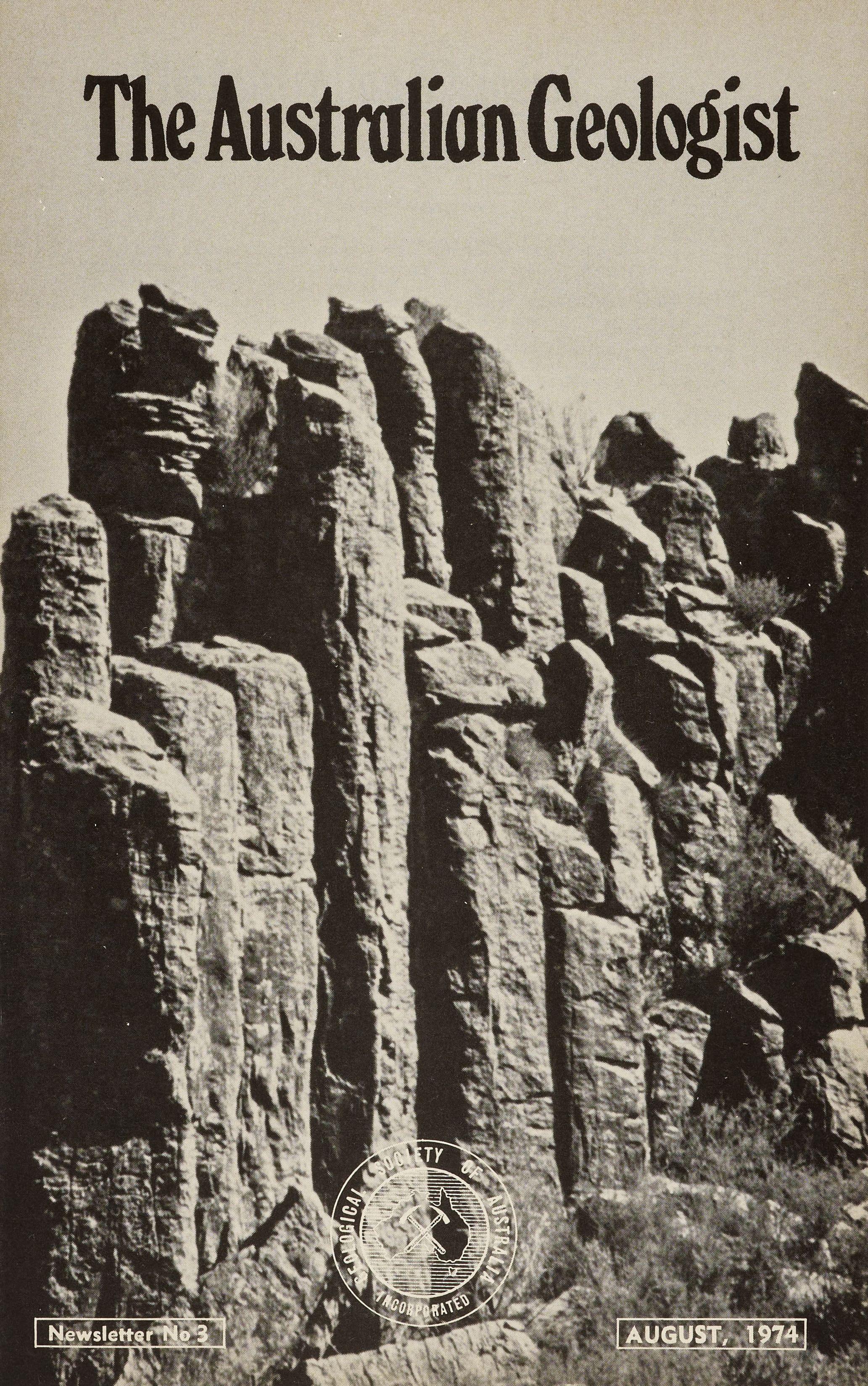
Cover Photo: Columnar jointed outcrop of small intrusive body within the Canobolas Volcanic
Complex in Central New South Wales.
The Australian Geologist
NEWSLETTER OF THE GEOLOG ICAL SOCIETY OF AUSTRALIA I NCORPORATED No. 3
August 1974
ED ITORI AL
This issue of the newsletter contains the second information bulletin on the Twenty -fift h I.G.C. prepared by the Secretary, Sandy Renwick. With the prospe ct of numbers approaching 3000 from 80 countries we are certain to be in for a busy period in Au g ust 1976 and in the months before, and alread y many society members have been involved in planning technical sessions, organising excursions and entertainments.
By the time the Congress is over it is likely that just about all the geologists in Australia wi ll have had some part in its affairs . This is a far cry from the First Congress held in Pa ris in 1878 when Arch ib a ld Liversidge was Australia's sole representative and is some meas·ure of our growth in the last one h u ndred years.
Alth ough there wi ll undoubtedl y be p u blicity about the Congress it seems to me t ha t the profession might be able to use the Congress period in an even more po sit ive way to inform the public what geolog y is all about a nd how knowledge of geology makes a p ositive contribution to man's activities.
Colour T.V. will be well entrenched by 1976 and a s eries of well p lanned programmes on aspects of geology could make really g ood viewing and be useful in the lon g t erm for educational purposes. Could we do - for instance - 'Th e Growth of Australia' - The Shield, the Adelaide Geosyncline (or the pre sent equivalent O.K. term), The Eastern Highlands , the Great Artesian Basin, The Pleistocene g lac iation - the list is endless? Perhaps those divisions not directly involved in congress organisation might give the idea a thought. Local sponsorship for eac h segment could probably be arranged and something of permanent value presented.
A follow-up at the time of the congress using topquality speakers from overseas might also be fruitful, perhaps under the aegis of some of the special ist g roups.
It isn't too late to get moving on suc h a pro ject but if it is going to be d o ne it wi ll have to start now.
SOCIETY MATTERS
Prior to the r e cent joint specialist's meeting in Brisbane a Council meeting was held, at tende d by representatives o f all divisions and specialist groups. Among th e matte rs dealt with b y Council were revise d rules, central office accom·· modation, computerization o f membership r ecords, Australian Geology Convention 1975, capitation fees, publication s, I.G.C., act ivities of civisions, specialist groups and committees, geological monuments, and numerous other items.
The revised Rules draft p re pared ty former Federal secretar y Mike Rickard, was a tribute t o his interest in Society affairs. The rules have been rearranged into a more logi cal form dealing with membersh ip matters, Organization and Ac tivities in order and there are b ot h major additions and deletions. The draft ha s now been referred back to-Divisions
and Groups for their comments. Interested members should contact ~ouncillors or local secretaries for cocies of the draft and pass on significant comnents to Dr. M~ J . ~ickard , Dept. of Geology, A N.U ., Dox 4, P .O., Canberra , A.C.T 2601. The rules wi ll be out into final form or ior to nresen tation at the General Meeiing of the Society ln Adelai~e next May.
The Society is hoping to mcve its Central office accommodation in Sydney in the near future, as the site is sub-standard in many ways. The long - term idea is to set up office in the Science Centre, no~ being created to replace the p resent Science House, but the Centre building will not be fully renovated before 1977. He hope to conclude arrangements shortly for a suitable office for the interim period.
Also on the cards is computerization of Central Office procedures, but we are looking rather critically at the costs said to be involved.
Council approved the planning carried out by the South Australian Division for the first Australian Geology Convention which is scheduled for May 12 - 16, 1975 in Adelaide. The keynote symposium is to be ~roterozoic rocks and fossils of Australia' .
The Society, through divisions, has been involved in a number of submissions to the enquiry on the National Estate, and it is encouraging to see that the final report takes geological matters into account. As a follow up on these matters Council decided to co - ordinate the various unofficial divisional sub-committees for the preservation of geological monuments by creating a Federal Committee. Dr. Colin !3ranch of South Australia was named as convener.
Capitation fees to Divisions were again increased following representation by the Tasmanian delegate.
Hon. Editor, Kenneth Townley, pointed out that papers offered for publication in the Journal arrived in several rushes, following Tertiary institution vacation periods, making for an irregular work load. Ten of 55 papers offered were rejected mainly on the basis of being of pu rel y local interest, though some \vere too su~-:erf icial. Average time from receiving to sending to press was about three months. Some delays have resulted from manuscripts being sent to potential referees, who proved to be on leave overseas. The Editor requ ests Institutions to send him lists of people on leave. Such lists will help greatly to reduce delays.
The Joint Specialists Groups meeting held in Bri sbane in July was a great succ ess and attracted a total registration of 330. Brian 1-Ia\•1kins, Chairman of the Orgar1izing Committee, was overwhelmed by the usual last-minute enro lm ent , which forced him to make a hurried reorint of the Meetina Abst racts. The Comnittee is to be commended in coping with th~ situation but some consideration by members who could enrol much earlier is surely warranted.
Members are reminded of the Special Publications of t:ie Society which are available for purchase, with special prices for members. Snecial Publication No. 4 - Mes ozoic and Cainozoic Essays.in Honour of Isabel Cookson ($ 8-5 0) is one of the latest.
AUSTRALIA ANr DEEP SE A DRILLING
Since the middle of 1973, the Sedimentology Specialist Group Committee, and individual Specialist Group me mbe rs, have been promoting Australia n financial involvement in the International Program of Ocean Drilling (IPOD), which will succeed the Deep Sea Drilling Program (DSDP) in mid - 1975. The sum involved would be betwee n US$250,00 and US$1 million a year.
In Septembe r 1973, after an approach to the Minister for Science and the Minister for Minerals and Energy by the Special- ist Group Committee, Dr. P. J. Cook was enable d to attend a JOIDES Planning Committee Meeting in Zu ric h , which p rovided valuable information on IPOD. In November the Sedimentology Newsletter carried an editorial advocating an Australian financial involvement. In January 1974, Associate Professor J. J. Veevers initiated the idea of a Challenger Centenary Symposium, to consider DSDP data and prospect. This meeting will be held in Sydney in August.
Also in January , Dr. K. A. W. Crook, acting for the Specialist Group Committee, suggested to Professor D. Hi l l, G.S.A. President, that the G.S.A. should estab l ish a Deep Sea Dril li ng Committee, to receive an invitation for Australian participation from JOIDES, and then approach the Australian Government. This was deemed a matter for the Australian Academy of Science, and a submission was put to the February meeting of the Academy Council by the Specialist Group Committee. This advocated negotiations between the Academy and JOIDES, and the Academy and the Australian Government, through a specially established National Committee on Deep Sea Drilling. It was warmly endorsed by the G.S.A. Executive in a letter to the Academy.
Late in February, Associate Professor G. H. Packham wrote to the Ministers for Science, and Minerals and Energy, asking if they would be interested in receiving a report on DSDP, IPOD and the prospects for Australian participation upon his return from Scripps in April. They were interested, and the report was written at the end of April.
Meanwhile, in the Academy, the Specialist Group submission was off to a good start, thanks to prompt staff work by the Academy office. Members of app r opriate National Committees had their comments back for the Academy Counci l meeting in mid - March. Then came a set-back. The Council, which has a soil physicist as its sole geoscientist, felt unable to reach a deciiion, and referred the matter to a special committee, chaired by Professor Ringwood, to report early in June.
Because of the large sums of money involved, and the necessity of forward planning, the Specialist Group Committee was hoping the Australian Government could be approached in February or March. Also, your dead wombat in Canberra (with an ear to the ground) believed a prompt approach would have been timely. The dela y might have been critical, but for two extraneous events that would have delayed consideration of any proposal. The May 18 election operated thus here, while in North America recons i deration of the relationships between JOIDES, DSDP and the Na t ional Science Foundation was dela ying a formal approach to Australia.
In the event we may have been lucky, and lost no advantage. But I believe that in future the Geological Society must itself represent the interests of its members to the government.
The Academy Council at its June meeting wholeheartedly endorsed the scientific worth of the DSDP-IPOD. It decided to write to JOIDES suggesting th ey approach the Australian Department of
Science, and to the Department urging Australian participation. No National Committee on Deep Sea Drilling was established.
Although initiative has hitherto come from within the Sedimentology Specialist Group, IPOD is of potential interest to all geoscientists. The Specialist Group therefore asked G.S.A. Council in July to take over its concern, by establishing a broadly based Deep-Sea Drilling Committee. The formation of this Committee was approved by Council and it was formally established under the Chairmanship of G. H. Packham.
K.A.W.C.
BOOK REVIEW
Stratigraphic Problems of the Later Precambrian and Early Cambrian.
Edit. J.B. Jones and B. McGowran. Special Paper No. 1, Centre for Precambrian Research, University of Adelaide. iii+ 70 pp. 1972.
Price: $A 2-00 (including postage).
This inaugural Special Paper of the Centre for Precambrian Research, University of Adelaide, is a fitting tribute to Professor Martin F. Glaessner on the occasion of his official retirement. Professor Dorothy Hill provides a full account of Glaessner's distinguished career, and a bibliography of his scientific publications.
In addition there are four excellent reviews of aspects of pre - Cambrian and early Cambrian stratigraphy and palaeontology. Brian Daily presents a comprehensive, world-wide review of the base of the Cambrian and the first Cambrian faunas, Professor Glaessner contributes an important paper on early metazoan evolution, W. V. Preiss outlines the stromatolite succession of the Proterozoic, and J. A. Cooper appraises certain isotopic age determinations.
To those palaeontologists and stratigraphers interested in the origins and early developmental history of organisms and the problems of defining the base of the Cambrian, this inexpensive volume will be indispensable. One minor defect is the poor quality of the two half-tone plates accompanying Daily's paper.
Professor R. W.R. Rutland intimates in the foreword that 'this volume will be the first of a series of Special Papers covering the various projects of the Centre ' . If this first Special Paper is any guide, the series will hold very considerable interest for geologists in the years ahead.
B. D. Webby.
GRl,DUATE QUALI FICATIONS AND EMPLOYMENT
It has beco me apparent in recent years that the scope of emp l oyment opportunities for three-year degree graduates is decreasing. In p articular government emplo ye rs such as the geological surveys and B.M R have specif i ed i n print or otherwise a mi nimum requirement of four years training i e. a honours degree, for a graduate applicant. This trend has now extended into the industrial area where more job specifi cations are placing emphasis on h onours degrees as minimum qualifications for employment Although the upgrading in qualifications re quirement s is in many ways related to surplus manpower resulting from closure of firms following the post -boom depression, there has been over the last decade an overa ll trend towards higher qualifications for conventional geological j obs Again thi s may be due to an increase in the proportion of job applicants with higher degrees - par ticul arly if we cons idered the influx of overseas g raduates. The point of the matt er is that several problems have arisen for geolo gy departments and geo lo gy undergrad uat es because of this situation.
1. Potential geo lo gy und ergraduates, put off by job prospects for three year graduates, may foresake the science:
(a) if they cannot enrol at an institutio n offering more than a three yea r c ourse, or
(b) if they see financial or family problems in going beyond thre e yea rs.
2. Many geology departments in tertiar y institutions offer no more than a three year degree or its equivalent (?) . Due to i nternal administrative and financial restrictions, any possibility of expand ing beyond the present situation is inconceivable.
3 For all geology departments the question arises as to whether to continue with three- year courses or to re-structure courses so that a minimum of four yea rs is req uired before initial graduation. Some universities have already decided that in the professional area a four ye ar course is necessary.
The pertinent questions from these observations are then:
1 Is the three year qualification a professional qualification?
2. Do we al low individual organiza tions and companies to set , in an ad hoe manner, professional qualifications for geologists?
One possible way of overcoming these problems is th e establi shment of a professional Institution (similar to that being considered by the Geol~gical Society of London) which would determine minimum qualifications and also act as an arbitrator i n cases of discrimination in both the fields of qualifications and salaries. A profe ssional body such as this can also give authority to propositions put forward to administrators b y tertiary staff members indicating need for restructuri n g of courses or alteration in length of courses.
This brief resume will hopefully raise comments from others who have an interest in job prospects of geology graduates and/or have some thoughts about the establishment of a professional body for geologists.
D. Davidson, Lecturer in Geolog y W.A. Institute of Technology.
EMPLOYMENT POSSIBILITIES
In relation to the editorial by Dorothy Hill in the first Newsletter (No. 1), I would like to advis e you that th e re is an ope ning for a limited number of geologists at present in the field of "basic resources development " , includi ng clay and shale , limestone , crushed rocks , ornamental rocks, abrasive and refractory materials and industrial ceramics. To a larg e extent it would be rel a ted to development of industries i n country centres.
It wou ld be usually a matter of
(a) finding a company developing such basic resources, or
(b) forming a partne rship or company with the aid of people in industr y or others
During recent months it has been apparent that some finance institutions are showing an interest i n investing in such operations as mentioned earl ier, and the State or Australian Department of Decentralisation will often be a source of information regarding any existing operations and possible backers
I should stress that geological work as much may only occupy a fraction of the geologist's time (varies wi th time and situation), and I am classified by my employer as a "Staff Geologi st", "Proj ect Off i cer " and " Quality Control Officer" This b ri ngs u p the poin ts that quality control of the whole operation in this field not only provides more security of e mployment but also makes use of part of the general education acquired to become a geologist
George Winter , Holbrook, N S.W.
[On the above matter , L J. Peet, of 4 Asten Road, City Beach , 6015 , has sent me a copy of the lecture notes he uses i n a course to valuation students at Perth Technical Co ll ege. They cover both Introductory Geology and the Valuation of Extractive Industri es (mining, quarr ies, sand p its, etc ). The valuat ion part includes special characteristics of extractive industries, interest ca lculati ons and the legal aspects of compensation when land containing minerals or other extractive substances is resumed by Government. He will be happy to supply a copy of the notes to anyone who writes to him.]
-WANTED BACI< ISSUES OF JOURNA L-
To complete his personal set of the Society's Journal, Dr. A. F. Trendal would like to obtain one copy each of the fol l owing issues, which have long been out of print -
Volume 4
Volume 5
Volume 6 Part 2 Part 1 Part 2
Would anyone interested in offering any of these for sale please get in touch with him as Minera l House, 66 Adelaide Terrace, Perth 6000.
THE DIVISIONS
VICTORIAN NEWS
The Melbourne region has been yielding many of its geological secrets recently as the result of a massive attack by public authorities. The Geological Survey of Victoria has been carrying out detailed engineering geology studies of the Melbourne Underground Railway Loop and final reports are now being prepared. In collaboration with the Melbourne and Metropolitan Board of works the Survey is compiling surface and subsurface information about the Dandenong corridor.
The M.M.B.W. has numerous tunnels under construction. The South Eastern Trunk Sewer tunnel has been excavated between North Kew and Braeside (23 5 km) The northern 17 1 km was driven by boring machine in Silurian mudstone and sandstone incised by six buried channels , two of which passed below the tunnel . The southern 6.4 km was driven under compressed air in Tertiary and Silurian sediments.
Another tunnel running eastwards from Brighton to Oakleigh (7.7 km) exposed the irregular unconformity between Tertiary and Silurian for a total distance of 0.6 km. The Tertiary sediments were deposited in a rocky shoreline environment.
The South Eastern Effluent Outfall runs from Carrum to the Bass Strait at Boag Rocks (55 km). There are five tunnels Frankston tunnel (4.4 km) is in Tertiary and Ordovician Strata. Dromana Tunnel (6.5 km) is mainly in the granite of Arthur's Seat. There was a possibility that the tunnel would intersect the Selwyn Fault, one of the major faults bounding Port Phillip, but geological evidence is inconclusive. The remaining tunnels are in cemented and uncemented Pleistocene calcareous dune sands of the Nepean Pen i nsula.
19.2 km of the Thomson - Yarra tunnel for water supply has been completed and a further 10 km is to be constructed . This tunnel is in the dividing range 66 kms east of melbourne. Much of the tunnel is at right angles to the structural trend of Silurian and Lower Devonian sediments The stratigraphy is Peing studied by the Survey
Groundwater pollution studies are being carried out by the Survey in the southwest, north and southeast suburbs. The adjacent bays are also receiving attention.
An investigation of the beach and sea floor sediments of the St. Kilda area was undertaken during 1972 by the Ports & Harbors Division (Public Works) to provide background information for the St. Kilda mobile bed model at present operating at the Marine Models Laboratory, Port Melbourne. Close sampling to 5.5 m depth on three occasions during 11 months showed that a nearshore mobile zone of sediment movement , where sediment grain-size changes with time , i.e is weather dependent, is confined to depths of less than about 3.3 m; and offshore of this zone there is no change in grain size with time, indicating that the sediment in depths greater than 3.3 m is essentially out of the influence of wave action. The offshore sediment is generally coarser than the nearshore and the grainsize increases with increasing depth ; this sediment presumably was deposited at lower sea- levels and the nearshore zone contains the more mobile finer particles winnowed from this sediment and transported landwards by wave action.
A study is underway of the sediments and bar formations of the area from Safety Beach to Rye on the Nepean Peninsula. Beach profiles and beach and offshore samples have been taken and analysis is proceeding. It is also hoped to investigate the optimum grainsize for beach nourishment in this area by field and laboratory flume studies.
The Divis i on is at present building a sedimentation tube of the pressure transducer type , and a sled with mounted stadia rod for taking nearshore profiles
The westernport Bay Environment Study Group has called in geologists from
state bodies and Universities to investigate groundwater and Quaternary sedimentation and preliminary reports have already been issued.
The C.S I.R O Division of Applied Geomechanics has published an overall terrain evaluation report on Melbourne, one of its series of classifications for engineering purposes. The 1 : 250 , 000 sheet which accompanies this report can be fruitfully compared with the geological sheet of the same area.
Completion of the 1 : 250,000 maps of Victoria is scheduled for mid 1976 when a new 1:1,000,000 sheet will also be issued by the Survey.
Mr. Warren D. Hutchings has been awarded the W A Division's inaugural award for the outstanding final year student at WAIT. His prize is $50 cash and a medal presented at the Annual General Meeting . Awards of $25 and $15 respectively were made to Lawrie Miller and Joe Budrovich, for a contribution on palaeontology, and to Kerry Maquire , for a geology project These were the successful students in the 1973 Science Talent Search
The S.A . Division of the G.S A has been consulting with the Coast Protection Board regarding works being carried out to combat erosion along the metropolitan beaches along St Vincent Gulf. Valuable sections of Tertiary strata are being affected by these works and the G.S.A is attempting to minimize the effect on important geological sections
Following the floods which struck Brisbane early in 1974 , part of Coronation Drive, on the north bank of the Brisbane River immediately to the west of the city failed and because of the essential services and the nature of large - diameter drains and fresh water supplies to the city that lay beneath, this stretch of thoroughfare was closed. As part of the slip failure analysis Professor G E G Sargent of University of Queensland carried out a side scan sonar inspection of the area of the bank that lay below the surface of the Brisbane River. Traverses using a very high resolution side scan sonar system were made which provided detailed pictures of the submarine morphology The work was later extended, in conjunction with the Department of Harbours and Marine, to cover much of the course of the river through Brisbane. A resurvey of the river is planned later in 1974. The Survey Office, Department of Lands, has recently issued a flood map of Brisbane and suburbs showing the extent of flooding.
46th .l\t-iZAAS CONGRESS - CANBERRA - 20-24 JAl'-IUARY 1975.
The 9rogram for Section 3, Geology, is an interesting one including much on the Environment , and six excursions are planned.
i,rite to Dr. ~- A. Eggleton, Geology Department, Australian National University , Canberra, A . C.T . 2600, for details.
Dr. J.M. Dickins was awarded the Chresticn ~ica Gondwanaland Medal, the 7th award of 1969-1971, for his outstanding contributions in Permian palaeontology and stratigra p hy and in the palaeogeographic reconstruction of Gondwanaland, particularly in India and Australia.
Ken Plumb has been awarded the first Harold Raggatt medal Ken was awarded the medal for his presentation at the Third B.M.R Sympo s ium of a paper entitled ' Patterns of mineralization in northern Australia, with emphasis on lead and zinc '.
The Harold Raggatt Award will be presented annually in commemoration of the late Sir Harold Raggatt's contributions to earth sciences in Austra l ia and his association with the founding and deve l opment of the Bureau of Minera l Resources
A s pecial volume on the Tasman Geosyncline has been prepared by the Qu een sl and Division . Write to Dr. C . G Mu r ray, G.P O. Box 1820, Brisbane 4000 , enclosing $10.
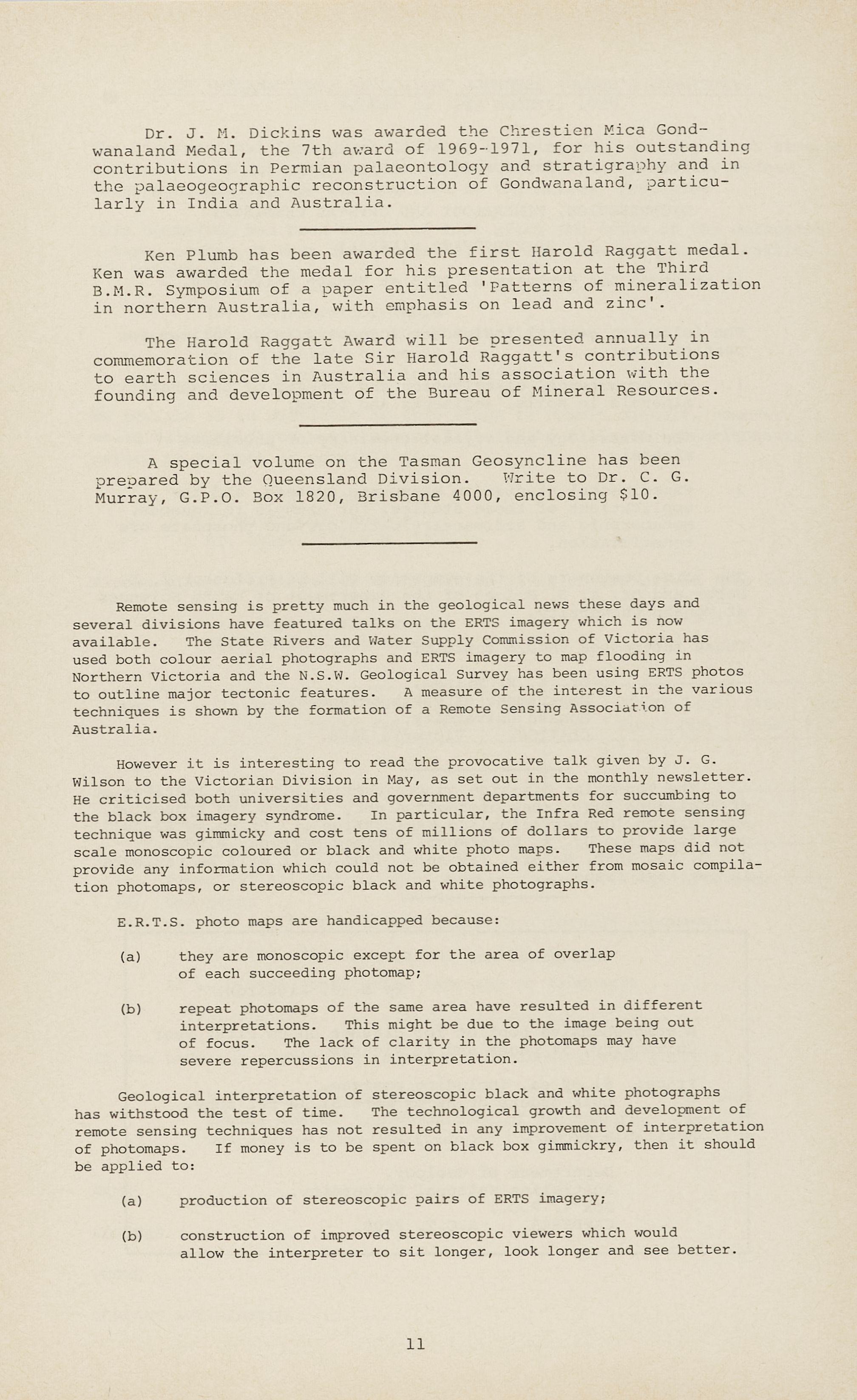
Remote sensing is pretty much in the geological news these day s and several divisions have featured talks on the ERTS imagery which is now available. The State Rivers and Water Supply Commission of Victoria has used both colour aerial photographs and ERTS imagery to map flooding in Northern Victoria and the N.S W Geological Survey has been using ERTS photos to outline major tectonic features. A measure of the interest in ~he various techniques is shown by the formation of a Remote Sensing Associoti on of Australia.
However it i s interesting to read the provocative talk given by J . G Wilson to the Victorian Division in May , as set out in the monthly newsletter . He criticised both universities and government departments for succumbing to the black box imagery syndrome. In particular , the Infra Red remote sensing technique was gimmicky and cost tens of millions of dollars to provide large scale monoscopic coloured or black and white photo maps. These maps did not provide any information which co u ld not be ob t ained either fro m mosaic compilation photomaps, or stereoscopic b l ack and white photographs
E.R T.S. photo maps are handicapped because :
(
a) they are monoscopic except for the area of overlap of each succeeding pho t o map ;
(b) repeat photomaps of the same area have resulted in different interpretations This might be due to the image being out of focus The lack of clarity in the photomaps may have severe repercussions in interpretation.
Geological interpretation of stereoscopic black and white photographs has withstood the test of time. The technological growth and development of remote sensing techniques has not resulted in any improvement of interpretation of photomaps If money is to be spent on black box gi mm ickry , then it should be applied to:
(a) production of stereoscopic pairs of ERTS imagery ;
(b) construction of improved stereoscopic viewers which would allow the i nterpreter to sit l onger, look longer and s ee better.
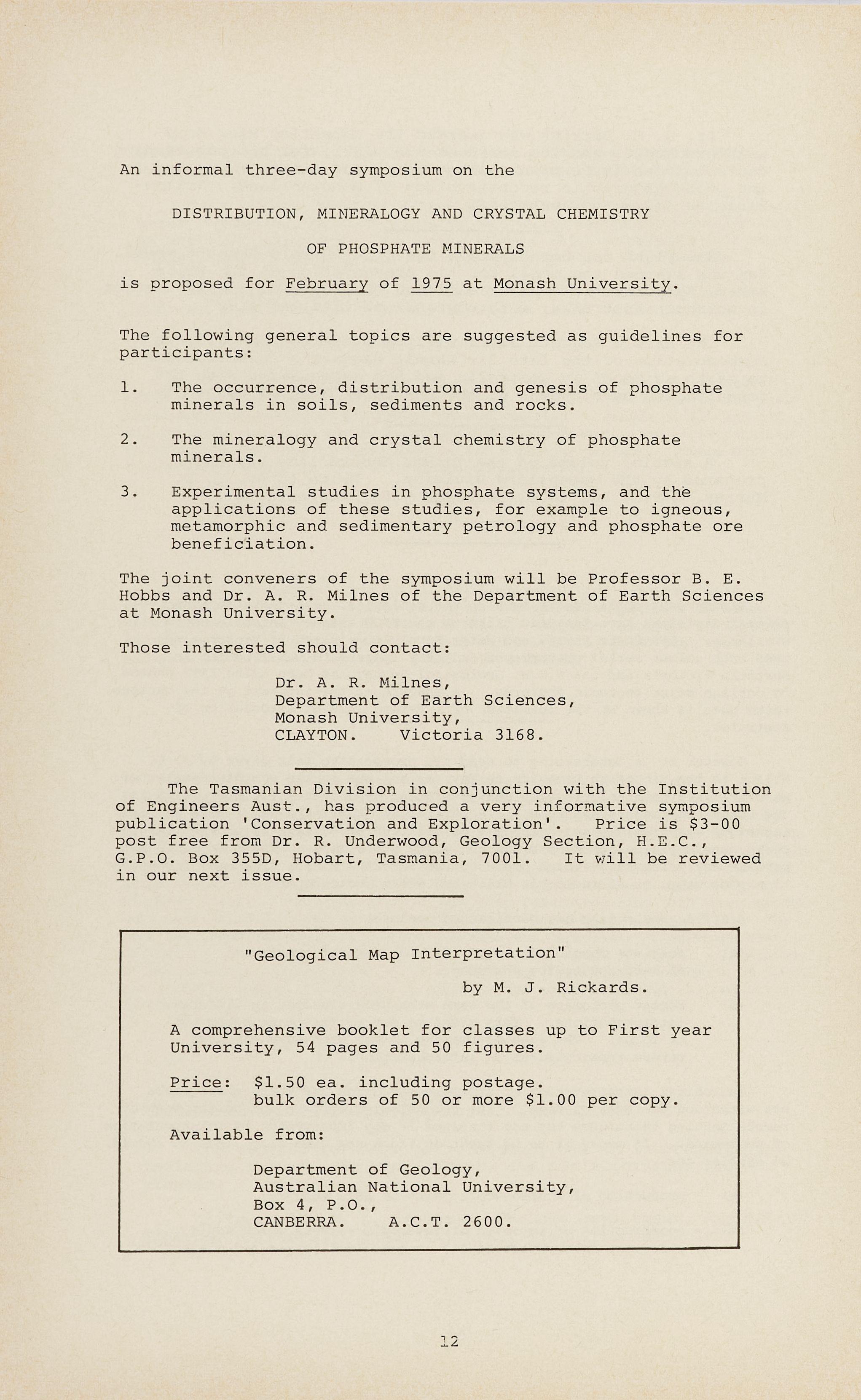
An informal three-day symposium on the DISTRIBUTION, MINERALOGY AND CRYSTAL CHEMISTRY OF PHOSPHATE MINERALS is proposed for February of 1975 at Monash University.
The following general topics are suggested as guidelines for participants:
1. The occurrence, distribution and genesis of phosphate minerals in soils, sediments and rocks.
2. The mineralogy and crystal chemistry of phosphate minerals.
3. Experimental studies in phosphate systems, and the applications of these studies, for example to igneous, metamorphic and sedimentary petrology and phosphate ore beneficiation.
The joint conveners of the symposium will be Professor B. E. Hobbs and Dr. A. R. Milnes of the Department of Earth Sciences at Monash University.
Those interested should contact:
Dr. A. R. Milnes, Department of Earth Sciences, Monash University, CLAYTON. Victoria 3168.
The Tasmanian Division in conjunction with the Institution of Engineers Aust., has produced a very informative symposium publication 'Conservation and Exploration'. Price is $3-00 post free from Dr. R. Underwood, Geology Section, H.E.C., G.P.O. Box 355D, Hobart, Tasmania, 7001. It will be reviewed in our next issue.
"Geological Map Interpretation" by M. J. Rickards.
A comprehensive booklet for classes up to First year University, 54 pages and 50 figures.
Price: $1.50 ea. including postage. bulk orders of 50 or more $1.00 per copy.
Available from:
Department of Geology, Australian National University, Box 4, P .0., CANBERRA. A.C.T. 2600.
25TH INTERNATIONAL GEOLOGICAL CONGRESS (WOMEN'S COMMITTEE)
16TH AUGUST to 25TH AUGUST, 1976 .
The International Geological Congress is being held for the first time in Australia from 16th August 1976 to 25th August, 1976 , and the Sydney University will be the Headquarters of the Ladies ' Committee.
This Committee has been formed to look after the wives of the delegates, a large number of them from overseas, and the Committee is now calling for Volunteers for:-
(a) Registration Tabl e (b) Hostesses in the Hos p itality Room (c) Hostesses on tours (d) Hostesses for luncheons
We realize it is difficult at this stage to commit oneself , however , it would help us if y ou would please fill in th e following questionnaire and return it as soon as possible to :
Mrs . D. J McGarry, 37 Waterhouse Avenue, ST. IVES N.S.W 2075 .
Please place a tick beside the function at which you may be able to help
(a) Registration Table (b) Hospitality Room
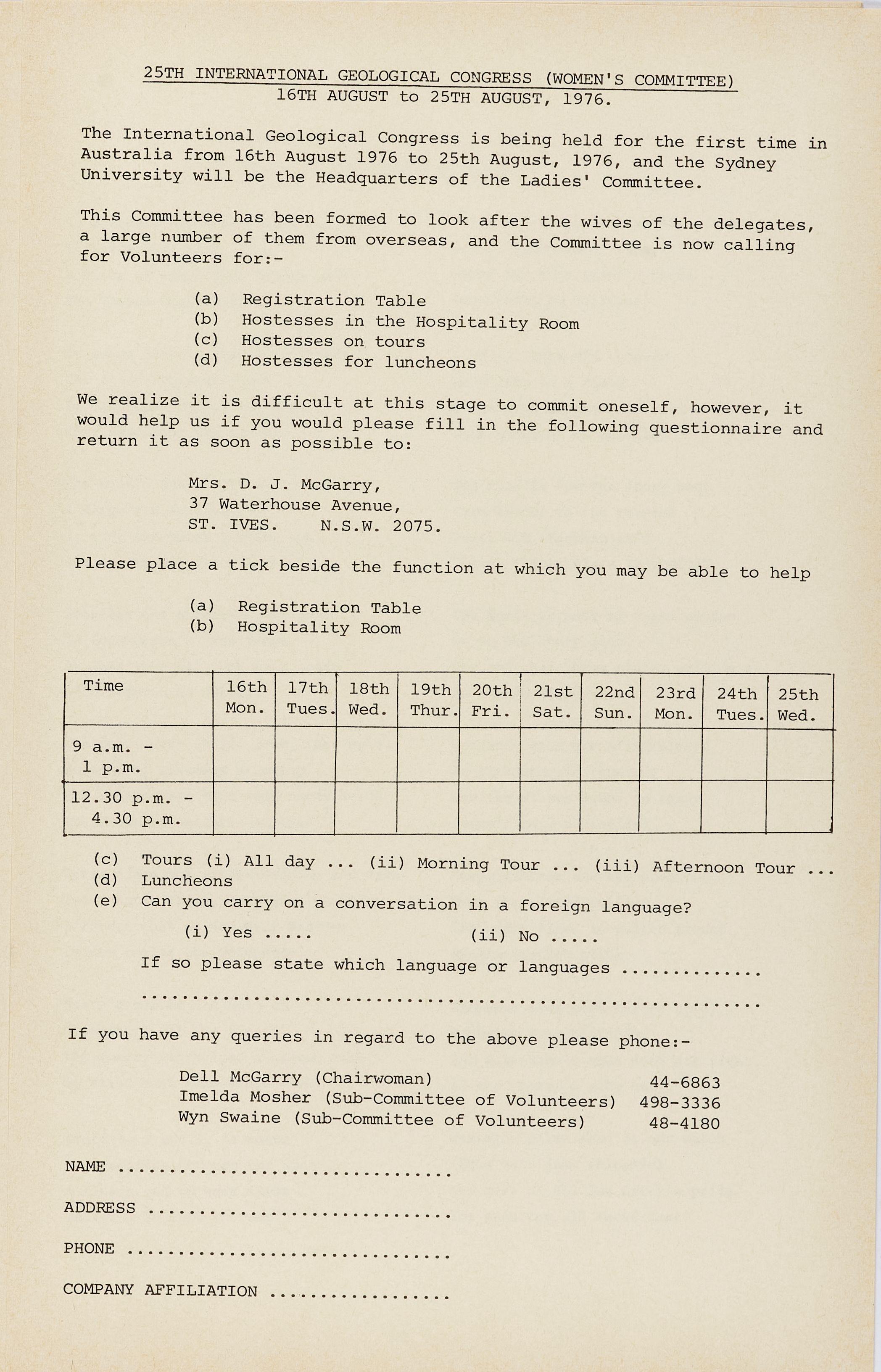
9 a ml p.m .
12 . 30 p.m4 30 p . m.
(c) Tours (i) All da y . . (ii) Morning Tour (iii) Afternoon Tour .. (d) Luncheons
(e) Can y ou carry on a c onversation in a foreign language?
(i) Yes .
(ii) No .
If so please state which language or languages
If y ou have an y queries in regard to the above please phone:-
Dell McGarr y (Chairwoman ) 44-6863
Imelda Mosher (Sub-Committee of Volunteers) 498-3336
Wyn Swaine (Sub- Committee of Volunteers) 48-4180
NAME
ADDRESS
PHONE
COMPANY AFFILIATION
THE GEOLOGY OF N.S.W.
In Southern New South Wales was born In Palaeozoic time
A block of crust that Crooky calls
The Tasman Geosyncline
It seems that in the distant past
The ocean floor was bent
By Cambrian subduction zones That Scheibner did invent.
The middle must curve down, not up; A large sialic dish. To stop the water running out , And losing all the flysch'.
Stauffer and Rickard drove away To Queanbeyan's vice traps. At last they did come back again With Ordovician nappes.
The folds were upside down, they said, Because of sediment slumping.
But Selley says that that needs herds Of dinosaurs (whilst jumping). 1
Three times the earth moved up and down
Two shorter times, one long 'un
A fourth that no-one will believe Is now called the Quidongan.
Nasty granites did well up Disturbing all the flysch!
The quartz, it helped a kraton make, Or thats what some would wish.
Granites Sand I, it seems Come pelting through the crust.
S always get up here first Whilst I is left to rust.
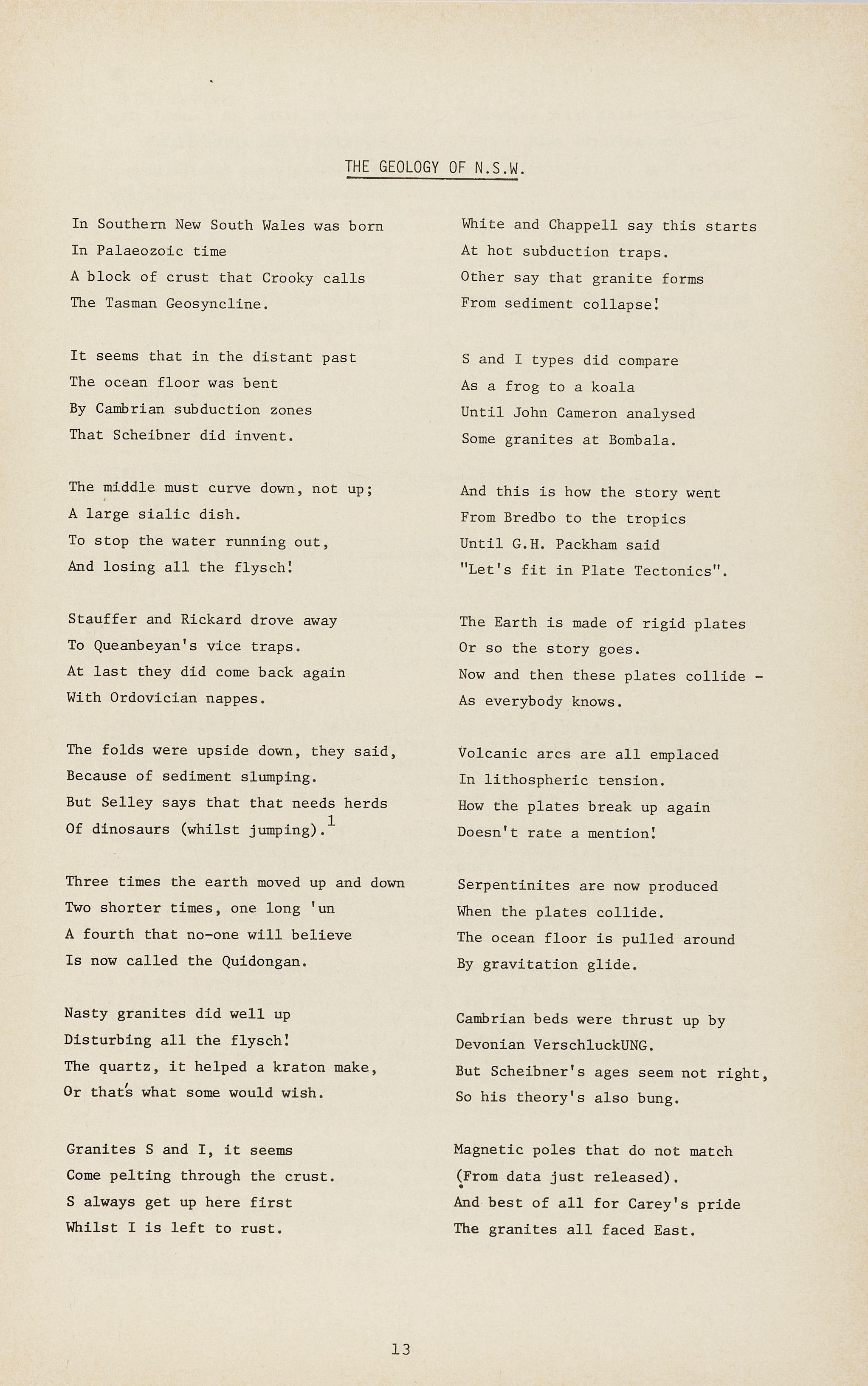
White and Chappell say this starts At hot subduction traps.
Other say that granite forms From sediment collapse'.
Sand I types did compare As a frog to a koala
Until John Cameron analysed Some granites at Bombala.
And this is how the story went From Bredbo to the tropics Until G.H. Packham said "Let ' s fit in Plate Tectonics" .
The Earth is made of rigid plates Or so the story goes. Now and then these plates collideAs everybody knows.
Volcanic arcs are all emplaced In lithospheric tension . How the plates break up again Doesn't rate a mention!
Serpentinites are now produced When the plates collide
The ocean floor is pulled around By gravitation glide.
Cambrian beds were thrust up by Devonian VerschluckUNG . But Scheibner's ages seem not right, So his theory's also bung.
Magnetic poles that do not match ~From data just released). And best of all for Carey's pride The granites all faced East.
"Some continental drift we have"
Or so John Griffiths said, "Before that you could drive a car From Coolac to N.Z. "
South East Aussie is made up Of lots of little bits
Harrington says "Amuse yo urselves With jigsaw puzzle fits".
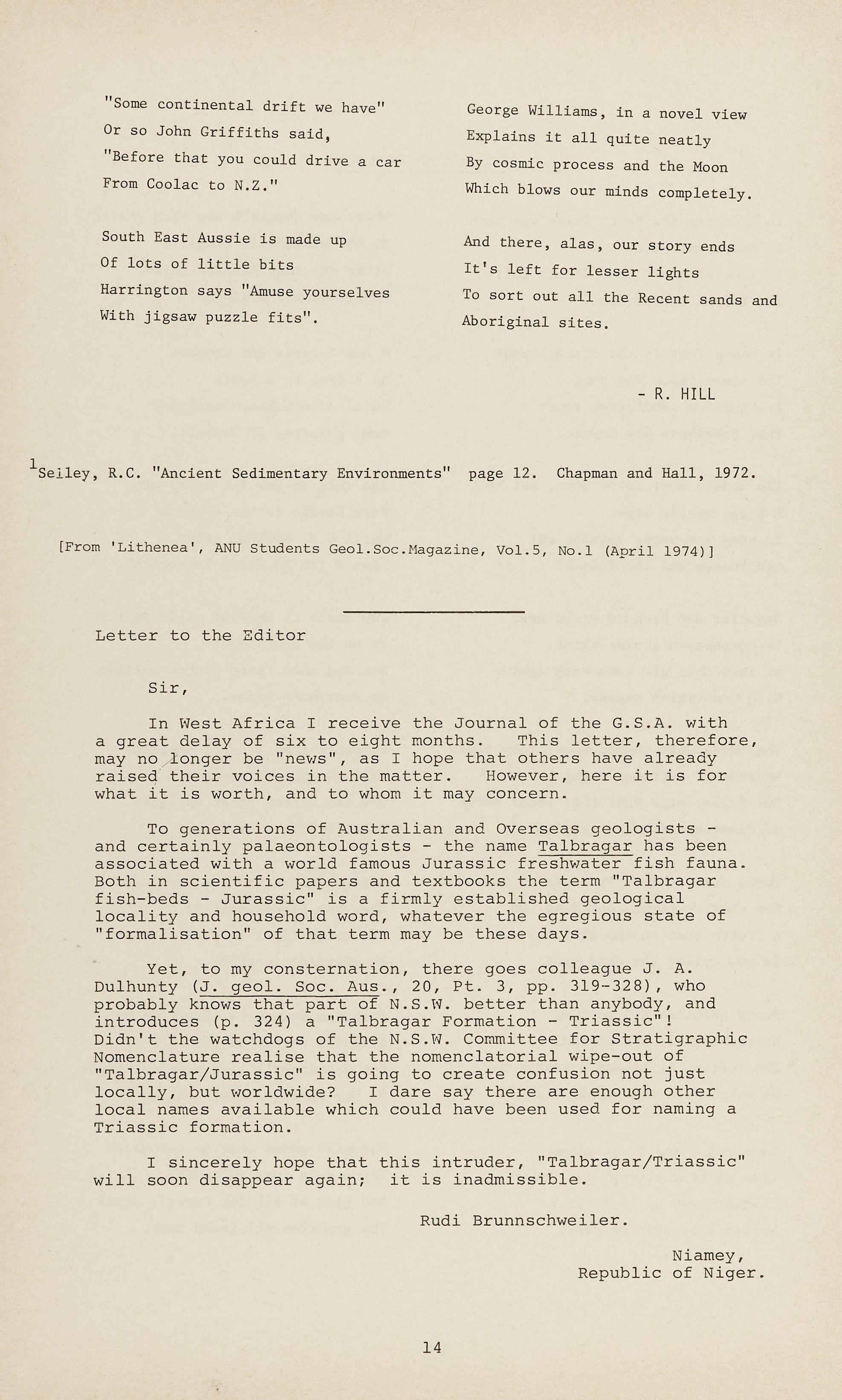
George Williams, in a novel view Explains it all quite neatly By cosmic process and the Moon Which blows our minds completely.
And there, alas, our story ends It's left for lesser lights
To sort out all the Recent sands and Aboriginal sites. - R. HILL
1 Selley, R.C. "Ancient Sedimentary Environments" page 12. Chapman and Hall, 1972.
[From 'Li thenea' , ANU Students Geo l. Soc.Magazine , Vol.5, No.l (April 1974)]
Letter to the Editor
Sir,
In West Africa I receive the Journal of the G.S.A. with a great delay of si x to eight months. This letter, therefore, may no longer be "news", as I hope that others have already raised · their voices in the matter. However, here it is for what it is worth, and to whom it may concern.
To generations of Australian and Overseas geo logistsand certainly palaeontologists - the name Talbragar has been associated with a world famous Jurassic freshwater fish fauna . Both in scientific papers and textbooks the term "Talbragar fish - beds - Jurassic" is a firmly established geological locality and household word, whatever th e egregious state of "formalisation" of that term may be these days.
Yet, to my consternation, there goes colleague J. A. Dulhunty (J. geol. Soc. Aus., 20, Pt. 3, pp. 319-328), who probably knows that pa rt of N.S.W. better than anybody, and introduces (p. 324) a "Talbragar Formation - Triassic"!
Didn't the watchdogs of the N.S.W. Committee for Stratigraphic Nomenclature realise that the nomenclatorial wipe-out of "Talbragar/Jurassic" is going to create confusion not just locally, but worldwide? I dare say there are enough other local names available which could have been used for naming a Triassic formation.
I sincerely hope that this intruder, "Talbragar/Triassic" will soon disappear again; it is inadmissible.
Rudi Brunnschweiler.
Ni amey, Republic of Niger.
BOOK REVIEW
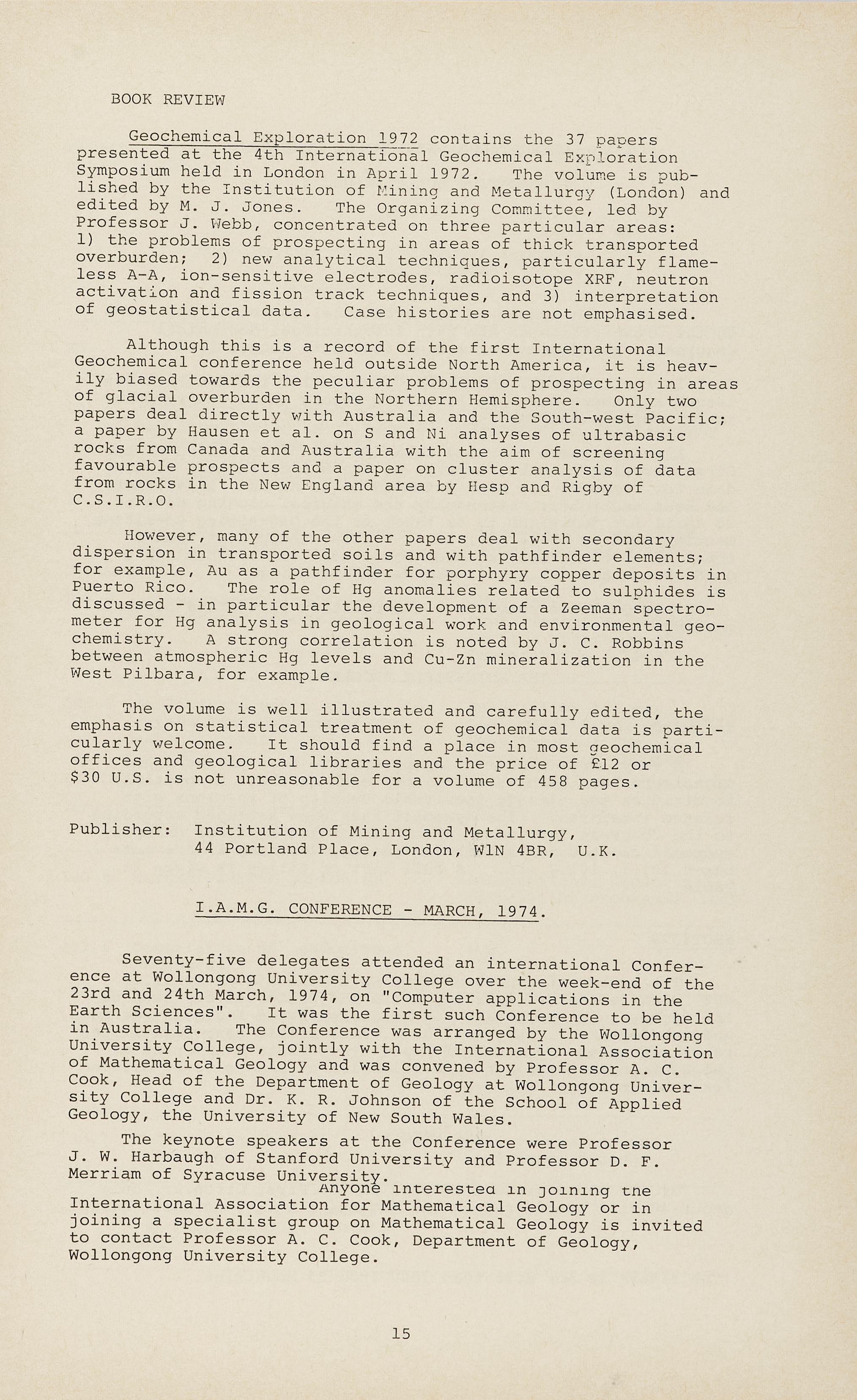
Geochemical Exp loratio n 1972 conta i ns the 37 pape rs presented at the 4th International Geochemical Ex p lorat i on Symposium held in Londo n in April 1972. The vol~me is published by t he Institution of E i ning and Metallurgy (London) an d edited by M. J. J ones . The Organizing Commit t ee , l ed by Professor J. Webb , concentrated on t h re e part icular areas: 1) the p roblems of prospect i ng in a r eas of thick t ransported overburden; 2) new analytica l t echniq ues, pa rticularl y flameless A-A, ion-sensitive e l ect rod es , radioisotope XRF, neutron activat~on and fission track techniques, and 3) interpretation of geostatistical data. Case histo ries are n ot e mphasised.
Although this is a record of th e first International Geochemical conference held outside No rth America , it is heavily biased towards the peculiar problems of prospecting in areas of g lacial overburden in the Northe rn Hemisphere . Only two papers deal di r ec tl y with Australia and the So uth-w e st Pacific; a paper by Hausen et al. on Sand Ni analyses of ultrabasic rocks from Canada and Australia with the a im of screening favourable p ros pec ts and a pape r on cluster ana lysis of data from rocks in th e New Eng lan d area by He sp and Rigby of C.S.I.R.O.
However, many of the other pape rs deal with secondary dispersion in transported soils and with pathfinder elements; for example, Au as a pathfinder for p or phy ry copp e r deposits in Puerto Rico The role of Hg anomalies relat ed to sulphides is discussed - in pa rticular th e dev e lopment of a Zeeman spectro- meter for Hg anal ysis in geological wo rk and env ironmental geoch e mistr y A strong correlation is noted by J. C. Robbins between atmospheric Hg l eve ls and Cu-Zn min e ralization in the West Pilbara, for exampl e
The volume is well illustrat ed and carefully edite d, th e emphasis on statistical treatment of ge ochemical data is parti- cularly we lcome. It should find a pl ac e in most geochemical offices and geo logical libraries and th e price of £l2 or $30 U.S. is not unreasonable for a volume of 458 page s .
Publisher: Institution of Mining and Metallurgy, 44 Portland P lace, London, WlN 4BR, U.K.
I.A . M.G. CONFERENCE - MARCH, 1974.
Seventy-five delegates attended an international Conference at Wollongong University College over the week-end of the 23rd and 24th March, 1974, on "Computer applications in the Earth Sciences" It was the first such Conference to be held in Australia. The Conference was arranged by the Wollongong University College, jointly with the International Association of Mathematical Geology and was convened by Professor A. c . Cook, Head of the Department of Geology at Wollongong University College and Dr. K. R. Johnson of the School of Applied Geology, the University of New South Wales.
The keynote speakers at the Conference were Professor J. W. Harbaugh of Stanford University and Professor D. F. Merriam of Syracuse University. Anyone 1nterestea in Joining tne International Association for Mathematical Geology or in joining a specialist group on Mathematical Geology is invited to contact Professor A. C Cook, Department of Geology, Wollongong University College.
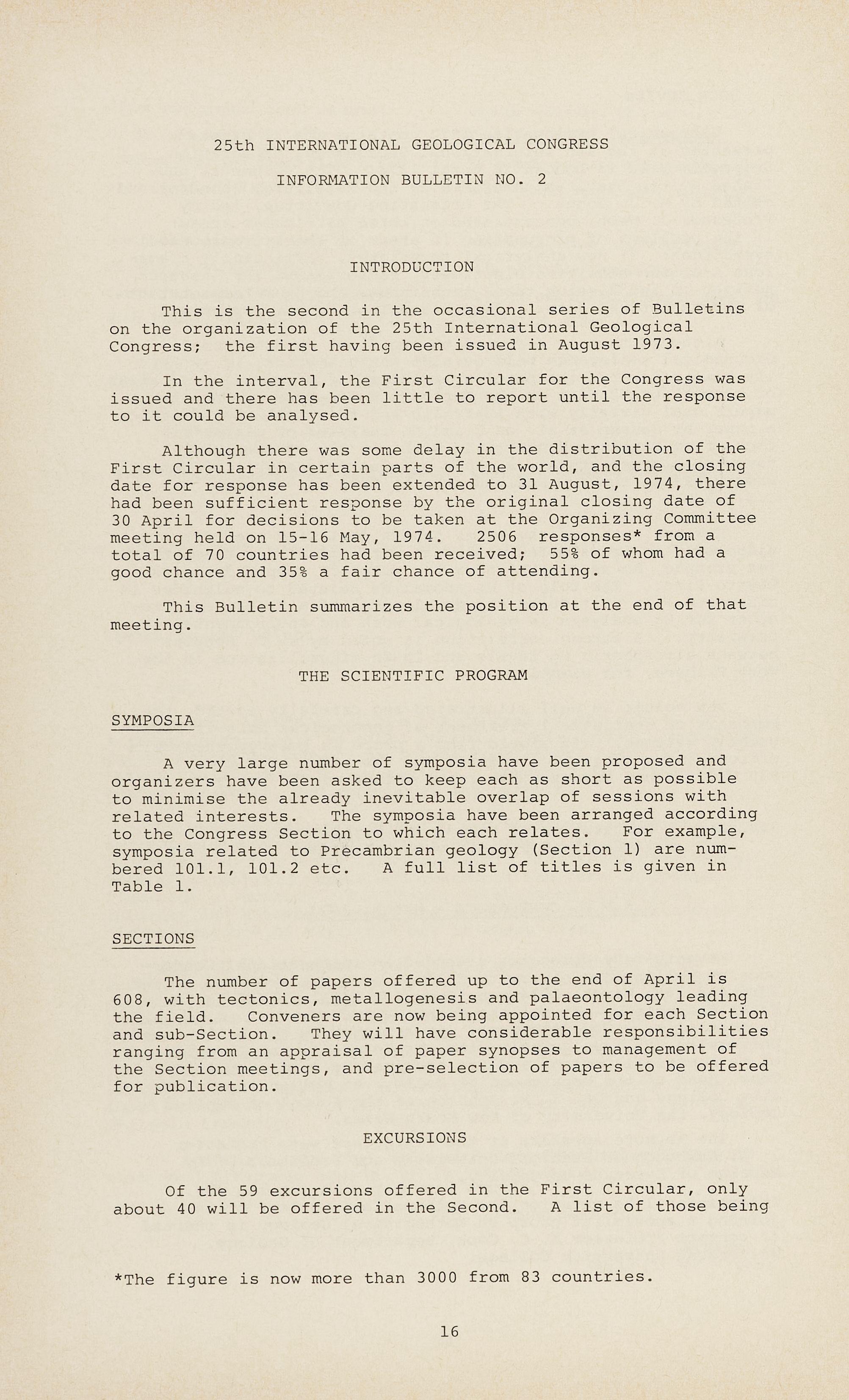
25th I NTER NA TIONA L GEOLOGICAL CONGRESS
I NFO RMATI ON BULLETI N NO. 2
I NTRODUCTION
This is the second i n the occasional series of Bullenins on the organization of the 25th International Geological Congress; the first havin g been issued in August 1973.
In the interval, the First Circular for the Congress was issued and there has b een little to report until the response to it could be anal y sed.
Although there was some delay in the distribution of the First Circular in c e rtain p arts of the world, and the closing date for response has been e x tended to 31 August, 1974, there had been sufficient response by the original closing date of 30 April for decisions to be taken at the Organizing Committee meeting held on 15-16 May, 1974. 2506 responses* from a total of 70 countries had been received; 55% of whom had a good chance and 35 % a fair chance of attending.
This Bulletin summarizes the position at the end of that meeting.
THE SCIENTIFIC PROGRAM
SYMPOSIA
A very large number of symposia have been proposed and organiz e rs have been asked to keep each as short as possible to minimise the already inevitable overlap of sessions with related interests. The s ymposia have been arranged according to the Congress Section to which each relates. For example, symposia related to Precambrian geology (Section 1) are numbered 101.1, 101.2 etc. A full list of titles is given in Table 1.
SECTIONS
The number of papers offered up to the end of April is 608, with tectonics, metallogenesis and palaeontology leading the field. Conveners are now being appointed for each Section and sub-Section. They will have considerable responsibilities rangin g from an appraisal of paper synopses to management of the Section meetings, and pre-selection of papers to be offered for p ublication.
EXCURSIONS
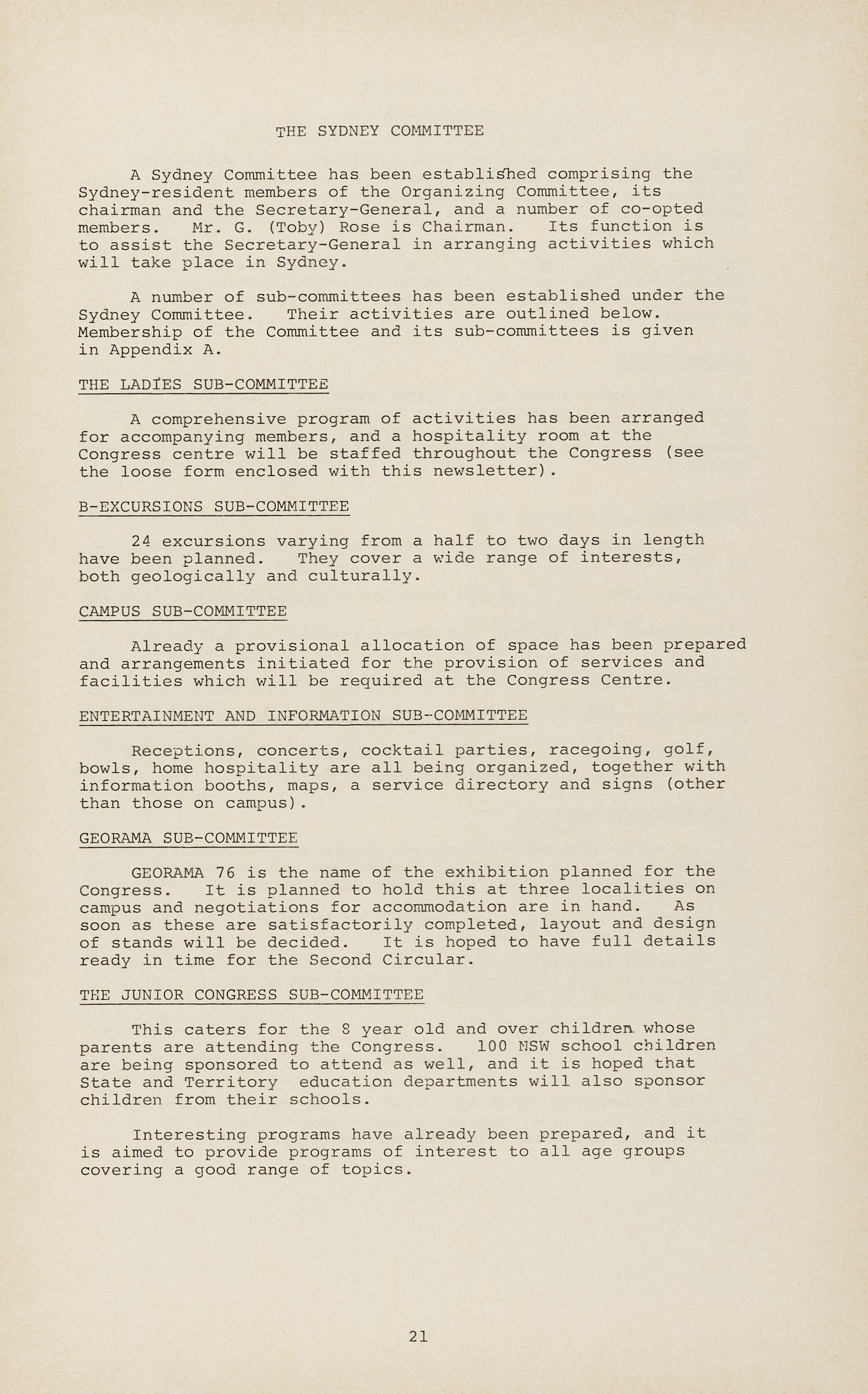
Of the 59 excursions offered in the First Circular, only about 40 will be offered in the Second. A list of those being
*The figure is now more than 3000 from 83 countries
r e tained (subj e ct in s ome cas es to re v i ew in Au g ust, 1 9 74) i s gi ve n in Ta b l e 2.
TAB LE 1
25t h IN TERNA TIO NA L GEO LOGICAL CON GRESS
SCHE DUL E OF SYMPOSI A
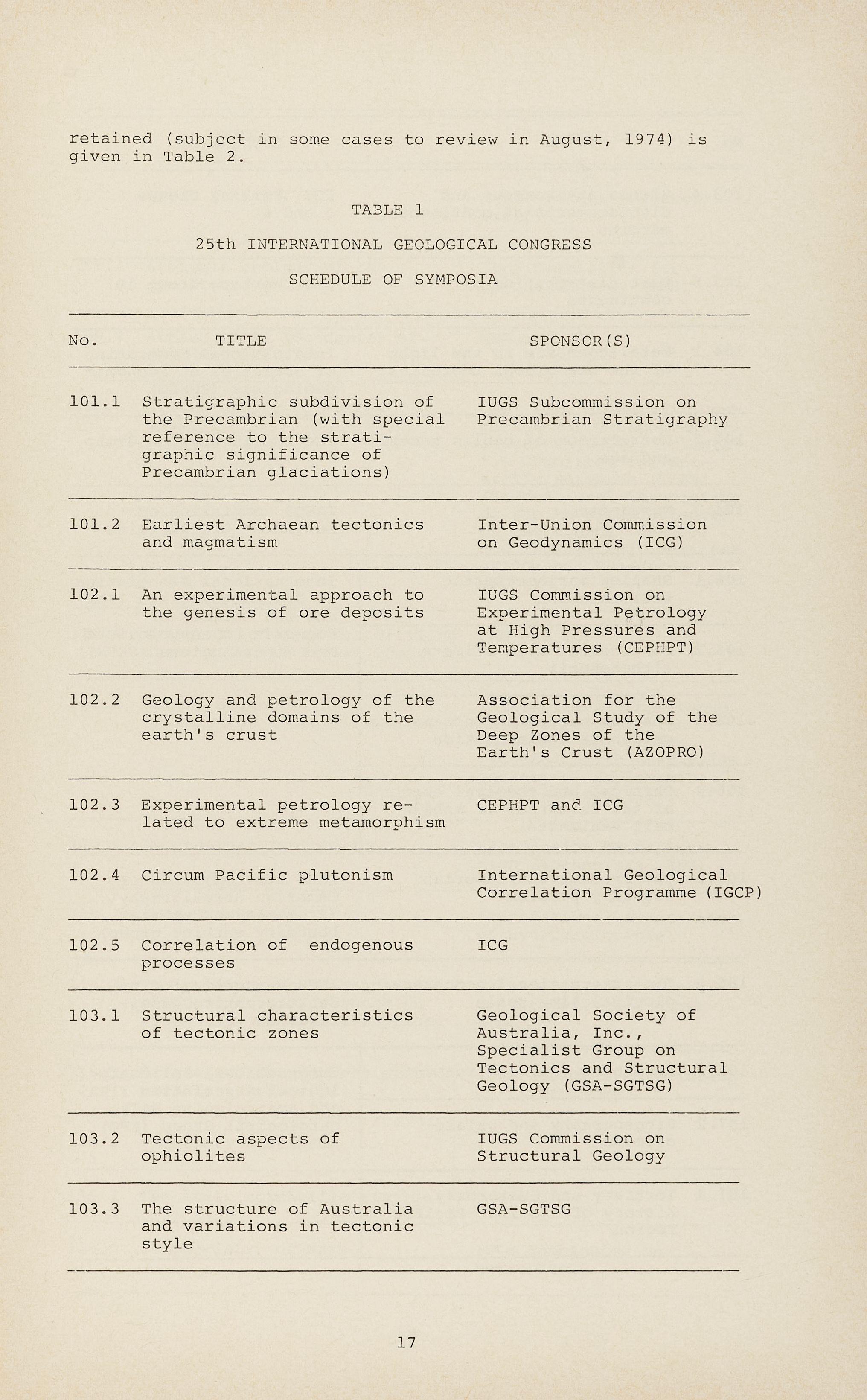
No . TITLE
101 . 1 Stratigra p hic subdivision of the Precambri a n (with special referenc e to the stratigraphic significance of Precambrian g laciations)
10 1 2 Earliest Archaean tectonics and magmatism
102 1 An experimental a pp roach to the g enesis of ore deposits
SPONSOR(S)
IUGS Subcommission on Precambrian Stratigraph y
102.2 Geolog y an d p etrolog y of the cr y stalline domains of the earth's crust
102 3 Exp erimental petrolog y relate d to extreme metamorphism
102.4 Circum Pacific plutonism
Inter-Union Commission on Geodynamics (ICG)
IUGS Co!TUY\ission on Ex perimental Petrology at High Pressures and Temp e ratures (CEP HPT)
Association for the Geological Study of the Deep Zones of the Earth's Crust (AZOPRO)
CEP HPT and ICG
International Geological Correlation Programme (IGCP)
102 . 5 Correlation of endogenous ICG p rocesses
103 1 S tructural characteristics of tectonic zones
103.2 Tectonic aspects of o p hiolites
103 3 The structure of Australia and variations in tectonic st y le
Geological Society of Australia, Inc , Specialist Group on Tectonics and Structural Ge ology (GSA - SGTSG)
IUGS Commission on Structural Geolog y
GSA-SGTSG
No. TITLE
103.4 Stress environment and displacements at continental margins
103.5 Past distribution of continents
104.1 Metallogenesis in the light of the new global tectonics
104.2 Correlation of kaolin genesis and age
104.3 Manganese
106.1 Shallow marine elastic sedimentation
106.2 Continental arid climate lithogenesis
106. 3 Shallow marine and non--marine carbonate sedimentation
106 .4 Physical and chemical aspects of the formation of mobile belt sediments
106.5 The Precambrian/Cambrian boundary problem
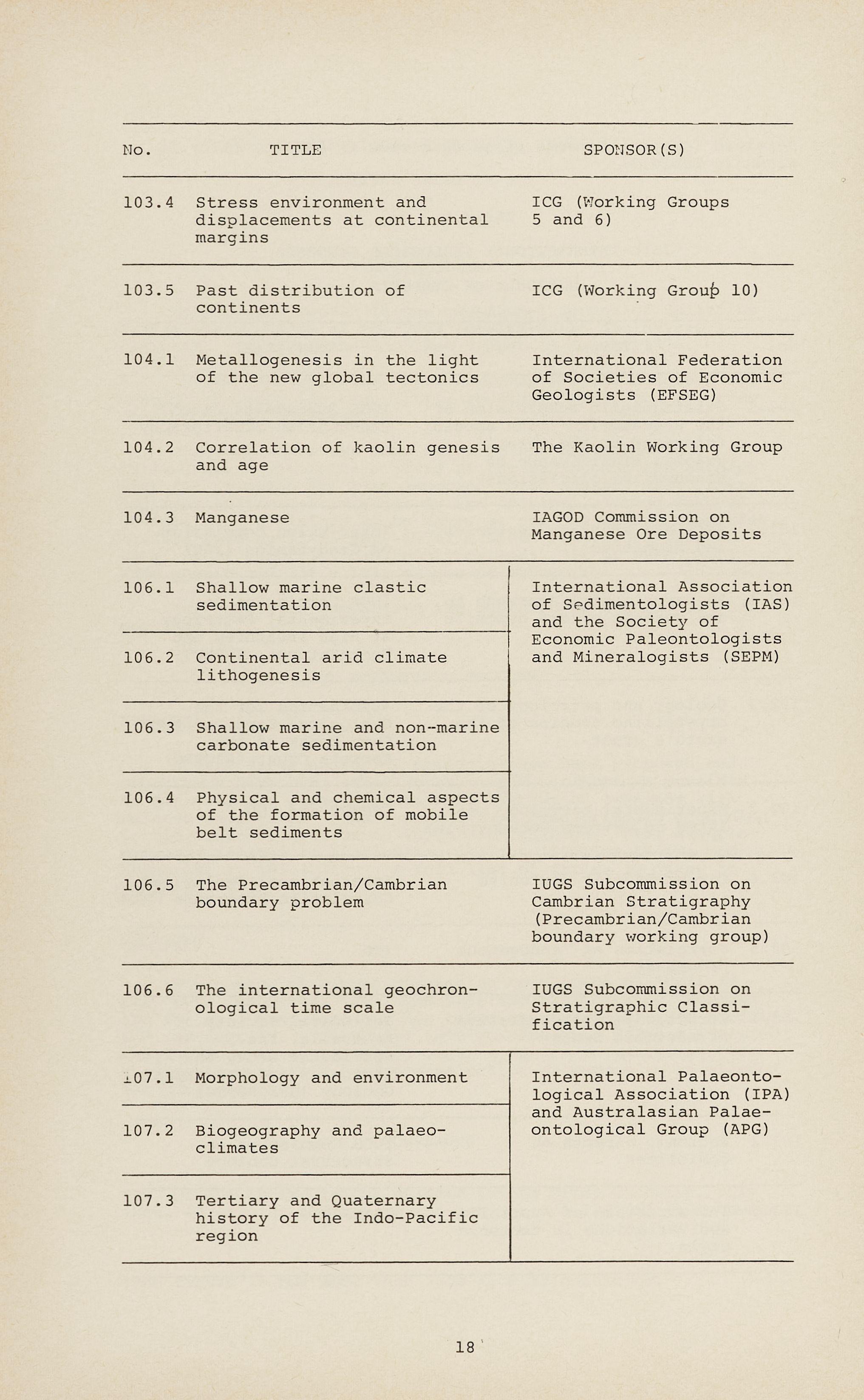
106.6 The international geochronological time scale
~07.1 Morphology and environment
107 .2 Biogeography and palaeoclimates
107.3 Tertiary and Quaternary history of the Inda-Pacific region
SPmlSOR (S)
ICG (Working Groups 5 and 6)
ICG (Wor k ing Group 10)
International Federation of Societies of Economic Geologists (EFSEG)
The Kaolin Working Group
IAGOD Commission on Manganese Ore Deposits
International Association of Sedimentologists (IAS) and the Society of Economic Paleontologists and Mineralogists (SEPM)
'
IUGS Subcommission on Cambrian Stratigraphy (Precambrian/Cambrian boundary working group)
IUGS Subcommission on Stratigraphic Classification
International Palaeontological Association (IPA) and Australasian Palaeontological Group (APG)
No. TITLE
107.4 Trace fossils
108.l Economic geology of the sea floor
108.2 Active plate boundaries of the West Pacific
108.3 Circum-antarctic marine geology
SPONSOR(S)
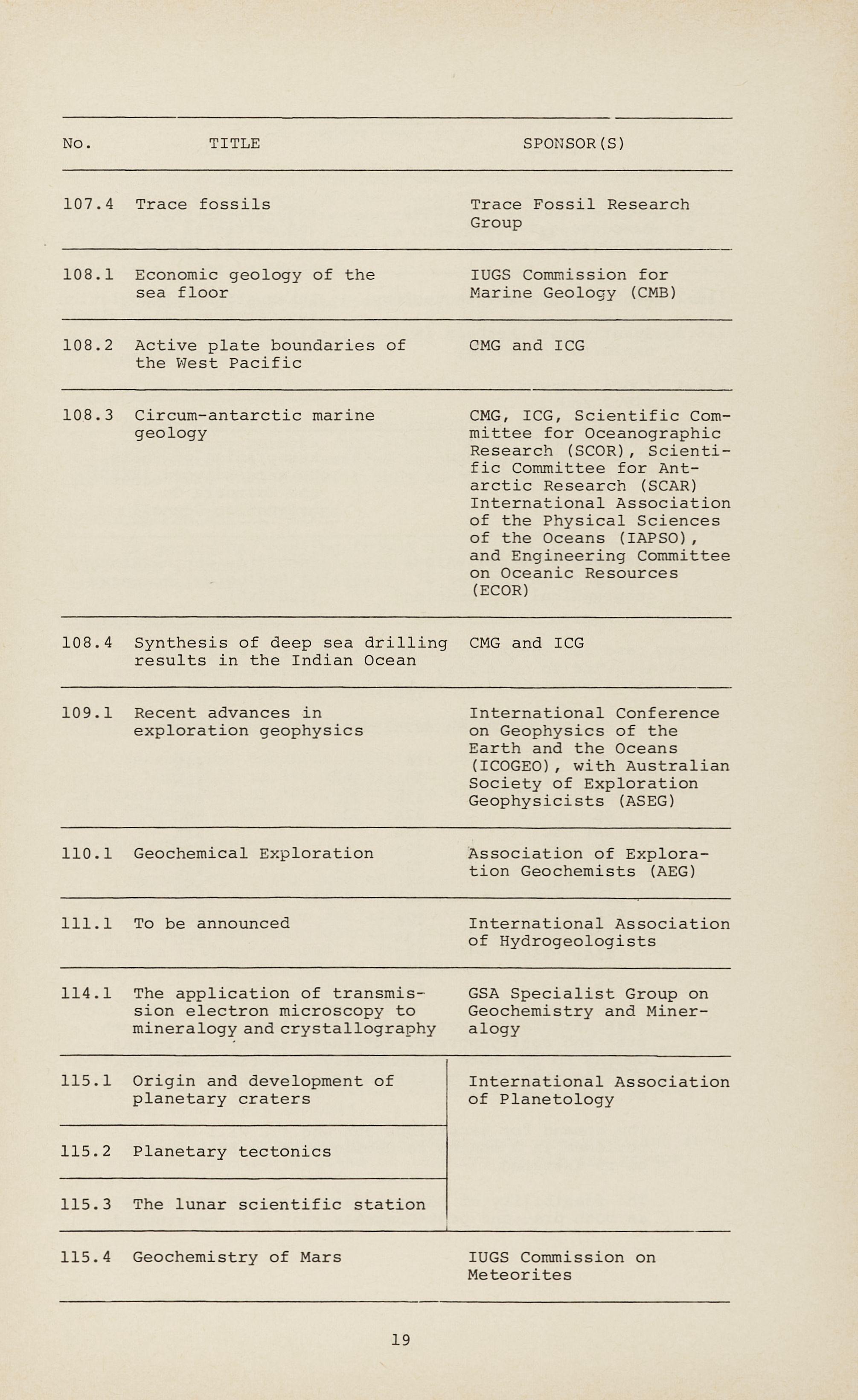
108.4 Synthesis of deep sea drilling results in the Indian Ocean
109.l Recent advances in exploration geophysics
110.l Geochemical Exploration
111.l To be announced
114.l The application of transmission electron microscopy to mineralogy and crystallography
115.l Origin and development of planetary craters
115.2 Planetary tectonics
115.3 The lunar scientific station
115.4 Geochemistry of Mars
Trace Fossil Research Group
IUGS Commission for Marine Geology (CMB)
CMG and ICG
CMG, ICG, Scientific Committee for Oceanographic Research (SCOR), Scientific Committee for Antarctic Research (SCAR)
International Association of the Physical Sciences of the Oceans (IAPSO), and Engineering Committee on Oceanic Resources (ECOR)
CMG and ICG
International Conference on Geophysics of the Earth and the Oceans (ICOGEO), with Australian Society of Exploration Geophysicists (ASEG)
Association of Exploration Geochemists (AEG)
International Association of Hydrogeologists
GSA Specialist Group on Geochemistry and Mineralogy
International Association of Planetology
IUGS Commission on Meteorites
No. TITLE
116.l Application of data-base management systems to geological problems
11&.2 Random processes in geolog y
116.3 Quantitative methods in exploration geology
116 4 'Open' papers on subjects of 116.2 and 3
117.l Writing, editing and publishing geology
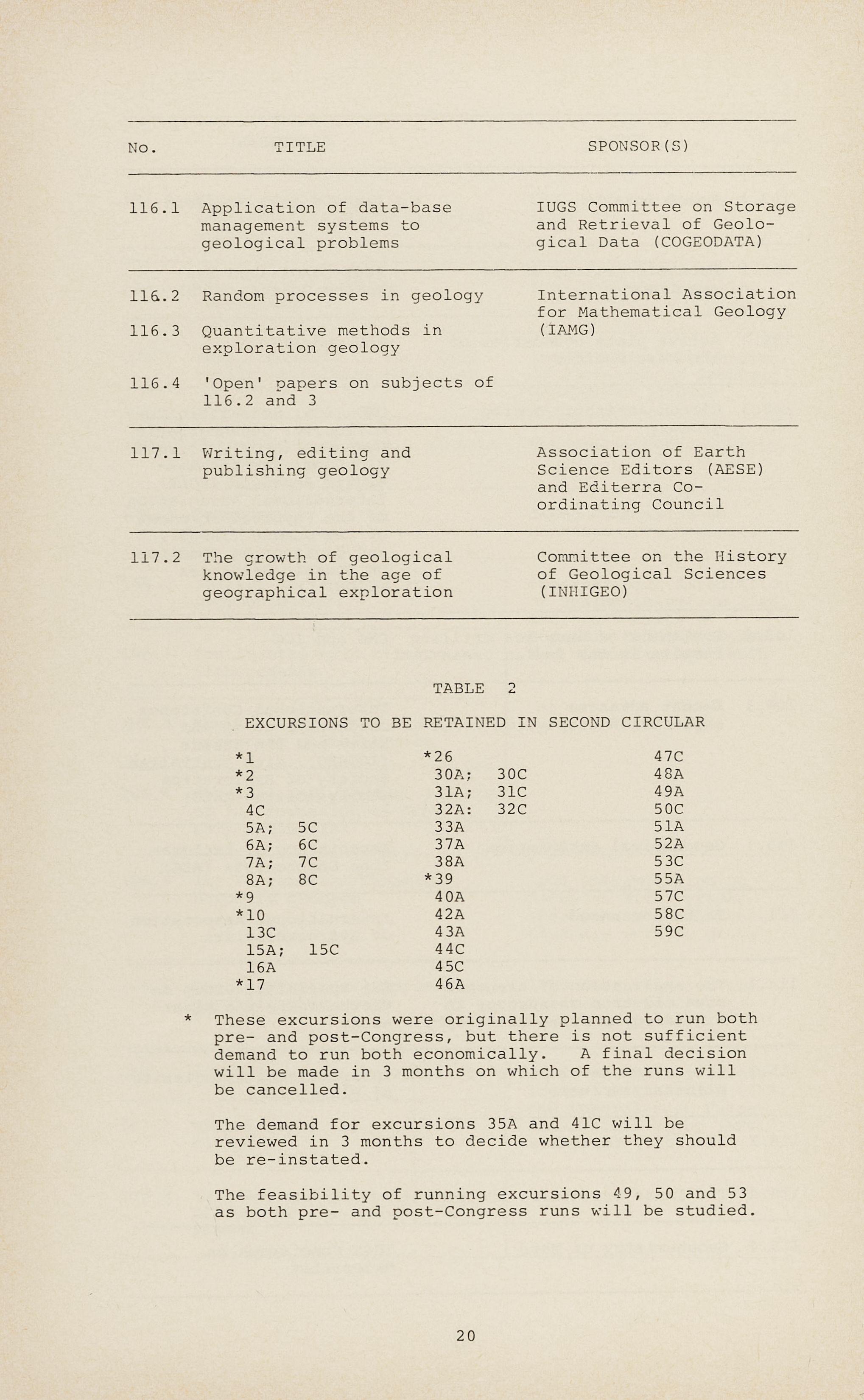
117.2 The growth of geological knowledge in the age of geographical exploration
SPONSOR(S)
IUGS Committee on Storage and Retrieval of Geological Data (COGEODATA)
International Association for Mathematical Geology (IAMG)
TABLE 2
EXCURSIONS TO BE RETAINED IN
*l *26
*2 30F.; 30C
*3 31A; 31C
4C
Association of Earth Science Editors (AESE) and Editerra Coordinating Council
Comnittee on the History of Geological Sciences (INHIGEO)
SECOND CIRCULAR
32 A: 32C
SA; SC 33A 6A; 6C 37A 7A; 7C 3BA BA; BC *39
*9 40A
*10 42A
13C 43A
15A; lSC 44C 16A 45C
*17 46A
These excursions were originally planned to run both pre- and post - Congress, but there is not sufficient demand to run both economically. A final decision will be made in 3 months on which of the runs will be cancelled.
The demand for exc ursions 35A and 41C will be reviewed in 3 months to decide whether they should be re-instated.
The feasibility of running excursions 49, 50 and 53 as both pre- and post-Congress runs will be studied.
THE SYDNEY COMMITTEE
A Sydney Comm i ttee has been established comprising the Sydney-resident me mbers of the Organizing Committee , it s chairman and the Secreta r y-General , and a number of co - opted members. Mr. G. (Toby) Rose is Chairman. Its function is to assist the Secretary-General in arranging activities which will take place in Sydney.
A number of sub-committees has been established under the Sydney Commi tt ee. Their activities are outlined below. Me mber sh ip of the Commit t ee and it s sub-committee s is given in Appendix A.
THE LADtES SUB - COMMITTEE
A comprehensive program of a ct ivitie s has been ar r anged for accompany i ng members, and a hospitality room at the Congress centre will be staffed throughout the Congress (see the loose form enc l osed with this newsletter).
B- EXCURSIONS SUB - COMMITTEE
24 excursion s varying from a half to two days in l ength have been planned. They cover a wide range of interes ts , both geologically and culturally.
CAMPUS SUB - COMMITTEE
Already a provisiona l allocation of space has been prepared and arrangemen t s initiated for the provision of services and facilities which wi l l be required at the Congress Centre.
ENTERTAINMENT AND INFORMATION SUB-·COMMITTEE
Receptions, concerts , cocktail parties, racegoing, golf , bowls, home hospitality are all being organized, together with information booths, maps, a service directory and signs (other than those on campus).
GEORAMA SUB - COMMITTEE
GEORAMA 7 6 is the name of the exhibition planned for the Congress. It is planned to hold this at three localities on campus and negotiations for accommodation are in hand. As soon as these are satisfactorily completed, layout and design of stands will be decided. It is hoped to have full details ready in time for the Second Circular.
TBE JUNIOR CON GRESS SUB-COMMITTEE
This caters for the 8 year old and over children whose parents are attending the Congress. 100 NSW school c~ildren are being sponsored to attend as well, and it is hoped that State and Territory education departments will also sponsor children from their schools.
Intere s ting programs have already been prepared, and it is aimed to provide programs of interest to all age groups covering a good range of topics.
~ISCF.LLANEA
BADGE DESIGN In spite of some interesting and well-drawn designs having been submitted, none was considered wholly suitable for all the many requirements for a badge, and no prize was given. All competitors were individually informed of the decision.
OPENING CEREMONY
The use of the Opera House has been reauested for the Opening Ceremony, but confirmation is not expected until September, 1974, when the 1976 schedules are prepared.
ACCOMMODATION
2,500 hotel rooms and a large number of University College rooms have been block-booked for the Congress. Accommodation will be allocated by QANTAS in response to applications received after the forms have been distributed with the Second Circular.
DEADLINES
The following are some of the more important deadlines so far set:
31 August 1974 - revised date for response to First Circular.
13 September 1974 - copy. for Second Circular to SecretaryGeneral.
1 October 1975 - synopses of papers to Secretary-General.
29 February 1976 - abstracts of papers to Secretary-General.
29 February 1976 - last day for reduced rate ($60-00) prepayment of registration fee.
COMMEMORATIVE STAMP
In spite of a very determined effort to persuade PMG's Department to follow established precedent and produce a commemorative stamp, the request was finally refused.
INSTITUTIONAL INVITATIONS
Oversea invitations have been sent out, and invitations to Australian institutions to be represented at the Congress will be sent out in July, 1974.
FEEDBACK
The Organizing Committee would like to be kept informed of any activity - e.g. special publications - planned to coincide with the 25th International Geological Congress.
APPENDIX A
25TH INTERi~ATIONAL GEOLOGICAL CONGRESS SYDNEY COMMITTEE AND SUBCOMMITTEE MEMBERS
SYDNEY COMMITTEE
Mr. G. Rose - Chairman
Mr. D. McGarry
Prof. G. Philip
Mr. A. Renwick
Prof. P. Howard
Mr. K. Horler
Mr. S. Hannaford
Dr. G. Taylor
Mr. L. Furlong
Prof. F. Beavis
Mr. J. Elliston
Dr. N. Fisher
Mrs. Libby Bates, QANTAS representative
Mr. w. Foskett, Transport Co-ordinator
Mr. M. Lake, Advisor from Premiers Department
Mr. W. Langley, Secretary.
LADIES SUBCOMMITTEE
Mrs. Del McGarry - Chairman
Mrs. Barbara Probert - Vice Chairman
Mrs. June Walpole - Treasurer
Mrs. Carmel Rose - Secretary
Mrs. Peggy Loughnan
Mrs. Mardi Seedsman
Mrs. Rosemary Markham
Mrs. Wyn Swaine
Mrs. Imelda Mosher
Mrs. June Ivanac
CAMPUS SUBCOMMITTEE
Prof. G. Philip - Chairman
Mr. E. Atkinson
Mr. B. O'Leary
Dr. H. Jenkins
Mr. w. Chesnut
Mr. R. Blackwood
Dr. J. Roberts
ENTERTAINMENT AND INFORMATION SUBCOMMITTEE
Mr. K. Horler - Chairman
Dr. J. Pickett
Mr. L. Furlong - Deputy Chairman
GEORAMA SUBCOMMITTEE
Mr. D. Pinkstone - Chairman
Mr. R. Lucas
LOCAL EXCURSIONS SUBCOMMITTEE
Mr. c. Adamson - Chairman
Dr. D. Branagan
Mr. 0. Shiels
Dr. I. Wallace
Miss Jeanette Adrian
Mr. D. Berkman
Mr. H. Geutsche
Prof. F. Loughnan
CANBERRA CONVENER
Mr. E. G. Wilson
NEWCASTLE SUBCOMMITTEE
Prof. Beryl Nasher
Mr. G. Harman
Mr. S. McKnight
JUNIOR CONGRESS SUBCOMMITTEE
Mr. C. McDonald - Chairman
Mr. A. Watson
Miss Jeanette Mccusker
Mr. D. Nicholson
Mrs. Joyce Brister
Miss P. Bucknell
Mr. w. Sykes