POSTING AS A PUBLICATION -
CATEGORY B
Newsletter Editor: ,
D. F. Branagan, Department of Geology & Geophysics, The University of Sydney, N.S.W. 2006.
Phone: (02) 692 2358 or 692 2912
THE PRESIDENT'S PAGE
Society Secretary: S. M. Bye, Exploration Department, Broken Hill Pty. ,Co. Ltd. , G.P.O. Box 86A, MELBOURNE, Victoria 3001.
AS instructed by the last Council, the Victorian Executive of the Society is moving to draw up recorrnnendations on the proposal to establish an Australian Geoscience Council (AGS). This matter was discussed briefly in the President's Page in Newsletter No. 21 and your President has called a meeting of all scientific bodies concerned with the geological sciences. The group is large and includes the Australian Society of Exploration Geophy:,icists, Aus. I.M.M., Association of Exploration Geochemists, Petroleum Exploration Society of Australia, ANZAAS and all the various state Royal Societies. The me~ting is scheduled for Monday 9th April 1979 and it will be a criticial one in that the future of an Australian Geoscience Council will largely depend on the attitude of this group. I have already had informal discussions with the President of the Australian Academy of Science, Dr. L. T. Evans, and it would seem that the Academy would be happy to join in the discussions at a later date.
Assuming that this first meeting would support the notion of an AGS, the second stage would be to bring in the BMR and other appropriate Commonwealth _ bodies, the State Surveys, tertiary educational institutions and the mining indu.stry.· This is going to be a major initiative for the Society but one which would seem to have broad support among the membership.
By now the Divisions and Specialist Groups should have received the final draft of the document entitled "A Geological Science Policy for Australia" for corrnnent. The latest version contains the views of a large number of members who submitted comments on the original document presented at Townsville. My own opinion is that this document is not the highly researched and "punchy" manifesto for the future development of the geological sciences in Australia that it should be, but it is a reasonable and worthwhile first attempt.
The new editor of our Journal, John Truswell, has provisionally changed the name of the Publications Committee to the Editorial Board and increased the membership to 22. You will soon see some other changes to the format of the Journal which we hope will continue to grow in stature as a journal of importance to the international geological community. However there are problems looming up ahead and the main one is a government proposal to remove the "Book Bounty" for periodicals which could increase our publication cost between $6000 and $8000 in a full year. Your President is currently joining with other learned societies to lobby against the government's proposal which, if it comes about, could seriously affect the future economic stability of our Society.
Nominations are at present being called for the award of the first W.R. Browne Medal. All Divisions, Specialist Groups and individual members are eligible to make nominations and the procedures for doing so are available from divisional secretaries. Nominations will close on 1st September 1979 and the first award will be made at the Hobart Conference.
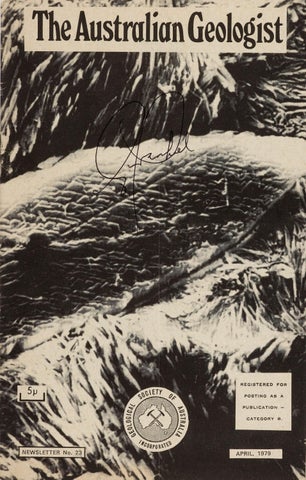
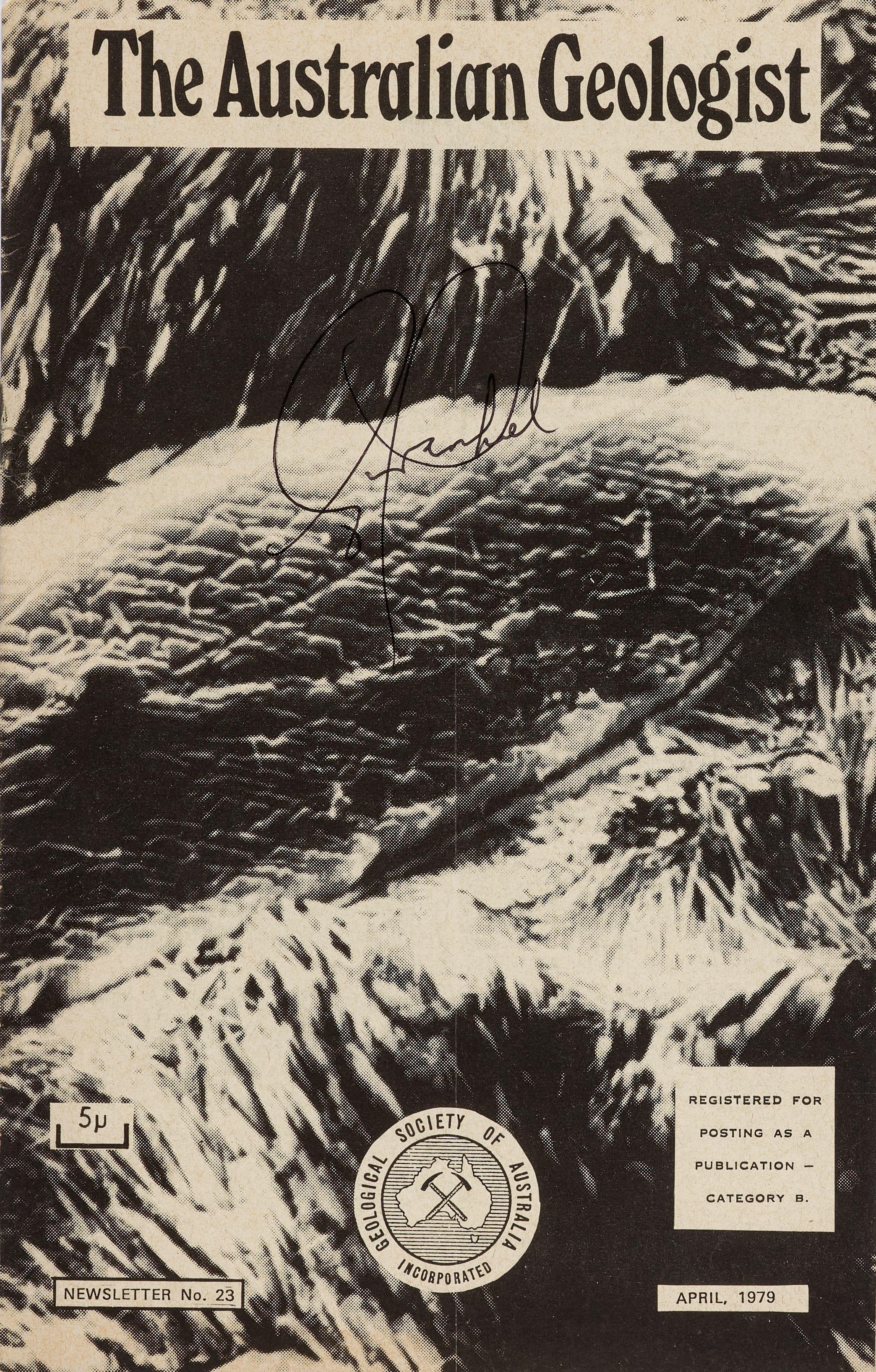
[cover Photo: see Feeling Jaded, page 6]
EDITORIAL
In this issue there is news of our two newest specialist groups. The executive of the ~ngineering Geology Group (E.G.G.) has put its collective shoulder to the yoke and is planning an ambitious programme, including sessions at the Society conference in Hobart next January .
It is pleasing ~hat the group has begun discussions with the Australian Geomechanics Society which is the national link with the International Society of Engineering Geolog y. It is unsatisfactory that the organization of Australian geology has left the Society unconnected with an international body of such importance.
I Engineering geology is a field in which geologists have the rare opportunity to influence other professionals and perhaps to convince the general public that geology has some use. Judging from various policy decisions around the country we still have a long way to go in the matter.
It is also true that there is no snob value in engineering geology. Many members still have the idea that it is necessarily a lower-grade activity unbecoming to the brighter members of our profession It is to be hoped that the new group will not remain too long in its shell, but will emerge and e x ert an influence both within and without the confines of the Society.
Similar remarks could be applied to the coal geologists who seem to be thinking in terms of a newsletter along the line~ of those produced sporadically by other specialist groups .
Coal geolog i sts have in the past published rather more than have engineering geologists and it will be a welcome move if much of the expertise learned in various areas becomes available in case histories or in some other form.
As I see it there are two needs, one to provide information for other geologists, the other to show, in more general papers, how geology has served the community. Perhaps the engineering and coal geologists should be directing their main thrust in the second direc- tion. It might influence other members to try and do some popular writing on geology. Wh y not tr y an article or two over lunch?
SOCIETY OFFICE MATTERS
All is not quiet in the new offices of the Society recentl y established in Martin Place close to the Cenotaph (or should it be Kainotaph - stratigraphers please check!). Business Manager Laurel Tuckwell wonders if there is an y significance in the number of bands in Martin Place now heard play ing 'Roc k of Ages.'
Laurel ' s office calendar is accurate which · is more than can be said for the Public Servic~ issue used in Canberra Bob Tinge y sends a copy which gives Apr i l 31 day s and the whole of Ma y and June consequently one da y out Fortunatel y the calendar st~ps at that point. Perhaps this out-of-stepness accounts for some of the goings on in Canberra I' 11 never forget that day in November 1975 was it the 10th or the 12th? Now I'm almost inclined to believe the Bureau geologist who several y ears ago claimed he hadn't come to meet us in the Hunter Valley because his calendar had two weeks missing!
If ~y ou are uncertain what day of the week it is, drop into
The Society office, Room 1001, 10th Floor Challis House, Martin Place, Sy dney 2000 . Phone (02) 231 4 696. 3.
Register Early Legis Late?
Sir,
I refer to the letter by Ken Glasson and Lindsay Ingall in the previous issue of The Australian Geologist (Newsletter No. 22).
As stated in their letter, they believe that the best approach to ·the formation of a professional organisation for geologists and geophysicists is by Method C as mentioned in my report in the same issue of The Australian Geologist. This method suggests an independent organisation, sponsored by, and connected by liaison committees with GSA and The Australian Society of Exploration Geophysicists (ASEG), and sharing office facilities and }he Australian Geologist with GSA.
Since publication of their letter, G¼sson and Ingall have stated firmly that they are most concerned with the formation of an organisation based on the Method C proposal and not one competitive with a -GSA proposal
It is hoped that their appeal will generate thought and discussion regarding the need for and the form of a professional organisation for geologists and geophysicists.
Their letter suggests that ours· is not a profession retarded by apathy.
Colin L. Adamson
Convener Professional
and Legislation -Committee
"Upper, Lower .......... Early, Late"
Sir,
Some years ago the Stratigraphic Nomenclature Committee of the Society made a recommendation that the terms "Early" and "Late" be used in preference to "Lower" and "Upper" for stratigraphic discus- sions involving time and time-rock units. Thus the "Upper Cambrian" becomes the "Late Cambrian", and the "Lower Triassic", the "Early Triassic".
The reasoning behind this, to me at least, is very logical. One does not, of course, speak of starting work in the "Lower Morning", nor stay on drinking in the pub until the "Upper Evening".
Yet the Society itself, through its' own official documents, still seems to persist with this sort of illogical logic. In the notice for the Fourth Australian Geological Convention (to take place in Tasmania in Lower 1980), I see that a major symposium will be held on the "Upper Palaeozoic", and no less than two of the excursions will be studying aspects of the "Lower Palaeozoic". Other excursions, however, are said to cover the "Late Devonian", "Late Carboniferous" and "Early Permian", so it may be that the problem only arises with the generalists among our geological brethren.
I would, therefore, like to appeal for consistency and logic, at least in the Society's own advertising matter. "Upper" and "Lower" refer to spatial rela.tionships, and are not temporal descriptors.
The Irish,, as far as I am aware, are the only· group to confuse the two. Hence we have the expression "Top of the morning", which, naturally enough, makes sense only to another Irishman.
Colin R. Ward, NSW Institute of Technology.
A GEOLOGICAL SCIENCE POLICY FOR AUSTRALIA
[The current statement of goals and recommendations, but not the expanded discussion.]
The Geological Society of Australia, with a membership of 2,700 represents the scientific and professional interests of Australia's geological scientists, covering the disciplines of geology, geo- physics, geochemistry and related fields. Geological sciences, in both their applied and basic research aspects have been of profound economic and social benefit to Australia. They will continue to be so in the future. All political parties should recognise the importance of the geological sciences to Australia in the formula- tion of their policies. As a guide, the Society has defined a series of national goals for the geological sciences, and recommen- dations towards attaining these goals.
NATIONAL GOALS
1. Expand and upgrade the input of the geological sciences to Commonwealth, State and Regional planning and assessment pro- grammes, with priority directed to the field of minerals, energy and water resources, and environmental geology.
Recommendation:
Provide for an Australian Geological Science Council to co-ordinate geological science policy and development.
2. Recognise the importance of education in the training of geological scientists and in developing the nation's aware- ness of its dependence on mineral and energy resources.
Recommendation:
Support secondary and tertiary education in earth sciences.
3. Recognise the national and international significance of basic research in all fields of the geological sciences and encourage the development of original Australian geological science technology.
Recommendation:
Provide expanded support for research funding in governwent research institutions a.1"'" research fanai11, lisdies,and encourage active research in geological sciences within the mining and allied industries.
4. Provide government, industry and the publtc with standards for control of the practice of the geological sciences.
Recommendation:
Legislate to control the professional practices of the geological sciences and ensure proper qualifications and the adherence to an appropriate code of practice.
5. Promote a wider recognition of the nature, extent and potential effects of geological hazards, and of the need of thorough investigation into areas where there is a risk to life, property, engineering structures or landscape.
Recommendation:
To encourage governwent and private oeological and geotechnical agencies to give greater emphasis to the identification and
delineation of geological hazards in areas where life, property, engineering structures o~ landscape features are at risk or where new developments such as roads, major structures or housing are planned.
6. Actively support Australian research and training in the marine geosciences and in geological research in Antarctica to increase our national understanding of these regions and their resource potential.
Recommendation:
At least one and more sensibly two oceanographic vessels, fully equipped for marine geoscience research, should· be supported to participate in the Deep-Sea Drilling Programme's International Phase of Ocean Drilling (DSDP - IPOD)
One such oceanographic v essel should be ice strengthened for marine geoscience investigations in Antarctic waters and support should be given to government bodies and tertiary research institutions to carry out, as a matter of urgency, geological science research both on the Antarctic continent and on its continental shelf.
7. Provide for the assessment, preserv ation, protection and adequate recording of Australia's geological heritage.
Recommendation:
Governments should continue to support the work of the National Heritage Commission and make funds available to acquire and preserve recommended sites and objects.
8. Provide for easy access to up - to-date National and Intern~tional Geological Databanks.
Recommendation:
To acquire all available international geological science data banks and in return make an appropriate geological science data bank available to other countries
FEELING JADED?
Australian nephrite deposits have been attracting some attention from the experts in recent years. The October '78 ~ssue of this Society's Journal included a second paper on the deposits in the Great Serpentine Belt which were discovered nearly 20 years ago.
South Australia has gone further with trial mining and evalua- tion of deposits near Cowell. Our cover photo shows a sample from Cowell, photographed through a scanning electron microscope for the paper by D. c . Scott, R. L. Wildy and R. J. Harris of the South Australian Department of Mines.
The toughness of the nephrite depends on the length and diameter of fibre bundles and on the orientation of such bundles.
The sample illustrated on the cover from outcrop 55 has fine· fibres (up to 90 µ x 2 µ ) but its toughness is significantly reduced b y the relative abundance of weakl y foliated tremolite grains.
SYMPOSIUM SUMMER IN THE WEST
Something of a communications revolution in economic geology hit sandgroper country last summer. Besides the usual forums of exchange such as divisional meetings, sundowners and the like, our brains and tongues have been stimulated by three symposia at the University of W.A.
(1) The University's Geology Department and Extension Service put on the third of their successful series of symposia, this one being entitled 'Gold Mineralization' held on December 4th, 1978. The enduring appeal of the metal (not to mention its price) and the prospect of hearing some notable experts drew a capacity crowd of some 160 geologists. Roy Woodall and Laurie Minter provided superbly illustrated reviews of gold mineralization in Aust~alia and Southern Africa John Chisholm and David Groves presented largely geochemical data on the nature and distribution of some gold in W.A. The application of sedimentology to a wealth of data collected from the placer deposits of the Witwatersrand was ably demonstrated by Laurie Minter in two further papers. In contrast Terry Seward discussed the role of hydrothermal transport in gold deposition by reference to theory and to modern hydrothermal systems in New Zealand.
(2) Not to be outdone, GSA's WA Divisional Committee organized a symposium on 'Aspects of Nickel Mineralization' held on February 7th, 1979 This was a first for the Division and the successful efforts of the nine speakers and the interest of the audience should ensure it is not the last. The meeting was chaired by Mike Hall who is now an authority on who's who in the nickel business. Russ Hudson introduced the day and expressed delight at seeing so many of the nickel men of a decade ago still around - almost an Anzac Day parade. Bill Gemuts put the day in perspective by giving a well illustrated talk on production, price and marketing of nickel. The recently discovered nickel-copper deposit at Sally Malay was then described by Dick Shaw Next came Russ Hudson with a stimulating review of dunite-associated deposits which represent enormous resources of low grade mineralization. The important, but largely neglected, role of copper in the crystallization of iron-nickel sulphide ores was ably discussed by Rob Hill.
Then followed three talks providing insight into the voluminous data accumulated in recent years at Kambalda. Jeff Gresham gave an elegant summary of the geological guides to the ore environment, whereas Owen Bavinton enlightened us on the once enigmatic relations between ore and adjacent sulphidic metasediments. Despite metamorphic modification, the importance of mag- matic processes in generating massive ore at Otter-Juan Shoot was stressed by Rod Marston.
The day was rounded off by descriptions of small but geologically important deposits outside Australia. Corey Williams interpreted one deposit in Rhodesia as overlying a volcanic vent. The Langmuir deposit in Canada, as described by Tony Green, has many features comparable with Kambalda, with special interest attaching to spinifex-textured sulphide ore or apparently magmatic origin.
(3) The latest symposium, on February 23rd, was a fourth offering by the University with all the speakers hailing from CSIRO's Division of Mineralogy. The subject was 'Pathfinder and MultiElement Geochemistry in Mineral Exploration'. Three contributions dealt with the geochemical signature of gossans over Ci-Pb-Zn mineralization in W.A. and Queensland. Ernie Nickel talked about the importance of solution chemistry in affecting element redistribution during initial gossan formation and subsequent leaching. Similarly Graham Taylor examined the pathfinder element geochemistry of gossans in the Mt. Isa region. An example of the all-to-common pseudogossan and its dispersion was described by Charles Butt, whereas Ray Smith i n a second talk stressed the value of using 7.
pathfinder elements in discriminating between true and pseudogossans in the Bangemall Basin environment.
Two less common methods of detecting and defining primary dispersion haloes were evaluated by Bill Ryall. Both pyrite trace element contents and mercury pathfinder methods have potential, but both suffer from a lack of good case histories. The day's proceedings were ably summed up by Alan Marshall who conducted a final discussion period.
Copies of papers presented at the gold symposium are available from the Extension Service, University of W.A., Nedlands 6009, priced at $6-50. Papers of the pathfinder symposium should be available before Easter from the same source and at a similar price.
R. J. Marston.
COAL GEOLOGY NOTES
The Coal Geology Group has indicated its willingness to participate in the International Geological Correlation ProgrammeCorrelation of coal-bearing formations. For information on this programme, contact the New South Wales Representative, Dr. C. R. Ward, New South Wales Institute of Technology, Department of Geology, P. O. Box 123, Broadway, N.S.W. 2007.
Papers are required for future editions of the Coal Geology Group Journal, 'Coal Geology'.
Authors are requested to write to the Coal Geology Group Honorary Secretary, Mr. W. Gould, Thiess Bros. Mining Division, 146 Kerry Road, Archerfield, 4108, for details of Guide to Authors.
We hope to run this section in the Australian Geologist as a regular feature. Anyone wishing to submit notices, letters, etc. under this heading are requested to do so via their State Representative, who will then submit them to the editor of the Australian Geologist for approva l. This will ov~rcome duplication and ensure an even flow of information.
J. Beeston, Chairman, Coal Geology Group.
I.G.C.P.
INTERNATIONAL SEMINAR ON LATERITISATION PROCESSES
PROJECT NO. 129 OF THE INTERNATIONAL GEOLOGICAL CORRELATION PROGRAMME 11th December - 14th December 1979
TRIVANDRUM, INDIA
Sponsored by UNESCO, IUGS and Indian National Committee for IGCP and Geological Survey of India.
Postal Address: Secretary , Organising Committee, International Seminar on Lateritisation Processes, 151 Nehru Nagar, Hyderabad, 500 026. India.
Cable: GEOSURVEY, HYDERABAD, INDIA. Telex: Hyderabad 0155257
Copies of the First Circular are available from: Dr. C. R. M. Butt, CSIRO Division of Mineralogy, Private Bag, P~O., Wembley, W.A. 6014.
s
Sir,
The first meeti~g of the Engineering Geology Specialist Group (E.G.G ) took place at Sydney University on 8th March, in conjunction with the New South Wales Division. Mr. Noel Gray delivered a lecture on the Accelerated Weathering Test used by the Water Board.
The meeting was well attended and discussions over dinner later, were followed by a committee meeting which confirmed the provisional constitution. The constitution has been approved by the National Executive of G.S.A. subject to minor modifications as a provisional constitution.
The aims of the Group are -
(i) To promote the interests of Engineering Geology in the widest sense, including Environmental and Urban Geology; Hydrogeology; Geology of Quarried Materia ls; Geology of Coastal Processes; and Geology as applied to Civil Engineering or Mining Engineering Works and related disciplines.
(ii) To arrange conferences and symposia, disseminate information concerning Engineering Geology and to provide news about activities of the membership.
(iii) To promote the publication of papers in the fie ld of Engineering Geology through the Journal of the Society or other appropriate publications.
(iv) To hold Symposia or Technical Sessions in conjunction with the Australian Geological Conventions.
(v) To advise the Council of the Society in all matters relating to the discipline of Engineering Geology as defined in (i) above.
A proposal ' for some joint meetings with the Geomechanics Society was favourably received and will be discussed with that Society.
The policy on publication of papers and technical notes could not be fully discussed and will be explored by an Editorial or Publication Sub-committee which is ye t to be appointed.
Useful suggestions and ideas have been advanced by a number of membe rs. Mr. G. Hoffman of Geological Survey of Queensland has asked that provision be made for the publication of Technical notes and discussion. It seems that the best vehicle for that purpose at present is the Au stralian Geologist but a lim it on size may need to be considered. Australian Geologist Editor please comment.
The Constitution provides for use being made of the G.S.A. Journal but opinions on this have been expressed indicating that some other outlets may be needed.
The Universities have indicated a need for the publication of case histories of Engineering Geology Investigations as applied to Civil Engineering Works. Many of these are more suitable for publication in a separate vol ume than in the Journal although some of the more original reports certainly are Journal material. Urban Geology could warrant treatment in a special volume.
However it is important that the Editor of . the Journal should appreciate that many Engineering Geology papers will be demonstrating the application of Geology and are not research. Consequently their evaluation as being worthy of publication is better left to the Publication Committee of the specialist E.G.G. If the Journal is to be the principal vehicle for publication the collection of suitable papers would need to be made by E.G.G. and a group published in the same part of the G.S.A. Journal.
~omments on these proposals from the G.S.A. members and from the A.G. Editor would be appreciated by E.G.G.
The membership fee for the group is $5-00 and further details can be obtained from the Secretary of the Group:
Mr. R. B. Smith, c/o Materials and Research Section, Department of Main Roads, P.O. Box 198, HAYMARKET, N.S.W. 2000.
SPECIALIST GROUP IN ECONOMIC GEOLOGY
This group is to sponsor a two-day symposium in Sydney late this year on the theme "Weathering in Australia and its implications for Mineral Exploration"
The meeting is to be held at the Sydney Science Centre, 35-43 Clarence Street, Sydney, on 28-29 November 1979.
Objectives of this meeting are to consider the fate of ore bodies in the oxidising environment and the problems and practices of explora- tion in deeply weathered terrain. Some 15-20 papers will be presented · and topics to be covered will include land forms, soils, laterites, gossans, geophysical and geochemical techniques, and exploration or research case histories. Some of these topics will be covered by invited speakers, but additional contributions are now sought, particularly from industry.
Publications will be by abstract only and the time a~lotted for presentation is 30 minutes. Persons interested in submitting papers for this meeting should contact the undersigned with an outline of the proposed paper as soon as possible. Registration details will be announced later.
G. G. Lowder ph. (02) 44 2787. SGEG Represeniative for NSW, 15 Woodlands Ave., Pymble NSW 2073.
SURVEY OF GEOLOGICAL FEATURES OF THE NATIONAL ESTATE IN VICTORIA
Since beginning work late in November 1978 the new consultant Wendy Parker has completed listing the 900 or so features recorded in the filing system. This listing was displayed for comment at the Divisional meeting on Thursday, 22nd February 1979 and is now being circulated to anyone wishing to offer corrections, additions or other comments. For further information ring Wendy Parker on 03-341 6740 oi 03-341 7217. • '
An additional grant for 1979 allowed the appointment of two recent graduates to carry out detailed mapping and documentation of a number of important features over the · summer and so far details of about 20 features have been completed.
The final publication is due to appear by mid-1979 and will incorporate both the detailed reports mentioned and briefer listings of other important features, together with chapters on the work of the Survey, techniques of evaluation used, a discussion of local protective legislation, and an alphabetical index and index maps. 10.
IGCP: A TRIP TO PLANET EARTH
by Daniel Behrman.
While spacecraft steer for the moon and the planets beyond, a much less publicized effort is being made to learn more of the secrets of Earth: where she keeps her remaining treasures, how and when they were fo-rmed.
The International Geological Correlation Programme - IGCP - has enlisted a small army of scientists. At the last count, more than 1,000 geologists in sixty countries were working on sixty-two IGCP projects.
The · IGCP came into being in 1973 as the child of Unesco and the International Union of Geological Sciences which had endorsed the programme in a prescient resolution in 1972 noting the "pressing need for international action concerning the scientific aspects of a rising demand for minerals of all kinds and for nuclear power and geothermal power."
The council then recalled that geology's general principles are based on · an understanding of regional phenomena that may occur at places hundreds or thousands of miles apart. If these are similar, if they can be correlated, then the geologist is justified in attributing them to the same causes. This makes it easier to find new resources.
Detective story
It is something of a detective story . Just as a smoking gun is a good indication of foul play, certain geological formations hint at the presence of resources ("salt domes", for example, are a sign of petroleum). Instead of combing an entire territory inchby-inch, the prospector looks for the type of formations that have shown economic promise elsewhere.
This can be a big help to developing countries. While 60 percent of Europe has been geologically mapped on a scale as detailed as 1:59,000 and virtually all of North America on 1:200,000, Africa still does not have a coherent geological map on a scale of 1:1,000,000. South America has only begun to be mapped on the 1:200,000 scale used for resource exploration. Since the forces that shape the earth do not distinguish between rich and poor, . what the industrialized countries have learned about their own geology can be applied elsewhere.
First, the geologists must synchronize watches. A number of projects are devoted to testing the accuracy of methods of measuring geological time, whether through the study of fossils, of past reversals in the earth's magnetic field or of the decay in certain radioactive elements in various rocks.
Major deposits
The scope of the IGCP in time runs from "recent" ice ages to the Precambrian era comprising the first 4,000 million of the earth's 4,500 million year history. Emphasis has been placed on Precambrian rocks because they contain most of the world's major iron ore deposits as well as very large deposits of nickel, chromium, gold and uranium.
"The difficuities of correlation in Precambrian rocks have delayed the identification of regional or world-wide geological events dating from the Precambrian Era," according to a report by two members of the IGCP board, Prof. Janet v. Watson and Dr. John A. Reinemund. "With the improvement of techniques of age-determination, the time is now ripe for international advances in this field. The IGCP has made it possible for problems to be tackled on the requisite scale."
In general, the IGCP has been thinking big. One project is looking at the granites found in the belt of volcanic and seismic activity that encircles the Pacific Ocean with what is often called a "rim of fire". They are at the origin of many important copper, tin, tungsten, molybdenum and other non-ferrous mineral deposits. Another is examining ophiolites, rocks found on the ocean floor in the western Pacific with occasional concentrations of nickel, copper or chromium. Marine research also plays a role in a pro- ject aimed at understanding the origins of manganese nodules so that their economic potential may be assessed more accurately.
Perhaps of more immediate applicability is a project that has been planned in association with the United Nations Economic and Social Commission for A.sia and the Pacific to establish correlations between the large sedimentary basins that flank the western Pacific and extend westward in Asia. Preliminary editions of five of thirteen planned base-map sheets have already been published. Such basins can be sources of coal, oil and gas.
In South America, a project is setting out to do the same thing for the Amazon and Parana basins and the geological formations under the foothills of the Andes. Individual nations had sent geologists out to work on the problem and now, through IGCP, these efforts have been better co-ordinated. li'That is learned in South America may be relevant to Africa, for the two continents, it is generally agreed, were once one. This is the focus of another project of economic promise.
"New compilations of the distribution of diamonds and of copper, lead, zinc and tin ores reveal an impressive continuity from western Africa into· eastern South America and provide a stimulus for mineral exploration of little-known regions on both sides of the Atlantic," states the report.
Underground flu~tuations
The IGCP is concerned not only with mineral resources but also with better knowledge of geological events that affect our use of the environment. This is to be seen in current projects on changes in sea level, and in the level of lakes and river floods. One project is trying to sort out those fluctuations in groundwater conditions brought about by climatic change from others traceable to man. It is hoped that the past will hold a lesson for the future.
The report emphasizes the extent to which IGCP has attracted the support of government-supported scientists, national research councils, academies and universities around the world. While Unesco budgets an average of $100,000 a year on the programme, at least fifty times more is spent by participating institutions and governments on scientific work related to IGCP projects and the data they use probably represents an investment of 100 times more.
December 17-19, 1979
THIRD SOUTHWEST PACIFIC WORKSHOP SYMPOSIUM
Evolution of India - Pacific Plate Boundaries
University of Sydney, Australia
~rogramme includes present plate boundary processes: evolution of island arcs, trenches and marginal seas; regional geodynamic models; geophysics of arcs and marginal seas.
Enquiries to: The Conveners, Department of Geology and Geophysics, The University of Sydney, New South Wales 2006.
WANTED TO PURCHASE
VISSER, W. A. & HERMES, J. J., 1962. Geological results of the exploration for oil in Netherlands New Guinea. Koninklijk Nederlands Geologisch Mijnbouwkundig Genootschap, Verhandelingen Geologische serie, 20, 1-265. Staatsdukkerij en Uitgeverijbedrijf, 's-Gravenhage.
One or more copies is required for the Irian Jaya Geological Project - an Australian geoscience aid project in Indonesia. Please contact:
Chris Pigram
Phone (062l 499204
Bureau of Mineral Resources, P.O. Box 378, Canberra City, A.C.T. 2601.
3rd International Conference in Australia on Finite Element Methods
The 3rd International Conference in Australia on Finite Element Methods will bring together international expertise of practice, theory and application of FEM.
To date 51 papers, from 84 authors, have been received.
It will be held July 2 - 6, 1979 at the University of New South Wales. For information contact the Conference Convener -
Associate Professor A. P. Kabaila, Phone (02l 662-3029.
School of Civil Engineering, University of New South Wales, P.O. Box 1, Kensington, N.S.W. 2033.
4th Australian Geological Convention
The Engineering Geology (E.G.G. l Specialist Group is hoping to participate in the 4th Australian Geological Convention (Hobart, 1979l. The topics proposed for discussion are:
(al Environmental and Urban Geology (bl Hydrogeology and Geology of Coastal Processes (cl Geology of Quarried Materials (dl General papers on Engineering Geology
The Eighth BMR Symposium will be held at the Australian Academy of Science Building in Canberra on 1 and 2 May 1979. There is a varied programme of some 18 papers covering aspects of petroleum geology and mineral deposits, geophysics, geochronology and tectonics.
THE FOURTH INTERNATIONAL SYMPOSIUM ON ENVIRONMENTAL BIOGEOCHEMISTRY will be held in Canberra, Australia, from 26-31 August 1979. 'Evolving Ecosystems'. The theme will be
The symposium will be followed by a Conference on Biogeochemistry in Relation to Mining Industry and Environmental Pollution to be held in Canberra on 3-4 September 1979.
For further information please contact: The Conference Secretariat, ISEB Symposium, PO Box 783, Canberra City, ACT 2601.
ENGINEERING FOR PROTECTION FROM NATURAL DISASTERS
There will be a Conference
(1) to review the current 'state of the art' of the design of structures to resist extreme forces from natural hazards;
(2) to identify and analyse problems that are unique to various countries with respect to protection against such hazards; and
(3) to identify specific study areas for future research into efficient protection against natural hazards.
It will be held January 7-10, 1980 at the Asian Institute of Technology, 42 km north of Bangkok, Thailand. The conference language will be English. Papers relating to earthquakes, floods, landslides, strong winds, tsunamis and volcanic eruptions are welcome.
Various distinguished authorities are expected to attend and give the proceedings a nudge in the right direction.
Anyone wishing to slide further into the upheaval should contact
Dr. A. S. Balasubramaniam, Division of Geotechnical & Transportation Engineering, Asian Institute of Technology, P.O. Box 2754, Bangkok, Thailand.
The Geological Survey of WA is to conduct two events during April. The annual public lecture programme will be held on April 19 and 20, and the Nabberu Basin excursion on April 23-26, 1979. The public lectures will be given in the Mineral House theatrette, commencing at 9 a.m. on April 19. The Nabberu excursion will commence with lectures at 8 p.m. on April 23 in the Meekatharra Shire Hall, and will conclude near Wiluna in the afternoon of April 26.
MICROSCOPY '79
The Microscopical Society of Australia will be holding a Symposium on August 27-29, 1979, at the University of Newcastle.
The M.S.A. covers every interest in microscopy and all interested are invited to take part in the Symposium and present either a paper or display and discussion poster (D. D. P.) .. Papers will need to be about 20 mins. in length with an added 10 mins. for question time. The display and discussion poster section is designed to allow all members the opportunity of showing others and exchanging information on the type and scope of work, be it routine analysis or research. Each person presenting a D.D.P. will be required to be present by the display for a short period on each day.
The Symposium will include technical sessions, a photomicrographic competition, equipment displays and laboratory visits.
For further information contact: PUBLICATIONS Mr. J. E. McLennan, Department of Metallurgy, University of Newcastle, Shortland, N. S. W. 2308.
About the Upper Crust?
Recently issued is 'Silcrete in Australia' edited by Trevor Langford-Smith. This book is sure to interest many members. Fourteen chapters by 18 authors cover a wide range of material. In particular there is 'a general re-appraisal of Australian geochronology in the late Cretaceous period and through the first half of the Tertiary' which might be useful to those interested in Tectonics.
It is available for $11-20 (postage included) from the Secretary, Department of Geography, University of New England, Armidale, N.S.W. 2351. 14-
CSIRO GEOSCIENCE CURRENT AWARENESS SERVICE
For some time past the CSIRO Central Information Service has been endeavouring to initiate a current - awareness SDI service in the geosciences field This service involves provid i ng a regular listi n g of articles relevant to the particu l ar interests of the user.
The data base which has been selected is GEOARCHIVE produced by Graham Lea's Geosystems group in Britain. Problems involving regular tape supply which have previously marred this system have now been overcome and a regular monthly current - awareness service is now operating.
The GEOARCHIVE data base for 1 978 consisted of some 100 , 000 items drawn from over 5,000 serial titles as well as conference proceedings , books and maps. The following major headings from the GEOARCHIVE subject classification indicate the scope of coverage of GEOARCHIVE :
General publications
Regional geology
Applied geology
Exp l oration
Engineering geology
Oceanography
Energy sources
Mineral deposits
Ore genesis
Metallic deposits
Non - metallic deposits
Water
General geology
Mineralogy
Petrology
Sedimentology
Geosc i ence information
Invertebrate paleontology
Micropaleonto l ogy
Vertebrate paleontology
Geochemistry
Geophysics
Geomathematics
Physical geology
Tectonics
Structural geology
Geomorphology
Historical geology
Geochronology
Stratigraphy
Paleogeology
Methodology
Equipment
Initially it is proposed that user profiles will be constructed by Information Service staff from 'interest narratives' supplied b y potential users. The January, 1978 GEOARCHIVE data have been set up as a test tape and will be used for all profile testing and development. As with previous current- awareness services all profile testing is free.
The annual subscription for the GEOARCHIVE service is $50 and will cover the period of the financial year.
Requests for further information or interest narrat~ves for profile development should be submitted to:
The Man a ger , Central Information Service, CILES , CSIRO , 314 Albert Street, East Melbourne, Vic 3002. or to Mrs. Yvonne Esplin , Regional Information Officer , CILES, c/o National Measurement Laboratory, CSIRO, Bradfield Road , Lindfield, N.S.W. 2070.
MAY Meeting: 9th (Wednesday ) ROCK AS A ROCKFILL MATERIAL .
Speakers will discuss the practical aspects of selecting and placing rockfill , and methods of predicting its performance
At Cl u nies Ros s Hou se, Melbo u rne. 6.0 p.m. Refreshments 5.30 p m.
The April seminar featu red 'Geological mapping for Engineering Courses '. Preprints $5 - 00 may still be available from the Institute of Engineers Australia (Victoria Division), 191 Royal Parade, Parkville, Victoria 3052.
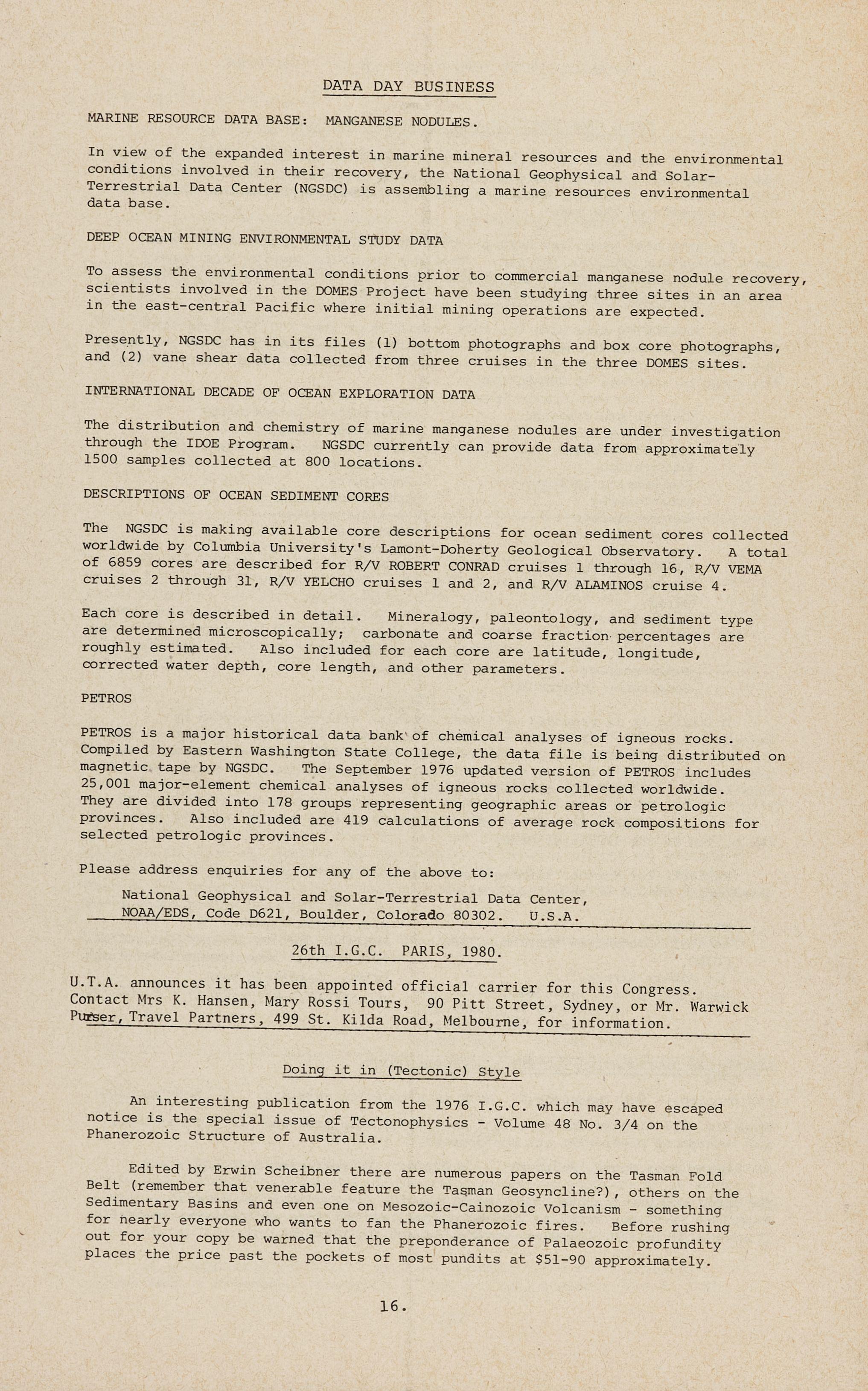
DATA DAY BUSINESS
MARINE RESOURCE DATA BASE: MANGANESE NODULES.
In view of the expanded interest in marine mineral resources and the environmental conditions involved in their recovery, the National Geophysical and SolarTerrestrial Data Center (NGSDC) is assembling a marine resources environmental data base.
DEEP OCEAN MINING ENVIRONMENTAL STUDY DATA
To assess the environmental conditions prior to commercial manganese nodule recovery, scientists involved in the DOMES Project have been studying three sites in an area in the east-central Pacific where initial mining operations are expected.
Presently, NGSDC has in its files (1) bottom photographs and box core photographs, and (2) vane shear data collected from three cruises in the three DOMES sites.
INTERNATIONAL DECADE OF OCEAN EXPLORATION DATA
The distribution and chemistry of marine manganese nodules are under investigation through the IOOE Program. NGSDC currently can provide data from approximate ly 1500 samples collected at 800 locations.
DESCRIPTIONS OF OCEAN SEDIMENT
CORES
The NGSDC is making available core descriptions for ocean sediment cores collected worldwide by Columbia University's Lamont-Doherty Geological Observatory. A total of 6859 cores are described for R/V ROBERT CONRAD cruises 1 through 16, R/V VEMA cruises 2 through 31, R/V YELCHO cruises 1 and 2, and R/V ALAMINOS cruise 4.
Each core is described in detail. Mineralogy, paleontology, and sediment type are determined microscopically; carbonate and coarse fraction - percentages are roughly estimated. Also included for each core are latitude, longitude, corrected water depth, core length, and other parameters.
PETROS
PETROS is a major historical data bank ' of chemical analyses of igneous rocks. Compiled by Eastern Washington State College, the data file is being distributed on magnetic tape by NGSDC. The September 1976 updated version of PETROS includes 25,001 major- element chemical analyses of igneous rocks collected worldwide. They are divided into 178 groups · representing geographic areas or petrologic provinces. Also included are 419 calculations of average rock compositions for selected petrologic provinces.
Please address enquiries for any of the above to: National Geophysical and Solar-Terrestrial Data Center, NOAA/EDS, Code D621, Boulder, Colorado 80302. U.S.A.
26th I.G.C. PARIS, 1980.
U T.A. announces it has been appointed official carrier for this Congress. Contact Mrs K Hansen, Mary Rossi Tours, 90 Pitt Street, Sydney, or Mr. Warwick PUi'ser, Travel Partners, 499 St. Kilda Road, Melbourne, for information.
Doing it in (Tectonic)
Style
An interesting publication from the 1976 I.G.C. which may have escaped notice is the special issue of Tectonophysics - Volume 48 No. 3/4 on the Phanerozoic Structure of Australia.
Edited by Erwin Scheibner there are numerous papers on the Tasman Fold Belt (remember that venerable feature the Ta~man Geosyncline?), others on the Sedimentary Basins and even one on Mesozoic-Cainozoic Volcanism - something for nearly everyone who wants to fan the Phanerozoic fires. Before rushing out for your copy be warned that the preponderance of Palaeozoic profundity places the price past the pockets of most pundits at $51-90 approximately.
16.