The Australian Geologist
President
Dorothy Hi I I
Hon. Federal Secretary
Dr. G. Playford, Dept. of Geology & Mineralogy, University of Queensland, St. Lucia. Queensland 4067.
Society Off ice
Miss Laurel Tuckwel I, Gemmology House, 24 Wentworth Avenue, Syd ney, 2010. 'phone: 61-9504.
Newsletter Correspondents
Dr. Dennis Gee, Geological Survey of W.A., Mineral House, 66 Adelaide Terrace, Perth, 6000.
Victoria
Dr. Colin Barton, Division of Applied Geomechanics, C.S. I .R.O., P.O. Box 54, Mount Waverley. Victoria 3149.
S.A.
Col in G. Gatehouse, No. 4 Frontignac Avenue, Wattle Park. W.A. 5066.
Queensland
Dr. C. G. Murray, Geological Survey of Queensland, Mineral HQuse, 2 Edward Street, Brisbane, 4000. OUR COVER PHOTO.
Newsletter Editor
Dr. D. F. Branagan, Dept. of Geology & Geophysics, University of Sydney, 'N.S.W. 2006. 'phone: 660-0522 extn. 2358 or 2912.
N.S.W.
Dr. Graham Taylor, Division of Mineral Chemistry, C.S. I .R.O., Box 17 5, P. 0. , Chatswood. N.S.W. 2067.
Tasmania
G. T. Roberts, Geology Section, Hydro-Electric Commission, Hobart, 7000
Territories
P.A. Smith, Bureau of Mineral Resources, P.O. Box 378, Canberra City~ A.C.T. 2601.
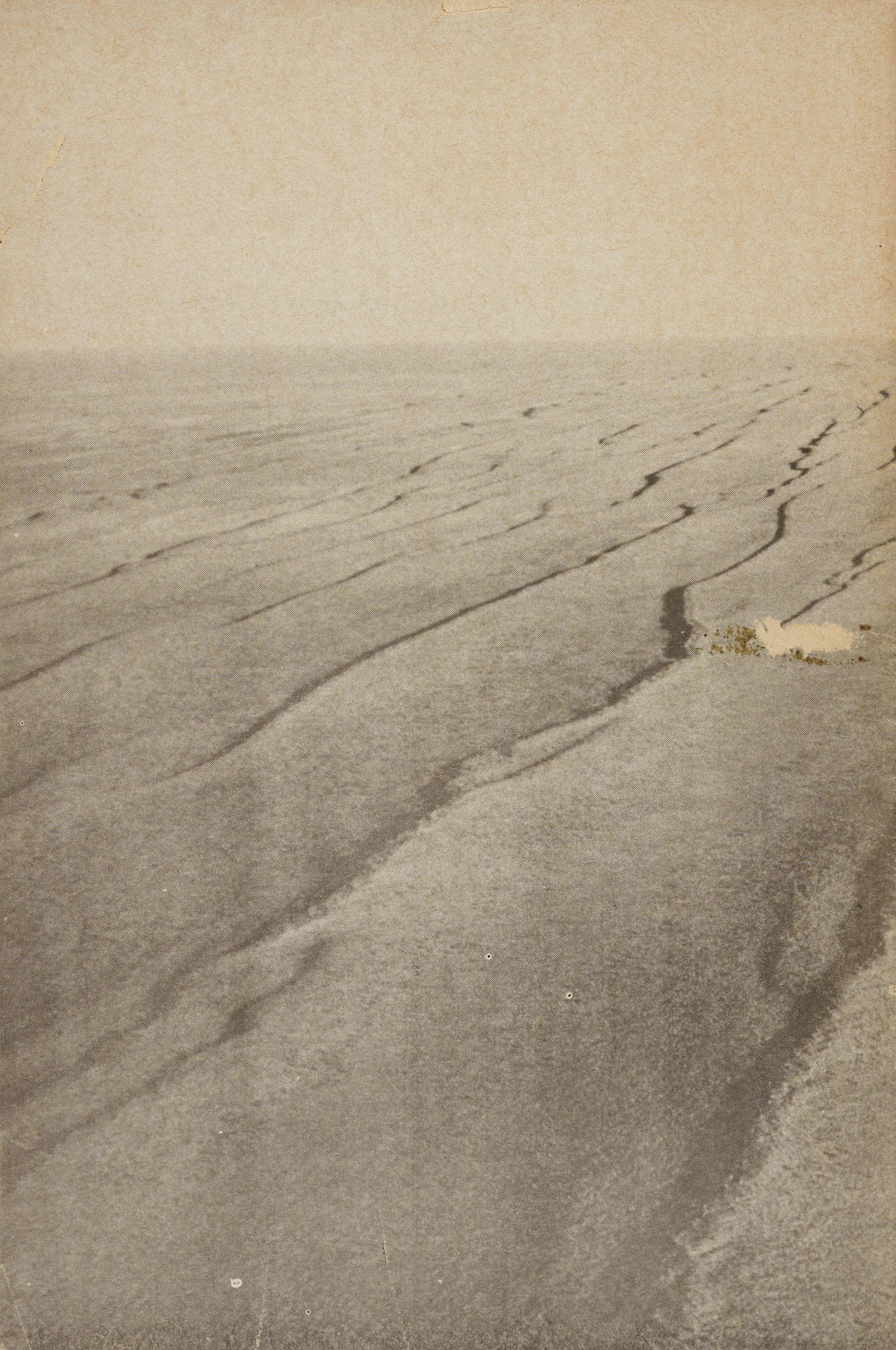
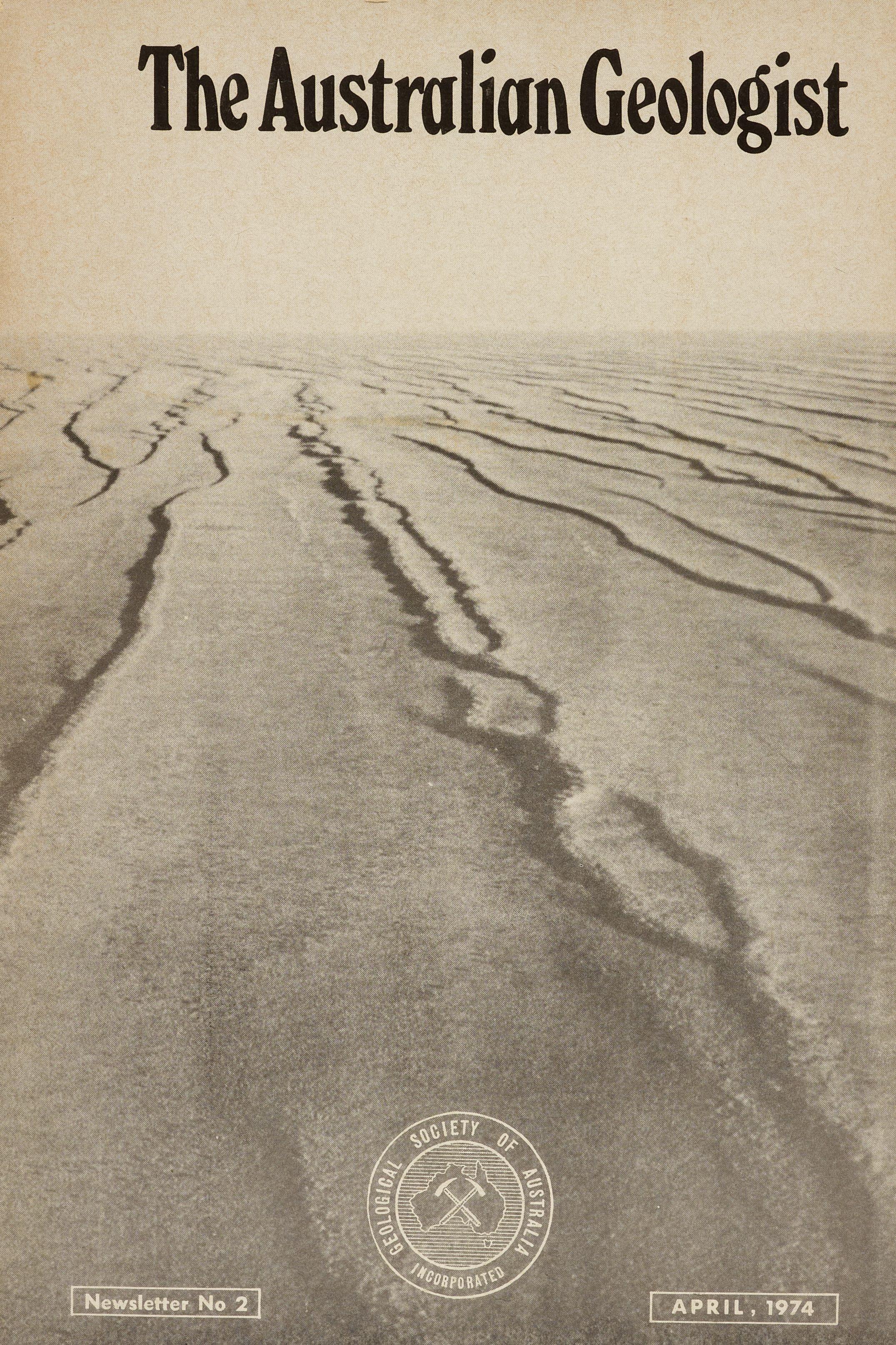
Longitudinal sand dunes in the central part of the Simpson Desert, N.T. The photo, by Tony Yeates of the B.M.R. was taken from about 1000 m altitude late in the afternoon and looking south-south-east. For a discussion on such sand ridges and a lead to earlier references, see 'The Asymmetry of Australian Desert Sand Ridges', by R.H. Clarke and C. H. B. Priestley in Search, Vol . 1, No. 2, August 1970.
The Australian Geologist
Newsletter of the Geological Society of Australia Incorporated
No. 2. April 1974
EDITORIAL
The response to our first issue has been encour~ging, and I am particularly grateful to those who have offered criticisms. These will be taken note of and acted upon where possible, except those which suggest we abandon the whole project!
Although the employment scene for geologists in Australia is not what it was several years ago, particularly in the mineral exploration field, there are some encouraging signs. In this issue vacancies in both general and specialized categories are advertised, and newspaper advertisements in past months have called for coal geologists. Many readers will also have read that Australian geophysicists and geologists are being sought for work on the expanding North Sea oil fields.
However in only a few cases are raw graduates asked for. This is the group which has probably suffered most in the decline in demand for geologists. Some have moved into "fringe" fields such as environmental work, albeit an important area where their training can be put to good use; others have continued on with higher degrees or gone into the teaching profession, but some have been lost to geology.
Many organisations have made a practice of taking on one or two young graduates every year, often without advertisement, and have built up well balanced teams, which remain stable . for a long time and, I am sure, return value for the money invested. Other bodies seem to have a rather capricious approach to employment of geologists and other technical staff, hiring with a great flourish and firing with equally gay abandon, and the geologists are usually first to go. The arguments for and against this 'sudden death' approach have been debated at length in Geotimes and other overseas journals, and there is no doubt the economics of the immediate situation are usually the criteria for whatever action is taken.
However I am doubtful if in the long term such an approach is economic. Geology deals usually with long-term processes and effects, and their elucidation requires long-term study for proper evaluation. Most of our potential mineral deposits have been 'looked at' by every major and minor exploration company in the country. How many of these deposits have been mapped in real detail?
There have been some co-operative exploration projects in recent years but is there a case for a miners co-operative which pools its 'excess' geologists to carry out such detailed mapping? As a follow-up to the regional work being carried out by the government surveys it might well pay dividends.
Advice for Prospective Contributors
1. Chaff is the pay dirt milked from the riffles of a bevy of mixed metaphors.
2. It is weakening · to use the passive rather than the active.
3. One should not use the negative in place of the positive.
4. The avoidance of using the main verb in the subject-nominative should be observed.
Up to and including 1 March, 1974, 1,532 responses to the First Circular had been received. Of these, 90% assessed their chances of attending as good or fair (56.5% as good). Of those, 856 expressed an interest in at least one pre-Congress excursion. The comparable figure for post-Congress excursio~s was 735. On average, each person is interested in 3 Sections. (Australians are, on avera9e, interested in more Sections than are North Americans).
Distribution of the First Circular has run into some unforeseen difficulties, and has been considerably delayed in several countries of both east and west Europe, and in the State of Victoria~ Steps are being taken to complete distribution in these areas as soon as possible.
The response from members of the Geological Society of Australia (Inc.) has been go09._ Percentage response from each Division so far is as follows: Commonwealth Territories 38%; N.S W. 39%; Queensland 36%; South Australia 33%; Tasmania· 26%; Western Australia 28%. It would be much appreciated if members who have not already done so would return their response card as soon as possible, and in any case before the deadline of 30 April, 1974. Late returns do involve the secretariat in a lot more work.
The Organizing Committee will meet in May to consider the response and to decide which excursions are to remain on offer when the Second Circular goes to press.
The Sydney Committee and its various sub-Committees are now very active, organizing the accompanying members' program, entertainment, transport, local excursions, Junior Congress, and GEORAMA 76. N.S.W. members will be lucky to escape the press gang.
About 450 authors have so far indicated their intention of offering a paper for the Congress. Significantly more papers have been proposed for Sections 3, 4 and 7 than for others. Section 15 is, at the moment, at the other end of the league table.
Dates of the Congress:
Place:
Information from: 16-25 August, 1976.
The University of Sydney
The Secretary-General, 25 IGC, P.O. Box 1892, CANBERRA CITY, -A.C.T. 2601.
* It had been thought there were no geologists in Victoria anymore. However the Society has recently begun to receive membership applications again, so things are looking up.
CENTENARY CELEBRATIONS
As part of .the Centenary celebz;ations of the New South Wales Department of Mines, one-day and two-day geological excursions are to be conducted on the week-ends commencing 21st and 28th September, 1974. They have been specially designed to cater for a wide range of geological background so that geologists as well as members of the public are invited to attend. One-day excursions will study (a), the Prospect, Penrith, Richmond extractive resources, (b), Northern Sydney Headlands - Hornsby quarry and (c), the Coalcliff-Darkes Forest Collieries. Two-day excursions will visit (a) Coastal, heavy mineral mining and restored areas, (b), the Blue Mountains region, and (c), the Glen Davis - Bathurst - Hill End areas. Geological notes and diagrams will be distributed on each excursion by the Departmental geologist present
I Bookings may/ be made through the New South Wales Government Tourist Bureau, 8 Martin Place, Sydney.
by DAVID BRANAGAN
SPECIALIST GROUPS
Cutting across the divisional structure of the Society are specialist groups concerned with particular topics within geology. Although these started in a relatively info:r:mal way as loose-knit groups, they have rapidly become an important part of the Society. There are five specialist groups each usually referred to by a fearsome set of letters which I have considerable difficulty in deciphering. They are S.G.I.G.O.D., S.G.G.M., S.G.S., S.G.T.S.F. and A.P.G. (fo:r:merly S.G.P.B.S.) of which I can state with some certainty that S.G. stands for specialist group! Each of these has been discussed in the first issue. Every one of them would welcome your interest. Specialist group membership usually involves a small additional fee to cover notices, newsletters, etc.
MEETINGS OF THE SOCIETY
Since its inception the Society has maintained close links with the geology section of ANZAAS. Transfer of Executive responsibility has usually taken place at the time of an ANZAAS meeting, Council has met, a general meeting of the Society has taken place and Presidential addresses have been given. In August 1973 the Council decided that the links with ANZAAS could be less rigid and it is likely that the various functions mentioned above will in future take place as the Society sees fit.
This means we will probably see more meetings directly organised by the Society and of specific interest to members. In the past we have had several very successful such meetings, notably the Archaean Conference held in Perth in 1970 which attracted 600 registrations. The smaller specialist conferences have proved very popular and several forthcoming are advertised elsewhere in this newsletter.
In particular, the Society is co-sponsor for the 25th International Geological Conference in Sydney in 1976 as all members are no doubt aware by ~ow.
PUBLICATIONS
One of the major reasons for the fo:r:mation of the Society was the desire to ensure publication of papers on Australian geology. The Society's major effort in this field has been the Journal of which twenty volumes have been published including separate volumes on most of the States and New Guinea.
The Journal has deservedly gained a reputation for its high standards. Some people have claimed that the standard is too high; and there is no doubt that papers rejected here have appeared substantially unchanged in overseas journals. At times there has been an imbalance in the type of geological material published but this is very largely a function of the material submitted. There have been few papers submitted over the years on economic geology and the geophysics contributions have also, unfortunately, been rather thin. It is very pleasing that our present editor, Ken Townley, has been able to get a geophysics sub-editor, and hopefully this imbalance will be reduced in the future.
Specialist meetings have resulted in a number of publications independent of the Journal series and it seems likely that these specialist papers will continue to appear. They are usually financed partly from Society funds and partly from special donations.
At present the whole matter of publication dissemination of scientific knowledge is under considerable scrutiny and it seems possible that in the not too distant future we will see something more like abstract publication backed by microfilm available for those particularly concerned in a topic. Ken Townley is already looking at such likely future developments. His questionnaire enclosed with this newsletter is well worth responding to, and should indicate more clearly what the members want in the way of publications.
Apart from the Journals, the siderable h~lp from the Bureau of Australia. The first, published as an excellent geological map. caused a great deal of discussion arguments in the future.
FUNDS
Society has published, thanks to very conMineral Resources, two Tectonic Maps of in 1960, served a very useful purpose - mainly The second, which is smaller, has already and will be the basis for many stimulating
Thanks to astute treasurers of the past years, the Society has been able to build a solid backing. It is not yet in the position of the Geological Society of America in this regard, but hopefully the Society's investments will in the future enable it to fund worthwhile projects. However, perhaps it is time that we thought about some investment in a small building as a permanent office which would render our activities less dependent on other organisations.
GEOLOGICAL LEGISLATION
The matter of registration of geologists has been of concerr, to the Society for some years. During 1972 a committee headed by Dr. A. F. Trendall of W.A. submitted recommendations for registration of geologists to the Federal Mining Council and hence implicitly to the Federal Government.
It was hoped that a uniform Australia-wide registration scheme would be introduced. However there has been a delay at Federal level and it now seems likely that legislation will be introduced first in Western Australia.
There has been much misunderstanding of the proposals which are concerned with registration only of those geologists who are preparing, or likely to prepare reports on geology to be used in financing, construction etc.
THE FUTURE
Perhaps the coming years will see the Society continuing a dual role. In academic aspects of geology new specialist groups are sure to form, and the Society hopefully will also act as co-sponsor of such bodies as the Australian Geomechanics Society. I believe the divisions will become more concerned with professional and community aspects of geology. Growth in both directions is essential to a healthy society.
References
Branagan, D. F. & Vallance, T. G., 1967. The Geological Society of Australasia 1885-1905. J. Geol. Soc. Aust., Vol. 14, Pt. 2.
Denmead, A. K , 1964. our Tender Years -A Stocktaking. J. Geol. Soc. Aust., Vol. 11, Pt . 1.
Townley, K. A., 1960. A Geological Society in Victoria (1852-53). Soc. Aust., Vol. 6, Pt. 2.
N.S.W. Geology - Its origins and development.
Wanted to buy: -
An Australian geological library, especially a reprint collection
Please write to: Dr. H.J. Harrington, Department of Geology, University of New England, Armidale. N.S.W.2351.
J. Geol.
FUTURE OF THE DEEP SEA DRILLING PROJECT
P.
J.
Cook 1 Bureau of Mineral Resources, Canberra.
This article summarizes some of the main points arising from a meeting of the JOIDES Planning Committee in Zurich in September 1973, which I attended.
In 1964, the JOIDES consortium, comprising a number of United States oceanographic institutions, was formed to plan a program of ocean-floor drilling. The Scripps Institution of Oceanography was designated the operating institution for the Deep Sea Drilling Project (DSDP), and Global Marine Inc. the drilling contractor. Funds were provided by the United States National Science Foundation (USNSF), initially for 18 months, but this was subsequently extended for two periods, each of 36 months 7he seven years of drilling (to August 1975) will have a total cost of U.S . $68.3 million. So far more than 30 sites have been drilled using the D/V Glomar Challenger, more than 30 of which are in the Australasian region. The scientific results accumulating from this drilling programe have been of fundamental importance to our understanding of the Earth's history. The USNSF has indicated that when Phase III of the DSDP is completed in 1975, it will no longer fund the project to the same extent as previously, but nevertheless it would not like to see a project of such importance abandoned. Consequently the JOIDES committee has decided to attempt to 'internationalize' the project: this is considered desirable, not only as a mechanism for obtaining finance, but also to achieve maximum involvement by the world geoscientific community. With this in mind the executive is setting up the International Program for Ocean Drilling (IPOD).
On completion of the present DSDP contract in 1975 it is hoped that a number of countries will contribute financially to IPOD. On doing so they will become full members of the JOIDES executive and the planning committee, and consequently will be in a position to influence the course of IPOD. Contributions of $1 million per country per annum have been sought from a number of nations (generally through the national institution of the nation). To date, only the USSR has definitely committed itself to a contribution of $1 million per annum, and the Institution of Oceanology of the USSR is now a member of the JOIDES executive. It seems fairly certain that West Germany will be making a $1 million contribution; France and Britain and Canada are rather more uncertain, and Japan has decided it will not contribute at this time. Switzerland wishes to contribute but only to a maximum of $200,000 per annum. The JOIDES executive may eventually decide to accept contributions of less than U.S. $1 million, but this is uncertain at this stage.
At present it is envisaged that IPOD will run for 5 years at a maximum cost of about U.S. $70 million, i.e. a maximum cost of about U.S. $14 million per annum.
Assuming that IPOD will commence in 1975 it is expected that the drilling program will emphasize three aspects:
(a) Deep Oceanic crustal drilling. The aim of this portion of the program would be to drill deep holes (penetration of 2-4 km) into igneous rock, hoping to reach beyond layer 2, as layers 3 and 4 have not yet been sampled. Information obtained from this drilling would help our understanding of the vertical and lateral structure of the crust, the mechanisms of plate tectonics, and the formation of orebodies. High-priority areas for drilling include the Sea of Japan, the North Atlantic, and the Gulf of California. Lower-priority areas include the Caribbean, and the area west of Australia from the Argo Abyssal Plain to the Java Trench
(b) Oceanic margin drilling. This program is expected to involve the deep drilling of sediments (maximum penetration of 4-5 km) in 1-4 km of water on continental margins. Margins of both the active and inactive types will be studied. Study of active margins (generally converging plate boundaries Published with the permission of the Director,
such as those of the Papua New Guinea region) should clarify the processes of subduction, their effects on the sedimentary column, and the nature of mineralizing processes associated with subduction. The study of inactive margins (such as those flanking Australia) should help elucidate the chronology of continental drift and the possibility of oil, gas, and mineral accumulations. Coincidentally, such marginal drilling programs are likely to act as a powerful stimulus to hydrocarbon exploration in these presently inaccessible areas, and may also lead to important technological discoveries. At present the possibility of future drilling in three areas in the Australian region (along with various other margins) is being considered. These are (i) off the NW Shelf; (ii) the eastern end of the Australian Bight; and (iii) the western margin of the Tasman Sea.
(c) Palaeoenvironmental drilling. The pre-1975 Deep Sea Drilling Program is already concerned with this topic, for ocean sediments record to some extent the conditions under which they were deposited. Drilling would presumably be generally in areas where the sedimentary record is most complete. Results obtained would help considerably to solve problems of worldwide correlation, and to elucidate changes both in the chemistry of the oceans and in past climates. Potential drill sites have not yet been chosen; there are probably a number of areas in the Australasian region that could be profitably drilled.
As a consequence of our new understanding of global tectonics, discoveries made by IPOD in the North Atlantic may conceivably have important implications for our understanding of geological phenomena on the Australian Plate. , Therefore, the entire IPOD program is potentially important to Australia and our understanding of Australian geology. Some aspects of the tentatively proposed drilling near Australia are also likely to be of direct interest to Australian geologists. Australian scientists have been involved in DSDP for a number of years, and so far 12 Australian scientists have participated in cruises, the largest number from any country outside the U.S., except, surprisingly, Switzerland. No financial contribution has yet been sought from Australia, but it is possible that we may be approached in the future.
A fundamental question at this stage is why any country should consider making a contributipn to IPOD when scientific results will be readily available anyway. The best counter to this "What's in it for us"? attitude is perhaps provided by the remarks of some of the scientists attending the Zurich meeting to justify why their country was actively considering making a contribution. They pointed out that no country outside the United States and perhaps the USSR could afford to operate its own drilling vessel of the Glomar Challenger type; consequently a consortium is the only feasible way of undertaking such a project. Also the deep continental margin drilling would act as a stimulus to hydrocarbon exploration. Involvement in the operation of an advanced vessel such as the D/V Glomar Challenger also helps to ensure that scientists of the various countries keep up to date with modern technological developments in drilling; also financial involvement in IPOD ensures a voice in the planning phase.
However, the most fundamental argument in favour of countries making a financial contribution was that expressed by Professor Cloos of West Germany who pointed out that the project is of vital importance to the world geoscientific community and unless support is forthcoming internationally, the project will die from lack of funds. It is therefore up to individual nations to play their part in supporting it financially to ensure its continuation.
Hopefully this point of view will prevail, and ensure that Deep Sea Drilling, one of the most important scientific programs of the twentieth century, is able to continue. A survey is being made of the applicability of the Stratigraphic Code to igneous rocks (acid to ultramafic; plutonic to volcanic). The survey embraces the naming of igneous rock units as well as the principles governing igneous nomenclature. Anyone wishing to comment on ANY ASPECT relating to this subject is asked to sul:mit his/her proposals to: Igneous Stratigraphic Code, c/- Mr. B. H Flinter , 17 Lachlan Place, Berowra, N.S.W. 2081.
Challenger Centenary--Deep Sea Drilling Symposium
In the centenary of HMS Challenger's visit to Australia and New Zealand, the undersigned are organizing a 3-day symposium to be held from Tuesday 20 August to Thursday 22 August in Sydney at Macquarie University to discuss the results of the Glomar Challenger's drilling in the region 1971-1973 and plans for future deep sea drilling.
The first day will be devoted to a discussion of the drilling results in the Wharton Basin, Souther~ Ocean, and southwest Pacific. On the second day, invited speakers will review the state of the art of studies (from biostratigraphy to igneous petrogenesis) made on material recovered on the Glomar Challenger. The final day will be devoted to geological and geophysical syntheses of the Wharton Basin, Southern Ocean, and southwest Pacific, and the suitability of these areas for the deeper drilling contemplated in the 1975-79 International Program of Ocean Drilling (IPOD). A summary of the proceedings will be published after the symposium.
The attendance fee (inclu o ing a copy of the published symposium proceedings) will be $10 ($2 for students).
Speakers on the first and second days will be by invitation. On the third day, the controversial topics of models of the Wharton Basin, Southern Ocean, and southwest Pacific will benefit from the widest discussion, and anyone who wishes to contribute is now invited to send the convener a brief outline of his or her proposed contribution.
To receive the final notice of the symposium (to be circulated by June), please fill out and post the form below.
(Signed) L. A. Frakes G. H. Packham
J. J. Veevers (convener) C. C. von der Borch
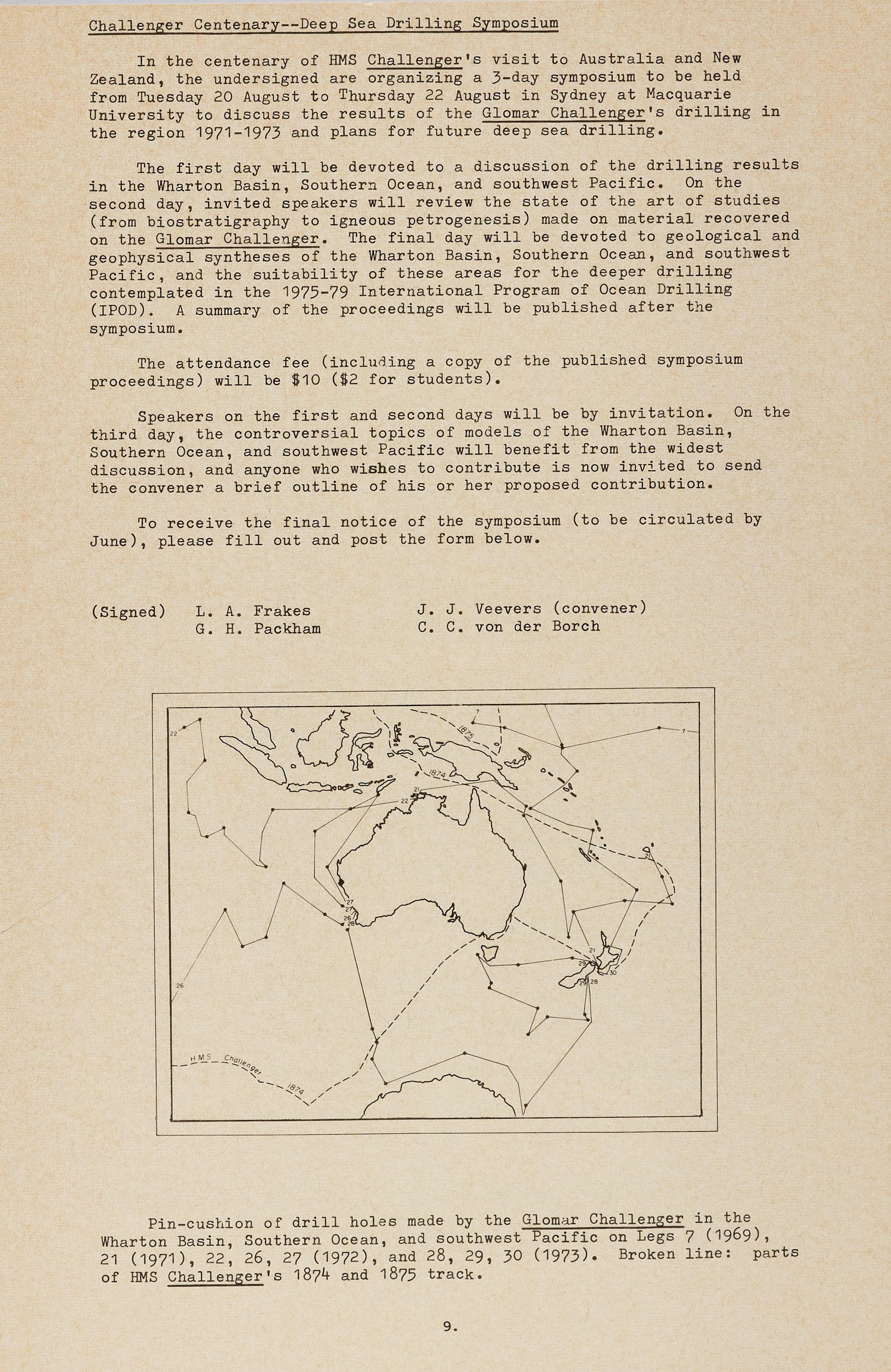
Pin-cushion of drill holes made by the Glom ar Challenger in the Wharton Basin, Southern Ocean, and southw est Pacific on Legs 7 (1969), 21 (1971), 22, 26, 27 (1972), and 28, 29, 30 (1973). Broken line: parts of HMS Challenger's 1874 and 1875 track.
by K. A. TOWNLEY Hon. Editor
The Geological Society of Australia exists for the benefit of its members. Of course. And the principal activity of the Society, in monetary terms, is the publication of the Journal. Yet, so far as I know, the Society has never tried to gauge the reaction of its membership to the Journal - as readers, that is. The Journal obviously serves members, or some of them, as a medium through which they may publicize their work; it takes good care of authors, but for readers it only tries to ensure that the material presented is reasonably accurate, reasonably grammatical, and, perhaps, reasonably significant (but to whom?).
A factor that lurks behind any enquiry is cost - which is borne by you, the members. Every page that you receive costs you 2 cents to print - and if the services of reviewers, editor, typists, draftsmen, etc. were not either honorary or borne by the authors' institutions it would cost more than twice as much. Moreover, costs are rising at a frightening rate: paper prices rose 15% in 1973 and will rise again; the Post Office has recently caused distribution costs to double; wages are rising; and so on. We are forced to attempt a cost-benefit analysis of the Journal before it prices itself out of range - for members of Societies are notoriously loath to agree to massive increases in subscriptions, particularly if they get no extra benefits.
Therefore in planning the future of the Journal we must consider these two aspects - which are interrelated: what should we publish? and how should we publish? I do not have in mind cutting back the information provided by the Journal - at least only as a last resort. What Council and I are concerned to find is the most efficient method of presentation.
The possibilities are many. To issue the whole Journal in microform would effect a big saving; or we could discriminate between papers with a wide appeal and those only read by a few, and use a different method of dissemination for the latter; or we could, as the Institution of Mining and Metallurgy has done, divide the Journal into segments catering to particular interest; or the list is almost endless.
But whatever is decided - and we have two or three years' grace before the cost problem becomes acute - should be decided on facts, not on hunches. Therefore I have made out a questionnaire which will give us some facts and opinions to go on, and I urge every member of the Society to complete it and return it to me. Above all, please be honest: you can - I think you shouldmake your return anonymous, so that there is no reason not to confess that you seldom open the Journal or read nothing but the 'funnies' in Oil Weekly or the 'personal' columns in Economic Geology.
I don't mind what you say: rubbish the Journal by all means if you want to. Only be receiving and collating honest opinions can we build a base for future improvement. Therefore, as a last point, do not be in a hurry to reply - take actual samples, not guesses, for the numerical answers.
Thank you, in advance. Let us hope for a better and more useful Journal.
Please return the enclosed Questionnaire. We value your opinions.
COMBINED SPECIALIST GROUPS MEETING
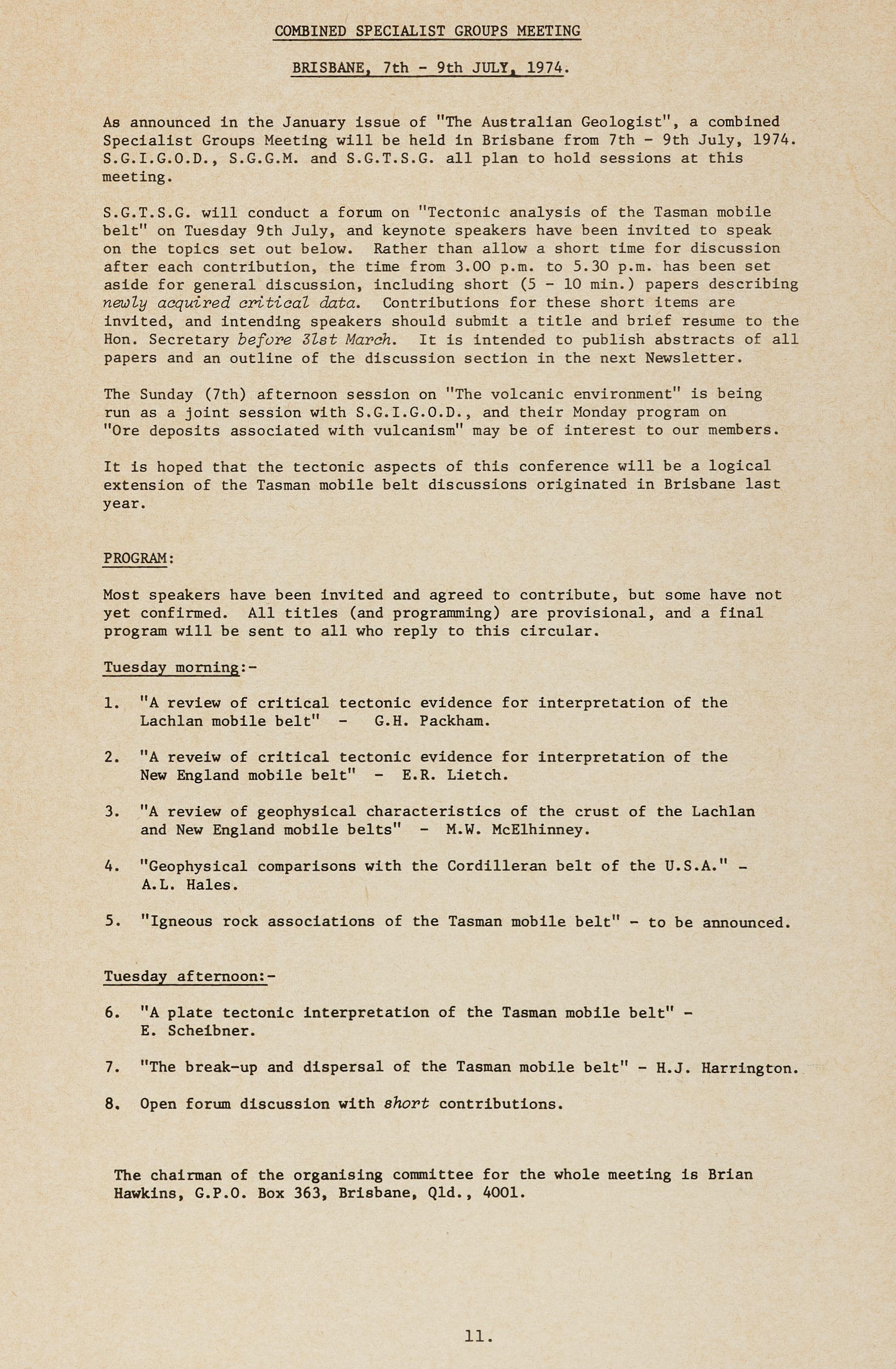
BRISBANE, 7th - 9th JULY 1 1974.
As announced in the January issue of "The Australian Geologist", a combined Specialist Groups Meeting will be held in Brisbane from 7th - 9th July, 1974.
S.G.I.G.O.D ., S.G.G.M. and S .G.T. S.G all plan to hold sessions at this meeting.
S.G.T.S.G. will conduct a forum on "Tectonic analysis of the Tasman mobile belt" on Tuesday 9th July, and keynote speakers have been invited to speak on the topics set out below. Rather than allow a short time for discussion after each contribution, the time from 3.00 p m. to 5.30 p.m. has been set aside for general discussion, including short (5 - 10 min.) papers describing newly acquired critic al data. Contributions for these short items are invited, and intending speakers should submit a title and brief resume to the Hon. Secretary before Jlst March. It is intended to publish abstracts of all papers and an outline of the discussion section in the next Newsletter.
The Sunday (7th) afternoon session on "The volcanic environment" is being run as a joint session with S.G I.G.O.D. , and their Monday program on "Ore deposits associated with vulcanism" may be of interest to our members.
It is hoped that the tectonic aspects of this conference will be a logical extension of the Tasman mobile belt discussions originated in Brisbane last year.
PROGRAM :
Most speakers have been invited and agreed to contribute, but some have not yet confirmed. All titles (and programming) are provisional, and a final program will be sent to all who reply to this circular.
Tuesday morning :-
1. "A review of critical tectonic evidence for interpretation of the Lachlan mobile belt" - G.H. Packham.
2. "A reveiw of critical tectonic evidence for interpretation of the New England mobile belt" - E.R. Lietch.
3. "A review of geophysical characteristics of the crust of the Lachlan and New England mobile belts" - M.W. McElhinney.
4. "Geophysical comparisons with the Cordilleran belt of the U.S.A."A.L. Hales.
5. "Igneous rock associations of the Tasman mobile belt" - to be announced.
Tuesday afternoon:-
6. "A plate tectonic interpretation of the Tasman mobile belt"E. Scheibner.
7. "The break-up and dispersal of the Tasman mobile belt" - H.J. Harrington.
8. Open forum discussion with short contributions.
The chairman of the organising cormnittee for the whole meeting is Brian Hawkins, G.P.O. Box 363, Brisbane, Qld., 4001.
Q~eensland
Some recently won honours:-
Doug Traves, of Mines Administration Pty. Ltd., Brisbane, was awarded an O.B.E. in the New Year's Honours L ist for his contributions to development of Queensland's oil, gas and coal resources.
Noel de Jersey, Principal Palynologist of the Geological Survey of Queensland, has been awarded a D.Sc. from the University of Queensland in recognition of his work on plant microfossils.
Fossils in the Brisbane Metamorphics.
The age of the pre-Mesozoic rocks in and near Brisbane, the Brisbane Metamorphics, has long remained a perplexing problem. Traditionally, they have been regarded as Early Palaeozoic, and the more thoroughly recrystallized rocks, which apparently form the base of the sequence (Rocksberg Greenstone and Bunya Phyllite), have even been assigned to the Precambrian. Recent K-Ar radiometric dating shows that these rocks were metamorphosed in the Upper Carboniferous. A Carboniferous age for the upper part of the Brisbane Metamorphics, the Neranleigh-Fernvale Beds, is suggested by Early Carboniferous K- Ar dates obtained from granite boulders in conglomerates south of Brisbane (D. C. Green, 1973, Jour. Geol. Soc. Aust., v.20, p.153). This age has been substantiated by the discovery of marine invertebrate fossils in the Neranleigh-Fernvale Beds at Mount Nebo, 20 km northwest of Brisbane, by geologists of the Geological Survey of Queen sland. The fossils occur in an oolitic arenite, and include fragments of crinoids, brachiopods and bryozoa. The fauna indicates a Carboniferous age; the association with oolites suggests that this can be restricted to Early Carboniferous. Details of the fossil discovery have been published in the March issue of the Queensland Government Mining Journal (P. J. G. Fleming et al., 1974: Upper Palaeozo ic invertebrate macrofossils in the Neranleigh-Fernvale Beds. Qd. Govt. Min. J., v.75).
Kalgoorlie Exodus
Kalgoorlie, which during the late 60s and early 70s enjoyed the presence of about 50 per cent of Australia's geologists, is still experiencing contractions as more exploration companies continue to withdraw. In the last few months 7 major companies have either withdrawn completely from Western Australia or have moved the centre of their operations to Perth. One large company after having discovered a large ore body, has dispersed their staff overseas and put the orebody on ice. Another company has its Kalgoorlie base managed by an alsation dog. He is called the "Sniffer: but is having no more success than his predecessors. The number of active exploration companies still with bases in Kalgoorlie could be counted on one hand. Some of the withdrawing companies will maintain a reduced interest in the Eastern Goldfields but the exodus does indicate a rethinking of the potential of the area in the light of current conditions. There is still . a fairly high level of interest in other parts of the State, with mainly regional exploration being done in the Murchison, Gascoyne, Ashburton and Pilbara areas. There is one beneficial effect however, attendance at the Geol. Soc. meetings in Perth is booming.
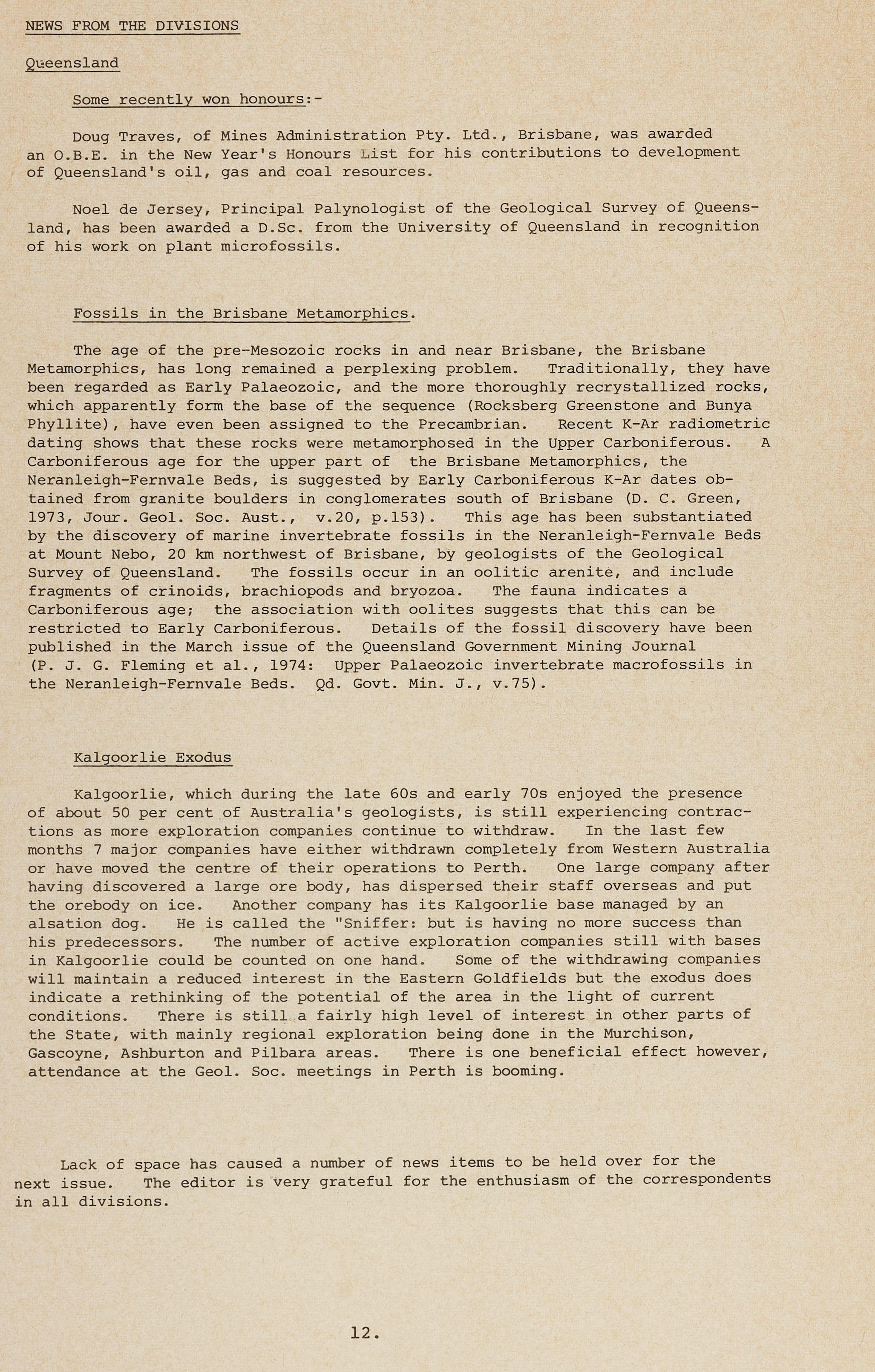
Lack of space has caused a number of news items to be held over for the next issue. The editor is very grateful for the enthusiasm of the correspondents in all divisions.
SPECIALIST GROUP IN TECTONICS AND STRUCTURAL GEOLOGY
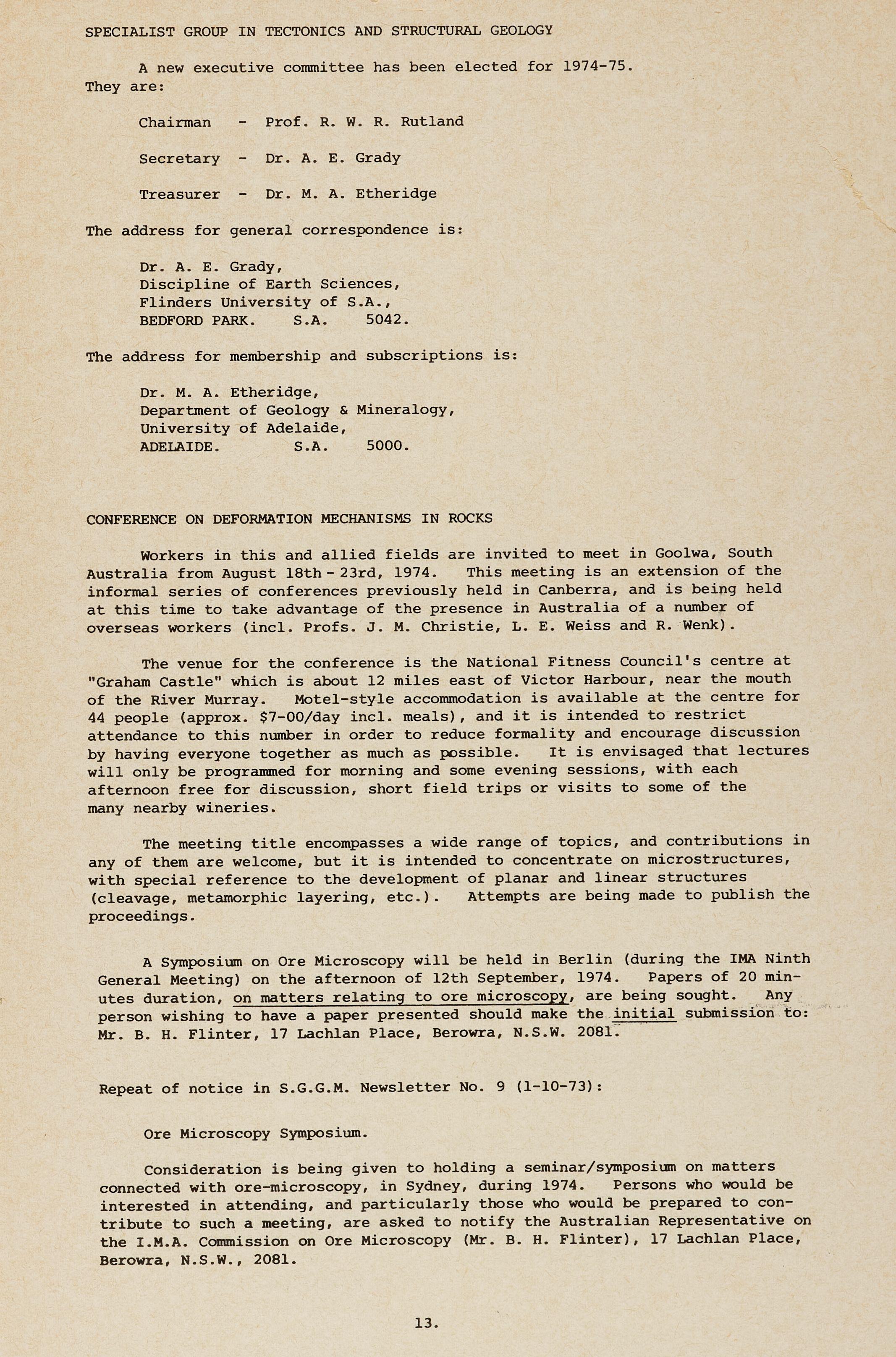
A new executive committee has been elected for 1974-75. They are:
Chairman - Prof. R. W.R Rutland
Secretary - Dr. A. E. Grady
Treasurer - Dr. M.A. Etheridge
The address for general correspondence is:
Dr. A. E. Grady, Discipline of Earth Sciences, Flinders University of S.A., BEDFORD PARK. S.A. 5042.
The address for membership and subscriptions is:
Dr. M.A. Etheridge, Department of Geology & Mineralogy, University of Adelaide, ADEIAIDE. S.A. 5000.
CONFERENCE ON DEFORMATION MECHANISMS IN ROCKS
Workers in this and allied fields are invited to meet in Goolwa, South Australia from August 18th-23rd, 1974. This meeting is an extension of the informal series of conferences previously held in Canberra, and is being held at this time to take advantage of the presence in Australia of a number of overseas workers (incl. Profs. J.M. Christie, L. E. Weiss and R. wenk).
The venue for the conference is the National Fitness Council's centre at "Graham Castle" which is about 12 miles east of Victor Harbour, near the mouth of the River Murray. Motel-style accommodation is available at the centre for 44 people (approx. $7-00/day incl. meals), and it is intended to restrict attendance to this number in order to reduce formality and encourage discussion by having everyone together as much as possible. It is envisaged that lectures will only be programmed for morning and some evening sessions, with each afternoon free for discussion, short field trips or visits to some of the many nearby wineries.
The meeting title encompasses a wide range of topics, and contributions in any of them are welcome, but it is intended to concentrate on microstructures, with special reference to the development of planar and linear structures (cleavage, metamorphic layering, etc.). Attempts are being made to publish the proceedings.
A Symposium on Ore Microscopy will be held in Berlin (during the IMA Ninth General Meeting) on the afternoon of 12th September, 1974. Papers of 20 minutes duration, on matters relating to ore microscopy, are being sought. Any person wishing to have a paper presented should make the . initial submissi'ori to: Mr. B. H. Flinter, 17 Lachlan Pla~e, Berowra, N.S.W. 2081-~ -
Repeat of notice in S.G.G.M. Newsletter No. 9 (1-10-73):
Ore Microscopy Symposium.
Consideration is being given to holding a seminar/symposium on matters connected with ore-microscopy, in Sydney, during 1974. Persons who would be interested in attending, and particularly those who would be prepared to contribute to such a meeting, are asked to notify the Australian Representative on the I.M.A. COIIUDission on Ore Microscopy (Mr. B. H. Flinter), 17 Lachlan Place, Berowra, N.S.W., 2081.
The Australasian Palaeontological Group was inaugurated on February 5th, 1974, at the Hobart Meeting of the Specialist Group in Paleontology and Biostratigraphy (SGPB) of the Geological Society of Australia, which was attended by representatives of the Queensland Palaeontographical Society (Q.P.S.). The new Group was founded by amalgamation of Q.P S. and S.G.P B. and is to inherit their assets.
The chief aim of the Australasian Palaeontological Group is to produce a Journal; its organisation is in the hands of a five-member editorial panel, scheduled to meet in early March.
Ordinary membership of A.P.G at $10-00 per annum is open to all members of the Geological Society of Australia Foundation subscriptions of $50-00 or more are invited as donations towards the initial establishment of A.P.G.'s finances; such subscriptions are additional to the ordinary membership subscriptions of $10-00, which are now due for 1974.
Committee
President: Professor G. M. Philip
Vice-President: Dr. K. S. W . Campbell.
Treasurer: Mr. M. J. Clarke, Department of Mines, G P.O. Box 1248, Hobart, Tasmania 7001.
Secretary: Dr. T. B. H Jenkins, Department of Geology and Geophysics, The University of Sydney, N.S.W. 2006
Editorial panel: Professor D. Hill, Drs. G. Playford, B. Runnegar, J. Shergold, and the President ex officio.
Aims
The aims of the Group are to promote the interests of Palaeontology in the widest sense, arrange conferences and symposia, disseminate information concerning Palaeontology and Stratigraphy, to provide news about activities of the membership and to produce a journal.
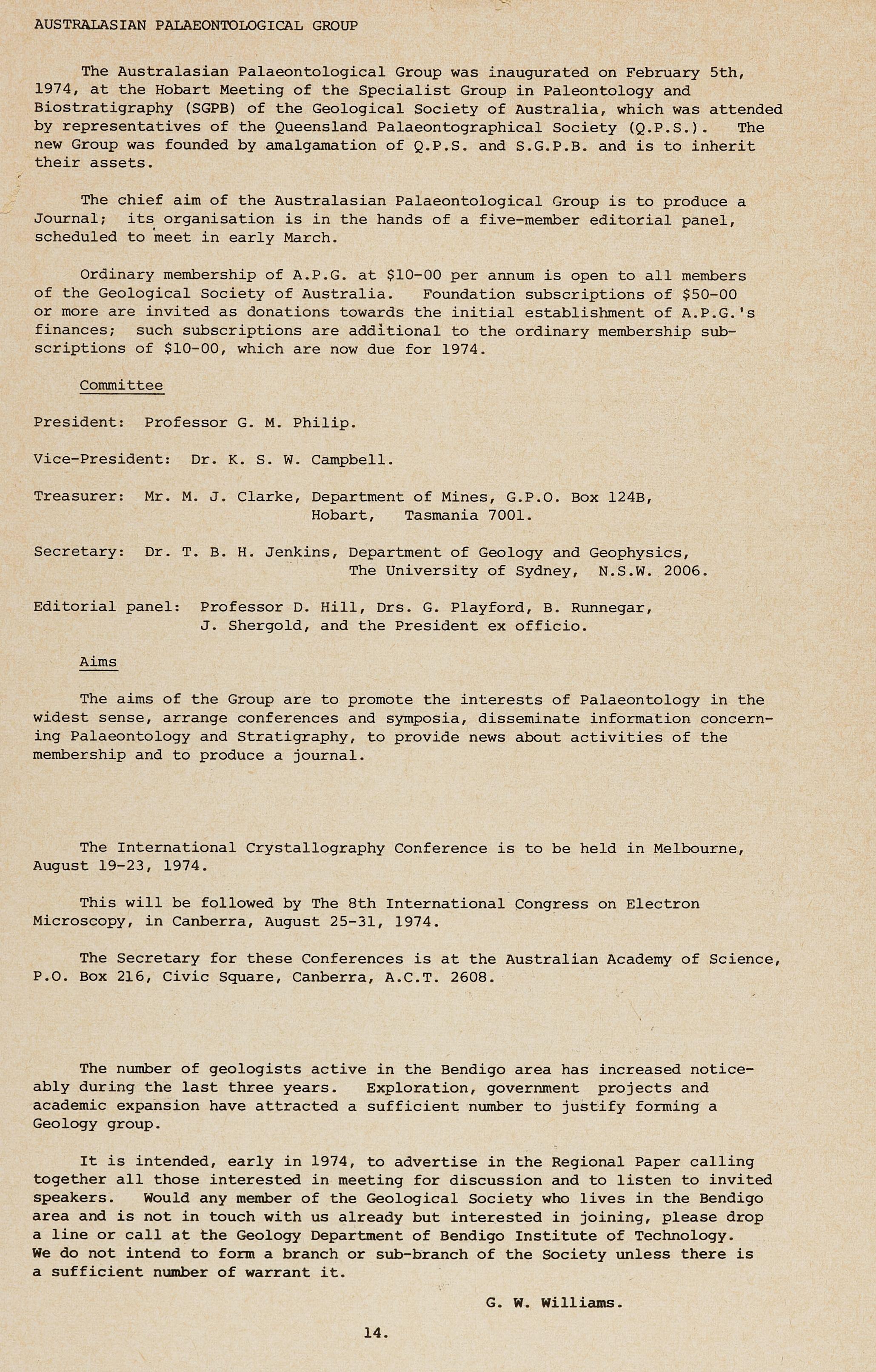
The International Crystallography Conference is to be held in Melbourne, August 19-23, 1974.
This will be followed by The 8th International Congress on Electron Microscopy, in Canberra, August 25-31, 1974.
The Secretary for these Conferences is at the Australian Academy of Science, P.O. Box 216, Civic Square, Canberra, A.C.T 2608.
The number of geologists active in the Bendigo area has increased noticeably during the last three years. Exploration, government projects and academic expansion have attracted a sufficient number to justify forming a Geology group.
It is intended, early in 1974, to advertise in the Regional Paper calling together all those interested in meeting for discussion and to listen to invited speakers. Would any member of the Geological Society who lives in the Bendigo area and is not in touch with us already but interested in joining, please drop a line or call at the Geology Department of Bendigo Institute of Technology. We do not intend to form a branch or sub-oranch of the Society unless there is a sufficient number of warrant it.
G. W. Williams.
C.S.I.R.O.
Research Appointments - Division of Applied Geomechanics.
Positions are available in the following fields:
1. Support of underground openings.
2. Slope stability.
3. Rock Fabric.
4. Measurement of stress deformation, behaviour of earthen materials.
5. Fracture and fragmentation studies.
6. Geodynamics. •
7. Geotechnical processes.
Qualifications: Ph.D. or equivalent, together with demonstrable research ability.
Salary range: $9,380 - $17,077 and beyond.
For further information contact:
The Acting Chief, Division of Applied Geomechanics, C.S.I.R.O., P.O. Box 54, Mount Waverley, Victoria 3149.
Applications close 26th April.
Geological Survey of Papua-New Guinea, Port Moresby.
Geologist Class IV in charge of Economic & Regional Geology.
Geologist Class III
Geologist Class III
Geologist Class III (Petroleum) (Metals) (Engineering Geology)
Engineering Geologist Class II
Engineering Geologist Class I (new graduate)
Geophysicist Class III (Petroleum & Engineering).
Salaries:
Class I $6000-8953
Class II $9397-10521
Class III $11050-12364
Class IV $12911-13796
plus in all cases $500 regional allowance. (New Guinea tax is 11% approximately)
For further details contact:
The Chief Government Geologist, Box 778, Port Moresby. Papua-New Guinea.
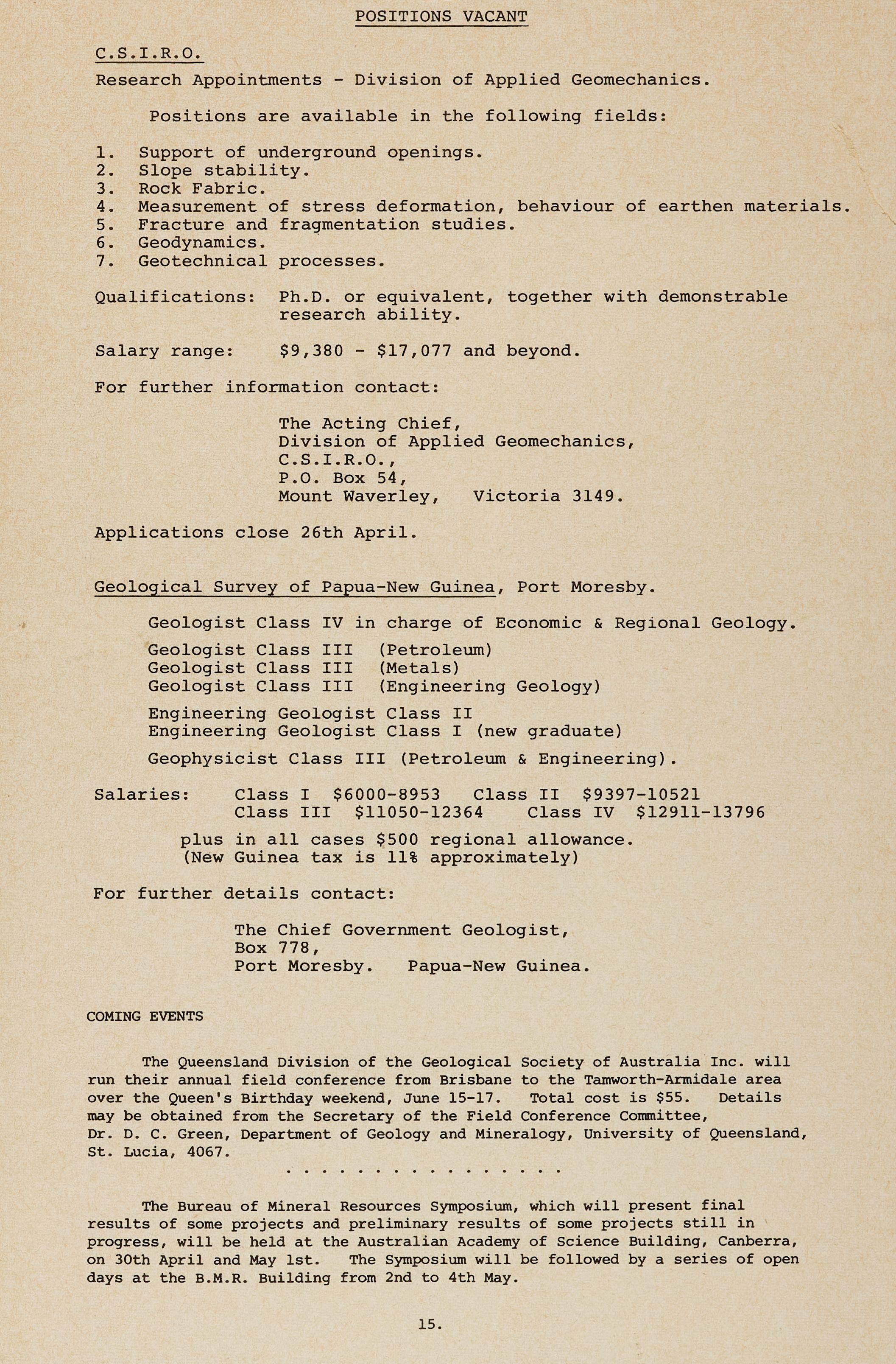
COMING EVENTS
The Queensland Division of the Geological Society of Australia Inc. will run their annual field conference from Brisbane to the Tamworth-Armidale area over the Queen's Birthday weekend, June 15-17. Total cost is $55. Details may be obtained from the Secretary of the Field Conference Committee, Dr. D. C. Green, Department of Geology and Mineralogy, University of Queensland, St. Lucia, 4067.
The Bureau of Mineral Resources Symposium, which will present final results of some projects and preliminary results of some projects still in progress, will be held at the Australian Academy of Science Building, Canberra, on 30th April and May 1st. The Symposium will be followed by a series of open days at the B.M.R. Building from 2nd to 4th May.