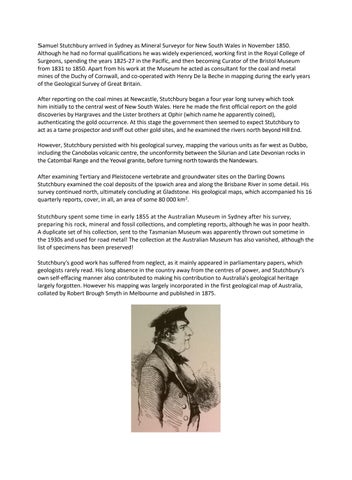
Samuel Stutchbury arrived in Sydney as Mineral Surveyor for New South Wales in November 1850. Although he had no formal qualifications he was widely experienced, working first in the Royal College of Surgeons, spending the years 1825-27 in the Pacific, and then becoming Curator of the Bristol Museum from 1831 to 1850. Apart from his work at the Museum he acted as consultant for the coal and metal mines of the Duchy of Cornwall, and co-operated with Henry De la Beche in mapping during the early years of the Geological Survey of Great Britain. After reporting on the coal mines at Newcastle, Stutchbury began a four year long survey which took him initially to the central west of New South Wales. Here he made the first official report on the gold discoveries by Hargraves and the Lister brothers at Ophir (which name he apparently coined), authenticating the gold occurrence. At this stage the government then seemed to expect Stutchbury to act as a tame prospector and sniff out other gold sites, and he examined the rivers north beyond Hill End. However, Stutchbury persisted with his geological survey, mapping the various units as far west as Dubbo, including the Canobolas volcanic centre, the unconformity between the Silurian and Late Devonian rocks in the Catombal Range and the Yeoval granite, before turning north towards the Nandewars. After examining Tertiary and Pleistocene vertebrate and groundwater sites on the Darling Downs Stutchbury examined the coal deposits of the Ipswich area and along the Brisbane River in some detail. His survey continued north, ultimately concluding at Gladstone. His geological maps, which accompanied his 16 quarterly reports, cover, in all, an area of some 80 000 km2. Stutchbury spent some time in early 1855 at the Australian Museum in Sydney after his survey, preparing his rock, mineral and fossil collections, and completing reports, although he was in poor health. A duplicate set of his collection, sent to the Tasmanian Museum was apparently thrown out sometime in the 1930s and used for road metal! The collection at the Australian Museum has also vanished, although the list of specimens has been preserved! Stutchbury's good work has suffered from neglect, as it mainly appeared in parliamentary papers, which geologists rarely read. His long absence in the country away from the centres of power, and Stutchbury's own self-effacing manner also contributed to making his contribution to Australia's geological heritage largely forgotten. However his mapping was largely incorporated in the first geological map of Australia, collated by Robert Brough Smyth in Melbourne and published in 1875.
Issuu converts static files into: and more. Sign up and create your flipbook.