
Psychosocial safety at the GSA: Consultation summary and risk mitigation strategies
Consultation DRAFT

EXECUTIVE SUMMARY
This report explores the importance of psychological safety within the Geological Society of Australia (GSA), particularly focusing on how GSA can effectively address psychosocial hazards within its volunteer workforce. A safe and supportive environment is essential for improving volunteer engagement, productivity, job satisfaction, and overall wellbeing. By following the guidelines established under the Work Health and Safety (WHS) Act 2011, the GSA can mitigate risks and comply with legal obligations while fostering a culture of care.
The report outlines the consultation process initiated by Awareness Co., which included educational sessions, a survey, and volunteer feedback to understand the psychosocial hazards facing GSA volunteers. It discusses common hazards such as high job demands, role ambiguity, lack of support, and workplace violence. The document highlights the importance of adopting a proactive approach to managing psychosocial risks, including implementing a structured risk management process, conducting regular reviews, and establishing support systems for volunteers.
Key recommendations include improving role clarity, establishing clear reporting and recognition systems, and ensuring ongoing volunteer support through measures such as leadership development, comprehensive training, and mental health resources. The GSA is also encouraged to implement more accessible risk management tools and foster an environment where volunteers feel safe to report any issues they encounter.
1. Introduction to psychological safety
Organisations that promote psychologically healthy workplaces and identify and manage psychosocial hazards experience several benefits including thriving workers, increases in productivity, engagement, and job satisfaction, and decreases in absenteeism, work-related injuries, and worker turnover. Additionally, it is a legal requirement for employers to consult with their workers under the model Work Health and Safety (WHS) Legislation.
Under the legislation, a person conducting a business of undertaking (PCBU) has a primary duty of care to ensure, as far as reasonably practicable, the health and safety of workers and volunteers.
Australian volunteer organisations face significant challenges in understanding how psychosocial hazard legislation applies to them due to the complex and evolving nature of these regulations. Volunteers, who are not employees, may fall into a grey area, making it unclear how protections against psychosocial risks apply to them.
Additionally, the diversity of volunteer roles and environments further complicates efforts to create standardised approaches to compliance, leaving organisations uncertain about their legal obligations and how best to safeguard the wellbeing of their volunteers.
The best approach for Australian volunteer organisations to navigate psychosocial hazard legislation is to adopt a proactive and inclusive strategy. Organisations should begin by conducting a thorough risk assessment that considers the unique contexts in which volunteers operate. Training programs tailored to volunteers, emphasising awareness and prevention of psychosocial hazards, are crucial and fostering a supportive and communicative environment where volunteers feel comfortable reporting issues is key. By integrating these practices into their broader risk management framework, organisations can
not only comply with legislation but also enhance the safety and wellbeing of their volunteers.
The GSA has taken a proactive approach in understanding their obligations and managing their psychosocial hazards by engaging Awareness Co. as an independent provider to initiate the consultation process, providing awareness and education to effectively identify and assess hazards and risks.
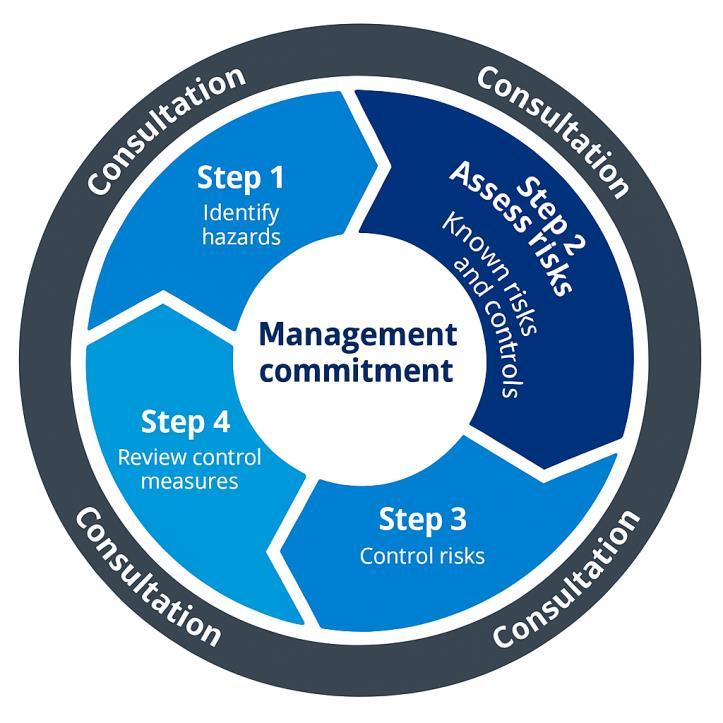
To manage and mitigate the risks associated with psychosocial hazards, the WHS Code of Practice recommends a structured approach to risk management. This process is essential to ensure that psychosocial hazards are properly identified, assessed, and controlled, reducing the potential for harm to volunteers and members.
The risk management process as illustrated in Figure 1 involves the following key steps:
1. Identify psychosocial hazards: Recognising and listing potential hazards in the workplace is the first step in managing risk. This includes identifying aspects of the work environment, job design, and interpersonal dynamics that could contribute to mental health issues.
2. Assess the risk: Once hazards are identified, organisations need to assess the risk they pose. This involves evaluating the likelihood of these hazards occurring and the severity of potential consequences.
3. Implement controls: After assessing risks, the next step is to put controls in place to eliminate or minimise these hazards. This might involve changes to the work environment, the introduction of support systems, or providing training and awareness for workers.
4. Review and monitor: Regularly reviewing and monitoring the effectiveness of the controls is essential to ensure that they continue to protect workers’ psychological wellbeing over time. This includes tracking the success of implemented strategies and soliciting feedback from volunteers to maintain engagement with the risk management process.
Psychosocial Hazards in the Workplace
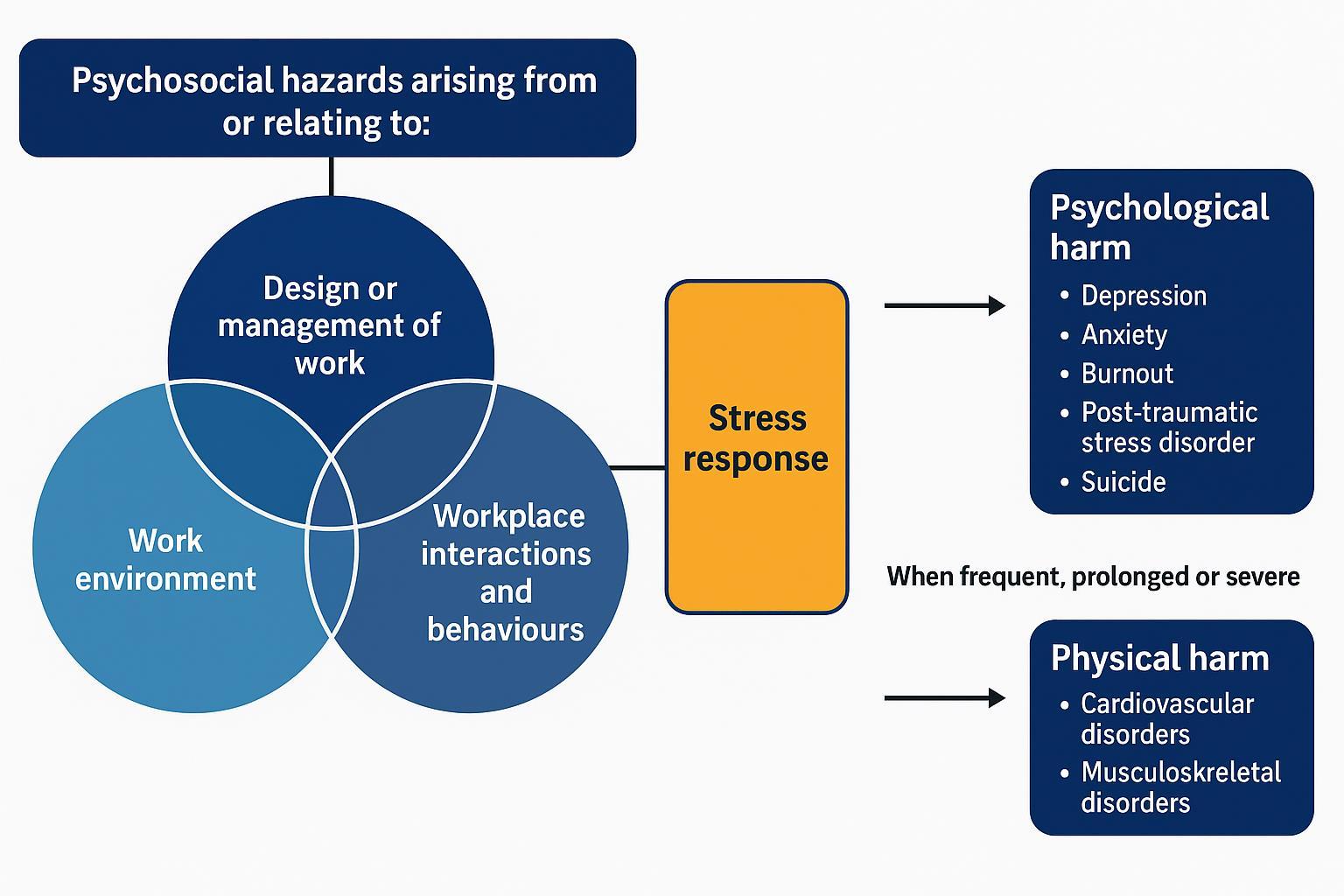
Psychosocial hazards refer to the factors within the work environment that may cause harm to a worker’s psychological health. These hazards may arise from how work is designed, managed, and organised, as well as how interpersonal relationships unfold within the workplace. Psychosocial hazards are just as important to manage as physical hazards because they can result in serious consequences for workers’ mental health, including stress, anxiety, depression, and more severe conditions such as post-traumatic stress disorder (PTSD).
Common psychosocial hazards as illustrated in Figure 2 include:
• High job demands: Workload that exceeds the capacity or resources of the worker, leading to stress and burnout.
• Role ambiguity: Lack of clarity in job responsibilities or expectations, leading to confusion and stress.
• Poor support: Lack of support from colleagues, supervisors, or the organisation, which may leave workers feeling isolated.
• Bullying and harassment: Interpersonal conflict or mistreatment in the workplace.
• Low job control: Workers may feel helpless if they have little or no control over their tasks, leading to frustration and burnout.
• Workplace violence: Exposure to physical or verbal violence, creating a hostile and unsafe environment.
These hazards can severely affect a worker’s emotional and psychological wellbeing, which, if left unaddressed, may result in long-term mental health issues.
2. Identification of hazards at the GSA
Education and Awareness Sessions
All GSA members were invited to dedicated sessions to commence the consultation process with educating the organisation on their obligations and responsibilities when it comes to Managing Psychosocial Hazards as well as raise awareness of inherent and potential hazards in the context of their volunteer roles. The session covered:
• An understanding of what psychosocial hazards are, and the impact they can have in a workplace,
• A high-level summary of the legislative requirements, and
• Responsibilities of the GSA towards volunteers in line with the relevant Code of Practice on managing Psychosocial Hazards
A final reflection activity of the session included asking volunteers “What can we improve? What do you hope GSA prioritises when it comes to volunteer safety?” Responses included:
• Volunteer shout-outs or volunteer awards/prizes
• Better conduits for reporting any issues
• An understanding of what our obligations with WH&S are.
• Regular check-ins to make sure that volunteers can continue to contribute and that they are feeling comfortable in the environment.
Volunteer Survey
All GSA volunteers were invited to complete a confidential survey, facilitated by Awareness Co., where participants had the opportunity to provide information about their current work, health and safety experiences in their role as a volunteer. 32 Volunteers participated in the survey and coupled with the discussions held at the Education and Awareness Sessions, insights outlined in this report provide a foundation for consultation to continue and for GSA to continue to identify, assess, control and review the inherent and potential hazards.
The following insights are taken directly from the Survey and any details that may identify an individual have been removed.
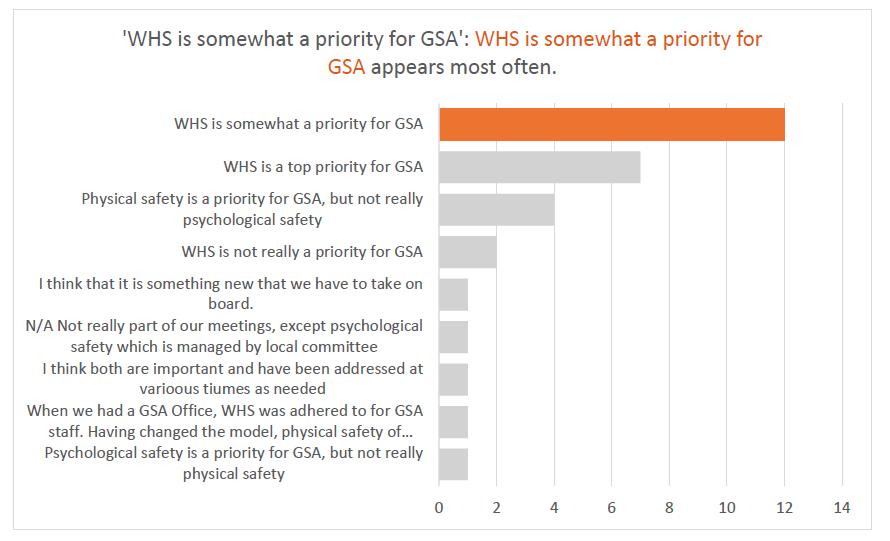
1. From your perspective, which of the following statements best describes your organisation's approach to prioritising WHS, including psychological safety?
2. Which of the following best describes the WHS obligations (including the identifying, reporting and monitoring of risks and hazards) within your role?
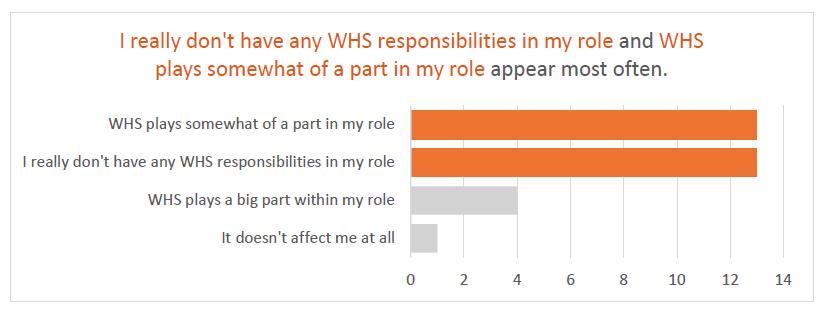
3. Describe how you provide feedback on health and safety risks, hazards or practices within your organisation. These may include channels such as one-on-one meetings, team meetings, feedback forms, registers etc.
• One-on-one and team meetings, via email/message, requesting clarity.
• Discussion at Committee or Division meetings, Governing Council or to the Chair of the
• Committee
• Risk assessments for field trips, field work and lab work
• We don't have this kind of conversation in our committee meetings, we don't have a formal channel for WHS reporting, as far as I know
• When we have an event, the committee collaborates to develop the risk mitigation plan for the activity
• It is something new that we have to consider. The legislation has caught up with us and we must take it seriously.
4. From your perspective, how often are the following Psychosocial Hazards experienced or observed in the workplace?
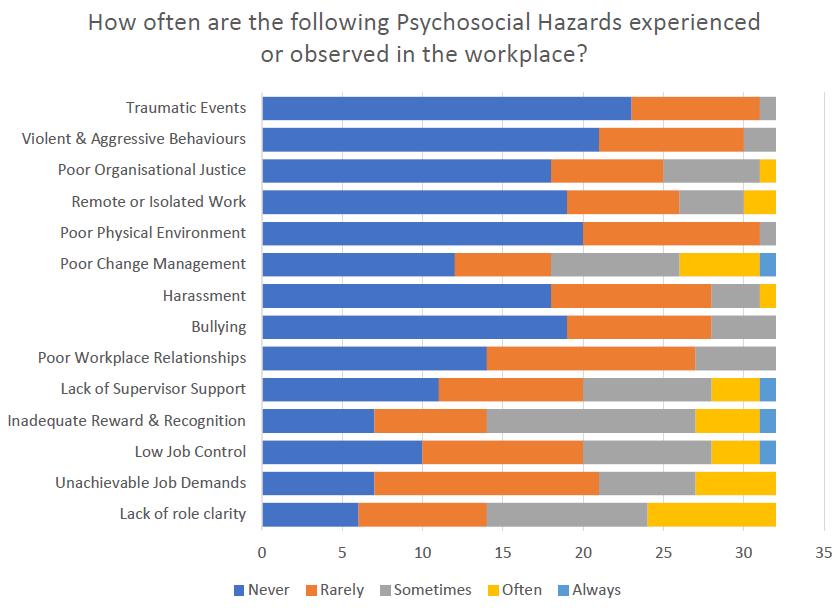
5. Who do you go to if you need support with any workplace matters?
• President, Chair or another committee member as appropriate, Executive Committee
• members (Vice Chair, Secretary or Treasurer)
• I don’t work for GSA or I don't need support in this volunteer role, not sure who to go to
• in GSA
• OH&S officer, info@gsa, HR, divisional and specialist group meetings, the safety and
• wellbeing team, GSA Central or someone I trust within the workplace
• I speak to fellow volunteers.
• Doctor, EAP, Manager, friend, family
6. If you had to raise an issue or provide feedback on anything in your workplace, how would you normally do this? Who do you speak to and what channels do you use?
The commentary to this question was very similar or identical to the responses provided in question 5.
7. When it comes to improving the safety, care, and working environment at GSA, do you have any ideas or suggestions on how this can be achieved?
• Clarity of roles, responsibilities and protocols.
• Forward planning and better record keeping.
• Policies that are easy to locate. Online risk assessment forms. GSA needs a WH&S policy in line with the legislation.
• Review Code of Conduct and refresher training. Clear and enforceable, and enforced policies that can address breaches. Provide official procedures, processes and training for GSA volunteers. Some training and support for volunteers on how to do forms, report etc.
• Having clear safety guidelines. Specific guidelines should be made available during field trips.
• Streamlining and standardising any required paperwork for field trips, workshops or common events (talks etc.).
• Perhaps we could have a reporting portal.
• Make sure there is a good gender balance at all levels.
• I would recommend offering mental health support for all volunteers, ensuring resources are universally accessible.
• Improvements could be made around managing expectations of members and other
• organisations that we work with on events, publications, projects, etc.
• The GSA website should feature a page with clear instructions (with links if relevant) on how to handle and report any issues that members have experienced or witnessed.
• I would like to see more support to encourage non-members to participate and therefore be
• exposed and possibly become members.
• Buddy system across disciplines.
• Dedicated role that can help to solve conflict.
• Could be an item discussed in monthly meetings
8. When it comes to addressing Psychosocial Hazards at GSA, what do you think Management should focus on in the coming year?
• Better policy on addressing behaviours from members.
• Reassure members that there's zero tolerance for harassment, bullying and similar misconduct.
• Provide clear ways to report inappropriate behaviours/seek advice.
• I think you should focus on providing excellent geological opportunities for people
• Succession planning for Division committees and their subcommittees.
• Clarity as to what the various jobs entail and better methods of keeping records.
• I think clearly defining committee member roles at AGMs would be helpful.
• I think having access to some sort of reporting portal and establish a medium that gives upper management some idea as to the range of issues.
• Burn out - volunteers usually take on our roles on top of existing work commitments and overreach ourselves.
• GSA management should concentrate on organising regular ice breaker sessions to facilitate open communication and allow volunteers from each regional division to express their concerns freely, share their experiences and challenges. These sessions should aim to strengthen team bonds and enhance mutual understanding among members.
• Flexibility at work, sharing workload, talk to people.
• Training around First Nations sensitivities and generational trauma.
• More engaged membership of the committee to reduce high expectations on others.
• Change management for when committee members resign, and new members start.
• Provide support to connect all committee members nationally to minimise duplication of systems (e.g. connect all secretaries in states/territories to come up with standard minutes system).
• Find avenues for geoscientists to relax together - look at programs like GeoHug.
• Making volunteers aware of what this is and how to respond correctly. Awareness raising and what to do if this is an issue.
Summary of Insights to Prepare for Action Planning
The feedback gathered during this process, can be summarised into 3 key areas to be considered by GSA to inform their action planning. Whilst the population that participated in the program is a small portion of the organisation, there has been consistent commentary throughout, some of which is known and may be in progress.
1. Robust Governance and Systems of Support
The reality for some volunteer-based organisations is that when people are “giving up” their time, they expect to be treated well and appreciated for their contribution. Whilst some of this may be out of the realm of control, in a destabilising context it can magnify dysfunction, making it harder for an organisation to effectively lead its volunteers and ensure all the hygiene factors are in place. Ensuring that there are robust systems of support for volunteers to perform their role effectively and capably is critical. This may include:
• Developing clear policies and procedures for volunteers to understand what their responsibilities are, what they are accountable for how work is managed, measured and evaluated and a transparent onboarding and offboarding process. These need to be complimented with ongoing individual engagement, development and training.
• Clear policy and procedure for reporting an actual or perceived risk or hazard.
• Simple and available systems to record incidents to allow for effective risk and hazard identification, assessment, control, monitoring and review.
• Clear channels of support to provide guidance and support and to promote a culture of care and safety.
Volunteers like employees need to consistently and repeatedly be made aware of their rights and responsibilities relating to policies and procedures which should be clearly outlined, available and distributed ensuring that they are up to date.
2. Genuine “Leadership” Commitment, Capability & Communication
The Australian HR Institute State of Leadership in Australian Workplaces Report demonstrates that when leaders express genuine care for their team members, levels of wellbeing, job satisfaction, performance and safety are all more likely to be higher1. When it comes to enhancing “leadership” capability, consider the current leadership/committee capability and introducing routines and practices that support hazard spotting and psychological safety. Continued consultation practices with Divisional Chairs will assist GSA in remaining compliant with legislative obligations.
3. Volunteer Engagement, Development & Culture
Considering an organisational approach to creating space for better engagement and 2-way communication will contribute to creating a culture of care and encourage greater participation. This may include:
• Team development activities that encourage collaboration and connection.
• Opportunities for Divisional Chairs and Committee members to communicate updates and organisational achievements to encourage ongoing commitment and contribution
• Increasing wellbeing literacy to identify and proactively address psychosocial hazards for individuals (‘me’ level), divisions/states/territories/teams (‘we’ level) and across the society (‘us’ level).
1- Australian HR Institute 2021. State of Leadership in Australian Workplaces Report. Available online: MMcQ_LeadersLab_WorkplaceReport2021.pdf
3. Controlling the risks - GSA Leader Session
On Thursday 31st of October 2024, Awareness Co. facilitated a Leader Debrief with the GSA Governing Council and Divisional Chairs working through the high-level insights from the Volunteer Consultation Program. During the debrief, we discussed:
• A summary of obligations when it comes to the responsibilities and risk management of Psychosocial Hazards
• The Leader Debrief Report and the insights gathered through the survey as well as the virtual Awareness sessions
• The challenges that a volunteer-based organisation faces with engagement of people in activities such as the consultation program given their time commitments.
• The best way to continue consultation on Safety in the workplace with volunteers
• Collective agreement across the group that they need to prioritise specific actions as a cohort to ensure a consistent approach to risk management.
After reviewing the available information from the consultation, coupled with their own experiences, the group agreed to focus on 3 key risk Areas and worked together in smaller groups to identify what is working well (or what controls currently exist).
They then worked to prioritise what actions and controls they could commit over the next 3 months to provide a safe place of work and safe systems of work.
1. Role Clarity & Job Demands
What are we doing?
• GSA constitution and rules (it is too big, need to reduce and define better)
• At the Divisional level – done poorly or ad hoc, we are doing what previous person did in the role which isn’t always best practice
Next steps:
What could we do?
1. Check with constitution what needs updating –what is already clear
• Revisit role descriptions
• Make them more accessible
• Terms of reference document and statement of purpose
2. Buddy system across divisions (divisional forums?)
3. Succession planning for committee roles, TAS online governance units, Deputy for some roles
1. Governing Council to reassess role descriptions and prioritising the Divisional and Specialist Group forums
2. Executive Committee to roll out governance training
3. Divisions and Specialist Groups to look at deputy roles for succession planning, buddy systems
2. Reward and recognition
What are we doing?
• Newsletter and social media introductions
• Informal verbal and written recognition of volunteer's effort
• Awards
• List of medal recipients on the website
Next steps:
What could we do?
1. Social media videos introducing new volunteers (optional)
2. Free membership for award recipients/ volunteer of the year (following year of service)
3. Nomination portal/email to recognise people's contributions / divisional / specialty group/ EC / GC achievements
• Section of TAG highlighting recent wins
• Formal welcome to new committee members at division/ GC +EC
• Membership of volunteers subsidised
• Committee dinner
• Ask how volunteers feel rewarded and recognised?
1. Governing Council to assess volunteer subsidies and recognition schemes, ask volunteers how they want to be rewarded and recognised
2. Geocommunication Standing Committee to roll out volunteer highlights
3. Divisions and Specialist Groups to welcome and promote their volunteers
4. TAG committee to publish ‘you rock awards’
3. Poor workplace behaviours including bullying/violence/harassment
What are we doing?
• Code of ethics
• Code of conduct
• Open conversation within groups
Next steps:
What could we do?
• Improved access to knowledge of processes to report (GC + Divisions)
• Reporting clarity: ensure follow through and ensure sense of confidentiality.
• Reporting of disciplinary actions – a way to let people know of management and outcomes within policy and respecting confidentiality
• Mental health support functions.
• Reminders and feedback mechanism during membership renewal
• Tick box for abiding by code of conduct
• Social media code of conduct
1. Governing Council to reassess and communicate workflows for reporting and management of poor workplace behaviours and implement new social media and mental health supports
2. Division and Specialist Groups to communicate new policies as established
3. TAS to assist with communication and reporting of the Code of Conduct
Parking Lot Notes
The team also captured additional items that need continued focus or a discussion later:
• Consider “Not for Profit” data (further benchmarking in relation to volunteer-based organisations and safety data)
• Reminder that Consultation Survey engagement is only a small portion of the volunteer cohort
• Volunteers taking on too much – passionate about the work they do
• Membership – consider demographics span (aging membership and younger members). Challenge is accommodating both.
• Guidelines should include expected volunteer hours and to ensure they do not burn out
• Reprioritise programs – stop/start/continue
• Safe space - consider cultural awareness training
4. Implementation and review of control measures
The Governing Council and Chairs of the Divisions have committed to implementing the next steps. The Governing Council have begun implementation of some of the recommendations, including the Social Media Code of Conduct and the You Rock Awards. The aim will be to complete all recommendations by the end of the 2025 and review these control measures annually in the membership survey, and subsequently published in TAG Magazine.
The GSA’s positive duty obligations require a proactive approach to safety and change management, and requires ongoing consultation with members to ensure everyone feels safe, valued and respected. Safety will continue to be an ongoing standing agenda item in the Governing Council meetings and the quarterly Divisional and Specialist Group forums. GSA members are welcome to provide feedback or assistance to the implementation process by contacting the Chair of the Safety and Culture Standing Committee, or your Divisional Chair. Members can also provide anonymous feedback to: Safety@gsa.org.au
Conclusions
The GSA have undertaken a consultation process with Awareness Co. to understand the current state of psychosocial safety at GSA and establish practices to reduce or minimise the risks By integrating the findings of the consultation study into actionable strategies, the GSA have shown commitment to improve its support for volunteers and ensure the mental wellbeing of its members.
The GSA have created a series of next steps that will be implemented to continue the commitment to psychological safety To ensure the success of these initiatives, it is crucial that the GSA continues to prioritise psychological safety through regular assessment, leadership engagement, and fostering a supportive, inclusive culture. By adhering to the WHS Act and its guidelines, the GSA can lead the way in promoting a healthy and safe work environment for all, reinforcing its role as a responsible PCBU and geoscience society of choice
Action register for the 2025-27 Governing Council, Divisions and Specialist Groups
Theme Action Ownership Progress
Reassess role descriptions and prioritise updating them.
Role clarity & Job Demands
Reward and recognition
Addressing poor workplace behaviours
GC
Roll out governance training for Divisional and Specialist Groups. GC in progress
Divisions and Specialist Groups to implement deputy roles for succession planning.
Introduce a buddy system across divisions (e.g., divisional forums).
Div/SG
Div/SG
Revisit the GSA constitution and rules for clarity and relevance. GC
Governing Council to assess volunteer subsidies and recognition schemes.
GC in progress
Ask volunteers how they want to be rewarded and recognized. All
Geocommunication Standing Committee to roll out volunteer highlights. GC in progress
Divisions and Specialist Groups to welcome and promote their volunteers.
Div/SG
TAG committee to publish ‘You Rock Awards’ to recognize volunteer achievements. All Completed /ongoing
Formalise welcome initiatives for new committee members at the division/GC +EC levels. All
Governing Council to reassess and communicate workflows for reporting and managing poor workplace behaviours.
Implement new social media policy
GC
GC completed Implement new mental health supports. GC in progress
Divisions and Specialist Groups to communicate new policies regarding bullying and harassment as established.
Div/SG
TAS to assist with the communication and reporting of the Code of Conduct. TAS
Continue to ensure follow-through and confidentiality in reporting processes.
Provide clearer reporting of disciplinary actions, ensuring transparency while maintaining confidentiality.
GC
GC