‘Saving Private Keid’ – the war experiences and later career of Harold Guy Walker Keid. By Ian Withnall Harold Guy Walker (Guy) Keid was born at Pimpama, south of Brisbane, on 25 June 1895, the youngest of 9 children of Charles George and Mary Elizabeth Keid. Two children died in infancy, but six brothers and a sister survived to adulthood. All children were initially educated at Pimpama State School, but in the early 1900s the family moved to Brisbane and around 1913 built a house in Graceville, called ‘Chewton’. Guy was educated at State schools, and when war broke out in August 1914, was a student at the newly opened University of Queensland studying towards a Science degree, intending to become a geologist. All six Keid brothers served in the First World War, and their war service is recorded in detail by Hampson (2005). Four of them were among the first wave of Australians to enlist. William enlisted in the 2nd Light Horse on 21 August, and Guy enlisted on 2 September. Guy had served for 15 months in the reserve Australian Medical Corps prior to enlisting, and was therefore appointed as a bearer in ‘A’ section of the 3rd Field Ambulance, which was attached to the 9th Battalion. Two other brothers, Harry and Ted, who had moved to the Atherton Tableland, enlisted in Townsville on 5 October and were appointed to reinforce the 9th Battalion.
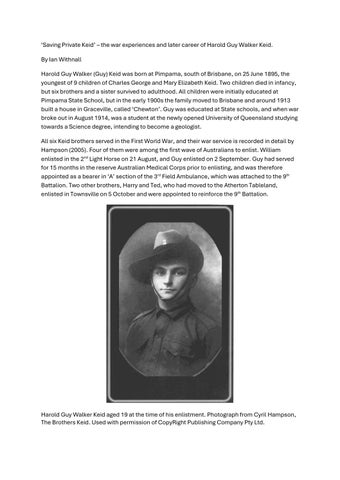
Harold Guy Walker Keid aged 19 at the time of his enlistment. Photograph from Cyril Hampson, The Brothers Keid. Used with permission of CopyRight Publishing Company Pty Ltd.
Guy and William received only rudimentary training before they embarked on 25 September for England and joined a convoy of 38 troop ships from Australia and New Zealand. However, the entry of Turkey into the war resulted in them being sent for training in Egypt instead, disembarking in Alexandria on 5 December. Harry and Ted arrived in Egypt and joined their battalion in early March, before the Anzacs were shipped to Lemnos in readiness for the invasion of the Gallipoli Peninsula. Guy, Harry and Ted were part of the first landing on 25 April, and Harry was one of the first casualties, although he recovered from his wounds and re-joined his battalion at Gallipoli in September. The 2nd Light Horse was deployed to Gallipoli as infantry in May and took over responsibility for Quinn’s Post where William Keid was killed on 23 June. Both Guy and Ted served on Gallipoli through the entire campaign until the evacuation in December. Meanwhile, the remaining two brothers, Leonard and Walter enlisted in May, 1915 and joined the 9th Battalion, reaching Egypt in February 1916, just before the existing battalions were split up to create two new Divisions. As a result, Leonard and Walter became part of the 49 th Battalion, while Harry and Ted remained in the 9th Battalion. They left for the Western Front in late March, while Guy’s unit, which had become the 13th Field Ambulance, did not leave until early June. In the meantime, Guy had found himself awarded 14 days No. 2 Field Punishment for using insulting language to an officer, resisting arrest and striking escort. With the exception of Harry, who had been chosen as an escort for General Birdwood, Ted, Leonard and Walter in their respective battalions were involved in the Battle of the Somme, while Guy was transferred again and was assigned to the rear aid post for the 49th Battalion near Pozieres. The disciplinary punishment in Egypt had done little to deter his rebelliousness, and in France in June and July he was awarded with two further sets of Field Punishment No. 2 for being ‘drunk and using obscene language in the hearing of French women folk’ and ‘creating a disturbance and disturbing French inhabitants’. At the beginning of September, the 49th Battalion was involved in an attempt to take Mouquet Farm on Pozieres Ridge, resulting in very heavy casualties. Amongst them were Sergeant Walter Keid, killed on 4 September, and Lieutenant Leonard Keid who was reported missing, and was believed to have been killed on 3 September. His body was never recovered. Guy was profoundly affected by the death of another two brothers, and in November, was sent to England and thence back to Australia, where he was discharged from the Army on 15 March 1917, for ‘Family Reasons’. The Army may have thought it best after the death of three brothers, given his youth and perhaps his problems with discipline, to send him home for discharge. Ted, now a sergeant, took part in the Third Battle of Ypres, where he was wounded by artillery fire on 1 November, dying the next day. Harry was still attached to Anzac headquarters, but in October 1917, came down with pneumonia and bronchitis and was transferred to hospital in England. The Premier of Queensland, T.J. Ryan, with the support of the Australian High Commissioner, Andrew Fisher, was moved to make representations that the Keid family had done enough and that Harry should also be repatriated and discharged. This request was granted and Harry returned home and he too was discharged for ‘family reasons’ in March 1918.
Meanwhile, on his return to Australia, Guy completed his B.Sc. at the University of Queensland. He joined the Geological Survey of Tasmania in 1920 as a third field geologist under Loftus Hills, the others being A.M. Reid and P.B Nye (Bacon, 1989; Bacon & Banks, 1989). During his time with the Geological Survey, he assisted in the preparation of a comprehensive survey of the coal resources of Tasmania, which is acknowledged by Bacon as one of Hills’ largest works with the geological Survey (Hill et al., 1922). Keid also assisted Nye on other geological investigations. However, being a recent graduate with little experience, he had trouble meeting Hills’ exacting standards and also received an unfavourable report from Reid on his work. Reid noted that Keid was referred to at the field camp as ‘the surly boy’ and that he ‘upsets one by his constant grumbling and finds no pleasure in his work’ (Letter from Reid to Hills quoted by Bacon, 1989). His reported attitude is consistent with his run-ins with authority while in France, but his war experiences and the loss of four brothers may also have contributed to his demeanour. Hills declined to recommend Nye and Keid for an annual pay increment in 1921, and Keid was dismissed when his position was abolished in 1922. Hills wanted to retain the services of a chemist, which was a temporary position, and recommended to the Secretary of Mines that this position be made permanent at the expense of one of the geological positions. In spite of Hills’ opinion of Keid’s competence, he had been continuing his studies while in Tasmania and Hampson (2005, p97) noted that in 1922 he achieved a second degree, presumably the M.Sc. that he thereafter used as a post-nomial. Guy married Clare Kerry Dillon and they later adopted a daughter Peggy. They lived in the Keid family home in Brisbane, but Hampson (2005) records that Guy was away for long periods working as an economic geologist in the Malay States, East Indies and Indo-China. He was involved with the development of the Cracow goldfield in central Queensland. Various newspaper accounts from this period refer to him as geologist to Carpentaria Prospectors Ltd and its subsidiaries including White Hope Central NL that had interests in leases on the Golden Mile and White Hope reefs (Denmead, 1932; Western Argus, Tuesday 15 November 1932). The Brisbane Courier (Saturday 13 August 1932) published an interview with him, in which he advised against people rushing to the field because there were already more men there than could be absorbed for a long time ahead and that new business opportunities were limited because there were more stores than the field could carry. In 1934, the Rockhampton Morning Bulletin (1 Dec 1934) published a circular to shareholders of White Hope Central NL that options on the leases at Cracow had been abandoned and announced a call on contributing shares to fund drilling on two deposits in the Northern Territory, Mount Tymms and Cosmopolitan–Howley, on which the company had secured options. The circular stated that ‘Mr HGW Keid had exhaustively examined the deposits and recommended that they be developed’. In 1937, Keid joined the Geological Survey of Queensland (GSQ) as Temporary Geologist, assisting the Charters Towers District Geologist CC Morton (Annual reports of the Department of Mines for 1937). While with the GSQ, he made examinations of the Garrawalt Creek section of the Kangaroo Hills tin field, the Woolgar Goldfied, the Stannary Hills tin field, and tantalite and gold occurrences in the Forsayth area. His reports were published in the Queensland Government Mining Journal (Keid, 1937 a–c, 1938a–c). He also assisted Morton with a survey of the Cape River goldfield and gold mines at Mount Leyshon.
He left GSQ in March, 1938 to take up a position with the Aerial Geological and Geophysical Survey of Northern Australia (AGGSNA) working in a team with more junior geologists under the supervision of Senior Geologist Dr H.I. Jensen. The team worked mainly in the Hodgkinson, Chillagoe and Herberton areas in the Cairns hinterland, but also spent time in north-west Queensland in the Kajabbi and Lawn Hill areas and across to Wollogorang in the Northern Territory. The work included regional geological mapping, which for the first time in Australia used aerial photographs for navigation, plotting observations and interpreting the geology. Examinations, sampling and making detailed plans of numerous mines through the areas was also done by the team, particularly by Keid and RJS Clappison. Keid worked closely with Jensen, and he was left in charge of the work during Jensen’s absences (transcript of Jensen’s letter books 16 July 1938). Although Jensen acknowledged and relied on Keid’s ‘wide experience in testing lodes for companies in a practical manner’ (transcript of Jensen’s letter books 30 October 1939), Keid and his colleagues sometimes failed to live up to Jensen’s expectations. After the 1940 field season, Jensen complained that he was ‘far from satisfied with the amount and character of the work done’ by Keid and Clappison (transcript of Jensen’s letter books, 9 November 1940)’. Although the letter books refer to numerous instances of reports being written by Keid, most of these were probably included in the overall six monthly reports released by AGGSNA. The only reports under the names of specific individuals for the Hodgkinson and Chillagoe areas were published under either Jensen’s or Clappison’s names. In 1942, Keid returned to the Department of Mines in Tasmania as a Field geologist and for 4 years made routine geological examinations of tin and underground water prospects before being appointed as Chief Geologist in 1946 (Bacon, 1989). During his 14 years as Chief Geologist, he concentrated on matters of a supervisory nature, making frequent trips to drilling operations and the centres of regional mapping activities at Davey and Zeehan. He retired in 1960 and lived in Tasmania until his death in July 1970. Guy Keid appears to have had a somewhat chequered career, but as the Hobart Mercury’s obituary records, he was a colourful character and was well-regarded by his colleagues. Guy was a big man, big in frame and big in heart, convivial and forthright, a raconteur with a fund of rare stories with astounding climaxes which always endeared him to the mining fraternity wherever he might be: and behind it all — a record of solid accomplishment in his profession (Quoted by Hampson, 2005, p99). REFERENCES BACON, C.A., 1989. One hundred years of the Department of Mines. Tasmania Department of Mines, unpublished report 1989/09. Accessed as http://www.mrt.tas.gov.au/mrtdoc/dominfo/download/UR1989_09/UR1989_09.pdf BACON, C.A. & BANKS, M.R., 1989. A history of discovery, study and exploitation of coal in Tasmania. Papers and Proceedings of the Society of Tasmania, 23, 137-189. HAMPSON, C., 2005. The Brothers Keid. CopyRight Publishing Company Pty Ltd, Brisbane. HILLS, L., REID, A.M., NYE, P.B., KEID, H.G.W. & REID, W.O., 1922. The Coal Resources of Tasmania. Geological Survey of Tasmania Mineral Resources 7.
JENSEN, H.I., 1938–1941. Letter books, transcribed by P.R. Blake, Geological Survey of Queensland (unpublished). KEID, H.G.W, 1937a. Garrawalt Creek tin field. Queensland Government Mining Journal, 38, 195–198. KEID, H.G.W, 1937b. The Woolgar gold field. Queensland Government Mining Journal, 38, 232– 236. KEID, H.G.W, 1937c. Mount Jack leases, near Forsayth. Queensland Government Mining Journal, 38, 392–396. KEID, H.G.W, 1938a. Stannary Hills. Queensland Government Mining Journal, 39, 47–50. KEID, H.G.W, 1938b. Tantalite near Forsayth. Queensland Government Mining Journal, 39, 124– 128. KEID, H.G.W, 1938c. Try Again area — Charters Towers. Queensland Government Mining Journal, 39, 159–161. Rockhampton Morning Bulletin 1 Dec 1934. White Hope Central—Circular to Shareholders— Northern Territory mines. Accessed as https://trove.nla.gov.au/newspaper/article/54779347/5373683#. The Brisbane Courier, Saturday 13 August 1932. Cracow Field—Big Transaction—Rush Unwarranted. Accessed as https://trove.nla.gov.au/newspaper/article/21965718. Western Argus (Kalgoorlie), Tuesday 15 November 1932, White Hope Central (Cracow) Costeening on Lease. Accessed as https://trove.nla.gov.au/newspaper/article/34608072.