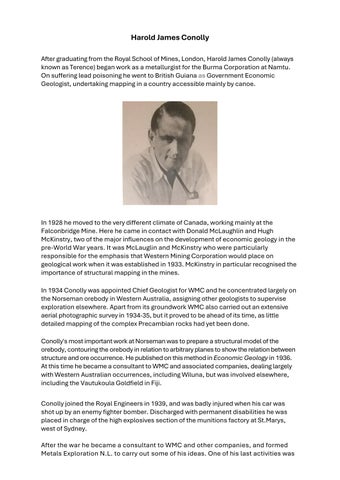
Harold James Conolly After graduating from the Royal School of Mines, London, Harold James Conolly (always known as Terence) began work as a metallurgist for the Burma Corporation at Namtu. On suffering lead poisoning he went to British Guiana as Government Economic Geologist, undertaking mapping in a country accessible mainly by canoe.
In 1928 he moved to the very different climate of Canada, working mainly at the Falconbridge Mine. Here he came in contact with Donald McLaughlin and Hugh McKinstry, two of the major influences on the development of economic geology in the pre-World War years. It was McLauglin and McKinstry who were particularly responsible for the emphasis that Western Mining Corporation would place on geological work when it was established in 1933. McKinstry in particular recognised the importance of structural mapping in the mines. In 1934 Conolly was appointed Chief Geologist for WMC and he concentrated largely on the Norseman orebody in Western Australia, assigning other geologists to supervise exploration elsewhere. Apart from its groundwork WMC also carried out an extensive aerial photographic survey in 1934-35, but it proved to be ahead of its time, as little detailed mapping of the complex Precambian rocks had yet been done. Conolly's most important work at Norseman was to prepare a structural model of the orebody, contouring the orebody in relation to arbitrary planes to show the relation between structure and ore occurrence. He published on this method in Economic Geology in 1936. At this time he became a consultant to WMC and associated companies, dealing largely with Western Australian occurrences, including Wiluna, but was involved elsewhere, including the Vautukoula Goldfield in Fiji. Conolly joined the Royal Engineers in 1939, and was badly injured when his car was shot up by an enemy fighter bomber. Discharged with permanent disabilities he was placed in charge of the high explosives section of the munitions factory at St.Marys, west of Sydney. After the war he became a consultant to WMC and other companies, and formed Metals Exploration N.L. to carry out some of his ideas. One of his last activities was
the successful testing of the extension at depth of the Great Fingal gold orebody. Conolly's exuberant personality, capacity for hard work, and enthusiasm for his ideas played an important part in the development of economic geology in Australia.