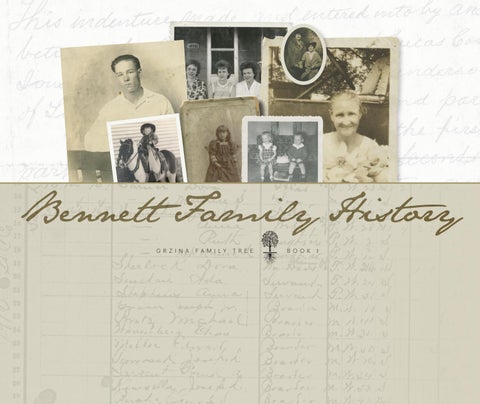
G R Z I N A
FA M I LY
T R E E
B O O K
I
G R Z I N A
FA M I LY
T R E E
B O O K
I
Bennett Family History Dedicated to Norma Peters I can remember numerous trips with mom to our public library, sitting across from her at a large, thick, wooden table, each of us scrolling through microfilm that was wound into a gigantic reader. She would give me a name to look for, and would tell me all the possible spelling variations I might encounter. She would then set my machine up to scroll through a particular census record and would turn me loose. Fast forward to thirty-five-ish years later... When mom passed, I found myself with the results of her efforts. Her research is compiled in 13 different binders, most being more than four inches thick. They contain extensive handwritten and typed notes, clippings, documents, photos and details of our family. I spent over half a year looking at the binders, taking them out, turning the pages, wondering what to do with all of it. I’m not sure why it took me that long to decide to design a book, since clearly it’s what I do for a living. While I could not include every detail, my goal was to present the history in a way that captures the essence of this particular family line, honoring mom’s work and our family legacy. Without mom’s extensive work tracing the genealogy of our family, this book would not have been possible. With exception of a few notes of my own, all content in this book was compiled from mom’s original research. Special thanks to Robyn Wilberg for her contributions and willingness to proofread and check my work. —Amy Grzina, November 2021
Fideli Bennett was born in Baden, Germany in about 1804. He came to America, arriving in Cincinnati, OH in 1831. He married Julia Ann Schneider/Snider in 1832. Their first child was born in Ohio in 1833. Soon after, the family moved to Ripley County, Indiana. Like most German immigrants, land ownership was a priority. Fideli bought 20 acres in 1835 and every 3 to 5 years bought additional acreage. He built a twostory log house on a stone foundation that had three rooms downstairs, two bedrooms upstairs and a basement room. A kitchen was added later. Here, they raised 10 children.
Fideli Bennett
Julia Snider
1804-1883
1810-1878
George Bennett
Mary Schmidt
1846-1918
1850-1926
George and Mary Bennett
Frederick Bennett 1873-1926
The family was Roman Catholic and attended St. Nicholas Church in Sunman. Fideli died in 1883 at the age of 79. George Bennett, son of Fidele, was born in 1846 in Ripley County, Indiana. He married Mary Elizabeth Schmidt. George Bennett was a blacksmith. Frederick Carl Bennett, son of George, son of Fideli was born in Ripley County Indiana in 1873. In 1893, he married Lillian Susan Dawson Schumaker.
Fred Bennett
Fred, Lillian and baby Frank
Adopted by Dr. Foster Sanderson
Sarah Van Doren
1825-1884
1825-1888
Lillian Dawson 1865-1956
Lillian was adopted by Dr. Foster M. and Sarah Sanderson at a young age. A story, handed down to her daughter Clara, tells us that Dr. Sanderson and his wife Sarah traveled from Clarksville, Ohio to Iowa to start a trading post and post office. The Dawsons traveled to the trading post with their produce to trade but on the way, Susie was born. When they arrived at the post, they left the baby with the trading post owners and went back with the rest of the train to get more produce. When they did not return at a reasonable time, searchers were sent out to see what happened and they found that all the folks in the train had been killed on the way back to their settlement and their wagons had been burned. Susie was reared by the Sandersons at the trading post who later returned to Clarksville, Ohio. At that time, Lillian was known as Susie. She traveled with Dr. Sanderson as a youngster, helping him administer to the sick by horse and wagon.
Lillain
The earlier life of
Susie Lillian Dawson Shu
Susie Lillian Dawson
Amos Shumaker Clarence Shumaker 1885-1886 John Logan Shumaker 1887-1957
Susie
Amos
Clara Shumaker 1890-1983
Before her life with Frederick Bennett, Lillian “Susie” married Amos Schumacher when she was 18. Three children were born to Susie and Amos. The first, Clarence, died in infancy and the other two children, John Logan and Clara Myrtle were surrendered to a children’s home in
Cincinnati around 1891. It is not known why the children were surrendered. John Logan went out on his own at an early age and Clara was adopted by the Van Horn family after only being at the children’s home a few days. Susie changed her name to Lillian after leaving, or being abandoned by
Amos Shumaker. Years later, Amos told Clara that her mother had died and Amos’ mother, Elizabeth said the same. After Lillian married Frederick, and began her life as a Bennett, it was assumed the three children from her marriage to Amos had died.
Clara, age 5
“ I don’t know why but she (Susie), and my father, Amos, took John and I to the 9th St. Children’s Home and gave us away. I prayed all my life to find blood relatives.” —Clara Crawford Shumaker Baby
The story of how Clara was found, by Norma Bennett Peters Researching Fred Bennett and Lillian, his wife, became a project. Because of Lillian’s adoption, (Jean and I) did not expect to get very far trying to find her parents. We had pictures that belonged to Lillian. They were of her children by Amos Shumaker, and we believed they were deceased. One of the photos had the name “Clarence Shumaker” written on the back and the other said Lebanon, Ohio. Thinking the three children had died, I wrote to Lebanon, on a whim, for their death records. Of course there were none. Ed, Amy and I planned a trip to Indiana and Ohio where I stopped at the Warren County Historical Society Library in Lebanon, Ohio. The library was tiny but packed with files and books and ledgers of records. I sat at a long table and began with the card files. I had no trouble finding Shumakers. I saw cemetery books and marriage and birth books. Then the lady showed me their envelope file of local genealogy. Here I found a book by Gorrell Shumaker (1st cousin to Clara) and it reported the names of the three children by Susie and Amos: Clarence, deceased at 18 months; John Logan’s birth and death dates; and finally Clara’s birth and marriage dates but no death date. A Florida address was listed for Clara. I was expecting to find burial information but instead was so excited to find that the children, two of them, had lived, married, had children of their own and one was possibly still living. I calculated the age of Clara and assumed she had passed away after the report had been written. When we returned home, I sent a letter to Clara at the Florida address. Even though I assumed her to be deceased, I was hoping to contact a relative. The letter went to Florida and by sheer luck was forwarded to Cincinnati where Clara now lived with her son. When Clara received the letter she called me and said “Guess who this is? I’m your Aunt Clara.” She had many questions about her mother because she had been told that her mother died. (Clara was very hurt to find that her mother and father
had both given her away but thinking Susie had died, she never tried to look for her. She found out accidently that she was adopted by the VanHorns and went to the Children’s home to look for more information. It was there that she found her brother John Logan.) On the phone call, I told Clara she had two step brothers and a step sister and she cried. Later she told me she prayed all her life to find blood relatives. The next day I had Aunt Hazel and Uncle Charley and my dad at my house and then we called Clara. We all took turns on two phones, listening, talking and crying. For the moment no one cared how or why but just that they had found each other. This was July 11, 1979. There were to be many more tears, letters and phone calls. In October, Clara and her daughter Jean visited us. We all liked each other from the moment we met. They exchanged pictures and talked and talked. We had a big party of 25-30 relatives, including a News Democrat reporter. We gave Clara a collage picture frame with photos of all her new family. Clara was 89 when she visited us. On her 90th birthday, Frank, Hazel, Ed and I went to Cincinnati for her 90th birthday party. On the last day of our visit, Clara, Hazel and dad went to church together and then we started the drive home. Hazel and dad talked softly and cried together for miles. I guess they knew they would not see her again. The letters and phone calls continued and everyone was happy. Clara lived four more years. It was a pleasure to know her just that short period of her life. The letters written on braille stationery became fewer in number and more repetitious in content. She once asked Lillian’s age at death and when told 91, Clara said she thought she would outlive her and she did. I’m not sure Clara fully forgave her mother for “giving her up.” Clara died at age 93 in 1983. (Story somewhat edited for length and content by Amy Grzina)
Frank, Hazel, Jessie and Clara, 1979
Fred and Lillian had five children. The first three were born in Indiana but soon after, the family left for Illinois probably looking for work around the railroad area. Frederick Bennett 1873-1926
Lillian Dawson (Sanderson) 1865-1956
Dora Bennett
George Bennett
Hazel Bennett
Charles Bennett
Frank Bennett 1905-1986
Dora
George
Dora & Hazel
Fred was a blacksmith like his father. He worked for a time at the Pennsylvania rail road yards in Fairmont City. He made parts for steam engines. Fred could speak fluent German and family members said he studied for the priesthood and once owned a beautiful chalice. He was deathly afraid of storms and family members say he forced the kids to take cover when clouds came, even forcing them to jump into a hole in the ground that was filled with water. Family says Lillian worked as a cook at McGowans Hotel in 1905 when Frank was born. He was brought to work and slept in a box or drawer while Lillian cooked for the railroad men. Frank was tiny and they called him “hinky-dinky.” The name Hink stuck.
Charles
Frank Bennett
Recollections of Frank Bennett by Norma Bennett Peters Frank was born in East St. Louis, IL in what was then known as Weed City. He was an outdoorsman. He fished and hunted and spent hours trekking in the woods. He picked mushrooms and berries and generally observed nature. He seemed to know the habits of birds and small animals. He hunted rabbits, quail and pheasant and caught turtles and frogs. He never killed anything he did not plan to eat. He could not shoot a deer because they were too beautiful. Squirrel was not his dish either as he thought a squirrel looked like a cat when skinned. We ate a lot of frog legs and a lot of crayfish or crawdads as we called them. He took (Dorothy, Jean and I) hunting berries and persimmons. He taught us to fish for crawdads by tying a string around a piece of liver (free from the grocer) and lowering it into holes on the creek bank. We hunted for mushrooms in the spring, only picking the ones growing on willow trees. They were cleaned, soaked in salt water, dipped in egg and coarse cracker crumbs and fried—really delicious. Frank was a great tinkerer. He could spend hours in the basement, hammering and humming and Frank, and his mother Lillian whistling and if asked what he was doing the answer was always the same—nothing. However, if a tool was borrowed or moved, he knew it immediately. He made all our kites. They were always star shaped and covered with newspaper. They flew. He made banjos out of English walnut halves. They had strings and tiny keys. He built toolboxes and birdhouses. The toolboxes were indestructible; made
mostly of 2x4s. The birdhouses were made of scraps he collected here and there. When we had our house sided with vinyl-clad aluminum, he collected the scrap pieces and made covered wagon bird houses, one for each of us daughters. Once, he made himself a purple martin house and found it frustrating trying to keep the sparrows out so he just let them live there. However, he once made a wren house and instead of drilling the entrance hole, he painted it on til it was time for wrens to nest. He though it was very funny. He watched for birds to try to get into the painted-on hole. He raised parakeets in the basement for a while. Once he actually built a boat in the basement. It was sort of a john boat and was painted yellow. I don’t think he could get it out of the basement because of the concrete steps beyond the door. I do not remember what happened to it. He could fix about anything that was broken. The real miracle being that he had practically no tools. He once fixed the furnace by dismantling it and spreading the parts all over the floor in the order they were removed. It took awhile but he got it fixed. He used the basement to escape from Jessie and to listen to ballgames and take naps. Sometimes when he was tinkering he would break out into Mexican or Spanish song. I supposed he learned them from work or from childhood in Fairmont City. His voice was high and he could carry a tune. He raised pheasants to eat and sell but he got attached to them and got rid of all of them. We had domestic rabbits for awhile— same story. He got a couple of turkeys once. They were very mean. Mom could not hang clothes out without getting pecked and then one day one of them pecked Dad and drew blood. He ended up in the freezer but we never ate him.
Frank was quite an athlete. He and his brother Charlie were baseball players. They were both pitchers. Frank played for the inner city leagues. In 1935, when he played for Verhovay, the team won the Southwestern Illinois Championship. He played for National Soda, Huffschmidt Soda, Verhovay Aid Association and Texaco. He was scouted by the Cardinals and invited to go to spring training for try-outs but the pay was so little he could not support a wife and three children.
The American Legion Post in Fairmont City, IL began a Sports Hall of Fame for local athletes and Frank was inducted in 1966. During WWII Frank coached and managed a ladies softball team in Washington Park. The women were not athletic and in fact were not real serious but he hounded them until they learned the rules and could play a decent game. Frank delivered coal by truck for a period of time, then in 1927 he began working at American Zinc Coal where he was a
laborer, an overhead crane operator and a mechanic repairing tractors. It was dad who dressed the wounds of childhood and spent time playing games and teaching us about nature and people. He cooked the Saturday breakfast basting the eggs...mom’s eggs were fried fast and had crisp edges. He made the popcorn we snacked on in the evenings and he was the one who taught us the card games in the winter and walked us into the woods in the summer.
Frank Bennett
Frank, at the American Legion Post Sports Hall of Fame induction, 1966
For Christmas, we went from tree lot to tree lot shopping for size shape and price of a tree. It didn’t matter if the snow was a foot deep, we still tramped around for hours. We girls always wanted a tree that touched the ceiling and didn’t care about the rest. Dad looked for a straight trunk. We always bought white pines. Where the limbs would be sparse on one side, that side went up against the window. Dad drilled holes in the trunk in the other sparse spots and cut limbs from the bottom of the tree to put into the holes. If they were large limbs, they then had to be wired onto another limb. Sometimes I felt like he picked out odd shaped trees he could rebuild. We strung popcorn a few times and made paper chains from red and green construction paper. We had elaborate trim under the tree. First we laid white cotton that had been bought in a roll. We put things under the cotton so there would be hills. We spread the cotton apart to make a hole and inserted a mirror underneath so it would look like a lake. We had many houses and little trees and animals to sit around. The years we didn’t have a topper for the tree, Dad made a star out of cardboard and covered it with foil. Dad made rubber guns for his darling, feminine daughters. They were made of wood with a close pin trigger and a rubber strip, which if it hit on a bare arm or leg could really sting. We climbed anything we could get to, ran fast, and Dorothy and I could fight but Jean was all mouth. We dried corn silks on the roof of the shed and when they dried we rolled them in newspaper and smoked them. There were the lady cigar trees which had the cigars which dropped on the ground when they were dry. We smoked them also.
Frank and Jessie’s house on Eastgate.
Frank and Jessie McMillan were married in 1924. Jessie was the daughter of Kate and Jesse McMillan who had both died in 1920. They moved in with his mother, Lillian, and Frank was obliged to turn over his earnings to her. Their marriage began in a rocky situation and never improved too much. They moved to a little house as soon as possible. This was the house referred to by family as “the shack.” It burned to the ground in 1933 and all possessions of this young family were lost. The earliest house I can remember was on 52nd street. We moved from there in 1940 to Eastgate where Frank and Jessie lived until 1983.
Jean, Norma and Dorothy
Mom always knew when we were doing things we shouldn’t do but she thought it was funny. Dad was always afraid we would get hurt. Whether we were 20 feet up the sycamore tree or jumping off the roof of a shed he would always threaten and cuss and carry on then finally would say well, now he was going to cut a switch off the tree ad blister some butts...so he would go to the tree, cut a switch, cut off the leaves and smaller stems and whittle off the bark and by that time he wasn’t mad anymore and we had lost interest watching him prepare to punish us. He never hit us once...not with a switch or hand!
Frank Bennett Dorothy Bennett 1925-2000
In the summer we played baseball in the street in front of our house. Dad tried to teach us the proper stance and form but we were not that serious. He watched from the porch for a while but would get aggravated at our silliness. Eastgate was just two blocks long. It went from Caseyville Ave. to Audubon. Caseyville to Eastgate was a great hill. When it snowed we could start running at the top and belly flop halfway to Eastgate and coast almost to Audubon. We would stay out til our feet felt frozen. This was a great place to grow up. I only have good memories from this era. — Excerpts from writings of Norma Bennett Peters
Jeanette Bennett 1927-
Jean and Dorothy Bennett
Dorothy, Jean and Norma
Norma Bennett 1931-2017
Jesse McMillan
Kate Thurston
1859-1920
1870-1920
Frank and Jessie
Fay McMillan
Howard McMillan
Ruth McMillan
Edith McMillan
Jeanette McMillan
Bernice McMillan
Jessie McMillan 1906-1988
Jessie was born in 1906 near a suburb of Chicago. Her father was Jesse Melvin McMillan, son of Joseph William McMillan and Honorah Fitch. They were from Pennsylvania. Jessie’s mother was Katherine Claire Thurston, daughter of John Howard Thurston and Geraldine VanGalder. Jessie’s father worked for the railroad and the family moved often. By 1910, the family was living in East St. Louis, IL. When Jessie was about 10, her father abandoned the family. In 1920, both of her parents died. Ruth, the oldest sister, took charge. Jessie, at age 14, was the youngest and most troubled. She ran away on the day of her mother’s funeral. Jessie graduated from 8th grade but did not go to high school. She was a tomboy as a child and had a good sense of humor. She loved jokes but was not a joke teller. She was interested in nursing and had many home remedies for different illnesses.
Jean and Norma Bennett
Dorothy Bennett 1925-2000
Dorothy was very shy and self conscious. She was a quiet young person. She was a very protective older sister, especially to Jean. Jean had a mouth that got her into trouble and Dor always had to settle things when it came to fighting. She took care of me a lot when mom could not. We teased Dor a lot for being dumb but in later years, when she needed a job, she was able to convince people she needed to that she could do almost anything in an office even though she had never seen a bookkeeping machine and could not type. She worked as a shoe model for awhile. She wore a tiny shoe and had pretty legs. She could make her own clothes and cut and permed her own hair. She taught me a lot about flowers and birds and got me interested in old glass and antique furniture. Dorothy was truthful, always trying not to hurt feelings and was the first to jump in when work was to be done. She seemed to know how to handle all situations. Dorothy loved movies and she and Bob Wilson often took me to movies in St. Louis. Bob was quite the movie buff and was a lot of fun. He teased me about everything. Dorothy married Robert Wilson in 1945 and Robyn was born in 1948. —Excerpts from writings of Norma Bennett Peters
Dorothy Bennett
Robert Wilson
Frank Russo
1925-2000
1924-1970
1926-1988
Robyn Wilson 1948
Top and far right: Dorothy, Robyn and Bob Wilson Robyn Wilson, middle and left
Robyn’s home in St. Louis from about ages 12-21
Robyn Wilson 1948
Even though there’s an age difference of 13, years, and we haven’t always lived near each other, I’ve always been close to Robyn. When I was 9, Robyn took me on a trip to Florida. I still remember how much fun that was. It was my first airplane ride and my first trip away from home without my parents. Over the years, mom, dad and I visited Robyn and her family many times. They lived close to the Speedway when they lived in Zionsville, Indiana and Gene had pit passes for the time trials. It was really exciting to watch the Indy cars nearly reach speeds of 200 miles per hour. One time when I was visiting Robyn, she needed to go shopping for a new dress because she had a party to go to for Gene’s office, or maybe it was a dinner with a client. Robyn tried on several dresses and I remember feeling so important helping her pick out a dress for such an exciting event. Robyn’s kids were the first babies in the family that I can remember. I was 12 when Emily was born and when I first saw her I thought she was beautiful. Shortly after, Eric was born, and then Anne. Those three babies were quite energetic and I have happy memories of a full house of Wilbergs at Aunt Dorothy’s. Over the years, Robyn visited her St. Louis family a lot. As her kids got older, she visited in the fall to celebrate the October birthdays. (Mine, Billy’s and hers). I’m not sure when this started but it went on for many years. Robyn has a great, infectious laugh and is successful at anything she puts her mind to. — by Amy Grzina
Jack Dulaney
Robyn Wilson
Gene Wilberg
1947
1948
1949
Emily Wilberg 1978
Eric Wilberg 1979
Bob Wilson, right, with his mom, Laveda Locher at Robyn and Gene’s wedding
Anne Wilberg XXXX-
Robyn and Gene lived in St. Louis, Missouri, Zionsville, Indiana and finally settled in Naperville Illinois where they raised Emily, Eric and Anne.
Emily Emily Wilberg
Nick Maglietto
1978
1978
Henry Maglietto 2010
Miles Maglietto 2012
Maxine Maglietto 2014
Eric Wilberg
Joanna Tiz
1979
1979
Eric
Evan Wilberg 2011
Anne
John Machay
AJ Fredenburg
Anne Wilberg
Ava Fredenburg 2008 John (Trey) Machay 2013
Hunter Machay 2014
Jean had a mild temperment but her smart mouth got her into trouble often and Dorothy, being the equalizer, had to fight her fights an save her from many a scrap. She was not a spectacular student, neither were Dorothy and myself. She was the germ catcher of the three Bennett girls and was sick often We made fun of her up-turned nose. Even dad said she should not get out in the rain— she might drown with that nose pointed upwards. She always had a good memory, good sense of humor and is honest and straight-forward often using colorful language.
Jean Bennett 1927-
After she married Bill Williamson, she worked in the cleaners that his family owned. The Peters family lived across the street from the cleaners. Edward was in high school at the time and had his uniforms cleaned often. Jean had told me about him and that she thought he was cute. I was not interested at the time. Later, she worked at the Federal Reserve Bank where she retired from in 1984. When she married Bud Crone, she became step-mom to his two sons and stepgrandma to his four grandchildren. Jean was always busy with different hobbies through the years. Gardening, crocheting, sewing and cross stitching. She loved animals and usually had a dog. — Excerpts from writings of Norma Bennett Peters
Jeanette Bennett
Bill Williamson
Admiral Crone
1927-
1928-2000
1927-2011
Bill Williamson
Connie Zajac
1949-
1951
Jean and Admiral “Bud” Crone
Robyn and Billy
Bill Williamson with son Billy.
Left to right: Frank Bennett, Norma Peters, Jean Crone, Bud Crone (in back) Robyn Wilberg, Gene Wilberg, Ed Peters, Jessie Bennett, Amy Peters, Dorothy Russo and Frank Russo