OFFICIAL MAGAZINE OF THE ROMAN ASSOCIATION OF HOTEL CONCIERGES “LES CLEFS D’OR“
ROME CONCIERGE
USEFUL CITY INFORMATION
n. 17
information
september/october 2026
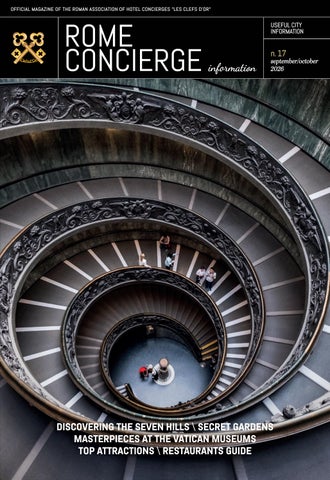
DISCOVERING THE SEVEN HILLS \ SECRET GARDENS MASTERPIECES AT THE VATICAN MUSEUMS TOP ATTRACTIONS \ RESTAURANTS GUIDE
PATAGONIA - EXPLORE THE WORLD TO EXPLORE OURSELVES
PATAGONIA - EXPLORE THE WORLD TO EXPLORE OURSELVES
Every story has a bead
www.trollbeads.it
INDEX september/october 2026
N. 17
13 Events: dates for your diary 17 Art appointments 21 Fashions tips: the must-have items 26 The seven hills of Rome 34 The masterpieces at the Vatican Museums 44 Kandinsky at Palazzo Bonaparte 50 Secret gardens 62 Pescado and Ambasciata d’Abruzzo 64 Rome with family by Roma GoGo 66 Special experiences with My Dolve Vita
ITINERARY The seven hills of Rome 26
ART Vatican Museums 34
ART The Kandinsky exhibition 44
Roma
Pantheon
Tokyo
Sant’Ivo
Casa Malaparte
Gasometro
I TUO I
LUOGHI
A R C H I T E T T U R E DA IND OSSARE Pagoda
Acquedotto
Piazza di Spagna
Duomo
Ca’ d’Oro
BOUTIQUE . VIA DELLA SCROFA 52 . ROMA . PH +39 06 48930454 . WWW.COROJEWELS.COM
INDEX september/october 2026
N. 17 TOP PLACES 68 Museums and archaeological sites 75 Monuments 76 Churches 80 Gardens and parks 81 Palaces 82 Restaurants 94 Information travelling 96 Hotels 98 Maps
ITINERARY Secret gardens 50
ART Appointments 17
EVENTS Diary 13
bi-monthly magazine
Official magazine of the Roman Association of Hotel Concierges “Les Clefs d’Or” www.romelesclefsdor.com PRESIDENT Alexandra Sardo PUBLISHER
Alex Vittorio Lana & Matteo Parigi Bini EDITOR IN CHIEF Matteo Parigi Bini MANAGING EDITOR Martina Olivieri EDITORIAL STAFF Teresa Favi, Francesca Lombardi Virginia Mammoli COVER Nicolas Hoizey PHOTOGRAPHERS Dario Garofalo, Daniele Fregonese, Hélène Mauri, Valentina Stefanelli ART EDITORS Melania Branca, Clelia Giardina ADVERTISING AND MARKETING DIRECTOR Alex Vittorio Lana ADVERTISING Nicola Brigandì, Pino di Persio, Emanuela Mattioli, Alessandra Nardelli Monica Offidani, Paola Paciotti, Anna Repellini EDITORIAL OFFICE Gruppo Editoriale via Cristoforo Landino, 2 - 50129 Firenze - Italy ph +39 055 0498097 - www.gruppoeditoriale.com Rome Concierge Information is registered with the Court of Rome under n. 75/2024 PRINT Baroni & Gori Questo periodico è associato alla Unione Stampa Periodica Italiana
copyright © Gruppo Editoriale srl
R O M A, V I A F R A N C E S C O C R I S P I 6 0/6 2
W W W.D A N R O M A.C O M
ROME CONCIERGE
information
BROWSE THE MAGAZINE ONLINE Scan the QR code and discover the digital format
@gruppo_editoriale
gruppoeditoriale.com
EDITORIAL
WELCOME TO ROME
TEXT Alexandra Sardo President of the Roman Association of Hotel Concierges “Les Clefs d’Or”
D
ear Guest, On behalf of all the Golden Keys concierges, we wish you a very warm welcome to Rome. Rome Concierge Information is our concrete commitment to making your stay in our city a truly memorable experience. In this magazine you will find all the information you might need and, above all, our sug-
gestions for the best things the city can offer during the autumn season. In this issue, we invite you to discover a more intimate side of Rome, exploring some of the city’s most beautiful and lesser-known gardens, hidden green spaces where history and autumn colours come together. We also take a walk through the history of Rome’s seven hills. Along the way, we explore the landmarks and unexpected corners that make each hill unique. Art takes centre stage too, with a visit to the Kandinsky exhibition at Palazzo Bonaparte and a tour of the masterpieces at the Vatican Museums. We remain at your disposal at our hotels, delighted to receive your requests. We all wish you a wonderful and amazing stay! 11
A stone’s throw from the Pantheon, Ottica la Fege combines the elegance of a boutique with the precision of an optical laboratory: new eyeglasses from top tier brands crafted from the finest horn, titanium and gold or platinum, express tailor-made lenses and repairs. Rome, professionalism and Made in Italy in a single exclusive experience.
Since 1900
via del Piè di Marmo 9, Rome | 06 678 1673 | www.otticalafege.it
EVENTS
DATES FOR YOUR DIARY
1
ROME FILM FESTIVAL
October 14–25 Auditorium Parco della Musica Ennio Morricone Screenings and red carpet events for the 21st edition of the Rome Film Festival. The program will also feature other cultural venues in the capital. The festival will open with Paolo Genovese’s Il rumore delle cose nuove, presented in the Grand Public section during the opening ceremony, hosted by Ema Stokholma.
2 3
ROMAEUROPA FESTIVAL - REF2026 Until November 15
Featuring over 1,000 international artists, approximately 100 performances, and 240 shows across 20 theaters in the capital, the program spans dance, music, theater, and digital arts, with stars such as Sofia Nappi, Caterina Barbieri, Fatoumata Diawara, and Benjamin Millepied. The 2026 edition also celebrates the 75th anniversary of diplomatic relations between Italy and Germany.
THEATER PERFORMANCES October and November Teatro dell’Opera di Roma
The Rome Opera House’s fall season features must-see performances such as Falstaff (October 11–November 1), Goecke / Robbins / Bausch (October 27–November 8), and The Rake’s Progress (November 27–December 5).
13
EVENTS
ROMA JAZZ FESTIVAL
4
November 1–11 Auditorium Parco della Musica Ennio Morricone Celebrate the 100th anniversary of Miles Davis’s birth with an edition dedicated to his musical legacy. The tagline Rereading Davis, Rethinking Jazz guides a program featuring artists such as Jason Miles, Paolo Fresu, Gregory Hutchinson, Jeremy Pelt, and Erik Truffaz, who have been invited to reinterpret the music and vision of the great trumpeter.
5 6
CONCERT SEASON 26/27 OF SANTA CECILIA
October – June 2027 Auditorium Parco della Musica Ennio Morricone The new season of the Accademia Nazionale di Santa Cecilia opens on October 21 with Wagner’s Siegfried, conducted by Daniel Harding, and continues through June 2027 with a rich schedule of concerts. Highlights include a recital by soprano Lisette Oropesa on October 14 and Wagner’s Secrets with Corrado Augias, Quirino Principe, and Sandro Cappelletto on October 18.
SERIE A SOCCER GAMES
October, November, and December Stadio Olimpico
The Roman fall season also comes alive with Serie A. SS Lazio faces Monza on October 11, Parma on October 24, Cagliari on November 1, and Lecce on November 21. Meanwhile, AS Roma takes on Genoa on October 17, Cagliari on October 27, Sassuolo on November 7, and Monza on November 29.
FOR MORE DETAILS AND RESERVATIONS, ASK YOUR “LES CLEFS D’OR” CONCIERGE 14
La bellezza a Roma dal 1958 Via Frattina 54 Roma 00187 tel : + 39 06 67 90 339 profumeriecastelli.com
EXHIBITIONS
ART APPOINTMENTS
1
KANDINSKY
Until February 14, 2027 Palazzo Bonaparte More than 70 works trace the artist’s entire career, from his early figurative works to the revolution in abstract art, including his time with the Blaue Reiter, his years in Russia, the Bauhaus, and his time in Paris. Among the masterpieces on display is Gelb-RotBlau, along with documents and personal items.
2
PONTORMO
From October 9 to February 7, 2027 Scuderie del Quirinale
The first major retrospective dedicated to Pontormo, the undisputed star of 16th-century Florence. Curated by Cristina Acidini, the exhibition brings together the artist’s principal masterpieces alongside an extraordinary selection of works on paper, thanks to loans from the Uffizi and major international museums. Among the most eagerly anticipated works is the famous Visitation from Carmignano.
3
KEITH HARING
From October 6 to April 11, 2027 Museo di Roma Palazzo Braschi La grande mostra dedicata a Keith Haring racconta l’universo dell’artista statunitense. Oltre 140 opere e materiali ripercorrono la sua ricerca, dalla New York degli anni Ottanta agli ultimi lavori, attraverso temi come la Street Art, l’impegno politico e sociale, l’eros, la religione e la cultura popolare.
17
EXHIBITIONS
ANDY WARHOL - FOREVER LOVE
Until March 28, 2027 La Vaccheria - La Casa della Pop Art
4
The exhibition brings together 51 works by Warhol, over 60 documents, and 28 original photographs by Dino Pedriali, along with 37 works by other leading figures of Pop Art. Portraits, Campbell’s Soup, Dollar Sign, and personal items reveal the artist’s creative and most intimate world, with a particular focus on his connection to Italy.
IL FASCINO DI SEOUL
Until December 4 Istituto Culturale Coreano
6
5
AEGYPTUS – DAL NILO AL MEDITERRANEO. OASI E DESERTI IN EPOCA ROMANA Until November 15 Museo Nazionale Romano Museo dell’Arte Salvata
An exhibition that explores the Roman presence in the oases of Egypt’s western desert between the 1st century B.C. and the 5th century A.D. Archaeology, video art, digital reconstructions, and artificial intelligence come together to create an immersive experience that explores the oases as places of encounter and exchange among cultures, trade, and religions. A journey to discover a previously unseen Roman Egypt.
An exhibition that tells the story of the Korean capital from the Joseon era to the present day through the concept of Pungryu: the art of living with elegance, pleasure, and harmony with nature. The exhibition is divided into three sections: from ancient paintings to the contemporary culture of the Euljiro neighborhood, culminating in an interactive space inspired by the Han River, where visitors can immerse themselves in everyday life in Seoul and sample traditional ramyeon.
FOR MORE DETAILS AND RESERVATIONS, ASK YOUR “LES CLEFS D’OR” CONCIERGE 18
Timeless elegance…
Restaurant L’Archeologia. Where innovation meets tradition. A unique experience to enjoy.
mercoledì - lunedì: 19.30 - 23.00 sabato e domenica: 12:00 - 15:00 / 19:30 - 23:00 martedì chiusi
Via Appia Antica, 139 ph. +39 06 788 0494
RISTORANTE TULLIO Locale Storico di Roma fondato nel 1950 e gestito tuttora dalla famiglia da ben 3 generazioni
PIATTI E SPECIALITÀ TIPICHE TOSCANE CON BRACE A VISTA Via San Nicola da Tolentino, 26 | +39 06 474 5560 | +39 06 487 4125 | +39 06 481 8564 | info@tullioristorante.it TULLIORISTORANTE.IT
SHOPPING
FENDI Largo Carlo Goldoni, 420 Roma CHANEL at Rinascente Via del Tritone, 61 Roma ANGELA CAPUTI - GIUGGIÙ angelacaputi.com
GOLDEN GLOW
Yellow gold returns with a warm, radiant allure,illuminating the season with timeless elegance and a bold contemporary touch BY Francesca Lombardi
DIOR Via dei Condotti, 1-4 Roma
MAX MARA Via dei Condotti, 17-18-18/A Roma 21
Un’elegante oasi di pesce fresco nel cuore di Roma, dove la cucina mediterranea incontra l’estro contemporaneo. Pescado celebra il mare con piatti raffinati, crudi d’autore e una carta vini pensata per esaltare
ra ffi n
a
ta de
lm
a re
Viale Bruno Buozzi 31/33 - Roma 331 7443515 - 06 5403542 | pescadoseafood.com
L’es sen za
Un via
gi on
g
Via Pietro Tacchini, 26 - Roma | 06 8078256 - 06 8074964 | ambasciatadiabruzzo.com
RISTORANTE
ei sap o ri
u n ic
Storico indirizzo della Città Eterna dove gustare carni alla brace, pasta e sapori decisi che raccontano storia e tradizioni
i RISTORANTE
SHOPPING
FENDI Largo Carlo Goldoni, 420 Roma
CHANEL at Rinascente, Via del Triitone, 61 Roma
DIOR Via dei Condotti, 1-4 Roma
BROWN MOOD
For her, brown takes center stage in rich, enveloping shades, bringing a sophisticated and effortlessly refined mood to winter
DE SIENA SHOES desienashoes.shop GIORGIO ARMANI Via dei Condotti, 77 Roma
DOLCE&GABBANA Piazza di Spagna, 94-100 Roma 23
OSTERIA STORICA A ROMA
PH.+39 06 686 4009 PIAZZA DEL FICO 29, ROMA DAFRANCESCOROMA.IT
PRADA Via dei Condotti, 92 Roma
EMPORIO ARMANI Via del Babuino, 140 Roma
FINED DETAILS
For him, refined details make the difference: fine textures, discreet accents and impeccable finishes redefine modern masculine style FERRAGAMO Via dei Condotti, 65 Roma
FENDI Largo Carlo Goldoni, 420 Roma LORO PIANA Via dei Condotti, 24 Roma
25
ITINERARY
ROME SEVEN TIMES OVER A journey through the hills that have served as the backdrop to the history of the Eternal City TEXT Martina Olivieri
R
ome isn’t just a place to visit: it’s a place to explore, observe, and breathe in. And to truly understand its character, it’s worth following its most ancient outline, that of its seven hills. Palatine, Aventine, Caelian, Capitoline, Esquiline, Viminal, and Quirinal are much more than seven hills in the heart of the capital: they are seven perspectives on the history, art, and daily life of a city that has continued to reinvent itself for over two thousand years. In Rome, the distance between one era and another can be just a street away. A simple stroll is all it takes to go from the ruins of the Empire to a secret garden, 26
from a basilica to an elegant government building. And it is precisely by walking that the seven hills reveal their most authentic charm.
A JOURNEY THROUGH THE SEVEN HILLS THAT HAVE SHAPED THE HISTORY OF ROME PALATINE HILL, WHERE LEGEND BEGINS This is where history meets myth. According to tradition,
Romulus founded Rome on the Palatine Hill in 753 B.C.; in the centuries that followed, the hill became the residence of the emperors. Today it is the heart of the vast archaeological area that includes the Roman Forum and the Colosseum. Amid temples, basilicas, and imperial palaces, the past literally emerges from the ground. Also not to be missed are the Basilica of Saints Cosmas and Damian and the Basilica of Saint Francesca Romana, testaments to the long transformation of the Forum area. AVENTINE HILL, ROME’S SECRET SIDE Just a short walk from the
XX
The Quirinale embodies institutional Rome. Here stands the Palazzo del Quirinale, seat of the Presidency of the Republic, along with some of the state’s most important buildings (ph. Valentina Stefanelli) 27
ITINERARY
CONCIERGE SUGGESTS
Concierge Hotel d’Inghilterra Roma - Starhotels Collezione AUGUSTINA VASILIU To feel connected to Rome, there is nothing quite like watching the sunrise from the Capitoline Hill, climbing towards the Aracoeli as the city slowly awakens below. At sunset, the other hills reveal Rome in a warm, romantic light. The seven hills have always held a special meaning for the city, each offering a different perspective. Across the seasons, their changing light reveals a new and beautiful side of Rome.
28
Circus Maximus, the Aventine Hill seems to belong to a more discreet Rome. Villas, gardens, and quiet streets make it one of the city’s most elegant corners. The Giardino degli Aranci offers one of the most romantic views of
ELEGANT AND SPECTACULAR, THE CAMPIDOGLIO IS THE HILL OF ROMAN POWER Rome’s rooftops, while the Roseto Comunale bursts with color during the blooming season. Then there’s the famous keyhole in the main door of the Priory of the Knights of Malta: a small gesture, a glance, and perfectly framed the dome of St. Peter’s.
CELIO, BETWEEN HISTORY AND LA DOLCE VITA The Celio is a hill to be savored at a leisurely pace, among monuments, greenery, and spots to stop for a break. The Basilica of San Clemente is one of its most fascinating stops: a journey through the different layers of Roman history, from the current basilica to the underground structures. Also worth exploring are Villa Celimontana, a green oasis in the heart of the city, and the monumental Basilica of St. John Lateran. CAMPIDOGLIO, THE ETERNAL ACROPOLIS Elegant and spectacular, the Campidoglio is the hill of Roman power. The square designed by Michelangelo is home to the Capitoline Museums, which house an extraordinary collection of ancient and modern art, and the famous equestrian statue of Marcus Aurelius. Not far away, the Altar of the Fatherland dominates Piazza Venezia.
XX
2
Above: Campidoglio Below: Basilica of Santa Maria Maggio, Esquilino (ph. Valentina Stefanelli) 29
ITINERARY
Above: Palatino Below: San Giovanni in Laterano 30
XX
View of the Imperial Forums from the Palatine Hill (ph. Valentina Stefanelli) 31
ITINERARY
But it is especially when looking out toward the Forum that one understands the privilege of this place: having the history of Rome literally at one’s feet. ESQUILINE, THE CHANGING CITY The largest of the seven hills is also one of the most cosmopolitan. The Esquilino encompasses very different atmospheres: from the lively Termini area to the Monti neighborhood, filled with shops, restaurants, wine bars, and contemporary hotspots. In the Colle Oppio Park lie the ruins of the Baths of Trajan, while the Domus Aurea complex extends beneath the hill, and the Basilica of Santa Maria Maggiore houses one of the great treasures of Christian Rome. QUIRINALE, THE ROME OF POWER The Quirinale embodies institutional Rome. Here stands the Palazzo del Quirinale, seat of the Presidency of the Republic, along with some 32
of the state’s most important buildings. But the hill also boasts a more monumental and spectacular side. Just a short walk away stands the spectacular Trevi Fountain, one of the masterpieces of Roman Baroque and one of the city’s
THE GIARDINO DEGLI ARANCI OFFERS ONE OF THE MOST ROMANTIC VIEWS OF ROME’S ROOFTOPS most famous landmarks. The Quirinal Gardens, when open to the public, offer a more intimate glimpse into this corner of the capital. VIMINALE, SMALL BUT PRECIOUS The smallest of the seven, the Viminale is nestled between
the Quirinal and the Esquiline. Here you’ll find the Palazzo del Viminale, the National Roman Museum – Baths of Diocletian, the monumental Piazza della Repubblica, and the Rome Opera House. It’s a hill less celebrated by the major tourist itineraries, but for this very reason, it deserves to be explored with curiosity. AN ITINERARY TO EXPERIENCE ON FOOT The distances between these sites can be easily covered on foot, alternating between walking and public transportation. More than just a list of monuments, however, the seven hills are an invitation to change your perspective. In Rome, all you have to do is walk up a street to see a dome, a bell tower, a ruin, or a garden appear behind a doorway. And this is perhaps the most authentic luxury of the Eternal City: having history at every corner and the time, at least for a day, to let yourself be surprised.
XX
Giardino degli Aranci (ph. Valentina Stefanelli) 33
Momo’s Helical Staircase (ph. Nicolas Hoizey)
ART
MASTERPIECES AT THE VATICAN MUSEUMS Ten highlights you won’t want to miss TEXT Francesca Lombardi
35
ART
Above: The Laocoon Group Below: The Belvedere Torso (ph. Valentina Stefanelli) xx 36
ART
THE PAPAL COLLECTIONS HOUSE SOME OF THE WEST’S GREATEST MASTERPIECES AND ILLUSTRATE THE CHURCH’S EXTRAORDINARY HERITAGE
A
visit to the Vatican Museums is a journey through centuries of art, history, and spirituality. The papal collections house some of the West’s greatest masterpieces and illustrate the Church’s role in preserving an extraordinary heritage. Here are ten highlights you won’t want to miss. THE SISTINE CHAPEL It is the iconic heart of the Vatican Museums and one of the most famous spaces in the world. Built between 1475 and 1481, the Sistine Chapel owes its fame above all to Michelangelo’s frescoes, which transformed the ceiling and the altar wall into one of the most breathtaking feats in the history of art. Prophets, sibyls, majestic figures, and biblical scenes culminate in The Last Judgment, creating a masterpiece that continues to amaze even those who have seen it before. Even amid the crowds, it’s worth stopping to take in the whole scene and the details.
THE LAOCOON GROUP In the Octagonal Courtyard stands one of the most famous sculptures of antiquity, directly linked to the founding of the Vatican Museums. The group was discovered in 1506 on the Oppian Hill, and Julius II sent Michelangelo and Giuliano da Sangallo to examine it. Shortly afterward, the pope purchased the work and placed it in the Belvedere. The subject depicts Laocoon, a Trojan priest, being crushed along with his sons by sea serpents. The sculpture – likely a Roman marble copy of a Hellenistic original – still captivates visitors today with the tension in the figures’ bodies and the dramatic power of the scene. THE GALLERY OF GEOGRAPHICAL MAPS This is one of the most spectacular vistas along the museum tour: approximately 120 meters long, with late 16th-century Italy unfolding on the walls like a vast painted atlas. As you proceed along the gallery, the regions facing the
Tyrrhenian Sea appear on one side, and those facing the Adriatic Sea on the other. Above, the richly decorated ceiling depicts religious episodes linked to the various territories. The result is both geographical and symbolic: an Italy still divided into states, yet already perceived as a unified space through history, faith, and culture. THE SCHOOL OF ATHENS In the Raphael Rooms, the School of Athens is one of the Renaissance’s greatest masterpieces. Created around 1509 for Julius II, the fresco depicts ancient learning through a grandiose idealized architecture. At the center, Plato and Aristotle step forward, surrounded by philosophers, mathematicians, and thinkers of antiquity. Raphael gave some of the figures the likenesses of his contemporaries, creating a dialogue between antiquity and his own time. Among the figures, he also appears himself, in a subtle self-portrait. 37
ART
1
2
4
1. The Pigna Courtyard and Pomodoro' Sculpture 2. 3. The Braccio Nuovo of the Chiaramonti Museum 4. In the Raphael Rooms, the School of Athens 5. The Vatican Art Gallery 6 The Gallery of Geographical Maps
3
5
38
6
ART
A VISIT TO THE VATICAN MUSEUMS IS A JOURNEY THROUGH CENTURIES OF ART, HISTORY AND SPIRITUALITY
THE BELVEDERE TORSO Fragmentary yet incredibly powerful, the Belvedere Torso is one of the works that has most influenced artists from the Renaissance onward. Housed in the Vatican Museums and studied with admiration even by Michelangelo, it depicts a seated male figure, contorted in a twist of extraordinary sculptural energy. The figure has been variously identified, including as Ajax in the moment before his suicide. Its power lies in its incompleteness, which draws the eye to the tension of the body. THE PIGNA COURTYARD It is one of the Museums’ most
recognizable open spaces and offers a picturesque respite between one section and another. The name derives from the monumental bronze pinecone placed in the large niche on the northern side. In the center of the courtyard stands Arnaldo Pomodoro’s Sphere with Sphere, donated to the Museums in 1990. The surface reveals internal mechanisms and forms, engaging in a dialogue with the surrounding architecture: an unexpected encounter between ancient history and contemporary art. THE BRACCIO NUOVO The Braccio Nuovo of the Chiaramonti Museum was bu-
ilt in the early 19th century, when the return of works looted during the Napoleonic campaigns made it necessary to rethink the layout of the collections. Pius VII entrusted the project to Raffaele Stern; it was later completed by Pasquale Belli, while Antonio Canova oversaw the installation as president of the Commission of Fine Arts. Inaugurated in 1822, it is one of the most refined examples of neoclassical museum architecture. The monumental statue of the Nile dominates the large, skylit exedra. THE VATICAN ART GALLERY Opened in 1932 in a building 39
ART
A detail of the Sistine Chapel 40
ART
41
ART
The Sistine Chapel commissioned by Pius XI, the Vatican Art Gallery houses, across eighteen galleries, an extraordinary collection of works ranging from the Middle Ages to the modern era. The exhibition largely follows a chronological order, allowing visitors to journey through centuries of Italian painting. Giotto, Beato Angelico, Filippo Lippi, Perugino, Raphael, Leonardo, and Caravaggio are just a few of the featured artists. This section is best visited at a leisurely pace, though it is often overshadowed by the fame of the Sistine Chapel and Raphael’s Rooms. ANIMA MUNDI, ETHNOLOGICAL MUSEUM The origins of the Ethnolo42
gical Museum date back to the Vatican World’s Fair organized by Pius XI in 1925, on the occasion of the Jubilee, featuring objects from numerous regions of the world reached by papal missions. The success of the initiative led to the creation of a permanent collection, which was later transferred to the Vatican Museums. Today, Anima Mundi brings together artifacts from different cultures, peoples, and traditions. It is a journey that invites reflection on the relationship between spirituality, identity, and mutual understanding.
MOMO’S HELICAL STAIRCASE The tour concludes with one of the most photographed sights in the Vatican Museums. Designed by Giuseppe Momo and built in 1932, the famous staircase is constructed as a double helix: one flight ascends and the other descends, without ever meeting. Viewed from above, the effect is one of continuous movement that combines elegance, functionality, and surprising modernity. Today, it guides visitors toward the exit: not merely a functional element, but a piece of architecture that transforms the farewell to the Museums into a final visual experience.
ART
UNA TRADIZIONE DI FAMIGLIA. A ROMA, DA OLTRE CENT’ANNI.
VIA DEI MONTECATINI, 12 - 00186 ROMA | TEL +39 06 679 1160 RISTORANTEILFALCHETTO.COM | IL_FALCHETTO
43
XX
Composition I, 1936 44
XX
KANDINSKY, THE COLOR OF THE SOUL A major exhibition explores his work at Palazzo Bonaparte
TEXT Francesca Lombardi PHOTO ©Centre Pompidou, MNAM-CCI/Hélène Mauri/Dist. GrandPalaisRmn 45
ART
M
ore than twenty-five years after the last major exhibition in Rome dedicated to him, Palazzo Bonaparte brings Vassily Kandinsky – one of the leading figures of 20th-century art – back to the capital through February 14, 2027, with over seventy works, most of which come from the Centre Pompidou in Paris. This retrospective spans the artist’s entire life and creative career, from his early figurative works to his embrace of abstraction, from his years with the Blaue Reiter to the Bauhaus, and on to his luminous Parisian period. Born in Moscow in 1866, Kandinsky came to painting through a radical detour. After studying law and economics and embarking on a promising academic career, he abandoned everything in his early thirties to move to Munich and devote himself to art. Two encounters would prove 46
decisive: Monet’s Sheaves, in which form seemed almost to dissolve into color, and Wagner’s Lohengrin, which he heard at the Bolshoi Theater. From those experiences, one of the founding insights of modernity took shape: painting no longer needed to represent the visible to evoke emotion. It could function like music, speaking directly to the inner self through the rhythm of lines, forms, and colors. The exhibition at Palazzo Bonaparte traces this progressive liberation of the image. In Murnau, where Kandinsky worked alongside Gabriele Münter, forms became simpler and color acquired an intensity of its own. In 1911, Der Blaue Reiter was founded with Franz Marc and in collaboration with Münter herself, and within the same intellectual climate, On the Spiritual in Art took shape – the text in which Kandinsky theorized that “inner necessity” destined to become the
foundation of his thought. The painting is no longer a window onto the world, but a space of resonance: a sensitive surface upon which the artist orchestrates tensions, vibrations, and pauses. Among the highlights of the exhibition is The Black Arch from 1912, a work emblematic of the transition toward a language now independent of the representation of reality, alongside Gelb-Rot-Blau from 1925, where geometries and fields of color seem to be arranged according to a musical score. The eye no longer seeks a subject: it follows balances, contrasts, and movements. It looks and, at the same time, listens. The exhibition, however, also reveals a Kandinsky who was less isolated than a certain mythology of the revolutionary artist has long suggested. Alongside him, Gabriele Münter emerges with particular force – his partner for over a decade but, above all, an artist in her own right and
XX
Dunkle Kühle (Fraîcheur sombre) Janvier 1927 xx 47
ART
Gelb-Rot-Blau (Jaune-rouge-bleu), 1925 a leading figure of German Expressionism, finally reevaluated in the context of her own specific artistic practice. Equally pivotal was Nina Kandinsky, his wife and guardian of his legacy, whose bequest helped establish one of the most significant collections of the master’s works at the Centre Pompidou. After returning to revolutionary Russia, Kandinsky joined the Bauhaus, where, beginning in 1922, he explored the relationships between point, line, form, and surface with almost scientific rigor. With the closure of the school imposed in 1933 by the Nazi regime, he finally moved to Paris. There, the austere 48
geometry of his German years gradually gave way to biomorphic figures – light and mysterious – and to a lighter color palette, inspired by the light of the French capital and his engagement with artists such as Jean Arp and Joan Miró. Paintings, photographs, documents, and objects from the Bibliothèque Kandinsky, along with an immersive room, round out the narrative. But at the heart of it all remains, above all, that breakthrough that permanently transformed our understanding of painting: the possibility that a color does not describe something, but is something; that a line has
a rhythm and a form has a voice. For Kandinsky, painting meant making visible what is not visible. And it is perhaps for this reason that, more than a century later, his works continue not only to be viewed but to resonate. They arrive at this point from different paths, but it is precisely here that those paths seem to converge. Information Palazzo Bonaparte, Piazza Venezia, 5 (Rome). Opening hours: Monday through Thursday, 9:00 a.m. – 7:30 p.m. Friday, Saturday, and Sunday, 9:00 a.m. – 9:00 p.m.
XX
Fine Roman and Mediterranean Cuisine
25 YEARS OF EXCELLENCE Ristorante Vattani for authentic traditional food In the beating heart of Rome there’s a place that has been passionately serving authentic Roman food for over twenty years. This is Ristorante Vattani, a delightful and delicious place at Via del Viminale 2, welcoming guests with informal warmth and elegance since the year 2000. Here, every detail – from the attentive service to the choice of furnishings – is designed to make customers feel truly at home, pampered in simple yet beautifully curated surroundings. The icing on the cake is the delightful outdoor dining room, framed by a stunning array of plants; a green corner exuding freshness and harmony and the perfect place to enjoy traditional food under the Roman sky among natural scents and colours. The food is rooted in the most authentic Roman dishes such as carbonara, amatriciana and saltimbocca alla romana, but alongside the tradition, there’s plenty of room for creativity, with surprising new interpretations that never betray their origins, including cacio e pepe with crispy rocket, paccheri with prawn gricia or pennoni all’arrabbiata with fresh tuna and escarole. Main courses are a true homage to Roman lifestyle and fresh ingredients, from artichokes prepared Roman or Jewish style to roasted veal breast and fish of the day – oven-cooked or fried crisp – which arrives every morning to ensure superb quality. Completing the experience are delicious home-made desserts, a comprehensive wine list featuring a selection of prestigious labels and fabulous cocktails. Vattani is not only about great food; it’s an experience that combines flavour, atmosphere and hospitality, proudly telling its 25-year-old story of dedication, quality and love of good food. A special thank you to our Lord and Savior Jesus Christ, without whom nothing would be possible. (Giovanni 15,5)
VIA DEL VIMINALE, 2 | TEL. 06 4818229 Open every day 11am - 12midnight. All credit cards accepted
49
XX
Villa Torlonia (ph. Valentina Stefanelli) 50
XX
SECRET GARDENS In Rome during the foliage season. Natural oases where you can enjoy autumn TEXT Teresa Favi
51
XX
Colonna Garden (ph. Valentina Stefanelli) 52
GARDENS
IN THE FALL, ROME TAKES ON A NEW LOOK AND REVEALS SECRET GARDENS WHERE HISTORY AND AUTUMN FOLIAGE COME TOGETHER
CONCIERGE SUGGESTS
Concierge The Rome Edition MARK SCHEMEIL In the heart of the Appia Antica Park, the Parco degli Acquedotti is a hidden gem off the beaten path. Seven monumental structures from ancient Rome, some perfectly preserved, blend seamlessly with the Lazio countryside amid classic pine trees and golden sunsets. It’s the perfect open-air film set to recommend to our guests for a lovely stroll, some exercise, a bike ride, or a picturesque picnic away from the hustle and bustle.
I
n Rome, when autumn arrives, all you have to do is step off the beaten path to discover a different city. Behind a gate, beyond a hedge, on the side of a hill, or within the grounds of a historic villa, gardens survive that tell centuries of history. These are secluded spots where the fall foliage lights up the avenues, and the capital seems to belong to those who truly know it. Even in ancient times, Rome was dotted with private gardens. The great aristocratic families owned gardens, nymphaea, terraces, and pergolas, often designed as extensions of their residences. Many have disappeared; others have been preserved within palaces, institutions, and villas. It is within these green enclaves that one discovers a Rome that is less monumental and more secluded. JAPANESE CULTURAL INSTITUTE On the Janiculum Hill, the Japanese Cultural Institute Garden offers a brief immersion in the landscape of the Land of
the Rising Sun. Completed in 1962, it was designed by architect Nakajima Ken, who also designed the Japanese section of Rome’s Botanical Garden. It is the first Japanese garden built in Italy. The garden is built around a small pond, featuring waterfalls, rocks, small islands, a small bridge, and a stone lantern. From the veranda, the view looks down over the water amid cherry trees, wisteria, irises, and dwarf pines. Guided tours provide insight into the design and the botanical species. Via Antonio Gramsci 74; visits by appointment only. PALAZZO FIRENZE Right in the heart of the historic center, in Piazza di Firenze, a grand entrance leads to a Renaissance Rome that many visitors pass by without knowing what it holds. Palazzo Firenze, built in the first half of the 16th century as the Medici family’s Roman residence, was decorated by Jacopo Zucchi and Prospero Fontana and became one of the city’s social 53
XX
Palazzo Venezia (ph. Valentina Stefanelli) 54
XX
55
GARDENS
Villa Magistrale (ph. Daniele Fregonese) 56
GARDENS
1
2
3
1. Villa Magistrale (ph. Daniele Fregonese) 2. Villa Maraini 3. Villa Torlonia 4. Villa Magistrale (ph. Daniele Fregonese) 5. Japanese Cultural Institute Garden
4
5
57
XX
PIAZZA NICOSIA 24 - ROMA 58
TEL 066896299 | DUELADRONI.COM
GARDENS
Palazzo Firenze hubs. Cardinal Ferdinando de’ Medici used to organize parties and banquets there. Today, the palace houses the Dante Alighieri Society and features a 16th-century garden, restored in 2016 by Filippo and Daniela Cosmelli of the IF Society. The restoration has created an intimate space. Piazza di Firenze; visits by appointment only. COLONNA GARDEN On the Quirinal Hill, the Colonna Garden belongs to that aristocratic Rome that can only be glimpsed beyond the doors of historic palaces. It is reached via the Galleria Bridge and features terraces, Italian-style hedges, magnolias, holm oaks, laurels, and pittosporums. The design owes much
to Cardinal Ascanio Colonna, who oversaw the creation of the terraces and the construction of the nymphaeum with its water feature designed by Girolamo Rainaldi. On the upper level, three Roman sarcophagi from the 3rd century A.D. are preserved; the terrace offers a view of the city center. Over the centuries, the garden has welcomed Petrarch, Michelangelo, and Bernini. In the fall, when the foliage changes color, the interplay between architecture, vegetation, and the panorama becomes particularly evocative. Visits by appointment only. VILLA MAGISTRALE On the Aventine Hill, among the quietest streets of the hill,
the Villa Magistrale of the Order of Malta boasts one of Rome’s most famous viewpoints, as well as a garden that deserves to be explored beyond its famous gate. The property has belonged to the Order since the 15th century. At the center of the complex stands the Church of Santa Maria in Aventino, restored along with the garden by Giovanni Battista Piranesi. The path is dotted with busts of Agrippa, Socrates, and Diogenes and leads to Piazza del Cedro, home to the 18th-century Coffee House, once frequented by artists and philosophers. A large Lebanese cedar completes the landscape. Then there is the famous Buco della Serratura: through the 59
GARDENS
Villa Magistrale (ph. Daniele Fregonese) main gate on Piazza dei Cavalieri di Malta, St. Peter’s Dome appears perfectly framed by the avenue of laurel trees. This famous view is just the beginning of the tour. The Villa Magistrale is open to visitors by reservation on Fridays and one Saturday per month, for groups of at least ten people. Piazza dei Cavalieri di Malta 4. VILLA MARAINI Centrally located, the Swiss Institute Garden sits atop the splendid Villa Maraini. The villa features a garden that is barely visible from the street. From here, you can enjoy a unique view of the city, surrounded by greenery. Opening hours and tours should be checked in advance. 60
VILLA TORLONIA Located along Via Nomentana, the park of Villa Torlonia is a blend of architecture, history, and landscape developed over more than two centuries. After passing from the Pamphilj family to the Colonna family, it was purchased in the late 18th century by the banker Giovanni Torlonia, who transformed the complex into one of the most refined villas in aristocratic Rome. The tour includes the Casino Nobile, the Casino dei Principi, the Scuderie, and above all the Casina delle Civette, an Art Nouveau gem featuring stainedglass windows, ceramics, and ornate decorations. Villa Torlonia also preserves a more controversial chapter in 20th-cen-
tury history: from 1925 to 1943, it served as the official residence of Benito Mussolini, who occupied the Casino Nobile and had air-raid shelters and an underground bunker built – which can now be visited as part of the Villa Torlonia Museums. In the fall, the park takes on a special charm: the avenues lead from one building to another, the leaves break up the geometry of the paths, and the architecture emerges from the greenery. For those who have already seen the Colosseum and strolled through Piazza Navona, this is a different way to spend a day in the city: follow the greenery, venture inside where possible, and discover a more secluded side of Rome.
XX
GIULIETTA ALLE CARROZZE Via delle Carrozze, 10 - 00187 Roma (Piazza di Spagna) Tel. 06 678 55 58 Aperto tutti i giorni Cucina: dalle 12:00 alle 23:30 orario continuato
61
FOOD
1
Pescado Seafood Restaurant (1. 2. 3. ph. Elisabetta Rubino Studio Lalo) and L’Ambasciata d’Abruzzo (4. 5.), two restaurants that capture the essence of Rome’s dining scene, both rooted in the vision and expertise of Roberto Poggi
2
3
4
62
5
FOOD
THE TASTE OF ROME
Pescado Seafood Restaurant and Ambasciata d’Abruzzo: two iconic restaurants in the Parioli district TEXT Martina Olivieri
I
n the heart of Parioli, there are two places that embody the soul of Roman cuisine. They are Pescado Seafood Restaurant and L’Ambasciata d’Abruzzo, both linked to the vision and experience of Roberto Poggi. After a major restyling, Pescado Seafood Restaurant is now a refined setting dedicated to seafood cuisine. The fish arrives daily from the best auctions in the Tyrrhenian Sea, from Fiumicino to Anzio, and is displayed at the entrance in the evocative ‘fish market’, where guests can choose the catch of the day. The rooms feature elegant tones and soft lighting that create an intimate and sophisticated atmosphere. The various dining rooms and the terrace overlooking the rooftops of
Parioli make the experience even more exclusive. In the kitchen, the menu ranges from the finest raw dishes to hot dishes that enhance the purity of the sea: from scampi on ice cooked using the thermal shock method to spaghettone with sea urchins, bouillabaisse, and large Catalan-style shellfish dishes. To complete the experience, there is a wine cellar with over 600 Italian and French labels and a selection of champagnes designed to accompany seafood cuisine. A few steps away, L’Ambasciata d’Abruzzo represents a piece of Roman restaurant history. Open for over sixty years, the restaurant has evolved over time while maintaining its identity intact: an elegant but welcoming restaurant
where Italian gastronomic tradition takes center stage. The menu celebrates the great classics of Roman and Abruzzese cuisine: tonnarelli cacio e pepe, spaghetti alla carbonara, and fettuccine al ragù di agnello pave the way for iconic main courses such as roast suckling pig or lamb chops alla scottadito. There is no shortage of seasonal produce, from Roman-style artichokes to porcini and ovuli mushrooms. The wine cellar, curated by Riccardo Poggi, boasts over 600 Italian wines selected with passion over the years. Two different but complementary addresses, united by the same attention to quality, service, and the art of hospitality. Two experiences that convey the authentic pleasure of Roman cuisine. 63
ADVICE
ADVICE
ROME WITH THE FAMILY Two experiences by Roma GoGo to discover the capital through history, fun, and technology
V
isiting Rome with children can turn into an adventure exploring the city’s history, culture, and many facets. Alongside the major monuments and the most classic itineraries, Roma GoGo offers two tours designed to make your visit even more engaging, turning your trip into a fun experience for the whole family. The first tour takes you on a journey of discovery through the city aboard a vintage Ape Car, a unique way to cruise through the streets of the capital in one of Italy’s most iconic vehicles. This distinctive vehicle becomes part of the experience: seated inside, adults and children alike can view Rome from a different perspective, passing by some of its most famous
landmarks while enjoying an unusual and entertaining itinerary. Even more immersive is the guided tour with a virtual reality headset, which combines a guide’s
ROMA GOGO OFFERS TWO TOURS DESIGNED TO TURN YOUR TRIP INTO A FUN EXPERIENCE FOR THE WHOLE FAMILY narration with technology to transport participants back in time. The experience allows visitors to see some of the capital’s most impor-
tant sites as they would have appeared in ancient times. Thanks to immersive 360° videos and an audio guide available in five languages, visitors can witness the Circus Maximus, the Theater of Marcellus, the Imperial Forums, the Forum of Augustus, the Forum of Trajan, and the Colosseum come to life before their very eyes. It is precisely the chance to see the past come to life that makes this tour particularly engaging even for young children. Technology serves as a tool to introduce children to history in a dynamic and immediate way: not just by listening to stories about ancient Rome, but by virtually immersing themselves in its spaces and imagining what they looked like nearly two thousand years ago.
ADVICE
ADVICE
A DAY IN THE SPOTLIGHT My Dolce Vita: see Rome differently through the eyes of a local
W
e had the most amazing experience with Simona and My Dolce Vita in Rome! It was such a unique and unforgettable way to discover the city” says Esti after trying her experience with My Dolce Vita. Forget the usual tourist tours and imagine a charming little showroom in the heart of Rome, a trusted, detail-oriented friend helping you immerse yourself in the atmosphere of La Dolce Vita, and real paparazzi at your service, ready to capture every shot: this is what Simona Mondello, founder of My Dolce Vita, offers to everyone who wants to try a different way to discover the city. “We don’t offer standards tours” says Simona, “we curate cinematic moments designed exclusively for people
who want to feel like a movie star, and live like a local for a day.” But what is included in a My Dolce Vita tour? “First of all, a personal styling session in my showroom” explains
PERSONALISED ITINERARIES THROUGH HIDDEN CORNERS, LOCAL RESTAURANTS AND HISTORIC SHOPS, FAR FROM CONVENTIONAL TOURIST ROUTES Simona, “iconic clothes and accessories carefully selected to transform each guest into a movie star. Then, a personalised itinerary through the au-
thentic streets of Rome, hidden corners, local restaurants and historic shops, far from conventional tourist routes.” During the walk, you will have the chance to experience a spot of roman authentic life, visit a local market, taste tipical roman food like supplì or espresso, sip a spritz while admiring the sunset. And to take home memories of the day, a real paparazzi photographer will capture every stop along your itinerary. “Rome has a wealth of artistic and architectural treasures that everyone knows about, and rightly so,” continues Simona. “Yet, it’s a shame that visitors often miss the chance to soak up some of the authentic Roman atmosphere and discover hidden gems that only a local can show them. That’s why I decided to create the My Dolce Vita experience”
TOP PLACES
68
TOP PLACES
TOP PLACES TO SEE IN ROME
Museums, churches and all the attractions that you should not miss in city. Reservations are recommended in some museums, ask your ‘Les Clefs D’Or’ concierge 69
TOP PLACES
MUSEUMS AND ARCHAEOLOGICAL SITES COLOSSEUM
Designed to hold 50,00075,000 spectators coming to see the fights between gladiators and ferocious animals, the Colosseum is the largest amphitheatre from Antiquity, a symbol of Rome and one of the seven wonders of the world. A water system fed various fountains and allowed for naumachiae, mock naval battles. Piazza del Colosseo, 1 ph. +39 06 39967700 colosseo.it Closed: January 1, December 25
FOR0 AND PALATINO
The Arch of Constantine links the Palatine Hill, adding to the houses of Livia and Augustus, and the Forums built along the Via Sacra and beyond the Arch of
70
Titus, up towards the Capotiline Hill and the Sacred Largo Argentina area, that is reopened and equipped for disabled people. At the same time, the emperors paid homage to themselves by building their own squares, known as Fori. Fori Imperiali | Foro Romano | Palatino: ticket office Piazza della Madonna di Loreto and Via della Salara Vecchia ph. +39 06 39967700 coopculture.it Closed: January 1, December 25
THE BATHS OF CARACALLA
Inaugurated by Caracalla in 216 CE, they extended for 10 hectares, vaunted a sophisticated water system for its tepidarium, calidarium, frigidarium and two gymnasiums, and included a Mithraeum, the god venerated by young soldiers. Priceless materials stripped from the structure were recycled to build Santa Maria in Trastevere. Viale delle Terme di Caracalla, 52 ph. +39 06 39967702 coopculture.it Closed: January 1, May 1, December 25
CATACOMBS
These underground cemeteries carved into tuff rock were decorated with Christian symbols and located, for reasons of hygiene, outside the city walls. Beginning in the 2nd century, martyrs, Christians and Jews were all buried in them. The most evocative, near the Appian Way, are the catacombs of Domitilla, Lucilla, Callixtus, St. Sebastian and the Ardeatine.
CIRCO MASSIMO
A portion of the area gives us an idea of the original purpose of this stadium, 120 metres wide and 620 metres long, likely the largest structure ever built to stage spectacles and able to seat 250,000 people. It was used for horse races and a market. This is also where the Rape of the Sabine Women occurred. Today, it is a popular place for hosting large events. Via del Circo Massimo ph. +39 06 0608 sovraintendenzaroma.it Closed: January 1, May 1 (variable), December 25
TOP PLACES
CASTEL SANT’ANGELO
The mausoleum of Emperor Hadrian, it later became Castel Sant’Angelo. Thanks to its secret passage connecting it to the Vatican, it was transformed into a fortress and refuge for popes. It was later a prison, barracks and museum. Inside, there are frescoes by Pinturicchio, while the bronze angel was made by Peter Anton von Verschaffelt in 1753. Lungotevere Castello, 50 ph. +39 06 6819111 castelsantangelo.beniculturali.it Closed: January 1, May 1, December 25
VATICAN MUSEUMS AND SISTINE CHAPEL
This collection of buildings houses one of the most impressive and visited art museums in the world. Another highlight, in addition to the Gallery of Geographical Maps, is the Pinacoteca, which conserves artworks, including pieces by Leonardo, Giotto, Titian, Reni, Caravaggio and Raphael. The latter’s
masterpiece, however, can be found in Julius II’s apartments, today known as the Raphael Rooms. Near there is the Pauline Chapel, which conserves frescoes by Michelangelo, and the Sistine Chapel. The walls were frescoed by Botticelli, Perugino and Signorelli, while the ceiling is Michelangelo’s triumphant. On the wall behind the altar, Last Judgement. Viale Vaticano ph. +39 06 69884676 museivaticani.va Closed: Sunday (except for the last of the month), January 1, February 11, March 19, April 22, May 1, June 29, August 14 and 15, November 1, December 25 and 26
GALLERIA BORGHESE
The gallery, adjacent to the villa that dominates the Pincian Hill, is considered the most important museum in the world for its collection of artworks by Bernini and Caravaggio, including the former’s Apollo and Daphne, the latter’s Young Sick Bacchus and The Deposition by Raphael. Piazzale Scipione Borghese, 5 ph. + 39 06 8413979 galleriaborghese.beniculturali.it Closed: January 1, December 25
71
TOP PLACES
MUSEI CAPITOLINI
Housed inside Palazzo dei Conservatori and Palazzo Nuovo, in the piazza redesigned by Michelangelo, the museums conserve artworks like the Capitoline Wolf, the original statue of Marcus Aurelius, the Dying Gaul, Bernini’s Medusa and The Fortune Teller by Caravaggio. A section of the museum is now in the Centrale Montemartini. Piazza del Campidoglio, 1 ph. +39 06 0608 museicapitolini.org Closed: January 1, May 1, December 25
GNAM – GALLERIA NAZIONALE DI ARTE MODERNA
Designed by architect, Cesare Bazzani, the National Gallery houses Italian masterpieces
72
from the 19th and 20th centuries. Divided into two sections, the exhibition space was built for the International Exhibition and showcases works by the Macchiaioli, Futurists (Boccioni and Balla), Chini, Modigliani, Guttuso and De Chirico, as well as Klimt, Monet, Cézanne, Mondrian, Kandinsky. Viale delle Belle Arti, 131 ph. +39 06 32298221 lagallerianazionale.com Closed: Monday, January 1, December 25
IL VITTORIANO
Named the Vittorio Emanuele II Monument at its inauguration, it is also known as the Altare della Patria (Altar of the Fatherland) and was built to commemorate Italian liberation. Built like a modern Roman Forum, it houses the Museum of the Risorgimento and the Tomb of the Unknown Soldier. Today, it houses temporary exhibitions and features a large terrace with a view of the city. Il Vittoriano: Via di San Pietro in Carcere ph. +39 06 8715111 ilvittoriano.com Museo centrale del Risorgimento al Vittoriano: Closed Easter, week of August 15, December 25 ; Timetable of temporary exhibitions on the site
TOP PLACES
PALAZZO BARBERINI AND GALLERIA CORSINI
The galleries housed here showcase artworks including gems like Raphael’s Portrait of a Young Woman and Holbein’s Portrait of Henry VIII, as well as pieces by Van Dyck, Tintoretto and Titian. Built by Maderno for Pope Urban VIII, features a salone with Barberini Power by Pietro da Cortona. Palazzo Barberini: Via delle Quattro Fontane, 13 ph. +39 06 4814591 Closed: Monday, January 1, December 25 Galleria Corsini: Via della Lungara, 10 ph. +39 06 68802323 Closed: Tuesday , January 1, December 25 barberinicorsini.org
SCUDERIE DEL QUIRINALE
Up until 1938 it was used as a stables and carriage house, after which it housed the Carriage Museum. Built on top of the ruins of the Roman temple of Serapis, the
building boasts a view from the highest point of Rome’s historic hills. The Scuderie was restored by the international architect Gae Aulenti for the Jubilee in 2000 and is today one of the main sites for large exhibitions. Via XXIV Maggio, 16 scuderiequirinale.it Timetable of temporary exhibitions on the site.
GALLERIA DORIA PAMPHILJ
Palazzo Doria Pamphilj is the biggest palace that still serves as a residence and is home to important private art collections. The gallery features works by Titian, Raphael, Caravaggio, Parmigianino, Lorrain, Sebastiano del Piombo, Bronzino and Bernini, as well as Vélazquez’s most famous
portrait. The palace apartments and private chapel can be accessed via the gallery. Via del Corso, 305 ph. +39 06 6797323 doriapamphilj.it Closed: third Wednesday of the month, January 1, Easter, December 25
MAXXI
The museum features art from the 21st century and was built on the site of an old army barracks, the Caserma Montello, near the Auditorium Parco della Musica by Renzo Piano. The interior space is dedicated to international avant-garde movements and the first gallery of Contemporary Architecture.
73
TOP PLACES
Works on display include pieces by Boetti, De Dominicis, Kapoor, Richter and Cattelan. Via Guido Reni, 4A ph. +39 06 3201954 maxxi.art Closed: Monday, May 1, December 25
MUSEO DELL’ARA PACIS
Intended to celebrate peace in Spain and Gaul, the Ara Pacis was consecrated in 9
BCE between via Flaminia and the Mausoleum of Augustus. Decorated with the achievements of Emperor Augustus and portraits of the Giulio-Claudia gens, it has been enclosed in a protective building made of steel and marble designed by Meier since 2006. Lungotevere in Augusta (corner via Tomacelli) ph. +39 06 0608 arapacis.it Closed: January 1, May 1, December 25
QUIRINALE
The hill, also called Cavallo (horse) because of the statues of the Dioscuri found in the square, has always been the home of powerful people. First
74
the popes from Gregory III to Pius IX, and then Napoleon. It was also the king’s home and finally the residence of the President of the Republic. The majestic walls of the palace preserve beautiful tapestries, antique clocks and porcelain, as well as the beautiful elliptical by Mascarino and the staircase of Honour. Piazza del Quirinale ph. +39 06 3996 7557 palazzo.quirinale.it
FORUM STUDIOS
Founded in 1970 by Ennio Morricone, Forum Studios in Rome represent a landmark in music and cinema history. For the first time ever, the historic Studios will open their doors to guests with a number of customisable exclusive visits and experiences inside the most famous Italian recording studios in the world. Piazza Euclide, 34 ph. +39 366 1301884 forumstudios.it
TOP PLACES
MONUMENTS FONTANA DI TREVI
A cross between Baroque and Neoclassicism, the largest fountain in Rome reflects the story of the Augustus-era Aqua Virgo. It was rebuilt multiple times in Antiquity and enlarged by Bernini but finished only in the late 18th century. Traditional says that if visitors to throw a coin into the fountain, they will return to the city one day. Piazza di Trevi
SCALINATA TRINITÀ DEI MONTI
Imposing and scenic, its shape narrowing and widening as it climbs, it connects the Church of Trinità dei Monti to piazza di Spagna. After centuries of development, the stairway was built in 1726 based on a design by the architect Francesco De Sanctis. Its beauty is exalted in the spring, when the flowers are in bloom. Piazza di Spagna
COLONNA TRAIANA
Ancient Roman at its finest, it is the first coclide column, erected in 113 to celebrate the victory over Dacia (today Romania), with scenes from the war depicted across a spiral, chronological frieze. Forty metres tall, it con-
serves the ashes of Trajan and is located in what was Trajan’s Forum. Sixtus V replaced the statue at the top with one of St. Peter. Via dei Fori Imperiali
oldest theatres remaining, and over the centuries, it has been used as a model for theatres and amphitheatres. Via del Teatro di Marcello
Begun by Caesar and located between the Tiber and the Capitoline Hill, it was completed and enlarged by Augustus. In the Middle Ages, it was used for houses and workshops. Restored in the 1920s, it is one of the few and
It’s located opposite Palazzo Chigi, in the exact spot where it was erected by Commodus in 190 to celebrate the victories of his father Marcus Aurelius over the Germanic people. Forty metres tall, the frieze winds for 110 metres and was inspired by Trajan’s Column. In 1589, Sixtus V replaced the Roman statue on top with an effigy of St. Paul. Piazza Colonna
TEATRO MARCELLO
COLONNA DI MARCO AURELIO
75
TOP PLACES
statue of the saint is by Arnolfo di Cambio, while the towering round dome is by Michelangelo, who was inspired by Brunelleschi’s dome in Florence. Piazza San Pietro vatican.va
ARCIBASILICA DI SAN GIOVANNI IN LATERANO
ARCO DI COSTANTINO
With its three arches, it is the largest triumphal arch in Rome and symbolically inaugurates via dei Fori. The Senate dedicated it to Emperor Constantine in 315. Recent studies have dated it to the era of Hadrian, however. The decorations show a variety of styles, from classical to medieval: a veritable open-air “museum”. Via di San Gregorio
PYRAMID OF CAIUS CESTIUS
Gaius Cestius wrote in his will that the tomb must be built in only 330 days, lest his heirs be excluded from his rich patrimony. Erected out in 18 BCE and 36 metres tall, it was covered in marble and inspired by the Pyramids of Giza. Via Raffaele Persichetti
76
CHURCHES BASILICA DI SAN PIETRO IN VATICANO
St. Peter’s Basilica is the most fascinating place in the world. In addition to priceless relics and interesting tombs, there are many masterpieces inside St. Peter’s, including the Pietà, sculpted and signed by young Michelangelo, and the lavish canopy by Bernini. The bronze
This is the city’s cathedral and the first of the four papal basilicas. Built by Constantine following the First Council of Nicaea in 325, this is where Pope Boniface VIII announced the first Jubilee in 1300. The Constantine-era mosaics, Cosmatesque floor and ciborium remain, while the incredible “rooms of light” by Borromini can still be seen today. Piazza di S. Giovanni in Laterano, 4 vatican.va
BASILICA DI SAN PAOLO FUORI LE MURA
This was the cemetery where St. Paul was buried. The church, built by Constantine, is one of the four papal basilicas, the second largest after St. Peter’s and also called Ostiense. Vaunting an imposing colonnade, it was destroyed by a fire and rebuilt as it was. The ciborium by Arnolfo di Cambio is priceless, while the mosaic portraits of all the popes is a rare masterpiece. Piazzale San Paolo, 1 basilicasanpaolo.org
TOP PLACES
BASILICA DI SANTA MARIA MAGGIORE
The church, one of the four papal basilicas, maintains its original early-Christian structure and was built in the 4th century on the spot where snow is said to have fallen in the summer (commemorated every August 5). Inside also to the oldest Nativity, by Arnolfo di Cambio. Piazza di S. Maria Maggiore, 42 vatican.va
PANTHEON BASILICA DI SANTA MARIA AD MARTYRES
Dedicated to all the gods by general Marcus Vipsanius Agrippa, it was later rebuilt
by Emperor Hadrian. It is almost a perfect sphere, 43 metres in diameter and vaunting a concrete dome with an oculus. In addition to Raphael, Annibale Carracci, Perin del Vaga, Margherita di Savoia and kings Umberto I and Vittorio Emanuele II are all buried here. Piazza della Rotonda pantheonroma.com Closed: January 1, May 1, December 25
BASILICA DEI SANTI COSMA E DAMIANO
The basilica is of the first churches built atop ancient buildings, in this case the Forum of Vespasian and the Temple of Romulus, both still visible. The apse contains a 6th-century
mosaic depicting Saints Peter and Paul Presenting Cosmas, Damian, Theodorus, and Pope Felix IV to Christ. The 18th-century Nativity, which sets the scene in Rome, is worth a look. Via dei Fori Imperiali, 1 cosmadamiano.com
BASILICA DI SAN CLEMENTE
One church atop another between Esquiline and Caelian hills: the first was transformed from an earlier mithraeum built on top of Roman houses. The second (4th century), conserves frescoes dedicated to St. Alexi-
77
TOP PLACES
BASILICA DI SANTA MARIA DEL POPOLO
us. In the upper basilica (12th century), frescoes by Masolino dedicated to St. Catherine of Alexandria. Via Labicana, 95 basilicasanclemente.com
serves some of the chains that bound St. Peter in the nearby Mamertine Prison, the oldest in Rome. Piazza di San Pietro in Vicoli
Nothing remains of the 5th century church, the Baths of Titus and the Neronian domus. Julius II is buried here, whose tomb was designed by Michelangelo and vaunts his imposing Moses. According to tradition, the church con-
Built by Michelangelo, who recovered the building without destroying the Frigidarium from the Baths of Diocletian, this church is where official state ceremonies are held. It was completed by Giacomo del Duca and restored by Luigi Vanvitelli. Amongst the works of art conserved here, a modern Igor Mitoraj and a sundial built for the Jubilee. Piazza della Repubblica santamariadegliangeliroma.it Closed on Saturdays
BASILICA DI SAN PIETRO IN VINCOLI
78
BASILICA DI SANTA MARIA DEGLI ANGELI E DEI MARTIRI
Built in 1099 with funds offered by the community (popolo in Italian, inspiring the church’s name), it was altered by Maderno, Raphael, Bramante and Bernini, and is decorated with masterpieces like the Crucifixion of St. Peter and the Conversion of St. Paul by Caravaggio in the transept. The Chigi Chapel is splendid, designed by Raphael and restored by Bernini. Piazza del Popolo, 12 smariadelpopolo.com
BASILICA DI SANTA MARIA IN TRASTEVERE
It is the oldest church dedicated to the Virgin Mary. It is said that the church was built where oil miraculously erupted from the ground. Rebuilt in the 12th century with materials taken from the Baths of Caracalla, it conserves a triumph of 13th-century mosaics, many of which are by Pietro Cavallini, as well as the historic Madonna Theotókos. Piazza di Santa Maria in Trastevere
TOP PLACES
CHIESA DEL GESÙ
It is perhaps the first church built during the Counter-Reformation and was a model for all those that came later. Vaunting a single nave and a barrel vault, the church has a large side pulpit and a central altar. Desired by Ignatius of Loyola (with his breathtaking revolving altarpiece), it is also the mother church of the Society of Jesus. Via degli Astalli, 16 chiesadelgesu.org
CHIESA DI SAN LUIGI DEI FRANCESI
The church was completed in 1587 thanks to Catherine de’ Medici. The French church in Rome is famous for its paintings by Caravaggio, in the Contarelli Chapel, dedicated to St. Matthew with The Calling, The Inspiration and The Martyrdom. The church also conserves
frescoes by Domenichino and a copy of Raphael’s Saint Cecilia by Guido Reni. Piazza di S. Luigi de’ Francesi saintlouis-rome.net
CHIESA DI SAN PIETRO IN MONTORIO
It is famous for the Tempietto designed by Bramante. Legend says that St. Peter was martyred here, and Beatrice Cenci has been buried here since her execution in 1599. The Tempietto was commis-
sioned by the Spanish king Ferdinand II of Aragon in the early 16th century to dissolve a vow. Today, the former convent houses the Royal Spanish Academy. Piazza S. Pietro in Mortorio, 2 sanpietroinmontorio.it
CHIESA DI SANT’AGNESE IN AGONE
Built atop the Stadium of Domitian, the church is a masterpiece of Baroque architecture, replete with optical illusions. Built according to a Greekcross plan, it was redesigned by Borromini, who created a concave façade and separated the two bell towers, making it
79
TOP PLACES
Overlooking the homonymous staircase by Domenico Fontana, the church vaunts a façade with two bell. Its style is between Baroque and Rococo. Inside frescoes by Daniela da Volterra, including a portrait of Michelangelo and Giovan Battista Naldini. In front of the church stands an obelisk that was in the Gardens of Sallust. Piazza della Trinità dei Monti, 3
GARDENS AND PARKS appear as if it were larger. Today, it is also an elegant venue for sacred music concerts. Piazza Navona corner Via S.Maria dell’ Anima, 30/A santagneseinagone.org
CHIESA DI SANTA MARIA DELLA PACE
Commissioned Sixtus IV following the Pazzi Conspiracy in the hope for a period of peace, the church was altered in the 17th century by Piet-
ro da Cortona. In the Chigi Chapel designed by Michelangelo, there are paintings by Raphael. The adjacent former convent conserves the Bramante cloister (an exhibition site today); the dome was added in 1524. Arco della Pace, 5
CHIESA DELLA SANTISSIMA TRINITÀ DEI MONTI
Villa Ada Savoia on via Salaria is one of the largest parks in Rome, while one of the most beautiful parks is the Villa Torlonia in Nomentano whith lakes and grottos, ex residence of Mussolini. Located in near the ancient Appian Way, the Aqueduct Park. The Rose Garden, at the base of the Palatine hill, is a must-see in the spring, while the Villa Borghese is a great classic.
ILPORTODIRIPETTA.COM
80
TOP PLACES
PALACES Many palaces are still inhabited by the same families who built them centuries ago, while others have become museums, embassies, government offices. But all of them are tied to the fortunes of popes who rebuilt the city beginning in the 15th century. From the Visconti to the Orsini, the Corsini to the Colonna to the Borgia, Piccolomini, Della Rovere, Farnese, Medici, Carafa, Borghese, Barberini, Pamphilj, Chigi and Rospigliosi, each family left an enduring mark on the city. There’s Palazzo Doria Pamphilj on the busy via del Corso, decorated in the Baroque style and vaunting loggias and courtyards elegantly frescoed. Palazzo Spada in piazza Capodiferro is also impressive. Cardinal Bernardino commissioned
its construction by Borromini, the man behind the famous Galleria Prospettica. Since 1927, the building has housed the Council of State. Palazzo Farnese is nearby, in the homonymous piazza decorated with two Egyptian, granite tubs from the Baths of Caracalla. The palazzo, granted to France in 1939 for 99 years, it now serves as the French embassy and is open to the public on July 14. Palazzo Chigi in piazza Colonna was instead intended as a place to host elite parties. Bought by the Chigi family in the mid-17th century, it became the seat of the Austrian embassy in 1917, followed by the headquarters of the Ministry of the Colonies under Mussolini, then the Ministry of Foreign Affairs and, lastly, the Council of Ministers since 1961. The nearby Pala-
zzo Montecitorio has been the seat of the Chamber of Deputies since 1870. Palazzo Madama is seat of the Italian Senate since 1871, it was the Medici’s Roman residence until Cardinal Ferdinando bought Villa Medici on the Pincian Hill. The villa is currently home to the French Academy in Rome. Palazzo del Quirinale was a papal residence and since 1946 it has been the official residence of the President of the Italian Republic. The Versailles-style 18th-century Palazzo Colonna is nearby, in piazza Santi Apostoli. Assigned to the university by Pope Eugene IV, the Renaissance Palazzo della Sapienza was later modified by Francesco Borromini, who added the Church of Sant’Ivo. The building houses the State Archives today.
81
(ph. Valentina Stefanelli)
FOOD EXPERIENCES
The best restaurants in Rome. Reservation recommended, the ‘Les Clefs D’Or’ concierge is at your service
RESTAURANTS
ALFREDO ALLA SCROFA
AMBASCIATA D’ABRUZZO
A passion for excellent food and high-quality produce, courtesy and attentiveness are the foundations at this storied restaurant in Rome’s Parioli neighbourhood; the perfect place to enjoy grilled meats, pasta dishes and the bold flavours of history and tradition.
Via Pietro Tacchini, 26 ph. +39 06 8078256 ambasciatadiabruzzo.com
Alfredo alla Scrofa opened in 1914 in the heart of Rome, a stone’s throw from Piazza Navona. And it is here, with passion and artistry, that the legendary Fettuccine Alfredo were invented. To this day, the restaurant continues to preserve and celebrate tradition in the same spirit of dedication and authenticity, welcoming guests from all over the world. A place where luxury and tradition coexist in harmony, among exclusive dining rooms and the storied Roman wine cellar.
BABETTE
Imagine dining in an elegant house, a lot of books and the scent of thyme and bread in the air. Babette is a combination of the skills and experiences of the owners, Flora and Silvia, who love pampering their guests every day with special attention. The menu changes depending on the availability of seasonal ingredients, following the creativity of the chef who often reinvents family recipes or traditional dishes.
Via della Scrofa, 104/A ph. +39 06 68806163 alfredoallascrofa.com
Via Margutta, 16 ph. +39 06 3211559 babetteristorante.it
84
RESTAURANTS
DUE LADRONI
Founded in 1988 out of Salvatore Di Maria’s passion, Due Ladroni is now run by his children, Daniele and Michela, who carry on the tradition with authenticity, quality, and a focus on hospitality. The cuisine, Italian with international influences, celebrates the sea and Mediterranean tradition through seafood, select meats, fresh pasta, and high-quality ingredients. Just a short walk from the main squares of the historic center, the restaurant rounds out the experience with an elegant outdoor dining area surrounded by greenery, open most of the year. Piazza Nicosia, 24 ph. +39 06 6861013 dueladroni.com
CHECCHINO DAL 1887
Six generations of the same family have been managing this restaurant which combines tradition and quality, providing a unique gastronomic experience. Every dish is a must-try: from the delicious calves’ feet salad to the traditional bucatini alla gricia and rigatoni with pajata, or the oxtail alla vaccinara and the famous padellotto alla macellara. Elio and Francesco Mariani, professional sommeliers, personally select the wines, while Marina is in charge of the desserts. Via di Monte Testaccio, 30 ph. +39 333 5855055 checchino-dal-1887.com
CRISPI 19
Live an experience of gastronomic excellence at Crispi 19, just a few steps from the Trevi Fountain. Since 1873, we have been dedicated to creating unique dishes that blend Mediterranean cuisine with Italian haute cuisine, exalting the freshness of our fish, fine meat selections, and offering a curated wine list designed to enhance every pairing. The romantic and intimate atmosphere, ideal for anniversaries and important events, makes every visit an unforgettable moment.
DA FRANCESCO
It was back in 1957 that Francesco Boni and Amalia Tognoloni took over this venue close to Piazza Navona and created a place that has become a landmark for authentic local food. Even today, with the third generation of the family, although there are some contemporary variations, the traditional Roman recipes are ever present.
Piazza del Fico, 29 ph. +39 06 6864009 dafrancesco.it
Via Francesco Crispi, 19 ph. + 39 06 6785904 ristorantecrispi19.it
85
RESTAURANTS
Via delle Carrozze, 10 ph. +39 06 6785558 giuliettallecarrozze.it
Via Francesco Carrara, 12-15 ph. +39 06 3234453 fingersrestaurants.com
FINGER’S ROMA
A luxury Japanese restaurant offering a fabulous culinary experience, thanks to the fusion creations of chef Roberto Okabe. Superb quality, excellent service and a beautiful setting, with generous sofa seating and soft lights creating a delicate, evanescent Japanese mood for a new eastern-style Dolce Vita. To round off the evening, Finger’s Roma has a spacious lounge area devoted to mixology, where you can sample innovative cocktails.
Via della Scrofa, 100 ph. +39 375 6788300 gnoccoroma.it
GNOCCO
GIULIETTA ALLE CARROZZE
Just a short walk from the Spanish Steps, Giulietta alle Carrozze celebrates Roman cuisine with a contemporary twist, featuring timeless classics, carefully selected ingredients, and a refined wine list. Among the specialties are veal “elephant’s ear,” served and sliced at the table, and tonnarello cacio e pepe, freshly creamed in a wheel of Pecorino Romano DOP. An elegant and welcoming spot where Roman tradition meets attentive service and a more contemporary vibe.
IMÀGO
Imàgo - image and magic - summarises in just one word the philosophy behind the restaurant at the Hassler in Rome: a location where the magnificent view of the Eternal City and the flavours come together to create a unique culinary experience. Andrea Antonini has since 2018 been Executive Chef, developing a vision that puts Italian and local recipes front and centre, deconstructing and reconstructing them with exquisite technique and creative flair. Piazza Trinità dei Monti, 6 ph. +39 06 69934726 hotelhasslerroma.com
86
In the heart of Rome, Gnocco offers traditional dishes reinvented with light options, seasonality and research. Davide Cianetti’s cuisine blends tradition and contemporaneity to offer authentic and creative dishes, accompanied with a selection of modern wines and cocktails. A convivial and refined location where Roman style is presented with taste, simplicity and personality.
RESTAURANTS
IL PORTO DI RIPETTA INEO
Ineo Restaurant, from the Latin “new beginning,” embodies the new culinary path undertaken by Anantara Palazzo Naiadi together with Executive Chef Heros De Agostinis. Located in Rome’s Piazza della Repubblica beneath the iconic travertine arches framing the famed Fountain of the Naiads, INEO is a true temple of contemporary taste. Awarded a Michelin star in the 2026 Michelin Guide.
Piazza della Repubblica 46 ph. +39 06 489381 ineorestaurant.com
IL FALCHETTO
Tucked away among the city’s most delightful squares and narrow streets, Il Falchetto offers meticulous cooking with a strong focus on quality ingredients. The menu features all the classics of Roman cuisine, like pasta with cacio e pepe, amatriciana or carbonara, Jewish-style artichokes, oxtail alla Vaccinara and tripe. There’s also a huge variety of fish dishes. All are accompanied by superb wines, thanks to the list of more than 200 labels, to suit all tastes.
From 2014, Il Porto di Ripetta is the perfect place for those looking for cuisine which combines innovation with a deep respect for tradition. Over the years, the staff have refined their unique style, delighting guests with original creations and authentic flavours. From the most creative seafood dishes to the most classic recipes, each course is designed to be a gastronomic experience that combines technique, creativity and respect for the ingredients. Via di Ripetta 250 ph. +39 06 93570160 ilportodiripetta.com
Via dei Montecatini, 12 ph. +39 06 6791160 ristoranteilfalchetto.it
87
RESTAURANTS
Piazza Cardelli, 5A/5B ph. +39 06 68805145 margheritaroma.it
Via Boncompagni, 31-33 ph. +39 06 8543182 ormaroma.it Via Mario de’ Fiori, 98 ph. +39 06 97639976 lamenagere.it
ORMA
LA MÉNAGÈRE
La Ménagère is a place where aesthetics, taste, and hospitality come together in a multisensory experience. In the new Roman location, envisioned by the Manfredi family, every detail – from fresh flowers to lighting, from seasonal cuisine to crafted cocktails – is designed to inspire emotion. A place to return to, always different, always special.
88
MARGHERITA OSTERIA PIZZERIA
An inviting modern restaurant that’s open all day every day, from breakfast time to midnight. Crisp, thin-based pizzas, fried specialities, hamburgers, traditional starters and mains, homemade desserts and a wine list featuring over 100 labels make for an authentic contemporary venue.
A fine-dining restaurant with an international outlook in the historic Ludovisi neighbourhood. Orma’s architecture is visually stunning, and the food ranges from fine dining, with a chef ’s table seating four, to the formula lunch at the bistro and a cocktail bar on the terrace for hot summer nights. Ingredients are brought straight from the Orto di Orma in the Lazio countryside.
RESTAURANTS
PIRÒ OSTERIA QUARANTAQUATTRO
In the historic centre of Rome, there’s a place that interweaves traditional cooking with modern touches for an unforgettable dining experience. It’s the perfect setting for dinner with friends, a business lunch or a romantic evening. The menu combines mediterranean cuisine with an ongoing quest for new combinations, and the result is a triumph of flavour and tradition. Wines come in a broad range of aromas and styles for a pleasant and lasting memory.
PESCADO SEAFOOD RESTAURANT
At this elegant fresh fish destination in the heart of Rome, mediterranean cuisine meets contemporary flair. Pescado celebrates the sea with sophisticated dishes, spectacular raw options and a wine list designed to bring out every flavour. A sensory seafood journey in an eclectic setting, with four beautiful dining rooms and a panoramic terrace.
Pirò opened in 2015 and today it’s a modern fish restaurant located in a historic palace built in the year 1000, very close to Piazza Navona. In this welcoming and meticulously designed setting, Pirò serves simple food that showcases the natural flavours of local fish, for an unforgettable culinary experience.
Vicolo della Cancelleria, 36 ph. +39 06 68803140 piroosteriadipesce.it
Via Aureliana, 44 ph. +39 06 42013318 osteriaquarantaquattro.com Viale Bruno Buozzi, 31/33 ph. +39 331 7443515 pescadoseafood.com
89
RESTAURANTS
Via Sicilia, 47 ph. +39 06 5575012 damareroma.it
Via Appia Antica, 139 ph. +39 06 7880494 larcheologia.it
RISTORANTE L’ARCHEOLOGIA
Via Padre Massaruti, 183/185 ph. + 39 06 91938937 quantobastaroma.it
QUANTO BASTA
QB – Quanto Basta. Exceptional quality, vital goodness. Every carefully selected ingredient becomes the star of a unique sensory experience. International culinary techniques and extraordinary fusions come together in dishes where flavors guide you on a metaphysical journey of taste… Quanto Basta.
90
RISTORANTE DA’MARE
The restaurant just steps away from Via Veneto where the sea unveils its flavors in a refined yet informal atmosphere. Its cuisine of memories narrates the creativity of Chef Davide Cianetti with offerings of locally sourced seafood and a wine list boasting sought-after and prestigious labels. The American bar serves tapas paired with cocktails that can be enjoyed both at the counter and in the outdoor seating area.
Since 1804, Ristorante L’Archeologia has told the story of the city through its food, its wine cellar and its unique experience. New forms of expression are inspired by traditional regional food and wine culture, while respect for superb ingredients is always at the heart.
RESTAURANTS
RISTORANTE SINATRA
RISTORANTE LIFE
Opened 20 years ago in a quiet, elegant street near Piazza di Spagna, Ristorante Life offers high-quality dishes based on fresh fish, meat and white and black truffles. There’s a terrace garden with a huge variety of plants, and indoor dining rooms with beautiful cosy decor. A fantastic cellar of the best Italian wines.
Via della Vite 28 ph. +39 06 69380948 ristorantelife.com
RISTORANTE MIRABELLE
On the seventh floor of the elegant Hotel Splendide Royal, the Mirabelle restaurant offers a sensory experience on one of the most enchanting gourmet terraces in the city. Surrounded by a unique panorama, wonder and marvel intertwine amidst the Mediterranean flavors of refined cuisine and the elegance of unparalleled hospitality.
The interiors od Sinatra Restaurant, inspired by 1930s American style, feature elegant wall paneling and a refined cocktail bar. The menu celebrates Italian tradition with seasonal ingredients, offering both seafood and meat dishes, including the classic green pepper filet and a wide selection of premium grilled meats. The indoor dining rooms and an outdoor terrace are available for dinners, aperitifs, and after-dinner drinks. Via Fabio Massimo 68 ph. +39 06 3219657 ristorante-sinatra.it
Via di Porta Pinciana, 14 ph. +39 06 42168838 robertonaldicollection.com
91
RESTAURANTS
Via Pompeo Magno, 12/C ph. +39 06 24401661 theappuntamento.it
Via San Nicola da Tolentino, 26 ph. +39 06 4745560 tullioristorante.it
Via della Penna, 68 ph. +39 06 3610291 osteriastana.it
RISTORANTE ST. ANA
Storied restaurant, always a landmark in Rome for good food. Opened in 1968 by Elio Quagliarini and his wife Antonietta, it is now run by their son, Roberto. It is located in an evocative setting of rare beauty, in an historic building with medieval walls, close to Piazza del Popolo. Its ancient walls testify to the countless showbiz stars and illustrious figures who have dined here from the Sixties to today.
TULLIO THE APPUNTAMENTO
Nestled in Rome’s elegant Prati district, just steps from Piazza del Popolo and Via Cola di Rienzo, this glamorous Italian bistrot and concept store is a harmonious blend of tradition and modernity. Here, classic cuisine meets floral artistry, fine ceramics, and curated design objects. Wandering among the chic armchairs and sophisticated wallpaper, it’s easy to imagine crossing paths with a ‘60s diva, as you savor an exquisite cocktail or indulge in signature creations by Executive Chef Marco Melatti.
VATTANI RISTORANTE
Not far from Piazza Barberini and Via Veneto, Tullio has been run by the same family since 1950. It all began with a small grocery shop, and has become a landmark in the city. In this informal, convivial place you can sample typical Florentine dishes (the owners are originally from Tuscany) and seasonal specialities, accompanied by a superb range of wines.
A refined restaurant and cocktail bar right in the centre of Rome, with an elegant and exquisitely retro style, where diners can give themselves over to the pleasures of traditional Roman cooking and fresh Mediterranean and seafood dishes for an unforgettable culinary experience. Outdoor seating is available. Via del Viminale, 2 ph. +39 06 4818229
92
RESTAURANTS
TRATTORIAS FELICE A TESTACCIO Via Mastro Giorgio, 29 ph. +39 06 5746800 feliceatestaccio.com HOSTARIA DA PIETRO Via di Gesù e Maria, 18 ph. +39 06 3208816 hostariadapietro.it MATRICIANELLA Via del Leone, 4 ph. +39 06 6832100 matricianella.it POLDO E GIANNA OSTERIA Vicolo Rosini, 6/7 ph. +39 06 6893499 poldoegianna.it TRATTORIA DA CESARE AL CASALETTO Via del Casaletto, 45 ph. +39 06 536015 trattoriadacesare.it TRATTORIA DA CESARE AL PELLEGRINO Via Del Pellegrino, 117 ph. +39 06 68801978 trattoriadacesare.it TRATTORIA PENNESTRI Via Giovanni da Empoli, 5 ph. +39 06 5742418 trattoriapennestri.it TAVERNA TRILUSSA Via del Politeama, 23 ph. +39 06 5818918 tavernatrilussa.com
MICHELIN STARRED RESTAURANTS
ENOTECA LA TORRE** Lungotevere delle Armi, 22 ph. +39 06 45668304 villalaetitia.enotecalatorre.group IMÀGO* Piazza Trinità dei Monti, 6 ph. +39 06 69934726 hotelhasslerroma.com IL PAGLIACCIO** Via dei Banchi Vecchi, 129A ph. +39 06 68809595 ristoranteilpagliaccio.com LA PERGOLA*** Via Alberto Cadlolo, 101 ph. +39 06 35092152 romecavalieri.com PIPERO* Corso Vittorio Emanuele II 246/248/250 ph. +39 06 68139022 piperoroma.it
HOTEL RESTAURANTS & BARS ANIMA Salita di San Nicola da Tolentino, 14 ph. +39 06 45249009 animaristoranteroma.it BIVIUM RESTAURANT-CAFÉ-BAR Piazza di San Marcello ph. +39 06 86814000 sixsenses.com BRUNELLO BAR AND RESTAURANT Via Vittorio Veneto, 70A ph. +39 06 06421111 rome.baglionihotels.com CAFÈ ROMAN0 Via Borgognona, 4M ph. +39 06 69981500 collezione.starhotels.com
ACQUOLINA** Via del Vantaggio, 14 ph. +39 06 3201590 acquolinaristorante.it
CIELO RESTAURANT Via Sistina, 69 ph. +30 06 97793716 roccofortehotels.com
ALL’ORO* Via Giuseppe Pisanelli, 25 ph. +39 06 97996907 ristorantealloro.it
COGNAC LOUNGE Via di San Basilio, 15 ph. + 39 06 4229001 alephrome.com
AROMA* Via Labicana, 125 ph. +39 06 97615109 manfredihotels.com
FOLLIE Via del Gianicolo 3 ph. +39 06 92590, melia.com
GIANO RESTAURANT Via Liguria, 28 ph. +39 06 894121 gianorestaurant.com GIGI RIGOLATTO ROMA Piazza della Minerva, 69 ph. +39 06 844293 gigi-restaurant.com J.K. CAFÈ Via di Monte d’Oro, 30 ph. +39 06 982634 jkroma.com LA TERRAZZA DELL’HOTEL EDEN Via Ludovisi, 49 ph. +39 06 47812752 dorchestercollection.com LE JARDIN DE RUSSIE Via del Babuino, 9 ph. +39 06 32888870 roccofortehotels.com LUMEN COCKTAILS & CUISINE Via Vittorio Emanuele Orlando, 3 ph +39 06 47092740 marriott.it ORVM Via Vittorio Veneto, 125 ph. + 39 06 47081 marriott.com RISTORANTE IL VIZIO Piazza Barberini, 23 ph. + 39 06 488933288 ristoranteilvizio.it SETTIMO ROMAN CUISINE & TERRACE Via Lombardia, 47 ph. + 39 06 478021 settimoristorante.it VICI BISTROT & RISTORANTE Via Vittorio Veneto, 62 ph. + 39 06 42010788 rome.intercontinental.com
93
INFORMATIONS
INFORMATION
GETTING AROUND IN ROME AND THE SURROUNDING AREA Everything you need to know to move in the city and further afield
TAXI AND UBER
Rome’s taxis can be booked
access the service you need
follow the instructions to
to register with operators and
register and activate the ser-
download the Car Sharing
vice. To hire bikes or scooters,
Roma app. The fleets of vehi-
choose one of the three op-
cles include hybrid and elec-
erators Lime, Dott and Bird
tric options.
(until 2026). They can also be booked via the Uber app.
by calling +39 06 0609, Free Now app or you can catch one at the taxi stand. Starting price from 6:00 to 22:00 on weekdays: €3,50. Starting price from 6:00 to 22:00, weekends and holidays: €5,00. Starting price at night from 22:00 to 6:00: €7,50. Fixed rate from Rome city center to Fiumicino airport: €55,00. Fixed rate from Rome city center to Ciampino airport: €40,00. Rome is also covered by Uber service with cars bookable through the Uber app.
The
CAR SHARING simple,
sustainable
shared vehicle solution. To
94
CITY BIKE AND SCOOTER
BUS
Rome boasts a total of 379
In Rome it’s quick and easy
bus lines (including 29 night
to hire a shared bicycle or
buses). The night buses re-
scooter: just choose an oper-
place the metro when it’s
ator, download the app and
closed, and are essential for getting around the city after midnight. Urban lines (U) operate from 5:00 or 6:30, and the service ends at midnight. Night buses (N): operate when the metro is closed, between 00:00 and
INFORMATIONS
DISTANCE FROM ROME TO: CAPALBIO CAPRI CIAMPINO FLORENCE FIUMICINO FREGENE NAPLES PORTO ERCOLE SABAUDIA SPERLONGA
130 KM 270 KM 17 KM 280 KM 30 KM 40 KM 225 KM 150 KM 95 KM 150 KM
5:00 or 6:00. Bus tickets (like
B1 (Laurentina-Jonio) and C
metro tickets) can be bought
(Pantano-San Giovanni), and
at metro stations, tobacco
trains run at the weekends too.
shops or newspaper kiosks,
From Sunday to Thursday, the
or on the ATAC ROMA app. A
first train is at 5:30 and the last
standard ticket is valid for 100
at 23:30; on Friday and Satur-
minutes from stamping, and
day the first is at 5:30 and the
covers one journey on ATAC
last at 1:30. In August 2023, line
public transport. The price
A is partially closed for refur-
is € 1.50. There are also day
bishment.
tickets (€ 7.00), 2-day tickets (€12.50), 3-day tickets (€18.00) and other options.
VATICAN CITY FREGENE
ROME
FIUMICINO
FROSINONE LATINA SPERLONGA SABAUDIA
AIRPORT
Fiumicino international airport (IATA code FCO) is the largest of Rome’s airports. It is located 32 kilometres from the capital, and connected to
TRAIN
Rome has 71 railway stations. The main one is Roma Termini in the city centre, Italy’s most important railway hub. The second-largest in terms
METRO
RIETI
VITERBO
of passenger numbers is Roma
Roma Termini by the Leonardo Express train and numerous shuttle bus services. Ciampino airport is mainly used by low-cost airlines, and is 17 kilometres from the centre.
Tiburtina. Both are served by
The metro is an alternative way
high-speed connections to the
to move around the city. There
main Italian destinations. To
are 4 lines: A (Anagnina-Battis-
reach the centre of Rome from
tini), B (Laurentina-Rebibbia),
Tiburtina, take the blue metro line B and get off at Colosseum.
95
HOTELS
CONCIERGE ‘LES CLEFS D’OR’
HOTELS ANANTARA PALAZZO NAIADI ROME HOTEL Piazza della Repubblica, 48-49 ph. +39 06 489381 anantara.com BAGLIONI HOTEL REGINA Via Vittorio Veneto, 72 ph. +39 06 421111 rome.baglionihotels.com CORINTHIA ROME P.za del Parlamento, 18 +39 06 0020 5000 corinthia.com GRAND HOTEL PALACE ROME Via Vittorio Veneto, 70 ph. +39 06 47871 millenniumhotels.com
HOTEL EDEN
ROME CAVALIERI,
Via Ludovisi, 49
A WALDORF ASTORIA
ph. +39 06 478121
HOTEL
dorchestercollection.com
Via Alberto Cadlolo 101 ph. +39 06 35091
HOTEL HASSLER Piazza Trinita dei Monti, 6 ph. +39 06 699340
SINA BERNINI BRISTOL,
hotelhasslerroma.com
AUTOGRAPH COLLECTION
INTERCONTINENTAL ROME AMBASCIATORI PALACE Via Vittorio Veneto, 62 ph. +39 06 47493 ihg.com J.K.PLACE ROMA Via di Monte d’Oro, 30 ph. +39 06 982634 jkroma.com
HOTEL DE RUSSIE Via del Babuino, 9
ORIENT EXPRESS
ph. +39 06 328881 roccofortehotels.com
Piazza della Minerva, 69
HOTEL DE LA VILLE Via Sistina, 69 ph. +39 06 977931 roccofortehotels.com HOTEL D’INGHILTERRA ROMA
romecavalieri.com
LA MINERVA grandhoteldelaminerve.com PALAZZO MANFREDI Via Labicana, 125 ph. +39 06 77591380 manfredihotels.com
Piazza Barberini, 23 ph. +39 06 488931 sinahotels.com SIX SENSES ROME Piazza di San Marcello ph. +39 06 86814000 sixsenses.com SOFITEL ROMA VILLA BORGHESE Via Lombardia, 47 ph. +39 06 478021 sofitelrome.com THE FIRST DOLCE Via Del Corso, 63 ph. +39 06 45427861 pavilionshotels.com THE FIRST MUSICA
STARHOTELS COLLEZIONE
PALAZZO RIPETTA
Lungotevere
Via Bocca di Leone, 14
Via di Ripetta, 231
dei Mellini, 26E - 27
ph. +39 06 699811
ph. +39 06 3231144
ph. +39 06 8620 291
collezione.starhotels.com
palazzoripetta.com
pavilionshotels.com
96
HOTELS
THE HAVEN Via Giuseppe Pisanelli, 25 ph.+39 06 32110128 hotelthehaven.it THE ROME EDITION Salita di S. Nicola da Tolentino, 14 ph. +39 06 45249000 marriott.com THE ST. REGIS ROME Via Vittorio Emanuele Orlando, 3 ph. +39 06 47091 marriott.com THE WESTIN EXCELSIOR ROMA Via Vittorio Veneto, 125 ph. +39 06 47081 marriott.com UMILTÀ 36 Via dell’Umiltà, 36 ph. +39 06 878080 umilta36.com
FIUME HOTEL Via Brescia, 6 ph. +39 06 8543000 hotelfiume-roma.com MARTIUS PRIVATE SUITES HOTEL Via degli Uffici del Vicario, 49 ph. +39 066784157 martiusprivatesuites.com RADISSON BLU GHR Via Domenico Chelini, 41 ph. +39 06 802291 radissonhotels.com ROME MARRIOTT GRAND HOTEL FLORA Via Vittorio Veneto, 191 ph. +39 06 489929 marriott.com STARHOTELS MICHELANGELO Via della Stazione di San Pietro, 14 ph. +39 06 398739 starhotels.com
VILLA AGRIPPINA GRAN MELIA Via del Gianicolo, 3 ph. +39 06 925901 melia.com W ROME Via Liguria, 26/36 ph. +39 06 894121 marriott.com
97
VIAL
ESA
RE
PIAZZA VIA P DEI QUIRITI
OMP
AG N EO M
O
O VIA OTTAVI AN
O IENZ
NZIO
PIAZZA CAVOUR Pon Cavote ur
CASTEL SANT’ANGELO R T.P LG
I
BORGO S.SPIRITO
LGT.C
A
LO STEL
E
AR
T. M
LG
C
V
DI
NA SI
I AL D IB VI A AZIO
OS
AN Z
IO
LG T. D .A
A LUNG ARETTA
ISOLA TIBERINA NG UIL
LA RA
Ponte Palatin
PIAZZA S.M. IN TRASTEVERE
ST EV
ER E
TI N T. AV E LG
Su Pon bli te cio
TR A
PIAZZA D’EMPORIO
VI AL E
T. TE S LG
O RT E
NS
E
TA C
CI
O
ATA
OR
RM
MA
LG T. P
VIA
A
VIA FELI
VIALE DEI QU
P.ZZA ROSOLINO
LG
PIAZZA DI PORTA PORTESE
VILLA SCIARRA
N O
T. RI PA
VILLA DORIA PAMPHILJ
SSETTI VIA G. RO
T. LG
G AR
LGT. CENCI
FA EL L
Ponte Garibaldi
VIA
VIA DI TORRE A R
AL EB IT DE
LG T. R AF
VIA DELL R ANC AN P DI S
CORSO RINASCIMENTO
II
CAMPO DE’FIORI
PIAZZALE GARIBALDI
VIA DELLE FORNACI
UE LE
T LG
E RN FA T. LG
VIA
AN
P Si ont st e o
I GA SP ER
DE VI A
O LL GA
ANT IC A
EM
SE nte i Po zzin Ma
GIANICOLO
VIA AURELIA
O
AN
N LE ICO IAN
G IA
VI TT OR I
PIAZZA NAVONA
CO RS O
S T. LG
T. G LG
L DE
HES
RG
VIA DEI CORONARI
Ponte a Principe Savoi
OL O NIC
CELLI
O F. B VIA
ZIO
VIA AURELIA
STAZIONE SAN PIETRO
VIA TOM A
I AT
GENTINA
LO V PAO
rio tto e Vi el e u nt an Po Em
VIA
Ponte elo ng Sant’A
SAN PIETRO
VIA DELLA CONCILIAZIONE
te Pon erto b Um
PIAZZA SAN PIETRO
O ORS
VIA CRES CE
EL C
PIAZZA RISORGIMENTO
CITTA DEL VATICANO
VIA D
DI R
TA GUS
A COL VIA
A VI
ICO MAN I GER CC H VIA G RA DEI VIA
PIAZZA DEL POPOLO
U .IN A LGT
Pontea in Reg erita h Marg
LLIN IME
NO TICA E VA
LIO C E GIU
PIAZZALE FLAMINIO
.DE LGT
TIONI VIALE DEI BAS LO DI MICHELANGE
VIAL
Ponte Nenni
ILIZIE
VIA D I RIPE TTA
L VIALE ANGE
VIA LEONE IV
RIA
RI
ANA
. DO VIA A
M LLE E DE VIAL
A IT ER
RIA
NA
A VI
A IT IN TI TR ON LE M IA EI
VI A
PI NC
IA
VILLA BORGHESE
GALOPPATOIO
CORSO D’ITA
VIA
A VI M
UT
OM ONC VIA B
ILIA
PIAZZALE DI PORTA PIA
NI PAG
VIA
O
AT I
PIAZZA INDIPENDENZA PIAZZA BARBERINI
FONTANA DI TREVI ONE TRIT DE L VIA
PIAZZA DELLA REPUBBLICA
E
VIA XXIV
R EMB
PIAZZA VENEZIA
P ANIS V IA P
VI A
IS
VI
VI A
RSO
ITO ISC LEB DI P
NO V
DE PR ET
VI A
BASILICA V DI S. MARIA MAGGIORE IA C AR LO
ERNA
VIA GIOVANNI LANZA DE
IF
O
RI
V IM
CAMPIDOGLIO
PE RI A
AV IA C
A
M
G IO BE RT I
O EL C VIA D
IV VIA
NA
O ZI
LE NA
UR
VI A
A VI
FI LI PP
O
AR SA
TU RA TI
G IO VA N
VIA
LI
DI
V IA
SI M
FA
O
N
TI
AD
BA
AR
M
L’A
L DE
A VI
N
AL
VIA G
A LL
IA
IO
R
VI A
DR
US
O
VI
NN SA
VI
A
VA
E
E AV
VIA
AM
MO
FE
O NU
A VI
O
ARLO
A PI
AZZA TEMPIO DI DIANA
GE RU SA
AP
VILLA CELIMONTANA
IN
A VI
S RA NE I SA D A VI
E
RE
PIAZZA S. GIOVANNI IN LATERANO
O
CIRCO MASSIMO
OC
C VIALE
N DO OTO NO R
IA
M AS
. STE VIA S
AN O
MAG NA GRE C
AS SI M
.C R
AG GIO
VIA
M
LAT ER
NA
DI S
TT I
RTO
I IN
I CA
LI
IBE FIL
RC O
LAB
ELE ANU
S. GIO VA NN
PIAZZA BOCCA DELLA VERITA
CI
EM
NA
VIA
V IA
IO
PO RT AM
VI A
VIA
ULA MER
I ON
FORO ROMANO
DE L
NI G
P.ZZA VITTORIO EMANUELE II
COLOSSEUM
CI RC O
’ ELL
LA
VI A
AL BE RT O
OUR
DOMUS AREA DI NERONE
VI A
ED
STAZIONE TERMINI
CA VO
I QU
MAGGIO
L DE
L VIA
TERMINI
PIAZZA DEL CINQUECENTO
E
A
A VI
L NA RI
VI
AZZA ONNA
IC O LIN
N A
LIC PO
SI ST I
S
L DE LE VIA
A
XX
E BR
IO TOR PRE TRO CAS
I
A VI
M TE ET
DEL
OTT
BIS SO L
M
A
O
OND
L.
VIA
E VIAL
TIAN LUS SAL
VIA
V IA
PIAZZA GALENO
R ST LE PA
C VIA
I TO R VIT
A
A VI
O V E NE T
TA
O IN BU BA
G AR VI
A VI
TA EN
IA DR AN
A EGN SARD IC VIA S
A ARDI OMB VIA L
PIAZZA FIUME
LIA
SS LE
M NO
PIAZZA TUSCOLO
OFFICIAL MAGAZINE OF THE ROMAN ASSOCIATION OF HOTEL CONCIERGES “LES CLEFS D’OR“
ROME CONCIERGE
information