OFFICIAL MAGAZINE OF THE ROMAN ASSOCIATION OF HOTEL CONCIERGES “LES CLEFS D’OR“
ROME CONCIERGE
USEFUL CITY INFORMATION
n. 16
information
july/august 2026
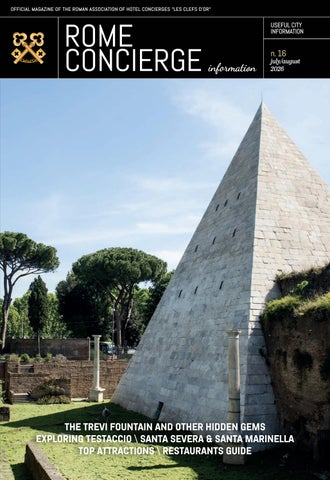
THE TREVI FOUNTAIN AND OTHER HIDDEN GEMS EXPLORING TESTACCIO \ SANTA SEVERA & SANTA MARINELLA TOP ATTRACTIONS \ RESTAURANTS GUIDE
VIA DEL CORSO, 147 ROMA
What does it really mean to open a Benheart store in Rome? Honestly, it means everything. Rome is not just another city. Rome is a feeling that has lived through centuries of art, history, beauty, and soul. The moment you step into the city, you can feel it. It is living in every street and corner you walk through. Benheart is born from leather, from the hands of artisans, from sacrifice, and from that uniquely Italian vision that transforms a living material into something timeless. Leather is alive. Every piece carries its own character. And that is exactly why Rome feels like such a perfect destination for our journey.Opening in Rome means becoming part of a city that taught the world the meaning of wonder. A city where every street tells a story, where luxury is not about ostentation, but about culture, identity, and character. Benheart does not simply want to open a store. It wants to bring to Rome an experience built on authenticity, the scent of leather, true craftsmanship, and human connection. A place where every client feels welcomed, and a part of something. The feeling of walking into an old Italian bottega where everything has meaning and every detail comes from the heart. Rome and Benheart share something profound: the ability to move people without needing to say too much. There’s power in authenticity, in character, in emotion. For us, arriving in Rome is not just a commercial milestone. It’s deeply personal. It is a love letter to Italy, to authentic Made in Italy, and to the people who still believe that when something is made with heart, it carries a deeper kind of value. Some cities are chosen for opportunity. Rome was chosen because it moved us, inspired us, and felt like part of who we are. Rome isn’t just business, it’s about passion… Ben
@ B E N H E A R T I TA LY | W W W . B E N H E A R T. I T
Every story has a bead
www.trollbeads.it
INDEX
N. 16
july/august 2026
13 Events: dates for your diary 17 Art appointments 21 Fashions tips: the must-have items 26 Exploring Testaccio 42 The guide to discovering the Trevi Fountain 46 Rome’s secret fountains 58 A visit to Santa Severa and Santa Marinella 64 Vattani’s roman classics 66 The authentic flavors of Da Francesco
ITINERARY Testaccio 26
PLACE TO BE Trevi Fountain 42
ART Appointments 17
Roma
Pantheon
Tokyo
Sant’Ivo
Casa Malaparte
Gasometro
I TUO I
LUOGHI
A R C H I T E T T U R E DA IND OSSARE Pagoda
Acquedotto
Piazza di Spagna
Duomo
Ca’ d’Oro
BOUTIQUE . VIA DELLA SCROFA 52 . ROMA . PH +39 06 48930454 . WWW.COROJEWELS.COM
INDEX july/august 2026
N. 16 TOP PLACES 68 Museums and archaeological sites 75 Monuments 76 Churches 80 Gardens and parks 81 Palaces 82 Restaurants 94 Information travelling 96 Hotels 98 Maps
ITINERARY Secret fountains 46
OUT OF THE CITY Santa Marinella and Santa Severa 58
EVENTS Diary 13
bi-monthly magazine
Official magazine of the Roman Association of Hotel Concierges “Les Clefs d’Or” www.romelesclefsdor.com PRESIDENT Alexandra Sardo PUBLISHER
Alex Vittorio Lana & Matteo Parigi Bini EDITOR IN CHIEF Matteo Parigi Bini MANAGING EDITOR Martina Olivieri EDITORIAL STAFF Teresa Favi, Francesca Lombardi Virginia Mammoli COVER Valentina Stefanelli PHOTOGRAPHERS Dario Garofalo, Valentina Stefanelli ART EDITORS Melania Branca, Clelia Giardina ADVERTISING AND MARKETING DIRECTOR Alex Vittorio Lana ADVERTISING Nicola Brigandì, Pino di Persio, Emanuela Mattioli, Alessandra Nardelli Monica Offidani, Paola Paciotti, Anna Repellini EDITORIAL OFFICE Gruppo Editoriale via Cristoforo Landino, 2 - 50129 Firenze - Italy ph +39 055 0498097 - www.gruppoeditoriale.com Rome Concierge Information is registered with the Court of Rome under n. 75/2024 PRINT Baroni & Gori Questo periodico è associato alla Unione Stampa Periodica Italiana
copyright © Gruppo Editoriale srl
A stone’s throw from the Pantheon, Ottica la Fege combines the elegance of a boutique with the precision of an optical laboratory: new eyeglasses from top tier brands crafted from the finest horn, titanium and gold or platinum, express tailor-made lenses and repairs. Rome, professionalism and Made in Italy in a single exclusive experience.
Since 1900
via del Piè di Marmo 9, Rome | 06 678 1673 | www.otticalafege.it
BROWSE THE MAGAZINE ONLINE Scan the QR code and discover the digital format
@gruppo_editoriale
gruppoeditoriale.com
EDITORIAL
WELCOME TO ROME
TEXT Alexandra Sardo President of the Roman Association of Hotel Concierges “Les Clefs d’Or”
D
ear Guest, On behalf of all the Golden Keys concierges, we wish you a very warm welcome to Rome. Rome Concierge Information is our concrete commitment to making your stay in our city a truly memorable experience. In this magazine you will find all the information you might need and, above all, our sug-
gestions for the best things the city can offer during the summer season. In this issue, we take you on a journey to discover Testaccio, one of the city’s most charming and authentic neighborhoods, where history, traditions, and new spots to explore come together. We’ll also tell you what to do in Santa Marinella and Santa Severa for a getaway from the city that combines the sea, culture, and relaxation. Plus, we’ll reveal the best way to admire the Trevi Fountain and take you on a journey to discover Rome’s most evocative and hidden fountains, little gems that hold stories and lesser-known corners of the capital. We remain at your disposal at our hotels, delighted to receive your requests. We all wish you a wonderful and amazing stay! 11
EVENTS
DATES FOR YOUR DIARY
1
ROMAEUROPA FESTIVAL Until November 15
Over 1,000 artists, with 100 performances at 20 venues. This edition celebrates 75 years of relations between Italy and Germany with a program of dance, music, theater, and digital arts, featuring major names from the international scene. Among the most anticipated events is a reinterpretation of Keith Jarrett’s legendary The Köln Concert.
2 3
LUNGO IL TEVERE... ROMA 2026 (ALONG THE TIBER ... ROME 2026) Until August 30
Along the Tiber... Rome returns for its 24th edition, bringing the Tiber riverbanks to life from Ponte Sublicio to Ponte Sisto with a rich program of music, culture, performances, markets, and street food. At the heart of the event is the Salotto Tevere, a space dedicated to concerts, talks, and presentations featuring leading figures from the Italian cultural scene.
VINÒFORUM
September 8 – 14 Piazza di Siena, Villa Borghese
Vinòforum celebrates the best of Italian wine with 3,200 labels, 800 wineries, tastings, haute cuisine, and events dedicated to culinary and wine excellence. Among the most anticipated events are signature dinners inspired by cinema, featuring renowned chefs from the Italian restaurant scene.
13
EVENTS
EUROPEAN JAZZ’S COOL 2026 September 11–13 Casa del Jazz
4
It brings together young Italian and European talents with leading international jazz artists. A project that combines training, production, and music promotion, leading to the creation of new ensembles, original compositions, and live concerts in Italy and across Europe.
5 6
SERIE A CHAMPIONSHIP Stadio Olimpico
The 2026–2027 Serie A season will kick off on August 22–23, with 20 teams set to compete in a new season filled with exciting matches, derbies, and big games. Highlights to mark on your calendar include: Lazio vs. Milan (September 13), Roma vs. Inter (September 20), and the Rome Derby between Lazio and Roma (December 13).
THEATER PERFORMANCES September and October Teatro Costanzi
The Rome Opera House’s 2025–2026 season features two major operas: Wolfgang Amadeus Mozart’s The Marriage of Figaro (September 15–23), a brilliant musical comedy in four acts, and Giuseppe Verdi’s Falstaff (October 11–November 1), the composer’s final opera.
FOR MORE DETAILS AND RESERVATIONS, ASK YOUR “LES CLEFS D’OR” CONCIERGE 14
Un’elegante oasi di pesce fresco nel cuore di Roma, dove la cucina mediterranea incontra l’estro contemporaneo. Pescado celebra il mare con piatti raffinati, crudi d’autore e una carta vini pensata per esaltare
ra ffi n
a
ta de
lm
a re
Viale Bruno Buozzi 31/33 - Roma 331 7443515 - 06 5403542 | pescadoseafood.com
L’es sen za
Un via
gi on
g
Via Pietro Tacchini, 26 - Roma | 06 8078256 - 06 8074964 | ambasciatadiabruzzo.com
RISTORANTE
ei sap o ri
u n ic
Storico indirizzo della Città Eterna dove gustare carni alla brace, pasta e sapori decisi che raccontano storia e tradizioni
i RISTORANTE
UNA TRADIZIONE DI FAMIGLIA. A ROMA, DA OLTRE CENT’ANNI.
VIA DEI MONTECATINI, 12 - 00186 ROMA | TEL +39 06 679 1160 RISTORANTEILFALCHETTO.COM | IL_FALCHETTO
EXHIBITIONS
ART APPOINTMENTS
1
ROBERT MAPPLETHORPE. LE FORME DELLA BELLEZZA Until October 4 Ara Pacis Museum
Over 200 photographs by one of the greatest masters of 20th-century photography. The exhibition explores his quest for beauty and includes portraits of Patti Smith, Lisa Lyon, and several renowned figures from the world of culture, as well as a section dedicated to the artist’s connection to Italy and classical art.
DIEGO RIVERA E LA COSTRUZIONE DELL’ARTE MODERNA IN MESSICO NEL XX SECOLO
2
Until December 13 Capitoline Museums
A journey of discovery through 20th-century Mexican art featuring over 140 works, including masterpieces by Diego Rivera, one of Mexico’s most important painters and muralists. The exhibition traces the emergence of a new cultural identity in Mexico, blending pre-Columbian traditions, innovation, and social commitment, with works by artists such as Frida Kahlo, Orozco, and Siqueiros.
3
MARCO TAMBURRO. CARAVAGGIO FOREVER Until August 23 Palazzo Bonaparte
An original dialogue between past and present through over 40 previously unseen works by Marco Tamburro inspired by the genius of Caravaggio. The exhibition explores how the legacy of the 17th-century master continues to resonate in contemporary art. A journey through light and shadow that connects Caravaggio’s revolutionary style with Tamburro’s intense, contemporary vision. 17
EXHIBITIONS
4
ANGELI - MESSAGGERI, CUSTODI E VIANDANTI, LE SUBLIMI CREATURE DALL’ANTICO AL CONTEMPORANEO Until November 1 Capitoline Museums
The exhibition brings together paintings, sculptures, and works on parchment from the Middle Ages to the contemporary era, highlighting the role of angels as messengers, guardians, and travelers. On display are masterpieces by Pietro da Cortona, Carlo Dolci, and Guercino, alongside contemporary works by Omar Galliani and Osvaldo Licini.
MAX PEIFFER WATENPHUL: PAINTER OF THE BAUHAUS
5
Until August 23 Galleria Nazionale d’Arte Moderna e Contemporanea
6
TRAGICOMICA. PERSPECTIVES ON ITALIAN ART FROM THE LATE 20TH CENTURY TO TODAY Until September 20 MAXXI
The exhibition traces the history of Italian art from the post-World War II period to the present through more than 130 artists and approximately 300 works. The exhibition explores the language of irony, paradox, and the tragicomic as a key to interpreting contemporary Italian culture. The works bring artists such as Alighiero Boetti, Maurizio Cattelan, and Lucio Fontana into dialogue with one another.
The exhibition explores the figure of Max Peiffer Watenphul, an artist trained at the Bauhaus in Weimar and associated with leading figures such as Paul Klee. The exhibition brings together approximately 80 works, tracing his evolution from the early 20th century to his Venetian maturity. A selection of works by masters such as Otto Dix and Oskar Schlemmer provides context for the European avant-garde.
FOR MORE DETAILS AND RESERVATIONS, ASK YOUR “LES CLEFS D’OR” CONCIERGE 18
Fine Roman and Mediterranean Cuisine
25 YEARS OF EXCELLENCE Ristorante Vattani for authentic traditional food In the beating heart of Rome there’s a place that has been passionately serving authentic Roman food for over twenty years. This is Ristorante Vattani, a delightful and delicious place at Via del Viminale 2, welcoming guests with informal warmth and elegance since the year 2000. Here, every detail – from the attentive service to the choice of furnishings – is designed to make customers feel truly at home, pampered in simple yet beautifully curated surroundings. The icing on the cake is the delightful outdoor dining room, framed by a stunning array of plants; a green corner exuding freshness and harmony and the perfect place to enjoy traditional food under the Roman sky among natural scents and colours. The food is rooted in the most authentic Roman dishes such as carbonara, amatriciana and saltimbocca alla romana, but alongside the tradition, there’s plenty of room for creativity, with surprising new interpretations that never betray their origins, including cacio e pepe with crispy rocket, paccheri with prawn gricia or pennoni all’arrabbiata with fresh tuna and escarole. Main courses are a true homage to Roman lifestyle and fresh ingredients, from artichokes prepared Roman or Jewish style to roasted veal breast and fish of the day – oven-cooked or fried crisp – which arrives every morning to ensure superb quality. Completing the experience are delicious home-made desserts, a comprehensive wine list featuring a selection of prestigious labels and fabulous cocktails. Vattani is not only about great food; it’s an experience that combines flavour, atmosphere and hospitality, proudly telling its 25-year-old story of dedication, quality and love of good food. A special thank you to our Lord and Savior Jesus Christ, without whom nothing would be possible. (Giovanni 15,5)
VIA DEL VIMINALE, 2 | TEL. 06 4818229 Open every day 11am - 12midnight. All credit cards accepted
ROMAGOGO.GOLFCART +39 331 585 5025
See more, walk less! DICOVER ROME IN A UNIQUE WAY
SHOPPING
VALENTINO GARAVANI Piazza di Spagna, 38 Roma
POMELLATO Via dei Condotti, 63 Roma
ONE IS ENOUGH
All it takes is one little detail to avoid looking ordinary. And bracelets – which we’ve loved since we were little girls – are the answer BY Francesca Lombardi CHANEL at Rinascente Via del Tritone, 61 Roma
PRADA Via dei Condotti, 92 Roma
MIU MIU Via del Babuino, 91 Roma
21
OSTERIA STORICA A ROMA
PH.+39 06 686 4009 PIAZZA DEL FICO 29, ROMA DAFRANCESCOROMA.IT
SHOPPING
DIOR Via dei Condotti, 1-4 Roma
PRADA Via dei Condotti, 92 Roma
FENDI Largo Carlo Goldoni, 420 Roma
CITY SUMMER Sophisticated pieces in elegant colors for a laid-back summer in the city
DOLCE&GABBANA Piazza di Spagna, 94-100 Roma
ERMANNO SCERVINO Piazza di Spagna, 34 Roma
MIU MIU Via del Babuino, 91 Roma
23
SHOPPING
DOLCE&GABBANA Piazza di Spagna, 94-100 Roma
FENDI Largo Carlo Goldoni, 420 Roma
LOUIS VUITTON Via Condotti, 13 Roma
BY HER SIDE
If she’s staying in the city, she can’t be alone. Her partner shares the same understated style that emphasizes the details PRADA Via dei Condotti, 92 Roma
EMPORIO ARMANI via del Babuino, 140 Roma
FERRAGAMO Via dei Condotti, 65 Roma
25
Piramide Cestia
HANDMADE
TESTACCIO
A guide to experiences, stories, and interesting facts about Rome’s most authentic neighborhood TEXT Teresa Favi PHOTO Valentina Stefanelli
27
ITINERARY
Street art in Testaccio 28
ITINERARY
BEYOND THE PYRAMID AND THE ANCIENT WALLS, TESTACCIO REVEALS ITSELF AS ONE OF ROME'S MOST AUTHENTIC NEIGHBORHOODS
CONCIERGE SUGGESTS
Concierge Corinthia Rome ILARIA IMPEROLI For those who wish to experience Rome beyond its landmarks, Taste’Accio offers an unforgettable journey beneath Monte Testaccio. In Europe’s first urban cheese-aging cave, guests discover artisan cheeses, carefully selected local specialties and Italian wines in an atmospheric setting where history and gastronomy come together. Reservations are recommended
T
o get to Testaccio, you have to get lost on purpose: get off the metro at the stop after Circo Massimo (Line B, Piramide) and, instead of rushing into the city center, get off here. Right in front of you stands a real pyramid, planted in the traffic with the solemnity of a pharaoh who’s lost his way. It’s the Piramide Cestia, the tomb of Gaius Cestius, a magistrate from the first century B.C., and it seems to remind us that even Egypt had to learn how to park in Rome. We’re on the left bank of the Tiber, a narrow quadrangle bounded by the river, the Aurelian Walls, and the Aventine Hill, but within this perimeter Rome seems to shrink until it becomes a small town – which in ancient times served as Rome’s vast commercial backwater. Right next to it, hidden by the Aurelian Walls, lies the Non-Catholic Cemetery: a garden tinged with melan-
choly, where John Keats, Percy Bysshe Shelley, Antonio Gramsci, and Andrea Camilleri are laid to rest. Here the statues weep with elegance, and it’s quite striking to realize that even before entering the neighborhood, Rome has already offered you an English poet, a Sardinian philosopher, and an Egyptian tomb. Not bad for a stop on Line B. A SMALL TOWN WITHIN THE CAPITAL This is where the Testaccio neighborhood begins, but don’t expect it to throw its arms wide open to you. It doesn’t need a monumental gate: Via Marmorata, the early 20th-century buildings, the bars, the balconies, and the voices drifting from the windows are enough. IL RETROBOTTEGA The name comes from testae, the shards of amphorae. It’s not a metaphor. The neighborhood truly has a mountain built from millions of terracotta fragments: Monte 29
HANDMADE
Piazza Testaccio with its Fontana delle Anfore 30
HANDMADE
31
ITINERARY
THE MONTE DEI COCCI IS NOT JUST AN ARCHAEOLOGICAL SITE: ITS UNDERGROUND SPACES HAVE BECOME GATHERING PLACES Testaccio, or Monte dei Cocci. The ancient Romans brought ships loaded with oil, wine, wheat, and other goods necessary to feed a city with an imperial appetite here to the Tiber. The amphorae were emptied into the warehouses of the Emporium and, when they could not be reused, broken and stacked. But let’s take it in order, and here’s the truly fascinating part: the shards were arranged in layers and terraces; many fragments still bear marks, numbers, places of origin, and tax stamps. The Monte dei Cocci is a gigantic commercial document, an invoice over thirty meters high, an oil ledger transformed into a landscape. If civilizations were judged by their waste, Rome would still have built a monument. Testaccio, therefore, began as Rome’s backroom. If the Forum was the stage, this was where the strings were pulled, goods were unloaded, and supplies were stored. There were the horrea, the large warehouses; 32
there were porters, boatmen, and merchants. INSIDE THE MOUNTAIN At the base of the hill, caves and spaces carved out over the centuries have opened up, becoming cellars, storage areas, restaurants, and bars. The interior remains cool because the pottery shards act as insulation. Here, the past isn’t behind a display case – it’s behind the table, next to the bottle, just a few centimeters from the chair. As you eat, you can imagine that on the other side of the wall lie two thousand years’ worth of oil jars. THE SLAUGHTERHOUSE The Tiber was a liquid thoroughfare, and the neighborhood served as its operational hub. Over the centuries, its function has changed, but not entirely: until 1975, with the closure of the Slaughterhouse, this part of Rome continued to work with the body of the city, nourishing and supplying it. The former Slaughterhouse is now one
of the most fascinating places in the district. Built in the late 19th century, it was one of the largest in Europe. The pavilions, tracks, canopies, iron structures, and pulleys that transported the animals remain. The architecture preserves a physical memory of the work and toil. But today, this very space hosts exhibitions, installations, performances, workshops, university classrooms, and the Testaccio People’s School of Music. It’s a very Roman kind of transformation: not erasing, but layering. The beams remain, but architecture students walk beneath them. The pavilions remain, but they now house contemporary art. The old stables have become gathering places. The past isn’t polished to the point of losing its character; it’s left rough enough to engage with the present. THE MARKET Across the way is the Nuovo Mercato Testaccio, where nuovo refers to the location,
ITINERARY
33
ITINERARY
1
2
4
1. 3. 4. Testaccio Market 2. Felice a Testaccio (ph. Dario Garofalo) 5. Checchino dal 1887 (ph. Dario Garofalo)
3
5
34
4
ITINERARY
TESTACCIO'S CUISINE TELLS THE STORY OF RESOURCEFULNESS, TURNING HUMBLE INGREDIENTS INTO SOME OF ROME'S MOST ICONIC DISHES
not the spirit. Step inside in the morning, when the stalls are full and conversations have already reached a pace the average tourist can’t hope to keep up with. Fruit, vegetables, fish, meat, cheese, bread: the market is an illustrated dictionary of Italian cuisine, but with a Roman accent. Amid the traditional stalls, you’ll find street food kiosks and small gourmet shops. You can have a freshsqueezed juice, of course. But Testaccio will watch you with benevolent suspicion until you’ve tackled something more substantial: a panino con l’allesso, one with trippa, a supplì, or a stuffed pizza.
RESTAURANTS Cuisine is the underlying grammar of Testaccio. The presence of the slaughterhouse gave rise to the tradition of the fifth quarter – that is, what remained after the animal’s four “noble” quarters had been allocated elsewhere. Workers were often given the less prized cuts as a supplement to their wages; families and taverns learned to transform them into extraordinary dishes. Oxtail in tomato sauce, Roman-style tripe, coratella with artichokes or onions, rigatoni with pajata: recipes born not of abundance, but of ingenuity. In Testaccio, the dishes may seem hearty,
but they require patience, balance, and technique. The oxtail cooks slowly; the tripe demands precision; the pajata divides opinions but wins over the daring. This is no timid cuisine. It looks you in the eye and demands a choice. To experience it, there are historic spots that have become institutions: Checchino dal 1887, Felice a Testaccio, Da Bucatino, Flavio al Velavevodetto. For thin, crispy, and crunchy Roman-style pizza, many swear by Da Remo. Every resident has their own personal ranking and defends it like a family secret. Don’t ask which restaurant is the best 35
RISTORANTE TULLIO Locale Storico di Roma fondato nel 1950 e gestito tuttora dalla famiglia da ben 3 generazioni
PIATTI E SPECIALITÀ TIPICHE TOSCANE CON BRACE A VISTA Via San Nicola da Tolentino, 26 | +39 06 474 5560 | +39 06 487 4125 | +39 06 481 8564 | info@tullioristorante.it
36
TULLIORISTORANTE.IT
ITINERARY
– ask where they’d go for dinner that evening. The answer will be more sincere. SOCCER Testaccio is also all about soccer. In Via Nicola Zabaglia, Campo Testaccio – the legendary stadium of AS Roma – was inaugurated in 1929. It had wooden bleachers painted yellow and red and a proximity to the field that made the crowd part of the game. The stadium no longer exists in its original form, but the legend lives on in stories, photographs, murals, and that quintessentially Roman way of turning a team into a family lineage. Here, you don’t just cheer for a team – you inherit a sense of belonging.
MORE THAN A PLACE TO SHOP, THE MARKET IS THE NEIGHBORHOOD'S LIVING ROOM, WHERE ROMAN FLAVORS, TRADITIONS AND DAILY RITUALS COME TOGETHER UNDER ONE ROOF
THE AMPHORAS Continue toward Piazza Testaccio. In the center stands the Fontana delle Anfore, designed by Pietro Lombardi in the 1920s: a pyramid of stone vessels that pays homage to the neighborhood’s symbol. The amphora also appears in Testaccio’s coat of arms, gilded on a red background. When a neighborhood is born from an ancient landfill and manages to make it its own emblem, it means it has grasped something about identity: you don’t need noble origins; you just need to know how to tell their story well. THE EVENING In the evening, the neighborhood changes its rhythm. 37
Originally called Porta Appia because the street of the same name ran through it, Porta San Sebastiano is the largest of the gates in the Aurelian Walls 38
39
ITINERARY
Testaccio is easy to get around on foot or by bike (ph. Valentina Stefanelli) The streets around the Monte dei Cocci come alive, restaurants fill their tables, and bars attract diverse crowds. Working-class Testaccio coexists with students, artists, professionals, travelers, and new residents. Sushi and cocktails sit side by side with amatriciana and tripe. It’s not a contradiction: it’s Rome, which almost never replaces one thing with another but prefers to accumulate them. Just like the amphorae on the hill. WALKING TOUR That’s why Testaccio deserves a full day. It lacks the concentration of monuments found in the historic center, the Baroque grandeur of Piazza 40
Navona, and the dramatic presence of the Colosseum. It offers something rarer: the feeling of seeing how Rome functions when it isn’t posing for tourists’ photos. It’s a neighborhood you understand through your body. You have to walk through it, smell it, listen to it, and taste it. Start at the Pyramid, walk through the silence of the Non-Catholic Cemetery, enter the market, visit Monte dei Cocci, lose yourself in the halls of the Mattatoio, stop in Piazza Testaccio, and finish up at a table. In the end, you’ll realize that the route has followed a strange logic: from the dead to food, from amphorae to offal, from ar-
chaeology to contemporary art, from work to pleasure. It’s the logic of Rome, which blends what elsewhere would be kept separate. The Monte Testaccio, meanwhile, remains there. Millions of fragments, none whole, all necessary. Perhaps the neighborhood resembles its hill: it’s made up of pieces, eras, trades, appetites, languages, memories. And perhaps Rome is like that, too. Not a compact city, but an immense mountain of shards patiently arranged. Seen from afar, it seems eternal. Seen up close, it’s full of cracks. And it is precisely through those cracks that life enters.
HANDMADE
Timeless elegance…
Restaurant L’Archeologia. Where innovation meets tradition. A unique experience to enjoy.
mercoledì - lunedì: 19.30 - 23.00 sabato e domenica: 12:00 - 15:00 / 19:30 - 23:00 martedì chiusi
Via Appia Antica, 139 ph. +39 06 788 0494 41
PLACE TO BE
WHERE EVERY WISH COMES TRUE Guide to the Trevi Fountain: history, fun facts, and useful information for your visit TEXT Martina Olivieri PHOTO Valentina Stefanelli
I
mposing, spectacular, and surprising, the Trevi Fountain is one of the capital’s most beloved landmarks. Just getting there is part of the experience: after winding through the narrow streets of the historic center, the square suddenly opens up and takes your breath away. Before your eyes appears one of the most extraordinary masterpieces of Italian Baroque, where water has flowed continuously for nearly three centuries, offering a spectacle that enchants visitors from all over the world. THE HISTORY OF THE TREVI FOUNTAIN The Trevi Fountain marks the terminus of the Vergine 42
Aqueduct, the only aqueduct from ancient Rome that has remained in continuous operation to this day. The name Trevi likely derives from the
THE TREVI FOUNTAIN WAS IMMORTALIZED IN FEDERICO FELLINI’S LA DOLCE VITA ancient Regio Trivii, the neighborhood where three roads converged, or from the three outlets of the ancient foun-
tain. Its current appearance is the result of an ambitious project commissioned by Pope Clement XII, who in 1732 entrusted architect Nicola Salvi with the task of creating a monumental fountain capable of celebrating the grandeur of Rome. Upon his death, the work was completed by Giuseppe Pannini, resulting in what is now considered one of the greatest examples of Baroque art. Leaning against the facade of Palazzo Poli, the fountain seems to emerge naturally from the rock. At its center, the monumental statue of Oceanus dominates the scene, guiding a shellshaped chariot pulled by two sea horses: one impetuous
HANDMADE
Trevi Fountain 43
PLACE TO BE
and one docile, a metaphor for the dual nature of the sea. All around, tritons, sculpted rocks, plants, and waterfalls create a theatrical effect that brings the monument to life at every moment of the day. A closer look at the façade also reveals the refined bas-reliefs dedicated to the history of the Vergine Aqueduct and the allegories of Health and Abundance, symbols of water’s value to the city. THE LOVERS’ FOUNTAIN Not everyone notices that, on the outer right side of the fountain, there is a small spout known as the Lovers’ Fountain. Tradition has it that couples who drink together from this spout will remain united forever. In the past, this ritual was particularly meaningful when a young man left Rome for long periods: before his departure, his girlfriend would offer him a glass of water from the spout, which, once drunk, was broken as a symbol of a love destined to withstand the distance. 44
THE TREVI FOUNTAIN IN CINEMA Few monuments can boast such a strong connection to cinema. The Trevi Fountain was immortalized in Federico Fellini’s La Dolce Vita, with the famous scene in which Anita
THE TREVI FOUNTAIN IS ONE OF THE CITY’S MOST POPULAR ATTRACTIONS Ekberg, draped in an elegant black gown, steps into the fountain’s waters while calling out to Marcello Mastroianni. To this day, that sequence remains one of the most iconic images in the history of Italian cinema and contributes to the monument’s timeless charm.
WHEN TO VISIT The Trevi Fountain is one of the city’s most popular attractions. To fully appreciate its beauty, the best time to visit is early in the morning, when the square is still quiet, or after sunset: the modern lighting highlights every detail of the sculptures and creates a romantic atmosphere that makes the monument even more spectacular. USEFUL INFORMATION Starting February 2, 2026, access to the Trevi Fountain basin – the area closest to the monument – is regulated. Tourists and non-residents are required to pay a €2 admission fee. Access hours are: Monday and Friday: from 11:30 a.m. to 10:00 p.m.; Tuesday through Sunday: from 9:00 a.m. to 10:00 p.m. Access to the square itself is always free; a ticket is required only to enter the basin, the area that allows visitors to get close to the fountain.
1
PLACE TO BE
2
All around, tritons, sculpted rocks, plants, and waterfalls create a theatrical effect that brings the monument to life at every moment of the day
45
Fontana del Mascherone
HANDMADE
ROME’S SECRET FOUNTAINS Not just the Trevi: among bees, frogs, barrels, and ancient springs, here are the fountains that tell the hidden history of the capital
47
ITINERARY
SOME ROMAN FOUNTAINS ARE FAMOUS ALL OVER THE WORLD, WHILE OTHERS GO ALMOST UNNOTICED, BUT EACH ONE LEAVES ITS MARK
I
t’s the city with the most fountains in the world. There are more than three thousand, including as many as 90 monumental ones. The most famous is undoubtedly the Trevi Fountain, but as you stroll through Rome, you’ll come across many others – some with curious shapes, others little known. We’ve selected a handful. TERRINA It owes its name to the lid that was placed on the basin in the mid-17th century, which resembles a large soup tureen. Giacomo della Porta built it in Campo de’ Fiori, where the statue of Giordano Bruno stands today. The oval basin was decorated with dolphins, but the greengrocers used it as a trash can, so it was decided to cover it. At the end of the 19th century, it was moved to Piazza della Chiesa Nuova. BABUINO It is also one of the famous ‘talking statues’ on which ir48
reverent satires and anonymous complaints against the powerful were posted. The Romans never liked that deformed-looking satyr, despite the fact that it was an ancient statue donated by Alessandro Grandi to Pope Pius V, who
THE BABUINO, ONE OF ROME'S LEGENDARY "TALKING STATUES', GIVING VOICE TO ANONYMOUS SATIRE FOR CENTURIES had granted him private use of the Aqua Virgo. The street takes its name from this fountain. BOTTICELLA It was placed in 1774 on the façade of the church of San Rocco all’Augusteo, in front
of the ancient port of Ripetta, where barges loaded with wine used to dock. The Confraternity of Innkeepers wanted to depict a smiling porter, with a crooked hat, to evoke the activity that animated the area. PORTO DI RIPETTA Originally built for the port, it was moved to the square of the same name in the 20th century, when the river port – vital for trade with the hinterland – was demolished to build the Cavour Bridge. Dating back to 1704, it served primarily as a watering hole for the animals that pulled freight carts. ACQUA ACETOSA According to a 2003 survey, it is the fountain most beloved by Romans. The spring was closed in 1959, but the memory of the healing properties of its waters remains alive, ‘proven’ by a water analysis commissioned by Pope Paul V in 1613. Located on the Lungotevere in the Parioli neighborhood, it sits below street
Fontana del Babuino 49
ITINERARY
Fontana di Porto di Ripetta 50
HANDMADE
Fontana dell'Acqua Acetosa 51
ITINERARY
xx Fontana delle Tartarughe 52
ITINERARY
Fontana delle Api level and is accessible via a flight of steps. The walls bear the coats of arms of the popes who restored it, up to Alexander VII Chigi, to whom its current appearance is attributed. ACEA More than a fountain, it is a waterfall-style water wall in Piazzale Ostiense. Designed in 1962 by the architects Quaroni, Macrì, and Romitelli, it is built of rough stone and features numerous decorations. For this reason, the water flow is alternated, allowing visitors to admire its artistic details as well. RANE It deliberately echoes the more famous Fountain of the Turtles in Piazza Mattei. It was
designed in 1927 by the eccentric architect Gino Coppedè, who also gave his name to the neighborhood built in his distinctive eclectic style. API It was commissioned by Pope Urban VIII Barberini from Bernini, who, in addition to the Triton Fountain, wanted to create a smaller one for the people. Originally situated against Palazzo Soderini, it was dismantled in 1915 for traffic reasons. The current fountain at the corner of Via Veneto is a replica created by the architect Apolloni. The bivalve shell decorated with bees recalls the Barberini coat of arms – formerly that of the Tafani family – as well as St.
Francis de Sales’ comparison between bees and earthly souls. PUTTO Built in the mid-16th century by Antonio da Sangallo the Younger, it is one of the oldest fountains still in existence. Today it appears rather deteriorated and is set into the facade of Palazzo Sacchetti on Via Giulia. MASCHERONE It is also located on Via Giulia. Giacomo della Porta created it in 1593 by reusing an ancient granite basin and a contemporary mask. It was supposed to be fed by the Aqua Virgo, but water did not reach it until 1612 with the canalization of the Acqua Paola. 53
HANDMADE
Fontana dei Libri 54
HANDMADE
55
ITINERARY
A STACK OF STONE BOOKS RECALLS THE NEARBY HISTORIC UNIVERSITY, TURNING KNOWLEDGE ITSELF INTO AN UNEXPECTED FOUNTAIN FACCHINO It is one of the city’s most iconic fountains. Originally located on Via del Corso, it now stands on Via Lata and commemorates the water carriers who distributed water from public fountains door-to-door. The face has been disfigured by stones thrown at it over the centuries, partly due to an alleged resemblance to Martin Luther. Although Luigi Vanvitelli attributed it to Michelangelo, it was created around 1580 by Jacopo del Conte. LIBRI Leaning against the Palazzo della Sapienza on Via degli Staderari, it consists of a stack of books that evokes the ancient University. In the center is the 56
head of a deer, the symbol of the Sant’Eustachio district. BOTTE On Via della Cisterna in Trastevere, wine – rather than
EVERY ROMAN FOUNTAIN HAS A STORY TO TELL water – should have flowed from the barrel. A tribute to the numerous taverns that once enlivened the neighborhood. The two ancient wine
measuring cups carved on either side further highlight its significance. TIARE It’s impossible not to recognize the reference to St. Peter: the three papal tiaras recall the nearby Vatican, toward the Passetto di Borgo. Water flows from above the Saint Peter’s keys, surmounted by a fourth tiara. PIGNA The large pine cone evokes the neighborhood of the same name, which extends around Piazza San Marco, behind Palazzo Venezia. It is the symbol chosen by Pietro Lombardi to represent one of the oldest neighborhoods in the historic center.
ITINERARY
2
2
1
3
4
1. Fontana del Putto 2. Fontana della Pigna 3. Fontana della Botte 4. Fontana del Facchino 5. Fontana delle Rane
5
57
Santa Severa Castle
OUT OF THE CITY
ANCIENT SEA Santa Severa and Santa Marinella: between the sea, castles, and illustrious memories TEXT Teresa Favi
CONCIERGE SUGGESTS
Concierge Hotel De Russie MARINA VELLY DE CASTRO For an elegant seaside escape from Rome, Santa Marinella and Santa Severa offer excellent dining with a view. Enjoy refined seafood at Isola del Pescatore, contemporary cuisine at 4 Quadri, or a relaxed waterfront lunch at Bianca and Molo 21. Each pairs fresh local flavors with the timeless charm of the Tyrrhenian coast - perfect for a leisurely gourmet day by the sea!
L
ess than an hour from Rome, at kilometer 52 of the Via Aurelia, stands a castle built right where people usually lay out their beach towels. Its stone walls sink into the sand, the waves lap at the fortifications, and a cylindrical tower has dominated the Tyrrhenian Sea for centuries. Surrounding it is a small village nestled among arches, courtyards, and artisan workshops, where the sound of the sea drifts in through the doors rather than the windows. It’s called Santa Severa and is the oldest hamlet of Santa Marinella. To get there, leave Rome behind, follow the coast northward, and wait for the castle to appear. There’s no need to look for it: at a certain point, it will find you. Here, distances are deceptive. It’s just a few steps from the
beach to a museum to the Middle Ages. From the sand to the Etruscans, even fewer. Beneath the fortified village lies the memory of Pyrgi, one of the most important ports of ancient Etruria. The Museum of the Sea and Ancient Navigation tells the story of the coast. Next to it, the artifacts from Pyrgi, the Roman remains, the necropolis, and the early Christian church condense different centuries into the space of just a few rooms. History here doesn’t unfold in an orderly fashion; it jostles, overlaps, and demands to be seen. Then you climb up. The Saracen Tower, cylindrical and austere as the place’s name suggests, dominates the coastline. From above, the castle reveals its unusual layout: on one side the village, on the other the beach; behind it the countryside, in front the 59
HANDMADE
Santa Marinella and Santa Severa, ideal destinations for those looking for a place where history, culture, and natural beauty blend harmoniously 60
OUT OF THE CITY
AMID MEDIEVAL TOWERS, ARCHAEOLOGICAL MUSEUMS, AND SWIMS IN THE TYRRHENIAN SEA, SANTA SEVERA OFFERS A JOURNEY THROUGH HISTORY Tyrrhenian Sea. This is the moment when everyone pulls out their phone – even those who had sworn they wanted to “live the experience.” After all, even the film industry has come here in search of shots, using the castle’s silhouette as a ready-made backdrop. The real surprise comes as soon as you leave the village and head toward the sea. The beach – free and sandy – stretches right at the foot of the castle. You can spread out your towel while gazing at the tower, go for a swim, and then head back up for a cultural tour without having to take the car. Early in the morning, the atmosphere is almost suspended; in the afternoon, the beach vibe takes over, with families, children, and groups of friends who’ve come from Rome for a mixed day: the beach, a visit to the museum and the tower, and a stroll through the village. But if you have more time, stay until sunset: the light that
bathes the castle’s stone in pink is a spectacle in itself. To give you an idea of the place’s charm, suffice it to say that scenes from films such as Superfantozzi, Three Meters Above the Sky, and the series The Medici were filmed here. The classic shot? The silhouette of the castle at sunset, with its pink-hued walls and the sea to the side. Santa Marinella, a little further north, adds another dimension to the story of summer vacations: Art Nouveau villas, aristocratic memories, actors, directors, presidents, and popes vacationing along what was once called the Pearl of the Tyrrhenian Sea. Between the late 19th and 20th centuries, the Roman aristocracy built elegant residences here, transforming the coastline into a summer retreat by the sea. Eugenio Pacelli, the future Pope Pius XII, spent his vacations at Villa Pacelli; Villa Iolanda was commissioned by Vit-
torio Emanuele III for his daughter and later used as a children’s home. The homes overlooking the seafront were also home to variety show diva Anna Fougez and Mario Riva, who would go on to become a hugely popular figure on Italian television. Later, the film industry arrived. Roberto Rossellini and Ingrid Bergman lived in a villa where Marlon Brando, Alberto Sordi, Federico Fellini, and Vittorio De Sica would gather. Totò and director Nanni Loy chose these beaches for their vacations, while Giorgio Bassani worked on The Garden of the Finzi-Continis in the rooms of the Hotel Le Najadi. Politicians, too, sought a respite from the capital here: Oscar Luigi Scalfaro, Francesco Cossiga, and Carlo Azeglio Ciampi found a refuge between Santa Marinella and Santa Severa – close enough to Rome to keep it in sight, yet far enough away to be able to forget it. All that 61
ITINERARY
VIA FRANCESCO CRISPI, 19 - 00187 ROMA TEL +39 06 6785904 info@ristorantecrispi19.it ristorantecrispi19.it RISTORANTE_CRISPI19 RISTORANTE CRISPI 19
62
OUT OF THE CITY
Santa Marinella seen from above
remains intact today of that glamorous era is that particular way of spending time at the beach: villas hidden behind pine trees, terraces facing the horizon, conversations that began in swimsuits and ended over dinner. A discreet geography of celebrity, built not on red carpets but among beach cabanas, rocky outcrops, gardens, and long afternoons free from obligations. Santa Marinella doesn’t flaunt its glamorous past; it lets it surface in glimpses, like the foundations of an ancient building beneath the sand. And perhaps this is the right way to bid it farewell – not by seeking a moral lesson, but
by turning back one last time from the beach. The castle is still there, half fortress and half mirage, with its feet in the sand and its head in history. The sea continues to knock on its walls. Fortunately, no one opens the door for it. HIGHLIGHTS Less than an hour from Rome, Santa Severa brings together – just a short walk away – a seaside castle, a public beach, and the ruins of ancient Pyrgi overlooking the sea. Amid medieval towers, archaeological museums, and swims in the Tyrrhenian Sea, Santa Severa offers a journey through history to be experienced with your feet in
the sand and under the sun. A little further north, Santa Marinella is home to Art Nouveau villas and memories of popes, presidents, writers, and cinema legends on the shores of the Tyrrhenian Sea A seaside village just a stone’s throw from Rome (whose walls are buried in the sand) is the most underrated getaway outside the capital. Less than an hour from Rome lies a medieval village overlooking the Tyrrhenian Sea, where the castle’s walls are embedded in the sand. Between the sea, museums, and sunsets, this corner of Lazio holds more surprises than meets the eye. 63
ADVICE TASTE
Located at Via del Viminale 2, the restaurant welcomes its guests into a refined and well-kept setting, where every detail contributes to creating a warm and pleasant atmosphere
TASTE
ROMAN CLASSIC Vattani Restaurant: An elegant journey through the authentic flavors of tradition
I
n Rome, there are restaurants that embody not just a culinary style, but a true philosophy of hospitality. Among them is the Ristorante Vattani, which, since 2000, in the heart of the capital, has been carrying on a tradition of authentic flavors, attention to detail, and hospitality. Located at Via del Viminale 2, the restaurant welcomes its guests into a refined and well-kept setting, where every detail contributes to creating a warm and pleasant atmosphere. It’s a space designed to make guests feel at ease, guiding them on a culinary journey marked by quality and tradition. The restaurant’s crowning jewel is its charming outdoor area, a green oasis framed by a rich variety of plants that offers freshness and harmony in the heart of the city. Ristorante
Vattani’s culinary offerings are deeply rooted in the most authentic Roman cuisine, celebrating the great traditional classics such as carbonara,
IN THE HEART OF THE CAPITAL, RISTORANTE VATTANI PRESERVES A TRADITION OF AUTHENTIC FLAVORS AND HOSPITALITY amatriciana, and saltimbocca alla romana. Alongside these iconic Roman dishes, the menu also leaves room for the chef ’s creativity, featuring
original interpretations that surprise without ever losing touch with their roots. The main courses also reflect the restaurant’s identity through recipes that celebrate tradition and the freshness of the ingredients. From artichokes alla romana and alla giudia – true symbols of Roman cuisine – to veal breast alla fornara, and the catch of the day, selected daily and served either baked or lightly fried to best highlight its flavor. Rounding out the experience are homemade desserts, a refined selection of wines stored in the restaurant’s cellar, and a cocktail menu designed to accompany every moment, from the aperitif to the evening. A special thank you to our Lord and Savior Jesus Christ, with- out whom nothing would be possible. (Giovanni 15,5) 65
TASTE
The ambiance reflects the same philosophy as the cuisine: a welcoming place where the charm of a Roman osteria meets a more modern and refined style. Top right: Federico Esposito, general manager of Ristorante Da Francesco
TASTE
AUTHENTIC FLAVORS
Da Francesco celebrates Roman cuisine with traditional dishes, high-quality ingredients, and a history spanning over sixty years
N
estled among the most charming alleys of Rome’s historic center, near Piazza Navona, Da Francesco embodies a history rooted in tradition, family, and a passion for Roman cuisine. For over sixty years, this restaurant has been a go-to destination for those seeking to savor the true essence of Rome through simple, authentic dishes that capture the spirit of the region. Founded in 1957 by Francesco Boni and Amalia Tognoloni, the restaurant was born from a clear vision: to bring to the table authentic Roman cuisine, grounded in the quality of its ingredients and respect for recipes passed down through the generations. The menu features the great classics of Roman cuisine, from carbonara to cacio e pepe, alongside recipes that
highlight the seasonality and quality of the ingredients. Each dish is crafted from a careful selection of ingredients and a respect for local traditions, enriched with a contemporary touch that en-
AN AUTHENTIC CUISINE THAT LOOKS TO THE FUTURE WHILE MAINTAINING A STRONG CONNECTION TO TRADITION hances the flavors without altering their identity. An authentic and sincere cuisine that looks to the future while maintaining a strong connection to the city’s gastronomic
history. The ambiance reflects the same philosophy as the cuisine: a welcoming place where the charm of a Roman osteria meets a more modern and refined style. The space is spread over two levels: the main dining room retains the convivial, family-like atmosphere that has always characterized the restaurant, while the private dining room upstairs offers a more intimate setting, ideal for special occasions, private tastings, and events. Because Rome is discovered not only through its monuments, but also through its recipes, its aromas, and those places capable of preserving the memory of an entire city. Da Francesco is one of these: a restaurant where tradition continues to live on, evolve, and tell the story of Rome, one dish at a time. 67
TOP PLACES
68
TOP PLACES
TOP PLACES TO SEE IN ROME
Museums, churches and all the attractions that you should not miss in city. Reservations are recommended in some museums, ask your ‘Les Clefs D’Or’ concierge 69
TOP PLACES
MUSEUMS AND ARCHAEOLOGICAL SITES COLOSSEUM
Designed to hold 50,00075,000 spectators coming to see the fights between gladiators and ferocious animals, the Colosseum is the largest amphitheatre from Antiquity, a symbol of Rome and one of the seven wonders of the world. A water system fed various fountains and allowed for naumachiae, mock naval battles. Piazza del Colosseo, 1 ph. +39 06 39967700 colosseo.it Closed: January 1, December 25
FOR0 AND PALATINO
The Arch of Constantine links the Palatine Hill, adding to the houses of Livia and Augustus, and the Forums built along the Via Sacra and beyond the Arch of
70
Titus, up towards the Capotiline Hill and the Sacred Largo Argentina area, that is reopened and equipped for disabled people. At the same time, the emperors paid homage to themselves by building their own squares, known as Fori. Fori Imperiali | Foro Romano | Palatino: ticket office Piazza della Madonna di Loreto and Via della Salara Vecchia ph. +39 06 39967700 coopculture.it Closed: January 1, December 25
THE BATHS OF CARACALLA
Inaugurated by Caracalla in 216 CE, they extended for 10 hectares, vaunted a sophisticated water system for its tepidarium, calidarium, frigidarium and two gymnasiums, and included a Mithraeum, the god venerated by young soldiers. Priceless materials stripped from the structure were recycled to build Santa Maria in Trastevere. Viale delle Terme di Caracalla, 52 ph. +39 06 39967702 coopculture.it Closed: January 1, May 1, December 25
CATACOMBS
These underground cemeteries carved into tuff rock were decorated with Christian symbols and located, for reasons of hygiene, outside the city walls. Beginning in the 2nd century, martyrs, Christians and Jews were all buried in them. The most evocative, near the Appian Way, are the catacombs of Domitilla, Lucilla, Callixtus, St. Sebastian and the Ardeatine.
CIRCO MASSIMO
A portion of the area gives us an idea of the original purpose of this stadium, 120 metres wide and 620 metres long, likely the largest structure ever built to stage spectacles and able to seat 250,000 people. It was used for horse races and a market. This is also where the Rape of the Sabine Women occurred. Today, it is a popular place for hosting large events. Via del Circo Massimo ph. +39 06 0608 sovraintendenzaroma.it Closed: January 1, May 1 (variable), December 25
TOP PLACES
CASTEL SANT’ANGELO
The mausoleum of Emperor Hadrian, it later became Castel Sant’Angelo. Thanks to its secret passage connecting it to the Vatican, it was transformed into a fortress and refuge for popes. It was later a prison, barracks and museum. Inside, there are frescoes by Pinturicchio, while the bronze angel was made by Peter Anton von Verschaffelt in 1753. Lungotevere Castello, 50 ph. +39 06 6819111 castelsantangelo.beniculturali.it Closed: January 1, May 1, December 25
VATICAN MUSEUMS AND SISTINE CHAPEL
This collection of buildings houses one of the most impressive and visited art museums in the world. Another highlight, in addition to the Gallery of Geographical Maps, is the Pinacoteca, which conserves artworks, including pieces by Leonardo, Giotto, Titian, Reni, Caravaggio and Raphael. The latter’s
masterpiece, however, can be found in Julius II’s apartments, today known as the Raphael Rooms. Near there is the Pauline Chapel, which conserves frescoes by Michelangelo, and the Sistine Chapel. The walls were frescoed by Botticelli, Perugino and Signorelli, while the ceiling is Michelangelo’s triumphant. On the wall behind the altar, Last Judgement. Viale Vaticano ph. +39 06 69884676 museivaticani.va Closed: Sunday (except for the last of the month), January 1, February 11, March 19, April 22, May 1, June 29, August 14 and 15, November 1, December 25 and 26
GALLERIA BORGHESE
The gallery, adjacent to the villa that dominates the Pincian Hill, is considered the most important museum in the world for its collection of artworks by Bernini and Caravaggio, including the former’s Apollo and Daphne, the latter’s Young Sick Bacchus and The Deposition by Raphael. Piazzale Scipione Borghese, 5 ph. + 39 06 8413979 galleriaborghese.beniculturali.it Closed: January 1, December 25
71
TOP PLACES
MUSEI CAPITOLINI
Housed inside Palazzo dei Conservatori and Palazzo Nuovo, in the piazza redesigned by Michelangelo, the museums conserve artworks like the Capitoline Wolf, the original statue of Marcus Aurelius, the Dying Gaul, Bernini’s Medusa and The Fortune Teller by Caravaggio. A section of the museum is now in the Centrale Montemartini. Piazza del Campidoglio, 1 ph. +39 06 0608 museicapitolini.org Closed: January 1, May 1, December 25
GNAM – GALLERIA NAZIONALE DI ARTE MODERNA
Designed by architect, Cesare Bazzani, the National Gallery houses Italian masterpieces
72
from the 19th and 20th centuries. Divided into two sections, the exhibition space was built for the International Exhibition and showcases works by the Macchiaioli, Futurists (Boccioni and Balla), Chini, Modigliani, Guttuso and De Chirico, as well as Klimt, Monet, Cézanne, Mondrian, Kandinsky. Viale delle Belle Arti, 131 ph. +39 06 32298221 lagallerianazionale.com Closed: Monday, January 1, December 25
IL VITTORIANO
Named the Vittorio Emanuele II Monument at its inauguration, it is also known as the Altare della Patria (Altar of the Fatherland) and was built to commemorate Italian liberation. Built like a modern Roman Forum, it houses the Museum of the Risorgimento and the Tomb of the Unknown Soldier. Today, it houses temporary exhibitions and features a large terrace with a view of the city. Il Vittoriano: Via di San Pietro in Carcere ph. +39 06 8715111 ilvittoriano.com Museo centrale del Risorgimento al Vittoriano: Closed Easter, week of August 15, December 25 ; Timetable of temporary exhibitions on the site
TOP PLACES
PALAZZO BARBERINI AND GALLERIA CORSINI
The galleries housed here showcase artworks including gems like Raphael’s Portrait of a Young Woman and Holbein’s Portrait of Henry VIII, as well as pieces by Van Dyck, Tintoretto and Titian. Built by Maderno for Pope Urban VIII, features a salone with Barberini Power by Pietro da Cortona. Palazzo Barberini: Via delle Quattro Fontane, 13 ph. +39 06 4814591 Closed: Monday, January 1, December 25 Galleria Corsini: Via della Lungara, 10 ph. +39 06 68802323 Closed: Tuesday , January 1, December 25 barberinicorsini.org
SCUDERIE DEL QUIRINALE
Up until 1938 it was used as a stables and carriage house, after which it housed the Carriage Museum. Built on top of the ruins of the Roman temple of Serapis, the
building boasts a view from the highest point of Rome’s historic hills. The Scuderie was restored by the international architect Gae Aulenti for the Jubilee in 2000 and is today one of the main sites for large exhibitions. Via XXIV Maggio, 16 scuderiequirinale.it Timetable of temporary exhibitions on the site.
GALLERIA DORIA PAMPHILJ
Palazzo Doria Pamphilj is the biggest palace that still serves as a residence and is home to important private art collections. The gallery features works by Titian, Raphael, Caravaggio, Parmigianino, Lorrain, Sebastiano del Piombo, Bronzino and Bernini, as well as Vélazquez’s most famous
portrait. The palace apartments and private chapel can be accessed via the gallery. Via del Corso, 305 ph. +39 06 6797323 doriapamphilj.it Closed: third Wednesday of the month, January 1, Easter, December 25
MAXXI
The museum features art from the 21st century and was built on the site of an old army barracks, the Caserma Montello, near the Auditorium Parco della Musica by Renzo Piano. The interior space is dedicated to international avant-garde movements and the first gallery of Contemporary Architecture.
73
TOP PLACES
Works on display include pieces by Boetti, De Dominicis, Kapoor, Richter and Cattelan. Via Guido Reni, 4A ph. +39 06 3201954 maxxi.art Closed: Monday, May 1, December 25
MUSEO DELL’ARA PACIS
Intended to celebrate peace in Spain and Gaul, the Ara Pacis was consecrated in 9
BCE between via Flaminia and the Mausoleum of Augustus. Decorated with the achievements of Emperor Augustus and portraits of the Giulio-Claudia gens, it has been enclosed in a protective building made of steel and marble designed by Meier since 2006. Lungotevere in Augusta (corner via Tomacelli) ph. +39 06 0608 arapacis.it Closed: January 1, May 1, December 25
QUIRINALE
The hill, also called Cavallo (horse) because of the statues of the Dioscuri found in the square, has always been the home of powerful people. First
74
the popes from Gregory III to Pius IX, and then Napoleon. It was also the king’s home and finally the residence of the President of the Republic. The majestic walls of the palace preserve beautiful tapestries, antique clocks and porcelain, as well as the beautiful elliptical by Mascarino and the staircase of Honour. Piazza del Quirinale ph. +39 06 3996 7557 palazzo.quirinale.it
FORUM STUDIOS
Founded in 1970 by Ennio Morricone, Forum Studios in Rome represent a landmark in music and cinema history. For the first time ever, the historic Studios will open their doors to guests with a number of customisable exclusive visits and experiences inside the most famous Italian recording studios in the world. Piazza Euclide, 34 ph. +39 366 1301884 forumstudios.it
TOP PLACES
MONUMENTS FONTANA DI TREVI
A cross between Baroque and Neoclassicism, the largest fountain in Rome reflects the story of the Augustus-era Aqua Virgo. It was rebuilt multiple times in Antiquity and enlarged by Bernini but finished only in the late 18th century. Traditional says that if visitors to throw a coin into the fountain, they will return to the city one day. Piazza di Trevi
SCALINATA TRINITÀ DEI MONTI
Imposing and scenic, its shape narrowing and widening as it climbs, it connects the Church of Trinità dei Monti to piazza di Spagna. After centuries of development, the stairway was built in 1726 based on a design by the architect Francesco De Sanctis. Its beauty is exalted in the spring, when the flowers are in bloom. Piazza di Spagna
COLONNA TRAIANA
Ancient Roman at its finest, it is the first coclide column, erected in 113 to celebrate the victory over Dacia (today Romania), with scenes from the war depicted across a spiral, chronological frieze. Forty metres tall, it con-
serves the ashes of Trajan and is located in what was Trajan’s Forum. Sixtus V replaced the statue at the top with one of St. Peter. Via dei Fori Imperiali
oldest theatres remaining, and over the centuries, it has been used as a model for theatres and amphitheatres. Via del Teatro di Marcello
Begun by Caesar and located between the Tiber and the Capitoline Hill, it was completed and enlarged by Augustus. In the Middle Ages, it was used for houses and workshops. Restored in the 1920s, it is one of the few and
It’s located opposite Palazzo Chigi, in the exact spot where it was erected by Commodus in 190 to celebrate the victories of his father Marcus Aurelius over the Germanic people. Forty metres tall, the frieze winds for 110 metres and was inspired by Trajan’s Column. In 1589, Sixtus V replaced the Roman statue on top with an effigy of St. Paul. Piazza Colonna
TEATRO MARCELLO
COLONNA DI MARCO AURELIO
75
TOP PLACES
statue of the saint is by Arnolfo di Cambio, while the towering round dome is by Michelangelo, who was inspired by Brunelleschi’s dome in Florence. Piazza San Pietro vatican.va
ARCIBASILICA DI SAN GIOVANNI IN LATERANO
ARCO DI COSTANTINO
With its three arches, it is the largest triumphal arch in Rome and symbolically inaugurates via dei Fori. The Senate dedicated it to Emperor Constantine in 315. Recent studies have dated it to the era of Hadrian, however. The decorations show a variety of styles, from classical to medieval: a veritable open-air “museum”. Via di San Gregorio
PYRAMID OF CAIUS CESTIUS
Gaius Cestius wrote in his will that the tomb must be built in only 330 days, lest his heirs be excluded from his rich patrimony. Erected out in 18 BCE and 36 metres tall, it was covered in marble and inspired by the Pyramids of Giza. Via Raffaele Persichetti
76
CHURCHES BASILICA DI SAN PIETRO IN VATICANO
St. Peter’s Basilica is the most fascinating place in the world. In addition to priceless relics and interesting tombs, there are many masterpieces inside St. Peter’s, including the Pietà, sculpted and signed by young Michelangelo, and the lavish canopy by Bernini. The bronze
This is the city’s cathedral and the first of the four papal basilicas. Built by Constantine following the First Council of Nicaea in 325, this is where Pope Boniface VIII announced the first Jubilee in 1300. The Constantine-era mosaics, Cosmatesque floor and ciborium remain, while the incredible “rooms of light” by Borromini can still be seen today. Piazza di S. Giovanni in Laterano, 4 vatican.va
BASILICA DI SAN PAOLO FUORI LE MURA
This was the cemetery where St. Paul was buried. The church, built by Constantine, is one of the four papal basilicas, the second largest after St. Peter’s and also called Ostiense. Vaunting an imposing colonnade, it was destroyed by a fire and rebuilt as it was. The ciborium by Arnolfo di Cambio is priceless, while the mosaic portraits of all the popes is a rare masterpiece. Piazzale San Paolo, 1 basilicasanpaolo.org
TOP PLACES
BASILICA DI SANTA MARIA MAGGIORE
The church, one of the four papal basilicas, maintains its original early-Christian structure and was built in the 4th century on the spot where snow is said to have fallen in the summer (commemorated every August 5). Inside also to the oldest Nativity, by Arnolfo di Cambio. Piazza di S. Maria Maggiore, 42 vatican.va
PANTHEON BASILICA DI SANTA MARIA AD MARTYRES
Dedicated to all the gods by general Marcus Vipsanius Agrippa, it was later rebuilt
by Emperor Hadrian. It is almost a perfect sphere, 43 metres in diameter and vaunting a concrete dome with an oculus. In addition to Raphael, Annibale Carracci, Perin del Vaga, Margherita di Savoia and kings Umberto I and Vittorio Emanuele II are all buried here. Piazza della Rotonda pantheonroma.com Closed: January 1, May 1, December 25
BASILICA DEI SANTI COSMA E DAMIANO
The basilica is of the first churches built atop ancient buildings, in this case the Forum of Vespasian and the Temple of Romulus, both still visible. The apse contains a 6th-century
mosaic depicting Saints Peter and Paul Presenting Cosmas, Damian, Theodorus, and Pope Felix IV to Christ. The 18th-century Nativity, which sets the scene in Rome, is worth a look. Via dei Fori Imperiali, 1 cosmadamiano.com
BASILICA DI SAN CLEMENTE
One church atop another between Esquiline and Caelian hills: the first was transformed from an earlier mithraeum built on top of Roman houses. The second (4th century), conserves frescoes dedicated to St. Alexi-
77
TOP PLACES
BASILICA DI SANTA MARIA DEL POPOLO
us. In the upper basilica (12th century), frescoes by Masolino dedicated to St. Catherine of Alexandria. Via Labicana, 95 basilicasanclemente.com
serves some of the chains that bound St. Peter in the nearby Mamertine Prison, the oldest in Rome. Piazza di San Pietro in Vicoli
Nothing remains of the 5th century church, the Baths of Titus and the Neronian domus. Julius II is buried here, whose tomb was designed by Michelangelo and vaunts his imposing Moses. According to tradition, the church con-
Built by Michelangelo, who recovered the building without destroying the Frigidarium from the Baths of Diocletian, this church is where official state ceremonies are held. It was completed by Giacomo del Duca and restored by Luigi Vanvitelli. Amongst the works of art conserved here, a modern Igor Mitoraj and a sundial built for the Jubilee. Piazza della Repubblica santamariadegliangeliroma.it Closed on Saturdays
BASILICA DI SAN PIETRO IN VINCOLI
78
BASILICA DI SANTA MARIA DEGLI ANGELI E DEI MARTIRI
Built in 1099 with funds offered by the community (popolo in Italian, inspiring the church’s name), it was altered by Maderno, Raphael, Bramante and Bernini, and is decorated with masterpieces like the Crucifixion of St. Peter and the Conversion of St. Paul by Caravaggio in the transept. The Chigi Chapel is splendid, designed by Raphael and restored by Bernini. Piazza del Popolo, 12 smariadelpopolo.com
BASILICA DI SANTA MARIA IN TRASTEVERE
It is the oldest church dedicated to the Virgin Mary. It is said that the church was built where oil miraculously erupted from the ground. Rebuilt in the 12th century with materials taken from the Baths of Caracalla, it conserves a triumph of 13th-century mosaics, many of which are by Pietro Cavallini, as well as the historic Madonna Theotókos. Piazza di Santa Maria in Trastevere
TOP PLACES
CHIESA DEL GESÙ
It is perhaps the first church built during the Counter-Reformation and was a model for all those that came later. Vaunting a single nave and a barrel vault, the church has a large side pulpit and a central altar. Desired by Ignatius of Loyola (with his breathtaking revolving altarpiece), it is also the mother church of the Society of Jesus. Via degli Astalli, 16 chiesadelgesu.org
CHIESA DI SAN LUIGI DEI FRANCESI
The church was completed in 1587 thanks to Catherine de’ Medici. The French church in Rome is famous for its paintings by Caravaggio, in the Contarelli Chapel, dedicated to St. Matthew with The Calling, The Inspiration and The Martyrdom. The church also conserves
frescoes by Domenichino and a copy of Raphael’s Saint Cecilia by Guido Reni. Piazza di S. Luigi de’ Francesi saintlouis-rome.net
CHIESA DI SAN PIETRO IN MONTORIO
It is famous for the Tempietto designed by Bramante. Legend says that St. Peter was martyred here, and Beatrice Cenci has been buried here since her execution in 1599. The Tempietto was commis-
sioned by the Spanish king Ferdinand II of Aragon in the early 16th century to dissolve a vow. Today, the former convent houses the Royal Spanish Academy. Piazza S. Pietro in Mortorio, 2 sanpietroinmontorio.it
CHIESA DI SANT’AGNESE IN AGONE
Built atop the Stadium of Domitian, the church is a masterpiece of Baroque architecture, replete with optical illusions. Built according to a Greekcross plan, it was redesigned by Borromini, who created a concave façade and separated the two bell towers, making it
79
TOP PLACES
Overlooking the homonymous staircase by Domenico Fontana, the church vaunts a façade with two bell. Its style is between Baroque and Rococo. Inside frescoes by Daniela da Volterra, including a portrait of Michelangelo and Giovan Battista Naldini. In front of the church stands an obelisk that was in the Gardens of Sallust. Piazza della Trinità dei Monti, 3
GARDENS AND PARKS appear as if it were larger. Today, it is also an elegant venue for sacred music concerts. Piazza Navona corner Via S.Maria dell’ Anima, 30/A santagneseinagone.org
CHIESA DI SANTA MARIA DELLA PACE
Commissioned Sixtus IV following the Pazzi Conspiracy in the hope for a period of peace, the church was altered in the 17th century by Piet-
ro da Cortona. In the Chigi Chapel designed by Michelangelo, there are paintings by Raphael. The adjacent former convent conserves the Bramante cloister (an exhibition site today); the dome was added in 1524. Arco della Pace, 5
CHIESA DELLA SANTISSIMA TRINITÀ DEI MONTI
Villa Ada Savoia on via Salaria is one of the largest parks in Rome, while one of the most beautiful parks is the Villa Torlonia in Nomentano whith lakes and grottos, ex residence of Mussolini. Located in near the ancient Appian Way, the Aqueduct Park. The Rose Garden, at the base of the Palatine hill, is a must-see in the spring, while the Villa Borghese is a great classic.
ILPORTODIRIPETTA.COM
80
TOP PLACES
PALACES Many palaces are still inhabited by the same families who built them centuries ago, while others have become museums, embassies, government offices. But all of them are tied to the fortunes of popes who rebuilt the city beginning in the 15th century. From the Visconti to the Orsini, the Corsini to the Colonna to the Borgia, Piccolomini, Della Rovere, Farnese, Medici, Carafa, Borghese, Barberini, Pamphilj, Chigi and Rospigliosi, each family left an enduring mark on the city. There’s Palazzo Doria Pamphilj on the busy via del Corso, decorated in the Baroque style and vaunting loggias and courtyards elegantly frescoed. Palazzo Spada in piazza Capodiferro is also impressive. Cardinal Bernardino commissioned
its construction by Borromini, the man behind the famous Galleria Prospettica. Since 1927, the building has housed the Council of State. Palazzo Farnese is nearby, in the homonymous piazza decorated with two Egyptian, granite tubs from the Baths of Caracalla. The palazzo, granted to France in 1939 for 99 years, it now serves as the French embassy and is open to the public on July 14. Palazzo Chigi in piazza Colonna was instead intended as a place to host elite parties. Bought by the Chigi family in the mid-17th century, it became the seat of the Austrian embassy in 1917, followed by the headquarters of the Ministry of the Colonies under Mussolini, then the Ministry of Foreign Affairs and, lastly, the Council of Ministers since 1961. The nearby Pala-
zzo Montecitorio has been the seat of the Chamber of Deputies since 1870. Palazzo Madama is seat of the Italian Senate since 1871, it was the Medici’s Roman residence until Cardinal Ferdinando bought Villa Medici on the Pincian Hill. The villa is currently home to the French Academy in Rome. Palazzo del Quirinale was a papal residence and since 1946 it has been the official residence of the President of the Italian Republic. The Versailles-style 18th-century Palazzo Colonna is nearby, in piazza Santi Apostoli. Assigned to the university by Pope Eugene IV, the Renaissance Palazzo della Sapienza was later modified by Francesco Borromini, who added the Church of Sant’Ivo. The building houses the State Archives today.
81
(ph. Valentina Stefanelli)
FOOD EXPERIENCES
The best restaurants in Rome. Reservation recommended, the ‘Les Clefs D’Or’ concierge is at your service
ALFREDO ALLA SCROFA
AMBASCIATA D’ABRUZZO
A passion for excellent food and high-quality produce, courtesy and attentiveness are the foundations at this storied restaurant in Rome’s Parioli neighbourhood; the perfect place to enjoy grilled meats, pasta dishes and the bold flavours of history and tradition.
Via Pietro Tacchini, 26 ph. +39 06 8078256 ambasciatadiabruzzo.com
Alfredo alla Scrofa opened in 1914 in the heart of Rome, a stone’s throw from Piazza Navona. And it is here, with passion and artistry, that the legendary Fettuccine Alfredo were invented. To this day, the restaurant continues to preserve and celebrate tradition in the same spirit of dedication and authenticity, welcoming guests from all over the world. A place where luxury and tradition coexist in harmony, among exclusive dining rooms and the storied Roman wine cellar.
BABETTE
Imagine dining in an elegant house, a lot of books and the scent of thyme and bread in the air. Babette is a combination of the skills and experiences of the owners, Flora and Silvia, who love pampering their guests every day with special attention. The menu changes depending on the availability of seasonal ingredients, following the creativity of the chef who often reinvents family recipes or traditional dishes.
Via della Scrofa, 104/A ph. +39 06 68806163 alfredoallascrofa.com
Via Margutta, 16 ph. +39 06 3211559 babetteristorante.it
84
RESTAURANTS
Via Francesco Crispi, 19 ph. + 39 06 6785904 ristorantecrispi19.it
Piazza del Fico, 29 ph. +39 06 6864009 dafrancesco.it Via di Monte Testaccio, 30 ph. +39 333 5855055 checchino-dal-1887.com
DA FRANCESCO
CHECCHINO DAL 1887
Six generations of the same family have been managing this restaurant which combines tradition and quality, providing a unique gastronomic experience. Every dish is a must-try: from the delicious calves’ feet salad to the traditional bucatini alla gricia and rigatoni with pajata, or the oxtail alla vaccinara and the famous padellotto alla macellara. Elio and Francesco Mariani, professional sommeliers, personally select the wines, while Marina is in charge of the desserts.
CRISPI 19
Live an experience of gastronomic excellence at Crispi 19, just a few steps from the Trevi Fountain. Since 1873, we have been dedicated to creating unique dishes that blend Mediterranean cuisine with Italian haute cuisine, exalting the freshness of our fish, fine meat selections, and offering a curated wine list designed to enhance every pairing. The romantic and intimate atmosphere, ideal for anniversaries and important events, makes every visit an unforgettable moment.
It was back in 1957 that Francesco Boni and Amalia Tognoloni took over this venue close to Piazza Navona and created a place that has become a landmark for authentic local food. Even today, with the third generation of the family, although there are some contemporary variations, the traditional Roman recipes are ever present.
85
RESTAURANTS
Via della Scrofa, 100 ph. +39 375 6788300 gnoccoroma.it
Via Francesco Carrara, 12-15 ph. +39 06 3234453 fingersrestaurants.com
FINGER’S ROMA
A luxury Japanese restaurant offering a fabulous culinary experience, thanks to the fusion creations of chef Roberto Okabe. Superb quality, excellent service and a beautiful setting, with generous sofa seating and soft lights creating a delicate, evanescent Japanese mood for a new eastern-style Dolce Vita. To round off the evening, Finger’s Roma has a spacious lounge area devoted to mixology, where you can sample innovative cocktails.
86
Piazza Trinità dei Monti, 6 ph. +39 06 69934726 hotelhasslerroma.com
GNOCCO
In the heart of Rome, Gnocco offers traditional dishes reinvented with light options, seasonality and research. Davide Cianetti’s cuisine blends tradition and contemporaneity to offer authentic and creative dishes, accompanied with a selection of modern wines and cocktails. A convivial and refined location where Roman style is presented with taste, simplicity and personality.
IMÀGO
Imàgo - image and magic - summarises in just one word the philosophy behind the restaurant at the Hassler in Rome: a location where the magnificent view of the Eternal City and the flavours come together to create a unique culinary experience. Andrea Antonini has since 2018 been Executive Chef, developing a vision that puts Italian and local recipes front and centre, deconstructing and reconstructing them with exquisite technique and creative flair.
RESTAURANTS
IL PORTO DI RIPETTA INEO
Ineo Restaurant, from the Latin “new beginning,” embodies the new culinary path undertaken by Anantara Palazzo Naiadi together with Executive Chef Heros De Agostinis. Located in Rome’s Piazza della Repubblica beneath the iconic travertine arches framing the famed Fountain of the Naiads, INEO is a true temple of contemporary taste. Awarded a Michelin star in the 2026 Michelin Guide.
Piazza della Repubblica 46 ph. +39 06 489381 ineorestaurant.com
IL FALCHETTO
Tucked away among the city’s most delightful squares and narrow streets, Il Falchetto offers meticulous cooking with a strong focus on quality ingredients. The menu features all the classics of Roman cuisine, like pasta with cacio e pepe, amatriciana or carbonara, Jewish-style artichokes, oxtail alla Vaccinara and tripe. There’s also a huge variety of fish dishes. All are accompanied by superb wines, thanks to the list of more than 200 labels, to suit all tastes.
From 2014, Il Porto di Ripetta is the perfect place for those looking for cuisine which combines innovation with a deep respect for tradition. Over the years, the staff have refined their unique style, delighting guests with original creations and authentic flavours. From the most creative seafood dishes to the most classic recipes, each course is designed to be a gastronomic experience that combines technique, creativity and respect for the ingredients. Via di Ripetta 250 ph. +39 06 93570160 ilportodiripetta.com
Via dei Montecatini, 12 ph. +39 06 6791160 ristoranteilfalchetto.it
87
RESTAURANTS
Piazza Cardelli, 5A/5B ph. +39 06 68805145 margheritaroma.it
Via Boncompagni, 31-33 ph. +39 06 8543182 ormaroma.it Via Mario de’ Fiori, 98 ph. +39 06 97639976 lamenagere.it
ORMA
LA MÉNAGÈRE
La Ménagère is a place where aesthetics, taste, and hospitality come together in a multisensory experience. In the new Roman location, envisioned by the Manfredi family, every detail – from fresh flowers to lighting, from seasonal cuisine to crafted cocktails – is designed to inspire emotion. A place to return to, always different, always special.
88
MARGHERITA OSTERIA PIZZERIA
An inviting modern restaurant that’s open all day every day, from breakfast time to midnight. Crisp, thin-based pizzas, fried specialities, hamburgers, traditional starters and mains, homemade desserts and a wine list featuring over 100 labels make for an authentic contemporary venue.
A fine-dining restaurant with an international outlook in the historic Ludovisi neighbourhood. Orma’s architecture is visually stunning, and the food ranges from fine dining, with a chef ’s table seating four, to the formula lunch at the bistro and a cocktail bar on the terrace for hot summer nights. Ingredients are brought straight from the Orto di Orma in the Lazio countryside.
RESTAURANTS
PIRÒ OSTERIA QUARANTAQUATTRO
In the historic centre of Rome, there’s a place that interweaves traditional cooking with modern touches for an unforgettable dining experience. It’s the perfect setting for dinner with friends, a business lunch or a romantic evening. The menu combines mediterranean cuisine with an ongoing quest for new combinations, and the result is a triumph of flavour and tradition. Wines come in a broad range of aromas and styles for a pleasant and lasting memory.
PESCADO SEAFOOD RESTAURANT
At this elegant fresh fish destination in the heart of Rome, mediterranean cuisine meets contemporary flair. Pescado celebrates the sea with sophisticated dishes, spectacular raw options and a wine list designed to bring out every flavour. A sensory seafood journey in an eclectic setting, with four beautiful dining rooms and a panoramic terrace.
Pirò opened in 2015 and today it’s a modern fish restaurant located in a historic palace built in the year 1000, very close to Piazza Navona. In this welcoming and meticulously designed setting, Pirò serves simple food that showcases the natural flavours of local fish, for an unforgettable culinary experience.
Vicolo della Cancelleria, 36 ph. +39 06 68803140 piroosteriadipesce.it
Via Aureliana, 44 ph. +39 06 42013318 osteriaquarantaquattro.com Viale Bruno Buozzi, 31/33 ph. +39 331 7443515 pescadoseafood.com
89
RESTAURANTS
Via Sicilia, 47 ph. +39 06 5575012 damareroma.it
Via Appia Antica, 139 ph. +39 06 7880494 larcheologia.it
RISTORANTE L’ARCHEOLOGIA
Via Padre Massaruti, 183/185 ph. + 39 06 91938937 quantobastaroma.it
QUANTO BASTA
QB – Quanto Basta. Exceptional quality, vital goodness. Every carefully selected ingredient becomes the star of a unique sensory experience. International culinary techniques and extraordinary fusions come together in dishes where flavors guide you on a metaphysical journey of taste… Quanto Basta.
90
RISTORANTE DA’MARE
The restaurant just steps away from Via Veneto where the sea unveils its flavors in a refined yet informal atmosphere. Its cuisine of memories narrates the creativity of Chef Davide Cianetti with offerings of locally sourced seafood and a wine list boasting sought-after and prestigious labels. The American bar serves tapas paired with cocktails that can be enjoyed both at the counter and in the outdoor seating area.
Since 1804, Ristorante L’Archeologia has told the story of the city through its food, its wine cellar and its unique experience. New forms of expression are inspired by traditional regional food and wine culture, while respect for superb ingredients is always at the heart.
RESTAURANTS
RISTORANTE SINATRA
RISTORANTE LIFE
Opened 20 years ago in a quiet, elegant street near Piazza di Spagna, Ristorante Life offers high-quality dishes based on fresh fish, meat and white and black truffles. There’s a terrace garden with a huge variety of plants, and indoor dining rooms with beautiful cosy decor. A fantastic cellar of the best Italian wines.
Via della Vite 28 ph. +39 06 69380948 ristorantelife.com
RISTORANTE MIRABELLE
On the seventh floor of the elegant Hotel Splendide Royal, the Mirabelle restaurant offers a sensory experience on one of the most enchanting gourmet terraces in the city. Surrounded by a unique panorama, wonder and marvel intertwine amidst the Mediterranean flavors of refined cuisine and the elegance of unparalleled hospitality.
The interiors od Sinatra Restaurant, inspired by 1930s American style, feature elegant wall paneling and a refined cocktail bar. The menu celebrates Italian tradition with seasonal ingredients, offering both seafood and meat dishes, including the classic green pepper filet and a wide selection of premium grilled meats. The indoor dining rooms and an outdoor terrace are available for dinners, aperitifs, and after-dinner drinks. Via Fabio Massimo 68 ph. +39 06 3219657 ristorante-sinatra.it
Via di Porta Pinciana, 14 ph. +39 06 42168838 robertonaldicollection.com
91
RESTAURANTS
Via Pompeo Magno, 12/C ph. +39 06 24401661 theappuntamento.it
Via San Nicola da Tolentino, 26 ph. +39 06 4745560 tullioristorante.it
Via della Penna, 68 ph. +39 06 3610291 osteriastana.it
RISTORANTE ST. ANA
Storied restaurant, always a landmark in Rome for good food. Opened in 1968 by Elio Quagliarini and his wife Antonietta, it is now run by their son, Roberto. It is located in an evocative setting of rare beauty, in an historic building with medieval walls, close to Piazza del Popolo. Its ancient walls testify to the countless showbiz stars and illustrious figures who have dined here from the Sixties to today.
TULLIO THE APPUNTAMENTO
Nestled in Rome’s elegant Prati district, just steps from Piazza del Popolo and Via Cola di Rienzo, this glamorous Italian bistrot and concept store is a harmonious blend of tradition and modernity. Here, classic cuisine meets floral artistry, fine ceramics, and curated design objects. Wandering among the chic armchairs and sophisticated wallpaper, it’s easy to imagine crossing paths with a ‘60s diva, as you savor an exquisite cocktail or indulge in signature creations by Executive Chef Marco Melatti.
VATTANI RISTORANTE
Not far from Piazza Barberini and Via Veneto, Tullio has been run by the same family since 1950. It all began with a small grocery shop, and has become a landmark in the city. In this informal, convivial place you can sample typical Florentine dishes (the owners are originally from Tuscany) and seasonal specialities, accompanied by a superb range of wines.
A refined restaurant and cocktail bar right in the centre of Rome, with an elegant and exquisitely retro style, where diners can give themselves over to the pleasures of traditional Roman cooking and fresh Mediterranean and seafood dishes for an unforgettable culinary experience. Outdoor seating is available. Via del Viminale, 2 ph. +39 06 4818229
92
RESTAURANTS
TRATTORIAS FELICE A TESTACCIO Via Mastro Giorgio, 29 ph. +39 06 5746800 feliceatestaccio.com HOSTARIA DA PIETRO Via di Gesù e Maria, 18 ph. +39 06 3208816 hostariadapietro.it MATRICIANELLA Via del Leone, 4 ph. +39 06 6832100 matricianella.it POLDO E GIANNA OSTERIA Vicolo Rosini, 6/7 ph. +39 06 6893499 poldoegianna.it TRATTORIA DA CESARE AL CASALETTO Via del Casaletto, 45 ph. +39 06 536015 trattoriadacesare.it TRATTORIA DA CESARE AL PELLEGRINO Via Del Pellegrino, 117 ph. +39 06 68801978 trattoriadacesare.it TRATTORIA PENNESTRI Via Giovanni da Empoli, 5 ph. +39 06 5742418 trattoriapennestri.it TAVERNA TRILUSSA Via del Politeama, 23 ph. +39 06 5818918 tavernatrilussa.com
MICHELIN STARRED RESTAURANTS
ENOTECA LA TORRE** Lungotevere delle Armi, 22 ph. +39 06 45668304 villalaetitia.enotecalatorre.group IMÀGO* Piazza Trinità dei Monti, 6 ph. +39 06 69934726 hotelhasslerroma.com IL PAGLIACCIO** Via dei Banchi Vecchi, 129A ph. +39 06 68809595 ristoranteilpagliaccio.com LA PERGOLA*** Via Alberto Cadlolo, 101 ph. +39 06 35092152 romecavalieri.com PIPERO* Corso Vittorio Emanuele II 246/248/250 ph. +39 06 68139022 piperoroma.it
HOTEL RESTAURANTS & BARS ANIMA Salita di San Nicola da Tolentino, 14 ph. +39 06 45249009 animaristoranteroma.it BIVIUM RESTAURANT-CAFÉ-BAR Piazza di San Marcello ph. +39 06 86814000 sixsenses.com BRUNELLO BAR AND RESTAURANT Via Vittorio Veneto, 70A ph. +39 06 06421111 rome.baglionihotels.com CAFÈ ROMAN0 Via Borgognona, 4M ph. +39 06 69981500 collezione.starhotels.com
ACQUOLINA** Via del Vantaggio, 14 ph. +39 06 3201590 acquolinaristorante.it
CIELO RESTAURANT Via Sistina, 69 ph. +30 06 97793716 roccofortehotels.com
ALL’ORO* Via Giuseppe Pisanelli, 25 ph. +39 06 97996907 ristorantealloro.it
COGNAC LOUNGE Via di San Basilio, 15 ph. + 39 06 4229001 alephrome.com
AROMA* Via Labicana, 125 ph. +39 06 97615109 manfredihotels.com
FOLLIE Via del Gianicolo 3 ph. +39 06 92590, melia.com
GIANO RESTAURANT Via Liguria, 28 ph. +39 06 894121 gianorestaurant.com GIGI RIGOLATTO ROMA Piazza della Minerva, 69 ph. +39 06 844293 gigi-restaurant.com J.K. CAFÈ Via di Monte d’Oro, 30 ph. +39 06 982634 jkroma.com LA TERRAZZA DELL’HOTEL EDEN Via Ludovisi, 49 ph. +39 06 47812752 dorchestercollection.com LE JARDIN DE RUSSIE Via del Babuino, 9 ph. +39 06 32888870 roccofortehotels.com LUMEN COCKTAILS & CUISINE Via Vittorio Emanuele Orlando, 3 ph +39 06 47092740 marriott.it ORVM Via Vittorio Veneto, 125 ph. + 39 06 47081 marriott.com RISTORANTE IL VIZIO Piazza Barberini, 23 ph. + 39 06 488933288 ristoranteilvizio.it SETTIMO ROMAN CUISINE & TERRACE Via Lombardia, 47 ph. + 39 06 478021 settimoristorante.it VICI BISTROT & RISTORANTE Via Vittorio Veneto, 62 ph. + 39 06 42010788 rome.intercontinental.com
93
INFORMATIONS
INFORMATION
GETTING AROUND IN ROME AND THE SURROUNDING AREA Everything you need to know to move in the city and further afield
TAXI AND UBER
Rome’s taxis can be booked
access the service you need
follow the instructions to
to register with operators and
register and activate the ser-
download the Car Sharing
vice. To hire bikes or scooters,
Roma app. The fleets of vehi-
choose one of the three op-
cles include hybrid and elec-
erators Lime, Dott and Bird
tric options.
(until 2026). They can also be booked via the Uber app.
by calling +39 06 0609, Free Now app or you can catch one at the taxi stand. Starting price from 6:00 to 22:00 on weekdays: €3,50. Starting price from 6:00 to 22:00, weekends and holidays: €5,00. Starting price at night from 22:00 to 6:00: €7,50. Fixed rate from Rome city center to Fiumicino airport: €55,00. Fixed rate from Rome city center to Ciampino airport: €40,00. Rome is also covered by Uber service with cars bookable through the Uber app.
The
CAR SHARING simple,
sustainable
shared vehicle solution. To
94
CITY BIKE AND SCOOTER
BUS
Rome boasts a total of 379
In Rome it’s quick and easy
bus lines (including 29 night
to hire a shared bicycle or
buses). The night buses re-
scooter: just choose an oper-
place the metro when it’s
ator, download the app and
closed, and are essential for getting around the city after midnight. Urban lines (U) operate from 5:00 or 6:30, and the service ends at midnight. Night buses (N): operate when the metro is closed, between 00:00 and
INFORMATIONS
DISTANCE FROM ROME TO: CAPALBIO CAPRI CIAMPINO FLORENCE FIUMICINO FREGENE NAPLES PORTO ERCOLE SABAUDIA SPERLONGA
130 KM 270 KM 17 KM 280 KM 30 KM 40 KM 225 KM 150 KM 95 KM 150 KM
5:00 or 6:00. Bus tickets (like
B1 (Laurentina-Jonio) and C
metro tickets) can be bought
(Pantano-San Giovanni), and
at metro stations, tobacco
trains run at the weekends too.
shops or newspaper kiosks,
From Sunday to Thursday, the
or on the ATAC ROMA app. A
first train is at 5:30 and the last
standard ticket is valid for 100
at 23:30; on Friday and Satur-
minutes from stamping, and
day the first is at 5:30 and the
covers one journey on ATAC
last at 1:30. In August 2023, line
public transport. The price
A is partially closed for refur-
is € 1.50. There are also day
bishment.
tickets (€ 7.00), 2-day tickets (€12.50), 3-day tickets (€18.00) and other options.
VATICAN CITY FREGENE
ROME
FIUMICINO
FROSINONE LATINA SPERLONGA SABAUDIA
AIRPORT
Fiumicino international airport (IATA code FCO) is the largest of Rome’s airports. It is located 32 kilometres from the capital, and connected to
TRAIN
Rome has 71 railway stations. The main one is Roma Termini in the city centre, Italy’s most important railway hub. The second-largest in terms
METRO
RIETI
VITERBO
of passenger numbers is Roma
Roma Termini by the Leonardo Express train and numerous shuttle bus services. Ciampino airport is mainly used by low-cost airlines, and is 17 kilometres from the centre.
Tiburtina. Both are served by
The metro is an alternative way
high-speed connections to the
to move around the city. There
main Italian destinations. To
are 4 lines: A (Anagnina-Battis-
reach the centre of Rome from
tini), B (Laurentina-Rebibbia),
Tiburtina, take the blue metro line B and get off at Colosseum.
95
HOTELS
CONCIERGE ‘LES CLEFS D’OR’
HOTELS ANANTARA PALAZZO NAIADI ROME HOTEL Piazza della Repubblica, 48-49 ph. +39 06 489381 anantara.com BAGLIONI HOTEL REGINA Via Vittorio Veneto, 72 ph. +39 06 421111 rome.baglionihotels.com CORINTHIA ROME P.za del Parlamento, 18 +39 06 0020 5000 corinthia.com GRAND HOTEL PALACE ROME Via Vittorio Veneto, 70 ph. +39 06 47871 millenniumhotels.com
HOTEL EDEN
ROME CAVALIERI,
Via Ludovisi, 49
A WALDORF ASTORIA
ph. +39 06 478121
HOTEL
dorchestercollection.com
Via Alberto Cadlolo 101 ph. +39 06 35091
HOTEL HASSLER Piazza Trinita dei Monti, 6 ph. +39 06 699340
SINA BERNINI BRISTOL,
hotelhasslerroma.com
AUTOGRAPH COLLECTION
INTERCONTINENTAL ROME AMBASCIATORI PALACE Via Vittorio Veneto, 62 ph. +39 06 47493 ihg.com J.K.PLACE ROMA Via di Monte d’Oro, 30 ph. +39 06 982634 jkroma.com
HOTEL DE RUSSIE Via del Babuino, 9
ORIENT EXPRESS
ph. +39 06 328881 roccofortehotels.com
Piazza della Minerva, 69
HOTEL DE LA VILLE Via Sistina, 69 ph. +39 06 977931 roccofortehotels.com HOTEL D’INGHILTERRA ROMA
romecavalieri.com
LA MINERVA grandhoteldelaminerve.com PALAZZO MANFREDI Via Labicana, 125 ph. +39 06 77591380 manfredihotels.com
Piazza Barberini, 23 ph. +39 06 488931 sinahotels.com SIX SENSES ROME Piazza di San Marcello ph. +39 06 86814000 sixsenses.com SOFITEL ROMA VILLA BORGHESE Via Lombardia, 47 ph. +39 06 478021 sofitelrome.com THE FIRST DOLCE Via Del Corso, 63 ph. +39 06 45427861 pavilionshotels.com THE FIRST MUSICA
STARHOTELS COLLEZIONE
PALAZZO RIPETTA
Lungotevere
Via Bocca di Leone, 14
Via di Ripetta, 231
dei Mellini, 26E - 27
ph. +39 06 699811
ph. +39 06 3231144
ph. +39 06 8620 291
collezione.starhotels.com
palazzoripetta.com
pavilionshotels.com
96
HOTELS
THE HAVEN Via Giuseppe Pisanelli, 25 ph.+39 06 32110128 hotelthehaven.it THE ROME EDITION Salita di S. Nicola da Tolentino, 14 ph. +39 06 45249000 marriott.com THE ST. REGIS ROME Via Vittorio Emanuele Orlando, 3 ph. +39 06 47091 marriott.com THE WESTIN EXCELSIOR ROMA Via Vittorio Veneto, 125 ph. +39 06 47081 marriott.com UMILTÀ 36 Via dell’Umiltà, 36 ph. +39 06 878080 umilta36.com
FIUME HOTEL Via Brescia, 6 ph. +39 06 8543000 hotelfiume-roma.com MARTIUS PRIVATE SUITES HOTEL Via degli Uffici del Vicario, 49 ph. +39 066784157 martiusprivatesuites.com RADISSON BLU GHR Via Domenico Chelini, 41 ph. +39 06 802291 radissonhotels.com ROME MARRIOTT GRAND HOTEL FLORA Via Vittorio Veneto, 191 ph. +39 06 489929 marriott.com STARHOTELS MICHELANGELO Via della Stazione di San Pietro, 14 ph. +39 06 398739 starhotels.com
VILLA AGRIPPINA GRAN MELIA Via del Gianicolo, 3 ph. +39 06 925901 melia.com W ROME Via Liguria, 26/36 ph. +39 06 894121 marriott.com
97
A IT ER
RIA
NA
A VI
A IT IN TI TR ON LE M IA EI
VI A
PI NC
IA
VILLA BORGHESE
GALOPPATOIO
CORSO D’ITA
VIA
A VI M
UT
OM ONC VIA B
ILIA
PIAZZALE DI PORTA PIA
NI PAG
VIA
O
AT I
PIAZZA INDIPENDENZA PIAZZA BARBERINI
FONTANA DI TREVI ONE TRIT DE L VIA
PIAZZA DELLA REPUBBLICA
E
VIA XXIV
R EMB
PIAZZA VENEZIA
P ANIS V IA P
VI A
IS
VI
VI A
RSO
ITO ISC LEB DI P
NO V
DE PR ET
VI A
BASILICA V DI S. MARIA MAGGIORE IA C AR LO
ERNA
VIA GIOVANNI LANZA DE
IF
O
RI
V IM
CAMPIDOGLIO
PE RI A
AV IA C
A
M
G IO BE RT I
O EL C VIA D
IV VIA
NA
O ZI
LE NA
UR
VI A
A VI
FI LI PP
O
AR SA
TU RA TI
G IO VA N
VIA
LI
DI
V IA
SI M
FA
O
’
A VI
O US
A LL
IA
IO
R
VI A
VIA G
NN SA
VI
A
VA
AL
VI
DR
VIA
O NU
E
FE
R
N
E AV
ARLO
A PI
N
TI
MO
I
O
GE RU SA
AP
VILLA CELIMONTANA
AZZA TEMPIO DI DIANA
IN
A VI
S RA NE I SA D A VI
E
RE
PIAZZA S. GIOVANNI IN LATERANO
O
CIRCO MASSIMO
OC
C VIALE
N DO OTO NO R
IA
M AS
. STE VIA S
AN O
MAG NA GRE C
AS SI M
.C R
AG GIO
VIA
M
LAT ER
NA
DI S
TT I
RTO
I IN
I CA
LI
IBE FIL
RC O
LAB
ELE ANU
S. GIO VA NN
PIAZZA BOCCA DELLA VERITA
CI
EM
NA
VIA
V IA
IO
PO RT AM
VI A
VIA
ULA MER
I ON
FORO ROMANO
DE L
NI G
P.ZZA VITTORIO EMANUELE II
COLOSSEUM
CI RC O
’ ELL
LA
VI A
AL BE RT O
OUR
DOMUS AREA DI NERONE
VI A
ED
STAZIONE TERMINI
CA VO
I QU
MAGGIO
L DE
L VIA
TERMINI
PIAZZA DEL CINQUECENTO
E
A
A VI
L NA RI
VI
AZZA ONNA
IC O LIN
N A
LIC PO
SI ST I
S
L DE LE VIA
A
XX
E BR
IO TOR PRE TRO CAS
I
A VI
M TE ET
DEL
OTT
BIS SO L
M
A
O
OND
L.
VIA
E VIAL
TIAN LUS SAL
VIA
V IA
PIAZZA GALENO
R ST LE PA
C VIA
I TO R VIT
A
A VI
O V E NE T
TA
O IN BU BA
G AR VI
A VI
TA EN
IA DR AN
A EGN SARD IC VIA S
A ARDI OMB VIA L
PIAZZA FIUME
LIA
SS LE
M NO
PIAZZA TUSCOLO
VIAL
ESA
RE
PIAZZA VIA P DEI QUIRITI
OMP
AG N EO M
O
O VIA OTTAVI AN
O IENZ
NZIO
PIAZZA CAVOUR Pon Cavote ur
CASTEL SANT’ANGELO R T.P LG
I
BORGO S.SPIRITO
LGT.C
A
LO STEL
E
AR
T. M
LG
C
V
DI
NA SI
I AL D IB VI A AZIO
OS
AN Z
IO
LG T. D .A
A LUNG ARETTA
ISOLA TIBERINA NG UIL
LA RA
Ponte Palatin
PIAZZA S.M. IN TRASTEVERE
ST EV
ER E
TI N T. AV E LG
Su Pon bli te cio
TR A
PIAZZA D’EMPORIO
VI AL E
T. TE S LG
O RT E
NS
E
TA C
CI
O
ATA
OR
RM
MA
LG T. P
VIA
A
VIA FELI
VIALE DEI QU
P.ZZA ROSOLINO
LG
PIAZZA DI PORTA PORTESE
VILLA SCIARRA
N O
T. RI PA
VILLA DORIA PAMPHILJ
SSETTI VIA G. RO
T. LG
G AR
LGT. CENCI
FA EL L
Ponte Garibaldi
VIA
VIA DI TORRE A R
AL EB IT DE
LG T. R AF
VIA DELL R ANC AN P DI S
CORSO RINASCIMENTO
II
CAMPO DE’FIORI
PIAZZALE GARIBALDI
VIA DELLE FORNACI
UE LE
T LG
E RN FA T. LG
VIA
AN
P Si ont st e o
I GA SP ER
DE VI A
O LL GA
ANT IC A
EM
SE nte i Po zzin Ma
GIANICOLO
VIA AURELIA
O
AN
N LE ICO IAN
G IA
VI TT OR I
PIAZZA NAVONA
CO RS O
S T. LG
T. G LG
L DE
HES
RG
VIA DEI CORONARI
Ponte a Principe Savoi
OL O NIC
CELLI
O F. B VIA
ZIO
VIA AURELIA
STAZIONE SAN PIETRO
VIA TOM A
I AT
GENTINA
LO V PAO
rio tto e Vi el e u nt an Po Em
VIA
Ponte elo ng Sant’A
SAN PIETRO
VIA DELLA CONCILIAZIONE
te Pon erto b Um
PIAZZA SAN PIETRO
O ORS
VIA CRES CE
EL C
PIAZZA RISORGIMENTO
CITTA DEL VATICANO
VIA D
DI R
TA GUS
A COL VIA
A VI
ICO MAN I GER CC H VIA G RA DEI VIA
PIAZZA DEL POPOLO
U .IN A LGT
Pontea in Reg erita h Marg
LLIN IME
NO TICA E VA
LIO C E GIU
PIAZZALE FLAMINIO
.DE LGT
TIONI VIALE DEI BAS LO DI MICHELANGE
VIAL
Ponte Nenni
ILIZIE
VIA D I RIPE TTA
L VIALE ANGE
VIA LEONE IV
RIA
RI
ANA
. DO VIA A
M LLE E DE VIAL
OFFICIAL MAGAZINE OF THE ROMAN ASSOCIATION OF HOTEL CONCIERGES “LES CLEFS D’OR“
ROME CONCIERGE
information