
March 27th, 2026
March 27th, 2026
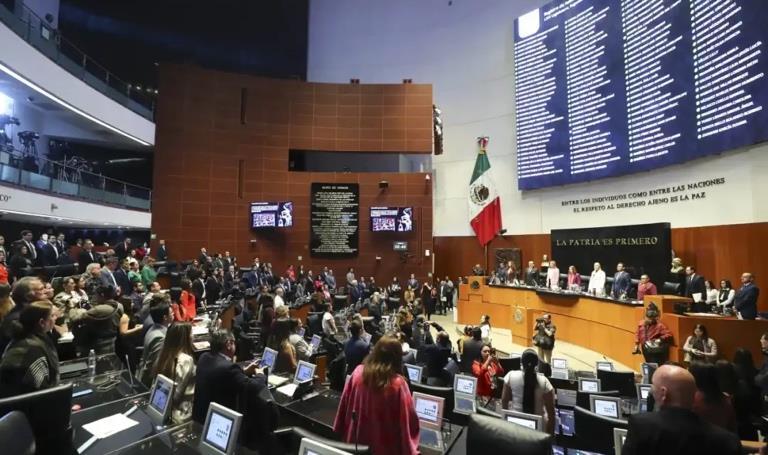
Mexico’s Senate approved President Sheinbaum’s electoral “Plan B” reform, advancing a package focused on reducing institutional costs, capping salaries of electoral authorities, restructuring local governments
A key development was the removal of proposed changes concerning the revocation of mandate A reservation introduced by Senator Lizeth Sánchez of the Labor Party (PT) eliminated the modification, keeping the mechanism unchanged in the Constitution With these changes, the bill was sent to the Chamber of Deputies.
The vote highlights emerging divisions within the ruling coalition, which signals that Sheinbaum no longer commands a fully cohesive or automatic majority in Congress, particularly for constitutional changes that require an absolute mayority to be approved.
Source: FORBES, EL ECONOMISTA

President Claudia Sheinbaum expressed optimism regarding the ongoing review of the USMCA, highlighting a “constructive attitude” from Washington following the establishment of the first formal negotiation table Talks between Mexico and the United States began recently in Washington, in a context where U.S. President Trump has constantly raised uncertainty by suggesting alternative bilateral arrangements
President Sheinbaum acknowledged the economic impact of recent tariffs on key sectors such as automotive, steel, and aluminum, but stressed expectations that these measures could be revisited during negotiations. Also, Secretary of Economy, Marcelo Ebrard, described the initial technical discussions as “encouraging,” noting a cooperative tone and ongoing efforts to address mutual concerns, including strengthening regional manufacturing and limiting non-North American inputs in supply chains. The review process, will formally begin in July 1st and, while Mexico is pushing for continuity and stability, the broader context of U.S. tariff policies suggest a complex negotiation ahead
Overall, the government’s messaging reflects cautious optimism, but underlying tensions point to potential risks for trade certainty and investment planning in North America
Source: ARISTEGUI NOTICIAS, EL FINANCIERO
China signaled it may adopt retaliatory measures against Mexico following recent tariff increases, reaching up to 35% on imports from countries without free trade agreements, affecting over $30 billion in Chinese exports. The Chinese Ministry of Commerce argued that Mexico’s actions constitute barriers to trade and investment, with potential losses estimated at $9.4 billion, particularly impacting the automotive, mechanical, and electrical sectors. Secretary of Economy Marcelo Ebrard defended the measures as necessary to correct market distortions and ensure fair competition for domestic industries
The dispute highlights growing tensions as Mexico balances its trade relationship with China against increasing integration with the United States Ongoing USMCA review discussions have emphasized reducing dependency on Asian supply chains and strengthening regional production While Mexico maintains that the measures are not directed politically at China, Beijing’s response underscores the risk of escalation, potentially affecting bilateral trade flows and complicating Mexico’s broader strategy of nearshoring and supply chain realignment
Sources: EL ECONOMISTA, MILENIO

The Governing Board of Bank of Mexico (Banxico) cut its benchmark interest rate by 25 basis points to 6 75%, surprising markets amid a recent uptick in inflation and persistent external risks. The decision reflects the central bank’s assessment that current monetary conditions remain sufficiently restrictive to guide inflation toward its 3% target range
Recent data from National Institute of Statistics and Geography (INEGI) showed inflation rising to 4 63% in early March, above Banxico’s target range of 2–4% Despite this, the board cited weakening economic activity, exchange rate dynamics, and the broader global environment as factors supporting continued rate easing Banxico signaled that future decisions will remain data-dependent, leaving the door open for additional cuts if conditions allow
The move suggests a growing prioritization of economic support over inflation risks, raising questions about policy credibility if price pressures persist. It also reflects confidence that inflationary shocks may be temporary
Source: MILENIO
A labor panel under the USMCA ruled against Mexico in the Camino Rojo mining case, determining the existence of labor rights violations under the Rapid Response Labor Mechanism. In response, the Secretariat of Labor and Social Welfare (STPS) strongly criticized the panel’s findings, arguing that it exceeded its mandate by assessing conduct of a potentially criminal nature and assigning responsibility to actors beyond the direct employer.
The decision marks another high-profile use of the mechanism, designed to enforce labor standards across North America, and raises concerns within the Mexican government over its scope and implications.
Source: EL ECONOMISTA
Mexico’s Chamber of Deputies approved a new law to promote private investment in strategic infrastructure, sending it to the Senate to continue its legislative process. The initiative seeks to reverse a 28.4% contraction in public investment in 2025 by enabling mixed public-private financing schemes
The legislation establishes two participation models: long-term contracts and mixed investment; and creates a centralized planning council led by the federal executive. A controversial modification removed a provision requiring projects to explicitly adhere to existing constitutional and budgetary frameworks.
The reform reflects the government’s push to unlock large-scale infrastructure financing amid fiscal constraints, but it also heightens concerns over transparency and contingent liabilities
Source: EL UNIVERSAL
At the 82nd Annual Assembly of CAINTRA Nuevo León, President Claudia Sheinbaum highlighted a generally positive tone in discussions with the United States regarding the USMCA review and called for optimism despite potential disagreements Sheinbaum also underscored the administration’s broader economic strategy, linking trade stability with a renewed push for infrastructure investment and mentioned that the “Plan Mexico” strategy seeks to reduce import dependence and strengthen domestic production through targeted industrial projects.
The messaging reflects a dual-track approach: reinforcing North American trade integration while advancing internal capacity-building.
Source: EL HERALDO
Draft Decree Amending the Constitution to Reduce Privileges and Strengthen Recall Elections
• Presented by: Joint Commissions of Constitutional Points; Legislative Studies
• Objective: establishes new rules for municipal governance, including limits on council composition and gender parity requirements It caps local legislative budgets and restricts compensation for electoral authorities to constitutional limits, eliminating excessive benefits
• Status: Approved on March 25, 2026, and sent to the Chamber of Deputies
Draft Decree Enacting the Law for Promoting Investment In Strategic Infrastructure
• Presented by: Joint Commissions of Infraestructure; Finance and Public Credit
• Objective: establishes a legal framework to regulate investments in strategic infrastructure projects It creates coordination mechanisms to channel public, private, and social investment, and regulates strategic investment contracts,
• Status: Approved on March 26, 2026, and sent to the Senate
Opinion with Draft Decree Amending Article 141 of The Federal Tax Code
• Presented by: Comission of Finance and Public Credit
• Objective:This reform allows taxpayers to choose freely among available mechanisms to guarantee tax obligations without proving the impossibility of alternative methods. It maintains compliance requirements while increasing flexibility, aiming to improve efficiency in tax administration
• Status: Approved on March 25, 2026, and sent to the Senate
Point of Agreement on Security Measures for Transport Operators
• Presented by: Dip. Rubén Ignacio Moreira Valdéz (PRI)
• Objective: urges authorities to strengthen security, prevention, and investigation actions against crimes affecting transport operators, including robbery, assault, and kidnapping. It aims to ensure safe conditions for transport workers, safeguard supply chains, and promote accountability.
• Status: Published in the Parliamentary Gazette on March 24, 2026
Opinion with Draft Decree Amending the Federal Labor Law
• Presented by: Joint Commissions of Legislative Studies, First; Work and Social Prevision
• Objective: The reform strengthens nondiscrimination provisions in the workplace by prohibiting discriminatory practices based on personal characteristics It also bans employers from using or sharing sensitive personal data of former employees to restrict future employment opportunities, reinforcing data protection and promoting equal access to work under fair and dignified conditions
• Status: Approved on March 24, 2026, and sent to the Chamber of Deputies