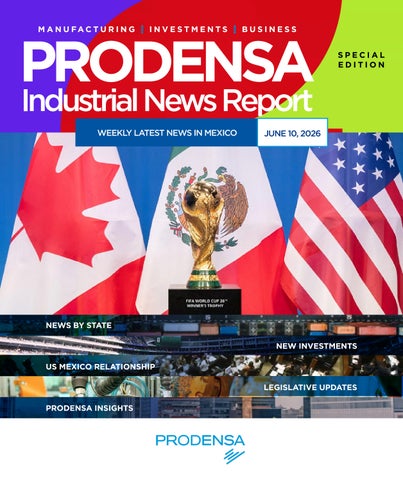
PRODENSA M A N U FAC T U R I N G | I N V E S T M E N T S | B U S I N E S S
SPECIAL EDITION
Industrial News Report WEEKLY LATEST NEWS IN MEXICO
JUNE 10, 2026
NEWS BY STATE NEW INVESTMENTS US MEXICO RELATIONSHIP LEGISLATIVE UPDATES PRODENSA INSIGHTS
2
WORLD CUP 2026: THE IMPACT IN MEXICO EXPECTED ECONOMIC IMPACT
ABOUT THE WC • The FIFA World Cup 2026 runs from June 11 to July 19. • For the first time ever, 48 national teams will compete across 104 matches. • Mexico becomes the first country to host three different World Cups (1970, 1986, 2026). • Mexico will host 13 matches across three stadiums: Banorte (Mexico City), Akron (Guadalajara), and BBVA (Monterrey)he essentials of payroll compliance in Mexico
• Deloitte estimates $2.73 billion USD — equivalent to 0.14% of Mexico’s GDP. • Mexico’s Secretary of Tourism and ANPEC estimate a total economic spillover exceeding 60 billion pesos, driven by tourism, local consumption, and World Cup-related commerce. • BBVA México projects the tournament will add approximately 0.3 percentage points to Mexico’s economic growth. hat manufacturers can gain beyond tariff benefits
EXPECTED VISITORS • Over 5.5 million tourists are expected to visit Mexico during the tournament. • Deloitte estimates 800,000 direct matchrelated tourists: 550,000 domestic and 280,000 international. • 4 million people are expected to attend World Cup-related events across the three Mexican host cities. E
3
WORLD CUP 2026: THE IMPACT IN MEXICO
EMPLOYMENT & MACROECONOMIC IMPACT • The FMF projects ~24,000 direct jobs tied to tournament organization and logistics. • Deloitte estimates 100,000 direct and indirect jobs during June–July, representing 0.24% of all jobs expected to be created in Mexico in 2026. • Key sectors (food, hospitality, transport, entertainment) could see sales grow up to 30% those months. • Mexico’s soccer industry already accounts for 0.6% of total GDP and 54% of the sports sector’s GDP, supporting over 147,300 direct and indirect jobs.
WHY IT SHOULD MATTER TO COMPANIES • Speeds up infrastructure, permits, and public-private partnerships that would otherwise take years. • Impact extends to manufacturing, logistics, construction, technology, and supply chains across North America. • The government’s strategy explicitly includes promoting Mexican products and positioning host cities as innovation ecosystems. Infrastructure and supplier networks built for 2026 shape investment conditions well beyond the tournament.
INFRASTRUCTURE INVESTMENT • 13 billion pesos invested in infrastructure with no public debt generated, including a new metro line in Monterrey, road expansions in Guadalajara, and renovation of both AICM terminals in Mexico City. • The federal government allocated between 1.5 and 2 billion pesos for mobility, security, and public space upgrades in all three host cities. • Mexico City alone invested over 6 billion pesos in infrastructure, mobility, sports, and culture. The Azteca Stadium renovation cost over 3 billion pesos on its own.
FOR MORE INFORMATION, VISIT: HTTPS://WWW.PRODENSA.COM/INSIGHTS /BLOG/WHY-SMART-COMPANIES-ARE- PAYING-ATTENTION-TO-WORLD-CUP-2026 Sources: https://www.deloitte.com/latam/es/services/financial-advisory/perspectives/preparate-para-el-mundial-nuevas-oportunidades-para-los-negocios.html https://www.deloitte. com/latam/es/about/recognition/news/oportunidades-para-la-industria-de-turismo-durante-el-mundial.html https://news.airbnb.com/wp-content/uploads/sites/4/2025/06/MX_Deloitte-Report_Airbnb_FIFAWorldCup26.pdf https://www.gob.mx/presidencia/prensa/presidenta-presenta-la-copa-mundial-fifa-2026-es-momento-para-compartirle-al-mundo-lo-que-es-mexico- y-el-momento-historico-que-vive https://kpmg.com/mx/es/home/tendencias/2025/08/ao-mundial-2026-oportunidad-economica-para-mexico-y-sus-recintos-deportivos.html
4
US - MEXICO PRESIDENTIAL NEWS
5
US - MEXICO PRESIDENTIAL NEWS
USMCA REVIEW MEXICO - U.S. NEGOTIATIONS • The first formal bilateral negotiating round between Mexico and the US concluded on May 29th. Discussions focused on rules of origin, economic security, steel and aluminum, labor provisions, critical minerals, and manufacturing competitiveness. Reports also indicate that U.S. negotiators raised the possibility of increasing regional and U.S. content requirements in the automotive sector, reflecting Washington’s broader objective of strengthening domestic production. • After this negotiation round, Mexican senators traveled to Washington to meet with members of the House Ways and Means Committee. These efforts underscore the strategic importance both countries attach to preserving North American competitiveness amid growing global trade tensions. • At the same time, Secretary of Economy, Marcelo Ebrard, publicly acknowledged that the era of fully duty-free trade with the United States is unlikely to return under the Trump administration; arguing that Mexico’s objective should be to maintain a more favorable position than competing exporters; while pushing for long-term certainty; as he formally requested, alongside Canada, a 16-year extension of the USMCA, emphasizing the need to support investment, supply chains, and regional economic integration as the review process moves forward. SOURCE: FORBES, LA JORNADA, EXCELSIOR, LA JORNADA
6
US - MEXICO PRESIDENTIAL NEWS
USTR PROPOSES NEW TARIFFS • The USTR proposed imposing a 10% tariff on imports from Mexico and other economies following a Section 301 investigation into the enforcement of restrictions on goods produced with forced labor. • Nonetheless, 85% of Mexican exports to the US that comply with USMCA rules of origin would be exempt. • In parallel, President Trump signed an executive order directing U.S. agencies to increase scrutiny of importers, require more detailed supply-chain information, strengthen origin certification requirements, and expand audits. • These measures suggest that trade enforcement, supply-chain transparency, and compliance verification will become increasingly important. SOURCE: EL UNIVERSAL, SECRETARÍA DE ECONOMÍA, N+
7
US - MEXICO PRESIDENTIAL NEWS
MEXICO-US SECURITY COOPERATION • Mexico-U.S. security cooperation faced renewed political tensions following remarks by President Claudia Sheinbaum during a mass rally commemorating the second anniversary of her electoral victory. • While highlighting bilateral security challenges, Sheinbaum accused the US of seeking to interfere in Mexico’s internal affairs through investigations and legal actions against Mexican officials, arguing that cooperation must not undermine national sovereignty. Her comments came as reports emerged that U.S. authorities are investigating additional Mexican governors, including Sonora Governor Alfonso Durazo and Tamaulipas Governor Américo Villarreal, over alleged links to organized crime. • In response, former President López Obrador broke his public silence to support Sheinbaum, arguing that recent U.S. pressure reflects broader interventionist tendencies rather than purely security concerns. • Nonetheless, Trump is yet to issue a response, and, in contrast, signs of cooperation followed as U.S. Homeland Security Secretary Markwayne Mullin praised the Sheinbaum administration noting significant results in drug, weapons, and cash seizures and emphasized the importance of respecting Mexico’s sovereignty.
• These developments illustrate the increasingly delicate balance between maintaining close bilateral security cooperation and managing growing political sensitivities surrounding sovereignty as both countries navigate a more contentious phase of the relationship. SOURCE: LA JORNADA, LA TIMES, POLÍTICO, PROCESO
8
LEGISLATIVE CHANGES AND INITIATIVES JUDICIAL
ELECTORAL
• JUDICIAL REFORM OF THE CONSTITUTION
• ADDITION OF A NEW CAUSE FOR ELECTORAL NULLIFICATION DUE TO FOREIGN INTERFERENCE IN THE CONSTITUTION
— Presented by: Federal Executive — Objective: Schedules the next judicial election for the first Sunday of June 2028, concurrent with the federal electoral process. It also allows recall elections to be held alongside ordinary elections and strengthens the operation of Evaluation Committees. Additionally, it creates two sections within the Supreme Court to improve the resolution of procedural matters. — Status:2June 2, 2026 – Published in the Official Gazette (DOF)
— Presented by: Federal Executive — Objective: Establishes that federal and local elections may be annulled when serious, intentional, and decisive acts of foreign intervention or interference are proven to have influenced electoral outcomes. — Status:2June 2, 2026 – Published in the Official Gazette (DOF)
• AMENDMENTS TO THE GENERAL LAW OF ELECTORAL INSTITUTIONS AND PROCEDURES REGARDING CANDIDATE INTEGRITY — Presented by: Federal Executive — Objective: Creates the Candidate Integrity Verification Commission, responsible for conducting risk assessments of candidates nominated by political parties or seeking independent candidacies. — Status:2June 2, 2026 – Published in the Official Gazette (DOF)
9
LEGISLATIVE CHANGES AND INITIATIVES
• AGREEMENT ESTABLISHING SIMPLIFICATION MEASURES FOR PROCEDURES BEFORE THE MINISTRY OF LABOR AND SOCIAL WELFARE — Presented by: Ministry of Labor and Social Welfare
— Objective: Seeks to simplify procedures and services administered by the STPS by clarifying requirements, reducing processing times, eliminating duplications, lowering administrative burdens, and improving regulatory efficiency. — Status:2June 1, 2026 – Regulatory Impact Analysis Exemption
• AMENDMENTS FOR THE INCLUSION OF PERSONS WITH DISABILITIES LABOR • DECREE ESTABLISHING VARIOUS ADMINISTRATIVE MEASURES WITHIN THE FRAMEWORK OF THE OPENING OF THE FIFA WORLD CUP 2026 IN MEXICO CITY — Presented by: Federal Executive — Objective: Encourages private-sector and civil society organizations in Mexico City to implement telework, remote work, or flexible work arrangements for non-essential administrative activities on June 11, 2026, in accordance with Articles 330A and 330-G of the Federal Labor Law. The decree also suspends classes on that date in public and private preschool, primary, secondary, teacher-training, upper-secondary, and higher-education institutions under the Ministry of Public Education located in Mexico City. — Status:2June 9, 2026 – Published in the Official Gazette (DOF)
— Presented by: Senator Olga Patricia Sosa Ruiz (MORENA) — Objective: Requires employers to install and maintain adequate indoor air quality systems, monitor workplace air conditions, and control exposure to hazardous chemical agents. Recognizes chronic exposure to indoor contaminants as an occupational risk and allows temporary telework when environmental conditions pose health risks. Establishes indoor air quality as a matter of public health and incorporates definitions for Organic Disability and Multiple Chemical Sensitivity within the legal framework. — Status:2June 1, 2026 – Published in the Parliamentary Gazette.
10
NEWS BY STATE
NATIONAL The 2026 FIFA World Cup is expected to significantly increase demand for sportswear, technical fabrics, and athletic apparel across Latin America, creating growth opportunities for Mexico’s textile industry. According to CANAINTEX, the tournament is likely to drive higher consumption of jerseys, uniforms, fan merchandise, and performance textiles as brands, retailers, and consumers prepare for the event. Industry leaders believe Mexico is well-positioned to benefit from this trend due to its established manufacturing base, proximity to North American markets, and integration into regional supply chains. The World Cup could provide a boost to textile production, employment, and exports, particularly for companies serving the sports and apparel sectors, while reinforcing Mexico’s role as a key supplier within the Latin American textile market. SOURCE: INDUSTRIAL NEWS BC
11
NEWS BY STATE
BAJA CALIFORNIA In Tijuana, manufacturers are preparing workplace adjustments ahead of the 2026 FIFA World Cup to accommodate employee interest in Mexico’s matches while maintaining productivity. According to ARHITAC President Fernando Becerra, between 80% and 90% of member companies are planning measures such as flexible break schedules, adjusted meal times, on-site viewing screens, and employee engagement activities to reduce absenteeism during games. The initiative reflects a broader effort among Tijuana’s industrial sector to balance operational continuity with workforce morale, recognizing the World Cup as a major cultural event while fostering employee commitment and retention. SOURCE: INDUSTRIAL NEWS BC
12
NEWS BY STATE
COAHUILA Manufacturing companies in the southeastern region of Coahuila are implementing special measures to prevent worker absenteeism during Mexico’s national team matches at the 2026 World Cup, particularly for the opening game against South Africa. According to CANACINTRA Coahuila Sureste, many companies will install screens inside their facilities so that workers can follow the matches without completely halting operations, while others will adjust shift schedules, allowing early departures or delayed start times. The business organization noted that companies recognize the high level of interest generated by the World Cup and consider these actions a more effective strategy than dealing with potential unexcused absences, while also seeking to maintain productivity and foster camaraderie among employees. SOURCE: VANGUARDIA
13
NEWS BY STATE
NUEVO LEON More than 300 member companies surveyed by CAINTRA (Nuevo León’s Chamber of Manufacturing Industry) have developed operational contingency plans to keep the state’s industrial sector running smoothly during the 2026 World Cup. Given that Nuevo León is Mexico’s top nearshoring destination and a high-productivity manufacturing hub, the strategies focus heavily on reducing traffic and maintaining supply chains: roughly 53% of companies plan to enable temporary remote work for eligible administrative staff, 39% will replace non-essential in-person meetings with virtual sessions, 33% will reschedule deliveries and supplier pickups to nighttime or low-traffic hours, and 28% will implement staggered shift schedules for plant workers to avoid overlap with match times. CAINTRA president Jorge Santos emphasized that private transport routes already used by manufacturers will be a key tool for moving production workers efficiently, reducing reliance on public transit, which is expected to be strained by the influx of local and international visitors. SOURCE: MEXICO INDUSTRY
14
NEWS BY STATE
GUANAJUATO With the 2026 FIFA World Cup approaching, Guanajuato state authorities are working alongside business organizations, security forces, and transportation sector representatives to strengthen protections for truck drivers, cargo, and the logistics corridors that run through the state. Given Guanajuato’s strategic position within Mexico’s national logistics network as part of the Bajío industrial corridor, the plan focuses on increased highway surveillance, route monitoring, strategic information sharing, and faster response to cargo transport incidents. Officials noted that the World Cup will bring a significant surge in the movement of people, goods, and services, making it essential to reinforce prevention and intelligence mechanisms to keep supply chains running efficiently — and to leverage the event as an opportunity to solidify Guanajuato’s standing as one of Mexico’s most important industrial and logistics hubs. SOURCE: EL PIPILA
15
NEWS BY STATE
JALISCO The Jalisco state government announced that schools and public sector agencies will suspend in-person activities on June 11 due to the FIFA World Cup opening day — which includes Mexico’s national team match and a game between South Korea and Czechia in Guadalajara — but the employers’ confederation Coparmex clarified that this suspension does not apply to private businesses, which may operate normally according to their own needs. Governor Pablo Lemus confirmed the public sector pause, with exceptions for essential services like security, civil protection, firefighters, and emergency services. While private companies are not required to halt operations, Coparmex Jalisco recommended that businesses voluntarily consider flexible scheduling, remote work options, and advance planning to help employees manage mobility disruptions and school closures. The organization also encouraged companies to view the World Cup as a historic economic opportunity for Jalisco, particularly in tourism, commerce, and services. SOURCE: EL ECONOMISTA
16
NEWS BY STATE
QUERETARO The Querétaro Chamber of Commerce (Canaco) is calling on broadcast rights holders and authorized providers to develop more affordable licensing packages so that small and family-owned businesses — restaurants, bars, hotels, and other service establishments — can legally air 2026 World Cup matches. The organization emphasized that accessibility should not mean informality, warning businesses that standard residential cable, open-air TV signals, or personal streaming accounts are not sufficient for commercial use, and urging them to avoid pirated signals, illegal links, or unauthorized decoders. While Querétaro is not a host city, Canaco sees the tournament — the largest in FIFA history with 48 teams and 104 matches across Mexico, the U.S., and Canada — as a significant economic opportunity to boost local tourism, gastronomy, and commerce, and is also promoting “La Gran Escapada,” a free-to-join tourism platform where local businesses can register promotions to attract World Cup visitors traveling through the region. SOURCE: LIDER EMPRESARIAL
17
NEWS BY STATE
MEXICO CITY •
Mexico City is expected to be one of the main economic beneficiaries of the 2026 FIFA World Cup, hosting multiple matches, including the opening game. According to Moody’s, the city will see a temporary boost in tourism, hotel occupancy, restaurants, transportation, retail, and entertainment spending as thousands of international visitors arrive for the tournament. However, the agency emphasizes that the overall economic impact will be modest and short-lived, as most infrastructure projects and venue upgrades were already planned or financed separately from the event. While local businesses tied to hospitality and tourism are likely to experience increased revenue during the tournament, Moody’s does not expect the World Cup to generate significant long-term economic growth or materially alter Mexico City’s financial position beyond the event period.
SOURCE: EL ECONOMISTA
18
NEWS BY STATE
STATE OF MEXICO •
A growing number of business owners in the State of Mexico argue that the economic benefits of the 2026 FIFA World Cup will be concentrated among a limited group of companies rather than broadly shared across the local economy. Their main concern is the high cost of obtaining special operating permits and licenses required to participate in World Cup-related commercial activities, which many small and medium-sized businesses consider prohibitively expensive. Entrepreneurs warn that these regulatory and financial barriers could prevent local businesses from capitalizing on the influx of visitors, leaving larger corporations and established hospitality operators as the primary beneficiaries. As a result, business groups are calling on authorities to reduce fees and simplify permitting processes to ensure a more inclusive economic impact from the tournament.
SOURCE: CAPITAL
19
FIFA WORLD CUP 2026 INVESTMENT NEWS MEXICAN COMPANIES RAMP UP INVESTMENTS TO CAPTURE 2026 WORLD CUP OPPORTUNITIES According to a KPMG Mexico survey cited by Forbes, Mexican companies are making significant investments to capitalize on opportunities generated by the 2026 FIFA World Cup, with 37% planning to invest between MXN 1 million and MXN 15 million in World Cup-related initiatives and another 40% investing up to MXN 1 million. Rather than focusing solely on sponsorships, businesses across sectors such as manufacturing, automotive, finance, retail, healthcare, and construction are using the event to boost sales, strengthen brand positioning, expand product offerings, and accelerate digital transformation efforts. The survey found that 77% of companies have already made or plan to make investments tied to the tournament, while 66% expect a positive impact on their industry. Artificial intelligence and digitalization are emerging as key priorities, with companies investing in automation, customer experience, and operational efficiency. The report also highlights that most World Cup-related consumer spending is expected to occur at home through food, beverages, entertainment, streaming services, and retail purchases, creating opportunities well beyond the host cities. SOURCE: FORBES
20
FIFA WORLD CUP 2026 INVESTMENT NEWS
MEXICO CITY COMMITS NEARLY MXN 30 BILLION TO WORLD CUP-RELATED INFRASTRUCTURE AND URBAN DEVELOPMENT Mexico City has invested nearly MXN 30 billion in infrastructure, mobility, and urban improvement projects linked to the 2026 FIFA World Cup, making it the largest public investment effort among Mexico’s host cities. The projects include upgrades to public transportation systems, roadways, public spaces, water infrastructure, and the areas surrounding the stadium that will host World Cup matches. City officials emphasize that these investments are intended
to create a lasting urban legacy rather than serve only the tournament, improving connectivity, mobility, and public services for residents long after the event concludes. The spending reflects Mexico City’s strategy of leveraging the World Cup as a catalyst to accelerate infrastructure projects that were already part of the city’s long-term development plans. SOURCE: EL ECONOMISTA
21
FIFA WORLD CUP 2026 INVESTMENT NEWS
NUEVO LEÓN INVESTS MXN 350 MILLION IN NEW AMPHITHEATER AS PART OF WORLD CUP 2026 PREPARATIONS
FIFA WORLD CUP 2026 EXPECTED TO DRIVE REAL ESTATE INVESTMENT AND URBAN DEVELOPMENT IN MEXICO The 2026 FIFA World Cup is expected to serve as a catalyst for real estate investment and urban development across Mexico’s host cities, particularly Mexico City, Monterrey, and Guadalajara. According to industry experts, the tournament is accelerating investments in hospitality, mixed-use developments, residential projects, transportation infrastructure, and urban regeneration initiatives aimed at accommodating increased tourism and business activity. Beyond the short-term economic boost, developers see the World Cup as an opportunity to enhance city competitiveness, improve connectivity, and attract long-term domestic and foreign investment. The event is also expected to increase demand for hotels, short-term rentals, retail spaces, and entertainment venues, while supporting broader urban transformation projects that could leave a lasting legacy after the tournament. SOURCE: REAL ESTATE MARKET & LIFESTYLE
As part of preparations for the 2026 FIFA World Cup and Nuevo León’s bicentennial celebrations, Governor Samuel García inaugurated the new amphitheater at the Parque del Agua, a project that involved an investment of approximately MXN 350 million. The amphitheater is part of a broader transformation of the park and surrounding public spaces designed to strengthen Monterrey’s tourism, cultural, and recreational infrastructure ahead of the tournament. State officials highlighted that the project will provide a venue for concerts, cultural events, and community activities while contributing to the long-term urban development of the metropolitan area. The investment reflects Nuevo León’s strategy of leveraging the World Cup to accelerate infrastructure improvements and create lasting benefits for residents and visitors beyond 2026. SOURCE: EL HERALDO DE MEXICO
22
PRODENSA INSIGHTS Payroll Services in Mexico: More Than Just Paying Employees Payroll in Mexico involves far more than processing wages. Companies must navigate labor regulations, tax obligations, social security contributions, mandatory benefits, and ongoing compliance requirements to avoid costly risks. This article explains the key components of payroll administration in Mexico and why many foreign companies rely on specialized providers to ensure accuracy, compliance, and scalability as they grow. • The essentials of payroll compliance in Mexico • Key labor, tax, and social security obligations • How the right payroll strategy supports growth
USMCA Compliance: The Ultimate Competitive Advantage For many manufacturers, USMCA compliance is viewed as a regulatory requirement. The most successful companies, however, treat it as a strategic advantage that strengthens market access, reduces risk, and enhances competitiveness across North America. This article explores how a proactive compliance strategy can unlock value beyond tariff savings, helping manufacturers build more resilient supply chains and position themselves for long-term growth. • Why compliance is becoming a competitive differentiator • How strong trade practices reduce operational risk • What manufacturers can gain beyond tariff benefits
VISIT OUR WEBSITE TO EXPLORE OUR FEATURED BLOG POSTS, EBOOKS, AND CASE STUDIES. PRODENSA.COM/INSIGHTS
23
WHAT’S NEW IN PRODENSA?
24
25
www.prodensa.com contact@prodensa.com