USMCA
IT’S OFFICIAL:
MEXICO IS No. 1 U.S. TRADE PARTNER FOR THE FIRST TIME
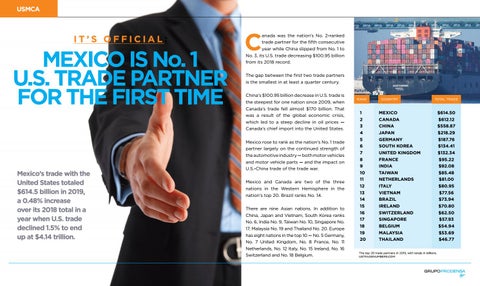
Mexico’s trade with the United States totaled $614.5 billion in 2019, a 0.48% increase over its 2018 total in a year when U.S. trade declined 1.5% to end up at $4.14 trillion.
C
anada was the nation’s No. 2-ranked trade partner for the fifth consecutive year while China slipped from No. 1 to No. 3, its U.S. trade decreasing $100.95 billion from its 2018 record. The gap between the first two trade partners is the smallest in at least a quarter century. China’s $100.95 billion decrease in U.S. trade is the steepest for one nation since 2009, when Canada’s trade fell almost $170 billion. That was a result of the global economic crisis, which led to a steep decline in oil prices — Canada’s chief import into the United States. Mexico rose to rank as the nation’s No. 1 trade partner largely on the continued strength of the automotive industry — both motor vehicles and motor vehicle parts — and the impact on U.S.-China trade of the trade war. Mexico and Canada are two of the three nations in the Western Hemisphere in the nation’s top 20. Brazil ranks No. 14. There are nine Asian nations. In addition to China, Japan and Vietnam, South Korea ranks No. 6, India No. 9, Taiwan No. 10, Singapore No. 17, Malaysia No. 19 and Thailand No. 20. Europe has eight nations in the top 10 — No. 5 Germany, No. 7 United Kingdom, No. 8 France, No. 11 Netherlands, No. 12 Italy, No. 15 Ireland, No. 16 Switzerland and No. 18 Belgium.
RANK
COUNTRY
TOTAL TRADE
1 2 3 4 5 6 7 8 9 10 11
MEXICO CANADA CHINA JAPAN GERMANY SOUTH KOREA UNITED KINGDOM FRANCE INDIA TAIWAN NETHERLANDS
$614.50 $612.12 $558.87 $218.29 $187.76 $134.41 $132.34 $95.22 $92.08 $85.48 $81.00
12 13 14 15 16 17 18 19 20
ITALY VIETNAM BRAZIL IRELAND SWITZERLAND SINGAPORE BELGIUM MALAYSIA THAILAND
$80.95 $77.56 $73.94 $70.80 $62.50 $57.93 $54.94 $53.69 $46.77
The top 20 trade partners in 2019, with totals in billions. USTRADENUMBERS.COM
USMCA
I
t should be remembered that Mexico approved the Modifying Protocol to the USMCA in the Senate on December 12, 2019. For its part, Canada continues its ratification process in its Parliament. Once the legislation is introduced for approval, 21 readings must be made to the treaty, so ratification will take longer and could be completed by the end of March or April. Once the ratification process is completed in the three countries, they will have to notify each other that their internal processes have been completed. Upon receiving the last notification from the Parties, the treaty will enter into force on the first day of the third month, so the Mexican government expects the agreement to enter into force by the end of July or August of this year.
Roadmap for the implementation of the USMCA On January 16, 2020, the plenary session of the U.S. Senate approved the Treaty between Mexico, the United States and Canada (USMCA), with 89 votes in favor and 10 against.
What needs to be done before its implementation? In view of the imminent entry into force of the USMCA, the Ministry of Economy is working against the clock on Mexico’s implementation of the new trade agreement. There are several aspects to be considered before it enters into force.
1. LEGISLATIVE CHANGES The first deadline is April 30, because before that day - when the first ordinary session of Congress ends - adjustments to Mexican laws must be approved, thinking that the treaty will be in force in the second half of the year. The Ministry of Economy is responsible for ensuring that all commitments that Mexico assumed in the USMCA are reflected in national legislation. Therefore, for months they have been working on the legislative package of the USMCA with the Chamber of Deputies, the Senate and different agencies to make the respective adjustments. Among the laws that will be adjusted are: the law of normalization, the law of industrial property, the Criminal Code to toughen penalties for piracy, and even refers to changes that will strengthen the National AntiCorruption System.
USMCA
2. UNIFORM REGULATIONS Another aspect that occupies the Ministry of Economy and that will be crucial for the implementation of the agreement is the design of uniform regulations, which will allow to have common interpretations on what was negotiated in the USMCA, in the rules of origin. The Secretariat has pointed out that since the beginning of 2019 they have been in contact with the United States and Canada on this issue. There are some rules of origin that are more precise and require more detail, such as those for the automotive, textile or clothing sectors, which must be finalized before the treaty enters into force. In the automotive sector this is essential, as it is the sector that will suffer the most transformations, as its rule of origin will be tightened from 62.5 to 75 percent. On this issue, the agency works with its counterparts in the United States and Canada, and coordinates with the Mexican industry. For example, clarifications must be made about the value of labor content, which will be 40 percent. So far, it is known that talks between the three countries are continuing and no agreement has been reached.
CONCLUSION
3. BUDGET It is important to point out that one of the challenges in the implementation of the USMCA is the budget, since the administration of the treaty will be more complex in aspects such as dispute resolution, which demands more human resources to respond quickly. For example, with regard to the USMCA Secretariat, resources will be needed to implement it and to comply with the provisions on dispute resolution and the Express Mechanism in the labora chapter, which will require staff for this purpose. The Secretariat is a figure that depends on the Ministry of Economy and its work is merely administrative, but crucial, since it is in charge of all the technical bureaucracy of the treaty. In addition, resources are required to deal with the dynamics arising from new labour, environmental and dispute settlement provisions.
The government of Mexico will have to act very effectively to implement the Treaty and be ready for its entry into force. It is important that the communication efforts it is making with business and the general public on the disciplines negotiated and what needs to be changed continue. It is also important to note that the United States has indicated on several occasions that they will not notify until they are sure that Mexico is ready to comply with the treaty. In this sense, the Ministry of Economy and its counterpart, the US Trade Representative, have held several talks to this end.
CHINA
China to Cut Tariffs 50% on U.S. Goods China will halve tariffs on some $75 billion of imports from the U.S. later this month, reciprocating a U.S. action and likely satisfying part of the interim trade deal.
B
oth nations agreed to cut tariffs on each others’ goods as part of the phase-one deal signed last month. Other retaliatory tariffs China has imposed on U.S. goods will remain, according to the statement. “We don’t see any impact from this tariff cut -the measures are in line with what the U.S. side is doing,” said Li Qiang, head of Shanghai JC Intelligence Co. While China will continue to process waivers on farm product imports, it won’t remove its punitive tariffs if the U.S. maintains its duties, he said. The yuan extended gains after news of the tariff reduction, with the offshore rate advancing as much as 0.3% to 6.9573 per dollar. Soybean futures
traded in Chicago rose 0.4%. Brent crude futures in London climbed as much as 2.4%. After the reduction, retaliatory tariffs on American crude oil will be lowered to 2.5% from 5%. Punitive tariffs on soybeans will go down to 27.5% from 30%, and to 30% from 35% for pork, beef, and chicken. These rates are higher as these goods were also hit with tariffs in 2018, which will remain in place. “China hopes that both sides can comply with and implement the agreement to enhance market confidence, promote development of bilateral economic ties and facilitate global economic growth,” according to the statement. Source: Bloomberg.com
MEXICO
The States with the highest labor availability and with a better development are, State of Mexico and Mexico City, Nuevo Leon and Jalisco. The number of inhabitants and their skills are superior to other sectors of the Mexican Republic.
MAIN STATES
75%
Economically Active Population (EAP) in Mexico.
Employed ppulation by gender.
60.4%
Of the population in Mexico is of working age.
62%
Of the population in Mexico is of working age.
MEN
38% WOMEN
BAJA CALIFORNIA
EAP employed by age. CHIHUAHUA
22%
7%
COAHUILA
14 - 19 years
NUEVO LEÓN
45% 30 - 49 years 50 - 59 years
20 - 29 years
33%
ESTADO DE MÉXICO
Students graduated by state and academic area. Engineering, Manufacturing and Construction.
5% 8%
JALISCO
Manufacturing Director
12%
CDMX
IT Engineer
QUERÉTARO
Maintainance Technician GUANAJUATO
Welders
Customer Service Representatives Call Centers
29% 5% 5% 5% 4%
16%
20%
Process Engineer
Marketing and HR Professionals
17% 8% 7% 5% 5%
Estado de México y Ciudad de México Veracruz Puebla Coahuila Guanajuato
IT
Commercial Director
Production Supervisor
10%
60+ years
EAP employed by industry.
1% 1% 4%
16%
Services
Commerce
Manufacturing
Agricultural
33%
20%
16%
12%
Construction
8%
Transport and Communication
5%
Puebla Jalisco Veracruz Nuevo León Business and Administration
Government
Electricity
Others
23% 7% 5% 5% 5%
4%
1%
1%
% Percentage of Total Graduates by Area.
States with higher availability of talent in most areas. Among the states with the highest number of nurses are State of Mexico, Mexico City, Chiapas and Tamaulipas
Estado de México y Ciudad de México
Estado de México y Ciudad de México Jalisco Veracruz Puebla Guanajuato
MEXICO
Outsourcing Updates There is an ongoing debate in Mexico regarding Outsourcing. During the month of February, public hearing have been held at both chambers of the Federal Congress. Upcoming changes to the regulation are expected once the bills that are under discussion are voted. On the other hand, with the current regulation, Outsourcing inspections are being held to ensure that companies are in compliance.
COVID-19
The coronavirus impacts auto plants around the world
M
anufacturers around the world have come to depend on parts from China to keep their own supply chains going. Experts fear that factories across the globe could ground to a halt if many of the plants across China remain closed this coming week. Auto plants could be among the first to feel the impact. “It only takes one missing part to stop a line,” said Mike Dunne, a consultant to the auto industry in Asia and the former head of GM’s operations in Indonesia. China is a major supplier of parts to auto plants around the world — shipping nearly $35 billion of parts in 2018, according to UN data. About $20 billion of Chinese parts were exported to the United States alone in 2018, according to the Commerce Department’s International Trade Administration.
The human cost of China’s coronavirus outbreak is tragic, mounting and already readily apparent. The cost to businesses around the world could also become severe in the coming weeks.
While some of those parts go to auto parts retail stores, a large percentage of them go to assembly lines and are to used to build cars. So far most of the auto assembly plants in China are closed, and they’re there to serve the Chinese market. Volkswagen announced it was keeping its Chinese auto plants shut partly due to travel restrictions there and partly due to the lack of parts. But it has already started to spread to plants elsewhere. Hyundai has shut its assembly plants in South Korea, not because the disease but because it can’t keep the plants operating without Chinese parts. Last week, Fiat Chrysler said it has one European plant at risk from the lack of Chinese parts in the next two to four weeks. The other automakers are closely monitoring Chinese situation and said it is too soon to say what are the impacts on their global operations. Experts say the global auto industry hasn’t seen the full impact before now because the plants had been scheduled to closed for the lunar new year. Many assembly plants had an extra inventory of parts going into the holiday. While the shutdown was extended by a week due to the outbreak, most plants haven’t run out of Chinese parts yet. But that can’t last. Simon Mac Adam a global economist at Capital Economics in London said “A supply chain is only as strong as the weakest link. That’s why there’s such uncertainty about estimates.” Source: edition.cnn.com
COVID-19
3 Preventive measures against the new coronavirus covid-19
1. SNEEZE RECOMMENDATION
• When you cough or sneeze, cover your mouth and nose with a tissue and throw it away.
• Or use the inside angle of your arm. Never use your hands.
• Then wash your hands with soap and water.
2. FREQUENT HAND WASHING
3. HOME SAFEKEEPING
• Wash your hands properly with soap and water.
In case you have cold or flu symptoms: • Go for a medical check-up and do not self-medicate • Avoid contact with other people • Avoid kissing, shaking hands These non-pharmacological measures are the most effective in preventing respiratory diseases from spreading to others.
• Or use 70% alcohol gel solutions
FOR FURTHER INFORMATION CONTACT YOELLE ROJAS I yrojas@prodensa.com ABRIL ESCANDÓN I aescandon@prodensa.com