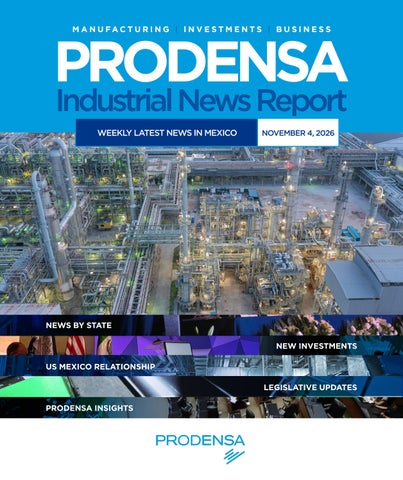
PRODENSA M A N U FAC T U R I N G | I N V E S T M E N T S | B U S I N E S S
Industrial News Report WEEKLY LATEST NEWS IN MEXICO
NOVEMBER 4, 2026
NEWS BY STATE NEW INVESTMENTS US MEXICO RELATIONSHIP LEGISLATIVE UPDATES PRODENSA INSIGHTS
2
US - MEXICO NEWS
3
US-MEXICO NEWS
MEXICAN EXPORTS SURGE 38% AS U.S. DEMAND BOOSTS MANUFACTURING Mexico’s exports reached US$77.8 billion in September, increasing 37.8% year-on-year and extending their streak of double-digit growth to eight consecutive months. Manufacturing exports rose 39%, with non-automotive manufacturing increasing 53% and accounting for 74.1% of manufacturing sales. Automotive exports grew at a more moderate 5.7%, while non-oil exports to the United States rose 43.5%, driven by a 57.2% increase in non-automotive shipments and an 8.5% rise in automotive exports. The increase has been linked to stronger U.S. demand for semiconductors, computing equipment and other technology-related products. By September, Mexico had accumulated a record US$627.2 billion in exports for the year, up 30.3%, while third-quarter exports reached US$237.2 billion, their strongest growth for a comparable period in 35 years. Analysts cited by El Financiero said future performance will depend partly on bilateral negotiations with the United States and the USMCA review, particularly discussions involving rules of origin, automotive trade, metals and regional supply chains. SOURCE: EL FINANCIERO
4
US-MEXICO NEWS
MEXICO TIGHTENS FOREIGN-INVESTMENT SCREENING IN STRATEGIC SECTORS The Chamber of Deputies approved President Sheinbaum’s reforms to the Foreign Investment Law without changes to the Senate version. The measure expands the National Foreign Investment Commission (CNIE) to give permanent voice and vote to the secretaries of Defense, Navy, and Security and Citizen Protection, plus the Digital Transformation Agency. It also creates a mandatory prior CNIE authorization for any direct or indirect foreign investment that would exceed 49% of the capital of a Mexican company in sensitive sectors, or that crosses asset thresholds to be set by general resolution. Sensitive sectors listed include strategic infrastructure, energy, mining, artificial intelligence, semiconductors, cybersecurity, aerospace, telecommunications, critical inputs, raw materials and water, food production, and personal data. Morena’s Dolores Padierna said opening to foreign capital must not mean renouncing the state’s ability to protect strategic interests, and that “sovereignty and prosperity do not compete; they reinforce each other.” The text goes to the Executive for publication in the Official Gazette (DOF). SOURCE: LA JORNADA
5
US-MEXICO NEWS
CONASAMI AND THE 2027 MINIMUM WAGE Conasami has entered the final stage of deciding the future of the Independent Recovery Amount (MIR), the fixed-peso mechanism created in 2016 to raise the purchasing power of the minimum wage without triggering proportional jumps in contractual revisions. The tripartite Consultative Commission finishes its technical diagnosis on October 30th and will deliver it to the Council of Representatives. Invited institutions include Mexico’s Central Bank (Banxico), the National Institute of Statistics and Geography (Inegi), the Ministry of Labor and Public Welfare (STPS), the Ministry of Finance (Hacienda), and the National Autonomous University of Mexico (UNAM). Banxico and Inegi stayed neutral; Banxico noted that the MIR has already lost much of its guiding effect on collective bargaining. STPS and UNAM favor a gradual phase-out, with UNAM suggesting the amount could eventually be set at zero while the legal instrument is kept for future inflation shocks. Labor wants the MIR abolished so higher percentage increases can be negotiated directly; business prefers to keep it to limit contractual pressure. Unions are asking for a 12% rise. Conasami president Luis Munguía said there is still room for a double-digit increase aligned with the goal of 2.5 basic baskets by the end of the administration, rejecting Coparmex’s call to limit the adjustment to expected inflation. The permanent Council session starts in the last week of November; proposals close at the end of the month; the decision is due from December 1 and takes effect January 1, 2027. SOURCE: EL ECONOMISTA
AMBASSADOR JOHNSON ON CARTEL DESIGNATIONS During his conference in the Milken Institute, U.S. Ambassador Ronald Johnson said the designation of drug cartels as terrorist organizations is not intended to “drop bombs on Mexico.” The goal, he stated, is to deploy financial tools, economic sanctions, and measures against material support so the United States can “address the network in its entirety,” noting that the groups operate in Europe, Asia, South America, and inside the United States itself. He described bilateral security cooperation as “the best moment” of his lifetime, while adding that “there is still plenty of room to keep progressing.” He urged both sides to drop reluctance and openly call themselves partners: “We have everything others want; it is right here.” On the border he said it need not be a barrier and can be a source of opportunity, adding that the United States wants a safe Mexico and a safe hemisphere partly for selfish commercial reasons. He recalled that in his first conversation with President Sheinbaum she told him “we cannot separate; it is a marriage in which divorce is not an option,” and he replied that the secret of a long marriage is to talk and “not go to bed angry.” No specific implementation dates for the designations were given. SOURCE: LA JORNADA
6
LEGISLATIVE CHANGES AND INITIATIVES LEGISLATIVE UPDATES ECONOMIC PACKAGE • DRAFT DECREE AMENDING VARIOUS PROVISIONS OF THE INCOME TAX LAW (LEY DEL IMPUESTO SOBRE LA RENTA) — Presented by: Federal Executive (President Claudia Sheinbaum); Hacienda y Crédito Público and Estudios Legislativos Committees, Senate. — Purpose: Strengthen tax collection and combat evasion and elusion by introducing a control mechanism on authorized deductions and fiscal losses for certain legal entities with annual income exceeding 50 million pesos, without creating new taxes or raising rates. The reform expands the Régimen Simplificado de Confianza (RESICO), raises the income limit for legal entities to 50 million pesos, sets a maximum ISR of 125,000 pesos for individuals up to 5 million pesos, and increases the exemption threshold for agricultural, livestock, forestry, and fishing activities to 1 million pesos. The Senate added exceptions for certain automotive companies under fiscal deposit authorization and for gasoline and diesel distributors. — Status: 2026-10-27 – Approved by the Senate with modifications. Returned to the Chamber of Deputies for concurrence on the changes before possible transmission to the Federal Executive.
ECONOMIC PACKAGE • DRAFT DECREE AMENDING, ADDING, AND REPEALING VARIOUS PROVISIONS OF THE FEDERAL LAW ON RIGHTS (LEY FEDERAL DE DERECHOS) — Presented by: Federal Executive (President Claudia Sheinbaum); Hacienda y Crédito Público Committee, Senate. — Purpose: Update fees charged for federal public services and the use of public-domain goods so they better reflect actual costs, including operational, technological, and regulatory factors. Main changes include raising the Derecho de No Residente to 1,158 pesos, homologating ordinary visas at 1,639.80 pesos, a 10% increase in airspace fees, a rise in the long-term railway concession rate to 3%, increases in certain CNBV and environmental fees, reductions in some spectrum rights, and exemptions for museums and archaeological sites. — Status: 2026-10-27 – Approved by the Senate without modifications. Sent to the Federal Executive for enactment and publication in the Official Gazette (DOF).
7
NEWS BY STATE
BAJA CALIFORNIA Baja California has taken a step toward becoming a regional leader in technological innovation and the space economy through its participation in the Digital and Green Innovation Summit Latam, held in Santiago, Chile, from October 27 to 29. The event was part of the International Conference on Space and Sustainable Development (CEDS 2026). Dulce Rodríguez López, Director of Innovation and Technology at the state’s Ministry of Economy and Innovation, said satellite data and Earth observation are a chance to drive solutions in strategic sectors such as agribusiness, maritime, energy and the environment, since they help optimize resources and protect the environment. Together with representatives of Mexico’s federal Ministry of Economy, the delegation took part in working sessions with international organizations, universities and innovation players from Latin America, the Caribbean and Europe, aiming to build collaboration networks and open doors for sustainable tech projects. State agencies also presented initiatives on applied research, mentoring networks and green projects, all meant to position Baja California as a regional innovation hub and to expand international cooperation. SOURCE: INDUSTRIAL NEWS BC
8
NEWS BY STATE
SONORA Sonora’s Ministry of Economy and Tourism (SETUR) took part in a coordination meeting on strengthening Mexico’s semiconductor industry, led by federal Economy Secretary Marcelo Ebrard Casaubon. State Secretary Roberto Gradillas Pineda said that under Governor Alfonso Durazo Montaño, Sonora is building closer ties with universities and industry to develop specialized talent, drive innovation and attract investment, in line with the Plan Sonora de Energías Sostenibles. He added that collaboration among governments, universities and companies is key to preparing the workforce this industry needs and to bringing more local suppliers into its value chains. At the meeting, participants reviewed a collaboration proposal from Arizona State University’s School of Engineering to build industrial and technological capabilities in Mexican states, with a focus on semiconductors. Gradillas Pineda also pointed to Sonora’s strategic location, manufacturing experience and close ties with Arizona and the United States as strengths for growing its role in the sector. SOURCE: ENTORNO INFORMATIVO
9
NEWS BY STATE
CHIHUAHUA Ahead of Mexico’s 2027 elections, the business organization COPARMEX Chihuahua is preparing several initiatives to encourage civic participation and help voters make informed choices, its president Jorge Treviño Portilla announced. One is “Diálogos por la Democracia,” a podcast that will interview candidates about their proposals and views on public issues so voters can compare their options before going to the polls. The organization will also recruit citizen election observers to help ensure that elections are lawful and transparent, encouraging participation beyond casting a ballot. COPARMEX will also work more closely with its business centers in other Chihuahua municipalities to bring these activities to more of the state. The goal is to make informed voting and responsible participation a shared effort between society and institutions on the way to 2027. SOURCE: PRO CHIHUAHUA
10
NEWS BY STATE
NUEVO LEON AmCham Noreste strengthens ties with Texas in advanced manufacturing, logistics and investment. AmCham’s Northeast Chapter (AmCham Noreste) led a business mission to Texas centered on advanced manufacturing, border logistics and investment opportunities, where Mexican private-sector representatives met with industry executives, organizations and U.S. officials to strengthen the bilateral economic relationship. The delegation toured Port San Antonio, the Boeing Center at Tech Port, Toyota Motor Manufacturing Texas and the high-performance center The Rock at La Cantera to learn about the advanced manufacturing ecosystem that makes Texas a strategic point in the North American supply chain. In Austin, members met at the State Capitol with Texas Secretary of State Robert S. Howden and Carlos Ealy to discuss binational economic integration as the USMCA review moves forward, and they exchanged views on trade facilitation and border logistics with the Texas Business Leadership Council. In San Antonio, they met with Amegy Bank and the law firm Cacheaux Cavazos & Newton to review the region’s financial conditions and legal framework, and made connections with greater:SATX and the San Antonio Hispanic Chamber of Commerce. AmCham No-
reste Director Grace Lingow highlighted the decades of trust and shared vision behind the relationship. U.S. Consul General in Monterrey Melissa Bishop accompanied the mission, and Mexican Consul General in San Antonio Rubén Minutti hosted a reception. The visit marks the start of a new stage of cross-border engagement aimed at keeping a permanent line of communication open between the business sectors of both regions. SOURCE: MEXICO INDUSTRY
11
NEWS BY STATE
GUANAJUATO Guanajuato’s state government, led by Governor Libia Dennise García Muñoz Ledo, signed a memorandum of understanding with Arizona State University (ASU) during an October 28–30 visit by an ASU delegation headed by James O’Brien, Senior Vice President of University Affairs and Chief of Staff to the President. The agreement sets the basis for joint projects in semiconductors, advanced manufacturing, automotive and mobility. It also aims to strengthen supply chains, map technology and talent capabilities, and promote exchanges, tra-
ining and dialogue among academia, industry and government. The goal is to move the state beyond traditional manufacturing into areas such as microelectronics, integrated circuit design, engineering and advanced materials. Guanajuato is not starting from scratch. Its B-CHIPS program, which links the state Ministry of Education, CIDESI and universities, has trained teachers in chip design, assembly and testing and produced a multi-project silicon wafer with about 200 integrated circuits. This work is backed by institutions such as CEDECI, IECA and the Center for Research in Optics (CIO), plus a planned cleanroom at IECA. Through its Ministry of Economy and the Guanajuato SUMA strategy, the state aims to build specialized talent and become a competitive destination for investment in semiconductors, advanced manufacturing and automotive. SOURCE: CLUSTER INDUSTRIAL
12
NEWS BY STATE
QUERETARO Querétaro is taking part in a national effort between Mexico and Arizona State University (ASU) to build state-level industrial and technological capabilities in semiconductors. Querétaro’s Secretary of Sustainable Development, Marco Antonio Del Prete Tercero, attended a national coordination meeting led by federal Economy Secretary Marcelo Ebrard Casaubon, where ASU’s School of Engineering presented a collaboration proposal to help develop the industry across several Mexican states. The meeting focused on cooperation mechanisms to strengthen Mexico’s position in semiconductors, an industry that depends on specialized knowledge, technology infrastructure and close ties between universities and companies. Querétaro’s participation is part of a broader effort to identify opportunities in the semiconductor value chain, whose products feed the automotive, electronics, aerospace and IT sectors. Working with international universities is seen as a way to develop specialized talent, applied research and knowledge transfer. The announcement did not include investment amounts, corporate commitments or an implementation timeline. SOURCE: MEXICO INDUSTRY
13
NEWS BY STATE
MEXICO CITY Stellantis Mexico announced a new organizational structure, effective immediately and aligned with FaSTLAne 2030, the five-year global strategic plan led by Stellantis CEO Antonio Filosa. The goal is to give regional operations more autonomy, improve coordination across departments and respond faster to the needs of the Mexican market. CEO Daniel Alejandro González will lead the new structure. Víctor Medina was named VP of Manufacturing for Assembly Plants and José Pagano VP of Manufacturing for Engine Plants. In human resources, Ana Laura Dorantes will serve as VP of HR, Business Partners and HR Centers of Excellence, and Noemí Andrade as VP of HR and Manufacturing Labor Relations. Joaquín Álava will head Government Relations, while Mariana Lavigne becomes Director of Marketing and Advertising as well as Director of Leapmotor Mexico. On the brand side, David Martínez will lead Jeep and Dodge, Mariana López will take over FIAT and Alfa Romeo Mexico, and Jesús Rodríguez, who remains Commercial VP, will lead a new cluster for the group’s Italian brands. The company also announced the retirement of Rafael Paz and Carlos Rivera after 30 and 33 years of service, respectively. SOURCE: CLUSTER INDUSTRIAL
14
INVESTMENT NEWS CENTRAL MEXICO SCHNEIDER ELECTRIC Schneider Electric, the French energy management and automation company, inaugurated on October 28 its Querétaro Campus, an industrial complex with an investment of about 3.6 billion pesos, equivalent to about US$195.3 million. The complex has about 115,000 square meters of productive area in three plants, two of them already operating, and expands the production of electrical distribution solutions, critical energy infrastructure equipment, and engineer-to-order projects for Mexico, the United States, and Canada. The company expects to create more than 4,000 direct jobs by the end of 2027 and about 8,000 indirect jobs, and its manufacturing sites in Mexico rise to 12. Querétaro Governor Mauricio Kuri González was present at the announcement.
CARNOT LABORATORIOS Carnot Laboratorios, the Mexican pharmaceutical company, inaugurated on October 29 its Platah plant in Villa de Tezontepec, Hidalgo, with an initial investment of 2.4 billion pesos, equivalent to about US$130.2 million, which is set to rise to about 3.5 billion pesos. The facility covers 21,000 square meters in five buildings for production, laboratory, storage, services, and administration, and has an annual capacity of up to 35 million finished units. The plant is expected to create 600 highly specialized direct jobs and about 5,000 indirect jobs. President Claudia Sheinbaum and Hidalgo Governor Julio Menchaca Salazar attended the inauguration.
15
INVESTMENT NEWS
MERCADO LIBRE Mercado Libre, the Argentine e-commerce company, inaugurated on October 29 its first distribution center equipped with robotic technology in Mexico, located in the PLATAH Industrial Park in Villa de Tezontepec, Hidalgo. The facility covers more than 100,000 square meters and started operating with 240 autonomous robots, with plans to exceed 1,000. It is the company’s third building in Hidalgo, where its facilities together exceed 290,000 square meters. The company reports more than 600 million dollars invested in the state since 2024 and about 4,700 direct jobs generated there.
DEWA (PODECOBI ZAPOTLÁN) DEWA, the developer in charge of the urbanization, started construction on October 29 of the Podecobi economic development hub in Zapotlán, Hidalgo, with private investment of more than 10 billion pesos, equivalent to about US$542.6 million. The 922-hectare complex will be built in five phases and is expected to create about 5,000 jobs in its first phase, with a focus on the automotive, aerospace, pharmaceutical, and logistics sectors. Economy Secretary Marcelo Ebrard, representing President Sheinbaum, and Hidalgo Governor Julio Menchaca Salazar led the start of works.
VOLKSWAGEN / AUDI Volkswagen and Audi plan investments of more than US$2 billion in Puebla, according to figures presented by the state government on October 29 during the first official visit of the German ambassador to the state. Volkswagen would invest close to US$1 billion in a second phase at its Cuautlancingo plant, and Audi about US$1.1 billion in electric vehicle production at its San José Chiapa plant, including the Audi Q5 e-hybrid quattro and the Q5 Sportback e-hybrid quattro. More than 5,200 direct jobs are projected for the Audi project. SOURCES: CLUSTER INDUSTRIAL, EDOMEX AL DIA
16
WHAT’S NEW IN PRODENSA?
17
PRODENSA INSIGHTS
How CTPAT and OEA Can Change the Way You Evaluate an Industrial Site Selecting an industrial site in Mexico involves more than evaluating location, costs, and infrastructure. For manufacturers operating under CTPAT and OEA security standards, factors such as access controls, perimeter protection, cargo security, and supply chain vulnerabilities can significantly influence a facility’s suitability. This article explores how incorporating security and certification requirements into the site selection process can help manufacturers identify potential risks, avoid costly modifications, and strengthen operational readiness before committing to a property. • Why CTPAT and OEA should influence site selection decisions • What facility security conditions manufacturers should evaluate • How early risk assessments can support compliance and operational continuity
VISIT OUR WEBSITE TO EXPLORE OUR FEATURED BLOG POSTS, EBOOKS, AND CASE STUDIES. PRODENSA.COM/INSIGHTS
www.prodensa.com contact@prodensa.com