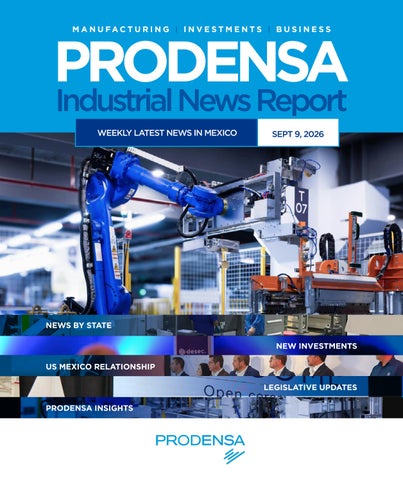
PRODENSA M A N U FAC T U R I N G | I N V E S T M E N T S | B U S I N E S S
Industrial News Report WEEKLY LATEST NEWS IN MEXICO
SEPT 9, 2026
NEWS BY STATE NEW INVESTMENTS US MEXICO RELATIONSHIP LEGISLATIVE UPDATES PRODENSA INSIGHTS
2
US - MEXICO NEWS
3
US-MEXICO NEWS
AMBASSADOR JOHNSON PUSHES FOR MEXICO’S ACTION ON CARTEL FINANCES U.S. Ambassador to Mexico Ronald Johnson urged Mexican authorities to intensify the tracking of cartel finances, arguing that freezing criminal cash hits organized crime harder than seizing drugs or weapons, which can be replaced. He spoke at the CIFirst International Financial Crimes Forum organized by the U.S. Internal Revenue Service’s criminal investigation division. Johnson said weakening cartels and the networks that sustain them is a shared priority for President Donald Trump and President Claudia Sheinbaum. Without money, he said, cartels cannot operate their illegal activities. Following the money, he added, stains those who handle it and leaves them nowhere to hide. He framed the effort as a shift from separate national investigations to joint work against cross-border networks. The United States has blocked more than 50,000 weapons from reaching criminal groups; Mexico has seized more than 80 tons of drugs in maritime operations. Washington also returned hundreds of fugitives, including 10 the previous week sought for kidnapping, drug trafficking, and arms offenses. Mexico’s Financial Intelligence Unit chief Omar Reyes Colmenares said the agency now maps entire economic structures rather than isolated accounts. The unit immobilized 24,622 accounts between 2024 and 2026, worth about 8.67 billion pesos, and filed complaints with the Attorney General’s Office. Source: infobae
4
US-MEXICO NEWS
G20 TALKS, TARIFFS, AND NVIDIA IN MEXICO Economy Secretary Marcelo Ebrard met U.S. Commerce Secretary Howard Lutnick on the sidelines of the G20 Innovation Ministers meeting in Chapel Hill, North Carolina, convened under the U.S. G20 presidency. They reviewed the North American technology agenda and bilateral trade, including U.S. tariffs on steel, aluminum, and autos that Mexico calls unjustified. Mexico argues the measures raise costs across tightly integrated North American supply chains and clash with decades of regional manufacturing under the USMCA, which is also under review. Sheinbaum said Ebrard was working to reach agreements that protect competitiveness. The same G20 session put artificial intelligence, industrial innovation, supply chains, and specialized labor at the center of the agenda. Ebrard also met NVIDIA CEO Jensen Huang, OpenAI’s Sam Altman, and Anthropic co-founder Tom Brown. Huang said NVIDIA’s AI supercomputers are already being built in Mexico and that he looks forward to visiting to help push the country into the AI era. Ebrard invited him and said Mexico must build AI capacity because the technology will be as disruptive as electricity was for manufacturing. Mexico is also seeking to insert domestic suppliers into dataeconomy value chains under Plan México. Source: Jornada/ Excelsior/El Economista
5
LEGISLATIVE CHANGES AND INITIATIVES INNOVATION • GUIDELINES FOR A NATIONAL MODEL TO STANDARDIZE GOVERNMENT PROCEDURES AND SERVICES, SHARE TECHNOLOGY SOLUTIONS, AND BUILD PUBLIC-SECTOR CAPACITY — Submitted by: Digital Transformation and Telecommunications Agency — Objective: These guidelines set out the rules, mechanisms, and procedures for adopting, implementing, monitoring, and evaluating the National Model for Standardizing Procedures and Services, Sharing Technology Solutions, and Building Public-Sector Capacity. That model is established in the National Law to Eliminate Bureaucratic Procedures, and the guidelines are meant to make the law operational. — Status: September 1st, 2026 — Exempt from Regulatory Impact Analysis
6
LEGISLATIVE CHANGES AND INITIATIVES
FOREIGN INVESTMENT • INITIATIVE WITH DRAFT DECREE AMENDING, ADDING, AND REPEALING VARIOUS PROVISIONS OF THE FOREIGN INVESTMENT LAW — Submitted by: The Federal Executive — Objective: The bill would add the Defense, Navy,
PUBLIC ADMINISTRATION
and Security ministries to the National Foreign Investment Commission. It would also give permanent guest status—voice but no vote—to the Attorney General’s Office, the National Intelligence Center, the tax authority (SAT), and the Finance Ministry’s Financial Intelligence Unit. The goal is to bring national-security expertise into reviews of foreign takeovers and acquisitions, and to spell out clearly which deals trigger that review and how far it goes, so investors have more legal certainty. — Status: Published in the Parliamentary Gazette on August 30, 2026
• INITIATIVE WITH DRAFT DECREE AMENDING AND ADDING ARTICLES 82, 116, AND 122 OF THE POLITICAL CONSTITUTION OF THE UNITED MEXICAN STATES, ON EXCLUSIVE NATIONALITY FOR HOLDING THE FEDERAL AND LOCAL EXECUTIVE OFFICES — Submitted by: The Federal Executive — Objective: To establish in the Political Constitution of the United Mexican States the requirement of not holding or acquiring a nationality other than Mexican nationality in order to accede to and exercise the offices of President of the Republic, Governor of a federative entity, and Head of Government of Mexico City, unless that other nationality is renounced under the terms established by law before the candidacy is registered with the competent electoral authority. — Status: Published in the Parliamentary Gazette on August 30, 2026
7
NEWS BY STATE
BAJA CALIFORNIA The recent shutdown of Mexicali’s commercial border crossing by truck drivers protesting visa revocations forced local companies to reroute cargo through Tijuana and San Luis Río Colorado, driving up fuel and logistics costs, according to Coparmex Mexicali president Ernesto García Manjarrez; the hit was worst for perishable-goods shippers, who couldn’t afford delays, while Tijuana’s Otay crossing extended its hours over the weekend to absorb the diverted traffic. Coparmex doesn’t yet have a firm cost estimate but is gauging the impact from container volumes at other crossings, and García Manjarrez used the episode to call for better coordination between Mexican and U.S. authorities — including a proposed liaison role for the Mexican Consulate in Calexico — while warning that although he understands the drivers’ frustration, the closure’s economic fallout risks spreading to other sectors of the local economy. SOURCE: INDUSTRIAL NEWS BC
8
NEWS BY STATE
SONORA The Sonoran State University (UES) connected students with the automotive industry through Ford Hermosillo’s Lean Challenge, an eight-week academic partnership that immersed participants directly in the plant’s operations, placing them on multidisciplinary teams to tackle real production issues using continuous-improvement and Lean methodologies. UES rector Martha Patricia Patiño Fierro said the experience strengthens students’ overall training and deepens ties with the state’s productive sector, with backing from Governor Alfonso Durazo. Three UES students took part — Delhia Maryam Padilla Martínez (Industrial Manufacturing Engi-
neering, UES Magdalena), Carlos Duarte Badillo (Mechatronics Engineering, UES Hermosillo), and Antonio Ulises Moroyoqui Nieblas (Mechatronics Engineering, UES Navojoa) — analyzing technological and operational challenges, designing solutions, and preparing proposals for the automotive sector with guidance from Ford specialists, while UES also trained them to present results and defend their decisions before evaluators. Ford Hermosillo representatives praised the students’ performance, with Juliana Cantú Samaniego, the plant’s CoE Talent lead, calling UES a strategic ally. SOURCE: TERMOMETRO EN LINEA
9
NEWS BY STATE
CHIHUAHUA Ernesto Hermosillo Seyffert has taken over as president of the State of Chihuahua’s Economic Development agency (DESEC) for the 2026-2028 term, sworn in during the organization’s General Assembly at the Chihuahua Casino with an agenda centered on competitiveness, investment and talent. He succeeds Jorge Cruz Camberos, who led the agency for three years and was recognized for his work, during which it drove investment attraction, entrepreneurship, and infrastructure projects, including the relaunch of Chihuahua Futura 2.0 and the Chihuahua City Invest strategy. Hermosillo’s arrival also reflects continuity within the organization itself: he previously served as vice president of the Private Sector Competitive Intelligence Platform (PICsp) and has also chaired the Regional Economic Development Council (Coder), the PICsp, and the Mexican Meat Council (Comecarne). Taking office, he identified translating economic growth into greater prosperity for Chihuahua families as a key challenge, pointing to the need to attract new investment, generate better jobs, and create conditions to retain young talent in the state. The new board also includes Pablo Méndez Alvídrez as secretary and Luis
Carlos Ramírez Chávez as treasurer, plus eight vice presidencies driving different strategic agendas, as the agency enters a new phase focused on aligning the private sector, government and society to strengthen the state’s economic development. SOURCE: PRO CHIHUAHUA
10
NEWS BY STATE
DURANGO Durango is diversifying beyond its traditional mining and food-processing base into automotive, auto parts, and EV-component manufacturing, with manufacturing now making up 40.7% of the state’s gross value added (INEGI, 2024). Key drivers include harness and cable makers like LEONI, Yazaki, APTIV and COFICAB (around 43,000 jobs across ~30 maquiladoras), LS e-Mobility Solutions’ EV-component production for Ford since late 2025, LEONI’s expansion for EV/autonomous-vehicle harnesses (500 jobs), COFICAB’s new second plant, and MLS’s $261+ million, up-to-3,500-job project in La Laguna. Food processing (led by Pilgrim’s $2.6 billion Gómez Palacio investment) and mining (First Majestic Silver, Peñoles, Fresnillo, Avino, Luca Mining) remain strong pillars, with the state reporting 28 active or upcoming projects worth $4.17 billion and 16,373 direct jobs in 2025 — positioning Durango’s next challenge as deepening these value chains rather than just attracting new plants. SOURCE: MEXICO INDUSTRY
11
NEWS BY STATE
NUEVO LEON Nuevo León Governor Samuel García inaugurated Expo PyME 2026, touting the state’s first-place ranking in 51 of 54 INEGI indicators and crediting industry and small businesses as key allies, while outlining support measures including over 10.8 billion pesos in Nafin/Bancomext credit for 4,300 companies, the “Made in Nuevo León” program, the “Zero Shutdowns” initiative with the Industrial Chamber (Caintra), $51 billion in foreign direct investment over two years, 160 billion pesos in public works over five years, a new 4-billion-peso credit line for PyMEs this year, and the launch of the Wallet Nuevo León digital services platform. Caintra president Jorge Santos Reyna thanked the state for its Digital Window (over 300 digitized procedures) and the Zero Shutdowns program, calling small and medium businesses the heart of Nuevo León’s industry and a pillar of Mexico’s economy, while Mexico’s Deputy Secretary of Foreign Trade Luis Rosendo Gutiérrez represented Economy Secretary Marcelo Ebrard, who sent a video message emphasizing his priority of integrating PyMEs into high-value global supply chains like semiconductors. SOURCE: GOVERNMENT OF NUEVO LEON
12
NEWS BY STATE
COAHUILA ISAN (the Higher Institute of Business Administration) opened a new campus in Ramos Arizpe, Coahuila, aimed at giving industry workers and working students access to flexible professional training; after 18 years in the Laguna region (Torreón, Matamoros, Francisco I. Madero), this marks the institution’s expansion into southeastern Coahuila, formalized with a ribbon-cutting attended by state education officials and ISAN leadership, including operations coordinator Emilio Ramírez Medina, who said the location targets industry workers seeking degrees for promotions, raises, or personal growth. Programs will roll out in stages — open-format high school, Industrial Engineering, bachelor’s degrees in Business Administration and Law, and master’s programs, with undergraduate and graduate courses starting in September in both in-person and online formats — and will include the “ISAN Seal,” supplementary training in information technology, artificial intelligence and current job-market skills built into the curriculum alongside the degree. The campus is located in a shopping plaza on Plan de Guadalupe Boulevard in downtown Ramos Arizpe, open Monday through Friday from 9 a.m. to 7 p.m. and Saturdays from 9 a.m. to 3 p.m. SOURCE: EL HERALDO DE SALTILLO
13
NEWS BY STATE
GUANAJUATO Guanajuato and Germany deepened industrial ties at the Smart and Sustainable Industry Summit in Silao, where officials reported nearly $4 billion invested across roughly 70 German projects in the state, generating over 35,000 jobs, as part of PAGSID’s evolution into a long-term Germany-Mexico industrial platform marking 15 years of cooperation between COPARMEX and Germany’s BDI. Speakers including COPARMEX’s Juan José Sierra Álvarez and Guanajuato investment official Alejandro Hernández Fonseca discussed Mexico’s growing manufacturing platform and the need for local companies to build tech capabilities and become strategic suppliers, while the event also featured the
launch of a bilateral catalog profiling 61 sustainable Mexican suppliers and three panels covering sustainable supply chains, industrial energy transition (renewables, smart infrastructure, decarbonization financing), and AI-driven smart manufacturing (Industry 4.0, advanced computing). Closing remarks from Puerto Interior director Héctor López Santillana emphasized the need for long-term public-private projects and a corporate culture that tolerates risk and error to enable real innovation, while BDI’s Friedolin Strack closed by thanking Guanajuato and urging continued investment in both workforce development and youth engagement in Mexico-Germany cooperation. SOURCE: CLUSTER INDUSTRIAL
14
NEWS BY STATE
QUERETARO The Querétaro Industrial Meeting 2026 brought together 580 supplier companies, 60 buyers and 180 purchasing representatives for over 700 scheduled meetings, projecting more than 5,600 business connections. Officials, including Governor Mauricio Kuri González and Sustainable Development Secretary Marco Antonio Del Prete Tercero, said the 20-year-old event shifted from a trade-show format to direct buyer-supplier matchmaking, helping small and medium businesses join supply chains in sectors like automotive, aerospace, medical and Industry 4.0; the program also included a tech pavilion, a job fair with 400+ openings, and a local-products showcase. Tremec México purchasing manager Miguel Ángel Blanco Abarca added that suppliers must now act as engineering and innovation partners, not just compete on price, to meet the industry’s evolving needs. SOURCE: MEXICO INDUSTRY
15
NEWS BY STATE
JALISCO Industrial developer Lintel reinforced its growth strategy in Jalisco, showcasing its Colinas de Lagos project and a future development within the Jalisco Logistics Center at the Third Annual Congress of the Jalisco State Industrial Parks Association (APIEJ), held September 1-2 in Guadalajara under the theme “Industrial Real Estate Revolution: Navigating North America’s New Rules of the Game.” Colinas de Lagos, a 286-hectare industrial park in Lagos de Moreno developed jointly with the Jalisco state government and geared toward light and medium manufacturing, has ten international corporations committed to the complex, and is part of Lintel’s broader portfolio of industrial parks in Guanajuato,
San Luis Potosí and Jalisco. The company also mentioned a new, still-undisclosed project within the Jalisco Logistics Center — with no size, investment figures, construction timeline or target tenants announced yet — making its Congress appearance one of the first public signals of its plan to expand further in the state; Lintel said the event helped it build connections with developers, business representatives and other players in Jalisco’s industrial infrastructure, aligning with APIEJ’s goal of linking developers, investors and suppliers to boost the sector’s competitiveness.
SOURCE: MEXICO INDUSTRY
16
NEWS BY STATE
MEXICO CITY •
•
CDMX allocated 19 billion pesos this year to water and drainage works (a 45% increase from prior years), covering 600 projects citywide, and plans to keep this as a budget priority for 2027 to address sinking, cracked infrastructure, and heavier rains. (Enfoque Noticias) Tax/business law firm Hone Maxwell opened a Mexico City office to serve Mexican companies and investors with U.S. ties, as Mexican FDI into the U.S. hit $61.7 billion in 2024, up from $42.1 billion in 2020. (El Ecosistema Startup)
17
NEWS BY STATE
STATE OF MEXICO •
•
•
Governor Delfina Gómez met with Germany’s ambassador-designate to discuss expanding cooperation on investment, economic development, and education, marking Germany’s first meeting with a Mexican state governor and coinciding with Bosch’s 60th anniversary in Toluca. (Mexiquense Digital) French energy company ENGIE presented the State of Mexico government with a plan to invest more than 2 billion pesos (2026–2030) to expand its natural gas distribution network across the state. (Voces y Jarillas) Bosch’s Toluca plant — its first in Mexico — marked 60 years of operations, having grown from making starters and alternators to a broader range of auto components, now employing about 3,000 people and running a dual-education program since 1969. (MexicoIndustry)
18
INVESTMENT NEWS
NORTHERN MEXICO QSMX QSMX, the Mexican industrial services company founded by Roberto Espinosa Castañeda, inaugurated on September 1 a new operations center in Ramos Arizpe, Coahuila, with an investment of more than 180 million pesos. The facility centralizes the company’s administrative and operational areas supporting automotive quality control, component manufacturing, metallurgical structures, logistics, and specialized inspection services, and is expected to generate more than 350 new jobs, raising the company’s total workforce past 550. QSMX has operated in the municipality since 2014, and the inauguration was attended by Ramos Arizpe Mayor Tomás Gutiérrez Merino and Coahuila Secretary of Economy Luis Eduardo Olivares Martínez, who highlighted the region’s growing appeal for binational supply chain coordination.
19
INVESTMENT NEWS
CENTRAL MEXICO
SOUTHERN MEXICO
VUTEQ
BEPENSA
VUTEQ, the Japanese automotive components manufacturer, inaugurated on September 2 its second plant in Apaseo el Grande, Guanajuato, with an investment of 100 million dollars. The facility performs large format plastic injection molding to produce front rail components for the Toyota Tacoma pickup truck under Project 929N, the first time the company has used injection machinery of this scale for pickup truck parts, according to CEO Shinji Yanagawa. The project will create 135 new jobs and adds to Japan’s cumulative investment in Guanajuato, which totals approximately 9.7 billion dollars, reinforcing the Apaseo el Grande to Celaya industrial corridor within Toyota’s North American supply chain.
Bepensa, the Yucatan based Mexican bottler and Coca-Cola partner, inaugurated on September 6 its Planta Centenario in Valladolid, Yucatán, with an investment of 1,200 million pesos. The facility, covering more than 9,900 square meters within a 380,000 square meter property, is Mexican Coca-Cola Industry’s first new carbonated beverage plant since the late 1990s, and will raise Bepensa’s returnable beverage capacity by more than 30 percent while covering approximately 25 percent of current Yucatán Peninsula demand. The plant will generate more than 200 direct jobs and forms part of a 6 billion dollar national investment plan announced by the Coca-Cola system, celebrating 80 years of Grupo Bepensa and 100 years of Coca-Cola in Mexico. CEO Alonso Gasque Toraya and Coca-Cola México President Louis Balat attended the ceremony alongside Yucatán Governor Joaquín Díaz Mena. SOURCES,: CLUSTER INDUSTRIAL, POR ESTO
20
WHAT’S NEW IN PRODENSA?
21
REPSE & Outsourcing Compliance for IMMEX Companies
WATCH FULL VIDEO
22
PRODENSA INSIGHTS
What Executives Should Do Today to Protect Their Mexico Operations As the USMCA enters a more uncertain phase, protecting manufacturing operations in Mexico requires more than watching negotiations. Executives need greater visibility into origin documentation, inventory controls, supply chain traceability, labor compliance, and other areas that can directly affect market access and profitability. This article outlines practical priorities for CFOs and COOs to reduce exposure, strengthen compliance, and prepare their Mexico operations for greater scrutiny. • Why USMCA compliance is becoming a leadership issue • Where stronger audits and traceability are needed • How proactive governance can protect Mexico operations
VISIT OUR WEBSITE TO EXPLORE OUR FEATURED BLOG POSTS, EBOOKS, AND CASE STUDIES. PRODENSA.COM/INSIGHTS
www.prodensa.com contact@prodensa.com