The Camden Bench Inner city benches can be magnets for anti-social behaviour (ASB) and crime, often resulting in their removal to detrimentally affect the positive use of public space. It was time for a new approach.
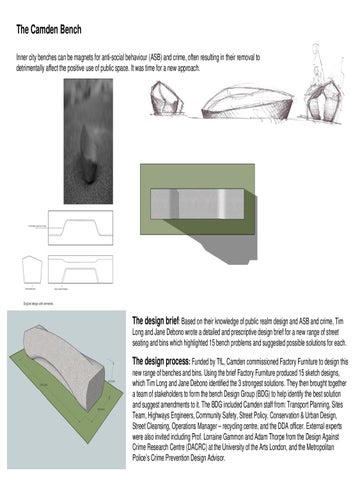
The design brief: Based on their knowledge of public realm design and ASB and crime, Tim Long and Jane Debono wrote a detailed and prescriptive design brief for a new range of street seating and bins which highlighted 15 bench problems and suggested possible solutions for each. The design process: Funded by TfL, Camden commissioned Factory Furniture to design this new range of benches and bins. Using the brief Factory Furniture produced 15 sketch designs, which Tim Long and Jane Debono identified the 3 strongest solutions. They then brought together a team of stakeholders to form the bench Design Group (BDG) to help identify the best solution and suggest amendments to it. The BDG included Camden staff from: Transport Planning, Sites Team, Highways Engineers, Community Safety, Street Policy, Conservation & Urban Design, Street Cleansing, Operations Manager – recycling centre, and the DDA officer. External experts were also invited including Prof. Lorraine Gammon and Adam Thorpe from the Design Against Crime Research Centre (DACRC) at the University of the Arts London, and the Metropolitan Police’s Crime Prevention Design Advisor.
Prototyping and installation: A prototype of the best design was placed on site in Great Queen Street, Covent Garden. The BDG, with Keep Britain Tidy, and passers by tested the design which highlighted further refinements. With the final design agreed, Factory Furniture fabricated the mould, which can be reused, and cast the four pilot benches in concrete, whose colour and aggregate type closely matched the surrounding buildings and contrasted with the paving. The benches were installed in Great Queen Street in September 2009, and the bins in October 2009.
Designing a range of Camden benches: This innovative design created a functional and modular design. From this basic shape a range of 13 different size and shape benches and a bin were designed to cater for narrower streets, and curved benches for the base of trees. In February 2011 three of the slimmer double sided benches and a singled sided bench, that is placed against a wall, were installed in the Holborn area.
The Camden Bench
Functionality: The unique features in the Camden bench minimise ASB, as follows, to encourage walking and more comfortable and social streets: •Anti-graffiti - coating. •Anti-postering - design. •Difficult to skateboard on. •Anti-rough sleeping - has a peaked top. •Deters drug dealing - as no cracks or gaps in the bench to hide materials in. •Deters bag theft - as the recess along both sides encourages people to store their bags behind their legs. •Deters metal theft - as the bin lid is galvanised steel. •Easy to move the bench away from problem areas - as it sits on the footway and is not bolted to a foundation. •Reduces littering and dirt - as no flat surfaces or gaps to trap litter and water. •Reduces littering - as the bin cannot be tipped over and contains a cigarette bin. •Provides the right bench for the right location - as modular designs provide the right size bench from a range of 13 different widths and shapes. •Counter-terrorism version passed PAS68.
The bench sets several other new standards in inclusive design and street cleaning as it has: •5 different height and 3 different width seats. •A more ergonomic seat design. •A tapping rail around the base of bench. •No finger or clothing traps - as the bench has no cracks or gaps. •The bin lid does not dazzle people - as galvanised steel. •Litter flows off the bench and is simply swept around the base. •The bin lid hides the dirt - as galvanised. •The bin acts as a bollard. •Back of the bin provides a possible seat.
Achievements: The most significant achievement is that during the last 18months no complaints have been received from residents or the police about ASB. Despite the benches being one block from a homeless hostel and in the 24hour economy in Covent Garden. The new counter-terrorism version passed the PAS68, stage 1 test to stop a 7.5t truck at 30mph (October 2010) Keep Britain Tidy have documented the bench and bin design process as best practice. The Design Council have recognised the benches as good examples of using design to reduce crime. Observational studies have shown that people quickly take to using the benches. They have also found new seating positions on the bench due to its enabling shape, as it is not a restrictive design. Camden have also observed that people seem to be more comfortable sharing the bench (compared to a traditional park bench) possibly due to the design providing different height and facing seats. Tim Long from Camden comments ‘I believe the Camden bench sets new standards: in reducing anti-social behaviour, simplifying street cleaning, and creating a much more inclusive design (as the benches address about 28 different design issues)’.