Chris Boylan - Oceanic Art
PARCOURS DES MONDES 2026
Chris Boylan - Oceanic Art Sydney Australia
I live in Sydney, Australia. Due to my many travels, I work from a home office and Sydney warehouse rather then a permanent gallery. My schedule includes several trips to Papua New Guinea and various Pacific regions, with regular exhibitions in Australia and overseas. An avid field collector, I still greatly enjoy these Pacific odysseys and always come across some fine and interesting artworks. Having said that, old collections and small auctions within Australia can also be a rich resource for artworks.
email: info@chrisboylan.com.au www.chrisboylan.com.au TEL: +61 405 093 577
Design: Grumpy Wombat, Sydney Photos: Jenni Carter, Sydney
1. DANCE MASK, brag or barag
Murik Lakes, North Coast, Papua New Guinea, 19th/early 20thC. This aged, well-used mask displays the soft texture and patina that can only develop over many generations. It remains in nearly perfect condition, indicating its significance. The face features small pierced eyes and mouth, with a strong yet delicate nose and a large pierced septum. The back of the mask also reveals this worn patina. Attached across the back is a stick, fastened through side holes by cane, which is held in the teeth during the dance. This is not the original teeth stick but a replacement likely made in the generation before it was collected. These brag masks symbolized a spirit or mythical entity. They were always kept inside the Haus Tambaran, placed high on shelves because they were considered ‘powerful.’ Each mask had its unique name and was brought out for ceremonial events, where it was richly decorated and the dancer adorned with foliage and grass skirts, embodying the spirits. These masks possessed latent magical power that was activated, even made dangerous, by applying fresh ochre paint (usually red) and chanting magic spells during this ritual. Collected by Pierre Donaldson, an Australian patrol officer who first arrived in New Guinea in 1938 and returned after the war, where he stayed working for the administration until 1974. The knob at the base appears to have been damaged are repaired (quite expertly) at some time. 46 x 22 x 14 cm € 9,000
2. FIGHTING SHIELD
Upper Lai Valley, Southern Highlands, Papua New Guinea. Provenance: Collected in 1988 by Chris Boylan in the Upper Lai Valley. The warriors of the Upper Lai Valley paint their shields like no others, using abstract flowing forms half-immersed in an almost expressionistic palette. An ancestral figure, with arms raised and legs apart emerges from the swirling yellow, green and white; and there are obvious layering of re-painting having occurred over generations. This region in the Upper Lai Valley is remote, with no road access, and traditional fighting continued well into the 21st century. approx 142 x 36 cm € 4,000
3. OLD GOPE BOARD Papuan Gulf, Papua New Guinea. 19th Century. This is a very old gope board featuring a beautifully strong patina on both the front and back. The shape, including the lower lug, indicates it likely comes from the Namau people of the eastern areas of the Papuan Gulf. The carving is deeply incised, skillfully done, with the dynamic asymmetry characteristic of the oldest Papuan carvings. It comes from a collection in northern NSW, though its provenance is unknown.
74 x 11.5 x 2.5 cm € 5,500
4 CEREMONIAL LIME CONTAINER, Bandi na aivo
Iatmul people, Middle Sepik River, Papua New Guinea. Early 20thC. When Iatmul initiates come out of the Haus Tamabaran following an extended initiation ritual lasting several months, which includes the painful process of body scarification, they receive this ceremonial lime container from their maternal uncles. They wear their finest decorations to reunite with the community and achieve their status as a “man.” This ceremonial lime container, known in the Iatmul language, is a significant emblem of their manhood. This lime container is remarkable, featuring a bamboo shaft with finely woven attachments: the wooden stopper is topped by a large bird totemic figure, skillfully carved, and beneath it are two ancestral faces. This lime container was gathered between 1937 and 1938 by Sir Edward Ford (1902-1986), who served as the chief Medical Officer in Papua New Guinea from 1937 to 1939 and later became Dean of Medicine at Sydney University. He acquired this item during his time in PNG. It subsequently became part of the collection of Kenneth F Russel, Professor of Medicine at the University of Melbourne, and was then passed down by inheritance. 74 x 9 x 8 cm € 4,500
5. MAN’S CHEST ORNAMENT, TEMA Santa Cruz, Solomon Islands. 19thC.
This Tema is quite old; the clamshell circle displays a beautifully aged surface and color. Tema were worn by distinguished men during ceremonies and battles. The turtle shell overlay, also with soft edges and aged appearance, features stylized frigate birds, bonito fish, and sharks as part of its design, merging them into what is believed to be a stylized ancestor figure. Collected by a New Zealander soon after the finish of World War Two, who later emigrated to Australia. 17 cm diameter € 3,000 Santa Cruz man dressed for ceremony, wearing the tema, the most important chest ornament.
6. RITUAL OBJECTS Liagam Valley, ENGA, Papua New Guinea Highlands. a) Prehistoric Stone Figure, Enga, Papua New Guinea. This sculpture, carved from stone, represents a large possum with a protruding head, prominent eyes, and a tail curled beneath the figure. Its arms and legs reach forward. The entire shape forms a remarkable nearly spherical sculpture, with all body parts intricately carved. Much of the stone figure is pecked, meaning finely chipped, including the head and most of the body. However, certain areas, such as the eyes, back, and tail, have been smoothed. It was collected by Australian geologist Ron Ingle in 1962-63 while working with Dawsett Engineering in the Liagam Valley. b) Ritual Echidna skull, Enga region, Papua New Guinea. This is one of the rare ritual echidna skulls I have encountered. It is decorated with cowrie shell eyes and red and white pigments, with a glossy overall patina. The patina indicates use and age. Nevertheless, its precise purpose remains unknown. a) 25 x 13 x 8 cm b) 20 x 6 x 5 cm
POA € 2,000
7. CEREMONIAL DANCE MASK, MWAI
Iatmul people, Middle Sepik River, Papua New Guinea. This is a fine old mask, dating back to the 1940s-1950s. It was collected in the early 1970s and brought back to Australia sometime during that decade and remained with the family until recently. The Mwai (or Mai) mask of the Middle Sepik River is typically elongated. The red face is central with cowrie shell eyes and the nose decorated with matching pig tusks. Below the nose is an arched probiscis that merges into a totemic animal creature, which, in this case is a finely carved bird. The remainder of the mask is covered in a thick resilient clay and embedded carefully selected and matched nassa shells. The clay is carefully mixed with a tree oil ensure durability. Mwai masks are traditionally danced in pairs, representing the older and younger supernatural siblings. The mask is attached to the avan, a large woven basketry costume that completely covers the male dancers, transforming them into living embodiments of ancestral/spiritual power. Size: 96 x 22 x12 cm € 4,000
8. DANCE MASK
Inland Ramu River mountains, Papua New Guinea, 19thC. This is a historic mask, carved from stone and distinctly different from the more familiar coastal masks found in the area. Its origins lie inland, in the mountainous region above the Ramu River, specifically the Adelbert Ranges. The mask displays a beautiful soft patina; some areas shine from frequent handling. It has an oval shape and is deeply carved, featuring a pronounced brow that encircles and frames the face. The face is characterized by sharply defined eyes and a septum, both shaped as sharp ovals. The patina on the exposed wooden parts is enhanced by subtle orange and white pigments that accentuate the deeply carved features. The forehead is decorated with orange and white dots made from these same pigments. Collected in the early 1980s and kept since then in a private collection in Australia. I have only encountered two other masks similar to this one from this remote region. 42 x 16 x 8 cm POA
9. POWERFUL FEMALE FIGURE, KORLU
Sawos region, inland Sepik River region, Papua New Guinea. 19thC. Provenance: Collected by Keith Buxton, Numangwa village in the late 1960s; Ex-Roy Boylan 1971-78; private collection Chris Boylan till present. This is one of the rare notable examples of Sawos Female Cult Figures. It is carved from stone and dates back to pre-contact periods – definitely the mid-19th Century. Traditionally, these significant figures were kept in the Men’s Ceremonial House, attached to the rafters or a main post; concealed from women and uninitiated men. Offerings such as betel nut or occasionally food were hung from the hooks to encourage the spirit to protect and guide during especially challenging times. The figure represents a female, with a strong, almost masculine physique, standing with arms and legs spread in a firm protective pose. A sense of “power” radiates from this figure in a strong and safeguarding manner. The carving is exceptional, indicating that a skilled master-carver created this piece. This somewhat stiff form is characteristic of Sawos sculpture (Newton:1979,324). Much of the face was originally covered in clay and embedded with nassa shells, some of which still remain intact. Blue German trade beads set inside cut conus shells create an almost frightening glare; the pierced ears and nose would have been adorned with shell ornaments on special occasions. A semi-circular snake figure on the left side of the main torso, and a cassowary head near the figure’s feet on the right, were once balanced by similar shapes, but these were lost long before the figure was collected, as the breaks are old and discolored.
106 x 56 x 15 cm POA
10. RITUAL FEMALE FIGURE, MALINGATCHA Nagum-Boiken, Papua New Guinea, early 20thC.
This figure is abstracted with raised arms and a squatting posture. All limbs are sharply defined, with the head and genital area sharing a similar shape. Despite its pointed form, the edges of the figure show signs of age, generational handling, and ceremonial use. The paint, once likely vivid, has softened over time and become an integral part of the wood. The elongated shape and open face make it an elegant example among Boiken figures. These figures were used in initiation rituals, though little else is known as these ceremonies ceased in the 1940s (Roscoe:1990). Both male and female figures exist, and Roscoe suggests they were traditionally carved in pairs. This figure is ex-Peter Hallinan collection and sold at Sothebys Australia. 28 Nov 1993, Lot 246 with two other Hallinan Boiken figures. It resold at Vickers & Hoad auction 18 March 2023. Lot 53. 65 x 14 x 4 cm € 5,500
11. OLD HEADHUNTING HORN
Middle Sepik River, Papua New Guinea, 19thC. Stone carved. War horns are important ritual objects associated soley with headhunting, and as such were objects of power and pride. This old horn has a simplicity in form that is most common in the much older Sepik carvings, whenno metal tools were available. The strong head has a wonderful form and good detail; the areabelow the trumpet’s blowing hole has simple “diamond shape” designs. The highlight in some ways of this object is the superb ancestral face carved near its base, and it would be this invokation of ancestral power that gives the headhunting horn its potency. Size: 60 x 12 cm diameter Price: € 3,800
12. BIRD DANCE MASK
Pora Pora River, Lower Sepik River, Papua New Guinea. Ex-Pierre Langois collection, Paris. Collected on an expedition to PNG in the 1970s. This Bird Mask, symbolizing a clan bird totem, is utilized in dance and stands as one of the more refined masks originating from Pora Pora, a little-known area in the Lower Sepik River. In performance, the male dancer wears this mask over his face while his body is completely enveloped by a long, dense fiber skirt. The tip of the nose is broken. This might have been accidental, but it is more probable that it was intentionally damaged when a significant man, or the master carver of the mask, passed away. It is a well-known practice in the Sepik that artworks are harmed to express mourning when an important person dies – often on a large slit gong, a figure, or a mask. Then, when people observe this, it revives the memory of the deceased. The nose, however, keeps its graceful contour as the damage is on the inside and does not lessen the overall shape of the mask. The precise nature of the ceremony for which this mask was performed remains unknown, yet it exhibits a remarkable liveliness. Size 58 x 12 x 12 cm Price: € 3,800
13. OLD SHIELD
Green River (Abau people) Upper Sepik River, Papua New Guinea. Collected 1948. This is a massive shield shape. In fact, it is so large that it is more accurately described as a “board.” The people of the Upper Sepik and Star Mountains did not carve three-dimensional ancestor figures like most Sepik River communities. Shields and display boards incorporated all these elements of ancestral reverence and worship. The raised lines outlining the abstract shapes are carved in high relief—a lengthy and meticulous process that highlights the significance of this piece. The two primary shapes are quite striking in their design, featuring tail-like extensions. They may represent animal totems or creator beings. The asymmetry gives the carved form a great dynamic quality. This was collected by Pavel Rysavy in 1948. He managed the Angoram Timber Mill on the Lower Sepik River from around 1946. He traveled extensively along the Sepik River. After returning with his artworks to Australia, he left them with a Czech friend, Otto Nekvapil, in Melbourne. Eventually, they became part of Radomir Joura’s collection, and this shield hung in his Sydney home for over 50 years. 210 x 130 cm POA
14. WOODEN TROPHY SKULLS. In New Guinea, wooden skulls are commonly made to replace actual skulls in ceremonial practices. These wooden skulls come from the Sepik River and the Asmat people, both groups historically recognized as headhunters and cannibals. a) Wooden trophy skull, Iatmul group, Middle Sepik, Papua New Guinea. This skull is finely carved with a beautiful form. It lacks a lower jaw but retains an upper row of teeth, all adding to its elegant appearance. Previously part of Sydney artist Alan Leach-Jones’s collection; ex collection Michael Esson, Sydney. b) Wooden trophy skull, Asmat, West Papua, Indonesia. This skull displays a unique character, with prominent fierce teeth and eyes set with red abrus seeds. Ex collection Michael Esson’s collection, Sydney. a) 25 x 18 x 13.5 cm
€ 1,600
b) 26 x 11 x 11 cm
€ 1,200
15. ANCESTOR FIGURE
Central Asmat, West Papua, Indonesia. Early to mid-20thC. This male figure from the Asmat people is carved with distinct features, including knobbly knees, large feet, and very prominent genitals. Extending from the genitals to the chin is a large head of a praying mantis, which is a significant head-hunting emblem due to the female’s behavior of consuming the male’s head during mating. Asmat figures are ancestral and are notably carved for the dedication of a new Jeu, the Men’s Ceremonial House. Research indicates that sometimes these figures were rolled inside mats and stored for later use; other studies suggest they were cast into sago swamps for fertility purposes. Collected by William Leimbach in 1974-1975 while filming “Wow Asmat,” he was an American filmmaker who initially traveled to the Asmat region to document the disappearance of Michael Rockerfeller in 1963 but eventually created an exceptional film, interviewing Asmat master carvers, titled “wow,” which means Asmat language. 73 x 12 x 13 cm € 3,500
16. THREE CULT FIGURES, YIPWON
Karawari River, Middle Sepik region, Papua New Guinea. These small cult figures serve as hunting talismans; they are frequently carried in small netted pouches as charms for hunting (Forge 1960); alternatively, they may be invoked for success before setting out. They have also been credited with power in warfare to ensure victorious results. These small yipwons usually have individual names. a) Mid-20thC. An excellent example, featuring graceful hooks encircling the central “heart”; from a vintage Melbourne collection. b) Early 20thC. This yipwon displays a fine overall patina, delicate engraving, and a pierced septum. ex-Wayne Heathcote, ex-Peter Elliot collection, Sydney; sold at Mossgreen, Melbourne 30 August 2015, “Ex Peter Elliot Collection.” c) Mid-20thC. A finely carved, tall, and slender miniature yipwon. The central projecting forms are more complex than the simple “heart” - possibly representing internal organs. Ex-old Melbourne collection a) 28 x 9 x 3 cm
b) 21 x 5 x 2 cm
c) 41 x 5 x 4 cm
a) € 900
b) € 1,500
c) € 900
17. TWO RITUAL FIGURES
Abelam, Prince Alexander Mountains, East Sepik, Papua New Guinea. Abelam figures are sculpted in three dimensions but typically have a flat back, as they lean against walls and are used almost theatrically inside the Haus Tambaran during initiation rites. They are paired with painted sago panels that create a vivid and colorful display. a) Finely crafted and painted, originating from the western Abelam. The colours are soft and paintwork quite precise. These figures were used over several generations and repainted before each initiation ceremony. This piece was collected by Ron and Pat May in the 1970s, during the time Pat was working on her renowned book, “Pottery of Papua New Guinea,” co-written with Margaret Tuckson. 2000-2025, private collection, Chris Boylan. b) A well-carved and painted figure, likely from the central Abelam area near the villages of Kuminibis. This figure is quite distinctive, featuring rhythmic horizontal carving and painting on its back. Ex-German collection. a) 57 x 19 x 9 cm
b) 44 x 13 x 11 cm
a)€ 3,000
b) € 1,800
Inside the Haus Tambaran, numerous painted spirit figures are presented to the initiates, to overwhelm and instruct them. Photo: Bongiora Haus Tambaran 1973, Fred Gerri’ts.
18. MEN’S CEREMONIAL PECTORAL, PUKABINDA
Tiwi is Northern Territory, Australia. 19thC. ex-Charles Glover collection, Adelaide. ex-William Dunmall collection, Queensland. ex-Urimbirra Museum, Harvey Bay, Queensland ex-Gabriella Roy collection, Sydney These intricately decorated circular pectorals are exceptionally rare artifacts, with only a few held in collections. During his 1954 expedition, Monteford refers to these items as chest ornaments known as pukabinda. These sizable discs, worn throughout and following the Pukamani ceremony, symbolized mourning. They are crafted from woven lawyer vine fiber, adorned with painted ochre patterns, and embedded with Abrus precatorius seeds set in resin. These ornaments could be worn hanging from the upper arm or placed on the chest, often featuring attached tassels made of string and feathers. Women donned similar but smaller discs, which had larger central holes, on their arms during the ceremony. disc 26 x 26, € 3,500
58 long
19. TWO OLD BOOMERANGS, AUSTRALIA a) A finely incised boomerang from Coopers Creek, Western Queensland. It is likely to have been a fighting weapon decorated with the maker’s totemic designs. The surface is covered in fluid designs, with two pointed ends to the boomerang. 65 x 12 cm € 1,000 b) The open form of this boomerang is typical of the Kimberleys. The engraving is precise and very fine, with older traditional designs on one side. The reverse, possibly even carved at a later time, is more sparse and depicts animals. The front is 19thC, the reverse quite possibly early 20thC. 64 x 13 cm € 1,800
20. TWO ABORIGINAL FIGURES Early to mid-20thC, Australia. a) Hardwood Aboriginal Stingray Figure. Collected in the 1940s in Darwin by an Australian serviceman stationed there during the second world war, possibly originating from Groote Island, though this is uncertain. This intricately carved depiction of a stingray illustrates the deep connection between the Aboriginal peoples of northern Australia and the marine world. Fish, stingrays, sharks, sawfish, and other sea creatures have long held both practical and spiritual importance throughout coastal Arnhem Land and the Gulf of Carpentaria, appearing in rock art, ceremonial symbols, and later in portable paintings and carvings. The stingray holds special meaning within the cultural traditions of the Anindilyakwa people of the Groote Eylandt archipelago. In Anindilyakwa creation stories, Yumaduwaya, the ancestral Stingray, journeyed from the eastern Arnhem Land coast toward Groote Eylandt alongside the ancestral Hammerhead Shark and Sawfish. Their ancestral travels are linked to the creation and cultural landscape of the archipelago. Marine life representations are a distinctive characteristic of early Groote Eylandt art. During the 1940s, Anindilyakwa artists created striking images of fish and other sea creatures, often shown as sharply defined silhouettes. These forms have strong ties to the much older rock-art traditions of the archipelago. Notably, two stingray shapes cut from bark and painted with natural pigments were collected at Umbakumba, Groote Eylandt, during the 1948 American-Australian Scientific Expedition to Arnhem Land, showing that stingray depictions were made as portable objects at that time. This piece is unusual as it is designed as a fully carved sculptural form. Its broad, flattened body, protruding eyes, and exceptionally long, finely tapered tail give the creature an immediate and remarkably lifelike presence. Its early collection in Darwin in the 1940s places it within a significant formative period in the collection and broader recognition of Aboriginal art from Arnhem Land and northern Australia’s coast. Although the exact community of origin is not documented, the subject matter and early collection history invite comparison with the known marine imagery of Arnhem Land and, specifically, the strong stingray tradition of Groote Eylandt. b) Aboriginal Bandicoot figure, Arnhem Land, Northern Territory, This is an early carved marsupial figure with distinctive earth ochre from the 1950s/1960s. Attributed to the Maningrida people. The bandicoot is a small rodent-like animal that is both totemic and valued as food. a) 56 x 15 x 3 cm
b) 8 x 38 x 7 cm
a) € 3,000
b) € 1,200
21. ENGRAVED FACES
Made from underground fungus, Washkuk Hills, Upper Sepik River, Papua New Guinea. Little seems to be known about these delicately carved faces.made from a fungus that is dug up near the roots of a particular tree. They are certainly associated with the yam cult ceremonies of Yina, Mindja and Nogwi. They are possibly used in a similar way to the small pottery heads. Sometimes they are painted, sometimes left natural like these two examples. What is known is that these special fungus are dug up from underground (like a truffle) and are associated with only one particular tree. a) 11 x 11 x 8 cm
b) 11 x 12 x 8 cm
a) € 900
b) € 900
22. TWO ANCESTOR FIGURES Papua New Guinea a) A tall double statue, with one figure (possibly female) seated on the shoulders of the other ancestor figure, a male dressed in ceremonial attire. The intricate details and additional small figures are very finely carved. Keram River, Lower Sepik River. From the Carl Shipman collection (number 26). An older collection number, 30, is unknown. The figure leans slightly backward, giving it a dynamic vitality. Signs of wear and use indicate an early 20th-century origin. b) A small figure from Massim, Trobriand Islands. It is simply yet finely carved, suggesting early 20th century and the skill of a master carver. The minimal decorations are beautifully executed, again pointing to an early date. a) 57 x 11 x 10 cm b) 26 x 6.5 x 5 cm
€ 3,000 € 750
23. DANCE MASK, MUNDUGUMORE
Yuat River, Lower Sepik River, Papua New Guinea, early 20thC. ex-collection Carl Shipman, Melbourne, Australia. The prominent brows are characteristic of Mundugumor masks, and these brows ripple with a striking asymmetry, hanging heavily above the tilted eyes to impart great energy to the mask. The mask is aged and exhibits signs of use across many generations, with multiple layers of paint from repeated ceremonial use. Carl Shipman obtained the mask in the 1960s, though there is no proof that he personally collected it or that it came from an early collection. 41 x 16 x 7 cm € 3,000
24. THREE WOODEN YAM MASK
Abelam Arapesh, East Sepik, Papua New Guinea Wooden Yam Masks are considerably less common than their woven cane counterparts made for the Ceremonial Yam Linging rituals, which are traditionally held annually after the harvest. They originate from the eastern Abelam and Arapesh communities in the Mount Alexander Mountains. The typically have a projecting ‘‘handle’’ below the chin. a) Characteristic of the eastern Abelam with a broad oval face, pierced nose and ears: from an old Melbourne collection. b) Small, very delicate yam mask, painted in an unusual yet graceful manner with a deep hollow back. Formerly part of an important Tahitian collection; collected in the 1960s. c) A refined oval-shaped mask, featuring subtle orange and white pigments. Collected around 1972-3 in the Yangoru region by Edward Boylan. a) 32 x 16 x 5 cm
b) 17 x 5 x 5 cm
c) 37 x 12 x 6 cm
a) € 800
b) € 1,200
c) € 950
25. Two Woven Yam Masks
Abelam, East Sepik, Papua New Guinea. Yam masks are used ceremonially during the yam-lining rituals proceeding harvesting of large yams. Culturally to grow large and long yams showed spiritual connections with the grower, always an older initiated man. Both these yam masks are old and finely woven, collected and brought back to Australia in the 1960s. a) An old and very finely woven yam mask, with strong bird-like face and fine “headdress” above. The mask has a overall serene presence. There are many layer of paint indicating long use in mant ceremonies. The final colours are a strong pink and creamy white. b) This is a smaller yam mask, also very finely woven with a sharp projecting beak and very interesting eyes within an abstracted cross-form. The colours are old and well done, with a solid headdress above, seperated from the face by small undulating openwork,The nose and ears are strong forms a) 33 x 31 x 17 cm
b) 23 x 15 x 12 cm
a) € 1,200
b) € 1,000
26. DANCE PADDLE, FLY RIVER, AND FIGURE, TURAMA RIVER PAPUAN GULF a) Dance Paddle from the Fly River. Used by men during ceremonial dances; it features similar concentric circular designs on both sides. The paddle has an elegant curve on one side and a knob at the base of the handle. Collected by George Craig in the 1960s; formerly part of an important Tahitian collection. b) Ancestor Figure from the Turama River, Papuan Gulf, Papua New Guinea. Turama figures are rare and always have been highly collectable. This figure is not as finely carved as some that have passed through auction and achieved remarkably high prices, However, it is old and shows long usage It is from an old Melbourne collection and would without doubt be early 20th Century, if not older. There is a hole in the head, probably for insertion of a feather adornment a) 69 x 8 x 9 cm
b) 38 x 7 x 6 cm
a) € 1,400
b) € 1,800
Anthropomorphic Figure in the round Probably representing a clan ancestor. Turama cultture. 75.7cm Musee du Quai Branly, Inv 4202
27. MAGIC BAG
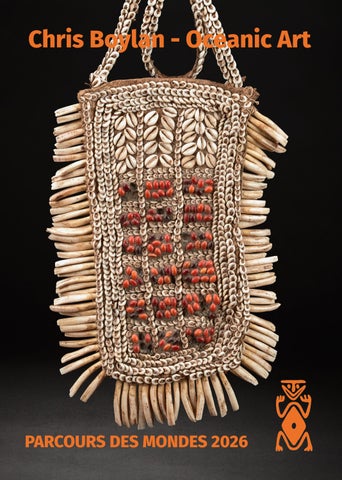
Orokolo Bay, Central Papuan Gulf, Papua New Guinea. Early 20thC. Such small bags, richly adorned with shells, cowrie and egg cowrie, are quite uncommon and appear in only a few collections. This bag returned to Australia early, possibly during the 1920s or 1930s, but remained within the same family until recently. It was always referred to within the family as the “sorcerer’s bag.” There are several small objects inside the bag. Little is known about these bags, but it appears they were personal items kept hidden inside the home rather than used in ceremonies. It might be hard to find a place where they were more deeply rooted than in the villages of Orokolo Bay. Powerful and influential sorcerers were believed to gain spiritual power from the dead by consuming some of their flesh. F.E. Williams, the government anthropologist in the Territory of Papua from 1928 to 1943, wrote: “It might be difficult to find a place where sorcery was more deeply ingrained than in the villages of Orokolo Bay. It may be safely said that every death is attributed to sorcery by someone or other...” WILLIAMS, F. E. (1940). Drama of Orokolo: the Social and Ceremonial Life of the Elema. U.K., Oxford University Press. 19 x 23 x 12 cm, handle 19 cm € 2,600
28. MAN’S PECTORAL
Morobe Province, Papua New Guinea. Early to mid-20thC. This sizable pectoral is an uncommon type, mounted on thick tapa cloth, featuring carefully chosen and graded pig teeth arranged radiantly along its edges. The central section and neck strap are adorned with delicate nassa shells, as well as cowrie shells and red abrus seeds. A comparable piece in the Papua New Guinea National Museum collection, with a similar square, flat shape bordered by radiating ‘pigs’ teeth, is identified as a leader’s emblem, worn as a status symbol by the Kube people of Pindu, Morobe Province. Published in “Adorned - “ Macleay Museum, Sydney University, 1999. 33 x 21 cm, neck strap 38 cm € 2,800
29. SHIELD, KALAM
Madang Highglands, Papua New Guinea. 19th / early 20thC. Ex- Wayne Heathcote, UK, ex-private collection, UK. Kalam shields are crafted from the buttress root of large trees, which accounts for their frequently asymmetrical shape. The wood used is denser than that of most Highland shields, and they are generally shorter and more square-shaped rather than rectangular. This shield is adorned with the typical nodule-like patterns symbolizing gardens. However, this shield is quite unique, featuring not only ridges encircling the “gardens” but also a more intricate double-X design. This implies anthropomorphic figures—a layered double form likely ancestral and protective for the warrior. Two holes in the shield are intended for a fiber sling that the warrior uses to carry it. This shield is aged. The bottom edge shows signs of wear from many years of resting on a hut’s dirt floor, and the overall surface has developed a patina from age, smoke, and use. 98 x 58 cm € 3,500
30. TWO GIANT CLAMSHELL RINGS, YUA
Prince Alexander Mountains, Papua New Guinea. YUA are the most treasured and significant wealth items among the Abelam / Arapesh peoples. They play a vital role in numerous major life events, such as bridal payments, compensation settlements, and funeral ceremonies for distinguished men and women. Crafted from fossilized clamshell, they are made using an ancient technique involving bamboo and sand to carve the central hole, with sand also used to gradually create the smooth, glossy finish. a) Large, thick, and extremely valuable, the clamshell ring features a striking grain that is highly esteemed, a creamy color that is also prized, and eight notches along the inner circle’s edge. b) Large, thick, and very valuable, the clamshell ring exhibits a beautiful grain that is much admired, a creamy hue that is also highly prized. The shell reveals part of the joint where this massive clamshell was connected to its other half, a characteristic often seen in large, thick YUA. a) 24cm diam x 5 cm thick
b) 26cm diam x 5 cm thick
a) € 1,800
b) € 1,800
31. THREE 19TH CENTURY OCEANIC CLUBS a) Fighting Club, kiakavo I cali, Fiji, often referred to as “gunstock” club. Exquisitely carved club featuring numerous carved indentations designed for ivory inlays. Originating from an old collection in rural Victoria that included antique weapons (guns) and Oceanic clubs, all collected before 1890. The family and collection later relocated to Richmond, Melbourne. b) Swollen-Headed Pole Cub, povai, rounded-head, Samoa. The club has typical fine incising in tiny geometric patterns with traces of lime. The wood is very hard and heavy and has a wonderful shiny patina. These clubs were stored high in the house between wars, and when brought down for use, polished with coconut oil, and magic herbs rubbed in to give them added spiritual “power”. c) Fighting Club, Vanuatu, 19thC. Long and slim with a flaired top and angle raised design. Ex-Leo Fleischmann collection, Sydney, LF/C34.
a) 97 x 19 x 6 cm b) 72 x 6 diam cm c) 99 x 5 x 4.5 cm a) € 3,000 b) € 900 c) € 1,200
32. THREE ABORIGINAL BOOMERANGS Northern Territory, Australia, early 20thC.
Swann-Necked boomerangs were exchanged across extensive areas of Central Australia, but they were predominantly linked with the Warlpiri and Warumungu peoples around Tennant Creek in the Northern Territory. These Swan-Necked Boomerangs served both in combat and hunting; when thrown into flocks of rising parrots or ducks near inland waterholes, they proved highly effective. This mulga-wood boomerang, like many from the early 1900s, was crafted from the junction of a tree root and trunk, utilizing the natural curve of the wood to form a sturdy hook. In combat, the hook could catch on an opponent’s shield or club and then swing around to strike the face or body. a) Swan-neck boomerang. Decorated with yellow and white striped pigments, it was used ceremonially and has become a ritual artifact. Finely fluted on both sides. b) Swan-neck boomerang. Finely fluted on one side only, with an elegant shape and engraved designs on the lower handle. Ex Professor Peter McCabe’s collection, Adelaide. c) Swan-neck boomerang. This piece features a small notch beneath the “head”; the top is narrower and nearly pointed. The somewhat imprecise painting suggests ceremonial use. Fluted on one side only. a) 71 x 22 cm
b) 70 x 21 cm
c) 65 x 24 cm
a) € 900
b) € 750
c) € 700
33. THREE ABORIGINAL CHURRINGAS Western Australia. Churringas hold information within their carved form about ceremony and landscape. The central churringa was displayed in the Urimbirra museum in Queensland for many years, originally from the collection of William Dunmall (1927-1998). The other two smaller churringas were collected by two brothers who lived in rural Western Australia in the 1890s. The collection subsequently dispersed, these two pieces eventually entering a private Museum in Renmark, South Australia - the Black’s Museum a) and c) The full length both is engraved with the inter-locking square motifs that are typical of Kimberly designs. Each inter-locking element is then finely engraved with vertical and horizontal lines. c) has lalso triangular motifs. b) This much larger churringa has more free form motifs with vertical and horizontal engraved lies and also small round punctures. Inscribed on the back is the catalogue number 015, and “ Angus Downs, Pitjajinjara, 1965” - which is where and when it was colleced . a) 64 x 4.5 cm b) 93 x 8.5 cm c) 58 x 7 cm
€ 800 € 1,000 € 800
34. Three Turtleshell Armbands
Sepik River region, Papua New Guinea. 19th/early 20thC. Turtleshell was cut into a long rectangular shape, then delicately and precisely engraved when still flat then; carefully bent into its present curved form, to fit the arm. The engraving on all three of these armbands is of higest quality. All three are from the Sepik/Ramu coastal region from where thay are also traded far up the Sepik River and along the north coast.. These are used ceremonially by both men and women. They are highly valued also used as bride price. a) The medium-sized of the three is well worn, with zig-zag bands top and bottom and the central concentric circular designs probably representing whirlpools - where the water spirits dwell. b) A large armband, finely engraved in geometric motifs suggesting water and wind, with zig-zag designs above and below. What makes this example remarkable is the superb woven fibre crocodile covered in finely graded nassa and cowrie shells. c) The smaller of the three, also ancient, engraving is fine and detailed with circles, chevrons and triangles in the most delicate combinations. a) 9.5 x 8.5 diam cm
b) 13 x 9 x 14 cm
c) 6 x 8 diam cm
a)€ 700
b) € 2,400
c) € 600
35. FOUR OCEANIC COMBS
From the Solomon Islands and Papua New Guinea. All early 20thC. a) Ebony Comb, Oro Province, PNG. A straightforward multi-pronged ebony comb, richly adorned with red spondylus shell discs. This is a prestigious item worn exclusively by chiefs, decorated with the highly valued and prized red shell. b) Figurative hardwood comb. Intricately carved on both sides. The handle features large ancestral faces carved on the front and back. Above the head on the front side is a crucifix-like figure (possibly Jesus?). On the back is a more traditional engraved pattern with squatting figures and geometric motifs. c) Fine hardwood comb, Solomon Islands. Inlaid with delicately carved nautilus shell. These combs are used ceremonially in dances and also serve as symbols of wealth. d) Hardwood comb. Papuan Gulf. Heavily engraved on both sides with ancestral faces and intricate geometric designs. a) 27 x 7 x 3.5 cm
b) 23 x 8 x 3 cm
c) 26 x 7 x 1 cm
d) 35 x 8 x 1,5 cm
a) € 600
b) € 900
c) € 1,000
d) € 1,200
36. THREE PIGMENT DISHES
Sepik River, papua New Guinea. 19th/early 20thC. Pigment dishes are quite rare and held as prized possessions by only the older men, who eventually pass them on to the next generation. Most pigment dishes have the totemic head of a crocodile or bird; less common may have a pig or human head. They are used magically, with pigments, to paint the face of a warrior before battle, or overmodelled skulls. This gives magic power, magic spells of chants being recited during the painting process. Among the Kwoma of the Upper Sepik, pigment dishes have a special use; a magic potion of vine sap, and (importantly) menstrual blood is mixed in the dish by initiated elder men and snorted through a reed up the nose. This gives power to the man in war, debate and love. a) Old pigment dish, cockatoo head, abstract crocodile tail; the sides are engraved with egg and water motifs. b) Old pigment dish, bird head, crocodile tail, finely engraved sides, ex-Anthony Forge collection. c) Old pigment dish: crocodile head and tail, sides engraved with egg-like motifs and four engraved crocodile legs a) 26 x 7 x 4 cm
b) 24 x 6 x 2 cm
c) 34 x 10 x 5 cm
a)€ 3,000
b) € 2,800
c) € 2,800
37. Three Pigment dishes
Sepik River, papua New Guinea. 19th/early 20thC. Pigment dishes are quite rare and held as prized possessions by only the older men, who eventually pass them on to the next generation. Most pigment dishes have the totemic head of a crocodile or bird; less common ones may have a pig or human head. They are used magically, with pigments, to paint the face of a warrior before battle, or overmodelled skulls. This gives magic power, magic spells of chants being recited during the painting process. Among the Kwoma of the Upper Sepik, pigment dishes have a special use; a magic potion of vine sap, and (importantly) menstrual blood is mixed in the dish by initiated elder men and snorted through a reed up the nose. This gives power to the man in war, debate and love. a) Old pigment dish, elaborate pig/crocodile head and abstract tail, ex Marc Franklin collection. b) Old pigment dish, highly stylized with an abstract, convuluted head and realistic crocodile tail. c) Pigment dish, larger and wider than the usual and quite angular; A larger pig head at one end, a smaller crocodile head at the other; white pigment inside the dish a) 19 x 7 x 4 cm
b) 17 x 6 x 2 cm
c) 19 x 6 x 3 cm
a) € 3,000
b) € 1,800
c) € 1,800
38. FIGHTING SHIELD
Upper Lai Valley, Southern Highlands, Papua New Guinea. Provenance: Collected in 1992 by Chris Boylan in the Upper Lai Valley. The shield has a district but abstracted figure, dramatically outlined in black on its variegated yellow background. The “arms” are more like wings, giving it an ethereal presence. This is an old shield, used and re-painted many times, over several generations. This region in the Upper Lai Valley is remote, with no road access, and traditional fighting continued well into the 21st century. 144 x 42 cm € 3,800
39. PHANTOM SHIELD
Wahgi Valley, Papua New Guinea Highlands. Artist: John Wahgi. Shields with non-traditional designs are a relatively recent phenomena; the first shields with The Phantom painted on its surface was in the 1990s. These “new designs” were a ressponse of the first generation of educated Highlanders becoming warriors. They knew of the wider world beyond their Highland valleys and decided to incorporate new ideas into their shield designs. “The Phantom” became a favourite motif, as the story reflected in many ways their own Highland cosmology. This strong Phantom shield shows the Phantom in action, emerging fromt he Skull Cave where he lives, with a haunting moon rising large in the dark sky, and reflecting across a lake. His dog, Wolf, is behingd him, ready to follow. “The Phantom” is written in large red letter and, below this, “Man who Cannot Die”. 137 x 39 cm € 4,000
40. Painted Tapas a) Painted Tapa, Tolai people, East New Britain, PNG. Tolai painted tapas are quite uncommon and are always associated with funeral ceremonies, which were intricate and lasted several days. This piece is intricately detailed, divided using many sun-like circles, along with one ancestral face and, importantly, one dukduk face, separated by flowing lines. The colors are typical of the Tolai, also accented by some use of Reckitt’s Blue. Ex-collection. On the reverse, Dunmall has noted: “Duk Duk burial shroud, Rabaul. from Mr Tull, Cooroy, Q 1964”. b) Painted Tapa, (lepau) Santa Cruz, Solomon Islands. The patterns, painted with plant dyes, are geometric and very finely crafted. This would have served as a man’s loincloth. Examples from the Oldman collection are held in several New Zealand museums. c) Painted Tapa Dance Capes, Kamano people, Eastern Highlands, PNG. These capes were worn draped over the shoulders, covering the sides of the dancer’s torso. The design appears abstract but represents a body of water, possibly a river or lake; the surrounding black triangles and pronged ends symbolize frog legs (frogs signify regeneration). Ex-John Friede collection, Rye, NY. a) 118 x 50 cm b) 56 x 22 cm c) 136 x 20 cm
€ 1,800 € 800 € 700
41. TWO PREHISTORIC STONE STAR-SHAPED CLUB HEADS Papua New Guinea Highlands.
In ancient pre-contact eras, stone clubs were widely used throughout the Highlands as close-combat weapons. At some stage in history, the more advanced stone axe appears to have replaced the stone club in general warfare due to its greater efficiency and versatility. Eventually, stone clubs became items of magical significance rather than instruments of battle. The use of stone clubs in fighting persisted into historical times only in the more isolated peripheral valleys, such as the Menyama area (Kukukuku). a) Finely crafted basalt 7-pointed star-shaped club head, Western Highlands. It is in nearly perfect condition with only a few minor chips on the central shaft. Collected by Dick Ellison, a teacher in the Western District during the 1960s. b) Well-carved double-row 6-point star-shaped club made from a basalt-like hard stone, Southern Highlands. One rounded point at both the front and back is damaged, but overall the piece remains in good condition. Collected by Joseph Mead, who was stationed in Mendi in 1967. a) 11 diam x 6 cm
b) 12 diam x 5 cm
a) € 700
b) € 500
42. CEREMONIAL NOSEPIECE AND EYE MASKS a) Nosepiece, Asmat, West Papua, Indonesia. Crafted from Bailer shell, the two curved sides are made separately and joined with cane straps coated in resin. Worn by men during ceremonies. This is an especially fine and graceful example. b) Eye Mask, Sawos, Middle Sepik River, Papua New Guinea. This eye mask is highly intricate, featuring additional fiber, shell, and dog teeth decorations. Used in ceremonial dancing, with the face painted and elaborate headdress of cassowary feathers and dog teeth. The exact meaning is unknown. c) Eye Mask. This is the more common example simple and deeply engraved. Similar to that worn by the dancer in the field photo. a) 8.5 x 15 x 3 cm
b) 19 x 24 x 2 cm
c) need size
a) € 700
b) € 1,200
c) € 400
43. MAN’S WAR PECTORALS, ANDAKARA Abelam, East Sepik, Papua New Guinea.
These two andakara are from the southern Abelam region, the Wosera. The Wosera war pectorals are rarer and more dynamic than the northern Abelam groups, whose war pectorals, called karawut, do not have the 3-dimensional woven face. Andakara are worn on the back during ceremony (though some say initiated men have the right to wear them on the chest), but a major use was during warfare, where they were held in the mouth a). A finely woven pectoral featuring delicate nassa shells and intricate paintwork. Ex-Michael Hamson, CA, USA. b) A larger specimen of the andakara with a robust split pig tusk design, striking shell decorations, and a detailed three-dimensional woven face. a) 29 x 10 x 5 cm
b) 33 x 15 x 5 cm
a) € 850
b) € 950
44. THREE ENGRAVED SORCERY FORMS, MARUPAI Papuan Gulf, Papua New Guinea.
Marupai are carved from the dwarf coconut and decorated with intricate designs. They resemble animal-like totems, but from other perspectives, they appear more human-like. Essentially, they are objects utilized by sorcerers for both good and malevolent purposes. When empowered, they become living beings. Marupai are believed to fly through the air and produce distinct sounds. Their power can be increased with certain barks, animal meat, and especially human flesh. a) This small, old marupai has three tiny wooden objects attached, possibly imbued with magical power. Ex-Robin Leahy collection, Papua New Guinea. b) Old and finely, deeply carved with a dark patina. c) Old and skillfully carved; the lower jaw and one side of the nose are damaged, but most of the marupai remains in good shape. a) 9 x 3 cm diam
b)10 x 3 cm diam
c) 10 x 4 cm diam
a) € 900
b) € 1,000
c) € 700
45. Marriage Skirt
Torrocelli Mountains, Sundaun Province, Papua New Guinea. These skirts are delicate combinations of shell and croix seeds, strung on fine fibre. The shells, conus, bailer and clamshell are all carefully worked and graded. With a backdrop of the fine croix seed it makes a most elegant apparel for a marriage presentation. It has another use also; when a young girl has her first period she is dressed in this skirt an dpresented to the village now as a “woman”. These skirts are from a small cultural group and have now become quite rare. a) 29 x 18 cm a) € 1,200
46. TWO CEREMONIAL PENIS COVERS Upper Sepik River, Papua New Guinea.
These covers, made from the dwarf coconut, are used in one particular level of male initiation, in the Washkuk Hills areas of the Upper Sepik. Douglas Newton notes that these were worn only by initiates in the highest grade, Komaptam, by successful homicides. a) Dwarf coconut with fibre edging decorated with cowrie and nassa shells,. The fine chords are lined with fine grey seeds, Croix lacrima, forming ropes to fasten the penis cover securely around the waist. It has a wonderful patina. b) Similar to a) this penis cover is also deeply engraved with added lime to highlight the motifs. The shellwork is more elaborate. Reference: “Crocodile and Cassowary- religious art of the Upper Sepik River”, Douglas Newton, The Museum of Primitive Art, New York, 1971. a) 11 x 6 cm diam
b) 14 x 5 cm diam
a) € 1,000
b) € 700
47. THREE CEREMONIAL COMBS
Abelam, East Sepik, Papua New Guinea. Combs among the Abelam, decorated with feathers and paintwork, are used ceremonially in dance. The most important occasion would be the initiation ceremonies where large headdresses are worn, but also lesser ceremonial gatherings. The teeth are made from sharpened black palm a very strong wood - which are woven together and faces formed with skilful woven canework. a) € 400
b) € 400
c) € 400
These combs are used during elaborate initiation ceremonies. They are a small part, dominated by huge headdresses covered in Brilliant bird faiths. But they may also be used in more simple ceremonial dancing occasions.
48. Set of Aboriginal Glass Spearpoints Northern Australia.
Glass spear points first started to be made in the 1870s -1880s They are finely crafted, leaf-slaped projectile tips made often from coloured glass - broken sections of wine or beer bottles., and sometimes from the white porcelein of telegraph insulators. Aboriginal craftsmen adapted stone pressure-flaking techniques to work glass into sharp, translucent, and highly prized cultural objects. Originating primarily from the Kimberley region of Western Australia, they were traded widely along the northern coast. a) Clear, € 200 b) Clear, € 200 c) Black, € 200 d) Clear, € 150 e) Blue, € 300 f) Clear, € 200 g) Amber, € 250 h) White, € 250 i) Green, € 250
49. SHELL-INLAID WOVEN SHIELD Solomon Islands.
There are only about 25 known examples of these original 19thC inlaid woven shields, according to the Metropolitan Museum in New York. All were collected between 1840 and 1860. None were collected after this period and there are no photographs of these early shields in use. Only in last 10-15 years one Solomon Island family on Malaita Is, whose heritage goes back to Iroboa, the famous great leader of Su’uafa, have actually made examples of these amazing and iconic shields. This family has maintained traditions around fishing and dolphin-hunting and have dedicated themselves to maintaining some of the ancient arts within their culture. This shield is one of a handful of shell-inlaid shields that have recently been produced. The shield has a tightly woven and strong cane base. Tiny pieces of very finely carved Nautalus shell are prepared and set into parinarium nut pastse that covers the front surface of the shield. The finest old shields had a large central figure, elongated and abstracted, and surrounded by various geometric deigns. This shield has this same elongated central figure with arms raised and very linear form. Below this figure is a smaller figure in squatting position. Surrounding both figures are the typical geometric motifs. The family has painstakingly re-created these enigmatic shields with some reflecting these central figures, while others that have explored designs based on their own experiences. Because of the time and creativity involved, only a handful have been created. This particular shield is somewhat darkened, possibly from being stored over several years in a smokey domestic environment. Photo: early 20thC. War canoe with warriors carrying lave-lave, war shields made of cane, but undecorated.
83 x 24 x 6 cm € 4,000