IssueI




Dear readers,
We are delighted to present the inaugural issue of The Forum on the theme of Remembrance. We hope you enjoy this collection of reflections and stories that mark a new era of Classical scholarship at Groton School
As we selected and read through the pieces, we were confronted with the question: why found The Forum at all?
Born into a world where stories suture parent to child, generation to generation, we are constantly surrounded by a time different from our own Some of us become enamored with their heroes and exploits for glory, others with their architectural feats and culinary delights. We first encounter the Classics not as an academic discipline, but as an untapped source of wonder.
When we enter Groton, we learn to engage in the Classics in a different manner, guided by translation, annotation, and contextualization Through poring over the Catilinarian orations in Latin 3 or Vergil’s Aeneid in AP Latin, we start to realize that as one of our writers note “the present is simply a continuation of the past.”
The Forum is an open space where students can explore this connection through humanistic inquiry, argument, and analysis, regardless of their fluency in Latin and/or Ancient Greek. We write in order to learn, and we learn in order to better understand ourselves and the world around us.
We are proud to share the inaugural issue with you all, and we are excited to see where the future takes us
vōbīs grātiās agimus!
Amanda
Chang
and Jamie Abramson Editors-in-Chief
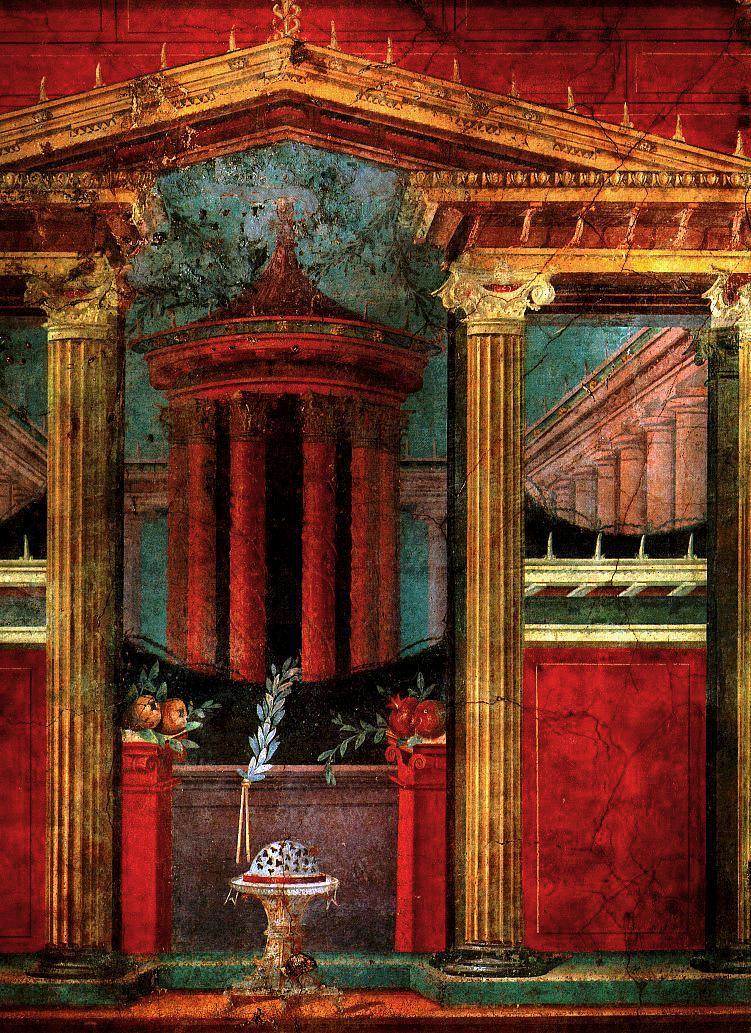
Background photos courtesy of Wikimedia Commons
Jamie Abramson
Amanda Chang
Olivia Hegyi
Ethan Yan
Cam Kucera
Samuel Lu
Museworks Editors
Sasha Kwon
Jess Shapiro
Courtesy of Wikimedia Commons
By Ethan Yan ’27
On February 26th, 2025, archaeologists in Pompeii discovered a large fresco painted on the walls of a sizable banquet room. Specifically, it was located at Insula 10 of Regio IX, within the central area of the city. This discovery follows a series of excavations this year at Pompeii, the site of a devastating eruption by Mount Vesuvius in 79 CE that left the city covered in a thick layer of debris. Experts at the Archaeological Park of Pompeii have estimated that this fresco dates back to roughly 40-30 BCE This work, rich with Dionysian imagery, resonates with the discovery of a similar fresco elsewhere at the Villa of Mysteries approximately a century ago. Together, they mark two significant findings that contribute to our modern understanding of Pompeii’s history, inviting comparisons in their cultural significance.
“In 100 years, today will be seen as historic,” commented the Italian Minister of Culture, Alessandro Giuli, in regards to the finding of the banquet fresco. “The megalograph found in Insula 10 of Regio IX provides another glimpse into the rituals of the mysteries of Dionysus. It is an exceptional historical document and, together with the fresco of the Villa of the Mysteries, constitutes a one-of-a-kind, making Pompeii an extraordinary testimony to an aspect of life in classical Mediterranean life that is largely unknown.”
The paintings, labeled “megalographic” due to their life-like size, feature the bacchantes ecstatic cult worshippers of Bacchus, the Roman god of wine, agriculture, and fertility The creator depicts these figures across the hall, painted on pedestals, both as musical dancers and as hunters. In the fresco, they can be seen trapping goats and slaughtering animals. The frieze mirrors images found within Euripides’s 405 BCE play The Bacchae, which deepened the association between the bacchantes’ personalities and frenzied madness. In ancient Rome, women generally fulfilled the role of modest homemakers, managing family affairs and domestic duties. The images in the banquet room contrast these two archetypes: the graceful, composed women in Roman society and the untamed, bestial bacchantes.
As Gabriel Zuchtriegel, the director of the Archaeological Park of Pompeii, puts it, “for the ancients, the bacchante or maenad expressed the wild, untameable side of women in other words, the direct opposite of the ‘nice’ woman who emulates Venus, the goddess of love and marriage, the woman who looks at herself in the mirror and ‘dolls herself up. ’”
This juxtaposition, vividly rendered on the walls, reveals how these opposing conceptions were immortalized within elite Roman spaces. Zuchtriegel goes on to discuss how the depictions’ religious implications were key to building the atmospheres of Ancient Roman banquets and feasts how we might feel seeing a Michelangelo painting adorning the wall of a restaurant, he posits as an example.
The Italian government’s work in archaeology exemplifies the importance of continuing to fund these excavations, especially in our modern world. This discovery has joined a thrilling stage of transformation in archaeological understanding that continues to expand our understanding of Pompeii’s heritage.
Archaeological Park of Pompeii. “Pompeii, Discovery of a Room With Frescoes
Depicting the Initiation Into the Mysteries and the Dionysiac Procession.” Last modified February 26, 2025
https://pompeiisites org/en/comunicati/pompeii-discovery-of-a-room-withfrescoes-depicting-the-initiation-into-the-mysteries-and-the-dionysiacprocession/.
Balmer, Crispian. “Rare frescoes unearthed in Pompeii shed light on ancient
rituals ” Reuters, February 26, 2025
https://www.reuters.com/world/europe/rare-frescoes-unearthed-pompeiished-light-ancient-rituals-2025-02-26/.
McGee, Suzanne. “What Role Did Women Play in Ancient Rome?” History, March
6, 2025 https://www history com/articles/women-ancient-rome/
Nadeau, Barbie Latza. “Newly discovered Pompeii frieze shows wild Bacchanalian
rituals.” CNN, February 28, 2025.
https://www.cnn.com/2025/02/28/style/pompeii-bacchanalia-frieze-scli-intl.
Radley, Dario “Rare Dionysian fresco unearthed in Pompeii depicts rituals and
mystery cults.” Archaeology News, February 26, 2025. https://archaeologymag.com/2025/02/rare-dionysian-fresco-unearthed-inpompeii/.
By Arwen Zhang ’28
In a single volcanic eruption, centuries of prosperity disappeared under a smothering blanket of ash and debris, and a city was wiped off the face of the earth. This was the fate of Pompeii, a Roman port-city and vacation destination that Mount Vesuvius decimated in its catastrophic eruption on August 24, 79 CE. Nearly two millennia later, the city was finally unearthed, revealing a snapshot of Roman life below the tragedy and chaos
Beneath the pumice lay valuable artifacts that enriched historians’ understanding of Ancient Roman life: buildings, monuments, art, and humans. Though their human flesh has long decayed, the hollow outline of their bodies remains imprinted in ash As early as the 1800s, scientists filled these cavities with plaster, creating statues of the Pompeiians in their dying positions. By assessing the proximity between these three-dimensional figures, researchers were able to assume the interpersonal relationships between them. These presumptions stood for centuries until scientists deviated from solely relying on subjective assumptions and integrated objective evidence into their claims
On November 7, 2024, scientists from Harvard Medical School, the University of Florence, and the Max Planck Institute for Evolutionary Anthropology published a study in the journal Current Biology where they analyzed DNA from embedded skeletal material preserved in 14 of the 86 casts under restoration One studied site, named the House of the Golden Bracelet for the golden bracelet worn by an adult discovered in the building, contained four casts. Two pairings the adult with the bracelet and the child carried on their lap, and a pair of individuals in an embrace contributed significantly to findings that challenged previous assumptions. The physical intimacy in both pairs led to the conclusion that the former were mother and child, and the latter, sisters; however, genetic analysis revealed them all to be male and unrelated, invalidating these initial narratives.
A point to be raised is the immediate identification of the adult wearing the bracelet as being female. This is logical in accordance with many present-day societal standards associating jewelry with femininity; however, jewelry was a unisex decoration in Rome and did not become predominantly feminine until centuries after the empire’s collapse. Although modern rationale may support the conclusion that the adult’s sex is female, the truth demonstrates the necessity of scientific backing.
A further point raised is the basis of physical intimacy to inaccurately denote the instances of kinship. Initially, it seems reasonable for scientists to assume a motherchild or sibling relationship from such embraces, given both the societal norms in the Roman Empire and modern behavioral trends in different genders. However, this is a type of social projection, where one relies on their own perspective and experiences when predicting the cognition, emotion, or behavior of other people In this example, historians lean too far into their knowledge of the status quo of human behavior in Roman society without considering the disruptions of Vesuvius. While the familial structure was indeed conventional in Ancient Rome, these standards were shattered by the eruption-induced chaos.
Once researchers acknowledged this and put aside their own biases, they were able to understand the event differently from their predecessors, leading to the theory that the destruction and terror caused by Vesuvius united strangers panicking in the face of imminent death, driven by the inherent desire for comfort in the face of chaos. As the world fell around these Pompeiians, strangers were brought together in their final moments
The case of the Pompeiians reinforces the need for a high standard of historical objectivity. Co-senior author David Reich, professor of genetics in the Blavatnik Institute at HMS and professor of human evolutionary biology at Harvard University, agrees with this necessity: “Instead of establishing new narratives that might also misrepresent these people’s experiences, the genetic results encourage reflection on the dangers of making up stories about gender and family relationships in past societies based on present-day expectations.” Future historians should integrate factual evidence into their theories to enrich and correct their limited perspectives Otherwise, history is condemned to a cycle of assumptions and halftruths, the past distorted and misconceived as its true stories remain untold and undiscovered.
Bazinger, Claudia, and Anton Kühberger. "Is social projection based on simulation
or theory? Why new methods are needed for differentiating." New Ideas In Psychology ScienceDirect Last modified 2012 Volume 30, no 3 (2012): Pages 328-335, https://www.sciencedirect.com/science/article/pii/S0732118X12000037.
Dutchen, Stephanie. "Ancient DNA Challenges Stories Told About Pompeii Victims."
Harvard Medical School News and Research. Harvard College. Last modified November 7, 2024
https://hms.harvard.edu/news/ancient-dna-challenges-stories-told-aboutpompeii-victims.
Jashemski, Wilhemina Feemster. "Pompeii." Edited by The Editors of
Encyclopaedia Britannica Britannica Encyclopaedia Britannica Last modified February 28, 2025 https://www britannica com/place/Pompeii
Max-Planck-Gesellschaft. "DNA evidence rewrites story of people buried in Pompeii
eruption." Max Planck Gesellschaft. Last modified November 7, 2024. https://www.mpg.de/23699890/1106-evan-dna-evidence-rewrites-story-ofpeople-buried-in-pompeii-eruption-150495-x
Pilli, Elena, Stefania Vai, Victoria C. Moses, et al. "Ancient DNA challenges
prevailing interpretations of the Pompeii plaster casts." Current Biology. Elsevier. Last modified November 7, 2024. https://www.cell.com/currentbiology/abstract/S0960-9822(24)01361-7
"Scientists FINALLY Sequenced The DNA of Pompeii's Victims and It Changes
Everything!" Video. YouTube. Posted by Discovery Future, November 8, 2024. https://www.youtube.com/watch?
v=bx4xucUkyco&pp=ygVUU2NpZW50aXN0cyBGSU5BTExZIFNlcXVlbmNlZ CBUaGUgRE5BIG9mIFBvbXBlaWkncyBWaWN0aW1zIGFuZCBJdCBDaGFuZ 2VzIEV2ZXJ5dGhpbmch.
Singapuri, Nalin. "Jewelry of the Roman Empire." The Museum of Jewelry. MOJ.
Last modified May 17, 2020. https://store museumofjewelry com/blogs/news/ancient-roman-jewelry? srsltid=AfmBOorL4ZPATLsxSwFZsbanrpkzJTO5P3Il8BfUHZJV8UXXeJsh0qi 6.
By Nora Qiao ’28
In Homer's Odyssey, Ithaca is the final destination in the arduous journey from the ruins of Troy. Although Ithaca is just a small island off the Ionian coast, its symbolism in a classic that has underpinned so much of modern literature is immense A new artificial intelligence model with the same namesake has been published and documented by Thea Sommerschield, Assistant Professor in Digital Humanities and the Ancient Greek World at Durham University, and Yannis Assael, a research scientist with Google DeepMind. After many panels of review, the model has been admitted to Nature, the most influential science journal globally. Ithaca AI assists in textual restoration, geographical attribution, and chronological placement of ancient Greek inscriptions Specifically, the model is a deep neural network, which means that it holds many more layers of computation compared to basic artificial intelligence. The partners that designed Ithaca claim that “the AI is foremostly built to expand and assist the historians rather than replace them.” Ithaca’s platform supports a workflow made up of collaboration, decision support, and interpretation between its predictions and the insight of historians At its core, Ithaca is a synchronization of the arts and sciences that provides the type of synergy powering the next great leaps in Classics.
Ithaca’s capabilities as an AI model are effective and well-designed. In order to make the best predictions, Ithaca has been trained on 80,000 ancient Greek inscriptions The model has three main abilities: reconstruct missing text, establish origin, and determine provenance. The first of the three is especially important in a field so deeply affected by the work of historical preservation, as historians in the field often discover inscriptions with breaks in the stone or entire lines missing. Ithaca makes predictions much like how large language models like ChatGPT answer questions and generate answers This process uses the associations between important words and well-positioned words in the inputted sentence to determine what answers are most likely to fill in blanks. The user inputs the sentence with the missing words replaced by a string of question marks, and Ithaca will share its predictions. These capabilities are all well documented in open source code accessible through Git Hub, meaning total free usage, community peer review, and online editing
The model uses evidence in the text, such as names of famous people, unique grammar, and particular spelling, to attribute the inscription’s age and geographical origin. The data generated for both chronology and geography are sorted into bins,
with geography being split into 84 regions across the Mediterranean and chronology into 10-year groups (i.e., 300 - 310 BCE). When the researchers gave Ithaca partially revealed versions of known Greek texts from classical Athens, Ithaca achieved a 62% accuracy rate by itself. Experts in the field only produced a 25% accuracy rate with the same texts. It is important to note that the “experts” were Greek language experts not specialized in the study of classical Athens Ultimately, the model’s predictions were most effective when sorted through by a historian counterpart; together they achieved a 72% accuracy percentage. These numbers suggest that in the future Ithaca might become a useful tool which provides the historian with further insight not as a definitive answer key but as a prodding partner which sees the world from a completely different point of view
In the end, the interdisciplinary unity captured by Ithaca AI has always been the most captivating part of its story. As human knowledge progressed, there was an inevitable partitioning and specialization within intellectual pursuits. When the inscriptions that Ithaca analyses were carved, polymaths, like the famous Aristotle, were common among scholars This diversity has been replaced by individual specialization, partially due to the time needed to master a field of study. However, it is possible to overcome our personal limitations by working together. While Yannis Assael was pursuing a PhD in machine learning, and Thea Sommerschield was pursuing a PhD in ancient history, they often conversed about their fields. When Sommerschield opened up to Assael about her struggles in deciphering fragmented epigraphy, Assael proposed integrating his work in machine learning. The story of Ithaca is a tale of collaboration between people, disciplines, and perspectives. Even Ithaca’s design is reflective of this reality. Rather than giving one answer to a textual reconstruction problem, Ithaca provides a list of possibilities, complete with their respective probabilities When displaying answers to attribution questions, Ithaca responds with barcharts and dynamic answers for the historian to analyze on their own, rather than force-feeding a single inscrutable prediction. Ithaca’s purpose is to point the researcher in a fruitful direction they otherwise wouldn’t have explored, not to take control over the research itself. Just like the island guides Odysseus through his perils, the AI helps the researcher through their journey
Assael, Yannis, Dr., and Thea Sommerschield, Dr. "Restoring and attributing
"The AI historian: A new tool to decipher ancient texts." Video. Youtube. Posted ancient texts using deep neural networks." Nature, March 9, 2022. https://doi.org/10.1038/s41586-022-04448-z. by nature video, March 9, 2022. https://www.youtube.com/watch?v=rq0Ex qCKeQ&t=2s.
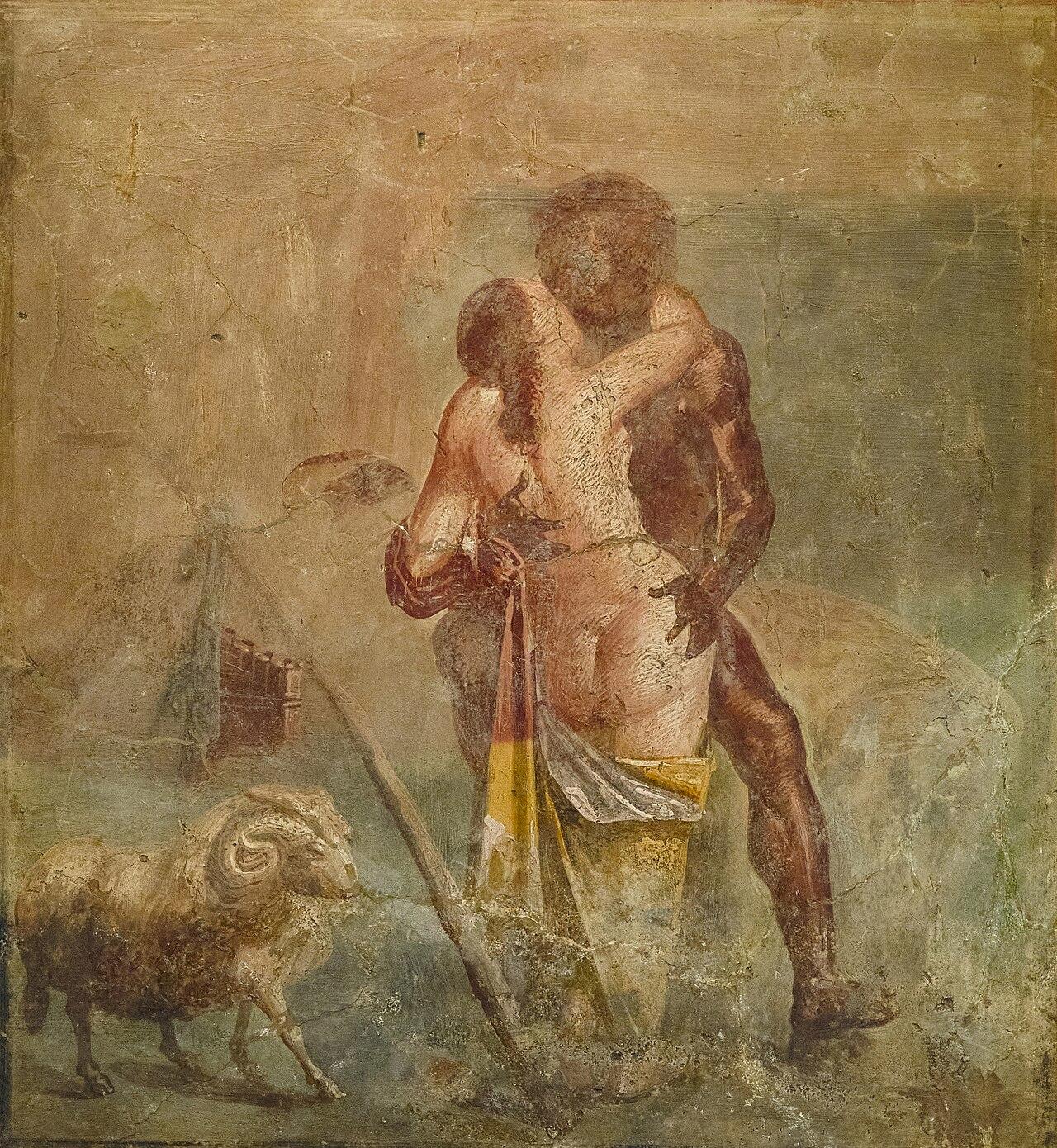
Polyphemus and Galatea wall painting in the Casa della Caccia antica (House of the Ancient Hunt), 71-79 CE, Naples National Archaeological Museum
Courtesy of Wikimedia Commons
By Jamie Abramson '26 and Samuel Lu '27
“Why do we study the Classics?” is a question that perhaps we all find ourselves asking at some point during our Groton careers and an appropriate question at that. Why is it that we force ourselves through the excruciating tedium of reciting declensions and memorizing vocabulary words? Why do we devote hours upon hours of our day to examining scrawny lines in a codex, just to adorn a few lines of text with annotations? Why don’t we study other, more relevant world languages?
These are questions that the rest of the world seems to have already answered. Criticism of the Classics and the humanistic education it entails has become more vocal and derisive. The traditional cachet of the Classics is said to be unfairly assigned; implicit in the discipline are odious suggestions of European superiority, and the pragmatic incentives for Classical study are also rapidly disappearing.
But in our haste to modernize, we overlook the many merits that an education in the Classics offers its students. And yes, they are more meaningful than just elucidating academic jargon, giving us the fleeting satisfaction of recognizing Latin epigrams, and making us sound pretentious
On the practical side of things, studying the Classics equips us with historical lessons for the modern day. To be informed citizens the minimum demand of our civic responsibility requires a clear understanding of our modern republics, which are better contextualized by their predecessors The political architecture of the Greek city-states and the Roman Republic, built upon earlier Phoenician and Mesopotamian precedents, provides insight into two of the earliest systems of popular participation. The evolutions of these systems over their lifespan, under the weight of class conflict and populism, provide valuable feedback for modern citizens in the struggle to safeguard democracy The growing instability permeating the Late Roman Republic is a cautionary tale that underlines the dangers of polarization, massive inequality, and demagoguery triumphing over reasoned civic discussion. Despite images of Ancient Roman and Greek opulence, wealth was highly concentrated among the aristocracy of the Classical world. Cruel practices of slavery and other forms of exploitative control at the hands of the elite clashed against redistribution reforms ranging from Solon’s debt relief to the Gracchi Brothers’ agrarian land package often with bloody effects. These scenes of imbalance and
struggle create a dichotomy that is shockingly similar to our affluent present, which remains steeped in inequality and polarization.
Beyond its civic applications, the study of the Classics is a matter of being culturally and historically literate. Because the present is simply a continuation of the past the accumulation of the social, moral, and scientific contributions of our forebearers our modern intellectual climate is inseparable from our Roman and Greek ancestors. To engage with the Classics learning about Athenian democracy, Socrates’ dialectical methods, Aristotle’s logic, Cicero’s rhetoric is a matter of glimpsing the vast scaffolding of tradition upon which much of today’s world stands. Any discussion of the modern, in its architecture, law, philosophy, or art, is incomplete without examining its Classical origins “We only see so far,” the old saying goes, “because we stand on the shoulders of giants.”
These giants, of course, are pluralistic. Concomitant with the study of Classics is the realization that no philosophical discussion is complete without acknowledging the past in its entirety Studying ancient civilizations and mapping the continuity between them and with modernity comes with the recognition that our civilization has not developed in isolation. Yes, Greece and Rome were sophisticated, cosmopolitan societies that were geographically extensive and geopolitically formidable. But other civilizations equally prolific, equally elegant and urbane thrived outside of Europe Whereas the current conception of the European continent ends at the Bosphorus, the Romans saw no such division; as any Latin III student knows, Rome traced its origins to Troy, a mythical city-state in what is now considered Western Asia. The so-called “Pythagorean Theorem” hails not from Samos but from Babylon, over 1500 years prior to Pythagoras’ birth. Theories of optics are traced not to the writings of Varro but of Al-Haytham, from the Islamic Golden Age, as are windmills, water clocks, and coffee One of the most important lessons that the Classics equips us with is that homage cannot be paid to a single culture. The Renaissance did not transpire in isolation, nor is the Enlightenment European proprietary. Learning the Classics is learning to dismantle the Eurocentric mythology that is integral to its makeup.
Americans are some of the most linguistically provincial people in the world. Decades of being the world’s leading economic and social powerhouse have dispossessed us of our linguistic flexibility, and our insularity has made us idle, rigid thinkers. When we approach the study of Classics through its texts, in all of its beauty and ambiguity, unadulterated by the impositions of English translation, we learn to see the world through a different lens, one that is historically informed and intellectually profound. This is why the Classics remains one of Groton’s core and most valuable experiences. We have the luxury of having an esteemed faculty, all widely read and deeply knowledgeable, sharing a common intellectual currency despite their varied interests and personalities. Let us join in the wisdom of the
Classical world, so that we, too, may learn to question, wonder, and experience our present condition more acutely.
By Nora Qiao '28
Some ideas are universally digestible in all languages. Other ideas are intuitive in some languages but completely inexpressible in other languages. Most languages, however, fall short under the burden of complex philosophical ideas like selfreference and universal truth Gottfried Wilhelm Leibniz, a German polymath famous for the co-invention of Geometric Calculus, felt the very same inhibitions. He proposed that in order to truly model metaphysical ideas and the pure reality that they inhabit, a new universal philosophical language, Characteristica Universalis, needed to be created. Being a mathematician, he claimed that the language should be algebraic, a Calculus of Logic, in order to preserve the undistorted world. It may seem nonsensical that a new language would easily defeat our introspective troubles, but the capacity of syntax, grammar, and construction to influence us is powerful. As a whole, this idea that switching languages affects how we think or how well we think about specific matters is summarized in the weak Sapir-Whorf Hypothesis, otherwise known as linguistic relativity The hypothesis posits that languages influence the manner in which people perceive You know that feeling you can’t quite describe? Maybe its elusiveness is in part because of the boundaries of your language. Perhaps what we think is easy is a product of how we communicate; perhaps what we think is impossible is doable except by our own limitations.
As Latin scholars, we surely understand how learning different languages changes how we think. As we picked up the syntax and grammar of Latin, we experienced how different rules might affect our thinking One distinction that is immediately apparent even from the first week of Latin 1 is the absence of articles i e , the, an, a, this. In Latin, the idea of individuality and definiteness is instead routinely expressed by demonstratives and emphatic pronouns (ipse, ipsa, ipsum). While articles are often skimmed over while reading an English sentence, it is hard to miss grammatical structures like demonstratives. In Latin, the scarcity of such grammar teaches the practiced reader to note definiteness to an accentuated degree
Another interesting grammatical system in Latin is the genders of nouns. Gender
is crucial to making nouns, adjectives, and verbs agree in Latin, determining a big part of their endings. While we immediately relate gender to sex thinking of the classic three categories: masculine, feminine, and neuter the gender of nouns in a language is not necessarily based on biological sex. The word gender itself, originating from the Latin genus and relating to the French derivative genre, means type or kind and refers primarily to a grouping of nouns For example, in Dyribal, a indigenous Australian language, nouns are instead categorized into four genders: gender 1 for male humans and animals, gender 2 for females and dangerous objects, gender 3 for consumable plants, and gender 4 for everything else. The fact that Latin perpetuates the strict sorting of all things into the masculine, feminine, and neuter pushes us to see biological sex as the fundamental sorting group through which we sift the world. When Latin assigns masculine endings to an inanimate piece of nature like a mountain (mons, montis, m.) and feminine endings to a tree (arbor, arboris, f.), these objects gradually take on biological genders in the minds of speakers, writers, and readers. Latin’s grammatical choice to base the noun types off of biological sex pushes the Latin scholar to see the world in a tricolored lens, where everything, in one way or another, must circle back to one of three colors: feminine, masculine, and neuter. In the end, Latin is not the only language that supports such rigorous grouping of nouns, but spending hours matching genders within the lines of an ancient Latin text causes the student to notice the partitioning of the world far more clearly.
Ultimately, the lack of word order in Latin is the most drastic difference transforming our critical thinking skills. In English, verbs and subjects are held together by word order, whereas in Latin, there is a much more logical relation between verbs and subjects, matching them in gender, number, and case. In a deeper sense, this addresses the different approaches to linearity between the two languages. While English strictly follows the subject-verb-object word order (in the active voice), Latin is somewhat flexible as to what word order or what grammatical forms are used to express ideas. The English approach fosters a sense of expectation and linearity. Readers become accustomed to expect the agent of the action, then the action, and finally the object of the action This train of thought, where events are related to each other in cause and effect is over emphasized by English We fixate on categorizing events linearly and chronologically, to the point where we overlook other approaches. This dependency causes certain relationships or complex ideas to skim over our heads. It is the same way that looking at a hard algebraic math problem from the lens of geometry can make it much more intuitive. On the other hand, the emphasis on verbs in Latin makes it a language that flows in chunks, allowing the reader to appreciate how one event fits in with another. It's as if the whole is carved out first, the verb is identified, and then the subsequent pieces fit neatly by a combination of trial and logic. In Latin, the big picture approach, where we have to consider the whole grammatical segment in unison in order to prevent misunderstandings, challenges the reader’s familiarity with time sequential linearity
Everything about a language, from the ins and outs of its construction to its vernacular usage, impacts the way a practitioner sees the world. Maybe the impossible really is possible if we could only see the world from another angle. But no matter what, one thing will always be true: switching perspectives every once in a while will only ever give you a fuller understanding. Through our compulsory study of Latin, Groton students eagerly know the power of language in becoming formidable thinkers.
Black, Max. “Linguistic Relativity: The Views of Benjamin Lee Whorf.” The Cuzzolin, Pierluigi. "Aspects of the Expression of Definiteness in Classical Latin." In De Melo, Wolfgang. "Gender in Latin and Beyond: A Philologist's Take."
Philosophical Review 68, no. 2 (1959): 228–38. https://doi org/10 2307/2182168
Recent Trends and Findings in Latin Linguistics: Volume I: Syntax, Semantics and Pragmatics. Volume II: Semantics and Lexicography. Discourse and Dialogue, edited by Concepción Cabrillana, 19-44. Berlin, Boston: De Gruyter, 2024 https://doi org/10 1515/9783110722116-002
Antigone. antigonejournal.com/2021/10/gender-in-latin-and-beyond/. Accessed 23 Oct. 2025.
Losonsky, Michael "Leibniz and 18th-century Philosophy of Language " Lo
Sguardo, no. 37 (2024): 111-124. https://doi.org/10.5281/zenodo.13829534.
By Henry Lepri ’26
In the dormitories of a Bethlehem monastery, an early Christian scholar dips his pen in ink The page in front of him is half-written Turning from his Latin composition to the Hebrew Bible by his side, his gaze hangs on the word “peri.” A moment passes. The monk smiles to himself, removes his pen from the ink, and writes “malum.”
At the time of Saint Jerome’s Latin translation of the Hebrew Bible, the Latin word “malum” meant both “fruit” and “evil.” Jerome’s decision to translate “peri,” the Hebrew word for fruit, as “malum” was simply a pun. It wasn’t until the 17th century that John Milton’s Paradise Lost gave lasting shape to the image of Eve plucking an apple from the tree of knowledge. By then, the meaning of “malum” had expanded to include “apple ”
And so, the simple apple grew to represent both the promise and dangers of the human endeavor. One needs only to flip over an iPhone to see the bitten apple, symbolizing the knowledge and temptation of the forbidden fruit.
What is particularly striking about the apple's symbolic weight is that it originates from Latin composition. Unlike most English words that inherit meaning from established Latin roots, the apple’s association with evil grew from a single interpretive moment, when “malum” stood for “peri.” Saint Jerome’s fateful word choice is better understood as the expression of an idea rather than as an act of literal translation His aim was to communicate the sinister nature of the fruit tree without explicitly stating it
As I write about Saint Jerome, John Milton, and apples, I question why Latin composition, the catalyst for the apple’s symbolic journey, has seemed to fade from modern classical study. More specifically, I wonder why so few schools practice writing in Latin, or rather, composing an original Latin work
In researching Latin composition for this essay, I discovered an article from the University of Cambridge Press on the utility of composing original Latin works built on the foundation of existing texts. The article was written and published by Adam Trusted, a member of the faculty of education at Cambridge’s Classics Department Titled “Rewriting the Textbook: an investigation into students’ practices with creative composition in a Year 7 Latin class,” it sought to test the effectiveness of a “creative Latin composition exercise.”
The concept was simple. Students would insert their own characters into a Cambridge Latin Course story. Trusted judged the success of the exercise on both “the work completed within the lesson itself” and a “post-lesson focus group. ” Trusted observed not only a newfound "enthusiasm and excitement” among his students, but also noted dramatically increased productivity, remarking, “I was impressed with how much text students managed to write in a short time-frame of 30 minutes.”
Having experienced a traditional Latin education, the students' enthusiasm does not surprise me. Latin is a particularly rewarding subject, but the repetition of translation and grammar lessons, especially when confined to a limited selection of authors, can sometimes drain life from what should be an exciting discipline. Trusted’s experiment introduced something that Latin instruction often forgets: that language is not just a tool for reading the past, but a medium for imaginative thought. Trusted’s students weren’t only learning Latin, they were using it.
It was, in fact, through this use of the Latin language that the exercise’s true pedagogical value was revealed. Reflecting on his students’ work, Trusted said, “It is startling how clearly students’ trains of thought can be understood and their individual issues with morphology diagnosed.” Trusted’s observations reveal the potential of “creative Latin composition” to address gaps in students’ understanding and accelerate language acquisition
Trusted’s experiment may have been limited in scale, but its results are certainly promising. Most importantly, it recalls the spirit of that moment in the Bethlehem monastery when Saint Jerome paused over a single word. Latin composition, then and now, serves not only as an exercise in grammar, but as a creative act, capable of shaping how we perceive language and culture.
Burghardt, W.J. "St. Jerome." Encyclopedia Britannica, February 23, 2026.
https://www.britannica.com/biography/Saint-Jerome.
Martyris, Nina "'Paradise Lost': How the Apple Became the Forbidden Fruit " NPR
Last modified April 30, 2017.
https://www.npr.org/sections/thesalt/2017/04/30/526069512/paradise-losthow-the-apple-became-the-forbidden-fruit.
"Saint Jerome: The Perils of a Bible Translator " St Anthony Messenger Press Last Trusted, Adam “Rewriting the Textbook: An Investigation into Students’ Practices
modified September 1, 1997.
https://www.smp.org/resourcecenter/resource/2637/?srsltid=AfmBOordpCXSFVkHgdgyYbzO-FUglCPrbGRPcdKPoZjGGpqWUYBVnSZ.
with Creative Composition in a Year 7 Latin Class ” Journal of Classics
Teaching 25, no. 50 (2024): 136–41. https://doi.org/10.1017/S205863102400031X.
By Rory Hu ’28
Nero fiddled while Rome burned: like the big bad in an action flick, he cackled away at his people’s plight It’s a common anecdote of Nero’s cruelty but it almost certainly holds no water. Not only did fiddles not exist during Nero’s time, but the emperor was also likely in Antium, 35 miles away, at the time of the disaster.
Rumors of Nero’s musical escapades were fueled by public discontent after Nero built his lavish imperial palace, the Domus Aurea, on land cleared by the fire where civilian housing once stood. History casts Nero as an abhorrent ruler, a mere onedimensional caricature of villainy. However, Nero was actually a key figure in helping Rome recover after the Great Fire in 64 CE. He housed refugees, provided resources to survivors, and established better fire codes for buildings. Nero’s actions helped many survivors rebuild their lives, setting a decisive precedent for future emperors ’ disaster response.
The name of Nero evokes images of tyranny and cruelty, but he still helped restore Rome. The name of Rome too evokes images of mass violence, but humanitarian actions nonetheless took shape in legal codes and conventions of warfare However, Nero used the events of the Great Fire for his own political gain Did Roman humanitarianism too have an ulterior motive, or was it truly blossoming from compassion?
Roman philosopher Cicero wrote that a military leader must have a iusta causa, or just cause, for war For many, religion provided the answer: devotion and trust in the gods was established firmly in Roman culture. Before every battle, augurs divined omens from sacred chickens and fowl flight patterns to determine if the gods were on Rome’s side. Favorable omens, symbolizing divine support, often spurred fervor for campaigns. Romans believed that if the gods smiled upon their conquest, it rationalized the merciless military tactics that they employed
Despite this religious justification, some Roman philosophers opposed excessive brutality, opening a pathway for the beginnings of humanitarianism. Cicero argued that battles should be just without relying on religious ceremony, extolling the values of mercy and honor in war. His words, however, fell on deaf ears. As Roman humanitarianism was still in its early stages, it could not significantly sway Roman leaders. Concerned about having a just cause in theory but not in practice, generals in pursuit of wealth and prestige exaggerated or even engineered circumstances to
create a plausible front for battle. Julius Caesar engaged in such behavior; he was criticized by his enemies for failing to provide justification for his campaign in Gaul. While frequent war enabled Rome to grow into a fearsome empire, it calls into question the ethics of Rome’s conquests.
Whatever the reasons, unjustified warfare casts a troubling light onto Rome’s legacy. As the scale of expansionist warfare grew, so too did outcries for compassion, stirring the roots of humanitarianism among Roman leaders. Many emperors after Nero continued to emulate his strategies of disaster relief; following the eruption of Mount Vesuvius in 79 CE, Titus generously funded reconstruction efforts and refused to accept any gifts of gratitude He was subsequently lauded for his swift and unsparing response to the crisis.
Were rulers like Nero and Titus truly displaying their benevolence, or were religion and reputation once again at play? Although auspicious divinations helped lend credibility to Roman military campaigns, natural disasters called their authority into question Romans viewed phenomena such as earthquakes or floods as punishment by the gods, and political opponents of a ruler may have used such disasters to criticize their governance. As a result, emperors were pressured to reaffirm their divine right to rule through disaster relief. Regardless of intrinsic or extrinsic motivation, however, Roman emperors were incorporating more humanitarian practices
Responses to natural disasters were just one such practice: Roman philosophies espousing goodwill started to gain traction, especially as Romans realized the horrific extent of their violence firsthand. Under rulers such as Sulla or Augustus, Roman citizens themselves faced execution simply for being on the wrong political side, which may have spurred a turning point in Rome’s ruthless practices. Chastened by these tastes of their own medicine, the Romans began to adopt more humanitarian morals: philosophers such as Seneca criticized the mass atrocities Rome leveled against its enemies, and others began to prefer humanitas to immanitas (cruelty) Cicero spoke of the universi generis humani societas, or the universal community of humankind, recognizing that all humans belong to one community despite the state lines that divide them. Such ideas lie at the heart of modern humanitarianism today.
The Roman Empire, perhaps the most influential civilization in shaping the world today, is remembered for its military might and remarkable war tactics, but also for its innovation and culture. Was Roman humanitarianism simply a byproduct of political plotting, or did it gesture to the growth of new philosophy? The Roman narrative is muddied with the influence of gods and humans alike. Despite religion defining many aspects of the empire, Rome, too, was only built by people, the same who stoked the flames of violence that defined Roman warfare But, like Nero after
the Great Fire, they also helped rebuild: amid the ashes, the seeds of humanitarianism were beginning to take root.
Guillermand, Jean. "The Historical Foundations of Humanitarian Action."
Hankins, James. "The Roman Custom." The New Criterion. Last modified
September 2023. https://newcriterion.com/article/the-roman-custom/.
History Staff. "Did Nero Really Fiddle While Rome Burned?" HISTORY. A&E
Networks Last modified May 28, 2025 https://www history com/articles/didnero-really-fiddle-while-rome-burned.
Tuck, Steven L. "The Ancient Roman Origins of Government Disaster Response."
Yoo, John. "Marcus Tullius Cicero, De Officiis." Hoover Institution. Last modified International Review of the Red Cross 299 (April 1994): 194-216. https://doi org/10 1017/S0020860400078359
Origins: Current Events in Historical Perspective. Ohio State University. Last modified June 2020 https://origins osu edu/connecting-history/romangovernment-disaster-response
February 6, 2019. https://www.hoover.org/research/marcus-tullius-cicero-deofficiis.
Courtesy of Wikimedia Commons
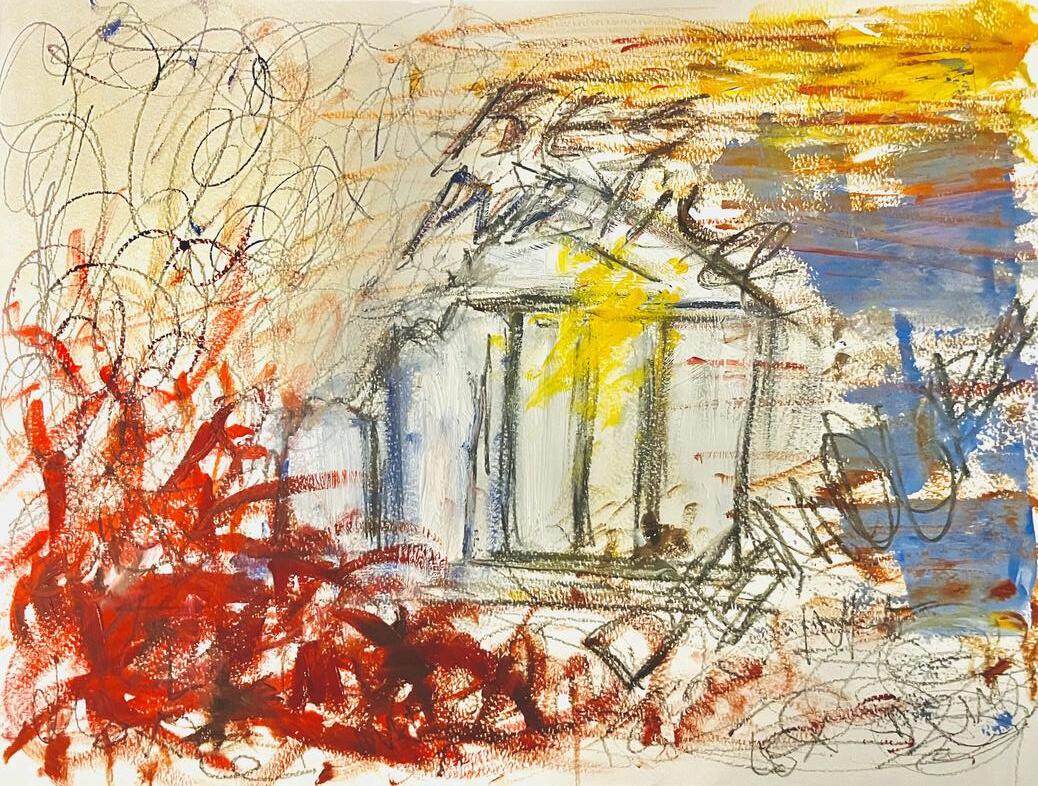
By Liv Ding ’26
ἡ σημείωσις καλή (Author’s Note): This is based on a dad joke that I found on the Internet
130 BCE
Athens, Greece
An ancient Greek walked into his tailor’s shop with a torn chlamys
“Euripides?” said the tailor without turning away from his work.
“Yeah, Eumenides?” replied the man.
Suddenly, the tailor turned around and let out a hearty guffaw “I knew it was you!” He walked over and clapped his friend on the shoulder. “No one else walks like that.”
“Like what?”
“Like they’ve lodged an amphora between their never mind. By Jove, what did you do to that chlamys?”
“I tore it while hunting wild boar. And Jove? What are you, a Roman?”
Eumenides shrugged “My son is in Rome tutoring wealthy children There was no talking him out of it. He wanted to see the world, or whatever bogus young people get up to these days. He writes home occasionally. He seems to be doing well, even in a slum like Rome. They see us as intellectuals, you know.”
“So how do you explain Corinth, then? The invasion?”
“Is that a rhetorical question?” Eumenides ran his fingers down the blue fabric, letting it drizzle down to the mosaic floor. Eumenides has certainly renovated his shop, thought Euripides. Business must be booming.
“Nasty tear. Too difficult a job for the wife?”
“Well, she said it’d take her a while to weave a new one. ”
“Of course it would I bet she unravels it every night while you ’ re sleeping ”
“Eumenides, you are insufferable, ” groaned Euripedes, slumping into an archbacked klismos with pale engravings of griffins (seriously, how rich was Eumenides now?) “Do you treat all your clients this way?”
“Only the worthy ones, ” winked Eumenides “You know, they kind of enjoy being poked and prodded. Gives them a little thrill, you know, aside from politics or the sides of triangles or whatever they else do. But don’t distract me. How is Panope?”
“Oh, you know. With child.” Euripides helped himself to a goblet of wine.
“A girl again?”
“Eumenides, you bulge-eyed cow ”
“I’m just saying, a virile man like you cannot only be capable of producing girls! It’s scientifically impossible! Have you tried it with a slave?”
“I would not ”
“I think it’s wifey’s problem. Get a new one. Or, better yet, give up on the whole breeding thing It’s fruitless, see? Copulation with women is on the same tier as new wine practically grape juice, no kick to it. And then what happens? A girl-child, or a boy who dies a few days later from some grievous ailment.”
“The gods ”
“If I got to live forever and drink ambrosia all day, I wouldn’t give a scintilla about the pathetic little ant-people running around below me. I don’t blame them for anything.” Eumenides stared at the cloak for a few moments. “I don’t think I’m going to fix this.”
“But I ”
“Sebastianos!” called Eumenides.
Within seconds, a sallow boy the color of goat milk was at the doorway to the room His too-large sandals were laced all the way up to his thighs and though he
looked twelve or thirteen, his expression was as if he’d been born yesterday.
“Can you repair this chlamys for me, mathetha? Do you remember what I showed you?”
“Yes, didaskale, ” said the boy, inclining his head He watched Euripides warily
“Oh, this is Euripides, my longtime best friend,” said Eumenides to his pupil. “We met when we were about your age. Euripides’s family was a big rich honkin’ deal.”
“We weren’t a––”
“His great-great-grandfather did big things in government.”
“He liked the prospect of the Assembly,” added Euripides. “Democracy.”
“And it didn’t work,” said Eumenides languorously “Big waste of time, if you ask me. ”
“Oh, and you think what we have now is a better option? We haven’t progressed, Eumenides––we’ve fallen from the gods’ graces. ”
“My son in Rome,” said Eumenides, sitting down on a couch opposite Euripides and pouring himself a goblet of wine, “ says the Roman people feel very passionately about not having a king. They have consuls, two of them so that one of them doesn’t get too greedy. They have senators. They have these so-called “novi homines” in the government people who grew up normal and poor, like I did And for all this equality, for this res-publica there is corruption galore. The senators spend all their free time figuring out how to assassinate each other––hear about those Gracchus brothers down in Rome? Nobility are bribed to vote for one candidate or another. It will not work. Equality is not the instinct of the man. Money is. Power is.”
Euripides looked around at the new furnishings of Eumenides’s home and felt a chill ripple down his spine.
“I thought you believed––”
Eumenides snorted “You thought I believed in your silly fantasy? I mean, really, Euripides? Democracy? Your family can’t let go, can they? It’s pathetic, really. You’re a political extremist. No one in these circles respects you. And I have always defended you, to the detriment of my career, I will say––it is truly liberating to confess what I’ve harbored for all these decades––”
“Decades?”
Eumenides inclined his head. “Ever since I’ve known you, you have never invited me to dine, never shared your clothes when mine were tattered beyond repair. You have never even offered wine when I came to visit your home. I played the role of a vulgar entertainer for years. The gods and the ant-people, Euripides. What was I to you? Because whatever it was, I am no longer ”
Euripides stood up. He felt woozy, dulled by the wine, yet a dagger-sharp fear was slicing through his sternum.
Eumenides rose as well. “You will not tell anyone what I told you. ”
Euripides nodded silently. He was aware, now, of what Eumenides had been aware of all along that the gods were not all that distant from mankind. They were within this drunken chest of his.
“Sebastian will deliver the chlamys in two days’ time,” said Eumenides coldly “Leave now My next client will be here soon, and he does not like to be kept waiting.”
By Sasha Kwon ’27
The trees bear witness that day, brittle leaves stirring in the breeze, when young Lucilla received her fate. The trial was long; Lucilla had waited such, but the verdict was clear Face washed pale, braided cord bound tight at her waist, the marble cold of her chest, summer ’ s sweat slick on skin. We see her groom, a gentle man, not yet aged, her father’s friend.
We watch the rite unfold, family and friends hold judge and jury. They affirm a sentence long ordained
The trial ends, the marriage sealed, a feast is called for: the elder judge brings sweet bread, myrtle wreaths wound tight, scattered ruby seeds and dark raisin eyes, still fresh with youth.
Her husband takes her hands, guides them around the blade, together they cut, a slice through tender white flesh. The bread spills warm juice, heavy and thick. We lean in close, seeds spill from the crumb, She watches her husband, his hand sticky with berry stain, touching her cheek.
We watch him, satisfied, as blessings rise for sacred bread, sacred bond, her sacred fate. He smiles, holds her close. Her eyes meet her father’s, her mother’s, wide from the altar, while judge and jury crow, the gavel falls final.
We remember old things, new things: when her husband stood, hands clasped in sticky bread and prayer, his grip on her braided cord. We remember earth’s warmth, the warmth of torn bread, of fallen leaves. We remember how she used to weave crowns, now we remember her vows.
This poem is an adaptation of Diana Arterian’s Agrippina the Younger, Age Thirteen. “Lucilla at the Stand” is created as an intertextual response, echoing Arterian’s structure and themes while reimagining the experience from the perspective of Lucilla, who was slightly older
By Amanda Chang ’26
Courtesy of Wikimedia Commons
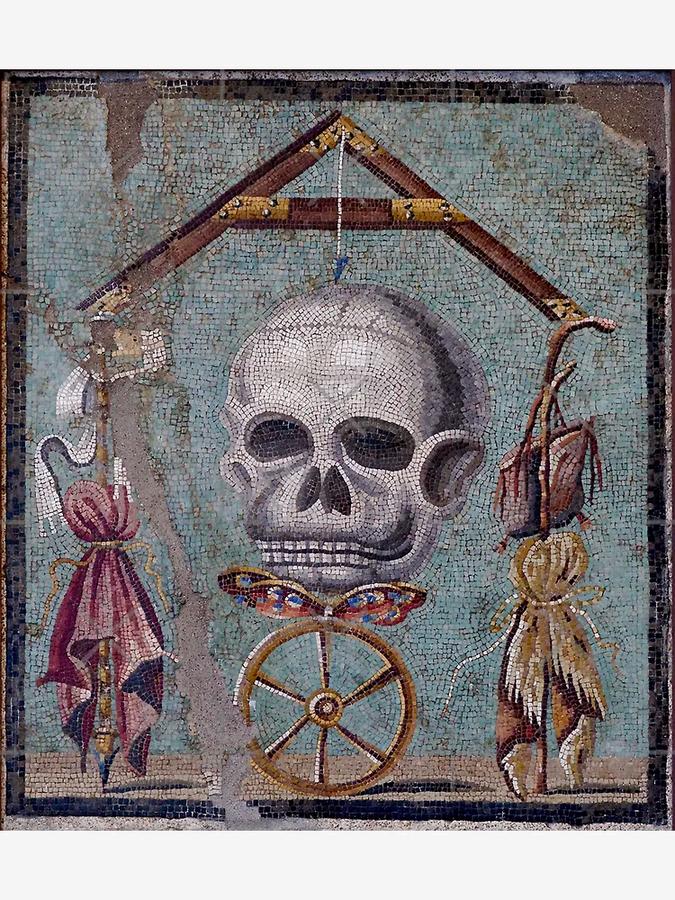
memento mori
the Romans often reminded themselves of the inevitability of death
buried under the ruins of Pompeii in the wake of a feast
there was a skull
between a scepter & a scrip wrapped with the cloth of the gods or perhaps a varmint’s hide
perched so precariously
on a brown wheel spoked six times (but did so only once on man ’ s fortune)
above a red butterfly, whose wings ringed with gold and mottled with blue
would flutter away should a miraculous gust of wind
send the soul running & the wheel turning & the skull shattering
under the weight of the libella, bounded with bolts of iron and bronze whose certainty overcame the fragility of life
thus eat, the rich would urge each other passing around platters of fish & figs thus eat, the poor would urge each other passing around platters of bread & cheese
eat because remember that you must die