
www.grossrentmultiplier.com

www.grossrentmultiplier.com
The Gross Rent Multiplier (GRM) is a simple real estate metric that helps investors estimate whether a rental property is fairly priced based on its gross annual rental income. It is widely used as an initial screening tool to compare multiple investment properties before conducting a detailed financial analysis.
GRM answers one important question: "How many years of gross rental income would it take to equal the property's purchase price?"
A lower GRM may indicate better value, while a higher GRM can suggest a more expensive property. However, the ideal GRM varies depending on the property's location, market conditions, and investment strategy.
✔ Compare multiple properties quickly
✔ Identify promising investment opportunities
✔ Save time during the property screening process
✔ Support better real estate investment decisions
Calculate your property's GRM instantly at www.grossrentmultiplier.com
The Gross Rent Multiplier (GRM) compares a property's purchase price with its annual rental income. It helps investors quickly estimate whether a property is reasonably priced before performing a detailed financial analysis.
Formula
GRM = Property Purchase Price ÷

Gross Annual Rental Income
Example
Purchase Price: $500,000
Annual Rental Income: $50,000
GRM = 10
A lower GRM may indicate better rental value, while a higher GRM could suggest a more expensive investment. However, always compare properties within the same market and property type.
Calculate your GRM for free at
Remember: GRM is a screening tool—not the final investment decision. www.grossrentmultiplier.com

Understanding Your GRM Result
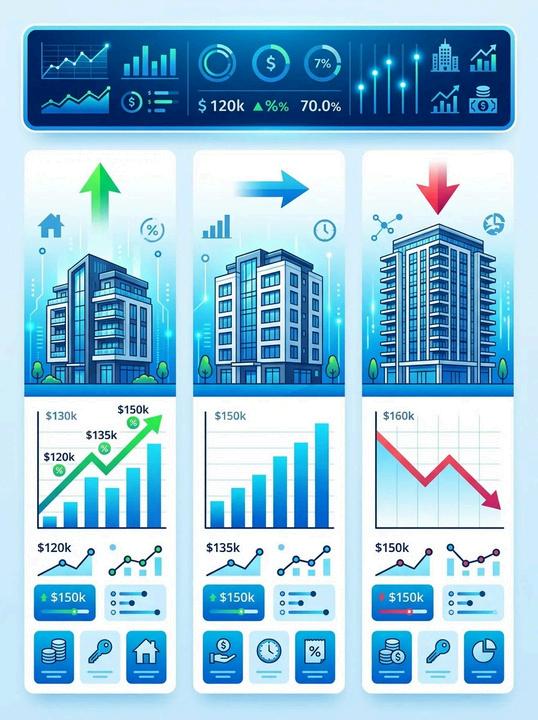
There is no universal "perfect" Gross Rent Multiplier. A good GRM depends on the property's location, rental demand, property type, and local market conditions.
General Guidelines
�� GRM Below 8
May indicate a strong rental opportunity.
�� GRM Between 8–12
Common in many balanced real estate markets.
�� GRM Above 12
May suggest a higher purchase price or lower rental income. Further analysis is recommended.
Tip: Always compare GRM values with similar properties in the same neighborhood for the most meaningful results. Compare properties with our free GRM Calculator www.grossrentmultiplier.com
Which Metric Should You Use?
Both Gross Rent Multiplier (GRM) and Cap Rate help evaluate investment properties, but they serve different purposes.
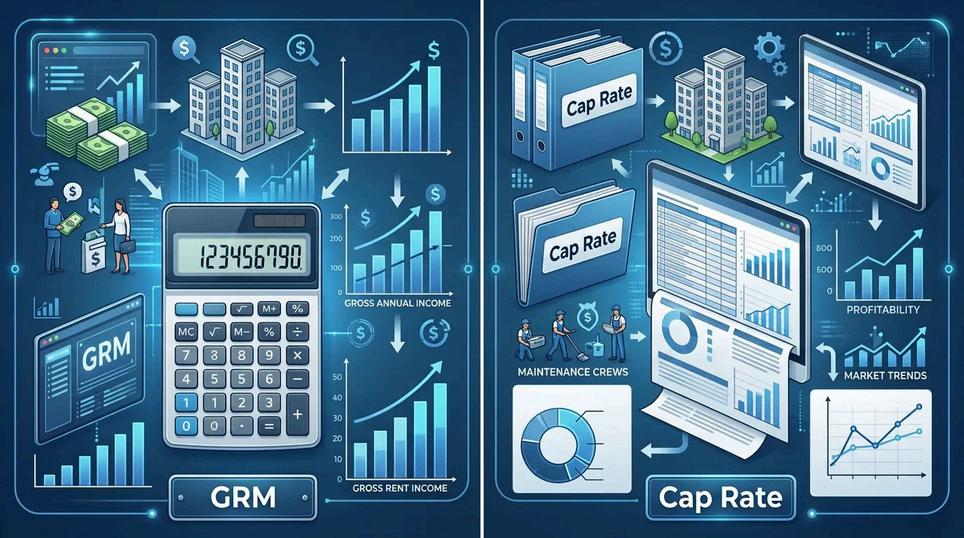
G
Uses gross rental income
Quick screening tool
Easy to calculate
Best for comparing listings
Best Practice
Uses net operating income (NOI)
Detailed profitability analysis
Includes operating expenses
Best for final investment decisions C
Evaluate properties faster with our free GRM Calculator www.grossrentmultiplier.com
While GRM is a valuable screening tool, relying on it alone can lead to poor investment decisions.


Ignoring operating expenses
Comparing properties in different markets
Overlooking vacancy rates
Forgetting maintenance and repair costs
Relying only on GRM without reviewing Cap Rate or Cash Flow
5 Tips Every Investor Should Follow
✔ COMPARE SIMILAR PROPERTIES
Always evaluate properties within the same neighborhood and market.
✔ VERIFY RENTAL INCOME
Use actual rental income instead of estimates whenever possible.
✔ CONSIDER ALL COSTS
Review maintenance, taxes, insurance, vacancies, and financing costs.
✔ USE MULTIPLE METRICS
Combine GRM, Cap Rate, NOI, and Cash Flow for a complete analysis.
✔ LEVERAGE TECHNOLOGY
Use online tools to save time and reduce calculation errors.
Smart investing is about informed decisions— not just quick calculations. Gross
Analyze rental properties with confidence at www.grossrentmultiplier.com