1.
2.
3.
4.
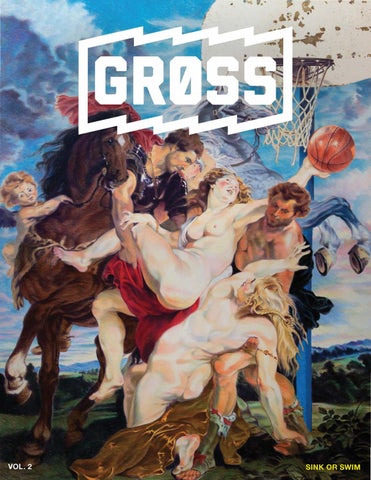
Covers: 1. And 1 (after Rubens): Artwork by Eric Yahnker 2. A$AP Ferg: Photo by Adam DeGross 3. In Flux: Artwork by Kit King 4. Nothing Exists: Artwork by CYRCLE., photo by Phil Sanchez
This magazine is published by GRØSS Association, LLC Editors: Victor Gonzalez, Kevin Peth Producer: Victor Gonzalez Creative Director: Kevin Peth Copy Editor: Samantha Tack Production Assistant: Andy Huynh Contributing Writer: Grady Olson Contributing Photographers: Dustin Aksland, Mike Anderson, Michael Cariello, Adam DeGross GRØSS Association, LLC San Francisco, CA grossmag.com | @gross_mag New phone who dis? +1.504.814.0125 COPYRIGHT © 2017 GRØSS Association, LLC All Rights Reserved. Limited run of 4,000 pieces Offset printing & assembly: The Prolific Group Sticker printing: Cellotape, Inc.
IN VOL. 2: SINK OR SWIM, WE’RE EXPLORING THOSE COMMITTED DECISIONS COMMONLY REFERRED TO AS GOING ALL IN OR TAKING A LEAP OF FAITH TO SHED LIGHT ON PIVOTAL MOMENTS WHEN FOLKS HAD TO TAKE A DEEP BREATH IN ORDER TO PROCEED. WE’RE GUIDING, INSPIRING AND REASSURING OTHERS AS THEY FOLLOW THEIR OWN PASSIONS.
Editor’s Note In a nutshell, GRØSS has become so much more than a side hustle. We’ve grown from a small Kickstarter squad of 164 backers to an ever-increasing community of thousands located in over 20 countries around the world; and have added RELISH to the roster, a new series of submission-based publications that focuses on awakening and connecting local creative communities, city by city. This thing has legs, baby, but we’re learning that the only way we’re going to turn this vision into a reality is to relentlessly give it our all. As we began plotting a direction for VOL. 2, we did what we always do to find inspiration. We grabbed a notebook, cracked a couple cold ones and roasted a little grass — this is where we arrived. GRØSS Magazine VOL. 2: Sink or Swim is the next step, the exploration of the unknown, the leap of faith, the abandonment of our comfort zone, the focused and relentless effort to continue what we started. We’ve asked our contributors what it means to be dedicated to making something out of nothing. What kind of sacrifices or uncertainties have they experienced or do they foresee in their future, if any at all? Some of the kind folks we spoke to have made tough decisions, for others it was simple and for a few, there was never any choice to make. Everyone experiences doubt from time to time. We all deal with commitment in one way or another. Aspirations are just potential until you get off your ass and make them real. Thank you to all who have supported us from the beginning and to all of those who have recently joined our efforts; creating a new environment where mutual learning and growth are a priority. It is our hope that there will be at least one tiny, little nugget within these pages that helps you deal with a pivotal decision — past, present or future. Cheers,
Kevin & Victor
04
Table of Contents
Eric Yahnker (6-23) Ben Venom (26-39) Elizabeth Waggett (42-49) CYRCLE. (52-67) Erin M. Riley (78-85) Innovative Leisure (86-91) Hanni El Khatib (92-93) Tijuana Panthers (94-99) BADBADNOTGOOD (100-101) Kit King (102-111) A$AP Ferg & Jay West (114-127)
05
ERICYA
HNK ER
.COM
NK E H A Y C I @E R
A message from Eric Yahnker to the aspiring, prospective and emerging artist: “If you’re burning inside to make it happen, just begin. Don’t waste your money on bullshit!” In 2004, Eric made a jump from a rising career in animation to full-time visual artist. His successful transition wasn’t immediate though. It took a fair amount of introspection and exploration before he felt ready for his first show in the Spring of 2008. His works — large-scale 06
and technically sound creations — as astounding as they are punny, are a very welcome humorous infusion into an art world that tends to lean toward stuffy. Procrastination, limitations and commitment are all things that each of us encounter every day, but it’s how Eric approaches them that clearly spells out his personal recipe for breaking through to the other side.
R
ERIC YAHNKER
07
08
ERIC YAHNKER
09
10
11
Photo by Jeff Mclane
12
Let’s bring it back to where you began to take on art full time. When did you decide to commit and what led you to that decision? I really don’t remember it being much of a choice. I was burning to do something else, something that hopefully didn’t involve having a boss. The reality is that even though animation can be an incredibly rewarding field, I wasn’t particularly suited to working in a crew. Let’s just say, I’m not much of a team player. Also,
first show in the Spring of 2008. I’m not sure that confidence played much of a role in it — certainly not as much as insecurity and fear. All I knew was that I was completely invested and had total tunnel vision toward making a run at whatever it was that allowed me to continue making my work. You just quit your job. Now it’s time to make some art. Was there ever a feeling that having total freedom in art is too open?
I really don’t remember it be ing much of a choice. I was burn ing to do something else, some thing that hopefully didn’t involve having a boss. back in the early 2000s, animators were rapidly trading in their pencils and paper for a keyboard and mouse. Of course, now they draw directly on digital tablets. I just didn’t have the heart to stick with it if I couldn’t do it the way I was passionate. It was either train on a computer or dole out handjobs at the bus depot. I opted for the handjobs. What mental, tactical or practical preparation did you go through? How confident were you that you could make it work? I was fortunate in that I had a pretty great animation gig fall in my lap in 2004 that enabled me to rent a studio and take some time to figure out who I was as an artist. I had zero idea what to do, I just knew I had to go to that studio every day and make something. It ended up being nearly four years before I could even show anybody what I was up to and I had my
Oh, hell yes. Limitations can be incredibly helpful in making art. I’ve often said that limitations create style. If you can’t draw or paint, I see that as a potentially huge benefit to a r tmak ing, be c ause maybe you’ll find a far more interesting way to draw and paint than someone who knows all the rules; or maybe you’ll find a new way to approach artmaking all together. At times, I found I needed to artificially create boundaries so that the whole universe wasn’t open for me to work from. I didn’t want to shy away from making technically skilled work and using my comedic sensibility, both of which always seemed to carry and serve me well throughout my life; but I was also well-aware that technical ability and comedy don’t necessarily hold any real cache in the art world. Basically, if you’re trying to calculate how to remain authentic while simultaneously appeal to the art world, you’re already lost. It may seem obvious, but it’s worth mentioning that the more I stopped caring about the art world and pursued my own authentic voice, the more audience I found. I still don’t have a clue what the art world wants anyway.
ERIC YAHNKER
13
14
ERIC YAHNKER
15
I just didn’t have the heart to stick with it if I couldn’t do it the way I was passionate. It was either train on a computer or dole out handjobs at the bus depot. I opted for the handjobs.
16
ERIC YAHNKER
17
Were you ever worried about finding your unique style?
I had zero idea what to do, I just knew I had to go to that studio every day and make something.
Having a signature style is obviously really helpful to an artist’s career. There’s a reason that Picasso, Warhol, Basquiat, etc., are so ridiculously celebrated. I didn’t pursue that mode of thinking at all, but I think I somehow ended up having some style recognition anyway — it just naturally occurs. If anything, my visual work was aiming to play the “straight man” in a slapstick comedy, making quasi-cartoonish ideas and concepts appear deadly serious. I guess one’s raw ability, matched with organic consistency, over a number of years results in a recognizable pattern and emerges as a signature style.
Not only did it take forever to craft these works with the sharp point of a colored stick, but my right arm — from the shoulder to the tip of my fingers — was bearing the brunt. I had to make a change or likely have permanent issues. Once I built my new studio, with my own two hands, I was so fired up to get back in the studio and get crackin’ that I finished an entire body of work in under a couple of months for my solo show at UNTITLED, Miami Beach. A time frame like that was absolutely unheard of in the past! There were single colored pencil pieces that took me longer than that to make! But I’m so stoked with how everything is looking. I was so ready to find a way to make my work more streamlined while not sacrificing quality and even potentially improving. It’s been really liberating and exciting to see folks respond so enthusiastically to the new work, since I was deathly afraid it would fall flat on its ass.
Talk about the first moment when you started to feel like things were clicking, a moment when you were feeling like “Holy shit, look mom, I’m doing it!” It’s my nature to see myself as the underdog, so I’m not sure I’ve even fully had that moment yet; but I do remember it being pretty damn amazing when a huge throng of strangers showed up to my “Cracks of Dawn” opening in Los Angeles in 2011. I had no idea that many people even knew I had a show, let alone wanted to come see it. I’m always grateful that people still seem to want to check out what I’m up to. Did you ever have to go back and do any other forms of work, or was the Seinfeld job the last?
Fortunately, that gig was indeed my last job working for someone else, other than a bit of volunteer work. Seinfeld was a particularly good gig because most were not that fun, easy and well-paying. A couple of years back, I actually got a call from Jerry’s people to do more work with his new series, “Comedians in Cars Getting Coffee.” But I finally knew I was really mentally out of the animation game when I declined because of an upcoming show deadline and happily referred the job to a good buddy from my CalArts (California Institute of the Arts) days. The scale of your work requires a lot of skill and labor. How do you deal with procrastination and finding motivation?
Procrastination is a big part of the job — you have to be as good at it as you are with the actual work! I’ve found that I get really pumped to work though. Since I started using pastels on sandpaper over this past year instead of colored pencils, I’ve been able to not be completely imprisoned by my method. To make massive pieces in colored pencil became a real ass-reamer.
18
A lesson you wish they taught in school? I studied journalism and then character animation at CalArts. Our critiques were more about improving walk cycles or character designs, and not having our hearts splattered on the floor by a bunch of stressed out MFAs and visiting art stars. Nevertheless, I hope art schools are stressing the value of authenticity and personal motivations for each individual outside of the confining art crucible. There’s a million slices in the proverbial art pie and you only have to represent a small fraction of that pie to have a rewarding career as an artist, or at least find some satisfaction therein. In fact, you can create your own slice of the art pie unto yourself if you’re able to lead new audiences into the art world that have been traditionally underrepresented.
Things are obviously changing rapidly and the old guard ways of doing things won’t likely have any bearing on what happens next. I hope students just entering art school or thinking of taking the art route realize that going to school for art is only a small part of the equation to being an artist. If you’re burning inside to make it happen, just begin and don’t waste your money on bullshit! Save every last dime you can so you can say no to the things you don’t want to do or to things that prevent you from making your work. Keep your head down, stay humble and just work, but don’t be afraid to let people know when you’ve done something you’re proud of. Most of all, finish things! Whatever it takes, you must finish things. The only real difference between you and many of the artists you admire is that they finish things and subsequently show them. Know that it will never be easy and there will never be a time to rest on your laurels. If you don’t think you have the fire or passion to continue making work in terribly uncertain circumstances for a lifetime, then this field is probably not the best match for you.
ERIC YAHNKER
19
20
ERIC YAHNKER
21
22
ERIC YAHNKER
23
24
INSPIRATION TIME
25
26
Ben Venom stitches badass fucking quilts. He works out of his home studio a block up from Haight Street in San Francisco. Ben has had a mustache for more than 11 years — a family tradition: “Everyone in my family has or had one. I couldn’t sit at the adult table until I had one, seriously.”
BEN
.C M O N VE
OM
@BENVENOM
Words by Grady Olson 27
Ben is from a small suburb just north of Atlanta, Georgia. “It was super conservative. Newt Gingrich lived 20 minutes away from me,” he said. Always wanting to leave and move to San Francisco, he made the move to attend the San Francisco Art Institute (SFAI), where he earned his MFA in 2007, and has never left since. He even teaches at SFAI every few semesters. After foolin’ with a sewing machine and taking a profoundly inspirational visit to an exhibition titled, “The Quilts of Gee’s Bend” (look it up — trust), Ben made his first quilt while in art school and never looked back to his previous creative dabbles. His form, subject and alias make a seriously epic and award-winning combination that has caught the attention of international galleries, collectors and museums alike.
was made out of old, faded and worn-out band T-shirts that he had acquired over the years but just couldn’t bring himself to throw away. “They were just sitting in my closet collecting dust … too many holes to wear out in public. It’s not cool when your Slayer shirt turns to mesh,” Ben said. It’s the simplicity, yet uniqueness, of using old metal band tees to make a quilt that makes his work so interesting. He’s not creating flowers and sunshine that your meemaw makes on her back porch. He’s putting together a ratted Slayer tee with a faded Ozzy Osbourne staring right at you. Ben wants people to be a part of his pieces and to feel a connection with them. Even if they may not know who the bands are, they can relate to that old, tattered tee that will never get thrown away.
the time, anytime,” he shared. “I wake up around 7:30 a.m. and work in the studio till my wife comes home for dinner. We eat … then I try and get a few more hours in the studio before bedtime, which is around 10 p.m. This schedule includes the weekend, especially if I have a lot of deadlines com-
“By stitching donated band tees, jeans, jackets, leather, etc., into a unified piece, the quilts are able to display a multitude of personal histories. E v e r y o n e ’s u n e xplained stain, tear or rip will be included, and when displayed, viewers will be able to see a piece of themselves woven into this larger history. A collection of memories, dreams and past experiences will be on view in the form of a functional piece of art,” Ben shared.
“Saying no is the hardest decision to make, especially when it involves significant sums of money. This past year, I probably turned down more money than I made. Not all opportunities are the best ones for my art career and I take careful consideration when I agree to an exhibition or project,” Ben said.
Everyone’s unexplained stain, tear or rip will be included, and when displayed, viewers will be able to see a piece of themselves woven into this larger history.
Before working with tex tiles, Ben was painting and printmaking, but it was in graduate school where he started to transition into textile work. “While in school, I was slowly learning how to use the sewing machine via tr ial and e r ror. Mistakes are a large pa r t of my a r tistic process. After seeing the ‘Gee’s Bend’ quilts, I decided to push the boundaries of my ar t and at tempt to make a quilt,” he said. Learning to make a quilt was not something he picked up right away, he actually didn’t have a clue. He bought the “Quilting 101” book because it had pictures that made it easy to follow and went from there. “In 2008, after many mistakes, happy accidents and a lot of questions — I would occasionally call my mom or pester employees at the fabric store — I completed my first quilt, ‘Listen to Heavy Metal While You Sleep!’” Ben shared. His first quilt
Ben is a smart guy. He teaches graduate students and gives lectures, one of which was to the creative department at Adidas. Alongside teaching, Ben also works part time at a custom picture frame shop to help keep a steady income. Knowing that the art business is constantly fluctuating, Ben chose to move his studio into his home, which he said was one of the best decisions he has ever made.
ing up or an exhibition.” Despite his high output, he still sometimes has to turn down projects, which bums him out.
What he makes isn’t all for show and to be hung up and looked at. These quilts also do what every quilt does, they keep you cozy. “All of my art can be used as a functional item. The quilts are purposely constructed according to the technical specifications of what constitutes a quilt,” Ben shared. “At the end of the day, even if you do not like what you see aesthetically, my art still serves a distinct purpose in the world. You can wear it. It keeps you warm.” What lies next for Ben isn’t really set. Although he has given speeches to quilt guilds and has been featured in quilting magazines, he doesn’t consider himself a quilter: “I describe myself as an artist, not a quiltmaker at all. I’m just an artist working with textiles, for now — that could change next year.”
“With a home studio I am able to work all BEN VENOM
29
Photo by Margo Moritz
BEN VENOM
31
32
34
BEN VENOM
35
Photo by Randy Dodson
36
37
38
BEN VENOM
39
L I Z E A
B
AGGS W _ @
WA G
T
BETHW AGGE T T.CO M
G ET
E L IZ A
42
E
H T
Beyond her fantastic attitude towards life, Elizabeth Waggett’s techniques are profound. Initially kicking a lame graphic design position to the curb for lack of sabór, she relocated to Abu Dhabi, United Arab Emirates, to teach kids how to unleash their creativity and explore art. Little did she know that the move would result in her first solo show and spark her interest in becoming a full-time artist. As any proper Brit would do, Elizabeth later made a logical plan to move to New York City for two years and if it didn’t work out, well, she would resume her life as she knew it. She jumped way the fuck out of her comfort zone and what you see is the gorgeous result. Her work plays with the perceived value of things, and how they influence and distract us every day. She saw her shot and took the risk on a big gamble. We thank the universe that she did.
ELIZABETH WAGGETT
43
44
ers were keen to get back to the creature comforts of home, while I felt like I was in a magical world and never wanted to return; but that persistent voice in my head telling me to get a job crept in and I returned. When I got back to the U.K., I earned my postgraduate degree, taught design for three years to the most incredible teenagers and then went to Abu Dhabi which was always in the cards. The move was easy because the company I worked for at the time organized everything.
At one point you were a graphic designer. Was this the original career plan? What led you to seek out something new? My career as a graphic designer was actually my first attempt to seek a creative career. Against my better judgment, but with the pressure of “get a real career” in mind, I’d enrolled in a degree that was utterly lacking in creativity. Part of that degree meant that I was able to take a gap year in the industry. As a result, I busted my gut in the interview process for a design position to show that I had creative ability. For more than a year, I turned out sportswear designs for the NFL, Premier League, NBA and Reebok rugby. It taught me more than my degree could have ever attempted to and, most importantly, it taught me that being truly creative doesn’t exist inside a box or a set of limits. I needed freedom and finding it wasn’t as easy as I had hoped. It took me a long long time to figure out what I wanted to do, and I needed time to mature and grow in confidence. There is no way I could be doing what I am now back then. I was all front but quivering behind it. In the end, the constant feeling like something wasn’t quite right led me to seek new opportunities. You seem to have the travel bug. Tell us about your move to Abu Dhabi. As soon as I had finished university, I planned a trip around Southeast Asia; backpacking and doing everything as authentically and cheaply as possible. I planned to go on my own, but encouraged friends to come, so in the end, there were four of us. After traveling around, I stayed because I loved it so much. Oth-
Life in Abu Dhabi is like Disneyland for adults, a complete bubble of luxury, relaxation and time. It comes with its frustrations, but it certainly was a very rewarding lifestyle. I was living in the most luxurious apartment on a private beach with many pools, restaurants and spas surrounding me in the wealthiest city in the world. Living in Abu Dhabi wasn’t too hard. When you began teaching, were you always creating personal art on the side? Was there a plan to eventually transition to full-time artist? Ye s, I’ve always had my hands in something creative. I never had a plan early on, but in retrospect, I wish I had. I ended up applying for a position at another prestigious school in Abu Dhabi and they were concerned that I hadn’t exhibited in the traditional sense. While I had a huge portfolio coming from a design degree, I had no idea how to even begin to exhibit in art galleries, so I networked and made connections with wonderful people. I started to exhibit locally and it went well, to the point where I was awarded a solo show and that went even better. I’ve always had a feeling that there must be something more out there and being a teacher, if I wasn’t going to be an example to my students that the normal path isn’t for everyone, then I would be failing them! Teaching children was certainly one of the best things I’ve ever done and I miss them all terribly, but being able to inspire them to step out of a socially conditioned box is a great joy. ELIZABETH WAGGETT
45
What was the experience of your first show like? 50 percent exciting and 50 percent scary as fuck. I’m an open person and my art comes from the deepest part of me. I’m literally baring my soul so I find it exhausting to talk about it. At shows, you get the best questions and feedback, and I love to take it all in and use it to grow. Looking back, I was quite overwhelmed with what I did. First, I’d filled a gallery with work, and second, I’d filled it with people! In the short first 18 months of living in NYC, I met enough people to pack the house, which was wonderful. I don’t think I’ve ever been so exhausted in my life. What sparked the pivotal move to NYC and the two-year plan to make it as an artist? How soon after your shows in Abu Dhabi did you decide to move? Three things played a part in that move. My soul was slowly being crushed by my boss (I have a lot to thank her for!), my show in Abu Dhabi was a huge success that made me determined to give a fulltime art career a go, and most of all, love. I fell in love with an American in Abu Dhabi. Luckily, he also had his own big goals and wanted to move to a major city, him to London and me to NYC — I won! We both knew that for our careers to progress, we needed to be in a vibrant city for a few years. Abu Dhabi is excellent, but not perceived by others as top notch in your CV. It all happened very quickly. Once I set my mind to something, I’m very determined. I had my first show in Abu Dhabi in February, first solo show in May, and then I quit my job, packed my things and moved. By August, we were living in Manhattan. Did you have connections in NYC? How were the first months there and how did you push yourself to be more active, productive and outward? Not one. The first few months were dark times. While my visa was being processed I wasn’t allowed to leave, which is not good for someone with as itchy of feet as mine. Living in NYC was a very different reality to the many times I’d visited, but slowly I started finding my people. Americans are so welcoming. I’ve learned not to take everything that’s said as gospel, but generally, I found NYC very accommodating and open. I feel I wouldn’t have 46
had the successes I’ve had here in NYC in another city. Americans still believe in magic and that’s very special, while a lot of other cultures are very set in their ways. I want in on the magic. I had days where I wanted to go back to my bubble — the dirty noisy streets of NYC didn’t quite live up to the sparkle of the Middle East — but then it all clicked. NYC is a place for doers, dreamers and believers. As corny as that may sound,
I was all front b ut quivering behin d the end, the co it. In ns feeling like som tant ething wasn’t quite rig ht led me to seek new opportunities.
it’s true. Action and motion are all it takes. The more I got out there, the more great things started to flow.
We read that some of the best advice you’ve ever received was to move away from anything or anyone that doesn’t help you achieve your highest purpose or self. I believe that any advice which sticks or resonates deeply does so because you haven’t fully taken that advice on board, but know you need to. I definitely have to check myself regularly by reading, and attending seminars, meditations and positivity tasks all the time to keep my thoughts in check. However, like your artwork, every area of your life needs to be curated, and I’m learning fast to be super protective of what I allow into my life, be it people or things! I’ve certainly let go of a lot of negativity in my life. When I was younger I didn’t notice that some people only suck out your energy — I’ve let those people go.
ELIZABETH WAGGETT
47
“50 PERCENT EXCITING AND 50 PERCENT SCARY AS FUCK.”
48
ELIZABETH WAGGETT
49
50
INSPIRATION TIME
51
52
Ra
D av
bi
ey
CYRCLE.COM @CYRCLE #DOUGLYFE
Rather than us come up with some punchy, original introduction for the mural specialists collectively known as CYRCLE., since they’ve done a kickass job themselves, we’ll just cmd+v it here, straight from the horse’s mouth.
Photos by MSA Photography
Enjoy the read, Doug.
“We left our families, We abandoned our homes, We worked for nothing, We slept on floors, We partied hard, We lost our minds, We danced with the devil, We faced our fears, We swallowed our pride, We gave our hearts, We tried and failed, We followed our dreams, We are CYRCLE., We never die!” CYRCLE.
53
54
CYRCLE.
55
What were you each doing artistically when around the time you formed your original group, The Fear? How did you guys manage to pay the bills? Davey: The Fear & Loathing in Los Angeles, the year was 2007. The City of Angels was ruthless and intimidating. People came from all over the world with high hopes to make it big and leave their mark. Most of them gave up before trying. Many left disappointed and defeated. I wanted to make it there too and I’ve been too stubborn to give up.
Conversely, in a series of unfortunately fortunate events, I partnered with the son of a prominent real estate developer. His family owned multiple commercial properties in Larchmont, an upscale neighborhood in LA. It was there where we created a clothing label called Opportunity Workshop and opened a retail store/gallery in an old hardware store on Larchmont Boulevard. There was a smaller space connected to the store that was an old dry cleaning place that we converted
Rabi: I had just moved back down to LA after a few formidable years in Santa Barbara, California, where I was skating, painting a lot of graffiti, growing an afro, doing drugs, having sex, and looking for God and love — basic training for a 20-something đ&#x;˜‰. I had Section 8 from my mom growing up which made living relatively easy. I could survive on pasta and fast food foreverrrrrrrrrr, or so I thought. I needed some money, so I went north with friends to trim weed on a farm. No-brainer, right? Despite it being cold as fuck and the farm getting raided by federal agents, it went quite well LOL. Actually, I ended up befriending the owner of the farm and they commissioned me to paint a mural on the side of the trim house. While everyone was trimming, I was painting. I made a thousand bucks for the mural and when the place got raided, nobody got paid except for me. I kind of felt like I was being bumped on the head by the universe’s dick and it said, “Be you, MAKE ART and it will pay!â€? This was just the reminder I needed. Back on the farm though, I met some se riously creative Dougs. These new friends told me about their homie in Oakland, where Davey was at the time, that they lived with. They were like, “Yo, you remind me of my homie, Davey. He’s an artist and his name is David too. You guys would be friends.â€? All I remember is that I disregarded it instantaneously. It was like someone saying, “Hey, you’re black. I’ve got a black friend. You guys would totally get along,â€? LOL. To my fricken’ wildest surprise, here I sit 12 years later, six feet away from that man. Also, how in the FUCK do you guys know about The Fear?!
s g n ti e e m e s e th e v a h ld We wou uts to n ri p t u o d e d n a h I re e wh e th to s e v ti c je b o d n a s a of ide r. e d a le e th s a w I s s e u g crew. I y m in n o s e m a J f o le tt o With a b me k o to w o h e m o s y e th , d han seriously.
I spent most of my early 20s as a typical starving ar tist — broke, hungry and living with seven smelly a r ti s t s in O a kland, California. Through a series of fortunately unfortunate events, I was offered a job in Los Angeles to art direct for a clothing brand. I resisted at first, because af ter all, L A was the metaphorical Babylon for this young hippy, but I became curious and eager for change. I accepted the offer, shaved the locks and settled into my new life. The gig was good while it lasted. I was getting paid well to design, feeling creatively fulfilled and even almost fully domesticated. My life was stable, but my soul was bludgeoning me in the face with a glass boulder and I knew I wanted more.
Always having lofty dreams of being an artist, I wasn’t ready to give that up. I left that job, forfeited the safety and comfort of stability, and started making paintings under the moniker DoubleD’s with Devin Liston, former member of CYRCLE., but still our dear and most fantastically talented and cute as a button friend. We sold our first two paintings for $1,000, which made the dream feel tangible, so we just kept going, kept making, and kept dreaming awake. 56
into our art studio. We would basically just party and paint in there every night till the crack of dawn. We cranked out paintings and began selling them in the gallery for thousands of dollars. This was right about when I met Rabi at a party on a rooftop in Echo Park and invited him over. It was there, in that studio, where our working relationship took root. Eventually, I left the clothing label, giving up that opportunity for a new one.
How quickly after meeting did you start The Fear and was there a goal or plan? Did the collaboration slowly fade out with a hope to one day ramp back up or was it a decision to stop? D: I’ve killed a lot of brain cells over the years, so forgive me for my cloudy memories. Chronicling timelines is not my forte. I do remember when I was a teen and my dad took me to a psychi- a t r i s t to find out what was wrong with me. The doctor explained that I was a circumstantial thinker — I go around the way to get “there,” but eventually I get to the point. Apparently, I don’t think in linear terms, which makes sense don’t you think? I’ve known Devin (original and former member of CYRCLE.) since the sixth grade. We had gone to hell and back together and collaborated on many occasions in the past. When I first met Rabi, we clicked instantaneously. We vibed creatively and spiritually, despite my recklessness. Rabi was, and continues to be, the most accepting and loving man I know. The three of us got our first jobs together, building a booth for a clothing expo in Las Vegas — let’s just say shit got weird. I put all of our money on black and lost, Rabi fell in love with a one-eyed stripper, and we found Devin with a homeless medicine man in a bush on the strip. What happens in Vegas stays in Vegas, except this time I had brought something back with me: The Fear. From this sickness, an idea was spawned, forged from the darkness with one mission: To assemble a collective of creative talent and spread The Fear. The name was meant to be ironic because the intention was to spread fearlessness by fearlessly propagating fearless propaganda to fear less, through art and fashion. The real irony is that the reason I was fearless was because I was drunk and high on Adderall and painkillers. We would have these meetings where I handed out printouts of ideas and objectives to the crew. I guess I was the leader. With a bottle of Jameson in my hand, they somehow took me seriously.
enough money for rent, let alone food, alcohol or drugs. But hey, if it wasn’t for The Fear, I wouldn’t have gotten strung out. If I hadn’t hit bottom, I wouldn’t have gotten sober and there would be no CYRCLE. today. R: God, that was blurry for sure. The intention was pure, but the practice was toxic. I think that was part of the appeal though. The energy was young and volatile. There was no
decision to stop, it just crashed and burned on its own. In essence, The Fear was just a period of life that had run its course, for better or for worse. Fuck, I don’t know, I don’t miss those days LOL. What did you do on your different paths after The Fear fizzled? D: I went to rehab. R: While Davey and Devin were in rehab, I basically did whatever I could to make money and enjoy myself. I was doing a lot of odd design jobs. Fuck, whenever I look back at personal artwork, it makes me sick. However happy it may have made me at the time, in hindsight, it’s all crap. I wonder how shitty our current stuff is HAHA, never good enough. Salvador Dali said it best, “Have no fear of perfection — you’ll never reach it.”
To be honest, that whole era was a blur and to this day, I have no idea how I had CYRCLE.
57
58
CYRCLE.
59
D e s c r ib e s o m e thin g s th a t yo u learned from experiencing The Fear that benefitted you both when CYRCLE. began? D: Don’t do drugs. R: Don’t let Davey do drugs đ&#x;˜‰, don’t spread things too thin and too many cooks make for a confusing meal. What sparked the birth of CYRCLE. and how was it going to be different from The Fear?
Back then, we were naive. We thought that maybe we would achieve some epic dream, and be happy with money, fame and respect.
D: The year was 2010. I came back from rehab with no money and no place to live. Rabi offered for me to stay with him and his sister, Torah, and her dog, Toby, in a one-bedroom (Section 8) apartment in East Hollywood. Devin had just gotten out of rehab too and moved in shortly after. Ahhhh shiiiiittt, the boys were back together with a fresh start ... we had come full circle. We had failed, but we had to try again and we needed each other — there is no I in CYRCLE.
Now that we were sober, we regrouped with focus and clarity. I wanted to create a signature style for CYRCLE. by pairing bold statements with timeless imagery. I designed the CYRCLE. box logo with the font Myriad Pro Bold Condensed Italic because it was bold and direct, yet comfortable and familiar as it comes preloaded on every American computer. We wanted to make conscious minimal art not feel overly cheesy. At first, we figured we would put these creations on clothing and sell the fuck out, but that would need money to produce that we didn’t have. The rent at the apartment was only $150/month (after government subsidies), which allowed us to make designs and brainstorm ideas, without the financial burden. Devin worked at Johnny Rockets and used his student loans to pay for rent and supplies. I had an old screen printing press in my dad’s garage that we had shipped down. We set up shop in the apartment with computers, canvases, shirts, screens, printing press, Devin and me all stuffed in the living room; and Rabi, Torah and Toby slept in the bedroom. R: It felt like we were ready to create 60
something with a real foundation. Everything we’d been through was now shedding light on how to proceed. We were sick of getting fucked over by galleries and random clients. We wanted to build something that was our own, so we came
up with CYRCLE. The symbol itself is beautifully layered, no end or beginning. The practice of alchemy makes reference to this as the Ouroboros, a self-sustaining being that gives not and takes not, and is equal in all parts. It felt like things were coming around again. We all shared the determination to never give up, learn from our mistakes and value the learnings from failure. We had come to understand each other’s strengths and weaknesses a bit more. Shit, the truth is that we just wanted to make art and we knew we were stronger together. So we set out again — a little older, not much wiser, but ready to fuck some shit up! D: The energy back then was Tesla, na mean? Daaang, darn, shoot, I think I just made me some slang. You can credit me for that, family [we’re guessing the energy was good]. OK, switching back to grown man grammar. I didn’t have anything to lose back then, so I really didn’t give up much. I left rehab with a pack of cigarettes, bag of clothes and notebook full of ideas. I was just stoked to be back in LA and reunited with my Dougs. Sure, the apartment was far too small for the five of us, and
Devin and I shared a mattress in the living room; but I’m pretty well-adjusted to living in cramped conditions. I know how to work, eat and shit where I sleep. Speaking of eating, chef Rabi made spaghetti with Ragú and sugar almost every night and it was excellent! Man, those were the good ol’ days for me when everything felt natural and easy. I was exactly where I needed to be — it was obvious. R: Agreed . It was very natural, almost as if we had no choice in the matter. Have you heard of the analogy of the fish swimming in the river? It’s like we were the fish thinking that we were swimming, believing we were making our own choices. In truth, we were being taken by the river with the current moving us in One Direction, LIKE THE BAND!! YEAHHH!!
But then as you reach the tops of some of the mountains you climb, you realize there is only another peak in the distance; and a valley, a forest and a swamp in between. As cliche as it sounds, the only thing that matters is the journey.
CYRCLE.
61
62
CYRCLE.
63
Talk to us about CYRCLE.’s manifesto. D: The manifesto was written in 2011 in a simple testimony of self-reflection. At that point, I knew that neither myself nor any of us are alone or unique in the world. Countless people from across the globe leave the safety of their nests in search of something more; they take risks and make sacrifices to follow their hearts and fulfill their dreams, and we’re no different. Rabi, Devin and I are bound by this truth. We’ve lived every line of the manifesto and didn’t die in the process; but before the manifesto was written, we were busy planting our seeds in the city. We stuck stickers, pasted posters, painted murals and took over billboards. Our work in the street started popping up on blogs and gaining notice from artists and galleries. One gallery in particular reached out to us for a studio visit. The curator came to our “studio” and noticed a newsstand in the corner that Rabi had taken from the sidewalk back in the day, day, day. Around the same time, The Fear was coming to an end and Rabi curated some graffiti shows for the Downtown LA Art Walk. He would bring the newsstand to the shows and leave it there for everyone to tag and sticker. The curator asked to show it, but Rabi was reluctant to give. I think it was more sentimental to him rather than a sculpture for sale. But the curator inquired anyway, “How much for the newsstand?” Rabi replied, “It’s not for sale.” The curator responded, “Come on, everything has a price.” Rabi gave in and said, “Ahhh fuck it, $40,000!” I’m guessing he just threw out a big number expecting it not to sell, but guess what? It sold the very next night, and after the split, he got a check for $20,000! It was shocking when we got the news because that was the most money we had ever seen and we had no idea what to do with it. We had some pretty bad ideas of how to spend it, but thankfully the universe had better plans. An artist friend of ours had a studio on Hollywood Boulevard and he mentioned that the unit 64
Recall an early validation or moment of success that gave you good momentum.
beneath his was for rent. It was over 2,000 square feet of open commercial space that we could do with what we pleased. The potential to have a real working studio to call home was right under our big, Jewish noses. But, but, but there was just one little problem, none of us had good credit. In fact, we had shit credit. To our surprise, the landlord made an exception for us, under one condition ... we had to pay six-months rent plus deposit, a total of $16,000! We took a minute to think and talk it over, and in the end, we said fuck it and jumped off the cliff! We truly believed that a bigger space would create bigger ideas and opportunities, and it did.
D: Sometime in 2011, we made this lenticular piece on paper of a cat burglar stealing Warhols. The next day, we pasted it onto the fence of the Los Angeles County Museum of Art (LACMA). I don’t think it was up for more than 24 hours, but it stayed up just long enough to get photographed and posted to some art blogs. A few days later, we got an email from a gallery in Culver City, California, responding to the post. They saw our potential and offered us our first solo show as CYRCLE.
R: Until death, we’re on a constant journey, seeking this and seeking that. Every destination only leads us to a new departure.
R: Chad Muska DJed that show and Will Smith even showed up. Name drop!! Whuuuuuut?! We made it LOL. We are sooo coooool. Follow us and die .
Back then, we were naive. We thought that maybe we would achieve some epic dream, and be happy with money, fame and respect. But then as you reach the tops of some of the mountains you climb, you realize there is only another peak in the distance; and a valley, a forest and a swamp in between. As cliche as it sounds, the only thing that matters is the journey. As much as I want safety and comfort, I’d rather be swinging from a thin vine feeling the most alive and free!
D: I think we created that whole body of work in less than a month. The show was a success. We met our first collector and sold most of the work on opening night. We had arrived! The show was titled, “WE NEVER DIE.” We had survived and the rest is history, sort of.
Back to the manifesto, uhhhh … a scissor lift fell on me in Hong Kong and bent my leg back to where it was touching my head. I got chased and beaten by cops in Ukraine. I almost fell out of a lift that sank into the mud in the Netherlands. I spilled paint on so many cars. I spent about 40,000 doll hairs on a clothing company we never even released. Drugs and addiction have taken our friends’ lives and almost ours. We’ve been so hungry that we stole food from the grocery store. We missed flights for thousands of dollars. I had a heatstroke in Israel. I’ve heard the question, “Hey Rabi, where’s Davey?” answering with, “He’s good,” knowing that he’s self-destructing. We had a falling out with one of our oldest friends and original member, Devin, just to reunite down the line, but on different paths. I remember flipping out when someone copied our work for the first time, only to look really stupid and realize that shit’s going to happen a lot more — pick your battles.
How about an early fuck up or something you had to learn the hard way? D: Don’t drive on Ketamine? I don’t know. All of my fuck-ups were drug-related. I would get sober, be inspired, journal ideas, discuss with Rabi, build confidence, create designs, gain momentum, spend money, develop concepts, get high, burn money, get drunk, act as if, get weird, keep working, slowly crumble, power through, crash and burn, then repeat the process. R: To keep my mouth shut. I definitely tend to put my foot in my mouth. I still struggle with relationships. I open up right away, let people come in and rob the place, then they’re surprised when I finally tell them to fuck off. Davey’s the only one I think, other than my family, that I’ve ever been able to live with and somehow he’s been able to do the same with me. For better or for worse, in sickness and in health, blah, blah, blah ... death.
CYRCLE.
65
66
CYRCLE.
67
68
WE GOT THE GOODS
69
Photo by Jacob Martinez
GROSSMAG.COM/RELISH 70
A ONE CITY AT A TIME MAGAZINE AND GALLERY SHOW.
ANYONE IN THAT CITY CAN SUBMIT. ARTISTS OF ALL KINDS.
COMING TO A CITY NEAR YOU. RELISH
71
VOLUME ONE
SAN FRANCISCO
WHERE SHOULD WE GO NEXT?
LOS ANGELES NEW YORK CITY LONDON DETROIT PARIS AMSTERDAM TOKYO HONG KONG 72
Photo by Japhy Alexander III RELISH
73
74
WIP MURAL BY MARGINALINK FOR RELISH, SAN FRANCISCO BAY AREA @MARGINALINK MARGINALINK.COM THANK YOU TO THE HOMIES AT ELLO.CO, BLICK ART SUPPLIES & IRONLAK RELISH
75
76
INSPIRATION TIME
77
Perhaps these are the pages you don’t go through with your momma.
OM C . Y Y E L I IL E R M MR N I E R E RIN @
From early on, Erin M. Riley found her medium and began weaving highly personal and decently erotic imagery into her works that continuously keep our attention in a headlock. Erin’s subject matter, paired with a meticulous and niche medium, is what led us to dissect what it is that drives her and seek her reflections on the pivotal moments that she has weathered in order to bring her career as a fine artist to fruition.
ERIN M. RILEY
79
80
ERIN M. RILEY
81
ERIN M. RILEY
83
84
Talk to us about getting into art before going to college. It seems like you had a pretty solid plan for your life early on. I am a stubborn person, or focused. I had a really cool art teacher and was lucky to get to take a bunch of art classes through my high school that had a strong visiting college program. I became obsessed with getting out of my hometown and going to art school. I also went through a time when for me, journaling didn’t feel like a safe outlet, so I discovered a new way to express myself without words. It just seemed logical to go to art school and I got into MassArt (Massachusetts College of Art and Design), which is an incredibly affordable state school, so I made the choice — that changed my life. When did you first understand that tapestries were going to be your medium? What was the first thing you weaved that made you feel like you found your style? I was learning how to weave in college, while also exploring painting, drawing, and various mediums and techniques. I got an assignment to weave a tapestry triptych with cer tain prompts; it was the fir st time I thought of weaving in a conceptual way to convey a me s s ag e r athe r than just showcase technique. I further explored other weaving techniques, but kept going back to tapestry.
When you graduated with your MFA after being in school your whole life, how did the freedom feel? Were you confident you could make the artist life happen full time? Any worries or doubts? The first year out of graduate school was pretty horrible. I moved a million times trying to figure out a good studio and apartment setup. I was getting so many rejections and things felt really pointless, but I was able to make work that no stuck-up intellectual at school would tell me was too emotional or not interesting. I could do whatever I wanted without the constant feedback, which was fun. I worked jobs for a while until I finally started getting residencies. As soon as I got one, the others started trickling in and I was fortunate to do two a year for three years. It was when I came back from a residency and had no place to live that I slept in my studio; and it was tough because I didn’t have a reliable sleeping schedule or shower access, so I lived very cheaply and committed to my work.
work. I had a lot of downtime and I had a professor from graduate school who shopped at Whole Foods who would kind of give me a hard time, but in a supportive way, making sure I was still creating work, and had plans and goals. I would work my shift and then either go to sleep or go to the studio. I never went a day without going to the studio, even if I was exhausted. How about some of your first major breaks once you finished your MFA? Were there any defining moments that really helped push you forward? Did you ever have to put yourself out there? When I first got out of graduate school, I applied to a lot of juried exhibitions and opportunities. I got into a magazine and then a blog found my work, and subsequently, a gallery found my work; this all led to the beginning of exhibiting outside of juried shows and I started selling my work. I put myself out there quite a bit. In 2005, I was one of the first of the students in my class to have a website for my art. I always used the internet to my advan-
and s n io t c je e r y n a m I was getting so intless, but I was o things felt really p that no stuck-up rk o w e k a m o t le b a e m ll e t ld u o w l o o intellectual at sch or not interesting. l a n io t o m e o o t was
When you first started weaving such personal subject matter, what was the feeling? How has the honesty in your work helped guide you and your subject matter? I started out culling or reappropriating images from the internet. It was a different time when Google hadn’t monetized searches and you could access really random personal content. I was a lurker, still am, but the internet used to be a maze that was to be explored and mined. Everything became highly curated and no longer raw, so I started using my own images — those that I was taking and sending to people — as a way to personalize and make my work more specific.
I worry and doubt every day.
Talk to us about the first years, the times you were couch surfing and sleeping in your studio. What were some odd ways you worked to support your art? What was a typical day like when you had a job, and how did you manage to stay focused and inspired?
I worked at Whole Foods for many years after graduate school; it was a decent job and they were always flexible when I needed to travel for residencies. I also worked at a bowling alley and did random labor jobs. I was always trying to find work that was flexible and not something that I was really invested in because my art was the most important. My jobs were actually good for pushing me to want to make my
tage, before it was something everyone did. It was actually considered crass to represent yourself independent of a gallery — a very different mentality than the Instagram-world of today. What were some skills they didn’t teach you in college that you had to learn the hard way? How to ship and pack art! Also very practical things, like how to advocate for yourself, ask for money, and be a business person and an artist at the same time; so much about gallery drama and politics.
ERIN M. RILEY
85
INNOVATIVELEISURE.COM @INNOVATIVELEISURE
86
U
L
EI S
RE
IN e at
E
N
AT I V
N
OV
As they say, you’ve gotta risk it for the biscuit. For founder, Nate Nelson, and his powerhouse partners, Jamie Strong and Hanni El Khatib, Innovative Leisure is a pioneering Los Angeles-based record label whose rewards have been well worth the risk. Payin’ their dues at none other than the legendary Stones Throw Records, known for artists like J Dilla, Quasimoto and Knxwledge, Nate and Jamie found themselves outgrowing their positions just in time for a chance encounter with musically inclined and then HUF creative director, Hanni.
Read on for features with Innovative Leisure artists: BADBADNOTGOOD HANNI EL KHATIB TIJUANA PANTHERS Photos by MSA Photography and Dustin Aksland
Nate sparked it. Jamie stoked it. Hanni added gasoline.
ni an H
Ja
m
ie
Together, the three have marched to the beat of their own drum, while leaving an uncontested wake of influence.
INNOVATIVE LEISURE
87
88
INNOVATIVE LEISURE
89
How long were you two speaking about starting a label prior to representing your first artist? Nate: Before we started working with Hanni, it wasn’t really anything we talked about. We both had a good gig at Stones Throw and worked well together there, so there was no inclination to start our own thing; it really came out of necessity when I wanted to work on some music that wasn’t a fit for Stones Throw. Was starting your own label always the life dream?
Jamie, were you there helping Nate out from the start or was seeing Nate make it happen a “Fuck it, I want in!” type thing? J: To Nate’s credit, he was pretty much doing it all on his own from the onset. I would help out occasionally on the sales and distribution front via Stones Throw, but we were close friends that shared similar beliefs, goals and taste in music. It wasn’t until I met Hanni and shared his music with Nate that we teamed up in an official capacity, which developed organically into teaming up on more projects and artists.
it was definitely a bit nerve-wracking at times knowing we gave up a salary, benefits and various perks to venture into the unknown. Thankfully, Nate’s wife would create some tasty home-cooked meals every day while we worked out of their dining room. Bringing on another partner in a business it a big step to take. Were you guys already thinking of making an addition? Talk about the process of Hanni joining the team. N: We had come from a label that had a great brand and aesthetic, so it was important to us to establish that with our operation. While Jamie and I know what we like to look at, neither of us are designers, so we wanted to bring someone on at the start who could help us create a label look. Hanni came from a design background, so it was an easy fit.
d e h c a e r y l l I eventua r e t f a d n a l a that go to e r i s e d e h t awhile, . n i d e k c i k do more
N: Maybe in the back of my mind, but my goal when I graduated college and moved to Los Angeles was to work at a label, not to own one. I eventually reached that goal and after awhile, the desire to do more kicked in. Jamie: I echo Nate’s sentiments. From doing an internship and street team marketing for Ubiquity Records while at the University of Wisconsin, I always had a passion for music and knew it was something that I wanted to be involved with — but to what degree was a bit of a mystery. Post graduation, I pretty much worked entirely in the label world via Ubiquity and Stones Throw, so I guess it was a natural progression.
Nate, the initial funds you threw down — where did those come from? Did you expect to get them back? What were the feelings going on during that time? Was this on a personal credit card or had you created the business already? N: I wish I could say it was a rich dad, but unfortunately that wasn’t the case … HA! Honestly, I hadn’t a clue of how big the initial investment was going to be. It was a pretty massive hole I dug, as I was only spending and not making very much back. Like most entrepreneurs starting out — without rich dads — it was through a combination of personal savings and credit cards. I didn’t have a family to support at the time, so it was a little easier to justify, but it was still scary. Through very good fortune, we were eventually able to land some revenue opportunities that helped make me whole again.
90
Innovative Leisure is a small company and we’re familiar with “wearing many hats,” but each person has their unique strengths and skills that help make great things work. How do each of your rolls differ?
What triggered the official “we’re going all in” decision to leave Stones Throw? Was this a relatively quick process? Did you go sober for six months and eat ramen to save some extra cash before leaving your day jobs, or was the decision to leave spontaneous?
J: We’re quite fortunate to have a great staff (Scotty, Ben, Chris and Emily, and CFO, Trey) that really help keep our business operational. Fortunately for Nate, Hanni and me, our strengths and weaknesses complement one another. In the grand scheme of things, it is the independent world and there are many hats to be worn, so everyone helps out where and when they can. Greatest piece of advice you were ever given? N: Reinvest most of your profits.
N: It was a combination of things. Management was changing at Stones Throw; we started to have some success with Hanni, Nick and the Allah-Las; and we landed a domestic and international distributor, then Rhye happened and kind of blew the doors off. We knew then that we’d probably have to strike while the iron was hot and devote full attention to Innovative Leisure. J: Nate’s summary is pretty on point, but
Artists on your radar? J: There are always artists on our radar, and a few in particular right now that we’re in the process of signing that we can’t say just yet, but we’re quite excited about them. In terms of new Innovative Leisure artists with full-length records coming out in 2018, definitely keep your eye on Mint Field from Tijuana and Vicktor Taiwò from London.
ORT SUPP YOUR L LOCA RD RECO E STOR LEISURE VE VATI INNO
INNOVATIVE LEISURE
91
What a legend. A San Francisco native who grew wings as a creative director at HUF, Hanni El Khatib began his music career in 2009 with an amateur album packed in a handmade zine that he released at an art show. 92
It just so happened that his musical talent is rad as shit and Jamie Strong was an auspicious recipient of this extremely limited release. Making the jump from stable salary to the uncertainties of full-time musician and partner at the burgeoning record label, Innovative Leisure, Hanni’s
raw sound has since kept its unwavering authenticity while gaining underground, international and commercial success — you don’t need to be an industry expert to know that isn’t easy to do. This guy makes it look like a cinch.
HANNIELKHATIB.COM @HANNIELKHATIB
HANNI EL KHATIB | INNOVATIVE LEISURE
93
Words by Grady Olson Photos by Michael Cariello
94
@T
T I J UA
NAPA
N T HER
NA A U IJ
PA
ER H T N
S
S.COM
TIJUANA PANTHERS | INNOVATIVE LEISURE
95
96
TIJUANA PANTHERS | INNOVATIVE LEISURE
97
ht and in th e nig r te la l ti n to it u e,” Danget back ind of gon k ’s e it d , a o m d u ady n when yo have alre fi rs t the Panthers e a n th a it u . ij e d T d re T he l s ha ey m a a te r. ie e ye s — th ve made -s e a t th e 0 0 it in th e ir ,0 2 nthers ha a a t P u r a o o n e a ld c o n iju s the T peara amed of, tim e th ey Although achella ap e ever dre o v a C le h ir b y e a e th g th d e it that than , b e in Nevermin it further o don’t se inte rview h e w n to le to p g S o in e g in ation he still p nd gett the ir Roll there are t a convers ey wa n t a u t o th u b r o a e b v e a k te ll a a sp o pot: to do wh l coffee s is what it’s way. Chad at his loca wn music o y u ir g e a th h y it pla had w e c o ff e e for them. o is a t th h w a n y a u u g ij T th is the u p to m e “ T h e re is 2017 tour, e comes ir H e . to e th o s c u p is o u c h going to my n Fran Rounding s h o p by you guys re stop in Sa a a re n e e e h d h a w w l m , ‘So u mean? th e Hil Panthers a nd go e s hat do yo otto m of ‘W e B , s t ly e a p h T re w . I o So er in muthem p lay a s h make it?’ h up with gone furth tc e d a ’v c n e a to W ic . t s o id u yd ’t b e li eve eir m GR ØS S g We alread e d.’ I c a n th with th o m b in a s y, re s b a d u jo r b e e ev me ly for m hav guys stay s ic th a n I o handso ree of the l s th o o ll id h a A v c . p e s it n n f me! I middle ve b e e outside o ma zing to a n d; o n e k we h a a b c s e t’ ro e th a e th th n to o ; o to d s h ow r and addition being able o d wo rke - single f o a o u w S o d e g e h n , it m o a w a re chell pp e r te a c h e r, e r e ve n d play Coa ey stay da a — h T e re n r. a o e h tl d s s e d n ’v ‘n’ roll hu eir bags a things we ing else.” made in th d every th n a e p ro u ve cito Po to E urfing. king for a love for s aren’t loo rs w e ie t v th n y a e P th ey are jus thing ijuana dive in, th n ot s o m e - T he T is to to t p ic e in u s p o u o w p h m e that tr io g re ping off Playing cool venu love. T he t n d jum x a a e te , t n u la ia e b t rn th u b fo g for ing o a s a jo a c h , C a li p ot. Stay e lookin e Long Be r a surf s the r sinc a e e g n style. “ T h to is ir ic g e th e r in e y s ally th ing mu x- full re y e I ’t la h n t p u is ic n b h g e , w e o o l, e o p le pa rt yin h ave b id d le s c h r some p ve and m a fo t. h in h s y ig e rk re n o th e ll w ic rty a th e y w fo rm u la y dynam kes to pa . e b ro th e rl 20 09, we what it ta in e v P h il s a id g a n h ,” ti ’t rf u p la in s th n u b and s er. De e do th iv p v o f u o h re e c e k v a a to e lo w g th e r h e lp in among ws is a s t I’d ra oy s w ith g out sho ju b in u ll e re e s m e s e d w d th u e n . “W ng a play lo c re d it u s ic s ty le ck Touri e able to b m ro t t to s rf s t u ju n lo s a , to y le w t o ey , bu a fu n k y. The wh is what th - theirs dos, reall au die nc e had Wach C n a ,” r g fo some weir in . s th ic e s a t of their liv sn’t really scene wa for the res o d . id a st) s tel (guitari t, e of tale n bundanc a n a le e v ty a life s yh rocksta r While the e with the m ti ig b g goin rity. main prio isn’t their and playy twenties rl a e , r u o re in are at now “If we we e level we th t n a e e s h a w S ha ing, and it that,” Phil ld think of u o f my hew o I ll e “A b may r) said. e m e m ru d nd that I hav (vocalist a ok up to lo I t t a o n th s to uy me ros and g t have told e m o s d n t a s ith is ju playe d w b u s ine s s job. T he y a e bands d m y o m s quit e re a re th , e h a e y d it and som fi c k le. A n that make s u ir e th k li te d my la that soun know, in u o y .” d n in a ll , it a that don’t g to throw t just goin o n m I’ , s tie a ll y jo b s u s u a ra te d a y p e ans P ir a e Tijuan H a v in g th ay of the w e n’t th a c in il t e n Ph doesn’t g often whe o s ad ry h e C v , e t sroom thers, bu r his clas fo to te d tu a ti h s e t) hav find a sub off (bassis y ic a h d ic r M e l th g ano and Danie ve r, havin . e ly w e o v ti H a . e em cre th r m a ke d u fo g n ti way e frustra e o n yo u r job can b e you’ll b s u a ing, c th e b ry a n d e ve “It su cks e e ff o c e e to n d h av you’ll hav to work a ide a a n d n a t le to e b g a l e y n ot b a n d you’l d you ma n a ; n w o write it d 98
TIJUANA PANTHERS | INNOVATIVE LEISURE
99
100
BADBADNOTGOOD
BADBADNOTGOOD
It’s a puzzlingly enjoyable time being at a show to see a young group of dudes playing jazz soaked in hip hop, while the audience moshes in unison. The percussion leads coordination and the bassline is a behemoth that provides an acoustic abyss to get lost in, while the keys and mainly saxophone dazzle earholes. Welcome to the musical medley that is BADBADNOTGOOD (BBNG). Their skills, heightened by formal training and a shared love of hip-hop, come together in a courageous adventure of music that we can’t get enough of. Since first catching a whiff of them to wetting ourselves at a live show at The Fillmore in San Francisco, this young group has our full attention. The casual sophistication of their tunes is an approachable gateway that invites listeners of many genres to lend an ear and enjoy. Without gimmicks, flashy novelties or deliverance of the instant gratification that plagues mainstream media, BBNG is likely your favorite band’s favorite band.
Joining forces in 2010 while enrolled in a jazz program at Toronto’s Humber College, Matthew Tavares (keyboardist), Alexander Sowinski (drummer) and Chester Hansen (bassist) broke onto the scene when they uploaded their video “The Odd Future Sessions Part 1,” that features the trio’s tribute to hip hop collective Odd Future. Their video caught the attention of Tyler, The Creator and since then, they’ve been neck-deep in the scene producing original music and collaborations with Ghostface Killah of the Wu-Tang Clan, Kaytranada and Snoop Dogg. 2016 proved to be a pivotal year for BBNG. Matthew and Chester left Humber College to focus on their music careers, Alex stayed enrolled apparently just for the dental plan, and new members Leland Whitty (saxophonist and multi-instrumentalist) and James Hill (touring keyboardist) were added to the official roster. Do yourself a favor and listen.
O C . OD OD O TG TG O O DN DN O A DB DB A A B BA @
M
Photos and words by Victor Gonzalez BADBADNOTGOOD | INNOVATIVE LEISURE
101
Take a moment and imagine the amount of attention, time and detail it takes to honor every glistening pore and every soft wrinkle in the hyperrealistic, and at times surreal, paintings of the admirably self-taught artist, Kit King. No kidding, just take a look at one of her paintings featured here (best seen in person) and then come back to finish this introduction. Go look. Cool, you’re back.
102
Kit has had a natural talent, perhaps inherited from her artistic parents, from a young age but never thought art was for her. The only class she ever flunked was an art class in high school because she could give a rat’s ass about being taught “how to art.” From selling drawings out of her locker to professional tattooing, Kit’s transition to fine artist may seem ordinary, but on the contrary, it was a tumultuous, and entirely necessary, leap. Agoraphobia is a condition that at first glance may seem like a hindrance; but blended with creative positivity, it has resulted in a beautiful marriage and a thriving career in fine art for this wondrous Canadian.
103
KITKINGART.COM @KIT_KING
104
KIT KING
105
106
KIT KING
107
108
For some, dedicating themselves to art is a tough decision and seems far-fetched if it’s not in their family. For you, the daughter of two artists, was a career in art always the goal? When I was a child, I wanted to be a marine biologist; then a judge for a while, and as I grew older, I was interested in becoming a medical geneticist. Actually, being an artist was never on my radar, I just happened to fall into it when life took an insane detour for me. I didn’t attend art school like my parents. I was more into traditional academia. To be taught art just never made much sense to me, and even though my parents supported my creativity, we never discussed art as a viable career path. In fact, my father once told me not to make a career out of my passion because that was a swift way to murder it, so becoming an artist was never something I set out to pursue as a career. I imagined art would just forever remain my favorite pastime.
ed with honors and received a scholarship, but was booked up at the tattoo shop. It was meant to be temporary, but I fell completely in love with it; to be creative every day and to have people respond the way they did felt so gratifying. I’d go on to do that for seven years, until life took another ugly turn to where I could no longer tattoo or leave my home or be around people. Being completely devastated and not knowing what to do, I turned to art to cope. Years later, I was still drawing and painting each day, and while working on a piece, I was trying to figure out what to do with my life and it hit me — wow, I’m an artist. It’s funny how things work out.
s e u n e v ll a d e r I have explo ty ie x n a is h t e m o to overc — h is b b u r n io s s e and depr sis. o n p y h f o y h s everything y, p a r e h t t n ie t a p I’ve tried in t n ie t a p t u o , s n hospitalizatio , s t is g lo o h c y s p therapy, ure s o p x e , s t is r t ia psych ah. g — n io t a it d e therapy, m
You’ve had a pretty natural entry into the art world with some notable pivots in your career. From young amateur to tattoo, and ultimately fine artist, what can you say about the transitions between dedications?
I’d say they never seemed much like transitions; it all happened unintentionally and I never planned for them. Without seeing it coming, I wasn’t aware a transition had taken place until I was already deep into it, and one day it was like, oh wow, I guess I’m a tattoo artist. Oh wow, I guess I’m a full-time painter. I actually fell into both tattooing and fine art with sights to pursue something entirely different. When I was younger, I’d draw a lot in class and my peers would tell me I should be a tattooer, which I dismissed. They’d ask if I could design their tattoos for them, and so I started selling these little flash doodles out of my locker to make some extra bucks in high school; and never thought much of it until my tidy life plan was completely derailed, and seemingly overnight went from honor roll nerd and band geek, to homeless, dropout drug addict. After years of insanity and seeing death’s door, I vowed to get out of the world I was in and make something of myself. I was going to get my diploma and then enroll in university to pursue a career in the sciences. Well, I got clean and enrolled in courses at a drop-in center for homeless youth, which was in the downtown core right across from a tattoo shop. I had a very difficult time being down there and keeping my nose clean, so I would wander over to the tattoo shop to see if I could help out with cleaning and paperwork — not even to get paid — just to keep occupied and keep out of trouble while I was back in school. I’d doodle at the counter when it was slow, people would take an interest and I wound up learning how to tattoo from everyone who worked there. When an appointment would cancel, we’d goof around and they’d let me tattoo. One day, the manager had to bail on his appointment and asked if I could cover ... I did; and again and again, appointment after appointment, suddenly I found myself working there as a fulltime tattoo artist. Next thing I knew, school was over. I graduat-
We read that for a while you painted a lot of babies’ portraits as a means to pay the bills when you left tattooing and first started working full time as a fine artist. Share the difficulties in balancing commission work that pays the bills versus painting freely. How have you progressed? Any tips? Do you think you’ll ever stop painting just to pay the bills?
Oh boy, those baby portraits (laughs). So yes, after I was freshly out of the tattoo industry I would draw and post on social media, and people would message me asking for a portrait of their daughter, niece, or cousin’s new baby for a wedding gift. I had no income and no clue what to do, so I’d agree and more people would ask, until all I was doing for 16 hours a day were portrait commissions. It got to the point where I was making a decent living from it and didn’t need to do that many, but I knew I had to keep creating to sort of save sanity in those dark times. As a solution, I taught myself to paint with oils and started to balance out enough commissions to pay my bills while leaving my extra time to paint freely. I’d post my new oil paintings and people started asking if they could purchase those. As time went on, I began to do more of my own work, but when it hit me that this was my path — to be an artist — I wanted to see how I could elevate myself and my art while leaving the commission work behind entirely. I soon realized there is no painting freely if it’s your career. It’s a delicate dance between you the artist and everyone who will come in contact with your KIT KING
109
work. I’ve made it to the point where I do not take commissions anymore, but my greatest struggle as a fine artist is finding that perfect balance of selling works without selling my art soul and murdering my passion. I’ve been doing it for a few years now and it’s working out financially, but it’s so much more difficult than I could have predicted. It is something I am constantly navigating, adjusting and trying to figure out — like perfecting a recipe. Embrace the chaos and find that balance that allows the natural current of things to flow while also pushing yourself. Remember, the more you put in, the more you get out. WORK FOR IT. MAKE SACRIFICES. Tell the world to fuck off while you get your ass to work, and then continue to bust your ass until people can’t help but notice you. How do you and your husband, Oda, work together? Share some collaborative successes and failures, including what you have learned over the years. It has been an insane journey with Oda. For starters, I am a huge loner and prefer to work alone; so it was this massive, life-changing moment when we discovered very early on that we worked so well together, which was a first for me. Fresh in that honeymoon stage, it’s all either of us wanted to do, so we — perhaps too eagerly — said, “Fuck our solo careers! Let’s just do this!” Some were incredibly supportive, while others did what they could to break us apart. We held strong and built something wonderful together, but just as people tend to do, we both grew and it wasn’t in parallel directions. We were, and still are, trying to find our individual voices in art, and we started to notice that our separate voices weren’t mirroring one another anymore. We knew that by forcing only collaborative work, especially while on different pages, it would not result in the best work we could do. We’ve taken time to try to find ourselves individually so that when we do collaborate, we can find a way to pair the strengths of our independent voices to create strong, unified work.
110
Over the years, I’ve learned the importance of remaining true to your soul’s countenance — that’s what art is, right? — the face of your soul written in paint and it’s apparent when it’s not genuine. I’ve taught myself to set my pride aside and accept that the full-throttle collaboration course didn’t pan out as we had hoped; to just be open and honest, and accept that we are both unique and flawed individuals with different voices and that’s okay. Your greatest successes can be seen as failures if all you see is how things didn’t go, rather than observing the wonderful course the universe carved out for you. We understand you struggle with anxiety in the form commonly known as agoraphobia. This seems to fuel your creative productivity with your work, serving as a therapeutic solution. What can you say to others who may be suffering from anxiety? Have you taken measures outside of painting to help ease the strain? Oh yes, when you never leave, you become ridiculously productive (laughs). I have explored all venues to overcome this anxiety and depression rubbish — everything shy of hypnosis. I’ve tried inpatient therapy, hospitalizations, outpatient therapy, psychologists, psychiatrists, exposure therapy, meditation — gah. I’ve tried it all. I had ups and downs, but ultimately nothing has been effective. The only thing that quells the pain and provides solace is art. Art is how I escape without having to leave my home — I just mentally check out. It’s not only a passion, but how I occupy my mind, and how I navigate my struggles with anxiety and depression. Ever since I was a kid, if there was something going on internally that I couldn’t make sense of, I’d hide away and draw until it dissipated or until I figured it out. Anxiety can feel like a prison, but art is one of the only truly freeing things in this world — take advantage of it and create so that you may grow from it.
112
“IF YOU EVERY UND CONT YOU’R MOVING ENOU
U HAVE YTHING DER TROL, E NOT G FAST UGH.” —
R MA
I
N A O
D
T RE
TI
INSPIRATION TIME
113
114
ASAPFERG.COM
@ASAPFERG
&&&&&& &&&&&& &&&&&& &&&&&& &&&&&& &&&&&& &&&&&& &&&&&& &&&&&& A$AP FERG & JAY WEST
115
@JAYWESTART
&&&&&& &&&&&& &&&&&& &&&&&& &&&&&& &&&&&& &&&&&& &&&&&& &&&&&&
116
A$AP FERG & JAY WEST
117
Board at Penn Station. Hop off the 1 train at 125th Street Station. Find ourselves in Harlem. “Peep the map, we’re just a few blocks away.” “Hold up, let’s pick up a bottle — 100% blue agave tequila añejo.” “Good choice.”
Now dinner and drinks at BLVD Bistro for some extra cozy comfort food.
With time to kill and stomachs to fill, let’s grub. There’s a place just around the corner, no sweat. En route, just past some boys stooped-up, see a few uncles playin’ cards in the dark with nothing but a TV tray table and a phone screen to light a two pair.
Take the shoelace express over to the pad, welcomed by Shogun the big house doggo and dive down into the basement studio. It’s a bit messy, small and stuffy — it’s perfect.
It’s fucking nice out.
118
Next up, a crew rendezvous across the block at Jah Seal Juice Bar for some herbal tonic shots. Swell. OK, I think we’re getting it, sussing out the vibe of this place.
We’re exploring Jay West’s filled to the brim studio, discussing works, listening to the walls talk and understanding more about these guys.
Words by Victor Gonzalez Photos by Adam DeGross
A$AP FERG & JAY WEST
119
120
Harlem, at least the sliver of territory that we managed to trace, made a swift impression; which really makes sense considering it’s the neighborhood where rapper and A$AP Mob member A$AP Ferg, and his childhood friend, collaborator and fine artist, Jay West, first began their hustles. “I never wanted to be a rapper, you know. I just thought it was so corny, just the way everyone was doin’ it seemed so tasteless. I didn’t think rappers really accepted themselves for who they were,” Ferg told us. Being aware of who they are, what they are and where they are is what creates an invaluable dynamic between Jay and Ferg. When we spoke with Ferg aka Hood Pope aka Trap Lord aka Darold D. Brown Ferguson, it became crushingly apparent just how much energy he invests in his work; bouncing from coast to coast performing shows — sometimes multiple a day. However, getting to this level and still wanting to go further comes with its sacrifices. “Everything bro, I’ve sacrificed friendships and relationships. Man, I come back home to meet new family and my nephews are walkin’ around now,” Ferg shared. His compromises are a true testament to the level of dedication he throws down in his pursuits. But let’s take it back to when Ferg was a young, driven high school kid cruising around Manhattan’s High School of Art and Design where he ran into Jay aka
Jaythoven aka Justin West. As a result of amicable persistence, Jay broke through Ferg’s more introverted personality and the two established a mutual respect; then got movin’ designing and pushing shirts along with bespoke leather accessories. Novice as they were, they were anything but aloof. Taking the craft seriously, their ambitions and tactics worked hand in hand. Jay’s fine technique was complimented by Ferg’s impeccable hustle, all which led to items from their co-founded line, Devoni, to land in the hands of clients like J. Cole, Diggy Simmons, and Swizz Beatz whom Ferg stills calls on a regular basis for a self-prescribed inspiration kick. As a simple result of times a changin’, Devoni items are now rarities of the past, but what remains steady is the heavy dedication to their proceeding endeavors. Ferg eventually linked up with A$AP Rocky and stepped into the unknown, pivoting to music by joining a group of heathens collectively known as A$AP Mob, and going all in with his efforts of mastering his music. Simultaneously, Jay further immersed himself into the visual arts and scaled up his artwork, along with his output. Although their career paths have diverged, the two stay close, encouraging each other at every opportunity. Our visit was complemented by the opening reception of the group show, “Analog Angels,” at Fat Free Art where Jay showed a tribute piece to late rapper Tupac Shakur. This is just one of the
countless shows that Jay continues to be recognized in. We see what Jay is capable of and we’re excited for the heat that he’s bringing. Rap is less of a career for Ferg as it is a stepping stone to the grand vision and overarching goal that he works toward. When asked about his current state of being, Ferg revealed that although he’s definitely happy with what he has achieved so far, it’s only 10 percent of what he has plans for. He made it a point to inflect a quick mention of interest in the culinary* arts, while revealing that he wants to show people there’s much more to him than just rapping. It’s the mob mentality — the support, the hype and power in numbers — that is so special. It’s hard to fully describe Harlem. Langston Hughes, Harlem Renaissance writer, did a commendable job and came close, but there is a certain indescribable feeling when walking around its streets. It’s the groups congregating anywhere and the people gathering without any special reason that defines and sets it apart. They come together and make their own scene, not needing anything but the camaraderie and upward spiral of energy to build each other up — that’s the shit.
* Ferg may or may not be opening up a restaurant. Put us on that opening night guest list, ya heard?
A$AP FERG & JAY WEST
121
Shogun the dog. Catch him in A$AP Rocky’s “Purple Swag” video at 1:52. Back in the day, young A$AP Rocky in Jay’s art studio.
122
The early collaboration shirt with Bape.
A$AP FERG & JAY WEST
123
124
“EVERYTHING BRO, I’VE SACRIFICED FRIENDSHIPS AND RELATIONSHIPS. MAN, I COME BACK HOME TO MEET NEW FAMILY AND MY NEPHEWS ARE WALKIN’ AROUND NOW.” 125
126
A$AP FERG & JAY WEST
127
KEEP UP @GROSS_MAG
128