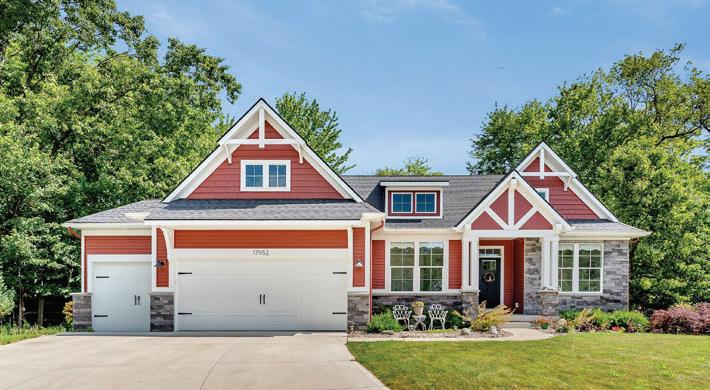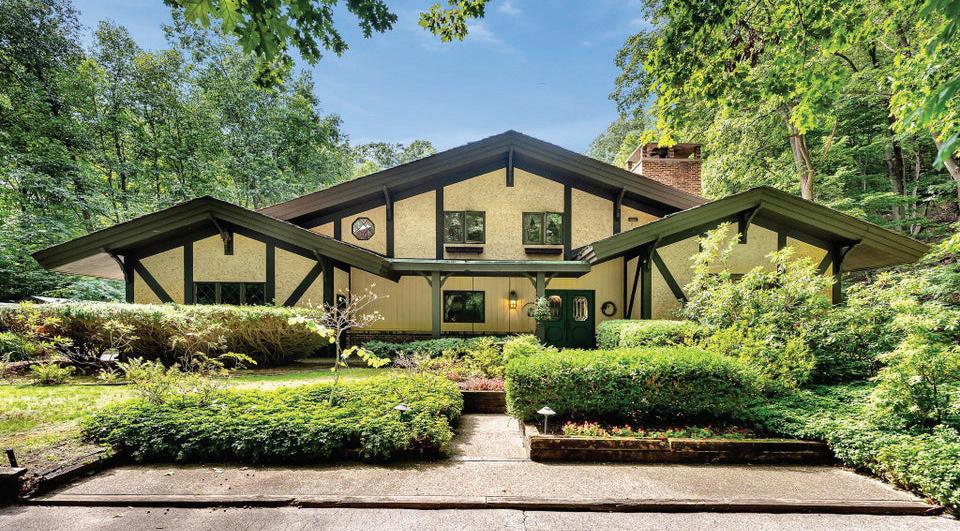



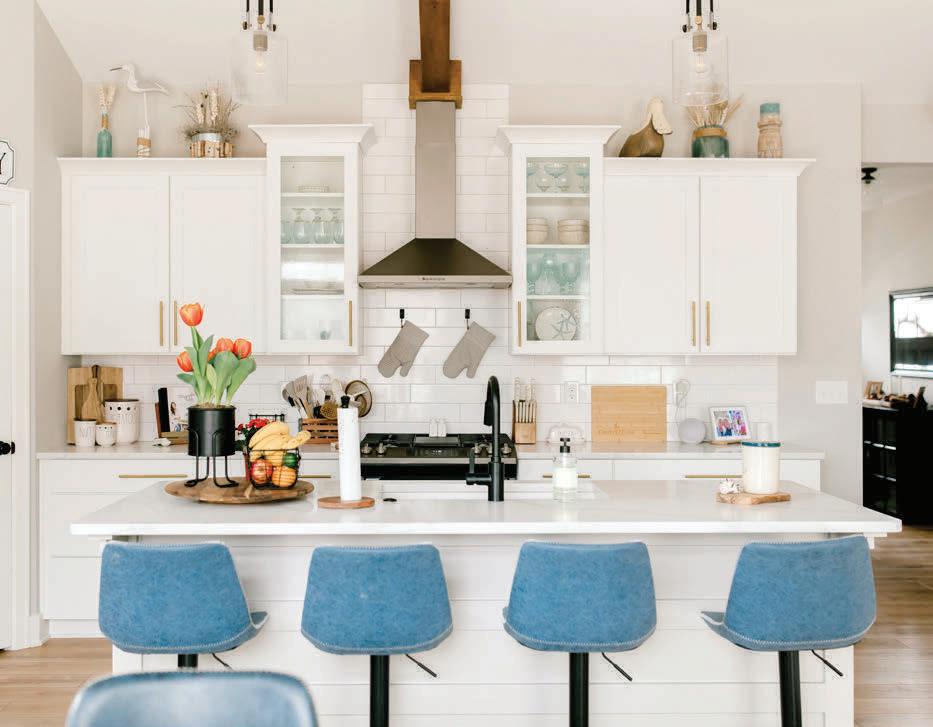
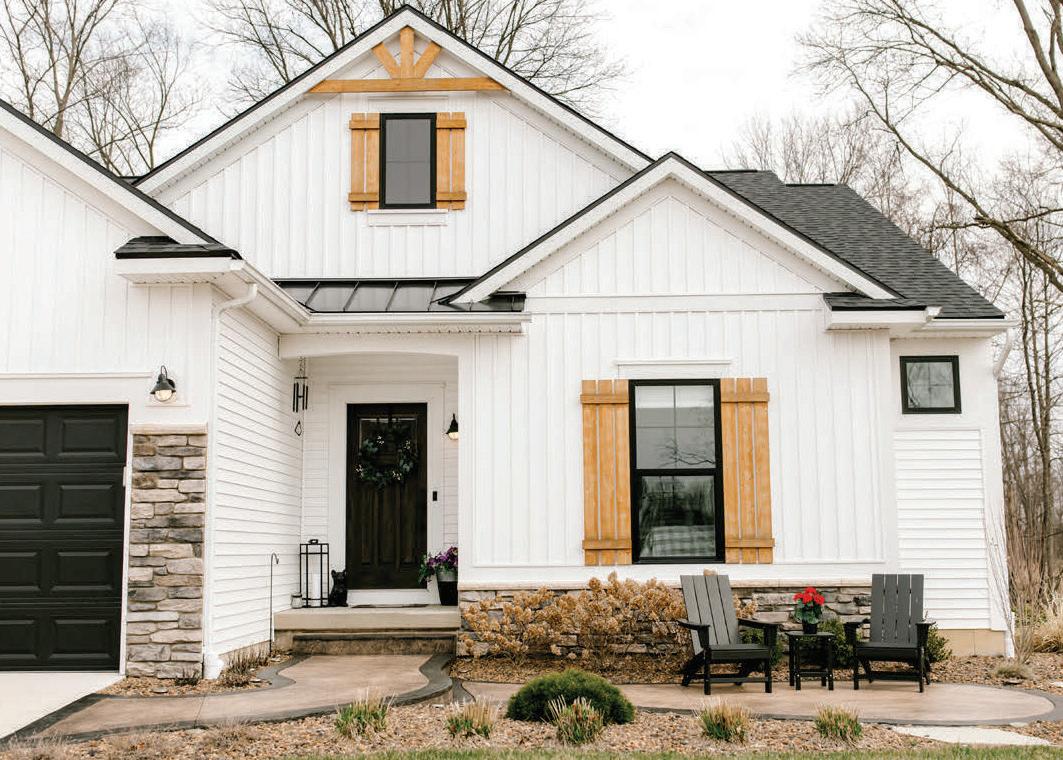
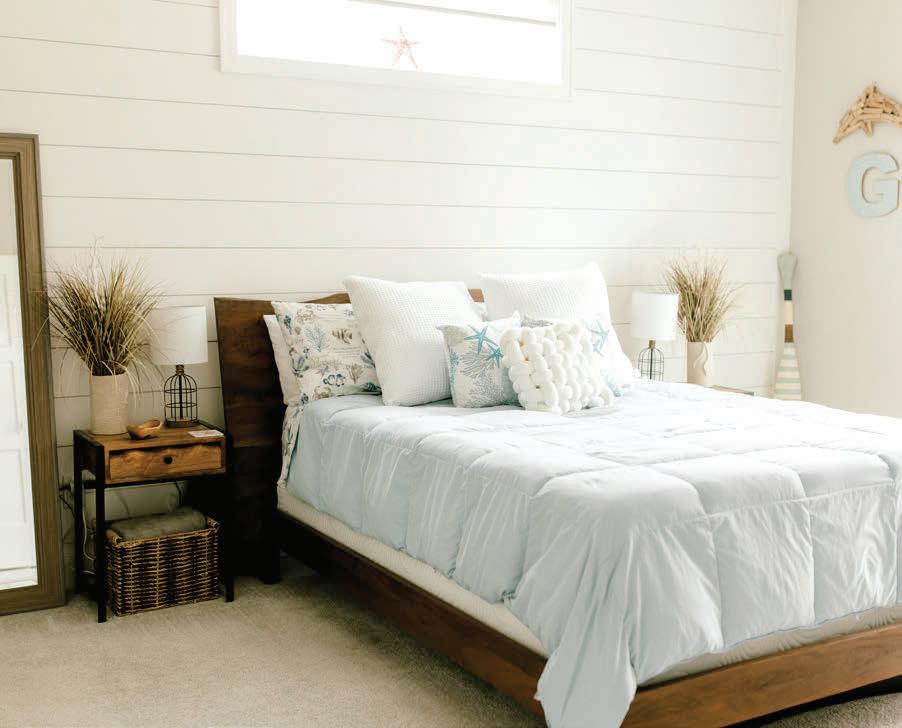
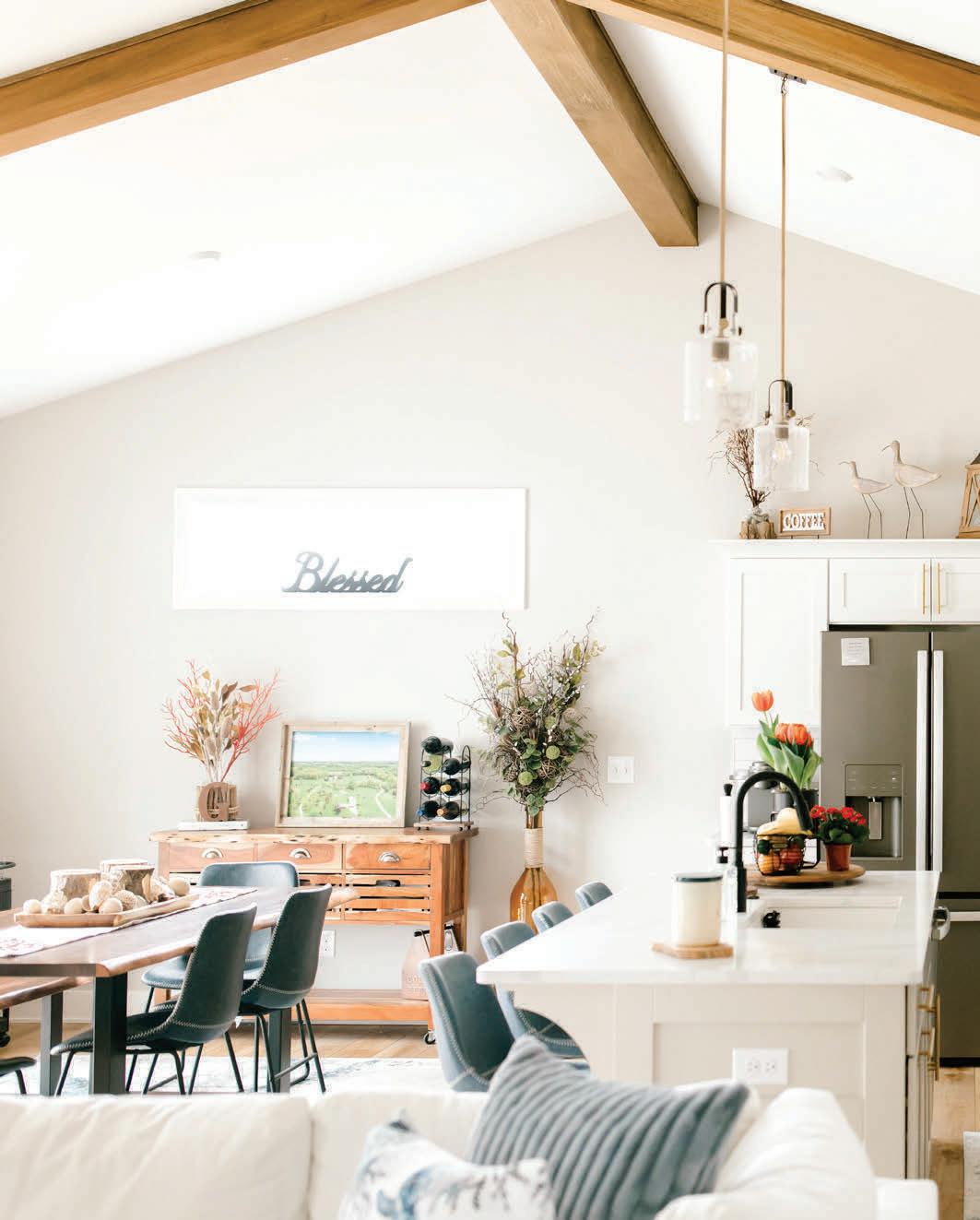
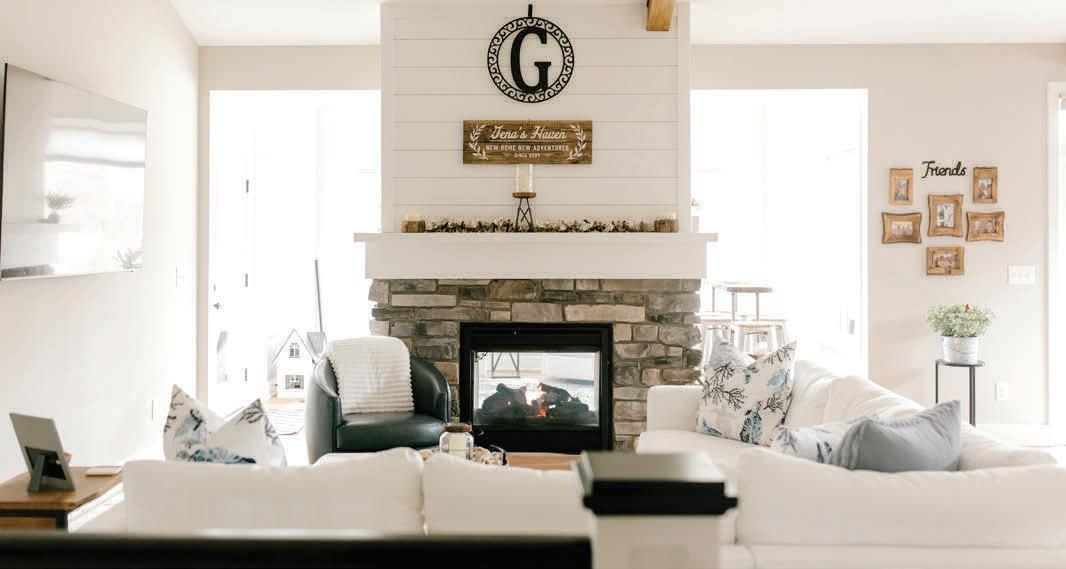
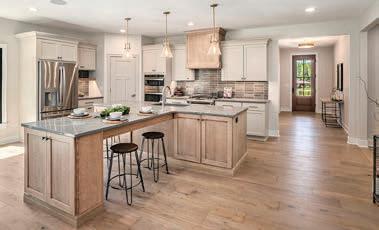
This edition features Gena, who was seeking an open-concept design for hosting friends and family. With the help of Eastbrook Homes, she found a home plan that fit her lifestyle and reflected the quality and attention to detail that she valued.
Gena’s experience is a reflection of our dedication to quality and customer experience. With over 59 years of experience and over 12,000 homes built, we’ve learned what makes a home stand the test of time.

See What Sets Us Apart!


The Eastbrook team went above and beyond to make me feel comfortable and supported. What could have been a very stressful time turned into one of the most positive experiences I’ve ever had.” - Gena Step
What home plan do you have?
I chose the Georgetown floor plan because I immediately fell in love with its layout.
How did you incorporate your lifestyle into your home?
I love to entertain, and the large open-concept design gives me the perfect space to gather with friends and family.
What are your favorite features in your home?
My favorite features of my home are the vaulted, beamed cathedral ceilings and the double-sided fireplace. I also absolutely love my freestanding tub, which was one of my musthaves when designing my floor plan.
What made you choose Eastbrook Homes as your builder?
I first learned about Eastbrook after attending one of their open houses and was immediately impressed by the quality and attention to detail. Once I understood Eastbrook’s building process, I knew it was the best fit for me compared to other builders.
What was your Eastbrook Experience like?
The building process itself was amazing. I never felt lost or overwhelmed. From the design appointments for both the interior and exterior to the weekly updates, Eastbrook kept me informed every step of the way and always made sure I knew what was happening with my home.
Do you have any tips or tricks for new homeowners?
My advice to anyone considering building with Eastbrook is to trust the process. They are so thorough that you never have to worry about missing something. They guide you every step of the way. That allowed me to focus on selling my previous home without worrying about what needed to be done during the build of my new one.
If you’re interested in learning more about building or buying new with Eastbrook Homes, our team is here to help. Reach out today with your questions and dreams, and we’ll help turn them into a reality.


giraffedesignbuild.com
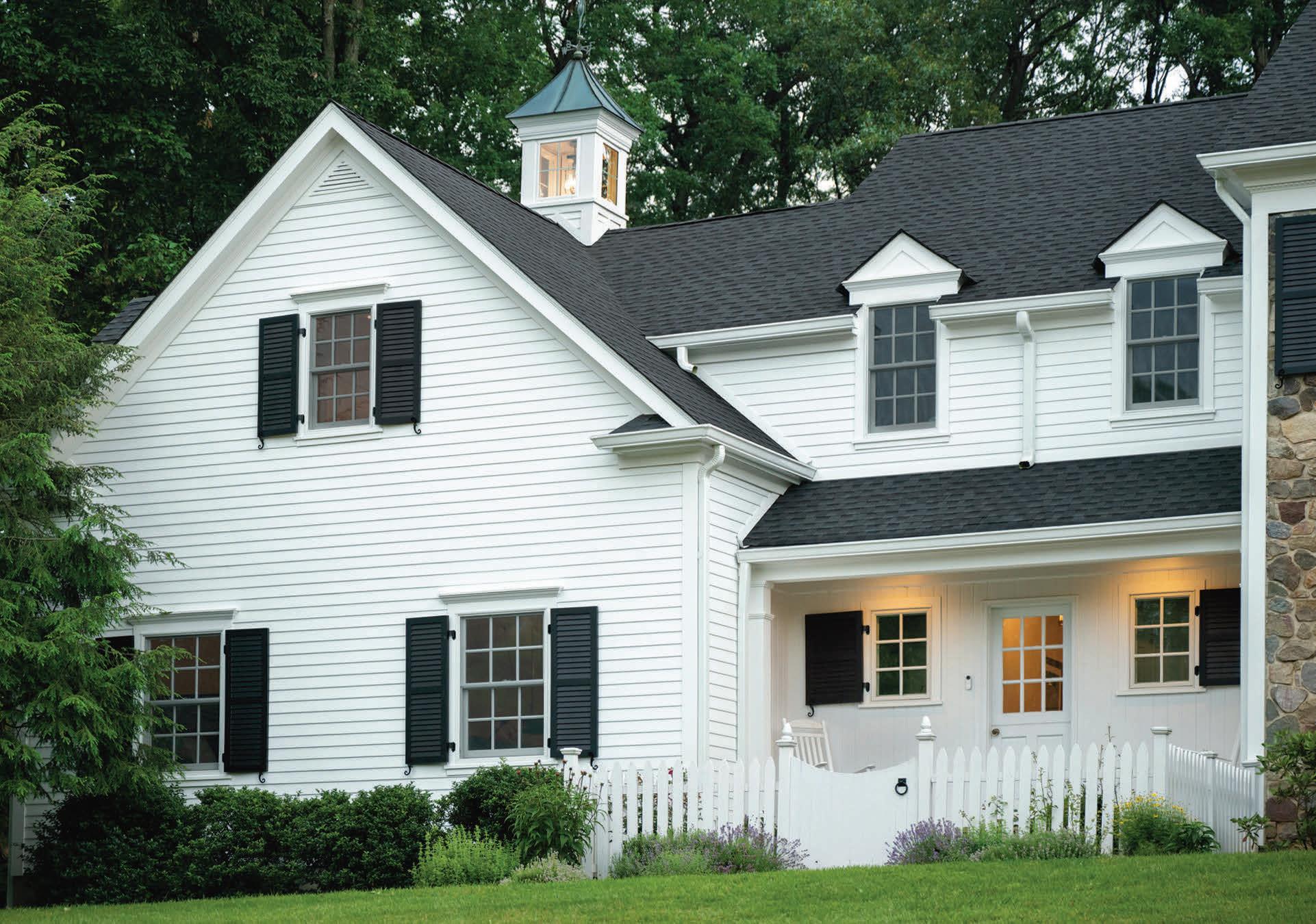
IIn MIchIgan, where weather can shIft from punishing winters to humid summers, exterior materials are tested constantly. AZEK Lap Siding rises to that challenge with a level of performance and refinement that sets it apart.
For homeowners seeking both durability and architectural integrity, AZEK offers a solution that doesn’t ask for compromise. Its advanced cellular PVC construction resists moisture, rot, and pests, issues that commonly plague traditional wood siding in this region. The result is an exterior that holds its beauty over time without the cycle of repair and replacement.
Equally important is how it looks. AZEK Lap Siding is engineered to capture the depth and detail of classic wood profiles, making it an
ideal choice for homes that demand authenticity in their design. Longer board lengths, concealed fastening, and clean, consistent lines create a finished appearance that feels intentional and elevated.
Performance matches the aesthetic. The system is designed to move naturally with temperature changes, helping prevent warping and maintaining a crisp, uniform exterior through every season. With a Class A Flame Spread Rating and a Lifetime Limited Warranty, it delivers confidence alongside its visual appeal.
For Michigan homeowners, AZEK Lap Siding represents a smarter investment. It brings together enduring protection, low maintenance, and timeless style in a way few materials can. It is not just
about improving a home’s exterior; it is about ensuring it performs beautifully for years to come.
Learn more at AZEKexteriors.com
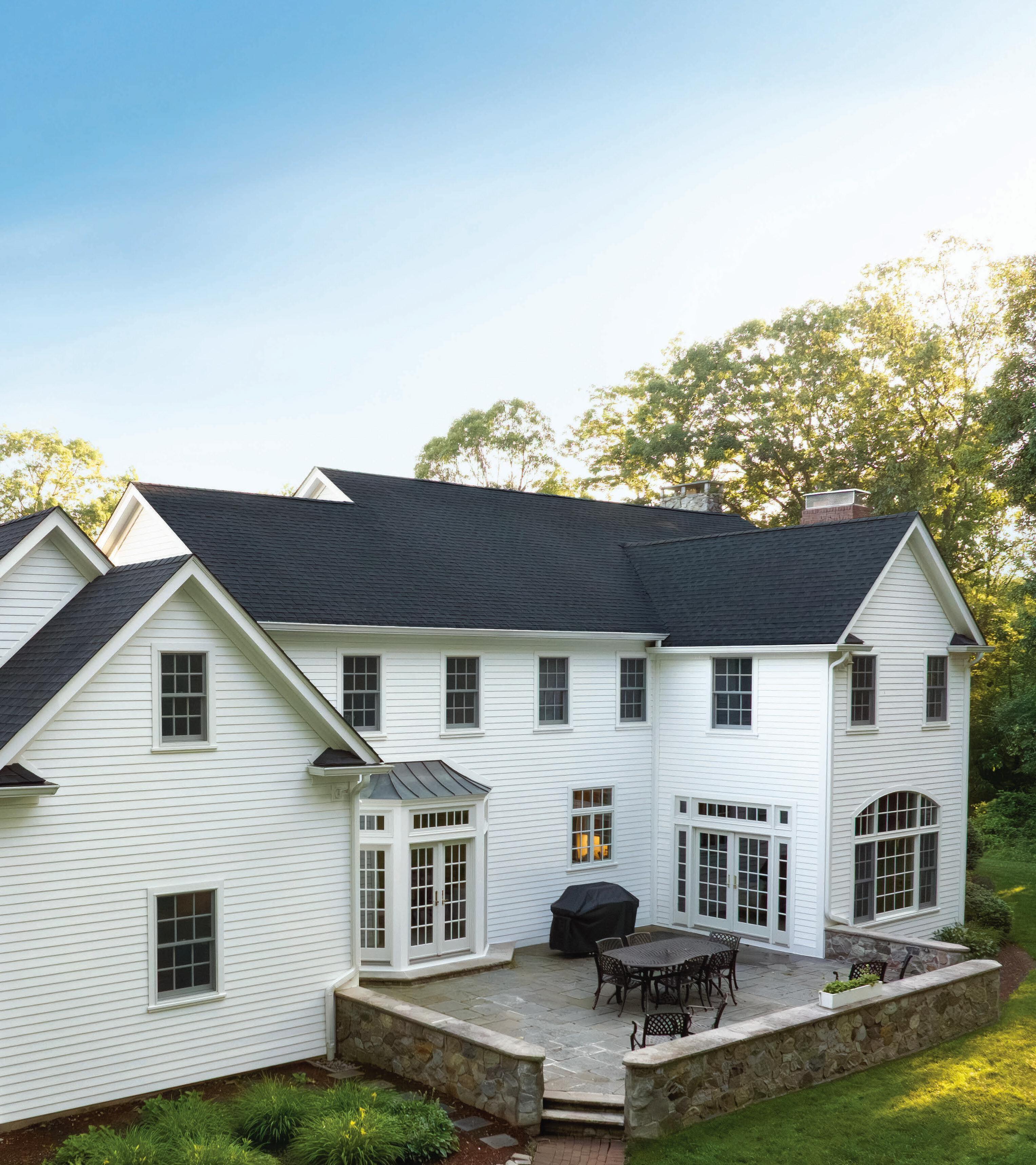
Whether you’re preserving a historic cottage, restoring a country retreat, or designing a classic suburban residence, AZEK Lap Siding imparts the charm of real wood without the need for re-painting or any other wood upkeep. Pros appreciate AZEK quality, ease of installation, and the backing of a Lifetime Limited Warranty. It endures harsh weather, resisting fading, cracking, and peeling for a beautifully resilient home.







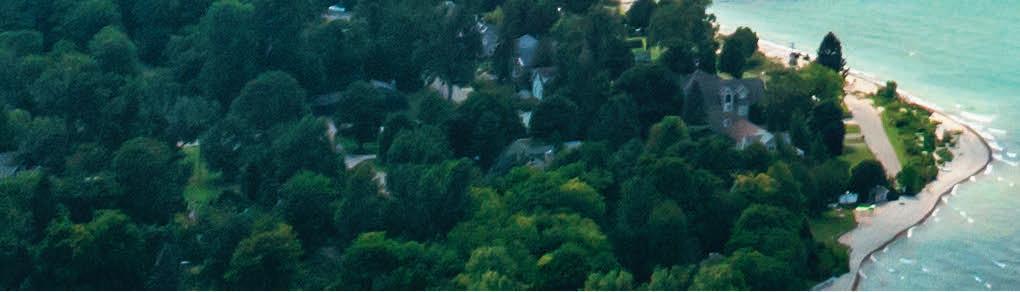






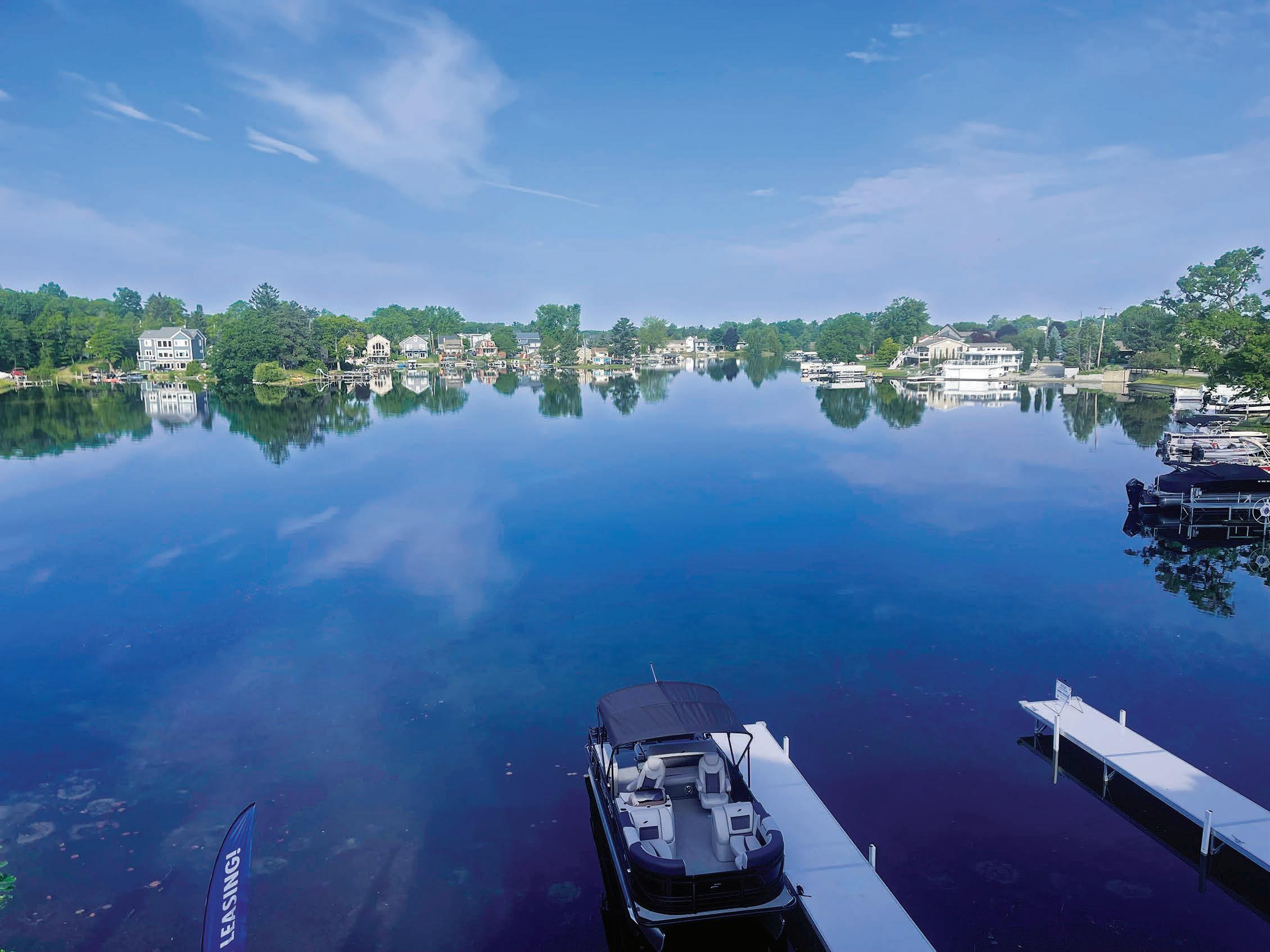

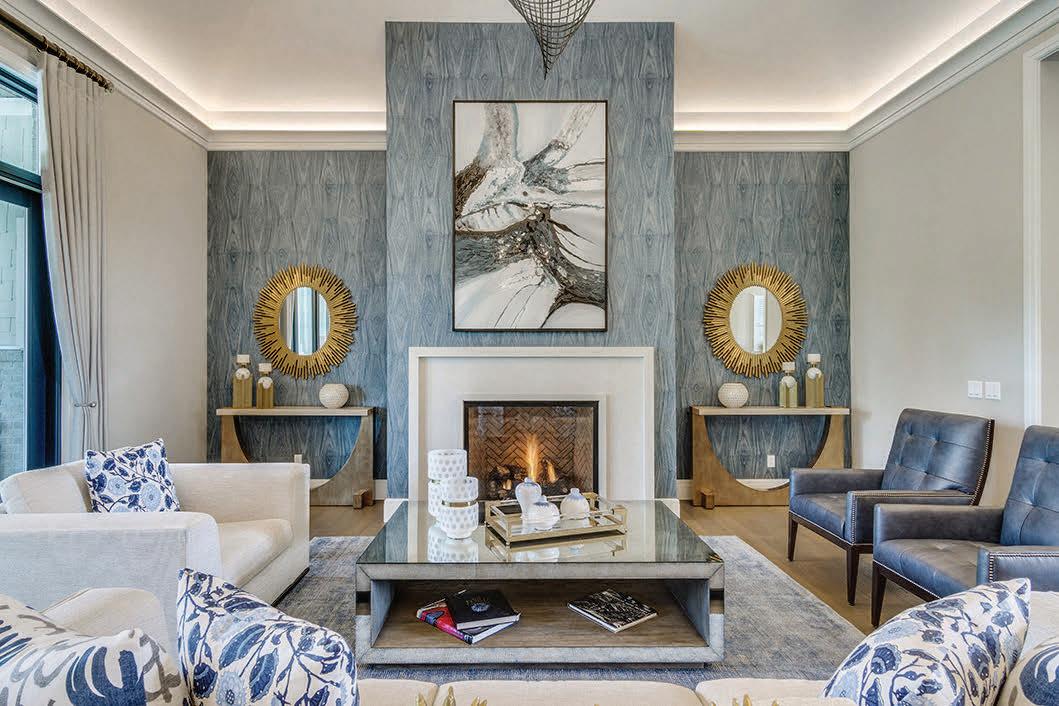
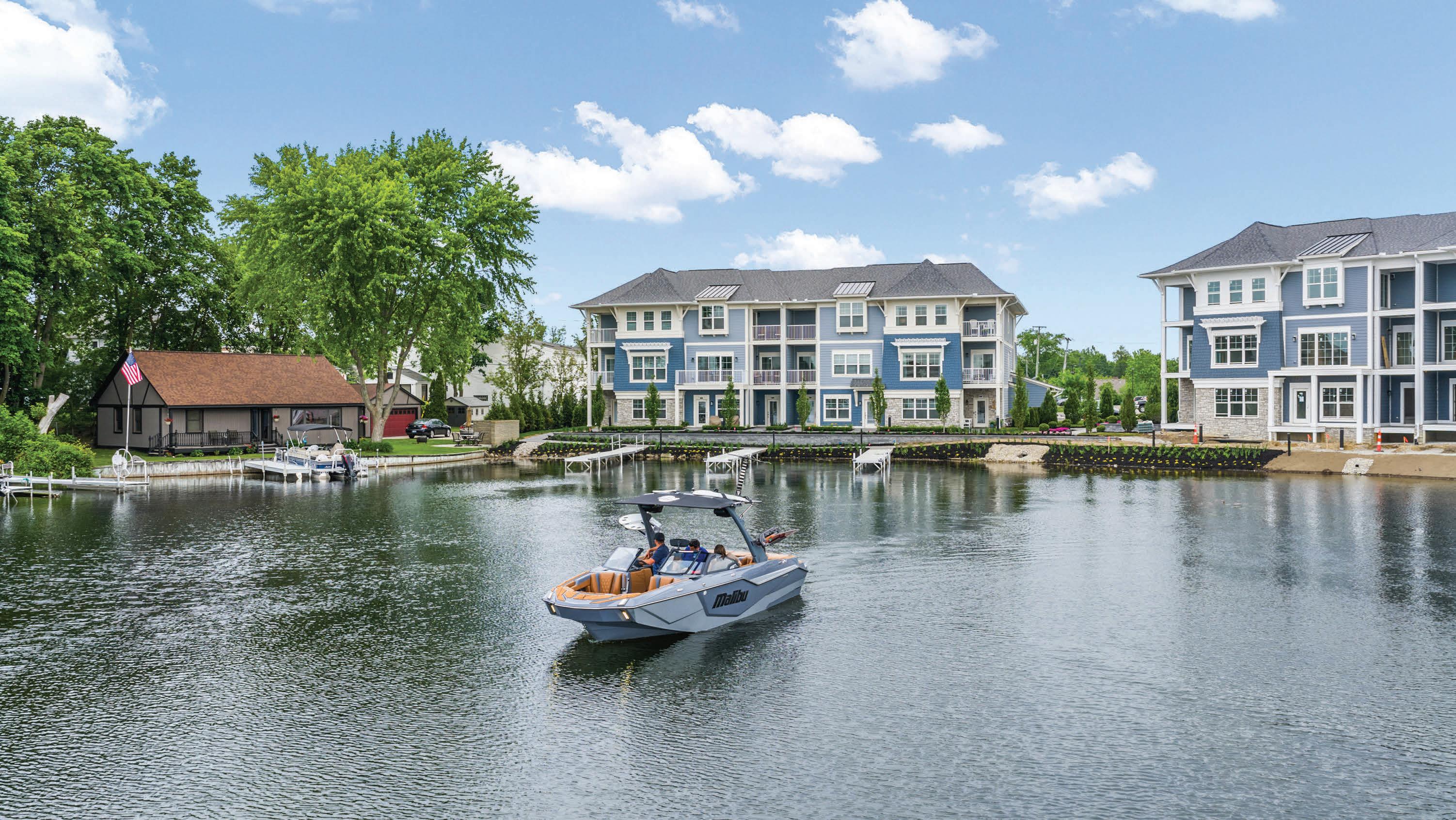









wish you were here.






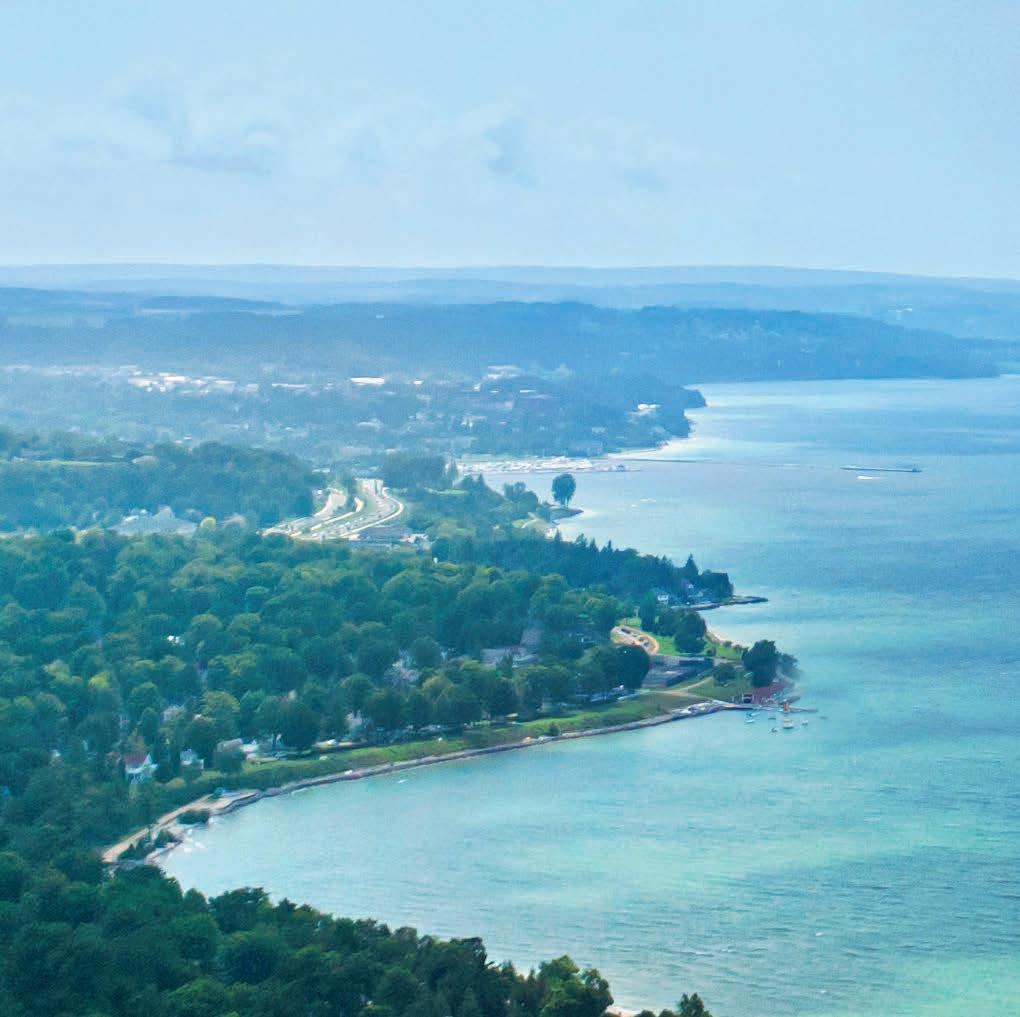
It’s not just a destination – it’s the destination. See why Good Housekeeping named Traverse City as a “2026 Travel Award Winner for Best Beach Escapes”.




43 Photo Essay: Loon Lover
A talented photographer keeps watch at Seney National Wildlife Refuge. By Teresa McGill and Megan Swoyer
48 Blue Heaven
Filled with personality and polish, a new-build home on Glen Lake, near Empire, replaces a family’s vintage cottage. By
Khristi S. Zimmeth
55 Southwest Ramble Road trip treasures and lake town adventures await with a turn of your steering wheel. By Bill
Semion
60 Fields of Purple Lavender loves our Great Lakes microclimates, which means we get to pick it, bake it, grow it, and stir it into summertime beverages.
The goals for this
were open layouts and great views.
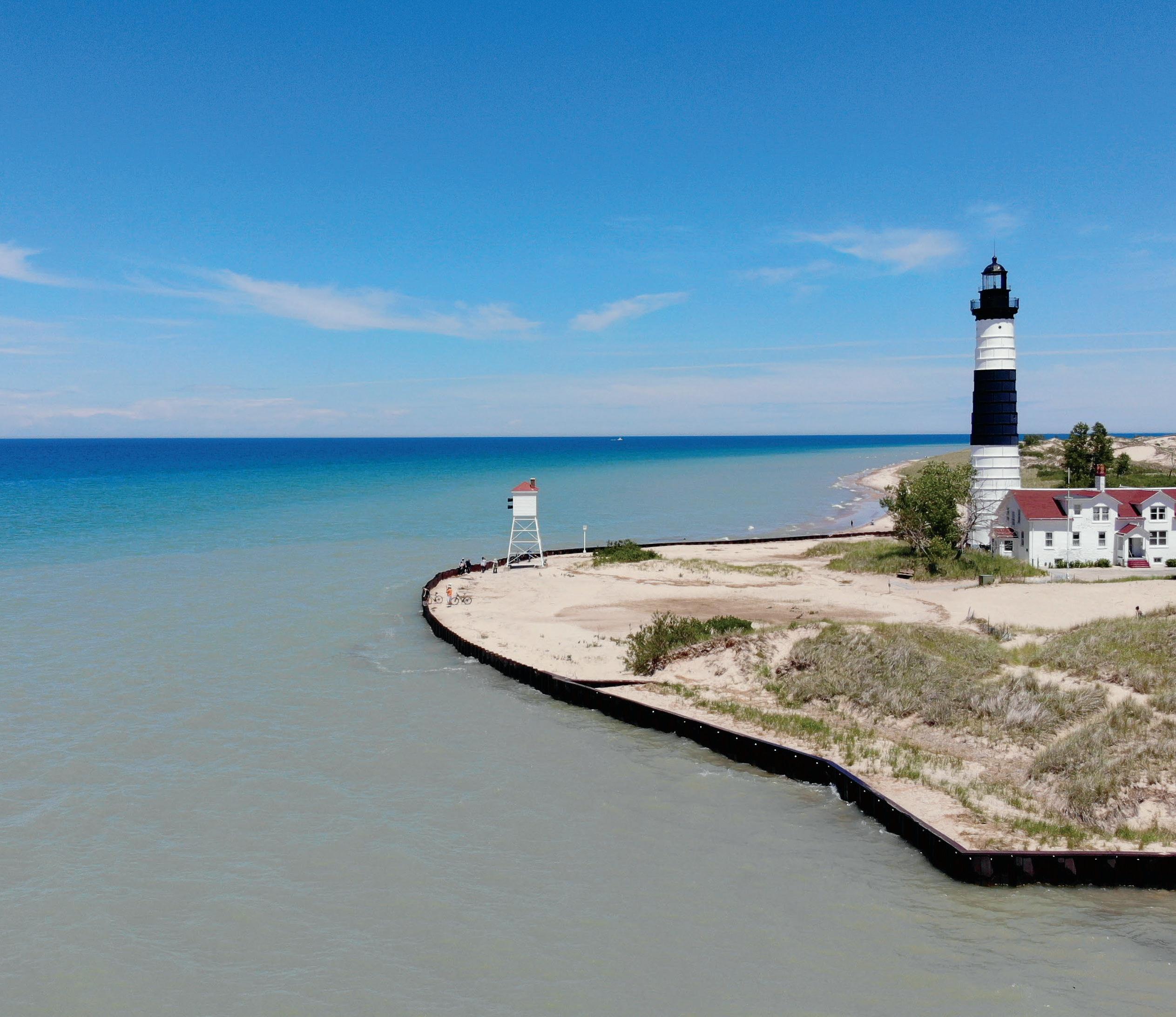

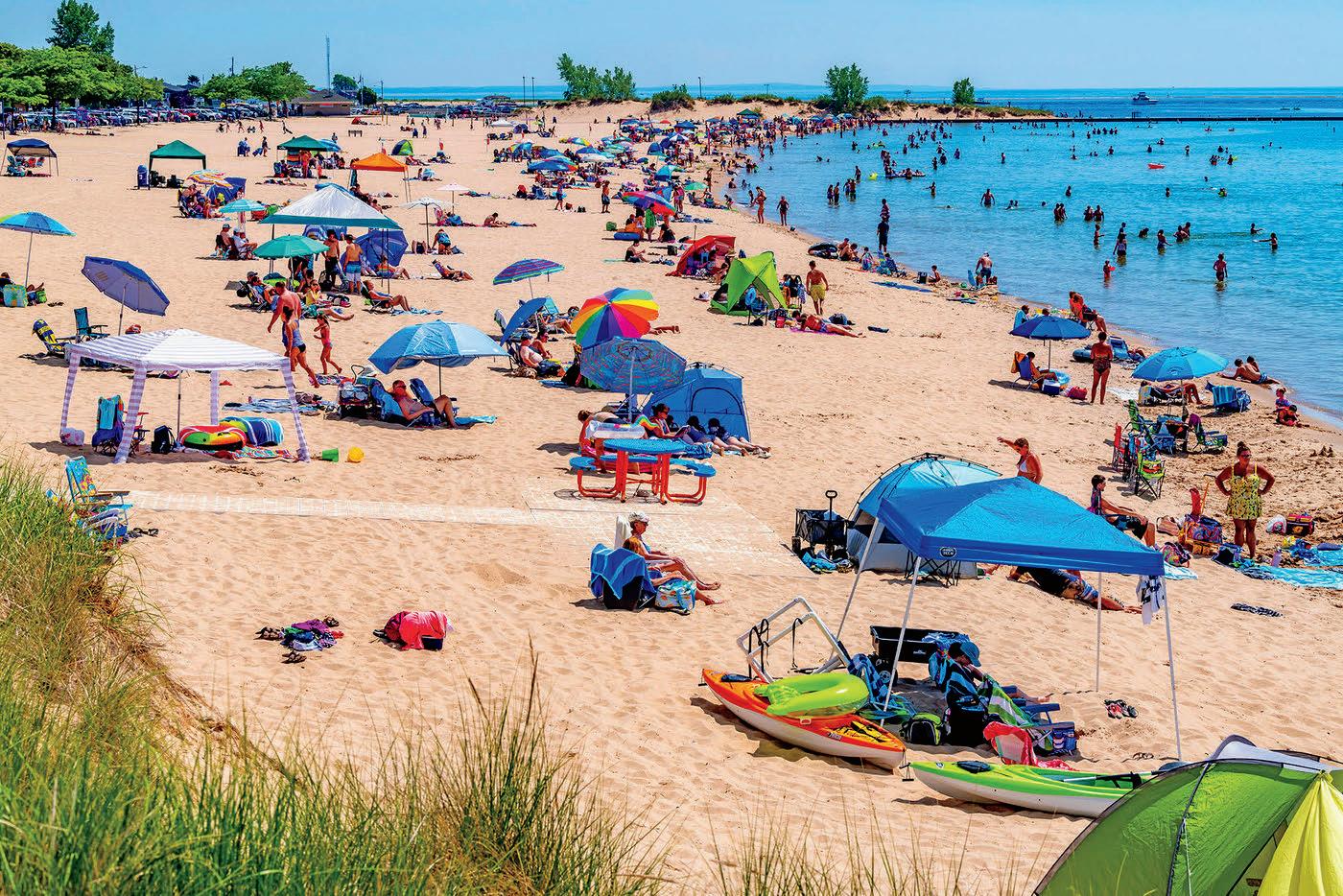
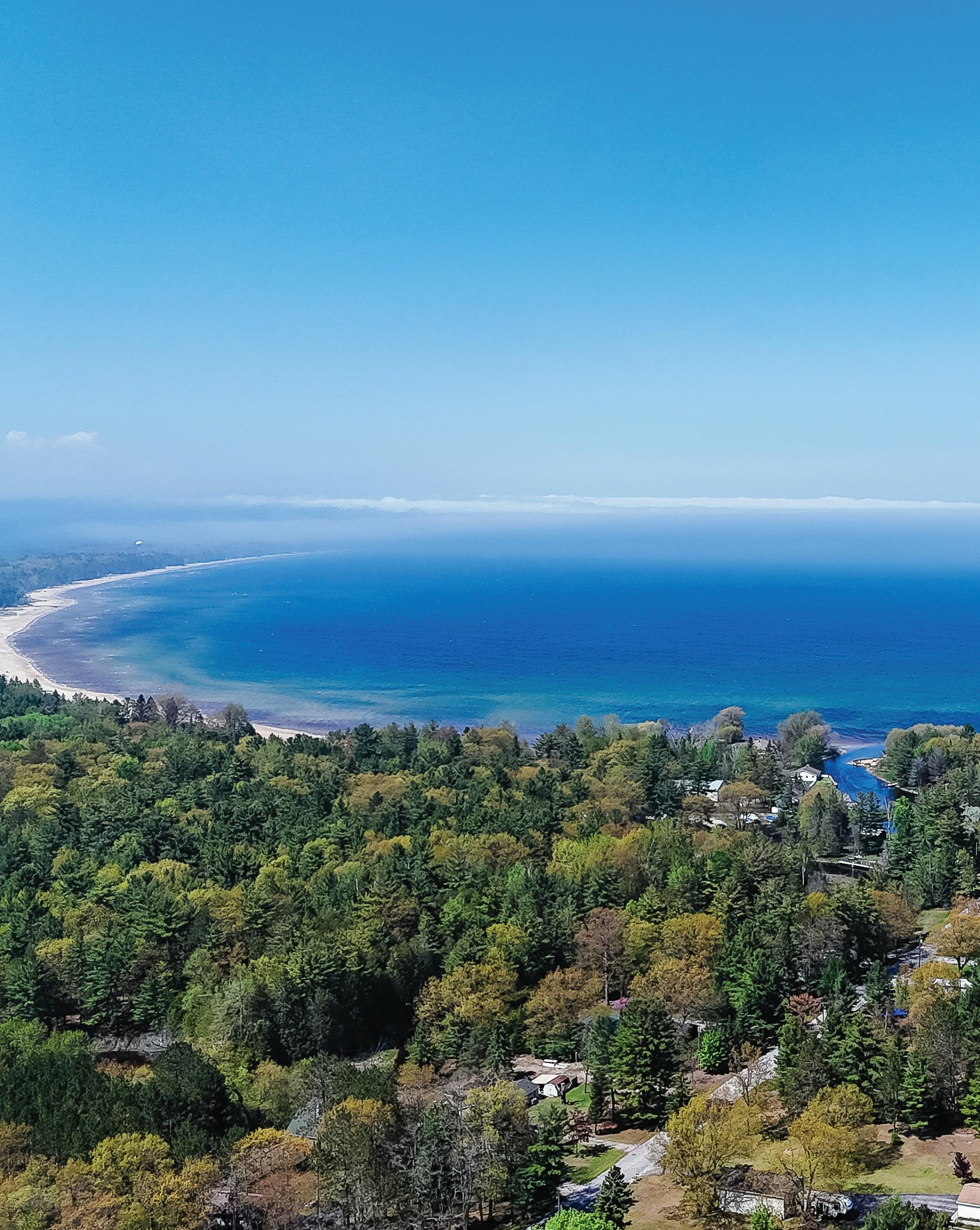
If your idea of the perfect vacation is sugar-sand beaches, clear blue waters along 28 miles of Lake Michigan shoreline, outdoor adventures, climbing to the top of historic lighthouses, or exploring a charming downtown, Ludington is your destination for Pure Michigan fun.
Ludington's unspoiled natural resources offers a quintessential “Up North” experience all within easy reach located at the intersection of U S 31 and U S 10 No matter what you ' re seeking - a beach or outdoor adventure, a peaceful get-away, or just a community of friendly faces - you can find it in Pure Ludington. Start planning your next visit at:


18 Sky, Sand & Surf
Paddleboarders enjoy a remarkable perspective shift at a relaxing pace, and a huge shoreline recreation area near Alpena could become the first developed state park in six decades. By Chris McElmeel and Bill Semion
22 Get Outdoors
Traverse City’s Second Annual Food & Wine event spotlights the region’s best agricultural offerings, and the North Country Trail winds through 1,180 majestic miles of scenic terrain.
By Megan Swoyer and Mark Spezia
27 Staff Picks
From the best golf courses and bike paths to palatepleasers from the lakes, baked goods, and gluten-free pizza, here’s a sampling of favorite spots in northern Michigan. By Ron Garbinski
28 Headwaters
An avid cyclist pedals his way to becoming the leader of the League of Michigan Bicyclists. By Mark Spezia
30 Paging Readers “Soul of Detroit” author shares why she left Paris to explore the Motor City. By Jamie Fabbri
32 Field Guide
An annual International Fireworks Championship in Traverse City, communities receive Tree City USA designations, and the “Michelin Guide” will include metro Detroit’s culinary community in its American Great Lakes edition. By Ron Garbinski
36 Studio Visit
With a bold style, artist Katherine Corden captures the beach scene. By Giuseppa Nadrowski
38 Design Stars
Why Amy and Joe Brisson decided to design and build Ossineke’s Heavens Edge Cottages. By Megan Swoyer
40 The Elements Stripe Hype: Line up your décor acumen with on-trend cottage pieces. By Giuseppa Nadrowski
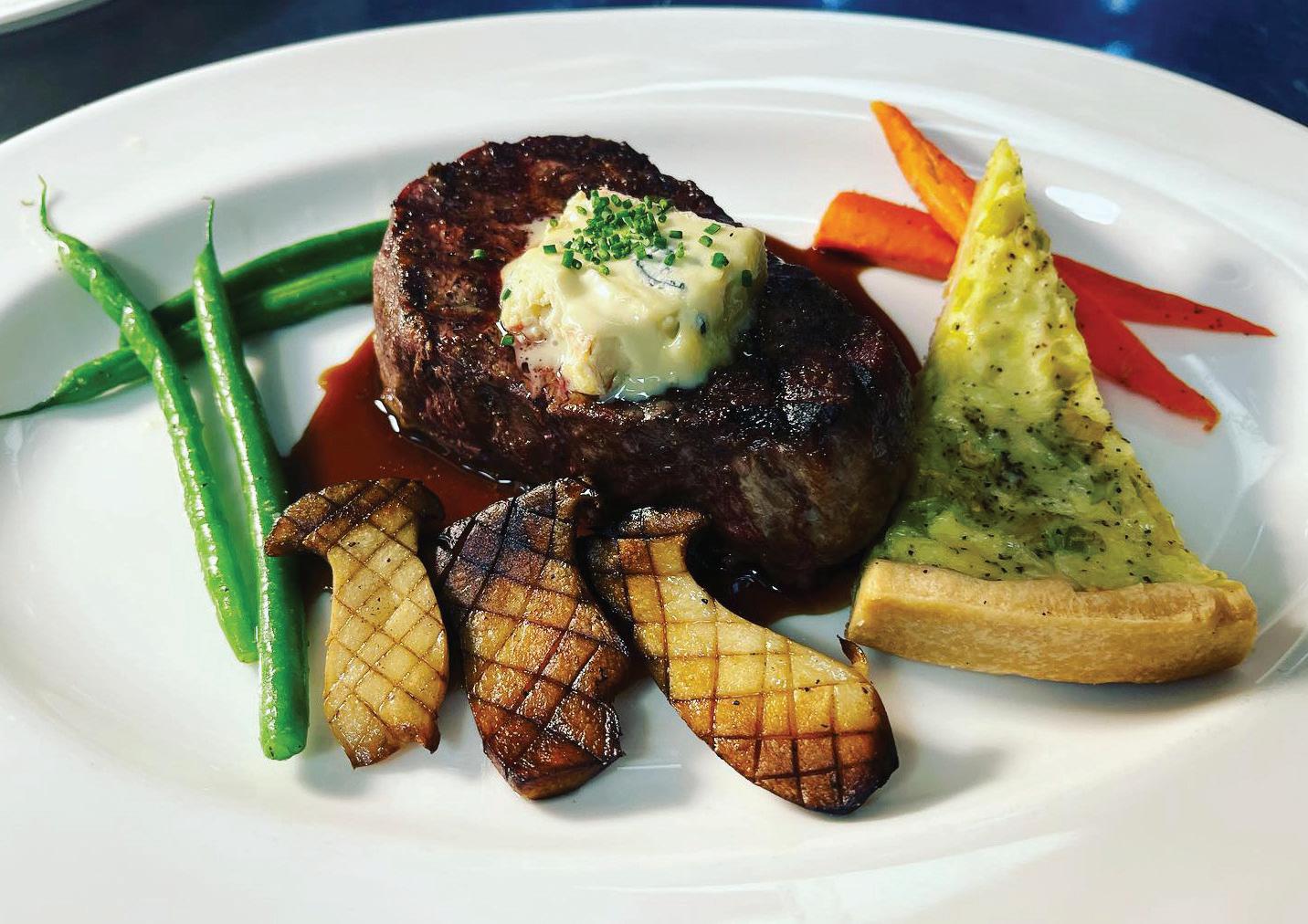
70 Dining Out Blu, in Glen Arbor, collects glowing reviews for its impressive waterfront dining experience. By Mark Spezia
72 Book It
The updated Royal Park Hotel, on Paint Creek in Rocheester, attracts nature buffs, city slickers, and a fair share of anglers. By Megan Swoyer
74 Discoveries
Michigan’s legendary forts, some dating back to the 1770s, showcase military history and offer great lake views. By Ellen Creager
14 Reflections Loon Lessons
By Megan Swoyer
80 Postcard
As it eerily came into view through the fog, the Grand Island East Channel Lighthouse mesmerized this photographer. Text and photo by Nick Erwin
Log out for the weekend …

MMy husband and I have owned our cottage for a quarter century. In that span, we’ve experienced the best of times and the worst of times.
The loon is a big reason why we purchased our cottage. We’d been invited to a golf course opening in northern Michigan and, as our kids were quite young, we took turns watching them so we could play the course and learn more about the new tract and its designer.
When my husband was on kid duty, he and the boys discovered a sweet 1960s lakeside two-bedroom cottage for sale.
He arranged for a Realtor to meet us there and while we toured the cottage, our boys frolicked outdoors, dipping their toes in the water and marveling at frog sounds, loon calls, and shimmery dragonflies.
Once we were home in metro Detroit, I kept thinking about the allure of the cottage. Urban living was great for all of us, but we also needed to get away, to look up into dark skies at the glittering stars and planets, and gaze into waters where minnows darted and turtles bobbed.
fallen limbs. The tops of long-standing old pines, and thousands of branches and boughs covered the ground. Tree limbs were leaning against the house, while big branches poked into the roof. It was a surreal scene.
It was maybe 20 degrees, the snow was blowing, and in the distance two figures appeared. They were tossing tree limbs onto a pile. Realizing it was our son and his girlfriend, who took a day off and drove up from Detroit, I began to feel the burden lift.
We made several more clean-up trips while the tree service crews did the heavy work over three separate days. I would take over wheelbarrow and burning duties, while my husband sawed limbs and hauled wood for future fires. We were thankful for days when we had a cobalt blue sky, sunshine, and the calls of waterfowl in the air.

So, we became the owners of a little slice of nature’s paradise. The best of times!
Our location made it easy to get to other great spots in the north, too, including the North Country Trail, Seney National Wildlife Refuge, and challenging golf courses. On one memorable trip we headed to Munising’s Pictured Rocks for a boat tour and hikes, taking in that Grand Island lighthouse and all the natural beauty before heading to Seney to spot the legendary loons. (Those loons are showcased in this issue’s Photo Essay, page 43, by Teresa McGill, and on the cover.)
Fast-forward a couple decades and it’s become the worst of times as cottage owners. In March, an ice storm — followed by extremely high winds — swept through parts of our beloved state, taking down trees, breaking limbs, and blanketing yards with pine boughs a foot deep, embedded in icecoated snow and frozen ground. And then came the massive flooding in April!
On March 17, we headed to our cottage, which had lost power, to assess the damage. As we turned off the road onto our driveway, we saw nothing but chaos — including huge
One day, I grabbed my camera and went to the water’s edge where I stood amid strewn boughs, pine needles, and even more limbs. A mélange of blackand-white feathers, cinnamon crests, and vermillion bills filled my lens. The ducks were so calm, while I was thinking of the cost of taking down trees, fixing the roof and siding, dealing with insurance companies, and hearing weather reports warning of the upcoming serious flooding.
The mergansers and buffleheads comforted me as they glided atop the water, which began to take on shades of lilac and pink in the late hours of the day. Listening to the ducks’ calls, I heard the unique haunting song of loons — woooo -oooooooew- woooooh, wooooh, woooooh. Could they be here already? I took a look at the photos I’d taken and, bingo, I spotted two white-speckled black waterfowl.
Loons! They’re a sign of harmony and serenity, and symbolize a reawakening of old dreams. Once upon a time, our dream had been to own a cottage. Watching the loons, I came to the realization that it’s important to recall your dreams and recognize why you had them, if you want to reawaken the joy — even in a dismal situation.
Yes, cottage owners have to be willing to take the good with the bad. We experience the best of times — and, occasionally, the worst of times. But through it all, don’t forget the dream, and appreciate the importance of staying stable and buoyant — just like the loons.
Publisher: Jason Hosko
EDITORIAL
Editor: Megan Swoyer
Travel Editor: Ron Garbinski
Copy Editor: Anne Berry Daugherty
Contributors: Ellen Creager, Jamie Fabbri, Nick Irwin, Maconochie Photography, Chris McElmeel, Teresa McGill, Giuseppa Nadrowski, Bill Semion, Mark Spezia, Julie Bonner Williams, Khristi S. Zimmeth
DESIGN & PRODUCTION
Creative Director: Lindsay Richards
Art Director: Mike Wagester
Junior Art Director: Sabrina Seldon
Production Manager: Crystal Nelson
Account Manager: Elizabeth Kowalik
Production Assistant: Alessandra Taranta
Special Projects Editor: Olivia Sedlacek
Graphic Designer: Joe Salafia
SALES
Advertising Inquiries: advertising@hour-media.com
Media Advisers: Connor Cooper, Maddy Gill, Nick Irwin, Stephanie Scott
Media Associate: Lachlan O’Neill
DIGITAL
Director of Digital Strategy: Travis Fletcher
Digital Development Manager: Matthew Cappo
Senior Digital Development Specialist: Luanne Lim
Digital Development Specialist: Brian Paul
IT
Director of IT: Jeremy Leland
CIRCULATION
Director of Audience Development: Geralyn Wilson
Circulation Manager: Riley Meyers
Senior Circulation Coordinators: David Benvenuto, Rachel Moulden
Circulation Coordinators: Cathy Krajenke, Michele Wold
Circulation Customer Service: 866-660-6247
Email Marketing Coordinator: Mitch Ackerman
MARKETING
Marketing & Events Manager: Regan Wright
Marketing & Events Coordinator: Puja Trivedi
Marketing & Events Assistant: Kayla Yucha
ADMINISTRATION
Director of Business Operations: Kathie Gorecki
Senior Accounting Associate: Andrew Kotzian
Accounting Associates: Jenna Glod, Austin Schmelzle
PUBLISHED BY HOUR MEDIA, LLC
CEO: Stefan Wanczyk | President: John Balardo

Michigan Blue magazine is published quarterly by Hour
Media. Publishing office: 5750 New King Dr., Suite 100, Troy, MI 48098. Telephone 616-459-4545; fax 616-459-4800. General email: info@hour-media.com
Copyright ©2026 by Hour Media. All rights reserved. POSTMASTER: Send address changes to Michigan Blue magazine,1965 E. Avis Dr., Madison Heights, MI 48071. Subscription rates: one year $14.95, two years $24.95, three years $34.95, U.S. only. Single issue and newsstand $5.95 (by mail $8.95). To subscribe or to order back issues, please contact Circulation at 866-660-6247. Advertising rates and specifications at mibluemag.com or by request. Michigan Blue magazine is not responsible for unsolicited contributions.

mswoyer@hour-media.com







BY Bill Semion
SKY, SAND & SURF
Could a huge shoreline recreation area near Alpena become the first developed state park in six decades?
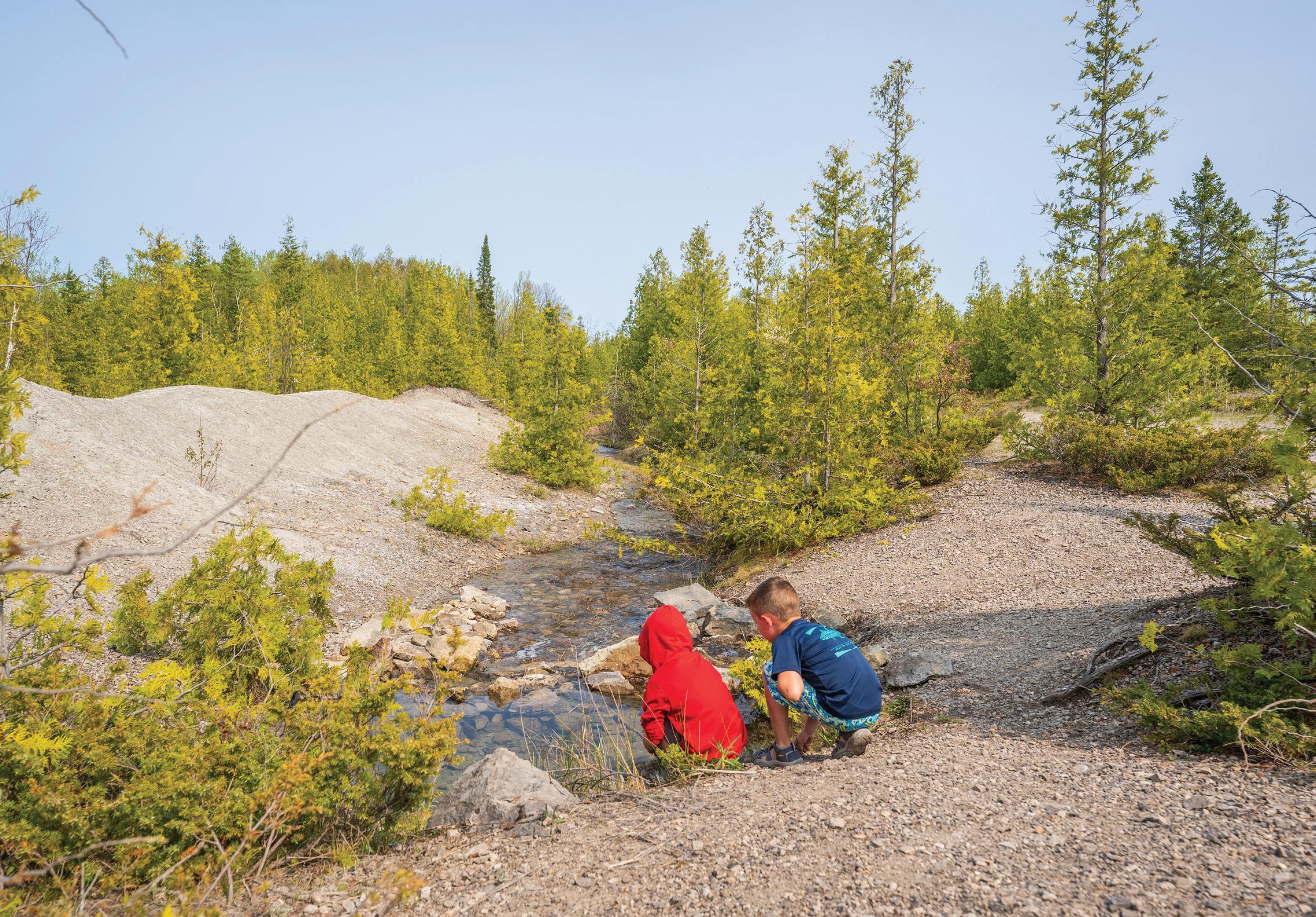
By all accounts, the Rockport State Recreation Area, 13 miles north of Alpena in northeast Michigan, is beautiful. Its 4,327 acres, which are covered in mixed conifer and other hardwood forests along a remote Lake Huron shoreline, already attract hikers, bikers, cross-country skiers, and equestrians who enjoy its 20 miles of trails.
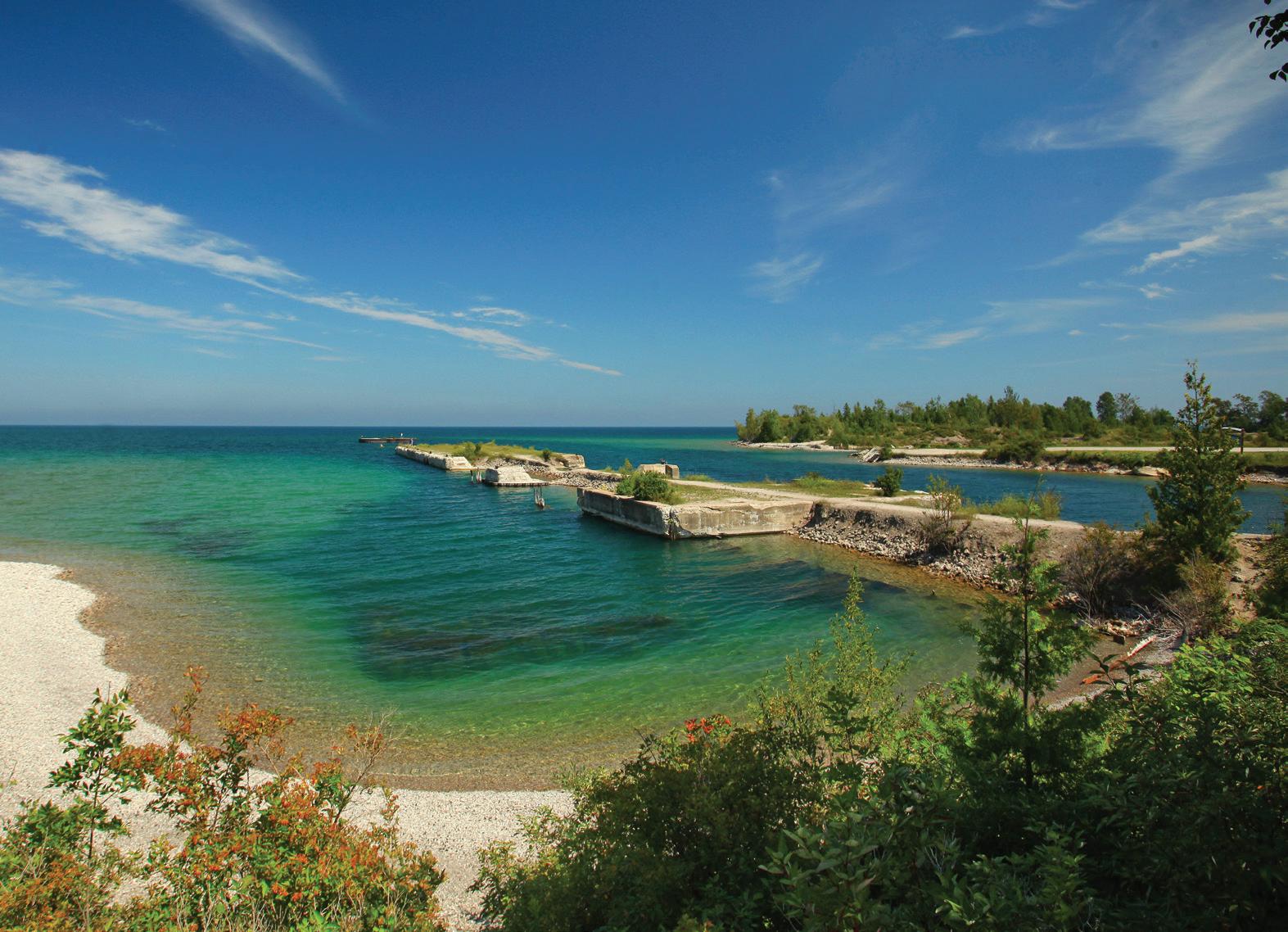
Anglers launch at its limited harbor, which still bears the bones left from a long-ago limestone mining operation. At a former quarry, visitors can hunt for fossils. It’s also a designated dark sky area for viewing the heavens.
The current best “guesstimate” of the number of annual visitors is 22,961.
In a few years, however, Rockport could change dramatically. Could it become the first state park to be created in Michigan since the 1960s?
A futuristic vision for Rockport is actively being pursued by the rec area’s current stewards, the Department of Natural Resources. Through its Parks and Recreation Division’s general management plan process, there will be plenty of opportunity for input about potential changes or improvements by experts, stakeholders, local entities, and the general public.
DNR veterans involved in that process include Matt Lincoln, park planner with the DNR’s Parks and Recreation Division in Lansing, Rich Hill, DNR Parks district supervisor

in Gaylord, and Jason Cherven, regional field planner for the DNR in Gaylord.
They and others, with input from those outside the DNR, are preparing an updated 10-year plan for the property — and as with all things that could lead to change, the answer may not be what everyone wants.
What could it include? So far, a draft development plan is still being created in conjunction with the general management plan. It may include several hike-in campsites, rustic cabins, improved parking, interpretive panels, stabilization of the pier, and a pathway with ropes to guide viewers walking at night below a sky of stars that are difficult to see elsewhere.
Other changes could include an improved boat launch to enable anglers to access the popular Middle Island area in Lake Huron in search of walleye, lake trout, and salmon; a separate kayak launch; and improved markings for equestrian/hike/bike trails.
Or, like some prefer, it could be left alone.
Hill says the current demand for campground space in the region isn’t the deciding factor. “The state parks with campgrounds are certainly busy, but it doesn’t necessarily mean that they (campgrounds) have to be at every state park. Every state park is really special, and each brings something unique to the overall system.”
That’s where devising a plan comes in
— and it’s not without a bit of controversy, including objections from those who like Rockport just the way it is.
“Currently, we’re in the process of updating the general management plan. We started working on a development plan within that management plan,” he says.
Lincoln says the development plan process started in 2020 to consider potential new uses, based on the park’s management plan completed in 2012.
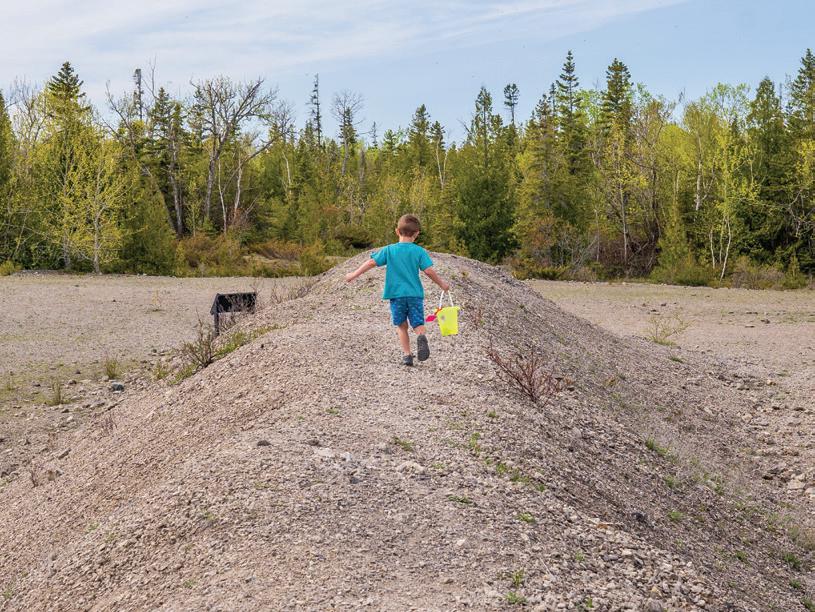
“If you go to the park website, you can get to a site for the plan and see where we’re at. We did a public input survey in the fall and had a stakeholder meeting to get feedback on what Rockport means to people,” Lincoln says. “What we’re going to do is (create) an update that will include what makes the park unique. In the summer, the public can review those again. Currently, we have very limited camping opportunities in that area. It’s a unique landscape with a 300-acre former quarry that looks like a moonscape.”
Adds Hill: “All these things are in draft form, and the next steps for us will be to continue working on the management plan and (contemplating) what the overall development of the park would look like. It’s still very much in the development stage. Sometime in the summer, we’ll have a public meeting that will focus on the general plan — but
obviously, the development plan is a big part of that. We’ll have a public open house of some type.”
The closest state park to Rockport that has a modern campground is Clear Lake State Park near Atlanta. P.H. Hoeft near Rogers City, one of the eight original Michigan state parks that was created decades ago, is just north on U.S. 23. Those parks’ campsites are generally filled each summer weekend, as are two others farther south: Harrisville and Tawas Point. The latter was developed in the 1960s, after being relocated from the East Tawas waterfront.
The Alpena area would be sure to gain from a newly developed Rockport State Park, which would bring increased visitation and potentially ease reservation pressure at other campgrounds.
What’s next for Rockport may be determined later this summer. In the meantime, many interested parties in the region are waiting to review what’s in this new development plan before commenting. Stay tuned
More Information:
Rockport State Recreation Area
michigan.gov/recsearch/parks/rockport
Both pages: Located at a former quarry, Rockport State Recreation Area is a fun — and productive — place to spot fossils, hike, and explore. A planning committee is considering adding hike-in campsites, rustic cabins, interpretive panels, beach improvements, and more. The old harbor (left) could also see boat ramp enhancements and the addition of a kayak launch.
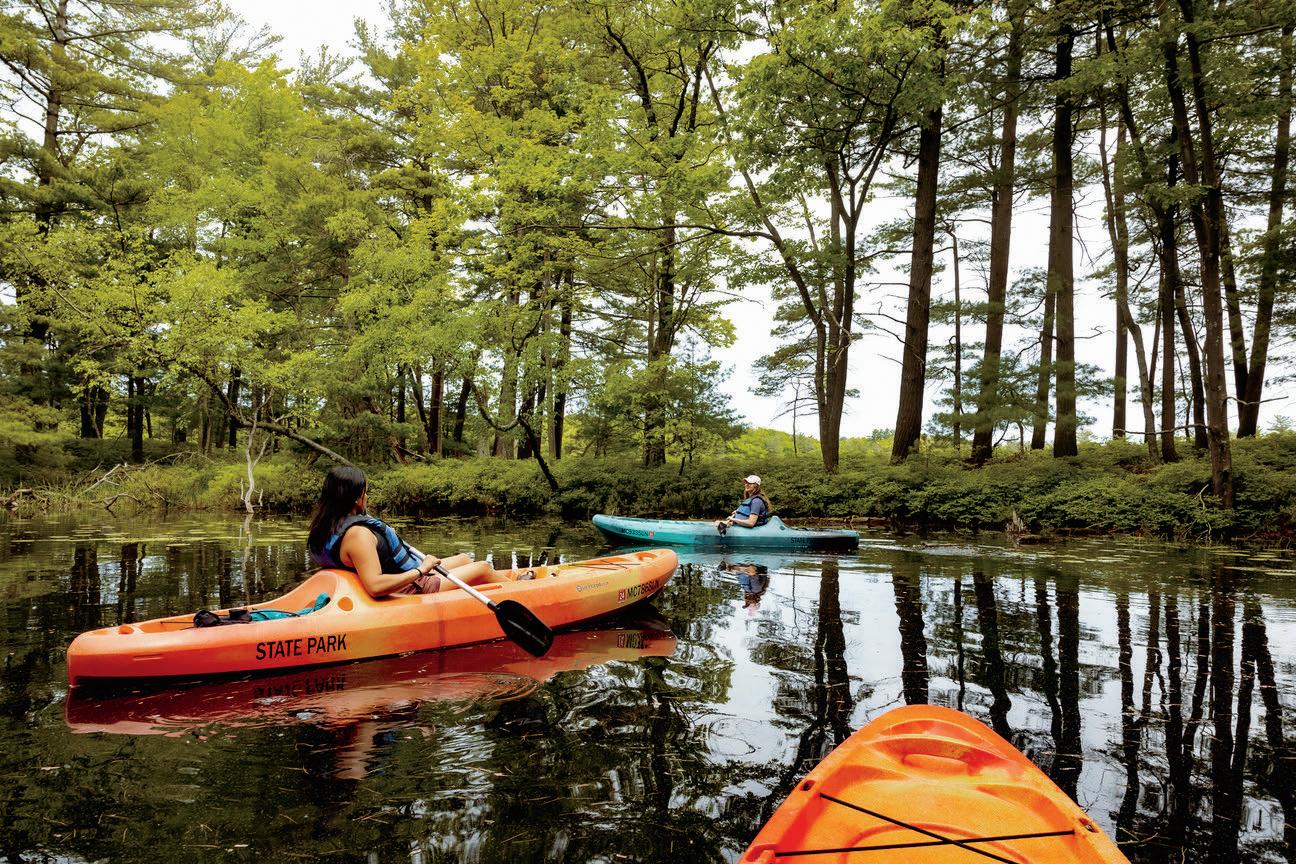
There’s a moment, usually just after sunrise, when the water turns to glass and the shoreline feels like it belongs only to you. No engine noise. No deadlines. Just the soft dip of a paddle and the quiet realization that you’re standing in one of the most beautiful freshwater regions in the country.
In west Michigan, stand-up paddleboarding isn’t a trend. It’s a perspective shift.
“Paddling Michigan’s lakes and waterways is an incredible way to make lasting memories with family and friends,” says Kelly Wolgamott, vice president of Pure Michigan. “From the pristine beauty of the Great Lakes to the quiet solitude of our inland lakes and rivers, there’s nothing like a day on the water.”
Born from surf culture with modern roots in Hawaii, stand-up paddleboarding (SUP) has become one of the fastest-growing outdoor activities in North America. The premise is simple: Stand on a large, stable board and glide across the water using a single-bladed paddle.
When people hear “Michigan lakes,” they often underestimate the drama of the landscape. Katy Wiesen, co-owner of the Crystal River Outfitters Recreational District in Glen Arbor, sees that misconception often. “I think a lot of people misunderstand Michigan in general,” she says. “They think (of) maybe a city, or (that there’s) not much here, when really it offers the most dramatic landscape and the most dramatic seasons.”
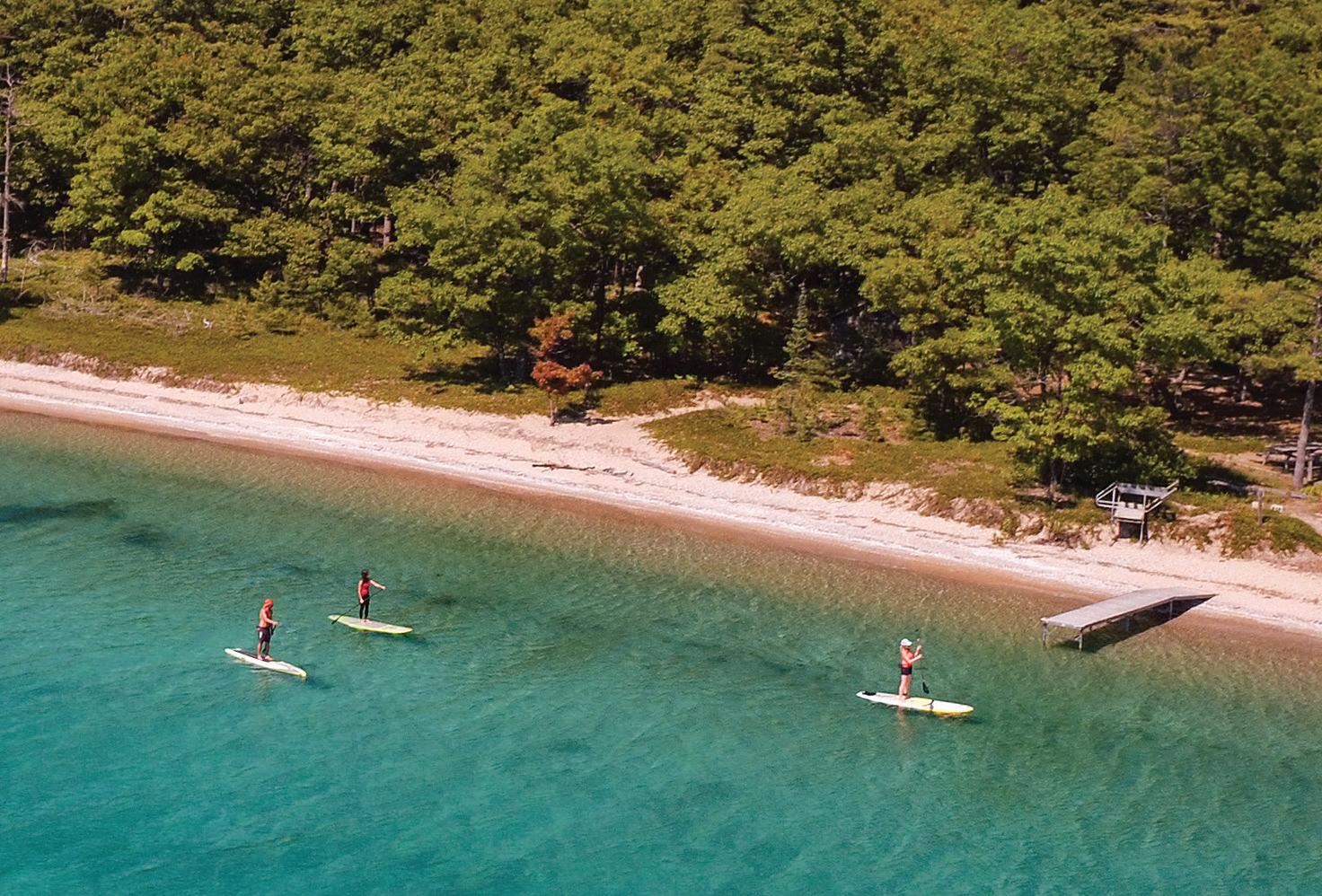
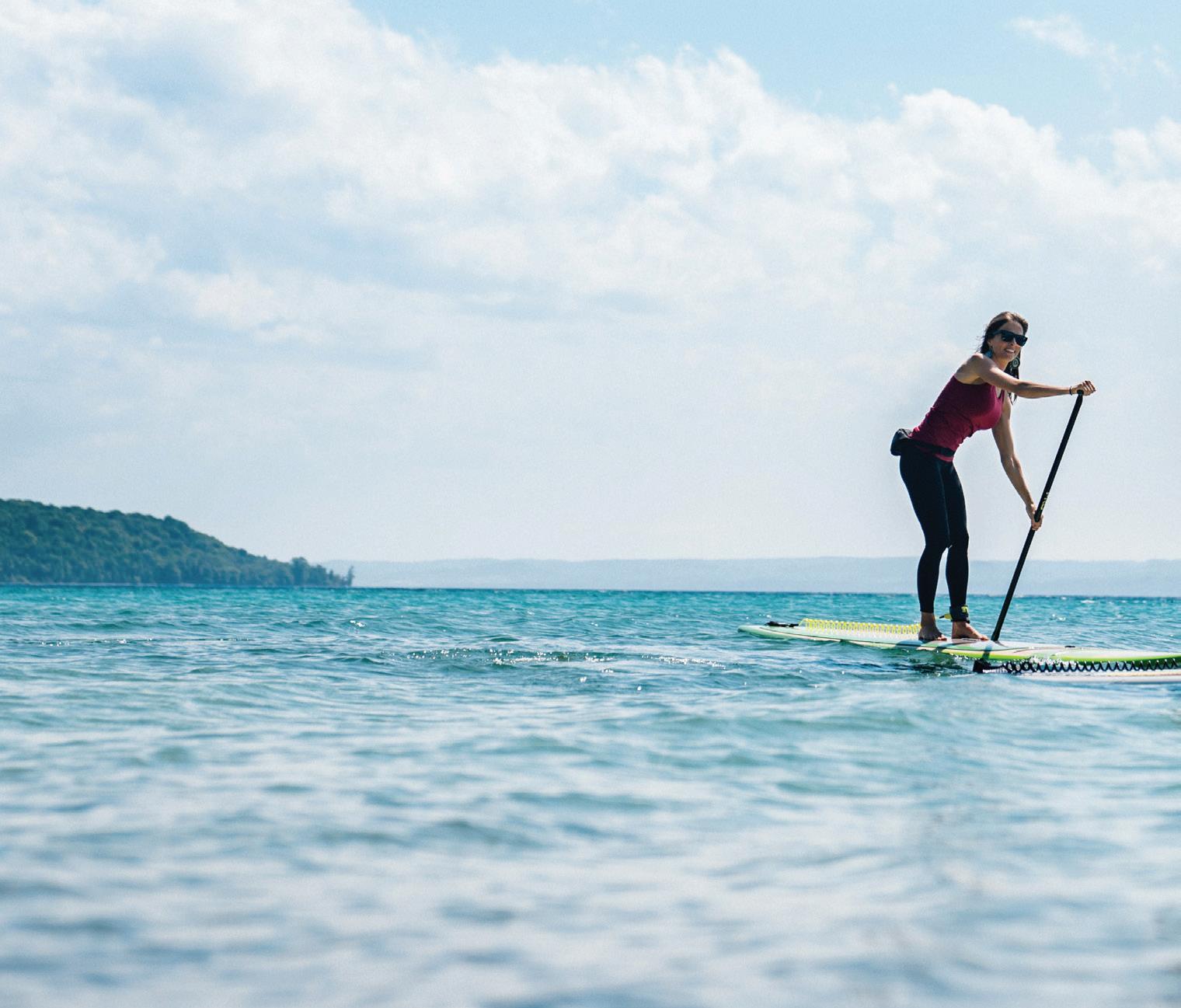
From the turquoise clarity of Big Glen Lake to the sweeping shoreline of Lake Michigan near the Sleeping Bear Dunes, west Michigan offers a remarkable range of paddling environments. Inland lakes provide calm water ideal for paddleboarding beginners and families. The Grand and Muskegon rivers wind through forests rich with wildlife. And Lake Michigan, on a calm morning, can feel like the ocean — minus the salt and sharks.
Then there’s the Pine River in northern lower Michigan. Known among paddlers for its scenery, the river offers something rare in the region.
“The Pine River features some stretches of Class I whitewater, a rare occurrence in the Lower Peninsula,” says Jacob Miltner of Pine River Paddlesports. “It also features beautiful high banks, adding a depth of view often missing on other Michigan rivers that lie in floodplains.”
The Pine is both a U.S. Forest Service-designated Wild and Scenic River and
SKY, SAND & SURF
Paddleboarders enjoy a remarkable perspective shift at a quiet, relaxing pace
a Blue Ribbon Trout Stream.
“I would hope a first-time paddleboarder on the Pine would be able to take in the beauty the river is known for while also feeling a level of accomplishment from the more interactive paddle it offers,” Miltner says.
One of the most common hesitations about paddleboarding is balance. Surely, standing on a floating board must require elite athleticism? Not necessarily.
“It’s funny,” Wiesen explains. “We have some friends who are some of the best athletes, but have struggled with paddle-
BY Chris McElmeel
boarding. They expect to just be good at it because they’re athletic. Instead, it’s those people who often fall off.”
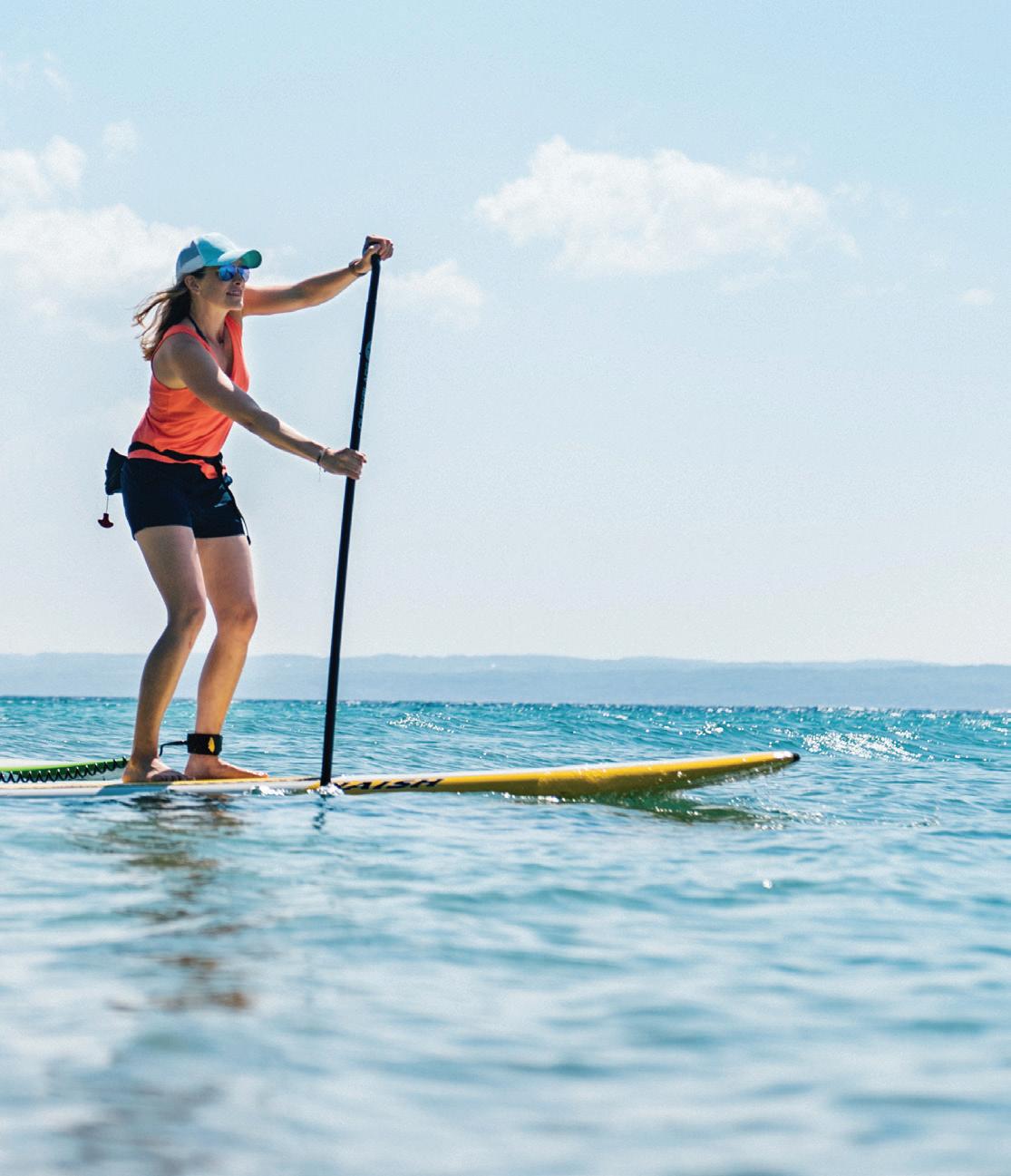
Her advice is simple. “Don’t overthink it. Just calmly balance. Stand up and keep your knees soft. Don’t stay too rigid.”
wear a life jacket and board leash.
For paddlers seeking something beyond open lakes, rivers provide a different rhythm. Miltner says the Pine River often leaves visitors with a lasting impression. “I would find it hard (to believe that) someone (would) walk away from paddling the Pine without feeling like their cup has been refilled,” he asserts.
“Our favorite paddleboarding section of the Pine is from Low Bridge to Norman Dickson,” Miltner adds. “This calm, relaxing float takes about an hour and 15 minutes, not accounting for stops or extra exploring.”
Ask Wiesen when she feels most grateful to live in Michigan and her answer comes quickly. It’s midsummer on Big Glen Lake, when the water is warm and the long daylight hours stretch into evening.
If you were to paddle west Michigan only once, she suggests waiting for July or August, when the lakes finally shed their spring chill.
But you may find once isn’t enough. Paddleboarding here becomes less about the sport itself and more about unlocking stillness in motion and the simple satisfaction of standing steady on the water.
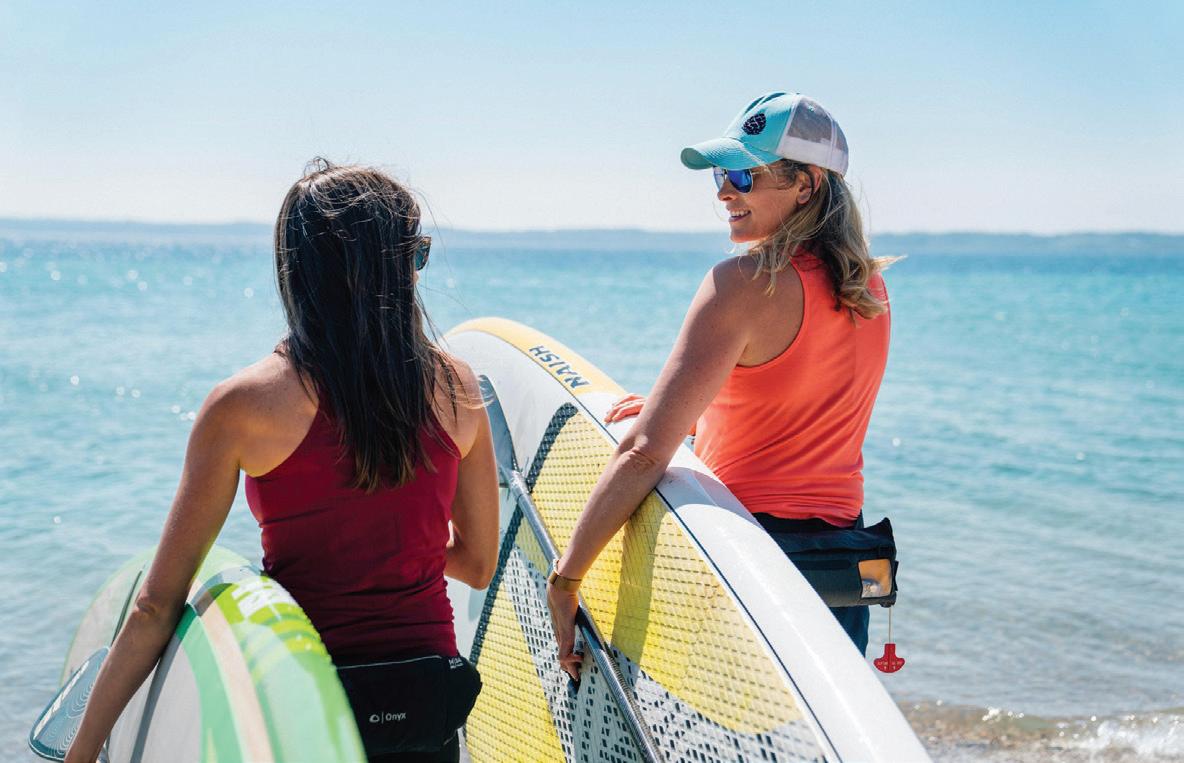
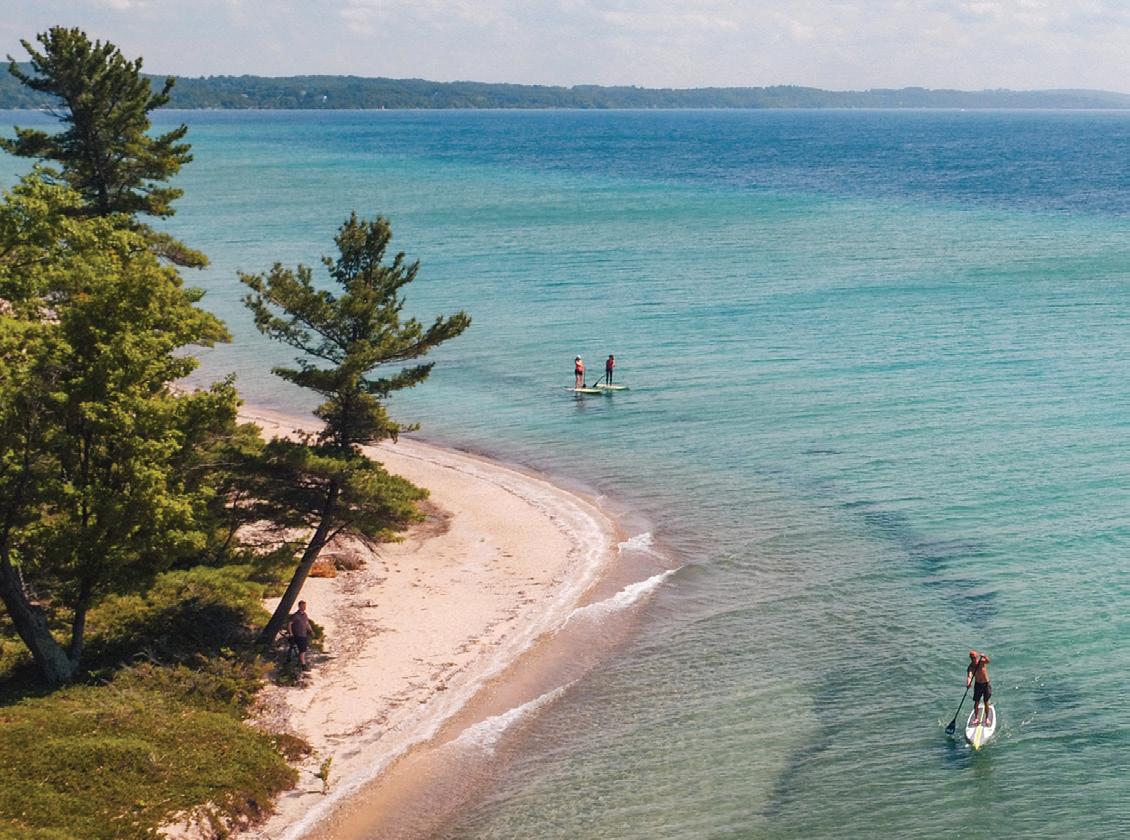
Above and opposite page: From the turquoise clarity of smaller lakes to the sweeping shoreline of Lake Michigan near the Sleeping Bear Dunes, west Michigan offers a remarkable range of paddling environments. Inland lakes provide calm water that’s ideal for paddleboarding beginners and families. Right: Boarders enjoy the solitude of Lake Michigan’s Grand Traverse Bay, near Traverse City.
Inflatable SUP boards built with dropstitch construction are remarkably stable, and many first-timers are surprised by how steady the boards feel beneath their feet.
Within minutes, nerves often give way to a smile, which Wiesen says is the sign someone is hooked. “Once they stay upright, once they find a smile on their face where their nerves once were, that’s when you know,” she says.
What paddleboarding offers beyond exercise is quiet access. “Peace and calm,” Wiesen says when asked what SUP provides that other watercraft can’t. “I love that you can take your board out in the morning or later evening, when the boats are tucked away. It’s a quiet moment with just the water.”
On Big Glen Lake, Wiesen describes water so vividly blue in midsummer that it looks almost Caribbean. “Being able to see the patterns of the sand below the water is amazing,” she says. “Paddleboarding provides a great bird’s-eye view of it.”
West Michigan’s beauty comes with responsibility. Conditions, especially on Lake Michigan, can change quickly. “When the wind picks up, that’s when it becomes humbling,” Wiesen says.
She says it’s important to check the forecasts, paddle with a friend, and always
In a region defined by lakes, rivers, and shoreline, that perspective feels like the most natural luxury of all.
Pine River Paddlesports thepineriver.com
Crystal River Outfitters Recreational District crystalriveroutfitters.com Pure Michigan michigan.org/paddle-sports
Why wouldn’t we?”
That’s the question Patrick Brys posed when discussing the inaugural Traverse City Food & Wine event, held last year in late August. With a host of wineries, a large batch of wonderful restaurants and award-winning chefs, idyllic freshwater surroundings, and an abundance of agricultural offerings, why not, indeed? It was time, Brys says, to create a top-notch event that honors Traverse City’s best culinary delights.
After experiencing the first of what will surely be at least several annual events, Brys has been reviewing how things went and making plans for an even better festival — if that’s even possible. This year’s festivities are slated for Aug. 19-23.
Blue magazine’s editor, Megan Swoyer, sat down with Brys, president and CEO of Brys Estate Vineyard & Winery in Traverse City (the fifth winery to be established on Old Mission Peninsula), and Whitney Waara, chief operating officer of Traverse City Tourism, to learn more about the ingredients going into this special extravaganza. Both Brys and Waara are on the festival committee. Brys also is a board member of both Traverse City Tourism and the state’s Pure Michigan Travel Commission.
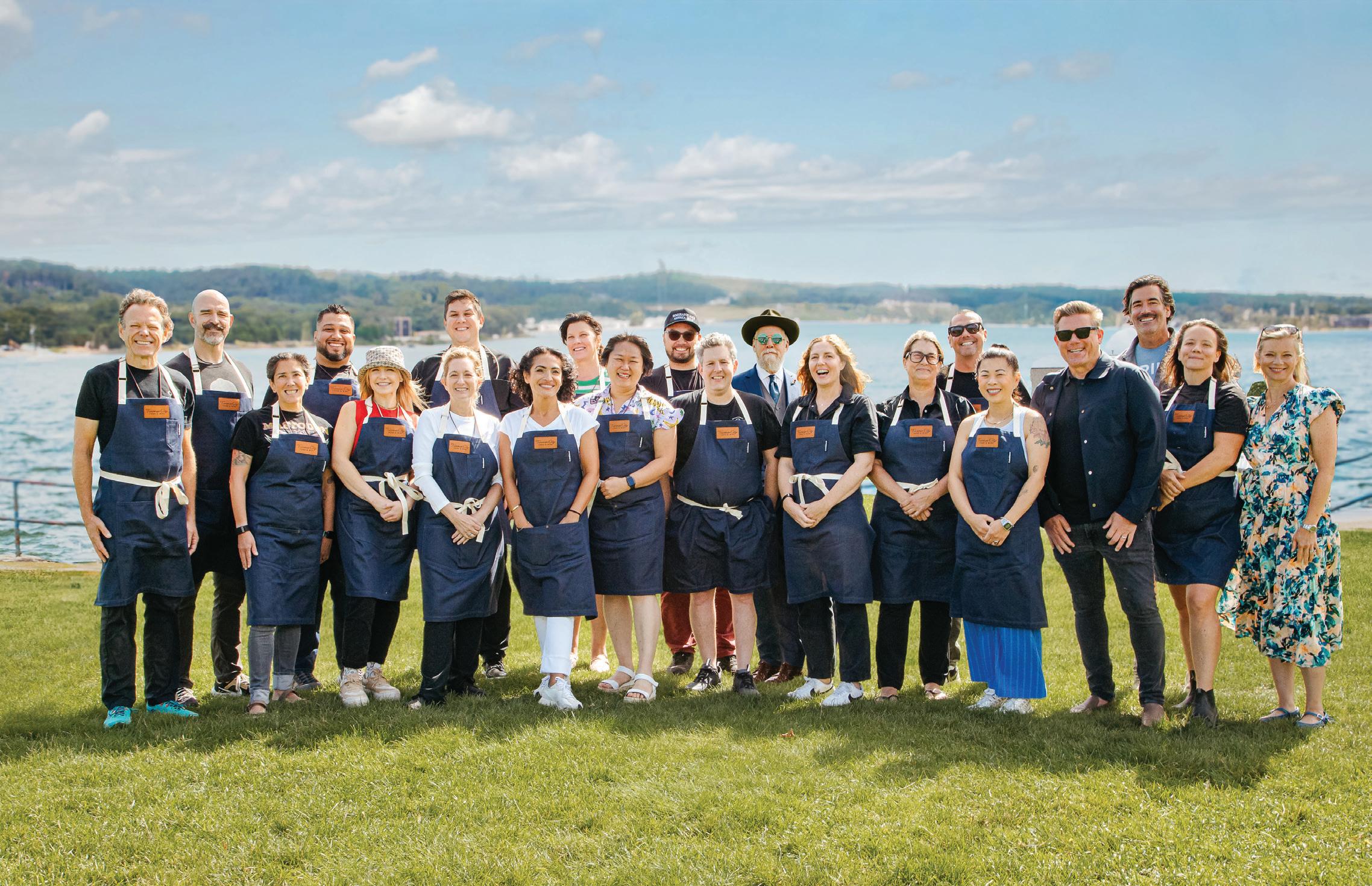
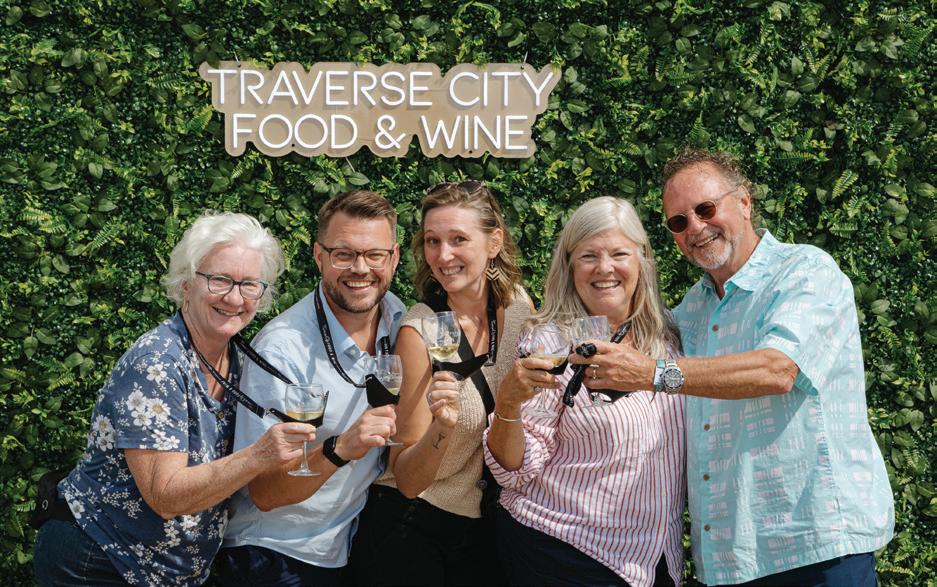
Top to bottom: Taking time out from their busy event schedules, chefs from around the nation pause for a celebratory photo near the lake. Festival-goers can sample and learn about everything from great wines to delicious hand-helds.

Traverse City’s Second Annual Food & Wine event spotlights the region’s best agricultural offerings
BY Megan Swoyer
Megan Swoyer: How did the first event go last year?
Whitney Waara: We had 4,000 tickets available and sold most of them.
MS: That’s amazing. To what do you attribute the success?
WW: We have different events for different budgets, so much of it is very affordable. There’s a little something for everyone. Also, it’s extremely local, as we were very focused on trying to gather as many locallygrown ingredients as possible. It’s uniquely Michigan and it allows attendees to get up close and personal with the makers who’ve built this business in our state.
MS: What were some of the most popular events last year?
WW: A real cool one that quickly comes to mind was the collaboration with the Boathouse Restaurant. It was held at the Brys Estate Vineyard & Winery and the Boathouse did the food, bringing in American barbecue-type fare. It was held during sunset, and I fondly remember the peach cobbler being out of this world. As I was mostly running around, I didn’t get to attend a lot of the events, but I know that the brunch on the tall ships was great, as were the goat yoga classes and farm tours, especially the tea farm tour.
MS: This year, should folks try to get their tickets well in advance for the more popular events?
WW: A lot of events sold out quickly, especially the high-end meals with exclusive experiences where you’re dining with about 20 folks and it’s intimate enough that you can really get to understand the foods and wines. The Coffee Shop Tour and roasting demo was another popular one. I’d say yes, it would be a good idea to get your tickets as soon as possible.
MS: How did the idea for this festival come about?
Patrick Brys: This area has such an agricultural abundance, the decision to do it was a no-brainer. The event is a natural fit with the community, as Michigan and the Great Lakes region rank second in agricultural diversity. We can grow (a greater variety of) items than any other state except California. We knew it would eventually happen.
WW: If we’re going to attract people to visit the area, we have to think about what
our assets are and how they differentiate us from other destinations. We talked to various businesses and so many were anxious to participate. More businesses and people bought into this than we anticipated. We’re excited that 4Front Credit Union was our main sponsor last year and will be again this year.
MS: How did the organizers decide on the timing of the event?
WW: August is peak harvesting season for a lot of fruits and vegetables, including grapes. And we needed several days because we’re bringing in guest chefs, throwing dozens of events throughout the area, and putting on a huge core event called the Grand Tasting. There will be food and wine at almost every activity. There will be non-alcoholic beverages, as well, at locales such as the Open Space.
MS: Tell me more about that Grand Tasting.
WW: It’s a marquee event held right on the water at Open Space Park in downtown Traverse City. It features more than 100 local wines, craft beverages, and gourmet
bites from local chefs, plus live cooking demonstrations by celebrity chefs. It can accommodate up to 2,000 people.
MS: What does your chef line-up look like?
WW: We’re in conversation (in April) with celebrity chefs. You’ll see some returning chefs and some new ones. We already have Cameron Rolka back. He’s chef/owner at Mink in Detroit and owner of Umbo in Traverse City. Also, Sarah Welch is coming. She’s a Top Chef and a James Beard nominee, plus a co-founder and partner at Marrow and Mink in Detroit, and owner of Umbo in Traverse City.
MS: What’s a Michigan wine grape stat that readers might not know?
PB: Pinot noir is the most planted red grape varietal in the state.
Traverse City Food & Wine traversecityfoodandwine.com
Most of the events are ticketed, so purchase yours now, online.
Right: Top Michigan chefs Sarah Welch and Cameron Rolka cook up some deliciousness at last year’s inaugural Traverse City Food & Wine event. They are slated to create culinary magic at this year’s event, as well.

BY Mark Spezia
From the solitude and rugged beauty of the Upper Peninsula to the tranquil countrysides of the southern Lower Peninsula, Thomas Funke will always treasure the time he’s spent traversing Michigan’s section of the North Country Trail (NCT).
Few people know it better than Funke, a Muskegon native and author of “50 Hikes on Michigan’s and Wisconsin’s North Country Trail” and “50 Hikes in Michigan’s Upper Peninsula.”
Michigan boasts the most miles (1,180) of the eight states through which the 4,800-mile NCT passes. The trail, which runs between Vermont and North Dakota, enters the state near Morenci, coming up from Ohio, and exits into Wisconsin just west of Ironwood. The North County Trail Association, which oversees the entire trail, is headquartered in Lowell.
Ready to hike? The North Country Trail winds through 1,180 majestic miles of our two peninsulas’ most scenic terrain
Funke has hiked all of the Upper Peninsula’s 550 miles and explored many Lower Peninsula sections while serving as director of conservation for the Binder Park Zoo in Battle Creek and conservation director for the Michigan Audubon Society. In all, he says he’s hiked more than 2,000 NCT miles.
“What I love about the North Country Trail in Michigan is how it flows through a variety of environments from near downtowns like Battle Creek to remote areas like McCormick Wilderness (northwest of Marquette),” Funke says. “Users can experience those very different areas and everything in between. Millions of Michigan residents live within an hour of the trail.”
Guidebook author Jim DuFresne — whose titles include “50 Hikes in Michigan” and “Backpacking in Michigan” — and NCT Michigan Trail Coordinator Kenny Wawsczyk can also attest to the trail’s variety as it traverses the state.
“Michigan has the best, most developed sections of the NCT and the largest array of terrain,” says DuFresne, who is cofounder of the Michigan Trail Maps website (michigantrailmaps.com). “There’s a marvelous section that skirts Traverse City
through the Pere Marquette State Forest to Kalkaska, then north through Petoskey, around Harbor Springs, and into Wilderness State Park near Mackinaw City. The U.P. portion is wild and interesting, especially the remote section running east from Grand Marais to the Crisp Point Lighthouse. Much of it is right along Lake Superior.”
Wawsczyk assumed his current role in 2015 after seven years as a Manistee National Forest trails crew leader. “What’s great about the NCT in Michigan is how it offers a great variety of landscapes but also has sections for people of all ages and ability levels — meaning those who think of themselves as walkers and not necessarily hikers,” he adds. “A good place for anyone to start is heading north from Croton Dam (in Newaygo).”
The NCT in Michigan is maintained by 12 chapters of volunteers. Each chapter
is responsible for a section. Chapters also organize group hikes, which are always open to non-members.
“Without the dedicated volunteers within our chapters, there is no trail,” Wawsczyk says. “They keep it clear and improve their sections of trail in any way they can, even building new sections so there’s less roadwalking involved. There are (also) volunteer opportunities other than trail labor, like chapter secretary or social media manager.”
Wawsczyk marvels at the way northern Lower Peninsula chapters responded to last year’s devastating ice storm, which stripped branches and limbs from thousands of trees. “They cleared about 100 miles of trail in three months,” he reports. “What an amazing example of how efficient and dedicated they are.”
DuFresne has assisted the NCT’s Grand Traverse Chapter with mapping of the Fife
Both pages, clockwise from far left: Lowell is a designated “Trail Town” for the North Country Trail (NCT) and hosts more than 8 miles of the trail in the immediate area.
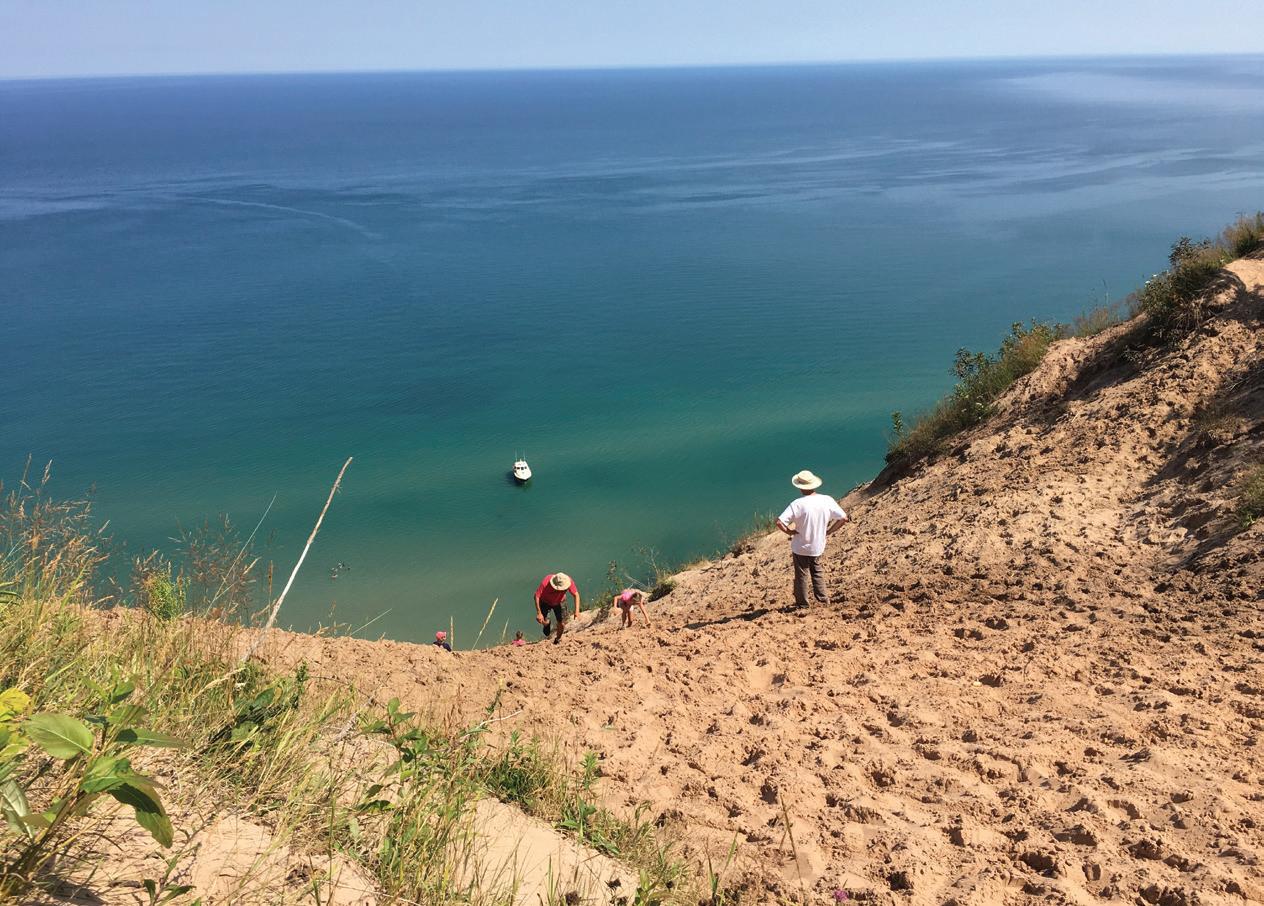
The Grand Sable Dunes Log Slide is a straight shot down a large dune that was once used to get logs to the lake so they could be floated to Grand Marais. Pictured Rocks National Lakeshore features sandstone cliffs, beaches, inland lakes, and more.
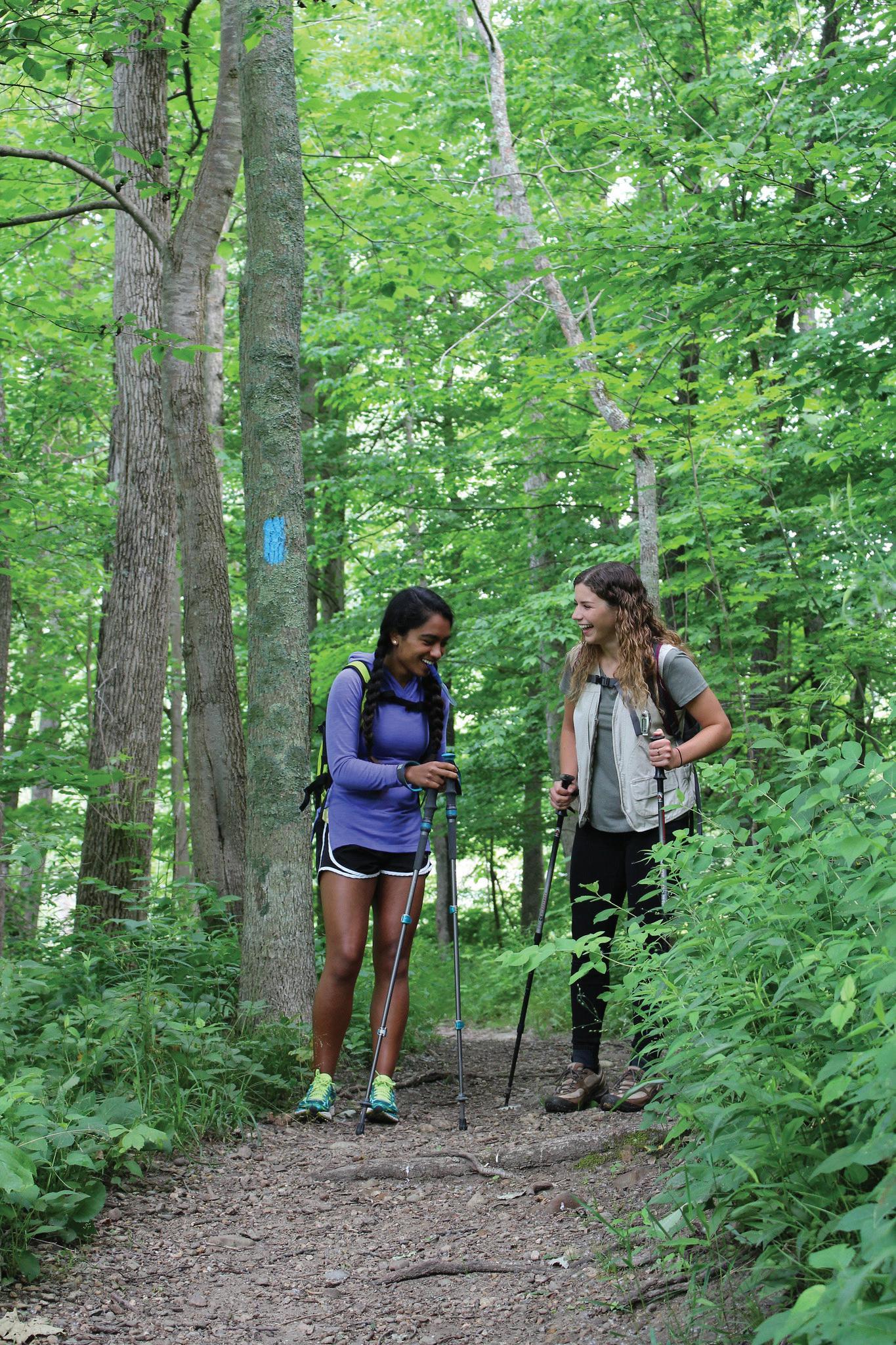
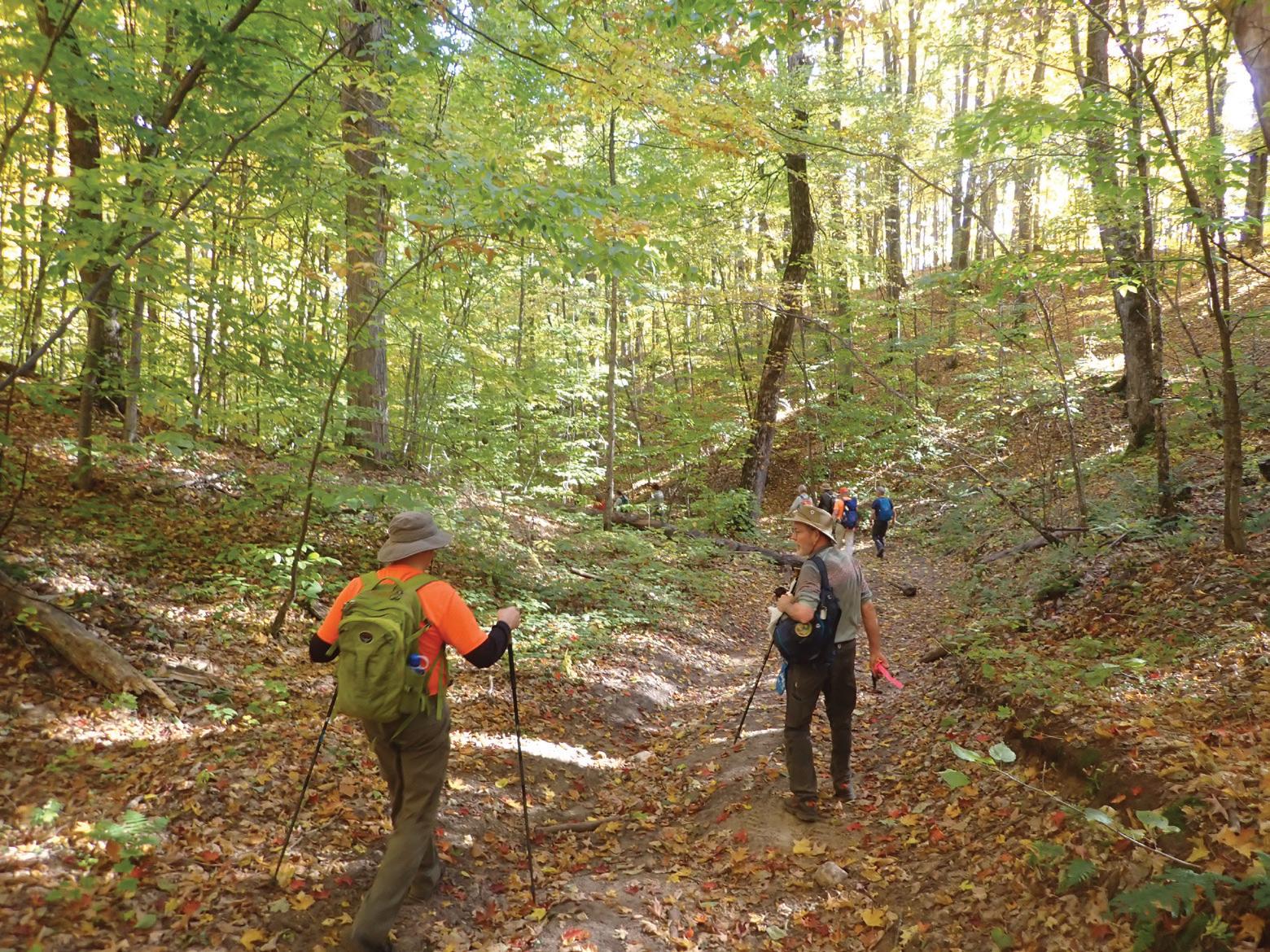
Outdoor buffs enjoy a day hike on the North Country Trail near Elmira. There are 12 NCT chapters in Michigan that take care of sections of the trail, and most of them organize group hikes that are open to non-members.
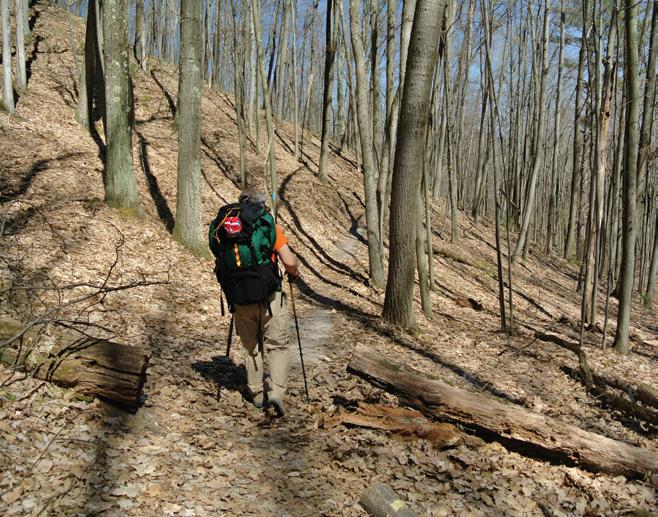
Lake Loop Trail, part of the 107 miles of trails the chapter maintains between Mesick and Mancelona.
“What these chapters do is remarkable, from cleaning up debris and clearing downed trees to building bridges and constructing boardwalks across swamps,” he says. “They paint blue blazes on trees and put up trail signs to provide direction.”
The NCTA also partners with numerous agencies — including several branches of the Michigan Department of National Resources, the National Forest Service, local parks and recreation departments, timber companies, and private landowners — to maintain and improve the trail.
In 2023, the National Park System officially designated the NCT as a unit of the park system, qualifying it for additional funding opportunities and resources, and affording it the same legal status as other NPS properties.
The NCT passes by a cave and covered bridge, among other landmarks, in southern Michigan before winding through state and national forest lands on the western side of the Lower Peninsula to the Mackinac Bridge.
In the Upper Peninsula, the trail heads northwest from the bridge, connecting several iconic areas such as Tahquamenon Falls State Park, Pictured Rocks National Lakeshore, and the Porcupine Mountains.
“My favorite NCT day hike is (5 miles) between the Upper and Lower Tahquamenon Falls,” Funke says. “I’ve hiked it too many times to count and it’s a unique experience every time.”
Below is a list of other NCT sections many hikers recommend exploring.
• A 7-mile section that passes through Lost Nation State Game Area, near Pittsford, features moraines left by retreating glaciers, wildlife along the St. Joseph River, ravines, and Silas Doty Cave.
• Another 7-mile stretch from Lowell to Fallasburg Park has a famous covered bridge and offers rolling terrain through the Lowell State Game Area, as well as views of the Flat River.
• Farther north, a section of the NCT combines with the Manistee River Trail near Mesick to form a 21-mile loop, while another portion is part of the 18-mile Jordan Valley Pathway loop near Alba. There’s also a 3-mile loop beginning at Deadman’s Hill Overlook.
• A roughly 3-mile section near Kingsley passes through Valley of the Giants, a tract of oldgrowth forest featuring towering virgin pines and hemlocks, and a creek with sprawling beaver dams.
• A 4-mile, out-and-back section near Petoskey known as the Skyline Trail begins with a descent through a thick forest of tall pines and has views of the Bear River Valley and Little Traverse Bay.
• From the Lakeview Trailhead south of Wilderness State Park, a roughly 2-mile, outand-back hike winds through a dune forest and past a peaceful creek and vernal pool. A spur trail leads to a stunning overlook of Lake Michigan’s Sturgeon Bay.
A DuFresne favorite: “The NCT section running along the Manistee River is scenic and rugged. The Skyline climbs above Petoskey to an observation platform for a nice view of Lake Michigan, especially after the leaves drop. The shorter loop at Deadman’s Hill is great for a quick fall color hike.”
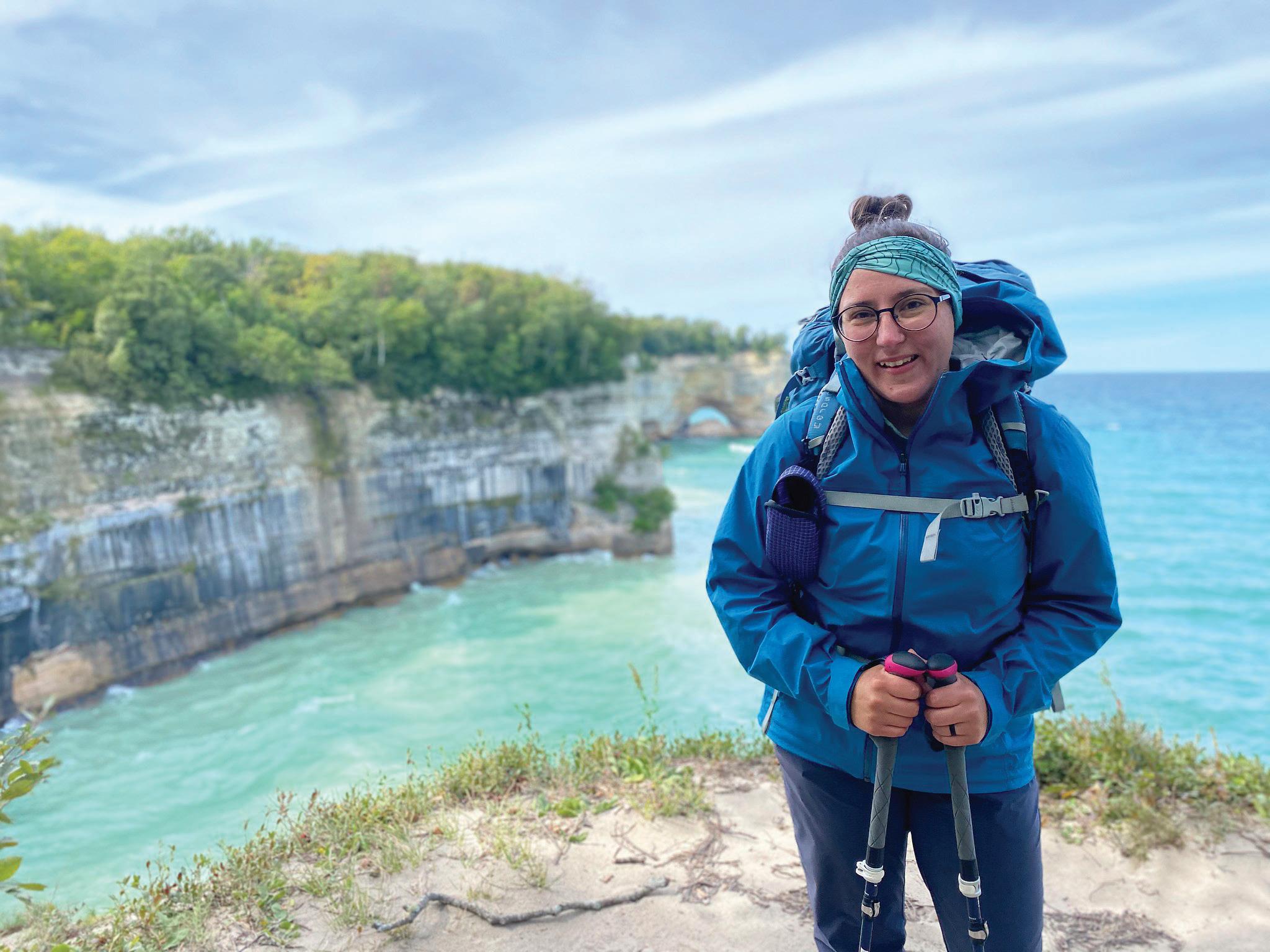
• The 42 miles along Pictured Rocks is considered the crown jewel of the NCT, taking hikers roughly 200 feet above Lake Superior at times. Experience the Grand Sable Dunes, the Miners Castle overlook, and the Chapel Loop trail, featuring two waterfalls, Chapel Rock, and breathtaking Chapel Beach.
• A 4.6-mile stretch from Wetmore Landing to Echo Lake Road just west of Marquette offers stunning stretches of Lake Superior beach, rock formations, towering red pines, cliffs overlooking the lake, and Little Presque Isle not far from shore.
• A remote, 7-mile section running along the southern portion of the McCormick Wilderness has rugged landscapes, craggy rock formations, and unique plant life such as rock tripe and lungwort lichen.
• The Trap Hills segment, near Bergland, is another must-do for those seeking solitude. Highlights include sweeping views, waterfalls, and rare wildlife such as the Eastern timberwolf and peregrine falcon.
• The NCT’s Porcupine Mountains Wilderness State Park section cuts through the park’s eastern section before swinging west past the Lake of the Clouds overlook to waterfalls on the Presque Isle River, which forms the park’s western boundary.
• Farther west, a 5-mile stretch along the Black River passes by five stunning waterfalls.
A Wawsczyk favorite: “Anywhere west of Marquette to the Porcupine Mountains is especially remote and wild. We spotted two bull moose working on a section near Craig Lake State Park. The Sturgeon Gorge area (near Baraga) is very scenic. Don’t miss the waterfalls, one after another, on the Black River.”
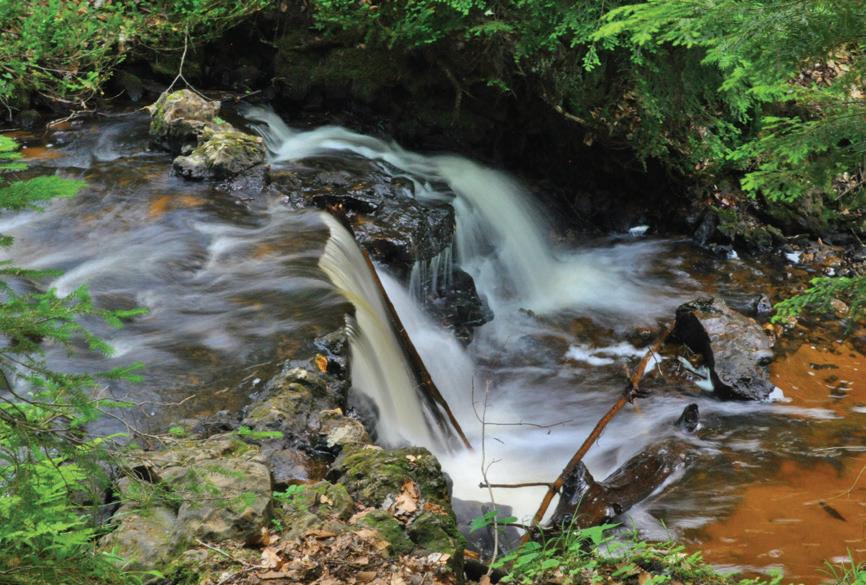
Above: Chapel Falls is a 60-foot, tiered waterfall located in the Pictured Rocks National Lakeshore. Below: A hiker enjoys the 20-plus-mile Manistee River Trail section of the NCT.
Plan It!
North Country Trail northcountrytrail.org/the-trail/michigan
The tough Links fairways at Bay Harbor Golf Club hugthe spectacular Lake Michigan coastline.
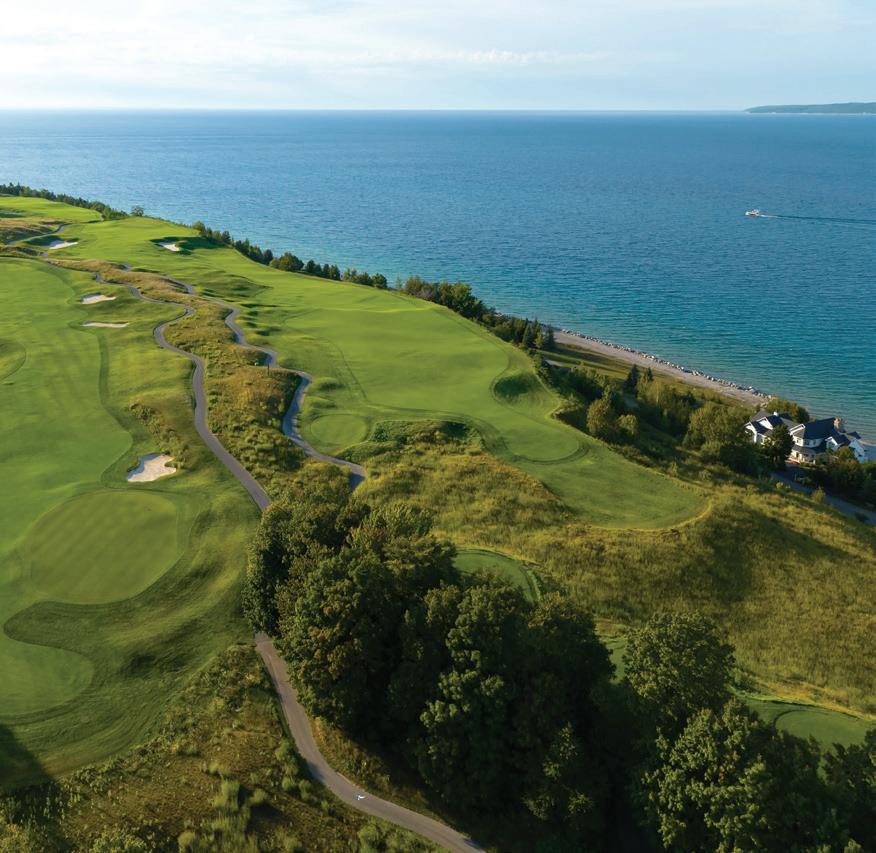
A+ SUMMER PLAYLIST: Northern Michigan golf destinations and courses continue to garner top rankings in national awards competitions. Earning the top spot in USA Today’s 10Best Golf Destinations category was Michigan’s Upper Peninsula, with its resume of fine tracts including the acclaimed Sweetgrass Golf Club at the Island Resort & Casino in Harris. Petoskey, with its 17 courses, shines as the No. 5-ranked destination. Boyne Golf (with 11 courses) captures the third position in the 10Best Golf Resorts honors. Black Lake Golf Club, meanwhile, ranked seventh on the 10Best Public Golf Courses in the country.
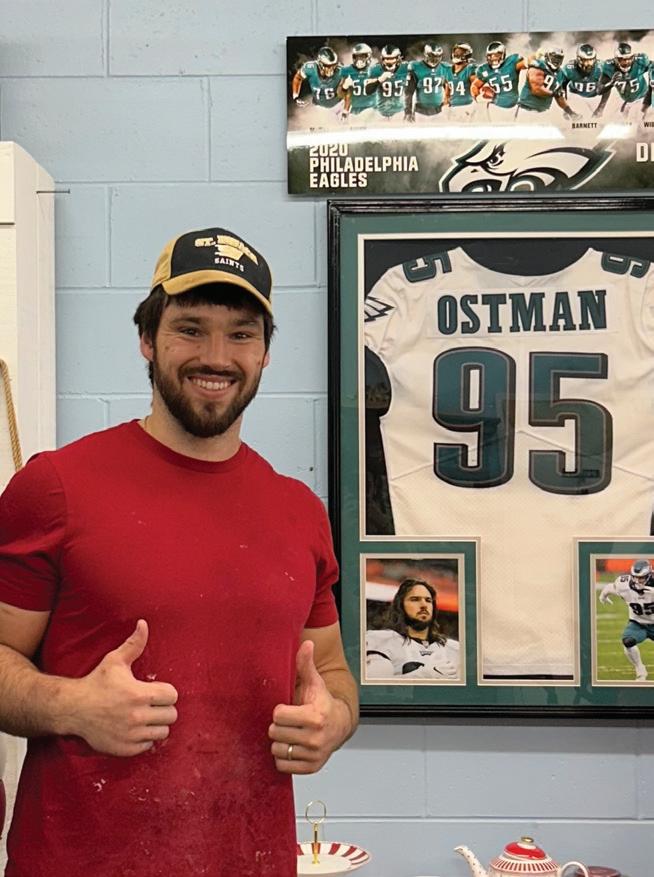
Joe Ostman’s NFL defensive end jersey hangs in the Mackinaw Bakery and Café.
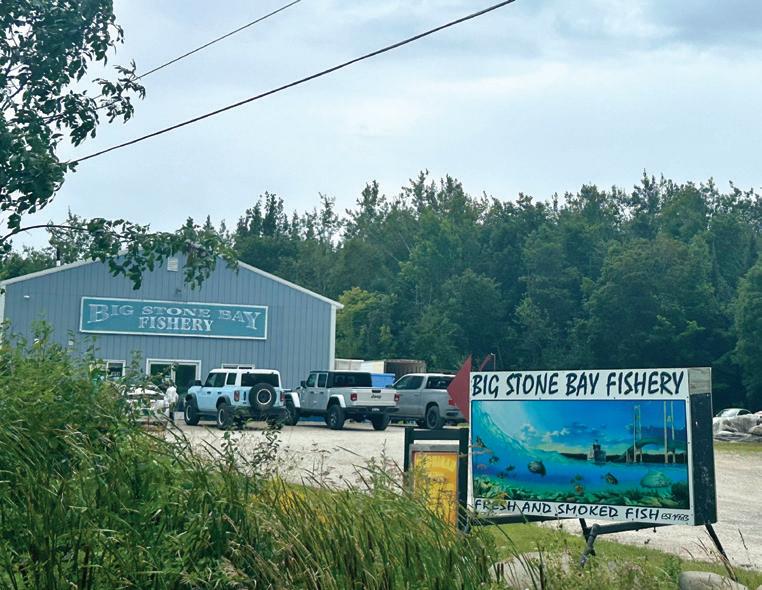
A FISH-LOVER’S FIND: After visiting some of the popular stops around the Straits of Mackinac, stop in at the Big Stone Bay Fishery, located on U.S. 23 just south of Mackinaw City, for some delicious take-home fish. Its specialty: fresh fillets of whitefish, trout, walleye, perch, and more, plus salmon in season, that are caught in Lake Huron and Lake Michigan. The staff will even pack your orders on ice. This laid-back retail/wholesale fish market, operating since 1983, also creates great hardwood-smoked fish, and whitefish sausage and spread. The maple-glazed smoked trout is divine.
From top tees to tempting treats, here’s a sampling of some Northern Michigan favorites
BY Ron Garbinski
PRO BAKER: From playing football at Central Michigan University and then as a defensive end for the NFL’s Philadelphia Eagles, Joe Ostman still exudes star qualities at the Mackinaw Bakery & Café, in Mackinaw City, where everyone loves to chat with him while sipping home-brewed coffee. The St. Ignace High grad now runs this fourthgeneration bakery that’s one of the north’s best shops for coffee, scratch-made pastries, and sandwiches. When an injury cut his football career short, he returned to baking at the bakery (he started there when he was 7). The donuts — and smoothies — are simply “oh my!” Expect a new menu and new look, too! mackinawbakery.com
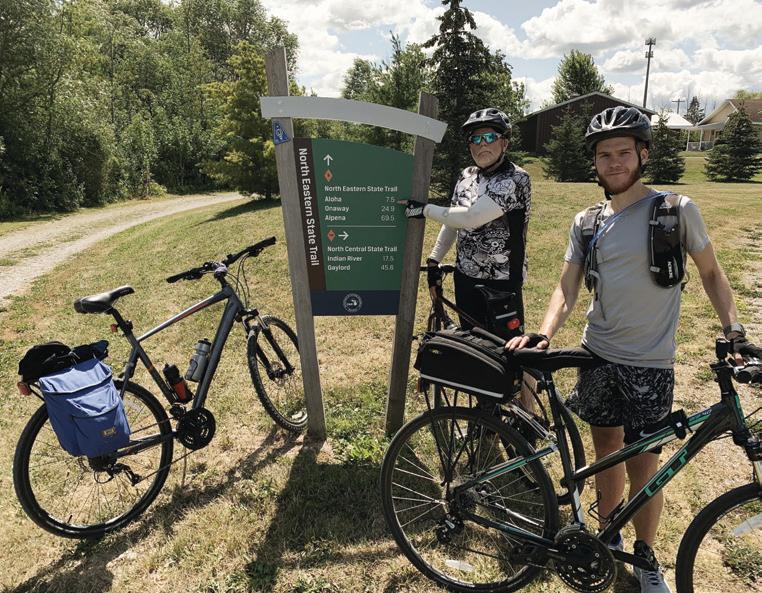
BIKING ADVENTURES: Three “you gotta do” rail-to-trail bike journeys through northern Michigan’s picturesque landscape garner high marks from cyclists of all levels. Travel the entire routes, or select delightful segments to enjoy out-and-back excitement. The 71-mile North Eastern State Trail, above, meanders from Alpena to Cheboygan. The fabulous 73-mile North Central Trail travels from Waters into Gaylord, on its way to Mackinaw City. The 32-mile North Western State Trail links Mackinaw City to Spring Lake Park near Petoskey, where it connects to the Little Traverse Wheelway into Charlevoix. For more amazing routes, visit trailscouncil.org

GF PIZZA, ANYONE?: Two tasty picks for Up North gluten-free pizza include the allergy-friendly Alcona Brew Haus (a Best of Blue award-winner in 2025, pizza shown above) on U.S. 23 in Harrisville and the casual Adirondacks Pizza, a new offering this season at Mission Point Resort on Mackinac Island. The Brew Haus caters to those with glutenfree and other allergies (or with no allergies!), and makes yummy GF pizzas, entrees, and lots more. Mission Point’s executive chef has created a gluten-free crust that isn’t cauliflower-based, with options such as wild mushroom and BBQ chicken pizzas that anyone can enjoy on the resort’s Great Lawn. alconabrew.com, missionpoint.com

SCENIC ART TOUR: The Aug. 22 Tunnel of Trees Art Trail leads visitors to fun stops including art studios, galleries, and more — along the enchanting M-119, between Harbor Springs and Cross Village. An art show at the Good Hart Artist Residency, the event’s host, is Aug. 22 and 23. Check out the live painting demonstrations at the Little Traverse Conservancy Nature Preserves and Thorne Swift Nature Preserve, and don’t miss Odawa art demonstrations at the King House in Middle Village. Shown here are some student works at Three Pines Studio & Gallery in Cross Village, a fantastic stop on the tour. goodhartartistresidency.org
BY Mark Spezia
Avid rider pedals far and wide on his way to becoming the leader of the League of Michigan Bicyclists
Trying to impress his grandfather while a boisterous toddler is Andy Rohrer’s earliest bicycling memory.
“I must have been no more than 4 years old, and the two of us went outside at a time when I had been wanting to start riding bikes,” recalls the new League of Michigan Bicyclists (LMB)
executive director. “I jumped on a bike that was in our driveway and was like, ‘Look, grandpa, look.’ ”
Going forward, Rohrer’s cycling adventures took him from rides near his Sparta home on his first 10-speed to trips on more advanced bikes to places such as one of Michigan’s first designated mountain biking spots, Cannonsburg State Game Area; the
pathways of Arlington, Va.; the forests of Germany; and along coastal areas of Spain and steep cobblestone paths in Belgium.
Last September, Rohrer’s robust passion for the sport led to him being named the LMB’s director.
“Learning the ins and outs of the new role has been like drinking from a firehose at times, but I’m loving it,” says Rohrer,
who before becoming the LMB’s director concluded a 26-year military career that included a stint as a senior defense policy adviser at NATO Headquarters in Brussels, Belgium.
Founded in 1981, the Lansing-based organization’s mission focuses on advocating for bicycle-friendly policies at the State Capitol; providing financial assistance to individuals and organizations with a shared mission; developing educational materials for bicyclists, motorists, and law enforcement; running several events and outings; and providing an extensive statewide calendar of bicycling events.
Rohrer wasted little time in getting involved. Last October, as part of a more active advocacy and education role, for example, he spoke with television station FOX 17 in Grand Rapids about the importance of understanding the differences between regular ebikes and higher-powered e-motos (with more powerful motors, higher torque and voltage), and how that confusion can shape policies and perceptions in ways that hurt cyclists.
“Sometimes, local municipalities lump ebikes and e-motos together when they’re completely different, because e-motos are almost like mopeds,” Rohrer explains. “It can lead to local ordinances that end up restricting where ebike riders can go.”
He has testified before the Michigan State House Judiciary Committee in support of the Vulnerable Road User (VRU) bills, which will strengthen penalties for drivers who cause injury or death to pedestrians, cyclists, wheelchair users, and other at-risk road users by increasing sentences.
“Too often, victims and their families in these cases don’t feel like they’ve gotten justice because charges are just misdemeanors,” Rohrer says. “For prosecutors, it’s either that or file attempted murder or murder charges — which are more difficult to prove. The
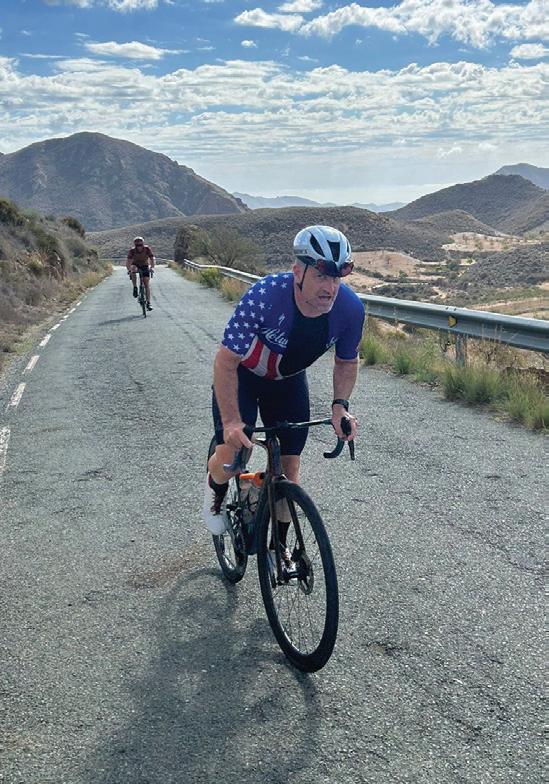
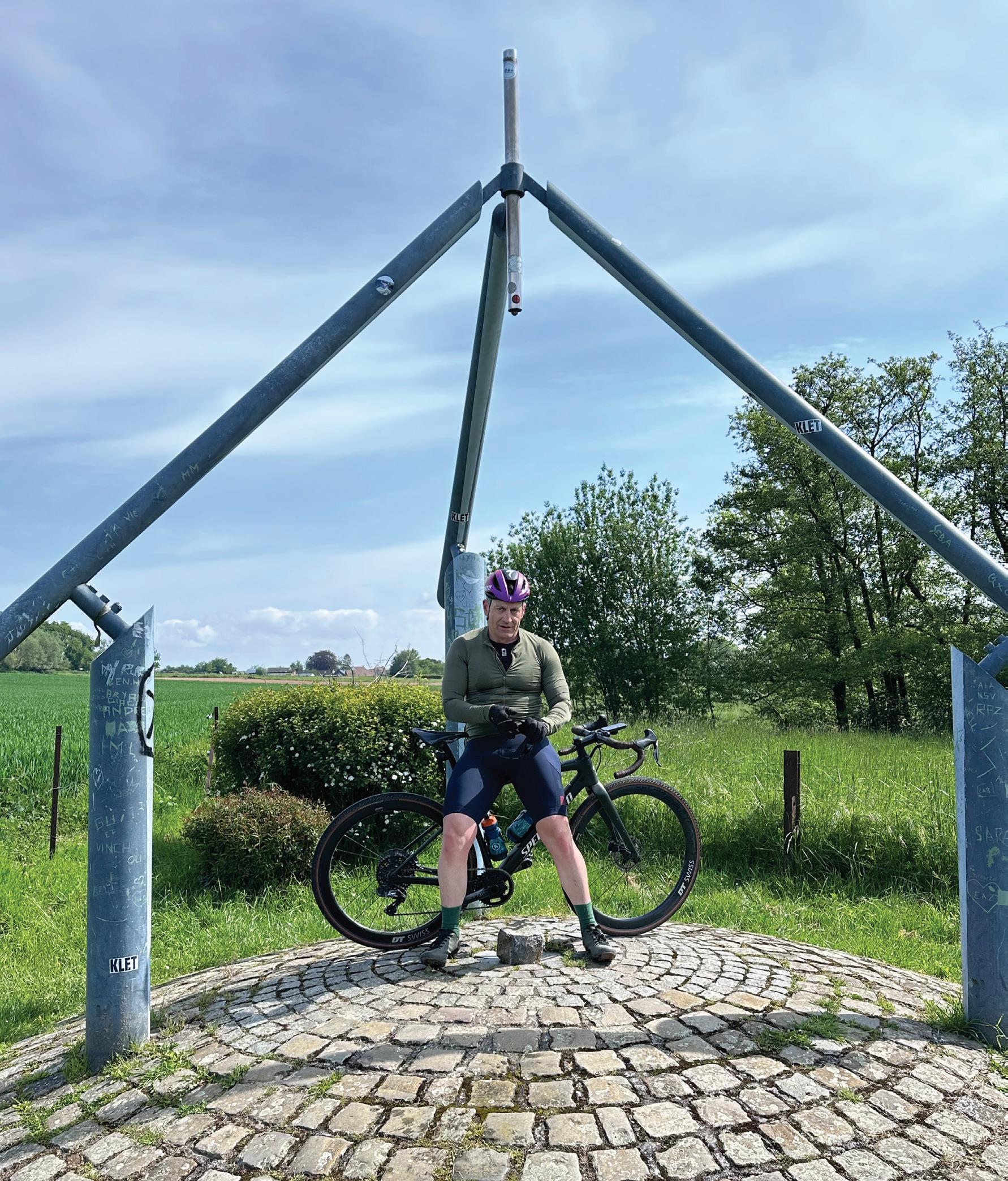
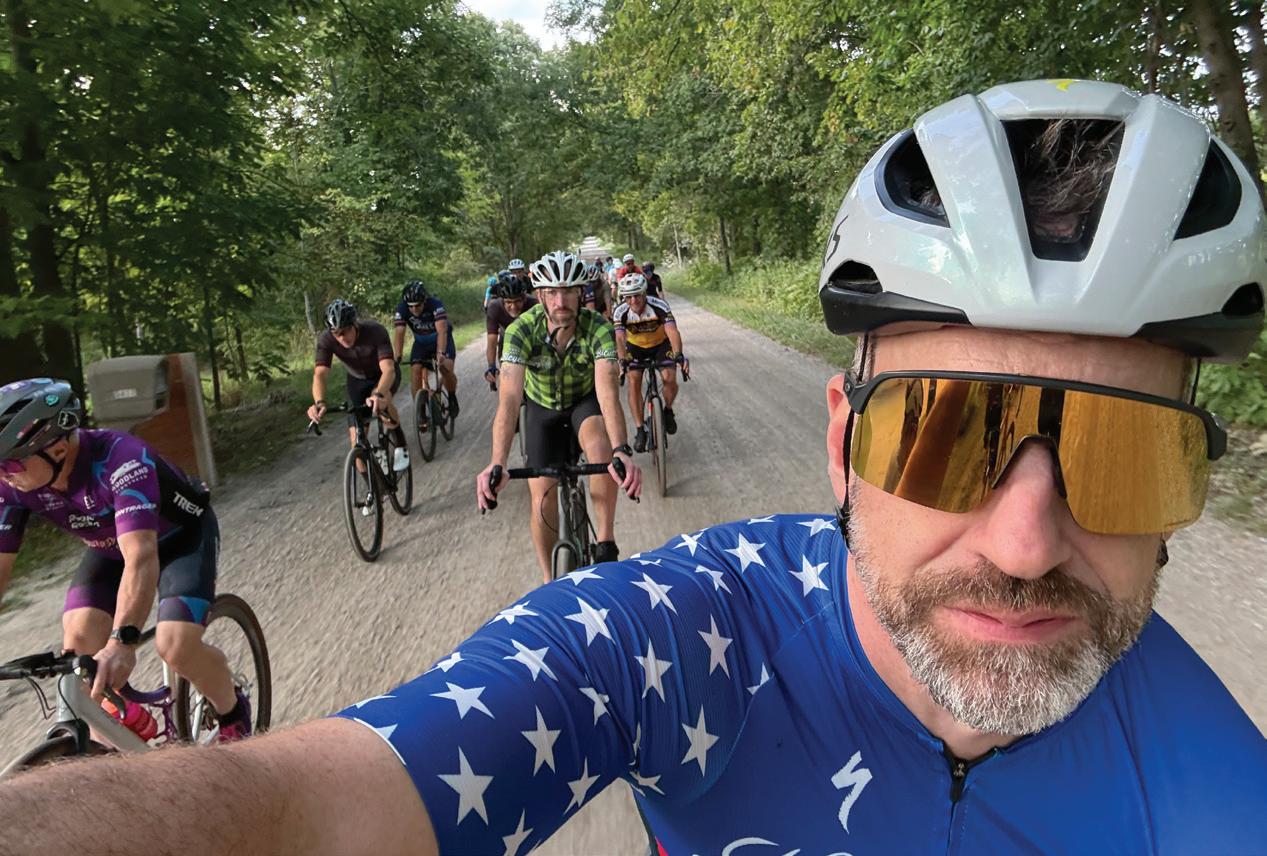
Right : After being hired to lead LMB, Andy Rohrer ventured out on a Tuesday night gravel ride in Kent County, east of Cannonsburg. Below: While based in Europe, Rohrer ended a ride with a climb west of Mojácar, Spain. Opposite page: The cyclist explored the geographic center point of Belgium (in the commune of Nil-Saint-VincentSaint-Martin, Wallonia) with two American friends.
VRU legislation fixes that.”
Rohrer’s strong advocacy and leadership skills immediately caught the attention of LMB staff members such as Events Director Neal Glazebrook.
“Andy was ready to roll up his sleeves and help remind communities across the state that LMB is here, actively working to make cycling in Michigan safer, more accessible, and more welcoming,” Glazebrook says. “He has shown a deep interest in Michigan’s racing community and new partnerships are taking shape under his guidance. Andy’s approach is centered on embracing, informing, and educating racers about the vital work LMB does for them, their families, and their broader cycling networks.”
For Rohrer, the 10-speed rides of his youth eventually gave way to mountain biking when he returned to the Grand Rapids area in the mid-1990s after earning a history degree from Spring Arbor College.
Upon enlisting in the United States Army in 1999, Rohrer took both of his bikes to the Fort Irwin National Training Center in California, where he was first stationed. His time for cycling waned during the next dozen years as he completed officer candidate school, married, welcomed two children, and served two tours in Iraq and one in Afghanistan.
His love of biking was fully reborn when he began working at the Pentagon in 2013, often commuting by bike 6 miles to work. Weekends were spent on the trail networks nearby and elsewhere.
Rohrer began his NATO tenure in the summer of 2020 as a strategic issues team leader before transitioning to his final role three years later. During those years, he pedaled on lots of scenic long-distance cycling adventures in Europe.
An uncanny sequence of events brought Rohrer and the LMB together. He learned of the opening through a friend just as he had begun the process of retiring from the Army with the rank of lieutenant colonel.
“(My friend is) an avid cyclist and sent me the job listing, and she suggested I would be a perfect fit,” Rohrer says.
Bill Brennan, chairman of the LBM, and his fellow board members agreed. “Andy impressed everyone with his exceptional communication skills and thoughtful approach to team-building, organizational strategy, fiscal responsibility, and public policy,” Brennan says. “After a thorough vetting process, we were excited to endorse Andy for the job.
“Andy has done a fantastic job connecting with staff and key partners, getting to know Michigan’s cycling scene, and putting together a strategy for our next phase of growth,” Brennan adds. “He’s making important decisions and recommendations about resource allocation and fundraising, and we’re looking forward to seeing Andy’s energetic stewardship for 2026 and beyond.”
More Information: League of Michigan Bicyclists lmb.org

BY Jamie Fabbri

Although she spent her childhood years in Paris, journalist Margot Guicheteau always felt pulled to Detroit, her Polish maternal family’s hometown. Ever since her first visit, she’s been deeply connected to the city. She currently calls the Core City neighborhood, near the I-94 and I-96 interchange, home.
“I still remember the first night I arrived (in Detroit, at age 24),” Guicheteau recalls. “I asked my cousin to take me to Poletown, where my mom grew up. It was 11 p.m., the air was freezing, and the atmosphere felt eerie, dramatic, and beautiful all at once. Although I had traveled to the U.S. every year and taken road trips since childhood, I had never seen a city like Detroit. Immediately, I felt at home. There was history here; there were stories that needed to be told.”
Her new book, titled “Soul of Detroit — A Guide to Exceptional Experiences,” is a 144-page paperback filled with vibrant photos. The guide highlights 30 of her most carefully curated gems, from hidden hotels to outstanding restaurants. Michigan Blue contributor Jamie Fabbri caught up with Guicheteau to dig into her experience as a Parisian in Detroit and find out how this book came to life.
PAGING READERS
Local writer shares stories about why she left Paris to explore the Motor City’s eclectic mix of hidden gems
Jamie Fabbri: What lured you to Detroit? Margot Guicheteau: I began my career at 21 as a journalist for the French national newspaper Le Figaro, writing for the lifestyle section, mainly about design. After a few years, I realized I wanted to tell stories that required being out in the field. I was searching for something more adventurous, more exhilarating. That’s what
led me to Detroit, where my mother was from. Growing up, I heard her tell stories about the places she used to go, places that had since disappeared. Detroit was a mystery to me, yet I felt connected to it.
JF: What led you to create this book?
MG: After my first experience in Detroit, I lived all over the United States — New York, Seattle, the middle of nowhere in North Carolina, and Nashville, yet I always found myself coming back to Detroit. No matter where I was, I was proud to talk about my time in this city, and eventually life brought me back here.
JF: Who is the book’s target audience?
MG: My collection highlights 30 hidden gems, so I hope the book appeals especially to people who want to discover the city in a more intimate way. But truly, it’s a book for everyone. I hope it encourages people who have never visited Detroit to come and experience this beautiful city for themselves. So far, I’ve met many people from the suburbs who are excited to return and rediscover places they had forgotten about, or never knew existed.
JF: From the 1,000 places you explored, how did you narrow all the possibilities down to 30 locations?
MG: They were chosen for how they have shaped — and continue to shape — Detroit’s unique identity. The city is full of magical places you won’t find anywhere else in America. The challenge is that in Detroit, everything is a little hidden. You have to push doors open, know someone who can take you there, make the effort to find them. What other city has a Hare Krishna temple inside a Ford mansion, a 1930s Russian sauna, the largest Masonic Temple in the world, chocolate made locally, farm-to-table food served straight from an Airstream on a vacant lot, or a bar where you can play feather bowling?
JF: Any personal favorites?
MG: Core City, the neighborhood where I live and built my house, is, I think, the most inspiring in terms of innovative structures. The inhabited Quonset huts, the Caterpillar, and the way the units interact with light while creating a feeling of warmth are deeply inspiring. The restaurant Barda is also unique, with its sunken 30-seat bar clad in vivid blue tiles. And, of course, the wildly imaginative Warren Gateway playground is a truly avant-garde structure.

JF: What’s your itinerary for an ideal day in metro Detroit?
Right: Guicheteau’s
“Soul of Detroit — A Guide to Exceptional Experiences” covers everything from iconic donut shops to cool playgrounds to happening techno clubs. Top: The Warren Gateway playground is a truly “avant-garde structure,” the author says. The modern playground features a large geometric climbing structure, a spiral slide, and more.

MG: I’d start at Trinosophes in the Eastern Market with a chai, the best in town, and a hearty breakfast. Then I’d get lost in John K. King Books, searching for hidden literary treasures. After that, I’d take a walk through the Arboretum Detroit or wander the Belle Isle Conservatory and Oudolf Garden Detroit on the island, observing how the plants evolve through the seasons. I’d pause at Detroit’s Huckleberry Explorer’s Club, in my neighborhood, and have all sorts of conversations with Stefany Anne Golberg and Morgan Meis, two of the most inspiring people I’ve met here, whose home and cardboard shrine museum always make me feel at home.
A few hours at The Schvitz sauna near the New Center area would follow. For dinner, I’d head to Sharaku (in West Bloomfield), an authentic Japanese restaurant. On the way, I’d stop along Woodward Avenue for a few donuts at Dutch Girl Donuts. If I stayed in Detroit for dinner instead, I’d go to Rose’s on Jefferson Avenue, which reopened after my book was published, and remains one of my all-time favorite spots. I’d end the day at Spkrbox on Grand River (a coffee shop during the day and a techno club at night). I love going there during the week. No other club really has much happening then, but Spkrbox always does.
MORE INFORMATION: Order the book at amazon.com, simonandschuster.com, or barnesandnoble.com.
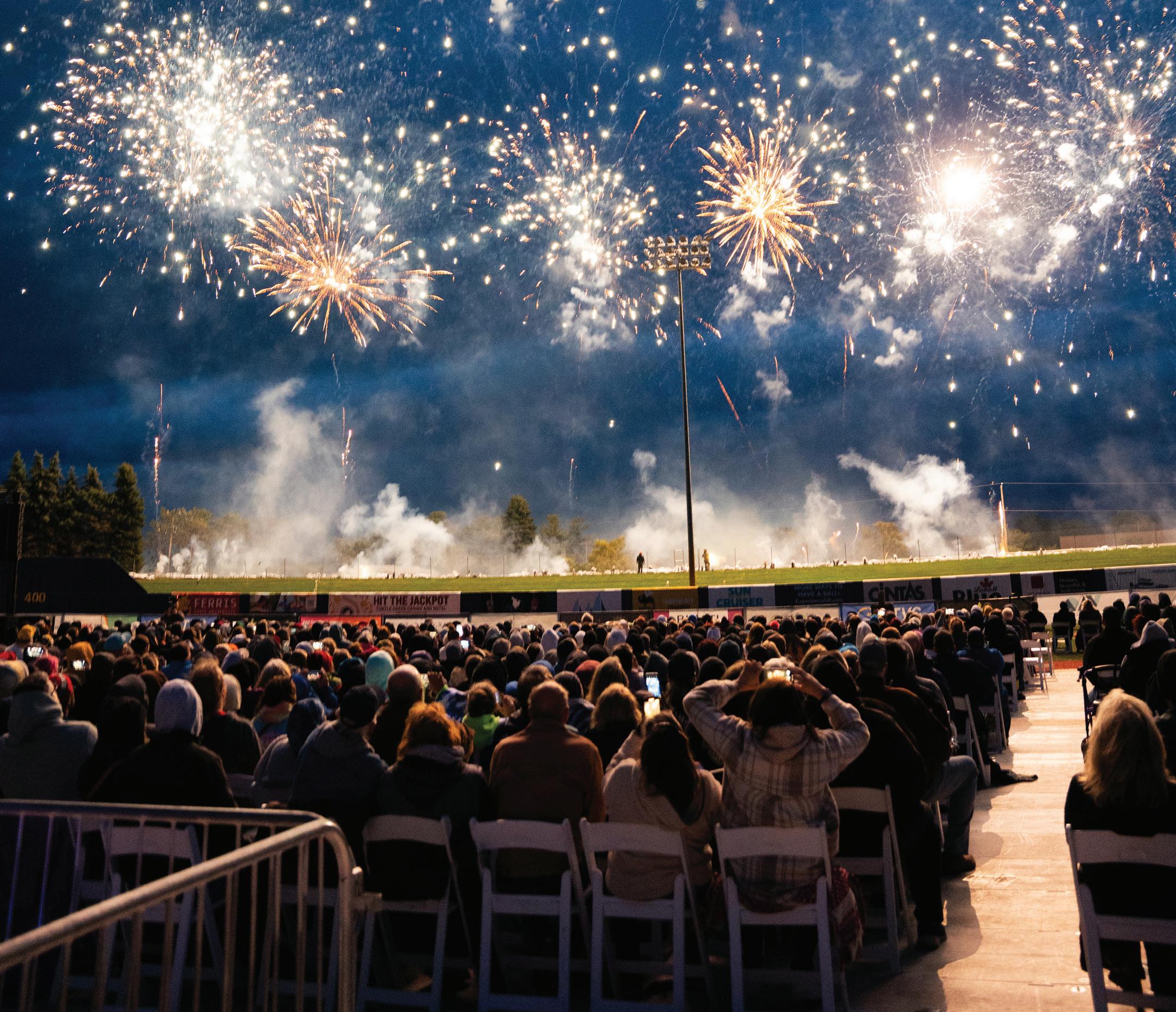
GLITTERING DISPLAYS: Grab your tickets now for the fourth annual International Fireworks Championship, hosted by Traverse City Tourism Sept. 11-12 at Turtle Creek Stadium. The show highlights six award-winning pyrotechnic teams (one of their displays is shown here) and consists of presentations by three groups each night, including a grand finale. “In the first three years of this competition, we attracted the top fireworks companies from around the world,” says TC Tourism President Trevor Tkach. “The teams were energized to choreograph presentations synchronized to music that were nothing short of spectacular.” Tickets are available for either Friday or Saturday night, or sold as a two-day pass. Group sales and sales of indoor suites can also be accommodated. Teams from Poland, Serbia, Portugal, Canada, China, and the U.S. competed last year. Team USA won the Audience Choice award on night one and Portugal won on night two, while Team Poland earned the Judges’ Choice award. traversecity.com
BEAUTIFUL LANDSCAPES: During this 50th-year celebration of the Arbor Day Foundation’s Tree City USA program, the Michigan Department of Natural Resources has announced that five new communities have earned recognition for work accomplished in 2025. Canton Township, Caro, Glen Arbor, Hamtramck, and Laingsburg received their Tree City USA designations for efforts to promote and care for their town’s public trees. They rank among 122 Michigan communities, seven college campuses, and seven health care campuses that now proudly display Tree City USA designations. “Our Arbor Day Foundation Program participants have done an amazing job with their tree work this past year,” says Lawrence Law, urban forester and outreach coordinator for the DNR. “Communities don’t plant trees for the present, but to make a positive difference to people in the future that we’ll never meet.” arborday.org/programs, michigan. gov/UCF
FIRST-TIME HONORS: What took so long?
The “Michelin Guide,” an international benchmark in fine dining, announced in April that it will finally include metro Detroit’s impressive culinary community in its American Great Lakes edition. Local Motown gems will be highlighted on a global stage, as evaluations by anonymous Michelin inspectors put them into consideration for designation as a one-, two-, or three-star Michelin restaurant. The Detroit restaurant selections will be revealed in 2027. “Being included in the newest edition of the ‘Michelin Guide’ is a transformational moment for our destination,” says Claude Molinari, president and CEO of Visit Detroit. “It signals to the world that our culinary scene has reached a level of excellence that’s worth traveling for. This isn’t just about recognition; it’s about real economic momentum for our entire region.” The Great Lakes guide will also include Cleveland, Indianapolis, Milwaukee, Minneapolis, and Pittsburgh. michelinman.com
— Compiled by Ron Garbinski
Have news that pertains to Michigan’s natural resources, travel, or exploration? Send a note to MSwoyer@Hour-Media.com.
















BY Giuseppa Nadrowski
With a bold style, this Traverse City artist focuses on blissful Michigan moments
Traverse City artist Katherine Corden’s paintings are admired for their beach-inspired scenes. Her love for creating started young, but it wasn’t a path she thought she could follow. “I loved art,” she says, “but I graduated high school during the recession, and out of a need for security and stability, I decided to study physical therapy.”
While pursuing her career in Chicago, Corden, who grew up in metro Detroit, began dabbling in art during her off days. She enrolled in figurative drawing classes, posted her work online, and discovered a community that encouraged her creative journey. In 2019, she and her husband moved to Traverse City. The move propelled her to work more on her art while slowly cutting
“It’s not representing a specific moment, but encapsulating the feeling of the whole day.”
— Katherine Corden
back on physical therapy until, as she says, “I was just doing all art.”
Today, Corden paints while balancing life as a busy mom of three. Her work is reflective of her northern Michigan location and of time spent with family and friends near the water. Her favorite beach to paint? The Frankfort Public Beach, near where her grandparents once lived.
While Corden brings along a sketchbook on beach days, it’s often easier for her to take “dozens of pictures,” then bring them to her studio at the Tru Fit Trouser building. “It’s like a puzzle,” she explains. “It’s not representing a specific moment, but encapsulating the feeling of the whole day.”
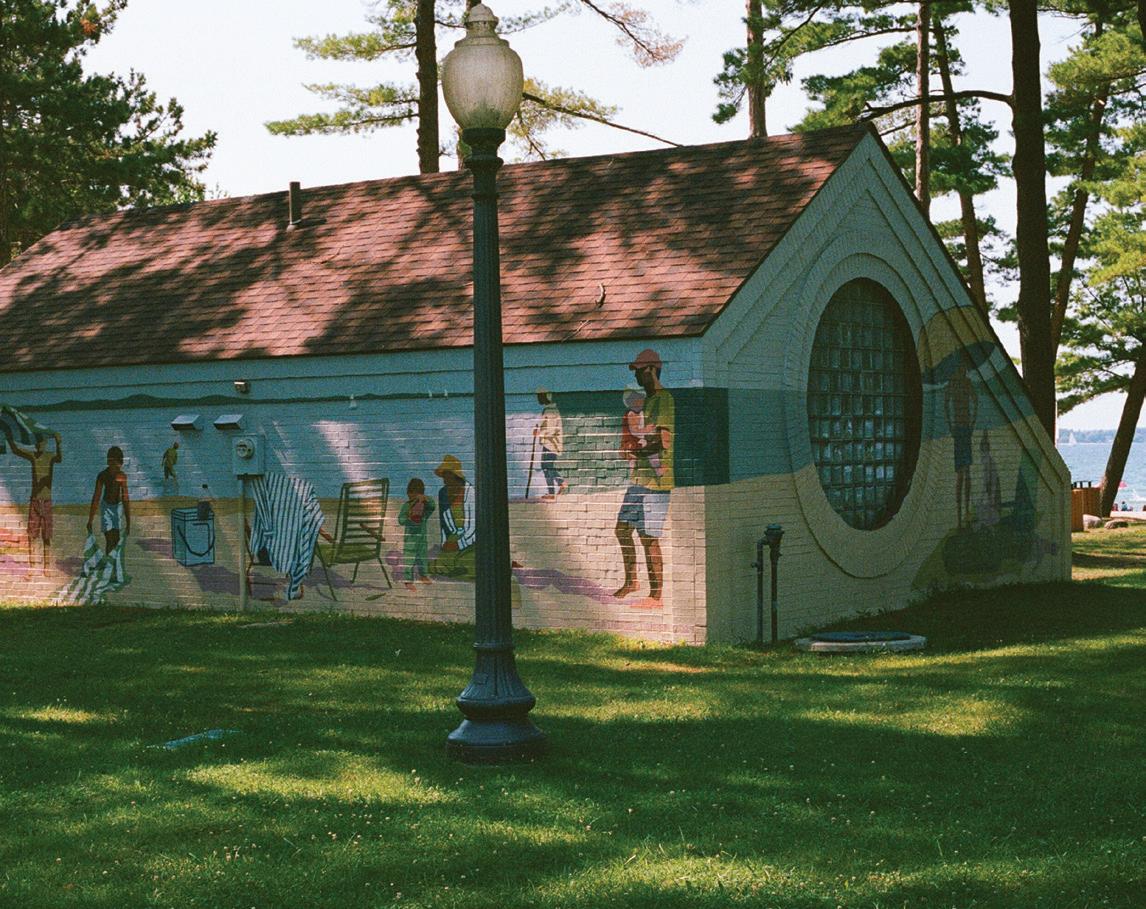
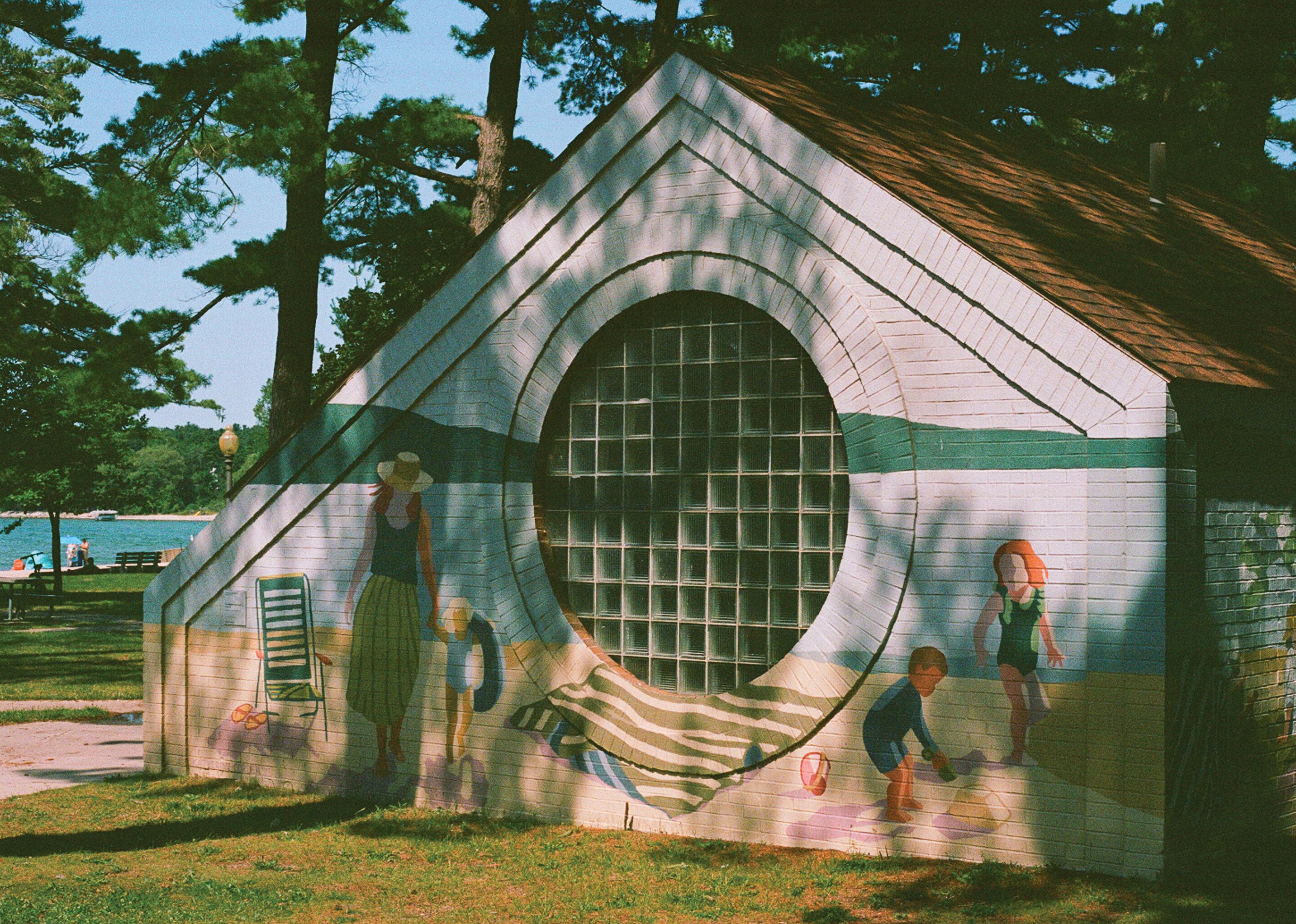
In 2023, the Traverse City Arts Commission selected Corden to create a permanent mural in Bryant Park, a place
she often visits with her children. Corden invited locals to join her there, and she photographed them for hours. She drew on those images to create the mural. “The (models) get to live on that wall and they know it’s inspired by them.”
Fascinated with color theory and light play, her work often depicts bold shapes and a social interaction element. She typically paints using acrylics, but she’s been experimenting with oils, too. “I really love the vibrancy of the oil paint and the ease of manipulation,” she says.
Currently, she’s creating two large pieces featuring the historic Glen Haven Canning Co. building. “You get these layers of color where you have this goldenrod dune grass with the ultramarine lake, a viridian strip of one of the Manitou Islands with the sky in the background, and then this giant square of red bringing you forward — I just think it’s so interesting.”
When asked why she creates art, Corden states: “It’s something that was inevitable for me. Even if I wasn’t doing it as my job, it would be something I would have to do for my soul.”
More Information: katherinecorden.com



Clockwise from top: Artist Corden focuses on color theory and light play in her works, which span a lakeful of subject matter, from beachgoers in search of the perfect sandy spot to Great Lakes lighthouses. Her light-filled studio is the perfect spot for turning out light-filled paintings that often begin with an initial sketch or photograph created at the beach.

STARS
Two
years ago, Amy
and
Joe Brisson
finished building and opened Heavens Edge Cottages. Here’s how they did it.
BY Megan Swoyer PHOTOGRAPHY BY Rick Houchin
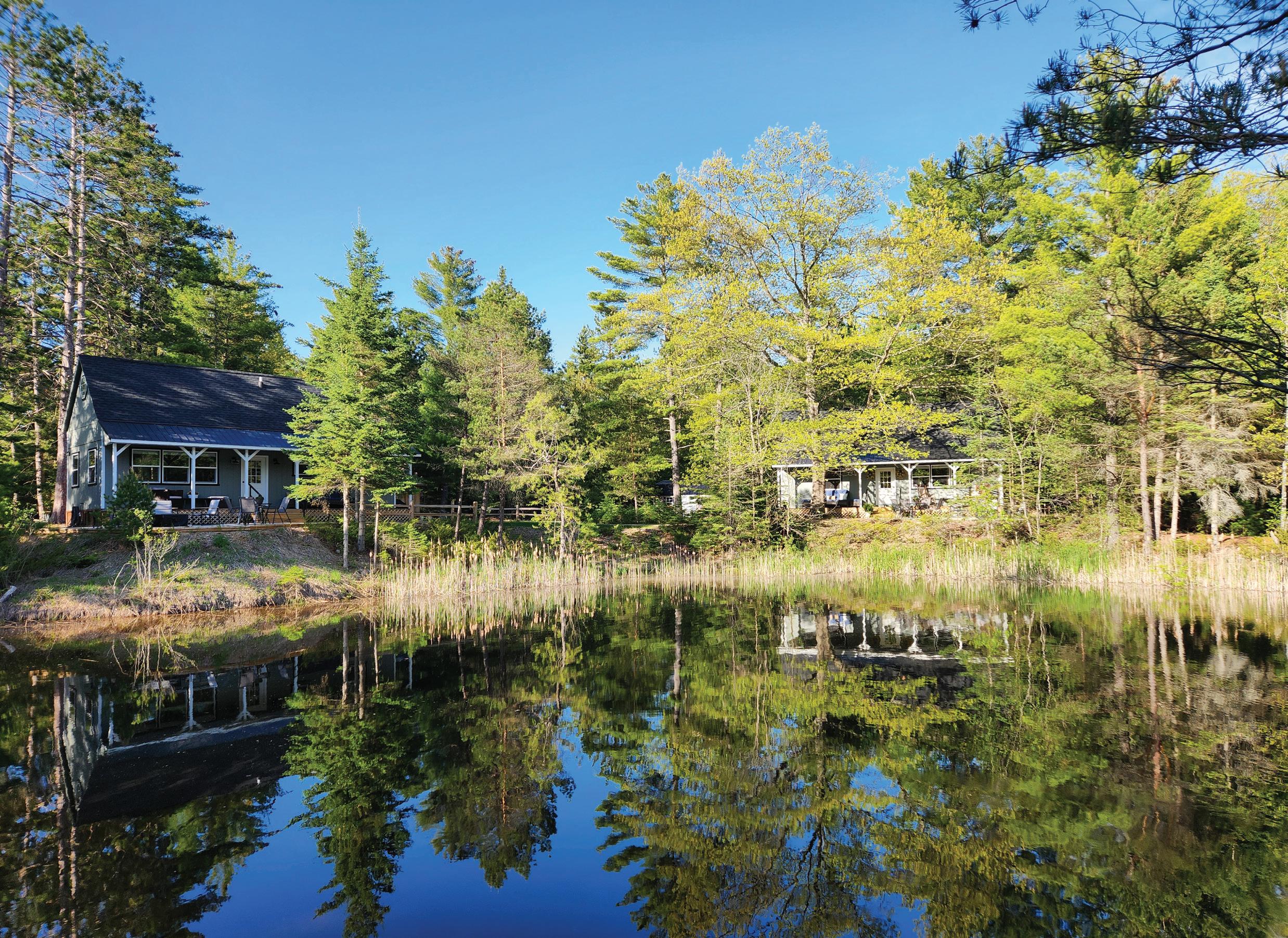
my and Joe Brisson had been contemplating building rental cabins for nearly six years before they welcomed their first guests to Heavens Edge Cottages in northeast Michigan’s Ossineke, just a short walk from Lake Huron, a year ago.
“We had a piece of property with a pond that definitely lent itself to something that could be just for us or could be for a business,” Amy says. “We’d been flirting with the idea of something in hospitality for a good while.”
In 2020, the couple decided to get serious about building the cottages, which are next door to their home. “We ordered the frames in 2020,” Amy recalls.
“We did it because we’re crazy,” Joe adds with a laugh.
Michigan Blue editor Megan Swoyer recently chatted with the 50-something couple about their experience.
Megan Swoyer: Were you both working when this idea hatched? How did you find the time to design and build the cottages and open a business?
Amy Brisson: Joe works full time, remotely, for a conveyor company and travels a lot. I worked for the health department, and I left my job 10 years ago after Joe was able to work remotely. I could travel with him, and maybe start designing the cottages. We found a company in the middle of Michigan that made large shed framess (Lakeside Cabins and Sheds), and you could design them however you wanted. Then I worked out a design, over a year’s time, for two cottages. Each has one bathroom, two bedrooms, and a blow-up mattress. And each has a heated outdoor shower.
MB: What were your design goals?
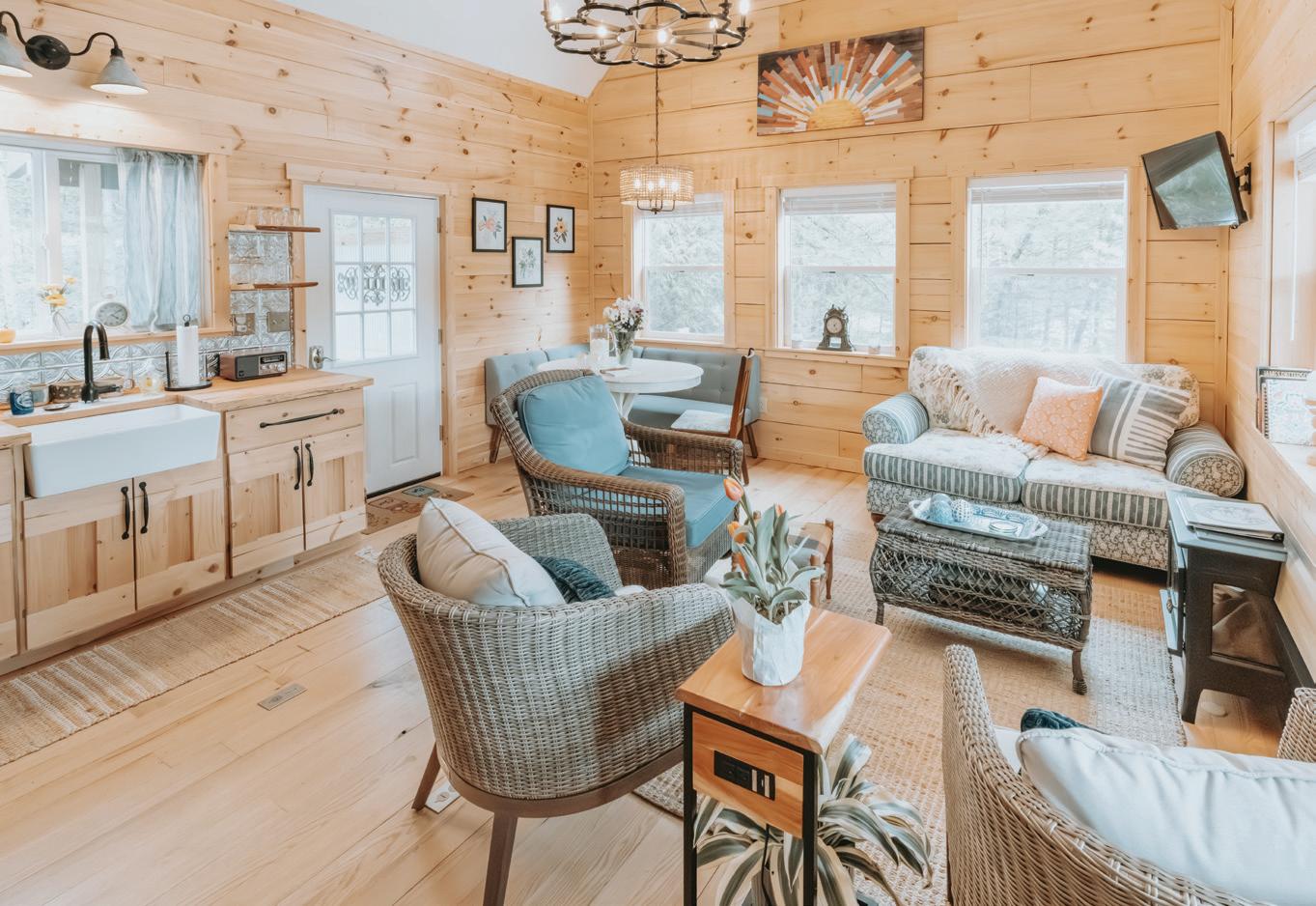
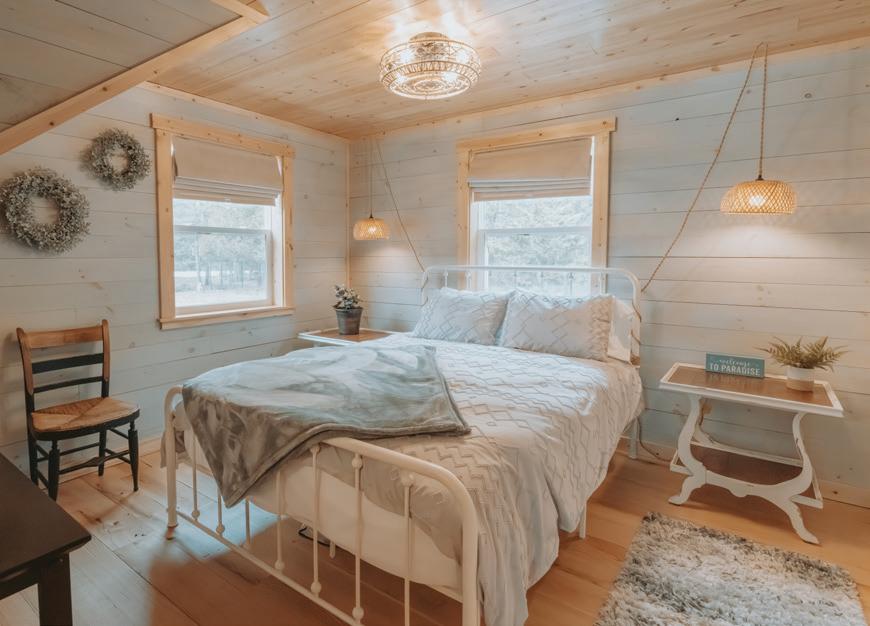
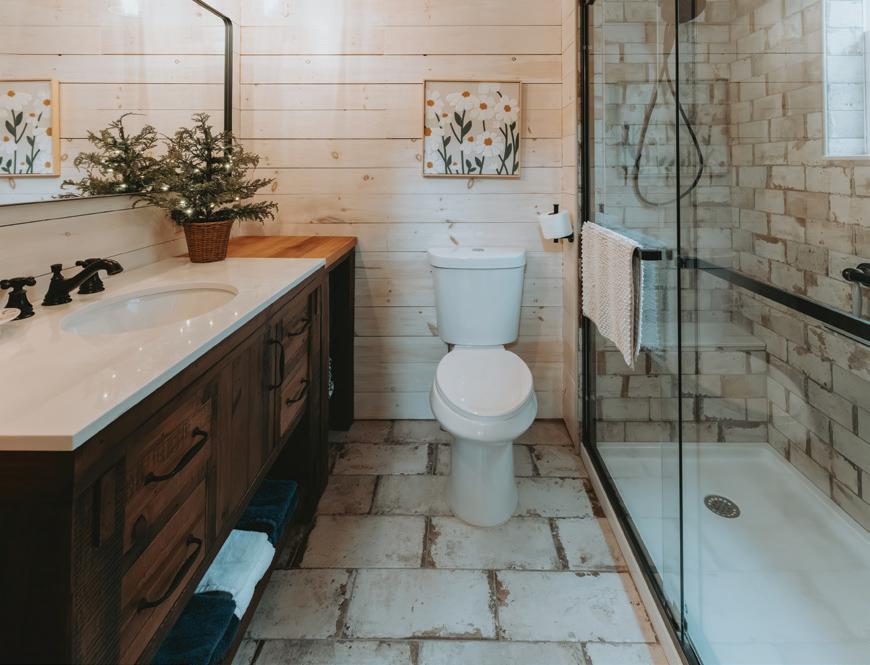
AB: I wanted them to be large enough to feel comfortable, but small enough to feel cozy. We went with a loft style. I also wanted them to be rustic and to feel old. Joe did all of the construction; only the
frames were ordered and built for us.
Joe Brisson: To get that rustic feel, we left wood on the main wall as wide as we could. It’s rough-sawn with no finish. Then I created all the cabinetry in the kitchens with a rustic feel, and we used live-edge (oak tree) countertops. I was crazy enough to buy a sawmill (ordered online), so I milled most of the wood for the interiors. We had support from an abundance of family and friends. Thunder Bay Electric and Lakeshore Plumbing and Heating, along with Meridian Contracting, also worked on the cabins.
MS: Where did you get your wood?
JB: A neighbor was taking down large pine trees and he gave us the logs. We also used maple and oak from neighbors and friends. One cabin we call The Oak (it has oak floors) and the other is The Pine, with pine floors. (The Oak has a six-person portable hot tub.)
MS: What can guests expect to see as far as artwork?
AB: We have photos by my son-in-law (Rick Houchin), a well-known local photographer. And we have pottery from local potter Rose Lynn Clay.
MS: Joe, how did you learn to do all of this? Does millwork run in your family?
JB: When we got married, we bought a house that needed work and I didn’t know anything. Amy said, Buckle up, pal; we don’t have money to hire someone to do the work (he laughs). So, I went to friends for information and bought the right tools. It worked out well; part of my goal now, in retirement, is to do some professional work in my woodshop for things like countertops and cabinetry.
:Top and middle: Amy wanted the spaces, including bedrooms and bathrooms, to be large enough to feel comfortable, but small enough to feel cozy. Bottom: In the great room/kitchen, Joe’s handiwork is made from regional wood that he turned into rough-sawn walls and cabinetry.
MS: What can guests do at the cottages and what’s nearby for outings and diversions?
AB: We have horseshoes, cornhole, bicycles, private gas fire pits, and grills. Also, there’s a community wood fire pit. And, of course, people love the pond. If they want to go out they can ride bikes to the beaches (Beebee Beach, Sanbirn County Beach, and Ossineke State Forest Beach), or head to the nearby state parks (Harrisville State Park, with beautiful trails and a lovely swimming beach, and Negwegon State Park, also on Lake Huron and a state-designated dark sky preserve, making it an excellent spot for stargazing and viewing the aurora borealis). Several lighthouses are located nearby, as well as great fishing spots. I have a book in each cabin that has ideas for the best cinnamon rolls, pizzas, fine dining, and more. Folks can also go morel mushroomhunting in the spring. We have lots of games and puzzles in the cabins, too. And there’s Dinosaur Gardens just one mile away.
(Editor’s note: Nearby Alpena has great dining, glass-bottom boat tours that cruise over shipwrecks, the Thunder Bay National Marine Museum Sanctuary, a nauticalthemed movie theater, and ice cream and coffee shops.)
MS: Visitors to this side of the state find it a little quieter than other areas. Nature is truly at your fingertips, right?
AB: Oh, yes. I said to Joe that this area needs to be shared with others. It’s a sanctuary. You can really feel the universe touching you in this region. People are seeking a literal getaway — to get away from all the noise and confusion and busyness of life. Meanwhile, at the cabins, we see just about every kind of Michigan bird, owls, deer, otters, and turtles (snapping, painted, and blanding). The pond is full of large perch and sunfish, and people like to feed the fish. Ducks nest here every year, including mallards and wood ducks.
MS: Are the cottages handicap-accessible?
AB: Yes. The Oak has a ramp, and both have no-step showers.
MS: I know you want it to feel remote, but is there internet service?
AB: I fought Joe on this topic (she laughs), but he insisted — so, yes, we have WiFi throughout the property, as well as a television in each cabin.
Plan It!
Heavens Edge Cottages heavens-edge.com
STYLED BY Giuseppa Nadrowski 8

























































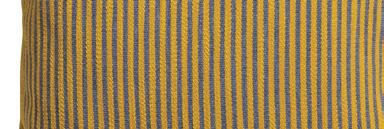
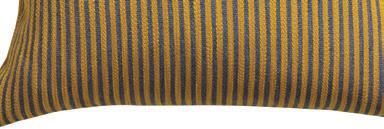


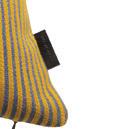



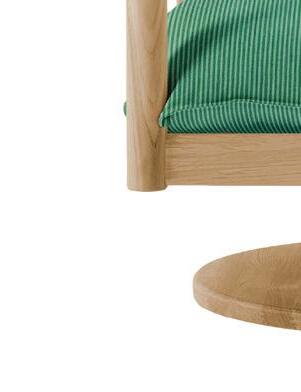





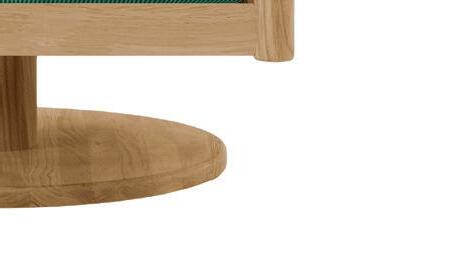
Line up your décor acumen with these on-trend pieces perfect for summer vibes
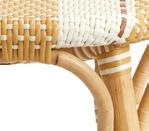
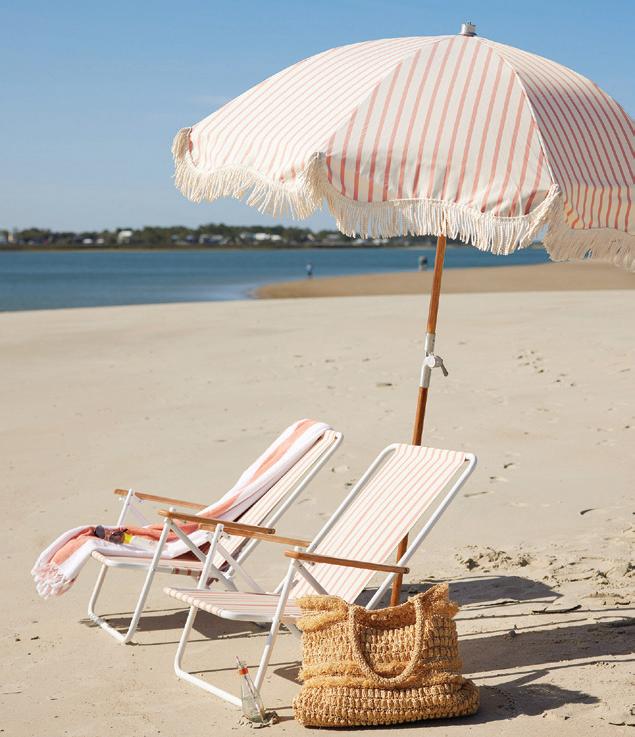
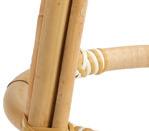
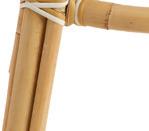
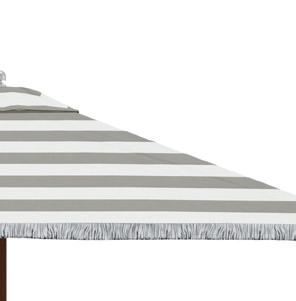
1. In “Everybody Loves Stripes: Decorating Between the Lines,” SCHUMACHER shows readers how top designers across the world use this timeless motif in their décor. $54.95, Schumacher, Michigan Design Center, Troy, shopschumacher.com 2. The Maharam Concord Indoor/Outdoor Pillow by Paul Smith at DESIGN WITHIN REACH features petite stripes and playful color options (shown here in Monitor) that are perfect for any cottage aesthetic. $200, Design Within Reach, Grand Rapids, dwr.com 3. DESIGN WITHIN REACH’s Terassi Swivel Lounge Chair, shown here in teak with a whimsical Basilisk concord stripe Sunbrella® fabric, was inspired by 1930s-era furniture that was discovered at a lodge in Oregon. $4,395, Design Within Reach, Grand Rapids, dwr. com 4. The lemon-yellow stripes of MADE GOODS’ ceramic Betsy Stool are sure to sweeten any space. To the trade, Made Goods, CAI Designs, Michigan Design Center, Troy, caidesigns.net, madegoods.com 5. Showcase your summer farmers market finds with POST DETROIT’s Costa Blue Stripe Ceramic Grater Plates, which can grate, smash, peel, and crush veggies, fruits, and herbs. From $38.50, Post Detroit, Detroit, mutualadoration.com 6. TUCCI’s iconic Bay Master M1 Classic takes on the season’s favorite print in this striped canopy. From $1,425, area Gorman’s Furniture stores, gormans.com, tucci.com 7. SERENA & LILY recently updated its beloved Riviera Rattan Bistro Counter Stool with a new striped seat. $328, Serena & Lily, Birmingham, serenaandlily.com 8. Relax in style when you’re poolside or at the beach! All you need is this striped Mallorca Beach Towel in Seashell from SERENA & LILY $88, Serena & Lily, Birmingham, serenaandlily.com

















































Grand Rapids Magazine is the essential guidebook to the good life in Grand Rapids. As the premier bi-monthly life and style publication in West Michigan, the magazine exudes the excitement, complexity and style associated with West Michigan.
Grand Rapids is our beat. We capture the flair and vitality of the city and present it in a unique and creative style that blends award-winning journalism and depth of knowledge with engaging editorial.


To subscribe today, Scan the QR Code - ORgo to grmag.com/subscribe for your one-year subscription for $24.00








































































































































A
photographer captures some of the most beautiful members of the waterfowl world at Seney National Wildlife Refuge
Photography by Teresa McGill Text by Megan Swoyer
Teresa McGill and her husband, Michael, have lived in northwest Michigan’s Central Lake area for more than 45 years. She graduated from Central Michigan University with a Bachelor of Science in business administration, but discovered a passion for wildlife photography more than 25 years ago. Today, she spends as much time as possible at Seney National Wildlife Refuge in the eastern part of the Upper Peninsula, arriving before sunrise to photograph wildlife — especially loons. McGill says she enjoys observing the birds from the time they return to the north country to nest and raise
their young until they leave in the autumn. The photographer journals her observations, and then shares them with the facility. When she’s not at Seney, McGill enjoys studying the American bald eagle or monitoring snowy owls.
“I love to educate, and promote conservation and the importance of guarding our natural resources,” McGill says. “(I also like to) educate others on how to ethically photograph and respect our wildlife. I love to blend into the environment and quietly observe my subjects, being as unobtrusive as I can. Blending artistry and nature into one is a satisfying venture that I love to share.”
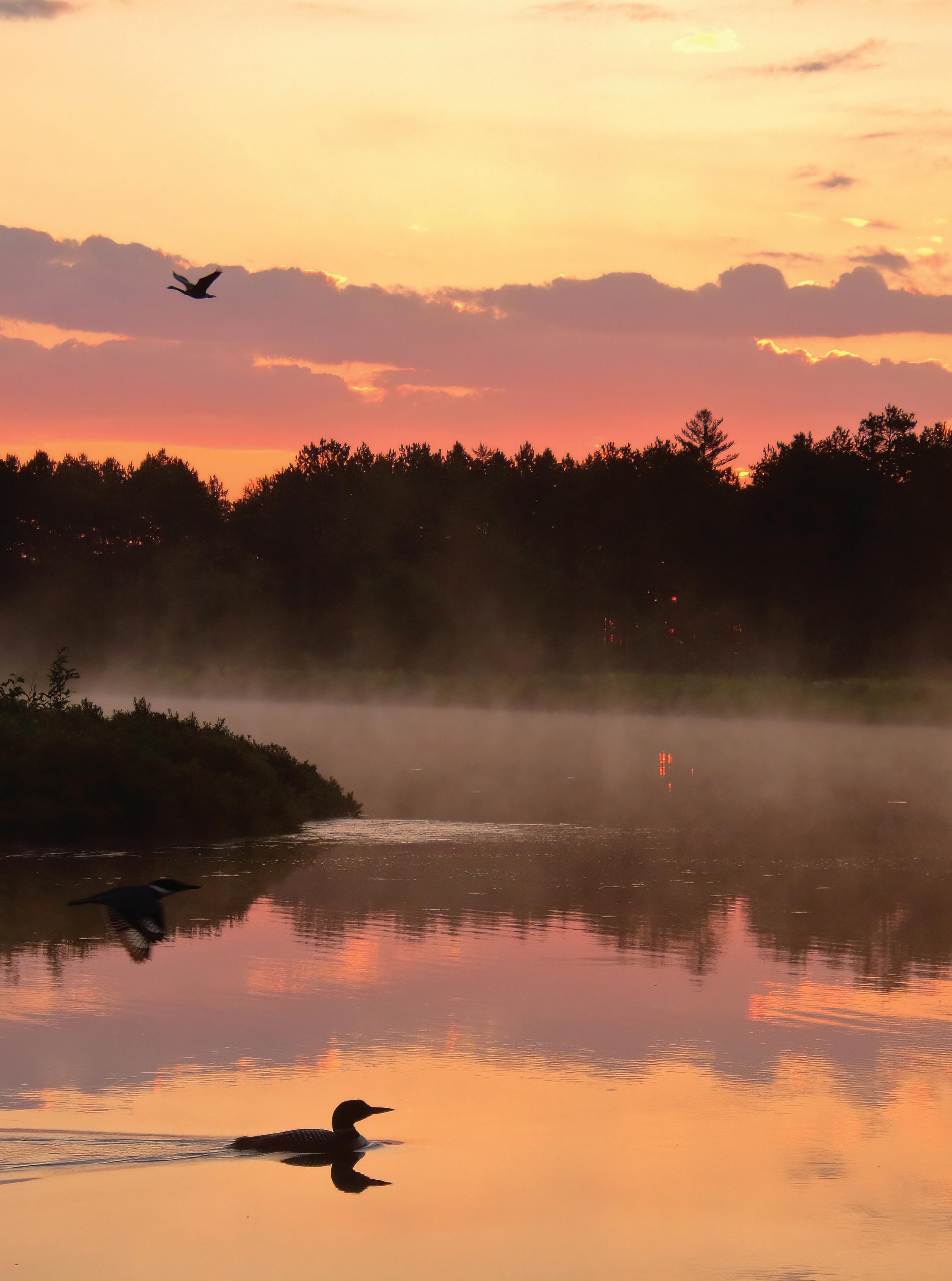
When in the Upper Peninsula, do as the loons at Seney National Wildlife Refuge do: chill. Here, at dawn, a lone loon glides across the refuge's J Pool. It's part of the remote paradise's 95,000 acres, where more than a dozen loon pairs breed and raise their young in the summer months. Because these waters are closed to boating, the loons are content and sense a feeling of safety. This pretty loon is joined by a belted kingfisher (above) and a trumpeter swan.
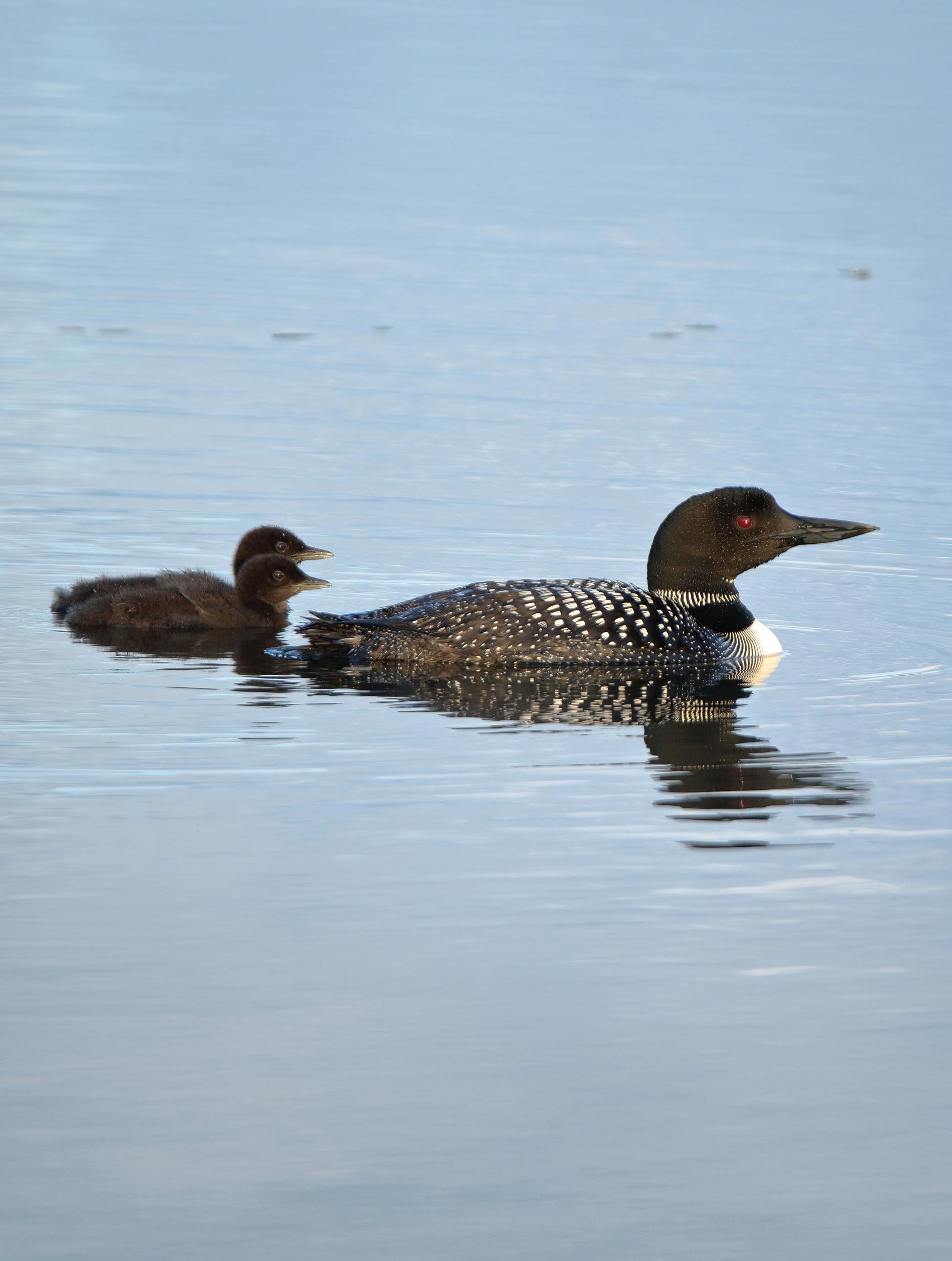
Follow me and I will teach you the ways, says a G Pool male, who takes a swim with his 2-week-old chicks. Covered in blackish-brown down, chicks can swim immediately and look to their parents for protection. The G Pool is part of the managed, extensive wetland pools at the refuge.

The New Hampshire-based Loon Preservation Committee shares on its website that loons preen regularly to maintain the waterproofing of their feathers. Doing a sheen-preen of sorts, they'll flap their wings hard and rise out of the water, appearing to be unable to take off. When preening, you'll see them shake their wings, head, and tail.
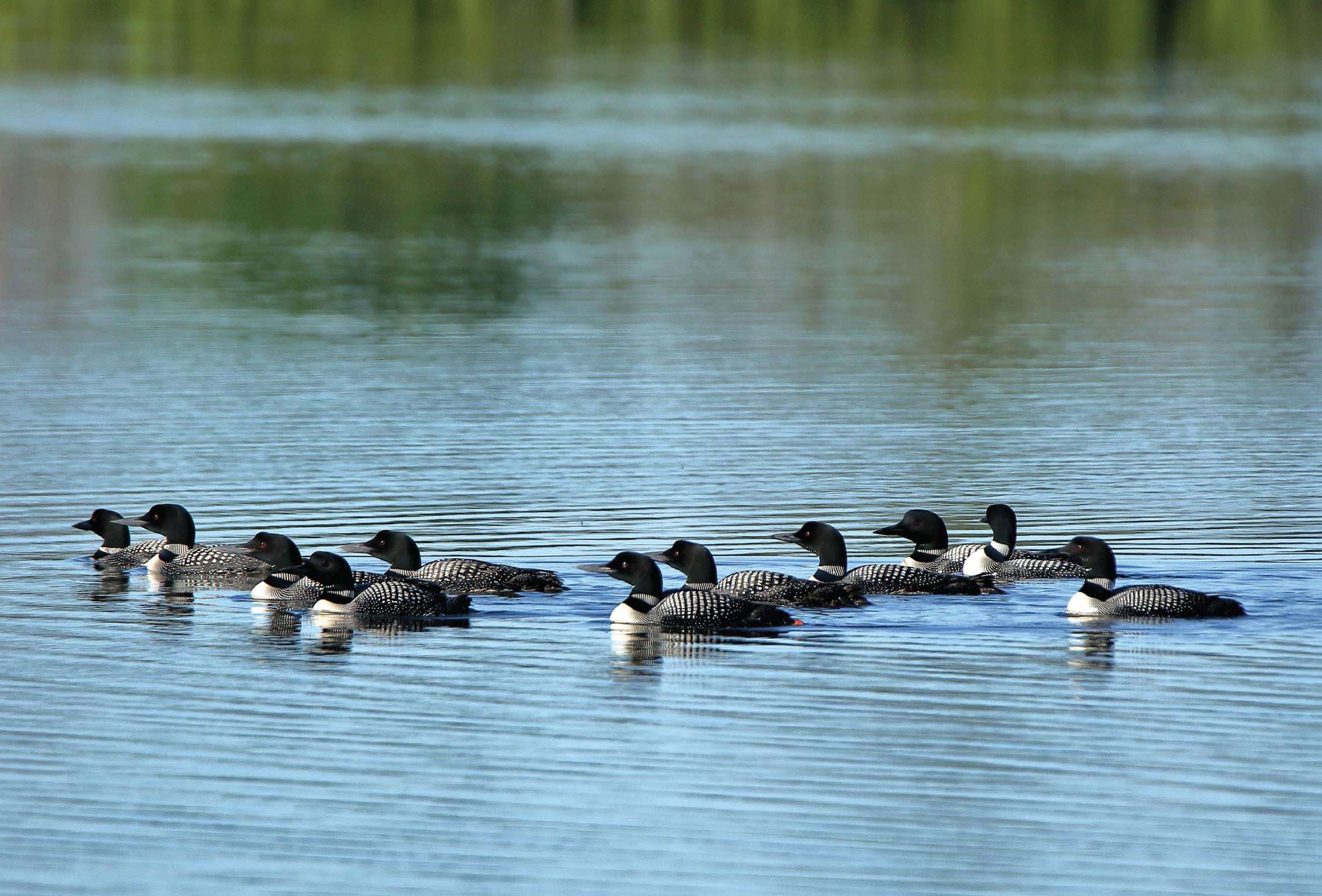
When breeding season is about over or ends, agression wanes and loons become much more social. If you see a raft of loons at a gathering, it's party time (this one took place in July, reports photographer McGill). They're likely enjoying some socializing and foraging.

Seney's ABJ and Fe, the world's oldest and likely most productive documented common loon pair, mated for 25 consecutive years! They defied the species' non-monogamous nature, raising more than 32 chicks. They have returned to Seney this past spring, but have new partners (for now). Leg bands help identify birds so researchers can track their age and movements while observing their behavior without interference.
And whoosh! This loon at Gray's Creek Pool, which empties from A Pool, knows that when arriving or departing from water, he's either using his belly to slow down and land, or his feet to take off and run across the water’s surface while flapping furiously.

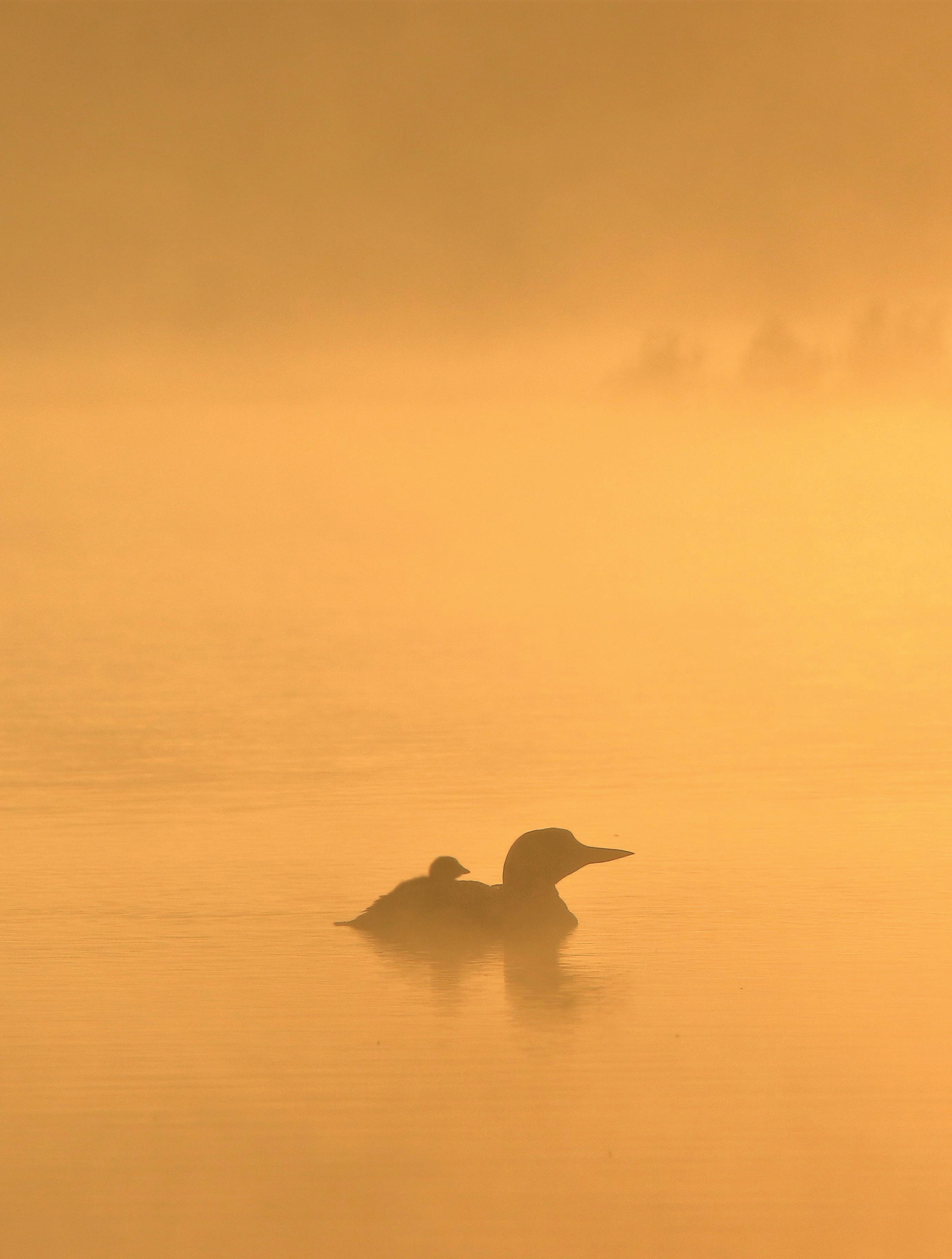
You get a peaceful, easy feeling during another sunrise at Seney National Wildlife Refuge. Here, ABJ and Fe's daughter tends to her chick. When swimming with a chick, adult loons typically use soft, low-amplitude calls for intimate communication to stay in touch. Go, and hear for yourself. You'll find there's no other place quite like Seney (fws.gov/refuge/seney).
Follow Teresa McGill’s adventures on McGill’s Nature in Motion, facebook.com/mcgillsnatureinmotion/. Her photos are available for purchase at fineartamerica.com: Teresa McGill, fineartamerica.com/profiles/1-teresa-mcgill
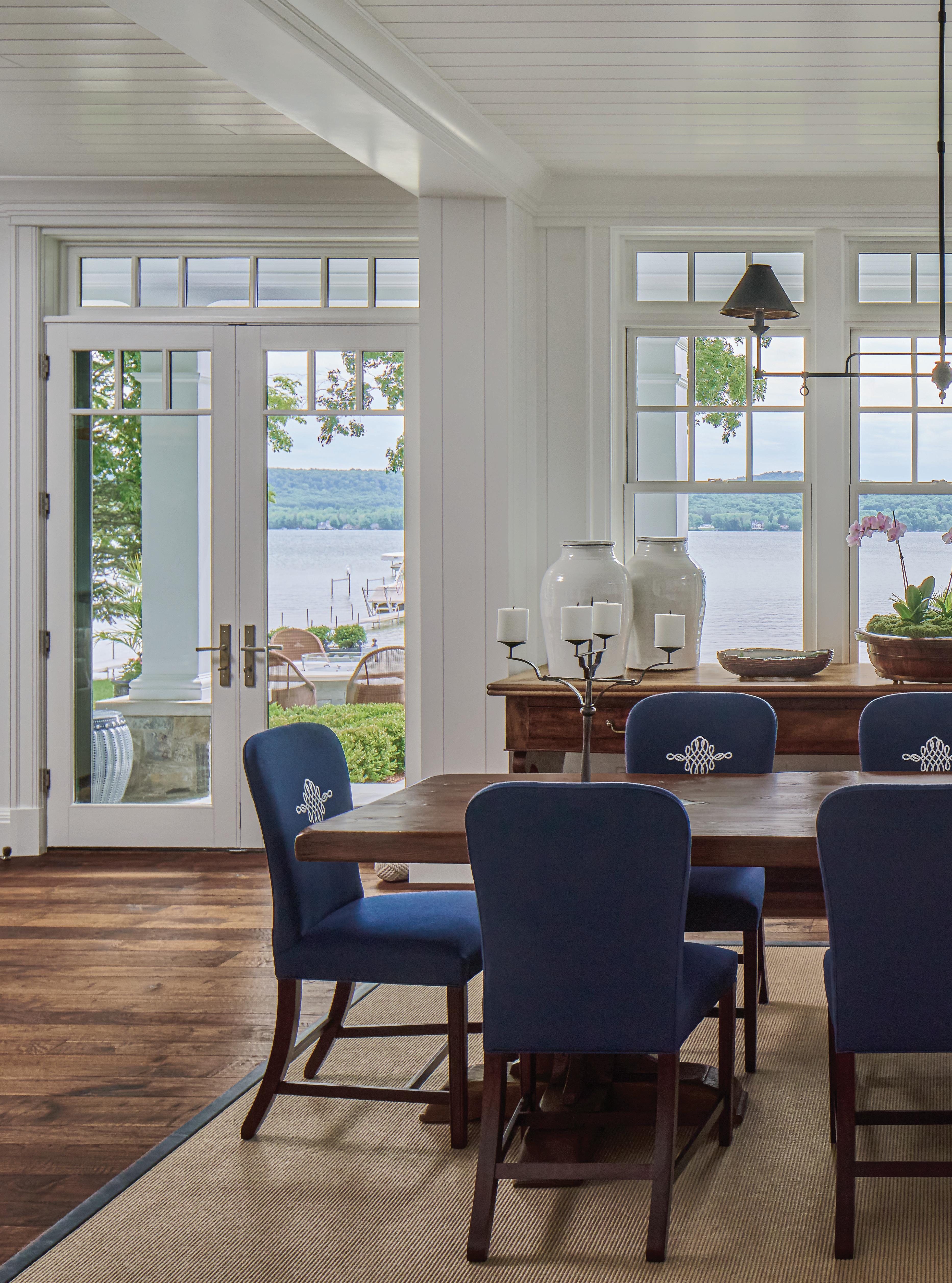
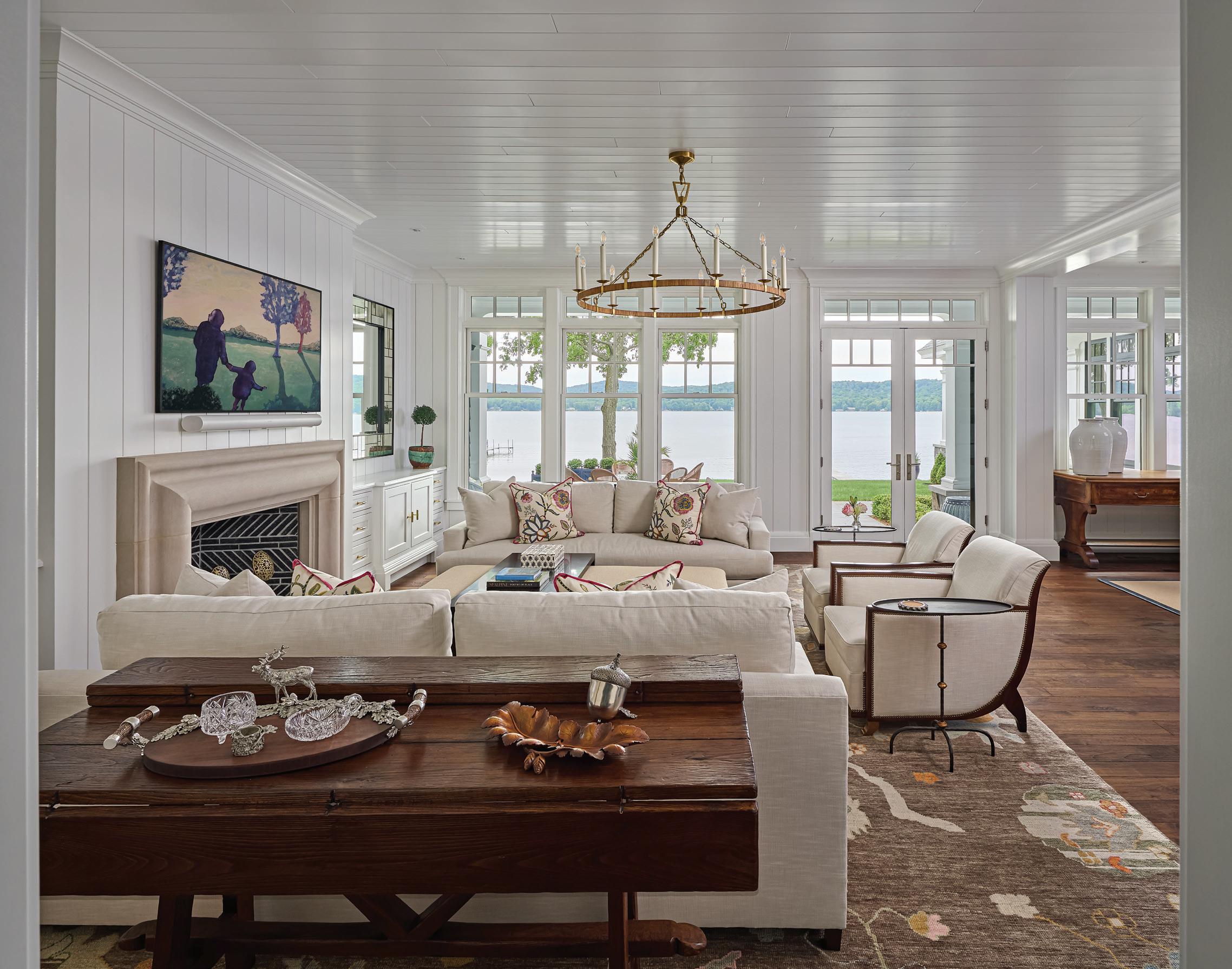
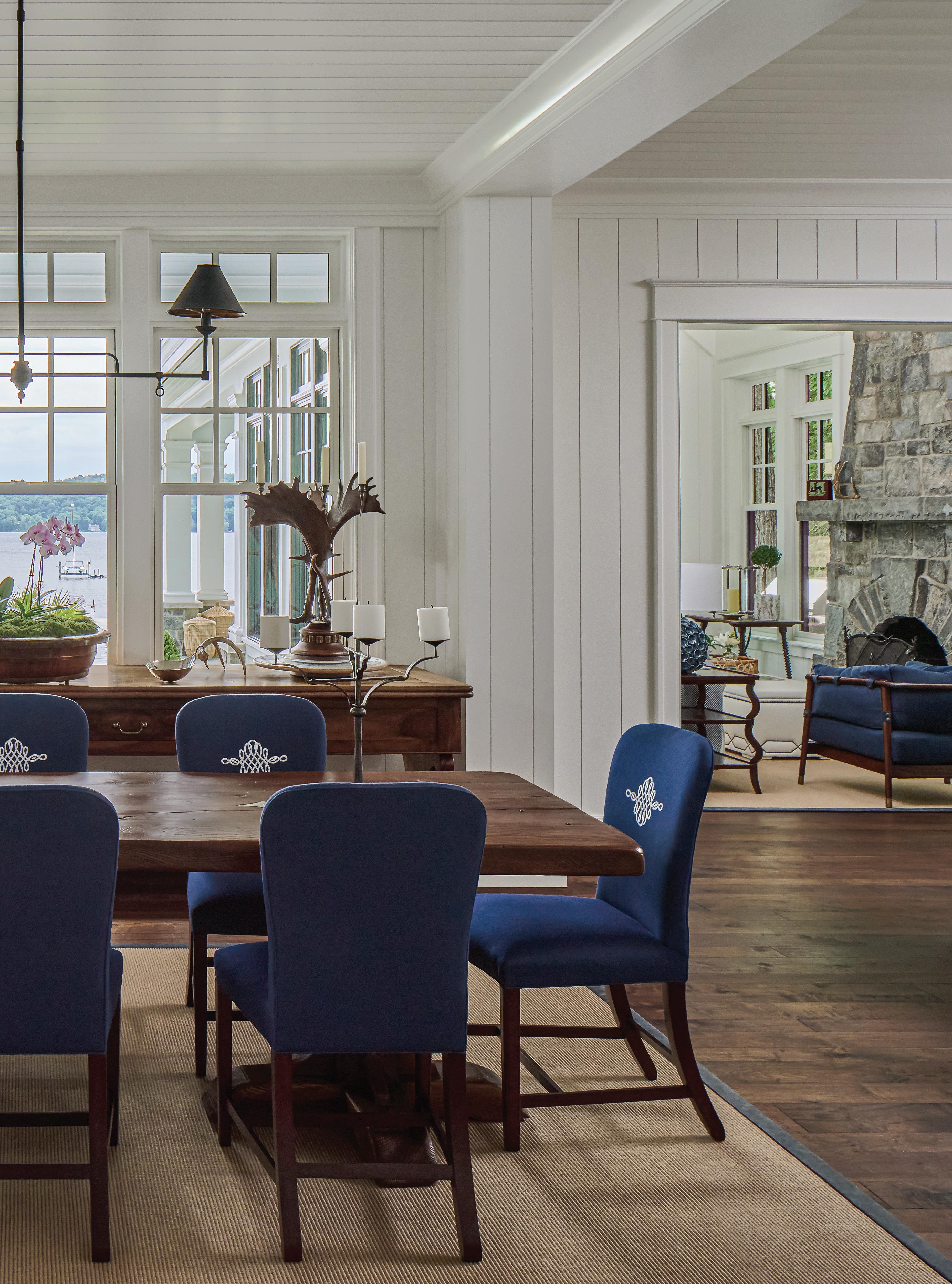
There’s plenty of room for family and friends in a large dining space that features spectacular views of the Leelanau Peninsula’s Glen Lake, in northwest Michigan.
Architecture: White & Liebler Architects (Nick Liebler, Drew Mittig), Petoskey, white-liebler.com Builder: Cawood Building Co. (Bill, Bob, and Sam Cawood), Okemos, cawoodbuilding.com Cabinetry: O’Brien Harris (Laura O’Brien, Elizabeth Haar), Chicago, obrienharris.com Interior Design: Jones-Keena & Co. (Lucy Earl, Amanda Rink, and Leslie
Troy, jones-keena.com Landscape Architecture: Silverman & Co. (Anita Silverman), Traverse City, silvermanlandscapes.com
TThe color palette for this recently built second home on Glen Lake in northwest Michigan’s Empire was “probably our easiest decision,” says the homeowner. “Our whole family loves blue, and when we discussed the exterior color, it was a unanimous vote.”
The hue is featured prominently inside, as well, and provides a thread that links the 100 feet of nearby lake frontage with the five-bedroom home. The getaway replaced a “cute little white cottage” the couple had purchased in 1996; at 1,100 square feet, the original cottage “was adorable, and we loved it well for 26 years,” the homeowner says, but eventually the family outgrew it.
“Everyone loved the Up North charm but (my husband and I) decided, as we became empty-nesters, that we wanted to expand and plan for the next stage of family life, where hopefully our kids and their future families will want to come and visit,” she explains.
The couple turned to architects Nick Liebler and Drew Mittig, of White & Liebler in Petoskey, and interior designer Lucy Earl (winner of the 2026 first-ever Design Icon award at the annual Detroit Design Awards) and the team of Jones-Keena & Co. in Troy, to help them achieve the home’s next act.
Outside, they wanted pitched rooflines, interesting chimneys, exterior trim, and lots of windows. Because they “eat almost every meal outside” in the summer and entertain frequently, they also wanted outside dining that provides an open-air feel but protects guests from the elements.
Inside, the couple requested wide hallways, a stone fireplace in the sunroom, plenty of nooks for furniture and art, and hefty molding and baseboards. They also wanted an open living plan for the kitchen, dining room, and living room, to make hosting and entertaining easier. Other must-haves included more sleeping space and bathrooms for visiting family and friends — including a spacious bunk room for future grandchildren.
The goals for the interior design called for “a balance between beauty and functionality,” the homeowner says, with a collected feel that incorporates modern and new pieces, along with beloved antiques. “They’re very traditional, and have very classic and beautiful accessories,” Earl
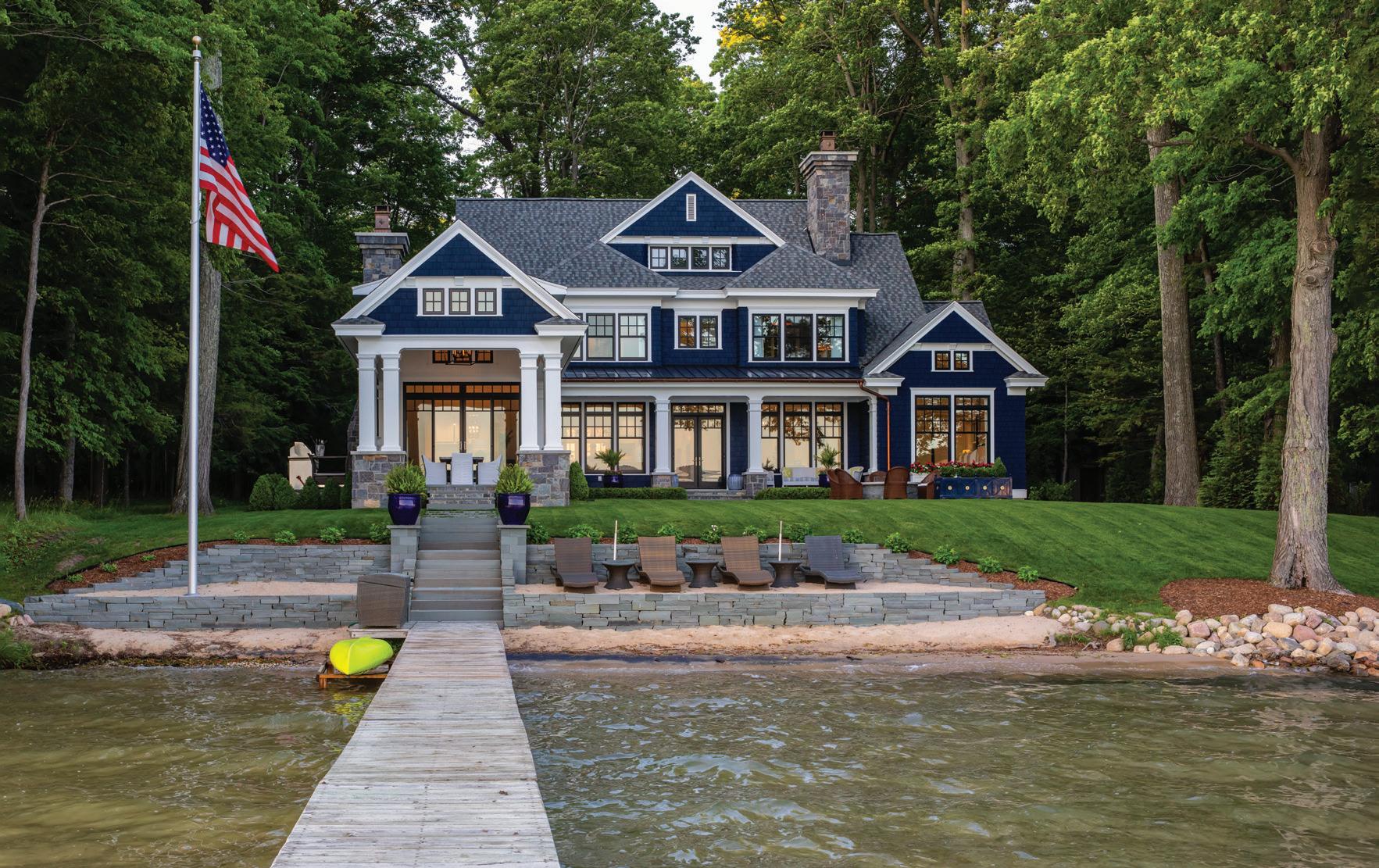

Both pages, counterclockwise from left: The new getaway, located on 100 feet of Glen Lake frontage, replaces the homeowners’ previous little white cottage. The charming bunk room, for future grandchildren, is one of five bedrooms. One of the wife’s favorite spaces is the roomy kitchen.

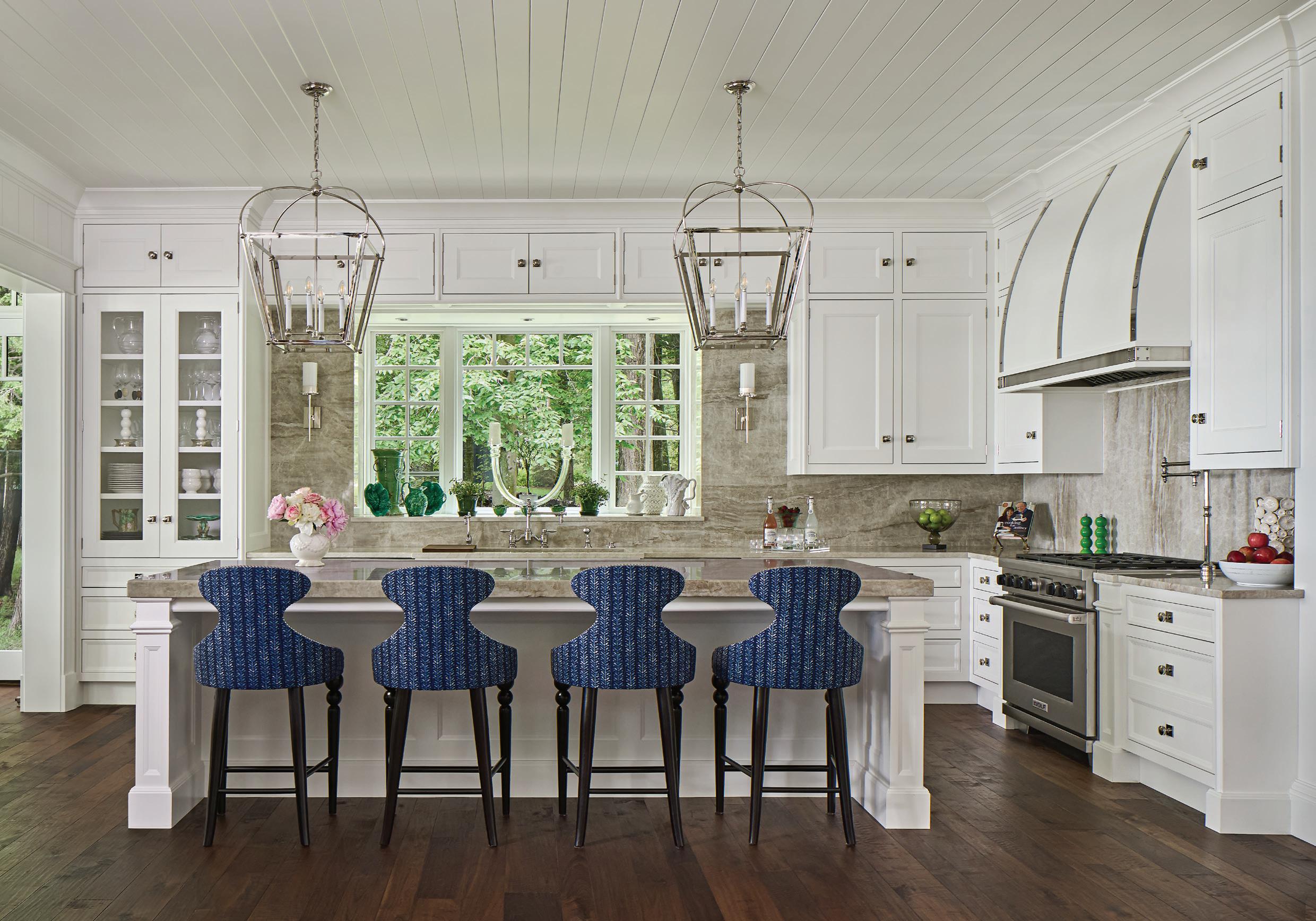
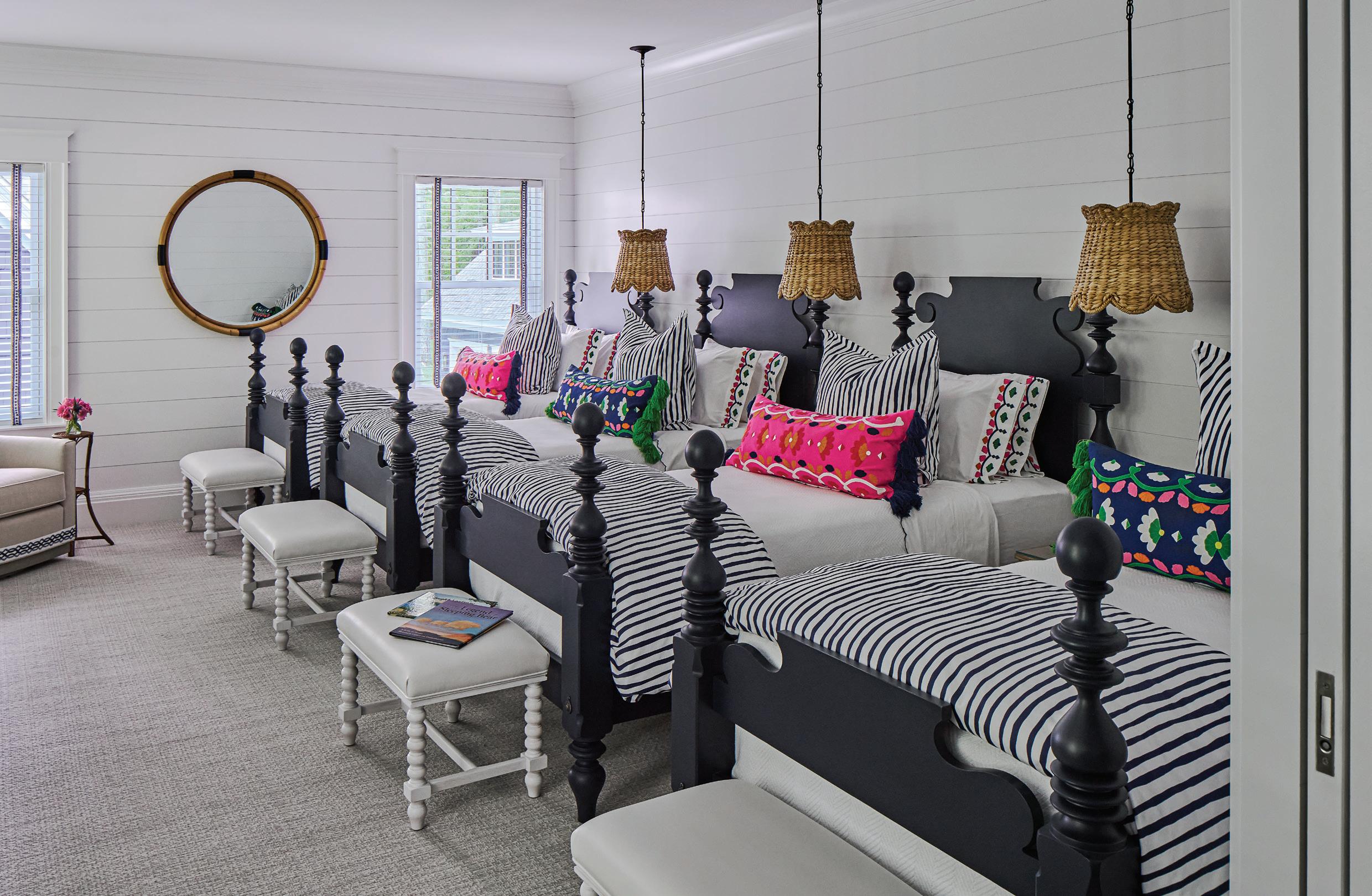
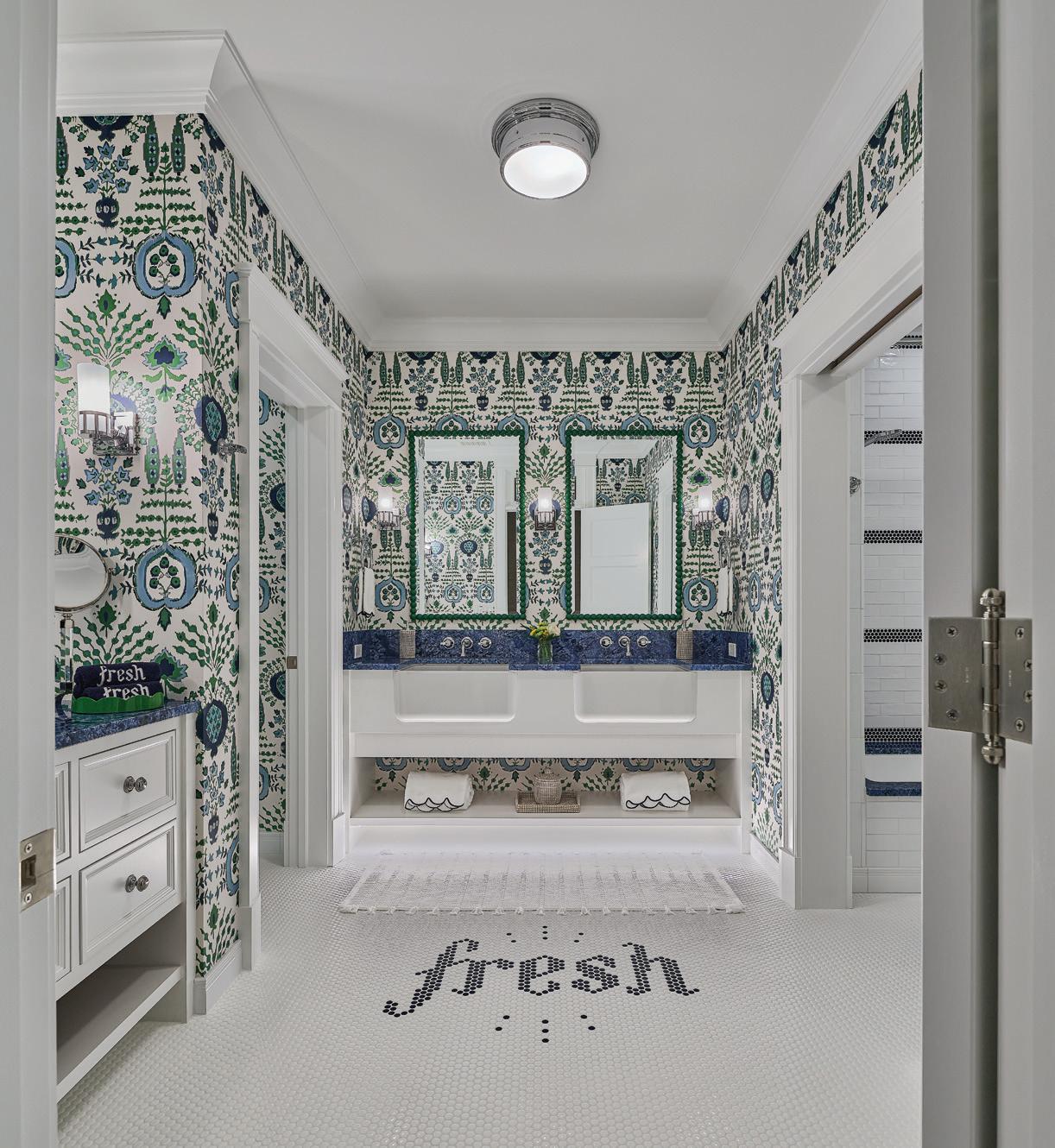
Both pages, clockwise from left: The whole famly loves the color blue, so it’s featured prominently in the home, especially in this pretty bunk bath, replete with inspired blue-andgreen wallpaper. In the summer, the outside covered dining porch is used on a daily basis, the homeowners say. Glen Lake near Sleeping Bear Dunes National Lakeshore.
GLEN LAKE is located on the Leelanau Peninsula and is adjacent to the Sleeping Bear Dunes National Lakeshore. At its closest, it’s about 0.94 miles from Lake Michigan. The lake consists of two large bodies of water connected by a narrow channel, which is traversed by a causeway carrying highway M-22. The body of water on the west side of the causeway, which is far shallower and more elongated, is known as Little Glen Lake, while the body of water east of the causeway, which is nearly perfectly round and deeper, is Big Glen Lake. The lake empties into Lake Michigan via the Crystal River, which winds through Glen Arbor.
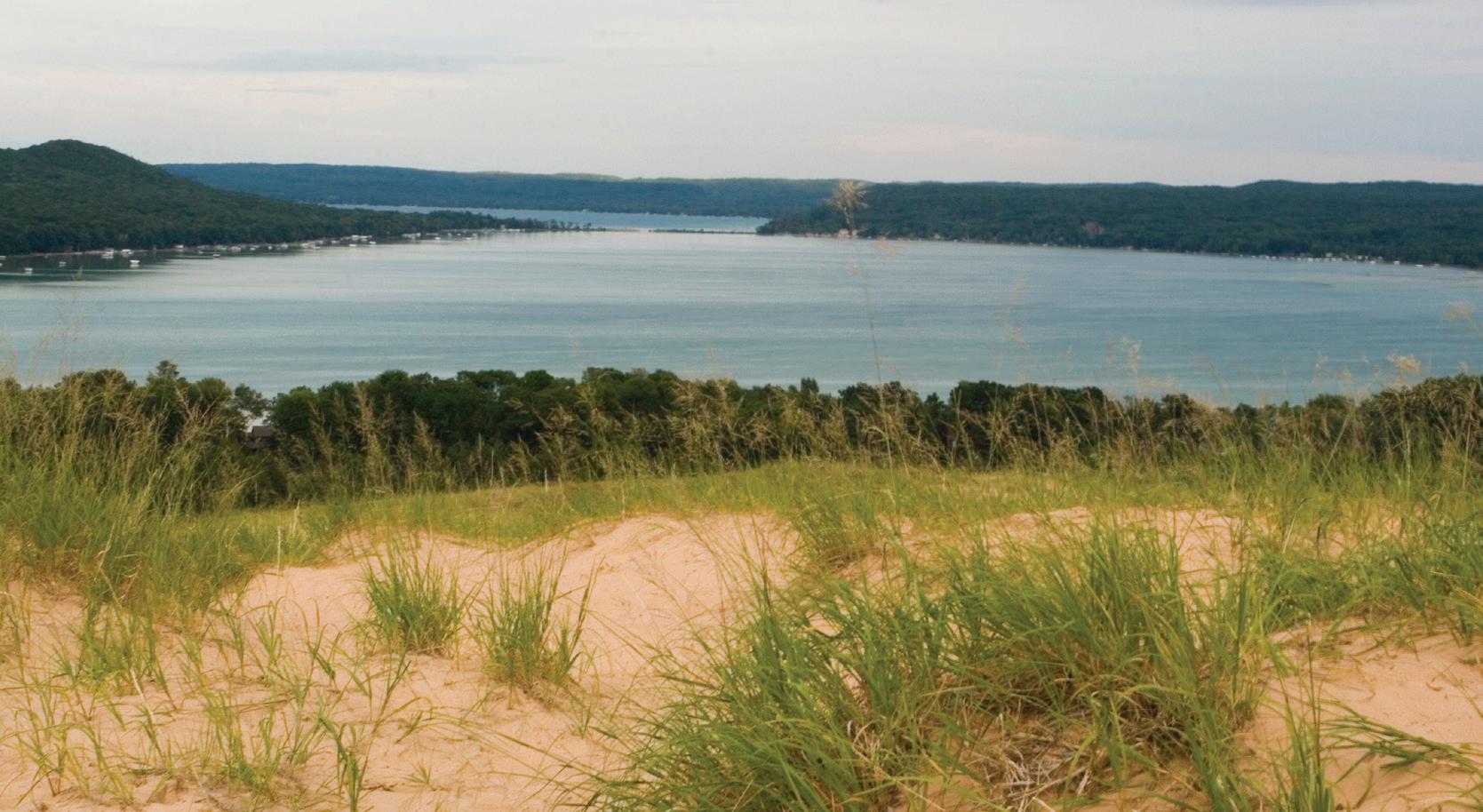

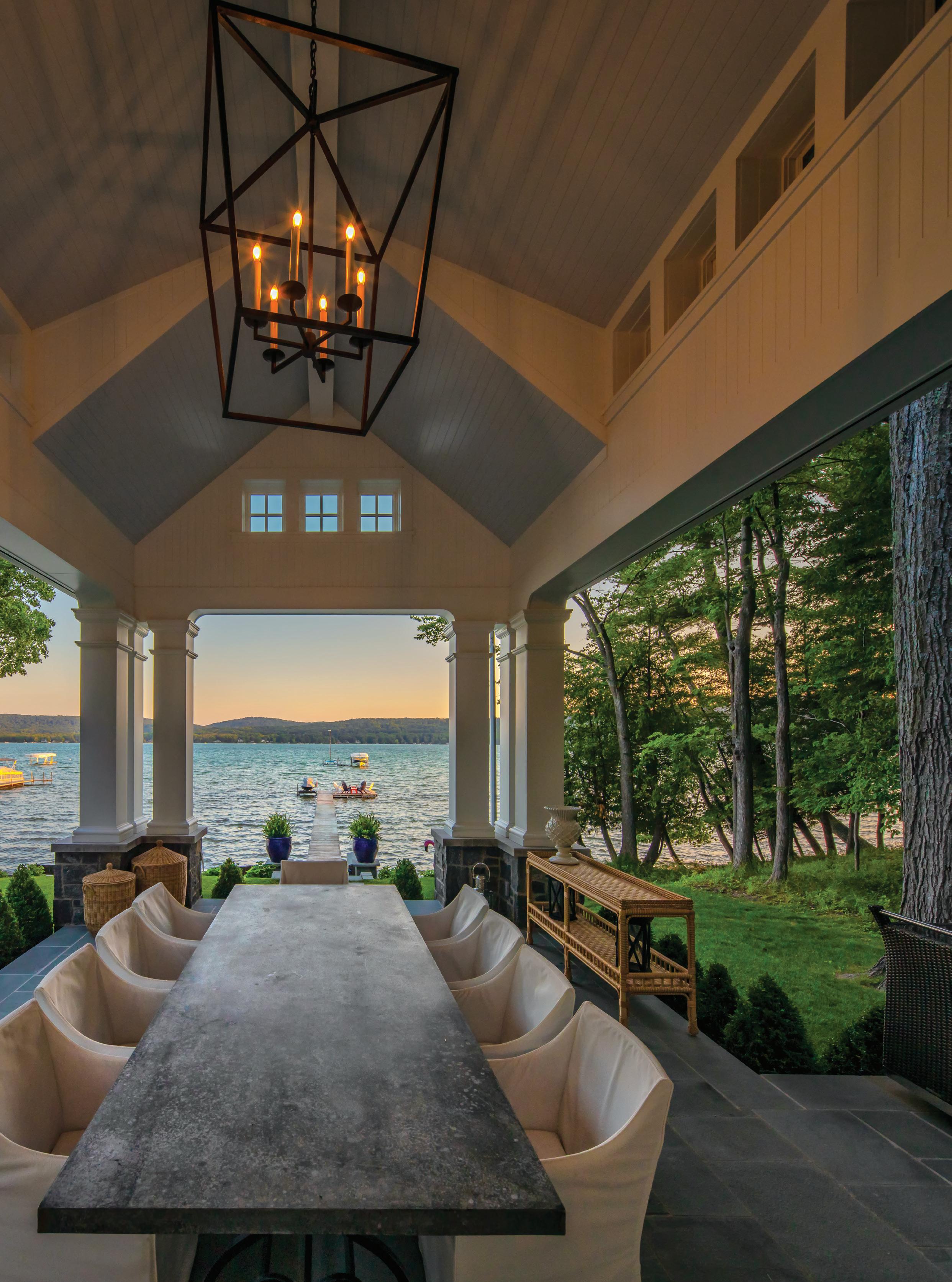
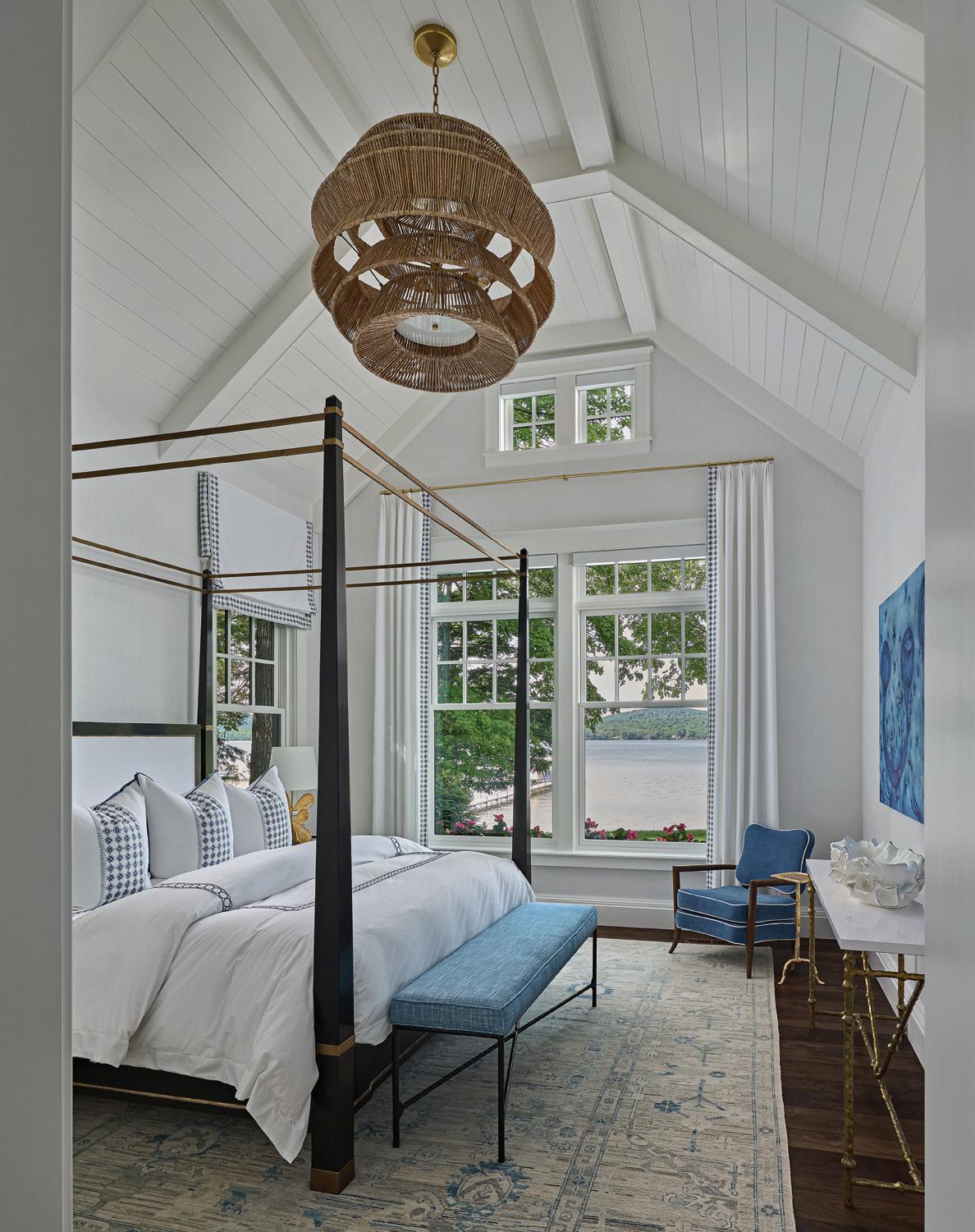
explains. “Working with clients who know exactly what they love, and who care so deeply about beauty and meaning, made this project incredibly rewarding.”
A number of pieces from the original cottage were integrated into the new home, including the French Herbeau kitchen sink fixture, which is now “perfect (in the) powder room,” according to the homeowner. An antique matchstick holder that had been mounted next to the old fireplace is now in the sunroom, while the Ralph Lauren carved four-poster safari bed from the former primary bedroom has a new home in a guest bedroom. The slipcovered sofa from the old cottage’s sunroom is another cozy reminder of the past. New additions include custom furnishings and one-of-akind finds from Hickory Chair, Alfonso Marina, Chaddock, and Julian Chichester. The clients even joined the designers twice at the High Point Market to ensure every detail reflects their taste and personality.
The homeowners say they spend as much time on the lake as possible and
visit during all four seasons. “We love being there and sharing it with family and friends. In the summer, the outside covered dining porch and patio fire pit are elements that are used (on a daily basis),” they say.
The designer says she’s been lucky enough to enjoy the result of the team’s hard work firsthand. “I’ve been up for dinner and have had lunch on the terrace,” she says. “It’s such an amazing view.” She cites the china nook, green bar, and reading nook at the top of the stairs as her favorite features, adding, “there isn’t a space in the house that I don’t love.”
The homeowner says she’s partial to the sunroom in the morning, and shares that it’s “the perfect place to enjoy coffee by the fire and look out the windows at the lake.”
Blue may be prominently featured, but Earl added other tones — green in the bar, hot pink by the back door — to add interest and balance. “They wanted every space to be special,” she says of the homeowners. “I think we pulled it off.”
A few of Jones-Keena’s founder and principal Lucy Earl’s favorite things
BY GIUSEPPA NADROWSKI
1. Alfonso Marina Deux Bed, CAI Designs, Michigan Design Center, Troy, alfonsomarina. com, caidesigns.net
“This bed brings formality to the primary suite, balancing comfort with elegance. The homeowners fell for the refined craftsmanship and sculptural presence of Alfonso Marina during a High Point shopping trip.”




2. Darlana XL Wrapped Ring Chandelier, Visual Comfort, Birmingham, visualcomfort.com
“The living room chandelier is wrapped in rattan. Rattan adds warmth and texture.”




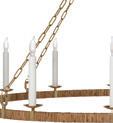

3. Alfonso Marina Bruz Chair, CAI Designs, Michigan Design Center, Troy, alfonsomarina. com, caidesigns.net
“We call this the ‘hugger chair’ because it embraces you. The homeowners love it for morning co ee.”




4. Thibaut Wallcovering in Mendoza Suzani, Rozmallin, Michigan Design Center, Troy, thibautdesign.com
“The watercolorinspired antique motif of this wallcovering brings charm to the bunk bath.”
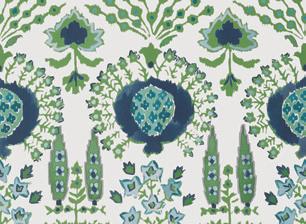
5. Emma Counter Stool, Julian Chichester, CAI Designs, Sanford Indigo Performance Fabric, Pindler, Michigan Design Center, Troy, julianchichester. com, pindler.com
“These stools lend sophistication to the kitchen, while the performance fabric brings practicality. They’re durable enough for everyday use — think wet swimsuits — but elevate the space.”
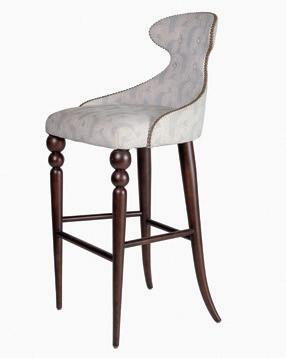
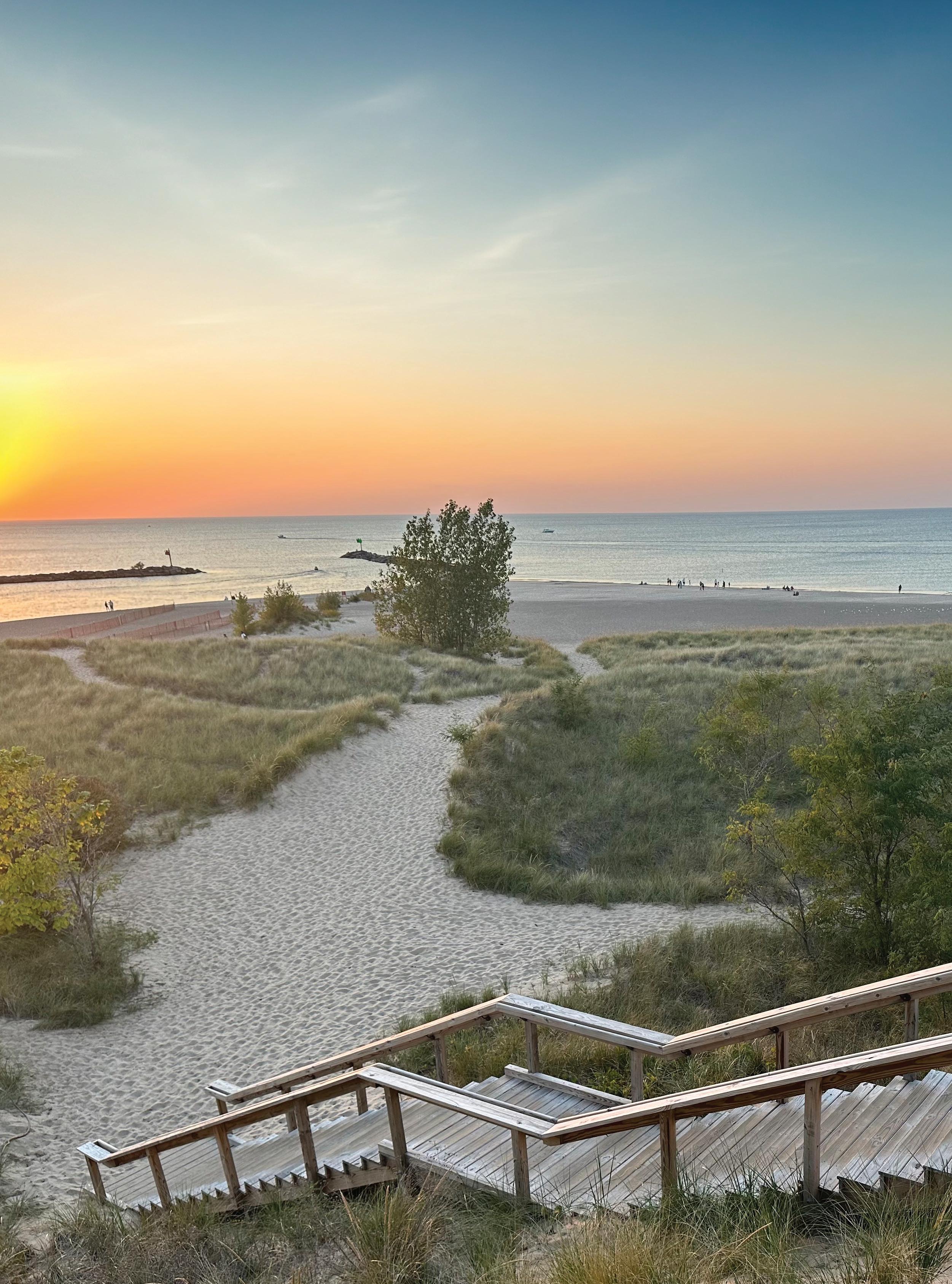
Road trip treasures and lake town adventures await with just a turn of your steering wheel

BY
Often, the best finds happen with a serendipitous turn of the steering wheel. A road trip guided by a “let’s see what’s down that road, turn right here” spirit. That’s exactly what brought me to the spots I’m about to detail on this side of southwest Michigan.
I’ve been to the region many times, but my rediscovery of this corner of the mitten, where the state slowly sweeps along the Lake Michigan shore toward Chicago, began just that way — wandering down sections of roads past long-lost towns, and a stretch where the name goes from Blue Star Highway to Lakeshore Drive, among other names.
When you get off the interstate, it’s a different world. Here are some of the discoveries I made on a trip late last summer. Ready to take a ride?
Wau-Ke-Na means “forest by the water” in the language of the Potawatomi, who once inhabited what is now southwest Michigan. Between the map dot communities of Glenn and Ganges, a minor road named Lakeshore Drive wends quietly along the coast past homes and the Wau-Ke-Na preserve.
Chicagoan and conservationist William Erby Smith donated the land to the Southwest Michigan Land Conservancy in 2005, to preserve 540 acres of the lakeshore. In making the donation, he stipulated that it must never be developed.
There are two tracts within a few miles of each other and you can walk more than 3 miles of trails. The north tract has a sandy half-mile path to the lake, while the larger south tract has winding routes past the marshes, woods, and fields that Erby loved.
Just down the road is Allegan County’s West Side Park, with access to a sweeping section of Lake Michigan beach.
The conservancy is thinning a swatch of evergreens to transform a 100-acre section of the south tract into a meadow, which will help attract more of the birds that the conservancy notes have been disappearing lately.
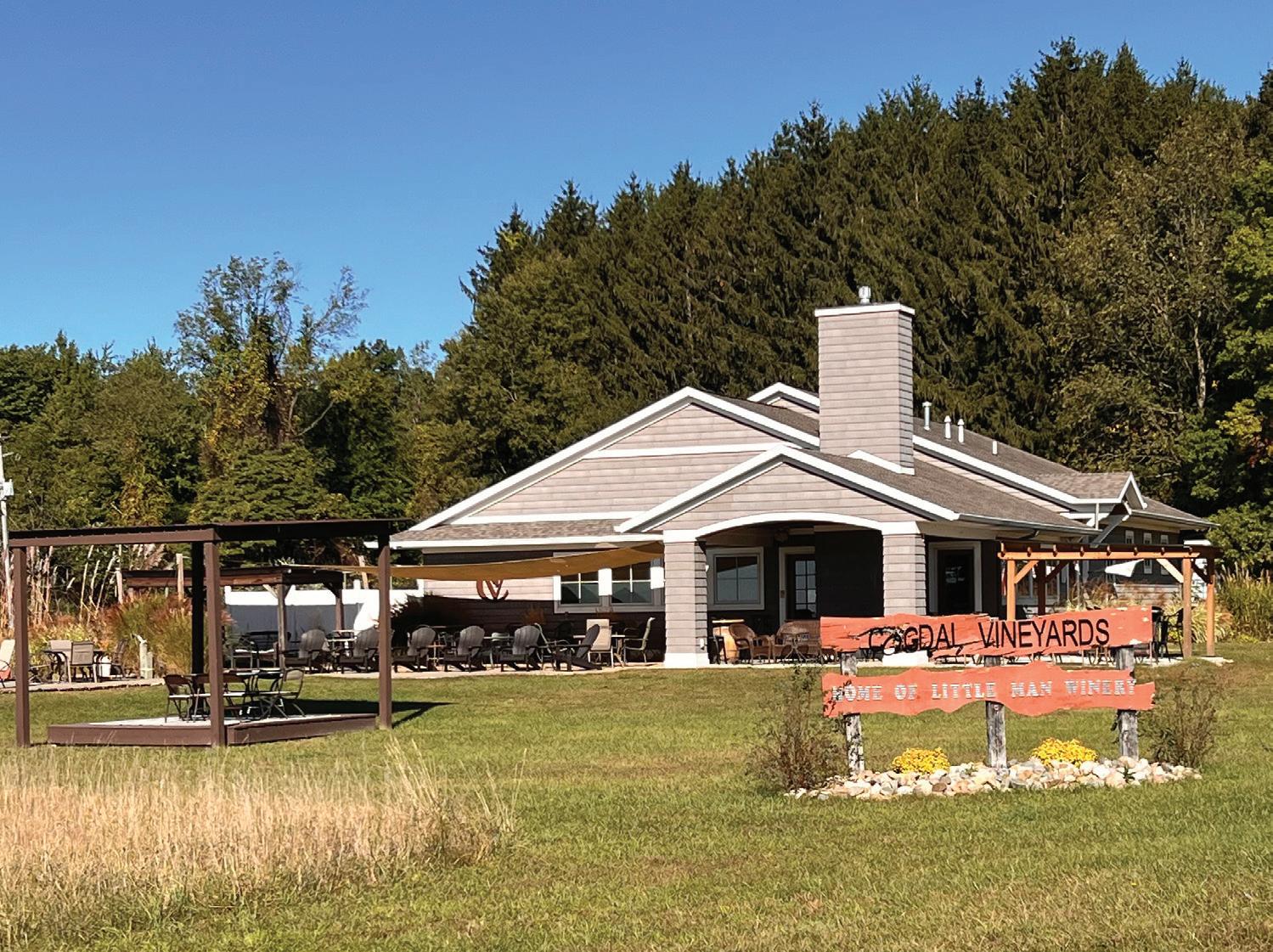
Michigan wines differ by variety and quality. This winery, just a few miles down Lakeshore in South Haven, is a sleeper.
Jack and Deb Murdoch opened it in 2008 a half mile from Lake Michigan on land owned by Jack’s grandfather, Harry Cogdal — hence the name.
“It was family property, and mom and dad were 80 and wondering what was going to happen to it,” Murdoch says. “My wife and I like wine, and the vines made something that would keep the property sustainable. We do around 1,000 cases a year, and grow 50 percent of what we need.”
He says they buy the rest, using varieties that can survive Michigan’s winters.
“I think that helps our Riesling. It has a different flavor. The Baroda-area wines tend to be a bit more lime-y,” he explains.
The Murdochs have done well, and their wines have won awards — especially for a cabernet franc. Nine acres are under production, Murdoch says, adding that it’s plenty when you do it all yourself. The winery is definitely worth a visit.
Cute name, eh? Darlene Stumpf began
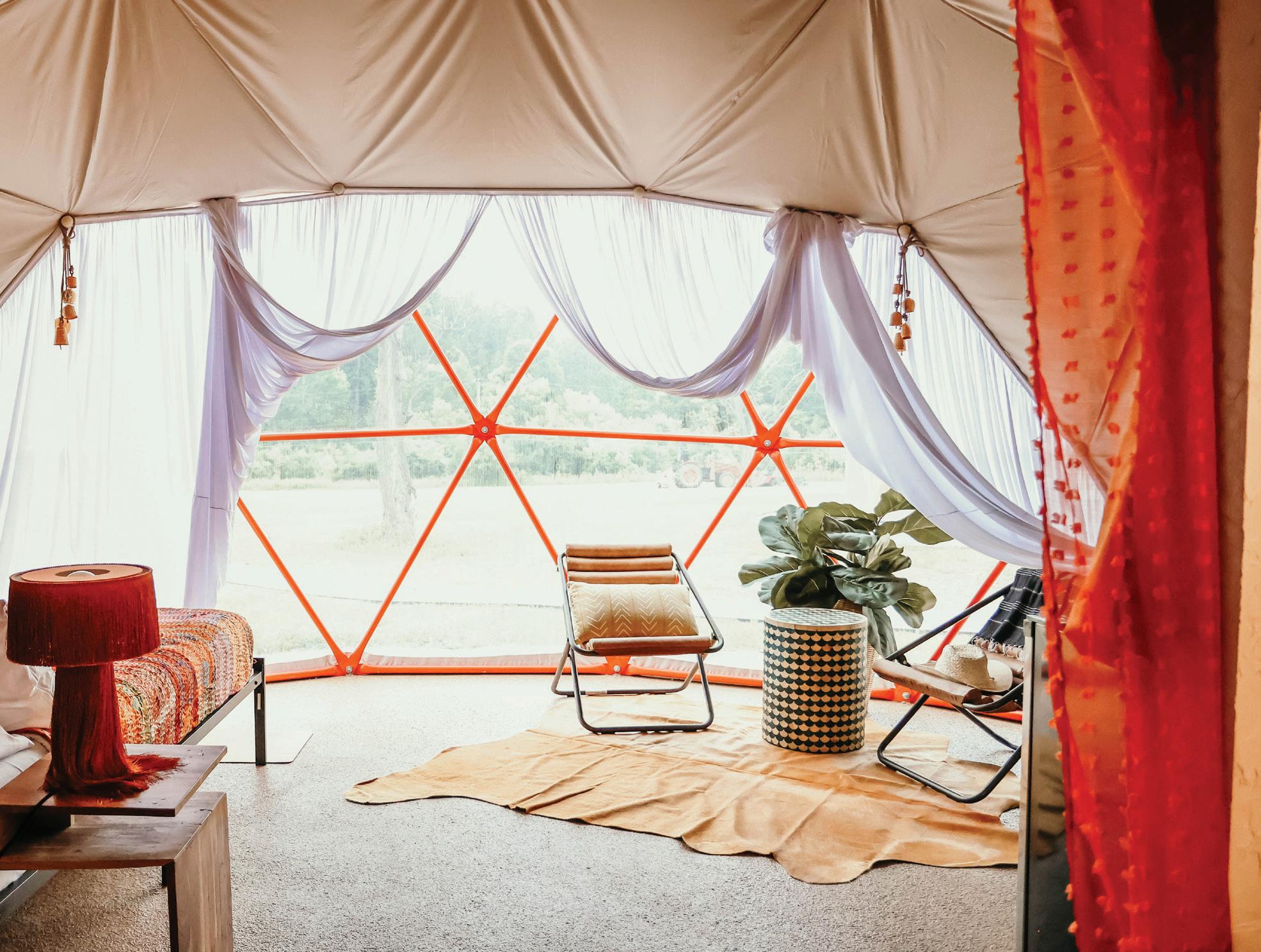
the enterprise at the South Haven Farmers Market 26 years ago. Later, when out driving with her mother-in-law, they saw a “for lease” sign on a building and she says she couldn’t pass it by.
“(My mother-in-law) whipped the truck around and said, ‘Get that phone number!’ I was running a little café in Saugatuck and she said, ‘You’re going to do this for you now.’ And here we are, five years later,” Stumpf says.
“Everything we make — the pastries, the baked goods — is from scratch. We also make pierogies. Everyone who works here gets a crash course in pierogi-pinching; it’s a pierogi palooza,” she laughs. Before you stop by, check the bakery’s current hours, which may vary this season.
Look for this unique luxury glamping and restaurant retreat on Blue Star Highway as you head south from Fennville toward South Haven. Owner Missy Fojtik, who established the retreat on a former country club golf course, is slowly expanding her collection of geodesic domes. “All our domes are decorated differently for a little whimsy and wonder,” Fojtik says.
Growing from nine domes in 2025 to 19
now, each offers heat, air conditioning, full baths, and other amenities. Guests can also enjoy the swimming pool and her unique restaurant. Sample the goat yoga classes, the weekend breakfast buffet, and fusion Indian-Asian foods in the restaurant, with its ceiling of faux foliage. DayDreamer Domes is open daily in summer to early fall.
For a more traditional overnight, try Martha’s Vineyard Bed & Breakfast, just down the street from Cogdal Vineyards. A full, hot breakfast is included, and there’s a fireplace and bath in each room — and the establishment boasts its own vineyard, to boot.
Keep digging around this region and you’ll find lots of other interesting spots, but if you head a bit south, you’ll understand what lures folks to this part of the state.
From Bridgman to the Indiana line, the area really promotes itself just by being the beautiful region it is.
Each of the areas is just as stunning as the next, including wonderful natural resources. There’s the inland freshwater sea (no sharks) and the beaches. You’ll also find the largest public boat harbor on the Sunset Coast in New Buffalo.
Southwest Michigan has been called the capital of reunions because of its prox-
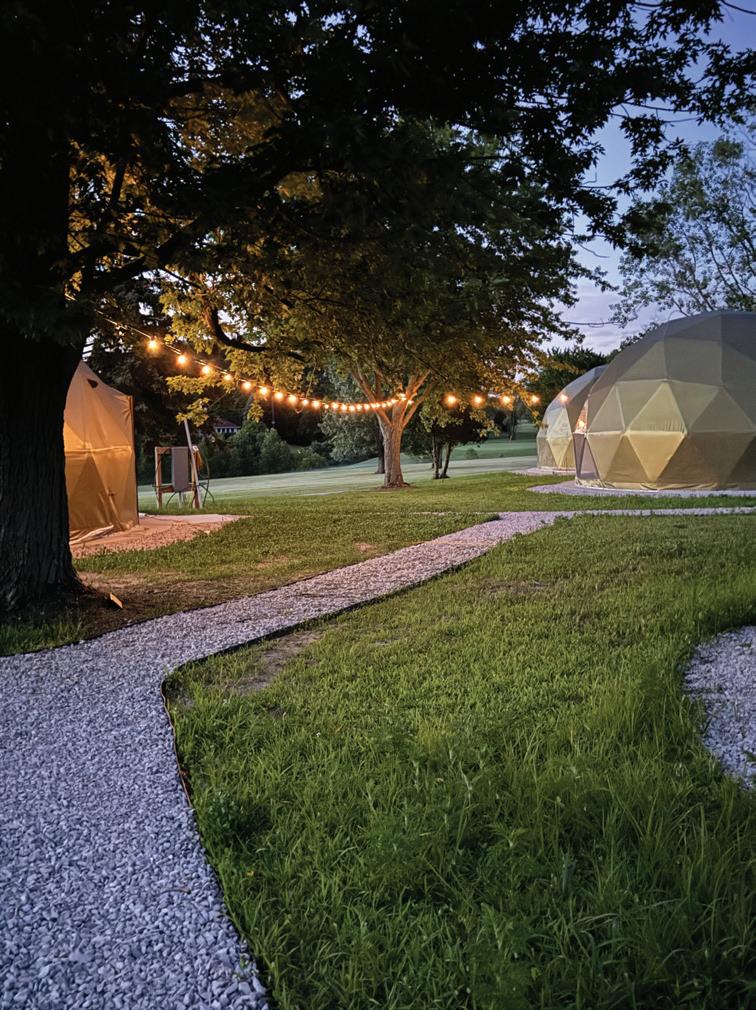
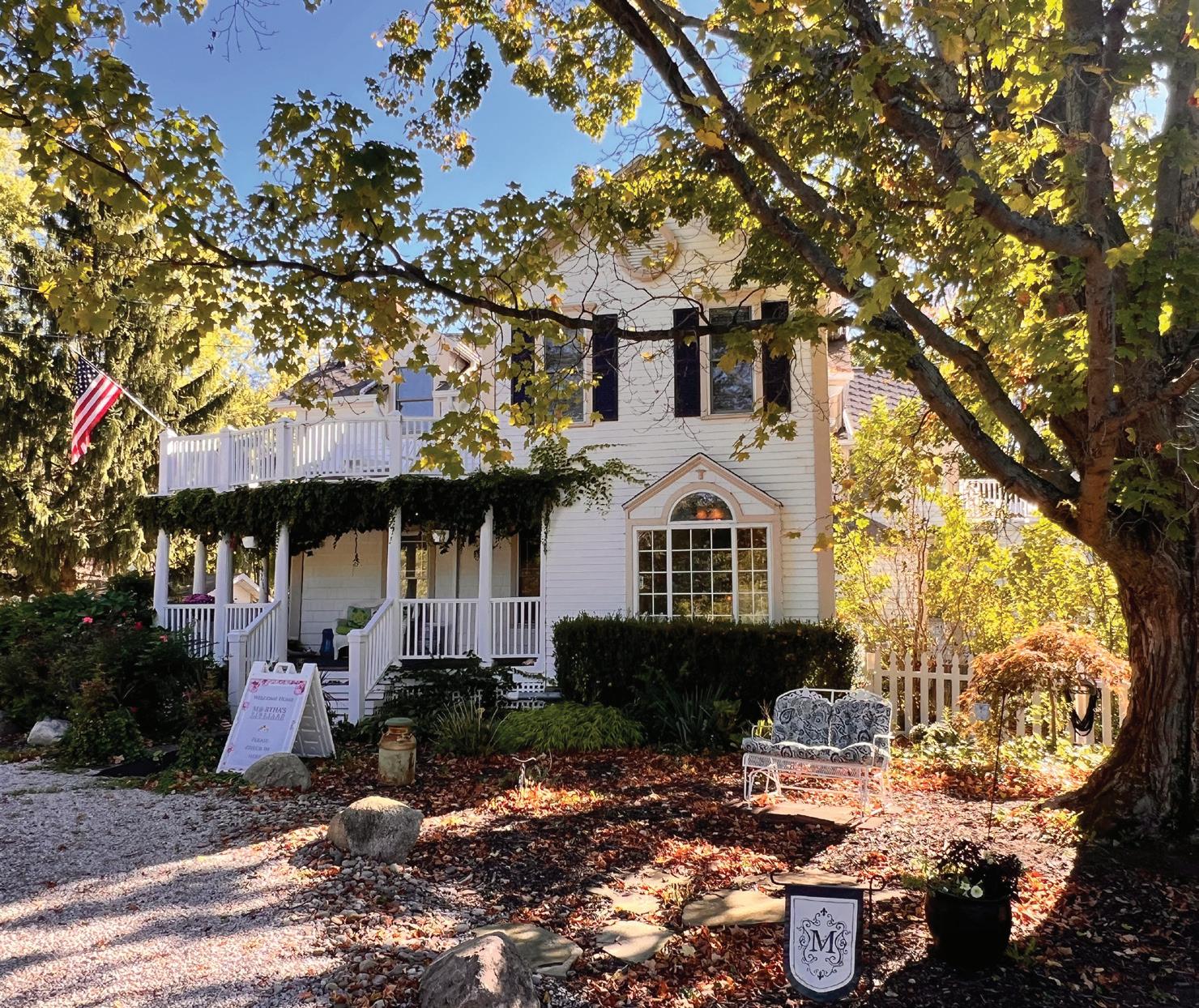
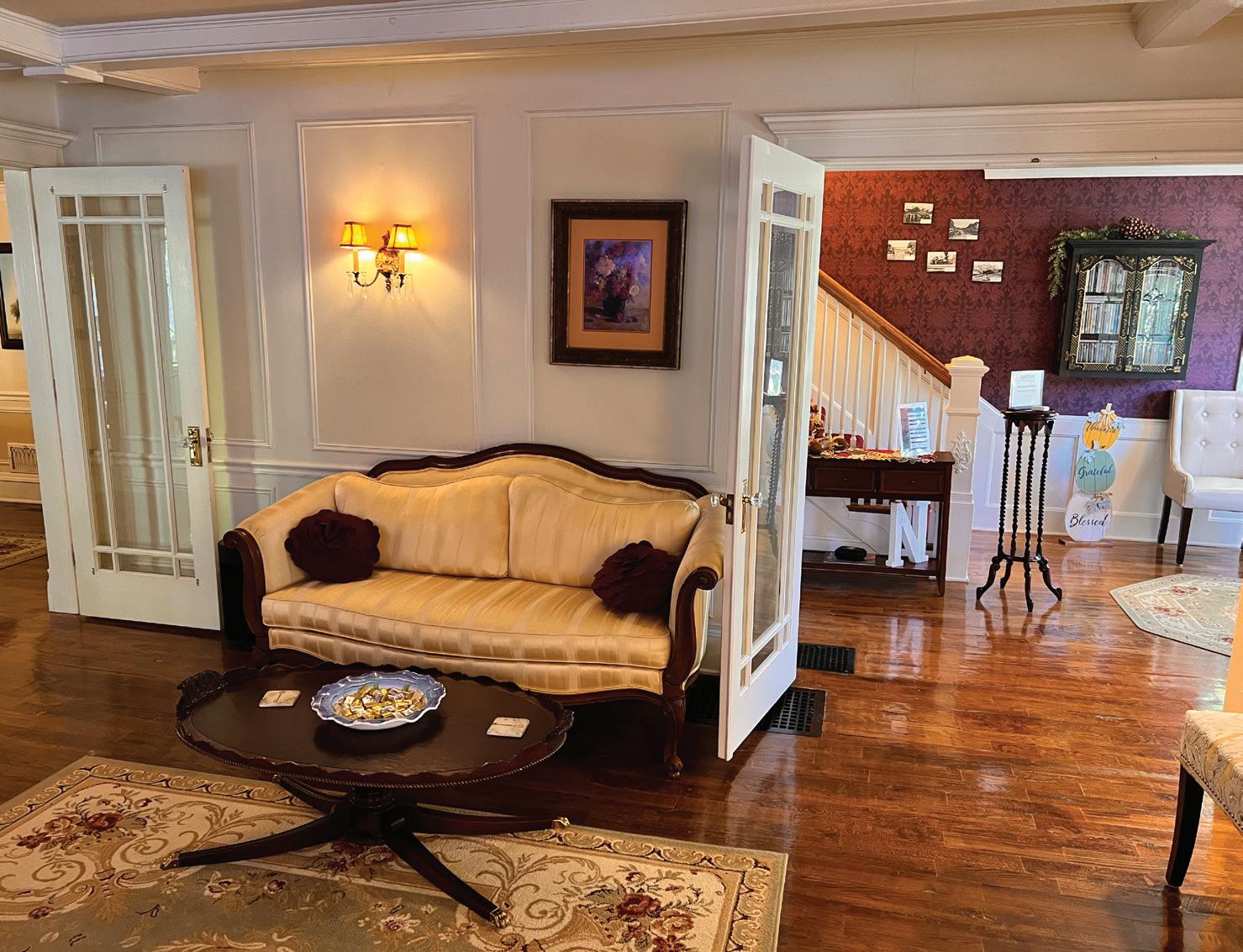
imity to Chicago, Grand Rapids, and St. Louis, as well as its multiple airports and an Amtrak train that stops in New Buffalo. It seems new residents are arriving in record numbers, and many are coming from Chicagoland. Speaking of Amtrak, where else can you plunk down as little as $16 and in 90 minutes, on any of four Amtrak train departures, be in the heart of downtown Chicago’s dining, shopping, and nightlife? And the same train will bring you back to the beach in Michigan. It’s hard to beat.
Here are some other highlights:
• Union Pier’s lodging options feature cozy cottages, all located along and near Red Arrow Highway.
• Harbert is the town where poet Carl Sandburg spent much of his writing years, in a home his wife designed. It’s now in private hands.
• Nearby Sawyer is home to Warren Dunes State Park, perennially one of the most visited state parks in Michigan. It’s also near two Italian restaurants — Tosi’s, where you can sit at Al Capone’s favorite two-top near the kitchen for fast getaways, and D’Agostino’s.
Run now by second-generation owner Dana D’Agostino, this 250-seat restaurant is all about family. D’Agostino’s father and mother began “The Navajo,” as locals call it, after World War II, carrying on the name from the original Navajo Trading Post and keeping the history alive. D’Agostino and his wife, Joan, and other family members have taken the reins, and have been hosting for 37 years now.
Most of the staff, including his daughter, are family, and serve up American fare with an Italian flare. Fresh seafood is delivered daily.
“You can never run a restaurant like this without family. Aunts and uncles have worked here, plus others from Joan’s side. When we say family, it’s the real deal,” he says.
Bridgman is considered Harbor Country’s gateway to wine country, with 14 establishments to choose from. Then there’s Three Oaks.
“There’s the three oaks,” people would cry back in the day, as an old-time puffing locomotive passed a certain trio of trees. At least that’s the legend of how this town got its name. Starting as a farm community a mere 9 miles from Lake Michigan, it has grown to become a destination for everything from unique shopping to live musical and theater performances.
Stop by Drier’s Meats, a National Historic Site, where they’ve been curing local meats since the Civil War era, or visit Kaminski Farms for grass-fed beef. Or enjoy a pop at Journeyman distillery. If you’re in the mood for a live performance, the Acorn theater stages more than 150 events every year.
This is one of several notable nature preserves in close proximity, another being Warren Woods State Park near Warren Dunes State Park.
At 105 acres, Fernwood, on the St. Joseph River, is a botanical garden, arboretum, and preserve near Niles that features more than 10 short nature trails, a sculpture garden, and a rebuilt tall grass prairie that echoes what it used to look like in this part of the state.
The last stop on your trip before the Indiana state line is the home of that $16 Amtrak train ride to Chicago. You’ll also find a beautiful public beachfront with great accommodations, a boat harbor where you can snag a fishing charter, and treats like malts at Nancy’s at the Lake downtown and Oink’s, just blocks away.
At Redamak’s, join the line to order a burger from March to October — it’s one of a slew of restaurant options at the end of your road trip.
Like what you see? Learn more by checking out the resources below — and the next time the urge hits to break from the Interstate, do it. There’s a whole world to explore. Just turn that wheel.
Harbor Country Chamber of Commerce harborcountry.org
Visit Southwest Michigan swmichigan.org
D’Agostino’s Navajo Bar and Grille dagostinosnavajo.com
DayDreamer Domes daydreamerdomes.com
Fernwood Botanical Garden fernwoodbotanical.org
Martha’s Vineyard Bed & Breakfast marthasvy.com
Tosi’s tosis.com
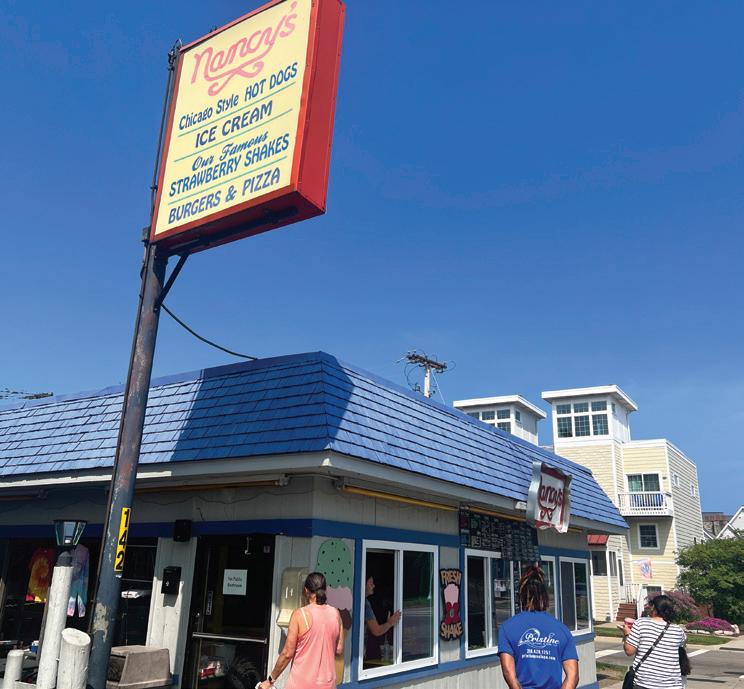
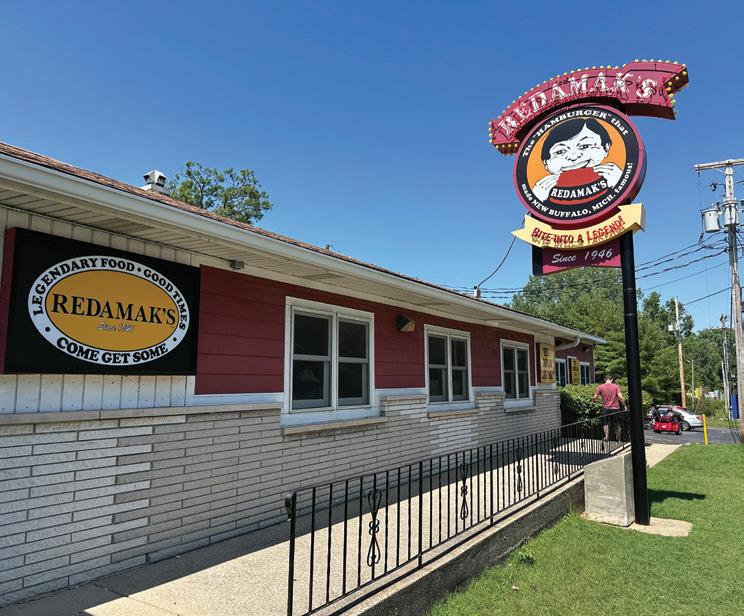
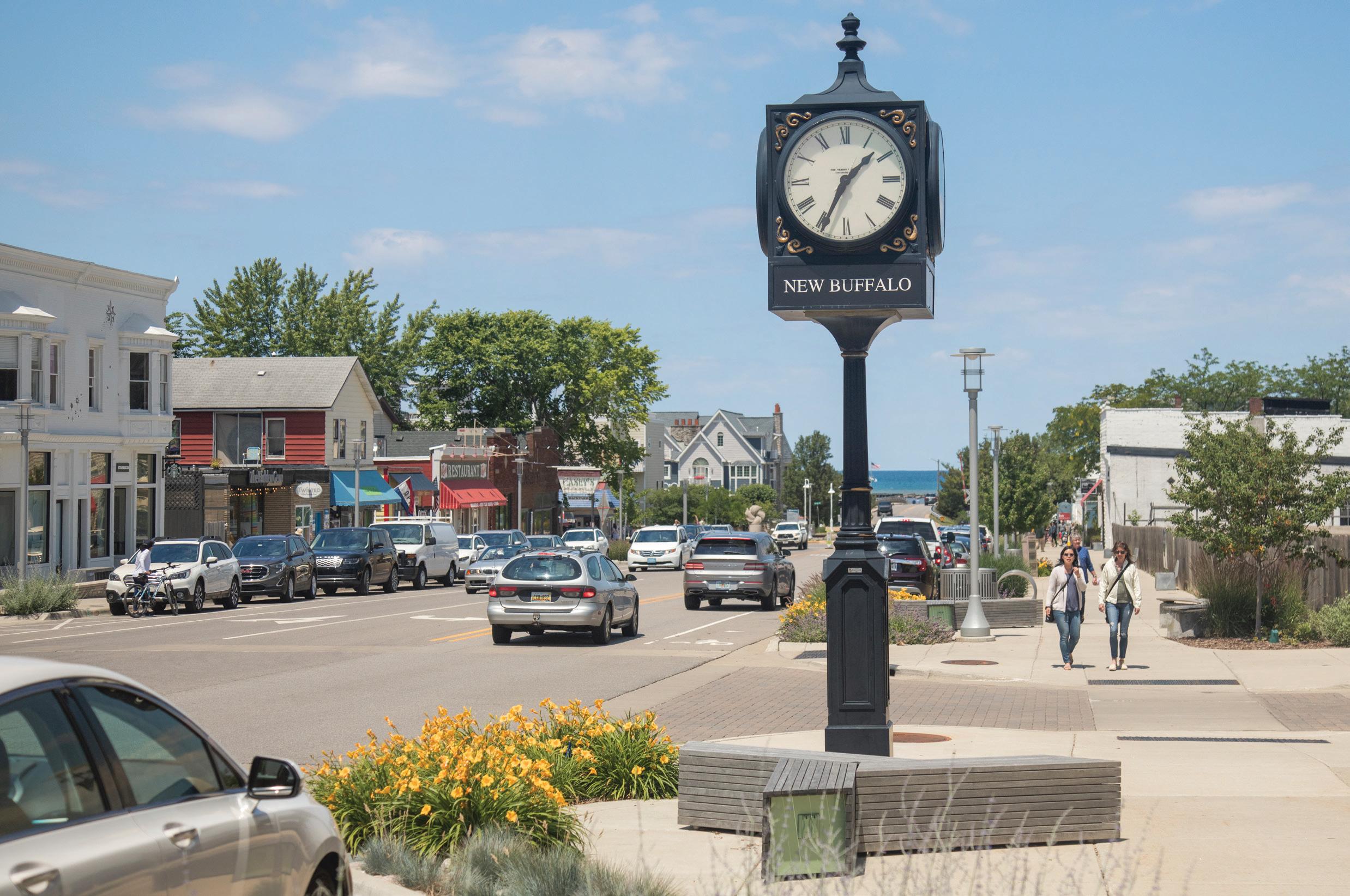
Lucky for us, lavender loves our Great Lakes microclimates. We get to pick it, bake it, grow it, and stir it!
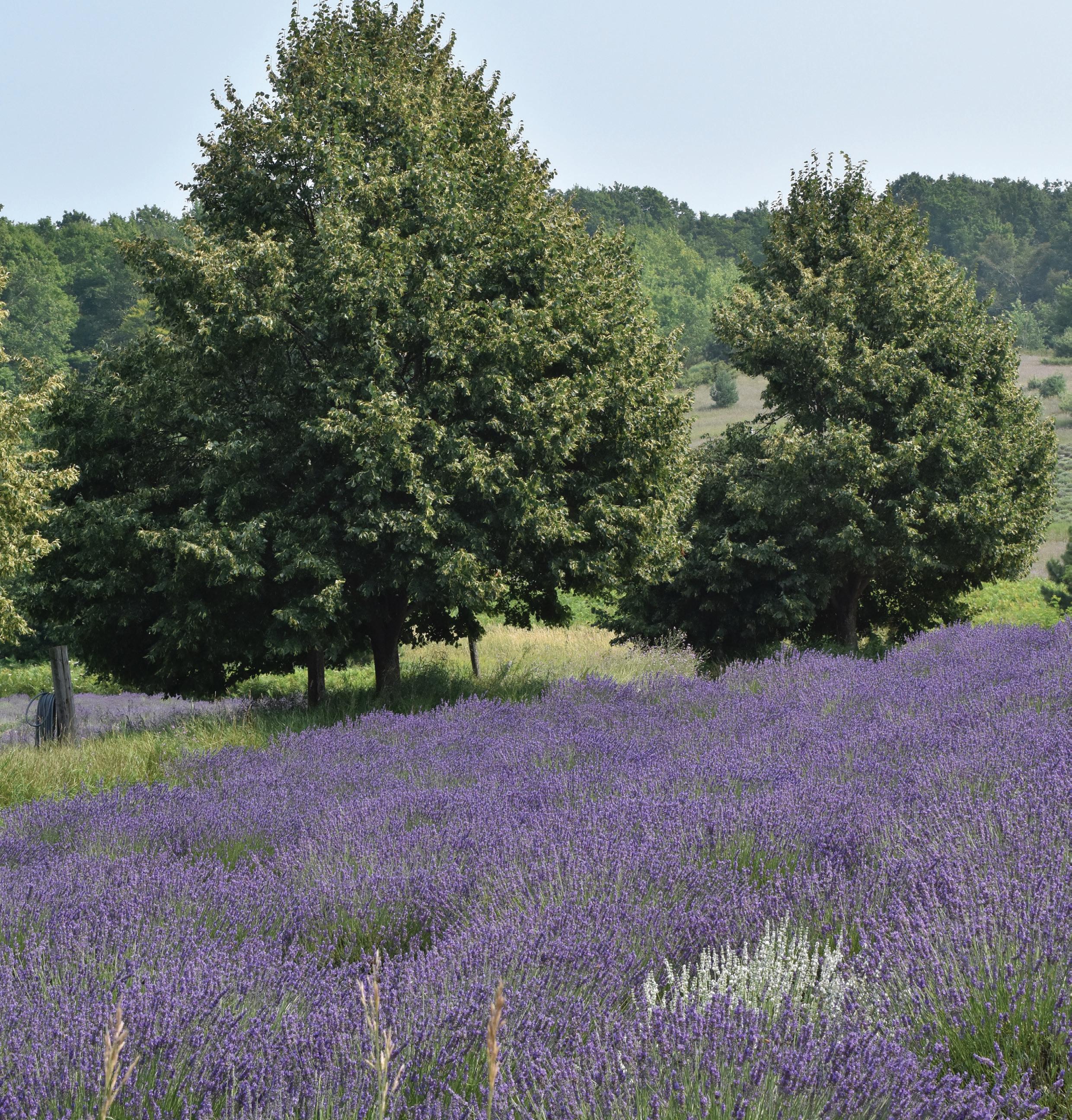
Michigan’s growing conditions are ideal for lavender production because of our well-drained sandy soil, warm summers, and unique microclimates near the Great Lakes. In the winter, the state’s ample snowfall acts as natural insulation for the plants. The result: Michigan has become a booming hub for the fragrant flower, joining California, Washington, Oregon, and Virginia as the top U.S. states for lavender production (California leads in total farm numbers).
Not only is lavender a beautiful addition to gardens, but it has multiple uses that range from medicinal purposes to bath and body needs to culinary delights.
On the following pages, we explore Michigan’s lavender trail, from the southwest region to the northwest — and a few points in between — and talk with home growers, family farmers, hospitality professionals, mixologists, and chefs.
PHOTO BY MEGAN SWOYER
BY Megan Swoyer
AFTER TEACHING A WATERCOLOR WORKSHOP at the Boyne Arts Center in Boyne City last summer, my husband and I were headed to our next destination along Horton Bay Road when we saw a sign for Lavender Hill Farm.
It was Aug. 1 and the surrounding fields were awash in various-toned purple plants that seemed to be waving us in — so we turned up the driveway. Rows upon rows of orchid-, pomegranate-, and amethyst-colored beauties greeted us as we exited our vehicle. It was the perfect time to enjoy some U-pick fun!
Two huge barns are located on the premises. One is a century-old, renovated structure that has been transformed into a terrific event site, while the other, which is more modern, is home to an all-things-lavender gift shop and also hosts special events. An amphitheater is the site of concerts and more during the warm months.
As we walked up a slope from the parking lot, we spotted a sign-up booth for a farm tour, and within seconds we found ourselves aboard a golf-cart-style shuttle that would take us out to the fields. Our guide/driver told us about the different types of lavender and plants that are grown specifically for toiletries and cooking (there’s a big difference).
Did you know that there are more than 400 cultivars worldwide? We learned that only some are suited to the growing conditions of this Michigan region, and Lavender Hill Farm typically grows about 30 cultivars, with new ones planted each year. Inside one of the farm’s two barns, we were able to see how lavender is dried.
Cultivars of English lavender are best suited for culinary use, as they have a sweeter and less bitter taste. Those of French lavender, or Lavandin, are better for products that feature the popular lavender scent. These plants have a higher concentration of camphor, which is one of the chemical properties that gives lavender its distinctive aroma.
The most popular varieties of culinary lavender on this farm are Hidcote, Melissa, and Violet Intrigue. Culinary lavender can be used in many ways; chocolate, ice cream, meat rubs, sodas, beer, cookies, wine, tea, coffee, dressings, and cheese are just a few of the foods that taste great with a little culinary lavender mixed in. Fans say lavender can add a unique flavor to nearly anything (see accompanying recipes).
Lavender Hill Farm uses steam distillation, where a copper tubing still extracts essential oil and hydrosol (floral water) from fresh lavender flowers and stems. The fascinating process involves packing lavender into the still, passing steam through it to the plants’ oil glands, cooling the vapor in a condenser, and separating the oil from the water.
In the shop, my husband and I purchased lavender mulch (left over from the distilling process), which is said to ward off critters in the garden. It turns out that lavender is a great plant for home gardens, especially if there are
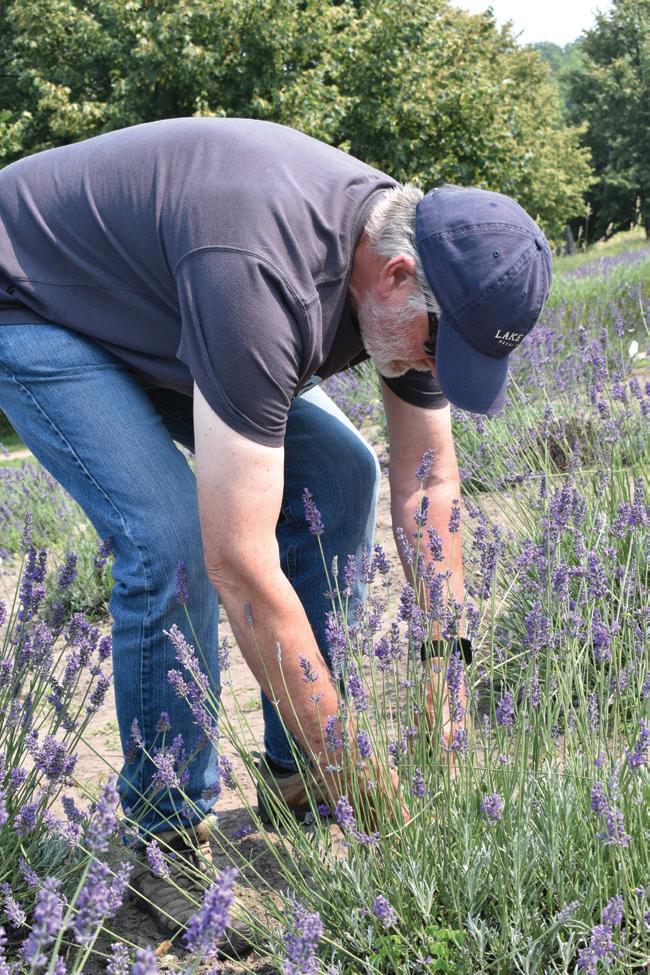
rabbits and deer who like to visit, because they don’t like its scent and typically will avoid it.
After a quick lesson on where to cut some lavender blooms, we sauntered out to the fields to cut our own fresh bundles of lavender.
I’m glad we pulled up the driveway of this fabulous spot, which opened in 2003. Beyond the mulch, we left with two large bundles of fresh periwinkle-violet flowers, and we also purchased lavender sachets and oils (they improve sleeping, really!), and lavender shortbread cookies (the best I’ve ever had!).
lavenderhillfarm.com
Weather determines lavender’s blooming time, but it’s always fun to visit — whether the fields are ready to harvest or not. The peak bloom season often starts in June and lasts through August. Like wine and lavender? Traverse City’s Brys Estate Vineyard & Winery and its Secret Garden is a must-visit. You’ll even find lavender ice cream (by Moomers) here! brysestate.com
More lavender farms in Michigan: Search for lavender farms in the search bar at michigan.org, which lists 31 lavender farms located throughout the state.
BY Julie Bonner Williams
IT BEGAN WITH AN AFTERNOON DRIVE through Greenville, en route to Lavender Vista farm. I’d spoken with Susan, an owner, on the phone, and was watching for forsythia bushes framing a mailbox on my left.
Susan met me as I parked in her gravel driveway, and she offered me a glass of lavender lemonade before we walked her lavender fields. She challenged me to smell different plants’ blooms and identify each scent: camphor, citrus, a peppery aroma. I learned which lavenders are used for soaps, lotions, and potpourri, and which are for culinary purposes.
Susan said her own journey started while she was on vacation in northern Michigan. Suffering from a headache, she walked into
Left: After he was given tips from the Lavender Hill Farm staff on how to harvest lavender, this U-picker set off for the bountiful fields and cut two large bunches. Below: Writer Julie Bonner Williams has a nice crop of drying lavender at her home in southwest Michigan.
a store filled with lavender — and walked out minus the headache. Inspiration struck. The result was a lavender farm and business. I was smitten. On the drive home, I planned my own lavender field.
The next day, I plunged a shovel into the earth and started. I was already an avid gardener, so I knew what I was in for.
In my journey, I’ve learned the most frequent question asked of lavender growers is, “What do you do with your lavender?”
Some sell lavender to artisans or cooks; others make soaps, lotions, and linen sprays; and still others offer “U-pick” at their farm. My goal was to help people who suffer from anxiety — people like me.
Does lavender really do all the things I’d heard it can do?
I sought articles to discover what research has determined. “Lavender and the Nervous System” (National Library of Medicine, 2013), cited three clinical studies on the efficacy of lavender oils. Lavender was shown to ease anxiety, sleeplessness, medical- and dental-related anxiety, and more: “This study indicates that lavender effectively ameliorates generalized anxiety comparable to 0.5 mg/daily lorazepam.” (https://pmc.ncbi.nlm.nih.gov/ articles/PMC3612440/ )
Partnering with a local therapist, I made dozens of lavender sachets and donated them to her practice. She shared clients’ experiences. A client’s teenage daughter kept a sachet in her pillowcase to help with anxiety. Another took hers to yoga classes, while yet another reported the lavender simply made her happy.
Since then, the lavender I harvest each summer has found its way into more people’s lives. Twenty bundles were used in a bride’s wedding flowers. A woman uses my culinary lavender in her teas. I’ve given bundles of dried lavender to the stressed-out college students I teach.
Today I have more than 300 lavender plants, and about 12 cultivars including Loddon Blue, Melissa, and Folgate.
The past two growing seasons I’ve had setbacks, including recovering from surgery and being instructed not to bend and lean, as a lavender-grower must do. Last year, a minor health issue kept me out of the sun. They weren’t wasted seasons, though. Although I was unable to do the heavy work, I savored walking through my lavender fields, happily watching dozens of bees and butterflies rejoicing in the plants that I started years ago.
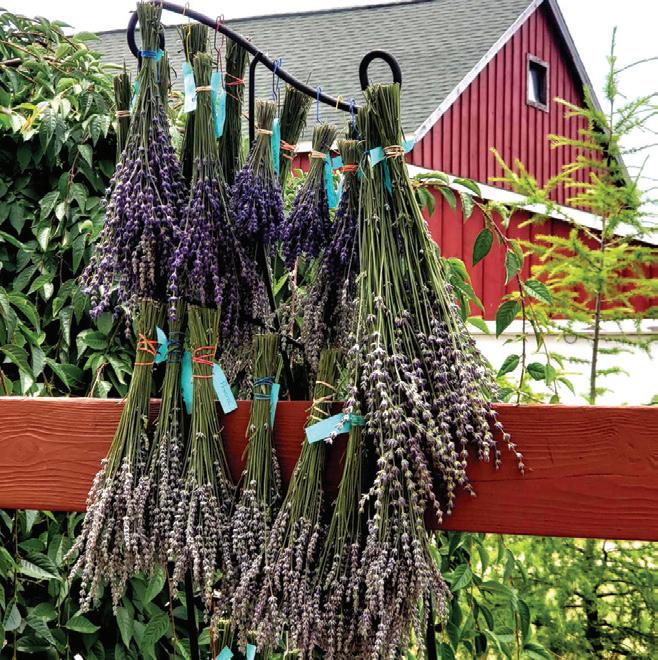
BY Giuseppa Nadrowski
IN 2022, MY HUSBAND, ANDREW, AND I HAD A WILD IDEA — we wanted to start growing lavender at my grandparents’ former Christmas tree farm in northwest Michigan’s South Boardman, even though we live 3.5 hours away in metro Detroit. We wanted to find a way to pay tribute to my grandparents by keeping the farm they had worked so hard for alive.
That fall, we started G’s Family Farm — named after my grandfather, Giuseppe “Joe” Lucido. He and my grandmother, Maria Lucido, immigrated to the U.S. from a small rural town in Sicily in the late 1940s and ’50s, and were known for their selfless generosity and unparalleled work ethic. In the late ’60s, my grandpa began purchasing a few acres at a time in Kalkaska County, slowly building what would become Lucido’s Quality Christmas Trees. A barber by trade, with a beloved shop in Eastpointe, he hand-planted thousands of trees and meticulously pruned and shaped each one.
He had a contagious passion for his farm, and it’s why my husband and I, along with our two children, love the land as much as we do. My grandfather put his heart into each field, and while trees hadn’t been planted in years, and rows once lined with Fraser firs were now riddled with thistle and grass, we knew we could make the land flourish as he once had.
Wanting to try something di erent, we learned that lavender thrives on the property’s sloped terrain, sun-drenched fields, and sandy Kalkaska soil (all which help to prevent roots from getting “wet feet”). In addition, the lake-e ect climate is just right for certain cultivars, too (our location shares the same parallel with Provence, France, which is known for its picturesque lavender fields).
We started with roughly 1,500 plants, placed in 19 rows. The work was far from easy, but after witnessing the plants grow beautifully, we ordered another 3,500 for the following season. Three years later, our plants, which are grown using all-natural and organic practices, are flourishing; each July, the deep-purple blooms and sweet, sugary scent of lavender takes hold of our fields. Then the monarchs, mantises, and bees arrive, and the fields come to life. With blue spruce and white pines towering behind our rows, it’s the perfect mix of past and present — and it’s a sight we hope my grandparents would be proud of.
By August the plants are ready to harvest, a task that’s done completely by hand. From there, we steam-distill the flowers to create pure lavender essential oil and hydrosol. We use our oils to handcraft small-batch products that are inspired by the land — from our beloved soy wax candles and cold-process soaps with scents like Fraser Fir & Lavender (a nod to the trees that once grew in our same fields) and Lakeside Lavender (reminiscent of days spent along Grand Traverse Bay), to our petite di users and roller balls that allow you to bring the relaxing scent of lavender along wherever you go.
What started as a truly wild idea for us has grown into so much more than we could ever have envisioned. We’ve witnessed our children grow and appreciate the land as much as we have, working and dreaming alongside us through it all. In the future, we hope to add a nursery and storefront with space to host workshops and U-picks, and we’re excited to begin replanting Christmas trees, too, just as my grandfather once did.
More information:
gsfamilyfarm.org


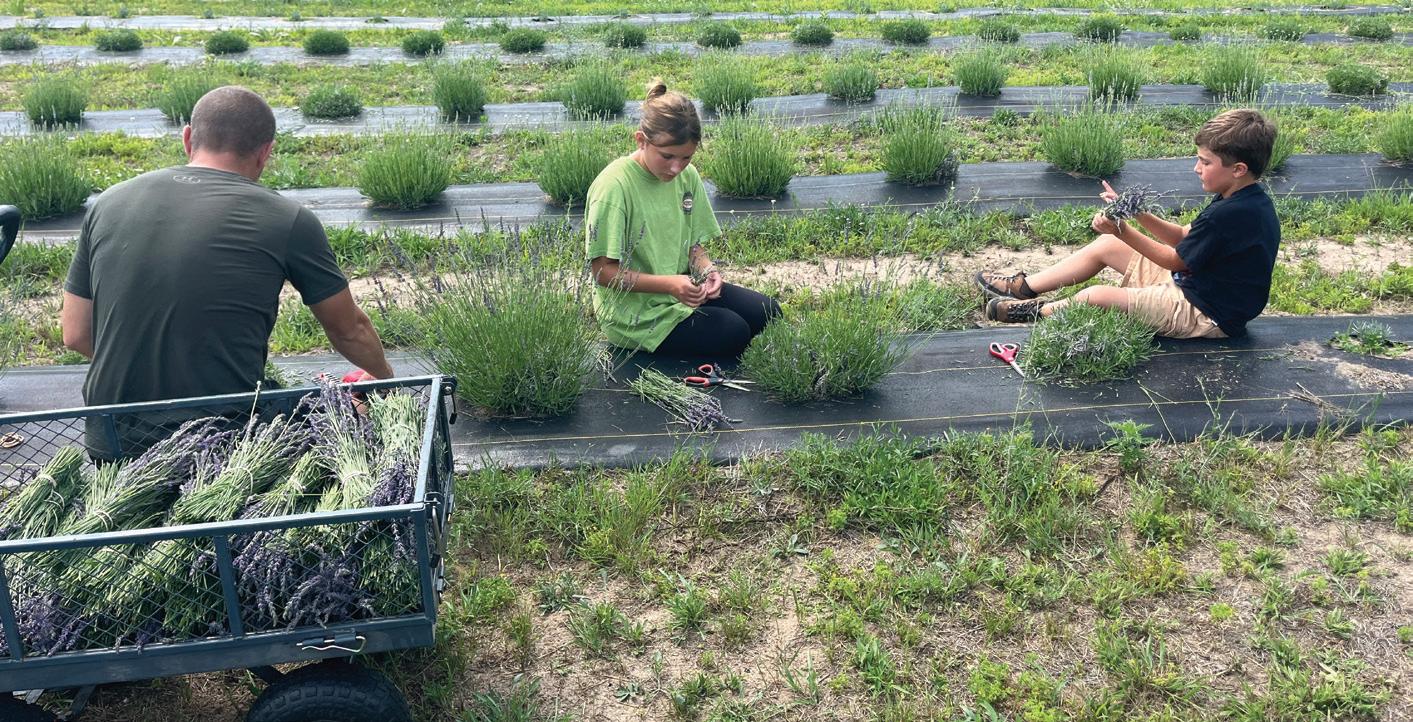
BY Megan Swoyer
he was working for Meijer in a corporate marketing job during the day, but side-hustling after hours as a scientist of sorts. Well, more of a mixologist. As evenings and weekends rolled around, Colette Doran, a Grand Valley State University graduate who now lives in Grand Rapids, would roll out her bar cart and stir up some fascinating concoctions. Passionate about her hobby, she sensed that it could lead somewhere. And before she knew it, the beverage specialist was pouring herself into crafting cocktails full time.
“I loved my job (women’s clothing and accessories buyer) but could see that mixing was becoming more than a hobby,” she says. In 2020, Doran started posting drink images and ingredients online for friends and family. The beverages — under the Colette’s Cocktails umbrella — made such a splash that she’s now a full-time online
influencer/content creator/mixologist.
“I find it so much fun; it’s my obsession and job!” Doran exclaims. With about 138,000 followers on Instagram and a manager who works (on her behalf) with brands that want to partner with Colette’s Cocktails, Doran can focus on running her social media accounts. “I do all filming, recipe creation, editing, and posting on my own. My posts are very everyday life; you might even see my dog (Ember). Or I’ll try to match a cocktail to the color of my shirt,” says the stylish Lake Orion native, who adds that her online tasting reactions are real. “I don’t post any drink information unless I really like the drink.”
In November of 2025, Doran published her first recipe book, “Twist or Tonic: Elevated Craft Cocktails & Their Mocktail Twins.” It’s available in both hardcover and e-book format.
“The book was going to be a collection of my favorite drink recipes, but then I was thinking about Damp January (a spin-off of Dry January that involves reducing alcohol consumption in January rather than eliminating it entirely), and how I could create cocktails and mocktails for the whole month. That did so well on Instagram because it appealed to those who drink, who don’t drink, or who didn’t want to drink,” she shares. “So then I started a Twist or Tonic series, and then wrote the book.”
Doran says the mixing bug bit her a few years back, when she wanted to start making good drinks at home.
“I started with learning the classics, like old fashioneds, margaritas, daiquiris,” she says. When she does head out to a bar, it’s likely the Buffalo Traders Lounge, Drip Drop Cocktail Room, or the Nightwatch Lounge, all in Grand Rapids.
As different seasons arrive, Doran says she loves to match the time of year with her cocktails — whether it’s toasty toddies in the winter or fresh lavender-infused sippers in the summer.
“When using lavender for drinks, choose the culinary-grade English lavender as it offers a sweet, floral, and non-soapy flavor,” Doran says. “Always use food-safe, organic lavender to avoid pesticides, and avoid French lavender, which has a much stronger scent and is used mainly for soaps and perfumes.”
Follow Colette Doran on Instagram at @ colettescocktails. Order her book by visiting colettescocktails.com.
Here, she shares her favorite lavender-infused drink recipes.
(Makes 8-10 cocktails)
Ingredients
1 bottle sauvignon blanc wine (I use White Haven)
½ cup pear brandy (can replace with pear juice if needed)
½ cup pisco (a grape brandy)
¼ cup freshly squeezed lemon juice
1/3 cup lavender simple syrup
1.5 cups club soda
2 frozen sliced pears
Handful of lavender
1 sliced lemon Ice
Add the sauvignon blanc, pear brandy, pisco, lemon juice, and lavender syrup in a pitcher. Stir. Place in the fridge for at least one hour before serving. Once chilled, add the club soda, frozen pear slices, lavender, and sliced lemons. Serve over ice. Garnish with a lemon slice and lavender.
(Makes 4-6 mocktails)
Ingredients
2 limes, diced
2 cups lavender tea
1.5 cups sweetened condensed milk
¾ cup lavender simple syrup
Lime slices
Lavender sprigs
Ice
Preparation
Wash and dice your limes. Place the diced limes (with the rind on) in a blender. Add the lavender tea. Blend well. Strain through a fine mesh strainer into a bowl. Press down with a rubber spatula to get all the juice out. Pour the juice back into the blender. Add the sweetened condensed milk and lavender simple syrup. Blend well. Serve chilled over ice. Garnish with a lime slice and lavender sprig.
Ingredients
1 cup water
1 cup granulated sugar
About 10-12 lavender sprigs
Preparation
Add all ingredients to a small pot. Place over low heat and stir occasionally as the mixture heats up. Continue to stir occasionally until the sugar dissolves. Let the simple syrup simmer lightly for another 3-5 minutes. Remove from heat and let fully cool. Once cooled, strain out the lavender. Store in a sealed bottle (Optional: add a few lavender sprigs to the bottle for extra flavor.) The simple syrup will last in the fridge for up to four weeks.
(Makes 1 cocktail)
Ingredients
1.5 oz. Empress Gin
½ oz. cream of coconut
1 oz. lavender tea (purchase at a grocery store in the hot tea section) ¾ oz. freshly squeezed lemon juice
1 egg white (or 1 oz. low-sodium aquafaba for a vegan eggsubstitute option)
1 lavender sprig
Ice
Preparation
Add all ingredients except the lavender sprig in a cocktail shaker. Dry shake (shake without ice). Add a good amount of ice to the cocktail shaker. Shake very well. Strain into a chilled Nick & Nora glass (small, stemmed). Garnish with the lavender sprig.
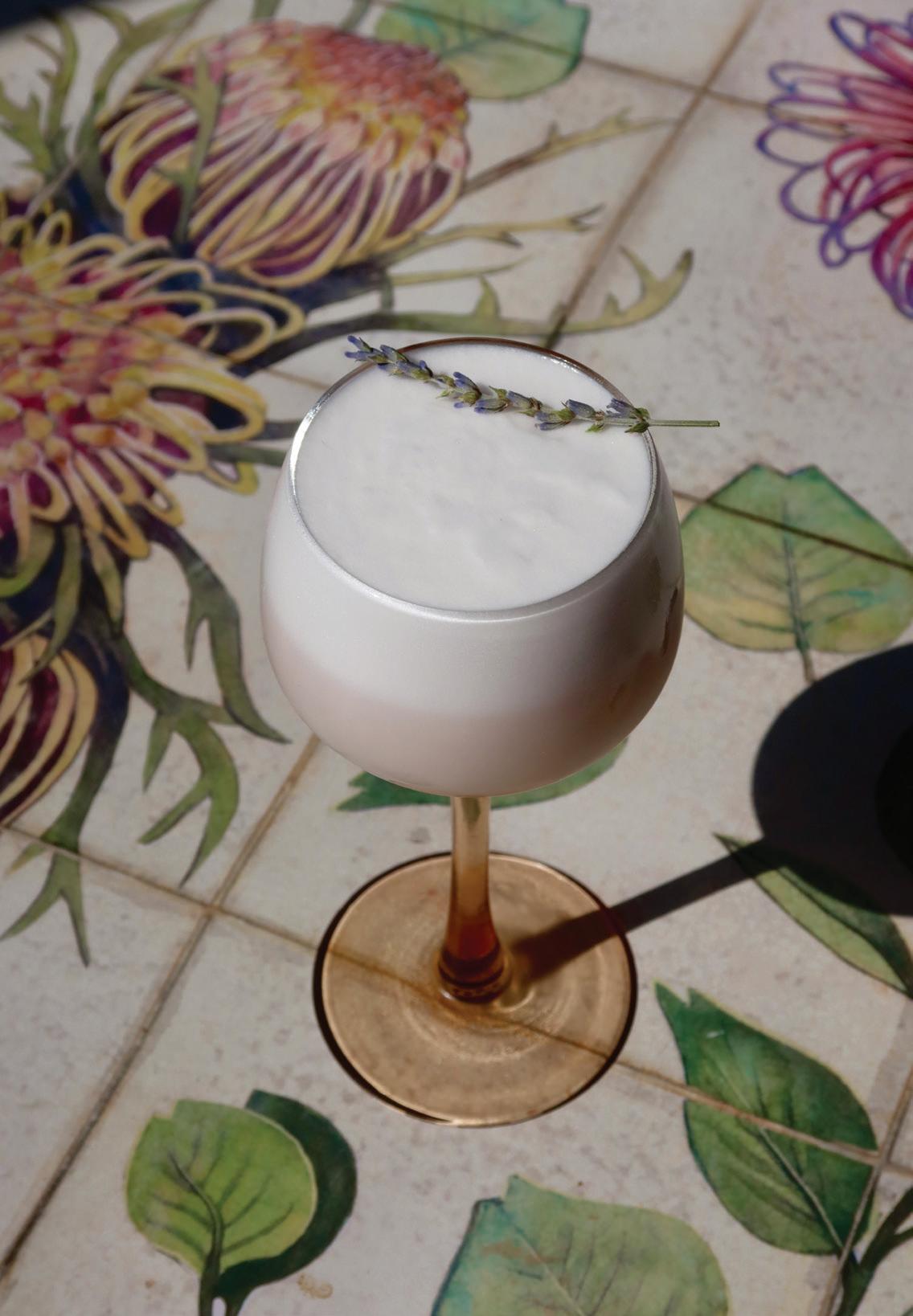

Entrepreneurs Christian and Michelle Anschuetz are self-described failures at retirement.As Christian tells it, Michelle’s hobby has been literally growing into something unique in the region — and perhaps the state — in a jack pine forest outside tiny Roscommon (east of Grayling) in northern lower Michigan.
It’s so under the radar, in fact, that you could drive right by the branded sign on Chase Bridge Road announcing the homestead that the couple has named Uncommon Ranch. Like a lot of things around the city that have opened recently, it’s aptly named.
Here’s part of what you’ll see when you explore its more than 200 acres of planned quiet and solitude: 10,000 lavender plants thriving in the sandy soil, sustainably and organically grown, all used on the premises in everything from the food featured in the ranch’s Blue Zone-themed dinners to natural insect repellent. Here’s what you can experience: Access to cooking and yoga classes, five rental properties (one’s called Lavender Loft) scattered around the property, hiking trails, and more. All of it is anchored by fields of purple, white, pink, and blue — there are 16 varieties of lavender that you probably didn’t know existed outside of the traditional purple.
Just 3.5 miles from the South Branch of the legendary Au Sable River, much of the area consists of state or federal lands. From the Uncommon Ranch, you can literally head east to Lake Huron, west to Lake Michigan, or point north to Cheboygan or Petoskey and never touch private property.
The former Marine explains that when he and his wife left Chicago’s high-rises, they wanted to settle someplace in the middle of nowhere. They’ve been building on that dream since buying the first parcel of their personal paradise in 2002.
“It’s incredibly remote, beautiful, and surrounded on all sides by national forest,” he says, “and Michelle has fed the fire.
“She asked, What can we grow here? All that can grow is jack pine, blueberries, and ferns,” Anschuetz recalls. But, he says, they soon discovered that lavender, which
loves the sandy soil around the Roscommon area, also thrives on their property. “It’s one of the best crops and there’s tremendous demand for it. Our overall vision is more than just being agritourism. We have an 8,000-square-foot building called The Retreat. It’s an art studio, yoga room, commercial-grade gourmet kitchen, and a small retail store. That’s where our Long Table is,” he continues.
The Long Table is one of Uncommon Ranch’s underpinnings. Themed dinners that can accommodate up to 64 people in the fall and winter can be expanded in warm weather thanks to an outdoor area that seats 32 more. All of the meals are prepared by Executive Chef/Culinary Director Kaytie Bowman — and, of course, lavender is frequently used in the courses. Bowman’s menus are currently themed around Blue Zones — regions where food tends to promote long, healthy lives and an attitude that says slow down, take a moment, exhale, and connect with others in a calming environment. One time she’s serving an authentic Greek meal; the next it’s California-style, or Japanese or South American fare. Some meals even combine food with art. Bowman also leads cooking classes, and enjoys partnering with local businesses.
“We live in a food desert. There’s not a lot of good dining experiences, (where) you could come from downtown Chicago and say, ‘This is nice.’ But there’s a very high level of attention (to detail) here at Uncommon Ranch,” Anschuetz says. Lavender is added to sugars and lemonades, and is distilled for its essential oils, soaps, and other products that are for sale at the ranch. “We don’t sell any of our products wholesale,” Anschuetz notes.
“Most lavender and essential oils found elsewhere are either ‘cut’ or contaminated. We’re very stringent, so there are no chemicals used — only water — and everything here is powered by renewable energy.”
Uncommon Ranch is adding another dimension to the experiences it offers: an outdoor stage for musical performances will soon be located in the flowering fields.
BY Bill Semion
“We feel extraordinarily fortunate. We’re expecting this season to be off the charts,” Anschuetz says. “This area also is an activity desert. If you’re not in the woods or on the lake, what do you do? This is a radically different offering that already attracts a lot of people. We’re working to give everyone 10 different reasons to come out here every week.”
More information: uncommonranch.com
Uncommon Ranch staff member Brenna Janisse tends to the drying lavender plants. Ranch owner Christian Anschuetz says there’s a tremendous demand for lavender.
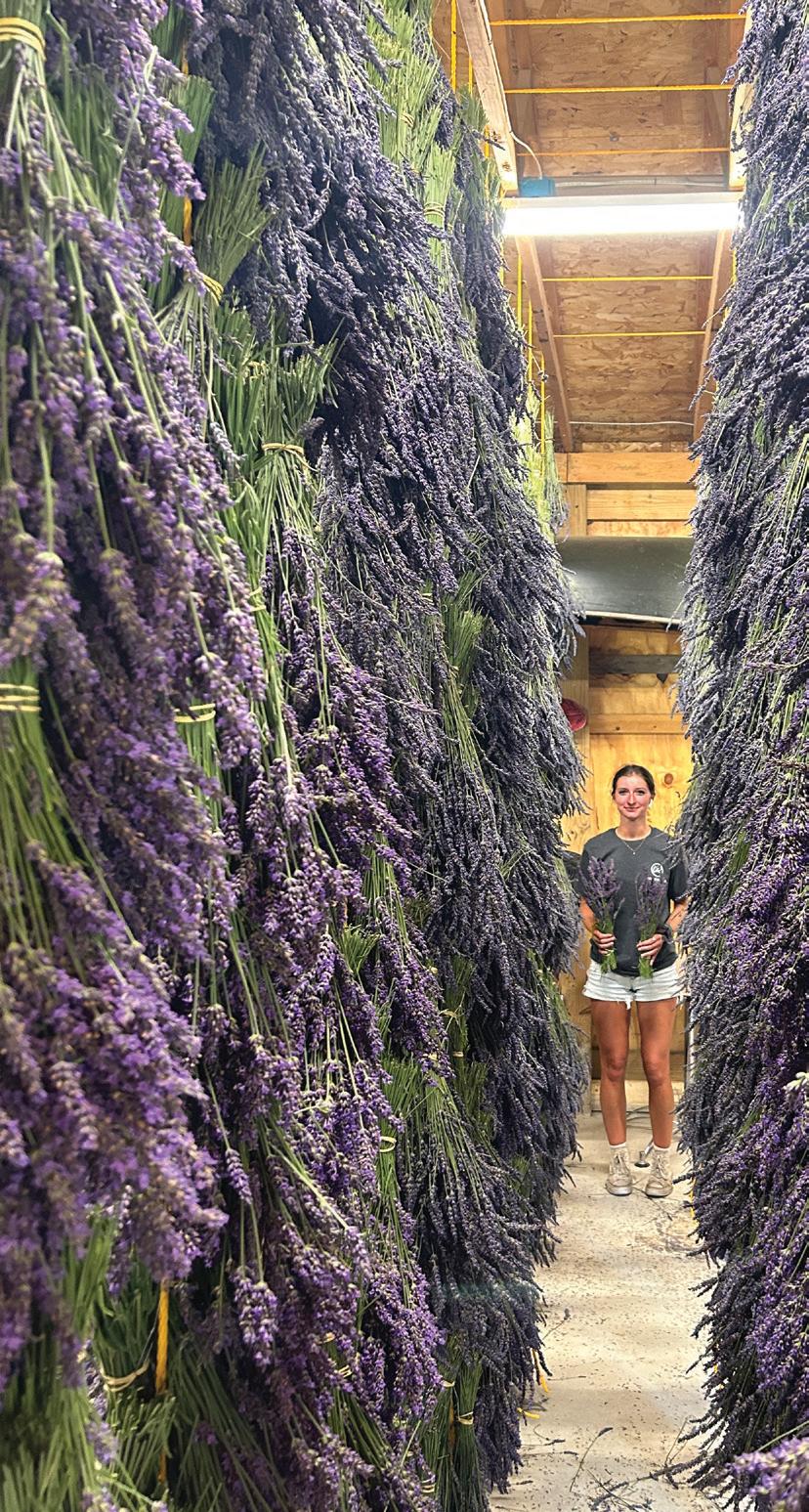

CHEF KAYTIE BOWMAN, OF UNCOMMON
RANCH, describes herself as a “lifer” in the kitchen. She says that’s the term chefs use when they’ve settled on a love of cooking and serving guests, and since she’s been working in the kitchen since she was about 15, it’s an apt description.
“My first official job was running a Mennonite camp kitchen. We would feed 300 at a time, a big buffet,” she recalls. Later she added to her skills at Traverse City’s Great Lakes Culinary Institute, and with a stint at the Paul Bocuse Institute in Ecully, France, before taking on Uncommon Ranch’s cooking classes and Long Table dinners.
“(The Uncommon Ranch owners and I had) been professional friends for a while because I would buy their herbs and lavender and do catered events. When my restaurant in Grayling closed, it became obvious that we needed to bring the food out there. We’ve been doing dinners for over a year now,” she says.
Here, she shares three recipes using lavender. “There are things lavender doesn’t go with, but a lot that it does. Lavender and ginger are a classic combo. Lavender and lemon, lavender and honey, coffee and lavender. It can be used for savory and sweet. I like it in both.”
— B.S

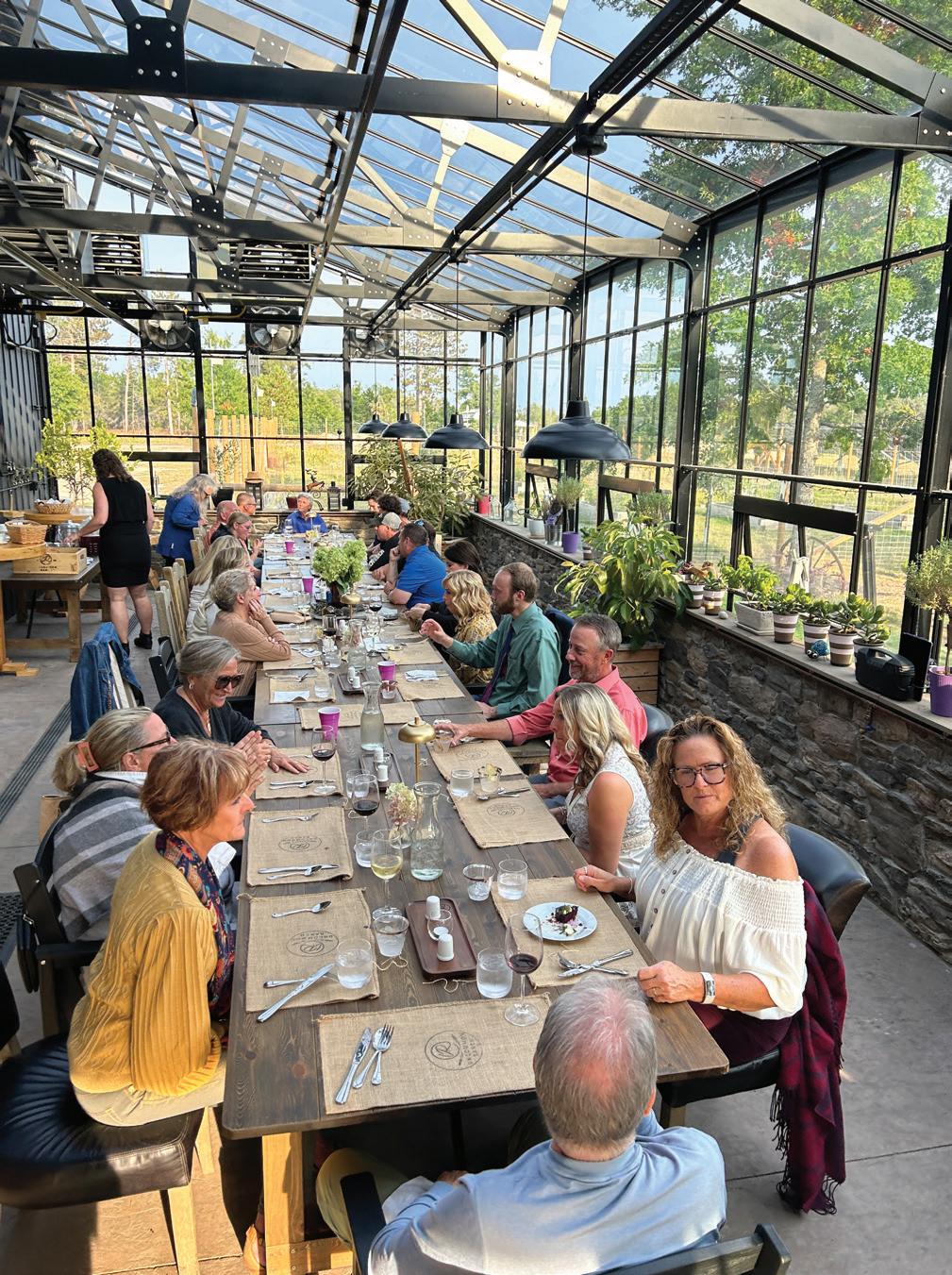
(Serves six to eight)
(Makes 18 muffins)
Tips for Success
Do not overmix when folding the wet ingredients into the dry. Be sure the muffins are cool before glazing.
Ingredients
2 cups all-purpose flour
¾ cup granulated sugar
1 tablespoon poppy seeds
1 teaspoon baking powder
½ teaspoon baking soda
1 teaspoon salt
½ teaspoon finely crushed culinary lavender
½ teaspoon almond extract
2 eggs
¾ cup milk
½ cup melted butter
¼ cup sour cream or creme fraiche
½ cup sliced almonds
Preparation
Preheat oven to 350 and line a muffin tin with paper liners. In a large bowl, whisk together the flour, sugar, poppy seeds, baking powder, baking soda, salt, and crushed lavender. In another bowl, whisk the eggs, milk, melted butter, sour cream (or creme fraiche), and almond extract. Gently fold the wet ingredients into the dry ingredients until just combined. Divide the batter evenly into paper-lined muffin cups and sprinkle with sliced almonds. Bake for 18-22 minutes, until the tops are golden and a toothpick inserted in the center comes out clean. Allow the muffins to cool slightly before glazing and serving.
Honey Butter Glaze
Warm ½ cup lavender honey with ½ cup salted butter. Add a small drop of almond extract. Whisk until fully emulsified. Brush over the slightly warm muffins.
Tips for Success
Serve as an accompaniment to a charcuterie or cheese board. This pairs wonderfully with warm crostini, grilled bread, crackers, nuts, seasonal fruits, cured meats, or roasted grapes. The lavender should remain subtle, providing a gentle floral complexity that enhances the flavors of the honey and goat cheese.
Ingredients
10 oz. softened goat cheese
3 tablespoons heavy cream or olive oil
2 tablespoons lavender honey (or honey)
½ teaspoon finely crushed culinary lavender buds
1 teaspoon chopped fresh thyme leaves
1 teaspoon chopped fresh chives
Pinch sea salt and fresh ground pepper
In a bowl or food processor, whip the goat cheese with the heavy cream or oil until smooth and fluffy. Fold in the lavender, honey, spices, herbs, salt, and pepper. Adjust the seasonings to taste. Spread onto a shallow serving dish and drizzle with additional honey or olive oil. Finish with fresh thyme leaves and a few lavender buds for garnish.
(Serves two to four)
Tips for Success
You can buy Herbs de Provence or make your own by mixing thyme, rosemary, oregano, savory, marjoram, and basil. To get the most juice out of your lemon, roll it firmly on the counter before slicing, to break cell membranes.
Ingredients
4 bone-in chicken thighs or 1 whole
Left: The Long Table is one of Uncommon Ranch’s underpinnings. Themed dinners that can accommodate up to 64 people in the fall and winter can be expanded in warm weather, thanks to an outoor area that seats up to 32 more. Inset: Chef Kaytie Bowman is the maestro of these culinary experiences.
chicken
2 tablespoons olive oil
2 cloves garlic, minced Juice and zest of 1 lemon
Salt and pepper
1 tablespoon honey 2 teaspoons Herbs de Provence ½ teaspoon culinary lavender buds, lightly crushed 1 teaspoon chopped fresh thyme leaves
1 teaspoon chopped fresh rosemary
In a bowl, whisk together the olive oil, garlic, lemon zest, lemon juice, honey, Herbs de Provence, lavender, thyme, and rosemary. Season the chicken generously with salt and black pepper. Place the chicken in the marinade and coat well. Marinate overnight.
Preheat oven to 400. Arrange the chicken in a roasting pan. Roast for 30-35 minutes, until the skin is golden and the chicken is cooked through. Spoon pan juices over the chicken before serving, and finish with fresh lemon if desired.




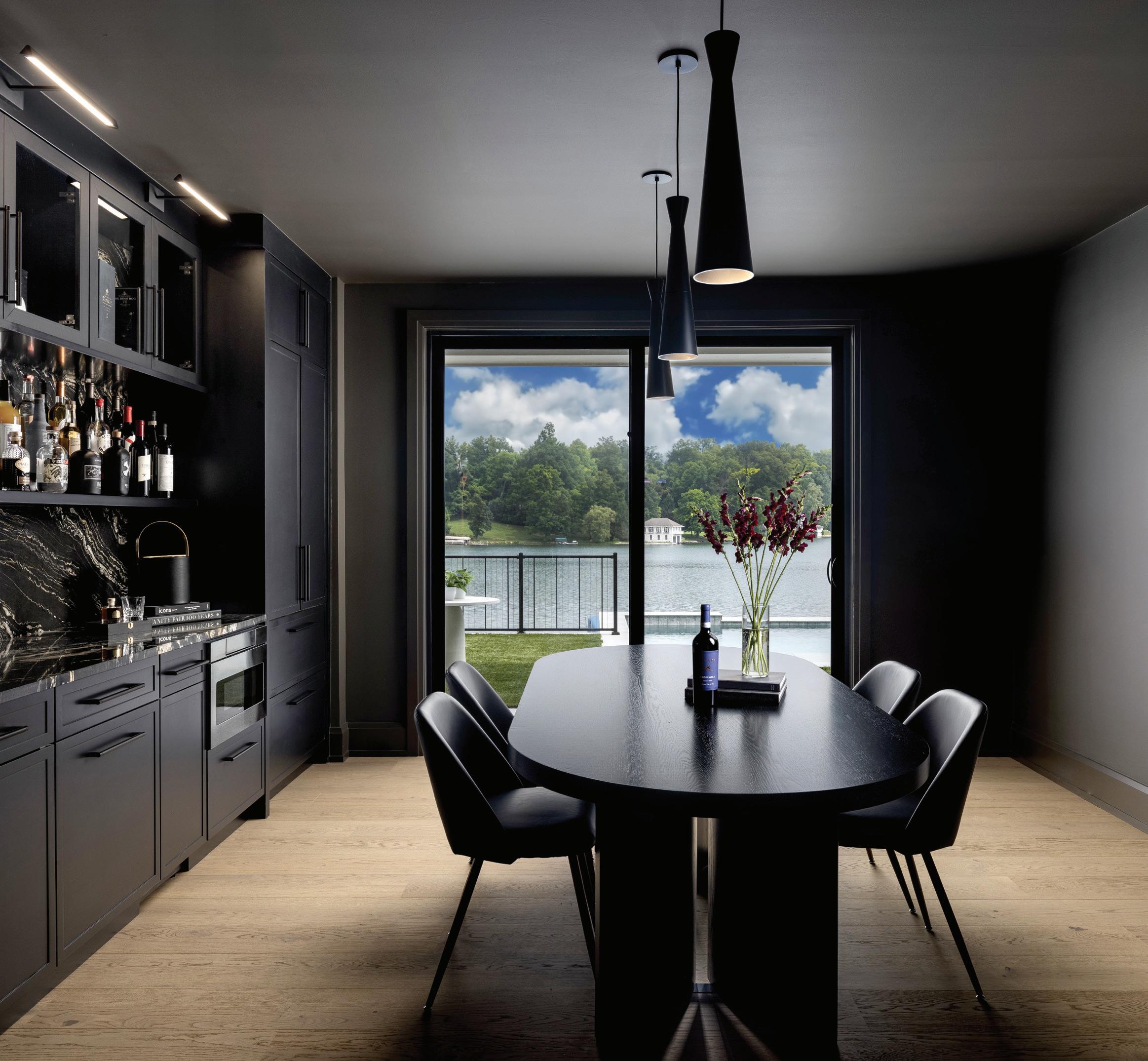



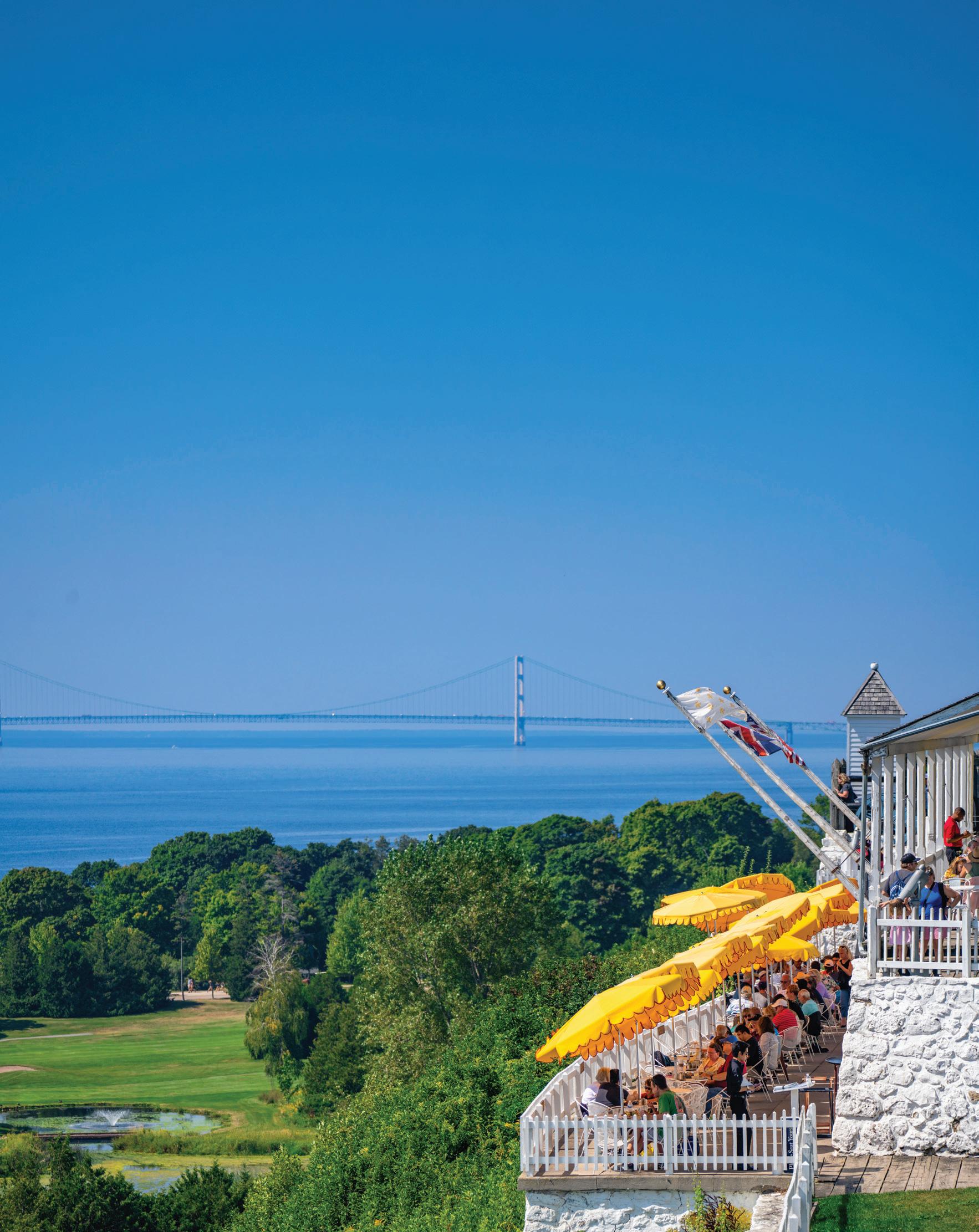
Fort
Read about it and other forts in this section’s
Less than 30 feet from the enticing waters of Lake Michigan’s picturesque Sleeping Bear Bay lies Blu, an inviting dining destination at the LeBear Luxury Resort in Glen Arbor that blends an ever-changing menu with mesmerizing views.
Taking in the natural beauty of the bay, the Manitou Islands to the north, and the surrounding forest is made easy through Blu’s sizable windows, while its high ceilings and skylights add to the elegant yet relaxed atmosphere.
Venture out on the spacious outdoor patio when weather allows to take in unspoiled vistas, coupled with the sound of crashing waves.
“Certainly, being right on Lake Michigan offers amazing views and incredible sunsets for our guests through lots of glass, but we’re not just about the view,” says owner Brandon Chamberlain, a third-generation restaurateur whose parents (Randy and Mari) founded Blu in 2008.
“We love creating an unforgettable dining experience with a menu that changes daily with ingredients we select from local farmers markets and farms,” he continues. “We keep a record of all our previous menus, so we first look back at what we were doing at the same time in past years — but our menus are always changing a little each year.”
In 2025, Blu was one of fewer than 400 restaurants across the continent to receive a Distinguished Restaurants of North America (DiRoNA) award. The organization recognizes exceptional dining experiences.
Head Chef Todd Thompson draws on his decades of experience at several Traverse City-area restaurants in seeking out ingredients from the likes of Lakeview Hill Farm & Market (Traverse City), Bluebird Farm and Gardens (Empire), Morganic Farm (Fife Lake), Second Spring Farm (Cedar), the Michigan Farm Co-op (Suttons Bay), Providence Organic Farm (Central Lake), and several other sources.
While the menu is fluid, some entrees appear frequently and have become customer favorites, especially duck confit. According to the meticulous recordkeeping initiated by Randy Chamberlain and continued by his son, Blu surpassed 15,000 orders of duck confit in 2024.
“Our duck confit gets its richness from the way it’s sealed in duck fat,” Brandon says. “We pan-sear it really hard on the skin side, which makes it nice and crisp, and then we cook it to perfection in the oven, which really brings out the rich flavor. Customers who
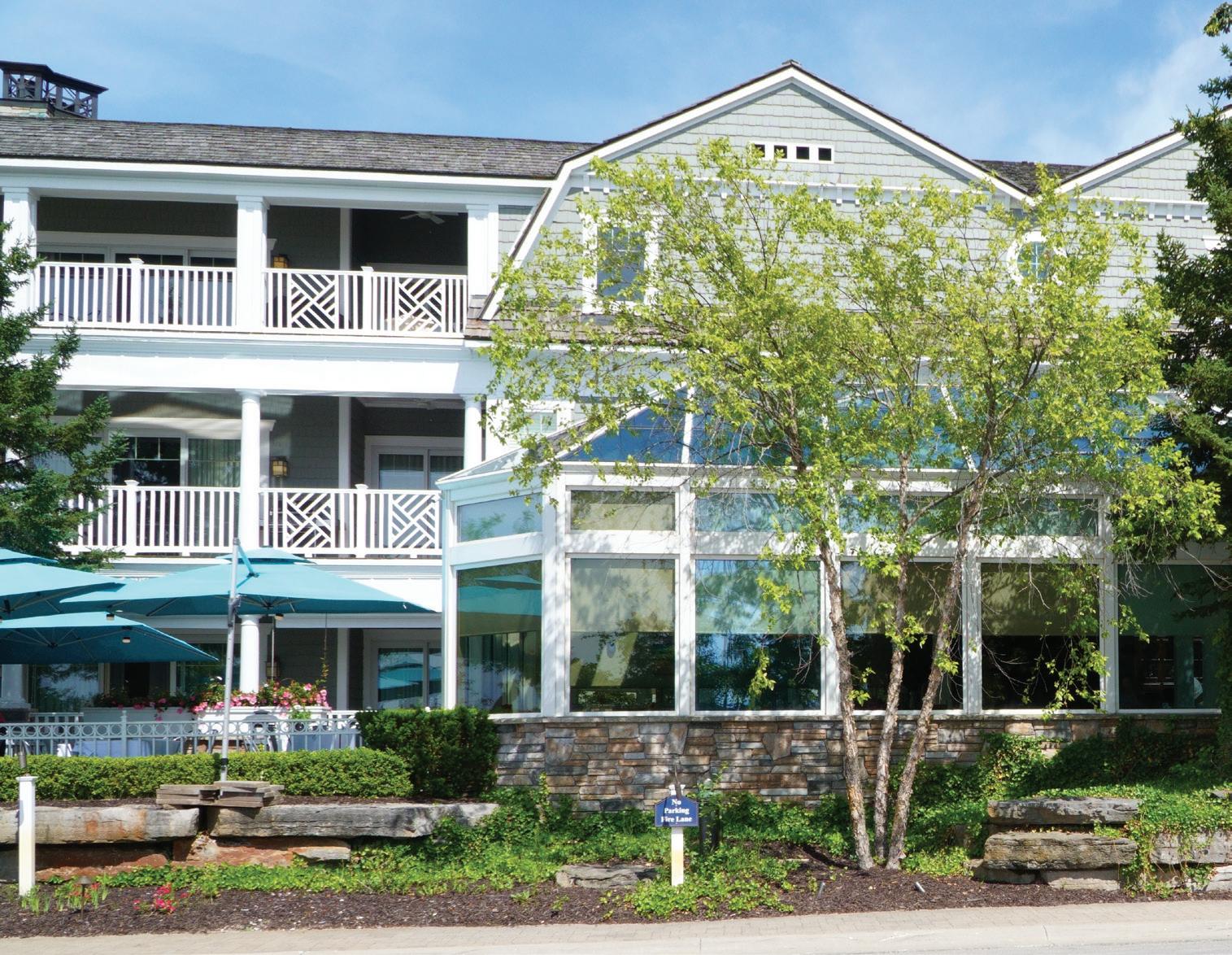
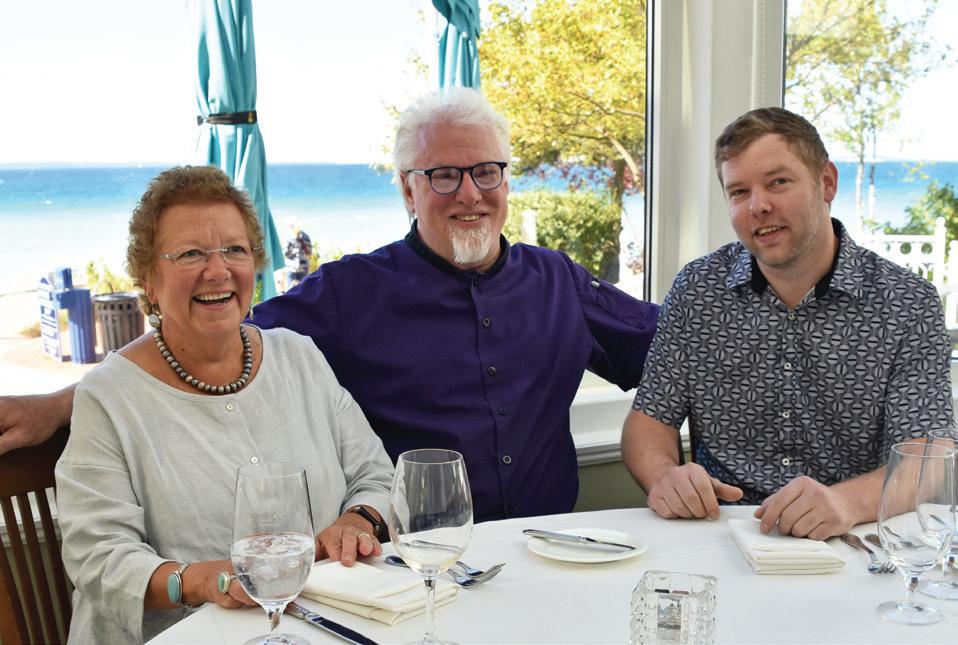
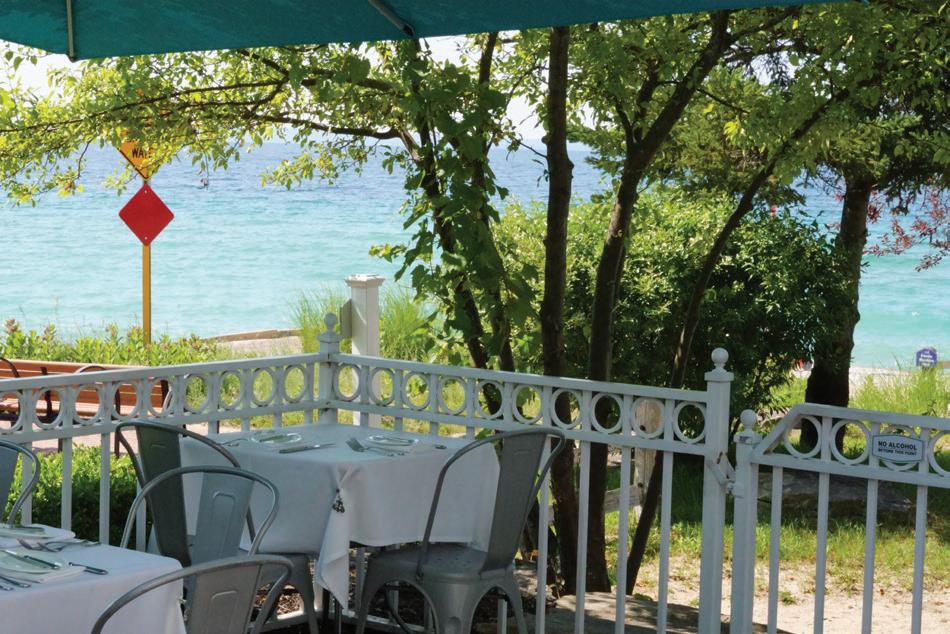
Blu collects glowing reviews for its impressive waterfront dining experiences in Glen Arbor
BY Mark Spezia
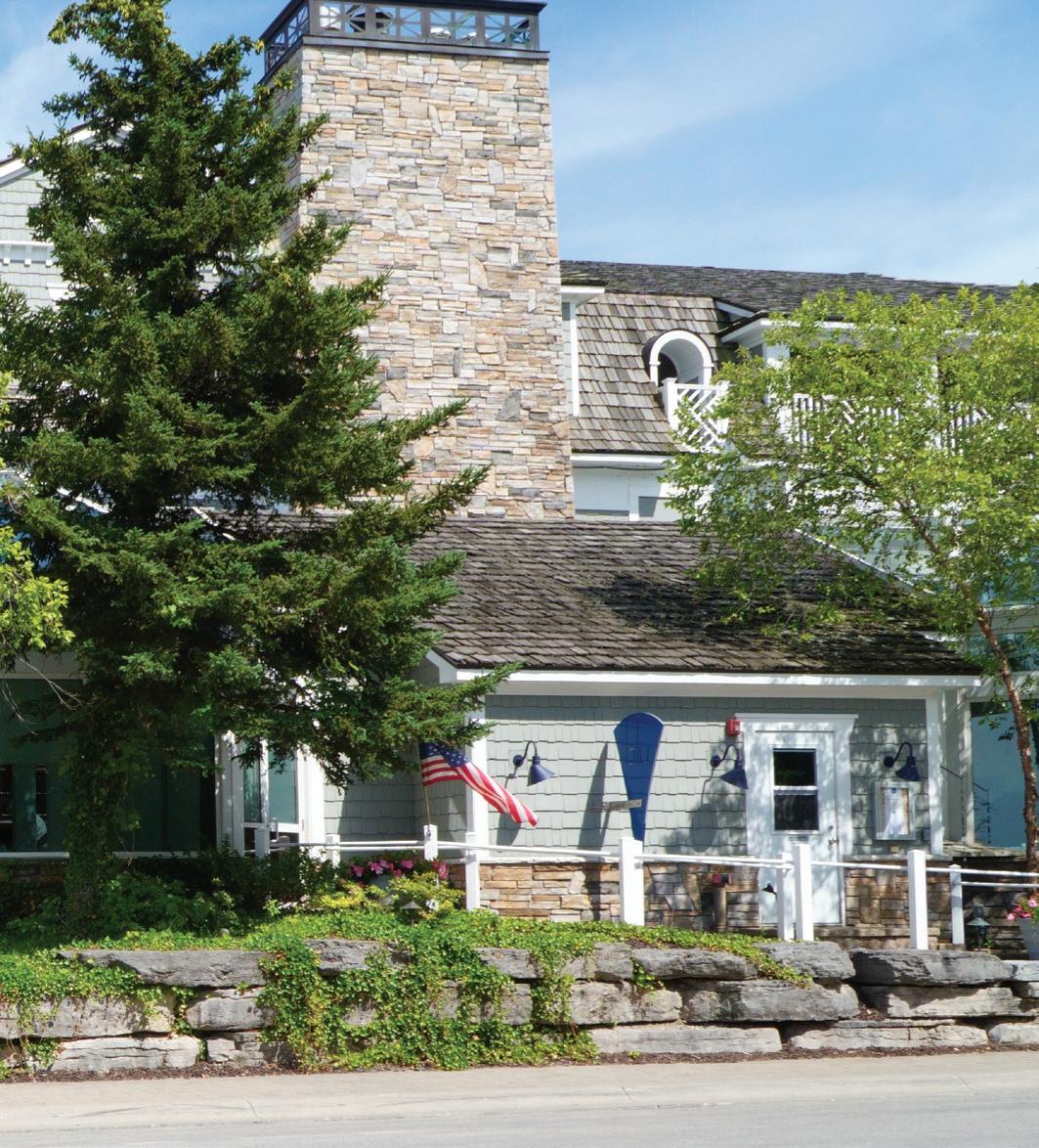
have traveled the world say our duck confit is the best they’ve ever had.”
City-area establishments, including Charlie’s Basket, Charlie’s Deli, Chamberlain’s, and Downtown Charlie’s.
Randy Chamberlain began working in his father’s restaurants at age 10 and was a kitchen manager before he turned 20. He later spent time as a chef at Reflections and Windows, also in the area, before opening Blu and serving as executive chef.
Just two years after serving his first meal at Blu, Randy was named a James Beard Award semifinalist in the Best Chef Great Lakes category.
“The most important lesson I learned from my parents and grandparents when it comes to the restaurant business is to never stop evolving and improving,” Brandon says. “Always find a way to make what you already have better.”
Brandon began his tenure in the business bussing tables as a 16-year-old. He spent 17 years at Trattoria Stella and The Franklin in Traverse City before joining Blu as dining room manager in 2021.
Opposite page, top, middle, bottom: Blu is located less than 30 feet from the shores of gorgeous Lake Michigan. The restaurant is within the LeBear Luxury Resort in Glen Arbor.
Blu’s founders, Mari and Randy Chamberlain, turned over the reins to son Brandon (right) a couple of years ago. Outdoor diners rave about the stunning lake views at Blu.
A menu from earlier this year included appetizers such as Greek olives, morel and shiitake risotto and crab puffs, and main courses such as black Angus tenderloin, tandoori-seared walleye with grilled shrimp, grilled venison rack, and the signature duck confit, served with braised cabbage and “blu-berry” tamarind sauce.
Among Blu’s other favorites are seared scallops, Lake Michigan whitefish, and hand-crafted pastas.
Desserts include a milk chocolate orange shortbread tart, browned butter milk chocolate mousse, shortbread cookies profiterole, cocoa nib brittle, and caramel sauce Basque cheesecake.
Blu’s fastidiously curated wine list was originated by Mari Chamberlain, who was the restaurant’s first sommelier, and showcases bold reds, crisp whites, and refreshing rosés from local, national, and international wineries. Craft cocktail options include seasonal drinks featuring fresh ingredients and artisanal spirits.
Brandon Chamberlain, 37, has put his own stamp on Blu, including introducing new drinks. “I come from a heavy bar background, so I’ve looked to bring interesting new cocktails to the menu, including the Sea Plane — rye whiskey washed with our duck fat,” he says.
Brandon says his family’s restaurant roots run deep. Grandfather Charlie Chamberlain owned and operated several Traverse
By then, Randy and Mari had already begun talking with Brandon about taking over the restaurant upon their retirement in 2024. As part of the changeover, Thompson was promoted from sous chef to head chef.
“Even before we began having those conversations, I was planning to open my own restaurant and had started looking at options in the area, but it seemed fitting that I took over the family business,” Brandon says.
“The transition has gone smoothly, and my parents say they only hear good things from people who are longtime customers since Todd and I have taken over,” Brandon adds. “The ownership change has been well-received, and we have remained very busy.”
Reservations are recommended for Blu’s 5-9 p.m. dinner service Tuesday-Saturday. Outside seating reservations can only be made on the same day, weather-permitting.
It!
Blu glenarborblu.com
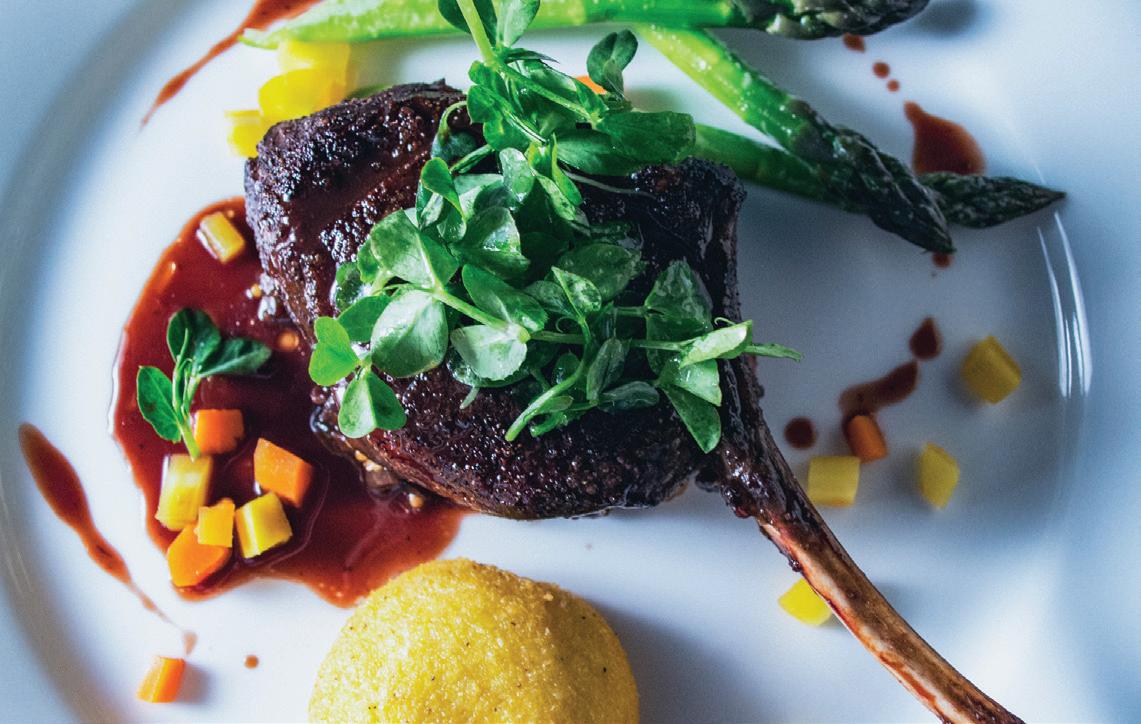
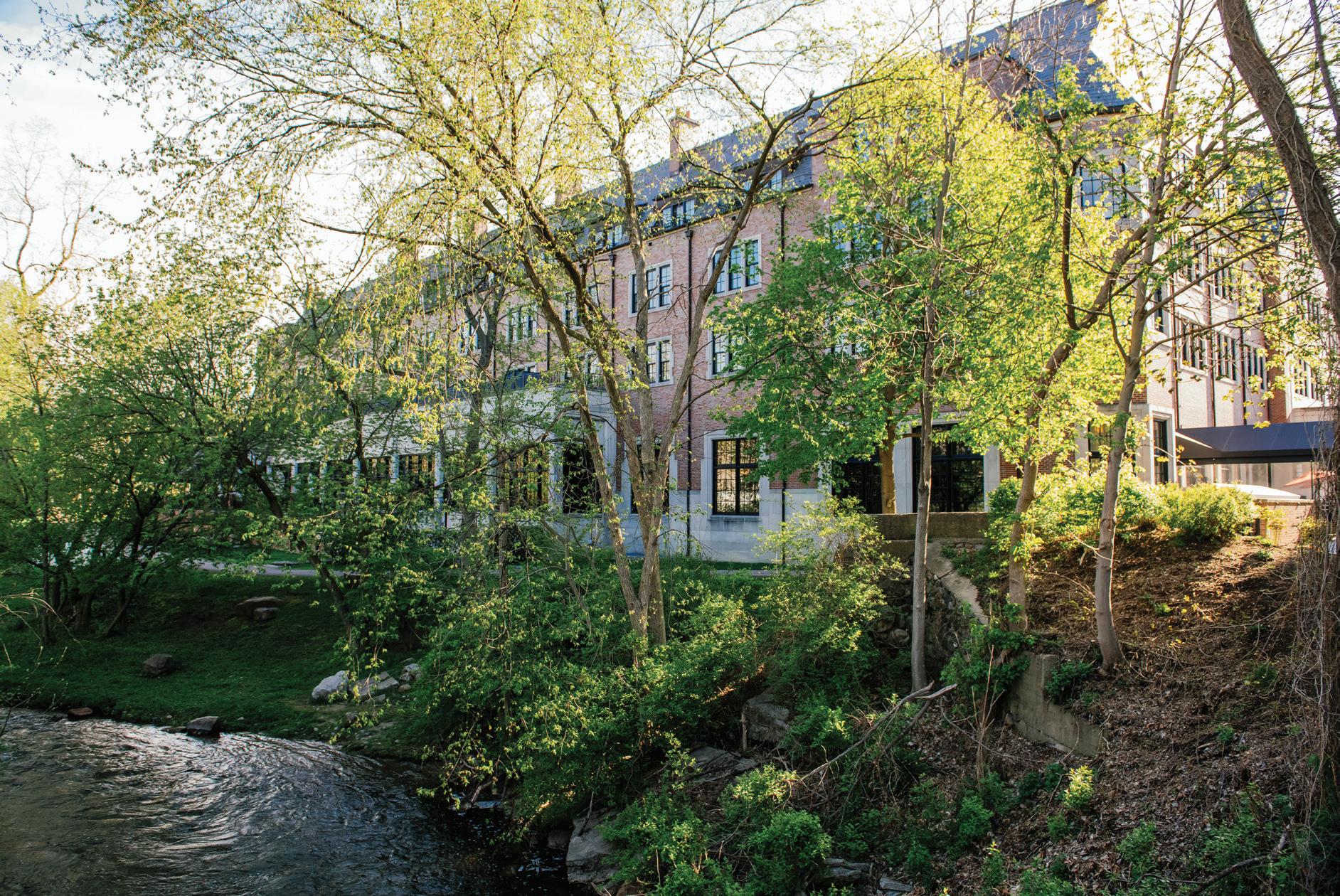
Both pages, clockwise from left and below:
The Royal Park Hotel, whose interiors underwent a design overhaul, is located on the 16.9-mile-long Paint Creek in downtown Rochester. Anglers are often spotted here catching trout. Its guest rooms now feature gorgeous light tones of grays, purples, and creams, while the lobby is abloom with fresh accents.
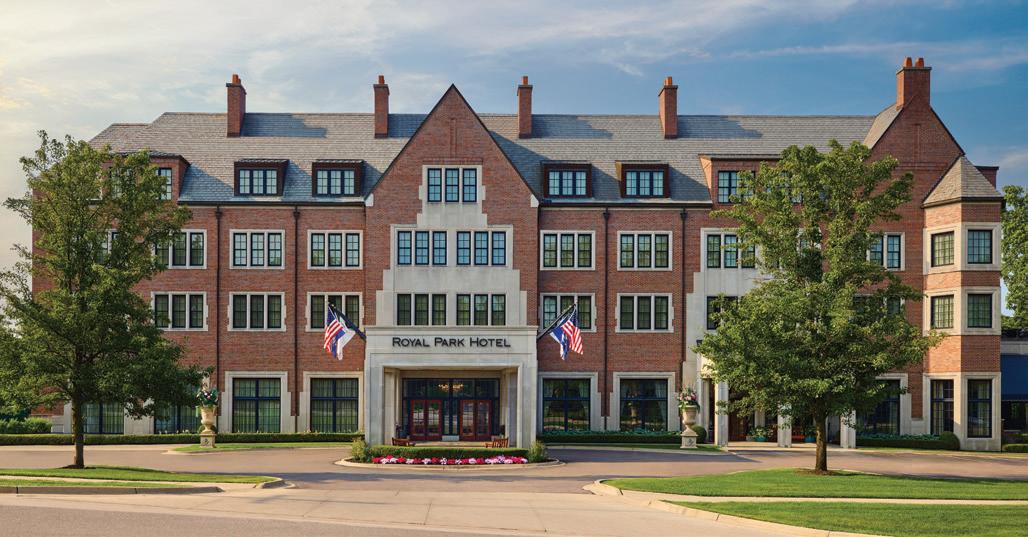
BY Megan Swoyer
Rochester’s updated Royal Park Hotel attracts nature buffs, city slickers, weekenders, and a fair share of anglers
Craving a distinctive getaway that puts you alongside one of nature’s rambling creeks, but also envelops you in the finest of accommodations? Consider the Royal Park Hotel in downtown Rochester.
Located on the Paint Creek, hotel staff say they often spot anglers casting in the pretty waterway, a 16.9-mile-long stream that flows southeastward into the Clinton River. It’s one of two designated trout streams in Oakland County (the other is Trout Creek, a tributary of Paint Creek). Anglers typically catch brown trout, rainbow trout, and creek chubs.
Whether you’re packing nymphs, dry flies, and spinners, or just looking for a creekside getaway steps from a vibrant downtown, the Royal Park is your ticket to both a happening getaway and a peaceful sojourn.
Recently, I learned the hotel has turned over a bright, new leaf with a refreshing garden-themed vibe. It’s the first design overhaul
since the hotel, now owned by Fairwood Capital and managed by Davidson Hospitality Group, opened in 2004.
“We wanted to bring an English garden feel to the entire property,” Sarah Osbourn, director of marketing for the upscale facility, told me during a tour. The refurbishment took about seven months to complete.
Guided by what designers are calling a “bud to blossom” concept, they’ve layered soft floral wallcoverings with a serene color palette throughout the hotel.
“It’s inspired by the original architecture of the building and the beautiful grounds surrounding the property,” says designer Chris McDonough, of Chicago-based Gettys Group, which led the undertaking. A light-filled, welcoming atmosphere reflects the property’s natural surroundings, including its location along Paint Creek.
“Our goal (with design) was to invite guests to slow down, take notice, and truly

enjoy their surroundings,” adds Danielle Gilligan, general manager of Royal Park Hotel.
Each of the facility’s 143 guest rooms (including 15 suites) has been refreshed. A significant collection of spacious suites was designed to accommodate longer stays, celebrations, and group and family travel.
“Some suites have connecting doors and one suite has three balconies,” Osbourn notes. She says it was a smart decision to add sleeper sofas in many of the spaces, for those traveling with children.
Also complementing the new motif are guest room headboards that feature fabric with a floral pattern in light shades of gray, purple, and cream. The artwork in guest rooms and suites ranges from both modern abstract (an enlarged calla lily, for example) to a more classical botanical art style.
I was especially impressed with the glorious modern wallpaper (from MDC) in the lobby and hallways. Large-scale peony blooms in hushed grays and whites make up the pattern and pair well with the creamy, newly painted millwork.
McDonough says that upon entering, he wants guests to sense “a soft and airy arrival.” Special details, such as light fixtures with a petal motif, wow, while muted pink tones
and an Art Deco appeal provide a relaxed ambience. The rooms/suites with balconies are especially alluring, as many look out to the calming waterway.
Soft, warm paint tones, such as Scuffmaster’s Mocha Cream on the lobby’s wood and Benjamin Moore’s Alabaster on the library walls and ceiling, create a soothing feel.
Meeting rooms also received a recharge. New televisions, chairs, banquettes, carpeting, wall treatments, and drapery adorn these inspiring spaces.
In the library, I was lured to the fireplace with a cup of coffee in hand, and browsed a collection of floral-themed books (such as “A Year in Bloom,” “Edible Flowers,” and “The Kinfolk Garden”) while savoring walls showcasing garden photography. A soft rug with an organic design (think deep maroon with cream and sage floral patterns) complements cream- and peach-toned furnishings. Bright ivory drapery, small marble-topped tables, and brass tabletop lights also adorn the airy room.
Nearby, the light-filled, garden-inspired conservatory, hand-constructed in Belgium and assembled on site, was untouched, and for good reason — it not only aligns perfectly with the new design concept, but it’s
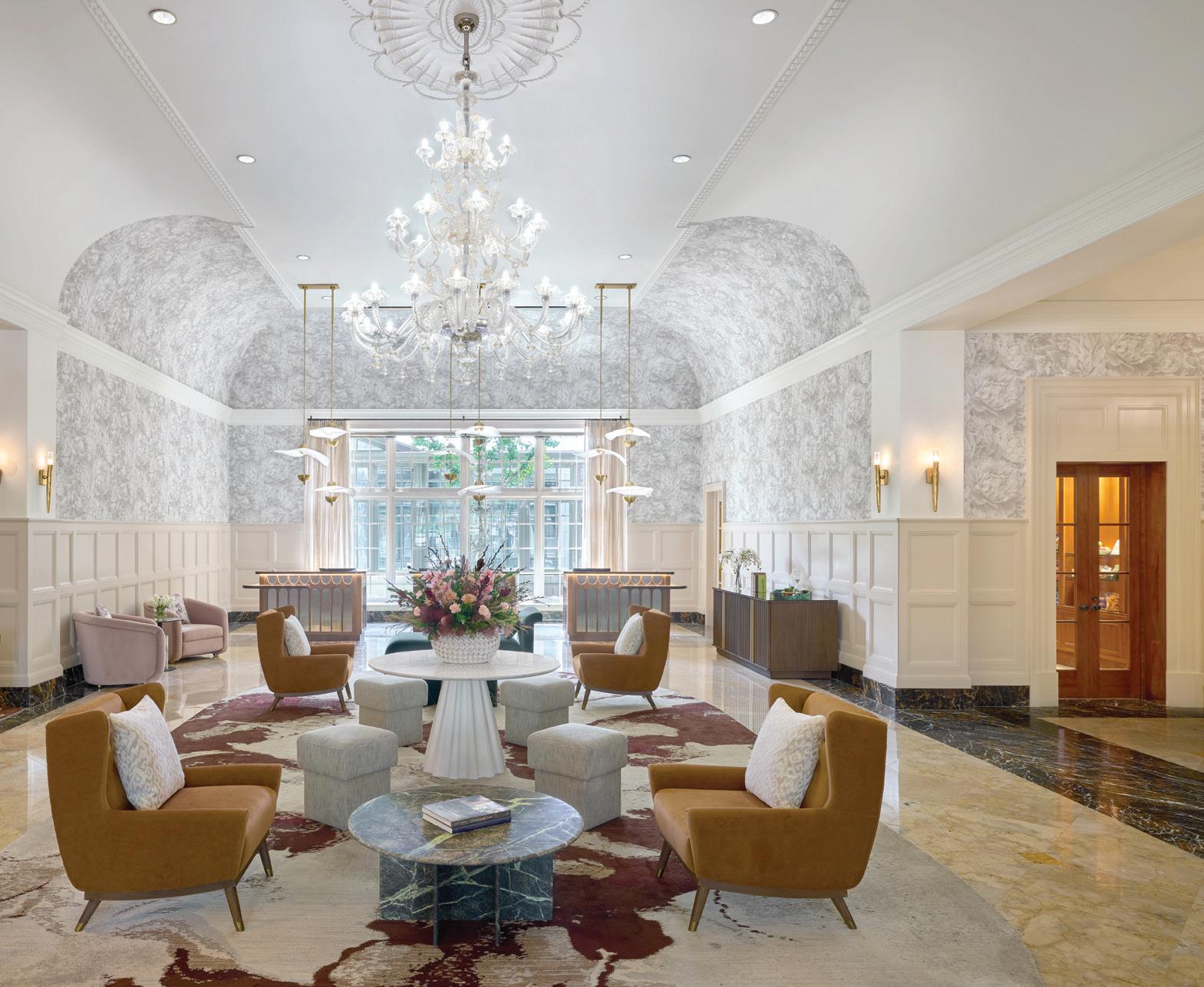
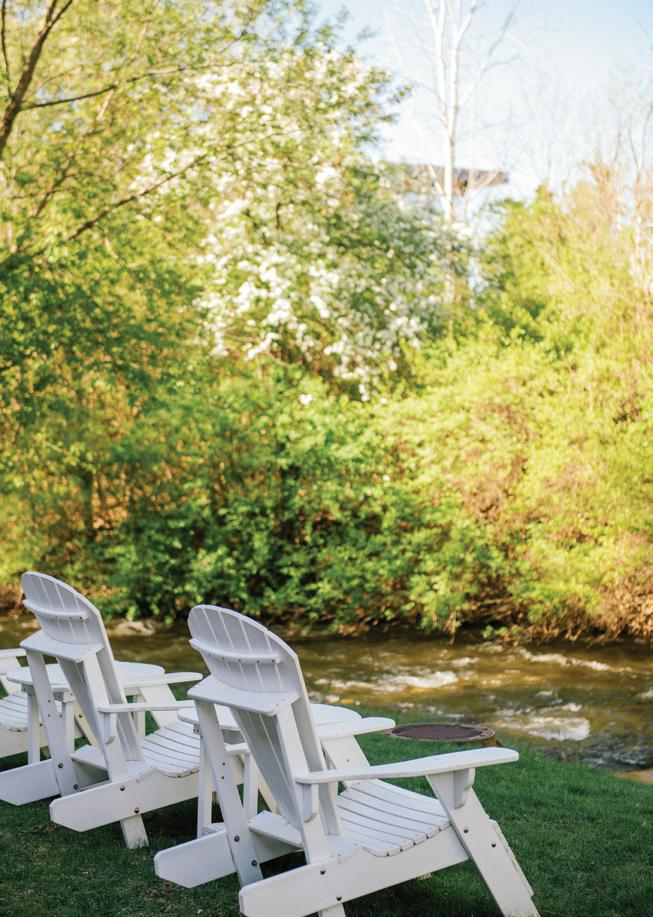
also a space that gets raves reviews, event after event.
The Royal Park Hotel offers formal afternoon teas, seasonal celebrations, and holiday events from Easter through Christmas. When the weather turns warm, an outdoor stage is set up near Paint Creek so guests and the community can enjoy ticketed performances for monthly outdoor concert offerings.
Finally, staff members are happy to hook visiting anglers up with a fishing guide. “Yes, we do make those connections; sometimes guests want to fish,” Osbourne shares. Or you can watch the anglers, with a beverage in hand, from the comfort of the hotel’s creekside Adirondack chairs.
Royal Park Hotel royalparkhotelmi.com
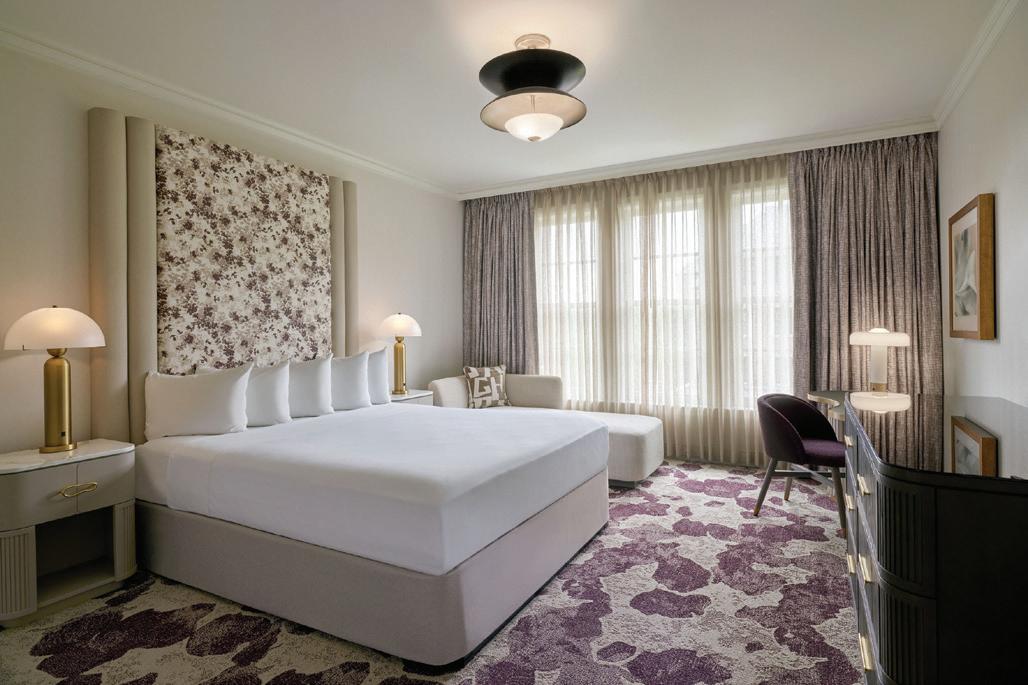
BY Ellen Creager
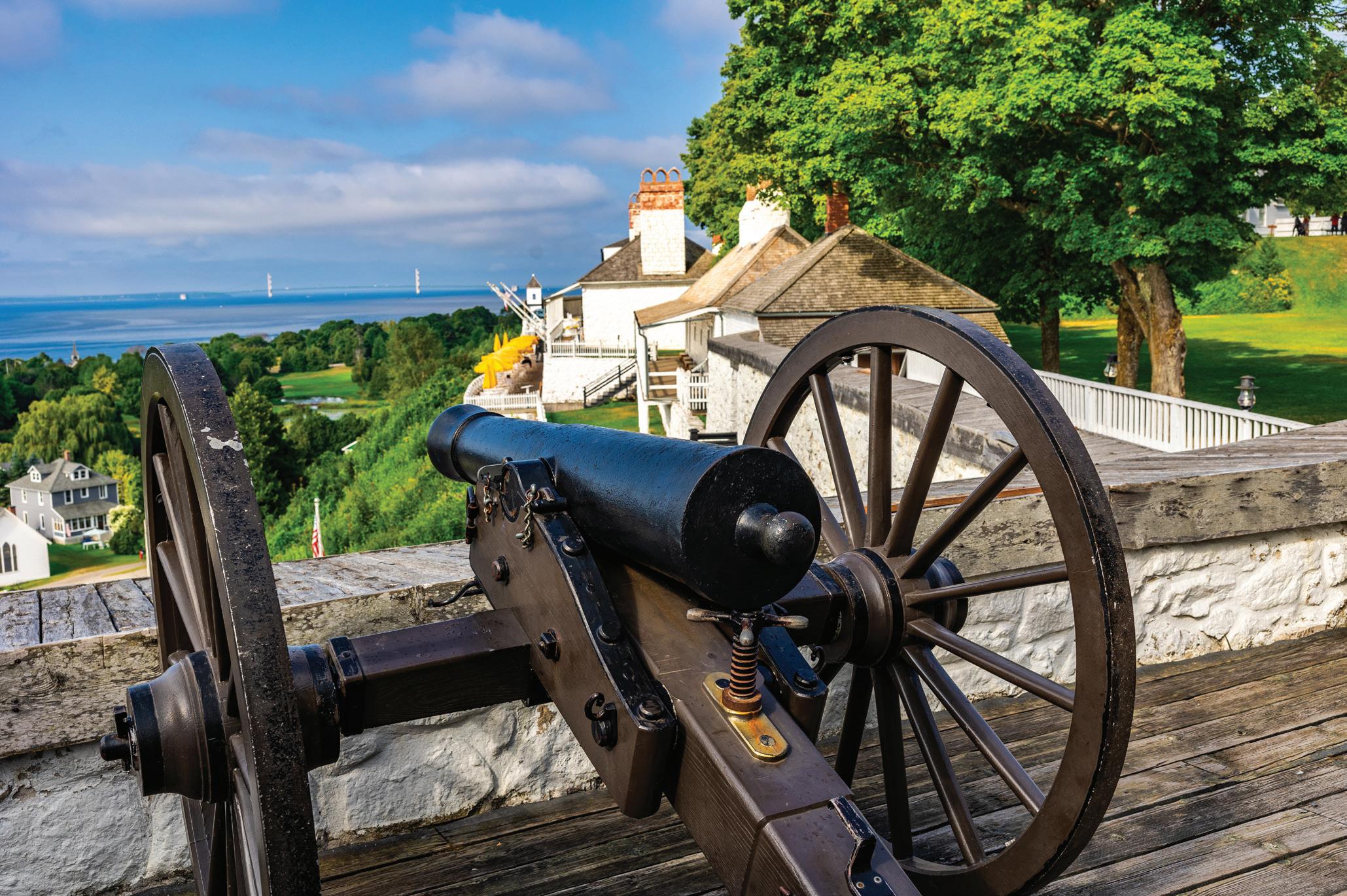
Michigan’s legendary forts, some dating back to the 1770s, showcase military history and offer great lake views
Above: Fort Mackinac, built during the Revolutionary War on Mackinac Island, will be a cite for America250, the nation’s big birthday celebration. Below: Fort Michilimackinac, in Mackinaw City, was built by the French. It offers numerous programs for families to learn about fort life and participate in archeology digs of the grounds.
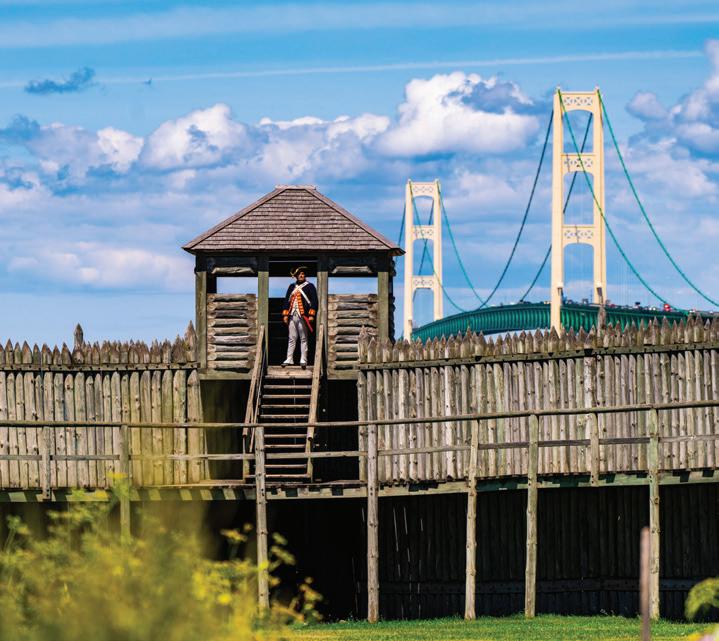
They were built for defense. They are beloved for the views.
“The joke is, the British built Fort Mackinac because they realized it would be a tourist attraction in 250 years,” says Dominick Miller, marketing chief for Mackinac State Historic Parks.
Today, the Mackinac Island fort built during the Revolutionary War has drop-dead, gorgeous panoramic views of Lake Huron and beyond, especially from the outdoor tea room with its yellow umbrellas.
“It’s pretty unrivaled anywhere in northern Michigan,” Miller says. “The restaurant closes at 7 p.m., but they serve cocktails after 5, and when the sun is starting to move past the Mackinac Bridge, the light is beautiful.”
Michigan has had many forts in its history. Four forts remain as tourist attractions, in good and bad condition. Three of them, in northern Michigan, have been treated with loving care and honor. Their surroundings retain the loveliness that Mother Nature bestowed.
One, along the Detroit River, survives as
a star-fort structure surrounded by its fading buildings and a riverview surprise.
This summer, the fort will be part of America250, the nation’s big birthday celebration. “This is an authentic Revolutionary War fort. People don’t equate the Revolutionary War with anywhere outside the east coast,” Miller says, “but the Straits of Mackinac was the super highway — the water — and it connects to every point in the Great Lakes.”
In the 1770s, the British feared that rebels from the colonies or the Spanish might attack their fort at Michilimackinac in Mackinaw City, so they moved everything to a bluff on tiny Mackinac Island. The limestone walls and ramps were the first things built, and they’re still in use today.
One favorite activity visitors usually do at the top of the fort is stand on the gun platforms to take selfies, with the panoramic water view behind them. Stand by the cannon looking south, and you’ll see the Mackinac Bridge and Mackinaw City. To the west is the
island’s downtown. Beyond that? Miles of shimmering Lake Huron.
Mackinaw City
Lesser known than its sister fort — and harder to pronounce (Mich-i-la-Mack-in-aw) — this plucky fort has survived in one form or another since the early 1700s. Built by the French at a spot long used by Native tribes for trade, it became a British fort before the Revolutionary War.
In the 1950s, the Mackinac Bridge was built directly next to the historic fort site, almost over the top. Today, it means visitors have a front-row seat to the action on the Lake Michigan side of the Straits.
One of the coolest views? The fort gift shop is almost directly under the bridge; panoramic windows let you see out and up to the traffic passing above. Other great views can be found inside the fort and along the beach.
“The freighters are right in front of you, the ferries, the bridge traffic, everything. You have the contrast. You have 18th century cannons, but the modern bridge is right there,” Miller says. “In addition, from the old block house you have an absolutely stunningly beautiful view from the portholes framed by the Mackinac Bridge.”
Copper Harbor
Michigan’s Keweenaw Peninsula might seem like an unlikely spot for a fort, but in the 1840s, America wanted to make sure the Upper Peninsula was secure
Right: Fort Wayne was built in 1845 on the Detroit River to protect America from British Canada. It had 7-foot-thick perimeter walls and limestone barracks.
Above right: Nineteen restored fort buildings welcome visitors to Copper Harbor’s Fort Wilkins, now a state park that was built in the 1840s. Views of Lake Superior and Lake Fanny Hooe make it a favorite spot for hikers and campers alike.
during the copper mining boom.
The Army fort stayed bucolic, so in the 1920s it was turned over to Michigan as a state park. Today it has 19 restored fort buildings, a living history program, and 165 campsites, hiking, fishing, and a whole lot of quiet. Charming views of mighty Lake Superior and Lake Fanny Hooe are abundant.
Robert Wild, park supervisor at Fort Wilkins, has two favorite views. One is looking north to Lake Superior from the trail. “It’s a really rocky and rugged coastline, and across the bay you can see the Copper Harbor Lighthouse,” he says.
The other notable view is from the fort’s parade grounds: “Stand by the flagpole, look out over Lake Fanny Hooe to a wooded ridge, and that’s a great spot.”
The view from here is new and surprising. Just beyond the fort grounds, the new Gordie Howe International Bridge connecting Detroit and Windsor juts up high, its silvery strands reaching across the Detroit River.
Right across the street from the fort’s entrance is the bridge’s imposing customs plaza; its security wall features a star-shaped pattern that honors the fort.
The new bridge is a touch of something new for this old spot. In 1845, Fort Wayne was built on the Detroit River to protect America from British Canada. It had 7-footthick perimeter walls and limestone barracks. The fort saw no action, but the site later was used for everything from World War II and
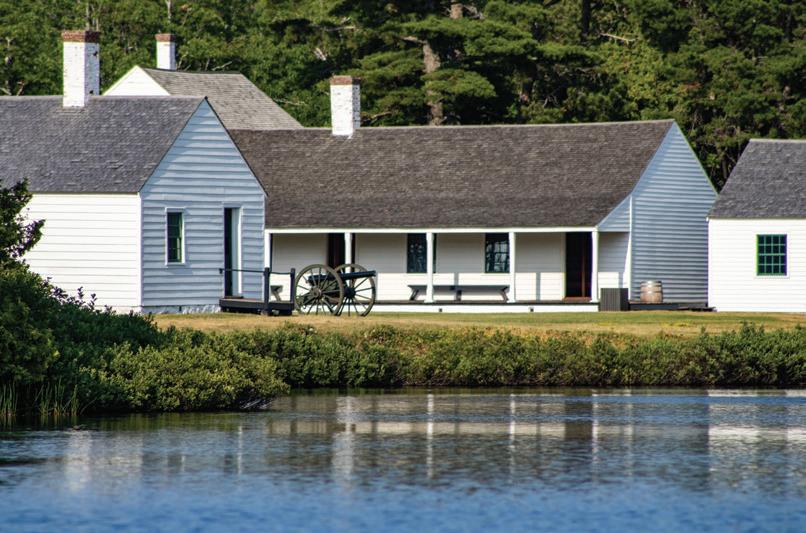
Vietnam War inductions to WW II vehicle storage. The fort also has a 1,000-year-old Native American burial mound.
Today, “visitors can experience the tranquility of acres of natural green space combined with the profound historical and cultural significance of the landmark,” says Brennah Grace Donahue, Historic Fort Wayne manager.
Decades of valiant efforts to completely restore Fort Wayne and its buildings have failed, and many are quietly crumbling, but a visit here is poignant.
Forts Mackinac and Michilimackinac, and America250 events mackinacparks.com Fort Wilkins michigan.gov/historicfortwilkins Fort Wayne historicfortwayne.org
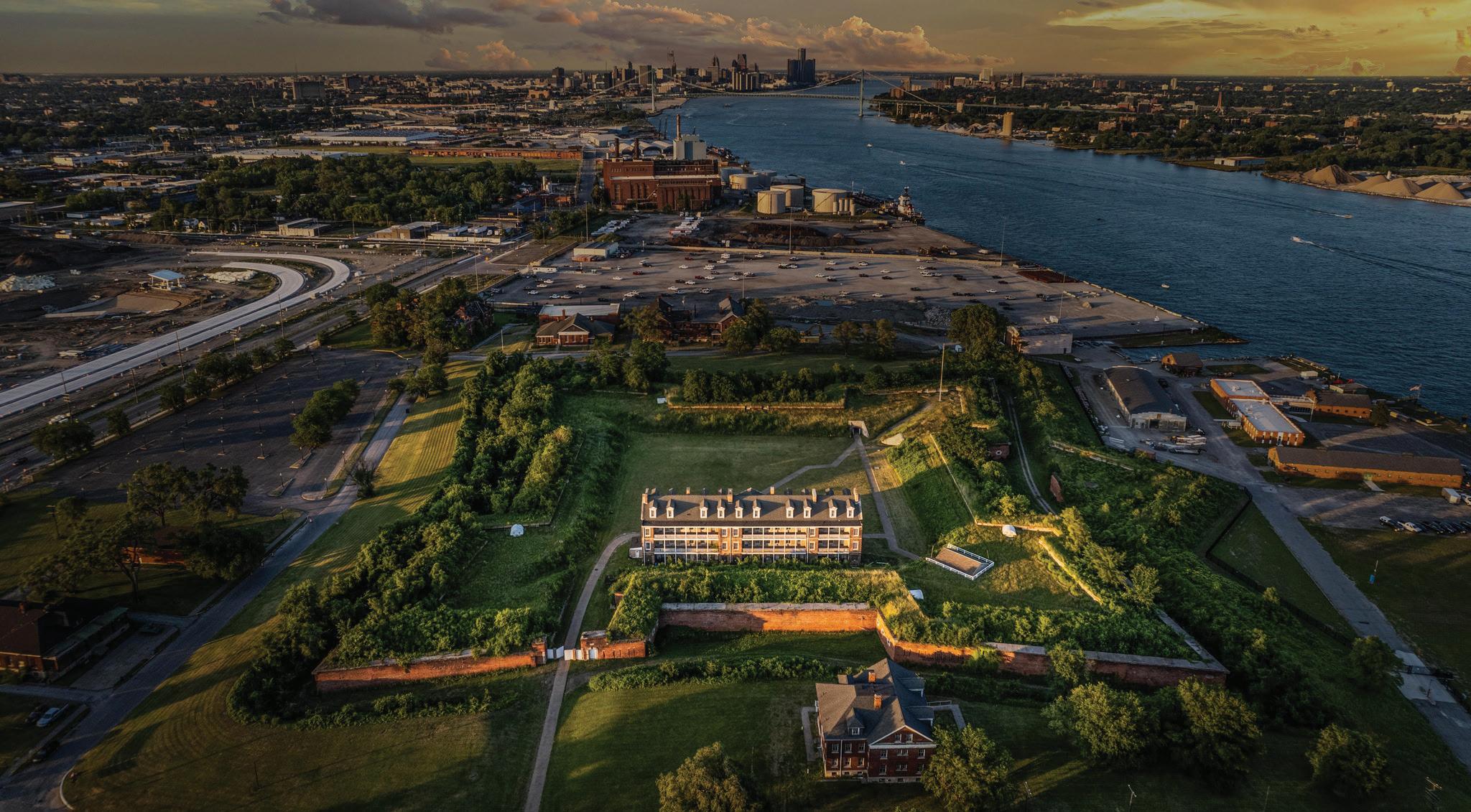












Jennifer M. Grieco Altior Law PC
Stephen T. McKenney Altior Law PC
David A. Mollicone Altior Law PC
Kenneth F. Neuman Altior Law PC
Matthew David Smith Altior Law PC
Dean W. Amburn Amburn Law PLLC
Jacqueline Asher Kelly AsherKelly
David M. Foy Berr y Moorman PC
Sheryl A. Laughren Berr y Moorman PC
John J. Schrot Jr. Berr y Moorman PC
Mark E. Straetmans Berr y Moorman PC
Harvey B. Wallace II Berr y Moorman PC
Randolph M. Wright Berr y Moorman PC
Courtland W. Anderson Bodman PLC
Jennifer M. Oertel Bodman PLC
Peter D. Bosch Bosch Killman VanderWal PC
Thomas P. Branigan Bowman and Brooke LLP
Roger P. Meyers Bush Seyferth PLLC
Moheeb H. Murray Bush Seyferth PLLC
Patrick G. Seyferth Bush Seyferth PLLC
Justin B. Weiner Bush Seyferth PLLC
Lee T. Silver Butzel Long
Cynthia M. Filipovich Clark Hill PLC
Paul S. Magy Clark Hill PLC
Gregory L. Curtner Curtner Law PLLC
Jeffrey D. Moss Dawda PLC
John Mucha III Dawda PLC
Susan J. Sadler Dawda PLC
Mark S. Demorest Demorest Law Firm PLLC
John E. Anding Drew
A. Luttmann Frasco


















Timothy D. Finegan Giarmarco Mullins & Horton PC Troy
Bruce W. Haffey Giarmarco Mullins & Horton PC Troy
Lindsay P. Hazen
Giarmarco Mullins & Horton PC Troy
William H. Heritage III Giarmarco Mullins & Horton PC Troy






248.457.7066 Workers’ Compensation Defense
248.457.7140 Close/Private Held Business; Mergers/Acquisitions; Tax: Business
248.457.7047 Employment: Management; Labor: Management; School
248.457.7104 Close/Private Held Bus; Corp Finance; M&A; Publicly Held Corp; RE: Comm
William H. Horton Giarmarco Mullins & Horton PC Troy 248.457.7060 Commercial Litigation; Trade Secrets/Unfair Competition
Alexander Lebedinski Giarmarco Mullins & Horton PC Troy 248.457.7058 Close/Private Held Business
Victoria S. Lehman Giarmarco Mullins & Horton PC
Adam Levitsky Giarmarco Mullins & Horton PC
Christopher D. Messing Giarmarco Mullins & Horton PC
Timothy J. Mullins Giarmarco Mullins & Horton PC Troy
248.457.7185 Medical Malpractice Defense
248.457.7029 Workers’ Compensation Defense
Personal Injury Defense: General; School
Civil Appellate; School
Ryan L. Perry Giarmarco Mullins & Horton PC Troy 248.457.7068 Commercial Litigation
Katherine Ross Giarmarco Mullins & Horton PC Troy 248.457.7186 Civil Appellate; Employment: Management; School
Paul Alan Thursam
Jared M. Trust Giarmarco Mullins & Horton PC
Geoffrey S. Wagner Giarmarco Mullins & Horton PC
Donald K. Warwick Giarmarco Mullins & Horton PC
LeRoy H. Wulfmeier III
William M. Azkoul Gruel Mills Nims & Pylman PLLC
Benjamin W. Mills Gruel Mills Nims & Pylman PLLC Grand
Thomas J. Worsfold Gruel Mills Nims & Pylman PLLC Grand Rapids 616.235.5500
LLP
Angela L. Jackson Hooper Hathaway Price Beuche & Wallace
Kevin C. Backus
Daniel H. Bliss
& Howard PLLC
& Howard PLLC
Henry J. Brennan III Howard & Howard PLLC
Nicholas T. Chapie
Robert E. Graziani
C. Inman
Medical Malpractice Defense
Copyright/Trademark; Intellectual Property; Patent
Oak
Held; Corp Fin; M&A; Publicly Held Corp; Securities/Vent Fin




Brian A. Kreucher
Jon D. Kreucher
Anthony J. Long
Miles T. Macik
George M. Malis
Patrick M. McCarthy




Howard & Howard PLLC
Howard & Howard PLLC
Howard & Howard PLLC












Oak 248.723.0441 Employment: Management
Oak




Commercial Litigation; Energy; Real Estate: Commercial; RE: Finance
Oak 248.723.0365 Commercial Litigation
Howard & Howard PLLC Royal Oak 248.723.0474 Class Action/Mass Tort Defense; Commercial Litigation
Howard & Howard PLLC
Howard & Howard PLLC
Alexander S. McGee Howard & Howard PLLC
Gerald E. McGlynn III
Gary A. Peters
Mark W. Peyser
Jon R. Steiger
Michael F. Wais
Timothy M. Wittebort
Oak 248.645.1483 Close/Private Held Business; Tax: Business
Oak
Commercial Litigation
Oak 248.723.0374 Intellectual Property; Patent
Howard & Howard PLLC Royal Oak 248.723.0335 Copyright/Trademark; Intellectual Property; Patent
Howard & Howard PLLC Royal Oak 248.723.0490 Environmental
Howard & Howard PLLC
Oak
Commercial Litigation; ADR: Comm Lit; Ins/Coverage/Reins; Prod Liab Def
Howard & Howard PLLC Royal Oak 248.723.0407 Commercial Litigation; Trade Secrets/Unfair Competition
Howard & Howard PLLC
Howard & Howard PLLC
J.J. Conway JJ Conway Law
Michelle D. Bayer Joelson Rosenberg
Raechel M. Badalamenti Kirk Huth Lange & Badalamenti PLC
Barry F. LaKritz Lakritz Law
Douglas W. Van Essen Legacy Litigation Group
Gary C. Ankers Littler Mendelson PC
Matthew P. Allen Miller Canfield
Thomas W. Cranmer Miller Canfield
Amy M. Johnston Miller Canfield
Leigh D. Moss Moss Law PLC
Terry W. Bonnette Nemeth Bonnette Brouwer PC
Deborah L. Brouwer Nemeth Bonnette Brouwer PC
Patricia M. Nemeth Nemeth Bonnette Brouwer PC
Matthew I. Paletz Paletz Law
Frank T. Mamat Plunkett Cooney PC
Oak
Litigation
Close/Private Held; Mergers/Acquisitions; Public Finance; RE: Commercial
Employment: Management
Labor: Management
Civil Appellate; Class Action/Mass Tort Defense; Comm Lit; Trade Secrets
Litigation; ADR: Comm Lit; Intellectual Prop; Prof’l Mal Def
Products Liability Def
Close/Private Held Bus; Employment: Management; Mergers/Acquisitions
Management
Management
Employment: Management; Labor: Management
Alan J. Taylor Segal McCambridge Singer & Mahoney Ltd Southfield
Kenneth P. Williams Segal McCambridge
David J. Yates Segal McCambridge Singer & Mahoney
Joel Thomas Finnell Sinas Dramis Law Firm
Sheri B. Cataldo
David L. Delie Jr.
Robert E. Edick
Keith P. Felty Sullivan
Cornelius C. Hare Jr.
























R.
Nolan A. Yaldo
Hubert H. Yi
Geoffrey A. Leskie Segal McCambridge Singer & Mahoney
Stephanie L. Strycharz Zausmer PC
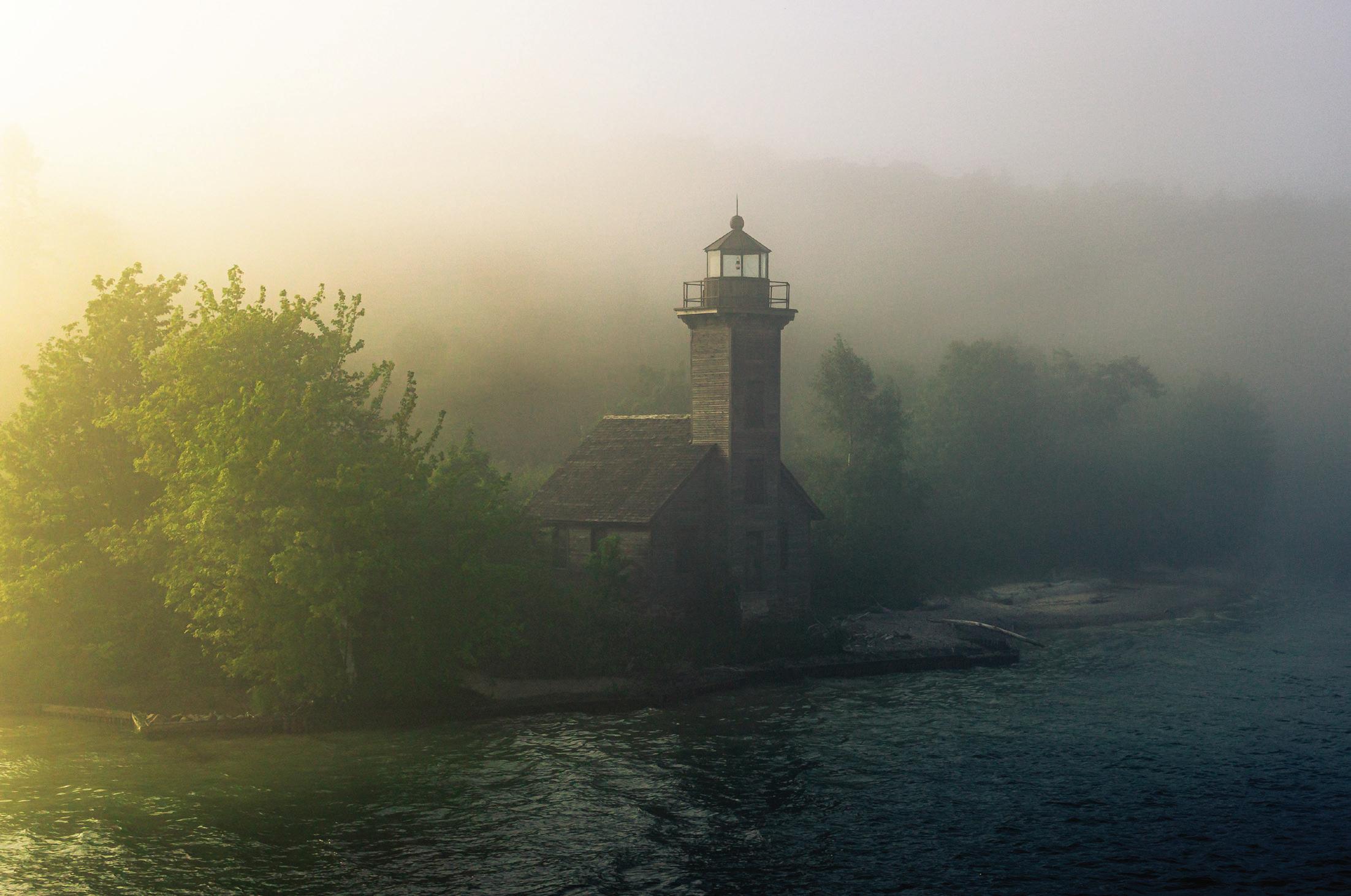
As it eerily came into view through the fog, the Grand Island East Channel Lighthouse mesmerized this photographer
The fog thickened and the view became more like a gray blanket as the captain navigated the ship farther from the dock in Munising and into Lake Superior’s South Bay. Soon, the mist was so dense you could almost taste it, clinging like a cool, clammy hug from the ghosts of Lake Superior — a reminder of the many ships that have gone down in this very area. Gitche Gumee (Lake Superior) is stunning, but it can be unforgiving to those who dare to challenge it. And on this sunset cruise, we were sailing along what’s known as Shipwreck Coast.
The conditions on Lake Superior made this an unsettling yet exciting voyage, and I hoped to see the Grand Island East Channel Lighthouse for the first time. Although I felt safe, imagination can run wild when one realizes that history has a way of repeating itself.
After all, just outside this lighthouse the 150-foot schooner Bermuda lies in 12 to 30 feet of water. She wrecked in 1870, only two years after the light was first turned on. In 1903, the 252-foot wooden freighter Manhattan struck a reef and burned, and the crew sought refuge at this lighthouse. There are 32 known shipwrecks in the area, and my goal was not to be part of the next one.
Time passed and my mind drifted into a kind of hypnosis, lulled by the noise of the boat’s deep, rumbling engine mixed with the
treble of the stream-like wake as we churned forward. Suddenly there was a soft tug as the throttle stopped, and my senses jolted awake. As the bow swung left, I grabbed my camera on my right. I was using a compact Sony A6000 with a 30mm Sigma prime lens. Prime lenses have no zoom, so I hoped the focal length was the right choice and I made sure the shutter speed was fast, because I was on a moving boat.
Then, out of the blanket of fog, the lighthouse slowly appeared, revealed in the most ominous yet beautiful way. Where the setting sun touched the fog, the mist shimmered with a glorious golden glow. In that moment, I was reminded that even when things don’t look promising, it’s still worth going, anyway.
P.S. The Grand Island East Channel Lighthouse is a wooden structure that’s 45.9 feet tall. It was built in 1868 on the southeast shore of Grand Island, and guided vessels from Lake Superior through the channel into Munising Harbor. Deactivated in 1913, today it’s privately owned and inaccessible by land, but it’s a picturesque subject for those on boat tours such as Pictured Rocks cruises or shipwreck tours.
Nick Irwin, Destination Marketing photographer, showcases and sells his photography at nickirwinimages.com. You can also follow him on Facebook at Nick Irwin Images and on Instagram: @irwin.nick.




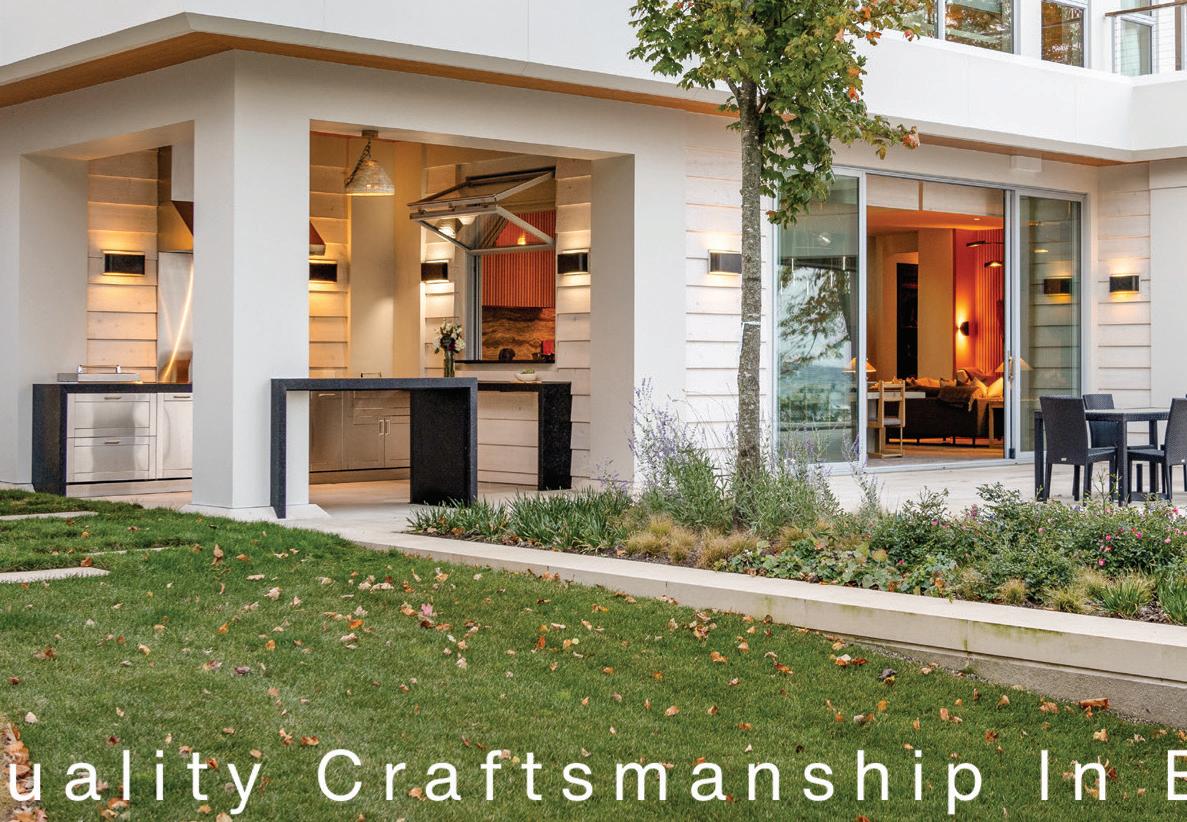
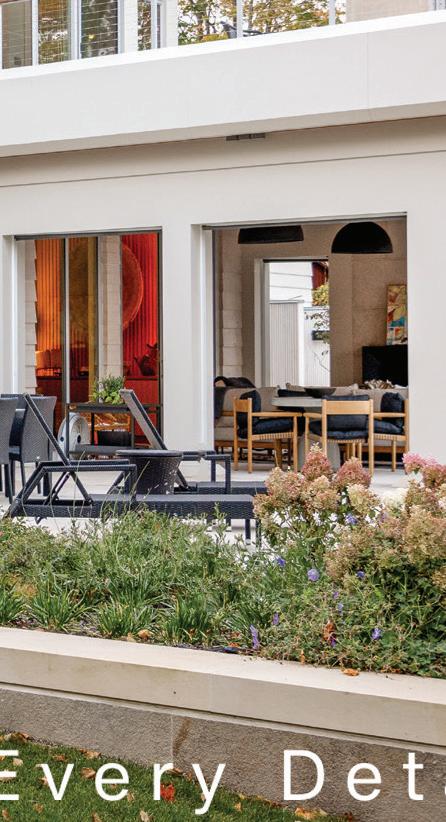

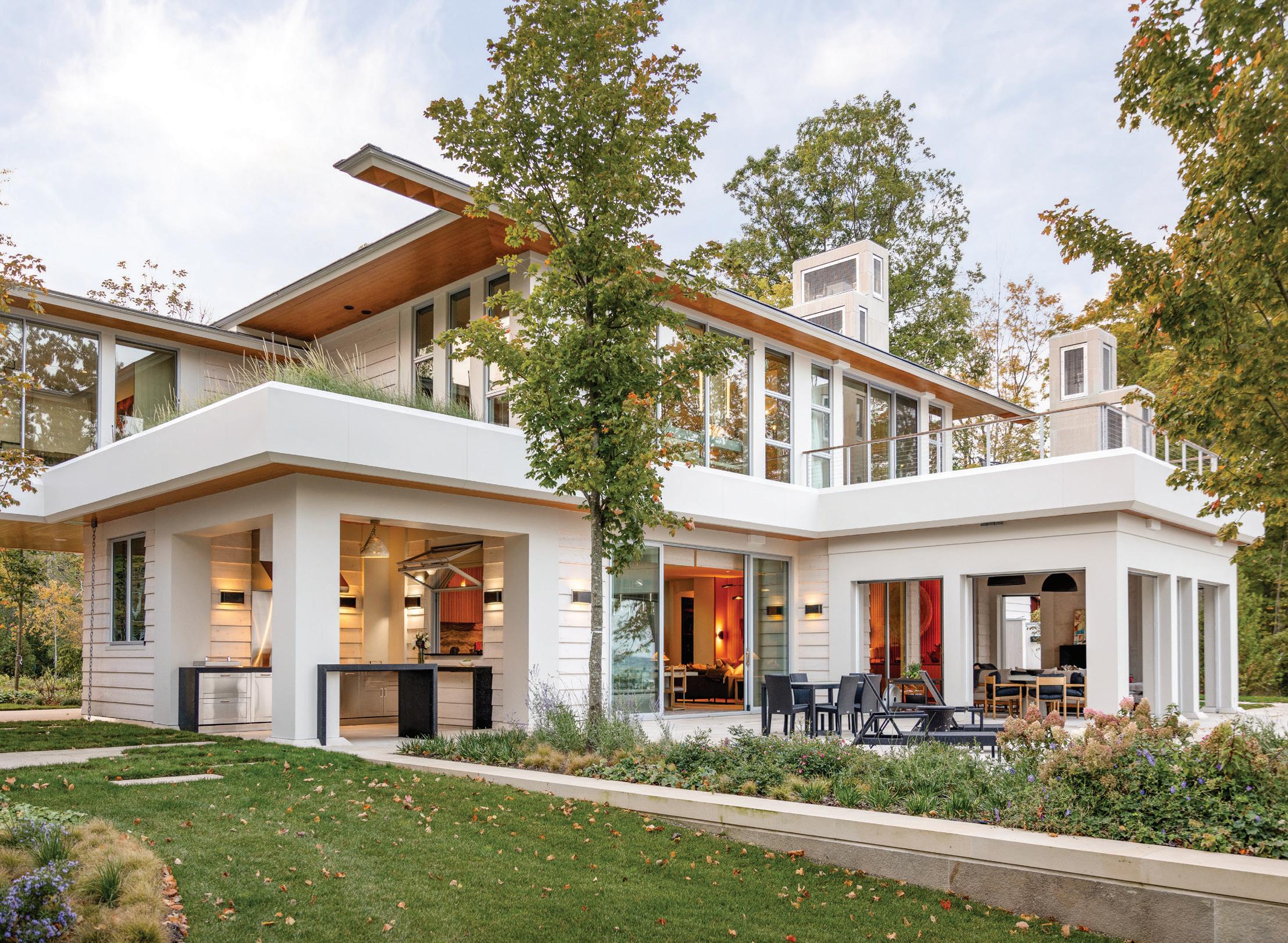
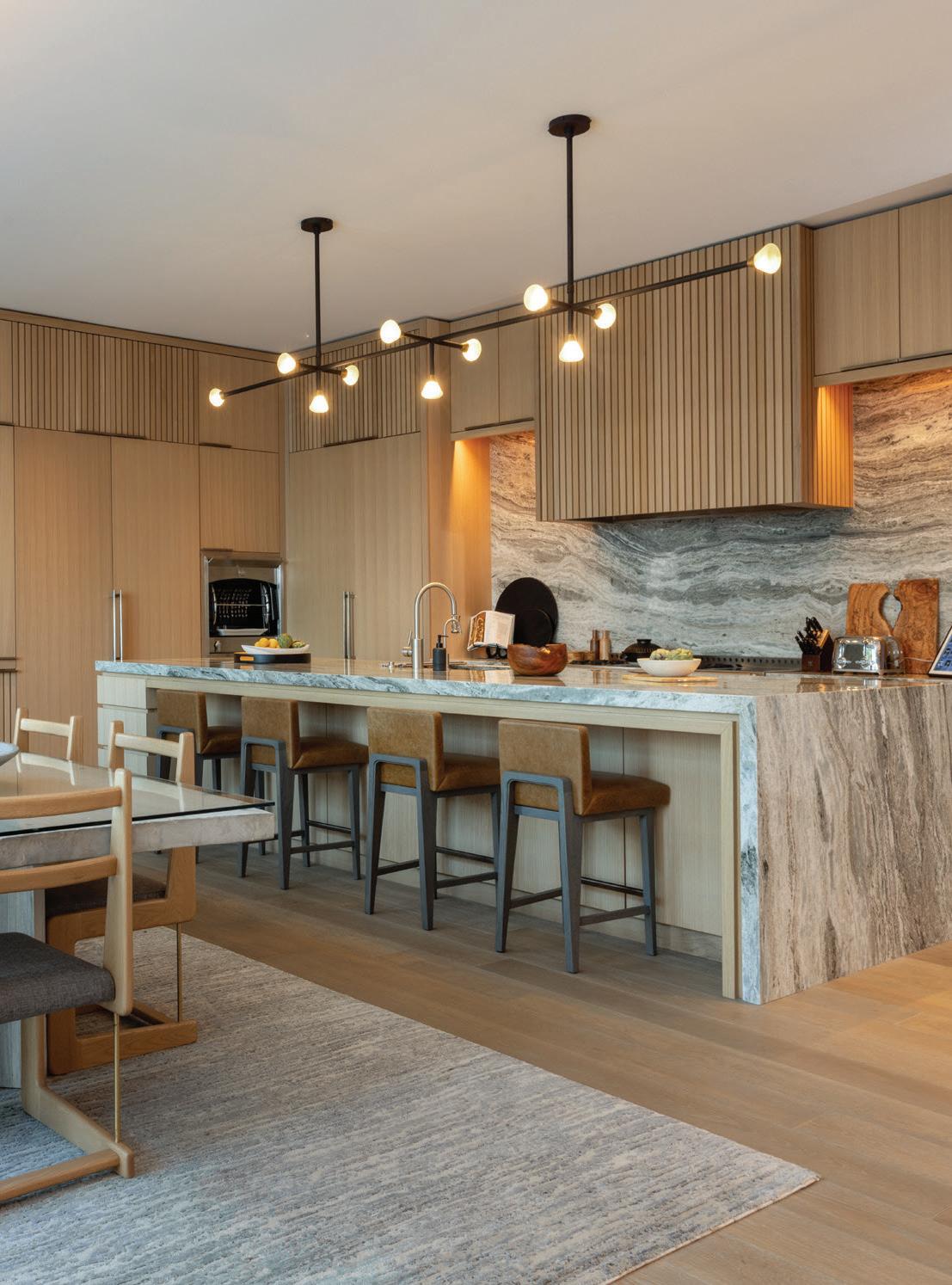





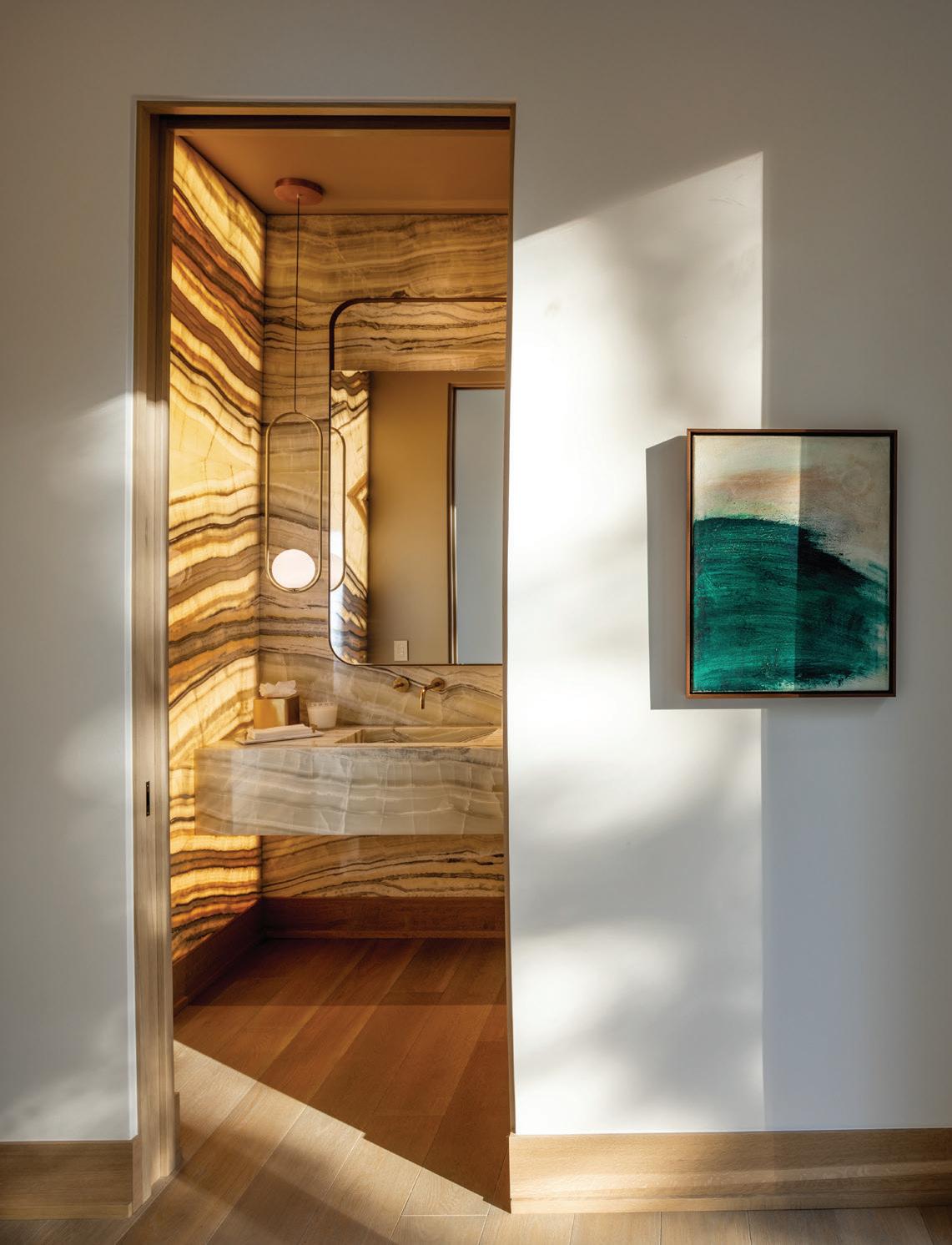







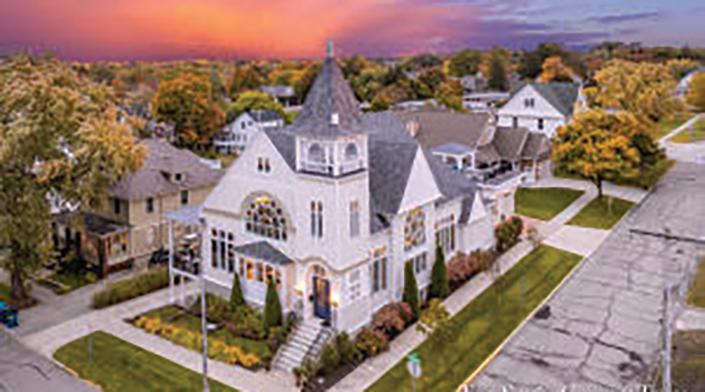




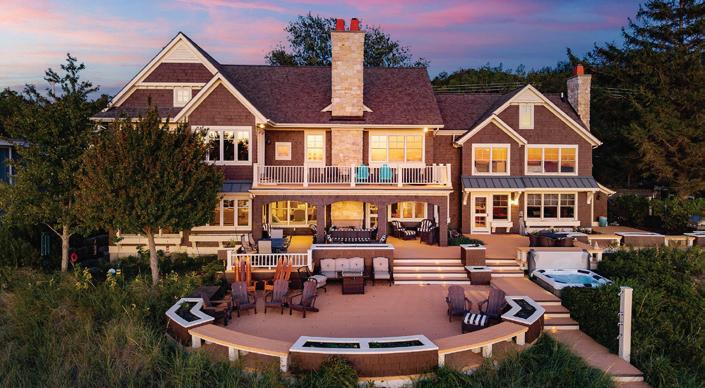
19201 NORTH SHORE DRIVE, SPRING LAKE: Summer Wind - A Timeless Lake Michigan Estate - Set along Spring Lake’s most prestigious shoreline, Summer Wind is a masterpiece of design and craftsmanship o ering 115 ft of low-blu Lake Michigan frontage and over 7,500 sq ft of refined living space. Built by Sytsma Construction and designed by architect Chuck Posthumus, this 5-bedroom, 4 full
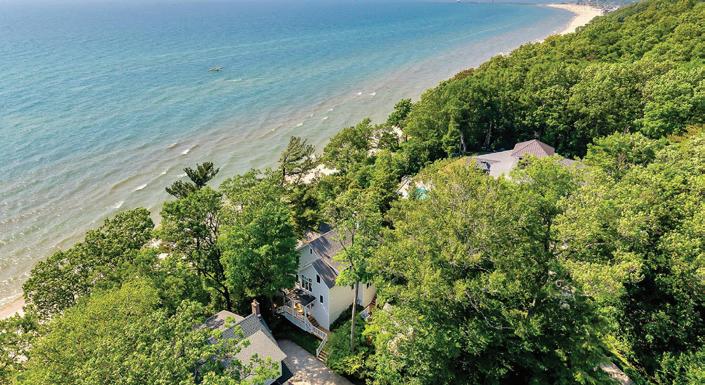
18215 SPINDLE DR, GRAND HAVEN: Nestled along the pristine shores of Lake Michigan, this stunning 4-bedroom, 3.5-bath home o ers a blend of comfort, and breathtaking natural beauty. With private frontage and over 3,000 sq ft of well-designed living space, this is an opportunity to own a serene, lakeside haven where every detail invites you to relax, entertain, and savor the view. Originally built with care and fully remodeled in 1999, this home exudes warmth throughout.