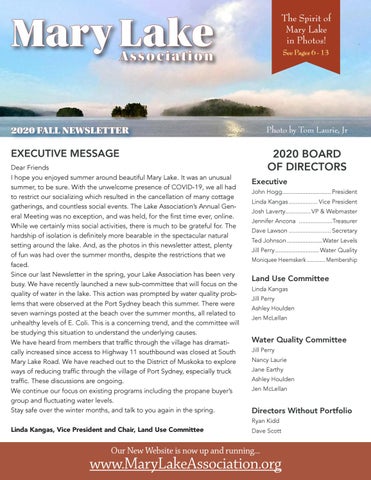
Mary Lake
The Spirit of Mary Lake in Photos! See Pages 6 - 13
Association
2020 FALL NEWSLETTER
Photo by Tom Laurie, Jr
EXECUTIVE MESSAGE
2020 BOARD OF DIRECTORS
Dear Friends I hope you enjoyed summer around beautiful Mary Lake. It was an unusual summer, to be sure. With the unwelcome presence of COVID-19, we all had to restrict our socializing which resulted in the cancellation of many cottage gatherings, and countless social events. The Lake Association’s Annual General Meeting was no exception, and was held, for the first time ever, online. While we certainly miss social activities, there is much to be grateful for. The hardship of isolation is definitely more bearable in the spectacular natural setting around the lake. And, as the photos in this newsletter attest, plenty of fun was had over the summer months, despite the restrictions that we faced. Since our last Newsletter in the spring, your Lake Association has been very busy. We have recently launched a new sub-committee that will focus on the quality of water in the lake. This action was prompted by water quality problems that were observed at the Port Sydney beach this summer. There were seven warnings posted at the beach over the summer months, all related to unhealthy levels of E. Coli. This is a concerning trend, and the committee will be studying this situation to understand the underlying causes. We have heard from members that traffic through the village has dramatically increased since access to Highway 11 southbound was closed at South Mary Lake Road. We have reached out to the District of Muskoka to explore ways of reducing traffic through the village of Port Sydney, especially truck traffic. These discussions are ongoing. We continue our focus on existing programs including the propane buyer’s group and fluctuating water levels. Stay safe over the winter months, and talk to you again in the spring. Linda Kangas, Vice President and Chair, Land Use Committee
Executive John Hogg.............................. President Linda Kangas.................. Vice President Josh Laverty................ VP & Webmaster Jennifer Ancona .....................Treasurer Dave Lawson.......................... Secretary Ted Johnson......................Water Levels Jill Perry........................... Water Quality Moniquee Heemskerk............. Membership
Land Use Committee Linda Kangas Jill Perry Ashley Houlden Jen McLellan
Water Quality Committee Jill Perry Nancy Laurie Jane Earthy Ashley Houlden Jen McLellan
Directors Without Portfolio Ryan Kidd Dave Scott
Our New Website is now up and running....
www.MaryLakeAssociation.org
This article expands on the topic of Shoreline Buffers which was discussed in the Spring newsletter.
Shoreline Buffers - Part 2
A shoreline buffer is an area of undisturbed or minimally impacted vegetation adjacent to a lake, river or stream. A healthy shoreline buffer mimics the complexity of nature, with vegetation of different heights, types, and ages all mixed together. In addition to plants and trees, a healthy buffer may have standing dead trees, fallen logs and different sizes of stones and rocks. Shoreline Buffers have a number of important functions:
Filtering Runoff for Clean Water Shoreline vegetation helps slow the flow of surface runoff. Their roots absorb surface water, pulling it into the ground, rather than allowing it to reach the lake. Underground, the pollutants in the runoff, such as pesticides, fertilizers, oils and fuels, become trapped in the soil and are absorbed by deeper plant roots.
Controlling Erosion Trees and plants all have root systems that hold layers of soil in place. They act like glue, stabilizing the shoreline and preventing erosion. Leafy foliage reduces the impact of rainwater, preventing it from striking the soil and washing it away. Plants that grow directly along the shoreline absorb wave energy that would otherwise erode banks.
absorbed into the ground instead of running directly into the lake.
Providing Habitat for Wildlife Throughout their lifecycles, 70% of land-based wildlife, and 90% of aquatic species depend on a healthy shoreline. They utilize this area for sources of food, shelter, migration, breeding, and rearing of young. Shoreline vegetation provides a corridor for wildlife when transitioning from land to water. Fallen vegetation that settles in the water provides unique habitat for aquatic life.
Resources: For more information on the topic of healthy shorelines, and tips on how to naturalize your shoreline, visit these websites.
Managing Stormwater and Controlling Floods Flooding occurs when water enters the lake and exceeds its capacity. This causes it to overflow onto land that is usually dry. Flooding can be caused by heavy rains, and melting snow and ice. Healthy shorelines can help manage fluctuations in water level. Vegetation slows the flow of runoff, allowing it to be
Love Your Lake: loveyourlake.ca Watersheds Canada: watersheds.ca Native Plant Database: watersheds.ca/plant-database/ Native Plant Encyclopedia: https://cwf-fcf.org/en/ resources/encyclopedias/native-plant-encyclopedia/
2
Yo u r s Tr u l y C a r d s . c a Restoring a Shoreline Buffer If your shoreline buffer has been altered by the removal of vegetation, or the planting of a lawn, it is possible to restore most of its natural function. Here are some suggestions. A personal ser vice to handwrite greeting cards for you
Calling All Sailors! Port Sydney Yacht Club is Looking For New Members! PORT S
EY DN Y
• If you want to start small, simply leave the buffer area alone and let nature take over. If you have a lawn to the water’s edge, stop mowing the area along the shore. Over time, your grass will grow longer, and native plants from surrounding areas will gradually move in. Eventually a mix of plants of different ages will develop. Monitor your buffer for invasive species and remove any before they become established. • If you want to move faster, you can plant native species of differing heights and types in the buffer area. When choosing plants, refer to Watershed Canada’s Native Plant Database or Canadian Wildlife Federation’s National Native Plant Encyclopedia to find suitable plants for your property.
YACHT CLUB
• Leave the edge of the buffer uneven with a mix of plant heights and types, and clusters of vegetation. This kind of variety helps provide lots of fallen leaves, needles and twigs to slow water runoff and encourage absorption. It also provides useful habitat for birds and small mammals looking for food and shelter.
Looking for Sailing, Crew and Social Members • Races are every Saturday at 2:00 pm • After Party at 4:30 following races! • Meet New People on the Lake • Albacore boats available for use Email Sue Tovee serious_sue@hotmail.com
• Minimize buffer damage when you create access to the water’s edge by creating the smallest possible “puncture” in your buffer. Try to keep as much of your shoreline untouched as possible, and focus your access pathway, stairs and dock in one general area. • When you start the process of restoring a buffer area, make sure that you consider your own needs for access, recreation and views, as well as what the buffer requires in order to function effectively.
Contributed by Linda Kangas 3
August 2020 and the Night Sky Near midnight on a slightly chilly evening in mid August this past summer, my family, consisting of two grown sons, one daughter in law, two grandchildren, my husband and I, were lying flat on our backs on thick blankets on our dock. Above us was an ethereal show-stopping event of Perseid meteors bursting out of a dark sky that was a mass of tiny twinkling stars. Exploding balls of bright white light criss-crossed through the open skies above. Between these nano second displays, we pointed out the various stars and constellations we already knew and took great delight in identifying unfamiliar ones with the aide of an amazing app. The entire arm of the Milky Way was right there above us! It was a glorious moment during crazy times that was calming yet exciting and an ever so powerful experience to share together.
“For my part I know nothing with any certainty, but the sight of the stars makes me dream.” — Vincent van Gogh I am so grateful that we live in a section of our lake where neighbours do not have flood lights on their dock; do not leave their security lights on 24/7/365; do not have over-powering landscape and security lights. Here we have no light polluting glare that would have affected the visibility of this panoramic meteor shower display.
The residual of the world wide increase of urban sky glow or night light pollution has resulted in several issues. For residents of the Mary Lake area, these mainly involve the intrusion of unwanted light on neighbouring properties and over the lake itself, as well as concern that with increased use of inappropriate landscape lighting there will be a visual reduction of the stars in our night sky. Keeping our sky free of polluting glare over our lake involves a conscious effort on our part to install landscape and security lighting that reduces the chance of light pollution. Please think of the potential light polluting effect your choice of ambient or security outdoor lighting might have on your neighbours, the community in general, and the darkening of our sky.
Do This
Do use appropriate lighting that does not intrude on the privacy of your neighbours; do carefully consider the location of your lights; do make a plan for your outdoor lights; do avoid flood lights or any lighting that shines directly onto your neighbour’s property or out onto the lake; do avoid landscape lights that cast their light up into the sky; do become familiar with the movement of Dark Sky (darksky.org) that has influenced lighting ordinance decisions of municipalities across North America for commercial properties, public spaces and private residences. Here is an excellent article for further reading from the Doppler on this topic including a NASA night photo of the Huntsville area. https://doppleronline.ca/ huntsville/outdoor-lighting-bylaw/
Don’t Do This
• Lights on only when needed. • Only light the area that needs it. • Be no brighter than necessary. • Minimize blue light emissions. • Be fully shielded with the light pointing downward. When you install or replace your outdoor landscape and security lighting remember to: • Light responsibly. • Light with a purpose. • Light with a plan.
More good information and tips...
www.darksky.com Nancy Laurie
4
How is Mary Lake doing? Breathtaking views aside, we choose to spend our summers on the shores of Mary Lake because we can dive or wade in, open our eyes underwater, and look for the bottom. When we gaze off the edge of the dock or overboard, we love to admire in intricate detail the uniform wave patterns on the sand after a storm. Clean, clear water is why we all choose to be here. Covid may have cancelled our annual Bugs in the Mud water quality surveillance program this year, but it did not cancel us loving our lake. Even without our beloved Canada Day and Regatta celebrations at the beach, boat traffic and beach use seemed to reach an all time high this summer. After the repeated postings at the Port Sydney town beach due to E. coli contamination (Seven over the summer), however, a group of residents from all around the lake met to talk about water quality. These were some of our observations: • Reduced water clarity. • Overnight growth of algae on ropes and ladders. • Increased cleaning/replacement of screens on intake valves and water filters on UV systems. • Bloodshot swimmers eye. • More surface foam. • Explosion of aquatic plant and algae growth.
In addition to E. coli, blue-green algae (the cyanobacteria which produces a neurotoxin) hit the news again, with blooms observed on Lake of Bays and Lake Muskoka. This algae has the potential to render lake water both unswimmable and untreatable by any technology. We all know that climate change is affecting water levels, and we now know that it will increasingly affect our water quality. A report commissioned by the District of Muskoka blamed climate change as the primary cause of the blue-green algae outbreak on Peninsula Lake in 2017.
With a view to understanding and tracking the quality of Mary Lake’s water, a new MLA subcommittee was formed. It is being chaired by Jill Perry, and presently includes Nancy Laurie, Jane Earthy, Ashley Holden and Jennifer McLellan. Last year the board of the MLA voted unanimously to apply for the Love Your Lake Program, and this summer we were provisionally accepted into the program for next summer, based on funding and 5
Covid considerations. The MLA board will receive resources and training to help us deliver programs to help us all protect and restore the shoreline. The program also provides a private assessment of each waterfront area and a list of detailed actions that owners can voluntarily take to protect the waterfront. We would also like to share another Watershed Council Program that you can participate in on your own. The Natural Edge provides free waterfront visits with advice and recommendations on how to improve your shoreline. Resources in the Shoreline Re-naturalization Starter Kit include a customized planting plan, educational materials and native plants to create natural habitat along your shoreline. The plan is complimentary and the starter kit of materials costs $250. Both of the above programs will help us reduce shoreline erosion from boat wake and lake level fluctuations, reduce nutrients running off into the lake, prevent goose nesting and foraging, and limit plant and algae growth. At a time when many changes are seemingly out of our control, we can all take concrete steps to make sure that Mary Lake is clean and clear for decades to come. To share or receive information Contact Jill Perry: Jillperry@live.ca
2020 Report on Water Levels Submission to the Environment Ministry’s Task Force The year 2020 began with unusually early activity on water levels by your Association. Previously, the Ontario Ministry of the Environment (MOE) had established The Muskoka Watershed Advisory Group to advise the Ministry on possible improvements to watershed management. The Mary Lake Association participated in public hearings in late January in Port Carling and made a follow-up written submission in February pleading for an overhaul of the 2006 Muskoka River Watershed Management Plan of the Ministry of Natural Resources and Forestry (MNRF). The Advisory Group submitted its report to the MOE in June. We are unaware of what’s contained in the report’s nineteen recommendations but we understand it will be released in the coming weeks and are hopeful that our voice has been heard. Water Level Performance - 2020 We were relieved in March to learn that the saturation level of the Algonquin Park snowpack was ‘normal’, and that a major spring flood was unlikely. This was in sharp contrast to 2019 when a 250 percent saturated snowpack led to a record flood. The weather gods cooperated to produce a benign runoff, but as we reported in the Spring Newsletter, the MNRF then created a ‘government-induced flood’ bringing the lake up a foot and a half and flooding docks and environmentally sensitive shorelines.
When we contacted the MNRF to object we were told that they were proud of their performance because they had succeeded in tracking their 2006 Watershed Management Plan. We and other lake associations encouraged them to apply common sense, and levels were then brought down so that the summer target was achieved by mid-June. Over the summer, levels were generally kept about 10cm or 4 inches above the Hatch Target, and for two weeks in July were kept 15cm or 6 inches above the old Hackner-Holden target around which our shorelines had stabilized over a period of about 130 years. Hackner-Holden was the agreement articulating the target from the 1870’s to 2006. The Muskoka River Water Management Plan was created by the MNRF in 2006 and created new targets for Mary Lake. The Hatch Agreement is a compromise target agreed to by the MNRF in 2008 after substantial effort and negotiation with the Mary Lake Association. As the chart accompanying this article shows, water levels were kept pretty consistently above the Hatch target from the May long weekend to Labour Day. A request for an explanation from the MNRF elicited an acknowledgement of the Hatch Agreement but also an explanation of the impact of rain on watersheds. The chart also shows the Hackner-Holden target (the lowest, flat line) and reminds us where levels had been maintained before the imposition of the 2006 Muskoka River Water Management Plan. Members with shoreline properties would have noticed a dramatic increase in boat traffic (and consequent shoreline impacts) during this unusual 6
Mary Lake Summer 2020 Level
year. Much of this involved boats dropped in from trailers at the Town Dock launching ramp. In a final ironic twist, the MNRF dropped the lake precipitously in late August and ran the level BELOW the Hatch target for much of September and October making it much more difficult to take boats out of the water at the ramp as the navigation season drew to a close. (We have also asked repeatedly over the past ten years, without success, that the MNRF keep levels above the MRWMP and Hatch targets from Labour Day to Thanksgiving in acknowledgment of the difficulty that low water causes some property owners and boat owners attempting to use the ramp at the Town Dock.)
We regret the somewhat ill-tempered tone of this report, but perhaps it reflects what we have felt in dealing with an impervious government department. Ted Johnson
7
The Spirit of Mary Lake in Photos...
Hugh Mackenzie
Nancy Laurie
Kerry Horn-Holliday
Lynn Thomas
Sharon Poore
Thomas Laurie
Ryan Kidd
8
Joel Beatty
The Spirit of Mary Lake in Photos...
Carol Baker
Scott Lindsay
Nancy Laurie
Sue MacMurtry
Sue Beatty
Nancy Laurie
Angus Laurie
Nancy Laurie
Debbie and David Gillies
Lynn Thomas
9
Mark Tovee
The Spirit of Mary Lake in Photos...
Nancy Laurie
Nancy Laurie
Bruce Hay and Michell Reive
Lynn Thomas
Greg Crawford
Ryan Kidd
Lynn Thomas
Nancy Laurie 10
The Spirit of Mary Lake in Photos...
Sue MacMurtry
Kerry Horn-Holliday
Nancy Laurie
Lynn Thomas
Ryan Kidd
Nancy Laurie
Lynn Thomas
Nancy Laurie
Bruce Hay and Michell Reive 11
The Spirit of Mary Lake in Photos...
Sue MacMurtry
Angela Brown
Debbie and David Gillies
Bruce Hay and Michell Reive
Fred Buehler
Joel Beatty
Tom Laurie, Jr.
Joel Beatty 12
The Spirit of Mary Lake in Photos...
Pamela Nitert
Greg Crawford
Nancy Laurie
Scott Lindsay
Samantha Horn
Nancy Laurie
Betsy Horn
Nancy Laurie
Jim Sproxton 13
The Spirit of Mary Lake in Photos...
Jake Koffman
Nancy Laurie
Debbie and David Gillies
Lynn Thomas
Ralph Manktelow
Derek Kurtz
Lynn Thomas
Debbie and David Gillies 14
The Spirit of Mary Lake in Photos...
Pamela Nitert
Debbie and David Gillies
Kerry Horn-Holliday
Sue MacMurtry
Ryan Kidd
Nancy Laurie
Stefanie Smith Beatty
Pamela Nitert
Jim Sproxton 15
The Spirit of Mary Lake in Photos...
Carol Baker
Sue MacMurtry
Joel Beatty
Sue Beatty
Nancy Laurie
Kerry Horn-Holliday
Bruce Hay and Michell Reive
Nancy Laurie 16
The Spirit of Mary Lake in Photos...
Jake Koffman
Nancy Laurie
Nancy Laurie
Sue Beatty
Angela Brown
Carol Baker
Ryan Kidd
Bruce Hay and Michell Reive
Jake Koffman
Nancy Laurie
Ryan Kidd
Jim Sproxton 17
Early Settlers Around Mary Lake This excerpt is from “The Newcomers” written By Ryan Kidd and is available from Trafford Publishing
The Thoms Bay Cottages
high school in Barrie before he went to Trinity College where he studied mathematics. After that he became a mathematics teacher at Riverdale Collegiate. It was during his teaching career that he met Arthur Flock and heard the stories about Mary Lake. In 1920 he visited Port Sydney to see this
Dick Thoms house c 1920
beautiful lake for himself. That summer he and his
Dick Thoms sat on his porch overlooking Mary Lake and
family (Ted, Rolph, Selby
the bay that was known as Thoms Bay. From his vantage
and wife Lillian) stayed
point he could see the three cottages along the north
with the MacInnes Family
side of the bay. They had been built by three teachers
in the big house at the
since the war ended in 1918. The closest one was the
corner of Morgan Street
Rogers Cottage; beside it was a big field where Dick
and Muskoka Rd.10. The
occasionally grazed cattle; then came the Flock Cottage
lake was everything that
and next to it was the Hogg Cottage. The cottagers would come by train to Utterson and then travel by car
Ted, Rolph, Selby (on Lap) William and Lillian Rogers (L-R)
Flock had told them and more.
to the farm and finally row across the bay. There was a rough trail over the hill but it was hardly used. Even
In 1921 William bought the second lot east of Arthur
though the woman cottagers were younger, they were
Flock’s land from William Thoms for $200 a foot. His
still good company for Dick’s sisters.
cottage was a packaged kit that they bought in Barrie from his brother who had a lumber mill. In 1922 it was
The Rogers Cottage
hauled in from the train in Utterson. The last part of the trip must have been really difficult since there was only a cart track over the hills to the lot. The cottage had three bedrooms, a living room and kitchen. The beautiful fireplace was built by Mr.MacFarlane who did the stone work at Bigwin Inn. William Rogers passed away in Rogers Cottage c 1922
1930 but his wife Lillian continued to come to the lake. Later she added a veranda and in 1946 the cottage was passed on to their son Ted.
The Rogers family who emigrated from England in 1832 settled in Collingwood where they operated a
During the summers the family loved to escape the city’s
farm and sold books. Their son, William, attended
heat and relax up here. In early days the road was paved 18
to Bradford but after that it was gravel and often in poor
William Rogers was a good friend of the Anglican
shape. The car would be loaded with supplies for the
ministers including Rev. Hunt and Canon Pinnington.
summer including sides of bacon. In those days cars
Canon Pinnington had been a padre in WW 1 and after
needed regular stops to top up the water in the radiator.
he returned he became a moving force in Port Sydney. Among other things he is remembered for starting the
George Johnson (above) said they would allow two
rifle club that used a range just west of Pine Lodge. On
days for the trip from Port Dover in the early 1920’s..
Saturday afternoons the men and women of the village
They towed a camper trailer behind their car (from the
would compete. The prizes were coffee cups.
photos, the car was likely a model-T Ford.) and would camp at the property of a family friend near Toronto at
Arthur Flock and
the end of the first day. He and a nanny would sleep in
William Rogers had
the camper-trailer, while his mother and father would
another colleague
share a tent. Highway 2 was the only Macadamized
who lived across
(paved) road on the route. Road maps and signage
the lake. Elizabeth
along the way were provided by the recently-formed
Jackson was also a
Ontario Motor League. George said they could count
teacher at Riverside
on at least one flat tire during the course of the journey!
Collegiate. She had
There were always problems in keeping the food cool.
inherited the family
They would have ice cut by Dick Thoms in the winter
farmhouse at the
and stored under sawdust in an icehouse. It was the
mouth of Jackson Creek near where
chore of the children to wash off the blocks. They did Canon Pinnington and Captain Ralph Lee of the Muskoka Navigation Company and the Sagamo in the background.
not get hydro until after WW2.
Muskoka Lodge was located. In the late 1920’s on land north
of the creek along what is now Edgemere road she built a nine hole golf course. This became the destination for the men of the community whenever they had some Uncle William, Bill (Selby) Ted, arriving at cottage
spare time. In those days golf was mainly a male sport.
It was a twenty minute row to Port Sydney for supplies and while the parents were shopping William’s son, Ted and his brother would swim off the town dock. In those days there was a shed at the end of the dock to store goods from the steamers. It was the height of daring to jump off the top of the shed into the water with local kids like Mel and Bill Clarke. …..Continued Ryan Kidd Town Dock Seen on Regatta Day 19
A Simpler Time! “...Everybody’s happy back in’57 Ain’t nobody happy since then; There was law in the land, Order in the home, Swimmin’ in the river back then...”
Law and order was maintained in summer by the Village
(Bob Bossin, Canadian troubadour, 1975)
in the photo). Alex applied the Hackner-Holden target:
Policeman, hired for two months a year by the volunteer village council. Water levels, a subject of particular interest to the author, were managed by Alex Hughes (that’s him on the right essentially, “hold it steady from June to September”. His
Our nostalgia for the 1950’s was awakened recently
friend Stuart MacDonald, the caretaker of Isle o’ Pines,
when we came across the 1955 tax bill for our old family
would call up to say “She’s coming up a bit, Alex.” and
cottage, a typical Mary Lake waterfront cottage. The
Alex would send his nephews Gord and Doug down
taxes were $220. That’s equivalent to $1,968 today.
to pull out a log or two at the dam. There were very
The cottage, with a few upgrades but still fairly typical,
few complaints about water levels, even from the fish.
remains in the family but the taxes are about $4,500 - up
Healthy populations of native trout, bass and catfish
more than twice what simple inflation would suggest they
populated the lake and river.
should be. Some time ago our late friend Bill Clarke Sr, together with MLA board member Ryan Kidd, put together a CD of ‘Port Sydney Memories’. It includes a nostalgic photo of the first Village Council taken in about 1934, the year Port Sydney was first incorporated as a Village. The four councillors and the reeve were elected, but received no pay. Several of them continued to serve into the nineteen sixties. In 1955, the year of our $220 tax bill, Port Sydney had good roads although only one short paved sidewalk and only a couple of street lights. There was no garbage
The first Port Sydney Village Council (circa 1934). They were elected unpaid volunteers. Several served into the 1960’s. L-R Hugh MacInnes, Mel Clarke, Reeve Bob Jenner, Bill Watson and Alex Hughes.
collection; most people dug garbage pits. The single fire
Next year will mark the fiftieth anniversary of the end of
truck was kept on the ground floor of the Community
local government in Port Sydney and in the surrounding
Hall. There were community-hosted dances most
townships. The twenty-four Muskoka municipalities were
Saturday nights, Bingo every Wednesday evening in
amalgamated into six, and a supervening upper-tier
summer, and the village softball team (umpired by Bill
District Government was added. Port Sydney became
Watson, general store owner, second from the right in the
part of the expanded Town of Huntsville. Today we are
photo) played to a keen audience on the ball diamond in
governed by a Huntsville Council of nine and a District
front of the Hall.
Council of twenty-three. 20
Since then we’ve lost our summer policeman. The last police visit to the village the author can recall was the night the OPP shut down the Wednesday bingo for good. We’re now on our second two-bay fire hall. Paved sidewalks and streetlights proliferate. And the councillors,
12 Suggestions on What You Can Do About Extreme Weather!
both Town and District, are paid. Anyone who has recently driven past the new Bracebridge Fire Hall, built by the District Government, or past District headquarters, both in the town of Bracebridge, cannot help being struck by their grandeur. One is impressed also by the proliferation of vehicles owned by the District, now said to number over one
A Cottagers Guide 1. Protect natural areas that can hold back water in Spring. 2. Prevent top soil removal. 3. Avoid tree cutting.
hundred.
4. Obey fire control warnings.
While those of us who remember the public spirited men
5. Have an emergency evacuation plan.
who composed the original Village Council and recall the
6. Have a 72 hour supply canned goods.
Port Sydney of the nineteen fifties might be forgiven for asking, as we open our annual municipal tax bill, “Where’s the beef?”, we should probably balance this churlish thought with the acknowledgment that, thanks to District Government, we now have municipal garbage collection. Ted Johnson
7. Know your hydro emergency numbers. 8. Get your air conditioner serviced before summer. 9. Check your elderly neighbours after bad weather. 10. Check that you are insured for flood damage on your cottage. 11. Threatening weather..listen to local Radio & TV for flash flood warnings. 12. Watch local weather radar.. https:// weather.gc.ca/radar/index_e. html?id=WBI
Extreme Weather is now part of our lives and we are going to have to live with it. 21
Membership & Propane Update Summer seems far away now that we have had a long stretch of cooler days. Even Fall will soon be a distant memory. Our membership count is currently at 181, reflecting that
For the members who are aware that I am wearing many
we have really made great progress over the last couple
hats and are wondering what happened to our Mary
of years. During our last MLA Board meeting, we voted
Lake Marina property, we are still here. There was lots
to expand our membership area further up the Muskoka
of interest and activity, but we are not ready to close
River, and to also include Mud (Lancelot) Creek leading
the Marina in order for a new owner to convert the
out of Penfold Lake. In order to achieve this, we will
property into their private retreat. We have engaged a
conduct a membership drive and hope to acquire more
professional planner and have discovered there are many
members on all properties surrounding Mary Lake or
options for this property and that it would be a shame to
leading into Mary Lake that should be included in our
give these opportunities to a new owner, instead of us
Association.
enjoying these opportunities first. We are very happy to tell you that we are staying!
If you know a property owner near or on the lake or river, please invite them to become a member. If you are not sure if their property is within our boundaries, they can always contact me to verify. Our Lost and Found list is small, and this year was very quiet. Maybe the big storms are still to come, or everyone tied down their items! If you have lost or found something, please let me know or check out our list: https://drive.google.com/drive/folders/1SPCnGf69_ mNqdsln-1u7GoaJQtQA84Xj?usp=sharing
Please contact me if you would like extended members of your family to receive the newsletters and the occasiaonal messages from the MLA and I will add them to my list. Let me to wish you and your family Happy Holidays. It will be a different season for many, stuck in the Canadian Winter with closures and restrictions, but please remember that we are so lucky to be living in beautiful Muskoka. We just have to dress accordingly. With no flip flops down south, snowshoes must do!
Monique Heemskerk The growth in memberships is also a result of our Bulk Propane buyers group. As neighbours of Propane members hear about the rate offered by Superior, new members learn that they can save on their propane even after having paid their membership fees. It was very difficult to reach the right persons at Superior, but luckily my determination paid off. We are combing through our lists and members are now being contacted by Superior to set up their accounts. Just a year ago there were 30 members on the Propane list, and this has grown to 62.
Membership Director