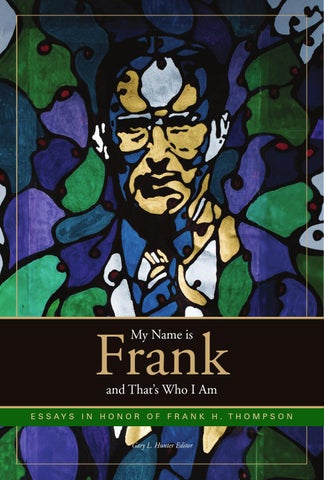
Frank My Name is
and That’s Who I Am
E S S AY S I N H O N O R O F F R A N K H . T H O M P S O N
Gary L. Hunter Editor
Essays in Honor of Frank H. Thompson
Edited by Gary L. Hunter
2015 First printing My Name is Frank and That’s Who I Am: Essays in Honor of Frank H. Thompson Copyright 2015. All rights reserved. Published by Greenville College Greenville, Illinois ISBN 978-0-9964165-0-4 Cover art by Rick McPeak. Used by permission. Views and opinions expressed by individuals in this publication do not necessarily reflect the views of Greenville College. Printed in the U.S.A. by Thomson Shore Dexter, Michigan
For you, O God, have heard my vows; you have given me the heritage of those who fear your name. Psalm 61:5 (ESV)
Greenville College gratefully acknowledges the following generous contributors to this project.
Underwriters Anonymous Greenville College Office of Advancement Brian and Darlene Hartley Kevin and Lori Hopkins John and Carol Knight James W. T. Moody Tom and Betty Morgan Jo Ann Noble Steven and Julie Peay George and Linda Peters Robert “Ish” and Joanna Smith W. Richard Stephens, Sr. Stanley Walters Jim and Wilma Wilson Gifts in Memory of Dr. Ross F. Shaw Greenville College Department of Language, Literature and Culture Herbert H. Coates Robert and Tammy Cranston Daniel and Becki Jewett Gene and Miriam Kamp Jim and Marilyn Reinhard Hugh and Marie Siefken Jesse and Lesley Sieger-Walls Robert “Ish” and Joanna Smith Phillip and Phyllis Ward Jeff and Pam Wilson
Contents Preface................................................................................... v Gary L. Hunter Introduction. . ........................................................................vii Ivan Filby
Part 1: Tribute Essays Finding the Right Stories: A Collegial Conversation about Frank Thompson..........................................................................3 S. Bradley Shaw with James A. Reinhard and A. H. Mathias Zahniser Frank Thompson: A Tribute......................................................25 Orley Herron In All Sharing of Faith...............................................................27 Kevin Hopkins Four Lessons from a Wise Man..................................................33 Doug Ranck Totally Frank..............................................................................39 James A. Reinhard A Memoir of Frank Thompson and W. Richard Stephens.......41 W. Richard Stephens, Sr. Education for Love.....................................................................51 W. Richard Stephens, Sr. Memories of Frank Thompson..................................................65 James E. Wilson   | i
To Know Him Better.................................................................71 Mark Van Valin
Part 2: Scholarly Essays Let Us Worship God—But How?..............................................77 Donald N. Bastian Is Wesleyan Humility a Thomistic Virtue? Aquinas and Wesley on Pride, Vanity, and Humility..................................................87 Craig A. Boyd Disinterring the Bones of John Foxe: Suffering in the Acts and Monuments as Weapon in Ecclesiastical Definition...................103 Brian T. Hartley The Central Experience—Concepts of Conversion in Early Christianity...............................................................................127 Paul Livermore Mechanical Heroes and Robotic Angels: Images and Themes of Mechanical Beneficence in American Children’s Literature 1860–1950...............................................................................145 James W. T. Moody The Word of God in the Liturgy of the Church.....................151 Steven A. Peay The Son of Jesse: Is the Story of David and Goliath a David and Goliath Story?......................................................................171 Frank Anthony Spina King-People Congruence in the Bible.....................................197 Stanley D. Walters The God of Knowledge Girds the Feeble with Strength.........213 Karen Strand Winslow | ii
Points of Contact with the Qur’ān for the Earliest Christian Doctrine of the Atonement......................................................227 A. H. Mathias Zahniser
Part 3: Frank Thompson Alienated and Reconciled: A Sermon Preached in the Early 1970s........................................................................................245 Frank H. Thompson Curriculum Vitae.....................................................................253 Contributor Notes....................................................................257
| iii
| iv
Preface
T
he antecedents to this project reach back to June of 2011, when Rick McPeak and I met at a Chinese restaurant in Greenville, Illinois, for lunch and conversation. Like all other conversations that Rick and I had prior to this, our attention and energy quickly turned to the topic of Frank Thompson. Indeed, Rick and I have spent hours discussing this remarkable man, the contributions that he has made to so many people, his laughter, his humor, and his wisdom. On the other hand, unlike any conversation that Rick and I had prior to this, Rick confided in me that he had always wanted to write a book and call it, “My Name is Frank and That’s Who I Am.” This title was based on something that we, and surely many others, had heard Professor Thompson say from time to time over the years. Not to be out-confessed, I confided in Rick that I had always wanted to see a Festschrift that was devoted to Professor Thompson. After a long pause, and with two confessions promulgated, Rick smiled, looked at me from across the table and said, “Let’s do it!” Festschriften has long been one of my favorite genres of literature. The goal of a Festschrift is to honor a venerable scholar by presenting him or her with a collection of essays that have been written by colleagues and former students. Some of the finest essays that I have ever read come from this genre, as contributors seem to put their best foot forward when writing for their friend, colleague, or mentor. In this case, nine academic professors, a mathematician, two past-presidents of Greenville College, three | v
parish ministers, a former Free Methodist bishop, a philosopher, and an archaeologist have contributed to the volume. Additionally, from the outset of this project, I harbored a desire to pattern this Festschrift on an element that was used, many years ago, in two Festschriften written in honor of William Foxwell Albright and one Festschrift written in honor of G. Ernest Wright. That element being: Albright and Wright wrote essays that were published in their own Festschriften. In this case, I asked Professor Thompson to reconstruct a sermon that he had preached at the Greenville Free Methodist Church some-thirty-odd years ago, so that it might be included alongside the other essays that I have collected for this project. In March 2014, I received Professor Thompson’s essay. It is vintage Frank Thompson, and it appears in this volume. Although this Festschrift began years ago in a Chinese restaurant, many people have converged to complete this project. Scott Giffen and his staff in the Greenville College Office of Advancement contributed their time and talents. Dr. Richard Stephens has been a steady cheerleader and sounding board since the early days of this project. Dr. Stephens also served as an amanuensis when communication needed to be made. Dr. David Lipovitch, of the University of Toronto, offered many suggestions and was helpful as I tracked down sources for each of these bibliographies. A special thank you goes to Ruth Huston for her assistance with transliterations. And finally, a great deal of thanks goes out to those who gave up time from retirement, class schedules, or ministry in order to write essays for this volume. Gary L. Hunter Greenville College Class of 1983 Thanksgiving Day, 2014
| vi
Introduction IVAN FILBY
D
esigners tell us that details are not “just” details. Repeated, they create patterns that often drive the overall design. As we near the 125th anniversary of Greenville College, I am reminded how one such detail shaped the College’s signature approach to education. That detail—focus on the development of students as well-rounded persons—attracted professors who were committed to helping students thrive spiritually, intellectually, emotionally, relationally, and physically. By 1921, the student-centered approach defined Greenville College’s curriculum. By 1934, its integration with liberal academic training and the “leavening influences” of Christ-centeredness gave the College a clear identity. In 1947, the North Central Association “institutionalized” that identity by granting Greenville College full accreditation. And, by 1967 when Frank H. Thompson joined its faculty, the College’s philosophy of personal teaching and counseling influenced all varieties of decisions, even those involving renovations to buildings. Schooled in the “whole person” approach and Christ-centered philosophy, Greenville College graduates entered areas of business, medicine, education, ministry, technology, financial services, science, music and more. They employed creativity, critical thinking, and skilled communication to solve problems and realize dreams. They relieved suffering and ministered to the needy. They stirred others to action and enriched places of work and worship. They brought glory to God as they channeled the | vii
salt and light of the gospel to places far from the picturesque campus-hub of their college home, across the United States and around the world. When it comes to developing the whole person, the Greenville College community has always regarded its professors among its most valuable assets. We have grown accustomed to hearing alumni recount stories of life changing events in which professors played influential roles. Our graduates tell about poignant conversations and unexpected awakenings against common campus backdrops like classrooms, lunch tables and walkways. Frank Thompson’s name recurs. I can think of no better tribute than a Festschrift to celebrate Frank Thompson’s impact as a mentor and scholar who has always desired fullness for others. Over his 28-year career at Greenville College, Frank championed the truth-seekers who crossed his path and inspired them to press on. These included students and colleagues, civic leaders like himself, parishioners at the local Free Methodist church where he worshiped and taught, and the many other churches where he preached. They included pastors and seminarians, college administrators who donned their running shoes to join Frank on lunchtime runs, and inmates at Greenville’s federal prison where Frank volunteered. Taken as a whole, their remembrances of “life with Frank” and their scholarship that reflects his influence expose details that comprise patterns, patterns that reveal character, and character that the Greenville College community treasures immeasurably. Though distant in retirement, Frank remains one of us. Dr. Ivan Filby President Greenville College
| viii
PART 1
Tribute Essays Iron sharpeneth iron; so a man sharpeneth the countenance of his friend. Proverbs 27:17 (KJV)
S. BRADLEY SHAW with JAMES A. REINHARD and A. H. MATHIAS ZAHNISER
Finding the Right Stories: A Collegial Conversation about Frank Thompson
J
ames A. Reinhard was Frank Thompson’s co-conspirator in the Department of Philosophy and Religion through the course of Frank’s career at Greenville College. A. H. Mathias Zahniser joined both Frank and Jim in the department from 1978 to 1983. Matt has since returned to Greenville as a scholar-in-residence. They briefly reminisced about their memories of working with Frank Thompson at the prompting of S. Bradley Shaw, who was a student of all three during the early 1980s. REINHARD: My concept of a Festschrift is not an obituary for Frank, but it’s people doing scholarly articles to honor Frank. SHAW: Yes, I think Gary Hunter’s idea for Frank’s Festschrift is that the bulk of the volume will be scholarly articles, but he thought this sort of interview would offer a helpful counterpoint with some more personal reflection. Gary thought that there was room for this collegial reminiscence as he was shaping Frank’s Festschrift. I think we’re safe. We’re not trying to bury Frank here. We’re not at his funeral. In fact, we’re at Greenville’s one and only Mexican restaurant and it feels much more like Cinco de Mayo than Día de Muertos. I thought I’d just start at an obvious place. Can each of you remember the first time you heard about Frank or the first time you encountered him? What do you remember? REINHARD: It was out at the Greenville lake, when I first met SHAW | 3
Frank. I’m trying to think of the occasion, but the first impression was very favorable. He was going to be my colleague in the religion department and then my memory fades and I can’t recall much detail after that, but that’s the first meeting. I do remember him showing great respect for me as a fellow graduate of Asbury Seminary. SHAW: So when Frank was hired, did you participate in the search for him, or was that something that happened primarily on the academic dean or president’s level back then? REINHARD: Yes, the latter. SHAW: So would you have heard about Frank before he came to Greenville at all? In the Free Methodist circles or anything like that? REINHARD: No. SHAW: So he arrived fresh to campus without any relationship with you—would he have known any of your other colleagues? REINHARD: I think he would have known Stan Walters and of course he knew Elva McAllaster—she was one of his mentors at Seattle Pacific. SHAW: Was Frank arriving here directly from Princeton or had he been somewhere else? REINHARD: I think directly from Princeton, yes. ZAHNISER: And that, in itself, was very impressive . . . SHAW: What courses did Frank teach when he first arrived here? Was the load that he eventually settled into of Old Testament classes his from the start or was it a wider range of courses? Of course, he probably started to teach some of the general education courses right away? REINHARD: I think he would have immediately taken the upper division classes, junior-level; I don’t know. Brad I’m having trouble going back in time now . . . SHAW: That’s ok. What we’ll probably do is hit upon some veins SHAW | 4
of memory and when they’re rich, we’ll mine those, and when they aren’t we don’t have to worry. Proximity sometimes helps with memory. Was Frank always your next-door neighbor in Hogue Hall? REINHARD: Yes. right next door. SHAW: So he moved into that office right when he first came? REINHARD: Yes. SHAW: I remember in your retirement tribute to Frank you recalled always hearing him bound down the hall each morning, and you knew Frank was there and the day had started. From my limited student and junior colleague perspective—I think of those energetic steps down the hallway as “vintage” Frank, but was it like that in the very beginning? Was Frank “Frank” when he first arrived, or did he develop into “Frank” over the course of time here? REINHARD: Mmm, good question. I can’t remember a time when the “Frank” emerged, so I think it fair to assume he arrived at GC with his personality fully formed. [Laughter] I do remember him as someone who ran our department well, and I felt how hard it was for me to “keep up” in many areas. ZAHNISER: Yes, me too! SHAW: Jim, as you began to discover Frank’s strengths as an instructor and theologian did you make those discoveries most directly in coffee or office conversations, or did you discover a lot about Frank via what was going on in his classes and what students were telling you about him? REINHARD: I think mainly sitting with him in his office. I would have a question about my teaching, and would ask, “Frank, what do you think about this?” And then I would leave his office thinking: “Well that was brilliant, and I can popularize that. I’ll steal his ideas and share that at the 101-level.” I shared what I was doing in that regard so he laughed and called me a “midwife” for SHAW | 5
these freshmen. For example, I developed a better understanding of the book of Exodus because of the seven elements of an “exodus” that he shared with me. SHAW: Matt, do you remember your first memory of Frank? Did you hear about him before you met him? ZAHNISER: I think I probably met him at one of the Free Methodist Graduate Student Consultations. But I don’t remember for sure. Any of my first impressions are completely inundated by subsequent, more intimate knowledge of him. So all of my images of him are developed from multiple contacts rather than the initial one. But my first contact with him as a faculty member of Greenville College is very memorable because he was chairing the group of people who welcomed me to GC. Jim Stewart was there, and Louvine Schoen was there, because she was part-time secretary for the department and she also worked in the president’s office. Frank introduced me to them for the first time as the visiting professor who was filling in for Jim as he took a church in Evanston, Illinois, for a sabbatical leave. REINHARD: That was 1978–79. ZAHNISER: Yeah, 1978–79 and I was here just as a visiting prof because I was able to take time off from Central Michigan University—a leave of absence because I had tenure. I was having vocational difficulties, and trying to find a solution to them. You see—I could take a leave of absence and still have my CMU job when I got back. But at that initial meeting, the first news that Frank gave me was that for my “Bible and Culture” course—which was already twice the size of any course I had at Central Michigan University—I was to take them on a field trip to Chicago. So my first response to Frank was anger, actually. I said, “No one told me about this! I have no idea how to take a huge group of people to a city where I’m not familiar with anything,” and so forth. And on top of that, they insisted that I use Oletta Wald’s The Joy . . . REINHARD: The Joy of Discovery. SHAW | 6
ZAHNISER: Yeah, and I said, “Look, I know the inductive method. I studied it. Why do I need to have to master another text book?” Frank said well, “Dr. Reinhard insists on that textbook.” So he didn’t give me an INCH! But both things turned out to be wonderful. So I walked into the president’s office and Louvine Schoen who had been there for my little demonstration of maybe characteristic . . . but maybe disguised anger. She said, “You know Matt, if you want me to, I will help you with the Chicago trips.” So I said, “Ok,” and we had excellent Chicago trips that year Jim was on sabbatical leave. And then the Oletta Wald textbook turned out to be my favorite book on inductive Bible study. SHAW: So do you remember Frank particularly in that exchange of frustration? ZAHNISER: No, if you hadn’t asked me about the first time I met him I don’t think I would have even thought of that episode. But he was the one in charge, and I think that how he responded was typical of how I came to know him. He gave me no “slack,” whatsoever. But I don’t remember being angry at any one person about that. And I came to know Frank during that first year from his visits after his early morning class; I would be in my study and he would drop in and tell me what he had done! Did he ever do that with you? It was usually something from TIME or Newsweek or something like that. And I would think, “He keeps track of the morning paper! He keeps track of everything! Wow, how does he do it?!” [laughing] I’m struggling with a new textbook and all this, and he’s bringing in things from outer space! And another thing was this crispness, and orderliness, and even his little pens that he used to annotate texts. Everything! Stan Walters was like that too. He was my mentor up at Central Michigan University. They were sort of two of a kind and there was a “right” way to do everything and “if you’re going to do this now, we recommend this.” But you know, I’m always a day or a week behind everyone else, so I was mostly in wonderment about this energetic, confident, well-dressed person. [laughter] Those are my initial impressions in that first year. SHAW | 7
SHAW: Those years were the beginnings of the B&C Chicago trips which Jim and Marilyn Reinhard inaugurated. ZAHNISER: Yes, oh yes! They were wonderful trips! Now this is about Frank so you have to keep me from talking about myself too much, but my life verse is Psalms 12:1a: “Help!” REINHARD: [laughing] “Oh Lord, Help!” Yes, I’ve been influenced by Matt in so many ways. I’ve adopted his life verse as well! ZAHNISER: So, Louvine, she was the angel that stepped in, and Frank was always affirmative of what I did. It was the amazing things he did that I found dis-affirmative! I felt like I was competing against Jim’s imagination, Frank’s expansive perception, and their clever ways of implementing education. And then there was Jim Stewart who knew how to get students involved in something. Like he would take them to protest in Springfield, and I thought I was always 2–3 days behind. BUT! I didn’t really feel too badly about what I was doing because I got good feedback from them. They were encouraging. SHAW: Jim you mentioned going to Frank’s office to ask him questions, and Matt you mentioned Frank stopping by your office. What pattern do you think would be more dominant? Frank stopping by your office or you going to his office? REINHARD: For me, it was definitely my knocking on his office door. I had lots of questions. I knew he would have thoughtful answers. I think he knew that I often compared myself with my teaching colleagues and came up short. He tutored me not only in giving me new ways to approach scripture, but in new ways to understand myself. He shared some of his personal “lack of self-acceptance” stories with me. He was aware of his limitations. The visits to his office were memorable because he would narrate stories of what he had said to a particular student who came in and wanted to take issue with him. He wasn’t intimidated by conflict or devastated by it. But the frustrating thing for him was a student who was uniquely un-shapeable, “the know it all.” You know, those people who came out the way they went in to his SHAW | 8
classes. No matter how many classes they had, no matter how many times there was conversation with them. SHAW: Do you think Frank engaged you two differently because you had different personalities, or because of your different positions—veteran GC professor vs. visiting professor? ZAHNISER: I think early on Frank perceived that I could use a lot of help. [laughter] Yeah, I really mean that. And so he became a good mentor. SHAW: Was he mentoring you in terms of the content or method? ZAHNISER: Both the content and the method, yeah. SHAW: Jim, you mentioned content—how he introduced to you the “Exodus” paradigm. What kind of methods did he introduce to you? REINHARD: As department chair, Frank would ask to see course outlines and schedules; I was not always able or ready to follow through with this request to his satisfaction. I would have been a better instructor, I know, if I had followed his suggestions more closely. SHAW: When Frank would push you towards that direction, towards more organization, how would he do that? REINHARD: He was always gentle, always gentle. I don’t know how else to describe it. I remember more his sharing content, new ideas for interpreting scripture. He was more on course content than method of instruction. But he had an impact on my instruction that was wider than either content or method. He just encouraged me in profound ways. I never felt intimidated by his Princeton pedigree, or felt like “Jimmy” Reinhard from University of Iowa just didn’t quite match up. Frank over and over again found ways to affirm me. He wanted Jim Reinhard to believe in Jim Reinhard, and I really love him for that. When we were once contemplating hiring a particular professor to teach in our department, I said, “Frank, SHAW | 9
he can teach Religion 101, I know he’d do a good job with that course.” Frank just got in my face (this is a memorable moment) and said, “Jim Reinhard, don’t you say that again! If you offer to give up B&C, I will stomp on you!” It was a memorable line. ZAHNISER: I know it was important to Frank, because he narrated that story to me! REINHARD: You remember that? ZAHNISER: Yeah! Yeah! He told me that. REINHARD: That’s a memorable moment for me. ZAHNISER: Very affirming. And he exaggerated it, so you had no chance to think that maybe he was just being friendly or kind. REINHARD: The encourager. That was Frank in a number of ways and instances, not just classroom stuff. I remember when I met with the street kids on a Sunday morning in the new Simple Room location above the theatre. I just invited those kids to come in on a Sunday morning. The Greenville FMC pastor called me on that Sunday afternoon and just raked me over the coals: “Jim Reinhard, I am not going to compete with you on a Sunday morning!” When I told Frank about the conversation he was irate. Later, Frank tells me what happened the next time he went jogging with the local pastor. Frank is jogging backward, but he’s in the pastor’s face: “Tell me you didn’t do that! Tell me you didn’t say that to Jim!” ZAHNISER: Frank Thompson was running backwards? REINHARD: Yeah! Running backwards and lecturing, at the same time! Can you picture this?! ZAHNISER: Yeah I can picture him! REINHARD: What a sweet memory, thinking again how he came to my defense. SHAW: Both of you described Frank as not afraid of confrontation. You both narrated stories that get at that. Can you think of SHAW | 10
memorable places where you saw Frank’s fearlessness in the face of confrontation create a story that was distinctly Frank? ZAHNISER: My relationship with Frank has continued long after I left GC in 1983; and we would room together at the AARSBL meetings [American Academy of Religion-Society of Biblical Literature]. So we had lots of meals together, and we had conversations in which he would confront me with the same sort of earnestness when I would lament some sort of inadequacy about myself—I always had what Stan Walters called the “imposter’s syndrome.” When I was with Frank at these meetings, I would share with him—it was an outlet for me. When I was at Asbury Theological Seminary in the midst of conflict from 83–92, many of the faculty at the seminary were just against our School of World Mission and Evangelism [because of our intercultural approach to teaching missiology and evangelization]. We had to survive these events that we should have never had to survive, and I would come to Frank with tales of woe and talking about my limitations. And I remember one time lamenting about my limitations academically in the context of all this fantastic scholarly work going on at the conference and meeting these brilliant people—Frank being one of them—I made some comment about my limitations, and he said, “Now look! You got off the airplane! You got onto the public transportation system, you took the underground, the elevated and so forth!” He narrated a chronology of this amazing trip that I made from the airport! He was trying hard to show me that I have skills! He said, “I would take a taxi! I couldn’t do all of that!” REINHARD: Yeah, that sounds like Frank. SHAW: I’ll take a “baby step” into this conversation, because my memories of Frank are much more limited than yours. They primarily come from my student years (1979–1983) and when I came back to join the faculty in 1991. Frank was across the hall from me for three or four years before he retired. But back in my student days I can distinctly remember a Wisdom Literature class in which Frank was using a text from Proverbs to examine SHAW | 11
the characteristics of an educated person, but he didn’t leave it stuck back in ancient Hebrew poetry—he was very much going to battle in the early part of the “Culture Wars.” Some evangelical Christians on the political Right were busy making “secular humanism” their primary whipping boy, and I still remember Frank just came in the class livid one day because the college had chosen to describe itself as a place that was safe from “humanist” perspectives. (I don’t remember if it was an advertisement or if it was a piece of the college’s promotional literature that he was waving in front of us.) He forcefully communicated his distaste for such a statement and interweaving his reading of this wisdom passage he made an argument for why he was a Christian Humanist . . . why Christian Humanism is an important and vibrant part of orthodox Christianity. It was really interesting because he probably had in his audience many students that already bought into notions about the evils of “humanism”—the enemy of evangelical Christianity—and here he was up there giving us an alternative way to think of ourselves and who we are. It was clear that he wasn’t afraid to do battle with those minds and thinkers who he thought were a threat to a vital, authentic Christianity. Do you guys have any memories like those? ZAHNISER: I do have a memory . . . or rather it’s a story Frank told me at an AAR-SBL meeting. You may know it better than I do, so interrupt me if you do. He once gave a lecture on “creation” that a prominent member of the Free Methodist Church heard about; I guess a student disagreed with it and reported it to the Conference. And this person challenged Frank on it. So Frank wrote to him, and said that the report was erroneous, that he had not said what was being reported about him. And furthermore, he had the lecture recorded! He sent his critic the recording. He never heard anything back from the person. He never knew anything about what happened until quite a bit later he received a letter from a missionary in Africa complimenting him on this lecture that he had given on creation. Somehow the recording had made its way from the annual meeting of a Free Methodist Conference to the African missionary and had a positive outcome. SHAW | 12
REINHARD: Because of these stories that circulated on Thompson and Reinhard at different Free Methodist Conferences, [President] Rich Stevens developed an annual, or every other year, meeting with conference representatives to sit down and talk with us. I remember one meeting in particular when one of the ministers just got on Frank: “Your view of scripture, you just don’t take the Bible as literally as we do.” And Frank responded: “Well on the story of the flood for example, do you really want the water to cover Mt. Everest and all of the mountains? Are you going to take that literally? Well, God would have had to create seven times the amount of water that is present on the earth just to cover those mountains?” He just wasn’t afraid to engage folks with stuff like that. ZAHNISER: Yeah, he told me more stories like that I wish I could remember. REINHARD: That story actually ended with the minister saying: “I guess what you’re saying is [you’re not a biblical literalist]. But we just don’t have Frank Thompson to carry around in our hip pocket to help us understand all of these passages.” ZAHNISER: Oh, really?! [laughter] I never heard that one. REINHARD: Yeah, “We need a Frank Thompson to carry around in our hip pocket to understand scripture.” SHAW: There’s an image. ZAHNISER: Frank was always sort of pained that the local Free Methodist pastors rarely asked him any questions about interpretations of scripture or didn’t fully seek his counsel about difficult passages. He thought that if you have a church directly across from a department of the college and faculty who are experts in the stuff you’re dealing with, wouldn’t it make some sense to call them from time to time about a particular issue? REINHARD: Frank really encouraged me with the continuance of the Simple Room ministry. He was very supportive in that regard. ZAHNISER: What were the particulars in that support? SHAW | 13
REINHARD: Well, that January when our son Brian was a freshman with Doug Faulkner—I think it was 1983—those boys signed up with the group of 17 freshmen for an interterm course titled “Creative Resources in Evangelism.” Out of that class came this ministry; we discussed it and we decided that all we needed was a simple space—a “simple room” to meet these kids on their own turf. We couldn’t just love kids for a month and stop, and I remember talking with Frank about this. What do we do? And I think he was knowledgeable at that point in saying, “Well, we probably need to see an attorney and establish a corporation to raise funds.” I forget the details, but Frank was very supportive on advising me, and I went to Tom Meyer who was the attorney in town and he needed three names on this original charter: Rick McPeak, Marilyn and my name went on it. It’s still on that document to this day. Frank was very supportive of that. I have memories of Frank at Lake Junaluska Conference Center in North Carolina. We both were admirers of the late Carlyle Marney. So Frank, Jim Stewart, and I went for a weekend to this mountain retreat. And I think it was a very pivotal time for the three of us, especially for Frank. You’ve heard him talk about his experience there. ZAHNISER: I’ve heard all three of you talk about this, yeah. REINHARD: Here this might be . . . this really should be Frank’s story to tell. Marney really confronted Frank on being “deaf ”: “No, Frank, you are the deaf person; you were raised by parents who are deaf. Frank you are deaf, you are not hearing what people are saying to you.” And then he looked at Stewart, at me, and says, “Why haven’t you told Frank? Don’t you like Frank? Why haven’t you told him?” Marney says, “Jiminy! Why haven’t we told Frank that he can talk too much and not listen?” ZAHNISER: I know that from having Frank tell me that story more than once, he owned that. He saw that as a transformational moment for him. REINHARD: I’ll never forget hearing Frank coming back to SHAW | 14
where we were staying at Lake Junaluska, and I could hear him coming even from the distance singing the George Beverly Shea song: “Singing I go along life’s road for Jesus has lifted my load.” SHAW: We often think about Frank in his tie and his suit, showing his respect for his students, giving us advice about why we should write in our Bible with these tiny pens. There’s a sort of “preciseness” to Frank—an orderliness and structure. But did Frank ever surprise you? Can you remember Frank ever playing a practical joke on you guys? ZAHNISER: No! REINHARD: Good question. But you know about the student playing a practical joke on Frank? April first, Snyder 104—you know that lecture room. Frank is up in front of this class, a large “Faith and Learning” class—the student points to Frank’s fly, and Frank acknowledges this. He turns around to adjust the fly, but it was not down. [laughter] Later, the student reported, “Frank just turned and glared at me as if to say, ‘How dare you do a thing like that!’” SHAW: That would be surprising. REINHARD: It takes audacity to do that. My thought is, why would you want to do that to Frank? SHAW: Maybe because it was Frank! Frank Thompson would never have his fly down! REINHARD: That tasteless joke on Frank should lead to Frank’s laugh, which is just— ZAHNISER: Oh yes! That was one of the first things I thought of when we sat down to this interview. SHAW: Frank loves to laugh. REINHARD: And I gave him the picture of “Jesus Laughing” that I had found somewhere and for years it was hanging in his office, and I wrote something at the bottom of it when I gave it to him, “Oh, this is where you learned to laugh like that.” SHAW | 15
ZAHNISER: This is a vague memory, but, one of the funniest things was when, that Italian guy from Eastern University— SHAW: Tony Campolo? ZAHNISER: Yeah, Tony Campolo came to GC and he gave his famous sermon “It’s Friday, but Sunday’s Coming.” As I was listening to a recording of the sermon, I could distinctly hear Frank Thompson laughing! SHAW: I’ve never heard the recording—but it sounds like it makes a perfect sermon even better. Can you guys recall any memorable Frank Thompson sermons or chapel addresses? REINHARD: Frank could take a passage from scripture which painted a picture of our sinful condition, and then in an unforgettable way he said as a repeated motif: “But there’s another story!” A deeply moving chapel address! Yes, “there’s another story!” ZAHNISER: One that always appealed to me was from the book of Hebrews—chapter ten, I think! There’s a series of imperatives there about “gathering together.” I think of it every time I read the passage and consider this nice use of imperatives in there. That’s my most vivid memory. REINHARD: Pastor Frank VanValin was responsible for bringing the well-known African American minister, Dr. Sam Proctor, to campus for three lectures. Frank Thompson and I were captivated by his sermon from Galatians. We often played the recording to our classes. I can still hear Frank Thompson refer lovingly to the sermon on “The Margin (MAH-GIN) of Freedom.” It was the story of Proctor’s conversion. We often talked about that sermon with great appreciation. Frank preached for years for Jim Howie, a local Presbyterian minister who served several rural Bond County churches. And Frank would always use the lectionary readings. ZAHNISER: Frank is very committed to the lectionary, and he would narrate the sermons for me when he preached at these churches. SHAW | 16
REINHARD: I worked with Jim Howie, too, and I would preach at Sorento or Reno and I would often go to Frank: “Frank, these three—I don’t see any relationship in these three lectionary passages. Please help me!” Oh, he would always see a beautiful “tiein.” And I would just say, “Oh yes, Frank! That’s brilliant.” And I would thank him profusely and he would say, “Well, Jim, there’s more where that came from!” (That’s a Thompson line: “There’s more where that came from.”) And I’d say, “Frank, I know that, that’s why I’m here every time!” And let’s not forget Frank’s love for proper language in ritual. Until this year the college has used the vespers ritual he wrote for the communion service we held at the beginning of each school year. It was carefully and creatively designed for the incoming freshmen and their parents. He borrowed passages from the pastoral epistles to write the script. That “Thompson ritual” was well received each year. SHAW: Frank had a long tenure at the college and as student generations shift, their behaviors shift. What they’re interested in or what creates controversy changes over time. Can you think about Frank engaging those changes or shifts or critical moments on campus? Where he was interacting with students? Was Frank here for the Asbury revival? REINHARD: Yes. SHAW: Can you remember how he reacted to what was going on then? REINHARD: I remember one line from Frank about that: “This forces me to make a change in my theological perspective.” He was very much affirmative of what was happening here in the early 70s in our college chapel. He didn’t elaborate on it, but somehow he said it affected his theology. Because it was so experience-oriented, it had a profound impact on him in some way. I think we both marveled at what we saw take place among our students. It just seemed extraordinary. I was chapel director at the time, and I remember getting a call from Clyde VanValin asking if we would find a venue for some Greenville alumni to SHAW | 17
come and share the story about what was happening at Asbury College. I was kind of skeptical when I first got the request from the Free Methodist seminary chaplain, Clyde VanValin. I thought somewhat cynically, “Oh yeah, let’s have a revival!” “Come and share and bring us a revival!” And when I heard these students, Greenville graduates, come and share their testimonies, they were saying “dumb” things. I just was not impressed. And when the student leader asked us to sing a concluding hymn—it was some “bohemian” tune—I thought, “What an unwise selection for an invitation, if you want kids to come forward!” Well the exact opposite happened; I mean kids just flocked to the altar. It was just a spine-tingling experience. Almost surreal. One kid came up from the back row where he had been seated and said, “Hey, you guys back there, this is real! You damn well better check this out!” ZAHNISER: Is that what he said?! REINHARD: From the pulpit! And then that gang came up to the altar. ZAHNISER: The next wave, huh? REINHARD: The next wave and into the night, students came forward and met in small groups to pray and confess their sins: “I lied”; “I cheated.” The St. Louis Post Dispatch came out to cover the event and quoted some of the testimonies given by our students! SHAW: Can you think about Frank’s reaction to student movements or events that didn’t have that sort of consequence as the Asbury Revival—more minor things or changes in behavior? REINHARD: I’m trying to remember how he responded to the guys who rented academic robes from Demoulin’s, crashed the faculty Convocation march, and sang “Take Me Out to the Ballgame” for our guest speaker, Bowie Kuhn, [the Major League Baseball commissioner]. I don’t think he was very upset by that practical joke compared to some of the other faculty members and a pastor who was present. President Stephens handled it beautifully. SHAW | 18
SHAW: I remember Frank laughing heartily from the front row. REINHARD: Oh you were there! SHAW: I wasn’t one of the conspirators, but I was interested in Frank’s reaction because I knew what was going to happen, and I was anxious to see how Prof. Thompson would respond. ZAHNISER: Well that’s interesting, isn’t it! Frank, who is an orderly and formal kind of person, was capable of taking that in . . . REINHARD: And seeing the humor in it. And Frank’s laughter was wonderfully unique. ZAHNISER: Like we said, he doesn’t play tricks on people and is not somebody who tells a lot of jokes or anything. Yet, he obviously has an expanse in his conscience for that. SHAW: In what ways do you think encountering Frank has changed you? Can you think of ways in which you’ve engaged him, his friendship, or his life as a scholar and teacher? What do you think his impact has been on you? ZAHNISER: Well for one thing, for me, I think he’s a reminder that there’s another way of viewing something. Especially when I get down on myself or become discouraged. He’s a kind of icon that there’s another perspective because he’s so different from me. If you measure it from Myers-Briggs or StrengthsFinder— just very different. Another thing that I learned from him is the value of ritual process. He gave retreats. I know Jim, my son Jim, had Frank do a prayer retreat for one of his classes at Greenville, and it was just a life-changing thing for Jim. I remember he would make liturgies. I appreciate that part of him. I don’t do that very much, but I do write prayers and revise prayers and things like that and use them. Another thing was, even though he was a person of very strong convictions, he also has a very broad horizon of appreciation. And I jotted this down so I wouldn’t forget it—his carrying out a memorial service for an Arab-Muslim student who was drowned on Carlyle Lake. I didn’t attend this service, but Frank told me SHAW | 19
about that story how he oriented, put things together, had liturgy developed for it. That’s something that has had an enduring impact on my appreciation for him and, to some extent, on my behavior. He has a broad empathy that some people might connect with a lack of heavy conviction on the part of a person—“some say yes, some say no.” But I think Frank, he somehow has a combination of a certain rigid adherence to what he thought was true, but also had an empathetic horizon that was very broad. REINHARD: Frank and I shared that chapel service that you talked about after the drowning. Another veteran faculty member visited me after the service; she was disappointed in the way Frank and I handled that. We were too sympathetic to the Muslim student; the faculty member implied the drowned student was not a Christian and we had been too generous. I’m not saying it correctly, but you get it. She thought we didn’t handle it very well. That’s not about Frank, well yeah it is . . . ZAHNISER: Well yeah, because, yeah it is! His powerful empathy, led him to the right thing to do in that position. REINHARD: I recall Frank going with me on one or two Chicago trips. On one of these we both observed a group of inattentive, disrespectful Jewish youth in the back of their sanctuary. When our students later commented on that, Frank was quick to ask, “And have you not behaved in the same way in your church or in our chapel?” His attitude toward other groups was sympathetic and nonjudgmental. He wanted our students to adopt the same posture. ZAHNISER: I remember him once telling me about a change in his way of thinking, when he was struggling with some new ideas at Princeton. He made a decision when he was in graduate school and was having a difficulty with Deuteronomy. As he took down a commentary on Deuteronomy by his Asbury Professor, he realized that it seemed to skip over the difficult questions that were raised by the more critical students and professors at Princeton. He decided that he was not going to avoid those issues. He made SHAW | 20
decisions on some of those issues that precipitated some of those later problems with the pastors that we noted earlier. That was a huge experience with him in his life to decide that he was not going to skip over difficult issues. He was going to try to interpret them and understand them! REINHARD: He wasn’t going to “take a shower” after Princeton and forget all the good things he learned there. He had an experience there with Bruce Metzger, which he valued highly. He often quoted Metzger. Later, I remember his coming back from his experience at St. Louis University where he had studied the Pentateuch. I remember his coming to my office at that time saying: “Jim, there is something to the documentary hypothesis. There is clearly a difference in the Hebrew text in these different sources.” That was a revelation to him that what he had heard at Asbury Seminary from his Old Testament professor, you know, just didn’t hold up. ZAHNISER: That’s a better reproduction of what I was trying to say about that commentary. And that’s why I wanted my children to go to Greenville. I wanted them not to have to sacrifice the realities of scripture—the only scriptures that we have—in order to be faithful followers of Christ. I wanted them to struggle with that. REINHARD: I’m wishing and hoping that for my [grandchildren] because of Greenville’s present religion department. I see what they did for Niqui [a granddaughter who recently graduated from GC]. SHAW: In your last two very personal comments, you both seem to be suggesting that part of the legacy of where Greenville is, in its religion department or theologically where it is as an institution, you think that has a lot to do with Frank’s legacy? REINHARD and ZAHNISER together: I do, I do. REINHARD: Frank has changed my mind in regards to Jesus. He helped me see our Lord as a wisdom teacher; I would never SHAW | 21
have thought that apart from Frank’s influence. Not that he didn’t accept the Council of Chalcedon, etc., but that insight—I can just hear Frank now as he puts his finger prints in the margin (one of his favorite expressions) of certain gospel passages: “That’s Jesus, the wisdom teacher!” ZAHNISER: I was reading that yesterday in a book by Richard Bauckham exploring the Sermon on the Mount. He says you have to know that Jesus is the wisdom teacher, because the wisdom tradition always implies that you need to have the other side in your head. At the same time a highly hyperbolic statement is made, you have to know that another position is there to lie next to it. Sounds like Frank. REINHARD: Because we’ve been given this Southern Baptist view that Jesus came for one purpose and one purpose only and that was to die. In other words, we need not care about what he said as a teacher—he came to die for our sins. But wait a minute! What about his three years as a wisdom teacher? ZAHNISER: He came to be a wisdom teacher and died because he was a wisdom teacher! REINHARD: I guess He taught the wrong things! SHAW: Often we talk about “Frank and Marilyn” together; when we put those two names together is there something different that comes to mind about Frank? REINHARD: They counseled engaged couples in preparation for marriage, and I know many students spoke very favorably of that ministry. I remember Randy and Vondria Bergen paying high tribute to them when we said “farewell” to Frank and Marilyn as they moved from Greenville a few years ago. ZAHNISER: I know my son Jim has a strong regard for how he and Ann were counseled by Frank. REINHARD: I think of Frank serving Marilyn’s mother when she first had to be continuously bed ridden, I don’t know if I menSHAW | 22
tioned that in my tribute. But when I heard that he was changing her diapers I immediately thought: “This is Saint Frank. Saint Frank Thompson!” I don’t think I could do that, but Frank is doing that. That puts him into Sainthood for me! SHAW: Well, aside from testifying on behalf of his “beatification,” if Frank was here right now and you wanted to tell him something directly to affirm his life, career, and legacy at Greenville College, what would you say? ZAHNISER: I would thank him for being himself consistently and being a model of a person who wanted to be and do his best. I would thank him for supporting me all along the path that I’ve known him. I always knew that if I needed somebody to support me, Jim Reinhard and Frank Thompson would come to my aid. REINHARD: Frank, you were always aware of my inner low self-estimate and you would remind me now and again that I need to visit the right stories, his very expression: “Jim, you need to visit the right stories.” Thank you, Frank, for reminding me of that because that’s part of “the song in the night” when I’m attacked by “Screwtape” and “Wormwood.” I think that my attempt at writing sonnets in recent years and starting to write my autobiography is influenced by your encouragement. You often reminded me of my love for the Paul Tillich book, The Courage to Be. You told me to “Live it out!” SHAW: And finding the right stories. REINHARD: Finding the right stories, yeah. SHAW: That’s great. That’s a great title for a book.
SHAW | 23
SHAW | 24
ORLEY HERRON
Frank Thompson: A Tribute
W
hen I became president of Greenville College in 1970, I wanted to learn as much as I could to help me address the issues that were most important to the faculty, staff, students, alumni, donors, and others. So I invited those people to meet with me to educate me about their major concerns. I also included town leaders. There was one person however, a legend, who was not available. So when we finally met, I was anxious to learn from his unique wisdom. His name was Professor Frank Thompson. I have met thousands of people in my lifetime. Frank is one for whom I thank the Lord in all my remembrances of him (Phil 1:3). Frank is super smart and super humble. His knowledge of so many things was always enlightening when I needed information in order to arrive at quick answers to important challenges. He was a great runner so I took the opportunity to jog with him. He was so talented that he could run backwards and lecture me, when I was trying to run forward to keep up with him. He never missed a step. Two members of that small group of joggers became Greenville College presidents. Members of that jogging group still are my lifelong friends. When I left Greenville College to return to a secular institution as president, my largest donor wanted to travel to Switzerland and hike the mountains. I called on my dear friend, Frank, to join me as my guest to travel to Switzerland. I also asked Frank to give us devotionals each morning in the small chapels on the trails of the mountains. That helped influence this donor to later accept HERRON | 25
Christ as his personal Savior. I love Frank and Marilyn Thompson. My life and Donna’s life have been enhanced and blessed by them in extraordinary ways. Frank is a matchless friend who has the rare ability to give wisdom with grace, love, and exceptional care. I wish for everyone a Frank Thompson in their lives.
HERRON | 26
KEVIN HOPKINS
In All Sharing of Faith
W
hen I was asked to submit an essay for this Festschrift honoring Professor Thompson, I was taken by surprise. I only had Professor Thompson for one class, “Major Issues in Philosophy,” way back in the summer of 1981 between my sophomore and junior year of college. I could only come up with two memories, neither one related to any topic discussed in the class itself. However, as I pondered those two memories, it seemed that they had impacted my life far more than I realized. My first memory is of a time when I was walking to or from work that summer. Who should come jogging along but Professor Thompson and Greenville College President Richard Stephens. They “stopped” (they continued jogging in place) and chatted for a bit. Prof. Thompson said, “Here is a student studying to be a mathematician and philosopher.” I think Dr. Stephens followed that with some type of philosophy question. It was Prof. Thompson’s remark that caught me off guard and has remained with me. As I share later, this class was very challenging to me, and I didn’t consider myself any kind of philosopher at all (I probably didn’t consider myself much of a mathematician yet either). Yet, now that I have taught mathematics at Southwest Baptist University for twenty-five years and thought of various ways to integrate the Christian faith with the discipline of mathematics, I have encountered and presented to my students a number of philosophical ideas. The books Mathematics Through the Eyes of HOPKINS | 27
Faith by Russell Howell and James Bradley and Mathematics: Is God Silent? by James Nickel shaped many of these ideas. One of these ideas is the nature of the infinite. In mathematics, the limit is a major concept. What happens when x gets really close, but not actually equal to, some value. The limit as x approaches infinity is one of the limits that is considered. Mathematically we can talk about x approaching infinity. At an early age, students learn that no matter how big a number is, there are always larger numbers. In math we can be much more sophisticated about large numbers and talk about numbers like a google (1 followed by 100 zeros) or a googleplex (1 followed by a google zeros). In one sense we understand these numbers, but in another sense we really don’t. Yet mathematicians use the concept of infinity in a variety of ways. Similarly, as Christians we have an understanding of God as infinite. We use omniscient, omnipresent, omnipotent to describe ways in which God displays the infinite. In one sense we understand this infiniteness, but in another sense we really don’t. If we really could understand the infiniteness of God, wouldn’t that somehow make it less infinite? Another idea is about the nature of beauty in mathematics. For those who have studied mathematics, there is a stunning beauty to how seemingly different concepts work together to provide a solution to a problem. There is even a book written with the title The Unreasonable Effectiveness of Mathematics in the Natural Sciences. All people have an appreciation of beautiful things in the world. Why should the world have any beauty at all, and for that matter, why should we as humans even recognize beauty? Being created in God’s image, we appreciate beauty and seek to create it in various ways. Change is another major theme in mathematics and in life. Calculus studies the rate at which a quantity changes. We use functions to “change” (map, transform) inputs into outputs. We look at various scenarios trying to figure out how a change in input will affect the output (usually with desired results in mind). We work with theorems and try to decide how the conclusion is changed when we change the hypothesis. HOPKINS | 28
In life’s problems, we can’t predict how a change in one area will affect another area. We aren’t very good at effecting the first change to even test out a theory about how that change might affect other areas. God wants to transform our lives to make us more Holy (see 1 Cor. 15:53 and Heb. 9:14). God also wants control of all of our lives. So, we don’t need to stress on how to change something now to try to produce a desired result. We need to trust God and follow Him. He will orchestrate the changes needed to lead us to places we could never have imagined (1 Corinthians 2:9 and 1 John 3:2). A fairly recent development in math education is a move to a more reformed curriculum. By this I mean an emphasis on students having an understanding of the mathematics involved, not merely an ability to perform a number of mathematical skills. Certainly the ability (or lack thereof) to perform a given set of mathematical skills is much easier to measure. But that isn’t what mathematics is really all about. Mastery of some skills is certainly needed to do mathematics, but the mastery is not the mathematics itself. Similarly, in Christianity, there are a number of “skills” that are often talked about: having a quiet time, memorizing scripture, going to church. Performance of those skills may be easier to measure, but that isn’t what Christianity is all about. It is about having a relationship with Jesus Christ as Lord and Savior. In developing that relationship, we learn that those skills are important but just doing them isn’t the goal. The second memory of Prof. Thompson has to do with the grading scale for the course. Prof. Thompson required a 95% for an A. In a summer term with lots of papers, this seemed an insurmountable obstacle to my goal of preserving a 4.0 GPA (which I had carried throughout school). I remember nights of troubled sleep, stressing over my grade. I finally decided I would do my best and learn what I could from the course. If I didn’t get an A, I would still survive. I now realize that I, as a math professor, do similar things that stress my students but, hopefully, help them realize there is a much bigger goal than just a grade in a single class. God has provided HOPKINS | 29
me with the opportunity to run a summer math camp for the past eight years. Early, and often, in that camp I state one of my goals is to have them attempt question sets where I anticipate they will only know 50% of the answers. For students used to being top in their class, this is a frightening concept to them. But, I explain, if they already know all the answers they aren’t learning anything new. It is only when having to struggle with topics we don’t yet know that we can learn new material. I stress to my students often that we can learn from our mistakes. Mathematics is not a spectator sport. We have to get into the problems and try them. When we make mistakes, we can learn from them. One of my favorite illustrations to share with students about mistakes is that there are three types of mistakes. We may not understand a problem to even know how to do it or we may make a mistake somewhere in the details (perhaps while in a hurry to get lots of problems done in a limited time). As far as math is concerned, those are essentially the only two reasons. But, I said there are three types of mistakes. In life, we can deliberately choose to make a mistake. In math, this is laughable. No student would ever see 2 + 3 on a math test and reason, “I know the answer is 5, but I am going to say 6 right now.” Yet, in life we do that far too often. We can know the right answer or right thing to do in a situation (for campers, perhaps that is to obey your parents or follow the stated rules of camp), but we make a willful decision to do something else. This is the sin that I feel grieves God the most. We certainly may experience sin, and its consequences, from handling a totally new experience wrongly or from being too stressed to carefully choose wisely. In those cases I believe God grieves with us as we suffer those consequences. It seems to me that all religions recognize this sin problem (although they may not all use that wording to describe it): we, as people, choose to make bad decisions even when we know what good decisions look like. All religions pose some type of “solution” to this problem. Christianity is unique in that it accepts God’s solution to the sin problem, that is, only Jesus can solve it for us and we need to accept His sacrifice on our behalf as the HOPKINS | 30
way this problem is solved. Mathematics has a number of theorems that conclude some type of solution exists, but the theorem doesn’t give any indication of how to find it. However once one knows a solution exists, it becomes another problem to try to find that solution. This idea is important in sharing one’s faith as one needs to know if the person listening believes there is a sin problem (and hence a discussion of Christ as the solution to that problem is appropriate) or not (in which case more discussion about the existence of a sin problem is needed). In mathematics, our theorems are very specific about what our assumptions are as we move toward a conclusion. In all sharing of faith, one needs to know what assumptions the audience has in order to build an argument that relates to them. These memories remind me of something I should have already known. A professor touches students’ lives in ways the professor, and even the students, don’t realize until years later (maybe when such a student is asked to write an essay). With that, I wonder: What should I be doing to provide my students with inspirational memories of these encounters? What “chance” meetings with my students have impacted them far more than I, or they, realize? What will my students remember about the classes they have had me in, will they remember the material or will they remember other things? With all these questions, perhaps I have become more of a philosopher than I ever realized. Thank you, Professor Thompson.
HOPKINS | 31
HOPKINS | 32
DOUG RANCK
Four Lessons from a Wise Man “Joyful is the person who finds wisdom, the one who gains understanding.” Proverbs 3:13 (NLT)
A
s one who has been in ministry for the past three and a half decades, I still run into pastors who will, on occasion, tout the fact they rarely, if ever, refer to anything in their files from college or seminary years. Hearing this produces a wince on my face as I choose how to respond, for I feel quite the opposite. I have been blessed to attend two institutions where integration of faith and learning was systemic. I sat under many professors who poked and challenged me to look beyond the pages of a book. They helped shape me to be a scholar in the classroom and a scholar in the world. The hard copy files and the “files” in my mind have become an important resource to me. After years of loving God’s world both here and abroad, I have come to appreciate, even more, the opportunity to learn. Being filled with knowledge is a gift, but over this life I have come to understand the deeper value of wisdom. As a young college student I would have told you there is no difference between knowledge and wisdom. By the time I took “Wisdom Literature” with Professor Frank Thompson, my world was changed and a new perspective emerged. We were reminded that in Hebrew life, knowledge of a fuller and better life motivated youth. They knew there could be something more if they sought knowledge and let wisdom guide their lives. Seats in this post-lunch class were arranged in concentric half-circles. The priority was to focus on the professor and discourse among our brother and sister scholars. It was essential for RANCK | 33
us to be ready to participate in the class. Participation was not only encouraged, it affected our grade. In this context, while it was a challenge to shake off the food-coma, it was easier to be inspired by the passion and depth being spoken into our lives from the mouth of Professor Thompson. In preparation for this paper I went through my files, finding all my notes and papers from the class (yes, Professor Thompson I did go back to my class files!). After sifting through many handwritten and typewritten documents, I gleaned some quotes that once again reminded me of the glory and power of wisdom as displayed throughout all of God’s word. Here are a few I attribute to Professor Thompson: “Fear of the Lord = the deep, abiding sense that something is true.” “Am I working with what I do know?” “Wisdom can be found wherever we are.” “Listening is the model for the wise man” Our wise God used Professor Thompson to speak into my life and I have been listening ever since. I have found wisdom all over the world and through thousands of youth I have shepherded in one form or another. In the process, my choice has been to live a life of wisdom. As I enter the last 10 or so years of paid, full-time ministry the value of understanding and working with what I do know has become even more pronounced. As I ponder the life and impact of Professor Thompson in my own life, I have identified “Four Life Lessons in Wisdom” taught to me by one who lived his convictions.
Lesson 1: “Be passionate.” Whether it was first-hour “Faith and Learning” class or after-lunch “Wisdom Literature,” Professor Thompson was a “force of nature.” His personality, positivity and love for life filled the room even when he was going eye-to-eye with a bunch of initially disinterested college students who stayed up too late the night before. Even in my skepticism about how much fervor one man could exude, I was slowly being influenced to adopt God’s RANCK | 34
call for me to love His creation and the life he had given me. Recently I took the “Strengths-Finder” assessment, which identified my number one strength as positivity. My love for learning, listening and bringing hope has served me well, and God’s people well, these years of serving Him.
Lesson 2: “Don’t eat a turkey sandwich for lunch.” Most professors and pastors would like to know their students came away from the teaching setting with valuable axioms for life. Though I have listed a few of those above, there was another that has stayed very clearly in my memory, even years later. In the midst of a very academic lecture, Professor Thompson noted “half-mast” eyes and an abundance of yawning. As I recall, he stopped mid-sentence and said, to our surprise, “Let’s talk about your eating habits at lunch.” At this, eyes flew open and yawns were squelched. He went on to detail the effects of tryptophan on our biology, and challenged us to postpone the ingesting of turkey until dinner or Sunday when one could more easily take a nap. In subsequent years, every time I have eaten a turkey sandwich at lunch I have thought about Professor Thompson, but more importantly, this underscored the merit of working with what I do know. In all of life, as a child of God, a husband, a father, and a pastor, I now see with bigger eyes the significance of taking what I know, listening to others and living it, including saving my turkey for later.
Lesson 3: “Be ready to engage.” Admittedly, it is intimidating, even to an extrovert like me, to have my level of participation, as assessed by the professor, affect a course grade. While it was always possible to say something, thoughtful scholars did not want to speak just to have their voices heard. Professor Thompson invited us to engage in a way that required our outside class participation by reading the material and reflecting on the nuances and application of the content. Through this exercise I learned the significance of preparation, thoughtfulness, tempered speaking and seeking to engage with RANCK | 35
others who also wanted to grow in their faith and life. This practice of engagement has been fulfilling throughout my work.
Lesson 4: “Be a lifelong learner.” The life of wisdom reminds us “wisdom can be found wherever we are.” When asked how it has been to be a youth pastor for over 35 years I quickly respond by saying, “humbling,” and, “I feel like I know less than I ever did.” Though I have gained much knowledge and wisdom over the years, this present culture is nothing like that with which I started. This pushes me to be a listener and learner if I indeed want to engage. What I saw in Professor Thompson was a man who wanted to learn, a man who implored us to learn from all creation as it declared its praise to the maker, and a man who had a refreshing zeal for life in all circumstances. Never was this more evident than in an experience I had with him outside the classroom. It was the summer of 1980, and I had the privilege of singing with a team that traveled the country and represented Greenville College. For a week we were scheduled to lead music and youth ministry with the people in the Kentucky-Tennessee Conference of the Free Methodist Church. On the opening night we found ourselves in a completely different culture of worship and prayer. Many of these people came from impoverished communities and journeyed to camp to fill their lives with God. On that first evening, Professor Thompson and our college president joined us there. After debriefing we joined the two of them at a Pizza Hut, where Professor Thompson shared how much he loved these people and how he learned so much from them. As I sat across the table and looked at him, I considered the differences and marveled at how wisdom moves us to learn wherever we are. Ironically, in the background I heard the words and music of Pink Floyd saying “we don’t need no education!” Had he not been so focused on us I’m sure Professor Thompson would have had an appropriate response.
RANCK | 36
Professor Frank Thompson once said, “Teach wisdom and wisdom will be the harvest.” Professor Thompson, you have taught wisdom, and it is the harvest. Your love for wisdom and the wisdom literature has inspired my generation and generations before me. Now it is bringing a harvest in today’s generation as I passionately engage young people and encourage them to be lifelong learners. May you feel the blessings of one who has shown the joy of the Lord through the life of wisdom you lived out before me. Sincerely and with a grateful heart, Doug Ranck
RANCK | 37
RANCK | 38
JAMES A. REINHARD
Totally Frank
Our belov’d Princeton “prof ” brought to our halls A standard of excellence campus wide. Asked young preachers to examine their “calls,” Let Wisdom Literature be their guide. He taught: “In the beginning”: Exodus! Salvific hist’ry truly starts right there. We always thought that it was Genesis, A narrative of notorious pair. Sui generis, he was just unique. A gateway thinker, who achieved a way To tease students into Hebrew and Greek; And J E D P won’t lead them astray! He forced us all to take a new approach: Inductive Bible study—He was coach!
REINHARD | 39
REINHARD | 40
W. RICHARD STEPHENS, SR.
A Memoir of Frank Thompson and W. Richard Stephens
O
ur first meeting, later recalled by Frank as a “boisterous moment,” occurred during the late 1960s on the front campus of Greenville College. Arlene and I had returned to our alma mater for homecoming and had just met Frank and Marilyn Thompson. Our conversation, more heated than enlightened, soon erupted into a debate about the politics of the day. Over the decades that followed, Frank and I became fast friends as we focused our hearts and minds on engaging our God-given freedoms and responsibilities as humans. During those decades of friendship, we spent the lion’s share of our brotherhood as colleagues at our beloved Greenville College. Frank served as professor of Hebrew Bible and chaired the Department of Religion and Philosophy, and I—having returned to Greenville from Indiana University Bloomington where I was professor of American social and education history—served as vice president of Academic Affairs, dean of faculty, and eventually president. So, our scholarship covered BCE to CE, and all points in between. Eager and committed professors, we spent time together lecturing and learning from each other and anyone else within earshot. Beginning with that very first meeting on campus, our mutual respect grew in knowledge and faith in God, our Gracious Creator and Redeemer of all Creation. Theologically, Frank and I were rooted in the Wesleyan Tradition as understood by the Free Methodist Church in which we grew up during the Great Depression and to which we remain STEPHENS | 41
faithful to this day. We both loved nature. Frank spent his boyhood in the great Pacific Northwest (Washington State), while I nourished mine on the banks of the Mississippi River south of Hannibal, Missouri, where my father operated a general country store and small farm. Like my family, Frank’s family knew little of wealth. There was one major difference, however: both of his parents were deaf. The tiny Free Methodist churches where we first heard the Gospel presented (always in camp meeting style) made us aware of our sins and God’s forgiveness in Christ. They also made us aware of our responsibility to be good stewards of our lives on behalf of others and creation. As the Apostle Peter made clear, so we learned that our journeys as servants of the Most High God were to be characterized by adding knowledge and the other virtues to our faith. This journey took us to Free Methodist colleges, Frank to Seattle Pacific College and me to Central College and Greenville College. Frank later completed degrees at Asbury Theological Seminary and Princeton Seminary, and I completed degrees at Missouri University and Washington University, St. Louis, Missouri. At these institutions, we saw our childhood formulations of religious ideas and beliefs greatly disturbed and then resolved. We also broadened and deepened our educational horizons and views of the world. What follows are memories and stories of our journeys together, from which we reaped delight and learning as we engaged in leadership that provided opportunities for others.
Marrying Up Marilyn, Frank’s college sweetheart, wife, and mother of their three children (Margaret, John, and Anne) was a superb teacher of young children; she brought warmth and class to the Thompson home. Arlene, my college sweetheart, wife, and mother of our three children (Rick, Kendell, and Kelli) was also a superb teacher of elementary children, and like Marilyn, brought warmth and class to the Stephens home. Marilyn and Arlene were fast friends, and without them neither Frank nor I would have accomSTEPHENS | 42
plished what we did. Neither lady was a pushover, and they held equal status with their mates in managing life’s issues at home. They were recognized leaders at the College, in church, and in the community. Both spoke often before various audiences and shared with others in the Greenville Shakespeare Club where each member presented papers on various topics. The Thompson and Stephens homes were places of warm-hearted love and beauty, and often these homes shared delightful hospitality with both high and low, with students and church family, and with the community. Marilyn and Arlene knew how to laugh, and laugh they did. Our families often shared Sunday evening suppers together. The tables were well set with tablecloths and napkins, the best china and silverware, and candles. Usually, special soup dishes would be prepared from scratch showing our culinary appreciation. Conversations were sometimes full of merriment and other times full of concern for community, church, and college affairs. Shalom was the ambience of these evenings. At other times, Marilyn would join Arlene and other ladies at Arlene’s table hosting a newcomer to the College or church community. Again, the table setting expressed beauty and peace, and the fare was served with grace and good humor. Last, but not least, the college students who frequented Marilyn’s and Arlene’s homes were received with open arms, listening ears, and wise counsel. Marilyn and Arlene brought the fullness of love to their husbands and families, and an ability to speak the truth in love. Hence, their homes were places of sanctuary and open reception for one and all. Their influence for good and God was palpable, and it continues to this day, both in their families and in the lives of countless others who call them blessed.
Professor I came to know Frank as professor of religion at Greenville College when I arrived on-campus as the vice president for Academic Affairs and dean of faculty in June 1971. My full professorship at Indiana University had included a commitment to research and STEPHENS | 43
writing, as well as teaching and service. I began my dean’s work with department heads and faculty by focusing on the professional concepts and skills of teaching. Like most college and university faculty at that time, ours had never studied the discipline of education formally. Rather, they employed classroom-teaching methods they had seen in graduate school. Though philosophers historically gave lectures on such topics as politics, art, religion, education, and more, all in light of their basic philosophical premises metaphysically and epistemologically, it was not until the last half of the 20th century that “education” became an increasingly important topic of study for college teachers. During Frank’s tenure as a college professor, students enrolled in colleges and universities came from much broader social and cultural backgrounds than their predecessors. This was true at Greenville. Hence, it became increasingly important for college faculty to engage in their own professional development as teachers while in-service. As the VPAA I brought James G. Carter’s dictum for such study of education and teaching to the Greenville faculty, who found it favorable. Carter was a key founder of Normal Schools in Massachusetts during the mid-19th century. Said Carter, “Though a teacher cannot communicate more knowledge than he possesses, yet he may possess much and still be able to impart but little.” Hence, Greenville College embraced the call for serious study of the concepts and practices of the art and science of teaching. Among all Greenville College faculty, Frank eagerly accepted this new study of teaching and learning. He thought deeply about his own teaching among our student body with its increasingly diverse cultures and religious backgrounds. His colleagues in the religion and philosophy department followed Frank’s lead as department head, and soon their classes were full to overflowing with students. Part of these burgeoning student enrollments were due to the general education requirement that all students study two specific courses—Bible and Culture and Faith and Learning. The latter was Frank’s specialty course, one he taught to juniors and seniors. STEPHENS | 44
Both courses exposed students to the academic study of religion. Frank and his colleagues used various methods: lectures, reports, conferences with individual students, critical thinking, group study projects, field trips, research papers and technology to induce learning and integrate the same with students’ other learning. They aimed for each student to develop a comprehensive Christian world view. No question, either in the discipline or raised by students, was considered to be out-of-bounds for in-class analysis and discussion. If students did not raise critical questions, Frank raised them and encouraged students to wrestle with them, all in the interest of preparing them for facing those same questions subsequently in graduate school, in their vocations, in churches where they would worship upon graduation, and in an increasingly modern and skeptical world. Frank understood well the kinds and depth of disturbances that could threaten earliest faith formulations; he experienced such disruptions when he was a student at Princeton Theological Seminary. What Frank refers to as a “crisis” over his views of the Bible occurred when professors introduced him to the JEPD hypothesis regarding the origins and nature of biblical documents. At the time, he studied with Professor Bruce Metzger, a distinguished New Testament scholar respected among many evangelicals. Metzger had assigned a paper on the theology of the P document, which led to their discussion of Frank’s crisis of belief regarding the Bible. Metzger asked Frank a key question: “How free is God to use any form of literature, or any arrangement of the text?” Frank later recalled, “ I knew how free God was, and I knew that I didn’t want God to be that free.” A few weeks later, Frank came to the insight that “all truth is God’s truth” and that he was free to believe it and engage the process of knitting it into his own world views, all the while “keeping his heart warm until he got his head on straight.” During my deanship we instituted a plan where students evaluated each professor’s classroom-teaching, including the professor’s effectiveness in assisting student learning. Year after year, students ranked Frank and his religion and philosophy colleagues STEPHENS | 45
among the very top of all academic departments. Each professor was also encouraged to engage in service to the profession, the church and the community. Frank took this call seriously, as the following activities demonstrate.
Speaker, Teacher Frank was called on often to minister in local churches for special services. Among these were prayer retreats, where Frank led Free Methodist Conference pastors in sessions of silent prayer; he did the same for college students. He also led local congregations in weekend services focusing on the Holy Spirit. Frank accompanied me on many of my presidential visits to report to the Free Methodist annual conferences, and while there on conference grounds for several days, he led seminars for pastors in the arts and knowledge of pastoral work. He served on boards of the Free Methodist Church, including the Ministerial Education and Guidance Board of the Central Illinois Conference, and the Study Commission on Doctrine of the Free Methodist Church of North America. Frank was a founding member of the Graduate Student Theological Seminar sponsored by the Free Methodist Church. He attended their annual meetings even into retirement, encouraging its student-members particularly when their studies stressed their journeys of faith. During Frank’s retirement years, he volunteered his time and talent in traveling to Russia and Haiti, meeting with young pastors of newly formed Christian churches and teaching them the arts and knowledge required of pastors. His longest volunteer service, however, was with the Federal Correctional Institution in Greenville in providing educational offerings to inmates. Frank developed and taught courses that addressed such topics as American social and political history and literature, theology, biblical study, personal development, and more. He became acquainted with each inmate in his classes, and made himself available to them for counseling. Often, when he first met a new class of inmates, they would look him over and test him and his ideas. Over time, many of them came to respect him as a person who could be trusted fully. STEPHENS | 46
Frank did not teach down to inmates, but furnished their minds with important ideas. Likewise, the books he required them to read were substantial with ideas that mattered. On one occasion, Frank set up a graduation exercise similar to that held by colleges, and I served as commencement speaker. Frank’s goal was to recognize the intellectual achievement of the prisoners and to give them a celebratory occasion by means of the historic rite of graduation exercises held by colleges. This was a pleasure for me inasmuch as I, upon retirement from the presidency, had set up the first in-prison program of volunteers at the institution. With time, I also performed unique volunteer work in the prison, such as speaking especially to the prison staff when closure of the U.S. Government prevented their scheduled speaker, the regional director of prisons, from leaving his office in Kansas City. Our volunteer work in the prison gave Frank and me another opportunity to join our ideas and commitments in service. Frank, in one of his inimical and cogent interpretations of Scripture, would often say, “When Jesus returns, one of the questions he is going to ask everyone is how they cared for the prisoners!” (A Matthew 25 query).
Administrations To accommodate the departure of President Orley Herron in 1977, the College’s Board of Trustees appointed me as interim president. Frank willingly accepted the interim VPAA/dean of faculty appointment by me that fall. He served in this interim role, admirably leading the faculty during the rest of the academic year 1977–78. He met with my cabinet and me as we dealt with the usual issues that accompany the work of the top-level administration of any college. Following this year of administration, Frank returned to his faculty position with grace and greater understanding of administration. Soon, leaders in the local Republican Party tabbed Frank to run for a seat on the Bond County Board, and members of that governing body came to value his service. Sometimes when I would meet Frank for our daily walk, especially during our retireSTEPHENS | 47
ment years, a board colleague would retain him to discuss some county issue. With precise articulation and skilled writing, Frank repeatedly captured the board’s voice in motions and messages to citizens in the county. He was re-elected term after term.
Running and Conversation During Frank’s student days at Seattle Pacific College (SPC), he ran long distance on the track team. He had a long stride, great self-discipline, and ran everywhere on-campus, sometimes encountering Marilyn, then the most striking co-ed at SPC. Frank later recalled once running across campus to a class, stepping up and down as appropriate as he crossed the curbed streets and walks. He carried an arm full of books. Out of the corner of his eye, he chanced to see Marilyn. In Frank’s own words, confirmed by Marilyn in conversations years later, Frank kept his eye on her no longer that a split second when he suddenly stumbled, falling headlong to the concrete and sending his precious books flying! Frank quickly picked himself up, gathered his books, brushed himself off, dabbed his blood-stained elbow, and—embarrassed beyond measure—resumed running at break-neck speed. Marilyn watched the episode just a few yards away, bemused and grinning, puzzling about her soon-to-be beau and wondering how such a “with-it” co-ed as she could ever abide this man destined for the pastoral ministry and scholarship! Frank persisted in his pursuit of her, and the rest of the story is filled with the stuff of ministry and scholarship that has made for them and countless others a delightful and wonderful life journey. When I arrived at Greenville as chief academic administrator, President Orley Herron, Frank and others had taken up running for exercise and conversation during noon hours. I joined this small band, which included the likes of Delbert Catron (VP for student development), Harry Tomaschke (professor of physics), Robert “Ish” Smith (baseball coach and assistant to Herron), Tom Morgan (soon, VP of enrollment), the pastor of the college church and occasional assorted others. We ran five miles daily, often to Frank’s lectures about the Hebrew Bible (which he reSTEPHENS | 48
ferred to as the First Testament), teaching, and politics. Frank would speed out in front of this gaggle and turn around to run backwards, all the while giving us the benefit of his wisdom. His insights on administrative decisions provided a sample of faculty opinion that helped campus leaders. Frank could run and talk and never become winded! The running continued for years. Younger faculty sometimes joined the group and through it became “oriented” to the culture of GC. One such faculty member, Rick McPeak, recalled a special day of sensing acceptance when Frank and I tended him in his struggles to make that five-mile run. Another day, Ish Smith gave Frank a T-shirt with the appellations: omnipotent, omniscient, omnipresent. Frank never got over it!
Greenville College Centennial President’s Address My time as president came to a conclusion during the centennial celebration year of Greenville College, 1992–1993. I had served sixteen years in office and six years prior to that as VPAA and dean of faculty. Frank was present during all those years as a faithful colleague and friend. During our centennial year we undertook the construction of two buildings, the Irvin L. Young Library Tower and the Crum Recreational Center. Celebratory occasions throughout the year also helped spread the good word about the College. As was our custom, we commenced each new academic year with the faculty and spouses attending a Faculty Fall Fellowship off campus that lasted three days. These were wonderful times of building community as we considered together our mission as a Christian college in the Free Methodist Church. We enjoyed good food, played together, and joined in singing, prayer, and shared testimonies. Typically, the president addressed the group. During this centennial year, I felt led to speak on the mission of the College. I titled my message “Education for Love.” Because Frank and Marilyn embodied that love which God demonstrated in Jesus, in honor of them, I include the entire address here. STEPHENS | 49
STEPHENS | 50
W. RICHARD STEPHENS, SR.
Education for Love
Preamble
T
here are many different purposes of education being expressed today. “Education for Competitiveness,” “Education for International Harmony,” “Education for Economic Development,” “Education for Personal Self-Fulfillment,” are only a few of them. While there is merit in each of these statements, at Greenville College they must all be subsumed to the overarching mission I will characterize in this centennial year address as “Education for Love.” We stand today on the threshold of the 100th academic year of Greenville College. When some future historian writes of this period, he will note each of our names. As the historian reviews the character, training, and work of each one of us as faculty, staff, and associates, he will be able to determine to a significant degree why the college was the way it was and why it did what it did. He will be able to assess the kind of quality we built into the institution. This centennial year, then, is one that puts us all under the magnifying glass; and, in point of fact, our plans to celebrate past accomplishments and to prepare for the future have deliberately invited one and all to pay particular attention to us. We have, as it were, asked thousands of people to look at us, to celebrate, to give thanks to God, and to give of their means, support, and prayers as the college faces the future. So on this momentous occasion I am asking each one of us to reflect on ourselves and each other, STEPHENS | 51
and to measure our preparedness, renew our resolve to make any change, to give all the time needed to reach for the highest and best in every circumstance, to put aside any old harmful prejudices and negative attitudes, and to pay the necessary price to make the 100th year of the college achieve a new and unalloyed level of educational and spiritual excellence. My prayer is that this 100th year will see a marked enrichment of the academic, spiritual, and interpersonal components of the culture of the faculty, staff, and associates of the college. No greater contribution could be made to the future of the college, the church, and the larger society. As I reflect on this call to come up higher, I would characterize it as a call to love more deeply and dearly. As we respond to this call, I would hope that it could be said of us, as it was of those early Christian communities, “Behold, how they love one another.� Paul’s great hymn of love is the kind of love I have in mind (I Corinthians 13). And, Jesus Himself is the embodiment and expression of that love of which I speak. So dear friends let me lift up for our challenge the kind of Education for Love, which I believe we are called to reach for during this centennial year. Let us deepen our love for the unique Christian liberal arts mission of this college. Greenville is an intentional college. It is driven by ideals of mind and heart and action. We value a rationality that inquires and that will not be content with less than an exhausting search for the true, the good, the beautiful, the useful, and the helpful. To know for its own sake is oh so good, but it is not good enough; what we teach students to come to know we must also teach them to put to work in human affairs for their good and for the good of this troubled and hurting world. We are preparing the salt to be salty, the yeast to be yeasty, and the light to shine brightly after the pattern, and in the strength of Jesus. We strive daily to see all students come to fuller and fuller knowledge of Christ and his world. And, we rest in faith that those who know Him will continue to follow Him throughout their lives, and those who do not follow Him while on this campus will someday bend the knee to Him. Yes, let us deepen our love for the Christian liberal arts mission of the college. STEPHENS | 52
Let us deepen our love for each other, our colleagues. What a privilege it is that you are a member of this college community. The expertise you bring is a special gift. Arlene and I have the deepest admiration for you, your talents and skills, and count it a wonderful blessing to know you as friend, colleague, and brother or sister in Christ. We as a community of leadership are a powerful force for good and for God. We span the knowledge of the ages, we cultivate, transmit, and advance the tried as well as the new knowledge being produced. We add to the domains of knowledge our own special contributions. We need each other! No lone individual or single field is adequate to explain all of existence. The sciences need the arts, the arts need the sciences; the sciences and arts need professional fields to put their knowledge to work in human affairs, and professional fields devoted to practice need the findings in the sciences and the arts to enlighten the paths of service the professionals follow. The curriculum needs the co-curriculum, that special set of experiences that develops and utilizes the unique talents of students and faculty. It is here that individuals learn in a short period of time to blend their individual contributions with others in order to achieve an overall goal. It is here that students learn the high price they must pay to produce competence and success in drama, athletics, music, and other artistic endeavors. It is here that students learn about failure, including the fact that while victory and success are never the ultimate, failure need never be final or fatal. Because, therefore, a Christian liberal arts college is such an interdependent place, its success is highly dependent upon us who comprise its community of leadership. My call is that we here today take time to be and talk with each other, respect each other, reinforce each other, praise each other before students, speak the truth in love with each other for the growth of each other, and thereby demonstrate how the constraining love of Christ can and does make the Christian college the powerful arm of the church that has characterized it at its best throughout its history. Yes, let us deepen our love for each other, our colleagues. Let us deepen our love for our students. The major redeeming STEPHENS | 53
value which brings us to the college is our students. They and their families are paying dearly to be here, to be with us. “Students first” should be our motto. It is good to be a student—to be one who is only partially complete and developed—who produces the fruits of ignorance and knowledge, civility and incivility, self-control and impulsiveness, and who shows the presence of sin and grace. These conditions qualify one for the status of student. As doctors work with patience, skill, inquiry, and during all hours to produce health in their patients, so let us be equally diligent in our teaching, counseling, and advising as we work together to produce education in our students. Sometimes we will chasten, always we will reinforce the good. Let us keep students at significant tasks until they have mastered them, rather than touching on many things which are soon forgotten. Share your own stories of failure and success with your students, which are more powerful educationally than we imagine. And as the student body is comprised of increasing numbers from a variety of ethnic, racial, national, and denominational backgrounds, let us recognize the educational and spiritual challenges and opportunities this variety presents. Because of the relatively high level of success we have had in working with diversity, the college is cited frequently as an example for others to follow. My call is that every student will become known personally by you, will have many private conferences in your offices and at various occasions on the campus. My prayer is that every student will be in conversation with you at some point about any and all aspects of their lives, including their eternal destiny. This personal incarnation of the love of Christ by you to your students is the bedrock distinctive of this college. It is by means of your personal and our collective approaches that we love our students, and which justify us in saying that the college’s mission is to provide Education for Love. Yes, let us deepen our love for our students. Let us deepen our love for creative teaching. The college is known widely for its excellence in teaching. Students for decades have revered the faculty for their high quality teaching, and this fact was confirmed again last year in the student survey. Our creSTEPHENS | 54
ativity shows itself in the way we cause students to be involved in their own learning. High expectations are set for and with students, and then all efforts are expended to assist students to reach those expectations. Our style is far different from those who set the bar high and then stand back to see if students can jump it. While we set the bar high, we help students plan a course of action to reach and even exceed it. Some call it the mastery approach, others say they are developing competence. Whatever the name, the creative process most of us use in teaching is to cause a student to stay with his work, receiving positive comments and specific instructions from us for its revision. Only after a student has revisited and revised his work, maybe several times, is a grade assigned. This revision process is the way learning for mastery occurs, and it helps the student internalize a standard of excellence. Also, this way of teaching gives us the opportunity to tailor our teaching to the unique backgrounds of our students. Sometimes we find deficits that need special attention, and if we cannot help them there are special resources in the college we can call on. This creative approach actually integrates the Christian concept and fact of forgiveness into education. Most often a person’s first attempts at learning are a mixture of success and error. To note the errors and to give opportunities to correct them is forgiveness in education. To be sure, judgment day comes to all, but both the Lord and the teachers apply patience and mercy in the interest of growth and maturity. Yes, let us deepen our love for creative teaching. Let us deepen our love for the church. As a college sponsored by the Free Methodist Church we are a church affirming college. How does a college love its sponsoring church? Minimally, the college lives up to its agreements with the church. The means that all the faculty and others in leadership love and serve the Christ who is the head of the church at large and of each local congregation. If we love Him, we keep His commandments. If we love His churches we serve their needs for ministry, preparing both professionals and laymen for service in the church and in the world. We also love the church by studying and advancing STEPHENS | 55
its basic truth claims, and by helping the church keep itself in perspective. We love the church by bringing our scholarship to bear on its structures, ideas, processes, and plans. We love the church by preparing its young people to love the church and to be faithful stewards in it life-long. We love the church when we avoid sectarianism, and all other isms. President H. J. Long once said, we must be continually “seeking after the whole truth. If so, neither dogmatic liberalism nor dogmatic conservatism will be given countenance. There must be a fundamental loyalty to truth regardless of where it leads.” (Inaugural Address, October 23, 1936) The final way we love the church, which I will mention here, is by our own attendance and service in and through a local church. We need the benefits of such identification, and the people need us. And, our students need to see our involvement and to hear our words of encouragement and exhortation for them to identify with the church while students, as well as after they leave the college. Yes, let us deepen our love for the church. Let us deepen our love for the world. The call of God in Christ to His people is for them to be in the world, but not to be of the world. Jesus’s prayer was not that His followers be taken out of the world, but that they be kept from the evil one (John 17:15). The great commission is that Christ’s followers go into all the world and there teach of God’s marvelous activity in Christ; there, in the world, teach all that Christ has commanded. Whatever else a Christ-one does, he seeks for ways to go into the world to bring light and healing. As God’s coming into the world in the humanity of Jesus made it possible for unregenerate, lost, hurting people—as part of the world—to hear and to follow God, so can we in our humanness—in the power of Christ-in-us, go to our unregenerate, lost, hurting fellow earth travelers with the message of Christ. A Christian liberal arts college, such as Greenville, seeks, therefore, to be involved in the world as an ambassador of Christ. It is a bridge to the world whereby the major leadership centers— government . . . business . . . education . . . health . . . entertainment . . . labor—are populated with enlightened graduates, who STEPHENS | 56
are salt, leaven, and light. Getting involved in the world is delicate and risky business. It means at minimum that the college dares to get next to and very close to lost sheep—or to change the metaphor, those prodigal sons whose lives are not Christ honoring. It means that these are privileged, yes encouraged, to participate in all the programs of the college so that they can be touched by Christian students and faculty. Even as Jesus, knowing of Judas’s thievery and disloyalty, nevertheless kept him as one of the twelve disciples, and kept on reaching to him until he was able to reach no more, so a Christian college is patient sometimes to a fault with a student who is wallowing and wayward. It means further that the college dares to get involved with the “babes in Christ” in the student body endeavoring to move them from a diet of milk to meat— to make stalwart, competent, broad-gauged, large visioned, deeply caring, and loving people out of them; to make them people who can be trusted in their homes, churches, and in the high leadership centers of the world.
There are various models of the Christian college, ranging all the way from those which have only a handful of Christian faculty and students, to those which require a commitment to Christ and the confession of a creed by all faculty and students. Jesus’s Christian College of the Twelve was probably somewhere in the middle, having students who ranged from no or little commitment to very intense commitment to Him, but an all-Christian faculty—Jesus Himself. All of his students exhibited much need for growth in faith and service, and as people who could be trusted. Some needed to learn that power could corrupt. Some needed to learn that self-righteousness was alienating. One needed to learn how to control his emotional outbursts and fits of cursing. Some were ethnocentric and racist and needed to learn that God is no respecter of persons. Are not these similar to the learnings that need to go on in the Christian colleges of today? Only parts of its offerings attracted students to the Christian STEPHENS | 57
College of the Twelve. Some attended for reasons less than the full-blown mission of the college. And when the going really became tough, all of the students fled. They all dropped out. But their teacher was able to assemble them again, and to continue his teaching. Note that the very last lesson Jesus taught his students, as they ate their fish breakfast that morning, remains to this day the principal lesson every Christian college is called to teach. As John records it, three times Jesus asked one of the students if he loved Him. After each positive answer Jesus told him that if he really loved Him, then he would feed His sheep—those who are in the fold and those who are outside the fold—both the lost and the found. What a blessed privilege we have! We are called to serve as stand-ins for Jesus, to feed and shepherd our students, His sheep. I urge each of us to go over class rosters . . . co-curricular groups (in music, sports, drama, art) . . . residence hall lists . . . commuter groups . . . and ask, “What shepherding is each receiving from me?” Whether in the Christian College of Twelve or in Greenville College, the nature of the student sheep is such that to know how to be in the world but not of it requires much shepherding. Yes, let us deepen our love for this troubled and hurting world. In order for us as a college community to respond to the call to Educate for Love, by deepening the loves I have identified above, we must deepen our personal love for the God and Father of our Lord Jesus Christ. We can love only because we are related to God who is perfect love. This love is a leaven that will work in us and among us a refreshing spirit and wind. It will sweep through us and strengthen us to rise to His call to service. And, as a community of loving educators, we will attract students to us because they will know they can trust us to be wholly and only for their good. They will share their deepest needs and their most cherished dreams, and we will be enabled to advise, counsel, and teach with unusual effectiveness. The education we offer will be no arms length affair, but we will be immersed in the swirling cauldron of each student’s experience. Dear friends, these seven loves comprise the bedrock foundaSTEPHENS | 58
tion of Greenville College. These have been our strength and made us effective. These are alive and well in the college, today, but the magnifying glass of the centennial year will show where we need to take corrective action. My fervent prayer is that during the college’s second century, these very foundation stones will be kept in place thus enabling it to be effective. Let all else at the college be held lightly, but these dear friends, hold to with unswerving commitment, and with your faith set like flint toward the heavenly city. I submit that an Education for Love is exactly what the coming future needs. And I now want to offer some comments as we chart the course of the college into the future. These will take the form of cautions and considerations. I caution us to be ever on our guard to preserve, enrich, and advance the seven loves which I have just described as the bedrock of Greenville as a Christian college. We need to be aware that many major tides in America and the western world are running against the Christian college movement. The historical record is that most all once vital Christian liberal arts colleges are such no longer. While many external factors (lack of church and alumni support, unwarranted compromises to receive corporate and government funds, failure of homes to be committed to Christian education, the many subtle secularizing trends in the culture) have been identified which played a part in this trend, the principal factor is internal, viz., the decline of distinctively Christian values, practices, and considerations within the faculty, including the president who is the first member of the faculty. We the faculty, as the primary community of leadership within the college, are the spiritual as well as the academic heart of the college. Students will follow our lead. If we love God and His world, students will too; if we love and practice integrity, respect and service for all people, students will too; if we love and attend regularly celebrating and disciplining spiritual occasions—chapel, vespers, covenant and other Bible groups, church services, etc.—students will too; if our language and personal styles are careless, students will follow. There are exceptions, of course, but STEPHENS | 59
a faculty who loves God, each other, their work with students, and the college constitutes a powerfully attractive and effective educational and spiritual force. There will always be a place for such a college and it will flourish. I caution and urge us to keep our love fires burning for the Christian college especially for our beloved Greenville. I caution us to control the prices students must pay to attend the college. To be sure, funds are needed to provide equipment, materials, and other educational services, including salaries for faculty and support staff. And it is true that students need to understand that the costs they pay are wise investments, therefore, work and loans make sense. In addition, financial support from all churches and alumni, corporations and foundations, and government grants to students, must increase regularly. On top of this the endowment must be kept growing and producing. But even so, for the foreseeable future our price increases should be kept right at inflation, lest we price ourselves out of the market, and/or change the mission of the college such that only the more well-to-do students can attend. We will need to balance our expenditures with modestly increasing resources. Local and regional developments will bring new challenges and opportunities for the college. All colleges serve local needs, as agreed to in their charters—to provide teaching, research, and service. Also, the call to the Christian is to serve first at home, then the region next door, then the uttermost parts of the world. Consistent therewith families in our area need more attention from us. New families moving to the area as new industry arrives will need the college. Finally, those hurting and troubled 650 or so neighbor prison residents cannot be overlooked, it seems to me, by a truly Christian college such as Greenville. I have no other plans in mind than that we must engage soon in thoughtful consideration regarding the needs of these people and how the college will respond. My only concern is that whatever we do, both faculty and students should be involved in such ways that prison residents are tremendously helped, and that students learn how to carry out the call of Jesus to serve those who are in need, prisSTEPHENS | 60
on inmates being one representative group. In addition, we may want to consider offering an on-campus degree completion program for adults in the region. We need to do a study of the needs for such a course. But, such students would come on-campus, and be taught by our regular faculty. Hence, they would experience as much as possible the ethos of the college. The increasingly shrinking world our graduates will inhabit, and the need for cross-cultural communication, call for new thinking about the education we provide. The college’s deep historic and continuing involvement with overseas missions programs provides a rich base from which to think anew about alternative cultural and service experiences for our students. Since the world has come to America, we should consider ways of giving our students experiences with these diverse people. Already this happens when international students enroll on campus, and this is good. And, groups also travel to other countries. But, since it is not likely an affordable option to require an overseas experience for all students, we must find ways for students to benefit from, and provide good to, those who come from other countries to our shores. In fact, we could do much more than we are in arranging inclass and out-of-class programs for cross-cultural and inter-racial experiences for all students, given the mix we now have in the student body. Every professor should arrange an intercultural and/ or inter-racial learning experience for students at least once a semester in every course. If nothing more is done, simply having one good learning project with a mixed group would be a good step. The major need the college will have in the future if it is to be first-rate in its educational mission is a deeply committed and competent faculty. The faculty has always been the heart of a truly excellent college, and the faculty of a college of excellence has always been a community of scholar-educators. Teaching, both in- and out-of-class, has always been the hallmark of such faculties. They have no sympathy with that style of work which relegates teaching, counseling, and advising students as the last and least of their purposes. To the contrary, faculties in excelSTEPHENS | 61
lent colleges always put the whole student and his or her needs first above all else. Faculty at Greenville in the future, as in the past, must love their students. And, they must love each other and be loyally supportive of each other, the college, the church, and the society who will receive their graduates. For the college to have a Christianly committed and competent faculty, alumni and students and others must rise to the call for sacrificial support. Christian college faculty, in the future, will need to sacrifice also, as in the past, but they by no means can be expected to carry the full load. Spouses of faculty will need to continue to support their professional mates, and open their homes to students on various occasions. Can such a faculty be found in the future? The answer is a clear and resounding “yes, if,� if each generation of faculty and alumni fulfill their roles in their day many students will feel the call to someday become faculty in a Christian college. As students see faculty teach with creativity and effectiveness, exercise leadership in the church and world, and pray over their work and with students, that is the seed-bed out of which new students will hear the call and catch the vision to become faculty in the future. Dear friends there are yet other matters we will face in the future (providing and teaching worship occasions that meet the needs of the wide variety of denominational backgrounds of our students, teaching appropriate life-style patterns and principles in the face of materialism and sexual and drug libertarianism, keeping the curriculum balanced in meeting needs for general knowledge and specialized education related to changing graduate school and career needs, and others), and these all we will work through as has been done in the past. We need an unusual trust that God will lead us to accomplish quality education as the future unfolds. President Hogue and his faculty, a hundred years ago, could not have foreseen many of the matters we deal with daily, and the same is true for presidents and faculties in the intervening years. But from Hogue until now, all have kept the college pointed in the right direction, namely toward the Christian liberal arts ideal. We, too, have done this and during this centennial celebration STEPHENS | 62
have taken the largest steps ever to prepare the college for improved service as we conclude century one and launch century two. God will guide us by all the means by which we know Him— by pillars of cloud and fire if needed, by his still small voice, by means of natural law and reason, by counsel from others, by historic and contemporary experience, by the church and Scripture, and most clearly and compellingly and redemptively by his Son Jesus. Let us be faithful followers is my prayer for us all as we lead the college in providing an Education for Love. Thank you. W. Richard Stephens, President Greenville College Centennial address delivered at Faculty Fall Fellowship August 23, 1991
STEPHENS | 63
STEPHENS | 64
JAMES E. WILSON
Memories of Frank Thompson
S
ince both Frank and I were professors at Greenville College we had the opportunity to share ideas quite regularly. It is a delight to recall the interactions we had over many years. We served together on several committees at the College—I think perhaps the Committee on Teacher Education (COTE) and the Scholarship Committee. I don’t remember any particular emphases or pet issues Frank followed, but we served together faithfully. For a number of years, Frank was the teacher of the Sunday school class I attended at the Greenville Free Methodist Church. Frank mentioned numerous times that he preferred the RSV Scriptures—he felt this version was more accurate than the recently popular NIV. John Kelsey, a college board member, would often ask, “How does this passage of Scripture relate to today’s picture in Illinois politics?” Another class member, Reggie Johnson, enjoyed bringing up a controversial or opposing point of theology. When a class member asked a question, Frank always gave a carefully studied answer; he knew so much of the history, theology, and philosophy behind the issue being questioned that he wanted to give a reasoned answer. On another topic, Frank was always ready to sing when we had a faculty men’s group perform at various functions. He had a good bass voice, could read music, and knew most of the hymns and gospel songs. I’m not sure when he learned this history of hymns—he likely learned these hymns in church, college and seminary. WILSON | 65
There was another area of concern that I was aware of in those years. On occasion, difficult theological and biblical topics would be discussed in classes on campus, and students would carry comments home to parents and pastors. These stirred deep feelings in churches and conferences, and then critical letters came back to the college administration. How different is a philosophy or theology class from a mathematics class or a sports team! Our religion and philosophy professors suffered these peccadillos almost every year. Frank was a runner. He ran daily at noon with several other faculty members, including Harry Tomashke, Del Catron, Ish Smith and Rich Stephens. I recall him telling how long his running shoes would last before he needed new ones. I remember also that Frank won election to the Bond County Board. This meant a real commitment to lengthy meetings every week. Often these sessions were difficult and confrontational, but Frank had a voice in this way, and I’m sure he had respect in town and a lasting influence for this service. Many of the college faculty members volunteered in community service, which Frank exemplified. They served on church committees and taught Sunday school classes. When Wilma and I came to Greenville for me to teach music at the College, we both served at the Greenville Free Methodist Church. She served as organist, and I served as minister of music for twenty-five years, from the fall of 1957 to June of 1982. Although others assisted, I was responsible for having a pianist or organist and a song leader for services, which included two morning services and an evening service, plus occasionally a weeklong revival series more regularly in the earlier years. We developed a multiple choir program—Carol Choir (grades 1–3), Junior Singers (grades 4–6), Junior High Handbell Choir, High School FMY Choir, adult Sanctuary Choir and, in earlier years, a regular college student choir to sing at the Sunday evening services. Neither of us had any remuneration until I was paid $120 per month to administer the program for about the last ten years. How did each of us teach a full daily load and then think and plan for this WILSON | 66
music also? After we resigned from these responsibilities, Wilma became the regular organist at the local Presbyterian church, and I continued (and still continue today) to sing in the Sanctuary Choir at the FM Church and in the Choral Union (community chorus) under my successor, Jeff Wilson, for Messiah and other oratorios. When I retired in May 1996, I felt drawn to other kinds of volunteering. I was involved in carpentry work at the Simple Room in Greenville, a community outreach program for poorer teens in the southwest part of town. This Simple Room ministry continues a positive community influence, now many years later. Out north of town at the College’s Ayers Science Station I enjoyed doing carpentry work. I kept record of doing over 300 hours. Also, I have continued for about ten years to deliver boxed lunches from the Bond County Senior Center each Wednesday morning. This is all volunteer work with more than a dozen helpers each week, which benefits the customers as well as the income for the Senior Center. Harking back to my attendance in the Sunday school class at the Greenville FM Church, Frank emphasized our understanding of God as both Creator and Redeemer, and our responsibility as stewards of His Creation. This frame of mind has led me to follow another interest I have developed over the years in Greenville—my interest in birds. Just before I retired in 1996, I began participating in a program under Illinois Audubon called “Illinois Bluebird Project,” in which bird lovers were encouraged to put up bluebird houses and then keep weekly records of activities. We hoped to bring new bluebird babies to “fledging,” flying out of the box. This continues today under East Central Illinois Bluebird Society in Paris, IL. I am designated as “coordinator” for Bond County. I have 75 “helpers” in the county. Most of these keep records, send me the data in September, which I organize and send to Paris, IL, and they send the information on to North American Bluebird Society (NABS). For the season of 2010, we successfully raised 458 bluebird babies—our most successful year. This data was gathWILSON | 67
ered from 119 boxes by 30 helpers, who diligently kept records. Last April my organization in Paris, IL, honored me as “Bluebirder of the Year,” and asked me to give a lecture on our activities in Bond County. We were sixth in the state that year for the number of bluebird babies raised, with nineteen other counties lower than that, and Bond County is one of the smallest in area and population. We did very well. This success is gratifying for me. Now, in my area of music, I always felt that Frank supported my desire for quality of texts and music with my college groups (including the choir) and voice students. Frank and I did not have occasion to collaborate in planning services for church or campus functions, but I knew what kind of hymns and gospel songs toward which he would lean. Both Frank and his wife, Marilyn, always participated heartily in congregational singing in church. As a musician trained in traditional classical music style, I am saddened by recent developments in worship style and church music. Why? Most of us learned many ideas of our theology from the songs and hymns we sang. It’s not only a personal preference, but I am sorry that our younger generation is being influenced by a popular and secular world of entertainment music, and this generation is not even aware of our four-hundred-year heritage of great poetry and music which has been winnowed from a lot of chaff left behind during those years. In studying the texts of Charles Wesley, for example, one can count the scriptural references and beautiful language in almost every phrase. One may look at the chord sequences and voice leadings of the four-part harmony of “When Morning Guilds the Skies,” or “This Is My Father’s World.” Many of us were challenged to learn to sing these voice parts in our church services. Although, a simpler gospel song, “Great Is Thy Faithfulness,” has noble ideas and a graceful musical flow; personally, I feel I need to sing it every day. For our worship music, we need more than three monotonous chords and a tiring repetitive melody to adequately praise our God! Then there is the decibel level of many “praise team” situations. Wouldn’t Frank wince when the speaker system got so WILSON | 68
loud? Do we need to be physically beaten when we participate? What level can our hearing organs stand? Surely, Frank would have greater respect for ears, having grown up in a family of deaf persons! There is no need to criticize all respectable and uplifting entertainment music, but must this style come into our worship services? Certainly there is a place for fun youth music around a campfire, but not for our whole diet. Will our children learn “God of Grace and God of Glory,” and “What a Friend We Have in Jesus,” and “It Is Well with My Soul” if these are not taught in Sunday school, choirs, youth groups and church? There is a “teaching function” to our church youth ministry! Let us not be squeezed into “our world’s mold!” Do I sound like a prophet of old? Let’s change our ways!
WILSON | 69
WILSON | 70
MARK VAN VALIN
To Know Him Better
M
oses had built a rather extraordinary résumé and had established his place of authority over the people of Israel. All that got him was the agonizing place of standing in the gap between God and the rebellious Israelites. In Exodus 33, following the golden calf incident, God told Moses to go on up and possess the land, “you and the people you brought up out of Egypt.” Moses, instead, stayed put and sought an audience with God. In the second half of that chapter, we are privy to Moses’s intercessory prayer on behalf of the people. He made several requests, but the first is of interest here. Moses requested, “If you are pleased with me, teach me your ways.” After all that Moses had seen and experienced, his first desire was deeper knowledge of God. Along with the request, he also gave the reason and desired outcome: “So I may know you and continue to find favor with you.” As a leader, Moses knew that his knowledge of the Lord and His ways were vital to any future Israel hoped to have. He knew the source of true knowledge—the Lord himself. He also knew the purpose of true knowledge—to know God and to be able to please him. Moses’s prayer tells us something about education. Might the real purpose of knowledge be to know God and to please him— i.e., to serve him better? Ask any student why they are getting an education, or ask any scholar why they are doing research, and they will most likely tie it to hopes of a career, or career adVAN VALIN | 71
vancement, or to making a name for themselves. Some might say, to their credit, “to better serve the world.” How many, however, would respond, “So I can know God better and find favor with him?” In a world without God, knowledge is power. We live in an age where information has supplanted military strength as the source and symbol of power in the world. This is nothing new, and yet, with technology’s potential for good and evil, the stakes are so much higher. For many, knowledge is sought simply for the purpose of attaining more power, wealth, influence, acclamation, or control. For the follower of Christ, knowledge is sought for an entirely different reason. As Moses said so simply, “so that we may know God and continue to find favor with him.” I took one class with Frank Thompson during my two years at Greenville College. It was 1978, and he team-taught “Faith and Learning” with Jim Stewart. I remember little about the class (it began at 7:30 in the morning), but I remember much about Frank, and most of it after that one class with him. After graduation and early in my ministry, I was honored to be invited back to campus to speak occasionally at chapel or a Christian Life week. In those earliest of chapel experiences, I remember Frank, always sitting to my left, at the very front, fully engaged with everything I said. He would offer verbal “amens,” deep sighs, a heartfelt “yes,” and other timely utterances of approval and wonder. His responses were audible throughout the entire sermon. (I remember, because he was usually the only one responding like that.) I remember how it both puzzled and pleased me. I figured pretty quickly, however, that his affirmations were not due to any wisdom this young preacher might have stumbled upon. I felt it came, rather, out of some kind of inner dialogue that Frank seemed to always have within—dialogue with the idea, or even the Author of Truth Himself. It didn’t seem to matter to him whether truth came from a distinguished scholar, an elder sage, or out of the mouth of a young white-knuckled prophet. Truth was truth to him, and whatever its source, it was worthy of his full and reverent attenVAN VALIN | 72
tion. I knew all this, and I knew his “amens” were not about me, but having him there in the front row did wonders for a young preacher’s confidence. The memory of it, today, still does wonders for a middle-aged preacher. My memory of Frank continues to sharpen my perspective and fuel my resolve. The purpose of knowledge is not to impress anyone, win an argument, or gain any kind of social standing. Nor is it to exercise control over truth, or the application of it, or the profitability of it. The purpose of knowledge is first to bask in the wonder of all things right, lovely, and true, and then give glory to the Author of it all. The purpose of knowledge is essentially to worship. Among many things, it seems this is the primary difference between a Christian liberal arts education and a secular one. Frank Thompson is one of many examples for me of a person whose posture of worship is the natural outflow of all learning. Frank taught me that, for the Christ-follower, the higher the level of scholarship and expertise, the greater the need for humility, curiosity, wonder, and delight. For this, I am grateful. And, as I write this, I am reminded how the gospel story can never be allowed to grow stale. I am also reminded how I, too, can encourage the next generation of preachers the way Frank encouraged me over 30 years ago. We can never outgrow or outlive Moses’s prayer. In my final years and after all that might or might not be accomplished, let me say with Frank, “Lord, teach me your ways, so I may continue to find favor with you.”
VAN VALIN | 73
VAN VALIN | 74
PART 2
Scholarly Essays Lead me in thy truth, and teach me: for thou art the God of my salvation; on thee do I wait all the day. Psalm 25:5 (KJV)
DONALD N. BASTIAN
Let Us Worship God —But How?
T
he pastor stepped to the pulpit dressed in a black Prince Albert coat, formal striped grey pants, and well-shined dress shoes as the congregation sat quietly waiting. In his right hand he held three or four slips of paper. From each he read a brief announcement without comment, laying it aside as he did. Then he said to the congregation, “Now, let us worship God.” The organist sounded a chord, the congregation stood, and in one voice, broke forth in song: “Glory be to the Father, and to the Son, and to the Holy Ghost; as it was in the beginning, is now and ever shall be, world without end. Amen. Amen.” It was 1948, and I was 23 years old. I had traveled from Toronto, Canada, to the Roberts Memorial Free Methodist Church in Washington, D.C. to hold a week of services. This was my third day with the church, and I was experiencing culture shock. For example, on the previous Friday night during the early part of the service, I sat in a pew at the front of the sanctuary. When the congregation was invited to kneel for prayer, I found kneeling between the pews difficult. Then, I heard a click, click, click, and glanced around to find the pews in this beautiful Colonial church equipped with kneeling benches. I was taken aback. The church of my childhood and early teens, on the prairies of Saskatchewan was a loving congregation but had no place for kneeling benches or even musical instruments, bulletins, printed orders of service, or prayers over the offering. These were signs of formalism, and to this church at BASTIAN | 77
that time, kneeling benches would’ve been unthinkable. I sat in Roberts Memorial Church keeping my thoughts to myself. Then came that Sunday morning. The congregation sang with conviction “The Gloria Patri.” I was suddenly filled with a sense of awe, inwardly stirred, momentarily breathless. Beyond mere emotion, my spirit was awakened in a new way to the majesty, the splendor, the glory of the triune God. Church life in my childhood was not without emotion. Sometimes it was strong and openly expressed. I felt it often when the saints demonstrated their joy. But it took this more objective and unselfconscious act of worship to raise my sights above myself into the pure radiance of the “God who is high and lifted up.”
Today’s Worship Differences This is not a plea for Prince Albert coats as pulpit attire. And the “Gloria Patri” is not the only way to open a service of worship. But, that event of half a century ago comes to mind as I think of the way public worship is often carried out now. Today, what one can expect from church to church is unpredictable because when it comes to worship practices, a libertarian spirit now pervades our culture. Freedom of expression is everything and “norms” have been seriously downgraded in churches, just as they have been in society. Hence, we have much confusion and conflict over how worship should be conducted—even within individual congregations. Some congregations have adapted their worship to accommodate the styles of contemporary culture, but this has left large numbers of believers who find the sudden and drastic changes wrenching and somehow, as they see it, lacking the authenticity of normative worship. Moreover, others are troubled by the introduction of elements which they consider in poor taste, lacking in esthetics, and in some cases even crude. In my travels and conversations across North America, I have heard tense discussions about worship. I have met believers who have pulled up long-established roots to leave their churches in search of one nearer to their worship ideals, while others have BASTIAN | 78
stayed behind, but grieve in silence over what they feel is a profound loss. Beneath the sometimes jumbled collection of the new and old, the historical and innovative, all sides should ask in deep reflection, are there norms from which we can take our reckonings, basics that have endured from age to age? What is the essence of Christian worship, and what is its substance?
Consider the Essence of Christian Worship In addressing the essence of Christian worship, the first question is always: who are we worshiping? Animists believe that every tree, rock, or animal has a spirit, and this belief regulates how and where they worship. Polytheists, such as Hindus, must of necessity, figure out how to give many gods their due, and pantheists, like New Agers, must design ways to worship themselves. So too, for us, questions about worship must begin with clear apprehension of the God we worship. The Scriptures of Old and New Testaments tell us abundantly: He is the God who spoke the universe into being, and so ours is a God of omnipotent power. He is the God who summoned Abraham to a pilgrimage of faith and appeared to him at least nine times, so he is a personal God who addresses his people person-to-person. Our God gave Moses his divine law in the ethereal reaches of Sinai, so he is a God who not only protects, but also makes moral demands on his people in accordance with his own character. Through Amos, he rebuked his chosen people (and us today) with stern promises of judgment for the wanton disregard of his moral law; through Hosea he assured them (and us) of his unrelenting love. This God repeatedly told his people, “I am holy.” Above all, in the incarnate presence of Jesus Christ, his only begotten son, God made full revelation of himself to his world. “For in Christ all the fullness of the deity lives in bodily form” (Col 2:9). When we examine Jesus’s life of service, his love for sinners, his reproach for hypocrisy of all kinds, his readiness to offer forgiveness at great personal cost, we know we are seeing what God is like. He said, “He who has seen me has seen the Father” (Jn 14:9). BASTIAN | 79
All this is where any discussion of Christian worship must begin. This is the God we worship when we bow down (one meaning of a word for worship), and the God to whom we offer our services like a slave to a master (the root meaning of another word). Across two millennia, Christian minds, both brilliant and devout, have attempted in creeds and articles of faith to summarize who God is. For example, in 1571, English Reformers set forth the following statement under the heading, “Of Faith In the Holy Trinity”: There is but one living and true God, everlasting, without body or parts, of infinite power, wisdom, and goodness, the maker and preserver of all things, visible and invisible. And in unity of the Godhead there are three persons of one substance, power, and eternity—the Father, the Son, and the Holy Spirit.
This lofty and enduring statement came only after several decades of wrestling and reflection. But what happens when an elevated vision of God no longer dominates every part of corporate worship, allowing it to become a combination of the lifted up and the banal—or even utterly casual? Congregations may still enjoy being together, but a serious malnutrition of the spirit sets in; style dominates substance; the horizontal lines of human fellowship may remain intact, but the vertical lines of adoration and awe weaken; worship leaders become verbose because the whole event is not regulated by a deep sense of reverence; worship and entertainment become confused with each other; and God’s people leave the event lacking the cleansing and renewing effect of true worship.
Then What Is the Substance of Christian Worship? But essence must be attended by substance. True, Christian worship is largely internal, an exercise of the spirit, because “God is Spirit, and his worshipers must worship in spirit and in truth” (Jn 4:24). But we are not pure spirit. We are creatures who partake deeply of the material realities of life. When Paul exhorts, “Present your bodies a living sacrifice . . . which is your spirituBASTIAN | 80
al worship” he acknowledges this fact (Rom 12:1). So, what can help us physical beings to worship God in Spirit? Consider four substantial means: 1. Ponder the Use of Ritual All congregations rely on ritual of one sort or another, and sometimes those most opposed to ritual become the most ritualistic. For example, a charismatic leader was in charge of a summer community union service in another evangelical church in his town. He began by scolding the members of the host congregation for how “ritualistic” they had become over the years. He then sought to help them by calling for some hearty amens. Next, he faced one side of the congregation and exhorted them to say, at the drop of his hands, “Amen.” Turning to the other side, he made the same urgent request. He kept this up until he was satisfied (although the long-suffering people were not). His thought was to deliver the people from what he considered their cold rituals. In fact, he was only substituting another ritual more to his liking. Any ritual used by Christians grown cold becomes empty, but there is no such thing as a congregation without ritual—saying the Lord’s Prayer together, singing “The Doxology” after the offering, standing for the pastoral prayer, starting each service with 20 minutes of praise choruses, placing a hymn of response after the sermon. What a congregation does week after week are its rituals. And what it uses should be chosen wisely because it takes rituals of substance and beauty to bring refreshment despite their frequent use. I remember one aged member of a congregation who had served the Lord since her childhood. She said, “The ritual we use for the Lord’s Supper becomes more meaningful to me with the passing of the years.” 2. Consider the Place of Symbol The substance of worship is also reflected in the use of Christian symbols. A symbol is an object that helps the worshiper to apprehend the spiritual reality that is behind all Christian worship. The use of symbol is not a substitute for truth, but it marks the point where physical and spiritual realities meet. BASTIAN | 81
I once took a group of ten- and eleven-year-olds into the sanctuary of the church. I was leading them in a membership class, midweek after school. I had them sit down on the floor in front of the communion table. Carved across the face of that beautiful walnut table were the words, “This do in remembrance of me.” For starters, I asked if they ever felt that God was present when they came with their parents to worship. One of them, Barbara, said, “Oh yes, and sometimes it’s sort of scary; well not really scary but you know what I mean.” I did know. Children are well able to feel awe in God’s holy presence. In even the simplest location, symbols can help in divine worship—the communion table with a Bible and candles on it; the pulpit, a symbol of the authority of God’s preached word and often called in earlier times “the sacred desk”; the communion rail, more recently referred to as the altar; a cross mounted on the wall behind the pulpit; artistic banners reminding the congregation of “faith” or “hope” or “love.” It’s hard to live without symbols, so they, too, should be chosen carefully and exploited wisely to enhance the worship of God. 3. Realize Sacraments are Acts of Worship Sacraments, or ordinances, are a third substantial means of worshiping God. The word “sacrament,” from the Latin sacramentum, means a pledging. Sacraments have to do with the use of physical enactments to enhance our sensitivity to spiritual realities. Whereas symbols have to do with objects, sacraments have to do mostly with actions. The two sacraments observed almost universally in Protestantism—Baptism and Holy Communion—convey by action two key realities at the heart of the Christian faith. Commanded by Christ, Baptism is a rite of initiation into the church (Mt 28:19, 20). Water is used to represent the washing away of sin and the beginning of a new life in Christ. Paul refers to the “washing of rebirth and renewal by the Holy Spirit” (Titus 3:5). By it, some believing parents dedicate their children to God until such a time as the children can make their own faith commitments. In adult baptism, new believers pledge publicly to follow Christ. BaptisBASTIAN | 82
mal services bring great blessing to a congregation because the essence of the faith—the worship of the triune God—is made substantial, visible, even palpable. If Baptism is a rite of entry into the church, Holy Communion is a rite of continuation through faith in Christ’s sacrificial death. When believers regularly receive a piece of bread and the juice of the crushed grape, they celebrate again and again the death of the Lord Jesus Christ and enact their dependence on the merits of that death for their redemption. This rite Jesus also commanded when he said, “Do this in remembrance of me” (Lk 22:19). His most mystifying and inviting words, reflecting the reality behind the action may always be, “Unless you eat the flesh of the Son of Man and drink his blood, you have no life in you” (Jn 6:53). Holy Communion enacts total dependence on Christ for our salvation. 4. Remember All Worship Involves Sacrifice Sacrifice is the fourth substantial element in Christian worship. In fact, worship is summed up in sacrifice. In any era or place, when people have awakened to the divine, the resulting sense of holy awe fills them with an impulse to give something to the unseen Presence. All religions have in common something equivalent to an altar. How does the element of sacrifice permeate Christian worship? There is the sacrifice of praise in hymns and spiritual songs. The offering up of tithes and offerings has in it an element of sacrifice, which explains why it should be a dignified act of worship, not a mere interlude to “take up a collection.” When a soloist sings, her song must first be seen as an act of sacrifice to God, offered up as worship. It can be argued that the proper response, therefore, is not a round of applause for a job well done; the proper response, instead, is a fervent mental or audible “amen,” as agreement with the truthfulness of the song. If we say that applause is the new way of saying “amen,” then applause should follow every part of worship, not just musical offerings. For example, a good pastoral prayer should be followed with a good hand. It seems to me that applause following only BASTIAN | 83
musical renditions of one sort or another is given in imitation of the entertainment world, and the practice should be questioned. In worship, the gaze is primarily upward, and only then inward and others-ward. And “amen”—meaning truly or verily— is a distinctive Christian word, which belongs to the congregation (1 Cor 14:16). Above all, the sermon given at the high point in worship is preeminently offered to God as an act of sacrifice. The Reformation in the sixteenth century came about through the rediscovery of the sacred Scriptures as a living message and the consequent renewal of preaching. The Methodist Movement of the eighteenth century was a preaching movement, out of which grew a community of transformed men and women and an overflow of social ministries. To the serious congregation of the present, the preaching of God’s word must be the crown jewel in the setting of Spirit-inspired congregational worship. As Martin Luther summarized it, “When I declare the Word of God, I offer sacrifice; when thou hearest the word of God with all thy heart, thou dost offer sacrifice. When we pray, and when we give in charity to our neighbor, we offer sacrifice. So too, when I receive this sacrament, I offer sacrifice—that is to say, I accomplish the will and service of God, I confess him, and I give Him thanks. This is not a sacrifice for sin, but a sacrifice of thanksgiving and praise.”
What May Change And What May Not How a congregation adapts true worship practices to its own setting may legitimately vary depending on a variety of things: What is the culture of the people? Are they dominantly blue collar or white collar? Is the community rural or urban? Is it a congregation of 50 or 500? What is the mean age? What sort of architecture frames the sanctuary? And what is the temperamental leaning of the pastor in these things? All such matters factor into how a congregation worships. But none of these variables should obscure the fact that in all cases, worship that is truly Christian has one ESSENCE: from BASTIAN | 84
beginning to end, it is reverence and joy in the presence of the God who is thrice holy—Father, Son, and Holy Ghost. And, as well, it has a common SUBSTANCE, manifested in its rituals, symbols, sacraments and sacrifice. In fact, here is a good test any congregation might apply: Suppose a young man not used to well-ordered church practices should arrive at such a worship service this next Sunday, how would he be affected by the experience? Would he find it dull, predictable, lacking in spirit? Or rousing, but short on reverence and holy awe? Or, would it be so sincere, so unpretentious, so Spirit-directed, that he would be lifted into the Presence, sensing the majesty and glory of God? And might the experience be so telling that he would remember it, as I did, more than half a century later? It’s a good test for modern worship.
BASTIAN | 85
BASTIAN | 86
CRAIG A. BOYD
Is Wesleyan Humility a Thomistic Virtue? Aquinas and Wesley on Pride, Vanity, and Humility Introduction
P
ride and humility seem to represent opposite ends of the moral spectrum as most moral theologians narrate the various virtues and vices. A good representative of this is C. S. Lewis, who once observed, “Pride is the complete anti-God state of mind.�1 Humility, in contrast, represents the fundamental receptivity of the self to God and to the process of genuine moral development. Augustine comments that, of the elements of the Christian religion, the first part is humility; the second, humility; the third, humility: and this I would continue to repeat as often as you might ask direction, not that there are no other instructions which may be given, but because, unless humility precede, accompany and follow every good action which we perform, being at once the object which we keep before our eyes, the support to which we cling, and the monitor by which we are restrained, pride wrests wholly from our hand any good work on which we are congratulating ourselves. All other vices are to be apprehended when we are doing wrong; but pride is to be feared even when we do right actions, lest those things which are done in a praiseworthy manner be spoiled by the desire for praise itself.2 1 C. S. Lewis. Mere Christianity. (New York: Macmillan, 1943), 109. 2 Augustine, Letter CXVIII, in The Church Fathers., trans, J.G. Cunningham. (Buffalo,
NY: Christian Literature Publishing Co., 1887). BOYD | 87
Augustine’s important insight here is that pride can corrupt any activity. We must take care to consider our intentions, our desires, and our activities, all under the perspective of humility. This Christian notion of virtue and vice merges well with Aristotle’s understanding of the nature of habit, which Thomas Aquinas developed and transformed into his own account of the virtues as found in his famous Summa Theologiae and in the less well-known De Malo.3 This backdrop has also shaped in important ways the work of contemporary virtue ethicists Alasdair MacIntyre and Stanley Hauerwas.4 Yet little of this approach has “trickled down” to scholars working on the thought of John Wesley. Recent work on Wesley’s moral theology by D. Stephen Long, Edgar Colon-Emeric, and Kevin Lowrey have indicated that Wesley’s thought may have been much more deeply influenced by the catholic tradition of virtue ethics as found in Aquinas than has been previously held.5 While Long and Colon-Emeric have focused upon the narrative structure of Wesley’s ethics as well as its influence on Wesley’s account of Christian perfection, Lowrey has emphasized the historically located empiricist tendencies in Wesley that might find resonance with contemporary approaches to virtue ethics. In this paper I propose an elaboration of this approach to Wesley’s work as directed to the virtue of humility. Wesley considered humility to be one of the most important of the Christian virtues and in his famous sermon on the “Circum3 All references to the Summa Theologiae (Rome, 1873–Present) are according to the
standard Leonine edition with regard to part, question, and article and are hereafter cited in the text. All translations are the author’s unless otherwise noted. References to De Malo will be cited parenthetically in the text according to question and article. All translations will be from Thomas Aquinas, On Evil, trans. Richard Regan. (New York: Oxford University Press, 2003). 4 See for example Alasdair MacIntyre, After Virtue. (Notre Dame, IN: University of
Notre Dame Press, 1980) and Stanley Hauerwas, The Peaceable Kingdom: A Primer in Christian Ethics. (Notre Dame, IN: University of Notre Dame Press, 1983). 5 D. Stephen Long, John Wesley’s Moral Theology: The Quest for God and Goodness. (Nash-
ville, TN: Abingdon Press, 2005); Edgar Colon-Emeric, Wesley, Aquinas, and Christian Perfection: An Ecumenical Dialogue. (Waco, TX: Baylor University Press, 2009); and Kevin Lowrey, Salvaging Wesley’s Agenda: A New Paradigm for Wesleyan Virtue Ethics. (Eugene, OR: Wipf and Stock, 2008). BOYD | 88
cision of the Heart,”6 argues that “circumcision of heart implies humility, faith, hope, and charity. Humility, a right judgment of ourselves, cleanses our minds from those high conceits of our own perfection, from that undue opinion of our own abilities and attainments, which are the genuine fruit of a corrupted nature” (203). This echoes the views of Aquinas, who claimed that the twin virtues of magnanimity and humility enabled the possessor to have genuine self-assessment. I begin with Aquinas’s account of pride and vanity and how humility corrects these destructive vices. From there I gather a number of sources in Wesley’s work and sift through them for the threads of pride and humility and how they reflect a Thomistic understanding of these vices and humility’s redeeming work.
Pride, Vanity, and Humility in Aquinas Aquinas believes that pride possesses a kind of “vicious priority” in that it stands over and above all the other capital vices.7 That is, it is the root of the other vices and so he sees pride as a deeper sin than vainglory (i.e., “vanity”). Pride is an “inordinate desire for preeminence” (DM, Q. VIII, art 3, ad1), while vanity is “when one glories either in something false or something temporal, or when one does not relate one’s glory to a proper end” (DM, Q. IX, 2).8 But “glory” and “excellence”—the proper ends of vanity and pride—are both real goods. So how does one pursue these goods in inappropriate ways? All capital vices pursue a particular object under the formality of “the good” (the ratio boni) because every sin that we might consider is based on some kind of natural desire. For pride, that 6 John Wesley, “Circumcision of the Heart,” in Wesley’s Works, (Peabody, MA: Hen-
drickson Publishers, 1991), Vol. V, 202–11. All references to Wesley’s works will be cited parenthetically in the text according to work, volume, and page number. 7 For an extended analysis of Aquinas’s view on pride and humility see Craig A. Boyd,
“Pride and Humility: Tempering the Desire for Excellence,” in Kevin Timpe and Craig A. Boyd eds., Virtues and Their Vices. (Oxford: Oxford University Press, 2014): 245–66. 8 For a clear discussion of vainglory see Rebeccca Konyndyk DeYoung’s Glittering Vic-
es: A New Look at the Seven Deadly Sins and their Remedies. (Grand Rapids, MI: Baker Academic, 2008). BOYD | 89
good is the “excellence of honor and glory” (DM, Q. VIII, 2). This desire is a natural desire all humans share, and as such is a desire for a good. Aquinas says that “human beings by every natural appetite seek likeness to God” (DM, Q. VIII, 3). But every desire must be governed by “the rule of reason.” He states that “an appetite will be morally right and virtuous if the appetite is borne to a naturally desired good by the rule of reason, and there will be sin whether the appetite exceeds the rule of reason or falls short of it” (DM, Q. VIII, art 2). We can desire some things too much and others too little. To this extent his analysis sounds like an Aristotelian “golden mean” between the extremes of excess and defect. But we should also pursue the excellence of our soul—which can be understood as becoming like God—in a manner that avoids defect (the sin of pusillanimity) as well as excess (the sin of pride). Pusillanimity “causes a man to fall short of his capability when he refuses to extend himself to achieve an aim commensurate with his power” (IIaIIae. 133, 1). But pride is “simply to exceed the proper measure in the desire for excellence” (DM, Q , VIII, 3). Of the two extremes, however, pride is the more dangerous. He says: We can understand pride in two ways . . . We understand it in one way as it signifies a rebellion against the law of God, and then it is the universal root of all sins, as Gregory says. And so he lists vainglory, not pride, among the capital sins. We can understand pride in a second way as an inordinate desire for pre-eminence, and then we posit it as a capital sin on a par with the others. And because human glory seems to belong especially to such pre-eminence, Gregory substitutes vainglory for this particular kind of pride (Q. VIII, art 2, ad 16).
Pride prevents us from accepting our place in the order of the cosmos, because it places the glory and honor of the self before all other goods and persons—including God. Pride is the root of all sin in that it fundamentally rejects the genuine authority of God over the self. Aquinas says, “Pride is BOYD | 90
so called a sin because by it a person thereby aims at something higher than he is; thus Isidore says, that ‘A Man is said to be proud because he wishes to appear above what he really is; for he who wishes to overstep what he is, is proud.’”(IIaIIae. 162, 1). It is a denial of reality based upon illicit desire. And this illicit desire creates chaos in the soul. Pride is an excessive love of one’s own excellence, which causes us to desire our own excellence to an unreasonable degree. It is “simply to exceed the proper measure in the desire for excellence” (DM, Q. VIII, art 2). As such, pride is rooted in our appetite for the “difficult good.” Although pride has cognitive effects it is primarily a matter of desire. But desire has two sources: the sensitive and the rational appetites. It is rooted in both the irascible appetite as well as the will. As a result, pride is primarily located in our desires, not in our intellect. But this desire for preeminence cuts us off from the community because it is an illicit valuing of ourselves over others. The tendency is to diminish the importance of others while exaggerating our own alleged importance. Aquinas sees pride as a kind of love for one’s own good in a way “that one does not acknowledge that one’s own good comes from another” (DM, Q. VIII, 2, ad15). This idea is reiterated in the Summa where he states, “when a man esteems a good he has received of another as though he had it of himself, the result is that his appetite is borne towards his own excellence immoderately” (IIaIIae, 162, 4). Aquinas means that when we fail to acknowledge that we are creatures whose own good is derivative from other sources then our desire for our own excellence clouds our judgment to the point that we think we are all “self-made” people.9 Our desire for our own excellence distorts our ability to navigate relationships and see situations as they truly are. When we fail to acknowledge God as the source of our goodness we are proud, and when we fail to adequately consider the importance of our social networks and dependence 9 For an excellent analysis of this idea that all people need to acknowledge their depen-
dence upon others for their well-being, success, etc. see Alasdair MacIntyre, Dependent Rational Animals: Why Human Beings Need the Virtues. (Chicago: Open Court Press, 1999), 119–28. BOYD | 91
on others for our goodness, we are not only proud but also ungrateful. Aquinas says, “For every man needs, first, the Divine assistance, secondly, even human assistance, since man is naturally a social animal, for he is not sufficient by himself to provide for his own life” (IIaIIae. 129, 6). Anyone who denies her dependence on others fundamentally denies reality and has constructed a false narrative of her own existence. Aquinas summarizes the three ways in which pride is an over-reaching of what is appropriate for the individual. It happens in one way regarding the excellent good itself that one desires, namely, as when one’s desire is borne to something that exceeds one’s measure . . . It happens in a second way regarding the way of obtaining the good, namely, that one attributes to oneself or one’s merits an excellence that one can obtain only through the favor of another . . . In the third way, one can exceed one’s due measure regarding the way one possesses an excellence, namely, as one affects to have something above others that it belongs to the person to have in the same way others do (DM, Q. VIII, 4).
We could say that pride can be the result of desiring too much honor for oneself, a failure to acknowledge the source of one’s own excellence, or thinking of oneself more than one should. In all three ways there is a concerted effort at self-deception. In this first case, one wants too much of an excellence that is simply beyond one’s capacities. This violates right reason by not knowing what one can and cannot do or achieve for oneself. We have already seen that, in the second case, pride results from failing to acknowledge one’s dependence on others for one’s own good. That is, the proud individual thinks she has obtained her good through her own efforts. But there is another theological dimension to this kind of pride. Aquinas says that the proud person might think that God has bestowed divine favor on her because of her own merits and not because of divine grace. In the third place, we see the more common type of arrogance where the proud person wants to elevate herself above others in BOYD | 92
ways that defy reality. That is, the arrogant elevate themselves above others even though others have exactly the same measure and kind of excellence. In each of these kinds of pride, the individual (1) denies reality, (2) focuses obsessively on the self, and (3) alienates others by refusing to acknowledge the goods that come from others. Humility attacks pride because it is an internal disposition to desire that which is in accordance with right reason. That is, humility is a consent (qua desire) to the station which God has assigned. Second, humility does not wish to appear to others as greater than one truly is. To be humble is to see one’s self as one truly is; as a creature who is constantly in need of divine grace. Thus, the prerequisite for the reception of grace and the theological virtues of faith, hope, and love is humility. Humility—through the work of right reason—enables us to see who we truly are and why we need love. For Aquinas, humility paves the way for the theological virtues of faith, hope, and charity in that it accomplishes two tasks: first, it provides an affective and epistemic corrective that prevents us from desiring things too far above us and from thinking too highly of ourselves, and second, it provides an internal disposition that enables us to value that which is truly good. He says: Just as the orderly assembly of virtues is, by reason of a certain likeness, compared to a building, so again that which is the first step in the acquisition of virtue is likened to the foundation, which is first laid before the rest of the building. Now the virtues are in truth infused by God. Wherefore the first step in the acquisition of virtue may be understood in two ways. First by way of removing obstacles: and thus humility holds the first place, inasmuch as it expels pride, which “God resists,” and makes a person submissive and ever open to receive the influx of Divine grace . . . In this sense humility is said to be the foundation of the spiritual edifice (IIaIIae.161.5, ad2).
On Aquinas’s view, virtue consists primarily in the soul’s acting in accordance with the dictates of “right reason”; humility BOYD | 93
and its twin virtue, magnanimity, enable the soul to act for that which is truly good. As we have seen, that which is in accordance with right reason is what is appropriate to us as created beings, since, “The good for anything whatever consists in the fact that its action is in agreement with its form. Now the proper form of human beings is that which makes them rational animals. Thus, it follows that a person’s action is good from the fact that it is in accord with right reason.”10 Humans are uniquely gifted among all creatures in that they are capable of seeing “ratios” or “relations” among persons and objects. This is one peculiar and significant feature of the “rational animal.” These ratios enable us to see genuine value and act accordingly. The human creature must recognize her place in the world and neither think too highly of herself nor think too little of herself. For this reason two virtues are needed: one to prevent us from thinking too much of ourselves and the other to prevent us from despair. Humility prevents us from thinking too much of ourselves while magnanimity prevents us from thinking too little of ourselves. As Pieper observes, “Magnanimity directs hope . . . to its true possibilities; humility, with its gaze fixed on the infinite distance between man and God, reveals the limitations of these possibilities and preserves them from sham realization and for true realization.”11 Like humility, magnanimity is also a virtue that conforms to right reason. Aquinas says, “Magnanimity urges the mind to great things in accord with right reason. Hence it is clear that magnanimity is not opposed to humility: indeed they concur in this, that each is according to right reason” (IIaIIae, 161, 1, ad3). Magnanimity preserves us for that which is truly good and helps us avoid the temptation to choose the lesser good in place of a higher good.
10 Aquinas, Commentary on Aristotle’s Ethics, lect. 2. Vernon Bourke has called Aquinas’s
ethical theory “orthological ethics” since it emphasizes “right reason” throughout the treatises on the various virtues but also plays an important role in the discussion of natural law. Vernon J. Bourke, A History of Ethics. (Garden City, NJ: Doubleday, 1968); Vernon J. Bourke, “Is Thomas Aquinas a Natural Law Ethicist?” The Monist. Vol. 58, No. 1, January (1974): 52– 66. 11 Josef Pieper, Faith, Hope, Love. (San Francisco: Ignatius Press, 1986), 102. BOYD | 94
In “removing the obstacles” to the life of faith, humility enables its possessor to perceive genuine value in the world where before she could see none or only distorted values. In recognizing one’s appropriate place in the cosmic order, one sees that all humans are creatures of a loving and benevolent God who loves them all. No one creature is loved more by God than the others but God loves all equally. As a result, we should value others as we do in fact ourselves. Aquinas says that “every man, in respect of that which is his own, ought to subject himself to every neighbor, in respect of that which the latter has of God’s” (161, 3). Since each person is created in the image of God we are required to subject ourselves to our neighbor because of the divine element in the neighbor. He says, “We must not only revere God in Himself, but also that which is His in each one, although not with the same measure of reverence as we revere God. Wherefore we should subject ourselves with humility to all our neighbors for God’s sake” (161, 3, ad1). The imago Dei provides the basis for a kind of radical egalitarianism for Aquinas—a truly odd insight coming as it does from someone who is so often thought of as being bound by the hierarchical medieval feudal system.
Pride, Vanity, and Humility In Wesley In place of the analysis Aquinas gives of pride, vanity, and humility, Wesley offers phenomenologies of the arrogant and lists of the sins that spring forth from pride. There is, thus, neither a systematic account of pride nor a taxonomy of sins related to it. In this section, I consider the nature of pride and vanity in Wesley’s thought and how he re-contextualizes these two vices and one virtue for his own hearers. Pride is, of course, the root of all sorts of evil. In this regard, there is nothing new here in Wesley. It is a vice that persuades the soul to think more highly of itself than it should. It puffs itself up and looks down on others. Of the proud, he says: They see more and more of the evil tempers which spring from that evil root; the pride of spirit, the constant bias to think of BOYD | 95
themselves more highly than they ought to think; the vanity, the thirst after the esteem or honour that comes from people, the hatred or envy, the jealousy or revenge, the anger, malice, or bitterness; the inbred enmity both against God and people, which appears in ten thousand shapes; the love of the world, the selfwill, the foolish and hurtful desires, which cleave to their inmost soul (Upon Our Lord’s Sermon on the Mount, Vol. V, 253–4).
Like Aquinas, Wesley sees pride as both cognitive and affective (though we can probably not say with certainty which has priority). Pride “biases” our thinking. It corrupts the ways we think of ourselves and of others. It gives us a false view of reality in which the universe orbits our very being. In his Letter to Mrs. R., Wesley recounts the recipient’s tendency to place her own opinion above all others, to undervalue the experiences of others, and—maybe most importantly—to be “above instruction.” He writes plainly that, “You appear to undervalue the experience of almost everyone in comparison of your own. To this it seems to be owing, that you, some way or another, beat down almost all who believe they are saved from sin” (Letter to Mrs. R., Vol., XII, 265–6). The moral location of “being above” others is important since the only way to engage others, therefore, is by “looking down” upon them. One can see anticipations of G. K. Chesterton’s famous quotation about the proud person: If we said what we felt, we should say, “So you are the Creator and Redeemer of the world: but what a small world it must be! What a little heaven you must inhabit, with angels no bigger than butterflies! How sad it must be to be God; and an inadequate God! Is there really no life fuller and no love more marvelous than yours; and is it really in your small and painful pity that all flesh must put its faith? How much happier you would be, how much more of you there would be, if the hammer of a higher God could smash your small cosmos, scattering the stars like spangles, and leave you in the open, free like other men to look up as well as down!”12 12 G. K. Chesterton, Orthodoxy. (Wheaton, IL: Harold Shaw Publishers, 1994), 17. BOYD | 96
Pride, in short, is an exaggerated estimation of oneself that precludes the possibility of being instructed, enlightened, or assisted by anyone other than oneself. It is to presume to be preeminent. Yet, pride also has an affective element. In the passage from Upon Our Lord’s Sermon on the Mount, Wesley also notes that there is the affective corruption that pride works in the soul—we have, he says, a “thirst after the esteem or honour that comes from people” (Upon our Lord’s Sermon on the Mount, Vol. V, 253). Pride disorders our desires so that instead of desiring what God would have us desire—we prefer to be held in high esteem by others. The corrosive effects of pride erode the integrity of our cognitive and affective powers. And this erosion of the soul brings about a multitude of other sins that flow from pride (Wesley’s term is “evil fountain”). He states: Hence independence, affecting to be like the Most High. Hence pride in all its forms; teaching thee to say, “I am rich, and increased in goods, and have need of nothing.” From this evil fountain flow forth the bitter streams of vanity, thirst of praise, ambition, covetousness, the lust of the flesh, the lust of the eye, and the pride of life. From this arise anger, hatred, malice, revenge, envy, jealousy, evil surmisings: from this, all the foolish and hurtful lusts (The Way to the Kingdom, Vol. V, 82).
Here Wesley sees pride as self-sufficiency. One who is proud sees no need for grace and as a result fails to honor God. That is, as Aquinas would say, there is a failure to acknowledge that our goods are always “derivative” in the sense that we can never be fully responsible for our own success. The temptation of pride is to think that we have accomplished our success and wealth entirely by our own efforts. We owe no one anything and we tend to look down upon those who are not “like us.” But greed complicates things here since it tempts us to think we have no need of God’s grace. We place our trust in our own goods and not in the grace of God. The soul is “independent” of need; the soul puts its faith in its own resources—specifically in its accumulation of wealth. And here it is that we encounter a puzzle in Wesley’s ethics. BOYD | 97
Does wealth lead to pride or does pride lead to greed? The evidence probably suggests that pride is the result of the accumulation of wealth. But one could argue that the “desire” for independence leads one to acquire for oneself vast sums of material goods. In any case, what is undeniable is that there is a close link among three dangerous sins: pride, vanity, and greed. Manfred Marquardt sees the connection here and states that, “The meaning and aim of renouncing luxury is guarding against the rich satisfying reprehensible desires such as pride, ambition, and idleness.”13 The logic of Wesley’s argument seems to run along the following lines: the person who acquires great wealth is tempted to see the wealth as her own and tacitly privileges herself above other people by pursuing luxuries while the poor suffer without even the most basic necessities. Wealth tempts the individual to see herself as “self-sufficient” and without need of divine grace. This self-sufficiency manifests itself in public displays of vanity. An obvious (and culturally bound) demonstration of one’s own wealth (and pride in that wealth) can be found in ostentatious clothing. Here we see most clearly Wesley’s repeated condemnations of expensive clothes and ostentatious displays of wealth. The corrective to this sort of vanity is a generosity of spirit that gives. A spirit that can see the real value in others is less likely to see itself as superior to others. The corrective to pride (and especially vanity) is a genuine sense of humility. And like Aquinas, Wesley sees humility as a kind of “prerequisite” to the theological virtues of faith, hope, and charity. Humility paves the way for the acquisition of faith, hope, and love because humility accomplishes two tasks: (1) it enables the soul to see its proper place in the cosmos, and (2) it helps the soul see its need for grace. Wesley says, that, “Humility, a right judgment of ourselves, cleanses our minds from those high conceits of our own perfections, from that undue opinion of our own abilities” (Circumcision of the Heart, Vol. 5, 203). The virtue consists in a “right judgment”—and a right judgment can only 13 Manfred Marquardt, John Wesley’s Social Ethics: Praxis and Principles, trans. John E. Steely and W. Stephen Gunter. (Nashville: Abingdon Press, 1992), 45. BOYD | 98
occur when one has understood the real relationships that exist between creature and Creator as well as between creature and fellow creature. We see at work here the idea that unaided reason may point us to various truths about God and the fact that we cannot attain grace on our own. This is true not only in the realm of the relationship of “faith to reason” but also with regard to moral virtues and theological virtues. Wesley says that: Christianity begins just where heathen morality ends; poverty of spirit, conviction of sin, the renouncing ourselves, the not having our own righteousness, (the very first point in the religion of Jesus Christ,) leaving all pagan religion behind. This was ever hid from the wise men of this world; insomuch that the whole Roman language, even with all the improvements of the Augustan age, does not afford so much as a name for humility (Upon Our Lord’s Sermon on the Mount, Vol. V, 256).
As Augustine and Aquinas before him saw, pagan virtue has no room for humility since the virtuous person must be self-sufficient. It is at this critical point that Christian virtue diverges most clearly from Greek virtue. “Pagan virtue” as Wesley sees it, is a kind of Pelagian self-sufficiency that perceives no need for God’s assistance. Humility, or what he often calls “poverty of Spirit” in the tradition of the “Sermon on the Mount,” sees itself as completely dependent on divine grace. He exhorts his listeners: Then thou learnest of him to be “lowly of heart.” And this is the true, genuine, Christian humility, which flows from a sense of the love of God, reconciled to us in Christ Jesus. Poverty of spirit, in this meaning of the word, begins where a sense of guilt and of the wrath of God ends; and is a continual sense of our total dependence on him, for every good thought, or word, or work (Upon Our Lord’s Sermon on the Mount, Vol. V, 257).
Humility sees all things as “gift.” That is, genuine Christian humility sees everything as grace in the sense that we are not BOYD | 99
the cause of our own goodness, the cause of our own success, or even the cause of our own being. Humility, therefore, is both an affective response of gratitude as well as an intellectual grasping of that fundamental truth. Wesley’s account of virtue has the requisite threefold features of intellect, affect, and habitual practices. The proud think themselves to be superior to others, the proud feel themselves to be superior, and the proud habitually practice their vanity in multiform ways. The humble see themselves as sinful (that is, on a plane with all others), the humble feel themselves to be as guilty as all others, and they engage in practices that enable the development of faith, hope, and charity. When this idea of humility can be combined with Wesley’s account of what it means to love God and neighbor we see clearly that Christian perfection (or Christian maturity) is a habituated process by which we participate in the goodness of God in increasingly deeper ways especially with regard to our thankfulness to God and others for their unmerited goodness to us.
Conclusion Aquinas provides us with a detailed taxonomy of virtues and vices with specific reference to the appetites and the manner in which they distort our knowledge of and desire for the good. The chief vice, or rather, the vice that gives birth to all other vices is pride. Closely allied to pride is vanity, which is the habitual disease of self-glorification. For Aquinas, the only cure for pride is humility, which, in a sense, clears the ground for genuine character. But humility requires, fundamentally that we restrain our desire for our own excellence in ways that help us see how we fit into the larger picture of the cosmos. Right reason enables us to think through these relationships with clarity and self-restraint. In Wesley there is nothing that even remotely resembles Aquinas’s systematic analysis of virtue and vice. Rather, he provides various phenomenologies of the wicked and lists of the evils that flow from pride. As many people have thought about the virtues and vices, one could say that the vices “travel in packs.” For WesBOYD | 100
ley, the key “leaders” of the vices are “pride” and “vanity.” We see the various vices, and especially greed, tied into an inextricable knot that only the grace of God—through the work of humility—can sever. Is Wesley a “virtue theorist?” The answer is “No,” if we mean by “theory” a detailed and systematic account of the nature of virtues and vices. But if we mean by “virtue ethicists” someone who believes that our cognitive and affective powers are habituated to the good (or evil) then the answer is “yes.”
BOYD | 101
BOYD | 102
BRIAN T. HARTLEY
Disinterring the Bones of John Foxe: Suffering in the Acts and Monuments as Weapon in Ecclesiastical Definition
O
ne of the least-researched aspects of John Wesley’s voluminous literary production remains his massive undertaking entitled, A Christian Library.1 This extraordinarily monumental publishing venture, originally designed to fill some sixty to eighty volumes, eventually settled into fifty modest tomes “in order to provide a complete library for those that fear God.”2 In reading through the contents, one cannot help but be impressed by the sheer amount of space the editor devoted to his abridgement of John Foxe’s Acts and Monuments.3 It would appear that Wesley clearly understood Foxe to be central, not only to his own interpretation of the life of faith, but to that of his intended readership, as well.4 Like most Englishmen of his day and for several generations preceding him, Wesley had fallen under the spell of Foxe and his carefully-constructed rhetorical universe. How is one to make sense of this? Why insert such a substantive diet of martyrological narrative into the digestive system of early Methodists?
1 Its full title was A Christian Library: Consisting of Extracts from, and Abridgments of, the
choicest Pieces of practical Divinity which have been published in the English Tongue (Bristol: Farley, 1749–1755). 2 From letters to Ebenezer Blackwell and to “a Friend,” August 14, 1748, quoted by
Richard P. Heitzenrater, “John Wesley’s A Christian Library, Then and Now,” Summary of Proceedings: 55th Annual Conference of the ATLA. Margret Tacke Collins, ed. Durham, NC, June 20–23, 2001. 133. 3 Foxe occupies much of volumes 2 through 5. HARTLEY | 103
The answer is quite simple: no other book, after the English Bible and The Book of Common Prayer, had more influence on the religious self-consciousness of England as a largely Protestant nation—in either the sixteenth or the eighteenth centuries. This singular work of historiographical mythography, “was read formally, systematically and, in the language of the time ‘thoroughly,’ as men read Scripture.”5 An enormous tome,6 the Acts and Monuments exerted a powerful stimulus in developing the apocalyptic framework of the Church of England 7 and became one of the most popular and recognizable pieces of narrative for countless generations of English men and women.8 In it and through it, the author initially attempted to provide a powerful apologetic for the Elizabethan regime while, at the same time, turning a new lens on the past, which reinforced the legitimacy of the Reformation through the development of a post-Lutheran schema.9 Though 4 Wesley’s preface to Foxe reads as follows: “AFTER the venerable remains of Igna-
tius and Polycarp, closed with the artless, yet lively discourses of Macarius, and John Arndt’s nervous account of True Christianity, worthy of the earliest ages; I believed nothing could be more acceptable to the serious reader, than to see this Christianity reduced to practice. I was, therefore, easily determined to subjoin to these, The Acts and Monuments of the Christian Martyrs. Here we see that pure and amiable religion, evidently set forth before our eyes: assaulted indeed by all the powers of earth and hell, but more than conqueror over all. In abridging this vast work, I have purposely omitted not only all the secular history; but likewise those accounts, writings, and examinations of the Martyrs, which contained nothing particularly affecting or instructive. Whoever attends to the power of GOD, which was so eminently shown both in the lives and deaths of these big saints, will easily excuse that manner of expression, which might give disgust to a curious reader. Near two hundred years cannot but make a very considerable change in a living language: so that many phrases which were then both clear and beautiful, have now lost both their elegance and perspicuity. I had not leisure to alter the language much: only, to change some obsolete expressions, for such as are now in common use; and, therefore, more intelligible to ordinary readers. May we all learn from these worthies, to be not almost only, but altogether Christians! To reckon all things but dung and dross for the excellency of the experimental knowledge of JESUS CHRIST! And not to count our lives dear unto ourselves, so we may finish our course with joy!” http://wesley.nnu.edu/john_wesley/christian_library/ vol2/ CL2Part1.htm. 5 Patrick Collinson, “Truth and Legend: the Veracity of John Foxe’s Book of Martyrs,”
in Clio’s Mirror: Historiography in Britain and the Netherlands. Edited by A. C. Duke and C. A. Tamse (Zutphen: De Walburg Pers., 1985), 31. 6 Acts and Monuments contains some two and a half million words and occupies eight
volumes of roughly 700 pages each in the nineteenth-century editions. In its time, it could rightly claim to be the longest book ever conceived and published in English. HARTLEY | 104
there remains a great deal of difficulty in identifying which Foxe is under discussion,10 there is little question of the role that the book served in its earliest editions in providing legitimacy to the regime of Elizabeth I.11 The irony, which this paper will take as its focus, is that this same Foxe who so ardently enshrined a reinterpretation of the past for political purposes became, himself, a tool of ecclesiastical redefinition over a period of some four hundred years. Over time, the Acts and Monuments came to be used in ways which its author could never have anticipated, becoming a malleable tool for those whose agenda oftentimes had only a tangential connection to the original context. This essay will attempt to provide a brief sketch of how Foxe’s monumental work, which Wesley perceived as essential reading, became, itself, an apologetic weapon reusable over time for various purposes and in a wide variety of settings.
7 See especially Tom Betteridge, “From Prophetic to Apocalyptic: John Foxe and the
Writing of History,” and Andrew Penny, “John Foxe, the Acts and Monuments, and the Development of Prophetic Interpretation,” both of which appear in David Loades, editor, John Foxe and the English Reformation (Brookfield, VT: Scolar Press, 1997), 210–232 and 252–277, respectively. Earlier important studies include: V. Norskov Olsen, John Foxe and the Elizabethan Church (Berkeley: University of California Press, 1973); Paul Christianson, Reformers and Babylon: English Apocalyptic Visions from the Reformation to the Civil War (Toronto: University of Toronto Press, 1978); Richard Bauckham, Tudor Apocalypse (Abingdon, UK: Sutton Courtenay Press, 1978); and Katharine Firth, The Apocalyptic Tradition in Reformation Britain (New York: Oxford University Press, 1979). 8 In 1571, the Privy Council ordered that the Acts and Monuments be set up in cathedral
churches alongside the English Bible, and numerous parishes followed suit. (Foxe’s book thus supplanted the position that Erasmus’s Paraphrases had occupied under Edward VI). Chained in the narthex, even those who were illiterate were captivated by the powerful woodcuts. John King suggests that the illustrations represent “some of the best new work seen in English books in the period,” and portrays John Daye, Foxe’s publisher, as having “gained a reputation as the publisher of the finest illustrated books of sixteenth-century England.” See further, Tudor Royal Iconography: Literature and Art in an Age of Religious Crisis (Princeton: Princeton University Press, 1989), 133–136. 9 Anthony Kemp posits that, “more than any other book, it is to the Acts and Monu-
ments that one must turn in order to see what the past looked like to the post-Lutheran world,” in his The Estrangement of the Past: A Study in the Origins of Modern Historical Consciousness (New York: Oxford University Press, 1991), 84. Foxe serves as the prime example, for Kemp, of what he calls “Antihistory,” that is a new historiographical configuration which identified the institution of the papacy with antichrist and rejected the doctrine that the Holy Roman Empire was identical with its classical model. HARTLEY | 105
Foxe’s Book and Its After math One incident, among many, is illustrative of the beginning of Foxe’s hold on the English imagination. On January 11, 1573, the parish of St. Michael’s, Cornhill, London, ordered the purchase of “the book of martyrs of Mr. Foxe’s,” along with a chain and lock to secure it to the lectern, at the substantial cost of 2 pounds, 2 shillings, 6 pence.12 Because of its bulk and expense, most Englishmen encountered the book in this context, oftentimes next to the Bible itself. Surrounded by the trappings of the holy, lying next to God’s Word, this “sacred narrative” exercised an inordinate influence on an Elizabethan audience in the process of developing a sense of Anglican self-awareness yoked to an embryonic nationalism, secured through persecution, exile, and suffering.13 Warren Wooden has even suggested that “to the Elizabethans, they (the text and pictures of the Acts and Monuments) 10 The history of Foxe is somewhat complicated. During the Marian exile, he pro-
duced his Commentarii Rerum in Ecclesia Gestarum in Strasburg in 1554, which was expanded in Basle under the title, Rerum in Ecclesia Gestarum, a work which contained little more than a list of recent victims in England. With the accession of Elizabeth, Foxe was led to produce a major new martyrology in English, resulting in The Acts and Monuments of these latter and perilous days, published in London in 1563. According to David Loades, Director of the Foxe Project, “this very large book, of over 1800 folio pages, with its extensive documentation and impassioned polemic, made an immediate impact . . . Once created, this magnum opus dominated the remainder of his life.” New editions were produced in 1570, 1576, and 1583, each with a somewhat different agenda. According to Loades, “In 1563 he had been triumphalist. Elizabeth was the new Constantine who had defeated the forces of evil, and God was using England in a special way to prepare for his second coming. In 1570 he was apprehensive that the enemy was not finally defeated, and went back to his original intention by including much material on the early persecutions of the church. By 1583 he was reasonably sure that the reformation had triumphed in England, but very uncertain that the new generation of Englishmen were worthy of their calling.” The work was abridged in 1589, after the author’s death, and produced in full editions in 1596 and 1610. Subsequent generations used it, abridged it and rewrote it to suit their own purposes. See further Loades, “Introduction: John Foxe and the Editors,” in John Foxe and the English Reformation. Edited by David Loades. 1-11. 11 A clear indication of this is Foxe’s woodcut in which the initial C of the dedication
of the 1563 edition which begins the name of Constantine is filled in with Elizabeth, seated on her throne and carrying the sword of justice, as she surmounts the toppled pope, who is entwined with demonic serpents beneath her feet. For further discussion of the type/antitype of Constantine/Elizabeth, see John King, Tudor Royal Iconography, 154-156. 12 J. F. Mozely, John Foxe and His Book (New York: Octagon Books, 1970), 147. HARTLEY | 106
were almost as authoritative and often as moving as the Bible itself.”14 Foxe’s achievement was to create what David Loades has called a “shared national experience”15 by drawing on the longer tradition of Christian martyrology to create a picture of the “true church”16 inextricably linked to the Crown and England. The power of the combination of text and woodcuts is hard to overestimate. Because persecution was depicted as the one indelible sign of the true church, Foxe charts across history “a form of heroic suffering in which the victim manifests a new sense of identity, as one of a company of Christian martyrs reaching back to the apostolic church, and speaks with a voice that asserts an enhanced moral and spiritual authority.”17 One gets the distinct feeling leafing through the pages, that one is no longer simply an observer, but a participant, creating an immediacy that “makes one feel like an eyewitness” to the very events described therein.18 By carefully interweaving together letters, examinations, and eye-witness testimony,19 Foxe created, through clinical and physiological detail, a kind of psychological drama in which the mar13 Richard Helgerson develops this idea in his Forms of Nationhood: The Elizabethan
Writing of England (Chicago: University of Chicago Press, 1992), in which he concludes that the Acts and Monuments “contributes to the making of a specifically English community of faith,” and, “enforces England’s imperial identity,” 268. 14 Warren W. Wooden, John Foxe. English Authors Series 345. (Boston: G. K. Hall,
1983), 41. 15 “Introduction.” John Foxe and the English Reformation, 4. 16 A helpful survey is W. H. C. Frend’s Martyrdom and Persecution in the Early Church: A
Study of a Conflict from the Maccabees to Donatus (New York: New York University Press, 1967). Recent special studies in the field are featured in Diana Wood, editor, Martyrs and Martyrologies. Studies in Church History 30. (Oxford: Blackwell Publishers, 1993). 17 John R. Knott, “John Foxe and the Joy of Suffering,” Sixteenth Century Journal 27
(1996), 727. 18 Ibid, 727. Knott cites here the work of the medical anthropologist, Robert Klein-
man, who argues in “Pain and Resistance: The Delegitimation and Relegitmation of Local Worlds,” in Pain as Human Experience: An Anthropological Perspective, ed. Mary Jo DelVecchio Good, et al., (Berkeley: University of California Press, 1992), 169-197, that expressing pain can be seen as a form of resistance to authority, as in the case of China’s cultural revolution. Kleinman’s model, Knott claims, can be adapted to Foxe’s martyrs by inverting it: “In their case, not expressing pain becomes the means of resisting authority and of relegitimating a moral world that they share with supportive onlookers.” HARTLEY | 107
tyr’s internal struggles provided a powerful pattern for the reader to attempt to emulate. In a time in which the memories of those alive included shifts in religious allegiance and its concurrent punishment to those on the “wrong” side, Foxe created paradigmatic martyrs who were able to triumph over fear and doubt and to achieve noble and godly deaths.20 Here, readily available, was a clearly demonstrable propagandistic piece for the emergent Reformation faith, which came to be included in the armory of the Establishment and found in cathedrals and parish churches throughout the realm.21 During the author’s lifetime alone, the book went through five major editions (1554, 1563, 1570, 1576, 1583), each becoming somewhat larger and reflecting something of the political and theological winds that buffeted Elizabeth’s regime. Even before Foxe’s death, however, what one recent scholar has dubbed “readers’ appropriations”22 had already begun. By the mid-seventeenth century, party lines had hardened and different dynamics were at work. A work which had been heartily embraced by the status quo a generation or two earlier, now was being seized upon by non-conformists to justify their position.23
19 This essay will not address the highly contentious issue of Foxe’s sources and reliabil-
ity in any depth. It is clear that Foxe was a careful sifter of his sources and practiced at least an early form of historiography. For further elucidation of these issues see Wooden, 21-24, Collinson’s “Truth and Legend” (above), and John King, “Fiction and Fact in Foxe’s Book of Martyrs,” in John Foxe and the English Reformation, 12-35. 20 Susan Felch cleverly traces the development of Foxe’s work from edition to edition,
showing how his earlier idea of writing a scholarly apology to intellectually acute critics eventually gave way to becoming a spiritual gift to morally acute compatriots. “Shaping the Reader in the Acts and Monuments,” in John Foxe and the English Reformation, 52-65. 21 David Loades suggests that though “the English Church may have been imperfect
by the standards of the godly, it was still reformed, and a bulwark against the power of Antichrist in a threatening world . . . God favoured his Englishmen, and the doubts of the Puritans, Foxe included, were unworthy,” “Introduction,” 5. 22 Damian Nussbaum, “Appropriating Martyrdom: Fears of Renewed Persecution
and the 1632 Edition of Acts and Monuments.” John Foxe and the English Reformation, 178-191. Some of the ways in which later readers understood Acts and Monuments are taken up in John R. Knott, Discourses of Martyrdom in English Literature, 1563-1694. (New York: Cambridge University Press, 1993), and William Haller, The Elect Nation: The Meaning and Relevance of Foxe’s ‘Book of Martyrs’ (New York: Harper, 1963). HARTLEY | 108
The policies of Charles I, in particular, seem to have aroused the ire of opponents and created a furious debate regarding the true nature of the Ecclesia Anglicana.24 Distinct material from that of Foxe came to be attached to each new edition. Though the 1610 edition added little new material, by 1632 the editors had added a “Treatise of afflictions and persecutions of the faithfull, preparing them with patience to suffer martyrdome,” which presented, according to Nussbaum, “an unequivocal call to martyrdom.”25 All in all, nearly 200 pages of new material were added, expanding the format from two volumes to three, and not allowing the reader to make any distinction between the original and the additions. Foxe’s canonical status was now being appropriated by continuators whose hermeneutic oftentimes lay in an entirely different direction. It was the concensus of these new editors that “if God had extended his favour to England in 1558, he had certainly withdrawn it by 1630.”26 While Foxe had opposed resistance to lawful authority, his heirs sought to employ his work as a “tract for the times” against both king and archbishop.27 When the archbishop’s power collapsed, in 1641, another edition appeared, this time incorporating all the additions of the 1632 edition and adding a memorandum of 23 Nussbaum points to the fact that the Acts and Monuments became a regular prison
visitor and a source of inspiration to a generation of religious dissidents from William Prynne to George Fox. 24 This is the judgment of Loades in his “Introduction,” 5, which is sustained by Nuss-
baum, 179 ff. 25 Nussbaum, 182. 26 Loades, 6. The reasons for this judgment seem to have been many, including the pes-
simism engendered by the Thirty Years War, as well as more localized fears concerning the king’s Arminian sympathies and Henrietta Maria’s youthful intransigence. 27 In 1570 Foxe had said, “No man liveth in that commonwealth where nothing is
amiss; but yet because God hath so placed us Englishmen here in one commonwealth, also in one church, as in one ship together, let us not mangle or divide the ship,” quoted in Nussbaum, 190. Nussbaum contends that “where Foxe had counselled pragmatic conformism to the authorities, the editors in 1632 adopted a new approach. They did not encourage a reading of the treatise as a call to resistance, but neither did they discourage it. Where Foxe had explicitly ruled out resistance to a reformed Church of England, the 1632 editors left the question open,” 190. HARTLEY | 109
the martyrologist’s life, emphasizing his non-comformist credentials. Revisionism was being freely incorporated in an attempt to recontextualize Foxe and incorporate him into the panoply of non-conformist saints.28 Though Laud himself was an admirer of Foxe, he did not appreciate his being put to such a use.29 As Damian Nussbaum suggests, “If Foxe was to play a part, then the Laudians were resolved that he be taken down from his pedestal, stripped of his privileged status, and side-lined, henceforth to be consulted merely as one amongst many historians of the Protestant past.”30 The sixteenth-century version of Foxe had been effectively torn loose from its conformist moorings and used for far more radical interpretations. Whereas Foxe had sought to encourage “his readers to pursue more godly lives, inspired by the constancy and faith of the martyrs, the text contained for the first time an explicit exhortation to readers to prepare themselves for affliction, so emulating the martyrs’ example of resistance to tyranny.”31 By the outbreak of the Civil War, the Acts and Monuments had become a call to resistance rather than conformity, detached from 28 Nussbaum maintains that it was unsurprising that Foxe attracted this kind of inter-
est, since his text “had grown into a crucial symbol of authority and legitimation for subsequent generations of English Protestants,” 191. 29 Nussbaum has probed Laud’s attitudes in his article, “Laudian Foxe-Hunting? Wil-
liam Laud and the Status of John Foxe in the 1630’s.” The Church Retrospective. Papers read at the 1995 Summer meeting and the 1996 Winter meetings of the Ecclesiastical History Society. Studies in Church History 33. Edited by R. N. Swanson. (Rochester, NY: Boydell Press, 1997), 329–342. Nussbaum suggests that “though he carefully avoided direct criticism of Foxe, he (Laud) hardly bent over backwards to promote him either . . . Given the status of Foxe in the early seventeenth century, the quasi-biblical reverence in which his work was held, Laud’s omission was a reverbrating silence . . . Effectively Laud minimized Foxe’s importance by denying him the oxygen of publicity,” 339–340. Anthony Milton believes that Laud, unlike Bancroft, set out to intentionally repudiate the heritage of what he calls the “moderate Elizabethan Puritans,” represented by such figures as Foxe, Laurence Humphrey, John Rainolds, William Whitaken, William Fulke, William Perkins, and Andrew Willet. According to this interpretation, these were all jettisoned by the Laudians, and heading the list of casualties was John Foxe. See further, Anthony Milton, Catholic and Reformed: the Roman and Protestant Churches in English Protestant Thought, 1600–1640, (Cambridge: Cambridge University Press, 1995), 539–540. 30 “Laudian Foxe-Hunting?,” 341–342. 31 Nussbaum, “Appropriating Martyrdom,” 191. HARTLEY | 110
its original context and recruited to the Puritan and parliamentary cause. For that reason, there was little interest in Foxe until a generation after the Restoration. With the Popish Plot and the Exclusion crisis, new anxieties plagued the Anglican hierarchy and a further edition found its way to the press in 1684. With the recession of these anxieties, no further edition appeared until 1782.32
The Eighteenth and Nineteenth Centuries By the eighteenth century, Foxe had apparently been reclaimed by the Anglican Establishment.33 Yet, the Church of England had become, by then, a sensible ecclesiastical arrangement for whom “enthusiasm had become a term of abuse, and the apocalyptic message of the martyrologist no longer appealed, or seemed relevant.”34 What characterizes the use of Foxe during this period is the new life which he was given via lurid illustrations and stories which appealed to the popular imagination of the newly-rising basically literate population. Instead of the large, and at times impenetrable folio volumes of previous generations, there emerged numerous abridgements, selections, and extracts, each of which appeared in cheap editions at regular intervals.35 During the period from 1660 to 1830 only three major editions of the Acts and Monuments appeared, while some sixty of these 32 The most important article for assessing these changes is Eirwen Nicholson, “Eigh-
teenth-Century Foxe: Evidence for the Impact of the Acts and Monuments in the ‘Long’ Eighteenth Century.” John Foxe and the English Reformation, 143-177. Nicholson includes a listing of the various editions of Foxe from 1660-1837. 33 Loades cites for evidence the work of John Strype and Gilbert Burnet, both of
whom wrote voluminous histories of the Reformation. See Strype’s Ecclesiastical Memorials, relating chiefly to religion, and the reformation of it, and the emergencies of the church of England under King Henry VIII, King Edward VI and Queen Mary I, with large appendices, containing original papers, records &. (London, 1721), and Burnet’s History of the Reformation of the Church of England (3 vols, London, 1679-1715). 34 Loades, 7. 35 See especially Nicholson, 149ff. Nicholson states that after 1684, the Acts and Mon-
uments known to previous generations ceased to exist because of the impact of ‘cheap print’ and ‘popular literature.’ See further, Tessa Watt, Cheap Print and Popular Piety 1550-1640 (New York: Cambridge University Press, 1991), 1-8. HARTLEY | 111
selections and extracts were circulated. The latter consisted of a variety of formats—everything from substantial abridgements or reworkings to serial abridgements, smaller glossed collections of excerpts and paraphrases down to broadsheets.36 What is curious about these publications is that, though Foxe is their common denominator, they tended to shorten or dispense altogether with his larger purpose and historical purview, concentrating primarily on English history (above all that of the Marian period), and providing hideously gruesome and pathetic particulars of the various persecutions and martyrdoms.37 David Loades believes that the main impact of these smaller works was to “keep alive a venomous and xenophobic hatred of ‘popery’ which could not be justified by any rational perception of political or religious danger.”38 Others go further, maintaining that the ‘Book of Martyrs’ became “the victim of an eighteenth-century historiography of post-Revolution toleration, growing secularism and a torpid Anglicanism.”39 What remains undeniable is that these bastardized versions of Foxe were but a part of a vast popular literature which made available to numerous pious households a vision of the English culture and church at times only tangentially connected to the grand schema of the Acts and Monuments. With the advent of the nineteenth century, a deep-seated rethinking of both the nature and the legacy of the English Reformation ensued. As Dickens and Tonkin have said: Spokesmen of the established Church of England were confronted by opponents in the Roman and dissenting traditions, powerful and articulate despite their continuing social and political disabilities. More significantly, these spokesmen could not 36 Nicholson, 150. 37 Nicholson points out that these various publications are frequently illustrated, some-
times with imitations of earlier woodcuts, and sometimes with newer and more sensational images. Another characteristic is that, chronologically, the “history” tends to be extended to the present or the more helpfully general “recent times,” 150. 38 Loades, 8. 39 Nicholson, 152. David Cressy develops and comments on this in his Bonfires and
Bells: National Memory and the Protestant Calendar in Elizabethan and Stuart England (Berkeley: University of California Press, 1989), 187. HARTLEY | 112
even agree among themselves on whether the Church of England was a legitimate child of the Reformation, and whether the reformation it had undergone was a renewal or a perversion of the true faith. Consequently, the interweaving of historical judgments and contemporary preoccupations—never absent from scholarly debates—was in nineteenth-century British studies of the Reformation particularly acute.40
Or, as Andrew Penny maintains in his article, it is best understood as “a time of intense discussion of issues . . . (in which) locating common ground often proved elusive, as even former compatriots fell out with one another over some point of procedure or interpretation.”41 Out of this maelstrom emerged discussion of a new edition of Foxe. Why interest in the Acts and Monuments increased again is not completely clear. Two full editions had appeared in 1782 and 1784, and a dozen or so abbreviated versions between 1790 and 1810. David Loades believes that perhaps because of the prolonged period of war and crisis throughout Europe, Foxe’s description of a nation tested by God and emerging through fiery purgation into the calmer waters of Divine favor, had a contemporary resonance.42 In any event, out of the internal crises of ecclesiastical definition and the external crises of war and the economy, emerged the great editions of 1837–41 and 1877— projects which were to receive enormous support from Victorian Evangelicals. These Evangelicals perceived themselves as the true spiritual heirs of the Reformers. Staunchly anti-Catholic and committed to a clear vision of an “evangelical succession” of true faith through the Christian Era, they looked firmly to the traditions of the Magdeburg Centuries 43 and to John Foxe. They were challenged by the emergence of Anglo-Catholicism, which, according to Diarmaid 40 A. G. Dickens and John Tonkin, The Reformation in Historical Thought (Cambridge,
MA: Harvard University Press, 1985), 189. 41 Andrew Penny, “John Foxe’s Victorian Reception.” The Historical Journal 40.1
(1997): 111-142. 42 Loades. “Introduction,” 8. HARTLEY | 113
MacCulloch, had its way paved by the generosity of Cranmer and his intentioned ambiguity bequeathed to the Church of England.44 The Tractarians’ eventual historiographical victory was to have profound consequences in the way that the Reformation was both read and interpreted.45 Because Foxe was embraced by the Evangelicals as a prophet, his integrity as an historian “was fundamental to the validity of their churchmanship.”46 By producing a new edition of the Acts and Monuments, they believed that they were making available a praiseworthy replica of perhaps the greatest historian of the church.47 Their hope of creating something of a Victorian monument was challenged, and to some degree thwarted, by a number of detractors, chief among them the distinguished librarian of Lambeth Palace, Samuel Roffey Maitland.48 Although not the first critic of Foxe in the nineteenth century,49 Maitland was to prove the most tenacious. Maitland appears variously throughout his life as clergyman, 43 The product of a small team of Lutheran scholars under Matthias Flacius Illyri-
cus, an Istrian befriended by Luther at Wittenberg. He is described by Dickens as “a contentious theologian (who) eventually fell out so dramatically with Melanchthon and many others that he had to withdraw to Magdeburg, Frankfurt, and finally Jena, where he completed most of his work,” 28. His Ecclesiastica Historia was published at Basel in 13 volumes from 1559-1574. 44 Diarmaid MacCulloch, “The Myth of the English Reformation.” Journal of British
Studies 30 (1991): 4. 45 See further Dickens and Tonkin, chapter 8, “Polemics Transcended: The Church
Historians,” 179-212, and MacCulloch’s essay. 46 Loades, 9. 47 Details of the new edition were set forth by the publishers in a “Prospectus” on 25
June 1836. The scheme was endorsed by three prominent clergymen on 16 January 1837—Josiah Pratt, Edward Bickersteth, and Charles Bridges. These documents are reproduced in S. R. Maitland, Six Letters on Fox’s acts and monuments . . . (London, 1837), xii-x. 48 Because of Maitland’s importance as the chief of Foxe’s critics, he is mentioned
here. However, the complexity of his times demands a much fuller treatment, which is yet to be written. A brief overview of the problems can be discovered in Penny’s “John Foxe’s Victorian Reception.” 49 The loudest critic was unquestionably William Eusebius Andrews in his A critical
and historical review of Fox’s book of martyrs, shewing the inaccuracies, falsehoods, and misrepresentations in that work of deception (2 volumes, London, 1824, 1826). He announces in volume 1 that his sole desire is to “elucidate TRUTH, the WHOLE TRUTH, and NOTHING BUT THE TRUTH!” (13). HARTLEY | 114
librarian, editor, historian, and controversialist. He showed particular interest in the revealing of the Antichrist which, unlike Foxe, he assumed lay yet ahead,50 and he showed some assistance to the High Church position which aided the agenda of Newman and, eventually, helped spark Tractarianism.51 The first of Maitland’s major collections, which consisted of six letters sent to The British Magazine, appeared in 1837—a reaction to the beginning of the Foxe project which came out in the same year.52 Penny describes Maitland in appallingly unattractive terms as “a rather nasty man who enjoys roasting his enemies over a spit,” and, “the bully, preying upon the weak and vulnerable, always ready to attack instead of edify.”53 Foxe represented everything that Maitland detested in a scholar, including what he perceived to be “misrepresentation, carelessness, ignorance and almost worst of all, an extreme spirit of partisanship.”54 Foxe, he argued, was deeply prejudiced and 50 S. R. Maitland, An attempt to elucidate the prophecies concerning Antichrist (London,
1830). See also the references to Maitland in Olsen, 88–93, where his interpretation of the church and eschatology are compared to Foxe’s. 51 See Sheridan Gilley, Newman and His Age (Westminster, MD: Christian Classics,
1991), 190. 52 Tracking down all of Maitland’s correspondence is a researcher’s nightmare! Penny
traces the history of the various letters and essays (see footnote 50, 119). Copies of his Twelve letters on Fox’s acts and monuments, originally published in the British Magazine, during the years 1837 and 1838 (London, 1841) are rare, though one may view a copy in Dr. Williams’s Library in London. 53 122. 54 Penny, 124. Penny says that Maitland believed history should be done “well, consci-
entiously, circumspectly, methodically.” He was a patent modernist who believed that “mankind should believe what is true, and disbelieve what is false.” One gains insight into his attack on Foxe in his explanation of the task of one who will do “real church history”: “He must be out at nights, creeping under the hedge and beside the ditch, in darkness and dirt, to catch the glow-worm—or, to speak plainly, he must toil through much that is useless, worthless, and repulsive—much offence to taste, logic, and common sense; much ignorance, and much superstition—he must be strong in mind, in body, and in purpose—his daily task must be ‘the reading that was never read;’ and half his books what were not thought worth printing—he must tuck up his sleeves, and bid defiance to dirt, and dog-latin, and all the tricks of monkish penmanship—he must have free access to old and large libraries, and full permission to ransack their stores— and he must not (however useful and honourable those employments may be, he must not) write basketfuls of sermons, and spend six hours a day in teaching greek and latin.” Taken from S. R. Maitland, Facts and documents illustrative of the history, doctrine, and rites, of the ancient Albigenses & Waldenses (London, 1832), 47–49. HARTLEY | 115
unreliable, stooping to falsifying sources, making unverifiable assertions, and jumping to conclusions with no evidence at all. Because of his extremely partisan spirit, Maitland saw his mission as one of protecting “the unsuspecting from the manipulations of inferior specialists.”55 The sentiment behind that desire continues unabated even today in such assessments as that of Christopher Haigh.56
Twentieth-Century Treatment It took J. F. Mozely’s work to make Foxe palatable to many historians again.57 Maitland’s attack on the veracity of Foxe had been followed by other church historians writing at the turn of the century, aside from that of Canon Dixon who, although not denying partiality and prejudice, had noted how much Foxe had suffered at the hands of his editors.58 Mozley contended that Foxe had been no more partisan in his approach than the much-revered Thomas More and documented his advanced views on toleration and persecution.59 For the first time in discussions of Foxe, the complexity of assessing his contribution was raised—partly by asking the larger question of how Foxe’s use of sources compared to others of his age, and partly by examining the long and complicated history of the editorial process, even during Foxe’s own lifetime.60 Mozley’s restitution of Foxe as historian allowed William Haller to argue in the sixties that the Acts and Monuments was
55 Penny, 127. 56 Haigh argues that “the perspective and the method of the Foxe-Dickens approach
have been undermined by the impact of ‘revisionism,’” in his Introduction to The English Reformation Revised (Cambridge: Cambridge University Press, 1987), 2. Haigh believes that Dickens is guilty of the same kind of “protestant propaganda” that Maitland accused Foxe of spreading. 57 Originally published in 1940, John Foxe and His Book is available as a reprint (New
York: Octagon Books, 1970). 58 Dickens and Tonkin cite historians like James Gairdner and J. S. Brewer as examples
of Victorians who followed Maitland’s conclusions (49). R. W. Dixon’s History of the Church of England (London and Oxford, 6 vols., 1884–1902), however, had attempted to exonerate Foxe of the charge of dishonesty (V: 328–329). 59 John Foxe and His Book, 239–240. HARTLEY | 116
responsible for establishing the idea that England was an “elect nation,” a nation set apart by God to lead humankind back to true religion.61 Though critics have rightly contested the idea of England as an elect nation before the 1640s, this new lens provided a fresh approach to the interpretation of Foxe which continues to be mined.62 By and large, however, Foxe’s Acts and Monuments did not figure prominently in twentieth-century scholarship until the 1970s. Though Mozley had successfully corrected suppressed historical inaccuracies and misconceived ideas, Foxe’s larger contributions remained untouched until V. Norskov Olsen’s John Foxe and the Elizabethan Church.63 Olsen sought to view Foxe through a wider lens that included, not just the Acts and Monuments, but many of his minor works as well. He contended that Foxe was essentially “a theologian and preacher, and that as such, and only as means to an end, he became an historiographer.”64 In order to understand that end, Olsen sought to articulate Foxe’s doctrine of the church, one which, he suggests, dates back to Creation itself. In the generation since Olsen’s book appeared, scholarship on Foxe and the Acts and Monuments has slowly been gaining mo60 Mozley addresses these issues in chapters 5 and 6, entitled, “Foxe’s Book: Its Mak-
ing,” and “Foxe’s Book: Its Method,” respectively. He says in his conclusion: “In reading his book, then, we learn, or should learn, to respect and admire Foxe. We respect him for his zeal and earnestness, for his enormous painstaking. We thank him for the historic knowledge which he has preserved from destruction. We are touched by his devotion to the martyrs, by his championship of the poor and downtrodden, by his hatred of cruelty. If he was a partizan, he was no more so than Sir Thomas More, whom the present age finds no difficulty in taking to its bosom. And there is this to be said. Foxe’s fierce words spring not from attachment to a set of theological dogmas or an ecclesiastical system, but from deep and spontaneous human sympathy; he sees men suffer, and his soul rebels” (239–240). 61 William Haller, The Elect Nation: The Meaning and Relevance of Foxe’s Book of Martyrs
(New York: Harper, 1963). 62 Without reviving Haller’s thesis in its original form, Warren W. Wooden supplies a
succinct and convincing demonstration of the historical importance Foxe attributed to England in his John Foxe (Boston: Twayne, 1983), 34–36. This becomes a central motif in Richard Helgerson’s award-winning Forms of Nationhood: The Elizabethan Writing of England (Chicago: University of Chicago Press, 1992). See especially chapter 6, “Apocalyptics and Apologetics,” 249–294. 63 Los Angeles: University of California Press, 1973. 64 John Foxe and the Elizabethan Church, 50. HARTLEY | 117
mentum. In 1993 the British Academy formally adopted a plan to begin the long and arduous process of preparing a critical edition of the Acts and Monuments. Working under the direction of David Loades, a series of international colloquia were established, beginning at Magdalene College, Cambridge, in July 1995.65 Work on this enormous project continues unabated, with the committee’s work continually being updated and made available online.66 In addition to the tedious textual work that is being undertaken, a whole host of new “lenses” are being used by which to assess Foxe’s contribution as both historian and mythographer. Excellent examples of these approaches can be discovered in the literature.67 After a long period of relative neglect, work on Foxe at the beginning of the twenty-first century appears to be gaining attention from a wide variety of disciplines, portending something of a renaissance in Foxean scholarship in the years to come.
A Concluding Historiographical Assessment Foxe’s Acts and Monuments appeared during a crucial “hinge” time in British history. If one accepts the conclusions of Eamon Duffy, true “reformation” in England took place not primarily 65 These colloquia flourished during the latter part of the twentieth century and into
the early years of the next, resulting in several important collections of essays by specialists, such as John Foxe and his World, edited by Christopher Highley and John N. King (Burlington, VT: Ashgate, 2002). I was privileged to be chosen to participate in one of the summer conferences under the auspices of the National Endowment of the Humanities, hosted by John King and Jim Bracken on the campus of Ohio State University, entitled, “John Foxe’s Book of Martyrs: A Paradigm for Early Modern English Print Culture,” June 18–July 25, 2001. One of the participants in that seminar was Sarah Covington, whose book, The Trail of Martyrdom: Persecution and Resistance in Sixteenth-Century England (Notre Dame: University of Notre Dame Press, 2003), has now become standard fare for understanding the use of state power to impose order and control in Early Modern England. 66 The British Academy John Foxe Project can be accessed at www.shef.ac.uk/hri/
projects/projectpages/ foxeintro. 67 Two illustrative examples are the way Susan Felch examines the changing preludes
and postludes to the Acts and Monuments throughout the various editions produced during Foxe’s lifetime in her “Shaping the Reader in the Acts and Monuments,” in Loades’ John Foxe and the English Reformation, 52–65. Another superb essay in the same book, is authored by Margaret Aston and Elizabeth Ingram, in which the iconography of the various editions are analyzed and compared. See “The Iconography of the Acts and Monuments,” 66–142. HARTLEY | 118
during the reigns of Henry VIII or Edward VI, but through the apologetic avalanche of the early Elizabethan regime, for whom, “by the end of the 1570’s, whatever the instincts and nostalgia of their seniors, a generation was growing up which had known nothing else, which believed the Pope to be Antichrist, the Mass a mummery, which did not look back to the Catholic past as their own, but another country, another world.”68 Foxe’s project was one of several attempts to both legitimate this settlement and to propagate an alternative apocalyptic vision through suffering for its adherents. For this purpose, he found it necessary, not only to challenge a thousand years of history-writing, but to embed recent events of the Marian persecution within the context of a wider historical scope. This narrative sought to discover the “true church” hidden, at times, but carefully guarded by the work of the Holy Spirit and always witnessed to by the testimony of the martyrs. The irony, as this essay has maintained, is that Foxe became something of a convenient trophy for those with other axes to grind. The partisan treatment of the Acts and Monuments in both the seventeenth and eighteenth centuries inevitably led to a backlash led by Maitland, but certainly accompanied by others. However, as we have seen, both Maitland and his opponents were part of their own partisan theological politics which swirled around the early Victorian church. Both sides firmly believed that they were defending a truly “objective” viewpoint, in which their own biases had little or no part. Opponents of Foxe attempted to consign him and his work to the dungeon of the “Dark Ages,” while his supporters found it necessary to look to Foxe as the harbinger of a new age—the enlightened and purged Protestant Reformation. Renewed emphasis on narrative and the subjective stance of the narrator allow scholars to see Foxe in a new light. The Acts and Monuments can now be understood to be an attempt by an emerging regime flush with the return of the Marian exiles to see 68 Eamon Duffy, The Stripping of the Altars: Traditional Religion in England 1400–1580
(New Haven: Yale University Press, 1992), 593. HARTLEY | 119
itself in the larger context of ecclesiastical history. We may even see the hand of the author at work, adding new material for each new edition, as well as re-casting the larger vision of the work in the light of changing historical circumstances. In some respects, then, those who used Foxe were simply continuing a tradition which he, himself, had begun. With the launching of The Acts and Monuments Online, it is now possible to see Foxe’s own hand at work—reshaping and refocusing the theological and historiographical lens for his own purposes.69 We are now also able to see how, with the proliferation of woodcuts, text and image worked together to provide a powerful apologetic mythography for even those who were considered illiterate. This renewed emphasis on the connection between text and image thus provides an important element in helping us to recognize the role of the historian as not only a narrator of suffering, but also as interpreter of the same. This essay has sought to contend that Foxe and his enormous tome serves as a valuable reference point for assessing the way that a history of a suffering community has been told and its concomitant ecclesiastical identity constructed. It is clear that John Wesley was not alone in being enamored with the rhetorical power of Foxe’s prose or with the narrative of suffering which lie at the heart of his understanding of the church. With the now broad availability of this important work via the internet, it is clear that scholarly production on the importance of this Reformation tome is only now beginning.70 It is to be expected that, over the course of the next generation of scholarship, historians will insist on continuing to mine both the life and the work of John Foxe as a tool for explaining the past as well as understanding the present. 69 Completed just recently, the first four editions are now available and completely
searchable. The Unabridged Acts and Monuments Online or TAMO (HRI Online Publications, Sheffield, 2011). Available from: http//www.johnfoxe.org [Accessed: 06.23.12]. 70 Recent examples include Thomas P. Anderson and Ryan Netzley, eds., Acts of Read-
ing: Interpretation, Reading Practices, and the Idea of the Book in John Foxe’s ‘Actes and Monuments’ (Newark: University of Delaware Press, 2011), and Elizabeth Evenden and Thomas S. Freeman, eds., Religion and the Book in Early Modern England: the Making of Foxe’s ‘Book of Martyrs’ (Cambridge, UK: Cambridge University Press, 2011). HARTLEY | 120
Bibliography Anderson, Thomas P. and Ryan Netzley, eds., Acts of Reading: Interpretation, Reading Practices, and the Idea of the Book in John Foxe’s ‘Actes and Monuments’. Newark: University of Delaware Press, 2011. Andrews, William Eusebius. A critical and historical review of Fox’s book of martyrs, shewing the inaccuracies, falsehoods, and misrepresentations in that work of deception. 2 vols. London: 1824, 1826. Aston, Margaret and Elizabeth Ingram. “The Iconography of the Acts and Monuments.” In John Foxe and the English Reformation, edited by David Loades, 66–142. Brookfield, VT: Scolar Press, 1997. Bartlett, I. Ross. “John Foxe as Hagiographer: The Question Revisited.” Sixteenth Century Journal 26.4 (1995): 771–789. Bauckham, Richard. Tudor Apocalypse. Abingdon, UK: Sutton Courtenay Press, 1978. Betteridge, Tom. “From Prophetic to Apocalyptic: John Foxe and the Writing of History.” In John Foxe and the English Reformation, edited by David Loades, 210–232. Brookfield, VT: Scolar Press, 1997. Boudin, Hugh R. “Les Martyrologes Protestants De La Reforme. Instruments De Propagande Ou Documents De Temoignage.” In Sainteté et Martyre Dans Les Religions Du Livre: Problèmes d’ Histoire du Christianisme, edited by Jacques Marx, 67–75. Brussels: University of Brussels, 1989. Burnet, Gilbert. History of the Reformation of the Church of England. 3 vols. London: 1679–1715. Christianson, Paul. Reformers and Babylon: English Apocalyptic Visions from the Reformation to the Civil War. Toronto: University of Toronto Press, 1978. Collinson, Patrick. “Truth and Legend: the Veracity of John Foxe’s Book of Martyrs.” In Clio’s Mirror: Historiography in Britain and the Netherlands, edited by A.C. Duke and C.A. Tamse, 31. Zutphen: De Walburg Pers., 1985. Covington, Sarah. The Trail of Martyrdom: Persecution and Resistance in SixteenthCentury England. Notre Dame: University of Notre Dame Press, 2003. Cressy, David. Bonfires and Bells: National Memory and the Protestant Calendar in Elizabethan and Stuart England. Berkeley: University of California Press, 1989. Davies, Catherine and Jane Facey. “A Reformation Dilemma: John Foxe and the Problem of Discipline.” Journal of Ecclesiastical History 39.1 (1988): 37–65. Dickens, A.G. The English Reformation. 2d ed. University Park, PA: Penn State University Press, 1989. ––––– and John Tonkin. The Reformation in Historical Thought. Cambridge, MA: Harvard University Press, 1985.
HARTLEY | 121
Dixon, R.W. History of the Church of England. 6 vols. London and Oxford: 1884– 1902. Dobbins, Austin. “Foxe, Wicliff, and the Church of England.” Review and Expositor 52 (January 1955): 63–83. Duffy, Eamon. The Stripping of the Altars: Traditional Religion in England 1400–1580. New Haven: Yale University Press, 1992. Elton, Geoffrey R. “Persecution and Toleration in the English Reformation.” In Persecution and Toleration, Studies in Church History 21, edited by W.F. Sheils. Oxford: Basil Blackwell, 1984. Evenden, Elizabeth and Thomas S. Freeman, eds., Religion and the Book in Early Modern England: the Making of Foxe’s ‘Book of Martyrs’. (Cambridge, UK: Cambridge University Press, 2011. Facey, Jane. “John Foxe and the Defence of the English Church.” In Protestantism and the National Church in Sixteenth Century England, edited by Peter Lake and Maria Dowling, 162–192. New York: Croom Helm, 1987. Felch, Susan. “Shaping the Reader in the Acts and Monuments.” In John Foxe and the English Reformation, edited by David Loades, 52–65. Brookfield, VT: Scolar Press, 1997. Firth, Katharine. The Apocalyptic Tradition in Reformation Britain. New York: Oxford University Press, 1979. Freeman, Thomas S. “The Importance of Dying Earnestly: The Metamorphosis of the Account of James Bainham in ‘Foxe’s Book of Martyrs.’” In The Church Retrospective, edited by R.N. Swanson, 267–288. Rochester: Boydell Press, 1997. –––––. “The ‘reik of Maister Patrik Hammyltoun’: John Foxe, John Winram, and the Martyrs of the Scottish Reformation.” Sixteenth Century Journal 27 (1996): 43–60. Frend, W.H.C. Martyrdom and Persecution in the Early Church: A Study of a Conflict from the Maccabees to Donatus. New York: New York University Press, 1967. Fritze, Ronald H. “Root or Link? Luther’s Position in the Historical Debate over the Legitimacy of the Church of England, 1558–1625.” Journal of Ecclesiastical History 37 (1986): 288–303. Gilley, Sheridan. Newman and His Age. Westminster, MD: Christian Classics, 1991. Hageman, Elizabeth H. “John Foxe’s Henry VIII as Justitia.” Sixteenth Century Journal 10 (1979): 35–44. Haigh, Christopher. English Reformations: Religion, Politics, and Society Under the Tutors. Oxford: Clarendon Press, 1993. Haigh, Christopher, ed. The English Reformation Revised. Cambridge: Cambridge University Press, 1987.
HARTLEY | 122
Haller, William. The Elect Nation: The Meaning and Relevance of Foxe’s ‘Book of Martyrs’. New York: Harper, 1963. Hargrave, O.T. “Bloody Mary’s Victims: The Iconography of John Foxe’s Book of Martyrs.” Historical Magazine of the Protestant Episcopal Church 51 (March 1982): 7–21. Heitzenrater, Richard P. “John Wesley’s A Christian Library: Then and Now.” Summary of Proceedings: 55th Annual Conference of the ATLA. Margaret Tacke Collins, ed. Durham, NC, June 20–23, 2001. 133–146. Helgerson, Richard. Forms of Nationhood: The Elizabethan Writing of England. Chicago: University of Chicago Press, 1992. Highley, Christopher and John N. King, eds. John Foxe and His World. Burlington, VT: Ashgate, 2002. Kemp, Anthony. The Estrangement of the Past: A Study in the Origins of Modern Historical Consciousness. New York: Oxford University Press, 1991. King, John N. English Reformation Literature: The Tudor Origins of the Protestant Tradition. Princeton: Princeton University Press, 1982. –––––. “Fiction and Fact in Foxe’s Book of Martyrs.” In John Foxe and the English Reformation, edited by David Loades, 12–35. Brookfield VT: Scolar Press, 1997. –––––. Tudor Royal Iconography: Literature and Art in an Age of Religious Crisis. Princeton: Princeton University Press, 1989. Kleinman, Robert. “Pain and Resistance: The Delegitimation and Relegitmation of Local Worlds.” In Pain as Human Experience: An Anthropological Perspective, edited by Mary Jo DelVecchio Good, et al., 169–197. Berkeley: University of California Press, 1992. Knott, John R. Discourses of Martyrdom in English Literature, 1563–1694. New York: Cambridge University Press, 1993. –––––. “John Foxe and the Joy of Suffering.” Sixteenth Century Journal 27 (1996): 727. Levin, Carole. “John Foxe and the Responsibilities of Queenship.” In Women in the Middle Ages and the Renaissance: Literary and Historical Perspectives, edited by Mary Beth Rose, 113–133. Syracuse, NY: Syracuse University Press, 1986. Loades, David. “Introduction: John Foxe and the Editors.” In John Foxe and the English Reformation, edited by David Loades, 1–11. Brookfield, VT: Scolar Press, 1997. –––––. “Introduction.” In Martyrs and Martyrologies, edited by Diana Wood, xv–xviii. Oxford: Blackwell Publishers, 1993. –––––. “John Foxe and the Traitors: The Politics of the Marian Persecution (Presidential Address).” In Martyrs and Martyrologies, edited by Diana Wood, 231–243. Oxford: Blackwell Publishers, 1993. MacCulloch, Diarmaid. “The Myth of the English Reformation.” Journal of British Studies 30 (1991): 4.
HARTLEY | 123
Macek, Ellen. “The Emergence of a Feminine Spirituality in The Book of Martyrs.” Sixteenth Century Journal 19.1 (1998): 63–80. Maitland, S.R. An attempt to elucidate the prophecies concerning Antichrist. London: 1830. –––––. Facts and documents illustrative of the history, doctrine, and rites, or the ancient Albigenses & Waldenses. London: 1832. –––––. Six Letters on Fox’s acts and monuments . . . London: 1837. –––––. Twelve letters on Fox’s acts and monuments, originally published in the British Magazine, during the years 1837 and 1839. London: 1841. McNeill, John T. “John Foxe: Historiographer, Disciplinarian, Tolerationist.” Church History 43 (1974): 216–229. Milton, Anthony. Catholic and Reformed: the Roman and Protestant Churches in English Protestant Thought, 1600–1640. Cambridge: Cambridge University Press, 1995. Mozely, J.F. John Foxe and His Book. New York: Octagon Books, 1970. Nicholson, Eirwen. “Eighteenth-Century Foxe: Evidence for the Impact of the Acts and Monuments in the ‘Long’ Eighteenth Century.” In John Foxe and the English Reformation, edited by David Loades, 143–177. Brookfield, VT: Scolar Press, 1997. Nussbaum, Damian. “Appropriating Martyrdom: Fears of Renewed Persecution and the 1632 Edition of Acts and Monuments.” In John Foxe and the English Reformation, edited by David Loades, 178–191. Brookfield, VT: Scolar Press, 1997. –––––. “Laudian Foxe-Hunting? William Laud and the Status of John Foxe in the 1630s.” The Church Retrospective, edited by R.N. Swanson, 329–342. Rochester, NY: Boydell Press, 1997. O’Day, Rosemary. The Debate on the English Reformation. London: Methvan, 1986. Olsen, Palle J. “Was John Foxe a Millenarian?” The Journal of Ecclesiastical History 45 (1994): 600–624. Olsen, V. Norskov. John Foxe and the Elizabethan Church. Berkeley: University of California Press, 1973. –––––. “John Foxe’s Concept of Toleration.” St. Andrews University Seminary Studies 5 (January 1967): 28–45. Penny, Andrew. “John Foxe, the Acts and Monuments, and the Development of Prophetic Interpretation.” In John Foxe and the English Reformation, edited by David Loades, 252–277. Brookfield, VT: Scholar Press, 1997. –––––. “John Foxe’s Victorian Reception.” The Historical Journal 40.1 (1997): 111–142. Rechtien, John G. “John Foxe’s Comprehensive Collection of Commonplaces: A HARTLEY | 124
Renaissance Memory System for Students and Theologians.” Sixteenth Century Journal 9.1 (1978): 83–89. Smart, Stefan J. “John Foxe and ‘The Story of Richard Hun, Martyr.’” Journal of Ecclesiastical History 37.1 (1986): 1–14. Sprunger, Keith L. “John Foxe’s Vision of Printing and Progress.” Mennonite Life 45 (September 1990): 24–27. Strype, John. Ecclesiastical Memorials, relating chiefly to religion, and the reformation of it, and the emergencies of the church of England under King Henry VIII, King Edward VI and Queen Mary I, with large appendices, containing original paers, records & . . . London: 1679. Thompsett, Fredrica Harris. “Protestant Women as Victims and Subjects: Reformation Legacies from John Foxe’s book of Maryrs.” In This Sacred History: Anglican Reflections for John Booty, edited by Donald S. Armentrout. Cambridge, MA: Cowley, 1990. Wabuda, Susan. “Henry Bull, Miles Coverdale, and the Making of Foxe’s Book of Martyrs.” In Martyrs and Martyrologies, edited by Diana Wood, 245–258. Oxford: Blackwell Publishers, 1993. Watt, Tessa. Cheap Print and Popular Piety 150–1640. New York: Cambridge University Press, 1991. Wesley, John. A Christian Library: Consisting of Extracts from, and Abridgments of, the choicest Pieces of practical Divinity which have been published in the English Tongue. Bristol: Farley, 1749–1755. Williams, Neville. John Foxe the Martyrologist, His Life and Times. London: Dr. Williams’s Trust, 1975. Wood, Diana, ed. Martyrs and Martyrologies. Studies in Church History 30. Oxford: Blackwell Publishers, 1993. Wooden, Warren W. John Foxe. English Authors Series 345. Boston: G.K. Hall, 1983. Zakai, Avihu. “Reformation, History, and Eschatology in English Protestantism.” History and Theory 3 (1987): 300–318.
HARTLEY | 125
HARTLEY | 126
PAUL LIVERMORE
The Central Experience— Concepts of Conversion in Early Christianity
I
n early Christianity the threshold to becoming a Christian was crossed when a person was baptized.1 But baptism hardly occurred alone. Just as many cultures had rituals to celebrate the transition from childhood to adulthood, so baptism marked the transition into full Christianhood, but not necessarily when persons began to identify themselves as Christians. Baptism was preceded by a catechumenate that included teaching, profession of faith, repentance of sins, and commitment to live according to Christian standards and be guided by the church.
Conversion in Justin Martyr We see all of this in chapter 61 of Justin Martyr’s First Apology, an early statement that outlines conversion. The passage clearly displays a range of ritual acts, spiritual experiences, and theological ideas.2 I will also explain the manner in which we dedicated ourselves to God when we were made new through Christ, since if we left this out in our exposition we would seem to falsify something. As many as are persuaded and believe that the things we teach and say are true, and undertake to live accordingly, are instructed to pray and ask God with fasting for the remission of their past sins, while we pray and fast with them. Then they are brought by us where there is water, and are born again in the same manner of rebirth by which we ourselves were born again, for they receive LIVERMORE | 127
washing in the water in the name of God the Father and Master of all, and of our Savior, Jesus Christ, and of the Holy Spirit. For Christ also said, “Except you are born again, you will not enter into the Kingdom of heaven.” Now it is clear to all that it is impossible for those who have once come into being to enter into their mothers’ wombs. And it is said through Isaiah the prophet, as we wrote before, in what manner those who have sinned and repent shall escape their sins. He thus spoke: “Wash, become clean, put away evil doings from your souls, learn to do good, judge the orphan and plead for the widow, and come and let us reason together, says the Lord. And though your sins be as scarlet, I will make them white as wool, and though they be as crimson, I will make them white as snow. But if you will not listen to me, a sword will devour you; for the mouth of the Lord has spoken these things.” And we have learned from the Apostles this reason for this [rite]. Since at our first birth we were born of necessity without our knowledge, from moist seed by the intercourse of our parents with each other, and were brought up in bad habits and wicked behavior; in order that we should not remain children of necessity and ignorance, but of free choice and knowledge, and obtain remission of the sins formerly committed, there is named at the water over him who has chosen to be born again, and has repented of his sinful acts, the name of God the Father and Master of all; they who lead to the washing the one who is to be washed call on this [name] alone. For no one can give a name to the ineffable God; and if anyone should dare say there is one, he raves with a hopeless insanity. And this washing is called illumination, as those who learn these things are illuminated in the mind. And he who is illuminated is washed in the name of Jesus Christ, who was crucified under Pontius Pilate, and in the name of the Holy Spirit, who through the prophets foretold all the things about Jesus.
Justin’s words describe fairly wide practice. He was born in Neapolis of Syria-Palestine3 and died in Rome, where he worked as a teacher and was martyred.4 When Justin spoke of baptism, Sunday worship, and the Eucharist, he was reporting on broad LIVERMORE | 128
church practice, what Christians did on a week-to-week basis everywhere. His observations on why Christians did these things included some of his own explanations, but the ritual acts themselves, and the reasons for doing them, were common church property. Justin shows no knowledge of any other practice or theology. From Palestine in the eastern part of the church to Rome in the west, this was what Christians did and why they did it. Justin wrote this statement in the middle of the second century. Barnard dates The First Apology between 151 and 155 CE.5 That puts it within two generations of the last apostle and three or four from the majority of them. Of course, there was some evolution in practice and thought from apostolic to Justin’s times. But there is no reason to think that what he tells us differs substantially from what Peter or Paul or John tell us. When we analyze Justin’s statement, four distinguishable experience-concepts converge to make for an authentic conversion to Christianity: 1) Trinitarianism, 2) Christonomism, 3) spiritual formation, and 4) churchly mediation.
Conversions in the Acts of the Apostles In claiming that these various experience-concepts were integral to conversion in early Christianity, we question some contemporary models as falling below that of early Christianity. Evangelicals, for example, have sought to streamline the process. One main support claimed is that the Acts of the Apostles reports instantaneous conversions as normative in apostolic times (as with the Philippian jailor). But this example does not fully support the claim. Luke tells us that after Paul spoke to the jailor, the jailor and his family were baptized; but Luke does not explain how this was a meaningful rite to a pagan (16:23ff.). That is, he telescopes the episode into a few words. When we look at the rest of the Acts, the conversion stories are a complex of experience-concepts. Those converted on the day of Pentecost were steeped in the teachings of Israel on God, the end times, and repentance—themes of classical propheticism, apocalypticism, and Judaism. They were in Jerusalem on LIVERMORE | 129
a religious pilgrimage. Peter, through his sermon, stated that the salvation-history work of God had advanced to a new stage in the ministry, death, and resurrection of Jesus. But a pre-Pentecost history also prepared these pilgrims for their conversion. A similar type of readiness would be the case of the Ethiopian eunuch that Philip saw in the desert. When we turn to reports of Paul establishing new churches in cities throughout the eastern Mediterranean, we see that he typically began in Jewish synagogues, and God-fearing Gentiles were among the first to respond. The same applies to Cornelius. These were not polytheistic, idol-worshiping, morally debauched pagans, but persons who honored the one, spiritual God of Israel. Even though they did not live by the 613 commandments, they did follow the values of the Noahide laws and were searching for answers to spiritual questions.6 On the other hand, we have a number of cases where the apostles spoke, but conversions did not occur because the persons were not prepared to decide, or decided negatively. To calm the religious fever of rustic pagans at Lystra, Paul and Barnabas had to introduce the idea of non-image worship of God, a constant feature of Jewish propaganda. Paul’s speech at Athens was not to a sympathetic audience but to one that loved debate about the topic of the gods that gave meager results. Gallio was uninterested in Paul’s message, thinking the whole affair was a squabble among Jews about their peculiar beliefs. The Roman tribune, Claudius Lysias thought much the same. The citizens of Malta believed a shaman had visited them when Paul shook off the viper and lived. Paul’s preaching did move Felix, for he was better informed about Christian thought before Paul spoke to him, but he wanted to delay a decision. In short, the Acts of the Apostles does not support the notion that most conversions in apostolic times were rapid, instantaneous events. Rather, they were the results of long and complex processes.
LIVERMORE | 130
The Complexity of the Central Experience—Concepts of Conversion Before describing the four experience-concepts, we make some observations. First, we use the term “experience” in a broad sense, along the lines followed by William James in his brilliant work, The Varieties of Religious Experience. It includes existential events, consciously felt from within, but they also have other dimensions. As spiritual, they pertain to the meaning of life that includes and yet transcends its physical properties. They resolve a sense of lostness, lack of focus and ultimate value. One becomes better through them, reaching toward the goal of life. They are theological because they deal with God as the divine other. Second, each of the four experience-concepts has an inner richness and unity that must be appreciated but also balanced with the other three. None of the experience-concepts can stand by themselves. Here I adapt a model set forth by Max Kadushin, which he called the “Value-Concepts” of Judaism.7 Only as we see their complex roles in the lives of real people will we not be guilty of theological reductionism. The four are not solitary and simple, but clusters of emotions and ideas and values, both conscious and sub-conscious, that engage in an array of interactions. Some will object that what we describe confuses growth and development with entry issues. Conversion, they will go on, only speaks of getting people started on the Christian life; moving them along is another question, one that comes later. However, this complex model as the very heart of conversion cannot be so easily dismissed. Gordon Smith has argued that the simplistic model of conversion prevailing in evangelicalism misreads the evidence of theology, church history, and the Scriptures and also explains our anemic, spiritual life.8 Third, our taxonomy of conversion builds on models of Jacob Neusner and Abraham Joshua Heschel. Neusner argues that a systemic document is such that we can sketch out of it a description of a religious community in three regards: its people (ethnos), its worldview (ethos), and its ways of life (ethic).9 Heschel points to another essential component, a vibrant experience of God (we might say, energia), what he calls in one place “depth theology.”10 LIVERMORE | 131
Trinitarianism At the center of Christianity is its particular view of God; everything else derives from this. It is not that new converts would have been able to explain the finer points of the Nicene Creed, but that they understood some of what the Creed affirms.11 What people believe and experience is primary; technical language used to describe this belief is secondary. Those who study Nicea I and Constantinople I, know that what drove Athanasius and the Cappadocians was not philosophical speculation but the conviction that if Arius’s low Christology prevailed, it would undermine the Christian experience of salvation. Trinitarianism confesses the self-revelation of God as Father, Son, and Spirit as central to the Christian way of thinking and being. A New Testament form of this is found in the Great Commission (Matthew 28:19). It is unmistakable in Justin’s description of conversion. The beginning of the Trinitarian view of God is the long history of Israel culminating in the exclusion of idolatry and any rivals to the one God. During the Babylonian exile, the sovereignty of God reached clear affirmation: “I am the Lord and there is no other” (Isaiah 45:5). The second major point was the belief that in Jesus of Nazareth, God was revealed as the Son. The emergence of this as a clear affirmation is a complex story. Larry Hurtado12 has displayed this as a conviction among the earliest Christians in their worship. The memory of Jesus’s life—his words and ministry, love and self-sacrifice together with the experience of his resurrected presence as they gathered in worship—elicited this. A cluster of emotions, values, and actions converged in the conviction that God was in Christ as the Son bringing salvation, and as the Spirit, bringing assurance of adoption and enablement to live in obedience. The exalted Jesus transcended time and space and entered into his people. The Spirit of Christ inhabited these disciples and empowered them. Salvation from sin accomplished through Christ has always held a special place in Christian thinking. Several models of what this entails have been developed because the effects of evil are LIVERMORE | 132
multi-faceted.13 The “vicarious atonement” model emphasizes the debt we acquire through our sin and its removal from us by Christ assuming our guilt. The Christus Victor model sees sin as a power, often even as a personal, supernatural power—the devil—from which we are delivered by the triumph of Christ over the powers of evil. The “recapitulation” model understands human nature as corrupted and debased through sin, and views the entire Incarnation as a process by which God’s Son restores and sanctifies it. The “exemplarist” model views the obedient and selfless life of Christ as setting before us the way of life we must imitate. There are points of overlap between these models, but together they set forth a plan of salvation that is developmental and holistic.
Christonomism Justin, in the paragraph cited above, declares that new Christians “undertake to live” according to what they have been taught regarding the Christian way of life. Earlier he had named some central features of the Christian ethical system, distinguishing it from that of paganism. He mentions Christian sexual mores, generosity to the needy, and so on. In another work, the Dialogue with Trypho, Justin treats another topic of Christian ethics at some length, explaining why Christians do not observe the special Jewish laws of the Old Testament but do follow the moral laws given there. In other words, those who would convert were given detailed instructions on Christian behavioral standards and agreed to live by them. Since the Reformation, some have taken Paul’s criticism of the “works of the law” as negating any moral expectations for entry into the Christian life. A typical explanation has been that obedience to God has nothing to do with our acceptance or non-acceptance by God, though it ought to follow from our gratitude of God’s free grace. The problem with such a view is that it collides with the rest of the New Testament, especially teachings from Jesus, and even with Paul.14 In simple terms, Christianity has a particular way LIVERMORE | 133
of living. Those who would identify themselves as Christians have been required to embrace this as both an ideal and a demand upon their personal choices. People do sin, and for this they seek forgiveness. But forgiveness is not granted under any circumstance. Those who do not obey cannot legitimately call themselves authentic Christians. A large part of instruction and testing for those seeking admission to the Christian family in the early church concerned this.15 The Old Testament is full of commandments and admonitions regarding them, and the prophets preached repentance— that is, returning to covenant obedience. Jesus’s teaching included large discourses on these issues. All the apostolic letters, including Paul’s, have sizable hortatory sections. The teaching and example of Jesus in particular set the standard. Christians are not only to enjoy the undeserved salvation granted through Christ; they are also to imitate him. The ethical discussions that appear in the New Testament and throughout classical Christianity are many, but certain central themes keep reappearing. In the early church, no person would have been baptized who did not have a clear idea of these principles and commit themselves to them. When we look at Jesus, Peter, John, Paul, and other New Testament authors, the following stand out: 1) Those who practice pagan behaviors and worship pagan gods will not inherit the kingdom of God, so those who would belong to the church must abandon everything related to idolatry. 2) On the other hand, they do not have to keep the 613 commandments of the law, but only the moral commandments. 3) They must love others with a gentle and forgiving spirit, enduring abuse without seeking revenge. 4) They must be generous, especially to those in need, working hard, carrying their share of the load, and not making wealth a goal for life. The prophets of Israel, Jesus, and James gave particular attention to the poor and oppressed. 5) Marriage and human life are both sacred and not to be violated. 6) Christians must respect those in authority, including those in spiritual authority. 7) All these standards find their supreme example in Jesus, whom his disciples follow. LIVERMORE | 134
Spiritual For mation The cluster of ideas and values in spiritual formation shifts our attention in a new direction, though there are places of overlap with Trinitarianism. Christ-Devotionalism we described as a subcategory of Trinitarianism. We might also call this Christ-Formationism. In John 15, Jesus compared the relationship of the disciples to himself in terms of the vine and the branches. Paul describes it as being “in Christ.” According to Paul, the distinction between the Spirit and the Spirit of the Lord and the resurrected Lord disappears, as in his admonition to “walk in the Spirit” and the “law of the Spirit of life in Christ Jesus.” Abandonment of the old life, Christ’s sacrificial death, devotion to Christ, the presence of Christ within the Christian through the Holy Spirit, and the energy this releases to live as God intended all merge. Justin mentions two features of spiritual formation: the remission of past sins and being made new. Protestants have chosen justification for the first of these and regeneration for the second; Evangelicals speak of forgiveness and being “born again.” The logic works like this: persons do what is wrong because there is something wrong with their nature. Original sin, or in popular terms “our sinful nature,” refers to what is wrong. Spiritual formation addresses this problem in two regards. In the first place, through Christ’s atoning sacrifice, the guilt of sin is set aside; we are now in a right relationship with God. In the second place, God’s Spirit renews us to make us different people. It is the second of these we want to explore. About a century ago, William James in the work we referred to above, The Varieties of Religious Experience, used the terms Once-Born and Twice-Born to distinguish two modes of spiritual change. He described these as psychological or personality types. James gave more attention to the Twice-Born. Those whose lives had been chaotic and self-destructive were transformed into wholeness and unity. These persons had an about-face, Damascus-Road experience. But James also believed the Once-Born was more typical.16 LIVERMORE | 135
Usually evangelicals, shaped by Pilgrim’s Progress and similar narratives, envisage God’s grace as working under the TwiceBorn model; and Catholics, shaped by sacramental theology, envisage God’s grace under the Once-Born model. However, within evangelical circles over recent decades there has been a shift away from the revivalistic model. Gordon Smith’s studies have played a role in this reassessment, as had Fowler’s from mainline Christianity.17 But the shift was underway before Fowler or Smith; in the nineteenth century Horace Bushnell thought along comparable lines.18 Bushnell, in his day, was stigmatized as a radical and his proposals were often dismissed as unorthodox. He had criticized revivalism as anthropologically unsound. Ironically, most contemporary evangelicals have adapted educational methods that conform more to Bushnell’s anthropology than to the older, revivalistic model—even though there remains a disjunction or inconsistency in the theoretical bases for their actions.
We designate the two models as Spiritual Transfor mation (Twice-Born) and Spiritual For mation (Once-Born) Spiritual transformation assumes one has a corrupt nature that needs to be replaced; spiritual formation assumes a misdirected or immature nature that needs redirection and maturation. The spiritual formation model is represented by the difference between a seed and an oak tree, a child and an adult, an apprentice and one skilled at a craft. It emphasizes the shaping of character over an extended time and arrival at full development. In actual life, spiritual formation applies disciplines that remove sinful habits and replaces them with godly ones, so there is overlap with spiritual transformation. Spiritual transformation points to what God does by sudden change (the Twice-Born model); spiritual formation (the Once-Born model) points to what God does gradually, over time. It emphasizes process as we mature through the myriad of situations, crises, and challenges. Spiritual transformation can be construed to fit into rapid change; spiritual formation cannot; its very nature is painstakingly slow. Spiritual formation is mirrored in normal life processes. LIVERMORE | 136
We cannot tell exactly when a youth becomes an adult; neither can we tell, according to spiritual formation, when a person becomes a Christian, and a Christian, a saint. For this very reason, spiritual formation has never found a home in revivalism; their methods and logic are far apart. Revivalism wants results now, today. It demands a “shorter way,� a direct path to achieving goals. If candidates should die on the way home; they would be lost for eternity. If they are not changed into a godly person now, when will they be changed? Spiritual formation does not panic; it is not anxious. Things happen slowly, gradually. Most of it is unseen, unnoticed. Spiritual formation does not deny the significance of crisis experiences; but it does deny that these, by themselves, accomplish the goal. We celebrate the marriage of two people on a particular day when they make vows to one another. But real marriages are those where day-in-and-day-out the partners are attentive, patient, forgiving, supportive, learning together, and growing together. Marriage may be solemnized in a few moments, but a good marriage is created over time. Saints are not persons who have a lightning-strike of divine power but those who learn to be like Jesus through trial-and-error, growth and development, stumbling first efforts followed by improved efforts until finally they reach a high level of godly skill. In no case do persons become saintly just because time has passed. Correct patterns and modes of thought and responses must be learned and ingrained into character. Reflection, dialogue with others, repentance, prayer, obedience, service, effort, patience, humility, risk-taking, and self-discipline are all a part. For most of its history, Christian anthropology was dominated by a Platonic or Neo-Platonic view that did not appreciate how deeply our intellectual and volitional faculties are integrated with our physical and emotive faculties. Particular aspects of spiritual formation were analyzed in some detail along these lines (Evagrius of Pontus and John Cassian, for example). But the holistic view of human nature that prevailed in the Hebrew and Jewish world was set aside in favor of one that leaned towards dualism. The LIVERMORE | 137
biblical-Hebraic way of looking at human nature meshes better with the insights the social, psychological, and biological sciences offer than did the older Christian model that clung to Platonic categories. Of course, there were great teachers of spirituality in the historic church (for example, Ignatius Loyola and Thomas à Kempis, Dallas Willard in our time). But that does not obviate the need to rethink the whole question. From a theoretical standpoint, Adrian van Kaam has brought together the study of human psychology and spiritual formation in a very helpful way.19 We know a good deal more than did our spiritual forebears about human nature in terms of the bio-neurological processes by which thought and behavior unfold. Human development, from the first moment in the prenatal stage to the last moment at death, is extraordinarily complex. Hormones, neurons, synapses, and physical and social environments all factor together with the unfolding personhood, the bio-pyscho-social stages of life, and our genetic heritage (DNA). Spiritual transformation views persons as recipients of God-given action, and they are largely passive. It may not be solus Deus, but it is monergistic; the human contribution is trivial. In spiritual formation, however, the human plays a great role. Growth occurs as we engage in the process. Sometimes the Scriptures pose this as a paradox: “Continue to work out your salvation with fear and trembling, for it is God who works in you to will and to act according to his good purpose” (Philippians 2:12b–13). We are not passive but active and participating. In spiritual transformation, human nature appears to be remade; the genetic makeup has been transformed, the synapses that incline to sinful behavior have been rewired with new synapses that incline to godly behavior. Multiple examples can be brought forward of persons who have had an encounter with God, and henceforth they became different people. But the same can be shown of persons in other religious traditions or even of agnostics; a radical event that results in changed behavior is not unique to Christianity. At the same time, psychological research and personal experience suggest that sudden, radical change is LIVERMORE | 138
the exception, not the rule. Substance abusers must go through detoxification, and even then it is a challenge. Anger management classes sometimes help, as do sexual-addiction support groups. But old ways die slowly. Alcoholics may have a dramatic experience that liberates them from the old life, but the saying, “Once an alcoholic, always an alcoholic,” is founded on experience and backed by the facts of neurological science; alcoholics are still hardwired to drink—that is “chemical dependency.” What happens in spiritual formation conforms to observable patterns in bio-neurology. Third, spiritual formation raises interesting questions about human nature. On the one hand, it agrees with spiritual transformation that there is something wrong, flawed, evil. Old ways of thinking and living must be replaced. On the other hand, it may also be not so much wrong as immature and undeveloped. The Christian Church has a long history of mistrusting natural drives and desires. Augustine, who came within a hair’s breadth of saying concupiscence was original sin, did say that had Adam not fallen, there would be no strong sexual desire. This would not be so important, except that his doctrine of original sin was based on these errors. Sorting through human desires and proclivities; what are God-created and what are the result of sin; and how natural desires have been corrupted by sin—inherited, social, and personal—and how they are restored by grace or remain flawed throughout this life has been a task which the Church has not done very well.
Churchly Mediation During Justin’s time, persons would have thought of themselves as Christians only as they participated in the church. With the emergence of the hermits a century or so after Justin, the view did appear that a basic form of Christianity was the individual’s relationship with God. There are differences between the hermitic model and modern Christian individualism but also similarities: Both models see spiritual formation primarily as a personal, not a churchly activity. Throughout the Scriptures, earliest ChrisLIVERMORE | 139
tianity, and church history, however, most would have thought of spiritual formation in terms of churchly involvement. Justin names baptism as the instrument of entering the church, but not as the beginning of participation in churchly life. That began with the catechumenate. As one progressed toward baptism, the involvement in churchly life grew. If we could question the ancients when one actually became a Christian, they would have found the question hard to answer. In one sense, it was at baptism; in another sense, it was at the beginning of the catechumenate, though certain privileges were reserved for after baptism, most notably the Eucharist. The catechumenate was a trial period. The further a catechumen became involved, the higher the expectations of behavior, knowledge and affirmation of Christian teaching. If, while still a catechumen, death was imminent, baptism was hastily given. Martyrdom was considered a glorious baptism. In other words, the lines we draw between being and not being a Christian were drawn somewhat differently by the early church. To be a Christian was to be a baptized member of the church or a catechumen moving toward baptism. The notion that one could be a Christian and not participate in the life of the church would have struck second-century Christians as illogical. Justin stated that baptism was attended with other ritual acts (prayer, repentance, and fasting). And the church joined the catechumens in these. In the same work, Justin goes on to speak of other churchly acts, the Eucharist at some length, the weekly worship on the Lord’s Day with the Scripture lessons, the homily, the Eucharist, and the collection for the needy. Once the catechumens had been baptized into full membership, they nurtured their spiritual lives by full participation with the entire community of fellow Christians in these ritual acts as well as private devotions. Throughout church history the relation between the individual pursuit of salvation to its churchly mediation has been variously conceived. Making generalizations would mislead. Claiming that High Church traditions produce only shallow LIVERMORE | 140
Christians overlooks a Mother Teresa. Asserting that traditions emphasizing individualism produce only narrow-mindedness ignores the Quakers. Religious traditions create subcultures, but designating them simply as either ritualistic or individualistic is reductionistic and fails to enlighten us on the spiritual environment they create. High Church traditions have had powerful movements within them that nurtured individualism. But the Pietism of the seventeenth century and Wesleyan Methodism of the eighteenth century were built on small groups that shared in ritual acts of spiritual devotion and support, in other words, a form of churchly mediation. The sacramental rituals of baptism and the Eucharist have always been considered central churchly acts. Along with these, we should include two more that have been central to churchly worship (reading and preaching from the Scriptures and corporate prayer), and two more that have been central to the mediation of grace, encouragement—“conversation,” as Wesley called it—and financial support, especially for the poor. Four things should be observed with respect to these central churchly activities: First, each one of them has roots in the Bible, from Israel to the apostles. In adopting these forms of community life, the modern church has not invented or even discovered them. Second, Jesus instructed us to carry on these churchly actions. The traditional teaching has been that the Lord specifically instituted baptism and the Supper as the two sacraments. This is particularly apparent for the Eucharist that carries out Jesus’s directive to “do this in remembrance of me.” But it also applies to the other acts, as, for example, when Jesus instructed Peter to “feed my sheep” or in the Parable of the Sheep and the Goats when he quoted the king as saying: “Just as you did it to one of the least of these who are members of my family, you did it to me.” Third, as these activities are ancient in their origins, they tie the contemporary church to the historic church across time and LIVERMORE | 141
place. The most basic things we do or believe as Christians have been done and believed by all Christians across the centuries and around the world. Fourth, these churchly acts underscore that our thriving as human beings includes our spiritual lives in social relationships. Christianity is a social religion, and the environment for this is the church.
LIVERMORE | 142
Notes 1 William Cave, Primitive Christianity. Edited by Henry Cary (London: Oxford,
1840), 143ff. Cave wrote his work originally in 1672. See New Schaff-Herzog Encyclopedia of Religious Knowledge, edited by Samuel Macauley Jackson (Grand Rapids: Baker, 1952), 2:461. Wesley made a practice of using Cave’s work as giving a good summary of pre-Constantinian Christianity. See Albert Outler, John Wesley, (New York: Oxford, 1964), 163. Also, cf. Anne Field, From Darkness to Light. How One Became a Christian in the Early Church (Ben Lomond, CA: Conciliar, 1978, 1979), 107ff. for details on the catechumenate. 2 Leslie William Barnard gives this translation in St. Justin Martyr. The First and
Second Apologies (Ancient Christian Writers, 56; New York and Mahwah, NJ: Paulist, 1997). 3 First Apology 1. 4 Eusebius, Church History, book 4, chapter 16. 5 Barnard, 11–12. 6 See Frederick Milton Derwacter, Preparing the Way for Paul; the proselyte movement
in later Judaism (New York: Macmillan, 1930). 7 Max Kadushin, The Rabbinic Mind (New York: Jewish Theological Seminary,
1952). 8 Gordon T. Smith, Beginning Well, (Downers Grove: Intervarsity, 2001. 9 Jacob Neusner, The Systemic Analysis of Judaism (Atlanta: Scholars Press, 1988). 10 Abraham Joshua Heschel, The Insecurity of Freedom (New York: Schocken, 1972),
115ff. Heschel describes what amounts to the same four elements in a religion in another essay, “No Religion Is an Island” found in Moral Grandeur and Spiritual Audacity, essays edited by Susannah Heschel (New York: Farrar, Straus and Giroux, 1996), 239. He describes the four elements of his taxonomy as: teaching, faith, law, and the community of the covenant. 11 Dr. William Abraham, The Logic of Evangelism (Grand Rapids: Eerdmans, 1989),
145ff. 12 Larry W. Hurtado, Lord Jesus Christ: Devotion to Jesus in Earliest Christianity
(Grand Rapids, Cambridge, U.K.: Eerdmans, 2003) 13 We are, of course, using as a model the classical taxonomy set forth by Gustaf
Aulén, Christus Victor, translated by A.G. Hebert (London: SPCK, 1970, originally, 1931).
LIVERMORE | 143
14 See the seminal studies of James W. Thompson, Pastoral Ministry According to Paul:
A Biblical Vision (Grand Rapids: BakerAcademic, 2006) and Moral Formation According to Paul (Grand Rapids: BakerAcademic, 2011) 15,16 William James, The Varieties of Religious Experience (New York et alia:
Longmans, Green, and Co., 1912), 78ff. 17 James W. Fowler, Stages of Faith (Cambridge etalia: Harper & Row, 1981). 18 Horace Bushnell, Christian Nurture (New York: Scribner’s, 1912, originally, 1847).
This volume, though over a century and a half old, is still worth reading. See a clear description of Bushnell’s view and how it challenged traditional thought in H. Shelton Smith, Changing Conceptions of Original Sin (New York: Scribner’s, 1955), 137ff. 19 Van Kaam’s entire plan appeared in seven volumes under the general title of
Formative Spirituality published between 1983–1995.
LIVERMORE | 144
JAMES W. T. MOODY
Mechanical Heroes and Robotic Angels Images and Themes of Mechanical Beneficence in American Children’s Literature 1860 –1950
M
ost historians consider the creation of the United States of America as a product of the Enlightenment and those philosophers who believed rational, enlightened men could and should create a political, social, and scientific new Age of Progress. The Industrial Revolution was further testimony to the triumph of reason and progress. The continuous evolution of democracy, science, and technology serves as testimony to humanly created progress. For more than a hundred years, children’s literature has introduced American children to positive images of science and technology. A look back at the history of children’s literature reveals a long tradition of mechanical heroes and allies. In this tradition, we find the machines and mechanical inventions involved in the stories that reflect the most popular technological developments or experiments of each decade. The technological and historical background to this tradition can be found in the rapid industrialization of the United States in the post-Civil War era. The Victorian fascination with such sources of power as steam, electromagnetism, electricity, hydraulics, liquid air, internal combustion engines, and the various forms of both “lighter-than-air machines” and “heavier-than-air machines” is reflected in the stories developed in this period. Machines and machinery were a major focus of the Philadelphia Centennial Exhibition of 1876. The largest and most popular building at this fair was “The Hall of Mechanical Progress.” Almost all subsequent international MOODY | 145
exhibitions, or world fairs, followed this same emphasis on mechanical progress. The late nineteenth century also gave birth to several scientific magazines, one of which, in 1898, changed its name from The American Inventor to World’s Progress. Jules Verne’s Five Weeks in a Balloon (1863) was one of the early works anticipating and illustrating the growing fascination with new machines. It was an instant success. This success can be, in part, attributed to the excitement surrounding the advent of several experimental lighter-than-air vehicles. Both hot-air ballooning and the press coverage of the successes and failures of the experimental dirigible-like airships created by the eccentric Brazilian aristocratic aeronaut Alberto Santos-Dumont made headlines in the popular press. The nineteenth century was also “The Age of Steam.” By 1880, both steam locomotives and steam traction engines were part of daily life in most parts of Europe and the United States. In 1868, Edward Ellis published a story “The Huge Hunter,” or “The Steam Man of the Prairies,” the hero of which was a steam driven robot. Frank Reade, Sr., in 1876, published a story on the same theme using a giant-sized steam-powered robot. His adventure dime novel was entitled The Steam Man of the Plains. Subsequently, Reade published further adventures of steam-powered allies in The Steam Team and The Steam Horse. Both authors combined the popularity of steam-driven machines with the high adventure and dangers of the Wild West. Frank Reade, Jr., following in the style of his father, turned the focus of technological fantasies to electricity and created The Electric Air Canoe. This was the story of a dirigible-like aircraft that gave good men the ultimate weapon against the forces of evil. Reade combined an airship, electricity, a pneumatic gun, and a searchlight in a highly mechanized adventure against a variety of villains. The same theme was used in the story “The Aerial War: A Tale of What Might Be,” which The Boy’s Own Library (Vol. 44) published in 1907. Similar to the Reade adventure stories, Luis Senarens, the so-called “American Jules Verne,” published, between 1891 and 1896, more than one hundred adventure stoMOODY | 146
ries featuring a boy hero Jack Wright. This series began with the Edison-like hero in “Jack Wright, The Boy Inventor.” The same theme was used in the story “The Aerial War: A Tale of What Might Be” in The Boy’s Own Library (Vol. 44) published in 1907. The theme of warfare with its triumph of good over evil has been a popular form of fiction for both children and adults. Through the imagination of Jules Verne, the submarine became a popular machine to rescue humankind. Published in 1870, Twenty Thousand Leagues Under The Sea featured a futuristic submarine, the Nautilus. This novel combined futuristic inventions with historical themes, which in this case was the war against the slave trade. The name of the submarine was taken from Robert Fulton’s submarine built for Napoleon I in 1800. Between 1890 and 1910, French, British, and American inventors launched more than a dozen experimental submarines powered by steam and/or electricity with at least one equipped with torpedo tubes and another with an airlock to permit divers to explore the sea floor. In the case of steam-powered submersible ships, the fiction became fact in the building of the infamous and disastrous British K-Boats for World War I. The excitement about submarines provided Frank Reade, Jr., with the theme for his The Electric Submarine Boat. By far, the largest use of new and developing forms of technology in children’s stories was the very popular series the Tom Swift adventure books, among which were Tom Swift and The Submarine, Tom Swift and His Airship, Tom Swift and His Electric Runabout, Tom Swift and His Motor-Cycle, Tom Swift and the Electric Rifle, Tom Swift and the Aerial Warship, Tom Swift and the Electric Locomotive, and Tom Swift and The Flying Boat. Another popular series was written by Edward Ellis. His stories also popularized the use of machines as active allies in adventure stories. Ellis’s The Flying Boys to the Rescue, The Flying Boys in the Sky, and The Launch Boys Adventure in Northern Waters featured daring exploits in which human success was dependent on machines. In 1870, Verne launched both the Nautilus and also an exploration of outer space with his book Round The Moon, a sequel MOODY | 147
to From the Earth to the Moon. In the latter book, two Americans and a Frenchman were launched into a voyage to the moon from Texas City, Florida, by an immense super-cannon firing a massive hollow projectile. The same sort of fantastic and eccentric uses of technology were found in Francis Montgomery’s 1904 adventure novel, The Wonderful Electric Elephant. The extensive use and misuse of science and technology during World War I left a forceful impression on the public mind. Control of such power and technology now had a darker side to be considered. To some extent, inventors and inventions were credited with “winning the war” which killed more than eight million humans in four years. Nevertheless, being an inventor or experimenter had broad appeal and found its way into children’s books. There was also the ever present life and inventions of Thomas Alva Edison which served as a model for many stories. Later of course, Henry Ford enshrined his hero, Edison, at Greenfield Village, a remarkable museum complex built as a shrine to Edison and the creators of “American Progress.” The twentieth-century American dream embraced the positivistic ideal of a better society created by American genius and inventiveness. This hope for a better world through machines was part of a paradox, which included both the benefits of science and technology and the dehumanizing and alienating impact of industrial mass production. A dream of a mechanical future became a part of everyday life as the American home began to enjoy the benefits of electricity, radios, refrigerators, and all manner of appliances. This new and growing array of domestic appliances was a further proof that faith in human inventiveness was well-founded and beneficial. Even the ten years of the Great Depression did little to dampen this enthusiasm. In the popular mind, World War II again combined adventure, heroic challenges, and ultimately success through mechanical and scientific means. The Americans came out of that war with a staggering variety of new technologies, a vocabulary enriched by technical terms, and an imagination full of the new potential of MOODY | 148
electronics, atomic power, etc. In the post-war years, electronics brought television into the American culture. It became a new and revolutionary influence. Children’s literature was affected by this new medium and responded with a new excitement. Even the tried-and-true Tom Swift of the pre-war era adapted to the new post-war age. Tom Swift and the Atomic Earth Blaster and Tom Swift and the Outpost in Space reflected the new technological frontiers already popular in American culture. During the past 154 years, American culture has adapted to the development of many forms of technology. In each phase of this development, writers of children’s stories have popularized the newest inventions, and in some cases, imagined even more than was already on the drawing boards. The message of a better world through mechanization and mechanical allies was more or less the constant message, although some recognized the potential for the misuse of genius and inventiveness. The American faith in machines is inseparable from the belief in progress. The images and themes of mechanical beneficence are very much a part of every American childhood and reinforce the American ideal of progress. The cultural attachment to the belief in progress combines the double commitment to a mechanized democratic future, which was affirmed by Jefferson and subsequent philosopher-inventors down to the latter day inventor-prophet of scientific and technological progress, R. Buckminster Fuller.
MOODY | 149
MOODY | 150
STEVEN A. PEAY
The Word of God in the Liturgy of the Church An Essay in Honor of Frank H. Thompson (one who taught me the importance of the Word) Introduction
A
nd they devoted themselves to the apostles’ teaching and fellowship, to the breaking of bread and the prayers” (Acts 2:42). There we see a core value of the Christian faith and especially the Anglo-Catholic tradition. It is a value, I am afraid, that is being neglected by the so-called “mainline” churches in America and sometimes even missed by those who are more liturgical in orientation. Some years ago I came across an interesting statement by Annie Dillard about Christians and worship. I think this writer, who once described herself as a “lapsed Congregationalist,” but whom, I understand, has since been received into the Roman Catholic Church, understands what Christian worship claims to be. “
Why do people in churches seem like cheerful, brainless tourists on a packaged tour of the Absolute? . . . On the whole, I do not find Christians, outside the catacombs, sufficiently sensible of conditions. Does anyone have the foggiest idea what sort of power we so blithely invoke? Or, as I suspect, does no one believe a word of it? The churches are children playing on the floor with their chemistry sets, mixing up a batch of TNT to kill a Sunday morning. It is madness to wear ladies’ straw hats and velvet hats to church; we should all be wearing crash helmets. Ushers should issue life preservers and signal flares; they should lash us to our pews.1 PEAY | 151
Why does she say this? Because, as we read in the letter to the Hebrews, “For the word of God is living and active, sharper than any two-edged sword, piercing to the division of soul and spirit, of joints and marrow, and discerning the thoughts and intentions of the heart. And before him no creature is hidden, but all are open and laid bare to the eyes of him with whom we have to do. Since then we have a great high priest who has passed through the heavens, Jesus, the Son of God, let us hold fast our confession. For we have not a high priest who is unable to sympathize with our weaknesses, but one who in every respect has been tempted as we are, yet without sin. Let us then with confidence draw near to the throne of grace, that we may receive mercy and find grace to help in time of need” (Heb. 4:12–16). In short, we invoke the presence of the Creator, Sovereign God, and God obliges us. If we stop to think about what we do and say in the liturgy, then we really should be terrified—and in the right and good way. To explore the liturgy and the Word of God, we have to go back to the basic pattern we observe in the Acts of the Apostles. It is commonly known as the fourfold pattern of worship: 1) the church is gathered; 2) the Word is preached; 3) the bread is broken; and 4) the church is sent forth.2 At the center of the pattern are the Word and the actions of call and response.
The Liturg y as Response to the Word We read in Genesis, “And God said, ‘Let there be light’; and there was light” (Gen. 1:3). The motif of “and God said” will be repeated again and again as the Creator speaks creation into existence. From before the beginning of time the creative Word of God has been, and it is through this Word that everything is brought into being. The divinely spoken “word” (dabar) of God in the Old Testament communicates the creative power of God. We began with 1 Annie Dillard. Teaching a Stone to Talk: Expeditions and Encounters. (New York: Harper
& Row, 1982), p. 40. 2 The late Robert Webber wrote extensively and eloquently on this approach to wor-
ship; see his chapter on “Blended Worship” in Exploring the Worship Spectrum: Six Views Counterpoints Series Paul Basden, ed. (Grand Rapids: Zondervan, 2004), p. 182ff. PEAY | 152
the reference to the act of creation in the first chapter of Genesis, but we can also see that same efficacious word in Psalm 33:6, “By the word of the LORD the heavens were made, and all their host by the breath of his mouth.” And in Psalm 107:20, “He sent forth his word, and healed them, and delivered them from destruction.” Each of the foregoing demonstrates that the Word works. This is why dabar is sometimes translated as “deed,”3 and thus indicates the “dynamic” coloring of the word and its application. What we see, clearly, is that God’s word is His creative act, His powerful agent. Furthermore, God’s dabar, as God’s creative faculty, possesses the power of self-realization and it will accomplish what it purposes. This is what we read in Isaiah’s prophecy, “For as the rain and the snow come down from heaven, and return not thither but water the earth, making it bring forth and sprout, giving seed to the sower and bread to the eater, so shall my word be that goes forth from my mouth; it shall not return to me empty, but it shall accomplish that which I purpose, and prosper in the thing for which I sent it” (55:10–11). What Isaiah speaks about is the same Word we hear described in John, chapter one: “In the beginning was the Word, and the Word was with God, and the Word was God. He was in the beginning with God; all things were made through him, and without him was not anything made that was made. In him was life, and the life was the light of men. The light shines in the darkness, and the darkness has not overcome it . . . And the Word became flesh and dwelt among us, full of grace and truth; we have beheld his glory, glory as of the only Son from the Father” (1:1–5, 4). The Word, then, calls us into being and calls us into the fullness of life. John also records that the Word makes the unseen Father known (John 1:18). The making known is accomplished by what we read in the Gospel of Mark: “Now after John was arrested, 3 See Eero Repo, Der Begriff ‘Rhema’ im Biblisch-Griechischen: I, ‘Rhema’ in der Septua-
ginta (1951), 59–62 cited in Stephen Hultgren’s Narrative Elements in the Double Tradition: A Study of Their Place within the Framework of the Gospel Narrative (Berlin: Walter DeGruyter, 2002), p. 323. Also, Brevard S. Childs’ Biblical Theology of the Old and New Testaments: Theological Reflection on the Christian Bible (Fortress Press, 1993), pp. 384–396. PEAY | 153
Jesus came into Galilee, preaching the Gospel of God, and saying, ‘The time is fulfilled, and the kingdom of God is at hand; repent and believe in the Gospel’” (1:14–15). In essence, the gospel that Jesus preached in Galilee was the message that would later become known as the kerygma. The literal definition of kerygma is “the proclamation, announcement made by a kerux (herald).”4 In translation, the words “proclamation” or “preaching” are normally used for kerygma. The root word from which it derives, kerussein, implies a certain informality. The emphasis is not on delivery of a hortatory discourse necessitating a great amount of preparation and skilled delivery. Rather, emphasis is on the declaration of an event.5 Within the context of the Christian faith, the “event” that is declared is the Christ event. We find a perfect example of this declaration in Peter’s speech to the Jews in Acts, chapter two. And Peter said to them, “Repent, and be baptized every one of you in the name of Jesus Christ for the forgiveness of your sins; and you shall receive the gift of the Holy Spirit. For the promise is to you and to your children and to all that are far off, every one whom the Lord our God calls to him” (2:38–39). The Roman Catholic theologian Hugo Rahner (brother of Karl) speaks in terms of kerygma’s relation to God’s revelatory activity. Kerygma is first the simple preaching of the good news. It comes before any system, and it is essentially given in the essence of revelation itself. Kerygma is therefore, the revelation as it went forth from the beginning from the mouth of the preacher sent by God, immediately from preacher to man. For since the Word became flesh, salvation is communicated to all ages in the indissoluble union of preaching and hearing (Rom 10:4).6
The emphasis would seem to rest upon the notion of mediated communication from God to man. This, of course, is not new 4 Walter Bauer, W. F. Arndt, F. W. Gingrich. A Greek-English Lexicon of the New Testa-
ment (Chicago: University of Chicago Press, 1973), p.432. 5 Robert H. Koch. “Preaching,” Sacramentum Verbi. 3rd ed., (1967), vol. III, p 686. 6 Hugo Rahner, S.J. A Theology of Proclamation (New York: Herder & Herder, 1968), p. 18 PEAY | 154
with Christianity. The preaching of the prophets to Israel also served to mediate God’s word of warning or promise. The difference lies within the message that is preached. The foundation of the Christian kerygma rests on the Word become flesh and His redemptive activity, the “event” mentioned above. What the kerygma implies is what it proclaims: the Christ event. The good news of the coming of the kingdom of God preached by Jesus resulted in the kingdom’s arrival. At the heart of the message of the kerygma, then, stands the Lordship of Christ. The kerygma does not carry with it the overtones of a lecture “about” God’s kingdom, but rather it is a proclamation and a declaration of an event. As Gerhard Freiderich said, “If Jesus came to preach, this means that he was sent to announce the basileia tou Theou (the kingdom of God), and therewith to bring it.”7 This is precisely what Karl Rahner means when he talks about the creative Word of God. The Word of God—on the lips of the preaching Church as elsewhere—is not didache (teaching), from beginning to end, but proclamation in which the arrival of the thing proclaimed itself takes place. It is the mighty, creative dabar (word), of God to man, the way in which the reality is being proclaimed discloses itself, and thereby and thus becomes present to us, coming forth itself from its divine concealment and coming where we are for the very first time.8
What sets the Christian proclamation apart from all others is the fulfillment of what Isaiah prophesied, the reality of the salvific Word made present and effective. In the kerygma Christ is both the proclaimer and the proclaimed; He is present and active. The essential nature of the kergyma, then, is Christological. Friederich points this out when he writes: 7 Gerhard Friederich, “Kerygma,” Theological Dictionary of the New Testament, vol. III
(Grand Rapids: Eerdmans, 1965), p. 710. 8 Karl Rahner, S.J. Theological Investigations, vol. iv, (New York: Seabury Press, 1974),
p. 261. PEAY | 155
The reality of the resurrection constitutes the fullness of early Christian kerygma. This is a fact which cannot be apprehended like other historical events. It has to be continually proclaimed afresh. It is not human dogma which we are to teach other. It is salvation history which must be preached, and the preaching of salvation history is itself an event of salvation. What is at work in this word is not just the content of what is proclaimed; it is God himself. The message does not lose its significance. Yet it must be proclaimed again and again, not just to the world, but to the community, 2 Timothy 4: 2 (preach the word, be urgent in season and out of season, convince, rebuke, and exhort, be unfailing in patience and in teaching). 9
The kerygma is not just an outward proclamation, the work of an evangelist, but it is also directed inward, toward the community of faith, and serves as its ongoing reconstitution and renewal. The kerygma serves, then, as a point of unity between the internal, mystical body of Christ and its external, visible presence, which is the Church. The foregoing being the case, how does kerygma relate to other forms of the Word? The distinction between teaching (didache), the basic moral teaching of the Church (paranesis) and kerygma have long been in the forefront of discussion concerning kerygma’s use in the Christian assembly.10 It is readily apparent in the New Testament that the earliest Christian preachers, and the Christian community itself, for that matter, took the message of the kerygma to the world, not the appeal to live an ethical existence. And, as scholars have pointed out, a distinction can be rightly made between the didache and kerygma; however, it must not lead to thinking that the Church’s preaching was addressed solely to those who were outside it. As Alan Richardson has pointed out, it must always be remembered that the most urgent proclaiming of 9 Friederich, p. 711, the text of 2 Timothy inserted by this writer. 10 Cf FN 7 in Bede Steven Peay, O.S.B. “Proclaim the Word: A Study of the roles of
kerygma and preaching in the liturgy; with special reference to the work of Josef A. Jungmann, S. J.” (MA thesis: Saint Vincent Seminary-School of Theology, Latrobe, PA, 1981). PEAY | 156
the faith was, and always must be, addressed to the Church by the Church. Both the earliest Christian proclamation and teaching dealt with the cross and resurrection of Jesus.11 This message is central to the Church’s self-understanding, and I would contend that when it is neglected, or replaced, then the Church begins to lose its sense of self and, thus, its way. Joachim Jeremias and C. H. Dodd were pioneering scholars in the study of the Church’s proclamation, and while other studies have been done since their work, I find theirs foundational and approachable. Jeremias argues that the kerygma serves as the central core around which the Church built its teaching. Dodd supports this understanding, but with the added notion of the “preservative” character of the kerygma, as well. The kerygma is primary, and it acted as a preservative of the tradition which conveyed the facts. The nearer we are in the Gospels to the stuff of the kerygma, the nearer we are to the fountainhead of tradition. There never existed a tradition formed by a dry historical interest in the facts as facts. From the beginning the facts were preserved in memory and tradition as elements in the Gospel which the Church proclaimed.12
Richardson, in his New Testament Theology, also lends support to this understanding of the role of the kerygma. From the earliest days of the Church there was a tradition (paradosis) of teaching (didache) to which the Church’s preachers were loyal. It contained an exposition of the kerygma as set forth in the actual historical facts of the life, ministry, death, and resurrection of Jesus, along with such words of the Lord himself as were of importance in interpreting these facts and had decisive significance for the life and witness of the primitive communities of the disciples (ekklesiai).13
11 Alan T. Richardson. An Introduction to the Theology of the New Testament (New York:
Harper & Row, 1958), p. 25. 12 C. H. Dodd. The Apostolic Preaching and Its Developments (New York: Harper, 1954),
p. 20. PEAY | 157
Both Dodd and Richardson indicate the accuracy and importance of the kerygma. It is important to note two things which emerge from the foregoing: first, the role of tradition as proclaimed or preached tradition, and second, the principal recipient of the tradition, i.e. the Church itself. So, we can say that didache and paranesis grow out of kerygma. All three together become the body of church teaching. Dodd has shown that there was a diversity of tradition in regard to the kerygma. One can actually talk about “strains” of kerygmatic tradition within the New Testament and early Christian community. The Acts of the Apostles contains one strain of this tradition. The Pauline epistles contain the other. Regardless of the strain, as Dodd puts it, “the main burden of the kerygma is that the unprecedented has happened: God has visited and redeemed His people.”14 When we look at the structures of the kerygma we can see the essence of the Christian faith. As Dodd reconstructed it, the Pauline kerygma has seven points: The prophecies are fulfilled, and the new Age is inaugurated by the coming of Christ. He was born of the seed of David. He died according to the Scriptures, to deliver us out of the present evil age. He was buried. He rose on the third day according to the Scriptures. He is exalted at the right hand of God, as Son of God and Lord of quick and dead. He will come again as Judge and Savior of men.15
Bruce Metzger presents an outline of the Jerusalem kerygma, which has three major points: 13 Richardson, p. 37. 14 Dodd, p. 33. 15 Dodd, p. 17. PEAY | 158
1. The promises of God made in the Old Testament days have been fulfilled, and the Messiah has come. 2. He is Jesus of Nazareth, who: a. went about doing good and executing mighty works by the power of God; b. was crucified according to the purpose of God; c. was raised by God from the dead; d. is exalted by God and given the name “Lord”; e. will come again for judgment and restoration of all things. 3. Therefore, all who hear the message should repent and be baptized.
Given the content of the kerygma as shown in the outlines, it is quite easy to see that core of Christian teaching which came to be contained in the Creeds. One can also see the possibility for an expansion and development of theological teaching, which moves beyond the basic nature of the material outlined. One can then easily argue that the most important response to the primary proclamation is the development of a worshiping community of those who have heard and heeded the call. Thus, the leitourgia—the work of the people—comes as a result of having heard and now seeking to answer by means of the act of worship. The liturgy becomes the expression of the community brought together and formed in response to the Gospel.
The Proclamation of the Word Is Integral to the Liturg y The proclamation of the Word is formative of the worshiping community, and it is also the substance of the worship offered. There can be little question that the daily offices of morning and evening prayer—morning and evening being the hinges on which the day turns—are primarily made up of sacred Scripture. No one has described this better than the venerable Percy Dearmer in his Everyman’s History of the Prayerbook:
16 Bruce M. Metzger. The New Testament: Its Background, Growth and Content, (Nash-
ville: Abingdon, 1983), p. 177. PEAY | 159
What is this character of the Divine Service, as the choir offices are called? It is the daily reading and hearing of Holy Scripture—primarily the recitation of the Psalter, accompanied by prayer and by meditation upon the teaching of the Bible. This is admirably described in the preface, “Concerning the Service [that is the Divine Service] of the Church,” which states that the English Church set herself to restore “this Godly and decent order of the ancient Fathers,” by arranging that the whole Bible should be read through at the daily services, once in the year, and the Psalter continuously recited once a month for the ancient Fathers had intended “that the Clergy . . . should (by often reading, and meditation in God’s word) be stirred up to godliness themselves, and be more able to exhort others by wholesome doctrine, and to confute them that were adversaries to the truth and further, that the people (by daily hearing of holy Scripture read in the Church) might continually profit more and more in the knowledge of God, and be the more inflamed with the love of his true religion.” It is then evident that the Divine Service is a daily and not a special Sunday service; and that one of the chief objects of the Reformers is frustrated unless it is said regularly every day.17
The daily office is an ancient and important form, as Dearmer and Douglas Burton-Christie in The Word in the Desert both point out. The goal of monks and later Reformers was the same, to bring folks to hear the Word and in so doing enter into a deeper relationship with God. Burton-Christie makes it clear that the desert monks understood that the “Word is a living, dynamic force” and that they had a desire “to grapple with the meaning of Scripture and to appropriate that meaning as far as possible in their lives.”18 The hinge hours of morning and evening prayer are thus meant to draw and focus the worshiper on the Word. For every call there is, most naturally, a response and, while the offices are important, the response par excellence is the Eu17 Percy Dearmer. Everyman’s History of the Prayerbook, chapter 12 http://justus.angli-
can.org/resources/bcp/everyman_history. PEAY | 160
charist. The great liturgist of the last century, Josef Jungmann, S.J., makes a direct connection between the Mass and the Word in this context. He writes, “The eu-charastia (thanksgiving), then, which we direct to heaven is the proper response to the eu-aggelion (evangel—good news) which we have received from heaven.”19 This, of course, ties to the notion of the kerygma as efficacious Word involved with the efficacious Word made present in the Eucharist.20 The event of proclamation by which Christ becomes present in His saving power, thus, finds its appropriate response in the worship of the Church as expressed in the Eucharist. The effect of that Word extends deeply into worship since Christ Himself becomes present within the worship activity. Here, Word ties with Word and event to event, both bringing about the presence of Christ in the midst of his Church just as he promised [“For where two or three are gathered in my name, there am I in the midst of them” (Matt. 18:20)]. The response-nature of the liturgy would then seem to give a special importance to the role of the sermon, or the preached Word, taking place within its confines and calling forth this response. Similarly, the Church year takes on a new significance due to the great themes expressed in its readings and liturgical formulas. If important ideas such as Christ, redemption, grace, Church are vitally realized by pastor and flock through this kind of celebration of the main feasts of the Church’s year, it stands to reason that these thoughts will live on throughout the year . . . the great mysteries of the Christian faith will emerge from ancient liturgical forms and formulae and begin to exert a powerful influence on the thought and aspirations of the faithful; the developmental 18 Douglas Burton-Christie. The Word in the Desert: Scripture and the Quest for Holiness in
Early Christian Monasticism. (New York: OUP, 1993), p. 116. 19 Josef A. Jungmann, S.J., The Good News Yesterday and Today trans. and ed. by Walter
A. Huesman, S.J. (New York: Sadlier, 1962), p. 119. 20 This understanding is also found in the work of Gabriel Fackre, who writes out of
the Reformed tradition. See his The Church Signs of the Spirit and Signs of the Times volume 5 in The Christian Story: A Pastoral Systematics (Grand Rapids: Eerdmans, 2007), especially chapters 4 and 5 on kerygma and leitourgia. PEAY | 161
processes and fortunes of the kingdom of God—the Church; the words of the Master as they are heard in divine worship become the living word of the living Christ, spoken to us today.21
With the proclaimed word restored to its appropriate role, “the Church’s year is the ‘classic’ course in religion for everyone, always recovering and enriching souls until they are completely at home in this spiritual world.”22 The Church year and, consequently, the Church’s proclamation revolves around the two great feasts of the Christian faith, Christmas and Easter. Jungmann addresses the role of the sermon as it pertains particularly to these great feasts. The sermon makes the meaning of these feasts more apparent to the believer. His conclusion is that the incarnation and resurrection need to assume the power of kerygmatic events within the drama of the Church year, not simply remaining dry, doctrinal formulae. Basically the proclamation of the faith needs knowledge only about the way which leads to God, about its beginnings and critical turns, about its ramifications and its endings. Its proper subject is and remains the Good News—what was called the kerygma in primitive Christianity. Dogma must be known; the kerygma must be proclaimed.23
This proclamation, while being a vivid presentation of the gospel, implies no superficiality of knowledge. Rather, it demonstrates real understanding. This meaning can be found in the use of the term praedicandi (preaching) in the ecclesiastical Latin of the fourth century. Of this usage Domenico Grasso says: This is an important observation because preaching, in as much as it proclaims God’s great works, is true praise of the divine. Among God’s works the Incarnation and the Redemption are obviously the most miraculous. To proclaim these at the top of
21 Jungmann, p. 94. 22 Jungmann, p. 83. 23 Jungmann, pp. 33–34. PEAY | 162
one’s voice—as does the kerux—is the greatest praise that one can render.24
It can be said, on the basis of Grasso’s observation, that preaching is an act of worship. It is worship “not only in conjunction with the liturgy, but at all times and in all its forms.”25 Hugo Rahner relates the kerygma to the whole of the economy of salvation, which implies its intimate connection with the liturgy of the Church. Kerygma means a preaching in the clarity and power of the great Scholastics, and finally, a preaching which fashions itself upon the liturgy and its forms, which were constructed in the classical ages of the kerygmatic theology.26
Here the kerygma becomes the formula for salvation, not just a form of the preached Word. Rather, it is viewed by Rahner as the content of all that is to be preached or taught by the Church. He even states that the classical formulation of the Church’s proclamation, i.e. the kerygma, begins with the word “credo”27 (I believe).
The Liturg y as Proclamatory Act Karl Rahner and Karl Lehman emphasize that the fullest expression of the kerygma is to be found in the celebration of the Eucharist. It is within the celebration of the Eucharist that the kerygma’s elements reach their most original form. The form that the kerygma may take varies in the celebration according to the time and circumstance. What is important, however, is the observation Rahner and Lehman make that all forms of mystagogical
24 Domenico Grasso, S.J. Proclaiming God’s Message (Notre Dame, IN: Notre Dame
University Press, 1965), p. 244. 25 Grasso, p. 244. 26 H. Rahner, p. 14; treatment of the theology of the Word from a neo-Scholastic
point of view. For an excellent treatment using the method of Bernard Lonergan in a general theology of the Word see: Frederick E. Crowe, S.J., Theology of the Christian Word (New York: Paulist Press, 1978). 27 H. Rahner, p. 17. PEAY | 163
catechesis and preaching, liturgical or otherwise, derive from the kerygma itself.28 This fullest expression is tied to the understanding of the “prognostic” character of the kerygma and the sacraments. In both, the saving event becomes present in such a way that is related to the origin and the future, which comes into the present through the kerygma active in proclamation and sacramental activity. As with sacrament, “kerygma is always anamnesis and prophecy.”29 There is the recalling of the actual event of salvation and the promise of its fulfillment in the activity of proclamation. Rowan Williams speaks to this in his book Why Study the Past: The Quest for the Historical Church, “Mature Christian identity is at home with the past—with diverse aspects of it, in diverse ways, but always as posing the questions of relation with Jesus. Without this encounter with Jesus in the days of his flesh and in his life in his corporate Body in history, the believing self remains untouched by transforming grace.”30 It is within the liturgy where the touch of transforming grace occurs. Karl Rahner in the Theological Investigations refers to the “efficacious word of the Mass, being proclamation of the death of Christ,” as the “primary kerygma.”31 Here the promise of salvation becomes present. Within the context of the Eucharistic liturgy the saving event becomes present both at the “table of the Word” and at the “table of the Altar.” The effect of the presence is the same; the people become recipients of God’s saving grace.32 There can be no division made between the effects as regards the grace made present in the kerygmatic activity of preaching and of Eucharist. In both instances the word effects the saving grace which the human so desperately needs for his own well-be28 Karl Rahner, S.J. and Karl Lehman, S.J., Kerygma and Dogma, (New York: Herder
& Herder, 1969), p. 24.
29 K. Rahner and K. Lehman, p. 19. 30 Rowan Williams. Why Study the Past: The Quest for the Historical Church, (Grand
Rapids, Eerdmans, 2005), p. 91.
31 K. Rahner, Theological Investigations, vol. IV, p. 286. 32 Again, see Fackre, p. 116ff. PEAY | 164
ing and that of the community of faith in which he lives. Rahner amply explains this when he writes: Grace is always there in the form of the word; grace is always and everywhere present from beginning to end, from the first word of preaching to the sacrament inclusively, in the form of the word. And this one word of grace and this one grace in the word has its own proper stages as the word of God, as the word accepted existentially in faith, as the word of the Church. And where this word attains its absolute climax, as the incarnational and eschatological word of God, and absolute self-expression of the Church as a whole and as directed to the individual, the word of the Eucharist is heard.33
Rahner demonstrates that the kerygma is even less the designation for a form of preaching than it is the primordial voice of the Lord speaking in all preaching. Thus, we are able to see the intimate connection between word and sacrament. This connection is essential in understanding the kerygma in the liturgy of the Church. It is logical to conclude, then, that the place for preaching is to be in the midst of the community. It is in the community that the Scriptures are read and the Eucharist is celebrated. These acts will have little or no meaning if there is no proclamation, in the explicit sense, of the word in worship. The kerygma does not exist in isolation as some form of abstract truth. Rather, it has a social character, which ties it to the community. It is, as it were, “the statement of the truth of the community as such.”34 The term “missionary preaching” which is so often applied to the kerygma is, in many ways, a misnomer.35 The kerygma is 33 K. Rahner, p. 280. 34 K. Rahner & K. Lehman, p. 21. This idea also runs counter to Martin Luther’s
thought on the proper place of preaching articulated in “An Order of Mass and Communion” and “The German Mass” in Luther’s Works: Liturgy and Hymns volume 54 Ulrich Leupold, ed. and trans. (Philadelphia: Fortress Press, 1965), pp. 26 and 79 respectively. It is also interesting to note that Luther’s position would affect the work of Thomas Cranmer in the placement of the sermon in the 1552 Book of Common Prayer, corrected in the 1662 edition. PEAY | 165
not necessarily the first proclamation of the mystery of Christ to those who are unbelievers, seeking their conversion and decision for the faith. It can also be seen, even in a primary sense, of being the ongoing preaching and renewal of life within the Church, which is the Christian community. The intimate tie to the sacramental activity of the Church provides the proving ground for the kerygma in the community. Nevertheless, despite the demonstration of such a tie, many believe the scope of the kerygma is outside the community. This being the case especially among Roman Catholics,36 it is also true for many Anglo-Catholics and it is important to reiterate the tie in terms of the Catholic Church and remind all of us who see ourselves in the “Catholic” tradition that there is a substantive tie between proclamation and sacramental life. Catholics will see the kerygma in the actual life of the Church as a mediation of salvation which takes place essentially in a sacramental event which is also the action of the word. Its supreme form is the liturgy, especially the celebration of the Eucharist in its framework of prayer, Scripture reading, exhortation and homily: the most real presence possible, in the “time of the Church,” of the crucified and risen Lord and of the salvation of all in Him.37
Thus, without question, it becomes established that the place of the proclamation is to be the community which is formed by that proclamation and assembled to hear and partake of the word in preaching and holy communion. Though preaching, in the strict sense of public proclamation, is reserved to the Church’s ministers, the people who assemble in Christ’s name— the Church—preach by the very act of their assembling together 35 See Charles Davis, “Theology of Preaching” in Preaching, ed. by Ronan Drury (New
York: Sheed & Ward, 1962), pp. 18–20, and P. Hitz, C. SS. R., To Preach the Gospel translated by Rosemary Sheed (New York: Sheed & Ward, 1963), pp. 49–104, especially 49–56. Hitz’s book deals with the preaching of `missions’ within the parish as done in the apostolate of the Redemptorists and Passionists. 36 Koch, p. 692. 37 Edward Simons. “Kerygma.” Sacramentum Mundi. (1968), vol. III, p. 247. PEAY | 166
in worship.38 In its worship, the Church proclaims the great truth of the mystery of faith: “Christ has died. Christ is risen. Christ will come again.” What we proclaim is the worth we ascribe to God—indeed the very origin of the English word “worship” (from the Old English “worthscip”) means to “ascribe worth.” We are saying to God, to the world around us and to ourselves that God is worthy—of our praise, of our devotion, of our time. Marva Dawn, the Lutheran liturgical theologian, has said this powerfully and well in her book, A Royal “Waste” of Time: The Splendor of Worshiping God and Being Church for the World. The title in itself speaks volumes, but something she says in the introduction always speaks to me: To worship the Lord is—in the world’s eyes—a waste of time. It is, indeed, a royal waste of time, but a waste nonetheless. By engaging in it, we don’t accomplish anything useful in our society’s terms. Worship ought not to be construed in a utilitarian way. Its purpose is not to gain numbers for our churches to be seen as successful. Rather, the entire reason for our worship is that God deserves it. Moreover, it isn’t even useful for earning points with God, for what we do in worship won’t change one whit how God feels about us. We will always still be helpless sinners caught in our inability to be what we should be or to make ourselves better—and God will always still be merciful, compassionate, and gracious, abounding in steadfast love and ready to forgive us as we come to him. Worship is a royal waste of time, but indeed it is royal, for it immerses us in the regal splendor of the King of the cosmos. The churches’ worship provides opportunities to enjoy God’s presence in corporate ways that take us out of time and into the eternal purposes of God’s kingdom. As a result, we shall be 38 See D. W. Cleverly Ford, The Ministry of the Word (Grand Rapids:Eerdmans, 1979),
p. 130. Edward Schillebeeckx, O.P., addressed the issue in his work on the theology of ministry, The Church With a Human Face (New York: Crossroad Publishing Co., 1985), pp. 187–189..
PEAY | 167
changed—but not because of anything we do. God, on whom we are centered and to whom we submit, will transform us by his Revelation of himself . . . Worship of such a God immerses in such a way of life, empowered by a Spirit who does not equip us with means of power or control, accomplishment or success, but with the ability and humility to waste time in love of the neighbor.39
The witness of the Church in worship, then, bears fruit in the activity of the Church in the world. The truth of the foregoing should be abundantly clear to anyone who is identified with Anglo-Catholicism, since it was/is a movement that sought to worship the Lord in the “beauty of holiness,” but also saw the direct connection between that holiness and the implications of being very serious about the incarnation of our Lord. Maurice Reckitt has commented: The “Ritualists” were teaching not only through the ear but through the eye—even in “extreme” cases through the nose—an illiterate race of social outcasts who could learn only with difficulty by more intellectual means amidst the hideous and odoriferous squalor of such places as London Docks and Miles Platting. The worship of God in which they joined was, by the violent contrast to all else in their lives, at once a vindication of the other-worldliness of their faith and an implicit condemnation of the filthy environment amid which the social sin of an acquisitive and complacent ruling class had condemned them to live. So regarded, the ritual, which mainly centered round the Presence of our Lord amid surroundings more hostile than those of his very Nativity itself, was not “empty” but full of a profound significance; not “meaningless” but clamouring for an interpretation even more
39 Marva J. Dawn. A Royal “Waste” of Time: The Splendor of Worshiping God and Being
Church for the World. (Grand Rapids: Eerdmans, 1999), p. 1 &2.
40 Quoted from: http://www.anglocatholicsocialism.org/dolling.html; see also Donald
Gray Earth And Altar: The Evolution of the Parish Communion in the Church of England to 1945 Alcuin Club Collections no. 68 (Norwich: Canterbury Press—for the Alcuin Club, 1986). PEAY | 168
far-reaching than most of those who practised it knew how to provide.40
Great and saintly souls like Robert Radclyffe Dolling and Charles Fuge Lowder, to name only two, lived out of their worship life and proclaimed the faith as boldly by their acts of Christian charity as they did in seeking the “beauty of holiness.” So many miss the real point of Christian charity: it comes out of the saving relationship with God in Christ. The Tractarians did what they did because they knew Christ and wanted to worship and serve Him in accord with the apostolic tradition. Their worship of God led directly to their love of neighbor, since we are unable to truly love our neighbor apart from loving God. They discovered that what others saw as a “waste” was, in fact, the fulfillment of life.
Conclusion What is the ultimate point? Simply this, that the liturgy is a response to the Word of God and that it is both the vehicle for its proclamation and is also an act of proclamation and witness in and of itself. The key to understanding the relationship of liturgy and Word is found rather neatly in Acts 2:42: “And they devoted themselves to the apostles’ teaching and fellowship, to the breaking of bread and the prayers.” There is the early Church doing what Church is meant to do and being what it is meant to be— devoted. One final word and it is an appeal to work toward a recovery of devotion in the life of the Church on every level. The Church seems to have forgotten what business and education have rediscovered—that one has to stay “on task” and true to the “core values” if one hopes to remain authentic and also to succeed. Devotion “to the apostles’ teaching and fellowship, to the breaking of bread and the prayers” is what makes us who we are, and we will do greater good in the world out of that context than we will by appropriating something else. To echo what was said at the outset, the task is to become “sufficiently sensible” as PEAY | 169
we approach the liturgy and God’s Word and really believe that what we do means what it says and makes a difference; because it does. They devoted themselves—and so should those who follow in their footsteps.
PEAY | 170
FRANK ANTHONY SPINA
The Son of Jesse: Is the Story of David and Goliath a David and Goliath Story?
T
his essay is part of a larger project in which I propose that biblical stories have been not only a blessing but also a bane for the Church. The blessing aspect is obvious. The biblical story is basic to faith and religious identity. As well, the many smaller stories that are constitutive of the larger story are part of the Church’s communal memory. Many hymns and songs allude to biblical stories. Stories have been indispensable for nurturing children and adults. Stories provide the impetus for much preaching. Christian art and music not only make reference to but also interpret biblical stories. The Church’s liturgical calendar is geared to the biblical story. Holy days in the Church’s life emphasize particularly important parts of the story, such as Christmas, Easter, or Pentecost. Christians affirm the truthfulness of the biblical story in the creeds. There’s no question that we in the Church have been extraordinarily blessed by the biblical story and its many component parts. Given this, how dare one suggest that the biblical story is also bane? This seems utterly contradictory. However, my contention is that the manner in which we have recited, told, taught, preached on, and appropriated these stories has actually blinded us to the wonderful intricacies of the biblical text. This is because we have tended to tell the stories as summaries or abstractions. For example, in the Bible there is no such thing as the story of David and Goliath. Instead, there is 1 Samuel 16–17. When we summarize these chapters, we risk ignoring the very details that SPINA | 171
give the story depth, nuance, and texture. To be sure, at one level a summary is not only harmless, but—as I noted above—beneficial. But at another level ignoring details makes the stories flat, univocal, or simplistic rather than profoundly theological and spiritually penetrating. In the essay that follows, I hope to illustrate what we miss when we reduce 1 Samuel 16–17 to “the story of David and Goliath.” I consider it a high privilege to offer this study in honor of my long-time mentor and friend, Dr. Frank Thompson. Though I never had the opportunity to sit formally in one of his classes, he has nevertheless taught me over the many long years of our friendship. He is a treasure for the Church of Christ.
Introduction The introduction of David in 1 Samuel 16–17 in the aftermath of King Saul’s rejection (15:28, 35; 16:1) is complicated. Though the prophet Samuel anoints David as king, Saul retains power (1 Sam 16:1–13). Also, his new office notwithstanding, David enters Saul’s inner circle as an armor bearer and musician (16:14–23). In this capacity, David soothes Saul when the evil spirit from God afflicts the king. Finally, David famously kills the Philistine, Goliath, while Saul and the Israelite army stand by helplessly (1 Sam 17). This introduction is even more perplexing given several puzzling features in these two chapters. For example, how does one account for Jesse’s reluctance to present his son to Samuel as a candidate for king, especially in light of the biographical sketch offered by one of Saul’s aides (1 Sam 16:11, 18)? Or, how is it that David is unfamiliar with and even burdened by armor in chapter 17, yet designated an armor bearer in chapter 16 (1 Sam16:21; 17:38– 39)? Again, what sense does it make that David is among those closest to Saul but appears to visit the Israelite army as an outsider (1 Sam 16:21–23; 17:17–18, 26, 28)? Finally—and perhaps most anomalously—what accounts for Saul’s initial summoning David by name, his affection for the lad, employing him as armor bearer and personal musician, but then inquiring about his identity after the Goliath incident (1 Sam 16:19–23; 17:55–58)? SPINA | 172
The standard solution to these peculiarities is to posit different sources which have been clumsily combined. The problems presented by the present Hebrew text are highlighted by the Septuagint’s much smoother version of the story.1 This has led to debates over which textual tradition came first (Rofé; Tov; McCarter). Though this debate continues among biblical scholars, my intention is to treat the final form of the Hebrew text (i.e. the Masoretic Text) as an artful whole, something those oriented to various literary approaches have done (Polzin; Jobling; Eslinger; Gunn). Plus, I plan to engage the text for its theological import, specifically focusing on Saul’s remarkable prescience regarding David in 1 Samuel 16 and curious ignorance about the very same man in 1 Samuel 17.
David’s Appearance At the outset of 1 Samuel 16, Samuel knows only that the replacement king he has been commanded to anoint is among Jesse’s sons (1 Sam 16:1). In Saul’s case, Samuel knew beforehand whom he was to anoint (9:15–17). This undercuts Samuel’s claims about insider knowledge. When he berated Saul by informing him that the Lord (YHWH) had rescinded divine plans for his perpetual dynasty and had also sought someone more to YHWH’s liking (biqqēš YHWH lô ʾîš kilbābô; 13:13–14), Samuel gave the impression that he knew the man’s identity.2 It also seems that Samuel is in the know when he repeats that YHWH has rejected Saul’s kingship and given it instead to “your neighbor who is better than 1 In LXX Codex Vaticanus the Masoretic Text’s 17:12–31, 41, 48b, 50, 55–18:6a is not
represented. Septuagint is a conventional name given to various Greek translations and original compositions of Jewish Scriptures, which eventually became the Christian Old Testament. New Testament writers often used this Greek version of the Jewish Scriptures. These Greek texts were produced a couple of centuries before the birth of Jesus. 2 In the ancient world all deities were named, including Israel’s. The name of Israel’s
God was spelled with Hebrew letters equivalent to English YHWH. Most modern translations render this name Lord, sometimes in small upper case letters. Throughout this essay I use the name without vowels because of the tradition among Jews that it is impious to refer to God by personal name. SPINA | 173
you” (ûnetānāh lerēʿăkā haṭṭôb mimmekā; 15:26–28). But as the story unfolds it is clear that Samuel was only correct about God’s having rejected Saul, not about the identity of his replacement. Jesse is in the dark as well, even after all his other sons have been deemed unsuitable (1 Sam 16:11). Instead of volunteering, Jesse had to be prodded by Samuel to fetch his remaining son (16:11– 12). At this point the reader still has no clue about YHWH’s preference. Adding to the mystery, both Samuel and Jesse appear confused about the qualifications of the preferred candidate. Samuel had initially determined that the first son—Eliab—filled the bill: “Surely before YHWH is His anointed” (ʾak neged YHWH mešîḥô; 1 Sam 16:6). After YHWH rebukes Samuel for going by appearance, the other sons are paraded by at Jesse’s instigation but are passed over as well (16:6–10). We are not told how Samuel ascertained YHWH’s wishes. As noted, it was odd for Jesse to withhold his last son after the others failed to pass muster. Presumably, Jesse had heard the prophet’s dismissals of his first seven sons (1 Sam 16:8–10). However, Jesse’s response is revealing when Samuel asks about other sons. Jesse grants that he has another, but discounts him by noting that he is young and that he is tending sheep (16:11). Are we to infer that Jesse thinks his son’s age and duties disqualify him? Was this a matter of the youngest son being too busy? Would the lad’s chores have had a higher priority than the possibility of being made king? Jesse’s rationale notwithstanding, Samuel insists on seeing this remaining son. At this juncture YHWH removes all ambiguity by ordering Samuel: “Get up; anoint him, for this is he” (qûm mešāḥēhû kî-zeh hûʾ; 16:12). Consequently, Samuel anoints David “in the midst of his brothers” (beqereb ʾeḥāw), a phrase which has a possible double meaning, referring on the one hand to the other rejected sons of Jesse and on the other hand echoing the passage in Deuteronomy which supplies criteria for Israel’s ideal monarch (miqqereb ʾaḥêkā; Deut 17:15). At this epochal moment, YHWH’s spirit comes upon the newly anointed king (1 Sam 16:13). SPINA | 174
The Descriptions of David Once David—whom the narrator first names in 1 Sam 16:13— appears, it is instructive to observe the differing ways he is described. As we saw, Jesse’s description is enigmatic, speaking only of his son’s age and work (16:11). Is this a factual statement or a value judgment? If the former, why did Jesse keep his son from this extraordinary opportunity? If the latter, why should David’s position as the youngest or his pastoral responsibilities automatically disqualify him? Recall that his age in absolute terms is never revealed. Equally, what is it about discharging pastoral duties that would keep David from high office? The reasons for Jesse’s response are never given. Another description is as odd as Jesse’s in that it is as lavish as Jesse’s was modest. An unnamed person in Saul’s entourage responds to the collective desire to find a musician to play when Saul is troubled by the evil spirit from God (1 Sam 16:16–17). When the aide suggests a candidate, he simply says: “I have seen a son of Jesse the Bethlehemite who knows how to play” (16:18; see 16:1). But then, strangely, he goes on to “overnominate[s]” (Brueggemann, 125) the candidate as a man of stature (gibbōr ḥayīl), as a warrior (ʾîš milḥāmāh), as being articulate (nebôn dābār), as possessing a commanding presence (ʾîš tōʾar), and as one enjoying divine presence (YHWH ʿimmô; 16:18). What is the basis for this portrayal? If the man is relaying common knowledge—surely a person with such a reputation would have been widely known—then why did Jesse down play his son by passing him off as (too?) young and (merely?) tending sheep? Also, if all Saul needed was a skilled musician, what was the relevance of these extra qualities? In fact, would not such a man as Saul’s servant described have been absurdly overqualified? Granted, the narrator is more generous than Jesse when depicting David, but this is confined to appearance: “he was ruddy, with beautiful eyes, and handsome” (hûʾ ʾadmônî ʿim-yepēh ʿênayīm weṭôb rōʾî; 1 Sam 16:12). Not a word is said about David’s military experience, his standing in the community, being an impressive public figure, enjoying divine favor, or the like. At this point we do not know whether David is ordinary or extraordinary. SPINA | 175
Saul’s Prescience The episode becomes more intriguing given that Saul’s servant said nothing about David’s name or occupation. This omission is confusing in light of Saul’s reaction. Saul is so taken by the aide’s description that he contacts Jesse immediately. But Saul summons David by name and refers explicitly to his duties: “Send me David your son, who is with the sheep” (šilḥāh ʾēlay ʾet-Dāvīd bīnekā ʾăšer baṣṣōʾn; 1 Sam 16:19). How are we to understand Saul’s apparent prescience? It could be that there was no prescience, in that these details were communicated to Saul behind the text, so to speak. But that violates narrative integrity. If the narrator wanted readers to conclude that Saul knew by normal means David’s name and occupation that would have been easy enough to convey. The omission of these details is telling, as is the presence of other ambiguities. There is the odd juxtaposition of YHWH rebuking Samuel for reacting positively to Eliab’s outward appearance over against David’s later introduction as physically compelling (1 Sam 16:7, 17). Though unimpressed by Eliab’s external features, YHWH affirms David as the right choice right after his good looks are highlighted (16:12). As well, Jesse’s dismissal of his son’s qualifications and the aide’s recitation of David’s résumé are jarring in their opposition. If Jesse’s evaluation was closer to the truth, why did the aide puff David in this manner? If the aide spoke truthfully, how do we account for Jesse’s reluctance to promote such a gifted son? This brings us back to Saul’s somehow knowing David’s name and his pastoral duties (1 Sam 16:19). Ironically, Saul names David while Jesse never does. It is one thing to cite an instance where a biblical character knows more than he could or should know at the time. It is quite another to ascertain the reasons for such knowledge. At this point the text does not explain Saul’s clairvoyance. In my judgment, these enigmatic features are purposeful and will be cleared up by developments in the broader context. Similarly, the royal servant’s extravagant description of David (1 Sam SPINA | 176
16:16) may be seen in a new light after 1 Samuel 17. At this point, however, what is arguably most significant is that neither the aide’s perception of David’s incomparable qualifications nor Saul’s prescience extend to the fact that a new king has been anointed. Very soon in the larger story nothing will be more important than that. For now, however, Saul and his aide remain completely unaware about this determinative event. In a way, their extraordinary discernment has failed them where it counts the most. How peculiar that these two men know more than they should or could have known, but have no inkling that a newly anointed king upon whom YHWH’s spirit rests (16:13) is now in their midst.
David Enters Saul’s Service Notwithstanding his anointing, David enters Saul’s service only as armor bearer and musician (1 Sam 16:18–22). As mentioned, it is noteworthy that Saul knows David’s name and his association with sheep without having been informed about either. The redundant reference to your son is also curious (binkā; 16:19). Obviously, Saul would not have commanded Jesse to send along someone else’s son. Why does Saul say your son when he has already named David? This may be grammatical convention, but it may also be significant. Later in the narrative we may learn which is the case. It is also interesting that Saul has his messengers issue orders to Jesse (1 Sam 16:19). The king neither asks Jesse’s permission nor offers compensation for David’s service. Does this evoke Samuel’s warning Israel of the consequences of having a king like all the other nations (8:11: zeh yihyeh mišpaṭ hammelek ʾăšer yimlōk ʿălêkem)? Samuel had cautioned that such a king would take your sons (ʾet-benêkem yiqqāḥ; v11). Is Saul fulfilling Samuel’s prophecy? Maybe, but subsequent to Saul’s direct order—if that is how we are to take it—he makes a request of Jesse regarding the duration of David’s service. After David became Saul’s armor bearer and received the king’s love (wayyeʾĕhābēhû meʾōd; 16:21), Saul petitioned Jesse to allow David to stay on: “Let David remain in my service, for he has found favor in my sight” (yaʿămād-nāʾ SPINA | 177
Dāwīd lepānay kî-māṣāʾ ḥēn beʿênāy; 16:22). Either this was an attempt on Saul’s part to soften the effect of the previous order, or the earlier imperative should be thought of as an implied request. In any case, Jesse complies without hesitation. It is unclear whether the items Jesse sent along—bread, wine, and a kid (1 Sam 16:20)—were gifts for Saul or provisions for David. It is also unclear whether these items allude to the earlier occurrence of bread, wine, and goats, which served as signs that Saul had been divinely selected (10:3–4). Their number in the Saul incident as well as the circumstances for encountering them were different, but mentioning the very same items in this context is suggestive.3 Granted, specifying the bread, wine, and a kid may be nothing more than narrative verisimilitude. David naturally needs provisions for his journey and a possible extended stay, or perhaps as a gift to the king summoning him. Still, given their role as signs of divine sanction in the former Saul episode, a similar function may obtain in this instance, too. However we should understand these details, David finally serves the purpose for which Saul first sought him—to play music when the evil spirit from God afflicts the king. David’s ministrations had the intended positive effect (1 Sam 16:23). David’s first actions as the newly anointed king are completely unconventional.
The Philistine Despite David’s prominence at the end of Chapter 16, he does not appear in the first scene of Chapter 17. Given the way the chapter sets up, one would never surmise that David will be a principle figure in this episode as well. In fact, 1 Samuel 17 begins as though nothing narrated in 1 Samuel 16 mattered. Instead, 3 The actual elements are the same in both pericopes except for the amount and one
detail. In 1 Samuel 10 three loaves of bread, three kids, and a skin of wine are specified. In 1 Samuel 16:20 the amount of bread is more general: an ass-load’s worth. Also, in the latter passage there was one skin of wine and one kid. A nēbel-yāyīn is mentioned in 1 Sam 10:3 whereas in 1 Sam 16:20 it is a nōʾd yayīn. Likewise, in 1 Sam 10:3 kids (gedāyîm) are mentioned while in 1 Sam 16:20 it is a gedî ʿizzîm, that is, a “kid of goats.” SPINA | 178
chapter 17 describes a type-scene featuring two armies squared off against each other. The Philistines and Israelites face each other from opposite hills separated by a valley (1 Sam 17:1–3). But the appearance of a single Philistine soldier, Goliath of Gath (17:4), shows that this is no ordinary battle. Every Sunday school student associates Goliath with extraordinary size, yet the text is actually restrained about this feature (gobhô šēš ʾammôt wāzāret; 1 Sam 17:4).4 However, no detail is spared relative to the Philistine’s armor and weaponry. Three full verses describe Goliath’s protective gear and armaments, including their weight and construction materials (17:5–7). As well, the impressively arrayed soldier has an armor bearer. To be sure, the man’s size is a factor, but the specifics of his defensive and offensive capabilities rivet our attention. Goliath steps forward not merely as an outsized physical specimen. He appears primarily as the quintessence of conventional power. After all, Saul also could boast considerable size (10:23). However, in a military setting superior armament proves decisive. It is futile to engage overwhelming conventional force in a head-to-head confrontation. Thus, in the case of Saul and his outmatched army only one response to Goliath’s challenge (17:8–10) is rational: dismay and fear (wayyēḥattû wayyarʾû meʿōd; 17:11). Another textual detail underscores the contention that Goliath epitomizes conventional power. The narrator names the Philistine warrior twice (1 Sam 17:4, 23). But this is only for the reader’s benefit. Goliath never refers to himself by name; nor do any other characters. Throughout the episode the narrator, David, and Saul refer to Goliath either as the Philistine or this Philistine (17:10, 11, 16, 23, 26, 32, 33, 36, 37, 40, 41, 42, 43, 44, 45, 48, 49, 50, 51, 55, 57).5 More significantly, the warrior identifies himself in this manner: “Am I not the Philistine” (hălôʾ ʾānōkî happelištî; 17:8). This startling self–reference often goes unnoticed 4 Though Goliath is referred to as a champion in many translations, in Hebrew he is
described with the obscure phrase “a man of the betweens” (ʾîš-habbēnayīm; 1 Sam 17:4). The phrase is used only here and in 17:23 in the Old Testament. 5 In 1 Sam 17:26, 36 David includes the adjective “uncircumcised.” SPINA | 179
because translators render the phrase as though the definite article were missing (RSV; NRSV; NIV; JPS translates literally). In my judgment, Goliath’s typing himself as the Philistine indicates more than that he is an agent of the Philistine army. He also represents incomparably superior conventional military power. The abject failure on the part of Saul or any other soldier in his entire army to rise to Goliath’s challenge stresses that no one on the Israelite side believed he had any chance against the military strength being displayed. With power of this sort at his disposal, the Philistine was all but invulnerable. Considering the extent of this conventional force, Israelite fear was eminently reasonable.
David’s Second Appearance Precisely when the Philistine challenges Saul’s army (1 Sam 17:12–16), David enters the scene. Of course, because David is already known (1 Samuel 16), his introduction at this point is often viewed as redundant and therefore indicative that the two chapters derive from different sources. Is there any way to see this apparent doublet as a function of something else? As we saw in 1 Samuel 16 there are a variety of perspectives on David. All we know for certain (because the narrator tells us) is his appearance (16:12), his selection by YHWH as the anointed king (16:12), his being anointed by Samuel in the midst of his brothers (16:13), his having YHWH’s spirit come mightily upon him (16:13), his being named David (16:13), his entering Saul’s employ as armor bearer and musician, and his successful musical ministrations when Saul was afflicted by the evil spirit from YHWH (16:21–23). Presumably, we have no reason to question Jesse’s modest description of David’s relative youth and his shepherding (16:11). But we still do not know what to make of the aide’s description (16:18), excepting the claim that YHWH is with him (16:13). When David is introduced in 1 Samuel 17 the accent falls first on his family. We are told that an elderly Jesse is an Ephrathite from Bethlehem (see Ruth 1:2), who had eight sons. The three eldest sons already have a connection to Saul as members of his SPINA | 180
army. The narration likewise corroborates Jesse’s prior claim about David’s relative youth (1 Sam 17:12–14). At this point the text seems again redundant. Even though we already know about the military service of the three oldest brothers (1 Sam 17:13), we read in the very next verse after the notation that David was the youngest son that “the three eldest ones followed after Saul” (ûšelōšāh haggedōlîm halekû ʾaḥărê Šāʾûl; 17:14). Commentators want to excise this seemingly superfluous verse. But, as we have argued, such solutions fail to engage a narrative which has been artfully crafted. In the text’s present form, upon learning that Jesse’s three eldest sons followed after Saul we also learn that “David went back and forth from Saul to tend his father’s sheep at Bethlehem” (weDāwīd hōlēk wāšāb mēʿal Šāʾûl lirʿôt ʾet-ṣōʾn ʾābîw bêt-lāḥem; 17:15). The communication of these facts functions as follows. One, it connects the two chapters. Two, it suggests that David’s brothers not only serve with the king’s soldiers but also represent Saul’s understanding of conventional military power. Three, though David also is involved with Saul, his primary location and vocation lie elsewhere. In short, David sits more loosely than his three brothers to what Saul and his military forces symbolize. This reading is supported by other details in the text. For example, before David visited his brothers (1 Sam 17:17–18) “he left the sheep with a keeper” (wayyiṭṭōš ʾet-haṣṣōʾn ʿal-šōmēr; 17:20). Eliab also speaks of David’s pastoral commitments, though he does so disparagingly. Having heard about David’s conversations with other soldiers (17:28), Eliab impugns his little brother’s motives and ridicules him by asking sarcastically, “And with whom have you left those few sheep in the wilderness?” (weʿal-mî nāṭaštā meʿaṭ haṣṣōʾn hāhēnnāh bammidbār). Eliab scoffs that David belongs with sheep, not soldiers. David does not reject this association. In fact, his prowess as a shepherd is key when trying to convince Saul that he can handle Israel’s challenger (1 Sam 17:32). Though Saul contrasts David and Goliath in the starkest of terms by noting that the former is a mere youth (naʿar) and the latter a man of war since his youth (17:33), David does not disagree. In spite of the fact that he was SPINA | 181
once himself described in this manner (16:18), David puts forward his pastoral credentials. As a protector of sheep, he took on lions and bears, which, with YHWH’s help, he handily dispatched (17:34–37). To David, this uncircumcised Philistine is one more predator threatening his sheep. It is immaterial to David that the Philistine is the quintessence of conventional power, for he has no intention of bringing equivalent conventional power to bear. Saul is correct that David is deficient on that score. However, David believes he has sufficient unconventional power, against which the Philistine has no more chance than had the beasts, which had once menaced David’s flocks. At first, David seems convincing with this line of reasoning, for Saul responds, “Go, and YHWH be with you” (lēk waYHWH ʿimmāk; 1 Sam 17:37).6 But it is clear that the king still does not comprehend the nature of the power of which David speaks. Thus, Saul has David dress himself in the king’s own armor. David’s confidence notwithstanding, Saul thinks it necessary to use conventional means as an insurance policy. But these military accoutrements are useless to David; in fact, they actually impede him (17:38–39). Pointedly, “David took them off” (wayesīrēm Dāwīd mēʿālāw; 17:39). In this exchange it should be noted that not once has Saul even hinted at Goliath’s size. This exchange is exclusively about weaponry and the Philistine’s military prowess due to his long experience as a soldier. David finally discards the conventional armaments and reverts to the tools of his pastoral craft. The recitation of the details underscores that David proceeds into battle as a shepherd. He has his staff (maqlô), a shepherd’s bag or wallet (kelî hārōʿîm; yalqûṭ) for the five stones he selected from the brook, and his sling (qēlleʿô; 1 Sam 17:40). David might have carried out these same actions with this same equipment were he heading out to pasture. In a military context, this is completely incongruous. The power which David wields is out of place on a conventional battlefield. From the Philistine’s perspective, David epitomizes weakness. Goliath notices only two things as David approaches. One is his 6 The aide had also used this phrase of David (1 Sam 16:18). SPINA | 182
youthful appearance (1 Sam 17:42; see 16:12). The other is David’s staff, at the sight of which the Philistine sniffs: “Am I a dog, that you come at me with a staff?” (hăkeleb ʾānōkî kî-ʾattāh bāʾʾēlay bammaqlôt). It is hardly lost on us that David’s prior boast about warding off lions or bears has been inadvertently dismissed by the Philistine’s insult that a staff may be used to shoo away far less impressive animals. It is little wonder that the Philistine curses David by his gods (17:43). Conventional power such as the Philistine wielded is unimpressed by what David brought to the confrontation. David acknowledges the Philistine’s formidable weapons: sword, spear, and javelin (1 Sam 17:45).7 But David’s counter is not that his weapons will neutralize his opponent’s weapons; indeed, he does not even refer to his staff, sling, or stones. Weapons have become irrelevant to David. Rather than brag about his armaments, David invokes the name of Israel’s deity (17:45). However, in spite of the fact that YHWH is lord of Israel’s armies, David does not imply that the deity will help the Israelite army to fight. The whole point of this confrontation is calculated to show both the Philistine and Israelite armies—“this whole assembly” (kol-haqqāhāl hazzeh)—that YHWH does not save with sword and spear (kî-lōʾ beḥereb ûbaḥănît yehôšîaʿ YHWH; 17:47). David’s posture in this setting is consistent with previous battles in which Philistines succumbed to unconventional power facilitated directly or indirectly by YHWH. Samson used a variety of unconventional and even bizarre strategies against Philistines (Jud 14:19; 15:4–5, 8, 14–15; 16:23–30). Likewise, after Philistine forces soundly defeated Israel twice, the Ark of YHWH inflicted its own maximal damage against Philistine cities (1 Samuel 4–5). Even when Israelite conventional forces engaged the Philistines, it was a mop-up operation after YHWH acted alone (1 Sam 7:10–11). David’s felling of the Philistine is of a piece with these narratives. Thus, David drops the Philistine “with a sling and a stone” (baqqelaʿ ûbāʾeben); there was no sword in his hand (weḥereb ʾên beyad-Dāwīd; 17:50). Then, as though to emphasize 7 These three weapons appear all together only in this verse in TANAK. SPINA | 183
the mismatch of the weapons each man had wielded, David uses Goliath’s own sword to decapitate him (17:51). When the Israelite army finally gets into the fray it involves finishing off what David started (17:52–53). Nothing can tarnish David’s unconventional victory.
Saul’s Ignorance A flashback puts into bold relief Saul’s puzzling ignorance about David’s identity. We discover that as David approached the Philistine, after complaining about and then discarding Saul’s armor (1 Sam 17:39–40), the king inexplicably asks Abner about the youth’s identity (17:55). Two observations argue against solving this difficulty by positing different literary sources. The first is the fact that 1 Sam 17:15 is almost surely a redactional attempt to reconcile 1 Samuel 16 with 1 Samuel 17. As Polzin asks, why would a competent redactor go to the trouble of inserting 1 Sam 17:15 to make chapters 16 and 17 read as a literary whole, but then allow to stand the glaring contradiction of Saul inquiring about David’s identity (Polzin, 172)? The second observation is that Saul poses his question not once but three times, which belies innocent and incidental curiosity about the identity of a stranger. Polzin is right that Saul’s questioning is being emphasized with a vengeance (Polzin, 172). Additionally, the manner of Saul’s questioning is striking. Rather than asking Abner straightforwardly, “What is his name?” he wants to know “whose son is this youth?” (ben-mî-zeh hannaʿar).8 When Abner claims not to know, Saul presses the matter: “You should ask, ‘Whose son is this youth?’” (šeʾal ʾattāh ben-mîzeh hāʿālem; 1 Sam 17:56).9 Abner does not follow Saul’s orders exactly; instead, he ushers David to the king, who poses the ques8 Note the ordinary way of asking about someone’s name in the following: Genesis
32:28 (Eng 27): māh- šemekā; Exodus 3:13: weʾāmerû-lî mah-šemô; Judges 13:17: mî šemekā. 9 In Saul’s using the less common ʿelem here instead of naʿar there may be an intended
pun on the verb ʿālam, which has the nuance “conceal.” The words need not be etymologically related—that would be a violation of the “etymological fallacy” (Barr)— for there to be a pun. SPINA | 184
tion himself: “Whose son are you, young man?” (ben-mî ʾattāh hannāʿar; 17:58).10 At long last Saul gets his answer, which David supplies just as it was asked: “The son of your servant Jesse, the Bethlehemite” (ben-ʿabdekā yišay bêt hallaḥmî; 17:58). Conspicuously, David does not actually offer his given name (see Brueggemann, 134). Saul’s persistent inquiring after the lad’s father is not about identity per se. Rather, it is a function of Saul’s astonishment at the youth’s blithe willingness to confront the Philistine though preposterously outmatched. David’s steely confidence altered Saul’s thinking. The manner in which David vanquished this formidable foe only reinforces Saul to re-think what he had witnessed. Saul’s virtual obsession about the identity of the young hero’s father indicates that fundamental questions have arisen in the king’s mind: How does one account for a man like this? What are this man’s origins? Is not a son of this sort an absolute asset? These questions transcend identity and biology. In the context of 1 Samuel 16, David’s relationship to Jesse would have prompted no questions (16:18–19). Notwithstanding what Saul may have thought about his aide’s overnomination (16:18), the young man David and his pastoral vocation (16:19) were perfectly suited to what Saul needed at the time. All Saul had requested was someone who could play well (16:16). There was no reason for Saul’s servant to say any more than that he knew Jesse’s son was a skillful lyrist; everything else—true or not—was superfluous (16:18). In effect, when Saul sends for “your son, David, who is with the sheep” he minimizes the grandiose claims that had been made in David’s behalf. After all, even Jesse apparently thought David was a poor candidate for king when considered in conventional terms (16:11). Saul’s somehow knowing David’s name and his connection to sheep similarly cuts him down to size. Saul’s evaluation of David at this point is more in line with Jesse’s description than with the royal servant’s. David might have become an armor–bearer for Saul, but that was all but 10 The presence of the definite article on the noun naʿar in this instance is vocative
(Waltke and O’Connor, 247). SPINA | 185
incidental. David’s primary task was to play an instrument when the evil spirit afflicted Saul. Saul was revived when David’s playing caused the evil spirit to depart (16:23). It is little wonder that Saul wanted David to remain with him (16:22). Saul knows this Jesse and knows his son, David. The king did not have any need to know more than that. Pointedly, David does demonstrate his musical talent, but is never depicted actually bearing Saul’s armor. But after the Goliath incident everything changed. Before this episode, Saul had no reason to believe that Jesse’s son was capable of this sort of feat, which is why Saul basically ignored everything his aide had said about the son of Jesse which intimated military prowess. What did it matter if David was valorous (gibbôr ḥayīl) or a warrior (ʾîš milḥāmāh) (1 Sam 16:18)?11 However, now Saul sees, as it were, with other eyes. The questioning about David’s parentage after the defeat of Goliath is subtly coercive, as though Saul were asking the lad to renounce Jesse’s paternity in favor of his own (Polzin, 175). David had been dividing his time between taking care of his father’s sheep and attending to Saul (17:15). From Saul’s perspective, once David proved his military worth by overcoming the Philistine, and consequently the entire Philistine army, the king realizes how crucial David’s complete allegiance will be (Polzin, 175). A monarch’s ability to take (lāqaḥ) Israelite sons and make them in effect his own has already been adumbrated in Samuel’s famous speech excoriating Israel for demanding a king like all the other nations (8:4–5, 11–12). Saul’s odd questioning suggests an indirect way of fulfilling Samuel’s ominous prophecy. Thus, when David answered Saul by saying that he was Jesse’s son (1 Sam 17:58) he was actually turning down Saul’s thinly veiled offer. It was as though David said, “I am still Jesse’s son.” Saul was maneuvering to get David as his own son, not primarily for familial or emotional reasons, but in order to co-opt the lad’s unparalleled military usefulness. David’s answer to Saul’s question was resoundingly negative. 11 See Judges 20:17. The plural use is more common, e.g., Num 31:28, 49. For gibbôr
ḥayīl, see 2 Kgs 5:1. SPINA | 186
However, given David’s response, Saul implemented a bolder strategy. Indeed, putting aside any subtlety, he in fact fulfilled Samuel’s prophecy when he took (lāqaḥ) David and would not let him return to his father’s house (1 Sam 18:2). No longer would David divide his time between his father’s sheep and Saul (17:15). Saul made sure he had access to the unbelievable power he had seen David wield. From Saul’s vantage point, he had to take this boy as his son. Later, Saul removed all ambiguity when he referred to David explicitly as his son (24:17 [Eng 24:16]).12 Yet, this was a colossal error in judgment on Saul’s part. Though David’s victory was completely unconventional, Saul viewed it otherwise. David was adamant that the Philistine’s sword, spear, and javelin meant nothing when compared to “the name of YHWH of hosts” (1 Sam 17:45). Removing any doubt whatsoever, David declares that the victory he is about to enjoy is YHWH’s, not his own (see also 17:37). Afterwards, “all this assembly” (qol-haqqāhāl hazzeh) would know that their deity does not save with sword and spear (17:46–47). As we saw, David underscored his bold contention by decapitating his defeated foe with the man’s own sword (17:51). The power which David wielded, rooted as it was in YHWH’s mysterious ways, was beyond the ken of the hapless Philistine to comprehend. Unfortunately, it was beyond Saul’s comprehension as well. There were other occasions when Saul relied on conventional means against Israelite enemies. At first, however, the new king took advantage of unconventional power. When Saul heard about the Ammonite threat God’s spirit came upon him, leading him to muster an impressive force, which eventuated in victory (1 Sam 11:5–11). In spite of military overtones, the language used to describe the Ammonite defeat is restrained, cryptic, and economical. No weapons or body counts are mentioned. Plus, Saul would not allow any Israelites who had been critical of his selection as king to be harmed because he acknowledged that “today YHWH brought about Israel’s victory” (kî hayyôm ʿāśāh-YHWH tešûʿāh beyiśrāʾēl; 11:13). In this instance, Israel’s access to unconventional power mediated by their new king is stressed. 12 Saul asked David, “Is this your voice, my son David (hăqōlekā zeh benî Dāwīd)?” SPINA | 187
This is why it is not surprising that Saul reduces the size of his army when the next threat looms. Against the Ammonites Saul mustered three hundred and thirty thousand (1 Sam 11:8) but against the Philistines he selects only three thousand. The rest of the troops he sends home (13:2). Regardless of this comparatively small number, Israel still enjoyed success (13:3–4). Saul has no trouble beating conventional odds. Yet, when Saul engages the Philistines at Gilgal things are inexplicably different. A huge Philistine army deploys against the Israelites (1 Sam 13:5), to which the Israelite forces respond by hiding in caves, holes, rocks, tombs, and cisterns. They also take flight by crossing the Jordan into Gad and Giliad (13:6–7). Israel could hardly be pictured in a less flattering light. To be sure, some troops remained with Saul at Gilgal, but the fact that they were “trembling after him” scarcely inspires confidence (wekol-hāʿām ḥāredû ʾaḥărāw; 13:7).13 Saul is still bleeding troops after the seven days that Samuel told him to wait (13:8; 10:8). Saul then proceeds on his own when the prophet fails to appear. While we are initially inclined to criticize Saul for perhaps presuming on prophetic authority, we need to remember that Samuel had also told the newly anointed king to “do for yourself what your hand finds, for God is with you” (10:7). That command is as open-ended as the direction to wait at Gilgal for seven days is restrictive. In any case, Saul opts to move forward given Samuel’s absence and the continuing attenuation of the number of those serving with him. When Samuel does arrive right after Saul conducts the ritual offerings the prophet excoriates the king and informs him that his kingship has concluded (13:10–14). If Samuel deserves criticism for not giving Saul room to maneuver and for not showing up on time as promised, the king may be faulted for forgetting his previous unconventional successes and then believing that he was no match for the large Philistine army. All of a sudden, Saul is thinking exclusively in conventional terms, which explains why he forced himself (wāʾetʾappaq) to go ahead without Samuel (1 Sam 13:12). 13 ʿām often means troops in the Old Testament. SPINA | 188
Nothing puts in sharper focus Saul’s anxiety that he did not have the means to face a conventionally superior Philistine force than his son Jonathan’s attitude and behavior in the very next episode, which unfolds at Michmash (1 Sam 13:16). Jonathan’s actions in this scene need to be seen in light of the fact that in conventional terms the Israelites were ridiculously out gunned. The Philistines had managed to monopolize the blacksmith industry, which prevented Israel from arming itself (13:19). Israelites even had to go to the Philistine smiths to sharpen farming implements (13:20). The upshot of this distressing situation was that when it came time for Israel to confront the Philistines in this particular battle, the Israelite army had neither sword nor spear (13:22). Saul and Jonathan possessed the only two weapons that Israel had! From a conventional standpoint, Israel’s only rational response in this situation was to sue for terms and hope for Philistine generosity. However, Jonathan is not fazed by these preposterous odds. Without informing Saul, Jonathan had his armor bearer (!) accompany him to a position where both men would be seen by a Philistine garrison (1 Sam 14:1). Jonathan’s reason for such a foolhardy maneuver was a religious one: “Maybe YHWH will act in our behalf ” (ʾûlay yaʿăśeh YHWH lānû). Given the possibility of divine action, Jonathan concludes that Philistine troop numbers and armaments are irrelevant. His theological calculus is simple: “ . . . for nothing impedes YHWH from saving by many or by few” (kî ʾên laYWHH maʿṣôr lehôšîaʿ berab ʾô bimʿāṭ; 14:6). Predictably, the Philistines deride the two men’s seemingly suicidal actions, surmising that the cowering Israelites were panicking and bolting from their hiding places. But Jonathan’s confidence was well placed, for the Philistines fell before Jonathan (14:11–15; wayyippelû lipnê yônātān). It turns out that the king’s son was right to believe that nothing prevents YHWH from saving whether by many or by few. Saul, on the other hand, acts throughout this episode in a manner diametrically opposite his son’s convictions and actions. In addition, there are a number of markers in the text which not only unfavorably compare Saul to Jonathan, but also accent SPINA | 189
Saul’s dubious use of religious symbols and his foolish embrace of conventional power. First, Saul had in tow Ahijah, a priest in the line of Eli of Shiloh (1 Sam 14:3) even though this priestly line had been condemned by a man of God and later by YHWH via Samuel (2:27–36; 3:11–14). This judgment against Eli’s house explains why prophetic ministry gained the upper hand in Israel (Spina, “Eli’s Seat”). Second, the presence of the Ark of God may not necessarily cast Saul in a positive light. After all, famously Israel had used this religious object before in an attempt to manipulate God, with disastrous results (1 Sam 4:1–22; 6:19; see Spina, “Pregnant Pause”). Was Saul about to repeat this egregious Israelite error? Third, when Jonathan criticizes his father’s oath forbidding the troops to eat during the confrontation—which Jonathan inadvertently violated—he uses language which evokes Achan’s infamous violation: “My father has troubled the land” (ʿākar ʾābî ʾet-hāʾāreṣ;1 Sam 14:24–30; Josh 7:1, 25). Fourth, Saul’s rash oath not only worked against a more substantial victory but created conditions for a serious violation of Torah: eating animals with the blood (1 Sam 14:31–33; see Lv 19:26; Dt 12:16). Though Saul responds with appropriate admonitions and ritual actions (1 Sam 14:34–35), his impulse had led to the violation in the first place. Finally, when at the priest’s behest Saul inquires of God about pressing his advantage against the Philistines, he gets no answer (1 Sam 14:37). The king interprets this divine silence as relating to someone who broke the oath about fasting (14:38). He further insists that he will rectify matters even if his son Jonathan is the guilty party. Ironically, Saul, this time, gets no answer even from the people, who protect Jonathan (14:38–39). When Saul eventually discovers that, in fact, Jonathan was the transgressor, the people would not allow the scion to be punished as he was responsible for Israel’s victory (14:40–45). Jonathan has become the epitome of unconventional power, whereas Saul more and more demonstrates that he is indeed a king like all the other nations (8:5). SPINA | 190
Conclusion According to this reading, the answer to the question posed in the above subtitle is clear: the David and Goliath story is not a David and Goliath story.14 That is, the Church generally has taken this story as illustrative of the teaching that God enables the devout to overcome overwhelming odds. To be sure, if properly qualified that is a legitimate biblical teaching. But it is not what 1 Samuel 16–17 teaches. At the very least, such a reading is superficial. As I have tried to demonstrate, these chapters make the case that the power available to God’s people is of a different kind altogether than the conventional power available to the world’s social or political institutions. We need to keep in mind that 1 Samuel 16–17 narrates an episode in the life of God’s elect people Israel. This is the community through which God has plans for all the peoples of the earth (Gen 12:1–3). As such, the power which this special community wields is of another order. In this particular instance, David symbolically eschews conventional means and embraces unconventional ones. This makes him a king—keep in mind he has been anointed king—decidedly not like the other nations have (see Deut 17:14–20). Granted, in time David too would devolve by exercising conventional power (2 Samuel 11–12). But eventually he becomes Israel’s ideal king and the basis for the future anointed one in the coming messianic age (2 Samuel 21–24). This ideal David is not only the epitome of pristine righteousness (2 Sam 22:21–25) but one who never loses sight of the sheep—standing in this case for God’s people Israel—in his charge (2 Sam 24:17). Christians believe that this new David was none other than Jesus of Nazareth, the anointed one, that is, the Christ (Mt 1:1). He also wielded power, the unconventional power of sacrificial love. To be sure, the world did not experience what Christ did as power but as weakness. Yet, in point of fact, Christ’s actions took
14 In the culture generally this story has been viewed as a classical story in which
an underdog manages against all odds to defeat a superior opponent. In the football world, for example, underdog Davids are often lauded for upsetting more highly ranked Goliaths. SPINA | 191
on cosmic evil in all its dimensions and vanquished it. Ironically and incredibly, this sort of power was ultimately wielded by a Shepherd, who gave his life for his sheep (John 10:11). The story of David, the son of Jesse, in 1 Samuel 16–17 foreshadows this power.
SPINA | 192
Bibliography Abir, P. A., “The Literary Character of 1 Samuel 17,” Indian Theological Studies 33 (1996): 233–48. Auld, A. Graeme, “The Story of David and Goliath: A Test Case for Synchrony plus Diachrony,” in David und Saul im Widerstreit: Diachronie und Synchronie im Wettstreit: Beiträge zur Auslegung des ersten Samuelbuches (Walter Dietrich, ed.; OBO 206; Friboug: Academic Press; Göttingen: Vandenhoeck & Ruprecht, 2004): 118–28. Aurelious, Erik, “Wie David ursprünglich zu Saul kam (1 Sam 17),” in Vergegenwürtigung des Alten Testaments: Beiträge zur biblischen Hermeneutik— Festschrift für Rudolf Smendzum 70. Geburtstag (Christoph Bultmann, Walter Dietrich, and Christoph Levin, eds.; Göttingen: Vandenhoeck & Ruprecht, 2002: 44–68. Avioz, Michael, “The Motif of Beauty in the Books of Samuel and Kings,” Vetus Testamentum 59 (2009): 341–59. Beck, John A., “David and Goliath, A Story of Place: The Narrative-Geographical Shaping of 1 Samuel 17,” Westminster Theological Journal 68 (2006): 321–30. Berginer, Vladimir M. and Chaim Cohen, “The Nature of Goliath’s Visual Disorder and the Actual Role of His Personal Bodyguard: (1 Sam 17:7, 41),” Ancient Near Eastern Studies 43 (2006): 27–44. Billingham, Clyde E., “Goliath and the Exodus Giants: How Tall Were They?,” Journal of the Evangelical Theological Society 50 (2007): 489–508. Brueggemann, Walter, First and Second Samuel (Louisville, KY: John Knox Press, 1990). Dietrich, Walter, “Die Erzählungen von David und Goliat in I Sam 17,” ZAW 108 (1996): 172–91. Fontaine, Carole R., “The Sharper Harper (1 Samuel 16:14–23): Iconographic Reflections on David’s Rise to Power,” in The Fate of King David: The Past and Present of a Biblical Icon (Tod Linafelt, Claudia Camp, Timothy Beal, eds.; Library of Hebrew Bible/Old Testament Studies, 500; London/New York: T & T Clark, 2010): 135–52. Galling, K. “Goliath und seine Rüstung,” SVT 15 (1965): 150–69. George, Mark K., “Constructing Identity in 1 Samuel 17,” Biblical Interpretation 7 (1999): 389–412. Hays, J. Daniel, “The Height of Goliath: A Response to Clyde Billingham,” Journal of the Evangelical Theological Society 50 (2007): 509–16. Hendel, Ronald, “Plural Texts and Literary Criticism: For Instance, 1 Samuel 17,” Text 23 (2007): 97–114.
SPINA | 193
Hutzli, Jürg, “Mögliche Retuschen am Davidbild in der massoretischen Fassung der Samuelbücher,” in David und Saul im Widerstreit: Diachronie und Synchronie im Wettstreit: Beiträge zur Auslegung des ersten Samuelbuches (Walter Dietrich, ed.; OBO 206; Friboug: Academic Press; Göttingen: Vandenhoeck & Ruprecht, 2004): 102–15. Jason, H., “The Story of David and Goliath: A Folk Epic?,” Biblica 60 (1979): 36–70. Kalimi, Isaac, “A Transmission of Tradition: The Number of Jesse’s Sons,” TZ 57 (2001): 1–9. Klein, Johannes, “Unbeabichtige Bedeutungen in den Daviderzählungen. Am Beispiel von 1 Sam 17,55–58,” in David und Saul im Widerstreit: Diachronie und Synchronie im Wettstreit: Beiträge zur Auslegung des ersten Samuelbuches (Walter Dietrich, ed.; OBO 206; Friboug: Academic Press; Göttingen: Vandenhoeck & Ruprecht, 2004): 129–37. Krintezki, L., “Ein Beitrag zur Stilanalyse der Goliathperikope (1 Sam. 17, 1–18, 5),” Biblica 54 (1973): 187–236. Lemche, N. P., “David’s Rise,” JSOT 10 (1978): 2–25. Lust, J., “The Story of David and Goliath in Hebrew and Greek,” Ephemerides theologicae lovanienses 59 (1983): 5–25. Polzin, Robert, Samuel and the Deuteronomist: A Literary Study of the Deuteronomic History: I Samuel (San Francisco: Harper & Row, 1989). Rendtorff, R., “Beobachtungen zur altisraelitischen Geschichtsschreibung anhand der Geschichichte vom Aufstieg Davids,” in Probleme biblischer Theologie (Festschrift G. von Rad; Munich: Kaiser, 1971): 428–39. Rofé, Alexander, “The Battle of David and Goliath: Folklore, Theology, Eschatology,” in Judaic Perspectives on Ancient Israel (J. Neusner, B. A. Levine, E. S. Freichs, eds.; Philadelphia: Fortress, 1987): 117–51. Rudman, D., “The Commissioning Stories of Saul and David as Theological Allegory,” Vetus Testamentum 50 (2000): 519–30. Spina, Frank Anthony, “A Prophet’s ‘Pregnant Pause’: Samuel’s Silence in the Ark Narrative (1 Sam. 4:1–7:2),” Horizons in Biblical Theology 13/1 (1991): 59–73. ––––, “Eli’s Seat: The Transition from Priest to Prophet in 1 Samuel 1–4,” JSOT 62 (1994): 67–75. Stoebe, H. J., “Die Goliathperikope 1 Sam XVII 1–XVIII 5 und die Textform der Septuaginta,” Vetus Testamentum 6 (1956): 397–413. Tov, E., “The Composition of I Sam. 16–18 in Light of the Septuagint Version,” in Empirical Models for Biblical Criticism (J. H. Tigay, ed.; Philadelphia: University of Pennsylvania Press, 1985): 97–130.
SPINA | 194
Wénin, André, “David roi, de Goliath à Bethsabée. La Figure de David dan les Livres de Samuel,” in Figures do David à Travers la Bible: XVIIe Congrés de l’ACFEB (Lille, 1er-5 Septembre 1997; Louis Derousseaux et Jacques Vermeylen, eds.; LD 177; Paris: Cerf, 1999): 75–112. Willis, J. T., “The Function of Comprehensive Anticipatory Redactional Joints in I Samuel 16–18,” ZAW 85 (1973): 294–314. Wong, G. C. I., “Who Loved Whom? A Note on 1 Samuel xvi 21,” Vetus Testamentum 47 (1997): 554–56. Wong, Gregory T. K., “Goliath’s Death and the Testament of Juday,” Biblica 91 (2010): 425–32.
SPINA | 195
SPINA | 196
STANLEY D. WALTERS
King-People Congruence in the Bible1
N
othing in the book of Genesis speaks of God’s people as having or wanting a king. Nothing in the story of Israel’s residence in Egypt and migration to the land of their ancestors, including their yearlong stay at Mt. Sinai. There are no references to kings in the Covenant Code (Ex 20–23), or in Leviticus. The books Numbers and Deuteronomy mention kings only because Israel comes in contact with them as they move towards the Promised Land. Israel is a nation of tribes and has nothing to do with monarchy as an institution.
1. At the Jordan Nevertheless, in the long rehearsal of the Sinai laws that Moses gives Israel as they prepare to cross the Jordan into the Promised Land (i.e., the book of Deuteronomy), he says that there will come a time when Israel will want to set a king over themselves, and he gives them permission to do so: [Y]ou may indeed set over you a king whom the Lord your God will choose. One of your own community you may set as king over you; you are not permitted to put a foreigner over you, one who is not of your own community (Dt 17:15 NRSV).
1 This paper is about the unity of king and people in Israel, and how that notion
might end up influencing how we read the Bible. It is a pleasure to dedicate it to Frank Thompson, and to claim a share in the events that brought him to Greenville College. WALTERS | 197
The expression, “one of your own community” (miqqereb ʾāḥèkā, literally, “from the midst of your brothers”2 ) is more than a citizenship requirement. It implies a cultural and spiritual homogeneity between the king and the people of his realm. Such congruence is helpful for benevolent governing, and necessary for the preservation of the nation’s distinctive national culture and character. Use of the term “brothers” (three times in verses 15 and 20)— expressing intimate, family familiarity—satisfies these needs. It implies (a) the mutual acceptance and support ideally present in our families, affirming individuality along with community, together with (b) a common understanding of Israelite character and identity, and of Israelite sin and righteousness. This law is not first of all about the skills and duties of the king, but about the sharing of Israel’s common culture and theology by king and people within the covenant. “He thinks like one of us, he lives like one of us, we can trust him for guidance and direction.” We may ask what this provision excludes. Certainly a king who shares the culture and ideology of the land of Canaan. The law itself renounces as king a “foreigner” who is “not your brother” (v 15), and the warning is prescient because the elders who will come asking Samuel to give them a king say specifically that they want a king “like the nations” (1 Sm 8:5, 20). It also distances Israel’s king from the dynastic tradition, in which the king’s primary commonality is with the country’s elites. In addition, the Deuteronomy text specifies that God is to select the king, who is not to pursue ostentatious militarism and careless opulence, but is rather to devote himself to study of the divine Law and to faithful obedience to it, “so that his heart not be lifted up above his brothers nor turn from the commandment to the right or to the left . . . ” (17:20). This is to be a distinctively Israelite kingship, indeed, a prophetic kingship, in which the king’s first role is to provide comfort to the distressed through the gifts and power of God’s Spirit. This is one of the effects of introducing David into the Bible through 2 The LXX reads ἐκ τῶν ἀδελφῶν σου, “from your brothers.” WALTERS | 198
his anointing and his service to Saul’s darkness (1 Sm 16) rather than through his defeat of Goliath (1 Sm 17).3 Thus, the first time holy Scripture speaks of Israel as having kings—I mean the law of the king in Deuteronomy 17:14–20—it reveals a constitutional monarchy. It is affirmative in its estimation of kingship, although there are warnings enough for those who know the story, and the law’s references to horses, wives, and money are a foil to Samuel’s own work in the earlier chapters of his book—including his warnings in 1 Samuel 8 and his plea of moral integrity in chapter 12. And I grant the common supposition that Solomon sat for the portrait of royal faults to be avoided (Dt 17:16–17). But Moses’s foundational provisions, far from prohibiting kingship, require that Israel’s collective political life under a king shall flow from their experiences at the Red Sea and Sinai as well as what they have learned in the desert, and from the divine teaching that God has provided. All this I take as implied by the direction to choose the king “from among your brothers.” I would call this “covenant-kingship” or “faithful kingship.”
2. Kingship in the Event To continue with the biblical story, I now take note of instances within Scripture that imply spiritual and political unity between the king and the people, and therefore something like this understanding of kingship. (a) Above all, Samuel anoints David “in the midst of his brothers” (beqerev ʾeḥāyw) (1 Sm 16:13). The common translation, “in the presence of his brothers” (JPS NRSV NIV; “in front of ” CEB), obscures the linkage of this epochal event with the Deuteronomic law (see above, p. 1), and is really a translation of lifnê, whereas the natural literalism of the KJV, “in the midst of ” (also ERV ASV RSV), preserves the allusion.4 David is the one who will be king in the Israelite prophetic manner. It is not that the rejected brothers are standing by doing the slow burn while Samuel
3 See Walters, “The Light and the Dark,” in Ascribe to the Lord, JSOTSS 67 (Sheffield:
1988), 567–89. especially 580–82. WALTERS | 199
anoints David in their presence, but that David becomes king out of the group where he belongs in culture, tradition, and faith. He fulfills the hope of Deuteronomy 17:15. Eliab’s grumpiness in 1 Samuel 17:28 sounds a note of family realism, but also intimates that inner-Israelite resistance to a faithful kingship was present from the beginning. In 2 Samuel 22:44a David says, “You delivered me from strife with my people,” thus celebrating divine assistance in overcoming “my enemies,”56 people who even called upon HaShem for help (vs 38–43). I stress the “my” as implying internal resistance. Psalm 133 (Hinnê mah t.ôv) implies the same. The need for continuing faithfulness to the covenant by God’s people is essential. David is Israel’s second king. Saul was the first, but the book of Samuel says nothing about his fitness as a representative Israelite, even though it gives his genealogy back five generations.6 Chronicles is more pointed: Saul is the only person in its abundant genealogies not to be linked to one of Jacob’s twelve sons, being linked instead with Gibeon, a city that typifies Canaanite religious and political traditions (1 Chr 8:29 and 9:35). This gives particular force to the appeal later made to David by the elders of Israel, “Behold, we are your bone and flesh” (2 Sm 5:1).7 4 It is also consistent with the LXX ἐν μέσῳ τῶν ἀδελφῶν αὐτοῦ, “in the midst of his
brothers.” Only the Lucianic mss read ἐνώπιον “before”—perhaps not recognizing the allusion to Dt 17:15 and opting for “presence” rather than “midst,” as modern translations have done as well. The Targum reads בגו, “in the midst,” the usual Aramaic counterpart to Heb בקרב. In Josephus’ telling of David’s anointing, God directs Samuel to visit Jesse and to anoint the new king τῶν υἱῶν αὐτοῦ “from his sons” (Ant. VI 157). The fresco from the Dura synagogue shows David, already attired in purple, standing a step forward from his brothers as Samuel anoints him. 5 The proliferation of textual variants to any particular text usually indicates high
interest in that text by its tradents and readers. The variants to “ עמיmy people” apparent both here and in the parallel text Psalm 18, and in two other texts noted by the Masoretes, namely, Psalm 144:2 and Lam 3:14, show that inner-Israelite resistance to covenant ways is a touchy matter, seeing that the variants shift attention away from people within the covenant (“my people”) to “people” or “peoples” without specification. The external enemies have largely prevailed in current translations; CEB does not even footnote its abandonment of the MT at 2 Sm 22:44, which I think should be retained in all these loci. 6 Sm 9:1–2, cp 10:21, 14:51, using names that for the most part do not recur in the
Bible. 7 See Walters, “Saul of Gibeon.” JSOT 52 (1991) 61–76, especially 70–71, 73–75. WALTERS | 200
(b) Referring to Nathan’s oracle in 2 Samuel 7:5–16, Ethan the Ezrahite says, Of old you spoke in a vision to your godly one, and said, “I have granted help to one who is mighty; I have exalted one chosen from the people” (Ps 89:19).
David is the one “chosen from the people” (bāḥûr miʿām), although Nathan himself does not assert this fact about David’s kingship. The psalm thus gives a moderating touch to the royal language of Nathan’s oracle, especially, thus gives a moderating touch to Sm 7:8)—a touch consistent with Psalm 89’s sudden notice of reverses in Israel’s wellbeing that seem to imply God’s rejection of his covenant with David (v 39). (c) In a long oracle of restoration and rebuilding, Jeremiah speaks of the ruler who is to come: Their prince shall be one of themselves; their ruler shall come out from their midst (miqqerbô) (30:21).
The Deuteronomic requirement for Israel’s king comes naturally to be transferred to the King who is to come, namely, the Messiah. In the prophetic hope for the future, Jeremiah presupposes the unity of God’s people and their ruler. (d) The literary structure of 2 Samuel 21–24 displays this unity, with reference to David as a messianic prototype. A1 24:1–25
A 21:1–4 B1 23:8–39
B 21:15–22 C 22:1–23:7
The concentric organization of this concluding segment of the book “Samuel” was noticed as early as Wellhausen, although Carlson was the first to give serious thematic treatment to it as a block of material.8 Most of it also appears elsewhere in the 8 Julius Wellhausen, Die Composition des Hexateuchs und der Historischen Bücher des Al-
ten Testaments, 2nd edition (Berlin: 1889) 263; R. A. Carlson, David, the Chosen King (Stockholm: 1964) 194–269; cp Nils Lund, Chiasmus in the New Testament (Chapel Hill: University of North Carolina: 1942) 90–91. WALTERS | 201
Bible;9 only § A and § C 23:1–7 are unique to Samuel. The theological force of these texts lies particularly in their artful arrangement. § A and § A’ show the king serving, by actions of atonement, the well-being of the people and of the land. § C, the center of the block, consists of two poetic texts that point to the Messiah.10 Bracketing these texts are two lists of anecdotes and personal names involving David’s “servants” (ʿăvādîm) and his “mighty men” (gibbôrîm) (§ B and § B’). On the narrative level, these men protect him and fight for him; David succeeds only through their presence and heroism, and they run risks for him as he does for them. But even on the literary level, that is, considering the placement of these texts on the page, the King is in the midst of his brothers. David is surrounded by his men, and the Messiah is one with his people. This is a literary expression of the messianic King’s congruence with Israel’s history and revealed way of life. (e) In Daniel 7:13-14, the figure who arrives on the clouds and appears before the Ancient of Days is one “like a son of man,” i.e., like a human being (kevar ʾenaš). He also is the one “to whom was given dominion and glory and a kingdom, that all peoples, nations, and languages should serve him; his dominion is an everlasting dominion, which shall not pass away, and his kingdom one that shall not be destroyed”—that is, he is also a messianic figure. Yet—and this is the point—when the interpreter tells Daniel what the vision means, he says, the saints of the Most High shall receive the kingdom and possess the kingdom forever, forever and ever” (v 18). That is, the people of God replace the messianic figure, who does not reappear in the vision or in the book of Daniel. And when this vision is re-opened in Dn 7:23, “the kingdom and the dominion and the greatness of the kingdoms under the whole heaven” will be given, not to the one like a human being, as might be expected from v 14, but “to the people of the saints 9 § B and § B’ appear in 1 Chr 20:4–8 and 1 Chr 11:10–47; § C 22:1–51 duplicates
Psalm 18; § A’ is also found as 1 Chr 21. See James D. Newsome, Jr., A Synoptic Harmony of Samuel, Kings, and Chronicles (Grand Rapids: 1986). 10 Childs was early to point out this role of the poetic texts at the beginning and ending
of Samuel, IOTS p. 272–75. WALTERS | 202
of the Most High; their kingdom shall be an everlasting kingdom, and all dominions shall serve and obey them” (v 27). The text here almost equates the covenant community of God’s people with the messianic figure. One or the other will do. The doctrine of the king’s congruence with Israel as a people is here taken for granted. In spite of scholarship’s preoccupation with the “son of man” in Daniel and in related intertestamental studies, that figure disappears from the book of Daniel, leaving the people of God in his place. It is the covenant people who wait for the Messiah, and who will be there when he arrives. The congruence between leader and people here extends to an easy moving back and forth between the two, minimizing their presumed polarity, as if they were interchangeable. This will work only if the people and the leader share between them with some fullness the essential moral character implicit in the covenant. Such would also have been the goal in examples (a)–(d), although we know that in kingship the two may often be far apart.
3. Beyond Kingship (f) There is a spiritual and emotional unity between “the servant of the Lord” in Isaiah, and Israel as the people of God, similar to what I have traced with king and people, and especially in example (e). The servant seems to be both Israel as a community and an individual servant who suffers and redeems. The words of Isaiah move back and forth between the two figures without self-consciousness or difficulty.11 For example, the servant in Is 42:1–4 sounds very individual, someone who shows mercy to the suffering, not breaking the bruised reed (a text taken up of Jesus Mt 12:15–21). But vs 18–25 refer to the servant as a people plundered, given up to the looter. Is the servant an individual or a people? Again: When God asks Cyrus to act on behalf of “my servant Jacob // Israel my cho11 Although the term “corporate personality” has often been adduced since Wheeler
Robinson’s influential studies, I am avoiding the term in the interests of keeping as close as possible to the actual biblical text. See Corporate Personality in Ancient Israel, revised edition. (Edinburgh: T. & T. Clark, 1981). WALTERS | 203
sen” (Is 45:4) the reference is surely to the nation. But the servant whom God called from the womb Is 49:1, 5, to engage in a ministry of restoration that would bring Israel back, would seem to be a person and not a group. This is especially true of the suffering servant of Is 52:13–53:12. Isaiah’s freedom to move back and forth between individual and group becomes more explicable if we consider the Bible’s ease in speaking of a spiritual unity of God’s people with their leader. I add two New Testament metaphors that imply Christ’s unity with his people. (g) One is Paul’s reference to the church as Christ’s body, with Christ as the head: For just as the body is one and has many members, and all the members of the body, though many, are one body, so it is with Christ . . . You are the body of Christ, and individually members of it” (1 Cor 12:12, 27).
Paul does not here use the word “head,” but he does in other passages, such as Col 1:18, “And he is the head of the body, the church.”12 This goes further than the OT examples just given, in that it minimizes the separateness of the “king” and the “people.” The head and the body form a single entity, although they fulfill separate functions within that unity.
12 See also: And [God] has put all things under [Christ’s] feet and has made him the
head over all things for the church, which is his body, the fullness of him who fills all in all Eph 1:22–23. But speaking the truth in love, we must grow up in every way into him who is the head, into Christ, from whom the whole body, joined and knit together by every ligament with which it is equipped, as each part is working properly, promotes the body’s growth in building itself up in love. Eph 4:15–16. ... Christ is the head of the church, the body of which he is the Savior Eph 5:23. ... holding fast to the head, from whom the whole body nourished and held together by its ligaments and sinews, grows with a growth that is from God Col 2:19. Similarly Col 1:24, 3:15. WALTERS | 204
“Head and body” is a metaphor that might well have been used for the Israelite kingship under David, in the model of 1 Sm 16 and 22–30. But there is no word for “body” in the OT (except when designating a corpse or a slave),13 and so the figure does not occur. (h) And then Jesus says, “I am the vine; you are the branches” (Jn 15:5). The metaphor of the vine already occurs in the Old Testament, which I note in order more easily to show how the NT departs from that pattern. Thus, in the OT, “You brought a vine out of Egypt, / you drove out the nations and planted it” (Ps 80:8), and, “The vineyard of the Lord of Hosts is the house of Israel, / and the people of Judah are his pleasant planting” (Is 5:7).14 In these uses of the figure of the vine, God is the gardener and the vine is Israel, God’s people. The two—it seems hardly necessary to say—are discrete from one another, and no one speaks of their unity or identity. The gardener and the plant are two poles, each distinct from the other, rather like the polarity of Creator and creation. It is the same with king and people, as I say above (see pp 3–4 on “brothers”)—the polarities of individuality remain—the king and the subjects are separate entities, discrete and individual persons, each created in an inviolable uniqueness. Yet they are one in all that draws and holds them together, a common culture of history and story, of redemption, of obedience, of godliness. So, in the OT, God says, “You are the vine,” but in the NT, Jesus says, “I am the vine” (Jn 15:5). The NT figure overcomes the polarity of gardener and plant. The two objects—branches and vine—are virtually one. This is the opposite of the vine-metaphor in the OT, carrying farther the unity of king and people into the mystical oneness of Christ and the redeemed: the life of each separate entity is a shared life. As branches, we do not exist on our own, but only as we draw life into ourselves from the root 13 Eduard Schweitzer, “Body,” ABD I 789. 14 Cp also Is 27:2, Jr 2:21, 12:10. It is the OT figure of the vine that lies behind Jesus’s
behind parable of the vineyard in Mt 21:33 and parallels Mk 21:33 and Lk 20:9. WALTERS | 205
and trunk of the vine of which we are a part. His life becomes our life; our life is his life.
4. Who Speaks in the Psalms? I assume in this paper that it is reasonable to follow Jesus and the earliest Christians in finding references to Him in the OT, especially where the text expresses messianic hope.15 It is reasonable because the book of Psalms appears to have been editorially shaped by messianic interests, especially through the distribution and force of the “royal psalms.” For example, Book III of the Psalms is bracketed by the epochal royal psalms, 72 (Elohîm mišpatèkā) and 89 (Ḥasdê Adonai). In Book III, the psalter recognizes clearly for the first time the destruction of Jerusalem and the burning of the Temple in 586 B.C.; Psalm 74:48 reads as if dependent on eye-witness testimony. Meanwhile, Psalm 72 speaks glowingly of the ideal king and of the blessings of his rule to the people, while Psalm 89 speaks extravagantly of God’s covenant with David as king, but with a dark and tragic ending that recognizes the collapse of the monarchy and with it the promise to David. This editorial shaping arises from Israel’s recalibrating the referent of the Bible’s royal texts, once the human institution of kingship disappeared among them with the fall of Jerusalem in 586 B.C. The loss of kings and kingship in ancient Israel led God’s people to read the Bible’s royal material with two possible second meanings. (a) One is a projected meaning in which earthly kingship becomes a figure for the rule of God through the King who is to come: thus, kingship texts become messianic texts. Although the royal psalms spoke originally of the historical kings, “[t]hey were trea15 In this discussion I borrow ideas and words from my paper, “Finding Christ in the
Psalms,” in Stanley D. Walters, editor, Go Figure! (Eugene, OR: Pickwick, 2008) 38–41, where I acknowledge the importance of Gerald Wilson’s conclusions in his work, The Editing of the Hebrew Psalter (Scholars Press, 1985). WALTERS | 206
sured in the Psalter for a different reason, namely as a witness to the messianic hope which looked for the consummation of God’s kingship through his Anointed One.16 Over many centuries this was the case with Christian interpretation of the Psalms: the royal figure is God’s Messiah, the suffering Savior, the living Lord of the church. The critical tradition of biblical scholarship disallows such readings, but they have not died out in the church’s liturgy. Even in The Revised Common Lectionary, Psalm 72 is set for Advent 2 and for Epiphany, and Psalm 89 (first half only) for Advent 4. In line-items (c), (d), and (e) above, the biblical text itself looks for a messianic figure. (b) The other is a leveled meaning in which the king becomes a figure for Israel or for every person under the covenant. We can see this transfer taking place in Isaiah 55:4–5, which I paraphrase somewhat to bring out this force: Look, I made David a witness to the peoples, a commander and a law-giver for the peoples, but now, you, Israel, are the one to call a nation you do not know, and a nation that does not know you will run to you on account of the Lord your God, yes, to the Holy One of Israel, for he has glorified you.
Thus I would add, on the model of Childs’s formulation above, that the Bible’s royal texts came also to serve as figurative witnesses to God’s word of counsel and judgment for all people under the covenant. I would call these “the Christological sense” and “the moral sense,” respectively. They correspond to the king and the people in the biblical pattern I have been tracing.
5. St. Augustine I’ve introduced the Christological reading of the OT, especially the Psalms, in order to carry my earlier observations on “congruence” one step farther, and here I must turn to the great Christian thinker and preacher, St. Augustine. 16 Childs IOTS 517. WALTERS | 207
When Augustine preached on Psalm 69 (Psalm 68 in his psalter), he understood that in it we hear Christ speaking. “We can have no doubt whatever about that,” Augustine says, for “[w]ords are uttered here which find their full meaning in his passion.” He cites v. 21 of the psalm, “They gave me poison for food, and for my thirst they gave me vinegar to drink,” which was fulfilled in John 19:28–30.17 Several other passages in Psalm 69 also find fulfillments or echoes in the NT. When describing how Jesus cleansed the Temple, driving out the merchants and moneychangers, John says, His disciples remembered that it was written, “Zeal for your house will consume me” (2:17).
Psalm 69 is similar. The psalmist says that he has suffered reproach on God’s behalf, that even members of his family have shunned him, and adds, For zeal for your house has consumed me, and the reproaches of those who reproach you have fallen on me (Ps 69:9).
The psalm’s words fit Jesus’s actions quite well, although John’s citation puts the “consuming” in the future instead of the past— perhaps because Jesus’s death is still in the future. And then, Paul also quotes the same verse, saying, For Christ did not please himself, but as it is written, “The reproaches of those who reproached you fell on me” (Ro 15:3).
Nor are these the only lines in the psalm to be quoted in the NT,18 so the whole psalm must work when you assume that it gives us Jesus’s voice.
17 Citations of Augustine are from Maria Boulding, translator and editor, Expositions
of the Psalms, The Works of Saint Augustine volume III/17, New York: New City Press, 2001. This quotation is from p. 365. 18 Note also Acts 1:20, “May his camp become desolate, and let there be no one to
dwell in it,” quoting Psalm 69:25 of Judas. WALTERS | 208
But wait a minute! What’s this in Ps 69:5? O God, you know my folly; the wrongs I have done are not hidden from you.
How can Jesus be the speaker of these words? Christian commentators from the beginning have seen the problem. Origen, writing in the early 200s, had three possible explanations: As one who, in Ps 69:5, confesses folly and wrongs, Jesus refers to: 1. his limits in the Incarnation, becoming a fool on account of fools; 2. the sins of which people (falsely) accused him; 3. our sins that he carried in his atonement; But writing a couple centuries later, Augustine, bishop of Hippo, a diocese in North Africa, cannot be so content. After speaking of what looks to the world like folly, he says, “It is absolutely clear, evident, and obvious, that this is to be understood as spoken by the body. Christ had no transgressions.”19 “Spoken by the body.” Augustine holds that the psalm gives us the voice of Jesus, but it is the voice of Jesus the Head in union with the body of believers. If the words of the psalm do not fit Christ the Head, Augustine is free to apply them to the church the body. And indeed, to read the words of Psalm 69:5 in that way is quite straightforward: we do have sins that are known to God. Commenting a little later on the same psalm but in another sermon, Augustine is very clear: We have already reminded you that in some places you must be alert to the words of the head; but when what is said is unsuitable for the head, you must understand it of the body. Christ speaks as a single person.20
A student in one of my classes, having been assigned to study Augustine’s commentary on Psalm 69, complained that the bish19 Boulding, p. 376. 20 Boulding, p. 383. WALTERS | 209
op has an option that lets him off the hook when the Christological sense cannot be accepted. “If he can’t make his interpretation work with Christ as the speaker, he just changes to the church,” she said. “It’s not fair.” Is Augustine cheating on us? His use of a “head-body hermeneutic” is well-known. He seems to have learned it from a “Book of Rules,” written by Tyconius, an older contemporary of his with whom he also had certain theological differences. The first of Tyconius’s seven rules for interpreting the Bible is, “The Lord and His Body.” The interpreter decides, Tyconius says, “[w]hether scripture is speaking about the Lord or about his body, i.e., the church.”21 An historical connection between Augustine and Tyconius is indubitable; in his own work on biblical interpretation, Augustine summarizes Tyconius’s work and commends it to those seeking to understand the Bible.22 My argument is that the doctrine of king-people congruence makes quite natural an interpretation of the Psalms in which the text may refer to either Jesus or to the church. To see a biblical text as referring now to Christ, now to the church, is not different from the lessening of polarity between the king and the people in items (e), (f), (g), (h) above, or from the “recalibration” I speak of earlier. Indeed, Augustine’s head-sense and body-sense correspond very well with the Christological and moral senses that I speak of there. Much remains to be said, especially to avoid the vagaries of allegory that helped make figuration unacceptable to the critical tradition of biblical scholarship. The responsible context for interpretation, given the flexibility of second meanings, includes both the rule of faith as the church’s doctrinal confession, and the interpreter’s determination to hold the figural sense as close as possible to the plain sense. Both act as constraints on undisciplined figuration. 21 William S. Babcock, translator, Tyconius: the Book of Rules, Texts and Translations
31, Atlanta: Scholars Press, 1989, p 3. 22 Augustine says, “Consideration of these rules, as expounded by him, is quite helpful
in penetrating the obscure parts of the divine writing.” See his On Christian Teaching, R. P. H. Green, translator (Oxford: 1997) §§ 92–99. WALTERS | 210
These urgent concerns enlarge the task of teaching and preaching the church’s Scriptures and open opportunities for interpretation that enrich our appropriation of the biblical text for the life of faith and service and bring us close in that work to the centuries of interpretation in whose debt the church always stands. May the Spirit of Truth be our guide and helper!
WALTERS | 211
Bibliography Augustine. On Christian Teaching. R. P. H. Green, translator (Oxford: 1997). ––––––. Expositions of the Psalms. Maria Boulding, translator and editor, The Works of Saint Augustine volume III/17. (New York: 2001). Babcock, William S., translator. Tyconius: the Book of Rules, Texts and Translations 31. (Atlanta: 1989). Carlson, R. A. David, the Chosen King (Stockholm: 1964). Childs, Brevard. Introduction to the Old Testament as Scripture. (Philadelphia: 1979). Lund, Nils. Chiasmus in the New Testament (Chapel Hill: 1942). Newsome, James D., Jr. A Synoptic Harmony of Samuel, Kings, and Chronicles. (Grand Rapids: 1986). Robinson, H. Wheeler. Corporate Personality in Ancient Israel, revised edition. (Edinburgh: 1981). Schweitzer, Eduard. “Body,” in Anchor Dictionary of the Bible, I 789. Walters, Stanley D. “The Light and the Dark,” in Lyle Eslinger and Glen Taylor, editors, Ascribe to the Lord, JSOTSS 67 (Sheffield: 1988) 567–89. –––––. “Saul of Gibeon,” JSOT 52 (1991) 61–78. –––––. “Finding Christ in the Psalms,” in Stanley D. Walters, editor, Go Figure! (Eugene, OR, 2008) 29–45. Wellhausen, Julius. Die Composition des Hexateuchs und der Historischen Bücher des Alten Testaments, 2nd edition (Berlin: 1889). Wilson, Gerald H. The Editing of the Hebrew Psalter. SBL Dissertation Series 76. Chico, CA: Scholars, 1985.
WALTERS | 212
KAREN STRAND WINSLOW
The God of Knowledge Girds the Feeble with Strength 1 Samuel 2:4 and 1 Kings 1:1–53
Dedicated to my friend, Professor Frank Thompson, who has been an encouragement to me since we first met at Warm Beach Camp in Stanwood, Washington, in the early 1990s, when he was the Bible teacher for family camp. He told me he had long prayed that I would come to teach at Greenville College. This finally happened in 2001, when I became the first chair of Jewish-Christian studies and taught biblical and Jewish studies in the departments of religion and philosophy and history and political science.
T
his paper focuses on the last days of one of the most important characters in the Christian Old Testament, or the Hebrew Bible, which Professor Thompson liked to call “the First Testament.” In spite of his serious flaws, David became the model for all subsequent kings whose stories are recounted in 1–2 Kings, and he was promised a lasting dynasty. But David failed to name a successor, and this failure underscored the more serious sins he committed against others, even those of his own household. As we take a close look at the pieces that were moved into place to put one of David’s younger sons, Solomon, on his throne, certain words from Samuel and Deuteronomy must be bound upon our hands, tied as frontlets between our eyes, and written upon our doorposts and gates. They are: Talk no more so very proudly, let not arrogance come from thy mouth. For Yahweh is a God of knowledge, and by him actions are weighed. The bows of the mighty are broken, but the feeble gird on strength (1 Sm 2:3–4). WINSLOW | 213
When he has taken the throne of his kingdom, he shall have a copy of this law . . . diligently observing all the words of this law and its statutes, neither exalting himself above his brothers nor turning aside from the commandment, either to the right or to the left, so that he and his descendants may reign long over his kingdom in Israel (Dt 17:18–20).
The first and second chapters of 1 Kings describe the peculiar way by which Solomon’s mother, Bathsheba, led him to the throne of his father, David. In 1 Kings 1, the lights on King David, whose story was mostly told in 1 and 2 Samuel, are rapidly dimming, but familiar actors enter the scene, joined eventually by the young Solomon. As literary critics have noted, the first chapters of the new canonical unit—the book of 1 Kings—also conclude the larger narrative complex which began in 1 Samuel 9–20.1 The intervening chapters (1 Sm 21–31), which recount incidents, songs, and people connected to David’s reign, seem to come from other sources and interrupt an otherwise coherent document: 1 Samuel 9–20 and 1 Kings 1–2. In 1926 Leonhard Rost labeled this document “the Succession Narrative.” He saw the entire story as an explanation of the politics by which Solomon achieved the throne.2 Other scholars label this section “The Court History of David,” asserting that the theme of the end cannot be cast over the entire work, which incarnates other important meanings.3 At the beginning of this section, in 1 Kings 1:11–31, Nathan and Bathsheba are center-stage strategists who conspire to situate Solomon upon the throne of Israel. As promised above, we will look at this passage in the light of Deuteronomy’s rules for kings, Hannah’s song of 1 Samuel 2, and previous events in 2 Samuel 1 Otto Eissfeldt, The Old Testament: An Introduction (New York: Harper and Row, 1965),
270, 271, 277. 2 L. Rost, The Succession to the Throne of David (M. D. Rutter and David M. Gunn,
trans.; Historic Tests and Interpreters in Biblical Scholarship, 1; Sheffield: Almond, 1982). 3 See B. Long, “A Darkness between Brothers” JSOT 19 (1981): 79; and Peter R. Ack-
royd, “The Succession Narrative (so-called),” Interpretation 35 (1981): 383–396. WINSLOW | 214
9–20 in order to interpret the actions and words of its characters, to detect the inversion and irony they convey, and to understand its theological themes. We shall begin with the preceding events recounted in the larger narrative. The Samuel portion of the Succession Narrative (chapters 9–20) is framed by nearly parallel synopses of life in Israel under David. Second Samuel 8:15–18, is a summary of David’s reign and a list of the king’s military commanders (Joab and Benaiah), the recorder and secretary, and the priests (Zadok, Abiathar, and David’s sons). Second Samuel 20:23–26 concludes by listing (with differences) David’s military men, administrators, and priests, and adds Adoram, in charge of forced labor, who will be killed during the split of the kingdom after Solomon’s death. This makes one suspect connections between David’s census (relayed in 2 Sam 24), which can be interpreted as a faithless, self-exalting act, and the forced labor that eventually tears the kingdom apart. Nathan is introduced in 2 Samuel 7, carrying the word of the Lord to David about the enduring house (dynasty) God desired to build for him, overwhelming David’s plan to house (shelter) the ark of God. The Lord then said about David’s son who would be allowed to build him a house (temple; verse 13): “When he commits iniquity, I will punish him with a rod of mortals, with blows inflicted by humans. But I will not take my steadfast love from him as I took it from Saul” (7:14b–15). King David, former shepherd, humbly responded: “Who am I, O lord Yahweh and what is my house, that you have brought me this far?” Bathsheba entered the story in 2 Samuel 11 as the beautiful woman whom David, now a sedentary monarch, saw bathing as he walked upon his roof in Jerusalem after a nap. At this time, “Joab and all Israel” were out ravaging the Ammonites at Rabbah (11:1). The narrator is restrained in this chapter,4 but by rigorously avoiding a judgmental tone, he invites the reader to compare what she knows was required of a king of Israel (Dt 17.14–20) and King David’s initiatives here. 4 Meir Sternberg, The Poetics of Biblical Narrative (Bloomington: Indiana University
Press), 191. WINSLOW | 215
By staying home while his brothers were fighting for him, David exalted himself above them: “when kings go out to battle, David sent Joab with his officers and all Israel with him . . . but David remained at Jerusalem” (11:1). Continuing in this self-exalting manner, David sent messengers to inquire after Bathsheba, Uriah’s wife. He sent for her, took her, and lay with her, breaking the commandment of God (2 Sm 11:3, 4). She returned home. The disclosure that she was purifying herself from her uncleanness (verse 4) tells us that Bathsheba was not pregnant by Uriah when David seized her. She spoke not a word until she sent the words,“I am with child,” to David by a messenger. Clearly David intended his relationship with Bathsheba to be a one-night-stand, not a protracted affair or a way to acquire a new wife, for he sought to escape liability for the pregnancy by sending for Uriah.5 Although David imperiously sent for Bathsheba’s husband to cover David’s paternity, the foreigner Uriah (whose name means “Yahweh is my light”) was too devoted to Joab, Israel, and his fellow warriors to “enter” his home and Bathsheba.6 Therefore the incontinent monarch sent to Joab murderous words “by the hand of Uriah,” which demanded that the abstemious husband be cut down while he fought for Israel. Joab reluctantly complied. Other innocents were killed, and Joab communicated the death of Uriah as a mission accomplished, making clear his distaste for David’s maneuvers (2 Sm 11:19–21). Voicing David’s hypothetical objection to his battle strategy, Joab referred to the woman who brought death to Abimelech. Joab intimated that he knew that David, on account of a woman— Uriah’s wife—brought death to Uriah and downfall to David.7 Detecting Joab’s distress and disgust, David responded with callous encouragement: “War is like this, you know.”8 5 Sternberg, 210–211. I disagree with Fontaine who sees Bathsheba as a way for David
to fill up any dynastic lacks (“The Bearing of Wisdom on the Shape of 2 Samuel 11–12 and 1 Kings 3,” JSOT 34 (1986): 61–77 (see 64–65). 6 1 Sm 21:4–5. Sternberg observes the ambiguity here; perhaps Uriah knew about
David’s dalliance with his wife and was stoically, cynically refusing to get him off the hook by going home. He came home out of obedience to the king, but he would not be duped (201–203). WINSLOW | 216
Bathsheba was again sent for and became David’s wife. The sender is the powerful character; the sent for are his defenseless victims, although, Bathsheba had sent the cryptic words “I am pregnant,” which impacted David and set into motion the subsequent events. According to Adele Berlin, Bathsheba was not guilty of adultery, but “the means by which it is achieved . . . [she is an] agent . . . for nothing about her which does not pertain to that function [her passive role in David’s adultery] is allowed to intrude into the story.”9 David was the law breaker, who seized her because he was king and because her husband was gone, but David could not escape culpability for his crime, because her husband, though he returned upon demand, did not—in defiance of David—return home far enough. Like Bathsheba, Uriah was a victim, but a resistant one, in that King David could not force him to go home. Uriah could be finally coerced to eat and drink against his principles, but he would not lie with his wife, which was David’s objective in recalling him to Jerusalem. David, who had many wives but could not control his passion, is contrasted unfavorably to his servant, Uriah, who exemplified—even when drunk—resolute loyalty and restraint far greater than his “lord.” Uriah refused to break far lesser codes than David himself had broken.10 We cannot help but see the parallels between David’s desire for Bathsheba and Ahab’s desire for Nathan’s vineyard, as described in 1 Kings 21. Ahab’s Jezebel acquired the vineyard for him by unjustly putting Naboth at the head of the line to be falsely accused and then murdered; David himself coerced Joab to put
7 Joab’s reference to “king” Abimelech’s downfall alludes more to King David’s down-
fall than to Uriah’s (Sternberg, 220). The consequential events bear this out. 8 We know that David was extremely callous (“he had no pity”), he wished to come
across as the understanding warrior-king: “don’t take this failure to heart” on the surface. And this was his way of subtly thanking Joab. 9 Adele Berlin, “Characterization in Biblical Narrative: David’s Wives” JSOT 23
(1982): 73. 10 For an extensive discussion of the question of what Uriah knew, see Sternberg,
201–212. WINSLOW | 217
Uriah in the line of fire so he would die in battle. No one could save Naboth and Uriah from the kings’ covetousness for what was theirs, but in both cases, prophets were sent to demonstrate God’s view of the kings’ cold-hearted possessions—in one case a subject’s wife, in the other a subject’s land.11 Whereas Ahab had never been a friend of God, David was. Once, the LORD had been pleased with David and sent Nathan to him with eternal promises (2 Sm 7). But here, the LORD was displeased with David and sent Nathan to indict, try, convict, and sentence David with eternal penalties (2 Sm 12). What had been threatened as punishment for the potential iniquity of David’s sons (2 Sm 7) was inflicted upon David for his own iniquity. He was forgiven—God’s covenant love was not withdrawn from him—but he was punished with the blows of humans, his own family members. The destructive power of David’s passion, coupled with his position, contrasts sharply with the pathos of Bathsheba’s compliance and Uriah’s fatal fidelity. Nonetheless, the aftermath of this affair depicts the proud king, who could not contain his lust, as increasingly impotent. Furthermore, we are immediately compelled to ask if Joab was mocking David or testing him in 1 Kings 12:26–31 when he demanded that David take the city for which Joab had long fought, lest it be called by Joab’s name. Was David being given another opportunity to say when tempted, “No, this is not mine, this belongs to another?” He failed this test, the city was named after him, and thereby David acquired the spoil of another man’s labor, a consistent component to the story where he unjustly acquired another man’s wife. Nonetheless, David complied with Joab’s demand. Soon David became a pawn in the hands of Amnon and Jonadab (chapter 13) in Amnon’s pursuit of his sister, Tamar. David was party to his son’s rape of his daughter, although he did 11 For further explication of the parallels between 2 Sam 11 and 1 Kgs 21, see Marsha
White, “Naboth’s Vineyard and Jehu’s Coup: The Legitimation of a Dynastic Extermination,” in Vetus Testamentum 44, 1 (1994): 69–74. WINSLOW | 218
not know it until later, at which time he did nothing. His anger only served to accentuate his inaction; his hands were tied by his own guilt. His proficiency at interfering in the lives of his subjects contrasts with his deficiency in managing his own household. This debility was the underlying cause of Amnon’s death, as ordered by Absalom, and Absalom’s successful conspiracy against his father through which Joab obtained opportunities to save David from his son, from himself, and from further rebellion and loss of the kingdom (2 Sm 18:14–20:22). Long before David was old and advanced in years, he was used and maneuvered by rebel and loyalist alike. This leads us to 1 Kings 1–2. Naming a successor to his throne, even though God had promised him a lasting dynasty, was another thing David failed to do. Indeed he was unable to do this without help. His inaction, once again, created a vacuum, which others were only too eager to fill. Even before David was so old and so cold that neither clothes nor a beautiful virgin could warm (or stimulate) him, his eldest remaining son, Adonijah, had been announcing: “I will be king” (1 Kgs 1:5). The narrator carefully points out that Adonijah was a natural from the human perspective, for he was the remaining firstborn, handsome, and had expected to be named king. He would not expect any objections from the king because his father had never questioned him at any time about anything (1 Kgs 1:6). This reminds us of the reversal of expectation that occurred before Samuel anointed David, even though Samuel was impressed with the good looks of Jesse’s first born (1 Sm 16:6–7). But, more pertinently for this story, we are reminded of the similarities between Adonijah and handsome, spoiled Absalom, whose brief takeover of Jerusalem and the royal harem ended in failure.12 This time Nathan was not sent by the Lord with words from the Lord, but immediately acted to save those not invited to Adonijah’s regnal celebrations—Solomon and himself—by advising Bathsheba to tell the king that he had sworn to her that her son Solomon would succeed him. She was also to demand an explanation of Adonijah’s actions (although Nathan and Bathsheba both knew that David did not know about Adonijah [verse 11]). WINSLOW | 219
Bathsheba freely altered and intensified the words Nathan told her to say. Unlike David’s other wife, Abigail, Bathsheba had not been able to save David from killing her husband when she was young, but now she could save her son. The woman once victimized by David’s lust and position convincingly persuaded him “to remember” that he had sworn to her “by Yahweh [his] God” that Solomon would be king after him, but “now Adonijah is king and now my lord the king, you do not know it” (verses 17–18). Nathan and Bathsheba’s recital of what David did not know and what David had not let Nathan know (verse 27) underlines David’s neutralized position, foreshadowed by the disclosure that the king did not know Abishag in verse 4. Here the narrator invites questions: had David privately promised Bathsheba the throne for her son and had she privately informed Nathan of this promise at an earlier, unreported point? Probably not. First of all, there is no report of such crucial information in the preceding story about sons being born and vying for succession; secondly, Nathan introduced his plan as counsel or advice by which Bathsheba might be able to save herself and Solomon; and finally, David is depicted as extremely old, bedridden, sexually impotent, constantly attended, unknowing, and compliant. It seems more likely that this was a plot concocted by Nathan and embellished by Bathsheba. However, the sinful way David had acquired Bathsheba and the subsequent loss of their first son may have led David to make such a promise or be easily convinced that he had done so. Bathsheba urged David to name the next king immediately: “The eyes of all Israel are on you, to tell them who shall sit on the throne.” She urged him by reminding him of his kingly obligation, just as Joab did when David wept over Absalom instead of thanking his supporters (2 Sam 19:1–8). She told David that he had a task for which everyone was watching and waiting, and, with this initiative of Adonijah’s, could wait no longer. She add12 We are on the alert to be suspicious of Adonijah’s later request for Abishag as a wife,
for she had lain in the king’s bosom (1 Kgs 1:2). See Kyle P. McCarter, Jr., “Plots, True or False: The Succession Narrative as Court Apologetic,” Interpretation 35 (1981): 365. WINSLOW | 220
ed, “Otherwise . . . I and my son Solomon will be considered offenders,” for, if appealing to his pride did not work, appealing to his compassion might. As king, Adonijah may kill all other claimants to the throne and their supports. (This, in fact, happened to Adonijah himself.) At that point Nathan entered (as arranged) to ask David if he had named Adonijah king without telling Nathan “who should sit on the throne of my lord the king after him” (1:24–27), although Nathan knew it was happening outside of David’s authority. He portrayed himself as innocently suspecting that perhaps David had named Adonijah king. He and Bathsheba colluded, so it would not appear that they were colluding. Again, it is apparent that David had named no one earlier, not even Solomon, for Nathan would have known if he had. Nathan’s words coupled with Bathsheba’s claim seconds ago (that David had told her in a private moment that Solomon was the next king) collided in David’s mind. (Remember, he was old, cold, did not know, and had lost the ability to lead). He then swore to Bathsheba “as Yahweh lives” that just as he had earlier sworn to her “by Yahweh the God of Israel,” he would “this day” make her son, Solomon, king. And he did.13 David no longer hesitated to muster himself to pass the throne to Solomon. As Ackerman says, “Just as David had earlier snatched Bathsheba from the bosom of the poor man, Bathsheba has in turn snatched the kingship from the bosom of David.”14 Noting the incremental repetition of this scene, Alter observes how it is an effective means of bringing about change and another example of how language here—as elsewhere in the Bible— makes things happen.15 The בואHebrew verbs (came or entered) and ( שכבlie down) are used for sexual intercourse in the Hebrew Bible. In 2 Samuel 11:4 and 12:24 both appear to express David and Bathsheba’s 13 Burke Long is one of the many scholars who agree that Nathan proposed a salvific
plan that Bathsheba enacted more forthrightly and Nathan nuanced: "Its cumulative effect evokes the image of a king not quite in control . . . dimly roused from his shivering torpor . . . convinced of his earlier oath regarding a successor (he believes an apparent lie, or believes himself infirm enough to have forgotten)” 85. 14 Ackerman, “Knowing Good and Evil,” JBL 109 (1990): 53. WINSLOW | 221
physical union. In 1 Kings 11–31, David’s space/life is entered בוא, repeatedly by both Nathan and Bathsheba. Of course, the narrator must use this term to express the simple action of the plot, which demands that characters come together to dialogue and act. But one cannot escape the irony created by the repetition of the term in 1 Kings 1, in which the powerful sexual predator is now politically preyed upon, by one of his previous victims, in collusion with Nathan. Adonijah’s actions had made both Nathan and Bathsheba vulnerable. In this manner, the life of the king who had overstepped his limits by violating the kingly formula, exalting himself above his brothers and sisters, and turning aside from the commandment (Dt 17), ends. The manipulator of the powerless was powerfully manipulated. Power, as in all cases of sexual harassment and other sorts of victimization, was the issue. Abuse of power was the most critical danger of placing a king upon a throne in Israel, of giving one human authority over others, and so it remains to this day. Where is God in this narrative about Solomon’s ascent to the throne of his father? There is no word from the Lord “happening” to proclaim Solomon king in David’s place, as had happened to Samuel in the cases of Saul and David. The word of the Lord is conspicuously absent here compared to earlier narratives. Recall that the rejected, dispirited Saul had desperately attempted to wrestle guidance for battle out of God near the end of his life, as he continued to fight for Israel. David’s sin seems to have disabled him from bringing justice to the oppressed in his own family (2 Sm 13:21). Was David’s impotence as a father and monarch a consequence of overweening potency, which effectively eliminated trust in divine guidance and allowed human power struggles to take their natural courses? Had David’s rape of Bathsheba and betrayal and murder of Uriah marginalized David from God’s guidance? Or was the Lord present behind the scenes, using the wits of the vulnerable, those who had the most to lose, to achieve the 15 Robert Alter, The Art of Biblical Narrative (New York: Basic Books, 1981), 100. WINSLOW | 222
justice and righteousness of God? I agree with James Wharton who argues that in spite of the brevity of references to God, those that appear (1 Kgs 1:36, 48) show that God was still the chief player, “that God is everywhere involved, and that God’s purpose ultimately prevails in all that goes on.” God is obviously not determining human action and failure, but is holding these “persons and events in closest intimacy to the purposes of his heart.” He concludes that God is both more hidden from and more intimate with human experience than we ordinarily realize and that this is what gives the narrator permission to tell the stories with such candor. In spite of the myriad of human contingencies that could have resulted in other outcomes, Solomon’s accession to the throne is disclosed as the Lord’s intent.16 David bowed to the purposes of God after naming Solomon to his throne (1 Kgs 1:47, 48). Although we know the human engineering involved, we sense with David, in his aged humility and final expressions of piety, that God was indeed behind the scenes in placing one on the throne who had not himself striven for it; and that God redeemed the most illicit of unions, the most blatant failures, even this nadir of David’s moral life. Wharton says that no human defect can block God’s purposes, and God chose to proceed with such people rather than without them.17
Conclusion It is my view that the stage was set by Hannah’s song at the beginning of Samuel for the exalted who do not submit to the laws of God to be brought low: “The bows of the mighty are broken” (1 Sam 2:4). Certainly the theme of Hannah’s song introduced the subsequent narrative that unfolded in the life of its primary hero, David, and in the lives of his sons who exalted themselves over their brothers and sisters. The second part of 1 Samuel 2:4, “but the feeble gird on strength,” unfolded for one of those David had 16 James A. Wharton, “A Plausible Tale: Story and Theology in 2 Sam. 9–20, 1 Kings
1–2,” Interpretation 35 (1981): 349–352. 17 Ibid. 353. WINSLOW | 223
oppressed, Bathsheba, and, by her efforts, the endangered Solomon. Bathsheba was a pragmatic counterpart to Hannah whose prayer of faith brought forth the word of the Lord in the form of Samuel. Bathsheba’s words and actions resulted in a dramatic turn to the history of Israel, although she is rarely extolled by Scripture shapers and holders.18 By using the parable of the poor man’s ewe lamb, Nathan, representing God, took his stand for Uriah, rendered weak, defenseless, and dead. Should he not also have claimed recompense for the ewe lamb? The lamb was sacrificed for the pleasure of the rich and powerful, just as Bathsheba’s dignity and purity, her husband, and child had been sacrificed to David’s lust and as a penalty for his sin.19 Eventually, however, using the acumen, survival instincts and convincing performances of Nathan and Bathsheba, God girded the feeble with strength.20 Solomon, the younger brother, was placed on Israel’s throne through the wits of a desperate Bathsheba and Nathan.21 After avenging the injustices known but not remedied by his father (and at David’s command; 1 Kgs 2), the young king prayed for wisdom to guide God’s people. As he grew older, however, the once imperiled Solomon was not immune from the perils of power. He 18 In recent years, feminist biblical scholars and others have underscored the signifi-
cance of words and actions of wit and faith spoken by the other defenseless women characters such as Tamar (Gen 38), Shiprah and Puah (the Hebrew midwives, Ex 1), Zipporah (Ex 4), Rahab (Jo 2), and Judith (book by her name in Apocrypha). These scholars have brought to light also the desolation of other women such as Jepthah’s daughter (Jgs 11:29–40) and Tamar, David’s daughter in 2 Samuel 13. 19 Although I agree as far as it goes, Coats’s concern must be expanded to include Bathsheba: “For the rich man to show no pity on the poor man and his lamb is for David to show no pity on Uriah. And for David to show no pity on Uriah is for David to despise God,” (George W. Coats, “Parable, Fable, and Anecdote: Storytelling in the Succession Narrative,” Interpretation 35 [1981]: 377). What about the “ewe-lamb” who loses her honor, her husband, and her child by someone who already had many wives and children? 20 Some commentators have expressed surprise that the accusing Nathan of 2 Samuel 12 aligned himself with Bathsheba in 1 Kings 1, as if Nathan assumed, like many later commentators, that she sought David’s illicit attention (The New Oxford Annotated Bible with the Apocrypha [New York: Oxford University Press, 1973, 1977] 414–15). But Nathan and God had accused David of taking what was forbidden to him, not Bathsheba. David was the power figure; she his subject. Could she have stood against him and accused the king of Israel of sexual harassment? WINSLOW | 224
had the freedom to choose the ways of God or not. Solomon, like his father and brothers, eventually turned his heart away from God and from God’s laws. Consequently, the major portion of the kingdom was torn from his descendants. In addition to their penetrating insight into human experience, their capacity for drawing the reader into the subtle dynamics of God’s immanence and activity in our world, these stories intend to place a hedge around the power of kings and other leaders of God’s people.22 In the stories of Bathsheba, Nathan, and David; of Hannah, Eli, and Samuel; of Saul, Solomon, and the many exalted and oppressed people that followed, we also see the importance of prophets, men and women who brought the conviction and direction of God’s spirit to God’s people. As Israel’s story unfolds after Solomon, we discern the God of Knowledge girding the feeble with strength as Hannah’s song required through the prophetic word. Weighing human actions, debasing the arrogant, raising the poor, lifting the needy, judging the ends of the earth, and giving strength is God’s role, God’s way of dwelling among his people (1 Sm 2:1–10 and Dt 17:20).
21 Genesis is rife with younger brothers displacing their older brothers, leading us
to conclude that these stories may have served to justify both David’s and Solomon’s reigns. According to Coats, the more kings abuse power, the more absurd they appear when brought low. Audiences knew that certain acts of the king can be ridiculous or absurd. It is this ironical edge that captures the function of these stories about David’s last days (“Parable,” 382). 22 See B. Long, “A Darkness between Brothers” JSOT 19 (1981): 79; also Peter R. Ackroyd, “The Succession Narrative (so-called),” Interpretation 35 (1981): 383–396. WINSLOW | 225
Bibliography Ackerman, James. “Knowing Good and Evil: A Literary Analysis of the Court History in 2 Samuel 9–20 and 1 Kings 1–2.” JBL 109 (1990): 41–60. Ackroyd, Peter R. “The Succession Narrative (so-called).” Interpretation 35 (1981): 383–396. Alter, Robert. The Art of Biblical Narrative (New York: Basic Books, 1981). Berlin, Adele. “Characterization in Biblical Narrative: David’s Wives.” JSOT 23 (1982): 69–85. Coats, George W. “Parable, Fable, and Anecdote: Storytelling in the Succession Narrative.” Interpretation 35 (1981): 368–382. Fontaine, Carole. “The Bearing of Wisdom on the Shape of 2 Samuel 11–12 and 1 Kings 3.” JSOT 34 (1986): 61–77. Long, Burke O. “A Darkness between Brothers: Solomon and Adonijah.” JSOT 19 (1981) 79–94. McCarter, P. Kyle, Jr. “Plots, True or False: The Succession Narrative as Court Apologetic.” Interpretation 35 (1981): 355–367. Nicol, George G. “Bathsheba, a Clever Woman?” Expository Times 99 (1988):360– 363. Rost, Leonard. The Succession to the Throne of David (M. D. Rutter and David M. Gunn, trans.; Historic Tests and Interpreters in Biblical Scholarship, 1; Sheffield: Almond, 1982). Sternberg, Meir. “Gaps, Ambiguity, and the Reading Process.” The Poetics of Biblical Narrative (Bloomington: Indiana University Press, 1985). Wharton, James A. “A Plausible Tale: Story and Theology in 2 Sam. 9–20, 1 Kings 1–2.” Interpretation 35 (1981): 349–352. White, Marsha. “Naboth’s Vineyard and Jehu’s Coup: The Legitimation of a Dynastic Extermination.” Vetus Testamentum 44, 1 (1994): 66–76. Yee, Gale. “Fraught with Background; Literary Ambiguity in 2 Samuel 11.” Interpretation 42 (1988): 240–253.
WINSLOW | 226
A. H. MATHIAS ZAHNISER
Points of Contact with the Qur’ān for the Earliest Christian Doctrine of the Atonement
S
ome Muslims have concluded that Jesus did in fact die, and some fewer have held that Jesus was in fact crucified.1 But most Muslims reject the crucifixion of Jesus, mostly on the basis of its meaning for Christians. For example, Muhammad Rashīd Ridā (d. 1935) records his encounter in 1912 with Christian evangelists advocating this interpretation of the death of Jesus: Once while proceeding along Muhammad Ali Street [in Cairo], I saw a man standing at the gate of the English School inviting all who passed before him to hear a talk about God. When he singled me out for an invitation, I accepted. Enough people having gathered, an evangelist 2 stood up and presented the Christian doctrine of the crucifixion. When Adam disobeyed God by eating from the tree God had forbidden him to eat from, he and all his descendents became 1 Cumming, focusing on the wide divergence of positions present in the Sunnī Qur’ān
commentaries of al-Tabarī, al-Rāzī, al-Qurtubī, al-Baydāwī, and Sayyid Qutb (2001:6), finds reports from Ibn Abbas, Muhammad ibn Ishaq, wahb ibn Munabbih, and al-Rabī’ ibn Anas, that God caused Jesus to die and took him up to Heaven; the commentators he analyzes support a wide variety of interpretations of Q 3:55, 4:157, 5:117, and 19:33. Lawson (2009) adds especially Isma’īli Shī’ī interpreters, al-Rassī, al-Nasafī, Ja’far al-Yamanī, al-Sijistānī, and even the Sunni al-Ghazālī all of whom clearly held that Jesus was crucified and died. Zahniser (2008:11–12) adds only Thomas McElwain to the list. 2 Ridā uses the term du`āh to describe the speakers who invited him and others to this
meeting. But another form of the same root (da`wā) is used by Muslims to speak of what Christians would call evangelism. ZAHNISER | 227
guilty sinners, also deserving eternal punishment for their sins. And, because both justice and mercy are ascribed to God, the transgression of Adam posed a problem for God . . . if He were to punish Adam and his descendents, it would defy His mercy, and He would not be merciful! And if He were not to punish Adam and his descendants, God would be denying his own justice, and would be unjust. [The solution] called for His son who is God, himself, to be incarnate in the womb of a woman descendent of Adam, and to be born from her. Her child would be fully a human in respect to being her son, and fully a god in respect to being the son of God. He would be innocent of all the transgression of the children of Adam. Then after living for a time with them, eating what they eat, drinking what they drink, enjoying as they enjoy, and suffering as they suffer, his enemies were compelled to kill him in the worst possible way, through crucifixion—a death so shameful even the Divine Book prescribes a curse upon its victim (Deuteronomy 21:22–23). So he endures the curse and the crucifixion for the redemption of humankind and their salvation from their sins, as John says in his first epistle, “He is the atonement for our sins; not for our sins only, but for the sins of all the world also” (1 John 2:2).
Ridā’s refutation of the Christian evangelist’s atonement includes, among other issues, these two: The crucifixion of the Messiah . . . abolishes both justice and mercy in the end, because God punished the Messiah in so far as he was human while he was undeserving of punishment because he had never sinned at all.
In addition, Ridā says, “According to all the scholars I know, one person’s forgiveness of another, even a master’s forgiveness of a servant, does not abolish justice and perfection. These scholars consider forgiveness among the greatest of virtues.”3 5 Ridā 1970: 3.23–28. ZAHNISER | 228
Ridā’s critique is not unlike a critique going on now in Western Christianity itself. Here are some of the questions some theologians would put to this popular interpretation of why Jesus was crucified: • Does everyone’s life require a literal death debt they cannot repay? • Does justice as an abstract force determine what God is able to do? • Does this reason for the death of Jesus not make God seem much less forgiving than even we humans can at times be? 4 • Does this simple transaction—a death for a death, as a means of salvation—empty the cross of much of its power as a model for Christian discipleship? 5 • Does exclusive emphasis on this judicial model not obscure the richness of New Testament teaching on the meaning of Jesus’s death? 6
For this reason, I am proposing that Muslims and Christians consider another doctrine of the atonement based upon the whole life of Christ, not just his death, and based on the notions of recapitulation and participation, rather than upon any conflict between forgiveness and justice in God. Furthermore the doctrine to which I am referring finds points of contact with the Qur’ān itself. Irenaeus, Bishop of Lyons (d. ca. 202 CE), whose theology, written about A.D. 180, has been lauded as “the first comprehensive Christian theology,” 7 taught a doctrine of the atonement based on Ephesians 1:10 that he called “recapitulation” (Against the Heresies 5.14.1).8 Jesus recapitulated,9 that is, “summed up” or “relived,” the life of Adam, but without disobedience of any kind—not even when it meant facing a horrible death. He thus 4 McCabe 1991:92. 5 Green and Baker 2000:26; Hooker 1994:67. 6 Cf. Green and Baker 2000: chs. 2–3 and Zahniser 2008: 238–39. 7 Osborn 2009:122. ZAHNISER | 229
lived a representative life in solidarity with humankind, a life in which others can participate by God’s grace through surrender, faith, and—strengthened by the Holy Spirit—progressively conforming to the kind of flourishing life God originally intended for all humankind.10
Points of Contact in the Qur’ān with Irenaeus’s Doctrine of the Atonement The elaborate Qur’ānic treatment of the person and mission of Jesus is well known. It speaks of: • his miraculous birth (Q 3:42–48; 19:22–33); • his prophetic life (Q 2:87; 3:48–55; 43:63–65); • his death (Q 3:55; 19:33); • and his resurrection for the Day of Judgment (Q 19:33); • it places him in a long line of prophets and messengers whom God has sent into the world (Q 2:87, 136; 4:156; 5:46–48a; 6:85–86);
8 Against the Heresies (Contra Haereses). Translated by Alexander Roberts and James
Donaldson in Roberts and Donaldson 2004 [1885]; and http://www.earlychristianwritings.com/irenaeus.html 9 Greek: anakephalaióō, “to bring everything together under some unifying principle or
person” (Louw and Nida 1988:1.614 [63.8]). Ephesians 1:10 reads, “This plan, which God will complete when the time is right, is to bring all creation together, everything in heaven and on earth, with Christ as head.” The words I have italicized represent the translation of anakephalaiōsasthai, a form of the verb anakephalaióō, in this key verse for Irenaeus’ recapitulation doctrine. The “disobedience, slavery, corruption and alienation” perpetuated by humans in solidarity with Adam’s disobedience are corrected by Jesus through “obedience, liberation, incorruption, and reconciliation” (Osborn 2001:100). The Ephesians passage represents ontological perfection in Christ and the Romans passage the ethical perfection of love (Osborn 2000:13–14; 2001:245). “Irenaeus sees the love of enemies and the recapitulation of all things in Christ as converging where Jesus says, ‘Father, forgive them, for they know not what they do’” (idem. 2001:245; 2000:13–14, 22; Against the Heresies 3.18.5). 10 It is possible that early Muslims, including Muhammad, would have been familiar
with this “classical” doctrine of the atonement, since it prevailed in the church universally up until the time of Anselm (d. 1109 CE), and still prevails in the Eastern churches—even Martin Luther espoused it (See, e.g., Aulén 1950:22–23, 30, 119–27). I would like to thank Rick Oaks and Dale Walker for suggestions incorporated in this note and included at other places in this paper. ZAHNISER | 230
• it exalts him to a high level even among prophets and messengers (Q 2:253; 3:45; 6:85–86); • it reports him as a founder of religion (Q 42:13; 43:63–65) with whom God made “a weighty covenant” (Q 33:7); • he is a recipient of revelation (Q 3:84; 4:163; 5:46–48; 57:27); • and a worker of signs (Q 2:87; 3:48–49; 5:110–117); • he is a word from God (Q 3:45; 4:171); and • a spirit from God (Q 4:171); and, together with his mother, • a sign or miracle of God (Q 23:50).
Several points of contact with Irenaeus’s recapitulation doctrine can also be identified for the Qur’ānic Jesus: 1. his full humanity (Q 5:75); 2. his connection with Adam through their beginnings without a father (Q 3:59–60); 3. and his living his life supported by God’s Spirit (Q 2:87; 58:22).11
I will look at 1) Jesus’s full humanity, 2) how Jesus is connected with Adam through the direct creative work of God in their births, and 3) how the Holy Spirit of God supported Jesus.
1. Jesus’s full humanity. The Qur’ān insists on the full humanity of Jesus, son of Mary, the Messiah. For example: The Messiah, son of Mary, was only a Messenger; other Messengers had come and gone before him; His mother was a virtuous woman; both ate food [like other mortals] (Q 5:75) (Q 4:172; 5:75, 77–78, 110–117; 43:59).
11 Other points of contact could be identified, such as, Jesus as slave or servant (Q
4:172); Jesus as scriptural prophet and messenger (Q 42:13; 6:85–86); Jesus as recipient of revelation (Q 5:46; 61:6); Jesus as taught by God (Q 5:110); Jesus as worker of miracles (Q 5:110); and the resurrection of the body (Q 3:55). ZAHNISER | 231
The Christian Gospel also depicts Jesus as fully human: • he is hungry and eats (Mark 2:15, 16; 11:12; 14:3, 13); • he can do no miracles among the people of his home town because of their unbelief (Mark 6:5); • he resists Satan’s temptation (Mark 1:12, 13); • he severely grieves over, and asks to be released from, his Messianic task (14:34, 35); • he feels forsaken by God (15:34); and he dies (15:37).12
Jesus’s full humanity figures prominently in Irenaeus’s theology. Irenaeus stresses Jesus’s full humanity because he is refuting the conviction of the Gnostics, who had infiltrated the Christian church, that Jesus only appeared to be human.13 Ironically, the Qur’ān insists that because Jesus could not be divine, he was fully human, while the Gnostics insisted that he could not be fully human because he was divine. In contrast to these two views, the Christian writers of the New Testament, as well as the classic theologian Irenaeus, teach that Jesus was both fully human and that he participates in the identity of God.14 The full humanity of Jesus is a cardinal point in Irenaeus’s portrayal of the meaning of the life, teaching, death and resurrection of Jesus. Here is a passage from the bishop: [Jesus] commenced afresh the long line of human beings, and furnished us, in a brief, comprehensive manner, with salvation; so that what we had lost in Adam—namely, to be according to
12 Parallels to all these passages in Mark can be located in the other Gospels. 13 This position, known as Docetism, has plagued the Christian tradition. Somehow
it has been easier for Christians to envision the divinity of Jesus than his humanity. My engagement with the Qur’ān and Islam has helped me to see his full humanity as essential to Jesus’s identity. 14 The best discussions I know of Jesus and divinity are found in the following sources.
They account for his full humanity even better than do the classical Christian sources and creeds. Bauckham and Wright are accomplished New Testament historians and Jenson is a widely-read contemporary theologian: Bauckham 1998: 25–42/2008:18– 31; Jenson 2003:201–05. Wright 2006:116–20. ZAHNISER | 232
the image and likeness of God—that we might recover in Christ Jesus (3.18.1).
Irenaeus insists that Jesus had to be fully human: In order to . . . be capable of being tempted, dishonored, crucified, and of suffering death (3.19.3). For if He . . . was not made what we were,15 He did no great thing in what He suffered and endured (3.22.1).
The full humanity of Jesus in the Qur’ān represents a point of contact for Irenaeus’s understanding of the atonement. We turn now to another point of contact of Irenaeus’s theology of the cross with the Qur’ān, the connection of Jesus and Adam.
2. Jesus is connected with Adam through the direct creative work of God in their births. Adam is seen in the Qur’ān as in solidarity with his offspring in disobedience. The Qur’ānic story of Adam can be summarized briefly. He was created by God and given a spouse, though she is not named. All the angels except Iblīs, or Satan, obey God’s command to bow down to Adam. He is placed in the garden with his spouse and forbidden to eat of one of the trees in it. Nevertheless the two eat of the tree and, after forgiving Adam, God forces them to leave the garden: They became conscious of their nakedness and began to cover themselves with leaves from the garden. Adam disobeyed his Lord and was led astray—later his Lord brought him close, accepted his repentance, and guided him—God said, “Get out of the garden as each other’s enemy” (Q 20:121–23).16
The Qur’ān also suggests humankind’s solidarity with or in Adam. Notice how the following verses flow seamlessly from the people of God’s immediate audience to their ancient and original parent, Adam. 15 Gnostics said Jesus only appeared to be human; if this were so, says Irenaeus, his
suffering would be meaningless. ZAHNISER | 233
We established you [people] on the earth and provided you with a means of livelihood there—small thanks you give! We created you, We gave you shape, and then We said to the angels, “Bow down before Adam,” and they did. But not Iblis (Q 7:10–11). Children of Adam . . . do not let Satan seduce you, as he did your parents, causing them to leave the Garden, stripping them of their garments to expose their nakedness to them (Q 7:27).
The Qur’ān connects Adam and Jesus through their unique births: In God’s eyes Jesus is just like Adam: He created him from dust, said to him ‘Be’: and he was (Q 3:59). Mary . . . guarded her chastity, so We breathed into her from Our spirit.17 She accepted the truth of her Lord’s words and Scriptures: she was truly devout (Q 66:11, 12. See also Q 3:42–48; 19:16–34).
Adam and Jesus in the Gospel Genesis in the Torah contains the story of God’s placing Adam and Eve in the garden where they are enjoined not to eat from one of its trees. But they disobey, having fallen prey to the Tempter, and have to leave their garden paradise (Genesis 2:7–3:24). In his Gospel, Luke traces the genealogy of Jesus back to Adam whom Luke calls, “the son of God” (3:38).
Jesus as the second of two Adams is of course an essential feature of Irenaeus’s recapitulation theory of the atonement between God and humankind. Here is one of many expressions of 16 Quotations from the Qur’ān come from Abdel Haleem’s translation (2005). Some
contemporary Qur’ān interpreters do not see the expulsion of Adam and Eve from the garden as a consequence of their disobedience, but rather as an assignment they received as God’s representatives on earth. See Mawdudi 1988:1.66–67; Khan 2005:144–45; and in more detail, Abdel Haleem 1999:130–132. This appears to be a result of the post-Qur’ānic belief in the impeccability of the prophets, of whom Adam was the first. The earlier commentators treated Adam’s expulsion as a fall from paradise (Schöck 2001:24–25). 17 See Mahmoud Ayoub’s treatment of this verse (2007:119). ZAHNISER | 234
Irenaeus’s connecting Adam and Jesus. Note the solidarity with each of the two Adams. Wherefore also “the first Adam was made” by the Lord “a living soul, the second Adam a quickening spirit” [1 Corinthians 15:45].18 As, then, he [i.e., any human person] who was made a living soul forfeited life when he turned aside to what was evil, so, on the other hand, the same individual, when he reverts to what is good, and receives the quickening Spirit, shall find life. (Against the Heresies 5.12.2). For doing away with that disobedience of man which had taken place at the beginning by the occasion of a tree, “He became obedient unto death, even the death of the cross” [Philppians 2:8];19 rectifying that disobedience which had occurred by reason of a tree, through that obedience which was upon the tree . . . He clearly shows forth God Himself, whom indeed we had offended in the first Adam, when he did not perform His commandment. In the second Adam, however, we are reconciled, being made obedient even unto death. For we were debtors to none other but to Him whose commandment we had transgressed at the beginning (5.16.3).
Irenaeus even finds importance for the purpose of recapitulation in the birth of both the first and second Adams by the direct action of God. If the first Adam had a man for his father, and was born of human seed, it were reasonable to say that the second Adam was begotten of [his father] Joseph. But if the former [Adam] was taken from the dust, and God was his Maker, it was incumbent that the latter [Jesus] also, making a recapitulation in Himself, should be formed as man by God, to have an analogy with the former as respects His origin (3.21.1). 18 This quote is from the Authorized or King James Version of the Bible. TEV reads,
“‘the first man, Adam, was created a living being’ [Genesis 2:7]; the last Adam is the life-giving Spirit.” 19 Authorized or King James Version; TEV, “He was humble and walked the path of
obedience all the way to death—his death on the cross.” ZAHNISER | 235
Now our third and final point of contact concerns the Holy Spirit of God.
3. The Holy Spirit of God supported Jesus The Qur’ān mentions “the Holy Spirit”20 four times (Q 2:87, 253; 16:102; and 5:110). All but one of these citations contain the expression, “We strengthened him with the Holy Spirit” and refer to Jesus. From the Sūrah of the Cow: We gave Moses the Scripture and we sent messengers after him in succession. We gave Jesus, the son of Mary, clear signs and strengthened him with the Holy Spirit. So how is it that, whenever a messenger brings you something you do not like, you become arrogant, calling some impostors, and killing others? (Q 2:87).21
A passage from the Sūrah of the Banquet (Q 5:110) relates the support of the Holy Spirit in Jesus’s speaking, both as an infant and as an adult, and implies that God’s Spirit helped in other particulars of Jesus’s mission as well: creating a bird out of clay, healing the blind and the leper, bringing the dead to life—all with God’s permission—learning scripture, and in restraining the Israelites.
The Gospel Connects the Holy Spirit with the mission of Jesus The Gospels present Jesus as assisted by the Holy Spirit: in connection with: • his birth (Matthew 1:18–20; Luke 1:34–35),22 • his baptism (Matthew 3:16; Mark 1:10–11; Luke 3:21–22), • his temptation in the desert (Matthew 4:1; Mark 1:12–13; Luke 4:1), 20 The genitive construct rūh al-qudus seems to require “the Spirit of Holiness” as a
translation. I am following, however, Abdel Haleem’s translation (2005:11) in translating it the “Holy Spirit” and also in the use of capitalization. See also Griffith 2002:2.442. 21 In Zahniser 2008:26, I support Kenneth E. Nolin’s argument that this verse pro-
vides some Qur’ānic support for the Christian conviction that Jesus was killed (Nolin 1980:26). ZAHNISER | 236
• his proclamations (Matthew 12:18; Luke 4:18);23 • his exorcisms (Matthew 12:28); • his itinerary (Luke 4:14); and • his worship (Luke 10:21).
Jesus, himself, connects the Spirit with his mission through a prophecy of Isaiah: The Spirit of the Lord is upon me, because he has chosen me to bring good news to the poor. He has sent me to proclaim liberty to the captives and recovery of sight to the blind, to set free the oppressed and announce that the time has come when the Lord will save his people (Luke 4:18–19).
The Apostle Peter declared about Jesus: God poured out on him the Holy Spirit and power. He went everywhere, doing good and healing all who were under the power of the Devil, for God was with him (Acts 10:38).
This Theme Shows Up in Irenaeus’s Doctrine of the Atonement Irenaeus in Against the Heresies quotes this verse in a passage focusing on Jesus’s anointing with the Holy Spirit for carrying out his mission. A quote from that same passage reads: For inasmuch as the Word of God was man from the root of Jesse, and son of Abraham, in this respect did the Spirit of God rest upon Him, and anoint Him to preach the Gospel to the lowly . . . For He called all men that mourn; and granting forgiveness to those who had been led into captivity by their sins, He loosed them from their chains . . . Therefore did the Spirit of God descend upon Him, [the Spirit] of Him who had promised by the prophets that He would anoint Him, so that we, receiving from the abundance of His unction, might be saved (3.9.3).
22 See parallel in Q 66:12. 23 These passages are both prophesies from Isaiah 42:1–4 and 61:1–2. ZAHNISER | 237
In Irenaeus’s “last Adam Christology,”24 Jesus is empowered by the Spirit to recapitulate the human journey and bring about humanity’s fulfillment.”25 This, it seems to me, represents a bridge toward Muslim understanding of the Christian conviction about Jesus, the Messiah, son of Mary: fully human, related intimately with Adam, and supported by the Holy Spirit.
Recapitulation and Participation The popular penal satisfaction theory of the atonement falls short of an adequate account of the meaning of Jesus’s death on the cross in at least two very important ways: it neglects the teaching and example of Jesus; it also neglects the intimate engagement of God in human redemption. Irenaeus’s theology makes the whole of Jesus’s life from birth to resurrection, especially his teaching and his example, crucial for showing believers how to live in God’s way, or along what Muslims might call “the straight path” (Q 1:6,7). Jesus’s life “sums up,” that is, recapitulates the life of Adam, with a path of complete obedience, culminating in the difficult task of being faithful to God’s way even when it entailed death—and a horrible death at that.26 Irenaeus uses strong language to describe the liberating career of Jesus: [T]he word of God became son of man, and endured suffering for us. For he has fought and conquered: on one hand, as man 24 Christology refers to a theological presentation of the identity, work, and mission
of Jesus. Clark Pinnock offers a recovering of Spirit Christology, not by a return to the liberal Christology that substitutes the anointing of Jesus by God’s Spirit for the full deity of Jesus, but by a return to the biblical model of Jesus as fully human and supported by the Holy Spirit, yet still participating as the Word made flesh in the identity of God. Mahmoud Ayoub offers an Islamic Christology, which is very much like the Spirit Christology of more liberal Christianity (1980:91–121/2007:111–83). 25 Pinnock 1996:80. 26 Gustav Aulén makes this point, sans references to Islam, prominent in his presen-
tation of the atoning work of Christ according to Irenaeus (1950:44–45): “[Irenaeus] traces a continuous line from the Incarnation, through the entire earthly life of Christ, and His death, to His resurrection, and . . . no one point in this line claims anything like an exclusive emphasis.” ZAHNISER | 238
he fought for the fathers and redeemed their disobedience by his obedience, on the other hand, he has bound the strong man, set free the weak and poured out salvation on the work of his hands, destroying sin. For the lord is patient and merciful and loves the human race. (3.18.6).27
In Jesus, the divine engagement features a fully human life. It recapitulates the failed life of Adam, and provides a new solidarity and oneness with God for those who join with Jesus in his representative journey in the Spirit through faith, submission, obedience and the love and liberation of others, even their enemies (Against the Heresies 3.18.5).28 The points of contact of Jesus’s life journey in the Qur’ān do not suggest Islam is poised to embrace Jesus’s mission of recapitulation. Yet, seeing Christian atonement as involving Jesus’s fully human journey, his intimate connection with Adam through the direct creative work of God and his life of service and liberation supported by the Holy Spirit, may increase Muslim understanding of Christian faith and give Christians a new appreciation for the whole of Jesus’s life, and not just his death, in the work of redemption.
27 Translation by Eric Osborn (2001:95). “The work of his hands” refers to human-
kind, based on Irenaeus’s conviction from John 1:1–3, that the word of God was instrumental in the creation process, participating in the creation of all things. 28 Eric Osborn who sees recapitulation as the essence of Irenaeus’s theology
(2001:12) and the love of enemies as the crux of recapitulation, says, that love of enemies and recapitulation converge in Jesus’s prayer on the cross for his enemies, “Father forgive them for they know not what they do” (2001:245). Here is a portion of Against the Heresies 3.18.5: “From this fact, that He exclaimed upon the cross, “Father, forgive them, for they know not what they do,” the long-suffering, patience, compassion, and goodness of Christ are exhibited, since He both suffered, and did Himself exculpate those who had maltreated Him. For the Word of God, who said to us, “Love your enemies, and pray for those that hate you,” Himself did this very thing upon the cross; loving the human race to such a degree, that He even prayed for those putting Him to death. If, however, any one, going upon the supposition that there are two [Christs], forms a judgment in regard to them, that [Christ] shall be found much the better one, and more patient, and the truly good one, who, in the midst of His own wounds and stripes, and the other [cruelties] inflicted upon Him, was beneficent, and unmindful of the wrongs perpetrated upon Him, than he who flew away, and sustained neither injury nor insult.” ZAHNISER | 239
Works Cited Abdel Haleem, Muhammad. A. S. 1999. Understanding the Qur’an: Themes and Style. London, UK and New York, NY: I. B. Taurus. Abdel Haleem, Muhammad. A. S. translator 2005. The Qur’an: A New Translation. Oxford World Classics. Oxford, UK and New York, NY: Oxford University Press. Aulén, Gustav. 1950. Christus Victor: An Historical Study of the Three Main Types of the Idea of Atonement. Transl. A. G. Hebert. London, UK: SPCK. [1931] Ayoub, Mahmoud. 1980. “Towards an Islamic Christology, II: The Death of Jesus, Reality or Delusion (A Study of the Death of Jesus in Tafsīr Literature),” in The Muslim World. 70/2 (April), 91–121. Also in Ayoub 2007: 156–83. Ayoub, Mahmoud. 1990. “Divine Revelation and the Person of Jesus Christ.” Newsletter of Christian–Muslim Concerns. National Council of the Churches of Christ in the U.S.A. and Hartford Seminary. 43 (July 1990), 1–5. Ayoub, Mahmoud. 2007. A Muslim View of Christianity: Essays on Dialogue. Ed. by Irfan A. Omar. Maryknoll, NY: Orbis Books. Bauckham, Richard. 1998. God Crucified: Monotheism and Christology in the New Testament. Grand Rapids, MI and Cambridge, UK: Eerdmans. Bauckham, Richard. 2008. Jesus and the God of Israel: God Crucified and Other Studies on the New Testament’s Christology of Divine Identity. Grand Rapids, MI and Cambridge, UK: Eerdmans. Cumming, Joseph L. 2001. “Did Jesus Die on the Cross: The History of Reflection on the End of His Earthly Life in Sunnī Tafsīr Literature.” http://yale.edu/faith/ rc/rc-rp.htm. Arabic version: http://yale.edu/faith/rc/rc-rp.htm 2002. Edwards, Mark J. 2009. “Introduction.” in Mark J. Edwards, ed. We Believe in the Crucified and Risen Lord. Vol. 3 of Ancient Christian Doctrines. Ed. Thomas C. Oden. 5 vols. Downers Grove, IL: IVP Academic, xiv-xl. Green, Joel B. and Mark D. Baker. Recovering the Scandal of the Cross: Atonement in New Testament and Contemporary Contexts. Downers Grove, IL: Inter-Varsity, 2000. Griffith, Sydney H. 2002. “Holy Spirit.” Encyclopedia of the Qur’ān. Ed. Jane Dammen McAulife. 6 vols. Leiden, ND: E. J. Brill, 2.442–44. Hart, David Bentley. 2004. The Beauty of the Infinite: The Aesthetics of Truth. Grand Rapids, MI: Eerdmans. Hooker, Morna. 1994. Not Ashamed of the Gospel: New Testament Interpretations of the Death of Christ. Grand Rapids, MI: Eerdmans.
ZAHNISER | 240
Irenaeus of Lyon. 1994. Against the Heresies (Contra Haereses). Translated by, Roberts and James Donaldson. In Roberts and Donaldson 2004 [1885]:309–567. http:// www.earlychristianwritings.com/irenaeus.html Jenson, Robert W. 2003. “The Identity of Jesus Christ.” in Placher 2003:201–05 Khan, Irfan Ahmad. 2005. Reflections on the Qur’ān: Understanding Sūrahs al-Fātihah and al-Baqarah. Leicester, UK: The Islamic Foundation. Lawson, Todd. 2009. The Crucifixion and the Qur’an: A Study in the History of Muslim Thought. Oxford, UK: Oneworld. McCabe, Herbert, OP. 1991. God Matters. Springfield, IL: Templegate. Markham, Ian S. 2009. The Blackwell Companion to the Theologians. 2 Vols. Chichester, UK: Wiley-Blackwell. Mawdūdī, Sayyid Abul A‘lā. 1988. Towards Understanding the Qur’ān. Transl. and Ed. Zafar Ishaq Ansari. 3 Vols. Leicester, UK: The Islamic Foundation. Nolin, Kenneth E. 1980. “A Pilgrimage into Islam.” Unpublished Manuscript. Osborn, Eric. 2000. “Love of Enemies and Recapitulation.” Vigiliae Christianae. 54/1, 12–31. Osborn, Eric. 2001. Irenaeus of Lyons. Cambridge, UK: Cambridge University press. Osborn, Eric. 2009. “Irenaeus of Lyons (2nd Century).” In Markham 2009:121–28. Pinnock, Clark H. 1996. Flame of Love: A Theology of the Holy Spirit. Downers Grove, IL: InterVarsity. Placher, William C., editor 2003. Essentials of Christian Theology. Louisville, KY: Westminster John Knox. Ridā, Muhmmad Rashīd. 1970. Tafsīr al-Qur’ān al-hakīm al-shahīr bi-tafsīr al-manār. 12 Vols. Beirut: Dr al-Ma`ārif. Roberts, Alexander and James Donaldson, eds. 2004. Ante-Nicene Fathers: The Writings of the Fathers Down to A.D. 325. Vol. 1. The Apostolic Fathers, Justin Martyr, Irenaeus. Peabody, MA: Hendrickson. [1885] #17 Rosenthal, Peggy. 2000. The Poet’s Jesus: Representations at the End of a Millenium. Oxford, UK and New York, NY: Oxford University Press. Schöck, Cornelia. 2001. “Adam and Eve.” Encyclopedia of the Qur’ān. Ed. Jane Dammen McAulife. 6 vols. Leiden, ND: E. J. Brill, 1.22–26. Sandnes, Karl Olav. 1994. “The Death of Jesus for Human Sins: The Historical Basis for a Theological Concept.” Themelius. 20/1 (October), 20–23. Sells, Michael. 1990. “Sound, Spirit, and Gender in Sūrat al-Qadr.” Journal of the American Oriental Society. 11/3 (September), 101–139.
ZAHNISER | 241
Sells, Michael. 1993. “Sound and Meaning in Sūrat al-Qāri‘ah.” Arabica. 40, 403–430. Sells, Michael. 1999:183–207. Approaching the Qur’án: The Early Revelations. Introduced and Translated by Michael Sells. Ashland, OR: Whitecloud Press. Sells, Michael. 2006.“Spirit.” Encyclopedia of the Qur’ān. Ed. Jane Dammen McAulife. 6 Vols. Leiden, ND: E. J. Brill, 5.114–17. Singh, David Immanuel. 2008. Jesus and the Cross: Reflections of Christians from Islamic Contexts. Global Theological Voices. Eugene, OR: Wipf and Stock Soroudi, Sorour S. 1979. “On Jesus’ Image in Modern Persian Poetry.” The Muslim World. 69/4, 221–228. Sultan, Parvaiz. 2008. “A Pakistani Christian’s Perspective on the Cross.” In Singh 2008:115–19 Wright, N. T. 1996. Jesus and the Victory of God. Christian Origins and the Question of God, 2. Minneapolis, MN: Fortress. Wright, N. T. 2006. Simply Christian: Why Christianity Makes Sense. New York, NY: Harper San Francisco. Zahniser, A. H. Mathias. 2008. The Mission and Death of Jesus in Islam and Christianity. Maryknoll, NY: Orbis Books.
ZAHNISER | 242
PART 3
Frank Thompson
FRANK H. THOMPSON
Alienated and Reconciled A Ser mon Preached in Early 1970s Lectionary Readings: Genesis 2:18–3:7; Romans 5:12 –19; Matthew 4:1–11
Humans Are “Nude,” But Satan Is Shrewd
T
he condition of our human soul is essentially the same now as in the story of the garden. Man and Woman were ‘arumim nude; the serpent is ‘arom, shrewd. The play on words underscores the inevitable vulnerability of the human couple: they have a lordly calling, a God-given power of conversation with one another which is intuitive and open. Their conversation with Lord God is a leisurely friendship enjoyed in the Mediterranean style—in the “cool of the evening.” “All is well, and all things are well.” They are innocent in their relationships with Lord God, with one another, and with the created order. Then comes an alienating question and answer, which begin to set a distance between human will and the divine instruction: “Did Lord God say, ‘You shall not eat from any tree in the garden’?” Woman adds one word, “touch,” to the prohibition on tasting the forbidden fruit. She and her husband are not to “touch” it. The whole issue moves from an inner question of affectionate and willing obedience to an external, objective logic. It looks and feels good. Why not eat it and share it? Instantly, Man and Woman know they are no longer fit to meet with Lord God in their daily colloquy. They are “naked” and vulnerable, and the sound of the daily approach of Lord God is to them no longer like that of a spring breeze, but of a mighty army of a foreign monarch. When Lord God asks where they are, they reply out of their naiveté, “We are naked!” “Who told you?” The chasm THOMPSON | 245
between them and the Dear Lord God is there for all to see, and it is growing desperately beyond human control. I agree with Professor Lowell Noble and against the encrusted doctrine of the historic church, which says that the primary issue is the incursion of guilt. The episode in the Garden of Eden depicts what we now understand to be about the alienation, shunning, and exclusion of persons who have stepped over and broken the sacred norms and expectations of a close-knit covenant-based society. Guilt is an infraction, which is cared for by confession and payment of reparation; alienation is healed by community acts of love and of invitation to reconciliation. The immediate mythic and historic record of Genesis 1–11 spins out the story in brisk and telling chapters. Lord God embraces the human couple in redemptive acts, but their most human behaviors bedevil them with excruciating pain in childbirth, numbing patience in raising crops, and endless sweat in harvesting them. Then, alarmingly, their eldest son murders his brother in jealous rage. The stories leading to the flood narrative are equally depressing. Everything humans do has no reference to an inconvenient Lord God, who sadly but justly returns the favor. The post-flood world is little better: look at Ham, who gleefully spies his father Noah’s nakedness and invites his brothers to the show. The infection spreads to the Land of the Two Rivers and beyond. A vast tower is built to memorialize the heavenward reach of humans, with the sad result that all the engineering, gathering of building materials, and arranging for work forces resulted at last in the inability of the builders to communicate with one another or with Lord God. Lord God had seen to that. I recall an adult Sunday school class I attended with my fatherin-law in Boise, Idaho. The teacher was a high-powered farm implement sales representative. The class members were mature, thoughtful Christians. The discussion was the Tower of Babel, its dimensions, its location, and all the standard issues. I became aware that precious time and opportunity were being wasted. I asked for permission to make a suggestion and was overwhelmed by waves of good will and glad permission from the teacher. I THOMPSON | 246
drew a verbal picture of an important city with surplus labor, funds, and with skillful engineers and adequate materials to build a vast memorial worship center. Yet, as the project progressed, the people discovered that they could not communicate with one another. Spouses, parents and children, brothers and sisters, and neighbors stopped communicating! And no one seemed to be able to talk with Lord God! At that point, the class members literally took the discussion away from me! They talked excitedly and in anguished fashion about breakdowns in family communications and even in church activities. The teacher wished that I could return and help them with further discussions. I thought, “Oh no you don’t. You don’t know what I did to you in this class session!” The veil of “not knowing” is an unnecessary one. The biblical portrait of alienation and separation from Lord God and from one another seemed and seems complete . . . until that most typical of biblical figures appears on the scene. The man is Abram, whose father, Terah, vexed by the sorts of worship followed in the Chaldean city of Ur, set out for that land of refuge so often sought out by natives of the land of Syria today: Haran in southern Turkey! Genesis 11 and 12 set forth stories of the journeys of Terah and his son Abram, who became known by some alchemy as Abraham, and who became a seeming warlord, or at least a sheep man to be reckoned with among the Canaanites. The wretched bargains struck by Abraham’s sons and grandsons nevertheless culminated in the shining life of Joseph, of whom no evil story was told in the biblical record. The Hebrews continued to be outsiders, “those people,” to the Egyptians. Their status degenerated into one of slaves, alienated from the almost forgotten promises to Father Abraham. God came to their rescue by ingeniously designating Moses, a Hebrew reared in the court of Pharaoh. Moses’s life was a varied history of both nobility and treachery. He himself became alienated from the court of the Pharaoh by an act of impulsive retribution. He had to “live on the lam” for forty years, so the story goes. When he reappeared in the Egyptian court, it was with instructions from God announcing disastrous plagues so long as THOMPSON | 247
the Hebrews—the Egyptians’ source of energy for construction projects—were kept in slavery. It was not enough that Moses demonstrated a God-given courage and ingenuity in leading the people through the desert of the Sinai, he became alienated at times from those he led in fierce desert conditions even though he had performed miracles and wonders to meet the people’s needs for water and food. At last, he died an outsider. Alone, within sight of the Promised Land, he was buried by angels in an unknown grave. The story begun in the garden comes to a climax here. Jude says Satan contended with angels over Moses’s body. His shrewdness was defeated and will always be. The people forgave Moses and celebrated his memory in story and song. They learned from Moses that God promised to clothe them in righteousness and holiness if they would listen and obey with all their minds, with all their hearts, and with all their strength.
Humans Are Lost, But God Knows the Cost of Recovery The Apostle Paul filled the Book of Romans with a prophetic view of the entire human family, and of the cosmos itself. Human history is the story of transgression of God’s boundaries, just as the first Adam transgressed and experienced alienation in his own way. The contagion is absolute, and the created order groans as though in the throes of yearning for a new order. The priestly and mystic thinkers of the mortal race stared at the heavens and tried to read what they saw in nature around them. What did they see? Their imaginations danced around impenetrable mystery. In the Greek manner of thinking, to which we are indebted, the first human incurred guilt in eating the forbidden fruit. The Puritan children chanted: “In Adam’s fall, we sinned all.” What did they think that meant? They thought of individual sins, which would cost them specified public punishment. That is what their elders sternly told them. In some way, a plague had broken out among humans from which none escaped, from infancy to the grave. One could travel from culture to culture and ask: “What is wrong with my heart?” THOMPSON | 248
and, “How may I be cleansed from my sins?” The answers might vary, from repeated baths in sacred waters to outpourings of animal blood to bodily whippings to disciplines of various sorts and lengths of time. Others might simply answer: “Indulge your fleshly desires, and hope for the best.” But no culture can long survive whole and thriving without well-defined boundaries for action and expectations of willing acceptance by families and neighbors and populations of those boundaries. Those who study the phenomenology of religion have discovered that the Golden Rule is found nearly everywhere, though most often stated in negative terms: “Don’t do to others what you don’t want them to do to you.” There is no provision for the noblest of human expression in this. Ever and always, the human family is called to love God with all one’s heart and to love one’s neighbor as oneself. Lord God reaches deep into the well of purified human nature and calls forth the richest mosaic of human traits. All is bound together and illuminated by affection, which is opposite of the objectification of relationships that so confused Woman in Eden. Martin Buber is known for his view that we can transform our actions from those of I-It in which we use the object for personal purposes to I-You, in which love is given and called forth. We are able to “Do unto others as we wish them to do unto us.” We are made able to act out the Shema‘, first stated in the books of Moses, “to love the Lord our God with all our heart and with all our soul and with all our mind and with all our strength, and our neighbor as ourselves.” Can we think of anything more desirable, more attractive, more cleansing, than this sort of attachment, this sort of focus, this sort of emotional outpouring? The picture Paul paints is of an impossible universal human moral pollution, for which the cost of its cure and cleansing has been provided by the free grace of God through Jesus Christ for all who are made righteous through obedience. Therefore possible divine provision has been made for human moral cleansing and righteousness and loving interactions with all other persons, as the Lord Jesus Christ made possible. THOMPSON | 249
It is a truism that no healing of a breach in a covenant culture can come at the initiative of the transgressor; the initiative must be the action of the group. It reflects a decision to reconcile with the outsider. Understandings and courtesies are necessary, both for the group and for the individual. The offer of divine forgiveness and reconciliation is not a casual affair, even if understood to be made in love and in freedom. There may be offers of aid and support in the maintenance of agreements, but these must be taken in the light of utmost seriousness and not casually. Paul’s urgent call to the community in Corinth was to be reconciled to God, and to be reconcilers in the world. God forgives sins. We offer reconciliation and rescue from alienation. Romans 5:8–10 (NRSV) reads: God proves his love for us in that while we were sinners Christ died for us. Much more surely then, now that we have been justified by his blood, will we be saved through him from the wrath of God. For if while we were enemies we were reconciled to God through the death of his Son, much more surely having been reconciled will we be saved by his life.
Paul followed Jesus in seeing the Church as a witnessing community of reconcilers. The pattern Jesus set forth will be our inner and outer guide. The hostilities begun in Eden and found everywhere in our scriptural DNA were climactic in the life of Jesus, and are important for us to understand as followers of Christ and as those who call on God the Father through Jesus Christ and in the Holy Spirit.
Jesus’s Battle With Satan: Physical or Mental? This question never occurred to me until after I began my life as a professor. It was alleged by an emcee at a ministers’ conference that it was being taught in the department that Jesus’s temptation in the wilderness was only a spiritual or mental experience and not a physical confrontation. What was I going to do about that? Not only had I not in fact ever heard that theory, but I suddenly remembered that I had been warned about my challenger. THOMPSON | 250
I began to think frantically about the most profound temptations I had experienced as a Christian, often in public. Then I began to understand the question. I asked my questioner to tell me the name of a mountain high enough to permit Jesus to “see all the kingdoms of the Earth in a moment of time.” A college trustee suggested one could not see all of them “from the Moon.” I suggested that many of the biblical pictures were metaphorical, and that we knew the meaning of such terms. I offered the example that, in some red-letter Bibles, John 3:16 was not in red letters, but was thought to be the words of John. He then threw “Red Sea. . . Reed Sea” into the mix and I showed him that my Hebrew text literally read yam suph, “reed,” and not yam ‘adam, “red.” This was a gratuitous act of aggression, since he obviously couldn’t read it. Up until that very moment that man was enemy to me, and it was my fault. I bitterly regret my defensive reply and that I was not Christ-like and gentle in my approach. The passages in Matthew 4 and in Luke 4 recount the epic encounter between Satan and the man Jesus, who had just been baptized by his cousin John and identified by the Holy Spirit of God as the Divine Son of God. The war was to be between the Second Moses, and that serpent-being who attempted the destruction of the human couple in Eden. The Serpent/Satan had yet one more encounter with the Lord Christ at Calvary and at the gates of Hell. The wind of the Spirit was “blowing” Jesus down among the wadis and canyons of the Judean wilderness, where he would win his battle with the cunning serpent by quoting Deuteronomy 6:6, 16, and 8:3. Once more the serpent ate the bitter dust of defeat it had tasted at the foot of the pole on which Moses lifted the brass serpent, at which the people were invited to gaze for the healing of a plague that had broken out in retribution for their dalliance with a fertility cult in the Negev. Jesus survived like all of us do, by attending to the revealed Word of God in the Torah, and by obeying the commands of God in a present situation. He survived physically when angels came to minister to him. He survived vocationally to begin his three prophetic years of preaching, teaching, and healing. THOMPSON | 251
Jesus spread among the populace of Judaea and Galilee, whether Jew or Gentile, Greek, Roman, Phoenician, Egyptian, North African, or any other of the multitudinous nationalities crowding the Mediterranean Basin, the authoritative word of hope about God’s intentions for humankind. His was not a derivative set of quotations from some wise teachers. His were words of simple love and peace and honesty. He set down the mighty and lifted up the weak and lowly. He honored women and lepers, two human categories others thanked God they had escaped by birth or infection. His manner of healing was often unexpected and always free. He imparted the notion that God was happy to grant health and wholeness to those who believed and obeyed. The Gospel writers never forgot his signs, wonders, and works, which were of a piece with those of Moses and of the great prophets. God, who established covenant with Abraham, Isaac, and Jacob, made definitive covenant with the Hebrews through Moses. The First Testament law and prophets laid down the boundaries and the blessings. The wisdom writings and the Psalms celebrated in a major key the glories of God, the beauties of righteousness, and the blessings of holiness. In it all, God announced the divine plan to include all who would believe and obey. Each was included in the all. None was to be left out. The wretchedness of human sin and unrighteousness was no insurmountable barrier to the mighty love and grace of God. The angels whose matchless tones heralded the birth of the baby Jesus will bow their heads in awe at the mighty ocean of redeemed and reconciled souls whose hymn will be like the sound of many waters. We have been reconciled to God and to every other human and to the world of nature itself. We can and will act like it. We are all included and assigned a place of importance. By the grace of Almighty God, through Christ, and in the Holy Spirit, One God over all. Amen.
THOMPSON | 252
Curriculum Vitae of Frank H. Thompson (Excerpts)
Parents Born June 8, 1929 in Bellingham, WA, to Frank H. Thompson, Sr. and Ethel H. Thompson (both deceased) Marriage November 24, 1950 to Marilyn L. Rudolph of Boise, ID Children Margaret Elizabeth Gunggoll (m. Mark; children: Stephen, Elizabeth) John Gregory Thompson (m. Carol; child: Stephanie) Anne Catherine Maloney (m. Lawrence J.; child: Lawrence) Education 1947 1947–1951 1959–1962 1963–1968
1978, 1981
Bellingham High School Graduate Seattle Pacific College, B.A. in English Asbury Theological Seminary, M.Div. Princeton Theological Seminary, Th.M.; ABD Dissertation topic (unfinished): Comparison of Daniel-Type Wisdom and Sirach-Type Wisdom in the Maccabean Period Saint Louis University; doctoral level courses
Church Affiliation 1938–1950 Member, Free Methodist Church, Bellingham, WA 1950 Ordained Deacon in Washington Conference (now Pacific Northwest), Free Methodist Church 1953 Ordained Elder in Washington Conference (now Pacific Northwest), Free Methodist Church
CURRICULUM VITAE | 253
1950–1966
Member, Pacific Northwest Conference, Free Methodist Church 1966–Present Member, Central Illinois Conference (now Gateway), Free Methodist Church Pastoral and Other Church Work 1950–1951 Assistant Pastor, Rainier Avenue Free Methodist Church (Seattle, WA) 1951–1959 Pastor, Free Methodist Church (National, WA) 1952–1956 Pastor, Free Methodist Church (Sumner, WA) 1956–1959 Pastor, Free Methodist Church (Tonasket, WA) 1967–1994 Secretary of the Board of Ministerial Education and Guidance, Central Illinois (now Gateway) Conference, Free Methodist Church 1963 Founding Member, Free Methodist Graduate Student Seminar 1964–1967 Pastor, Presbyterian Church (Sykesville, NJ) 1968–1974 Interim Supply Pastor, Presbyterian Church (Carlyle, IL) 1990–1994 Frequent Pulpit Supply, Parish of the Open Door Presbyterian Church 1992–1993 Frequent Pulpit Supply, Presbyterian Church (Vandalia, IL) 1994–2000 Frequent Pulpit Supply, Presbyterian Church (DuQuoin, IL) 2000–2002 Contracted Pulpit Supply, Presbyterian Church (DuQuoin, IL) Academic Presentations Instructor, Lecturer, Visiting Scholar Jul 1980 Free Methodist Church (Westmoreland, KY)—Theology Jul 1981 Free Methodist Church (Westmoreland, KY)—Biblical Studies Jul 1982 Free Methodist Church (Westmoreland, KY)—Psalms Oct 1988 Mid-America Nazarene University (Olathe, KS)—James Fowler’s Developmental Model for Student Development Apr 1991 Olivet Nazarene University (Kankakee, IL)—Building Academic Community Mar 1998 Evangelical Christian Seminary (Moscow, Russia)— Biblical Theology Jan 1999 Free Methodist Ministers’ Continuing Credit—Wesleyan Theology Jan 1999 Free Methodist Ministers’ Continuing Credit—Old Testament Prophets CURRICULUM VITAE | 254
May 1999 Mar 2000 Jan 2001 Oct 2001 May 2002 Mar 2003
Osaka Christian College (Osaka, Japan)—The Present State of Biblical Theology Evangelical Christian Seminary (Moscow, Russia)— History Books of the Old Testament Free Methodist Ministers’ Continuing Credit—Psalms Kazakstan Evangelical Christian Seminary (Almaty, Kazakstan)—The Pentateuch Emmaus Bible Seminary (Vaudreuil, Haiti)—Revelation and Apocalyptic Literature Emmaus Bible Seminary (Vaudreuil, Haiti)—Wesleyan Theology
Academic Work Experience 1961–1962 Acting Librarian, Asbury Theological Seminary 1964–1966 Departmental Assistant in Old Testament, Princeton Theological Seminary 1965–1966 Research Assistant, Woodrow Wilson Fellowship Foundation, Princeton, NJ 1967–1977 Associate Professor of Philosophy and Religion, Greenville College, Greenville, IL 1977–1995 Professor of Philosophy and Religion, Greenville College 1977–1978 Acting Dean and Vice President for Academic Affairs, Greenville College 1969–1977; 1983–1995 Head, Department of Philosophy and Religion, Greenville College 1995–Present Emeritus Professor of Religion and Philosophy, Greenville College 1996–2007 Adjunct Professor, Greenville Opportunities in Adult Learning (GOAL) 1998, 2000, 2002, 2003 Adjunct Professor, OMS Courses Taught at Greenville College Apocalyptic Literature Logic Armageddon, Apocalyptic, Major Issues in Philosophy and the End of the World Man and Problems in Philosophy Basic Methods in Theology Methods in Bible Study Bible and Culture Minor Prophets Biblical Geography New Testament Biblical Theology Biblical Theology Old Testament Biblical Theology CURRICULUM VITAE | 255
Christian Doctrine of the Holy Spirit Departmental Honors Departmental Seminar Elementary Biblical Hebrew Ethics Ethics in Sports Faith and Learning God, Man, and Spaceship Earth Intermediate Greek Letters of the New Testament Life of Christ
Old Testament Law and Prophets Old Testament Seminar Philosophy of Religion Taiwan: Culture and Values The Holy Spirit Today Theories of Knowledge Wisdom and Poetic Literature of the Bible History of Philosophy Wisdom Literature World of the Bible Writings of John
Publications “Proverbs, Ecclesiastes, Song of Solomon,” Aldersgate Biblical Series (Vo. 11). Winona Lake: Light and Life. 1963. Articles on “Obedience,” “Resignation,” “Rewards,” “Wisdom,” in Baker’s Dictionary of Christian Ethics, Ed. Carl F. H. Henry. Grand Rapids: Baker. 1973. Six Lessons on “Great Old Testament Themes” in Arnold’s Commentary (Vo. 85). Winona Lake: Light and Life. 1974. Thirteen Lessons on “The Bible and Church History” in Arnold’s Commentary (Vo. 86). Winona Lake: Light and Life. 1975. Article on “Faith” in Light and Life. Winona Lake: Light and Life. 1989. Article on “Anger of God in the Old Testament.” Illustrated Bible Life. 23 February 1992. Beacon Press of Kansas City. “Coming Home,” article on treatment of “backsliders,” Light and Life: Indianapolis: Light and Life Press. January 1994. Professional Affiliations American Academy of Religion Society of Biblical Literature Honors and Awards Woodrow Wilson Fellow, 1962 “This is Your Life” (Greenville College), 1982 Faculty Recognition Award (Greenville College Student Association), 1980–81 Faculty Award (Greenville College Alumni Association), 1987 Honorary Doctor of Humane Letters (Greenville College), 1990
CURRICULUM VITAE | 256
Contributor Notes
Dr. Donald N. Bastian, Greenville College Class of 1953, is bishop emeritus of the Free Methodist Church of North America. Dr. Craig A. Boyd, Greenville College Class of 1985, is associate professor of philosophy and coordinator for philosophy and theological studies at Saint Louis University (St. Louis, MO). Dr. Brian T. Hartley, Greenville College Class of 1979, is dean of the School of the Liberal Arts and Sciences and professor of religion at Greenville College. Dr. Orley Herron, president emeritus at National-Louis University (Evanston, IL), served from 1970 to 1977 as Greenville College’s seventh president. Dr. Kevin Hopkins, Greenville College Class of 1983, chairs the Department of Mathematics at Southwest Baptist University (Bolivar, MO). Dr. Paul Livermore, Greenville College Class of 1966, served for 33 years as professor of Biblical and systematic theology at Roberts Wesleyan College and Northeastern Seminary (Rochester, NY). Dr. Rick McPeak, cover artist, is associate professor of philosophy and religion at Greenville College. Professor James W. T. Moody, Greenville College Class of 1959, teaches history and anthropology at Lake Superior State University (Sault Sainte Marie, MI). Dr. Steven A. Peay, Greenville College Class of 1977, is deanpresident and professor of homiletics and church history at Nashotah House Theological Seminary (Nashotah, WI).
| 257
Rev. Doug Ranck, Greenville College Class of 1981, is associate pastor of youth and worship at the Free Methodist Church of Santa Barbara. Dr. James A. Reinhard, Greenville College Class of 1954, is professor emeritus of religion at Greenville College. Dr. S. Bradley Shaw, Greenville College Class of 1983, is professor in the Department of Language, Literature and Culture and coordinator of scholarship and faculty development at Greenville College. Dr. Frank Anthony Spina, Greenville College Class of 1965, is professor of Old Testament at Seattle Pacific University (Seattle, WA). Dr. W. Richard Stephens, Sr., Greenville College Class of 1953, is president emeritus at Greenville College, serving as president from 1977–1993. Dr. Frank H. Thompson is professor emeritus of philosophy and religion at Greenville College. After retiring in 1995, he returned to teach in the College’s degree-completion program. Greenville College presented Thompson with an honorary doctorate in 1990. Rev. Mark Van Valin, Greenville College Class of 1975, is lead pastor at Spring Arbor Free Methodist Church. Dr. Stanley D. Walters, Greenville College Class of 1952, is professor emeritus at Tyndale University College (Toronto, Ontario). Dr. James E. Wilson is professor emeritus of music at Greenville College, serving from 1957–1996. Dr. Karen Strand Winslow is professor and chair of the Department of Biblical Studies at Azusa Pacific Seminary (Azusa, CA). Dr. A. H. Mathias Zahniser, Greenville College Class of 1960, is scholar in residence at Greenville College. He taught in the Department of Philosophy and Religion at Greenville College from 1978–83 and in the E. Stanley Jones School of World Mission and Evangelism from 1983–2000. | 258
CELEBRATING OUR SCHOLAR FRANK H. THOMPSON
The Festschrift, a centuries-old tradition in academia, joins voices from across disciplines, generations and experiences to celebrate an esteemed scholar with the written word. Here, former students and colleagues honor Dr. Frank H. Thompson, professor emeritus of philosophy and religion at Greenville College. They represent scholars, ministers, authors and respected authorities in their fields. Some pay personal tribute to Thompson as an engaging member of a close college community. Others share academic papers that reflect Thompson’s influence as a critical thinker, theologian and professor. Combined, the writings paint a portrait of a man whose initial regard for classroom instruction as “Christian vocation” ultimately evolved into a passion. “Teaching is my lifeblood,” Thompson confessed later in his career. His was the classroom of important questions, transformative conversations, memorable encounters, and, as revealed here, lasting influences.
Religion/Education ISBN 978-0-9964165-0-4