Meet a supporter who participated in Greenpeace’s very first protest 3
CLIMATE JUSTICE:
People around the world are rising up against billionaires and corporate bullies 4-5
PROTECTING NATURE:
An update on the Deep Sea Mining campaign 6-7
No consensus on a Global Plastics Treaty...yet 8
Illegal gold mining in the Amazon, and Canada’s responsibility to step in 9
MOBILIZATION:
Greenpeace campaigner Louis Couillard on the importance of building a movement 10
SUPPORTER CARE:
2024 Photo Competition Winners 11
DID YOU KNOW?
The Rainbow Warrior was acquired by Greenpeace in 1977 and became the flagship vessel of the Greenpeace fleet. Between 1977 and 1985, it was used to lead numerous campaigns against antiwhaling, anti-nuclear testing and more.
YOU CAN’T SINK A RAINBOW
Forty years ago, on July 10, 1985, the Greenpeace ship Rainbow Warrior, was bombed and sunk off the coast of New Zealand, killing Portuguese photographer and Greenpeace crew member Fernando Pereira. It was later revealed that the attack was carried out by the French Secret Service. The Rainbow Warrior and its crew had been preparing to lead a protest against French nuclear testing in the South Pacific, and this attack was a violent attempt to silence us.
It was devastating. But instead of destroying Greenpeace, the attack sparked global outrage, massive public support, and ultimately, victory — nuclear testing in the Pacific was stopped forever.
The Rainbow Warrior became a powerful symbol of peaceful resistance and environmental activism. The ship was rebuilt as a testament to courage, solidarity, and the enduring fight for a peaceful and resilient planet.
So it’s no surprise that as a global Greenpeace movement, we are reflecting on this moment from our history as we face new kinds of attacks today.
In March of this year, a jury in North Dakota, USA, found Greenpeace International and Greenpeace in the USA liable for over USD$660 million in damages to the pipeline company Energy Transfer. For context, this is more than Greenpeace Canada’s budget for the entirety of our 54 year existence; and only 4% of Energy Transfer’s 2024 earnings.
The lawsuit is in response to the ongoing Indigenous-led Standing Rock resistance to the Dakota Access oil pipeline. It’s a blatant attempt to discredit Indigenous activism, while saddling organisations like ours with backbreaking legal expenses in order to silence criticism.
However, our history has taught us an important lesson: You can’t sink a rainbow
Just as before, people around the world have responded with solidarity, generosity, and strength. Your donations and messages of support have uplifted us in every way imaginable. You — our supporters — are the reason we persevere. And your support is more than helpful; it’s where our strength lies.
Why is Greenpeace under attack? Because we’re effective. We stand for peace, and the protection of our planet and people. That makes us a threat to polluters and profiteers everywhere.
In this edition of the Greenpeace Magazine , you’ll read about ways in which this strength and tenacity continues to show up in our campaigns for the planet. You are such an important part of this work, and we’re so grateful for the support that you provide.
Big corporations may have money, but when we have people like you on our side, we are unstoppable.
In solidarity and gratitude,
Christy Ferguson
Executive Director, Greenpeace Canada
are immune to political and corporate pressure because we don’t take donations from governments, corporations, or political parties. We rely solely on support from people like you in order to conduct our campaigns around the world. To learn more about Greenpeace, visit greenpeace.ca or call 1-800-320-7183
in
Cecil Street, Toronto, ON M5T 1N1 454, avenue Laurier Est, Montréal, QC H2J 1E7 Scan the QR code to donate today.
GREENPEACE’S FIRST PROTEST WAS ALSO MINE
Long-time supporter Kim Coltman recently shared her first experience with Greenpeace — which just happened to be Greenpeace’s very first rally, in Vancouver, 1971. Her story is so inspiring that — with her permission — we’re sharing it here with you:
“The rally that I attended was held in Vancouver at the train station at Main and Terminal. I had to have special permission from my mother to attend because I was only 11 years old. At first, my mother did not want me to go, but then when she saw how passionate I was about stopping the nuclear testing on Amchitka Island — an island off the coast of Alaska — she relented and signed a permission slip so I could skip school and attend the rally.
I recruited my brother, who is an amazing artist to help me make a sign. My sign had a middle finger sticking up and the word Nixon — the then president of the United States, who had greenlighted the nuclear testing — arched over it. He was 14 years old at the time.
We lived in the projects on Hastings Street, so we weren’t too far from where the rally was being held, and I ran all the way there, afraid I would miss it. When I arrived, there was a sea of people. I had never seen so many people in one place for one cause before in my life… All 11 years of it.
I proudly hoisted my sign above my head and began marching through the crowd. I stayed closer to the outside of the crowd because I didn’t think anybody would be able to see
To my amazement, he raised my sign above his head and rode his motorcycle through the crowd with my sign raised high. I lost sight of him and thought for sure my sign was gone forever, but I was wrong! About half an hour later, he showed back up with my sign and gave it back to me. He thanked me for letting him carry it. That was the first positive interaction I had ever had with police. Most downtown Eastside kids would tell you the same, then and now.
I will never forget that rally, it was my very first protest, but was not to be my last.”
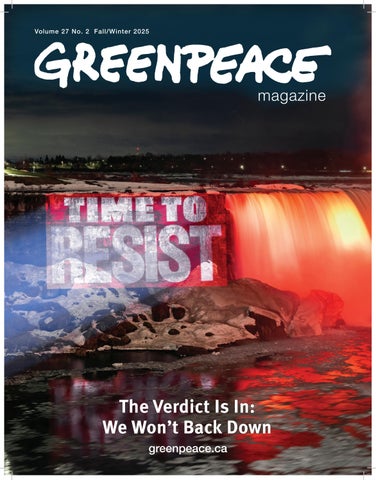
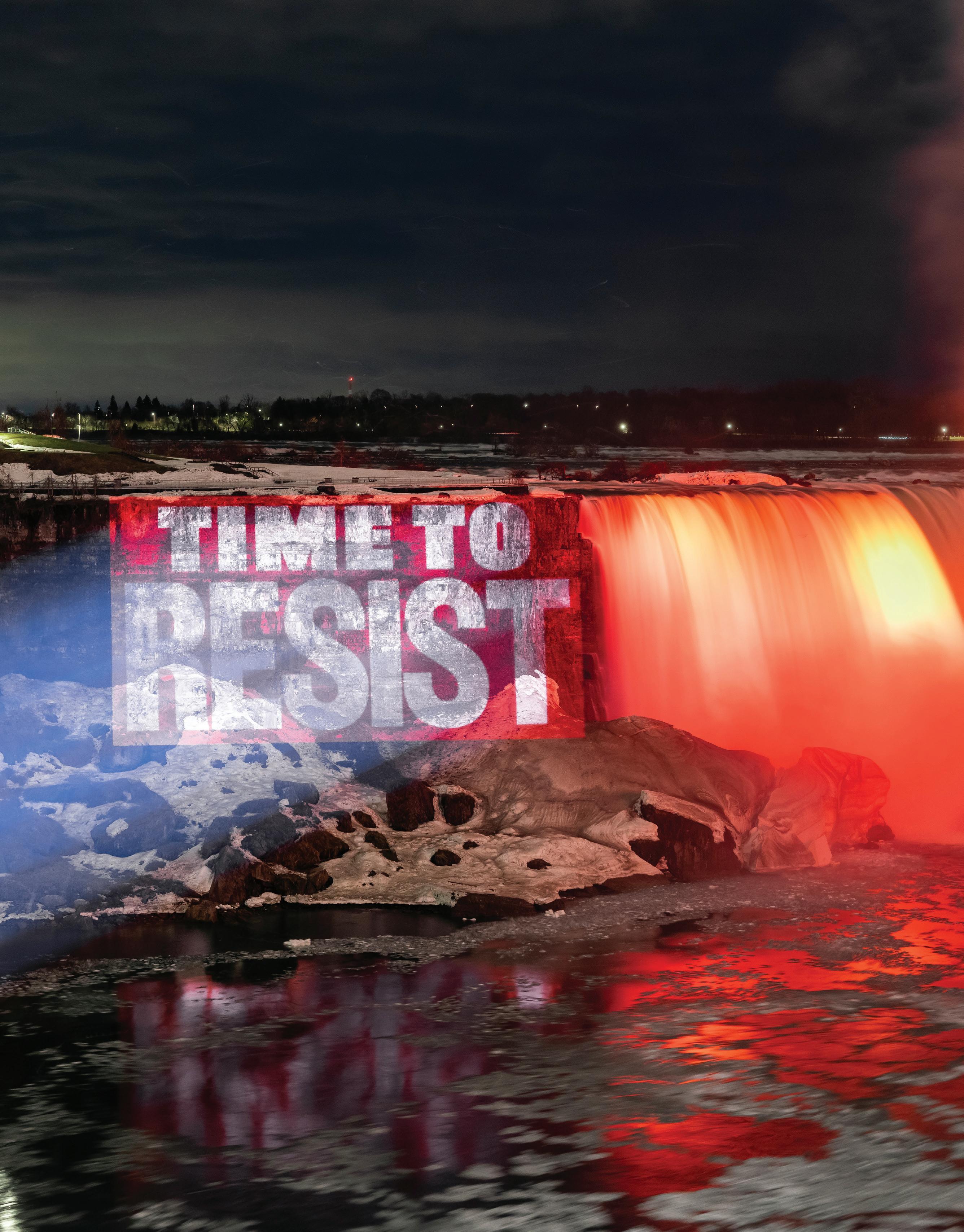
AROUND THE WORLD GREENPEACE IS DECLARING: IT’S TIME TO RESIST
By Stephanie Hulse, Loyalty Officer
A movement is growing, and spreading across the globe. A spark of resistance, courage, and unity is igniting in cities and communities worldwide.
From the gusty beaches of Scotland, to the skylines of Toronto and Mexico, to the rocky shores of San Francisco and beyond, the Greenpeace network is announcing it is “Time to Resist.”
This is not just a slogan: it’s a campaign designed to ignite a global wave of resistance to push back against billionaires’ greed, legal bullying, and attacks on our right to protest and speak up for the planet — and for each other.
Because in every corner of the planet, corporations are using their vast fortunes to silence critics. They fund political candidates who will serve their interests, lobby
governments to weaken laws that protect people and ecosystems, and even dominate the media to influence public opinion. Perhaps most dangerously, they’re also abusing the legal system to shut down dissent.
A favourite legal tool of corporate elites is Strategic Lawsuits Against Public Participation (SLAPPs), whose purpose is to bury activists and organizations in financial stress. The most brazen example is the abusive lawsuit brought by oil pipeline company Energy Transfer, where a jury in North Dakota found Greenpeace entities in the USA and Greenpeace International liable for more than US$660 million. This lawsuit isn’t only meant to financially drain these Greenpeace entities but also intimidate, exhaust, and silence them. It’s also intended as a threat to other environmental organizations if they dare speak out.
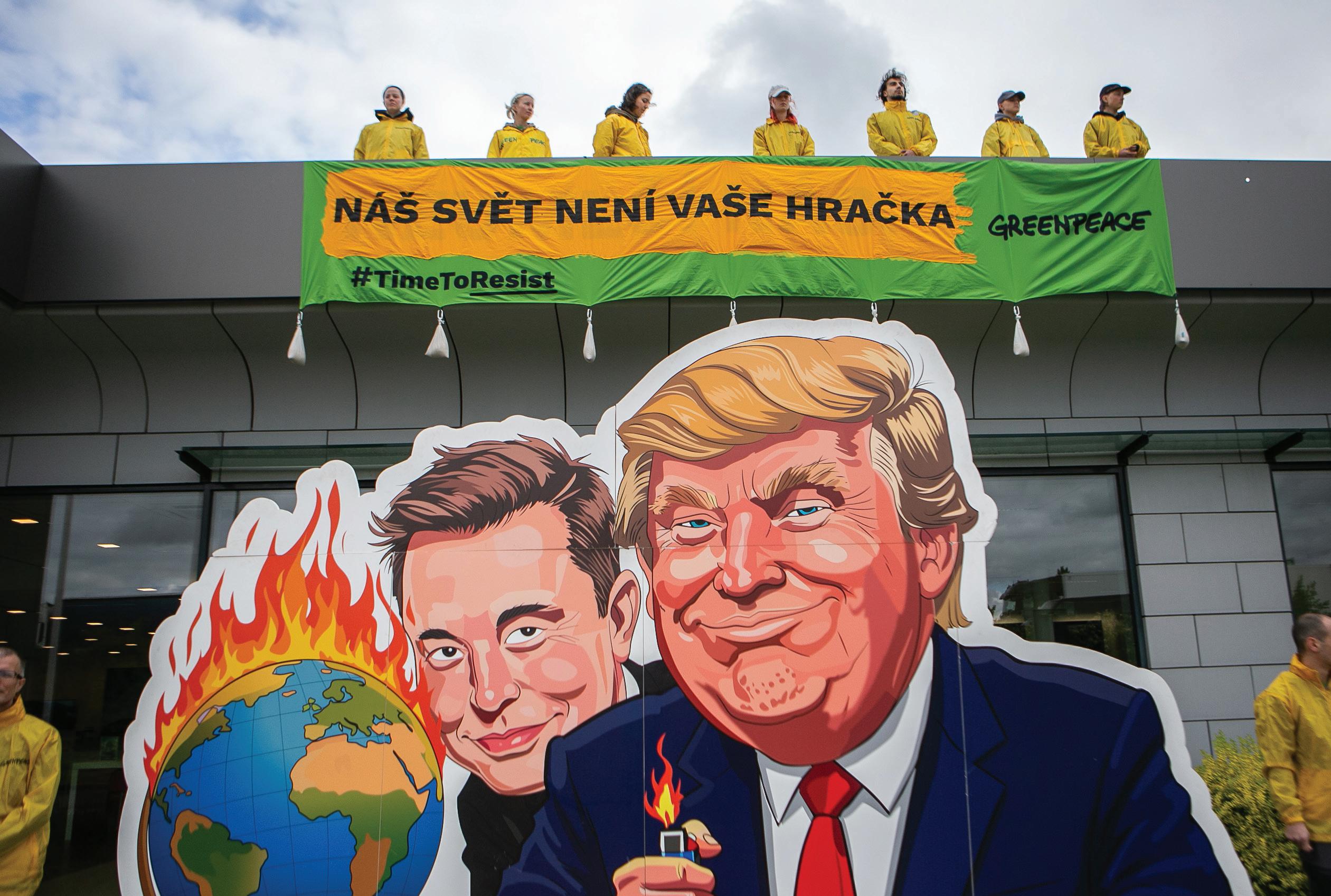
In June, Greenpeace activists from Czechia, Slovenia, Slovakia, Austria and Poland climbed onto the roof of the Tesla showroom building near Prague and unfurled a banner reading “Our world is not your toy #TimeToResist.“ They also placed a three-meter-tall caricature of billionaire Elon Musk and U.S. President Donald Trump in front of the building.
This case has received over two thousand pieces of media coverage in more than 20 languages. We’ve also seen a massive outpouring of support from Greenpeace allies around the world. Over 1,000 Greenpeace Canada supporters donated in response to the jury verdict and tens of thousands more around the world have given millions of dollars to support Greenpeace’s cause.
And this is exactly what terrifies our opponents like Energy Transfer.
While oil industries have billions in the bank, we have millions of people on our side, who believe in a better future. People who know we must not let profiteers and polluters intimidate those who dare to tell the truth, and protect the planet. And it’s this support that allows us to push back against corporate bullies like Energy Transfer, expose how oil companies are fueling the climate crisis and silencing dissent, and empower other communities around the world who are resisting corporate takeover of our planet.
It’s also important to note that Greenpeace International and Greenpeace in the US have strong grounds for appeal — due to numerous errors at trial on Energy Transfer’s side — and they plan to face Energy Transfer in court again soon.
The global Greenpeace network is built to withstand this type of pressure, and no matter what bullying tactics corporations like Energy Transfer throws our way, they won’t silence us or prevent us protecting people and the planet.
We choose to resist, not retreat.
Thank you for being among those incredible supporters who won’t allow bullies to silence us, as the planet is destroyed, Indigenous rights and sovereignty are steamrolled, and the right to protest is threatened.
The Energy Transfer case is far from over, and in the meantime we will continue to speak out and take action wherever Greenpeace is needed.
To learn more about the Time to Resist campaign and to take action, visit: greenpeace.org/international/act/timeto-resist/, and act.gp fight-the-billionaire-takeover.
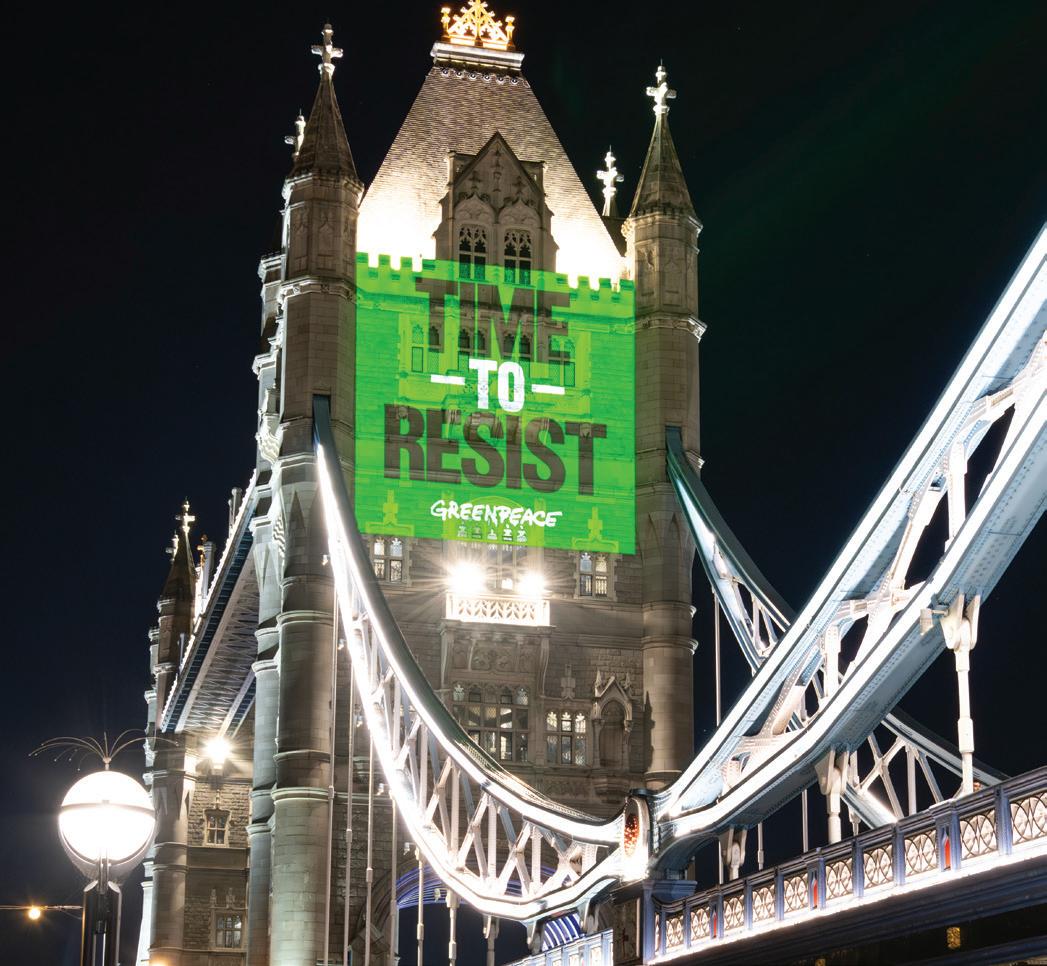
Greenpeace UK marked Earth Day by projecting clear messages onto Tower Bridge in London, UK that it’s time to resist.
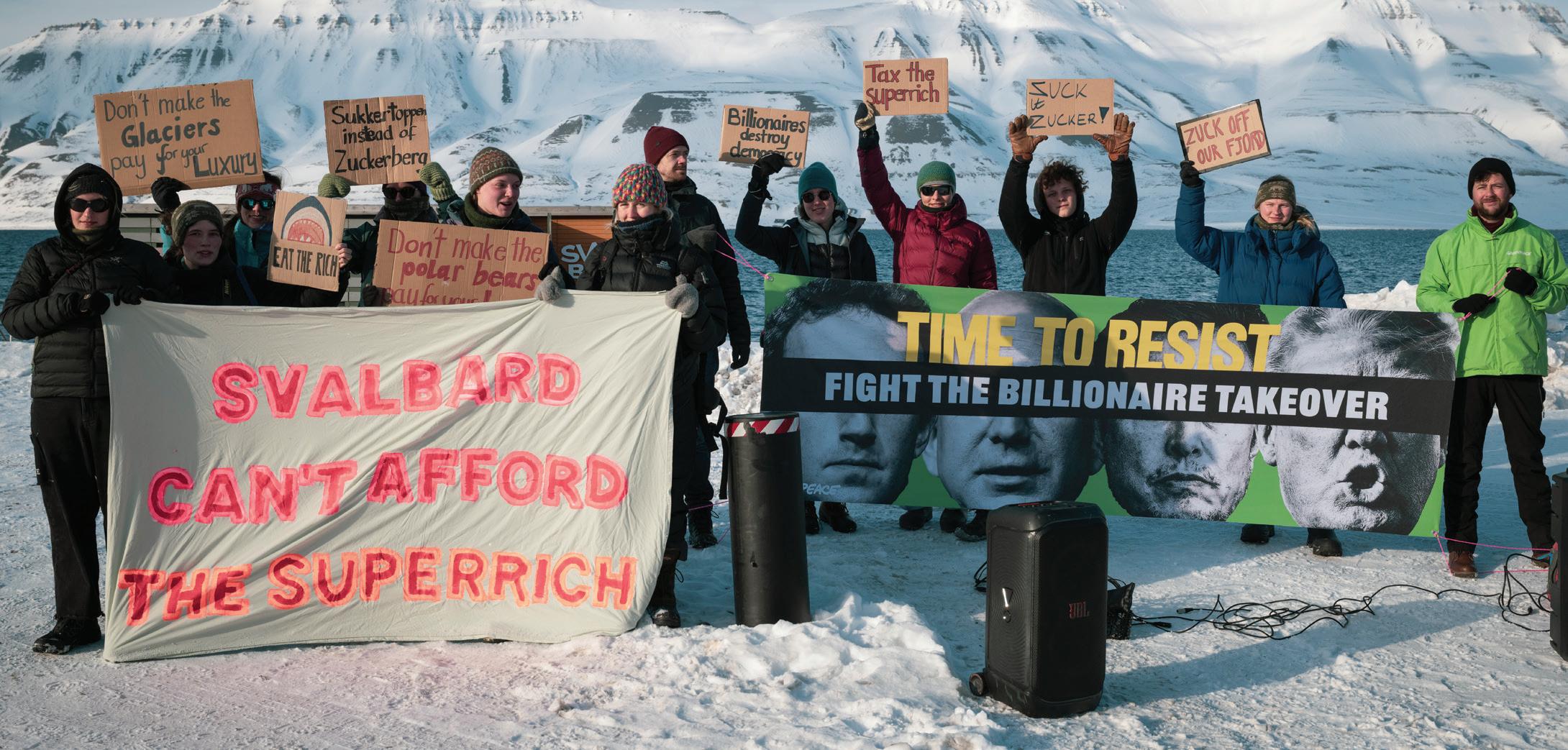
Greenpeace Nordic activists in Svalbard, Norway protest in front of Mark Zuckerberg’s luxury yacht Launchpad as part of the campaign to stop the billionaire takeover.
CODE RED FOR THE SEABED: WHO WILL WIN THE BATTLE FOR THE OCEANS?
By Salomé Sané, Nature Campaigner
This summer, the fate of the world’s oceans hung in the balance. At the heart of it all is a high-stakes battle between the forces seeking to exploit the oceans, and those seeking to protect them. From UN conference halls to protest murals on the streets of Vancouver, the drama played out across a global stage.
In June, the UN Global Oceans Conference aimed to secure ratification for a Global Oceans Treaty and spark urgent calls for ocean conservation. Prime Minister Carney committed to ratify the treaty as soon as possible during his election campaign, but fell short on delivering that commitment in time for the UN deadline.
Weeks later, in July, leaders from around the world met at the International Seabed Authority (ISA) to debate an urgent question facing the world’s oceans: should deep sea mining be allowed to go ahead, despite warnings from scientists, Indigenous leaders, and environmental advocates? One of the most aggressive voices pushing for mining is Canada-based The Metals Company (TMC), led by
CEO Gerard Barron. His dream? Massive robots scouring the ocean floor for minerals — regardless of the environmental cost, and impacts on coastal communities. Barron has even collaborated with US President Donald Trump to try and bypass international law in pursuit of his mining interests.
But in July, the ISA sent a clear signal in response: ignore the rules, and you will face consequences.
A Threat Beneath the Waves
Imagine massive machines tearing across the deep ocean floor to extract minerals, destroying fragile ecosystems that have existed undisturbed for millions of years. This isn’t science fiction. It’s TMC’s business model. They’re willing to gamble on one of the planet’s last untouched ecosystems for profit. But mining for deep sea minerals isn’t how we make the sustainable energy transition happen. What we need is to reduce mineral extraction, promote reuse and regeneration of existing materials, and demand justice for impacted communities.
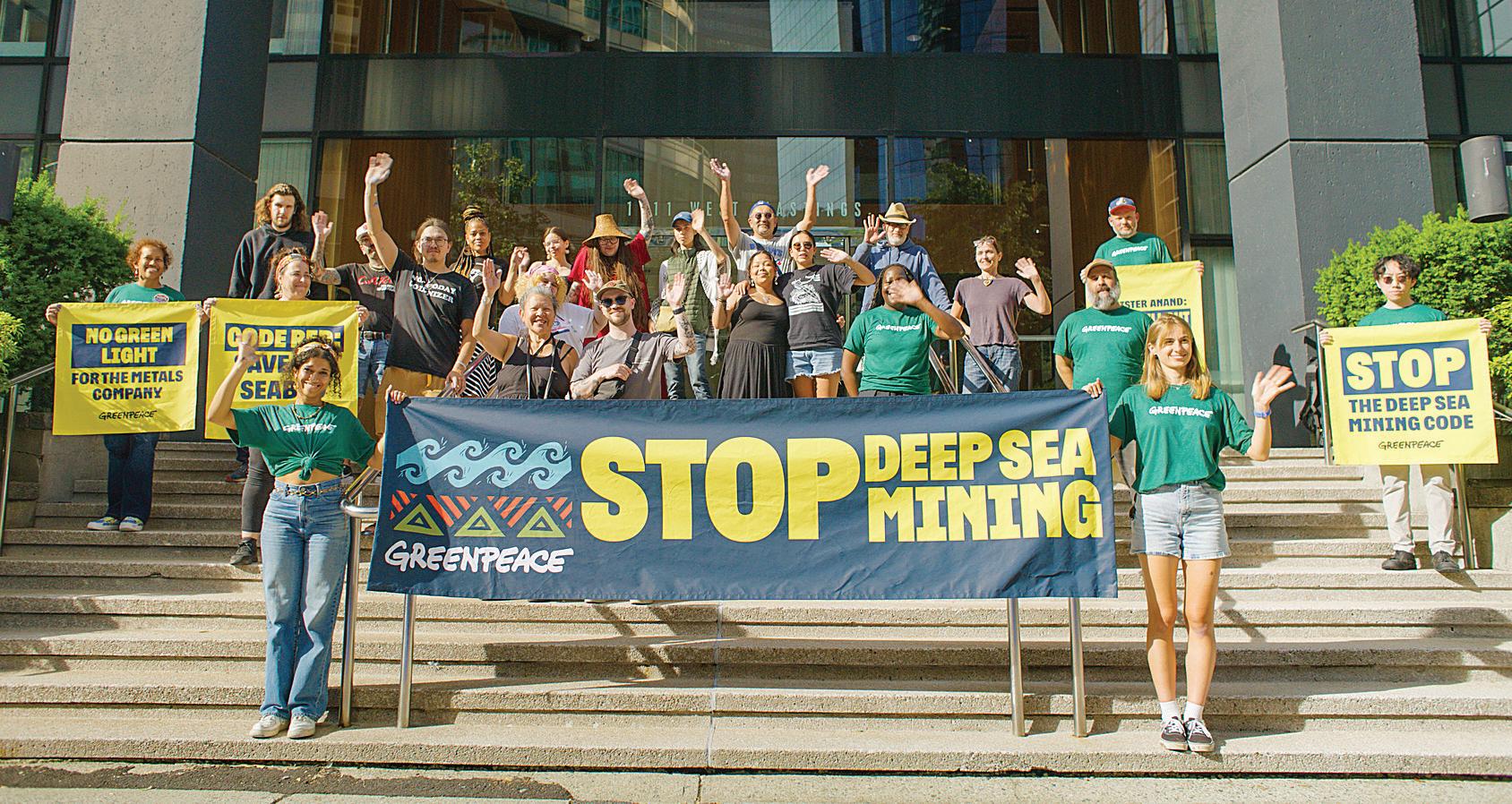
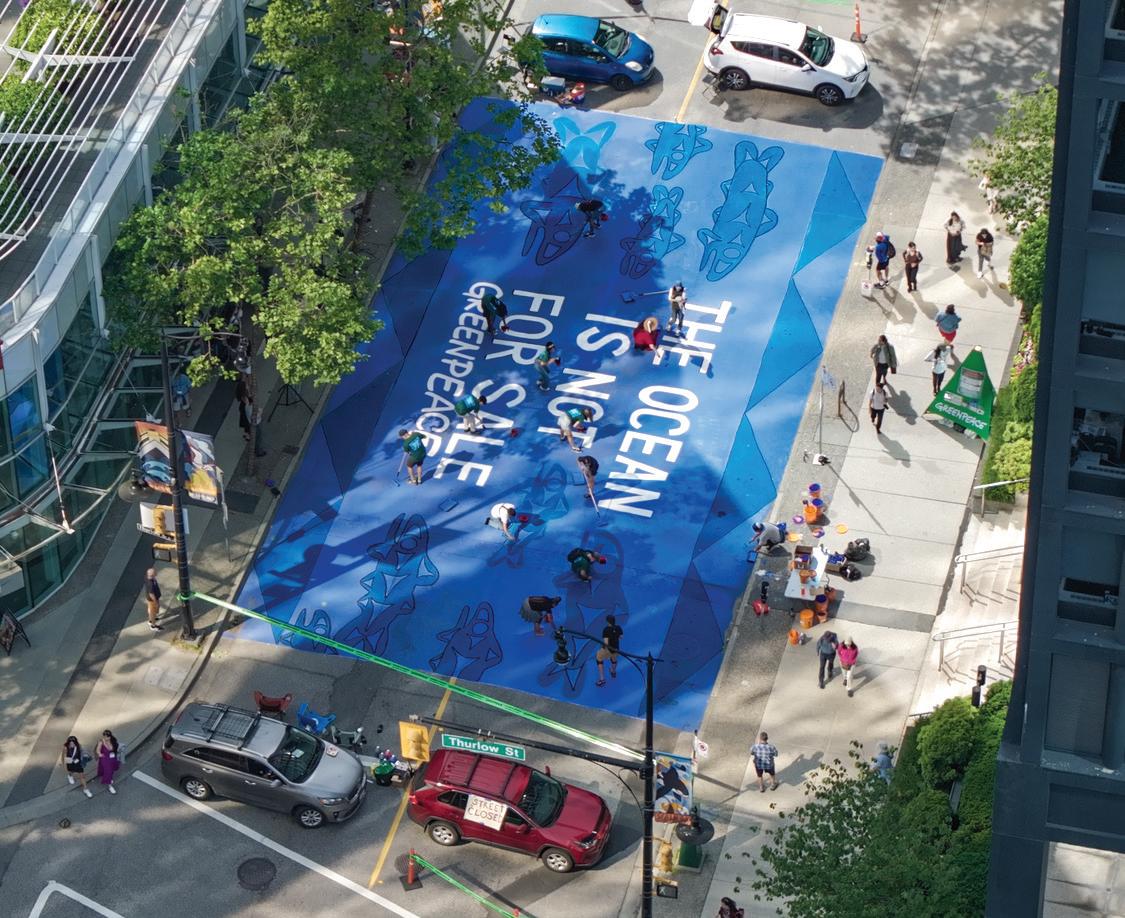
Ahead of the 30th session meetings of the International Seabed Authority, Greenpeace Canada activists, volunteers and local artists protested in front of The Metals Company HQ in Vancouver, urging Canada to oppose Trump-backed deep sea mining and protect the oceans.
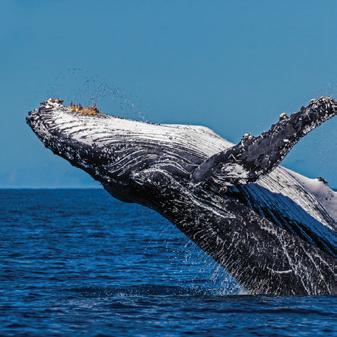
The deep ocean makes up 90% of Earth’s marine environment. It plays a huge role in balancing the planet’s climate by acting as the world’s largest carbon sink. It’s also home to incredible species that we’re only just beginning to discover. Scientists warn that mining this fragile, undiscovered world could cause irreversible damage. Deep sea mining would lead to habitat loss and could deeply impact whales and other marine mammals.
Pacific island nations, coastal communities, and Indigenous Peoples, whose cultures, economies, and food systems rely on a healthy ocean, will face severe impacts if deep sea mining is permitted to start. For that reason, many are speaking up to hold the line against this nascent industry.
Art as Resistance
In early July, Greenpeace Canada teamed up with Coast Salish artists and activists to paint a giant, colorful mural outside TMC’s Vancouver office. The mural was a powerful reminder that the ocean is sacred — not a sacrifice zone for corporate profit.
But instead of engaging in dialogue, TMC’s CEO lashed out, calling the peaceful protestors — including children — “eco-terrorists.”
It’s an outrageous accusation. The real threat isn’t kids with paintbrushes — it’s companies willing to gamble away the deep sea for short-term profits.
The tide is turning
By playing with fire, The Metals Company will end up getting burnt. The ISA has launched a formal investigation into TMC’s subsidiaries, which could result in the company losing its mining privileges. More importantly, it signals a shift in international sentiment: ocean governance must be rooted in science, equity, and precaution — not exploitation.
The deep ocean is not a business opportunity — it’s our shared natural heritage. Once we destroy it, we can’t get it back. That’s why we need Canada to stand on the side of science, justice, and ocean protection.
Now is the time to act. We must say no to deep sea mining. Instead, let’s protect this shared blue planet for generations to come.
Help us convince the federal government to double down on their support for a global moratorium on deep sea mining, oppose a rushed Mining Code — a set of rules that the ISA has put forward that would legalize seabed exploitation — and stand up to Trump and The Metals Company’s corporate greed. Visit: act.gp/stop-the-deepsea-mining-code.
Historic Victory: Global Ocean Treaty is Ratified!
The Global Ocean Treaty has officially entered into force, marking a historic victory for ocean protection and people power. 20 years of campaigning led to the 2023 agreement, which has now been ratified by 60 governments. This legally binding treaty brings us one step closer to our goal of protecting 30% of the world’s oceans by 2030. It’s a milestone that reflects the strength of our global movement and the tireless efforts of supporters worldwide.
This win is another example of people power, of collective action, and a reminder that we can convince governments to put the planet before profit. And while we take a moment to soak up this win, we also recognize that the work is not over. Global governments must establish strong ocean sanctuaries immediately. We must resist industrial fisheries and the deep sea mining industry. Let’s build on this momentum to secure lasting protection for the ocean and the planet!
Greenpeace Canada activists, volunteers and local artists painted a giant mural in front of The Metals Company HQ in Vancouver, to publicly expose them as accomplices of Trump who are making moves to fast-track deep-sea mining and cause irreparable harm to ocean life, July 2025.
WORLD LEADERS FAIL TO SECURE A GLOBAL PLASTICS TREATY AGAIN, BUT IT’S NOT OVER YET
By
The world is drowning in plastic pollution. Plastic starts polluting the planet the moment it’s created, threatening wildlife, ecosystems, the climate, and human health. We need a solution that matches the scale of the problem and a global treaty on plastics can be that solution.
And so, in response to public pressure and the recommendation of scientists, over the past few years governments have been gathering at UN negotiations to agree upon and create a Global Plastics Treaty.
This August, world leaders met for what was supposed to be the final round of negotiations for a Global Plastics Treaty (INC-5.2), and after 10 days of grinding negotiations, the session concluded without the hoped-for landmark agreement to end plastic pollution.
While many were left feeling dismayed, the dream of a strong Global Plastics Treaty is not lost, and negotiations will resume at a later date (TBD). But for now, here’s our reflection on the latest round of negotiations:
Move over, ambition is trying to come through
During the negotiations, a draft plastics treaty was proposed, but it disappointed the majority of countries at the table — in particular, a group of over 100 countries including Canada, known as the High Ambition Coalition — who want a strong plastics treaty that regulates the entire lifecycle of plastic.
Unfortunately, progress towards this goal was stalled by a smaller group of oil producing countries, who derailed negotiations by focusing on the scope and definitions of
the treaty. And so, in an effort to reach consensus among all parties, the proposed draft eliminated critical measures on cutting plastic production and regulating toxic chemicals.
“Unacceptable
for future generations”
During the talks, Canada bravely held the line and demonstrated a clear commitment to a strong treaty. The Canadian delegation called the proposed draft “unacceptable for future generations,” and criticized the lack of inclusion of Indigenous Peoples in the text. In fact, days before the negotiations began, Canada and Australia submitted a joint proposal to strengthen the language in the draft treaty regarding Indigenous Peoples and their communities, who are often most affected by the plastics crisis. We hope Canada continues to demonstrate the same level of leadership they displayed at INC5.2 as talks move forward, and help land the ambitious treaty the world needs.
The time for courage and determination is now
While these talks were not successful, the call from people, scientists and civil society remains clear: we need a strong, legally binding treaty that cuts plastic production, ends harmful products and chemicals, upholds Indigenous Rights, secures fair financing, and accelerates a just transition to a reuse-based future. And we’re not going to give up until it happens.
To follow along on our campaign to cut plastic production, visit: act.gp/globalplasticstreaty.
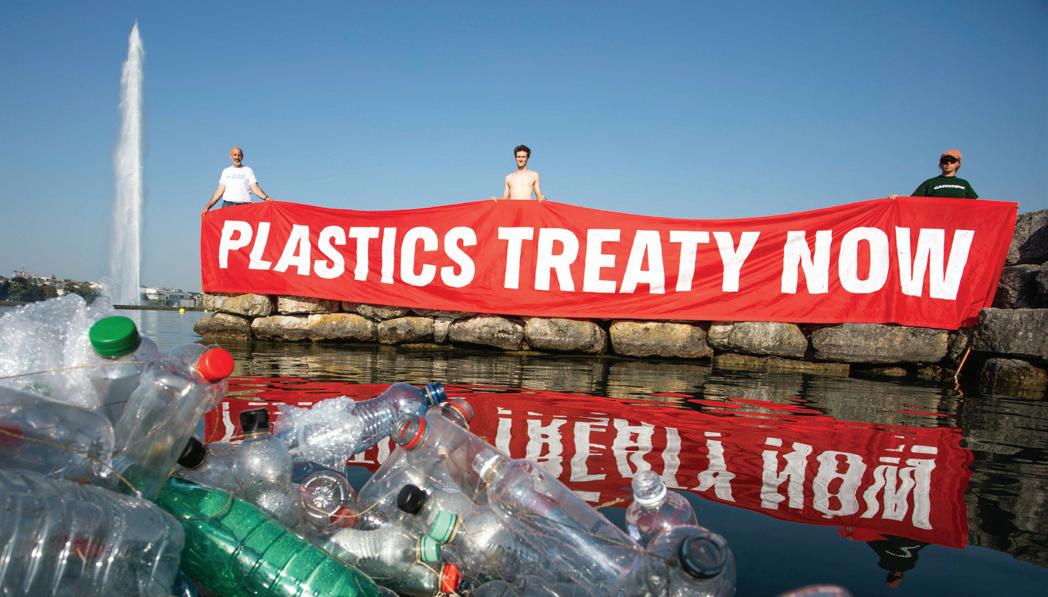
Greenpeace activists unfurled a banner reading “Plastics Treaty Now” in front of the Jet d’Eau of Geneva, where the INC-5.2 negotiations took place.
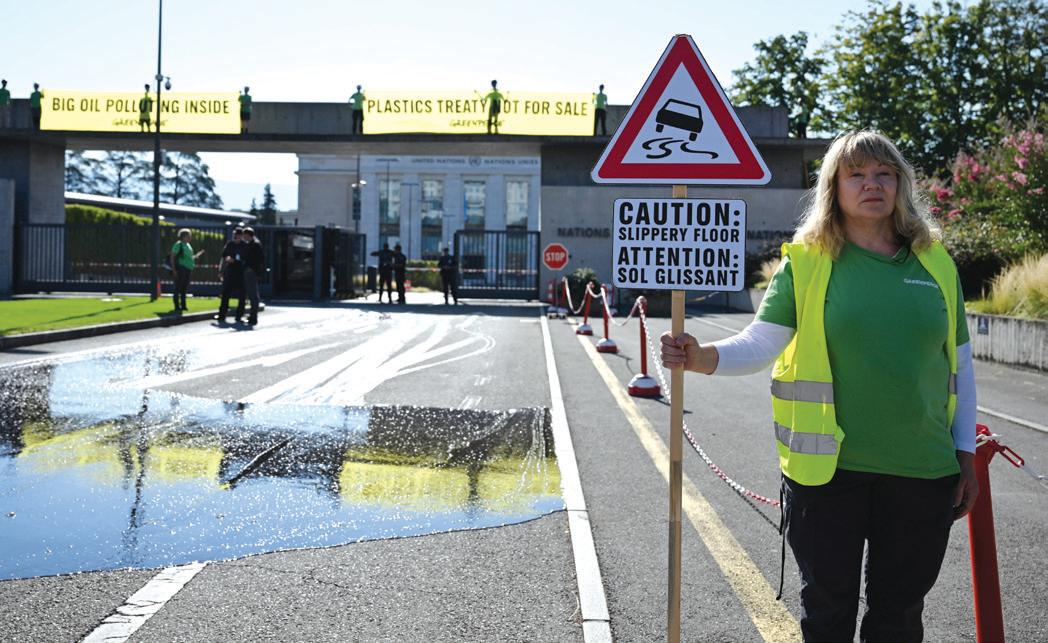
Greenpeace activists created a trail of black “oil” and hung banners that read “Big Oil Polluting Inside” and “Plastics Treaty Not For Sale” on the entrance of the Palais des Nations, in Geneva, where the INC-5.2 negotiations took place.
TOXIC GOLD: HOW ILLEGAL MINING IS POISONING THE AMAZON AND ITS PEOPLE
By
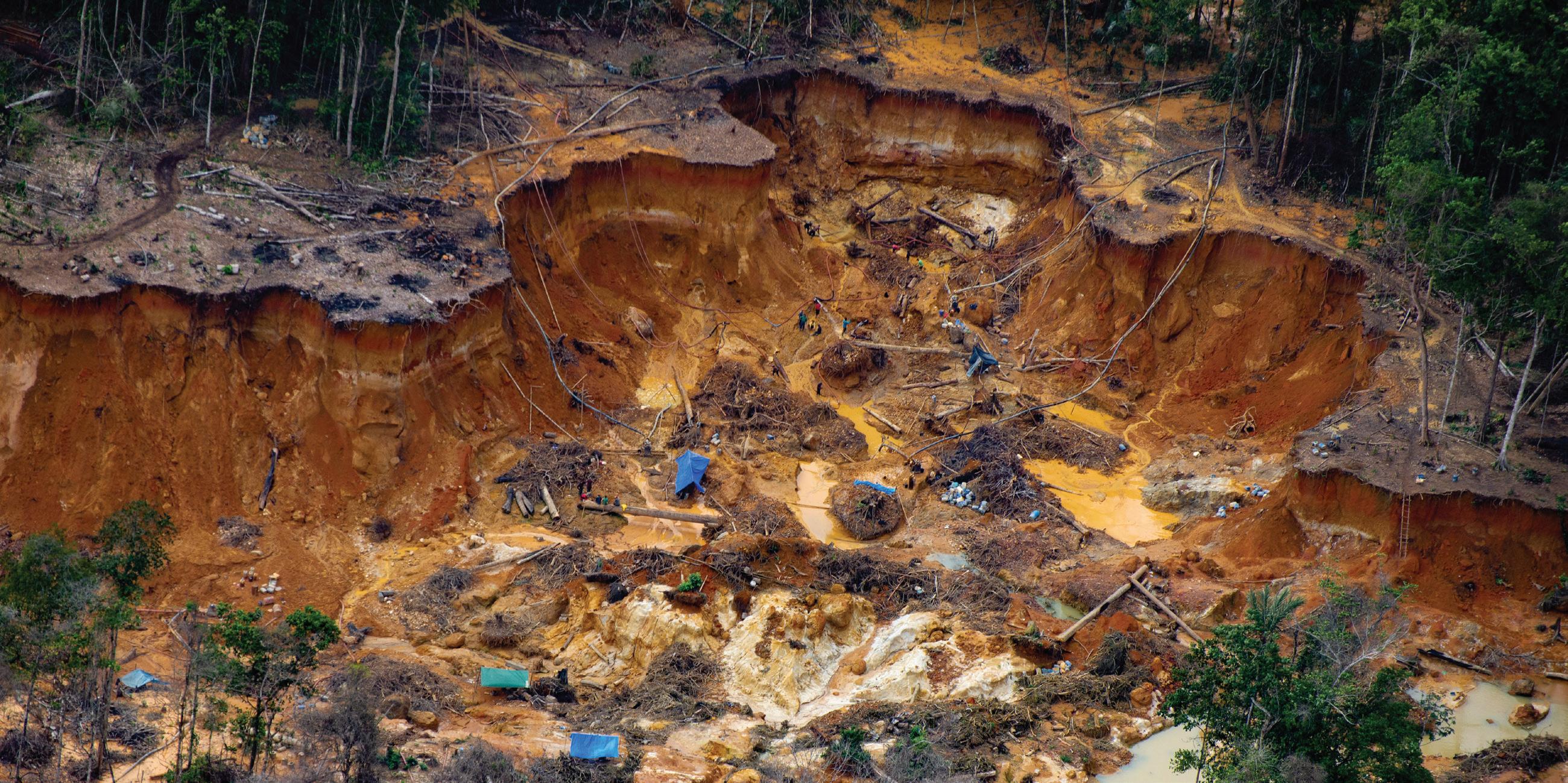
In the heart of the Amazon, illegal gold mining is wreaking havoc — destroying forests, poisoning rivers, and endangering Indigenous communities. This isn’t just an environmental crisis: it’s a human rights emergency.
To extract gold, miners use mercury — a highly toxic metal that contaminates rivers, builds up in fish, and travels up the food chain to humans. It damages the brain, heart, and kidneys, with symptoms ranging from tremors and memory loss to lifelong neurological harm.
The scale of the contamination is staggering. In 2024, 84% of people in nine Yanomami villages were found to have mercury in their bodies. In the Munduruku territory, 60% exceeded safe limits. One in five fish sold in 17 Amazonian cities tested above World Health Organization safety thresholds. Even wildlife is affected: mercury levels near mining sites are up to six times higher than in untouched areas.
But the damage isn’t only chemical. Illegal mining fuels exploitation — with reports of forced labour, sexual violence, and disease outbreaks in Indigenous communities. Though Brazil’s Constitution bans mining on Indigenous
lands, enforcement is weak, and criminal operations continue with impunity.
This destruction is fueled by global demand — and Canada plays a role. According to Greenpeace’s Toxic Gold report, Canada is one of the top importers of Brazilian gold. With gold prices soaring 44% in 2024 and central banks stockpiling the metal, pressure on the Amazon is only increasing.
Still, there’s hope. People-led victories are making a difference. In 2023, Greenpeace pushed HD Hyundai to stop supplying machinery to illegal miners. Greenpeace’s satellite monitoring of four Indigenous territories has exposed and helped remove hundreds of illegal mining rafts. These efforts work — and they need support.
Canada must act. That means cleaning up our gold supply chains and standing with Indigenous Peoples defending the Amazon.
Together, we can protect the forest, its people, and our shared future. To learn more about Greenpeace’s efforts to protect the Amazon, go to: act.gp/respect-the-amazon
Greenpeace Brazil captured images of illegal mining within the Yanomami Indigenous Land in the Amazon, during an overflight expedition, April 2021.
TOGETHER WE CAN: THE POWER OF COLLECTIVE ORGANIZING
By Louis Couillard, Greenpeace Canada Climate Campaigner
We each have our own story of how we became environmentalists. It could be your upbringing, or because of the influence of a friend or family member, or a moment in your life that suddenly turned everything around. Or perhaps a combination of many things. Personally, I can pinpoint two very specific moments in which my political awakening was sparked — and then exploded! These moments were driven by people power, and they’ve shaped my life, who I am, and what I have strived to create ever since.
The first moment came in 2012, during Quebec’s “Maple Spring” — the longest student strike in Canadian history. I was in high school, marching in the streets for the first time, and chanting alongside thousands of fellow students. I became overwhelmed by the surge of energy around me. It was an energy for change, of collectedness, of unity, and of a deep desire for good. It was here where I discovered the power of collective organizing. I didn’t know it yet, but a seed had been planted in me — and I would dedicate my life to mobilization and building collective power, all because of this protest.
My focus in climate justice came years later, in my first year of university. The 2018 United Nation’s special report on climate change landed like a thunderclap. In a lecture that had nothing to do with the issue, a professor put the report on the screen and told us bluntly: “You should be out in the streets protesting, not sitting here.”
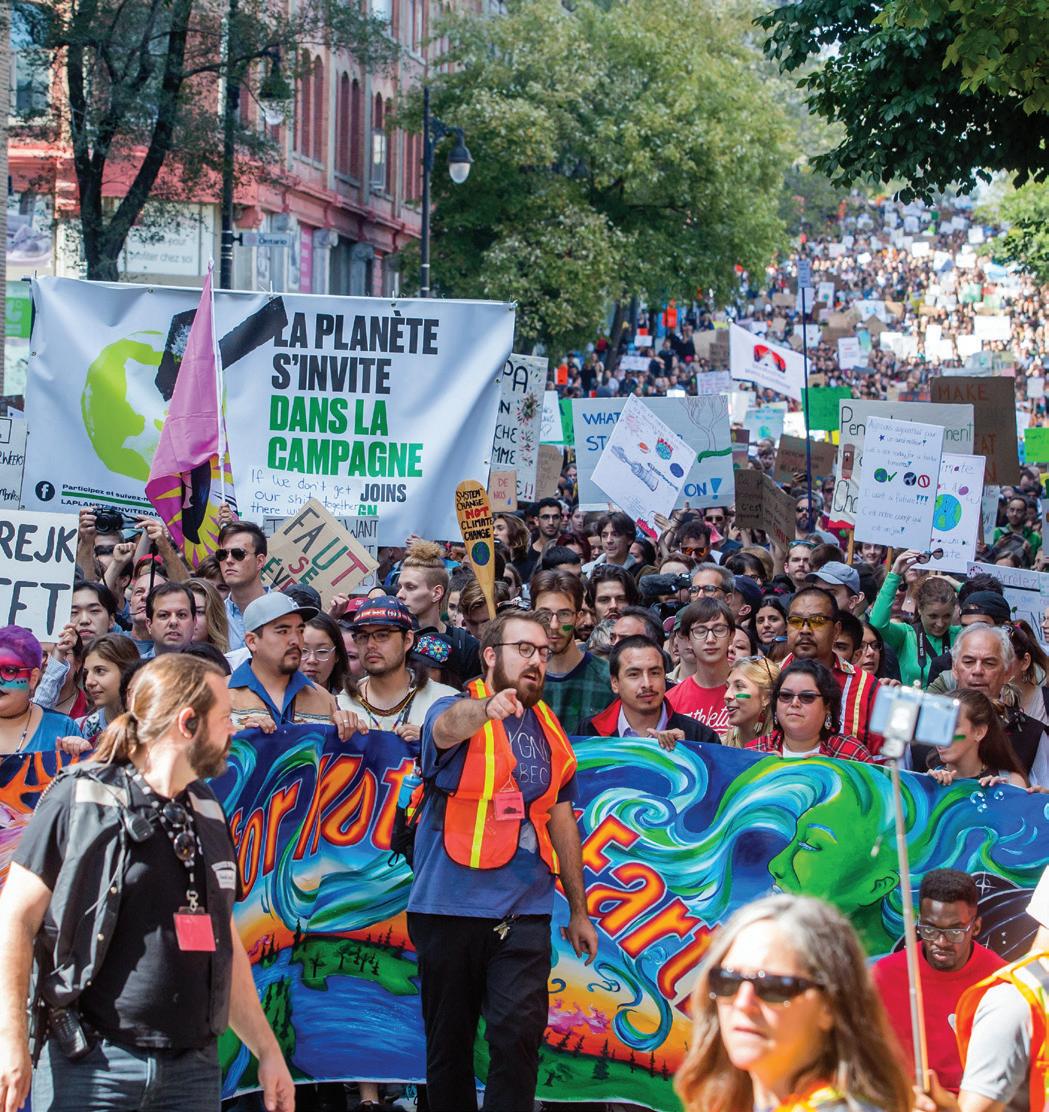
Without hesitation, I took his message to heart and took action. I joined the fossil fuel divestment movement, helped launch the student climate strikes in Canada, and — unbeknownst to us at the time — paralleled the early efforts of a Swedish teenager named Greta Thunberg. Months later, we marched in the streets with half a million people in Montreal, demanding climate justice now.
It was during those early strikes that Greenpeace Canada stepped in — not to lead, but to support. They gave us meeting space, materials, and experienced staff to help us grow as organizers. Many groups helped us, but Greenpeace went above and beyond. I told myself then that if I ever worked for an environmental organization, it would be them.
Over the years, I’ve learned something important: the real driver of change isn’t reports, lobbying, or polished
campaigns — it’s people marching in the streets. A senior political staffer once told me the only reason Quebec banned oil and gas extraction and stopped a major liquified natural gas (LNG) project was because young people protested every other Friday.
That LNG victory in 2021 remains one of my proudest achievements. The odds were terrible: politicians supported the project, it was far from urban centres, and greenwashing dominated the narrative. But through relentless grassroots coordination, record-breaking public consultation participation, and unyielding pressure, we scared off investors and pushed the government to reject it.
What keeps me going nowadays is my two young daughters — and the unshakable knowledge that collective organizing works. People are powerful, and we can create change. If you want to get involved, start local. Join a climate justice group. Show up. No one changes the world alone, but together, we can.
If you would like to get involved in climate action visit act.gp/volunteerwithus, or join a climate justice group or chapter in your community!
Louis Couillard (in a high-vis vest) helped organize the 2019 climate march in Montreal.
Winners of the 2024 Photo Competition
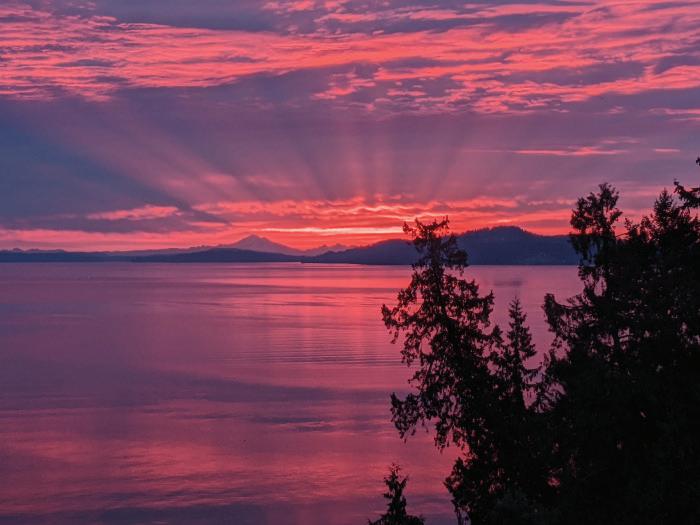
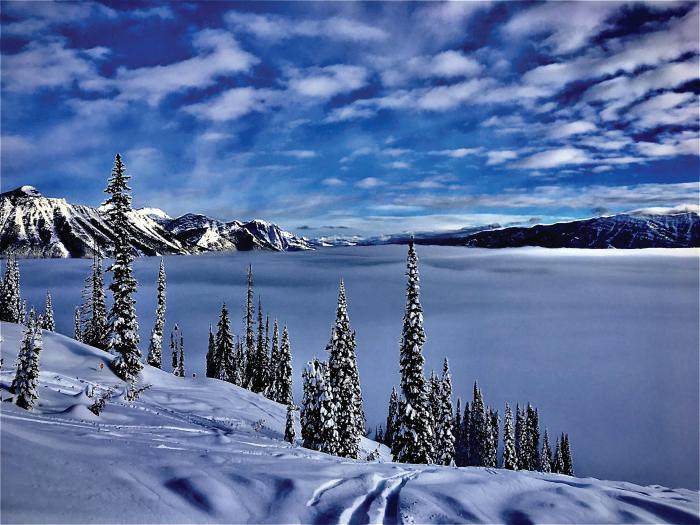
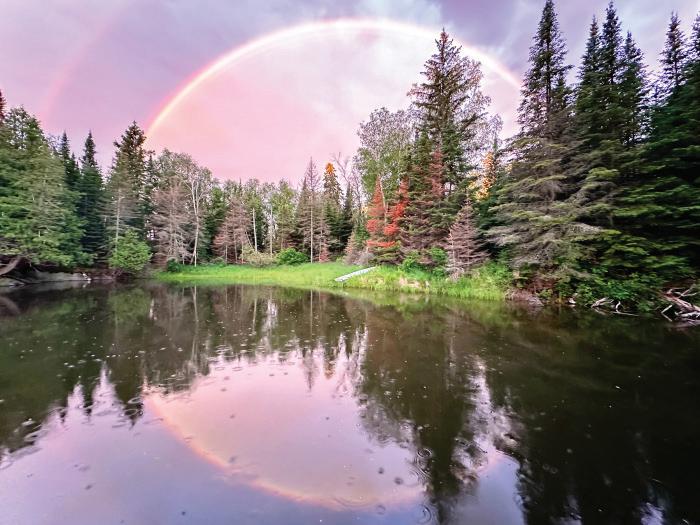
In 2024, our photo contest theme, Weather Wonders, celebrated the awe-inspiring elements of nature — from the dancing northern lights to dramatic stormy skies. Participants from across the country shared stunning images that captured the raw power and beauty of Earth’s weather.
We’re endlessly inspired by the stunning nature photography shared with us, and look forward to hosting this annual contest and celebrating the incredible talent in our community.
People’s Choice Winner
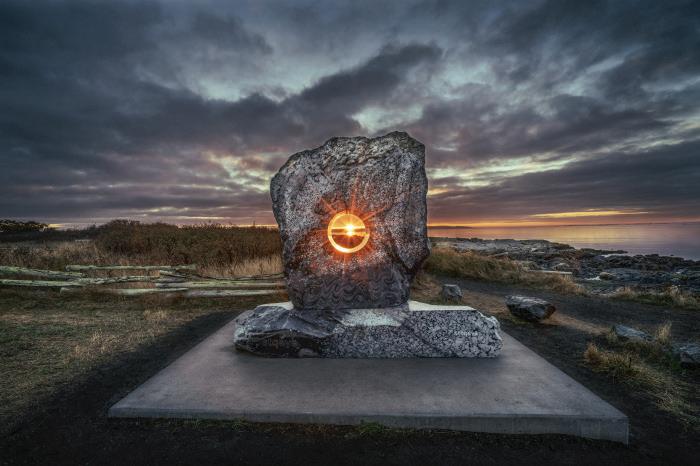
For the first time ever, our People’s Choice and one of our Top Five winners were one and the same: Jack Adamson. His breathtaking photo not only showcased the majesty of nature, but also told a deeply personal story, honouring Indigenous culture.
Get in touch! Have a question? Need to update your information? Greenpeace Canada’s Supporter Care team is here to help!
Please email the team at supporter.ca@greenpeace.org or reach them by phone between 9:30 am and 5:30 pm ET, Monday to Thursday, at 1-800-320-7183.
After providing for your loved ones, you can also help protect the planet for future generations by leaving a gift in your Will. Legacy giving is simple, meaningful, and our team is here to support you every step of the way.
To make the process even easier, Greenpeace Canada has partnered with Willfora, a free and secure online will writing platform that helps you create or update your Will and include a legacy gift. You can get started today at: give.willfora.com/charities/greenpeace-ca Together, we can honour today’s commitment with a legacy that safeguards tomorrow’s planet. If you’re ready to start a conversation, email us at lcanada@greenpeace.org or call Lisa Bono , Head of Donor and Development at, 647-955-0070 .
Scan the QR code to learn more about how you can make a lasting legacy!