Volume 28 No. 1 Spring/Summer 2026
magazine
An ocean of possibilities:
Changing the world one story at a time greenpeace.ca
MOBILIZATION:
Climbing in community: a catalyst for change 3
CLIMATE:
How Greenpeace is helping build sources of light in Ukraine during a dark time 4-5 Unpacking the spread of climate conspiracy theories
NATURE:
Greenwashing and the deep sea
6 7
Calling for a new model of nature protection rooted in care rather than control 8-9
STAFF SPOTLIGHT:
Greenpeace Canada’s Head of Communications on how to cultivate hope and agency in the contemporary media landscape 10
SUPPORTER SPOTLIGHT:
Your 2025 Photo Contest winners! 11
DID YOU KNOW?
According to Canada’s largest market research firm, IPSOS, 9 in 10 Canadians (87%) report feeling happier when connected to nature.
Reuse me: once you are done with your magazine, bring it to a local coffee shop or library for others to enjoy!
Scan the QR code to donate today.
FSC logo goes here
Greenpeace Magazine is published biannually and printed using vegetable-based ink on paper made from 100% post-consumer fibre. Greenpeace is an international organization whose primary purpose is to take action to protect the environment and promote peace.
CHANGING THE NARRATIVE Several of the founders and early members of Greenpeace were journalists. They believed we could change the world, not through brute force, but through the power of ideas. That one image—one impactful story—could shock our collective consciousness into action. A “mindbomb,” as Bob Hunter called it, to explode in people’s heads. Greenpeace grew into a powerful global network because it was able to do just that: capture the imagination. Those early images of Greenpeace activists aboard a tiny rubber boat, standing between a whale and a massive commercial whaling ship, changed the way that we, collectively, perceived our agency: we may be small, but we are so powerful. As a campaigning organization, Greenpeace is constantly involved in this kind of meaning-making. Every campaign we launch is, in and of itself, a story to help us (re)imagine what’s possible. That work is sometimes met with skeptics or critics, who’ll say that our visions for a greener future are idealistic, naive, or “fantastical.” What’s fantastical, though, is the idea that endless extraction is possible on a planet with finite resources, or that the world can be bombed into harmony. This edition of the Greenpeace Magazine centres on the power of ideas and narratives. In these pages, we highlight the work that we’re doing to identify, disrupt, and rewrite some of the damaging narratives that have become normalized over time, whether it’s that environmental concerns are luxuries during times of conflict, or that “true” nature is untouched by humans. And it’s thanks to you that we can do this work—that we can reimagine what’s possible. As an independent organization, Greenpeace doesn’t have to conform to what’s politically palatable, or follow a corporate script. We can research and advocate for solutions that centre people and the planet, without compromising our values or ideals, because you, too, care about creating meaningful change. That is the story Greenpeace has always told: a better world is possible, and brave individuals, boundless imagination, and collective action can make it a reality. Thank you for being a part of this chapter. Sincerely,
Christy Ferguson Executive Director, Greenpeace Canada We are immune to political and corporate pressure because we don’t take donations from governments, corporations, or political parties. We rely solely on support from people like you in order to conduct our campaigns around the world. To learn more about Greenpeace, visit greenpeace.ca or call 1-800-320-7183.
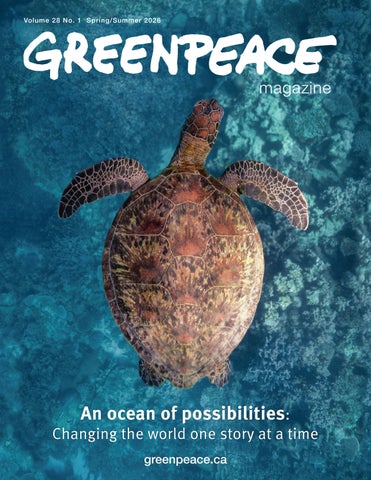
On the cover: A green turtle swims over the Ningaloo Reef in Australia. © Greenpeace / Lewis Burnett (Instagram: @huntingforparadise)
33 Cecil Street, Toronto, ON M5T 1N1 454, avenue Laurier Est, Montréal, QC H2J 1E7
@ Greenpeace
IN THIS ISSUE…
MOBILIZATION
TO THE SUMMIT AND BACK:
How climbers are building community
In 2025, people from Greenpeace offices across the Americas came together for a skillshare, including two volunteers from Greenpeace Canada. The objective was to equip climbers with the necessary skills to execute actions safely and effectively. It was an exercise in teamwork, as participants navigated language barriers, varying skill levels, and challenging weather with humour, kindness, and adaptability. For Toronto-based Greenpeace Canada volunteers D.J. Dillon and María Sánchez Osuna, it was an experience that left them inspired, energized, and deeply connected to a global movement for change. The technical lessons were invaluable, but what stood out most was the sense of solidarity and community. “On any given day I was learning from different people or part of a different group working together,” says D.J. Climbing—much like the change we want to see in the world—requires trust, collaboration, and perseverance. The safety of the activists is always the number one priority. While we often hear about climbing framed in terms of “risk” and “courage,” it’s also a gradual process that can, in contexts like these, emphasize care and belonging.
What’s your reason to help save the planet?
© Tumelo Mohlamonyane / Greenpeace
Every Greenpeace action is different, but they all share one thing in common: people combining their skills in pursuit of meaningful change. Among them are climbers, who scale iconic landmarks, industrial sites, and oil infrastructure to draw public attention to (and sometimes block) activities that threaten, pollute, or destroy life on our planet, and to call out those who cause or allow them to happen.
Activists at the 2026 Human Rights Festival in South Africa.
Experiences like this challenge ideas about action centred on a “lone hero,” showing instead what’s possible through collective action and shared responsibility. For María, Greenpeace has been a lifelong inspiration. “As a kid, I used to watch Greenpeace actions on the news and thought those were the bravest people in the world,” she says. After trying to start green initiatives on her own, she realized change can be difficult to spark in isolation: “I volunteer to make sure my efforts can be part of a bigger initiative, where the strength comes from the collective.” Greenpeace’s campaigns are powered by many caring people who contribute their time, talent or financial support to protect our planet. If you’re interested in volunteering with Greenpeace and want to learn about upcoming opportunities to take action, visit: act.gp/mobilization.
Because you’re mad. Because you’re sad. Because you have to. Because you want to. Because you love this place.
Whatever your reason, start your fundraiser for Greenpeace at because.greenpeace.ca
Spring/Summer 2026
greenpeace.ca
3
© Verena Brüning / Greenpeace
CLIMATE
In 2024, Greenpeace activists set up a “solar sunflower” at the Ukraine Recovery Conference in Berlin, Germany, to advocate for the expansion of solar energy in Ukraine. The installation featured solar panels that were later delivered to Trostyanets, Ukraine, to support the city’s power supply.
BEACONS OF LIGHT:
How Greenpeace is helping Ukrainians use renewable energy to power a more peaceful future By Greenpeace Ukraine
Since Russia’s full-scale invasion of Ukraine began in 2022, its missile and drone strikes have systematically targeted civilian infrastructure. Thousands of homes, schools, and hospitals have been damaged or destroyed, while the intensity of its attacks on Ukrainian energy systems have left civilians without water, electricity, and heating in sub-zero winter conditions. The crisis has been disruptive and challenging, to say the least, and is forcing Ukrainian municipalities to look for ways to become more energy-independent. In the northeastern city of Trostyanets, Greenpeace has been collaborating with local authorities on a municipal masterplan for green reconstruction. The goal is to strengthen the city’s energy resilience, addressing both immediate and long-term recovery needs for reliable, attack-resistant, and decentralized energy resources. In support of these initiatives, Greenpeace recently led the energy-efficient renovation of an apartment block, which was severely damaged during the Russian occupation of Trostyanets in 2022. 4
Four years on, the complex—comprising 60 apartment units—is equipped with a modern heating system that runs on geothermal energy and solar power. The total cost for the heating system is 218,000 euros, which accounts for five water tanks of around 2,000 litres each; a heat exchanger for hot water; and a rooftop solar plant. While similar seed projects already exist for public buildings, this initiative marks a new effort in the private residential sector, particularly for large, multi-family housing complexes. By investing in this building as a pilot site, Greenpeace Ukraine is establishing the foundation for the implementation of solar panels and heat pumps in 113 multi-family residential buildings across the city. “This building proves that even during the war, Ukraine can implement cutting-edge technologies and create dignified living conditions. We want our experience to show other cities that the transition to renewable energy is possible today—and that it gives people something essential: the feeling of a home that is always warm and protected from threats,” says Yuriy Bova, Mayor of Trostyanets.
greenpeace.ca
Volume 28 No. 1
The residential renovation is a story of resilience, and part of the larger Green Reconstruction of Ukraine project launched by Greenpeace Central and Eastern Europe in 2022. The campaign highlights a window of opportunity amid the crisis—that is, an opportunity to rebuild the country’s infrastructure sustainably, while addressing the immediate need for communities to generate their own power instead of relying on centralized (and distant) power plants, which leave them vulnerable to attacks.
In periods of war or crises, workers, women, and other collectives that organize around shared issues have often been told to wait until “after the war” to demand rights or reforms. It’s a dangerous narrative that usually favours the status quo. Ukraine’s experience clearly demonstrates that change is not something for “after the war,” and that environmental concerns are not a “luxury” in the context of conflict. In fact, renewable energy is a solution that must be implemented during the war if we want to protect people. Every solar panel, heat pump, and storage system is a step towards energy security, independence, and peace. That is why we stay here, working alongside people who prove that, even in the darkest times, it’s possible to build light. To learn more about the Green Reconstruction of Ukraine campaign, visit: act.gp/ukraine. Spring/Summer 2026
© Oleksandr Popenko / Greenpeace
Several NGOs—including Greenpeace—installed a heat pump and solar power plant for the Horenka hospital, near Kyiv.
© Ivan Govzan / Greenpeace
The implementation of this infrastructure is also a testament to the success of the Women Solar Power Plant Installer project. To meet the demand for green technologies, Greenpeace is training Ukrainian women to install solar power plants. Thirty women have completed the courses so far, and Greenpeace Ukraine plans to engage the graduates in the installation of solar plants during the restoration of social infrastructure throughout Ukraine.
Women participating in a solar power plant installer course in Ukraine.
The renovated apartment block in Trostyanets, Ukraine.
© Ivan Govzan / Greenpeace
Projects like this are already delivering results. Through the Solar for Ukraine initiative, Greenpeace has provided solar panels for 16 hospitals across the country. The Rivne Regional Clinical Hospital, where more than 40,000 people are treated annually, received 387 solar panels as part of this initiative. Meanwhile, the Chortkiv Central City Hospital, which serves nearly 250,000 people in surrounding communities, received 150 solar panels. This kind of equipment allows medical institutions to offset the risk of blackouts from the war—helping to save lives while lowering energy costs.
© Greenpeace / Katherine Karpenko
Powering the way forward
The apartment block’s new heating system.
greenpeace.ca
5
CLIMATE
CLIMATE COVER-UPS:
Why are so many people choosing to believe conspiracy theories instead of climate science? By Keith Stewart, Senior Energy Strategist
© Andreea Udrea / Greenpeace
outcomes are the consequences of a person doing a bad thing, like an arsonist setting fires, they seem more manageable. After all, every action movie or police procedural suggests that a courageous, clever hero can stop this kind of “bad guy.” The fact that these tragedies are the consequence of a complicated fossil fuel-based energy system—that we collectively participate in—doesn’t provide the same sense of closure or control in uncertain situations. Deliberate disinformation
Greenpeace mounted a giant climate crisis bill in Bucharest, Romania, demanding governments hold polluters accountable.
There is an enduring conspiracy theory that environmentalists are setting wildfires to “trick” people into believing that climate change is real. This belief that climate change is some kind of “hoax” is characteristic of climate conspiracy theories. These tend to be stories about powerful actors who are using climate change as a means for economic or political control. Some invoke falsehoods about “corrupt” scientists using climate change to secure research funding. Others suggest that government policies to reduce carbon emissions are a pretext to restrict personal freedoms. Curiously, climate conspiracies do contain a grain of truth: the climate is being altered, and there is a select group of people who profit. But none of this is a secret: for decades, scientists have laid out in excruciating detail how human activity is destabilizing our climate, resulting in more extreme weather and wildfires. They’ve emphasized that burning fossil fuels and deforestation are the primary causes, and that there are actors—like fossil fuel companies and financial institutions—who profit from the destruction. So, if climate science exists, why is it that many people find it easier to believe conspiracy theories? Narrative and cognitive structure As climate change intensifies, more people are losing their homes and lives to wildfires, floods, and other natural disasters. In trying to make sense of these tragedies, there is a very normal human desire to identify a familiar villain. If these 6
Oil and gas companies have also financed decades-long disinformation campaigns to cast doubt on climate science. They’ve funded think tanks that promote climate skepticism and tried to manufacture a sense of “scientific debate” where there is consensus. Essentially, these companies have aimed to delay (or prevent) climate action, because it would reduce the demand for their products. In doing so, they’ve created fertile ground for conspiracy theories to grow. Big Oil has also spent millions of dollars to back far-right politicians, who frame climate action as a threat. Far-right actors often exploit economic uncertainty to frame green transition policies as “elitist interventions” and advocate for xenophobic policies that criminalize refugees displaced by climate disasters. In weaponizing people’s fear and anger, they’ve managed to blend climate change into their culture wars, which makes the “belief ” in climate science a matter of identity or ideology. What’s next? Research suggests that some of the best strategies are preventative—that is, helping people understand what (un) reliable information looks like. To that end, Greenpeace Canada is launching a new campaign, focused on confronting disinformation. We want to investigate the mis- and disinformation that influences Canada’s climate politics, exposing the strategies and actors involved. We’ve already seen the impact this work can have: in 2024, following investigative research and reporting my colleagues and I conducted, a parliamentary committee summoned the CEOs of Canada’s Big Five banks to testify about their “Net Zero” pledges and concurrent investments in fossil fuels. Building on that momentum, this new campaign represents the next step in our efforts to hold polluters accountable. To learn more, visit: act.gp/polluters-pay.
greenpeace.ca
Volume 28 No. 1
NATURE
MINE-SPLAINING:
The deceptive marketing of deep sea mining By Sien Van den broeke, Nature Campaigner
1 The Green Energy Transition
The Metals Company, a Vancouver-based deep sea mining firm, initially tried to market deep sea mining as a necessary part of the transition to a fossil-free future. The deep seabed contains concentrated deposits of critical minerals, which the company claims we need in order to meet the demand for clean energy solutions. While these nodules do contain minerals commonly used in the batteries that power electric vehicles, we don’t need to mine the deep sea for a global energy revolution. Even if we manage to rely entirely on renewable energy by 2050 (a goal we certainly support), evolving battery technologies are already decreasing our dependence on the kinds of metals found in nodules, as would a circular economy. In fact, significant (but underutilized) supplies of key metals like cobalt and nickel already exist in global electronic waste. The Metals Company has also tried to peddle the idea that deep sea mining is less disruptive than mining on land—as if “collecting” nodules on the ocean floor were akin to “picking up rocks.” In reality, the deep seabed stores carbon beneath the ocean floor, which regulates the climate. Therefore, disturbing the seabed could impact the oceans’ ability to support life, including the people in coastal communities who depend on oceans for their food security and livelihoods. In other words, deep sea mining could have huge ramifications for a part of the natural world that is already vulnerable to the impacts of overfishing and plastic pollution.
from the Trump administration, it’s been arguing that deep sea mining is needed for advanced defence technologies, and to reduce the country’s reliance on foreign, land-based suppliers. In response, Greenpeace USA released a report (“Deep Deception”) that challenges these claims. First, if the United States were to unilaterally endorse deep sea mining, that, in itself, could fracture key alliances and detonate legal conflicts in a volatile geopolitical arena. Second, this framing isn’t a response to genuine market demand; the minerals that interest the United States defence sector aren’t in scarce supply, and defence contractors won’t rely on unproven extraction models. Therefore, the company’s claims are, really, a marketing tactic to fast-track massscale mineral extraction. Steering the Conversation Confronting false narratives is important, because they can shape how we understand problems and risks. Years of campaigning for a transition away from fossil fuels have taught us just how much economic and communicative power Big Oil and other extractive industries hold. Applying these lessons to our work on deep sea mining is, largely, about providing scientific evidence to influence international negotiations and strengthen policy decisions. And it’s with the backing of our supporters that we are able to do the kind of research and outreach that challenging disinformation requires. No single actor can prevent this reckless industry from taking off, but, together, we can have a momentous impact. To join our efforts, visit: act.gp/deepsea.
© Jason White / Greenpeace
In their search for political investment and support, deep sea mining companies have tried to frame deep sea mining as a necessity—first for the green energy transition and, more recently, for national security. Wrapped in buzz words like “innovative” and “secure,” their marketing strategies use soft, sanitized language that masks the devastating impacts these operations could have. As a Nature Campaigner, I want to address these greenwashing tactics, because it’s important to resist any distractions or deception in our efforts to prevent this extractive industry from taking off.
2 National Security
Most recently, The Metals Company has begun exploiting geopolitical tensions in its attempts to attract political support. As the company seeks mining permits Spring/Summer 2026
Activists used a giant inflatable octopus to protest at Adepth Minerals, a Norwegian-based deep sea mining company.
greenpeace.ca
7
NATURE
BELONGING:
Changing the conversation around conservation By Salomé Sané, Nature Campaigner
Myth of an “empty” wilderness
© Jarett Sitter
Since the late 19th century, the “parks” model has been the gold standard of conservation in Canada. Places like Banff, established in 1885, were built on the idea of “wilderness.” That concept is, in itself, a colonial fallacy that frames nature as separate from humanity—as if we weren’t inherently part of these ecosystems. It’s the same kind of colonial logic that was used to justify the dispossession and displacement of Indigenous Peoples from their lands and waters, turning them into “trespassers.” And it’s the kind of logic that treats nature as something to be enjoyed or preserved for a select few, rather than a shared, everyday space.
In 2022, the Canadian government pledged to protect 25% of the country’s land and oceans by 2025. By December of 2025, it was clear that the government had missed its target. This policy failure is, at its core, a failure to understand our interdependence with nature. In Canada, nature is often framed as a distant and pristine gallery. As if “true” nature were a kind of remote landscape, untouched and uninhabited. In fact, the government’s current approach to nature protection—commonly referred to as the “fortress” model of conservation—is based on the belief that biodiversity is best protected by separating nature from human interaction and interference. In reality, people are part of her fabric, and Indigenous Peoples have been caring for these lands and waters since time immemorial. Greenpeace Canada’s recent report, “Belonging in Nature,” outlines the ways in which conservation failures are intricately tied to systemic, social exclusion. When the government focuses biodiversity protection on parks and trails, it treats nature as an “escape,” rather than a living commons. In doing so, it not only fails to account for urban ecosystems, but feeds a myriad of health, cultural, and environmental inequities. Co-written with community leaders, the report re-imagines what nature protection could look like if it were founded on care and belonging instead of “top-down,” centralized control. 8
When nature is defined in opposition to human presence, this creates physical, cultural, and social barriers that limit engagement. This idea of nature privileges visitors who have the time and resources to travel, for instance, while excluding those who rely on public transit, or who can’t afford to pay park fees. It also favours white, colonial, and ableist ideals of recreation. This model tends to centre activities such as hiking and camping, which can limit the participation of certain groups, like people with limited mobility. It also overlooks the many ways people connect with nature, by policing or altogether restricting cultural traditions that are meaningful to Indigenous, Black, and newcomer communities. What’s more, conservation that prioritizes “pristine” areas has led governments to focus on protecting large, remote swaths of land, while overlooking the importance of local ecosystems. Urban environments are part of natural ecosystems too, and they impact our health and well-being in significant ways. Racialized and low-income neighborhoods, for instance, tend to have more concrete and less canopy, which leads to higher heat-stroke risks and air quality disparities. As a result, these communities are bearing the brunt of climate change and its effects, like heatwaves and pollution. Therefore, this narrative of a “true” nature, untouched by humans, doesn’t reflect or account for all the ways we interact with the natural world, and the benefits we get from doing so. It also feeds a system of nature protection that deprives communities of those benefits—of spaces of healing, rest, and connection. Ultimately, we need the government to think about nature protection in a way that moves beyond distant parks and embeds nature—and our relationships with her—within the fabric of everyday life.
greenpeace.ca
Volume 28 No. 1
are proving that when people feel they belong with nature, they are more likely to protect her. The federal government must treat these initiatives as part of a national nature strategy, not as side projects, and provide them with adequate recognition, funding, and support. 4. Close data gaps
© Jarett Sitter
We need to measure nature protection in more comprehensive ways—not just by counting parks or access to them. That means looking at things like tree canopy in different neighbourhoods, barriers for people with disabilities, and differences in air quality. Collecting this kind of detailed data would help track progress more fairly and accurately. Belonging
Protection beyond parks Moving beyond the fortress model of conservation requires a deep conceptual shift. First, we need to acknowledge our interdependence with nature—that is, that we are held by the ecological systems we often imagine as separate. Second, conservation can’t just be about setting land aside; we must consider how all spaces are cared for, from remote forests to city streets. This shift requires a whole-of-society approach, which is why Greenpeace Canada is working across several fronts, to ensure that belonging in nature is a reality for all, not a privilege for some. 1. Land back and Indigenous governance: Returning Indigenous lands to the stewardship of Indigenous peoples (or “Land Back”) must be at the heart of how Canada reconnects with nature. The country’s parks and protected-areas network was developed through the forceful displacement of Indigenous Peoples from their territories. Any meaningful attempt to protect nature must, therefore, return Indigenous territories to Indigenous governance. 2. Implementation of a Nature Law: Bill C-73, or the Nature Accountability Act, was introduced in Parliament in 2024. The bill proposed a federal framework to hold the Canadian government accountable for its international biodiversity commitments— specifically, its pledge to protect 30% of lands and oceans by 2030. The bill didn’t pass, however, because the parliamentary session was prorogued (paused) in January 2025, which reset the legislative agenda. There is currently an opportunity to introduce a bill modelled on Bill C-73, though, and we must mobilize to make it happen.
For too long, conservation in Canada has been shaped by exclusion and dispossession. Getting back on track to meet Canada’s nature commitments means addressing the root causes of inequity and disparity—that is, solutions that recognize the interdependence of land, people, and oceans. Indigenous, Black, newcomer, low-income, and disabled communities have been leading this work for decades, and we hope that by amplifying their stories and leadership, Greenpeace Canada can help push for the Canadian government to approach nature protection in a more relational and holistic way. To that end, the “Belonging in Nature” report is a tool that policy-makers can use to drive this kind of systemic change. We know that it’s possible because it’s happened before. In 2022, Greenpeace Canada and Ecojustice released a report (“Protecting Nature, Protecting Life”) which called for a federal law to protect nature in Canada. After months of campaigning—and more than 100,000 signatures backing the petition—Steven Guilbeault, then the Minister of Environment and Climate Change, signalled his willingness to enshrine Canada’s nature targets in legislation. Together, we can do it again. Add your name: act.gp/nature-protection.
3. Scaling community-led solutions:
Spring/Summer 2026
greenpeace.ca
© Jarett Sitter
Across Canada, racial and disability justice advocates are doing the work that the government hasn’t. From hiking collectives to urban gardens, grassroots groups are creating vibrant communities in harmony with nature. They 9
STAFF SPOTLIGHT
The Attention Economy Jennifer Brown, Head of Communications at Greenpeace Canada, shares her take on the contemporary media landscape. From critically evaluating source material to community building, she offers some reflections on how we can reclaim our sense of agency in this age of information overload.
Today’s media landscape is defined by the rapid and decentralized distribution of information. This means that we have access to more information, and mis-information, than ever before. In the context of so much political conflict and uncertainty, that makes our efforts to stay informed feel particularly overwhelming—as though problems are everywhere, and that nothing we do will make a difference. But I invite you to ask who benefits from this narrative, because there are corporate and political actors who have a vested interest in feeding our fear and eroding our collective action. There are several things that we need to understand about the way media and communications work in order to regain our sense of agency, and one of the most important is the role of media ownership. News outlets are largely owned by media conglomerates, investment firms, and wealthy individuals, which influence the development and publication of stories. For example, Postmedia Network, the largest newspaper chain in Canada, is majority-owned by an American hedge fund with Republican ties. They own over 130 brands, including the National Post, which means that the content many Canadians consume is shaped by conservative U.S. stakeholders. We also need to think critically about the ownership of digital channels. Social media is largely under-regulated, which means that most content creators are not bound by any journalistic standards. While some may present themselves as subject matter experts, many prioritize engagement—and profit—over accuracy. At the same time, algorithms collect data on user preferences, which platform owners use to deliver targeted ads and generate revenue. These algorithms can trap us in echo chambers, limiting our exposure to different perspectives. Which is all to say, there are editorial, political, and economic agendas that shape how news is presented or shared.
10
The second thing we need to understand about the media landscape is that how we consume information matters just as much as what we consume. We can take back control by actively seeking stories from a variety of sources that adhere to credible reporting standards. That could mean incorporating a wider variety of media, like magazines and international news outlets. Or, it might look like incorporating non-traditional media outlets, regularly feature stories and voices that the mainstream media overlooks. In that sense, it can be a great way to break out of echo chambers and explore new perspectives from (and on) different communities and issues. Another effective way of staying informed is to engage in community. Something as simple as turning off our screens to connect with our neighbours can teach us so much, from upcoming events and local developments, to the impacts of government decisions. Volunteering with a local organization that works on issues you care about is also a great way to learn about the challenges facing your community. I write this, and think about how relationships are such a vital part of our communications work at Greenpeace. We are incredibly fortunate to count on a diverse network of volunteers, community partners, and collaborators who do the most impactful work in the movement. Dismantling oppressive power structures (and narratives) starts with a personal commitment to learn about a range of human experiences. This involves listening to the communities most impacted by the polycrises we face today— whose voices and stories are vastly under-represented in, or outright suppressed by, the media. In centring that knowledge and experience, we’ll find sustainable solutions and equitable alternatives for a better tomorrow.
greenpeace.ca
Volume 28 No. 1
SUPPORTERYOU SPOTLIGHT ASKED
Wildly Talented
Gerald Cuccio 12-Hour-Old Fawn Asleep in Clovers
Karalynn Lang The Uniqueness of Nature’s Design
William Simpson Ethereal Antartica
David Rhodes Ice Crystals in Limberlost Forest and Wildlife Reserve, Ontario People’s Choice Winner
Sanne Meijer
Dave Conlon
Leopard in a Tree, South Africa
Anyox Ghost Town Cemetery, British Columbia
From the stripes of a chipmunk to the grooves on the bark of a tree, nature’s tiniest details tell some of the biggest stories. In 2025, Greenpeace supporters celebrated Earth’s characters and configurations as part of the 2025 Photo Contest. The theme was “Patterns of the Wild,” and every entry was a celebration of nature’s symmetries, spots, and spirals. We are so grateful to everyone who participated Spring/Summer 2026 greenpeace.ca 11 and to have a beautiful showcase of landscapes and wildlife from the winning entries to share with you!
Plant the seeds of the future. After providing for your loved ones, you can use your Will to help protect the planet for future generations. Legacy giving is simple and meaningful, and our team is here to support you every step of the way. If you’re ready to start a conversation, contact Lisa Bono, Head of Donor Engagement, at Lcanada@greenpeace.org, or call 647-955-0070. To make the process even easier, Greenpeace Canada has partnered with Willfora, a free and secure online platform that can help you create (or update) your Will to include a legacy gift. To get started, visit: give.willfora.com/charities/greenpeace-ca. In honouring today’s commitments, we can build a legacy that ensures a brighter tomorrow.
Scan the QR code for more information!