GREEN MOUNTAIN AGENT VERMONT INSURANCE AGENTS ASSOCIATION | October 2021
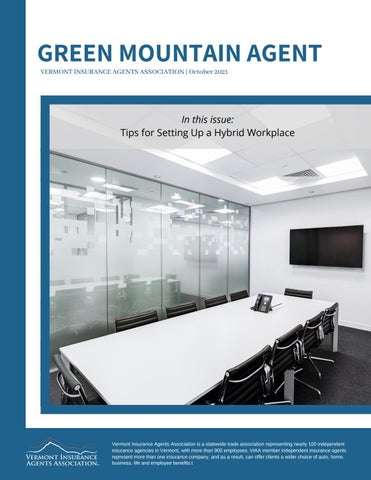
In this issue: Tips for Setting Up a Hybrid Workplace
Vermont Insurance Agents Association is a statewide trade association representing nearly 100 independent insurance agencies in Vermont, with more than 900 employees. VIAA member independent insurance agents represent more than one insurance company, and as a result, can offer clients a wider choice of auto, home, business, life and employee benefits.t
Green Mountain Agent is a publication of
CONTENT ________________ October 2021
05 Letter from the President
600 Blair Park Road, Suite 100 Williston, VT 05495 Phone: 802-229-5884 Fax: 802-876-7912 www.viaa.org
14 Tips for Setting Up a Hybrid Workplace 19 On the Hill
VIAA Officers President Daniel J. Rodliff, CIC, CPIA, LUTCF
25 How to Quote Affluent Homeowners
Vice President Michael Barrett Secretary/Treasurer Jessica M. Fleury, ACSR
29 E&O Corner Claims Made Versus Claims Made and Reported Policies: What’s the Difference and Does It Matter?
National Director Ronald Bixby Directors Chip Ams Ian Sutherland Alan Kinney
33 Commentary 37 Agency & Company News
www.viaa.org
3
4
www.viaa.org
LETTER FROM THE PRESIDENT ______________________________ October 2021
What a year. As I wind down my tenure as President of VIAA, I find myself reflecting not just on the past year, but the last 18 months. While the pandemic has posed great challenges for us all personally and professionally, it has also been rewarding in some ways. For me, it has been an honor to serve as the VIAA President and to follow in the footsteps of two of my mentors Mike Walsh and Dan Lussier. Additionally, I have been so fortunate to work with my Dream Team of Past President Alan Kinney and Vice President Mike Barrett (now our President Elect). With Alan’s leadership, we had to navigate the beginning of this pandemic, which was no small feat. Additional credit goes to our Executive Director Mary Farley. I have enjoyed working with Mary since I became President and she has been a true ally. I was thrilled to see many of our members at EVOLVE21, at the Double-Tree in Burlington on September 16th and 17th.
Dan Rodliff VIAA President
With the challenges of COVID-19, and especially the increase in cases with the Delta variant, we made great efforts to make this year a “hybrid” convention - with both in-person and virtual opportunities for those who joined us. We once again used WHOVA as the platform to stream our sessions, including our keynote speaker Matt Havens on Friday morning, along with the induction ceremony of our new officers. For those in attendance, there were excellent sessions throughout the day on Thursday that were capped off with lots of fun with the “Survey Says” from GameShowsVT. We also enjoyed a 90’s celebration with 90’s tribute band “Lazer Dad”. A huge congratulations to VIAA President Elect Mike on a wonderful event. Also, a huge thank you to our friends at NEAS for their support. From putting on a hybrid convention to navigating a hybrid work environment - this month’s magazine features an article about hybrid work schedules. We successfully pivoted to remote work environments and for many of us, the need to meet with customers at our office is still an integral point of contact to service their needs. We can now work through this next phase of a hybrid environment to better help our customers and our employees. It is a time to be excited for the future. So, as I sign off, I look forward to further collaboration with Mike as our President Elect – I wish you continued success and I am confident that with your ideas for the future, our association will remain as vibrant as ever. And to all of you at home or in the office, I sincerely wish you, your colleagues and your families success and good health. Thank you.
www.viaa.org
5
6
www.viaa.org
10
www.viaa.org
www.viaa.org
13
AGENCY MANAGEMENT
TIPS FOR SETTING UP A HYBRID WORKPLACE
14
By Sharon Emek, WHAVE CEO We’ve talked about the future of the workplace being a new, flexible model—one where employees work both in the office and at home, with part-time, contract, flexschedule and job-sharing arrangements flourishing. But while 78% of employees say they very much want this hybrid model postpandemic, according to an internal Forbes survey, only 43% of employers have a longterm plan in place for it. Clearly, it’s time for us to start planning. As a company that specializes in flexible job arrangements and a diverse talent pool, we at WAHVE know a thing or two about how to set your business up for hybrid-workplace success. There are a range of ways to ensure that your company reaps the benefits of both
www.viaa.org
in-office and remote workers. Here are a few tips: Get in the cloud. When people are in and out of the office and spread out across the country—and in some cases, the globe— having access to critical files and company information becomes tricky. Migrating to the cloud can make it easier for employees to work and collaborate wherever they are by centralizing all work in a universally accessible location. There are many ways to do this, from investing in enterprise software solutions to using specific cloud-based programs such as Google Docs or Sheets. Choose which solutions work best for your business.
Tips for Setting Up a Hybrid Workplace continued
Support remote workers. In addition to carefully considering and implementing policies for employees working both remotely and in a flexible or hybrid capacity, you’ll also want to be sure your company (and company culture) actively supports these arrangements. What does that mean? It means making sure your workers have the equipment they need to do their jobs outside of the office—from laptops to standing desks, from software licenses to ergonomic desks and chairs. It means being flexible in terms of working hours, maintaining regular contact (especially when workers are virtual), and instilling an atmosphere of trust and respect. Make sure people are recognized for their work and contributions—regardless of where they’re located. Invest in videoconferencing tools and room-booking software. You’ll want to make it easy for anyone in the office to meet with anyone else in or out of the office. Consider investing in top-notch videoconferencing tools as well as online room-booking software to ensure your team members have dedicated private spaces to collaborate.
You don’t want any team member to miss key details that emerged during in-office meetings or impromptu chats. You may want to consider recording meetings—both online and in person—for everyone to reference after the fact. Make your perks flexible. Ensure that your itinerant, part-time, contract and other employees can take advantage of your benefits by offering ones that are flexible and accessible anywhere. This means perks like stipends for meal delivery, online discounts, and digital subscriptions to apps, online learning, wellness programs, magazines and more. It’s time for us to begin formally planning for a post-pandemic world. What are some of your top tips for ensuring a smooth transition to the hybrid workplace of the future?
Consider flex desks. Related to the roombooking point, you may want to reconsider your office real estate setup. Flex desks— public desks that employees can book in advance for in-office use—may be able to meet your needs. Be sure to incorporate semi- or fully private small areas, often dubbed call booths or huddle spaces, to facilitate impromptu gatherings of colleagues for brainstorming or casual meetings—and consider equipping these spaces with videoconferencing tools to make it easy for these employees to include their remote colleagues. Consider recording all meetings— including ad hoc ones. www.viaa.org
15
ON THE HILL: Congress Set to Pass Legislation to Extend NFIP
Congress is expected to pass legislation that will fund the government through Dec 3. The legislation will also reauthorize the National Flood Insurance Program (NFIP) for the same length of time. The NFIP had been scheduled to expire on Sept. 30, the same date that government funding was scheduled to run out.
Now that a lapse of the NFIP has been avoided, the Big 'I' will work towards a longer “clean" extension of the program later this year and will continue to work with Congress and the administration to enact a long-term reauthorization of a modernized program that would increase takeup rates for flood insurance both in the NFIP and in the private market.
Although work continues towards a long-term reauthorization of a reformed NFIP, allowing the program to lapse in the short-term would have been devastating to policyholders across the nation who are still being impacted by COVID-19 and are facing an increasing number of severe flooding events. Earlier in September, the Big “I" joined others in the insurance industry and several other interested stakeholders in sending a letter to congressional leadership urging them to extend the NFIP. The Big “I" was the only Main Street agent group to sign the letter.
www.viaa.org
19
How to Quote Affluent Customers
markets
Firmly wedged between high-net worth and mass-market lies the affluent market. While many imagine “affluent" means a multimillion-dollar net worth and a palatial mansion, it covers a broad spectrum of consumer. Think more the upper-middle class and less “Downton Abbey." They are your community's established professionals and business owners. They often drive luxury autos and they likely own specialty vehicles, like a boat or a motorhome. Because of their assets and income, they need high limits of liability and an umbrella policy. With home values starting around $500,000, these customers may qualify for private client coverage but they're not all willing to pay the price for white-glove service and have little need for a bottle-bybottle wine schedule.
24
www.viaa.org
What affluent customers do need is a risk advisor, an independent agent who understands how to ensure they are protected using their superpowers of ease, choice and advice. They also need an insurance carrier that has both the breadth of products and the depth of coverage to give them peace of mind. Many affluent customers are insured by captive carriers, not realizing that the lower internal limits of their current policies leave them inadequately protected. This is a rich (pun intended) opportunity for you to prospect and educate. When quoting affluent customers, here are five key coverages to offer: 1) Extended dwelling coverage. This is a must and ideally at least 100% of the coverage A amount. As the pandemic is
www.viaa.org
25
C E O & R O N ER
Claims Made Versus Claims Made and Reported Policies: What’s the Difference and Does It Matter?
When it comes to coverage provided, the differences between Claims Made policies and Claims Made and Reported policies are extremely significant. Professional liability policies for Insurance Professionals are typically written on one of these forms. It is critical to understand the two when purchasing professional liability insurance to protect yourself and your business. Claims Made Coverage A Claims Made Policy provides coverage for an injury or loss if a claim, such as receipt of a demand letter or service of a lawsuit, is first made during the policy period. Claims Made policies provide broader coverage and contain more liberal reporting requirements than Claims Made and Reported policies. The major distinction between the claims made form and the claims made and reported form is that under a claims made policy form the insured typically need only report the claim "as soon as practicable" or promptly, but not necessarily during the policy term. On the other hand, Claims Made and Reported Policies, as the name suggests, require that the claim be made and reported during the same policy period. This wording under a claims made policy may read: "This is a claims-made policy which applies to 'claims' first made during the policy period or any extended reporting period." Sample insuring language: "We will pay on behalf of the insured 'loss' for which the insured is legally liable caused by a 'wrongful act' committed by an insured arising out of 'professional services' rendered to others. 28
This type of insurance applies to "'potential claims' and 'claims' first made against the insured during the 'policy period' arising out of a 'wrongful act' taking place on or after the retroactive date". Claims Made and Reported Coverage A Claims Made and Reported Policy also requires that the claim be made during the policy period. However, this policy form also requires that the claim be reported to the carrier during the same policy period in force at the time the claim was made. (Some states may provide for an automatic reporting period of 3090 days providing the insured a grace period to report claims). While often less expensive, Claims Made and Reported coverage is much more restrictive. Sample wording under a claims made and reported policy: "We agree to pay on behalf of the insured such 'loss' to which this insurance applies sustained by the insured by reason of liability imposed by law for 'loss' caused by any 'wrongful acts' committed by the insured, arising out of the conduct of the business of the insured in rendering services for others".. This insurance applies to ”wrongful acts” only if:
www.viaa.org
1. The “wrongful acts” did not occur before the Retroactive Date, if any, shown in the Declarations or after the end of the policy period, and 2. “Loss” because of the “wrongful act” results in a “claim first made and reported to us” during the policy period.
How to Quote Affluent Customers continued
showing, the cost to rebuild a home can vary wildly and without warning. Shortages of materials, labor and more mean that 25% or even 50% may not be enough coverage to rebuild a home, especially when you consider luxury finishes, such as granite countertops and solid wood doors.
4) Worldwide protection. Many affluent consumers travel extensively. Ensuring they have protection no matter where they wander will offer valuable peace of mind, including everything from worldwide vehicle rental coverage to the worldwide liability protection of an umbrella policy.
2) Replacement cost coverage. This should be offered on everything possible, from their personal property to their autos, boats and RVs. The affluent consumer is interested in protecting the things they've worked so hard for and offering policies with replacement cost shows that you recognize the importance.
5) A true umbrella policy. The assets and income of the affluent make them targets for lawsuits. Additionally, their future income needs protection. Offer an umbrella policy that covers risks such as electronic libel, directors & officers activities, rented watercraft and the cost of legal defense outside the limit of liability.
3) Original equipment manufacturer (OEM) parts and glass. People who drive a Porsche, Land Rover or similar luxury vehicles generally want repairs to include genuine OEM parts, and that includes an OEM windshield. However, few carriers outside the private client market offer OEM glass coverage.
Safeco offers a suite of products designed for affluent customers: Premier™ Home and Auto, a true umbrella, landlord protection and specialty vehicles policies for everything from ATVs to $1 million class-A motorhomes.
www.viaa.org
29
Hail Damage Dilemma
William C. Wilson, Jr. CPCU, ARM, AIM, AMM is the founder of InsuranceCommentary.com. He retired from the Independent Insurance Agents & Brokers of America in December 2016 where he served as Assoc. VP of Education and Research and was the founder and Director of the Big "I" Virtual University for over 17 years. 32
www.viaa.org
Here is a pretty common situation. A roof begins to leak during a heavy rain storm and the property owner reports the claim to the homeowners insurer. An investigation reveals that the loss resulted from hail damage which likely occurred over a year ago. Is there coverage under the ISO HO-3 policy that was in force at the time of the hail storm? What if the insurer denies the claim and the insured files suit? This question was raised in a series of emails I received during the spring and summer. One of the questions is, exactly what is the loss…the water damage from the leak, the hail damage to the roof, or both? That will raise the issue of when the occurrence took place and what policy then would respond if there is a significant time difference. This is even further complicated when, as included in one of the emails I received, you have a policy condition like this: Suit Against Us …A claim for a loss resulting from the peril of windstorm or hail must be reported to us or our agent within 6 months of the loss event, and any suit arising there from must be brought within one year after the loss or damage occurs…. When hail damage is discovered only after a roof leak materializes many months or even years after the roof damage occurred, what is the damage and when did it occur? Did the damage occur at the time of the hail storm, did it occur gradually over the months or years between that event and the leaky roof?
the damage is discovered. In other words, for a policy provision like that cited above, the time should begin to toll, not when the initial hail damage occurred, but rather when it was discovered. That seems to be the most equitable way to respond to claims where there may be a fairly long time delay between occurrence and damage discovery. Some states have statutes or regulations governing the time a policyholder has to sue an insurer, but I’m not aware of any similar legal restrictions on reporting claims other than perhaps some body of case law. Presumably, in the absence of a statute, an insurance policy can establish contractual restrictions on this and the only short-term solution would be a lawsuit charging ambiguity and the only long-term solution would be legislative or perhaps regulatory. Thirty years ago, ISO reflected this manifestation theory in their HO forms when a plumbing “repeated seepage and leakage” water damage exclusion was removed from the forms. Under current ISO forms, as long as water damage is hidden from sight, there is coverage as long as discovered damage is promptly reported. ISO forms now rely on the Neglect exclusion if prompt reporting doesn’t happen. Again, this appears to be the most equitable approach for unsophisticated property owners, though many (probably most) insurers using ISO HO forms include a “repeated seepage or leakage” type exclusionary endorsement.
Much has been written about coverage trigger theories involving third-party liability claims, but very little has been written about first-party property claims. The limited first-party trigger theory articles seem to suggest that the Manifestation Theory applies to first-party claims and coverage should be based on when www.viaa.org
33
COMPANY & AGENCY NEWS 36
www.viaa.org
Vermont Mutual Named a 2021 Top Growing Business in Vermont Every year, Vermont Business Magazine acknowledges Vermont businesses that have exhibited the greatest growth over the previous year. This year, Vermont Mutual Insurance Group® was named one of the top 25 companies demonstrating the greatest growth in the state. The Vermont Business Growth Awards is presented annually by Vermont Business Magazine and KeyBank, acknowledging twenty-five Vermont businesses that have experienced the greatest growth over the past five years according to VBM’s Vermont 100+ published each January.
Vermont Mutual Named a 2021 Top Growing Business in Vermont Hickok & Boardman Insurance Group announced the election of Ian Sutherland as Treasurer of the Vermont Independent Agents Association (VIAA). Ian was sworn into his Board position by Jon Jensen, Chairman of the National Independents Agents Association on September 17, 2021. Ian joined Hickok & Boardman in August of 2009, as a Business Client Advisor. Ian advises a variety of clients in the development of insurance and risk management programs to meet their unique business needs. In 2014, Ian became a stockholder of Hickok & Boardman Insurance Group, was elected Vice President by the Board of Directors in 2018 and made Director of Sales in 2019.
www.viaa.org
37
38
www.viaa.org
www.viaa.org
39