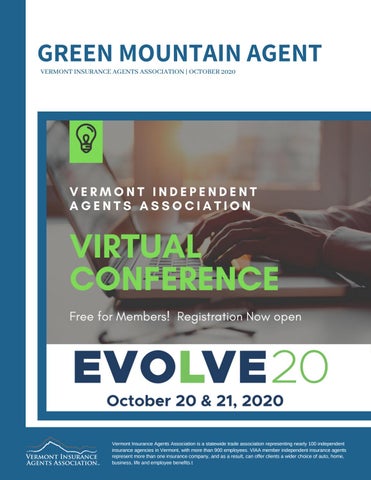
GREEN MOUNTAIN AGENT VERMONT INSURANCE AGENTS ASSOCIATION | OCTOBER 2020
Vermont Insurance Agents Association is a statewide trade association representing nearly 100 independent insurance agencies in Vermont, with more than 900 employees. VIAA member independent insurance agents represent more than one insurance company, and as a result, can offer clients a wider choice of auto, home, business, life and employee benefits.t
Green Mountain Agent is a publication of
CONTENT ________________ October 2020
05 Letter from the President
600 Blair Park Road, Suite 100 Williston, VT 05495 Phone: 802-229-5884 Fax: 802-876-7912 www.viaa.org
10 Planning for Your Agency: Data is Key 15 On the Hill
VIAA Officers
20 EVOLVE 2020
President Daniel J. Rodliff, CIC, CPIA, LUTCF
23 E&O Corner
Vice President Michael Barrett
26 Your Remote Hiring Plan
Secretary/Treasurer Jessica M. Fleury, ACSR
33 Commentary
National Director Ronald Bixby
37 Agency & Company News
Directors Chip Ams Ian Sunderland Alan Kinney
www.viaa.org
3
4
www.viaa.org
LETTER FROM THE PRESIDENT ______________________________ October 2020
As I write this, my first month as your newly installed President is now under my belt and it flew by way too fast. I want to again express my sincere appreciation to my predecessor, Alan Kinney. Alan was, and still is, instrumental in providing stability during this transition. In addition to Alan, my sincere thanks go to Past President Erin Odell who also helped us through the transition these last several months. As an association, we continue to rise up to meet the needs of our members and we are moving full steam ahead! EVOLVE 2020 is happening and it will take place this month! We have been hard at work developing an outstanding virtual conference this year to meet YOUR needs. Our line-up of speakers and topics are timely with something everyone can appreciate. Because of the virtual setting, with no travel time or travel expenses, and since it is free of charge to attend, I look forward to seeing everyone from your agency there. How To Build a $10 Million Insurance Agency with Dr. Billy Williams Learn what separates a good leader from a great leader, how emotions affect the way we handle problems and solutions and much more! Coronavirus E&O Issues with Attorney’s Jim Keidel & Chris Weldon Learn the types of coronavirus claims your customers may have and how your agency should handle them.
Dan Rodliff VIAA President Working From Home with Claudia St. John With COVID disrupting the way agencies work and with the move to work-from-home formany, Claudia will help you overcome Zoom fatigue communicate better and much more. Ethics with Pat Murray Pat will assist you n learning and reviewing State Statutes, Bulletins and Regulations to understand their Ethical and legal duties when dealing with your customers. Selling in a Pandemic with John Chapin Join nationally recognized sales leader John Chapin as he discusses techniques for selling more regardless of the market, economy, or pandemic. We are looking for a great event! Register Today!
www.viaa.org
5
www.viaa.org
7
Planning for Your Agency: Data is Key
TECHNOLOGY
By Agents Council for Technoloóżľ‹ (ACT) Independent agencies are among the most profitable and predictable businesses causing them to be considered recession proof by almost all measurements. Independent agencies have remained strong over the past 15 years which included several epidemics including SARS, Bird Flu, H1N1, MERS, and EBOLA as well as the recession in 2008. In fact, during this time period the number of independent agencies remained constant at 36,500 in spite of an increase in mergers and acquisitions. In 2019, the average agency experienced retention rates of over 90% which created both a stable and predictable cashflow stream. In addition, over 75% of agencies reported that they are growing year over year both in personal lines and commercial lines business. These are some of the factors that have attracted PE funds into our industry and have driven the multiples to an all-time high deeming independent agencies as an incredibly attractive investment. Regardless of the strength of independent agencies, I believe that the successful agencies of today and tomorrow are the ones that can marry relationships, technology and data, and COVID-19 has accelerated that need. Impact of COVID-19 COVID-19 has created a dynamic that is unprecedented in our economy. It is a unique health crisis that has turned into a financial crisis and the impact has been rapid, deep, and far-reaching in a significant number of industries within our economy. We are experiencing unemployment rates that are the 10
www.viaa.org
highest we have seen since the Great Depression and some predictions show that up to 21% of small businesses will not be able to survive and re-open. It is uncertain how long this pandemic will persist and what the short, mid, and long-term impact will be both on our economy and the behaviors of consumers. Many believe that this pandemic will have a long-term impact on the way we work, do business, interact and what we will require of businesses and each other to ensure our own health and safety. While a significant impact to independent agencies may not be felt today, as this pandemic continues, we can expect to see the full impact of COVID-19 in agencies in the coming months. The impact in an agency will vary based on its specific situation. A crisis like COVID-19 shines a bright light on t
Planning for Your Agency: Data is Key Continued he strengths and weaknesses of all organizations. For those organizations that are healthy well-run businesses, they will continue to flourish as they are designed to measure key performance indicators and adjust as changes occurs. For a lifestyle business, the impact may be significant as that type of organization is not focused on monitoring the data needed to drive business decisions. The reality is that many agencies that were able to operate successfully as lifestyle businesses will struggle to weather this kind of storm. Now more than ever before, agency owners should be utilizing data to create a plan for their agencies. Step 1 – Know your book & assess your risk Every agency has a different makeup which means both. The risk and the impact on your agency will be unique to your specific situation. In order to estimate the impact that the many factors of COVID-19 may have on your agency, you first need to outline your expected revenue and cashflow. You can do this by creating a cashflow statement that classifies your revenue into categories of personal lines, commercial lines, life & health, and other income knowing that each of these categories are subject to different risk factors. Next you will need to assign reasonable risk factors to each category that you have outlined. For instance, in personal lines, consider the average age of your insureds to estimate the percentage that may reduce or cancel their coverage due to loss of their jobs. For commercial lines, further categorize your book into industries and assign a risk factor to each category in order to estimate any potential area that you may experience a significant increase in lost accounts and reductions in coverage due to reduced staff and revenue. Categories such as restaurants, hotels, and manufacturing are areas that have a high-risk factor as a result of the extended closures and the many restrictions on reopening. Once you have estimated the impact on each category of your book of business, you can build a cashflow model that reflects the best case, worst
case and most likely case that your agency may experience as a result of COVID-19. Step 2 - Create an action plan Now that you know what the potential impact may be to your agency, create a plan of action. Map out a plan in phases to actively monitor your revenue often and take corrective steps as necessary. Immediately identify opportunities to reduce or delay costs, renegotiate contracts with vendors and determine if and when you may need to make any staffing changes to reduce your expenses. Identify areas that you can grow and focus your resources to support that growth. Cash is king in times of uncertainty, so make sure you are spending your resources only in areas that are an absolute must and are directly related to your retention and growth. Step 3 – Apply for relief There are many programs available for small businesses to take advantage of during this crisis. You should apply and take advantage of the ones that are best suited for your specific situation. Having a documented cashflow projection will help you assess your needs and document your situation to support your application for programs like the Paycheck Protection Program (PPP) or other small business loans like the Economic Injury Disaster Loans (EIDL). In addition, if you have any debt, you should consider restructuring that debt to get the lowest rate possible in order to reduce your liabilities.
www.viaa.org
11
Planning for Your Agency: Data is Key Continued Step 4 – Focus on retention and growth Determine the areas of opportunity and over communicate with your customers. This is not the time to be quiet, so reach out and let your customers know you are there for them. In times of uncertainty there is great comfort in hearing from our advisors. Be proactive and reach out to your customers to ask them how they are and communicate how their current carrier is responding to this pandemic. It is estimated that 8 out of 10 insureds will shop their insurance during this time. Now more than ever, people want to support their local community and local businesses. Remind them that you are there for them, are part of their community and that you care. Using data to assess the risk in your agency and plan for your future has never been more important. The agencies that have a plan will be able to adjust and make the necessary decisions to navigate these unprecedented times. We have the tools and resources available to provide you with the resources you need to build a strong plan for your agency. Our business consulting team can provide you with the support and tools you need to help you build your agency's cashflow projection. In addition, we work with several state association partners across the country to bring as many agents as possible the financial and operational benchmarks that are relevant in your marketplace and actionable in your agency. We are all here to help you utilize these insights, take action and plan for your agency's future. For more information about our state partners and footprint contact Carey Wallace at (614) 552-3063 or visit our website at www.intellagents.io
Next Meeting is November 19, 2020 Watch Your Email for a meeting invitation! Learn more about the Young Agents Committee
12
www.viaa.org
ON THE HILL: Big ‘I’ Sends Letters to Capitol Hill on NFIP and PPP
The Big “I" sent two letters to Capitol Hill advocating for issues important to independent insurance agents. First, the Big “I" joined others in the insurance industry and many other interested stakeholders in advocating for Congress to extend the National Flood Insurance Program (NFIP), which is currently scheduled to expire on Sept.30. Specifically, the Big “I" is urging Congress to reauthorize the NFIP as part of legislation to fund the government beyond the expiration of the current package, which also falls on Sept. 30. The letter, addressed to U.S. House of Representatives and U.S. Senate leadership, notes that, “allowing the program to lapse would be devastating to the policyholders across the nation who have already been impacted by COVID-19 and are facing an increasing number of severe flooding events. With a lapse in the program's authorization, policyholders would not be able to obtain coverage, or—importantly— buy or sell properties of all kinds."
The letter goes on to urge Congress to reauthorize the program before Sept.30 to provide continuity and certainty to the millions of policyholders who rely on a functioning NFIP. The Big “I" also joined a number of organizations in sending a letter to Senate Majority Leader Mitch McConnell (R-Kentucky) and Senate Minority Leader Chuck Schumer (D-New York) urging support for S. 4117, “The Paycheck Protection Program Small Business Forgiveness Act," sponsored by Sens. Kevin Cramer (RNorth Dakota) and Kyrsten Sinema (D-Arizona). This important legislation would ensure our nation's small business owners who took Paycheck Protection Program (PPP) loans, including Big “I" members, can focus their time, energy, and resources on their business and communities, instead of allocating significant time and resources into completing complex PPP forgiveness forms. Specifically, S. 4117 would forgive PPP loans of less than $150,000 upon the borrower's completion of a simple, one-page forgiveness document.
www.viaa.org
15
Register Here
20
www.viaa.org
www.viaa.org
21
C E O & R O N ER
Built to Last By Brian Butcher
Builders risk insurance might appear to be an exotic animal in comparison to more mundane insurance products. However, a few simple reminders will help insurance professionals avoid many of the errors & omissions pitfalls associated with the procurement of this type of policy. Builders risk indemnifies the policyholder against damage to buildings while under construction or renovation. It also protects materials, fixtures and equipment used in the construction or enovation of a building. Most often, covered perils include fire, wind, theft and vandalism. Sometimes, a few other perils are covered as well. The coverage is normally intended to end when the building is ready for occupancy or work is completed. When this occurs, a new policy is needed for a new type of risk, which includes occupancy. If the risk includes both renovation and construction, as well as additional occupied structures, make sure the existing www.viaa.org
occupied structure is covered with a builders risk policy, which would not normally be covered as part of the risk. Typical exclusions often include your work, concurrent causation, partial occupancy and earthquake. Some endorsements are vailable to broaden coverage with some carriers. Make sure these endorsements are discussed with the client. Also, check to see if the client needs another policy to cover other aspects of the risk, such as professional liability coverage. Determine the period of time needed for the work to be completed. This information should be gathered after detailed conversations with the client. A diary system should then be used to follow-up with the client to check on the status of construction or to follow up about questions posed to the client about the nature of the risk. Look at the construction budget to help determine the policy limits. Make sure the 23
Built to Last Continued client has input into the amount and document what they said. Document all discussions in writing with the client about the risk and confirm via letter or email. Refrain from using text messaging because they can be lost or difficult to access if needed several years later. If you go to the construction site to inspect the risk, document the inspection with datestamped photos. Check whether the premises are occupied and, if occupied, whether the policy excludes coverage. Most builders risk policies have exclusions based on occupancy. I have handled E&O claims involving the procurement of a policy with an occupancy exclusion where the agent allegedly knew, or should have known, the premises were occupied. Sometimes during construction or renovation of commercial structures, part of the building is under renovation and part of the building is occupied or in use. Make sure to discuss this type of risk with the insured and the carrier’s underwriter about how to insure this risk, as well as document the exchange. Insist that the client immediately contacts the agency when conditions change, such as when the renovation is complete or if the
24
construction timeframe is longer than expected and the policy needs to be renewed or endorsed. When the nature of the risk changes, due to occupancy or use, make sure the appropriate policy is procured. In summary, as with other lines of insurance, know the product. Continue to ask questions, throughout the procurement of the policy. Work with the carrier’s underwriting department to ensure you are getting your client the coverage they need. Document your inspection of the site if you inspect the risk. Clear and frequent communication, which is well-documented, will ensure your client obtains the appropriate insurance coverage and in turn will greatly reduce your exposure to E&O claims. Brian Butcher is a vice president, claims expert with Swiss Re Corporate Solutions. This article is intended to be used for general informational purposes only and is not to be relied upon or used for any particular purpose. Swiss Re shall not be held responsible in any way for, and specifically disclaims any liability arising out of or in any way connected to, reliance on or use of any of the information contained or referenced in this article. The information contained or referenced in this article is not intended to constitute and should not be considered legal, accounting, or professional advice, nor shall it serve as a substitute for the recipient obtaining such advice. The views expressed in this article do not necessarily represent the views of the Swiss Re Group (“Swiss Re”) and/or its subsidiaries and/or management and/or shareholders
www.viaa.org
VIAA Education October
2020
Virtual Courses
October 1 CISR Commercial Property
October 20 CISR Commercial Casualty I
October 14 (am) Deadly Weapon, Active Shooter, and Workplace Violence
October 28 CIC: Commercial Property
October 14 (pm) Personal Umbrella Insurance
Register at VIAA.org
October 15 CPIA Update - Disaster and Business Continuity Planning
Open
www.viaa.org
25
Your Remote Hiring Plan
hiring practices
By Sharon Emek, Ph.D., CIC
In-house hiring practices don’t often translate to hiring employees that will work remotely. What modifications do you need to make to your hiring process?
insurance industry careers. According The Millennial Survey conducted by The Hartford, a mere 4% of millennials would consider an insurance industry career.
By all accounts, the pandemic-related work-from-home business model is here to stay, at least for the time being. For the most part, many companies were able to transition quickly, albeit not without some significant challenges.
Yet the very pandemic that has challenged insurers to adopt remote work strategies may be somewhat of a saving grace in the quest to find remote workers. According to World Economic Forum data, 85% of millennials are seeking full-time remote work opportunities. What’s more, 82% expressed higher company loyalty to those companies with remote work programs.
Yet now another significant challenge is looming: how to hire employees you may not meet in person, either during the course of the pandemic or for the duration of their employment with your company. For the insurance industry, that challenge is multiplied by a shortage of viable candidates. Veteran insurance professionals are retiring at an alarming rate. The Bureau of Labor Statistics estimated that between 2016 and 2020, 400,000 insurance professionals will head off to retirement. The situation is made more dire by the fact that millennials are showing little interest in
26
www.viaa.org
In fact, remote work is appealing across a wider age demographic than just millennials; a recent Zapier-commissioned Harris Poll reveals that 95% of all knowledge workers (those working in a professional setting and using a computer as part of the job) want to work remotely. That means companies that were forced to shift to a remote work arrangement are now facing the very real challenge of trying to build a remote hiring process. No matter how big or small your agency is,
Your Remote Hiring Plan continued
remote hiring takes planning. But if executed properly, your hiring process could do more than just help you hire good talent – it can elevate the number of candidates to choose from, and deliver candidates that have the exact skills needed. But First, Soft Skills Yet your new hires need a few more traits than a standard in-house hire. Because remote work can be isolating, employees need the right set of traits to be able to perform effectively and productively. Before you hire, make sure to understand common soft skills that make for a successful remote worker. Your next remote employee should to be able to work with minimal supervision. Ideally, your remote worker should be able to manage time effectively so that daily tasks as well as projects are completed on time. To do that, your employee should demonstrate the ability to solve common issues as well as some of the more complex challenges that they may face. And your employee should be comfortable with remote communication tools and methods. Interviewing from a Distance Any organization that has worked remotely recently knows the need for video conferencing. That same technology is what’s needed to conduct remote interviews. While phone interviews can work for initial screening, they fail to pick up on physical cues, such as body language and facial expressions. Plus, video conferencing is a way to vet those candidates on their comfort level with technology your company uses.
technology can be similar, so that the learning curve for your particular application would not be prohibitive. What could be problematic is your candidate’s ability to maintain connectivity with your team. Spotty internet may not be a deal-breaker unless your team needs to be able to connect quickly during office hours. By conducting a distance interview, you can assess the quality of the connection. You can assess also how conducive the candidate’s available workspace is to the tasks at hand. For instance, if you’re hiring a salesperson, having a noisy location or too many people in the residence could hinder the salesperson’s ability to connect with prospects. Your ideal candidate should have a distraction-free location, or a plan for keeping it quiet and distraction-free during work hours. That last point can be difficult to navigate. As many families are home with young children and daycares are closed, your ideal candidate may have temporary distractions. If that’s the case, shift the questioning a bit: Would your candidate be able to put in hours after children are in bed or napping? Would a more flexible work schedule help them complete the work necessary?
That comfort with technology should extend to all technology your company employs. How familiar is the candidate with those tools? Have they shown proficiency in related technologies? In some cases, www.viaa.org
27
Your Remote Hiring Plan continued
To ensure they can, find out how they best learn: in-class instruction or independent, self-paced learning? Have they completed any self-guided learning before? What were the results? How easily can they get used to new systems or technology? What challenges them most about technology? That matters because in remote work, technology is key to getting the job done. And by asking these questions at the outset, you can set expectations for your candidates so that they know what is expected of them. Hired: Now What? That’s important too after the candidate is hired. We recommend using the hiring process to outline both your expectations and how you will measure their performance. One suggestions we ask you to consider is dropping an hourly expectation and replacing it with a per-outcome expectation. As mentioned previously, not all candidates can do their best work during traditional nine-tofive hours. By measuring your new hires, as well as all your employees, by benchmarks met and project outcomes, you will get a true measure of their productivity. Moreover, such a move boosts employee morale and motivation. In an environment in which employers and employees alike are trying to carve out the best way to conduct business, adopting a more flexible employee management style makes the most sense, and helps workers succeed in a remote setting. Hired, Retained That success results in higher employee satisfaction, which translates into better employee retention. In a global workforce environment that is adapting to what could be permanent changes to business, your business has a great opportunity to grow and to thrive. A strong remote hiring process, 28
complete with vetting for soft skills, setting expectations, and outlining new management strategies can help your organization gain an advantage of those organizations that are still trying to do everything through the traditional business lens. By setting your remote business on the right path at hiring time, your organization can adapt quickly to whatever changes may come in the future. That flexibility can keep your entire organization moving into a stronger, more resilient future. Sharon Emek, Ph.D., CIC, is founder and CEO of Work At Home Vintage Experts (WAHVE). WAHVE (www.wahve.com) is an innovative contract talent solution that matches retiring, experienced insurance, accounting and human resource career professionals with a company’s talent needs. WAHVE bridges the gap between an employer’s need for highly skilled professional talent and seasoned professionals desiring to extending their career working from home. From screening to placement, WAHVE is a comprehensive solution to qualifying, hiring, and managing experienced remote talent.
www.viaa.org
www.viaa.org
29
Coverage for Auto Loading and Unloading
William C. Wilson, Jr. CPCU, ARM, AIM, AMM is the founder of InsuranceCommentary.com. He retired from the Independent Insurance Agents & Brokers of America in December 2016 where he served as Assoc. VP of Education and Research and was the founder and Director of the Big "I" Virtual University for over 17 years. www.viaa.org
33
Last week I received an inquiry from an independent agent who writes the CGL coverage (2013 ISO form) for an HVAC contractor, but the auto is written by a captive agency company. He does not have a copy of the auto policy but was told it was a personal auto policy with a “business” endorsement attached. Most auto policies cover the ownership, maintenance, and use of covered autos. Some specifically include “loading and unloading,” though there are variations on who (named insured, family members, others) is covered for which coverage (liability, medical payments, etc.). However, the majority of forms I’ve reviewed are silent as to whether “use” includes loading and unloading the vehicle. The current ISO business auto policy (BAP) makes no specific mention of loading or unloading. Coverage for loading and unloading is governed by liability exclusions 7 and 8 in the BAP. The result is that the ISO BAP covers loading and unloading by hand, hand truck, or mechanical device attached to a covered auto. The ISO CGL does specifically state that “Use includes operation and ‘loading or unloading.’” The loading/unloading coverage in the current ISO CGL policy is governed by CGL definitions 11 and 16.b. So, the ISO CGL policy covers loading and unloading by a mechanical device other than a hand truck or mechanical device attached to an auto, for example a lift truck. Insuring a loading or unloading exposure using the ISO CGL and BAP forms significantly decreases the likelihood that a claim will fall into the coverage cracks between two policies, especially if each policy is written through a different insurer. So, what happens if property is damaged while a covered auto is being loaded or unloaded by hand or a hand truck? CGL definition #11 for
34
“loading or unloading” says that property damage is excluded “While it is being moved from an aircraft, watercraft, or ‘auto’ to the place where it is finally delivered.” The ISO BAP is the policy that covers this exposure. However, in the current situation, we do not know what the captive agency insurer’s policy says. Several years ago, an agent came to me with a claim involving a furniture company that damaged the interior of an upscale home while employees hand-carried a piece of furniture. The ISO CGL policy did not cover this exposure, but the ISO BAP would have. Unfortunately, the auto exposure was insured through another captive agency insurer and their policy covered “ownership, maintenance or use” of the auto. Their interpretation of “use” was that it did not cover loading and unloading. Again, this is why it’s usually preferable to cover general liability and auto liability with the same insurer using forms that were designed to work together.
www.viaa.org
www.viaa.org
35
COMPANY & AGENCY NEWS www.viaa.org
37
Acuity Earns A+/Stable Rating From Standard & Poor’s Acuity announced that Standard & Poor's (S&P) has reaffirmed the insurer’s Financial Strength Rating of A+ and Stable outlook as of August 11, 2020. Acuity also maintains an A+ financial strength rating from A.M. Best, making Acuity the only regional carrier that offers independent agents the financial security of two superior ratings. In its rating reaffirmation, S&P noted, “Acuity continues to outperform the industry, with strong underwriting margins and growth outpacing the industry.” Also highlighted were Acuity’s “extremely strong capital capacity with a significant buffer at the ‘AAA’ level” as well as a “strong balance sheet highlighted by no financial leverage and exceptional liquidity.” The stable outlook is based on S&P's evaluation that Acuity will continue to outperform the industry over the next 24 months.
Acuity Announces Staff Promotions Tony Berg is promoted to Manager - Commercial Underwriting and will oversee the Southwestern Wisconsin underwriting team. Tony joined Acuity in 2013 as a Commercial Underwriter after graduating from the University of Wisconsin-La Crosse with a bachelor’s degree in finance. Tony has handled territories in both Iowa and Ohio and was named Senior Commercial Underwriter in 2019. Ryan Krueger is promoted to Manager - Commercial Underwriting, overseeing a new Minnesota team. Ryan graduated from the University of Wisconsin-Milwaukee, majoring in both finance and economics and obtained his MBA in finance from Concordia University. Ryan joined Acuity in 2013 as a Commercial Underwriter and was promoted to Senior Commercial Underwriter in 2018. Jacob Clement is promoted to Programmer Analyst. Jacob started at Acuity in June 2017 in the MIS Department. He graduated in 2017 from Wheaton College of Illinois with a bachelor’s degree in applied mathematics and computer science. EJ Gutzmer is promoted to Programmer Analyst. EJ started at Acuity in June 2018 in the MIS Department. She graduated in 2018 from the University of Wisconsin-Eau Clare with a bachelor’s degree in computer science. Samantha Hyde is promoted to Programmer Analyst. Samantha joined Acuity in June 2017 as an MIS Intern. She became a full-time employee in 2018 after graduating from Carroll University in Waukesha, Wisconsin, with a degree in computer science and minor in mathematics. Brennan Linse is promoted to Programmer Analyst. Brennan joined Acuity in June 2018 in the MIS Department. He graduated from Concordia University-Wisconsin with a bachelor’s degree in computer science. Trevor Berceau is promoted to Senior Programmer Analyst. Trevor joined Acuity in June 2014 as a Programmer Intern, started as a Programmer in 2015, and was promoted to Programmer Analyst in 2017. He graduated in 2015 from the University of Wisconsin-Green Bay, where he majored in computer science and minored in information science. 38
www.viaa.org
Cooperative Insurance receives "Best Value for Auto Insurance" In VT and NH for 2019-20 Co-op is gratified to receive the award for Best Value in Vermont and New Hampshire for 2019-20. This is the fourth consecutive year we have won the prestigious ValChoice® awards by providing our members with a unique combination of excellent customer service, claims handling and value in our auto insurance products over a three-year evaluation period. ValChoice uses its data analytics engine to identify and acknowledge the best insurance companies state by state. ValChoice provides consumers, agents and advisors with information on which home and auto insurance companies offer the best value: price, protection (claims handling) and service. The company collects and analyzes millions of financial and complaint data points and delivers the results in an easy-to-use service that Forbes Magazine described as "Carfax for insurance." Using www.valchoice.com, consumers are able to shop for insurance based on value rather than making decisions blindly based on price or advertising campaigns.
Ben Salzmann Honored for Leadership During COVID-19 Crisis Acuity’s President and CEO Ben Salzmann has been named by Glassdoor as one of the Highest Rated CEOs During the COVID-19 Crisis. Salzmann is ranked #8 among all U.S. CEOs of large organizations (over 1,000 employees) and is the top-ranked insurance CEO in the nation. Glassdoor analyzed employee reviews to identify CEOs who have earned high praise from their employees in terms of their leadership during the COVID-19 crisis. According to Glassdoor, “It's during difficult times that a leader really shows his or her true colors. This year in particular, CEOs have had to make a range of difficult decisions given the impact of the COVID-19 crisis. It's clear that some employees have felt supported and taken care of throughout the past few months as their employers have tried their best to prioritize the health and safety of their workforce, while also doing what's right for the business they lead.” Common trends among the Highest Rated CEOs During COVID-19 include prioritizing work-life balance, taking care of employees' overall well-being, offering flexible and/or remote working policies, establishing strong health benefits and maintaining frequent, clear communication. On Glassdoor, current and former employees voluntarily and anonymously share insights and opinions about their work environments by sharing a company review, designed to capture a genuine and authentic inside look at what a specific job may be like at a particular company.
www.viaa.org
39
40
www.viaa.org