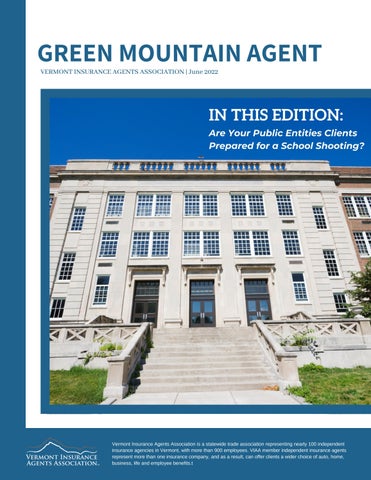
GREEN MOUNTAIN AGENT VERMONT INSURANCE AGENTS ASSOCIATION | June 2022
IN THIS EDITION: Are Your Public Entities Clients Prepared for a School Shooting?
Vermont Insurance Agents Association is a statewide trade association representing nearly 100 independent insurance agencies in Vermont, with more than 900 employees. VIAA member independent insurance agents represent more than one insurance company, and as a result, can offer clients a wider choice of auto, home, business, life and employee benefits.t
Green Mountain Agent is a publication of
CONTENT ________________ June 2022
05 Letter from the President
600 Blair Park Road, Suite 100 Williston, VT 05495 Phone: 802-229-5884 Fax: 802-876-7912 www.viaa.org
10 On the Hill 16 Commercial Lines
VIAA Officers
Are Your Public Entities Clients Prepared for a School Shooting?
President Michael R. Barrett
23 Best Practices
Vice President Jessica Fleury, ACSR
9 HR Regulatory and Compliance Trends to Watch in 2022
Secretary/Treasurer Ian Sutherland, CIC, AAI-M National Director Ronald Bixby
31 E&O Corner
Directors
35 Commentary
Daniel J. Rodliff, CIC, CPIA, LUTCF Aislyn M. Allen, CISR Laurie Audy
39 Agency & Company News
Executive Director Mary M. Farley, MBA, AAIM
www.viaa.org
3
4
www.viaa.org
LETTER FROM THE PRESIDENT ______________________________
June 2022 Having just come off a long weekend, with the “unofficial start of summer,” it is my hope that you all had safe and happy Memorial Day weekend. Also, I hope you paused, even if only for a moment, to reflect on the ultimate sacrifice so many have given in service to our country. Now, bring on the warmer weather, longer days, campfires, fireworks, and GOLF! We here at VIAA are really looking forward to the VIAA Golf Tournament, to be held on June 20th, at the Vermont Country Club in South Burlington. The tournament is ALREADY SOLD OUT! That said, you could add your name to the waiting list by connecting with Sarah (sarah@viaa.org). Have you seen the co-branded commercial with VIAA and Trusted Choice? I myself have seen it a few times on WPTZ and know many others have caught it a time or two.
Michael R. Barrett VIAA President
Remember, this is simply the first step in getting our message out to our fellow Vermonters of the importance of working with Independent Agents. Our next step will be to give you, our member agencies, the incredible opportunity for advertising via a professionally produced 30 second commercial, which will air on local networks during morning and evening news (WCAX, WPTZ, WFFF, & WVNY), plus during Red Sox games on NESN. An email actually went out just ahead of the Memorial Day weekend to all agency Principals, detailing how your agency can join us on this incredible campaign, with the Trusted Choice grant program, and carrier support! Not to wish our summer away, but make sure to put a placeholder in your calendar for EVOLVE22, starting the evening of Wednesday, September 28th through the morning of Friday, September 30th, at the Double Tree in Burlington. Our VIAA VP, Jess Fleury is already in the planning stages, for what should be a great event for all VIAA members to participate in! As always, I welcome any comments or questions, just email me, mike@thebarrettagency.com. Stay well! Michael Barrett President, VIAA
www.viaa.org
5
6
www.viaa.org
VIAA EDUCATION
Any time. Any where. Get it done. viaa.org/Education
ON THE HILL: Cannabis Legislation Builds Momentum in Wake of Big ‘I’ Legislative Conference
A bipartisan group of 24 Senators sent a letter to congressional leadership in both the U.S. House of Representatives and U.S. Senate urging Congress to include the “Secure and Fair Enforcement (SAFE) Banking Act" in the final conferenced American Competitiveness, Jobs and Innovation package. This letter of support comes hot on the heels of the 2022 Big “I" Legislative Conference where independent insurance agents and brokers from all over the country met with their respective members of Congress to voice their support for the SAFE Banking Act, among other important issues. The cannabis-related legislation had previously passed the House as part of the “America Creating Opportunities for Manufacturing, Pre-Eminence in Technology, and Economic Strength Act of 2022," also 10
known as the “America COMPETES Act of 2022." However, the provision was not included in similar legislation that passed the Senate. The differences in the two pieces of legislation must now be reconciled in a conference committee made up of a bipartisan group from the House and Senate. The SAFE Banking Act, introduced by Rep. Ed Perlmutter (D-Colorado) in the House and Sens. Jeff Merkley (D-Oregon) and Steve Daines (R-Montana) in the Senate, would reconcile federal law with conflicting cannabisrelated state laws by providing a federal “safe harbor" to financial services providers, including insurers and agents and brokers. Specifically, the legislation would prevent criminal prosecution and civil liability against agents and brokers who, of their own accord, choose to engage with “cannabis-related legitimate businesses. Read More
www.viaa.org
ARE YOUR PUBLIC ENTITIES CLIENTS PREPARED FOR A SCHOOL SHOOTING?
COMMERCIAL LINES
By Mark McCrary
16
Violent events at schools used to be rare. Today, they’re an all-too-common news story. According to the Everytown for Gun Safety Support Fund, Inc., since 2013, 185 school shootings have occurred in the U.S.— an average of nearly one a week. If you are an insurance agent or broker working with a private, charter or religious school or a public school district, you should make certain considerations when marketing property-casualty insurance programs to your clients. From a risk management perspective, look for a program or carrier partner that can help with tools and solutions to avoid or prevent
violent events from occurring, or to minimize their potential adverse impact. A specialty program focused on educational institutions should have the ability to conduct risk management visits, assess the institution’s physical facilities and assist with response plans and other critical items. While traditional risk management practices typically include metal detectors, cameras, security access, random searches, secure areas and more, many educational institutions have begun considering arming teachers and administrators. It’s a contentious issue, but regardless of where you stand on it, check whether your .
www.viaa.org
Are Your Public Entities Clients Prepared for a School Shooting? Continued insurance program offers coverage in the event that the school chooses this route. Some policies may not provide liability coverage in the event of a suit against the school for damages or unintended consequences from the use of force, whether to terminate a violent event or not. Beyond risk management issues of avoidance and prevention, look closely at the terms and conditions of the insurance policy which may be written on a business income and extra expense coverage form. Closely review areas including, but not limited to: What is the definition of a “violent event?” Some policies may not respond unless a specified number of individuals are injured or killed. This could be a significant limitation the insured would need to fully understand before choosing.
event, or does coverage extend to the date when the premises is restored to its functional level before the violent event occurred and those present have received necessary medical treatment? As agents and brokers, we should seek coverage options to share with and explain to our educational institution clients and prospects. While we will never be comfortable with violence occurring in schools, we can and should prepare to address these types of risk management issues and coverage concerns.
Mark McCrary is president of Glatfelter Public Practice, a division of Glatfelter Insurance Group. Reprinted from IA Magazine.
What is the limit of insurance for a violent event? Does the policy include additional violent event expense limits per person? Is there an additional violent event expense limit aggregate? Is there any coverage for injured or affected parties other than students and employees, such as parents, volunteers or speakers who may have been at the school during the event? Also, determine what types of expenses the policy covers. Considerations include: first aid or emergency medical care; ambulance, hospital, surgical, X-ray and other medical services; fees to public relations firms; fees for independent security firms; professional counseling services; additional transportation costs; and funeral expenses. Does the coverage extend beyond the date of the event and, if so, when does it terminate? Is there a time limit of days postwww.viaa.org
17
22
9 HR REGULATORY AND COMPLIANCE TRENDS TO WATCH IN 2022
BEST PRACTICES
By Paige McAllister Employers will face new challenges in 2022 while battling old ones.
who are close to the minimum wage to prevent wage compression.
Here are some major regulatory and compliance trends to watch this year, as well as some actions we recommend taking throughout the year:
2) National Labor Relations Act (NLRA) initiatives. The pro-labor majority of the National Labor Relations Board (NLRB) is reviewing several workplace rules to give employees more protections. Some initiatives include defending protected, concerted activity, including using company networks and systems, redefining independent contractors, prohibiting and penalizing wage theft, and enforcing compliant handbook and policy language.
1) Minimum wage increases. Twenty-five states and Washington, D.C. will increase the state minimum wage in 2022, with 21 of them having taken effect on Jan. 1. Three states will also see corresponding increases to the exempt salary thresholds. Action to take: Review wages paid to all employees to ensure they meet minimum wage standards and possibly adjust those
Additionally, the U.S. Department of Labor (DOL) and NLRB signed an agreement to
www.viaa.org
23
9 HR Regulatory and Compliance Trends to Watch in 2022 continued share information, training and enforcement more freely, thereby increasing the possibility of cross-agency investigations and added penalties.
Action to take: Understand the marijuana laws in your state and how they impact your policies and procedures, especially for drug testing and disciplinary action.
Action to take: Stay up to date with rulings and changes that will impact all workplaces. Review your policies, procedures and actions to ensure all employees can exercise their rights. Ensure compliance with wage payment practices and employee or independent contractor classifications.
5) Restrictive covenants. Federal and state governments are reviewing legislative options to limit non-disclosure, confidentiality, noncompete and non-solicitation agreements so employees have more latitude and protections, especially if little consideration is given.
3) Discrimination protections. State, county, and city governments will continue to pass laws expanding protections for certain characteristics, such as pregnancy and childbirth, natural hair and protective hairstyles, sexual orientation, gender identity, gender expression, COVID-19 vaccination status, homelessness or immigration status.
Action to take: Have any restrictive covenants regularly reviewed by legal counsel familiar with local employment law.
Laws are also being strengthened to prohibit retaliation against any employee who makes a valid discrimination or harassment claim, files a discrimination or harassment complaint with a federal or state agency, or participates in any related investigation whether internal or by legal authorities.
6) Independent contractors. In addition to the NLRB reviewing independent contractor definitions, the DOL may join some states in refining the tests and criteria for independent contractors to ensure workers are properly classified. Action to take: Review all current independent contractor relationships and ensure they meet the test under state law as well as DOL and IRS regulations.
Action to take: Know all the federal, state and local laws that apply to your workplace and employees. Ensure there is no adverse employment action taken based on protected characteristics. Investigate any complaints. Draft and enforce policies prohibiting discrimination, harassment, sexual harassment and retaliation. 4) Marijuana legalization. Thirty-seven states and Washington, D.C. have legalized marijuana in some form while nine others have decriminalized it or legalized CBD oil. Initiatives to expand the legalization of medical and recreational marijuana use are expected. The federal government is also looking into options to legalize marijuana in some form. 24
www.viaa.org
9 HR Regulatory and Compliance Trends to Watch in 2022 continued 7) Paid leave. President Joe Biden and Congress will continue to push for paid family leave and paid sick time on a federal level. In the meantime, several states have passed new paid or unpaid sick or leave laws while others are expanding leave laws currently in place. Some local governments are also passing sick leave laws. Action to take: Understand what leave laws apply to your employees based on where they work. Draft procedures so all requests are handled consistently. 8) COVID-19 quarantining. The Centers for Disease Control and Prevention (CDC) has changed their guidance for those who are exposed to or who are asymptomatic or have recovered from mild symptoms after contracting COVID-19. However, some states have yet to update their guidance, so there may be conflicting requirements. Action to take: Check both CDC and state health department requirements on quarantining when dealing with employees who are exposed or who test positive. 9) Privacy and data security. Protecting consumer and employee information will remain a priority for several states. We have already seen many states pass strict laws regarding how businesses and employers gather and protect information, as well as actions that must be taken if there is a breach threatening the security of that information. Action to take: Consult data security experts to ensure all the sensitive and confidential information you gather on customers and employees is protected. Take required actions if there is a breach. Paige McAllister is vice president, HR compliance, Affinity HR Group Inc. Affinity HR is the endorsed HR partner of Big “I" Hires, the Independent Insurance Agents of Virginia, Big I New York, Big I New Jersey and Big I Connecticut. Reprinted from IA Magazine. www.viaa.org
25
26
www.viaa.org
C E O & R O N ER
Agents Must be Proactive About Prescribing Coverage in the Virtual World. By Donna Asta
Many of us have transitioned to working from home in response to COVID-19 protocols and are reliant on technology now more than ever. Nevertheless, productive, proactive and profitable teleworking can be accomplished by keeping a number of things in mind.
home. Although the broker did not have any knowledge of the business, they should have created a checklist of possible exposures to ask their clients about. Making a list of clients to contact each day and fine-tuning a checklist of important questions will help keep you informed and prepared.
Now is the time to take a closer look at whether your agency has appropriate cyber insurance. While most offices connect through a VPN and use encryption technology, not everyone has that available at home. Remind your employees and customers to utilize proper security measures when conducting business from home. Also, do you, your employees and clients have insurance that covers business-related activities at home? Review your agency’s coverage and confirm the extent of coverage for employees working from home. This is also an excellent time to generate more premium by recommending business insurance policies and business interruption coverage to clients, particularly for business owners and independent contractors working from home.
A checklist helps with identifying insurance needs, but also in assessing a particular risk, as you may have less information available to obtain coverage for your client. For example, a claim arose in New York involving a large commercial bakery that had installed a new assembly line. The agent was unaware of the new equipment because he did not visit the bakery in person as he normally does every year at renewal time. When the new assembly line broke down, the client sustained an uninsured business interruption loss. Had the agent prepared for his virtual meeting with a checklist of questions, it’s possible the loss would have been covered.
When meeting with your clients via video conference, use that time as an opportunity to offer appropriate types of coverage and consider whether your clients’ needs have changed. A recent Arkansas claim involved a client who was running an uninsured daycare out of her
As COVID-19 continues to affect every business, some have changed the nature of their business altogether. Think about the distilleries that are now making hand sanitizer. Who would have thought that would happen a year ago? Review your clients’ websites for additional insight. For example, a recent claim in Wisconsin involved a landscaping company that also started removing snow. While the change in their business was on the client’s website, it was not disclosed to the broker.
www.viaa.org
31
Agents Must be Proactive About Prescribing Coverage in the Virtual World continued Accessing state records may help determine ownership and the names of officers and directors. Do your clients have state reporting requirements? Look it up. We saw a claim in Indiana involving different trucking mileages reported to the state from that reported to the insurer. One of the claims against the insured broker was that it should have confirmed the numbers with the state’s reports. Reviewing your customers’ tax returns might also provide additional insight on the coverage limits your clients require. Working from home should not be daunting. While it may not be ideal for some, it can be effectively managed with technology and some thoughtful workarounds. Donna Asta is vice president and claims expert at Swiss Re Corporate Solutions and works out of the office in Chicago. Insurance products underwritten by Westport Insurance Corporation, Kansas City, Missouri, a member of Swiss Re Corporate Solutions. This article is intended to be used for general informational purposes only and is not to be relied upon or used for any particular purpose. Swiss Re shall not be held responsible in any way for, and specifically disclaims any liability arising out of or in any way connected to, reliance on or use of any of the information contained or referenced in this article. The information contained or referenced in this article is not intended to constitute and should not be considered legal, accounting or professional advice, nor shall it serve as a substitute for the recipient obtaining such advice. The views expressed in this article do not necessarily represent the views of the Swiss Re Group (“Swiss Re”) and/or its subsidiaries and/or management and/or shareholders.
32
www.viaa.org
What is the Best Insurance Sales Channel, Direct or AgentAssisted?
William C. Wilson, Jr. CPCU, ARM, AIM, AMM is the founder of InsuranceCommentary.com. He retired from the Independent Insurance Agents & Brokers of America in December 2016 where he served as Assoc. VP of Education and Research and was the founder and Director of the Big "I" Virtual University for over 17 years. www.viaa.org
35
I was reading this article in the latest edition of the Coverager email newsletter: “The Big Bet” This was excerpted from a 2004 Berkshire Hathaway annual report: “But a man named Leo Goodwin had an idea for an even more efficient auto insurer and, with a skimpy $200,000, started GEICO in 1936. Goodwin’s plan was to eliminate the agent entirely and to deal instead directly with the auto owner. Why, he asked himself, should there be any unnecessary and expensive links in the distribution mechanism when the product, auto insurance, was both mandatory and costly. Purchasers of business insurance, he reasoned, might well require professional advice, but most consumers knew what they needed in an auto policy. That was a powerful insight.” Effectively, this expressed GEICO’s philosophy that: (1) most consumers know what they need in an auto policy and (2) agents are “unnecessary and expensive” links in the distribution mechanism. The first premise is easy to dispel. The typical auto insurance consumer has absolutely no idea what they need when it comes to limits and coverages. The typical auto insurance consumer has no idea about the potentially catastrophic coverage differences between auto policies. I have written and spoken about this extensively. To illustrate, just search my web site for “commodity” and/or “commoditization.” The perception of auto insurance can be attributed largely to the almost exclusively price-focuses advertising of some members of the insurance industry and it’s reinforced by the hundreds or thousands of consumer media articles about “how to save money” on car insurance. The premise that most consumers are capable of shopping for auto insurance on their own is ludicrous. Warren Buffet doesn’t even understand this based on his 2004 comment [emphasis added]: 36
“Insurers have generally earned poor returns for a single reason: They sell a commodity-like product. Policy forms are standard, and the product is available from many suppliers, some of whom are mutual companies (‘owned’ by their policyholders rather than stockholders) with profit goals that are limited. Moreover, most insureds don’t care from whom they buy. Customers by the millions say ‘I need some Gillette blades’ or ‘I’ll have a Coke’ but we wait in vain for ‘I’d like a National Indemnity policy, please.’ Consequently, price competition in insurance is usually fierce.” Given that insurance is NOT a commodity, the term “commodity-like” might be better expressed as “similar.” Price competition is fierce because that’s how insurance is largely sold…by too many insurers. But that’s not how it’s sold by good, competent agents who provide a service that is far from “unnecessary and expensive.” I debated this in this article: “Can Consumers Act As Their Own Insurance Agent?” First of all, ALL insurers sell through agents. You can’t sell insurance without being a licensed agent. I believe, if you compare the relatively meager commissions paid to agents to the salary and benefits paid for direct-sales insurer employee agents, there probably is not a great deal of difference. If you factor in the BILLIONS in advertising costs these insurers assume, especially if coupled with the loss ratios produced by good agents, insurers whose primary sales channels are agents might even be able to sell a superior AND less costly insurance product than direct-sales channels. When you read articles about insurance sales success, they almost always focus on what’s best for the insurer, not the insured. GEICO may be viewed as a highly successful insurer from a market share and profitability standpoint, but are their POLICYHOLDERS better served by not having good agents assist in exposure analysis and advocacy at claim time?
www.viaa.org
www.viaa.org
37
COMPANY & AGENCY NEWS www.viaa.org
39
Union Mutual Receives 4th Straight Gold-Level Worksite Wellness Accolade Union Mutual was recently honored by the Vermont Department of Health and the Governor’s Council on Physical Fitness and Sports with a 2022 Governor’s Excellence in Worksite Wellness Award – GOLD Level. This is the Company’s fourth consecutive top-tier wellness honor. According to the Vermont Department of Health, the annual Worksite Wellness Awards create a standard of excellence for worksite wellness initiatives and recognize Vermont employers’ efforts to enhance productivity, bolster a healthy environment and improve employee wellbeing. The roughly 100-question survey addresses all aspects of an organization’s wellness program – from availability of healthy food options and on-site fitness opportunities to occupational safety and accessibility measures. Union Mutual has a robust wellness program, with offerings such as an on-site gym for employee use, wellness challenges throughout the year, healthy snack options, a no-smoking campus, lunch-and-learn training events on a variety of topics from retirement readiness to healthy cooking, participation in an Employee Assistance Program, and more.
Xxxxx
40
www.viaa.org
Union Mutual President & CEO Lisa Keysar Joins Special Olympics Vermont Board of Directors Union Mutual Insurance Company is pleased to announce that Lisa L. Keysar, President & CEO, has been elected to serve on the Board of Directors of Special Olympics Vermont. Lisa is the first woman to head Union Mutual since the Company’s founding in 1874. She joined Union Mutual in 1995 and has held numerous leadership roles in her 27-year tenure. Lisa is committed to Special Olympics Vermont’s mission of promoting inclusion through sports. She is consistently one of the top annual fundraisers for Special Olympics Vermont through the Penguin Plunge and has volunteered at the Summer Games since 2015. She lives in Burlington with her husband, and they have a daughter who lives in Seattle, Washington. Lisa is serving as the Co-Chair of the upcoming 2022 Special Olympics Vermont Benefit Golf Tournament, along with Paul Plunkett, President & COO of Hickok & Boardman Insurance Group. The event will be held on May 23 at Burlington Country Club. The Board of Special Olympics Vermont helps raise the funds essential to offer programming and focuses on the sound financial management of the organization. Directors also bring time and talent to the Board to help the organization run as efficiently and effectively as possible. The Board is a diverse group of approximately 20 dedicated individuals with backgrounds in business management, communications, marketing, finance, insurance, government, law, sports, education, and more. Special Olympics is the organization of inclusion, and there are two very active SOVT athletes that serve on the Board of Directors.
Xxxxx
www.viaa.org
41
42
www.viaa.org
www.viaa.org
43