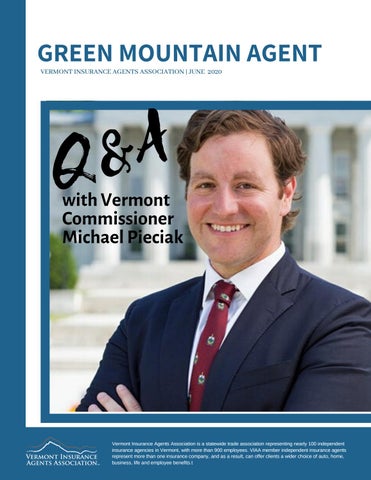
GREEN MOUNTAIN AGENT VERMONT INSURANCE AGENTS ASSOCIATION | JUNE 2020
A &
Q with Vermont
Commissioner Michael Pieciak
Vermont Insurance Agents Association is a statewide trade association representing nearly 100 independent insurance agencies in Vermont, with more than 900 employees. VIAA member independent insurance agents represent more than one insurance company, and as a result, can offer clients a wider choice of auto, home, business, life and employee benefits.t
Green Mountain Agent is a publication of
CONTENT ________________ June 2020
04 Letter from the President 06 Q&A with Commissioner Michael Pieciak
600 Blair Park Road, Suite 100 Williston, VT 05495 Phone: 802-229-5884 Fax: 802-876-7912 www.viaa.org
09 Member Spotlight: Edwin Camp 11 YAC Spotlight: Alex Handy
VIAA Officers President Alan K. Kinney
14 Feature: What You Do and Don't Do when a COVID-19 E&O Suit Hits
Vice President Dan Rodliff Secretary/Treasurer Michael Barrett
17 On the Hill
National Director Ron Bixby
16 Member Feature: Essex Agency 18 On the Hill
Directors
20 Carrier Feature: Vermont Mutual
Chip Ams Erin Odell, CIC Paul Plunkett Jessica Fleury Ex-Officio
23 E&O Corner
Staff
25 Feature: These Simple Habits Will Transform Your Well Being in 2020
Executive Director Mary Eversole mary@viaa.org
30 Feature: 5 Ways to Help Commercial Clients Navigate a Hardening Market 33 Commentary 37 Agency & Company News
www.viaa.org
3
LETTER FROM THE PRESIDENT ______________________________ June 2020
The country has changed in the last several months and as independent agents, we’ve responded! Many of us have shifted to “at home” workers, who continue to provide outstanding service to our customers. This wasn’t an easy transition for many, but you did it and it’s working. I think for some of us, this new way of doing business is uncomfortable, it’s not what we’re used to. But maybe it is the “kick in the pants” we all need to start accepting and embracing new ways of doing business. . . . Maybe it will allow us to pull in new talent because we now can offer a more flexible work solution. . . . Maybe we will be MORE successful because we have the confidence to shift and change more than we ever thought we could.
Alan Kinney VIAA President
It’s all up to you. As you start to consider your next steps in opening your agency, we urge you to not backslide into the old thinking that everyone has to be in the office to be productive. We urge you to remember that parents with children still have a summer ahead that holds no solutions to day care. Remember the value of your employees and give them options on how they can work for you, be productive and manage their re-entry into the world. Your employees are your biggest asset, so please take care of them – and yourself. We can’t miss addressing the recent social unrest that has added another layer to this already tense time. This too is a wake-up call to all of us to be more inclusive. To bring that into our agency culture and embrace all with employment opportunities and acceptance. Every little bit we do can make a difference. Our feature article is an interview with Commission Pieciak. He led Vermont in modeling the COVID19 pandemic and talks with Mary Eversole on the impact it’s had in our state. You will find this interview interesting and informative. Here at the association, we continue to do everything we can to protect your business so you can take care of you! If you have a need, please call us. Mary is available to triage what you need and how the association can support you. Stay well!
4
www.viaa.org
www.viaa.org
5
A & Q
With Vermont Insurance Commissioner Michael Pieciak
Executive Mary Eversole recently interviewed Vermont's Insurance Commissioner Micheal Pieciak about the Department of Financial Regulation's (DFR) working since March when the Governor declared a state of emergency. Commissioner Pieciak has jurisdiction over Vermont's insurance industry and has provided guidance on health insurance, business insurance, PPP, fraud, workers comp, and retooled how CE is delivered, and licensing exams. In addition to those roles, DFR also took on one of the most important components of the state's response, modeling. Question Could you update us on how the return premiums to Vermonters, how that is going and how Vermonters benefited? Answer The auto insurance premium refunds were a really important step for the industry. It was a recognition that their customers are really changing their behavior in a way that is really beneficial to the health crisis that we're dealing with as well. They were not driving as much and as a recognition of that, the industry decided to implement these premium credits, which we fully supported. Question Your day job kind of got changed in the course of this crisis. So, how did DFR get drafted to do modeling data for the state? 6
Answer I think the reason that, you know DFR got selected, we certainly have experience as actuarial modeling, financial models are also important to the work that we do and the work of the industries that we regulate, but obviously, you know, we're not epidemiologist. We're not infectious disease experts. So one of the first things we had to do was also sort of build out that partnership with people that are expert in this area. Question What was done to create the projections early on when the crisis hit? Answer You know, they call it the R0 [reproductive number prounounced "R naught"], which is basically how many people get infected by
www.viaa.org
Answer someone that has the virus. So if the R0 is one, on average one person that's infected will give it to one other person. If the R0 is two, one person will give it to two people. The estimates have it initially as between two and three so every single person that has the virus, will spread it to potentially to two to three people. So that's kind of like the basic, you know, understanding of how quickly is the virus going to grow, for us to understand modeling of what is the exponential growth that we can anticipate. Question What do you think the modeling will look like through the summer and the fall?
Question Do you have a projection on how long this work from home order will stay in place, or rather, that's the preferred guidance? Answer I don't really see us transitioning at our department. I think it's going to be you know, June, July, and August, that we're going to continue to be working remotely as we see how things play out in Vermont and elsewhere. That possibility of coming into contact with someone with the virus. We reduce that likelihood of that happening and that benefits everybody. Question Why did it take so long to report the recovery data?
Answer What the modeling really shows us is so long as we have folks that can continue to work remotely that we really shouldn't see a resurgence the virus over the summer that we should be able to keep your hospital resources low, and then we should be able to keep our case count low as well. Question What is mobility data here that thrown into the mix quite a bit? What does that mean? Answer We had received a model in late March from one of our modeling experts that showed us over the last two and a half months at that time, basically from New Year's through late March, what the mobility was in Vermont.
Answer We weren't just sort of modeling on assumptions, but that the epidemiological team was actually able to go and interview people and account for whether they had recovered or not, whether they were still exhibiting symptoms. It’s not based on an assumption that people get better after 14 days, and then another percentage of the population is going to get better after 21 days. It's really, for the most part, that team following up with people that have been sick; understanding if they're still exhibiting symptoms. If they're not, you know, and they recovered they mark themas recovered and then we have a sense of how many have actively been marked covered. How many are still exhibiting symptoms. Then, we were able to focus on this active case count.
I can assure you the government's not tracking you. I mean, these are third-party apps all done voluntarily, then all done at the aggregate and anonymized levels and you'll see that the data shows you that Vermonters were very mobile prior to the pandemic. As the different orders got put in the place, including stay home, stay safe.They then became very compliant with those orders and the mobility data really decreased dramatically. www.viaa.org
Watch the entire video with Commissioner Pieciak on YouTube Click here
7
Member Spotlight
Edwin Camp Royer Camp & Associated Insurance Newport, Vermont This month, Edwin "Ed" Camp turns 90 years old! Ed is the longest licensed agent in the State of Vermont and still participates in the Vermont insurance community. In 1963 Roland Royer formed Royer Insurance, Inc. and in 1965 he was joined by Ed as a partner and the agency changed its name to Royer Camp Insurance, Inc. Ed remains a key part of the daily operations of Royer Camp & Associated Insurance, working primarily with commercial insurance customers. Congratulations Ed on this milestone birthday!
www.viaa.org
9
10
www.viaa.org
YAC SPOTLIGHT: Axel Handy Essex Agency Axel Handy is a native Vermonter, born and raised in Essex, VT. When he is not relaxing at his condo in South Burlington, he is playing his bass guitar, enjoying live music or on the slopes. Those who know Axel would say he is fun-loving, friendly, knowledgeable and a true professional. He was encouraged to join the YACs by his father who is a former VIAA president. He enjoys the comradery and ability to connect with others in the industry. Axel has been with the Essex Agency for 6 years and counting. With his father being the agency owner, you would assume Axel started his career to continue the family business. After graduating Johnson State College and having a typical office job, Axel knew he wanted more. He wanted a meaningful career that allowed him to work with the public, be out of the office and have growth potential to keep him motivated. Since he started, he has obtained his CIC designation which has improved his confidence as an Insurance Counselor rather than a “salesman�. If you were to ask Axel what he enjoys about his role in insurance he would say that the interaction with people along with the flexibility and the knowledge of knowing that the harder you work the more protected your community is. www.viaa.org
11
WHAT YOU DO AND DON’T DO WHEN A COVID-19 E&O SUIT ARRIVES
AGENCY OPERATIONS
By Christopher Boggs COVID-19 has changed the agent’s errors and omissions (E&O) landscape for the next several months. While we can’t predict the number of agents who may have E&O claims at this point, the odds are high that if you don’t get sued, an agent you know will. Proper actions and reactions when threatened or served with an E&O suit arising out of this pandemic are of utmost importance. Once a threat is made or a suit filed, the allegedly improper act or omission has already occurred - don't worsen the situation by making bad decisions. Remember these “dos” and “don’ts” if you find yourself in an E&O situation. Let’s start with the first MAJOR don't: Do not overreact to the claim. Understand that there is no shame in being accused of an error or omission, especially given the weird aspects of this COVID-19 situation. Even the best practices and procedures may not protect the agency right now. Anger, either toward yourself or others, is counterproductive and serves only to increase the weight of the situation.
DO NOT DO THESE THINGS Do not, under any circumstances, alter the client's file. What’s done is done. Making changes creates the appearance that there is something to hide. Accept what is there and prepare for what comes next. Do not discuss the claim with anyone other than the claims representative, defense attorney or any other member of the office directly involved in the claim. The only individuals who need to be involved in any
14
www.viaa.org
discussion related to any E&O claim are those personnel directly related to the care of the plaintiff's account and those defending the agency. Do not make any admission of liability or wrongdoing; and do not offer or make payment. Do not provide any written or recorded statement to the plaintiff without your E&O carrier's claim representative present. Do not allow inspection, copying or removal of client files and records without consulting with your E&O claim representative. Do not try to manage the claim on your own. The E&O carrier has more experience and is better able to manage the process. Allow those with more experience and resources to manage the suit.
WHAT TO DO What should your immediate and ongoing "do's" be following an E&O claim?
Do's and Don't for COVID 19 E&O Suits Continued Write down all the information known about the incident surrounding the claim. Each member of the team directly related to the client and the incident giving rise to the E&O claim should record all they can remember about the incident or incidents onwhich the claim is based. This should be a factual narrative statement in chronological order. Leave out opinion and emotion. This is the time to act like you are talking with Joe Friday from Dragnet – just the facts. Who, what, when, where and why is all that should be contained in these accounts. Notify the E&O carrier of a "claim" or potential claim immediately. Provisions in the E&O policy require the insured to notify the insurance carrier as soon as practicable following the receipt of a "claim" or any indication of a potential claim. Listen for “trigger” words or questions. Some words, phrases or questions just don’t seem normal, in fact, they sound like something a lawyer would say. If your client uses terms like “duty,” “breach” or “breach of duty,” assume they have been talking with a lawyer. Also pay attention to the questions that are asked, does it seem like they are trying to trap you into admitting something? Notify the carrier of a potential claim if words or phrases seem to indicate a lawyer is already involved. Assume every conversation is being recorded. Regardless of the legalities of recording a conversation, assume your answers are being recorded. Pick responses carefully. Gather and organize all pertinent records related to the insured and the situation. But when doing this, remember the second "don't" don't alter them. The claim representative needs all the information to conduct an investigation and prepare and provide a proper defense.
www.viaa.org
Assign one person as the claim leader. One person should be assigned the duty to report, track and manage all COVID-19 E&O claims within the agency. Cooperate with the E&O carrier. This includes providing information and facts that look bad for the agency. Hiding or hedging certain aspects of the facts surrounding the situation on which the claim is based creates distrust between you and your insurer; it also makes the agency look guilty. The insurer is on your side. Make sure you comply with all policy conditions and requirements. If the agency fails to comply with all E&O policy conditions, coverage may be jeopardized. Hopefully, You Will be Spared Hopefully, you and your agency will not need this information. If not, that’s great. But given the uncertainty of this current situation, it’s better to be prepared.
15
ON THE HILL: Big ‘I’ Advocates for Liability Protections
As Congress and the Trump administration continue to look for ways to provide relief to businesses, the Big “I” is continuing to advocate for legislation that will help independent agencies across the country. The Big “I” joined a number of business organizations in signing a letter on liability protections that was sent to all members of Congress. As states lift lockdown orders and businesses across the country start to open back up, this important letter focused on the need to enact temporary and targeted liability protections. The letter specifically asks Congress to quickly enact those temporary liability protections for businesses, non-profit organizations and educational institutions that follow applicable
public health guidelines against COVID-19 exposure claims. The letter also notes that in addition to being temporary, these liability protections should be limited in scope and preserve recourse for those harmed by truly bad actors who engage in egregious misconduct. As Congress and the Trump administration continue to consider COVID-19 relief measures, the Big “I” will make the most upto-date government affairs information available on the coronavirus resource page and in the weekly News & Views enewsletter.
www.viaa.org
17
CARRIER FEATURE Vermont Mutual Contributes $1,000,000 for COVID-19 Relief Vermont Mutual Insurance Group®,has announced that they will contribute $1,000,000 in charitable donations to assist with COVID-19 relief efforts in Vermont. Two organizations, the Vermont Foodbank and the Vermont Community Foundation have already been named as the first recipients, with $500,000 total being designated for the two institutions. Dan Bridge, Vermont Mutual's President and CEO , stated “We selected the Vermont Foodbank and the Vermont Community Foundation because of their long-term commitment to Vermont communities, as well as their established infrastructures which enable them to quickly put these funds to use serving the recovery efforts of our local communities.” In addition to the $1,000,000 donation noted above, the company has also distributed additional funds to the United Way of Central Vermont, the American Red Cross, and the Boys and Girls Club of Burlington, to further support their efforts in assisting community members affected by the COVID-19 pandemic. The company also reached out locally, sponsoring "Comfort Care Baskets" for Central Vermont Medical Center frontline healthcare workers and purchased nearly $2,000 worth of gift cards from local restaurants to help with their cash flow during the stay-at-home order.
20
Speaking of the company’s commitment, Dan Bridge remarked "The financial impact of these unprecedented and uncertain times is widespread, impacting children, students, families, employees, small businesses and large corporations.”
The company also announced that it will increase its employee-based charitable contribution match from 100% to 200% for any Vermont Mutual employee who donates to organizations responding to the COVID-19 pandemic. As well, having seen a reduction in auto claims during the stay-at-home order, the company has instituted an Auto Premium Payback Program for their Personal Auto customers, one that will result in nearly $5 million in premium payback to its customers. For those Vermont organizations seeking funds under the Vermont Mutual COVID-19 Recovery Program, the company has created a grant application specific to those relief efforts. For more information, visit: VermontMutual.com/covid-19. Thank you Vermont Mutual for showing how important it is to take care of our neighbors.
"Thank you so much for making this impactful commitment to the people of Vermont! You and your customers are taking action in a way that so few are able to, and I want you to feel really good about that. I look forward to reporting back on the good your generosity is creating, and how Vermont Foodbank and Vermont Community Foundation are partnering to make sure Vermont is a stronger and more prosperous community as we all recover together."
Dan Bridge, President and CEO “Since 1828, Vermont Mutual has been protecting Vermonters and assisting them in their time of need. It is hard to imagine any greater need than what is currently being experienced across our state, region, country and world and Vermont Mutual is grateful to be in a position to fulfill its obligation to help people and businesses recover from this crisis.�
John Sayles, CEO of the Vermont Foodbank
"It really is a remarkable commitment to this collective effort. We are very grateful that you reached out and that we are able to undertake this work together. Vermont and Vermonters will recover and be more resilient for it." Dan Smith CEO of Vermont Community Foundation
Mark McDonnell, Executive Vice President and COO "Many members of our communities have been adversely affected by this pandemic and we hope our charitable efforts will help ease their burden a bit. We also consider ourselves very fortunate to be in a position to assist those serving on the front lines. Speaking on behalf of all of us at Vermont Mutual, I'd like to extend our sincere gratitude to every one of them." 21
C E O & R O N ER
One Important Marketing and E&O Prevention Tool: The Declined Coverage Form By Thomas Casella, JD, MBA, SCLA Senior Risk Management Specialist, Utica National Insurance Group
When I speak with insurance agents and brokers on the need to document the agency file with all client requests, communications (telephone, text, email, fax, etc.), carrier correspondence, coverage elections, claim notices and so on, I am often asked if there is an easier way, or a method that is not as disruptive to the sales workflow. While there are no shortcuts to establishing and maintaining an E&O preventative culture within your agency, efficiencies are available. One document that can serve three important roles for your agency is the Declined Coverage Form. Three ways that the Declined Coverage Form assists producers is by providing a means to: 1. Review to ensure that they have covered all of the relevant coverages for the client in a convenient proposal form (which works especially well if working from a line/industry specific risk checklist); 2. Document for E&O prevention purposes by holding clients accountable for their coverage elections; 3. Market coverages and limits by informing the clients, in writing, as to what is available, which forces them to consider the available coverages and limits, and sign acknowledging their selection. While the first two uses may be obvious, the third may be less so. Many agents and brokers that I speak with see this form mainly as an E&O prevention instrument that they have to complete to limit their risk; however, that narrow view misses the enormous marketing and sales opportunity
For instance, it is much easier for a client to say in conversation that they do not want cyber coverage because of what they hear about the risk (which may be amorphous to them) and the dollar amount associated with the premium (which will impact their bottom line), so the client will be able to easily dismiss it. There is no onus on the client for their decision at this point. However, if the client is presented with a menu of options for coverages and limits, they have time to review and consider their options, and then are required to sign to decline certain coverages, more thought is likely to go into that decision. Agents and brokers that use the form in this marketing context report that clients will call them asking for more information on coverages that were not initially sought. Taking this one step further, having the Declined Coverage Form in an electronic format with e-signature functionality will further streamline your agency’s process, digitalize your documentation (which is helpful for E&O defense purposes) and speed up the process time, as the document will be sent and returned electronically. This is in keeping with the industry trend for faster service with more options. Using this one tool can help you provide your clients with the relevant coverage options available, thereby increasing their financial security, and your agency’s sales, while also protecting your agency from E&O claims for failing to offer the correct coverage or sufficient limits. Capture efficiency by using the Declined Coverage Form for all of its benefits.
This information is provided solely as an insurance risk management tool. Utica Mutual Insurance Company and the other member insurance companies of the Utica National Insurance Group (“Utica National”) are not providing legal advice, or any other professional services. Utica National shall have no liability to any person or entity with respect to any loss or damages alleged to have been caused, directly or indirectly, by the use of the information provided. You are encouraged to consult an attorney or other professional for advice on these issues.
www.viaa.org
23
These Simple Habits Will Transform Your Well-being in 2020
HEAD SPACE
By Jessica Hicks, Associate Multimedia Editor at Thrive Global
If you had a dollar for every time you hear “new year, new you,” leading up to 2020, you’d probably be a millionaire by the time the clock strikes midnight. We all like to talk about starting fresh when January 1 rolls around, yet we often set ourselves up for disappointment by making resolutions that are products of wishful thinking, instead of focusing on realistic and achievable goals. The key to making goals that last is starting small, with Microsteps — and there are so many minor changes you can make in your daily life that will have a major impact down the line.
bath one or two hours before you call it a night. While this might sound counterintuitive, bioengineers from The University of Texas at Austin found that doing so increased circulation from the core of the body to the hands and feet, which contributes to an overall decrease in body temperature. This practice “will aid the natural circadian process and increase one’s chances of not only falling asleep quickly, but also getting quality sleep,” Shahab Haghayegh, a Ph.D. candidate in UT’s department of biomedical engineering and lead study author, writes for Thrive.
These eight science-backed strategies — implementing the very latest research — are simple enough to incorporate into your daily or weekly routines, and are sure to change the way you work and live in 2020.
Develop a consistent morning routine Let’s make 2020 the year of not-so-frazzled mornings. A consistent morning routine has been shown to “anchor underlying biological rhythms,” and help adults ease the transition between wake and sleep, fall asleep faster, and sleep soundly through the night, according to research published in The Gerontologist. So for the sake of consistency and a less
Take a bath one or two hours before bed When it comes to good sleep, your brain and body thrive in cooler temps. But instead of opening a window or blasting your AC to cool down, try taking a warm www.viaa.org
25
Simple Steps to Transform Your Well Being continued stressful morning and night, find a routine that works for you — and stick with it. Seek out phone-free experiences Seeing the world device-free — not through your phone screen — has been shown to produce a plethora of benefits for mental health and well-being. Wenjie Cai, Ph.D., a senior lecturer at Greenwich University, and his research team found that vacationers who choose to go on a digital detox while traveling were able to be more present in their environments and ultimately feel recharged. While some study participants experienced a bit of an “emotional roller coaster” when initially letting go of their devices, they later reflected positively on the experience. “They were proud as they gained navigation skills, engaged much more with other people around them, and realised the beauty of their surroundings as they weren’t busy staring at their screens,” Cai writes for Thrive. Whether or not you’re planning to travel in 2020, the benefits of unplugging from our devices can be felt from faraway places or a staycation. Take five-minute naps once or twice a week An afternoon cat nap isn’t just one of life’s simple pleasures: It’s a valuable tool in safeguarding your health. A 2019 study showed that taking naps as short as five minutes once or twice a week was enough to lower participants’ risk of developing cardiovascular disease or having a heart attack or stroke by 48 percent. What’s more, catching some quick zzz’s during the day can help you clear your mind and up your alertness later on. Meditate for 20 minutes If your 2020 goals have anything to do with finding more focus at home or at work, this is a habit you’ll want for your toolkit. We already know that mindfulness meditation comes with significant benefits, making the time for just 20 minutes of meditation is enough to “enhance the brain’s ability to detect and pay attention to mistakes,” Jason Moser, a researcher at Michigan State University and co-author of a mindfulness meditation study, told Science Daily. 26
www.viaa.org
If you catch yourself slipping up at work or simply need to find that laser sharp focus, try eking out just 20 minutes for a reboot session. Make a to-do list right before you go to sleep Sometimes, despite your best efforts, when you want nothing more than to drift off to sleep, all the hustle and bustle still going on in your brain just won’t let that happen. Research from Baylor University found that writing a very specific to-do list five minutes before bed is an effective way to ease bedtime worries about future tasks, and help you fall asleep faster. Try piecing together a short list at night — and make sure you use pen and paper, don’t resort to the notes app on your phone — for more restful sleep and a less stressful morning. Don’t run from your feelings — bring them to life instead If you have a habit of burying negative emotions instead of embracing them, this strategy might help you reframe how you view the feelings that are bogging you down. Inspired by the movie Inside Out, a researcher from the University of Texas at Austin found that bringing negative emotions to life, like sadness, can help you feel less attached to them. According to the study, imagining your sadness as a person outside of yourself — a little girl walking with her head down, say, which one study participant used — can you help you feel separated from it and thus better able to cope. Get outside for 30 minutes at least three times a week If you have 20 minutes for meditating, you also have 20 minutes to step outside and take a “nature pill.” Research from the University of Michigan found that a nature experience lasting at least 10 minutes, without the distraction of social media, the internet, phone calls, conversations, or reading, can lower levels of stress hormones like cortisol. Based on the study’s findings, you should aim to take your “dose” at least three times a week, but the more the merrier (and less stressed you’ll be).
28
www.viaa.org
5 Ways to Help Commercial Clients Navigate a Hardening Market By Brendan Zyvoloski
MARKETS
The commercial insurance market has reached a crossroads at a time when many aspects of the industry are changing. This change is happening at a pace that has never been seen before. Digital innovations, changing consumer behaviors and consolidation in the independent brokerage channel are all influencing how insurance is sold and the expectations businesses place on their independent insurance agent. All of this is occurring alongside a hardening market for property-casualty insurance. This market is characterized by stricter underwriting standards, reduced capacity, restricted coverage and less competition among insurance carriers for new business. While the hardening market is largely driven by high-level macro trends —including increasing claims costs, catastrophic losses, reduced investment certainty, social inflation, rising reinsurance costs and more—the net result for most businesses is that they are paying more for their insurance. Alongside these rising costs, your clients are also facing dynamic short- and longterm trends in their respective industries, as well as the fallout from the COVID-19 pandemic. The bottom line is that businesses need insurance and risk management partners they can trust now more than ever. While current market conditions are challenging, they also present an opportunity for insurance brokers and agents to separate themselves from their competition. They play a critical role in helping businesses navigate the insurance 30
www.viaa.org
market. While this is true in soft markets, it’s especially important when the market is hardening. Those that will fare the best in a hard market are those who focus on quality service and guidance rather than strictly cost. Here are five strategies to best position your agency and clients for the current market: 1) Stay informed. Your clients rely on you to provide tailored guidance. This starts by understanding the current market conditions yourself. The best agents not only have a good sense of high-level pricing trends, but also the conditions that their clients are likely to experience. You need to have a handle on how market conditions are affecting businesses with similar risk profiles. Having this understanding will allow you to provide meaningful advice to your clients on how they can address this market from a coverage standpoint, as well as a risk management perspective.
Five Ways to Help Commercial Clients continued
Now is a great time to think about ways to strengthen your relationship with insurance carriers. Having a good sense of how insurance carriers and their underwriters view the current market will give you a leg up. 2) Take the time to explain the market to your clients. No one likes bad news. This is especially true for commercial insurance buyers who may see dramatic premium increases. However, bad news is even worse when it comes as a surprise. In the current market, agents should be transparent with clients when it comes to potential price increases. Doing so will help your clients manage their expectations and allow them to properly budget for increased insurance costs. Providing this information well ahead of renewal has the added benefits of giving you ample time to develop a solid plan for positioning your clients’ risks to underwriters. 3) Be a true risk management partner. It’s no secret that many insurance carriers are tightening up their underwriting standards due to increased claims cost, poor loss ratios and deteriorating investment income. For your clients, this means underwriters are going to ask more questions than in years past and will be more selective in the risks they are willing to recommend. In this setting, it’s doubly important to ensure you’re able to provide targeted risk management advice that can improve your clients’ risk profiles. Whether you provide this guidance in-house or connect your clients to this information, it’s important to demonstrate that your clients take a proactive approach to risk management. Remember, best-in-class risks get best-in-class pricing which, in this case, may mean less dramatic premium increases. 4) Start the renewal process early and focus on quality submissions. “Start your renewals early” is the advice that insurance brokers hear every year. This is especially true this year. The
earlier you start working with clients on their renewal, the more time you will have to address issues with their submissions. Whether it's addressing risk management issues or determining how to structure insurance coverage, time is a valuable asset— especially since many insurance carriers are seeing an uptick in submission volume for certain lines of coverage. Many underwriters will outright dismiss incomplete or sloppy submissions. 5) Leverage technology for improved service. Your clients are going to expect a lot out of you. Businesses today are looking to their insurance agents to help them control their risk, structure their insurance policies and provide timely guidance. In light of these demands, agencies are increasingly embracing InsurTech solutions to find efficiencies in their workflows. Doing so helps agents focus on their core responsibilities while still delivering best-inclass insurance and risk management advice. What’s more, given recent shifts toward digitization in the industry, technology is sure to play an even larger role in your everyday operations in the coming years. Now is the time to examine available InsurTech solutions that allow your agency to enhance its value proposition and be a partner that your clients can rely on. Now more than ever, your clients are leaning on you for expertise, guidance and support. Stay informed, communicate with them early and often, and be there as their business consultant during this challenging time, and you’ll secure your position as their essential long-term partner in the years to come. Brendan Zyvoloski is a senior market analyst specializing in p-c products at Zywave.
www.viaa.org
31
Agent COVID-19 E&O Do’s and Don’ts
William C. Wilson, Jr. CPCU, ARM, AIM, AMM is the founder of InsuranceCommentary.com. He retired from the Independent Insurance Agents & Brokers of America in December 2016 where he served as Assoc. VP of Education and Research and was the founder and Director of the Big "I" Virtual University for over 17 years. www.viaa.org
33
The trial bar is pursuing all possible sources of recovery for business interruption claims. Initially, their primary target has been insurers. However, some agencies and brokerages have also been sued and, with anticipated claim denials by carriers that are likely to be upheld by the courts, agencies (and their E&O insurers) should expect to become higher profile litigation targets as this process plays out. Lawsuits against agents may be made on many grounds. For example, if a COVID-19 claim is denied by the carrier on the basis of a virus exclusion, the agent might be sued for negligence in the failure to place coverage with an insurer that does not have a specific virus exclusion or that otherwise might offer such coverage. Independent agents might be more vulnerable than captive agents to such suits because of the greater availability of markets. This article addresses some of the things agencies and brokerages can do to minimize their E&O exposures while assisting their customers and what they can do to minimize future E&O claims.
All claims should be reported to all carriers that might become involved in the claim. For example, liability claims should be reported to excess/umbrella carriers in addition to CGL or BOP insurers. If a COVID-19 claim is denied by the insurer, do not advocate for customers in a manner that might incriminate the agent. Good agents, if they believe a claim has been wrongly or improperly denied, often successfully advocate for their customers in reversing such denials. However, in the case of COVID-19 claims in particular, this can be dangerous because of the number, size, and complexities of these claims and the many unknowns regarding judicial interpretations and governmental actions. DOCUMENT all communications. This is caveat #1 of all potential E&O claims.
First and foremost, don’t tell insureds NOT to file claims. According to a survey recently conducted by the Iowa Restaurant Association, as reported by Business Record Daily, “… nearly half of those business owners with business interruption policies said they were told by the agents not to file a claim, because it would be denied.” Agents should NEVER deny claims. That right is reserved by the carrier as a party to the insurance contract. There have been reports of some insurers actually directing their agents to deny claims on their behalf. NEVER do that. In addition to it being inappropriate, effectively acting as an adjuster may be illegal under state insurance laws and regulations, including licensing requirements. In addition, unfair claim settlement practices laws impose very detailed 34
requirements regarding the investigation and handling of claims, especially denied claims.
Be wary about articles and social media posts, especially those that opine about coverage. In the event of an E&O claim, during the discovery period plaintiff’s counsel will undoubtedly request copies of communications and publications related to the claim. If you THINK you MIGHT have an E&O claim, contact your E&O carrier immediately. Read your E&O policy and you’ll probably find out that your reporting requirement is not triggered by a claim or suit, but rather your knowledge that one is possible. Aside from any such contractual requirement, early reporting will enable your E&O carrier to provide you with advice on how to proceed. Try to identify coverage gaps created by the pandemic that impact the agency and your
www.viaa.org
Agent COVID Do's and Don'ts Continued
customers. For example, with a few exceptions, most property coverages are limited to property at the described premises. If you have employees working remotely, they may have significant values of agency business property in their homes. Business income coverage is also usually triggered by damage to property at a described location, not at employee homes. Likewise, certain crime and cyber coverages may be tied to a described location. Consider exclusions and limitations for business vacancies…check policy language and discuss with insurers to determine if they plan to enforce such contractual provisions. IMPORTANT: Discourage customers who contact the agency to cancel or suspend coverage and document such inquiries and actions. Make sure the person contacting the agency is authorized to make coverage changes and, if coverage is reduced in any way, consider using a signed disclaimer form.
As soon as practical, update the agency’s operations manuals. Adopt or revise the agency’s disaster plan to include pandemics. Update the agency procedures manual and employee handbooks and HR materials. Stay informed about COVID-19 developments. Pay particular and timely attention to carriers’ positions on coverage, cancellation, late premium payments, etc. Carefully review renewal policies for newly added exclusionary or restrictive endorsements and make sure the carrier points out such changes to insureds. Monitor and follow regulatory directives from state insurance departments or other controlling government agencies. Keep up to date on coverage and legal issues from trusted publications and other sources.
Do not offer or provide advice beyond your expertise or the coverage bounds of your E&O policy. Just today, an agency asked how they could help a private swim club with waivers and standard procedures as they reopen. Unless you are a risk management expert, you probably cannot and should not provide such advice. Unless you have a law degree, you should not be drafting waiver agreements. Agencies should consider seeking their own legal advice (procedures, waivers, disclaimers, etc.) when dealing with customers who are looking for consultations beyond the sale of insurance products. Given that most policies have or will have some sort of communicable disease, virus and/or pandemic exclusion, the agency’s E&O policy (if it doesn’t have such an exclusion) could be a prime candidate for someone looking for coverage. www.viaa.org
35
COMPANY & AGENCY NEWS www.viaa.org
37
Vermont Business Wellness Leadership Award Winner This year, The Vermont Governor’s Council on Physical Fitness and Sports presents the Vermont Business Wellness Leadership Award to Michael Nobles, President and CEO of Union Mutual Insurance Company. The Business Wellness Leadership award, traditionally presented at the Worksite Wellness Awards ceremony, recognizes one Vermont employer who demonstrates exemplary efforts to promote a healthy work-life balance for their employees. Nobles’ strong leadership and generous service to the community make him a role model in sustaining a culture of wellbeing. Nobles is involved the Union Mutual Wellness and Charitable Giving program, which stands upon the values of employee appreciation and community giving. Nobles’ accomplishments include leading the 2020 Penguin Plunge fundraising campaign, guiding his team into the icy waters of Lake Champlain and individually raising over $22,000 for Special Olympics Vermont, as part of a larger team fundraising record of over $130,000. Michael has a lifelong connection to Special Olympics and both sponsors and volunteers with Special Olympics Vermont Summer Games. Nobles instills a culture of wellbeing by taking time each workday to focus on health and wellness. He plays basketball with employees in the office parking lot and runs alongside employees in the office gym. Once a week, Nobles brings in a certified Pilates instructor to lead a class, free to all employees. Nobles’ generosity extends to both his business and the greater Vermont community. Not only did Nobles install bike racks for his employees to safely store their bikes, but he also did the same for students at nearby Montpelier High School, in 2019. Michael Nobles is an excellent example of how Vermont employers can take initiative within the workplace to better the lives of their employees by encouraging worksite wellness activities. While the annual Worksite Wellness Awards ceremony will not take place this year due to the COVID-19 outbreak, Nobles’ achievements do not go unnoticed. Nobles will be mailed his award and will receive $100 from the Governor’s Council to give to the charity of his choice, Special Olympics Vermont.
38
www.viaa.org
Local company wins recognition as top-notch employer
For the fourth time in as many years, Middlebury’s Co-operative Insurance Companies has been named one of the Best Places to Work in Vermont. Co-op was one of about two dozen small businesses on the overall 2020 roster of 51 companies. The ranking results from a statewide survey conducted by Vermont Business Magazine, the Vermont Chamber of Commerce, the state’s Department of Labor, the Vermont Council of the Society for Human Resource Management, and Best Companies Group. The selection process includes review of company practices and policies, but depends largely on employee feedback. The company’s management recognizes that providing a desirable workplace is one of the keys to being able to serve its members well. While earning a spot on a list of great places to work means a lot, it’s the survey results from the process that are most valuable to Co-op, as that feedback helps in sustaining that exceptional work environment. The competition, which is in its fourteenth year, is open to business, non-profits, or government entities that have been operating a year or more and that have a facility and at least 15 employees in Vermont. While all 51 winners have been named, the final rankings will be announced at an awards presentation in June. Co-operative Insurance Companies has been meeting property and casualty insurance needs since 1915, offering farm, home, auto, business, and other insurance to people in Vermont and New Hampshire. It is owned by its members and committed to protecting them with fast and fair claims service, farm safety expertise, and local operations. The company has headquarters in Middlebury, Vermont, with regional claims offices and more than 100 agency locations across Vermont and New Hampshire.
40
www.viaa.org
Jonathan Becker Succeeds Terry Moore as Vice President of Underwriting at Vermont Mutual Vermont Mutual Insurance Group®, has named Jonathan Becker as the company’s new Vice President of Underwriting. Mr. Becker replaces retiring Vice President of Underwriting, Terry J. Moore, who leaves after leading Vermont Mutual's underwriting department for the past five years. The new Vice President of Underwriting, Jonathan Becker, recently served as the Regional Vice President and Branch Manager of a New England-based commercial property and casualty insurance company. Mr. Becker began his insurance career nearly 25 years ago and has held positions in underwriting at Chubb, Travelers and Fireman’s Fund, as well as roles in marketing, loss control, claims and policy rating. Mr. Becker will be operating from the Company's headquarters in Montpelier, Vermont.
Relief Fund Launched to Aid Downtown Montpelier Businesses The Montpelier Development Corporation (MDC) with one of its partners the Montpelier Foundation (MF) announced today the launch of the Montpelier Economic Need and Distress (MEND) Fund. The MEND Fund was created last week to respond to the burden faced by downtown businesses during the COVID-19 pandemic and the State of Vermont’s subsequent ‘Stay Home, Stay Safe’ order. MEND will provide funding to downtown storefront businesses in the form of grants to assist with their recovery and revitalization efforts during this time of unprecedented economic hardship. “Everyone involved in the creation of the Fund understands the importance of Montpelier’s downtown businesses,” said Michael Nobles, President and CEO of Union Mutual Insurance Company, and member of the Board of the MDC. “When I reached out to my peers at Vermont Mutual, National Life, Northfield Savings Bank, and Noyle W. Johnson, they immediately expressed their support.” Collectively, those five companies are hoping that the over $200,000 that they have already pledged to the Fund will be matched with additional donations from other businesses and individuals. Amounts raised by the Fund will be provided to businesses in the form of grants that will be awarded without restrictions. Any first floor store front in Montpelier’s Designated Downtown with fewer than four locations is eligible. The store is asked to make a pledge to stay open or to reopen when it is safe to do so. Businesses seeking financial assistance from the MEND Fund can use the MDC website (https://www.mdcvermont.com/mend-covid-relief) to sign and submit their pledge by June 5th for review by MDC. Businesses will get their grants before the end of June. Tax-deductible donations to the MEND Fund may be made by going to https://www.mdc-vermont.com/mend-covid-relief. For more information about the Fund, please contact Catherine Coteus, MEND Fund Project Manager, at (802) 8287050.
42
www.viaa.org
44
www.viaa.org