GREEN MOUNTAIN AGENT VERMONT INSURANCE AGENTS ASSOCIATION | July 2021
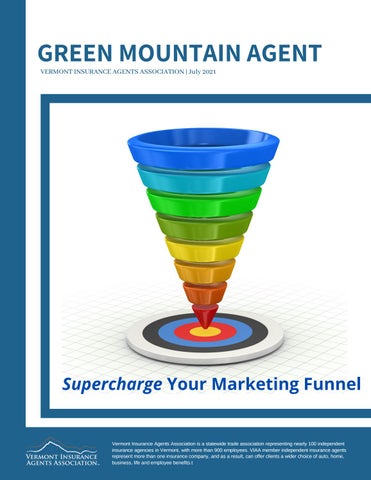
Supercharge Your Marketing Funnel
Vermont Insurance Agents Association is a statewide trade association representing nearly 100 independent insurance agencies in Vermont, with more than 900 employees. VIAA member independent insurance agents represent more than one insurance company, and as a result, can offer clients a wider choice of auto, home, business, life and employee benefits.t
Green Mountain Agent is a publication of
CONTENT ________________ July 2021
05 Letter from the President
600 Blair Park Road, Suite 100 Williston, VT 05495 Phone: 802-229-5884 Fax: 802-876-7912 www.viaa.org
06 Young Agents 09 NEWSFLASH Vermont
VIAA Officers President Daniel J. Rodliff, CIC, CPIA, LUTCF
13 3 Ways to Supercharge Your Marketing Funnel
Vice President Michael Barrett
17 On the Hill
Secretary/Treasurer Jessica M. Fleury, ACSR National Director Ronald Bixby
20 E&O Corner Agents Take the Wheel
Directors
25 Rental Cars and Insurance: I Was Wrong (Sort of)
Chip Ams Ian Sutherland Alan Kinney
33 Commentary 39 Agency & Company News
www.viaa.org
3
4
www.viaa.org
LETTER FROM THE PRESIDENT ______________________________ July 2021 Happy 4th of July to all of you! As I write this, I am excited to see us enjoying our return to "normal" here in Vermont. It's been quite a ride, and adjustments are still being made as all of us acclimate, but the opportunity to see family and friends and each other is a gift that we're not likely to take for granted for some time! That brings us to our Evolve 2021 Convention this fall, when we will look very different than in any year in the past. We are committed to providing a hybrid experience so that all our members can participate whether they choose to do so in person or virtually. We know that with our technology, we can expand our reach and connect with more of our members than ever before, so I look forward to "seeing you all" this September 15th, 16th and 17th. Here are some highlights to allow you to plan accordingly:
Dan Rodliff VIAA President
First, we are moving the golf outing away from the Convention. We have found over the years that it is difficult to balance this unique event with all of the additional commitments that come along with our convention. By moving our golf outing to the spring, we will have a chance to engage more participants and to have another event during the year when we can reconnect. As a practical matter, we'll have more course opportunities as well because we'll be able to choose from a wider calendar range. Private courses typically offer Mondays as "outside tournament" days and we are working to secure that for 2022 and beyond! Secondly, our annual meeting will take place on Friday morning, September 17th at 10 am. We are moving forward with our transition to align with our fiscal year/calendar year. Elections for the Board of Directors will take place at this meeting and new Board members will be invited to participate in the November Board meeting. Officers will be elected at a time closer to the end of the year to allow the fiscal year and terms of office to align. On another note, we are working to schedule a return to in-person classes starting up this fall! Rather than jump in this summer, we wanted to let the dust settle and allow time for readjusting to our updated work environments. Keep an eye out on our website for updates. Finally, when Mary Eversole resigned last year, we reached out to Mary Farley to step in as our Interim Executive Director on a part-time basis. Mary has worked closely with our partners in Rhode Island, especially their Executive Director, Mark Male, and together, they have supported our Association. Mary has accepted the opportunity to continue as our Executive Director on a part-time basis and we look forward to her continued support and teamwork with Mark and his team. While we may not see her in person at some of our events, we know we can count on her expertise, experience and diligence to keep our Association moving forward. Conveniently, the primary email of Mary@viaa.org remains viable - we just have a new friend on the replying end! Happy 4th! Dan www.viaa.org
5
6
www.viaa.org
www.viaa.org
7
8
www.viaa.org
NEWSFLASH DFR Releases Report Examining the Impacts of Climate Change on Vermont’s Insurance Industry The Department of Financial Regulation (DFR) released a report examining the ongoing impact that climate change is having on Vermonters and the insurance companies that provide them coverage. The report was completed in conjunction with, and based on original research conducted by, Northview Weather, LLC, a Vermont weather modeling and forecasting firm with expertise in extreme weather events.
Further, the report concluded these climate trends are expected to continue over at least the next three decades, which will lead to an increase in the frequency and intensity of severe weather. In addition to those who will be directly impacted by property damage, all Vermonters could experience an indirect impact through rising homeowner and auto insurance rates.
The report found that climate trends are making Vermont’s climate warmer and wetter which is also leading to an increase in severe weather more likely to cause greater property damage.
“Vermont currently has some of the lowest home and auto insurance rates in the country and it is in the collective interest of industry and consumers to maintain that in the future,” said Commissioner Michael Pieciak.
Specifically, hailstorms accounted for the most property damage in terms of total loss, followed by gradient wind and thunderstorms. These types of weather events tend to increase in a warmer, wetter environment.
www.viaa.org
9
10
www.viaa.org
www.viaa.org
11
12
www.viaa.org
3 WAYS TO SUPERCHARGE YOUR MARKETING FUNNEL
AGENCY MARKETING
By Xxxx As COVID-19 has forced many independent agencies to warm up to digitalization, there is an opportunity to work on improving your online marketing funnels, the essence of which is the client data that it generates.
Here's a three-step framework to supercharge your insurance marketing funnels:
Your funnel is the sales process or journey you guide your clients through after you find them online. Optimizing this is simply finetuning the steps you take to attract clients online and turn them into raving fans.
1) Audit the funnel. A leaky marketing funnel is the second-most common cause for missed sales targets. A misaligned funnel is the first. Auditing your marketing funnel helps agency owners gain confidence by knowing their current sales scenario at both a granular and 30,000-foot view to address gaps and build upon what's working.
By analyzing online funnels, agencies can measure how they are being perceived on the online marketplace, what types of people they are reaching, why they became clients—or why they chose not to go further—and how their clients want to interact with them. Like a car dashboard, your funnel will self-diagnose and tell you what needs to be done to fix it.
Even the best of funnels can be tweaked, tested and improved. When analyzing your leaks, make sure to audit each piece of your funnel separately. In both the online and offline space, this means auditing the engines you use to generate demand in your services, convert the interested people, and stay atop the latest in optimization techniques.
www.viaa.org
13
3 Ways to Supercharge Your Marketing Funnel continued
After you've identified your areas of opportunity, you can get started making improvements. 2) Maximize conversions. The next step in supercharging your insurance marketing funnel is to maximize your conversion opportunities. In the online space, conversion rate optimization (CRO) is the art of analyzing how to increase conversions—the number of people who reach out to you for a quote—on your website. Whether online or offline, every insurance agent should be looking to improve the client experience so they take the next step. Improving your client experience online will improve your conversion rate, thus helping you to generate more leads with the same budget. My favorite way to do this is by heat mapping my landing pages. Heat maps of how different audiences react to web content allow you to understand what is and isn't resonating with potential clients. By listening to their reactions, you can ultimately offer a better experience—which means more conversions from the same marketing spend. Other methods to maximize conversions are A/B testing your advertising and landing page copy, utilizing call tracking and using a customer relationship management system (CRM).
they've become a client. One of the ways insurance agents can create a unique preclient experience is through targeting the exact types of clients you want to work with online. You do this by positioning your advertising and search engine optimization (SEO) campaigns for the exact markets you want to reach and sharing relevant content with them. After you convert an online visitor into a new lead, they are immediately routed to the CRM where the system builds data on the contact and segments them into the proper lead nurturing lists. Funnels are a living and breathing representation of your organization's sales assembly line. More conversions ultimately lead to more revenue. And every percentage increase in conversions impacts all your other marketing channels. As you continue to drive traffic from your marketing channels, optimization will help you turn more of those visitors into leads and leads into clients. Camille D. Bob III is a digital marketing strategy consultant and founder of Insurance Funnels, the No. 1 funnel agency for insurance. Download The Insurance Funnels Blueprint.
3) Create personalized experiences. Tailoring the client experience is the latest trend in digital marketing. Companies everywhere use data and analytics to give their clients what they want before they ask for it. As a result, your clients' expectations have risen and they are paying attention to their experience with you before and after
14
www.viaa.org
www.viaa.org
15
16
www.viaa.org
ON THE HILL: Big ‘I’ Advocates Against Small Business Tax Deduction Changes
The Big “I" joined more than 100 other trade associations in sending a letter to Capitol Hill opposing potential legislation that would weaken the Section 199A pass-through tax deduction that was passed as part of the Tax Cuts and Jobs Act in 2017. Although changes to the small business tax deduction have been left out of recent tax proposals released by the Biden Administration, several congressional democrats have floated making changes to the deduction to pay for new spending proposals. Most concerning, Ron Wyden (D-Oregon), chairman of the U.S. Senate Committee on Finance, has signaled that he is working on legislation that would phase out the tax deduction starting at $400,000 and get rid of it altogether for those making over $500,000.
The letter also states that without the deduction, individually and family-owned Main Street businesses would pay significantly higher taxes, putting them at a competitive disadvantage and accelerating the consolidation taking place in our economy. Finally, the letter makes clear the importance of the bipartisan legislation, H.R. 1381 and S. 480, the Main Street Tax Certainty Act, which would make the deduction permanent. As Congress and the Biden administration continue to discuss tax policy and how to pay for their spending proposals, the Big “I" will continue to advocate on behalf of its members and provide updates in the weekly News & Views e-newsletter.
In the letter addressed to leaders of the Senate Committee on Finance and the U.S. House Ways and Means Committee, the Big “I" and other organizations note our strong opposition to any reductions or repeal of the 20% deduction for qualified business income under Section 199A, including phasing out the deduction above certain income thresholds. www.viaa.org
17
18
www.viaa.org
www.viaa.org
19
C E O & R O N ER
Agents Take the Wheel
How Agents Can Steer Clear of Uninsured/Underinsured Motorist Errors & Omissions Claims By Kristina Miller
In today’s litigious society, drivers need uninsured/underinsured motorist insurance and even umbrella coverage. Certain states have minimum automobile liability coverage requirements, while some states make UM/UIM coverage a requirement. However, often, an at-fault driver who carries state minimum coverage limits cannot adequately compensate the injured party for their loss. Therefore, UM/UIM and umbrella coverage are all important offerings of any insurance agency that procures automobile liability policies for its customers. Insurance agents need to be careful and take appropriate steps to avoid errors & omissions claims that allege they failed to offer UM/UIM and umbrella coverage. Such steps include: 1. Verify state requirements. All agencies that write auto insurance need to keep abreast of any changes in state laws regarding these requirements. 2. Make sure the client understands who is insured. A recent E&O claim resulted when an agency failed to clarify the extent of coverage under a law firm’s commercial auto liability policy, which included UM/UIM coverage. The firm was the named insured under the policy and provided coverage to the partners when occupying a scheduled vehicle. When one of the partners suffered significant injuries after being hit by an uninsured driver returning from court, the carrier declined UM/UIM coverage for the loss because the partner did not occupy a scheduled vehicle at the time of the loss. The claim against the agency alleged negligent misrepresentation regarding the existence of UM/UIM coverage and failure to procure portable UM/UIM coverage. An addition-al claim alleged that the agency failed to offer excess UM/UIM coverage.
20
3. Communicate the necessity of UM/UIM coverage. Best practice for agencies is to have written documentation with clients regarding coverages. Certain states require an agency to obtain an executed document from the customer that declines UM/UIM coverage, which means agents must ensure the form is appropriately executed. Failing to do so could result in a customer claim that the agency failed to offer coverage. A welldocumented file that contains correspondence, emails and records of phone conversations is crucial to defending any claim. 4. Understand state umbrella insurance coverage requirements. Recently, an agency received an E&O claim after the carrier denied coverage be- cause the customer did not maintain the required underlying auto liability limits. The customer was hit by an at-fault uninsured driver and severely injured. The customer brought a claim against the agency for damages due to the agency’s failure to procure $1 million in umbrella UM/UIM coverage. The agency also failed to confirm the customer’s underlying automobile policy had the appropriate underlying limits by obtaining a current declarations page of that policy. Kristina Miller is an assistant vice president and claims specialist with Swiss Re Corporate Solutions and works out of the Chicago office. Insurance products underwritten by Westport Insurance Corporation, Overland Park, Kansas, a member of Swiss Re Corporate Solutions. This article is intended to be used for general informational purposes only and is not to be relied upon or used for any particular purpose. Swiss Re shall not be held responsible in any way for, and specifically disclaims any liability arising out of or in any way connected to, reliance on or use of any of the information contained or referenced in this article. The information contained or referenced in this article is not intended to constitute and should not be considered legal, accounting, or professional advice, nor shall it serve as a substitute for the recipient obtaining such advice. The views expressed in this article do not necessarily represent the views of the Swiss Re Group (“Swiss Re”) and/or its subsidiaries and/or management and/or shareholders.
www.viaa.org
www.viaa.org
21
22
www.viaa.org
www.viaa.org
23
24
www.viaa.org
Rental Cars and Insurance: I Was Wrong (Sort of)
COVERAGE
By Chris Boggs
IA Magazine republished one of the VU's Ask An Expert questions and answers specifically related to personal auto policy (PAP) coverage issues when the insured rents from a non-traditional" rental platform such as Turo. In fact, Turo was the platform specifically addressed. In my answer to this non-traditional rental exposure, I made a statement regarding the PAP's response to the traditional rental car exposure saying, In a traditional rental situation, the insured's PAP extends liability and physical damage to the rented vehicle on a primary basis." David Thompson, CPCU, AAI, API, CRIS, a highly-regarded instructor with the Florida Association of Insurance Agents and a known coverage expert, questioned my statement. He simply asked, You sure about that?" Before I go any further, let me tell you that when Thompson asks me a question like that I get to thinking, and second guessing, www.viaa.org
and worrying. Thompson admits that he knows two things very well, barbecue and insurance. I've not had the opportunity to sample his BBQ, but I do know he's one of the best when it comes to insurance which is why I began to question myself. OK, back to our email exchange. After asking, You sure about that," Thompson did the unthinkable he used policy language to back up his question and make his point. He copied and pasted directly from ISO's PAP: LIABILITY: OTHER INSURANCE If there is other applicable liability insurance, we will pay only our share of the loss. Our share is the proportion that our limit of liability bears to the total of all applicable limits. However, any insurance we provide for a vehicle you do not own, including any vehicle while used as a temporary substitute for "your covered auto", shall be excess 25
Rental Cars and Insurance: I Was Wrong (Sort of) continued over any other collectible insurance except insurance written specifically to cover as excess over the limits of liability that apply in this Policy. PHYSICAL DAMAGE: OTHER SOURCES OF RECOVERY If other sources of recovery also cover the loss, we will pay only our share of the loss. Our share is the proportion that our limit of liability bears to the total of all applicable limits. However, any insurance we provide with respect to a "non-owned auto" shall be excess over any other collectible source of recovery including, but not limited to: Any coverage provided by the owner of the "non-owned auto". Any other applicable physical damage insurance. Any other source of recovery applicable to the loss. His point, the PAP is excess for both liability and physical damage coverage when the vehicle is a non-owned vehicle. A rental car is certainly a non-owned auto; thus, the renter's PAP responds as excess protection over the coverage provided by the rental car company.
26
From a physical damage perspective, the agreement says that any damage to the vehicle is wholly the renter's responsibility unless modified by state law. So, from a physical damage perspective the real answer is, it depends on state law. State law plays a role and I NEVER considered that fact or even the possibility in my writing.
While I cannot argue that policy language makes coverage excess, it seems we must consider the contractual provisions in many (if not most) rental agreements that may alter the application of the policy language. Following is my response to Thompson: I pulled out the (company name redacted) agreement to read its contractual provisions regarding insurance. Basically, the third-party liability section states that the rental car company does carry liability limits sufficient to meet state financial responsibility laws; however, NO liability coverage is extended to or for the benefit of the renter. But there is an unless" type wording that essentially says that the rental company will provide state minimum limits protection for the benefit of the renter if required to by state law.
So, from a liability perspective the real answer is, it depends on state law.
Thompson responded, Fifty states, 50 ways to do it. I still say the form gives excess coverage, but excess of nothing then becomes primary or 'only' coverage." From here, our conversation went awry in trying to decide upon whom we should lay the blame for my obviously only partially true statement. We considered blaming some quite well-known insurance folks but decided not to blindside them that way yet. So, what does this all mean to you, dear reader? It means I need to apologize for my improper (or improperly explained) information. Ultimately, Thompson is correct, the PAP is excess over the rental car company's coverage. Further, I think that Thompson is correct that excess of nothing makes the renter's PAP primary. Which means I'm correct.
www.viaa.org
Rental Cars and Insurance: I Was Wrong (Sort of) continued So, the real answer to whether the PAP provides coverage to rental cars on an excess vs. primary basis lies in state law. Liability: If state law requires the rental car company to provide liability coverage to the renter, the PAP is excess over the rental company's coverage. If, however, state law does not require the rental company to extend coverage to the renter, then the liability coverage provided by the renter's PAP is functionally primary because of the contractual language in the agreement. Physical Damage: The renter's PAP is contractually primary unless state law does not allow such transfer to the renter. It is unlikely most states address physical damage. One last point to keep in mind, even if the rental company is statutorily required to provide liability coverage, it is only required to provide state minimum limits (as is stated in the sample rental agreement). Thompson's and my debate opened my eyes to something I had never considered regarding rental car coverage state law affects how PAP coverage applies. I spend so much time harping on the need to and benefit of purchasing the physical damage waiver that I never paid much attention to the availability and order of liability protection. For that, I do apologize. Since this conversation began, I have taken the opportunity to review a few state laws regarding rental company liability insurance requirements. So far there seems to be a relatively even split between states that require the rental company's liability coverage to be primary and states that don't have such a requirement in statute (allowing the rental contract to take precedence). The VU plans to eventually add this to the state-by-state spreadsheets so stay tuned.
www.viaa.org
27
28
www.viaa.org
www.viaa.org
29
30
www.viaa.org
www.viaa.org
31
32
www.viaa.org
Collapse Coverage
William C. Wilson, Jr. CPCU, ARM, AIM, AMM is the founder of InsuranceCommentary.com. He retired from the Independent Insurance Agents & Brokers of America in December 2016 where he served as Assoc. VP of Education and Research and was the founder and Director of the Big "I" Virtual University for over 17 years. www.viaa.org
33
As insurance professionals, while our hearts are focused on the lives lost in the recent Surfside, Florida condominium building collapse, our minds turn to the insurance implications of this tragedy. This article seeks to explore the coverage issues and examine a few lessons learned. But, before moving on to this week’s article, it came to my attention that some subscribers did not receive two recent blog posts. As we try to figure out why this happened, the following are links to those articles: “Mental Incapacity and Intentional Loss Exclusions“ “If Not Illusory, Is It Fraudulent?“ Now for this week’s blog post…. The recent tragedy in Surfside, Florida has raised questions about what coverage commercial property forms provide or don’t provide for building collapse. From the standpoint of ISO industry standard forms, collapse is addressed by ISO’s primary Causes of Loss forms. This article references ISO’s CP 10 30 10 12 – Causes Of Loss – Special Form and, given that Florida has legislated coverage for certain types of collapse, the ISO CP 01 25 02 12 – Florida Changes endorsement. First of all, the CP 10 30 form EXCLUDES collapse of property or any part of the property, including: (1) An abrupt falling down or caving in; (2) Loss of structural integrity, including separation of parts of the property or property in danger of falling down or caving in; or (3) Any cracking, bulging, sagging, bending, leaning, settling, shrinkage or expansion as such condition relates to (1) or (2) above.
34
However, there are three categorical exceptions to the exclusion. First, if the collapse results in a Covered Cause of Loss at the described premises, the loss or damage caused by that ensuing cause of loss is covered. Second, the exclusion doesn’t apply to the extent that coverage is provided by the Additional Coverage – Collapse. Third, collapse is covered if caused by the “specified causes of loss,” breakage of building glass, weight of rain that collects on a roof, or weight of people or personal property.
“Specified causes of loss” means fire, lightning, explosion, windstorm or hail, smoke, aircraft or vehicles, riot or civil commotion, vandalism, leakage from fire-extinguishing equipment, sinkhole collapse, volcanic action, falling objects, weight of snow, ice or sleet, and water damage. The form elaborates on what is meant by sinkhole collapse, falling objects, and water damage. For example, sinkhole collapse means the sudden sinking or collapse of land into underground empty spaces created by the action of water on limestone or dolomite. More on this later. The Additional Coverage – Collapse essentially covers only abrupt collapse due to certain named perils. “Abrupt collapse” means an abrupt falling down or caving in of a building or any part of a building with the result that it cannot be occupied for its intended purpose. The collapse must be cause by one or more of the following [emphasis added]: a. Building decay that is hidden from view, unless the presence of such decay is known to an insured prior to collapse; b. Insect or vermin damage that is hidden from view, unless the presence of such damage is known to an insured prior to collapse; c. Use of defective material or methods in construction, remodeling or renovation if the abrupt collapse occurs during the course of the construction, remodeling or renovation; d. Use of defective material or methods in construction, remodeling or renovation if the abrupt collapse occurs after the course of the construction, remodeling or renovation, but only if the collapse is caused in part by…a cause of loss listed in a. or b., a “specified causes of loss,” breakage of building glass, weight of people or personal property, or weight of rain that collects on a roof. The Additional Coverage – Collapse does NOT apply to: a. A building or any part of a building that is in danger of falling down or caving in;
www.viaa.org
b. A part of a building that is standing, even if it has separated from another part of the building; or c. A building that is standing or any part of a building that is standing, even if it shows evidence of cracking, bulging, sagging, bending, leaning, settling, shrinkage or expansion. The Additional Coverage – Collapse fills an entire page, but the above are the provisions likely most applicable to the case in question. So, would there be collapse coverage for the property in question under this ISO form? As is often the case, it depends. In this case, it depends on what caused the collapse. At this point, it is only speculation as to what contributed to the collapse. Was it a construction defect? Maintenance issue? Sinkhole collapse or other form of earth movement?
to apply absent an actual collapse or case law to the contrary. Of particular importance here, IF there is coverage, could be the extent of Ordinance Or Law coverage to demolish the “undamaged” portion of the building and rebuild in compliance with any building code changes since the building was originally constructed 40 years ago. A final complication is Florida’s “catastrophic ground cover collapse” law (Section 627.706) that is incorporated into the ISO CP 01 25 endorsement. The ISO form provides for coverage for catastrophic ground cover collapse, “meaning geological activity” that results in ALL of the following:
Early speculation has centered on roof renovations, construction on adjacent property, several years of sinking of the building at a rate of perhaps 2 mm a year, possibly inadequate columnar support in the parking garage, and the list goes on. The local media have reported anecdotal stories from residents about large cracks and standing water in the garage. One account from the husband of one of the residents is that his wife called to tell him that a large “crater” had appeared in the pool area. Other media reports suggest that an engineering report from 3 years ago found structural issues.
The abrupt collapse of the ground cover; A depression in the ground cover clearly visible to the naked eye; “Structural damage” to the building, including the foundation; and The insured structure being condemned and ordered to be vacated by the governmental agency authorized by law to issue such an order for that structure. This concept is new to me and, again, the circumstances of the loss are largely unknown at this time, so it’s too early to say whether this coverage may override the collapse and earth movement exclusions or whether the association had sinkhole coverage that applies. For that matter, except for statutorily required coverage, the policy forms in place may not be ISO standard forms at all.
Under the ISO CP 10 30, the first possible exception to the collapse exclusion is for sinkholes, but this term refers specifically to the sudden sinking or collapse of land into underground empty spaces created by the action
If it turns out that there is no coverage or the amount is limited, that might make a case of the value of Differences In Conditions (DIC) coverage if available. Needless to say, the general and professional liability policies in force will like be tested.
of water on limestone or dolomite. Was that the source of the “crater” allegedly reported? Was the nature of the foundational strata conducive to such an event? None of the other “specified causes of loss” appear to be material.
One early lesson learned is the potential complexity of collective ownership of property. Who is responsible for risk management and insurance? Is property adequately insured, under both master policies and individual unit owner policies, from the standpoint of limits and perils? Is D&O coverage provided and adequate? Have unit owners purchased adequate Loss Assessment coverage under their policies?
That leads us to the Additional Coverage – Collapse. From the discussion above, neither the b. nor c. perils appear to apply and d. would only apply to sinkhole collapse. That leaves peril a., building decay, an interpretation of what is meant by building “decay,” and whether it was hidden from view or unknown to an insured. These questions cannot be answered yet. With regard to the portion of the building still standing, the Additional Coverage – Collapse does not appear
If anything, this tragedy dispels the myth that someone can buy insurance in 15 minutes or less. Loss exposure analysis is critical and ongoing, requiring expertise beyond that of most owners and occupants. It is an investment of time that only takes an instant to pay for itself.
www.viaa.org
35
36
www.viaa.org
www.viaa.org
37
38
www.viaa.org
COMPANY & AGENCY NEWS www.viaa.org
39
International Association of Insurance Professionals (IAIP) names Lindsey Farrar as the 2021 Region 1 Risk Manager of the Year At the recent IAIP Region 1 Virtual Conference, Lindsey Farrar of Hickok & Boardman was named Region 1’s Risk Manager of the Year. Region 1 is comprised of insurance professionals from 9 states. Lindsey has been a valuable member of the Risk Management Team at Hickok and Boardman since 2013, rising from Service Coordinator to Workers Compensation Risk Manager. She has obtained her workers Compensation Adjusters license in Vermont New Hampshire and New York. She has also received her RWCS, Registered Workers Compensation Specialist Designation. Lindsey is one course away from her CRM Designation as well. To say that Lindsey has consistently been an outstanding risk management professional is not be an understatement!. Lindsey has served her local Chapter of IAIP, Champlain Valley Association of Insurance Professionals, tirelessly since 2014 in many Board and committee capacities, currently serving as CVAIP Vice President.
Xxxx
40
www.viaa.org
www.viaa.org
41
42
www.viaa.org