GREEN MOUNTAIN AGENT VERMONT INSURANCE AGENTS ASSOCIATION | August 2022
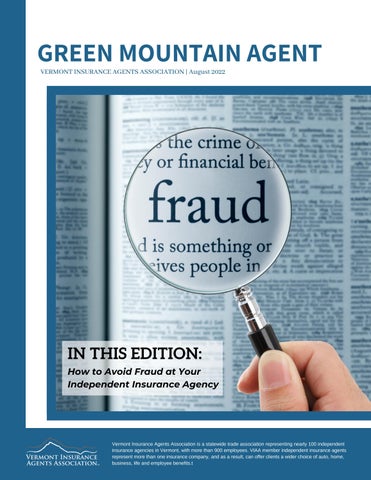
IN THIS EDITION: How to Avoid Fraud at Your Independent Insurance Agency
Vermont Insurance Agents Association is a statewide trade association representing nearly 100 independent insurance agencies in Vermont, with more than 900 employees. VIAA member independent insurance agents represent more than one insurance company, and as a result, can offer clients a wider choice of auto, home, business, life and employee benefits.t
Green Mountain Agent is a publication of
CONTENT ________________ August 2022
4 Evolve 2022
600 Blair Park Road, Suite 100 Williston, VT 05495 Phone: 802-229-5884 Fax: 802-876-7912 www.viaa.org
9 Letter from the President 15 On the Hill
VIAA Officers President Michael R. Barrett
21 Agency Management
Vice President Jessica Fleury, ACSR
How to Avoid Fraud at Your Independent Insurance Agency
Secretary/Treasurer Ian Sutherland, CIC, AAI-M
33 E&O Corner
National Director Ronald Bixby
37 Commentary
Directors Daniel J. Rodliff, CIC, CPIA, LUTCF Aislyn M. Allen, CISR Laurie Audy
41 Agency & Company News
Executive Director Mary M. Farley, MBA, AAIM
www.viaa.org
3
8
www.viaa.org
LETTER FROM THE PRESIDENT ______________________________
August 2022 Is it really August already?!?! Never ceases to amaze me how quickly summer can fly by! I hope you are enjoying time with family and friends and making the most of our “warmer” months! Quick question: did you receive the post card “save the date” invite for EVOLVE22? Our Vice-President, Jessica Fleury and our amazing VIAA staff are busy putting the finishing touches on the event, to be held again this year at the Double-Tree by Hilton in Burlington, September 28th through the 30th. Make sure to take advantage of the networking, learning, and continuing education credits that are all to be part of this amazing event. Keep an eye out for registration opportunities coming soon. As President of VIAA, one of my focuses continues to be member involvement. If you are receiving this Green Mountain Agent Magazine, you are a part of VIAA! Become involved, make your staff and peers aware of all the VIAA has to offer, and let us help you. Also, make sure to thank our many VIAA Company Partners; it is through their generous support of our organization that we continue our efforts to serve the needs of our members.
Michael R. Barrett VIAA President
Still short of your continuing education credits for license renewal next March? Make sure to check out the Education Calendar at VIAA.org. The course lineup is packed with classes for ethics, flood, commercial lines, potential claim issues, and more. Take advantage of the pricing for members and get those credits! We are all in this amazing industry together, so I hope to see you all at the upcoming EVOLVE22 and more! Have questions? Contact Mary Farley (mary@viaa.org) or myself (mike@thebarrettagency.com) Stay well! Michael Barrett President, VIAA
From Mary Farley's Desk 2022 Annual Golf Outing! We are delighted to share that the Association Annual Golf Tournament was a wonderful SOLD OUT SUCCESS! The weather was spectacular and Vermont National Country Club was in beautiful shape and served a great lunch and cocktail hour! In addition to all the fun we had, we also secured the voting to update our new, up to date, By-laws. And, we’re pleased to share that our Mulligan fund raised $420 for our colleague and friend, Pat Murray. Pat continues to stay strong in coping with her terminal cancer diagnosis. She sent a long sincere gratitude as this will help her with copays and medical expenses. Also, our “Stock the Bar” raffle raised $586 for Let’s Grow Kids Vermont! Thank you all for your amazing support and generosity! And a big thank you to our sponsors, especially AIM, Union Mutual and Vermont Mutual for keeping us fed and hydrated out there! We look forward to next year’s event and have already secured June 12th at the same location; so mark those calendars and join us! www.viaa.org
9
10
www.viaa.org
VIAA EDUCATION Any time. Any where. Get it done. viaa.org/Education
14
www.viaa.org
ON THE HILL: Concerning Data Privacy Legislation Passed Out of House Committee
H.R. 8152, the “American Data Privacy and Protection Act" (ADPPA) was passed out of the U.S. House of Representatives Committee on Energy and Commerce by a vote of 53-2. The legislation had previously been introduced by the Chairman of the House Committee on Energy and Commerce, Rep. Frank Pallone (D-New Jersey) and the committee's top Republican, Rep. Cathy McMorris Rodgers (R-Washington). Before the bill was introduced, Reps. Pallone and McMorris Rodgers, as well as Sen. Roger Wicker (R-Mississippi), the top Republican on the U.S. Senate Committee on Commerce, Science, and Transportation, announced that they had reached a deal on data privacy legislation. Notably, Sen. Maria Cantwell (D-Washington), the chairwoman of the Committee on Commerce, Science, and Transportation, opposes the ADPPA and remains committed to her own legislation, S.
3195, the “Consumer Online Privacy Rights Act." If enacted, the ADPPA would create a national standard on what kinds of data companies can gather from individuals and how they can use it. While the legislation includes a limited small business exemption from some provisions, it would still require small businesses to publicly display a lengthy privacy policy including a description of the companies' data security practices, the length of time data is retained, and the processing purposes of the data. Additionally, businesses must notify all customers if there is a change in the privacy policy or practices at the company. Read More Reprinted with permission from IA Magazine
www.viaa.org
15
HOW TO AVOID FRAUD AT YOUR INDEPENDENT INSURANCE AGENCY
agency management
By Patricia Smith Every independent insurance agency must protect its operations from fraud, including bank fraud. Moving money ― both incoming and outgoing ― poses the greatest risk of fraud for an insurance agency. Collecting premiums, paying bills, administering payroll, paying commissions, and moving funds from or to depository accounts all require procedural protocols and consistent monitoring to mitigate risk for the agency. The higher the transaction volume, the greater the risk rises for fraud. Risk is present whether transactions are conducted by check, deposit, wire, or ACH (automated clearing house).
www.viaa.org
Is email a source of fraud? A prevalent risk for fraud is business email compromise, or BEC. The Federal Bureau of Investigation reported that in 2021, the agency received 19,954 email account compromise complaints with adjusted loses of nearly $2.4 billion. In the independent agency channel, agency owners unfortunately have become victims of this type of phishing attack, which involves a criminal impersonating an employee or executive at the agency or a trusted vendor in order to gain access to funds or sensitive information. In many instances, it involves a scheme in which the fraudster has hacked an email
21
How to Avoid Fraud at Your Independent Insurance Agency Continued account and requests a wire transfer or ACH request to move money out of the agency. ACH transactions are a rich target because these transactions are the way agencies move money from their account for payment to carriers and or to collect payment from insureds. The stolen funds are often transferred to crypto currency wallets or out of the country, making it difficult to recover them. Is malicious software used to steal accounts? Corporate account takeover is a crime in which cyber criminals penetrate the computer network of a business and spread malicious software ― such a “keylogger” ― that records the words typed, web browsing history, passwords and other private information. This in turn allows criminals to access your agency software programs, including online banking. As with BEC, these funds are very difficult to recover once they leave the bank. Is check fraud common? Counterfeit or altered checks are still a target for fraud at agencies. Checks are vulnerable from the moment they are issued until they are cashed. Check fraud can include: Stolen checks. Mail theft is still a growing trend, whether the fraudster steals blank checks or written checks placed in the mail.
erases the name of the payee with common household cleaning products. The check is then made payable to the scammer. Because the amount matches the bank statement, the fraud can escape notice until too late. The criminal receives the funds while the legitimate payee endures the hardship. How are an agency’s financial accounts potentially affected by fraud? The compromise of an agency’s financial accounts or computer system becomes a huge disruption to their business. Depending on the dollar amount stolen or type of scheme, the fraud often results in a negative impact to the bottom line. Imagine the hassle of closing accounts, issuing stop payments, ordering new checks and reissuing payments. Often, to recover, the agency must manage two accounts on an interim basis and tell all of their carriers to redirect funds to their newly established replacement account. The victimized agency owner often must hire an expert to perform a computer-hacking forensic investigation. This process aims to detect hacking attacks, properly extract evidence to report the crime, and conduct audits to prevent future attacks. All of this is expensive and timeconsuming.
Check alteration. This is most common with payroll checks. A check for $500 can easily be changed to $5,000. Copying checks. Changing various information on a check and making a color copy has also proven to be easy and effective for fraudsters. Unauthorized printing of checks within an agency. Unfortunately internal check fraud is as great a threat as external fraud. Employees who have access to check printing within the agency have the opportunity to commit fraud. Creating a fake check, whether paper or digital, on the agency’s account.
22
Check-washing. In this growing trend, a scammer steals a check from a mailbox then
www.viaa.org
How to Avoid Fraud at Your Independent Insurance Agency Continued How can an agency combat fraud? The basic steps to protect an agency are straightforward: Put firm procedures in place to deal with access to funds and disbursement of funds. Train your employees to recognize suspicious signs of online fraud. Replace paper check writing with technological cash management products such as online banking, ACH origination, bill pay and wire transfer. Use an automated fraud detection tool known as “Check Positive Pay” or “Positive Pay.” This service, conducted by the bank, compares each check presented for payment against the agency’s check issue file. It also has an ACH component for electronic transactions. It identifies checks or ACH transactions that don’t match, allowing the agency to stop fraud on their account. The agency can view the images of check or transaction exceptions before deciding which items to pay and which to mark as fraudulent. Establish a firm procedure for acting upon email requests to move money. Regardless of whether the request is made by someone internally or by a known vendor, the agency should validate the request by doing what may be old-fashioned: Pick up the phone and call the requester to validate them before acting upon the request. When using remote deposit, be sure that the original checks deposited are safeguarded and that scanned checks are not left unsecured. Ultimately deposited checks should be shredded. The agency that continues to use paper checks should safeguard them in a locked drawer or vault when not in use and make sure no lone employee has absolute access to checks when paying accounts. Rather than allowing mail delivery to the agency, establish a post office box at the local U.S. Postal Service branch to reduce mail theft and access to sensitive information.
The security tips presented here are simply guidelines to aid agencies in diminishing security and privacy risks and managing them. Although none can be guaranteed 100% effective, they can help reduce the probability of becoming the next victim of fraud. Patricia Smith (psmith@insurbanc.com) is vice president and director of Cash Management Services/Business Development officer at InsurBanc, a division of Connecticut Community Bank, N.A. InsurBanc specializes in financial products and services nationally for the independent insurance distribution community. Started in 2001 as a vision of the Big “I,” InsurBanc finances acquisitions and perpetuations and helps agencies become more efficient by providing cash-management solutions.
www.viaa.org
23
28
www.viaa.org
www.viaa.org
29
30
www.viaa.org
C E O & R O N ER
Too Little, Too Late Why You Should Make the Effort to Offer to Insure Properties to Value By Matthew Davis
"Full coverage." Does that phrase sound familiar? It should because we've heard it said by claimants in errors & omissions claim after errors & omissions claim. Why does the insured have inadequate limits? Because you assured them—incorrectly, it turns out—that they had “full coverage.” To make matters worse, you never mentioned a thing about coinsurance or replacement cost, which is how—they solemnly explain to the jury —they wound up with a severely uninsured loss. Over the past decade, Marshall & Swift/Boeckh estimate that some 60% of residential homes are undervalued by roughly 15-20%–and that was before the recent explosion in construction costs caused by supply chain issues, hurricanes, the pandemic and the war in Ukraine. You’ve of course heard that the current rate of inflation may be as much as 8% on an annual basis but the cost to repair or rebuild a damaged property, residential or commercial, is up by about 15%. Consider the implications of the number of underinsured properties in the context of your business. The odds are, many of your customers were already underinsured by their own choice but, even if their policy limits were exactly where they needed to be a year ago, inflation has put even those sensible customers at risk of incurring a coinsurance penalty. If you’re like the vast majority of agents, you have a lot of customers concentrated in a relatively small geographic region. What if it gets hit by a wildfire, hurricane, tornado, derecho or severe rainstorm? You could wind
up with dozens of claims involving customers whose limits are not enough to repair or rebuild their property. Sadly, given the number of customers who have claims each year and the likelihood that inflationary pressures have rendered their limits inadequate, it won’t take a catastrophe to have claimants—and their attorneys—lined up at your door. There is, however, a silver lining to this ominous, dark cloud. In ordinary times, if you asked a customer if they would like a quote with higher limits, their inevitable response would be, “Why?” And in ordinary times, your sensible reply—that it makes good sense to reassess limits periodically to ensure that the property is insured to value— would have often been met with a shrug or “Maybe next year…” This year is different and these are not ordinary times. Plus, inflation is very much in the news these days, so your suggestion that it is time to revisit limits and your explanation is much more likely to be heard. Needless to say, your offer of a quote with higher limits should be made in writing and you need to follow up to close the loop. If your customer still insists upon sticking with their current limits despite your explanation, that’s their decision to make. Just be sure you document it. If they express interest? Do not offer to assess the replacement cost of their property yourself—not unless you have serious training that qualifies you to make such an assessment, especially considering rapidly escalating prices. Ideally, their current property carrier will be willing to make that calculation. If not, be prepared to suggest a local
www.viaa.org
33
Too Little, Too Late continued professional resource, such as an appraiser or construction company, that can offer an expert opinion about the replacement cost of the property. If the expense scares them off, suggest fallback options like an estimator program that calculates replacement cost based on location, square footage, construction type and a variety of other factors that your customer—not you—should provide. The insured is the best person to provide this data and we have seen many E&O claims resulting from errors made when inputting key variables like square footage. Once your customer has arrived at the correct value, obtain written quotes based on that figure. If the carrier has an available replacement guard endorsement, offer that, too. Again, document your customer’s response, and if it is a “yes,” get the new limit in place immediately. Remember: Too little, too late is no good for anyone. Yes, this does sound like a lot of work but bear in mind that many of these efforts will result in higher commissions for you as a benefit of helping your customer. Still not convinced? Count the number of property policies written through your agency, then determine what the deductible is on your E&O policy—and the aggregate, if you’re lucky enough to have one. The real question isn’t whether you can afford to make the effort required to contact all these customers; it’s whether you can afford not to. Matthew Davis is a vice president and claims manager with Swiss Re Corporate Solutions and works out of the Kansas City office. Insurance products underwritten by Westport Insurance Corporation and Swiss Re Corporate Solutions America Insurance Corporation, Kansas City, Missouri, members of Swiss Re Corporate Solutions.
34
This article is intended to be used for general informational purposes only and is not to be relied upon or used for any particular purpose. Swiss Re shall not be held responsible in any way for, and specifically disclaims any liability arising out of or in any way connected to, reliance on or use of any of the information contained or referenced in this article. The information contained or referenced in this article is not intended to constitute and should not be considered legal, accounting or professional advice, nor shall it serve as a substitute for the recipient obtaining such advice. The views expressed in this article do not necessarily represent the views of the Swiss Re Group (“Swiss Re”) and/or its subsidiaries and/or management and/or shareholders. www.viaa.org
Time to Make Government Action Exclusions More Equitable?
William C. Wilson, Jr. CPCU, ARM, AIM, AMM is the founder of InsuranceCommentary.com. He retired from the Independent Insurance Agents & Brokers of America in December 2016 where he served as Assoc. VP of Education and Research and was the founder and Director of the Big "I" Virtual University for over 17 years. www.viaa.org
37
I received an email directed to a list of coverage nerds from Tim Wahl, CIC, a Missouri agent. The email included a link to this news story: “A SWAT Team Tore Down This Woman’s Home and Left Her With a $50,000 Bill” In this case, the property owner not only suffered direct damage, but as a result of the shootout (especially the suicide), she experienced a loss in the form of the diminished market value of the home. This incident reminded me of a claim some years ago where bank robbers barricaded themselves in a small downtown grocery store as the police surrounded them. Long story short, the store suffered significant damage from ammunition rounds and tear gas. The claim was denied by the insurance company, citing this exclusion: Government Action Seizure or destruction of property by order of governmental authority. But we will pay for loss or damage caused by or resulting from acts of destruction ordered by governmental authority and taken at the time of a fire to prevent its spread, if the fire would be covered under this Coverage Part. In this case, the police were not liable either under a governmental immunity statute. Under these laws, recovery from a governmental authority may be minor or nonexistent. These incidents are not common, but they are also not rare.
I desirable for insurers to deny claims for property damage arising from criminal acts of the insured. But for situations like this, innocent insureds have suffered fortuitous losses. A similar exclusion can be found in auto policies. For example, the ISO personal auto policy excludes: A total loss to “your covered auto” or any “nonowned auto” due to destruction or confiscation by governmental or civil authorities. This Exclusion (6.) does not apply to the interested of Loss Payees in “your covered auto”. I’m personally aware of two claims where vehicles were stolen and later used in the commission of a felony. In one case, law enforcement impounded the vehicle for over a year while the case was tried. The innocent insured was denied compensation by both law enforcement and the insurance company. If the auto was stolen, the insured would have been entitled to compensation…from the standpoint of the insured, confiscation by the police is just as fortuitous of a loss as theft by a criminal. As you can see, in the exclusion above, an exception is made for an innocent loss payee. So, why not an exception for innocent insureds? If and when the vehicle is released, the insured could perhaps have the option of keeping the monetary settlement or returning it to the insurer in exchange for the vehicle.
We have seen the kind of damage to property that can occur from active shooter episodes in recent years. While a relatively minor claim, we saw a homeowner’s boat riddled with bullet holes when one of the Boston Marathon bombers was cornered in the boat.
38
Historically, this type of exclusion exists to preclude coverage for government-mandated seizure or destruction of condemned property as a public safety hazard or RICO seizures of property. It is understandable and socially
www.viaa.org
www.viaa.org
39
40
www.viaa.org
COMPANY & AGENCY NEWS www.viaa.org
41
Vermont Mutual Recognized by Ward Group as a Top 50 Insurer for the 14th Consecutive Year For the 14th consecutive year, Vermont Mutual Insurance Group® has been recognized as one of the top 50 Property and Casualty insurers in the United States by Ward Group, an Aon Hewitt company, and one of the industry’s most respected benchmarking organizations. Annually, Ward Group identifies the industry’s top insurance companies through a comprehensive financial analysis of nearly 3,000 U.S. property and casualty insurers. The “Ward’s 50” recognizes insurers for their consistency, safety and superior financial performance. Every company recognized by Ward Group has passed all safety and consistency screens and achieved superior performance over a 5 year period. As a recipient of the Ward’s 50 designation for 14 years in a row, Vermont Mutual has once again affirmed its position as a leading provider of homeowner, automobile and business insurance in the Northeast.
Scott Boardman Celebrates 40 Years with Hickok & Boardman Insurance Group Xxxxx Hickok & Boardman Insurance Group is pleased to announce the 40th Anniversary of Scott Boardman, Chief Executive Officer of Hickok & Boardman Insurance Group. Scott joined Hickok & Boardman in July of 1982, as a Property & Casualty Agent and was elected Vice President in 1989. In 1992, Scott was elected Executive Vice President and Chief Operating Officer. In 1994, Scott was elected President and CEO, and in 2021 he assumed the role of CEO.
42
www.viaa.org
Union Mutual Honored by NAMIC for Innovative Employee Development Program Union Mutual Insurance Company is proud to announce its Employee Development Program has received national honors from the National Association of Mutual Insurance Carriers (NAMIC). The Program earned Best in Category – Adaptability during the 9th Annual Award in Innovation presentation at the 2022 NAMIC Management Conference. The Company implemented the Program to accelerate professional development and give employees a greater sense of connectivity, belonging, and purpose within the workplace. The Program also allows the Company some flexibility in hiring and serves as a mechanism to “find the right person for the right seat.” Union Mutual invests in its employees and seeks to grow internal resources to create the workforce of the future. Criteria for the Innovation Award include: impact on perpetuating the mutual insurance creativity Union Mutual Honored byindustry; NAMIC for ofInnovative idea; numbers and/or dollar impact relative to size of Development Program insurer; potential for the idea to be adapted and used by other NAMIC members; and alignment with the NAMIC Xxxxx focus areas of strategy, innovation, leadership, industry trends, and the economy.
www.viaa.org
Employee
43
44
www.viaa.org
www.viaa.org
45