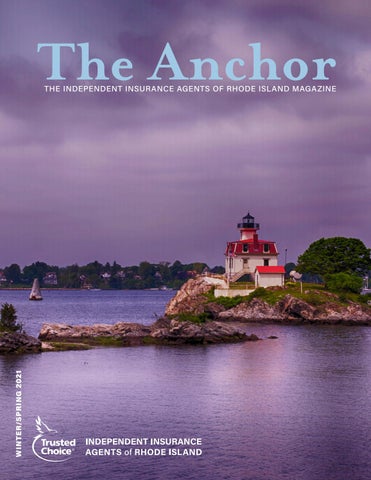
The Anchor
WINTER/SPRING 2021
THE INDEPENDENT INSURANCE AGENTS OF RHODE ISLAND MAGAZINE
By having EMC offices across the country, our representatives are better equipped to help agents tap into the local market and grow their businesses. Insights harvested from these trusted partners also inform our future innovations and product offerings. As an EMC independent insurance agent, these are just a few ways you’ll know you can always Count on EMC ®. emcins.com
©Copyright Employers Mutual Casualty Company 2021. All rights reserved.
CONTENTS
WINTER/SPRING 2021 | DIGITAL RELEASE ONLY Independent Insurance Agents of Rhode Island
President Perspective ............................................. 7 Executive Vice President Perspective ....................... 8 PAC Donations .....................................................
10
Content to Share .....................................................
12
Agency Receivables .................................................
13
E&O Corner.............................................................
14
Partners 2021...........................................................
16
Case Law Notes ......................................................
18
Legal Corner
......................................................
20
Workers’ Compensation............................................
24
Human Resources Corner ........................................
27
Marketing Corner.....................................................
28
Guest Column - WAHVE............................................
31
Government Affairs Corner............................................ 33
16 Thanks to Our Partners
214 Insurance Coverage Checklists
20 Covid Legal Retaliation
Independent Insurance Agents of Rhode Island Winter/Spring 2021
3
Our E&O program is geared specifically towards the Independent Insurance Agents of Rhode Island. Our carriers have over 40 years of experience in placing insurance industry professional liability coverage. We have broad coverage forms, and “yes”, with lots of bells and whistles. We can also provide coverage extensions on the E&O policy for minimal business in real estate, mutual funds, financial products, employment practices and cyber liability Protect your agency and staff with an E&O policy that works as hard as you do! Not already part of our program? Act today. Contact your state E&O Program Director : Helen Collins at 401-732-2400 / hcollins@iiari.com.
To get a premium indication complete an application now:
Visit our website
Coverage is subject to the terms, conditions, and exclusions of the actual policy, which forms the contract between the insured and the insurance company. Available coverages, credits, and options may vary by state. Insurance products underwritten by Westport Insurance Corporation, Overland Park, Kansas, a member of Swiss Re Corporate Solutions.
OFFICERS President
Kenneth Thompson, Jr.
President Elect
Michele Calabrese
Vice President
Anthony Bucci, Jr. CPCU, AIS
State National Director
William J. Hunt, CPCU
Immediate Past President
Denise T. Smith, CIC
ADVERTISERS
INDEX
DIRECTORS Terms Expire 2021 Sean P. Daly, CPCU Daniel Lathrop Terms Expire 2022
Terms Expire 2020
Margaret Longolucco, CIC Joseph Paiva Thomas. J. DiSanto, JD, LLM, CIC Christopher Slocum, CIC, CPIA
EMC Insurance ............................................... 2 Big I Professional Liability Big I Markets
............................... 4
............................................... 6
Servpro®......................................................... 9 IIARI PAC
................................................ 12
STAFF
Big I Hires
Marcia L. Berthiaume, AAI, ACSR, AIS, CPIA State Account Manager, Emerging Leaders Liaison
................................................... 23
E-Pay Policy
Helen Collins, AAI, AIS, CPIA Director of Professional Liability Sean R. Donaghey, CPCU Senior Vice President, State Account Executive
................................................ 26
JH Communications
....................................... 29
PS&H ............................................................ back
Toni Drowne Communications & Marketing Manager Jack Hutson, CAE Senior Vice President, Business Development Lori Kaufman Executive Assistant/Member Services Coordinator
EDITOR’s NOTE (2021):
Maureen McNamara, AIS, ACSR Assistant Treasurer, Director of Finance
Due to the ongoing COVID-19 pandemic, we have decided to publish this edition digitally.
Mark A. Male, MLIS Executive Vice President, Secretary/Treasurer Jean E. Nagle, AAI, ACSR, AIS Assistant Vice President, Director of Education Sarah Ribera Assistant Director of Education & Membership The Anchor is published by the Independent Insurance Agents of Rhode Island (IIARI). Statement of fact and opinion is made based on the responsibility of the authors alone and does not imply an opinion on the part of IIARI, it’s officers, directors or members. Subscription rate for members is $15, which is included in dues. Subscription rates for non-members is $75 per year. (single copies $10). Reprint requests should be referred to IIARI. Copyright © 2021 Independent Insurance Agents of Rhode Island.
Independent Insurance Agents of Rhode Island Winter/Spring 2021
5
Independent Agents of Rhode Island - Product Availability
Personal Lines: •
•
Affluent Package ▪
AIG
▪
Chubb
Auto & Home – Standard Markets ▪
MetLife Home & Auto
▪
Progressive
▪
Safeco
▪
Travelers
Commercial Lines: •
Bonds: Bid, Contractor, Performance, Surety
•
Commercial Auto Monoline
•
Community Banks Business Insurance Program
•
Cyber Insurance – Coalition
•
Cyber Liability-Small Business Solution
•
Flood - In, Above & Outside of the NFIP!
•
Pollution Contractors-Farms-USTs-Other
•
Flood - In, Above & Outside of the NFIP!
•
Real Estate Agents/Property Manager E&O
•
Home Business Insurance
•
Small Commercial Markets
•
Jewelry
•
Non-standard Homeowners, Renters, Condominium, Rental Dwellings, Vacant Dwellings
•
Personal Excess Policy
•
Personal Umbrella Policy
•
Recreational Marine
•
Recreational Vehicles
▪
Travelers
▪
Chubb
▪
CNA
Life & Health: •
Life, Disability and Long-Term Care ▪
Revised 6/22/2020
Crump Life Insurance Services
*Product availability varies by state.
PRESIDENT PERSPECTIVE
Convention & Golf for 2021 I can see the light at the end of the tunnel. I finally started to watch the news
again because the stories are becoming more positive every day. More and more people are being vaccinated and all I can think about is seeing my family, friends, and those in our industry at a function having a good time together soon. Unfortunately, we will not be able to have an inperson conference this year. We had an exploratory committee looking at it from every direction trying to make it work. Based on the feedback from members, exhibitors, and the hotel we came to the difficult decision to cancel for 2021. We could not accommodate everyone in the space needed under the current covid rules. The rules might change in June but if they did not, we would have been obligated to pay our food and beverage contract with the hotel.
SAVE THE DATE MONDAY JUNE 14 Crestwood Country Club Rehoboth, MA
I am excited to tell you that we will be having a golf event this June which will give us the opportunity to see old friends and company representatives safely outdoors. We will be sending out registration details of the event shortly so stay tuned. It will be held at the Crestwood Country Club in Rehoboth on Monday, June 14.
I know we are all trying to figure out how we will open our offices so that we can help our clients the way they are used of us servicing their accounts. If the board can help in any way, please let us know. In the interim, please continue to protect your employees and customers until we can safely gather.
I want to assure everyone the board has not stopped working for its members. We continue to have zoom meetings discussing what we could do for our members short and long term. The board discussed reinstituting the board member liaison program. We will assign a board member a list of agencies that they will be assigned so if you have any questions or concerns you have someone you can reach out to. Also, when we have important information that our members should know your board liaison will be contacting you directly. You should also look at this as a way to elevate industry, association or agency concerns to the board’s attention. Ideally, this is a mechanism that will ensure the agency principals will remain in touch with your Association and know that your opinion matters.
7
Winter/Spring 2021
Kenneth Thompson Lezaola Thompson Insurance IIARI President
EXECUTIVE VICE PRESIDENT PERSPECTIVE
Changes for the Independent Agent Who could have possibly conjured up a
scenario where our economy would suddenly retract substantially and unemployment would spike? How about the rampant fraud that came with the PPP loans and unemployment claims? My name was used to file an unemployment claim so now I monitor my credit reports like a hawk with concern that someone might try to use my personally identifiable information to obtain credit or file my taxes! So, we are in year two of this unbelievable reality defined by a pandemic. The Association has had to navigate these waters as business continues, members still need continuing education and training, bills are still introduced in the General Assembly, and the demand for products and services continues without pause. Amid all this disruption, Nationwide moved their producer base to independent agency status, and we are happy to welcome many of those agencies into our group. Market access has always been an issue,
especially so for smaller agencies who cannot produce the required amount of premium volume to warrant consideration for an appointment by many insurance companies. When IIARI did a member survey in 2019, it revealed smaller agencies need markets and, not unexpected, the larger agencies did not. Based on this qualitative and quantitative data, the board bought into a platform called Independent Market Solutions (IMS) that is owned by many state associations around the country including us. This mechanism, while in its infancy, may provide market solutions that will compliment the IIABA’s Big “I” Markets platform. National has worked hard to modernize the experience and to remove some of the challenges agents countrywide faced in putting business through Big “I” Markets. Coupled with IMS the organizations desire is to provide invaluable market access to members without regard to their size. You can check it out at IMSAccess.com Another challenge has been, and continues to be, identifying new agency personnel. Your president, Ken Thompson, and I met with some individuals from CCRI to explore a program that would prepare people to enter the insurance field. CCRI has already done this with success in other sectors and while discussions have only recently begun, we are encouraged this may provide a workable solution that members can tap into in the future. A key element would be that the agent community gets first “dibs” on individuals going through the program before they are made available for the general insurance industry in Rhode Island. Ken is scheduling additional meetings and be assured we will
Robert J. Pettinicchi, Mark Chief Male Lending officer, Executive Insurbanc Vice President
Winter/Spring 2021
8
keep you apprised as developments evolve. Finally, a word about convention. If you attended a convention in recent years, you will be keenly aware of the low registration fees to attend. Thanks to Beacon Mutual who essentially underwrites the registration for commercial lines CSRs, for many principals there is no cost to participate. You may wonder how we can do a convention when most of the registration costs are absorbed and for agency principals, nearly for free? The answer goes to two critical factors. Sponsors and Exhibitors. The support from IIARI Sponsors through the Partners Program and even more so the registration fees paid by exhibitors make it all possible. Why am I sharing this information? When we surveyed our exhibitors on appetite to attend an in-person event in 2021, the results were lukewarm at best. So,
with that as a backdrop, the board made the difficult decision to forego an event in June. We will look to a possibly distanced annual meeting in September but we will evaluate the situation as we proceed through the first and second quarter of the year. In the end, we need to continue to buckle up and prepare for the unknown. Your continued support gives us direction and we remain committed to the independent Agents in Rhode Island. Stay safe!
When Selecting a Company That Does It All, Choose the New Reconstruction Leader.
WE DO THAT! SERVPRO of Providence – 401.941.5500 ®
For Immediate Dispatch: 24 Hour Response
•Fire Damage Cleanup •Water Damage Cleanup •Mold Remediation •Soot Damage Removal •BioHazard Cleanup •Document Drying •Reconstruction Services •Drying & Dehumidification
24 | 7 | 365
“Your Single Call Solution”
Independent Insurance Agents of Rhode Island Winter/Spring 2021
9
2020 PAC Contributors!
Our Association’s 2021 PAC solicitation campaign is underway. It’s important that we support our PAC because we are in a highly regulated industry and there there are many factions that would propose changes that would be harmful to our customers or to our agencies. By having a vibrant PAC we are able to help get our voice heard. During the 2021 legislative year there will be new leadership and we will need to re-establish our presence. During the 2020, year even though most traditional fund raisers were canceled, many interest groups continued to make contributions to candidates. If we don’t keep up we will fall behind. Please make a meaningful contribution.
IIARI PAC CONTRIBUTORS 2020 GOLD
BRONZE
Edward Bishop EF Bishop Agency
Melanie Loiselle-Mongeon, CIC, AAI, AIS Loiselle Insurance Agency
Christopher N. Brook Brook Insurance Associates, LLC
Mark A. Male, MLIS Ind. Ins. Agents of Rhode Island
Robert Loiselle, CIC Loiselle Insurance Agency
Bintou Chatterton Chatterton Insurance, Inc.
Nancy Mendizabal Apple Valley Agency
Doug Mayhew, CIC OceanPoint Insurance Agency, Inc.
Matthew F. Clarke, AAI, CIC OceanPoint Insurance Agency, Inc.
Ernest Shaghalian Jr. Alpine Insurance
Roger L. Messier, CPCU Butler & Messier, Inc.
Thomas Dacey Dacey Insurance Managers, Inc.
SILVER
Richard A. Padula, CIC The Hilb Group of New England, LLC
Sean P. Daly, INS, CPCU, ACSR, PGI Affiliated Insurance Managers, Inc.
Joseph J. Paiva The Agency Paiva, LLC.
Trevor Edge A.N. Nunes Agency, Inc.
Frank Richard Esten & Richard Agency, Inc.
Robert Hartnett Interstate Insurance & Finance Co.
Barry Sutcliffe Bradford-Sutcliffe Ins. Assoc., Inc.
Brian M. Hunter, CPCU, CIC Hunter Insurance, Inc.
Kenneth Thompson Jr. Lezaola Thompson Insurance, Inc.
John Kaull, AIA, ACSR OceanPoint Insurance Agency, Inc.
David White Butler & Messier, Inc.
Barbara Kirby Esten & Richard Agency, Inc.
Michele Calabrese Farmington Insurance Agency, Inc. William Combies Bentsen-Combies Insurance, Inc. Francis X. Doyle AAA Northeast Insurance Agency Inc. John T. Edge, Jr., CIC A.N. Nunes Agency David Gates Gates Insurance Agency, Inc 10
Winter/Spring 2021
The Anchor
Sherry LaPointe World Insurance Assoc., Inc.
Bruce Messier, AAI Butler & Messier, Inc.
Richard Rheinberger Affiliated Insurance Managers, Inc.
Margaret M. Longolucco Mansfield Insurance Agency, Inc.
Marc Nadeau, CPIA Blais Insurance
Stan Tabak John J. Clarke Insurance, Inc.
Brenda Marcotte Loiselle Insurance Agency, Inc.
A. Alan Oliver Oliver Insurance Agency, Inc.
Steven Thibault Esten & Richard Agency, Inc.
Mark Matrone, CIC John Andrade Insurance Agency, Inc.
Gregory Oliver Oliver Insurance Agency, Inc.
William R. Warburton, Jr. The Hilb Group of New England, LLC
INSURPAC CONTRIBUTORS 2020 CENTENNIAL CLUB
FOUNDERS CLUB
Mark A. Male, MLIS Ind. Ins. Agents of Rhode Island
Edward Blais Blais Insurance
GOLD CLUB
Christopher N. Brook Brook Insurance Associates, LLC
Frank Richard Esten & Richard Agency, Inc.
PIONEER CLUB Michele Calabrese Farmington Insurance Agency, Inc. William J. Hunt Sr. , CPCU Shove Insurance, Inc. Brian M. Hunter, CPCU, CIC, AAI Hunter Insurance, Inc. John Lathrop Lathrop Insurance, Inc. Melanie Loiselle-Mongeon, CIC, AAI, AIS Loiselle Insurance Agency Robert B. Loiselle, CIC Loiselle Insurance Agency Doug Mayhew OceanPoint Insurance Agency, Inc. Mark Matrone, CIC John Andrade Insurance Agency, Inc. Kenneth Thompson Jr. Lezaola Thompson Insurance, Inc. J. Theodore Ray Duxbury & Ray Insurance Agency, Inc.
Matthew F. Clarke, AAI, CIC OceanPoint Insurance Agency, Inc. David Gates Gates Insurance Agency, Inc.
John Kaull, AAI, ACSR OceanPoint Insurance Agency, Inc. Garry Mansfield Mansfield Insurance AGency, Inc. Bruce Messier, AAI Butler & Messier, Inc Alexander Paiva The Agency Paiva, LLC Joseph Paiva The Agency Paiva, LLC
Marc Nadeau, CPIA Blais Insurance
Nicholas Paiva The Agency Paiva, LLC
A. Alan Oliver Oliver Insurance Agency, Inc.
Denise Smith Smith Insurance Group, Inc.
Gregory Paquin OceanPoint Insurance Agency, Inc.
Stan Tabak John J. Clarke Insurance, Inc.
CONTRIBUTOR
Ralph Woodmansee Woodmansee Insurance, Inc.
Charles Balfour, Inc Bud Balfour Insurance, Inc. Maurice Bessette, Jr. Bessette Insurance Alan Chatterton III Chatterton Insurance, Inc. Sean P. Daly, INS, CPCU, ACSR, PGI Affiliated Insurance Managers, Inc. Donna Gelsomino Affiliated Insurance Managers, Inc. Margaret M. Longolucco, CIC Mansfield Insurance Agency, Inc.
Ernest Shaghalian Jr. Alpine Insurance
Independent Insurance Agents of Rhode Island Winter/Spring 2021
11
When you give to our PACs, we all win Ensure the independent agent’s voice is heard in the halls of Providence and D.C.
visit iiari.com/pacs
CONTENT-TO-SHARE A full library of ready-to-use social media content
Using Trusted Choice’s Content-To-Share is easy and FREE for members. Simply log in, browse, download and you can use our content for any occasion, holiday or insurance type to maintain a social media schedule! The Content-To-Share page provides members with a plethora of designed graphics, videos, and infographics that your agency can use on its social media, website and other platforms to encourage consumer engagement and maintain a consistent social media presence!
Free Monthly Social Media Calendar Updated monthly, this calendar gives you an outline of suggested posts including images and copy so you can just plug and play right into your social channels!
Visit trustedchoice.com/agents to begin using this content and return regularly to see what’s new!
E&O Corner
The Importance of Using Insurance Coverage Checklists One of the best E&O loss control practices for insurance agencies and
brokerages to follow is the use of coverage checklists. This simple, but highly effective, E&O loss control practice is one that any size, or type of, agency or brokerage can easily implement and follow. In this issue of The E&O Corner, we will discuss how insurance coverage checklists should be used and the many benefits that they provide when they are used on a regular basis. The primary benefit of using insurance coverage checklists is that they help protect an agency or brokerage from E&O claims and lawsuits being made by customers on the basis that various coverages were not offered to them. An insurance coverage checklist can prove to be a valuable piece of documentation if an insurance agency or brokerage is forced to defend itself against a claim made by a customer that it failed to obtain a particular type of insurance coverage to cover a loss. In fact, many professional liability insurers specifically ask on their applications whether the insurance agency or brokerage to be insured under the policy regularly uses insurance coverage checklists. This question is asked because the E&O insurers are aware that coverage checklists can be instrumental in defeating an E&O claim based upon allegations of failure to procure coverage. For this reason alone, every insurance agency or brokerage should implement a procedure pursuant to which insurance coverage checklists are used consistently by all employees when they are reviewing possible coverages with customers and potential customers.
checklists is that quite often they will have the customer think about coverages or exposures that they had not originally contemplated. When this occurs, customers will often purchase insurance for risks or exposures that they had not planned on insuring, which then helps the agency or brokerage sell more insurance. This factor not only helps protect the customer by providing insurance for something that they did not originally consider insuring, but it also helps increase the sales of the insurance agency or brokerage. Sample insurance coverage checklists are available for insurance agencies and brokerages from many sources, including but not limited to the Virtual Risk Consultant under the Membership tab of the Independent Insurance Agents of Rhode Island’s website. However, as each agency or brokerage has its own unique type of business and areas of specialty, there is no one form checklist that fits the needs of every agency or brokerage. An agency or brokerage that seeks to implement the use of insurance coverage checklists should carefully review the various forms that are available and then modify the forms to fit within the parameters of how that particular agency or brokerage operates and the types of customers that it has. One important question that every insurance coverage checklists
Another benefit of using insurance coverage checklists is that they help ensure that consistent information is being provided to customers no matter which employee, or which office location, of the agency or brokerage they are dealing with. When used consistently throughout an agency or brokerage, insurance coverage checklists can help provide better customer service to all customers. An additional benefit of using E&O coverage 14
Winter/Spring 2021
The Anchor
in face-to-face meetings. If the coverage checklist is reviewed in person with a customer, a good practice is to have the customer complete and sign the form to acknowledge that the coverages were reviewed. Once the coverage checklist is completed and signed, the agency or brokerage should save the checklist in the customer’s file. If a checklist is reviewed instead with a customer over the telephone, notes of that discussion can either be made on the checklist form or in the agency management system. When insurance coverage checklists are used by an agency or brokerage one of the most important things to require is that they are used consistently by all employees on a regular basis.
should have is a catchall question at the end asking the customer whether they have any other insurance or risk that they would like to discuss other than what was reviewed with the agency or brokerage on the checklist above. This question puts the burden on the customer to affirmatively request information concerning anything that was not reviewed with the agency or brokerage.
For all of the reasons discussed above, the prudent insurance agency or brokerage should make certain that all employees consistently use insurance coverage checklists when discussing coverages with customers and potential customers. In our experience, insurance coverage checklists are one of the best E&O loss control practices to follow because they not only provide E&O protection for the agency or brokerage, but they also with help a customer identify risks and exposures that they may not have originally contemplated, which in turn will help sell more insurance.
Coverage checklists should be used when discussing insurance coverages with both insureds and potential insureds either on the telephone or
Keidel, Weldon & Cunningham, LLP
concentrates its practice in the defense of insurance agents’ and brokers’ errors and omissions claims and litigation, errors and omissions loss control counsel and education, insurance coverage analysis and litigation, and insurance regulatory matters. Please direct any comments or questions to James C. Keidel, Esq., Christopher B. Weldon or Robert Walker Lewis either by mail at the firm’s Rhode Island office located at 303 Jefferson Boulevard, Warwick, Rhode Island 02888, by email at jkeidel@kwcllp.com or cweldon@ kwcllp.com, or by telephone at 401-773-7730.
James C. Keidel, Esq. Partner, Keidel, Weldon & Cunningham, LLP
Christopher B. Weldon, Esq. Partner, Keidel, Weldon & Cunningham, LLP
Thank you! 2021 IIARI
PARTNERS Without their continued support, the ability to deliver membership benefits would be significantly compromised. Please help us thank them for continuing to support us over the year.
16
Winter/Spring 2021
The Anchor
Diamond
Gold Silver
Bronze EMC Insurance
Quincy Mutual Fire Insurance Co.
Hospitality Insurance Group
Providence Mutual Fire Insurance Co.
Johnson & Johnson, Inc. CMGA
SWISS RE Corporate Solutions
MAPFRE Insurance
Utica National Insurance Group
NLC Insurance
Vermont Mutual Insurance Group
Providence Mutual Fire Insurance Co. Independent Insurance Agents of Rhode Island Winter/Spring 2021
17
CASE LAW NOTES
3 C’s You Should Know: Cyber-Attacks, COVID-19, and Coverage Ransomware. It sounds bad, and it can be fatal to a company’s operations. Ransomware attacks typically involve the infection of computers with malicious software, often downloaded by clicking on links in emails or website pop-ups. These infections often leave users locked out of their own systems, coupled with a demand for ransom funds that must be paid to restore a company’s computer functions or data. Ransomware attacks have been unrelenting during the COVID-19 pandemic and indeed have been specifically aimed at some of the most crucial sectors, such as health care. The New York Times recently reported that, even during the COVID-19 era, cyber-attacks on hospitals and health systems “have become their own kind of pandemic.” But the health care industry is far from alone in being targeted: there was a dramatic overall increase in the severity of ransomware attacks in the first half of 2020, with the average ransom demands reportedly increasing 100% or more from 2019 through the first quarter of 2020, and then jumping another 47% from the first to second quarters of 2020. In the second half of 2020 and into 2021, the trend has continued unabated. Picture an official-looking email, addressed to you personally, that indicates that you’ve been identified as someone who was exposed to COVID-19 and to click a link for further information. One can imagine that over the course of the last twelve months, such emails have proliferated, and been successful at a greater clip than ever before. Additionally, with all the workplace changes that the last year has brought, it’s not surprising that companies are now at a particularly acute risk of ransomware attacks. With employees working remotely, and monthly or even weekly changes to processes and procedures, there are multiplying cracks in security for bad actors to exploit. Business email systems remain a near-constant target, and criminal actors are always seeking vulnerabilities they can exploit. A 2020 federal court decision out of Maryland highlights some of the risks that insurers face as a result of the barrage of cyber-attacks. The decision indicates that policyholders may potentially have insurance coverage 18
Winter/Spring 2021
across a variety of insurance products for losses beyond just “ransom” payments. In Nat’l Ink & Stitch, LLC, v. State Auto Prop. & Cas. Ins. Co. (D. Md. Jan. 23, 2020), a federal district court held that a policyholder who had suffered serious damage from a ransomware attack was entitled to all-risk property coverage for their lost data, lost software, and for their damaged computer system itself. The court held that the property insurance policy at issue provided coverage for replacement of a business’s computer system damaged by a cyber-attack, even though the policy did not explicitly provide cyber coverage. Insurers and policyholders alike should take note of this decision that exemplifies what has been called “silent cyber” coverage. That is, cyber insurance coverage—despite the actual policy language neither expressly contemplating nor being sought or designed to cover such risk. At issue in National Ink was a property insurance policy, which would typically cover a loss to tangible property. The policy was interpreted to provide coverage for damage resulting to data and software, items that are generally considered intangible property. Judge Gallagher of the U.S. District Court in Maryland held that the insurer was required to pay its insured on a property damage claim after suffering a ransomware attack. The policy covered direct physical loss of or damage to “covered property.” And under the Policy, that property included “electronic media and records (including software)”. The insured submitted a claim seeking replacement for its computer system after it was compromised in the cyber-attack. The insurer denied, on the grounds that the cyber-attack and subsequent damage to the computer system itself did not amount to a “direct physical loss for or damage” to the computer system. The insured filed a coverage action, and the parties cross-moved for summary judgment. The insurer argued that because the insured
The Anchor
only lost data, and because it could still operate its computer system, the insured had not experienced any “direct physical loss”. The insured countered that the plain language of the Policy included data and software as property subject to a “direct physical loss,” that its system had been damaged—as the attack permanently impaired its functionality—and that certain data was unrecoverable, therefore it had suffered a “direct physical loss.” The court agreed, holding that the claim denial was improper: the insured could recover under the Policy based on either the loss of data and software or the loss of the system functionality itself. The court relied on decisions from other federal courts which had previously held that data or software may be susceptible to physical loss or damage claims, and cases analyzing whether a system which has only limited functionality (though still some functionality) bars a finding of “physical loss or damage.” The Court found that a complete and utter inability to function is not required to establish physical damage – rather, loss of use, or even just impairment of functionality, was sufficient. The court relied on the plain language of the Policy, which defined the covered property to include data, software, and other electronic media, leaving it unclear whether damage from a similar cyber-attack would constitute a tangible property loss under another policy that had language that less clearly contemplated software and data.
In short, the National Ink court held, “not only did [the insured] sustain a loss of its data and software, but [the insured] is left with a slower system, which appears to be harboring a dormant virus, and is unable to access a significant portion of software and stored data. Because the plain language of the Policy provides coverage for such losses and damage, summary judgment will be granted in favor of [the insured’s] interpretation of the Policy terms.” This case underscores the issue that policyholders may potentially be found to have coverage for serious cyber incidents under policies that are not cyber-specific, including not only property policies as in National Ink, but also potentially policies that insure against crime, D&O and E&O losses and claims. In the context of ever-increasing cyber threats, particularly in the COVID-19 era with its attendant increases in risk for cyber-attacks, insureds and insurers alike should closely examine policy terms with an eye towards cyber risks, even in policies that do not appear at first to cover such losses.
Travis McDermott Partner, Partridge Snow & Hahn 19
Winter/Spring 2021
Legal Corner
COVID-19 Retaliation COVID-19 Is Going to Get Your Company Sued for Retaliation Many employers are worried that COVID will result in legal liability from employee claims. However, some employers are still focusing on the wrong things. Understanding What Is (and Is Not) Likely to Get You Sued Absent legislation or an executive order, liability from COVID safety employment claims is not likely to be substantial given: (1) the difficulty in proving causation in the context of a contagious disease present in the general population; (2) the number of mild COVID cases limiting actual damages; and (3) if a law change were to occur allowing certain employees to bring such claims without proving causation, the same would likely only be allowed under the workers’ compensation system. With respect to the last point, it is notable that in Rhode Island, the workers’ compensation exclusivity doctrine is extremely broad, covering employer’s intentional torts against their employees, Cianci v. Nationwide Ins. Co., 659 A.2d 662, 670 (R.I. 1995), and extending to an employer’s officers, agents, and employees. R.I. Gen. Laws § 28–29–20. In addition, current proposed bills such as 2021-H 5474 would only allow presumptive eligibility for workers’ compensation benefits for essential workers, not litigation. However, as noted in our article previously published in the Summer 2020 issue of The Anchor, titled, COVID-19 Is Going to Get Your Company Sued for Wage Payment Mistakes, Anchor issue, COVID presents real liability issues for employers outside of worries regarding sick employees or broken safety standards. In addition to the wage and hour liability previously discussed, COVID has created a large potential for whistleblower claims and National Labor Relations Act (“NLRA”) violations.
Your Employees are Blowing the Whistle (and You May be Missing It) Under the Rhode Island Whistleblowers’ Protection Act, R.I. Gen. Laws § 28-50-1, et. seq. (“RIWPA”), Rhode Island employees are protected whenever they
complain about something that they believe is a law violation, whether or not they are correct in their belief that the practice is occurring and whether or not the practice actually violates the law. The significance of being “protected” is that the employee cannot be disciplined, warned, given a poor review, terminated, or otherwise treated adversely. Moreover, even when an employer takes an adverse action against the employee for a totally separate reason that is close in time to the protected complaint, a retaliation claim will be difficult to defend. In the COVID whistleblowing context, companies are receiving more complaints that are protected under the whistleblowing law in two specific COVID-related categories. The first category is relatively easy to spot. This consists of employees who are worried about the virus and believe their employer is not doing enough to protect them. For example, an employee who complains that the company is not following the latest executive order on occupancy restrictions in the office context (which as of February is 33% in Rhode Island except when work cannot be performed from home) is protected from retaliation. The protection attaches even when the employee is dead wrong about either the number of employees going into the office (e.g., even if only 10% of employees are going into the office) or the terms of the order (e.g., the order expired and now 100% of employees can be present). Despite the protection, employers should note that while they cannot behave adversely towards the employee for
Winter/Spring 2021
20
their complaint, they can still make the employee go into the office and do not have to allow the employee to work from home.
non-supervisory employees when discussing their terms and conditions of employment with their co-workers or taking actions likely to lead to or facilitate such discussions. “Terms and conditions of employment” includes discussions about policies (or lack of policies) related to working onsite, wearing masks, social distancing, and other COVID issues. Under the NLRA, the employees who publicly post about how your Company is “threatening their lives” by requiring them to come into the office once a week (no matter how essential the work is) are protected. Also under the NLRA, the employees who are laughing and making jokes on breaks about how “stupid” the boss’s reminders about “remembering to keep their mask above their nose” are equally protected.
Employers are more frequently missing the second category of protected COVID complaints. This category contains the employees who are angry about the COVID restrictions and believe their rights are being violated with respect to COVIDrelated safety procedures. Examples of this include the employee who tells their supervisor that the workplace rule requiring them to wear masks is “unconstitutional” or that it is illegal for an employer to take their temperature. While employees do not have constitutional rights in private employment and the Equal Employment Opportunity Commission has temporarily suspended the prohibition on temperature checks during this pandemic, again the employee is protected despite being wrong. An employer who chastises the employee’s challenge of the mask policy as being reprehensible or selfish violates the whistleblower protection, even though the policy is not only legal but actually is required by the law. Again, employers need to understand that while the conduct is “protected,” the employer can still require the employee to wear the mask and get the temperature check.
Like all NLRA protected activities, the protections are subject to time, place, and manner restrictions, which means if you would prohibit the employee from talking about other personal topics during working time (such as their favorite television shows), you can prevent the discussion of the “stupid” mask reminders. It also means you do not have to allow an employee to stand on their desk to yell about your in-office work policy. However, the NLRA bars employers from prohibiting engaging in such discussions outside of work hours (such as after work on social media or on breaks).
The NLRA Gives Additional Protections for Employee Complaints about COVID
continued next page >>
The National Labor Relations Act (“NLRA”) protects
21
Winter/Spring 2021
Brian Fishman Associate Partridge Snow & Hahn
Alicia J. Samolis Partner, Partridge Snow & Hahn
How Employers Can Protect Themselves from COVID-Related Retaliation Claims Rhode Island employers should take the following steps to deal with these ever-increasing risks: •
Train supervisors to recognize employee complaints of illegal or unsafe company actions as protected and to report the information to human resources or other designated role. Supervisors should not be handling the complaint process, but all supervisors need to be adept at recognizing these complaints as protected and raising them to management/human resources.
•
Have policies clearly setting out which designated employees should receive complaints. While this does not prevent employees from being protected when they go to their supervisor or other member of management, it does make it more likely the complaints get to the correct person and are not missed.
•
Deal with all legally protected complaints in a reasonable and uniform fashion. Specifically, human resources or another designated role should speak with the employee with the complaint, confirm the company is not doing something illegal (with management, legal counsel or further factual investigation if needed), meet with the employee to explain why the action the company is taking is legal, and then document the process in the company’s files.
•
Given the vast number of COVID related complaints, management and human resources should be reviewing performance warnings and terminations to ensure prior protected conduct is in no way part of such negative decisions. In particular, adverse actions relating to a failure in “being a team player,” “negative attitude,” “positivity,” “adaptability,” and “insubordination” – while sometimes completely legitimate – may be a guise for illegal retaliation.
•
Timing alone can sometimes be enough for an employee to make it to a jury on a whistleblower or other retaliation claim.
Thus, employers are well-served to think long and hard about eliminating the position of an employee the day or week after the employee raises their protected COVID concern. •
Recommit to best practices as to documentation of performance issues and behavioral problems. While many of these practices may have slipped at a time when employees in human resources roles are working from home or otherwise focused on COVID issues rather than routine documentation issues, employee documentation is vital to defend against retaliation claims.
•
Do not let complaining employees rule your policies and procedures. Employees often do not have the rights they think they do and just because they are “protected” from retaliation does not mean the company has to change its substantive policies. Be confident that your Company’s practices are compliant, be firm in explaining this to complaining employees and do not be more lenient in rule enforcement when an employee complains about a rule – this could lead to further complaints.
•
Implement a mandatory arbitration agreement to make employee claims less expensive to defend.
Finally, consult your employment attorney when you have doubts about the legality of your practices, when you need guidance through the investigation into employee complaints, or when you need to terminate or discipline an employee who has made a protected complaint.
Winter/Spring 2021
22
Recruit. Assess. Train. Retain.
CREATE YOUR DREAM TEAM! Does the thought of hiring a new employee leave you overwhelmed? Are you seeing turnover, or posting a job, but just aren’t finding the “right” person? You’re not alone. According to the Agency Universe Study 44% of independent insurance agency owners say finding qualified new recruits is their top challenge. Find the right recruits with Big "I" Hires, a one-stop resource for independent insurance agencies to identify, hire and assess top-performing Producers and CSRs.
Find Your Next Top Employee: BigIHires.com
Empowering Trusted Choice® Independent Insurance Agents.
Worker’s Compensation Corner
What’s Going On? The Rhode Island General Assembly has a number of bills that it is considering during the 2021 session. There is one judicial vacancy at the Court. The Department of Labor & Training continues to focus on employee misclassification and lack of insurance. We hope the following will explain all of this and assist you and your customers navigate the Rhode Island workers’ compensation system. WORKERS’ COMPENSATION COURT The Workers’ Compensation Court has had another retirement. Judge Dianne Connor gave the court 20 years of distinguished service and her position is now being advertised by the Judicial Nominating Commission. The Commission should make its recommendation for a replacement to the Governor before the end of the 2021 General Assembly session. Judge Kevin Reall started at the Court as a new judge in early January of 2021 and brings many years of workers’ compensation experience with him. Judge Reall has hit the ground running and is presently handling most of the petitions being filed so that he can build up his caseload. His experience is enabling him to work effectively and efficiently to the benefit of all.
cases should never settle, but those are few and far between when you consider the cost of having an open claim.
LEGISLATION The Workers’ Compensation Advisory Council is working on an “Omnibus Bill” with recommended legislative changes for the General Assembly. Issues under consideration include the formula by which indemnity benefit entitlement is calculated, calculation of the average weekly wage for recurrences and solidifying the language in the denial and dismissal settlement statute relative to other benefits and entitlements under
The Court continues to do most of its business remotely. This does not mean that the parties are not involved. To the contrary, it is more important than ever that your customers stay engaged and attend the virtual pretrial hearings. The hearings are done by telephone and the parties are added to the call at their request. In lieu of in-person attendance at the courthouse, the employer can attend from their desk. Please encourage your customers to communicate with and assist the defense attorneys and make arrangements to attend the hearings. It has never been easier. While pretrial hearings, settlements and mediations continue in a timely fashion, gathering restrictions have caused delay in those matters that have gone to trial. If one of your customers has a matter that is at this level, please encourage them to work with their claims representative to resolve the dispute through mediation or settlement. The best claim is a closed claim and until the pandemic is over, these delays will continue. Some 24
Winter/Spring 2021
The Anchor
MEDICAL ADVISORY BOARD
the law. There is also discussion regarding the intoxication defense, cross-examination of court appointed expert witnesses and the waiver form requirements. (DWC-11). Your Association is involved and we shall report later on the results of these discussions.
The Medical Advisory Board (MAB) continues with its complete protocol overview. The MAB is now working on revising the spinal column stimulator and low back injury protocols. They have also been working on the recruitment of new doctors to act as Impartial Medical Examiners for the Court.
DEPARTMENT OF LABOR AND TRAINING
In conclusion, despite the pandemic, both policymaking and the dispute resolution process in relation to workers’ compensation continue to function very well. Your Association continues to participate at the Workers’ Compensation Advisory Council and at the General Assembly. Please continue to stay involved and feel free to contact anyone here at Beacon with questions in regards to the above.
There is a new Acting Director of the Department, Matt Weldon. Director Weldon had been the Assistant Director for many years so he brings experience and wisdom to the position. Under his direction, the Department continues to focus on employee misclassification issues in relation to wage and hour violations and ancillary workers’ compensation fraud including understatement of payroll, misstated job classification and independent contractor misrepresentation. Lack of insurance also continues to be a focus and aggressive enforcement continues. There is a bill pending at the General Assembly (H195) that makes wage theft a felony rather than a misdemeanor. The genesis of this bill was the Department’s Misclassification Task Force which continues its work. Please keep your customers informed of the consequences of misclassification.
Mike Lynch has more than 30 years of experience in workers’ compensation law. Prior to Beacon, Mike was a partner at Higgins, Cavanagh & Cooney where he practiced primarily in the area of workers’ compensation defense.
Michael Lynch, Vice-President, Legal, Beacon Mutual 25
Winter/Spring 2021
Winter/Spring 2021
26
HR CORNER
The COVID-19 Employee Lawsuits - Top 5 Threats This is a continuing article in the series of human
resource articles for the “Independent Agent”. My goal is to bring value to your organization in accomplishment of the Essentials of Human Resources. In past articles, we have dealt with a variety of topics. 2020 has been a challenging and difficult year for all of us with the COVID-19 Pandemic. Employers have learned a lot along the way in what to do to protect their employees and their organizations. However, the U.S. employers struggle to operate in this environment. They are also facing a tidal wave of legal claims. Here are the most common claims and tips in avoiding them.
1. Retaliation, wrongful termination / whistleblowing.
Many lawsuits allege employees were terminated or retaliated against for raising COVID-19 related safety concerns. Example, In Kentucky a worker claims he was fired for complaining about a lack of safety masks. Remind managers that employees have a legal right to voice their safety concerns.
renewed going into 2021. Hopefully, you have adequate policies and procedures in place in handling these events going into 2021.
5. Wage and hour. With the spike in
remote work, employers are seeing a rise in employee lawsuits for overtime off-the-clock work and wage claims over time spent completing health screenings and temperature checks. If you’re doing layoffs or closings, give enough advance notice to comply with federal or state WARN Acts. If you have a question or need clarification, please contact Dave Nichols or a Human Resource or legal professional.
2. Unsafe Work Condition. Employees are claiming working
conditions (failure to clean and enforce distancing standards or provide protective gear) have cause COVID sickness and death. Such workplace exposures would normally be covered by state workers compensation laws. But if employees can prove their employer acted recklessly, workers can recover more.
3. Discrimination and harassment. Employers may think they
are protecting vulnerable people-older workers or those with preexisting conditions—by terminating them or refuse to hiring them. But that would violate anti-discrimination laws. In New York, a man sued, saying he was laid off during the pandemic based solely on his age. Other suits claim disabled or pregnant staff were singled out for discharge.
4. FMLA Emergency Leave. Employers are still tripping over
the paid emergency sick leave and FMLA provisions in the new Families First Coronavirus Response Act. Workers were saying that they were denied leave rights or retaliated against for taking leave. Encourage managers to bring leave questions to HR. Keep in mind this Act was terminated December 31, 2020 and was not
Dave Nichols is the principal of a human resource management business, Quality Transitions, Inc. located in Charlestown RI. He has 25 years of experience in the field and also retired from the U.S. Army as a Lieutenant Colonel. If you are interested in learning more, please visit his website at www.qualitytransitions.net.
Dave Nichols Quality Transitions, Inc.
MARKETING CORNER
How Will Marketing Adapt to a Post-Pandemic World Maybe it’s wishful thinking that, when
writing this in March 2021, we will be further along in entering a post-pandemic world. For this article, I am operating under the assumption that more of us will be working from our offices again and be back to enjoying restaurants and more activities this Spring. While our world has no doubt changed, the pandemic also has transformed marketing. Here are 5 things to keep in mind for your marketing in this new environment:
5. Video conferencing will not go away when in-person meetings return. I have Zoom fatigue too, but I also recognize what an invaluable tool it can be. I already have returned to some in-person meetings, but I recognize the efficiency of Zoom and other video conferencing platforms. Regular client check-ins, illustrating a new strategy, and showing a new collateral piece are some of the ways I will continue to use Zoom.
4. Conferences and meetings will include a hybrid component. Many of us have endured those hour-long video conferences, and some of the better ones include recorded and live videos. In fact, I was able to hear from a nationally renowned CEO who probably would not have attended a local conference in person. Allowing attendees to network and share ideas, while also enabling speakers from around the country to appear, the merger of technology and live meetings should enhance the overall experience and increase live and remote attendance.
3. DIY videos not only are acceptable, they are effective. With a minor investment in equipment for your smartphone, or by utilizing the record feature on your video conferencing platform, you can make
John Houle JH Communications
John Houle is the president of JH Communications, a marketing-communications agency in Providence RI specializing in the insurance industry. He can be reached at 401.831.6123 or at john@jhcom.net. Winter/Spring 2021
28
your own professional videos to send to clients. How about record an update on new policies, or explain the limits of your coverage? You can also use video as a prospecting tool, introducing yourself to prospective clients by providing that introductory information about yourself and why they should be talking to you.
someone ask you a few questions that you are an authority on, and speak comfortably and naturally about the topics. When your commercials are being edited, ask that your additional footage be developed with your current logo and graphics to make informative short web and social media videos.
2. Professional videos are the next step up.
1. The need for clear communication is always essential.
Now that you can welcome videographers back into your world, you should take advantage of their time and overshoot footage. When you record new footage for your Trusted Choice ad or any commercial, ask your videographer to spend anywhere from an extra 15-minutes to an hour to develop some additional questions. Have
Concise and direct never goes out of fashion. Whether you decide to do your own videos, marketing pieces, print or digital ads, remember to have a strong headline and clear and direct language. Simply put, most small businesses do not have the huge creative budgets to entertain their future customers, and to break through the clutter of all the advertising just speak the truth.
Madison Avenue Videos for Agencies & Main Street Businesses
JH Communications • 111 Wayland Avenue, Providence • 401.831.6123 • www.jhcom.net Independent Insurance Agents of Rhode Island Winter/Spring 2021
29
Managing General Agents | Wholesale Insurance Brokers
Protect Your Agency with the Big “I” Cyber Secure Program You’re in the business of protecting others, but who’s watching out for you? We are. Responding to a breach is a complicated process requiring the assistance of many different professionals. Failing to notify your clients "without unreasonable delay" could cost your agency hefty fines plus additional costs to comply with notification laws, legal liability and reputational harm caused by the breach. If handled improperly, this exposure could be devastating to your agency.
Cyber Secure Program Enhancements: • Increased Fraudulent Instruction from $100k to $250k • Increased Funds Transfer Fraud from $100k to $250k • Increased Telephone Fraud from $100k to $250k • Increased Criminal Reward from $25k to $50k • Increased Consequential Reputational Loss sublimit to Match Elected Limit. $2M aggregate limit will only have $1M max • Amended the Definition of Data- removes the requirement for regular back up. • Added Other Insurance Clause Endorsement - Primary With Respect to First Party Loss • Added Contingent Bodily Injury with Sublimit Endorsement
• Removed Amend Continuity Date - implemented use of no known loss letter • Updated Post Breach Remedial Services Endorsement- better explains the services • Removed PCI verbiage under Risk Controls section; PCI will be added for every risk • Updated Endorsement: Voluntary Shutdown Coverage – updated version to remove the requirement for the underwriter’s prior written consent • NEW Endorsement: CryptoJacking Endorsement (sub-limit: $100k) This endorsement covers financial loss incurred by the insured organization for additional utility costs as a result of crypto jacking
• NEW Endorsement: Computer Hardware Replacement Cost (aka bricking). Sublimit: $100k • NEW Endorsement: Invoice Manipulation Coverage (Sublimit: $50k) indemnifies the Insured Organization for Direct Net Loss resulting directly from the Insured Organization’s inability to collect payment for any goods, products or services after such goods, products or services have been transferred to a third party as a result of Invoice Manipulation that the Insured first discovers during the policy period.
Program Takeaways • Exclusive Membership Program • Notification on record count • 3 Aggregate limits
• Coverage for accidental release of PII • Coverage for dependent business interruption • Coverage for fraudulent instruction
• Cryptojacking coverage • Invoice manipulation • Extortion payment for eCards
For more information, contact: Helen Collins helen.collins@iiari.com Phone: 401-732-2400
(800) 878-9891
ArlingtonRoe.com
GUEST COLUMN
The New Digital Workplace As we approach the one-year mark of the
Covid-19 pandemic in the United States, businesses and individuals alike have adapted to a new normal. That new normal, you may have guessed, is remote—with work, businesses, mile-stones and even relationships maintained virtually, using the many digital tools at our disposal. Not only are we all now accustomed to Zoom meetings, but FaceTime birthday celebrations and videoconference retirement parties have become the standard way to socialize and commemorate special occa-sions. It’s a brave new world.
An Event Horizon
And now, it’s become clear that that brave new world is here to stay. As reported in a January New Yorker article, global advertising and marketing agency R/ GA conducted a series of internal surveys that found that not only did 30% of supervisors believe employees were actually more productive at home, but employees were envisioning remote work becoming a permanent option. The article then went on to detail how certain companies are altering their plans for physical office space going forward: smaller satellite locations versus large, centralized hubs; fewer (or no) individual desks and cubicles, to be replaced by shared, reservable workspaces; fewer enclosed, dedicated con-ference rooms and more generalized public spaces for collaborating.
I expect we’ll see many more companies instituting policies around: •
Flextime and non-traditional work arrangements, including contract and Part-time work
•
Work/life balance benefits, such as providing ergonomic desk equipment, virtual on-demand exercise classes,
•
Fully remote teams and remote-team management
•
Expanding the definition of “talent pool” to include all geographical l. locations and age groups
We may not know exactly what a post-Covid world will look like. But I think we can all agree that whatever shape it takes, remote work will feature prominently in it.
Meanwhile, The Atlantic recently published a piece about how the meteoric rise of remote work, fueled by the pandemic, is already leading to a redistribu-tion of talent across the country, as information workers move out of coastal metropolises and into the Sun Belt, Midwest, and Southeast cities. In fact, the article notes that venture fund Initialized released a recent survey finding that 42% of its firms believe starting a remote company is better than being head-quartered anywhere, compared with just 6% thinking so last year. “What if the next Silicon Valley is nowhere—or, just as precisely, everywhere?” writes the author. At WAHVE, we’re at the forefront of this movement. We’ve always understood the power and value in remote work—and the power and value in a diverse talent pool. Perhaps one of the only silver linings of this terrible health crisis is that many more businesses have been forced to embrace these things in a much more meaningful and impactful way. As the trend continues, 31
Winter/Spring 2021
Sharon Emek, PhD, CIC
CEO and President, Work At Home Vintage Experts | WAHVE.com
GOVERNMENT AFFAIRS CORNER
Insurance Data Security Act - Back in Play Legislation has again been proposed that would install strict
standards for the protection of insurance consumers personal information. It would require insurance licensees (agencies) to implement measures that are delineated in a 14 page bill. These measures would be expensive, complicated to administer and some measures would be virtually impossible to achieve. This bill is based on a model act from the National Association of Insurance Commissioners (NAIC). It has been enacted in 11 states and is pending in four more this year. The bill is being promoted by Elizabeth Kelleher Dwyer (Esq) the Superintendent of Insurance at the Department of Business Regulation. Dwyer was instrumental in the drafting of the model act at the NAIC level and now is pushing to get the act passed in her home state. IIARI members are already very concerned with the privacy of their customers personal information. Agencies use technology, train their staff and buy data breach insurance to protect their customers. A data breach could bankrupt
Robert J. Pettinicchi, Ernest Shaghalian, Jr., CPCU, AAI Chief Lending officer, Government Affairs Committee Chairman Insurbanc
an agency. However, IIARI has concerns with this bill based on the following: the fairness of a data security law that just applies to insurance; the initial cost and annual maintenance cost imposed on small businesses; the requirement that agencies attest that third party service providers (like agency management vendors) are in compliance with a law that they are not subject to; and the fact that Rhode Island already has a comprehensive identity theft law that applies to insurance agencies (and all businesses). Some of the requirements are; •
”Implementation of an information security program. Commensurate with each insurance license, it’s size and complexity, the nature and scope of it’s activities, including its use of thirdparty service providers”.
•
”Identify reasonably foreseeable internal or external threats” ... “including the security of information systems and nonpublic information that are accessible to, or held by, third party service providers”
•
”Protect, by encryption or other means, all nonpublic information while being transmitted over an external network” or “stored on a laptop”
•
”Include audit trails within the information security program designed to detect and respond to cybersecurity events”
•
”A licensee shall require a third party service provider to implement appropriate administrative, technical, and physical measures to protect and secure the information systems” of the third party service providers.
•
“if the licensee learns that a cybersecurity event has or may have occurred in a system maintained by a third party service provider the licensee will complete” certain steps “or confirm and document that the third-party service provider has completed those steps”
•
”Identify the source of the cybersecurity event”
There are many more requirements in the bill which seems harsh when the insurance industry as a whole seems to be less vulnerable and more secure than most other industries. Over the last few years think of all the data breaches of major hotel chains, big box retailers and the grand daddy of all was the 2017 breach of a data company that exposed the personal information ,including social security numbers, of 150,000,000 people. The only notable insurance data breach that comes to mind is Anthem Insurance and that was in 2015. IIARI members have analyzed the requirements of the bill and have determined that it would cost $8,000 to $10,000 as an initial cost and an annual cost of $5,000 to $8,000 to maintain the technology requirements. The bill as submitted does have a limited exemption for the expensive technology requirements for agencies with less than ten employees (including independent contractors). However there are many requirements in the bill that apply to all size agencies. This added expense
would come at a time when agencies have seen a decline in revenue because of the effects of the pandemic. Many commercial customers have ceased operations or have had a drastic drop in revenues which has resulted in a decrease in premiums. The first hearing on the bill (H 5200) was held on February 22nd in the House Corporations Committee. IIARI submitted written opposition to the bill based on the reasons noted above. The American Property & Casualty Insurers Association which represents most of the property & casualty insurers in Rhode Island was generally in favor of the bill with some minor adjustments being requested. A trade group of health insurers voiced concerns with the bill also but would be amenable with some changes. All agency principals or mangers should read the bill and provide feedback to IIARI as there is a good likelihood that the bill passes this year.
Independent Insurance Agents of Rhode Island Winter/Spring 2021
33
The Anchor IIARI 2400 Post Road Warwick, RI 02886
PRSRT STD U.S. Postage PAID Providence, R.I. Permit No. 1398