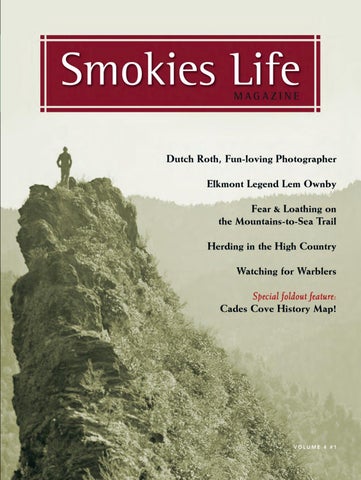
SLcovers_#6:SL covers
2/5/10
2:49 PM
Page 1
volume 4 #1
"National Parks are the best idea we ever had. Absolutely American, absolutely democratic, they reflect us at our best rather than our worst." Wallace Stegner, 1983
S MO KIES LIFE MAG A ZIN E
401003
$7.95
USA GSMA
SLcovers_#6:SL covers
2/17/10
3:20 PM
Page 2
Smokies Road Guide #400190 $11.95
miss a n issu t ’ e! Don
History Hikes of the Smokies #400650 $12.95 Zoom Binoculars 6x to 18x magnification #600453 $39.95 Great Smoky Mountains Trails Illustrated Hiking Map #400008 $11.95
Exploring the Smokies #400595 $9.95
Great Smoky Mountains Association Members receive Smokies Life Magazine delivered to their home twice a year. Memberships start at just $30 per year.
Day Hikes of the Smokies #400630 $9.95
Hikers’ Map/Guides Mt. Le Conte #490105 $2.00 Appalachian Trail #490104 $2.50
Birds of the Smokies #400043 $11.95
Other membership benefits include: • 15% discounts in our park stores (and our web site!) • discounts at other park stores in national parks around the country • four issues of the park newspaper per year • two issues of the Bearpaw newsletter per year • monthly cub report e-newsletters Waterfalls of the Smokies #400266 $12.95
Membership in Great Smoky Mountains Association is for people who want to help protect Great Smoky Mountains National Park and learn more about this wonderful place. Established in 1953, GSMA now provides over $1.8 million in assistance to the park each year. We are a nonprofit organization.
Help Support a National Treasure Join today!
Hiking Trails of the Smokies #400161 $19.95
Ferns of the Smokies #400725 $8.95
Wildflowers of the Smokies #400282 $12.95
www.SmokiesInformation.org • (865) 436-7318 x222
SL_issue6:Layout 1
2/5/10
3:19 PM
Page 1
CCC enrollees at work on the Elkmont bridge, around 1935.
From the Editor Every Great Depression and Great Recession has a
chances of Great Smoky Mountains National Park
silver lining.
getting federal appropriations to cover them seemed slim to none. Until the Great Recession.
In the early 1930s, when unemployment in the
Now it appears the Smokies will gain well over
United States hit 25%, President Franklin D. Roosevelt created the Civilian Conservation Corps (CCC),
$70 million in fiscal stimulus (American Recovery and
eventually putting over 500,000 men to work across the
Reinvestment Act) monies, enough to jump start
U.S. In 1933, the first of some 4,000 CCC enrollees
efforts to reduce the park’s considerable maintenance
arrived in the Smokies. Alongside Works Progress
backlog. Much of the credit for the funding boost
Administration staff and others, they created much of the
goes to the park’s administrators who wasted no time
park infrastructure we see today. Their accomplishments
in convincing Washington that the Smokies needed
include trails, roads, bridges, fire towers, picnic areas,
the money and that they were ready to spend it
campgrounds, ranger stations, landscaping, and more.
quickly and effectively. The results will be visible soon. Improved trails,
Nearly 70 years after the CCC disbanded, their work still makes up the backbone of the park’s
picnic areas, and campgrounds; repaired buildings,
infrastructure. Inevitably, after the wear and tear of
restored cemeteries, and repaved roads. When the dust
hundreds of millions of park visitors, some of it has
settles, our favorite park should be ship shape enough to
begun to show its age. The price tag for the needed
host its nine million annual visitors for years to come.
infrastructure repairs was very, very high, and the
Maybe even until the next economic catastrophe. Steve Kemp Editor
Steve@GSMAssoc.org
Smokies Life
1
SL_issue6:Layout 1
2/5/10
3:19 PM
Page 2
Volume 4 Number 1 $7.95 Contributing Editor Steve Kemp Lead Designer Lisa Horstman National Park Service Publications Liaison Kent Cave Designers Joey Heath Karen Key Editorial Assistance Julie Brown Valerie Polk Research Assistance Annette Hartigan Advertising Sales Curt Talbot ©2010 Great Smoky Mountains Association. No portion of this magazine may be reproduced without written permission from GSMA. Executive Director Terry Maddox Membership & Special Events Coordinator Judy Collins National Park Service Coordinator Cathy Cook Great Smoky Mountains Association Board of Directors Danny Bernstein Warren Bielenberg Geoff Cantrell Steve Carr Dan Lawson Kelly Leonard, Treasurer David McGuire Barbara Muhlbeier, Vice Chairman Jim Niemeyer Dan Pierce Wayne Shepherd, Chairman Kate Welch Front cover photograph by Albert “Dutch” Roth Back cover photograph by Bill Lea Attention Retailers To carry Smokies Life in stores, contact Curt Talbot, Curt@GSMAssoc.org or (865) 436-7318 x350 Advertisers: Contact Curt Talbot, Curt@GSMAssoc.org or (865) 436-7318 x350 416 Cherry St., Gatlinburg, TN 37738. Printed in Canada Smokies Life (ISSN 1937-0725) is published biannually by Great Smoky Mountains Association, a nonprofit organization. 115 Park Headquarters Road, Gatlinburg, TN 37738 (865) 436-7318. www.SmokiesInformation.org This magazine is a premium for members of Great Smoky Mountains Association. To join, change an address, or make other membership inquiries, contact membership and special events coordinator Judy Collins at the address above or Judy@GSMAssoc.org. Memberships start at $30 per year. No submissions of manuscripts, photographs, or art, please. Written queries are welcome. Copyright 2009 by Great Smoky Mountains Association. Send address changes or other membership queries to Judy Collins at the address above or Judy@GSMAssoc.org. Periodicals postage paid at Knoxville, TN. Postmaster: Send all address changes to Judy Collins, GSMA, 115 Park Headquarters Road, Gatlinburg, TN 37738 or Judy@GSMAssoc.org. www.SmokiesInformation.org
The text pages of this magazine are certified by the Forest Stewardship Council as adhering to strict environmental and social standards. Printed with vegetable inks.
2/5/10
3:19 PM
Page 3
In This Issue Smokies Life Magazine Volume 4 Number 1
A Reluctant “Ultra Hiker” Tackles the Smokies’ Mountains-to-Sea Trail Overconfidence, over preparedness, and under planning leads an aging hiker to discover fear and loathing on the Smokies’ “other” long trail. By David Brill
The Life, Legs, and Legacy of Photographer Albert “Dutch” Roth PHOTOGRAPH BY BRIAN SMALL/VIREO
SL_issue6:Layout 1
It’s hard to say which “Dutch” loved more, traipsing trails with the Smoky Mountains Hiking Club or capturing the magic of the wilds with his camera. By Don Williams
The History of Cades Cove According to Daffodils Special bonus double foldout section! Every spring these cheerful yellow flowers bloom to remind us of those who once called Cades Cove their home. By Inez Adams
Last Man in Elkmont: The Story of Lem Ownby Lem was granted a lifetime lease to stay on in the Smokies. Of course living alone, nearly blind, who ever thought he’d make it to 94! By Don Williams
From the Mountain Kitchen The low down on the secret ingredient for the best biscuits, fried chicken, and pies on the planet. By Rose Houk
Watching for Warblers Each spring a million little winged miracles flit about the Smokies. Our author learns patience and humility in their bedazzling presence. By Courtney Lix
Upon Summer’s Green Pastures “Move ‘em on, head ‘em up.” Spending summer with “them doggies” in the Smokies’ heavenly high country. By Rose Houk
The Puzzle Tree Why does that oak tree look like its trunk grows upside down? By Horace Kephart
The Map Room The 1930 Kephart/Masa North Carolina nomenclature map.
Smokies Life
3
10 20 34 40 52 56 64 72 74
SL_issue6:Layout 1
2/5/10
3:19 PM
Page 4
Smokies Life
4
2/5/10
3:20 PM
Page 5
© 2006 ROBERT J. GOODWIN
SL_issue6:Layout 1
ALL THE TRAILS IN THE SMOKIES FOR ALL TIME… Friends of the Smokies has made the Trails Forever Endowment its number one fund raising priority for this year. Trails Forever is a lasting gift that will benefit the Smokies’ 800 miles of trails and every hiker who will use them for countless generations. Our goal of raising $2 million to match funds dedicated by The Aslan Foundation of Knoxville in memory of Lindsay Young will also be the single most ambitious fundraising initiative in Friends of the Smokies’ 15-year history. Do you hike? Do you have great memories of seeing the fall colors from the mountaintops? Do you hike to spend time with friends and family? To stay in shape? Do you have a favorite
waterfall or other beloved place accessible only by trail? Do you hike to get away from it all? Would you like to honor or remember someone special who loves or loved to hike? Whatever your motivation, and whatever your means, your support for the Trails Forever campaign will be for all the trails in the Smokies, for all time. Be a part of this lasting legacy for the Smokies. To receive more information, please call us at (800) 845-5665, visit our website at www.FriendsOfTheSmokies.org, or return the card included here.
SL_issue6:Layout 1
2/5/10
3:20 PM
Page 6
SL_issue6:Layout 1
2/5/10
3:20 PM
Page 7
Smokies Life
7
SL_issue6:Layout 1
2/5/10
3:20 PM
Page 8
SSm mookkiieess LLiiffee
88
SL_issue6:Layout 1
2/5/10
3:20 PM
Page 9
SL_issue6:Layout 1
2/5/10
3:20 PM
Page 10
Smokies Life
10
SL_issue6:Layout 1
2/5/10
3:20 PM
Page 11
hu·bris
\’hyü-bres\ noun [Gr eek hybris]: exaggerated pride or self-confidence often resulting in retribution, Webster’s Ninth New Collegiate Dictionary.
BOTH PHOTOGRAPHS BY DAVID BRILL
It’s 2:30 am, and I’m following the beam of my headlamp along a mistshrouded trail lined with rhododendrons in full flower. Their white-pink petals—botanical breadcrumbs—sprinkle the footway ahead, leading me forward through the darkness. Below, to the right, Deep Creek announces its presence through the audible thrash of water over rock. Deep Creek is one of the more productive—and isolated—trout fisheries in Great Smoky Mountains National Park. If the creek were bathed in full sunlight, and if my itinerary were a bit more relaxed, I would succumb to its temptation. But this is no gentle amble through the woods. Indeed, this adventure is more about covering miles and shaving minutes than it is about the more esoteric rewards of hiking. More specifically, in one continuous maniacal push, I am covering the Smokies segment of the Mountains-to-Sea Trail (MST), which leads from Clingmans Dome to the park boundary near the Oconaluftee Visitor Center. Over nearly 16 hours, I will cover 27.4 miles and gain and lose a cumulative 10,871 feet in elevation. (For more information on the Mountains-to-Sea Trail, see: “From Summit to Sand along the Mountains-to-Sea Trail” on page 16.) It’s worth noting that my current mission, in every way, runs contrary to the modus operandi that has defined my three decades of hiking in the eastern mountains. My traveling companion has seen to that. I have known James J. (JJ) Rochelle for 20 years. For the first 11 of those years, I would have characterized him as completely sane and well-adjusted. That’s before the term “ultra” entered his consciousness and penetrated his now oxygen-saturated cells. In January 2001, JJ drove to Huntsville, Alabama, and started running. Seven hours, 35 minutes, and 59 seconds later, he stopped, having completed the Mountain Mist 50K (31 miles).
Later the same year, he drove to Front Royal, Virginia, and, again, set out running. This time, the route led 100 miles over the rocky and rugged trails of Massanutten Mountain. After 34 hours, 6 minutes, and 20 seconds of near-continuous exertion, JJ reached the finish line, fatigued but far from sated. In the years since, he has completed 20 100-mile races, some of them in mountain states like Colorado and Wyoming. In so doing, JJ entered the ranks of an elite cadre of remarkably fit men and women, many of whom reference the Buddha in explaining themselves and their zany avocation: People should learn endurance; they should learn to endure the discomforts of heat and cold, hunger and thirst; they should learn to be patient when receiving abuse and scorn; for it is the practice of endurance that quenches the fire of worldly passions which is burning up their bodies. Raw asceticism has never held much fascination for me. Nevertheless, I invest my hopes in Friedrich Nietzshe’s contention that “that which does not kill us makes us stronger.” Which of Nietzshe’s ultimate outcomes I experience will pend until the very end of the trek. Our current endeavor, by JJ’s standards, barely ranks as a warm-up; for me, it represents a foray deeper into the realm of exhaustion than I’ve experienced. If I survive this excursion, I will forever remain vigilant and wary around those who ply the adjective “ultra” in describing their hobbies. I will also return, happily and forever, to my former mode of mountain travel, which can best be described as “slow and steady,” with ample time built in to rest and reflect on my surroundings. JJ has pledged that, tomorrow, once we reach the park boundary, we’ll stop, though I know the temptation to
Smokies Life
11
2/5/10
3:20 PM
Page 12
BOTH PHOTOGRAPHS BY DAVID BRILL
SL_issue6:Layout 1
Above: The author’s provisions included high powered energy drink, caffeine pills, and ibuprofen. Right: Turk’s cap lily viewed in the utter darkness.
“If I survive this excursion, I will forever remain vigilant and wary around those who ply the adjective “ultra” in describing their hobbies.” – D.B.
continue on will be a powerful one for him. The entire MST route extends nearly 1,000 miles and terminates at Jockey's Ridge State Park on the Outer Banks. Now, as we stand with headlight beams plumbing the depth of Deep Creek, I can only wonder how this majestic forest of lush ferns and towering trees would look basked in full sunlight.
The Best Laid Plans Despite our original plan to set out in the early afternoon, a series of delays ate into our day—and, with it, the hours of daylight we hoped would illuminate our way for most of the trek. After depositing a car at the Oconaluftee Visitor Center, we arrived at the Clingmans Dome parking lot at 9:30 p.m. and emerged into darkness and blustering wind. (For advice on night travel through the park, see “If You
Get Caught out after Dark,” on page 18.) We switched on our headlamps and sifted through our packs one last time before setting out. JJ’s entire kit, contained in a sleek, aerodynamic daypack, weighed about three pounds, including one liter of water, a thin thermal layer, a pair of lightweight gloves, spare headlamp and batteries, and six Kashi “Go Lean” chewy bars. The juxtaposition is jarring: A guy who shares a body type with Mahatma Gandhi has opted to count calories and subsist on a single liter of water over a marathon-length trek through the mountains. The Buddha, who, as we have learned, admonishes us to “endure the discomforts of hunger and thirst,” would no doubt be pleased. My dietary choices trended in the opposite direction, as do the contents of my pack, whose assemblage
Smokies Life
12
2/5/10
3:20 PM
Page 13
was inspired by a welter of worries—including, but not limited to: dehydration, snake bite, a fatal depletion of glycogen stores (the “bonk,” in the parlance of long-distance bicyclists), bear mauling, wild hog goring, crippling rapidonset osteoarthritis, stroke, heart attack, and fatigue-induced psychosis. In the end, I set out with 20 pounds, most of it extraneous: a camera, one additional lens (never used), a tripod, a flash unit, a spare headlamp and extra batteries (never used), three liters of water (two in a hydration bladder and one in an aluminum flask), a water filter, a rain jacket (never used), a fleece shirt (never used), spare socks (never used), a first-aid kit (never used), two cans of sardines and one of tuna, a bag of almonds, English muffins, two chocolate bars (all foodstuffs devoured with alacrity), a onepound nylon hammock for napping (never used), a 10-ounce can of a potent energy elixir with a name like “Throttled Rock Star” or “Raging Bull,” caffeine pills, and Vitamin I tablets (ibuprofen). As we shouldered our packs, we both noted the unusual weather. The temperature had plunged to 56 degrees—unseasonably cool for North Carolina in July, even at this altitude—without factoring in the chilling effect of the wind. Low-slung clouds skittered across the parking lot in curtains of white mist, and innumerable tiny droplets swam and shimmered in our headlamp beams. After a brisk half-mile uphill trek on blacktop from the parking lot to the Clingmans Dome summit with its alienshave-landed observation tower, we confronted our first trail sign bearing the Mountains-to-Sea Trail logo (a peaked mountain crest to the left tapering to rippling waves to the right, against a pale-yellow and brown background) and distinctive blaze (a white circle measuring three inches in diameter). For the first nearly four miles of our MST hike we followed the Appalachian Trail to the junction with the Fork Ridge Trail. For most of the first seven and a half hours and 13 miles of our trek, our trajectory tracks steadily downward from the 6,643-foot summit of Clingmans Dome—an aerie knob from which all trails lead downward. The Dome is the highest point in Great Smoky Mountains National Park and the state of Tennessee and also the highest perch along the entire 2,175-mile Appalachian Trail. The gentle trail led through a Hobbit-like landscape of ferns, vivid crimson bee balm, and orange Turk’s Cap lilies spread below behemoth old-growth spruce, yellow birch, and hemlock. The latter are still standing in defiance of the hemlock woolly adelgid, which has infested and killed hundreds of what many regard as the park’s most graceful trees. By 12:30 a.m., the mist dissipated and stars began to wink through the branches of the towering trees. JJ, whose frequent nocturnal scrambles have familiarized him with the night sky, paused long enough to locate Jupiter and the constellation Cassiopeia. An hour later, a large animal crashed through the brush
20 yards above the trail. We surmised it to be a bear, owing in part to the volume of the commotion and in part to the occasional pile of blackberry-seed-laced scat deposited in the middle of the trail. We stopped for several minutes, listening, while the mystery creature did the same. Within two miles, we arrived at the margins of Deep Creek, and JJ afforded me one of only three opportunities to sit and rest—brief though it was—along our nearly 16hour journey.
They Only Come out at Night A clearing beside the creek marks campsite number 53, which, a sign tells us, is officially closed because of bear activity. Bears or no, I’m ravenous, so I peel the lid from a can of sardines bathed in mustard sauce—the olfactory equivalent of a dinner bell for omnivores. As the aroma of canned fish wafts through the air, JJ, a devoted vegetarian and something of an ursa-phobe, eyes me with a look that says, “Okay, now who’s crazy?” Here, at the creek, with official notification of bear activity, I devour the sardines quickly, which, I realize, is completely in keeping with the “ultra” nature of our hike. Food is fuel—nothing more. Seated for the first time in five hours, and serenaded by the sound of the fast-moving stream, I reflect on the fact that all of North Carolina is now abed and deep in REM sleep. A wave of fatigue begins to overtake me. JJ, by way of a motivational speech, reminds me that
Mr. Rochelle discerns that the bear sharing their trail is fond of blackberries.
PHOTOGRAPH BY DAVID BRILL
SL_issue6:Layout 1
Smokies Life
13
2/5/10
3:20 PM
Page 14
we’ve covered fewer than 10 miles in five hours and that our progress has, in his estimation, been far from stellar. I gobble down two caffeine tablets and a Vitamin I and drain the can of energy drink. Tiny mice, likely having missed all the food-bearing hikers since the campsite’s closure, skitter across the clearing, their eyes glowing red in our headlamp beams. I envy them their energy level. We spend a half hour following the volunteer trails emanating from the campsite, hoping that one of them will lead to a bridge across the creek. For a time, we wonder if we’ve lost the trail, and I backtrack a few hundred yards uphill before JJ’s headlamp beam hits a piece of reflective metal on a tree across the creek. Long a believer in the importance of maintaining dry footwear, I peel off my boots and socks and plunge my bare dogs into the icy water. As I do, I unleash a stentorian string of expletives that would make Denis Leary blush. Meanwhile, JJ picks his way across by deftly hopping on exposed rocks. Our assumption that an officially closed campsite would be devoid of overnighting humans proves incorrect, and once across the creek, we confront two tents—one a sleek, high-end backpacking domicile and the other a ponderous green-canvass Army-surplus model with a cast-iron frying pan lying in the doorway. We can only surmise the terror that our clamorous arrival—and my indelicate language— has inspired in the formerly sleeping campers. A light flickers briefly in the nylon tent as we pass. No one stirs in the canvas tent, which, in fact, only increases our concern. A guy willing to schlep a frying pan into the backcountry surely wouldn’t regard a handgun as all that much of an extra burden. JJ and I adjust our pace accordingly, and I resist the temptation to call out a public apology for having disturbed their slumber.
An Ultra-runner’s “Grading Scale” With more than 2,000 “ultra” miles under his sneakers, JJ has developed a keen appreciation for well-groomed footways. He awards the trail that led us here an A+ for its gentle grade and soft treadway. He is not quite so magnanimous in his assessment of the sodden and overgrown Deep Creek Trail that now leads us forward. For the next four miles, dew-dampened vegetation—including stinging nettle—lashes our thighs as we follow a mucky, marginally defined trail that leads us across Deep Creek three more times and past backcountry campsites 54, 55, 56, and 57—all vacant.
PHOTOGRAPH BY DAVID BRILL
SL_issue6:Layout 1
Day Two. 9 a.m. Corner of Newton Bald and Mingus Creek. 21.1 miles behind them. 6.3 more to go.
At 5:05 a.m., we reach the physical—and, for me, emotional—nadir of our hike, at 2,410 feet, at the junction with the Martins Gap Trail. In the span of a standard workday, we have covered a mere 13 miles—we’re not yet quite half way—and dumped a cumulative 4,200 vertical feet. Over the next six miles, we will gain much of it back. I can’t shake the realization that in the time it’s taken us to cover 13 miles, JJ would have nearly crossed the finish line of his inaugural 31-mile ultra run. The quality of trail ahead will only compound my misery. The Martins Gap Trail has been churned into a pocked and pitted quagmire by horse travel. It will flat out fail on JJ’s grading scale. As we begin the nearly 2,700-foot climb, I’m experiencing a profound desire to sleep, combined with demoralizing doubt that culminates in a dark fantasy. In it, I become the often-lampooned oldster in the commercial who has “fallen and can’t get up.” Meanwhile, JJ, looking hale and daisy fresh, is in the grips of an emotion more akin to pity, intermixed with rancor. He plies the descriptor “sad” in describing our performance thus far. Had I the energy to muster a response, it would be this: “Yes, my friend, and it’s only going to get sadder.”
Smokies Life
14
2/19/10
5:00 PM
Page 15
Let the Head Games Begin Now, less than an hour from the first luster of dawn, as we begin the uphill trek, I fully embrace the notion that, from here, my mental resolve will play a more vital role in my progress than my wasted muscles and sleep-deprived brain. I’ve played this mental game once before in these eastern mountains, though in that instance I was mounted on a bicycle rather than leaning on trekking poles. In 1989, when about 150 road miles a week kept me in fighting trim, I submitted the entry fee to ride in the Assault on Mount Mitchell. The Assault, a century ride (a 100-mile route), begins in Spartanburg, South Carolina, and culminates in a 30-mile, nearly continuous climb to the top of the highest peak east of the Mississippi. For the first half of the final climb, I remained profoundly attuned to my aching muscles and escalating fatigue. I wanted more than anything to stop, even if that meant flopping into the roadside weeds, still clipped into my pedals. Just at the moment I was about to succumb, something remarkable happened. I lifted my gaze from the pavement directly in front of me and became transfixed by the cluster of gears—the freewheel—spinning rhythmically on the rear axle of the bicycle in front of me. I could hear the steady hiss of the chain passing over lubricated metal parts, and I could see the road sliding slowly away beneath me. The combined effect opened a portal into an endorphincushioned region of my brain and one I had never visited before. In that moment, I transcended the physical discomfort and entered a place of mental calm and even contentment. The miles melted away as we continued to climb, and I lost track of the passage of time. As long as the freewheel kept spinning, I knew we were moving. I barely glanced at the computer mounted on my handle bars that telegraphed my speed and cumulative mileage. Hours later, I was
jarred from my reverie by the sound of clapping and cheering and glanced up to see the finish line. Here, on the Mountains-to-Sea Trail, in the last minutes of darkness, I peer up the trail in front of me, hoping to see a spinning freewheel. Instead, I confront its rough equivalent in the reflective tape on the backs of JJ’s shoes, rising and falling purposefully with his stride. Given the circumstance, it will have to do. I wait for the transcendence to come, to lift me from my discomfort, but it fails me. I am acutely aware of my physical state: the constant pounding of my toes against the ends of my boots on the long downhill has triggered numbness (I will shed a toe nail within a month), the insides of my thighs have been chaffed to the color and texture of steak tartar, and my leg muscles are twitching involuntarily, as if a mad scientist is controlling them through probes tethered to a gigantic dynamo. At 5:40 a.m., dawn begins to break, and within a half hour, the ambient light allows us to switch off our headlamps. The banshee call of pileated woodpecker serves as our rooster. We still face nearly 2,000 feet of climbing, and all I can think about is the blessed rest I’d find nestled in the onepound hammock stowed in my pack. JJ, who has seen runners in much worse shape than I along the final miles of the more brutal ultras, subtly reaches into a bag of motivational tricks he’s amassed over the past nine years. At various points through his ultra career, JJ has been both the purveyor and recipient of the techniques, which vary in form and execution but all fall PHOTOGRAPH BY DAVID BRILL
SL_issue6:Layout 1
Smokies Life
15
under the general heading of “pacing.” The first involves the threat of abandonment in a hostile environment, many miles from the nearest outpost of civilization. I see JJ pull ahead of me. The distance between us gradually increases, and he soon disappears around a bend in the trail. Realizing that my brain is, at present, a sputtering synaptic wasteland and that I’m completely reliant on JJ’s superior orienteering skills, I respond accordingly and hasten my pace. Soon, when that fails, and I again begin to lag, he employs a second tactic, the art of distraction, and begins a monologue—an exhaustive discourse on ultra running laced with colorful anecdotes and a who’s-who list of regional “ultra” paragons—that continues ceaselessly for more than two hours. I hear stories of competitors whose faltering thigh muscles have forced them to run backward up the final miles to the finish line. I learn of JJ’s
SL_issue6:Layout 1
2/5/10
3:20 PM
Page 16
From Summit to Sand along the Mountains-to-Sea Trail The Mountains-to-Sea Trail (MST) began in 1977 as an idea among state park planners to develop a nearly 1,000-mile footway running smack through—and showcasing—North Carolina's three celebrated geographic regions: the Mountains, the Piedmont, and the Coastal Plain. In the years since, an army of volunteers and state trail crews have completed nearly 500 miles (about half) of the route. For now, the remainder leads hikers along the blacktop rather than through the backcountry, though North Carolina has committed funds to acquiring lands needed to connect existing sections of the trail. The trail existed largely as a concept before creation of the Friends of the Mountains-to-Sea Trail by Allen de Hart, the trail’s first thru-hiker, in 1997. Three years later, the North Carolina General Assembly voted to include the MST in the state park system. The trail’s 38 sections traverse 37 of the state’s counties. Section one begins on the 6,643-foot summit of Clingmans Dome in Great Smoky Mountains National Park and continues 26.4 miles to the park boundary at Oconaluftee Visitor Center. Clingmans Dome is the highest point in Tennessee and on the 2,175-mile Appalachian Trail, but the MST tops out even higher, at 6,658, just shy of the 6,684-foot summit of Mt. Mitchell, the highest peak east of the Mississippi. The final section ends, at sea level, on the shore in Jockey's Ridge State Park on the Outer Banks. To date, 16 MST “thru-hikers” have completed the route. Frank Potter and Jim Walters, MST end-to-enders numbers 14 and 15, completed the trail together in sections between July 2007 and May 2009. Besides occasionally losing the trail and becoming lost—most notably in the Middle Prong Wilderness Area of Pisgah National Forest—Potter, 67, savored the variety of terrain along the route but found 80 miles of sand hiking on the Outer Banks far from easy. In profile, the MST through the Smokies forms a “W” missing the right upstroke, dropping about 4,200 vertical feet from Clingmans Dome to its lowest crossing of Deep Creek, ascending just under 2,700 feet from there to Thomas Ridge near Newton Bald, and dropping just over 3,000 feet to Mingus Mill and the Oconaluftee Visitor Center. For MST information, maps, and route descriptions, visit the Friends of the MST Website: http://www.ncmst.org/
utter disdain for delirious, time-pressed runners—men and women—who use the middle of the trail as a toilet. I learn of the 68-year-old “German Wonder,” Hans Dieter Weisshaar, and the precept of “leichte zeit” (roughly translated, “easy time”): “When you’re on good trail, pick up the pace.” I come to grasp the wisdom behind the mantra “start slow and get slower.” The ultra-runner acknowledges the limits of mind and body and manages them in a controlled “degradation curve,” allowing the pace to slip slower as the distance increases. “For that strategy to work, you need what ‘Leonardo’ Martin calls ‘time in the bank’—meaning that you move fast enough during the first half to leave enough time for the second, slower, half and to finish before the official race cut off,” JJ explains. Runners who succeed avoid the dreaded DNF designation (Did Not Finish). I can only hope to be so lucky. The next instructional module fills me with bitter regret. “Kerry Trammel, the Godfather of Oak Ridge ultra running, says, ‘Don’t become a pack mule.’” JJ illustrates the point by referencing the ponderous camera, extra lens, and tripod that are, at this moment, biting into my shoulders. JJ’s monologue ends with a lesson he learned in the Lake District of Switzerland from a taxi driver who, with horn blaring and tires squealing, deftly maneuvered past a traffic snarl. “If you do not go, you will stay,” the driver explained. JJ’s long-time running partner Susan Donnelly phrases that sentiment as more of an imperative: “Maintain relentless forward progress.” I can’t say my progress at the moment is relentless, but it is carrying me forward up the seemingly endless incline. As if by design, JJ’s voice, for the first time in hours, falls silent just as we arrive at a trail sign. It’s 9 a.m., we’re at just over 5,000 feet, and we stand at the junction of the Newton Bald and Mingus Creek trails. Though JJ does his best to try to convince me that we have a thousand feet yet to climb, the surrounding terrain, which falls away around us, tells a different story. We’ve topped out. A mere 6.3 miles separate us from the thronging Oconaluftee Visitor Center parking lot, JJ’s Subaru, and easy access to fast-food paradise in Cherokee. We idle at the trail junction for nearly a half hour, snapping photos, lounging, celebrating the miles behind, interacting like old friends, rather than mentor and protégé. The steady downhill ahead obviates the need for JJ’s motivational tools; visions of a sizzling, fat-laden burger and large order of fries prove sufficient in that regard. When we resume the hike, I note that the mental fog has lifted and my powers of observation have returned. Extensive hog damage has disrupted the trail margin to the left, but clusters of bright red fire pink more than compensate. The temperature hovers, perfect, in the 60s,
Smokies Life
16
SL_issue6:Layout 1
2/5/10
3:20 PM
Page 17
the sky is a seamless blue, and I am not going to die—at least not today. Three miles ahead, where the Mingus Trail breaks sharply left, JJ notes a sign indicating a nearby cemetery. “Hey, big guy, you don’t have far to go,” he says. It takes me a few seconds to fully appreciate the humor of the reference. Owing to my chaffed thighs, I’m walking like a saddlesore cowboy, but I’m walking, and as I do, over the next two hours, I note the ever-increasing signs that we’re approaching civilization: the widening span of the trail, elaborate planked bridges over creeks, and, finally, automobiles, with their chrome glinting in the afternoon sun.
marathon trek, though, by most accounts, the two continued neck-and-neck for most of the journey. Then, as now, I regarded their feat as aerobically and physically extraordinary but wholly lacking in the intangible rewards I’ve come to cherish during my time in the woods. For them, the destination—and the time lapsed in reaching it—loomed larger than the magical elements of a journey along America’s premier long-distance trail. They covered the ground but, in my opinion, completely missed the point. In the end, even Horton’s victory proved ephemeral.
A Survivor, Not a Convert
Smokies Life
PHOTOGRAPH BY BILL LEA
In 1991, I had my first encounter with a speed hiker—two of them, in fact—on a beautiful spring afternoon on the Appalachian Trail just north of Damascus, Virginia. I was seated, with legs draped over the edge of a shelter opening, munching GORP, when an enormous bearded man dashed into the clearing in front of the shelter. All he carried in the way of gear was contained in a small fanny pack. He seemed edgy. “Hey,” he barked. “How long have you been here?” “About a half hour.” “Has another guy come through here? He’d be movin’ fast and wearing a pack like this.” “Nope. Haven’t seen him.” “You got anything to eat?” I offered him some GORP, and while he chewed, he explained himself. His name was Scott Grierson, and he went by the trail name Mainiac (he haled from the Pine Tree State). He was speed hiking the AT. His goal: to quash the existing record of 62 days. The fellow he was asking about, his competition, was close on his heels. With that, Mainiac thanked me and resumed his mad dash north. Within a half hour, a lean, determined-looking fellow materialized in front of the shelter. He, too, wore a fanny pack. “Have you seen a big guy with a beard come through here?” “Yeah, you missed him by about a half hour.” “Okay, thanks.” And with that he was gone. Though the runner didn’t offer his name, I learned later that he was David Horton, who would ultimately overtake Mainiac and set the new record for an AT thru-hike: 52 days, nine hours, and 42 minutes, maintaining a daily average of a little over 40 miles. (Mainiac finished in 55 days, 20 hours, and 34 minutes.) I’m still amazed that I encountered the two men, separated by a mere 30 minutes, more than 400 miles into the
17
SL_issue6:Layout 1
2/5/10
3:20 PM
Page 18
If you get caught out after dark Short-duration night hikes around camp can open a door into a magical nocturnal world populated by an amusing cast of characters, some of which are rarely seen—or heard—during the daylight hours. But extended nighttime forays into the backcountry introduce a welter of perils and risks generally avoided by those who travel with the sun. Navigation can be challenging enough during daylight in the complex network of ridges and folds of Great Smoky Mountains National Park. Navigating the same terrain at night can become even more difficult when darkness obscures the surrounding terrain and, with it, notable landmarks. A rocky footway, even if illuminated by the beam of a headlamp, can become treacherous in the darkness, and poisonous snakes and other hazards may be more difficult to spot and avoid. Night hiking is not, as you might expect, widely encouraged by the National Park Service. Despite thorough preparation, there’s always the risk that you will be caught in the backcountry after the sun goes down. You should plan accordingly. • Acquire appropriate permits from the National Park Service for overnight camping in the backcountry. • Leave a complete itinerary with someone at home, including your route and destination and anticipated arrival time. Call as soon as you arrive at your destination. • Pack plenty of food and water (and a water filter) and additional layers of clothing to keep you warm through the night. Keep in mind that nighttime temperatures in the park, particularly at higher elevations, can be 30 degrees or more below typical daytime temperatures. • Pack a reliable headlamp or flashlight, a spare light source, and sufficient batteries to power those devices through the hours of darkness. • Carry a complete first-aid kit, including essential daily medications. • Never travel alone. Better yet, travel only with someone familiar with the section of trail you’re exploring. • Be aware that animals—including bears and wild hogs—may exhibit different behavior patterns in the darkness, particularly if they’re startled by the approach of a hiking party following the beams of headlamps. • Carry map and compass, and know how to use them. A GPS system can be a useful adjunct to map and compass, but you should never rely entirely on a GPS system. Exhausted batteries and poor satellite coverage can make the devices all but useless. Chart your progress on the map so you can always pinpoint your current location. • Recognize that fatigue can cloud judgment. Hike only when you’re well rested and mentally alert.
As they say, records are made to be broken. Horton’s fell in 1999 to Peter Palmer (48 days, 20 hours, and 11 minutes), whose record, in turn, fell in 2005 to Andrew Thompson (47 days, 13 hours, 31 minutes). By the end of my marathon trek along the Mountains-to-Sea Trail, my respect has only grown for JJ and the other men and women who possess the physical and mental discipline to course 100 miles through rain and snow, sunlight and darkness, along rugged mountain trails. I grasp the sense of fulfillment that rewards them as they approach the finish line. But in the end, I emerge from this endurance quest a grateful survivor but in no way a convert. As Bob Dylan admonishes, “Don’t criticize what you can’t understand.” And so I won’t. In just over 15 hours, under JJ’s tutelage—sometimes kind, sometimes reproving—I have covered a mere 26.4 miles, and I doubt that the term “ultra” would apply to my accomplishment. Had I been left on my own, I likely would have asked the fellow in the green Army-surplus tent to scoot over, gun or no gun, and would still be slumbering contentedly on the shores of Deep Creek. As I stagger across the road to the Oconaluftee Visitor Center parking lot, I possess the mental acuity of a clump of kelp and rely on JJ to keep me out of the paths of oncoming cars. I can vaguely imagine the cars’ occupants wondering out loud what manner of hardship could inspire such a grotesquely bent posture and tortured gait. Only after I spot JJ’s Subaru and realize that the grueling ordeal is nearly over do I allow myself the luxury of imagining, in vivid detail, what will come next: an orgy of foods decidedly not endorsed by the American Heart Association, followed by many hours of undisturbed slumber. JJ’s Swiss cab driver had it right: “If you do not go, you will stay.” There’s no doubt about it: my adventure on the Mountains-to-Sea Trail was all about going—slowly but persistently and well past the point of dreading every step. But on my next foray into the Smoky Mountains, I definitely plan to stay—for a good long while—and will pack accordingly. David Brill has written for National Geographic Traveler, Men’s Health, and many other magazines. He is the author of Desire & Ice and As Far as the Eye Can See: Reflections of an Appalachian Trail Hiker. He lives in a rustic cabin on the Cumberland Plateau and is gainfully employed by the University of Tennessee. His last story for Smokies Life was “Hiking the Smokies A.T.”
Smokies Life
18
2/5/10
3:20 PM
Page 19
PHOTOGRAPH BY DAVID BRILL
SL_issue6:Layout 1
The author (right) and Mr. Rochelle pose where the trail ends and the road to Big Boy triple cheeseburgers with extra bacon begins.
Smokies Life
19
SL_issue6:Layout 1
2/5/10
3:20 PM
Page 20
Lunch time on the rocks in the Cumberland Mountains near Crossville, TN, February 16, 1947.
The Life, Legs, and Legacy of Photographer
Albert “Dutch” Roth by Don Williams
Smokies Life Smokies Life
20 20
SL_issue6:Layout 1
2/19/10
5:00 PM
Page 21
“
Photographs by Albert Gordon “Dutch” Roth (1890-1974)
If you are ever hiking through the Great Smoky Mountains and climbing to the highest peaks and should run across a big black bear coming down the trail wearing a pair of horn-rimmed glasses, carrying a tripod over his shoulder, wearing a big handkerchief around his neck, don’t be surprised. You are not crazy, it’s just that he found the things that I have lost…
”
These words come courtesy of Tales from the Woods. It’s a manuscript Albert Gordon “Dutch” Roth wrote but never published. It’s now housed at University of Tennessee Libraries, along with assorted notes, correspondence and lots of beautiful photographs. Pictures of Dutch Roth reveal a short, muscular man with broad cheekbones, chiseled nose, high forehead and thinning hair. He is often decked out much like his imaginary bear. Like his words that open this story, Dutch’s photographs open doors to wonder, adventure, and quirky characters. For proof, look no farther than pictures gracing this article. Yet Dutch was more than a photographer. He was a pioneer of dangerous road trips and hiking trips, a founding member of the Smoky Mountains Hiking Club in 1924, and its most active member, setting records for consecutive hikes. “Such a record as his has not been more than halfway approached,” said his grandson, Charlie Roth, an avid, if late-blooming, off-trail hiker who lives in New Market, Tennessee. In the 30 years between 1924 and 1954, Dutch participated in 728 hikes. It’s safe to say he topped 1,000 before his death, including well over 100 to his beloved Mt. Le Conte. By 1958, Dutch had been up Mt. Le Conte 90 times, “covering every trail several times and sometimes hiking without a trail straight up the mountain,” he wrote in Tales from the Woods. Dutch climbed every notable mountain in the Smokies, plus many in the Blue Ridge Mountains of Virginia, the Cumberland Mountains of Tennessee and Kentucky, and countless others. Moreover, he helped blaze the Appalachian Trail along the high peaks of Tennessee and North Carolina. He
knew and photographed legends of Smokies lore, in action, including Benton MacKaye, originator of the Appalachian Trail, Harvey Broome, president of the Smoky Mountains Hiking Club and the Wilderness Society, and famed photographer Jim Thompson, a one-time mentor. “I have to think Dutch learned from a professional like Thompson,” said Anne Bridges, co-director, with Ken Wise, of the Great Smoky Mountains Regional Project at UT-Knoxville. “We have a scrapbook Thompson gave to Roth including photographs that are identical except that in one photo you’ll see Thompson and in the other you’ll see Roth. I can see a sense of humor and a camaraderie in these images.” Thompson’s and Dutch’s photographs have been presented side by side in galleries, shops and conferences, though Thompson’s fame far exceeds Dutch’s. “I didn’t personally witness the relationship,” said Anne Meyer Koella Frazier, Dutch’s niece who lives in White Pine TN. “I do remember the family talking repeatedly that Uncle Albert would go hiking over the weekend, and then ride the bus to uptown Knoxville—he did not drive a car—after work.” Dutch worked as a pipe fitter at Coster Shop, a train maintenance and repair plant. On Monday afternoons, after work, he’d take his films to be developed at Thompson Photo. “Mr. Thompson would use those he liked to sell as special prints of the Smokies,” said Frazier. It’s unclear
Smokies Life
21
SL_issue6:Layout 1
2/5/10
3:20 PM
Du tch ’s
Page 22
photographs ope
how much Thompson paid his friend. After all, Dutch was an amateur, but over the years his reputation grew, because Roth captured subjects, moods and a certain splendor equaled by few. More to the point, it was splendor peculiar to his own time in the early prints and therein lies their power.
To a twenty-first century hiker, certain of Roth’s photographs seem like leftover images from a dream or memo-
t s r o o nd
ries of a distant land. After gazing upon hundreds of pictures, however, one begins to understand the many reasons why. Here are some of them. Roth photographed in every kind of weather. Rainy, sleety, snowy, foggy, crystalline or “smoky.” This “land of a thousand smokes,” as the Cherokee called it, can be startling in the way it presents itself to the eye, and Roth was there for every effect of moisture and light. What he lacked in technical mastery, he more than made up for with a schoolboy’s Johnny-on-the-spot enthusiasm coupled
Smokies Life
22
n o w o
SL_issue6:Layout 1
2/19/10
5:00 PM
Page 23
An oak tree on the state line between L ow G a p and Whit e
q u d i n r k a y e r c u h t arac n e v t e rs d a , . r e d n o with a true artist’s persistence. Much as French impressionist Claude Monet would return again and again to Rouen Cathedral to capture changing light, Dutch hiked again and again to favored mountains. “By 1927 we had climbed the Chimney Tops, Indian Gap, Gregory and Parsons Bald eight times each,” wrote Dutch. “These were steep hikes, no Grade-A trails then. We went to Abrams Falls four times, to Look Rock five times, Alum Cave four times, House Mountain three, Pinnacle, Thunderhead and Brushy Mountain we visited twice each.” And that was in the first three years of the Smoky Mountains Hiking Club. The mountains must have seemed magical, dramatic, to this young man who grew up around factories and mines operated by Knoxville’s Welsh community—his maternal grandparents were Welsh. With talk of national parks and conservation circulating, he began taking excursions into the mountains. Soon he had discovered enough like-minded souls to help form a club. “It all began in November 1924, when several of us got together for a meeting in the basement of the American Legion Building,” he wrote. “It was at this meeting that the Smoky Mountains Hiking Club was organized….
Roc k
(Mt
. Ca mm ere
r), S
e
pt e “We wanted to see mb er 3, what was in those mountains and 19 34 why. So on December 11, 1924, eight of . us went on our first hike as a club. We drove to Gatlinburg where we spent the night at Mountain View Hotel. The next day we got up early and hiked to the top of Mt. Le Conte. It poured rain all day. With no road over the mountain, we had to start hiking at Gatlinburg, which made the hike twice as far….”
Dutch would spend much of his life chasing shadows and light refracted through mists, reflected from clouds and snow banks in the Smoky Mountains. He once scaled Le Conte when mercury had plummeted to 22 below zero. “When he took off his glove to take a picture, his finger froze,” according to the Foreword in Tales from the Woods. On June 18, 1932, he hiked to Le Conte by moonlight, arriving well after midnight. Christmas Day 1925 found him hiking from Gatlinburg to Elkmont and on to Fish Camp Prong, where he spent the night in a trapper’s cabin. “We walked across the river on ice,” he reported, but that was not too unusual. “We hiked in all kinds of weather and I never forgot my camera, despite the cold or rain. You never know
Smokies Life
23
SL_issue6:Layout 1
2/19/10
5:00 PM
Page 24
when you might miss a good shot. We hiked around rocks, on rocks, hopped rocks, went up creek beds, down roads, in brush and on trails.” Even as an aged man, in 1958, he led a hike to Rainbow Falls with the temperature at 2 degrees F, when heavy snow and ice “made proceedings perilous.” Early on there was a sort of madcap method to his madness. D. Stewart Quern, writing in The Knoxville News-Sentinel, put it this way: “While the rest of the hikers are trudging along, Dutch may be seen climbing 20 or 30 feet into the trees and breaking branches out of the way if the view is obstructed. Or he will suddenly leave the party and go 100 yards from the trail if some scene of magic beauty meets his eye.” Even after a hard week at work, Dutch would shoulder his heavy tripod, crowned by a Kodak 122 camera, famous for rendering postcard-quality images. Dutch was indefatigable. The results were images rich and varied in detail and effects. Yet there’s another reason Roth’s photographs are haunting.
From the top: (1) Smoky Mountains Hiking Club on a visit to Uncle Tom’s Cabin, on way to Mount Harrison, January, 1928. (2) Roslie Edmonson on Charlies Bunion, February 27, 1938. (3) At Cliff Top on Mount Le Conte looking west, August 22, 1937.
Smokies Life
24
While time carries most of us forward into an ever more shopworn world, preserved lands such as Great Smoky Mountains National Park seem to move backwards, toward more pristine conditions. We who venture there now tread verdant peaks and valleys spared indignities of human habitation. This was not Dutch’s experience. His photographs capture a reversal in time’s arrow. Settlements give way to reclaimed wilderness, erosion to rebirth, pasture to forest. Clear-cutting to reforestation. His pictures span the 1920s to the 1970s—from long before to long after the advent of Great Smoky Mountains National Park. Look. Here you see Russell Field picked clean by a flock of woolly sheep. Here’s an ancient tree that’s known the gibbering gnaw of the saw, a tree articulating so many postures it evokes dancers, running horses and more. Here are cabins, lodges, lean-tos, shacks, houses, inns, ferries and rails where none should exist. Here is Silers Bald, Gregory Bald, Parson
SL_issue6:Layout 1
2/19/10
5:00 PM
Page 25
Bald—any number of balds—living up to that name bald— tended, grazed, shorn of hedge and heath. Here are climbers scaling Alum Cave Bluff, but not just any climbers. One is Harvey Broome, another is Benton MacKaye, prophets of conservation, bent on reclaiming this land for nature. And look. That gigantic feather duster hanging from the lip of a bluff ten times taller than any human is Rainbow Falls, crystallized in two-degree weather. Effects of climate change render such formations ever more rare. Still, here and now in this captured moment it’s always Feb. 16, 1958 and crystalline feathers dwarf a man who, standing below on the flank of an ice pyramid, lends scale to grandeur….
Such human markers show up frequently in Dutch’s photographs, for there was no shortage of friends and relations to lend scale. Safe to say he was not a loner. This active family man often took his wife Mary, daughter Margaret Ann and son Charlie (whom he called Sonny) along with assorted nieces and nephews camping in the mountains. And throughout his life he loved nothing better than traveling to Neyland Stadium of a Saturday to join huge crowds to watch his beloved UT Volunteers vie for football glory, and he brought back photographs from at least one Cotton Bowl. He was active in his church, Fifth Avenue Presbyterian Lionel Edney on Maddron Bald, February 2, 1947.
in Knoxville, says Charlie, long after he retired and moved in 1960 to Emerts Cove within the town boundaries of Pittman Center. “Here he can have a garden, work in flowers and just sit on the porch and look at the mountains from Mt. Le Conte all the way to White Rock [Mt. Cammerer] with the state line in the background,” according to the Foreward in Tales from the Woods. This home soon became the setting for meetings, cookouts and family gatherings, however. More to the point, he loved hiking with others, especially members of the Smoky Mountains Hiking Club. So what do we make of Dutch’s passion for mountains? Maybe it was a quest for something beyond the mundane mechanical world. Anne Frazier remains impressed “that he was raised in Knoxville (Mechanicsville) and yet he had this love of the mountains and the out-of-doors.” As a pipe fitter for Southern Railways, he would’ve been familiar with train schedules and engineers who traveled to Elkmont and beyond. “Everybody loves the sound of a train in the distance,” sings Paul Simon. “Everybody thinks it’s true.” Maybe Dutch felt drawn by sounds of trains he spent his working life tending.
The late great mythologist Joseph Campbell once defined a hero as one who embarks on a quest of enlightenment, faces continued on page 28
Harvey Broome near Charlies Bunion, May 16, 1937.
Smokies Life
25
Albert Gordon “Dutch” Roth checking mileage on Charlies Bunion, October 4, 1944.
SL_issue6:Layout 1
2/5/10
3:21 PM
Page 26
Smokies Life
26
SL_issue6:Layout 1
2/5/10
3:21 PM
Page 27
Opposite page, clockwise from top left: (1) Mount Kephart from Mount Mingus, February 6, 1944. (2) Skiing at Indian Gap, February 22, 1947. (3) Frozen Rainbow Falls, February 16, 1958. (4) North Slope of Charlies Bunion, March 30, 1947. This page, clockwise from top: (1) The Appalachian Trail east of Newfound Gap looking west, December 1, 1935. (2) Smokies in snow, November 3, 1935. (3) Made from the trail to Greenbrier Pinnacle looking toward The Boulevard, November 21, 1937.
Smokies Life
27
SL_issue6:Layout 1
2/19/10
5:00 PM
Page 28
On the state line between Hughes Ridge and The Jump-off, May 28, 1932.
continued from page 25
down danger and brings back a gift, such as fire. By that definition, Dutch Roth is a sort of hero. His gifts were often stunning. In frame after frame there’s detail and scale and lighting effects few others went to such lengths to capture. And yet, in reading Tales from the Woods, one gets a feeling Dutch was having a grand old time. Here’s a hint of the merriment that often attended such outings. “The leaders made arrangements with the Southern and Little River railroads to make a special run from Knoxville to Elkmont. Arrangements were also made for both ladies and men to stay at the Appalachian Club. There was a big log fire in the clubhouse and we had music and games.” And another: “We used to have switch-key hikes where half of us would go up one way and the other group would come up the other way. On top we would meet and exchange car keys and each group would go down the way the others had come up, and then when we got down to the cars, we would drive the other fellows’ cars around to a meeting place.” Mary would often serve as driver on such outings. Then there’s the account of an early morning Leap Year trip for a “Mystery Hike” above Gatlinburg. It was Feb. 29,
Made between Hangover and Stratton Bald, Nantahala National Forest, September 19, 1931.
1948, when “all the bachelors and young maids had a special invitation to make the trip.” There was singing, an impromptu football game on the early-morning streets of Gatlinburg, in which a hapless young lady’s shoe served as football, and then there was a short communal hike. “Later, when we got to the bus and were waiting on some of them, one of the girls started kidding the bachelors and on a dare kissed one of them, then after we all got on the bus and was (sic) coming down the mountain, some of the rest of them took it up and by the time that we got back to town I think that every man on the bus had been kissed—including a big lip smear on the driver’s forehead…. Just about all of the girls had been in on the act. As we came into Knoxville someone thought about the lipstick and you should have seen the men wiping it off. The driver got his off coming across Henley Bridge….” in downtown Knoxville. Such happy moments are plentiful. There’s the time Dutch and friends bought watermelons from a farmer and carried them up a mountain in their arms, then chilled them in a cold stream. He describes a “special trip” June 8-9, 1929, (five years before park establishment) to Clingmans Dome where he
Smokies Life
28
SL_issue6:Layout 1
2/5/10
3:21 PM
Page 29
People in tree in Cataloochee section, September 2, 1946. East of Hall Cabin site on the state line, July 5, 1931.
Smokies Life
29
SL_issue6:Layout 1
2/19/10
5:00 PM
Page 30
joined Knoxville journalists meeting with Asheville journalists and governors of both states. The delegates shook hands across state lines and set a carrier pigeon free into the blue. Dutch’s writing rings with accounts of singalongs, dances, festive conferences and hikes marked by practical jokes, including a penchant among fellow hikers to sneak rocks into Dutch’s too-heavy backpack during trail breaks. Dutch was not above such pranks, as he recorded in Tales…. “The next morning while one of the men was still asleep in his sleeping bag, and everyone else was up and stirring around, I decided to play a trick on him. I got my inspirator out (a long rubber tube used to blow into the fire to get it started). I sneaked up and put one end of it down his neck and blew into the other end. It sounded just like a bear sniffing. He came out of that bag and started down the mountain so fast, that it is a wonder the sparks didn’t set the woods on fire....” By all accounts, Dutch was a quiet, kindly man, yet he was drawn to adventure in service of his art. Consider discrete snippets from Tales. • “On one of the hikes in Greenbrier, I climbed a tree and was sitting on a limb ready to shoot when the limb broke. I snapped the picture on my way down, and believe it or not, it was good!”
• “It is nearly always cool in the mountains….I remember on May 3, 1929, Snake Davis and I went looking for new hills to conquer on the North Carolina side. We ended up walking 35 miles and nearly freezing to death….” • And another time, “We camped that night and had rolled up in our blankets and everything was fine, but during the night things began to happen. The weather changed, and the snow and temperature both began to fall. We got up the next day in a blizzard. We put on all the clothes and blankets we had to keep warm. All day we hiked through aisles of snow-covered forest. Part of the time we could not see where we were going or where we had been.” • This excerpt is from an account of hiking in the Cumberlands. “My family was worried when they found out I was lost. They called on the Park Service, which sent a Jeep up in the mountains to find us. It was so rough that a car couldn’t make it. About 5 o’clock they found us…. We had wandered across the state line and were in Kentucky. I never will live that down….” • This from an account of a trip over the mountains in a Model T Ford. “We had to be very careful coming down the Tennessee side, because it was all down hill and we didn’t have any brakes. We would just nose it into a bank or put our foot out and drag it a little ways and would stop….”
Opposite page, clockwise, from top left: (1) Whiteside Mountain, Nantahala Forest, May 27, 1934. (2) The Hole in Rock Mountain, January 31, 1932. (3) One Chimney from the other one, May 5, 1940. (4) Mary Francis Roth in tree between Indian Gap and Clingmans Dome, July 12, 1937. (5) View from top of Whiteside. Mrs. Herbert Kerr in foreground, July 21, 1940. (6) From Appalachian Trail between Cheoah Bald and Stecoah Gap, Smokies in background, May 27, 1933. Albert “Dutch” Roth, Brockway Crouch, Margaret Watraus and unknowns, June 5, 1927.
SL_issue6:Layout 1
2/5/10
3:21 PM
Page 31
SL_issue6:Layout 1
2/19/10
5:00 PM
Joe Green standing on site where his home was before the flash flood on Webb Creek in Pittman Center, Tennessee, December 18, 1938.
Page 32
Benton MacKaye on the Appalachian Trail near Newfound Gap, September 24, 1933.
• And here’s a snippet from his account of a car wreck. “We got as far as the Chimneys Campground and were just about on the sharp curve at the entrance, when we found out that we were going too fast on that snow to make it. We hit some ice and went headlong into the stone bridge. My head hit the windshield and I was still picking glass out of my face when I got home….” Other stories concern lost keys, unexpected flooding, lost children…. Still, it was art in service of the beauty and variety of the Smoky Mountains that makes Dutch meaningful to subsequent generations. That beauty not only made it into his photographs, but it shows up again and again in Tales from the Woods. “You could call the Great Smokies a Winter Fairyland…. They are beautiful any time of year, but with snow, ice and hoarfrost covering everything, they look like diamonds sparkling….” On the other hand Dutch’s images speak more eloquently than words. If a picture is worth a thousand words, then Dutch had a million of them. Just look. Sevier County native Don Williams is a frequent contributor to Smokies Life.
Farm boys just outside of Hartford, Tennessee, on the way to White Rock (Mt. Cammerer), early on a Sunday morning, May 17, 1931.
SL#6_gatefold_pp33-40:Layout 1
2/5/10
5:08 PM
Page 1
a
a l Th e H i s t o r y o f C a d e s C o v e According to the
Elizabeth Shue and Guy Frizzell at the old cabin up Laurel Creek, November 15, 1942.
Daffodils
Smoky Mountains Hiking Club lean-to on Silers Bald, July 5, 1931.
q IF
YOU HAVE BEEN
to Cades Cove in late February or early
March, you have seen the bright yellow daffodils (also called jonquils or buttercups) blooming in the fields and forest edge. What you may not have realized is that every smattering of daffodils marks a particular place and time, often a home and family, though the people and buildings have been gone for well over 50 years. When Great Smoky Mountains National Park was established in 1934, over 300 people lived in Cades Cove. As they were forced to leave, some of their homes were preserved, but most were removed. Yet, incredibly, the daffodils they planted to adorn their yards and gardens have endured. Each spring their blooms reveal the exact lo-
Roger Howell at Icewater Spring shelter. Snow is 13 inches deep, March 8, 1941.
“Dutch” Roth, Carlos Campbell, Guy Frizzell, Myron Avery, Oliver Crowder and unknown on hike from Newfound Gap to Deals Gap, May 29-31, 1935.
cations of homes, schools, stores, churches, and cemeteries. No Global Positioning System or plot map will ever be more accurate. Local historian Inez Adams has taken on the task of linking the Cades Cove daffodils with the people who planted them and structures they once decorated. Her work has taken over a decade. Now, using Inez’s map, photos, and text, anyone can discover Cades Cove historic sites just by looking for the early spring daffodils. Follow along as Inez takes us on her “tour de daffodils” and Cades Cove history.
by Inez Adams Mountain View Hotel in Gatlinburg, 1926.
John Oliver’s lodge on the way to Abrams Falls, August 17, 1930.
O
33
a
Smokies Life
l a
All photographs are from The Albert “Dutch” Roth Digital Photograph Collection and are used with the permission of University of Tennessee Libraries, Knoxville.
Page 2
a
ddddddddddddddddd
dddddddddddddddddddddddddddddddddddddddd
dddddddddddddddd
ddddddddddddddddddddddddddddddddddddd
dddddddddddddddddddddddddddd
ddddddddddddddddd
Hyatt la ne
dddddddddddddddddddd dddddddddddddddddddddddddddd
ddddddddddddddddddd
dddddddddddddddddddd
ddddddddddddddddddddd ddddddddddddddddddd
dddddddddddd
dddddddddddddddddd
ddddddddddddd
ddddddddddddddddd
dddddddddddddddddd ddddddddddddddddddddddddd
dddddddddddddddddd
dddddddddddddd
9
dddddddddddd
ddddddddddddddddddddddddd
dddddddddddddddddddddd
dddddddddddddddddddddd
10
dddddddddddddddddddd
dddddddddddddddddd
dddddddddddddddddddd
dddddddddddddddddddddd
11
12
dddddddddddddddddd ddddddddd
dddddddddddddddddddddd
hh
14 13
dddddddddddddddddd
William H. and Mary Jane McCauley Shields
dddddddddddddddddd
9
dddddddddddddddd
S HIELDS FAMILY HOME . A large frame house was constructed on this Noah and Sarah Brown Burchfield site in 1921. Several generations of the Shields family occupied it at one time, including A. Randolph Shields, a teacher at Maryville College and author of The Cades Cove Story. [House photo caption:] from left to right, John E. Shields, Bess Shields Myers, and Jack Shields. All were children of William H. Shields (1859-1902) and Mary Jane McCauley Shields (1861-1937).
John and Nancy Whitehead Oliver
ddddddddddddddddd
H OME OF W ILLIAM F. H AWKINS (1863-1949) AND A NNIE C. S HIELDS 8 H AWKINS (1866-1943). Frank moved his family from Cherokee County, NC to Cades Cove in the early 1890s. He built this log house in 1895. In 1902 he bought a general store near Cable Mill and moved into a frame house there. Noah Burchfield bought the log house and moved it to his property nearby.
dddddddddddddddddd
N OAH B URCHFIELD (1849-1934) AND S ARAH B ROWN 7 B URCHFIELD (1848-1936) HOME . Noah built a large frame house on this site, replacing a log home that had burned. Noah’s father, Robert Burchfield, came to Cades Cove from western North Carolina in 1834 and bought 150 acres of land. The homeplace was near the Burchfield and Davis cemeteries.
7
8 dddddddddddddddddd
H OME AND TOURIST LODGE OWNED BY J OHN W. O LIVER (18761948) AND N ANCY W HITEHEAD O LIVER (1878-1948). John was a descendent of John and Lucretia Oliver, two of the first Euro-American settlers in Cades Cove. John W. taught school, worked as a rural mail carrier, farmed, and was an ordained minister for the Primitive Baptist Church. In the 1920s he built a lodge and cabins on his property and was operating tourist accommodations when he reluctantly sold his land for the creation of the national park.
6
6 dddddddddddddd
H OME OF M URRAY T. B ORING (1896-1974) AND C ORDIA M YERS B ORING (1899-1980). It’s likely that Murray built this house on property owned by his father-in-law, Henry W. Hampton Myers. Murray was the postmaster in Cades Cove from 1924-40. He and Cordia had 11 children and adopted a grandson. All of their children’s names started with M.
5
4
Cades cov e l
ddddddddddddd
C ADES C OVE C IVILIAN C ONSERVATION C ORPS (CCC) CAMP BEGAN AT 1933. Of the two dozen CCC camps in the Smokies, it was the best equipped for recreation, boasting a swimming pool and tennis courts as well as facilities for softball, soccer, football, volleyball, horseshoe pitching, and boxing. Indoor games included ping-pong and pocket billiards. The camp number was 1214 and the daffodils were planted by enrollees in the shape of these numerals. OF THE
THIS SITE IN LATE
Murray and Cordia Myers Boring
ddddddddddddddd
C ONSTRUCTION
3
5
ddddddddddddddd
4
ddddddddddddddddddd
H OME OF W ILLIAM A. “B ILLY ” F EEZELL (1836-1912) AND M ARY 3 S HIELDS F EEZELL (1842-1862). A log home probably built by George W. Feezell first occupied this site. George’s son, William A. “Billy” Feezell, built the frame house that replaced the log structure. Billy married Mary Shields, who died giving birth to their first child. Billy later married Modena M. Spradlin (1841-1915) who was the widow of Nathan Spradlin. The daffodils are about a half mile from the road.
William Feezell and Modena Spradlin Feezell
Josiah J. Gregory and Elvira Feezell Gregory
dddddddddddddddddd
HOME OF JOSIAH J. (“JOE BANTY”) GREGORY (1890-1933), HIS WIFE 2 ELVIRA FEEZELL GREGORY (1871-1943) AND THEIR 13 CHILDREN. A cave on this property was said to be 42° F year-round and was used for food storage. Prior to 1925, gas lanterns and pine torches were used for light. In 1925 guided tours of the cave were offered to the public (50¢ per person) and a system of electric lights powered by 16 car batteries was installed.
hhhhhhhhhhhhhhhhhhhhhhhhhhhhhhhh
H OME OF D ANIEL M YERS , J R . (1854-1939) AND HIS WIFE L URENA A NGELINE G REGORY M YERS (1859-1928). Daniel and Lurena were married in 1877 and had eight children. The original house they occupied at this site burned. A frame house replaced it and the couple’s son, Labe Myers (1890-1975), and his wife, Cora Cooper (1894-1974), were living there when the park was established.
1
ddddddddddddd
hhhhhhhhhhhhhhhh a l
ddddddddddddddd
5:08 PM
ddddddd ddddd
2/5/10
dddddd
SL#6_gatefold_pp33-40:Layout 1
hhhhhhhhhhhhhhhhhhhhh
5:08 PM
Page 3
dddddddddddddddddddddddddddddddd
dddddddddddddddddddddd
dddddddddddddddddddddd
1 dddddddddddddddddddddddddddddddd
loo pr oa d
dddddddd
ddddddddddddddddddd
dddddddddddddddddddddddddd
dddddddd
dddddddddddddddddddddddddd
dddddddddddddddddddddddddddddddddddddddddddddddddddddddddddddddddddddddddd
c c
c c bbbbbbbbbbbbbbbbb c c
hhhhhhhhhhhhhhhhhhhhhhhhh
a l
MAP REFERENCE BY INEZ ADAMS AND DAVE POST
D R . J AMES M ARION S AULTS (1849-1914) AND N ANCY R ANDALL R OBIN SON S AULTS (1844-1934) MOVED INTO THIS HOUSE FROM T UCKALEECHEE C OVE IN 1910. Dr. Saults was a pastor at the Missionary Baptist Church on Hyatt Lane and a physician. He and Nancy had seven children. Dr. Saults died of a heart attack while attending a birth at the home of John W. Oliver.
11
T HE C ABLE S CHOOL WAS BUILT ON THIS SPOT IN 1926. Parts of the school were recycled from the Laurel Springs School which was located on Parson Branch Road. The Cable School continued to operate until 1944, ten years after the establishment of the national park. This was due to the fact that a few families continued living in the cove by having their short-term leases extended. Occasionally the school was used for funerals for persons being buried in the adjacent Cable Cemetery. Becky Cable’s funeral was held there in 1940.
a
bbbb
ddddddddddddddd
dddddddddddddddddddddddddddddddddddddddddddddddddddddddddddddddddddddddddd ddddddddddddddd
bbbb
bbbbbbbbbbbbbbbbb
c c
Russell and Mary Jane Whitehead Burchfield
12
dddddddddddddddddddddddddddd
ddddddddddddddddddd
16
ddddddddddddddddd
ddddddddddddddddd
15
John and Rhoda Lawson Abbott
dddddddddddddddddddd
ddddddddddddd
ddddddddddddd
dddddddddddddddddd
dddddddddddddddddddd
spa rks lane
17
H OME AND STORE OF R USSELL D. B URCHFIELD (1874-1925) AND M ARY J ANE W HITEHEAD B URCHFIELD . Russell and Mary Jane built a house and store here sometime after 1920. Prior to this date they operated the Hawkins general store near Cable Mill. Russell was a justice of the peace for several years. After Russell’s death, Mary Jane continued to run the store at this site until the early 1930s.
10
P ETER A. M YERS (1856-1940)
S ARAH M ARGARET S HIELDS M YERS (1856-1940) That house burned, but their daughter Cordelia (1884-1964) and her husband George Caughron (1882-1967) built a new house on the site using the old chimneys. Their children continued to live in the park on extended agricultural leases for several decades.
13
dddddddddddddd ddddddddddd
e
dddddddddddddddddddddd
ddddddddddddddddd
ddddddddddddddddd
ddddddddddddddddd
2
a
a l
hhhhhhhhhhhhhhhhhhhhhh
hhhhhhhhhh
2/5/10
hhhhhhhhhhh
SL#6_gatefold_pp33-40:Layout 1
AND
ORIGI -
NALLY BUILT A LARGE FRAME HOUSE AT THIS SITE .
J OHN A BBOTT (1863-1925) AND R HODA E. L AWSON A BBOTT (1864-1948) WERE MAR RIED IN 1884 AND BUILT THE LOG HOUSE AT THIS SITE IN 1901. In 1912 they built a frame house next to the Dan Lawson place and moved there. Several different families then occupied the log house.
14
James McCauley
A NDREW “W ITT ” S HIELDS (1860-1919) AND HIS WIFE , A NNA C. WALKER S HIELDS (1857-1896) LIVED IN A LOG HOME HERE FOR 18 YEARS . Their eight children were born in that home. Andrew operated a general store and a flour mill and was postmaster for 10 years. He was also justice of the peace. Two years after Anna died he married a widow named Mary Lawson. In 1900 they built one of the largest frame houses in the cove. They used the old cabin as a “casket house” where Andrew and neighbor John McCauley built and stored coffins.
15
Andrew “Witt” Shields
J AMES M C C AULEY (1832-1906) AND U NITY E. C ALDWELL M C C AULEY (18411909) MOVED TO C ADES C OVE IN 1879 FROM ELSEWHERE IN B LOUNT C OUNTY WITH THEIR SIX CHILDREN . They had two more children in the cove and lived in the Tipton-Oliver house until their log home was built on this site around 1893. James was a master chimney builder who laid many of the chimneys in Cades Cove. He also had a woodworking and blacksmith shop. He made many caskets, as did his son John McCauley.
16
S AMUEL R OBERTS (1855-1939) AND M ARTHA J ANE S HIELDS R OBERTS CAME TO C ADES C OVE FROM S EVIER C OUNTY IN THE MID 1880 S . After 1891 they built a large frame house and barn near the present day campground store. They sold their home to Dan Myers and Ivy Sparks Myers in 1921 and moved away from the cove. They had 10 children. O
17
Inez Adams lived in Cades Cove, in the vicinity of the Dan Lawson place, until she was eight years old (1934). The daughter of Millard and Dulcie Abbott McCauley, Inez is known by many today as the “Keeper of the Cove.” She is an avid photographer and archivist and is a member of the Cades Cove Preservation Association.
Samuel and Martha Jane Shields Roberts
SL#6_gatefold_pp33-40:Layout 1
2/5/10
5:08 PM
Page 4
l
a
a
He could shoot a bear,
fell a tree,
court a woman, distinguish a
$5 dollar bill from a $20, rob a beehive,
entertain celebrities,
and walk his beloved property all by
sound and touch.
He was nearly blind
a
a l
PHOTOGRAPH BY DRAKE FLEEGE
most of his life.
Th e s t ory of Le m O w n by
SL_issue6:Layout 1
2/19/10
5:00 PM
Page 41
alk every trail. Turn every stone. Read deeds and clippings and genealogies. Just try to find a better Appalachian name in three
by sound and touch. His first name, so lilting and soft, rhymes with Clem and sort of with limb, fitting for an
syllables than Lem Ownby. Honest and unadorned, it’s suited to the last man left standing in the Smoky Moun-
old-time lumberjack and sawyer. Second name’s harder hitting, not softened by a middle vowel as its cousin O-wen-by is.
tains National Park for so long. As Lem liked to say, “I thought about leav-
Rather Ownby thrums forth blunt and sonorous—ON-be—like an ax rebounding off
in’, but I just kept on stayin’.”* Yes, others lived in the park after Lem
chestnut or black locust.
died on January 16, 1984, but Lem was the
Lem lived up to this name.
last of the lifetime lease-holders who re-
He could be so blunt, after all, that he
fused to go in the 1930s and finagled deals
once turned away two Supreme Court jus-
to hold onto their lands even unto death.
tices who’d come calling, and, on another
Cades Cove old-timer Kermit Caughron
occasion called into question the integrity of
survived Lem, but he lived in the park
governors, even to the face of one, if in a hu-
courtesy of a renewable agricultural lease,
morous way. But here, let an eyewitness tell you about
not a lifetime one. Lem was nearly 95 when he died. And ILLUSTRATION BY LISA HORSTMAN
celebrities, and walk his beloved property all
it. This account by Peter Jenkins ran in The
for most of those 95 years he was nearly
Smoky Mountain Star, Jan. 19, 1984. It recalls a
blind. Even so, he could shoot a bear, fell a
hike Jenkins took in the summer of 1983
tree, court a woman, distinguish a $5 dollar
with Lamar Alexander, Tennessee’s governor
bill from a $20, rob a beehive, entertain
at the time, to see the famed recluse….
* One version of this is, “I thought about leaving sometimes but I kept on staying.” Diane Wilkinson, June 22, 1972, The News-Record.
By D on Willia m s
Smokies Life
41
SL_issue6:Layout 1
2/5/10
4:26 PM
Page 42
Lem is blind now…and is sitting in a chair by his Warm Morning wood stove. “Why didn’t you sell your place and leave when everyone else did?” I asked him. The cabin smells strongly of wood smoke and chewing tobacco. “Because I was born here.” He spits into a can. “You see that corner?” He points to a corner by the old fireplace. “My mother was kneeling in that corner praying one day for her seven brothers to come home from the Civil War. They all walked into the yard together while she was praying. There never was a better woman who tramped dirt.” Lamar was sitting on the old man’s bed and decided to enter the conversation. “We haven’t had many governors from East Tennessee before,” Lamar said. Lem should be proud of that I thought. “Yeah and we ain’t had many that didn’t steal, either,” Lem said. Lem couldn’t see but surely he sensed what everyone was thinking. He paused, and then he said, “I ain’t never heard nothing on you yet….
Ownby was such a recluse that he refused to see Justices Potter Stewart and Harry Blackmun when they knocked on his door one spring day in the mid-1970s. The justices were attending a legal conference 10 miles away in Gatlinburg and Knoxville lawyer Foster Arnett took them to visit Ownby. “I walked up and knocked on the door and there was Uncle Lem sitting down next to his wood-burning stove with his hat pulled down over his ears,” Arnett recalled. “I said, Uncle Lem, I’ve got some distinguished friends here and I would like very much for you to meet them. “Who are they?” Ownby asked. After he was told, Arnett said Ownby declared, “Them fellows from Washington? Don’t like them. Don’t care for them. They ought to go back home. I don’t have no use for those fellows.” Arnett said Stewart and Blackmun “doubled up in laughter. How many independent free souls like that are there left in the world?”
The Civil War reference is problematical. Lem was less than a year away from dying and likely confused, assuming Jenkins, most famous for his acclaimed 1979 book, A Walk Across America, got the quote right. There’s every reason to think he did, as Lem told others much the same story. Still, Lem’s cabin wasn’t built until well into the Twentieth century, and couldn’t have been the site of the dramatically answered prayer by Lem’s mother, who would’ve been 14 when the war ended. Maybe Lem sensed it was time to steer conversation to more solid ground when he asked his distinguished guests, “Did you know that a lot of them people that sold their places here in the mountains for this here park died of homesickness….”
Now you know the two most famous stories about Lem. They’ve been told and retold so often they tend to distort the reality of the man, as I learned from Carroll McMahan, a historian and folklorist in charge of special projects for the Sevierville, Tennessee, Chamber of Commerce. McMahan met Lem and is quick to bring perspective to his life.
•••
GSMNP ARCHIVES
T
housands packed up and said goodbye to once-thriving communities like Cades Cove, Cataloochee, Greenbrier, and the Sugarlands. Most famous among those who stayed were the five Walker sisters of Little Greenbrier Cove—Margaret, Martha, Polly, Louisa and Hettie—who became famous for homespun clothes, wit, primitive poetry, soaps they made and sold, recipes, heirloom gardening and much more. Lem outlived the last of them, Louisa, by 20 years, and their mantle of old-time mountain ways descended gracefully onto his stooped shoulders. Unlike them, Lem spent much of his nearly 95 years unsung and alone. Not that he’d turn away those tourists and ramblers who found their way to his steps. Well, not all of them, leastways. There were those Supreme Court justices mentioned above, and we might as well get that story out of the way now. Here’s an account from a UPI article that ran in The Muncie (Indiana) Star on Jan. 19, three days after Lem died of a stroke in 1984….
Jim Shelton, left, husband of Sarah Caroline Walker, visits with Lem Ownby at Lem’s place, circa 1950.
Smokies Life
42
SL_issue6:Layout 1
2/5/10
4:26 PM
Page 43
“Lem and Bert were blind most all their lives till it got so they couldn’t see much of nothing. As young fellers they worked for a good while with Little River Lumber Company in the logging of the Elkmont area. “They was workers they was…. They couldn’t see the notches but they ran their hands along till they found them. They would set their crosscut in the notch and saw through that thang (sic.) without stopping, no matter how thick it was…. “After Lem’s place was reforested with eight-inch poplars he got into it with the park over somthin’. Anyhow, Lem got het up (heated up— DW); he got plumb mad with them and set in cutting them poplars down. The park folks was fit to be tied…. “I remember sitting in the road over yon (Jakes Creek railroad bed—Brinegar) watching Bert cut trees in here. Boy, you didn’t offer to help… “As he couldn’t see the way the tree would fall, he would get on the upper side and reach as far up the trunk as he could to tell which way it leaned. When he decided where to cut, he would set in on that tree and make the chips fly like they was boiling…. “When it started to fall, he dropped that ax and lit out running with his hands stretched out to take the shock of a bush or a tree…. “The biggest trouble was he couldn’t find the ax or stump. He had to find the downed tree and follow it back….” Lem wasn’t above laughing at his own impairment, said McMahan. “Winfred Ownby, a gentleman in his late 80s and Lem’s grand-nephew, recently told me about going bear hunting with Lem,” said McMahan. During the hunt, the bear started approaching the hunters and Lem, unable to see it, “got in a position where he just laid down and the
GSMNP ARCHIVES
GSMNP ARCHIVES
Lem was about half-blind from birth, McMahan avers, and this adds a sort of wonder to our mountaineer. “Family members have told the story that his vision was such that he’d walk right into a mud puddle in the road,” McMahan told me on a recent ride through Wears Valley, across Cove Mountain and along singing Little River to the Elkmont region of the Smokies, where Lem lived his entire life. “As he got older he became completely blind, but before his wife passed away in 1967, he’d still rob his bees every day,” by touch and sound, “and he could distinguish a $5 bill from a $10 bill from feeling it, but he was completely blind. He was known to shoot bears and other animals that would get in his orchards, by hearing,” said McMahan. He could catch a trout or fell a tree and likely subdued hundreds, if not thousands, of each in his long lifetime. Writing in the Maryville Daily Times, Aug. 14, 1986, columnist Woody Brinegar quotes one Earl Franklin, a distant inlaw who knew Lem and his older brother Bert well….
Top: a portable sawmill, circa 1910. Bottom: the post office in the thriving Elkmont community, circa 1917.
bear walked over him and the bear had a bowel movement on top of him, and Lem said he’d had a lot of things happen to him but this was the first time he’d been sh** on by a bear.” •••
L
em experienced lots of firsts, another aspect of his character that often gets lost in short newspaper articles. Just how much mountain history Lem experienced is astounding. Born on Feb. 24, 1889, son of Thomas D. Ownby (1846-1930) and Sarah Elizabeth Watson (1851-1931), Lemon S. Ownby was the grandson of one of Elkmont’s earliest settlers, David Ownby, who built a log cabin about 1840 in the area that would become Elkmont. When Lem was two, Thomas moved his family to a nearby farm of 44 acres, said McMahan, where Lem lived the rest of his life, first in one modest house, then in another that he helped his father build.
Smokies Life
43
5:00 PM
Page 44
PHOTOGRAPH LIBRARY OF CONGRESS
2/19/10
PHOTOGRAPH GSMNP ARCHIVES
SL_issue6:Layout 1
Two young couples stand on the “cow catcher” on Engine No. 110 at Elkmont, circa 1915.
Tennessee Williams spent summers in his youth at the Appalachian Club in Elkmont.
The first move was occasioned by the purchase of land and timber rights. “A man named John English established the first logging industry in the Elkmont area,” said McMahan. “He built splash dams on the river there.” These dams would collect water until it was time to move logs, and then floodgates would open and wash timber on down the valley. “Floods kept washing his splash dams away, so he wasn’t making any money. Eventually Col. Townsend built a railroad from Tuckaleechee Valley to Elkmont and established the Little River Company there.” While some mountain folks frowned on the devastation occasioned by such heavy lumbering practices and opposed it mightily, many took it in stride. “Lem knew my grandfather, George McMahan,” also a lumber man, said Carroll, “and Lem and I talked about portable sawmills. It was just a way for his generation to make money. They had no vision of what it was going to do to future generations. They never thought about running out of trees or the flooding and erosion that would follow. Lem loved the mountains, where he grew up, but he was not a visionary in that way.” Soon, Col. Townsend had linked his rail lines to Southern Railroads, providing access from Knoxville through Walland to the town named for him,
Townsend, TN. There visitors would climb aboard Little River Railroad trains for trips to Elkmont, where they’d fish for trout and hunt bears and other wildlife, mostly on weekends. Game, no doubt, was on the move due to rapid destruction of habitat occasioned by so much clear-cutting. Lem once told reporter Diane Wilkinson that his brother Steve killed 30 bears in a single season in those pre-park days. “It was at that time the community got the name of Elkmont. It was not due to the large number of elks living in the area, it was because the Elks Club of Knoxville had established a cabin there. To anyone’s knowledge there were never any elks in Elkmont, except for the two-legged kind.” Such men came frequently for work, sport, solace, renewal and pure fun. Others soon joined them. Several dozen eventually built cabins and cottages. You can still see the 19 that have been preserved by the Park Service as pieces of Smoky Mountain history. “In its heyday, Elkmont was such a large resort it was actually the second largest community in the county, complete with post office, general store, boarding house and movie-theater,” said McMahan. “This was the Elkmont Lem grew up in.”
Smokies Life
44
2/5/10
4:26 PM
Page 45
PHOTOGRAPH COURTESY C. M. MCCLUNG HISTORICAL COLLECTION, KNOX COUNTY PUBLIC LIBRARY
PHOTOGRAPH GSMNP ARCHIVES
PHOTOGRAPH COURTESY C. M. MCCLUNG HISTORICAL COLLECTION, KNOX COUNTY PUBLIC LIBRARY
SL_issue6:Layout 1
Top left: The Wonderland Hotel in Elkmont, built in 1911 on cutover land Colonel Townsend provided. This profitable hotel added immensely to the community’s luster. Top right: The Murphy cabin in Elkmont, circa 1920. Bottom left: Visitors to the Appalachian Club in Elkmont.
•••
L
em never received any formal education, in part because of his vision impairment, but he learned by doing. At age 19, he helped his father build the board-and-batten house where he would live the next 75 years just above the cabins of Elkmont. From this position he witnessed history write its story on the Smoky Mountains. The fabled train wreck of Shay #3 that killed Engineer Gordon Daddy Bryson and brakeman Charles Jenkins, for instance, occurred at the mouth of Jakes Creek. According to articles by Jim Dumas, who wrote for the Smoky Mountain Star as well as The Mountain Visitor, Lem became acquainted with a horse-breeder and trader named Bob Catlett, leader of a notorious outlaw vigilante group. Ostensibly formed to oppose drunkards, adulterers and thieves, the White Caps lost the moral high ground when they became notorious for midnight raids, for whipping “lewd women,” for ambush killings and shootouts with a smaller group called the Blue Bills, who rose up to oppose them. The White Caps employed a system of secret oaths, symbols, handshakes and other signals useful in stacking juries and bribing public officials, such as constables. At its peak, the group might’ve numbered 2,000 members, according to The Sevier County White Caps, a book
written mostly by Tom Davis, the incorruptible deputy sheriff who risked his life to subdue the group in gun battles, courtrooms and on several danger laden trips to the State Legislature in Nashville to petition for judicial reform in Sevier County. Most White Cap raids occurred in lower-elevation communities of Sevierville, Henderson Springs, the mouth of Wears Valley and the Boyd’s Creek area, but Dumas quoted Lem in the Smoky Mountain Visitor as saying, “Bob Catlett was a smart man who drove a lot of horses to and from North Carolina where he traded. Bob rode here on horseback many a time and spent lots of nights here.” If true, this story adds another dimension to Lem’s personality, though it’s impossible to know just how well Catlett knew the Ownbys and how much of Catlett’s dark history was known to Lem. Accused of masterminding the murder of two former tenants, including a young mother, Catlett’s alibi was that he was horse-trading in North Carolina when the killings occurred. Two of Catlett’s associates, Pleas Wynn and Catlett Tipton, named for Bob Catlett’s father, were hanged on the Sevierville courthouse lawn on July 5, 1899, following a trial that drew national coverage. These were the last men publicly executed in Sevierville. Bob Catlett lived into the 1930s, and it’s unclear just
Smokies Life
45
2/5/10
4:27 PM
Page 46
PHOTOGRAPHS GSMNP ARCHIVES
SL_issue6:Layout 1
Top left: Lem Ownby, circa 1982, at his Jakes Creek cabin. Top right: An antique mantle clock graced Lem’s mantle. Bottom left: The exterior of Lem’s cabin when he lived there, circa 1982.
Smokies Life
46
SL_issue6:Layout 1
2/5/10
4:27 PM
Page 47
“Time passed real slow… but after I got 21 it sure flew.” L E M O W N BY
when Lem might’ve become acquainted with him. Most likely it was during the period that Lem, despite being partially blind, took up lumbering for the Little River Lumber Company. “Time passed real slow… but after I got 21 it sure flew,” Lem told Dumas. A two-man crew on a cross-cut saw and a leader to tell them which way the tree should fall often put in 11-hour days, Dumas wrote. For such a day’s work, Ownby received $1.50. How many trees he cut depended on their girth. “I could never forget the granddaddy of them all,” Dumas quoted Ownby. “Old granddad was a huge poplar nine feet in diameter and you’ll never see flat cars with logs like that again….” •••
He showed me a letter dated Aug. 6, 1950, from Janet Reno’s mother to a woman named Mary, in Miami. It describes the Renos’ visit to a rustic cabin in which “a zillion” shed snake skins decorated the premises, and describes how a black snake, possibly with “two tails,” slid down the chimney and coiled at her feet while she was building a fire. Unlike such well-traveled guests, Lem never wandered far, in part because secluded mountain people tended not to, and in part because of his vision impairment. By all accounts he never went farther away than Knoxville, 50 miles distant. Only once did he enter North Carolina, about ten miles or so away, and that was to purchase a dog, maybe Shep or Buddy, two of several who became helpful companions, alerting Lem of visitors and chasing rattlesnakes and bears away.
E
ven as timber played out the community blossomed with sport and social life. The leisured class of Knoxville, Maryville, Chattanooga and other communities had discovered the settlement and began traveling to Elkmont by rail in large numbers. As early as 1907, influential Knoxvillians established The Appalachian Club, with hunting and fishing privileges on 40,000 acres. As the club grew, wives began joining their husbands for weekend getaways and full-fledged vacations. A dam was built on the Little River for a swimming hole. Dances and bridge tournaments soon graced the thriving town and affluent families began building private cottages. In June of 1911, the famous Wonderland Hotel opened on cutover land Col. Townsend provided and became a profitable enterprise. The hotel was a white board structure with sweeping porches containing rockers and swings looking onto beauty. It added immensely to the community’s luster. In later years, young folk who would grow up to become celebrities, including the late great playwright Tennessee Williams and former U.S. Attorney-general Janet Reno, would spend formative summers with well-connected relations there, said McMahan.
•••
L
em did travel to Grandfather Watson’s home in Shady Grove. Roads leading there wound through the Glades community a few miles northeast of Gatlinburg. It was in the Glades that Lem met a distant cousin his own age, Jemima Ownby. Jemima had a nickname, and in most every rendering I’ve seen it’s spelled Mimmie, though McMahan says everyone pronounced it Mimey (MY-me) as Lem did. Mimmie was the daughter of Brazelton Ownby and Mary Ann “Polly” Huskey Ownby. Photographs of the young Mimmie reveal a willowy, well-dressed woman with thick dark hair and a face easy on the eyes. Lem brought his mature new bride home to Jakes Creek where she moved in with him and his parents. Although Lem and Mimmie were 35 years old, advanced in years for the times, and would never have children, their love was real by all accounts, and they had lots in common. Lem was one of nine children and Mimmie one of 11. Both loved children and had many nephews and nieces on which to lavish affection. Children were drawn to Mimmie’s
Smokies Life
47
2/5/10
4:27 PM
Page 48
PHOTOGRAPH GSMNP ARCHIVES
SL_issue6:Layout 1
The Lem Ownby cabin on the day of its demolition.
homemade cookies and pound cakes, in which a key ingredient was Lem’s fresh mountain honey. It was that honey, Lem told reporters, that kept his complexion smooth. It’s uncertain just when beekeeping became his favorite pastime, but by most accounts he eventually collected up to 145 hives and he sold honey to friends, relations and visitors to the Wonderland Hotel. Later, tourists would return from all over the country and as far away as England to buy such ambrosia.
his cabin.) In some ways he was prescient, but Chapman and his allies won out. “Rumors were rampant,” said McMahan. “Most were suspicious of outsiders. It was a survival thing. Am I going to be able to survive outside of these mountains?” In 1926, the notion of a park got a boost, as Col. Townsend sold the Little River Lumber Company property to the government. No doubt Lem and Mimmie heard of the deal, and by the time Lem’s parents died—Thomas in July, 1930, Elizabeth April of ‘31—the advent of a park seemed predestined.
••• •••
O
f course that was long after the national park was established on June 15, 1934. Serious talk of a park had begun in earnest by the time Lem and Mimmie married in the mid-1920s, and much of it originated in the Elkmont community. Members of the Wonderland Club and the Appalachian Club, led by Col. David C. Chapman, formed the Great Smoky Mountains Conservation Association, dedicated to establishing a park. A lawyer named James Wright, a staunch conservationist who owned a cabin at Elkmont, led much of the opposition. Wright favored turning the region into a national forest, not a national park, as he feared ardent visitors would overcrowd the park and its borders. (He also likely feared losing
B
irthing a park meant killing towns like Elkmont, and many were furious at Townsend for selling out and shutting down his rails, but most accepted the inevitable. Some sold their property early and moved on, glad to be away. Lem and Mimmie were not among them. Despite intense pressure from government, family and friends, they thought about leavin’ but kept on stayin’. Many well-heeled Elkmont resort cabin-owners resisted relocation, and with attorney James Wright running interference, worked out a compromise in which the government granted them multi-year leases. Such leases would be renewed several times over the years until 1992, when the
Smokies Life
48
2/5/10
4:27 PM
Page 49
PHOTOGRAPH GSMNP ARCHIVES
SL_issue6:Layout 1
The interior of Lem Ownby’s cabin on the day of its demolition. The home stood near the start of Jakes Creek Trail. It was near, but not among, the Elkmont summer cottages.
Park Service let them expire once and for all amid much controversy. For reasons that remain murky, the park offered Lem a lifetime land lease. He received less money than he would’ve otherwise, $3,500 in all, but he and Mimmie were permitted to stay the rest of their lives. Like the famous Walker sisters, Lem and Mimmie were more-or-less self-sufficient farmers. Also like them, they had no children and so the closing of schools, such as the oneroom schoolhouse in Little Greenbrier, was not an issue. Unlike the Walker sisters, however, Lem eschewed fame. In McMahan’s words, “He just didn’t care about it.” •••
F
ame accrued to Lem anyway, like honey gathering in a hive. Lem and Mimmie became sort of well-kept secrets, and knowledge of their existence was slow to get out to lovers of mountain lore. In that way they resembled the synchronized lightning bugs of Elkmont that glow in unison. Only those in the know took the trouble to seek them out. It’s doubtful Lem ever beheld the now-famous fireflies. As the world fell ever more from view, however, Lem could still rob a beehive, catch a trout, fell a tree, saw wood, build a fire, pick an apple, and take the measure of a greenback
by touch. And with Mimmie by his side to help him along, he was never tempted to move. The childless couple kept chickens, a few cattle and hogs. Lem sold honey. His apple orchard provided good cider and extra income. He grew tobacco, corn and other vegetables, plowing much of his 44 acres with oxen, mules and horses. Some reports mention a grist mill. As he told reporter Jeannine McKamey in an Aug. 18, 1978, article for The Knoxville Journal, “This mountain land will provide for a man if he’s willing to work it hard.” Water flowed from a spring about 300 feet away, and eventually Lem piped it in, using only gravity to carry it to his porch. When Mimmie replaced her washboard with a wringer type machine in her later years, the flow was sufficient to fill it. They’d simply roll the washer over and pull the stop out of the pipe. Lem didn’t like drinking any other water, and once while in the hospital he asked a relative to bring him some good mountain spring water. “I never will get well drinking this city water.” Friends brought the water to him and he recovered right well. •••
S
till, as the poet said, all things must pass. Many of Lem’s friends and relatives had long since moved to the Valley View community in nearby Wears
Smokies Life
49
SL_issue6:Layout 1
2/5/10
4:27 PM
Page 50
“I thought about leavin’ sometimes but I kept on stayin’. ” L E M O W N BY
Valley, just over Cove Mountain, whose ridgeline forms the park boundary there. These folks were surprised to learn how much property their government buyouts would afford them in the Great Depression, with stressed landowners looking to sell. Residents dismantled the Elkmont Baptist Church and moved it to property donated by Baus Ownby, a cousin of Lem’s who thrived in Wears Valley. Residents renamed the church Valley View and established a cemetery there. It soon became populated with Ownbys, Ogles, Huskeys, McFalls, Connatsers, Hatchers, McCarters and Trenthams. When Mimmie died in a Knoxville convalescent home in 1967, Lem had her buried in the Valley View’s cemetery, a lovely site with dramatic Cove Mountain rising in the background, and the white steepled church in the foreground. Mimmie was 78 years old. Though saddened, Lem “thought about leavin’ but kept on stayin’” at his beloved Jakes Creek. The park installed an electric fence to protect his bees from bears and wild boars, and allowed a nephew, Roy, to move a mobile home onto the property. Roy and his wife cooked for Lem, drove him places and provided occasional companionship. Modern conveniences were not unknown to them. Lem had an electric light or two, a radio, even a box telephone hanging on a wall in later years. A Warm Morning upright stove that could burn wood and coal usurped the role of his fireplace as primary heat source, and Lem just kept on staying. •••
O
ne July day in 1968, while on a hiking trip down along Jakes Creek, the late legendary columnist Carson Brewer chanced upon Lem’s cabin and was intrigued. But let Carson tell you what he told readers of The Knoxville News-Sentinel, Jan. 21, 1973.
It is the quiet season at Lem Ownby’s house. His honeybees are snug in their hives, waiting for warmer days…. The birds don’t sing much and chickens don’t cackle much in dead winter. Buddy barks once in a while, as he did when Alberta and I walked through the melting snow to Lem’s house, above Elkmont Monday. Buddy is Lem’s only dog now. He had three when I unexpectedly came upon his cabin while hiking on a July morning in 1968… Lem’s house is of board and batten, with the wood an aged natural gray. The tin roof, brown with rust, pitches steeply from the ridgepole and then assumes a less drastic angle over the front porch and the corresponding area on the opposite side. The steep part of the roof had shed the snow, but snow still covered the lower, flatter roof sections and dripped as it melted…. “Come in! Come in!” said Lem, who had opened the door after being alerted by Buddy’s barking…. Brewer’s articles boosted Lem’s fame, as media for miles around took note and played catch-up. Lots of media offered impressions of Lem or his home, often in full-page layouts complete with telling photographs. In fading clippings you still may see his smooth complexion, even into his 90s, contrasting against hands with wrinkles aplenty from feeling their way through this world. Others reveal a stooped man in coveralls and work boots sitting on a plank porch in a ladder-back chair or feeling his way across the yard, a long staff in hand. Word-pictures are just as revealing. Lynn McKnight offered this description in the March 6, 1982, Smoky Mountain Star… “A tin roof reflects the warm sunlight and catches the patter of rain fall. A creek rock chimney is daubed with red clayish mud… Lem’s house, sitting on a grassy knoll, is surrounded by grape arbors, apple trees and beehives….” And Jeannine McKamey wrote for the Aug. 18, 1978 edition of The Knoxville Journal… “His beloved bees droned placidly around their hives. Jakes Creek flowed gently and the 89-year-old Lem sat in the sun on his front porch.”
Smokies Life
50
SL_issue6:Layout 1
2/5/10
4:27 PM
Page 51
Writing in Mountain Trails in July 1983, Delmar Dennis wrote…. “He sat in his favorite chair dressed in overalls and a denim jacket buttoned all the way to the top. His hair gray and thin on top.…” Such portraits were impressed into minds of readers who learned to care for this man who came to embody so much about our fading mountaineers. •••
D
uring an ice storm in late December, 1983, Lem fell on his front porch and broke some ribs. He was taken first to Sevierville, then on to Fort Sanders Hospital in Knoxville. Maybe someone brought him a glass or two of his good mountain water because he appeared to be mending fine, said McMahan. Then, on Jan. 16, 1984, about six weeks shy of his 95th birthday, Lem suffered a stroke and died. Papers across the country carried notices of his death, and most included accounts of Lem’s long ago refusal to entertain Justices Blackmun and Stewart. Brewer, who knew the story well, expressed puzzlement in his Jan. 17, 1984, News-Sentinel account. “Many people, great and small, came to his small home above Elkmont,” wrote Brewer. “Those who knew Ownby best could not understand his refusal. Perhaps he was confused. For most who visited him were struck by his quiet courtesy.” Lem was laid to rest beside Mimmie in the Valley View Cemetery in Wears Valley. In keeping with the covenant he made with the government, all his land reverted to the park. In keeping with his and Mimmie’s love for children, he left his money to the Tennessee Baptist Children’s Home. Many were astonished to learn how much the famous subsistence farmer and keeper of bees had accumulated. It came to $54,000. •••
T
o my knowledge I never met Lem, though I visited Elkmont both for newspaper stories and the simple pleasure of hiking along Jakes Creek, but I did visit his cabin with park naturalist Glenn Caldwell four days after Lem’s death in 1984, for a story that ran in the Jan. 24 issue of The Mountain Press. “I guess we knew he’d die sometime,” Glenn said as we stood before the simple board-and-batten cabin. I photographed Glenn on the lonely little porch, took pictures of a mint bush coated in ice. Limbs finger-thick and pointed look poised to claw their way into the house. “Nature is reclaiming its own,” I wrote. Cardwell recalled rows of marigolds and pansies once adorned the yard. Gesturing beyond he said, “These mountainsides were cleared and pastures covered that hillside. Peach trees and plum trees were planted along the fencerow.”
Out front we saw a heap of coal that fed Lem’s Warm Morning upright in his last months. Long gone were sawhorses Lem used to cut firewood by touch, and a saw still hung from his porch that day, its handle worn smooth as the stones that formed the walkway to his porch. Among those stones was a millwheel, its grinding grooves and teeth still visible. A stone’s throw away stood slumping beehives and two stray chickens pecked about the barnyard and stone fencerows that meandered over the land. Lem’s padlocked house stood deserted. Standing amid curtains of icicles hanging from the roof and eaves, Glenn speculated about the possibility of saving the house, but it was not to be. Too much political baggage pertained. •••
O
n the summer day McMahan and I visited for this story a quarter-century after Lem’s death, a horse barn and tool shed stood along with a small block utility building. They didn’t evoke mountain ways. Still, something of Lem remained. Mounds of stone up near the spring. Two ancient apple trees where the house once stood. Feathery red bee balm flowers marked the yard, along with rhododendron and a non-native yucca plant that Mimmie must’ve planted. In the distance Jakes Creek still sang to the land, and if you lent an ear just right you could almost hear a whisper on the wind…. “I thought about leavin’ sometimes but I kept on stayin’.” Don Williams is a freelance journalist, short story writer, and founding editor of the annual literary anthology, New Millenium Writings, which published his book of journalism, Heroes, Sheroes, and Zeroes: The Best Writings about People. Awards include a National Endowment for the Humanities Michigan Journalism Fellowship, a Golden Presscard Award, the Malcolm Law Journalism Prize, and five Writer of the Month awards from the Scripps-Howard newspaper chain.
SL_issue6:Layout 1
2/5/10
4:27 PM
Page 52
Lard A’mighty LARD: “The white fat of pork, rendered and sold in solid form; used in piecrusts, biscuits, other baked foods and for frying.” – The Good Housekeeping Illustrated Cookbook by Rose Houk
First question, right away, is what is lard? The Good Housekeeping definition pretty much tells us—it‘s the fat from pigs, cooked and used as shortening in several kinds of foods. We start with the basics because these days a new generation needs a little educating. Few people use lard anymore, and the very mention often evokes unfavorable reactions—a shrug, a wan smile, or a wrinkled nose. Most cooks long ago replaced lard with more convenient Crisco and more healthful vegetable oil. Today, this solid form of animal fat is saddled with a bad rap. Nutritionconscious eaters shun it for its supposed devastating effects on our arteries; and, though you can still buy preservative-rich lard at the grocery, you’ll be hard-pressed to
find anyone who still supplies the fresh, unprocessed version. Lard has become a four-letter word. But for old-time Smoky Mountain residents, lard was the grease that kept the wheels of life smoothly turning. Ruth Davis, daughter of Kermit and Lois Caughron, said she helped her mother make lard at their home in Cades Cove in Great Smoky Mountains National Park. The Caughrons were the last residents to live in the cove, staying under a special permit long after it had become part of the park. The manufacture of real lard necessarily starts with butchering hogs. This was a timehonored activity in the Smokies, because nearly every farm had a few hogs. Pork, after all, was the meat of choice of nearly every
Smokies Life
52
mountaineer. They let their pigs wander the woods most of the year, fattening up on chestnuts and acorns. After the first freeze in fall, usually sometime in November, they chose one or two of the animals to butcher. Lois Caughron says her parents, the Shulers, “went by the signs” to determine the best time to butcher and get the best lard production. William Cagle of Deep Creek said the sign was when the moon was waxing, or growing. Lois described the whole process. They’d get a hog from the pen, kill it, and hang it head down so the blood would drain. Then the hog was dipped into a barrel of boiling hot water to loosen the hair, which was then removed with a butcher knife or a scraper specially designed for the task. “We got every bit we could” of the hair, she said. They washed
2/5/10
4:27 PM
Page 53
PHOTOGRAPH FROM GSMNP ARCHIVES
SL_issue6:Layout 1
Hogs were usually butchered in the fall after temperatures had dropped. The meat was salted, smoked, and otherwise preserved to last through winter.
the carcass thoroughly, then cut down the middle of the body and removed the liver and heart. Lard from around the kidneys was considered highest quality. This snowy-white “leaf fat,” as it was called, has a texture “kind of like lace,” said Lois. Additional fat was pulled from the ribs, tenderloin, intestines, and other parts of the hog. Usually on butchering day or the day after, the lard was rendered, or melted. Lois said they just combined all the different kinds of lard together. They cut it into small pieces about the size of a hen’s egg or smaller. These chunks were put into a big iron pot or wash kettle with just enough water to keep from sticking, then simmered over a low fire. We “kept stirring and stirring,” Lois noted, until the pieces began to take on a “puffy,” airy look. That’s how they knew it was
done. For those who might want a more accurate measure, one book says optimum temperature for thorough rendering should not exceed 255 degrees Fahrenheit. Some people used a device called a lard press to separate the clear, liquid fat from the skin and residue left from the hog. These “cracklins” were themselves a highly desired ingredient in cornbread. Lois Caughron strained the mixture through muslin to “get the sediment out.” She poured the grease into glass canning jars and sealed them. Some hold to the idea that lard should only be kept in tins. And though her parents used lard cans, Lois believed glass was superior because the lard kept better. It was left to solidify and was stored in a cool, dark place and used throughout the year. One butchering session might yield 24 quarts or so of lard. Ruth allowed that her mother
Smokies Life
53
“made biscuits every day with it,” and Lois smiled at the thought of the fine results it produced in the crusts of her fried pies. The gravy she made to accompany her fried chicken also elicited accolades from both mother and daughter (and pangs of hunger from this author). Of course, they and many other people have long insisted the only way to make honest-togoodness fried chicken is with lard. Heat to the perfect temperature, drop breaded chicken pieces into a couple inches of fat, and let it cook slowly so the skin is crisp and the meat comes out tender and moist. Lard had a few other handy uses around a farm. Soap making was an important one. Wood ashes, preferably from hickory, were gathered in the hopper, and water was dripped slowly through the ashes to produce lye. That was mixed with cold water and lard
SL_issue6:Layout 1
2/5/10
4:27 PM
Page 54
PHOTOGRAPH FROM GSMNP ARCHIVES
PHOTOGRAPH BY KAREN KEY
Above: Mrs. Kate Duckett and daughter, Tennie, making lye soap in Coopers Creek, North Carolina in 1935. Right: Lye soap is still a popular product in the region.
and cooked into a worthy “lye” soap. Alex Stewart told John Rice Irwin that his mother “was the best soap maker in that country.” She used lard in her soap because beef tallow, declared Alex, “don’t make good soap like hog lard. It just won’t do it. They’s nothing beats hog lard for making soap.” Lard had a few medicinal purposes too. Mixed with turpentine,
it was rubbed on the chest to treat pneumonia. Gladys Trentham Russell described a salve made from a mixture of lard and sulphur “heated for awhile” and applied to “itch or scabies.” Foods fall in and out of favor. Perhaps we moderns will someday again sing the praises of lard fresh from the pig. Maybe, just maybe, we will once again enjoy the inner
Smokies Life
54
peace induced by flaky pie crusts, heavenly fried chicken, and biscuits beyond belief. Rose Houk is author of Food & Recipes of the Smokies, Exploring the Smokies, and many other books. She is a frequent contributor to Smokies Life.
SL_issue6:Layout 1
2/5/10
4:27 PM
Page 55
Pie Crust 11⁄2 cups flour 1
⁄4 teaspoon salt
1
⁄2 cup lard
Sift dry ingredients, and cut in lard with fingers or pastry cutter until mixture resembles coarse meal. Stir in ice water, a tablespoon or so at a time, until dough makes a ball. Chill, then roll out on floured surface.
“Ask a Southerner whose memory goes back far enough about crackling bread crumbled up in buttermilk—and watch his eyes light up!”
Crackling Bread 2 cups cornmeal 1 teaspoon baking powder 1
⁄2 teaspoon salt
2
⁄3 cup cracklings
Sift into a bowl cornmeal, baking powder, and salt. Pour into this enough boiling water to make a stiff batter. Add cracklings. Mold into oval shapes (pones), and bake in hot (425 degrees) oven, until light brown. Serve with tall glasses of very cold buttermilk, and instructions that the hot crackling bread is to be broken into the milk and eaten with iced teaspoons. From Mrs. Henry W. Lix, in Mountain Makin’s in the Smokies Smokies Life
55
SL_issue6:Layout 1
2/5/10
4:27 PM
Page 56
“Be near Asheville, North Carolina, the third week in April, and you will see the warblers pour across the mountains.” Ludlow Griscom renowned American ornithologist 1890-1959
mookkiieess LLiiffee SSm
56
SL_issue6:Layout 1
2/5/10
4:27 PM
Page 57
So ut h
ird venb o n er
BY COURTNEY LIX Photographs by Brian Small/Vireo
T HE
GREEN FLUSH OF SPRING
is barely beginning to creep up
the mountainsides, but the third week in April is already upon us. And so are the warblers. I’ve come to Great Smoky Mountains National Park, binoculars in hand, to join enthusiasts from across the country for the annual week-long hiking, birding, flower-viewing extravaganza collectively called the Wildflower Pilgrimage. We earthbound pilgrims walk along hiking trails as the warblers crowd the treetops above us, returning from their wintering grounds in Central and South America. My goal is to see as many of these tiny, flittwo days. But warbler-watching, I quickly find out, isn’t your typical “sit at the picnic table and see what flies by” kind of birding. My alarm buzzes at 5:15 a.m. As soon as I press the snooze button, I hear faint strains of birdsong outside my window. The first challenge of birding for warblers, which turns out to be a rule of thumb for most birding, is to wake up before your brain is fully functional. Birds are generally active in early morning, singing in the “dawn chorus,” then quiet down in the midday heat until resuming activity as afternoon shadows lengthen. To not wake up early is
SS m m oo kk ii ee ss LL ii ff ee
57 57
rb ler
ting feathered forest jewels of the Parulidae family as possible in
wa Yel d e low-throat
SL_issue6:Layout 1
2/5/10
4:27 PM
Page 58
Northern parula
to miss out on significant opportunities for bird sightings. I struggle out of bed and fumble for my clothes, then stagger toward the coffee maker. The sun still hasn’t risen when I walk out to my car, and a chill hangs in the air. The sky is clear though, and the forecast says it’ll warm up quickly. I cruise through downtown Gatlinburg on my way to Sugarlands Visitor Center— it’s too early even for tourists to start queuing up in front of the pancake houses—and cross into the national park. Twenty people have arrived at the visitor center for the morning bird hike. Our leaders, the “birding experts,” are brothers, Jason Mitchell and Terry Crowe. Serious birders are a quirky bunch, prone to drive for hours (possibly days), forgo sleep, and endure mosquito swarms for the mere possibility of sighting a rare migrant. Or they’ll argue for hours (sometimes years) about whether a nondescript bird at the backyard feeder did or did not have wing-bars and an eyering. I’m surprised when I meet Jason and Terry, though. They seem so pleasant, so normal. Jason has a calm, friendly demeanor, quiet and thoughtful. But he’s in the middle of explaining his work as a natural areas coordinator with the Tennessee Valley Authority to me when he stops mid-sentence and asks, “Did you hear that red-eyed vireo?” “Huh?” I think, confused at this abrupt topic change. Talking, listening and bird-song identification is too much multi-tasking for me, especially at this hour of morning. “The call is a repeated song that sounds like ‘here I am,
where are you?’” he says. “Do you hear it?” I stop walking and listen. “Here I am, where are you? Here I am, where are you?” sings the vireo. I nod, but Jason doesn’t see me because he’s looking through his binoculars. “I make it a habit to try to get a visual on every vireo, no matter how certain I am from the song,” he says. “That’s because you never know what a vireo might turn out to actually be. They hang out a lot with warblers.” Finally satisfied that the songster really is a vireo, he lowers his scopes and continues explaining his job, exactly where he left off. ••• O N THIS PARTICULAR walkabout, we are birding in the lawn and woods around the Sugarlands Visitor Center. Almost instantly we hear teach-teach-teach—the bold crescendo of a southern ovenbird (the northern birds say teacher-teacherteacher; ovenbirds, like quite a few warblers, have regional dialects). I’m thrilled—it’s not even 7:15 in the morning, and I’ve found my first warbler of the day. A three-year survey of breeding birds in the national park ranks the ovenbird as the most abundant species out of the 113 that were observed. One of the reasons ovenbirds thrive in the Smokies is that they need continuous expanses of woodland for successful nesting. In a time of rapid habitat fragmentation throughout their entire breeding range, the ovenbird population has declined significantly in the
Smokies Life
58
2/5/10
4:27 PM
Page 59
last twenty years. As a result, their protected habitat in the mid to lower elevations of the national park has become a crucial component of the species’ survival. In the park understory, where they can more effectively hide their Dutchoven shaped nests built on the ground, ovenbirds have a reduced chance of suffering from both nest parasitism by cowbirds, which sneakily remove the ovenbird eggs and replace them with their own, and the predation of their eggs by animals like snakes, chipmunks, and opossums. In addition to ovenbirds, 22 different species of warbler are known to breed and nest in the park—this is over half of the warbler species that occur in the Eastern United States. The great diversity is facilitated by the combination of change in altitude along mountain slopes and the mix of forest types found within park boundaries: blackburnian and Canada warblers prefer the spruce-fir-hemlock forests around Clingmans Dome and other high peaks; the mid-elevation forests with rhododendron thickets from Greenbrier to Cataloochee are great places to find black-throated blue and hooded warblers; the call of the Louisiana waterthrush can often be heard above the soft bubbling of mountain streams; and black-throated green, pine, black and white, yellow, yellow-throated, worm-eating (and many more) warblers thrive in the lower elevation forests. In the words of Paul Super, the science coordinator at the Appalachian Highlands Science and Learning Center, “This time of year, at just about any spot in the park, you can count on at least five or six warblers being around you.” ••• W E ’ RE STILL IN the visitor center parking lot when we spot our second warbler, a male yellow-throated warbler. He’s sitting on the slender end of a branch in a tuliptree, with the sun on his golden feathers. A moment later, he takes flight—and then we see a second male yellow-throat soaring through the air. The two tiny birds collide and their feet tangle together, making a ball not even as big as your fist as they plummet toward the ground. They break free about ten feet before impact, though, and flitter off in opposite directions. It’s a startling reminder that these birds aren’t singing because they’re happy—the melodies (joyful to our ears) are all about establishing territory and finding a mate. Birdsong fills
the Smokies in the early spring, but the mountains become gradually quieter as the season progresses because paired males sing much less frequently than bachelors. I’m not sure which yellow-throated male ended up winning the territorial battle this time, but my own heart is racing at their stunt. Not long after the yellow-throats challenge each other, a zeeeee-up! call, like a zipper being whisked closed, sounds from a nearby tree. We crane our necks to peer into the highest branches of another tuliptree. The singer is a northern parula warbler, and once I get him in my binoculars I can see his handsome banded yellow breast and double white-barred wings. Only four and a half inches long from the tip of his sharp bill to his tail feathers, he’s the same size as the tree’s new leaves—the smallest warbler in the Smokies. This is another of the (many) difficulties of birding specifically for warblers: most of them are only five to six inches from beak to tail, and they move quickly: darting and zipping around the highest treetops. The warblers’ almost constant movement, Jason explains, is because they feed mainly on flying insects, or they often will flit around, checking leaves for tasty morsels like butterfly larvae. Although it can make it tough for novice birders to identify a warbler (it flies off before you’ve gotten a good look at wing-bars or eye rings), the activeness of warblers can be helpful for spotting a bird, if you see him just before he lands and can focus your scopes on him before he flies again. “It’s really hard to spot a bird that’s sitting motionless in a bush,” Jason says. “A little bit of movement can really help you know where to aim your binoculars.” Speaking of binoculars: as we roam around the visitor center, I’m taking an interest in my companions’ scopes, since the right binoculars can make or break your birding experience. An older couple from Indiana is decked out in hiking boots, leg gaiters, canvas vests, and Swarovski binoculars with a special kind of neck strap that loops around their arms to reduce the weight on their necks. Other people are using tiny lenses that look like they belong at an opera. Jason has Zeiss binoculars—made by the same company that manufactured the projector used by the Hayden Planetarium in New York City. I’ve borrowed my dad’s twenty-year old Nikons— they’re well worn but functional.
zee zee zee zoo zee zee zee zee zoo zee te dg reen
SL_issue6:Layout 1
zee zee zee zoo zee zee zee zee zoo zee
a ro h t BlackSmokies Life
59
SL_issue6:Layout 1
2/5/10
4:27 PM
Page 60
at ert hru sh
and white warbler. The group buzzes with “Those are nice binoculars,” I say to excitement in anticipation of checking the young guy next to me. He’s got a another warbler species off the list, but “fast-focus Jason” but he doesn’t exthe catch is we’re supposed to find the actly strike me as a birder. five-inch bird in a quarter mile of hem“Thanks,” he smiles. “They were lock, pine, and rocks. my grandfather’s. I inherited them, “That’s my brother,” Jason jokes. “He along with all his bird books.” can find a bird that’s a half mile away, “We just put everything in the sleeping on the back side of a tree…” closet at first,” his wife says, “until one Spotting the bird is only half of Terday we decided we wanted to know w ry’s challenge. For a dedicated birder, in orwhat kinds of birds were in our yard.” na der for the sighting to carry weight, at least Then, apparently, they got hooked on uisia o L one other person in the group has to verify it. This birding. They’re from Illinois and it’s their first is mainly to keep overactive imaginations in check: if only time visiting the Smokies. “We’ve realized we’ve got a lot to one person sees the bird, he or she could have been fooled learn,” she adds. by a tricky-looking branch, patch of lichen, bunch of We’re lucky Jason and Terry are around to sort out the leaves, rocks, or even a chipmunk (you laugh, until it hapnuances and teach us, but the brothers are modest about pens to you). But this is another challenge of looking for their skills. warblers: they’re so given to darting and flitting that “People think you need some kind of special heareven if one person gets a good look, no one else ing ability to identify birds,” Jason says. “But it’s can find the bird before it’s gone. Terry really about familiarity. It’s just like learning knows we don’t have much time. a language.” “He’s about two-thirds of the way up And what a language it is. Calls of the slope, in a pine tree at about two bzz buzz bee bit check chew chi churry o’clock on the hillside,” he says, cheery cha caw tweet tee titi teesi teach tsee “working his way along the trunk—it’s tea tip tew seet see sweet wee weet weeta old and twisted, with a bare branch witchety zip zee zoo zizi zay zhee zur ring jutting straight toward us. You should out from the bushes and treetops scan the tree trunks for movement— around us. But by 8 a.m., traffic is he’s picking insects out of the bark.” starting to pick up around the visitor Precious seconds tick by while we center, and there’s no way even the kscrutinize the mountain slope without sucmost lung-busting song from a warbler an cess. Terry loses then finds the bird again, can compete with a motorcycle or diesel d-w h i te narrating its whereabouts as best he can. truck engine. We move on to less vehicle-infestThen, like a miracle, I see black and white striped ed areas of the park. crown feathers, white wing bars, and vertical stripes on the After a brief stop at Maloney Point, where we hear three back of the aptly named little warbler. black-throated green warblers zee zee zee zoo zee-ing to establish “Got it!” I cry. And I’m not the only one who’s thrilled. Terry their territories, we caravan down Little River Road to the is so excited, I’m pretty sure I could’ve asked him for his watch picnic area at Metcalf Bottoms. We bird around the picnic and car keys and he would’ve happily given them to me. area and make note of a few more northern parulas and redIt’s a triumph that I spotted the tiny bird, but it’s eyed vireos, then pause near the river because Jason’s also an unbelievable feat of endurance that he’s heard the distinctive clear triple-whistle of a even made it to the Smokies at all. Like Louisiana waterthrush, which despite its many of the warblers in the park, black name, is a warbler. For almost fifteen and whites are neotropical migrants, minutes, the waterthrush plays hidemeaning that they winter in Central and-seek with us among the rhodoand South America, then fly north to dendron branches overhanging the nest in the Appalachians in the stream bank. It’s my first taste of warspring. These species often travel in bler-watching frustration, but eventumixed-species groups of warblers, flyally I catch sight of him, tail-bobbing ing together for thousands of miles, as he walks over the mossy rocks. often at night to avoid predators. For Terry, whose job with a police demany warblers, like the black and white, partment SWAT team seems to have given him superhuman eyesight, turns his a parula, ovenbird, and yellow-throats I’ve re seen, the Smokies is their final destination for b scopes higher up the hillside and spots a black w
ste dc
hat
ac Bl
Yello
Smokies Life
60
SL_issue6:Layout 1
2/5/10
4:27 PM
Page 61
nesting territory. But for a dozen more species, the national park is an extremely important stopover and resting place with abundant food and shelter as they travel along the spine of the Appalachians on their way to breeding grounds in the northern U.S. and Canada. The vulnerability of these migrants to changes in landscape outside the national park, however, is a point of concern for park naturalists and managers. Populations of species like the cerulean and prairie warblers, which rarely breed in the national park but use it as a stopover, are showing troubling declines due to habitat loss in both their breeding ranges across the U.S. and their wintering grounds in South America.
In 1990, in order to facilitate better protection for these migrants, the national park joined Partners in Flight, an international cooperative of public and private organizations throughout the Americas which works to synergize conservation efforts for migratory birds. Then in 2000, the National Park Service created the “Park Flight” program which coordinates conservation, research, and education efforts among 14 of the United States’ national parks, including the Smokies, and national parks in seven Latin American countries, from Argentina to Mexico. The partnerships support expanding research and education efforts throughout the Americas, and work to make sure that the birds have habitat that can maintain healthy populations.
•••
zip zip titi teee zip zip titi teee
zip zip titi teee zip zip titi teee zip zip titi teee zip zip titi teee Blackburnian
W ITH A FEW MORE warblers checked off our bird lists, we leave Metcalf Bottoms and drive to Cades Cove. By noon, the forecast has proven correct and it’s blistering hot in the field when the breeze dies down. We’ve seen Northern rough-winged swallows flitting along an old fence, a meadow lark, and a red-tailed hawk, but no warblers. The sighting of a black snake climbing a tree distracts most of us from the fact that we’re slowly cooking to death, but Terry and Jason aren’t interested in reptiles. They drift away from the group, looking and listening for birds, which collectively seem to be taking a break from singing or flying for the afternoon. “Did you put sunscreen on your feet?” Fred, a biology teacher at Webb High School in Knoxville, eyes my sandals and pinkening skin. “There’s nothing as miserable as
zip zip titi teee
a bad burn on the tops of your feet.” “Er, I’ll be fine,” I reply. He gives me a little smile. “I think we should be heading in for lunch soon, right?” I add hopefully. My fellow novice birders seem to think this is a good idea, but that’s when Jason goes obsessive-compulsive bird maniac on us: he’s heard a song he can’t identify. He’s pacing back and forth along the fence line, looking and listening. He consults with Terry and Fred, but no one’s certain what the varied caw-whistle-trill could be. “That’s driving me crazy,” Jason mutters. Like a sailor lured by a siren’s song, he scrambles through the barbed wire fence and disappears into the tangle of trees, briars, and poison ivy. I consider following him, but unfortunately,
Smokies Life
61
SL_issue6:Layout 1
2/5/10
4:28 PM
Page 62
our national parks are protected from degradation, biodiversity loss, and change, they are not. But there are still healthy hemlocks around the Chimneys Picnic area, and the morning is cool and clear, ideal for birding. After the heat and sun of the cove, it’s nice to be back in the forest (especially since I forgot to put on sunscreen again) but excitement eventually gives way to frustration. We’re on the trail above the picnic area and warblers are singing all around us. Jason has called our attention to the songs of the black-throated blue warbler and hooded warbler (new ones for me), and we’ve also heard parulas, black-throated greens, and an ovenbird— but we haven’t actually seen so much as a tail feather during the forty-five minutes we’ve been hiking. I’m beginning to suffer neck and eye-strain from staring into the rhoa dodendrons and hemlocks. ro One of my companions, h t a more experiBlack- enced birder, has come prepared: at first I think she’s recently been in a car accident because it looks like she’s wearing a soft neck brace. “It’s for preventing warbler-neck,” she explains, “so when I’m scanning the treetops, I can crane my neck backward as long as I like without it hurting.” Wow, she’s smart, I think. Especially when Jason hears a Blackburnian warbler give its telltale zip zip titi teee call. Blackburnians are ••• legendary treetop birds, often spotted in I T ’ S MUCH EASIER to wake up early the highest branches of 70 or 80-footon the second morning of my wartall trees. My neck is tilted so far back bler marathon. Adrenaline isn’t that my head is resting between my something I would have associated shoulder blades. But then the songwith birding previously, but as I get ster takes flight and when he lands, I dressed and double-check my hiking spot him. My binoculars magnify the gear (I was too tired to pack the flaming orange plumage around his night before), I’m moving with alacrity. head and throat, beautifully contrasted Today we’re heading to a higher elevaagainst his black and white body. I can’t tion, completely different habitat in the look away, even as a deep ache spreads Ho oded park: the cove-hardwood forest near the through my neck, arm, and back muscles. Chimneys Picnic Area. “Oh Lordy,” Fred, the biology teacher, says. “A It’s been a while since I’ve driven up Newfound Gap sight that beautiful just might make this old heart of mine Road, though, and I’m startled at the vast expanse of ashy stop beating. You’d better be ready to carry me out of here gray eastern hemlock skeletons on the mountain slopes. quick if I pass out… but I guess there’s something to be said The trees are being killed by a non-native insect, the hemfor dying happy.” lock wooly adelgid. Despite the Park Service’s best efforts If I hadn’t been there, I would’ve thought he was being to save as many hemlocks as possible, the trees are still dymelodramatic—but my own heart is pounding with exciteing by the thousands. Warbler species like the black-throatment too and I’m a little short of breath. After allowing us a ed blue and black-throated greens often forage and nest in minute of rapture, the Blackburnian takes flight again and hemlock-dominant forests, and no one knows what the efdisappears over the tops of the trees. I lower my binoculars, fect of losing these trees will be on their reproductive sucgrateful that a creature so lovely still exists in this world of cess. It’s a sobering reminder of the interconnectedness of diminishing biodiversity, and that I have been lucky enough an ecosystem, and also that as much as we want to believe to be in the right place at the right time to see him.
Smokies Life
te db lue
I’m wearing sandals and I’m starting to think I might faint from hunger. A couple of vultures are gliding the thermals high above us. Sweat slides down my back and I reach for my water bottle, gauging the liquid that’s left in it and wondering how long we’ll have to wait for Jason to return. It’s a long ten minutes in the heat, but he soon reemerges, calm once more, and happy. “It was a yellow-breasted chat,” he announces. “I thought so, but wasn’t sure…got a good sighting of it though.” The chat is the largest warbler found in the Smokies, and looks and behaves more like a mockingbird (later I read that the chat is known for its “eccentric song” which explains Jason’s confusion). It’s also the last new warbler we find that day, bringing my warbler species tally to ten. In one day, I’ve seen or heard almost a third of the warbler species that occur in the Smokies. Not bad, but I want more. As the sun sinks below the mountains, I’ve forgotten the discomfort of the afternoon (reminded only when I take my sandals off and discover a pink-and-white zigzag sunburn) and am perusing my Sibley Guide to Birds, trying to memorize the plumage of a dozen more warblers so I’ll recognize them the next day. Did I mention warbler-watching is addictive?
62
2/19/10
5:00 PM
Page 63
PHOTOGRAPH BY KEN VOORHIS
SL_issue6:Layout 1
So, so, so, so, sweet-to-hear So, so, so, so, sweet-to-hear So, so, so, so, sweet-to-hear ••• A NOTHER CHALLENGE of birding is accepting the fact that sometimes you’re lucky, and sometimes you’re not: when I chat with Jason a few months after the Pilgrimage, he tells me that on a subsequent Pilgrimage outing I’d missed sighting a Swainson’s warbler, one of the Smokies’ rarest species. He’d heard it singing in the woods, but thought it was too far away for anyone to get a sighting of it. And then the little olivebrown bird flew down and took a bath in the creek, right in front of the group. “I’d never seen anything like it,” he tells me. (With Jason’s birding experience, that’s really saying something.) “Wow,” I say. “I can’t believe I missed it. Maybe next year…” “If there’s one thing you can’t count on,” he cautions, “it’s
a sighting of a Swainson’s. But maybe.” I’m enough of a pragmatist to believe there’s nothing I can do to ensure I get lucky, but I’ve got until next spring to polish my warblerwatching skills—memorizing songs, breeding plumage, behavioral quirks—paying particular attention to the attributes of the elusive Swainson’s. And if you’re looking for me on the n’s third week in April next year, when warblers o s Swain pour across the southern Appalachian Mountains like water over a spillway, you know where to find me. Sevier County native Courtney Lix is a recent graduate of Princeton University who works as an assistant editor for the environmental publisher Island Press. Her last story for Smokies Life was on Laura Thornburgh.
Smokies Life
63
SL_issue6:Layout 1
2/5/10
4:28 PM
Page 64
by
Rose Houk
Photographs courtesy of National Park Archives
SL_issue6:Layout 1
2/5/10
4:28 PM
Page 65
Contented cows munching peacefully in mountain meadows, a happy herder in leather lederhosen belting out a yodel now and again, the soft tinkle of bells echoing through the hills. Such a serene scene would not be too farfetched for the Great Smoky Mountains— except maybe that part about the yodel and the lederhosen. For at least a century before the Great Smokies became a national park, livestock were driven up onto the grassy balds every summer to fatten for a few months on the flavorful forage. Herders kept watch over cattle, sheep, hogs, and a few horses and mules, and in the fall they rounded up all the animals and brought them down to market.
Smokies Life
65
2/5/10
4:28 PM
Page 66
Photographs Courtesy of North Carolina State Archives
SL_issue6:Layout 1
Grazing cattle on Gregory Bald, 1936.
Pigs on Thunderhead Mountain, ca. 1907-08.
This tradition of grazing goes back at least to the early 1800s, and possibly even earlier. Native Americans may have grazed animals on the balds—historians say the Cherokee held communal grazing lands, and leased pastures to farmers to range their cattle as well. And it’s certain that
the earliest white settlers saw the value of that grazing land and put it to use. With their Scotch-Irish heritage, they found it fairly easy to adapt their old-country, upland grazing methods to the new environment of the Smokies, according to historian Daniel Pierce. For those newcomers, writes Pierce, “ranging livestock in the woods and on the peaks of the Smokies” soon became one of the most important parts of their lives. Through continuous use, grazing likely kept trees and shrubs at bay, and even helped enlarge the size of many of these high grassy meadows. The arrival of cattle in the Great Smokies with the first whites is well documented. In Tennessee, Joshua Jobe and John and Lucretia Oliver introduced domesticated stock into Cades Cove in 1819 and 1820. Ten years later, James and Caroline Spence came to neighboring White Oak Cove (now known as White Oak Sink), then went up to the crest of the mountains and built a cabin at a place that would soon bear their name. The couple moved up to Spence Field each spring and stayed until fall, herding cattle and growing vegetables. One year, when Caroline was about to give birth to a son, she
Smokies Life
66
SL_issue6:Layout 1
2/5/10
4:28 PM
Page 67
Sheep on Thunderhead Mountain, ca. 1907-08.
walked alone 10 miles back to White Oak Cove to have help with the delivery. Over on the North Carolina side, in the beautiful Cataloochee valley, a group of settlers widened an old Indian trail in 1825 and drove livestock in and out of the area along what was called the “Catalooch” Turnpike. For the privilege of using the road, drovers were charged a penny per hog and two cents for every head of cattle. In Quallatown at the foot of the mountains, Will Thomas, “white chief” of the Cherokee, was a successful early stockman. He employed drovers in the 1830s to usher his cattle all the way to markets as far as Charleston, South Carolina. Thomas also owned a tannery and kept up a steady trade in hides. The diary of Knox Countian Samuel McCammon describes his activities between 1846 and 1854. He set out for “the top of the mountain” in mid-April with his herd. The stock stayed up in the high country until August, when McCammon returned to collect them and bring them back down. Though his cattle were “belled,” he still lost a few. Some became wild during the summer stay, others were killed in a snowstorm in April of 1847. And so all along the spine of the Great Smokies–from Gregory and Parson balds, Spence and Russell field, Silers and Andrews balds, possibly even as far east as Hemphill Bald—the tradition of grazing took hold. And as with most
traditions, it was surrounded by a fair amount of ritual. Come April or early May, when the trout lily or “lamb’s tongue” appeared, word rippled through surrounding towns and valleys that it was time to ready the livestock for their journey. To tell one owner’s animals from another, they nipped distinctive notches or impressed tattoos into the ears. The Caughrons of Cades Cove marked theirs with a “V” in the right ear. They did it with a pocket knife, Rex Caughron said, and the cattle just bawled. Most of the cattle and sheep also had bells around their necks. As many as 50 families mingled their livestock for the long migration. By the time all were assembled, there would be several hundred head of cattle—steers, heifers, cows, some blackface, whiteface, and good old mountain mixed-breeds. There might be one bull per herd, but not two. That would only spell trouble. Add in sheep, hogs, horses and mules—and the usual noisy entourage of barking dogs and shouting and whistling drovers—and it was quite the procession once underway. Herds headed for Spence and Russell fields went up to the crest by way of the Bote Mountain Road. Those bound for Gregory or Parson took the Cooper and Rich Mountain roads into Cades Cove, and continued along Forge Creek or the Gregory Ridge Trail. After reaching the top, the animals were let loose to wander at will in the nearby environs, feeding on the native mountain oat grass and enjoying the
Smokies Life
67
SL_issue6:Layout 1
2/5/10
4:28 PM
Page 68
Hunters at Spence Field Cabin, 1924. Sometimes the herders used these high, remote cabins during the summer, but visitors were generally welcome.
pleasant breezes and lack of bugs at 5,000 feet elevation. It was heaven on earth for a cow. Men hired on as herders and charged a nominal sum per head. Dan Myers, Fonze Cable, Granville Calhoun, George Tipton, and Tom Sparks were among the best-known. A few became legends in their own time. Some herders went back and forth to the balds to tend the animals, while others lived up there all summer in cabins they built beside springs. Spence Cabin and Hall Cabin were notable. All these structures are gone now, but photographs show them as small log cabins of one or two rooms, with a fireplace and simple furnishings. The herder would keep a loyal dog, and maybe a cat, for company. They had a few visitors too, as hunters and hikers stopped in along the way. Some herders cleared a garden patch and grew potatoes and cabbage to supplement the standard fare of cornbread, fatback, and beans. And nearly every one of them hunted wild game, to vary the monotonous diet and probably to help pass the long hours. One nice fall day, Granville Calhoun and his father-in-law, Crate Hall, went out searching for some strays. Meeting some other men, they completely forgot about the cattle and commenced hunting. It was a good day’s harvest: nearly a dozen wild turkey, a buck deer, one bear, a groundhog, raccoons, several squirrels, and a grouse. As newspaperman Carson Brewer reported, Granville, who
was quite the camp cook, “said he used some of the meat from all that game in two ten-quart buckets–one from Tennessee and one from Carolina–cooked it over a log fire, made dumplin’s with a half-sack of flour, had five gallons of coffee, and ate far into the night.” It must have been a healthful diet, because Granville Calhoun lived 103 years. Seymour Calhoun helped his father herd. They ran their own cattle and those of others at the same time, he said, “anywhere from five to seven or eight hundred head” from Clingmans Dome west for about 16 miles to Spence Field. And the hills were in fact alive with music—the clank of cowbells as the animals lowered their heads to graze. When he was almost 80 years old, Seymour Calhoun still plainly recalled that sound: “you could hear all kinds and all tones of bells.” One herder was said to have perfect pitch, and was so attuned to the quality of certain bells he could distinguish them for miles and knew exactly which group of cattle was which. Another father-son team was Tom Sparks and son Asa. Their territory was Spence Field. Asa said his father would take care of the animals over the summer for a dollar and a half a head. “Take ‘em in about the first of May and we’d gather the cattle the first Monday in September.” They watched after 400 to 600 head, along with 200 to 300 sheep, and 75 to 100 horses. Salting was one of the herder’s main tasks. He had to bear the expense of the salt,
Smokies Life
68
SL_issue6:Layout 1
2/5/10
4:28 PM
Page 69
plus the weight of it on his back toting it up. “Put about 25 pounds of salt on your back, carry it up that hill, it was pretty hard work,” Asa observed. Every week or so, loose salt was spread on “lick logs” or large flat rocks, and the cattle would come in to get it. A herder would let out “hoooooo-cow” or “sue-cooooow” to draw them in, but Russell Gregory used another technique. Well-known rancher and resident of Cades Cove, Gregory would stand out in the open meadow and blow a large horn, the sound echoing for miles around. Herders had to stay alert to certain hazards, lest they lose too many cattle. If cattle were led up to the high country too soon in the spring, a late cold snap could prove fatal. The third week of April 1901, a killer storm hit the Smoky Mountains. Charles Dunn would never forget Dan Myers of Cades Cove whittling, June 21, 1937. the story his older brother Pat In his younger days Dan was a herder. told about the experience. When Pat and other drovers started up from near Townsend, Tennessee with a herd of more than 100 animals, it was raining. The higher they went, the colder it got, and the rain turned to snow. Finally, they were forced to corral the cattle. All but one lone yearling died. The men were stranded on the mountain in four feet of snow; to their good fortune, Tom Sparks was in his small cabin, where they holed up for three days. Hungry and half frozen themselves, they finally struggled back down to the Dunn’s home in Dry Valley. The following year on the North Carolina side, another weather-related calamity hit a herd. It was in Bone Valley off Hazel Creek. Bone Valley used to be called Balley Creek. But a freeze that spring killed a large number of cattle. Their bones, strewn all over the ground, inspired the new name. Such fateful events taught most people that it was better to wait until the first of May to take the cattle up. Lightning was also a real threat to animals standing out on the open balds. Seymour Calhoun said a man told him about being up at Spence Place one day when “it came up…a right heavy thunderstorm on the mountain.” The man took shelter under a cliff, and the sheep were huddled together just below him. Before his eyes, a bolt of lightning struck and took out 79 sheep at once. Another time, Randolph Shields said his family received word that lightning had killed most of their sheep at Ekaneetlee Gap. His grandmother took everyone up, and they pulled the wool off the carcasses because it was too valuable to waste. Bears could be a problem, mostly for calves and sheep, but in pre-park days the bear population was much sparser than it is today. If a herder did hear of a marauding bear, though, he’d form a hunting party and go get it. Poisonous plants, especially mountain laurel, or “ivy,” were to be avoided. The cattle wore muzzles of leather, bark, or wire to prevent their nibbling laurel along the trail. “It’d kill them” if they ate it, said Uncle Jim Shelton, who started herding as a teenager with Granville Calhoun. Another plant, white snakeroot, brought on a malady called “milk sickness,” or the trembles. Snakeroot was one of the few green things still growing in
Smokies Life
69
Tom Sparks and the Panther Tom Sparks, long-time herder on Spence Field, was out searching for some lost sheep in a snowstorm one autumn. The short day was drawing to a close, dusk was coming on, and Tom was in a hurry to find his flock. In front of him, a large tawny animal ran across the trail, knocked Tom down, and jumped on him. It was a mountain lion, or “painter” in local parlance. As Tom’s son, Asa, would later recall, his father grabbed the left front leg of the animal and sunk his knife in. The tracks of the injured animal were followed into a laurel thicket, but it had managed to get away. A year or two later, a hunter treed a panther and shot it. Asa and his father were in the herder cabin when the hunter arrived and reported to them that he’d “killed your painter.” The cat’s wounded left shoulder made them believe it was the same one that had come after Tom that fall day. Tom Sparks’ career as a herder ended abruptly in 1926, in an altercation with a young man at Spence Field. Some say the boy was helping Tom make whiskey, and he was being teased, so he took a gun and killed Tom. As Roy Myers told it, “there was a drunken racket, I reckon. Feller shot poor old Tom Sparks.”
SL_issue6:Layout 1
2/5/10
4:28 PM
Page 70
Sam Sparks, Hubert, Fonze, and John Cable, May 14, 1936. Fonze Cable hired out as a herder.
the fall, so the cattle were brought down early enough in September that they wouldn’t be so tempted to eat it. Beyond such natural hazards, there was also the occasional poacher or rustler. Dan Myers was especially sensitive to them. Russell Whitehead told Vic Weals that “The hog rogues would…sneak and kill your hogs when they got fat. They’d take the meat home and eat it.” But if Dan caught them taking an animal off his range, “he’d likely put a bullet in them.” Come the first of September, usually around Labor Day, it was time for “the gathering” or roundup—all the cattle and sheep had to be collected, counted, separated according to ownership, and readied for the trip back down the mountains. This was the only count that was done, said Asa Sparks, but it was an important one because this was when the herder discovered if any animals in his charge were lost or missing. If any were unaccounted for, he had to go find them. Randolph Shields said he and Kermit Caughron combed the thick-wooded hollows of the Twenty-Mile area for three days just to find three missing cows. Roundup was a big happening, with nearly everyone coming up to participate. It was the only time during their stay on the balds that the cattle were put into pens. The pens were called gant lots. The origin of the name raises two possibilities, depending on who you talk to. It may be
because the cattle were held in the lots without feed for a few days, and became gaunt, or “gant.” People believed the drive back down the mountain would be easier on the animals if they didn’t have full bellies. Some wonder about this because, logically, if you were getting paid by the pound for the animal, you wouldn’t want it to lose weight just before you took it to market. Thus, another derivation could arise from the fact that the cattle were herded through a sort of gauntlet to enter the lot. Kara Gregory sketched out the Gregory Bald gant lot for Carson Brewer and described how the sorting process worked. It was a snaky fence of chestnut rails four high, enclosing one to four acres. The owner and the herder stood to one side of the lot and identified the cattle and sheep by the markings as they went by. Two other men stood at the chute entry, releasing the owner’s cattle into one part of the gant lots. Those belonging to someone else were driven through at a second point, back into the main lot to await their rightful owner. People have spoken of four gant lots in the mountains above Cades Cove. The one for Gregory was at Rich Gap, the Lawson lot was near what is now the Mollies Ridge shelter on the Appalachian Trail, and two others were located at Spence Field and Russell Field. After a few days in the gant lot, all the animals were driven back the way they came. Cades Cove owners would
Smokies Life
70
SL_issue6:Layout 1
2/5/10
4:28 PM
Page 71
Dulcie Abbott and friends on Russell Field after Sunday School, with cows grazing in the background.
have theirs down the first day, while others who had farther to go would corral up for the night in Noah Burchfield’s big meadow. Then it was off to markets and meat packers in towns in the region. Roy Myers of Tuckaleechee Cove said they took theirs to Knoxville, where they’d either be auctioned off or sold to a small-market speculator called a “pinhooker.” He remembered that some also were shipped to Baltimore by the carload. At first, three cents a pound was considered a good price, and during World War I it climbed to ten cents. Kermit Caughron of Cades Cove got a dollar a head in 1934. Even after he paid for the salt, he still netted about $300 for his summer’s work (about $4,800 in today’s dollars). Good money in those days when jobs were very hard to come by. But by the 1930s, people had begun to place a different value on the Great Smoky Mountains. The range was about to become a new national park. Grazing, and other uses considered incompatible with the park, would no longer be allowed. The last holdout was John Oliver, who took some of his cattle up on the balds above Cades Cove in 1936. That marked the end of an annual tradition that had lasted for more than a hundred years.
Sheep on Thunderhead Mountain, ca. 1907-08.
Rose Houk is a frequent contributor to Smokies Life. A major source for this article was History of the Grassy Balds in Great Smoky Mountains National Park by Mary Lindsay. The author also thanks Lois Caughron, son Rex, and daughter Ruth, for their recollections.
Smokies Life
71
2/5/10
4:29 PM
Page 72
PHOTOGRAPH BY GEORGE MASA
SL_issue6:Layout 1
Smokies Life
72
SL_issue6:Layout 1
2/5/10
4:29 PM
Page 73
The Puzzle Tree By Horace Kephart
Horace Kephart submitted the following article and photograph to Nature Magazine (published by the American Nature Association) in early 1931. An assistant editor replied in a letter dated March 4 that the forthcoming issue was “all complete,” so the article and photo were returned to the author at his address: Mr. Horace Kephart, Bryson City, North Carolina. Kephart was killed in an automobile accident on April 2. If you have an opinion about the solution to the “puzzle,” please express it to our webmaster: Carolyn@GSMAssoc.org.
Freaks in tree growth are not so uncommon that nearly every nature lover has observed some of them. For example, in my home town of Bryson City, NC, by the riverside, there is a good-sized oak, like any other of its species, except that if a passerby casts his eyes upward along its trunk he will be startled to see a sturdy beech limb growing right out from the core of the oak. There is no indication of a beech below, until you scan the far aide of the tree trunk, and then you will see “how come.“ The oak has enveloped a beech, from the ground up; but beech limbs protrude above, and here we have
a singular arboreal example of what, in animal life, we would call a double monster. On a hillside of this same town is an oak that put out a horizontal limb which forked, then grew almost together, forming a loop just large enough to admit a man’s head. During the World War [I] a prominent citizen of our town, whose mind had been deranged by troubles incident to that time, hung himself from this tree without any ropes, strap, or other accessory. He simply climbed up, crawled out on the limb, stuck his head through the loop, let go all holds, and broke his neck. I was among those who brought the
Smokies Life
73
poor fellow back for burial. The twinned trees shown in the accompanying photograph are not so easily explained. They grow on the brow of a wooded hill about five miles east of Bryson City, on the farm of James Cooper, an old mountaineer who also appears in the picture. A pair of Spanish oaks is united, by an oblique shaft, in such manner to form an “N.” The peculiar thing of it is that the right-hand tree, as we view the picture, is much thicker above the fork than it is below; so that the tree looks as if it grew upside down. “How come?”
SL_issue6:Layout 1
2/5/10
4:29 PM
Page 74
SL_issue6:Layout 1
2/5/10
4:29 PM
Page 75
1930 R KEPHART/MASA NORTH CAROLINA NOMENCLATURE MAP
R
T
his map was signed by George Masa and likely had input from Horace Kephart. It was created
as part of the two mens' involvement with the proposed park's Nomenclature Committee. The committee's task was to designate official names for all landmarks in the Smokies. Masa and Kephart were said to be especially skilled at determining authentic names for peaks, ridges, and streams. Both were avid hikers and campers who walked hundreds of miles on Smoky Mountain trails and manways.
SL_issue6:Layout 1
2/19/10
5:01 PM
Page 76
The following businesses and organizations are proud supporters of Great Smoky Mountains National Park and the more than 800 square miles of mountains, rivers, forests, and wildlife protected within. These groups provide important services for the park's nine million annual visitors and more than 300 employees.
A RTS , C RAFTS , & G IFTS SMOKY MOUNTAIN FARMS JAMS AND JELLIES At the Winery Square 458 Brookside Village Way Gatlinburg, TN 37738 865-436-4049 THE MAPLES’ TREE Selling tradition built on family, customers first Gatlinburg and Pigeon Forge, TN 1-800-598-0908 www.maplestree.com
E NTERTAINMENT BOOGERTOWN GAP OLD TIME STRING BAND Old time mountain and Celtic music for all occasions Gatlinburg and Pigeon Forge, TN 865-430-5968 www.boogertowngap.com
FOOD
AND
DRINK
HARD ROCK CAFÉ GATLINBURG Celebrating the evolution of music 515 Parkway Gatlinburg, TN 37738 865-430-7625 www.hardrock.com WHOLE EARTH GROCERY 446 East Parkway #4 Gatlinburg, TN 37738 865-436-6967 • 865-430-7887 www.wholeearthgrocery.com
GOODS & SERVICES HAIR CARE ETC. Owner and Stylist Cathy Bettis 820 East Parkway Gatlinburg, TN 37738 865-436-9876 KIZER AND BLACK, ATTORNEYS, PLLC 329 Cates St. Maryville, TN 37801 865-982-7650
BRUCE ALL MIGHTY FITNESS Convenient Downtown Location Visitors Welcome 200 East Parkway Gatlinburg, TN 37738 865-436-5598 MAST GENERAL STORE Carrying all you need for life…comfortable footwear, outdoor travel gear, clothing, over 500 old-fashioned candies, and more. Locations in downtown Knoxville, TN; Waynesville, Asheville, Hendersonville, Boone, and Valle Crucis, NC and Greenville, SC 866-367-6278 www.mastgeneralstore.com
LODGING MOUNTAIN VISTA LUXURY RENTALS 215 Woliss Lane Gatlinburg, TN 37738 865-430-7550 www.mvlr.com CLARION INN AND SUITES 1100 Parkway Gatlinburg, TN 37738 865-436-5656 • 800-933-0777 www.clariongatlinburg.com THE HIGHLANDS CONDOMINIUMS 855 Campbell Lead Rd. Gatlinburg, TN 37738 865-436-3547 • 800-233-3947 www.highlandscondos.com JACKSON MOUNTAIN HOMES, INC. CABINS AND CHALET RENTALS Your mountain home 1662 East Parkway Gatlinburg, TN 37738-0110 800-473-3163 * 865-436-8885 Fax www.jacksonmountain.com SKI MOUNTAIN CHALETS AND CONDOS/SKI MOUNTAIN CHALET RENTALS, INC. 416 Ski Mountain Rd. Gatlinburg, TN 37738 865-436-7846 For reservations call 1-800-824-4077 www.skimtnchalets.com
BUCKHORN INN 2140 Tudor Mountain Rd. Gatlinburg, TN 37738 www.buckhorninn.com CENTURY 21 A+ REALTY GROUP 239 East Parkway Gatlinburg, TN 37738 865-436-2100 • 877-436-2100 www.c21aplusrealtygroup.com MUSIC ROAD HOSPITALITY INN, HOTEL AND CONVENTION CENTER Home of the Wilderness Wildlife Week (January 8th thru January 15. 2011) 303 Henderson Chapel Rd. Pigeon Forge, TN 37863 1-866-767-7002 www.musicroadhotel.com www.musicroadinn.com RAINBOW LOG CABIN RENTALS 450 Cherry St. at Winery Square Gatlinburg, TN 37738 1-800-422-8922 www.rainbowlogcabinrentals.com HOWARD JOHNSON INN 200 East Parkway Gatlinburg, TN 37738 865-436-5043 1-800-933-8679 www.reaganresorts.com
O UTDOOR A DVENTURES A WALK IN THE WOODS Guided Nature Walks since 1998 As seen with Samantha Brown on the Travel Channel 865-436-8283 www.awalkinthewoods.com OBER GATLINBURG AERIAL TRAMWAY SKI RESORT 1001 Parkway Gatlinburg, TN 37738 865-436-5423 www.obergatlinburg.com
AND
SL_issue6:Layout 1
2/5/10
4:29 PM
Page 77
Smokies Life
77
SL_issue6:Layout 1
2/5/10
4:29 PM
Page 78
Smokies Life
78
SL_issue6:Layout 1
2/5/10
4:29 PM
Page 79
Smokies Life
79
SL_issue6:Layout 1
2/5/10
4:29 PM
Page 80
Smokies Life
80
SLcovers_#6:SL covers
2/5/10
2:49 PM
Page 2
Smokies Road Guide #400190 $11.95
miss a n issu t ’ e! Don
History Hikes of the Smokies #400650 $12.95 Zoom Binoculars 6x to 18x magnification #600453 $39.95 Great Smoky Mountains Trails Illustrated Hiking Map #400008 $11.95
Exploring the Smokies #400595 $9.95
Great Smoky Mountains Association Members receive Smokies Life Magazine delivered to their home twice a year. Memberships start at just $30 per year.
Day Hikes of the Smokies #400630 $9.95
Hikers’ Map/Guides Mt. Le Conte #490105 $2.00 Appalachian Trail #490104$2.50
Birds of the Smokies #400043 $11.95
Other membership benefits include: • 15% discounts in our park stores (and our web site!) • discounts at other park stores in national parks around the country • four issues of the park newspaper per year • two issues of the Bearpaw newsletter per year • monthly cub report e-newsletters Waterfalls of the Smokies #400266 $12.95
Membership in Great Smoky Mountains Association is for people who want to help protect Great Smoky Mountains National Park and learn more about this wonderful place. Established in 1953, GSMA now provides over $1.8 million in assistance to the park each year. We are a nonprofit organization.
Help Support a National Treasure Join today!
Hiking Trails of the Smokies #400161 $19.95
Ferns of the Smokies #400725 $8.95
Wildflowers of the Smokies #400282 $12.95
www.SmokiesInformation.org • (865) 436-7318 x222
SLcovers_#6:SL covers
2/5/10
2:49 PM
Page 1
volume 4 #1
"National Parks are the best idea we ever had. Absolutely American, absolutely democratic, they reflect us at our best rather than our worst." Wallace Stegner, 1983
S MO KIES LIFE MAG A ZIN E
401003
$7.95
USA GSMA