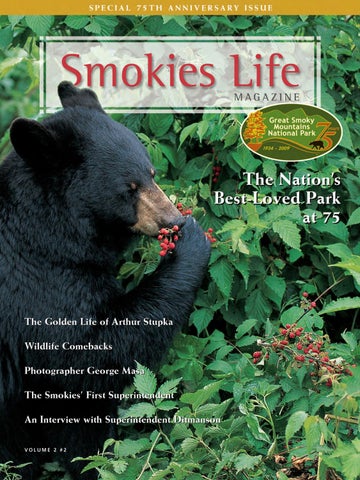
SLcovers_v2#2:SL covers
8/27/08
4:11 PM
Page 1
Whatever can go wrong, will go wrong, and at the worst possible moment. volume 2 #2
—Murphy's Law
S MO KIES LIFE MAG A ZIN E
Formerly dominant bull elk #14 of Cataloochee Valley commits a major fashion faux pas just in time for the fall rut. photograph by Don McGowan
$9.95 USA
GSMA
SLcovers_v2#2:SL covers
8/27/08
4:12 PM
Page 2
ss an iss i m t ’ ue! n o D
to the 75th Anniversary Celebration of Great Smoky Mountains National Park!
Great Smoky Mountains Association Members receive Smokies Life Magazine delivered to their home twice a year. Memberships start at just $30 per year. Other membership benefits include: • 15% discounts in our park stores (and our web site!) • discounts at other park stores in national parks around the country • four issues of the park newspaper per year • two issues of the Bearpaw newsletter per year Membership in Great Smoky Mountains Association is for people who want to help protect Great Smoky Mountains National Park and learn more about this wonderful place. Established in 1953, GSMA now provides over $1.8 million in assistance to the park each year. We are a nonprofit organization.
The Smoky Mountains have inspired me and my music since I was a little girl. They touch my soul and lift my spirits. Let’s celebrate America’s most popular national park, but most especially, join me in making sure its magnificent beauty thrives for generations to come.
Dolly Parton Ambassador for the 75th Anniversary of Great Smoky Mountains National Park
Help Support a National Treasure Join today!
www.SmokiesInformation.org • (865) 436-7318 x222
SL_vol2#2:Layout 1
8/4/08
4:36 PM
Page 1
From the Editor In his article which leads this special 75th anniversary issue, historian Dan Pierce sums it up perfectly when he says “It could never happen today, and even after studying the subject seriously for 15 years, it seems hard to believe it happened then.” Dan is referring to the creation of Great Smoky Mountains National Park. During the 1920s, when the park movement was finally gaining some followers, the odds against its successful birth were still so overwhelmingly long that it’s a miracle anyone even bothered to try. Immensely powerful and contentious timber companies had to be persuaded to lay down their saws, come to the negotiating table, and settle. Thousands of not-so-powerful mountain folk, many of them deeply rooted, had to give up their beloved homes and farms. The states of North Carolina and Tennessee, and many, many organizations and individuals, even school children, had to quickly come up with $10 million ($120 million in today’s money) in one of the poorest regions of our nation on the brink of the Great Depression. The result of the perseverance and sheer will power of the Smokies’ founders is America’s most popular national park, a place where every day of the year stressed-out modern humans find inspiration, peace, and renewal and where countless of nature’s most perfect animals and plants are granted a place to thrive. Its value is now beyond the realm of currency. Each drop of sweat and every dark hour of despair that went into its establishment has spawned rivers of happiness and decades of vitality. Happy Birthday Great Smoky Mountains!
Steve Kemp Editor Steve@GSMAssoc.org
Smokies Life
1
SL_vol2#2:Layout 1
8/4/08
4:36 PM
Page 2
Volume 2 Number 2
$9.95
Contributing Editor Steve Kemp Lead Designer Lisa Horstman National Park Service Publications Liaison Kent Cave Designers Joey Heath Karen Key Editorial Assistance Julie Brown Carolyn Jourdan Courtney Lix Research Assistance Annette Hartigan Advertising Sales Curt Talbot Š2008 Great Smoky Mountains Association. No portion of this magazine may be reproduced without written permission from GSMA. Executive Director Terry Maddox Membership & Special Events Coordinator Judy Collins National Park Service Coordinator Cathy Cook Great Smoky Mountains Association Board of Directors Ellis Bacon Warren Bielenberg Geoff Cantrell William Hart, Jr., Chairman Kelly Leonard, Treasurer Cheryl Light, Vice Chairman David McGuire Barbara Muhlbeier, Secretary Jim Niemeyer Dan Pierce Wayne Shepherd Kate Welch Front cover photograph by Bill Lea Attention Retailers To carry Smokies Life in stores, contact Curt Talbot, Curt@GSMAssoc.org or (865) 436-7318 x226 Advertisers: Contact Curt Talbot, Curt@GSMAssoc.org or (865) 436-7318 x226 416 Cherry St., Gatlinburg, TN 37738. Printed in Canada Smokies Life (ISSN 1937-0725) is published biannually by Great Smoky Mountains Association, a nonprofit organization. 115 Park Headquarters Road, Gatlinburg, TN 37738 (865) 436-7318. www.SmokiesInformation.org This magazine is a premium for members of Great Smoky Mountains Association. To join, change an address, or make other membership inquiries, contact membership and special events coordinator Judy Collins at the address above or Judy@GSMAssoc.org. Memberships start at $30 per year. No submissions of manuscripts, photographs, or art, please. Written queries are welcome. Copyright 2008 by Great Smoky Mountains Association. Send address changes or other membership queries to Judy Collins at the address above or Judy@GSMAssoc.org. Periodicals postage paid at Knoxville, TN. Postmaster: Send all address changes to Judy Collins, GSMA, 115 Park Headquarters Road, Gatlinburg, TN 37738 or Judy@GSMAssoc.org. Thanks to the ALCOA Foundation for their generous support. www.SmokiesInformation.org
Cert no. SW-C0C-1271
The text pages of this magazine are certified by the Forest Stewardship Council as adhering to strict environmental and social standards. Printed with vegetable inks.
page 56
SL_vol2#2:Layout 1
8/4/08
4:36 PM
Page 3
In This Issue Smokies Life Magazine
Volume 2 Number 2
A Fairy Dream on a Goat Hill There are a thousand reasons why the effort to establish GSMNP should have failed. The miracle is it didn’t. By Dan Pierce
Park History and Timeline An illustrated review of the first 75 years or so of park history. By David Brill
Aden Carver’s Rocking Chair Visitors to the Smokies are still enjoying this craftman's work.
Then and Now Preserving historic buildings in the Smokies is no walk in the park. Photographs by Don McGowan
The Golden Life of Arthur Stupka page 12
The park’s first naturalist lived a charmed and fascinating life. By Rose Houk
Return of the Missing Ones: Wildlife Comebacks It worked! Wildlife is thriving in the Great Smoky Mountains. By Rose Houk
Ranger Stories: Why You Don’t Mess With Ranger Bob Once upon a time a man decided to poach in the park… By Don Williams
Photographer George Masa The “Ansel Adams of the East” helped save the mountains. By Bill Hart
The Smokies’ First Superintendent: J. Ross Eakin Ross was given two rangers and 800 square miles to take care of. By Ted Catton
An Interview with Park Superintendent Dale Ditmanson What challenges await the Smokies between now and the Centennial? By Don Williams
12 20 48 52 56 64 74 76 86 94
SL_vol2#2:Layout 1
8/4/08
4:36 PM
Page 4
Smokies Life
4
8/4/08
4:36 PM
Page 5
© 2006 ROBERT J. GOODWIN
SL_vol2#2:Layout 1
ALL THE TRAILS IN THE SMOKIES FOR ALL TIME… Friends of the Smokies’ Trails Forever Endowment will be the signature project of the Park’s 75th anniversary celebration. Trails Forever is a lasting gift that will benefit the Smokies’ 800 miles of trails and every hiker who will use them for countless generations. Our goal of raising $2 million to match funds dedicated by The Aslan Foundation of Knoxville in memory of Lindsay Young will also be the single most ambitious fundraising initiative in Friends of the Smokies’ 15-year history. Do you hike? Do you have great memories of seeing the fall colors from the mountaintops? Do you hike to spend time with friends and family? To stay in shape? Do you have a favorite
waterfall or other beloved place accessible only by trail? Do you hike to get away from it all? Would you like to honor or remember someone special who loves or loved to hike? Whatever your motivation, and whatever your means, your support for the Trails Forever campaign will be for all the trails in the Smokies, for all time. Be a part of this lasting legacy for the Smokies. To receive more information, please call us at (800) 845-5665, visit our website at www.FriendsOfTheSmokies.org, or return the card included here.
SL_vol2#2:Layout 1
8/4/08
4:36 PM
Page 6
SL_vol2#2:Layout 1
8/4/08
4:36 PM
Page 7
SL_vol2#2:Layout 1
8/4/08
4:37 PM
Page 8
Smokies Life
8
SL_vol2#2:Layout 1
8/4/08
4:37 PM
Page 9
Smokies Life
9
t
llllllllllll
4:37 PM
Page 10
lllllllll
The Historic
t
t
t
8/4/08
llllllllllll
SL_vol2#2:Layout 1
GATLINBURG INN Rustic elegance located in the heart of downtown Gatlinburg. Just four blocks from the entrance to Great Smoky Mountains National Park. Private rooms with baths starting at $58 per night. Suites starting at $94. A clean, quiet, and comfortable non-smoking inn. {Yes, this is the inn where “Rocky Top” was written!}
{865} 436-5133
• GatlinburgInn.com
lllllllll Smokies Life
10
t
t
t
Open April 1 - November 1
t
SL_vol2#2:Layout 1
8/4/08
4:37 PM
Page 11
Smokies Life
11
SL_vol2#2:Layout 1
8/4/08
4:37 PM
Page 12
Smokies Life
12
SL_vol2#2:Layout 1
I
8/4/08
4:37 PM
Page 13
t could never happen today, and even after studying the subject seriously for 15 years, it still seems hard to believe that it happened then. What am I talking about?—the establishment of Great Smoky Mountains National Park, a process so unlikely, spearheaded by “the obstacle of raising even more unlikely people, an estimated $10 million that it still boggles my mind after all these years. to purchase the required When I began looking into the history behind the esacreage. . . in one of the tablishment of Great poorest regions of the Smoky Mountains National Park as a graduate stunation was daunting to dent at the University of say the least.” Tennessee in 1992, I thought I knew what I would find. After eight years, thousands of miles logged in driving to the National Archives in Washington, D.C., the Rockefeller Archives at Pocantico Hills, N.Y., the Tennessee and North Carolina State Archives, and the park archives at Sugarlands, countless hours spent in front of a microfilm reader looking at the regional newspapers from the 1920s and 1930s, and countless other hours spent thinking about and writing what became The Great Smokies: From Natural Habitat to National Park, I found out that much of what I thought I knew was wrong. What I did find is a compelling, complicated, and unique story that still teaches us important lessons today.
In The Beginning Prior to the establishment of Great Smoky Mountains National Park in 1934, all of the great national parks like Yosemite, Yellowstone, Grand Canyon, and Rocky Mountain were in the western United States and had been created by the federal government from land already owned by the federal government. The only exception to this rule was tiny Acadia on Mount Desert Island in Maine, which had been donated to the government by a few wealthy families—the bulk by the Rockefellers. When individuals in East Tennessee and Western North Carolina began seriously talking about the possibility of the federal government establishing a national park in the Smokies in the early 1920s, they faced two major obstacles. First, there was no land in the Smokies in the federal domain; all of the land was owned by either individual farmers or by large timber companies. Secondly, while the federal government regularly bought land in the southern Appalachian region for national forests under the management of the U.S. Forest Service, Congress had firmly declared that it would not appropriate money for the purchase of land for national parks. Fortunately, for the folks in the southern Appalachian region, the National Park Service had very creative leadership in Director Stephen Mather, who, along with his energetic assistants Horace Albright and Arno Cammerer, wanted to expand the scope of the national parks and add units in the eastern U.S. They concocted a plan where the Park Service would designate sites with the “scenic values” appropriate for national park status, guide the states in purchasing the land, and then accept the donation of that land
Smokies Life
13
SL_vol2#2:Layout 1
8/4/08
4:37 PM
Page 14
Some of the impetus for creating Great Smoky Mountains National Park came from automobile clubs and other motorists hoping for more opportunities for scenic auto touring in the area. Left: Visitors crowd the parking at Cades Cove Primitive Baptist Church in 1951. Right: First and only motor vehicle ever on Spence Field up to 1952. The grassy bald was once auto-accessible via Bote Mountain.
“Indeed, the push for the creation of a national park in the Great Smokies began not in a Sierra Club meeting, but in meetings of the Knoxville and Asheville chambers of commerce. ”
from the states once it had been purchased. After a tour of the region by a special committee to judge the worthiness of potential sites in the southern Appalachians in 1924, the Park Service decided that the Shenandoah Mountains of Virginia and the Great Smokies on the border of Tennessee and North Carolina would be acceptable additions to the national park system. While folks in the region rejoiced over designation of the Smokies as a potential site, the obstacle of raising an estimated $10 million to purchase the required acreage—over 400,000 acres before the NPS would accept it as a national park—in one of the poorest regions of the nation was daunting to say the least. The real work of creating a national park in the Smokies would fall not to the federal government, but to the people of Tennessee and North Carolina, particularly of its mountain regions. One Tennessee critic decried the whole project as ludicrous and called the vision of boosters
who wanted a national park in the Great Smoky Mountains, a “fairy dream on a goat hill.” Most objective observers probably agreed with this assessment, but a fascinating and unexpected group of people poured their enthusiasm, energy, and money into this unrealistic project and turned a “fairy dream” into reality.
Founding Fathers (and Mothers) One major misconception I had about the creation of Great Smoky Mountains National Park was the idea that this park—and indeed, all national parks—was created by people who were environmentalists. In doing research on the park, I was quickly disabused of the notion of a group of East Tennessee and Western North Carolina Henry David Thoreau or John Muir types speaking on behalf of trees, woodland animals, and mountains, and convincing
Smokies Life
14
SL_vol2#2:Layout 1
8/4/08
4:37 PM
Page 15
the federal government of the need for a national park in the region. Indeed, in the group of individuals most responsible for the establishment of the park, you were much more likely to find industrialists, auto dealers, developers, salesmen, newspaper publishers, lawyers, and housewives than you were to find transcendentalist philosophers. Instead of a John Muir, you were much more likely to find figures more akin to novelist Sinclair Lewis’s 1920s archetypical businessman George F. Babbitt, a "God-fearing, hustling, successful, two-fisted Regular Guy. . .” Indeed, the push for the creation of a national park in the Great Smokies began not in a Sierra Club meeting, but in meetings of the Knoxville and Asheville chambers of commerce, the East Tennessee Automobile Club, and business booster group Western North Carolina, Inc. For most of the individuals involved, preservation of the Smokies was not the end, but a means to the end of regional economic development. Indeed, few of the people who began lobbying the federal government to create a national park in the region had even been into the Smokies themselves. Knoxville automobile dealer Cowan Rodgers spoke for most of the people involved in pushing for the creation of a national park when he argued that if the government established a national park in the region, then “millions will annually come through our gates and scatter their golden shekels in our midst.” Much of the language and imagery used by boosters in the early promotion of the park idea revolved around economic benefits to the region and called the potential park “an inexhaustible gold mine,” a “Mecca for tourists,” the “best investment ever offered to the people of East Tennessee,” the “Goose with the Golden Eggs,” and a “modern combination of Aladdin's Wonderful Lamp, the touch of Midas, the Magic Urn, and the weaving of straw into gold by Rumpelstiltskin.” Lobbying by these boosters for a national park in the region came within the context of the dramatic increase in the number of automobiles and of state and federally maintained roads—a product of a major push by so-called “good roads” advocates—in the 1920s. The resulting growth in “automobility,” along with the economic prosperity of the period, also led to the rise of the middle-class family vacation. It was this new class of motorists, along with traditional elite travelers, that boosters envisioned flocking to the Smokies. While the motivations of East Tennessee and Western North Carolina park boosters like W. P. Davis and his wife Anne (one of the first women elected to the Tennessee House of Representatives), David Chapman, Mark Squires, and Charles Webb may not fit our image of “park people,” they were incredibly energetic and committed to the cause. They effectively lobbied Congress to have the Smokies designated as a site that the National Park Service would accept, raised over $1 million in pledges from businessmen, housewives, blue-collar workers, and school children, and convinced the state legislatures of Tennessee and North
Carolina to issue bonds worth $2 million each to purchase the needed land. There were those who would be considered environmentalists involved in the establishment of the Smokies, however. Two of the individuals in the region who began seriously talking early on about creating a national park in the region were outdoor writer Horace Kephart of Bryson City, North Carolina and Paul Fink, a pioneering hiker and camper in the Smokies from Jonesboro, Tennessee. Kephart once wrote of his love for the Smokies and the need to preserve them, “I owe my life to these mountains and I want them preserved that others may profit from them as I have.” In 1919, Fink—after a backpacking trip to the area—wrote to Kephart telling him about the devastating impact of logging in the eastern end of the Smokies: “A great shock it was to us, to travel for days through a magnificent, truly virgin forest, where there was only the very faintest, scattered evidence man had ever been there before, and then step into the utter devastation the spruce logger leaves behind him.” Although their initial efforts in the early 1920s were frustrated—Kephart wrote to Fink, “I wish in my heart that I could encourage you in starting a propaganda to have the Government buy up the best forests here before they are destroyed; but there is no hope…,” both eagerly joined forces with the Asheville and Knoxville boosters to promote the park idea. Kephart played an especially important Author Horace Kephart wrote eloquently about the devastation caused by large scale logging in the Smokies and the need to protect the area as a national park. “Why should future generations be robbed of all chance to see with their own eyes what a real forest, a real wildwood, a real unimproved work of God, is like?”
Smokies Life
15
SL_vol2#2:Layout 1
8/4/08
4:37 PM
Page 16
role as a nationally known author and penned articles in the New York Times and other publications extolling the beauties of the Smokies and soliciting support for their preservation. Perhaps the most important conservationist/environmentalist who took an active role in the establishment of the Smokies, however, was John D. Rockefeller, Jr. By late 1927, the park movement was at a standstill. Boosters had secured pledges of $1 million from individuals and businesses and the states of Tennessee and North Carolina had pledged an additional $4 million in bond funds. Many of the legislators who supported the bond bills in both states, however, did so because a clause in each bill stated that the bonds would not be released until all of the money needed to purchase land for the park—an estimated $10 million—was in hand. They voted for the bill because they never believed the boosters could come up with the rest of the money. The needed money was secured, and the politicians shocked, due to the persistent efforts of NPS assistant director Arno Cammerer, and John D. Rockefeller’s love for oldgrowth forests—the Smokies held the largest remaining stands of old-growth east of the Rockies. In 1928, Rockefeller announced that the Laura Spelman Rockefeller Memorial Fund would donate the remaining $5 million. This gift not only provided half of the needed money, but forced both states to release the promised bond funds. Unfortunately, few park visitors know of the sacrificial efforts made by both boosters and environmentalists in gaining federal recognition of the Smokies and in raising the necessary funds. In fact, few realize that this park and Shenandoah National Park were not purchased from the federal treasury, but with the donations of citizens who became passionate about the preservation of the Smokies. Park visitors also often miss the only real public monument to the role played by the boosters, environmentalists, and state governments of North Carolina and Tennessee—reluctant as they were—and of the Rockefeller family on a bronze plaque attached to a stone platform at Newfound Gap. In making his $5 million bequest to the Tennessee and North Carolina Park Commissions, Rockefeller asked only that a plaque memorializing his mother and the roles of the states be placed in a prominent place. The plaque reads: “For the permanent enjoyment of the people, this park was given one half by the people and states of North Carolina and Tennessee and by the United States of America, and one half in memory of Laura Spelman Rockefeller by the Laura Spelman Rockefeller Memorial, founded by
A very happy day in Knoxville. Left to right: Ben A. Morton, State Senator A. J. Graves, W. P. Davis, Ben W. Hooper, E. E. Conner, Col. David C. Chapman, John M. Clark, J. Wilie Brownlee, Gov. Henry Horton, Gen. Frank Maloney, Gen. Cary F. Spence, Arno B. Cammerer, Kenneth A. Chorley (top), Cowan Rodgers, and William S. Shields
her husband, John D. Rockefeller.” While the needed money—or at least most of it as it turned out—was in the hands of park commissions in Tennessee and North Carolina by late 1928, the work had just begun. Those commissions now faced the daunting task of purchasing—mostly from unwilling sellers—the 427,000 acres of land in the Smokies required by the federal government before the area could be named a national park.
Opposition to the Park’s Establishment Growing up not far from Great Smoky Mountains National Park it was hard for me to imagine that anyone did not love the park. But from the very beginning of the campaign to boost the idea of a national park in the Smokies in the mid-1920s, the timber companies—who owned most of the land in the proposed park area—expressed their vehement opposition to the project. In 1925, the Western North Carolina Lumber and Timber Association passed a resolution declaring, “the National Park System is not adapted to the needs of Western North Carolina.” The association justified its position based on its opposition “to the segregation of enormous areas of forest lands and lands suitable for growing forests into dead hands, where
Smokies Life
16
8/4/08
4:37 PM
Page 17
PHOTOGRAPH BY MARY ANN KRESSIG
SL_vol2#2:Layout 1
Left: Cades Cove Primitive Baptist Church interior, organized in 1827. Right: John Oliver’s cabin restored today.
it cannot be used, no matter how vital its use may be to the industries of this State, and to the material needs of this nation.” Throughout the fundraising crusade, the timber companies kept up a steady campaign to voice their opposition, declaring that much of the land in the Smokies was already cut over and “not suitable for national park purposes.” The arguments timber companies used ranged from hard economic data to rather bizarre rantings. In 1926, timber company supporters hijacked a park fundraising rally in Waynesville, North Carolina. Suncrest Lumber Company lawyer “Bat” Smathers took the platform and characterized park boosters as the “forces of evil.” “This mad age of pleasure and recreation is carrying us to hell as fast as possible.” Despite such efforts, however, the timber and paper products industry failed to derail the fundraising campaign. Once boosters raised the money, timber company opposition did not abate, but if anything became more intense. The timber companies forced the park commissions in both states to take each of them into court to force them to sell their land under each state’s power of eminent domain. This process proved costly for the states as lawyer fees climbed due to the long and drawn out court proceedings, the appeal of many decisions, and local
jury awards that gave the timber companies top dollar for their land. In Sevier County, Tennessee, a five-man “jury-of-view,” appointed by the courts to make a fair appraisal of land owned by Champion Fibre Company, awarded the company $65 an acre— an exorbitant amount. Years later it was revealed that Champion had bribed at least one of the jurors to the tune of $15,000. Champion later settled for a much smaller amount for both its Tennessee and North Carolina lands. Dealing with the timber companies and their lawyers cost the park commissions years in delays and hundreds of thousands of dollars. Indeed, it took a couple of “back-door” bail-outs and some creative accounting by members of Franklin D. Roosevelt’s New Deal administration— primarily from Secretary of the Interior Harold Ickes—to complete the purchases of land and finally dedicate the park in 1940. The timber companies were not the only opponents to the creation of a national park in the Smokies; the over 4,000 people living within the proposed park boundary on family farms presented the most bitter and heart-felt opposition. Early in the process, public officials guaranteed the people living in the region that their land would not be taken. At a community meeting in Elkmont
Smokies Life
17
in 1926, then Tennessee Governor Austin Peay tried to calm an uneasy crowd of Smokies homeowners, “As long as I am a member of the Park Commission, I wish to assure these people that there will be no condemnation of their homes.” Such an action, he argued, “for the pleasure and profit of the rest of the state would be a blot upon the state that the barbarism of the Huns could not match!” Peay died not long after this speech, but it soon became clear that his promise was an empty one and attempts to buy farms in the Smokies began in 1928 followed by condemnation proceedings for those who would not sell. Opposition was particularly strong in Cades Cove. One cove resident sent a letter to local papers questioning: “Our ancestors fought in the American revolution. Have we no right to life, liberty, HOME and happiness? Fresh warm blood from Cade’s Cove redeemed the soil of France to make the world safe for Democracy—must Cade’s Cove submit to Kaiserism?” John Oliver, postmaster and Primitive Baptist minister in the cove, wrote to Secretary of the Interior Hubert Work in 1928 that forcing the people of Cades Cove to leave their homes “would be a crime which our national government would be ashamed of.”
SL_vol2#2:Layout 1
8/4/08
4:37 PM
Page 18
The price to create Great Smoky Mountains National Park was high. Those who paid most dearly were the more than 4,000 people who had to leave their homes and see their communities dismantled. Decades later, at least some would look back on their sacrifice, and the verdant mountains, and say it had been worth while. Left: Little Greenbrier School ca. 19151920. Right: Rachel and Will Messer.
Challenges to the park commissions’ right to condemn the land of Smokies farmers went all the way to both the Tennessee and North Carolina Supreme Courts, but the power of eminent domain was upheld and the courts forced the challengers to settle with the park commissions. Even before these cases were settled, most homeowners made the decision to sell out to the park commissions. While there is some debate as to whether landowners received a fair deal for their land—and as to what factors, including political affiliation, influenced the amounts offered by commissions—the majority settled for the offer without a great deal of haggling. Depression era conditions, which made farm life increasingly precarious economically, along with new job opportunities outside the Smokies with federal work programs like the Tennessee Valley Authority and at factories like the Champion Fibre Company in Canton, North Carolina, and the ALCOA aluminum plant near Maryville, Tennessee, made the decision easier for some people. By the late 1920s and through the 1930s, the sad sights of families packing their belongings and moving out of the coves and hollows of the Smokies where their ancestors had lived for generations became common. Some residents, due to the economic conditions of the Great Depression, were allowed to stay on their land on leases, but for most the limitations on their activities imposed by the National Park Service made leasing only a short-term solution. One resident voiced his frustration over lease restrictions: “They tell me I can’t break a twig, nor pull a
flower, after there’s a Park. Nor can I fish with bait for trout, nor kill a boomer, nor bear on land owned by my pap, and grandpap and his pap before him.” By the mid-1930s, most of the families who had not only built homes, but created communities like Cades Cove, Cataloochee, Greenbrier, and the Sugarlands, were gone. Some few stayed behind on lifetime leases, primarily elderly folks who could not bear to leave their homes and land behind, but things were not the same. The Park Service began destroying many of the structures left behind, selling off lumber to those who wanted it and burning much of the rest. Some buildings— most that reflected what the Park Service termed “pioneer characteristics” and little that might “suggest progress or advancement beyond the most primitive stages”— were preserved. However, this left behind an unrealistic view of the lives lived by most of the 20th century residents of the Smokies as locked in the 18th century. As historian Durwood Dunn observed in his book on Cades Cove: “It was as though, having destroyed the community of Cades Cove by eminent domain, the community’s corpse was now to be mutilated.” If I feel any sadness about the establishment of Great Smoky Mountains National Park it is for the families who lost their homes, churches, businesses and communities. As former Park Ranger Glenn Cardwell—who grew up in Greenbrier—argued, “You can buy a farm anywhere, but tearing up your community does something to your spirit.” Indeed, one of the glaring deficiencies in the park today is the lack of recognition of the supreme sacrifice paid by
Smokies Life
18
SL_vol2#2:Layout 1
8/4/08
4:37 PM
Page 19
families like the Cardwells, the Olivers, the Caldwells, Ogles, Messers, and thousands of others who lived in and loved the Great Smoky Mountains before it became a national park. Obviously, despite the vigorous, and sometimes vicious, opposition to the establishment of the park, the work of purchasing the needed land was completed in the late 1930s. A suitably grand dedication took place at Newfound Gap on September 2, 1940 with President Franklin D. Roosevelt, Secretary of the Interior Harold Ickes, and numerous other dignitaries standing alongside the boosters like David Chapman, Anne Davis, and Charles Webb who had helped turn a “fairy dream” into reality.
So What? As a college teacher I try to get my students to not only know and recall the facts of history, but to understand the significance of that history. The story of the establishment of Great Smoky Mountains National Park is rife with significance for both park managers and for the general public. Perhaps the most significant product of the history of the park is that the unusual circumstances surrounding its establishment created a unique relationship between the park and the people of Western North Carolina and East Tennessee. Indeed, the Smokies and Shenandoah are the only two national parks that were essentially created by the citizens of their respective regions. I believe in the Smokies that this has created an important historical bond that is even more relevant today. Unfortunately, after the dedication of the park in 1940, the relationship between the park and the people of the region began to weaken as the National Park Service took over management of the park and input from local people became less and less important. About the only input from the people of the region from the 1940s to the 1990s were the complaints from people when roads were closed, trails shut down, or bear-proof trashcans were installed and bears were banned to the backcountry. During this period the Park Service let it be known that their fiscal needs were provided by the federal treasury and that they had the necessary expertise to manage the Smokies without input from locals. Indeed, there was often tension between the Park Service and the local communities. When I was beginning research on the history of the Smokies in the early 1990s, however, things began to change. The fiscal climate for national parks had declined dramatically and the Smokies and other national parks were/are chronically strapped for funds. Deferred maintenance began to build up everywhere throughout the park as CCC-era picnic areas and campgrounds aged, roads became warped and full of potholes, and trails eroded. At the same time new challenges began to emerge as invasive species and poor air quality became major problems in the park and park mangers possessed few resources to either
address the problems or educate the public. Fortunately for Great Smoky Mountains National Park, two things happened in the early 1990s that helped restore the historic bond between the park and local communities and the American public at large. First, Great Smoky Mountains Natural History Association—now Great Smoky Mountains Association—founded in 1953 as a cooperating association primarily to run park bookstores, became much more proactive and creative in providing financial and inkind aid to the perennially cash-strapped park. Secondly, a group of citizens from the region, concerned about the condition of and the challenges faced by the park, formed the Friends of Great Smoky Mountains National Park. Together, these groups annually provide over $3 million in support to the park. Recent projects such as the construction and furnishing of the Twin Creeks Science Center, the Appalachian Highlands Science Learning Center at Purchase Knob, and a new visitor center at Oconaluftee would not be possible without aid from GSMA and the Friends. The park partners have also provided emergency aid to save as many of the park’s hemlocks as possible from the hemlock woolly adelgid, funds to restore elk to the Cataloochee Valley and brook trout to many of the park’s streams, money to restore historic log homes in the park, and even help to conduct day-to-day educational, management, and law enforcement activities. The actions of these groups and their support for the park are in the best historical tradition of Great Smoky Mountains National Park. Horace Kephart argued in a magazine article that once established, Great Smoky Mountains National Park would become “a joy and wonder to our people for all time.” To be sure, the Smokies have become a “joy and wonder” for millions of people in Western North Carolina, in East Tennessee, and around the world, fulfilling the vision of its founders by both protecting a national ecological and scenic treasure and at the same time generating millions in tourist revenue for the surrounding region. As we celebrate its unlikely, almost fairy-tale like establishment in 1934, we also celebrate the legacy of the individual contributions of thousands of East Tennesseans and Western North Carolinians and the generous philanthropy of people from outside the region like John D. Rockefeller, Jr. Part of that legacy involves the unique responsibility of the descendents of its East Tennessee and Western North Carolina founders—and indeed all American citizens—to see that this park created by the people remains healthy and vibrant “for all time.” Dan Pierce is the chairman of the History Department at the University of North Carolina in Asheville and is the author of The Great Smokies: From Natural Habitat to National Park. For more information on how you can show your support for Great Smoky Mountains National Park, visit SmokiesInformation.org or FriendsoftheSmokies.org or call 1-888-898-9102.
Smokies Life
19
SL_vol2#2:Layout 1
8/4/08
4:37 PM
Page 20
The Nation’s Bestloved Park, at 75 { a brief history of G reat S moky Mountains National Park} by David Brill
In 1934, the National Park Service created its
22nd unit, and Great Smoky Mountains National Park
would go on to become the nation’s favorite.
The journey that leads from rough concept to the
park we know and love today follows a
meandering path defined by remarkable people and events. Smokies Life 20
SL_vol2#2:Layout 1
-
8/4/08
4:37 PM
Page 21
1925:
Clarence Darrow takes a break from the Scopes Monkey Trial in Dayton, TN to visit the area, accompanied by John Scopes himself. Darrow provides an eloquent endorsement of the park idea.
1923:
National Park Service Director Stephen Mather voices his support for creation of a national park in the East. Under consideration are Roan Mountain, Mt. Mitchell, Grandfather Mountain-Linville Gorge, Blowing Rock, and the Black Mountains north of Asheville.
1911:
Congress passes the Weeks Act, which provides for the condemnation and purchase of lands in the East for a forest preserve. At the time it appears as though the acquired lands may begin life as a national forest rather than a national park, although many in the surrounding community are not sure of the difference between the two.
SMITHSONIAN INSTITUTION ARCHIVES
1899:
The Appalachian National Park Association forms in Asheville to explore, according to Henry Lix, the ambitious goal of creating a 12,000-square-mile park whose boundaries would meander through parts of North and South Carolina, Georgia, Virginia, and Tennessee.
Clarence Seward Darrow (center stand ing) during the trial of State of Tennessee vs. John Thomas Scopes, July 20, 1925.
1925:
Park proponents in North Carolina and Tennessee join forces to raise money through donations to acquire park lands. Combined, the two states raise less than half the necessary funds.
1912:
The Wonderland Hotel is completed at Elkmont.
In 1926, Jack Huff (right) took over operations at Le Conte Lodge. Along with providing accommodations for hundreds of guests, he gave his mother a lift to the mountain top.
T
he millions of visitors who enter Great Smoky Mountains National Park each year are, in fact, observing a 500,000-acre organism that’s as continually evolving as the myriad “...Pervasive in the story is the species of plants and anitheme of development for mals that reside within its public use vs. preservation.” boundaries. Consider the influences of wind and water. The effects of fluctuating budgets. by David Brill The construction of faciliAll photographs are from Great Smoky Mountains ties and roads. The decline National Park Archives unless noted otherwise. and surge of wildlife populations. The intrusion of invasive species. The impacts of the visitors themselves. All have contributed to a dynamism that sustains an endless process of change. The Great Smoky Mountains National Park (GSMNP) of today is different from the park of just yesterday, if only incrementally. When viewed from the perspective of nearly a century, the change is enormous.
The 75+ year story of this park illustrates our evolving definition of wildland stewardship and corresponding management practices. Pervasive in the story is the theme of development for public use vs. preservation. These dichotomous forces were jostling for position decades before the park was officially established and continue to do so this very moment. And so we begin, in 1885, not on the forested peaks of the southern Appalachians, but, oddly enough, in New York City.
GENESIS OF A PARK: 1880s-1929
As with the birth of anything truly worthwhile—and grand—the creation of Great Smoky Mountains National Park spanned a gestation period of nearly half a century marked by, at turns, conflict, political intrigue, and imminent miscarriage, before emerging as the 22nd unit of the U.S. National Park System. The story of the park, by the account of former park naturalist Henry Lix, may have begun as early as 1885, at the American Academy of Medicine meeting in New York City, where Boston doctor Henry Marcy presented a paper titled “Climatic Treatment of Disease,” which touted the
Smokies Life
21
SL_vol2#2:Layout 1
8/4/08
4:37 PM
Page 22
1927:
John D. Rockefeller Jr. pledges $5 million from the Laura Spelman Rockefeller Memorial, named for his mother. Rockefeller designates the gift as a “match,” requiring the two bordering states to raise an equal amount before they can access the funds.
1926:
The 76,507-acre Little River Lumber Company holding becomes the first purchase for the new national park, although included in the contract is a proviso allowing for the continued harvest of timber in the area. This allows removal of trees from the property until 1937, three years after official establishment of the park. Negotiations move toward acquisition of Ravensford Lumber Company, Suncrest Lumber Company, and the Champion Fibre Company (which holds nearly one-fifth of what will become park lands).
The Rockefeller memorial that is located at Newfound Gap today.
1926:
Healing Waters and Hot Wheels
WALTER LEEDY POSTCARD COLLECTION, CLEVELAND STATE UNIVERSITY LIBRARY
Other vacation resorts included Alleghany (with a 60room hotel), Duponte, and Kinzel Springs. Indian Gap Hotel, as well as the Appalachian Clubhouse and Wonderland Park Hotel in the Elkmont district, also welcomed visitors in pre-park days. By 1915, reports author Steve Cotham, the “Elkmont Special” steam engine and passenger cars regularly carried tourists from Knoxville to the Smokies. Beginning in 1924, according to historian Dan Pierce, Primitive Baptist preacher John Oliver offered more rustic accommodations, renting cabins in Cades Cove chiefly to fishermen. The Palmers of Cataloochee did likewise on the other side of the mountain, welcoming tourists and anglers at their rustic lodge. The modern lust for tourism—and the steady increase in visits to what would become Great Smoky Mountains National Park—resulted from a mechanical conveyance mass produced and marketed by Henry Ford in the early years of the 20th century. Ford’s Model T, produced from 1907 to 1927, created a new generation of mobile Americans who sought hard-surfaced roads as well as engaging destinations situated at the ends of those roads. Ford sold more than half a million of the cars in 1915, and it’s a safe bet that many of Ford’s later models brought visitors to the park.
Congress passes a bill calling for creation of national parks in Virginia (Shenandoah) and Tennessee and North Carolina (Great Smoky Mountains), but the bill leaves the states responsible for purchasing the lands and requires that a minimum of 150,000 acres should be acquired to gain NPS law enforcement and fire protection. The bill also requires that “a major portion” of the up to 704,000 acres authorized for inclusion must be acquired before full development may begin.
therapeutic benefit of breathing clean mountain air, perhaps among sufferers of tuberculosis. Regardless of the merit of Marcy’s hypothesis, the presentation left an impression on Ohio physician Chase Ambler, who moved to Asheville, North Carolina, in 1889 and devoted his energies to a “vigorous” campaign to establish a national park in the southern Appalachians. In 1923, Willis and Anne Davis, members of the East Tennessee Automobile Club of Knoxville, returned from a trip to Yellowstone National Park (the nation’s first, established in 1872) determined to see a park created in the Smokies. The couple helped form the Great Smoky Mountains Conservation Association, which elected as its chairman Col. David Chapman, a veteran of the SpanishAmerican War and later colonel in the East Tennessee National Guard. Sen. Mark Squires, Chapman’s counterpart across the mountain, assumed the chairmanship of
Smokies Life
22
SL_vol2#2:Layout 1
8/4/08
4:37 PM
Page 23
Lands Stripped Bare By the 1920s, the 814-squaremile area that would become GSMNP had, according to historian Daniel Pierce, “lost two-thirds of its forest cover” to logging operations, leaving only isolated pockets of old-growth timber intact, chiefly in the eastern half of the future park. The resultant timber harvest created a devastated landscape unrecognizable “by inhabitants of only a generation earlier, much less the Cherokees and their ancestors who had hunted and gathered in these forests for millennia.” Little River Lumber Company’s log loader.
1929:
An invader from Asia, Cryphonectria paracitica, better known as chestnut blight, has arrived and infested 99 percent of the park’s dominant tree species, which at one time occupied up to 40 percent of park lands, with some of the larger trees exceeding heights of 100 feet. By 1938, nearly all of the park’s once-majestic chestnut trees will be dead.
1929:
The stockmarket crashes marking the beginning of the nation’s decline into Depression.
Elkmont Summer Homes
Dead chestnut trees in the park around 1935.
the North Carolina Park Commission. During the same year, North Carolina naturalist and author Horace Kephart and Asheville Citizen Times editor Charles Webb—both energetic and persuasive park advocates—lent eloquent and much needed voices to the park movement in both states.
1929:
John W. Oliver receives the first condemnation suit issued for the park development. This kicks off the purchase of, according to historian Michael Frome, “6,200 separate tracts, including 5,000 lost in summer colonies and proposed developments, plus over 1,000 small farms.” The North Carolina side faces acquisition of 410 separate tracts. Soon-to-be displaced landowners surrender their holdings and move out or agree to a reduced purchase price (generally about half) and retain lifetime rights to lease the land from the government.
Included among the acreage acquired for the park was the collection of 74 cottages, lodges (including the Appalachian Clubhouse), outbuildings, and the Wonderland Hotel in Elkmont, all located near the former site of the Little River Lumber Company. The small community of structures is now known as the Elkmont Historic District. Most of the property owners accepted a reduced value for their lands in exchange for lifetime leases, which allowed them to continue to use the property. Most of the leases expired in 1992, though the debate on the structures’ ultimate fate has continued into the current century. The park’s 1982 general management plan called for removal of the structures, but in 1994 Elkmont was placed on the National Register of Historic Places, with more than half of the existing structures cited for inclusion in the historic district. In 2004, as part of the Draft Environmental Impact Statement (DEIS), required by the National Environmental Policy Act, the park’s management staff explored several options and invited public comment. The park’s preferred alternative is to restore and preserve several of the cabins, including the Appalachian Clubhouse, for educational purposes. The final EIS calls for preserving about 20 of the buildings.
Smokies Life
23
SL_vol2#2:Layout 1
8/4/08
4:37 PM
Page 24
1930:
The federal government accepts deeds for 158,876.5 acres, exceeding the minimum requirement (150,000 acres) in order to gain protection and management from the federal government.
1931:
The park’s first superintendent, J. Ross Eakin, a World War I artillery commander, and his small staff of rangers arrive for work. The early years of their tenure involve taming lawlessness— primarily moonshining, poaching, and squatting—more than the finer points of managing a national park unit.
1933:
Roosevelt issues an executive order pledging $1,550,000 in federal funds to the park, and the Rockefeller family agrees to release $500,000 of the funds even though the states have not raised enough to make the match. The pooled funds will permit the states to acquire the additional lands required for full park status.
Dozens of illegal moonshine stills were confiscated during the early years of the national park.
1933:
President Franklin Delano Roosevelt, as a project of the New Deal, creates the Civilian Conservation Corps (originally known as the Emergency Conservation Work or ECW program). By May of the same year five camps of 200 men each are established in the park.
1931:
Horace Kephart, eloquent park supporter and one time park inhabitant, is killed in an automobile accident.
Photographer and park advocate George Masa dies of influenza.
Horace Kephart, instrumental in the birth of the park.
THE TREE ARMY: 1930-1939 Superintendents as Chroniclers
On April 8, 1931, the park’s first superintendent, J. Ross Eakin, typed out the first of what now number more than 800 monthly superintendents’ reports. The reports occupy numerous bound volumes in the park archives. Eakin begins his inaugural report with notable humility: “Herewith report of activities in Proposed Great Smoky Mountains National Park for the month of March 1931. In some respects this report is not as complete as it should be but we hope to do better in the future. In other respects there is perhaps more detail than is ordinarily desired….” In the eight-page report, Eakin cites “large numbers of people who desire work in the park,” driven to the park employment lines by the early years of the Great Depression, though Eakin had no funds for hiring them. Eakin also references houses occupied within the park by squatters—homeless individuals who settled into some of the dozens of yet-to-be demolished structures dotting the fledgling park. One occupant, Eakin notes, “has been very
valuable for fire suppression.” Another dwelling, however, was “occupied by a squatter, a woman who has separated from her husband, and her grown daughter. These women bear a very bad reputation for peddling whiskey and loose morals.” In his report filed on May 6, 1931, under “miscellaneous,” Eakin notes the death of one of the park’s key proponents: “Horace Kephart, of Bryson City, N.C., author of ‘Our Southerland Highlands’, etc. was killed in an automobile accident on April 2. He was largely instrumental in starting the movement for the park.” It is notable to mention that these monthly and later yearly accounts of park history exist in national parks all over the country, allowing for the willing researcher to step into the past in Yosemite just as one can do so in the Smokies.
A Dearth of Wildlife At the time of J. Ross Eakin’s appointment as the Smokies’ first superintendent in 1931, many animal communities had dwindled to just a few individuals through habitat loss and hunting (legal as well as poaching).
Smokies Life
24
SL_vol2#2:Layout 1
8/4/08
4:37 PM
Page 25
1934:
1939:
Congress passes legislation providing that the then 400,000-acre holding “be established as a completed park for administration, protection and maintenance,” thus establishing June 15, 1934, as the official birth date of GSMNP. The official dedication ceremony is yet six years away.
On July 5th, the inauguration of the ranger-naturalist program occurs with great success. Because of the lack of a museum, visitor center, or amphitheatre most of the programs involve hiking. A total of 621 people attend 25 hikes varying in length and difficulty from 2.6 miles roundtrip to Laurel Falls to a 10-mile overnight hike up Alum Cave to Mt. Le Conte.
1935:
GSMNP welcomes Arthur Stupka, a zoologist from Acadia National Park (the first national park in the East), as the first park naturalist. Stupka begins a survey of the flora and fauna that will be referred to for years to come, building a foundation for both Resource Education and Inventory and Monitoring activities.
Hikers crossing foot log on Alum Cave Trail. Arthur Stupka in the snow-covered Smokies.
1939:
A wedding ceremony is held on the Clingmans Dome tower with snow covering the ground. This is the first wedding of its kind in park history. Today approximately 350 couples are married in the park each year.
1935:
Creation of the Wilderness Society, an idea formed near Knoxville during a trip to the Smokies by Harvey Broome, Robert Sterling Yard, Bob Marshall and Benton MacKaye (well known mastermind of the Appalachian Trail).
An April 5, 1931, press release announces plans to “restock the park with native species of game animals, birds, and fishes.” The release goes on to stipulate that several “fished-out” streams will be restocked with large numbers of rainbow and brook trout. Unfortunately, rainbow trout are not, in fact, a species native to the southern Appalachians. The alien brown trout, a native of Europe, was introduced at about the same time. In the years since, the browns’ and rainbows’ more-aggressive feeding habits have displaced the native brook trout from the lower sections of many park streams. In his December 1932 report, Eakin notes that four deer were killed in the park and that “apparently my estimate of there being only three deer in the park area was wrong.” An unnamed man Eakin regards as “reliable” informs the superintendent that “he had seen one herd of 7 deer.”
Preserving Antiquity As the park’s original families departed, relic hunters descended on the now-abandoned homes. Ranger Phillip Hough, operating largely in an unofficial capacity, began collecting artifacts, with the notion that someday they
would be displayed in a museum devoted to mountain culture. By 1938, the park formalized its interest in historic preservation by appointing H. C. Wilburn, C. S. Grossman, and park naturalist Arthur Stupka to explore ways to preserve artifacts of Smokies culture. “The three men established as a basic ground rule that the Park Service should preserve and present to the public only those things representative of mountain culture prior to 1890,” writes historian Daniel Pierce. The 1890s threshold separating quaint-and-interesting from modern-and-insipid is an entirely artificial construct, maintains Supervisory Park Ranger Kent Cave. The policy ultimately led to the destruction of some of the newer—and better constructed—homes in Cades Cove and Oconaluftee. Instead, the park preserved the log cabins and very early frame houses. By the 1990s, says Cave, the way the Park Service interprets mountain life and culture changed dramatically. “To tell the whole story is to talk about how social and economic conditions changed over time,” he says. “People in Cades Cove were not living a pioneer existence but if you looked at buildings we preserved you would think so.”
Smokies Life
25
SL_vol2#2:Layout 1
8/4/08
4:37 PM
Page 26
THE GREAT GREEN ARMY
T
he economic depression of the 1930s wrought hardship for many American families, but it also prompted creation of the Civilian Conservation Corps (CCC). The Corps’ work reshaped Great Smoky Mountains National Park’s built environment and endures as a monument to FDR’s most innovative project. President Franklin Delano Roosevelt took the oath of office in March of 1933, and within a month signed into law the Federal Unemployment Relief Act. Among other provisions, the act created the Emergency Conservation Works program, later to be known as the Civilian Conservation Corps. By early April, the program inducted its first enrollee, according to John Paige, author of the 1985 National Park Service Report “The CCC and the National Park Service, 1933-1942.” Virginian Henry Rich, like the thousands of other eventual CCC enrollees, was a single unemployed male between the ages of 18 and 25. In exchange for a wage of $30 a month, Rich and his contemporaries signed on for a minimum six-month stint. While Rich went to work in Shenandoah, the first of thousands of CCC recruits, members of what would
Camp P-4, a typical CCC camp located in Smokemont, North Carolina.
become known as the “Tree Army,” journeyed to Great Smoky Mountains National Park. Charlotte Pyle writes in her 1979 report “CCC Camps in Great Smoky Mountains National Park,” that the first “permanent” camp in the park, Laurel Creek, was created late in May. By July, according to historian Margaret Brown, author of The Wild East, “nine camps dotted the Smokies, and within a year, 17 camps, employing a total of 4,350 ‘physically fit’ young men, filled the mountains.” Brown reports that GSMNP had “more CCC camps than any other two national parks combined.”
Smokies Life
26
In all, 22 CCC camps were created in the park, with the last of them being abandoned in July 1942, when the program ended. The abandoned facilities at Sugarlands and Kephart Prong would later serve as camps for Conscientious Objectors during World War II. Black and white photos from the era depict crews of strapping—and often shirtless—young men constructing many, if not most, of the enduring features of the park’s built environment. Among them are the Oconaluftee Visitor Center, the stone fire tower on Mt. Cammerer, park headquarters at Sugarlands, the four-arch stone bridge at Elkmont, the shelters
SL_vol2#2:Layout 1
8/4/08
4:37 PM
Page 27
along the Appalachian Trail, and the overlook at Newfound Gap. The CCC crews also fought forest fires, planted trees and shrubs, built roadways, moved earth and stone (often with the aid of dynamite) to create most of the park’s existing trails, and built fish-rearing pools at the Chimneys and Kephart. The pools allowed the park to restock creeks depleted from decades of heavy logging. The practice of stocking park streams continued until 1976. As novel—and desperately needed—as Roosevelt’s program seemed at the time of its creation, Paige traces the “intellectual origins of the program” to the 1850s and Scottish essayist Thomas Carlyle, who, in Paiges’ words, advocated that “unemployed men should be organized into regiments to drain bogs and work in wilderness areas for the betterment of society.” A half-century later, Paige writes, American philosopher William James further explored the idea of, “instead of military conscription a conscription of the whole youthful population to form for a certain number of years a part of the army enlisted against nature….” The idea here was to dispatch young men to various physically demanding tasks and in the process “to get the childishness knocked out of them, and to come back into society with healthier sympathies and soberer ideas.” The United States would have to wait a mere two decades before a cultural and economic Zeitgeist would create the ideal context for implementing Carlyle’s and James’s concepts. Indeed, with the stock market crash and ensuing Great Depression, Paige reports that “unemployment rose from a little over 3 percent of the civilian workforce (in 1929) to more than 25 percent (in 1933).” Charlotte Pyle’s report maps the locations of all CCC camps in the park—an effort that grew out of a project to locate sites where plants had been collected during the 1930s. “More than a few of the plants [contained in the park’s herbarium] are described as being collected at CCC camps,” writes Pyle. In short, by locating the CCC camps, Pyle was also able to locate many of the plant collection sites. According to an unpublished 1974 study, “The Civilian Conservation Corps in East Tennessee and the Great Smoky Mountains National Park, 1933-1942,” by Walter Miller, the more eye-catching stone creations aside, the most notable accomplishment of the CCC in Tennessee involved construction of a statewide forest fire detection and communications system. From top right counter-clockwise: CCC enrollees working on Elkmont bridge; CCC trail construction on Miry Ridge Trail from 1934 to 1935; CCC “In 1933, the state of Tennessee operated six wooden fire towers,” Miller enrollees from Co. No. 411 in 1934; White Rock Tower atop Mt. Cammerer writes. “Six years later, the Division of Forestry with the assistance of the built by the CCC. CCC units had built 130 lookout towers [nine of them within GSMNP] connected by telephone lines to strategic points across the state.” The existing fire towers on Mt. Cammerer, Mt. Sterling, and Shuckstack were built by the CCC in the 1930s.
Smokies Life
27
SL_vol2#2:Layout 1
8/4/08
4:37 PM
Page 28
Place of Peace, Time of War President Roosevelt’s dedication speech, delivered on September 2, 1940, from the Rockefeller Memorial at Newfound Gap, was focused on the importance of conservation, but fraught with references to the growing conflict in Europe, as this was during the height of the Battle of Britain. “It is good and right that we should conserve these mountain heights of the old frontier for the benefit of the American people,” Roosevelt said. “But in this hour we have to safeguard a greater thing: the right of the people of this country to live as free men. Our vital task of conservation is to preserve the freedom that our forefathers won in this land, and the liberties that were proclaimed in our Declaration of Independence and embodied in our Constitution.”
1941:
Park visitation tops 1 million for the first time. The park won’t reach this threshold again until after World War II ends.
1940:
Eakin’s monthly reports reflect repeated schedulings and cancellations mostly due to global politics, until, finally, he receives confirmation of the president’s pending visit.
AN OFFICIAL ANOINTING: 1940-1949
December 7, 1941: Within 15 months of
Roosevelt’s dedication, Japanese planes strike Pearl Harbor, the United States enters the war, the nation needs the thousands of CCC boys for other purposes, and the program officially draws to a close.
The year 1940 sees completion of the new park headquarters building at Sugarlands, and Eakin and his staff leave their offices in Gatlinburg and move in. Also completed are the Secondary Administration Building (now known as the Oconaluftee Visitor Center), and the Little River and Clingmans Dome roads. President Roosevelt had clearly demonstrated his support for GSMNP through a timely infusion of funds as well as through his creation of the CCC, but at the opening of the decade, the park still wanted for an official ceremony to christen the now six-year-old NPS unit. “On August 21 came the announcement in the press, confirmed by the Washington Office, that the long awaited and oft postponed dedication of this park by the President would take place on Labor Day, September 2,” Superintendent Eakin writes. “From that time until after Labor Day the personnel of this park worked on practically nothing but preparations for the event.”
In welcome, CCC crews line the road along the route up the mountain. Roosevelt offers his remarks from a stone monument constructed by the CCC at Newfound Gap, situated, in the interest of fairness, on the shared border between North Carolina and Tennessee. Behind the president, a bronze
Overlooking the crowd of the park dedication at Newfound Gap.
Smokies Life
28
SL_vol2#2:Layout 1
8/4/08
4:37 PM
Page 29
1943:
An agreement is reached whereby upon flooding of Fontana Lake and therefore North Carolina Hwy 288, TVA will deed 44,400 acres of land above the lake to the park if the park will build a road on park land to replace Hwy 288. This agreement, although seemingly simple in nature, is plagued with complications from the very start, and will continue to cause controversy for more than 60 years.
1944:
Congress authorizes funds for construction of the 71-mile Foothills Parkway, connecting U.S. 129 at Chilhowee Lake to the current site of I-40 along the Pigeon River.
Building Fontana Dam in mid-1940s.
North Shore Road Tunnel as it is today.
1943:
The war leaves CCC camps all over the park vacant, until two groups of Conscientious Objectors of the war are stationed at Sugarlands and Kephart Prong where they resume work projects that the CCC was forced to abandon.
1942:
Gasoline rationing goes into effect for the Atlantic Seaboard states affecting travel to the park.
plaque mounted into the masonry wall acknowledged the Rockefellers’ philanthropy, as well as the contributions of the states and the federal government.
The North Shore Road In the early 1940s, the Tennessee Valley Authority acquired about 60,000 acres of land to build Fontana Dam and power the aluminum smelters producing materials for the war. Although the project was deemed necessary for production of war materials, many families were displaced by the project. Small communities with names like Proctor and Almond disappeared below the rising waters
when the dam was completed in 1944. Also submerged was N.C. 288, which connected Bryson City to Deals Gap and served as the main route of travel for the families and merchants occupying the northern shore of the Little Tennessee and Tuckasegee rivers in Swain County, North Carolina. Swain County had incurred considerable debt in constructing the road and sought compensation from the federal government. In a
1943 agreement among TVA, Swain County, the state of North Carolina, and the U.S. Department of the Interior (DOI), TVA turned over 44,400 acres to DOI, and the land became part of GSMNP. DOI, in turn, agreed to build a new road through the park, along the north shore of Fontana Lake, when funding became available. By the early 1970s, about seven miles of the road had been completed. Construction progressed no (cont. on next page)
Smokies Life
29
SL_vol2#2:Layout 1
8/4/08
4:37 PM
Page 30
1949:
1.5 million visitors descend on the park, and their numbers will only increase in coming years, reaching a peak of 10,283,598 in 1999.
Four of the Walker Sisters enjoy a short rest on the front porch. Their log cabin home was built by their grandfather when Abe Lincoln was still practicing law in Illinois.
The North Shore Road (cont.) further, because of fiscal, engineering, and environmental issues, primarily those arising from hewing a road through rugged mountainous terrain underlain with unstable and highly acidic Anakeesta rock. For decades, The Road to Nowhere, as it became known, sustained a bitter dispute between opponents, who, on the one hand, wanted to preserve one of the largest remaining tracts of unbroken wilderness in the Southeast, and, on the other, those favoring construction of the road, as promised, including many residents of Swain County. Transportation Concepts, a report released by the NPS in 1971, proposed 11 options for resolving the North Shore Road controversy. NPS Director George Hartzog endorsed option B, which would resurrect the old idea to build a 34.7-mile transmountain road, linking Townsend with Bryson City. Opposition to the new trans-mountain
road on the part of wilderness advocates eventually killed the project. In December 1974, then President Gerald Ford sent to Congress the recommendation that 390,500 acres within GSMNP be designated as wilderness under the 1964 Wilderness Act. In 1978, Assistant Secretary of the Interior Robert Herbst, a Carter appointee, sent a letter to then Speaker of the House Thomas P. O’Neill Jr. recommending that “action should be postponed on Great Smokies until the Park Service and State of North Carolina resolve a dispute regarding location of a road.” Wilderness designation for park lands would stall there, though the NPS continues to manage more than 460,000 acres within the park as defacto wilderness. In September of 2007 as required by the National Environmental Policy Act (NEPA), the NPS completed an
Smokies Life
30
1946:
“Time Stood Still in the Smokies” a story in the Saturday Evening Post, focuses on the Walker Sisters of Little Greenbrier. The five sisters are some of the most famous and visited of those residents allowed to stay in the park with lifetime leases.
Environmental Impact Statement (EIS) which assessed the impact of building the road along with the impacts of four other alternatives on the park’s resources and visitor experiences. On December 28, 2007, Paul Anderson, the acting southeast regional director of the National Park Service, signed a Record of Decision that officially calls for a monetary settlement to Swain County, North Carolina as the conclusion to the Environmental Impact Statement process. Congress agreed to provide funding to help settle the issue. The “downpayment” reflects the federal government’s willingness to bring the long-simmering issue to a close.
SL_vol2#2:Layout 1
8/4/08
4:37 PM
Page 31
In 1944, Congress authorized the NPS to begin acquiring land for the construction of the 71mile Foothills Parkway, connecting U.S. 129 at Chilhowee Lake to the current site of I-40 along the Pigeon River. The route sought to connect some of the recreational destinations running along the Smokies’ foothills in Tennessee, and provide some beautiful views of the Tennessee side of the park. Construction on the project would not begin until 1960, and as of 2008, only a 16.5-mile segment, running from U.S. 129 at Chilhowee to Walland on U.S. 321, and a six-mile segment connecting Cosby with I-40 are open, with another 15 miles partially completed.
BILL LEA PHOTOGRAPH
The Foothills Parkway
Visitors at the Cades Cove Primitive Baptist Church in 1951.
Smokies Life
31
SL_vol2#2:Layout 1
8/4/08
4:37 PM
Page 32
1952:
1956:
In his first year as superintendent, Ed Hummel sees visitation exceeded two million for the first time. Still dealing with the manpower vacuum left by the CCC, Hummel and his beleaguered crew struggle to provide for the steadily increasing influx of guests.
President Eisenhower launches an ambitious park development program titled Mission 66, which seeks, within a decade, to revitalize an increasingly decrepit system of national parks.
The project creates Elkmont Campground, Sugarlands Visitor Center (dedicated in October 1960), the observation tower on Clingmans Dome (opened in 1959), and a revived effort to build the Foothills Parkway. Sugarlands Visitor Center dedication in October 1960.
1956:
1951: The first Spring Wildflower Pilgrimage is held
Howard Zahniser, then executive secretary of The Wilderness Society, drafts (with the help of early park advocate Harvey Broome) the Wilderness Act, which, in eight years, will see passage by the U.S. Congress.
in Gatlinburg.
1953:
The Great Smoky Mountains Natural History Association (now Great Smoky Mountains Association) is founded as a means to help support the park’s educational, historical, and scientific efforts.
1950: The Outdoor Drama, Unto These Hills opens in
Cherokee.
USER-FRIENDLY WILDERNESS: 1950-1959
By 1950, sections of the park once ravaged by timbering enterprises and dying chestnut trees had begun to heal, and forest succession had reclaimed many of the old roads and homesteads left behind by former residents now two decades gone. Nevertheless, the America of the 1950s had fallen in love with its modern conveniences as well as the nation’s parks and recreation areas.
on the Smokies, such as field guides, books for children and adults, maps, a quarterly newspaper and this semiannual magazine. These products provide in-park and “take-home” educational information to people visiting their park for the first time, but also more in depth information for the Smokies enthusiast. Employees of GSMA not only run the several bookstores within and outside the park, but also provide education to visitors first hand during special programs and at the park’s grist mills in Cades Cove and Oconaluftee.
Telling the Smokies Story
Eisenhower on a Mission
One of GSMNP’s most productive allies, the Great Smoky Mountains Natural History Association, was authorized by Congress in 1953 “to support the park's educational, scientific, and historical programs.” Over the decades, the organization, which shortened its name to Great Smoky Mountains Association (GSMA) in 2003, has infused more than $19 million in aid to the park and led the effort to educate visitors and tell the true story of the Smokies, both before and after creation of the park. GSMA writes, produces and sells informational material
In 1956, President Eisenhower launched Mission 66, an ambitious decade-long project to revitalize a by then down-inthe-heels National Park System. “The impetus for Mission 66 was the deteriorating condition of America’s national parks, which had received little attention during World War II and were being visited by unprecedented numbers of people,” writes Robin Karson in her introduction to Ethan Carr’s Mission 66: Modernism and the National Park Dilemma.
Smokies Life
32
SL_vol2#2:Layout 1
8/4/08
4:37 PM
Page 33
1962:
1964:
National Geographic magazine publishes “The People of Cades Cove.” The article, by U.S. Supreme Court Justice William O. Douglas, profiles, among others, Kermit Caughron, who will continue to raise cattle on his farm in the cove until a few months prior to his death in 1999 at age 96.
Congress passes the Wilderness Act, providing for enhanced protection of wild lands, including sections of many national parks. At present, despite numerous efforts, no areas within GSMNP have been officially designated wilderness.
1963:
The balsam woolly adelgid, Adelges piceae, an invasive species first detected in Maine in the opening decade of the 20th century, arrives in the Great Smoky Mountains. The spreading infestation will first be detected in the park in 1963 on Mt. Sterling. Within 30 years, the adelgid will kill more than 80 percent of the park’s Fraser firs at high-elevation sites like Clingmans Dome and Balsam Mountain.
1963: Starker Leopold, son of author (Sand County
Left: In the 1970s, spraying for the balsam woolly adelgid helped some Fraser firs. Right: Atop Clingmans Dome today, visitors can see many dead Fraser firs killed by the balsam woolly adelgid.
Almanac) and Wilderness Society co-founder Aldo Leopold, is appointed chairman of the Advisory Board on Wildlife Management and submits “Wildlife Management in the National Parks” to Secretary of the Interior Stewart Udall. Udall creates the board in response to public outcry over the shooting of over-populous elk in Yellowstone National Park to reduce their number.
1964:
The last surviving Walker Sister living in the park, Louisa, dies at the age of 82. Her sister Caroline, the only one to marry, will pass two years later.
The report will influence how GSMNP handles its wildlife—chiefly bears—and bring an ecosystem-based focus to the park’s land management.
Left: Louisa Walker. Right: Caroline Walker. Both photos taken circa 1909.
“By the end of the billion-dollar program, the parks and the public enjoyed a wealth of modern services, including 584 new comfort stations [restrooms], 221 administrative buildings, 36 service buildings, 1,239 units for employee housing, and more than 100 new visitor centers,” reports the Web site “Mission 66: Modern Architecture in the National Parks” (www.mission66.com/mission.html). Historian Margaret Brown aptly titles the sixth chapter of her book The Wild East “Drive-in Wilderness.” The chapter addresses Mission 66. If we have Eisenhower, and by extension Superintendent Hummel, to thank for many of the modern facilities available to park visitors, we also have them to thank for the pendulum swing in the opposite direction, which gave birth to the modern wilderness movement. In the same year Eisenhower’s administration promulgated Mission 66, Howard Zahniser, then executive secretary of The Wilderness Society, drafted (with the help of early park advocate Harvey Broome) the Wilderness Act, which, in eight years, would see passage by the U.S. Congress and alter the way GSMNP managed its lands.
WILDERNESS, PLEASE—HOLD THE CEMENT: 1960-1969
Park visitation topped four million in 1960, and while the planners and architects operating under the auspices of Mission 66 completed new construction projects all over the park, providing for their guests’ comfort and convenience, others began to take note of the threats these developments posed to the park’s remaining wilderness.
Whither Wilderness?
The U.S. Congress passed the Wilderness Act of 1964, and in so doing provided for the ultimate protection of some of the nation’s natural areas. Behind the act was the Wilderness Society, formed in 1935 by, among others, Harvey Broome, a Knoxville lawyer, and Benton MacKaye, the visionary who conceived the Appalachian Trail. In the early 1960s, as the pace of development and road building threatened more and more untrammeled lands, the organization was poised to assume a central—and vocal—role in reversing the trend.
Smokies Life
33
SL_vol2#2:Layout 1
8/4/08
4:37 PM
Page 34
1966:
The “Save our Smokies” hike, led by members of the Wilderness Society, helps gain attention for the cause of designated Wilderness in the Smokies, effectively assisting the defeat of the proposed second trans-mountain road that would link Bryson City, NC to Townsend, TN.
1968:
GSMNP chief ranger G. Lee Sneddon drafts the bear management program for the park. The program seeks to re-educate people as well as bears.
Bear warning signs in mid-1960s.
1969:
Congress passes the National Environmental Policy Act, which calls for “use of the natural and social sciences” in plans and decisions affecting the environment. The act will require the park to conduct studies and solicit public input into its decision making, a process that will be used to seek a resolution to the North Shore Road and Elkmont dilemmas.
1969:
Maryville College begins operating the Great Smoky Mountains Institute at Tremont, on the site of a former Job Corps site, as a residential environmental education center. In 1979, the Great Smoky Mountains Natural History Association will assume management and remodel the facility. In 1999, the Institute will become an independent nonprofit organization, offering programs “designed to nurture appreciation of Great Smoky Mountains National Park.”
In 1964, the NPS announced that GSMNP would be the first of the national parks to go through the process of earning wilderness designation and proposed creation of several small wilderness areas within the park, according to historian Margaret Brown. These areas, combined, comprised about half of the park acreage, writes Brown, but left “massive corridors open for park development.” Among those development projects, Superintendent George Fry and NPS Director George Hartzog envisioned a second trans-mountain road that would link North Carolina with Tennessee as an alternative to the North Shore Road. The Master Plan drafted by Hartzog’s staff didn’t stop there. According to Brown, plans included, among other projects, “a LeConte-style lodge in Spence Field,” a ski run, creation of 16 new picnic areas and eight new campgrounds. Ultimately, Hartzog’s Master Plan would founder, owing in part to resistance from the influential Smoky Mountains Hiking Club, which included Harvey Broome and his wife Anne, along with Ernie Dickerman, creator of the prowilderness Conservation Committee.
In June, the Martin family makes its annual trek to Spence Field, where ancestors drove their cattle for summer grazing. Six-year-old Dennis Martin, last seen heading west on the Appalachian Trail toward Russell Field, disappears without a trace. A 16-day search turns up no clues.
Toward Ecosystem Management The Leopold Report went well beyond advising the parks on the management of wildlife; it also argued for an ecosystem-wide approach to managing park lands, removal of invasive species, and reintroduction of extirpated natives. From the report’s summary: “The goal of managing the national parks and monuments should be to preserve, or where necessary to recreate, the ecologic scene as viewed by the first European visitors….Active management aimed at restoration of natural communities of plants and animals demands skills and knowledge not now in existence. A greatly expanded research program, oriented to management needs, must be developed within the National Park Service itself. Both research and the application of management methods should be in the hands of skilled park personnel.” By “skilled” Leopold likely meant resource managers trained in the ways of science, and by “ecologic scene,” Leopold and his colleagues meant that park lands should be managed as integrated and interdependent communities of native plants and animals.
Smokies Life
34
SL_vol2#2:Layout 1
8/4/08
4:37 PM
Page 35
TAMING THE BEAR PROBLEM
I
n 1963, at the time of "Wildlife Management in the National Parks,” a study commissioned by then Secretary of the Interior Stewart Udall, long-standing park policy had sought to control the behavior of marauding bears and the visitors who encouraged their destructive—though amusing— antics. The policy was not enforced as aggressively as it might have been, and visitors took to feeding scavenging bears roaming along U.S. 441. Neither bears nor people were consistently held to account for their actions. Photos from the era depict bears torsodeep in garbage cans and tourists proffering handouts from their picnic baskets. In 1968, in part in response to Leopold’s report, GSMNP Chief Ranger G. Lee Sneddon drafted a more ambitious bear management program for the park, reporting that between 1960-67, “bear incidents numbered per year from 16 (1965) to a high of 148 (1960),” with personal injuries peaking at 23 in 1966. The management plan outlined in Sneddon’s document established two goals. First, park staff would control the behavior of people toward bears through education (posters, pamphlets, and such), and if that didn’t work, through fines and arrests. Meanwhile, the rangers would control the behavior of the bears through deterrent (“instilling in them their normal inherent fear of humans”) and, if that didn’t work, through capture and relocation, or, in some cases, euthanasia. (cont. on next page) Top: Bear problems in the 1960s. Bottom: NPS implemented signs to inform the public of the dangers of bears.
Smokies Life
35
SL_vol2#2:Layout 1
8/4/08
4:37 PM
Page 36
(continued) The plan, which proved effective, also called for bear-proof garbage receptacles and studies to better understand the “ecology, habitat, and behavior of the black bear.� University of Tennessee wildlife biologist Mike Pelton was instrumental in establishing baseline population counts and researching bear-management techniques beginning in the late 1960s. Currently, park scientists put the bear population at about 1,500, and strict management policies have significantly reduced bear incidents.
Clockwise from top right: Stunts like feeding bear cubs resulted in as many as 23 people being injured by bears in the park in a single year. Old, non-bearproof garbage cans led wild bears to become scavengers and beggars. New bearproof dumpsters and garbage cans have helped park rangers keep wild bears wild. An angry bear charges a reckless photographer and nearby toddler. Knoxville cartoonist Bill D yer's commentary on human-bear interactions and the drastic drop in park visitation during World War II.
TAMING THE BEAR PROBLEM
Smokies Life
36
SL_vol2#2:Layout 1
8/4/08
4:37 PM
Page 37
1975:
1972: Ecologist Susan Bratton conducts graduate
Boyd Evison becomes the Smokies 12th superintendent and, at 41, the youngest in NPS history. His short tenure proves controversial.
research in the park. Ostensibly a study of herbs, Bratton’s research reveals the rampant destruction caused by the burgeoning population of European wild hogs in the park. Sus scrofa, introduced into a private hunting preserve in North Carolina in 1912, escaped and had invaded the park by about 1950.
1975:
The park’s chief scientist Ray Hermann appoints Bratton park biologist and asks her to create the Uplands Field Research Laboratory, which initially occupies trailers at Tremont.
Boyd Evison: Change Agent In his brief, three-year (1975-78) tenure, Superintendent Boyd Evison, a devoted conservationist, did much to elevate the role of science in managing the national park. Among his administrative acts, according to Margaret Brown, Evison closed backcountry roads and forced rangers to pack in hand tools, reduced roadside mowing, reversed a longstanding policy permitting the killing of poisonous snakes, and closed miles of brook trout streams to fishing. Among his more controversial decisions, Evison launched an aggressive campaign to control the park’s population of wild hogs, by both free-range hunting the animals in the park and trapping and removing them from the area. Local hunters, who regarded the hogs as prized trophies, were vocal in their opposition. Under fire for many of his policies, Evison accepted a transfer to the NPS Washington Office in 1978. Remembered for not backing down as a defender of the environment, Evison earned the Department of Interior’s highest honor, the Distinguished Service Award. He later became director of the Alaska Region of the National Park System and played a key role in protecting millions of acres of public land.
1971: In the report Transportation Concepts NPS
Director George Hartzog endorses a plan that would build a 34.7-mile trans-mountain road, linking Townsend with Bryson City. Opposition to the new road on the part of wilderness advocates eventually kills the project.
SCIENCE RESTORES BALANCE: 1970-1979 The 1970s would mark the start of a shift in natural and cultural park management policy from one based largely on law enforcement, visitor services and development to one focused on resource protection and understanding. For years, GSMNP had relied partially on visiting scientists from the University of Tennessee and other regional universities to conduct research in the park. By the end of the decade, the park would employ the first of many Ph.D.s, engage an eager cadre of graduate students, and establish its first facility devoted entirely to science and research. Resource management, no longer housed under law enforcement, would become a separate division. In 1978, Susan Bratton released “Trail and Campsite Erosion Survey for Great Smoky Mountains National Park.” The management report documented the untoward effects of overuse resulting from the backpacking “craze” as well as horses on the park’s trails and backcountry campsites. During the ‘70s in particular, many park roadsides and other sites were “rototilled” by a rapidly expanding population of non-native wild hogs.
Smokies Life
37
SL_vol2#2:Layout 1
8/4/08
4:37 PM
Page 38
1976:
The park is designated an International Biosphere Reserve. Visitation reaches 8.9 million.
1978:
The Smoky Mountain Field School, a joint project of the park and the University of Tennessee, begins offering classes on park plants and animals, archaeology, geologic features, and hiking and backpacking techniques.
1977:
Amendments to the 1970 Clean Air Act designate all national parks exceeding 6,000 acres— including GSMNP at a half-million acres—as mandatory Class I areas worthy of the greatest degree of air-quality protection. Just a year later the park begins monitoring the air quality in the Smokies, marking the beginning of a program that will eventually monitor ozone pollution, visibility and acid rain in several locations throughout the park.
According to Dwight McCarter, in Lost, a Cessna 421 disappears from radar and is presumed crashed in the park near Gregory Bald. Helicopters are dispatched by the City of Knoxville; the University of Tennessee Hospital; Ft. Campbell, Kentucky; and the Tennessee Civil Defense in Nashville. A chopper spots the wreckage just below Parson Bald. The helicopter from Ft. Campbell, piloted by Captain John Dunnavant, loses one of its engines and crashes. Nine die in the two crashes, though four aboard the Ft. Campbell chopper survive.
Native brook trout are restored to Road Prong.
1977:
The lease lapses on Mt. Le Conte lodge, built by Paul Adams and Jack Huff in the early 1920s. Park scientists as well as wilderness advocates cite a host of ecological woes—including deeply rutted trails and the huge appetite of the lodge’s woodstove—as a compelling reason to remove the structure from the mountain, Brown reports. Public support among those who love the lodge ensure its continued operation, though Evison imposes a few new operating procedures, including reduced horse access and a reservation system for overnight guests. Left: Helicopter at Newfound Gap being loaded with lumber for use at Le Conte Lodge. Right: Le Conte Lodge in the mid-60s.
The Smokies become one of the premier parks for air quality monitoring. Diligence in monitoring visibility (left) and ground level ozone p ollution (right) eventually lead to several regional agreements that have reduced the rise of air pollutants entering the national park.
Smokies Life
38
SL_vol2#2:Layout 1
8/4/08
4:37 PM
Page 39
The first coyote sighting in GSMNP is documented in Cades Cove.
PHOTOGRAPH BY BILL LEA
1982:
The World’s Fair comes to Knoxville, and the park staff braces for a huge influx of visitors. Although they do not see as many as some predict, roughly 450,000 visitors from the World’s Fair do visit the park on tour buses resulting in the construction of a bus parking lot at Sugarlands Visitor Center.
1983:
The United Nations Educational, Scientific and Cultural Organization names the park a World Heritage Site because of its rich biodiversity, historical and archaeological assets.
1982:
An Uplands Field Research Laboratory report indicates that the park’s 15 grassy balds are being overtaken by such woody invaders as hawthorn, blackberry, blueberry, serviceberry, and mountain laurel, as well as oak and beech. Two years later, the park service partially abandons its policy of allowing natural succession to reclaim these areas in order to keep two grassy balds, Gregory Bald and Andrews Bald, open.
1984:
The park celebrates its 50th anniversary. The year is dotted with special events including a concert by the Knoxville Symphony Orchestra in Cades Cove with then Tennessee Governor Lamar Alexandar as a special guest pianist.
PROTECTING WHAT’S HERE; RESTORING WHAT’S LOST: 1980-1989 Just shortly after the birth of the park’s science-based airquality program aimed at reversing the trend toward diminishing, haze-shrouded views and increasing air-borne pollutants, a series of projects aimed at reintroducing some of the native animals lost over the decades through hunting and habitat degradation began in the park.
Return Engagement "Wildlife Management in the National Parks,” a 1963 report prepared by Starker Leopold for Secretary of the Interior Stewart Udall, articulated, among its goals for the park system, “to preserve, or where necessary to recreate, the ecologic scene as viewed by the first European visitors.” That sentiment had a role in the park’s efforts to reintroduce native species that had been extirpated from park lands through hunting, trapping, habitat degradation, or other human influences. Four peregrine falcons, a species last seen in the park in the 1940s, were released in the Greenbrier section in 1984.
The park’s falcons had suffered the same DDT that had decimated the nation’s bald eagle population. It would take the birds more than a decade to nest and breed. Although falcons are a difficult species to track, there are still several pairs of falcons existing in the park. In 1986, Michael Pelton, a University of Tennessee wildlife biologist, supervised the release of 10 river otters near Abrams Creek. Hunted for their pelts and threatened by habitat loss, native otters were last seen in the park in the 1930s. In 1989, biologists released 14 additional otters in the Little River area above Elkmont. The Park Service decided to launch a full-scale restoration project and in 1994 and released 100 more otters into waters on both the Tennessee and North Carolina sides of GSMNP. Kim Delozier, a park supervisory wildlife biologist, maintains that the otter population is nearing the carrying capacity of the park’s ecosystems. The success of the falcon and otter reintroductions ultimately led to efforts to restore the elk and red wolf to the park.
Smokies Life
39
SL_vol2#2:Layout 1
8/4/08
4:37 PM
Page 40
1984:
1988:
Four Peregrine Falcons, a species last seen in the park in the 1940s, are released in the Greenbrier section of the park. Two years later, the park will release 10 otters near Abrams Creek.
Southern Appalachian Man and the Biosphere (SAMAB) is founded at a meeting in Clemson, SC. A cooperation of 11 Federal Agencies and three states, the organization works to encourage development while protecting the scenery and natural resources of the region.
The Dollmaker, with Jane Fonda, is filmed in Cades Cove.
1987:
NPS co-founder and second director Horace Albright, for whom Albright Grove is named, dies in Los Angeles at 97.
1989: Park visitation is 8.3 million.
NATIONAL PARK SERVICE UNIFORMS THROUGH THE YEARS
1920s
1940s
1930s
All women’s uniform photos came from National Park Service Uniforms: Breeches, Blouses and Skirts.. All men’s uniform photos came from National Park Service Uniforms: Ironing Out the Wrinkles.. Both are National Park Service History Collection publications.
Smokies Life
40
1970s
SL_vol2#2:Layout 1
8/4/08
4:37 PM
Page 41
1993:
Friends of the Great Smoky Mountains National Park is formed during the last year of Randy Pope’s tenure as superintendent of GSMNP. The Friends has since raised more than $23 million to benefit the park.
1992:
The Southern Appalachian Mountains Initiative (SAMI) is established to bring a coordinated approach to improving regional air quality.
Fire Becomes Friend and Foe In 1996, after years of revision and review, the Smokies adopts a fire management plan that allows certain lightning-ignited fires to burn in the backcountry. The plan reflects decades of research that shows natural fire helps improve wildlife habitat, control plant diseases, recycle nutrients, and reduce underbrush that could lead to catastrophic fire. The plan also encourages the Park Service to intentionally ignite “prescribed fires” in areas where a past history of fire suppression has resulted in unhealthy forests. Arsonignited fires and natural fires that threaten structures and developed areas continue to be fought. The new fire policy is a resounding success and some 1,000 acres or more of forest and grassland are now rejuvenated by fire each year.
1991:
Red wolves are reintroduced to the Cades Cove and Tremont areas, but the high mortality rates of pups causes the effort in the Smokies to be scrapped.
1993:
Tennessee Air National Guard helicopters rescue 24 students and their teachers—all from a Michigan boarding school—on a wilderness excursion in the Smokies. The 24, rescued near Fontana Dam, were among the over 150 backpackers stranded in the park during the early spring blizzard widely known as the “Storm of the Century.”
CALLING ON REGIONAL RESOURCES: 1990-1999 During this crucial decade, Superintendent Karen Wade (1994-1999) nurtured a vital partnership with the nascent Friends of Great Smoky Mountains National Park and helped engage researchers from universities around the nation in what remained the park’s most ambitious scientific effort. The Friends group got off to a quick start, raising funds
to restore the Mt. Cammerer fire tower in 1995 and the Cook Cabin in Little Cataloochee in 1999. The park’s efforts to reintroduce red wolves began in 1991 in the Cades Cove area with the release of four animals. Ultimately, the program failed, in part, because of low reproduction rates. Don Barger, Southeast Regional Director for the National Parks Conservation Association, termed the wolf reintroduction “probably the best designed and executed failure I've ever seen.” The remaining wolves were removed from the park and relocated to a wildlife refuge in North Carolina. At mid decade, volunteers and park staff began to collect native plant seeds from an old field at the west end of Cades Cove that hadn’t been cultivation in two decades. The seed harvest included big blue stem, little blue stem, Indian grass, broom sedge, and eastern gamma grass. The seeds will be used to restore native plants to the cove’s fields. Fescue, Timothy grass, Johnson grass, velvet grass, and foxtail grass, as well as red and white clover—all alien species—were introduced by cove farmers over many years.
Smokies Life
41
SL_vol2#2:Layout 1
8/4/08
4:38 PM
Page 42
1995:
Using funds raised by Friends of the Smokies, the park’s historic preservation crew restores the Mt. Cammerer fire tower, built by the CCC in the 1930s.
1999:
A federal jury convicts Jeremiah Locust Sr. of the shooting death of ranger Joseph Kolodski, 36. Locust, who shot Kolodski on June 21 as he stepped from his vehicle along the Blue Ridge Parkway, receives a mandatory life sentence without parole.
PHOTOGRAPH BY DON MCGOWAN
In the same year, park visitation peaks at 10,283,598, and the historic preservation crew restores the Cook cabin in Little Cataloochee Valley using funds generated by Friends of the Smokies as part of an historic preservation partnership with Aurora Foods, makers of Log Cabin syrup.
Abov e: Mt. Cammerer fire tower right after restoration in 1995. Right: Cook cabin in process of restoration.
In 1998 park researchers and university biologists initiated the park’s ambitious All Taxa Biodiversity Inventory (ATBI). The project’s goal is to inventory every living species in the park, by some estimates 100,000 of them. By 2008, the ATBI, coordinated by the nonprofit Discover Life in America, had discovered 5,116 species new to the park and 877 new to science.
Mammalogist Dr. Don Linzey (below) and a Western Carolina University student search for new species.
Smokies Life
42
SL_vol2#2:Layout 1
8/4/08
4:38 PM
Page 43
2000:
PHOTOGRAPH BY BILL LEA
Kathryn McNeil and Voit Gilmore donate their summer home and two additional structures on 535 acres contiguous to the park for creation of the Appalachian Highlands Science Learning Center at Purchase Knob. The center pairs science researchers and students in a unique program closely affiliated with schools in North Carolina.
Elk are mostly seen on the North Carolina side of the Smokies.
2001:
Park biologists make headway on a restoration project to extend the range of the native southern Appalachian brook trout, Salvelinus fontinalis. Park staff and volunteers use electricity to stun the natives in a section of Sams Creek, then move them upstream above a waterfall—a natural barrier. Sams is one of 11 streams in the park where brook trout are being restored.
LONG-FESTERING ISSUES RESOLVED: 2000-2008 Superintendent Mike Tollefson’s brief tenure as superintendent (2000-2002) began the decision making process to resolve two long-standing land use controversies, the North Shore Road and the Elkmont Historic District. Tollefson would be in his new office, as superintendent of Yosemite National Park, by the time the complex and time-consuming provisions of the National Environmental Policy Act had reached a decision. But the decade began with a lethal encounter between human and beast that garnered headlines across the nation. In May, 2000, Cosby school teacher Glenda Ann Bradley became the first black bear fatality in the history of Great Smoky Mountains National Park. Bradley was attacked by two black bears—a mother and yearling—during a hike along the Little River Trail at the intersection with the Goshen Prong Trail. Rangers destroyed both animals and the park tightened procedures for responding to problem-
bear reports and bolstered visitor education. The elk reintroduction project began in 2001 with the importation of 25 elk from the Land Between the Lakes National Recreation Area on the Kentucky-Tennessee border. The animals were released in the Cataloochee Valley, on the eastern edge of the park. In 2002, the park introduced another 27 animals. As of 2008, herd size had reached 80 adults and approximately 15 calves. After more than 60 years of controversy and exhaustive studies and public meetings, the National Park Service decided to make cash payments to Swain County, North Carolina in lieu of building a new road along the north shore of Fontana Lake. In the other long-festering conflict, the Park Service proposed to preserve around 20 historic buildings at Elkmont and remove the other 50+ historic and non-historic. The in-holding of summer homes had been an anomaly in the park since the 1930s.
Smokies Life
43
8/4/08
4:38 PM
Page 44
2002:
The National Parks Conservation Association, Appalachian Voices, and Our Children's Earth rate the Smokies as the country's most polluted park. The report, based on Park Service data, equates the air quality in GSMNP with that of Los Angeles. The Park Service confirms GSMNP’s first infestation of the hemlock woolly adelgid three miles north of Fontana Dam. North Carolina passes the Clean Smokestacks Act, which requires significant reductions in sulfur dioxide, nitrogen oxides and mercury from many of the power plants.
PHOTOGRAPH BY BILL LEA
PHOTOGRAPH BY BILL LEA
Tiny insects from Asia are killing the park’s hemlock trees. Effective treatments exist, but they are expensive and labor-intensive.
2004:
NPS transfers 143 acres within the park to the Eastern Band of Cherokee Indians in exchange for 218 acres known as the Yellow Face tract off the Blue Ridge Parkway near Waterrock Knob in North Carolina. The 143acre Ravensford tract, adjacent to the Cherokee Indian Reservation, will be the site of new tribal elementary, middle, and high schools. Park visitation slows to 9.1 million.
PHOTOGRAPH BY BILL LEA
PHOTOGRAPH BY KAREN KEY
SL_vol2#2:Layout 1
Left: Most of the Elkmont cabins and cottages once served as summer homes for people in Knoxville and other nearby communities. Above: Ravensford tract.
SL_vol2#2:Layout 1
8/4/08
4:38 PM
Page 45
PHOTOGRAPH BY BILL LEA
H
emlock trees are one of the largest and most common trees in the Great Smokies. Though some of the park’s hemlocks are 400 years old, the entire population is under threat from an exotic insect pest that’s much smaller than the head of a pin but destructive enough to decimate the Smokies’ trees. The hemlock woolly adelgid (HWA), Adelges tsugae Annand, an aphid-like insect native to Japan and China, disrupts the nutrient supply to the trees’ needles. The loss of foliage eventually kills the tree. In May 2002, the Park Service confirmed GSMNP’s first HWA infestation three miles north of Fontana Dam. A short time later, Park Service personnel identified a second infestation site about a mile from Cades Cove. In the years since, the pest has seen wide distribution throughout the park. The HWA is closely related to the balsam woolly adelgid, which has killed more than 80 percent of the park’s Fraser firs at high-elevation sites like Clingmans Dome and Balsam Mountain. Hemlock trees play a vital role in the maintenance of healthy ecosystems, in part by shading streams, which increases dissolved oxygen and helps sustain cold-water fish like trout. The park’s pesticidal arsenal includes a soap solution that’s sprayed onto the branches of infested trees and a chlorinated nicotine compound that’s injected into the soil at the base of the tree and is then taken up by the tree’s roots. “The soap and pesticide must be applied by hand, so it is not practical to treat large or isolated stands,” says Kristine Johnson, GSMNP supervisory forester. “But in developed areas or with smaller outbreaks, we may be able to keep an outbreak in check.” For wider control of the pests, the park is releasing a natural predator of the HWA, tiny Pseudoscymnus tsugae beetles, which feed exclusively on adelgids. The control effort, according to park scientists, will be an ongoing maintenance task. HWA will likely never be eradicated from the park.
PHOTOGRAPH BY DON MCGOWAN
PHOTOGRAPH BY KAREN KEY
HEMLOCKS UNDER ASSAULT
The Park Service releases thousands of predator beetles each year. Eventually, their numbers should grow sufficiently to keep hemlock woolly adelgids in check.
Smokies Life
45
8/4/08
4:38 PM
Page 46
2007:
The park’s brook trout restoration succeeds, and after a three-year study determines that fishing pressure does not cause a decline in adult brook trout populations or breeding, the park reverses a 30-year ban and opens all but a few of the park’s streams to brook trout fishing.
2006: New bilingual exhibits are dedicated on the
Oconaluftee River Trail, which links the Oconaluftee Visitor Center to the town of Cherokee. The exhibits, with text in both English and Cherokee, represent a partnership between the park and the Eastern Band of the Cherokee Indian.
Park visitation is 9.3 million.
PHOTOGRAPH BY BILL LEA
SL_vol2#2:Layout 1
2008:
President Bush signs the new federal budget that includes the largest single-year operational increases in the park’s history. The new Omnibus Bill includes a $1.5 million boost to the park’s $17.2 million annual budget.
2005:
Spring storms thwart President Bush's plans to celebrate Earth Day in Cades Cove. Instead, the president delivers his remarks from inside a hangar at McGhee Tyson Airport. The “rain-out” leaves FDR as the only sitting president to visit the Smokies.
2007:
Tennessee Senator Lamar Alexander dedicates the park’s new Twin Creeks Science and Education Center, located off Cherokee Orchard Road near Gatlinburg. The 15,000-square-foot energy-efficient facility provides work space for park resource managers and visiting scientists. A climate-controlled room contains the park’s collection of 50,000 catalogued insect and plant specimens.
Smokies Life
46
SL_vol2#2:Layout 1
8/4/08
4:38 PM
Page 47
In drafting this condensed history of the park, this writer leaned heavily on the earlier chroniclers, who, in some cases, labored over several years to compile their accounts. It seemed pointless to mine for nuggets that had already been unearthed, analyzed, and elegantly presented to the reading public. Chief among them are Margaret Lynn Brown, whose book The Wild East (University of Florida Press, 2000) transports the reader from park inception to the late 1990s and appoints the journey with an abundance of detail. Other historians also have lent worthy volumes to the telling of the park’s story, including Daniel Pierce (The Great Smokies: From Natural Habitat to National Park, University of Tennessee Press, 2000), Steve Cotham (The Great Smoky Mountains National Park, Arcadia, 2006), Carlos Campbell
(Birth of a National Park, UT Press, 1960), Michael Frome (Strangers in High Places, UT Press, 1980). Short History of the Great Smoky Mountains National Park, drafted, but never published, by park naturalist Henry Lix in 1958, provides an insider’s perspective on the day-to-day operation of what remains the most popular national park unit. This history also presents data gleaned from the stories of Kris Christen, Lisa Byerley Gary, Doris Gove, Constance Griffith, Elise LeQuire, and Dennis McCarthy that appear in the University of Tennessee publication Sightline. This writer also tested the boundless patience of park librarian Annette Hartigan, who cheerfully located volumes of decades-old documents and records that proved vital to telling the park story.
Smokies Life
47
SL_vol2#2:Layout 1
8/4/08
4:38 PM
Arts
&
Page 48
Crafts Gallery
Aden Carver O
ne of the Great Smoky Mountains’ most remarkable residents was Aden Carver, born at Smokemont in 1844. Carver lived to be 101 years old. He was a farmer, craftsman, millwright, and deacon of the Oconaluftee Baptist Church. He lived through five American wars. During the Civil War he was in the Confederate homeguard and watched over his native Smokemont. He tried unsuccessfully to enlist for World War I, at the age of 76. At age 90 he did succeed in joining the Civilian Conservation Corps (CCC) in the Smokies. At 92 he helped restore Mingus Mill to its current sterling condition. He was a good choice for the job, since in 1885-86 he was one of the people who helped build the mill in the first place. The secret to a long life? “Staying on my feet and working hard,” said Carver.
Smokies Life
48
8/4/08
4:38 PM
Page 49
PHOTOGRAPHS FROM GREAT SMOKY MOUNTAINS NATIONAL PARK ARCHIVES AND TONY MYERS
SL_vol2#2:Layout 1
This photograph shows Aden with one of his original creations, a handsome and comfortable rocking chair. As part of the 75th anniversary celebration of Great Smoky Mountains National Park, reproductions of the chair are being offered for sale. For more information, contact www.SmokiesInformation.org or call (865) 436-7318 x226. Smokies Life
49
SL_vol2#2:Layout 1
8/4/08
4:38 PM
Page 50
The following businesses and organizations are proud supporters of Great Smoky Mountains National Park and the more than 800 square miles of mountains, rivers, forests, and wildlife protected within. These groups provide important services for the park's nine million annual visitors and more than 300 employees.
™
ARTS, CRAFTS, & GIFTS JUST FOR YOU GIFTS Arts and Crafts Community 459 Glades Rd. Gatlinburg, TN 37738 865-430-7430 www.visitjustforyougifts.com MEDICINE MAN CRAFTS Genuine Indian Made 482 Tsali Blvd. (across from the festival grounds) Cherokee, NC 28719 828-497-2202 Owner: Kay Sharpe MOON MAID BOTANICALS For the good health of people and the planet 535 Tall Poplar Way Cosby, TN 37722 865-217-9713 865-253-7853 www.moonmaidbotanicals.com OLD MILL SQUARE 175 Old Mill Avenue Pigeon Forge, TN 37863 (865)428-0771 www.oldmillsquare.com PIONEER TRADING POST 3030 Wears Valley Rd. Wears Valley, TN 37862 865-908-9506
FOOD
AND
DRINK
AUNT MAHALIA’S HOMEMADE CANDIES Since 1939 611 Parkway Gatlinburg, TN 37738 865-436-7992 www.auntmahalias.com
DIXIE STAMPEDE 3849 Parkway Pigeon Forge, TN 37863 1.800.356.1676 www.dixiestampede.com FLYING PIG SMOKEHOUSE Highway 321 E. Parkway in Winery Square Gatlinburg, TN 37738 865-436-3141 HARD ROCK CAFE GATLINBURG Celebrating the evolution of music 515 Parkway Gatlinburg, TN 37738 865-430-7625 www.hardrock.com LEGENDS BY MAX 650 Parkway Gatlinburg, TN 37738 865-436-7343 www.legendsbymax.com MOONSHINE RIDGE COUNTRY STORE AND CAFE 2005 Wears Valley Rd. Wears Valley, TN 37862 865-908-9506 OLE SMOKY CANDY KITCHEN Home of Delicious Candy 744 Parkway Gatlinburg, TN 37738 865-436-4886 WHOLE EARTH GROCERY 446 East Parkway #4 Gatlinburg, TN 37738 865-436-6967 865-430-7887 www.wholeearthgrocery.com
GOODS & SERVICES AAA EAST TENNESSEE 100 West Fifth Avenue, Knoxville, TN 37917 865-637-1910 www.aaaet.com COCKE COUNTY TOURISM 433 B Prospect Avenue Newport, TN 37821 423-625-9675 www.cockecounty.com GRAHAM COUNTY NC TRAVEL AND TOURISM AUTHORITY 12 North Main Street Robbinsville, NC 28771 1-828-479-3790 1-800-470-3790 email: info@GrahamCountyTravel.com www.grahamcountytravel.com GREAT SMOKY MOUNTAINS HERITAGE CENTER P. O. Box 268 Townsend, TN 37882 865-448-0044 www.gsmheritagecenter.org HAYWOOD COUNTY TOURISM DEVELOPMENT AUTHORITY 1233 N. Main St., Suite 1-40 Waynesville, NC 28786 800-334-9036 www.SmokeyMountains.net SMOKY MOUNTAINS CONVENTION VISITORS BUREAU 7906 East Lamar Alexander Parkway Townsend, TN 37882 865-448-6134 800-525-6834 www.smokymountains.org
AND
SL_vol2#2:Layout 1
8/4/08
4:38 PM
Page 51
STATE OF NORTH CAROLINA DEPARTMENT OF COMMERCE 4301 Mail Service Center Raleigh, NC 27699-4301 (919) 733-4151 www.nccommerce.com TANGER FIVE OAKS OUTLET CENTER 1645 Parkway, Suite #960 Sevierville, TN 37862 www.tangeroutlet.com TENNESSEE DEPARTMENT DEVELOPMENT 312 Rosa Parks Avenue 25th Floor Nashville, TN 37243 615-741-2159 www.tnvacation.com
OF
TOURIST
TOWN OF BRYSON CITY P.O. Box 726 45 Everett Street Bryson City, NC 28713 828-488-3335 www.greatsmokies.com WALGREENS 3071 Parkway Pigeon Forge, TN 37863 865-429-8801 www.walgreens.com
LODGING BRADLEY’S COURT 111 Woliss Lane Gatlinburg, TN 37738 865-436-4884 www.bradleyscourt.com CLARION INN AND SUITES 1100 Parkway Gatlinburg, TN 37738 865-436-5656 800-933-0777 www.clariongatlinburg.com CROWN PARK RESORT A celebration of mountain living with downtown convenience 404 Historic Nature Trail Gatlinburg, TN 37738 866-345-3966 865-908-1700 www.crownparkresort.com THE EDGEWATER HOTEL 402 River Rd. P.O. Box 170 Gatlinburg, TN 37738 1-800-423-9582 www.edgewater-hotel.com
GATLINBURG CABINS ONLINE 510 Ski Mountain Rd., Suite 7 Gatlinburg, TN 37738 865-430-9068 www.gatlinburgcabinsonline.com
RAINBOW LOG CABIN RENTALS 450 Cherry St. at Winery Sq. Gatlinburg, TN 37738 1-800-422-8922 www.rainbowlogcabinrentals.com
GREYSTONE LODGE AT P.O. Box 408 559 Parkway Gatlinburg, TN 37738 1-800-451-9202 www.greystonelodgetn.com
SHERWOOD FOREST RESORT 4306 Forest Ridge Way Pigeon Forge, TN 37863 865-774-9199 www.sherwoodforestresort.com
THE
AQUARIUM
THE HIGHLANDS CONDOMINIUMS 855 Campbell Lead Rd. Gatlinburg, TN 37738 865-436-3547 800-233-3947 www.highlandscondos.com LEGACY MOUNTAIN RESORT 1735 Upper Middle Creek Rd. Sevierville, TN 37876 865-934-1353 www.legacymountainresort.com THE LODGE AT BUCKBERRY CREEK 961 Campbell Lead Rd. Gatlinburg, TN 37738 866-30-LODGE 865-436-8030 www.buckberrylodge.com MAJESTIC MOUNTAIN VACATIONS 1753 Wears Valley Rd. Sevierville, TN 37862 865-934-0652 www.majesticmountainvacations.com MOUNTAIN LAUREL CHALETS, INC. 440 Ski Mountain Rd. Gatlinburg, TN 37738 865-436-5277 800-626-3431 www.mountainlaurelchalets.com PARK VISTA HOTEL AND CONVENTION CENTER It’s In Our Nature 705 Cherokee Orchard Rd. Gatlinburg, TN 37738 865-436-9211 800-421-PARK www.parkvista.com
SUGAR MAPLE CABINS 1735 Upper Middle Creek Rd. Sevierville, TN 37862 865-908-0566 www.sugarmaplecabins.com THE SWAG The Great Inn of the Smokies 2300 Swag Rd. Waynesville, NC 28785 828-926-0430 800-789-7672 www.theswag.com
OUTDOOR ADVENTURES A WALK IN THE WOODS Guided Nature Walks since 1998 Gatlinburg, TN 37738 865-436-8283 www.awalkinthewoods.com THE COMPLEAT NATURALIST 2 Brook Street Asheville, NC 28803 800-678-5430 www.compleatnaturalist.com DOLLYWOOD 1020 Dollywood Lane Pigeon Forge, TN 37863 1.800.DOLLYWOOD www.Dollywood.com DOLLYWOOD’S SPLASH COUNTRY 1020 Dollywood Lane Pigeon Forge, TN 37863 1.800.DOLLYWOOD www.dollywoodssplashcountry.com OBER GATLINBURG AERIAL TRAMWAY SKI RESORT 1001 Parkway Gatlinburg, TN 37738 865-436-5423 www.obergatlinburg.com
AND
THE PRESERVE RESORT 3031 Hickory Lodge Rd. Sevierville, TN 37862 865-934-1370 www.thepreserveresort.com
SL_vol2#2:Layout 1
8/4/08
4:38 PM
Page 52
THEN
&now
Park Historian Ed Trout once said, “Trying to preserve a historic building in the Smokies is like trying to preserve a cocktail napkin in a rain shower.” Many of the national park’s 100+ historic buildings are, after all, made entirely of unpainted wood. The Great Smoky Mountains receive 55-60 inches of rain per year (in the valleys). The atmosphere is famously humid, contributing to the characteristic blue haze, and encouraging rot and mildew. The “wondrous diversity of life” that also typifies the mountain range includes hundreds of species of insects and other organisms that make their living eating dead wood. Two things do work in favor of preservation. For one, the people who built the homes, barns, and outbuildings knew what they were doing. They chose the right woods and worked them in a fashion that gave them a fighting chance of surviving for a century or more in a warm, damp environment. Secondly, the National Park Service’s historic preservation crew knows what it’s doing. They are well trained, highly skilled, and have a real passion for ensuring “these old houses” last long enough for their great-greatgreat-grandchildren to enjoy.
The Little Greenbrier School building was completed in 1881. It also served as the community church until 1924, when a separate building was constructed nearby. The last class was dismissed from the school in early 1936. Top image March 2, 1936, National Park Service Archives. Bottom image 2008 by Don McGowan
Smokies Life
52
SL_vol2#2:Layout 1
8/4/08
4:38 PM
Page 53
The Noah “Bud� Ogle family was one of the first Euro-American families in the Gatlinburg area. Such notable locals as Lucinda Ogle started their lives here. The family owned 400 acres, and preserved structures on the site include a tub mill (for grinding corn) and a barn. Running water was once piped via wooden flume to a sink on the back porch. Bottom image circa 1938, National Park Service Archives. Color image 2008 by Don McGowan.
Smokies Life
53
SL_vol2#2:Layout 1
8/4/08
4:38 PM
Page 54
The John P. Cable Mill was built in the early 1870s on the far west end of Cades Cove. The waters of Mill Creek still turn the 11 foot tall overshot waterwheel. The millers at Cable Mill grind corn daily from mid-March through Thanksgiving using the mill’s original stones. Top inset image circa 1934, National Park Service Archives. Color image 2008 by Don McGowan.
The Collie Ogle house exists outside the boundaries of the national park on Buckhorn Road in Gatlinburg. The original log structure was covered with wooden siding at least 60 years ago. Like so many people in the Smoky Mountain area, the house has
made the transition from an agricultural economy to one based on tourism. Left image: Date unknown; Earl, Horace, Collie, and Willard Ogle, National Park Service Archives. Right: 2008 image by Don McGowan.
Smokies Life
54
SL_vol2#2:Layout 1
8/4/08
4:38 PM
Page 55
The Cades Cove Missionary Baptist Church building was constructed in 1915 and continued to host church services and Sunday school into 1944. The congregation separated from the Primitive Baptists during the 19th century because of disputes over missionary work, Sunday schools, and temperance unions. In the 1930s and 1940s a Civilian Conservation Corps camp was located near the church. Top: 1953 image, National Park Service Archives. Below: 2008 image by Don McGowan.
SL_vol2#2:Layout 1
8/4/08
4:38 PM
Page 56
“Herein are the golden days of my life.” With this prophetic prologue, Arthur Stupka began the first page of his nature journal for 1921. Then a teenager, Stupka roamed the fields and forests around his home in Cleveland, Ohio, entranced by all the secrets and mysteries and beauty of the natural world. On lined paper in small composition books, he carefully recorded his observations of the plants and animals that inhabited those woods and that world. The habit of keeping a nature journal—always handwritten in a clear, generous script— stayed with Arthur Stupka throughout his long life, including his nearly 30 years as park naturalist in the Great Smoky Mountains. Preserved for us today in those journals is an incalculable legacy, an almost daily record of the dazzling diversity of the Great Smokies.
Smokies Life
56
SL_vol2#2:Layout 1
8/4/08
4:38 PM
Page 57
By
Smokies Life
57
Rose
Houk
8/4/08
4:38 PM
Page 58
A
A B UDDING N AT URALIS T
Stupka introduced thousands of park visitors to the wonder of the Smokies on his ranger guided hikes. He apparently loved sharing his knowledge with people because he continued to lead trips from the Hemlock Inn long after his “retirement.”
rthur Stupka was born on October 24, 1905, in Cleveland, Ohio, son of Czechoslovakian parents. He attended grade school and high school in Cleveland, but the family could not afford to send him to college. A generous acquaintance recognized Arthur’s potential and paid his tuition to Ohio State. There, Arthur earned bachelor’s and master’s degrees, majoring in zoology, studying botany, and writing his thesis on the food habits of barn owls. From an early age he communicated his love of the outdoors through writing—for the South High Beacon newspaper, then in a weekly column titled “The Nature Trail” for the Ohio State Journal. It wasn’t too big a change from boys’ camp counselor in Ohio and Maine to his first position with the National Park Service, as ranger-naturalist in Yosemite in 1931, then as park naturalist at Acadia National Park in Maine. The woman who shared his love of nature, and her life with him, was Margaret McCloud. They met in college, and after she graduated they married. Margaret and Arthur went to Acadia together, both having ranked on the civil service job register. But it was Arthur who was hired and who worked in Acadia from 1932 to 1935. Then, in 1935, he accepted a promotion and moved to
PHOTOGRAPH BY DICK BURNS/GSMNP ARCHIVES
SL_vol2#2:Layout 1
Smokies Life
58
4:38 PM
Page 59
the Great Smoky Mountains. Traveling from Bar Harbor, Maine, to Gatlinburg, Tennessee, he left behind the rocky Atlantic shores for the deep forests and steep mountains of the southern Appalachians. On the evening of his arrival, October 14, 1935, Stupka immediately put pen to paper: “Hereafter, in these journals, the abbreviation G.S.M.N.P. will refer to Great Smoky Mts. Natl. Park.” On day two, he couldn’t resist comparing his new home to the one he’d just left. “What a change from Acadia!” he wrote. The Smokies forest was at its height of fall color, with red maples common but “certainly not as abundant as Maine.” Witch hazel was in full bloom too, but “later here than in Acadia.” During his second week, Arthur journeyed to the park’s highest elevations and was impressed with the forest of red spruce and Fraser fir, so similar to the evergreens of Maine. (That “little bit of Canada on top of the Smokies,” reaching its farthest southern extent here, was to Stupka’s mind one of the park’s greatest natural attributes. During his long tenure in the Great Smokies, he witnessed both the loss of most of the Fraser fir to a non-native insect, and 50 years earlier the last of the American chestnuts to a blight.) When Stupka approached his boss, park superintendent J. Ross Eakin, inquiring what he was to do on his new assignment, Eakin was preoccupied with 18 Civilian Conservation Corps camps. While they were building roads and trails and other facilities in the new park, an interpretive naturalist program would have to wait. Instead, Eakin instructed Stupka simply to go out and “get acquainted with the park.” “I was my own boss,” Stupka recalled. It was a dream job, what with nearly a half million acres out his front door to study and explore. That’s exactly what Arthur Stupka did, for the next four years. He went everywhere in the park, noting everything he saw—bears, birds, butterflies, big trees, wildflowers, the weather, the seasons—everything large or small, abundant or rare, unusual or routine. He recorded not only what he saw but also what he heard—-a Carolina wren “singing, scolding, or simply asserting itself;” the “great day time din of katydids” from the valley below a bald; and the Little Pigeon River swelling from a hard rain and humming “a loud monotone-symphony tonight—like some hurricane noise in a pine grove it sounded to us in our stream-side cabin.” Arthur Stupka was a keen birder. On December 22, he and a companion from Knoxville watched birds out by Cades Cove. From 6:15 a.m. until 4:30 p.m., with snow falling most of the morning, they drove 46 miles and walked another 8. Though “neither of us knew the territory well,” still they counted 39 species. That was the first Christmas bird count held in the Smokies. Nearly every year thereafter, until 1964, Stupka participated and gave species tallies at the end of each year’s journal. Then there was the red-letter day in May 1940, when he identified, by sight or sound, a grand total of 21 species of warblers!
DR. WILLIAM HUTSON/GSMNP ARCHIVES
8/4/08
Top: In 1958, Stupka posed next to what was then the largest recorded eastern hemlock in the world, growing at 19 ft. 10 in. circumference. It was located in the park near the headwaters of the Roaring Fork. PHOTOGRAPH BY F. C. EVANS/GSMNP ARCHIVES
SL_vol2#2:Layout 1
Smokies Life
Left: Dr. Garland Wells, Associate Professor of Forestry at the University of Tennessee, with Stupka on Laurel Top, July 1936.
59
8/4/08
4:38 PM
Page 60
GSMNP ARCHIVES
SL_vol2#2:Layout 1
Stupka began keeping a nature journal while a teenager rambling about in northern Ohio. His first Smokies entry was October 14, 1935, the day he reported for duty. He filled one journal during each of his 29 years working at the park.
He carried only a few items in his knapsack—binoculars, an altimeter, and a cyanide jar for capturing insect specimens. He got around by driving to the end of a road, then set off walking, occasionally riding a horse, or snowshoeing. On a January day in 1940, one of the coldest months on record in the Southeast, he and wildlife technician Willis King snowshoed two-thirds of the way up to Ramsey Cascades in powdery snow 10 inches deep in places. Normally, the journal entries were trim and succinct. But on occasion, Stupka waxed more eloquent. Stargazing one August night up at Tricorner Knob, he was moved to spiritual eloquence: “Last night was clear, with a myriad stars and no wind —there is something awe-some about such conditions here in this high mountain forest—as though the stillness might mean that nature had, for the time being, suspended her activities and was straining her ears for some message of great moment which the stars above were whispering to her.” Intriguing relationships in nature caught his attention as well. He watched giant solitary wasps called cicada killers battling each other over wild cherry territory, and noted a large dark spider catching small fish from a riverside rock! At his dining room table one day, he observed a dragonfly entangled in an orb-weaver’s web. The next day, the dragonfly was nothing more than a hollow shell and the spider sported a swollen abdomen. Then he collected the spider and provided this linkage: “So the man ‘preys’ upon the spider, the spider on the dragonfly, the dragonfly on various insects which in turn prey on other insects-—a kind of house that Jack built, as it were, a circle which, like the seasons, revolves constantly in Nature.” He rejoiced at each turn of the wheel of the seasons— the welcome voices and colors of springtime, expressed in the “liquid graty call” of the first frogs serenading from a ditch or the sweep of green up the mountainsides, “The wand of which first touched the lower regions in and near the mountains,” slowly waving over the slopes until by midMay “the magic…has reached the summits.” He extolled the “truly gorgeous” spectacle of throngs of rose-purple Catawba rhododendron, summer at full florescence, followed inevitably by the beautiful, bittersweet days of fall— “so does Autumn creep upon us as though to take us unawares with the reality at hand—the aging of the year thus being similar in that regard to the aging of men.” Numerous “firsts” were posted in his journals. In 1936 some CCC boys brought in a shrew they had caught in a mousetrap. He identified it as the rare long-nosed shrew, “The first record for this Park and also for Tennessee.” On August 3, 1936, he watched three sparrow hawks near the summit of Thunderhead put on a thrilling flight show, “the 1st time I have noted these birds in the high mountains.” On December 12 a wood rat was found near the Sinks representing “probably…the 1st record for this mammal from the Park.” In 1937, Ernest Ogle caught a medium-sized softshelled turtle on the Little Pigeon River, “our 1st definite
8/4/08
4:39 PM
Page 61
record from the Park vicinity.” In May of 1946, another local man collected the park’s first pine snake near the Abrams Creek Ranger Station. Two months later a Saint Lawrence tiger moth was discovered on the Appalachian Trail, a insect he knew from Maine but not from the Smokies. Scientists from all over the country corresponded with Arthur Stupka or came to the park to work. Among them were Stanley Cain, Jack Sharp, and H.M. Jennison from the nearby University of Tennessee. Stupka consulted with famed ornithologist Roger Tory Petersen about unusual bird sightings, with another scientist versed in spiders, yet others who specialized in mushrooms and mosses. When asked why he maintained these contacts, Stupka responded it was because “since I was knee-high to a grasshopper nature was all I cared about.” It was always the infinitely interesting world of nature, not politics or personalities, that captured his affections. Though he held firm opinions, Stupka intentionally avoided that fray and resolutely refused to address such topics. After the first blissful years of independent exploration, Arthur Stupka turned to designing and implementing an interpretive program for the park. According to historian Michael Frome, he wrote guides for nearly every nature trail, personally led visitors on walks and auto caravans, and gave the traditional, much-revered evening programs to untold numbers of additional visitors. “It is impossible to visit the Great Smoky Mountains National Park,” wrote Frome, “without feeling the influence of Arthur Stupka.” On one outing, 88 people joined Stupka on a walk along the narrow trail to Ramsey Cascades. He was compelled to report the number to Superintendent Eakin, just to let him know how interested people were.
D
PHOTOGRAPH BY ARTHUR STUPKA/GSMNP ARCHIVES
SL_vol2#2:Layout 1
uring the World War II years, entries in Stupka’s nature journal thinned noticeably. A large part of December 1941 went almost unreported and without explanation; similarly, entries for 1942 were scant. He may have been preoccupied with world events and the effects of the war on park visitation, or it could have been that he and Margaret had their first daughter, Carolyn, who would be followed by another, Maryanne. By 1945, though, the pace of journal recording resumed, including Stupka’s unnerving close encounter with a timber rattler on Gregory Bald. Through the 1950s, entries grew brief again, with an entire month occupying only a page or so, possibly due to a heavier administrative workload. In 1957, with 25 years in the National Park Service, Stupka was looking toward re-
PHOTOGRAPH BY WILLIS KING/GSMNP ARCHIVES
The Passage of Time
Top: Stupka’s first wife, Martha, with Grace and Charles Grossman on Thunderhead, June 1936. Bottom: Stupka snowshoeing on the trail to Ramsey Cascades, January 1940.
Smokies Life
61
4:39 PM
Page 62
PHOTOGRAPH BY H. W. LIX/GSMNP ARCHIVES
8/4/08
PHOTOGRAPH BY T. OʼHALLORAN/GSMNP ARCHIVES
SL_vol2#2:Layout 1
Top: Sugarlands Visitor Center dedication, October 1960. L-R: Regional Director Cox, Director Wirth, Stupka, Representative Reece, Superintendent Overly, Mayor Bill Mills, Representative Roy Taylor. Bottom: Stupka and museum technician Kathleen Manscill examine a woodchuck in the park specimen storage area at Sugarlands, April 1986.
tirement. In a memo to the superintendent, he laid out what he saw as the park’s most pressing interpretive needs: “I now come to the point of stating my conviction that in my few remaining years before retirement,” that the best use of his time was concentrating on plant and animal checklists, new exhibits, employee training, new nature trails and care of existing ones, and additions to the park study collections. In 1960, Arthur Stupka stepped down as chief park naturalist and took the position of park biologist. Over the next four years, he worked feverishly to produce manuscripts for publication—among them his natural history handbook for the park, a book on birds of the Great Smokies, one on trees, shrubs, and woody vines, and another on wildflowers of the area. Though readily understandable to a lay reader, the tone of these writings was formal unto scholarly. In 1964, at age 59, he did retire. The only indication in his nature journal was a typically unassuming notation at the bottom of the first page: “Special Note: In late March, 1964, I retired from my position (Biologist) in GSMNP; I served there as Park Naturalist from Oct. 1935 to Oct. 1960—thereafter as Biologist.” Still, he continued to frequent his favorite spots in the park, attend scientific meetings, and answer constant calls for information. Of course he kept his nature journal up to date, but by then most entries bore the letter “B,” shorthand for observations made close to his and Margaret’s home in the Buckhorn area, on the outskirts of Gatlinburg. They never had a television, and their main entertainment was listening to classical music on the radio, commented grand-
Smokies Life
62
SL_vol2#2:Layout 1
8/4/08
4:39 PM
Page 63
son Teddy Murrell. His grandfather, Murrell said, would take him out in the park to show him where a particular salamander could be found, then lifting up a rock would find it there just as he had predicted. Stupka was always involved in some project, Murrell added. “You couldn’t keep him still for long.” In the 1970s, Arthur and Margaret began spending time at the Hemlock Inn near Bryson City, North Carolina. There, “for room and board,” he served as “resident” naturalist while Margaret pursued her photographic interests. Those contented years ended for Arthur Stupka on June 15, 1981, when Margaret died. She had been his wife and true companion for 49 years, and her loss left Arthur in deep despair. In letters with friend Roger Conant, he confided his grief, and Conant urged him to go out and reengage with the natural world he so loved. Stupka then remarried Grace Grossman, widow of a Park Service colleague. In 1983, as they packed for a move to Florida, he donated his sizable personal library and papers to the park’s library. Included are some 700 books, among them classic works by Bartram, Burroughs, Borland, and Thoreau; each bears a special bookplate commemorating his gift. In an interview around that time, he spoke with great pride of eight “critters,” new species to science, that were named after him. Among them are a spider, a crane fly, a leaf hopper, a beetle, a fly, and a mite from a lemming mouse. But Arthur’s heart remained in the Great Smokies, and he returned to spend several months a year there. Every April, when the trilliums reached greatest glory in the forests, he was back at the Hemlock Inn. In the morning he entered the dining room, announced he was leaving, and invited those who wanted to join him. He introduced himself to those gathered, then headed up a trail, stopping to kneel down before a familiar plant and touch it as gently as if he were giving a sacrament. Come lunchtime, he’d often want to go down to a Bryson City ice cream shop for a hot dog! Cliff Hamm, of Gastonia, North Carolina, first met Arthur Stupka at the Hemlock Inn, and over some 20 years going on walks and talks with him, they became fast friends. From Stupka, Hamm said he learned to “be observant” and unhurried in the woods. In fact, said Hamm, Stupka didn’t like the word “hike”—“mine are strolls” he would say of his walks. And, if you didn’t know something, the best thing to do was just admit it, because “nobody knows them all.” Arthur Stupka was a proper gentleman and a private, complex man. He didn’t care for crowds, and preferred small groups. Stupka was “humble in lots of ways,” Hamm recalled, but always inquisitive and dedicated. Hamm was immensely honored when Stupka asked him to continue the Hemlock nature programs after Stupka was no longer able to. A rocking chair in front of the dining room fireplace at the Hemlock Inn bears a gold plaque engraved “In Loving Memory of Arthur Stupka,” put there by Cliff Hamm, his wife, and friends. Now departing from the lodge, the Stupka Nature Trail heads across a pine-oak hill-
side with a splendid view of the mountains. North Carolina writer and naturalist George Ellison also found a mentor in Arthur Stupka. Soon after moving to Bryson City in the 1970s, Ellison met Stupka at the Hemlock Inn. At dinner there, he found Arthur sitting in a corner by himself. The two started talking, and as Ellison recalled, “I think he perceived that I wanted to know about nature.” What Ellison really wanted to know was the nuts and bolts of “how to go about it,” that is how to interpret natural history. Stupka taught him many things—slow down, pay attention, don’t overwhelm, gear the content to the audience, share anecdotes about the plants and birds, visit different elevations, and be prepared. “He had a great gift for someone interested in nature,” Ellison stated, and “nobody in the Smokies area has ever been better than Arthur.” On one of his last field trips with Stupka, Ellison accompanied him to a ravine that sheltered a lush colony of walking ferns. It was his favorite fern, Stupka said, and he sought George’s promise not to reveal the location to anyone he didn’t trust, lest they return to collect them. A fall at his home resulted in a broken hip, which ended Arthur Stupka’s strolls in the woods. After he moved into a nursing home in Sevierville, he still watched birds at feeders outside his window. He died there, on April 12, 1999, at age 93. He is buried in the Walnut Grove Cemetery in Sevierville. So ended the golden days of this premier naturalist. As fellow birder Wallace Coffey wrote in Mr. Stupka’s obituary, on the day he died “There must have been a sudden stillness in all the greatness of the Smoky Mountains. Somewhere The Great Naturalist appointed a single thrush to sing for all creation.” On November 19, 2007, the natural history study collection of the park’s new Twin Creeks Science and Education Center was dedicated to Arthur Stupka. As with so much else in the park, Stupka initiated the collection. The specimens first were housed in an attic at park headquarters, where he was close enough to watch over them. The study collection then was moved to the basement of the Sugarlands Visitor Center, where it was housed for a number of years before being transferred to the Twin Creeks facility. Though collections of the park’s flora and fauna are still growing, Stupka and associates had amassed more than 6,000 plant specimens for the herbarium, many hundreds of mammal, bird, reptile and amphibian specimens, and many thousands of insects. University of Tennessee-Knoxville graduate Rose Houk is the author of Exploring the Smokies, Cades Cove: Dream of the Smoky Mountains, Food & Recipes of the Smokies, and over a hundred other books on natural areas and historic sites across America.
Smokies Life
63
8/4/08 4:39 PM
BY ROSE HOUK
PHOTOILLUSTRATION BY LISA HORSTMAN; DEER PHOTOGRAPH BY BILL LEA
SL_vol2#2:Layout 1 Page 64
It
was a dark and foggy morning, and I was certain the sun would never rise.
D E E R
In a low-slung sedan, I inched along
In 1931, park superintendent J. Ross Eakin wrote that “deer were originally as much a part of the park as the plant life. Early records prove that the park area contained an immense number of deer. The plant life survived but the deer did not.” Eakin himself was in the park 12 years before he saw his first white-tailed deer. Overhunting, dogs, disease, lumbering, predation, and habitat changes have all been given as reasons for their scarcity. In the park’s earliest years, the idea of importing deer was broached, but by the 1940s the prevailing opinion was not to bring in any animals. In 1955 park naturalist Arthur Stupka wrote that “Deer are rare to absent in the park, except in Cades Cove.” Dogs, he added, were still the “worst enemies” of deer and should not be allowed to roam at will. White-tailed deer did increase naturally in the park. Visitors now circle the Cades Cove Loop Road, eager to view the idyllic scene of deer grazing in the meadows, maybe even a handsome antlered buck in the fall or a doe with spotted fawn in early summer. People do love to see deer, and we like to know how they’re doing. But that’s a complex puzzle, one still missing some pieces. Deer numbers tend to rise and fall with changes in the environment and the influence of predators, humans included. The perennial questions arise: are there too many deer, or too few, and why, and should anything be done? The historic major predators of Smokies deer—wolves and mountain lions—are gone. Without them, the number of deer can exceed the carrying capacity of the land; they
the one-lane road into Cataloochee,
seeing precious little out the windshield except the muted glow of the headlights, and praying I wouldn’t meet another vehicle coming the other way. I’d gotten up before dawn to arrive in the valley by sunrise, when Joe Yarkovich, the “elk guy,” said I’d stand the best chance of seeing elk. It was nothing short of miraculous that this elegant animal, this southern Appalachian original, was again here after an absence of almost 150 years. The decision by Great Smoky Mountains National Park to reintroduce this long-lost native animal has made this
PHOTOGRAPH BY BILL LEA
dream come true. I found Joe at the ranger station, hopped into his truck, and we commented on our mutual need for a dose of caffeine at the early hour. He drove out to “last field” at the end of the road, where we scanned the mist-shrouded meadow with binoculars; but no elk were about, so we headed back to the field by the Beech Grove School. Already a couple of vanloads of people, bundled in hats and coats and gloves, were out looking too. Lo and behold, the ghostly silhouettes of large mammals began to emerge—all told some 17 elk, including a bull, cows, and calves. On that late October morning, as the leaves on the trees were rising to their peak of color, it was the end of the rut, the elk breeding season. The big bull, Number 16, raised his head and let loose a half-hearted bugle, signaling perhaps that his manly needs had been met for the year. The animals’ coats were a bit ragged as they changed from summer tan to the same color of the graygrasses in winter. Each bore a numbered ear tag and a radiocollar “necklace.” It had taken years of study, planning, and public relations to reach this moment. With interest from the Friends of the Smokies, Great Smoky Mountains Association, and the Rocky Mountain Elk Foundation to raise funds, and researchers from the University of Tennessee to do the studies,
Smokies Life
65
PHOTOGRAPH BY BILL LEA
DEER CONTINUED then strip the cupboard bare, ending in population crashes. High herd densities can also encourage disease outbreaks. In 1971, the Cades Cove herd was struck by EHD, or epizootic hemorrhagic disease, and many deer died in a short time. But the herd bounced back, with parkwide estimates reported as high as 600 to 1,000 deer by the early 1980s. In 1989 one researcher declared the density of the Cades Cove herd one of the highest in the Southeast. Enter coyotes. They, along with bears, started to prey on fawns (and still do). In the 1990s park biologists saw another general decline, or at least a plateau, in deer numbers. That’s not necessarily a bad sign, they say, and current population estimates and annual health checks indicate the deer herd is healthier than it was.
by the mid 1990s the “time seemed right” for elk, said Smokies wildlife biologist Kim Delozier. He believed the only real way to get answers to many of the questions surrounding the reintroduction was “to let the animals tell us whether they could make it on their own.” And so in February 2001, 25 elk were trucked from Land Between the Lakes on the Tennessee-Kentucky border to Cataloochee Valley on the North Carolina side of the Great Smokies. It was a “soft” release, with the animals held in fenced pens until they acclimated to their new environment. On April 2, the gates were opened and the big creatures barreled out to freedom. Among this vanguard was a pregnant cow that delivered the first calf in June, a 40pound male found in a blackberry thicket near the meadows. A second group of 27 elk came from Alberta, Canada, that northern subspecies being the closest living relative to the extinct eastern one. Habitat loss and overhunting ushered eastern elk to death’s door. Of significant concern both to biologists and neighboring farmers was the risk of parasites in the elk and the risk of disease being transmitted to domestic livestock. With comprehensive evaluations, disease experts and park biologists say they’re satisfied that the herd is healthy. Not a complete surprise, black bears have been preying on elk calves. With calf survival the key to building the herd, wildlife managers decided to capture and relocate bears to other areas of the park for the first couple weeks after calves are born. Though the bears inevitably return, it appears that
Smokies Life
66
protecting the calves during that critical time gives them a head start on life. The first years of the reintroduction were deemed “experimental,” while data was gathered. With about 95 elk now living on their own in and around the park, officials have good indications the population can sustain itself, and this very visible, highly popular species will be a true success story. The fog lifted and the sun finally rose that morning; as the day warmed, the elk took to the forest or simply laid down in the fields to rest. It had been a perfect morning for wildlife watching, with the reward of seeing a noble animal returned to its rightful place in these meadows and mountains. Within the protected habitat of Great Smoky Mountains National Park, other native animals have enjoyed a comeback, either on their own or with a little help from their friends. All tell hopeful stories of the resilience of wild animals when they’re given a fighting chance. With these optimistic stories come some natural questions. Why do we care or work so hard to bring these creatures back? What is the value of wildlife in a national park? There’s the element of their otherness, but also the kinship we feel with other living creatures. They encourage us to stop, sit quietly, and watch them in their home, noting what they do, how they react and interact with the land and their fellow animals. They belong here, they’re real, they’re necessary to the ecosystem. They possess the knowledge of survival, a wisdom we can sometimes see in their eyes. Their presence enriches what would otherwise be just pretty scenery. And, they engender those intangibles of mystery and wonder, values that bear no price. As Smokies biologist Kim Delozier observes, “it’s our responsibility to ask the questions” about which species are good candidates for reintroduction. It’s what people want, it’s our chance to repair some damage we’ve done and, in a more philosophical vein, to him the animals symbolize wilderness—“and we gravitate toward that.”
PHOTOGRAPH BY BILL LEA
University of Tennessee-Knoxville graduate Rose Houk is the author of Exploring the Smokies, Cades Cove: Dream of the Smoky Mountains, Food & Recipes of the Smokies, and over a hundred other books on natural areas and historic sites across America. Her last story in Smokies Life magazine was on trilliums.
OTTER A quartet of beautiful brown otters surfaced briefly, then slid down into the waters of Abrams Creek, delighting the two people standing on the streambank by the campground. It was a thrilling sight, a privilege to see these sleek mammals frolicking in their native aquatic habitat. Now, more and more visitors to Great Smokies have that distinct opportunity. That wasn’t always the case though. The same thick, dense fur that makes otters so suited for the watery life also spelled their decline. Nineteenth-century fur trappers devoured them for their pelts, which brought fine prices at market. Unrestrained trapping, along with the deleterious effects of logging on Smokies streams, led to the otter’s demise. The last reliable sighting was made in the Cataloochee area in 1936. For 70 years river otters were missing from the park, until 1986 when 11 were released into Abrams Creek below Cades Cove, where the creek flows wide and slow. The animals paired up, bred, and built dens for the young. Like bears, otters have adopted delayed implantation as a reproductive strategy. They mate from December to March, but the egg does not implant in the female’s uterus for another 10 months. When it does so, young will be born two months later. Those pioneer Abrams
Smokies Life
67
Creek otters soon found their way over to the Little River, so it was selected for the second release. Over eight years, a grand total of 137 otters were let go in more than a dozen creeks in the park. Many came from the warm swamplands of Louisiana, and those let loose on the Oconaluftee River one snowy January day must have suffered severe culture shock. Implanted radio transmitters have allowed researchers to track the otters’ movements. The animals have found plenty of streamside living to their liking, along with a full menu of rough fish and crayfish. The travelers have continued to move into other drainages, some even taking to land for a mile or more to reach their destinations. As Kim Delozier observed, “It makes little difference where we release them, they’ll go where they want to go.” He was amazed when someone reported one up on the Appalachian Trail, and came to believe it was a reliable sighting. Strong, agile, adaptable, and quick to learn, the river otter has taken full advantage of its second chance at survival in the Smokies. The otter reintroduction program was deemed a success in 1994, and releases ended in the park. By all reports, both adult and young are faring well on their own, setting up otter households wherever basic needs of food and shelter are met. With those matters tended to, river otters now find plenty of time to play in the waters of the Great Smoky Mountains.
8/4/08
4:39 PM
Page 68
B E A R
PHOTOGRAPHS BY BILL LEA (3)
SL_vol2#2:Layout 1
Smokies Life
68
By the early 20th century, black bears had retreated into isolated enclaves deep in the Great Smoky Mountains, driven by hunters, settlers, and habitat changes. And, like all the other wildlife in the mountains, by the mid 1940s bears had lost that most invaluable food, the chestnut, forcing them to compete for a more limited, and less predictable, store of acorns. Along with berries and a few other nuts, acorns are the big calorie source for bears in the fall, letting them lay on enough fat to last through the lean winter. Yet even with the protection of the national park, bear numbers didn’t seem to be high. Some estimated as few as 50 bruins in all. Wondering why, park officials went to University of Tennessee biologist Michael Pelton for answers. In 1969, Pelton and his students launched what has become the longest-running research on black bears in the country. They counted bears, studied food needs, looked at behavior, denning, and reproduction, just about anything having to do with this enthralling mammal. Counts over the last few decades are showing more and more bears in the Smokies, from about 500 in 1976, to upwards of 1,500 by 2007. On average, that’s about two bears for every square mile of land, one of the highest densities in the Appalachians. The black bear, icon of the Great Smoky Mountains, seems to have biological largesse on its side now. The forest is maturing, and the foods bears prefer are becoming more reliable. With protection and management— aimed primarily at people, their food, garbage, and guns—the future looks promising for the great black bear in its long-held sanctuary.
SL_vol2#2:Layout 1
8/4/08
4:39 PM
Page 69
T U R K E Y Benjamin Franklin, early backer of the wild turkey as the national bird, wrote this to his daughter: “The turkey is in comparison [to the bald eagle] a much more respectable bird, and withal a true original native of America….He is besides, though a little vain & silly, a bird of courage.” However vain, silly, or courageous, the wild turkey in the 1800s was considered abundant throughout the southern Appalachians. But by the end of that century, observers were declaring the turkey rare and predicting its impending extinction. The major causes: relentless overhunting, deforestation from logging, and disease. By the 1920s the remaining turkeys had retreated to the high ridgetops in the mountains. In that period, they also lost one of their favored foods, the American chestnut, as the trees succumbed to a blight. Acorns and beechnuts filled the gap and remain important fall and winter food. Smokies resident
Dave Ogle told park naturalist Arthur Stupka that “the shotgun was largely responsible” for the drop in numbers of wild turkeys. Ogle recalled that in 1900 he had killed 15 of them in 12 days at Indian Gap, where turkeys had always been plentiful. Forty years later, as he walked with Stupka at Indian Gap, Ogle remarked “It just don’t look right not to see where turkeys have been ascratchin’ here.” Another old-timer recalled when he was a boy on Hazel Creek “there was a sight of wild turkeys,” and his father “killed many a turkey in his time.” Hunters used a turkey wing bone to call in their prey, and had to sit and wait for the birds to get close to take a shot. A 1928 article in Science noted “At present, well-informed natives of the region admit, this most typically American bird is being gravely overhunted and has reached a point of distressing scarcity.” But the author predicted that establishment of Great Smoky Mountains National Park, where hunting would be prohibited, might save the wild turkey. The remnant turkey population did benefit from protection within the park. Officials believed the turkeys were spreading on their own and so they resisted offers to restock from the outside, wary of mixing with the park’s pure strain of birds. Increase they did, but turkey numbers tended to fluctuate into the 1960s. In the last 15 to 20 years, however, their population has really “taken off,” according to park biologist Bill Stiver. Although these resident birds are still classed as uncommon in the Smokies, visitors stand a fair chance of seeing them at forest edges, in clearings and open woods, and along roadsides. Cades Cove and Cataloochee are two of the best places to view them, sometimes in large flocks, scratching the ground without apparent concern, and on occasion startling us with their brief but powerful flights through the trees.
Smokies Life
70
PHOTOGRAPHS BY BILL LEA (2)
W I L D
Smokies Life
71
PEREGRINE
PHOTOGRAPH BY FRED J. ALSOP
On April 7, 1929, Tennessee ornithologist Albert Ganier discovered a peregrine falcon nest on a rock shelf on the slopes of Mt. Le Conte. It held three eggs staunchly defended by the parents. Ganier thought the site had been used for years by peregrines, or duck hawks as they were then known. Park naturalist Arthur Stupka was well aware of Ganier’s observations, and he also knew that egg collectors had raided the nests before the national park was created. In the 1930s duck hawks were reported “numerous” on Le Conte, with a few bold ones attempting to steal chickens from the lodge. But, in 1942 Arthur Stupka observed the last known successful nesting pair of peregrines in the park. Over the next two decades, peregrine falcons nearly vanished. Their rapid decline was blamed largely on wide use of the pesticide DDT, which caused the birds’ eggshells to thin and fail to produce young. Another pesticide, dieldrin, also killed the adult birds. DDT was banned in the United States in 1972, but by that time peregrines were highly endangered. A captive-breeding program and release technique called “hacking,” developed at Cornell University, helped restore these amazing aerialists to the wild. Between 1984 and 1986, 13 peregrines were released in the Greenbrier area of the Great Smoky Mountains, part of the eastern U.S. recovery program. Though a few single birds were sighted in the ensuing years, the falcons still had not bred. Finally, in June 1997 a pair surprised everyone when they returned to that historic nest site on Peregrine Peak and
produced three young. The parents brought food to their hungry hatchlings for a few weeks, the youngsters’ feathers darkened, and they began to try their wings. With much fanfare, the first one fledged on July 2, and the siblings followed, fittingly, by Independence Day. Fearing disturbances, the park kept people from getting too close to the nest, but they could still observe the birds at a safe distance from the popular Alum Cave Trail. The following year, the same pair of birds raised another trio. At least two active peregrine nests are known in the park, and they’re closely monitored. The adults are producing young but not every year, according to park biologist Paul Super. Knowing that peregrines mate for life, exhibit loyalty to nest sites, and return to the place where they learned to fly, biologists hope the birds will use the same eyries for years to come. In a great conservation victory, the peregrine falcon has been removed from the federal endangered species list. Albert Ganier no doubt would be joyous that this bird—“a bold brigand, a courageous parent, a paragon in the art of flight, trim and handsome”—once again soars over the crest of the Great Smoky Mountains. v
Smokies Life
72
PHOTOGRAPH BY DOUG WECHSLER/VIREO
PHOTOGRAPH BY FRED J. ALSOP
FA L C O N
PHOTOGRAPH BY DOUG WECHSLER/VIREO
SL_vol2#2:Layout 1
8/4/08
4:39 PM
Page 73
8/4/08
4:39 PM
Page 74
PHOTOGRAPH BY DAVID LUTTRELL
SL_vol2#2:Layout 1
Why You Don’t Mess With Ranger Bob by Don Williams He’s wiry even at 59, no flab about him, so imagine how skinny Ranger Bob Wightman might’ve been at 28, when he chased down, tackled and handcuffed an armed poacher on a rugged Smoky Mountain slope at Greenbrier. When he recalls that struggle of Thanksgiving Eve, 1976, Ranger Bob takes a little journey. His close-set brown eyes gaze from chiseled features right through stacks of reports weighing down his desk, through wood planks and gray limestone of Park Headquarters, on through the wooded Sugarlands terrain outside, skirting Gatlinburg, peering on across the Pigeon River, to
navigate intervening years and focus on Greenbrier as he knew it then. A wild region of the park featuring giant tuliptrees, hemlocks, oaks and…critters—bears, bobcats, deer, boars—amid a maze of trails, rushing streams, ridgelines and stony old roads. This is where Bob Wightman’s reputation took a vertical leap decades ago that landed him whump! solidly in Ranger lore. Staff and volunteers will tell you this father of three from Wears Valley is an old-style, by the books ranger who will do damn near anything to protect the park. They’ll tell you he’s busted ginseng harvesters, staked out marijuana patches and arrested wildlife poachers fearlessly.
Smokies Life
74
And those in the know will tell you it all started at Greenbrier. Follow me…. As I say, it’s Thanksgiving Eve, 1976, and Bob has decided to catch a sunset, maybe listen for distant dogs hunting before heading home to entertain friends his wife Marianne has invited for dinner. So he parks his truck at a pulloff known as Cubby Hole. Hunting at Thanksgiving time is a tradition in these parts, and gun-toting poachers might be about, so under his green parka with the bright orange lining, Bob dons the holster of his 38-caliber Smith & Wesson revolver. It’s the kind of holster held in place by a “paddle,” a stiff rubberized flap you can slip over your belt and inside your pants, so the holster and
SL_vol2#2:Layout 1
8/4/08
4:39 PM
Page 75
gun rest outside the pants at your waist and upper hip. He used to wear this revolver on earlier assignments, at Catoctin Mountain, near Washington, D.C., for example. Maybe he’s mentally comparing the Smoky Mountains to that setting, as he begins hiking crosscountry up a nearby ridge. Or maybe he’s thinking on other gigs—Petrified Forest, Rocky Mountain, Cape Hatteras, Fort Caroline…. Could be he’s wondering how long he’ll be living here where yellow buckeye, silverbell, white ash, sugar maple, birch, black cherry and rhododendron decorate coves and hillsides. Maybe he’s casting his memory on back to ruminate on formative Boy Scout years in Colorado Springs, where his father worked as a civil engineer and his mother kept house. It’s been a long hike to this job he loves. Though he’s only been in the Smokies a few months, he’d like to stay a long time, maybe start a family…. He reaches a choice overlook at the time of day some call the Magic Hour, when evening light bathes wooded slopes in honeyed hues. He’s sitting on a mossy log, taking in this sweet, buttery scene, when he hears a crunching of leaves. Something larger than a squirrel rattles his way. He crouches, pulls his unzipped parka close, in order to hide its fluorescent orange lining as he scans the trees. There! It’s a man, mid-twenties, short hair, heavier than Bob and toting a rifle. “I see him and I’m thinking he sees me,” Bob recalls. It’s a hell of a situation. Poacher and Ranger, each armed and potentially deadly for all the other knows, have not even sized each other up good, when Bob decides to act rather than wait to be acted upon, and so he stands and yells, “Park Ranger! Halt!” Lickety-split the man runs. Down into a holler he goes and keeps on truckin’ in the parlance of the times. Bob dashes after him. This guy’s not getting away from me…. Then he’s dodging trees, clam-
bering over rocks and blitzing through crackling leaves. Closing in after a minute or so of hauling butt, he reaches for his 38 revolver but realizes with alarm that the Smith & Wesson’s missing. For a moment he considers turning back. Let ‘im think he’s outrun me exposed as I am, but instead he pours on the speed, feels himself gaining, so that he’s only a few feet away when the stranger spins suddenly and points the barrel of the gun at Bob’s chest. Bob puts his hands up and out, heart pounding and somehow knocks the barrel aside, half-expecting to hear the gun blasting, but it doesn’t and then his arms and body are crashing into the stranger, who drops the rifle as Bob grabs hold of him and drives him backwards and down to the ground. Now they’re rolling and clawing and wrestling in the leaves. Slowly Bob feels himself gaining the advantage, as the stranger tires. He marks it up to superior physical fitness as he slings an open handcuff over one wrist, though he doesn’t now remember how he came to hold this fortunate advantage. Now he has the other wrist cuffed. Panting, he holds the poacher at bay, takes a deep breath, another, another, and then, panting, clambers to his feet. He doesn’t remember rising or how the stranger got to his feet. He remembers the relief of not having to grapple. Now what? He looks around, picks up the man’s rifle, can’t see to unload it in fading light, asks the poacher how to do that, then looks around for his own piece. It’s nowhere. Somehow during the chase down the hill, Bob’s lost the revolver, holster and all. Heaven forbid if his gun fell into hands of criminals or innocent children. Granted, it’d likely rust before anyone stumbled across it in this wilderness, but Bob’s a conscientious ranger and needs to be sure. “Ok, get moving,” he says, nudging the poacher uphill, toward the tree-studded mountainside they’ve just raced down. “Hell no, not goin’ to,” the man
Smokies Life
75
says. Yes, he’s being sullen and uncooperative, but not without cause, Bob reflects. Their vehicles are both downhill, they’re tired, bruised, and it’s getting dark. It’s weird to ask a man to struggle back uphill into that tangled terrain in the cold and dark. What for, when you could just as easily hike downhill? Bob has no answer, at least none he cares to share with the poacher, so he radios Cosby headquarters for help. Before long, Ranger J. R. Buchanan, a small man with a large reputation as a tracker, arrives to lend support. Bob pulls him aside and says, “J. R., I’ve lost my gun.” “Well, give me a minute,” J. R. says. He disappears up the darkening slope, finds the gun forthwith, and the three proceed downhill to collect vehicles and work the paper chase. Turns out the poacher is notorious in the region, and the story of Bob’s derring-do spreads like wildfire among park personnel and acquaintances in nearby communities. It chases him all the years, even to his office at Park Headquarters in the Sugarlands where, though still a ranger, he’s taken on several administrative roles for the park. How much danger was he in that long ago day? It’s hard to say here, now, in this office, but outside Bob’s door is a framed photograph and commemorative plaque memorializing the life and death of a Smokies’ ranger named Joe Kolodski who wasn’t so lucky. Kolodski was shot dead in 1994 while investigating threats by a man with a hunting rifle harassing park visitors. “Any time a gun’s involved, it can get deadly,” Bob allows. It’s a day or two after the incident in Greenbrier when Bob walks into Park Headquarters and the chief ranger surveys his slight frame and says, “Way to go, Bob.” It’s a simple stamp of approval Bob still appreciates. Friends and neighbors in these mountains he never left have been saying much the same ever since.
SL_vol2#2:Layout 1
8/4/08
4:39 PM
Page 76
GEORGE MASA & S MOKY MOUNTAINS P HOTOGRAPHER
P ATRIOT
E
arly 20th century hikers in the Great Smokies were likely to en-
counter a small Japanese man on the trail. He was 5' 2" tall and weighed a little more than 100 pounds. He might have been burdened with a pack containing a heavy camera, tripod, and accompanying equipment. Or he might be pushing the front wheel of a bicycle connected to handlebars with an odometer attached, a cyclometer, that he used to measure trail mileage. Any conversation with this diminutive man would have entailed responses in broken
wr i tten b y
English. And as likely as not, he would have been accompanied by men and
Wi ll iam A. Hart, Jr. p ho t o gr a p h s b y
women, his friends, who frequently hiked with him.
G e or ge M as a ( u n le s s ot h e r w i s e n o t e d)
Years later this same man received a letter written April 20, 1932, from the associate director of the National Park Service, Arno Cammerer, that stated in part, “You surely are the Great Smoky Mountains patriot…” It was signed “Cam,” indicating a first-name relationship between the two. Webster defines a patriot as “a person who loves and loyally or zealously supports his own Country” or in Cammerer’s usage, supports Great Smoky Mountains National Park.
m moookkkiieieesss LLLiififfeee 76 76 SSSm
SL_vol2#2:Layout 1
8/4/08
4:39 PM
Page 77
Smokies Life
77
SL_vol2#2:Layout 1
8/4/08
4:39 PM
Page 78
ALL PHOTOGRAPHS THIS SPREAD COURTESY OF NORTH CAROLINA COLLECTION, PACK MEMORIAL LIBRARY, ASHEVILLE, NC
Below left: George Masa, holding a walking stick, and a group of friends gather at the Horace Kephart Memorial located near Deep Creek in the Smokies.
Top right: The bicycle wheel was used by Masa to measure trail distances.
Above: George Masa seated on a “go-cart” at the Creaseman house at 615 Brookshire St. in Biltmore, where he lived from 1915-1920.
Above: Masa with three men in front of the old wooden tower on Mt. Guyot.
Bottom: Masa is shown posing in a field with three view cameras on tripods.
The story of George Masa and his relationship with the Great Smokies is a mixture of the known and unknown. Born in Japan and named Masahara Iizuka, in adulthood he chose his American name. He was an advanced student in mining engineering at Meige University in Tokyo and came to the United States in 1905 at the age of 24 to study mining engineering at the University of Colorado, although one report indicates he attended the University of California. Little is known about his first ten years in the United States. He is reported to have traveled about, visiting Colorado, St. Louis, and New Orleans, and to have worked in mining engineering and photography. And a personal friend, Barbara Ambler Thorne, reported that he worked in a tailor’s shop in Miami. His life during this period, however, remains a mystery. George Masa was a private man who revealed little of his past, even to his friends. In 1915 George Masa came to Asheville, North Carolina where he lived for a time in nearby Biltmore, North Carolina with Mr. and Mrs. Oscar Creaseman and their family. Some of Masa’s photographs of the Creaseman family taken
at the time indicate that he was familiar with photography and hint at his photographic creativity. During these early years he worked for Mrs. George Vanderbilt in the cabinet shop on the Biltmore Estate. Later he worked at the Grove Park Inn as a valet and at Biltmore Industries where he pursued woodworking. Additionally, he developed film for hotel guests. His success at his photographic venture prompted him to start his own photography business that at various times was called the Photo-Craft Shop, Plateau Studio, A-B. Photo Service, Asheville-Biltmore Film Company, and Asheville Photo Company. Although photography was George Masa’s vocation, his avocation was hiking in the mountains of western North Carolina, an activity that he regularly undertook at the drop of a hat. During these outings he often took his camera and equipment, sometimes aided by friends who helped carry the load. Because he was more concerned with photography than with eating, he carried limited food in order to have all his camera equipment. Barbara Ambler Thorne, who often hiked and camped with Masa, said that “he would take
Smokies Life
78
SL_vol2#2:Layout 1
8/4/08
4:39 PM
Page 79
View of Clingmans Dome from Newton Bald.
little small cans of caviar—the smallest cans—and we used to laugh at him. The rest of us would have ham sandwiches and we would feed him.” Masa ultimately focused his hiking interests on the Great Smokies. He thought nothing of walking many miles in the remote regions of the Smokies, braving the hardships that confront backpackers, to obtain his images. For Masa, taking photographs was not a simple matter, however. He was an artist and composed and captured scenes of the Smokies with his camera with the same focus and intensity that was employed by the master painters. He was especially attentive to the effects of light and shadow as well as to cloud formations, often waiting hours for the ideal combination of light, shadow, and cloud effects. Masa’s clouds are one of the characteristics of his work. In addition to photography, Masa had an inquiring mind and regularly measured trails with his cyclometer, recording mileage and trail details. This practice made him the first person to systematically record the Smoky Mountain trails. And he was an adept map maker who drew detailed maps from his knowledge of the Smokies. According to an article in the Asheville Citizen Times, Masa was equally comfortable in “giving correct information as to altitudes, distances, location, general topography and other characteristics of virtually every part of the Smokies, the Black mountains and other southern highlands.” Later, he would visit the area proposed for the park with National Park Service officials and share his encyclopedic knowledge with them. The movement to create Great Smoky Mountains National Park gained momentum in the 1920s, creating a demand for
information about the area proposed for inclusion in the park. Subsequently, Masa received constant requests for photographs to accompany newspaper and periodical articles as well as requests from National Park Service personnel involved in the movement. George Masa was readily able to supply these from his files. But frequently he didn’t wait for requests and took the initiative to send photographs to federal officials and others. In 1928 he prepared a book of photographs of the Smokies and sent them to Mrs. Calvin Coolidge, wife of the president. Paul Fink, a friend of Masa’s, wrote to him about showing “some of his pictures” to his Smoky Mountain trailmate, Lieutenant (Walter) Diehl, “who knows more of Smoky than I… He called them wonderful, saying that they showed the real spirit of the Smokies better than any other pictures he had ever seen.” These comments sum up George Masa’s work. It inspired and persuaded many people that the beauty of the Smokies should forever be preserved and protected in a national park. Masa’s expertise brought him into contact with others who shared his love and dedication for the Smokies. One of the most prominent of these was Horace Kephart, author of Our Southern Highlanders, who frequently wrote articles articulating the rationale for preserving the Great Smokies as a national park. Kephart’s eloquent words were accompanied by Masa’s dramatic photographs of the Smokies. Not only were Masa and Kephart connected by their common love of the Smokies and by their words and photographs, but they were close personal friends who often camped and hiked together. When the National Park
Smokies Life
79
SL_vol2#2:Layout 1
9/12/08
5:35 PM
Page 80
PHOTOGRAPH COURTESY OF WILLIAM A. HART JR.
PHOTOGRAPH COURTESY OF GREAT SMOKY MOUNTAINS NATIONAL PARK ARCHIVES
Looking toward Linville Gorge. Author Horace Kephart rests with his backpack beside him atop Mt. Kephart. Kephart and Masa hiked together, mapping trails for the future park. Masa’s photographs often illustrated the articles Kephart wrote in support of the park.
Service began administering Great Smoky Mountains National Park, two nomenclature committees were established and George Masa and Horace Kephart were recruited to fill two of the three positions on the North Carolina committee. The Tennessee committee included Jim Thompson, a highly respected photographer who mainly photographed
the Tennessee Smokies, and Paul M. Fink, a banker in Jonesboro, Tennessee and early Smoky Mountain hiker and explorer, both of whom became close friends with Masa. These committees were charged with the accurate identification of streams, mountains, ridges and other landmark features and with eliminating duplicate and confusing names. George Masa was tireless in this work, devoting great attention to accuracy, and when necessary, he made personal reconnaissance trips to clarify details, making photographs to document his findings. In addition to Masa’s work in the Smokies, he became involved in the effort to establish the Appalachian Trail. This led to regular communications with Myron Avery, chairman of the Appalachian Trail Conference, about scouting, marking and measuring assigned sections of the AT in the Southern mountains. As part of this effort he provided photographs, suggested trail routes, and attended early meetings of the Appalachian Trail Conference. Of course this work was too great for one individual, so at the urging of Myron Avery and with the assistance of his friend, Horace Kephart, he formed the Carolina Appalachian Trail Club in Asheville, North Carolina to promote the creation and maintenance of the AT. The CATC merged, shortly after its formation, with an earlier organization, the Carolina Mountain Club, revitalizing it and focusing its efforts on Appalachian Trail work.
Smokies Life
O
80
9/12/08
5:35 PM
Page 81
PHOTOGRAPH COURTESY OF NORTH CAROLINA COLLECTION, PACK MEMORIAL LIBRARY, ASHEVILLE, NC
SL_vol2#2:Layout 1
The back of the photo had a title that was crossed out: “G.S.M.N.P. Looking Down Tenn. River.” Under that is written “Tuchasegee River? Bryson City, NC.”
Masa carried out his commitments to the Great Smoky Mountains National Park movement, the Appalachian Trail, and the Carolina Mountain Club at the expense of his business. And the stock market crash in 1929 further complicated his problems. With limited business and low finances he reached out to friends and customers seeking to borrow money to keep his business afloat. Times were hard, however, and these efforts yielded little help. Although his business problems were bad enough, things got even worse for Masa. His close friend, Horace Kephart, died tragically in an automobile accident in April 1931. Kephart’s death left a void in Masa’s heart and life. But despite this heart-breaking loss, he maintained his focus on his many volunteer commitments, even shouldering some of the responsibilities of his departed friend out of his great sense of dedication to the goals they had shared. George Masa became ill mid-year 1933 at age 52 and was placed in the Buncombe County (NC) sanitarium where he died alone and penniless on June 21, 1933. The papers indicated that the cause of death was influenza and complications; however, Barbara Ambler Thorne said he
had tuberculosis. One hundred of his friends attended his funeral and he was buried in an unmarked gave in Asheville’s Riverside Cemetery. Unfortunately, he did not live to see the publication in 1934 of the Great Smoky Mountains National Park Guide coauthored by George Masa and George McCoy, Masa’s friend and state news editor for the Asheville Citizen Times. This guide included comprehensive information about the brand new Great Smoky Mountains National Park and detailed trail descriptions with mileage no doubt measured by Masa. Perhaps the most striking features in this publication are the photographs, most of which were taken by Masa. These include dramatic mountain scenes, a remote camp, tumbling streams, and displays of flowers. Without a doubt, the most famous of these is a photograph of his dear friend, Horace Kephart, taken in the depths of the wilderness. Ironically, a revised and enlarged edition of the Guide appeared in 1935 in which Masa was credited for his photographic work but not for authorship. And, George Masa did not live to see the Guide to the Southern Appalachians published in 1937 by the Appalachian Trail Conference, the first guide to describe the AT from the Virginia-Tennessee line to Mt. Oglethorpe,
Smokies Life
O
81
SL_vol2#2:Layout 1
9/12/08
5:35 PM
Masa was also an accomplished architectural photographer. Above is his depiction of the Biltmore House, with its reflection in the fountain pool. Circa 1930. At left is the Buncombe County Courthouse, which stands near Asheville City Hall. At center is the Grove Park Inn seen from below with gardens in the foreground, circa 1921-24. Masa worked at the famous hotel as a valet. At far right is the Asheville City Hall, an art deco building designed by Douglas Ellington. Its base is made of pink Georgia marble topped by a pink-and-green-tiled octagonal ziggurat roof. Its main decorative feature is an angular feather motif at the cornice line. Both the courthouse and city hall are pictured the year they were completed, 1928.
Page 82
SL_vol2#2:Layout 1
9/12/08
5:35 PM
Page 83
Georgia. A footnote to the foreword by Myron Avery states: “The assistance of Paul M. Fink and the late George Masa in the preparation of geographical and historical material for these notes is gratefully acknowledged.” And, sadly, George Masa did not live to see the completion of Great Smoky Mountains National Park. Masa’s grave remained unmarked until a simple marker was placed there in 1947. He had not been forgotten by his friends, however. In 1960 the Carolina Mountain Club organized the George Masa Memorial Committee to honor the man by naming a landmark in the Smokies for him. Dr. Samuel Robinson was named chairman of this committee and under his dynamic leadership the Carolina Mountain Club succeeded in 1961 in naming Masa Knob, a promontory along the Appalachian Trail, on the shoulder of Mount Kephart, near Charlies Bunion. Arno Cammerer was prophetic indeed when he characterized George Masa as “the Great Smoky Mountains’ patriot”. Masa’s images of the Smokies allowed others to understand and appreciate their grandeur and cultivated the desire to preserve them forever. O
William A. Hart, Jr. is a coauthor of Hiking Trails of the Smokies and is Chairman of the Board of Directors for Great Smoky Mountains Association. He has hiked over 3,000 miles in the Smokies. ALL PHOTOGRAPHS THIS SPREAD COURTESY OF NORTH CAROLINA COLLECTION, PACK MEMORIAL LIBRARY, ASHEVILLE, NC
Smokies Life
O
83
9/12/08
5:35 PM
Page 84
ALL PHOTOGRAPHS THIS SPREAD COURTESY OF NORTH CAROLINA COLLECTION, PACK MEMORIAL LIBRARY, ASHEVILLE, NC
SL_vol2#2:Layout 1
Awe inspiring scenery, showing a rugged section of Chimney Rock in western North Carolina.
Above is Looking Glass Falls in Pisgah National Forest, and below is a colored and textured photo-offset of the original image. Scenic postcards were one of Masa’s sidelines. Cornelia Vanderbilt in her wedding procession shown waiting outside the church. Cornelia’s mother is at her side wearing a satin cloche and a boa shawl. Masa was a skilled commercial photographer who covered weddings and shot portraits.
Smokies Life
O
84
SL_vol2#2:Layout 1
9/12/08
5:35 PM
Page 85
Top photograph: Chimney Tops with women standing on boulders in the foreground. Bottom photograph: a closer view of the Smokies’ Chimney Tops landmark, circa 1920. This photo was colored and used as a post card by Asheville Post Card Co. This photo is presumed to be by Masa, though the print it came from is uncredited.
Smokies Life
O
85
SL_vol2#2:Layout 1
8/4/08
4:39 PM
Page 86
SL_vol2#2:Layout 1
8/4/08
4:39 PM
Page 87
J. Ross Eakin, First Superintendent of Great Smoky Mountains National Park
On a wintry day in February 1941, Superintendent J. Ross Eakin and the National Park Service’s top lawyer, Jackson E. Price, were driving on Clingmans Dome Road “...it was Eakin’s when their car skidded on legacy to see the ice, caromed off the cut park all the bank on the left side of the road, then spun off the opway through its posite side, plunging 60 difficult years...” feet down the slope before it came to a precarious perch on a large boulder. by Ted Catto n Price managed to escape P ho to gr aphs by B ill Le a serious injury by jumping an d N P S A r c hiv e s from the car before it left the road, but Eakin, who was a very rotund man in his sixties, sat wedged behind the steering wheel as the car bounced down the mountain. Suffering severe cuts and bruises, two broken ribs, and a fractured vertebra, he had to spend the next five weeks laid up in a body cast.
Eakin’s near-death experience happened a little more than 10 years to the day since his arrival in Gatlinburg in January 1931 to become the first superintendent of Great Smoky Mountains National Park. Marking time in a hospital in Knoxville, he was able to reflect on everything he had done to date for this premier national park of the East. More characteristically, he also looked restlessly to the future to the things he had yet to accomplish. No man at such a juncture in his life can know where he stands in his own mortal journey, even if he wants to try. But maybe Eakin glimpsed it. By 1941, he had seen the park through its first decade of development amidst the rigors and frustrations of the Great Depression. In the four years remaining to him, he would see the park through another time of austerity as the nation committed itself to the Second World War. Superintendent from 1931 to 1945—more than twice as long as any subsequent park manager—it was Eakin’s legacy to see the park all the way through its difficult founding years. In 1931, the area that was to become Great Smoky Mountains National Park was a patchwork of public and
mookkii eess LL iiffee SSm
87 87
SL_vol2#2:Layout 1
8/4/08
4:39 PM
Page 88
Above: A park boundary survey party studies a map near Bradley Fork in 1931. From left: Arthur P. Miller, U.S. Public Health; Oliver G. Taylor, Chief Engineer, Washington; J. Ross Eakin, Superintendent; Charles E. Peterson, Landscape Architect, Washington; John Needham, Chief Ranger. Right: Eakin started with a staff of only two rangers and focused on removing squatters, moonshiners, poachers, and others from the park. It was said he used a "light touch" when enforcing the new regulations as he sympathized with the mountain farmer and wanted to win locals over to the national park idea.
“No man at such a juncture in his life can know where he stands in his own journey even if he wants to try. But maybe Eakin glimpsed it.”
private lands. Roughly a third of the area had been purchased and deeded to the United States government, roughly another third belonged to a handful of lumber companies, and the last portion was taken up in several hundred mountain farms. Owing to the economic crisis, the campaign to acquire the land was going slower than people had anticipated (and it would not be completed for another ten years). The unfortunate delay carried huge costs. As timber prices tumbled while land values stayed even, negotiations over the purchase price for each lumber company’s holdings grew complex and protracted, in some cases turning into years of expensive litigation. One lumber company, whose holdings covered an extensive area above Elkmont, stubbornly refused to stop logging while these tedious negotiations dragged on. The situation was no better in low lying areas around the edges of the park where most of the small farms were located. While numerous farmers
had already sold their property and vacated the area, those who were still living on the land were not inclined to go easily. Moreover, as the depression worsened, scores of desperate, unemployed people began moving into the park area to occupy homesteads that now stood empty. These “squatters,” not having any legal title to the land, were more apt to scratch a living from these hardscrabble farms by making moonshine and poaching game than by raising corn and hogs. Eakin’s first task was to establish a semblance of law enforcement over the scattered tracts of federal land. He started with just two rangers, one based in Bryson City with responsibility for the North Carolina side of the park, the other based in Gatlinburg (where Eakin also made his headquarters) with responsibility for the Tennessee side. Year by year, Eakin added more rangers to this puny protective force as his meager funds would allow. The rangers
Smokies Life
88
SL_vol2#2:Layout 1
8/4/08
4:39 PM
Page 89
patrolled the vast territory by Ford truck, horseback, and foot, getting from place to place over an unusual network of farmers’ wagon roads and logging companies’ railroad grades, as well as one automobile road that crossed the mountains through Newfound Gap, recently constructed by the states of North Carolina and Tennessee in eager anticipation of national park visitors. The superintendent instructed his rangers to use a light touch in enforcing park rules and regulations. As a native of West Virginia, Eakin felt a strong sympathy for the mountain farmer and he earnestly wanted to win the local populace over to the national park idea. Effective law enforcement, he knew, rested on good public relations. At the same time, when one of his rangers caught someone poaching and took the violator to court, Eakin would back his own man to the hilt. Deeply committed to the Park Service organization, he demanded loyalty from his staff and was loyal to them in return. He was incensed when federal judges and prosecutors sided with defendants against park officers (usually based on the defendant’s claim that the offense had occurred on non-federal land within the park area). Eakin believed this happened far too often, and he went to his superiors to get this “disgraceful condition” righted. The federal judges and prosecutors were simply trying to curry favor with the public, Eakin believed, when their loyalty ought to be toward their fellow federal officers and upholding the law. Gradually the courts came around, the local populace began to respect park rules and regulations, and the ranger force became an effective deterrent against poaching. Eakin’s rangers directed a good deal of their efforts toward removing so-called “undesirables” from the park. Ranger patrols frequently targeted abandoned homesteads, where bootleg liquor, moonshine stills, animal hides, and other contraband were confiscated or destroyed. Eakin had
many of these places burned so as to run their part-time occupants out of the park. He and his superiors recognized that some farmsteads should be preserved for their historic value, but sadly the Park Service had only a very rudimentary means of determining each property’s historical significance, while getting troublemakers out of the park seemed to them a much more urgent task. What Eakin and his associates dreaded most about squatters was their penchant for starting forest fires. One winter, the wily superintendent told his rangers to desist from burning down empty buildings until the forest greened up in the spring. Knowing that by destroying the farmsteads he would provoke squatters into setting incendiary fires, he wanted to wait until the forest became more fire resistant. In the 1930s, “forest protection” meant chiefly fire suppression. Like his contemporaries, Eakin did not linger much over what it really meant to preserve a forest in its natural condition. He thought the ideal forest was a green forest, and he sought to suppress all fire in order to keep the forest as green as possible, regardless of the role that natural fire played in forest ecology. In this endeavor the Park Service advanced in lock step with the U.S. Forest Service. Both agencies attacked fire like it was public enemy number one and by the mid-1930s both agencies had become remarkably successful at suppressing it. The key to fire suppression was rapid response. Eakin gave high priority, therefore, to maintaining an extensive system of truck trails and foot trails so that firefighting crews could be Eakin, center, surrounded by his capable staff in this circa 1938-40 photo. Back row, from left: Charles A. Cannon, Thomas J. Ray, Victor L. LaFollette, J. Ralph Pritchard, L. T. Davenport, James I. (Jim Ike) McGaha, Jack J. Kirkland, Samuel W. Henry, Robert E. Creswell, J. Guy Hester, Earnest Ogle, and Frank Mattson. Front row: John B. Carroll, J. Melvin Price, Harold O. Edwards, Arthur Stupka, Robert P. White, Eakin, John T. Needham, James B. Light, W. Conley Henry, Lawrence Jones, and J. Clyde Smith.
Smokies Life
89
SL_vol2#2:Layout 1
8/4/08
4:39 PM
Page 90
dispatched quickly to any point in the park. His trail crews cleared brush from old logging roads, built connecting switchbacks, and restored primitive bridges. Eakin personally insisted on a standard four-foot width for all new trails so that they would accommodate horses and properly withstand heavy rainfall. Wilderness advocates complained that the system was overbuilt. Eakin vigorously defended it. The superintendent was a boomer for roads, too. In his second year as superintendent, Eakin guided the preparation of the park’s first general development plan. The plan called for 222 miles of road—substantially more than would eventually be built. It envisioned four main roads: the existing road over Newfound Gap (this would soon be rebuilt to national park standards), a road from Sugarlands to Cades Cove (this would get built nearly to completion in the late 1930s), a “Skyway” that would follow the mountain crest from Newfound Gap to Deals Gap in the southwest corner of the park (just the first third of this road was completed to Clingmans Dome), and a road connecting Cades Cove to the Skyway at Ekaneetlee Gap (never built). There were numerous other roads down the list in priority, including an extensive network of connecting routes through the Balsam Mountain and Cataloochee areas in the southeast corner of the park. Soon the Park Service was hosting several road construction projects at once. Eakin was in his element. Like many park superintendents of his era, he was a trained engineer who knew a thing or two about road building. Before coming into the Park Service in 1921, he had spent nearly 20 years with the U.S. Geological Survey, rising to the position of topographical engineer. From 1921 to 1924, he was superintendent of Glacier National Park, where he oversaw preliminary work on the famous Going-to-the-Sun Road breaching the Continental Divide. From 1924 to 1928, he was superintendent of Grand Canyon National Park, where he helped design roads to South Rim and North Rim. Eakin stood four-square behind Director Stephen T. Mather’s vision of opening up national parks to automobile-based tourism. Eakin’s road building program at Great Smoky Mountains National Park emerged as part of a massive federal emergency relief effort to create jobs and revive the ailing economy. Most of the funds came by way of the Public Works Administration (PWA), a New Deal agency under the direction of Secretary of the Interior Harold L. Ickes; most of the work was performed under contract with specifications prepared by Bureau of Public Roads engineers and Park Service landscape architects. Eakin coordinated between his experts on the ground and the money handlers in Washington, working one day with blueprints and the next day with budgets, trudging like a good soldier through the reams of reports required to keep the enormous road-building effort on track.
Superintendent J. Ross Eakin (right) with the Governor of North Carolina, Clyde R. Hoey, during a visit to Great Smoky Mountains National Park on July 10, 1937.
Eakin’s proposed Skyway became the center of a national controversy over whether this park and other national parks were being overdeveloped with roads. A young Knoxville attorney, Harvey Broome, started a campaign to block construction of the highline road beyond Clingmans Dome, arguing that the crest from there to Deals Gap should be kept inviolate for wilderness recreation. Eakin defended the Skyway on the grounds that a scenic road gave many more people enjoyment than a wilderness trail did, and that the eastern half of the park would remain a haven for wilderness enthusiasts. After Broome and Eakin staked out the two sides of this argument, Broome successfully turned the issue into a test case for the Park Service’s entire road-building program. At that point the debate was raised to a higher level, with the wilderness movement’s leading spokesperson, Bob Marshall, arguing the wilderness proponents’ point of view and Park Service Director Arno B. Cammerer stolidly making the democratic argument for greater automobile access. Secretary of the Interior Ickes finally resolved the matter by ruling that the road would terminate at Clingmans Dome. Eakin was gratified to report growing numbers of tourists coming to Great Smoky Mountains National Park.
Smokies Life
90
SL_vol2#2:Layout 1
8/4/08
4:39 PM
Page 91
Superintendent of Great Smoky Mountains National Park from 1931-1945 Smokies Life
91
SL_vol2#2:Layout 1
8/4/08
4:39 PM
Page 92
Left: Eakin (center) leads officials riding in a hand car by a railroad water tower in 1931. Below: CCC masons lay massive stones on a bridge over Little River near Elkmont Campground.
Despite economic hard times, visitation grew year by year. Roughly two thirds of visitors were residents of Tennessee or North Carolina, and a certain portion of the visitor tally consisted of local farmers rather than bona fide tourists, who came to the park several times a week to catch fish for the table. On the other hand, one third of visitors came from virtually every other state in the union, as indicated by car license plates, with large showings from the northern states of Ohio, Illinois, Indiana, Michigan, and New York, as well as the southern states of Kentucky, Georgia, and South Carolina. The wide representation of states showed that the park was quickly developing into a tourist destination for the entire eastern U.S., if not the whole nation. By the end of the decade, Great Smoky Mountains usurped Yellowstone’s place as the most visited national park in the system. As the number of campers on any given weekend climbed into the thousands, Eakin improvised new ways to protect both the visitors and the resources. Concerned about sanitation, for instance, he initially made campers spread out along roadsides rather than concentrate in certain areas. At the same time, he required all campers to obtain a camping permit so that they could be informed about campfire procedures. As people applied for camping permits at all hours of the day and night, this system quickly proved impractical to serve the growing numbers of campers involved. Eakin then had two principal campgrounds prepared, Chimneys and Smokemont, one in each state. Equipped with drinking fountains, flush toilets, and underground sewer systems, these campgrounds officially opened
on July 30, 1938. At the same time, Eakin saw the necessity of developing more than a dozen “temporary campgrounds,” each equipped with pit toilets, until more “permanent campgrounds” like those at Chimneys and Smokemont could be built to accommodate the burgeoning demand. It would be more than two decades before park infrastructure caught up with visitor needs in this area. Eakin’s proudest contribution was what he accomplished with the Civilian Conservation Corps. At its height, the CCC had at least 18 camps at Great Smoky Mountains National Park, more than twice the number deployed in any other national park. For the hard-hit southern Appalachian region, the CCC provided desperately needed unemployment relief. Technically, CCC enrollees had to be 18 to 25 years old, single, unemployed, physically fit, and from a family on relief, but Eakin appears to have been given wider latitude than this in putting local men on the rolls. Well over 10,000 men served in the CCC in the Smokies over the course of the decade, including a substantial number of “mountaineers” who lived within the park area. From the outset, Eakin threw himself into this program. Called to Washington in April 1933, shortly after the Roosevelt administration took office, he spent 10 days assisting with high-level planning for how the rapid mobilization of the CCC would be done. Back at his headquarters, a cottage behind the Mountain View Hotel in Gatlinburg, he worked as much as 20 hours a day recruiting, laying out camps, and developing task lists. The frenetic pace continued through the summer. The results were dramatic.
Smokies Life
92
SL_vol2#2:Layout 1
8/4/08
4:39 PM
Page 93
Whereas in the final days of the Hoover administration Eakin had had just 75 men working on roadside cleanup for a federal stipend, a year and a half later the labor force had swelled to 4,350. In the mid-1930s, the resident population of CCC enrollees in the park outnumbered campers by a substantial margin. Eakin put the CCC to work on myriad projects. Divided into crews of 12 to 20 men, the CCC felled and removed dead chestnut trees, removed debris from the edges of newly constructed roads, and landscaped new road embankments. It built hundreds of miles of foot trails and horse trails, campgrounds, a fish hatchery, foot bridges, and fire lookouts. As time went on, CCC foremen and work crews took on increasingly sophisticated assignments involving carpentry and masonry. Some of the CCC’s work was superseded by later development, but most of their accomplishments survive in the park, such as the stone bridges in the Sugarlands and Elkmont areas and the Oconaluftee Ranger Station. As the economy began to recover, the CCC wound down, and with America’s entry into World War II the CCC was finally terminated. Eakin hated to lose this valuable source of manpower. But always the good soldier, he accepted the deep cuts in the park’s operating budget, the loss of park personnel to the Armed Services, and the transfer of heavy equipment to other agencies that was the fate of all national parks during the war years. In May 1942, while the last of the CCC boys worked on dismantling the camps, Eakin gave them their final task order: round up every available truck tire for use by the army. Ironically, Eakin’s noble work with the CCC came to be used against him in his long, personal battle with Senator Kenneth McKellar of Tennessee—a strange episode that stretched over four years, nearly destroyed Eakin’s career, and finally broke his health. How the antagonism started is not entirely clear, but it stemmed in part from false charges made against Eakin that he had selected people for the CCC based on whether they were Republicans or Democrats. McKellar believed it was his prerogative as the U.S. senator from Tennessee to select the superintendent of Great Smoky Mountains National Park; moreover, he thought that man should be a Tennessean and a Democrat. McKellar tried to get Eakin transferred. When the senator was unable to bend the Park Service to his will, he brought new charges against him, claiming that Eakin had mislaid CCC funds. The fact was that the park administration kept very loose accounts on all the money that came into the park for the CCC, but an auditor’s report cleared Eakin of any wrongdoing. Not satisfied, McKellar introduced an amendment to the Interior appropriations bill that would have prohibited the Park Service from paying Eakin his government salary. The measure was narrowly defeated by 31 nays to 28 yeas, with 36 abstaining. Still not giving up, McKellar pressed for a Senate investigation of Eakin. Three senators agreed to sit on the investigating committee
while McKellar assumed the role of prosecutor. Eakin had to go to Washington to testify in his own Senate trial. The investigating committee exonerated the superintendent, but McKellar successfully buried the committee’s report and hung on to the park’s accounting records, giving Eakin no peace. The longer McKellar persisted in his attacks, the harder Eakin fought back. It grieved him that after devoting most of his professional life to the Park Service, it had finally come to this. In the midst of his struggle he wrote a long missive to Secretary Ickes. “The difficulties between Senator McKellar and myself…arise out of my refusal to prostitute the civil service merit system of the National Park Service to the demands of patronage and spoils….” It was not an entirely convincing explanation for the senator’s bizarre vendetta against him, but it showed how Eakin thought of himself as a good soldier to the last. On December 29, 1944, he suffered a stroke that put him in a coma from which he never recovered. Eakin’s official retirement came on March 31, 1945, and he died the following year. The Park Service counted more than a million visitors to Great Smoky Mountains National Park in the first travel year after the war. Based on what first-time visitors saw in 1946, they would have had some difficulty recognizing the park as it appeared in 1931, or even the late 1930s. Vast areas of the park that still bore the devastated appearance of cutover lands a decade and a half earlier were now covered by beautiful, second-growth forest. Trout streams that had been degraded by the effects of logging now ran crystal clear and cool again in deep forest shade. Virtually all that remained of the former mountain communities were a relatively small number of empty farmsteads and silent gristmills. Gone, too, were the PWA contractors and their steam shovels and dump trucks, the CCC roadside cleanup crews, and the numerous CCC barracks. The raw, lean, hurting appearance of the place before the war was now just a memory floating on the breeze, a cloud shadow rippling down the mountainside. Eakin would have liked it that way. Writer and historian Ted Catton won the George Perkins environmental history prize for his book Inhabited Wilderness: Indians, Eskimos, and National Parks in Alaska. He has also written histories of Mt. Rainier, Lassen Volcanic, and Glacier Bay national parks. Ted, the grand nephew of historian Bruce Catton, is currently at work on a comprehensive management history of Great Smoky Mountains National Park.
Smokies Life
93
SL_vol2#2:Layout 1
8/4/08
4:39 PM
Page 94
We’ll Get By With A Lot of Help from Our
An Interview with GSMNP Superintendent Dale Ditmanson
by Don Williams • photographs by David Luttrell
Smokies Life
94
SL_vol2#2:Layout 1
8/4/08
Friends?
4:39 PM
Page 95
SL_vol2#2:Layout 1
8/4/08
4:39 PM
Page 96
His voice rings redolent of South Dakota hills and lakes he hunted and fished while a boy in the 1960s. His mother and father ran Ditmanson & Sons Hardware in Clear Lake, a town of 1,200 near the Minnesota border, and he still recalls the wind-chapped hands and faces of farmers and sportsmen who laid tools and tackle for purchase on his father’s counter. Since then he’s meandered far, including Mount Rushmore, Canyon De Chelley, Florissant Fossil Beds, Glen Canyon, Rainbow Bridge, and a position in the Northeast Regional Office overseeing parks from Virginia to Maine, at the time of the 9/11 attacks, including the Statue of Liberty, the USS Constitution in Boston, and Independence Hall in Philadelphia. Dale Ditmanson’s 31-year path through the National Park Service has about it the sense of destiny that some of the best hiking trails hold, as if bound to wend up some high peak and reveal vistas of terrain both ahead and behind. His first Park Service job as a seasonal employee at Fort Sumter, South Carolina, in 1977 could be seen as the trailhead. That’s where he met his wife, Suzanne, a University of Tennessee graduate who brought him to the Smoky Mountains on vacation. When he and Suzanne returned to live here with their two sons in 2004, he strode in as superintendent of the nation’s most visited national park, overseeing a staff and volunteers numbering in the hundreds and a budget in the millions. Exciting prospects, unresolved controversies and hidden treasures awaited as his community and friends looked forward to a milestone—June 15, 2009—the 75th anniversary of Great Smoky Mountains National Park. Ditmanson’s manifestly still in love with this piece of God’s green earth. And it’s easy to see why. Three deer graze outside his office windows as I arrive at the park’s Sugarlands headquarters, above Gatlinburg, to interview Ditmanson about that anniversary. The building, erected by Civilian Conservation Corps (CCC) craftsmen in the 1940s, exudes a warm, woodsy feel as I walk in and Ditmanson rises in greeting. In green and gray Park Service uniform, he fits his surroundings. His face has a carved-in-wood quality about it, featuring chiseled nose, deep-set eyes, etched laugh lines, and he has the rangy bearing and angular limbs of a man used to hiking. Medium-length brown hair belies his 54 years, as does a boyish enthusiasm as he talks.
DW: What’s the hardest part of your job? DD: My job as superintendent I see as sort of two things that are tied to the mission of the National Park Service. It’s our job to preserve and protect resources for future generations on the one hand and on the other hand to provide for enjoyment of those resources. Sometimes those things don’t match and so we have to be very careful to err on the side of protecting resources. That translates to protecting the air, the water, the forest health and of course the wildlife and fisheries. In some ways protecting resources is the most frustrating because outside sources impact the park and we can’t resolve some issues solely by our actions within the park.
DW: Talk to me about stewardship,
theme of the 75th anniversary celebrations. DD: It’s more than just a word. It really speaks to our responsibility to care for this wonderful place. The one thing the 75th anniversary is not about is just blowing out candles on a cake and going home. What it is, is a celebration of our heritage. All around the park is this wonderful heritage of mountain culture and families who used to own or are descendants of people who owned land that make up this park. We want to celebrate that and we’re doing that by reaching out to the six contiguous counties around the park, and others such as Knox County, Tennessee and Buncombe County, North Carolina. Already I feel a little bit of success, because we’re meeting back and forth across the mountains with upwards of 60 or 70 people in the room talking about our heritage. That’s a nice synergy that’s taking place. The other part of the celebration is this legacy of stewardship. Most of the national parks in the West were created out of public land, but folks from this area, so the story goes, traveled west and saw the national parks and said we have a great area here, too, and we need to preserve it. So through the twenties there was considerable conversation and promotion of a national park in the
Smokies Life
96
SL_vol2#2:Layout 1
8/4/08
4:39 PM
Page 97
“The one thing the 75th anniversary is not about is just blowing out candles on a cake and going home. What it is, is a celebration of our heritage.”
southern Appalachians in North Carolina and in Tennessee, with people recognizing we have a special place and taking action to preserve it.
DW: There’s lore that kids went around with milk jugs and collected pennies… DD: Kids did collect funds and it was a message that was sent, “Hey this is important….” But the incredible thing is just how many different groups and individuals worked their hearts out to create this park. There’s the Great Smoky Mountains Conservation Association, one of the first groups established to promote the concept of this national park. There’s a Great Smoky Mountains Commission, its members appointed by the governor of Tennessee. In North Carolina, there’s the NC Park, Parkway and Forest Development Council, also appointed by the governor. There is the Smoky Mountains Hiking Club that’s been active since the beginning. The American Automobile Association and a number of other civic groups worked tirelessly to promote the establishment of the park. Once established, no group left a more lasting legacy than the Civilian Conservation Corps (CCC) in the 1930s. There were actually more CCC camps in the Smokies than any other park in the country. In the 1950s, Great Smoky Mountains Natural History Association started selling books in the park’s visitor centers. Now it’s the Great Smoky Mountains Association, which continues to grow, and provided over a $1.6 million in 2007. The Student Conservation Association, developed from a college thesis, recommended that students volunteer in parks, and that grew into an organization we started
working with over 40 years ago. Over the years the Volunteer-In-Parks corps has grown to over 2,000 volunteers, contributing over 110,000 hours of time last year alone. It is pretty amazing when you list and add up the contributions of all these groups both in creating the park and in providing stewardship today.
DW: What about the Friends of the Smokies. DD: Well, I was just going to say, lay on top of that the impact of the Friends of the Smokies today. The organization is about 14 years old and has grown from a handful of folks who expressed concern about the needs of the park. Many of the Friends leaders had families with roots in the park. And you had a superintendent at the time, Randy Pope, who was open enough to recognize the National Park Service cannot do everything but there are ways to work together. The first meeting resulted in the fund-raising to rehabilitate the Mount Cammerer Fire Tower. The Friends has grown to where in 2007 they raised over $3 million dollars, over $20 million in 14 years. The success of the Great Smoky Mountains Association and the Friends rival any association or friends group at any park in the country. The Association’s 75th legacy project will be a new visitor center at Oconaluftee near Cherokee, North Carolina. We’re not getting rid of the old one. It’s a beautiful CCC building built in the 1940s. The walls are lined with wormy chestnut and the exterior is stone, but it’s about 1,000 square feet and that limited space has been serving over 300,000 people a year. The structure actually was never intended to be a visitor center. It was a ranger station and at one time a magistrate’s court. Our staff has
Smokies Life
97
SL_vol2#2:Layout 1
8/4/08
4:39 PM
Page 98
“…that provides $200,000 to
done a wonderful job of taking care of visitors there, but for over a decade we’ve been trying to get a new visitor center funded, so the Great Smoky Mountains Association identified this project as a critical need and they are prepared to spend $2.5 million, and the Friends a half-million to develop exhibits. That’s a wonderful legacy for the anniversary. The Friends have identified the need to protect and maintain the park’s trail system as their 75th legacy project. The park has over 800 miles of trails. With over nine million visitors they get hiked a lot, also with our level of rainfall the trails deteriorate quickly. We have a trail crew in North Carolina and a trail crew in Tennessee and they do a great job but we’re always behind the curve. So a foundation in Knoxville, in memory of a local community leader and philanthropist, Mr. Lindsay Young, has put forward a $2 million challenge grant. The Friends plan to kick-off a fund-raising campaign to match the $2 million to create a $4 million Trails Forever Endowment. If you use the interest, say at five percent, that provides $200,000 to fund a third trail crew and that would be an amazing legacy. So that’s two wonderful examples of stewardship.
DW: What’s the best way for an individual to help the park?
DD: First and foremost, be a responsible user of the park. Follow the regs. Leave things better than when you came. If you want to do more, you can donate money to protect the park or volunteer time and services. You can contact the park and ask for the volunteer coordinator or just go to a visitor center and they’ll direct you. Or visit www.NPS.gov or www.FriendsoftheSmokies.org or when you purchase
something at one of our bookstores in the park, ask for information there about joining Great Smoky Mountains Association.
DW: How much staff do you have? DD: A fulltime staff of somewhere around 250, well over 300 in the summertime, plus interns and volunteers.
DW: How big a budget do you oversee? DD: The federal budget for fiscal year 2007 was about $17 million. In addition we receive somewhere in the range of a $1 1/2 million to $2 million of project money. That might be funding to rehab a building, work on a trail, cyclic maintenance or other project work in the park. Add to that federal highway projects. Right now we’re repaving the Spur, a $6 million project. We just finished a bridge on the Foothills Parkway that was a $5 million project. We also compete for new construction funds, the latest example is the new $4½ million Twin Creeks Science and Education Center.
DW: As a kid, I loved going up to Clingmans Dome in the shade of those giant Fraser firs. Now they’re mostly gone, and I understand a whole parade of trees are in trouble—the oak and the beech and…. DD: There are a number of forest health concerns: beech scale, dogwood blight, sudden oak death and attacks on specific trees by such exotic pests as the emerald ash borer and the hemlock woolly adelgid. We have mounted an aggressive program to protect the hemlocks, however, we have already seen significant losses throughout the park.
Smokies Life
DW: Kudzu.
98
SL_vol2#2:Layout 1
8/4/08
4:39 PM
Page 99
fund a third trail crew and that would be an amazing legacy.”
DD: All kinds of things. It’s a blessing and a curse to being the most bio-diverse park in the country. Native species as well as exotics can thrive here. The reason we have so much diversity is our climate, latitude and range of elevation. When you enter the park here at Gatlinburg you’re around 1,400 feet elevation or less and at Cherokee around 2,000 feet, whereas at the top of the mountain you’re over 6,000 feet. That’s like driving from here to Maine going through all the different habitats and life zones. You know we’re doing an All Taxa Biodiversity Inventory. There are over 6,000 new species we’ve discovered— new species to the park—in the last 10 years. Over 800 or so are species new to science.
bility. It deposits things on the park that are impacting the wildlife, forest health, water and may cause health concerns. So we are learning everything we can to determine in a more specific way what those impacts are and taking actions to deal with them. As an example we began monitoring mercury deposition in 2002. We know that it exists at high levels and are now working with Tennessee to start an assessment of mercury deposition impacts to wildlife in the park. Also we want to understand where the mercury is coming from. We know it can come from power plants, but do not know where it is traveling from. This information will allow us to better protect our resources.
DW: Is anyone following up and saying here are the medicinal properties of this or that species? DD: We have numerous researchers, from colleges and universities, coming here to take part in the all taxa inventory and find out what’s here. The value of what they discover will assist us in managing the park and I am sure may include those types of uses. An example that has occurred in a national park is a bacterium that was discovered in the thermal hot pools in Yellowstone which is used today for DNA testing. We still don’t know all of what we have, that’s the reason for the inventory, or what value might be found through what we discover.
DW: How are things looking for bringing back the American chestnut, which succumbed to blight early last century? DD: We’re cooperating with the University of Tennessee and the American Chestnut Foundation to produce a disease resistant American chestnut where cuttings are taken from American chestnuts and grafted onto other rootstock of a highly blight-resistant Asian species in an effort to produce a tree that is close to the native chestnut but retains the blight-resistance genes. The research is still early to determine if these trees are feasible for planting in the park. The park has documented flowering, and some fruiting, chestnut trees and research is continuing on these surviving trees to determine if the blight will take hold as they mature.
DW: What do you lie awake at night thinking about? DD: We have a terrific staff of men and women taking care of this special place, so I don’t lie awake a lot. One thing that does worry me is the quality of our air. Air impacts visi-
DW: There’s been talk of charging an entry fee. DD: Well, it’s one of the toughest issues to discuss because of the handed down history versus the administrative
Smokies Life
99
SL_vol2#2:Layout 1
8/4/08
4:39 PM
Page 100
record. I can’t go back and recreate what people buying land for the park told people’s parents or grandparents. There’s a memory that deeds included something that said there’d never be a fee in the park. Those memories are deep and as I have said before, I greatly respect the heritage of this park. The legal, administrative record, however, is that when you review all the land acquisition records, at the time of the park’s establishment, there’s absolutely nothing in any of those historic records that states there would never be a fee in the park. Here’s what we have discovered. In a letter from Arno Cammerer, Director of the National Park Service to Chair Frank Dunlap, State Highway and Public Works Commission of North Carolina, January 1936, it was stated under present policy, it is not our intention to recommend to the department any license fee for the use of the road from Cherokee to Gatlinburg as now situated. In Tennessee, in 1951, the State of Tennessee deeded Little River Road between Townsend and Gatlinburg and Newfound Gap Road from Gatlinburg to the top of the mountain, and that included a prohibition against charging a toll on those roads. I think at some point it’ll be a conversation that needs to happen, but it has to be a grass roots effort to involve the public. If I sit back and compare my ability to manage resources with the superintendent of Grand Canyon or Yellowstone, they have a major tool in their toolbox that I don’t have, which is the entrance fee revenue. Those parks have the ability through fee funding to address many of their back-
log maintenance issues and provide for new facilities. One of the wonderful pieces of history in the Smokies is the CCC. They built a lot of our bridges and structures—the current Oconaluftee Visitor Center that we discussed earlier for example. It’s wonderful work, but they’re 1940s buildings. When we send a plumber out to fix a leak and he puts the wrench on an old pipe and cranks it… we’re finding we have critical infrastructure needs and we have one less source of funding to address them. National fee legislation that passed in 1998 allows the National Park Service to retain 80 percent of any fees collected at the unit that collects them. The Grand Canyon has an entry fee of $25 per car, and they collect several million a year in entry fees. Their visitation is half of ours, 4 ½ million.
DW: That’s stayed pretty constant hasn’t it? DD: Somewhere about 15-20 years ago it peaked at over 10 million, but visitation has been about 9.2 or 9.3 million for a decade or more.
DW: There’s been talk about restricting cars at entry points. DD: Cades Cove is the area where that discussion has come up. On the 11-mile loop you can be in traffic for two
Smokies Life
100
SL_vol2#2:Layout 1
8/4/08
4:39 PM
Page 101
“One alternative would be to prohibit all the cars and put a circulator bus system in place…In an ideal world that might be kind of fun, but then you start thinking… Where do people park to get on that shuttle?”
or three hours or more on a peak visitation day. So how do we deal with that? 11 miles… a lot of cars. So we have conducted studies which included interviews with people out in the cove and surprisingly, many people said, “We know it’s going to be three hours, we’re planning on it. We bring a picnic.” The real issue with Cades Cove traffic is wildlife. That’s one main reason why people go there. If you put a pullout every hundred yards and a bear walks out at 50 yards, traffic’s going to stop. One alternative would be to prohibit all the cars and put a circulator bus system in place. You would be able to just step off at the John Oliver cabin and get back on the bus, step off at the Primitive Baptist Church and, you know, every 10 or 15 minutes there’d be another bus on a schedule and you can step on and off and enjoy your day at the cove. In an ideal world that might be kind of fun, but then you start thinking…. Where do people park to get on that shuttle? And at about 1½ million people a year, you start looking at acres of parking lots during peak periods. Remember this is cyclical. On the Fourth of July, August, parts of October, it’s a madhouse. So, do we want a big parking lot in Cades Cove? I don’t think so. But our gateway communities may not be excited about having acres of parking lots either. It is a complex problem and one that we will work with the public in developing and in considering a range of alternatives.
DW: What’s happening with the cabins folks used to lease at Elkmont, up until the ‘90s? DD: Our intention is, after a public process, to retain
and stabilize about 20 of the 70-some structures and through those numbers interpret the range of stories of Elkmont. In the Appalachian clubhouse [before the park] they had gatherings of people asking, “How are we going to make this a national park?” Well the lumber companies convened a meeting there as well to discuss, “How can we make this a national forest?” Some fascinating history of the individuals and controversy in establishing Great Smoky Mountains National Park.
DW: What’s your favorite part of the park? DD: Folks on the staff here are going to tell you Greenbrier. I have about a four-mile walk I do there most every day. I live on that side of town and I can be there in five minutes.
DW: Where does the controversy stand surrounding the North Shore Road and access to those graves over in Swain County? DD: It’s important that we’ve reached a conclusion on the North Shore Road. On December 28, 2007, the Regional Director signed a Record of Decision. For about five years we conducted a comprehensive environmental impact process. Twenty-five public meetings, 75,000 comments were received. This issue goes all the way back to 1943. During WWII, Fontana Reservoir was created. TVA acquired the land and then transferred the land on the north side to the national park. With that came an agreement that stated at some point in the future when Congress appropriated money we would build a new road to replace old NC-288, which was
Smokies Life
101
SL_vol2#2:Layout 1
8/4/08
4:40 PM
Page 102
for some folks it was about on how this
flooded under the reservoir. In the 1960s the Park Service acted and built a section of the road, then stopped construction due to environmental concerns and costs. In 2001 Congress appropriated $16 million to start building the road again and we determined the need to conduct a public environmental process and came to the decision to offer a monetary settlement to Swain County, North Carolina and not build a road. We are now meeting with the signatories to the 1943 Agreement to reach a settlement.
DW: What’s been the toughest hurdle to overcome in getting this resolved? DD: This issue came together at this time due to a number of leaders throughout the National Park Service, the Department of the Interior and specifically the Congressional leadership in Tennessee and North Carolina. The toughest hurdle personally was that I have a background in history and I really appreciate the families who have history on the North Shore. Those families would have preferred a different outcome. Professionally, however, for the national park it was the right decision to put an end to this long controversy and not build 30 miles of road in an area that is undeveloped. DW: And you’ve been in a leadership role. DD: I have spent a good part of my four years as superintendent keeping this process moving forward to achieve the Record of Decision. This, as with many of the major issues facing the park, was brought to a resolution due to the hard work and efforts of many of our staff, past and present. I am very thankful for the wisdom and perseverance of my predecessors in particular.
DW: On another subject, I’ve had more difficult times getting to the Sugarlands, Dale, but I honestly can’t remember when. Highway construction, cars stacked up at intersections. Is there anything that can be done about access? DD: (Laughing good-naturedly) If you go back to the creation of the park, it’s clear that while, for some folks it was about preserving this natural environment, there was also an emphasis on how this park was going to provide economic benefit to east Tennessee and western North Carolina. So when we talk about the roads to the park today and you encounter traffic and see hotels and motels and pancake houses, that actually is a realization of what was envisioned. In the ‘20s and ‘30s, of course, you were dealing with the Depression, the CCC was putting men to work, the WPA, and this idea of a national park was a bright vision of the future, part of which was that there was going to be a strong economy. What is important to note is that both the health of the economy and the health of the park need to be provided for. Communities around the park are starting to recognize they’re losing their hillsides, losing their ridgetops and associated views and vistas. Some counties have stronger ordinances than others. We are pleased to see this citizen concern and applaud the efforts of several counties and communities in developing direction through local governments to protect adjacent lands and in turn the national park. DW: Speaking of here, right here, what are the sorts of problems you run into day in and day out? DD: Every day is something new, with 800 square miles of park and nine million visitors you can understand what
Smokies Life
102
SL_vol2#2:Layout 1
8/4/08
4:40 PM
Page 103
“If you go back to the creation of the park, it’s clear that while, preserving this natural environment, there was also an emphasis park was going to provide economic benefit to east Tennessee and western North Carolina.”
may arise. Just recently we discovered that we had an elk that decided to spend time at some folks’ home in Cosby. While wildlife and human interactions are not new, Assistant Superintendent Kevin FitzGerald and our staff take every situation seriously, especially if it may end up in dispatching an animal. In this particular case the elk had wandered out of Cataloochee, part of the experimental elk introduction program. Unfortunately on the evening news we learned that one resident was interviewed saying “Yeah, we love the elk, I feed them out of my hand,” and, well, we realized that we have work to do. Not just in taking care of the wildlife but in educating the public in how to live with and treat wildlife appropriately. The good news, the elk was returned to Cataloochee and as of today has stayed at home.
DW: I noticed there were deer on the lawn when I came up. DD: During the winter months there are deer out here all the time. Turkeys here all the time. Once a bear walked past.
DW: Did you take it to the backcountry? DD: Oh no. The bear was just passing through. One of
You know there are more bears now than in those years when people recall seeing them along the roadsides. Back when they were being fed and thus attracted by visitors. The population now is approximately 1,600 bears, about two per square mile. Last fall in fact—I bet I saw a dozen or more bears myself—they were just out and about everywhere and visitors were enjoying them and for the most part they—bears and humans—were all on good behavior.
DW: Thanks so much for the great interview. You have a lot of passion for your job. DD: It’s a wonderful park, it’s been a wonderful career. Don Williams is a freelance journalist, short story writer, and founding editor of the annual literary anthology, New Millennium Writings, which published his book of journalism, Heroes, Sheroes, and Zeroes: The Best Writings about People. Awards include a National Endowment for the Humanities Michigan Journalism Fellowship, a Golden Presscard Award, the Malcolm Law Journalism Prize, and five Writer of the Month awards from the Scripps Howard newspaper chain.
the real success stories of this park is keeping our bears wild. We don’t just move every single bear that shows up just because it’s there. Up on Cherokee Orchard Road, for example, there was good mast production last fall and of course, bears showed up. Instead of relocating the bears, we moved information signs up there that stated “Slow, Caution,” and people seemed to come through, slowed down and enjoyed the bears and then kept moving. If we could get people to do that and not jump out of their cars and go running in the woods….
Smokies Life
103
SL_vol2#2:Layout 1
8/4/08
4:40 PM
Page 104
Smokies Life
104
SL_vol2#2:Layout 1
8/4/08
4:40 PM
Page 105
SL_vol2#2:Layout 1
8/4/08
4:40 PM
Page 106
Smokies Life
106
SL_vol2#2:Layout 1
8/4/08
4:40 PM
Page 108
Andrea Wilson — Artist
Winner of the 2008 Spring Wildflower Pilgrimage Art Competition
--award-winning artist in watercolors and mixed media. --specializing in watercolor botanicals and mixed media work in 22Kt gold, silver leaf and India ink. Also working in traditional, copper plate etchings of botanicals and nature subjects.
Pittman Center
Visit www.AndreaWilsonArtist.com
A community dedicated to preserving our mountain heritage.
Turtle Hollow Gallery 248 Buckhorn Road Gatlinburg, TN 37738 865-436-6188 or 865-430-9026
Smokies Life
108
SL_vol2#2:Layout 1
8/4/08
4:40 PM
Page 109
Smokies Life
109
SL_vol2#2:Layout 1
8/4/08
4:40 PM
Page 110
SL_vol2#2:Layout 1
8/4/08
4:40 PM
Page 111
Smokies Life
111
SL_vol2#2:Layout 1
8/4/08
4:40 PM
Page 112
SLcovers_v2#2:SL covers
8/27/08
4:12 PM
Page 2
ss an iss i m t ’ ue! n o D
to the 75th Anniversary Celebration of Great Smoky Mountains National Park!
Great Smoky Mountains Association Members receive Smokies Life Magazine delivered to their home twice a year. Memberships start at just $30 per year. Other membership benefits include: • 15% discounts in our park stores (and our web site!) • discounts at other park stores in national parks around the country • four issues of the park newspaper per year • two issues of the Bearpaw newsletter per year Membership in Great Smoky Mountains Association is for people who want to help protect Great Smoky Mountains National Park and learn more about this wonderful place. Established in 1953, GSMA now provides over $1.8 million in assistance to the park each year. We are a nonprofit organization.
The Smoky Mountains have inspired me and my music since I was a little girl. They touch my soul and lift my spirits. Let’s celebrate America’s most popular national park, but most especially, join me in making sure its magnificent beauty thrives for generations to come.
Dolly Parton Ambassador for the 75th Anniversary of Great Smoky Mountains National Park
Help Support a National Treasure Join today!
www.SmokiesInformation.org • (865) 436-7318 x222
SLcovers_v2#2:SL covers
8/27/08
4:11 PM
Page 1
Whatever can go wrong, will go wrong, and at the worst possible moment. volume 2 #2
—Murphy's Law
S MO KIES LIFE MAG A ZIN E
Formerly dominant bull elk #14 of Cataloochee Valley commits a major fashion faux pas just in time for the fall rut. photograph by Don McGowan
$9.95 USA
GSMA