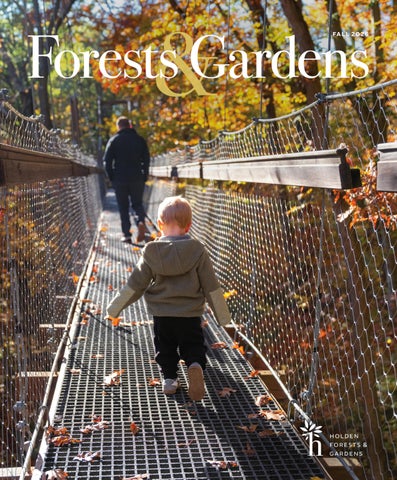
FALL 2026
FAL L 2 0 2 6 , V 10/ 4 Forests & Gardens is the member magazine for Holden Forests & Gardens, which includes the Holden Arboretum in Kirtland and the Cleveland Botanical Garden in Cleveland. MISSION: Holden Forests & Gardens connects people with the wonder, beauty, and value of trees and plants, to inspire action for healthy communities VISION: All communities transformed into vibrant places where trees, plants, and people thrive Editor & Director of Marketing: Jessica Schneider Editor & Content Manager: David Lardakis Photography: Gia Beggiani, Alex Faidiga, David Ike, Ethan Johnson, David Lardakis, Chris Langer, Bob Perkoski
BOARD OF DIRECTORS Constance Norweb Abbey Tom Anderson, Vice Chair Doug Banbury Barbara Brown Tera Coleman Paul DiCorleto Michael Dingeldein Lavita Ewing Mikiko Fujita Robert Galloway Lynn-Ann Gries Sally Gries Jonathan Hatch Greg Ina Josh Knerly, Board Chair
Joseph Mahovlic Leslie Manzo Michael Marino Roy Minoff Cynthia Moore-Hardy Kelly Morgan Kevin Myeroff Ellen Jones Nordell Katie Outcalt Gary Poth Robin Schachat Lynn Shiverick Ruth Stafford, Secretary Meghan Vickers Charles Walton Joy Ward
LETTER FROM THE CEO........................................................................................................... 3 FAIRWAY TO FOREST...........................................................................................................4 Can a former golf course become a forest? Researchers test tree survival in restored Acacia Country Club soils. A WETLAND REBORN.....................................................................................................................6 Holden Arboretum and The Nature Conservancy reimagine Strong Acres for wildlife and watershed health. WELCOME RAMA LOPEZ-RIVERA.............................................................................................8 HF&G’s new Director of Arboretum Horticulture brings global perspective and a deep collections expertise to Cleveland. STEWARDING A LIVING LEGACY.............................................................................................10 A partnership with Davey Tree highlights the science, expertise and care behind managing Cleveland Botanical Garden’s most valuable living assets.
©Holden Forests & Gardens Forests & Gardens (ISSN 2474-6371) is a class and events magazine published quarterly by Holden Forests & Gardens, 9500 Sperry Road, Kirtland, Ohio 44094-5172. Periodicals postage paid at Mentor, Ohio and additional offices. Postmaster: Please send address changes to Forests & Gardens Magazine Holden Forests & Gardens 9500 Sperry Road Kirtland, Ohio 44094-5172
For advertising information, call 216-377-3655 or email polverine@clevelandstudios.com Copyright 2026 by Great Lakes Publishing. No part of this publication may be reproduced by any means without permission of Great Lakes Publishing. All rights reserved. Holden Forests and Gardens and the publisher are not responsible for errors or omissions. All information is subject to change.
BUILT TO LAST................................................................................................................................ 12 New long-term monitoring plots will help scientists understand how Northeast Ohio’s forests adapt to a changing world. PLANT PROFILE............................................................................................................................. 14 Learn about the white enkianthus, which is not available in garden centers but is on display this season in the Helen S. Layer Rhododendron Garden. TROPICAL HOLIDAY PRESENTED BY JPMORGANCHASE..................................... 16 Winter is warming up with a new holiday show at Cleveland Botanical Garden. FALL SATURDAYS AT HOLDEN ARBORETUM............................................................. 18 Check out all of the fun activities happening every Saturday in October, including Skeleton Grove, a group of twelve-foot skeletons in the Main Display Garden. PROGRAMS & EVENTS......................................................................................................20 Discover upcoming programs, seasonal events and engaging experiences across both campuses.
On the Cover: Murch Canopy Walk at Holden Arboretum
WE LCOM E
Dear Friends, Fall has always seemed like the most honest season to me. Spring is full of promises. Summer is all energy and growth. But autumn is when you get to see the results. Seeds become plants, research produces answers (and frequently more questions), and a year's worth of planning starts to reveal what was worth the effort. As I write this, our forests and gardens are preparing for another spectacular display. Leaves are beginning their annual chemistry experiment, gardeners are busily planting for seasons they won't see until months from now, and researchers across our campuses are collecting data that will help us better understand and care for the landscapes entrusted to us. One of my favorite autumn facts is that some of Northeast Ohio's most brilliant fall color depends on a surprisingly specific combination of weather: sunny days followed by cool nights. Those conditions promote sugar accumulation in leaves, which helps drive the production of anthocyanins — the pigments responsible for many of the vivid reds and purples we enjoy each year. The result reminds us that nature often hides its most beautiful work in its smallest details. This issue of Forests & Gardens explores several stories that reveal what's happening beneath the surface of the landscapes we enjoy. You'll learn about an ongoing partnership with Cleveland Metroparks focused on soil and tree research at Acacia Reservation, where our scientists are digging — quite literally — into questions about forest health and resilience. We also take you to Holden Arboretum, where wetland mitigation efforts are demonstrating how thoughtful restoration can create lasting ecological benefits.
You'll meet Rama Lopez-Rivera, our new Director of Arboretum Horticulture. Rama brings a wealth of expertise, leadership and curiosity to the role, and we're excited about the knowledge and perspective he adds to our team. We also share more about our partnership with The Davey Tree Expert Company, a collaboration that strengthens our ability to advance research, conservation and education. One of the privileges of working in a public garden and arboretum is that no two days are quite alike. A morning might begin with a conversation about soil microbes and end with a discussion about visitor experiences, invasive species management or the surprisingly strong opinions people hold about their favorite trees. (For the record, I support most of those opinions.) As the season unfolds, I hope you'll join us for one of our autumn events, explore the changing colors across our campuses and perhaps take a peek at what's in store for winter. Like any good gardener, I'm reluctant to reveal too much too early — but I think you'll find there's plenty to look forward to. Thank you for being part of our community. Your support helps ensure that this work continues to grow and flourish, season after season. Sincerely,
Ed Moydell President & CEO
FALL 2026 3
AC AC IA RESERVATIO N
Fairway to Forest The former Acacia Country Club site is offering important insights for researchers at Holden Forests & Gardens. By Anna Funk, Science Communication Specialist
G
olf courses are among the most intensively managed landscapes — mowed, fertilized, chemically weeded and heavily trafficked. So when a century-old country club is slated for restoration, a natural question arises: can the soil still support anything beyond turf? Researchers at Holden Forests & Gardens wondered, too. In 2016, after Cleveland Metroparks had started restoring the old Acacia Country Club, they invited researchers at HF&G and Jean Burns, plant ecologist at Case Western Reserve University, to collaborate on an experiment. The goal was to see how different species of trees, in different types of soil — with or without amendments containing beneficial soil fungi species — would fare. Mycorrhizal fungi live in close partnership with tree roots and are essential for trees to get enough nutrients from the soil. In natural, mature forests, these fungi are abundant and diverse. The more intensely land is manipulated, the more these fungi can be put at risk.
Can they be restored? A new study, led by Claudia Bashian-Victoroff and published in Restoration Ecology, reports the long-term results of this experiment. Some of the fungi they’d added are still detectable in the soil — a win for the restoration of native fungi to the site. But when it came to supporting the trees, something else stole the show: sand that had been added to the teeing-off area of the old driving range.
4 FORESTS & GARDENS
Sanctuary in suburbia Acacia Reservation is bordered by busy shopping centers and neighborhoods, yet it offers what Bashian-Victoroff calls “a little sanctuary in suburbia.” The Lyndhurst park occupies the former Acacia Country Club, which operated from 1921 until 2008, was purchased by The Conservation Fund, then donated to the Metroparks in 2012. Since then, the site has been restored into a mosaic of trails, prairies, wetlands and woodlands, with part of the former driving range serving as a research site. The experiment began in 2016, led by Andy Lance, then a PhD student at Case Western Reserve University working with Holden Arboretum and Cleveland Metroparks. (Today, Lance is the Arboretum’s Conservation Manager). Researchers planted 405 tulip poplars, red oaks and black cherries across 15 plots. Some received forest soil, some commercial fungal inoculum, and others served as controls. After several years, the team found that soil type — not inoculation — had the strongest influence on tree growth, survival and fungal communities. The site contains two distinct soils: clay loam across much of the former driving range and sandier soil in the former tee area where golf course managers had added sand. By 2021, trees growing in the sandier soils were outpacing those in clay soils in growth. And 21% of the trees in the clay areas died, while just 4% of trees in the sandy areas died. Lance notes, “Even after just one season, we noticed that there was a strong plot effect, with three plots showing impressive survivorship and early
ACACIA RE S E RVATIO N
growth compared to the rest.” The differences in fungal communities between the two soil types were similarly stark.
Acacia Reservation in 2013
Bashian-Victoroff says they remember thinking, “Wow, this driving range — many, many years later — is still shaping fungi and impacting tree success.”
Observations: Fairways, paths, and sand traps are still visible in the months after the Acacia Country Club closed its doors to golfers.
What about me? I’m a fun-gi Although the sandy soils stole the show, the researchers still wanted to know what they could learn from the inoculation experiment. Early results had shown that inoculation did alter the composition of the soil fungal communities. Strangely, though, the commercial inoculant didn’t actually introduce the species listed on the label. After five years, these effects had mostly faded, largely overtaken by the effects of soil texture. But for some trees (particularly, black cherries), forest soil inoculant that had been harvested from one particular location was especially successful. In those cases, the number of mycorrhizal fungal species that established was much higher, and some fungi were still detectable in 2023. “We have inoculum that’s significantly increasing fungal species richness and diversity,” they said. “That’s very cool to me.”
Restoring the whole forest So what does this mean for forest restoration practice? Bashian-Victoroff is cautious about recommending inoculation at a management scale just yet — particularly commercial products, which showed limited lasting effects and raise concerns about non-local fungi potentially displacing locally adapted species. Forest soil transfer is more promising in theory, but it raises its own questions about how to do it sustainably without disturbing the healthy forests you’re drawing from. Still, the findings are encouraging. Restoring a forest on a former golf course may be an especially difficult challenge, and other studies have shown that fungal inoculation can support plant growth and establishment in many ecosystems. It’s also important to remember that five years is a short period in the life of a tree. The benefits of restored fungal communities may take longer to appear, particularly when trees face stresses such as drought or disease. Most importantly, inoculation successfully brought fungi back to the site. Scientists estimate only around 175,000 of a possible 5 to 17 million fungal species have been described, and fungi are rarely considered in conservation or restoration efforts. Because fungi play a vital role in healthy forests, their return is a meaningful step toward restoring a complete and thriving ecosystem.
Acacia Reservation in 2025 Observations: Paths remain for visitors, but the sand traps are gone and the fairway edges have blurred, as native vegetation reclaims the oncemanicured ground.
MEET THE STAFF Anna Funk is the Science Communication Specialist for Holden Forests & Gardens. She earned her Ph.D. studying prairie restoration before leaving the research world to help tell scientists’ stories. Today, she wears many hats, working as a writer, editor, consultant and more — anything that helps spread an appreciation of science and its impacts with others.
FALL 2026 5
ST RO NG AC RES
A Wetland Reborn Transforming Strong Acres to support wildlife and watershed health. By Andy Lance, Conservation Manager
W
hen most people think of Holden Arboretum’s Natural Areas, they envision lush forests filled with big trees and beautiful spring wildflowers. While this is an accurate representation of what you’ll find in many of these amazing spaces, the Arboretum’s Conservation department also strives to create and maintain a wide diversity of different habitat types, including forested wetlands.
The case for wetlands The Strong Acres wetland project represents an exciting new opportunity for Holden Arboretum to create forested wetland habitat in our Pierson Natural Area. Forested wetlands are a critical habitat type in the lower Great Lakes region. These forests harbor immense biodiversity, help mitigate floods and contribute to the resiliency of our local natural areas. In partnership with The Nature Conservancy, we will transform the Strong Acres site into a healthy wetland forest via the elimination of invasive plants, creation of wetland pools and planting of over 20,000 trees.
6 FORESTS & GARDENS
Reimagining strong acres Historically, Strong Acres was planted with trees that were part of the Arboretum’s old cherry, maple and hawthorn collections. These plantings began in the 1950s and continued into the 1990s. Tree growth and survival, however, were always limited at the site, largely a result of the area’s natural tendency to hold water. To improve the growth of planted trees, drain tiles were installed across much of Strong Acres in the 1960s. Our new collaborative project will remove much of this tiling, allowing water to once again form small pools and be retained on the landscape. Key results of the Strong Acres project will include the creation of 8.2 acres of new wetlands, enhancement of 5.2 acres of existing wetlands and enhancement of 27 acres of upland buffer habitat. A new loop trail, complete with earthen berms, will enable access throughout the site. Invasive plant species, including glossy buckthorn, multiflora rose and phragmites, are currently widespread at the site and will be removed in the first stages of project implementation. This work will continue for several years following the completion of wetland construction to ensure our native plants have an opportunity to establish.
S TRO NG ACRE S
Designed for wildlife Wetlands at the site will consist of small depressions designed to capture and retain rain and snow melt. The site will be most inundated with water in the winter and spring months. We don’t aim to create large standing water bodies, Instead we will focus on creating numerous small, shallow pools. The number of small depressions throughout the project area will likely exceed 30, with most having a maximum water depth of 6 inches or less.
By establishing forested wetlands at the site, we will provide important habitat for a wide diversity of amphibians, birds, plants, mammals and more. Planting for the future Following earthwork, the site will be seeded and planted with species characteristic of forested wetlands in our region. This includes a wide diversity of native sedges and grasses as well as wildflower species such as cardinal flower, monkeyflower and swamp milkweed. Holden’s Seed Bank will play an active role in providing seeds sourced from local populations of this species, including many found in other parts of the Natural Areas. An array of native trees and shrubs will also be planted at the site, including swamp white oak, basswood, pin oak, hornbeam and swamp rose. The large and stately shagbark hickory trees that currently grow at Strong Acres will be protected and maintained throughout construction, providing the site with a much-needed influx of seeds in the forthcoming years. While it won’t happen quickly, the end vision for the site is a diverse forested wetland.
Strong Acres is located on the Holden Arboretum campus in Kirtland, adjacent to Kirtland-Chardon Road.
The Strong Acres wetland project represents an exciting opportunity to reenvision and transform a currently underutilized portion of the Holden Natural Areas. By establishing forested wetlands at the site, we will provide important habitat for a wide diversity of amphibians, birds, plants, mammals and more. The site will also provide important flood mitigation services for the Pierson Creek Valley. The wetlands at the site will be permanently protected via a conservation easement with The Nature Conservancy to ensure they provide these services for the community well into the future.
MEET THE STAFF Andy Lance is the Conservation Manager. Born and raised in Northern Ohio, Andy has a B.S. from Bethany College, a M.S. from the Bard Center for Environmental Policy, and a Ph.D. from Case Western Reserve University. Andy has extensive experience working in the forests of the Great Lakes region and enjoys connecting current ecological research and applied land management.
FALL 2026 7
RAMA LO PEZ
Welcome
Rama Lopez-Rivera 8 FORESTS & GARDENS
RAM A LO P E Z
As Director of Arboretum Horticulture, the accomplished horticultural leader brings global perspective and deep collections expertise to support the organization’s next chapter of growth.
L
opez-Rivera brings more than 20 years of experience in public horticulture, living collections management, botanical curation and garden leadership in some of the world’s most respected gardens and arboreta. He most recently worked as an independent horticultural consultant and previously Head Gardener at Ramster Garden in England, as well as working and training at The Crown Estate at Windsor Great Park, Sonoma Botanical Garden in California and the Royal Botanic Gardens, Kew. A graduate of the prestigious Longwood Gardens Fellows Program, Lopez-Rivera also completed a leadership placement at Holden Forests & Gardens in 2023, where he worked with staff on organizational development and collaboration initiatives. “Rama brings an extraordinary combination of horticultural expertise, global perspective, leadership experience and passion for public gardens,” says Ed Moydell. “His deep knowledge of living collections and botanical curation, combined with his commitment to connecting people with plants, makes him an exceptional addition to our leadership team. We are thrilled to welcome him to HF&G.”
FUN FACTS
Get to Know Rama Lopez-Rivera Gardening tool I can’t live without: My pruning saw. It allows me to keep trees and shrubs on the grounds tidy, no matter where I am in the collection. Favorite tree: The tulip tree (Liriodendron tulipifera) — Not only does it have great form and shape in the landscape, as well as excellent fall color, but is also near identical to its East Asian counterpart (Liriodendron chinense), showing ancient relationships between two distant floras.
Trained through the University of Glasgow and the Royal Botanic Garden Edinburgh’s horticulture degree program, Lopez-Rivera is widely recognized for his expertise in woody plants, particularly those of East Asia and North America. His fieldwork and plant exploration have taken him throughout Asia and North America, contributing to the understanding, conservation and interpretation of temperate woody flora. As Director of Arboretum Horticulture, Lopez-Rivera will oversee horticultural operations, living collections and longterm landscape development across the Holden Arboretum core garden areas. “Holden Forests & Gardens is one of the most exciting organizations in public horticulture today, combining worldclass science, conservation, education and horticulture,” says Lopez-Rivera. “I am honored to join the organization and look forward to working alongside the talented staff, volunteers and supporters who care so deeply about its mission. Together, we will continue to cultivate inspiring landscapes while ensuring our collections remain valuable resources for research, conservation and future generations.”
Book I’m reading right now: The Optimist: A Case for the Fly Fishing Life by David Coggins.
FALL 2026 9
DAVEY T REE
Stewarding a Living Legacy How science and partnership guide tree care at Cleveland Botanical Garden. By David Lardakis, Content Marketing Manager
A
t the center of Cleveland Botanical Garden, where the CK Patrick Perennial Border, Woodland Garden, Hosta Hill and Lower Restorative Garden meet, one longtime resident has had a front-row seat to it all: a northern red oak. Standing nearly 100 feet tall and estimated to be close to 150 years old, the tree has long helped define the surrounding landscape. Its beauty, size, age and designation as a tribute tree have made it a notable landmark within the garden.
Why mature trees matter Mature canopy trees like this one are among the most valuable and irreplaceable parts of the Garden’s living collection. They shape the character of a place, influence
10 FORESTS & GARDENS
the growing conditions beneath them and provide ecological benefits that take decades to develop. Their canopies intercept stormwater, moderate temperatures, store carbon, support soil health, and offer habitat for insects, birds, mammals, fungi and many other organisms. But caring for mature trees also requires asking difficult questions. How do you know when a beloved tree is healthy, declining or potentially hazardous? And how can a public garden make the best decision when the answer is not immediately visible? “Losing a mature canopy tree affects far more than the tree itself,” says Amanda Hannah, Director of Botanical Garden Horticulture. “It changes the character of the Garden, the growing conditions for the surrounding collections beneath it and the experience of everyone who visits these spaces. That’s why it was so important to us to fully understand its condition before making any long-term management decisions.”
DAVE Y TRE E
Looking below the surface The red oak was not assessed because it appeared to be in obvious decline. Instead, observations by HF&G staff prompted further investigation. The investigation began as a proactive effort to improve soil conditions around a healthy red oak, but the discovery of Armillaria fungal mats during air excavation led to further testing that identified active populations of Phytophthora pseudocryptogea and up to three additional pathogens, highlighting a complex root disease issue that will be important to consider in future management of the tree. The assessment also points to a broader lesson in tree stewardship. The oak experienced root disturbance during nearby construction in 2003, and impacts to mature trees can take years, or even decades, to become apparent. The situation underscores why tree protection standards are so important during construction and other landscape projects. “Stewardship is a continuous process of learning,” says Annie Budziak, Vice President of Living Collections and Horticulture at Holden Forests & Gardens. “As our scientific understanding advances, so does our ability to care for living collections. Many of the practices we consider essential today simply weren’t understood decades ago. That’s why investing in research, scientific partnerships and public gardens is so important.”
Science in action To support the evaluation, HF&G staff and partners from The Davey Tree Expert Company have used a range of methods, including visual tree assessment, root collar evaluation, soil and site evaluation, tree sounding, fungal pathogen identification and advanced tree risk assessment. Sonic tomography, a technology that can help evaluate internal wood conditions, is planned as a next step. This work goes well beyond routine inspection. Mature trees can appear healthy above ground while significant issues develop below ground or within the tree itself. Understanding their condition may require expertise in soil science, fungal pathology, tree preservation, arboriculture and tree risk assessment. By bringing these disciplines together, HF&G and Davey Tree are building a clearer, science-based picture of the red oak’s health and long-term viability. Davey provided their expertise and services as an in-kind donation to HF&G.
When the assessment is complete, the team will consider factors such as structural integrity, extent of decay, root condition, pathogen impacts, likelihood of failure, visitor safety, preservation value and long-term viability before recommending a management path. That path could include continued monitoring, treatment, preservation efforts or removal if that proves to be the most responsible option. Just as important, the process is already informing how the Garden cares for other mature trees. The assessment has highlighted opportunities to better support root health, reduce impacts to mature trees and document findings that can guide future stewardship decisions.
“For us, this project highlights exactly what can be achieved when our shared expertise and a passion for conservation come together.” — Greg Ina, executive vice president of the Davey Institute and Employee Development at Davey Tree
A collaborative effort “Assisting in the preservation of an iconic specimen like this is a privilege,” says Greg Ina, Executive Vice President of the Davey Institute and Employee Development at Davey Tree. “We are grateful to provide the data and insights necessary to foster this tree’s health for generations to come. For us, this project highlights exactly what can be achieved when our shared expertise and a passion for conservation come together.” “We are deeply grateful to Davey Tree for their partnership and in-kind donation. They provided access to an exceptional depth of scientific expertise that complements the knowledge of our horticulture, arboriculture and research staff,” Hannah says. “Bringing together specialists in soil science, fungal pathology, tree preservation and tree risk assessment allows us to make more informed, science-based decisions about the stewardship of our living collections.” In many ways, this story is not about one red oak at all. It is about the belief that trees, landscapes and living collections are worth understanding and caring for with intention. This requires expertise and patience. The time and effort invested in this assessment reflects commitment to environmental stewardship and to making thoughtful decisions that will shape a healthier, more resilient landscape for future generations.
MEET THE STAFF David Lardakis is the Content Marketing Manager at Holden Forests & Gardens and serves as editor of Forests & Gardens magazine. He enjoys telling the stories of HF&G’s experts in science, conservation, and horticulture. Away from his desk, you may find him wandering the Arboretum grounds. Don’t worry, he’s not lost.
FALL 2026 11
LONG-TERM T RE E P LOTS
Built to Last
New forest plots are the foundation for decades of research. By Anna Funk, Science Communication Specialist
O
n a summer morning in one of Holden Arboretum’s natural areas, a small team fans out across a 50-by-50meter square of forest, measuring tapes and clipboards in hand. Every woody stem more than one centimeter thick gets a metal tag, a diameter measured at breast height and a species ID. It’s meticulous work — one of these plots can hold hundreds of trees, and there are 20 plots. But it’s worth it. The data collected will serve as the first chapter of a dataset that could outlive everyone currently holding a clipboard. The new project is spearheaded by Samantha Worthy, who joined Holden Forests & Gardens as a research scientist in August 2025. She’s already given her lab an informal motto: Long-term research, Worthy of the time. It’s a fitting pun given the new long-term tree plots she’s installing at the Arboretum. Population ecology, she explains, requires patience. To study changes in a forest, you have to be willing to watch it for years or decades. This summer, Worthy and her team began laying the groundwork to do just that.
12 FORESTS & GARDENS
Twenty plots, four forests The team has established 20 new long-term monitoring plots — each over half an acre — distributed across the Arboretum’s natural areas. There are plots in each of the Arboretum’s forest types: beech-maple, oak-hickory, mixed mesophytic and hemlock-hardwood. And each plot is set up the same way, with trees tagged, measured and ID’d, creating a baseline that future surveys will be measured against for years to come. The design itself comes from protocols set by the ForestGEO Network, a global consortium of long-term forest plots. Following these methods will make the data from the Arboretum doubly useful, serving not only as a local record but also something researchers around the world can tap into. “There aren’t as many of these forest datasets in the Great Lakes region, and we have an interesting climate that’s driven by the lakes themselves,” says Worthy.
A CLOSER LOOK
20 Alongside tracking tree births, growth and death, the team will also track soil temperature and moisture. Especially as the climate changes, these additional measurements should give insight into why the forest is changing. Duncan Jordahl, Worthy’s seasonal technician, is interested in a phenomenon called mesification — a shift toward wetter, damper conditions that puts oak-hickory forests, which prefer drier conditions, at a disadvantage. Climate change is often associated with drought, but in Northeast Ohio, the bigger threat may be the opposite: more intense storms — regardless of frequency — may saturate the soil and over time favor species that can tolerate occasional wet feet. “These are witness plots,” Worthy says. “They’ll live through climate change, and we’re going to see first-hand how they respond.”
Why Holden Arboretum? Holden Arboretum is a particularly good place to set up this type of study, and not just because it has representations of each of the different forest types so close together. A place like the Arboretum has real institutional permanence. “These data will live long past me, because this place will be here long past me,” she says. “Field stations can change hands, organizations’ priorities can shift — but conservation and learning is what we do here.” The study plots being right in the researchers’ backyard doesn’t hurt, either. Worthy has done work as far afield as Ecuador and Puerto Rico, which adds significant logistical burden to every site visit. When Hurricane Maria hit her research site in 2017, it was months before she was able to return to the site.
new long-term monitoring plots
There are plots in each of the Arboretum’s forest types:
beech-maple
oak-hickory
mixed mesophytic
hemlockhardwood
Each plot is over half an acre. Trees in each plot are:
tagged
LON G-TE RM TRE E P LOTS
measured
ID’d
It will be a nice change for Worthy to work so close to home. Plus, she’ll have great help. Andy Lance from HF&G’s conservation team has been central to Worthy’s project since the beginning. Still learning the natural areas herself, Worthy leaned on Lance’s knowledge and guidance to scout plot locations. As the project moves forward, the conservation staff, who know the natural areas best, will be meaningful partners.
Early returns Although these plots have been set up with the long haul in mind, we won’t have to wait decades to hear the first results. In addition to Jordahl’s mesification work, intern Brianna Hershey has been using the data collected this summer to explore differences in carbon storage across forest types, and two Green Corps students are investigating “regeneration debt” — whether enough young trees are present to one day replace the older canopy trees once they’re gone. The plots in the beech-maple forest may provide particularly meaningful insights in the next few years as well, as beech leaf disease continues to take its toll. “We can record how the forest changes in real time,” Worthy says. “Understanding how the forest composition will change near the epicenter of beech leaf disease will be valuable for everyone farther out.” Next year, Worthy plans to start studying seedlings to track regeneration directly, as well as to start assessments with the conservation team to evaluate the health of the understory. She’s already imagining even more collaborations the long-term plots might inspire. “There are endless possibilities,” Worthy says.
FALL 2026 13
P LANT PROF ILE
PLANT PROFILE
White Enkiantus – Enkianthus perulatus By Ethan Johnson, Plant Records Curator
T
he most spectacular fall foliage each year at Holden Arboretum is arguably on display in the Helen S. Layer Rhododendron Garden north of Logsdon Pond. Foliage of the grouping of eight white enkianthus begins turning red in October and in recent years reaches its peak color in early November. The individual plants have layered and expanded to form a mass. White enkianthus is not readily available in garden centers or in the nursery trade but may be obtained via mail order. It is native to Japan on the main island of Honshu and on Shikoku and Kyushu. The Rhododendron Garden plants were originally obtained as seed
14 FORESTS & GARDENS
from the USDA Beltsville Agricultural Research Station in Maryland in 1955. In 1957 the seedlings were propagated via cuttings, and in 1967 were planted in their current location. They measured 6 feet in height in 2026 after only being 2.5 feet tall in 2017 following the winter of 2015, which nearly killed them. Their maximum height of 9 feet was recorded in 2012. A member of the heath family, Ericaceae, this shrub requires acidic relatively well-drained soil in partial sun to a mostly sunny location. The small white flowers open in late April into early May and are borne in enough profusion to be noticeable from a distance.
Plant Facts Light: part to full sun Soil Type: acidic, moist, fairly well-drained Mature Size: 6-9’ tall by 10-14’ wide Best Location: USDA Zones 6a-8b
In ideal soil conditions at the David G. Leach Research Station in Madison a white enkianthus planted in 2002 measured 3 feet tall and 2 feet wide in 2003 and 6.5 feet by 11 feet in 2024. It and a 1970s specimen on the sandy loam in Madison did not suffer the severe dieback following the winter of 2015 that the plants on heavy silt loam in Kirtland did. The spectacular red fall foliage in Madison appears later in the season than it does in Kirtland due to the cooler early fall night temperatures in Kirtland.
MEET THE STAFF Ethan Johnson is the Plant Records Curator, bringing decades of experience in documenting and caring for living collections. He developed his record keeping expertise at Holden Arboretum and the Arnold Arboretum, and with organizations including the International Dendrological Research Institute, the Ohio Nursery and Landscape Association Plant Selection Committee, and the American Conifer Society. Ethan played a central role in Holden Arboretum’s accreditation as the sixth public garden in the United States to be recognized as a museum, led the labeling and inventory of its plant collections, and has overseen plant records at Cleveland Botanical Garden since 2015.
FALL 2026 15
Sebastien Glinzler Executive Director J.P. Morgan Private Bank
Skeleton Saturdays at Holden Arboretum
Food Truck Favorites Enjoy two local food trucks every Saturday, including Barrio during most weekends.
Complimentary Family Photo 11a.m.-2 p.m. Capture the season with a professional family photo. Receive one complimentary digital image, with additional photos available for purchase.
Skeleton Grove September 19-November 1 They’re back! A NEW group of larger-than-life skeletons has settled in the Main Display Garden ready to greet any visitor brave enough to venture out.
Meet the Artists 10 a.m.-Noon Each week, connect with two of the creators behind the skeletons during special Skeleton Grove artist meet-and-greet hours.
Leaf Trail Sharpen your leaf and tree identification skills as Northeast Ohio’s trees begin to change color!
Every Saturday in October 10 a.m.-3 p.m. Included with admission Food, family fun and fall colors. 18 FORESTS & GARDENS
Tram Tours Explore the beauty and breadth of the Holden Arboretum on a 45-minute guided tour. Perfect for an autumn outing!
WE’VE MADE YOUR TREES OUR BUSINESS. EXPERT TREE CARE FOR 117 YEARS — AND GROWING. Quercus alba. Acer macrophyllum. Carya ovata. Better known as White Oak, Bigleaf Maple and Shagbark Hickory, these are three of the thousands of species we specialize in. For 117 years, our family-owned company has brought a rare mix of groundbreaking science, award-winning safety practices, and global resources to every tree and shrub care task at hand. And at the heart of our success are our people — experts who know and champion every tree, no matter the species. Discover how our passion is inspiring one beautiful property after another.
Call 216-551-8923 or visit bartlett.com/cleveland-oh PRUNING | FERTILIZATION | CABLING & BRACING INSECT & DISEASE MANAGEMENT | TREE INSPECTIONS STORM DAMAGE | LIGHTNING PROTECTION | REMOVALS The F.A. Bartlett Tree Expert Company
E VENTS
HOLDEN ARBORETUM
Outdoor Adventures Immerse yourself in beauty during this harvest season.
20 FORESTS & GARDENS
E VE NTS
FIRESIDE CONCERTS DATE
December 4, January 8, February 5, March 5 TIME
6-7:30 p.m. PRICE
$25 per member $30 per nonmember
WINTERGREENS WREATH WORKSHOP DATE
December 7 TIME
1-3 p.m. or 5-7 p.m. PRICE
$77 per member $92 per nonmember
EVERGREEN HAPPY HOUR DATE
December 8 TIME
5:30-8 p.m. PRICE
$65 per member $80 per nonmember
WINTERGREENS WREATH WORKSHOP DATE
STEBBINS GULCH HIKE DATE
October 4, November 8 TIME
11:30 a.m.-3:30 p.m. PRICE
$12 per member $22 per nonmember
ART WITH HEART: FALL PAINT & SNACK
LITTLE MOUNTAIN HIKE
WINTER VILLAGE MARKET
DATE
DATE
October 17, November 15, December 13 TIME
11 a.m.-3 p.m. PRICE
$12 per member $22 per nonmember
WINE & CHEESE NIGHT HIKE
PRICE
Included with admission
HAND PAINTING ON SILK DATE
November 21
TIME
PRICE
TIME
7-10 p.m.
4-7 p.m.
PRICE
$49 per member $64 per nonmember
10 a.m.-4 p.m.
TIME
October 23, November 13
PRICE
TIME
DATE
DATE
October 17
November 14, 15
$32 per member $47 per nonmember
9:30 a.m.-4:30 p.m. $62 per member $102 per nonmember
December 9 TIME
5-7 p.m. PRICE
$77 per member $92 per nonmember
WINTER WINE TASTING In partnership with Kosicek Vineyards DATE
January 23, March 30 TIME
1-3 p.m. PRICE
$40 per member $50 per nonmember
FALL 2026 21
E VENTS
CLEVELAND BOTANICAL GARDEN
Fall Fun Head to the Cleveland Botanical Garden this season for inspiring events and fun activities for all.
22 FORESTS & GARDENS
E VE NTS
STORYTIME WITH SANTA DATE
November 22, 29 December 6, 13 TIME
10 a.m.-Noon PRICE
See holdenfg.org
WINTER WONDERLAND PAINT & SIP DATE
December 4 TIME
5-8:30 p.m. PRICE
$49 per member $64 per nonmember
KRAMPUSNACHT DATE
December 5 TIME
6-9 p.m. PRICE
$30 per member $35 per nonmember
BOTANICAL WREATH MAKING DATE
TETRAPAK PRINT MAKING DATE
October 3 TIME
10:30 a.m.-1:30 p.m. PRICE
$20 per member $25 per nonmember
RENAISSANCE AT THE GARDEN DATE
October 4
WESTERN RESERVE HERB SOCIETY HERB FAIR DATE TIME
10 a.m.-3 p.m.
1-3:30 p.m. PRICE
BREAKFAST WITH SANTA
PRICE
Included with admission
DATE
BOO-TANICAL BASH DATE
October 24
WILDCRAFTING: CORDAGE FROM PLANT FIBERS
TIME
DATE
Noon-3 p.m.
Noon-8 p.m.
PRICE
$15 per member $25 per nonmember
TIME
$49 per member $64 per nonmember
October 17
TIME PRICE
December 6
DJ dance party included with admission, trick or treat trail & crafts $15 add on
November 7
December 20 TIME
9 a.m. and 11 a.m. seatings PRICE
See holdenfg.org
TIME
10:30 a.m.-1:30 p.m. PRICE
$40 per member $45 per nonmember FALL 2026 23
9500 Sperry Road Kirtland, Ohio 44094 holdenfg.org
Book the Garden!
Woodland Hall
Treat your guests to lush gardens, elegant venues and exceptional hospitality in the heart of University Circle. Whether you're planning for 20 guests or 200, our team will help create an unforgettable experience. Through our partnership with Spice Catering Co., enjoy thoughtfully crafted menus, signature drinks and top-notch service tailored to your event.
Cleveland Botanical Garden @cbgarden @holdenarb
Contact Halle Scotese at hscotese@holdenfg.org for more information.
@holden_fg
@clebotanicalgarden
holdenfg.org
Forests & Gardens is the member magazine for Holden Forests & Gardens, which includes the Holden Arboretum in Kirtland and the Cleveland Botanical Garden in Cleveland. MISSION: Holden Forests & Gardens connects people with the wonder, beauty, and value of trees and plants, to inspire action for healthy communities VISION: All communities transformed into vibrant places where trees, plants, and people thrive ©Holden Forests & Gardens “Holden Forests & Gardens” and the related logo is a trademark owned by The Holden Arboretum.
9550 SPERRY ROAD KIRTLAND, OHIO 44094 440.946.4400
11030 EAST BLVD CLEVELAND, OHIO 44106 216.721.1600
HOURS Tuesday-Sunday: 9 a.m.-5 p.m.
HOURS Tuesday-Saturday: 10 a.m.-5 p.m. Sunday: Noon-5 p.m.
For updates, visit holdenfg.org