
2012 - 2013
Financial Summary
Council is in a sound financial position and returned a net surplus of $14.06m. This was primarily due to Council receiving early payments for government grants.
The total value of community assets increased to $1.181b.
Highlights
Total Operating Expenses: $96.36m
Total Operating Revenues (excluding capital): $102.17m
Capital Works completed: $22.41m
Total Capital Revenues: $8.25m
Operating Income 2012 – 2013
Employee costs consists of wages, superannuation, fringe benefits tax and workcover.
Capital Expenditure Comparison
2011-2012 2012-2013
$16,000,000
$14,000,000
$12,000,000
$10,000,000
$14,002,826
$13,597,653
$9,409,477
$8,000,000
$6,000,000
$4,000,000
$3,501,481
$4,903,264
$3,170,174
$2,000,000
N EW
U PGRADE / E x PANSION
R ENEWA l
Capital Expenditure By Type
2012 - 2013
$3,501,481
2011 - 2012
$3,170,174
$9,409,477
Financial Statements
For the year ending 30 June 2013
Comprehensive Income Statement
For the year ending 30 June 2013
The
Balance Sheet
at 30 June 2013
The above balance sheet should be read with the accompanying notes.
Statement of Changes in Equity
For the year ending 30 June 2013
The above statement of changes in equity should be read with the accompanying notes.
Statement of Cash Flows
For the year ended 30 June 2013
Notes to the Financial Report
For the year ending 30 June 2013
The Greater Shepparton City Council was established by an Order of the Governor in Council on 17th November 1994 and is a body corporate. The Council’s main office is located at 90 Welsford Street Shepparton.
The purpose of the Council is:
• to provide for the peace, order and good government of its municipal district;
• to promote the social, economic and environmental viability and sustainability of the municipal district;
• to ensure that resources are used efficiently and effectively and services are provided in accordance with the Best Value Principles to best meet the needs of the local community;
• to improve the overall quality of life of people in the local community;
• to promote appropriate business and employment opportunities;
• to ensure that services and facilities provided by the Council are accessible and equitable;
• to ensure the equitable imposition of rates and charges; and
• to ensure transparency and accountability in Council decision making.
This financial report is a general purpose financial report that consists of a Comprehensive Income Statement, Balance Sheet, Statement of Changes in Equity, Statement of Cash Flows, and notes accompanying these financial statements. The general purpose financial report complies with Australian Accounting Standards, other authoritative pronouncements of the Australian Accounting Standards Board, Urgent Issues Group Interpretations, the local Government Act 1989, and the local Government (Finance and Reporting) Regulations 2004.
Note 1
Significant accounting policies
a. basis of accounting
This financial report has been prepared on the accrual and going concern bases.
This financial report has been prepared under the historical cost convention, except where specifically stated in notes 1(f), and 1(i).
Unless otherwise stated, all accounting policies are consistent with those applied in the prior year. Where appropriate, comparative figures have been amended to accord with current presentation, and disclosure has been made of any material changes to comparatives.
All entities controlled by Council that have material assets or liabilities, such as Special Committees of Management, have been included in this financial report. All transactions between these entities and the Council have been eliminated in full.
b. change in accounting policies
No changes in accounting policy.
c. Revenue recognition
Rates, grants and contributions
Rates, grants and contributions (including Developer Contributions) are recognised as revenues when the Council obtains control over the assets comprising these receipts.
Control over assets acquired from rates is obtained at the commencement of the rating year as it is an enforceable debt linked to the rateable property or, where earlier, upon receipt of the rates.
A provision for doubtful debts on rates has not been established as unpaid rates represents a charge against the rateable property that will be recovered when the property is next sold.
Control over granted assets is normally obtained upon their receipt (or acquittal) or upon earlier notification that a grant has been secured, and are valued at their fair value at the date of transfer.
Contributions are recognised as income when the Council obtains control of the contribution or the right to receive the contribution, it is probable that the economic benefits comprising the contribution will flow to the Council and the amount of the contribution can be measured reliably. Developer gifted assets are recognised at practical completion date.
Where grants or contributions recognised as revenues during the financial year were obtained on condition that they be expended in a particular manner or used over a particular period and those conditions were undischarged at balance date, the unused grant or contribution is disclosed in note 6. The note also discloses the amount of unused grant or contribution from prior years that was expended on Council’s operations during the current year.
A liability is recognised in respect of revenue that is reciprocal in nature to the extent that the requisite service has not been provided at balance date.
User charges, fees and fines
User charges, fees and fines (including parking fees and fines) are recognised as revenue when the service has been provided, the payment is received, or when the penalty has been applied, whichever first occurs. Annual memberships are recognised when the service has been provided.
A provision for doubtful debts is recognised when collection in full is no longer probable.
Sale of property, plant and equipment, infrastructure
The profit or loss on sale of an asset is determined when control of the asset has irrevocably passed to the buyer.
Interest and rents
Interest and rents are recognised as revenue on a proportional basis when the payment is due, the value of the payment is notified, or the payment is received, whichever first occurs.
d. Depreciation of non-current assets
Buildings, land improvements, plant and equipment, infrastructure, heritage assets, and other assets having limited useful lives are systematically depreciated over their useful lives to the Council in a manner which reflects consumption of the service potential embodied in those assets. Estimates of remaining useful lives and residual values are made on a regular basis with major asset classes reassessed annually. Depreciation rates and methods are reviewed annually.
Where infrastructure assets have separate identifiable components that are subject to regular replacement, these components are assigned distinct useful lives and/or residual values and a separate depreciation rate is determined for each component.
Road earthworks are not depreciated.
Art collection and Regalia are not depreciated.
Straight line depreciation is charged based on the residual useful life as determined each year.
Major depreciation periods used are listed below and are consistent with the prior year unless otherwise stated: current period
pRO pe RT y
Buildings and land improvements
land improvements 10 to 80 years
Buildings 60 to 100 years
Heritage assets
Heritage assets 40 to 150 years
pLA n T A n D equipmen T
Plant, machinery and equipment 5 to 15 years
Furniture, equipment and computers 3 to 30 years
i nf RA s TR uc T u R e
Roads
Road pavements and seals 10 to 60 years
Road substructure 40 to 60 years
Road kerb, channel and minor culverts 10 to 60 years
Roundabouts 20 to 30 years
Bridges deck 50 to 100 years
Footpaths 10 to 60 years
Bike paths 10 to 50 years
Drainage
60 to 100 years
Naturestrip trees 10 to 50 years
Regulatory signs 3 to 20 years
Street furniture 10 to 50 years
litter Bins
Bus Shelters
Outdoor Furnishings
e. Repairs and maintenance
Routine maintenance, repair costs, and minor renewal costs are expensed as incurred. Where the repair relates to the replacement of a component of an asset and the cost exceeds the capitalisation threshold the cost is capitalised and depreciated. The carrying value of the replaced asset is expensed.
f. Recognition and measurement of assets
Acquisition
The purchase method of accounting is used for all acquisitions of assets, being the fair value of assets provided as consideration at the date of acquisition plus any incidental costs attributable to the acquisition. Fair value is the amount for which the asset could be exchanged between knowledgeable willing parties in an arm’s length transaction. Where assets are constructed by Council, cost includes all materials used in construction, direct labour, borrowing costs incurred during construction, and an appropriate share of directly attributable variable and fixed overheads.
The following classes of assets have been recognised in note 20. In accordance with Council’s policy, the threshold limits detailed below have been applied when recognising assets within an applicable asset class and unless otherwise stated are consistent with the prior year:
Revaluation
Subsequent to the initial recognition of assets, non-current physical assets, other than plant and equipment, are measured at their fair value, being the amount for which the assets could be exchanged between knowledgeable willing parties in an arms length transaction. At balance date, the Council reviewed the carrying value of the individual classes of assets measured at fair value to ensure that each asset materially approximated its fair value. Where the carrying value materially differed from the fair value at balance date the class of asset was revalued.
In addition, Council undertakes a formal revaluation of land, buildings, and infrastructure assets on a regular basis ranging from 3 to 5 years. The valuation is performed either by experienced council officers or independent experts.
Where the assets are revalued, the revaluation increments are credited directly to the asset revaluation reserve except to the extent that an increment reverses a prior year decrement for that class of asset that had been recognised as an expense in which case the increment is recognised as revenue up to the amount of the expense. Revaluation decrements are recognised as an expense except where prior increments are included in the asset revaluation reserve for that class of asset in which case the decrement is taken to the reserve to the extent of the remaining increments. Within the same class of assets, revaluation increments and decrements within the year are offset.
Land under roads
Council has elected not to recognise land under roads as an asset that it controlled as at 30 June 2008 in accordance with AASB 1051 land under Roads, and any acquisitions from 1 July 2008 are brought to account using the cost basis, if material.
g. cash and cash equivalents
For the purposes of the cash flow statement, cash and cash equivalents include cash on hand, deposits at call, and other highly liquid investments with original maturities of 90 days or less, net of outstanding bank overdrafts.
h. Other financial assets
Financial assets are valued at fair value, being market value, at balance date. Any unrealised gains and losses on holdings at balance date are recognised as either a revenue or expense. Council’s other financial assets comprise term deposits with a maturity date in excess of 90 days.
i. Accounting for investment in associates
Council’s investment in associates is accounted for by the equity method as the Council has the ability to influence rather than control the operations of the entities. The investment is initially recorded at the cost of acquisition and adjusted thereafter for post-acquisition changes in the Council’s share of the net assets of the entities. The Council’s share of the financial result of the entities is recognised in the Comprehensive Income Statement.
j. Tender deposits
Amounts received as tender deposits and retention amounts controlled by Council are recognised as Trust funds until they are returned or forfeited (refer to note 22).
k. employee benefits
Wages and
salaries
liabilities for wages and salaries and rostered days off are recognised and are measured as the amount unpaid at balance date and include appropriate oncosts such as work cover charges.
Annual leave
Annual leave entitlements are accrued on a pro rata basis in respect of services provided by employees up to balance date and are measured at the amount expected to be paid, including appropriate oncosts, when the accrued obligation is settled.
Long service leave
long service leave entitlements are vested to Council employees after a period of seven years. They are assessed at balance date having regard to expected employee remuneration rates on settlement, employment related oncosts and other factors including accumulated years of employment, on settlement, and experience of employee departure per year of service. long service leave expected to be paid within 12 months is measured at nominal value based on the amount expected to be paid when settled. long service leave expected to be paid later than one year has been measured at the present value of the estimated future cash outflows to be made for these accrued entitlements. Department of Treasury and Finance rates are used for discounting future cash flows.
Classification of employee benefits
An employee benefit liability is classified as a current liability if the Council does not have an unconditional right to defer settlement of the liability for at least 12 months after the end of the period. This would include all annual leave and unconditional long service leave entitlements.
Superannuation
The superannuation expense for the reporting year is the amount of the statutory contribution the Council makes to the superannuation plan which provides benefits to its employees. In addition Council may, periodically be required to contribute to the defined benefits schemes for current and former employees. Details of these arrangements are recorded in note 36.
l. Leases
Operating
leases
lease payments for operating leases are recognised as an expense in the years in which they are incurred as this reflects the pattern of benefits derived by the Council.
m. Allocation between current and non-current
In the determination of whether an asset or liability is current or non-current, consideration is given to the time when each asset or liability is expected to be settled. The asset or liability is classified as current if it is expected to be settled within the next 12 months, being the Council’s operational cycle, or if the Council does not have an unconditional right to deter settlement of a liability for at least 12 months after the reporting date.
n. Agreements equally proportionately unperformed
The Council does not recognise assets and liabilities arising from agreements that are equally proportionately unperformed in the balance sheet. Such agreements are recognised on an ‘as incurred’ basis.
o. web site costs
Costs in relation to websites are charged as an expense in the period in which they are incurred.
p. goods and services Tax (gsT)
Revenues, expenses and assets are recognised net of the amount of GST, except where the amount of GST incurred is not recoverable from the Australian Tax Office. In these circumstances the GST is recognised as part of the cost of acquisition of the asset or as part of an item of the expense. Receivables and payables in the balance sheet are shown inclusive of GST.
Cash flows are presented in the cash flow statement on a gross basis, except for the GST component of investing and financing activities, which are disclosed as operating cash flows.
q. impairment of assets
At each reporting date, the Council reviews the carrying value of its assets to determine whether there is any indication that these assets have been impaired. If such an indication exists, the recoverable amount of the asset, being the higher of the asset’s fair value less costs to sell and value in use, is compared to the assets carrying value. Any excess of the assets carrying value over its recoverable amount is expensed to the comprehensive income statement, unless the asset is carried at the revalued amount in which case, the impairment loss is recognised directly against the revaluation surplus in respect of the same class of asset to the extent that the impairment loss does not exceed the amount in the revaluation surplus for that same class of asset.
r. Trade and other receivables and inventories
Receivables are carried at amortised cost using the effective interest rate method.
A provision for doubtful debts is recognised when there is objective evidence that an impairment has occurred.
Inventories held for distribution are measured at cost adjusted when applicable for any loss of service potential.
Other inventories are measured at the lower of cost and net realisable value.
s. Trade and other payables
liabilities are recognised for amounts to be paid in the future for goods and services received as at balance date. Refer note 21.
t.
Accounting adjustments to prior periods
Existing assets not previously recognised. Non-current assets not previously recognised are classified as though they had always been recognised by an adjustment through equity and a restatement of the previous year’s comprehensive income statement if applicable.
During the 2012/13 financial year Council has captured existing drainage/bridge infrastructure assets not previously recognised to the value of $1,030,986 which have been recognised via adjustment to 2011/12 balances. Refer Note 20.
This balance was not significant as to require an additional balance sheet.
Note 2
Events occurring after balance date
At the date of this report no issues have been identified which would significantly affect the financial position reported herein.
Note 3
Rates and charges
Council uses Capital Improved Value (CIV) as the basis of valuation of all properties within the municipal district. The CIV of a property is the market value of the property which takes into account the land and all improvements fixed to the land.
The valuation base used to calculate general rates for 2012/2013 was $8,736 million (2011/2012 $8,432 million).
The date of the last general revaluation of land for rating purposes within the municipal district was 1 January 2012, and the valuation first applied to the rating period commencing 1 July 2012.
The date of the next general revaluation of land for rating purposes within the municipal district is 1 January 2014, and the valuation will be applied in the rating year commencing 1 July 2014.
Supplementary rates and rate adjustments undertaken after the annual calculation incorporate a number of valuation objections.
Note 4
Note 5
Grants were received in respect of the following :
mm O nwe ALT h gO ve R nmen T
conditions on grants
Grants recognised as revenue during the year that were obtained on condition that they be expended in a specified manner that had not occurred at balance date were:
Grants which were recognised as revenue in prior years and were expended during the current year in the manner specified by the grantor were:
Note 7 Contributions
3,948,539
3,533,930 3,338,306 3,533,930 3,338,306 Total 4,823,131 5,357,679
Note 8
Note 9
Employee costs
* Additional call to meet obligations in relation to prior year (2011/12) Defined Benefit Plan - $5,631,820 (incl Contribution Tax).
Note 10
Note 11
12
Note 13
Note 14
Net gain(loss) on disposal of assets
Note 15
percentage 61.14% in 2012/13 (61.76% in 2011/2012)
Note 16
Note 16b
13,000,000
Note: Right represents the value held for Council’s share of development and resale of Parkside Gardens. These are valued at lower of the last revaluation and recoverable amount. Annual impairment testing is undertaken to ensure that the carrying amount is not higher than the recoverable amount.
19
(a) based on reviewing the current market value and remaining anticipated lot sales.
Note 20 Property, infrastructure, plant and equipment
s umm ARy
Note 20 (cont.)
Property, infrastructure, plant and equipment
Valuation of land and buildings were undertaken by a qualified independent valuer, lG Valuation Services. The valuation of buildings is at fair value based on current replacement cost less accumulated depreciation at the date of valuation. The valuation of land is at fair value, being market value based.
land under roads is valued at deemed cost. Deemed cost is based on council valuations at date acquired for acquisitions since 1 July 2008, adjusting for englobo (undeveloped and/or unserviced) characteristics, access rights and private interests of other parties and entitlements of infrastructure assets and services.
n T A n D e quipmen T
Equipment and Computers
Valuation of Art Collection was undertaken by an independent valuer, leonard Joel Australia. Valuation of Regalia was undertaken by an independent valuer, P. Blashki & Sons Pty. ltd. The valuations have been made considering the prevailing market conditions of commercial worth.
i nf RA s TR uc T u R e
- 1,192,572 - 27,979,509
Footpaths
2,682,181
7,503,000
46,747,173
Note 20 (cont.)
1,395,636
Council valuation as at 30 June 2013 47,116,466less accumulated depreciation 12,570,02134,546,445 -
2,581,651 - 2,796,789
Furniture
cost - 1,095,137
accumulated depreciation - 84,930 - 1,010,207 at Council valuation as at 30 June 2013 2,788,720less accumulated depreciation 1,201,1471,587,573at Council valuation as at 30 June 2009 - 630,750 less accumulated depreciation - 363,025 - 267,725
- 1,689,178 - 2,050,607
Valuation of infrastructure assets has been determined in accordance with industry accepted engineering and landscaping standards and principles as to fair value, useful life and remaining life with the valuation undertaken by Council’s Strategic Assets Department. The valuation is at fair value based on replacement cost less accumulated depreciation as at the date of valuation. Works in progress
8,438,705 5,542,317
5,542,317
Note 20 (cont.)
Property, infrastructure, plant and equipment
Depreciation written down value of disposals contributed assets Transfers to and transfers from w i p balance at end of financial year
(530,780) 3,533,930 - 822,890,459
Note 20 (cont.)
Property, infrastructure, plant and equipment
Depreciation written down value of disposals contributed assets
Transfers to and transfers from w i p balance at end of financial year
(386,561)
(11,612,085) - 2,511,821 1,240,794 383,015,399 (11,612,085) - 2,511,821 1,240,794 383,015,399
(648,545) 3,338,306 - 650,826,732
21
Note 22 Trust funds and deposits
The following assumptions were adopted in measuring the present
Council expects to pay no more than $1,455,673 from Current long Service leave provision and no more than $2,301,612 from Annual leave provision, with those more than 12 months being discounted to present value in accordance with AASB119.
Note 24
received in advance
Note 25
Interest bearing loans and borrowings
2012
Note 27
Reconciliation of cash flows from operating activities to surplus (deficit)
Note 28
Reconciliation of cash and cash equivalents
Note 30
As at the reporting date, Council had restrictions relating to Grant Funding. Due to recent changes in legislation, Council is no longer required to maintain restricted assets in relation to employee entitlements (long Service leave).
c u RR en T long service leave (note 16) - 1,300,000
11,617,656 n O n- c u RR en T land and buildings on crown land 51,487,926 52,233,676 51,487,926 52,233,676
Superannuation
Council makes employer superannuation contributions in respect of its employees to the local Authorities Superannuation Fund (the Fund). Obligations for contributions are recognised as an expense in the Comprehensive Income Statement when they are due. The Fund has two categories of membership, accumulation and defined benefit, each of which is funded differently.
Council makes employer superannuation contributions in respect of its employees to other funds as nominated by its employee. Obligations for contributions are recognised as an expense in the Comprehensive Income Statement when they are due. All other funds are accumulation funds none are defined benefits.
The Fund’s accumulation category, Vision Super Saver, receives both employer and employee contributions on a progressive basis. Employer contributions are normally based on a fixed percentage of employee earnings (9% required under Superannuation Guarantee legislation 2012/13). No further liability accrues to the employer as the superannuation benefits accruing to employees are represented by their share of the net assets of the Fund.
The Fund’s Defined Benefit Plan is a multi-employer sponsored plan. As the Fund’s assets and liabilities are pooled and are not allocated by employer, the Actuary is unable to reliably allocate benefit liabilities, assets and costs between employers. As provided under Paragraph 32 (b) of AASB 119, Council does not use defined benefit accounting for these contributions.
Council makes employer contributions to the defined benefit category of the Fund at rates determined by the Trustee on the advice of the Fund’s Actuary. On the basis of the results of the most recent full actuarial investigation conducted by the Fund’s Actuary as at 31 December 2011, Council made the following contributions:
• 9.25% of members’ salaries (same as previous year);
• additional contributions to cover the excess of the benefits paid as a consequence of retrenchment above the funded resignation or retirement benefit (the funded resignation or retirement benefit is calculated as the Vested Benefit Index multiplied by the benefit), plus contributions tax (effective from 1 October 2012); and
• a top-up contribution towards the $406 million (plus contributions tax) payable on 1 July 2013.
The local Authorities Superannuation Fund latest 31 December 2011 actuarial investigation identified an unfunded liability of $406 million excluding the contributions tax in the defined benefit fund of which Council is a member.
A call to Employers for additional contributions was made for the financial year ending 30 June 2012 with commitment from Employers from 1 July 2013.
Council was made aware of the expected short fall through the year and was formally informed of their share of the short fall in July 2012 which amounted to $5.632m including contribution tax. The Council resolved to make early payment of this liability at the Ordinary Council Meeting held on 18 September 2012 and the respective invoice was released for payment on 29 September 2012.
Council accounted for this short fall in the 2011/12 Comprehensive Income Statement in Employee Benefit (See Note 9) and in the Balance Sheet under Current liabilities in Trade and Other Payables (See Note 21).
The Council has entered into the following commitments:
Operating leases
a. Operating lease commitments
At the reporting date, the Council had the following obligations under non-cancellable operating leases for the lease of equipment and land and buildings for use within Council’s activities (these obligations are not recognised as liabilities):
b. Operating lease receivables
At the reporting date, the Council had entered into commercial property leases. These properties held under operating leases have remaining non-cancellable lease terms of between 1 and 50 years. All leases include a CPI based revision of the rental charge.
Future minimum rentals receivable under non-cancellable operating leases are as follows:
Note 34
Contingent liabilities and contingent assets
a. contingent liabilities
i. Contingent liabilities arising from public liabilities
As a local authority with ownership of numerous parks, reserves, roads and other land holdings, the Council carries a $400 Million Public/Products liability Insurance that has an excess payment of $20,000 per claim on this policy. Any exposure to the Council from incidents allegedly arising out of negligent management of its assets has a maximum liability of the excess payment on any single claim. MAV Insurance – liability Mutual Insurance (lMI) is the Council’s primary insurer and under the terms and conditions of the 2013/2014 policy the Council has made the insurer aware of any pending or existing claims. Financial outcomes pertaining to claims are unpredictable and are an estimate only. Payments for Public liability claims are limited to the excess amount or part thereof.
ii. Contingent liabilities arising from professional indemnity
As a local authority with statutory regulatory responsibilities, including the issuing permit approvals, the Council can be exposed to claims and demands for damages allegedly arising due to advice given by Council Officers. The Council carries $300 Million Professional Indemnity Insurance that has an excess payment of $20,000 per claim on this policy. The maximum liability for the Council in any single claim is the extent of its excess payment. MAV Insurance – liability Mutual Insurance (lMI) is Council’s primary insurer and under the terms and conditions of the 2013/2014 policy the Council has made the insurer aware of any pending or existing claims.
i. Contingent liabilities arising from Cosgrove Landfill Financial Assurance
Council has a responsibility under the Environment and Protection Act 1970, for rehabilitation, site aftercare and remedial action at its landfill site at Cosgrove. While rehabilitation and site after care is funded through the annual budget, the EPA requires a financial assurance to meet the potential costs should the site require remedial works. As at the 30 June 2013 the Council is in negotiations with the EPA around how the financial assurance is managed. The MOU makes available to the EPA at call the sum of $978,000 should remedial action be required.
ii. Contingent liabilities arising from Developments in Growth Corridors
Council has land acquisition in Mooroopna West for the Mooroopna West Growth Corridor (MWGC). For land acquisition in MWGC, there are some instances where there is a disputed claim, these are the acquisitions that agreement cannot be reached on at this stage and therefore the final amount payable may be decided by VCAT.
b. contingent assets
As at the reporting date there were a number of subdivisions in progress throughout the municipality and on completion the Council will receive ownership of the infrastructure associated with those subdivisions. Valuations are determined at the time of handover.
Financial instruments
a. Accounting policy, terms and conditions
Recognised financial instruments
f in A nci AL A sse T s
cash and cash equivalents
Other financial assets
Trade and other receivables
Cash on hand and at bank and money market call account are valued at face value.
On call deposits returned a floating interest rate of 3.025% (4.23% in 2011/2012). The interest rate at balance date was 2.65% (3.40% in 2011/2012).
Investments and bills are valued at cost. Funds returned fixed interest rates of between 3.80% (5.17% in 2011/2012), and 5.65% (5.80% in 2011/2012) net of fees.
Investments are held to maximise interest returns of surplus cash.
Interest is recognised as it accrues.
Investments are held to maximise interest returns of surplus cash.
Receivables are carried at nominal amounts due less any provision for doubtful debts. A provision for doubtful debts is recognised when collection in full is no longer probable. Collectability of overdue accounts is assessed on an ongoing basis.
f in A nci AL L i A bi L i T ies
Trade and other payables liabilities are recognised for amounts to be paid in the future for goods and services provided to Council as at balance date whether or not invoices have been received.
interestbearing loans and borrowings
loans are carried at their principal amounts, which represent the present value of future cash flows associated with servicing the debt. Interest is accrued over the period it becomes due and recognised as part of payables.
Trust funds and deposits Funds held on behalf of third parties for various refundable deposits and are carried at nominal value.
bank facility Facilities are recognised at the principal amount. Interest is charged as an expense as it accrues.
Consists of term deposits with a maturity date in excess of 90 days from balance date. The above interest rates apply.
General debtors are unsecured. Credit terms are based on 30 days.
16
17
General Creditors are unsecured, not subject to interest charges and are normally settled within 30 days of invoice receipt.
Borrowings are secured by way of mortgages over the general rates of the Council.
The weighted average interest rate on borrowings was 7.55% during 2012/2013 (8.01% in 2011/2012).
Refundable to third party when deposit conditions are met.
The facility is subject to annual review.
21
25
22
29
b. interest Rate Risk
The exposure to interest rate risk and the effective interest rates of financial assets and financial liabilities, both recognised and unrecognised, at balance date are as follows:
c. net fair values
The aggregate net fair values of financial assets and financial liabilities, both recognised and unrecognised, at balance date are as follows:
d. credit risk
The maximum exposure to credit risk at balance date in relation to each class of recognised financial asset is represented by the carrying amount of those assets as indicated in the Balance Sheet.
e. Risks and mitigation
The risks associated with our main financial instruments and our policies for minimising these risks are detailed below.
Market risk
Market risk is the risk that the fair value or future cash flows of our financial instruments will fluctuate because of changes in market prices.
The Council’s exposures to market risk are primarily through interest rate risk with only insignificant exposure to other price risks and no exposure to foreign currency risk. Components of market risk to which we are exposed are discussed below.
Interest rate risk
Interest rate risk refers to the risk that the value of a financial instrument or cash flows associated with the instrument will fluctuate due to changes in market interest rates. Interest rate risk arises from interest bearing financial assets and liabilities that we use. Non derivative interest bearing assets are predominantly short term liquid assets. Our long term borrowings are at fixed rates so we are not exposed to fair value interest rate risk.
Our loan borrowings are sourced from major Australian banks by a tender process. Overdrafts are arranged with major Australian banks. We manage interest rate risk on our net debt portfolio by:
• ensuring access to diverse sources of funding;
• reducing risks of refinancing by managing in accordance with target maturity profiles; and
• setting prudential limits on interest repayments as a percentage of rate revenue.
We manage the interest rate exposure on our debt portfolio by appropriate budgeting strategies and obtaining approval for borrowings from the Department of Transport, Planning and local Infrastructure each year.
Investment of surplus funds is made with approved financial institutions under the provisions of the Local Government Act 1989. We manage interest rate risk by following a Council adopted investment policy that ensures:
• conformity with State and Federal regulations and standards,
• adequate safety,
• appropriate liquidity,
• diversification by credit rating, financial institution and investment product,
• monitoring of return on investment,
• benchmarking of returns and comparison with budget.
Maturity will be staggered to provide for interest rate variations and to minimise interest rate risk.
Credit risk
Credit risk is the risk that a contracting entity will not complete its obligations under a financial instrument and cause the Council to make a financial loss. Council has exposure to credit risk on all financial assets (except rate receivables) included in the balance sheet. To help manage this risk:
• Council has a policy for establishing credit limits for the entities that Council deal with;
• Council may require collateral where appropriate; and
• Council only invests surplus funds with financial institutions which have a recognised credit rating specified in the adopted investment policy.
Trade and other receivables consist of a large number of customers, spread across the consumer, business and government sectors. Credit risk associated with the Council’s financial assets is minimal because, apart from the Council’s rate debtors, the main debtor is the Victorian Government. Apart from the Victorian Government we do not have any significant credit risk exposure to a single customer or groups of customers. Ongoing credit evaluation is performed on the financial condition of our customers and, where appropriate, an allowance for doubtful debts is raised. Trade and other receivables are referred to at note 17. Bad and doubtful debts are written off, per note 11.
Liquidity risk
liquidity risk includes the risk that, as a result of our operational liquidity requirements:
• Council will not have sufficient funds to settle a transaction on the date;
• Council will be forced to sell financial assets at a value which is less than what they are worth; or
• Council may be unable to settle or recover a financial assets at all.
To help reduce these risks we:
• have an adopted cash management policy advising that a level of cash or equivalents must be maintained to cover transactions;
• have both readily accessible funds at call and other funding arrangements with the investment institutions in place to redeem invested funds before maturity only forfeiting the interest that would have been earned between the redemption date and maturity;”
• have a portfolio structure that requires surplus funds to be invested at call until minimum is covered then to terms as required;
• monitor cashflow performance on a regular basis based on historical high and low flow periods.
The Council’s exposure to liquidity risk is deemed insignificant based on prior period’s data and current assessment of risk.
f. sensitivity disclosure analysis
Taking into account past performance, future expectations, economic forecasts, and management’s knowledge and experience of the financial markets, the Council believes the following movements are ‘reasonably possible’ over the next 12 months (Base rates are sourced from Reserve Bank of Australia):
• A parallel shift of +2% and -1% in market interest rates (AUD) from year-end rates of 4.15% (2011/12, 5.17%).
The table below discloses the impact on net operating result and equity for each category of financial instruments held by the Council at year-end, if the above movements were to occur.
i. Responsible persons
Names of persons holding the position of a Responsible Person at the Council at any time during the year are:
cO unci LLOR s: 1 Jul 2012 - 27 Oct 2012 28 Oct 2012 - 30 June 2013
Michael Polan (Mayor)
Kevin Ryan
Jenny Houlihan
Chris Hazelman
Milvan Muto
Cherie Crawford
Jenny Houlihan (Mayor)
Michael Polan
Kevin Ryan
Milvan Muto
Dennis Patterson
Fern Summer
Geoff Dobson les Oroszvary
c hief e xecu T ive Office R : Gavin Cator
ii. Remuneration of Responsible persons
The numbers of Responsible Officers, whose total remuneration from Council and any related entities fall within the following bands:
Total remuneration for the reporting year for Responsible persons included above amounted to: $507,192 $341,601
iii. No retirement benefits have been made by the Council to a Responsible Person during the reporting year. (2011/12, Nil).
iv. No loans have been made, guaranteed or secured by the Council to a Responsible Person during the reporting year (2011/12, Nil).
v. Other transactions
No transactions other than remuneration payments or the reimbursement of approved expenses were entered into by Council with Responsible Persons, or Related Parties of such Responsible Persons during the reporting year (2011/12, Nil).
vi. senior Officers Remuneration
A Senior Officer other than a Responsible Person, is an officer of Council who has management responsibilities and reports directly to the Chief Executive Officer or whose total annual remuneration exceeds $130,000.
Total remuneration for the reporting year for senior Officers included above amounted to:
Note: Total number of Senior Officers for the 2012/13 financial year reflected higher than normal due to personnel changes as a result of an organisational restructure. As at 30 June 2013 Council employed 14 Senior Officers.
vii. Other transactions
Councillor Kevin Ryan held office with Merrigum Enterprises, Tatura Caravan Hire and Byrneside Nursery. There were no transactions with Merrigum Enterprises or Byrneside Nursery for the 2012/13 financial year ($0 in 2011/12). In March 2013 Tatura Caravan Hire booked and paid Council $8,127 for camping sites at the International Dairy Week. These transactions were according to Council’s schedule of rates ($0 in 2011/12).
Councillor Jenny Houlihan held the position of Chairperson with Centrepoint Body Corporate. There were no transactions for the 2012/13 financial year ($0 in 2011/12).
Councillor Jenny Houlihan held a beneficial interest in local business, ‘The living Room’. There were no transactions for the 2012/13 financial year ($0 in 2011/12).
*Assets have been attributed to functions/activities based on control and/or custodianship of specific assets.
The activities relating to the Council’s operations as per function are as follows:
community Life
Aged & Disability Services
Aquatic Facilities
Arts & Culture
Children’s Services
law Order & Safety
Other Community Programs
Public Open Space
Sports Facilities
Stock & Domestic Water Supply
economic Development
Development Services
Saleyards
Tourism
infrastructure
Aerodrome
Depot Operations
local Roads
Parking Management
Planning Investigation & Design
Plant
Public Buildings
environment
Drainage
Environmental Management
Waste Management
settlement & housing
Development Facilities
Environmental Health
council Organisation and management
Corporate Services
Financial Services
Governance
Information Systems
Management (Directorate)
Rates
Note 39
Financial ratios (Performance indicators)
a. Debt servicing ratio (to identify the capacity of council to service its outstanding debt)
Debt servicing costs refer to the payment of interest on loan borrowings, finance lease, and bank overdraft. The ratio expresses the amount of interest paid as a percentage of Council’s total revenue.
b. Debt commitment ratio (to identify council’s debt redemption strategy)
The strategy involves the payment of loan principal and interest, finance lease principal and interest. The ratio expresses the percentage of rate revenue utilised to pay interest and redeem debt principal.
c. Revenue ratio (to identify council’s dependence on non-rate income)
The level of Council’s reliance on rate revenue is determined by assessing rate revenue as a proportion of the total revenue of Council.
d. Debt exposure ratio (to identify council’s exposure to debt)
For the purposes of the calculation of financial ratios, realisable assets are those assets which can be sold and which are not subject to any restriction on realisation or use.
Any liability represented by a restricted asset (note 30) is excluded from total indebtedness.
The following assets are excluded from total assets when calculating Council’s realisable assets:
land and buildings on Crown land; restricted assets; heritage assets; total infrastructure assets; and Council’s investment in associate.
This ratio enables assessment of Council’s solvency and exposure to debt. Total indebtedness refers to the total liabilities of Council. Total liabilities are compared to total realisable assets which are all Council assets not subject to any restriction and are able to be realised. The ratio expresses the multiple of total liabilities for each dollar of realisable assets.
e. working capital ratio (to assess council’s ability to meet current commitments)
The ratio expresses the level of current assets the Council has available to meet its current liabilities.
Note 40
Pending Accounting Standards
AAsb 9 financial instruments
AASB 9 standard is one of a series of amendments that are expected to eventually completely replace AASB 139. During 2010-11, the standard will be expanded to include new rules on measurement of financial liabilities and hedge accounting. Currently the existing provisions of AASB 139 will continue to apply in these areas. AASB 9 simplifies the classifications of financial assets into those to be carried at amortised cost and those to be carried at fair value – the ‘available for sale’ and ‘held-to-maturity’ categories no longer exists. AASB 9 also simplifies requirements for embedded derivatives and removes the tainting rules associated with held-to-maturity assets. The new categories of financial assets are:
• Amortised cost – those assets with ‘basic’ loan features’.
• Fair value through other comprehensive income - this treatment is optional for equity instruments not held for trading (this choice is made at initial recognition and is irrevocable).
• Fair Value through profit and loss –everything that does not fall into the above two categories.
The following changes also apply:
• Investments in unquoted equity instruments must be measured at fair value. However, cost may be the appropriate measure of fair value where there is insufficient more recent information available to determine a fair value.
• There is no longer any requirement to consider whether ‘significant or prolonged’ decline in the value of financial assets has occurred. The only impairment testing will be on those assets held at amortised cost, and all impairments will be eligible for reversal.
• Similarly, all movements in the fair value of a financial asset now go to the income statement, or, for equity instruments not held for trading, other comprehensive income. There is no longer any requirement to book decrements through the income statement, and increments through equity.
The impact is not likely to be extensive in the local government sector. Although it will vary considerably between entities. While the rules are less complex than those of AASB 139, the option to show equity instruments at cost has been largely removed, which is likely to lead to greater volatility within the income statement. However it may also lead to an improved financial position for some entities. This will also create a requirement to measure some instruments annually that has not previously existed.
Transitional arrangements are extensive – in general retrospective restatement is required, but there are exceptions. Earlyadoption of the standard before 1 January 2014 removes the requirement for restatement of comparatives.
Periods beginning on or after 1 January 2015. The standard was amended in 2012 to delay the effective date by two years (previously 1 January 2013).
AAsb 10 consolidated financial statements
The standard introduces a single model of control, which is used to determine whether an investee must be consolidated. The existence of control is determined based on:
• Power to direct the activities of an investee (irrespective of whether such power is exercised).
• Exposure, or rights, to variable returns from its involvement with the investee.
• The ability to use its power over the investee to affect the amount of the investor’s returns.
AAsb 11 Joint Arrangements
AASB 11 classifies all joint arrangements as either joint operations or joint ventures:
• Joint operations exist where the parties have the right to their assets and the obligation for their liabilities under the arrangement. Each party recognises its own assets, liabilities, revenues and expenses resulting from the arrangement.
• Joint ventures exist where the parties have the rights to the net assets of the arrangement. Each party accounts for the arrangement under the equity method in accordance with AASB 128 Investments in Associates and Joint Ventures (see below).
AASB 12 Disclosure of Involvement with Other Entities
AASB 12 requires the disclosure of information to enable users to evaluate the nature of, and risks associated with, its interests in other entities and the effect of those interests on its financial position, financial performance, and cash flows. AASB 12 applies to all entities that have subsidiaries, joint arrangements, associates, or unconsolidated structured entities, and requires disclosures grouped into four categories:
• Significant judgments and assumptions, including how control, joint control, or significant influence has been determined.
• Interests in subsidiaries, including details of the composition of the group, the interests held by any non-controlling interest, any changes in control, and the nature of any associated risks.
• Interests in joint arrangements and associates, including their nature and extent, the effects on the group, and any associated risks.
• Interests in unconsolidated structured entities, including their nature and extent, any changes during the year, and the associated risks.
The definition of ‘control’ is based on various factors, and is wider than just those entities in which an investee holds greater than 50% of the voting rights. While the effects of this standard are not expected to be significant in the local government sector, there may be some increase in the number of entities required to be consolidated as subsidiaries.
The use of proportionate consolidation to account for joint ventures is no longer permitted. This is not likely to impact many councils
Early adoption is permitted, but AASB 10,AASB 11, AASB 12, AASB 127 (revised) and AASB 128 (revised) must all be adopted simultaneously.
Early adoption is permitted, but AASB 10,AASB 11, AASB 12, AASB 127 (revised) and AASB 128 (revised) must all be adopted simultaneously.
Periods beginning on or after 1 January 2013
Periods beginning on or after 1 January 2013
The disclosures required will be both qualitative and quantitative. In particular, management should document and be able to justify its key judgments concerning control and significant influence. In the local government context this is likely to require increased disclosures around the operations of library Corporations as well as other activities that Council have an interest in.
Early adoption is permitted, but AASB 10,AASB 11, AASB 12, AASB 127 (revised) and AASB 128 (revised) must all be adopted simultaneously.
Periods beginning on or after 1 January 2013
pronouncement what’s new?
AAsb 13 fair value measurement
AAsb 119 employee benefits
AASB 13 replaces the existing IFRS guidance on fair value measurement and disclosure. It applies whenever another standard permits or requires the use of fair value measurements. It sets out a fair value hierarchy for such measurements:
• level 1 – quoted prices in active markets for identical assets and liabilities, which can be accessed at the measurement date.
• level 2 – inputs other than quoted market prices included within level 1, which are observable for the asset or liability, either directly or indirectly.
• level 3 – unobservable inputs for the asset or liability.
There are also extensive disclosure requirements relating to each of the three levels within the hierarchy.
AASB 119 requires the recognition of all re-measurements of defined benefit liabilities/assets immediately in other comprehensive income, the immediate recognition of all past service cost in profit or loss and the calculation of a net interest expense or income by applying the discount rate to the net defined benefit liability or asset.
impact/Action
The standard determines ‘how to’ rather than ‘when’ in respect of fair value measurements, and summarises the existing IFRS guidance in one place. This standards may assist those councils that have equity investments that are no longer able to be held at cost.
Early adoption is permitted. Periods beginning on or after 1 January 2013
AAsb 127 separate financial statements
AAsb 128 investments in Associates and Joint ventures
AASB 127 has been amended to ensure consistency with the new requirements of AASB 10 Consolidated Financial Statements (see above). It now deals only with the preparation of separate company financial statements.
The entity is yet to assess its full impact.
Where adequate information is available, the entity will apply the new standard from 1 July 2013 when the new standard applies to the Greater Shepparton City Council.
Where separate financial statements are prepared, investments in subsidiaries, associates, and joint ventures must be accounted for either at cost , or in accordance with AASB 9 Financial Instruments. These changes are not expected to impact significantly on Councils
Early adoption is permitted. Periods beginning on or after 1 January 2013
AASB 128 has been amended to ensure consistency with the new requirements of AASB 10 Consolidated Financial Statements and AASB 11 Joint Arrangements. The standard sets out how the equity method of accounting is to be applied, defines “significant influence,” and how impairment is to be tested for investments in associates or joint ventures.
Some joint ventures which were previously accounted for under the proportionate consolidation method must now be accounted for as associates. These changes are not expected to impact significantly on Councils
Early adoption is permitted, but AASB 10,AASB 11, AASB 12, AASB 127 (revised) and AASB 128 (revised) must all be adopted simultaneously. Periods beginning on or after 1 January 2013
Early adoption is permitted, but AASB 10,AASB 11, AASB 12, AASB 127 (revised) and AASB 128 (revised) must all be adopted simultaneously.
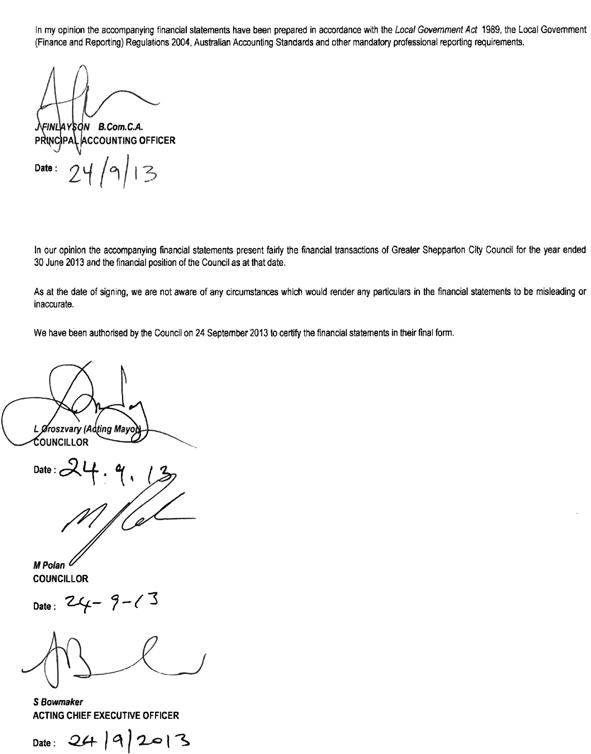
Standard Statements
For the year ending 30 June 2013
Standard Income Statement
For the year ending 30 June 2013
Standard Balance Sheet
As at 30 June 2013
Standard Cash Flow Statement
For the year ending 30 June 2013
Standard Statement of Capital Works
For the year ending 30 June 2013
The movement between the previous year and the current year in property, infrastructure, plant and equipment as shown in the Balance Sheet links to the net of the following items:
Notes accompanying the Standard Statements
For the year ending 30 June 2013
1. basis of preparation of standard statements
Council is required to prepare and include audited Standard Statements within its Annual Report. Four Statements are required - a Standard Income Statement, Standard Balance Sheet, Standard Cash Flow Statement and a Standard Statement of Capital Works, together with explanatory notes.
These statements and supporting notes form a special purpose financial report prepared to meet the requirements of the local Government Act 1989 and local Government (Finance and Reporting) Regulations 2004.
The Standard Statements have been prepared on accounting bases consistent with those used for the General Purpose Financial Statements and the Budget. The results reported in these statements are consistent with those reported in the General Purpose Financial Statements.
The Standard Statements are not a substitute for the General Purpose Financial Statements. They have not been prepared in accordance with all Australian Accounting Standards or other authoritative professional pronouncements.
The Standard Statements compare council’s financial plan, expressed through its budget, with actual performance. The local Government Act 1989 requires explanation of any material variances. The Council has adopted a materiality threshold of $100,000 and 10 per cent. Explanations have not been provided for variations below the materiality threshold unless the variance is considered to be material because of its nature.
The budget figures included in the Statements are those of the annual budget adopted by Council on 17 July 2012. The budget was based on assumptions that were relevant at the time of adoption. The council set guidelines and parameters for revenue and expense targets in this budget in order to meet council’s business plan and financial performance targets for both short and long term. The budget did not reflect any changes to equity resulting from asset revaluations, as their impacts were not considered predictable.
Detailed information on the actual financial results is contained in the General Purpose Financial Statements. The detailed budget can be obtained by contacting the council through the website. The Standard Statements must be read with reference to these documents.
2. explanation of material variances
1 Operating Grants and Contributions
More than budget by $7,164,381 largely due to the early receipt of 2013/14 Victoria Grants Commission funding of $5,518,624.
2 Statutory Fees less than budget by $266,811. This includes $131,976 regarding Animal Control and in particular lower income from cat and dog registrations than originally budgeted.
3 Other
4 Rent
More than budget by $312,213 mainly due to interest income being $294,992 more than budget.
Rental income was $124,484 greater than budget largely due to a change in classification of user charges collected at the Business Centre to Rent income of $101,098.
sTA n DARD i nc O me sTAT emen T - e xpenses
5 Utilities
More than budget by $570,481 which relates to electricity, water and gas expenditure. The predominant variances were $270,887 in Recreation and Parks and $200,000 in Aquamoves.
sTA n DARD i nc O me sTAT emen T - O T he R
6 Proceeds from Disposal of Assets
More than budget by $134,412 due to more items of plant sold.
7 Capital Grants and Contributions less than budget by $832,820 of which $396,215 relates to Roads to Recovery grants which are dependent on the timing of works.
8 Contributed Assets
9 Written Down Value of Assets Sold
Relates to developer contributions which are difficult to predict. This is a noncash item.
Relates to developer contributions which are difficult to predict. This is a non-cash item.
sTA n DARD bALA nce s hee T - c u RR en T Asse T s
10 Cash
More than budget by $1,758,160 largely due to lower receivables $857,006 and higher creditors $664,412 at year end.
11 Receivables less than budget by $443,406 which is largely due to government grants accounted for as income but not yet received.
12 Investments
13 Other
More than budget by $12,801,341, due to the early receipt of 2013/14 Victoria Grants Commission funding of $5,518,624 and $4,000,000 Federal funding for the Building Better Regional Cities Project.
More than budget by $1,002,490 including $397,442 in prepayments for Information Services annual maintenance and $360,788 in accrued income for National Disaster Financial Assistance relating to the September 2010 floods.
sTA n DARD bALA nce s hee T - nO n c u RR en T Asse T s
14 Property, Infrastructure, Plant and Equipment
15 Other
More than budget by $155,228,459 which largely relates to the infrastructure asset revaluation of $164,512,421 that is partially offset by the capital works program being $8,964,429 under budget.
More than budget by $155,228,459 which largely relates to the infrastructure asset revaluation of $164,512,421 that is partially offset by the capital works program being $8,964,429 under budget.
sTA n DARD bALA nce s hee T - c u RR en T Li A bi L i T ies
16 Interest Bearing liabilities
More than budget by $313,610 which relates to classification between the current and non current liability.
sTA n DARD bALA nce s hee T - nO n c u RR en T Li A bi L i T ies
17 Payables
18 Employee Benefits
less than budget by $142,529 and largely relates to the payments for the Cosgrove landfill.
More than budget by $153,953 which relates to a greater than budgeted long service leave liability.
note item explanation
sTA n DARD cA sh fLO w sTAT emen T
19 Receipts from customers
20 Interest Received
21 Proceeds from sale of property, infrastructure, plant and equipment
More than budget by $7,439,382 and includes the early receipt of 2013/14 Victoria Grants Commission funding of $5,518,624.
More than budget by $362,213 due to the early receipt of 2012/13 Victoria Grants Commission funding of $5,341,187 being held in investments during 2012/13.
More than budget by $362,213 due to the early receipt of 2012/13 Victoria Grants Commission funding of $5,341,187 being held in investments during 2012/13.
22 Payments for property, infrastructure, plant and equipment less than budget by $8,964,428 as the capital works program for 2012/13 was less than budgeted.
sTA n DARD sTAT emen T O f cA pi TAL wOR ks
23 Roads less than budget by $2,260,085 which Includes $409,035 for Raftery Road reconstruction and $200,000 for Ferguson Road renewal works which did not commence and developer works including Connolly Estate $332,000 and Northlinks $148,215.
24 Drains less than budget by $2,624,539 which Includes expenditure less than budget for Mooroopna West Growth Corridor drainage works $1,237,488, Urban Drainage renewal works $606,258 and Rural Drainage renewal works $268,714.
25 Open Space less than budget by $744,351 which largely relates to Shepparton Sporting Precinct works being $599,604 less than budget.
26 Plant and Equipment less than budget by $352,605 which largely relates to an underspend in plant renewals $443,773 due to plant that will be delivered in 2013/14.
27 Waste Management less than budget by $1,769,541 which largely relates the Shepparton Transfer Station works of $1,740,351 which did not commence.
28 Other less than budget by $987,397. Variances include $470,579 for general land purchases and $416,944 for the Safer Cities CCTV Project which did not occur during the financial year.
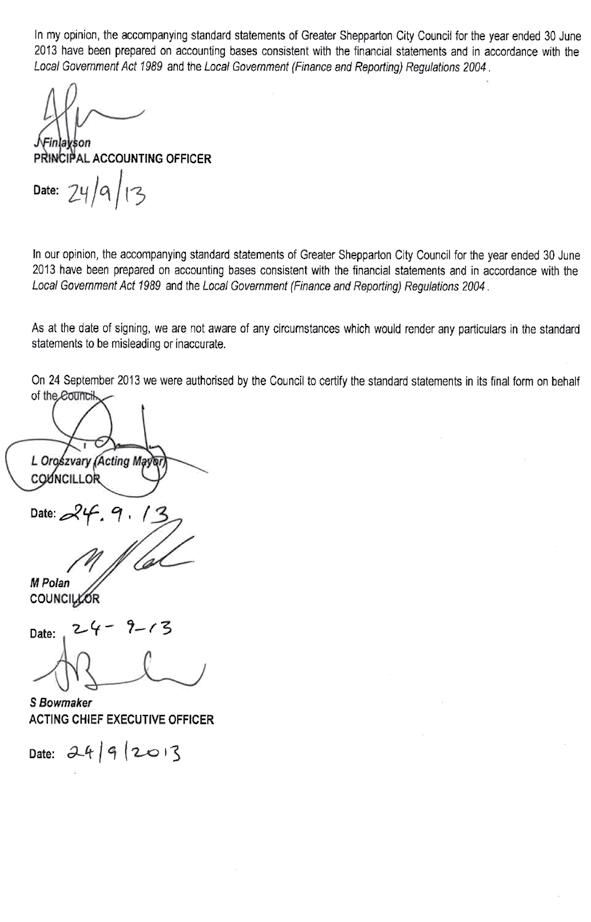
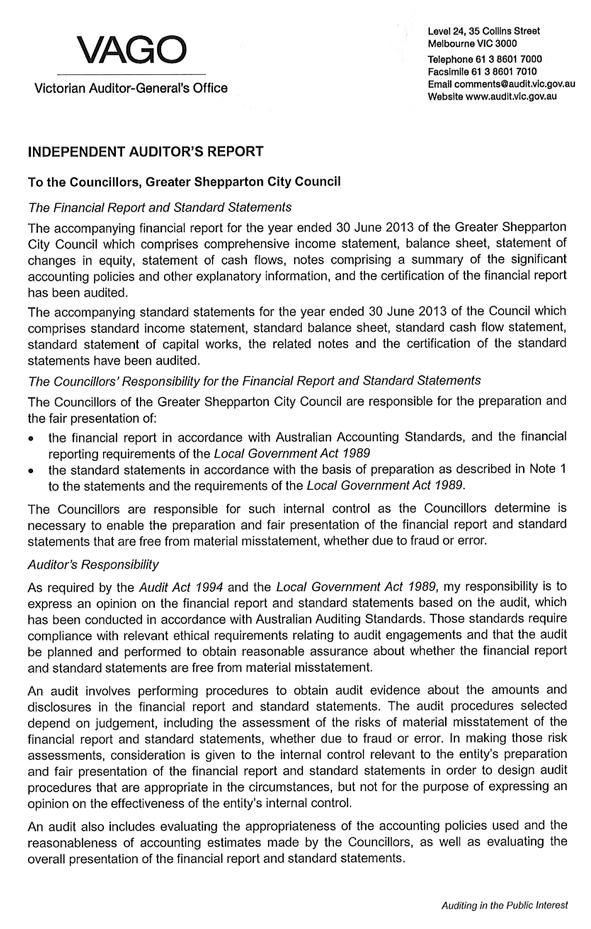
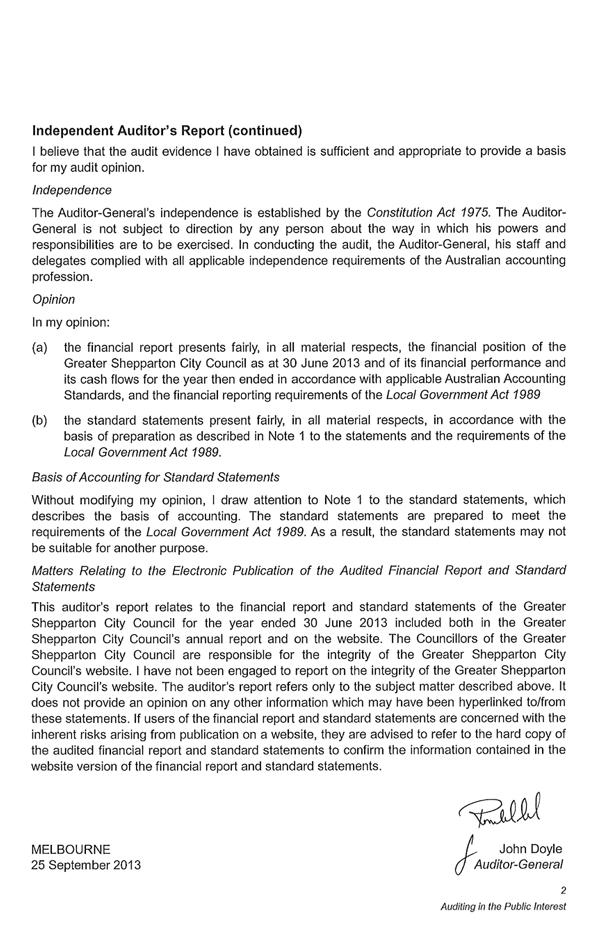
Auditor’s Report
Contact Us
business hours
8.15am to 5.00pm weekdays
in person: 90 Welsford Street, Shepparton
mail: locked Bag 1000, Shepparton, VIC, 3632
phone: (03) 5832 9700
sms: 0427 767 846
fax: (03) 5831 1987
email: council@shepparton.vic.gov.au
web: www.greatershepparton.com.au
Twitter: @GreaterShepp
facebook: Greater Shepparton City Council
Greater Shepparton City Council is National Relay Service (NRS) friendly. If you are deaf, hearingimpaired, or speech-impaired, we ask that you call us via the National Relay Service:
TTy users: 133 677 then ask for (03) 5832 9700
speak & Listen users: (speech-to-speech relay) 1300 555 727 then ask for (03) 5832 9700
internet relay users: Connect to the National Relay Service via www.relayservice.com.au and then ask for (03) 5832 9700.
A hearing loop is also available at Council’s customer service centre and Council meeting room.
Interpreter service available.