New Denver Pavement Plans Include Unexpected Shocks For Thousands of Homeowners
By Mark Silverstein | For the GPHN
The city’s new sidewalk program is kicking into high gear — and it is likely to pack a shocking punch of a surprise to thousands of Denver homeowners.
The recently-published goals and plans for rebuilding Denver’s sidewalk network threaten to reclaim and build out currently-unused city-owned right of way. Residents in impacted areas stand to lose wide swaths of what they have long treated (with Denver’s acquiescence) as a functional part of their front yards.
In Park Hill alone, roughly two-thirds of the neighborhood is targeted for sidewalk construction or reconstruction. In many cases, building these new sidewalks to city standards will bring the new pavement surprisingly closer to residents’ doorsteps — some within arm’s reach of their front steps.
Bigly ambitions
In 2022, Denver voters approved the “Denver Deserves Sidewalks” ballot measure, an expansive plan to build, upgrade and repair the city’s entire
3,500-mile network of sidewalks in less than a decade.
The ballot measure made a huge change in the financing and responsibility for sidewalks. Until 2022, property owners were responsible for building, maintaining, and repairing the sidewalks adjoining their lots. The 2022 ballot measure shifted responsibility to the city, specifically its Department of Transportation & Infrastructure (DOTI).
The City Council tweaked the financing formula with a 2024 ordinance, which established a new tax that went into effect in early 2025. Most property owners are now paying a flat fee of $150 per year, raising an estimated $40 million to $97.5 million to fund the sidewalk projects.
In late March, after the program’s first year of operation, DOTI released a comprehensive Sidewalk Implementation Plan: State of the System report (“SOTS Report” — online at tinyurl.com/SOTSReport).
Hands In The Dirt
Gardeners Find Quiet Solitude In a Frenetic World
By Kate Blanas | Park Hill Garden Walk Organizer
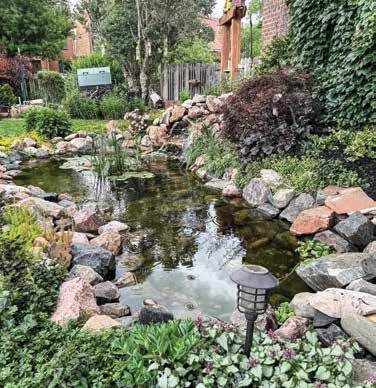
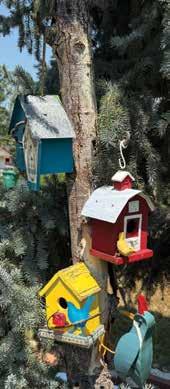
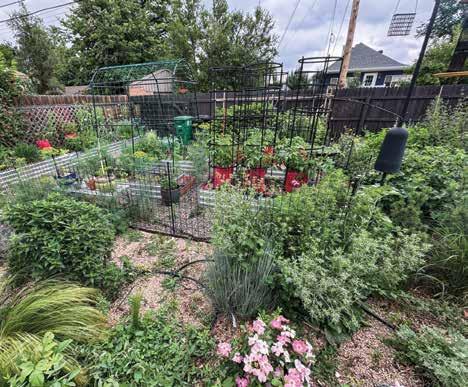
Behind each of the eight beautiful gardens featured in this year’s Park Hill Garden Walk are the amazing gardeners. Some of them remember their first gardens from their childhood and were inspired by their mothers, fathers, grandparents and neighbors. Others found their first gardening joy as adults in their current homes.
Sandy Stoll and Rebecca Moore both describe how their gardens have little by little taken over the original lawns. Whether they wear boots or shoes, gloves or not, a hat or a neck fan, gardeners garden for a wide range of reasons. Besides juicy tomatoes, benefits include working outside, hands in the dirt, creating beauty, bounty and finding a quiet place in our frenetic world.
“I find the nurturing, tending, and faithfulness that a garden requires deeply satisfying,” says Rebecca Lee. “Gardening connects me to the earth and the life-affirming act of growing things. I view gardening as a life practice. I do the best I can and let go of the outcome. Not always easy — especially when a snowstorm hits the first week in May.”
Making peace with imperfections
Other than bindweed, learning to work with and not against unpredictable Denver weather is the greatest challenge for gardeners whose
and
permit pedestrians
creations are featured in the June 7 neighborhood event.
Gardeners have many different approaches and styles, but all involve flexibility, determination and patience. Micki Amick has learned to accept that a third of what she plants will not survive. Camille Moore is guided by efforts to find the “right plant, right place.”
“That philosophy has drawn me deeper into native plants, which support local pollinators and feel true to this place,” she says. “I’ve come to genuinely appreciate what makes Colorado’s landscape distinctive, rather than trying to impose something on it.”
Colleen Gill goes with a “survival of the fittest” approach, but her husband, Ron, nurtures and shepherds the seedlings to help them mature into independent plants.
Happy gardeners must make peace with imperfections. In this year’s
The Fine Print
What: Park Hill Garden Walk — Tour Of 8 Local Gardens
When: June 7, from 9 a.m. to 3 p.m.
Tickets: Online at parkhillgardenwalk. org. Also available at City Floral, Spinelli’s and the Park Hill Branch Library
Adults: $20
Seniors (65+): $15
Day of Event: $25
Children under 12: Free Raffle tickets: Win a Garden-In-A-Box from Denver Water. Prices are $5 for one ticket, $10 for three tickets
[ PARK HILL GARDEN WALK ]
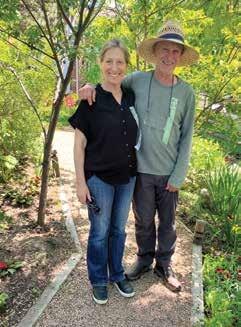
Kate Blanas and her husband, Jim, in their Park Hill garden. The couple opened their garden to visitors last year. File photo by Cara DeGette
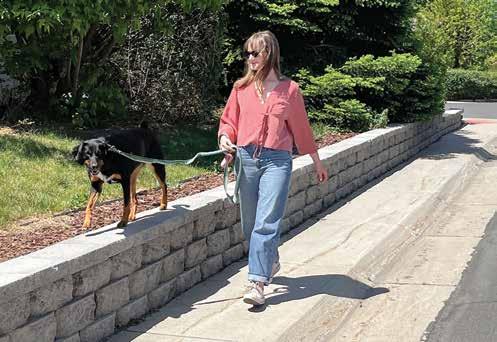
Mansour Al-Amin, Francesca Lipinsky and Sadie, on a Hollywood sidewalk in Park Hill. Almost all of the “deficient width” sidewalks in Park Hill are Hollywood style—they have no buffer of land between the sidewalk
street, have less than three feet of level space, and slope directly into the street. They don’t comply with the ADA and don’t
to walk side by side. Photo by Cara DeGette
WE BUY BOOKS!
Bravo! Bravo!
Local Businesses Shine In The Spotlight
By Cara DeGette | GPHN Editor
Penelope Wong, the mastermind behind Park Hill’s celebrated Yuan Wonton restaurant on 29th and Fairfax, has been nominated again for a James Beard Award for best chef in the mountain states region. (Yuan Wonton, which specializes in dumplings and other Asian dishes, was also named to the New York Times ’ list of America’s Best New Restaurants in 2024.)
The four other finalists include another Denver chef, Johnny Curiel of Alma Fonda Fina, plus two from Utah and one from Montana. This is the fourth time Wong has been nominated. The winner will be announced on June 15. Will the fourth time be the charm?
Also taking a bow…
sant competition.
Best Sign of Life on East Colfax: La Vista Motel got the nod for its recent renovation, transforming a motel in crumbling disrepair into a hipster-vibed, boutique lodging with a mid-century feel.
Best Antique Store: Antiques Etc., on the corner of Colfax and Ivy, occupies 10,000 square feet housing 50plus dealers. The days of having to head over to South Broadway for antiquing are over.
Best Place to Paint Pottery You’ll Actually Use: Ceramics in the City, on the south side of Colfax at Forest Street, is a creative space where you can take a clay-crafting class, get messy on a pottery wheel, or just relax and paint.
Numerous Park Hill and nearby businesses received kudos of the highest degree in Westword ’s annual Best Of awards this year. The awards are designed to highlight and celebrate some of the best things about Denver.
Best Dino Discovery: Westword bestowed a “Best Dino Discovery” award to the Denver Museum of Nature & Science in City Park for its discovery last year of of a dinosaur fossil 763 feet below the surface of its own parking lot. The fossil is similar to the vertebrae of the plant-eating dinosaur Thescelosaurus, which lived 67 million years ago.
Best Movie Theater: The Sie FilmCenter, on Colfax Avenue across from East High School, got the nod for Best Movie Theater (Not Owned by Corporate Ghouls). The theater “champions international cinema, documentaries and adventurous new releases.”
Best Croissants: La Croissanterie, inside Ruby’s Good Shoes on 33rd and Hudson Street. Pastry chef Rafael de Jesus Rufino’s croissants, stuffed with fillings like strawberry, chocolate, pistachio or dulce de leche, also recently won first place in the 5280 Pastry Co-Op’s annual Golden Crois-
WHO WE ARE
Editor: Cara De G ette
Ad Sales: Melissa Davis and Denise Fisher
Art Director: Kathy Conarro
Distribution: Sheldon Sidney Mikesell
HOW TO FIND US
Voicemail: 720-287-0442
Email: newspaper@greaterparkhill.org
Address: 2823 Fairfax St. Denver, 80207
Website: greaterparkhill.org
Facebook: facebook.com/greaterparkhillnews
Twitter: @parkhillnews
CONTACT US
STORY TIPS AND LETTERS TO THE EDITOR: Cara DeGette: 720-979-4385, editor@greaterparkhill.org
Deadline for submissions is the 15th of every month
Best Golf Course Gear: City Park Golf Course has got the primo golf swag. Readers’ Choice: Numerous other Park Hill and businesses pulled in Westword accolades. Here’s the rundown:
Specialty Market: Spinelli’s Market
Free Entertainment: City Park Jazz Bloody Mary: Esters Pub
BOGO Deal: Illegal Pete’s French Restaurant: Bistro Vendôme
Ending
On A Sad Note
Park Hill’s much-celebrated Bistro Barbès is closing. The tiny, upscale French-style bistro with North African influences has been in operation for 12 years at 5021 E. 28th Ave. In May, the Denver Post reported that chef and owner Jon Robbins, has decided to move on to the next chapter of his career. “Running Bistro Barbès has been one of the defining experiences of my life,” he said. The restaurant’s last day of service will be Saturday, June 13. Editor’s note: Do you have news about a neighborhood business? Recently opened? Closed? Changed hands? Had a visit from a celebrity? Send tips to editor@greaterparkhill.org.
The Greater Park Hill News is published by Greater Park Hill Community, Inc. (GPHC) on the 1st of each month. Greater Park Hill Community, Inc. makes no warranties and assumes no responsibility for the accuracy of the information contained herein. The opinions expressed in articles are not necessarily the opinions of GPHC. GPHC does not necessarily endorse the companies, products or services advertised in The Greater Park Hill News unless specifically stated. GPHC reserves the right to run any advertisement.
Circulation is 13,000 and is distributed in the Park Hill Area by neighborhood volunteers.
The Greater Park Hill Community, Inc., is a volunteerbased registered neighborhood organization that: promotes the character and vibrancy of Park Hill; provides resources, information and advocacy; and preserves quality of life and the history of the neighborhood through community participation.
June 2026 The Greater Park Hill News
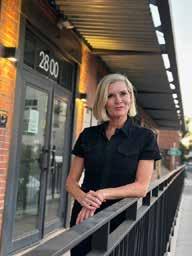
Yuan Wonton’s Penelope Wong
Gardener In Training
,700,000
With bright green, red and blue plumage, Resplendent Quetzals are perhaps the most striking birds you will ever see. Unfortunately, much of their Central American rainforest habitat has been destroyed, and the birds are now classified as near-threatened. Efforts to protect them are underway, and the birds themselves are helping. They love to eat tiny avocado fruits and regurgitate the pits — thus planting seeds for new trees throughout the forest. Photo by Mark Silverstein
5/20/26, 2:37 PM AW AD - Park Hill A
Denver describes this report as a first step in developing a master Sidewalk Implementation Plan in the remainder of this year.
The SOTS Report lays out multiple reasons why an accessible, safe, and connected sidewalk network is critical for an equitable and vibrant city. Sidewalks are essential for Denver residents who do not or cannot depend on cars. They are especially important for persons with disabilities. More than 30 years after passage of the Americans for Disabilities Act (ADA), Denver’s sidewalks have yet to comply with the statute’s minimum standards.
The mandate to DOTI is bigly ambitious. Denver voters and the city council have committed to a nineyear building blitz with three primary goals:
• Denver will build sidewalks along streets that currently have none. (Approximately 9 percent of Denver’s sidewalks — 318 miles — are missing.)
• Denver will repair deteriorated sidewalks with broken or crumbling pavement or large gaps or dangerous elevation differences between panels. (Five percent of Denver’s sidewalks — 1,233 blocks — need repair.)
• Finally, Denver will reconstruct and rebuild “deficient width sidewalks” that are too narrow and will bring them up to current city standards. (A whopping 34 percent of Denver’s existing sidewalk network — 1,162 miles — is too narrow and must be rebuilt.)
Two-thirds of Park Hill is deficient
It is this third goal — rebuilding “deficient width sidewalks” — that plants the seed for the upcoming surprise for many local homeowners.
Current city standards require sidewalks to be wide enough for two pedestrians to walk side by side. They must be wide enough to accommodate wheelchairs, and they must comply with the regulations of the ADA. Accordingly, Denver’s sidewalk program labels sidewalks as “deficient” when they are less than five feet wide. Therein lies a big problem: miles of the city’s sidewalks in Park Hill and other neighborhoods are less than three feet wide.
Denver’s State of the System Report includes a citywide interactive map that shows where sidewalks are narrower than the required five-foot minimum, as well as where they are missing entirely or in need of repair. (Check the map out online at tinyurl.com/ DenverSOTSMap — you can look up the status of your own sidewalk.)
In Park Hill, 84 miles of sidewalk — roughly twothirds of the residential area — is identified as having “deficient width sidewalks” that DOTI’s report targets for rebuilding.
The area includes almost all of Park Hill’s existing sidewalks east of Kearney Street, and the overwhelming majority of sidewalks north of 26th Avenue.
Sidewalks, Hollywood-style
Denver distinguishes between “attached” and “detached” sidewalks. Traditional sidewalks in resi-
= DEFICIENT WIDTH = MISSING
Sidewalks Of Park Hill
This conceptual map of Park Hill highlights where the city has determined sidewalks are too narrow (“deficient,” in blue), or missing entirely (in red). The plan is to upgrade these sidewalks to city standards. Those standards require a pavement five feet wide and a hell strip buffer at least eight feet wide. (Look up the status of your own sidewalk on the city’s online map at tinyurl.com/DenverSOTSMap.) Source: City and County of Denver
dential areas are “detached” — meaning that they are separated from the curb by a landscaped buffer. Denver calls those buffers a “tree lawn” and they are commonly called “hell strips.” (See related story — Whaddya Call That… —on page 6.)
Another type of sidewalk is an “attached” sidewalk, which is directly adjacent to the street curb, and has no hell strip buffer.
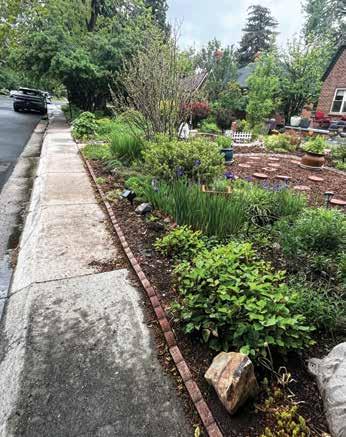
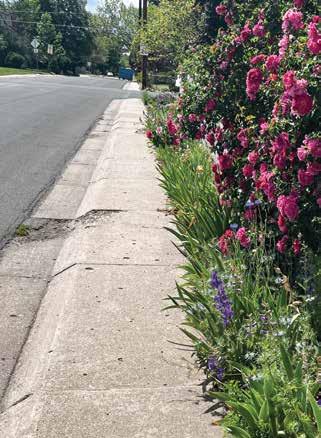
Most of the deficiently narrow sidewalks in Park Hill, and in the rest of the city, are a type of attached sidewalk that DOTI calls “Hollywood” sidewalks. These narrow strips of pavement provide less than three feet of level space before sloping directly into the street—there is no separate curb.
The angled curb of Hollywoods provide less protection from cars than standard vertical curbs.
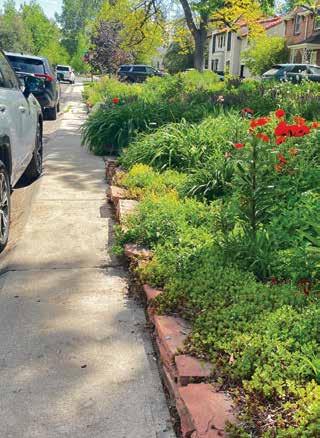
Examples of Hollywood sidewalks in Park Hill, with landscaping planted to the edge. Photos by Cara DeGette
Their narrow width violates the ADA, making wheelchair access nearly impossible. They also prevent people from walking side-by-side and expose pedestrians to dangerous proximity to passing vehicles.
It is unclear where Denver came up with the Hollywood term, but these sidewalks are especially common in Denver and around the country in neighborhoods built in the three decades after World War II — including much of Park Hill.
Early proponents of the design noted that it catered to the increasingly car-centric culture (“who walks any more?” they said). Hollywoods also allowed for larger front lawns. Or what looked like larger front lawns.
About that landscaping…
And now those seemingly larger front lawns are threatened by Denver’s plans. Residential streets with attached sidewalks — especially narrow Hollywood sidewalks — forego the traditional hell strip that separates the paved sidewalk from the street. As a result, the paved area (street plus sidewalk) does not occupy all of the city-owned right-of-way.
Large portions of what many residents have long regarded as part of their front lawns are actually part of the as-yet-unused city-owned right of way.
Many homeowners have built walkways, steps, railings, retaining walls, raised beds, shrubs, and even fences all the way up to the edge of the attached Hollywood sidewalks. DOTI refers to these homeowner-installed constructions on the city’s right of way as as “encroachments.”
Denver’s SOTS Report states that fulfilling the mandate to reconstruct the sidewalk network may require using the full city-owned right-of-way, including when homeowners’ encroachments are in the way.
Upgrading a narrow Hollywood sidewalk to city standards requires more than just adding a couple extra feet of pavement. When the city-owned right of way is wide enough, says DOTI spokesperson Nancy Kuhn, Denver’s standards require an eight-foot buffer (hell strip) between the new five-foot sidewalk and the street.
When the roadway is classified as an arterial street, city standards require the sidewalks to be at least eight feet wide. For residents living with Hollywood sidewalks, fulfilling the new mandate may mean losing a sizable chunk of what they have long regarded as an integral part of their front yard.
So how large a portion of a resident’s front yard is potentially at risk from the city’s plan? For many homeowners living on Park Hill’s residential streets with Hollywood sidewalks, the asyet-unused city-owned right-of-way extends approximately nine feet from the edge of the current sidewalk (see accompanying story below).
DOTI doesn’t say
As the sidewalk project kicks into gear, many Denver homeowners will surely be surprised to learn that their property ends just a couple steps from their front door. And many will certainly be unhappy with the prospect of a public sidewalk within arm’s reach of their front steps.
Continued on next page
Farewell, Front Yard
Park Hill Homeowners With ‘Hollywood’ Sidewalks Could Lose Nine Feet Of What They Have Treated As Their Property
In order to rebuild narrow Hollywood sidewalks to city standards, Denver states that it may need to use the full city-owned right-of-way.
Where is the line between the city’s right-of-way and the homeowner’s private property?
In neighborhoods where a hell strip separates the sidewalk from the street, homeowners are generally safe to assume that their property extends to the edge of the sidewalk. For Park Hill residents living in homes with narrow (less than three feet) Hollywood sidewalks attached to the street, the answer is different. It appears that the city-owned right-of-way may extend as far as nine additional feet into what people have long assumed to be their front yards.
Here are the calculations: On Park Hill’s typical residential streets with deficiently narrow attached sidewalks, Denver’s plat maps show that the city-owned right-of-way is 60 feet wide. The streets themselves, however, are only 36 feet wide. Thus, the city owns an additional 24 feet — 12 feet on each side of the street. By replacing the Hollywood sidewalk and using the full city-owned right-of-way, Denver could build a standard five-foot sidewalk, with an additional seven feet for a hell strip. For these property owners, their new sidewalks would be approximately nine-feet closer to their front doors.
— Mark Silverstein
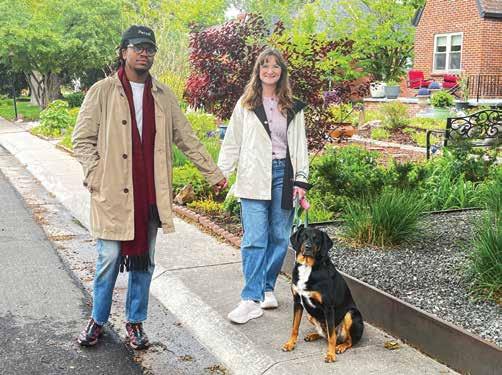
Sadie the dog (with owner Francesca Lipinsky) walks along a retaining wall built along the edge of a Hollywood sidewalk in Park Hill.
Homeowners will undoubtedly be disappointed to learn they might lose their shrubs, decorative walkways and fencing, raised beds and other landscaping that have been built on what they may learn for the first time is actually city property. For their part, Denver officials declare that narrow sidewalks will be rebuilt to city standards, and those standards require an eight-foot-wide hell strip in addition to a five-foot-wide sidewalk. The city’s plan likely clashes with the expectations of many homeowners, who stand to lose up to nine feet of what they have regarded as their front lawns. How will this tension be resolved?
Denver’s SOTS Report acknowledges some “competing factors” that DOTI “will need to weigh,” but it appears purposely vague. Notably, it provides no details about how to weigh competing factors — nor how to resolve them. In some cases, the report notes, there may not be enough space to rebuild a sidewalk to city standards. Instead of suggesting that those standards might be relaxed, the report states that Denver may need to acquire “small amounts of private property.” When discussing encroachments installed by homeowners, DOTI notes its need to use the full public right-of-way. The agency pledges to “work with” property owners “to resolve any issues,” but it provides no additional details.
The report notes that the “tree canopy” may compete for space with the sidewalk network.
Without mentioning that Denver’s standards require an eight-foot buffer, DOTI says, without elaboration, that both sidewalks and “tree lawns” (i.e.hell strips) are important, and it will
“be working through the necessary challenges and tradeoffs.” Again, no details. Do those potential tradeoffs include chopping down trees instead of relaxing sidewalk standards? Does it mean narrowing the required hell strip? DOTI doesn’t say.
In another section, the SOTS Report hints that one potential tradeoff could be to replace narrow sidewalks in some locations with wider attached sidewalks. (The report fails to note that in such a case, DOTI’s accessibility standards may require a sidewalk even wider than five feet.) Factors to be considered, the report states, are “available public right-of-way, street context, drainage requirements, and cost.”
In the months ahead
DOTI is currently working to create a “Master Sidewalk Implementation Plan,” as required by the 2022 ballot measure and the 2024 ordinance.
According to DOTI, the plan will outline in more detail “where, when, and how the Sidewalk Program will build a complete sidewalk network.”
The plan will provide “guidance on where building detached sidewalks is most appropriate and feasible.”
The agency plans to solicit public feedback on the plan in the coming months, beginning in June.
This next round of “public engagement” provides an opportunity for DOTI to explain in more detail how it intends to address what it acknowledges are “competing factors” and potential tradeoffs and to resolve the tension between Denver’s ambitious goals, the city’s exacting rigorous standards, and the potential impacts on homeowners who risk losing what they have regarded as their front yards. Stay tuned for updates. ✦
Whaddya Call That Strip Of Land?
Speaking of sidewalks, just what is the word for that strip of land between the concrete and the curb?
Tree lawn? Hell strip? Whaddyamacallits?
An astounding amount of variation exists. Denver officials call the buffer between the street and the sidewalk an “amenity zone,” or a “tree lawn.”
The Greater Park Hill News uses the commonly-used “hell strips.” A variant of that is “devil strip.” In New Orleans they are often called “no man’s land” or “neutral ground.”
The terms “parkway” or “boulevard” are common for the often-landscaped buffers.
Additional terms include “berm,” “terrace,” and multiple iterations of “strip” — such as grass strip, nature strip, park strip and curb strip.
The city’s standards require that residential sidewalks be detached from the street and sheltered by one of these whaddyamacallits, though the city’s miles of attached sidewalks reveal rampant noncompliance.
According to Josh Katz’s book Speaking American, the younger you are, the less likely you even have a word for that special street-adjacent zone: 87 percent of people born since 1995 have no word at all for that whatzit.
— Mark Silverstein
Dr. Kate received a BS in dental hygiene in 1982 and her DDS in 1989 , both from the University of Colorado. A second generation dentist, she proudly provides
Dr. Kate Hakala and her staff are
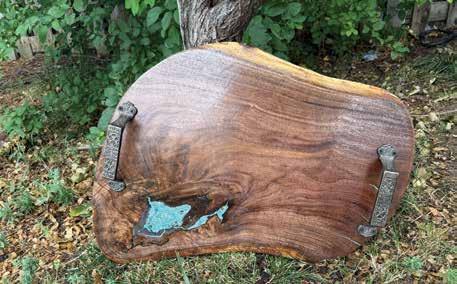
Painting by Nathan Roberts, Woodwork by Tina Hoffer, Jewelry by Angela Lujan.
Planning By Post-It Note
CDOT Temporarily
Story and photos by
Puts People Behind The Wheel On Colorado Boulevard Bus Rapid Transit
Cara DeGette | GPHN Editor
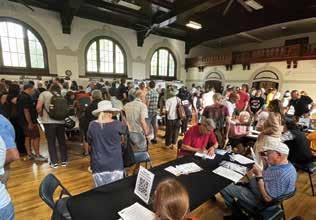
This is some of the feedback from when the Colorado Department of Transportation (CDOT) put several hundred people into an extraordinarily hot, noisy room, gave them all colored pads of post-it notes, and asked them about Bus Rapid Transit (BRT) on Colorado Boulevard.
• Not another Colfax, please!
• Agreed, not another Colfax — see what happens there before you commit to Colorado Blvd.
• Tunnels are better. Go Elon!
• Cities are for people, not cars!
• NO!
• OK, Boomer.
• YES, start!
• We are being bamboozled!
• Think of everyone not your own minor inconvenience.
• This will make our neighborhoods so unsafe.
• Denver needs better public transit. Ignore the ignorant comments against!
• Mixed flow is NOT BRT. It would be a waste of money and a missed opportunity.
• BRT would be great connection to the A-line!
• Coming from the airport on the 40 [bus] is great at night. Not so much at day.
• You need a bus lane!
• No f*%&in way.
• Yes f*%&in way, Boomer.
CDOT is currently considering several scenarios for a BRT on the congested, 10-mile stretch of Colorado Boulevard between I-70 and Hampden Avenue. Traffic volumes on the street often exceed 60,000 vehicles every day. Here are the options:
• No. 1. A center-running bus system that is similar to what is being built on Colfax. This design would eliminate one lane of car/truck traffic in each direction on Colorado Boulevard. Buses would run down the middle of Colorado Boulevard. It’s the most expensive option.
• No. 2. Side-running: This option would also eliminate one lane of car/truck traffic in each direction. Buses would run down each side of Colorado Boulevard. It’s less expensive than the center-running option, but with slower transit time.
• No. 3. Mixed-flow: This option would have buses continue to share traffic lanes with other vehicles, with improvements to the existing bus system. It’s the least expensive option, and also the one with the lowest expected bus ridership and reliability.
• No. 4: Build nothing.
On May 13, CDOT hosted an open house in the administration building of Clayton Early Learning, just west of Park Hill at Martin Luther King, Jr. Blvd. The
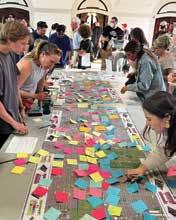
agency advertised its intent was to solicit community feedback. Rather than a traditional presentation, people were instructed to visit various stations set up around the large room, and to review oversized poster boards of the different design options. They were then encouraged to write responses and suggestions on post-it notes and stick them on a gigantic map of Colorado Boulevard. There was no consensus on a preferred design option. Many in attendance were clearly opposed to all of them. Colorado Boulevard may need safety and other improvements, several said — but BRT is not one of them.
Several in attendance mentioned a Brian Maass investigation about the project that had aired the night before on Channel 7. The report cited CDOTs own projections that reducing lanes on Colorado Boulevard would dou-
Park Hill Garden Walk
June 07, 2026 | 9am - 3pm
$20 Adults | $15 Seniors (65+) *Day of event, tickets are $25 Children under 12 years are FREE
ble southbound commute times for drivers — from 25 minutes to about 50 minutes.
Maass also reported that a week earlier, the Glendale City Council unanimously and “forcefully” voted to oppose the BRT. The plan, city leaders said, could dramatically worsen traffic for drivers while delivering only modest transit gains.
“The juice is not worth the squeeze, not by a little, but by a long shot,” Glendale City Manager Chuck Line told Maass.
Did you miss the meeting? CDOT invites feedback about the Colorado Boulevard BRT at this link: tinyurl. com/ColoBlvdBRT
Read more: The April Greater Park Hill News story about the Colorado Boulevard BRT plan is at this link: greaterparkhill.org/brt-overload. ✦
Attendees swarmed the May 13 open house at the Clayton Campus. At right, people stuck Post-It note feedback about the proposed Colorado Boulevard BRT on an oversized map.
Get Ready For A 4th Of July Blowout
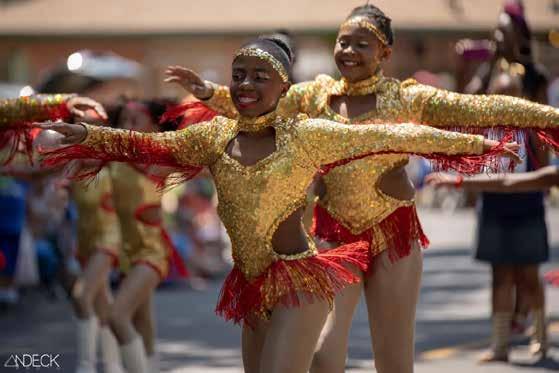
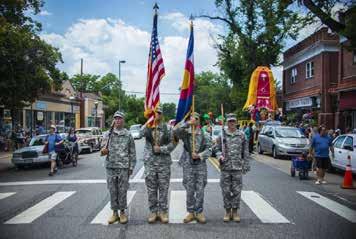
Get your blankets, your umbrellas and your coolers ready for the Park Hill 4th of July Parade. Organizer Justin Bresler reports this year’s event is going to be monumental, grand, outstanding, sensational, fantastical. Colorado is also celebrating its 150th birthday this summer. “It’s going to be a big year,” says Bresler. Between 8,000 to 10,000 spectators will line up along 23rd Avenue between Dexter and Kearney Streets for the parade, which begins at 2 p.m. Nearly 1,000 participants are expected to march this year, including three marching bands. Registration is still open to sign up your group to march: parkhillparade.com
Community Yard Sale Is June 13
The 14th Annual Park Hill Yard Sale is Saturday, June 13 from 9 a.m. to 2 p.m. Join dozens of neighbors in this coordinated same-day sale. Sellers: Register your yard sale at this link: greaterparkhill.org/events/yard-sale
(including descriptions of what you’ll be selling). Buyers: Check the link above or the ad on page 18 for a QR code to help you plan where you’ll go to find all the stuff you want and need. Note: A donation truck will be set up on June 14 at Park Hill Elementary to drop off unsold, unwanted items for charity.
Park Hill Art Festival June 6-7
The 13th Annual Park Hill Art Festival is set for Saturday and Sunday, June 6 and 7. The fine art and fine craft show showcases 100 artists from Colorado and beyond. Work ranges from paintings to fine jewelry, woodwork to sculptures, textiles to photography. Food trucks and gourmet vendors also participate. The Art Fest is on the grounds of the Park Hill Masonic Lodge, on Montview Boulevard between Dahlia and Eudora streets, from 10 a.m. to 5 p.m. both days. There is no entry charge. Check out parkhillartfestival.com for more on participating artists.
Changing Landscapes Opens June 12
What happens when the places we treasure begin to change? The exhibit, Changing Landscapes: Inside Venice, Mesa Verde, and Rapa Nui explores how climate changes are affecting three World Heritage Sites, including shifting landscapes and rising seas. The exhibit opens on Friday, June 12, at the Museum of Nature And Science
Streetwalking With Phil Goodstein
Join prolific historian Phil Goodstein in one or more walking tours this summer, and learn the fascinating histories of some of Denver most interesting neighborhoods.
June 6: Highland Park, 6–7 p.m.
Meet at Woodbury Library at West 33rd Avenue and Federal Boulevard. This walk includes landmarks in and around Denver’s Highlands neighborhood. It is free; participants may tip the guide as they wish.
June 24: East of Castle Marne, 6:30–7:30 p.m.
Gather at Castle Marne, at 1572 Race St. The tour will focus on the historic houses and colorful people of the Wyman section of Capitol Hill. It is free; participants may tip the guide.
July 5: Fourth of July in Colorado, 1:30–2:30 p.m.
Colorado entered the union in 1876 on the centennial of the Declaration of Independence. This is a free lecture highlighting the many changes in Colorado since statehood. It is on the Auraria Campus downtown, in the Casa Mayan house. RSVP at philgoodstein@gmail.com or 303-333-1095.
in City Park. It is free with museum admission. dmns.org
Beautify The Neighborhood June 13
If you’ve got a spare pair of hands, head over to MLK Recreation Center on Saturday, June 13 for the first of three huge trash cleanup events in the northeast part of Park Hill. Volunteers should show up at 8 a.m. at 3880 Newport St. The group will fan out through the neighborhood between Monaco Parkway and Quebec Street, and MLK Boulevard and Smith Road.
All trash pickup materials will be provided, and the work will be finished around 10 a.m. This is the first of three planned trash pickup projects being coordinated in this area by Park Hillian Kevin Hallman. (The other two dates are Aug. 15 and Oct. 17.)
“Beautifying and caring for the neighborhood takes everyone, and this is a great way to help out your neighbors and your community,” says Hallman. Email him at kevinandtessa2023@gmail.com to sign up. ✦
For The Love Of Futbal
The World Cup Is Here; Let The Summer Of Soccer Begin
By Bob Boyle | For the GPHN
The Mile High City is filled with fans getting energized for the World Cup, which kicks off June 11 in Mexico City. The final is July 19 — the single most-watched moment in sports, with over 1.5 billion expected to tune in. Check out tinyurl.com/WCSked for a full schedule of televised games.
The following is a guide to local World Cup events:
Soccer Film Series At Sie FilmCenter
¡GOLAZO! — a soccer film series co-produced by Denver Film and SOCCER ELECTRIC — runs June 2 through July 19 at the Sie FilmCenter at 2510 E. Colfax Ave. The overarching theme of the festival is Unity in Paradox — soccer and film as two universal forces that bring people together.
The festival features films, World Cup watch parties, panel discussions and conversations.
A full schedule and tickets are at denverfilm.org. Pay-what-you-can tickets are available.
June 2: Escape to Victory: John Huston’s 1981 sports-war classic starring Sylvester Stallone, Michael Caine, and footballers Pelé and Bobby Moore. A post-screening panel follows.
June 4: Stephen Chow’s kung fu comedy, Shaolin Soccer
June 9: Jafar Panahi’s Offside: The acclaimed Iranian film about women fighting to watch their national team play.
June 14: Copa 71, the 2023 documentary about the 1971 Women’s World Cup. The film will be followed by a panel on women’s soccer, equity, and what’s changed since 1971.
Through July 19: World Cup watch parties and live match steams will be shown citywide on the big screen. Check out these links to local soccer-loving taverns, as well as resources for Denver clubs and teams:
Abbey Tavern: theabbeytaverndenver.com
Cheluna Brewing: cheluna.com
Soccer Electric CAMPLIFY: soccerelectric.com
Colorado Storm: coloradostorm.com
FC Denver: fcdenver.org Colorado Rapids: coloradorapids.com Denver Summit FC: denversummitfc.com DNVR Bar: dnvrbar.com
At the Denver Summit Inaugural Game on March 28. Photo by Reid Neureiter
Kiros: Student Of Reform
I’m asking CD 1 constituents to consider the need for change in our representation in Washington.
We are in this moment in our nation’s history, in part, because congresspeople like Rep. Diana DeGette have failed to meet the needs of the American people. Rather, they offer us “safe” and watered down laws that are acceptable to their funders – the corporations and special interest millionaires who fund their campaigns and perpetuate the status quo. They prioritize military spending and sending arms to Israel over affordable/ accessible healthcare, housing, and other basic needs.
Trump is right about one thing — the system is rigged. One of the ways it’s rigged is to make us think we have a choice, when in fact both parties — Democrats and Republicans alike — accept money from the same corporations and special interests. It’s rigged to keep our legislators dependent on corporate contributions so they can stay in power and perpetuate the status quo.
This is why I support Melat Kiros for Congress in CD1 and encourage your readers to learn about her before deciding who to vote for in the June 30 primary election. She is serious about reform. Her priorities include getting money out of politics in favor of public campaign financing. She advocates for congressional term limits with a built-in mentoring program for freshman.
Importantly, Kiros walks the walk — she is running a grassroots campaign and is not accepting a penny from corporate PACs (unlike Rep. DeGette). She even studies reform: her Ph.D. focus is on money in politics as well as policy solutions to reform the national political system. Don’t let her age fool you, what she lacks in experience, she makes up for in intelligence and courage.
— Charlene Parris, Park Hill
DeGette Champions Our Values
Denver Congresswoman Diana DeGette has earned the praise of Rep. Alexandria Ocasio-Cortez, who calls her “one of the most powerful people in Congress on health care” and a
co-sponsor of Medicare for All.
Leaders of the Congressional Progressive Caucus PAC, led by Rep. Pramila Jayapal, Greg Casar and Maxwell Frost (the youngest member of Congress), endorse Rep. DeGette as “an effective, steadfast champion for progressive values – from championing universal health care and reproductive freedom to standing up against Donald Trump’s barrage of illegal politically-motivated attacks against Colorado.”
DeGette is a workhorse whose leadership benefits her constituents and all Americans. Among her many accomplishments in Congress, she has spearheaded laws to:
• Accelerate the discovery, development, and delivery of new medical treatments and cures while authorizing $46.3 billion in research on diseases like cancer, Alzheimer’s and diabetes.
• Restore authority to cap methane emissions from the oil and gas industry after Donald Trump repealed the rule.
• Expand clean energy production.
• Advance groundbreaking stem cell research.
• Prevent maternal deaths.
• Strengthen oversight of prescription drugs to keep families safe.
• Modernize food safety standards. Rep. DeGette has delivered millions of dollars to invest in major Denver projects, from homelessness and health care to cleaning up the Platte River and restoring Union Station.
On June 30, I’m voting for Rep. DeGette and her record of achievement and seniority that, come November, will give her the gavel to effectively champion the values that matter more than ever.
— C.L. Harmer, Windsor Gardens East
We love your letters, and we give preference to those that address an issue that has been covered in the newspaper, or a topic that is Park Hill or Denver-specific. Send letters to editor@greaterparkhill.org, and include your full name and the neighborhood in which you live. Deadlines are the 15th of each month, for the following month’s issue.
It’s Taste Test Time
The June 30 Primary Is Coming Up Fast. Do You Know Who The Candidates Are?
By Penfield W. Tate III | For the GPHN
Well, we have weathered the caucuses and now the June 30 primary looms large. Although all the constitutional offices, legislative races and congressional contests will be on the ballot, in the minds of most, the primary decision that matters most is that for governor of Colorado.
I hope that most of you have attended either candidate forums or debates or other events for one or more candidates. This is what I call the “taste test” time. You have an opportunity to look a candidate in the eyes, get a sense of their presence and assess their sincerity. You can take the measure of the person to satisfy whether you believe they are up to the position they seek. The reality is that you will have a better chance of visiting with the candidate now, than after they are elected — particularly to the office of governor or to congress. Once the election is over, it is less likely many voters will ever see that elected official in person again.
Money’s on the Democrats
Most political observers, me included, believe that the real race for governor is on the Democratic side of the ticket. By contrast, Republican gubernatorial candidates must decide if they really want to win the general election in November, or if they simply want to win the primary and carry the mantle of being a die-hard Donald Trump loyalist.
There were two televised gubernatorial forums in May. On the Democratic side, we saw Sen. Michael Bennet and Attorney General Phil Weiser.
Bennet focused on his experience as a businessman, superintendent of Denver Public Schools and a U.S. Senator. Weiser touted his legal background clerking for Justice Ruth Bader Ginsburg, his eight years of experience with state government, and his multiple successes fighting for consumers in court and winning against the Trump administration.
A wide range of topics was covered in the hour-long Democratic debate: both candidates said ICE is out of control, both will work to be business friendly, both said the state was too expensive due to the Trump administration, and both committed to getting the cost of health care and insurance companies under control. Both support more transit and want to expand Peña Boulevard.
Bennet advocated for common-sense regulation of AI and data centers, while Weiser touted his track record of proposing and supporting legislation to protect kids and consumers. Bennet pledged to build more affordable housing — Weiser committed to that, as well as going after out-of-state property owners that prey on Colorado renters.
Both say they support congressional redistricting, do not feel Tina Peters was sentenced too harshly, support Colora-
Prime Time
The Time To Decide Is June 30. Vote!
By Cara DeGette | Editor, GPHN
Primary Election Day — June 30 — will be day most of Colorado decides in 2026. The governor, attorney general and secretary of state are all up for grabs. Incumbent Democrats U.S. Senator John Hickenlooper (and in Denver, Rep. Diana DeGette) are being challenged. Technically, Nov. 3 is General Election Day. However, the last time a Republican won a statewide election was 10 years ago, when Heidi Ganahl won a seat on the CU Board of Regents.
U.S. Senate
do utilizing nuclear energy and support exempting educational funding from TABOR. Unlike Gov. Jared Polis, neither would wear sneakers with a suit.
‘Scary kind of issues’
On the Republican side, we watched state Rep. Scott Bottoms and state Sen. Barbara Kirkmeyer. (A third GOP candidate, Victor Marx, declined to participate in the forum, which turned out to be a bit more combative and fun than the Democratic event.).
While Democrats focused on fighting Trump, Bottoms and Kirkmeyer focused on fixing what they described as the mess Democratic control of state government has created. They were both amazingly comfortable disagreeing with one another.
Bottoms spent much of his time promising that his leadership would not shy away from taking on social issues and “scary kind of issues” like trafficking kids and fighting pedophilia. He repeatedly claimed state government needed to be “DOGE’d” due to what he, without proof, asserted is widespread corruption, waste, fraud and illegal behavior.
Kirkmeyer stressed her 20 years as a county commissioner, time as a legislator and service on the Joint Budget Committee as proof of her readiness to serve. She promised to cut property and other taxes, reduce regulations, reduce state spending and make the
Democratic incumbent John Hickenlooper is being challenged by state Sen. Julie Gonzales. The winner will likely face Republican state Sen. Mark Baisley in November.
US House of Representatives — CD1 Democratic incumbent Diana DeGette is being challenged by CU Regent Wanda James and lawyer Melat Kiros. The winner will run against Republican Christy Peterson in November.
state business friendly and more affordable.
Surprisingly, both Republicans expressed support for maintaining Medicaid, although Bottoms says there is too much waste and fraud in the program, with which Kirkmeyer disagreed. Bottoms also claimed, again without proof, that the state has spent hundreds of millions on abortions for undocumented immigrants and transgender surgeries. Kirkmeyer also said that was not true.
There was more contrast between the Republican candidates, but all the candidates made clear they will have their own style and approach toward running the state.
On June 30, Colorado voters will be wise to exercise their choice.
Penfield W. Tate III is an attorney, a frequent panelist on PBS 12 ‘s Colorado Inside Out and a leader of SOS Denver fighting to make the former Park Hill Golf Course open space. He represented Park Hill in the Colorado House of Representatives from 1997 to 2000, and in the State Senate from 2001 to February 2003. Penfield and his wife Paulette live in the neighborhood.
Two Democrats are running: Jeffco Clerk Amanda Gonzalez versus State Sen. Jessie Danielson: jessiedanielson.com. The winner will face off against Republican James Wiley (who goes by the name “Red Flame of Liberty”) in November. ✦ 2 26
With Colorado’s Grand Old Party in disarray, the conventional wisdom is that the Democrats who win statewide primaries will become November’s victors. Mail ballots will be sent to all voters in Colorado beginning June 8. Democrats can vote for Democrats, and Republicans can vote for Republicans. Unaffiliated voters will receive both Democratic and Republican ballots — they can vote in one of them.
Governor of Colorado
Democratic candidates: U.S. Senator Michael Bennet is running against Colorado Attorney General Phil Weiser.
GOP candidates: State Rep. Scott Bottoms; All Things Possible Ministries founder Victor Marx; state Sen. Barb Kirkmeyer.
Colorado Attorney General
Democratic candidates: Former Assistant U.S Attorney Hetal Doshi; Boulder County DA Michael Dougherty; Secretary of State Jena Griswold; Towards Justice Executive Director David Seligman. Republican candidates: 4th Judicial DA Michael J. Allen versus David Willson (Tina Peters’ lawyer).
Secretary of State
Krislene Lorenz, Partner
knife”) It’s Rebecca Lee’s favorite tool for almost everything.
Support local nurseries that sell native and acclimated plants.
Keep a garden journal, to document successes and failures.
Make a garden spreadsheet to stay organized. Shop at thrift stores for cool things for your garden.
come and gone and come again. Shade turned to sun and to shade again, and the flowers changed accordNow that I am older, I have turned to plants that need less TLC. I look to grasses, shrubs, and perennials that are interesting because of contrasting colors, textures, and shapes. I still have fun.”
Amick says she now thinks more about what plants and trees will provide in terms of native landscape, food for her and other species, and sustainability in a changing
Beauty in drought
Garden walkers this year will also see how landscapes are faring under drought conditions. For the first time, watering restrictions have been in effect in the months leading up to the big day.
“Water-conscious gardening is something I’ve practiced for a long time,” says Camille Moore. who has intentionally focused on low-water and native plants. “Most years, I don’t even begin watering until mid-to-late June. But the lack of snowpack this year has been genuinely concerning. I just keep reminding myself not to panic, our garden was built for this.”
Throughout Denver, xeriscaping, long a buzzword, has become a necessity as more gardeners are learning to adapt to the semi-arid climate. Less water, less lawn and more native plants work in the drier times we are facing. Survival of the fittest is no longer just a gardening style but is now almost a requirement for success. The Garden Walk raises approximately $20,000 each year to help support the five food programs at Greater Park Hill Community, Inc. If you are interested in joining the Garden Walk committee, volunteering the day of, sponsoring a garden or can suggest a garden for next year’s event, please contact Paula Marinelli at paulagardenwalk@gmail.com.
New This Year: Plants For Sale
This year, featured gardener Colleen Gill is hosting a sale of plant seedlings and starters.
These plants will be available for sale on the the day of the Garden Walk, with proceeds going to to the Greater Park Hill Community food program.
If you have surplus seedlings or “weedlings” from your own garden, drop them off before the day of the Garden Walk in small containers with some soil to 6645 17th Avenue (at Niagara Street). Leave them on the side porch off the driveway, and Colleen will take over their care.
If possible, include helpful information about your plants, including name, color, grow size, light and water requirements. It would also be helpful if you could send a picture of the mother plant to Colleen at colleen@nutrition-foundations.com.
Also, thanks to a donation from Denver Water, attendees may enter a raffle for a chance to win a Garden-In-A-Box. This do-it-yourself kit contains quart-sized perennial plants, Plant-by-Number maps, and maintenance suggestions.
Raffle tickets will be available for purchase at the ticket pickup site (19th & Forest Parkway) and at each home on the 2026 Garden Walk tour. ✦
Six Decades Of Cover-up
The Fossil Fuel Industry Has Known Of
Since The 50s. It’s Time They Clean
By Tracey MacDermott | For the GPHN
Fossil fuels have been pivotal in the rise of industrialization and economic growth. They have enabled many important advancements — from urbanization, better living standards, infrastructure and transportation to name a few. However, they are the largest source of greenhouse gas emissions — a major contributor to climate change.
Oil spills and habitat destruction from mining cause harm to other species and humans.
Air pollution from the burning of fossil fuels leads to millions of premature deaths every year. Global temperatures continue to rise and the effects are mounting.
Climate Risks
Up Their Mess
Fast-forward to 2026. Americans are paying higher prices for home insurance and electricity bills, choking on polluted air, suffering from extreme heat and increased vulnerability to extreme weather events — all while the oil and gas industry rakes in massive profits.
Recently, the Trump administration announced a plan to block new wind energy projects in the U.S.
The oil and gas industry still rakes in massive profits.
Yet President Trump is still sounding the clarion call for the world to buy more U.S. oil.
A half-century of knowledge
Fossil fuels are a finite resource. They will not last forever. If the world does not move on we risk not only continuing the harm they are creating, but an uncertain geopolitical future.
Fossil fuel companies have known since the late 1950s the threats posed by their industry. That’s nearly 60 years.
As published in a report by the Union of Concerned Scientists, internal industry documents show that by the late 1970s and early 1980s, fossil fuel companies had developed a deep and sophisticated understanding of climate change that far exceeded that of the general public and policymakers.
Selected internal documents, corporate presentations and congressional testimonies shared in the report leave little doubt that these corporations recognized the projected impacts of climate change for at least a half-century. The evidence shows that these companies possessed detailed knowledge of the risks their products posed to the planet.
The authors further highlight that three-quarters of all industrial CO2 emissions driving climate change have occurred since 1981. By that time, companies could have deployed their knowledge of climate science and taken steps to alert the public and policymakers to prevent the damage they knew their products were causing.
In 1968 the fossil fuel industry issued its own internal report, noting that “significant temperature changes are almost certain to occur by the year 2000.” The report also noted that significant temperature increases could lead to “melting of the Antarctic ice cap, rise in sea levels, warming of oceans” — and, that the “potential damage to environment could be severe.”
Fast-forward to 2026
Those warnings were not publicly disseminated for decades. Today, imagine what could have been avoided if fossil fuel magnates had insisted on acting in the world’s best interest — instead of those of themselves and their shareholders.
Says the president: “My goal is to not let any new windmill be built. They’re losers.”
His administration is considering spending billions of dollars to shut down offshore wind projects, further delaying our ability to move away from fossil fuels and onto clean energy.
In Wyoming, GOP Congresswoman Harriet Hageman has proposed a bill to grant big oil legal immunity from future lawsuits that attempt to hold them liable for climate damage. Some states have passed legislation to protect the oil companies.
Excuse me? Rather than protecting companies from the damage they have caused, it is time to hold the industry accountable.
Cleaning up the mess
Rational people are beginning to call on the oil and gas industry to clean up the mess they have made. The Make Polluters Pay campaign is one organization that is working on holding big oil accountable for damages that are estimated to cost the United States nearly $1 trillion a year.
The group currently is running a step-by-step campaign, which walks participants through a series of actions that make it easy to contact your legislator, city council and governor. They give you all the tools to write letters, make calls and have the talking points to highlight when you meet with legislators.
Every Monday night is an opportunity to virtually join fellow climate activists and concerned citizens. The meetings last an hour, and they are accessible at climatechangemakers. org. Perhaps we will see each other on one of the calls.
We must call on our elected officials and other leaders and demand that those that have caused harm to our shared planet be held accountable.
Tracey MacDermott is an at-large board member of Greater Park Hill Community, Inc. She was trained as a Climate Reality Leader in 2017. She chairs the Sustainability Committee for the Business and Professional Women of Colorado and the National Federation for Business and Professional Women. Email her at traceymacdermott@gmail.com
Can You Hear Us Now?
East Boys Lacrosse Tips Northfield in A Rivalry Thriller
Story and photo by Reid Neureiter | For the GPHN
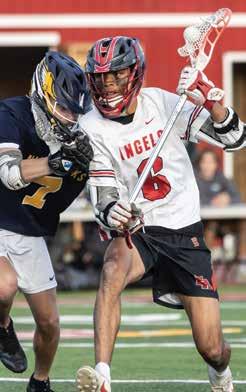
The May Day crowd at East High’s home field witnessed one of its most exciting lacrosse games in memory.
East’s Angels were facing their upstart rivals, the Northfield Nighthawks, in the concluding regular season game. It was East’s Senior Night, honoring 13 graduating laxers. But the crowd initially seemed to be composed of a majority of Northfield fans, who made the short drive from northeast Denver. Nighthawk supporters packed the stands with their navy and yellow colors and even squeezed East’s student supporters out of their dedicated seating section. School administrators had to step in to separate the rival student groups.
East came in to the match with a 6-8 record and a No. 16 ranking in the Colorado 5A Division. Northfield had a 9-5 record but was ranked No. 17 (based on less challenging strength of schedule). The game began badly for East, as Northfield scored point after point.
Near halftime the score stood at 6-0 — in favor of Northfield — and East finally landed a goal. Still, the cheers from Northfield’s enormous crowd were painful for East faithful: ”Scoreboard! Scoreboard! Scoreboard!,” yelled the Nighthawk fans. The Angel fans were quiet.
The second half was different. East’s face-off play improved and the Angels began controlling the ball. One goal for East, then two, and another — soon it was 6-4. By the fourth quarter, East had clawed its way within one goal.
The Angels’ once-porous defense had solidified, and sophomore goalie Chase Renschen made a number of outstanding saves.
When the Angels eventually tied the score, the East fans erupted into their traditional “Hay-lo-lo, Hay-lo-lo” cheer and began chanting “We can’t hear you! We can’t hear you” at the now-silent Nighthawk supporters. With minutes to go, East had taken a 9-6 lead after scoring eight unanswered goals.
But the match was not over! Northfield closed the gap to two goals with two minutes to play, and it won the ensuing face-off. The atmosphere was tense. But a Nighthawk turnover gave possession to East. The Angels cleared the ball and were able to evade the Nighthawk
High Stepping To Silver
defenders to run out the clock for a 9-7 victory. East senior attackman Jake Renschen was a standout with three goals and three assists, while junior midfielder Inigo Critchlow contributed two goals on four shots.
With the final whistle, East’s players were ecstatic, running to jump into the East student section. The deflated Northfield fans headed for the parking lot.
The post-script ended better for Northfield. Both teams made the state playoffs, with East taking on Rock Canyon and Northfield pitted against Castle View in the first round. East fell in by the score of 15-7, while Northfield won an upset first round victory by 10-6. Northfield ultimately lost in the playoffs to Regis Jesuit by 17-6.
Regardless of that outcome, Northfield is undeniably a growing power in the Colorado lacrosse scene, which promises more exciting rivalry matches in the years to come. ✦
East Hurdling Star Moe Kaeuuma Bags Two Silver Medals At State
Story and photo by Reid Neureiter | For the GPHN
High-stepping senior hurdler Mulyndwa “Moe” Kaeuuma was the undisputed star for the East Angels at the Colorado State Track and Field finals in May. Kaeuuma set school records both in the 110-meter hurdles, running a 13.78 time, and the 300-meter hurdles, with a 36.63.
The top podium spot just escaped Kaeuuma in both races, as he finished just a tenth of a second behind Cherokee Tail’s Joshua Stewart in the 110 meters, and seven one-hundredths of a second behind Eaglecrest’s Cameron Bell in the 300.
But Kaeuuma was happy with his results. Both were personal bests — and he arguably eclipsed the performances of East’s previous champion hurdler, David Oliver, who graduated in 2000. (Oliver went on to be a four-time U.S. hurdles champion, won a
bronze medal at the 2008 Beijing Olympics, and was world champion in 2013.)
Kaeuuma only started running the hurdles as a junior, after his father encouraged him to try the event because of his height — 6’3”.
“I’ve been running track for years. I was just a sprinter, but I was never the fastest person. My Dad said, ‘You are a tall guy, maybe you could try out hurdles and do something with those’.”
Kaeumma has surprised even himself with his progress. “If you told me six months ago I would be running the times I’m running now, it would be hard for me to believe. It would be just hopeful thinking.”
Kaeumma is headed to Colorado State University in the fall. ✦
Mulyndwa “Moe” Kaeuuma clears the last hurdle in the 110-meter event at the state track and field championships.
East junior midfielder Inigo Critchlow (#6) battles Northfield junior defensive midfielder Jojo Norman (#7) on May 1.
Ready For Adventure
Summer Programs Include Ocean Discoveries, Treasure Island, Yoga, Taiko And A Bilingual Book Club
By Leslie Williams | Pauline Robinson Branch Librarian
Our annual summer reading program for youth begins on June 1. Visit any of our branch locations to sign up and receive an adventure guide to inspire reading, making and exploring all summer. Both neighborhood libraries have planned some fantastic activities for youth, along with our monthly programs for adults.
Here are some facts and important dates:
• 2026 Theme: 150th Anniversary of Colorado Statehood, local history, art, artists and places.
• June 1: First day to register
• June 1: The Maker Gallery opens (This is our online space where you can share your latest drawing, Lego creation or cooking video.)
• June 2: First day to pick up prizes
• Aug. 8: Day At The Zoo!
• Aug. 10: Last day for prizes
Stop in soon to learn more about Summer of Adven-
June Library Programs
PAULINE ROBINSON BRANCH
Toddler Storytime | Tuesdays, 10:30-11 a.m.
Stories, songs, rhymes and fun for toddlers ages 18-36 months and their grown-ups.
Drop In Tech Help | Wednesdays, 2-3 p.m.
Need help navigating the internet, email, or social networks like Facebook? Have questions about your phone or tablet? Want to know how to access eBooks on any device? Drop by to get your questions answered and learn how to use tech more effectively!
Tween Lit Lounge in English | Tuesday June 2, 9, 16, 4-5:30 p.m.
Join us as we dive into two incredible books this summer: The First Rule of Punk by Celia C. Perez and Hands by Torrey Maldonado. Both novels follow 12-year-old main characters as they navigate life’s challenges. Attendees will enjoy crafts, themed food, and music inspired by the stories, and will receive a free copy of both books. Ages 9-13.
Tween Lit Lounge in Spanish | Wednesday, June 3, 10, 17, 4-5:30 p.m.
Los preadolescentes pueden leer o escuchar historias divertidas, compartir ideas y pasar el rato con amigos en un ambiente tranquilo.
ture, or go online to summerofadventure.org. For the first time at Pauline Robinson, this month we will be hosting Tween Lit Lounge, a bilingual book club designed exclusively for youth ages 9-13.
We’ll diving into the worlds of The First Rule of Punk by Celia C. Pérez and Hands by Torrey Maldonado. Participants will receive a free copy of both featured books in English or Spanish, as well as enjoy snacks, crafts, music and more. Check out additional details in the Tween Lit Lounge listing below. Registration is strongly encouraged to secure books. Call the library at 720-865-0290 or register online at one of these links:
Kids Create: Slime Time | Thursday, June 4, 4-5 p.m. Get messy and have fun at Kids Create: Slime Edition! Perfect for ages 5+, with grown-up help needed for kids under 10. Dress for slime and creativity.
Dive Into the Deep: An Underwater Adventure! | Thursday, June 11, 4-5 p.m. Put on your snorkel and get ready to explore the ocean. Young explorers will learn the secrets of ocean life, from colorful clownfish to glowing jellyfish, before creating a one-ofa-kind underwater world they can keep forever. No fins required. Just bring your sense of adventure.
Journey to Treasure Island | Thursday June 18, 4-5 p.m. Red, the Pirate Queen, is the villain in this play in which pirates maneuver to take over the ship and find the buried treasure in this humorous take on a classic tale. Performance led by the Arvada Center. Ideal for kids ages 3-12. Faith Ringgold: Story Quilts | Thursday, June 25, 4-5 p.m. Quilts have a history of telling stories. In this workshop, students learn a bit of that history through the work of Harlem-born artist Faith Ringgold, followed by piecing together paper story quilts of their
own. Program led by the Arvada Center. Ideal for kids ages 3-12. Pauline Robinson Book Club | Saturday, June 27, noon-1:30 p.m. We meet on the fourth Saturday of every month. All are welcome. This month we will be discussing The Sympathizer by Viet Nguyen.
PARK HILL BRANCH
Baby Storytimes | Thursdays 10:15-10:45 a.m.
Stories, songs, rhymes and fun for babies ages 0-18 months and their parents or caregivers.
Toddler Storytimes | Fridays 10:15-10:45 a.m.
Stories, songs, rhymes and fun for toddlers ages 18-36 months and their parents or caregivers.
Family Laughter Yoga | Wednesday, June 3, 3-3:45 p.m.
Enjoy playful laughter exercises with your family interspersed with gentle breathing and stretching. Simple, fun and accessible to everyone. This program is open to families of ages. Who Will Speak For You:
Part 2 | Saturday, June 6, 2:30-4:30 p.m.
Questions answered. Documents reviewed. Free notary service provided. Bring your completed documents and we’ll help you finalize them, whether you’re paper-based,
digital, or somewhere in between.
Death Café | Monday, June 8, 2-3:30 p.m.
Death Café is an international movement that invites people to gather and normalize conversations around death — to make the most of LIFE. This is not a grief support group or counseling session. Respect for all views is a priority.
Taiko Drumming | Tuesday, June 9, 10:30-11:30 a.m.
Taiko with Toni offers an introduction to the Japanese culture through folktales and the taiko (Japanese drum) and other Japanese instruments. Laughter Yoga | Wednesday, June 10, 11 a.m.-12:15 p.m.
Enjoy playful laughter exercises interspersed with gentle breathing and stretching. During this joyful practice, you’ll strengthen the immune system, increase tolerance to pain and combat the negative effects of stress. Simple, fun and accessible to people of all fitness levels.
Rainbow Family Party | Saturday, June 13, 2:30-3:30 p.m. Celebrate LGBTQ+ Pride with festive food and activities for the whole family. All families with children are invited. Special Guest Shirley Delta Blow will read some of our favorite LGBTQ+ kids’ books. Yasss Queen!
Level Up Tweens | Tuesday, June 16, 4:30-5 p.m.
Try fun challenges and build mini projects with friends. Learn teamwork, leadership, and problem solving while having a great time. For ages 9-12.
Family Book Celebration | Thursday, June 18, 4-5 p.m.
This month we will be reading books about Pokemon and having a Pokemon Party with crafts and activities! Ideal for ages 5-12. *Parents of young children need to attend with their child.
No Strings Attached Book Chat | Saturday, June 20, 11 a.m.-12:30 p.m.
Read whatever you want, attend whenever you can.
Mad About Hoops (Hula Hooping) | Wednesday, June 24, 3-4 p.m.
Join Mad About Hoops for a onehour interactive performance with games, lessons and contests.
Greater Park Hill has two public libraries: The Park Hill branch library is at 4705 Montview Blvd. and the Pauline Robinson branch library is at 5575 E. 33rd Ave. Note: All Denver Public Library locations will be closed on Friday, June 19, in observance of Juneteenth.
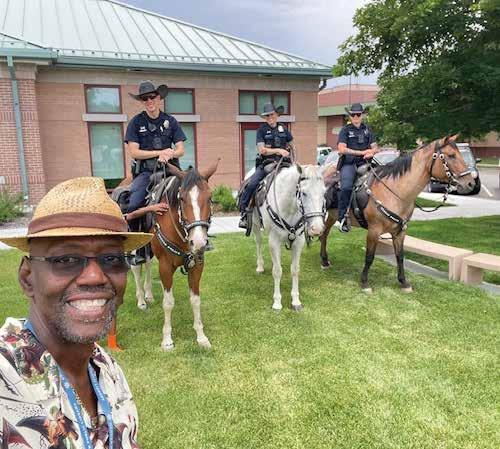
Pauline Robinson librarian Jesse Elston, in a selfie with the Denver Police Department Mounted Patrol. The patrol will return to the library this summer for family storytime.
Scratching That Itch Ways To Help Your Pet Survive Allergy Season
By Margot K. Vahrenwald, DVM, CVJ | For the GPHN
Human allergy season is raging. But we’re not the only mammals reacting. Our dogs and cats are also affected — only their afflictions look different than ours.
The overall majority of allergies are not to food, but rather to environmental irritants (house dust, pollen, molds, mites and dander). We humans react to environmental allergens with primarily upper respiratory signs, like hay fever. While our pets can also can exhibit mild upper respiratory signs, they are more likely to exhibit a reaction on their skin. It’s called atopic dermatitis (AD), and it can become inflamed and very itchy. Additionally, dogs especially can develop recurrent or persistent ear infections. In a nutshell, allergies are an overreaction of the immune system. In skin and ear conditions, immune mediators are reacting to contact with the allergens. Food allergies (aka adverse food reactions) occur in the immune patches along the small intestine known as gut-associated lymphoid tissue (GALT).
For all allergies, there is no cure, only management that is tailored to the individual patient. What works in one patient may or may not work in another. As allergies become chronic, changes in management may need to evolve or change, and there will always be flare-ups no matter what. Allergic disease is multifactorial. That means it’s a combination of genetics, impaired skin barrier and an individual’s hypersensitive immune response. The majority of allergic pets have a genetic predisposition to the disruption of the epidermis (the outer layer of skin) because of a deficiency in essential fats and ceramides that create microscopic gaps between the epidermal cells. Combine that deficiency with the fact that environmental allergens bypass this weakened barrier to absorb deeply into the skin — which triggers the cascade of immune response leading to pruritis, inflammation and self-trauma.
What we see clinically is the dreaded itch-scratch cycle that leads to annoying behaviors, hair loss, skin infections and changing appearances
of the skin that stress out us humans. So, what can you do to help your pet and lessen both your irritations?
There is no one silver bullet treatment. Instead, therapies can be targeted in three general ways: Barrier repair with topicals and supplements, medications that interfere with or stop parts of immune cascade, and preventing/treating secondary skin infections.
Here are five tips to help manage allergies:
1. Partner with your veterinarian to work up allergies and tailor allergy management to your pet in general and for when they flare up.
2. Topicals such as medicated shampoos, mousses and ceramides/ phytostigmines work to physically restore the epidermis. They also prevent or treat very mild skin infections and lessen inflammation.
3. Medications can include oral or injectable monoclonal antibodies or numerous other possibilities.
4. Infection treatment should occur promptly.
5. Home hacks can include changing the filter on your furnace/HVAC monthly and adding indoor air purifiers where appropriate. For dogs returning from the outdoors, dilute the allergens by immediately cleaning their paws, legs, armpits and bellies with unscented baby wipes, damp washcloth or pet wipes. Limit time outdoors during high allergy seasons — especially right after mowing the lawn when everything is stirred up.
The goal is happy pets and happy owners. Allergies can be stressful, but if you learn what you need to know, then they are manageable.
Dr. Margot Vahrenwald is the owner of Park Hill Veterinary Medical Center at 2255 Oneida St.
Open Letter To City Council
GPHC Board Highlights Concerns About Denver’s Proposed RNO Changes
On May 7, the board of Greater Park Hill Community, Inc. approved the following letter be sent to members of the Denver City Council. The resolution was unanimously adopted by a vote of 14-0.
Dear council members,
As you may know, Greater Park Hill Community, Inc. (GPHC) is a registered neighborhood organization (RNO), which represents all of the Park Hill neighborhood. The Park Hill neighborhood is represented on Denver’s City Council by Districts 8 and 9.
The Denver City Council effort, called Your City Your Voice, is described as “a citywide process to develop recommendations that improve how the city of Denver works with registered neighborhood organizations and community members.” After reviewing the report, released on the Your City Your Voice website on April 19, GPHC feels that many of the points are valid.
However, the following recommendations in that report are the most concerning to the GPHC:
1. Eliminate overlapping boundaries of RNOs. Our position: Park Hill, like many neighborhoods, has more than one RNO within its boundaries. Different RNOs reach different people and voices within the same neighborhood and serve a valued purpose.
2. Establish term limits for RNO Board Members and Officers.
Our position: This recommendation ignores how difficult it is to simply find and retain engaged people who want to be a part of an organization. Putting a forced time limit on these individuals’ participation is misguided at best.
3. Prohibit membership dues as a condition for participation, voting, or representation.
Our position: Membership dues are vital to GPHC; we use these fees to support our building, food programs, and newspaper. Losing membership funding would be devastating for us. Moreover, GPHC has always allowed members who are unable to pay to fully participate in GPHC.
4. Require RNOs to maintain basic documentation of members (e.g., names, addresses, contact information) as part of the registration and renewal process.
Our position: Requiring this documentation of contact information for all residents, property owners, and business owners inside an RNO’s boundaries is unrealistic and impossible to achieve due to the number of residents and owners. There is no single repository of this information and to require an RNO to obtain this information is unduly burdensome. We would note that the city itself does not have all this information.
We respectfully request that you provide us with a clear timeline for the drafting of any potential legislation and/or directives over the coming year regarding a new RNO ordinance.
GPHC looks forward to continuing to work together with you in supporting our Park Hill neighbors. We appreciate your attention to this request.
Sincerely,
Board Chair Shane Sutherland
Members of the Board of Directors
Greater Park Hill Community, Inc.
Editor’s note: The 130-page Your City Your Voice report can be read at tinyurl.com/DenverRNOReport.
Who We Are, What We Do
The Board of Directors of GPHC, Inc.
Greater Park Hill Community, Inc. is a volunteer-based registered neighborhood organization that promotes the character and vibrancy of Park Hill, provides resources, information and advocacy, and preserves quality of life and the history of the neighborhood through community participation.
GPHC world headquarters is 2823 Fairfax St. If you have an issue you’d like to discuss about the neighborhood, reach out to your board representative. Representatives can be contacted via the main office, at 303-388-0918 or info@greaterparkhill.org.
If you are interested in volunteering for a board position or serving on a committee, contact GPHC Board Chair Shane Sutherland at chair@greaterparkhill.org.
• Board Chair Shane Sutherland
• Treasurer Heather Shockey
• Secretary Bernadette Kelly
• District 1 Kevin Doyle
• District 2 Brenda Morrison
• District 3 Heather Shockey
• District 4 Currently Vacant
• District 5 Bernadette Kelly
• District 6 Currently Vacant
• District 7 Jon Bowman
• District 8 Nam Henderson
• District 9 Terry Brewick
• District 10 James Korn
• At Large Bruce Campbell
• At Large Mona Estrada
• At Large Maria Flora
• At Large Tracey MacDermott
• At Large Louis Plachowski lplachowski@gmail.com
• At Large Shane Sutherland
• Blessed Sacrament Betsy Boudreau
• Park Hill UMC Jacqui Shumway
Thanks To Our Volunteers
Greater Park Hill Community, INC. relies on its volunteers and donors to help keep its food pantry and other programs humming. This month’s list of donors and volunteers can be read online at https://sl1nk.com/gphvolunteers.
Go wild for Front Range air quality.
created from pollutants like car exhaust, is the Front Range’s biggest air quality issue and a leading cause
[ GREATER PARK HILL RESOURCES ]
Denver Police District 2 3921 Holly St., 2.Dist@denvergov.org, non-emergency number is 720-913-1000. For emergencies, dial 9-1-1.
Denver Public Schools dpsk12.org
Check the website for resources and updates. Call the helpline at 720-423-3054 for support in many languages.
Faith Community gr eaterparkhill.org/faith
Greater Park Hill’s faith community, home to over 30 places of worship in just four square miles, is as diverse and robust as the neighborhood itself. The GPHN maintains a list of Park Hill’s places of worship at the website above.
Community meetings are conducted on the first Thursday of the month, except for December and July. The next meeting is Thursday, June 4 at 6:30 p.m. at 2823 Fairfax St. Check greaterparkhill.org/joinus/community-meetings/ for info on how to participate.
Northeast Park Hill Coalition
The Northeast Park Hill Coalition hosts its monthly meeting the second Thursdays of the month. Location varies. Check the group’s Facebook page for updates.
Park Hill Community Bookstore
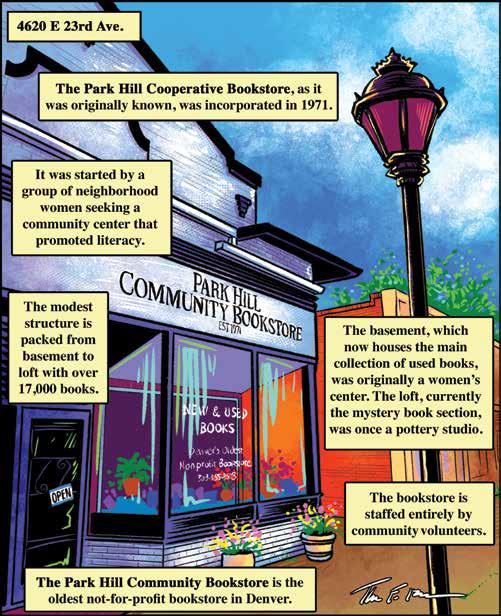
Established in 1971. Denver’s oldest nonprofit bookstore. Used and new books. 4620 E. 23rd Avenue. 303-355-8508. Members and volunteers get discounts and book credits. Check parkhillbookstore.org for hours of operation.
Park Hill Peloton
A recreational group of road cyclists that roll from Park Hill once or twice a week. Check the current status of their rides on the Park Hill Peloton Facebook page.
Submit your neighborhood events and resources to editor@greaterparkhill.org
Deadlines are the 15th of the month, for the following month’s issue.
Pushing Up Daisies
Environmentally-Friendly Options For Your Final Place Of Rest
By Mark Kuhl | For the GPHN
The term “green burial” means returning to earth in a natural way without toxic chemicals, high energy consumption, or needless concrete or metal.
Funeral homes, cemeteries and startups are offering a range of ecologically-friendly options for body recycling. So-called “woodland burial” involves a return to nature with a shallow grave and only a shroud or biodegradable casket, the way most people were buried in this country before the funeral industry became fixated on slowing decomposition with embalming. Many cultures have followed this tradition for hundreds of years.
In the 90s, “water cremation” (alkaline hydrolysis) was developed. This involves dissolving the body in an alkali-based solution. More recently, Natural Organic Reduction (NOR) or “human composting’ has been getting attention. This involves placing a body between layers of woodchips, straw, and alfalfa in a vessel where microbes decompose the body to produce humus.
These are great options for those interested in departing with positive impact to the environment.
Mark Kuhl is an environmental advocate who lives in Park Hill with his family. His handy tips and news about recycling appear every month in these pages.
[
GUTTERS
Gutter Cleaning, repairs, and replacement. Gutter Cleaning prices start at $150 – House, Garage, Porches, and walks. 303-907-9223/skmehaffey@ gmail.com
MASONRY SERVICES
Mason – Brick, stone, chimney repair, historic renovation. Your Park Hill Expert. Fully Insured, free estimates. Call Ben @720670-0874
PREMIER PAINT WORKS since 1993. Denver’s Residential Paint Specialists. Int/Ext. Neat, conscientious craftsmanship by polite, respectful, honest & fully insured crew. Impeccable references. Call or text John at 720-849-3921.
Interior and Exterior Painting. Prep, power washing, professional. Owned and operated by Park Hill resident with over 20 years of experience. Free estimate. JR Painting 720-4857207 or jpabz04@gmail.com
PLASTER
We repair plaster and drywall, specializing in older homes. Now in our 28 th year. The Wall Rebuilders 303-698-1057 www.wallrebuilders.com
ROOFING
Roofing: Repairs, Inspections, Flashings, Hail Damage, and reroofing licensed, bonded, and insured. Gutter replacement and cleaning. 303-907-9223/ skmehaffey@gmail.com
TUCKPOINTING
Over 25 years of experience. Fully insured. Mortar color and brick matching, broken brick replacement, cement chimney crown replacement. 12 years Chicago union experience. Mr.
Chimney and Home Masonry Repair. Call Chuck Bahnsen 303-948-7999
VOLUNTEER OPPORTUNITY
Be a Local Hero — Volunteer with Greater Park Hill News! We rely on volunteers to distribute the newspaper each month. Distributing the paper means “adopting” a block and delivering the newspaper to each home. It’s a great activity for families \ to do together, and takes just about 15 minutes. Interested in supporting your community newspaper and helping to get the news out? Contact us at newspaper@greaterparkhill.org or visit greaterparkhill.org/newspaper for more information and to sign up.
WINDOWS
Complete wood window restoration. Custom wood storm windows and screens. General painting, restoration and handyman services for your charming old home. Contact Matt 479-871-8140
Element Of Surprise
A frog, of course, is not a bug, and so what is this little croaker doing in Bugland? The answer? Looking cute — and looking for bugs. Red-eyed tree frogs are one of the most recognizable frog species. Native to forests of Central America, they come out at night to hunt for insects. When they are startled, they can flash their bright red eyes and their orange webbed feet. That surprises predators and allows the frog time to escape. This tiny hopper was photographed in Costa Rica by Mark Silverstein.
JADEN COMBS IS YOUR TRUSTED LOCAL QUEER REALTOR ® !
With a deep understanding of the LGBTQIA + community's unique needs, Jaden is dedicated to helping you find your perfect home. Whether you’re looking for a cozy condo or a spacious family house, Jaden’s personalized approach and extensive market knowledge ensure a seamless and inclusive buying and selling experience.