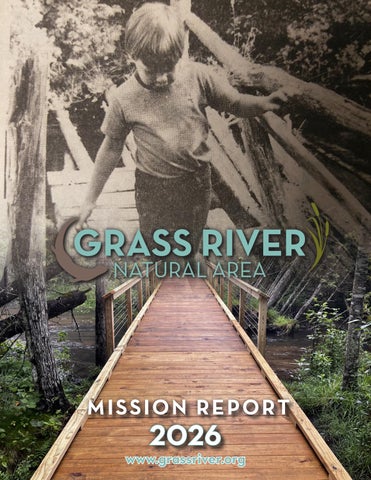
MIS S IO N R EPORT
2026
www.grassriver.org
A History of Access
BOARD OF DIRECTORS
• Jim Hook, Board Chair • Rachel Payne, Vice Chair • Mindy Lewin, Treasurer • Chris Hale, Secretary • Dale Ackler • Ann Isola • Joe Fischer • Gary Knapp • Charlie Polzin • Steve Springsdorf
STAFF
Construction of the first boardwalks began in the 1980s
T
he story of Grass River Natural Area would be difficult to tell without its boardwalks. These raised wooden paths have helped define the character of Grass River for decades, and more importantly, they have allowed people to experience its wetlands. Once you experience these places, it is hard not to love them, and that has been the goal all along, since we protect what we love. In the early 1980s, volunteers began creating a way for people to experience the wetlands without damaging the sensitive landscape beneath their feet. They asked: How can people learn about and care for wetland systems if they cannot see them firsthand? What followed was an ambitious undertaking for a small conservation organization: the construction of more than a mile of boardwalk through the heart of the Natural Area.
• Jenn Wright, Executive Director • James Dake, Education Director • Emma Fitzgerald, Conservation Director • Jill Lindenberg, Finance and Administration Manager • Lee Maynard, Development Coordinator • Brian Thelen, Land and Facilities Director • Chris Kuebler, Education & Outreach Assistant • Sarah Simon, Naturalist • Anne Drake, Naturalist • Arlene Westhoven, Naturalist • Mitch Pietryga, Naturalist
2026 NATURE EDUCATION INTERNS • Gracie Phillips • Jackson Schwandt • Allyson Claudepierre • Alena LaPointe
2026 RIVER AMBASSADORS • Kate Wolters • Allyson Claudpierre
COUNTY LIAISON • Terry VanAlstine
The work was accomplished through a remarkable combination of community effort and public programs. The Green Thumb program provided older workers with employment on outdoor projects, while the Michigan Youth Corps, working through the local Soil Conservation District, provided young adults with construction experience and paid employment. Lumber and supplies were hauled into the wetlands by hand, delivered by pontoon, and carried to the construction sites. The first boardwalks were completed in 1984.
Burton Stanley and Karl Larson inspect one of the first new bridges over Finch Creek in 1980
For the next four decades, those boardwalks became one of the defining features of Grass River Natural Area. They allowed visitors to travel deep into a landscape that otherwise would have been difficult, and in many places, impossible to explore. Students could stand above a cedar swamp and look for aquatic life. Families could follow the trail to the river. Naturalists could introduce visitors to plants, wildlife, and the complex connections that make wetlands so important.
The boardwalk did more than provide a trail. It became a bridge between people and a landscape. Over time, however, the original structure began to show its age. Decades of snow, rain, ice, standing water, and summer sun had taken their toll. Boards deteriorated, bridges sagged, and the walking surface became increasingly slippery. Just Janet West and Hank Leusby, part of the Green Thumb Crew, rest on the Finch Creek Bridge, 1980
A visitor enjoying the new overlook on Finch Creek
as importantly, the original design was never intended to provide the level of accessibility that visitors today rightly deserve.
RCI builders install helical piers for support of the bridges, 2025
In 2016, Grass River began planning for the next generation of boardwalks. The goal was not simply to replace what had been built in the 1980s. It was an opportunity to rethink what access to Grass River could look like and to create a safer, more durable, and more accessible system while preserving the character of the wetlands that made the original boardwalk so special. Working with Gosling Czubak Engineering Services, a design was developed based on interlocking six-foot wooden panels supported by steel frames. The system was fabricated by Wickcraft Boardwalks in Wisconsin and installed by Richter Construction, Inc. out of Traverse City throughout every phase. The design follows the existing pathways, allowing the boardwalk to wind through the forest much as the original did. In 2018, construction began with the Tamarack Loop. At approximately 1,250 feet, this first phase was intentionally designed as a proof of concept. It demonstrated what a new boardwalk could offer: a more stable surface, improved durability, greater accessibility, and a structure capable of withstanding the demanding conditions of a wetland environment rich with seasons.
Planning Walk-Through
2016
The community response was enthusiastic, and the success of Phase I gave Grass River the confidence to continue. Phase II, completed in 2024, extended the reconstruction toward the Grass River and expanded opportunities to experience the water. The project added approximately 2,050 feet of accessible boardwalk, a new dock at the river, an accessible kayak launch, two overlooks, and two bridges over Finch Creek. For visitors arriving by water, the dock provides a new and easy point of entry to Grass River. For students and families, it creates a safer place to explore the river itself. Phase III, the final phase, was completed in 2026, and added approximately 3,305 feet through
Phase I
2018
the Sedge-Meadow and Fern Trail areas. Two additional clear-span bridges and two overlooks completed the final phase of the reconstruction. Together, these projects have transformed the original boardwalk system into a new network designed to serve Grass River visitors for generations to come. We believe the completed system is the longest ADA-accessible boardwalk in the state of Michigan, and includes six bridges, four overlooks, a new dock at the river, an accessible kayak launch, and 17 new memorial benches. Interpretive signs along the route provide opportunities to learn about the wetlands and the plants, animals, and ecological processes found along the way.
The 2026 RCI Boardwalk Crew
Most importantly, the new boardwalk significantly expands who can experience these places. Visitors who use wheelchairs or walkers can travel farther into the wetlands. Groups from assisted living and care facilities have already taken advantage of the improved access. Families can explore together across generations. Artists can carry their supplies to overlooks and spend an afternoon capturing the landscape. Students can reach the river and wetlands as part of handson learning experiences.
Phase II
2024
The boardwalk allows groups of all ages and abilities to experience Grass River, 2026
Phase III
2026
The value of
Access
The accessible kayak launch on the Grass River
The boardwalk itself is impressive, but its greatest value is what happens because it is there. Toni C. has used a wheelchair for 22 years. She and her family live in Traverse City, where she enjoys kayaking on East Bay. Launching and landing from the beach makes it possible for her to enjoy one of her favorite outdoor pastimes, but finding new places to explore can be difficult. Toni typically relies on friends and family to let her know about outdoor destinations that will be accessible to her, such as the TART Trails.
Her husband is a member of the Adams Chapter of Trout Unlimited. At the chapter’s annual fundraising banquet in April, he won a guided group kayak tour at GRNA that was donated by our staff. When they learned about the new accessible boardwalk and kayak launch, they booked their tour for September. As fate would have it, everyone else in their group eventually had to cancel because of scheduling conflicts that day but Toni decided to make the trip anyway. She arrived at Grass River on her own and became one of the first visitors to experience the new accessible kayak launch.
A summer camp family enjoys a quiet moment on a bump out of the boardwalk
“It was the first time I had ever used an ADAaccessible kayak launch,” Toni said. She was surprised by “how easy it was” to get onto the water by kayak.
The accessible experience began well before she reached the launch. Traveling down the new boardwalk, Toni said she felt secure because of the design of the boardwalk. More importantly, she was able to make the journey independently and enjoy the wetlands along the way. “It was also a beautiful trip down the boardwalk to the kayak launch,” she said, “and I felt totally secure due to the lip on the edges.” When asked how important accessible trails like the Grass River boardwalks are to her, Toni didn’t hesitate. “Accessible trails are very important,” she said. “It makes it possible to get out and see nature.” And she isn’t finished exploring. “I will be back to paddle again,” Toni said, “and hopefully I’ll bring my family the next time!” Toni’s experience captures what this project is ultimately about. The boardwalk is a work of art and the scale of the project is impressive. But none of those things are as important as what they make possible. A visitor with a guide dog reads the braille signage along our Perception Pathway on the Fern Loop
The boardwalks allow people of all abilities to access the wetlands of Grass River, the overlooks, and even the kayak launch
A child sees a pitcher plant growing in the fen. A student watches a frog disappear beneath the water. A family pauses together at the edge of the river. An artist finds a new view to capture. Someone who thought they could no longer travel into the wetlands discovers they can. Through these experiences, visitors encounter a landscape they had never been able to reach before, and they begin to care about it. That connection is at the heart of the Grass River mission. The reconstruction represents the largest capital project in the history of GRNA, made possible through an extraordinary partnership with Antrim County, private philanthropy, foundations, contractors, engineers, staff, volunteers, and the broader community. It demonstrates what can happen when a community believes access to nature is worth investing in.
In many ways, the new boardwalk brings the story that began in the 1980s full circle. The volunteers who hauled lumber through the wetlands could not have known their work would connect generations of visitors to Grass River for more than 40 years. They simply saw a need and found a way to meet it. Today, we are building on that same vision. The question that inspired the original boardwalk remains just as important today as ever: How can people learn about and care for wetland systems if they cannot see them firsthand? Today, more people can see and experience them. And with that opportunity comes something even more important—the opportunity to understand them, appreciate them, and become their stewards. The next chapter of the Grass River story is already underway.
UPCOMING PROGRAMS OWL PROWL
Friday, October 30 - 7:00pm
FAMILY PLAYGROUP
Thursday, November 5 - 10:30am
WILD TURKEY TROT 5k
Saturday, November 7 - 11:00am
FAMILY PLAYGROUP
Thursday, November 19 - 10:30am
LIGHTING OF THE BRIDGES
Saturday, December 19 - 6:00pm See www.grassriver.org for a full listing of programs
PO Box 231 Bellaire, MI 49615 www.grassriver.org
Thank you to our supporters for bringing this project to life.
With heartfelt gratitude to the many individual donors whose generosity helped make this project possible.
Please consider making a donation at grassriver.org to help us fulfill our mission.