ISSUE 10
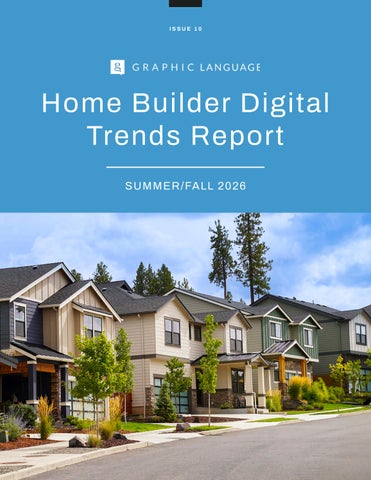
Home Builder Digital Trends Report SUMMER/FALL 2026
Introduction
Graphic Language is a dynamic web design and digital marketing agency that has carved a niche in the homebuilding industry. With a mission deeply rooted in innovation, we take pride in creating digital solutions that drive results. Our team of creative professionals is dedicated to designing engaging websites, executing strategic marketing campaigns, and providing a suite of services that enhance online visibility and sales for home builders. We’re drawing on our experience in the homebuilding industry to share invaluable insights to help home builder marketers bolster their digital initiatives. Our goal is leverage our expertise and findings to help guide your digital strategy so you can turn prospects into buyers.
Contributors: Chris Ochs, Teana Halford, Jenna Cole Copyright © 2026 by Graphic Language, Inc. All rights reserved. No part of this publication may be reproduced, distributed, or transmitted in any form or by any means without the prior written permission of Graphic Language, Inc.
Contents Industry Trends & Insights
4
Digital Marketing Strategies
8
New Home Sales Strategies
12
Website Design
16
Data & Analtyics Strategies
20
Inside Graphic Language
26
What We’re Talking About
30
Traffic is Down, Conversion is Swinging New Digital Marketing Channels for Homebuilders to Watch Why Presale Buyers Say Yes Before the Home Exists Inside the New S&A Homes Website Which Channels Are Actually Selling Your Homes? Celebrating 30 Years of Innovation What’s on the Blog
Industry Trends & Insights
Traffic is Down, Conversion is Swinging What the Data Says
If you’re a homebuilder marketer, this year has probably felt off. Leads have been harder to predict, conversion rates have moved around month to month, and it’s easy to write it off as “the market is weird right now.” That’s partly true but the full picture is more specific than that. We looked at year-to-date traffic and lead data across our builder clients located in every region of the U.S. and compared it to the same period last year. Two things stood out.
Traffic is Actually Down — Not Flat Heading into this analysis, the assumption was that traffic had stayed more or less steady and that conversion was the volatile piece. The data says otherwise. Traffic across our portfolio is running about 8% below last year’s pace through the first seven months of the year, on a like-for-like basis. This isn’t just a portfolio quirk; it reflects what’s happening in the broader housing market. Existing home sales nationally slowed to their weakest pace in over a year in August 2026, marking a third straight monthly decline, as buyers continue to wait on elevated mortgage rates. Builder sentiment backs this up: the NAHB/Wells Fargo Housing Market Index averaged 36 through August 2026, essentially flat with 2025’s average of 37, and both sit well below the 50-point threshold that separates builders feeling mostly positive from mostly negative. Builders have been in negative territory all year, and that’s showing up at the top of the funnel.
4
The picture varies by region, though. The West, our California and Pacific Northwest markets, posted the weakest builder confidence of any region and slipped further this year, averaging in the mid-to-high 20s in 2026, down from the low 30s in 2025. The South, which includes Central Florida, also softened. The Midwest, where our Chicagoland clients operate, actually improved modestly year over year. The Northeast held up as the strongest region overall, even with a slight dip. If your business is concentrated on the West Coast or in Florida, you’re likely feeling more pressure than a builder focused in the Midwest right now.
Conversion Isn’t Really the Problem. Channel Mix Is This is where it gets more interesting and more actionable. Traffic-to-lead conversion rate swung pretty widely this year: from a high of 2.86% in January down to 1.74% in May, then back up to 2.67% in June. That kind of range is easy to read as “buyers are more hesitant.” But when you break traffic down by channel, a clearer explanation emerges.
Paid Social grew from about 16% of total portfolio traffic in the first eight months of last year to roughly 27% this year, making it the single largest traffic source across the portfolio. The catch is that Paid Social converts at well under 1%, while Organic Search and Paid Search, both of which shrank as a share of the mix, convert at around 3% each. When a lower-intent channel takes up more of the funnel, blended conversion rate shifts based on how much of that traffic showed up in a given month, even if nothing about lead quality, landing pages, or offers actually changed
5
In short: the conversion swings this year look less like a demand problem and more like a math problem driven by where the traffic is coming from.
What This Means For Your Funnel Two things worth taking away: •
The market headwinds are real. Slower traffic in 2026 reflects a genuinely softer demand environment for new homes, especially if your footprint leans West or South. That’s not something a landing page tweak will fix; it’s a market condition to plan around, not panic over.
•
Don’t let blended conversion rate mislead you. If your channel mix is shifting toward Paid Social or other lower-intent sources, your headline conversion number will move even when your best channels are performing exactly as expected. Before you start diagnosing a lead-gen problem, check what’s driving your traffic mix that month — the answer is often right there, not buried in your landing pages or offers.
Your funnel isn’t broken. What 2026 has really asked of marketers is to read the data more carefully; distinguishing between what the market is doing and what your channel mix is doing, rather than bundling everything into one number and reacting to every dip. The builders who finish this year in the strongest position won’t be the ones who had the smoothest results. They’ll be the ones who actually understood what was driving them.
6
* A note on the data: this analysis reflects aggregated, anonymized traffic and lead data across builder clients in five regions; no individual client performance is disclosed. One client moved from opt-out to opt-in event tracking in mid-July 2026, which reduced recorded sessions and events for that client starting in August 2026. August figures are therefore not fully comparable to prior months and should be read with that in mind. Industry context sourced from NAHB (Housing Market Index and single-family housing starts data, national and regional) and national existing-home sales reporting as of September 2026.
Digital Marketing Strategies
New Digital Marketing Channels for Homebuilders to Watch
While Google and Meta remain staples in your marketing playbook, relying solely on traditional platforms means missing out on emerging spaces where home buyers are spending their time. From AI-driven search to streamable household ads, new advertising avenues are creating fresh opportunities for homebuilders to connect with highintent buyers earlier in their journey. Here are five innovative channels to add to your radar—along with key insights on what to expect if you test them.
ChatGPT Ads ChatGPT has emerged as a new upper-funnel advertising option, giving builders a way to connect with buyers while they’re actively researching their next home. It’s important to note the platform launched ads earlier this year and is still in beta, so this is more of an learning opportunity rather than a proven performance channel for now. Getting started requires a bit of lead time. You’ll need to apply for an account at ads.openai.com, and approval can take a few days, so it’s worth submitting your application even if you’re not ready to launch right away. Targeting here works differently than what you’re used to with traditional platforms. Instead of bidding on keywords, ChatGPT Ads uses “Context Hints” — broader topic and conversation themes. Creative specs are also tighter than most platforms: headlines max out at 50 characters (truncated at 24) and descriptions at 100 characters (truncated at 48), plus a small image slot best suited for a logo. Reporting tools are still limited, so expect directional insights rather than granular data in the early going.
8
Local Service Ads (Moving to Performance Max) If you’re running Google Local Service Ads (LSA), changes are on the way. This fall, LSAs are transitioning into Performance Max, though the format itself and the pay-per-lead model aren’t changing, just where you manage campaigns. The rollout will be gradual, and new LSA accounts will still need to be created in the existing LSA interface through year-end. Once inside Performance Max, these ads will remain limited to Search and Maps placements and won’t unlock the broader Performance Max inventory. One useful update: Google has introduced Home Listing Ads as an LSA format. To access them, builders need to opt into the “Buyer’s agent” or “Seller’s agent” job types under the Real Estate category. Just keep in mind that these listing ads won’t appear on Google Maps.
StackAdapt For builders looking to reach buyers beyond Google and Meta, StackAdapt is a demand-side platform (DSP) worth exploring. It complements your existing paid media by tapping into a wider range of premium inventory using audience, contextual, and behavioral targeting. Where StackAdapt really shines is its variety of ad formats, called “tactics,” that can support buyers at nearly every stage of their journey: •
Display: Standard banner-style ads, but with access to premium inventory and more advanced targeting.
•
Video: Same idea as display, but with video creative and clickable CTAs for added interactivity.
•
Connected TV (CTV): Non-skippable, TV-style ads on streaming platforms. Great for brand awareness at the household level, with reporting that can connect a CTV impression to a later website visit or conversion. CPMs are higher since its premium inventory.
•
Audio: Reach buyers during podcasts, audiobooks, or music streaming. While you can’t target specific shows or artists, but you can target by platform, genre, or category.
•
Digital Out-of-Home (DOOH): Digital billboards and screens in high-traffic locations like gas stations, grocery stores, malls, and transit hubs.
•
ChatGPT Ads via StackAdapt: Since early 2025, StackAdapt has offered early access to run ChatGPT ads through their platform. You get the same targeting as going direct through OpenAI, plus richer reporting and the ability for campaigns to learn alongside your other StackAdapt tactics. The tradeoff is a 15% platform fee on top of media spend.
9
Because StackAdapt covers so many formats, it’s a solid option for builders who want to diversify their reach without juggling a dozen separate vendor relationships.
Apple Maps Ads Apple Maps advertising launched in the U.S. and Canada within the last month. Users will now see clearly labeled ads, marked with a blue “Ad” tag, when searching for locations or browsing Suggested Places. This is a natural fit for homebuilders. Buyers researching neighborhoods on their iPhones are already in the right mindset, making them a highly relevant audience. Timing is also in your favor: Apple is currently running a Grand Opening Promo offering a 15% monthly statement credit for up to a year, capped at $1,000 per month. Given how new this channel is, it’s a low-risk window to test.
Reddit Ads Reddit offers a mix of familiar ad formats, image, video, and carousel, alongside some you won’t find on other platforms: •
Freeform Ads: Blog-post-style ads that combine long-form copy, images, GIFs, video, and links in a native format. Well-suited for educating high-intent buyers on community features, floor plans, or the homebuying process.
•
AMA (“Ask Me Anything”): A promoted version of Reddit’s popular Q&A format, where someone from your team answers real audience questions live.
•
Conversation Ads: Ads designed to appear naturally within existing Reddit threads.
•
Takeover Ads: High-visibility placements on the site’s busiest pages. Expect a significant investment, but with correspondingly large reach.
One thing to keep in mind: Reddit’s culture tends toward candid and sometimes critical commentary. While you can disable comments on ads, negative responses are more common here than on other platforms, so it’s worth going in with realistic expectations.
What This Means for Your Mix None of these channels need to replace your core search and social strategy. But each one offers a genuinely different way to reach buyers, whether that’s connecting with them mid-research on ChatGPT, building brand awareness through streaming and out-of-home via StackAdapt, or showing up where they’re already searching for neighborhoods on Apple Maps. As with any new channel, start with a modest test budget, set realistic expectations around reporting (especially on newer platforms), and treat early results as directional rather than definitive.
11
New Home Sales Strategies
Why Presale Buyers Say Yes Before the Home Exists
When you break it down, presale buying can sound risky: a buyer hands over real money for a home that doesn’t exist yet. No walk-through. No finished product to evaluate. Just a floor plan, a rendering, and a promise that it’ll all come together. In a hot market, that’s an easy ask. Buyers are motivated, prices are rising, and getting in early feels smart. In today’s market, where buyers are more cautious and more skeptical, that same ask takes a lot more work. And that changes what presale marketing needs to do. The builders doing this well aren’t just running ads and collecting leads. They’re balancing two things at once: creating urgency to get buyers interested, and building enough trust to get them to actually sign. Lose either one, and the whole funnel breaks down. Lean too hard on scarcity, and you end up with a long VIP list that goes nowhere. Lean too hard on trust-building, and buyers never feel the push they need to decide. The best presale campaigns do both, and it’s worth understanding how before your next launch.
Why Presales Matter Right Now Before getting into tactics, it’s worth being clear on why presales are worth the effort in the first place. With a spec home, you build first and find a buyer later, which means if the market softens, you’re sitting on finished inventory. Presales flip that model. A buyer is locked in, usually with a deposit, before or shortly after construction
12
Every marketing dollar you spend is working to build a pipeline, not move finished homes that are already on your books. In a slower market, that’s a meaningful advantage.
Scarcity: Why “Be First” Works Better Than “Buy Now” Presale marketing is fundamentally different from marketing a move-in-ready home. You’re not selling a finished product; you’re selling early access to one. And buyers respond to that framing much better than they respond to a traditional sales pitch. “Coming soon” landing pages with a VIP interest list tend to far outperform what you’d typically see from an open community. Builders who’ve run these campaigns report visitor-to-lead conversion rates and paid search c A few reasons why it works: •
It doesn’t feel like a hard sell. “Join our VIP list to be first to know” reads as an opportunity, not a pitch. Buyers opt in on their own terms, which lowers their guard.
•
Exclusivity is genuinely motivating. Being among the first to see pricing, pick a lot, or lock in early incentives taps into something real, nobody wants to find out they missed the best options.
•
It captures buyers who aren’t ready yet. Someone relocating in eight months, or a renter who’s been watching the market, is far more likely to sign up for updates than to respond to a “buy now” message they’re not ready for.
Once that list is built, the same logic carries through the funnel: retargeting ads for people who visited but didn’t sign up, live lot maps that show inventory moving from available to reserved to sold, and time-limited incentives for early buyers. Each of these mechanics turns a hypothetical future purchase into a decision that feels timesensitive.
The Trust Problem: Why Urgency Alone Isn’t Enough Here’s the catch. Urgency gets attention but it doesn’t, on its own, get someone to sign a presale contract. Especially right now. Recent buyer research found that around 44% of buyers don’t fully trust new-home construction quality. That’s nearly half the market walking into a sales conversation already skeptical. Add in the presale dynamic, asking
13
someone to commit to a home they can’t tour or inspect, and that skepticism becomes the biggest obstacle between a lead and a signed contract. The language many builders default to isn’t helping, either. The same research found that phrases like “dream home” and “luxury living” felt overused to roughly half of respondents. Buyers don’t want to be sold a fantasy. They want to feel like you actually understand what they’re looking for. What actually builds confidence in a presale context: •
Visuals that feel real, not aspirational. Photorealistic 3D renderings, interactive floor plans, and video walkthroughs help buyers picture the actual product — not just a polished mood board.
•
Social proof from people who took the same leap. A testimonial from a recent presale buyer directly addresses the “am I the only one taking this risk?” hesitation that holds a lot of people back.
•
Specific over generic. Messaging built around the real neighborhood, schools, commute times, and local amenities lands better than vague “luxury” language because it shows you actually know who you’re building for.
•
Transparency about the process. Buyers who understand the build timeline, what’s customizable, and how communication works during construction are buyers who trust you. And trust closes deals that urgency alone can’t.
How Urgency and Trust Work Together The strongest presale campaigns don’t treat these as competing priorities. They sequence them. Early on, trust-building earns the right to ask for a commitment later. By the time urgency mechanics kick in, they land on buyers who are already confident in the product and the builder. Here’s what that looks like across a typical launch timeline:
14
Weeks before launch: Build the foundation. Before any ads go live, the assets need to be ready: photorealistic renderings, a dedicated landing page, and a clear picture of who the community is built for. Buyers who land on a generic “coming soon” page with no real content have nothing to hold onto. Early awareness: Pair scarcity with substance. “Something new is coming” messaging works better when it’s backed by real imagery and specific location details, not stock photography and vague promises. This is where scarcity and trust start working together. Building interest: Bring in outside voices. Retargeting keeps the community top-of-mind, but this is also the time to lean on Realtor co-marketing and early sneak-peek incentives. A local agent recommending your community carries more weight than any ad; it’s third-party validation at exactly the moment buyers are deciding whether to take the next step. Lead generation: Let real buyers do the talking. A short video or quote from someone who just signed a presale contract does more to reduce perceived risk than another rendering or another discount. It answers the question every skeptical buyer is really asking: did this work out for someone like me? Launch: Convert the list. By the time “first 10 buyers” incentives and live availability maps go live, they’re not working in a vacuum. They’re landing on buyers who already trust the product, the builder, and the process. That’s what turns a VIP list into signed contracts.
Urgency Gets the Lead. Trust Gets the Signature Presale marketing comes down to one core tension: you’re asking buyers to commit to something they can’t see yet, at a time when trust in new construction is already shaky. Scarcity gets you the lead. Trust gets you the signature. The builders who are winning right now aren’t choosing between the two. They’re running campaigns that deliver both, in the right order. That’s exactly what our Grand Opening package is designed to do. It’s structured as a five-phase sequence, from digital foundation and awareness through interest, lead generation, and launch, and is built to pair urgency-driven tactics with the trust-building assets today’s presale buyers actually need. If you’re planning a community launch and want a partner who understands both sides of that equation, we’d love to talk.
15
Website Design & Development
Building on 15 years of Partnership: The New S&A Homes Website
Some client relationships begin with a single project. The best ones grow into something more lasting; built on trust, shared goals, and a genuine understanding of each other’s business. That’s exactly what has happened with S&A Homes over the past 15 years. The launch of the new S&A Homes website marks the latest milestone in that partnership, and it’s more than a redesign. It’s a rebuild informed by over a decade of data, buyer behavior, and a clear-eyed view of where homebuilder marketing is headed.
A Partnership That Keeps Evolving Long-term client relationships are rare in digital marketing. Vendor churn is common, and “redesign” often means starting from scratch with a new agency and a fresh set of assumptions. We took a different path with S&A. Rather than treating this as a visual refresh, we worked together to evaluate how homebuyers interact with the site today, where friction existed in the buying journey, and how new technology could better support both buyers and the S&A Homes sales team. That level of hands-on collaboration is what separates a website that looks like a brand from one that actually functions the way that brand sells homes.
What’s New and Why it Matters A Better Search Experience for Buyers S&A Homes builds across multiple Pennsylvania markets, each with its own communities, school districts, and lifestyle appeal. The redesigned website introduces advanced regional search tools that let buyers filter
16
by location, school district, amenities, and home style, helping them move from a broad search to the right neighborhood much faster. Improved community pages, floor plan listings, and quick move-in home experiences surface the information buyers care about most, while a mobile-first design ensures a seamless experience across every device. Built for the Future of Search Search has changed significantly over the past few years, and it’s continuing to shift. AI-powered tools are increasingly influencing how buyers discover builders and communities online, which means websites need to do more than rank well in traditional search results. The new S&A Homes website was developed with both SEO and Answer Engine Optimization (AEO) in mind. Content throughout the website is structured to answer common buyer questions clearly, improve search visibility, and establish stronger topical authority, positioning S&A Homes to remain competitive as AI-generated search experiences become more common. Smarter Tools for Buyers Today’s buyers want to do their research independently before ever picking up the phone. The new website supports that with a range of self-serve tools, including: •
My S&A Portal, a buyer account feature that lets visitors save favorite homes, communities, and floor plans and pick up right where they left off on return visits.
•
Interactive SPOT Maps that let buyers explore what surrounds each community, including schools, shopping, dining, and recreation, before scheduling an in-person visit.
•
Build-on-your-lot and scattered lot management tools for buyers who want more flexibility in where and how they build.
Faster Content Management Behind the Scenes The website runs on an upgraded version of Graphic Language’s proprietary smartEDIT content management system, giving the S&A team faster content updates, simplified promotion controls, and an integrated syndication
17
feed. When inventory changes or a new promotion launches, the team can get it live quickly, which matters in a market where timing directly affects sales. CRM Integration and Lead Tracking Every lead form on the new website connects directly into HubSpot, giving the S&A sales team a clean, complete flow of buyer inquiries without manual data entry. A new lead history feature inside smartEDIT gives the team a full view of buyer engagement over time, making it easier to follow up in a more informed and personalized way. Accessibility and Data Continuity The website underwent comprehensive ADA accessibility testing to ensure an inclusive experience for every visitor. And throughout development, inventory and community data was continuously migrated and synchronized, so the transition to the new website didn’t create gaps or stale listings that buyers would notice.
What This Signals for Homebuilder Marketing The S&A Homes relaunch is a useful window into where homebuilder marketing is heading as an industry. A few takeaways worth noting: •
AEO is becoming essential. As AI tools increasingly shape how people search for homes and builders, content strategy has to account for how that content is understood and surfaced by AI systems, not just how it ranks in a traditional search result.
•
CRM integration is no longer optional. Buyers expect a fast, frictionless path from interest to contact. A lead form that doesn’t connect directly to a CRM is a gap in the sales process.
•
Buyers want to self-serve, up to a point. The more research buyers can do independently, the more informed and ready to act they are when they do reach out. The right website tools make that possible.
•
Migration and testing are part of the work. A relaunch that loses inventory data or falls short on accessibility isn’t a success, no matter how good it looks. Getting the details right behind the scenes is just as important as the design itself.
The Results so Far The redesign was built with a clear purpose: make home shopping faster, smarter, and more personal. Early data suggests it’s already delivering. Since launch, the new website has seen a 9% increase in AI mentions, a 15% increase in AI citations, and a 34% increase in cited pages. Organic impressions and clicks are up 19%, and form fills have climbed 29% compared to the same period last year. That last number matters most; it’s a strong early signal that the new experience isn’t just attracting more visitors, it’s converting them into qualified leads.
18
Built to Keep Growing This is the third generation of the S&A Homes website that Graphic Language has built. Each version has reflected not just a new design trend, but a new stage in how buyers research and purchase new construction homes. That’s the real value of a long-term partnership: staying close enough to a client’s business to know when it’s time to rebuild, and building something that can keep evolving alongside them. S&A Homes has delivered more than 15,000 homes across Pennsylvania, built on a reputation for quality craftsmanship and customer care. We’re proud to continue supporting that mission digitally, and we’re excited to see what the next chapter brings. Ready to create a website that helps homebuyers find and fall in love with their future home? Let’s talk.
Data & Analytics Strategies
Beyond the Click: Which Channels are Actually Selling Homes?
Your marketing dashboard probably looks better than ever. Website traffic is climbing. ChatGPT Ads are racking up impressions. Local Service Ads are driving calls. Apple Maps is putting your communities in front of buyers midsearch. And organic AI search is surfacing your homes in answers you never had to pay for. But here’s the question that actually matters heading into your next budget conversation: which of these channels sold a home? If you can’t answer that with confidence, you’re not alone. Attribution has quietly become one of the hardest problems in home builder marketing, and it’s about to get harder. You don’t need a perfect answer. You need a clearer picture of how your channels work together to move buyers from discovery to decision to sale. Let’s break down how to get there.
Why the Old Model Stopped Working For years, measuring marketing performance was simple: you had a handful of channels, mostly search and social, and last-click tracking got you close enough to a real answer. Someone clicked an ad, filled out a form, bought a house. Credit went where credit was due. That model doesn’t hold up anymore. Today’s homebuyer journey is anything but linear. A single buyer might discover a builder through Google, visit the website, leave, come back through an organic search, see a social ad, spot the builder on a local listing, ask
20
ChatGPT for recommendations, and finally return to the website directly weeks later before submitting an inquiry. So which channel gets the credit? Last-click attribution would attribute that final visit. But that visit almost certainly wasn’t the only—or even the most important—interaction along the way. And as more channels enter the mix, from AI search to Apple Maps Ads, the gap between “what got the last click” and “what actually sold the home” keeps widening.
Clicks Are Not the Finish Line Marketing reports love top-of-funnel metrics: impressions, clicks, sessions, form submissions, cost per lead. These numbers help you understand campaign performance, but they only tell part of the story. A lead isn’t the goal. A home sale is. Picture two channels. One generates 100 leads. The other generates 40. At first glance, the first channel looks like the obvious winner. But what if only two of those 100 leads become buyers, while 10 of the 40 leads from the second channel eventually purchase a home? Suddenly the “weaker” channel is doing the real work. That’s why it helps to think about performance across the entire funnel, not just the top of it: Marketing → Website Engagement → Lead → Sales Opportunity → Contract → Closed Sale The farther downstream you can connect your data, the more meaningful your attribution becomes.
The Three Touches That Actually Matter You don’t need a complex multi-touch model to think clearly about this. It helps to break the journey into three simple stages. First Touch: What Introduced the Buyer? This answers a basic question: how did this person first discover you? It might be organic search, paid search, social media, AI search, a local listing, or a referral. First touch tells you which channels are good at generating awareness and pulling new prospects into the funnel.
21
Influencing Touches: What Moved Them Forward? These are the interactions between discovery and conversion. A buyer might browse several community pages, come back through a retargeting ad, explore floorplans, read a blog post, or open an email campaign. None of these may produce a form submission on their own, but each can play a real role in the decision. Conversion Touch: What Generated the Lead? Finally, there’s the interaction that produces a measurable action—a contact form, a phone call, an appointment request. This is the easiest touch to track, which is exactly why it’s so tempting to give it all the credit. But it’s just one part of a much longer story.
The AI Blind Spot The rise of AI search is where attribution gets especially tricky. A buyer might now ask an AI platform, “What are the best new home builders near me?” or “Which builders offer homes under $500,000 in my area?” If your community shows up in that answer, the buyer may head straight to your website or search for your brand by name—never clicking a traditional ad. That interaction rarely shows up cleanly in your analytics. Marketers call it “dark traffic,” and it’s growing fast in this industry. AI-driven discovery through ChatGPT, AI Overviews, and voice or map search often doesn’t pass along the referral data that traditional search does.
22
Here’s the danger: last-click attribution hands the credit to whatever touched last, and the AI mention that actually sparked the buyer’s interest gets nothing. Cut that “underperforming” channel and you may be cutting the one doing the most work. The influence is still there. You just have to read it indirectly—through rising branded searches, more direct traffic, referral bumps, or shifts in how leads behave. GA4 is starting to surface referral traffic from sources like chatgpt. com, which helps. But the smartest builders combine those signals rather than relying on any single report.
The Way Forward: Guiding Buyers from Hesitation to Homeownership You don’t need enterprise software to fix your attribution. You need discipline in a few specific places. Make your CRM the source of truth. Every lead should carry a first-touch and last-touch source field. More importantly, train your sales team to ask—and log—”How did you hear about us?” at first contact. This one habit catches everything your tracking pixels miss, including AI-influenced buyers who leave no digital trail. Use UTMs consistently across your website and every trackable paid channel, including Local Service Ads. Set up call tracking numbers by channel. This matters most for Local Service Ads and Apple Maps, where the real conversion is often a phone call, not a form. Reconcile monthly. Match closed sales back to their original lead source in the CRM—not just whatever channel touched last. The goal here is a lead-to-close loop: a source tag that survives all the way from first contact to the closing table.
Discovery Channels vs. Decision Channels Once your data connects, a useful pattern tends to emerge. Some channels are great at introducing buyers. Others are great at closing them. Separate your discovery channels from your decision channels. AI search and organic content usually win discovery. Local Service Ads and direct site visits tend to win the final decision. Both matter but neither tells the whole story on its own. When your first-touch data, last-touch data, and sales-team reports disagree, it usually signals a channel is doing
23
awareness work it isn’t getting credit for.
The Metrics That Matter As your attribution matures, evaluate performance at every stage of the funnel, not just the top.
The point is to shift the conversation from “How many leads did we generate?” to “What happened to those leads?” And when your data allows, cost per closed sale beats cost per lead every time.
Turn It into a Budget Decision Each quarter, pull your closed-sale source data and compare it against spend by channel. Calculate cost per closed sale—not cost per lead—for each one. That’s the number that should actually move your budget. Watch out for the obvious trap: a channel with weak last-click numbers but a strong showing in sales-reported first touches isn’t underperforming. It’s feeding the top of your funnel, and the credit just hasn’t caught up to it yet.
Don’t Chase Perfect Attribution Here’s the part worth remembering: attribution will never be perfect.
24
Buyers switch devices. They research anonymously. Cookies and tracking tools have real limits. Some conversations happen on your sales floor, offline and untracked. And emerging platforms don’t share the same clean data as traditional channels. So don’t burn energy trying to prove that exactly 37% of a sale belongs to one channel and 23% to another. Focus on the bigger picture instead. You might discover that paid search consistently brings high-intent buyers into the funnel, organic and AI search fuel early research and discovery, and retargeting brings prospects back before they convert. That’s a far more useful insight than knowing which channel racked up the most clicks.
The Question Has Changed The old question was: “Which channel generated the most leads?” The better question today is: “Which combination of channels is helping us sell more homes?” As the buyer journey keeps fragmenting across search engines, social platforms, listings, maps, and AI, the builders who can connect marketing activity to actual sales outcomes will make smarter decisions with every dollar they spend. Because at the end of the day, clicks don’t sell homes. Understanding what moves a buyer from discovery to closing does.
25
Inside Graphic Language
Celebrating 30 Years of Innovation: A Look Back at Our Journey
Thirty years ago, the internet was in its infancy, homebuilder websites were virtually nonexistent, and digital marketing looked nothing like it does today. Graphic Language has had a front-row seat to every stage of that evolution. As we celebrate our 30th anniversary, we’re reflecting on three decades of innovation, long-standing partnerships, and a singular focus: helping homebuilders connect with buyers through smarter technology, better marketing, and websites built specifically for the new home industry.
Growing Alongside the Homebuilding Industry Since 1996, Graphic Language has grown from a creative design agency into a specialized digital marketing and technology partner serving homebuilders across North America. As buyer expectations shifted from print brochures to desktop websites, then to mobile-first experiences and now AI-powered search, we’ve continually evolved to help builders stay ahead of what’s next. That evolution has never been about chasing trends; it’s about solving the real challenges homebuilders face, from managing complex inventory and community data to generating qualified leads and delivering a seamless online buying experience. The numbers reflect that commitment. Our builder clients have worked with us for an average of 10 years, and the average lifespan of a Graphic Language website runs nearly twice the industry standard. That kind of retention
26
doesn’t happen by accident. It happens because we’ve built an in-house team with deep expertise in the homebuilding space, and because we’ve always treated technology as a core competency, not an outsourced afterthought.
Innovation Has Always Been Part of Our DNA One of our defining characteristics has been a willingness to build solutions before the market realizes it needs them. One of the most influential innovations was New Home Feed, a listing syndication platform we developed to solve a specific, painful problem: getting accurate new-construction listings distributed correctly across the growing number of real estate portals buyers were using. New Home Feed let builders manage and syndicate their community, plan, and inventory data from a single dashboard, pushing it cleanly to Zillow, Trulia, and other partner sites. The product became the industry standard. In 2017, Zillow Group acquired New Home Feed outright, a rare distinction for a homebuilder marketing agency and a clear signal that the industry needed exactly what we built. That same spirit of innovation continues with our current product suite: •
smartEDIT™, our proprietary content management system, gives builders complete control over their websites through a centralized platform that simplifies updates, manages inventory, and supports integrations with CRMs, ERPs, and marketing tools. Recent enhancements have added AI-powered capabilities to help builders generate content, improve accessibility, and work more efficiently.
•
SPOT™ Maps (Single Point of Transaction), introduced in 2024, transforms static site plans into dynamic, interactive sales tools. Buyers can explore communities, view available homesites, compare inventory, and access detailed information, all from an intuitive map experience.
More Than Websites Although we’re best known for award-winning homebuilder websites, our scope has expanded significantly over three decades. Today, we partner with builders across every stage of the customer journey, offering:
27
•
Custom homebuilder websites
•
SEO and Answer Engine Optimization (AEO) for AI-driven search
•
Paid media strategy and campaign management
•
Interactive community maps and sales tools
•
CRM, ERP, and third-party data integrations
•
Listing syndication solutions
•
Content strategy and copywriting
•
Custom enterprise applications, sales kiosks, and mobile solutions
•
Website hosting, support, and ongoing optimization
We don’t treat these as separate services. They’re connected pieces of a single digital ecosystem. When your website, marketing, inventory data, and lead management systems work together, every part of your sales process becomes more effective.
Built for What’s Next The homebuying journey continues to evolve. AI is changing how buyers search for homes. Personalized digital experiences are now the expectation. Marketing decisions are increasingly data-driven. And builders need technology flexible enough to adapt without requiring a complete rebuild every few years. That’s why we keep investing in tools and services that help our clients stay ahead of changing buyer behavior, whether that’s AI-powered content tools, advanced data integrations, interactive buying experiences, or websites optimized for emerging search technologies.
Thirty Years of Partnership Technology may be at the center of what we do, but relationships have always been at the heart of our business. Many of our clients have partnered with us for years, some for decades. Those long-standing relationships have allowed us to grow alongside our clients, understanding their evolving challenges, and refining their digital presence as the industry changes around them. Every website launch, marketing campaign, and new technology we build reflects a partnership grounded in trust and shared success. That same sense of longevity runs through our team. Graphic Language has always been a place where people stay, grow, and build meaningful careers. Our team members bring deep institutional knowledge and decades of combined experience across homebuilding, technology, design, marketing, and digital strategy. For our clients, that continuity is invaluable because they’re not constantly onboarding a new team. They’re working with people who already know their business, remember their history, and are genuinely invested in their long-term success.
28
It’s also one of the things that sets us apart. Our experience isn’t measured solely in the number of websites launched or technologies developed. It lives in the relationships we’ve nurtured and sustained, the knowledge we’ve built over time, and the people who have helped shape this company into what it is today. As we celebrate this milestone, we’re grateful to the builders, developers, industry partners, and team members who have made the last 30 years possible. Every client, project, and innovation has played a role in getting us here. The digital landscape will keep changing, just as it has since 1996. But with a seasoned team, enduring partnerships, and a continued commitment to innovation, we’re looking forward to building what’s next, together.
29
On the Blog
What We’re Talking About
Looking for more resources? We’ve curated a collection of our blog posts so homebuilders can boost their digital marketing strategies and more.
30
Lead Quality vs Lead Quantity: Why Better Leads Matter
Beginner’s Guide to Understanding ClickThrough Rates
Lead quality vs lead quantity: discover why better leads drive more sales, improve ROI, and align marketing and sales teams.
Learn what click-through rate (CTR) means for homebuilder marketing and how to measure, optimize, and improve CTR across PPC, email, and web campaigns.
Read More
Read More
8 Tips for Your 2026 Digital Marketing Budget
4 Reasons Why a Successful Fall Selling Season Starts Today
Plan your 2026 marketing budget with 8 proven tips for home builders to boost leads, sales, and online visibility.
Prepare your homebuilder website for the fall selling season with four reasons to start now, from capturing online shoppers to boosting future sales.
Read More
31
Read More
Marketing Attribution: A Complete Guide
How Data Integrations Turn a Website Into a Sales Engine
New to the concept of marketing attribution models? We cover everything you need to know about attribution models in this ultimate guide.
Learn how data integrations turn homebuilder websites into sales engines by connecting CRM, analytics, ads, and sales systems.
Read More
Read More
Boost Your Digital Marketing Strategy in 2026 Need help with your digital marketing strategy? With over 30 years of experience working exclusively with home builders, we know what works. Connect with us to see how we can help fine-tune your digital marketing strategy.
Contact Us
32
Thank You Graphic Language has over 30 years of experience designing websites that convert for home builders just like you. We know how to combine stunning visual appeal with a user friendly experience that will make your website a true reflection of the quality of your new homes and the home buying experience you offer.
WWW.GRAPHICLANGUAGE.NET