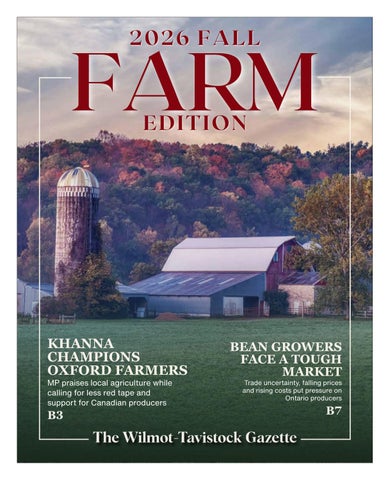
The Wilmot-Tavistock Gazette - 2026 Fall Farm Edition
2026 FALL
B1
Thursday, September 17, 2026 B1
FARM EDITION
KHANNA CHAMPIONS OXFORD FARMERS MP praises local agriculture while calling for less re tape an support for ana ian pro ucers B3
BEAN GROWERS FACE A TOUGH MARKET Trade uncertainty, falling prices and rising costs put pressure on Ontario producers
B7
B2
Thursday, September 17, 2026
The Wilmot-Tavistock Gazette - 2026 Fall Farm Edition
SERVING PURE WATER IS OUR BUSINESS
WEITZEL
PUMPS & WATER TREATMENT DIVISION OF SHEILWAYS ENTERPRISES INC.
519-625-8332
4009 Perth Road 107, Shakespeare info@weitzelpumps.ca 24 HOUR EMERGENCY SERVICE
• Well pressure systems • We service all jet & submersible pumps • Water softeners • Iron Filters • UV Systems • Rentals and Leasing Options • Plumbing • Residential/Commercial O.W.W.A.
The Wilmot-Tavistock Gazette - 2026 Fall Farm Edition
Thursday, September 17, 2026 B3
B3
Oxford MP pays tribute to area farmers and ag industry as uncertainty continues LEE GRIFFI Gazette Reporter
Oxford County’s member of parliament wants farmers to know just how much he appreciates the work they do to keep us fed. “Our farmers feed our families, and we owe them a debt of gratitude for what they do,” said Arpan Khanna. “Waking up early before sunrise and working the fields to make sure Canadians and the rest of the world get good, nutritious food. That is something we should always be thankful for. They work extremely hard, they are very talented and Oxford has some of the best soil in the country.” One of the MP’s concerns when it comes to agriculture is what he described as the government’s punishment of farmers through taxes and red tape. “Canada should be a place where we can make more, grow more, harvest more and become a self-reliant country. I think we have the potential, the foundation, the people, the farmers and the land. It’s time we get behind them and support them so we grow more locally and compete with the rest of the world.” Khanna said Canada is the only country
in the G7 with a 30 per-cent fertilizer tax, which comes from the federal government’s carbon pricing. He added the cost raises the price of Canadian-produced food significantly. “We have one of the highest levels of food inflation in the G7, something that doesn’t make any sense since we have some of the best farmers. We need to support our farmers so they can produce food at a reasonable price to feed our families.” Another Conservative concern comes from the cost of Canadian-made food compared to other countries we import it from. Khanna pointed to a local pricing example to explain why many consumers are choosing foreign-supplied groceries. “You can’t blame those families. For example, I was at an asparagus farm and they told me it costs $5 per pound to produce here in Oxford County, yet it costs $1.50 to produce in Mexico and have it shipped over 3,000 kilometres away. It makes absolutely no sense to me why we are punishing our farmers with rising costs and red tape.” Khanna said increasing taxes on farmers, truckers and retailers results in higher prices at the checkout. “We are hearing about a lot of farmers
As the Harvest Season Approaches. Please Be Mindful of Farmers on Our Roads. We all share the road. Let’s stay alert and stay safe.
who are selling their land because it no longer pays to be in the business. Putting all the work in and making sacrifices should mean something, and that’s what we are fighting for.” One cloud hanging over the heads of many Canadian industries is the ongoing trade and tariff battle with our neighbours to the south, something he said is having a crippling effect on our agriculture industry. “Even the farm equipment being tariffed is going to push costs higher for our producers. There are talks about supply management and what the U.S. wants to do with our dairy, and Oxford has a strong sector, which raises some concerns. We also need to ensure we can offer our goods to the rest of the world.” Khanna added uncertainty surrounding our relationship with the USA is one of the reasons why the official opposition has asked for parliament to be reconvened early in the interest of transparency. “We want to make sure our farmers, workers and businesses are fully aware of what’s going on so they can have a predictable future. Whether it’s for agriculture, automotive or any other industry,
we should be back at the table negotiating with our largest trade partner.” Khanna recently attended Canada’s Outdoor Farm Show in Woodstock where he hosted federal Conservative leader Pierre Poilievre. The event highlights the industry as a whole, including new technologies. He said Canadian companies are true innovators. “There’s a lot of AI being used these days for smart, efficient farming. Different tools and technology are making it less labour-intensive and more cost-effective. It’s good to see those advances happening, and what blows my mind is seeing Canadian innovation now leading the world and attracting investments and exporting products all over the world.” He also thanked Oxford County farmers for putting in the hard work to feed families locally, across the country and around the world. “We are forever grateful and hold on; I know there is a lot of red tape and barriers that challenge you every day, but Conservatives will continue to be by your side, championing the issue that matter to you. We will get through these uncertain times and unleash Canada’s potential.”
Our farmers feed our families, and we owe them a debt of gratitude for what they do. Arpan Khanna
WAL-DOR
INDUSTRIES LIMITED
METAL FABRICATION SERVICES FOR MANUFACTURING, AGRICULTURE, AND CONSTRUCTION
519-421-7214 • ARPANKHANNA@PARL.GC.CA 2-28 FINKLE ST., WOODSTOCK, ON, N4S 3C6 ARPANKHANNAMP.CA
Wal-Dor Industries offers you a full range of custom metal fabrication services and products with expedited and standard delivery available. 519-662-2820
wayne@waldorindustries.on.ca
waldormetalfabrication.ca
Our Services Fabricated Structural Steel Shearing Breaking Painting Welding Steel Stainless & Aluminum Versabelt Crop Dryer And More
B4
The Wilmot-Tavistock Gazette - 2026 Fall Farm Edition
Thursday, September 17, 2026
Passion for beekeeping leads to sweet success DIANE DANEN Gazette Correspondent
Staci Leis began her beekeeping journey in the spring of 2021 with just two hives. What began as an interest in beekeeping, something she felt naturally drawn to, has since grown into Daisy Bee Naturals. Today, Leis produces natural liquid and creamed honey, along with hand-blended flavoured honeys made in small batches with organic and natural ingredients. Daisy Bee Naturals is part of the Leis family farm just outside of Shakespeare, where Leis and her husband, Greg Leis, grow certified organic crops, including corn, soybeans and wheat, raise chickens and grow fruit and garlic. Other family members also help with the farm operation. Beekeeping is a side business, with Staci Leis caring for the bees and creating the honey products. Greg Leis helps at markets, where he talks with customers, hands out samples and, as Staci Leis says, “carries the heavy boxes.” Since 2021, Staci Leis has gradually increased the number of hives to boost honey production and improve the chances of having a healthy number of colonies survive the winter. Today, she cares for a total of 20 beehives. The name Daisy Bee Naturals reflects Staci Leis' goal of keeping her products as simple and natural as possible. While the farm produces certified organic crops, honey cannot be certified organic because of the wide foraging range of honeybees. Staci Leis does not use antibiotics or synthetic substances in caring for
her bees, and most of her honey is raw, meaning it is unfiltered and unpasteurized. The flavourings she uses are certified organic whenever available and natural when they are not. She also chooses packaging that is reusable, recyclable, compostable or biodegradable, or made from responsibly managed renewable resources. The farm's electricity comes entirely from solar energy produced on the property. The beekeeping season begins well before the first honey harvest. Staci Leis visits the bee yard in February and March to assess winter survival and check whether the colonies have enough honey stored to make it through the rest of the winter. Once the dandelions appear, Staci Leis knows there is enough forage available for the bees. Winter wraps come off of the hives in May, and regular inspections begin and continue throughout the season. During inspections, Staci Leis removes frames and looks closely at the brood, or developing bees. She checks for a healthy, laying queen, a good brood pattern and bees at various stages of development. She also watches for adequate food stores and signs of pests or disease. Varroa mites are one of the biggest challenges facing honeybees. Keeping mite populations low is essential to maintaining healthy colonies and improving their chances of surviving the winter. To manage varroa mites, a combination of nature-based solutions including organic
acids, essential oils and mechanical trapping is used. Weather can also have a major impact on the bees and honey production. Long winters can leave honey stores running low, while wet weather gives bees fewer opportunities to forage. Very dry conditions can also mean less forage is available. As a result, honey production can vary considerably from year to year. Staci Leis typically harvests honey once a season, aiming to have the work completed by mid-September. After harvest, she feeds the bees sugar syrup, which they turn into honey. Between the feed and nectar collected from the remaining blooms, each colony will have about 70 to 100 pounds of honey to eat over the winter months. For Staci Leis, one of the most rewarding parts of beekeeping is the opportunity to keep learning. She is currently working toward a Master Beekeeper designation through the University of Montana. The three-part program includes classes over several weeks each spring, allowing her to put what she learns into practice during that year's beekeeping season. Her interest in honey has also led to the creative side of the business, developing unique flavour combinations. Ideas are often inspired by flavours she enjoys, but there is plenty of trial and error. Some combinations do not work, while others
turn out better than expected. Lemon and lemon ginger are long-time customer favourites, while mint chocolate was a surprise for both Staci Leis and her customers. She was surprised by how well the flavour came together, while customers have been intrigued by its unexpected texture and flavour. Made during the Christmas season, it can be difficult to keep it on the shelves. For Staci Leis, one of the most rewarding parts of growing Daisy Bee Naturals has been sharing her products at local markets. She enjoys offering samples and meeting people who are curious about the different flavours. “There is something especially rewarding about watching someone try a flavour for the first time and seeing their reaction,” says Staci Leis. She and Greg often leave their markets feeling inspired and grateful for the conversations they have had and the people they have met. Daisy Bee Naturals continues to grow and evolve, with a new honey flavour set to be released this month. “It started with a few customer requests but evolved into something quite different and, I think, much better than the original idea,” shared Staci Leis. What started as a small beekeeping venture with just two hives has grown into Daisy Bee Naturals, a business that combines Staci Leis' interest in bees, her creativity with honey and her commitment to caring for the farm and the environment around it. To learn more, visit www.daisybeenaturals.com or email hello@daisybeenaturals.com.
Protecting What Matters Most To You Since 1893
Home | Farm | Auto | Commercial (CONTRIBUTED PHOTO)
Staci Leis of Daisy Bee Naturals tends to one of 20 beehives located on her family’s farm just south of Shakespeare.
The Wilmot-Tavistock Gazette - 2026 Fall Farm Edition
B5
Thursday, September 17, 2026 B5
From pasture to plate, JC Cattle Co. builds connection between farmers and consumers
Morgan Kuepfer of JC Cattle Co. based in Milverton tends to her Speckle Park beef herd in a pasture southeast of Stratford on a sunny, late summer morning.
GALEN SIMMONS Regional Editor
On a quiet pasture southeast of Stratford, a group of distinctly patterned cows graze, chew their cud and, for the most part, pay little attention to their visitors. They are part of JC Cattle Co.’s growing herd of Canadian Speckle Park cattle, a breed that has become the foundation of a young agricultural business built around a simple idea: raise quality beef locally and give customers an opportunity to know exactly where their food comes from. Based on a family farm outside Milverton, JC Cattle Co. is owned and operated by Morgan Kuepfer, her husband, Jonathan De Vries, and their friend and Jonathan’s coworker, Christine Chalmers. The business began after Chalmers and De Vries, who work together in agriculture, started talking about an empty barn on Chalmers’ family farm, where her family had previously operated a dairy farm. “Those two thought, ‘Well, let’s go fill it
with some beef because we’re getting sick and tired of paying the prices that we’re paying for beef and high-quality beef at the grocery store,’ ” Kuepfer said. “ ‘Let’s see if we can raise some high-quality beef ourselves.’ ” They started with two purebred, firstcalf heifers. Three years later, JC Cattle Co. has grown to roughly 100 cows, not including calves and other animals in the herd. Chalmers introduced her partners to Speckle Park cattle, a Canadian beef breed known for its distinctive black-and-white colouring and, according to Kuepfer, the quality of its beef. The animals also proved well suited to the operation. “They’re great mums, they have a good maternal instinct, for the most part they’re docile,” Kuepfer said. “They’re a really high-quality beef. So, because we were going direct to consumer and we wanted something that we loved too, it just seemed like a really good fit.”
THANK YOU FARMERS!
ERNIE HARDEMAN MPP - Oxford
(GALEN SIMMONS PHOTOS)
One of JC Cattle Co.’s Speckle Park beef cows stops to pose for the camera.
JC Cattle Co. raises its animals from birth through finishing, with cattle destined either to become breeding stock or enter the company's beef program. That start-to-finish approach also allows the farmers to have greater control over how their cattle are raised. Breeding cattle spend roughly six months of the year on pasture, depending on weather, and rotational grazing allows sections of pasture to recover while others are being grazed. The company also has cattle grazing 40 acres near Cambridge in partnership with rare Charitable Research Reserve, where rotational grazing helps manage the ecosystem and habitat. Most of the cattle's feed is grown by JC Cattle Co., while what it doesn't produce itself is sourced locally. Its animals receive a grass-and-grain diet through a non-GMO feed program. During the winter, cattle return to barns but continue to have indoor and outdoor access. “We like to try to keep it as clean and green as we can,” Kuepfer said. That philosophy extends beyond raising the animals. JC Cattle Co. takes what it calls a “noseto-tail” approach, finding uses for as much of each animal as possible. Beyond traditional beef cuts, customers can purchase bones and fat, while the company renders fat into cooking tallow and products including skin cream, lip balm and soap. Bones are used for broth, while some organ meat and other products are supplied to The Bark for freeze-dried dog treats. “There is just so much more than, you know, we all love a steak or a roast or ground beef,” Kuepfer said. “Those are great things. They're nutrient dense. However, there's so much more.” The business's direct-to-consumer model is equally important. Kuepfer handles much of the marketing and sales while continuing to work as a
People want to know where their food comes from. Morgan Kuepfer supply teacher, while Chalmers and De Vries handle much of the daily cattle and barn work alongside their full-time jobs. Customers can meet the farmers themselves at the Stratford Farmers' Market at the Rotary Complex on Saturdays and the Stratford Sunday Market behind city hall. JC Cattle Co. also operates an online store and offers free Thursday delivery to Perth County addresses. For Kuepfer, giving consumers that direct connection to their food is part of what the three farmers set out to accomplish. “People want to know where their food comes from,” she said. For JC Cattle Co., that means offering customers beef that is “clean and green and it's local and it's Canadian.” And three years into what began with two heifers and an empty barn, the farmers are still figuring out just how large their cattle “addiction” might become. The herd, Kuepfer said, has been growing as they determine what remains manageable for the three of them. “We've just been seeing what is still within our management style and reach and kind of just going with the flow.” For more information on JC Cattle Co., visit jccattleco.ca.
B6
Thursday, September 17, 2026
The Wilmot-Tavistock Gazette - 2026 Fall Farm Edition
FCC renews support for farmer wellness CANADIAN CENTRE FOR AGRICULTURAL WELLBEING Submitted to the Gazette
Farm Credit Canada (FCC) and the Canadian Centre for Agricultural Wellbeing (CCAW) have announced a renewed partnership to sustain and expand the National Farmer Wellness Network (NFWN) and National Farmer Crisis Line, 1-866-FARMS01 (1-866-327-6701). The renewed investment of $1.8 million over three years ($600,000 annually) will allow the program to continue providing tailored, no-cost mental health and crisis support to Canada’s farmers, farm families and agricultural workers. “The response to the National Farmer Wellness Network Crisis Line since its launch has confirmed what we always knew. There is a deep and urgent need for mental-health support that speaks the language of farming,” said Canadian Centre for Agricultural Wellbeing CEO and lead scientist Dr. Briana Hagen. “FCC’s renewed investment means we can continue building on this foundation, reaching more farmers and agricultural workers who need immediate, culturally informed support. This partnership is about more than a phone line; it’s about ensuring Canada’s agricultural community knows it is seen, valued and never alone.” Since launching in February 2025, the National Farmer Wellness Network Crisis Line has connected agricultural workers across Canada with licensed mental-health professionals trained through the Canadian
Agricultural Literacy Program (CALP), specialists who understand the unique pressures of farming life. The renewal ensures this vital service continues uninterrupted. “Farming and ranching asks a lot of people,” said FCC president and CEO Justine Hendricks. “Behind every operation are individuals and families managing uncertainty, long hours and immense responsibility. That’s why FCC is proud to continue its support to the National Farmer Wellness Network so farmers and farm families have access to trusted mental-health support from professionals who understand the unique realities of agriculture, whenever they need it.” Farming remains one of Canada’s most demanding occupations. Financial volatility, geographic isolation, unpredictable weather and the emotional weight of caring for land and livestock create compounding mental-health pressures that general support services are often ill-equipped to address. The NFWN Crisis Line was built specifically to meet farmers where they are, and this renewed commitment ensures it will keep doing so. “Renewing this commitment means that farmers and farm families across Canada can continue to count on us, not just in a moment of crisis, but as part of an ongoing network of care,” said NFWN chief programming officer Deborah Vanberkel. “The trust that agricultural communities have placed in this program is something we do not take lightly. With FCC’s continued support, we are able to grow that trust and deepen our reach into every province.”
(VECTEEZY PHOTO)
The National Farmer Wellness Network Crisis Line provides agricultural workers with access to mental-health support from professionals who understand the unique challenges of farming.
EINWECHTER Flat Storage I Bulk Trucking Buyer & Seller of Corn, Soy & Wheat
L T D
READY FOR 2026 HARVEST
Einwechter Limited: 1160 Puddicombe Road, New Hamburg, ON N3A 2W5 | Phone: (519) 662-1088
RELIABLE FUEL & PROPANE DELIVERY 24/7
219 Lorne Ave. E. Stratford, ON N5A 6S4 519-272-0090
E 24 H
TAN SIS C
www.josslin.com
Quality products and great service at a fair price.
A AIM S
1 • 888 • 567 • 7546
RC OU L
6976 Wellington Rd 7 Alma, ON N0B1A0 519-513-4514
165 Avenue Rd Cambridge, ON N1R 7Z1 519-622-3720
The Wilmot-Tavistock Gazette - 2026 Fall Farm Edition
B7
Thursday, September 17, 2026 B7
Oversupply and trade issues drive down dry bean prices for Ontario growers AMANDA NELSON Gazette Reporter
The 2026 Ontario Bean Growers annual general meeting was held in Stratford earlier this year, where dry bean growers from across the region came together to discuss growing concerns around exports, particularly trade, transportation and domestic demand. Alvin Klassen of Dry Bean World outlined current challenges as Canada continues to navigate overproduction of black beans and ongoing tariff changes that are limiting trade and creating uncertainty for growers. “In the last five years, we’ve experienced several severe ups and downs in commercial markets related to supply and demand, with the influence of producer and dealer pricing,” said Klassen. Despite steady global demand for dry beans, many growers are finding it harder to turn a profit. Prices across North America have dropped sharply in recent years – in some cases by nearly half – while input costs such as fuel and fertilizer have remained high. “Throughout North America, we are now sitting where bean prices are half of what they were three years ago, and the cost of production hasn’t gone down at all,” said Klassen. “In fact, seed pricing hasn’t gone down, and it’s making it very difficult to sustain production.”
(AMANDA NELSON PHOTO)
A fresh mixed bean salad is one of the many ways Canadians are encouraged to get more beans in their diet during the Ontario Bean Growers Eat More Beans campaign.
The issue, Klassen said, comes down to supply and demand. A strong harvest has left a surplus of beans in storage – known in the industry as “carryover” – giving buyers less incentive to pay higher prices. At the same time, export challenges and limited processing options in Canada are making it harder for farmers to move their crops efficiently, adding further pressure to an already strained market.
Jeff English of Pulse Canada said the organization is working to increase domestic consumption through its “Love Canadian Beans” campaign, which aims to raise awareness that many beans sold in stores are grown in Canada and encourage more people to include them in their diets. “It’s not about telling people how to eat but showing them how beans can be
incorporated into everyday foods we already know and love,” said English. “It’s about giving some familiarity to supporting what we see as a great, sustainably grown Canadian crop.” English added advancements in bean-processing technology could also help grow the domestic market. “Now that we have companies extracting proteins and starches from pulse crops, we should have an opportunity to put more protein into different foods – not necessarily calling them beans, but using them as a high-protein ingredient,” he said. Bill Rosenberg, parliamentary assistant to the minister of agriculture, food and agribusiness, also addressed growers, highlighting the significant role Ontario’s bean producers play in the province’s agri-food sector. “Our agri-food sector now generates around $52 billion in annual GDP,” he said. “This is why Ontario is known around the world for safe, nutritious and delicious food. “Eighty to 90 per cent of the beans grown here in Ontario are exported around the world, and that is something to be proud of,” he added. Overall, the message to growers was clear: while global demand is growing, the industry must navigate trade instability, supply chain risks and the need to build stronger domestic markets to remain competitive.
519.655.2584 | info@canadafd.ca Patrick Sommers | Tavistock, ON Pressure Washers, Air Compressors, Generators, Incinerators, Water Treatment Systems and More!
B8
Thursday, September 17, 2026
The Wilmot-Tavistock Gazette - 2026 Fall Farm Edition
Agricultural drones take flight after Health Canada pesticide approval AMANDA NELSON Gazette Reporter
A Health Canada approval allowing pesticide application by remotely piloted aircraft systems (RPAS), commonly known as drones, was granted in June, allowing farmers and small businesses across southwestern Ontario to spray pesticides in accordance with the Pest Control Products Act and the Pest Control Products Regulations. While Canadian farmers have been able to use drones for mapping, scouting and crop monitoring, the major regulatory hurdle has been using them to apply pesticides. Now that new approvals have opened the door for drone-based pesticide applications, small business owners such as Justin Shieck, owner and operator of Norfolk Drone Services, say they believe farmers can now utilize the technology for greater efficiency. Shieck was initially taken off guard when he read the report stating that pesticide spraying via drone technology was approved back in June, something he thought he wouldn’t see until next year. “There weren’t even signs that this was going to happen by the fall. … We were taken completely off guard about the approval.” Shieck says countries like China, the United States and Australia have been using drone technology in the agricultural sector for around 15 years, and yet Canada is just starting to see the value after getting feedback from competing countries. “In the States, drones are treated as another aircraft,” he said. “What got me into this business was really watching how fast it expanded across the States and seeing YouTube video after YouTube video and news article after news article showing small businesses booming, with young 20-year-olds and different age groups of farmers enjoying what they’re doing and bringing a cheaper solution for farming.” Shieck says he believes farmers throughout Canada will soon own and operate drones, similar to the way they own tractors, combines or other farming equipment. He says in farming, timing is everything when it comes to spraying pesticides or fertilizers. “Do I see every farmer owning one, like a Swiss Army knife in their toolbox? One hundred per cent because farming comes down to timing,” said Shieck. “Especially if you’re deploying it out of the back of your barn, you can hit timing windows when you really need to.” Compared to small conventional tractors, drones can cover more ground in less time, at about 40 acres per hour; however, large self-propelled sprayers can cover more than 80 acres per hour. These large sprayers are often hard on fields and don’t allow for the same mobility as a drone.
(AMANDA NELSON PHOTO)
Justin Shieck, owner and operator of Norfolk Drone Services, demonstrates agricultural drone technology. The June Health Canada approval allowing pesticide applications by remotely piloted aircraft systems opens new opportunities for farmers and agricultural businesses.
The Health Canada report noted that drone application is often the most practical option when fields are soft, wet or too difficult for ground application equipment; when pest outbreaks occur late in crop growth; or for areas that are either too large or inaccessible for ground application. “If it’s been raining a lot, I don’t think anyone’s pulling a rig through a field,” said Shieck. “Then once a canopy gets high, you can’t really spray beans or corn because it’s too tall. In the fall, I really see drones tackling the heavy canopies where you’re not getting that 25 per cent loss from driving over your beans.” Though Canada is behind in its approval, Shieck says it’s not all bad news, and being able to track and assess what’s happening in other countries before the Health Canada approval has benefited the budget. “Canada is cautious,” he said. “We take a more science-based regulatory approach than most places, and they do it for safety reasons. I would say it’s not a horrible thing that we were behind. Watching and allowing other countries to spend a lot of money on research while we sat back and collected data was valuable. Now we have some brands approved, and we’re not wasting that time or money on the trial and error they’ve already gone through.” The report notes that the approval also aligns Canada with other countries like the United States and Australia, helping Canadian agriculture stay competitive internationally during times when competitive prices are key. “Using RPAS to apply pesticides can make farming more efficient by helping farmers protect crops while using fewer inputs such as pesticides and other resources needed for crop production, including labour, fuel and equipment use,” read the report. “This will support food security and help keep food affordable.”
Drone operation is regulated by Transport Canada, whereas the regulation of pesticides is under the jurisdiction of Health Canada. Transport Canada considers aerial drones to be aircraft, and all pilots must understand and follow Canadian Aviation Regulations.
The data show that the risks of applying pesticides by RPAS are generally similar to those of conventional aerial application. However, drones also have the potential to apply pesticides very precisely, similar to some ground-based spot treatments. Health Canada also concluded that pesticide residues on food crops resulting from RPAS applications are not higher than those resulting from conventional application methods, making foods as safe as with conventional applications. Shieck’s company, Norfolk Drone Services, offers agricultural drone services focused on precision spraying, spreading and mapping. Its main agriculture-related services include aerial spraying, granular spreading, mapping and aerial imagery, as well as drone sales, support and training. The cost of a drone package varies, but Shieck says it is generally around $40,000 to $50,000 and includes multiple batteries and packages, including spray equipment that can be used for pesticides, fertilizers, herbicides and biological products. Shieck encourages anyone interested to visit his website or reach out to him directly at www.norfolkdroneservices.ca.
Working together to build a stronger community. At South Easthope Mutual, our policyholders are our members. That’s what keeps us strong! Your needs and your goals are our priority. So when you succeed, we succeed. That’s why after more than 150 years, South Easthope Mutual is still here for you — today and tomorrow. FARM HOME AUTO BUSINESS
Working together for insurance that works. 1-800-263-9987 | southeasthope.com
The Wilmot-Tavistock Gazette - 2026 Fall Farm Edition
B9
Thursday, September 17, 2026 B9
Ontario Greenhouse Vegetable Growers welcome new strategy aimed at helping farmers AMANDA NELSON Gazette Reporter
With the ever-changing climate for food producers across Canada, including trade shifts, global conflicts and climate change, prices on Ontario produce continue to rise. In response, the federal government has launched Canada's first-ever National Food Security Strategy. "Too much of what we grow is processed elsewhere, and too many Canadians still rely on imported food at higher prices," said Prime Minister Mark Carney. "Canadian farmers deserve more options to sell their produce, and Canadians deserve more options for where to buy their food." The National Food Security Strategy includes a $3.2-billion investment over 10 years with a strong focus on strengthening Canada's food system through a mix of production, infrastructure and regulatory changes aimed at reducing reliance on imported produce, especially in winter. "This is a significant and forward-looking investment that will directly benefit greenhouse growers across Ontario and Canada," said Richard Lee, executive director of Ontario Greenhouse Vegetable Growers (OGVG). "The Strategy acknowledges the
essential role our sector plays in producing fresh, nutritious, safe vegetables yearround, while reinforcing Canada's position as a global leader in greenhouse vegetable production, reducing reliance on imports and strengthening supply chains." A specific $750-million investment in controlled-environment agriculture (CEA), which includes greenhouses and indoor growing systems, aims to help growers build or expand greenhouse facilities, adopt new growing technologies and produce more fruits and vegetables year-round. The strategy also aims to support more food processing closer to where crops are grown, meaning infrastructure to turn raw produce into packaged goods locally, reduced transportation costs and reducing spoilage and emissions from long-distance shipping. The plan also hopes to reduce bottlenecks from farm to processor to retailer and help independent growers and vendors access markets more easily by supporting infrastructure for storage, transport and distribution. One key point outlined in the plan notes the government is actively looking to cut regulatory barriers, or "red tape," aiming to help speed up approval for fertilizers and crop protection tools, ease the
movement of goods across provincial borders and streamline agricultural regulations throughout the country. "Through this made-in-Canada approach, we will process more of what our farmers grow here at home, creating jobs, driving economic growth and strengthening Canada's food self-sufficiency," said Heath MacDonald, Canadian minister of agriculture and agri-food. "By reducing red tape and helping innovative businesses get projects off the ground faster, we will unlock new opportunities for farmers, food processors and entrepreneurs across the agri-food sector." OGVG says this support will help stabilize food prices in grocery stores, expand producers' market access and reduce the dominance of a few large retailers across the province. "With the support outlined in this strategy, the greenhouse sector will be able to grow more food more efficiently, and at a lower cost," added Lee. "This benefits not only our farmers, but also Canadian families who are looking for affordable, locally grown food options year-round." Ontario Greenhouse Vegetable Growers is a not-for-profit organization representing greenhouse farmers who grow tomatoes, cucumbers and peppers in Ontario. With a commitment to innovation,
(AMANDA NELSON PHOTO)
The federal government has launched Canada's first-ever National Food Security Strategy, which includes a $3.2-billion investment and is aimed at strengthening Canada's food system through a mix of production, infrastructure and regulatory changes.
sustainability and food safety, OGVG members supply fresh, high-quality vegetables to Canadians year-round.
NO JOB TOO BIG OR SMALL • NEW INSTALLATIONS • RENOVATIONS • REPAIRS • SEWER CAMERA • WATER SOFTENERS • WATER HEATERS • A MINI EXCAVATOR FOR SEWER WATER AND HYDRO TRENCHING AND TILE REPAIRS
(14 yard bins for rent anything from yard clean up to a roof or renovation)
Jeremy Berger Owner 519-274-0160
bergerplumbing.ca
B10
The Wilmot-Tavistock Gazette - 2026 Fall Farm Edition
Thursday, September 17, 2026
Ontario accepting new applications for the Rural Ontario Development Program GRANT HAVEN MEDIA STAFF thewtgazette@gmail.com
The Government of Ontario has announced that a new round of applications is now open for the Rural Ontario Development (ROD) Program. Applications are being accepted until Oct. 1. The Rural Ontario Development Program replaces the Rural Economic Development (RED) Program. To qualify for the ROD Program, an organization must be a municipality, a not-for-profit organization, an Indigenous community or organization, a local services board, or a small business with one to 20 employees. The ROD Program provides cost-share funding for projects that help rural communities: • address barriers and build capacity for economic development • attract, retain and expand businesses • attract and retain investment and jobs • strengthen regional partnerships and economic resilience • address workforce development challenges • transform community assets to drive economic development Small brick-and-mortar businesses in rural Ontario with one to 20 employees can
apply through the Business Development Stream, which offers up to 35 per cent cost-share to a maximum of $10,000. As well, municipalities, Indigenous communities, local services boards and not-for-profit organizations in rural Ontario can apply through the following streams: • Economic diversification, competitiveness and capacity building: projects that support communities to build economic development capacity and implement strategies that increase competitiveness to retain businesses, attract investment and enhance growth. • Strategies and plans: projects will develop strategies or plans that will enhance the ability of communities to be prepared for and engage in economic development activities. This stream offers up to 50 per cent cost-share up to $50,000. • Economic diversification and competitiveness: projects will support the implementation of an existing economic development plan or strategy. This stream offers up to 50 per cent cost-share up to $150,000. • Capacity building events: projects that support organizations in building community capacity to deliver economic development activities.
This stream offers up to 35 per cent cost-share up to $10,000. The workforce development, attraction and retention stream funds projects that support communities to implement strategies and/or to undertake initiatives for attracting and retaining workers. This stream offers up to 50 per cent cost-share up to $150,000.
National survey of farmer and rancher mental health now open
GRANT HAVEN MEDIA STAFF thewtgazette@gmail.com
A survey of farmers and ranchers across Canada is now open, asking those in the agricultural sector about their mental health experiences. The survey is being conducted by the University of Guelph in collaboration with the Canadian Centre for Agricultural Wellbeing (CCAW), making it the third national survey of its kind to be conducted through the partnership. Through the survey, farmers and ranchers from all regions and commodities in Canada are able to share their experiences related to stress, anxiety, depression, burnout, resilience and coping.
AGRICULTURAL COMMERCIAL RESIDENTIAL Powering every sector with expertise you can trust Our specialized team delivers reliable, high-quality electrical installation services across agricultural, residential and commercial projects, each handled with the skill and precision it demands. At Jantzi Electric, we’re committed to supporting our community while building lasting partnerships that help local businesses grow.
CALL TODAY 519-656-2449
The community infrastructure enhancements stream funds projects that update or transform community assets that have been identified as important to the community's economy. This stream offers up to 35 per cent cost-share, with large projects eligible from $25,000 to $250,000 and small projects eligible for up to $25,000.
ESA/ECRA License # 7003180
www.jantzielectric.ca
1558 Perth County Line 43, New Hamburg Proudly serving our community for over 25 years
Once the survey is completed, the results will help to provide insights into mental health in agriculture through comparisons to national surveys that were completed in 2016 and 2021, helping to identify trends over time. According to the Canadian Centre for Agricultural Wellbeing, broad participation is essential to ensuring the findings reflect the diverse realities of farming and ranching across Canada to help inform future research, programs and policy. The survey is confidential, and no identifying information is collected as part of the process. For more information or to complete the survey, visit ccaw.ca.
The Wilmot-Tavistock Gazette - 2026 Fall Farm Edition
Tips for staying safe
B11
Thursday, September 17, 2026 B11
ON THE FARM
The farm is more than a workplace — it’s also home. It’s where families are raised, crops are grown, and livestock are cared for, all while running a demanding business.
COMMON RISKS INCLUDE: Long days and fatigue Heavy machinery and moving equipment Time pressure from weather and field conditions Road travel with slowmoving vehicles Multiple people working closely together Working with animals that can behave unpredictably. When fatigue sets in or distractions creep in, the risk of injury rises quickly.
Farm safety isn’t just about rules and regulations,
IT’S ABOUT PEOPLE: Protecting family members, employees, and neighbours Preventing injuries that can disrupt operations during critical seasons Reducing long-term physical and mental health impacts Keeping farms running safely and efficiently
Accidents can happen in a split second, but many can be avoided with planning and attention — even during the busiest times of the year.
During busy times of the year, like planting or harvest, the pace of work increases, hours get longer, and the risks rise. Many farm injuries are preventable. Awareness, preparation, and taking a moment to slow down can make all the difference to help keep a life-changing accident at bay.
LF, HOW TO PROTECT YOURSE RM YOUR TEAM AND YOUR FA You can’t eliminate every risk, but small, consistent actions go a long way.
Plan ahead
Wear protective equipment: gloves, boots, helmets, eye and ear protection, dust masks if needed Keep a stocked first aid kit readily available Post emergency contact numbers where everyone can see them Carry a charged phone when heading out for the day
Inspect equipment
Check tractors, planters, and attachments before use Repair worn or damaged parts and replace missing safety guards Shut down equipment before making adjustments or clearing blockages
Educate your team Review safety procedures with employees and family members and make expectations clear Encourage everyone to speak up about hazards or near-misses
Stay alert
DON’T FORGET ABOUT KIDS!
Children grow up watching farm work and often want to help — but clear boundaries are essential. Keep kids away from operating machinery and active work sites Never allow grain bins, wagons, or equipment to be used as play areas Teach children to wear proper footwear and safety gear Supervise closely around livestock, which can react unpredictably
Mental health is important too Taking care of your mental well-being is just as important as maintaining your equipment.
Free, confidential support is available 24/7 through the Farmer Wellness Initiative at
Avoid working when overly tired, rushed, or distracted Take regular breaks and stay hydrated Step back and reassess when For more information and tips visit ofa.on.ca frustration or stress builds
1-866-267-6255
B12
Thursday, September 17, 2026
The Wilmot-Tavistock Gazette - 2026 Fall Farm Edition
Can seasonal patterns help inform fertilizer purchasing decisions? LEIGH ANDERSON Farm Credit Canada
As producers turn their attention to the 2027 growing season, buying fertilizer remains one of the most important and uncertain crop input decisions. The return of Chinese fertilizer exports has improved supply prospects for some nutrients, but ongoing geopolitical tensions in the Middle East and the potential for disruptions to trade through the Strait of Hormuz continue to create upside price risk. At the same time, energy markets and global trade flows remain important drivers of fertilizer costs. Against this backdrop, one question consistently comes up: How should producers approach fertilizer purchases in an increasingly uncertain market? In this report, we examine current fertilizer market conditions and explore how historical pricing patterns can help inform purchasing decisions amid ongoing uncertainty. Fertilizer markets are sending mixed signals Current market indicators highlight the diverging outlooks for nitrogen and phosphate fertilizers heading into 2027. Urea prices in the U.S. Gulf fertilizer market have retreated significantly from the highs reached earlier in 2026 and now sit roughly 15 per cent below pre-conflict levels, while DAP prices at New Orleans (NOLA) remain approximately 25 per cent above pre-conflict levels. The contrast highlights the different forces shaping nitrogen and phosphate markets.
(VECTEEZY PHOTO)
Farmers face uncertainty over fertilizer prices as they plan for the 2027 growing season.
Unlike nitrogen and phosphate, potash prices have remained comparatively stable over the past year. While Canadian fertilizer prices generally follow U.S. Gulf and NOLA benchmarks, transportation costs, exchange
SERVING WILMOT TOWNSHIP FOR 43 YEARS! Welding Tig - Mig - Stick - Oxy Act Custom Fabrication Millwrighting - On & Off Site Machining Custom Repairs We Will Help You Make Anything
rates, regional supply-demand conditions and retailer inventories can influence the extent and timing of price changes. As a result, declines in benchmark prices do not necessarily translate into equivalent reductions in Canadian fertilizer prices.
Nitrogen markets easing, but risks remain Part of the decline in urea prices reflects the seasonal slowdown that follows North American planting, a period often referred to as the summer lull in fertilizer markets. Continued on page B13
150 Years of Strength, Stability, and Peace of Mind. At Usborne & Hibbert Mutual Insurance, we have been insuring farms and protecting our neighbours since 1876. We have 150 years of experience insuring small family farms, large commercial farms, and everything in between. When it comes to providing the protection farmers need, no one does it better.
Contact us today and discover the U & H difference! usborneandhibbert.ca 1-800-422-3996 3504 Bleams Road, New Hamburg, ON 519-662-1952 | cress-ridge.com
HOME | AUTO | COMMERCIAL | FARM
The Wilmot-Tavistock Gazette - 2026 Fall Farm Edition Continued from page B12
Prices have also softened due to the return of Chinese urea exports after several years of limited participation in global markets, improving product availability and easing pressure on nitrogen prices. However, lower nitrogen prices should not be mistaken for lower risk. The Middle East remains a critical supplier of fertilizer products, feedstocks and energy, while the Strait of Hormuz remains a key global trade route. Any disruption to regional trade flows, shipping routes or natural gas markets could quickly reverse recent price declines. Phosphate markets remain fundamentally tight Phosphate markets continue to tell a different story. Elevated costs for sulphur, ammonia and natural gas – the primary inputs in phosphate production – have squeezed producer margins. So much so that in some cases, phosphate production has even been curtailed. With the Middle East accounting for nearly half of global sulphur trade, ongoing conflict in the region risks further increasing phosphate production costs and constraining supply. Also supporting phosphate prices is the uncertainty surrounding Chinese exports. While lower U.S. tariffs on Moroccan phosphate may encourage some additional North American imports, they are unlikely to materially loosen global market conditions. Chinese export policy remains a key watch item heading into 2027. Managing uncertainty through purchasing decisions With fertilizer prices remaining difficult
to predict, many farms are focusing on timing of purchases as a risk-management tool. Most farms know their expected crop rotation and fertilizer requirements well before spring, and while prices remain uncertain, historical seasonal patterns can provide useful context for purchasing decisions. Nitrogen exhibits the strongest seasonality of the major fertilizers. Over the past five years, Canadian retail prices have typically been the weakest during late summer and fall before strengthening into the spring application season, with average values peaking in April and May. Phosphate displays a more moderate but still noticeable seasonal pattern. Prices for Canadian farmers tend to be relatively softer during the second half of the calendar year before gradually strengthening ahead of spring seeding. In contrast, Canadian potash retail prices have exhibited relatively modest seasonal price fluctuations in recent years, giving producers greater flexibility to manage cash flow. After summer fill programs, farmers are typically left weighing purchases between fall and spring application windows. Those with storage capacity may be able to separate purchase timing from application timing, while others may use supplier programs that allow fertilizer to be priced ahead of delivery. Recent experience highlights why these decisions matter. Many producers viewed fertilizer prices as unattractive during summer fill programs last year, resulting in limited uptake. Fall fertilizer
B13
application was also weaker than normal, pushing a larger share of fertilizer demand into the winter and spring months. Fertilizer purchasing decisions should also be considered alongside grain marketing plans. As discussed in our recent grains and oilseeds report, historical crop pricing patterns can help inform grain marketing decisions amid market uncertainty. Locking in favourable crop prices can help offset higher fertilizer costs and improve margin certainty heading into 2027. Bottom line Geopolitical events this past year have highlighted how quickly fertilizer market conditions can change. Historical pricing
Thursday, September 17, 2026 B13 patterns suggest nitrogen and phosphate prices often strengthen into the spring application season, contrasting with potash prices which tend to show greater stability. While there is no guarantee markets will follow their typical seasonal path, the latter can be useful in guiding fertilizer purchasing decisions. Many producers appear to be taking a wait-and-see approach as fertilizer markets move through the fall and into the new year. Given the uncertainty that remains, a phased purchasing strategy may be worth considering. While it will not always result in the lowest price, it can help balance opportunity, risk and flexibility.
• Cheddar • Parmesan • Brick - Cook Cheese • Limburger • Cheese Curds And Much More! Cheese Platters and Trays for all Occasions Visit Oak Grove Cheese today for freshness & quality 29 Bleams Road West, New Hamburg 519-662-1212
B14
Thursday, September 17, 2026
The Wilmot-Tavistock Gazette - 2026 Fall Farm Edition
Study seeks to spin new use for stone wool substrate LUKE EDWARDS
Contributed to the Gazette
Used substrate in Ontario’s greenhouses may offer value for farmers and outdoor growers. With the help of a grant from the Greenbelt Foundation, researchers at Vineland Research and Innovation Centre (VRIC) are conducting a study to see how valuable used stone wool is as a soil amendment. And while Mother Nature’s whims during this year’s trials may not yield as much information on one of the main proposed benefits as researchers hoped, Jason Henry is nonetheless optimistic for a future benefit. “The industry is moving to waste recovery because landfilling these types of materials is becoming more costly. It’s becoming a lot more costly,” said Henry, a research scientist for plant responses and the environment at VRIC. Finding creative reuse of greenhouse waste is nothing new for Vineland researchers. Much work has gone into finding ways to divert the vines, leaves and unusable fruit away from landfills. However, Henry’s project takes that research underground, in a sense. Substrate makes up a small but still significant amount of the overall greenhouse waste, something in the neighbourhood of 15 per cent, Henry said. Reuse of other greenhouse material has
helped add nutrients back into the soil. While previous research found stone wool doesn’t offer the same kind of nutrient infusion, Henry said it does show significant promise when it comes to water retention. “It acts like a sponge,” he said. That water retention could be valuable during summer droughts when plants are thirsty. Adding used stone wool into the soil could keep water available to plants when it’s really needed. VRIC’s study is looking at sweet corn and broccoli, utilizing self-contained growing boxes at the Vineland campus. Four different treatments see researchers comparing plants grown in basic soil, plants grown with different rates of stone wool applied, plants grown with composted hen manure and finally, plants grown with a mix of manure and stone wool applied. While it’s too early to know the results, Henry said he’s optimistic. In addition to water retention, Henry said they think the stone wool can similarly act as a sponge for the nutrient in the hen manure, holding them for later use by the plants. Unfortunately, the wet spring and summer means they’ll gain limited insight on water retention. However, Henry said one of the concerns is the possibility the used stone wool could introduce disease into fields where it’s applied. The project will help researchers gain insight into that
(PHOTO COURTESY OF FARMPHOTOS.CA)
A joint project between researchers at Vineland Research and Innovation Centre and soilless growing media provider Grodan is seeking to find ways to reuse stone wool substrate to reduce waste produced by greenhouse production.
potential issue. To conduct the study, VRIC partnered
with Grodan, a company that produces soilless growing media such as stone Continued on page B15
Obround Fuel/ Oil Tanks
We also build Generator Sub-Base Fuel Tanks, Fuel Cube Tanks & custom design Steel Tanks to your specs
Call or Email for Inquires
519-669-3007
sales@riversideweldingmfg.com
Wallenstein, ON riversideweldingmfg.com
The Wilmot-Tavistock Gazette - 2026 Fall Farm Edition
Perth County Beef Farmers to host annual Beef BBQ
(PHOTO COURTESY OF PERTH COUNTY BEEF FARMERS)
The Perth County Beef Farmers are hosting their second annual Beef BBQ Dinner at the Milverton Agri Centre Sept. 19.
WILMOT-TAVISTOCK GAZETTE STAFF thewtgazette@gmail.com
The Perth County Beef Farmers are busy putting the finishing touches on their second annual Beef BBQ Dinner taking place on Saturday, Sept. 19, at the Milverton Agri Centre (MAC) located at 17 Pierson St. in Milverton. The meal, which will served from 5-7:30 p.m., includes locally sourced foods and is a real testament to the vision of “Farm Gate to Dinner Plate.” On the menu is smoked beef brisket served on a Guenther’s Bakery kaiser, Anna Mae’s Coleslaw, locally grown baked beans, baked potato and corn on the cob. For dessert, enjoy a slice of homemade
pie. Tickets are just $30 each and children 10 years and under get a free kid’s meal with the purchase of a $30 ticket. A kid’s meal includes a hot dog, cookie and a juice box. Additional kid’s meals can be purchased for just $5. Organizers say an event of this magnitude takes volunteers, so it is being hosted in collaboration with the Milverton Agricultural Society and the Milverton Lions Club, as well as some community youth who will be helping with set-up and clean-up. The goal is to sell 300 meals like last year. “It will be a true testament to not only the Perth County Beef Farmers, but all the participating businesses who work
Celebrating the Agricultural Communities
90C Peel St., New Hamburg, ON N3A 1E3
STRONG ROOTS-BRIGHTER TOMORROWS
OXFORD COUNTY
WATERLOO REGION
S
L
SERVING PERTH COUNTY
willseyalison@gmail.com
L
Real Estate Broker
REALTOR®
WI
ALISON WILLSEY
The Right REALTOR® Makes a Difference
TE
Local People. Local Knowledge. Lasting Relationships.
For over 21 years, I’ve proudly helped buyers and sellers with their agricultural and rural real estate needs throughout Perth, Oxford and Waterloo Region, as well as parts of Middlesex and Elgin Counties. With strong agricultural and business roots, I understand rural real estate is about more than property—it’s about families, livelihoods and communities. I bring experience, integrity and genuine care to every transaction, because your property and your goals matter.
Direct: 519-275-4900 Office: 519-747-0231
hard every day to bring us safe, delicious and nutritious locally grown and prepared foods,” organizers said in a press release. To round out the evening, there will be live entertainment from 6-10 p.m. and the event is licensed. Performances begin at 6 p.m. with the Perth County Line Dancers taking the stage, followed by local musicians Dan Gropp, Jadeyn Snider and the Jeff & Trish Duo. Entertainment is included with any meal ticket purchase, or people can simply attend for the entertainment after 6 p.m. by donation at the door. For more information or to purchase a ticket, email perthcountybeef@gmail. com or call Angela at (519) 291-8668.
A
wool. If they’re able to scale up the success they’ve found in the lab to real life scenarios, Henry said the industry can begin looking at processes to make it viable. Yianni Monahan, product manager, lifecycle North America at Groden, called the project foundational. “This project will provide important foundational research to evaluate the potential of this material as a soil amendment,” Monahan said. One of the side issues Henry said they face is confusion over regulatory standards. Henry said they want to provide more information to farmers and greenhouse growers on the rules to help make things easier as well. Public and industry events are planned for the future, as well, to help inform growers about the project and its results. The project began in April and is scheduled to last nine months. Henry said he’d love another chance to conduct the trials when there’s less rain. In a future trial, they could install covers in the self-contained boxes to control how much water the plants receive, giving them a better idea of the water retention qualities. As tipping fees rise dramatically and landfill space in Ontario dwindles, finding creative ways to reuse greenhouse waste is becoming more important. Henry said they’re grateful for the Greenbelt Foundation’s funding, calling it a “huge honour” to be selected.
Thursday, September 17, 2026 B15
EY
S
T
Continued from page B14
B15
REAL
E
In an ever-changing market, having the right REALTOR® matters. You deserve someone who listens, respects your time, advocates for your best interests and communicates openly and honestly. Real estate is more than a transaction— it’s about making confident, informed decisions with someone you trust by your side.
PROFESSIONAL
HONEST
EXPERIENCED
www.peakrealtyltd.com www.willseyrealestate.com PARTS OF MIDDLESEX & ELGIN COUNTIES
B16
Thursday, September 17, 2026
The Wilmot-Tavistock Gazette - 2026 Fall Farm Edition
Autonomous robots aim to cut nitrogen fertilizer needs JOHN MINER Submitted to the Gazette
If Maize Runner succeeds, corn growers will be able to cut the amount of nitrogen fertilizer they use while boosting yields. Maize Runner is a fifth-generation robot that is currently being tested on more than 3,000 acres on 31 farms across Ontario by Waterloo-based Upside Robotics. The idea behind the lightweight solar-powered robot is to regularly spoon feed nitrogen to corn plants throughout the growing season, matching the growth requirements of the plant.
We are hoping to get to a point where one robot by itself can manage at least a 100-acre field. Tanya Franklin
At present, farmers using current fertilizer application equipment can make one or two nitrogen applications during the season, but much of the nitrogen is gone by post-tassel when the corn plant still requires about 40 per cent of the nitrogen. In contrast, Maize Runner can apply fertilizer throughout the growing season, covering between 20 to 25 acres a day. The autonomous robot typically applies fertilizer for about four hours before returning to a base station to recharge, refill and head back out again. It can run 24-7. "We are hoping to get to a point where one robot by itself can manage at least a 100-acre field, making weekly applications," Upside Robotics agronomist Tanya Franklin told participants attending the Ontario Soil and Crop Improvement Association farm day at the Huronview Demo Farm near Clinton. The field results from the nitrogen robot application have been positive with some farms cutting their nitrogen applications by as much as 70 per cent and maintaining yields. Upside Robotics was co-founded in 2023 by Jana Tian, a chemical engineer, and Sam Dugan, who grew up on a farm and trained in mechatronics at the University of Waterloo. The first two generations of robots developed by Upside Robotics, Buddy and Marley, were driven by an Xbox controller that required an operator to walk behind the robot through the whole field.
100 ACRE FARM FOR SALE BY TENDER 23796 Valleyview Rd., Thorndale, Ontario
TENDER DEADLINE FOR OFFERS: OCTOBER 30, 2026, AT 1 PM
LAND
Consisting of Residential Lot 1 ½ acre (Principal Residence) 53 Acres workable cropland and with 41 acres systematically tiled and 12 acres with alternative draining ready to go. Soil type Bryanston Loam Soil. Non workable land 46 ½ acres consisting of 14 ½ acres bush and 31 acres of Thames River Valley land, and 1 acre of Thames River. Note, year 2007. Note, year 2007 as part of our Environmental Farm Plan (reforesting 20 acres of the above 31 acres). All acreage is approximate.
HOME FEATURE
1900 sq. foot (Main Floor) beautiful single story brick ranch home nicely landscaped, with attached single car garage (330 sq. ft), and attached 3 season sunroom, full basement – 1620 sq ft. and the furnace room 286 sq ft. All square feet are approximate. Driveway Centurian quad block, drilled well 215 ft. (excellent plentiful water). Septic tank and weeping bed, mature north side windbreak.
For further information and info package, and viewing of property for appointments please call:
GC Boyle Law Firm (519)284-2112 Email: gwendolen.boyle@gcboyle.ca
Be advised that the highest unconditional offer need not necessarily be accepted by the Sellers.
(JOHN MINER PHOTO)
Speaking at the Ontario Soil and Crop Improvement Association farm day at the Huronview Demo Farm, Upside Robotics agronomist Tanya Franklin describes how the Maize Runner robot can cut nitrogen fertilizer requirements. The solar powered autonomous robot covers 20 to 25 acres a day.
"We put in about 30,000 steps a day to get those applications done," said Franklin. There were also significant issues with motors quitting. By the end of the season, co-op students literally hooked up a harness to the robots and dragged them through the field to get the nitrogen applied, she said.
Last year, the liquid fertilizer tanks mounted on the robots above the computers and electronics leaked. "We were blowing up robots daily," Franklin said. The robots also relied on GPS and field maps to navigate between the rows. The maps turned out to be out by as much as Continued on page B17
The Wilmot-Tavistock Gazette - 2026 Fall Farm Edition
B17
Thursday, September 17, 2026 B17
Continued from page B16
150 centimetres, causing the robots to trample the corn. "We actually had to shut down the entire fleet for about two and a half weeks at the beginning of the season." This year's robot model, Maize Runner, no longer relies on planting maps to manoeuvre between the rows. It is equipped with front and back cameras, a multispectral camera, canopy camera, temperature and humidity sensor, magnetometer and gyroscope. Data is collected metre-by-metre as the robot moves through the field. "It's really cool, the amount of data that we're gathering on plant health, on how weather conditions affect things," said Franklin. The base station for the robot is equipped with a rainfall sensor and temperature sensor. If it is going to rain within two hours, robots at the base station can no longer go to the field and robots in the field are programmed to return to the base. If the base station detects rain, the robots in the field are automatically shut down and stay in place in the field until it dries out enough that they can start back up, return to the station and recharge. Franklin said she doesn't have a price on the robot system yet. "We know we want to sit in a spot where we can get the hardware reliable enough that when we sell it to you, you don't really have to do anything with it for about three years at least. "Year one, at minimum, it breaks even. Year two and three are for profit. That is the goal."
1426 Hutchison Rd. Wellesley, ON N0B 2T0 • 519 656 3030 Plumbing • Gas Fitting • Boilers • HVAC • Well Pumps Water Treatment • Radiant Floor Heating
Specializing in Agriculture since 2001 www.jantziplumbing.ca
In Kitchener-Conestoga, agriculture is a way of life. To our farmers and farm families: thank you for feeding Canadians and helping build a stronger food system and a stronger Canada.
Our National Food Strategy: More Choice. More Control. More Canada. Make food more affordable for Canadian families Strengthen Canadian food production and processing Build more resilient food supply chains Grow more food here at home and reduce reliance on imports
Today, and every day, we are grateful for all you do.
TimLouisMP.ca Tim.Louis@parl.gc.ca (519) 578-3777 TimLouisKitCon
Thank a a Farmer! Farmer!
B18
The Wilmot-Tavistock Gazette - 2026 Fall Farm Edition
Thursday, September 17, 2026
G.J.’s Harvest Centre names winners of summer colouring contest GARY WEST Gazette Correspondent
G.J.’s Harvest Centre in Milverton recently announced the winners of its first summer colouring contest, an initiative aimed at getting some of the youngest members of the local farming community involved. G.J.’s is one of Milverton’s newer farm-machinery dealerships, with a service and sales area for CLAAS combines, harvesters and tractors, along with other makes and types of farm machinery. This summer, the dealership invited children of its customers to take part in a colouring contest, with their completed artwork proudly displayed on a wall in the showroom. Organizers said they were pleased with both the number of entries and the range of ages represented in the contest. Based on this year’s response, they are already planning to bring the contest back next year with even more prizes. “It was a joy to see the kids’ faces when they brought in their artwork, and they were very proud of what they had,” organizers said.
(CONTRIBUTED PHOTOS)
Five-year-old Mila Schapendonk holds the artwork that earned her first place in the junior division of G.J.’s Harvest Centre’s summer colouring contest in Milverton.
Five-year-old Mila Schapendonk took first place in the junior division with her colourful entry, earning herself a CLAAS Bruder toy. In the senior division, 13-year-old Amber Ropp impressed with the detail she put into her entry. Ropp meticulously coloured and shaded the picture, giving it a realistic
Farmers and food producers are essential to Ontario’s food independence and the strength of our rural communities. I’m proud to support our local farmers who keep our agricultural roots strong.
63 Arthur Street South, Unit 3 Elmira, Ontario, N3B 2M6 519-669-2090 mike.harrisco@pc.ola.org mikeharrismpp.ca
appearance. For her efforts, Ropp received a Brixies Arion building-block set. Parts manager Jaime Lehmann thanked everyone who participated and said the dealership looks forward to holding another colouring contest for local farm kids next year.
Thirteen-year-old Amber Ropp shows off her winning entry in the senior division of G.J.’s Harvest Centre’s summer colouring contest for children of the dealership’s customers.
2026 IS D&S DOWNHAM EQUIPMENT’S
65TH YEAR IN BUSINESS Proudly serving Perth and Oxford County since 1961. Thank you for all your support. 3981 Perth Line 26, Stratford, ON 519.273.1740 • www.dsdownham.ca
The Wilmot-Tavistock Gazette - 2026 Fall Farm Edition
A F RME E L T T N PAGE R I U F L
B19
Thursday, September 17, 2026 B19
FIND THE 10 DIFFERENCES
FALL ON THE
FARM
COLOURing tiME
FARM ANIMAL CROSSWORD
B20
Thursday, September 17, 2026
The Wilmot-Tavistock Gazette - 2026 Fall Farm Edition
WE’RE HERE when you need us. ... when harvest feels long. ... when plans change. ... after a tough day. ... through every season.
Get started today
1-866-267-6255 FarmerWellnessInitiative.ca
Free ag-informed mental health counselling for Ontario’s farming community. — in English, French, Spanish and Tagalog — — intake available 24/7 —
No cost
The Farmer Wellness Initiative is 100% free for Ontario farmers, farm workers and their families with unlimited access
1 Call
and answer a few quick intake questions
2 Connect
Scan the bar code to add the line to your contacts
Available any time, anywhere
Intake and urgent support are available 24/7/365 from home, the tractor, the barn or the field
with your counsellor for an appointment within a week
3 Continue
counselling for as long as you need support