Wilmot-Tavistock Gazette March 26, 2026 (Farm Edition)
The Wilmot-Tavistock Gazette
Potential strategic growth areas between Baden and New Hamburg that could support increased residential density and mid-rise development were the focus of a March 23 presentation to Wilmot council as work continues on the township’s new official plan.
Township senior policy planner Rachel Greene and planning consultant Joe Nethery of Nethery Planning presented council with updated growth scenarios and potential intensification opportunities, seeking feedback before drafting policies and land-use maps for the proposed plan.
Oxford MP Arpan Khanna is pleading with the Liberal government to move forward on his private member’s Bill.
Khanna and Larry Brock, shadow minister for justice and the attorney general of Canada, are calling on the Liberal government to urgently support and pass Bill C-242, the Jail Not Bail Act, as it returns for further debate and a second reading this week.
“After nearly a decade of failed Liberal criminal justice policies, Canadians are facing a growing wave of violent crime, including a sharp and deeply concerning
“Our current official plan was approved in 2019 and is in need of modernization,” Greene said. “There have been significant legislative changes since that time. As of 2025, the Region (of Waterloo) no longer has planning authority and it’s now the township’s responsibility to implement both the region and the township’s official plan, creating duplication. As well, in 2024, a new provincial planning statement was passed by the province, and the plan now needs to come in alignment with the new policy directions. And lastly, the plan
GALEN SIMMONS Regional Editor
Lainey gets a head start on spring, showing off her seasonal outfit during a sunny March 9 stroll with owner Jennie Burns at Mike Schout Wetlands Preserve. Now that the season has officially arrived, we’re all ready to start soaking up the sunshine just like her.
(JENNIE BURNS PHOTO COURTESY OF SHOW US YOUR WILMOT FACEBOOK GROUP)
Khanna urges action on “Jail Not Bail” Bill amid rising crime
rise in extortion,” said Khanna.
He added extortion has increased by 330 per cent in the country since 2015, with communities across Canada experiencing threats, violence and intimidation tied to organized criminal activity.
“Small businesses, families and community leaders are being targeted repeatedly by offenders who are released back into the community under the current bail regime,” he added.
Khanna rose in the House of Commons on Monday and said parliamentarians are entrusted with the duty to do what is right, not what is easy.
“What is right is to build a criminal justice system that protects Canadians and the most vulnerable, listens to the stories of victims, and recognizes the profound impact of every life lost, every life shattered.”
He added there is a name and a face behind every crime statistic, as well as a family that will never be the same.
“I met with those families. Parents will never see their child again. Mothers, fathers, brothers, sisters, grandparents and communities are divided into before and after because a repeat violent offender was released over and over again,” Khanna said.
He said serious action needs to be taken
so no more families need to suffer at the hands of repeat offenders.
“Our victims are the ones who feel they are living on house arrest. They look over their shoulders and change their routines, all while criminals walk in and out of jail. The victims who had their lives changed are facing a life sentence, not the criminals.”
The Conservatives claim Bill C-242 is about restoring balance in the criminal justice system to protect the victims, not the offenders. Khanna added he and his colleagues held dozens of townhall meetings across Canada, talking to families, victims and law
enforcement.
“We have had tens of thousands of signatures on petitions, and the message we hear is very clear, Mr. Speaker. Canadians are terrified and fed up. They have anxiety and they are hurting, but despite that pain, they hope we can make the right call in this chamber to put forward solid policy ideas to restore safe streets in our country.”
The bill outlines a dozen proposed changes to the justice system the party says will prioritize public safety and put victims’ rights first.
“Canadians are living with the consequences of a justice system that too often puts the rights of repeat violent offenders
ahead of the safety of law-abiding citizens,” said Brock. “The Liberal government has had years to act, yet violent crime continues to rise while offenders cycle in and out of the system. Enough is enough.”
The Conservatives say Bill C-242 would restore public confidence in the justice system by ensuring individuals accused of serious, repeat and violent offences face stricter bail conditions and are not routinely released back into communities to reoffend.
“Communities across this country are dealing with the real and immediate impacts of catch-and-release justice,” said Khanna. “The Jail Not Bail Act is a commonsense response that prioritizes victims, restores accountability and ensures that dangerous individuals are kept behind bars.”
Conservatives have repeatedly called on the government to repeal Bills C-5 and C-75, which weakened sentencing laws and entrenched the “principle of restraint” that prioritizes release over public safety. Despite these calls, the government has failed to take meaningful action.
“With extortion and violent crime at alarming rates, Canadians cannot afford further delay,” added Khanna. “This is an opportunity for all parties to come together, put public safety first and deliver real results for Canadians.”
A vote on the bill was scheduled to be held on Wednesday after the Gazette’s deadline.
Oxford Conservative Arpan Khanna is hoping his Private Member’s Bill will pass second reading in the House of Commons.
(HOUSE OF COMMONS VIDEO SCREENSHOT)
needs to reflect current growth projections so the township can direct growth in a coordinated and sustainable manner.
“This project has been divided into four phases and we’re currently in Phase 3. We’ve taken the feedback received in phases one and two to help inform and shape the draft policies and mapping. These drafts will go out for additional consultation this spring before we bring a final version back to council for adoption.”
The presentation builds on earlier consultation and draft guiding principles shared with council in November 2025 as the township works toward creating a single updated planning document aligned with current provincial policy requirements and local priorities.
According to the presentation, Wilmot is expected to grow by approximately 11,000 people by 2051, bringing the township’s population to roughly 34,000 residents.
Much of that growth is anticipated to occur within the existing urban areas of Baden and New Hamburg, where planners are proposing a mix of new neighbourhoods, infill development and strategic growth areas to accommodate increased housing demand while limiting expansion into agricultural land.
Planners outlined several potential strategic growth areas located between Baden and New Hamburg where mixed-use development and increased density could be supported by existing infrastructure and proximity to urban services. Strategic growth areas proposed as part of the draft official plan include the area of Nafziger Road and Snyder’s Road West between New Hamburg and Baden, in the Baden Mill district and Schmidt Estate lands in Baden, along Waterloo Street in New Hamburg and in downtown New Hamburg. Under the proposed framework, buildings ranging from one to three storeys would generally be permitted throughout urban areas, while buildings between four and six storeys could be directed to identified strategic growth areas where site
conditions are appropriate and compatible with surrounding development.
“The two greenfields along Nafziger, I think, make complete sense (for four-tosix-storey developments),” Mayor Natasha Salonen said. “There’s no currently existing neighbours, there’s interest from those developers for that kind of growth, so I think you won’t have the not-in-mybackyard or the legitimate arguments and concerns about traffic and other things because those areas are going to be designed to accommodate that.
“I did just want to hear a little bit more around the justification around the Baden Mill area, in particular, what the roadway situation looks like as that area develops. Now, I know that’s a pretty quiet road and it almost feels like you’re out in the rural if you go down that street behind the mill, so I want to understand that match and how that wouldn’t dramatically change what those residents presumably chose to move out there for with potentially having an (as-of-right) six-storey building going up.”
Salonen raised similar concerns about including policies that would encourage mid-rise developments along Waterloo Street in New Hamburg.
“The (official plan) policies set targets; they don’t do the zoning part, so there will be secondary component,” said Andrew Martin, the director of development services for Wilmot. “What it does is it signals direction to people for investment that these are the areas, if you’re thinking about building up, focus your efforts here. There is still a process to amend zoning, so there is still the public consultation to evaluate the appropriateness of the location (for a proposed development).”
“If we’re trying to strike a balance that saves farmland and allows growth, then we need to designate the areas where we want the growth to take place,” CAO Jeff Willmer added. “If you want to encourage investment, investors need certainty. If I want to come to Wilmot and build a
Continued on page A5
Wednesday, March 25 and April 1 from 4-6 pm and Saturday, March 21 and March 28 from 11-2 pm
2 1/2 lb bag of sauerkraut @ $5.00 per bag or Black Forest Hams bone in/boneless around 3 lbs @ $20.00 Call (519) 655-3573 or email info@tavistockmensclub.ca or website tavistockmensclub.ca for further details.
Area MP hosts major defence funding announcement
Guns coming from Kitchener to supply Canadian military
LEE GRIFFI Gazette Reporter
Kitchener-Conestoga MP Tim
Louis hosted a pair of Canada’s top military officials last week for a funding announcement at a weapons maker.
Secretary of State Stephen Fuhr and National Defence Minister David McGuinty announced the awarding of a Defence Investment Agency contract to Colt Canada. The company will provide up to 65,402 assault-rifle systems, a move the federal government said will reinforce the recently announced Defence Industrial Strategy (DIS) and its commitment to invest in Canadian innovation. The contract is worth $307 million.
“Today’s announcement reflects our government’s ongoing commitment to ensuring the Canadian Armed Forces have the capabilities they need to protect Canadians and contribute to global security,” said McGuinty.
“By investing in modern, reliable tools and working with a trusted Canadian partner, we are supporting the operational readiness of our armed forces while strengthening Canada’s defence industry and the skilled workforce behind it.”
The Canadian Modular Assault Rifle (CMAR) project will be delivered through two phases. Phase 1 includes procuring
30,000 general service (GS) rifles over three years. Phase 2, which is expected to begin in four years under an optional provision, will involve the remaining 19,207 GS rifles, 16,195 full spectrum (FS) rifles, as well as associated systems.
This contract provides a modern replacement for the current C7/C8 assault rifle fleet, which has been in service for more than 35 years. The company has already ramped up its production and has hired several new employees. A total of 70 jobs are expected to be created at Colt and 80 per cent of the materials going into the rifles are Canadian.
Louis praised the announcement and added arming soldiers with the weapons they need is crucial.
“The fact that every member of the Canadian Armed Forces will have the support they need from Canada being made right here in our region is something to be proud of. We are protecting our soldiers and they're protecting Canada,” said Louis.
The Marc Carney government has been criticized for making a lot of announcements but not actually achieving anything. Louis said this is an example of getting boots on the ground immediately.
“I think things are being done. You heard the minister say we are ahead of schedule on defence spending and that's something
you don't always hear in announcements like this. I think the government realizes the importance of moving faster.”
Louis added whether it's industrial, military procurement, or major projects, which is the portfolio he’s working on, the government is finding ways to be more nimble.
“It's working together, finding out what needs to be done more efficiently and moving forward quickly. I think that's something Canadians expect us to do. I think that's something we're doing.”
Fuhr said the government’s goal is to spend 70 per cent of the defence budget in Canada.
“We want to energize Canadian industry as best we can to stimulate our own economy. Obviously, we have been very reliant on our neighbour to the south for years. We will still work with that neighbour, but we need to be much more resilient and less reliant than we were in the past.”
He added selecting Colt as the supplier of rifles for the Canadian military was an easy choice.
“This is a weapon that met the requirements of the army, and this is the weapon they wanted. It is made here in Canada and there are many more things I could say as to why this procurement really is a flagship example of what we are trying to do as we move into
the future.”
Fuhr said the government’s goal is to create 125,000 new jobs over the next 10 years in the defence and security space.
Another defence spending announcement was made in Ingersoll the day before the Kitchener press conference. A total of $305.4 million in financial assistance is being given to IMT
Precision in Ingersoll to build a new manufacturing facility capable of producing empty metal shells for 155-millimetre artillery projectiles.
The government said the move will boost Canada’s sovereign ammunition production capacity, reducing dependence on foreign suppliers.
Restoring small-town journalism, one community at a time!
The Wilmot-Tavistock Gazette
Publisher
Stewart Grant • stew@granthaven.com
Editor
Galen Simmons • galen@granthaven.com
EZT/Oxford Reporter
Lee Griffi • leegriffi@rogers com Wilmot/Wellesley Reporter
Amanda Nelson • amandajanewriter@gmail.com
Graphic Design / Sales Inquiries
Erin Parsons • thewtgazette@gmail.com
Business Development
Heather Dunbar • heather@granthaven.com
Billing Administrator
Cindy Boakes • boakescindy1576@gmail.com
Administrative Assistant
Wendy Lamond • wendylamond74@gmail.com
Contributors
Gary West Diane Danen, Mercedes Kay Gold, Julia Paul
36 Water St. St. Marys, ON, PO Box 2310 N4X 1A2 thewtgazette@gmail com | 519.655 2341 | granthaven com
Kitchener-Conestoga MP Tim Louis (left) and Defence Minister David McGuinty speak with a Colt Canada employee following a $307 million defence procurement announcement in Kitchener.
(LEE GRIFFI PHOTO)
Planners pitch mid-rise development to manage Wilmot’s growth
six-storey building, show me where I can do that. Don’t tell me I have to go to a public meeting that’s got an angry gallery full of people saying that’s too much height. It’s within council’s control now to say, ‘This is the area we want you to invest, and you don’t have to come to a public meeting because the zoning and the official plan are already in place. Please come and develop here.’ ”
During the discussion on including policies that encourage mid-rise developments in strategic growth areas, Coun. Steven Martin noted he is fully in favour of encouraging higher-density housing options that fall in the missing middle of the housing spectrum. Apartment-style housing within walking distance of services and amenities, Martin said, allows older residents an opportunity to downsize while remaining in Wilmot Township. These types of developments would also be suitable for people who do not drive or own a vehicle, Martin added.
Development scenarios presented to council explored a range of density targets, including maintaining early-2000s development patterns, reflecting more recent subdivision densities and a proposed hybrid approach that balances intensification with new neighbourhood growth.
The preferred scenario presented by planning staff assumes approximately 20 per cent of new housing will be achieved through intensification within existing urban areas, with a density target of roughly 45 people and jobs per hectare in new neighbourhoods.
“I think we have to strike a balance between densities that use excessive amounts of farmland and, as well, have liveable villages and strike that balance,” Coun. Stewart Cressman said. “ … I was encouraged to see that 45 was the (density target). Developers have to respond to the market and determine what is selling. Building something that isn’t in demand is a precarious business to be in.”
“There’s a reason people move to rural townships because they want the space, they don’t want people on top of each other,” Coun. Harvir Sidhu added. “ … I think it is about striking a certain balance. Seeing the higher density on the main roads, on the regional roads of Snyder’s or Waterloo, I think, is a responsible way to go about it.
“ … Ultimately, we do have to push back on developers. I don’t sympathize with them; they make lots of money. Let’s be honest, there’s a reason they want higher intensification because it is the almighty dollar that they’re after. … I find this is striking some sort of a balance; it’s never going to be a perfect balance. Seeing as though (development is approved on a) case-by-case basis and it’s not a one size fits all, I am also encouraged to hear more from the community and what they have to say about it.”
Planners noted the township’s wastewater treatment capacity remains a key
constraint on growth, meaning intensification and efficient use of existing serviced lands will be important considerations as the township plans for future development.
The March 23 meeting was intended to gather council input on preferred growth scenarios before planners begin drafting detailed policies and land-use schedules for inclusion in the draft official plan.
Once the draft policies and mapping are prepared, the township will undertake additional public consultation opportunities, potentially beginning next month, before presenting a draft official plan to council for consideration later this year.
The official plan will ultimately guide land use, housing supply, transportation planning and infrastructure investment in Wilmot Township over the coming decades, balancing projected population growth with the protection of farmland, natural heritage features and existing community character.
East Zorra-Tavistock releases 2025 council remuneration report
LEE GRIFFI Gazette Reporter
Township residents can now find out exactly how much members of East ZorraTavistock (EZT) council were paid in 2025 following the release of the township’s council remuneration report at a recent council meeting.
Mayor Phil Schaefer was the highest-paid member, earning $29,000, including expenses, which are on top of his base salary of about $23,700. He also earns approximately $30,000 yearly as a member of Oxford County council.
Coun. Jeremy Smith was the second-highest paid member of council last year, earning close to $27,000. Just under $8,900 of his pay was for mileage, conference pay and conference and workshop expenses. Smith earned far less in 2024 with a total hit to the township of just over
$20,500.
Any council member attending a conference last year received a daily per diem of $274.45 and Smith attended three conference for a total of 10 days, with $2,744.50 in per diem paid out. The dollar amount is on top of reimbursement for expenses, including mileage.
The Gazette reached out to a few neighbouring townships to see if they pay a per diem for elected officials to attend conferences. Zorra Township does not but does provide a $100 daily meal allowance if required.
The Township of Perth East pays a per diem of $207.68 for conferences, while Wilmot Township allows a maximum of $90 a day for meals but does not pay a per diem. Oxford County also does not provide a daily top-up to its councillors to attend municipal forums, nor do the cities
of Woodstock or Ingersoll.
EZT deputy mayor Brad Smith did not attend any conferences and earned just under $23,500 with a base salary of nearly $22,190. Councillors received a stipend of $16,815 in 2025.
The Gazette reached out to Schaefer for his thoughts on members of council being paid extra to attend conferences.
“These conferences are optional,” he said. “They are of great value to those members of council attending and do assist in their work of representing their constituents. The per diem is to encourage attendance and to compensate councillors for taking time away from their families, and in some cases jobs, to attend, learn and network.”
He added the base salary paid to the mayor and councillors in EZT is below that paid to their rural counterparts in
the other four rural townships in Oxford County.
“In some cases, substantially below. I absolutely have no problem with my salary or my councillors’. All things considered, I do think that residents of the township get good value for the dollars spent compensating their elected representatives,” Schaefer said.
There is a difference in how lower-tier municipal politicians in Oxford are paid.
Zorra Township Mayor Marcus Ryan earned a base rate of $35,119 last year while councillors were paid just under $20,400. In Norwich Township, Mayor Jim Palmer earns a base salary of about $33,500 and councillors were paid a little under $21,000. South-West Oxford councillors take home $17,134 before expenses with Mayor David Mayberry earning $25,700.
PROPERTY MAINTENANCE
Landscape Division and Ground Maintenance
Landscape Division and Ground Maintenance
Landscape Division and Ground Maintenance
Former East Zorra-Tavistock councillor passes away
LEE GRIFFI Gazette Reporter
A former East Zorra-Tavistock (EZT) councillor was remembered at last week’s council meeting.
The township’s flags were lowered to honour the passing of Don Lazenby, who served on council from 2010-2014. The township released a statement on social media following his passing.
“Mayor, council and staff extend their deepest sympathies to the Lazenby family, and we ask that the community keep Don’s family in your thoughts as they navigate this difficult time.”
Coun. Jeremy Smith, who has been on council since 2006, said it was an honour to serve with Lazenby.
“He was the wise elder at the council table when we were across the street in that term. He brought a background in education and agriculture to his work as a township councillor. His impressive resume included induction in 2004 into the Ontario Agriculture Hall of Fame for his
Notice of Annual Meeting
innovation and systems development in the dairy sector,” said Smith.
Lazenby was also awarded the Ontario Bicentennial Certificate of Merit, the Ontario Junior Farmers Lifetime Achievement Award and the Canadian 4-H Council Leadership Award.
“Known for his consensus building, he was an integral force in the formation of the Hickson trail committee during his term of council, which led to significant improvements to the functionality of the trail that continues to be enjoyed by users to this day.”
Lazenby passed away peacefully at home on Thursday, March 12, at the age of 87.
He was a high school teacher at Woodstock Collegiate Institute and College Avenue Secondary School before returning to the family dairy farm.
In retirement, he pursued his passion of breeding and working with Percheron draft horses. He was a longtime member of Oxford Baptist Church where he
provided leadership through his involvement with the deacons’ board and building committee.
A celebration of life will take place on Saturday, April 11, at Oxford Baptist Church (595465 Oxford 59, Woodstock). Visitation will begin at 1 p.m. with a service at 2 p.m.
In lieu of flowers, donations in Lazenby’s memory can be made to the Oxford Baptist Church building fund or Diabetes Canada.
EZT set to pass 2026 budget
No ratepayers attend public meeting
Barring an April Fool’s Day change of mind, East Zorra-Tavistock (EZT) ratepayers are set to pay 3.17 per cent more in their tax bills this year.
The increase is the lowest since 2022, when a 1.59 per-cent increase was approved.
The 2026 budget is set to be passed on April 1 at council’s 9 a.m. regular meeting. For an average property assessed at $332,000, this increase represents about $62 per year, or approximately $5.17 per month.
A public meeting was held last week where residents had an opportunity to ask questions or voice their opinions or concerns on the document. For the second straight year, there were no delegations or written submissions.
“We are now in a public meeting. Currently, no members of the public are here, so I will give it five minutes to see if anyone shows up during that time period before we carry on,” said Mayor Phil Schaefer.
After close to one minute, CAO Karen
DePrest continued the meeting with her budget presentation. She presented council with pie charts showing the breakdown of county, municipal and education taxes, as well as departmental allocations. Sixty per cent of the budget, or just under $5.4 million, is going to pay for infrastructure and community services, while 20 per cent, or nearly $1.8 million, is being allocated for general government. The third largest department expenditure comes in the fire and emergency services line, which sits at about $1.6 million or 18 per cent. Building and development services is the cheapest department to run, coming in at $170,000 or two per cent. East Zorra-Tavistock tax increases for the last five years
LEE GRIFFI Gazette Reporter
Former East Zorra-Tavistock councillor Don Lazenby passed away peacefully at home March 12 at the age of 87.
(CONTRIBUTED PHOTO)
Sprucedale classmates shave their heads to support Carter Kuchma
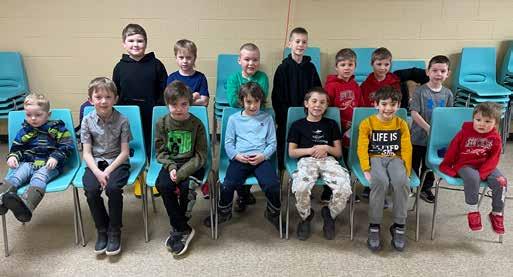
A group of Sprucedale Public School students showed just how much friendship can mean last Friday when they had their heads shaved in support of classmate Carter Kuchma as he continues his fight against cancer.
Residents in and around Shakespeare
who notice a group of boys with matching haircuts are not imagining things. The boys chose to shave their heads to stand with Carter, who is seven years old and will soon turn eight.
Carter’s parents, Tyler and Diane Kuchma, said their son had just begun to lose his thick hair as a result of ongoing chemotherapy treatments. They said the gesture from his classmates meant a great
deal to Carter and the entire family.
Even during a difficult week, Carter was able to feel happier spending time with his friends, who came together with their parents during March Break to take part in the head-shaving event.
Carter has not been able to attend school or play with his friends since being diagnosed last September, making the show of support even more meaningful.
The event followed another strong show of community support earlier this month, when Sprucedale Home and School parents organized a successful spaghetti dinner fundraiser for Carter and his family. The boys who took part wore shirts bearing the message, “We Fight Together – Team Carter.”
Carter Kuchma’s classmates show off their hair before having it shaved in support of their friend. The boys said they would do anything for Carter as he continues his battle with cancer.
Carter Kuchma and his classmates pose after their new haircuts. Front row, from left: Theo LaPoint, Grayson Fuhr, Carter Kuchma, Duncan Lindner, Levi Gautreau, Levi Roer and Zac Yantzi. Back row, from left: Theo Reid, Case Allen, Randy Berger, Jamieson LaPoint, Jak Yantzi, Ryan Yantzi and Wesley Allen. At back is hairstylist Larissa Allen, who helped make the event possible.
GARY WEST Gazette Correspondent
(GARY WEST PHOTO)
GRAND GRAND OPENING OPENING
If you have been curious about what's going on in the Old Sommers Building, join us Saturday for a fun filled day full of celebrations, giveaways, raffle prizes and an official ribbon cutting at 930am. Scratch & Save
March 28th
9:30-5:00
New Hamburg Legion members recognized for exceptional service
AMANDA NELSON Gazette Reporter
This year, two Royal Canadian Legion Branch 532 New Hamburg members, Gerry Eichler and Robert (Bob) Berg, were recognized for their exceptional service to the Legion.
Eichler, a Legion member since 1974, was awarded life membership for his extensive community service, including coaching, umpiring and significant contributions to the Legion’s executive and committees.
Eichler is one of only eight life members out of 335 total members. He is known as a man who can repair just about anything and has supported the Legion with cribbage, euchre and darts tournaments, demonstrating outstanding attendance. He also walked the local cemetery and placed poppy seals on more than 150 headstones in 2024.
Berg received the Palm Leaf Award, the highest honour for ordinary, associate or affiliate voting members, in recognition of his contributions beyond the Meritorious Service Medal.
His efforts included involvement with the Moose Lodge (Kitchener), the Knights
of Columbus (Waterloo) and the Military Service Recognition book project, in which he documented 375 veterans’ stories and was honoured with the title of historian. He is also known for countless other community service initiatives throughout the Region of Waterloo.
Berg also continues to chair the Kitchener Waterloo Veterans Organization, which is currently advocating for maintaining a clear entrance to the Waterloo Cenotaph for the Colour Party, addressing the loss of visible view and the loss of gathering space for hosting the four commemorative services held yearly.
Both awards required approval not only from provincial command but also from dominion command at the national level.
“The New Hamburg Legion wishes to congratulate Bob Berg for the Palm Leaf Award and Gerry Eichler for the life membership, as they recognize their dedication and commitment to uphold the objectives of the Royal Canadian Legion,” said Charlie Bronson, membership chair with the New Hamburg Legion. “These being to support veterans, their families and our community. We are very proud of their achievements.”
Two Royal Canadian Legion Branch 532 New Hamburg members were recognized for their exceptional service to the Legion. Gerry Eichler (left) was awarded life membership and Robert (Bob) Berg (right) was given the Palm Leaf Award.
(CONTRIBUTED PHOTO)
Shakespeare’s Jeremy Witzel explains challenges of pothole season
GARY WEST Gazette Correspondent
Jeremy Witzel, a Shakespeare-area resident and Stratford’s manager of public works, is working to keep city streets, sidewalks and roads in safe condition as crews deal with the annual challenge of pothole season.
According to Witzel, potholes rarely appear suddenly but instead develop over time as weather conditions weaken pavement.
“Potholes almost never start as potholes,” Witzel said. “They usually begin as tiny cracks with open joints, worn edges or utility cuts.”
Water from melting snow or rain can seep into those small openings, working its way into the asphalt and road base below. As temperatures fluctuate above and below freezing, sometimes within the same day, the freeze-thaw cycle causes the trapped water to expand, gradually widening cracks and weakening the pavement structure.
“The real surge comes during spring thaw,” Witzel said. “As frost leaves the ground, parts of the road structure can become waterlogged and lose strength.”
Once the road base is weakened, traffic can quickly break apart the surface, turning small cracks into potholes, particularly on busy routes. Poor drainage or blocked catch basins can also contribute by allowing water
to remain on road surfaces longer, increasing the likelihood of damage.
Winter maintenance can further contribute to deterioration in some cases. Witzel noted snowplows can affect already weakened pavement edges, while road salt and brine can allow moisture to remain liquid longer, increasing the chances water will seep into cracks before refreezing.
Witzel said the city’s response includes regular patrols and prioritization of higher-risk locations to address potholes as quickly as possible.
“The city’s patrol and triage work is just as important as patching,” he said, noting crews often complete temporary repairs when weather conditions are not suitable for permanent fixes.
Permanent hot-mix asphalt repairs are scheduled as temperatures rise and asphalt plants begin seasonal operations.
Witzel encourages residents to report potholes by providing the location and details, helping staff respond more quickly.
He also thanked residents for their patience as crews work through what can be a challenging season for road maintenance.
Stratford Mayor Martin Ritsma praised Witzel’s efforts, noting the public works manager leads a team of more than 30 employees and works hard to maintain city infrastructure for the benefit of residents and visitors.
Stratford manager of public works Jeremy Witzel draws on his rural roots growing up east of Shakespeare as he works with city staff to keep local roads safe throughout the year.
(GARY WEST PHOTO)
Conn Smythe brings music and memories to residents at the Maples
GARY WEST Gazette Correspondent
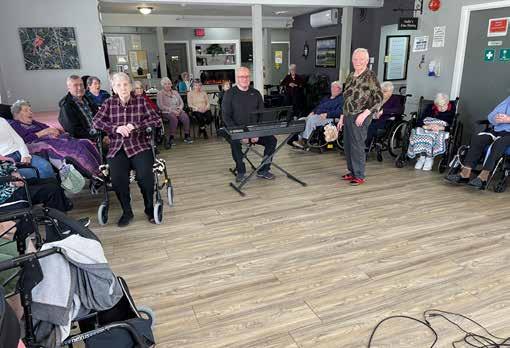
Residents at the Maples Home for Seniors in Tavistock were treated to an afternoon of music and entertainment Tuesday when Stratford performer Conn Smythe returned to share his wide-ranging repertoire of familiar favourites.
Smythe, a keyboard player and singer with more than 40 years of experience entertaining audiences of all ages, is a popular visitor at the long-term-care residence. Staff and residents alike say they always look forward to his performances, which feature a mix of well-known songs that encourage toe-tapping, clapping and singalongs.
Known for his friendly personality and engaging stage presence, Smythe brings along his keyboard, affectionately known as “Brandon,” and creates a relaxed atmosphere that many residents say brightens their day.
Those gathered for Tuesday’s performance shared how much they enjoy the
opportunity to hear songs they recognize from years past, with many joining in by singing along or keeping time with the music.
Smythe said he takes pride in continuing the musical tradition within his own family as well. His son, Blair Smythe, is currently based in Nashville, where he performs guitar alongside recording artists and appears at a number of well-known venues in country music’s capital.
Over the years, the Smythe family has become well known throughout the region for its musical talent and dedication to entertaining audiences across generations.
Maples Home executive director Joan Hergott said residents always look forward to Conn Smythe’s visits and enjoy the way he blends older favourites with newer material.
Performances are typically held indoors during the colder months and outdoors in warmer weather, when residents can enjoy the music in the sunshine. On some occasions, the event even includes ice cream, which has proven to be a popular addition.
Conn Smythe performs Tuesday at the long-term-care wing of the Maples Home for Seniors in Tavistock. Executive director Joan Hergott says residents always look forward to his performances, which bring a mix of classic songs and lively entertainment.
(GARY WEST PHOTO)
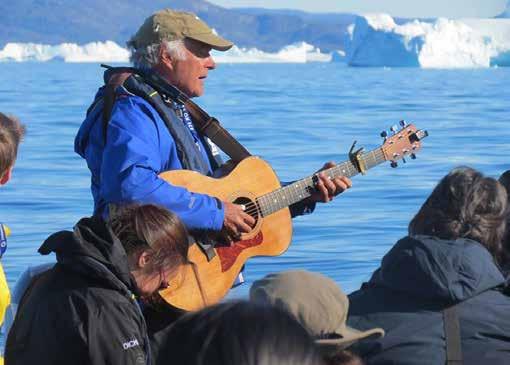
Tamblyn to perform at Harrington Hall April 19
AMANDA NELSON Gazette Reporter
The Harrington and Area Community Association is hosting a concert at Harrington Hall, 539 Victoria St., Embro, on Sunday, April 19, at 2 p.m.
Doors open at 1:30 p.m. and snacks, soft drinks and desserts will be served to guests. Ian Tamblyn, a multi-awardwinning singer-songwriter, multi-instrumentalist and storyteller, will perform for the first time in the region next month and says he’s looking forward to visiting somewhere new.
“This will be a new experience for me, and despite the fact that I’ve been playing for over 55 years, I’ve never been to Harrington,” said Tamblyn. “For one reason or another, I seem to find myself in small places with little enclaves of community-based concert halls and coffee houses. I’ve been doing that for many, many years, and really, I prefer playing in such places.”
Tamblyn was nominated as English Songwriter of the Year by the Canadian Folk Music Awards in 2022, and in the same year, he was appointed an officer of the Order of Canada.
His music reflects diverse themes,
including Canadian landscapes and people. His upcoming album focuses on small communities across Canada.
“I did four albums celebrating the four coasts of Canada – the Superior coast, the West Coast, the Arctic coast and the Labrador Coast,” said Tamblyn. “I’ve been to all of them, and I wanted to do an album reflecting those parts of the country, not just the landscape, but the people there as well.”
Attendees will hear a range of music as Tamblyn says he generally gets a feel for the audience and bases his performance around that.
“Each evening, I don’t have a planned set list. I sort of go where I want to go and also get a general vibe from the audience and see what works for them,” he said.
The community association is a volunteer-operated, registered non-profit that manages several local facilities and events. Its primary role is to oversee and maintain the Harrington Conservation Area and the Harrington Grist Mill, both owned by the Upper Thames River Conservation Authority, as well as manage Harrington Hall – the venue for the upcoming concert – on behalf of the Township of Zorra.
The association hosts a number of events each year, including a Christmas potluck,
an open house on the second Saturday in August and one or two concerts. Its largest fundraiser is the “Celebrate Harrington Community Auction,” an online event scheduled to take place shortly after the
upcoming concert.
Tickets for the concert are $30 and available in advance at exploreharrington.ca or by calling 519-536-0955.
Ian Tamblyn, singer-songwriter, multi-instrumentalist and storyteller, will bring his Canadian music to Harrington this April.
(CONTRIBUTED PHOTO)
Let’s hop to it:
Decorate this Easter picture with your favourite colours, then drop it off before 9 p.m. on April 2nd to:
Mackay’s No Frills
1540 Haysville Rd., New Hamburg
A winner will be selected from each of the following age groups and will be given a $25 gift card.
Age groups: 5 years and under, 6-9 years (x 2) and 10-13 years
Let your creativity shine!
Colouring Contest Rules:
1. Contest is open to children 13 years and under. Relatives of newspaper employees or contest sponsors are not eligible to win.
2. Contestants may use crayons, markers or coloured pencils to colour the pictures. Adults may assist in completing the contest entry form, but may not assist in colouring. Winners will be selected by random draw and will be contacted via phone/email.
Remembering Wilton ‘Willy’ Elzinga, a beloved fixture of the Tavistock community
bringing joy to those around him with both his enthusiasm and his humour.
Few people have left as lasting an impression on the Tavistock community as Wilton “Willy” Richard Elzinga, who passed away last week in his 69th year after spending his entire life in East Zorra-Tavistock.
Born with Down syndrome, Willy was known throughout the community for his warm personality, sense of humour and ability to connect with everyone he met. His easygoing nature and friendly smile made him a familiar and welcome presence around town for more than six decades.
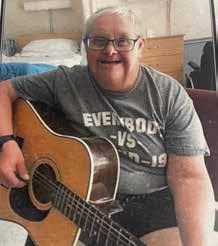
Willy loved music, especially country legends such as Hank Williams, Johnny Cash and Elvis Presley. With guitar in hand, he often imagined himself performing their songs,
Many longtime residents will remember Willy as a regular sight throughout Tavistock, whether riding his bicycle around town, visiting local businesses or spending time with friends over coffee. He enjoyed simple pleasures and approached each day with enthusiasm, a quality that left a lasting impression on those who knew him.
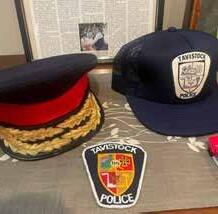
Willy also had a fascination with policing and took great pride in dressing the part, often wearing a police-style hat and vest while playfully directing traffic near the village’s well-known five-point intersection. While the role was symbolic, the gesture reflected Willy’s desire to contribute and be part of the daily life of the community he loved.
1. What 1994 film features a character describing a Quarter Pounder with Cheese as a "Royale with Cheese" in France?
What legendary musician wrote "Purple Haze," "Little Wing," and "Voodoo Child"?
3. The Pyramid of Giza is the only ancient wonder still standing today — what other ancient wonder was also located in Egypt?
4. What is the name of the galaxy closest to our Milky Way?
5. In the Bible, who is the eldest son of David?
6. Which country is known as Suomi?
7. How many lines are in a limerick?
8. Do male or female toads croak?
9. What magical phrase did Ali Baba use to open the cave?
10. In Toy Story, what is the name of the boy who owns Woody and Buzz?
GEORGE PENNER
George Penner, 83, of Shakespeare passed away peacefully at Greenwood Court, Stratford on Saturday, March 21, 2026.
Beloved husband of Ruth Penner. Dear father of Jerry and Steven. Dear brother of John Penner (Elaine). Dear brother-in-law of John Hoffmeyer, and Grace Shaw. Predeceased by his parents
John and Agatha Penner, brothers Henry in childhood and David Penner (Lois), sister-in-law Labelle Hoffmeyer and brother-in-law Terry Shaw.
George was a longtime millwright at Uniroyal in Kitchener until his retirement.
Former Tavistock police Const. Ron Rudy recognized Willy’s enthusiasm by presenting him with an official police hat and badges, a gift Willy treasured for the rest of his life.
Family members say Willy embraced life fully and enjoyed spending time with loved ones, including his mother, Betty, siblings and extended family. He was especially proud to take part in family celebrations, including serving as a member of his nephew Nathan Keller’s wedding party, a role he cherished.
Willy’s life stands as a reminder of the importance of kindness, acceptance and community. His presence brought smiles to many faces and his memory will continue to be part of Tavistock’s story for years to come.
Friends will be received at First St. Paul's Lutheran Church, 3620 Nafziger Road, Wellesley on Saturday, March 28 from 10:00 - 10:45 a.m. followed by the funeral service at 11:00 a.m. A reception will follow. Interment in First St. John's Lutheran Cemetery, Seebach's Hill. Memorial donations to First St. Paul's Lutheran Church, Wellesley or First St. John's Lutheran Church, Seebach's Hill would be appreciated and may be made at LockhartFuneralHome.com.
OBITUARY
FUHR: John Kenneth
Passed away suddenly on Wednesday, March 18, 2026 at his residence in Tavistock in his 47th year.
Dear son of Barbara Ann & the late Harold Fuhr (July 27, 2020) of Tavistock. Dear brother of Jane & husband Dean Brown of Parkhill. Sadly missed by his niece and nephews Keaton, Dayan and Calliegh. Remembered by is aunts and uncles Walter & Catherine Fuhr of Tavistock, Kenneth Steinacker of Embro, Doug and Carol Hoy of Raleigh, NC, by special cousins Brian, Ashlee, Theo, Ava, and Elianna Fuhr, Margaret & Wayne, Dwight, Shyanne, Vikki and Logan Herlick , Valerie, James & Scarlett Massengill, Michael, Bess & Lucus Hoy and by many other cousins. John will be missed by his co-workers of 26 plus years at Yantzi Feed and Seed and Sure-Gain in St. Marys.
Predeceased by grandparents Theodore (1976) and Louise (1975) Fuhr and Howard & (2009) and Ilona (2017) Steinacker.
Relatives and friends will be received in the Francis Chapel of the Glendinning Funeral Home, 77 Woodstock St. N. Tavistock on Monday from 4 - 7pm. Funeral service will be conducted in the Chapel on Tuesday, March 24, 2026 at 2:00pm. Spring interment in St. Paul's Lutheran Cemetery, Tavistock. Reception to follow in the Tavistock Men's Club Hall.
In lieu of flowers, donations to the St. Paul's Lutheran Church, Tavistock or the Heart & Stroke Foundation would be appreciated by the family. Personal condolences can be shared at www.francisfh.ca
by PeterS 2026
Willy Elzinga enjoyed playing guitar and singing songs by country legends such as Hank Williams and Elvis Presley.
Willy is pictured with two of his biggest supporters, his mother, Betty, and sister, Jane.
Tavistock police Const. Ron Rudy presented Willy with a police hat and badges, which he treasured throughout his life.
GARY WEST Gazette Correspondent
(PHOTOS COURTESY OF THE ELZINGA FAMILY)
The Old Gazettes
By Sydney Grant
Slowly but surely, I’m reading through the past pages of the Tavistock Gazette (est. 1895). Within this weekly column I’d like to share with you some of my findings.
March 16-23, 2016, Edition (10 years ago)
On Friday, March 11, 2016, at approximately 8:50 p.m., Oxford County Ontario Provincial Police (OPP) officers responded to the report of an attempted robbery at the Shell gas station on Woodstock Street South in Tavistock. The masked, lone male suspect entered the gas station convenience store and demanded money; however, the robbery was interrupted when another customer drove into the parking lot. The man left the store on foot in an unknown direction. Nothing was taken in the robbery and there were no injuries.
The Hickson Public School Hawks Girls Senior team won the Thames Valley District School Board A Basketball Championship on Saturday, March 5, 2016. The tournament was held at Westminster Secondary School in London. “This is the best team I’ve ever had the pleasure of coaching,” said coach Jon Empringham after the win. Many of these girls also won the Thames Valley conference in the fall for volleyball. Members include Grace Empringham, Amanda Witmer, Beth Ewing, Abby Bender, Sarah van Dijken, Alyssa Lupton, Hope Morley, Hannah Cowan, Clara Roth, Emma Pullen and Judy Seng.
A celebration of life; that's what these five lucky folks celebrated on Saturday evening, March 12, in Cambridge. Over 180 friends and family members heard stories from the transplant recipients about their journey prior to transplant and their many successes post transplant. Some of the friends that were in attendance had not heard the recipients’ stories until that evening and there were not many dry eyes in the crowd af-
start with beginners, born in 2001, and range up to the under 21, born in 1985. The Optimist and Queen’s parks are a flurry of activity every week, starting the first week of May. The first executive committee meeting of Tavistock Optimist Soccer Club was held on Thursday, March 9. Members of the committee include Marlow Gingerich, Mark and Jan Newcombe, Jason Kirkbride, Chris Cunningham and Murray Erb. Randy Marsh, former meat manager at Tavistock Foodland, has taken over as store manager as of Friday, March 10, 2006. Mr. Marsh succeeds former owners Rob and Sandra Taylor. There are no plans to change any of the store operations, however, it is now classified as a corporate store under the Sobey’s corporation. There are currently about 20 fulland part-time employees. Rob and Sandra Taylor bought the store on March 17, 1996, as a franchise store from the late Don and Mary Ann Swartzentruber. Rob Taylor has accepted a position with the St. Marys Foodland while Sandra Taylor continues as an insurance broker with McFarlan Rowlands in Embro.
March 19-26, 1986, Edition (40 years ago)
Hickson volunteer firemen answered a call Wednesday morning at 8:45 a.m. to a fire in the kitchen at the home of Mr. and Mrs. Frank Baer of RR 1, Tavistock. Mrs. Baer and her son, Roy, were returning from the barn at their home situated just east of the 16th Line and Cassel Sideroad crossing on the south side when they noticed smoke coming from the kitchen window. At that time, Mr. Baer, who had been in the bedroom above the kitchen, came out of the house. Hickson firefighters were called and with assistance from the tank trucks from the Innerkip and Tavistock departments, had the fire under control by 9:30 a.m.
A break and enter was reported to the Tavistock Police Force when employees started work at Zehr’s Esso Service on Thursday morning, March 20. About
TOWNSHIP OF EAST ZORRA-TAVISTOCK
GRACE UNITED CHURCH
116 Woodstock St. S., Tavistock Service starts at 10:30 am Phone: 519-655-2151
All are welcome Service led by Rev. Marilyn Arthur Music by Marilyne Nystrome
TRINITY LUTHERAN (ELCIC)
Sebastopol - Tavistock 2210 Perth Line 29
Pastor Steve Hoffard Worship In Person or on Zoom Sundays at 10:00 AM (519) 655-2372 trinitylcoffice@gmail.com www.trinitytavistock.com
TAVISTOCK MENNONITE
Pastor Julie Ellison White 131 Wettlaufer St., Tavistock 655-2581
Sunday Worship services begin at 9:45am, with coffee and fellowship to follow at 11am. All ages Junior Sunday School will follow after the service. All are Welcome Stream services online at www.tavistockmennonitechurch.ca
TAVISTOCK BIBLE CHAPEL
32 Oxford Street, Tavistock, Ontario
Questions or Need Help?
Text or Call: (519) 655-2413 tavistockbc.org
Family Bible Hour - 11am Each Sunday
EAST ZORRA MENNONITE 677044 16th Line Road, East Zorra Pastors Ray Martin & Mike Williamson www.ezmennonite.ca
Service audio recordings available at: https://ezmennonite.ca/worship/
WILMOT TOWNSHIP
ST GEORGE’S ANGLICAN CHURCH
Corner of Waterloo St and Byron St, New Hamburg
Weekly Sunday services at 10:15 am.
All are welcome.
https://www.stgeorgesnewhamburg.com
Please join us for Holy Week:
March 29 Palm Sunday 10:15am Service of Holy Communion
April 2 Maundy Thursday 7pm Service of Holy Communion
April 3 Good Friday
10am Ecumenical Service at Trinity Lutheran, with Zion United April 5 Easter Sunrise Service 6:30am Ecumenical Easter Service above the Nith River, parking lot behind Office Pro; with Trinity Lutheran and Zion United
April 5 Easter Service 10:15am Service of Holy Communion
St James Chapel of Ease 4339 Huron Rd Wilmot Township
All are welcome. Contact Carol Massel: 519-502-8648 carol@masselsmarine.com
ST AGATHA MENNONITE CHURCH
ST. PAUL’S LUTHERAN LCC
Church Phone 519-276-0701 Wellington Street, Tavistock stpaulstavistock@gmail.com
1967 Erb's Road St Agatha 519-634-8212 Pastor Jim Brown
Worship service 10am followed by coffee hour and sermon discussion. All are welcome
Pastor Rev. Michael Mayer
The Wilmot-Tavistock Gazette
PJHL Roundup: Braves take series lead into weekend games as playoff streak snapped
LEE GRIFFI Gazette Reporter
Tavistock may have taken the first two games of their Provincial Junior Hockey League’s (PJHL) Doherty Division final in easy fashion, but the Navy Vets sent a message on Tuesday night they will not go down easily.
The Braves came into the game at the Southwood Arena with a 2-0 series lead, but the Navy Vets made a statement of their own with a 5-2 victory. Tavistock came into the matchup on a 10-game playoff win streak and won 22 of their last 24 games in total.
Woodstock led 2-0 after two periods on goals by Carson Littlejohn and Owen Ireton as they were consistently able to get behind the Tavistock defence. Evan Palubeski cut the lead in half early in the third period but the Navy Vets scored three straight to seal the win. Jackson Andrews scored his first of the playoffs for the Braves with 44 seconds left in the game.
Woodstock was able to find room behind the Tavistock defence consistently,
Woodstock downed Tavistock 5-2 at home in game three of the Doherty Division final series. The Braves lead the best-of-seven series 2-1.
(LEE GRIFFI PHOTO)
something Braves head coach Zac Berg said contributed to the loss.
“We strayed from our gameplan, and we weren’t staying above our checks like we have been doing throughout the playoffs. We can’t rely on our goalie to make every save and that’s what cost us in the end.”
Berg added there weren’t many positives to take away from the loss.
“To be honest, it wasn’t us tonight, but we can’t panic after one loss. We rattled off 10 in a row during the playoffs, so this was eventually going to happen, and it wasn’t the worst thing for us.”
He added he is confident his team will put in a better effort in Game 4 on Friday night at home.
“We have been doing it all season long, bouncing back from tough losses. If we can do that, we will be totally fine.”
Navy Vets head coach Adam Wallace said his team rose to the challenge to stave off being on the brink of elimination.
“The effort was good, the detail was good. It was nice to have a bounce-back game like that because the first two weren’t great.”
He said his team did a better job scoring on the chances they had, and added his players were ready to go after a pair of lopsided losses.
“It’s easy to get down after losing the first two, especially in the division final. The biggest thing was the mindset of being
prepared, ready to go and treating it as another game and not get away from the things that brought us success this season.”
Wallace said his team’s leadership group stepped up their play and led the charge.
“It’s always nice when the big boys show up for us and they did that tonight. I thought the entire team did that and played their roles and did what they needed to do to make our team successful.”
Game 1 resulted in a 5-1 home-ice win for the Braves as they scored twice in the first period and three times in the second.
Captain Marc Dionne and Ethan Stover led the attack with a pair of assists each, while Yann Raskin added a goal and a helper. Other goal scorers were Jack Hodge, Ryan McKellar and Keegan Metcalf. Raskin’s “Michigan” goal gave the Braves a 3-0 lead in the second period and seemed to take some wind out of the sails of Vets.
Tavistock took Game 2 by the same 5-1 count in Woodstock and were led by Keegan Metcalf’s three points. Ryan McKellar and Ethan Stover added two assists each, while Hodge, Keaton Bartlett and Jacob ReidBrant scored single markers. Stover chipped in with two helpers.
Tavistock outshot Woodstock 82-46 over the first two games of the series. Game 4 will be played in Tavistock on Friday at 7:30 p.m., with Game 5 set for 6:45 p.m. on Sunday in Woodstock.
Mayors place bet on PJHL playoff series between Woodstock and Tavistock
Next stop: Making the meeting
Woodstock Mayor Jerry Acchione (left) and East Zorra-Tavistock Mayor Phil Schaefer have placed a gentleman’s bet on the Provincial Junior Hockey League (PJHL) Doherty Division final series. The loser will have to wear the opposing team’s jersey during the first Oxford County council meeting after the series is over
(CONTRIBUTED PHOTO)
Local athletic trainer Justin Wagler part of championship season in Detroit Tigers organization
GARY WEST Gazette Correspondent
Justin Wagler, a native of Punkey Doodles Corners, continues to build an impressive career in professional baseball as an athletic trainer within the Detroit Tigers organization.
Nearly two years after working his way through the rigorous training process required to reach the professional ranks, Wagler is now making his mark as a head athletic trainer in the Tigers’ farm system.
On March 16, members of the 2025 Lakeland Flying Tigers were presented with their Florida State League championship rings during a pre-game ceremony at Publix Field at Joker Marchant Stadium in Lakeland, Fla., prior to a Detroit Tigers spring-training game.
Wagler served as head athletic trainer for the Tigers’ Low-A affiliate, the Lakeland Flying Tigers, during the 2025 season and was part of the team’s championship run.
The Flying Tigers were one of two Tigers affiliates recognized during the ceremony, along with the West Michigan Whitecaps, who captured the 2025 Midwest League championship.
SATURDAY MARCH 28 • 10:30-12:00 NOON
this is one home you do not want to miss viewing, call today or view at the open house.
SATURDAY MARCH 28 • 1:00-3:00 PM
Welcome to this lovely 2 bedroom, 1.5 bath home backing onto farmland and offers, open-concept, hardwood floors, a spacious kitchen with ample cabinetry, approx. 1400 square feet of living space, plus a bright sunroom, Quadro fiber optics. Enjoy outdoor living on the private back deck, complete with hot tub hookup. This home also offers generous storage space beneath the home and in the shed complete with hydro hookup. Happy Hills offers resortstyle amenities, including controlled gate entry, a recreation hall, indoor heated pool, and golf facilities, providing a vibrant and secure lifestyle. Note with owning a property in the retirement all year living side, you have full access to the facilities on the camp ground side during the camping season, which is ideal for your grand children. Some additional up grades to this lovely home include - a new steel roof installed October 2025, 4, a generator that can power the entire house, the 20’ cable that goes from the generator to the power meter Installed 3 years ago and can run approximately 20 hrs. Call to day to view or for more information or be sure to view through the open house.
NEW LISTING - Enjoy a more relaxed lifestyle at the lovely Happy Hills Retirement Resort. Located in a gated community this lovely 2 or 3 bedroom home offers approximately 1366 square feet of living space with 2 full baths, a spacious eat in kitchen, a large living room, primary bedroom with a cheater ensuite and built in closet with dresser drawers. The back room could be either a 3 rd bedroom or office or family room. The rear yard offers a wood deck, a closed in insulated gazebo great for entertaining or those rainy nights, and extra storage with the garden shed with hydro and additional storage located under the unit and worry no more about the hydro going off, this unit offers a Generlink generator, also included for this unit is a pop up carport great for the winter months. Owning a home in this resort you have access to the community clubhouse with indoor pool, social events, and access to the trailer park amenities during the summer season. Call today for more information or your own private viewing on this great home, it might be just what you have been looking for.
SUNDAY MARCH 29 • 1:00-3:00 PM
Dare to dream to own this lovely custom built 2 + 1 bedroom brick bungalow built in 2015 , backing onto farmland. This stunning home is move in ready and offers an open concept main floor with cathedral ceiling in the living room, a spacious eat in kitchen with pantry and sliders to a 3 season sunroom- gazebo, and deck and the lovely view of the farmland. The fully finished basement offers a spacious family room with a gas fireplace great for those relaxing evening, a 3 rd bedroom with a cheater ensuite and walk in closet, upgraded Kinetico water softener. For the hobbyist or the car person this home offers 2- 9 foot garage doors, lots of space to store that special car or work shop area. One added bonus to this lovely home is an extra monthly income from the solar panels. This is one home you do not want to miss viewing, be sure to call to view today and own this great home today or view through the open house, you will not be disappointed.
Family members were on hand in Florida to celebrate Wagler’s accomplishment, including his parents, Brian and Heidi Wagler. Justin Wagler is also the grandson of Keith and Ruth Wagler of Tavistock, as well as Raymond Wagler of Tavistock’s Maples retirement residence. He fondly remembers his late grandmother, Mary Ramseyer. His siblings, Brady and Katie, have also been strong supporters throughout his journey in professional baseball.
Earlier this year, Justin Wagler spent time preparing for the season in Lakeland, known as “Tigertown,” at the Detroit Tigers’ spring-training complex. He also had the opportunity to spend a week working at the Detroit Tigers Dominican Academy in San Pedro de Macorís, Dominican Republic, where he gained valuable experience working with players and staff while learning more about Latin American culture.
Justin Wagler is currently based in Comstock Park, Mich., travelling with the West Michigan Whitecaps as head athletic trainer as the team competes in the High-A Midwest League.
He noted the Whitecaps benefit from strong community support, with a variety of promotional events taking place throughout the season. Wagler added his parents were honoured to throw ceremonial first pitches on Mother’s Day and Father’s Day as part of the team’s family-focused celebrations.
Residents throughout the Tavistock, Shakespeare and New Hamburg areas continue to take pride in Wagler’s success as he advances his career in professional baseball.
Justin Wagler holds his championship trophy after being part of the Florida State League champion Lakeland Flying Tigers organization.
Members of the Lakeland Flying Tigers celebrate their 2025 Florida State League championship at the Detroit Tigers spring-training facility in Lakeland, Fla. Justin Wagler is pictured at far left.
Securing our future as an energy superpower
We’re building the first small modular reactors in the G7 and first large scale nuclear facilities in 30 years.
That’s how we protect Ontario.
T:12.429"
Our plan to protect Ontario is fighting for every auto job
As Canada stares down economic uncertainty, we’re ready with a plan to protect Ontario. We’re building to protect every job in the automotive industry.
That’s how we protect Ontario.
T:12.429"
The whole scoop, part 1
If you were to look up the origin of April Fool’s Day, you would find several theories about how this day of pranks began. In our house, however, April 1, 2014, marks something much more significant – it was the day my family stopped using sugar in all forms.
At first, it felt like a cruel prank. The shortcuts I had relied on in the kitchen disappeared overnight and I felt overwhelmed by the extra work – not to mention the absence of treats for my young children.
Let me provide some background. My husband, my children and I were all struggling with various health issues. It seemed we were at the doctor constantly. The kids were frequently on antibiotics and we all felt tired and run down.
After months of research, we made a decision; we eliminated sugar from our diet. About a year later, we removed grains as well. That change didn’t just affect what we ate – it reshaped how we lived. Over time, doctor visits became far less frequent. Prescriptions decreased. Weight came off, inflammation eased and the constant brain fog began to lift.
We are not keto, carnivore, or paleo. We simply eat whole foods – grown locally and in season – the way people have eaten for generations.
So how do we eat without sugar or grains? The answer is extremely well. There is a bounty of nutrient-rich options – meats, healthy animal fats like lard and tallow, nuts and seeds, vegetables, fruits and animal products such as milk, cheese, butter, eggs and bone broth.
When we first began this journey, many people thought we were crazy. Some
extended family members were not supportive and we even lost relationships because of our firm decisions around food. Today however, more information is available about the effects of sugar and highly processed foods, and we feel encouraged to continue sharing our story in the hope that it may help others.
Over the past 12 years, I have learned many practical tricks. Here is a “foolproof” quiche that uses whatever you have on hand. The secret is baking it in a water bath to prevent the bottom from burning.
Empty the fridge quiche
Preheat oven to 350°F.
• 1 cup cream
• 4 eggs
• ¼ cup melted butter
• 1½ cups grated cheese
• ½–1 cup chopped meat (ham, bacon, sausage, hamburger, etc.)
• ½–1 cup vegetables (onions, peppers, spinach, broccoli, tomatoes, etc.)
• ½ teaspoon salt
• Pinch of pepper, parsley, or other spices
Mix all ingredients thoroughly. Pour into a greased nine-inch pie plate. Place the pie plate on a baking sheet and add water to create a water bath. Bake for 40-50 minutes, until firm to the touch. Let rest for 10 minutes before serving.
Happy April. Don’t let anyone fool you into thinking food is just about calories in. What we eat quite literally becomes the building material for our bodies.
Take time to plan your meals and get to know your kitchen again – it will have a lasting impact.
“Let food be thy medicine and medicine be thy food.” –Hippocrates
Calving
Rotation
Jack is a very sweet, affectionate boy with a soft heart and gentle spirit. He can be shy when meeting new people or finding himself in new places, preferring to take a moment to observe and feel safe before jumping in. Give him a little patience and kindness, and you'll see his loving personality shine. Once he trusts you, Jack is all about quiet cuddles, staying close, and soaking up every bit of affection.
He's simply looking for a calm, understanding home where he can grow his confidence and hold onto the "best of times" with his forever family. To learn more visit https://kwsphumane.ca/adopt/dogs SPONSORED BY:
Sponsored by:
A homemade quiche, packed with eggs, cheese, meat and vegetables, offers a simple, nutrient-rich meal made from whole ingredients without added sugar or grains.
JESSIE CAMPBELL Gazette Columnist
(VECTEEZY PHOTO)
Health-and-wellness business spotlight: W Physiotherapy & Sports Performance
HEAPS
OF HEALTHY TIPS
By Mercedes Kay Gold
Happy and healthy is the name of the game. Matt and Clare Wardrop, co-owners of W Physiotherapy & Sports Performance, along with chiropractor Dr. Joscyline Cadwell, change lives. From rehabilitation to prevention to adding muscle or losing weight, their mission is helping clients reach their full potential.
Clients often leave a lasting impression and local athlete Julian Jones was no different. Jones’ mother, Erica, reached out to Matt Wardrop regarding her teenage son, a U17 tierone fastball pitcher and hockey player. Besides being an owner, Matt Wardrop is the official in-house physiotherapist and personal trainer at the clinic.
A little less-known fast fact: Matt Wardrop is also a former Team Canada fastball pitcher with many gold medals over the years.
Unfortunately, the two softball lovers didn’t connect over training. Instead, life threw Jones a colossal-sized curve ball. He broke his distal ulna and radius in his wrist. Being his first serious injury, and his pitching arm, there was cause for concern. The cast would remain on for five weeks followed by a splint for three weeks.
The 2025 Husky rep hockey season was in full swing, and Jones spent the first half of it cheering on his teammates rather than playing. He was counting the days until his return.
It was a huge sigh of relief as the cast was removed and Jones was one step closer in the healing process. During his initial assessment at W Physiotherapy & Sports Performance, Matt Wardrop instantly assured Jones all would be okay. Due to the nature of the break, Jones’ range of motion and strength were compromised, and he worked with Jones specifically on regaining mobility.
In their sessions, Matt Wardrop was able to gently stretch the arm and wrist. Acupuncture was
added, an amazing, all-natural way to speed up healing. The balance of rehab and rest led to restored strength.
The time-sensitive but effective treatment would have Jones returning to play rep hockey as soon as possible, and pitch pain-free in the upcoming 2026 season. The timeline was 10-12 weeks.
Right on schedule, at the 10week mark post-injury, Matt Wardrop and Jones were tossing around the softball. Just one week later, Matt Wardrop cleared Jones physically, and the left winger took to the the ice for his first game of the season.
It wasn’t an easy return, and Jones admits to struggling mentally. Thanks to reassurance from Matt Wardrop and continued
work on drills, it became easier. Seeing Matt Wardrop bi-weekly for a few more weeks, Jones felt confident his arm was healed.
His teammates were three months ahead of him with practice and playing time but with Matt Wardrop’s continued support, Jones was no longer intimidated but excited.
Once the in-person sessions were complete, Jones had a daily home exercise plan with key exercises to complete on his own. He would now follow a specific warm-up plan for the two sports, helping reduce the chance of future injuries while maximizing performance.
Matt Wardrop also looks at the overall habits of athletes; in Jones’ case, recommending nutrientdense foods and underscoring the importance of hydration and sleep.
Jones is back loving his extracurricular sports, and thankful to Matt Wardrop for being the positive light he needed in those days to bring him through recovery. Jones wants to highlight that Matt Wardrop’s incredible sense of humour and fun activities, which made the rehabilitation something to look forward to rather than dread.
(CONTRIBUTED PHOTO)
(CONTRIBUTED PHOTO)
Julian Jones had to undergo more than three months of rehabilitation with physiotherapist Matt Wardrop of W Physiotherapy & Sports Performance.
Julian Jones is tier-one U17 fastball pitcher and needed to regain full use of his pitching arm after breaking his distal ulna and radius in his wrist.
Softball pitcher Julian Jones tosses the ball back and forth near the end of his rehabilitation with physiotherapist Matt Wardrop.
(PHOTO BY SHANNON HILL MEDIA)
Staying put? But don’t stay home!
OH, THE PLACES WE'LL GO
By Paul Knowles
Let’s be honest, there are an increasing number of would-be travellers who are getting rather chilly feet about venturing abroad. Many of us have chosen not to travel to the U.S. Others are understandably nervous about popular destinations like Mexico after the cartel uprising, Cuba with its collapsing infrastructure, or Egypt or Turkey, considering their proximity to the current war in the Middle East. As well, several African nations are doubling down on their oppression of LGBTQ2+ folk.
And then there are the issues that don’t involve personal dangers, such as the new requirements in the U.K. for pre-travel documentation or, if you were born there, a British passport. This sort of clearance before arrival in countries is also being initiated in many European countries.
As a travel writer, I will admit I still plan to travel. My near-future plans include Italy and even Mexico, with other trips in the works.
But I do understand we are all looking for alternatives. So, as we get closer to spring, I want to suggest a few drivable destinations that don’t involve leaving the province but will, I promise, provide visitors with a great vacation.
Let’s start with the Niagara peninsula. I don’t say “Niagara Falls” because while this wonder of the world is undoubtedly the biggest draw on the peninsula, there is so much more to explore here. Although it might be wise to consider staying in Niagara Falls, proper, because now, in the off-season, many of the hotels offer great deals on rooms, which often come with discounts on dining and even a casino voucher. If you’re heading toward the Falls, check out those options.
But if you go, don’t spend all your time in Niagara Falls. Niagara-on-the-Lake is one of my favourite towns in Ontario where you can browse in interesting shops, dine in good restaurants and pubs, and wander a couple of blocks off the main street to the banks of the Niagara River for terrific views of Lake Ontario, the riverscape and our neighbouring country that sadly shall not be
named.
My favourite pastime in the Niagara Region – as regular readers will know – is visiting wineries, and there are dozens to choose from. Many also have good restaurants, and some offer unique accommodations. For a full and informative list of wineries, see winecountryontario.ca.
And please note that the Niagara peninsula has now been divided into two official wine regions –Niagara Benchlands and Area and Niagara-on-the-Lake and Area. If I had to choose only two in each, it would be Fielding and Ridgepoint in the Benchlands; Bighead and Konzelman in Niagara-on-the-Lake region.
Now, let’s head east. It will also not be a surprise to regular readers that I recommend a getaway to our nation’s capital, Ottawa. I simply don’t think there is any equivalent destination in Canada, with as much to see and do, almost all accessible on foot.
Highlights for me include two art galleries – the phenomenal National Gallery of Canada and the unexpected Ottawa Art Gallery with a terrific Group of Seven exhibition. I recently wrote enthusiastically about the National War Museum, and I haven’t changed my mind – it’s really enthralling. In total, Ottawa is home to seven of Canada’s national museums.
I always enjoy the quirky artifacts at Laurier House, which housed two prime ministers –Wilfrid Laurier and William Lyon Mackenzie King. The display of memorabilia from King’s immersion in the occult is worth
the price of admission.
There are many unique sites open for tours in Ottawa, from the temporary House of Commons and the current home of the Senate (once the railway station) to the Royal Canadian Mint and Rideau Hall, home of the governor general.
For my last stay-at-home alternative to foreign travel, I am going to suggest a vacation that covers a distance of less than an hour and a half – the region that runs along the north shore of Lake Ontario and the western end of the St. Lawrence River, from Quinte West to Gananoque, including Kingston. We’ve had the chance to explore this region in the last couple of years, and there were a lot of unexpected delights throughout the area.
I would probably opt to stay in Kingston because this historic city offers some unique and special bed and breakfasts and inns. And over the course of my week or so in the area, I would be sure to visit the truly fascinating National Air Force Museum in Trenton and the Great Lakes Museum in Kingston (with a note that the highlight, there, the S.S. Keewatin, is not open for tours until May). I would also join Kouri’s Kopters in Gananoque for one of their breathtaking helicopter tours of the Thousand Islands (also starting in mid-May).
All of the communities in this lakeside stretch offer unique dining experiences, local live theatre and concerts, and on-the-water adventures in the warmer months.
So, if you are eager to travel but hesitant to leave the comfort of your own province, these three areas provide terrific travel experiences. I have been there, I have done that and I truly intend to do it all again.
Paul Knowles is an author and travel writer, and past president of the Travel Media Association of Canada. To contact Paul about travel, his books, or speaking engagements, email pknowles@ golden.net.
(PAUL KNOWLES PHOTOS) Fielding winery is one of the best in the Niagara Benchlands wine region.
The Canadian Senate chamber in its temporary quarters in the old railway station is open for tours. Reservations are necessary.
A Vimy warplane at the National War Museum in Ottawa.
Prime Minister Mackenzie King's library in Laurier House, including a shrine to his mother, with whom he communicated through seances.
Reg Selfe is long gone but his paintings live on (Part 2)
VINTAGE VIEWS
By Tim Mosher Tavistock and District Historical Society
When the Great Depression (1929-1939) struck, local residents told me that Reg Selfe was destitute. Wages had fallen and 30 per cent of the Canadian workforce was unemployed. Art lessons or purchasing oil paintings became a luxury and the novelty of having a fine artist living in the village with a posh accent had worn off.
Photos of Mr. Selfe during this time show a gaunt figure. This was when he switched from painting large canvases to small and very small oils, often on thin cardboard. It was during this period when Selfe bartered art lessons for rooms in summer cottages and even gave paintings in lieu of medical services in Tavistock, so said the daughter of one of the longtime doctors in the community, a practice that was not uncommon at the time.
Jack and Lucy Lemp proved to be more than sponsors and patrons; they were sincere friends over the three and a half decades that Selfe lived in Canada. One of the family's oils was acquired by sending dressed chickens and home-cooked, three-course meals to him delivered by their children, Lenny and Anne 'Girlie.' From time-to-time, Selfe babysat them "with a remarkable lack of skill"
said Girlie in a letter to me 32 years ago.
After Canada entered the Second World War in 1939, Selfe's station in life gradually improved, along with western economies. His finances clearly picked up by the late 1940s when he started to exhibit his work at summer resorts like Grand Bend, Muskoka and Bayfield.
Perhaps the high point of Selfe's career was exhibiting with members of the Group of Seven, Canada's best-known fine art painters a century ago. Today, their work is worth millions of dollars. This was not in Toronto or Montreal; it was in the Tavistock Library! The 27 oils on tour were part of the Housser Memorial Collection and were already a sensation before this 1949 show in the village. The prestigious oils were touring the province and Tavistock's librarian, Mrs. Emerson Kalbfleisch, scheduled it to appear in our public library (today Carnegie Manor).
Selfe was invited to display 20 of his own works alongside the famed group's work. Also in 1949, his painting entitled "Silence of the North" was chosen among almost 200 oils to represent Canadian and American art at a show in Windsor under the auspices of
the Detroit Institute of Art. Exhibiting with the Group of Seven and being chosen to represent this continent's finest work were undoubtedly tremendous compliments to "Tavistock's artist."
Ironically, during Selfe's last 10 years in the village, he returned to his first very modest apartment over the newly named "Tavistock 5¢ to $1.00 Store" (now Home Hardware), a shop that I knew as a boy in the 1960s. He set up a canvas divider again between his living area and his working/teaching space.
By now, Selfe was slightly rotund, full-faced, moustachioed and well dressed in newspaper accounts and snaps shown to me by a wide variety of friends, but his health started to gradually fail after suffering torn ligaments from a slip on ice. He also developed a heart condition, for which he spent time in Stratford General Hospital in 1959.
Selfe was told he couldn't leave the hospital until he found someone to supervise his recovery, so when Stanley and Beth Schippling visited, they returned to Tavistock with an unexpected house guest. Selfe stayed for 10 weeks and then returned to his apartment over the dime store.
The 153 examples of fine and commercial art that I recorded in my 1994 university research paper and one example of juvenilia (an ink wash he did at age 15) is far from Selfe's complete oeuvre. One painting that I've never seen in person is the large seascape that Selfe is posing with in part one of this article. If any reader knows where this painting is, please contact me at my email address below.
The reality is Selfe had a difficult life in Tavistock simply because the market for his paintings and lessons was small. The village was largely a Germanic and Scottish, agrarian-based economy that only started to have electricity eight years before Selfe arrived in 1924. His love of tea, cigarettes and the bachelor lifestyle was a little at odds with the local way of life. He spoke with an estuary English accent, with rhotic letter R's that many people remembered during my research. This always set him apart.
Despite his differences, it's clear that the local people treated him well, considering his many sponsors, gifts of food and services or local people and businesses accepting in-kind offerings of his paintings. This was how smalltown Ontario functioned during this time and Tavistock was no exception.
My memories as a child growing up in the village shortly after Selfe departed for the U.K. in 1960
overlap some of his experiences. Doors were not always locked, shovelling an elderly neighbour's snow without expecting pay and leaving milk delivered to a door untouched was commonplace in the district back then. Today, I live in a high-rise condo in the GTA and don't know the longtime neighbour across the hall. By the late 1950s, Selfe was now in his 70s and he yearned for his homeland. In 1960, he bade farewell to his friends, associates and art school students and – for unknown reasons – returned home to Guilford accompanied by Tavistock's police chief, Stanley Melbourne, also English-born. Selfe died a few months later and his three sisters had a modest headstone erected on his grave in Guildford. Part of his epitaph on the stone is "In Unfading Memory of Dear Reg."
In 2007, I visited Guilford, found the Selfe home and met the occupants; no Selfes resided there at that time. I found the cemetery where Selfe was interred in the family plot and was astonished to find that his headstone was missing! However, the stone's foundation and kerb set were intact (a low grave border made of stone, not common in North America).
I know that this was where he was buried because longtime friend Fred Schaefer visited the grave in 1967 and took photos of it. I matched his photos to where I stood in the graveyard and I was able to locate it. This is how I know half of Selfe's epitaph; the other half is illegible in Mr. Shaefer's pictures. The four-sided kerb set was still there but three sides had sunk slightly beneath the surface.
With the heel of my shoe I was able to uncover the other three sides and read inscriptions on it dedicated to Selfe's parents and perhaps an uncle, but nothing about Selfe (I should state that I don't make it a habit of digging in cemeteries). Selfe's three sisters weren't interred there because there were no new stones or foun-
dations. I took photos and departed. My mind was spinning.
The missing headstone is a mystery for the ages.
A question for readers: Does anyone know what happened to the Selfe oil of a Canadian winter scene that hung over the fireplace in the Tavistock Library before it was renovated to the present day "Carnegie Manor?" Shirley Weicker was the librarian in 1994 when I took photos of this oil. If you know, please contact me at my email address below.
The Jan. 22 History Mystery: The question was "What rare physical ailment does one of the people posing have?" Connie Hitzeroth of Tavistock was the first person to respond with the correct answer. The man wearing the bowler hat has one shoe with an extra-thick sole, but his other shoe does not. This is called short-leg syndrome, or anisomelia.
The last article's History Mystery: The question was "What detail is artificial in the setup in the main photo with this article?" This was answered by Connie Hitzeroth again. The answer is an oil painting that's in the process of being completed is never framed. The way Selfe is posed with his palette of paints and brushes in hand implies he was working on it when the photo was taken – not true.
This week's History Mystery: Why are kerb sets (stone grave borders) almost unknown in Canada but widely seen in England, unrelated to grass cutting, tradition or appearance? The first reader to respond with the correct answer will have their name and community or rural route number noted in the next Vintage Views article. Email your answer to me at tim_mosher@hotmail.com.
Correction: An error was printed in part one of the Vintage Views series about Reg Selfe. While that column indicated the name of Reeve Robert Rudy’s wife was Helen, her name was actually Doris. We regret any confusion this may have caused.
Reg Selfe and friend Stanley Schippling removed their car seats for the campsite. It's not known why Selfe never learned to drive his car, so he was often accompanied while camping by friends who drove him. This was on the Nith River flats near Haysville in 1944.
This photo was taken near Elora in the mid-1950s. Reg Selfe is in the centre, Fred Schaefer, Selfe's paperboy years earlier, is on the right, and Horst Burkholtz, a loyal patron, is on the left. Surprisingly, they're holding two box cameras which were popular 30 years earlier.
(PHOTO COURTESY OF STANLEY SCHIPPLING)
(PHOTO COURTESY OF THE ESTATE OF RANEY MILLER)
SATURDAY, MARCH 28
9:30 a.m. – 12:30 p.m.
The Nith Valley EcoBoosters are hosting another Repair Café
Skilled volunteer fixers will be on hand for mechanical, woodworking, sewing, mending, knitting, crocheting, jewelry and book repairs. Contact us at: nvebrepaircafe@gmail.com or check out www.nvecoboosters.com
Zion United Church, 215 Peel St., New Hamburg
Optimist Club of Wilmot's Easter Egg Hunt
Registration starts at 10:30 a.m. Hunt starts at 11 a.m.
Beck Park
215 Snyder's Rd E, Baden
WEDNESDAY, APRIL 1
East Zorra-Tavistock Council meeting
9 a.m.
Council Chambers
89 Loveys Street East, Hickson
THURSDAY, APRIL 2
Shakespeare Optimist Club's Rib, Sauerkraut and Pig tail Stag
Take out: 6 p.m. Dinner: 6:30 - 8:30 p.m. For tickets call Murray Schlotzhauer at 2713330 or Gary West at 272-9140. Shakespeare & District Optimist Hall Galt St Shakespeare
SATURDAY, APRIL 4
Brocksden Country School Museum Easter Egg Hunt 10-11 a.m.
NO CANDY in the eggs, just schoolhouse trinkets. To ensure enough eggs for all please sign up at: forms.gle/DvPejmx5qDTaM7Xg6 Sign up Deadline April 1. 2719 Line 37 (Vivian Street) between Roads 110 and 109, one road north of Highway 7&8
TUESDAY, APRIL 7
Ostomy Support Group Meeting
7 p.m.
Speaker – Denise Strasser from Action Health Care. She will update us on assistive devices, mobility aids, other home health products, and the Assistive Devices Program, (ADP) Social time and snacks. Everyone welcome. For more information call (519)273-4327. 93 Morgan St., Stratford
WEDNESDAY, APRIL 8
Community Care Concepts Lunch and Fellowship
12 p.m.
Please register by April 3 by calling 519-664-1900 or Toll Free: 1-855-664-1900
Wellesley Recreation Complex, 1401 Queen’s Bush Rd., Wellesley
WEDNESDAY, APRIL 8 CON'T
Tavistock Community Health (T.C.H.I.) annual meeting
7 p.m.
Guest speakers are Ron Harrison and Barb Myer, talking about Ron’s ongoing battle with Parkinson’s Disease. New board members are needed. Please Contact Frank Meconi at 519-655-2178 or email fameconi@rogers.com. Everyone welcome.
Tavistock Men’s Club Hall
78 Woodstock St N, Tavistock
Perth East council meeting
7 p.m.
Council chambers 25 Mill Street East, Milverton
SATURDAY, APRIL 11
Swing into Spring - Craft Sale
10 a.m. - 2 p.m.
Free admission
Morningside Adult Community Off Hwy 8 at Bleams & Bergy, New Hamburg
TUESDAY, APRIL 14
Wellesley Council meeting
6:45 p.m.
Council chambers
4805 William Hastings Line, Crosshill
WEDNESDAY, APRIL 15
Community Care Concepts Lunch and Fellowship
12 p.m.
Please register by April 10 by calling 519-664-1900 or Toll Free: 1-855-664-1900
Wilmot Rec Complex, 1291 Nafziger Rd, Baden
SATURDAY, APRIL 18
Tree Planting
9 a.m. to 12 noon
Let’s Tree Wilmot is partnering with Wilmot Township in a new special project, Mannheim Carolinian Corner. A two hectare site at the NW edge of Mannheim will become a wooded area with a trail system. https:// letstreewilmot.ca/events/ Milne Drive, Mannheim
TUESDAY, APRIL 21
Our Water - Challenges & Solutions
7-9 p.m.
Guest speaker - expert hydrogeologist, Dr. Hugh Simpson, followed by a Q&A. Free online and in-person event. Register at nvecoboosters.com under upcoming events. Questions? Contact nvecoboosters @gmail.
com
Zion United Church, 215 Peel St., New Hamburg
WEDNESDAY, APRIL 22
Community Care Concepts Lunch and Fellowship
12 p.m.
Please register by April 17 by calling 519-664-1900 or Toll Free: 1-855-664-1900
Linwood Community Centre, 5279 Ament Line, Linwood
MONDAY, APRIL 27
Wilmot Council meeting 7-10 p.m.
Council chambers
60 Snyder’s Road W., Baden
MORNING & EVENING BIBLE READING
Read the Bible in a Year in Community Morning meeting 6:00 a.m. daily
Evening meeting 6:00 p.m. daily
Contact Arthur Rosh if interested. Phone number: 226-899-1551
Email address: arthur.rosh@gmail.com
Location to be determined in New Hamburg, Tavistock, Baden, Wellesley, New Dundee, St. Agatha, Shakespeare, Petersburg, Hickson, Punkeydoodle’s Corner and area
EVERY WEDNESDAY
TOPS - Taking off Pounds Sensibly Wednesdays at 10:30 a.m.
TOPS is a non-judgmental weight loss support group. Need help on your weight loss journey. For info call Cathie 519-662-9273. St James Church, Baden
Wednesday Night Euchre at the New Hamburg Legion Wednesdays at 7 p.m.
65 Boulee St., New Hamburg
3RD THURSDAY OF EVERY MONTH
TAVISTOCK MENS CLUB MEETINGS Dinner at 6.15 p.m.
No meetings in July and August Welcome to attend. Phone: 519-655-3573
Website: tavistockmensclub.ca 78 Woodstock St N
STAMP CLUB
Oxford Philatelic Society
Meetings: 2nd Tuesday (2-4 p.m.) and 4th Tuesday (7 to 9 p.m.)
September to May
If you have never belonged to a stamp club, now’s the time. Meet new friends, grow your knowledge and collection.
Contact: Don Eaton dhfe@silomail.com Website: http://www.rpsc.org/chapters/oxford Church of the Epiphany 560 Dundas Street, Woodstock Ontario N4S 1C7
FREE SENIORS ACTIVITIES
Tavistock Seniors Activities @ Tavistock Memorial Hall, 1 Adam St. Tavistock ON, except Shuffleboard
Pickleball Monday, Wednesday and Friday afternoon, 12-4 p.m. Contact: Don Junker 519-535-7052
Cards Monday , Wednesday afternoon 1-4 p.m., euchre, crib (bring board), etc. Just drop in to play, good to bring someone . Contact: Bob Routly 519-301-2118
Inside walking Monday & Wednesday morning 8.30 a.m. - 12 p.m. Contact: Larry Brown 519-240-6715
Crokinole Monday , Wednesday morning 8.30 a.m. - 12 p.m., Just drop in to play, good to bring someone. Contact: John Schultz 519-655-2346
Shuffleboard @ arena, Wednesday 12:30-4 and Thursday 10 a.m. - 4 p.m. Contact: Don Junker 519-535-7052.
VON Smart Seniors Exercise, Tuesday and Thursday morning 9 - 10 a.m.; Village Manor 10:25 - 11:25 a.m. Contact: 519-539-1231 x 6285
TAVISTOCK & DISTRICT HISTORICAL SOCIETY
Museum Hours: Third Saturday of each Month 1-4 p.m. (other times by appointment) Email: info@tavistockhistory.ca or call 519-655-3334
Travelling Museum Display: The theme is “Heritage of Hickson Public Central School” - history of School from 1885 to present along with photos, artifacts, school and art work. TDHS partnered with the Hickson 4-H Club for this display that runs until April 27, 2026.
Hours: Monday-Friday 8:30 am-4:30 pm
Location: EZT Township Administration Building (lobby), 89 Loveys Street, Hickson Travelling Museum Display: “Easter Traditions & Egg Business in Tavistock" – history of the 1919 Tavistock Egg Circle and 1946 Tavistock Produce along with advertisements, artifacts & Easter decor. This display runs until April 27, 2026.
Hours: Open 7 days a week
Location: Tavistock & District Recreation Centre (arena lobby), 2 Adam Street, Tavistock CAREGIVER CONNECTION
Free Caregiver Connection peer support groups
Date: Third Tuesday of each month
Time: 6:30-8:30 p.m.
Are you worried about your child or youth? Parents and Caregivers for Mental Health (PCMH) is here to listen, support, and walk alongside you on this journey. Our free Caregiver Connection peer support groups offer parents and caregivers a community of support. Can’t make it in person? Join one of our virtual or hybrid groups! Visit family. cmho.org or email oxfordcounty@pcmh.ca for more information.
Hundreds of shade trees, fruit trees, apples, pears, peaches, plums, sweet and sour cherries, apricots, nectarines, blueberries, haskapp grapes, raspberries, elderberries etc. Lots of spruce, pine, cedars for windbreak and privacy hedges. Sizes 1-8 ft. in containers ready to go. Flowering shrubs and much more. Mon-Sat 7:00am to 6:00pm Martin’s Nursery, 42661 Orangehill Rd Wroxeter, ON N0G 2X0 (1 Conc. North of Wroexter on Belmore Line)
THANK YOU
Thank you so much for everyone that came to celebrate my special birthday, and for the many good wishes, cards, and gifts, and my family for their part in all the celebration. All was greatly appreciated. Sincerely, Pat Eidt
WANTED
I will pay cash for antiques and collectibles. Coca Cola, Pepsi, any pop company, Brewery items Kuntz, Huether Labatts, etc. Old radios and gramophones, Wristwatches and pocket watches, Old fruit jars, Beaver Star Bee Hive etc. Any old oil cans and signs Red Indian Supertest etc Any small furniture. If you are moving or cleaning out stuff please contact me - 519-570-6920.
WANTED
Wanting to buy scrap cars, trucks, heavy equipment trucks, big trucks, buses, farm machinery, bulldozers, and excavators. Bin service available. Call 519-373-2565.
Optimist Club of Downie Inc.
FARM FARM
mall Farm, Big Harvest B14
Oversupply and trade issues drive down dry bean prices for Ontario growers
The 2026 Ontario Bean Growers annual general meeting was held in Stratford last month, where dry bean growers from across the region came together to discuss growing concerns around exports, particularly trade, transportation and domestic demand.
Alvin Klassen of Dry Bean World outlined current challenges as Canada continues to navigate overproduction of black beans and ongoing tariff changes that are limiting trade and creating uncertainty for growers.
“In the last five years, we’ve experienced several severe ups and downs in commercial markets related to supply and demand, with the influence of producer and dealer pricing,” said Klassen.
Despite steady global demand for dry beans, many growers are finding it harder to turn a profit.
Prices across North America have dropped sharply in recent years — in some cases by nearly half — while input costs such as fuel and fertilizer have remained high.
“Throughout North America, we are now sitting where bean prices are half of what they were three years ago, and the cost of production hasn’t gone down at all,” said Klassen. “In fact, seed pricing hasn’t gone down, and it’s making it very difficult to sustain production.”
The issue, Klassen said, comes down to supply and demand. A strong harvest has left a surplus of beans in storage — known in the industry as “carryover” — giving buyers less incentive to pay higher prices.
At the same time, export challenges and limited processing options in Canada are making it harder for farmers to move their crops efficiently, adding further pressure to an already strained market.
Jeff English of Pulse Canada said the organization is working to increase domestic consumption through its “Love Canadian Beans” campaign, which aims to raise awareness that many beans sold in stores are grown in Canada and encourage more people to include them in their diets.
“It’s not about telling people how to eat, but showing them how beans can be incorporated into everyday foods we already know and love,” said English. “It’s about giving some familiarity to supporting what we see as a great, sustainably grown Canadian crop.”
English added that advancements in bean processing technology could also help grow the domestic market.
“Now that we have companies extracting proteins and starches from pulse crops, we should have an opportunity to put more protein into different foods — not necessarily calling them beans, but using them as a high-protein ingredient,” he said.
Bill Rosenberg, parliamentary assistant to the minister of agriculture, food and agribusiness, also addressed growers, highlighting the significant role Ontario’s bean producers play in the province’s agri-food sector.
“Our agri-food sector now generates around $52 billion in annual GDP,” he said. “This is why Ontario is known around the world for safe, nutritious and delicious food.
“Eighty to 90 per cent of the beans grown here in Ontario are exported around the world, and that is something to be proud of,” he added.
Overall, the message to growers was clear: while global demand is growing, the industry must navigate trade instability, supply chain risks and the need to build stronger domestic markets to remain competitive.
Love Canadian Beans promotional imagery showcases the versatility and health benefits of beans, part of an ongoing effort to encourage Canadians to incorporate more homegrown pulses into everyday meals.
AMANDA NELSON Gazette Reporter
(LOVE CANADIAN BEANS FACEBOOK IMAGES)
UTRCA programs help farmers invest in soil health, water quality and long-term sustainability
GALEN SIMMONS Regional Editor
Farmers across Perth, Oxford and surrounding counties are finding new ways to strengthen their land and protect the environment with support from a range of funding programs offered by the Upper Thames River Conservation Authority (UTRCA).
Through initiatives like the Phosphorus Reduction Program, Oxford Clean Water Program, Resilient Agricultural Landscape Program and UTRCA’s Tree Planting Program, farmers and rural landowners can access financial and technical support for projects that improve soil health, reduce runoff and enhance the long-term sustainability of their operations.
“The Upper Thames River Conservation Authority offers a range of funding programs designed to support farmers and landowners who are working to protect soil, water and the long-term health of the landscape,” said UTRCA stewardship outreach specialist Shannon Zylstra.
Those programs help offset costs for a wide variety of on-farm practices, including cover crops, reduced tillage, nutrient management, erosion control structures, windbreaks, wetland creation and tree planting. In some cases, multiple
programs can be combined to further reduce the financial burden on farmers.
“Agricultural lands play a vital role in the health of our watershed, and farmers are key partners in protecting the land and water we depend on,” Zylstra said. “These programs recognize that farmers are already strong stewards of the land and provide additional support to help them
continue that work.”
Beyond funding, UTRCA staff also provide technical assistance, helping landowners plan projects, navigate applications and connect with other available resources.
“This includes financial assistance through cost sharing, as well as technical support,” Zylstra said. “In many cases,
Our specialized team delivers reliable, high-quality electrical installation services across agricultural, residential and commercial projects, each handled with the skill and precision it demands.
At Jantzi Electric, we’re committed to supporting our community while building lasting partnerships that help local businesses grow.
staff can help with project planning, design recommendations and connecting landowners with other available programs and resources.”
Across the region, a number of farm families are already seeing the benefits of these programs in action.
In Middlesex County, Bill and Carrie Irwin planted a double-row windbreak along the edge of their property using support from UTRCA’s tree planting program. The project included 720 trees and serves as a natural buffer to help reduce soil erosion and protect crops from wind.
In Oxford County, Steve and Cobi Sauder have taken a comprehensive approach to soil conservation over several decades. In addition to adopting no-till and cover cropping practices, they have installed erosion-control structures such as berms, terraces and grassed waterways, along with extensive tree planting to support long-term soil and water management.
“We’re trying to be stewards of the land in terms of water quality as well as improving soil health,” said Steve Sauder in a video posted to the UTRCA website about the project. “We put in this berm with the Upper Thames River Conservation Authority’s Clean Water Program to try and alleviate this problem. What I can say
Upper Thames River Conservation Authority (UTRCA) stewardship and land-use planner Michael Funk and manager of integrated watershed management Tatianna Lozier measure water quality as part of a cover-crop project funded with support from the UTRCA.
(PHOTOS COURTESY OF UPPER THAMES RIVER CONSERVATION AUTHORITY)
after seven years is it’s been successful.
“
… When we initially put this berm in, I was concerned about designing it properly, and I was pleased that the Upper Thames River Conservation Authority provided engineering services free of charge that allowed us to get a good design that we were confident in.”
Meanwhile, in Zorra Township, Katherine and Jim Grieve transformed a low-lying, unproductive area of their farm into a thriving wetland. The project now provides habitat for wildlife while also improving water quality on the property.
“This area of the field has been
unproductive for years,” said UTRCA manager of integrated watershed management Tatianna Lozier in a video shot after construction of the wetland in 2017. “It’s wet following rainfall events, and there’s also standing water following significant events. … It looks great. In addition to the trees and shrubs we planted, we added 700 aquatic plugs that will spread and fill in the perimeter of the wetland. There is also vegetation that has come back and … it’s utilized now by several bird species and different insects.
“ … You’re creating both terrestrial and aquatic habitat. There’s also a water-quality function. The water (in the wetland) is from surface runoff, tile drainage and the rainfall itself. As the water is held in the wetland, the sediment will settle to the bottom and any nutrients associated with that sediment. With the vegetation, you have a nutrient-cycling benefit, and the water in the pond will be able to slowly infiltrate as well as be lost to evaporation. … When there is a lot of water, we do have a standpipe so that water can be slowly released.”
At Hoenhorst Farms in Innerkip, dairy farmer Cox Wensink implemented a slag filter system to treat silage runoff, helping remove excess nutrients before water leaves the farm. A recent upgrade to the system has further improved its perfor mance and longevity.
Zylstra said projects like these demon strate how environmental stewardship can also support farm productivity.
“Many of the practices support ed through these programs help keep
nutrients and soil on the field where they are needed, rather than being lost through runoff into local waterways,” she said.
For farmers, the programs also re
application process is straightforward and accessible, recognizing the time pressures farmers face throughout the year.
Farmers and landowners interested in
With support from the UTRCA, Oxford County farmers Steve and Cobi Sauder have been utilizing cover crops and reduced tillage, planted more than 6,500 trees, and have installed several erosion-control structures on their property.
A UTRCA technician conducts cover-crop trails and takes soil samples in a local farm field.
Tapping into tradition on the Wettlaufer Farm
his neighbour and cousin Leonard Wettlaufer during syrup season.
For Carman and Debbie Wettlaufer, life has always been rooted in the Tavistock area. Both lifelong residents, they have a story closely tied to the land, family traditions, and a deep appreciation for rural life.
Carman grew up on the family farm located on Line 29, northwest of Tavistock, while Debbie was raised in the village itself. Today, the couple continues to live and work on the same farm that has been part of Carman’s family for generations.
The property was first settled in 1844 by Jost and Anna Schaefer, Carman’s great-great-grandparents, on his mother’s side. The Schaefer's cleared most of the trees from the property, leaving 15 acres of bush, which has provided firewood and maple syrup for the family over the years.
A small wooden house was originally built behind the location where the barn now stands. In 1857, a two-storey fieldstone home was constructed on the property, the house that the Wettlaufer family calls home.
In 1944, the property was recognized as a Century Farm. The following year, Carman’s parents, Lorne and Marie Wettlaufer, purchased the farm from Marie’s father, ensuring that the land remained in the family.
Carman purchased the farm in 1981. The following year, he and Debbie were married at Trinity Lutheran Church in Sebastopol and began building their life together on the farm where they raised their three daughters, Sarah, Allissa and Shelby.
Previous generations of the Wettlaufer family had produced maple syrup mainly for their own use. Carman's grandparents had a printed label for their bottles that even included a licence number, suggesting that they produced enough maple syrup to sell commercially. Carman’s parents made syrup occasionally over the years, and Carman developed an interest in the process, often helping
Shortly after they were married, Carman and Debbie decided to try their hand at making maple syrup. Carman gathered the tin sap buckets and spiles that had been stored in the drive shed and began tapping trees.
In the early years, all the sap was collected by hand, a labour-intensive job that meant walking through the bush to empty every bucket. Carman often took their daughters along during syrup season. “I remember taking the girls to the bush and rushing to empty the buckets before a thunderstorm so the buckets wouldn’t get rain in them,” he said.
While building their maple syrup operation, both Carman and Debbie also worked off the farm. Carman first worked in construction, then at Bright Cheese House, and later at Tavistock Cheese, now Saputo, where he trained as a cheesemaker before retiring about 10 years ago to farm full-time.
Debbie began working at PeopleCare in Tavistock while she was in public school. When their children were young, she worked part-time as reception and office manager, later working fulltime, advancing through several positions. She currently serves as the executive director and recently celebrated an impressive milestone of 50 years working at PeopleCare.
In 1988, Carman built a new sugar shack and began producing maple syrup commercially, tapping around 750 trees on the property. That same year, he installed a pipeline system that allowed sap to flow directly to a gathering container at the sugar shack, saving time and labour and making it possible to expand production. Currently they have 1100 taps on 900 trees.
Maple syrup production depends heavily on the weather. Ideal conditions occur when nighttime temperatures drop to about –2 or –3 degrees Celsius and daytime temperatures rise to 2 or 3 degrees above zero, creating the pressure changes
DIANE DANEN Gazette Correspondent
Carman and Debbie Wettlaufer stand outside their sugar shack on the family farm near Tavistock, where generations of tradition and hard work continue to flow as sweetly as the maple syrup they produce each spring.
(DIANE DANEN PHOTO)
Continued on page B7
in the trees that cause sap to flow. Typically, one tap can yield about one litre of syrup over the season, although results vary widely depending on the weather. A maple tree must be at least 12 inches in diameter before it can be tapped, while larger trees can support two taps.
At the end of each season, the spiles are removed so the holes can heal naturally, and new holes are drilled a few inches away the following year. The pipeline system remains on the trees year-round, but at the end of the season, the tubing is flushed and sterilized. While the system saves a great deal of labour when collecting sap, it also requires regular maintenance, as lines can be damaged by falling branches or animals.
In recent years, Carman added a reverse osmosis system. The system removes a portion of the water from the sap before boiling, making the process more efficient. Before installing the equipment, Carman could produce about 60 litres of syrup per day. With the new system, he can now produce around 100 litres in the same amount of time.
Despite the technological improvements, Carman still boils the sap using a traditional woodfired evaporator. The reverse osmosis system reduces the amount of boiling required, which means less firewood is needed, but Carman still spends considerable time cutting and preparing wood for the season.
Turning sap into syrup requires
patience. Maple sap contains only about three per cent sugar and must be boiled until it reaches a temperature of about 104 degrees Celsius. At that point the syrup reaches roughly 66 per cent sugar content, the perfect balance that produces the rich flavour maple syrup is known for.
Once the syrup reaches the proper temperature and sugar content, it is double-filtered, reheated in the finishing pan and poured into jugs and sealed.
All maple syrup produced today is graded as Canada Grade A, with different colour classifications that reflect flavour intensity. Early in the season, sap contains a higher sugar content, meaning it may take only about 30 litres of sap to produce one litre of syrup. Later in the season, it can take closer to 80 litres. Minerals in the sap contribute to the unique flavour of the syrup. Lighter syrup tends to have a delicate taste, while darker syrup has a stronger flavour, often preferred for baking.
During syrup season, the sugar shack is often a busy gathering place. Friends, neighbours and family members often walk back to the sugar shack to visit while Carman tends the evaporator.
As a special treat, Debbie will make maple candy back at the sugar shack by boiling the sap and pouring it into moulds. Her maple syrup tarts are a favourite treat year-round.
Carman supplies maple syrup to family members and maintains
GOOD NEWS, WE’RE EXPANDING OUR SERVICES!
In response to growing demand for reliable service, we’re proud to offer complete property services and management.
Our new services include:
Weekly lawn mowing and maintenance
Yard cleanup and debris removal
Removal of sheds, fencing, playgrounds and unwanted structures
Flower bed and rock garden removal
Estate property cleanups for upcoming sales
Exterior home and deck power washing
Basement and garage cleanouts
Assistance with bylaw property cleanup orders
Skid steer services (regrading, backfilling, brush mowing, post hole augering and soil removal)
Locally grown tree sales (Grown by KandT Farms)
We will continue to provide our full range of professional tree services, including removals, pruning, stump grinding, and lawn repair.
Proudly serving our community with quality, care and local expertise.
CALL TOM to chat about how we can help 519-580-6255 or treefellar@netflash.net
a loyal list of regular customers in the Tavistock area. He also sells bulk syrup to Jakeman’s Maple Syrup.
While maple syrup production remains an important part of life on the farm, Carman also works the land, rotating corn, beans and wheat.
A large garden is planted each spring. Strawberries, raspberries and blueberries are grown, along with a small orchard that continues to provide fruit for the family to enjoy.
Carman has spent his lifetime planting trees on the property. Today, he continues the tradition by ordering about 200 trees each year and planting them with his grandchildren. Some of the trees will eventually be used as Christmas trees, making the experience even more meaningful for the younger generation.
Through decades of hard work and dedication, Carman and Debbie have transformed the property into a beautiful home for their family. It has been the setting for countless neighbourhood get-togethers and family gatherings, including the weddings of their two oldest daughters.
Today, they enjoy spending time with their grandchildren on the farm, taking walks through the bush, picking berries from the garden and spending time together in the sugar shack during maple syrup season.
For the Wettlaufer family, their farm is a place where history, tradition and family continue to grow together.
Vintage maple syrup labels used by William Schaefer reflect the Wettlaufer family’s early roots in commercial syrup production, a tradition that continues on the farm today.
(CONTRIBUTED
Where’s the Canadian beef? Cost of getting into the business or expanding creating major roadblock
LEE GRIFFI Gazette Reporter
Finding the best cuts of Ontario beef in grocery stores has become a recent challenge, although Australian and now New Zealand cows seem to have taken over a good chunk of the market, and at a lower price.
“Unlike the rest of Canada, Ontario is a net importer of beef to meet the demand of our domestic consumers,” explained Beef Farmers of Ontario President Jason Leblond, who has been on the organization’s board for eight years.
“Since before I started, we have been trying to increase the herd size to meet the demand for our feedlot sector.”
The biggest reason the beef industry can’t increase its capacity is the cost of production, which Leblond said makes it difficult for new players to get involved.
“The cost of land, input costs, and strong competition from imported beef and even from other protein sources. We are always working hard to meet consumer demand to the best of our ability,” added Leblond.
“For the cow/calf producers, it might be capital investment, it could be new entrants trying to get their feet under them to get additional cows. The cost of
replacement cattle is near the highest they have ever been.”
Leblond said the cost of purchasing a cow is nearly $2,000 higher this year than it was about three years ago. He added that everything needed to produce cows costs more.
“The price of diesel fuel, tractors and other equipment has increased substantially,” he said. “But we are starting to see numbers where we are maybe more so in the black than what we are so used to seeing in the red all the time.”
Leblond has 35 cattle on his farm and admitted he can’t quit his day job. He added that there may be an increase in farmers holding onto female cows for breeding purposes of about two per cent, which will help the industry down the road.
“There are some good signs and some hope, and we hope those signs keep going in the right direction for the next two or three years.”
The Beef Farmers of Ontario are actively lobbying the provincial government to create improved loan guarantee programs to help producers purchase breeders.
“The government is the guarantor for loans given by the private sector to producers to purchase the breeding stock, which gets more cattle into the food
chain. The breeding process can take up to three years to reach the processing stage for those fantastic Ontario steaks,” explained Leblond.
Many local, small-town butchers are not suffering from a shortage of beef, including the best cuts such as tenderloin, striploin, or ribeye, mainly because they have a steady supply from nearby local beef producers. Leblond said part of his association’s job is to tell consumers where they can purchase Ontario beef. That includes www.ontbeef.ca
“It’s like a product locator. So, your butcher shop could have a profile on the site, and when someone is looking for beef in Oxford or any other county, they would type that in, and stores would pop up.”
Imported beef from Australia, New Zealand, and even Mexico is cheaper than its Ontario counterparts. Leblond attributes that to something simple — lower production costs.
“Australia has a few different ways of growing its beef,” said Lebold. “The product they bring here is grass-fed and lean, factory beef trim for ground beef and hamburger. Another version is shortfed, essentially an animal that is fed for 90 to 120 days. That gets it to AA quality beef.”
Leblond added that Australia is heavily invested in the Wagyu beef industry,
At South Easthope Mutual, our policyholders are our members. That’s what keeps us strong! Your needs and your goals are our priority. So when you succeed, we succeed.
That’s why a er more than 150 years, South Easthope Mutual is still here for you — today and tomorrow
Jason Leblond, president of the Beef Farmers of Ontario, says rising production costs and strong global competition continue to challenge the province’s ability to meet growing demand for locally raised beef.
but the majority of exports go to Japan or Korea, where the breed was originally developed. Leblond added that most Canadian beef is graded AAA, and 40 per cent of the income from calves born on his farm ends up in feedlots across Ontario. The rest is exported, mainly due to the demand for what’s left.
“Forty per cent of the value of that animal goes into the export market. The taste here is for striploin and T-bone steaks, roasts and ribs. There are so many other parts of that animal that end up in export markets to use everything and retain as much value from the product.”
The federal government announced in January it was resuming beef exports to China after a years-long ban that had shut down a major overseas market, helping meet demand for cuts that are less popular domestically.
“For us in Ontario, an expanded market is a good thing, and more options for our processors are a good thing. We always treat these announcements with some degree of wait and see because it takes time for people to make purchases and for the product to get there.”
Leblond said he doesn’t want to lay any blame for the high cost of beef on anything in particular, but did say more than 50 per cent of Canadian beef heads south to the United States.
“The U.S. is also a net importer of beef. We are in a global market, and a lot of factors are at play. I would love to get beef cheaper, but I also want to make sure everyone in our supply chain is making money.”
Teresa Van Raay begins third term with Ontario Federation of Agriculture
DAN ROLPH Gazette Reporter
Teresa Van Raay is looking ahead to three more years of advocacy on behalf of the province’s farmers.
Van Raay, a Dashwood native, was re-elected as an Ontario Federation of Agriculture (OFA) director-at-large in November 2025, beginning her third three-year term with the organization.
Before she was first elected to serve in the OFA, Van Raay was a director with Ontario Pork for 14 years—an experience she described as eye-opening as she got to hear about the issues that farmers in the industry were facing.
“I realized how many more issues there are,” she said. “When you look at taking on the diversity of concerns in all Ontario, it’s daunting.”
Van Raay said some of the most prominent issues facing farmers in Ontario include trade and land use, which she noted is vital to the future of growing food in Canada.
“Once land is asphalted or cemented over, you’re not going to grow too much,” she said. “Getting the word out about how important it is for Canadians to grow our own food, that’s one of my biggest goals.
“The decisions made today affect our futures, and our next generation of farmers,” she added.
When asked why she decided to seek a third term with the federation, Van Raay was clear that there’s still work to do when it comes to advocating on behalf of Ontario’s farmers.
“We’re not done yet,” she said. “It’s a big portfolio, but the people in our industry who are elected to do this, all the ones who I’ve met, are in the positions for the right reasons. They want to make it better for their industry and for the next generations, all because we understand the importance of growing food.”
Van Raay said she’s taking many
lessons from her time as director-at-large so far as she looks ahead to at least three more years of representing farmers. She said networking remains one of the most vital parts of the work.
“One of the things that I love to do is put the right people together,” she said. “That can make a difference.”
Stepping outside the “agricultural bubble” is also important when speaking about issues facing farmers throughout Ontario, according to Van Raay, particularly with those not in the industry who live busy lives and may not be aware of those issues until they start seeing empty grocery store shelves.
“We are such a small population that we’re not getting the news out there,” she said. “If there comes a time that there’s a shortage, then people are going to stand up and be aware. But it might be too late if we haven’t realized the importance of food security in Canada.”
Van Raay said the upcoming municipal elections scheduled for later this year are an important issue that has her attention. With OFA regularly organizing all-candidates meetings for elections, she said it’s important to present the correct questions to those who could be making decisions in council chambers in the future, ensuring they understand their communities, particularly when it comes to land use.
“We don’t want to be collateral damage because no one’s thought about how a decision might affect the farmer,” she said.
Ontario’s recent announcement about the amalgamation of conservation authorities also has Van Raay’s attention. Under the government’s plan, the province’s 36 authorities will be consolidated into nine, removing representation from lower-tier municipalities.
“That’s a big deal,” she said. “One of the things we were really pushing with OFA is to have agricultural representatives.
“From what we did see, that’s not
there. That’s very important to our communities.”
A topic that has been getting more attention, particularly after the COVID-19 pandemic, has been mental health in the agricultural community—an issue that Van Raay said is close to her heart.
“It’s just become okay in the last seven or eight years to talk about it at the farm level,” she said. “When a farmer’s having a bad day, you just can’t take a week off. The pigs still have to be fed, or the crops still have to get planted.”
Speaking to farmers who may be struggling with mental health, Van Raay said Ontario’s Farmer Wellness Initiative and the Guardian Network are programs worth highlighting. The Farmer Wellness Initiative provides mental health counselling to Ontario’s farmers, farm families and employees at no cost.
The Guardian Network is a program driven by volunteers who are trained to
identify those struggling with their mental health in the agricultural community, and Van Raay said she’d personally completed the training to become a guardian in the network.
“It’s a really good program,” Van Raay said. “The more we talk about it, the more it’s okay to talk about it.”
With such a wide range of issues needing attention, Van Raay said OFA’s supporting staff have made the expansive
Teresa Van Raay was re-elected as an Ontario Federation of Agriculture director-at-large in November 2025, starting another three-year term of advocating for Ontario’s farmers.
(CONTRIBUTED PHOTO)
Ontario soybean farmers face price pressure as China shifts buying and Brazil ramps up production
AMANDA NELSON Gazette Reporter
Ontario soybean farmers are watching global trade negotiations closely as uncertainty around exports — particularly to China — adds to price pressure in a market already facing strong global crop supplies.
Brazil is expected to have a record soybean harvest in 2026, a development that analysts say will weigh on prices worldwide.
“There’s forecast to be record production in Brazil, and when there’s strong production, that has downward pressure on price,” said Brian Innes, executive director of Soy Canada. “That’s the first thing to watch for prices in 2026. The second is what happens globally with geopolitics and tariffs.”
Innes said changes in trade relations between major economies — especially the United States and China — can have a direct impact on the prices Canadian farmers receive.
“Due to the Trump administration, tariffs on soybeans have changed,” he said.
“One thing to watch for 2026 is how the situation between the U.S. and China evolves, and how the situation between Canada and China evolves. That can have an impact on price if tariffs change.”
More than 70 per cent of Ontario’s soybean crop is exported, with prices shaped by global demand, particularly from China. While China historically sourced much of its soybeans from the United States, it is increasingly turning to Brazil due to generally lower prices.
The Canadian and U.S. soybean markets are also closely linked through cross-border trade and processing, which could impact prices for Canadian farmers.
“Products flow back and forth across the border,” said Innes. “For example, Ontario soybeans are shipped to Michigan, processed into soybean meal, and then shipped back into Ontario. Soybean meal and soybean oil trade back and forth across the border, and that’s why prices are very linked.”
Soybeans are priced on global benchmarks — particularly U.S. futures markets — meaning Canadian prices move in
step with broader world trends.
“The price that Ontario farmers see is based on what conditions Canada faces when exporting to the world, including China,” said Innes. “In the past, the difference between Michigan and Ontario was largely tied to exchange rates, but now, with global trade disruptions, Canada and the U.S. face different tariffs and different market conditions.”
Despite growing competition from lower-cost producers, Innes said Ontario remains well positioned as a high-quality
soybean supplier.
Ontario is a global leader in identity-preserved and food-grade soybeans, a niche market that allows farmers to compete on quality rather than volume alone.
“We’re living in a time of unprecedented global uncertainty, and if market conditions change for Canadian soybean exports, that will have an impact on price,” said Innes. “But Canadian soybeans have been flowing under strong export conditions for some time, and that has meant strong demand for Ontario soybeans.”
A combine harvests soybeans in an Ontario field, as farmers keep a close eye on global markets and trade uncertainties that continue to influence crop prices.
(GAVIN FREGONA PEXEL PHOTO)
Deep Roots, New Roles: Stephanie Susz on Agriculture in Wilmot Today
SCOTT DUNSTALL Gazette Correspondent
In a region where farmland often tells the story before people do, Stephanie Susz’s story runs deep. Generations deep. With family roots in Waterloo Region stretching back over seven generations, Susz comes from a lineage that helped shape the land itself. From the Snyder family farms near what is now the Westvale subdivision to dairy operations and grain trading, her family history mirrors the evolution of agriculture in this region.
But what makes her perspective compelling is not just where she comes from. It is how she has chosen to stay connected to it.
On paper, she didn’t remain on the farm. She built a career in agricultural finance through several awards and promotions with TD Bank and now serves as vice-president of agricultural and commercial banking at Kindred Credit Union. In practice, it is less a departure and more a continuation in a different form.
“I always felt like I had a foot in both worlds,” she says.
She found it interesting that the family home was in New Hamburg while the farming operations were on the outskirts. Growing up, she worked on the farm, milked cows, drove tractors and showed cattle through 4-H, while also living in town. That dual perspective shaped how she sees agriculture today.
To Stephanie Susz, agriculture is not simply an industry. It is a community. It is built on relationships, trust and a shared understanding of something fundamental. “We are working with the land
and animals to make food to feed people,” she says. “There’s something so foundational about that.”
That grounding is what ultimately pulled her into agricultural banking. A 4-H scholarship led to a summer internship with TD in agricultural lending. What began as an opportunity quickly reframed her understanding of what a career in agriculture could be.
“I didn’t even know that was a career,” she admits.
Farming itself has become harder to enter. The barriers are higher, the capital requirements steeper and the margin for error thinner. Since she grew up, the number of ways to be involved in agriculture has expanded.
Finance, technology, logistics and advisory roles now play a critical part in supporting farmers. It is why Susz encourages young people, including her own children, to look at agriculture not just as a production, but as a broader ecosystem.
That evolution has been accelerated by technology. From robotic milking systems to GPS-guided equipment and data-driven decision-making, modern farms are increasingly run as businesses as much as they are lived as a way of life.
But technology, she says, is a tool, not a replacement.
“It doesn’t replace intuition. It enhances it.”
Her commitment to agriculture extends beyond her professional role. As a leader with the Wilmot Agricultural Society and the New Hamburg Fall Fair, she sees firsthand how much these traditions depend on community involvement.
Volunteers remain the backbone of the fair. While participation has grown in recent years, the need is constant. Not just for hands, but for people who see value in preserving what the fair represents.
“These things don’t happen on their own,” she says. “If you enjoy coming to the fair each year, perhaps think about how you can contribute to ensure its continued success?”
A quieter challenge sits alongside that. Despite being an agricultural fair, there is often limited direct agricultural representation during the event itself. Fewer animals. Fewer demonstrations. Fewer opportunities for people to connect with the source of their food.
It is something she hopes to change, though she understands the realities. Farmers are busy. Liability is a concern. Time is limited. Still, without that connection, something important risks being lost.
Then there is the issue she does not speak about lightly.
Land.
Ontario has been losing approximately 319 acres of farmland per day. At that pace, the long-term implications are difficult to ignore.
“We are already a net importer of food,” she notes, a reality that feels at odds with the quality of farmland in this region.
Closer to home, the proposed land assembly in Wilmot brings that concern into focus. Even setting aside her personal connection, her question remains simple.
Why here?
It is not opposition to development. Growth is part of any healthy community. But when some of the most productive
farmland in the province is on the table, the decision carries weight.
For Susz, this is about more than acres. It is about identity.
She describes driving home and cresting the hill near New Hamburg, where farmland comes into view. That moment signals something deeper than geography. It signals belonging. And it feels like home. To imagine that landscape replaced is not just a visual change. It is a shift in how this community understands itself.
Because agriculture, as Susz sees it, has never been just about the past.
It is about whether communities like ours still recognize its value enough to protect what comes next.
Stephanie Susz, vice-president of agricultural and commercial banking at Kindred Credit Union, draws on deep family roots in Waterloo Region to help support and advocate for the future of agriculture in the community.
(CONTRIBUTED PHOTO)
Farmer mental health matters: Reaching out is not weakness, it’s maintenance
GALEN SIMMONS Regional Editor
Behind the peaceful facade of endless country roads and open fields, many farmers are carrying a
The stress of running a farm business, the isolation of rural life, family and succession pressures, unpredictable weather and volatile markets can all take a serious toll on mental health. And while the stigma around mental health in agriculture may be slowly easing, it has by no means disappeared.
Rev. Matthew Isert Bender, executive director of the Interfaith Counselling Centre in New Hamburg, said one of the first things people need to understand is farmers are not immune to the same mental-health challenges faced by everyone else.
“They’re humans living life like everyone else,” he said. “There’s a bit of the idyllic sense, the rural countryside, that everything is tranquil and peaceful and beautiful. … But they deal with all the issues of stress, anxiety, addictions, relationship struggles. Those things are there.”
In fact, he said some research suggests farmers may be facing those struggles at even higher rates than the general population. He pointed to figures showing 45 per cent of farmers reported high levels of perceived stress, 57 per cent met the classification criteria for anxiety and 35 per cent for depression.
Part of that, he said, comes from the sheer weight of the job.
“Farmers are leading a big business,” he said. “There’s big dollars with quite a few variables you don’t control.”
Those variables can include weather, commodity prices, equipment breakdowns, labour shortages and family dynamics – all while often working from home in relative isolation.
That isolation has changed over time, too. Isert Bender said older, more labour-intensive styles of farming often created natural opportunities for social connection and conversation. Neighbours worked together more often, and those everyday interactions created space to talk about life’s struggles.
“You ended up talking a bit about your relationship, a bit about parenting, a little bit about your own mental health,” he said. “Those are organic places for natural processing of normal life struggles. I don’t think they’re as available now as they once were.”
Today, with larger farms, more automation and fewer day-to-day interactions with neighbours, those social supports often have to be created intentionally.
That is one reason the Interfaith Counselling Centre tries to make itself visible and accessible in the rural community. Founded to provide counselling in a rural setting, ICC offers generalist counselling for people across Wilmot, Wellesley and surrounding rural areas, including farm families. The centre also works to ensure its counsellors understand the realities of rural and agricultural life so they can meet farmers where they are.
“If it’s planting season and a farmer’s really stressed, and the counsellor’s like, ‘Well, you’ve just got to really take your break and shut down’ … they’re not coming back,” Isert Bender said. “You don’t
get it.”
Instead, he said support has to be practical and grounded in the life farmers actually live.
“Can you take at least 20 minutes? Shut the tractor off, eat for 15 minutes and maybe put your head back on your tractor seat for five minutes. Just close your eyes and breathe slowly for five minutes to let your nervous system reset just a wee bit.”
Most importantly, he wants farmers to know struggling does not mean they are weak.
“It’s not a sign of your weakness. It’s a sign of your humanness,” he said. “You’re impacted by things. … And you also don’t have to carry it alone.”
That support can begin with a trusted friend, breakfast with another farmer or a call to a counselling agency or helpline. He says talking about the stress does not make it worse. More often, it is the first step in loosening its grip.
“If you acknowledge it, accept it, name that this is a reality, it often is the first step to starting to reduce the power of it.”
And while he spoke with a bit of that gentle bluntness – the kind of language many farmers may respond to – he was also clear about the stakes.
“If you don’t care for this, it’s going to really mess you up and your relationships,” he said. “The amount of farmers struggling with addiction, the amount of farmers who end up suiciding … this, all of a sudden, is far from a laughable, joking matter.”
For farmers who need help, there are supports available.
Farmer mental-health resources
• Interfaith Counselling Centre: Rural
counselling support based in New Hamburg for Wilmot, Wellesley and surrounding communities. Call 519662-3092; email admin@interfaithcounselling.ca; or visit www.interfaithcounselling.ca.
• Agriculture Wellness Ontario: A free suite of mental-health programs for Ontario’s agriculture community, managed by the Canadian Mental Health Association, Ontario Division. AWO includes the Farmer Wellness Initiative – free individual counselling; the Guardian Network – volunteer suicide-prevention network; and In the Know – mental-health literacy workshop tailored to agriculture. Visit www.agriculturewellnessontario.ca.
• Do More Agriculture Foundation: National non-profit focused on mental health in agriculture. Visit www. domore.ag.
• Farm Credit Canada: Rooted in Strength campaign with resources on stigma, self-care, supporting family members and real farmer stories. 4-h-canada.ca/healthyliving/ mentalhealth
• Ontario Federation of Agriculture: Mental-health resources page including distress supports and ConnexOntario’s 24/7 helpline. Call 1-866-531-2600; or visit ofa.on.ca/ resources/mental-health-resources/.
• 4-H Canada: Mental-health and healthy living resources for youth, families and volunteer leaders. Visit4-h-canada.ca/healthyliving/ mentalhealth.
Green Hart Farms grows local food and a different path for small-scale farming
GALEN SIMMONS Regional Editor
On a quiet, dead-end gravel road just outside New Hamburg, Linda and Kendra Danner are proving a small piece of land can produce a surprisingly large amount of food.
Together, the mother-daughter team run Green Hart Farms, a two-acre vegetable, flower and seedling operation focused on growing fresh produce for local families while keeping the business sustainable –environmentally and financially.
“We have just two acres that we use for the vegetables,” Kendra Danner said. “We have indoor growing space like hoop houses, and we have outdoor growing space, and we do flowers, seedlings and vegetables.”
Green Hart Farms grew out of a need to diversify the family farm. Kendra Danner grew up on the property, which had long operated as a sheep farm under her mother, Linda Danner. But when Kendra Danner turned 18, she began to see vegetables as a way to create another source of income from the land.
“We needed to start something else to bring in some more income, so that’s kind of where the vegetables came out of,” she said.
Before launching the business, Kendra Danner volunteered on a couple of farms to learn how to build that kind of operation. Green Hart started small at a small farmers’ market before growing into a
larger direct-to-consumer business. Over time, Linda Danner became more involved, and the two are now partners in the venture.
While the farm once sold heavily
through farmers’ markets, the business shifted after the COVID19 pandemic toward a community-supported -agriculture-style subscription model, which Green Hart calls its veggie box program. Last year, the farm supplied produce to more than 200 families through weekly or biweekly boxes.
“Our primary business is through our veggie box program,” Kendra Danner said.
Customers sign up at the start of the season, giving the farm more predictable income early in the year when seeds, supplies and soil inputs must be purchased. Then, starting in May, they receive a box of vegetables each week or every other week based on what is being harvested.
“It’s a really good way to get fresh food,” Kendra Danner said.
Most of the farm’s sales now happen online, largely because of its tucked-away location.
“Our location isn’t very good,” she said. “It’s a really small gravel road, so nobody really comes down.”
That privacy can be nice, she added, but not when it comes to putting up a roadside sign to attract customers.
“If you put a road sign on our road, the only people that see it are the milkman and the neighbour.”
Linda and Kendra Danner show off some recently harvested radishes at Green Hart Farms near New Hamburg.
(PHOTOS COURTESY OF GREEN HART FARMS)
Still, what the farm may lack in drive-by traffic, it makes up for in efficient use of space. Green Hart uses both outdoor fields and hoop houses to maximize production, especially early in the season. Lettuce, green onions and radishes might go into a hoop house first, then tomatoes are planted right into the same space as those earlier crops are finishing.
“You can grow a lot of food in a small space,” Kendra Danner said.
That kind of intensive growing requires careful attention to soil health. The Danners use compost, dried hen manure, worm castings and compost tea to keep the soil productive without synthetic pesticides or fungicides. They also work to build and support a natural environment that encourages natural predators to manage pests, planting perennials and pollinator habitat to support beneficial insects like ladybugs that eat aphids, a pest gardeners and farmers know all too well.
“If you can support the predators, it kind of helps with your pest control,” Kendra Danner said.
That balance is part of the farm’s broader approach to sustainability, though Kendra Danner said sustainability in agriculture has to mean more than just environmental stewardship.
“One of the biggest problems with agriculture is actually financial sustainability,” she said. “In order to take a lot of those initiatives, you need money.”
That reality is one reason Green Hart’s model works. On a farm with 100 acres
available, the Danners use only two to grow vegetables, focusing on intensive production, direct marketing and low overhead instead of investing in costly, large-scale equipment or buildings.
For young people trying to get into farming, Kendra Danner says this kind of model offers a path forward.
“You can actually get started on a smaller amount of land, and you can actually eventually be able to make something,” she said.
“You just don’t need the huge investment up front that you might for cash crop or something.”
For Green Hart Farms, that means growing more than vegetables. It means growing a business rooted in local food, family partnership and a sustainable vision of what the next generation of farming can look like.
To learn more about Green Hart Farms, visit greenhartfarms.ca.
Kendra Danner harvests a bunch of carrots grown in the hoop house.
Linda Danner washes freshly picked garlic on the farm.
Linda Danner weeds the onion patch at Green Hart Farms.
Nuhn Industries expanding again with new Sebringville facility
GARY WEST Gazette Correspondent
One of Perth County’s most progressive manufacturing companies is continuing to grow.
Nuhn Industries, located on the western edge of Sebringville, is in the process of building a new 148,000-square-foot warehouse and assembly plant across the road from its main facility, creating additional space to expand its growing line of manure-handling equipment.
The expansion reflects the company’s continued success both locally and internationally, with its signature red-and-gold equipment recognized across Ontario, Canada, North America and beyond.
The company traces its roots back to 1902, when Simon Nuhn opened a small blacksmith shop in Wartburg, just north of the current Highway 8 location. Nuhn Industries later relocated to Sebringville in 1984, where it has continued to grow into a global manufacturer.
Today, the company produces between 200 and 300 manure tanks each year, along with hundreds of manure pumps, lagoon crawlers and alley manure vacuums.
Speaking last week, Nuhn Industries vice president Ian Nuhn said innovation continues to drive the company’s growth.
Nuhn was the first manufacturer to design and produce manure crawlers used to mix and agitate large manure lagoons, with more than 800 units now in operation worldwide.
The company’s newest product – a self-propelled manure vacuum designed for large, free-stall barns – has also gained strong traction in the market. According to Nuhn, the company is currently manufacturing and selling approximately one unit per week to customers around the world.
Nuhn Industries exports the majority
of its products with about 60 per cent of equipment destined for the United States, 30 per cent remaining in Canada and the remaining 10 per cent shipped internationally. Its customer base is largely made up of
Nuhn Industries in Sebringville continues to expand as one of Ontario’s fastest-growing agricultural equipment manufacturers.
(IAN NUHN PHOTO)
dairy operations, accounting for about 60 per cent of sales, followed by hog farms at 40 per cent and beef operations at roughly 10 per cent.
In addition to manufacturing, the company maintains strong connections with the agricultural community through farm and dairy shows, including the upcoming Canadian Dairy Expo in Stratford on April 1 and 2.
As the company continues to expand, it
also remains an important employer in the region, with plans to grow its workforce to approximately 250 employees while contributing to Perth County’s economy.
The business remains family-operated, with Ian Nuhn working alongside his father, Dennis Nuhn – a member of the Perth County Agricultural Wall of Fame –as well as his mother Marilyn Nuhn, who oversees human resources, and his wife, Linda Nuhn, and their two daughters.
Construction is underway on a new 148,000-square-foot assembly and warehouse facility at Nuhn Industries. The new building will feature 18 12-metric-tonne bridge cranes and floor scales to support loading for the company’s fleet of transport trucks.
A portion of Nuhn Industries’ inventory of manure-handling equipment, which is distributed to customers locally and around the world.
(GARY WEST PHOTO)
Buckthorn: A prickly problem
In the late 19th century, Ontario farmers thought fondly of common buckthorn (Rhamnus cathartica), a small, shrubby tree brought here from its native range in Europe and Asia.
It grows quickly, forming dense thickets that make excellent windbreaks and hedgerows. As an added benefit, it was considered medicine for various conditions including constipation and rheumatism. As farming spread throughout Ontario, so did buckthorn, framing fields throughout the province.
In the 21st century, buckthorn is known as one of the most widespread and troublesome plants on the landscape. Able to thrive in sun or shade and a wide range of soils, it’s now found in woodlots, hydro corridors and along roadsides and riverbanks across all of southern Ontario. Whether you're driving a sideroad or wandering your local trails, there's likely a buckthorn in sight both ahead and behind you.
The problems with buckthorn are plentiful. Classified as a noxious weed under Ontario’s Weed Control Act, our farmers are probably aware of the agricultural issues. Over winter, buckthorns host the soybean aphid (Aphis glycines matsumura), an invasive insect that feeds on the crop, reducing yields. It also hosts the fungi that causes oat crown rust (Puccinia coronata corda. f. sp. avenae) and barley crown rust (Puccinia coronata var. hordei), which cause serious damage to
Invasive Species Centre recently estimated could be as high as $3.6 billion each year in Ontario.
Buckthorn's impact on our natural world is more severe. As is the case with many plants introduced from abroad, buckthorn is of little ecological value to local insects and wildlife. Deer, for example, avoid browsing buckthorn in favour of just about anything else. This puts additional pressures on other food sources, reducing opportunities for those species to spread while more buckthorn fills the void. On the flip side, many of our most common birds, like American robins (Turdus migratorius) and cedar waxwings (Bombycilla cedrorum), will feed on buckthorn berries. Unfortunately, these provide them little nutrition and have a notable laxative effect. The birds fly away full but poorly nourished and quickly pass the seeds elsewhere, furthering the spread of buckthorn.
Once buckthorn has taken root, it's likely to form dense thickets with alarming speed. The shade produced can severely limit nearby plants’ access to sunlight. For all but their most shade-loving neighbours, this is likely a kiss of death.
Buckthorn's impact on soil is just as vicious. Its
leaves are high in nitrogen, and when they decompose, they deliver that nitrogen to the soil. This may sound like a good thing, but it's important to understand that our native plants, species that could have been found here long before settlement, generally prefer much lower levels of nitrogen than those brought here from elsewhere. Buckthorn's impact on the soil makes it less suitable for natives and more friendly to exotic species. Where the spread of buckthorn leads, other species of questionable ecological value follow.
Public lands, benefit from large-scale solutions and the experience of practiced professionals. Private lands are a different beast. Most of us may not even recognize buckthorn to see it, let alone understand how best to battle this scourge.
Buckthorn is a tall understory shrub with multiple stems that can eventually reach the heights of a small tree, some six to eight metres. Its grey-brown bark is often cracked or flaky and dotted with small spots called lenticels. Leaves are egg-shaped with jagged edges and veins that curve towards the tip. You'd think its characteristic thorns would be the telltale sign, but there's a more distinctive trait: look just beneath the bark for a layer of orange tissue called the cambium. Any of the popular plant-identification apps should prove reliable in confirming identification.
Strategies for removal depend on size. The Ontario Invasive Plant Council offers a comprehensive Best Management Practices document on their website, ontarioinvasiveplants.ca, which is full of excellent advice.
Seedlings and small plants are easy to pull by hand. Be sure to get as much of
the root as possible and tamp down the disturbed soil after. Saplings will likely require use of a weed-pulling tool as the roots hold soil firmly. Removed materials are best stashed in a sealed bin or contractor bag for a year before disposal. When that's not possible, hang the plant upside-down from a nearby branch with its roots exposed to sunlight.
Significant challenges come when you're dealing with mature buckthorn. The most common approach is to cut it down close to soil level. Girdling can work but is not nearly as effective. With either approach, be prepared to manage resprouts for up to three years. Stumps can be tarped over to minimize resprouting.
Making the best use of your time is key to long-term success. Removing a dozen trees is a great start, but preventing three dozen from spreading their seeds may be an even greater victory. Prioritize the removal of females before they start fruiting in July. Lob off all branches in reach while waiting for girdling to do its job.
The next two years are critical. Buckthorn can produce a huge number of seeds, which stay viable for many years after they fall. Expect those to sprout. The best defense is to introduce competition by planting natives. An outstanding choice is black elderberry (Sambucus nigra) which has leaf-out and leaf-fall timing similar to buckthorn. Another suitable choice might be northern spicebush (Lindera benzoin) which is fast-growing and plentiful around these parts. Look for local native plant sales and nurseries to source these and other suitable choices. If planting isn't an option, consider mulching or tarping the exposed soil to help suppress that next generation of buckthorn.
Common buckthorn is known as one of the most troublesome plants in the landscape, causing as much as $3.6 billion in damage to Ontario’s agricultural industry.
JASON RAMSAY-BROWN Grant Haven Media columnist
(JASON RAMSAY-BROWN PHOTO)
Local agriculture is not just an industry, it’s the backbone of our communities
FROM THE EDITOR'S DESK
By Galen Simmons
There are few better places to live and work than rural southwestern Ontario when it comes to access to local food.
In our communities, fresh meat, eggs, milk, produce and grains are not abstract products shipped in from far away. They are grown, raised and harvested by our neighbours. They are the result of generations of knowledge, hard work and stewardship on the farms that surround us.
That kind of proximity to our food system is something many people elsewhere in the world and in our country no longer have, and it is worth recognizing and protecting.
Local agriculture feeds our families, but it also does much more than that.
Farmers help drive the local economy by supporting local businesses – equipment dealers, feed mills, veterinarians, seed
suppliers, processors, truckers, retailers and countless other small businesses. They sponsor local sports teams, donate to community fundraisers, volunteer with service clubs, support fairs and 4-H, and consistently show up whenever their communities need them.
In many ways, the strength of our rural communities is inseparable from the strength of the farm families who live and work among us.
That’s why supporting local agriculture cannot be limited to a slogan or a feel-good message during planting and harvest season. It has to mean something real.
It has to mean understanding the pressures farmers face every day, from fluctuating commodity prices, high input costs and uncertain economic conditions to labour shortages, shifting gov-
We speak fluent farmer… B BECAUSE WE FARM TOO!
DRILLED WELLS • PUMP SYSTEMS
ernment policy, severe weather, climate change, pests, disease and the simple reality that much of what determines a farm’s success is outside a farmer’s control.
It has to mean recognizing farming is not just a lifestyle, but a business built on slim margins, long hours and enormous risk.
And it should also mean giving farmers the support they need not only economically, but personally. As we highlight in the farm edition included as a separate section in this edition of the newspaper, the stress farmers carry is real, and so is the need to stand behind them when times are tough.
If we value fresh local food, vibrant rural communities and a strong local economy, then we must value the people who make all of that possible.
So, while you’re reading about farmers and the issues they face
both close to home and further afield, let’s remember and be grateful we live where local food is abundant and close at hand. Local farms keep money circulating in the local economy and the farmers who work day and night to keep those farms running support community life far beyond the farm gate.
Agriculture is central to the identity of our local communities and farmers face real pressures that deserve public understanding and support. Supporting farmers means buying local when possible, advocating for fair policy and recognizing their broader contribution to community life.
After you’re done reading this week’s paper, go ahead and thank a farmer, buy something they grew, raised or produced, and pay just a little more attention to all the things, large and small, farmers do for our communities.
Breaking barriers: Women in Canadian agriculture
FARM CREDIT CANADA
Submitted to the Gazette
Women play a critical role in Canadian agriculture, but also face significant barriers to participation.
A lack of resources and recognition leads to underrepresentation of farm operators and of farm operators in leadership roles within agricultural businesses and organizations. The growing skills gap across the agricultural sector makes it imperative to advance gender equity and increase women’s participation in all aspects of farming.
Farm Credit Canada (FCC) estimates that achieving revenue equity—with female farm operators earning on average revenues in line with male farm operators—would add an additional $5 billion to agriculture's GDP contribution. Achieving gender parity in the number of farm operators would magnify these economic benefits.
Recognizing the existing contributions of women could attract more women to the industry, which itself is a function of elevating the status of women’s contributions equal to those of men. FCC estimates that almost 88,000 additional female farm operators will need to be counted to achieve gender parity by 2026. 75 per cent are already farming but unrecognized as operators, and 25 per cent of these will need to be new entrants.
In the 30-year period spanning 1991 to 2021, the percentage of female farm operators in Canada increased from 25.7 per cent to 30.4 per cent. This upward trend is expected to continue, with the proportion of female farm operators expected to reach 31.1 per cent in 2026.
While encouraging, it’s important to
note that this trend is largely explained by men leaving the industry, not by more women joining. Farm consolidations and an aging farm population have reduced the total number of farm operators across Canada over time, with the number of men falling faster than the number of women.
While the proportion of women farmers has been steadily rising, the actual number of women in farming has not grown much. In fact, between 2016 and 2021, the number of female farm operators grew for the first time since 1991, but only by 2.5 per cent – translating to less than 2,000 additional farm operators. Women are also still less likely than men to be the sole decision-maker on the farm.
Female farm operators face very different economic circumstances than male farm operators. Female operators tend to have smaller operations and lower farm incomes. The median farm operating revenue bracket is the same for both men and women at $50,000 to $99,999. But approximately 58.6 per cent of female farm operators work on farms that reported less than $100,000 in revenues, compared to 51.1 per cent of male farm operators, based on the most recent census data from 2021. Conversely, only 17.9 per cent of female farm operators were employed on farms with revenues of $500,000 or more, compared to 21.9 per cent of their male counterparts. Women have gained some ground in recent years in high-value markets for products such as beef, poultry, and eggs. Men continue to dominate the grains and oilseeds market.
In the fall of 2024, FCC interviewed women working in Canada’s agriculture sector to learn about their experiences. Overall, these producers felt that things
are slowly changing for the better. Yet women still face barriers to full participation in farming.
The public still expects farmers to be male. In many farm families, the man is stereotypically labelled the farmer, while the woman is labelled a farm wife. Girls growing up in farm families may not feel encouraged to participate in the more operational aspects of farming.
This early socialization can shape how women perceive their roles on the farm and their confidence in engaging in all aspects of farming as adults. Women also tend to be expected to take on more household and child-rearing responsibilities and often provide economic stability for their families through off-farm employment, making it more difficult to engage in production work.
Women reported that they often feel like they must prove that they are as knowledgeable, skilled and capable as their male counterparts, and often feel judged to be less competent because of their gender. And that non-production roles dominated by women, like accountant or finance manager, are often deemed not as important as operational roles that tend to be male-dominated.
Men are more likely to inherit the farm over women, as tradition dictates that these resources be passed from fathers to sons. Women are often excluded from succession planning and, in large part, are still expected to marry into farm families if they want to participate in farming.
Numerous aspects of farming were not designed with women in mind. For example, most farm equipment is tailored to the male physique, and these design limitations can make it more difficult for
women to engage in the physical aspects of farming.
Many women shared that their views on their own potential were shaped by what they saw represented as they grew up, which typically was men as decision-makers on the farm and women in supportive roles. A lack of representation of female leadership in agriculture can make it difficult for younger women to feel confident that they can take on leadership roles.
Women in farming are more isolated than their male counterparts and have less access to networking, mentorship and support. As agriculture continues to be a male-dominated industry, most executive and board positions within agriculture continue to be held by men. Women generally have less access to a network of like-minded peers sharing similar struggles, whom they can lean on for support and advice, and often find themselves the only woman in the room.
This can be both challenging and intimidating. Women also face barriers to attending in-person networking events, as they are often juggling childcare and offfarm work.
The labour needs of Canada’s agriculture sector are changing.
In this era of digital agriculture and data-driven decision-making, there is a growing need for highly skilled farm labour. Reflecting this need, there has been an overall upward trend in educational attainment among the agricultural labour force in recent years, with fewer workers having no formal qualifications and more with college and university degrees. This trend is even more pronounced for women, who are more likely to be highly
educated than their male counterparts. In 2021, nearly one-quarter of female farm operators possessed at least a bachelor's degree, compared to only 14.5 per cent of male farm operators.
The proportion of female farm operators without any formal education was only 9.3 per cent, notably lower than the 18.2 per cent observed among male farm operators.
The current gap in educational attainment between female and male farm operators is greatest for operators aged 30 to 39. Within this age cohort, 36 per cent of women have a university education, compared to only 17 per cent of men.
A high level of educational attainment makes it easier for women to take advantage of new tools and technologies of farming as they emerge. Many of these innovations are making it easier to overcome some of the physical and social barriers that women in agriculture have faced in the past.
A growing number of female farm operators are adopting new production technologies—things like automatic guidance steering and GIS. These tools can make it easier for women to achieve work-life balance. Women who are highly educated are also well positioned to be thought
leaders and champions of the agriculture industry, playing a leadership role beyond the farm level.
Women working in agriculture also continue to demonstrate a strong entrepreneurial spirit, leveraging their skills and expertise to enhance the value of what they produce. Women have been driving the emerging trend of direct-to-consumer sales of farm goods, with farms run exclusively or jointly by female operators being much more likely to adopt this marketing strategy. There are also a growing number of women working on farms producing organic goods and using sustainable energy sources and technologies. Women are also carving out space for themselves in growing niche markets, like sheep and goat production.
There is a lot of work that needs to be done to achieve gender equity in Canadian agriculture. Currently, the industry falls behind wholesale and retail, finance, education, health care and several other industries in terms of women’s participation. Women in agriculture today are highly educated and driven, with strong business acumen. They are well equipped to foster innovation and accelerate new methods, tools, and technologies on the farm. At a time when productivity growth in Canadian agriculture is stagnating,
leveraging their skills and entrepreneurial spirit will reap significant economic benefits.
Here are some potential strategies to consider:
• Increase the visibility of women in agriculture. Recognizing the important work that women are already doing on farms and in boardrooms across Canada is critical.
• Enhance mentorship and networking opportunities. This will help to reduce isolation and build community for women navigating the agriculture and food space. Programs like AgriMentor, that pair new and established women farmers with experienced mentors, and events like Advancing Women Conferences, can foster useful connections for women, helping to address time and cost barriers women often face when engaging in networking. Virtual initiatives can also help to make networking more accessible. The National Women in Agriculture and Agri-Food Network project is one example of a growing network that connects women in farming through both in-person and virtual initiatives.
• Ensure that women have equal opportunity to take on leadership
roles. This requires not only reducing gender bias in promotion and hiring, but also ensuring women are supported in stepping into leadership roles when the opportunity arises, through access to things like flexible work arrangements and childcare accommodations.
• Improve access to resources. Women have historically been excluded from succession planning and equal access to land and capital. Programs that support women in accessing the resources they need to start their farm businesses are essential moving forward. FCC’s Women Entrepreneur Program is one example of this. A broader cultural shift toward including women in succession planning is also needed to break this inter-generational cycle of exclusion. We are slowly seeing progress in this area, with more women being involved in farm transition planning.
Embracing the strengths and potential of women in agriculture can unlock billions of dollars in economic benefits for the agriculture sector. Achieving gender equity can drive innovation, improve productivity, and foster sustainability, leading to a more resilient and prosperous agricultural industry.
Corporation
CHARTERED PROFESSIONAL ACCOUNTANTS
125 Ontario St. Stratford
Phone (519) 271-7581 Fax (519) 271-2737
E-Mail: office@famme.ca
25 Water Street North, P.O. Box 1228
St. Marys, Ontario
Phone (519) 284-1030
Fax (519) 284-4393
E-Mail: st.marys@famme.ca
210 Oxford Street, E. London, Ontario
Phone (519) 432-1663
Fax (519) 432-7662
E-Mail: london@famme.ca
Tavistock company participates in Mexican trade mission
LEE GRIFFI Gazette Reporter
SoilOptix recently joined one of the largest Team Canada trade missions ever organized, an extensive delegation that travelled to Mexico to deepen trade and economic co-operation.
Kitchener-Conestoga MP Tim Louis, who is also the parliamentary secretary to the minister of Canada–U.S. relations, Dominic LeBlanc, helped lead the mission and participated in discussions aimed at strengthening supply chains, expanding export opportunities and building reliable international partnerships.
The mission brought together more than 250 Canadian companies and organizations. Nearly 400 business leaders participated in more than 1,900 business-to-business meetings, resulting in over 20 contracts and memoranda of understanding.
SoilOptix, recognized for its precision agriculture technology, showcased Tavistock’s strength in agricultural innovation during meetings focused on trade expansion and long-term economic co-operation.
Paul Raymer is the company’s president and CEO, and after his trip to Mexico was over, he headed to Brazil for another opportunity.
“We’ve been very fortunate to have been invited,” he said. “Global Affairs extends an invite to what they call candidate companies. I don’t know how we got on this list, but we did. But it didn’t mean we
were in. We had to apply and tell our story, and ever since, we have been getting
these invites. We have been getting in since 2024.”
There has also been a lot of focus in South Asia, and SoilOptix has attended other trade events in the Philippines, Vietnam, Indonesia, Cambodia, Thailand and Australia. Raymer said the Canadian government is providing opportunities for Canadian companies to grow.
“One thing I will say is they do a standup job,” Raymer continued. “We should have a great deal of pride in what the Trade Commission Service does to be able to support companies like ours, to help with getting boots on the ground with in-person engagement with prospective companies.”
Raymer said he appreciated the level of effort the federal government put into setting up conversations with prospective clients, even though his product is an expensive one.
“The big thing is, with all these countries aside from Australia, is the economic factor, and that’s always been a bit of a wait. What was really surprising to me in Mexico was the level of appetite. It was unbelievable.”
Raymer explained that the government set up meetings for him on other trade missions, but sometimes the potential customers were no-shows.
“A dozen meetings were scheduled for us in Mexico, and every one of them
Kitchener-Conestoga MP Tim Louis, left, poses with SoilOptix president and CEO Paul Raymer on a recent trade mission to Mexico.
(CONTRIBUTED PHOTO)
showed up,” he said. “Every one of them had a high level of interest and were all well-qualified companies to have conversations with.”
SoilOptix sells soil-mapping technology and software that uses gamma radiation-based sensor data.
Raymer said he and other participating companies sit down with government officials once a trade mission is over to provide input during question-and-answer sessions.
“The feedback is very important to them, and within six months, they are sending out a survey looking for traction. It is important to them to show they aren’t just waving money around. They are trying to measure the success of each trip.”
In addition to being an MP, Louis is the parliamentary secretary to the minister for intergovernmental affairs for CanadaU.S. trade. Raymer said Louis took a
great interest in his product and was very supportive.
“He sat down with me and wanted to learn more, and his staffer told him he had 10 minutes,” said Raymer. “He asked what he had after our meeting and was told his break. We ended up talking for 10 minutes. He wanted to learn more about us, and although he doesn’t have a background in agriculture, he’s been getting more involved in showcasing the sector.”
The MP also participated in one of Raymer’s meetings with a potential buyer.
“Participating in national trade discussions allows me to advocate directly for local businesses and ensure they have access to new and growing markets,” Louis said. “This mission highlights our region’s strength in agricultural innovation, with local companies continuing to extend their reach well beyond Canada’s borders.”
We salute the hard work and dedication of farmers in our diverse community. We thank you for ensuring we have local, healthy food on the table
Mayor Joe Nowak, Councillors Shelley Wagner, Lori Sebben, Derek Brick and Claude Hergott
WELLESLEY CA
Concerns about fertilizer availability amid turmoil in the Middle East
FARM CREDIT CANADA
Submitted to the Gazette
It has been nearly a month since the U.S. and Israel launched their first missiles into Iran, and that conflict has current and potential economic implications.
These remain highly uncertain and potentially very widespread – oil and liquefied natural gas refineries are shuttered with the Strait of Hormuz paralyzed, bond yields have risen in sync with inflation concerns, and exchange rates are in a state of flux. There is no shortage of economic topics to explore.
Nitrogen is a vitally important nutrient; one of three macronutrients used in primary crop production. There are many different types of nitrogen fertilizer products, each of which requires different production facilities and, importantly, access to an energy source, typically natural gas. Urea, ammonium nitrate and anhydrous ammonia are the three most common nitrogen fertilizers produced globally.
Disruptions in major producing regions can upend global trade flows and prices. That was seen in 2022 with Russia’s war against Ukraine; the halt of cheap Russian natural gas to European production facilities, as well as sanctions on Russian exports, choked off supply and caused prices to skyrocket. Collectively, the Middle
Eastern countries have an even larger say in global availability of nitrogen fertilizers than Russia. On a nutrient basis, the region has historically accounted for 12 per cent of global production and nearly 25 per cent of global trade.
It’s unlikely other suppliers will be in a position to fill this vacuum. In the European Union, a significant share of global ammonia production – a key input for urea – was lost in 2022 and a pipeline running through Ukraine has remained offline since the invasion.
Prior to the Iran strikes, the EU was still only operating at a reduced 75 percent production capacity. The recent surge in natural gas prices could pressure European producers to further reduce that capacity. China continues to restrict fertilizer exports to meet domestic needs, with urea shipments largely paused until August this year. Before the strikes, it looked highly unlikely Beijing would reverse course on these policies before August. Now, it seems even less likely.
Markets have reacted to the potential threat to supply. After slowly creeping up all winter, U.S. urea futures shot up $130 per tonne, nearly 30 per cent, in the first two days after the start of the bombing.
on imports to meet their needs. And, depending on the crop and region, there are different times of the season when more fertilizer is required. Obviously, spring planting is a prime consumption period. But in the east, the spring is also a time when winter wheat is typically topdressed. Corn typically requires more in the early summer as well. And post-harvest, producers may opt to spread fertilizer before the winter freeze-up, in preparation for the next growing season. As utilization changes month-to-month, so too does Canada’s import volumes. The timing of imports is dictated by seasonal demand, strategic planning and preparing for the upcoming growing season and weather. Fertilizer movement typically peaks in April and May to support justin-time delivery for seeding and summer topdressing.
A survey conducted by RealAgristudies in 2022 found that, by late March, 45 per cent of producers had their spring fertilizer needs already stored on farm. However, there was a significant regional split.
Given the aforementioned shipping bottlenecks, some fertilizer may not reach North America in time for spring planting. A shipment that would normally be loading in the Middle East today might not arrive to the farmer until May. This may force farmers to adjust application timing or reduce use.
Canadian prices mirror the trends in the U.S. futures market. Complicating matters for farmers, Canada still has a tariff on Russian fertilizer imports. These tariffs are adding approximately $100 per metric tonne for Canadian producers compared to their U.S. counterparts.
Not all crops require the same amount of fertilizer. Pulses, for example, are nitrogen-fixing, meaning they do not require it. But others are more fertilizer intensive. In terms of cost for all fertilizer, not just nitrogen, and prior to this recent price movement, we estimated fertilizer would account for 20 to 25 per cent of the total cost of growing a crop in 2026.
While Canada is a net exporter of nitrogen, some parts of the country still depend
More than 50 per cent of producers in the Prairies had their fertilizer on farm, but only 17 per cent of Quebec producers and 10 per cent of Ontario producers could say the same. In the Maritimes, the number was zero per cent. On the east coast, the situation will be extremely challenging as price is frequently determined when producers pick up product on the way to the field. Pre-buying at a set price is rare. Producers in eastern Canada simply do not have the same on-farm storage capabilities, making them more vulnerable to market conditions in the spring.
Now, despite the lack of on-farm storage, some inventory may be sitting with wholesalers and retailers. Statistics Canada’s latest fertilizer inventory data for December provides insight into these inventory levels and here again we note a regional divergence. While urea inventories in the west are the highest levels they’ve been in a decade, in the east, they are at their lowest levels since 2017.
However, one reason stocks looked elevated is that many farmers chose not to pre-buy or apply fertilizer last fall. That meant less product was sold, leaving more fertilizer sitting in retail and wholesale storage heading into winter. It also sets up the possibility of stronger-than-normal demand at planting, at a time when global supply is already tight.
Any disruption to imports or shipping during this narrow window would create supply challenges and higher prices to support just-in-time delivery for seeding and summer top-dressing.
Unlike 2022, when rising input costs were offset by strong commodity prices, 2026 is shaping up very differently. Farm Credit Canada is estimating a 40 per-cent increase in the cost of nitrogen would cut average Saskatchewan margins in half, from $50 per acre to $25 per acre for an average wheat and canola rotation. It would also lower average margins in Ontario from $365 per acre to $345 per acre for an average corn and soybean rotation. These margin estimates are provincial averages and exclude the cost of land which is much higher in Ontario than in Saskatchewan.
The margin estimates only account for the shock to the nitrogen price. They do not consider potential margin compression because of other fertilizer price increases, potential yield reduction resulting from less fertilizer being used or higher fuel prices. A prolonged conflict could disrupt regional fertilizer production, especially if natural gas supply – critical for nitrogen fertilizer production – continues to be limited out of the Strait of Hormuz. Unless the war is resolved quickly, expect global fertilizer supplies to tighten further and put additional pressure on global food production and prices.
Communication during turbulent times such as these is crucial. Farmers may want to contact their crop input retailers to confirm they’ll have the tonnes they need this spring and work together on any backup plans which might include adjustments to crop mix, fertilizer rates and target yields. Early discussions with credit providers may be necessary as well should the need arise as seeding approaches.
Erbcrest Holsteins recognized for long-lived, highproducing dairy cattle
GARY WEST Gazette Correspondent
Dan Erb of Brunner is continuing a strong family tradition of breeding high-production Holstein cows known for both longevity and strong type.
The Erb family’s Erbcrest Holsteins herd was recognized last year with a Master Breeder Shield in Perth County, an honour that reflects years of careful breeding focused on productive cows that remain healthy and profitable over the long term.
Erb is following in the footsteps of his father, Delmer, whose work helped establish the family’s reputation for developing cows that combine strong conformation with high milk production.
During a recent visit to the Erbcrest herd, located east of Topping and south of Milverton, the quality of the long-established, homebred Holstein herd was evident. The multi-generational dairy operation continues to build on decades of breeding decisions aimed at producing cows that perform consistently and remain productive throughout long lifespans.
Longtime Holstein master breeder Murray McGonigle of Hill Pond Holsteins near Amulree also praised the herd following a recent visit, noting it is among the top herds produced in North Easthope Township in recent years.
Recognition for the herd’s breeding program continued this year through the Perth County Holstein Breeders’ Association’s Breeders Cup in-barn competition.
One of the herd’s mature cows, Erbcrest Kerrigan Marica, received the 60,000plus kilogram lifetime production award,
highlighting the kind of long-term performance the Erb family aims to achieve through its breeding program.
Erbcrest Kerrigan Marica, one of the Erb family’s older cows, was the winner of the 60,000plus kilogram lifetime production award at this year’s Perth County Holstein Breeders’ Association Breeders Cup in-barn competition.
Dan Erb receives recognition for the herd’s lifetime production award winner, Erbcrest Kerrigan Marica. From left are past president Sjoerd Kemmere, Dan Erb and Perth County Holstein Club president Luis Velazquez.
(CONTRIBUTED PHOTOS)
Perth County Holstein breeders host spring open-house tour
GARY WEST Gazette Correspondent
Holstein breeders from across Perth County welcomed visitors to their farms Saturday as part of the annual Perth County Holstein Club open house car tour, offering fellow producers and visitors an opportunity to view dairy operations near Brunner, Poole, Topping, Atwood and Listowel.
Held each spring, the tour allows dairy producers, families and industry supporters from across the region to see how other farms manage their registered Holstein herds and facilities. Visitors were invited to travel between participating farms from 10 a.m. to 3 p.m., gaining insight into herd management practices, housing systems, feeding programs and new barn technology.
Among the herds featured on this year’s tour were Waycrest Farms of Wayne and Amy Kuepfer and Legacy Holsteins of Steve and Karen Dolson, and Jeff and Sally McMullen, both near Atwood.
Two Listowel-area farms were also included: Royal Acres, operated by Jim, Heather, Natalie and Ben Robinson, and Maplevue Farms, operated by Dave and Doug Johnston and their families.
In total, eight farms participated in the tour, many of them multigenerational family operations that have built strong reputations for producing high-quality milk from registered Holstein cattle.
Producers highlighted the advantages of Canada’s supply-management system, noting production quotas and border controls help support stable farm incomes while maintaining high-quality Grade A milk production for domestic consumers.
Several farms on the tour showcased modern dairy facilities featuring robotic milking systems, sand-bedded free stalls, total mixed ration feeding programs and cow-comfort features such as automatic brushes.
The Cnossen family farm on Highway
119 east of Brunner has operated at its current location since 2009. Andrea and Symen Cnossen, along with their children Ryan, Ella and Ben, milk 95 Holsteins in a double-10 rapid-exit parlour. Their herd averages more than 13,000 kilograms of milk, with the family actively involved in 4-H and local sports.
At Hyden Holsteins Ltd., south of Poole on Perth Road 121, the Gerald Zehr family operates a herd of 130 milking Holsteins, including 14 cows classified excellent. The farm’s new dairy barn, built in
The Cnossen family farm east of Brunner milks 95 Holsteins and reports an average production of more than 13,000 kilograms of milk. From left are Andrea, Ryan, Ella, Ben and Symen Cnossen.
Ella Cnossen is pictured with her show-winning cow, Avalynn.
(GARY WEST PHOTOS) Continued
2023, features two Lely A5 robotic milking units and an average production of more than 12,000 kilograms of milk per cow.
Janholm Farms, operated by Larry and Beatrice Jantzi and family east of Brunner, milks 45 registered Holsteins using robotic milking technology. The multigenerational farm reports an average production of 12,700 kilograms of milk and features sand-bedded free stalls and feed supplied from three adjoining tower silos.
Also on the tour was Erbcrest Holsteins,
operated by Dan and Ruthann Erb and family east of Topping between Milverton and Wellesley. Recognized by Holstein Canada as a two-time Master Breeder herd, the family milks 52 cows in a tiestall barn and reports a herd average of more than 15,000 kilograms of milk, with multiple excellent and very good classifications.
Throughout the tour, visitors were able to see examples of cow-comfort practices such as automatic brushes, spacious dry-cow pens and well-bedded calving areas designed to promote herd health and productivity.
The annual tour continues to provide an opportunity for producers to exchange ideas, showcase improvements to their operations and celebrate the strong tradition of family dairy farming in Perth County.
Many barns on the tour featured automatic cow brushes to promote cleanliness and comfort.
The Jantzi family of Janholm Farms east of Brunner milks 45 registered Holsteins using robotic technology.
The Erb family of Erbcrest Holsteins east of Topping operates a two-time Master Breeder herd recognized by Holstein Canada.
The Zehr family of Hyden Holsteins Ltd., south of Poole, milks 130 Holsteins using robotic milking technology in a barn built in 2023.