
Glendale crosses $100K mark for Terry Fox
JEFF HELSDON Editor
Glendale High School just passed a huge milestone in regard to the funds it has raised for the Terry Fox Run. The funds from this year’s students brought the school’s total raised over the $100,000 threshold.
In 1980, Terry Fox set out on his cross-country marathon from St. John’s, NL, to raise money for cancer research. The journey is made even more incredible because he had one prosthetic leg, losing his leg below his knee due to cancer. Although he had to quit his run due to the cancer spreading, his vision lives on through the annual Terry Fox Run held across the country.
The first run was held in 1981, and Glendale started to participate in 1989.
Student Success Teacher Brett Ferguson, who has been organizing the run since 2017-2018, said the town has raised $450,000 through the Terry Fox Run over the years.
“To me, for one school to raise almost a quarter of that, it’s impressive,” he said.
The present format of the run has the students run and walk twice around the football field. Some sort of fun teacher vs. student competition followed, with this year being a plasma car race. The losers end up getting whipped cream pies in the face from the winners. Past events have included a dodge ball competition and running race.
Fundraising is done through a variety of formats. Students can purchase T-shirts or buy hotdogs and hamburgers from the barbecue. Donations from Sobeys and Norpac help boost the profits. Students can also participate in Toonies for Terry.



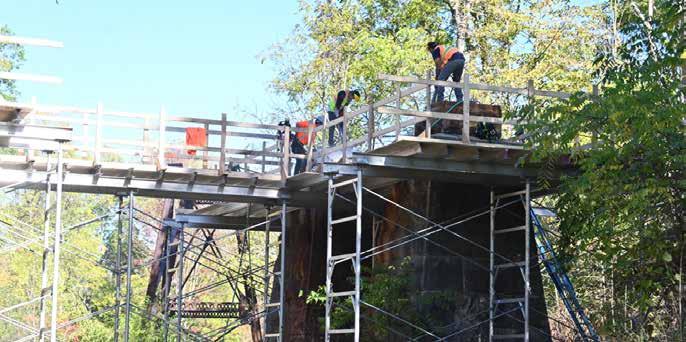
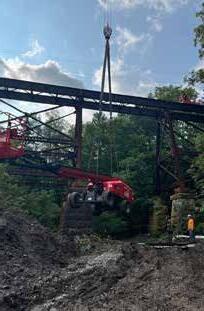
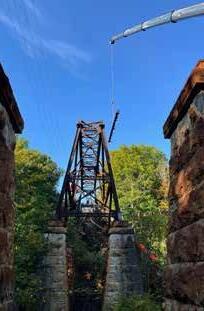
With the deck from the former Kinsmen bridge over Participark gone, crews have been concentrating on repairs to the masonry piers that will support the new bridge.
The bridge was part of the Great Western Railway, connecting Tillsonburg to Brantford, and was built in 1888. When the rail lines were removed, it was converted into a pedestrian bridge that connected the downtown to residential areas on the west side of town. The bridge was








slated for revitalization as part of the town’s 2025 capital projects, following its identification as needing replacement several years ago.
The new structure will be a modern steel girder bridge, but will still use the masonry piers from the original bridge for support.
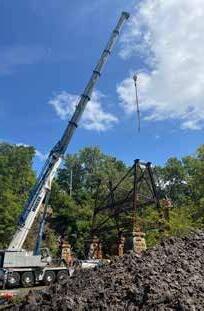
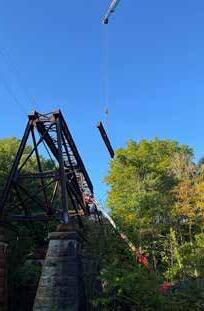
Crews from Lancoa Contracting have removed the bridge platform and the steel towers that supported it. Over the next few weeks, they will be removing the top two layers on the piers, which bear the weight of the steel girders. These will be replaced with new cement platforms.










(JEFF HELSDON PHOTO)
JEFF HELSDON Editor
Crews
Bridge. These piers will have a new top layer, new grouting and
Bridge expected to be open by the end of January
The grouting in between the stones will also be removed and replaced to make the structure more water-tight.
The cement work will continue into December, with the goal of completing it before cold weather arrives.
“In that time, the bridge is being manufactured by Algonquin Bridges and then delivered in sections in December,” said Leo Ferreira, the town’s manager of engineering.
He said the majority of the work is expected to be completed in January, with the bridge reopening by the end of January. Restoration of the trail below the bridge in Participark won’t take place until warmer weather in the spring.
This is later than the original planned date of having the bridge open by the end of the year. Still, Ferreira said finalizing the design drawings of the bridge to allow manufacturing to start took longer than expected.
A big piece of history will remain
Although the old bridge is gone, council opted to keep one of the metal towers that supports it as a piece of history. The original concept proposed was that several pieces of one of the towers could be incorporated into the Bridge Street reimaging or placed along Veteran’s Memorial Parkway.
“The idea was do we cut this up to and they give us the pieces we are looking for, or do we keep it intact,” Ferriera said. “If we keep it intact, where do we put it.”
A report on the subject was before council on Sept. 22. In his report, Ferriera said as the demolition proceeded, it was found one entire intact tower could be removed, instead of just pieces.
He asked council to decide if the tower would be cut up and moved to the public works yard for storage and then used in the future along Bridge Street or kept intact as a
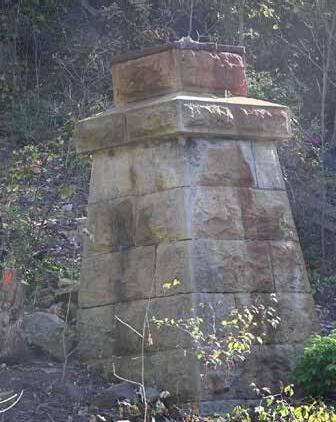
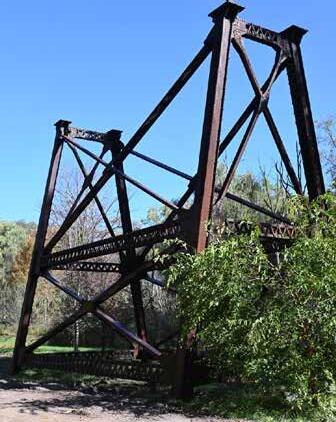
One of the steel towers that supported the
has been removed and will be preserved as a
structure.
monument to the town’s history. Council opted to keep the tower intact with it either being on display in Participark or adjacent to Veteran’s Memorial Walkway.
BRIDGE IN DEMOLITION
oodstock Ingersoll Echo
The scrap metal value from the tower, estimated at about $10,000, which Lancoa had incorporated into its bid, will be added to the project cost.
WAYS TO ACCESS NEWSPAPER!
local stories. View the current edition www.granthaven.com/woodstock-ingersoll-echo
receive each edition straight to your inbox. printed copy of the paper we will continue to drop community spaces.

SCAN FOR PICK UP LOCATIONS
NOTICE FOR PRINT SUBSCRIPTION CUSTOMERS:
With the ongoing Canada Post strike, delivery of subscriptions has unfortunately had to pause. As we did last time, we will be adding one week to your subscription expiry date for every week that the strike continues.
We apologize for the inconvenience and truly appreciate your understanding. Scan the QR code to find pick-up locations near you and stay connected with the good news!
Thank you for your continued support.



old bridge
monument to the old
(JEFF HELSDON PHOTO)
This view gives a good perspective of how the masonry piers were constructed with the cement bases on top to bear the load of the metal towers.
(JEFF HELSDON PHOTO)
This series of images, courtesy of the Town of Tillsonburg, illustrates the demolition process that was used to remove the bridge deck and piers. (TOWN OF TILLSONBURG PHOTOS)
Into year two with the Post FROM THE PUBLISHER’S DESK

This week’s newspaper seemed like an extra appropriate time for our team to celebrate the start of our second year at the Tillsonburg Post. The first edition of our newspaper was dated Sept. 19, 2024, and I’ll always remember the visit I had with Bill Pratt when I gave him the first-ever copy. There’s no one who was cheering for our success more than the legendary former editor of the Tillsonburg News.
This week happens to be National Newspaper Week, which takes place this year from October 5 to 11, 2025. The week is so named to recognize the critical role that newspapers play in an active and healthy democracy. Here in Tillsonburg, it’s a chance to highlight the work that our team does to keep the community informed and engaged regarding issues of local importance.
We are certainly blessed to have a wonderful team at the Post. In fact, it’s now an
award-winning team! Last month, the Tillsonburg Post was honoured at the Canadian Communication Newsmedia Awards in two categories. Jeff Helsdon and Jeff Tribe combined for third-place honours for best sports coverage in Canada, while Helsdon’s personal story about his grandfather serving in World War I was selected for second place in the country in the historical category.
Speaking of history, this week we celebrate the 200th anniversary of the founding of Tillsonburg with a special 40-page extra section. There are plenty of stories to tell, and I’m so pleased to see how it came together with so many local writers making contributions. To everyone who made this special edition possible, thank you.
When people ask me about what it is like to start a newspaper in present times, I tell them that each community is different, but that Tillsonburg is a special kind of close-knit community that has gotten behind this initiative like no other. Because of the enthusiastic support from readers and advertisers alike, we were able to graduate from a bi-weekly start-up to a thriving weekly newspaper in just nine months, which far exceeded our expectations.
On behalf of our entire team, I’d like to thank the entire community for all the support you have provided us in our first year, and we look forward to many great years ahead.

What a “Bonus” in the English teacher I ended up with

I attended Annandale High School in Tillsonburg for my secondary education. One of the more memorable teachers on staff was a lady of an indiscriminate age. We all thought she was quite ancient. She was no fashionista and frequently her dresses were buttoned up incorrectly or an unsewn hem drooped down on one side of her latest garment.
She was a bit of a “character” but in a very endearing way. Her main teaching assignment was English, and when I learned that she was going to be my English teacher for the year, other students “in the know” told me if I wanted to get high marks on my creative writing assignment, I needed to make sure that a cat appeared somewhere in the story line. I followed their advice and indeed they were correct about the need for a feline in any successful writing assignment that was to
be marked by this teacher.
My home was located one short block from, Broadway, the main street of Tillsonburg. The main post office was located across the street from the corner closest to our house.
The lady in question always carried an enormous handbag, which was also of an indiscriminate age. Whenever she crossed our very wide main street, she would tuck the handbag under one arm and hold up her other arm, palm spread in a stop gesture. Then she would step down off the curb and into the path of oncoming traffic.
When she got to the middle of the street, she would change the handbag and tuck it under the other arm while then holding up the opposite hand in the universal stop gesture.
Many times, we could hear, from our home, the screeching of brakes and the honking of horns.
“Oh dear” we would say “There goes that teacher to get her mail from the post office. I hope she’s OK.”
I was in her English class when an announcement came over the school PA telling us the terrible news that President Kennedy had been assassinated.
There was a long silence and then the good lady exclaimed, “My goodness, that reminds me of when Abe Lincoln was shot and killed.”
We all gasped and looked at each other as if to say, “I knew she was old but
WOW…..she remembers Abraham Lincoln?”
Rather unfortunately, it took away from the seriousness of the moment but the days that followed this terrible announcement are forever etched in my memory.
The following school year saw me with double lunch hours several times a week.
I decided to give up some of those lunch hours and take a typing course that was being offered at that time of day. My friends thought I was crazy.
“You want to be a teacher not a secretary” they said. “Why on earth do you want to take typing? You’ll never use it.”
My typing teacher was…you guessed it….the now famous English teacher.
She brought a turntable into the classroom, and we learned to type as it played music. She began with slow classical compositions. As we became more skillful at the keyboard, we graduated to marches and other more fast paced pieces of music. Sadly, no rock and roll music ever graced this typing classroom.
Years later, while taking school library courses, I often thought of that teacher and those lunch hour classes as I typed out card catalogue cards.
While others in the library course used the “one finger hunt and peck” method, my fingers hovered over the “home keys” and in my mind, I replayed some of those practice pieces of music as I completed library related typing assignments.
When technology arrived on the scene and we needed keyboarding skills, I again, silently thanked my former teacher. Whenever I write a short story or piece of prose, I again let my fingers first hover over the “home keys” before turning my thoughts into words and then into sentences.
Years later, this very same teacher was celebrated in the pages of a “Retired Teachers of Ontario periodical.” My former teacher was about to celebrate her 100th birthday. Counting backwards, I realized that she was ,at the best, in her early 50’s when I was one of her students. That got me thinking about how old my former students must have thought I was, when I stood in front of them as I taught a lesson. I knew I was in trouble when some kindergarten students asked me “Are you a girl or are you a lady?” From time to time, one of my Grade 8 students would ask me how old I was. My reply was always, “Older than 19 and younger then 99, that’s all you need to know.”
My time spent in the classrooms of this memorable high school teacher, were indeed a “bonus” . I will be forever grateful to her for her teaching skills and her infinite patience with students who did not, at the time, fully appreciate her efforts and her “unique” approach to life.
Norma Collis is a Tillsonburg author of several books, including “Tales from Holly Cottage”.
(JEFF HELSDON PHOTO) Autumn road.
NORMA COLLIS Tillsonburg Post Columnist WRITER'S CORNER
STEWART GRANT Publisher
A busy three months of events planned for Annandale NHS
Fetch your calendar, whether it is a cell phone or wall calendar, as you do not want to miss the events that are coming up at Annandale NHS
Previously I took you to the end of October, but I am slipping in a wee reminder about the big Founding Festival on Oct. 18 at the Complex and Memorial Park and Trick-or-Treating Friday, Oct. 31, 4–7 p.m., by donation. Wear your favourite costume and come and trick or treat in each of the rooms on the first floor of Annandale NHS (while supplies last). No age limit was noted. November is the month we start thinking and preparing for Christmas. Start early, to get that wonderful Christmas feeling. Avoid the rush and enjoy yourself at the same time!
Two hundred years ago what did they do at Christmas? Remember there were no nearby stores here then and virtually no cash to buy anything with. They did, however, have a forest and creek full of protentional. What would make for your family? What better way to get started getting ready for Christmas, but to make a special gift! Just happens, the top Christmas event list at Annandale NHS Christmas is the one for you!
Wednesday, Nov. 12 - Pioneer Christmas Ornaments Workshop 1:30 p.m., $25. All materials and supplies are provided. Pre-registration is required.
Nov. 22 to Jan 6th-2026 - A Pioneer Christmas Exhibit - An exhibition, exploring how our town’s first settlers and families, like the Tillsons, brought festive spirit and community cheer to the long winter nights
Fri. Nov. 28 - Christmas Open House Weekend Tree Lighting and Exhibition Opening 6:30–9 p.m. (part of Dereham Forge 200th Anniversary) - At 7pm watch as the Museum’s Christmas Garden is all lit up for the season! Then come inside and enjoy visiting Annandale NHS all decorated for Christmas and our seasonal exhibition, “A Pioneer Christmas”. Cost: By donation. Sat, Nov. 29th 10a.m.–TBA. Sun, Nov. 30th, 1pm–4pm. Admission by donation
Fri, Dec 19 - A Pioneer Christmas Tea, 1:30 p.m. - $25 (tax incl] Preregistration is required as this is a popular event you won’t want to miss! You will celebrate the holiday season with a delicious winter tea and goodies. Then have a guided tour of the 2025 Christmas exhibition, A Pioneer Christmas” and see Annandale NHS
decorated for the season. Ohhh, it is sold out, but wait, if enough people go on the waiting list, they could put in another day! It is worth calling Kate or Kathleen at 519 842 2294 Kbakos@tillsonburg.ca right away.
For teachers, there are school programs and home school programs. Be sure to call and get the information. I believe the star attraction every Christmas season are the rooms inside Annandale House. Each room is decorated by a volunteer, able to use a favourite theme or display a beloved collection in that room. Many moons ago I signed up to decorate the little sewing/smoking room on the second floor as a wildlife Christmas and recruited help from my wildlife rehabber friends. We decorated the tree and room with more stuffed animals, birds and probably a reptile, than you can imagine. I brought the large metal blue heron that resides in my living room, now known as Santa Heron, wearing a Santa hat. Held in his beak was a long list of things wildlife need and rehabilitators could use to help them. It was fun. I also recall a tree decorated with nothing but cups and saucers!! That was amazing!
Now don’t fret you have December to come and see the exhibits and tour the magnificently imagined and created rooms in the house. In fact, you have until Jan. 6th, 2026.
Annandale National Historic Site, is located 30 Tillson Ave.. Fall/winter hours are Monday -Friday 9 a.m. to 4 p.m. Sundays are 1 p.m.-4 p.m. For holiday hours, call 519 842 2294 or check social media: www.tillsonburg. ca/annandale or Facebook: AnnandaleNHS.
Tillsonburg driver faces multiple charges
An individual from Tillsonburg is facing impaired driving related charges after police received a traffic complaint regarding a possible impaired driver.
On Oct. 5, at approximately 2:30 p.m., the Oxford Ontario Provincial Police (OPP) Detachment were dispatched to a traffic complaint of a possible impaired driving, near Trillium Drive in the Town of Tillsonburg. Officers patrolled and subsequently located the vehicle.

Restoring small-town journalism, one community at a time!

Publisher
Stewart Grant • stew@granthaven.com
Editor
Jeff Helsdon • jeff@granthaven.com
Graphic Design / Sales Inquiries
Stacie Eden • info@tillsonburgpost.com Business Development
Heather Dunbar • heather@granthaven.com Administration
Jen Gaetan • jen@granthaven.com
Contributors
Jeff Tribe, Laurel Beechey, Debbie Kasman, Paul Knowles
36 Water St. St. Marys, ON, PO Box 2310 N4X 1A2 info@tillsonburgpost.com | 519.655.2341 | granthaven.com

Jagpreet Mann, 40-years-old, of Tillsonburg, has been charged with:
• Operation while Impaired - Alcohol
• Operation while Impaired - Blood alcohol concentration (80 plus)
• Dangerous Operation
A 90-day Administrative Driver's License Suspension (ADLS) and a seven-day vehicle impoundment was initiated as per statute.
The accused was released from custody and is scheduled to appear before the Ontario Court of Justice in Woodstock on November 25, 2025.
The OPP is committed to safety for all who utilize Ontario's roadways. Members of the public are urged to report Impaired Driving by calling 911 in emergency situations. Complaints of impaired, aggressive, or careless driving can also be made by calling 1-888310-1122.
Editor’s Note: Talented
Writer’s Corner is a new feature in the Tillsonburg Post, featuring the talent of our local writers.
Author Norma Collis has graciously provided material to launch this new column, but features are welcome from other local writers.
Submissions should be 600 to 800 words in length.
writers wanted
Submitted material doesn’t need to be about Tillsonburg, but a connection to the town is a bonus. Topics are diverse, but should not be business promotion or political opinion pieces.
E-mail editor Jeff Helsdon at jeff@granthaven.com with any questions.
LAUREL A. BEECHEY Tillsonburg Post Columnist
Glendale High School reaches fundraising milestone

“If each student brought a toonie, we’d be raising $1,600,” Ferguson said.
Prior to this year’s fundraising commencing, the school had raised $99,353 since 1989. The goal of raising $1,000 would put them over the top and was achievable. The final tally was $750, which put the total over $100,000.
“It's an impressive accomplishment for the students at Glendale High School to reach the $100,000 donation point, especially on the 45th Anniversary of the national Terry Fox Run,” said principal Melissa McKibbin. “Glendale students, past and present, should be proud of their collective efforts in supporting such a worthy and important cause.”
“Glendale should be extremely proud of their continued commitment to the Terry Fox
Foundation while celebrating the legacy that Terry Fox has left behind for us to continue,” Ferguson said. “Reaching the $100,000 fundraising mark over the past 28 years is an exciting milestone and we hope to raise thousands more in the future. For a smaller school, we are thrilled to have made a considerable impact.”
Ferguson volunteered to take over as event organizer after the retirement of Lloyd Renken, who held that role previously. He wanted to see the continuation of Terry Fox fundraising from elementary school to adulthood through the secondary school.
“He’s a fantastic role model for the students,” Ferguson said. “Doing something as a school to support the greater community is important as well.”
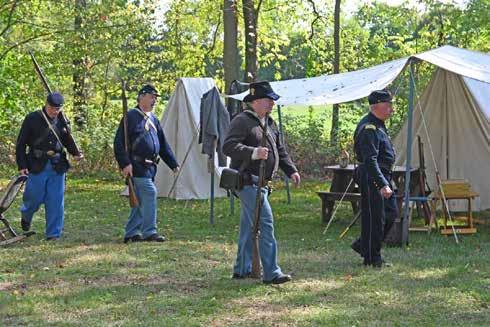
BRINGING HISTORY TO LIFE
Otterville’s Living History Reenactment was hosted by the South Norwich Historical Society on Sept. 27 and 28. The event highlights the role of Canadians who fought on both sides in the American Civil War. The event included a battle recreation, demonstrations and candlelight tours of the encampment. Union soldiers are seen here returning to their camps after the battle.




(JEFF HELSDON PHOTO)
Students and teachers raced each other in plasma cars as this year’s event in the annual student-teacher competition that’s part of the run.
(JEFF HELSDON PHOTO)
STATION ARTS GALA
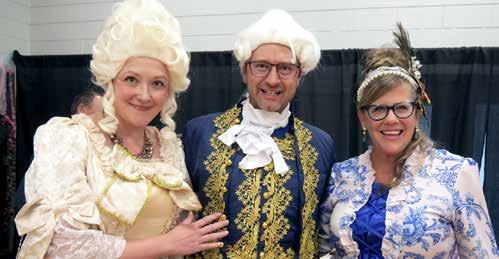
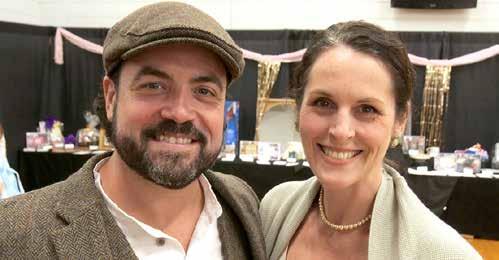

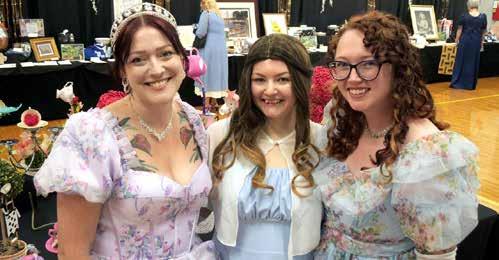






































Station Arts Centre celebrated its 29th Dinner and Gala Auction Saturday night at the Tillsonburg Community Centre. The fundraiser’s theme this year was ‘A Ton’s Night Out.’
From left are Anna Dickson, gala town crier Mark Dickson, and gala MC Kelly Spencer.
(CHRIS ABBOTT PHOTO)
Russ Power and Leslie Cameron, from SixPence & Sage, dressed up for Saturday’s Dinner and Gala Auction in support of the Station Arts Centre in Tillsonburg.
(CHRIS ABBOTT PHOTO)
Lance MacKenzie and Dr. Rebecca Heeney enjoyed the Bridgerton-inspired theme of A Ton’s Night Out on Saturday, a fundraising dinner and gala auction supporting the Station Arts Centre.
(CHRIS ABBOTT PHOTO)
Station Arts Centre gala committee members, from left, Tabitha Verbuyst, Cailey Coderre and Autumn Simeays mingle with guests Saturday night at A Ton’s Night Out, a fundraiser in support of the Station Arts Centre.
(CHRIS ABBOTT PHOTO)

Hurley’s focuses on quality
Hurley’s Mattress and Appliance in Tillsonburg will soon be on the move.
“We are moving our business this month,” said owner and store manager Jacob Knelsen, who with his wife Lena purchased the business one year ago from founders Bob and Irene Hurley. “We are expanding our business, which is very important to us.
“Right now, we sell mattresses and appliances – Whirlpool (including KitchenAid, Maytag, Amana), Electrolux (including Frigidaire), GE products and some others. That’s the appliances side. Then we do mattresses – Sealy and Serta, DreamStar, those are our main mattress brands that we carry.”
The expansion will see their building space grow from 4,500 square feet to 10,000 square feet.
“So we are going to be adding furniture to our store as a new category –and we are super excited about it,” said Knelsen who was recently at a trade show to look at new products.
“We are known for our quality, and we want to keep it that way. For example, Whirlpool, they are a well-known brand with a good reputation. So we want to stick with these big companies that have good products and good track records.

“With our furniture, we will be very selective with the brands we carry. Better quality products last longer, so that is our focus.”
Hurley’s Mattress and Appliance is also known for its service technicians, servicing most appliance brands – products purchased at Hurley’s or depending on the brand and availability of parts, other stores. They also sell parts.
“That is an area I want to grow,” said Knelsen. Customer service is a top priority at Hurley’s.
“Very, very important,” Knelsen nodded. “We work very hard at it.”
He recalled a recent text message from a customer after a local delivery, ‘Thanks Jake, I really appreciate you guys.’
“You know what? That makes my day. It’s what we do for our customers. It’s what I look forward to when I get up in the morning. The day I cannot serve our customers, I’m not here. So it’s good service at Hurley’s.”
Hurley’s will be moving from 15 Oxford Street, on the corner of Broadway, to 518 Broadway, former site of Broadway Cinemas.
“We’re almost there. November 1st, we should be in there. We want peo -
ple to know we will also be doing furniture, along with mattresses and appliances, but I don’t know if we want to do anything with our name. For now, we’ll stay the way it is –Hurley’s Mattress & Appliance.”
Including Knelsen, Hurley’s currently has about eight employees, and his wife Lena sometimes helps with the business.




“I would like to be able to say, within the next year or two, hopefully we’ll be up to 12 or so people. We will need more delivery and sales personnel.”
A grand opening will be held at their new location in November.





Jacob Knelsen, owner of Hurley’s Mattress and Appliance, is excited to be expanding his business.
TOWNSHIP OF NORWICH NEWS
Norwich request info on Oxford’s Partners for Climate Protection Program membership
LUKE EDWARDS
Post Contributor
Calling it a push for transparency, Norwich councillors are requesting a wide range of information on progress made and dollars spent by Oxford County combatting climate change.
Councillors approved a motion from Karl Toews at the Sept. 23 meeting that seeks information on the milestones Oxford County committed to when it joined the Partners for Climate Protection program in 2017.
“The public has a right to know what actions have been taken since then, what targets have been adopted, what progress reports have been filed and most importantly what this has cost,” Toews said at the meeting.
The program is free to join, and its website bills it as a “a five-step milestone framework that guides you (municipalities) as you take action against climate change by reducing emissions in your municipality.” Oxford County opted to join the program in November 2017.
According to Toews’ motion, the five-milestone framework includes completing a greenhouse gas (GHG) inventory and forecast, setting a GHG reduction target, developing a local action plan, implementing said plan, and then monitoring and reporting the results.
His motion requests the county to show what progress has been made on those milestones and how much it has cost the county to achieve them. It also requests copies of the progress reports that the county was supposed to submit to the Partners for Climate Protection every two years.
Going back to 2018, the motion asks for a year-byyear, line-item summary of the costs to the county for the program, climate change mitigation efforts and green energy costs, along with expected costs going forward.
In July councillors heard a delegation from Jacqueline Robinson opposing membership in the program and casting doubt on the dangers of human-caused climate change.

Scientists largely agree that human activity is causing the global climate to change in ways that have negative consequences for life on this planet.
Toews said his focus wasn’t on climate change itself.
“It’s not about how we may personally feel about spending on climate initiatives, it’s about getting a sense of what costs have been incurred,” he said.
And with property taxes at the county level increasing, he said local politicians have a duty to review how those tax dollars are spent.
“Since 2022, levies on Norwich residents for Oxford County services have risen by over 36 per cent… amounting to $31 million. That’s 31 million reasons why we can be asking for this information,” he said.
Toews’ motion nearly didn’t even make it on the floor, as Mayor Jim Palmer initially ruled it out of order, suggesting lower tier councillors may not ask questions of upper tier staff. However, Toews appealed the ruling and received enough support from council to move ahead.
Norwich still looking for information on Accountability Act
LUKE EDWARDS
Post Contributor
The township will be sending out another request for additional information on the proposed Municipal Accountability Act.
Back in January, Norwich councillors passed a resolution asking for Paul Calandra, who was then minister of municipal affairs and housing (MMAH), to provide clarity on the legislation. According to a motion from Coun. Karl Toews at the Sept. 23 township council meeting,
there has been no response as of the first of September.
The act includes several changes that will impact local municipalities, including “the creation of a new, standardized municipal code of conduct, an integrity commissioner inquiry process that would be consistent throughout the province and mandatory code of conduct training for members of council and certain local boards,” a spring press release from the province said.
However, Toews has concerns over part of the legislation that could allow for the removal of councillors.
“If this becomes law it will give the provincial govern-

ment the power to declare a duly elected councillor seat vacant for up to four years, which by the way as you know, is the full length of our term,” he said. It would require a severe violation of the code of conduct, though Toews said it’s not clear what constitutes a severe violation.
“So there’s definitely a potential for abuse, I think we can all see that,” he said.
With a provincial election that took place earlier this year and a new MPP at the head of MMAH, Toews said it’d be worthwhile to send another request for information.
Weekend Quiz
By Jake Grant
1. Where was Marco Polo born?
2. What is the name of Taylor Swift's newest album?
3. What is the maximum number of bitcoins that can exist?
4. How many US voting members of congress are there?
5. Who directed Casablanca(1942)?
6. Who is the Greek God of food?
7. What brightly colored monkey is the world's largest?
8. On what island was Jurassic Park located?
9. The Amazon river dolphins are what colour?
10. How many years did the "Great Plague of Milan" last?






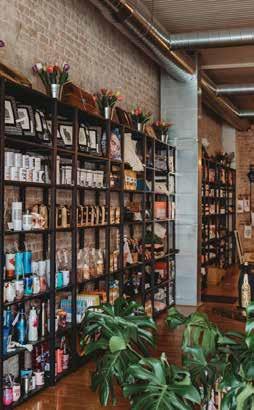










Photo: Danielle Cargill Photography


PHARMACY
Part of Tillsonburg’s Independent Spirit Since 1874
Find our weekly flyer at cowardpharmacy.ca 519-842-4081
165 Broadway, Tillsonburg
STORE HOURS:
MONDAY TO FRIDAY 9AM TO 9PM SATURDAY 9AM TO 5:30PM SUNDAY 12PM TO 4PM
Combining mathematics and horticulture in a positive volleyball equation
the experience,” Ferguson said. “There are kids with way more touches on the ball than we do.”
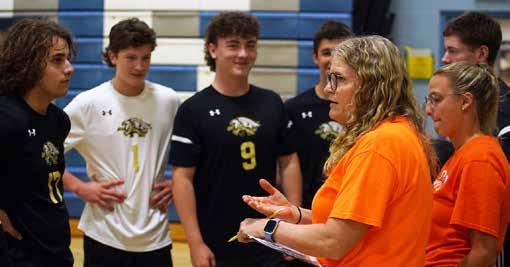
Krista Ferguson’s mathematical background allowed her to correctly assess the numbers from her Tillsonburg Gemini Thames Valley Regional Athletics senior boys’ volleyball 25-15, 25-17, 25-21 loss to the homecourt Woodstock St. Mary’s Warriors Tuesday, Sept. 30.
But her other teachable - horticulturecombined with growing up on a farm and currently being married to a dairy farmer may also contribute to her positivity around planting the seeds and nurturing growth toward better results in the future.
“We have a couple of good plays and it fills up my cup,” she smiled. “I’m happy.”
There is no shortage of athletic ability on the Gemini roster says Ferguson.
“We have everything we need to win games, but we don’t have club players.”
Tillsonburg’s main challenges include a lack of depth, a roster allowing one or two subs on the bench during games, as well as a comparative lack of volleyball experience compared to some competitors. The Gemini play an eight-game regular season along with a couple of tournaments, which doesn’t add up to the extended amount of game time enjoyed by many other squads who do have club members on their rosters.
The undefeated Warriors (5-0 as of press time) delivered the expected challenge. But Ferguson was pleased with her team’s response.
“We played with them, we got points against them,” she said. “The third set was close and in the second set we had them 13-12 at one point.
“They were mad we were ahead and they had the experience to fix it.”
The Gemini led 21-20 during the third set, before a few mistakes turned the tide toward a St. Mary’s win.
“We have all the skills, we don’t have


Her faith in the Gemini would be borne out that Thursday, Tillsonburg breaking into the TVRA Southeast win column with a tight 25-22, 25-19, 25-23 win over the visiting Woodstock College Avenue (CASS) Knights.
The junior Gemini also had their hands full at St. Mary’s, dropping a 25-15, 2513, 25-15 match which did feature a number of spirited rallies.
“We have a lot of potential,” said coach Melissa Jacko, of a young squad she believes will continue to improve. “It’s the beginning of the season, a lot of growth ahead of us.”
Tillsonburg has individual skill and abilities, she added.
“We’re going to work on bringing those individual skills together to build a winning team.”
Like their senior counterparts, the junior Gemini also broke into the win column Thursday, October 2 at home, downing the visiting CASS Knights in an exciting four-set match by scores of 2521, 26-28, 25-18, 25-19.
Gemini Scoreboard
Senior Football
Gemini 35, Aylmer East Elgin 2
Junior Football
Thursday, October 2
Aylmer East Elgin 35, Gemini 7
Senior Girls Basketball
Thursday, October 2
CASS 32, Gemini 12
Tuesday, September 30
St. Mary’s 37, Gemini 30
Junior Girls Basketball
Thursday, October 2
Gemini 33, CASS 13
Tuesday, September 30
St. Mary’s 16, Gemini 13





JEFF TRIBE Post Correspondent
(JEFF TRIBE PHOTO)
Tillsonburg Gemini junior L. Morse gets a shot in against Woodstock St. Mary’s Warriors blockers J. Mazurklewicz and D. Santos.
(JEFF TRIBE PHOTO)
Gemini senior coach Krista Ferguson makes a point during a break from a Tuesday, September 30 match against the Woodstock St. Mary’s Warriors.

It’s time to take a fresh look at your financial strategy I believe when it comes to your financial future, you deserve a personal relationship and professional advice.

End of season wrap-up

The season wrapped up on Tuesday night on a beautiful night where in between championship games we paid tribute to Darrell Smith. The teams participating, players from other teams and spectators alike were very respectful. All three of his sons, Craig, Kyle and Connor, were also in attendance. Dag(Steve Byron)broke out his yellow pants for the game as Darrell would ask him each night where his yellow pants were. All in all, it was a good season in Men's SloPitch, andthe executive did a great job. Chris Parker's dedication and leadership as president is the reason for the success.
Kurt Vaughan did a tireless job as umpire in chief and also in his dual role as A Division convenor. Josh Stubbs has really stepped up in many ways as well as being the C Division convenor. This is probably the toughest division to look after with the influx of new players and teams. Parker also served as the B Division convenor. Cheyne Sarafinchin kept the finances on track serving as treasurer. I did my usual job tracking rosters and looking after stats. The rest of the executive volunteered when called upon.
Thanks to those who gave up their time to umpire, listing in no particular order, Mike Schmeltz, Troy Temple, Jeff McKay Kurt Vaughan, Judy Legg, John Nichols, Paul Blouin, Chris Parker and Dave Weaver.
The league doesn't happen without the players that participate. Thanks to everyone and their
Sharon
32 Brock Street West Tillsonburg, ON N4G 2A2 Bus. 519-842-4382 • Cell 519-639-2651
sharon.jacques@edwardjones.com www.edwardjones.ca/sharon-jacques
sponsors. Also, thanks to the spectators that make viewing slo-pitch a part of their nightly entertainment!
Men’s A Division
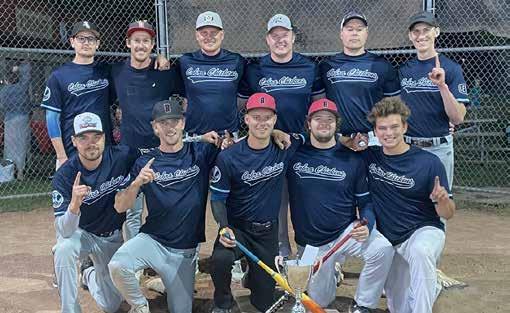
We have a new first-time champion as Legend Rubber Cobra Chickens mercied The Mill to capture their first title! They finished third in the regular season just slightly behind second place Leeswood Construction Dirty Mitts.
Legend Rubber Cobra Chickens-22, The Mill-7
Legend-Brian Dyck 4-4; Jared Froese 4-4; Caleb Reimer HR; Jesse Froese GrSlam, 2HR; Ethan Froese HR; Marcus Enns HR; Wyatt Blatz HR.
The Mill-Bob Evans 2-2; Josh Stubbs 2-3; Steve Derks 2 HR.
Game Synopsis-Legend was not going to be denied as they put sevenacross in their first atbat. Jesse Froese highlighted the rally, hitting a grand slam. The Mill could never get their offence going, which is uncharacteristic of them, and they went down in order in two of their five at-bats.
Legend was full value for the win and the addition of clean-up batter Jesse Froese for the night paid dividends as he homered in three of his at\bats. It was a team effort as 10 of their 11 batters had at least two hits and scored at least one run.
Men’s B Division
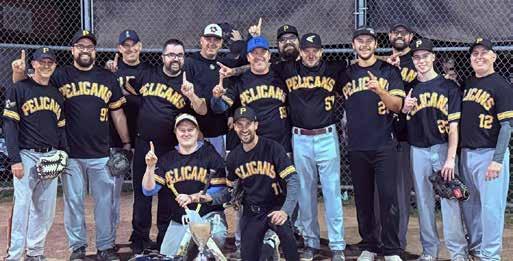
We had another first time winner in the B Loop. After three unsuccessful tries, the Perlicans captured their first title, winning by nine in the fourth game of their series with the new franchise At My Playground/IQT Logistics. It was quite an accomplishment for the first year team who had a successful fourth-place finish in the regular season reaching this year's final. Pelicans had finished second in regular play.
Pelicans-16 At My Playground/IQT Logistics-7
Pelicans-Steve Leacock 4-4, HR; Adam Jensen 3-4; Jeff Cadotte HR; T.J.Nevill HR.

32 Brock Street West Tillsonburg, ON N4G 2A2
Bus. 519-842-4382 • Cell 866-536-6844
mark.bruder@edwardjones.com www.edwardjones.ca/mark-bruder
A.M.P. -Gavin Balazs 2-3; Trent Masschaele 2-3; Brandon Balazs HR; Travis Lamb HR. Game Synopsis-A.M.P. were without two of their bigger bats in their lineup but were able to hang with the Pelicans until the veteran squad rallied for six in the fifth. Pelicans first baseman

Our Sponsors:
Benjamin Moore
Boston Pizza
Steve Leacock got healthy at the right time of year as he homered again, doubled and scored three runs. T.J. Nevill also homered and doubled and shortstop Rob Down had another strong game defensively. A.M.P. outfielder Brandon Balazs hit a long homer, singled and gunned down a runner at third base.
Special Olympics Tillsonburg wants to say THANK YOU TO ALL OUR SPONSORS for supporting our 2025 golf fundraiser.
Broadway Family Dental
Brokerlink
Carvalho Chiropractic
Coca Cola Bottling
Canada
Colour Code Collision
Couture Family
Country Table
Courtland Firefighters
Association
Detailz Plus
Fountain Tire First Street
London
Flooring Canada
Tillsonburg
Future Transfer. CO. Inc
Garden Gate Tillsonburg
George’s Auto-Steve
Sandham
Gentrac Building
Corporation
Jerry’s Scrap Yard
Joseph’s Furniture Inc.
J&S Collision Services
JourneyWell-Amanda
McCooeye
Kesco/St Thomas Tool
& Die
Lockhart’s Odyssey
Lorriane Davis
M&J Tirecraft
Old Cut Marina Ltd
Verne’s Carpet One
Royal Glass &Mirror
Sinden Family
Stauffer Motors Ltd
Swiss Chalet
System Air
T.A. Thomson Electric
Contactors
Terry Willaert
Tillsonburg Cars
Tillsonburg Glass
Tillsonview Golf
Tillsonburg Veterinary Centre
Tillsonburg Denture
Clinic
Whyte Auto Parts (Napa)
The Copper Mug
VLG Insurance Group Ltd
Voyago/Transdev
Walter & Diane Kleer
Wards Auto
Pet Valu
Old Cut Dairy Bar
Dan Priester
Martin Auto Body
IQT Logistics
At My Playground
Equipment Centre
Simcoe 2.0 Limited
Herc’s truck Service
William Douds & Son
Mark McKenny
Holmes, Kocheff & Good LLP
Cowards Pharmacy Ltd
Tim Horton’s Broadway
Tim Horton’s Simcoe, Oxford Street and Town Centre
Maurice J Verhoeve
Funeral Home
Special Thank you to Ben & Janet @ Tillsonview Golf for hosting this event. Also to JTK Meat Shoppe for catering our delicious meal. Looking forward to everyone’s support next year on Saturday August 8, 2026
DAVE WEAVER Post Columnist
(CONTRIBUTED PHOTO)
Legend Rubber Cobra Chickens were the winners of A Division in Tillsonburg Men’s SloPitch. Left to right are: (top row) Wyatt Blatz, Leonard Fehr, Jesse Froese, Ethan Froese, Marcus Enns, Jared Froese (bottom row) Caleb Reimer, Marcus Enns, Brian Dyck, Ethan Fehr and Nathan Froese.
(CONTRIBUTED PHOTO)
Pelicans were the winner of B Division in Tillsonburg Men’s Slo-Pitch. Left to right are: (back row) Rob Down, Adam Jensen, Jeff Cadotte, Chris Parker, Steve Leacock, Nick Wilson, Andrew Dawson, Joe Kingsbury, TJ Nevill, Ryan Verbyust, Ryan Marques, Matt Summers, (front row) Brandon Travers and Kevin Buchner.
Thunder open the season with a tough win
What a first weekend for your Tillsonburg Thunder.
The Thunder season starts with all of the October games on the road. The Thunder is pretty much a new, young, and fast team.
First up was the Seaforth Centanaires, last year's regular season champions. This is no easy task for a new team to start on the road against such a seasoned opponent. Seaforth opened the scoring at 16:53 of the second period after a scoreless first period. The Thun -
der did not wait long to even it up at 14:52, with new Thunder player Robert MacLean scoring from Roberts and Tye Johnson. MacLean scored again short handed from the aggresive forecheck of Danny Attridge. Roberts added an insurance goal at 8:01 of the third Seaforth came back at 6:13 to make it 3-2. The last 1:09 of the game was extremely tense as the Thunder were two men down and with the Seaforth tender pulled, created a 6 on 3 situation. Incredible defensive play by the penalty killers and outstanding goal tending by Zack Johnston held them off for the Thunder win. Final shot totals were Seaforth 32, Tillsonburg 27.
Questions are coming in from fans about the live streaming of the game. Unfortunately, not all arenas have internet. Such is the case in Seaforth. We could not even get a signal to put out the period scores via social media. We will try to at least share scores as they occur.
The next Thunder game is against the Dunnville Aeros on Saturday, Oct. 11 at 8 p.m. in Dunnville. I believe they have Internet access so hopefully we can stream it. To ensure viewing the game, make the trip to Dunnville. A significant number of Thunder fans make it to Seaforth and were they ever loud.
Bridging the need for more card players
JEFF HELSDON Editor
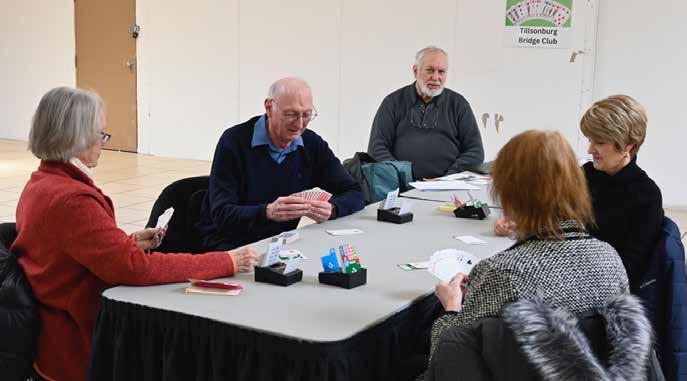
The Tillsonburg Bridge Club is looking for more card enthusiasts to join their ranks.
Anyone who knows about bridge realizes that tournaments are the big push. However, Rick Martin, president of the club, realizes there needs to be a less-advanced alternative to teach more people about the game and increase the club’s numbers. The club is hosting Wednesday night games at the Tillsonburg Seniors’ Centre for beginners, starting at 7 p.m.
“It’s going to be much more relaxed than the tournaments we have run,” he said.

Tillsonburg Post
Thursday September 11, 2025
Ad Size: ¼ Page Vertical – 5.1 x
Rocking Tillsonburg for over 70 years
TRY CURLING
<Add photo of a youth curler>
YOUTH: Our youth curling program is designed to introduce children to one of the fastest growing sports in Canada. Regardless of gender or physical prowess, curling offers every child an opportunity to participate as an equal member of a team. Age: 8 to 18-years
Free Friendly Bridge Games
All ages from 10 to 100
All levels from novice to expert Lessons for learners
Friendly competition for all Light refreshments
Youth Try Curling: Tuesday October 14. 6:00 to 7:00 pm
Youth Try Curling: Tuesday October 14, 6:00 to 7:00 pm
ADULT: Our adult program is designed to introduce adults to the sport of curling. Both delivering from the hack and using the delivery stick will be a part of the one-hour session.
Adult Try Curling: Wednesday October 15, 7:00 to 8:00 pm
Adult Try Curling: Wednesday October 15, 7:00 to 8:00 pm
Both Try Curling sessions are FREE RegistraFon is required online at CurlTillsonburg.com


Wednesday evenings at 7:00 pm
Tillsonburg Community CentreSenior Centre door

(JEFF HELSDON PHOTO)
Members of the Tillsonburg Bridge Club were in the Tillsonburg Town Centre this winter, demonstrating how the game is played to try to attract more players. The club is holding introductory nights on Wednesdays for new players.
MIKE HOLLY Post Contributor
Technology a big part in Andress’ new solo album



JEFF HELSDON Editor
Technology played a unique role in the production of Ben Andress’ new album with the musicians all supplying their tracks for the same songs remotely.
Called “Benjamin Clean Up and Then Heard A Sound”, Andress is upfront in admitting the name is a parody on the title of a Robert Munsch book.
“His stuff was kind of surreal and a lot of things happen in his children’s books that could never happen in real life,” he said.
The story of how this album came to be follows his career development. He started sol and then was in a band called The Smile Case with bassist Share McElhone and drummer Jackson Cronmiller in 2013.
The group put out two albums and then McElhone retired from music. Andress was up front in saying there are portions of a complete soundtrack he can’t do himself, such as drums. He started sending tracks to people he knew for them to assist him. Then, this thought was expanded through a web site for musicians.
“I even found complete random
strangers I hadn’t used before to see what would happen with that,” he said. “I experimented with computers and technology to see how they would turn out.”
Andress describes the album as on the “rock spectrum with punk roots”. He grew up listening to FM 96, and explained there is a Tom Petty influence on the album.
Asked if it’s a goal to have the album play on the new CKOT, Andress answered, “It would be nice. Last time there was a station here, it was ‘We’ll play your stuff but you have to buy a bunch of ads first’.”
A music video for the song “Slit My Throat” was produced by another local, Dalton Puhr.
“His style is sort of DIY, which is my background too,” Andress said.
He went to Niagara College for radio, television and broadcast. Andress now runs Blacktop Records, a record label he owns that promotes lesser-known artists, and is a booking agent for bands. While Andress did tour with The Smile Case, he isn’t planning that for this album as he has a young family.
The album can be found on Spotify and Apple Music under The Smile Case.
























(JEFF HELSDON PHOTO))
Tillsonburg Post music columnist Ben Andress recently released a self-produced solo album that was completed by using tracks recorded by other artists and combined electronically.
Author talks about “Breaking the Silence”
JEFF HELSDON Editor
A Canadian military author will be speaking on his experiences with getting veterans to speak of their combat experiences – a topic the majority don’t ever discuss.
Ted Barris will be speaking at a dinner/presentation at the Royal Canadian Legion on Friday, Oct. 17. Cost of the event, including a roast beef meal, will be $25.
“It’s a talk about my ex-
perience in talking to veterans about stuff they don’t like to talk about,” Barris said during a phone interview. “Once they understand how genuine I am, and prepared for their defensive mechanisms, I get through.”
The talk is based on his 2009 book “Breaking the Silence”. Barris began this journey more than 50 years ago, allowing him to talk to First World War veterans that were still alive at the time.
He said he is not belliger-
ent when talking to veterans, but is understanding.
“I have a fair record for making veterans feel comfortable, and the stories eventually come out,” he said.
He will be sharing five or six of those stories during his talk.
“One of the guys I talk to, said every time he heard a bang, he hit the ground,” Barris said.
He interviewed a Korean War veteran who was unable to talk to his girlfriend after returning home be -
cause he was so traumatized.
Another story is about a veteran from the Women’s Canadian Naval Service who helped save a Zellers store during a riot in Halifax after VE Day celebrations in 1945.
“She was there and saved a Zellers store. In the middle of this insanity, she stepped up and prevented this place from being torched,” Barris said.
He will also talk about stories heard from Afghanistan veterans.
“The younger veterans are different than the old ones,” Barris said. “This is because they haven’t yet worked out a script in their heads on how to answer what happened.”
In particular, he will relate discussions he had with the friendly fire incident survivors in April
TED BARRIS

“For me it’s about people. Too many military historians get caught up in counting rivets, they’re more interested in the machinery and technology. That’s fine but I’m more interested in people stories,” he said. All the stories aren’t dark and horrifying, some have a humorous element.
“It’s sometimes the humour of these moments that get them through this.,” he said.

LANGTON FAIR
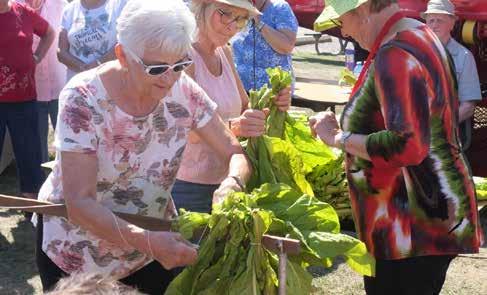
Mary DeCloet, on the left, ties tobacco with teammates Godelieve Townsend and Agnes MacLeod at the Langton Fair, winning the first-place prize. The tobacco tying contest is one of many events for the annual fair, which was held Sept. 17.
(CHRIS ABBOTT PHOTO)
(COINTRIBUTED PHOTO) Ted Barris is author of “Breaking the Silence”. The 2009 publication talks about veterans’ experiences during war.
Taste sensations in the south of Spain
OH, THE PLACES WE’LL GO!
I came home from Spain determined to replicate at least two of the amazing taste treats we had enjoyed there: paella, and sangria. I didn’t know what I was setting myself up for.
It goes well beyond paella and sangria; the south of Spain is a cornucopia of flavours, and we had the chance to sample many of them. The sundry small dishes, both hot and cold, served as tapas, either as appetizers or gathered on a larger plate to make up a delicious meal. The fruits and vegetables, especially the citrus fruits. The fresh fish of all kinds. Meats, cheeses, and olives, olives, olives.
And, of course, wine. Especially the very good, very cheap Rioja wine. But let’s start with paella. Paella is a
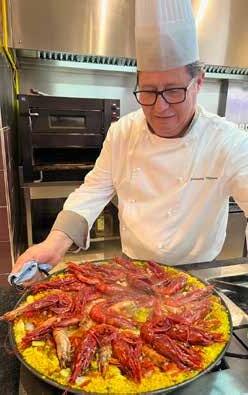
very common Spanish rice dish. You start with rice, and add stuff. Okay, perhaps the recipe is a bit more complicated than that. As ably demonstrated by the chef in Torremolinos who gave us a lesson in making paella.
First point – this ain’t any ordinary rice. This is round rice, or bomba rice.
In our particular case, the chef must have had some of his budget left over from the previous fiscal year, because he splurged. The ingredients of this particular paella included astonishingly big (and, it turned out, over-the-top delicious) prawns that cost 200 euros, just for this paella. He then added two others kinds of shrimp, mussels, clams, three or four kinds of fish, calamari, onions, red peppers, garlic, saffron – probably more expensive than the prawns – olive oil (of course) and broth. Each added at just the right time.
And then – this is one of the tricks of paella – it sits and simmers in the shallow frying pan for a long time, without burning.
It was amazing.
And then, the sangria. I have always enjoyed sangria, or at least I thought I did. But what I have enjoyed here has been a concoction of red wine, some kind of juice, and chopped fruit. Our Spanish hosts would use this to water
grape vines. Maybe.
Our young, jovial sangria mentors broke out bottle after bottle, in the end producing utterly delicious and significantly powerful sangria. Red wine, of course. Rioja, in fact, specifically Anciano Old Oak Tempranillo. Fanta orange, of all things. And then, the alcoholic dynamite: generous, 10-second pourings of Triple Sec, another of Sweet Vermouth, and perhaps a bit longer pour of a Spanish liqueur called “Licor 43”. Add four spoonfuls of sugar for each jug, and sundry fruits – we had apple, oranges and perhaps some other unidentified species. All we knew, after generous tastings, was that this was sangria to die for. And our home-grown, simple recipes would never again suffice!
We brought these recipes home with us. But one highlight of the trip – a lunch-time repast served in the home of Maria, our Spanish hostess – brought us no new recipes.
That doesn’t mean we didn’t want them. But friendly, jolly, lovely Maria absolutely refused to share her secrets with us. The meal began with a board of cold meats, cheeses, bread, olives and a salad. Second course, an egg soup. The main included pork and scalloped potatoes. Dessert, we called Custard de Maria, because it was wonderful and unidentifiable. And Maria was no help – just as she was not when we asked for the recipe for her amazing cookies, served with coffee.
By the time she had smiled and refused to divulge secrets through several courses, we gave up, and enjoyed the post-meal liqueur, a home-made taste treat made from locally grown quinces. To get to Maria’s dining room, we had climbed long, cobbled streets in a downpour. We all agreed it was more than worth the effort.
The adventures in cuisine never stopped. We sampled about every citrus fruit known to humanity at the Finca Juanito orchard. We wandered through a market in Ojen stocked with every kind of fresh fruit and vegetable. We tasted olive oil at the Mon Dron Co-op (there are 350 million olive trees in the country. In fact, Spain exports olive oil to… of all places… Italy.) And at the Hotel-Retaurant Balcón de los Montes, we started the day with churros, a fried
dough pastry which may not sound too exciting, but when coupled with coffee well laced with brandy, are a great treat. Or it may have been the brandy.
As I said, I came home determined to create some of these great tastes in my own kitchen. I started with paella. And quickly discovered that virtually no grocery store in this area sells round rice. Many, many, many other kinds of rice, but no bomba round rice.
I even made several excursions to stores where the internet affirmed the presence of round rice. Nope.
Finally, I found it in a little Portuguese grocery store in Kitchener. I launched the experiment. I did not buy million-dollar prawns, but that didn’t seem to matter, because my paella worked, much to my surprise – and that of my partner.
But for the real stuff – skip my kitchen and go straight to Spain.
Paul Knowles is an author and travel writer, and Past-President of the Travel Media Association of Canada. To contact Paul about travel, his books, or speaking engagements, email pknowles@golden.net.







PAUL KNOWLES Tillsonburg Post Columnist
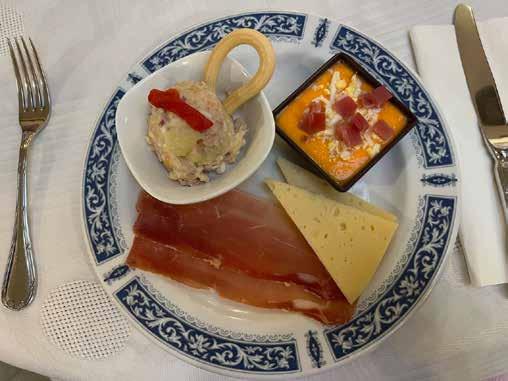
A typical tapas lunch, this one served in Malaga.
(PAUL KNOWLES PHOTO)
Our chef in Torremolinos, with spectacular paella.
(PAUL KNOWLES PHOTO)

SnackRite stresses quality, homemade food
Offering fresh, quality West African cuisine is the emphasis of SnackRite.
The restaurant, which opened on March 22 at 145 Simcoe St., is owned by John and Olaide Araoye. It offers something different when searching for international cuisine locally should check out SnackRite.
Oustide of their location on Simcoe Street, the couple

have been promoting their food at local events, such as TurtleFest and the Tillsonburg Seniors’ Centre sampler event. They sold out of food at TurtleFest, and have gained a few customers from both events as people learn about their offerings.
The eatery is the first restaurant the Araoyes.
Moving here from Nigeria, they noticed a void in this style of cuisine in Tillsonburg.
“We didn’t find any West African here so we opened,” John said.
They described the food as authentic, traditional type of cooking using spices.
“It’s not like the traditional burger we eat everytime,” John said.
The food is all fresh.
“We get it fresh from the farm,” Olaide said. “We don’t use processed food.”
“We don’t fry anything,” John added. “The only food we fry is French fries.”
Meat pies are one of the main features on the menu.

Jollof rice and chicken is the best seller to date. The menu also has seafood soup, peppered chicken, peppered turkey, peppered goat, fried plantain and many other unique items.
On the dessert side, puff bites are a feature.
“It’s similar to Tim Bits, and less sugary,” John said.
“It’s not hard, it’s soft,” Olaide added.
The reception to their food at their TurtleFest booth was overwhelming. They sold out of all their food.
“A lot of people bought our food, left and came back
again,” John said.
TurtleFest was an example of the catering SnackRite offers for weddings and birthday parties.
The couple have lived in Tillsonburg since 2023. John had a career in IT as a project manager after attending university in England.
“We decided let’s look for more opportunities, somewhere we could raise our kids to be nice people.,” he said. “Canada looked welcoming as there’s lots of multicultural people, so we decided let’s give it a shot.”









John and Olaide Araoye recently opened SnackRite on Simcoe Street in Tillsonburg. The restaurant features West African cuisine.
Where the riffs run free: Blind Dog Joe returns to

Few musicians in Oxford County embody the balance between passionate energy and honest storytelling quite like Tillsonburg’s Rob Cromwell. Whether it is a stripped-down acoustic set or a full band jam with his bandmates in Woodstock-based band Blind Dog Joe, Cromwell has a knack for reading the room and making every performance feel personal. This Saturday his band makes their return to The Cop-
per Mug for what promises to be one of the most dynamic live shows of the fall.
“When I perform solo there is a sense of freedom that comes with it,” Cromwell explains. “I can play whatever songs come to mind in the moment and I’m more flexible when it comes to audience requests. There is no need to make sure the whole band knows the tune. That said, playing solo has its own unique challenges. I do not use many effects, no looping station - just me, my guitar and my voice. The real challenge lies in capturing all the key elements of a full song and distilling them into a single instrument without losing the essence or feeling of the original.”
That stripped-down approach contrasts with the wide-open energy of Blind Dog Joe where collaboration and chemistry take the lead.
“On the other hand, playing with Blind Dog Joe opens up a different world,” Cromwell describes. “It allows me to tackle songs that would not work in a
OCT. 9 - OPEN MIC W/ BILLY GIBBONS
Paddy's Underground No Cover - 7:30 p.m. - All Ages/Licensed
OCT. 10 - 50+ KARAOKE
Tillsonburg Senior Centre - 1:30 p.m.
OCT. 11 - BLIND DOG JOE
The Copper Mug - No Cover – 8 p.m.
OCT. 15 - EUCHRE NIGHT
The Copper Mug - 6:30 p.m.

solo setting. The added layers of bass, percussion and another guitar bring a fullness and colour to the music that you just ca not replicate alone. With the band I get to really let loose and crank up the energy, while my acoustic solo shows are more intimate, laid-back and personal.”
Rob Cromwell’s love for music started at a young age with an enthusiasm for the heavier side of it.
“I started playing guitar a long time ago at the age of seven. Now, at 52, I have spent decades growing and evolving as a musician,” Cromwell says. “During my teenage years, when music really started to mean something to me, I was drawn almost entirely to heavy metal. Bands like Ozzy, Metallica, Megadeth, Sepultura and Slayer were all I wanted to listen to and play.”
While some of his peers that played music chased finger dancing guitar solos, Cromwell found his groove in rhythm guitar, which is the engine that
keeps a band moving.
“Back then the heavy driving riffs captured my attention. While most of my friends were obsessed with shredding lead guitar, I found myself gravitating toward rhythm,” Cromwell explains. “Looking back, I’m glad I did. That focus helped build the muscle memory in my hands and gave me the ability to keep the 'train' on track while singing the melody. It is kind of like rubbing your stomach and patting your head at the same time then switching hands without missing a beat.”
Over the years Rob’s taste has broadened to include everything from country to pop, soft rock to easy listening which can be seen as a reflection of his musical curiosity and evolving artistry.
“Since those early days, my musical interests have expanded to include country, grunge, pop, classic rock, soft rock and even some easy listening. I believe that broadening my focus over the years has played a big role in shaping my sound and
OCT. 16 - OPEN MIC W/ BILLY GIBBONS
Paddy's Underground No Cover - 7:30 p.m. - All Ages/Licensed
OCT. 16 - JAY RAWK
The Copper Mug - No Cover - 8pm
OCT. 17 - CRUSH
The Copper Mug - No Cover – 9 p.m.
OCT. 18 - BACK TO THE 50'S CONCERT
St. Paul's United Church
$50 - 2:30pm - All Ages



style today.”
That diverse mix shines through in Blind Dog Joe’s live performances which is full of off-the-cuff moments, improvised transitions and that undeniable onstage connection.
“There have been so many great moments with these guys just sitting around in the practice space, messing around with different ideas,” Cromwell reminisces. “Someone will play a riff or a groove that reminds someone else of a song and suddenly it is, 'Hey! We should play that one!' There is a real chemistry between us that we can all feel when we are performing. We feed off each other’s energy and sometimes it just takes a look, a smile or a nod to know that the song is about to shift in a new direction. It is that unspoken connection that makes playing together so special.”
Fans can expect plenty of that same magic when the band hits the Copper Mug stage this weekend.
“The upcoming show at The
Copper Mug in Tillsonburg is going to be a blast,” Cromwell exclaims. “I do not want to give too much away but anyone who makes it out is in for a wild ride. There are a few songs in the setlist that might just make your head spin! Maybe it is the influence of my solo work where I jump between genres all the time but Blind Dog Joe does a fair bit of that too. We love mixing things up and we often hear people say things like, ‘I can’t believe you went from that song straight into that one!’ It’s always a lot of fun and I’m really looking forward to the show.”
Blind Dog Joe takes over The Copper Mug located at 79 Broadway Street in Tillsonburg on Saturday October 11th. Doors open at 8 p.m with music going until midnight. This is a free event with no cover charge. For more details on the band Blind Dog Joe and upcoming concerts you can follow them on social media at www.facebook.com/BlindDogJoe
OCT. 18 - THE MAHONES W/ THE MCBAINS
Paddy's Underground
$25 - 8pm - All Ages/Licensed







at funnelcakefactory.ca or funnelcakefactory24@gmail.com

332810 Plank Line
Elgin, Ontario N0J 1N0 519-842-7845 | ostrandervet.ca ostrandervet@xplornet.ca




Colouring Fun
Turkey Talk
Funnies for the whole family!
Why was the turkey in trouble?
He was suspected of fowl play.
Why were there no cookies on the Thanksgiving table?
Nobody wanted the “crumby” job of baking them.
Why did the turkey put down his fork?
He was stuffed!
Why did the turkey get kicked out of his rock band?
He lost his drumsticks.
Spelling Scramble
Unscramble these Thanksgiving mystery words!
Contact





RIDDLES
I have a wattle, feathers, and a proud little strut; I “gobble” in October—what am I?
Turkey
I’m a boat without oars, poured from a spout, I sail over mashed potatoes and spill if I’m out. What am I?
Gravy
I’m stuffed before I’m eaten, baked before I’m served; bread and herbs inside—what am I, you’ve heard?
Stuffing
Orange and round with a buttery crust; add spice and cream—serve me or bust! What am I?
Pumpkin pie
I’m tart and red, jelly or whole; I sit by the turkey and sweeten the bowl. What am I?
Cranberry sauce
I’m a horn without sound, overflowing with food that’s found. What am I?
Cornucopia
I’m passed around the table, I’m warm and soft to tear; spread butter on my belly if you dare. What am I?
Dinner roll
I arrive with parades and cozy cheer; we gather ’round and give thanks each year. What day am I?
Thanksgiving
I’m crisp and sweet, from orchard trees; baked or sauced, I’m sure to please. What am I?
Apple
SUDOKU
PET


COMING EVENTS
ST. PAUL'S UNITED CHURCH FELLOWSHIP CLUB PRESENTS: OKTOBER FEST+
BACK TO THE 50'S CONCERT
October 18: 2:30 p.m.
88 Bidwell St., Tillsonburg
Non-alcoholic beer, live music, food. $50 advanced ticket sales only. Join us after the concert for authentic German food + fellowship. Contact Dianne Parnell @ 519871-3454 or stpaulsaots84@gmail.com.
OTTERVILLE UNITED CHURCH'S HAM SUPPER
October 20: 5-7 p.m.
231 Main Street E., Otterville Adults $20, Kids 6-12 yrs $8, Kids under 6 FREE.
For tickets, call Helen at 519-879-6883.
ROTARY BOOK FAIR
The Tillsonburg Rotary Club is holding it's fall book fair at the Tillsonburg Mall until Saturday, October 11. Give your used books, CD's and puzzles a new home! Help the environment by bringing your own bags to take home your purchases.
LET’S FALL INTO COUNTRY MUSIC WITH THE INGERSOLL COUNTRY MUSIC JAMBOREE at the Masonic Hall, 190 Thames St., Ingersoll, 1-4 p.m. every other Friday.
October 17 & 31, November 14 & 28, and December 5. Join us. Walk ins welcome. Qualifications, love 50-70’s country music, perform, listen, dance, and enjoy.
CWL RUMMAGE SALE
St. Mary's Church in TILLSONBURG, corner of Venison and Rolph Streets.
Saturday, October 18: 9 a.m. until 1 p.m.
A large selection of clothing and footwear for the entire family. Houseware, glassware, linens, home decor, paintings, toys and trinkets. Christmas decor, jewelry, books and much more. Find us in the fully accessible church hall.
Everyone is welcome. Admission is free. Please bring a bag (or two) to bring home your treasures.
DELHI & DISTRICT HORTICULTURAL
SOCIETY
ANNUAL FUNDRAISER "SILENT AUCTION"
Monday, October 20: 7:30 p.m.
Delhi Friendship Centre 418 Queen St., Delhi, ON
Just like a big yard sale. Get a bargain and join in the fun. MEMBERS, FAMILIES & FRIENDS ALL WELCOME. Enter at the parking lot off William Street.
OXFORD PHILATELIC SOCIETY CIRCUIT
BOOK FAIR
October 25: 10 a.m. - 4 p.m.
Church of the Epiphany, 560 Dundas Street, Woodstock Ontario N4S 1C7
Free Admission & Parking
Stop in and buy some stamps and meet fellow stamp collectors. About 8 participating stamp clubs. Contact: Don Eaton dhfe@silomail.com Website: http://www.rpsc.org/chapters/oxford
CHRISTMAS WITH COMMUNITY LIVING
Friday, December 5 – Free will donation. St. John’s Anglican Church, 46 Ridout Street West, Tillsonburg, Ontario
Join us, with our friends from Community Living, to start the Christmas season off with Christmas music and a good old Carol Sing. Christmas treats for all.
Tillsonburg council briefs from Sept. 22 meeting
Auditor’s thumbs up
Auditor Whitney Deane of Millard Rouse and Rosebrugh rated the town’s 2024 financial statement as a fair representation of its position.
Westmount Park parking
Parking will be permitted between the road and tree line in Westmount Park after a number of residents raised safety concerns with the town’s Recreation and Sports Advisory Committee.
The committee recommended a bylaw change to allow the parking, but after recreation staff consulted with the bylaw staff, they were told “that this issue has been resolved and parking is approved between the street and the tree line of the park.”
Supporting natural gas expansion
Tillsonburg council threw its weight behind a proposal for natural gas expansion in the province.
An information package from Enbridge Gas described the provincial consultation currently underway. It provided councils with a draft resolution and letter of support to endorse expansion as a way to support residential and economic growth within the municipality.
Council supported the suggestion after Development Commissioner Cephas Panschow said access to natural gas is an important part of economic development.
Debenture financing
Tillsonburg council approved a motion to apply for debenture financing to the Ontario Infrastecture and Lands Commission to fund the financing for its Project Big Swing lands.
MODERN SQUARE DANCING IS FOR YOU!
Looking for something to do in the evening or something new to try? Modern square dancing is a great way to learn something new, have fun, meet new friends, relieve stress, and get some exercise! At Thames Valley Dance Club, we dance on Monday nights from 7 - 9 p.m. All you need is comfortable shoes and casual clothing. No experience or partner is required and anyone over the age of 12 is welcome (children from 12-15 with an adult, please). The 2025-2026 season has started at the Ingersoll Pipe Band Hall, 108 Wonham St. S. Ingersoll. The first night is free, and after that the cost is $7.50 per person each Monday, paid monthly at the start of the month. For more information, contact Julie at 519-5353314. Hope to see you on Sept 8th at the Ingersoll Pipe Band Hall!
INTERESTED IN BRIDGE?
Join us every Friday at the Tillsonburg Duplicate Bridge Club at 1 p.m. at The Senior Centre. Don’t have a partner? Come anyway and we will match you up with someone. For more information, visit their Facebook page: TburgBridge.
TILLSONBURG LIONS
The Tillsonburg Lions meet on the 1st and 3rd Tuesdays. You are invited to their dinner meetings in the Lion's Den at the Community Centre. If you are interested in giving back to your Community contact Jim at 519 409 0876 for more information.....all are welcome.
OXFORD GRIEF CARE:
FREE Monthly Grief Support Group Register at: oxford.griefsupport@von.ca or 519-539-1231 Ext 6299 or 6296
TILLSONBURG
WHEN: 2nd Tuesday of every month
WHERE: VON Oxford Office 24 Brock St. W., Tillsonburg TIME: 6:30 p.m. - 8 p.m.
INGERSOLL
At its April 22, 2024 meeting, council approved financing of $4.3 million to acquire lands for Project Big Swing. OILC didn’t allow the financing for the land acquisition, which would have been at a more favourable rate.
The application was for financing over five years. The intent is to repay this through sales of land.
Peach Street lighting
Tillsonburg council approved the installation of a single street light on Peach Street at a cost of $20,000 to $30,000 to be funded from the tax rate stabilization reserve.
Coun. Kelly Spencer presented a motion calling for the installation of the street light as the area is dark and there is 90 meters between the Kara Lane and Magnolia Street. The standard distance between street lights is 45 meters.
Coun. Chris Parker said he is supportive of the street light, but asked how adding to the budget would work with the new Strong Mayors legislation changing the way municipal budgets are completed.
Director of Finance Reno Pullia said any item that will increase the levy must come before council.
Mayor Deb Gilvesy said she is supportive of the street light as well, but said she would like to see a staff report with the final costs.
Spencer maintained this was a typical installation and there is no need to waste staff time on a report.
“Now that we’ve been made aware of citizen’s feelings that ups the ante and I’d like to see this move forward,” she said.
WHEN: 4th Tuesday of every month
WHERE: Ingersoll Public Library 130 Oxford St., Ingersoll TIME: 10:30 a.m. –12 Noon
WOODSTOCK
WHEN: 3rd Saturday of every month
WHERE: Sakura House Hospice 715180 Oxford Rd.4, Woodstock TIME: 10:30 a.m. –12 Noon
MEMBERS GENERAL MEETING 1st Wednesday of every month
Starting at 7 pm
Not a member contact us to join
The Wagner Memorial Teeterville Legion Branch 526. 3890 Teeterville Road, Teeterville, Ontario. For More Information Call, the Legion 519-443-5588 https://www.teetervillelegionbranch526.ca
WOULD YOU LIKE TO VOLUNTEER TO HELP AT ONE OF OUR EVENTS? WE WELCOME YOU!
The Wagner Memorial, Teeterville Legion Branch 526 3890 Teeterville Road, Teeterville, Ontario
You do not need to be a member to Volunteer, Just contact the legion and leave your name and number and purpose of your call. Someone will get back to you as to where you might be needed. Students and Adults welcome. Open hours. Wed.-Fri. 3 pm-10 pm, Sat.1 pm-10 pm, Sun.1 pm-6 pm. For More Information call, the Legion at 519443-5588 or teetervillelegionbranch526.ca
OXFORD PHILATELIC SOCIETY
Meetings: 2nd Tuesday (2-4 p.m.) and 4th Tuesday (7-9 p.m.)
September to May
Church of the Epiphany, 560 Dundas Street, Woodstock Ontario N4S 1C7
If you have never belonged to a stamp club, now's the time. Meet new friends, grow your knowledge and collection. Contact: Don Eaton dhfe@silomail.com Website: http://www.rpsc.org/chapters/oxford


BUSINESS DIRECTORY





SMALL ENGINES
RENATE ELSE KUEPPERS
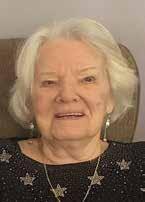
Renate Else Kueppers (nee Kuhn) passed peacefully in her 91st year with family by her side. Loving and devoted wife of Peter (pre-deceased) and caring mother of John (Janet), Hardy (Laurie) Roy (Sherrill) and Kirk. Survived by brother Werner Kuhn (Doris) residing in Germany. Grandmother (Oma) to many grandchildren and greatgrandchildren. Also loved by many nieces, nephews and cousins. Renate was loyal to her family and friends and attended St. John’s Anglican Church in Tillsonburg.


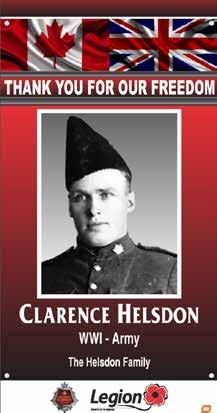

A Tillsonburg-area native, Clarence Helsdon headed west to Saskatchewan with his brothers Lou and Fred with the promise of free land before the war. After the war broke out, Clarence enlisted with the 218th Canadian Expeditionary Force in Moose Jaw in 2016. He saw action with the Canadian army in France during World War. He was shot in his right arm during a battle near Cambrai. After spending several months in hospital in England, he was discharged and returned home in 1919. Back in Canada, he settled in Norwich and was one of the key figures in starting the Norwich branch of the Royal Canadian Legion.
Renate immigrated to Canada from Germany in 1954, married Peter and settled in Toronto before moving to Tillsonburg in 1973. She enjoyed having her family together for celebrations, meals or coffee and dessert. She could whip up something delicious in a short amount of time without a recipe and if necessary, with only a few ingredients. Renate will be missed by her family and many friends, including neighbours whom she often made and delivered muffins to. Renate maintained her youthful lifestyle, was energetic and able to live in her own home until she endured a stroke in late August. Renate enjoyed time in her garden and kitchen where she made the most delicious German Potato salad for special events.
Special thankyou to Moms dear friends Martha Cook, Lilian Mackenzie and her church family with special mention to Father Patrick, Vermell Stevens, Carol Honsberger. Also, thank you to the kind and wonderful nurses in the Stroke Unit at St. Thomas Elgin General Hospital that welcomed and assisted visiting family and friends.
If desired, memorial donations could be made to the Heart and Stroke Foundation, St. John’s Anglican Church in Tillsonburg or a charity of your choice. Your messages of remembrance or condolence may be shared at Wareing Cremation Services Inc. www. wareingcremation.ca


CLASSIFIEDS
OBITUARY
ALMA MONSERE
(DECEMBER
15, 1932 –OCTOBER 1, 2025)
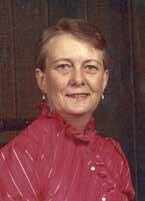
Peacefully, after a courageous struggle with cancer, Alma Monsere, formerly a resident of Lamers Court, Tillsonburg, passed away at Caressant Care Courtland, on October 1st, 2025, at the age of 92. Alma was born in the Chatham area to Alfons and Marie (nee Heiertz) Monsere. Alma was a member of St. Mary’s R.C. Church, Tillsonburg. Alma lived a quiet lifestyle, but she enjoyed the little things and valued her family, friends and neighbours. Alma was an animal enthusiast, and she loved caring for pets over the years. Alma is survived by her sister Martha Jacques (late Amedee, May 24, 2001), sister-in-law Lucienne Monsere (late Roger, July 28, 2025), niece Darlene (Michael Papaioannou), nephew John Monsere (late Diane, June 29, 2024), and niece Rosa Jacques (late Aime, Jacques, May 9, 2015), niece Noella Lava (late Anthony Jacques, August 25, 2001). Also survived by several great-nieces, great-nephews and cousins.
“Thank you to the wonderful Nurses, PSWs and Staff at Caressant Care Courtland, for your excellent care provided to Alma. Special thanks to Dr. Dockx and Dr. Sohal for their attentive care.”
Everyone who knew Alma was invited to attend a Funeral Liturgy of Christian Burial on Tuesday, October 7th, 2025, at 11:00 a.m. in the Maurice J. Verhoeve Funeral Homes Chapel, 262 Broadway, Tillsonburg, by Rev. Fr. Seejo John. Interment followed in the Tillsonburg Cemetery. Everyone who knew Alma is invited to share favourite memories and photos, send personal condolences or to contribute memorial donations to the “Canadian Cancer Society” or “Oxford County Animal Rescue” via Alma’s online tribute page at www.verhoevefuneralhomes.com or by contacting the Maurice J. Verhoeve Funeral Homes- Burial and Cremation Services Inc. (519) 842-4238, entrusted with all funeral arrangements, with confidence.
ALEX FRANK MORE
(AUGUST 8, 1945 – SEPTEMBER 28, 2025)
It is with heavy hearts that we announce the passing of Alex Frank More, surrounded by his family at St.Thomas-Elgin General Hospital on Sunday, September 28, 2025 at the age of 80 years. Beloved husband and best friend of Barbara More. Proud and loving father of Fay McCague (David) and Janna K. More (Donovan) and step father of Beverly Speirs and Rob VanDoninck (Nancy). Cherished grandfather of Nickolas Speirs, Claire VanDoninck and Ian VanDoninck. Beloved brother of Linda Chanyi and Kathe McCall (Jack).
Alex spent his working life as a farmer and later was employed at the Delhi Research Station and also enjoyed a rewarding career in real estate. Alex had a deep passion for history; especially classic cars and boats. He was a craftsman at heart specializing in wood and metal. Alex loved to tinker with anything that had a motor including cars, boats, tractors and combines. He spent countless hours refinishing two mahogany boats and for this he was featured in an article in the Parkinson’s Journal magazine about how he was able to work with his hands while having Parkinson’s Disease. The article was entitled “I Have Parkinsons But It Doesn’t Have Me”. Alex was truly a man of many talents and he had a unique ability to connect with all. A life well lived.
In keeping with Alex’s wishes, cremation has taken place. A Celebration of Life will be held at the Hickory Hills Recreation Centre on Saturday, October 11, 2025 from 1:00 pm – 4:00 pm. At Alex’s specific request, in lieu of flowers, memorial donations to Parkinsons Research may be made directly online or The Edison, Vienna & Area Museum may be made by contacting Ostrander’s Funeral Home (519-842-5221) who have been entrusted by the More family. Condolences may be made at www.ostrandersfuneralhome.com
TREES
Hundreds of shade trees, fruit trees, apples, pears, peaches, plums, sweet and sour cherries, apricots, nectarines, blueberries, haskapp grapes, raspberries, elderberries etc. Lots of spruce, pine, cedars for windbreak and privacy hedges. Sizes 1-8 ft. in containers ready to go. Flowering shrubs and much more. Mon-Sat 7:00am to 6:00pm. Martin's Nursery, 42661 Orangehill Rd Wroxeter, ON N0G 2X0 (1 Conc. North of Wroexter on Belmore Line)
HELP WANTED
PART-TIME DELIVERY DRIVER
We are looking for a delivery driver to join our team at the Tillsonburg Post.
Responsibilities would be taking receipt of bundles of the newspapers from our courier service on Wednesday mornings (delivered to your home) and then distributing the bundles to our various drop-off locations in Tillsonburg and surrounding area on Wednesday and Thursday so that our readers can obtain their weekly news. Our driver shall also take note of which drop-off locations require more or less copies so that quantities can be adjusted in future weeks to meet reader demand.
Compensation based on a combination of hourly wage plus kilometer allowance.
To apply, please contact Stewart Grant at stew@granthaven. com or text 519-868-1290.
It is with heavy hearts that we announce the passing of Maria Stekli (nee Kádar) on October 2, 2025, surrounded by her loving family at the Tillsonburg District Memorial Hospital, at the age of 89. Maria was born on June 20, 1936, in Turulung, Romania. Maria and her family immigrated to Canada in 1965 and spent her later years in Tillsonburg, where she built a beautiful life filled with love, laughter and community.
Maria was predeceased by her beloved husband, Steve Stekli Jr. (1991), her parents Paul & Ilona (Hudak) Kadar, 2 brothers and 1 sister. She is survived by her loving children: Mary (Larry) Neville, of St. Williams, Liz (Randy) Posthumus, of Tillsonburg; and Steve (Karrie) Stekli, of Tillsonburg. Cherished grandmother of Jeff (Crystal) Neville, Mike (Robyn) Neville, Stephanie (Chris) Nevins, Cynthia (Wes) McDougall, Krista (Derek) Linker, Rick (Lisa) Posthumus, Jason Posthumus (partner Kanyanat), Steven Posthumus (partner Alex) and Tyler Stekli. Maria was blessed with 11 great-grandchildren, who brought immense joy to her life. She is also remembered by her 2 sisters in Romania and extended family in Canada and abroad.
Maria’s legacy will live on through the warmth and kindness she so freely shared with everyone around her. It brought her so much joy to use her hands – whether in the kitchen or the garden. To not only bring her own family together, but to create a sense of home and belonging for countless others. She was known for her bright smile and delightful sense of humour- even if you had to listen carefully to understand her. She filled every room with laughter, love and the comforting sense that you were exactly where you belonged.
Friends, relatives and neighbours are invited to attend public visitation on Wednesday, October 8th, 2025, between 4:00 and 8:00 p.m. in the Maurice J. Verhoeve Funeral Homes Chapel, 262 Broadway, Tillsonburg. A Funeral Mass of Christian Burial will be held on Thursday, October 9th, 2025, at 11:00 a.m. in St. Mary’s R.C. Church (51 Venison St. W., Tillsonburg), by Rev. Fr. Seejo John. Interment follows in St. Ladislaus Cemetery, Courtland. All funeral attendees are invited to share in a time of fellowship with the family at the Delhi District German Home (443 James St, Delhi), immediately following the interment. In lieu of flowers, the family asks that you honour Maria’s memory by planting something beautiful, sharing a special meal with someone you love, just as she would have done, or contribute memorial donations to the Tillsonburg District Memorial Hospital. Everyone who knew Maria is invited to share favourite memories, photos, personal condolences or contribute memorial donations via Maria’s online tribute page at www.verhoevefuneralhomes.com or by contacting the Maurice J. Verhoeve Funeral Homes- Burial and Cremation Services Inc. (519) 842-4238, entrusted with all funeral arrangements, with confidence.













1825-2025
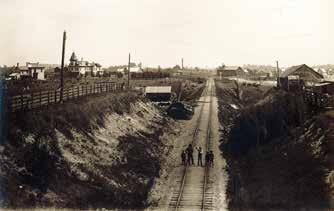
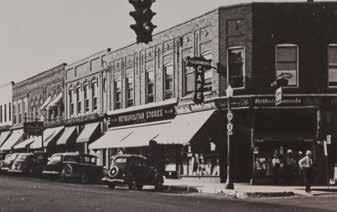
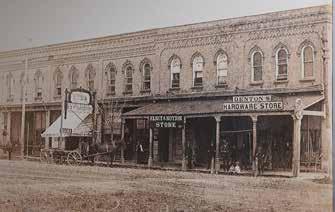
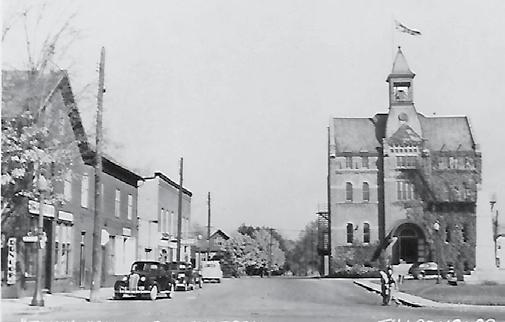
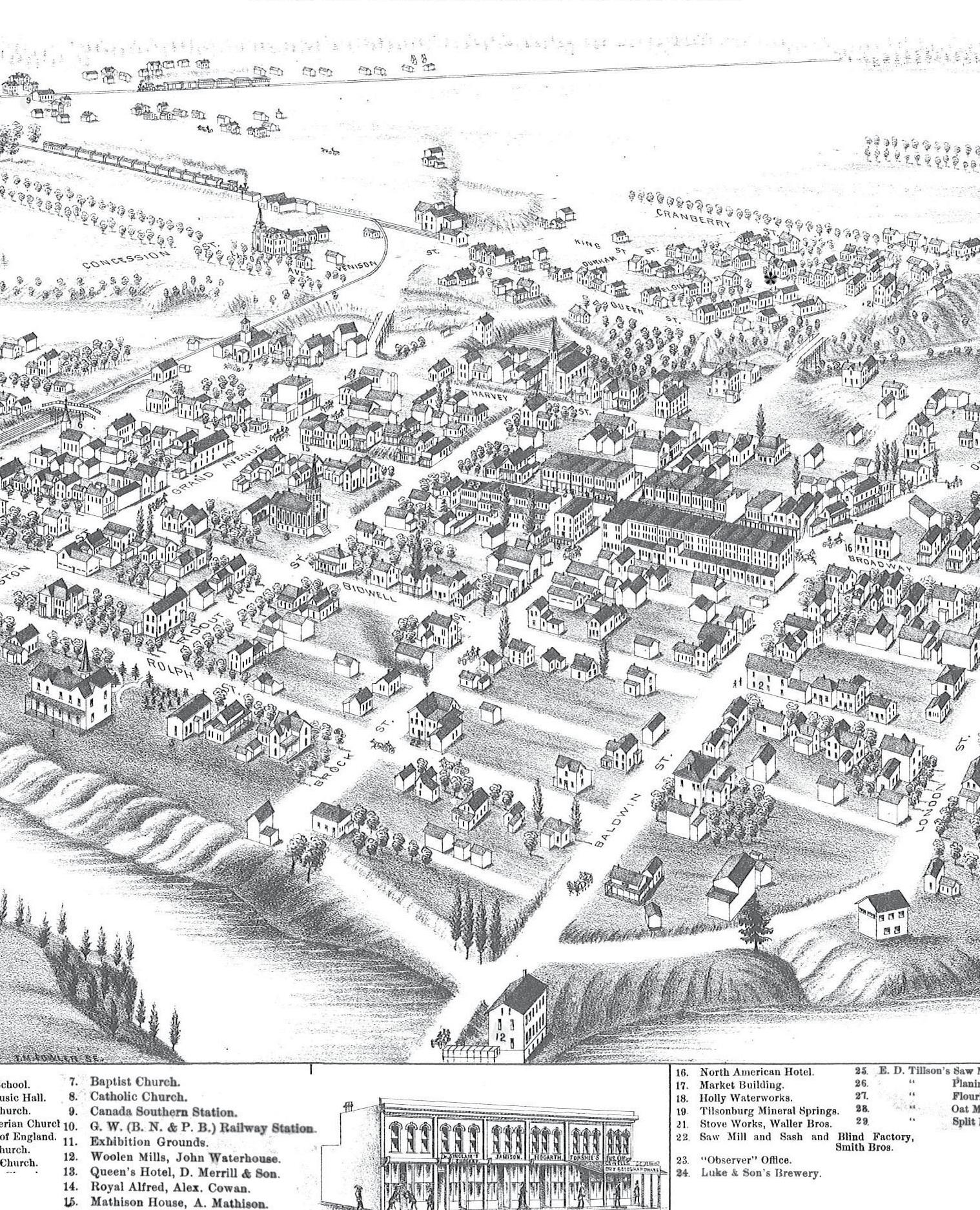
A commemorative edition of the Tillsonburg Post, celebrating our Town’s bicentennial












































































































































































































































Introduction
A Message from the Mayor
Two hundred years ago, George and Nancy Tillson made an extraordinary journey from Normandale into the wild heart of Southwestern Ontario. Their destination? A vision. What began as Dereham Forge soon blossomed into the vibrant community we proudly call Tillsonburg. It would take 12 years before the town took on the Tillson name, but the roots of what makes this place special—hard work, innovation, and community spirit—were planted the moment the Tillsons arrived.
In those early years, life was difficult and often isolating. Yet George and Nancy, with their children at their side, carved out more than just a homestead— they laid the foundation for a town built on resilience and entrepreneurial grit. Their legacy lives on in every small business, every community initiative,
and every citizen who calls Tillsonburg home. We owe a deep debt of gratitude to these pioneers, and to all who followed, who believed in the potential to build not just a town, but a lasting home.
To honour this remarkable milestone, I am pleased to invite all residents of Tillsonburg and our neighbouring communities to join us for our 200th Founder's Day Festival. The celebrations begin at noon in Memorial Park, where I will deliver opening remarks, proudly joined by the Ingersoll Pipe Band. From there, the day unfolds with excitement and family-friendly fun.
All events will take place at Memorial Park, the heart of our community.
A heartfelt thank you goes out to our incredible 200th Founder's Day Sub-Committee, who have worked tirelessly to plan a magical and memorable day for
Celebrations
Celebrating 200 years since Tillsonburg’s founding
A birthday bash is planned to celebrate the 200th anniversary of Tillsonburg’s founding on Oct. 18.
Memorial Park is the main venue for the events, which will commence with a land acknowledgement at noon, greetings from dignitaries and the singing of O’Canada. A performance by the Ingersoll Pipe Band will follow.
The Great Canadian Lumberjack Show will take the stage at 1, 2:30 and 4 p.m. Chainsaw carving, axe throwing, and a chainsaw race will be amongst the features.
The Pioneer Experience Zone is for the young and young at heart. A petting zoo, pottery, woodworking and forging
demonstrations will be available. Patrons will also have a chance for a wagon ride.
A variety of food trucks will offering tasty treats while they last.
The marketplace is the location to get the limited edition 200th anniversary souvenirs, including clothing, tote bags, wooden nickels, and glassware. Three local authors will also have displays.
Prior to the big start at noon, Tillsonburg Scouts will be hosting a pancake breakfast in the Lions Auditorium. A commemorative tree planting will take place at Annandale National Historic Site and the night will wrap up with fireworks at 7:30 p.m.
all. I also wish to thank town staff for their support in coordinating the many moving parts of this celebration, as well as the team at Annandale National Historic Site for their engaging and educational “fun fact” posts. Special thanks to Laurel Beechey, our dedicated local historian who has gathered and archived our existence from beginning to today and whose passion for Tillsonburg’s past continues to enrich our present. Also a sincere thank you to Dr. Jason Pankratz for his book entitled “Tillsonburg at 200”, which features 200 questions and answers about our beautiful T\town. Here’s to 200 years of heritage, and to a future as bold as our past.
Sincerely,
Deb Gilvesy Town of Tillsonburg


(CONTRIBUTED PHOTO)
Deb Gilvesy, Mayor of Tillsonburg.
Buildings and Industry in Tillsonburg
Hydro-electric power comes to Tillsonburg
JOAN WESTON Post Contributor
In the spring of 1906, Adam Beck came to Tillsonburg to talk to town council about his scheme of “People’s Power”. Beck’s Ontario Hydro-Electric Power Commission proposed to supply electricity for industrial use, for use in the home, and for use on the farm. At the April 1906 meeting, the council petitioned the legislature to adopt Beck’s scheme. Beck was successful, and the Ontario Hydro-Electric Commission was set up.
By means of a bylaw in 1908, town council gave the Ontario Hydro-Electric Commission a monopoly within the municipality. In August 1910, the Hydro Sub-Station #1 was erected at the corner of Concession St. and Park Ave.
John Armstrong says in his book, Tillsonburg: A History 1825-1982, “few buildings have had greater influence on Tillsonburg”. Bert Newman describes the two-storey structure in his book
Once Upon A Time: “….It was a brick building with a solid cement floor, and back then there were two floors inside.
The first storey had two transformers about 15-feet high on the south side and the north side, and above them were big
clocks. They had different voltages on them. The one down at the east end read 14,000 volts; the next one read 2,100 volts; and the next one might say 220 volts, while another one said 110 volts…. The only way you could get up to the second floor was by a ladder fastened on the wall. Up on the second floor were a lot of other contraptions, including things called lightning arrestors, which were meant to prevent the place from being struck by lightning.”
My brother, John, remembers the hydro wires from Woodstock which came right across the lake to the sub-station.
In 1949, George Newman, Bert’s father, retired after working at the hydro transformer sub-station for almost 40 years.
To date, I have not been able to determine when the transformer station was converted to a one-storey building, but it must have been between 1953 and 1958.
A car hit the sub-station and did major damage in the 1980s. Sadly, after 96 years, sub-station #1 was decommissioned and demolished in 2006. By that time there were five sub-stations in town, and only one was needed. Now a parkette graces the corner of Concession Street and Park Ave where the iconic transformer station once stood.





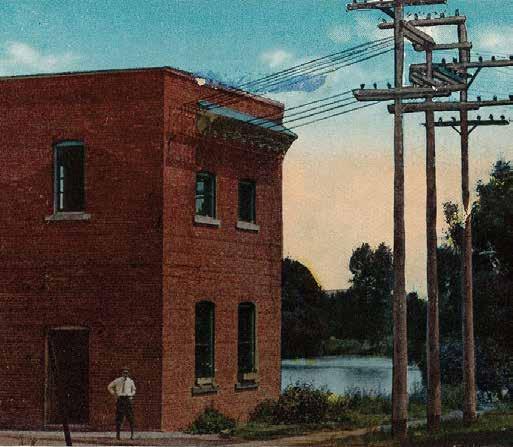




(ANHS PHOTO)
The sub-station at the corner of Park Ave and Concession Street was an integral part of the town’s early electricity infrastructure. Built in 1910, the building was damaged when a car crashed into it in the 1980s. It was decommissioned and demolished in 2006.
The ice house was once a Tillsonburg landmark
JOAN WESTON Post Contributor
I had a most challenging time trying to discover where the ice house and dwelling actually stood beside Lake Lisgar and when it burned down!
In 1910, Herbert Snell purchased the ice house and related equipment from the Crawford Lumber Co., which had cut ice on Lake Lisgar since 1900. Bob Snell started working for his father at the age of 12, in 1912. After 1905, well-to-do families had iceboxes in their kitchens. Gradually, every home acquired an icebox, necessitating a visit from the ice man’s horse and wagon almost every day.
Generally, it would be the last week in January before the lake was frozen deep enough to start the ice harvest. Lake Lisgar provided a high quality of clear ice because it was spring water. At first, many men were employed for the ice harvest, as all of the labour was done by hand. When the ice house was full, the harvest ended.
The workers would make sure about an acre of ice was clear of snow. Betty Lou (Horlick) Ireland remembers that in her day (1940s) she and other children would try to skate on that lovely patch of clear ice, only to be gruffly chased off it by annoyed men who didn’t want blade marks in the ice. A horse-drawn ice plow used to cut grooves on the frozen lake surface. The cutting dogs were like a plow, each one going down a quarter-inch deeper than the one ahead, like a plow. It would take five or six passes to get down six feet. By 1932, gasoline engines had replaced horses. The circular saw blade was driven by an adapted 1917 Model T Ford motor. Bert Newman worked in the ice harvest in 1922, and he describes the process from this point on: “…we would go out
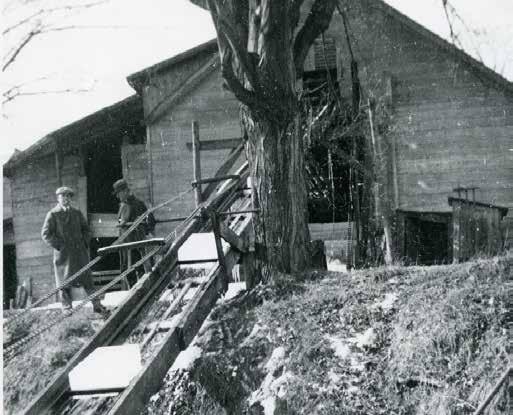
In the days before refrigerators, an ice house was a necessity to store ice for ice boxes in homes. Ice was delivered to homes by horse and wagon every day to replenish the frozen fuel. Tillsonburg’s ice house was on the shore of Lake Lisgar, and stored ice cut from the lake in the winter. It burned down in 1953, two years after it ceased operation.
there with big one-handled cross-cut saws. We would saw down into the ice, cutting out big blocks of ice; then [we’d] give the blocks a crack, and they’d break loose. We would take long pike poles and draw the blocks down open channels to the ice house.”
The workers would use a giant pair of iron tongs to haul the blocks to the chain link elevator that took the ice blocks up the bank, across the road and into the ice house. Horsepower was used to operate this eleva-
Celebrating Tillsonburg’s 200 year anniversary
Thank you to the community who continue to make it a wonderful place to live and work!

22 –

tor, but later it was powered by a gasoline engine. As the ice was stacked higher and higher inside the ice house, the elevator was raised up, until the ice was nearly to the roof. Bert said he worked in the ice house packing the one-foot thick, 16-inch wide and 30-inch long ice blocks in sawdust. The ice house itself was an unpainted, pine wood, slopedroof barn that could hold 100 tonnes of ice within its sawdust-insulated walls.
Bob Snell took over his father’s busi-
ness in 1945. Sometimes the Snells would hire Margaret (Eades) Horton to sit in the kitchen at their home on Ridput Street West so that anyone coming to the Snells’ barn by Raccoon Alley to get ice could pay her. Marg said she never checked how much ice the customers took, she just collected their money.
The demand from housewives diminished as they replaced their iceboxes with refrigerators, but there was still a great demand for ice from hotels, area cheese factories and dairies. However, in 1951 the ice house ceased operation.
Two years later, on August 6, 1953, the barn burned down. Jean Dawson and Michael Pepper both told me about watching the fire.
An article in the August 3, 1953 Tillsonburg News stated: “One of the town’s landmarks, the Snell ice house, burned down this morning and a nearby house was severely damaged. A strong breeze fanned the fire which is suspected to have been caused by a cigarette butt dropped by transients sleeping in the ice house…. Warning of the fire first came from Erwin “Pee Wee’ Millard, driver for Mr. Snell, who spotted the flames leaping up the southeast corner of the ice barn…. Other houses in the neighborhood also were endangered as changing winds swept red hot cinders across the sky…. Total damage was estimated at close to $5,000.” Apparently, the barn smouldered for days because of all of the sawdust inside it.
The iconic ice house and its business, which fascinated young boys like Irv Horton, disappeared. But…the house on the property, although damaged, was rebuilt and still stands on the corner of Denton and Park Ave. I had thought this an urban myth, but, my sister, Jean Mills, and Michael Pepper have convinced me otherwise.

(ANHS PHOTO)
A look at Tillsonburg’s first creamery
The next logical step for E.D. to take, even before the big barn was built, was the development of a creamery where the labours of the cows could be processed. Unbelievably, there were very few creameries during this time period and this development of E.D.’s was welcomed, not only locally, but all over Ontario, with his products being sent to all the better institutions in Toronto and beyond.
The creamery was fitted with cream separator, Babcock tester, modern churns and appliances for sterilization and washing of bottles and utensils and the packing of toothsome butter. The churns were run by the same steam machinery used in the barn.
An 1881 reporter for the Tilsonburg Observer will take you on a tour of his new dairy. “We next proceeded to view the Dairy, which is a model one. It is in the basement of a brick building –the engine and boiler being in rooms adjoining. The walls and floor are all of water-lime cement, and every door and window is hermetically tight when closed, so that not a breath of air from the barnyard can enter. The room is thoroughly ventilated, however, by means of an earthenware pipe one foot in diameter, which extends from the floor of the dairy underground for a long distance, and comes to the surface in the middle of a field west of the barns.
“ In this way cool, pure air is always plentiful. Around two sides of the room, on the floor, is constructed a sort of trough of brick and water proof cement. At one end of this a two-inch stream of pure cold water flows in, and at the other end flows out near the top, so that the trough is always full of running water. In this trough the deep milk pans are set, and maintained constantly, summer and winter, at a temperature of about 58 degrees. The steam churn was at work during our visit, turning out the very finest quality of butter. Mr. Tillson also sends milk to the Tilsonburg Branch of the Brownsville Cheese Co., and has built a small frame building to store his milk every night. One half the floor of this building is cut away and a deep, sodden trough inserted. The milk cans are set in this trough and a stream of water turned
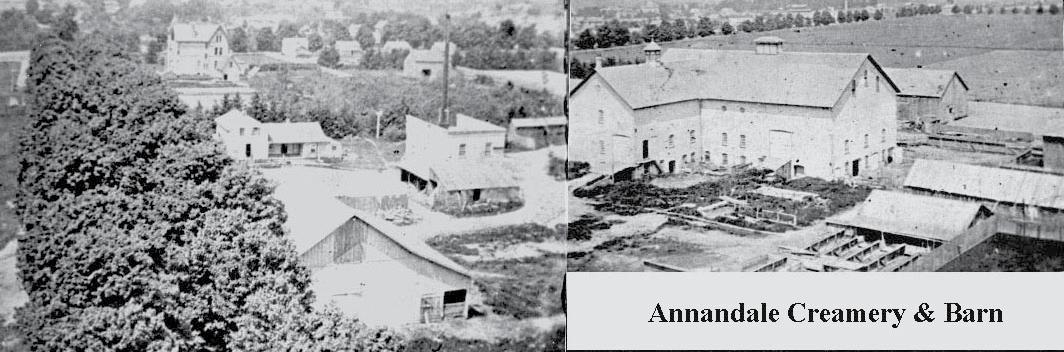
on, the surplus water flowing off near the top of the cans. By this means he has kept his milk from Saturday night to Monday morning, 36 hours, and delivered it at the factory in better condition than the Monday morning’s milking’s of many patrons.
“The quality of the butter is best indicated by referring to the fact that 23c per pound is received for all they can make. A good local milk and cream trade is also enjoyed."
As stated earlier, the need for this creamery was great. The stock book shows that deliveries were made as far away as Port Hope Trinity College, Toronto Trinity College, St. Hilda's College in Toronto, and the Hospital for Sick Children and its Lakeside House in Toronto. The Trinity Colleges and Sick Children's averaged about 400 pounds of butter per month at an approximate cost of $90.
A good local trade (of dairy products, milk, butter, cream, etc.) was enjoyed by Annandale Dairies, with each individual account noted in the Farm Journal. This included E.D.'s wife's (Mary Ann) account for An-nandale House on a daily basis and for any extras in the event of garden parties etc. I don't believe a pound of

RHYTHM AUTOMOTIVE
butter ever slipped through.
“In establishing his model dairy Mr. Tillson has spent more money than he can make out of it for a number of years; but he has put Tilsonburg far ahead of most Canadian towns, and even cities, by making its inhabitants quite independent of the irregular sources from which their supplies are drawn. To be at all saleable country butter must now be made up to the standard of Mr. Tillson’s Creamery, which, we feel assured, will be an excellent one,” it was written in one report.
For many years the barn and model creamery were subject of great scrutiny by E.D.’s dairy peers. The Western Dairy Association held a series of meetings in Tilsonburg so the delegates, hundreds of ‘practical men’ could visit.
E.D. never missed a trick. Make it practical and simple and they will come. A simple practical but extravagant idea for the times was connecting his creamery with the telephone central office in town so those who desired butter, cream or milk from the creamery could save themselves a walk by telephoning their orders.
MANUFACTURER OF CRITICAL AUTOMOTIVE SAFETY PARTS
DRIVERS SAFETY AND RIDING COMFORT

(ANHS PHOTO)
When the Annandale Creamery was built by E.D. Tillson in 1881, it was one of few creameries in the area and did a brisk business. E.D.’s house, what is now Annandale National Historic Site, can be seen in the upper left of the photo.
LAUREL BEECHEY
Post Contributor
Tillsonburg’s first high school was
JOAN WESTON Post Contributor
The “grande dame” of all the buildings around Lake Lisgar was the Tillsonburg High School, where my father, my aunt, my uncle, Bill Pratt and many others engaged in their secondary education.
Previous to 1893, the high school department consisted of a principal, one assistant teacher and 40 pupils in two rooms in an addition to the public school on Rolph Street. By 1893, there were so many secondary pupils that the taxpayers of Tillsonburg voted to erect a separate high school. E.D. Tillson donated three acres of land at the southeast corner of Lake Lisgar, with the eddy as the northern boundary and Lisgar Ave. as the eastern boundary.
John Smith’s construction company was chosen to build the new high school, which cost $6,500. On Jan. 1, 1894, the “Tillsonburg High School, stately, elegant and chaste in exterior, brightly and eloquently furnished interiorly” opened its doors for instruction. The school was topped with a lofty cupola, and had entrances at the sides, as well as at the front of the building. The first principal was Mr. A.W. Reaveley. The school board divided the scholastic year into three terms, and students were charged $2 a term.
In the early 1900s, Town Clerk A.E. Raynes, of the Kensington Art School, London, England taught drawing at Tillsonburg High School. In 1902, the high school cost $2,000 to operate and had an
enrolment of 76 pupils. In 1908 a wing was added to the west side of the building. In 1922 an east wing was added, containing the gymnasium, a junior and a senior science laboratory and an assembly room. The gymnasium had a metal pipe frame track/ catwalk around the second- storey level. In the 1930s, the cadets used the shooting gallery in the attic.
The wooden floors creaked and smelled just like Rolph Street Public School’s floors. In the 1940s, Jean Mills and Jack Eacott both remember walking from Rolph Street School to the Tillsonburg High School for special events, such as a puppet show put on by the high school students.
Jack Neale recalled that science teacher R.J. Sinclair was quite the character. In 1938 a friend of Jack’s played a prank on Mr, Sinclair. The friend coated matches in a clear shellac coating and carried them with him in hopes that Mr. Sinclair would ask for a match to light the Bunsen burners. One day Mr. Sinclair did indeed ask for a match. When he tried to light the one Jack’s friend gave him, it wouldn’t light, it just smoked!
Irv Horton recounts of how in the late 1940s, R.J. Sinclair, the basketball coach, would open up the door to the science lab on the second floor, throw one basketball down to the waiting basketball team and tell them to practice. An hour later, he would open up his door and ask for the ball back because the practice was over.
In January 1947, a three-room frame annex was built behind the school to ac-


Lake Lisgar
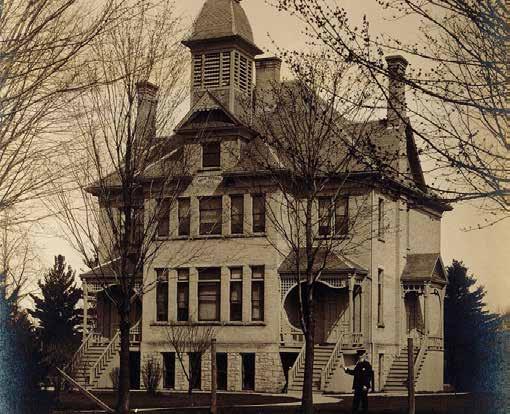
commodate the new commercial courses. It seems to me that this annex was a waste of money, because the high school was so crowded that a new high school was commissioned to be situated on Tillson Ave.
On Sept. 15,1949, Clifford Thomas bought
the Tillsonburg High School property and all of the buildings on it for $14,000. Thomas wanted to see a high-class subdivision arise on the old Tillsonburg High School property. Tillsonburg’s first high school closed its doors for good in June of 1950.

(ANHS PHOTO)
On Jan. 1, 1894, Tillsonburg High School opened its doors to students. Located on the southeast shore of Lake Lisgar, the school had more than one addition before it closed in 1950. At that time, Annandale High School opened on Tillson Ave.
From a lively dance hall to demolition
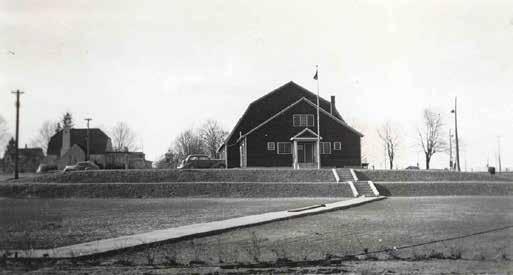
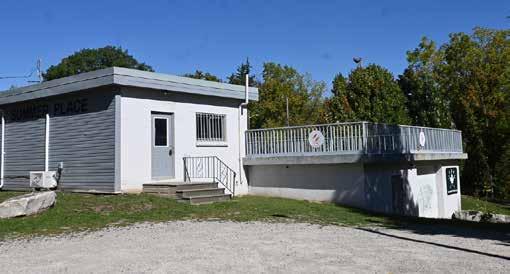
Fred Bushnell, Sr. built a dance hall in the early 1920s so that his musician son, Fred Bushnell, Jr. and his band would have a hall in which to practice and perform.
Because other dance halls of the era were built by water, Fred, Sr. purchased land by Lake Lisgar to build “The Evergreens”. The Bushnells thought The Evergreens would draw in crowds, but it
turned out that the dance hall was popular mostly in the summers. Therefore, the building was used as a badminton club, as well. Fred Bushnell, Jr. recalled playing his clarinet in The Evergreens in 1928, when jazz and Dixieland music were all the rage. Father and son tried to get the big bands in to perform, but they still didn’t draw crowds. Fred, Jr. lost his eyesight, so his father added roller-skating to make money. He remembered washing off the wax from the dance floor for the roller skaters.


Bert Newman recalled being asked to install the PA system to furnish music for roller skating and he said: “…before we knew it that place was so crowded with young people you wouldn’t believe it.”
One year later the rink closed. Then, the building was used solely by the badminton club, which remained in operation until 1940 or 1941.
In 1941, the Oxford Rifles moved in to The Evergreens and the dance hall became known as the Tillsonburg Armory. Sid Card helped to dig a basement underneath the building to house equipment and supplies. “A frolic night was to be held on June 25th, 1941 to furnish and redecorate the building….There was a parade of soldiers with two bands, a softball game and a monster bingo. Tickets for the entertainment were 3 for 25 cents.”
During the war years the members of the Oxford Rifles engaged in physical training and went on parade in the building, which shook the floor alarmingly. The army vacated the building at the end of the war in 1945.
From 1945 to the 1960s, various clubs held dances in the “Armory”. Jean Mills, nee Dawson, who grew up on Gowrie Street near the lake, could hear the music and laughing emanating from the building at night during these dances.
In the 1950s, Jack Eacott and others revived and re-organized the Tillsonburg Teen Town Dances which were held, fittingly, in the old dance hall. They used 78 RPM records on a portable record player, and had an illuminated crescent moon glowing from a hanging box. Boys stood on one side of the dance floor trying to summon up the courage to ask a girl among those standing on the other side. The music consisted in part of popular sentimental love songs with goofy lyrics. Couples dancing on the creaking hardwood floor in the semi-darkened room had ample opportunity to get close and engage in groping and intimacy. The feature song was always “In the Mood” by Glen Miller, played near the end of the dance.
In the early 1960s, the Lions Club used the building as a community centre. An office for Director John Hunter was added to the east side of the old dance hall. Also, the newly-formed historical soci-
ety held their meetings in this office in March of 1972. With the completion of the new Community Centre Complex on Hardy Ave., the Evergreens/Armory was once again vacant. With interest in local history running high because of the 1972 Town Centennial, the time seemed ripe for a museum.
On June 21st, 1972 the historical society started moving its artifacts into the old community centre. On July 4th, 1973, Victor Tillson cut the ribbon to officially open the Tillsonburg District Historical Museum. The stump puller was set up near Ross Street at first, but the neighbours complained so much about how awful it looked that it was moved up and over closer to the lake. I presume the town hall bell was moved from its home by the band shell to in front of the museum for the official opening of the museum.
Eventually, the museum needed more programming space for school children doing crafts, etc., so the board applied for and received a WINTARIO grant in the 1980s to add a room behind John Hunter’s office and to dig a basement out of the hill. The basement was also used by the newly-formed Tillsonburg Craft Guild for its painting group and local spinners and weaving group.
The museum had to move its premises when the addition was put onto Annandale House in the late 1980s. It took until September 1990 for the museum to pack up and move most of its collection to the new location at Annandale National Historic Site. However, on June 12, 1987, when the news of the museum vacating the building was made public, the Tillsonburg Rowing Club, The Optimists and Theatre Tillsonburg eyed the old dance hall as a possible home for their activities. The rowing club saw the space as a place to store equipment and train members.
Town council ordered an engineering study of the building, and after much controversy, it was decided that it would cost too much money to bring The Evergreens up to code. Sadly, the 73-year-old dance hall was demolished around 1995. What does remain is Summer Place, the additions made to the museum in the 1980’s, where the Tillsonburg Rowing Club has been housed ever since.
(ANHS PHOTO)
The Tillsonburg Dance Hall was built in 1920 adjacent to Lake Lisgar, and beside the present outdoor pool and waterpark. The building served as an armoury during the Second World War and as the town’s first museum. An addition was built into the side of the hill, creating a basement, which served as an office and the first home for the Tillsonburg Craft Guild. The building was demolished in 1995.
JOAN WESTON
Post Contributor
(JEFF HELSDON PHOTO)
The addition that was built on to the dance hall is all that now remains of the structure that served many purposes for the town’s people over the years. The building is now the headquarters of the Tillsonburg Rowing Club.
The mystery of Gibson House is solved
JOAN WESTON Post Contributor
When I conducted my first research on Gibson House years ago, all of the material I read declared that Gibson House was built after the flood of April 27, 1937. Recently, I read on the Town’s Heritage Listings website that Gibson House was constructed in 1933. I set out to solve the mystery by looking at issues of the “Tillsonburg News” for 1933 and 1934.
Mystery solved! An article on Aug. 3, 1933 stated that at a special meeting held on Friday night of July 27 “a comprehensive report of the changes and improvements necessary to put Tillsonburg’s fire protection system in an up-to-date and satisfactory condition” was submitted by Engineer D.H. Fleming of Toronto. Since repairing the old pumphouse and turbine would be too expensive and too hazardous, Fleming recommended that the town “build a new pumphouse with intake, screen well, electric-driven centrifugal pump direct connected and a duplicate unit run by a gasoline motor.”
Fleming, after careful consideration, had already chosen a site for a new pumphouse on the southeast side of the lake by the swimming hole. Fleming also recommended that the old intake (the present weir) should be maintained as a relief overflow for use in flood season. The overall cost of a new pumphouse and extending the mains on Simcoe Street would be $30,000, which would be less than fixing the old pumphouse.
The council then declared a recess and they all went to examine the old pumphouse! When the meeting was resumed, council unanimously adopted Engineer Fleming’s report.
On Aug. 25, council accepted all of the lowest bids of the tenders. Work on the pumphouse was expected to start in a few days, but it would take four to six weeks before the mains would be laid. Unfortunately, the decision to take the lowest bid for the construction of the pumphouse proved to be disastrous. At the council meeting just prior to Nov. 15, 1933 Engineer Fleming had submitted the following letter: “Re St. Clair Contracting Co. Ltd., pump-house construction. This is to certify that in my opinion the above work is unnecessarily delayed, that the contractor is wilfully violating certain conditions and covenants of this contract or is executing the same in bad faith and that the time for completion will expire on Nov. 15…. It is in order to serve the contractor with a written
notice to discontinue this portion of the work and to make other arrangements for its completion.”
At the meeting Fleming, declared that over 30 mistakes were made at the pumphouse. G.G. Reid of St. Clair Contracting intimated that if his company be relieved of the job, that legal action would be taken, to which Mayor Sutch replied that his mind could not be changed by threats.
A long and lively discussion ensued after the following motion was moved: “…in accordance with this council’s resolution of Nov. 7 and clause 56 of the general conditions of the contract, the St. Clair Contracting Co. Ltd. be notified to discontinue all work on the pump-house.’ The motion was carried, as was this next motion: “… engineer be instructed to take personal charge of the work at the pumphouse and employ men to complete the work according to plans and specifications.”
I searched the “Tillsonburg News” editions until December of 1934, but I could find no references to the completion of the pumphouse or the completion of the mains on Simcoe Street. I can only assume that all work was completed by sometime in 1934.
The new pumphouse was a one-storey square building. The basement was of poured cement, while the main section was covered with multi-shaded rust and brown bricks. The interior of the main floor was a wide-open square room, and the basement was a half basement.
Council bought the house across the road from the new pumphouse for Harry Wood and his family, which is still there. When there was a fire, someone phoned Wood and he would run across the road and switch on the electric pump.
The day before the dam broke on April 27, 1933, Wood operated the pumps in the fire protection pumphouse to help lower the level of the lake. “The pumps, working at capacity of about 1,340 gallons per minute, sent the water downtown through the system of mains, and three hydrants were wide open on Broadway from early Monday morning until about 6 o’clock on Tuesday morning.”
In the 1950’s, the government decided that all public buildings were required to use a special type of electric motor. The town had to remove the pumphouse’s old motors, which worked perfectly, to install the new ones. Unfortunately, when the next fire happened, the new motors didn’t work! Another system was devised to provide water for fire protection and the pumphouse
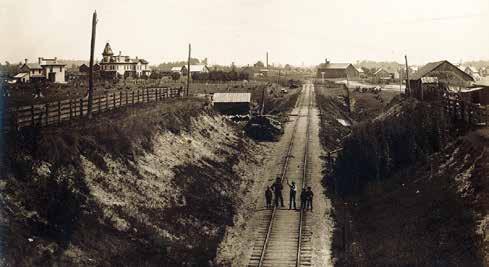
was no longer used.
In 1960, the town gave the pumphouse to the three Scout troops to use as a headquarters, and as a base for all their water activities. Don Baxter told me that in 1960 he and members of the 5th Kipling Rover Crew worked for weeks and weeks to remove the two malfunctioning motors, and two sets of pipes and pumps from the basement of Gibson House. The motors were mounted on two cement slabs 8’ long, 3’-4’ wide and 1’-1 1/2' thick. One set of pipes had brought water in from the lake, and the other set had sent it out into the mains for the fire hydrants.
In tribute to Walter Gibson’s long support of
the Boy Scout movement, locally and provincially, the second pumphouse was dedicated to him by the Boy Scouts on Nov. 16, 1968.
Floyd Marshall spent 40 years in Gibson House doing various things for both the Scouts and Sea Scouts. The Sea Scouts no longer occupy the building.
In 2013, Gibson House was repaired and improved with money from an Ontario Community Infrastructure Improvement Fund. New energy-efficient lighting and windows were installed. Repairs were made to the foundation. The building was made wheelchair accessible and the parking lot was made larger.

(ANHS PHOTO)
Best known as a building for the local Scouts, Gibson House was originally built as a pump house for the town’s water system. It was turned over the Scouts in 1960 as a base for their water-based activities.
The streetscape of Tillsonburg has changed dramatically since the town was incorporated in 1872. This photograph is looking towards the west and the two houses would have been on Lisgar Avenue with the tracks crossing the street. The large house, no longer standing, was originally the home of L.C. Sinclair, who married E.D. Tillson’s daughter Catherine Marilla. The house also served as the Legion until it was demolished.
(ANHS PHOTO)
Tillson Oats and Tillsonburg’s claim to fame in the breakfast kitchens of the nation
Tillson’s Pan Dried Oats was the patented name for one of the products produced by the Tillson Company Limited, which also made cornmeal, peameal, barley flakes, and various types of flour. According to family legend, E.D. Tillson began making oatmeal for a very personal reason: in 1869, he survived typhoid fever but was left with a “bowel complaint” for which his doctor prescribed eating oatmeal every day for breakfast.
In 1873, Tillsonburg’s first oatmeal mill began production. In 1886, a major fire destroyed the mill, but by August 1888, a larger, rebuilt mill opened and could produce 250 barrels a day, running 24 hours with three shifts of workers. By 1900, Tillson’s Pan-dried Oatmeal was sold worldwide and had won multiple gold medals at trade and agricultural fairs like the C.N.E. and World’s Fair. A Michigan newspaper in 1892 even claimed, “Tillsonburg, Ontario, was as synonymous with oatmeal as Milwaukee was with beer!” — earning the town the nickname “Pan-Dried Town” long before it became known for tobacco.
In 1910, after E.D. Tillson’s passing, the Tillson Company joined The Canadian Cereal and Milling Company Limited, merging with nine other mills in Ontario and Quebec to reduce competition. Tillson’s Pan-dried Oatmeal continued to be produced in Tillsonburg, but now the boxes listed the newly formed company.
By 1914, The Canadian Cereal and Milling Company was bought out by the Canadian Cereal and Flour Mills Company, and oatmeal production in Tillsonburg continued under the new name. Then, in 1917, the Quaker Company of Canada acquired the business after a fire destroyed their Peterborough mill. This purchase gave Quaker control of over 12 mills in Ontario and Quebec, including Tillsonburg. While oatmeal was still made locally, it was packaged as Quarter Oats, now using the Tillson Pan-dried process. Gradually, the Tillson name disappeared from the boxes, and was replaced by the Quaker Oats brand.
As part of their promotional materials, Tillson’s Quick Cooking Rolled Oats Box had recipes printed on them. These are the three recipes that were found on the 1900’s oat box.
Tillson's Prune Pudding
4 cups of water
1 cup of milk
2 cups Tillson’s Oats (Quaker Quick Oats)
1 cup of Prunes, quartered
½ teaspoon cinnamon
½ teaspoon nutmeg
salt
1/3 cup of sugar
1. Boil the water and salt to taste
2. Add Tillson’s Oats to the boiling water and cook for 2 1/2 minutes.
3. Remove cook oats from heat
4. Add prunes, sugar, spices and milk
5. Cook for ½ an hour in a double boiler or bake in a hot oven for 20 minutes
6. Serve hot or cold with or without milk.
Tillson's Crisp Cookies
3 cups of Tillson’s oats (Quaker Quick Oats)
1 cup of brown sugar
1 cup of butter
1 cup of flour
1 teaspoon soda
¼ cup of boiling water.
Optional: nuts, raisins, chocolate chips.
1. Mix the Tillson Oats with the sugar and flour
2. Add the melted butter and mix well
3. Dissolve the soda in boiling water and add to mixture
Optional: Added chocolate chips or raisins
5. From the dough into a roll and chill thoroughly
6. Slice thin and bake at a moderate oven for 5 to 10 minutes. (We baked a 375o for 7 minutes on a dark cookie sheet)
Tillson's Molasses Pudding
1 ½ cups of Tillson’s Oats (Quaker Quick Oats)
1 ½ cups of scalded milk
1 cup of molasses
2 eggs, beaten
½ teaspoon cinnamon
½ teaspoon allspice
1 cup of chopped raisins, dates or figs
1. Cook the oatmeal
2. Add the scalded milk to the oatmeal and mix until the mixture is lump free
3. Add beaten eggs
4. Add molasses
5. Add spices
6. Add chopped raisins, dates or figs
7. Pour onto a greased baking dish and bake in a slow oven (300 degrees) for about 40 minutes or until firm
8. Serve hot or cold, plain or with milk or
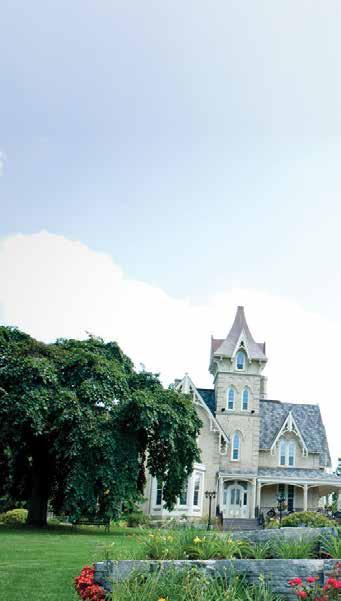

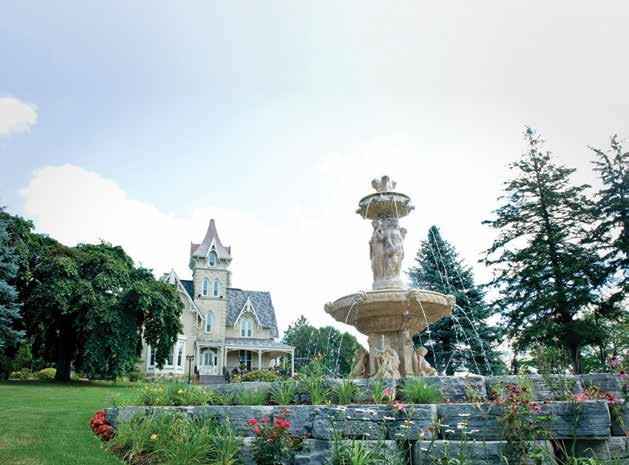


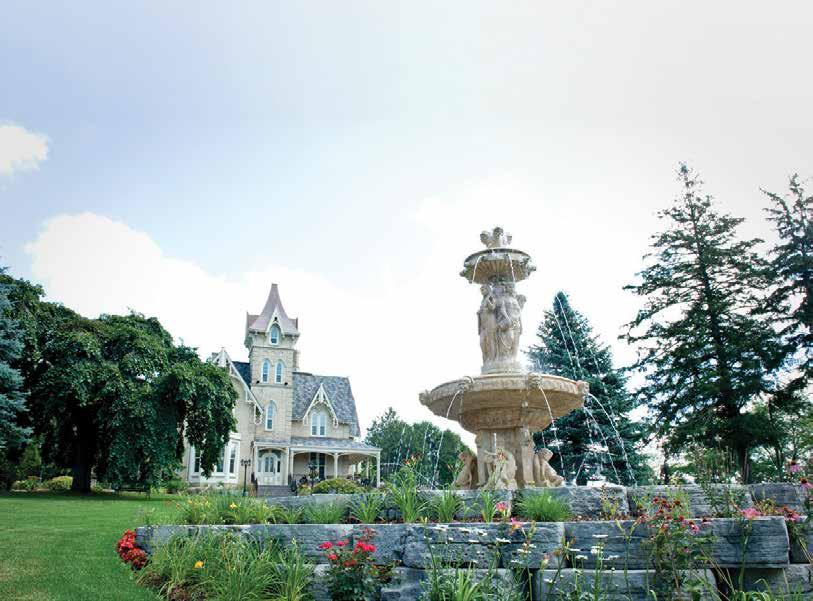
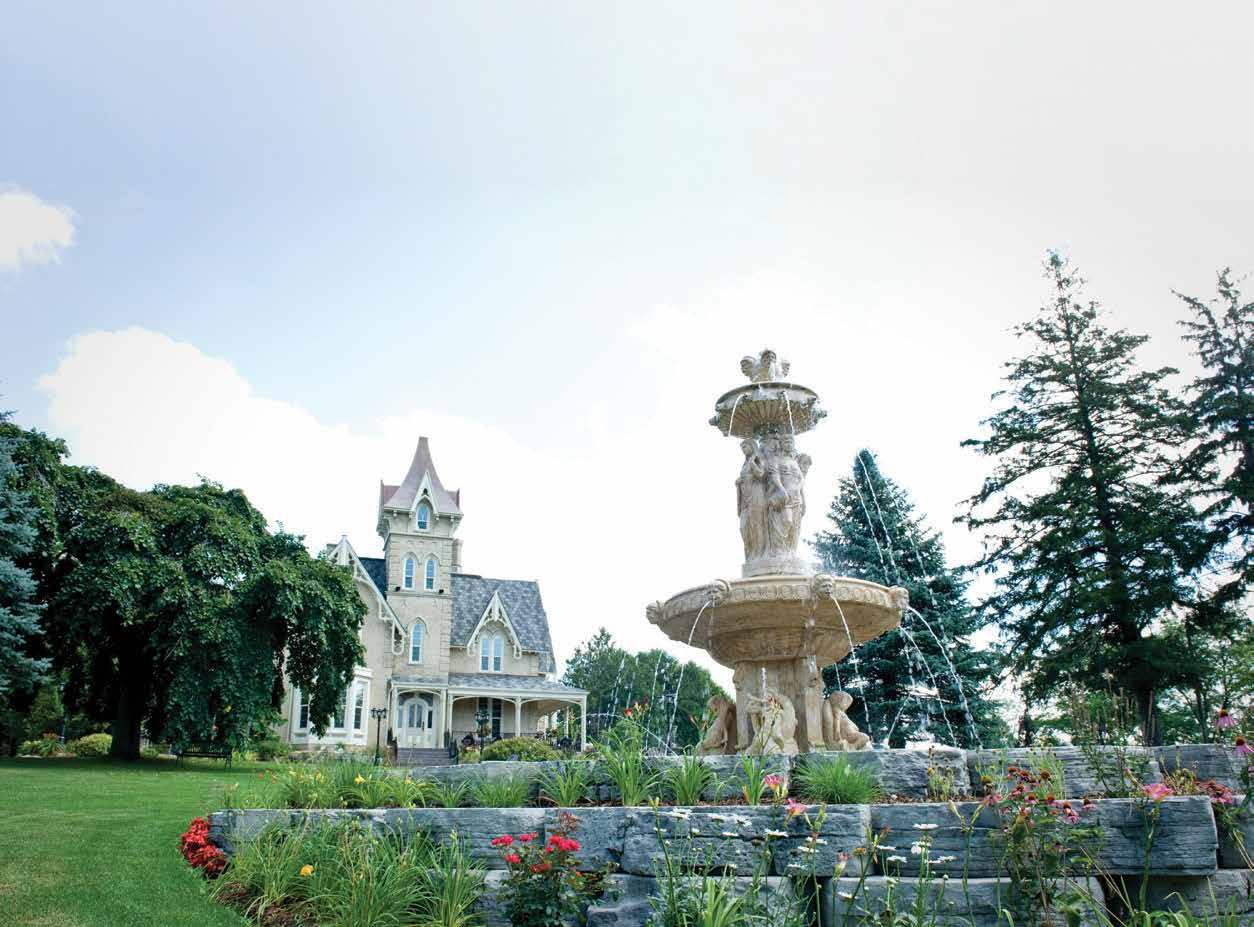


Festival









Opening Ceremonies with Ingersoll Pipe Band (45 minute performance)
Great Canadian Lumberjack Show 3 Shows | 1:00 PM, 2:30 PM & 4:00 PM
Pioneer Experience Zone
• Petting Zoo
• Wagon Rides
• Pottery, Woodworking & Forging Demonstrations
• Sapling Giveaway Market
• 35 Vendors; 7 Food Trucks; 3 Authors


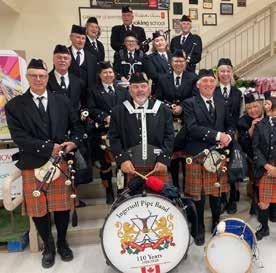


Kinsmen spearhead building Tillsonburg’s first pool
JOAN WESTON Post Contributor
There was a day when Tillsonburg didn’t have a swimming pool.
In the early 1940s, there were three swimming holes in Lake Lisgar. The main one was where Gibson House is now. There was a diving tower in the lake and lifeguards on the shore. On the Civic Holiday in August of 1929, the feature event of the aquatic sports was a three-mile marathon swimming race, open to all. Of the 12 amateur and professional swimmers competing, Tillsonburg’s Percy Heyd captured second prize.
There was also a swimming hole frequented by Bert Newman and his friends where the community dock is now, and a third one at “the point”, used mainly by people on the east side of the lake, which is where the bridge is now.
At the May 28th, 1946 meeting of the Tillsonburg Kinsmen Club, President D.E. Willits stated, “It is two weeks ago tonight (May14) that two drownings occurred in our town. I do not think these would have been necessary if we had had the proper swimming facilities in Tillsonburg. Most of us have families growing up, and there is very little recreation in Tillsonburg for them. It is felt that a swimming pool is needed in Tillsonburg.”
That night the Kinsmen unanimously decided to sponsor a swimming pool in Tillsonburg as a community war memorial. Combined with the swimming pool would be a wading pool for small children. After this meeting, the club met with the members of
the Tillsonburg Parks Commission and the two groups also visited Tillsonburg Memorial Park and inspected the site at the rear of the Armory (since demolished) where the club planned to construct the pool. The Kinsmen Club decided to set the objective of the fundraising campaign at $30,000. My father, John F. Weston, was appointed as the architect for the construction of the facility.
Over the next two years, the Kinsmen received funds from the citizens of Tillsonburg and sports teams, as well as a $7,000 grant from town council. In the spring of 1948, Jack Eacott’s father was in charge of the afterwork gang of volunteers who turned up to dig out the hole for the swimming pool by hand. Both Kinsmen and tradesmen worked feverishly to have the pool ready for business on Dominion Day, 1948. On June 27, the Kinsmen Club had a buffet supper at the pool and adjourned early to work on it. They started to pour the concrete for the wading pool that night.
Members of the Kinsmen Club and civic officials worked all night to be able to open the new community pool at 9 a.m. on July 1, 1948. Mary Jane Crosby was the first bather to enter the pool. Bathers were lined up in two rows across the park to the road waiting for the pool to open that afternoon.
A crowd of more than 500 people attended the swim show and dance on Aug. 2, 1948 for the official opening of the new Community Swimming Pool.
On Sept. 30, 1948, an article in the “Tillsonburg News” gave the following statistics about the new community pool: total receipts $759.77 from 588 children tickets and 24
adult tickets; net profit $268.79; cost of pool $40,142.88. By August of 1949, the daily attendance at the pool averaged 300, with a record-setting 775 attending on one day!
In 1950 or 1954, the Tillsonburg Parks and Recreation Commission took over the pool, but the Kinsmen Club still hired all of the workers and was still connected with it. At the beginning of October 1956, employees from the Gilvesy Construction Company started work on the new Kinsmen intermediate swimming pool, which was to measure 26’x36’, be two feet in depth, with a six-foot apron around the outside. The major cement work was completed that fall. The new intermediate pool was completed for the 1957 swimming season.
On Jan. 28th, 1972, the Kinsmen Club turned over ownership of the outdoor pool to the town. Town council agreed to continue to operate the facility as long as it was feasible
to do so.
By the early 1990s the pool needed repairs. In 1993 a questionnaire was put in the “Tillsonburg News” about whether or not citizens wanted to keep the outdoor pool: The results were 80 per cent of those questionnaires which were handed in were in favour of keeping the facility. In 1994, the Water Park Project was conceived. The Tillsonburg Kinsmen Club and Lions Club each raised $100,000 for the project, and then jointly gave another $25,000 to help pay for a 187-inch water slide. Parks and Recreation contributed $77,230. Provincial and federal grants covered the remaining two-thirds of the cost of converting the old Kinsmen Community Pool to a new water park, which included a play area and picnic area. The first full season of operation occurred in 1996.
By 2019, the slide at the Waterpark was deemed unsafe, and the future of the facility was in jeopardy. Once again, the townspeople supported the continuation of the Lake Lisgar Waterpark. Since 2019 the town has received several provincial and federal grants to install a new water slide in 2020; to build the Memorial Park Splash Pad in 2022; and to renovate the change house, paint its exterior with a pirate theme and tear down the original canteen and replace it with a much larger one in 2023-2024.
The Lake Lisgar Water Park has been in operation for 29 years. Although, being outdoors, its revenue is completely dependent on weather conditions. People come from as far away as London to have fun by the shores of Lake Lisgar!
Looking back at the Tillsonburg Community Centre
SARAH LISE ANHS Summer Student
The Tillsonburg Community Centre (TCC) is a fundamental part of many residents' daily lives in town. It’s home to the indoor pool, arenas, fitness club, various meeting rooms, and the Senior Centre. The community centre is a hub for bringing people together and fostering relationships between Tillsonburg residents, new and old. As we head into Tillsonburg's 200th anniversary, we look back on how this facility has evolved throughout the years Before the community centre on Hardy Avenue existed, there was one on the shores of Lake Lisgar. Built by Fred Bushnell Sr., in the early 1920s, the building originally served as a rehearsal space for his son, musician, Fred Jr., and his band. Known as "Evergreen's Dance Hall", or more commonly "Evergreens", it was a modest stone and wood barn-like building, that had many different functions over the years. The building was used as a roller-skating rink, a badminton club, an armory during World War Two, and as the home of the Lions Club Community Centre before becoming the town’s first museum. When all museum operations moved to Annandale House in the 1980s, the original community centre and mu-
seum was abandoned and eventually demolished around 1995.
By the late 1960s, it was clear Tillsonburg needed a larger, more versatile space. The town had a need for a bigger complex with more amenities, such as larger meeting rooms and more space for ice sports and aquatics. The town wanted a space that could facilitate activities for families and citizens of all ages. However, to turn this new dream complex into reality, the town needed money. The town’s fundraising campaign slogan was, “Please put the U in CommUnity Centre!” Clubs in Tillsonburg pulled through and fundraised large amounts for the construction of the new complex. The Tillsonburg Lions Club pledged $100,000 for the Lions auditorium. The Lions also contributed ideas for the new community centre. The Kinsmen Club promised $50,000 towards the construction of an indoor pool. The Kinsmen fundraised through a 48-hour flagpole sitting event, where a Kinsmen participant held onto or sat on a flagpole for 48 hours to raise money. The Rotary Club also pledged $25,000 to the Senior Wing of the building. Annandale High School and Glendale High School raised funds by selling chocolate bars and hosting sports games buyouts. It is remarkable how
the community united together to achieve their fundraising goals.
With the fundraising completed, the new complex was built. A momentous achievement for the Town of Tillsonburg, the opening ceremony rose to the occasion! The new Tillsonburg Community Centre officially opened on November 1, 1972. Governor General Roland Michener and his wife, Norah Willis Michener, attended the ceremony. Hundreds of town residents gathered outside the Community Centre on the big day to hear the Governor General speak and to see the ribbon cut to mark the official opening. Following the ceremony, there was a 10-day open house to celebrate the fundraising efforts of the community, which included free activities like bingo, swimming lessons, as well as song and dance performances.
Today, the TCC remains a staple of the community. With the indoor pool renovations finished in 2025, aquatic activities are better than ever and accessible to more residents. People of all ages continue to enjoy the many amenities. The complex is a reminder of how the Town of Tillsonburg was able to come together as a community to make their goal of a new community centre for everyone come true.
(CONTRIBUTED PHOTO)
Members of the Kinsmen Club dug out the original Kinsmen Pool by hand in 1958. This photo, taken shortly after it opened, shows the original layout of the pool.
(ANHS PHOTO)
This photo shows the Tillsonburg Community Centre while it was under construction in the early 1970s. The building was built with contributions from many local service clubs.
(JEFF HELSDON PHOTO)
The Tillsonburg Community Centre as it stands today with the recent upgrades done to the pool. Several renovations have taken place over the years.
Our Veterans
Tillsonburg honours and remembers its veterans
Tillsonburg citizens answered the call when Canada went to war during the 20th century. Everyone within the community knew of a family member of their’s, or from another family who was a veteran. Some served overseas, some at home, some came home, while others did not. In modern times, the veteran population is not as visible. No matter their service, age or ability, they have always been supported by Tillsonburg Varnavair Royal Canadian Legion Branch 153.
Tillsonburg honoured returning citizen veterans by giving them a token of appreciation from the town. World War One veterans received a lapel medal and Second World War veterans were given bookends; each personally inscribed with their name. These have become collectables for their families as well as collectors of Tillsonburg artifacts.
Members of the Tillson family also served. In particular, Marguerite VanNorman Sinclair, E.D. Tillson’s granddaughter, served as a nursing sister in World War One. Marguerite completed her nurses training at Farrand Training School Harper Hospital in Detroit, Michigan, prior to the war. She then traveled to England and France and worked in hospitals caring for sick and wounded soldiers. And, famously (or infamously) Tillson Lever Harrison, E.D. Tillson’s grandson, fought for both the United States and Canadian armies prior to World War One, was in the Philippines, completed a medical degree in 1907 in Canada, fought in Texas and Mexico, went to the Caribbean and South America. He served with the Royal Navy from 1941 to 1946 and then devoted his life to being a doctor for Chinese peasants.
Life at home in Tillsonburg reflected the common struggles of the war years, like other communities. Rationing was in place. Ration cards were issued and enforced when purchasing items such as sugar/ butter, meat, and gasoline. Scrapping and recycling programs became part of the war effort. And something vastly different from today, Tillsonburg specifically raised money during World War One for the Canada Cigarette & Tobacco Fund. This fund sent cigarettes and tobacco to soldiers overseas.
The Tillsonburg Legion Branch 153 officially gained its charter in 1929. The cenotaph or Soldier’s Memorial, on Broadway, was constructed and unveiled on November 11, 1929. It was funded by the Tillsonburg Lions Club at a cost of $3,880. World War One veterans met in a myriad of different spaces in the post-war years. In 1946, the Legion purchased the Sinclair House on Lisgar Avenue from the Tillson estate. After the Second World War, the branch’s membership increased, and a new building was required. The current Legion, on Durham Street, was built by the membership and opened in 1970. Not all Legions have a moniker or associated name, but Tillsonburg’s branch is called “Varnavair”. This stands for Veterans of the Army, Navy and Air.
I’ve been criticized for my articles that often focus on veterans from World War One and Two. A number of our community members have served our country in various world arenas, in historical and modern contexts, and in all types of service. It must be remembered that our Legion welcomes and supports all veterans. Additionally, Tillsonburg has become home to many men and women of various ages, countries, conflicts, acts and areas of service. Tillsonburg honours and remembers our veterans well. Look around our community and you can see many examples of ways we remember. Military graves and crosses in the cemetery, the veteran banner program, Veteran’s Memorial Walkway, and particularly, our cenotaph ceremonies on Canada Day and especially, November 11, Remembrance Day.
I recently asked a friend of mine, a veteran, who moved to Tillsonburg several years ago, what Tillsonburg meant to him. His initial responses are cliched; a beautiful town, easy to navigate and a good community of people and opportunities. Then he said, as a veteran originally from another community, he felt welcome as a comrade at our Legion. During his first visit to the Legion canteen, he was immediately welcomed and introduced to people. In time, he had his membership transferred to our branch and became involved in activities. And then he proudly stated that he loves Tillsonburg because the community does not forget their veterans. Our town, for its size, represents, honours and remem-
bers those who served better than other larger places.
Tillsonburg Legion Branch 153 is always looking for people who want to become involved in the acts of Remembrance and supporting our veterans and our community. You do not have to be a veteran to become a member. If you are a veteran and are
Hear Better
This
looking for support or a place to meet with comrades, we provide a safe and welcoming space. Here we will continue the legacy of the Royal Canadian Legion, which will celebrate its 100 year anniversary in 2026. And in 2029, our branch will celebrate our 100 year history. What a party that will be!



DR. JASON PANKRATZ
Post Contributor
(JASON PANKRATZ PHOTO)
This early photo shows the cenotaph in its original location in front of the old town hall. The cenotaph was unveiled in 1929.
(JEFF HELSDON PHOTO)
The Tillsonburg Legion, known officially as Branch 153 Varnavair, is a busy hub of activities, including the veteran’s coffee hour that gives veterans an opportunity to talk to other veterans in a relaxed environment.
People & Organizations in Tillsonburg
Mary Ann Tillson: The cookbook legacy of E.D’s wife
KATHLEEN WATKIN, ANHS Program Coordinator & LAUREL BEECHEY, Tillsonburg Historian
Mary Ann Van Norman, born in Normandale in 1831, was the daughter of Whiting F. Van Norman and Margaret McLeach, whose father was a Highland Scotsman and British soldier from Annandale. In 1850, while visiting her uncle Joseph Van Norman in Dereham Forge (now Tillsonburg), 19-year-old Mary Ann met Edwin Delevan Tillson. Their courtship, famously described as E.D. “courting on stilts through the snow,” quickly blossomed into romance. Within six months, they were married on July 4, 1850, in a double ceremony alongside E.D.’s sister Nancy Jane Tillson at the Tillson family homestead. The event, complete with white lawn dresses, a sunrise ceremony overlooking Otter Creek, and a wedding breakfast before traveling to London, Ontario, remains a cherished part of Tillsonburg’s local history.
After their wedding, Mary Ann and E.D. first lived in a house on London Street, where their first child, Nancy Margaret (“Maggie”), was born in 1851. As their family grew, they moved into a larger home on Oxford Street South in 1853, which still stands today. Mary Ann managed a bustling household, raising seven
children (Maggie, Catherine, Fred, Benjamin, Hattie, George, and Edwin) while also caring for the broader Tillson workforce—baking for up to 200 mill workers each week. While the Tillson children often worked in the family business, they sometimes struck out on their own before returning. Despite the challenges, the family remained close, cherishing summers together at their cottage on Lake Muskoka.
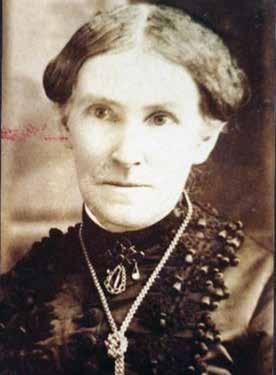
Despite E.D. Tillson’s powerful presence, Mary Ann was never overshadowed. She was strong, capable, and deeply respected for her own contributions. E.D. himself credited much of their family’s success to her partnership and support, noting in 1892 that she “advised and shared all the burden of life with me, and to her is due a great share of our success in life and the comforts of a pleasant and comfortable home.” Her great-grandson described her as “the power behind the throne,” a small but formidable woman who ran a tight but welcoming household. She balanced high standards with warmth and generosity, remembered for her love of life and community spirit—chartering trains for Sunday school picnics, leading berry-picking excursions, hosting Fourth of July and Confederation celebrations, the Queen’s Birthday, and elegant lawn teas.

Mary Ann Tillson passed away in the fall of 1911. According to the Tillsonburg Observer: “Early on Sunday morning last (October 29, 1911), the death occurred at the family residence of Mary Ann Van Norman, relic of the late E.D. Tillson, one of our oldest and most highly respected citizens. The Deceased, who was in her 83rd year, had been a patient invalid for the past 3 years and death was not unexpected.” Her gravestone reads, “She Hath Done What She Could,” a verse from Mark 14:8, reflecting the belief that while none of us can do everything, she truly did all she could.
One of Mary Ann’s last legacies is her participation in the well-known Canadian Home Cookbook of 1877. Her recipes appeared under her initials, M.A.T.
Annandale NHS is very lucky to have a copy of this cookbook containing Mary Ann Tillson’s recipes. Here are some of
her favourites.
Oyster Soup
Take a quart of water, one teacup of butter, one pint of milk, two teaspoons of salt, four crackers rolled fine and one teaspoon of pepper; bring to a full boiling heat as soon as possible, then add one quart of oysters; let the whole come to boiling heat quickly and remove from fire.
Tongue Toast
Mince very fine a cold boiled tongue. Mix it with milk and to every ½ pint of this mixture allow the well-beaten yolks of 2 eggs. Add salt and pepper to taste. Simmer on the stove for a minute or two and pour it over hot butter toast.
Potato Salad
Slice cold boiled potatoes; almonds blanched and quartered; hickory nuts if liked (both may be omitted). A very small quantity of chopped onions; pour over this any good salad dressing, not too much, and garish with shopped parsley; cold boiled beets, sliced lemon and anchovies, may be added to the salad, if liked,
Wine Sauce
Two teacups of sugar, one teacup of butter; stir to a cream; beat two eggs very light and stir all together; add one teacup of wine; mix and set on top of kettle of boiling water. It must not be put on the stove, nor boiled.
Jellied Veal
Boil the veal tender; pick it up fine, put in a mould, add water it was boiled in, and set in a cold place; season with salt and pepper to taste; a layer of hard-boiled eggs improves it.
Ten Cent Pudding
Mix together in bowl: 1 teacup golden syrup, 2 teacups currants, 3 teacups flour, 1 teacup suet; 1 ½ cup sweet milk, 1 teacup almonds, ½ teacup of brandy, ¼ teacup soda [baking]. Put in your pudding bag [cloth or animal intestine]. Steam for 3 hours.

Here’s to celebrating two centuries of community, hard
and

(ANHS PHOTO)
Mary Ann Tillson.
Jarred Mansfield was vital in preserving town’s history
LARISSA MCCABE
ANHS Summer Student
With retelling the tales of Tillsonburg, you’d be hard pressed to overlook Jerred Israel Mansfield in both the town’s history and the history of preserving town history. Mansfield is remembered for his instrumental collecting and preserving of Tillsonburg’s past, particularly with his significant emphasis on military history from World War I. Much of our town’s history is thanks to Mansfield’s hard work and dedication to encapsulate the memories past, just as we are today, memorializing Mansfield for Tillsonburg’s 200th anniversary. Born as the second child to Charles M. and Mary Mansfield in 1893, Jerred Mansfield was raised on a small family farm in South Walsingham, Norfolk County. When Mansfield was 23 (in the year 1916 - during World War I), he enlisted to join the war effort at the Port Rowan recruiting station. Mansfield was sent to fight in France and throughout his time there, he kept an extensive trench journal of his daily life and experiences during the war.
Following the war, Mansfield married Cenoe McConnell in 1922, and the couple lived in Tillsonburg. He and Cenoe transcribed and edited these trench journals into a full, complete diary, fixing mistakes and allowing it to be easier to read. Thanks to the hard work of Annadale National Historic Site volunteer Janet Whaley, the museum has both a copy of the physical documents from Mansfield and digital transcriptions; which we’ll share some excerpts to get a glimpse into the past. Following his time in the military, Jerred worked as a stationary engineer (janitor) at Tillsonburg District High School and then Annandale High School. Cenoe worked as a teacher in town, and they never had children.
Preserving military history became a very important thing to Mansfield at this point in his life, and along with fellow WWI veteran, Charles (Charlie) Laister, they established the Tillsonburg Museum’s outstanding military collection. On top of this, he acted as a photographer and made scrapbooks to document the world around him, as well as the fact that he was involved in the community’s branch of the Royal Canadian Legion, the North Broadway Baptist Church, and the Annandale High School.
In an interview with Janet Whaley, she tells her favourite excerpt from the Mansfield diaries being from paragraph 758, where Jerred Mansfield jumps into an opened crypt for protection from flying shells, mentioning that he didn’t mind the company of the dead people inside the crypt compared to the bombs outside:
“I went over to the Y.M.C.A. canteen a half a mile away at the other end of the village and on my way back I heard the high singing note of oncoming shells. I ducked
in a slight hollow without any feeling of guilt. Their arrival was announced by a ringing crash that shook me to my boot heels. I got up and ran as fast as I could. A hundred yards away the heavy stone slab covering a vault was shoved aside and I dived through the opening, caught the iron ladder and dropped to the bottom. I stayed right there until that little show was over. I am sure the company I was forced to keep did not bother me in the least.”
Local Tillsonburg historian, Laurel Beechey, tells her favourite of the Mansfield diary entries are the ones that remind readers of the horrors of war and exemplify contradictions of the romanticization of the violence that ensued during these times, especially because many who experienced them firsthand did not discuss or record this part of their life. Beechey’s favourite entry, as she told Annandale National Historic Site staff, pages 475 through 482, which detail Mansfield’s corps making their way through the Belgian hamlet of Wieltje (in Ypres, West Flanders) and getting bombed. Mansfield describes:
“To get off the road meant disaster, a loaded horse would simply sink into the mud and the chances of getting it out were about one in ten. The mud cannot be described; it was awful. It was a gigantic, quaking, seething Slimy “Hell” and yet it was our salvation. It was being heavily shelled up ahead and it was working down our way. We could only go a few yards and stop until the line moved on ahead again as the gap closed up caused by the shells. Then it struck us, great howling screeching shells that tore gaps in that line of men and animals. Gaping holes suddenly appeared in the road and fields; geysers of smoke and earth shot high into the air and the roadsides were strewn with the remains of what had once been men. Bodies without heads and legs were mingled with crippled and dying horses screaming In agony and shattered equipment was dumped in heaps everywhere. The noise was beyond description, almost beyond conception. It was like a close clap of thunder which seemed to split your brain pan and your head throbbed from the sound. The ground heaved and shuddered beneath our feet and the very atmosphere palpitated to the great detonations. The howl of shells passing over head gave us the feeling that the sky was falling. Compared it the roar of cannon at Waterloo must have sounded like the popping of fire crackers. Drivers cursed and tugging on their lead reins hurried the faster, while some silently took their turns knowing there was no use in hurrying.”
As we reflect on Tillsonburg’s history, it is important to remember the dedication of people like Mansfield, who shared and preserved the stories we tell today, because their hard work is how we have a town heritage to remember and celebrate.
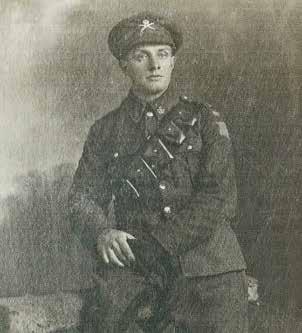

(ANHS PHOTO)
Jerry Mansfield.
Kinsmen Club makes its mark in Tillsonburg
MARY BARTRAM
Post Contributor
In 1920 after being refused membership to a service club, Hal Rodgers decided to form his own, all Canadian service club-Kinsmen. The aim for this service club was to combine opportunities for fellowship for young men as well as to serve within their community wherever the needs arose.
When Kinsmen began, women were only allowed at the social events. However, with many wives helping the men with all their fundraising and service work, by 1942 a formal structure was beginning to appear that would eventually turn into the ladies’ clubs - Kinettes. The Kinettes were made an auxiliary of the Kinsmen Clubs but it wasn’t until 1983 that the Kinettes were official registered as a service club with their own set of house rules.
During the founding years of Kinsmen, the large service project they contributed to was raising money to send powdered milk to Britain, for the children’s fund. In the 196’s the Kinsmen adopted Cystic Fibrosis as their national service project and they continue to serve this cause today.
The beginning Of Tillsonburg Kinsmen
Twenty-five years after Hal started Kinsmen, the Tillsonburg chapter chartered their first club with President William Green in 1945. Today, the club celebrates its 80th year anniversary!
The Tillsonburg Kinsmen started serving the community right away by hand digging the outdoor pool in 1947 and holding a winter carnival. They also started their annual turkey bingo, giving away a new car each year as the main prize.
As the club grew, they continued giving back to the town of Tillsonburg providing food hampers every Christmas and distributing them to families in need, one year giving away 150 hampers!
Serving the community
Over the years the Tillsonburg Kinsmen have pledged money towards multiple projects servicing the community;
• $50,000 pledged towards a new indoor pool in 1971
• $10,000 donated to the recreation complex and new senior citizen centre
• $10,000 pledged for the second ice pad in 1976
• $20,000 pledged to the hospital building fund in 1979
• $130,000 was pledged for new squash/racquet ball park and senior complex
• $7,500 donated to the Station Arts Centre
• $100,000 was donated to build the Tillsonburg Soccer Park
The club has also lad and executed on other community projects;
• The club began the Lake Lisgar Renaissance by draining and restocking fish, as well as constructing a bridge over the Lake. The Kinsmen continue to tend and maintain the fountain in the lake to this day
• Opened a newly-built Participark
• Built a walkway on the old railway bridge
• A community Easter Egg hunt was established in 1990 and still continues to this day
To fundraise for the above projects, the Kinsmen held various community events with a few that remained consistent for many years to help continue pledging for the town of Tillsonburg;
• The Kinsmen hosted their first TV Bingo in 1971
• ‘Femme Fest’ a ladies’ night out was a soldout event for years!
The beginning of Tillsonburg Kinettes
One year after the Tillsonburg Kinsmen Club was chartered, the first Tillsonburg Kinette club was chartered with Dorothy Freeman as president in 1946.
Following in the Kinsmen’s footsteps, the Kinettes began supporting Tillsonburg with various fundraising events;
• Fashion shows
• Raffles
• Bridge and euchre tournaments
• Magic show
The money raised from the events was put back into the community via donations to;
• The local library
• Tillsonburg Community Centre
• Meals on Wheels-spearheaded by the Kinettes around 1972
• Annual scholarship for Glendale High School
• Tillsonburg Hospital
Starting over
In the early 1980s, the Tillsonburg Kinettes had a membership of over 40 active girls but as the years progressed the membership declined to six members and it was decided to hand in their charter.
Then in 1990, a new Kinette Club was rechartered with 23 new members with Marilyn Moody as president. This charter has remained strong since then, and today there is over 31 ladies in the club.
With an established presence in the community and strong active members, the Kinettes have now been able to raise money on a larger scale which has allowed larger donations to go back into the community.
Some annual donations include;
• Food bank
• Salvation Army
• Scholarships
• Hospital
• Local schools
• Community centre
Two notable events that the Tillsonburg Kinettes have had great success with are ‘Breakfast with Santa’ and the ‘Princess Ball’.
Breakfast with Santa continues annually and is the largest event that the Kinettes sponsor with well over 600 meals served during the event! With many community sponsors for this event, they are able to get their expenses covered so that all profits can go back into the community, as well as being able to offer meal vouchers to be handed out for those in need. The Kinettes also ask for new toys to be donated for collection during the event which they take to the Salvation Army for distribution.
The Princess Ball was another event that the Kinettes hosted, and for the few years that it ran it was a wild success. Mothers, daughters and grandmothers got a chance to get dressed up for the afternoon and visit with Elsa, Cinderella, Belle and other princesses while drinking tea, eating cupcakes and making crafts. Unfortunately, after Covid, resurrecting the Princess Ball proved more difficult than the club was prepared for.
The Kinettes shifted gears and started an event called ‘Mom Prom’ that has sold out the last two years.
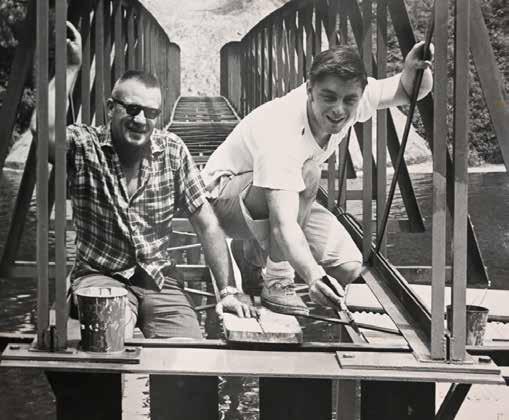
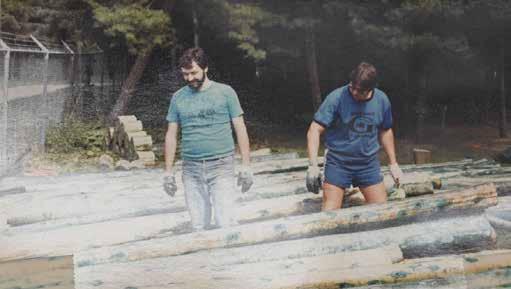
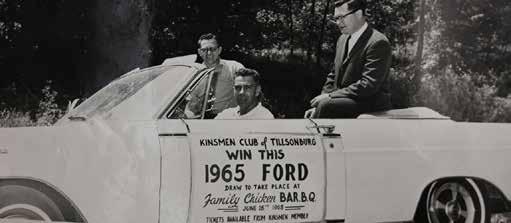
Over 100 years after Hal Rodgers started Kinsmen, Kin Canada is still going strong and remains the only Canadian service club that reaches all the way from the east coast to the west coast. Although many locations across
the country no longer have both a
but
into
Kinsmen and Kinette club
have instead combined
one known as a Kin Club. In Tillsonburg, there is strong membership in both the Kinsmen and Kinette clubs.
In the days with fewer regulations and insurance requirements, members of the Kinsmen Club built the bridge over Lake Lisgar. This 1969 photo shows members hard at work.
(TILLSONBURG KINSMEN PHOTO)
When Participark was originally built by the Kinsmen in the 1980s, the park featured a variety of activities visitors could complete while walking through the park. While the park remains popular, many of the structures for activities have been removed. Members are seen here working with logs to build one of the activities.
(TILLSONBURG KINSMEN PHOTO)
The car draw was a one of the Kinsmen Club of Tillsonburg’s annual fundraisers. This photo from 1965 shows Kinsmen members promoting the draw.
(TILLSONBURG KINSMEN PHOTO)
The Rink Masters: For a small town, Tillsonburg has produced a surprising number of hockey legends
COLLEEN PEPPER Post Contributor
In the late 1800s, hockey was a strictly outdoor activity. If you wanted to play a game of shinny, you layered on your woolies and headed over to Lake Lisgar. That is, until the turn of the century when Frank and William Barkey, proprietors of the Tillsonburg Electric Light Plant, had an idea. Why not build an outdoor rink? They could even install lights to enable night-time skating.
And so the Barkey Brothers Electric Rink was born. Opening on January 1, 1902, the new rink was a marvel.
Located where Canadian Tire is today, the rink had the largest playing area in the province (70 x 170 ft) and could reportedly accommodate crowds of up to 2000 people in its heyday. Though it was originally constructed as an open air rink, the facility later gained a roof, walls and even live music performed by Frank’s own band.
Photographs of Frank reveal a most unlikely sports hero if ever there was one. And yet, without this larger-than-life man and his brother, it’s fair to say that Tillsonburg might have remained a hockey backwater forever--a town known only for producing tobacco, and not the likes of NHL players Lloyd “Shrimp” Andrews and Russell Oatman—or their contemporaries, Colin and Gregory Campbell.
Here’s a look back at some of our local hockey legends.
Colin Campbell
At 17, Colin left home to join Roger Neilson and the OHL Peterborough Petes. In 1972-73, he was drafted fifth overall by the Vancouver Blazers of the WHA, and 27th overall by the Pittsburgh Penguins of the NHL.
After a year in the WHA, Colin switched leagues. It didn’t take long for him to make his presence felt.
Known as a scrappy, no-nonsense defender, Campbell’s NHL stat sheet speaks for itself: 11 seasons played, 25 goals, 103 assists and nearly 1300 penalty minutes.
Campbell’s story would have been impressive enough had it ended there—but as it turned out, that was only the beginning.
When Campbell’s playing days were over, he moved behind the bench, coaching the likes of Probert, Gretzky and Messier. In fact, it was as an assistant coach with the New York Rangers in 1994 that Campbell finally won a Stanley Cup. Colin Campbell is currently Executive Vice-President of Hockey Operations for the NHL.
Gregory Campbell
In the 2002 NHL Entry Draft, Gregory got his chance to follow the dream to win the Stanley Cup that started when he was 10 and his father won. He was picked 67th overall by the Florida Panthers. He was on his way.
Eight years later, Gregory was traded to the rough and tumble Boston Bruins and for the first time in his NHL career, he was headed to the post-season. He scored a goal and three assists in 25 playoff games—including a well-timed one in Game 7 of the Stanley Cup Final.
Gregory is the assistant general manager for the Florida Panthers.
Eddie Oatman
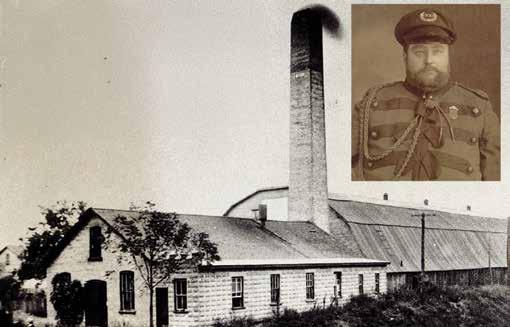
Rent-Alls.
Harley Hotchkiss
Harley Hotchkiss may have been “Mr. Calgary”, but he was a Tillsonburg boy at heart. Growing up “dirt poor” on a tobacco farm, Hotchkiss studied geology before heading to Alberta and the lucrative oil and gas industry. In 1980, he was one of six investors that purchased the Atlanta Flames and brought the team to Calgary. Over the next nine years, the Flames won the President’s Trophy twice, and played in two Stanley Cup finals (winning the championship in 1989). Hotchkiss served as chairman of the NHL board of governors from 1995-2007. At the time of his death in 2011, he was credited for saving not only the Flames, but the NHL as well, through the currency equalization program.
Gary Green
Born in 1889 in Springford, Edward Cole “Eddie” Oatman was 18 years old when he joined the Tillsonburg Pan Drieds, the local Ontario Hockey Association (OHA) team named for E.D. Tillson’s famous oats. In 1909, Eddie turned professional and two years later, won a Stanley Cup with the Quebec Bulldogs (NHA). Following the win, Oatman joined the Pacific Coast Hockey Association (PCHA), where he played for the New Westminster Royals, the Portland Rosebuds and the Victoria Aristocrats. In 1922, Eddie got another chance to play for the Cup when he filled in for an injured player on the Vancouver Millionaires.The next year, Oatman was traded to the Calgary Tigers and the team won the Western Canada Hockey League title. Even after economic collapse of western hockey in 1926, Oatman persevered. He played in the minor leagues for four more teams before finally calling it quits at age 50. In all, Oatman played an unbelievable 32 years of professional hockey, and served as coach and captain of five different teams.
Russell Oatman
Left-winger Russell Oatman may have grown up in his older brother Eddie’s shadow—but it wasn’t a bad place to be. In fact, it was Eddie’s success in the PCHL that opened the door for Russell to join the Victoria Cougars in 1925. During his first season, Russ scored eight goals and proved to be a dominant force in the corners. The following year, the Cougars moved to Detroit where Oatman scored three goals in 14 games. However, an off-ice incident resulted in a mid-season trade to the Montreal Maroons. Undeterred, he went on to play 25 games for Montreal and scored 8 times. In 1927, the Maroons squared off against the New York Rangers in an unsuccessful bid for Stanley Cup. The following year was a similar story, although Oatman was now on the defending Rangers roster. Oatman played his last hockey with the IAHL’s Hamilton Tigers and Niagara Falls Cataracts before retiring in 1930.
William “Red” Anderson
Defenceman Red Anderson was born in Till-
sonburg in 1911 and played professional hockey for eight different teams from 1936 to 1943. His on-ice career included games in the AHA, IAHL and EHL, as well as one NHL playoff game with the Boston Bruins.
Lloyd “Shrimp” Andrews
Born in Tillsonburg, left winger Lloyd Andrews was a part of the Tillsonburg Reds, Dunnville Mudcats and Niagara Falls Cataracts before making his NHL debut in 1921. During his four seasons with the Toronto St. Patricks, the 5’4” Andrews played 53 games, scored eight goals and had five assists. Undoubtedly, he would have had more points had he not volunteered for World War I. Nevertheless, Andrews made the most of his limited time. In the 1922 Stanley Cup playoffs he scored twice in five games to help the St. Pats win over Tillsonburg’s Russell Oatman and the Vancouver Millionaires. Released by Toronto in 1925, Andrews joined the Can-Am league, where he scored 24 goals during the 1929-30 season. He finished his career in the CHL before retiring in 1934. In 2017, Hayhoe Homes named their newest Tillsonburg housing development “Andrews Crossing” in Shrimp’s honour.
Stan Crossett
Born on April 18, 1900, defenceman Stan Crossett began his professional hockey career at the advanced age of 29. Standing six feet tall and weighing 200 pounds, Crossett enjoyed a significant size advantage over most of his opponents. In 1931, he signed a free agent contract with the Philadelphia Quakers and played 21 NHL games. When the team folded at year’s end, Crossett returned to Ontario and went into business.
John Gofton
During the 1960s and 70s, John Gofton was a gritty presence on a host of professional and semi-pro hockey teams. He was a part of the Memorial Cup-winning Hamilton Red Wings in the 1961-1962 season, and in 1977, won the National Senior Hockey Championships with the Brantford Alexanders. In an unusual twist, Gofton also played ‘Brophy’ in the 1977 cult movie hit, Slap Shot, opposite actor Paul Newman. Gofton is the former proprietor of Tillsonburg
When 21-year-old Gary Green realized he wouldn’t play in the NHL, he could have given up. Instead, the Tillsonburg native went to see Roger Neilson and offered to be an unpaid assistant coach for the Peterborough Petes. His gamble paid off. Three years later, Green was promoted to head coaching duties and led the Petes to two consecutive league championships and a Memorial Cup. In 1979, Green moved to Pennsylvania to coach the Hershey Bears (AHL). Two months into the season, he became head coach of the Washington Capitals. With a phone call and the stroke of a pen, the 26-year-old became the youngest head coach in professional sports. Terminated three seasons later, Green decided to wait things out in the broadcast booth. It turned out to be the start of a 30+ year media career. As a broadcaster, Green has worked for CBC, TSN, USA and the NHL Network. He also serves as a senior director of Stadium Consultants International, designers of more than 100 sports facilities worldwide, including Toronto’s Air Canada Centre.
David Moylan
As a kid, David Moylan loved hockey and by high school, it was clear the game loved him back. After playing at the Junior “B” and Junior “C” levels in the early 1980s, David was selected first overall in the 1984 Ontario Hockey League draft by the Sudbury Wolves (OHL). A year later, Moylan caught the eye of the Buffalo Sabres, who chose him in the fourth round of the NHL draft. In 1986, he won a silver medal for Canada at the World Juniors. In the years that followed, Moylan played in the OHL, IHL and AHL. He even played two years in the Finnish Elite League in Jokerit, Finland. Moylan finished his playing days with the CHL’s Brantford Smoke, retiring in 1994.
Jeff Bes
Center Jeff Bes played 19 seasons of professional hockey. In 1993, Bes won gold for Canada at the World Junior Hockey Championships in Sweden. Although drafted a year earlier by the Minnesota North Stars, Bes never saw regular season time in the NHL. He did, however, go on to play for 17 different teams, in seven different leagues and five countries. The last eight seasons of his playing career were spent with the Laredo Bucks in the CHL. He is currently head coach with the Fayetteville FireAntz in North Carolina.
(TILLSONBURG MUSEUM PHOTO)
The Barkey Brothers Electric Rink opened in 1902 and was destroyed in a 1927 windstorm. Co-owner and local band leader Frank Barkey is shown at top right. Tillsonburg would not have another ice arena until 1949, when Memorial Arena opened.


Charcuterie,Gifts&Catering 20BrockStW,Tillsonburg,ON 519-688-2228 twogirlsandacheeseshop.com

Supermarket - Wilkinson's Your Independent Grocer 227 Main Street, Delhi, ON 519-582-0864 yourindependentgrocer.ca

519-544-1131 sacredspells.company.site Awnings, Windows, Doors, Roofing, Eavestroughs & More! 346 Simcoe Street, Tillsonburg, ON 519-409-5754 thehainesgroup.ca Firearms, Crossbows, Knives, HuntingSupplies&Accessories A,107ConcessionStE,Tillsonburg,ON 519-842-7442 tillsonburggunshop.com


Construction Happy Birthday Tillsonburg! From the Grant Haven team. info@tillsonburgpost.com granthaven.com

Tillsonburg Business Improvement Area. 164 Broadway, Unit 10 Tillsonburg 519-842-8880 downtowntillsonburg.com



Supermarket Featuring Bakery, Deli, Local Products, & More 225 Broadway St, Tillsonburg 519-842-3625 metro.ca





CentreForKids.
Tillsonburg 437-455-6522 Sacredrainorshineplaycentre.com Spells Where the strange feels like

226-231-0722


519-842-6126 endoftheroll.com/tillsonburg


Small town, big dreams and a trip to the Olympics: The Livvies
PATTY PHELPS, Curator Emerita & KATHLEEN WATKIN, ANHS Program Coordinator
Did you know that Tillsonburg is the only Canadian community to produce not one, but two Canadian Olympic basketball teams—first in 1952 and again in 1960? This incredible achievement was made possible thanks to the vision, passion, and dedication of local businessman Gerry Livingston. For a small town with a population of just 5,500 in 1952 and 7,000 in 1960, this stands as one of the most remarkable chapters in Tillsonburg’s history.
The story of the Livvies began in 1946, when local players Bill Bennett and Roy Climie asked Gerry Livingston for financial support. As the owner of Livingston Wood Products, the largest industry in town at the time, Livingston agreed to lend the team one hundred dollars—a significant sum then—to help buy new uniforms.
But Livingston’s commitment went far beyond sponsorship. He became deeply invested in building the team’s success, recruiting talented players for both his growing company and the basketball team. One of his first recruits was Bill Coulthard, who joined as an accountant and playing coach for the upgraded Intermediate “B” team. By 1948, Livingston was already envisioning an Olympic future for the Livvies. Coulthard later recalled attending the Olympic trials in Toronto with Livingston: “In the spring of 1948, Mr. and Mrs. Livingston and my wife and I went down to see the Olympic Trials at Maple Leaf Gardens…I remember sitting there and [Livingston] said, ‘We’ll be there in 1952.’ Which was the first I’d heard of all this.”
To make that dream a reality, Livingston continued to strengthen the team by strategically recruiting skilled players and, in 1951, hiring Paul Thomas—who was then trying out for the New York Knickerbockers—as coach. Since Canada didn’t have a formal national basketball team at the time, the plan was simple yet ambitious: the Livvies would win the National Championship, which would qualify them to represent Canada at the 1952 Helsinki Olympics.
The Road to the Olympics
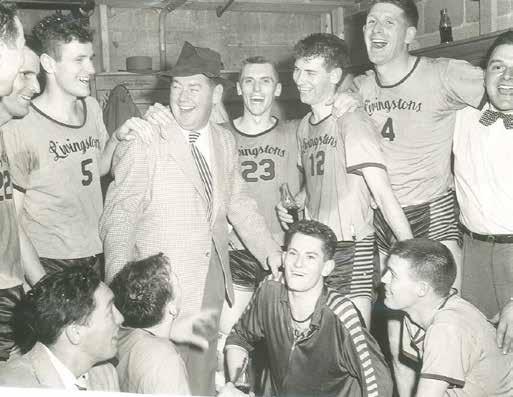
The Livvies won the Eastern Canadian title by defeating strong teams, including the Montreal YMHA, which had formed much of Canada’s 1948 Olympic team. To claim the national championship, they now had to take on the Western champions, the Winnipeg Grads. Gerry Livingston wasted no time transforming the Tillsonburg arena from an ice rink into a packed basketball venue that drew crowds far beyond its official capacity. The Livvies lost the first game but stormed back to win the next three, sparking huge local excitement— students even had their exam schedules shifted so they could attend the games.
Union Jacks flew from downtown light posts, the Tillsonburg News ran an editorial declaring, “Vive le Livingstons,” and the London Free Press called it the night “Tillsonburg became the basketball capital of Canada.” Even as Canadian champions, however, the Livvies still needed one last win to reach the Olympics.
Their final hurdle was a playoff against the University of Western Ontario, the In-
tercollegiate Champions. The series drew massive crowds, complete with newsreel cameras and a live radio broadcast—fans were literally hanging from the rafters to witness history in the making. Tillsonburg took the series in four games. The Livvies were going to Helsinki!
The Livvies head to the Olympics
The Livvies made up the core of Canada’s 1952 Olympic basketball team, joined by top players from other Canadian universities and clubs, with coach Paul Thomas and manager Eddie Bowering. The Games in Helsinki highlighted Cold War tensions, with the team experiencing strict political divides and security concerns, including a tense plane landing near the Russian border. The Tillsonburg News explained that the players discovered what it was like to be “under the shadow of the Iron Curtain”. Basketball was only in its third Olympic appearance, and Canada had to qualify through a preliminary round since they hadn’t placed high enough in 1948 to get
an automatic spot.
In the first round Canada was in group C up against Italy, Romania and Egypt. They won all three games beating Italy (68-57); Romania (72-51); Egypt (63-57).
Unfortunately, they drew Group 3 for the next round, which included the Philippines—whom they soundly trounced 81–65—as well as Brazil and Argentina. Argentina, the 1950 World Basketball Champions, had beaten Brazil for that title. In two nail-biting games, the Canadians narrowly lost to Brazil (57–55) and then suffered a heartbreaking defeat to Argentina with a score of 82–81. With one win and two losses, they missed their chance at an Olympic medal. Although they fell short, the members of the Livvies returned to Tillsonburg as Olympic heroes. Paul Thomas, the Livvies 1952 coach, later referred to their Olympic feat as an event that had become Tillsonburg “folklore”.
The Livvies do it again
The Livvies repeated their victory once again in 1959–60, making an impressive comeback to win the Dominion Triple Crown. They defeated Toronto’s West End YMCA for the Ontario title, then the Ottawa Schaffers for the Eastern title, and finally Alberni, B.C. to claim the Western championship. Once again, the Livvies were crowned Canadian champions and formed the core of the 1960 Canadian Olympic team, which was supplemented by top players from other Canadian universities and clubs. Unfortunately, the Canadians placed fifth in the preliminary rounds in Bologna and did not advance to the finals.
The remarkable story of the Livvies is more than just a tale of basketball victories—it’s a testament to vision, community spirit, and determination. In an era when Olympic dreams seemed distant for a small Ontario town, Gerry Livingston’s commitment and the players’ hard work put Tillsonburg on the map not once, but twice, as Canada’s basketball capital. Their legacy lives on as a source of pride and inspiration, reminding us that when a community pulls together, even the smallest town can make history on the world stage.
Two service clubs celebrating anniversaries this year
JEFF HELSDON Editor
Two service clubs are celebrating big anniversaries within the last year.
The Tillsonburg Lions Club marked a century in existence last year. The group started in October 1924, with its first meeting at the Arlington Hotel in Tillsonburg, and today, the Tillsonburg Lions are the eighth oldest Lions Club outside of the United States.
Through the past century, the Lions have made their mark in town, and several notable town assets bare testament to the work of club members. The second president, C.V. Thomson, was a First World War veteran who held the position from 1925 to 1926, and was instrumental in having the cenotaph erected in front of the old town hall.
Lions members were amongst the first to propose the concept of a new community centre, and when the Tillsonburg
Community Centre complex was built in 1972, the Lions and Kinsmen took on various projects associated with the construction. The commitment continued with the 1976 addition with the building of the Lions’ Den.
Outside of the facilities that bear the club’s name, there are many other town projects the club contributed to. In 1951, when the first elevator was installed at Tillsonburg District Memorial Hospital, the Lions paid 100 per cent of the cost. The club also kicked in when the hospital expansion took place in 1980. They have also contributed to Sakura House, Victorian Order of Nurses and have supported numerous sports teams, as well as helping the visually impaired.
Rotary Club celebrates 75 years in Tillsonburg
The influence of the Rotary Club is visible throughout Tillsonburg. From the Rotary Clock Tower downtown to the Annandale track and Theatre Tillsonburg to the less-obvious influence on the individuals in the community through the international student exchange, the group has made a difference.
The Tillsonburg Rotary Club was chartered on June 9, 1950, with 19 members, all of whom were male. Charles Lee, and Bill Popham. In 1952, the first Rotary show was presented. It started with a minstrel show and then evolved into the format local residents may remember. The show moved from the former town hall, to the community centre to Theatre Tillsonburg.
And speaking of Theatre Tillsonburg, Rotarian Tom Heeney was instrumental in establishing the present theater on Potters Road in the building that was formerly the Hungarian Hall.
In 1955, when the community was raising money for Rotary Westmount School for what is now Community Living Tillsonburg, the Rotarians raised $30,000 for the cause. They also built the track at Annandale and contributed to the construction of the Tillsonburg Community Centre.
The clock tower was built in 1994 with the club selling “bricks. One of the events the club is known for its international student exchange program.
(ANHS PHOTO)
Gerry Livingston, with the hat on, surrounded by members of the 1952 Livvies team that won the Canadian men’s championship and went on to represent the country at the Olympics.
Hospitals in Tillsonburg
Canada’s first hospital existed long before Canada was even a country. In 1639, the first Hôtel-Dieu (literally translated as hostel of God) was established in Quebec City by three sisters of Augustines de la Miséricorde de Jésus. This hospital still exists.
Canada’s first hospitals were based on charity and relied on donations from wealthy citizens and benevolent organizations. People who went to the hospital paid very little and the government did not financially support the hospitals. That is totally different from today, where Canada’s hospital operating funds come from the federal and provincial governments.
Until the early 1900s, hospitals primarily treated the poor. These individuals suffered from infectious diseases and conditions caused by lack of nutrition. Often, hospitals were dirty and overcrowded, and people who could afford to be treated at home would avoid the hospital. Salina Mahoney, who lived from 1808 to 1910, mainly in Springford, only saw a doctor three times in her over 100year life!
Tillsonburg was founded in 1825, incorporated in 1872, but did not have its first hospital until 1903! The building, known as The Emergency Hospital, is still standing today on Ridout St. directly behind the Bank of Montreal. This private hospital was created for the treatment of sick and injured by Dr. William Henry Bennett. Dr. Bennett was a surgeon, a coroner for the province, and a consulting surgeon for the staff of multiple railways that ran through Tillsonburg.
A private hospital, The Emergency Hospital, served the citizens of the town, but there was always the need for better hospital care for the people of Tillsonburg and the surrounding areas.
The man instrumental in Tillsonburg obtaining its first public hospital was John Smith. He had dealt with illness within his family. After leaving enough money for his widow, the rest of his es -
tate was used for establishing a hospital in the town. His will left instructions that a Hospital Trust be set up. Dated August 17, 1923, the Tillsonburg Soldier’s Memorial Hospital Trust was established. This trust specified that the hospital be named “Soldier’s Memorial Hospital”.
The Hospital Trust purchased land with a house on it known as the Ferguson Property. This property was at the corner of Rolph and Bear streets, and was purchased for $7,000.
The cornerstone of the original building was laid on July 20, 1925, by Louise, the widow of John Smith,. The original building joined the Ferguson house and was brick and joist construction with hardwood floors. The hospital cost $60,000 to build. The equipment necessary for the hospital cost $40,000. On March 22, 1926, Soldier’s Memorial Hospital was open for patients.
A two-story wing was added in 1939 to the south side for a nurse’s residence bringing the capacity of the hospital from 20 beds to 32.
The first major construction project at the hospital was in 1949 and added the north and west wings to the building at a cost of $859,600. This large addition raised the bed capacity to105 plus 27 bassinettes.
The name of the hospital changed in 1950 to the Tillsonburg District Memorial Hospital. This change came about at the annual general meeting where Roy Crandall stated, “since the hospital was first named, where has been another war in which the navy and the air force, as well as the army, have played a very important part. It is only fitting that the hospital should be a ‘memorial’ to all branches of the service”. He also said, “When the hospital was first organized, it served mostly the Town of Tillsonburg, however, now the surrounding districts use the hospital as does the Town of Tillsonburg.”
The original hospital building was demolished in 1965, and a new wing was opened in 1966. In 1960, the hospital started offering a training program for certified nursing assistants and the first
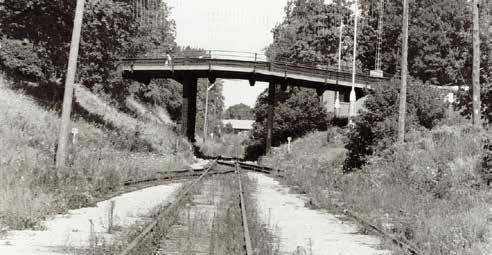
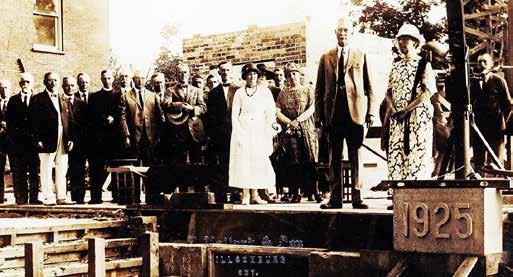
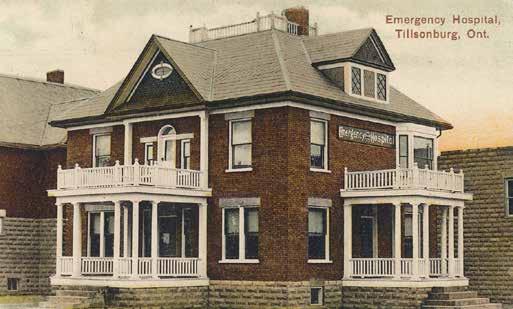
class graduated in October of that year.
An intensive coronary care unit was built on the south side of the hospital and ribbon-cutting ceremonies were held on October 22, 1971.
A further extension was done in 1981.
In 2005, the Ed DeSutter Dialysis Unit opened, and in 2012 the Digital Mammography suite opened at the hospital.
On May 10, 2025, a gala was held in
the Tillsonburg Community Centre to celebrate the 100th anniversary of the Tillsonburg Hospital. The gala featured delicious food and storytelling by local members of the community. While it is uncertain how the hospital will look in the future, one thing that will never change is the passionate Tillsonburg community, who support and rely on our local hospital.

JEN GIBSON
Post Contributor
(ANHS PHOTO)
Local businessman John Smith donated money to purchase land on the site where Tillsonburg’s hospital sits now. His widow Louise took part in the laying of the cornerstone of the new facility.
(ANHS PHOTO)
Although many wouldn’t recognize it, the building for the former Tillsonburg Emergency Hospital still stands today behind the Bank of Montreal. The building was used as a doctor’s office for many years after it was a hospital.
Local resident Linda Vandevyvere (Anderson) remembers Tillsonburg’s famed overhead bridge on Broadway where the Bridge Street and Broadway stoplights now sit. She recalls her older brother Ed was supposed to walk her to school, but he didn’t. Walking by herself to school when she was six she was on the bridge, and the train blowing the whistle while approaching the bridge, startling her.
(ANHS PHOTO)
VIDEO
Tillsonburg's Beginnings Tillsonburg absorbed the hamlet of Campbellton
In 2025, many people call the area in Tillsonburg, at Broadway and North Street West, the Bradburn Subdivision, but before the Bradburn’s had their farm here, it was the little hamlet of Campbellton.
It wasn’t formally planned, it seemed to just happen. It was in the Township of Dereham, today known as Southwest Oxford. The name shows up once on the 1856/7 Tremaine Map of Oxford Co Dereham Twp. It was never officially a hamlet or village. An 1843 map showed a few scattered settlers that have paid off their land. There were no banks, so until you paid off your debt you did not own the land although you were living and working on it, your name was not on a map.
Two tidbits of information were recorded of the name, Gerald Elder noted “The whole area south of the 10th Conc. [North St.] was owned and named after a Mr. Campbell who lived in the farmhouse on the West side of Broadway, later occupied by the Ecker family,” the 1852 Oxford County Gazaeteer stated. Dr. Cooper’s book noted Mr. Campbell secured land north of Concession St. [11th conc.]. What was Mr. Campbell’s first name? Alas, he did not leave behind his first name when he left. By 1840 there were only few settlers in the Tillsonburg district. “The three decades after 1840 marked the period of most rapid development. The settlement expanded tremendously. From 776 in 1840 the township swelled to 2,463 in 1848 and 5,838 in 1871. Thomas S. Shenston, study noted that Dereham Township was being settled more quickly than any other township in the county. But by 1871 Shenston stated that Dereham was nearing its population peak, causing smaller communities to spring up like Brownsville, Culloden, Mount Elgin, Salford.”
Where there were crossroads, a church or store would pop up, and people would settle, as did Delmer with a church. Ostrander had church and general store. By 1867, Tillsonburg had 700 people! The waterpower available allowed more industry than neighbouring townships.
The 1851 Dereham Census, introduces the ambitious Smith brothers, John and Malcolm and their 70-year-old widowed mother Margret, recent immigrants from Islay, Argyllshire, Scotland. They were looking for land of their own, with water privileges to build and operate a saw and grist [grain] mill. How they heard about the land in Dereham Township, we
will never know, but I expect they were guided to Tillsonburg by other settlers and learned of the thus-far-untapped water north of Tillsonburg on Clear Creek, which also runs south and eventually was used by E.D.’s pea and barley mills. Like George Tillson previously, the Smith’s most likely walked the creek and tributaries to find sites with fast flowing water for their mill ponds and various mills.
By 1857 they owned an amazing number of properties, virtually all on Clear Creek or its tributaries. The first properties they purchased, close to Delmer, was Richard H. Campbell’s Conc. 11 lot 12. At that time, he was the only Campbell noted with property. Perhaps too far from Broadway to leave his moniker on the village. The 200-acre lot from Conc. 10 to Conc. 11, [North Street West south to Concession Steet West] was split in half north/south, so each brother had water privileges.
Here the creek continued west/east in the middle of Conc.11, and John bought lot 9 n½ with two north/south tributaries running through it. Clear Creek then crossed ¼ Townline Rd. to lot 7 where Malcolm purchased two lots on either side of today’s North Street West, Conc.10, giving him the source of the tributary. He also bought Conc. 11n½, on the northwest corner of Broadway where the traffic lights are today. The south portion of lot 7 belonged to Francis Hawkins and was where the tributary met Clear Creek also on his property, so Francis damned Clear Creek creating a mill pond into which his tributary flowed into and built a sawmill. All of lot 6 on North St. E., purchased by John, was the icing of the cake of the Smith Bros. businesses. Broadway, coming into town at the top of the hill, crossed Malcolm’s north lot heading southeast meeting John’s northeast corner [at the traffic lights at North St.]. John also had a super tributary, which he took great advantage of, as it crossed North Street East, by today’s GoodPud and Grassmere Construction; continued southwest to cross Broadway, at today’s Christie St. and the pumping station. On the east side of the street, John built a sawmill. How convenient for his customers being right on Plank Rd!
From there the tributary flowed south, still on lot 6 where it joined Clear Creek also on John’s property. Just upstream from the convergence, on Clear Creek, John had a perfect spot for another millpond and sawmill. Immediately downhill from that convergence, Clear Creek crossed Conc.11; [today’s Concession Street West] continuing through today’s Participark ravine; though John Burns Sr. property, and onto E.D. Tillson’s Mills, delivering water for two more mill ponds, which powered two of E.D.’s sawmills and eventually his pea and barley mill. The water then joined the Otter Creek. [This is where the construction on John Pound Rd., dug up very old, large square beams this year.]
By now, son John Smith, Esqr, was 40, a lumber merchant with a sawmill, general merchant and Justice of the Peace; with the Church of Scotland, and had a large two-story house, with wrap-around porch, wood siding and two chimneys.
In the 1861 census we learn, Margaret
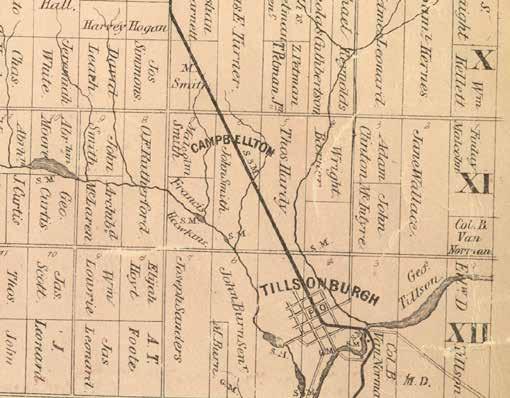
This 1800s map shows the clearly defined difference between the boundaries of “Tillsonburgh” and Campbellton. The small village was where North Street meets Broadway today. The map also shows the properties referred to in the article.
Smith had a house full of people to oversee! Margaret is now 80 years-old and lived through ten births and the death of two children William and Catherine. However, the next son and daughter were their namesakes, keeping their names alive.
He had married Phebe Perley in 1858, having a son Charels Perley in 1861. Brother Malcolm was 34, and by this time he was married to Isabella Smith, and had son William by 1857.
Labella Smith [Bella] born in 1830, was listed in this census was 31 and unmarried. Also listed on the census: “Ahaha Francis, male 24 years old b 1828 in USA Black/Negro, who is a servant and resident of the house.” His first name, so distinctive, returns no further information. Perhaps he was a previously trained and experienced servant in the U.S. and had the manners and decorum to serve and live in John Smith’s home. Ahaha is not listed in the 1961 census nor discovered anywhere else, as yet.
Mother Margaret passed sometime between the two census, one write-up suggested 1864.
By 1871 the village was vibrating! The Oxford Business Directory and Gazetteer did the following write up, but Campbellton is not shown on the maps. “A small village situated on the Ingersoll and Port Burwell Gravel Rd., on the 6th lot, of the 11th Concession of the Township of Dereham. The business of the village is the manufacture of lumber. Messers. J. & M. Smith are the proprietors of a steam sawmill, and grist mill propelled by waterpower. One general store and blacksmith shop. There is also a sawmill, and sash, door and blind factory near the village owned by Francis Hawkins, James Brown, clerk, Robert Chisholm, sawmiller, John Hamilton, miller; George Joslyn, team master; John Kennedy, laborer, Dougal McDougall, laborer; Denis Murray, carpenter; John Smith, flour, grist
and sawmill proprietors, general merchants etc. M. Smith [Malcolm] Partner & brother to John and Charles Ward, sawyer.”
John Smith was still with us, although Malcom would die in 1872. But before his demise, the two Scotsmen, built the Campbellton cheese and box factory. It was on the southeast corner side of North Street East,, approximately where the tributary crossed the road An 1874 map of Tillsonburg, shows the proposed growth north out Cranberry Rd, [today’s Tillson Ave.], much of which was E.D. Tillson’s land, to the 10th Conc./North St. E., where the Canada South Railway came to town. The train station was on lot 4 where the Michigan Central would join E.D.’s Spur Line to the mills. Known as part of the Cross Canada Trail today, the tracks continued parallel to North Street, heading west. The Smith brothers were wise with the land they purchased so long ago as the tracks went through their lots surrounding North Street and Broadway.
The little hamlet’s heart is said to have been where our recently-closed Broadway Cinema and fast foods are today on Broadway. A small railway station was built on Broadway for the train.
When the railroads came, the north boundary of Tillsonburg was moved to south of the tracks [by A&W], so Tillsonburgers wouldn’t have to pay a toll on the road to go to the train station. The toll was on John Smith’s property on Broadway and John was the tollgate keeper.
John Smith had a lot of children whose names are found on the multitude of lots he had acquired.
I live on John Smith’s property, later became Bradburn property but that is another story. I’ve been across the road from the railway tracks since 1983, and recall a small red railway shed there which had Campbellton sign on it. Amazingly no one new why.
(ANHS PHOTO) Campbellton Cheese factory used to sit on the northeast corner of Broadway and North Street East. Today North Broadway Baptist Church sits on the site.
LAUREL BEECHEY
Post Contributor
(ANHS PHOTO)

Tobacco was an important part of the town’s history
KATE BAKOS
Cultural Heritage Manager/Curator
When I was a small child, my father would sometimes bring me along to the tobacco auction exchange. After unloading our bales, waiting for them to be graded, and seeing them marked on the warehouse floor, he would take me into the auction room. The room was hushed, tense, and unlike any other place in town. He would hand me pieces of paper to draw on to keep me occupied and quiet as he waited, listening closely for our farm number and the sale price to come up. For me, those visits were filled with doodles. For him, they were moments where an entire season of backbreaking work was decided in seconds. These shipment days were exciting and fun. The warehouse bustled with people, forklifts, and movement, and to a child, it felt like stepping into the center of something big. Best of all, those days usually ended with a treat from the cafeteria—an ice cream, a slice of pie, or whatever the cook had on offer. These simple treats always made me eager to tag along to the warehouse.













burg appear as far back as the 1860s, often tied to agricul tural fairs, where local growers proudly showcased their best specimens. Yet, tobacco was controversial from the start. Local newspapers of the era published temperance columns warning against its use, echoing John Quincy Adams’ belief that abandoning tobacco could “add five years to the average of human life.”




1920s, when Belgian, Dutch, and Hungarian immigrants discovered that the sandy soils around Norfolk and Ox ford counties could grow a crop of surprising value. By the mid-20th century, the region supplied 17 of every 20 Canadian cigarettes. What had once been considered poor farmland became some of the most valuable acreage in the








The Tillsonburg Tobacco Auction Exchange was a hub of activity before it was sold to the town after the downsizing of the industry. It became the town’s Special Events Centre and then was sold to private interests.










ital.” Before the Ontario Flue-Cured Tobacco Growers’ Marketing Board existed, buyers representing cigarette ly to their own advantage. Farmers had little bargaining power, and the prices they received were often meagre in comparison to what the crop was truly worth. That changed in 1957, when the Ontario Flue-Cured Tobacco Growers’ Marketing Board was formed, fundamentally reshaping how tobacco was sold. Farmers voted overwhelmingly in favour of the new system, and later that year, 13,000 people crowded into Tillsonburg for the grand opening of the




auction exchange. When the first price was set at 49 cents per pound—well above what many had been used to—the building erupted in thunderous applause!




A few years later, the board solidified its presence in town with the construction of its 4 Elm Street head office, which was officially opened on November 24, 1966. The building—today home to the Long Point Region Conservation Authority—was a symbol of how deeply tobacco shaped the identity and infrastructure of Tillsonburg.
Inside the auction exchange, the Dutch clock, borrowed from Dutch flower markets, became the defining symbol of the trade. This clock didn’t tell time; it told price.















































































(ANHS PHOTO)
Tillsonburg was home to the headquarters of the tobacco board
The hand started at the highest price and ticked steadily downward while buyers, who had already inspected the bales, sat with their fingers poised over buttons. These buttons had the ability to stop the clock and set the price for the bales being auctioned. The Dutch clock always counted down twice. On the first pass, a buyer set the opening price by stopping the clock when it reached the amount they judged acceptable. Then the clock started again. Any other buyer still interested could stop it on the second run, but only at a higher price than the first. If no one acted on that second pass, the bales were awarded to the original bidder at the price at which they had stopped the clock. It was a system that demanded nerve and timing—wait too long and someone else might snatch the best tobacco, move too quickly and they risked paying too much. Every sale carried that same balance of opportunity and risk, adding layers of strategy and tension to the auction floor.
Farmers, in the tense and quiet auction room, knew that each tick of the clock, each press of a button, could make a difference in their year’s earnings. For my family, the click of that clock determined whether the year’s sweat and sacrifice had been worthwhile. For me, sitting beside my father with my drawings, it was a lesson in how much weight could rest on a single moment.
There were three auction warehouses in total. Delhi and Tillsonburg were identical in scale and design, both capable of processing more than 300 metric tonnes of tobacco per day. The third warehouse was in Aylmer, and was smaller by comparison. These buildings were more than business sites; they were community hubs.
Farmers gathered to talk, share news, and eat meals in the cafeteria. Families ate together, and sometimes farmers brought in their own catch of fish, which the cook would fry up on the spot. At the end of harvest, the community celebrated in grand style. Dances were hosted in Tillsonburg and could pack in 2,000 people. Included in the price of your ticket was a fish dinner, live bands that played late into the night, and the Lions Club kept the drinks flowing. These events were the social highlight of the year, marking the end of months of grueling la-


bour with music, food, and camaraderie.
The industry’s reach even stretched into Canadian music history. Stompin’ Tom Connors famously sang about the backbreaking work of “pickin’ tobacco down in Tillsonburg,” turning the town’s name into a national touchstone. For many Canadians, that song is still the first thing they think of when they hear “Tillsonburg.”
Tobacco was more than a crop; it was the economic engine of the region. An acre of tobacco could yield over 20 times the value of an acre of corn or wheat. Farmers and their families re-
lied on those cheques to pay mortgages, build homes, and support education. In town, some people even had stamps made reading “Tobacco money at work,” which they would mark on cheques when paying for goods. It was a statement of pride, a way of showing how deeply the industry sustained the local economy.
By the 1980s, the golden leaf’s dominance began to fade. Rising taxes, public health campaigns, and shrinking demand chipped away at the market. Even with new technologies like self-propelled automatic primers, optimism was hard to sustain. By the early 2000s, government buy-outs encouraged many families to leave tobacco behind. Kilns were dismantled, barns fell silent, and the rituals that once defined the season quietly disappeared.
As Tillsonburg marks its 200th anniversary, tobacco’s story looms large. It was controversial, yes, but it was also transformative. It drew immigrant families, created thousands of jobs, and left a footprint on our economy, culture, and landscape that cannot be ignored. Even today, tobacco farms still dot the landscape—less common than in years past, but reminders of the era when the crop built this community.
For me, the memory always returns to those visits with my father to the tobacco auction exchange. They were tense, spent in the quiet of the auction room as he listened for our farm number to be called, while also being lively and fun, walking the warehouse and ending with a treat from the cafeteria. Together, those moments shaped my understanding of how tobacco built not just my family’s life, but Tillsonburg itself—a story woven into the very fabric of our town’s 200-year history.









(ANHS PHOTO)
The sweet aroma of cured tobacco was overpowering on the inside of the tobacco warehouse on auction days. Farmers came to watch their tobacco sold, seeing the price of the tobacco they worked all year at.
Tillsonburg's Dark Side
Tillsonburg political riot ends in deadly disaster
BEECHEY
Post Contributor
A riot in Tillsonburg? Really? In littl’ole T’burg? Yup, way back in 1858, when Tillsonburg was only 33 years old.
What could their possibly be to riot about? Unfortunately back then Tilsonburg did not have their own newspaper. It was bad enough to have a political riot but to have another town’s paper headline: “Rowdyism & Blood in Tilsonburg!” screamed the Ingersoll Chronical. A pre-election riot! “One Man Killed and over Twenty other injured.”
Our founding families and settlers were quite passionate about their politics, after all they moved to this untamed country to start a life free and equal. They left Europe for land, sailed to the British, Dutch, Spanish or German Colonies. After several wars many in the eastern states came north to British Upper and Lower Canada. They were setting a new course and building the Canada we love today. Of course, each party was passionate in the future they thought they should take. After 33 years, Tillsonburg was growing up!
The Sep. 3rd, Ingersoll Chronical reported: ‘On Sep 1, 1858, Dr. George Connor [a Clear Grit] of the reform party rented the Temperance Hall, over on Bidwell and London Streets so that the Honourable M. H. Foley might speak on his
behalf and tell the people why he should be elected. And indeed he did, for considerable length to a very full hall. Suddenly the celebrated Barney French and other leaders of the Richard’s party, entered and immediately caused a great commotion yelling and trying to disrupt Mr. Foley’s speech. Yet that did not deter Mr. Foley, so these miscreants started to throw eggs one of which hit Mr. Foley in the chest. Still Mr. Foley continued but by now the people had been incited to violence. Barney French reached the podium and demanded he to be heard. They then decided to take the stand by force.’
But the riot suddenly stopped when the floor gave way and 150 people plunged twenty-four feet down. Those remaining in the hall above rushed to the rescue of those below and succeeded in rescuing many who would have been smothered. Alas not all survived. ‘Mr. John Hopkins, a carpenter in Tillsonburg was found dead below. Mr. Foley and Mr. Beaty were seriously injured and there were several others who could not possible recover, their injuries being so severe and in truth Mr. Lancelot Waller died a few days later.’
The newspaper editor was not afraid to say out plainly how he felt!: “Well, what will the intelligent and peaceable -disposed electors of South Oxford say now? The Richards party, finding it impossible to carry the election by fair means, imported characters of the Barney French stamp to use means, no matter how base or disgraceful
to secure their ends. Electors of South Oxford: must know their cause be a bad one when finding it impossible to buy a sufficient number of votes, they do not stop even at shedding innocent blood! The death of poor Hopkins must lie at the door of those who incited the people to violence and if it is any consolation to Mr. French or Mr. Richards, to know that they succeeded in breaking up Dr. Connor’s meeting at the sacrifice of life and limb
they are welcome to it!
A riot which ended in disaster. The official inquest noted the injuries received by the accidental falling in of the floor accelerated by the braking the table and insufficiency of the hall, caused the deaths of Lancelot Waller and John Hopkins. Both were buried in the Tillsonbirg pioneer graveyard. Oh yes, Dr. George Connor was elected in South Oxford.


LAUREL
There was a day when Tillsonburg was a one stoplight town and the corner of Broadway and Baldwin/Oxford was known as the stoplight corner. This view showing the east side of Broadway with the Metropolitan store on the corner, and is looking towards Brock Street.
Tillsonburg's Natural Landscape
Lost lake: The story of Lake Joseph and Tillsonburg’s water tower legacy
WATKIN ANHS Program Coordinator
What was once a bustling hub of industry and recreation in Tillsonburg is now only a memory. But the story of Lake Joseph—a man-made lake created by local industrialist E.D. Tillson in the late 19th century—remains one of the town’s most fascinating and ambitious chapters.
In the late 1870s, as Tillsonburg’s population and economy expanded, so did E.D. Tillson’s industrial vision. In order to power his growing milling operations, Tillson dammed the Otter, Clear, and Stoney Creeks. The first dam along the Otter Creek had created Tillson’s Pond, a mill pond that helped transport logs to local sawmills. But it wasn’t enough to meet the growing demands of his business empire.
Around 250 yards upstream from the original dam and the White Bridge, Tillson built a second dam—known as the Imperial Dam. This new structure created Lake Joseph, a four-mile-long reservoir named in honour of Joseph Van Norman and served as a critical water source for the mills downstream.
Local historian Bert Newman recounted that the dam was constructed by Tillson himself, using 70-foot-long logs and square timbers, reinforced by packed sand on both sides of the creek. While it served a functional purpose, Lake Joseph also became something much more than an industrial reservoir—it became a beloved part of community life.
In the late 19th and early 20th centuries, Lake Joseph was a popular recreation spot for Tillsonburg residents. Its wide, shallow waters made it ideal for swimming on hot summer days, and its tree-lined shores
offered perfect picnic locations. Boating was also a favourite pastime. A Saturday Globe article from July 7, 1894, described the lake as “simply lovely as it winds along the tree-lined banks.”
Rising above the lake was a remarkable structure: the Tillsonburg Waterworks Tower. Built by Tillson in response to personal tragedy, it was one of the town’s most iconic features.
In 1871, a Typhoid outbreak devastated the Tillson family, claiming the life of young Nancy Tillson and later her brother Fred, who died from complications a few years later. Aware that Typhoid was waterborne, Tillson took action and became determined to protect his family and community from future outbreaks. The Tillsonburg Waterworks Tower was constructed.
Standing 125 feet tall—roughly equivalent to a 13-storey building—the tower used hydraulic pressure and wooden pipes to deliver clean drinking water to Tillsonburg’s growing population. From its elevated perch, it offered sweeping views of the countryside.
The tower’s base doubled as a boathouse and apartment space, rented out to townspeople. It also housed the Tillson family’s impressive small steam launch, affectionately named The Oscar Wilde. A passionate boater, E.D. Tillson had the boat decorated with painted sunflowers, a nod to Wilde’s personal symbol, and lit by Chinese lanterns during evening cruises. His wife, Mary Ann, was said to have personally overseen the boat’s unique and charming details. Adding to the tower’s mystique was a lighthouse installed at the very top—a feature that puzzled many. Some believe Till-
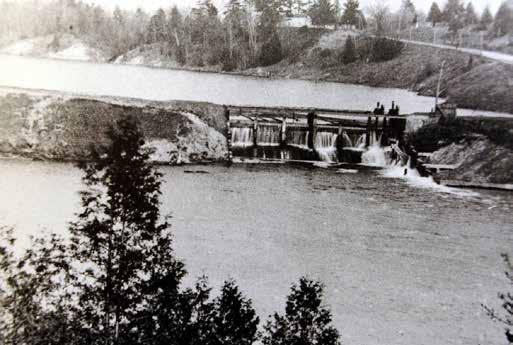
son, ever the visionary, used it for watching shipping routes to Port Burwell, where his goods were transported down the Otter Creek before heading out to global markets.
But this iconic part of Tillsonburg’s landscape met a dramatic and destructive end.
In April 1937, southern Ontario was hit with one of the worst floods in provincial history. After five straight days of torrential rain, rivers across the region swelled, and dams began to fail—including Tillson’s Imperial Dam.
The collapse sent a surge of water crashing through the Otter Creek bed, wiping out everything in its path—including the Simcoe Street Bridge, a vital town crossing. Within hours, Lake Joseph had disappeared, drained completely in the floodwaters.
Today, few physical traces of Lake Joseph and the Imperial Dam remain—but their story continues to shape how Tillsonburg remembers its industrious past. When the Imperial Dam collapsed in 1937, the lake was lost forever, marking the end of an era. Once a vital reservoir for industry and a beloved hub for recreation, Lake Joseph vanished in a matter of hours, leaving behind only memories and faint impressions of its former shoreline. But a piece of that history still lingers. If you find yourself on the north side of Simcoe Street, standing on the White Bridge, take a moment to look down into the ravine—there, nestled among the rocks and brush, you can still see the weathered ruins of the Imperial Dam, silent witnesses to a chapter of Tillsonburg long gone, but not forgotten.



(ANHS PHOTO)
The dam holding Lake Joseph was built from logs, timbers and earth. It held back the Otter Creek for more than 50 years until a huge storm in 1937 washed out the dam. Today, the base of the dam still remains.
KATHLEEN
(ANHS PHOTO)
Besides holding water to power the Tillson mills, Lake Joseph was also a recreational hub for the town and was part of the town’s early drinking water system.
In Our Founder’s Footsteps
Reimagining Tillson’s journey to launch Dereham Forge
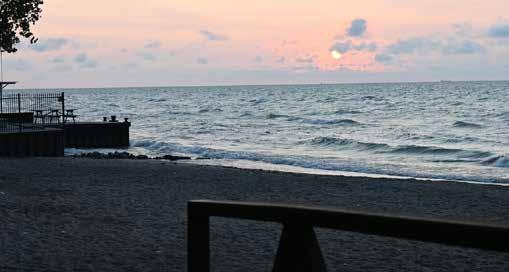
(JEFF HELSDON PHOTO)
The sun rising over Long Point Bay is one thing that hasn’t changed since Tillson left Normandale 200 years ago. The small fishing pier that stands today pales in comparison to the 300-foot pier that once stood there.
JEFF HELSDON Editor
Taking the 40-minute drive from Tillsonburg to Normandale today, it’s hard to imagine what George Tillson went through when he walked the distance 200 years ago with an ox and cart in tow, or that Normandale was a bustling industrial centre in the day.
Normandale is now just a shadow of what it once was, its famed forge is gone and the landscape has changed. But what was it like to undertake a journey of that length? Annandale National Historic Site Curator Kate Bakos and I set out to recreate a portion of the journey from Normandale to Tillsonburg last month, walking from Normandale to Delhi.
Parking near the historic plaque that
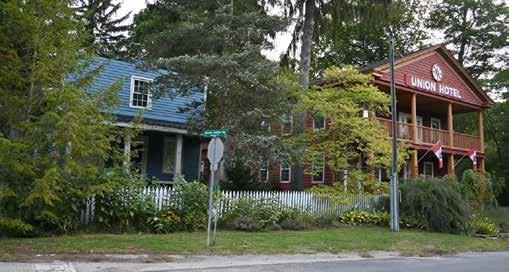
The Union Hotel was built between 1827 and 1834 when the VanNorman forge made the town a busy place. Today, the hotel is a bed and breakfast and the population of the village isn’t a lot different than it was in the mid-1800s.
pays heed to Normandale and the Normandale blast furnace, I went for a quick walk down to the lake. A small pier used for fishing stands at the mouth of Potter’s Creek where it enters Lake Erie. Today, the plaque and adjacent beach are a recent addition to Turkey Point Provincial Park. Research that Kate supplied prior to the walk talked of a shipping pier 300 feet long, which was likely in that vicinity. It’s likely the famed Normandale stoves were shipped from that pier.
Although hard to imagine today, Normandale was called the “principal industrial and commercial hub in all of western Upper Canada” in one of the papers I was supplied. The VanNorman brothers didn’t actually found the town. Job Lodor was the first settler on the property shortly after 1800, building a distillery, mill, and two houses. Due to discrepancies with the Crown lease on the property, he abandoned it and Samuel Long opened his pottery business there. That enterprise was successful enough that the creek was named Potter’s Creek.
Long’s fate isn’t known, but John Mason was the next on the property, and he started building a forge to take advantage of the bog iron in the area. He constructed a dam and waterwheel to power the bellows in his blast furnace. The plant was only partially completed when he died in 1819. Searching for buyers, his widow found Joseph VanNorman, who was heading a group of investors from New York that included George Tillson. The other partner, Hiram Capron, eventually founded the town of Paris, ON.
This is where the Tillson story begins. The group moved to the site of the furnace and worked on completing it. It wasn’t fully operational until 1828, by which time George had struck out on his own.
In March 1825, George started his journey with everything he would need to establish his new enterprise in a two-wheeled wagon pulled behind a single ox. The wagon only had two wheels to allow pivoting around the stumps.
Kate and I chose to head from Normandale to Turkey Point Road, cross it, go north on Gibson Road to the First Concession, then west to the West Quarter Line, which we followed to Delhi. Research by Post columnist Laurel Beechey surmised Tillson followed a slightly different route, likely going north up what are now more travelled roads. We elected to stick to the roads with less traffic.
As we enjoyed the brisk weather on a September morning, I mentioned that George would have likely faced larger challenges undertaking his journey in March with snow on the ground or just melted. In addition, the roads were likely just trails cut through the woods, which were muddy in the spring.
Kate said Tillson was not one who kept meticulous diaries, so details of his journey are scant, including the weather. That’s easy to understand, as in those days, survival would have been the priority. Even writing is something we take for granted, but it would have meant keeping paper dry and using a quill and ink in 1825. Laurel traced George’s route by the few scant details of the people he visited along the way, and found where they lived from historical atlases.
Although she only started at the museum in Tillsonburg this spring, I quickly learn that Kate is a quick study and is fluent in all things Tillson. Although she came to the position with her most recent job being with the Mississauga of the Credit First Nation, and before that with the Art Gallery of Ontario in Toronto, Kate grew up outside Delhi, so she wasn’t unfamiliar with Tillsonburg before starting the job. She can certainly relate to Stompin’ Tom Connors famous line “My back still aches when I hear the word” from Tillsonburg, as she grew up on a tobacco farm before heading off to the University of Guelph. As we headed north on Gibson Road, which is a gravel unmaintained road, I was hopeful of seeing deer or turkeys. I had to settle for finding tracks only, although one was from a big buck.
(JEFF HELSDON PHOTO)
Y O U R P R O J E C T S T A R T S H E R E

P r o u d l y C a n a d i a n O w n e d & O p e r a t e d S i n c e 1 9 5 6 !
L O C A L S P O T L I G H T :
T r a c e y ’ s B a c k y a r d
M a k e o v e r
R a n d y f r o m H D R C o n s t r u c t i o n
w a s o n e o f t h e w i n n e r s i n o u r
2 0 2 5 “ S h o w c a s e Y o u r P r o j e c t ”
c o n t e s t . H e s h a r e d a r e c e n t
b a c k y a r d p r o j e c t h e c o m p l e t e d
a t T r a c e y ’ s h o u s e i n
T i l l s o n b u r g , O n t a r i o . T h i s
b a c k y a r d u n d e r w e n t a

s i g n i f i c a n t t r a n s f o r m a t i o n ,
t r a n s i t i o n i n g f r o m a n o l d
p r e s s u r e - t r e a t e d d e c k t o n e w
c o m p o s i t e d e c k i n g a n d
a l u m i n u m r a i l i n g s .
O u r S p e c i a l t i e s :
D e c k a n d F e n c e D e s i g n
K i t c h e n & B a t h D e s i g n
I n s t a l l a t i o n S e r v i c e

H o u s e E s t i m a t i n g S e r v i c e s
P R O F o c u s e d S e r v i c e D e s k
C o n t a c t U s :
M o f f a t t a n d P o w e l l R O N A
5 1 9 - 8 4 2 - 4 2 0 1
2 6 8 T i l l s o n A v e , T i l l s o n b u r g
m o f f a t t a n d p o w e l l . c o m



Retracing George Tillson’s footsteps 200 years later
We discussed how this is different from George’s journey when there would have been bears and wolves in the area, as well as deer and turkeys. I did remark that I would have rather dealt with the remote threat of bears or wolves than the more likely encounter with deer ticks carrying Lyme disease. Each time we hit the long roadside grass to avoid vehicles, we checked for ticks.
A while later, a squirrel darted across the road, being the first wildlife we had seen. A couple of squirrels later, I raised the possibility of whether Tillson would have shot squirrels for food. Kate was doubtful, saying he would want to preserve any gunpowder and ammunition he had. That did raise the question of what he would have eaten on such a journey, and jerky was the main candidate.
Although there are a few details about the journey George took in 1825, less is known about how he arrived at the site where he would start his town. His intention was to build a blast furnace in Tillsonburg, and bog iron was abundant in this area historically. George heard about bog iron deposits in the future site of the town that bore his name from an Indigenous worker in 1824. There are almost no details, but it is known he went on a scouting trip to the area that fall.
Since hearing about bog iron and its role in the settlement of Tillsonburg, I have always wondered more about it. I pondered whether they drain wetlands to create a bog underneath and how they know it’s there.
No one I asked previously knew answers to that question. And since Kate didn’t either, I turned to Google when I got home. Bog iron was key to early iron making and dates back to the second millennium BC. The Romans used it and there is evidence of bog iron production by the Vikings at L’Anse Aux Meadows in Newfoundland.
Bog iron is formed when water with iron deposits oxidizes in bogs. Its presence is denoted by dead grass in the area, and reddish-brown solutions or deposits on the surface, and sometimes is even lying on the ground. By pushing metal or wooden sticks in the ground, the presence of large deposits was confirmed.
The route we mapped out was 28 kilometres, and we left Normandale at 7:30 a.m. We knew the pace we were taking was faster than George would have moved. His journey took six days, and he overnighted with other settlers
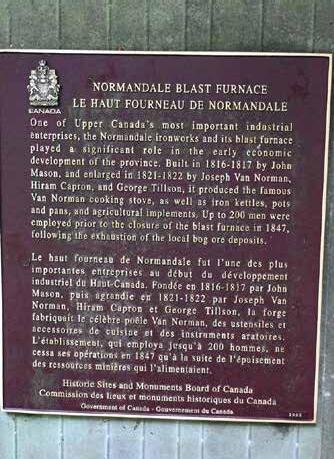
This hit home for me as my relatives settled along Highway 3 between Courtland and Delhi only 30 years after George’s journey. Historical atlases indicate that my family’s land was previously settled. Still, we lack information on the state of development of the road at that time or whether my ancestors had to clear the land.
At about 18 or 20 kilometers, the older of our modern-day trekkers – me – started to get sore feet. As I lamented that it was likely worse for George, I learned something when Kate explained that pioneer shoes would have been hand-made to fit the wearer and may have actually been better. She also pointed out the softer ground would be easier on the legs and feet.
Looking at it in a modern context, the 28 km, or 39,000 steps, is about two-thirds of a marathon. This gave me a better appreciation for what these athletes endure.
As we discussed more about pioneer life, Kate shared that George had the log cabin he built on site up four logs high in the first day. Having cut down a tree and cleared the branches off it with a chainsaw, I struggled to imagine the enormity of felling enough logs to build walls four logs high when the trees needed to be cut by hand, branches cleared, logs notched, and then somehow moved into position by man and ox.
We were both taken aback when discussing that after George had his cabin built, he didn’t send for his family for a year. Did this mean he didn’t communicate with them that entire time? Did they even know if he was still alive? Remember, his wife Nancy was pregnant with E.D. when George left. E.D. was born four days after his father left.

along the way.
The profound sense of how life is different today emerged in our conversations as the journey progressed. After passing Courtland, George found his trail through the bush dwindled, and he had to cut his way through at some points. Pointing to an area beside the road with dense tree cover, I mentioned how tough it would be cutting a path through it. We debated if he would have used an axe or saw, and while I saw the value of a saw, Kate said only an axe was mentioned.

As Highway 3 came into sight, about six hours later, both Kate and I agreed we preferred modern conveniences to pioneer life. Our journey was half of what Tillson undertook, and on a paved road as compared to a likely-muddy trail. And then when one considers George, Nancy and family walked to Normandale from New York, it makes us realize how good we have it.
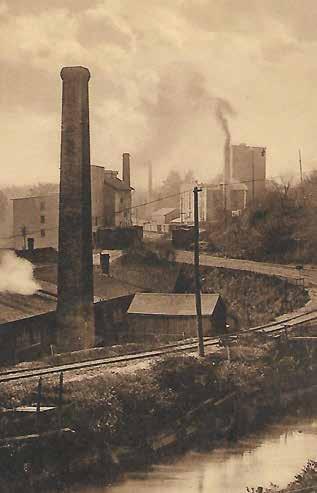
(JEFF HELSDON PHOTO)
A Government of Canada historical plaque pays tribute to the VanNorman family and the partners in the company who went on to found Tillsonburg and Paris.
The valley of the Big Otter Creek in Tillsonburg looked a lot different at the turn of the last century, being a hub of industrial activity. This shot is what one would have seen if standing at the back of the Oxford Street Tim Horton’s parking lot and looking towards where The Mill restaurant stands today.
(JASON PANKRATZ PHOTO)



PHARMACY
SERVICES OFFERED:
• Comprehensive medication reviews
• Minor Ailment Assessments for many conditions such as pink eye, UTI’s, allergies etc.
• Easy transfers of prescriptions
• Vaccine injections
ADDITIONAL PHARMACY SERVICES OFFERED:
• Onsite Diabetes Educator
• Travel Consultations
• Cholesterol and Blood Glucose testing, lab results in 15 minutes
TESTIMONONIALS:
“We have been customers of Shoppers Drug Mart Tillsonburg for over 15 years. We really value and appreciate the help we have received from the pharmacy. The pharmacists are accessible, proactive and always make time to help us with our needs.” Gail and Greg Robbins
“We have been customers of Shoppers Drug Mart since moving to Tillsonburg in 2011. We chose Shoppers as it is Canada wide and found it invaluable if we ran out of a prescription drug when in another province. The staff at this location have always been courteous and helpful. In the non-pharmacy part of the store, prices are comparable to the major chain and/or grocery stores and even allow us to collect points to use at a later date. The pharmacy part of the store allows to get flu and Covid shots when available, and they also offer home delivery which is ideal for seniors such as us” Joan and Wayne Ward
STORE HOURS:
Monday to Saturday 8:00 AM - 10:00 PM Sunday 10:00 AM - 6:00 PM


Exploring Tillsonburg's Hidden Secret Spots
Tillsonburg has many secrets in plain sight
DR. JASON PANKRATZ
Every town has interesting little spaces and things tucked away in plain sight. It is not that they are secret at all, rather, they are little tidbits of history that have been ignored, forgotten, or unkept. This article will look at a few of these interesting things that you can explore while meandering on foot or by car, in and around the town.
As time passes, we forget when buildings were built or replaced. This is natural. One fascination that I have is when a building has a date stamp. It can be etched into the brick or it could be a specifically designed date stone or plaque.
Here are a few examples to observe around town: The Masonic Hall on Broadway = 1904; Annandale School on Tillson Ave = 1950; Definite Styles Salon building on Brock Street east = 1905; McDonald Building on north Oxford Street = 1912; St. Andrew’s Church on Brock Street = 1930; St. John’s Church on Rideout Street = Aug. 18, 1899; St. Paul’s Church on Rideout Street = originally built in 1865 and destroyed by fire but rebuilt in 1912; And, though it is not viewable now, as it is within the building, the foundation stone of the former Rolph Street School was also laid in 1912, along with the name of the school trustees and the principal at the time.
There is a hidden trail on the east side of Broadway south. This walking trail allows pedestrians to walk up or down Broadway to Bloomer Street. When you investigate this area, you realize that there is no sidewalk or safe walking space for people if they are venturing down to John Pound Road. As you traverse the steep, stoney and rooted pathway that runs parallel to Broadway, you are led to Bloomer Street. If you keep walking and cross Bloomer, you will venture over the foot bridge that leads to Van Street, and then Coronation Park. This trail is a lasting vestige of the George and E.D. Tillson years when they established industry there. This would
be the pathway that workmen walked down to get to the forge and furnace, wood working buildings and later, the cereal mills. While down exploring Tillsonburg south on John Pound Road, walk around the green space north of the Mill Restaurant. Here you will find the brick ruins of a building foundation. Today it is filled with trees that have grown inside and around it, but it is clearly visible. You can even see an arched part of the construction on the west side of the foundation. These are the remnants of the Tillson Flour Mill.
Additionally, to the west, take a look at the retaining wall that attaches to the road. In the spring and summer, the vines obscure a good view of the wall. But when you do get a good look, you’ll notice that the stones do not match. It looks as if a building was once attached to this hill. And indeed there was! Old photographs show the flour mill standing in the junction of Bloomer Street and John Pound Road, the size of the building compensated for the grade in the landscape and, it was built attached to the roadway. In fact, when you look at the picture closer, there were rail tracks that ran along Boomer Street in front of the flour mill and to the other mills down John Pound Road. As you know, the flour mill was just one of many types of milling industries on that stretch: oats, pea and barley and later bran flakes.
When was the last time you walked around the cemetery? Check out the Pioneer Graveyard too, but the Tillsonburg Cemetery is really impressive! The first thing you will notice is the incredible landscape. There are old graves within terraced plots. Secondly, you will recognize the names, whether you knew the person or not, you will recognize “Tillsonburg” names. Then, once you start looking more closely, you will see the varied designs and styles of the grave markers. Some are flat, others tower, some are small, others monumental, some legible while
others are broken or unreadable. There are fraternal crests, etched images, pictures of the deceased, and personal offerings that are left. You will marvel at the three mausoleums as solid, lasting, resting places for long-gone individuals. You can also wander through the cemetery and see random military gravestones (identified by their common shape and cross), even though there is a section in the back dedicated to veterans.
While you’re exploring the cemetery, I want you to look for a grave marker that looks like a gray monument but is metal. It is the grave marker of the Merrill family: David Merrill (born December 20, 1817, and died November 11, 1889), Nancy McBride (born March 13, 1829, and died March 21, 1917), and Walter (born April 8, 1864, and died April 5, 1882). This type of marker was made famous and produced between 1874 and 1914 by the American Monumental Bronze Company. They marketed the product as “white bronze,” but it was really zinc. They were purchased through a catalogue and made to order. They were easy to erect, clean, and read. They be-

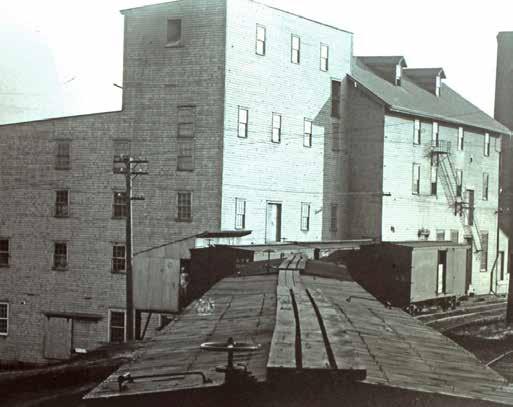
THE TILLSON FLOUR MILL AT ITS PRIME
(CONTRIBUTED
The foundation of the flour mill is still visible today, a short distance from The Mill Restaurant, and is in fact in the green space adjacent to the mill. This gives a sense of how close together the mills were in the day.
came popular because they did not rust, crack, or discolour. This is why they look so new and modern yet were placed in the late nineteenth century. To my knowledge, this is the only grave marker of its type in the Tillsonburg Cemetery.
These are just a few of the neat things to observe when you’re out looking for features beyond the contemporary. Do you know of other buildings with dates or inscriptions? Are there other secret paths? What footprints of past architecture can still be found? And, next time you find a grave marker made from ‘white bronze,’ look at the dates and notice how old it is but how good it looks!



PHOTO)
Post Contributor
It’s a Tillsonburg Fact!
DR. JASON PANKRATZ Post Contributor
It was optioned to me, thanks to my recent book, that I create 200 more facts for this article. Nope. But I have done some research and have 20 new facts. (20 is close to 200, but I’ve left out a zero). I won't go deep into the history but rather, provide readers with just the facts!
1) We remember the Normandale Furnace and Forge partnership between George Tillson, Hiram Capron and Joseph VanNorman, but there was another partner who we do not recognize: John White, the fourth additional partner. Little is known about him.
2) By 1881 the population of Tillsonburg was 1939 and there were 441 houses in town.
3) E.D. Tillson had a steamboat that the family used to sail on Lake Joseph. It was named “The Oscar Wilde.”
4) Mary Ann Tillson hosted a “Crazy Tea” party at Annandale House on Wednesday, Feb.15, 1892. Its theme was to resemble the ‘madness’ of the book Alice in Wonderland.
5) Tillsonburg’s earliest northern town limit was the street Washington Grand. Later it became Concession Street. North of Concession Street was another village called Campbelltown.
6) There is a curved path that goes from Brock Street and meets up with Tillson Ave. This was originally the route of a train track down to Bloomer
Street.
7) A brick-lined grave vault (using blonde Tillson bricks) was discovered in the Pioneer Graveyard during a restoration revitalization project.
8) Johnny Cowell (1926 – 2018) was a celebrated Canadian trumpeter, composer, and arranger, born in Tillsonburg.
9) Annandale House displays eight bells for communication. Seven are in the breakfast room (six bells and one electric) and one in the maid’s room on the third floor.
10) South of the Mill Restaurant is a road to the west that does not go anywhere. It is named Borden Crescent as it was an entrance to the Borden Milk Plant. It is now a walking trail that takes you to Baldwin Street.
11) Tillsonburg manufactured electric streetcars from approximately 19121914. It is believed that a streetcar from The Tillsonburg Electric Car Company exists in town and is a private residence.
12) King Hiram Masonic Lodge celebrated its 100th anniversary in Tillsonburg in October 1957.
13) The Bell Canada phone company created the 688 prefix for Tillsonburg phone numbers in January 1986.
14) The Rotary Clock tower on Broadway flies the national flags of the international students who are in our community participating in the Rotary exchange.

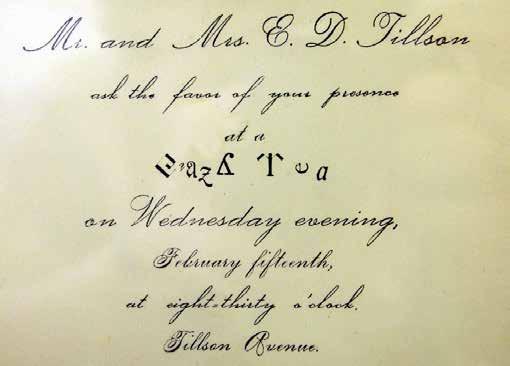
15) There is a gun range in the basement of Annandale School.
16) Hyman Street is named after E.W. Hyman, a tanner. He had a tannery (to cure leather) at the corner of Tillson Ave and Oxford Street until 1866.
17) Tillsonburg does not have a community water tower. We have access to natural water sources as well as a reservoir.
18) Tillsonburg’s OPP police station used to be on north Broadway, and is now a private residence. The town police station was in the town hall, and then

it occupied space next to Maple View Variety on Concession Street, before its current location (amalgamated into Ontario Provincial Police) next to the fire station.
19) Tillsonburg created and hosted the Lake Lisgar Arts Festival for a few years in the mid 1990s.
20) The Tillsonburg Horticultural Society makes our town look beautiful throughout the year. Notably, they look after the gardens at the Legion and Annandale House among other public areas.

(JASON PANKRATZ PHOTO)
Fortunately, one of the invitations to Mary Ann Tillson’s “Crazy Tea” survived more than 125 years later.
Read All About It: Books about Tillsonburg’s history
DR. JASON PANKRATZ Post Contributor
People have asked me why I chose to write a book about Tillsonburg for the 200th anniversary of the founding of the settlement.
Firstly, I have researched, written and presented Tillsonburg’s history for years. Secondly, I wanted to create a work based on research that would add to the historical resources regarding our town’s heritage. The fun part about research is the hunt. I used multiple sources during my planning and writing. I wanted to make sure that facts and content were accurate to the best of my abilities.
Here are some of the sources I used.
A great resource and collectible is the book “Tillsonburg: A history, 1825-1982” by Dr. John Irwin Cooper (1905 to 1994) and John Armstrong (1933-), former mayor from 1977-1982, and published in 1984. It is a comprehensive historiography of the settlement up to the early 1980s. This is a great resource because it presents the most comprehensive content regarding George Tillson and the settlement years. The book details the transformation of Tillsonburg from a small pioneer settlement into a thriving agricultural and industrial hub, emphasizing the role business, railroads, and manufacturing in shaping the town’s economy and identity.
The authors also delve into the social and cultural evolution of the town. They document the impact of major historical events like the World Wars and the Great Depression on the local population. They do this by providing anecdotes and photographs that bring the town’s history to life.
The next two books were written by former librarian Matthew Scholtz (1946 to 2023). “Tillsonburg Diary: A Chronological History 18241994,” in 1994, and “Tillsonburg Album: A Photographic History,” in 2014.
The first book captures the essence of development by documenting key events and community milestones. You can literally flip to a specific decade (within reason) and find out the major goings-on in town. Scholtz meticulously researched newspaper articles to re-report the most fascinating aspects of our town’s growth.
We can learn that as of January 28, 1926, 19 Ford cars had been sold in Tillsonburg. And, on February 2, 1970, Riley’s Motor Hotel became the first building in town to obtain the new “Contempora telephone” which had the rotary dial as part of the handset.
Scholtz’s second book is a visual chronicle of Tillsonburg’s evolution, capturing the town’s essence through a collection of historical photographs. The book spans from the 1800s to the early 21st century, showcasing aerial views, postcards, and images of key landmarks such as churches, schools and businesses. Photographs are accompanied by informative research that provides context and historical insight.
What makes this album particularly engaging is its thematic organization, with chapters dedicated to specific aspects of Tillsonburg life such as industry and business, community events and organizations, and notable residents. Scholtz’s work not only preserves the visual memory of the town but also evokes personal connections for readers, many of whom recognize the names of people and establishments that, through the passage of time, we have lost. Matt’s books are
exceptional resources for documented readable history but also because of the value of the photographs, in context and in number.
The four books by Bert Newman (18971992) offer a nostalgic collection of personal memories and local anecdotes that paint a vivid portrait of his life in town. Written in his later years, Newman drew from a lifetime of experiences to recount stories about the town’s people, places, and transformations. These books are not formal historiographies, but rather storytelling in print; filled with humor, nostalgia, and a deep affection for the community he called home.
The books, “Reminisces about Tillsonburg” (1986), “More Reminisces about Tillsonburg” (1987), “Once Upon a Time: Further Reminiscences About Tillsonburg” (1988), and “Those Were the Days: More Reminiscences about Tillsonburg” (1989), are especially valuable for their intimate tone and the way they preserve local heritage through storytelling. Newman’s reflections include descriptions of long-gone buildings, local businesses, and personalities, offering readers a sense of community and connection to the past. Edited and introduced by Dave Stover, the volumes also include photographs. These books serve as a unique cultural memory, about a time and place that differs greatly from our current experience.
Now, these are just the publicly-published books, if you want a true wealth of information, get yourself the booklets created by Laurel Beechey. These can be purchased at Annandale House National Historic Site. Laurel has provided, arguably, the greatest content (in scope and volume) in preserving and sharing the history
of Tillsonburg through her extensive research.
Laurel is an expert on all aspects of the Tillsons, town businesses, architecture and the evolution of the town at large. Through her columns, personal research notes, and public talks, Laurel has become a trusted figure in disseminating the history of our community. She is someone who ensures that Tillsonburg’s past remains accessible and meaningful for future generations. She has influenced and supported me greatly. Thank you, Laurel!
Each of the books mentioned have been long out of print but can be found at auctions or estate sales. You can also obtain these books, if you can find them (available and affordable) on book purchasing websites. Someone recently complimented my work saying that my book was now part of the “good company” of historical resources about Tillsonburg and that I was now an official Tillsonburg historian. It is a pleasure to be a steward of our history and as a resource for future historians, just as others have been for me.
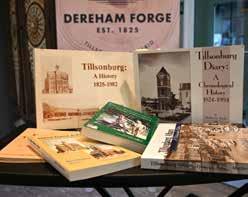


(JEFF HELSDON PHOTO)
The Canada Southern Railway, second by a hair
JOAN WESTON Post Contributor
On Feb. 28, 1868 a charter was secured for an extension of the “Erie and Niagara Railway”. American investors financed this venture, which then took the corporate name of “Canada Southern Railway” on Dec. 24, 1869. This railroad was to extend 289 miles from Fort Erie to the Detroit River, being the shortest, most efficient transportation route between New York State and Michigan, thereby becoming a threat to the existing Great Western Railway.
In 1871, the Township of Dereham voted to give a bonus of $15,000 toward the 16-million dollar cost of construction. The Canada Southern passed to the north of Tillsonburg, as Tillsonburg was not yet an incorporated town and could not collect any bonus money to entice the officials to pass through town.
The eastern half of the Canada Southern Railway reached north of Tillsonburg and lost the race with the western half of the Canada Air Line south of Tillsonburg by a few hours on Nov. 14, 1872.
Once Canada Southern’s standard gauge double track was completed, Tillsonburg citizens were divided in a controversy between placing the station on Cranberry Street where the railway officials had planned on putting it, at mile 90.83 from the International Bridge at Fort Erie, or on the Plank and Gravel Road (now North Street and Broadway).
In a lengthy article on Dec. 12, 1872 in the “Observer”, W.S. Law wrote a heavily-biased argument in favour of the Cranberry Street station. In his first argument, he claimed that it was in the interests of three-quarters of the inhabitants of the town to create a road from the Market Square over to Lisgar Avenue, thereby needing to build a bridge over Stoney Creek. From Lisgar Ave., the route to the station was straightforward. In doing so, the business section of the town, from Mr. Miles’ carriage factory to the bottom of Broadway “would be retained…making the downtown handsome, well-built, compact and convenient”. If, on the other hand, the station were located on the Plank Road, “the chances are that the whole distance along the Plank Road would be dotted with more or less pretentious places of business,
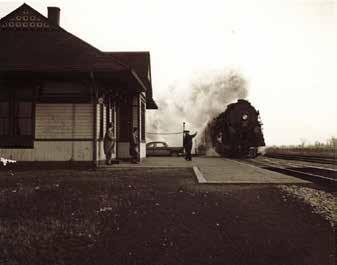
A steam locomotive pulls into the Canada Southern station off of Tillson Ave. Although this railway is now decommissioned, trains ran on the Detroit-Buffalo line into the 1990s and passenger trains frequented the line in the 1970s, although it’s unclear when Tillsonburg stopped being a stop.
forming a long, straggling, mean-looking, inconvenient business place.”
In his second argument, W. S. Law thoroughly proved that it would be a half-mile shorter round trip for the farmers to take their produce from Market Square to the Cranberry Station, “no slight consideration to a farmer with a tired team and a long drive home before him.”
Thirdly, Law stated that since Mr. J.V. Borland and the landowners around the Cranberry site were willing to provide the land for and pay for roads to access the station from the north and north-east, and since E.D. Tillson was willing to pay for the construction of a bridge and the widening of Lisgar Ave., all at a cost of $6,000 to $10,000 the ratepayers of Tillsonburg would not have to pay any extra taxes! But, if the station were at the Plank Road, not only would ratepayers be taxed for the construction of roads coming in from the north-west, but also, they could face a


toll-gate placed between the railway and the town by the Road Company, who would want to benefit from the increased traffic to the station.
Needless to say, the Cranberry Street location won the day.
The last rail of the Canada Southern line from Windsor to Fort Erie was laid on Feb 20,1873. The “Observer” noted on February 27, 1873: “Waterford Feb. 20 The last rail of the Canada Southern Railway was laid today. This is claimed to be the first new road of any great length laid throughout with steel rails. the road is nearly a straight line between the Niagara and Detroit Rivers, 96 per cent of the entire distance being straight with no grade exceeding 15 feet to the mile. It is being ballasted with great rapidity and will be opened for business the coming spring….” The entire length of the line ended up being 228 miles, 2 miles longer than the Canada Air Line, from Windsor to Fort Erie. By May 1873, three months after Great Western’s Canada Air Line, Canada Southern was operating regular freight and passenger service.
The Panic of 1873 was responsible for the failure of several large railroads in North America, including the Canada Southern. In 1874, the Canada Southern Railroad Company declared bankruptcy. Cornelius Vanderbilt, owner of the New York Central Railway, took control of the Canada Southern in 1876, simply by guaranteeing the bonds.
On Jan. 1, 1883, the Michigan Central Railroad leased the Canada Southern for 21 years. By the end of 1885, the Michigan Central had completed a freight-switch down to the centre of town, much to E.D. Tillson’s delight. His cereal mills were beginning to operate at capacity and the long delays in making delivery at railhead on Cranberry Lane were costly. The freight sheds were by the spur line track, between Elgin and Harris Streets.
New York Central, Penn Central, Conrail and CPR/CNR all used the original Canada Southern Railway tracks until they were removed in the 1990s.
Currently, Jim Thompson Desjardins Insurance occupies the Cranberry Street station built in 1877. Around 199,5 the building was moved back from the tracks, closer to Tillson Ave. and turned around so that the main door is facing Charles Street. The original bricks of the platform are still surrounding the building.

(ANHS PHOTO)
Canada Air Line—for trains, not planes
JOAN WESTON Post Contributor
I grew up listening to train whistles or the sounds of trains shunting cars just past Lisgar Ave. at Fourth Street. There were five rail lines in Tillsonburg for decades, so for the citizens hearing the trains was part of the fabric of life in town. The first railway was the Canada Air Line.
In 1868, the proposed Canada Southern Railway promised to increase competition for the lucrative rail traffic of the Great Western Railway in Southern Ontario because it had a substantially shorter route than the GWR’s main line. Therefore, Great Western had no choice but to come up with its own more direct route. In July 1869, the GWR obtained a charter for its “Canada Air Line” to diverge from its main line at Glencoe and to cut 146 miles across Southern Ontario paralleling the Canada Southern’s track all the way in a straight line to Fort Erie. The route, because it went on flat tableland, level with Lake Erie, had easy gradients, so since the same engine power could haul greater loads, the GWR would make greater profits on the Canada Air Line. The estimated cost of the line was $25,000 per mile.
The single track Canada Air Line passed to the south of Tillsonburg. Heading east, the line had to cross the deep valley of the Otter Creek. The bridge contractors began construction in January of 1872. They purchased lumber from sawmills near Delhi and Courtland. They employed seventy men who were probably all highly-skilled timber workers. On the flats under the Otter Bridge, the contractors set up their sawmills and metal-working shops for cutting and threading bolts, making spikes and fabricating the heavy tie rods required for truss work. Horsepower drove the machinery. Ten piers, or clusters of timber, supported the Howe trusses, which carried the deck on which the standard gauge 4’8-1/2” rails were laid.
An article in the June 20, 1872 Tilsonburg Observer stated: “[The bridge] is over fourteen hundred feet long, one hundred and eighteen feet high, and has required nearly one million five hundred thousand feet of lumber in its construction. It speaks well for the contractors and their workmen, that not even one stick of timber has been
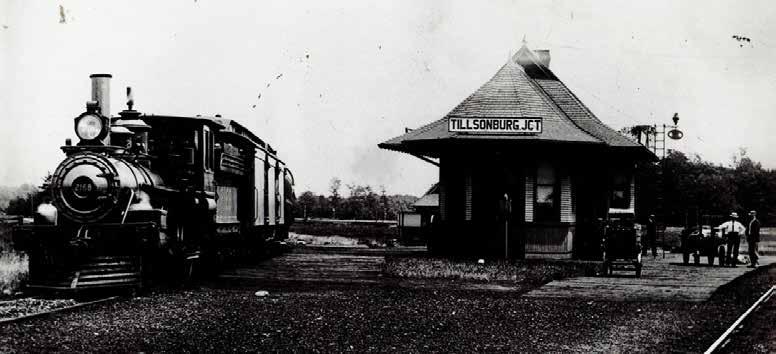
lost, nor a single mistake in the construction made since this immense structure was commenced—every stick fitting as if it had grown there.” The completed Air Line Bridge was the second longest and highest railway bridge in the Dominion.
On July 1st, 1872, the bridge contractors threw a Dominion Day party for their employees and friends. There was dining and dancing under the bridge, and drinking—limitless quantities of tea. A galaxy of railway officials also descended on Tillsonburg: Sir Thomas Dakin and the Hon. William McMaster, chairmen, respectively, of the British and Canadian Great Western Railroad Co. boards; Sir John Carling, a prominent Western Ontario politician, and many others. To the anxious town officers, these officials promised that the company would grant “all the necessary facilities” to Tillsonburg.
By Nov. 21, 1872 the western gang of track layers for the Canada Air Line was beyond Courtland, and expected to complete the Line at Tillsonburg in a few days.
A Dec. 5, 1872 “Tilsonburg Observer” article reported, “Mr. J. Wheeler has com-

menced the construction of the engine house, tank house, etc. at the Tilsonburg Station [known as Tilsonburg Junction].
The engine house will be east of the station grounds, and it will be continually kept a reserve engine.”
There is some confusion about where exactly this engine house was located. Possibly the freight sheds, wood sheds, engine house and a water tower were situated at Vienna Road. At Tilsonburg Junction, there must have been at least the station house and water tanks.
The Canada Air Line began operating from Windsor to Fort Erie on Monday morning, Feb. 17, 1873. The “Observer” noted, “The whole of the line is laid with steel rails and the track is solid and smooth. Five freight trains are run over the road daily and one passenger car is attached to each train for the convenience of the public.”
Townspeople had to make their way by horse and buggy south-west of town in order to board the east-west Canada Air Line trains.
The Canada Air Line sometimes offered excursions to Niagara Falls from Tillson-
burg. The frequent trains could also pose a danger. On Jan. 4, 1878 “about 10 o’clock, a man named Wm. Graham, while in a bad state of intoxication, left a rig standing unhitched in front of the Stilwell House near the Loop Line depot (Tilsonburg Junction), while he went inside for a drink. The horse took fright at a passing freight train, and ran away, smashing the buggy badly. The poor brute in its fright, got caught in a cattle guard, when it was struck by the train and killed. The rig belonged to Mr. Wm. Harris, of Dereham.”
In August 1882, the Great Western Railroad was taken over by the Grand Trunk Railway, and by 1884 the Canada Air Line had also merged into the Grand Trunk Railway. In 1923 the Canadian National Railway took control of the line.
Of the five rail lines in Tillsonburg, parts of two remain in use. CN Railway has leased the line from St. Thomas to the Tillsonburg depot at Vienna Road and Highway #3 to GIO Rail. The original Canada Air Line through Tillsonburg, including the bridge over the golf course, is still operational 153 years later.

(ANHS PHOTO)
Operated by GIO Rail today, the former Canada Air Line was located on the south end of town. This steam locomotive is pictured outside the former Tillsonburg Junction station, which was on Vienna Road. Running from St. Thomas to east of Delhi in more recent times, the line has been exclusively freight for decades. The eastern end of the railway has been moved back and it no longer runs to Courtland.



Civic pride grows when someone famous talks about a specific community. The Guess Who wrote and performed the song “Running Back to Saskatoon.” The Tragically Hip wrote and performed the song “Bobcaygeon.” The Hip also mention the community of Moonbeam and Neil Young recalls the village of Blind River. Canadian music is full of honourable big and small community shout-outs. You cannot travel through these places without thinking, playing, and singing these tunes. And of course, we in Tillsonburg, have our own communal shout-out anthem.
Stompin’ Tom Connors (February 9, 1936, to March 6, 2013) wrote and performed the song “Tillsonburg” for his 1971 album “My Stompin' Grounds.”
Stompin’ Tom was born in Saint John, New Brunswick. From his youth through his adult years, he crossed our nation taking in the histories of rural and urban places. Always attracted to music and becoming prolific in his storytelling, he established a career performing and recording. His music struck a nerve with Canadians because of his Canadiana and the places and songs
My Back Still Aches
that identified regional culture. His songs, “The Hockey Song, “Bud the Spud,” and “Gumboot Cloggeroo” exemplify the homespun, back-porch lyrics and sound of his brand of music.
He obtained his name by way of his ‘stomping leg’ to keep time. Later, he would use a piece of plywood or board to stomp and then donate to the local community. One of these boards was donated to Tillsonburg after a concert.
The song recalls the experience of priming tobacco in Tillsonburg. It is a recollection that many from our surrounding areas would have had during the heyday of the tobacco industry between the 1950’s to the 1990’s. He distinctly sings about the work, experience and environment of priming tobacco. Above it all, he, and the song, describes and emphasises the physical exertion of the labour.
His lyrics would make sense to my father, who grew up on a tobacco farm. He knew the stages of its growth to harvest. I have no knowledge of this. If anything, I experienced it through selling the final product. I sold tobacco products when I worked at Pantry Mart, a long gone convenience store that was on John Street in town
I travelled through Europe in 2005 on a history trip with local teacher Robin Barker-James. It was an excursion to important sites of World War One and Two. We visited seven countries. We stayed in Paris and Prague. We went to Vimy Ridge, Nuremberg, and saw all matter of historical content. One day we were resting in the common room of a hostel in Berlin. We had just completed a walking tour of the city and were ready to go for supper. As we visited with others in the hostel another traveller looked at me smiling. We had heard each other speak and we gave a wide eyed ‘you know English’ look to each other.
He said to me, “Where are you from?” I replied, “Canada.”
He said, “I know, but where?” I said, “Ontario.” He said, “I know but where?”
He said, “I am from Guelph.”
I said, “I’m from Tillsonburg.”
He smiled widely and said, “My back still aches when I hear that word.”
We momentarily exalted in the fact that we were visiting Berlin, Germany, in Europe and had travelled from Canada, from Ontario. At home we lived only an hour-and-so apart from each other. It was an incredible experience to connect with someone overseas who was ultimately so close to my community. And, with some-
one who knew our community moniker, as stereotypical as it is for anyone from our town to hear.
On the home front, we laud Stompin’ Tom because of his native storytelling and general Canadian fame. And Yes, he did come to Tillsonburg! He was inspired to write the song thanks to his experience of priming tobacco. But his song was not just a passing title. He returned to the community to perform. Connors performed in Tillsonburg four times. The first was in 1971, the year the song “Tillsonburg” came out on the album, then in 1990, 1999 and lastly in 2006.
What is brilliant about the song is that it starts with the question: “Hey Tom, have you ever been to Tillsonburg?” From then on, the song is a reflection of his experience. If you analyze it from there, you realize that the song is a criticism. It becomes a negative reflection, not of the town, but of the experience of priming. This fact is often lost on listeners.
I wish I had been more aware of his presence playing in town. I would have been there and tried to get his autograph, or a picture. But none-the-less, even if I don’t have a tangible trophy or artifact from him, I have the assurance that he produced a song about my place that I am invested in.
(JEFF HELSDON PHOTO)
Stompin’ Tom Connors tribute to Tillsonburg