St. Marys’ dining scene continues to evolve with the opening of Perthstone Kitchen last week by proprietors Jason Thorne and Jessica Kelly.
At 159 Queen St. E, the restaurant is located downtown in the historic limestone McIntyre building most recently occupied by Tuttco. The couple is thrilled to open their own restaurant after years of gaining experience within the industry.
Originally from Brantford, Thorne moved
to London as a teenager and got his start in the restaurant industry at an early age.
“I started working in fast food and then moved into restaurants, eventually working at The Keg for several years in a variety of roles,” he said. “I later worked in other fine establishments throughout London.”
Thorne eventually stepped away from kitchens to work as a contractor and carpenter before returning to the culinary world in his 40s. Now, at 50, he says opening a restaurant in St. Marys feels like the right place at the right time.
St. Marys councillors spent much of a strategic priorities committee meeting March 17 working through a wide-ranging update to the town’s zoning-bylaw review, a process that will shape how and where future housing, businesses and development can happen in the community.
Representatives from NPG Planning Solutions, the consulting firm hired by the town to lead the review, presented council with a series of policy questions and possible changes for consideration before the project moves into the drafting phase.
“The town has initiated a review and an update of the zoning bylaw,” said Grant Brouwer, the town’s director of building and planning. “The project team is here today. We have already talked to town staff, agencies and stakeholders, and some of the community as well through a survey and stuff like that, but there’s a number of items that we have in front of (the committee) that we kind of need a bit of direction on, and maybe to make sure we’re looking at things in the proper (context) that council wants to see in the zoning bylaw review.”
The review is intended to update St. Marys’ existing zoning bylaw so it aligns with the town’s new official plan, recent provincial planning-policy changes and current best practices in land-use planning.
(WENDY LAMOND PHOTO)
COMMUNITY
St. Marys zoning bylaw review enters key drafting stage as council weighs housing, parking and density changes
According to the report to council, the town is required under the Planning Act to review and update its zoning bylaw.
NPG has been working on the project since late 2025 and has already met with staff, council and several local committees, held an open house and released a community survey to gather public input.
The zoning-bylaw review has been broken into four phases: a background review, proposed directions, drafting the new zoning bylaw and finalizing that bylaw for council approval. The March 17 meeting focused on the second phase, with consultants seeking feedback from council that will guide the first draft of the new bylaw.
Among the biggest themes discussed were housing and residential intensification.
Consultants asked council to consider whether additional residential units should be more broadly permitted, what development standards should apply to those units and whether new forms of housing such as stacked townhouses and back-to-back townhouses should be specifically defined and permitted in certain residential zones.
Council also reviewed possible changes around lot size, setbacks, lot coverage and building height, as well as whether some forms of higher-density housing should be permitted as-of-right in areas already identified for that kind of development in the town’s official plan.
“Residential densities and intensification … is largely around pre-zoning lands potentially to be in line with new direction of the official plan,” NPG managing partner Aaron Butler told councillors. “ … The official plan contains a policy allowing more dense housing forms like townhouses and apartments up to four storeys on sites that meet locational criteria. Generally, that locational criteria is that, among other things, the land fronts onto or is within a certain distance – 100 metres – of an arterial road or a collector road, and is adjacent to other site already zoned for high density or non-residential use. So, there could be sites – and this is up for discussion – that are obvious that could be zoned this way.”
By pre-zoning lands that meet these criteria, Butler said developers would still follow the normal permitting and ap-
plication process with the town, however they may not need to file for a site-specific zoning-bylaw amendment – saving both time and money.
“This is something where, in a smaller municipality, we could really do to encourage development and reduce costs for people so people sitting on these lands might say, ‘Okay, if the town is okay with there being severances and there being higher density, and it’s zoned for that and I’m not going to have to spend an extra $10,000, $12,000 on a consultant … it might make a difference whether I proceed with the development,’ ” Mayor Al Strathdee said.
“Those are exactly my thoughts when I looked at this as a young person who just can’t get into the housing market or isn’t willing to try,” deputy mayor Brogan Aylward added. “It has been nice to see this council’s attitude towards increased density, and I think that just earmarking lands … really encourages development, and that’s exactly the direction I want to go.”
Parking was another major topic the consultants presented to councillors.
The consultants noted parking-related matters made up a significant number of the town’s recent minor variance applications and asked council to consider whether downtown parking requirements should be reduced to help facilitate development and redevelopment. The public survey also showed strong support for requiring parking for additional residential units, while raising broader questions about how much parking is needed for different uses.
“As we’re dealing with a senior population and an aging population, not everyone drives,” Strathdee said. “I own a residential building where I would say probably three-quarters of the people drive and a quarter don’t. … I think parking, lots of times, is a barrier to development. I think we get too bogged down in it and the reality is yeah, we need parking but … you should let the market dictate. If I want to build some units for people who don’t drive and I can’t provide parking for them, I still think you should be able to do the development because I think that market exists and I think we get too wrapped up in the (requirement for) one-and-a-half spaces (per residential unit).
“ … I don’t think that’s the reality of the marketplace and I think we need to have some flexibility in our zoning.”
Speaking on the topic of parking, Brouwer said the town could see more residential redevelopment in the downtown core with the potential for apartments being established above downtown businesses, however parking requirements in the current zoning bylaw have traditionally made that more difficult to achieve.
“I agree with that,” Coun. Dave Lucas said. “Parking in our core where there actually isn’t physically spots for that; I don’t think it should preclude us developing that or somebody being able to develop that.”
Other issues raised through the review so far include permitting smaller residential lots, allowing more home-based businesses, rezoning some employment lands to residential uses, addressing stacked and back-to-back townhouse standards, clarifying home-business permissions and updating engineering-related regulations such as visibility triangles, setbacks from swales and matters tied to sanitary capacity.
The report notes NPG reviewed 25 minor variance applications containing 41 separate variances as part of the project, with setbacks making up nearly half of all applications. Most variances reviewed were associated with residential uses, a trend consultants suggested could help identify areas where the existing bylaw
may no longer reflect current development patterns or practical needs.
A community survey completed earlier this year drew just 11 respondents. Results showed most respondents had not considered building an additional residential unit, though all respondents who answered the question about parking said such units should require vehicle parking.
“We’re going through this exercise and looking for comments and questions and input. Without sounding negative, 11 respondents is not very good considering we’ve had recreation surveys that had 1,500 respondents,” Strathdee said.
“ … As a councillor, I hear housing as being one of the most important issues of our time, so we may want to have a more fulsome discussion on where things are at and people you’ve talked to because this is something where I think we do need more input from the public and I think there has been a shift, in my time, in public opinion about zoning and so forth. I think it’s important that everyone speaks to what they hear.”
Council’s strategic priorities committee, which is made up of all members of council, was asked to provide comments and direction only.
The next major step in the project will be the preparation of a draft zoning bylaw, followed by further public consultation before a final version is brought forward to council for approval.
Perthstone Kitchen opens in downtown St. Marys
Kelly also has a strong background in hospitality. Born in Ottawa and raised in London, she began working in restaurants at 13 years old through her family’s businesses. She went on to work at Palasad in London for about 10 years along with working in other pubs and restaurants.
The couple, who moved to St. Marys last year, has fallen in love with the community and has treasured the many friendships made.
“In a city, you see a lot of faces but don’t necessarily have relationships with them,” said Thorne. “But in a small town, you get to engage with people on a more personal level. When you recognize them on the street or in their stores, or at our restaurant, it feels more personal. We feel very welcome in St. Marys.”
That sense of connection is key to Perthstone Kitchen’s philosophy of “local supporting local.” The menu is built around a true farm-to-table approach, with a focus on producers from across Perth County.
Local connections include Snapping Turtle Coffee Roasters, Perth Pork, The Butcher Barn, Stonetown Artisan Cheese and area producers such as Ann Slater, Edye Farms and Sheldon’s Berries.
“When we get the taps back on, we’ll have Broken Rail Brewing as our main beer provider along with other microbreweries throughout the county as well,” said Thorne as he and Kelly work
towards getting a liquor license approved for the restaurant.
“A lot of restaurants claim to be farmto-table local, but here in Perth County, we can really do that properly,” said Thorne.
Perthstone’s menu reflects both comfort and creativity. Drawing on his experience in fine dining, Thorne highlights classic offerings such as prime rib with
Yorkshire pudding and garlic mashed potatoes, which is featured every Sunday.
At the same time, Thorne emphasizes house-made ingredients and from-scratch cooking wherever possible.
“We make our own sauces, desserts and breads,” he said. “Our focaccia is made in-house, our burgers are fresh and we do our own cheesecakes and crème brûlée. You can taste the difference when things
are made fresh.”
Aside from certain staples like Friday’s fish-and-chips feature, Thorne says he prefers to avoid frozen and heavily processed foods in favour of fresh preparation.
Seafood is sourced through Steelhead Food Co. based out of St. Thomas, bringing in pickerel from the Great Lakes, scallops from the Bay of Fundy and salmon from the Atlantic Ocean. Oysters are also expected to be added during the summer months.
Alongside hearty options like steaks and burgers, the restaurant offers lighter options, including poke bowls, shawarma bowls and a range of gluten-free, dairyfree and vegetarian dishes.
At present, Perthstone’s hours of operation are 11:30 a.m. to 8 p.m. Tuesdays through Thursdays, 11:30 a.m. to 8 p.m. Friday and Saturday, 11 a.m. to 3 p.m. Sunday brunch, and 4 p.m. to 8 p.m. Sunday dinner service with a prime rib feature. Monday hours, starting Easter Monday on April 6, will mirror Sunday’s schedule with the 11 a.m. to 3 p.m. brunch followed by the 4 p.m. to 8 p.m. dinner service.
The restaurant can also be contacted via email at info@perthstone.ca or through their Facebook page.
To make a reservation or to place an order for takeout, call 226-301-4036.
Editor’s note: The author of this article is part owner of Perthstone Kitchen.
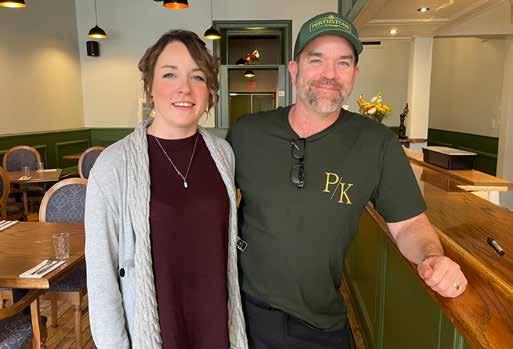
Jessica Kelly and Jason Thorne are owners of Perthstone Kitchen, a new restaurant located downtown at 159 Queen St. E, St. Marys.
(STEWART GRANT PHOTO)
EDITORIAL
Local agriculture is not just an industry, it’s the backbone of our communities
GALEN SIMMONS
Regional Editor
There are few better places to live and work than rural southwestern Ontario when it comes to access to local food.
In our communities, fresh meat, eggs, milk, produce and grains are not abstract products shipped in from far away. They are grown, raised and harvested by our neighbours. They are the result of generations of knowledge, hard work and stewardship on the farms that surround us.
That kind of proximity to our food system is something many people elsewhere in the world and in our country no longer have, and it is worth recognizing and protecting.
Local agriculture feeds our families, but it also does much more than that.
Farmers help drive the local economy by supporting local businesses – equipment dealers, feed mills, veterinarians, seed suppliers, processors, truckers, retailers and countless other small businesses. They sponsor local sports teams, donate to community fundraisers, volunteer with service clubs, support fairs and 4-H, and consistently show up whenever their communities need them.
In many ways, the strength of our rural communities is inseparable from the strength of the farm families who live and work among us.
That’s why supporting local agriculture cannot be limited to a slogan or a feelgood message during planting and harvest season. It has to mean something real.
It has to mean understanding the pressures farmers face every day, from fluctuating commodity prices, high input costs and uncertain economic conditions to la-
bour shortages, shifting government policy, severe weather, climate change, pests, disease and the simple reality that much of what determines a farm’s success is outside a farmer’s control.
It has to mean recognizing farming is not just a lifestyle, but a business built on slim margins, long hours and enormous risk.
And it should also mean giving farmers the support they need not only economically, but personally. As we highlight in the farm edition included as a separate section in this edition of the newspaper, the stress farmers carry is real, and so is the need to stand behind them when times are tough.
If we value fresh local food, vibrant rural communities and a strong local economy, then we must value the people who make all of that possible.
So, while you’re reading about farmers and the issues they face both close to home and further afield, let’s remember and be grateful we live where local food is abundant and close at hand. Local farms keep money circulating in the local economy and the farmers who work day and night to keep those farms running support community life far beyond the farm gate.
Agriculture is central to the identity of our local communities and farmers face real pressures that deserve public understanding and support. Supporting farmers means buying local when possible, advocating for fair policy and recognizing their broader contribution to community life.
After you’re done reading this week’s paper, go ahead and thank a farmer, buy something they grew, raised or produced, and pay just a little more attention to all the things, large and small, farmers do for our communities.
Bravo Boo
We have 1 Bravo this week
1) Bravo! I renewed my driver’s license in St. Marys which was great and the clerk was fantastic. I was done in about 15 minutes. So much better than going to Stratford!
We have no Boos this week
Quote of the Week
“I couldn’t even tell you (what I was thinking when the puck went in). I’m pretty sure after it went in, I just blacked out and turned around and skated towards ice. I could see both sides of the stands, and everyone was just freaking out, so that was cool for sure.”
- St. Marys Lincolns’ forward Blake Elzinga describes his reaction to scoring the eventual go-ahead goal to put the Lincolns up by a goal over halfway through the third period during their series-clinching 2-0 win over the Strathroy Rockets in Game 5
Restoring small-town journalism, one community at a time!
St. Marys Independent
Publisher
Stewart Grant • stew@granthaven.com
Regional Editor
Galen Simmons • galen@granthaven.com
Graphic Design / Sales Inquiries
Tyler Carruthers • info@stmarysindependent.com
Business Development
Heather Dunbar • heather@granthaven.com
Billing Administrator
Cindy Boakes • boakescindy1576@gmail.com
Administrative Assistant
Wendy Lamond • wendylamond74@gmail.com
Contributors
June Grant, Spencer Seymour, Emily Stewart, Jake Grant, Mary Smith, Nancy Abra, Lauren Eedy, Paul Knowles, Amy Cubberley, Laura McAsh, Alona Vasylieva, Nancy Bickell
36 Water St. St. Marys, ON, PO Box 2310 N4X 1A2 info@stmarysindependent.com | 519.284.0041 | granthaven.com
The best time for new beginnings is now. There comes a time where turning a new page is the best feeling in the world. Life has no remote, get up and change it yourself. Do what is right, not just what is easy or popular.
United Church Choir hosts The Crucifixion on Good Friday
LEADERSHIP COURSES
On April 3, Good Friday, at 3 p.m., the United Church Choir with musical guests from London, Kitchener, Sarnia and the surrounding area will present the musical reflection of The Crucifixion.
The musical work by Sir John Stainer will last a little over an hour. There is no admission charge as the concert will be in the form of a service. A freewill offering will be accepted at the door to help with expenses.
The premise of The Crucifixion reflects the Passion Story that begins with Christ and his disciples in Gethsemane on Maundy Thursday, ending with his crucifixion on Good Friday.
Director of music at St. Marys United Church Timothy Gilbert will direct the choir. The Casavant organ will be played by Angus Sinclair, who is the organist and director of music at St. John’s Anglican Church in Kitchener.
The church welcomes soloists Jason Lamont (tenor) and Stephen Habermehl (Baritone). Lamont performs with the Canadian Opera Company in Toronto and Hebermehl is a chorister and soloist with the St. Marys United Church Choir.
The popular works of Stainer will be an emotional journey of both gentle and riveting music that will keep the audience entertained with the well-known anthem, “God so Loved the World,” and ending with the final words of Christ from the cross – “It is Finished.”
PET LICENCE REMINDER
If you haven't registered your pets yet for 2026, it's time! Do so before March 31, 2026, when licence fees increase. Pet licences are valid for the life of your pet, with annual registration required.
Current fee: $25 per pet
After March 31: $35 per pet
Register: townofstmarys.com/petlicences
The St. Marys United Church at 85 Church St. S will host a musical program of The Crucifixion on Good Friday at 3 p.m.
(WENDY LAMOND PHOTO)
WENDY LAMOND Independent Reporter
Perth County releases 2025 council pay figures
Our senior of the week is Sue Robinson who celebrated her 75th birthday on March 18. Sue was born and raised in St. Marys. She has been married to Paul for 57 wonderful and eventful years. They have three children, six grandchildren and two great-grandchildren. Sue loves to colour, read and spend time with friends and family.
If you would like to nominate someone for Senior of the Week, contact us at 519.284.0041 or info@stmarysindependent.com.
WEEKEND QUIZ
1. What 1994 film features a character describing a Quarter Pounder with Cheese as a “Royale with Cheese” in France?
2. What legendary musician wrote “Purple Haze,” “Little Wing,” and “Voodoo Child”?
3. The Pyramid of Giza is the only ancient wonder still standing today — what other ancient wonder was also located in Egypt?
4. What is the name of the galaxy closest to our Milky Way?
5. In the Bible, who is the eldest son of David?
6. Which country is known as Suomi?
7. How many lines are in a limerick?
8. Do male or female toads croak?
9. What magical phrase did Ali Baba use to open the cave?
10. In Toy Story, what is the name of the boy who owns Woody and Buzz?
GALEN SIMMONS
Regional Editor
Perth County councillors received a combined total of nearly $211,000 in remuneration in 2025, along with $39,425.66 in travel and professional development expenses, according to the county’s annual statement of remuneration and expenses received by council at its March 19 meeting.
The annual report is required under the Municipal Act and provides a detailed breakdown of pay, taxable benefits and expenses paid to members of council and appointed committees.
Among councillors, past warden Doug Kellum received the highest total pay at $44,757.64, reflecting his time serving as warden until the election of a new warden in December 2025. Kellum also reported $21,684.51 in travel and professional development expenses, for a total compensation of $66,442.17.
Dean Trentowsky, who served as deputy warden for most of the year before being elected warden in December, received $23,116.24 in remuneration and $1,251.88 in travel expenses for a total of $24,368.12.
Other council remuneration totals ranged from $16,187.66 for Hugh McDermid to $19,594.60 for Robert Wilhelm. Rhonda Ehgoetz received $19,029.75, Sue Orr $19,287.86, Todd Kasenberg $18,434.72, Walter McKenzie $17,113.61, Matt Duncan $17,214.73 and Jerry Smith $18,239.20.
Council members collectively reported $34,147.61 in
travel expenses and $5,278.05 in professional development costs for 2025.
The report also includes remuneration paid to members of the county’s accessibility advisory committee, which totalled $6,436.77 in 2025. Individual payments ranged from $709 to $1,595.91, with an additional $23.77 in mileage reported.
“When you go to (the pay statement for) accessibility advisory, there’s nobody from West Perth,” Coun. Rhonda Ehgoetz said. “(Does West Perth) pay their people separately; do they not claim it?”
“We encourage everybody to submit their expense forms, however, some individuals do not submit their expense forms, so that’s why you would see that,” county clerk Tyler Sager said.
“I realize that. It just seems odd that both of them are from the same municipality; that’s why I raised it.” Ehgoetz responded. “ … Thank you to them for saving us the money.”
In addition, council received a summary of remuneration paid to county representatives serving on the Spruce Lodge Home for the Aged board. Jerry Smith received $841.88, including $281.88 in mileage, while Sue Orr received $920.00 in meeting pay. Combined remuneration for the two appointments totalled $1,721.88.
The statement summarizes all remuneration, benefits and expenses paid to council members and appointees for the 2025 calendar year as required by provincial legislation.
HOP INTO A FRESH START FOR YOUR EYES
Easter reminds us of new beginnings — and there’s no better time to give your eyes a fresh start. Whether you need an exam, updated glasses, or just want to see your world more clearly, our team at St. Marys Optometry is here to help.
Spring shoulder season returns to local conservation areas
Upper Thames River Conservation Authority (UTRCA) staff are busy preparing for the spring shoulder season at Fanshawe and Wildwood Conservation Areas.
In a press release, the conservation authority said this adds four weeks of dayuse access from Wednesday, April 1, until Thursday, April 30. It is the fourth year the conservation authority has offered shoulder seasons in response to the demand from visitors.
“We’re looking forward to welcoming visitors back to Fanshawe and Wildwood this spring,” said UTRCA conservation areas coordinator Damian Schofield in the press release.
“Visitors are eager to celebrate the return of warmer weather and want to get outside and explore. We’ve had guests reach out expressing their appreciation in having access to the CAs alongside the additional amenities for an extended season.”
Amenities offered to visitors during the shoulder season will include:
• Customer service staff on-site,
• Access to hiking and biking trails,
• Access to Fanshawe and Wildwood reservoirs for canoeing and kayaking (pending reservoir conditions, rentals not currently available),
• Access to day-use areas including a playground, BBQs, picnic areas and green space,
• Access to Fanshawe and Wildwood reservoir boat launch (pending reservoir conditions), and
• Washroom facilities.
A reduced vehicle day-pass fee of $11 (up to four people), or a reduced pedestrian/cyclist day pass fee of $8 for those walking or biking will be charged during this extended season.
Hours of operation will be as follows:
• Fanshawe Conservation Area: Monday to Friday, 10 a.m. to 6 p.m.; dam gate will be closed at 5:30 p.m. Saturday and Sunday, 8 a.m. to 4 p.m.; dam gate will be closed at 4 p.m.
• Wildwood Conservation Area: Daily, 8:30 a.m. to 4:30 p.m. Gate to day-use will be closed at 4:30 p.m. daily.
Visitors can also purchase a 2026 membership which includes day-use access 12 months of the year to Fanshawe and Wildwood. This can be purchased at the conservation area gatehouse or online. The 2026 camping season begins on May 1.
The spring shoulder season begins at Wildwood Conservation Area on April 1 and runs until April 30. (PHOTO COURTESY OF UPPER THAMES RIVER CONSERVATION AUTHORITY)
St. Marys Legion hosts another successful mini putt during March break
LAMOND
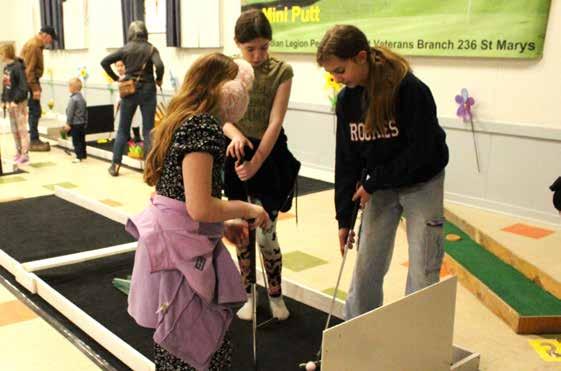
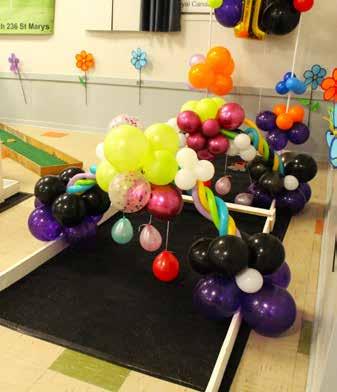
For the 10th year, the St. Marys Legion branch 236 hosted its annual 18-hole mini putt coarse. The event was held over three days from 10 a.m. to 3 p.m. The cost to play was only $5, making it a very cost-efficient March break activity for families. Every year, the organizers will mix up some themes on the mini-putt holes. Due to the success of the knitted and crocheted poppy campaign in November, there were
some extra poppies the organizers were able to use for one of the mini-putt holes.
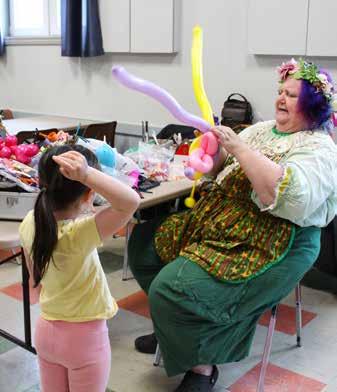
Also, balloon artist Kate Gregg created an amazing balloon-themed hole full of creativity and colour. Gregg was also on hand to make balloon animals for the kids and Brenda Farr did the face painting.
This year, Ian Morton was in attendance representing the Stratford Sabrecats Track club. The Legion is a big supporter of Athletics Ontario. The club, which is based in Stratford, has approximately 120 members. Morton, who coaches, was at the mini-putt event showing some
of the medals the club had won and was sharing information with mini-putters who may be interested in joining the track-and-field club.
As was the case in previous years, there was also food to purchase from the kitchen.
Organizer Tom Jenkins shared there were 197 golfers over the three days. Though they were hoping to reach 200, the branch was very happy with that number and is looking forward to seeing everyone again next year.
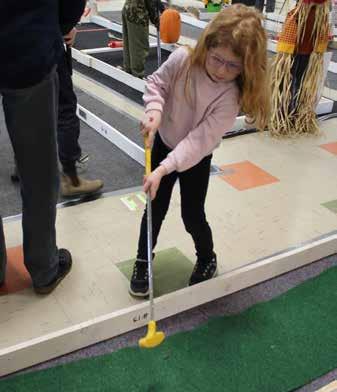
Kinley Leaman had fun golfing with Grandma Janice on Thursday at the Legion.
(WENDY LAMOND PHOTO)
Alivia Ridout waited excitedly for her balloon animal made by Kate Gregg.
(WENDY LAMOND PHOTO)
One of the new themed holes on the course was created by Kate Gregg.
(WENDY LAMOND PHOTO)
WENDY
St. Marys Sparks and Embers leaders seeking volunteers to keep group going
Regional Editor
After eight years spent building the 1st St. Marys Sparks/Embers group, Stephannie “Sparkle” Metcalfe is hoping to begin a transition in leadership, one that will allow her and fellow longtime volunteer Janet “Tawny Owl” Moore –who also happens to be Metcafle’s mother – to step back without seeing the program disappear.
Metcalfe launched the 1st St. Marys Sparks/Embers unit in 2018 when her oldest daughter was just starting in Sparks. What began with 12 girls and three leaders has since grown into a full program that regularly serves about 25 girls ages five to eight and acts as a feeder for the community’s older Guides and Pathfinders groups.
Now, with her youngest daughter entering her final year in the program, Metcalfe said it is time to start planning for what comes next.
“We’ve put so much effort and energy and love into this that we don’t want it to fall apart,” Metcalfe said. “Our goal here is to just find someone to help. … We want to make sure that we find some people to fill in those spaces. Even if it takes a while, we’ll stick around to kind of train them.”
Metcalfe and Moore are looking for volunteers to fill several key roles including contact guider, treasurer, cookie coordinator and co-guiders who help plan and run meetings. While some of those roles involve attending weekly meetings and working directly with the girls, oth-
ers can be done from home.
“There are even positions within it that you don’t have to go to the meeting,” Metcalfe said. “We need someone to help with the cookies and a treasurer.”
Moore said there is also plenty of behind-the-scenes work involved in keeping the unit running.
“There’s the administration of it that
isn’t for everybody,” she said. “You’ve got a lot of paperwork.”
Both women said the group has largely been sustained by family over the past eight years, with Metcalfe handling much of the administration, communication, cookie sales and creative planning, while Moore and other relatives have helped with meetings, outings and spe-
cial events.
Over the years, the group has offered girls a wide range of activities, from baking, crafts and science projects to swimming, skating, nature hikes and an annual camp at Camp Bimini. Along the way, the girls build skills and confidence, often without even realizing they are working toward badges.
“Sometimes they don’t even know that they’re working towards a badge,” Moore said. “It’s just sneaking in there.”
That mix of fun, friendship and learning is exactly why Metcalfe and Moore want to make sure the unit continues.
“This group needs to stay or there’s not going to be a Guides,” Metcalfe said, noting the younger unit has helped rebuild numbers in the older branch as girls move up through the program.
The pair said volunteers do not need to be parents of current members. Seniors, newcomers, high-school students looking for volunteer hours and anyone with a passion for working with children or sharing a skill are all welcome.
“The main thing is it’s volunteer,” Metcalfe said. “It’s a lot of fun for the adults. We’ve made so many good friends over the years.”
Metcalfe said the hope is to have the transition largely in place by next year so she and Moore can follow their girls into Guides while leaving the Sparks and Embers unit in good hands.
Anyone interested in volunteering can contact Metcalfe at stephanniemetcalfe@gmail.com.
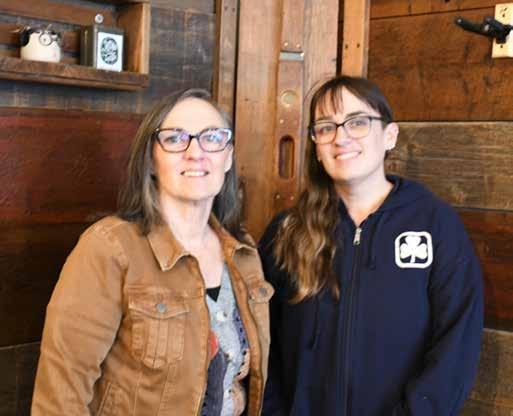
Stephannie Metcalfe (right) and her mom, Janet Moore (left), started the 1st St. Marys Sparks/ Embers unit eight years ago. Now, they’re looking to transition the unit to new leadership so they can continue to lead Metcalfe’s daughters as they move up to Guides and Pathfinders.
(GALEN SIMMONS PHOTO)
Early electric car owner donates vehicle proceeds to The Local Community Food Centre
AMANDA NELSON Independent Reporter
Malak Sidky, an early adopter of the electric car – the 755th electric vehicle sold in Ontario – recently decided to sell it through Donate A Car Canada and have the proceeds donated to The Local Community Food Centre.
In 2012, electric cars were still a novelty, and Sidky said that soon after she purchased the car, she was stopped many times by curious people who wanted to know the range, whether she liked driving the car and how powerful it was. She believes the car served its purpose as a means of transportation and may have made people more interested in being environmentally friendly.
“I’d like to think that I influenced people to think green,” she said.
But like any older car, after the brakes failed and the estimate to fix the car was $4,000, Sidky decided it was time to move on and sell it. However, the resale value was not what she expected.
“It’s a 13-year-old car. It needs new brakes. I can’t sell it without the brakes, so I decided to see what else we could do with it,” said Sidky. “The car served me well over the years and required minimal maintenance. We figure the money saved on gas and oil changes more than paid off the cost of the car.”
Through online searches, Sidky found www.donatecar.ca, where anyone can donate the proceeds from their used cars to a charity of their choosing.
“I was delighted to find Donate-A-Car Canada. They took the time to listen to
my desire to donate the car to The Local CFC in Stratford. They took care of all the arrangements,” said Sidky.
The one thing Sidky was worried about was transportation of the used vehicle. Donate A Car Canada took care of that as
well.
“The lady on the phone took all the details and then said, depending on where you live, you can drop it off or have us come and pick it up,” said Sidky. “So, I said, ‘Here’s the thing; it doesn’t have
any brakes,’ so she actually connected me to a local tow truck company to transport the car to London, which was great.”
After the car was sold at an auction house in London, Sidky was advised of the amount received. She was then given a tax receipt, and Margaret Smart, outgoing executive director of The Local Community Food Centre, an organization that addresses food insecurity in Stratford, St. Marys and the surrounding Perth County, received the proceeds soon after to help support the organization.
“Every act of generosity helps build the kind of community we all want to live in,” said Smart. “Malak shows up every Monday to volunteer for our community meal prep, knowing that every carrot chopped and every hour given helps meet real needs through The Local CFC. Now, by donating the proceeds from her car auction, she’s found yet another way to strengthen our ability to make good food accessible to everyone in our community. Thank you, Malak!”
Though it can sometimes be hard to know how to make a difference in the community, Sidky said donating her car was one way she knew she could help.
“It was emotional for me. I loved that car, but now I know it has a new home and the charity I chose and love has money to help out,” said Sidky. “The Local does phenomenal work to help the community throughout the year. I love volunteering there, so it made sense to me to help out financially as well.”
To learn more about Donate A Car Canada, visit www.donatecar.ca.
Friday, April 3rd from 6 pm - 8 pm
Malak Sidky stands with the electric car she donated through Donate A Car Canada, with the proceeds going to The Local Community Food Centre in Stratford.
(CONTRIBUTED PHOTO)
Fresh Idea Collective wraps up International Women’s History Month with Speak to Lead showcase
AMANDA NELSON Independent Reporter
A Speak to Lead Showcase for Women will take place at Here For Now Theatre in Stratford on March 29, where 10 women from across the region will come together to share their signature talks.
The event offers recent graduates of the eight-week Speak to Lead Academy for Women – a course designed and delivered by Fresh Idea Collective – an opportunity to take the stage.
Speakers will cover a range of topics including midlife reinvention, resilience, nutrition, mental wellness and community building. Sessions include Embracing Your Encore: Creating Your Best Life after 50 by Shari Doherty, The Balanced Plate: How Nutrition Fuels Your Success by Danielle Reid, and The Laughter Effect: Transforming Communities, Relationships and the Workplace by Jenna Goodhand.
Kerry Ramsay, founder of Fresh Idea Collective, said the program was designed to get women on stage to share their personal stories and inspire others.
“This is all about getting more women on stages so that women’s perspectives are reflected and women’s stories are shared,” said Ramsay. “Because we know that until women’s stories are shared, nothing else changes.
“The advantage for entrepreneurs and leaders is that when you have a signature talk and you’re getting paid to speak, it establishes your credibility and your authority. It positions you as a leader in your field.”
Ramsay said the location – Here For Now Theatre –was the “icing on the cake” when it came to booking a venue that supports women.
“We approached Here For Now Theatre to partner with us on this event because it’s a space that celebrates women and underrepresented voices,” she said. “We’re particularly pleased to be holding the showcase in this feminist venue, with an all-women board and an incredible artistic director leading the way.”
Running a business is never easy, but for women the challenges can be even greater. Fresh Idea Collective is showing that when women come together in a supportive community, it not only fosters connection but also helps cultivate the next generation of female leaders across the region.
“The community itself is a safe and accountable space where women can gather to look for ideas and exchange solutions,” said Ramsay. “Business is dynamic. It’s constantly changing, but what is really amazing about being part of a community is that it provides a solid foundation that helps alleviate fears and anxiety when it comes to building and growing a business.”
Fresh Idea Collective has connected with more than 500 women across the region, helping to build strength, resilience and a sense of community among entrepreneurs at various stages of business growth.
“As human beings, we crave community; we are designed to live, work and play in community,” said Ramsay. “Increasingly, we have become isolated from each other because of technology. Of course, you can run a business online, but there is power in coming together in the same space – connecting as human beings, laughing together, crying together, sharing wisdom and experiences that really can’t be replicated by any AI robot.”
To learn more about Fresh Idea Collective, visit www. freshideacollective.com.
Fresh Idea Collective brings together 10 women entrepreneurs to speak at the inaugural Speak to Lead Showcase for Women at the Here for Now Theatre later this month in recognition of International Women’s History Month.
(CONTRIBUTED PHOTO)
Rotary’s 100th Rural-Urban Night explores a century of change
PETER MCCASH
Rotary Club of St. Marys
The Rotary Club of St. Marys will mark a milestone this April as it hosts the 100th Rural-Urban Night – a community tradition that has brought rural and urban perspectives together since 1926.
While the club celebrated its 100th anniversary in 2025, this year’s event marks the 100th presentation of Rural-Urban Night itself – a longstanding community gathering that reflects the relationship between rural and urban life in and around St. Marys.
Titled “From Pitchforks to GPS: A Century of Rural-Urban Change,” this year’s evening will explore how daily life, agriculture, technology and community connections have evolved over the past hundred years.
The program will open with two short monologues set in 1926 – one from a rural perspective and one from an urban point
of view. The monologues will be delivered by well-known community members Carol Robinson Todd and Terry Todd, both long active in local amateur theatre, who will bring the voices of the past to life in period attire. Costumes for the performances are being generously provided by the St. Marys Community Players.
Guests are also invited to dress to reflect the past if they wish. Some may choose a full costume, while others may prefer something simple such as a hat or scarf. Attire can reflect any time over the past century – from 1926 through the decades that followed.
Historical images used throughout the evening are courtesy of the St. Marys Museum and Archive and form part of the visual backdrop to the program, helping illustrate how daily life in the community has changed over the past century.
Following the monologues, Doug Johnson and his son, Devin, of Maplevue Farms will reflect on how change has
shaped rural life across generations. Maplevue Farms is a fifth-generation family dairy and cash-crop operation and the longest continuously milk-producing farm in Perth County.
From pitchforks and horse-drawn equipment to GPS-guided tractors and modern dairy operations, the Johnsons’ father-and-son perspective offers a compelling lens on how agriculture and community life have transformed while remaining deeply connected.
Rural-Urban Night has long been one of the club’s hallmark events, drawing guests from across Perth County and surrounding communities for an evening of fellowship and discussion. Though the format has evolved over the decades, its purpose remains consistent: fostering understanding and strengthening ties between rural and urban perspectives.
The Rotary Club extends its appreciation to the businesses and individuals supporting this milestone Rural-Ur-
ban Night, including: Vet Purchasing; A-Nu-Prospect; Hubbard Pharmacy; Trouw Nutrition/Shur Gain; Waghorn, Stephens, Sipos & Poulton; Delmar; Trembletts Independent; Quadro Communication; and Welburn Agromart.
Additional sponsorship opportunities remain available. Businesses or individuals interested in supporting Rural-Urban Night are invited to connect with the Rotary Club of St. Marys through the Contact Us page at rotarystmarys.ca.
The event will be held on Thursday, April 16, with a social time beginning at 5 p.m. and dinner at 6:30 p.m. Tickets are $75 and registration is available online through the Rotary Club of St. Marys website.
Proceeds support the work of the Rotary Club of St. Marys. For more information or to register, visit rotarystmarys.ca.
St. Marys Poetry Circle to celebrate National Poetry Month in April
ALIZON SHARUN
St. Marys Poetry Circle
It’s here again! Whooping in with the spring comes National Poetry Month in April, and the Town of St. Marys will be dosed with poetry to lift residents’ hearts and make them pause as we crawl out of winter.
For the second year, students from the Coyote Nature School in St. Marys and Harrington have composed and decorated poems which will adorn the windows of over 40 stores in the downtown. The theme this year, chosen by the League of Canadian Poets in conjunction with Native Women in the Arts, is “Land and Sea.” Thanks to the St. Marys BIA for providing materials for this venture.
The Coyote Nature School Pop-Up Showcase will take place Saturday, April 11, from 1-3 p.m. at Riverwalk Commons (84 Water St. S). Come and have a sneak preview of the poems exhibited at Riverwalk Commons before they go up in the store windows. At 2p.m., the young poets will take the microphone to read their own poems, assisted by Kendra Martin, principal of the school, nature mentors and members of St. Marys Poetry Circle.
Playing at the Shoreline: In the Lap of Poetry takes place on Tuesday, April 14, from 7-9 p.m. at Riverwalk Commons. This is a treat for lovers of words and poetry – an interactive talk by Heather Meakin exploring poet-
ry’s appeal to two senses, reading the printed page, and hearing the spoken word, around this year’s theme for Poetry Month theme.
Meakin is a retired professor of early modern literature and brings her passion for sharing the transformative power of poetry. The cost for this event is $20 cash.
On Wednesday, April 22, at 7 p.m. at Riverwalk Commons, the St. Marys Poetry Circle presents The Song My Paddle Sings, a unique performance of the poems of Pauline Johnson, Tekahionwake (1861-1913). This poet, performer and writer was a superstar in the late 19th and early 20th centuries and remains an important figure in Canadian literature.
She was brought up on the Six Nations Reserve in Brantford of mixed Mohawk-English heritage and travelled throughout Canada by train and horsedrawn carriage, performing her poetry to packed audiences in cities and small towns including St. Marys. The St. Marys Museum researched newspaper records of her appearance here at The Opera House on at least two occasions, Dec. 6, 1894, and July 14, 1989.
Pre-registration is advised as seats are limited. Email alizonsharun@gmail.com to register. Doors open at 6:30 p.m. Tickets cost $20 cash. Refreshments will be provided and proceeds will go to the St. Marys Museum and Native Women in the Arts.
See you in April!
Town hosting Municipal Hazardous and Special Product Event on April 11
Contribution
The Town of St. Marys is hosting its next Municipal Hazardous and Special Product Disposal Day on Saturday, April 11.
The event will run from 8 a.m. to 12 p.m. at the municipal operations centre (MOC) located at 408 James St. S (enter off South Service Road). It is open to res-
idents of St. Marys and Perth South.
Items that will be accepted at the disposal event include:
All materials must be sealed and in their original containers with labels. Materials should be transported in the rear of vehicles (trunk, truck bed, etc.) and contained in rigid containers for safe transport and unloading.
Vehicles with materials in the front or back seat will be redirected to a separate area of the parking lot where they can be
moved to the trunk or tailgate. Residents are asked to remain in their vehicles at all times as materials will be unloaded by trained staff.
Please note the MHSW depot that was located at the St. Marys Landfill has now been closed, and MHSW material will no longer be received at the landfill.
For more information about waste disposal services in St. Marys, visit townofstmarys.com/MHSW.
Alzheimer Society Huron Perth offering education programming this spring
ST. MARYS INDEPENDENT
Contribution
The Alzheimer Society Huron Perth is inviting community members to learn about brain health and dementia through free, accessible online education programs.
Living Well education series
• Hearing and Dementia – Monday, May 4 at 2 p.m.
Danielle and Shannon from HearingLife will discuss the relationship between hearing health and cognitive wellbeing.
• Bereavement and the Grief Process –Tuesday, June 2 at 1:30 p.m.
Zoom sessions that provide practical information and support for anyone wanting to learn more about dementia.
The popular Dementia Basics series begins April 14, with afternoon and evening options. Topics include the 10 warning signs, types of dementia, mild cognitive impairment, dementia overview and more.
encouraged to attend CarePartners: Dealing with the Feelings, a fourweek program beginning Wednesday, July 22. This series focuses on the emotional aspects of caregiving, including stress, role changes and coping strategies.
Launching this spring, the Living Well series features guest speakers from local organizations.
Sally Brodie from Huron Hospice will offer guidance for navigating grief and life transitions.
Education Hour
Care-Partners: Dealing with the Feelings
For assistance, call 18005615012 or email info@alzhp.ca. ST. MARYS INDEPENDENT
The Alzheimer society offers onehour
Family members in caregiving roles are
For details and registration for these online programs, visit www.bit.ly/ASHPEducationhour or click the Education Hour banner at www.alzheimer.ca/huronperth.
Salvation Army hosts Easter food drive
First Baptist Church serves up roast-pork dinner
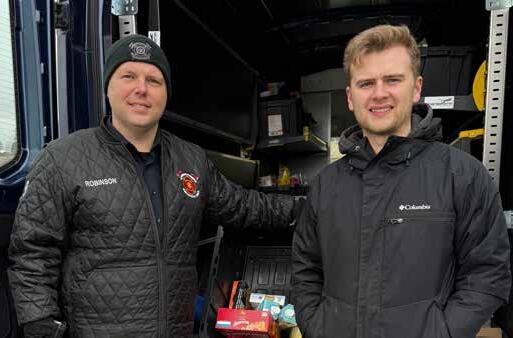
three St Marys firefighters. Pictured above left are firefighter Darcy Robinson and Michael Tigani of the Salvation Army. Pictured above right are firefighters Mike McKone and Chris Primeau.
(NANCY BICKELL PHOTOS)
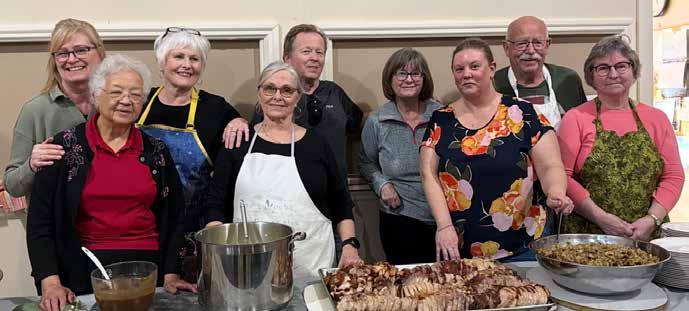
A warm meal on a cold night was welcomed by a crowd of hungry people at the community dinner prepared by the First Baptist Church on Monday, March 9 at the United Church. Roast pork with all the trimmings was on the menu
Members of the First Baptist Church and many others volunteered their help. Pictured from left, Barb Pickle, Marie Wood, Betty Ann Mustard, Barb Langdon, Bob Pickle, Audrey Hammond, Meaghan Everett, Gary Martin and Margaret Martin.
(NANCY BICKELL PHOTO)
St. Marys Independent SPORTS
Lincolns advance to second round with dominant
Game
5 win
SPENCER
On its face, a game that was scoreless until well over halfway through the third period doesn’t seem like it could be a one-sided thrashing.
However, with the Strathroy Rockets getting nary more than the occasional one-and-done chance, which were themselves few and far between, the St. Marys Lincolns delivered a commanding performance in Game 5 of their first-round series that ultimately saw the Lincolns win 2-0 to eliminate the Rockets and advance to the second round of the Sutherland Cup Playoffs.
“I thought we were outstanding,” head coach Jeff Bradley said of the Lincolns’ series-clinching showing. “It was closer than it should have been in terms of the score, and we probably deserved more, but regardless, we didn’t really give up much at all. They maybe had a couple of chances here and there in a 60-minute game, but other than that, we were outstanding.”
Bradley added the team’s defensive prowess was a key reason they ultimately came away with the series win, with the west’s second-ranked powerplay in the regular season managing just one goal on 21 attempts over the five games, and the Rockets scoring just one goal in the last 11 periods of the series.
“We allowed six goals in five games against one of the league’s best powerplays, and a team that has been shooting the lights out as of late,” Bradley said. “I think the way we defended and managed the puck, I thought at times we could do a better job of that, but when it mattered most, our guys were locked in and for the most part did the right thing at all times.”
With a chance to either close out the series or allow the Rockets an opportunity to claw back into the series, the Lincolns displayed a strong winning mentality and didn’t let their foot off the gas once during the fifth and deciding game.
“I know we have that killer instinct,” Bradley said. “At times, there are ups and downs throughout a team, and it’s much better that we’re going to do what we need to do at the times when it matters the most. In moments like (Game 5), you get reminded how good a team and how good of players we have with how they step up in those moments.
“We know what it takes. A lot of guys in here know what it takes to win, and whether they’ve done it or seen it, we know that our level of play has to be a little bit higher than the regular season, and that’s what they did, and you’ve got to give them credit. When we have all 20 guys going like that, we’re a hard team to beat.”
With the entire team playing so well yet going unrewarded and tension building amongst the ever-eager Lincolns’ crowd, it seemed to only be a matter of time before someone became the hero and the Lincolns finally were rewarded for their great effort.
Enter Blake Elzinga.
Just moments after successfully killing off a penalty, the Rockets went down a man due to a charging minor assessed to Gavin McGahey-Smith. On the ensuing Lincolns’ powerplay, a perfect storm of strong puck movement by the entire powerplay unit, and especially Blake Elzinga and Callum McAuley, coupled with traffic in front of Rockets’ netminder Seth Ronan led to Elzinga wiring home his first of the post-season to give the Lincolns a long-awaited 1-0 lead with just five minutes and 40 seconds left in regulation.
Elzinga described the clutch goal through his vantage point.
“They had a powerplay right before and then they got a penalty, so you go into that powerplay thinking, ‘We’ve got to score here,’ because there’s only five minutes left. The puck gets in the zone and to the right side of the zone, and I got it back at the point and I saw Callum (McAuley) sneaking down the left side, so I gave it to him. As he’s going around, there was a little open pocket just inside the slot, so I snuck in there.
“Callum saw me, gave me a pass, and I knew there was a guy in front of (Seth) Ronan, so he was coming across and couldn’t quite see where I was picking it up,” Elzinga continued. “I saw a spot high blocker and took a shot and was pretty fortunate to get it in there because we haven’t been able to score high.”
Elzinga added the goal lifted a huge weight off of his and his teammates’ shoulders simultaneously.
“It was a sigh of relief for myself, getting the first one of the playoffs and then obviously what game it was. It was an elimination game, and that goal put us ahead, so it was just a huge sigh of relief because we’re not waiting for one anymore. We can control the game now, and we’re not chasing that first goal.”
Owen Voortman potted an empty netter at the 18:38 mark of the third to seal the 2-0 victory, while Colby Booth-Housego turned in yet another excellent performance, making 27 saves for his second shutout of the playoffs. Booth-Housego has posted a save percentage of 0.972 or higher in three straight games, and hasn’t recorded a save percentage below 0.909 so far this post-season.
The Lincolns will next play against either the Elmira Sugar Kings, London Nationals, or Stratford Warriors. If the Sugar Kings defeat the LaSalle Vipers in their first-round series, the Lincolns will meet
the Elmira in the second round. If the Vipers beat the second-seeded Sugar Kings, the Lincolns will meet the winner of the Nationals and Warriors’ series, which is set to conclude on March 25 in a seventh game.
No matter who their opponent is, Bradley noted there are a couple elements of the team’s game the Lincolns will try to improve upon in the second round.
“I’d say our discipline could be a little bit better and our powerplay just needs to break through,” Bradley said. “We’ve seen some good things on the powerplay, but actually getting some more sustained production out of it would certainly be big for us. We’ll reset for our next series and begin seeing if there are areas that we can expose, but for the most part, it’s just about continuing to do the right things.”
St. Marys bowlers compete at provincial tournament
(CONTRIBUTED PHOTO)
Blake Elzinga, pictured, scored the game-winning goal in Game 5 of the St. Marys Lincolns’ first-round series against the Strathroy Rockets. The Lincolns defeated the Rockets 2-0 in Game 5 to advance to the second round of the post season.
(TURNER ROTH PHOTO)
On March 21, three St. Marys bowlers attended the Master Youth Provincial Championships at Victoria Bowl in Kitchener. The team of, as pictured from left to right, Asher Gregory, Scott Rinn, and James Van de Gevel, placed eighth out of 14 teams in the province with a total of 154 points over average. Gregory won a trophy for the highest bantam pins over average in a game, scoring 41 pins over his average.
U15 B Girls qualify for provincial championship
SPENCER
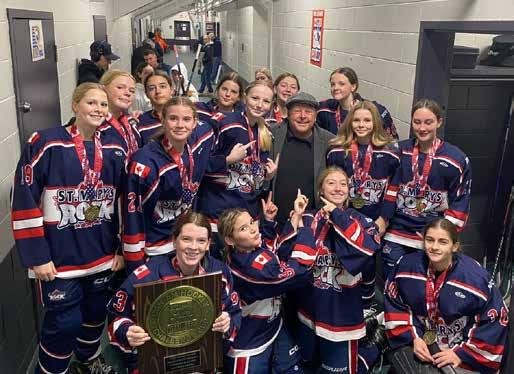
The Sam’s Home Hardware U15 B Girls St. Marys Rock will compete on the provincial stage when they take part in the Ontario Women’s Hockey Association (OWHA) Championships April 9-12 in North York.
Head coach Dave Bailey said the provincial-final berth was well deserved for the group.
“They earned their way there for sure,” Bailey told the Independent. “I’ve always made provincials the top of the heap in terms of our goals. At the end of tryouts, this is where we wanted to land; so far, we’re on the right path.
“I’m very happy for them and very proud of them. It’s basically the culmination of a season of hard work and dedication and their commitment that got them there.”
Bailey credited the team’s gutsy nature for leading them to the provincial stage.
“They’ve got a lot of heart,” said Bailey. “They’re gritty. They seem to answer the bell when it matters. That doesn’t mean they always win, but they definitely leave it on the ice, and I think we’ve had some reasonable success this season in those moments.
“It doesn’t always matter who’s supposed to be the best team on paper. They’re a hardworking bunch. Our defensive game is very good.”
The consistency of that compete level, according to Bailey, was something the squad built up over their strong season.
“I think it took some time to establish our identity, what we were and who we were. You never know for sure what you’ve got until you see how it works on
Andrew L. Hodges
the ice. We definitely have some skill for sure, but I think our strength is our work ethic. And as the season progressed, through practices and games, I think they realized that they’re going to get as far as the hard work that they put into it. It’s just become more consistent as the season went on.”
Though it was a 5-2 win over Mitchell on March 8 that officially locked the Rock into their spot at provincials, Bailey noted their first provincial playdown game, a 4-0 victory over the very same Mitchell squad, was a pivotal moment in their march towards provincials.
anymore. There were no weak sisters to play against. They were all good teams, so everything was a battle. In the end, I think it made us better and more prepared for provincials.”
For many of the team’s players, it is their second time going to provincials after making it there last season, which Bailey said provided valuable experience to the group after getting back to the all-Ontario tournament again this year.
“Nine girls from the team that I coached last year are on this team again, and at that time, when we qualified for provincials with my group last year, only two of the 14 girls had ever been to provincials before,” Bailey said. “Now, nine that were with me last year are here this year, but it’s a conquest to get out of our zone to begin with.
“I think the game that really solidified was the first game we played in the provincial playdowns against Mitchell. We went in there and beat them 4-0, and after I saw that, I had a pretty good feeling about our chances. We hadn’t beaten them up to that point, but we went in and looked very dominant. Even though it was early, that game really set a tone for the rest of the provincial playdowns for us.
“There’s a lot of parity in the league playoffs, and we finished in the top tier, which was our goal,” Bailey continued. “But there were no easy games
“I think the girls realize how special this is. They laugh and joke around a lot. We’ve got very good team chemistry, but even in the practices we’ve had since qualifying, I can tell they understand what they’ve done and what they’re hoping to do moving forward. So, I think it’s a pretty big deal for them.”
According to Bailey, the team’s work ethic, as well as breaking through a bit more offensively, will be vital to finding success at provincials.
“We need to outwork everybody we see and we need to find a little bit of offence. That’s been missing a bit in our game, I would say. It’s like hitting in baseball. One day, the ball is the size of a beach ball, and the next, it’s the size of a marble. I think, when we do have offensive success, it’s contagious and it snowballs from there.”
Pictured are the Sam’s Home Hardware U15 B Girls St. Marys Rock, who have earned a spot in the OWHA Provincial Championship in North York April 9-12.
(CONTRIBUTED PHOTO)
St. Marys Minor Soccer offers new training as season approaches
work, and movement of the ball as well as taking advantage of space.”
St. Marys Minor Soccer is enhancing the training offerings in its arsenal ahead of the 2026 soccer season.
Brad Wittig, the association’s newly elected vice president, noted the new initiatives represent an increase in their ties with a well-regarded Stratford-based soccer training organization.
“It connects back to the Eddie McKenna Training Academy, who we’ve partnered with the last couple of years, which has been a really good success for us,” Wittig told the Independent. “Working with them has been really well received by both kids and parents, and so we’re looking to expand what we do with him, outside of the normal things.”
One of Minor Soccer’s new offerings is a series of pre-season indoor training sessions, which began on March 23 and is being hosted at St. Marys DCVI.
“It’s geared a little bit more towards the soccer enthusiasts,” said Wittig. “That’s not to say house leaguers couldn’t come, but this is going to be a lot more geared for a certain skill development and getting a bit of a fresh start on the season. It’s going to be about getting lots of little touches in and getting a bit of fitness in. They’re going to get a lot of passing
Wittig added the closer confines of the high school gym will be utilized to do more work on ball handling and movement in tighter spaces.
“Because the indoor session is in a gym, space is limited, so it is a lot more touch work. You can utilize kids moving around in the space to receive a ball versus directly at their feet. With the way Eddie (McKenna) does things, it’s all about as many touches as you can get, which again, works well for a warm-up. We’re going to complement it with an outdoor version as well, which we will start registration for as the indoor version winds down.”
St. Marys Minor Soccer is also unveiling a week-long summer soccer camp, running July 6-10 with daily three-hour sessions running from 9 a.m. to 12 p.m. for U9 to U14 age groups.
Wittig said the association is “super excited” to bring the summer camps to St. Marys’ youth soccer players.
“This is something that is working in Stratford, and it’s something I believe that can work here,” said Wittig. “This is geared towards the more eager soccer players who want to develop. It is going to be completely soccer focused, so there won’t really be any non-soccer games.
It’s going to be fun and not straight running and training, but it will all be very soccer focused.”
Wittig added the goal is to sharpen the competitive soccer skills of local players.
“It’s just another way for us to do something else for the community, but at the same time continue to develop St. Marys’ competitive side,” Wittig said. “One thing we do really well is offer soccer for everyone, and none of those strategies are changing as we’re complementing the more competitive side of it.”
According to Wittig, the new programming and increased working relationship with the Eddie McKenna Training Academy reflect the goal of St. Marys Minor Soccer to offer a high-quality soccer program at the local level so players don’t have to go to larger centres.
“We want to bring more of a formal academy approach. Eddie (McKenna) comes from an academy background where, as a kid, he played in a lot of bigger cities where they had more formal, organized, academy-type systems, similar to what you find in Europe. He wants to bring that style to the smaller towns because in places like Stratford and St. Marys we lose players to bigger cities, so this is to show that, even in a small town, you can get high-level training.”
Wittig said both players and coaches are expected to benefit from St. Marys Minor Soccer building on their association with McKenna and his academy.
“First and foremost, the players get the immediate benefits. We have Eddie (McKenna) coming in this year, specifically to work with the tier-two teams on a scheduled weekly basis, whereas, in the past few years, it’s been more on an as-
you-book basis. Tier-three teams will still be able to access Eddie, and he also offers one-on-one training.
“The other thing is coaches actually get access to Eddie, indirectly or directly,” Wittig continued. “Eddie brings a lot of really good drills when he comes, and he also has a tone and approach and is so good with the kids and gears things towards the age groups. Our coaching staffs can see that, and can all take the drills he does or the approaches he has and apply them ourselves. So, it not only helps the players, but also the coaches and takes some of the weight off their shoulders.”
Even as the local minor soccer association ramps up their additional programming, Wittig noted they are also committed to keeping soccer accessible to everyone.
“We are still one of the most affordable places to play soccer, whether you want to play house league or the more competitive level soccer. Some of the new stuff we’re offering, it does cost a little bit of money. But even still, we’re really focused on keeping it open to everyone and making it affordable, while at the same time, trying to bring as many players in as we can, whether they want to play a bit more casually on a Sunday afternoon, or if they want to take it serious and play three or four times a week.”
U13 B Boys earn spot at OMHA provincial tournament
The No Snow U13 B Boys St. Marys Rock will compete at the Ontario Minor Hockey Association (OMHA) Provincial Championship April 3-5.
Head coach Jeff Richardson told the Independent he is ecstatic for his resilient squad to have made it to provincials after a season full of ups and downs.
“They’re a great group of kids who work hard every game,” said Richardson. “Even earlier in the season when we played a lot of tough teams, I was still impressed with their attitudes and their efforts. Now, it’s great to see them getting some success and being rewarded, and provincials is a big accomplishment for any team, so it’s great to see these boys going to get to experience that.”
Richardson noted the team began picking up steam after the calendar flipped, leading to the Rock’s eventual provincial final berth.
“It started in late January,” Richardson said. “We turned the corner, and we finished the regular season with five points in the last week, and I think the boys started getting some confidence. Ever since then, we’ve had solid goaltending, we’ve had offensive production from all three lines and the defencemen are moving the puck really well, and all of that has helped us start having success.”
According to the bench boss, the entire
group hit a stride in late January.
“We started putting together full 40-minute games and had balanced offence from all three lines. We’ve had some games where we’ve battled from behind, games where, in the first half of the season, we didn’t have the confidence we have now, but in the second half, we’ve been down a few goals and came back to win, which we wouldn’t have done in the first half.
When you start getting some wins, it gets addictive and they realize that they can do it. Ever since then, they started playing as a team and the results speak for themselves.”
Richardson said the team really began to believe in their chances to qualify for provincials after the first game of their playoff semi-final series where, despite narrowly losing, their strong teamwide
effort convinced the Rock they could make it to the OMHA championship tournament.
“We started off against Lambeth and dropped the first game in overtime, but we outplayed them and the boys knew that we outplayed them,” Richardson said. “We adjusted things a little bit and took the next three, and the boys were super excited, which was great to see.” Richardson, who has a chance to win a provincial title alongside fellow coach Dan Murrell, with whom he also won at the provincial level in their playing days, described his belief in the team’s depth and work ethic.
“We just have to continue to work hard every shift. We’re not a team that relies on one uber-talented guy. We need everyone going for us to have success. We’ve got a great opportunity at provincials. I think we have the chance to be right up there, and I think the boys have the opportunity to do something special. I know that they’re going to give their best effort like they have all year.”
“It brings back a lot of memories playing here in St. Marys and winning some provincial championships,” Richardson continued. “It’s something that you’ll never forget if you get the chance to do it. It’s very rare, but, like I said, it’s a great opportunity, and I know these boys will go out and give it their best, and we’ll make every game interesting.”
The No Snow U13 B Boys, pictured celebrating a recent win, will compete the OMHA Provincial Championship April 3-5.
(CONTRIBUTED PHOTO)
SPENCER SEYMOUR Independent Sports Reporter
Ryan Parnham rockets a shot from the high slot during this past Sunday’s Cubberley Plumbing and Heating U13 LL Boys Red St. Marys Rock game.
(SPENCER SEYMOUR PHOTO)
Piper Harrison launches a shot from along the wing during the St. Marys Kinsmen U9 C Girls St. Marys Rock game last Saturday.
(SPENCER SEYMOUR PHOTO)
Hunter Hodgson unleashes a long-range shot during this past Sunday’s U9 LL Boys Blue St. Marys Rock game.
(SPENCER SEYMOUR PHOTO)
Cole McIntosh puts the puck on net for a scoring chance during the Armstrong Motors U15 LL Boys St. Marys Rock game this past Sunday.
(SPENCER SEYMOUR PHOTO)
Talon Sampson blasts a shot off the rush during the Easy Lift Doors U13 LL Boys Blue St. Marys Rock game this past Sunday.
(SPENCER SEYMOUR PHOTO)
Zach Matheson sends a shot towards the goal from the point during this past Sunday’s St. Marys Legion U18 B Boys St. Marys Rock game.
(SPENCER SEYMOUR PHOTO)
We’re building the first small modular reactors in the G7 and first large scale nuclear facilities in 30 years.
That’s how we protect Ontario.
T:12.429"
COLUMNS
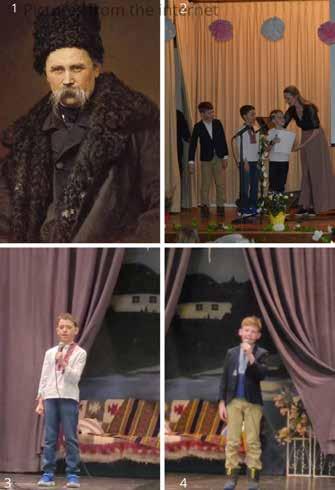
UKRAINIAN CORNER: Shevchenko – the voice of freedom through the centuries
TETIANA DIDKOVSKA Independent Columnist
“Study, read, learn from others, but do not shun your own.” - Taras Shevchenko
His words survived empires, censorship and generations. They live in poems, songs and in the hearts of Ukrainians around the world. Taras Shevchenko was not only a poet but also the voice of a nation striving for freedom, dignity and the right to be itself.
Every year in early March, Ukrainians around the world commemorate Shevchenko Days, marking both the birth and passing of their greatest poet and artist. These days unite communities in Ukraine and beyond in honouring his prophetic words, creative legacy and unbreakable spirit.
Across cities, towns and villages, people gather for poetry readings, exhibitions, concerts and quiet reflection where the lines of Kobzar are heard again. Through these gatherings, people remember the man whose voice helped shape the soul of a nation.
Taras Shevchenko was born in 1814 in the village of Moryntsi into a family of serfs. He lost his parents at a young age, becoming an orphan early in life. From childhood, he showed talent in drawing, which later led to his freedom and studies at the Imperial Academy of Arts in Saint Petersburg.
In 1840, he published Kobzar, the book that became the heart of Ukrainian literature. For his political views, he was arrested and exiled as a soldier for 10 years, forbidden to write or paint. Yet he continued to create in secret, protecting the flame of his creativity. After his release, he returned to Saint Petersburg and later received recognition as an artist. He died in 1861, leaving behind a legacy far greater than his short life.
Shevchenko wrote over 200 poems and created more than a thousand works of art. His writing laid the foundation for modern Ukrainian literary language. His works have been translated widely, and
his poetry continues to inspire readers around the world.
Today, Ukrainians across the globe continue to celebrate his life and legacy. Schools, cultural centres and community organizations host concerts, exhibitions, lectures and poetry readings dedicated to his memory.
This year, the Ukrainian community in St. Marys joined the commemorations during a warm Celebration of Spring and Love. The hosts shared stories about Shevchenko’s life and recited his famous poem, “Zapovit,” introducing the audience to his extraordinary biography.
Meanwhile, our wonderful students from the Ukrainian School of St. Marys actively participated in honouring the memory of Taras Shevchenko during “The Genius of Our Nation” event, which was organized by the Ukrainian community in London on March 8. Matvii Todoschenko recited an excerpt from “Knyazhna” – “My Evening Star” – and Platon Yanchuk read the poem, “Spring Has Come …”. Their youthful voices added a heartfelt touch to the celebration, reminding everyone that culture and tradition continue to live when shared across communities and generations.
More than a century and a half after his death, Shevchenko remains a symbol of courage and hope. His words still encourage people to defend freedom, cherish dignity and love their homeland.
For Ukrainians everywhere, Shevchenko Days are not only about memory but also about responsibility. They remind us to protect our culture, language and history, and to pass them to the next generation.
As long as his poems are read and his songs are sung, the dream he believed in will continue to live. That dream is a free Ukraine, strong in spirit and united across continents. In classrooms, community halls and family homes, his voice still guides and inspires. Through every new reader and every child who learns his poetry, the voice of freedom continues to travel forward into the future.
1: Taras Shevchenko. 2: The hosts of this year’s Ukrainian Community’s Celebration of Spring and Love shared stories of Shevchenko’s life and recited his famous poem, “Zapovit.” 3 and 4: Ukrainian School of St. Marys student Matvii Todoschenko recited an excerpt from “Knyazhna” called “My Evening Star,” and student Platon Yanchuk read the poem, “Spring Has Come…” during The Genius of Our Nation event, which was organized by the Ukrainian community in London. (CONTRIBUTED PHOTOS)
Are you between 50 and 85 and interested in learning more about memory changes as we age? Attend the “Brain Health Screening Workshop” on April 8. This free workshop by Baycrest Academy for Research & Education will give you the opportunity to meet others in the community, provide you with a personalized Brain Health Report, give you advice on how to keep your brain healthy, and more.
Due to popular demand, the original 11 a.m. to 12:15 p.m. time slot on April 8 has already filled up. A second slot from 12:45 – 2 p.m. on the same day has since been opened. To sign up for the 12:45 – 2 p.m. offering of this program, please visit: forms.townofstmarys.
Please note that to qualify you must be able to read and speak English fluently and possess basic computer skills (typing, clicking a mouse, navigating a website, etc.).
Recently, at an event in Stratford marking International Women’s Day, Betty Jo Beldon, Perth County Archivist, presented a list of trailblazing women –women who in the male-dominated 19th century made a difference in this area’s history. One was Adelaide Clayton who left her mark in towns at the two opposite ends of the county. She grew up in Listowel in North Perth and returned to her home there when she retired. But it was in St. Marys in the south part of the county where she had the best days of her teaching career and where she started a project that earned her international recognition.
Adelaide’s father, William Robert Clayton, was born in 1843 in London, England. He came to Canada with his family when he was nine, old enough to remember his early boyhood in England. In an interview on his 81st birthday, he told a reporter from the Listowel Banner that he had been enrolled in the famous Blue Coat School, a charitable institution founded by the Church of England to teach poor children reading, writing, religion and trades. He remembered his mother taking him to the Crystal Palace to see the Great Exhibition of 1851 and he saw the Duke of Wellington’s funeral procession to St. Paul’s Cathedral in 1852. These events made a great impact. Although he lived the rest of his life in Canada, William taught his children to be loyal supporters of England and the British Empire. Adelaide’s mother, Minnie (Willemena) Weiland, was born in Prussia in 1844, but she too came to Canada as a very young child. Her mother tongue was German, and she may have spoken that language to her children. As they continued their education, her daughters showed an aptitude for modern languages. Records are scarce for William and Minnie’s earliest years in Canada, but they met and were married in the mid-1860s. The young couple made a home in Colborne Township, north of Goderich, the most northwesterly part of the Huron Tract. According to the 1871 census, William was a merchant. It was a busy household. The Claytons’ first child, Adelaide, was born in 1867 and her sister, Minnie Elizabeth, arrived three years later. William’s widowed mother, Elizabeth, lived with the family as did Minnie Clayton’s younger sister, 16-year-old Adelaide Weiland. Perhaps Minnie had asked her to stay to help with her two very young children. By 1872, the family had moved to Drayton in nearby Wellington County where a third daughter, Vivian, was born. Sometime in the early 1870s, the Claytons moved to Listowel, and that town became their permanent home. William Clayton remembered Listowel as “a straggling little village” when the family first arrived. He found work as a clerk in a general store and then went into business for himself, opening a grocery and china store on Main Street. He prospered and was able to invest in commercial property as the town grew. He eventually sold his business but did not want to retire. He enjoyed meeting the public and worked as a clerk in different general stores until he was well into his 70s. He and Minnie were faithful members of the Anglican Church in Listowel. Both enjoyed horticulture. The prize lists for the annual Listowel Fall Fairs give their names as winners for entries of flowers and produce. Minnie also won prizes for her needlework and china painting. William was a member of the public school board and served several years as town auditor.
By the 1881 census, the three Clayton girls, 14-yearold Addie and her two sisters, were all attending Listowel schools. But in 1883, the middle sister, Minnie, died at the age of 12. Addie and Vivian, the two surviving sisters, were very close for the rest of their lives. The Listowel high school was established in early
1880, just in time for Addie to get a secondary school education in her own hometown. She was an excellent student and completed the senior course work required for university entrance. The University of Toronto only began allowing women to write matriculation exams in 1884. Addie Clayton wrote and passed them and was among the first young women to enroll in the university. She earned an Honours Degree in Modern Languages and English.
Following graduation, Adelaide Clayton may have taken courses at the Ontario School of Pedagogy. People in St. Marys have always believed that she then began her teaching career at our Collegiate Institute. But, she taught for at least a year in Kent County. On January 16, 1891, the Atwood Bee reported in the Listowel News column: “Miss Addie Clayton, daughter of W. R. Clayton, who has been home spending the holidays returned to Wallaceburg on Tuesday of last week, where she holds the position of assistant teacher in the High School of that town.” But Wallaceburg was a long way from Listowel. St. Marys was closer and its school had a good reputation. The following year, Adelaide Clayton was appointed teacher of English
and Modern Languages at the St. Marys Collegiate Institute, the first female teacher at the Collegiate. She must have started in the winter or spring semester because she overlapped with Arthur Meighen’s time at the school. She taught him Form VI English and, in later years, Meighen credited her with instilling in him his love for Shakespeare. After he graduated in 1892 with First Class Honours in Latin, Mathematics and English, he kept in touch with Miss Clayton and they remained good friends. The Claytons were all staunch Conservatives, and when Meighen entered politics, they must have followed this young man’s career with interest.
A privately owned archival treasure, shown with this week’s column, is the St. Marys Collegiate Institute’s one-page “Annual Announcement” for the 1892-1893 school year. It gives the start dates of the three semesters: August 29, 1892, January 4 and April 10, 1893. The names of the 11 men who make up the Board of Trustees have top billing. Below is a list of the “Staff of Teachers,” along with their qualifications and the subjects they taught. There were only five teachers: S. Martin, Principal and Mathematics teacher, T. H. Follick, Science, F. P. Riddell, Classics, J. Rice, English and Commercial, and Miss A. H. Clayton, Modern Languages and English. Miss Clayton, the most recent – and the youngest – addition to the school, was listed last. The print is small, but it is possible to see that Adelaide’s academic qualifications were equal to those of her male colleagues.
She must have made a good impression during her first year. On December 9, 1892, this item appeared in the Atwood Bee: “At the last meeting of the St. Marys Collegiate Institute Board, S. Martin was re-engaged as Principal for 1893, at a salary of $1,400, an increase of $200; F. Riddell, Mathematics Master, at his former salary of $950, and Miss Clayton, Modern Language teacher, at $950, an increase of $50.” Adelaide Clayton settled into life as a teacher in St. Marys. She had a comfortable boarding house close to the Collegiate. She attended the Anglican Church on Sundays and made friends with other young people in the community. She spent most of her holidays with her family in Listowel but did take the opportunity to travel. For example, in the summer of 1893, she went to the Chicago World Fair. On July 17, 1896, the Atwood Bee reported: “Miss A. H. Clayton, B. A., of St. Marys Collegiate Institute staff, daughter of W. R. Clayton of Listowel, accompanied by Mr. and Mrs. Dickson of St. Marys, has taken a trip to England for the benefit of her health.”
There is no indication that Adelaide had been seriously ill – probably just exhausted from a heavy year of teaching. She was the sort of person who gave all her energy to the tasks at hand. She was a dedicated teacher, committed to her students’ success. In the autumn of 1899, the Boer War broke out. Adelaide had a creative idea, a chance to put her principles into action and to instill patriotism and concern for others in her young students. To be continued.
MARY SMITH Independent Columnist
The annual announcement for the St. Marys Collegiate Institute, 1892-1893. Adelaide Clayton is listed as the school’s teacher of Modern Languages and English.
(PHOTO COURTESY OF L. R. PFAFF)
OH, THE PLACES WE’LL GO: Staying put?
Let’s be honest, there are an increasing number of would-be travellers who are getting rather chilly feet about venturing abroad. Many of us have chosen not to travel to the U.S. Others are understandably nervous about popular destinations like Mexico after the cartel uprising, Cuba with its collapsing infrastructure, or Egypt or Turkey, considering their proximity to the current war in the Middle East. As well, several African nations are doubling down on their oppression of LGBTQ2+ folk.
And then there are the issues that don’t involve personal dangers, such as the new requirements in the U.K. for pre-travel documentation or, if you were born there, a British passport. This sort of clearance before arrival in countries is also being initiated in many European countries.
As a travel writer, I will admit I still plan to travel. My near-future plans include Italy and even Mexico, with other trips in the works.
But I do understand we are all looking for alternatives. So, as
we get closer to spring, I want to suggest a few drivable destinations that don’t involve leaving the province but will, I promise, provide visitors with a great vacation.
Let’s start with the Niagara peninsula. I don’t say “Niagara Falls” because while this wonder of the world is undoubtedly the biggest draw on the peninsula, there is so much more to explore here. Although it might be wise to consider staying in Niagara Falls, proper, because now, in the off-season, many of the hotels offer great deals on rooms, which often come with discounts on dining and even a casino voucher. If you’re heading toward the Falls, check out those options.
But if you go, don’t spend all your time in Niagara Falls. Niagara-on-the-Lake is one of my favourite towns in Ontario where you can browse in interesting shops, dine in good restaurants and pubs, and wander a couple of blocks off the main street to the banks of the Niagara River for terrific views of Lake Ontario, the riverscape and our neighbouring country that sadly shall not be named.
My favourite pastime in the Niagara Region – as regular readers will know – is visiting wineries, and there are dozens to choose from. Many also have good restaurants, and some offer unique accommodations. For a full and informative list of wineries, see winecountryontario.ca. And please note that the Niagara peninsula has now been divided into two official wine regions – Niagara Benchlands and
Area and Niagara-on-the-Lake and Area. If I had to choose only two in each, it would be Fielding and Ridgepoint in the Benchlands; Bighead and Konzelman in Niagara-on-the-Lake region.
Now, let’s head east. It will also not be a surprise to regular readers that I recommend a getaway to our nation’s capital, Ottawa. I simply don’t think there is any equivalent destination in Canada, with as much to see and do, almost all accessible on foot.
Highlights for me include two art galleries – the phenomenal National Gallery of Canada and the unexpected Ottawa Art Gallery with a terrific Group of Seven exhibition. I recently wrote enthusiastically about the National War Museum, and I haven’t changed my mind – it’s really enthralling. In total, Ottawa is home to seven of Canada’s national museums.
I always enjoy the quirky artifacts at Laurier House, which housed two prime ministers – Wilfrid Laurier and William Lyon Mackenzie King. The display of memorabilia from King’s immersion in the occult is worth the price of admission.
There are many unique sites open for tours in Ottawa, from the temporary House of Commons and the current home of the Senate (once the railway station) to the Royal Canadian Mint and Rideau Hall, home of the governor general.
For my last stay-at-home alternative to foreign travel, I am going to suggest a vacation that covers a distance of less than an hour and a half – the region that runs along the north shore
But don’t stay home!
of Lake Ontario and the western end of the St. Lawrence River, from Quinte West to Gananoque, including Kingston. We’ve had the chance to explore this region in the last couple of years, and there were a lot of unexpected delights throughout the area.
I would probably opt to stay in Kingston because this historic city offers some unique and special bed and breakfasts and inns. And over the course of my week or so in the area, I would be sure to visit the truly fascinating National Air Force Museum in Trenton and the Great Lakes Museum in Kingston (with a note that the highlight, there, the S.S. Keewatin, is not open for tours until May). I would also join Kouri’s Kopters in Gananoque for one of their breathtaking
helicopter tours of the Thousand Islands (also starting in midMay).
All of the communities in this lakeside stretch offer unique dining experiences, local live theatre and concerts, and on-thewater adventures in the warmer months.
So, if you are eager to travel but hesitant to leave the comfort of your own province, these three areas provide terrific travel experiences. I have been there, I have done that and I truly intend to do it all again.
Paul Knowles is an author and travel writer, and Past-President of the Travel Media Association of Canada. To contact Paul about travel, his books, or speaking engagements, email pknowles@golden.net.
Aircraft at the terrific National Air Force Museum in Trenton. (PAUL KNOWLES PHOTOS)
PAUL KNOWLES Independent Columnist
Fielding winery is one of the best in the Niagara Benchlands wine region.
The Canadian Senate chamber in its temporary quarters in the old railway station is open for tours. Reservations are necessary.
EAT AT OUR HOUSE: Low-sodium Easter appetizers
Feedback is always appreciated when coming up with ideas to write this column as I want to be writing recipes people will be excited to use themselves that works for them.
A common suggestion is lower-sodium recipes, which more and more people are incorporating into their diets for personal reasons. Sadly, salt is a natural flavour enhancer and leaving this ingredient out often causes most dishes to be lacking that certain something. Well, I refuse to accept that in my own life as I revisit a low-sodium lifestyle. With the holidays coming up, I have found adaptable ways to still enjoy the dishes we look forward to yearly and plan to touch on a few kitchen substitutions in my upcoming columns regarding sodium intake. Check out Troyer’s Spices’ salt-free blends and offerings – they do not disappoint.
Low-sodium mayonnaise
Approximately 4 mg sodium; Serves 16 1-tbsp servings; Total time: 5 minutes
Tools and ingredients:
• Blender
• 1 egg
• 1/2 tsp mustard powder or low-sodium mustard of your preference
• 1.5 tbsp white wine vinegar
• 1 cup sunflower oil, or light oil such as avocado oil
• Black pepper optional for flavour
Method:
- Blend all ingredients except oil for a few second until egg is slightly beaten. Turn blender to low and slowly add stream of oil. Turn up blender on high and a thick sauce will form in 1 minute.
- Use as is or store in airtight container for up to seven days in the fridge.
*This can be used in your tra-
ditional Easter devilled eggs! I enjoy adding mild curry or paprika to my recipe.
Low-sodium Dijon mustard
Sodium 1 mg; Serves 16 1-tsp servings
Tools and ingredients:
• Mortar and pestle
• 3 tbsp mustard seeds
• 1/4 cup mustard powder or ground mustard
• 1/4 cup water
• 3 tbsp apple cider vinegar
• 1 tbsp honey
• 1/2 tsp turmeric
Method:
- Grind mustard seeds in mortar and pestle, or spice grinder. If you like chunkier Dijon, leave some seeds whole.
- In a bowl or mason jar, add seeds, mustard powder and water. Allow to sit for 12 minutes. For spicier mustard, allow to sit for 8 minutes.
- Add vinegar, honey and turmeric.
- Refrigerate and allow mustard to sit for 24-28 hours before consuming at first. The flavours will mellow as it sits.
*Last 1 month in airtight container in fridge.
Snap pea salad with goats cheese, almonds and crispy prosciutto
Serves 4; Total time: 25 minutes
Prosciutto is very high in sodium like most cured meats, but occasional exceptions can be made as we still need a small amount of sodium in our diets.
I cut down the prosciutto to 2-3 slices and that is my allotment for the day. Alternatively, you can add sodium-reduced seafood, homemade chicken or steak seasoned with herbs, or omit it altogether.
Ingredients:
• 1 tbsp fresh mint
• 1 tbsp chopped tarragon
• 1/2 cup plain yogurt
• 1 tbsp homemade mayonnaise
• 1 tsp lemon zest, plus 2 tbsp lemon juice
• 1 clove garlic, chopped
• 1 tbsp homemade Dijon mustard
• Salt substitute
• Freshly ground pepper
• 5 oz watercress
• 5 oz snap peas, trimmed and thinly sliced
• 2 oz goats cheese, crumbed (about 1/2 cup) *Goats cheese is considered a low-sodium cheese
• 1 carrot, cut into sticks
• 4 radishes, cut into wedges
• 1/3 cup roasted, unsalted almonds, chopped
• 3 slices crispy prosciutto, torn
Method:
- Whisk together mint, tarragon, yogurt, mayonnaise, lemon zest and juice, garlic and mustard in a bowl. Season with salt substitute and pepper. Toss together watercress, snap peas, goats cheese, carrot, radishes and almonds in a separate serving bowl.
- In a non-stick pan, fry prosciutto slices whole. No oil needed unless not using nonstick. Watch closely until prosciutto shrinks, flip until crispy. Transfer to wire rack or paper towel to cool. Prosciutto will become crispier when cooled –crumble into salad.
- Toss everything together with half the dressing. Serve remaining dressing alongside salad.
Buttered leek and gruyere galette
Serves 4-6; Prep: 25 minutes; Total time: 55 minutes
Ingredients:
• 3 tbsp unsalted butter
• 4 large leeks, white and green parts only, halved lengthwise and cut quarter-inch thick (about 3 and a 1/2 cups)
• 2 tsp chopped thyme
• Salt substitute and freshly ground black pepper
• 1/3 cup dry white wine
• 1/3 cup heavy cream
• 1/2 recipe basic pie dough of your preference
• All-purpose flour
• 4 oz gruyere, grated (about 1 cup) – I use Stonetown Cheese Grand Trunk
* Gruyere is considered a low-sodium cheese
Method:
- Melt butter in a large skillet over medium heat. Add leeks, thyme and 1/3 cup water. Season with salt substitution and pepper. Cook, stirring frequently for 12-14 minutes, until leeks are tender.
- Add wine and cook until thickened, 2-3 minutes. Add cream and cook until leeks are coated, 1-2 minutes. Cool
slightly.
- Preheat oven to 400 degrees Fahrenheit. Line a rimmed baking sheet with parchment paper. Allow dough to rest on work surface for 5 minutes. On lightly floured work surface, roll dough into a 13-inch circle, transfer to prepared pan. Top with gruyere, then leek mixture, leaving a 2-3-inch border all around. Fold edges of dough around filling, overlapping and pressing gently to seal. Brush dough with cream.
- Bake until crust is golden brown, 30-35 minutes. Serve warm or room temperature.
LAUREN EEDY Independent Columnist
This low-sodium buttered-leek and gruyere galette will satisfy your cravings while allowing you to stay true to your diet.
(LAUREN EEDY PHOTO)
A low-sodium Dijon mustard is the perfect way to keep the salt out of your condiments.
(LAUREN EEDY PHOTO)
I have spots but I’m not a dog, I give you milk, not from a jug. What am I? A cow
I’m pink and round and love the mud, I oink and roll around for fun. What am I? A pig
I wake you up at break of day, With a loud call I love to say. What am I? Answer: A rooster
I give you eggs for breakfast time, I cluck and peck and scratch and dine. What am I?
A chicken
I wear a fluffy woolly coat, and sometimes follow with a bleat or note. What am I?
A sheep
I’m strong and fast and like to run, on the farm I’m lots of fun. What am I?
A horse
I quack instead of bark or moo, I swim in ponds and waddle too. What am I?
A duck
I buzz around from flower to flower, making something sweet each hour. What am I? A bee
I help the farmer plow the ground, big wheels rolling all around. What am I?
A tractor
- Word Search -
SPONSORED BY:
Adult Learning Programs of Perth, Upstairs at the St. Marys
St. Marys Veterinary Clinic is pleased to be the sponsor of the
PET OF THE WEEK
SPRING TIPS FOR YOUR DOG!
Get moving this spring! Daily walks around your neighbourhood or favourite local trails are a great way to boost your dog’s physical health and keep their mind engaged - plus, it’s good for you too!
SCARLETT
Our Pet of the Week is Scarlett. She is a two-and-a-half-year-old golden retriever. Scarlett loves her best friend Marleigh, chasing her frisbee, escaping the back yard and rolling in the mud, as you can see.
Thorndale News
A section within the St. Marys Independent
Thorndale Dental Centre donates time and gives back to Ronald McDonald House in London
The staff at Thorndale Dental Centre recently volunteered alongside the chefs at Ronald McDonald House in London.
“I strongly believe it is important to give back when we can,” said Dr. Nicholas Massé of the Thorndale Dental Centre.
A few years ago, Massé’s then twomonth-old son, Oliver, went into medical distress and he had to be rushed to the hospital. Oliver was in emergency care for five days. It is here where Massé and his family were introduced to the in-hospital Ronald McDonald House area. It provided a space to retreat for some quiet and comfort while he and his wife, Allison, could be close to Oliver as he gradually recovered.
Lindsey McLeod Finkbeiner, a dental hygienist at Thorndale Dental Centre, also shared Ronald McDonald House was her and her family’s home for 34 days when her daughter was gravely ill.
“It was very important we were close to her during this time, and I am so grateful for the compassion we received during our daughter’s recovery,” she said.
“It was a home away from home; not a sterile atmosphere of a hospital facility but a cozy welcoming home.”
Freezer Meal Prep a fun community outreach
project
Last Saturday morning, March 21, the Thorndale United Church hosted a Freezer Meal Prep activity where seven area participants registered to make eight family meals to take home.
“In busy families, it is sometimes hard to make a healthy and hearty meal ready for supper,” said organizer Marilyn Flanigan.
The church volunteers worked together chopping, measuring ingredients and assembling eight meals for each participant to take home. Each meal will feed four to five adults – all for under $135.
“It was a fun morning cooking together and some hadn’t met before,” Flanigan said. “I am pleased with our outreach community project and we will do it again in the fall.”
Flanigan also thanked Jason, the butcher at St. Marys Foodland, for his help with the church’s meat order.
There are 16 Ronald McDonald Houses across Canada. The house in London serves southwestern Ontario with their mission of providing “essential services that remove barriers, strengthen families and promote healing when children need health care.”
These efforts are supported by the partnership with McDonald’s restaurant through their McHappy Day campaign and in-store donations. As well, they are supported by volunteers and charitable donations to cover costs of nightly stays and meals.
For the last five years or so, the Thorndale Dental Centre has donated to Ronald McDonald House in London.
“Instead of having a staff Christmas party, we make a financial donation to them for food supplies,” Massé said. “Then we go and volunteer approximately four hours or so to work with the chefs there to prepare a supper meal for 80 to 90 people. It is so rewarding and a fun team-building experience, but more importantly, we are giving back to help other families.”
Family Easter Fun planned for Thorndale
The Thorndale Optimist Club will once again host the Thorndale Easter Egg Hunt on the morning of Saturday, April 4, at the Thorndale Lions Community Centre.
The colourful egg hunts are scheduled for 9:30 and 10:15 a.m. with registration required.
Beside the egg hunt activity outside the community centre, there will be children’s crafts sponsored by Angels Childcare of Thorndale and face painting. The Easter Bunny will also be there for children to meet and for families to take photos with this character.
A breakfast sandwich along with coffee and juice will be available from the Thorndale Optimists for purchase (cash only).
New this year, the Thorndale Optimists are hosting a Teddy Bear drive. Families are asked to bring a new teddy bear with tags attached, and the Optimist will donate these teddys to local emergency responders and the hospital.
This community Easter Egg Hunt event sponsored by I Love Thorndale and the Thorndale Optimist Club is free, but registration is essential, so each child gets a treat. Register at www.ilovethorndale.ca/ event/easter-egg-hunt/.
Thorndale Dental Centre staff at the Ronald McDonald House kitchen in London.
(CONTRIBUTED PHOTO)
Volunteers gathered at Thorndale United Church March 21 to put together freezer meals for eight families to take home.
(MARILYN FLANIGAN PHOTO)
NANCY ABRA Independent Reporter
NANCY ABRA Independent Reporter
NANCY ABRA Independent Reporter
OBITUARY
Heaman
HEAMAN: Ross of Thorndale passed away peacefully at Henley Place, London on March 17, 2026 at the age of 89. Beloved husband of Ethel (Hutchison) Heaman for 64 years. Cherished father of Gary Heaman (Francine), and Carl Heaman (Dave). Adored grandfather of Cody (Meaghen), Patrick, and Julia (Matt). Dear brother and brother-in-law of Shirley Dorman, Janet Heaman, Betty Siddle, Bud Heaman and Belinda Becker, Marilyn Stanbury, and Gord Hutchison. Fondly remembered by his many nieces and nephews. Predeceased by siblings and in-laws, Jack Heaman, Don and Marie Heaman, Jack Dorman, Dave Siddle, Wes and Fran Heaman, and Floyd Stanbury, his parents Lawrence and Evelyn (Paton) Heaman and parents-in-law Frank and Dorothy (Armstong) Hutchison.
Cremation has taken place. Visitation will be held at Haskett Funeral Home, 223 Main Street Lucan on Monday, March 23 from 10 – 11 AM. Where Ross’ funeral service will be held at 11 am. Private family interment at Robin Hill Cemetery in the spring. Donations to charity of your choice would be appreciated by the family. Online condolences may be forwarded through www.haskettfh.com.
OBITUARY
Dotzenroth
Robert “Bob” Brock Dotzenroth passed away at Stratford General Hospital, after a short stay, on March 20, 2026. Born on June 26, 1953, son of the late Brock Dotzenroth and Margaret (nee Kirkwood). Married to Margaret Piece for 17 years, who predeceased him in 2024. Stepfather of Eddy Somerville, Jeff Somerville (Kelly Norris), Peter Stevenson and Step-Grandfather of Zoey Somerville. Brother of Ruth Noble (Norm) both deceased, Dorothy Dunseith (Paul), and Joan Murray (Karl). Bob will also be missed by nieces and nephews.
Private interment in St. Marys Cemetery. Memorial donations may be made to the St. Marys Healthcare Foundation or the Rotary Hospice Stratford Perth. Online tributes at www.hodgesfuneralhome.ca.
OBITUARY
Fusick
Larry Wade “Fuzz” Fusick, of St. Marys and formerly of Harrington and Stratford, sadly but peacefully passed away at Stratford Hospital on March 15, 2026, at the age of 71, with his daughter praying by his side. Born on May 2, 1954, Larry was the son of the late Louie Fusick (2006) and Ruth (Flath) Fusick (2023). He was the loving father of Devon Boivin (Michel), of France, and Robyn Fusick-White (Larry), of Stratford. Larry was predeceased by his twin brother, Garry Fusick (2021). He will also be deeply missed by his sister, Bonnie Bowra (Mike), of Australia. He is survived by his three beloved grandchildren, Sawyer White, Palmer White, and Emma Boivin, who were truly loved and adored by their proud Grandpa. Larry was a cherished uncle to Shawn Kelly (Sunlee), of Australia, Ryan Kelly of Stratford, Kyle Fusick (Steph) of Kincardine, and Justine Fusick (Tim) of Exeter.
Larry was a lifelong member of St. Peter’s Lutheran Church in Stratford. His faith was strong and unwavering throughout his life. He spent many happy years in Harrington tending to his hobby farm, sitting on the front porch and enjoying life’s simple pleasures. Larry was also a world traveler who especially enjoyed spending his winters in Bali, where he cherished time with his Bali family, attended church, and enjoyed the warmth and peace of being by his pool.
Larry’s greatest joy in life was his family and close friends. His best times were spent together. Talking, laughing, and simply being around his children and grandchildren. He loved hearing about their lives and was always happiest when everyone was together. Larry was an eternal optimist. He always wished the best for everyone and was grateful for each and every day.
His faith never faded, and he will now enjoy the gifts of his true dedication to the Lord in Heaven, reunited with his brother and parents. He will be forever loved, deeply missed, and always remembered.
The Funeral Service was conducted at the St. Peter’s Evangelical Lutheran Church in Stratford on March 21, 2026. A video of the service can be viewed on the St. Peter’s Evangelical Lutheran Church YouTube page. Spring interment in Knox Presbyterian Church Cemetery, Harrington. Donations may be made to St Peter’s Evangelical Lutheran Church in Stratford. Online tributes at www.hodgesfuneralhome.ca.
OBITUARY
Paul Ellsworth “Mickey” McNaughton of St. Marys, Ontario, passed away peacefully at the age of 89 on March 16, 2026.
Born at the home of Frank and Hattie in Woodham, Ontario, Paul lived a full and vibrant life marked by hard work, music, and community. He married Sheila Jean McNaughton (Watson) on November 24, 1956, sharing 67 years of love, partnership, and joy together. Paul was a devoted father to Rod (Jenn), Randy (Cheryl, deceased 2025), and Shawn (Nita), and a proud grandfather and great-grandfather, as well as a cherished uncle to many nieces and nephews. Paul was predeceased by his beloved wife Sheila (2023), daughter Debra Ann (1959), parents Lorne (2001) and Noreen (1999), father-in-law Earl Watson (1995), motherin-law Clara Watson (2005), brothers Carl (2019) and Bill (2022), and sister Yvonne (2006). He is lovingly remembered by his sisters Jane and Joan.
Paul’s passion for mechanics began with his training at Central Chevrolet in London and Vanexan Motors in St. Marys, before working at Sure Brake & Muffler and Kennedy Motors in Strathroy, where he also served as an Auxiliary Police Officer. In 1971, he and Sheila purchased a garage and diner in Kirkton, which became McNaughton Shell Service and Jeannie’s Gas Bar, operating it successfully for 20 years. He continued his automotive career with McNaughton Mobile Mechanic, while also driving for Ulch Transport, C.W. Prance Trucking, and Murphy Bus Lines.
Beyond his career, Paul’s life was full of music and community involvement. He was the lead vocalist and guitarist for the Sydenham Valley Boys, and he and Sheila delighted audiences at jam sessions, nursing homes, and church events. An avid camper, car enthusiast, and small-engine tinkerer, Paul had a largerthan-life presence, always ready with a smile, a helping hand, and a warm laugh. He and Sheila were active members of the United Church, where Paul served as usher and sound system coordinator, and contributed to countless church activities. Paul was also deeply involved in his community. He was a proud member of the Masonic Lodge and Shriners International. He was actively involved with the K-W Winter Carnival and helped organize the K-W Car Show, combining his love of community events with his lifelong passion for automobiles.
Paul’s joy, generosity, and vibrant spirit touched everyone who knew him. He will be deeply missed, but his legacy of love, music, and kindness will live on in the hearts of his family, friends, and community.
Private family interment in Kirkton Union Cemetery.
A Celebration of Life Open House will be held at the Kirkton Woodham Community Centre, 70497 Rd 164, Kirkton, on April 11, 2026 from 1 – 4 pm. In lieu of flowers, donations may be made to St. Marys United Church, Alzheimer Society, or West Perth Village Seniors’ Community. Those who knew Paul will remember his music, his laughter, and the way he made every room feel a little brighter.
HELP WANTED HELP WANTED
The Happy Valley Family Health Team is a dynamic team of professionals including 11 Family Physicians, Dietitian, Pharmacist, Mental Health Workers, Nurses, Nurse Practitioners and administrative support.
We currently have an opening for:
1 FULL TIME RECEPTIONIST
1 PART TIME RECEPTIONIST
This position requires the ability to multi-task in a fast paced environment and excellent communication skills. Pleasant telephone manner is essential and knowledge of medical terminology is an asset.
Please forward resume by March 27th, 2025 to: Happy Valley Family Health Team
Attention: Kimberly Lang, Executive Director 268 Maiden Lane P.O. Box 1120 St. Marys, ON N4X 1B7 stmmc@stmmc.ca
Thank you to all applicants who apply. Only applicants selected for an interview will be contacted.
The Happy Valley Family Health Team welcomes and encourages applications from people with disabilities. Accommodations are available on request for candidates taking part in all aspects of the selection process.
Looking Back
Cadzow Pool origins
25 years ago (2001)
Grace Sherwin of St. Marys won a bronze medal in the 60-metre sprint at the Ontario Track and Field Association championships in Windsor. Grace, a grade 6 student at Arthur Meighen Public School, also competed in the 200 metre (finishing fifth) and long jump (fourth). She is a member of the St. Thomas Legion Track and Field Club. A 911 call that led St. Marys OPP to a break in moments after it took place resulted in drug charges against a St. Marys man. Local police responded to a 911 report of a break and enter on Water Street South. The suspects had fled the scene by the time the officers arrived, but as they checked the premises, they found a quantity of marijuana in plain view in the home. The drugs were seized and charges were laid.
50 years ago (1976)
The Stonetown’s three pairs of swans are due to hit the creek this week, along with the local flock of geese. It’s mating season and hopes are that the number of swans could at least double before fall. Loiterers, mostly teenagers, who persist in hanging about the street in groups may be in for a shock very shortly. Chief Constable Ed Matheson told the Journal Tuesday that he has issued instruction to local law officers to enforce a local bylaw prohibiting loitering on the street. The bylaw refers to groups of three or more who refuse to comply with police. Complaints of stone tossing, foul language and so forth have been growing for a year or more.
75 years ago (1951)
The search is over!
The perfect summer job is found! If you are friendly, respectful and hard working, then this could be just what you are looking for.
Duties include ability to carry and install tent and party supplies. Must be physically fit and have a positive attitude. Competitive wages.
The Hydro Electric Power Commission helicopter made a tour of the power transmission lines running into St. Marys the past week. This windmill type aircraft is equipped with instruments which locate leaks, groundings, etc. on high power transmission lines.
Through the good offices of Cpl. Frank Taylor, Dr. Fred Follick, and Mr. Brown who give instructions in boxing, and Constable George Sullivan who gives lessons in wrestling, more than thirty boys and youths have been getting some real useful physical training each Tuesday and Thursday evening at the Collegiate gymnasium.
100 years ago (1926)
The Rotary Club has now decided to definitely establish a new park and children’s playground on the old Weir property, formerly known as Cadzow Park on Church Street South. The Club members have already collected a considerable sum, which will provide an up-to-date playground and picnic park for young and old alike. Present plans include the construction of an open-air swimming pool and swings.
A commercial air service between Winnipeg and Toronto will be established in the spring. The service will provide a thirteen-hour run from Winnipeg to Toronto, via Minneapolis, Cleveland and Buffalo, and will handle express and passenger business.
AMY CUBBERLEY Independent Columnist
CLASSIFIED ADS CLASSIFIED ADS
WANTED TO BUY
All collectibles including sports cards, beanie babies, Funko pops and stamps. Highest prices paid. Free appraisals.Are you downsizing or need an estate clean out? We can help. Call or text Stan anytime 519-868-3814.
WANTED
I will pay cash for antiques and collectibles. Coca Cola, Pepsi or any pop company. Brewery items - Kuntz, Huether Labatts, etc. Old radios and gramophones, wristwatches, pocket watches, old fruit jars - Beaver Star, Bee Hive etc. Any old oil cans and signs - Red Indian, Supertest etc. Any small furniture. If you are moving or cleaning out stuff please contact me at 519-570-6920.
FOR SALE
Hundreds of shade trees, fruit trees, apples, pears, peaches, plums, sweet and sour cherries, apricots, nectarines, blueberries, haskapp grapes, raspberries, elderberries etc. Lots of spruce, pine, cedars for windbreak and privacy hedges. Sizes 1-8 ft. in containers ready to go. Flowering shrubs and much more. Mon-Sat 7:00am to 6:00pm. Martin’s Nursery, 42661 Orangehill Rd Wroxeter, ON N0G 2X0 (1 Conc. North of Wroexter on Belmore Line)
CLEANING / PAINTING
House cleaning and painting available. Call or text Jacquie at 519-274-5761
Local Lawn Rolling & Aerating - reliable service, fair prices. Call 519-933-8636
LAWN CARE SERVICES
Shaun O’Neil - Owner & Operator. Professional grass cut & trim. Call 519-301-4933 or email shaunoneil80@icloud.com
THE WEEK AHEAD
SPONSORED BY: McDonald’s St. Marys 752 Queen St. E., St. Marys Founding and Forever partner of Ronald McDonald House
PRC & Friendship Centre events – See the Stonetown Crier on Page 5
St. Marys Public Library events – See Page 22
FRIDAY, MAR 27
- Royal Canadian Legion hot dog lunch at Noon
- A.N.A.F. meat draw – 6 p.m.
SATURDAY, MAR 28
- McCully’s Hill Farm maple syrup festival (farm tours, pancake brunch) – 10 a.m. to 2 p.m.
- A.N.A.F. pickerel fish fry – 5-7 p.m., Limited tickets
- Royal Canadian Legion meat draw – 5 p.m.
SUNDAY, MAR 29
- McCully’s Hill Farm maple syrup festival (farm tours, pancake brunch) – 10 a.m. to 2 p.m.
- Legion bingo – Doors open 11:30 a.m., Early bird 12:45 p.m., Game time 1-4 p.m.
TUESDAY, MAR 31
- Royal Canadian Legion buddy check coffee – 10 a.m. to Noon
- St. Marys Legion cribbage – Starts 7 p.m. sharp
THURSDAY, APR 2
- A.N.A.F. sausage on a bun – 12-1:30 p.m.
Notice of Application for Approval to Expropriate Land
Form 2
Expropriations Act
In the matter of an application by the Ministry of Transportation for approval to expropriate land, pursuant to s.11(2) and subsection 11.1(3) of the Public Transportation and Highway Improvement Act, being in the Geographic Township of Fullarton, Municipality of West Perth, County of Perth, Province of Ontario
For the purpose(s) of: constructing a new entrance to the property along Perth Line 20 and closing the existing entrance along Highway 23, for improved road safety.
Notice is hereby given that application has been made for approval to expropriate the land described:
A limited interest for a period of time up to and including May 4, 2026, to November 15, 2027, in the nature of a free, uninterrupted and unobstructed easement for the purpose of constructing a new entrance to the property along Perth Line 20 and closing the existing entrance along Highway 23, for improved road safety.
In the Municipality of West Perth, in the County of Perth, being Part of PIN 53219-0071 (LT), being Part of Lot 34, Concession North of Thames Road, Geographic Township of Fullarton, designated as PART 1 on Plan 44R-6439 (P-2198-46).
The approving authority is the Minister of Transportation with an address of:
Minister of Transportation
777 Bay Street, 5th Floor
Toronto, ON M7A 1Z8
416-327-9200
Any owner of lands in respect of which notice is given, who desires to comment on the proposed expropriation of the land for the described purpose(s) may do so by submitting the comment within the time stated herein to the Assistant Deputy Minister, Transportation Infrastructure Management Division, Ministry of Transportation, in writing.
The Ministry will review the comments for their technical/engineering information, having regard to the need for the land for the purposes of the project.
The Assistant Deputy Minister must receive the comments within thirty days after the owner is served with this notice, or within thirty days after the first publication of the notice.
The comments must be sent:
By e-mail to: Property.Process@ontario.ca
Or by mail to: Assistant Deputy Minister Transportation and Infrastructure Management Ministry of Transportation 4th Floor, Garden City Tower 301 St. Paul Street
St. Catharines, ON L2R 7R4
Please include the municipal address of the land in the comment.
The expropriating authority is the Minister of Transportation with an address of: 777 Bay Street, 5th Floor Toronto, ON M7A 1Z8 416-327-9200
Minister of Transportation
Per: c/o Linda Wilson-Holmes Conveyancing Supervisor 659 Exeter Road 3rd Floor London, ON N6E 1L3 226-688-7999
THIS NOTICE WAS FIRST PUBLISHED ON: MARCH 11, 2026
SUDOKU ANSWERS
Our plan to protect Ontario is fighting for every auto job
As Canada stares down economic uncertainty, we’re ready with a plan to protect Ontario. We’re building to protect every job in the automotive industry.
That’s how we protect Ontario.
T:12.429"
Shur-Gain: A longstanding farm business in St. Marys
“We are not in the business to make money. We are in the business to render a service. If we do that job well, profits are inevitable.”
These words were spoken by the founding force of Canada Packers, J.S. McLean, which is where Shur-Gain’s story began. The history of Shur-Gain began long before it became a permanent structure at 600 James St. S in St. Marys. The company originated in 1937 in Toronto as part of Canada Packers and is one of the oldest suppliers of animal livestock feed to Ontario farmers.
In the ‘30s, as farm-grown-rations
content varied, causing slow growth in livestock, more protein and minerals were needed. So, Canada Packers began producing meat, blood and bone meals for farmers. This led to the purchase of land for a research farm near the Toronto airport where testing of products and different feeding methods began.
Over the years, the company has remained extremely research focused. As Toronto was rapidly growing, the research farm was moved to the town of Maple. In 1991, due to more expansion in Maple, the farm was moved once more and now resides on 840 acres in Burford.
How did the feed company come to St. Marys? Well, a great source of knowl-
edge in this department is John Hensel, who was one of the forces behind the move. Hensel was in the business for 44 years and retired in 2000. He started out in the fertilizer business in Chatham and graduated to the feed business and then plant management. Canada Packers built a grain elevator and fertilizer-rending plant in Highgate that Hensel managed for 10 years. At that time, the local Ontario feed manager was looking for expansion and somewhere to build a new feed mill. Between him and Hensel, they worked together to find the best spot.
“We chose St. Marys because, at that time, much of the Ontario feed business was within 100 miles of the town,” Hensel said. “It had a great rail connection
and Shur-Gain had a long history with St. Marys and the Great Star Flour Mill which was a dealer at the time.”
This year marks 50 years at their current location.
Bruce Mclean owned the land and had 30 acres to sell. The company was only wanting to buy 15 acres of it but Hensel, with hopes of expanding down the line, convinced them to purchase the whole 30 acres where the pet food plant and the second mill now stand.
Hensel said the Town of St. Marys was great to work with and very welcoming to the business. Eric Taylor was a town manager at the time. Taylor actually wanted the plant to be closer to the town.
Shur-Gain plant #1 and the pet-food plant at 600 James St. S. The plants have been in the same location since 1976 and 1986 respectively. Both plants have employed many people throughout the years.
(WENDY LAMOND PHOTO) CONTINUED
WENDY LAMOND Independent Reporter
Shur-Gain: A longstanding farm business in St. Marys
At that time, there wasn’t a Southvale, Meadowridge or Maxwell street and it was wide open farmland.
Canada Packers chose to build the mill where it stands now due to truck traffic and environmental factors, and to keep it a bit further from the town centre.
The mill manufactured feed for all classes of livestock and about 20 employees were hired. In 1986, the petfood plant that was operating in Toronto at the time was shut down. With all the equipment sitting there, Hensel said it might as well be put to good use. As Hensel had hoped, expansion at 600 James St. S was going to happen and the pet-food plant was built with product brands like Loblaws onboard.
In 1990, a British Company called Hillsdown Holdings purchased Canada Packers. They also acquired a company called Maple Leaf Mills. The two were merged in 1991 creating Maple Leaf Foods with key ownership being taken over by the McCain Family and the Ontario Teacher’s Pension in 1995.
The Shur-Gain feed business worked with a dealer network. These are independent dealers that had a franchise with Shur-Gain. Shur-Gain would provide basic feed requirements to make feed at a local level. They sell dealers the premixes, and the dealers would then add commodities to make a finished product for their customers.
In 2000, expansion was once again on the horizon with the building of a 200,000-tonne capacity, state-of-the-art feed mill at the James Street location. Hensel said the purpose of the expansion was to show the commitment to the dealer network while keeping up with
the ever-growing direct livestock and poultry customers.
When it opened, the new feed mill was completely automated and employed a dozen additional workers, and focused on bulk swine and poultry feed.
Fast forward to 2007 when more change came to the company. An international animal nutrition and feed company called Nutreco purchased ShurGain from Maple Leaf Foods.
The company now operates under the name Trouw Nutrition, which is still owned by Nutreco but is a combination
of their animal feed businesses across Canada.
Dave Crossan, current general manager of the St. Marys location, has worked for the company for 23 years. After holding four different positions, he has seen many changes over the years. Changes in ownership and the differences in how they want to run the business stands out. The one thing that has always stayed the same is the focus on the customers.
“We always are focused on our cus tomers. Our consumers are more and more reliant on technology like the Ro
bot milking,” Crossan said.
The company has now grown to 265 employees. It has 11 centres of excellence and many smaller dealers, and the poultry feed has the largest tonnage across current-day Shur-Gain.
One thing both Hensel and Crossan shared was the importance of the people and the focus on the clientele. Hensel emphasized the value of personal relationships and the changes he has seen over the years. One big change is the growth in farm operations. Where it was once mostly small farms, at some point, the focus shifted to larger operations that require more specialty feeds. But as agriculture changed, Hensel said the company changed along with it.
According to Crossan, the tariff war has luckily not impacted the company too much.
A company that has been in business for 89 years is rare. It takes many people to make that happen, from management, staff, suppliers and customers, ShurGain has obviously done something right.
As a young man, Hensel was working a part-time job and planning on getting his pilot licence when he was injured in a workplace accident. He turned this lemon into lemonade by becoming an integral part of bringing Shur-Gain to St. Marys and enjoyed a 44-year career in the feed business. He said he feels good about bringing it to town and that it is still going.
“I enjoyed my entire career and all the people I met. I feel good about the fact that I brought it to town, that it employed many people over the years and that it is
Shur-Gain plant #2 was built in 2000 and can produce 200,000 tonnes of bulk feed.
(WENDY LAMOND PHOTO)
UTRCA programs help farmers invest in soil health, water quality and long-term sustainability
and
Regional Editor
Farmers across Perth, Oxford and surrounding counties are finding new ways to strengthen their land and protect the environment with support from a range of funding programs offered by the Upper Thames River Conservation Author-
ity (UTRCA).
Through initiatives like the Phosphorus Reduction Program, Oxford Clean Water Program, Resilient Agricultural Landscape Program and UTRCA’s Tree Planting Program, farmers and rural landowners can access financial and technical support for projects that improve soil health, reduce runoff and
With support from the UTRCA, Oxford County farmers Steve and Cobi Sauder have been utilizing cover crops and reduced tillage, planted more than 6,500 trees, and have installed several erosion-control structures on their property.
enhance the long-term sustainability of their operations.
“The Upper Thames River Conservation Authority offers a range of funding programs designed to support farmers and landowners who are working to protect soil, water and the long-term health of the landscape,” said UTRCA stewardship outreach specialist Shannon Zylstra.
Those programs help offset costs for a wide variety of on-farm practices, including cover crops, reduced tillage, nutrient management, erosion control structures, windbreaks, wetland creation and tree planting. In some cases, multiple programs can be combined to further reduce the financial burden on farmers.
(PHOTO COURTESY OF UPPER THAMES RIVER CONSERVATION AUTHORITY)
Upper Thames River Conservation Authority (UTRCA) stewardship
land-use planner Michael Funk and manager of integrated watershed management Tatianna Lozier measure water quality as part of a cover-crop project funded with support from the UTRCA.
(PHOTO COURTESY OF UPPER THAMES RIVER CONSERVATION AUTHORITY)
GALEN SIMMONS
UTRCA programs help farmers invest in soil health, water quality and long-term sustainability
“Agricultural lands play a vital role in the health of our watershed, and farmers are key partners in protecting the land and water we depend on,” Zylstra said. “These programs recognize that farmers are already strong stewards of the land and provide additional support to help them continue that work.”
Beyond funding, UTRCA staff also provide technical assistance, helping landowners plan projects, navigate applications and connect with other available resources.
“This includes financial assistance through cost sharing, as well as technical support,” Zylstra said. “In many cases, staff can help with project planning, design recommendations and connecting landowners with other available programs and resources.”
Across the region, a number of farm families are already seeing the benefits of these programs in action.
In Middlesex County, Bill and Carrie Irwin planted a double-row windbreak along the edge of their property using support from UTRCA’s tree planting program. The project included 720 trees and serves as a natural buffer to help reduce soil erosion and protect crops from wind.
In Oxford County, Steve and Cobi
Sauder have taken a comprehensive approach to soil conservation over several decades. In addition to adopting no-till and cover cropping practices, they have installed erosion-control structures such as berms, terraces and grassed waterways, along with extensive tree planting to support long-term soil and water management.
“We’re trying to be stewards of the land in terms of water quality as well as improving soil health,” said Steve Sauder in a video posted to the UTRCA website about the project. “We put in this berm with the Upper Thames River Conservation Authority’s Clean Water Program to try and alleviate this problem. What I can say after seven years is it’s been successful.
“ … When we initially put this berm in, I was concerned about designing it properly and I was pleased that the Upper Thames River Conservation Authority provided engineering services free of charge that allowed us to get a good design that we were confident in.”
Meanwhile, in Zorra Township, Katherine and Jim Grieve transformed a low-lying, unproductive area of their farm into a thriving wetland. The project now provides habitat for wildlife while also improving water quality on the property.
“This area of the field has been unproductive for years,” said UTRCA manager of integrated watershed management Tatianna Lozier in a video shot after construction of the wetland in 2017. “It’s wet following rainfall events and there’s also standing water following significant events. … It looks great. In addition to the trees and shrubs we planted, we added 700 aquatic plugs that will spread and fill in the perimeter of the wetland. There is also vegetation that has come back and … it’s utilized now by several bird species and different insects.
“ … You’re creating both terrestrial and aquatic habitat. There’s also a water-quality function. The water (in the wetland) is from surface runoff and tile drainage and the rainfall itself. As the water is held in the wetland, the sediment will settle to the bottom and any nutrients associated with that sediment. With the vegetation, you have a nutrient-cycling benefit and the water in the pond will be able to slowly infiltrate as well as be lost to evaporation. … When there is a lot of water, we do have a standpipe so that water can be slowly released.”
At Hoenhorst Farms in Innerkip, dairy farmer Cox Wensink implemented a slag filter system to treat silage runoff, helping remove excess nutrients before
water leaves the farm. A recent upgrade to the system has further improved its performance and longevity.
Zylstra said projects like these demonstrate how environmental stewardship can also support farm productivity.
“Many of the practices supported through these programs help keep nutrients and soil on the field where they are needed, rather than being lost through runoff into local waterways,” she said.
For farmers, the programs also reduce the risk associated with trying new practices.
“These programs provide an opportunity for farmers to try new techniques such as cover crops or soil conservation practices with reduced financial risk,” Zylstra said.
UTRCA has worked to ensure the application process is straightforward and accessible, recognizing the time pressures farmers face throughout the year.
Farmers and landowners interested in applying for funding or learning more about available programs can contact the UTRCA stewardship team directly or visit the conservation authority’s website for details.
“Our goal is to support farmers and the hard work they continue to do to strengthen our land,” Zylstra said.
Scott Graham humbled over induction into the Ontario Agricultural Hall of Fame
St. Marys resident Scott Graham was honoured to find out he is being inducted into the Ontario Agricultural Hall of Fame along with four other inductees at a ceremony in June taking place in Elora.
All five nominees are being recognized for their contributions and dedication to the farming world. Graham, who was nominated by Egg Farmers of Ontario, said he was overwhelmed and surprised when he received the call from current chair of the board Scott Helps and feels so fortunate to be included with other leaders from the industry who brought agriculture to where it is today.
“Being inducted into the hall of fame really does mean a lot to me, but I never forget all the good farmers on all the different concessions across the province,” Graham said. “In my mind, they are stay-athome hall of famers; guys that have contributed so much on what has gone on in this province. I have a lot of respect for those farmers that just do their own thing on their farms and are so good at it.”
Graham grew up on a farm on the outskirts of St. Marys and is a second-generation egg farmer. Owing much of what he learned to his father, Tom, who Graham feels deserves to be in the hall of fame more than himself, he said he always looked up to his dad as a mentor. He was instrumental in moving hybrid chickens into the marketplace in the ‘50s and in the ‘70s, he was one of the first to introduce Red Angus cattle into Ontario.
Graham was chair of the Egg Farmers of Ontario board for eight years and served on the board for 13 years. His career in the egg industry greatly advanced initiatives like the Quota Transfer System. This system, which Graham considers a highlight and one of his proudest achievements, was based on putting control and value on quota instead of selling it face to face. Currently, it is sold through an auction process.
The previous process was cumbersome and put pressure on the industry partners and needed more structure. Graham took part in over two years of research and worked with farmers for the transfer system to come into play in 2014.
Graham also spearheaded the development of the Consumer Choice Campaign, which was based on consumers learning more about the safety, nutrition
and the quality assurance behind Ontario’s egg production.
Examples of these campaigns included education about Ontario egg-farm families, the Get Cracking strategy, the egg quality strategy and much more. Graham says consumers love the sticker on their egg cartons.
More recently, Graham took part in the development of non-invasive technology for gender identification of eggs prior to hatching through a project called Hyper-eye.
Before the last tariff talks, Graham travelled with the federal minister of agriculture to the United States and met with 13 different agricultural secretaries, stopping in approximately six states to try and get a handle on the concerns they were dealing with south of the border and to build relationships. This was a highlight for Graham, who said he learned the differences between countries and how lucky we are to have the support of the provincial and federal governments.
“You have to travel a long way to see a farm landscape like we have here in Ontario with the diversity of different commodities. I think everybody should be really proud. We have some very good farmers here,” Graham said.
Graham discussed supply management and its three pillars: border control, supply control and production control. In the egg business, trade talks have resulted in 7 per cent of eggs coming from the United States. The other 93 per cent comes from Canada. With so many fluctuations with tariffs in place, responsible and accountable controls are very much needed.
The COVID-19 pandemic was a tough time for Graham as it was for many. After being around people as much as he was, he said it was hard to make that change to isolation. To help improve that, he was recruited to participate in a Tim Hortons commercial that was filmed in Stratford. When he was filming in
Scott Graham is being inducted into the Ontario Agriculture Hall of Fame. His nomination came from the Egg Farmers of Ontario for all of his farming achievements.
(CONTRIBUTED PHOTO)
WENDY LAMOND
Independent Reporter
Farmerettes documentary to screen in St. Marys
GALEN SIMMONS Regional Editor
The forgotten story of the Ontario Farmerettes will take centre stage in St. Marys this spring when the St. Marys Museum hosts a screening of the documentary, We Lend a Hand.
The screening will take place Wednesday, May 21, as part of the museum’s speaker series, which is now in its 13th season. Along with the evening public screening, the museum is also working on an afternoon matinee for DCVI students and is seeking sponsorship from local agriculture-related businesses to help cover the cost so students can attend free of charge.
St. Marys director of culture, tourism and engagement Amy Cubberley said the documentary is a natural fit for the museum and the speaker series.
“The film is doing a bit of a tour across Canada right now with a focus in southwestern Ontario,” Cubberley said. “As the title says, it’s a bit of a forgotten story. I think women’s history has often been overlooked and then, as well, agricultural history, so I think we’re just re-
ally excited to be able to showcase a little bit of both.”
Tickets for the evening screening are $20 and include both the film and a question-and-answer session with the film’s producers.
The documentary tells the story of the Ontario Farm Service Force, better known as the Farmerettes, a program that ran from 1941 to 1952 and saw roughly 40,000 teenage girls and young women work on farms across the province during and after the Second World War. They picked fruit, hoed vegetables and helped bring in crops at a time when many young men were overseas fighting. Their work helped feed both civilians and soldiers and became a vital, if long-overlooked, part of the wartime effort.
The film itself grew out of years of research by Bonnie Sitter, co-author of Onion Skins & Peach Fuzz: Memories of Ontario Farmerettes. That book, and the stories it collected, later inspired a stage adaptation at the Blyth Festival before eventually becoming the documentary, We Lend a Hand.
The film has been described by filmmaker Colin Field as a reminder that
“everybody can contribute.” The documentary also captures the challenge and adventure of the program, from girls living in tents and converted barns to the close bonds they formed while working long, hot days in the fields.
That spirit came through in a guest article published in the Independent last year by Peter Allan Rice, whose mother, Adelaide “Dale” Rice, was a Farmerette in 1942. Rice wrote about his mother picking strawberries, hoeing vegetables and, most memorably, picking peaches in the Niagara area, where the peach fuzz would sneak down her collar and under her handkerchief as she worked. He also described the freedom and friendships Farmerettes found in those summers away from home.
While St. Marys may not have a direct Farmerette farming story of its own on the same scale, Cubberley said the town has an important parallel history when it comes to women stepping into essential wartime roles.
“The most direct comparison we have that took place in St. Marys is related to Maxwell Industries,” she said. “They received a major contract during the Sec-
ond World War, and so St. Marys was actually the largest producer of grenades.
“Many of the men had gone overseas, so women filled those roles. Again, not agriculture, but kind of a similar story that women stepped up to the challenges.”
The Farmerettes documentary screening is a joint endeavour between the St. Marys Museum and the Friends of the St. Marys Museum. Cubberley said the museum is hopeful local interest will be strong, especially as more people begin to recognize the women in their own families and communities who may have taken part in the program.
Tickets will be available through the museum, with an additional retail outlet for ticket sales also being arranged. For more information, call the museum at 519-284-3556 or email museum@town. stmarys.on.ca.
Event info:
• Date and time: Thursday, May 21, at 7 p.m.
• Location: Community Centre at the Pyramid Recreation Centre, 317 James St. S.
• Tickets: $20 (cash or cheque only).
Stratford, takes were sent to the Tim Hortons group in Toronto and they decided whether a retake was to be done. Graham said he ate many Tim Hortons breakfast sandwiches that day, but it did restore his emotional wellness during that time and was a fun experience.
Graham’s son, Brett Graham, is the third generation and took over the family egg farm in 2008. As Scott Graham spent more time on the board, Brett Graham took on more responsibilities at the farm. Scott Graham is very proud of what his son has accomplished to carry on the family tradition.
Though there were some challenges associated with serving on the Egg Farmers of Ontario board, Scott Gra-
ham said there were so many positives.
Laurie Graham, Scott Graham’s wife of almost 50 years, was a huge part in his success.
“You must have a good partner to be away as much as I was in those days,” Scott Graham said. “Although she likely scratched her head at times, she was always supportive and I couldn’t have done all of this without her. I truly appreciate all she has done.”
According to the press release about the induction by the Ontario Agriculture Hall of Fame, Scott Graham’s legacy is defined by his commitment to building trust between farmers and consumers while mentoring the next generation of agricultural leaders. Nowadays, Scott Graham can be found coaching
his grandkids, playing hockey and volunteering on the St. Marys Healthcare Foundation.
Animalia exhibit explores how animals helped shape St. Marys – from horses and cows to mink ranches
For nearly a year, visitors to the St. Marys Museum have been able to explore a side of local history that is easy to overlook because it was once so ordinary – the role animals played in building, feeding, clothing and shaping the town.
The museum’s “Animalia” exhibit examines the long relationship between humans and animals in St. Marys, from companionship and decoration in the home to the essential working roles animals played in agriculture, transportation and industry.
Museum curator and archivist Emily Taylor said the exhibit grew out of the museum’s own collection.
“We started to notice that we had a lot of artifacts and photographs in our collection that were related to animals,” Taylor said. “We wanted to pull all of those pieces from our collection and kind of talk about why animals have re-
ally kind of captured people’s interests and imaginations.”
The exhibit is split broadly into two themes – animals in the home and animals at work. On one side are paintings, toys and decorative objects featuring animals. On the other are the tools, photographs and artifacts that show how deeply animals were woven into everyday life in early St. Marys.
“That relationship with people … goes back thousands of years in the history of agriculture. Animals have always been important in working alongside humans,” Taylor said. “Those types of relationships are very important in St. Marys history too, especially agriculturally.”
That includes the obvious livestock connections – cows, chickens, horses and geese – but also the draft animals that helped move quarried limestone, pull carts and transport heavy goods through town long before trucks and tractors took over.
“Horses would have been doing a lot of the heavy lifting that people wouldn’t
be doing,” Taylor said.
The exhibit also reminds visitors how closely tied animals remain to life in St. Marys today, whether through farming, food production, recreation or family pets.
“It’s so clear that animals have been incredibly important in St. Marys history, and they still are today,” Taylor said. “It’s such a way for people to connect their current lives to people in the past in St. Marys.”
One of the more unusual and more controversial animal stories tied to St. Marys is mink farming, a now lesser-seen but once highly visible agricultural industry in the area.
Town director of culture, tourism and engagement Amy Cubberley said mink ranching is an often-overlooked part of local history despite how prominent it once was.
“Mink ranching has been a major industry in the St. Marys area for a number of years,” Cubberley said. “There still are active mink ranches in the area.”
Historical excerpts preserved in the museum archives show just how significant the industry once was. In December 1947, more than 30 local mink ranchers with St. Marys addresses had sold over 5,000 pelts that season at prices ranging from $15 to $20 each, and by 1950, local ranchers were preparing for Montreal fur auctions while struggling to secure enough frozen fish to feed their animals.
The museum archives also trace the industry back to one of its local pioneers. According to the obituary of James Omar Mitchell, he “pioneered the fox and mink farming industry in this district,” helping launch what was then described as a thriving enterprise in St. Marys and the surrounding area.
Like many farm sectors, mink ranching developed its own culture of competition and recognition. Cubberley said she regularly comes across archival references to local ranchers winning honours for their animals. Even in 1975, the St. Marys Lions Club updated its club
Two horses puling a cart of quarried limestone.
(PHOTO COURTESY OF ST. MARYS MUSEUM COLLECTION) Barn scene with animals circa 1902-1906.
(PHOTO COURTESY OF CARTER AND ISAAC COLLECTION, ST. MARYS MUSEUM)
GALEN SIMMONS Regional Editor
Animalia exhibit explores how animals helped shape St. Marys – from horses and cows to mink ranches
This fly netting, on display at the St. Marys Museum, was draped over working horses to keep flies away. As the horse moved, the netting would shift back and forth, preventing flies from landing and biting the horse.
pin from one featuring a mink to one that reflected the town’s cement industry, a small but telling symbol of how the town’s identity was shifting.
The industry remains contentious today, particularly amid public concern
over fur farming and occasional releases of animals from farms by animal-rights organizations like PETA. But historically, it formed a real and profitable part of the local agricultural economy. That complexity is part of what makes Animalia interesting. It is not simply an
exhibit about beloved pets or pretty objects, it is about the many ways animals helped St. Marys grow – as labourers, food sources, companions and commodities.
Animalia will remain on display at the St. Marys Museum through the spring
before a new exhibit takes its place. For more information on the displays and exhibits at the St. Marys Musuem, visit www.townofst marys.com/recreation-community-culture/st-marys-museum-archives/.
A mink stole and Canada Mink Breeders Association patch on display in the Animalia exhibit at the St. Marys Museum. Mink-fur ranching was once a very public and profitable agricultural industry in and around St. Marys.
(GALEN SIMMONS PHOTO)
(GALEN SIMMONS PHOTO)
Nuhn Industries expanding again with new Sebringville facility
additional space to expand its growing line of manure-handling equipment.
One of Perth County’s most progressive manufacturing companies is continuing to grow.
Nuhn Industries, located on the western edge of Sebringville, is in the process of building a new 148,000-square-foot warehouse and assembly plant across the road from its main facility, creating
The expansion reflects the company’s continued success both locally and internationally, with its signature redand-gold equipment recognized across Ontario, Canada, North America and beyond.
The company traces its roots back to 1902, when Simon Nuhn opened a small blacksmith shop in Wartburg, just north
of the current Highway 8 location. Nuhn Industries later relocated to Sebringville in 1984, where it has continued to grow into a global manufacturer.
Today, the company produces between 200 and 300 manure tanks each year, along with hundreds of manure pumps, lagoon crawlers and alley manure vacuums.
Speaking last week, Nuhn Industries vice president Ian Nuhn said innovation continues to drive the company’s growth. Nuhn was the first manufacturer to design and produce manure crawlers used to mix and agitate large manure lagoons, with more than 800 units now in operation worldwide.
The company’s newest product – a self-propelled manure vacuum designed for large, free-stall barns – has also gained strong traction in the market. According to Nuhn, the company is currently manufacturing and selling approximately one unit per week to customers around the world.
Nuhn Industries exports the majority of its products with about 60 per cent of equipment destined for the United
States, 30 per cent remaining in Canada and the remaining 10 per cent shipped internationally.
Its customer base is largely made up of dairy operations, accounting for about 60 per cent of sales, followed by hog farms at 40 per cent and beef operations at roughly 10 per cent.
In addition to manufacturing, the company maintains strong connections with the agricultural community through farm and dairy shows, including the upcoming Canadian Dairy Expo in Stratford on April 1 and 2.
As the company continues to expand, it also remains an important employer in the region, with plans to grow its workforce to approximately 250 employees while contributing to Perth County’s economy.
The business remains family-operated, with Ian Nuhn working alongside his father, Dennis Nuhn – a member of the Perth County Agricultural Wall of Fame – as well as his mother Marilyn Nuhn, who oversees human resources, and his wife, Linda Nuhn, and their two daughters.
A portion of Nuhn Industries’ inventory of manure-handling equipment, which is distributed to customers locally and around the world.
(GARY WEST PHOTO)
Nuhn Industries in Sebringville continues to expand as one of Ontario’s fastest-growing agricultural equipment manufacturers.
(IAN NUHN PHOTO)
GARY WEST Independent Reporter
Ontario soybean farmers face price pressure as China shifts buying and Brazil ramps up production
AMANDA NELSON Independent Reporter
Ontario soybean farmers are watching global trade negotiations closely as uncertainty around exports – particularly to China – adds to price pressure in a market already facing strong global crop supplies.
Brazil is expected to have a record soybean harvest in 2026, a development that analysts say will weigh on prices worldwide.
“There’s forecast to be record production in Brazil, and when there’s strong production, that has downward pressure on price,” said Brian Innes, executive director of Soy Canada. “That’s the first thing to watch for prices in 2026. The second is what happens globally with geopolitics and tariffs.”
Innes said changes in trade relations between major economies – especially the United States and China – can have a direct impact on the prices Canadian farmers receive.
“Due to the Trump administration, tariffs on soybeans have changed,” he said. “One thing to watch for 2026 is how the situation between the U.S. and China evolves, and how the situation between Canada and China evolves. That can have
an impact on price if tariffs change.”
More than 70 per cent of Ontario’s soybean crop is exported, with prices shaped by global demand, particularly from China. While China historically sourced much of its soybeans from the United States, it is increasingly turning to Brazil due to generally lower prices.
The Canadian and U.S. soybean markets are also closely linked through cross-border trade and processing, which could impact prices for Canadian farm ers.
“Products flow back and forth across the border,” said Innes. “For example, Ontario soybeans are shipped to Mich igan, processed into soybean meal and then shipped back into Ontario. Soybean meal and soybean oil trade back and forth across the border, and that’s why prices are very linked.”
Soybeans are priced on global bench marks – particularly U.S. futures markets – meaning Canadian prices move in step with broader world trends.
“The price that Ontario farmers see is based on what conditions Canada faces when exporting to the world, including China,” said Innes. “In the past, the dif ference between Michigan and Ontario was largely tied to exchange rates, but now, with global trade disruptions, Can
ada and the U.S. face different tariffs and different market conditions.”
Despite growing competition from lower-cost producers, Innes said Ontario remains well positioned as a high-quality soybean supplier.
Ontario is a global leader in identity-preserved and food-grade soybeans, a niche market that allows farmers to com-
pete on quality rather than volume alone.
“We’re living in a time of unprecedented global uncertainty, and if market conditions change for Canadian soybean exports, that will have an impact on price,” said Innes. “But Canadian soybeans have been flowing under strong export conditions for some time, and that has meant strong demand for Ontario soybeans.”
Teresa Van Raay begins third term with Ontario Federation of Agriculture
DAN ROLPH Independent Reporter
Teresa Van Raay is looking ahead to three more years of advocacy on behalf of the province’s farmers.
Van Raay, a Dashwood native, was re-elected as an Ontario Federation of Agriculture (OFA) director-at-large in November 2025, beginning her third three-year term with the organization.
Before she was first elected to serve in the OFA, Van Raay was a director with Ontario Pork for 14 years – an experience she described as eye-opening as she got to hear about the issues that farmers in the industry were facing.
“I realized how many more issues there are,” she said. “When you look at taking on the diversity of concerns in all Ontario, it’s daunting.”
Van Raay said some of the most prominent issues facing farmers in Ontario include trade and land use, which she noted is vital to the future of growing food in Canada.
“Once land is asphalted or cemented over, you’re not going to grow too much,” she said. “Getting the word out about how important it is for Canadians to grow our own food; that’s one of my biggest goals.
“The decisions made today affect our futures, and our next generation of farmers.”
When asked why she decided to seek a third term with the federation, Van Raay was clear that there’s still work to do when it comes to advocating on behalf of Ontario’s farmers.
“We’re not done yet,” she said. “It’s a
big portfolio, but the people in our industry who are elected to do this, all the ones who I’ve met, are in the positions for the right reasons. They want to make it better for their industry and for the next generations all because we understand the importance of growing food.”
Van Raay said she’s taking many lessons from her time as director-at-large so
far as she looks ahead to at least three more years of representing farmers. She said networking remains one of the most vital parts of the work.
“One of the things that I love to do is put the right people together,” she said. “That can make a difference.”
Stepping outside the “agricultural bubble” is also important when speaking about issues facing farmers throughout Ontario, according to Van Raay, particularly with those not in the industry who live busy lives and may not be aware of those issues until they start seeing empty grocery store shelves.
“We are such a small population that we’re not getting the news out there,” she said. “If there comes a time that there’s a shortage, then people are going to stand up and be aware. But it might be too late if we haven’t realized the importance of food security in Canada.”
Van Raay said the upcoming municipal elections scheduled for later this year are an important issue that has her attention. With OFA regularly organizing all-candidates meetings for elections, she said it’s important to present the correct questions to those who could be making decisions in council chambers in the future, ensuring they understand their commu-
Teresa Van Raay was re-elected as an Ontario Federation of Agriculture director-at-large in November 2025, starting another three-year term of advocating for Ontario’s farmers.
(CONTRIBUTED PHOTO)
Teresa Van Raay begins third term with OFA
nities, particularly when it comes to land use.
“We don’t want to be collateral damage because no one’s thought about how a decision might affect the farmer,” she said.
Ontario’s recent announcement about the amalgamation of conservation authorities also has Van Raay’s attention. Under the government’s plan, the province’s 36 authorities will be consolidated into nine, removing representation from lower-tier municipalities.
“That’s a big deal,” she said. “One of the things we were really pushing with OFA is to have agricultural representatives.
“From what we did see, that’s not there. That’s very important to our communities.”
A topic that has been getting more attention, particularly after the COVID-19 pandemic, has been mental health in the agricultural community – an issue that Van Raay said is close to her heart.
“It’s just become okay in the last seven or eight years to talk about it at the farm level,” she said. “When a farmer’s having a bad day, you just can’t take a week off. The pigs still have to be fed, or the crops still have to get planted.”
Speaking to farmers who may be struggling with mental health, Van Raay said Ontario’s Farmer Wellness Initiative and the Guardian Network are programs worth highlighting. The Farmer Wellness Initiative provides mental-health counselling to Ontario’s farmers, farm families and employees at no cost.
The Guardian Network is a program driven by volunteers who are trained to identify those struggling with their mental health in the agricultural community, and Van Raay completed the training to become a guardian in the network.
“It’s a really good program,” Van Raay said. “The more we talk about it, the more it’s okay to talk about it.”
With such a wide range of issues needing attention, Van Raay said OFA’s supporting staff have made the expansive task manageable.
“It’s a great team, and a really diversified team,” she said.
With at least another three years ahead of her advocating for Ontario’s farmers, Van Raay said it’s her love for her home that will keep her going.
“It’s so important to have strong rural communities,” she said. “I love where I live. I love my Ontario. But we can’t keep coasting and think that somebody else is going to take up the baton.”
Breaking barriers: Women in Canadian agriculture
entrants.
Women play a critical role in Canadian agriculture but also face significant participation barriers.
Lack of resources and lack of recognition lead to under-representation among farm operators and in leadership roles within agriculture businesses and organizations. The growing skills gap across the agriculture sector makes it imperative to grow gender equity and lift women’s participation in all aspects of farming.
Farm Credit Canada (FCC) estimates achieving revenue equity – with female farm operators earning, on average, revenues in line with male farm operators – would add an additional $5 billion to agriculture’s GDP contribution. Achieving gender parity in the number of farm operators would magnify these economic benefits.
Recognizing the existing contributions of women could attract more women to the industry, which itself is a function of elevating the status of women’s contributions equal to men’s.
FCC estimates almost 88,000 additional female farm operators will need to be counted to achieve gender parity by 2026 – 75 per cent are already farming but unrecognized as operators, and 25 per cent of which will need to be new
In the 30-year period spanning 19912021, the percentage of female farm operators in Canada increased from 25.7 per cent to 30.4 per cent. This upward trend is expected to continue, with the proportion of female farm operators expected to reach 31.1 per cent in 2026.
While encouraging, it’s important to note this trend is largely explained by men leaving the industry, not by more women joining. Farm consolidations and an aging farm population have reduced the total number of farm operators across Canada over time, with the number of men falling faster than the number of women.
While the proportion of women farmers has been steadily on the rise, the actual number of women in farming has not been growing by much. In fact, between 2016 and 2021 the number of female farm operators grew for the first time since 1991, but only by 2.5 per cent – translating to less than 2,000 additional farm operators. Women are also still less likely than men to be the sole decision-maker on the farm.
Female farm operators face very different economic circumstances than male farm operators. Female operators tend to have smaller operations and lower farm incomes. The median farm operating revenue bracket is the same for both men and women at $50,000 to
$99,999. But approximately 58.6 per cent of female farm operators work on farms that reported less than $100,000 in revenues, compared to 51.1 per cent of male farm operators, based on the most recent census data from 2021. Conversely, only 17.9 per cent of female farm operators were employed on farms with revenues of $500,000 or more, compared to 21.9 per cent of their male counterparts. Women have gained some ground in recent years in high-value markets for products like beef, poultry and eggs. Men continue to dominate the grains and oilseeds market.
The public still expects farmers to be male. Stereotypically, in many farm families, the man is labelled as the farmer, while the woman is labelled a farm wife. Girls growing up in farm families may not feel encouraged from participating in the more operational aspects of farming.
This early socialization can shape how women perceive their roles on the farm, and their confidence in engaging in all aspects of farming as adults. Women also tend to be expected to take on more household and childrearing responsibilities and often provide economic stability for their families through off-farm employment, making it more difficult to engage in production work.
In a 2024 survey conducted by FCC, women reported they often feel like
they must prove that they are as knowledgeable, skilled and capable as their male counterparts, and often feel judged to be less competent because of their gender. Non-production roles dominated by women like accountant or finance manager are also often deemed not as important as operational roles that tend to be male dominated.
Men are more likely to inherit the farm over women, as tradition dictates that these resources be passed from fathers to sons. Women are often excluded from succession planning, and in large part are still expected to marry into farm families if they want to participate in farming.
Numerous aspects of farming were not designed with women in mind. For example, most farm equipment has been tailored to the male physique, and these design limitations can make it more difficult for women to engage in the physical side of farming.
Many women shared that their views on their own potential were shaped by what they saw represented as they grew up, which typically was men as decision makers on the farm and women in supportive roles. A lack of representation of female leadership in agriculture can make it difficult for younger women to feel confident that they can take on leadership roles.
FARM CREDIT CANADA
Contributed Article
Fun with fungi: Edye Farms bringing wildwood mushrooms to Perth County agriculture
EMILY STEWART Independent Reporter
Edye Farms, run by Arlene Oetomo and Joe Edye, wants to encourage St. Marys and area residents to cook with mushrooms unique to what’s typically found at the grocery store.
“Edye Farms was born out of our shared passion for eating more plants, sustainability and growing our own food,” Oetomo told the Independent. “We were looking for more variety and higher quality mushrooms right here in Perth County and found a gap worth filling.”
With Edye’s upbringing on a family farm, Oetomo’s educational background leading to her PhD in public health focusing on climate change and both of their experiences working on farms and in organic produce operations, the pair grows more than 200 pounds of woodland mushrooms every two weeks. As these mushrooms usually thrive in the fallen logs and decaying trees of a humid forest environment, Edye Farms found a way to copy those conditions indoors.
“We mimic those conditions in our controlled indoor environment with no pesticides or fertilizers – just fresh Perth County air and water,” Edye said. “This is quite different from the mushrooms you typically find at large grocery chains, which are commonly grown on animal manure at industrial-scale farms.”
Edye Farms can grow and harvest
mushrooms all year with their indoor facility so customers can enjoy wild mushrooms like the lion’s mane mushroom and oyster mushrooms and learn how to cook with them. Lion’s mane can be used as nuggets or steak, for example.
“Fungi are genuinely fascinating and we love being the ones to introduce people to what they’ve been missing,” Edye
said.
Nothing goes to waste at Edye Farms because any unsold mushrooms are dehydrated and sold dried in powdered form to be used in soups, hot drinks and baked goods.
Edye Farms is part of Perth County’s strong agricultural community. With an aging population of farmers across Can-
ada as more than 60 per cent are over 55 years old, Edye and Oetomo said they hope to inspire a new generation of farmers. Only about nine per cent of farmers across Canada are under 35 years old.
“As young farmers ourselves, we feel a responsibility to help change that trend and to show that sustainable, efficient farming methods can be a viable path for a new generation,” Oetomo said. “Growing food for climate-resilient communities isn’t just a goal for us; it’s the whole point.”
Edye Farms made their St. Marys debut on Jan. 26 at the St. Marys Farmers’ Market and received an overwhelmingly positive response.
“People were genuinely excited to find fresh, specialty mushrooms right here in St. Marys,” Edye said. “The response exceeded our expectations.”
Edye Farms will be part of the regular farmers’ market season starting in May. For now, the farm is running online ordering, local delivery and weekend pickup at The Flour Mill, and the response so far has been promising.
“Right now, our biggest challenge is raising awareness without a physical storefront and helping people feel confident cooking with mushrooms they may not have tried before. But that’s part of what makes this exciting for us,” Edye said.
For more information, including online orders, visit edyefarms.ca.
Breaking barriers: Women in Canadian agriculture
Women in farming are more isolated than their male counterparts and have less access to networking, mentorship and support. As agriculture continues to be a male-dominated industry, most executive and board positions within agriculture continue to be held by men. Women generally have less access to a network of likeminded peers sharing similar struggles who they can lean on for support and advice and often have the experience of being the only woman in the room.
The labour needs of Canada’s agriculture sector are changing.
In this era of digital agriculture and data-driven decision making, there is a growing need for highly skilled farm labour. Reflecting this need, there has been an overall upward trend in educational attainment in the agriculture labour force in recent years with a declining number of workers having no formal qualifications, and an increasing number of workers with college and university degrees.
This trend is even more pronounced for women, who are more likely to be highly educated than their male counterparts. In 2021, nearly one-quarter of
female farm operators possessed at least a bachelor’s degree, compared to only 14.5 per cent of male farm operators.
The proportion of female farm operators without any formal education was only 9.3 per cent, notably lower than the 18.2 per cent observed among male farm operators.
The current gap in educational attainment between female and male farm operators is greatest for operators aged 3039. Within this age cohort, 36 per cent of women have a university education, compared to only 17 per cent of men.
A high level of educational attainment makes it easier for women to take advantage of new tools and technologies of farming as they emerge. Many of these innovations are making it easier to overcome some of the physical and social barriers that women in agriculture have faced in the past.
Women working in agriculture also continue to demonstrate a strong entrepreneurial spirit, leveraging their skills and expertise to enhance the value of what they produce. Women have been driving the emerging trend of direct-to-consumer sales of farm goods, with farms run exclusively or jointly by female operators being much more
likely to adopt this marketing strategy. There are also a growing number of women working on farms producing organic goods and using sustainable energy sources and technologies. Women are also carving out space for themselves in growing niche markets, like sheep and goat production.
There is a lot of work that needs to be done to achieve gender equity in Canadian agriculture. Currently, the industry falls behind wholesale and retail, finance, education, health care and several other industries in terms of women’s participation. Women in agriculture today are highly educated and driven, with strong business acumen. They are well equipped to foster innovation and accelerate new methods, tools and technologies on the farm. At a time when productivity growth in Canadian agriculture is stagnating, leveraging their skills and entrepreneurial spirit will reap significant economic benefits.
Here are some potential strategies to consider:
-Increase the visibility of women in agriculture. Recognizing the important work that women are already doing on farms and in boardrooms across Canada is critical.
-Enhance mentorship and networking opportunities. This will help to reduce isolation and build community for women navigating the agriculture and food space.
-Ensure that women have equal opportunity to take on leadership roles. This requires not only reducing gender bias in promotion and hiring, but also ensuring women are supported in stepping into leadership roles when the opportunity arises, through access to things like flexible work arrangements and child-care accommodations.
-Improve access to resources. Women have historically been excluded from succession planning and equal access to land and capital. Programs that support women in accessing the resources they need to start their farm businesses are essential moving forward.
Embracing the strengths and potential of women in agriculture can unlock billions of dollars in economic benefits for the agriculture sector. Achieving gender equity can drive innovation, improve productivity and foster sustainability, leading to a more resilient and prosperous agricultural industry.
Arlene Oetomo and Joe Edye of Edye Farms are bringing woodland mushrooms like oyster and lion’s mane to St. Marys and area residents. The duo grows more than 200 pounds of mushrooms every two weeks.
(PHOTO COURTESY OF EDYE FARMS)
Oversupply and trade issues drive down dry bean prices for Ontario growers
AMANDA NELSON Independent Reporter
The 2026 Ontario Bean Growers annual general meeting was held in Stratford last month, where dry bean growers from across the region came together to discuss growing concerns around exports, particularly trade, transportation and domestic demand.
Alvin Klassen of Dry Bean World outlined current challenges as Canada continues to navigate overproduction of black beans and ongoing tariff changes that are limiting trade and creating uncertainty for growers.
“In the last five years, we’ve experienced several severe ups and downs in commercial markets related to supply and demand, with the influence of producer and dealer pricing,” said Klassen.
Despite steady global demand for dry beans, many growers are finding it harder to turn a profit.
Prices across North America have dropped sharply in recent years – in some cases by nearly half – while input costs such as fuel and fertilizer have remained high.
“Throughout North America, we are now sitting where bean prices are half of what they were three years ago, and the
cost of production hasn’t gone down at all,” said Klassen. “In fact, seed pricing hasn’t gone down, and it’s making it very difficult to sustain production.”
The issue, Klassen said, comes down to supply and demand. A strong harvest has left a surplus of beans in storage – known in the industry as “carryover” – giving buyers less incentive to pay higher prices. At the same time, export challenges and limited processing options in Canada are making it harder for farmers to move their crops efficiently, adding further pressure to an already strained market.
Jeff English of Pulse Canada said the organization is working to increase domestic consumption through its “Love Canadian Beans” campaign, which aims to raise awareness that many beans sold in stores are grown in Canada and encourage more people to include them in their diets.
“It’s not about telling people how to eat but showing them how beans can be incorporated into everyday foods we already know and love,” said English. “It’s about giving some familiarity to supporting what we see as a great, sustainably
grown Canadian crop.”
English added that advancements in bean processing technology could also help grow the domestic market.
“Now that we have companies extracting proteins and starches from pulse crops, we should have an opportunity to put more protein into different foods – not necessarily calling them beans, but using them as a high-protein ingredient,” he said.
Bill Rosenberg, parliamentary assistant to the minister of agriculture, food and agribusiness, also addressed growers, highlighting the significant role Ontario’s bean producers play in the province’s agri-food sector.
“Our agri-food sector now generates around $52 billion in annual GDP,” he said. “This is why Ontario is known around the world for safe, nutritious and delicious food.
“Eighty to 90 per cent of the beans grown here in Ontario are exported around the world, and that is something to be proud of,” he added.
Overall, the message to growers was clear: while global demand is growing, the industry must navigate trade instability, supply chain risks and the need to build stronger domestic markets to remain competitive.
FCC to support producers as fertilizer market uncertainty grows
As conflict in the Middle East heightens concerns about the rising cost of inputs, Farm Credit Canada (FCC) is expanding its trade disruption customer support program to help agribusinesses, farm operators and food processors affected by rising fertilizer costs and energy prices.
FCC president and CEO Justine Hendricks said rising global tensions can leave producers wondering how it may affect the inputs they rely on.
“While we cannot control those events, we can ensure producers have the financial flexibility and support they need to navigate uncertainty,” said Hendricks. “FCC is ready to help producers keep their operations moving forward.”
Originally introduced in response to trade tariffs affecting Canadian agriculture, this FCC program will now also offer support to help producers and agribusinesses manage financial pressures caused by unexpected market shocks.
Global urea prices have already risen
amid concerns about potential supply disruptions from a region that plays a major role in global nitrogen fertilizer exports.
Through the Trade Disruption Customer Support Program, FCC is offering relief for existing customers and new clients who meet lending criteria. The program offerings include access to an additional credit line of up to $500,000, new term loans and the option for existing FCC customers to defer principal payments for up to 12 months on existing loans.
FCC said it will continue to work with industry partners to ensure Canadian agriculture and food businesses can navigate changing market conditions and keep the industry moving forward despite uncertainty.
Customers and noncustomers who are interested in finding out more may contact their local FCC office or call 1-800-387-3232 to discuss their individual situation. Lending due diligence will be carried out on all applications.
Concerns about fertilizer availability amid turmoil in the Middle East
It has been nearly a month since the U.S. and Israel launched their first missiles into Iran, and that conflict has current and potential economic implications.
These remain highly uncertain and potentially very widespread – oil and liquefied natural gas refineries are shuttered with the Strait of Hormuz paralyzed, bond yields have risen in sync with inflation concerns, and exchange rates are in a state of flux. There is no shortage of economic topics to explore.
Nitrogen is a vitally important nutrient; one of three macronutrients used in primary crop production. There are many different types of nitrogen fertilizer products, each of which requires different production facilities and, importantly, access to an energy source, typically natural gas. Urea, ammonium nitrate and anhydrous ammonia are the three most common nitrogen fertilizers produced globally.
Disruptions in major producing regions can upend global trade flows and prices. That was seen in 2022 with Russia’s war against Ukraine; the halt of cheap Russian natural gas to European production facilities, as well as sanctions on Russian exports, choked off supply and caused prices to skyrocket. Collectively, the Middle Eastern countries have an even larger say in global availability of nitrogen fertilizers than Russia. On a nutrient basis, the region has historically accounted for 12 per cent of global production and nearly 25 per cent of global trade.
It’s unlikely other suppliers will be in a position to fill this vacuum. In the European Union, a significant share of global ammonia production – a key input for urea – was lost in 2022 and a pipeline running through Ukraine has remained offline since the invasion.
Prior to the Iran strikes, the EU was still only operating at a reduced 75 per-cent production capacity. The recent surge in natural gas prices could pressure European producers to further reduce that capacity. China continues to restrict fertilizer exports to meet domestic needs, with urea shipments largely paused until August this year. Before the strikes, it looked highly unlikely Beijing would reverse course on these policies before August. Now, it seems even less likely.
Markets have reacted to the potential threat to supply. After slowly creeping up all winter, U.S. urea futures shot up $130 per tonne, nearly 30 per cent, in the first two days after the start of the bombing.
While Canada is a net exporter of nitrogen, some parts of the country still depend on imports to meet their needs. And, depending on the crop and region, there are different times of the season when more fertilizer is required. Obviously, spring planting is a prime consumption period. But in the east, the spring is also a time when winter wheat is typically top-dressed. Corn typically requires more in the early summer as well. And post-harvest, producers may opt to spread fertilizer before the winter freeze-up, in preparation for the next growing season.
As utilization changes month-to-month, so too does Canada’s import volumes. The timing of imports is dictated by seasonal demand, strategic planning and preparing for the upcoming growing season and weather.
Fertilizer movement typically peaks in April and May to support just-in-time delivery for seeding and summer topdressing.
A survey conducted by RealAgristudies in 2022 found that, by late March, 45 per cent of producers had their spring fertilizer needs already stored on farm. However, there was a significant regional split. More than 50 per cent of producers in the Prairies
had their fertilizer on farm, but only 17 per cent of Quebec producers and 10 per cent of Ontario producers could say the same. In the Maritimes, the number was zero per cent. On the east coast, the situation will be extremely challenging as price is frequently determined when producers pick up product on the way to the field. Pre-buying at a set price is rare. Producers in eastern Canada simply do not have the same on-farm storage capabilities, making them more vulnerable to market conditions in the spring.
Now, despite the lack of on-farm storage, some inventory may be sitting with wholesalers and retailers. Statistics Canada’s latest fertilizer inventory data for December provides insight into these inventory levels and here again we note a regional divergence. While urea inventories in the west are the highest levels they’ve been in a decade, in the east, they are at their lowest levels since 2017.
However, one reason stocks looked elevated is that many farmers chose not to pre-buy or apply fertilizer last fall. That meant less product was sold, leaving more fertilizer sitting in retail and wholesale storage heading into winter. It also sets up the possibility of stronger-than-normal demand at planting, at a time when global supply is already tight.
Any disruption to imports or shipping during this narrow window would create supply challenges and higher prices to support just-in-time delivery for seeding and summer top-dressing.
Given the aforementioned shipping bottlenecks, some fertilizer may not reach North America in time for spring planting. A shipment that would normally be loading in the Middle East today might not arrive to the farmer until May. This may force farmers to adjust application timing or reduce use.
Canadian prices mirror the trends in the U.S. futures market. Complicating matters for farmers, Canada still has a tariff on Russian fertilizer imports. These tariffs are adding approximately $100 per metric tonne for Canadian producers compared to their U.S. counter-
parts.
Not all crops require the same amount of fertilizer. Pulses, for example, are nitrogen-fixing, meaning they do not require it. But others are more fertilizer intensive. In terms of cost for all fertilizer, not just nitrogen, and prior to this recent price movement, we estimated fertilizer would account for 20 to 25 per cent of the total cost of growing a crop in 2026.
Unlike 2022, when rising input costs were offset by strong commodity prices, 2026 is shaping up very differently. Farm Credit Canada is estimating a 40 percent increase in the cost of nitrogen would cut average Saskatchewan margins in half, from $50 per acre to $25 per acre for an average wheat and canola rotation. It would also lower average margins in Ontario from $365 per acre to $345 per acre for an average corn and soybean rotation. These margin estimates are provincial averages and exclude the cost of land which is much higher in Ontario than in Saskatchewan.
The margin estimates only account for the shock to the nitrogen price. They do not consider potential margin compression because of other fertilizer price increases, potential yield reduction resulting from less fertilizer being used or higher fuel prices. A prolonged conflict could disrupt regional fertilizer production, especially if natural gas supply – critical for nitrogen fertilizer production – continues to be limited out of the Strait of Hormuz. Unless the war is resolved quickly, expect global fertilizer supplies to tighten further and put additional pressure on global food production and prices.
Communication during turbulent times such as these is crucial. Farmers may want to contact their crop input retailers to confirm they’ll have the tonnes they need this spring and work together on any backup plans which might include adjustments to crop mix, fertilizer rates and target yields. Early discussions with credit providers may be necessary as well should the need arise as seeding approaches.
Usborne & Hibbert Mutual Insurance, we have been insuring farms and protecting our neighbours since 1876. We have 150 years of experience insuring small family farms, large commercial farms, and everything in between. When it comes to providing the protection farmers need, no one does it better.
Buckthorn: A prickly problem
In the late 19th century, Ontario farmers thought fondly of common buckthorn (Rhamnus cathartica), a small, shrubby tree brought here from its native range in Europe and Asia.
It grows quickly, forming dense thickets that make excellent windbreaks and hedgerows. As an added benefit, it was considered medicine for various conditions including constipation and rheumatism. As farming spread throughout Ontario, so did buckthorn, framing fields throughout the province.
In the 21st century, buckthorn is known as one of the most widespread and troublesome plants on the landscape. Able to thrive in sun or shade and a wide range of soils, it’s now found in woodlots, hydro corridors and along roadsides and riverbanks across all of southern Ontario. Whether you’re driving a sideroad or wandering your local trails, there’s likely a buckthorn in sight both ahead and behind you.
The problems with buckthorn are plentiful. Classified as a noxious weed under Ontario’s Weed Control Act, our farmers are probably aware of the agricultural issues. Over winter, buckthorns host the soybean aphid (Aphis glycines matsumura), an invasive insect that feeds on the crop, reducing yields. It also hosts the fungi that causes oat crown rust (Puccinia coronata corda. f. sp. avenae) and barley crown rust (Puccinia coronata var. hordei), which cause serious damage to these grains. For these reasons alone, buckthorn is an often-used example when discussing the economic impacts of invasive species on industry, which the Invasive Species Centre recently estimated could be as high as $3.6 billion each year in Ontario.
Buckthorn’s impact on our natural world is more severe. As is the case with many plants introduced from abroad, buckthorn is of little ecological value to local insects and wildlife. Deer, for example, avoid browsing buckthorn in favour of just about anything else. This puts additional pressures on other food sources, reducing opportunities for those species to spread while more buckthorn fills the void. On the flip side, many of our most common birds, like American robins (Turdus migratorius) and cedar waxwings (Bombycilla cedrorum), will feed on buckthorn berries. Unfortunately, these provide them little nutrition and have a notable laxative effect. The birds fly away full but poorly nourished and quickly pass the seeds elsewhere, furthering the spread of buckthorn.
Once buckthorn has taken root, it’s likely to form dense thickets with alarming speed. The shade produced can severely limit nearby plants’ access to sunlight. For all but their most shade-loving neighbours, this is likely a kiss of death.
Buckthorn’s impact on soil is just as vicious. Its leaves are high in nitrogen, and when they decompose, they deliver that nitrogen to the soil. This may sound like a good thing, but it’s important to understand that our native plants, species that could have been found here long before settlement, generally prefer much lower levels of nitrogen than those brought here from elsewhere. Buckthorn’s impact on the soil makes it less suitable for natives and more friendly to exotic species. Where the spread of buckthorn leads, other species of questionable ecological value follow.
Public lands, benefit from large-scale solutions and the experience of practiced professionals. Private lands are a different beast. Most of us may not even recognize buckthorn to see it, let alone understand how best to battle this scourge.
Buckthorn is a tall understory shrub with multiple stems that can eventually reach the heights of a small tree, some six to eight metres. Its grey-brown bark is often cracked or flaky and dotted with small spots called lenticels. Leaves are egg-shaped with jagged edges and
veins that curve towards the tip. You’d think its characteristic thorns would be the telltale sign, but there’s a more distinctive trait: look just beneath the bark for a layer of orange tissue called the cambium. Any of the popular plant-identification apps should prove reliable in confirming identification.
Strategies for removal depend on size. The Ontario Invasive Plant Council offers a comprehensive Best Management Practices document on their website, ontarioinvasiveplants.ca, which is full of excellent advice. Seedlings and small plants are easy to pull by hand. Be sure to get as much of the root as possible and tamp down the disturbed soil after. Saplings will likely require use of a weed-pulling tool as the roots hold soil firmly. Removed materials are best stashed in a sealed bin or contractor bag for a year before disposal. When that’s not possible, hang the plant upside-down from a nearby branch with its roots exposed to sunlight. Significant challenges come when you’re dealing with mature buckthorn. The most common approach is to cut it down close to soil level. Girdling can work but is not nearly as effective. With either approach, be prepared to
manage resprouts for up to three years. Stumps can be tarped over to minimize resprouting.
Making the best use of your time is key to long-term success. Removing a dozen trees is a great start, but preventing three dozen from spreading their seeds may be an even greater victory. Prioritize the removal of females before they start fruiting in July. Lob off all branches in reach while waiting for girdling to do its job.
The next two years are critical. Buckthorn can produce a huge number of seeds, which stay viable for many years after they fall. Expect those to sprout. The best defense is to introduce competition by planting natives. An outstanding choice is black elderberry (Sambucus nigra) which has leaf-out and leaf-fall timing similar to buckthorn. Another suitable choice might be northern spicebush (Lindera benzoin) which is fast-growing and plentiful around these parts. Look for local native plant sales and nurseries to source these and other suitable choices. If planting isn’t an option, consider mulching or tarping the exposed soil to help suppress that next generation of buckthorn.
JASON RAMSAY-BROWN Grant Haven Media Columnist
Common buckthorn is known as one of the most troublesome plants in the landscape, causing as much as $3.6 billion in damage to Ontario’s agricultural industry.