0% DEALS OR BIG CASH BACK 1
2
Now through December 31 on all compact tractors.
See details inside.
ST. CATHARINES 905.688.5160 | CALEDONIA 905.765.5011
HARVESTING INDEPENDENCE
4
ROAD SAFETY
9
ISSUE 32 / NOVEMBER 2026
NIAGARA REGION - ONTARIO’S ORCHARD
Honouring Farmerettes
3
27
A
T
H
WIT
O”
Since
R
NIAGA
05
3
0
9
1989
A
” BILK
00
M
WW
Field trip .BILKO.C W X OU A
-562-
Caistor Plowing Match
•K N OW L E D G E• •E X P E R I E N C E• •CO M M O N S E N S E•
1100 SERIES
FOR A LIMITED TIME GET
FREE LOADER
O N YO U R SI D E
Larry““ BILKO Larry BILKO”” Bilkszto
OR
Your Local REALTOR ® Since 1989
www.bilko.ca - larrybilko@gmail.com office 905-641-1110 hm office 905-562-3000 Garden City Realty Inc., Brokerage
* *Limited time offer
POWER+ 21" Single-Stage Snow Blower with Peak Power™ with 2 x 6.0Ah Batteries and 550W Charger
POWER+ 28 in. Self-Propelled 2-Stage Snow Blower with Peak Power™ and 2 x 12.0 Ah Batteries and Dual Port Charger
Model SNT2416
$ 2,499
Model SNT2807
$ 2,999
TAKE ON WINTER WITH UNBELIEVABLE
Model SNT2124
$ 1,199
SUBDRAIN | LIQUID STORAGE TANKS CULVERTS | CISTERNS | SEPTICS
(905) 386-1744
Proud Member
EACH OFFICE INDEPENDENTLY OWNED AND OPERATED
POWER
17
POWER+ 24 in. Self-Propelled 2-Stage XP Snow Blower with Peak Power™ and 2 x 10.0 Ah Batteries and Dual Port Charger
2 - NIAGARA FARMS - NOVEMEBER 2026
premierequipment.ca STK#232768
JD S7 700 2025 ... $819,995
PRWD, PRO DRIVE, PREM. CAB, PREM VIS., 350 ENG/ 265 SEP HRS
STK#185041
JD 8400 2022 ... $557,995
PREM CAB/LIGHT/RADIO, I READY, PRWD, PRODRIVE, ADV HEAD CNTRL, HIGH ARCH, HARVEST LAB, KP, 1536 ENG/ 913 CUT HRS
STK#245282
JD 9560R 2012 ... $339,995
18/6, PREM CAB, 5 REMOTES, SINGLE PUMP, PTO, LEATHER TRIM, PREM HID LIGHTING, 4657 ENG HRS
STK#233384
WINTER BOOKING PROGRAM SPECIAL
STK#243545
10% OFF
JD S780 2020 ... $589,995
PREM CAB/SEAT/RADIO, PRWD, PRODRIVE, CUSTOM CUTTER, 28.5’ AUGER, 1413 ENG/ 855 SEP HRS
PARTS AND LABOUR
STK#186354
ON REPAIRS
Call your local Service Department!
JD R4044 2019 ... $535,995
1200 GAL TANK, 120’ BOOM WITH 20” SPACING, PREM CAB/LIGHTS, EXACT APPLY, 2070 HRS
STK#149720
WHEN BOOKED BEFORE FEBRUARY 15, 2027 AND INSPECTED BY MARCH 31, 2027
JD 7200R 2012 ... $126,995
IVT (40K), PREM CAB, 59 GPM PUMP, 4 REMOTES, HID LIGHTS, 7050 HRS
Available at select locations!
FALL TURF INSPECTION Book your service inspection by December 1, 2026 and get engine oil, filter, fuel filter and spark plugs
STK#242856
FREE
Call our service department for details.
JD 6R 215 2025 ... $476,995
SUSP. CAB, MFWD, TLS, IVT 50K, COMMANDPRO, 484 HRS
STK#233376
JD 6R 145 2025 ... $378,995
JD 6155R 2017 ... $189,995
24/24 ECO, AT READY, PREM CAB/RADIO, 4 REMOTES, TLS PLUS, 2697 HRS
STK#233374
JD 6R 140 2025 ... $343,995
CAB, MFWD, TLS, IVT 50K, 660R LOADER, 89 HRS
CAB, MFWD, TLS, IVT 50K, 620R LOADER, 421 HRS
STK#234189
STK#233985
BGA 50 (KIT) BATTERY BLOWERS
JD 5090GN 2022 ... $52,995
24/12, CAB, 3 REMOTES, MFWD, NARROW, 3 HYD PUMP SYSTEM, 3583 HRS
29999
$
JD 5075GN 2017 ... $52,995
24/12, PREM CAB, DUAL PUMP, MFWD, 3 REMOTES, 1606 HRS
Smithville - (905) 957-2133
Stihl fall offers end November 20, 2026
Hagersville - (905) 779-3467
2887 South Grimsby Rd #13, Smithville ON
1030 Haldimand Road 20, Hagersville ON
Direct Parts Line: (289) 797-0071 | Direct Service Line: (289) 799-4290
Direct Parts Line: (289) 768-3264 | Direct Service Line: (289) 769-2321
NIAGARA FARMS - NOVEMBER 2026 - 3
Virtual field trip offers students behind-the-scenes tour of local egg farm By Luke Edwards A unique field trip last month helped crack open the mystery of egg farming for hundreds of students across the province. Jordan’s Elmwood Farms was the latest to host one of AgScape’s virtual field trips, giving classrooms a tour of the Mullet-Koop’s egg operations during Ontario Agriculture Week. Located in Lincoln, Elmwood Farms has a mixed farm, growing about 50 acres of wine grapes along with raising approximately 11,000 egg-laying chickens and another 11,000 pullets. For Josiah Mullet-Koop, who runs the farm with his dad Chris, the virtual field trip offered an excellent chance to teach kids about farming, open their eyes about the wide range of potential jobs within agriculture, and give them a firsthand view of everything that goes into making sure the food they eat is delicious and safe. “It was super cool,” Mullet-Koop said. “Just bringing that experience to the kids and generating some awareness about careers and about what happens behind the grocery store shelves.” With so many families more and more disconnected from their food
AgScape also offers thinkAG career competitions, which brings different farm sectors into a school to showcase the wide variety of career opportunities in agriculture. ~ Grant Haven Media file photo
sources, Mullet-Koop said the virtual field trip showed the kids all the work that goes into bringing those eggs to the grocery store.
Publisher Publisher Stewart Grant •Publisher stew@granthaven.com
Stewart Grant Grant •• stew@granthaven.com stew@granthaven.com Stewart Editor
Editor Luke Edwards • luke@granthaven.com Editor Luke Edwards • luke@granthaven.com Business Development
Jeff Helsdon • jeff@granthaven.com
Graphic Design Heather Dunbar • heather@granthaven.com Graphic Design Erin Parsons • niagarafarmsnewspaper@gmail.com Graphic Design
Tyler CarruthersBusiness • norfolkfarmsnewspaper@gmail.com Development Erin Parsons • niagarafarmsnewspaper@gmail.com Business / Sales Heather Dunbar • heather@granthaven.com BillingDevelopment Administrator
Billing Administrator Heather heather@granthaven.com Jen Dunbar Gaetan •• jen@granthaven.com Jen Gaetan • jen@granthaven.com Contributor Billing Administrator Contributers
Ann Marie Chechalk Jen Gaetan • jen@granthaven.com Ann Marie Chechalk 36 Water St. St. Marys, ON, PO Box 2310 N4X 1A2 3636Water PO Box2310 2310N4X N4X 1A2 WaterSt. St.St. St. Marys, Marys, ON,| PO Box 1A2 niagarafarmsnewspaper@gmail.com 519-868-1290 | granthaven.com niagarafarmsnewspaper@gmail.com | 519.655.2341 | granthaven.com norfolkfarmsnewspaper@gmail.com | 519.655.2341 | norfolkfarmsnews.ca Restoring small-town Restoring small-town journalism, one journalism, one community Restoring small-town community a time! at aattime!
journalism, one community at a time!
“They don’t know that there’s so many industries, so many trained people working behind the scenes to make sure everything goes right. It’s not just a farmer, either. It’s the truck drivers, the feed nutritionists, everybody.” AgScape’s roots go back several years. The organization provides various programs to highlight Ontario’s agricultural and food systems within the classroom curriculum. Cassidy Cook, education coordinator for AgScape, said they do around 10 to 15 virtual field trips a year, often trying to ensure they have one during key times like On-
tario Agriculture Week. She said Mullet-Koop’s enthusiasm and the work done at Elmwood Farms made it a great match. “I knew doing an egg farm would be particularly exciting because it’s something every student can relate to. It’s a familiar food that many of them have in their fridges at home, but while many students know that eggs come from chickens, they might not understand the entire process that goes into producing them,” she said. While this was his first time doing a virtual field trip, Mullet-Koop said Continued to page 5
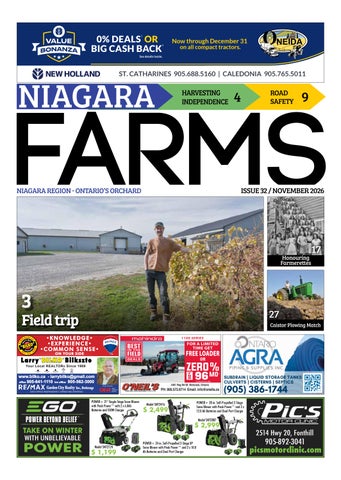
Front page photo: Josiah Mullet-Koop runs Elmwood Farms with his dad Chris. The Jordan farm has about 11,000 egg laying chickens and another 11,000 pullets, alongside about 50 acres of grape vineyards. ~ Luke Edwards photo
CRAVEN MAINTENANCE BARN PAINTING & REPAIRS
Barn Board Replacement Barn Doors Built or Repaired Steel Roofing Installation & Repair Roof Restoration Seamless Eavestrough Sandblasting & Screwnailing WSIB insured
Call 519.826.7422 or toll free 1.877.726.5329
www.cravenmaintenance.ca
4 - NIAGARA FARMS - NOVEMEBER 2026
Harvesting Independence event to support Vitucci family
By Luke Edwards Even though he’s one of the most determined and independent people they know, friends of Bill Vitucci - along with Niagara’s farming community at large - wasted no time rallying in support of the Wellandport farmer and his family after an incident earlier this year left him unable to walk. For months organizers have been hard at work planning the Harvesting Independence event, a stag and doe style evening to raise money for the Vitucci family. This spring the 51-year-old Bill fell while trimming some branches on his farm. It caused severe spinal cord damage, injuring his T10, T11 and T12 vertebra. While he has made much progress in regaining some function to his legs, his long-term prognosis remains uncertain. But, as any farmer knows, the chores must be done. The Nov. 28 event at the West Niagara Agricultural Centre will help raise funds for a special device that will help Vitucci continue to work on their farm. For Bill’s wife Cathy, seeing the community offer up their help and support in recent months has been incredible. “It’s been overwhelming, but a good overwhelming,” she said. And that’s some positivity the family could use after the injury forced the four kids to sacrifice their other ambitions and step up to ensure their farm, seed business and custom planting business continued operating, while Cathy helped Bill with his recovery. With the help of Callen, 24, and Cooper, 19, along with Emma, 19, and Addison, 17, the crops were planted and harvested. And the farmers who buy seed from the Vituccis got their orders filled. Friends also helped build a temporary device that allowed Bill to get into his combine and continue to farm when he got home from his lengthy stay in hospital. “I’ve never met a more determined person than Bill,” said family friend Nancy Yungblut. She and husband Jim are two of the members of a committee planning the Harvesting Independence event. “For Bill, that combine is his therapy,” Cathy said, though she also pointed out Bill’s strong commitment to his physical therapy has seen him regain function that some of his medical care team thought unlikely early on. The Nov. 28 event will see a local musical act by the name of The Other Band take the stage, while local businesses, friends and groups have chipped in to help with the food, prizes and other items.
Friends, family and community members are organizing a fundraising event later this month to help the Vitucci family buy a Life Essential lift to help Bill continue to farm following an incident earlier this year that left him unable to walk. Wife Cathy, and children Callen, Cooper, Emma and Addison have all chipped in to help as Bill undergoes the long recovery process. ~ Submitted photos
The agricultural society donated the use of the hall. “It’s amazing the support that’s come in,” said Jim Yungblut. The Life Essential lift gets installed onto a flatbed truck and can allow the person to lift themselves into a combine, or lower them down to work on the header or perform other tasks. Cathy’s been in touch with a man from Saskatchewan who uses a similar device, and he told her it’s allowed him to do so much more on the farm than he otherwise could. However, it’s not cheap. A new device, with retrofitting and installing on a truck could cost around $85,000 USD. There’s currently a used option that may become available that could lower the price tag to around $65,000. They can also receive a grant from the Canadian Agricultural Safety Association for $20,000, though that’ll still leave them on the hook for a significant portion. There will be prizes up for grabs at the Harvesting Independence event, courtesy several generous businesses, Cathy said. There’s a special farmer’s draw that will feature prizes like a tote of glyphosate, a Premier Equipment service inspection and three vouchers for two bags of corn from Pride Seeds. Cathy said they’re still working through the details. Tickets are $20 each. Doors open at 6 p.m. There will also be food and a cash bar. Response has been amazing so far, organiz-
Despite the severe injury, Bill has returned to work on the farm when and how he can. Friends call him the most determined person they’ve ever met.
ers said, with hundreds of tickets sold. For ticket inquiries or more information, people can contact the
organizing committee at harvestingindependence@gmail.com or through the Harvesting Independence Facebook page.
Elmwood Farms opens its doors to 1,600 students virtually Continued from page 2
he’s been involved with AgScape in the past for their thinkAG career competitions. Those events see AgScape bring in representatives from across the agricultural sector spectrum to talk to students about the wide range of career opportunities. The idea is to open their eyes that agriculture is about much more than just the classic idea of a farmer. It’s something Mullet-Koop completely supports. “I really enjoyed doing that, just kind of connecting with students, especially high school students. I remember being in high school, it’s hard to know what you want to do,” he said. “You don’t necessarily have to be born into agriculture to work in it. There are a lot of jobs that make the system work.” While there were a few technical glitches with the field trip Mullet-Koop said he had a blast doing it. There were about 1,600 students, from kindergarten to Grade 8, watching. They tuned in from cities and towns across the province. For his tour, Mullet-Koop said they focused on the egg-laying portion of the business, and Mullet-Koop took students through the process, showing them the pack room, how he regularly checks on the hens and what he looks for to ensure they’re healthy, as well as some of the computer systems and health and safety protocols they have. With food safety top of mind for many people, Mullet-Koop said it was also an opportunity to showcase just how seriously farmers take it. “Part of the tour was showing them the biosecurity that I do every day and showing them how I have these barriers, how I make sure that I don’t bring anything from out-
side in (to the barn),” he said. “It’s probably something that most kids don’t think about.” With a camera following him around, kids were also able to pick out things in the shots and ask Mullet-Koop what this or that piece of equipment did. He said he answered all manner of questions throughout the tour. Mullet-Koop encouraged other farmers to get involved and consider working with AgScape to offer a virtual field trip or take part in their career competitions. ”It’s really important that we involve students and encourage students to look at agriculture because, obviously, we’re always going to need to produce food and it’s really important that we maintain a strong workforce,” he said. “We need people who are innovative and can work on some of this new technology.” Cook, likewise, said the tour showcases just how diverse farming is. Part of her job is to develop curriculum-based material for after the tour that allows teachers to keep the discussion going. “For the egg farm, there are science connections around animal needs and life cycles, there’s technology connections around automated equipment. And then within the package there are also lesson plans and opportunities to explore things like data and problem solving through an egg or egg farm lens,” she said. The other programs AgScape offers include the thinkAG career competitions, and a teacher ambassador program where specially trained educators can come in to lead a workshop in a classroom. They also have an online digital resource library that teachers can access to incorporate agriculture into their lesson plans. For more information on AgScape and its programs, visit agscape.ca.
NIAGARA FARMS - NOVEMBER 2026 - 5
EXTENDS SHELF LIFE VEGAN & ORGANIC CERTIFIED ODORLESS TASTELESS PRE/POST HARVEST, STORAGE & TRANSPORT.
STOP TREATING TODAY’S PROBLEMS WITH YESTERDAY’S CHEMISTRY. The evolution of PATHOGEN CONTROL.
Unlike the peracetic treatments of old, Arbrox-P™ is not dangerous to handle or store, nor is it damaging to water distribution or fogging systems. Arbourdale's Arbrox-P™ provides food-safe, organic and vegan certified, effective pathogen control that integrates with wash, rinse, mist and fogging protocols. Arbrox-P™ protects your profit by protecting hard earned harvested produce from rot. Rot causing, profit eating pathogens also like to hide in wait. Use Arbrox-P™ to prevent cross contamination between harvests. STOP THE ROT by treating and killing the pathogen squatters that reside within the nooks and crannies of empty storage and transportation spaces. Product loss, recalls, damaged reputations and lost consumer confidence all lead to lost profit. Protect Your Harvest, Protect Your Profit with Organic & Vegan certified Arbrox-P™.
Restoring small-town journalism, one community at a time www.granthaven.com/niagara-farms
info@arbourdale.com • (855) 513-2525 • www.arbourdale.com 1166 Gorham St Unit 7, Newmarket, ON L3Y 8W4
6 - NIAGARA FARMS - NOVEMEBER 2026
AgTech Breakfast showcases emerging agricultural innovations
By Amanda Nelson Canada’s Outdoor Farm Show in Woodstock ran this year from Sept. 15 to 17 on the fairgrounds on Oxford Road 17. Every year, more than 36,000 people and more than 600 exhibitors attend the farm show. For more than 30 years, Canada’s Outdoor Farm Show has brought together visitors and exhibitors from across Canada to showcase agricultural innovation and new technology. This year was no different. The annual AgTech Breakfast brought together farmers, startup companies and stakeholders to showcase new and emerging technologies from across Canada. Nevin McDougall, Agricultural Research and Innovation Ontario (ARIO) board chair, moderated the event and said ARIO works together with Ontario leaders to bring the best agricultural innovation forward to enhance farming efficiency across the province. “ARIO is the owner and investor in the 14 agricultural research stations spread across our great province, where we work in collaboration with the University of
Guelph to conduct research and look for the next great solutions to improve our productivity and efficiency for our agri-food sector,” he said. ARIO is a board-governed agency of the province and is accountable to the Minister of Agriculture, Food and Agribusiness. In 2024, the ARIO Act was modernized to help the agency better support the sector in areas like equipment, technology, veterinary medicine and the needs of rural communities related to agriculture and food. One standout business presenter was Mahla Mirali, PhD, and founder of grAIn Data Solutions. Growing up on a farm and earning a PhD in agriculture, Mirali has long been interested in agri-tech and has worked in artificial intelligence (AI) since 2021. At a workshop at the University of Guelph, Mirali said a dairy farmer came to her with a problem: He couldn’t reliably measure the moisture in his bunker zone, and he was looking for a solution that was user-friendly, fast and not very expensive. Mirali said the products on the market at the time were very ex-
pensive, unreliable or too slow to process, so she set out to build a better solution. This is where grAIn Data Solutions FeedProbe was born. “We started researching, and we worked with some institutions to make the first venture of funding, and then start the real work,” said Mirali. “It was not an easy solution. It took us a while to find a good solution that is reliable enough for the farmers. And I came up with the final product after so many iterations.” A portable device, grAIn Data Solutions FeedProbe is designed to quickly measure the moisture content of silage right at the feed bunker. The goal is to help livestock farmers adjust how much silage they put into a ration based on that day’s actual feed moisture, rather than an older lab result or book value. The technology uses sensors in a handheld probe that connects to a phone app and provides real-time measurements to help farmers work more efficiently and avoid wasted time. “The farmer will grab some samples, mix them and put them in the probe,” said Mirali. “From there, an
app connected through Bluetooth will read three samples to make an average, and that’s going to give a very reliable answer.” This product will hit the market soon and is expected to be priced around $500 to $800, making it one of the most affordable and reliable products on the market. Miral’s business is just one of the many businesses advancing the agri-food industry. The agri-food sector is a vital part of Ontario’s economy, contributing more than $52 billion to GDP and supporting one in nine jobs across the province. “For me, that is very exciting, and it’s an opportunity for us to look at innovation,” said McDougall. “How do we adopt innovation? How do we maximize the potential and value from new innovations, and in particular, support some of the new companies that are trying to bring new innovations to the marketplace? You know, that’s a real signal of the health of our ecosystem. Are we getting new companies introducing their technology, scaling, getting adoption and creating new solutions for us to ensure that our sector is successful?”
WELLANDPORT
WE’VE GOT your farm supplies WE OFFER:
HEATED LIVESTOCK WATERER: CANARM RITCHIE CALF HUTCH
CONTACT US FOR PRICING
5157 Canborough Rd, Wellandport (905) 386-6252 wellandport@gmail.com STORE HOURS
Monday-Friday: 7:30 am - 5:30 pm Saturday: 8:00 am - 4:00 pm Sunday: Closed
Jon Snippe
Dealer - Owner
Mark Hauser Manager
Mahla Mirali, founder of grAIn Data Solutions, demonstrates the company’s FeedProbe, a portable device designed to measure silage moisture, at Canada’s Outdoor Farm Show in Woodstock. ~ Amanda Nelson photo
NIAGARA FARMS - NOVEMBER 2026 - 7
Giving the soil a bit of breathing room By Luke Edwards When the growing cycle for a crop ends, greenhouse operators want a clean split, not a messy breakup. Getting the greenhouse cleared out so they can bring in a new crop simply means the next payday comes a little sooner. It’s simple economics. And it’s what makes the extra effort St. Davids Hydroponics unique. While many other greenhouses choose the quickest and most efficient option - clearing everything out and trucking it to the nearest landfill - staff at St. Davids spend hours taking the plants down without the strings and clips that make recycling a headache. It takes time and money, but it allows them to turn the spent plant material into a soil amendment that a local grape grower happily takes. “Most greenhouses aren’t doing what Maarty and St. Davids is doing,” said Grodan’s Yianni Monahan, at an event held last month at Vineland Research and Innovation Centre. However, having that local grape grower connection is key. Chief grower Maarty Hendriksen said they don’t mind taking a few extra steps when they still know they can get the product out the door relatively quickly. “We’re just looking at how to get it away from our greenhouse as easily as possible.” VRIC and Grodan have been working together on a project that focuses not on the plant itself, but the substrate in which it grows. And the event last month offered some early insights into trials held this summer to see how using spent stone wool could act as a soil amendment for crops, much like the vine and above ground material that ends up in vineyards. Research scientist Jason Henry said it’s a matter of “shifting waste to a resource.” “We need to show there are demonstrated benefits,” he said. Henry and his team have been researching the possibility for several years, though said the existing literature on reuse of spent stone wool is sparse. Thanks in part to a grant from the Greenbelt Foundation, researchers at Vineland this year were able to run tests in the TreeCulture park where they grew corn and broccoli and used a variety of soil compositions that included various mixtures of soil, fertilizer and the spent stone wool soil amendment they’ve developed. What stone wool offers, Henry said, is a little breathing room in the soil. “This is where the air and water can enter in,” he said. “This is what makes substrate very powerful.”
Earlier this fall visitors to Vineland Research and Innovation’s What’s Growin’ On Here event learned a bit about research into using spent stone wool as a soil amendment. Pictured here are two visitors taking part in a demonstration at the event. Last month growers got even more details on the results and ongoing research. ~ Luke Edwards photo
By offering that space, the stone wool amendment can help the hydrogeological process, making the water and nutrients in the soil more available to the plants. “There’s a tug-of-water battle that goes on,” he said, describing some soils as less of a water giver than growing media used in greenhouses. Monahan described a few barriers to making the reuse of stone wool viable. First, growers and farmers need to be convinced it’s safe, simple, and accepted by regulators. It also needs to make economic sense. “We want to make a pathway that makes sense to operators,” he said. Vineland’s results with the sweet corn harvest did show some promise. Treatments that included stone wool and another that included both stone wool and hen manure had higher mean marketable cob weights compared to the untreated control. Testing on soil characteristics had less conclusive results, partly thanks to the wild weather this summer. Based on research, including simulations the team ran, Henry said the stone wool amendment could be a climate resilient amendment, especially during droughts. That’s a large reason why there’s been interest in the United Kingdom, where there’s been interest to reprint an article explaining his group’s findings. Monitoring for the broccoli trial was ongoing this fall, with harvest expected to take place in November. Offering up the grant for the Vineland/Grodan project made
plenty of sense for the Greenbelt Foundation, said Ryan Carlow, program lead with the foundation. He’s been involved with his own lengthy project researching soil characteristics for farmland in Niagara and the Greater Golden
Horseshoe. Overall, he said improving soil resilience can only benefit growers into the future. “Anything that can improve water storage capacity, they’re really interested in,” he said.
1200+
Farms Sold*
50,000
Acres Sold*
300 Years
Ag Experience*
Considering Selling? Call the Experts.
Ontario’s Top Selling Farm Team
519-670-5995 FarmOntario.com
Lifetime, Across FarmOntario team Remax Centre City/Phil Spoelstra Realty Inc Brokerages Independently Owned & Operated
*
8 - NIAGARA FARMS - NOVEMEBER 2026
Free mental health support available to Ontario farmers By Amanda Nelson
In a study done by the University of Guelph, 76 per cent of farmers reported moderate to high levels of stress, and 68 per cent of farmers were reported as being more susceptible than the general population to chronic stress due to the pressures of farming and crop management. According to Agriculture Wellness Ontario, producers are less likely to seek professional support for anxiety and depression, noting that 40 per cent of Canadian producers said they would feel uneasy seeking professional mental-health services because of what people may think. Dr. Randi McCabe, vice-president of mental health and addictions at St. Joseph’s Healthcare Hamilton, said there are many reasons why a farmer might have mental health challenges. “Farmers can experience so many challenges, such as crop yields, weather, labour shortages, and so many other things that may be out of their control,” she said. McCabe said the Ontario Structured Psychotherapy (OSP) program allows people in rural or farming communities to access mental-health care, which she said has not always been as accessible in rural areas.
The Ontario Structure Pyschotherapy Program helps farmers and people in rural communities receive mental-health care that can otherwise be a challenge for them to access. ~ Farmphotos.ca photo
“People may lack access due to geography, or having to drive long distances, or even some people, depending on the community, may have had limited access to the internet,” said McCabe. “There’s always been a lot of stigma around coming and finding help. So even though help is available, people might not have felt comfortable to (seek it out).” However, McCabe said that for rural communities, it’s important
Take home compact performance and a bonanza of savings. During Value Bonanza, get big year-end savings on the proven reliability and fuel-efficient power of a WORKMASTER™ or Boomer™ compact tractor. Now with 0% financing¹ or cash back² options, you’ll keep more money in your pocket and get more jobs done in no time. Hurry, offers end December 31, 2026. Stop in today for complete details. ¹ Customer participation subject to credit qualification and approval by CNH Industrial Capital Canada Ltd. Down payment may be required. Not all customers or applicants may qualify for this rate or term. CNH Industrial Capital Canada Ltd. standard terms and conditions will apply. This transaction will be unconditionally interest free. Canada Example: The interest rate will be 0.00% per annum for a total contract term of 84 months. Based on retail contract date of October 1, 2026, with a suggested retail price on a new WORKMASTER 25S Tractor of C$27,926.21, customer provides down payment of C$5,585.04 and finances the balance of C$22,341.17 at 0.00% per annum for 84 months. There will be 84 equal monthly payments of C$266.00; provided that the amount of the last payment may be slightly different due to rounding. The total amount payable will be C$27,926.21, which includes finance charges of C$0.00. Taxes, freight, setup, delivery, additional options or attachments not included in suggested retail price. ² Cash back applied at time of sale. Offer is nontransferable. ¹ ² For commercial use only. Offers subject to change or cancellation without notice. See your participating New Holland dealer for details and eligibility requirements. Offers end December 31, 2026. ©2026 CNH Industrial America LLC. All rights reserved. CNH Industrial Capital and New Holland are trademarks registered in the United States and many other countries, owned by or licensed to CNH Industrial N.V., its subsidiaries or affiliates.
TWO LOCATIONS TO SERVE YOU ONEIDA NEW HOLLAND
905.765.5011 634 FOURTH LINE CALEDONIA ONTARIO
ONEIDA NEW HOLLAND NIAGARA
905.688.5160
1410 FOURTH AVE ST CATHARINES ONTARIO
not to make this only about stigma. There are legitimate practical barriers, like distance, availability, cost, privacy and time. She said the OSP program removes several of those barriers, making mental-health care more accessible across the province. “That’s the nice thing about this program: people can do it all online, self-refer,” said McCabe. “They don’t even have to go in person if they choose not to. That can really reduce barriers in rural populations or communities that may have had to travel far to get to treatment in the past. This really breaks down barriers by making treatment accessible to everybody, including those in rural and northern communities.” The Ontario Structured Psychotherapy program offers free, evidence-based psychotherapy and mental-health support for adults 18 years and older experiencing depression, anxiety and related conditions. The program uses cognitive-behavioural therapy (CBT) and related approaches, such as cognitive processing therapy and prolonged exposure, to teach practical strategies and coping skills. “CBT is a psychological treatment that focuses on looking at how a person can become more aware of their thinking patterns and behaviours that might be contributing to symptoms,” said McCabe. “If you have a stressor, your natural response is to think negatively. They may start to avoid certain activities. CBT allows people to step back and examine different ways of responding to stress by changing up how we may think about it, and how we respond behaviourally,” she continued. The self-referral program currently offers different types of services to meet the needs of Ontario residents: self-led resource guides
that people can practise at home, or individual or group cognitive-behavioural therapy programs. The first option is self-led resources guided by a coach or therapist called the Bounce Back program. This program is delivered by phone and includes workbooks and a biweekly personalized mental-health appointment to help manage thoughts, emotions and behaviours. Clinician-assisted bibliotherapy is also delivered over the phone. In this option, clients receive a free cognitive-behavioural therapy self-help guide specific to their concern, a plan for readings and exercises, and weekly 30-minute sessions with a therapist. The third self-guided option is internet-based cognitive-behavioural therapy, delivered online and guided by a therapist, with modules, readings and exercises that help participants build coping and resilience skills. It requires access to a computer or mobile device and the internet. Individual or group cognitive-behavioural therapy includes in-person sessions with a therapist, either one-on-one or in a group format. “It’s completely private and confidential,” said McCabe. “What I would say to someone who may be suffering is, ‘what do you have to lose?’ You may have everything to gain by calling. There is no risk in trying. I’ve treated farming clients who are in their 60s and 70s, and they were very surprised by how much this helped them. They were feeling so stressed and anxious, and just being able to get the support they needed, they were able to feel so much better.” For more information or to complete a self-referral, please visit www.ospwest.ca.
NIAGARA FARMS - NOVEMBER 2026 - 9
Improved rural roads will make life safer for migrant farm workers, group says By Luke Edwards Cars whizzing by and the memorial at the side of Concession Road 6 were constant reminders of the dangers for pedestrians on Niagara’s rural roads. It came as members of the Migrant Workers Alliance for Change put out calls for all levels of government to improve safety conditions for those who come to Canadian farms each year to help farmers plant, grow and harvest their crops. “This is how our migrant farm worker neighbours feel every day when they travel our roads,” said Kit Andres, a member of the alliance. The group spent a day last month installing signs at several sites across the region where farmworkers have been injured or killed while biking or walking. The signs cautioned motorists to “look out for migrant workers” and were made with reflective material to ensure they’re especially visible during night. While the signs will offer reminders to motorists to be mindful as they drive rural roads, alliance co-executive director Syed Hussan said the focus is on ensuring all levels of government work
to address safety concerns for migrant farmworkers. He said it starts at the local level with town and regional councils enacting road safety measures like sufficient shoulders. Provincially, he said they’re calling on Queen’s Park to conduct a coroner’s inquest into the deaths of workers, such as Sinhue Garcia, who died earlier this year after he was struck by a car along Concession 6 while cycling home. The group linked road safety for workers with housing and labour rules, saying they’re intertwined. They also renewed calls to strengthen and enforce housing standards, include farm workers in provincial labour laws, and called on the federal government to ensure permanent immigration status for all migrant workers. “Action must be taken at all levels of government,” he said. “The near misses and injuries are far more than we see today.” Signs went up at five sites where farmworkers were killed or seriously injured in recent years. These include the site where Garcia was hit, on Concession Road 7 where a Mexican farmworker and mother of two died after a 2019 hit-and-run, at Lakeshore Road and Townline Road, where
Syed Hussan, co-executive director of the Migrant Workers Alliance for Change, said the group is calling on all levels of government to improve safety conditions for migrant farm workers.
A truck passes by as Kit Andres outlines calls by the Migrant Workers Alliance for Change to improve safety conditions for migrant farmworkers, including improved rural roads that workers often bike or walk along. ~ Luke Edwards photos
another worker was seriously injured following a hit-and-run while walking in 2019, as well as two in St. Catharines: on Seventh Street Lout where one worker died and two were seriously injured in 2022, and at Carlton Street and Dorchester Boulevard, where Ceto Reid was seriously injured coming home from the laundromat. “Sometimes looking out for our neighbours means speaking up for them,” said Andres, calling Niagara a place where people generally look out for, and help one another. A combination of working long hours along with a lack of public transportation means workers routinely bike or walk to services, and often late at night or early in the morning when it’s still dark. Some farmers and other groups do offer transportation services for workers, helping them get groceries and access various services. However, many still resort to walking or cycling when needed. And with farmworker housing often lacking amenities such as washing machines, workers have to head into town to use laundromats or other services. That’s why the group said improved housing standards and road safety go hand in hand.
LOOKING FORWARD TO SEEING EVERYONE AT THE UPCOMING
C H R I ST M A S PA R A D E S ACROSS OUR COMMUNITIES!
The group tried to bring Reid in on a call from his home in Jamaica to share a few words, but the connection failed. A prepared statement from Reid called for more respect and collaboration between local officials and the farmworker community. “They have to come on board and listen to us. People need to respect farm workers more and what we’re doing for the community,” he said in his statement. “We are the ones feeding the people, so look out for us. We have to use the roads, we have to live here, we have to work here. Look out for us. We are here.” Andres said Reid is doing well back in Jamaica, though Hurricane Melissa did affect his community and farm. Reid had been a longtime migrant farm worker, coming to Canada for nearly two decades before the injury. Hussan said they were focusing their attention on decision makers and policy makers. While he said there are good farm operators who mean well, stronger rules, and consequences for breaking those rules, will ensure all operations treat their workers well.
10 - NIAGARA FARMS - NOVEMEBER 2026
NPCA pitches restoration projects as a way to complement, improve working farmlands By Luke Edwards With agricultural lands making up nearly two thirds of the Niagara watershed, the agency in charge of protecting that watershed continues to look for ways to partner with local farmers. Geoffrey Verkade, the senior manager of integrated watershed strategies with the Niagara Peninsula Conservation Authority, was a guest speaker at last month’s Niagara Federation of Agriculture annual general meeting. Verkade shared some of the programs they offer that could help fund restoration projects on local farms. He stressed that when it comes to conservation, it’s not an either-or scenario. “When NPCA talks about watershed management, we’re not talking about separating agriculture and conservation. We’re talking about understanding how working landscapes and natural systems function together,” Verkade said. The agency received funding through the Ontario Agricultural Sustainability Initiative to operate a marginal lands program as part of the Rural Agricultural Landscape Program. This was the major program Verkade pitched as he talked to local farmers. “The program is designed to support farmers with an Environmental Farm Plan that’s fourth generation or later in making agricultural lands more productive and resilient,” he said. “This could be an excellent mechanism for implementing projects that may otherwise be difficult to fund.”
Insuring Niagara Farms Since 1880.
Get a Quote. 1003 Niagara Street Welland, ON (905) 735-1234 bcminsurance.com
With high up-front costs being one of the major barriers for such projects, Verkade said the program can cover up to 90 per cent of the costs. Tree and shrub plantings, establishing buffer zones, wildlife restoration and pollinator habitat establishment are all types of projects that can be covered. It can turn a patch of marginal farmland or a difficult-to-farm corner of a property into something that helps the watershed, and ultimately the rest of the farm. “The health of streams, wetlands, forests and agricultural lands are interconnected,” Verkade said. For farmers taking part in their programs, Verkade said NPCA staff and experts will be there to help from start to finish, providing advice and helping to fill out forms.
Verkade touched on a few other related programs in his presentation. Trees for All works to increase the tree canopy in the watershed. One key component of the program that often gets overlooked are the efforts to produce and keep seeds of native species. And while the NPCA remains interested in bringing the ALUS program to Niagara - there have been discussions about it for a few years - Verkade said the current focus is on delivering the existing programs. Historically there was more of a focus on individual projects, but with new funding through programs like RALP Verkade said they can take a broader view. For more information on NPCA’s funding programs visit npca.ca/restoration.
40
A24 - NORFOLK FARMS - SUMMER 2020
NIAGARA FARMS - NOVEMBER 2026 - 11
Lettuce greenhouse production a constant balancing act, audience hears
Continued from page A23 tally we are building value for the farmers of Canada. That means we (farmers) are part of conversations we haven’t been part of for a long time. Farmers realize they are part of the solution to a lot of things, like climate change mitigation, biodiversity, species-at-risk and flood control.” One of the offshoots of Norfolk’s initial efforts occurred after Prince By Luke Edwards Edward Island environment George Webster attended the pilot launch Leafy greens grown indoors offer an opporin 2008. The island was having an environmental issue at the time and tunity for greenhouse operators and a chance ALUS quickly became the solution and a well-funded provincial program. to increase Canada’s food sovereignty, but it Today, nationally ALUS is approaching 1,000 farmers participating also has challenges that need to be overcome. through 27 different community based programs in six provinces. ToThose challenges can come in the form pests gether they have enrolled 27,183 acres in the program. that or now destroy before they Bryandevour Gilvesy, CEOthe of leaves ALUS Canada, started his involvement with Officially, ALUS Canada’s mantra now is: “ALUS Canada makes it can be shipped offhe forsigned humanupconsumption, or to the program and then the program when as a participant possible to offset your environmental footprint through agricultural stewwith disease affecting theNorfolk root system meant became a member of the Partnership Advisory Committee. Bryan ardship. ALUS invests in farmers and landowners who are producing andfeed wifethe Cathy raiseorTexas on the YU Ranch, south of Tillsonburg. to plant, also longhorns with a workforce not acres of clean air, clean water, wildlife habitat properly attuned to the needs of the plants. and other ecosystem services in communiFortunately, presenters at the lettuce session ties across Canada.” of last month’s Canadian Greenhouse ConferCredit was given to some of the programs ence had solutions for all those potential issues. largest advocates by Gilvesy. Local MPP For New Leaf Consulting’s Lucas ChapToby Barrett has been a large ALUS propodelaine, there’s a thing that comes before the nent since the early days, and introduced a thing that comes first, as he was reminded of Private Member’s Bill promoting the concept. something he was told in his early days in the Wishart is now a MLA in Manitoba, and progreenhouse industry. While the plants come moting it there. Bob Sopuck, who was Delta first for any grower, it’s people who grow the Waterfowl’s western of policy Successful greenhouse lettuce operations rely on good teams, good plans vice-president and a strong integrated plants, so if you don’t take care of your people, pest management program, attendees at the Canadian Greenhouse Conference learned last month. ~ was an early advocate and became elected they won’t take care of the plants. Pixabay photo as an MP and was the program’s champion “That stuck with me,” he said. “On the hardest days it’s still people saving Beneficial Insectary’s Greg meanon Parliament Hill. Dave ReidBryant, co-wrote the Chapdelaine said the growing team of a while, went over some of the challenges of the crop,” he said. greenhouse lettuce operation must have a solid ALUS concept documents with Dr. Bob Baidisease, and options overcome them. Like in any sector, Chapdelaine said there are understanding of water and nutrient needs, ley, Delta’s easternto vice-president of policy. HeOver said the dense canopies so-called “miracle” cures out there that promise climate and pest control. years, Gilvesycan has make talkedscouting to thoudifficult, and encouraged growers to sample to fix every issue that may arise. While growers ) ( ) Beyond that, (proper tools and systems help ( ) ( ) (519) 909-0340 519 718-3384 519 410-7676 519 718-3384 519 410-7676 sands of people about ALUS at hundreds known hotspots first. Utilizing flying bugs such should be open to new products or technolothe growing team succeed. of speaking engagements across Canada. Dean Morrison Matt Devos Linda Allison gies he encouraged growers to dip their toes in as Recognition green lacewings in an integrated pest man“Water treatment is the best money you will for the program has included a Broker ofitRecord Dean Karen Matt agement program can help growers tackle the water before diving in. Salesperson spend, if you spend at build out,” he said. Salesperson Premier’s Ag Innovation Award Morrison Feth-“Verify DeVos - 449 -crop,” thoseGilvesy hard-to-reach in your own he said. (519)offered 909- some 0340other tips, (519) 7676the claims905 3485 Chapdelaine such 410 is proudspots. ALUS is a farmer-led pro“Let the flying bug do for you,” he said. Other presenters reminded growers to be as the use of polyphosphate iron, which helps gram and farmers fellitthey are the program Bryant offered up several options for IPM, on what’s happening both in plain sight ensure the iron survives ozone in the air “so the ( vigilant owners. ) 718-3384 (519) 410-7676 (519) 909-0340 519 with different biologicals providing different and in whatever growing medium the operation iron actually reaches your plant.” “People feel they are partners in ALUS,” benefits. But in the end, he said it comes down uses. And while AI can be a helpful tool, he rehe said. “It’s the value of developing a grassto being prepared, having populations on hand “What you see above in volume, you should turned to his theme of people, suggesting it’ll roots program that recognizes the value of before an outbreak gets out of hand, and consee below,” said Tim van Hissenhoven, who be a human who gets up at 1 a.m. to respond community.” owns a greenhousing consulting company. stant monitoring. to an issue.
Matt DeVos
Matt DeVos
WeWe KnowKnow NorfolkNorfolk
We Know Norfolk
Dean Morrison
Karen Feth
Matt DeVos
(519) 718-3384
(519) 410-767
We Know Norfolk
(519) 909-0340
For buying and selling farms, call...
Call us for a quote
1-800-215-1996 www.braemarbuildings.com
Quality Since 1979
12 - NIAGARA FARMS - NOVEMEBER 2026
With the right approach, organic greenhouse production can be a success Canadian Greenhouse Conference session shares tips and updates for growers By Luke Edwards The challenge Freeman Herbs received in the early 2000s was, in essence, to do something new by doing something old. American grocer and retailer Kroger put out the challenge for organically grown greenhouse produce. “Organic is the traditional way of farming,” said Marco de Leonardis, research and development manager at Freeman Herbs. He was one of three speakers at a morning session on organic greenhouse at last month’s Canadian Greenhouse Conference. For thousands of years farmers relied on what were essentially organic practices to grow their crops, de Leonardis said. That didn’t change until more recently as new chemicals and methods were developed over the past century. The return to organic, in a greenhouse setting, presents challenges but is doable, de Leonardis and other speakers said. But it takes some planning to ensure the greenhouse crops are productive and healthy, and don’t fall prey to the diseases that can wreak havoc on a greenhouse. “To have success with biological control, it’s important to be proactive, not reactive,” de Leonardis said. Over the years, Freeman Herbs has had to contend with various disease pressures, including blights and aphids. While disease resistant varieties were available, de Leonardis said they didn’t live up to the quality standards Freeman Herbs set. He did find success in the use of hydrogen peroxide, which stopped the spread of a blight that got into the greenhouse in 2013. The application had other benefits, too, keeping mould at bay and improving rooting.
Herd Dispersal Live Auction Sale
of 135 Bred Cows/Heifers
Saturday November 21, 11:00am
Building on lessons learned by organic greenhouse growing pioneers like Freeman Herbs, along with the research of scientists can make the sector a profitable one, proponents of the growing method said last month at the Canadian Greenhouse Conference. ~ Pixabay photo
It’s now part of the regular regime, where they mix in a small amount with the water system, applying a bit of peroxide every time they water. Laval’s Martine Dorais shared some of her research on organic methods to improve growing media and fertilization in greenhouses. A growing media that introduces the right mixture of water and oxygen to promote a healthy microbiome is key to ensuring proper nitrogen cycling. Some options for fertilizer include anaerobic digestion of tomato leaves and frass from black soldier fly larvae. Both can help replace existing fertilizers, and frass may also reduce disease pressure, her research has found. Consultant Norm Hansen also spoke at the session, sharing some information on recent updates to the Canadian Organic Standards.
THEY DON’T MAKE THEM LIKE THEY USED TO! OVER 37 YEARS OF LOCAL
KNOWLEDGE - COMMON SENSE - HONESTY ON YOUR SIDE!
to be held at 554447 Mono-Amaranth TLine, Mono, ON Preview on day of sale, or by appointment
Directions: Go west through Orangeville on Hwy 9 to County Rd 16 (Veterans Way at Greenwood Cemetery), turn north 5 miles to farm on East side. OR From Shelburne go east on Hwy 89 for 2 miles to Mono-Amaranth Townline, turn south & go 5 miles to farm on East side.Townline, turn south & go 5 miles to farm on East side. Cattle: (79 )Heifers: (18) Char, (17) Blk Simm, (33) Angus, (11) Red -1st time calvers, bred Angus & Limo, vacc. (18) X-bred Heifers - bred Black Angus, vacc. (17) Angus Heifers - bred Black Angus. (10) Blk Angus cows - all bred Black Angus, vacc. (8) Charolais Cows - bred Charolais, vacc. (3) Mixed Cows - with calf at side, vacc. All Cows will be preg checked prior to sale. Lunch Booth Washroom Available Terms & Conditions: Cash or cheque with proper I.D. on day of sale. Owner & Auctioneer will not be responsible for any accidents or loss on day of sale. All announcements on day of sale will take precedence over printed ads.
Auctioneers: Kevin McArthur (519) 942-0264 Scott Bessey (519) 843-5083 Email: mcarthurbessey@gmail.com www.theauctionadvertiser.com/KMcArthur - full listing & photos
One of the changes important for greenhouse growers, he said, is a clarification on soluble light usage, with a 20 per cent limit. While thousands of hours of work go into the standards and reviews that are done every five years, Hansen said growers should think of it as just a baseline. “The standard is just the minimum we do to be organic,” he said. He compared the soil to a rainforest, where “we grow a jungle of creatures.” And if growers are doing it right, disease pressure should be kept to a minimum. “We can make the change and switch to organics,” he said, adding yields can be strong with the right practices.
FREE!
Larry““ BILKO Larry BILKO”” Bilkszto
MARKET EVALUA TION CALL TO DAY!
Your Local REALTOR Since 1989
Ontario Federation of Agriculture
PROUD MEMBER
larrybilko@gmail.com - www.bilko.ca office 905-641-1110 - home office 905-562-3000
Garden City Realty Inc., Brokerage EACH OFFICE INDEPENDENTLY OWNED AND OPERATED
NIAGARA FARMS - NOVEMBER 2026 - 13
Vertical farming offers some fertile ground for Canadian growers
By Luke Edwards
Lettuce is one of the quicker crops to grow, which made Lenny Louis’ 14-month wait odd, but necessary. Louis is the CEO of Vision Greens, a vertical farm business with roots in Welland. And while his company alone isn’t the solution to Canada’s food security issues, he said it’s a step in the right direction. “We’re not going to feed Canadians with just lettuce, but it’s a start,” he said. That start took 14 months of product revision to get a lettuce his company could stand behind. Lengthy product development time, as well as high startup costs in general, are some of the major drawbacks to vertical farming. Combined with limited profit margins, it can make a decent return on investment a challenge. “The consumer is not willing to pay a drastic premium in a commodity category,” Louis said. However, Vision Greens has managed to grow, focusing on the right branding message of “peak fresh” that was simple enough for busy shoppers to internalize quickly as they did their groceries. Maintaining that peak fresh quality also requires strong relationships with grocery stores to ensure they’re storing the company’s products correctly. Eri Hayashi, from the Japan Plant Factory Association, agreed that high initial costs remain a limitation for vertical farming. As does insufficient production management and lack of available crops.
Vision Greens is a vertical farming company that produces lettuce. Based in Welland, the company is looking to expand and provide more locally grown lettuce for the rest of Canada. ~ Submitted photos
“We need to expand crop diversification,” she said, suggesting a move from growing what they can, to discovering how to grow what they need. However, high precision and constant measurements, along with a continuous supply are some of the benefits. And in Japan, while some operations have failed, others have succeeded, showing there is a path to prosperity. “You need to have good factory design,” she said.
One possible solution to high input costs has been studied by Laval University’s Steeve Pepin, who has found different light cycles could boost production and improve energy usage. He studied a variety of options and found some benefits of running four light cycles a day. It could allow growers to take advantage of times of day where energy is cheaper, he said. The trio told their stories and presented their findings at last month’s Canadian Greenhouse Conference, held in Niagara Falls.
PAIL SALE!
SCOOP UP YOUR SAVINGS FOR
NOVEMBER 27 - 28 BUY A PAIL & FILL IT UP & SAVE 20% OFF!* *EXCLUDES FEED, SHAVINGS, AND DEWORMER
MORE ABOUT PAIL SALE HERE!
20% OFF
14 - NIAGARA FARMS - NOVEMEBER 2026
Putting the flavour back into greenhouse strawberries By Luke Edwards Canadians love eating strawberries, but our challenging climate has historically made it impossible to grow enough of the popular fruit to satiate our tastebuds. Fortunately, work is ongoing by a team of researchers to develop new strawberry genetics and create a plant that will work indoors. Given the number of traits researchers need to consider, it’s a tall task. However, in a presentation to visitors at the Canadian Greenhouse Conference last month, Agriculture Canada Research Scientist Jason Lanoue discussed some of the progress he and his team have made. “Canadians eat a ton of strawberries…but we don’t grow a lot of strawberries. We import about $700 million worth of strawberries every single year,” he said. For the most part, those imports happen in the winter months, where locally grown field strawberries simply aren’t available. On top of that, Lanoue said many greenhouse operators are looking to diversify, as diseases for greenhouse tomatoes and peppers have created challenges. However, strawberries can also be susceptible. Lanoue said there was a stretch in recent years
where greenhouse production of strawberries increased in Canada, though the last couple years saw things plateau and even drop, thanks in part to neopestalotiopsis, a fungus that can affect strawberry plants both in fields and in greenhouses. A particularly difficult strain of the pathogen has recently emerged, and Lanoue said it did a number on Canadian growers. Greenhouse production also dropped in part because Lanoue said growers were promised 15 kilograms or more of yield per square metre. “And the genetics weren’t there,” he said. That’s where he and his team come in. They’ve been working on a breeding program to develop a strawberry plant that hits several key metrics: size, colour, yield, disease resistance and taste, among them. His update on the trial showed a few promising strains, with the team narrowing options down. While there’s more work to be done, he said there have been some hopeful signs. A four-month growing cycle saw production that would have averaged out to about 10 kg per square metre, not the promised 15, but getting closer. However, fruit size decreased as time went on,
Research is ongoing to develop strawberries that are better suited to be grown in Canadian greenhouses, with a focus on improved yield as well as taste. The berry is a staple in Canadian kitchens, though our climate means we rely heavily on imported product. ~ Farmphotos.ca photo
and Lanoue said North American consumers tend to prefer larger berries. On the flip side, the team is looking for ways to decrease the actual plant size, as larger plants can present disease and crop management challenges in greenhouses. Results on taste were a little mixed. Lanoue said lab tests showed nothing terribly special, however a taste panel of growers showed their strains performing as good or better than a control variety, and superior to grocery store bought berries. One of the side benefits of having more locally grown greenhouse
strawberries is the fact they can be picked and shipped closer to peak ripeness. California strawberries are intentionally picked when they’re still firm, because those firm berries are easier to ship. The tradeoff is taste. Lanoue said they also have to do some testing, but there’s some potential neopestalotiopsis resistance in their breeding program. Research is ongoing, with Lanoue said they’ll be continuing to look at improving the genetics and do testing over longer production cycles. They’ll also continue tinkering with different lighting regimes.
Farm
Protect your livelihood, from barns to equipment.
Automotive
Stay safe and secure, wherever the road takes you.
Aaron Miedema Trusted Insurance Agent Direct: 905-741-6392
Residential
Safeguard where life happens.
Commercial
Coverage that keeps your business running smoothly
Let’s Connect 780 Old Highway 24, Waterford, Ontario, N0E 1Y0 AMiedema@ctmins.ca 1-888-302-6052 x131
www.ctmins.ca
Jackie Kennedy, Aaron Miedema and Jennifer Brucculeri Our team will ensure you are covered every step of the way!
NIAGARA FARMS - NOVEMBER 2026 - 15
John Boy gobbles up all the attention By Ann Marie Chechalk John Boy the Royal Palm Turkey travelled all the way from Cambridge, P.E.I. to be part of the Ontario Poultry Breeders Show last month. He was just one of 16 turkeys that his owner Jodi Van Iderstine of Sanctuary Homestead brought with her. “I came all this way as it is nice to meet new people and learn from different judges and there are many here that I have not met yet in my travels.” Seven years ago, she saw a picture of the royal palm turkeys and now has quite a flock. “Turkeys have incredible personalities,” says Van Iderstine. ”John Boy is very affectionate and smart and excellent with the baby poults. He has a 100-acre woods to forage for his own food if he wants and since he is so well kept he will live from five to 10 years.” John Boy loves to have his picture taken as he sits on Jodi’s walker. Welcome to West Niagara!
A Very
John Boy the royal palm turkey traveled all the way from Cambridge, Prince Edward Island to be part of the Ontario Poultry Breeders Show in October, 2026. Just one of sixteen turkeys that his owner Jodi Van Iderstine of Sanctuary Homestead brought with her. ~ Ann Marie Chechalk photos
as m t s C o u ntry Chri
Saturday, November 28, at 5 PM Starting at the West Lincoln Community Centre and ending at The Village Square. Road Closures: 3:30 to 8 PM. westlincoln.ca/parade
@TWPWestLincoln
16 - NIAGARA FARMS - NOVEMEBER 2026
Irrigation project at ‘nose to the grindstone’ phase By Luke Edwards Significant milestones for two long-awaited irrigation projects are expected to be hit by the end of the year. Sean Norman, manager of strategic initiatives with the Niagara Region, said work on the regional irrigation project - really two separate projects with the overall goal of providing enhanced irrigation options to Niagara’s farmers - is continuing. The two projects include an update and upgrade to existing open-channel irrigation systems in Niagara-on-the-Lake, and a brand new system to service farmers in the western portion of Niagara. Since NOTL has an existing system, upcoming work for that area is further along. Norman said they hope to have some detailed design plans and costing figured out by the end of the year. The work includes converting parts of the open-channel system into a closed system,
which should improve efficiency and effectiveness. “You can move a lot more water, a lot more effectively through pipes,” Norman said. For West Niagara, however, building from the ground up requires more planning. The first step was simply figuring out where to get the water. The obvious answer is Lake Ontario, but with highways, urban areas and the like, figuring out where exactly has taken some work. The committee settled on three pumping stations, and with that plan in place it was time to decide how extensive the network would be. Norman said they settled on Option C, which is the most fulsome network. Now they’re working on preliminary design, which includes the size and location of pipes. Norman said they hope to have that preliminary design finalized by the end of the year, which he pegged at something like 10 per cent of the overall design and more of a feasibility process.
$275/yr
Reach Niagara area farmers by advertising your business in Niagara Farms.
Contact Heather Dunbar 226.261.1837 heather@granthaven.com
granthaven.com
While there’s plenty of variability in designing these major projects, Norman said there haven’t been any major surprises and they make their way through the work. He credited an engaged and smart farming community for a lot of the progress. “There’s so much local knowledge,” he said. Despite a summer that featured far too much rain for many farmers, the irrigation project has continued to be front of mind, said Norman. He said people understand there’s a lot of uncertainty year to year, and being prepared for whatever Mother Nature throws at farmers will be important for future success. As they continue their work, Norman said they continue to welcome input from the local farming community. They’ll also plan more events to keep farmers up to date. For more information visit niagararegion.ca/ projects/irrigation-initiative.
$198/yr
NIAGARA FARMS - NOVEMBER 2026 - 17
Farmerette plaque on display at Charles Daley Park By Luke Edwards After largely being forgotten over the decades, a plaque in Lincoln will ensure the memory of Ontario’s Farmerettes will live on. Local dignitaries, historians, filmmakers and six surviving Farmerettes were on hand last month for a screening of We Lend a Hand and the unveiling of an Ontario Heritage Trust plaque at Charles Daley Park commemorating the estimated 40,000 young women who left their homes during the Second World War to work on farms and support the war effort overseas. Many came to Niagara to pick peaches and other fruit, which was then canned and shipped across the Atlantic. “It was a really big deal to get that recognition. They (the Farmerettes) were just all smiles and so delighted to be recognized,” said Bonnie Sitter, who has been on a nearly decade-long journey to learn more about the program, and to share that knowledge with the general public. For Sitter, that journey started when she came across an old picture that mentioned the Farmerettes. She knew nothing about it, so began researching. Developed in 1941, it helped farmers throughout Ontario grow and harvest crops. With so many able-bodied young men fighting overseas, farmers didn’t have their traditional workforce to draw from. So thousands of women answered the call, doing their part to feed the country and feed Europe as war raged. “Often I meet people after the documentary or one of my powerpoint presentations that will say ‘I was one of those children that was hungry in Britain,” Sitter said. Sitter’s research eventually led into the documentary We Lend a Hand, which told the story of the
Thousands of young women left their home and ventured out to rural areas across Ontario, including Niagara, to work on the fields during the Second World War, doing their part to help the war effort and feed a war-ravaged Europe
Farmerettes, including interviews with several women who participated. The response has been overwhelming, with over 200 screenings, 16 awards and invitations to 31 film festivals. “We had no idea (what the response would be). We just knew we were recording important history that had been ignored,” she said. The heritage trust plaque was just another highlight for the project. When discussions about the plaque first started, Sitter was asked where it should be placed. To her, there were three obvious locations: Niagara, Lambton County and one in Essex. “I knew that wasn’t going to happen,” she said with a laugh. And since the first Farmerettes came to Niagara, working for farm families like the Schencks and Tregunnos, Sitter suggested this region made the most sense. Niagara West MPP and Minister of Agriculture, Food and Agribusiness Sam Oosterhoff said the unveiling was an important day both personally and in his role as minister. “Raised on a farm in an area of the province rich in the history and legacy of Farmerette wartime efforts, I applaud the unveiling of this new provincial plaque,” Oosterhoff said. “The location of this historical marker in Niagara West is especially meaningful for local families who hosted and laboured along with the thousands of women who served on the homefront. The Farmerettes helped lend a hand to victory on the battlefield across the Atlantic and prepared the way for thousands of immigrants who would follow in their footsteps after the liberation of Europe.” The program ran from 1941 to 1952. An estimated 40,000 women took part, though details are scant. That’s why Sitter’s research continues. She’s developing a list of women who participated, having so far collected more than 1,000 names. They’ve also been invited to Juno Beach for a spring screening of the documentary, and Sitter said they’d love to do a tour of the United Kingdom and Europe to raise awareness about the Farmerettes among the children and grandchildren of people who ate thanks to the hardworking women. She also encourages people to go through their old photo albums and keep an eye out for something that may tell another piece of the Farmerette story. Despite the documentary and awards, plaques and events, the very question that started Sitter on her journey remains unanswered.
Bonnie Sitter and Colin Field, who helped create the documentary We Lend a Hand, celebrate as a plaque commemorating Ontario’s Farmerettes is unveiled in Lincoln last month. ~ Submitted photos
“We still don’t know the names of the three ladies in the picture,” she said, referring to that original photo she uncovered. “I keep expecting that when we have a documentary screening or when I’m speaking at an event, somebody is going to yell out ‘that’s my mother in the middle’ or ‘that’s my grandma on the right.”
She continues to hold out hope. “One of these days,” she said with a laugh. “But so many other fantastic things have happened.” For more information on the documentary and project, or to support it, visit welendahand.ca. To see the plaque, visit Charles Daley Park.
We’ll take care of it
TM
Home • Auto • Business • Farm
westlandinsurance.ca
18 - NIAGARA FARMS - NOVEMEBER 2026
Delicious Recipes Sauces, dips and spreads add variety to everyday meals Fancy techniques and methods that channel your inner Gordon Ramsay or Mary Berg is one way to create a memorable meal. But there’s often a simpler way to take a dish and elevate it. Homemade sauces, dips and spreads can add a little something special to a meal, without requiring a ton of time and expertise. From spicy to sweet, savoury to sour, there’s something for every taste bud. Here are a few options to try this month, courtesy our friends at Foodland Ontario.
Red Pepper Feta Spread Ingredients • 1 Ontario greenhouse sweet red pepper, cut into chunks (1-1/4 cups/300 mL) • 1/3 cup (75 mL) water • 1 cup (250 mL) crumbled Ontario feta cheese (4 oz/125 g) • 1/8 tsp (0.5 mL) crushed red pepper flakes Instructions In medium skillet, combine red pepper and water; cover and bring to boil over high heat. Reduce heat to low and simmer 10 minutes or until pepper is tender. Uncover and bring to boil; simmer until all liquid has evaporated, about 4 minutes. In food processor or blender, purée pepper, cheese and red pepper flakes until smooth. Transfer to bowl; cover and refrigerate for 2 hours or up to 3 days. Bring to room temperature before serving. Tip: Any leftovers make a fantastic sandwich or burger spread.
Apple and Sweet Pepper Chutney Ingredients • 7 cups (1.75 L) chopped peeled Ontario apples (McIntosh, golden delicious, empire or Idared) • 2 cups (500 mL) chopped Ontario onions
•
1-1/2 cups (375 mL)diced Ontario sweet red peppers • 1-1/2 cups (375 mL) diced Ontario sweet yellow peppers • 3 cloves Ontario garlic, minced • 1 tsp (5 mL) salt • 1/2 tsp (2 mL) ground cloves • 1/2 tsp (2 mL) crushed hot red pepper flakes • 2 cups (500 mL) packed brown sugar • 1 cup (250 mL) apple cider vinegar • 2/3 cup (150 mL) currants Instructions In Dutch oven, combine apples, onions, red and yellow peppers, garlic, salt, cloves and hot pepper flakes. Stir in sugar and vinegar. Bring to boil over high heat, stirring often. Reduce heat and boil gently for 30 minutes, stirring often. Stir in currants. Reduce heat and simmer for about 15 minutes or until thickened, stirring often. Ladle into sterilized canning jars to within 1/2 inch (1 cm) of rim. Top with prepared new sealer lids. Apply jar rings just until fingertip tight (do not over tighten). Wipe jars if necessary. Place in boiling water, with tops covered by at least 1 inch (2.5 cm) water. Boil for 10 minutes. Remove to drain on tea towel. Lids will vacuum seal as they cool. Test lids by pressing in centre (will not move). Do not re-tighten lids. Store any unsealed jars in refrigerator and use within 1 month. Keep sealed jars in cool place.
Eggplant Mint Relish Ingredients • 1 Ontario eggplant (about 1-1/2 lb/750 g) • 1 tbsp (15 mL) olive oil • 1/4 tsp (1 mL) crushed red pepper flakes • 2 cloves Ontario garlic, minced • 1/4 tsp (1 mL) each salt and pepper • 10 sun-dried tomatoes packed in oil, finely chopped • 1-1/2 cups (375 mL) seeded, diced Ontario Roma tomatoes • 1/2 cup (125 mL) diced Ontario red onion • 1/4 cup (50 mL) fresh Ontario mint leaves, finely chopped • 1/4 cup (50 mL) olive oil • 3 tbsp (45 mL) toasted pine nuts • 2 tbsp (25 mL) capers, finely chopped • 1 tsp (5 mL) grated lemon rind • 3 tbsp (45 mL) fresh lemon juice Instructions Slice eggplant into 1/2-inch (1 cm) rounds. Bring large pot of water to boil. Place eggplant
rounds in boiling water, return to boil and cook until tender, about 4 minutes, stirring occasionally. Drain, cool and dice eggplant. In large skillet, over medium heat, combine oil, red pepper flakes and garlic; cook for 1 minute. Add eggplant, salt and pepper; cook for 5 minutes, stirring occasionally. Transfer eggplant to medium bowl; let cool completely. Add sun-dried tomatoes, tomatoes, onion, mint, oil, pine nuts, capers, lemon rind and juice; stir well to combine. Store in airtight container in refrigerator until ready to use.
Quick Herb Dip Ingredients • 1 pkg (300 g) Ontario soft tofu • 1/4 cup (50 mL) each chopped fresh Ontario parsley and Ontario greenhouse sweet red pepper • 1/4 cup (50 mL) chopped green onion • 2 tbsp (15 mL) light mayonnaise • 1 tbsp (15 mL) coarse-grain Dijon mustard • 1/2 tsp (2 mL) black pepper • pinch of salt • variety of Ontario carrots, Ontario button mushrooms, Ontario bread and crackers Instructions Drain tofu in sieve. Place tofu, parsley, red pepper, onions, mayonnaise, mustard, pepper and salt in food processor, process until smooth. If not using immediately, cover and refrigerate for up to 1 day.
Chunky Tomato Salsa Ingredients • 4 Ontario tomatoes, peeled and chopped • 1/2 Ontario greenhouse cucumber, chopped • 2 Ontario green onions, chopped
NIAGARA FARMS - NOVEMBER 2026 - 19
•
1 Ontario sweet green or red pepper, chopped • 1 clove Ontario garlic, crushed • 2 tbsp (25 mL) vegetable oil • 1 tbsp (15 mL) red wine vinegar • 1 tbsp (15 mL) fresh lemon juice • 1 tsp (5 mL) salt • 1/4 tsp (1 mL) pepper • 2 drops hot pepper sauce • 1/4 cup (50 mL) chopped fresh Ontario parsley Instructions In medium bowl, combine tomatoes, cucumber, onions, green or red pepper and garlic. Whisk together oil, vinegar, lemon juice, salt, pepper and hot pepper sauce. Pour over vegetable mixture and combine gently. At serving time, add parsley. Can be stored in refrigerator for up to 4 days.
Maple Walnut Pear Conserve Ingredients • 4 cups (1 L) chopped peeled ripe Ontario pears (6 to 8) • 1 tbsp (15 mL) lemon juice
• • • •
1 pkg (57 g) pectin crystals 3-1/2 cups (875 mL) granulated sugar 3/4 cup (175 mL) maple syrup 1/2 cup (125 mL) chopped walnuts (optional) Instructions In Dutch oven, mix pears with lemon juice. Stir in pectin. Bring to boil over high heat, stirring constantly. Stir in sugar; return to full rolling boil, stirring constantly. Boil hard for 1 minute, stirring constantly. Remove from heat; stir in maple syrup, and walnuts (if using). Ladle into sterilized jars to within 1/4-inch (5 mm) of rim; wipe rims. Apply prepared lids and rings; tighten rings just until fingertip tight. Process in boiling water canner for 5 minutes. Remove from water to towel. Let cool at room temperature until set (conserves have softer set than jams). Check seals; refrigerate any unsealed jars for up to 3 weeks. Variations: Stir in 2/3 cup (150 mL) raisins. Or omit walnuts and stir in 1/2 cup (125 mL) dried cranberries or sour cherries.
20 - NIAGARA FARMS - NOVEMEBER 2026
RAINY DAY RETREATS
The Royal Agricultural Winter Fair is an experience By Jeff Helsdon The Royal Agricultural Winter Fair is often held up as the pinnacle for those involved in livestock competition. Often called “The Royal” for short, this year’s show is planned for Nov. 6 to 15 at Exhibition Place in Toronto. It’s the 104th edition of the fair, which has grown into the largest agricultural and equestrian event in the world. The Royal started in 1922 and King George V permitted it to use the Royal title. The Royal Coliseum at Exhibition Place was built for the show. Although it’s in the middle of corn harvest for some, a trip to the Royal is a great experience for farmers on a rainy day when they can’t be in the fields, or for those who aren’t cash crop producers in the middle of harvest. The Royal Agricultural Winter Fair is not the same as the Outdoor Farm Show, or even the International Plowing Match. Farmers won’t find the latest pesticides or farm machinery there. It is an exhibition of the finest in livestock and horses on a grand scale. Competitors travel
from across Canada and the United States to take part. Here are the reasons to go: 1. The horse shows are top calibre and cover every imaginable facet of equestrian display, from jumpers to Belgians to teams with wagons. This is not to be missed. 2. The Royal is an opportunity to see an indoor rodeo in the winter. It’s likely the only opportunity to see a rodeo in Ontario after the fall season winds down. 3. Butter sculptures are a Royal tradition, but aren’t common outside of the Royal Winter Fair. Besides the sculptures on display, people can also make their own carvings from a pound of butter and submit photos for the competition. 4. Horses aren’t the only livestock at the Royal. There are rows and rows of the finest cows and other livestock in paddocks, and they are also on display. 5. Notable chefs share their favourite recipes on the cooking stage. This is a chance for
aspiring chefs to learn more and up their game. 6. Spotlight on Local is a section where the best of Ontario-grown food is featured. The winners could be from your area. 7. Early Christmas shoppers will have the opportunity to get a jump on filling their lists at the Holiday Market at the Royal and the Artisan Pavilion. Whether you’re looking for unique handcrafted gifts or gourmet treats, there are plenty of shopping opportunities. 8. The Royal K9-Equine Challenge is a unique event that has both horses and dogs complete an obstacle course, with the fastest time winning. 9. This is a great day for the children and grandchildren. The Royal focuses on agricultural education, and the more today’s youth know, the better. Getting there: Parking is available on the exhibition grounds, or you can park in Aldershot and take the GO train to the Exhibition Grounds stop. For more information visit royalfair.org.
The Royal Agricultural Winter Fair offers a little something for everyone, from animal shows and competitions, to food music and more. ~ Jeff Helsdon photos
Is there a place in Southern Ontario you and your family like to visit when the chores are done or the weather gives you an unexpected day off? Submit it to Niagara Farms editor Luke Edwards (luke@granthaven.com) and it could be featured in an upcoming edition of Rainy Day Retreats.
NIAGARA FARMS - NOVEMBER 2026 - 21
Showmen compete to see who has the best bird By Ann Marie Chechalk It takes bravery to put yourself out in front of any audience or in front of a judge. Who likes to be judged? But these four young showmen came out early in the morning with their washed and fluffed birds to be judged at the showmanship competition, which was part of a recent Ontario Poultry Breeders show held at the West Niagara Fairgrounds. Haven Stec owns four hens and five roosters, they are Belgium D’ucle Mille Flere. “First the judge asked me to tell him everything I knew about my bird, so I showed him all the body parts. He also asked me a few questions, I did not know what faking meant,” Stec said, who later found out that faking is when someone conceals a defect in their bird. “Real breeders show their birds as they really are. Sometimes an off-colour feather is only a point or two off the final score. A real breeder wants to know where their bird actually stands in the competition, even with its faults,” said Stec. Hadessah Lodewyk owns one hen and two roosters. “Her name is Hen Solo, get it? She is a blue silkie with red leakage. I would like to buy a solid colour silkie while I am here at the show and start a lineage,” she said. But she only brought $10 to the show. A silkie at the show would cost $100. James Crompton is always smiling. He joined 4-H two years ago to be part of the goat club but he did not own a goat. He did own
Four young people from Niagara: Jerusha Kumar, Hadessah Lodewyk, Haven Stec, and James Crompton, participated in the showmanship portion at the Ontario Poultry Breeders held recently at the West Niagara Fairgrounds. ~ Ann Marie Chechalk photo
chickens. Being part of the poultry club has given him invaluable knowledge. He has also apparently started to learn how to bargain, as he tried to convince his fellow showmen to trade him a chicken for a large bottle of maple syrup, though the deal did not happen. However his knowledge of poultry did manage to earn him second place in showmanship ages six to 12, winning a small trophy with a chicken on top. Crompton will continue on with the poultry club and raising and breeding his many ducks and chickens, Wyandottes, muscovys and bar rock bantams. Jerusha Kumar came late to the showmanship ring. As a third-year animal biology student
at the University of Guelph, she enjoys learning new things. “I showed Marnie, a black copper maran that was hatched in March. She is a dual meat/ eggs chicken. The judge showed me that if these types of chickens have red ear lobes they will lay rich dark brown chocolate eggs. Who knew?” she said. Here are the results: Showmanship class, ages 6-12: First, Kevin Zehr; second, James Crompton; third, D. Martin. Showmanship class, ages 12-18: First, Fred Fleming; second, Taylor Beamer; third, Hadessah Lodewyk. Showmanship class, adult: First, Victoria Beamer; second, Stephen Vooys.
The Niagara Peninsula Conservation Authority and the Town of Niagara-on-the-Lake are planning for the future of the Four Mile Creek watershed — and we want your input.
THE PROJECT WILL: • • • • • •
Assess current conditions Update floodplain mapping Study erosion and water quality Assess environmental health Consider future growth and climate change Identify actions to support a healthy watershed
Community Open House - Just Drop In
Working together to protect the Four Mile Creek watershed and build a more resilient future.
Wednesday, November 25, 2026 6:00 – 8:00 p.m. Niagara-on-the-Lake Community Centre
14 Anderson Ln, Niagara-on-the-Lake, L0S 1J0
Visit getinvolved.npca.ca to learn more.
22 - NIAGARA FARMS - NOVEMEBER 2026
Plenty of clucking and crowing at the Ontario Poultry Breeders show
By Ann Marie Chechalk The Ontario Poultry Breeders sure know how to put on a show! Welcoming 1,658 entries from five provinces and two states, they could all be heard clucking, quacking, and crowing at the West Niagara Fairgrounds on the weekend of Oct. 16 to 18. For the past 11 years the committee has chosen this location for its great facility, large well-kept barns and welcoming staff. Victoria Beamer, one of the coordinators and champion adult showman, has been raising birds since she was little. “I am a sixth-generation breeder,” she shares, “I have Buff Brahmas in Vineland.” The breed is described online as a “perfect backyard chicken breed” and is named for the Brahmaputra River in India. They’re large and with extensive feather coverage of their feet and shanks can withstand the cold. They also have a temperament that’s good for families of children. Hens lay about 200 medium-sized brown eggs each year, sometimes go broody, and are attentive mothers. The birds likely came to North American in the 19th century, or they may have developed here from other Asian breeds. “In the past nine years I have been focusing on them and I have five colours,” said Beamer, who enjoyed the West Niagara show. “This is a great local show, lots of good company and I like being part of the group.” When she steps up to the judge Lewis Cunningham of Ohio, she is prepared to give a full examination of her bird. She points out all the breed characteristics, knows how to correctly handle all the body parts and is ready to maybe even be asked a few questions, such as: How many body parts are there on a hen? Beamer is chosen as the top adult showman and Stephen Vooys is chosen as second. His
Victoria Beamer, one of the coordinators of the Ontario Poultry Breeders show, held recently at the West Niagara Fairgrounds, has been raising birds since she was little. She’s a sixth-generation breeder who has buff Brahmas. She won the top adult showman, while Smithville’s Stephen Vooys placed second. ~ Ann Marie Chechalk photos
son entered him in the showmanship competition with his standard white rock. White Rocks are another large chicken breed, with a broad, deep body on short shanks and toes. Bright, white plumage defines this breed, alongside their red comb, wattles and earlobes. Also docile and calm, they’re strong layers who can provide a consistent supply even through cold winters.
Just outside of Smithville, Vooys has a “few” chickens and ducks! “I always loved showing and it was a fun hobby, with a good price point for starting out. And it is never too late to learn something new,” he said. And he learned something new that day! A hen has 31 body parts and a rooster has 33. He will remember that the next time he steps up to show and the judge asks that question.
Smithville plowman turns up a scholarship at the International Plowing Match By Ann Marie Chechalk You might remember James Smith from a recent North Niagara plowing match with his score of 120 in the two-furrow class. That qualified him for the 2025 International Plowing match held in Grassie. There he placed second out of a group of eight from all over Ontario. He was then presented with the Fred and Helen Davenport watch and a cash gift of $200 and qualified him for this year’s match in Bruce County. Smith went to the 2026 International Plowing Match held in Bruce County with the goal of doing better than last year. He prepared his John Deere 1120 by changing the fluids, sharpening the plow and loading the tires to give it more weight. “Plowing in the Class 2 Group 2A U21, 2-furrow non Canadian as my second time plowing at the IPM, I earned more points than last year,” said Smith. “I did not win the class but I did receive the Barb McAllister Memorial Scholarship.” He’s been involved with the Ontario Plowmen’s Association for a few years, and was nominated by his local association for the award. He had to fill out an application and plow all four days, earning 411 points. “This year I am in grade 12 and will be applying to Guelph University for veterinary science. The scholarship of $2,500 can be used to towards my university education.”
James Smith of Smithville receives the Barb McAllister Memorial Scholarship from Queen of the Furrow Victoria Kolb at the 2026 International Plowing Match held in Bruce County. ~ Submitted photo
NIAGARA FARMS - NOVEMBER 2026 - 23
Royalty is crowned as North Niagara gets a new Queen of the Furrow By Ann Marie Chechalk How does one choose a new Queen of the Furrow? They are all intelligent, becoming, amiable women. And yet only one can be chosen to represent North Niagara at future events for the Queen of the Furrow. In North Niagara it has not been an easy task to persuade young women to step up to represent the area. Sarah Keizer, of Grassie, was our queen for several years. In 2025 she managed to find the time and started to arrange a competition. Iris Perriman, a Brock University student with a very encouraging godmother who was a former queen herself, encouraged her to get involved. Chosen as the Queen of the Furrow for 2025, she attended matches in Caistor, Haldimand, the International Plowing Match, Royal Agricultural Winter Fair and multiple Christmas parades. “I wore my sash and tiara a lot,” she quips, “just not to school. I will definitely be noting it on my resume, when I apply for law school at Carleton next year.” This year on a bright and sunny and windy day of Oct. 13, there were several candidates vying to be the new queen. It wasn’t easy for judges Sharon McMillan and Cheryl Ganann as they listened to speeches and waited for the upcoming scores from plowing. The judges had to select from Iris Perriman, Jesica Kumar, Emily Kelly, Annabelle Scott, and Hadessah Lodewyk. Kumar is known in Wainfleet as their fair ambassador. In her daily life she is a University of Waterloo student in the architectural engineering course, a double specialty encompassing five years and coop placements. “I love talking about agriculture and someday when I am finished my courses, I would love to create an agricultural build from start to finish including all aspects, design and electrical and plumbing. I am also very interested in heritage projects. While I live in Wainfleet now I also wish to keep my roots here as I love the small community.” “In India, I learned to plow using water buffalo, here I have only
plowed once a few weeks ago, luckily I have a good coach in Dan Crooks.” Emily Kelly, having a great year as grand champion showman at the West Niagara Fair, is also a member of the 4-H plowing club. At the match she was very busy plowing her plot for her 4-H achievement day and her plot for queen scoring. Kelly is known for her casual appearance and love of animals, and may not be the most comfortable wearing a tiara but is very comfortable on the seat of a horse or tractor. For Annabelle Scott, it’s her second time plowing. Although she’s from a plowing family her grandfather and uncles and nephews all spent time on a tractor either competing or coaching at the local matches. “I spent many hours with my grandparents Hank and Annette Scott with their horses and chickens and being with my cousins and I wish to learn more about agriculture,” she said. Hadessah Lodewyk is also a 4-H member, sharing her time between goat club, poultry club and now plowing club. She loves 4-H. “This is a great opportunity for me to learn more about plowing and agriculture as a whole. My plowing was a bit wonky today as the earth was very hard but I had a great coach in Calvin Dunlop, one of our club leaders.” Placing in the plowing portion of the competition was: First, Emily Kelly; second, Jesica Kumar; and third, Iris Perriman. “It has not been an easy decision,” said Judges McMillan and Ganann in their announcement of the winner, “but today we have chosen Jesica as your queen. The princess will be Annabelle who will join Jesica at events.” Ganann commended Kumar on her presentation. “You spoke so well, Jesica, your passion for agriculture really shone through,” she said. McMillan, commented, “it is not about winning or losing today, it is about putting yourself forward and being out of your comfort zone, smiling and speaking in front of all these people.”
Restoring small-town journalism, one community at a time www.granthaven.com/niagara-farms
The Ontario 2026-27 Queen of the Furrow Carmen Ward (middle) congratulates Niagara North’s new queen, Jesica Kumar (left) and princess Annabelle Scott (right). ~ Ann Marie Chechalk photo
Turkey time
Selena Van Wely celebrated Thanksgiving by making a wooden porch turkey at the Niagara 4-H Craft Club October meeting. ~ Submitted photo
24 - NIAGARA FARMS - NOVEMEBER 2026
Challenges come with opportunity, Niagara farmers told By Luke Edwards A century after Ontario farm families had to be leaders in the face of global conflict, they’re being asked to do so again as a very different kind of war is waged. But Niagara West MPP and Minister of Agriculture, Food and Agribusiness Sam Oosterhoff believes farmers in Niagara and across the province are once again up to the challenge. He evoked some of the province’s history as a reason for that optimism. Speaking at the Niagara Federation of Agriculture’s annual general meeting last month, Oosterhoff recalled the important work Ontario and Canadian farmers did during the First and Second World Wars. “It was Canadian farmers who really fed the war effort overseas, as they would do again, just a generation later in the Second World War. And it was Canadian farmers whose dedication, whose production, whose compassion to support the empire at that time, really put Canada on the map,” he said. While today’s conflict is mostly being fought with tariffs and policy instead of guns and bombs, Oosterhoff said farmers will once again have to step up to the plate. “We see that in this trade war, once again, it is to the farmers and to the agricultural sector that people are looking for leadership,” he said. Agriculture in Ontario supports 850,000 jobs and more than $52 billion in economic impact. “It’s an incredible testament to folks like yourselves who care for, who invest in, who are deeply motivated by community and by also
Niagara West MPP, and new Minister of Agriculture, Food and Agribusiness, Sam Oosterhoff brought greetings to members of the Niagara Federation of Agriculture during the organization’s annual general meeting last month. He’s pictured here (middle) with OFA President Drew Spoelstra (left) and NFA President Chris Mullet-Koop. ~ Luke Edwards photo
growing and doing better every single year,” he said. Despite trade wars and economic uncertainty creating fear, Oosterhoff said there are opportunities as well. He compared farming to the “ripping and shipping” method in the mining industry, where Ontario miners extract the raw materials, ship it to the United States, and then we buy the finished product back at a premium. Building capacity to refine the products - whether in mining or farming - within Ontario
and Canada, is one of those big opportunities Oosterhoff sees. “We grow commodities and we’ll ship them to the United States. And we’ll buy back the value added products,” Oosterhoff said. “We need to change that. We need to repatriate those jobs.” That processing capacity guarantees a local market for the farmers who grow the crops and raise the animals, he said. Drew Spoelstra, president of the Ontario Federation of Agriculture,
likewise said processing capacity is a topic his organization is keen to improve. “Looking for ways to add value to our products and find new opportunities to markets and expansion down the road,” he said. At the same time, though, he acknowledged the challenges farmers are facing, such as rising fuel and fertilizer costs. While there may not be a silver bullet to solve those problems, Oosterhoff said he’ll do what he can to help.
Niagara 4-H members shine in Norfolk
Several members of the Niagara 4-H Goat Club participated in the Norfolk County Fair Open Showmanship Class. Placing first in the senior class, Morgan McGee and second Jack Kelly. In the left photo Judge Grant Howley of Caledonia shared it is always tricky when the judge stands behind the participants and asks them to maneuver throughout the ring. Meanwhile, in the right photo, placing first and second in the Junior Class of the Open showmanship at the Norfolk Fair were brothers Gavin Vooys and Aiden Vooys. ~ Submitted photo
NIAGARA FARMS - NOVEMBER 2026 - 25
Canadian, American leaders partner to champion sustainable agriculture in Great Lakes, St. Lawrence region By Tamara Botting The Great Lakes (Huron, Ontario, Michigan, Erie and Superior) and the St. Lawrence River are part of a significant geographic region in several ways. The bodies of water make up the world’s largest system of surface fresh water; the region is home to over 110 million people (more than the population of Canada); and the area’s economy is worth almost $13 trillion (CAD). For about 40 years, leaders from both sides of the Canada and United States of America border in the area – the premiers of Ontario and Quebec and the governors of Illinois, Indiana, Michigan, Minnesota, New York, Ohio, Pennsylvania, and Wisconsin – have worked as equal partners to protect the water and grow the region’s economy under the banner of the Great Lakes St. Lawrence Governors and Premiers (GSGP). In October 2025, the group adopted the Great Lakes St. Lawrence Sustainable Agriculture Initiative. The organization has since published its Sustainable Agriculture Research Agenda report. As the GSGP website notes, “The document identifies shared research priorities, aligns information needs across jurisdictions, and lays the groundwork for a regional framework that amplifies the impact of ongoing and future work in support of agriculture today and for generations to come.” Cailyn Andrews, Program Manager for GSGP, said this is the first time the members of the organization “have worked collaboratively on agricultural issues,” and that the creation of the initiative was a testament to the importance of those issues to the region. “We have made major progress in a short period of time,” Andrews said, noting that provincial and state agricultural leaders and experts have been convened, and GSGP has worked to engage with key interested parties and partners. Some of the organizations GSGP is collaborating with on this work include the Ontario Federation of Agriculture, The Nature Conservancy/ Nature United, conservation authorities/ soil and water conservation districts, Alternative Land Use Services (ALUS), and universities, including Western University’s Ivey Business School. Andrews said the team is “seeking additional partnerships with organizations throughout the region. Our network continues to expand … We look forward to connecting with organizations that are involved in sustainable agriculture-related research and welcome the opportunity to collaborate.” Dr. Tim Boring, director of the Michigan Department of Agriculture and Rural Development, is also serving as chair of the GSGP Sustainable Agriculture Initiative. In his chair’s letter in the report, Boring noted that the initiative’s mission is “to foster sustainable agriculture in the region, strengthen the region’s agriculture economy, and increase resilience and food security. In the face of trade barriers, fluctuating policy landscapes, and increasingly difficult weather conditions, this work requires unprecedented regional partnership and collaboration to foster innovative and resilient solutions in agriculture.”
A group made up of political leaders in provinces and states that border the Great Lakes and St. Lawrence River are looking at ways to make agriculture in the region more sustainable, publishing the Sustainable Agriculture Research report. ~ Farmphotos.ca photo
Boring said the first step in this process “was to identify the information needed to achieve our goals.” Five priority research areas were identified and described in the report. Support Technological Innovation and Crop Diversification “Innovation and diversification are foundational to advancing sustainable agriculture and ensuring long term food security,” reads the report, noting that the development of precision farming tools and circular and regenerative practices “help producers adapt to changing extreme weather, reduce greenhouse gas emissions, manage inputs and improve soil and water health.” As outlined in the report, some of the themes identified within in this priority research area include: • Innovation of sustainable solutions for commonly grown crops (e.g., precision nutrient management), including risk management programs to support adoption • Investigate business or operating models that improve the likelihood and success of diversification. Build Resilient and Transparent Supply Chains “Resilient supply chains minimize the impact of disruptions (e.g., natural disasters, pandemics) on producers and consumers by addressing vulnerabilities and enabling systems to adapt quickly to maintain operations,” the report said. “As seen during the COVID-19 pandemic, supply chain disruptions create uncertainty for both producers and consumers.” As outlined in the report, some of the themes identified within in this priority research area include: • Evaluate regulations and policies that impact supply chain resilience and transparency • Assess supply chain infrastructure gaps that prohibit producer participation in new or existing markets (e.g., specialty processing infrastructure)
Assess the Effectiveness of Conservation Practices and Programs The report stated that evaluating the efficacy of conservation practice systems, as well as the programs that support producers in implementing and adopting those systems, is a priority for the region. Part of the challenge with this is how varied the soil types, weather patterns, topography, etc. is across the region. That is why the report highlights the importance of using consistent baseline metrics for quantifying and reporting information across the region. As outlined in the report, some of the themes identified within in this priority research area include: • Assess cost-effectiveness and implementation of measurement and monitoring strategies across the region to better quantify the benefits of conservation practices • Investigate the effectiveness of conservation practices considering environmental stressors (e.g., changing climate, extreme weather, invasive species, CEC), soil type, and/ or concurrent practices Determine Social, Behavioral, and Economic Drivers of Producer Adoption of Sustainable Practices There are numerous considerations that influence producers’ decisions when it comes to which sustainable practices they adopt; these can be social, economic, knowledge gaps, etc. “A better understanding of the role each of these factors plays in the uptake of programs and the application of practices would support the advancement of sustainable agriculture across the region,” the report said. As outlined in the report, some of the themes identified within in this priority research area include: • Analyze policies and regulations, including the extent to which government regulation either incentivizes or impedes adoption of practices • Develop cost-share models that reduce/ spread the cost burden for sustainable Continued to page 26
26 - NIAGARA FARMS - NOVEMEBER 2026
Feds announce launch of $1B Food-Link Fund By Luke Edwards The intake period for a key aspect of the federal government’s National Food Security Strategy is now open. Minister of Agriculture and Agri-Food Heath MacDonald and Minister of Housing and Infrastructure Gregor Robertson, announced the launch in a release last month. The $1-billion Food-Link Fund aims to help build new food terminals and regional food hubs across the country. It’s described as a key aspect of the $3.2-billion food security strategy announced in the spring. “Strong food supply chains help get more affordable high-quality food to Canadians, no matter where they live,” MacDonald said in the release. “The Food-Link Fund will help build the infrastructure we need to move food more efficiently, open new markets for producers, and give independent grocers more options. We are building a stronger, more competitive food system that helps keep food affordable and accessible for Canadians.” Intake for the fund opened in mid-October, and will remain open until Dec. 11. It’s split into two programs. The Food Terminal Fund will support the development and expansion of wholesale food terminals, which act as a one-stop shop for farmers, food businesses and independent retailers to sell and source products beyond the supply systems controlled by large retailers. The Food Hub Program, meanwhile, will help with the development and expansion of regional food hubs, which offer food producers access
Continued from page 25
agricultural practices across the supply chain. Develop Strategies to Address Contaminants of Emerging Concern (CEC) CECs may be present in a variety of substances, including pharmaceuticals and personal care products (e.g. antibiotics), industrial chemicals (e.g. PFAS) and agricultural chemicals (e.g. pesticides), the report noted. “A defining CEC characteristic is the need for more research to understand sources, fate and transport, low-level and chronic health impacts, and mitigation approaches,” the report said. “Due to the difficulties of managing CEC and the variety of potential impacts, sharing knowledge and resources among several jurisdictions is a critical aspect of a regional management strategy.” As outlined in the report, some of the themes identified within in this priority research area include: • Develop risk-reduction strategies producers can implement to mitigate the impact of CEC and improve understanding of what knowledge and support is needed to reduce barriers for implementation of these strategies • Identify effective communication strategies to inform interested parties and the public of current work on CEC and their potential risks The research agenda also identifies four main challenges or needs for the region: • Access to Land, Labour and Capital (i.e. agricultural production takes a lot of land, labour and money, and limited access to
The federal government’s Food-Link Fund will provide money to help develop and expand regional food hubs and food terminals, like the Ontario Food Terminal in Toronto. ~ SimonP photo
to the storage, processing, distribution, and market connections. “Canadians deserve a food system that is reliable, efficient and affordable. Through the Food Terminal Fund, we are investing in the facilities that help move food more efficiently across Canada, strengthening regional supply chains, and improving access to fresh, affordable food,” Robertson said.
“By building modern food distribution infrastructure, we are helping create more resilient communities and supporting the goals of Canada’s National Food Security Strategy.” For more information on the fund, visit agriculture.canada.ca/en/programs/food-linkfund.
any of those resources can be challenging for producers) • Behavioural Trends (i.e. the choices made by producers and consumers, and the internal and external factors that influence those decisions) • Varied Metrics and Monitoring (i.e. sustainable agricultural programs are offered and operated by various levels of government, as well as organizations within the non-profit and industrial sectors, etc., and the varied approaches to data collection make comparisons of success across multiple jurisdictions difficult) • Environment Stressors and Emerging Risks (i.e. extreme weather; CECs; deteriorating biodiversity, soil health and water quality are all threats to the productivity and function of agricultural systems) “Some of the challenges identified in the research agenda require engagement by the Canadian or US federal governments to address effectively. To help bridge that gap, GSGP is developing a regional action agenda to complement the research agenda and maintain momentum,” Andrews said, adding that the action agenda will be completed in the coming months. “Once finalized, (the action agenda) will serve as a guide for engaging federal partners and initiating conversations about how national-level support can help advance regional priorities.” Of course, the relationship dynamics between Canada and the US are in flux at the moment, which adds another layer of challenge to the work being done. When asked about this, Andrews said, “Subnational organizations like GSGP are more important than ever. GSGP works on practical
issues that affect everyday life. GSGP’s research will be coordinated on a binational basis and include US and Canadian partners. Collaboration with universities, state, provincial, and federal agencies, is central to GSGP’s work and we will continue to foster those partnerships.” International conflicts can also bring significant impacts to local agriculture. For instance, Russia’s ongoing invasion of Ukraine since 2022 has impacted the cost of fertilizer and fuel; the closure of the Strait of Hormuz by Iran after joint US-Israeli military strikes has also had a significant impact on the cost of fuel. When asked how these influences will be accounted for in GSGP’s work, Andrews said, “There are many uncertainties affecting agriculture at any given point in time. GSGP will be taking an iterative approach to the research and other phases of work so that we can be nimble and adjust to changes. “GSGP’s goal is to make our work timely and actionable in order to affect positive change on the ground. Additionally, the strong relationships we have built with state and provincial departments and ministries of agriculture enable us to stay informed about emerging challenges and respond effectively to changes in the agricultural landscape.” Reports and findings from the project will be released online at www.gsgp.org While there is a great breadth and depth of work to tackle ahead, the team at GSGP is optimistic. “We have created a set of strong relationships, valuable work products, and a strong foundation for future work. We will continue to work hard toward our goals and are excited for what is to come,” Andrews said.
NIAGARA FARMS - NOVEMBER 2026 - 27
Strong turnout for Caistor plowing match By Niagara Farms Staff A year after hosting the world, Niagara’s local branch plowing matches saw an uptick in interest this year. Organizers with the Caistor plowing match noted one of the best turnouts they’ve seen in a while, as that match took place Oct. 14 at the farm of Roger and Betty Egger. In its 137th year, the match saw 20 entries compete among several classes. In Class 1, Harry Humphries finished first among two entrants. At 84 years old, Humphries was also the oldest plowman in the field. For Class 2 - Mounted, two or more furrows, Mark Vancamp beat out his four competitors. Vancamp also won the trophy for best plowed land. With four entries in Class 3, Brad Clarkson came out on top. Orison Griffin was the only entrant in Class 4 - 16 years and under, making him not only the winner in that class but also the youngest plowman and the best plowed land under 16. In the older youth age group, Carly Packham was top among the Class 5 - 18 years and under category. She also won the best plowed land for anyone 18 years and under. Pat O’Neil brought out his horses, as the only entrant in the Class 7B - Horse with sulky plow category. The final two antique categories saw two entrants each. Mark Lane finished first in Class 8 - Antique, drag, while Mike Lassam finished first in Class 9 - Antique mounted. Organizers thanked the Eggers for hosting, and for everyone who sponsored the match this year.
Reach Niagara area farmers by advertising your business in Niagara Farms.
The Queen of the Furrow contest has seen renewed interest in recent years as young women show off their varied talents from plowing to public speaking, along with their passion for agriculture. From left: Ontario Queen of the Furrow Carmen Ward, new North Niagara Queen Jes Kumar, judges Joann Chechalk and Cheryl Ganann and previous North Niagara Queen Iris Perriman. On the tractor is Dave Harrison. ~ Michael Zwiep photos
Carly Packham keeps a keen eye on her path as she competes in the Caistor plowing match. She finished atop her age group.
Contact Heather Dunbar 226.261.1837 heather@granthaven.com
granthaven.com
The Caistor plowing match had one of its best turnouts in recent years.
28 - NIAGARA FARMS - NOVEMEBER 2026
Awards night celebrates youth passion for arts and horses By Niagara Farms Staff The Bill Galvin Racing Alliance honoured seven more young people as winners of its annual art and literary derby. Judges selected winners from among 20 finalists for the various age groups and announced the winners at a special event held last month at Woodbine Mohawk Park. However, while there were only a select few winners, it was a great night for all, organizers said. “Judging by the smiles and comments, I think the finalists and their families all had a great time. They got to experience several behind-the-scenes experiences unique to our industry”, said BGRA Director Jane Belore. The Bill Galvin Racing Alliance is a non-profit organization that promotes harness racing in Ontario. Galvin had a huge impact on the horse racing industry and so as Barb Lennox and sister Kim Hauver established the organization, they named it after him. Galvin ran a similar derby in the past, which the alliance has helped re-establish. Hauver said it’s in large part thanks to the support of St. Catharines harness racing enthusiasts Tom and Beth Rankin, who have
The Bill Galvin Racing Alliance celebrated the finalists and winners of its youth literary and art derby, which seeks to get young people excited about the sport of harness racing in Ontario. ~ Clive Cohen photo
supported the alliance and its events. “This is the fourth consecutive year that we have been able to run these contests and honour the finalists with this special night”, said Karen Hauver. “We would never be able to do it without all the support we’ve received from Tom and so many other organizations and participants within the industry. We’re very grateful to all the amazing people that contributed their time to help introduce our sport to this new audience and to Woodbine Mohawk Park for again providing the venue,” she said.
Winners came from across the province, with several in the Hamilton and surrounding region receiving honours. Finalists over 13 years of age received certificates for Equine Guelph’s online youth horse behaviour and safety courses, and all winners received a complimentary junior membership from Standardbred Canada. Here’s a list of winners: Youth Literary Derby Short Story, Junior (Grades 3-5): Larissa Thompson of Guelph for Pickles the Standardbred Racing Horse Short Story, Intermediate Division (Grades 6-8): Ruihan Zhao of Hamilton for Piper’s Song
Poem, Junior Division (Grades 3-5): Olivia Schiedel of Ayton for The Late Race Poem, Intermediate Division (Grades 6-8): Supreet Kaur of Brampton for An Extra Mile Youth Art Derby Junior Division (Grades 3-5): Alice Chen of Ancaster for The World Through A Racehorse’s Eyes Intermediate Division (Grades 6-8): Ruihan Zhao of Hamilton for Racing at Sundown Senior Division (Grades 9-12): Jacintha Riehl of Strathroy for Beauty of the Race
GrandErie
WORKSHOPS
Friday, November 20th at 6PM
Saturday, November 21st at 10AM
Santa’s Evergreen Crate $45
Country Christmas Urn
starting at
Additional Urn Designs Available
Thursday, November 26th at 6PM
Friday, November 27th at 6PM
Deck Your Doorstep
Christmas in Bloom
Additional Urn Designs Available
starting at
Saturday, November 21st at 1PM
A Birchwood Christmas $100
$100
$120
Saturday, November 28th at 10AM
Saturday, November 28th at 1PM
Make it Merry
Create Your Own Urn:
$70
$65
Thursday, December 3rd at 2PM
Simply Merry Centrepiece
$50
Saturday, December 12th at 11AM
Snowman Canvas Creation $10
Join us for photos with Santa!
More is More!
$50
Thursday, December 3rd at 6PM
Saturday, December 5th at 10AM
Welcome To Whoville
Christmas Duo
$60
Thursday, December 17th at 6PM
Choose your style Rustic or Frosty
1051 Broad St E, Dunnville | 905-774-6115 | granderiehomehardware.ca
Friday, December 11th at 6PM
A Very Merry Mystery
Porchside
$150
$50
Saturday, December 19th at 10AM
Holiday Centrepiece $50
$100
$70
Evergreen Centrepiece Choose your style Reindeer or Starry
VIEW MORE TODAY!
NIAGARA FARMS - NOVEMBER 2026 - 29
Juniors steal the show at inter-county dairy competition
The competition was fierce but the day was fun earlier this fall when the inter-county dairy show returned to the West Niagara Fairgrounds. Kaylee Hart and Chloe Mous-Hili, both juniors, won grand champion and reserve champion, while Simon Heeringa received an honorable mention. ~ Ann Marie Chechalk photo
By Ann Marie Chechalk The 4-H inter-county dairy show is an annual event first started at the Lincoln County Fair many years ago. This year the show took place at the West Niagara Fairgrounds in the warmth and comfort of the Richardson Building, on Saturday, Sept. 12, which arrived with great weather. To start, the showmen escort their calves in to the showring, to be judged by Mr. Grant Armstrong of Millbrook. Under his watchful eye, Armstrong welcomed clubs from Haldimand, Lincoln, and Wainfleet. Members of 4-H came with their calves to compete in conformation, showmanship and herdsman classes. These finely dressed showmen and their groomed calves, put a lot of hard work into the training of their project calves over the spring and summer. There were 78 4-H members who participated in the show. Novices of nine to 11 years of age enter the showring first. Calmly and capably they walk their well-groomed animals all the while keeping an eye on the judge. The top first and second place showmen, Addison Mous-Hili of the Lincoln Calf Club and Alyssa Tiersma of the Haldimand Calf Club, will return to compete for Grand Champion Showperson later in the show. Armstrong commended the way the showman in first had the most control of her calf and set her calf up quickly, though the competition was close. “The showman in second had her calf set up correctly every time I looked over,” Armstrong said. Next the Juniors from 12 to 14 years of age bring their animals into the ring. Kaylee Hart, of the Lincoln Calf Club, places first and Chloe Mous-Hili, of Lincoln, places second. “The first place showman,” said the judge, “had good control of her calf and you could tell she had spent a lot of time working with this calf to prepare for the shows. The second place showman gets the feet and legs set up well.”
They now get a short break to relax as the Intermediate members from 15 to 17 enter the show ring. The top first and second place Intermediate showmen, Janna Furry of Lincoln and Kate Kemper of Lincoln, will return to compete for Grand Champion Showperson. Once again they showed great skill “The first place showmen got her heifer set up quickly and correctly. The showman in second place also set up well with good control,” Armstrong said. The next group of members 18 to 21 years of age have spent many years in 4-H honing their showing skills and learning to calm their nerves and their calves while doing the best job possible before the attentive judge. Armstrong takes his time as he must choose the top two from an outstanding group of 4-H showmen. He selects Simon Heeringa of the Lincoln Calf Club as he is calm, smooth and comfortable in the ring. Tyler Gilbert of the Wainfleet Dairy Club is also relaxed in the show ring. These showmen will also return for the last showmanship class of Grand Champion. The eight competitors enter the show ring once again. All calves are being led slowly; all eyes are on the judge. Armstrong chooses Junior Showperson Kaylee Hart as the 2026 grand champion showperson, and Chloe Mous-Hili, also a Junior showperson, receives the honour of reserve champion showperson with Simon Heeringa receiving honorable mention. “Our top showman is calm and composed,” said the judge, “she is paying attention and has her animal set up correctly. Grassie’s John McDougall and family sponsor the award for this deserving showman. Although the next classes are conformation classes and the judge is now looking at the calves and not the showman, a skilled showperson sets his calf up so the judge can see to their best advantage all the conforming qualities of a well grown animal. Here are the first and second place winners in each category:
Spring Heifer Calf class born between March 1 and May 31, 2026: Addison Mous-Hili with Royal Lynn Champagne Jewel, who had style and strength in the front end, and Chantal Sikking with Braejan Master Stacey. Winter Heifer Calf class, born between Dec. 1, 2025 and Feb. 28, 2026: Kaylee Hart with Royal Lynn Leyser P. Halleluiah, who had style and width overall, and Sadie Morgan with Brookturn Illustrator Lexus. Fall Heifer Class, born between Sept. 1 and Nov. 30, 2025: Chloe-Mous-Hili with Gracehaven RL Alpha Crimson, who had style and overall length, and Janna Furry with Brookturn Hijack Havanna. Summer Yearling born between June 1, 2025 and Aug. 31, 2025: Allie Heastont with Keylas Ambrose Samoa, who carried herself more stylishly, and James Knutt with Beslea Colton Samantha. Spring Yearling born between March 1 and May 31, 2025: Tyler Gilbert with Marshview Victoria Paddington, with power and dairy strength, and Emma Smith with Mapletier Actionman Millie. The first and second place winners from each class return to the showring. The Grand Champion Calf is “to be commended for her dairy strength and straightness in the hind legs and depth of flank,” says the judge. The Grand Champion Calf for today will be Addison Mous-Hili with Royal Lynn Champagne Jewel and the Reserve Champion Calf will be Kaylee Hart with Royal Lynn Leyser P. Halleluiah. Wellandport’s Freurehaven Farms sponsor the prize to the winning calf. The Best Group of Four Calves and the Romagnoli Family prizes are taken home by the Lincoln Dairy Club. In the Herdsman Competition the first place winner is the Wainfleet Club. They receive a cash prize from the West Niagara Agricultural Society.
AG EVENTS AG EVENTS ON ON THE THE HORIZON HORIZON
30 - NIAGARA FARMS - NOVEMEBER 2026
November arrived with the clocks falling back an hour, meaning it now gets dark even earlier in the evening. Farmers have been hard at work in recent months getting crops off the field and preparing their farms for winter. But the work never really stops, as there’s plenty of maintenance and other work to do as the weather turns cold. Even so, it’s good to find the time to get out and have some fun, learn something new or participate in important meetings. Here are a few ag-related things happening in the coming weeks.
NOVEMBER 6-15
NOVEMBER 22 - 24
NOVEMBER 24 & 25
NOVEMBER 29
THE ROYAL
Canada’s largest fair returns to Toronto to kick off the month. The Royal runs from Nov. 6 to 15 at Exhibition Place, featuring agricultural competitions, equestrian shows, exhibitors and more. Visitors can also take in the famous butter sculptures, the Royal Rodeo, and musical entertainment. All while professional and home cooks compete for the best jams, buttertarts and other treats. For more information, or to buy tickets, visit royalfair.org.
ADVANCING WOMEN IN AGRICULTURE CONFERENCE
Returning to Niagara Falls from Nov. 22 to 24, the Advancing Women in Agriculture conference is open to all. It features three days of networking and workshop opportunities, covering a wide range of topics, from mental health to succession planning, AI to marketing. The event takes place at the Sheraton in Niagara Falls. For more information visit advancingwomencomference.ca.
OFA ANNUAL GENERAL MEETING
Celebrating its 90th anniversary in 2026, the Ontario Federation of Agriculture is planning to honour that milestone at its annual general meeting in late November. Running over two days, Nov. 24 and 25, in Toronto, it includes presentations from two guest speakers: RealAgriculture’s Sean Haney will offer a timely discussion on economic pressures and tariffs while MNP’s Kurt Oelschlagel will share insights on the business side of farming, from taxation to succession planning. For more information visit ofa.on.ca.
MARSHVILLE CHRISTMAS IN THE VILLAGE
Get into the holiday spirit with the help of Marshville’s heritage village, as organizers once again welcome the public for its annual Christmas in the Village event. Taking place Sunday, Nov. 29, visitors can experience what the holiday season was like for those living in the area in the early pioneer days. Enjoy Christmas music, food and entertainment, as you tour the buildings that will be decorated with yuletide fun.
ELECTRIC
AGRICULTURAL SUPPLIES (905) 386-1744 SALES@ONTARIOAGRA.CA
5377 ELCHO ROAD WELLANDPORT, ON
VERTICAL TANKS HORIZONTAL TANKS SUBDRAIN FARM DRAINAGE CULVERTS PUMPS & PLUMBING CISTERNS SEPTICS GEOSYNTHETICS PRECAST CONCRETE AGGREGATES
PLUMBER
Frank’s Electric Motors and Controls Inc. “If it will not turn, make it our concern” POOL / SPA PUMPS
FURNACE / AC FAN MOTORS
BARN / GREENHOUSE FANS AND MOTORS
FREQUENCY DRIVES / 3PH MOTORS / GEARBOXES CISTERN / WELL / SUMP PUMPS COMPRESSOR MOTORS CENTRAL VAC
franks@franksemc.ca 905-386-6955
WE’RE HERE TO HELP FARMERS, CONTRACTORS, AND HOMEOWNERS.
ELECTRICAL Powering growth.
Keep your operation up and running with a full-service electrical contractor who has decades of experience in agricultural electrical systems. Serving the Niagara Region and Golden Horseshoe into Burlington.
CALL US AT
905-899-2373 License #7002473
www.feenstraelectric.com
Darren Fousert Frank Fousert
5165 Canborough Road Wellandport, ON
HANDYMAN SERVICES HANS CAN HANDYMAN
905-246-1843
OUR SERVICES: Junk Removal, Yard Clean-Up, Weeding, Tree/Bush Trimming, Tree Cutting, Eavestrough Cleaning, Home Installations (Grab Bars, Railings, Toilets, Taps, Sinks, Door Bells, Locks, Lights, Fans), Wall Mounting, Furniture Assembly, Painting, Caulking, Drywall, Household/Window Cleaning, Hoarding Help, Demolition, Power Washing, Parging, Excavating and Moving Services.
CALL NOW
905-246-1843
PROMOTE YOUR BUSINESS HERE FOR MORE INFORMATION CONTACT HEATHER DUNBAR AT 226.261.1837 OR HEATHER@GRANTHAVEN.COM
NIAGARA FARMS - NOVEMBER 2026 - 31
32 - NIAGARA FARMS - NOVEMEBER 2026
SPEND $80 GET $10 COUPON OR SPEND $120 GET $20 COUPON*
Visit us at:
Scan, Download & Earn 500 Healthy Points
7481 Oakwood Drive, Niagara Falls
Organic Produce
Produce Sale Period: November 12th - November 29th Organic Cosmic Apple
Organic Yellow Onions
Organic Large Avocado
79 1 $ ea
9 2 $ ea
9 3 $ lb
9
Organic Garlic 85g
9
99 1 $ ea
OFFER VALID FROM NOVEMBER 12-29
Natural Beauty
Natural & Organic Foods Daiya
Weleda
Stoked Oats
Pizza All Kinds
Skin Food All Kinds
Entire Line
Trubar
Hippeas
Entire Line
Chickpea Puffs 113g All Kinds
40% OFF
40% OFF
Sports Nutrition Bull Nutrition
12 Strong Pre-Workout 730g
50% OFF
Entire Line
40% OFF
40% OFF
50% OFF
Wildcraft
Health Supplements Natural Factors
B12 Methyl 5000mcg 60T
50% OFF
AquaOmega
Omega-3 High DHA 1:5 240SG
ABE
Ultimate Pre-Workout 390g
BUY 11 GET
FREE
40% OFF
30% OFF
Natural Factors
RegenerLife Omega-3 150SG
50% OFF
Preferred Nutrition Berberine 500mg 240VC
30% OFF
Disclaimer: Healthy Planet reserves the right to correct printing errors. Some products listed in this flyer may not be available in all stores. Pricing, promotion and availability may vary. We reserve the right to limit quantity. No rain checks. Cannot be combined with any other offer. Check in-store for senior’s day discount details. | The maple leaf labels signify products from Canadian-owned businesses or those made in (or a product of) Canada. This information is based on details provided by the brands and/or their distributors. For the most accurate information, please refer to the product packaging. While we strive for accuracy, Healthy Planet cannot guarantee all claims and reserves the right to correct any errors. The Coupon Offer is valid only at the Niagara Falls Store. *Some exclusions apply. In-store only. Coupon delivered in-app by Dec 15. T&Cs apply.