That soybeans – which are one of Ontario’s major field crops – are one of the richest sources of plant-based protein? They provide all nine essential amino acids, and are low in saturated fats.
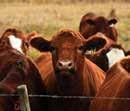
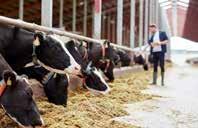
That Ontario has around 6 per cent of Canada’s total beef cattle population? DID YOU KNOW?
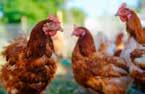
That Ontario is the top producer of poultry and eggs in Canada? Each year, the province produces over 2.4 billion individual eggs!
Business Development / Sales
Business Development
Business Development / Sales
Heather Dunbar • heather@granthaven.com
Heather Dunbar • heather@granthaven.com
Heather Dunbar • heather@granthaven.com
Billing Administrator
Billing Administrator
Billing Administrator
Jen Gaetan • jen@granthaven.com
Jen Gaetan • jen@granthaven.com
Jen Gaetan • jen@granthaven.com
That forage crops, like hay, alfalfa and feed corn, make up about 10 per cent of Ontario’s agricultural output?
DID YOU KNOW?
36 Water St. St. Marys, ON, PO Box 2310 N4X 1A2 brantfarmsnewspaper@gmail.com | 519.655.2341 | www.granthaven.com
36 Water St. St. Marys, ON, PO Box 2310 N4X 1A2 norfolkfarmsnewspaper@gmail.com | 519.655.2341 | norfolkfarmsnews.ca
36 Water St. St. Marys, ON, PO Box 2310 N4X 1A2 brantfarmsnewspaper@gmail.com | 519.655.2341 | granthaven.com
Restoring small-town journalism, one community at a time!
Restoring small-town journalism, one community at a time!
Restoring small-town journalism, one community at a time!
DID YOU KNOW?
That while most of Canada’s hazelnuts are grown in British Columbia, there is a concentrated effort to expand Ontario’s hazelnut growing industry?
That Ontario greenhouses produce over half of the nation’s flowers? Some of the most popular varieties grown include chrysanthemums, roses, gerberas, and alstroemeria?
Gratitude for the local farm community highlights Brant County Federation of Agriculture’s 85th anniversary celebration
By Diane Baltaz
The 85th anniversary of the Brant County Federation of Agriculture provided an evening of community, conviviality with good food on March 7.
More than 230 farm families, sponsors, friends, politicians and agricultural industry representatives gathered for the sold-out BCFA banquet, held in Burford. The event centred on a catered buffet and multiple speeches which celebrated agriculture and community in Brant County.
BCFA director and evening emcee Angela Leach told the guests that the BCFA directorate compiled a list of its presidents over the past 85 years, including the current and past presidents present: Chris Stuart, Mark Eddy, Colton Oughtred, Sandra Vos, Chris Kyle, Steve Sickle, Larry Davis, Ruth Ann Charlton, Alan Kelley, Tom Pate, Willy Hilgendag and Bob Lock.
Ontario Federation of Agriculture president Drew Spoelstra of Binbrook lauded the BCFA for its continuous commitment to the agricultural industry, as well as for farmers across Ontario. He confirmed that the OFA remains committed to advocating for its 51 Federation of Agriculture affiliates, including Brant.
“There’s a lot going on in the world, a lot of things out of our control, but the OFA is certainly doing our best to stay on top of all the things that are affecting farmers across Ontario,” said Spoelstra. “We’ve been listening and hearing from our membership on everything that’s concerning them: from trade and tariffs to all the other issues that we’re facing. Our board and staff are working hard to advocate on your behalf at all levels of government.”
The county’s two MPs, Larry Brock and Dan Muys, MPP Will Bouma, and County of Brant Mayor David Bailey stated their support for the
agricultural community. Four members of Brant County council were also present.
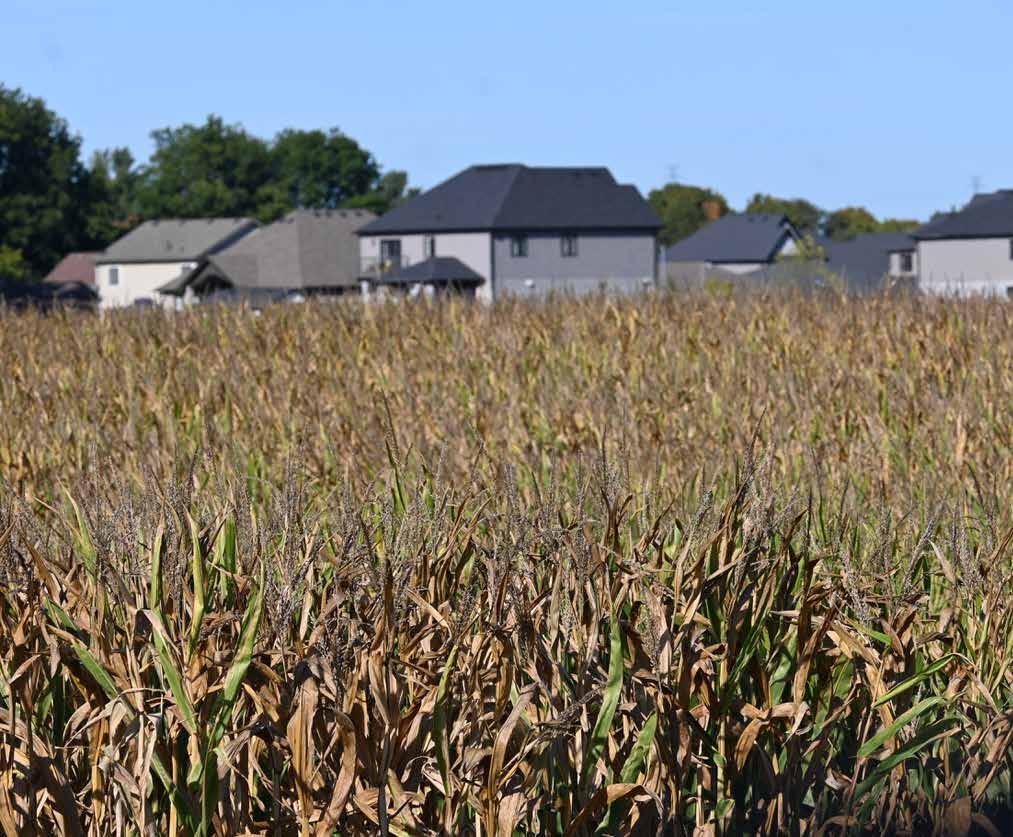
“We’re trying to keep the developers at bay. I know that it’s discouraging to see houses going up,” said Bailey, referring to the county’s urban sprawl during his talk. “We’re trying to hold back development to keep the county as rural as possible.”
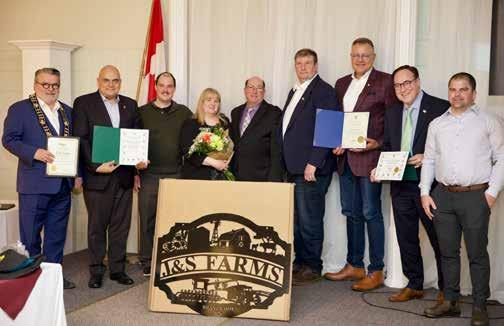
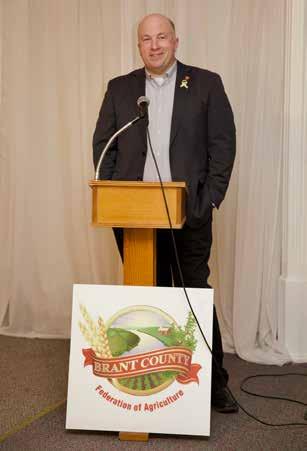
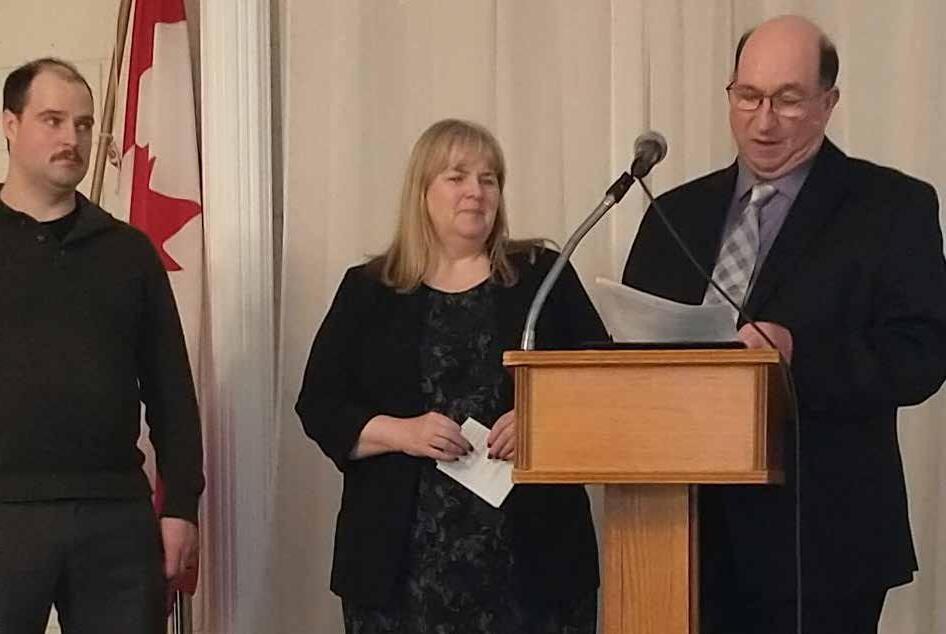
The banquet’s apex was the recognition of the 2026 Brant Farm Award recipients, Jay and Sara McLellan and their family who operate JaySar Farms and J&S Grains in the former Onondaga Township. Past-presidents Eddy and Oughtred outlined the McLellans’ excellence in farm management, environmental stewardship, and community involvement, prior to presenting award to the couple and their son, Alex.
Another highlight entailed the presentation of two BCFA scholarships worth $1,500 each to
Brant’s chief politicians joined in recognizing the BCFA’s 2026 Brant Farm of the Year, JaySar Farms, operated by the McLellan family of Onondaga. Left to right: Dave Bailey, Larry Brock; Alex, Sarah and Jay McLellan (centre), Mark Eddy, Will Bouma, Dan Muys, Colton Oughtred.
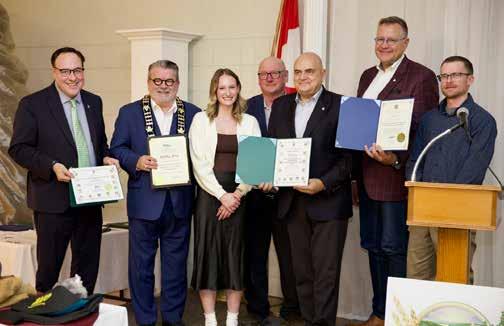
Local politicians joined the BCFA directors in congratulating the winners of the 2026 scholarships.Left to right are: Dan Muys, David Bailey, recipients Sofia Arva and Brian Coleman (on behalf of Hannah Coleman), Larry Brock, Will Bouma, BCFA president Chris Stuart.
Special guest and OFA president Drew Spoelstra congratulated the BCFA’s 85 years of farm advocacy.
Gratitude highlights Brant County Federation of Agriculture’s 85th anniversary celebration
two Brantford students who currently study at the University of Guelph.
The Open Award went to Hannah Coleman who is in her first year of pursuing a Bachelor of Science in chemistry, stated Chris Stuart, BCFA president who presented both scholarships. Coleman’s achievements included 4-H, completing over 30 clubs, playing piano and assisting on her family’s dairy farm with plans to teach some day.
The Agriculture Award went to Sofia Arva, now in her third year of pursuing a Bachelor of Commerce in food and agricultural business.
“She too has been heavily involved in our community with achievements in 4-H, competitive dance, and she served as a senior leader at the after school program for the County of Brant. Sofia also enjoys playing soccer and being involved in the OAC Agribusiness and Farm Management Club, the OAC Soil and Crop Club and recreational dance. She is pursuing a
long-term career in the agri-food industry,” said Stuart.
While Coleman was unable to attend the event, her grandfather, Ward 5 County Councilor Brian Coleman accepted the award on her behalf.
The banquet ended with a silent auction of more than 30 donated items, with the funds raised to be split between the Canadian Foodgrains Bank and local food banks.
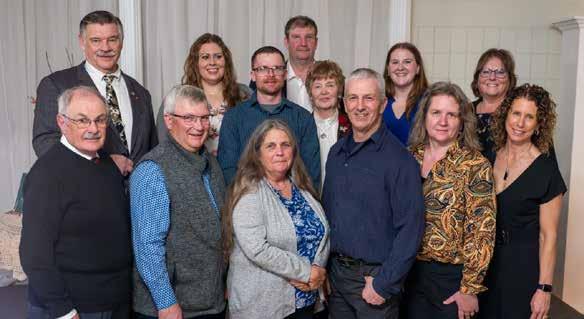
The 2026 BCFA directors: (Back row, left to right) Larry Davis, Amanda Henderson, Chris Stuart (president), Mark Eddy, Jean Emmott (vice-president), Lauren Miller, Joanne Fuller (OFA member service rep for Brant); (Front row) Bob Hamilton, Alan Kelley, Michele Snyder, Steve Sickle, Nancy Van Sas, Angela Leach
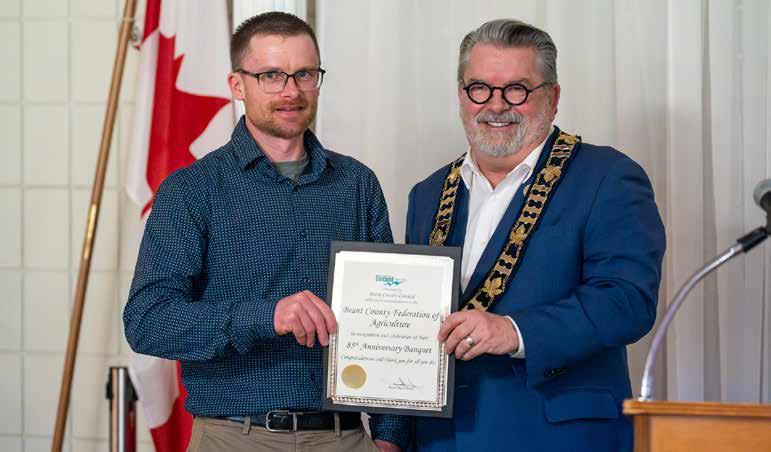
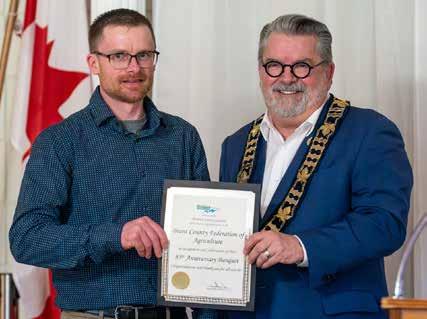
Brant County Mayor David Bailey acknowledged the BCFA’s community efforts with a certificate presented to federation president Chris Stuart.
Ag Robotics Day gives insight into the future of agriculture
By Jeff Helsdon
How far off is the day that will see increased use of robots for common farming practices?
Answers to this question was on the forefront as the AgRobotics Working Group hosted a demo day at the Ontario Crops Research Centre in Simcoe last summer. On display were several robots that are either on the market, or nearing that point.
There were nine different robots on display for those attending the demo day. These ranged from laser weeders and an asparagus harvester that can identify the ripeness of spears and decide which to harvest to drone sprayers and electric robotic tractors.
Since the AgRobotics Working Group was formed in 2021, it has grown exponentially. It started when Chuck Baresich of Haggerty Creek, a Chatham-Kent based agriculture company, approached the Ministry of Agriculture about robotics in farming. The group was formed and began to look into the possibility of using robots and artificial intelligence (A.I.) to solve many problems growers are facing. At the
end of the first year, the group was working with five different robots. Since then, the number of participants has jumped to 400 and the number of robots been looked at has also increased.
Brigette Mahon, the group’s project manager, explained that robots don’t need to be stationary and can be as simple as a washing machine or automated tractors.
“Farmers have been quick to adapt technology over the years because faming has been hard work,” she said.
As Baresich later explained, robotics have been common in animal agriculture for some time, but are just starting for field crops and orchards.
Showcasing a laser weeder that his company, Hagerty AgRobotics is working with, he explained labour is becoming a larger issue for farmers, and he suspects it could get worse. Robotics will be a solution of the future to address the problem.
The laser weeder is programmed to identify different species of weeds. At the demonstration day, confetti was spread on the ground
underneath to show its effectiveness. The machine found the small pieces of paper and burned them. Baresich explained it doesn’t actually burn weeds, though, but provides just enough heat to kill.
“Having too much laser power is a waste of energy,” he said.
The machine runs off three 48-volt lithium batteries and can be pulled behind a regular tractor. It is designed to operate at a speed of .3 to .4 miles per hour.
Baresich also showcased the drones that are being experimented with for aerial spraying. His company started working with smaller drones and eventually found the model he demonstrated, which is about two meters wide. It’s set up to automatically spray a field using GPS coordinates. He did point out no agriculture substances are legal to spray from drones at this point except fertilizer and Garland. More approvals, he said are coming, though.
A locally-made option
The asparagus harvester, made by Harvestcorp Technology in Tillsonburg, will hopefully be ready for market next year. It uses cameras to identify the spears, judge ripeness, then a decision is made to harvest, not harvest or harvest the spear and drop it. The machine uses cutters, then takes the harvested spears up a conveyor belt. It can also sort the harvested asparagus into two grades.
“It reduces the amount of labour in the grading room as well,” said Steve Spanjers of Harvestcorp.
The machine runs autonomously and is battery powered. It can operate 24 hours per day, seven days per week.
The four-row model can harvest 30 acres per day.
In the orchard
The Monarch, a 70-horsepower electric tractor which can drive itself between rows in an orchard was the leading-edge technology for orchard owners. It can allow an operator to pay more attention to the task being performed behind the tractor than where it’s going.
“They can watch that much more closely that before,” Baresich said. It will also drive itself without an operator.
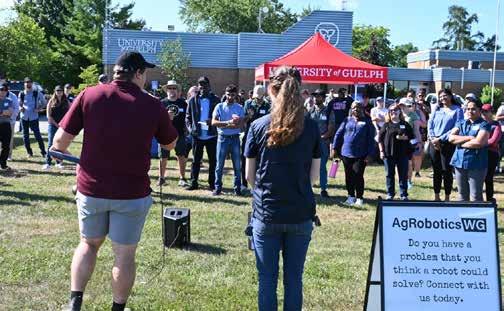
The crowd at the second annual AgRobotics Working Day shows the growing interest in the use of robotics for agriculture. While common in the dairy industry, with robotic milkers, robots are just starting to make their way into field crops.
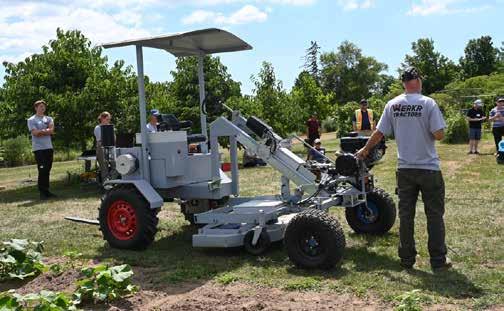
The Werkr electric tractor is a made-in-Canada solution for tractor automation. The company started with contracts from major lawn tractor manufacturers.
How far off is increased use of robots for field crops?
The Monarch will run for 14 hours performing light tasks, and eight on heavy tasks. It can recharge in four to six hours on 220 volts. This unit sells for $130,000, compared to a conventional tractor at $70,000 to $80,000. However, Baresich said there are no oil changes, oil filters and operating costs are lower. A traditional tractor also can’t drive itself.
Asked about batteries, he said they are good for eight years.
“What’s interesting is the battery that goes in there (in the future) will be significantly better than the one that came out,” he predicted.
A robot on display from Finite Farms is designed to thin apple orchards. This task is essential as trees want to make 200 to 300 fruit, said Finite’s Matt Stevens.
“Basically, you have to take a whole lot of fruit off as quickly as you can,” he said.
The thinner is designed to be used after a chemical thinner has been applied and will cut off the tiny apples that it identifies as subpar.
“The robot can see better than the human can, so we can start with marble-sized fruit,” he said.
The operator can program the optimum number of fruit per tree, depending on the variety and end use of the apples.
Horticulture uses
Toryn Boyle, manager of the Simcoe research centre, has been working with Haggerty to assess the Naio Oz’s practicality in the field by comparing two squash plots, one tended by the robot and one by conventional means.
“We’re trying to build a framework to assess these machines,” said Jason Gharigo of Haggerty.
Boyle said some experimentation was needed initially to set up the cultivator on the Oz.
“The robot has automation systems that allow it to correct,”
Boyle said, explaining it will adjust till depth and if it’s off track.
Initially, the machine got stuck a lot, and he had to go into the field and adjust it using an app on his phone. Once adjustments were made, there have been fewer problems.
Made in Canada, eh!
While many of the robots were imported from the U.S. and Europe, a home-grown industry was also on display. Besides the asparagus harvester, an orchard scanner that uses AI to assess the condition of the trees and make thinning recommendations was developed in Toronto, and Werkr Tractors is based in Kitchener/ Waterloo. The latter product is an electric tractor with an optional autonomous mode.
How far is this from reality?
Hagerty AgRobotics had nine Oz robotic tractors, which is a small unit that will perform a variety of tasks and is scaled for work on small farms or market garden operations, out this year. The Burro, a small unit which can run bins of fruit from the orchard to a processing centre or larger wagon, is in use on several farms.
The dealership receives weekly calls from growers interested in making the switch. The technology is advancing rapidly, and Baresich believes it’s on the cusp of becoming practical.
Part of his company’s job is evaluating the new technology as it comes to market.
“We have to be honest with the grower,” he said. “It’s not that they (manufacturers) can’t get there, it’s just they need refinement.”
“We’re right at the beginning of robotics in agriculture,” said Stan Baer of Werkr. “It’s going to look a lot different in 10 years than it does now.
Steve Spanjers of Harvestcorp Technologies explained the workings of the automated asparagus harvester manufactured by the company.
“Farming forms our foundation” says farmer, co-founder of popular Paris brewery
By Diane Baltaz
Paris has long had the Paris Fair, but a seventh-generation local family created a new agriculture-themed landmark for this town.
The Paris Beer Company, which opened in October, 2020, boasts of its farm roots; and like the long-popular Paris Fair, is primarily farmeroperated.
Its five partners - brothers John and Ken Edgar, their spouses Marsha and Jennifer, and managing partner-German Master Brewer Christian von Der Heide - grew up on farms and still share varying degrees of on-farm involvement. Some of their ingredients, notably their hops, come from E3 Farms Limited --the Edgars’ farms around Paris and Harrisburg -with their website stating, “Great beer is grown here on the von Edgar hop yard”.
The Paris Beer Company is situated in the back of the Wincey Mills, a refurbished 1880s mill that is now a year-round market in downtown Paris, beside the Nith River. It began winning awards in Canadian craft brewing competitions soon after opening. The brewery and its attached restaurant remain a popular day tripper destination.
“Farming forms our foundation,” states the Paris Beer Company website. It then describes the Edgars’ decades-long commitment to sustainable agricultural practices in addition to being “Paris’s first taproom and beer experience”. The brewery’s branded clothing and wooden beer trays are imprinted with the words “Farmers” and “Brewers.” A pitchfork centres the company’s logo. And other farmers are among the brewery’s visitors: in early February, the Edgars hosted an Ontario Grain Growers tour.
“We call ourselves farmers and brewers,” stated Ken, 58, who manages the farm’s crops.
The Edgar story begins in the 1830s when their ancestors moved from Ayr, Scotland to Ayr, Ontario. Edgar’s branch of the expanding family moved south to a farm on Rest Acres Road near the Power Line Road in the former Township of Brantford in the early 1900s.
By the late 1960s, two Edgar brothers -Harold and Allan – farmed in this location, on
neighbouring farms. Their families became involved in multiple community and farm organizations; the Brant Soil and Crop Improvement Association was one such organization, with Allen serving as its president at one point.
The family cash cropped corn and soybeans on a large scale by the time of Ken’s birth in 1968. The family adopted soil and water conservation practices such as planting grassed waterways by 1970, long before it became commonplace in Ontario.
“Our family practised no-till before it was widely accepted,” explained Edgar. “They were very ahead of their time. But it doesn’t take long to notice its benefits as it creates less erosion, lesser fuel bills with the tractor as there are less passes over the land.”
Edgar grew up as “the typical farm kid”, helping out in the shop, driving the tractor and similar tasks. However, while he was still attending high school in 1984, Edgar’s father formed a limited company with himself and his elder brother, John in order to sell pigs.
“John and I started out with two sows but it taught us a lot about pork production.”
The brothers presently rented a hog barn near Drumbo where they ran a 100-sow farrowto-finish operation. They maintained it while attending the Ontario Agricultural College (OAC) in Guelph.
“It seemed to be a good business,” said Edgar.
The landlord sold the farm shortly after Edgar’s graduation from the OAC; the brothers exited swine production “in spite of the good money at that time.”
But Edgar had immediately begun working for his father upon graduation.
“That was my first job out of school --- I was the tractor driver and fixer and breaker of things.”
The brothers and their father cash cropped 1,400 acres of corn and soybeans on land around Paris and Princeton.
By the early 1990s, Edgar married Jennifer; the couple and John switched to growing produce such as melons and squash; and
they also sold plastic mulch manufactured by a Montreal company.
Edgar discovered pleasure in growing produce.
“I found that I enjoyed it over livestock.”
But their farm focus changed after the brothers’ parents returned from a holiday in Australia. Their mother, Mary Ellen turned entrepreneurial. She developed a no-rinse, lanolin-based cleaning product for woolens: Eucalan Delicate Wash. Adapted from an Australian Ministry of Agriculture recipe a friend gave her during that trip, Mary Ellen ran the product line from Paris and found a factory to produce it. After Jennifer took over as CEO of Eucalan, Mary Ellen remained involved with operations until her death in December 2024.
Next, Ken, John and Jennifer established the Calendar Club, a national retailer of toys, games, and calendars, with a warehouse that is currently located in Brantford.
Both enterprises became part of the extended Edgar family’s focus, while retaining their farm production.
“These (businesses) are germane to our farming enterprise: as you know that in agriculture, there are some good years and bad years. My parents recognized their (off-farm) risks could balance it.”
“For years Dad and us sons grew crops and harvested them; when we were not harvesting, our parents were promoting their products at trade shows,” said Edgar.
John and Jennifer managed the Calendar Club, along with some additional family help, including John’s wife, Marsha. Edgar still focused on crop production, but he added, “Sometimes I had to park the tractor at the end of the day and walk into the warehouse.”
“It was a good business, but we stopped growing corn and stuck to soybeans, rotating it out with wheat.”
By 2015, the brothers and their spouses considered developing a more farm-based business using product grown in their fields.
“We were in our late 40s by then and we began talking about our past experiences. We
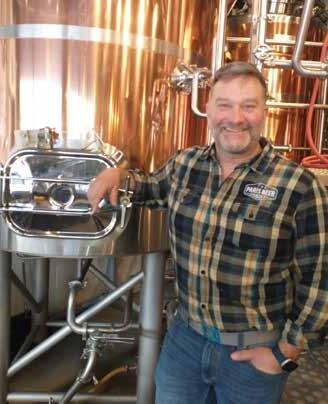
Ken Edgar works at the Paris Beer Company when he is not managing E3 Farms Ltd.
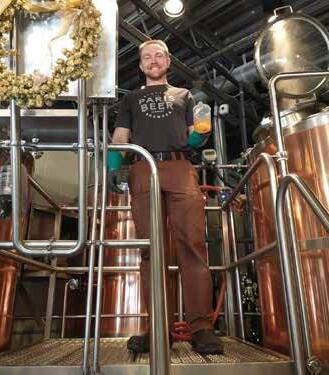
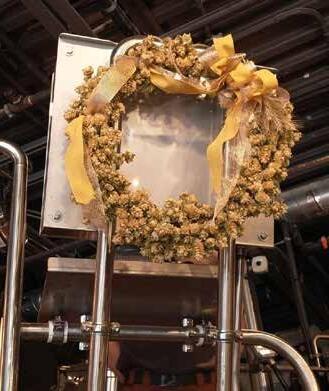
Tobias Edgar of E3 Farms Ltd. obtained his brew masters certification and works full time at the Paris Beer Company. The wreath on the adjoining tank consists of hops cones from their farm.
A hops wreath that adorns the main floor brewery area clearly shows the hops cones used for brewing.
“Farming
forms
our foundation”
says farmer, co-founder of popular Paris brewery
didn’t want the farm to go away. The farming gene was in us – it was in our DNA.”
The conversation centred on different varieties of drinks, such as wine, but presently focused on beer. They dreamed of creating an on-farm brewery, providing a public venue comparable to those by some Niagara wineries.
“That’s a very romantic setting,” said Edgar. “We can grow barley, wheat and create an appealing on-farm destination.”
When their discernment process deemed that option as financially impractical, they considered setting up a brewery-restaurant at the Wincey Mills, which had recently been revamped after being a Canadian Tire store.
“We decided that we can still bring our intention to this location.”
The Edgars partnered with a family friend who immigrated to the area in the mid-1990s: Christian von Der Heide. A certified German Master Brewer, von Der Heide grew up on a Bavarian farm, gained extensive international brewing experience; and according to the Paris Beer Company website, owns a farm in Bruce County. With von Der Heide as a managing partner, the group converted the Canadian Tire’s garage into a brewery, restaurant and sales room.
“The beauty of this relationship is that all five of us are of the same age with families wanting a passion project,” said Edgar.
In 2017, the partners planted an initial hop yard on the farm of John and Marsha Edgar, on Rest Acres Road near the 403 exit. Hops varieties were based on the ones popular with Munich brewers.
“It’s a highly-visible location and we wanted to show what we were doing. We were growing hops but we didn’t have a brewery yet,” said Edgar.
The first hops were harvested in 2018, while the partners concurrently worked on installing the brewery and hauling multiple, 1,000-litre fermentation vessels or Bright Beer Tanks into the Wincey Mill’s basement, even after pandemic labour conditions began.
In 2019, each partner assumed defined duties in the brewery operation while maintaining their previous business interests. Edgar changed his work to “focus 100 percent on the farm and the brewery.”
“We developed the concept of farming in this location for the brewery,” said Edgar. “Part of the plan is to grow our own barley.”
The malted barley portion of their farmbased concept has not yet been fully realized, said Edgar.
The malting process is biochemically complex. It requires that raw grain be steeped for several days in order to activate the enzymes required to break down its starch into fermentable sugars; this is critical because the sugars are what yeast will convert into alcohol during the fermentation process. The malted grain is then dried down to four to five percent moisture to halt germination while preserving the brewing enzymes. The resulting starch content enables greater activation of the enzymes needed for brewing.
”Malting is a different investment. We still hope to do that and we’ve grown our own barley in the past, but we decided that we
can purchase malted barley and focus on the brewing instead.”
But the hops crop continues to expand: last summer Ken and Jennifer installed three acres of trellising at their Harrisburg home farm, which they purchased in 2021. They intend to plant hops varieties delivered from a source in British Columbia this spring, with an initial harvest in 2027. Edgar said that this will raise the brewery’s on-farm production level to seven varieties of hops growing on six acres.
“That’ll give us ample hops,’ said Edgar. “All seven varieties are used for different reasons: basically, hops provide the ‘bittering’ and stabilizing properties to the beer. Malt gives beer the body. Together, hops and malt gives balance and the flavours, such as floral – they’re what make beers drinkable.”
Edgar expects to grow soybeans and rye this
•High Qualit y 2-piece Suit
• Dress Shir t
• Tie & Pocket Square
• Socks
• Minimum Purchase of 2 Suits
• Over 1400 In-Stock Suits to Chose From
season with assistance from John and Jennifer. The Paris Brewing Company creates beers using barley, wheat, and sometimes oats. The brewing team recently-released one using rye; they also make hard cider, as well as a glutenfree beer brewed with imported sorghum.
Edgar’s son, Tobias, completed his brew master’s training at Niagara College and currently works full-time at the Paris Beer Company. The restaurant and store have also expanded. Harold often visits the brewery to eat; and added Edgar, “My parents were, and my dad still is, a great promoter of this endeavour.”
“We’ve got a great team here – there’s an inherent work attitude from growing up on a farm,” said Edgar. We hope to pass it on to our children, to the people who work here. The farmer in us will never leave us.”
The Paris Beer Company brewery occupies a former garage at the back of the Wincey Mills in the Paris tourist area.
“New Beginnings” is the theme for the Burford Agricultural Society board
By Lisa Wright
One of the most significant “New Beginnings” for the Burford Agricultural Society (BAS) is the change of dates for the Burford Fair.
O N T A R I O B E E F F A R M E R S : W E N E E D Y O U
Traditionally held on Thanksgiving weekend, moving forward the fair will be held the weekend before Thanksgiving, which will be October 2-4 this year. But the BAS isn’t just about the fair,
Raising beef is vital to your family, your farm, your community, and Ontario as a whole The product you raise deserves to reach appreciative family tables close to home, ensuring you r eceive the best value for your hard work At VG Meats, we’ve partnered with small beef farmers across Ontario who share our commitment to quality, sustainability, and continuous improvement Now we’d like to work with you
We’re looking to purchase your finished cattle and provide you with valuable data on each animal’s tenderness, yield, quality, and weight This information not only helps you secure a premium for your beef but also supports better management and genetic decisions for generations to come By working together, we can help regenerate the lives profits and land of Ontario’s beef farming families
year-round this group and its board focuses on promoting Burford, engaging local citizens and increasing agricultural awareness while maintaining and managing the 22 acres of land and infrastructure, commonly known as the Burford Fairgrounds.
The BAS has a new, first-time president, Lucas Eby. He brings youthful energy and ideas, combined with generations of local agricultural and business experience to the role. From an early start in 4-H and successfully showing dairy cattle, to competitive plowing, obtaining an associate diploma in agriculture and operating local LJ Recycling, Lucas has a strong vision for the fairgrounds and the BAS. Dedicated community involvement, increased use of the fairgrounds, improvements to the facilities and grounds, education about agriculture, community pride, hosting agricultural events and pride in being on the board of the BAS feature among his goals in this role and he is passionate about achieving them. Lucas welcomes community feedback and ideas and can be reached at president@burfordfair.com
A new website has launched – burfordfair. com - complete with fairgrounds rental information, online availability and booking, and a calendar of all the happenings at the fairgrounds throughout the year. Whether planning an event requiring indoor or outdoor space or looking for something fun or educational to do with family or friends, the new website has everything
Another exciting “New Beginning” is the move of the Truck Ride for Special Olympics to Burford. Come admire up close the 60-plus expected big trucks of all types, washed and polished for the occasion. Watch them pull out onto their route with police escorts and cheer the Special Olympics athletes on board. Last year the Woodstock Truck Show and Concerts relocated to Burford,
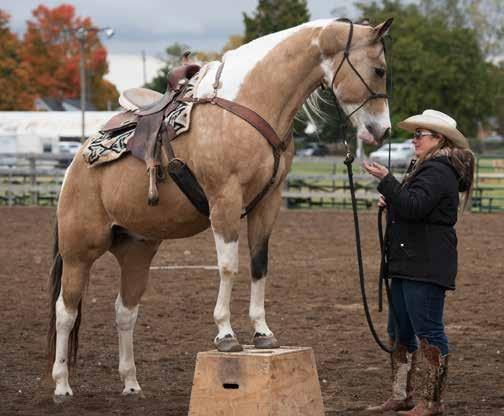
The horse show is one of the highlights of the fair, but the Burford Saddle Club also holds monthly competitions at the fairgrounds.
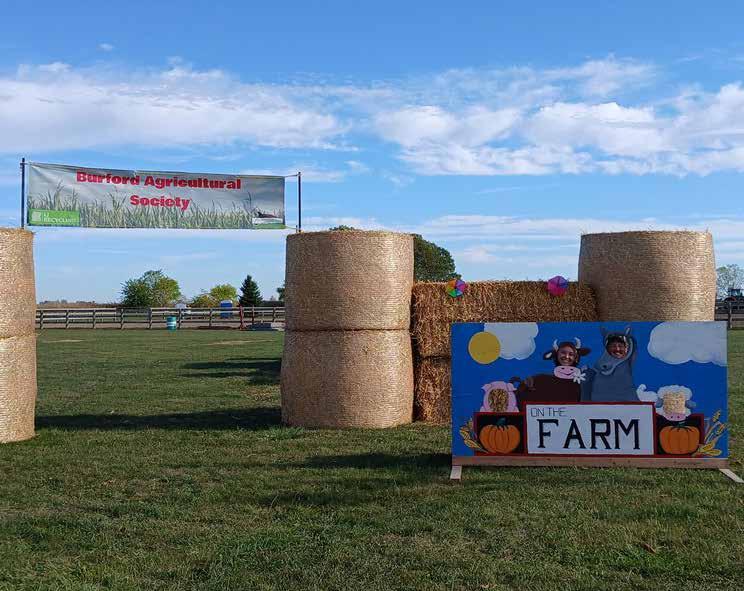
Many changes are being made to the Burford Fair by the Burford Agricultural Society, but one of the largest is moving the fair from Thanksgiving weekend to the first weekend in October, or Oct. 2-4 this year.
Producers learn more about effective carrot storage
By Tamara Botting
When carrots are harvested, it may be months before they reach the consumers.
To help Canadian farmers have the best final product and the least amount of avoidable loss, Fruit and Vegetable magazine presented the Fresh from the Field: Post-Harvest Best Practices for Carrots and Potatoes webinar for producers in November 2025, sponsored by Wyma Solutions.
Vikram Bisht, Potato and Horticulture Crops Pathologist with Manitoba Agriculture, was one of the presenters.
His portion of the presentation focused on the best post-harvest practices for carrots, and as he noted right away, “The storability of carrots is greatly influenced by the in-season practices and handling of carrots prior to storage … To have the best product for our customers, it is quite important that we bring in healthy, disease-free material. For that, we need welldrained soils; balanced fertility; good disease, insect and weed control.”
One of the big dangers to carrots while they’re still in the field is Sclerotinia disease, which can lead to severe rotting if preventative measures aren’t taken.
Bisht noted that in Manitoba, some producers have reported losing nearly half of their product in storage due to this rot. That’s why both infield and post-harvest management is essential. He suggested trimming the foliage between rows to improve airflow and to keep the under canopy dry, noting that this can help reduce the risk of infection of the carrots.
Bisht said there aren’t many in-field chemical
TO THE
options available for carrots when it comes to fungicides. While Switch 62.5 WG and Button (Cyprodinil+Fludioxonil) were effective against Botrytis grey mold and Sclerotinia white mold, there’s a limit of a maximum of two sprays in the field per season. Allegro 500F or Vantana (Fluazinam) are recommended at no more than three sequential applications.
If the disease pressure in a particular year is high, Bisht said it might be helpful to have a post-harvest treatment with the fungicide Scholar (Fludioxonil), which is registered for a
dipping or drench treatment. The efficacy of the spray vs. drench treatments will be impacted by the amount of soil or mud on the carrots; it is most effective on washed carrots, but not all carrots are washed prior to storage.
Of course, that’s another question that carrot producers have to consider when they’re harvesting their crop: to wash or not to wash? There are advantages and disadvantages for each option.
Bisht stressed the importance of not
During his presentation, Vikram Bisht reminded his audience that, “The storability of carrots is greatly influenced by the in-season practices and handling of carrots prior to storage … To have the best product for our customers, it is quite important that we bring in healthy, disease-free material.”
Producers learn more about effective carrot storage
harvesting carrots when it’s hot, and also to of cooling carrots down quickly when they’re brought in from the field, calling it a “critical thing to do.”
Washing the carrots means hydro-cooling them, which is a lot faster and more efficient than using forced air cooling. With forced air cooling, you’d need to be in the range of 1,000 to 3,000 cubic feet per minute (CFM)/ ton.) However, there are fewer risks of spreading pathogens when you leave the carrots unwashed until just before shipping. Moreover, soil has beneficial microbes, which are left intact to compete with harmful pathogens when the carrots are left unwashed.
Washing the carrots when they’re harvested eliminates a step when they’re being processed for shipment later – before they go out, they’ll need to be washed at some point, disinfected and packaged into breathable bags or cartons for shipping.
Since shipping often happens in the wintertime, if the washing area isn’t heated, holding off on washing until later can mean an unpleasant experience for those doing the work.
At the same time, when the carrots are being washed, there’s a greater chance that they’ll be damaged during the process, and physical injuries to carrots can create entry points for rot pathogens, meaning that delaying washing can mean a better product for consumers.
Ultimately, each producer will have to determine what the best approach is for their own operation.
Bisht did offer some broad suggestions that are good for any producer to keep in mind as they harvest, so that they can have the best possible outcome:
• Reduce mechanical damage as much as possible when handling the carrots during harvest, so as to not create entry points for rot pathogens
• Monitor and manage the temperature and relative humidity of your carrot storage facility well
• Apply a post-harvest fungicide (again, being aware that the efficacy of this will be determined by how much soil is on the carrots, if washing is being done later)
• Trim the greens on the carrots, otherwise they’ll draw the moisture out of the carrots and make them rubbery or flaccid
• Carrots should never be stored near ethylene-producing fruits, such as apples and pears, as the gas can cause a bitter flavour in carrots.
metabolic heat and gases. Control systems help ensure uniform conditions throughout the storage space.
The ideal storage temperature for carrots is near 0 to 1 degree C (32 to 34 degrees F). Once that temperature is achieved, the airflow should be at 5 to 10 CFM/ ton.
Carrot storages also should have a relative humidity level of 95 percent-plus.
Bisht said it’s common for humidification systems for carrots to use an ultra-fine fog that is non-wetting. This allows there to be adequate moisture in the air, which prevents the carrots from dehydrating.
He noted that there are some companies in Canada that offer equipment rentals to help with managing things like temperature, relative humidity and airflow, and that without a good refrigeration system, it would be almost impossible to hold carrots for over six to nine
months.
It’s not just about checking gauges, though – Bisht recommended actually going into the storage space fairly regularly and searching for signs of spoilage, whether by look or smell, and removing them immediately.
Inadequate storage can cause losses for carrot producers in several ways, most commonly:
• Weight loss, due to drying out or mould infestation
• Quality deterioration, due to humidity and temperature differences
• Waste of energy, due to inefficient cooling and ventilation
• Risk of spoilage and losses in bulk storage (diseases include Sclerotinia and soft rot)
However, taking steps to make sure your storage is operating properly will help to reduce
When carrots are being put into storage for a while, it’s common for them to be put in large wooden or plastic boxes or containers. If that’s the case, there should be gaps between the container stacks, so air can freely circulate through the bottom of the stacks and escape through the top.
If the carrots are being stored in bulk on the floor, then there needs to be aeration pipes on the ground. Air circulation prevents buildup of condensation or hot spots.
Either way, “Air flow is extremely important. Stale air can lead to condensation on the carrots and create anaerobic conditions, and that would lead to soft rot issues,” Bisht said. He added that high-capacity fans and ducts should be configured to move cold air through the storage space and extract
There’s a few common reactions when visitors to Transitions Acres first encounter the horses.
Sometimes they’ll stop in their tracks, mesmerized.
“Lots of times, I see happy tears,” said Alisha Wilson, founder and operations manager of the Oxford County-based non-profit, adding that sometimes she takes the feeling for granted, “because I’m around them all the time, so I automatically feel that way.”
Wilson grew up on her family’s home farm and spent time as a teen working on a ranch in Florida before eventually making her way to her current home just outside of Tavistock..
“I’ve been around horses my entire life – it’s been a lifelong passion of mine,” she said.
“In 2021, I decided to put the horse to work, so to say, and try to get other people to experience the benefits of being around horses that I’d experienced growing up.”
The model that she started with is largely what’s still in place today, including summer camps, classes and the experiences.
“Over the past five years, it’s really morphed into a place of wellness and holistic health, and having a safe space,” Wilson said. “A lot of times, when I have people come out, it’s because they’re looking for the wellness aspect of things; they’re looking for more of a therapeutic connection.”
There are a lot of connections made during the Cowgirl Kickback sessions – which have been named an Ontario Southwest Signature Experience – and the HorsePlay ultimate date night experience sessions.
Both of these experiences start with a drink by the fire, then move on to the ‘Whoa Game,’ which is the safety demonstration.
“Basically, we walk around the horse and do things that look unsafe or are unsafe, and then people have to yell at us not to do it,” Wilson said, adding that there’s one particular horse who usually helps out with these demonstrations because he’s so calm and good natured.
“I go as far as crawling underneath the horse,” Wilson said.
The safety talk is an important part of the session, because a lot of the clientele who come out to Transitions Acres aren’t from an agricultural background.
“Being on the farm, we take a lot of the things that we do for granted, and we kind of expect people to know, but they don’t. So, we have to make sure that we’re really aware of making sure that people are being taught properly about the risks and things to keep an eye out for,” Wilson said. So, “If you can make (the safety talk) comical and interesting, it’s more engaging.”
As with any agri-tourism enterprise, safety is paramount.
“We don’t tend to run any of the machinery or anything like that when we have people out, just because that also helps keep the risk down,” Wilson said. (While she doesn’t farm the land, there is another local farmer who does cash cropping on the property.)
The parking areas are clearly labeled for guests to help prevent mishaps. Undergirding all of the precautions, Wilson has made sure to have the proper liability insurance – key for any agri-tourism business.
Besides making sure the guests are safe
when they come out for a visit, though, is making sure they have fun.
After the Whoa Game, guests are able to get up close and personal with the horses, taking part in grooming, doing some fun obstacle courses and learning how horses communicate. The sessions wrap up back by the fire, with another drink and charcuterie while enjoying the sunset.
Wilson said that even though she grew up in Florida, which boasts some pretty spectacular views, “Honestly, I can say with all truth, they’re nothing compared to an Oxford County sunset over a field.”
With both experiences, guests enjoy a greater sense of connection with others.
Wilson said the Cowgirl Kickback is “directly driven towards women and those in their feminine energy. We’re really looking at having a good time, connecting with your friends, having some ‘aha’ moments, taking a time to just be at peace with yourself.”
Participants can choose to book a session for just their own group of friends, or be part of a larger, public party – sessions can have as few as two people, and up to 30.
“Those ones are fun, because then you’re working with strangers, and a lot of times the people become friends by the time it’s all done,” Wilson said.
The HorsePlay sessions are also proven to help couples find a greater connection – for at least one couple, it was their first date, and “It actually resulted in them eventually getting engaged and they had their wedding on the farm, so that was kind of cool,” Wilson said.
A lot of people find it very calming to be around the horses.
“Horses have a really large electromagnetic field around their being. It’s scientifically proven that they will help us to regulate our heartbeat,” Wilson said, adding that after the initial excitement of meeting a horse, people’s heart rates tend to lower.
What’s more, “Horses immediately go into working with you instead of against you … they provide immediate and non-judgemental feedback.”
Even if they get spooked, it only lasts a minute or so, and then they’re calm again, Wilson added. “They don’t hold a grudge, and a lot of people don’t get to experience that in life.”
It’s a profound feeling, and one Wilson wants to give to as many people as possible; that’s why she intentionally markets her horse experiences to people in larger city centres.
“(They) are looking for a bit of an escape, from the hustle and bustle. They want to come out and slow down, experience what it’s like to be on a farm in a peaceful setting.”
She’s seen it many times, with the Cowgirl Kickback and HorsePlay, as well as the kids’ camps.
“We’ve kids come out who have never seen a tree before. It’s really neat to have those types of things happen,” Wilson said. “We had two groups come out from London, and the kids were in awe, because they’ve never been around a farm at all.”
All of Transitions Acres’ programming takes place outdoors; there isn’t an indoor arena.
This was partially a financial decision, since an indoor arena would be a large investment, plus the ongoing maintenance costs, but also, “I think it’s a little bit more impactful, as far as the peaceful aspect of things. The horse pasture butts right up to our arena, so not only are (guests) interacting with a horse on the ground right with them, but they can also observe the herd behaviour and the horses in their own natural environment while they’re working as well,” Wilson said. On top of that, guests get to enjoy the sunshine, fresh air, birds and wildlife, etc.
“There aren’t many places like mine who do outside things year-round.”
People can also come and visit the farm for a nominal fee, without doing a full experience or camp; they can enjoy the environment, have a blind date with a book, have a refreshment in the lounge or by one of the fire features, and check out the gift shop, which is stocked with items from local artisans.
For more information about the farm and the programming it offers, visit transitionseq.ca.
The Cowgirl Kickback experience at Transitions Acres in Oxford County has been named an Ontario Southwest Signature Experience.
Ojibwe Spirit Horses are a critically endangered species; there are fewer than 200 known to exist.
Alisha Wilson, founder and operations manager of the Oxford County-based non-profit Transitions Acres, is doing what she can to protect the species.
“I have a really big passion towards Indigenous culture and their teachings,” said Wilson, adding that she’s not Indigenous, but describes herself as “a very fierce ally.”
Wilson said she didn’t even know about Ojibwe Spirit Horses until a few years ago when she saw them for the first time while attending a powwow. She began to research the breed, learning information such as, “They’re native to Canada, the boreal forest; they’re the only horse we can say that about.”
Then in 2025, she had a chance to acquire three Ojibwe Spirit stallions.
“Obviously, I bounced on the opportunity,” Wilson said. The three came to Transitions Acres in December.
“They’re all less than a year old, so we’ll be working on doing some training and stuff with them to keep
them healthy and safe,” she said. It’s not just about these horses, though, but looking to the future.
Wilson noted that back in the day, Quarter Horse breeders (including one of her grandfather’s) would do a lot of line breeding.
Unfortunately, “that’s where you start running into problems like congenital issues and a lot of health problems.”
Since there are so few Ojibwe
Spirit Horses in the world, “they’re already so closely related,” Wilson said. That’s why “it’s really important to pull a DNA strand, try and get their parentage, figure out who’s related to who.”
With the three stallions, the DNA testing has shown “one of them has the best coefficients to be able to breed with anybody, so we hope to keep him a stallion and eventually stand him as stud and
use him in the breeding program.”
If these efforts prove to be sustainable, Wilson hopes to eventually add some mares to the herd as well.
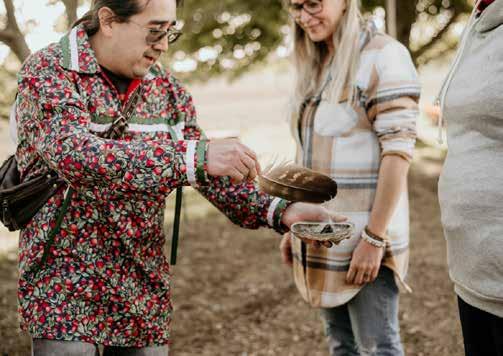
Wilson is building a whole program based around these horses, working in tandem with Eric G Martin, an Indigenous Elder who is already a regular at the farm for the monthly smudge gatherings, which are open to the public and free to join.
Wilson said she and Martin connected somewhat by accident a number of years ago, but they’ve since developed a strong working relationship and friendship, which has allowed them to connect with and educate the community.
“Our smudge gatherings, we’re starting to see upwards of 20 to 35 people every month who take part in the smudge and learn all about the medicines and stuff, so that’s kind of cool,” Wilson said.
With the Ojibwe Spirit Horse programming, “Basically, he will be doing all of the Indigenous teaching side of things, and I will be doing all of the horse teaching side of things,” Wilson said.
For more information about the farm and the programming it offers, visit transitionseq.ca.
Eric G Martin, an Indigenous Elder, is a regular at Transitions Acres, where he performs monthly smudge gatherings for the public. He is also partnering to share his knowledge through the new programs being offered that are focused on the farm’s recently acquired Ojibwe Spirit Horses.
Celebrating Canadian Businesses: Cleanworks technology is making Canadian food safer
By Tamara Botting
They say an apple a day keeps the doctor away. It’s perhaps fitting, then, that a Canadian innovation that kills food borne pathogens –and perhaps will be helping to sterilize medical equipment across the country soon – can track its roots back to an orchard.
Paul Moyer is a co-founder of Cleanworks Corp. However, he started as a fruit farmer in Vineland.
“I have farming in my heart. I love the land and working the land,” he said.
Moyer is the eight generation in his family to farm. In 1990, Moyer took over the family farm with his brother and mother.
For many years, they sold their produce at farmers’ markets and the Ontario Food Terminal, but they wanted to expand.
“My brother was still at university, and I wanted to expand the opportunity for value added, so that’s how we go into caramel apples,” Moyer explained.
They took the apples that were perfect for consumption but not up to the standards of the fresh market – perhaps because they were misshapen, or the colouring wasn’t ideal – and turned them into caramel apples, thus creating Moyers Apple Products.
“As a demand for the product grew, we decided we needed to expand, and that’s where Court Holdings came into play,” Moyer said.
The overall dip in demand highlighted the fact that food safety is paramount in breaking into the larger Canadian market, and potentially the US market.
“If we were able to have the safest, longest lasting product, we would gain a lot of market share,” Moyer said.
Not only that, but he feared that with repeated reports of pathogen outbreaks related to fruits and vegetables, the general public might start to believe that highly processed foods were safer.
“And I think that would be a tragedy, because nothing could be further from the truth,” Moyer said.
“So, working with the University of Guelph, we developed a technology that sanitized apples for the caramel apples.”
Arguably the biggest part of the innovation was the starting point they chose to set out from. Moyer said in the early stages of developing their new process, they kept asking themselves what they could do that was completely opposite from the established processes, which had proven to have gaps.
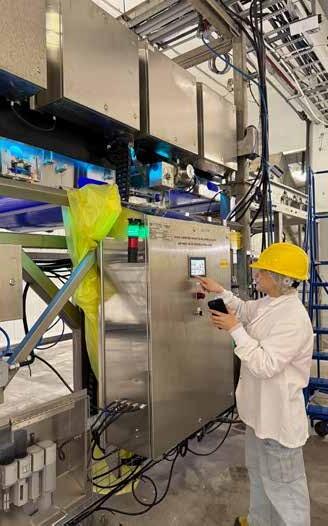
The units are engineered and manufactured in Canada.
Through the partnership, the business saw greater demand, and they subsequently expanded their facilities. However, a 2016 listeria outbreak – one that Moyers Apple Products didn’t even experience firsthand – dealt a harsh blow to the caramel apple industry as a whole.
After all, “The electric lightbulb was not invented by the continuous improvements of candles,” Moyer said.
The obvious answer was water.
“Everybody seems to think in order to sanitize something, you have to wash it,” Moyer said. In general, though, “water is more of a vector for pathogens than it is a solution for pathogens.”
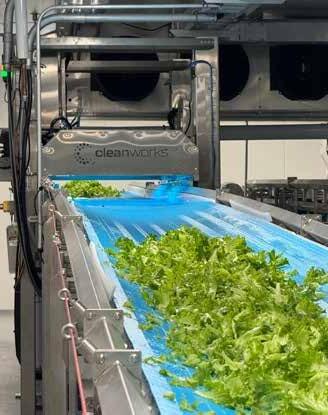
What they landed on was developing a patented process that uses a specific mixture of hydrogen peroxide vapour mixed with ozone
and UV light. Moyer explained that when the hydrogen peroxide and the ozone gas is put through the chamber with UV light, the two substances will turbocharge, and break down to their individual components. The process sanitizes the food – it also helps prevent mold and mildew – and the byproduct of the process is oxygen and water.
“It’s extremely green, it’s extremely safe, and there’s no chemical residue whatsoever,” Moyer said, adding that there’s no impact on the flavour of the food.
“On a molecular level, we make the product far, far safer than washing alone, by using significantly less water,” he said (the process doesn’t remove things like soil from the surface of the produce).
“In general, we can reduce pathogens – E coli, salmonella, listeria and such – 99 to 99.9 per cent, making fruit and vegetables and other food items much safer,” Moyer said.
Not only is the food safer to eat, but by drastically reducing mold and mildew, it lasts longer, too.
“We can increase the shelf life of produce about 20 per cent, if not more,” Moyer said.
The caramel apples that started it all fall into the ‘more’ category – they went from having a shelf life of 14 days to over 30.
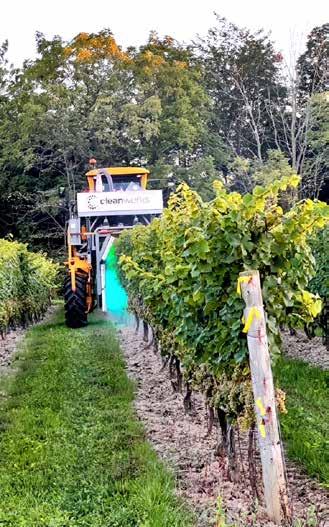
Moyer noted that because they’d had so much success with the process in sanitizing produce post-harvest, they decided to look at how it would work in the fields, pre-harvest. Testing on produce like spinach, strawberries and grapes has been very effective, even resulting in a reduction in the amount of fungicide needed.
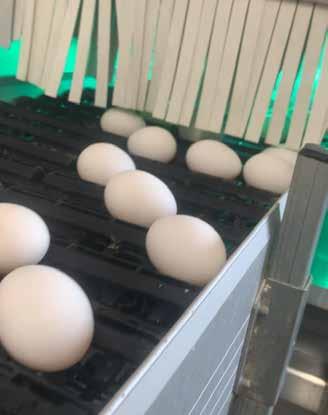
The process has proven successful in the protein market, too, including being used on eggs, for the hatchery and the table.
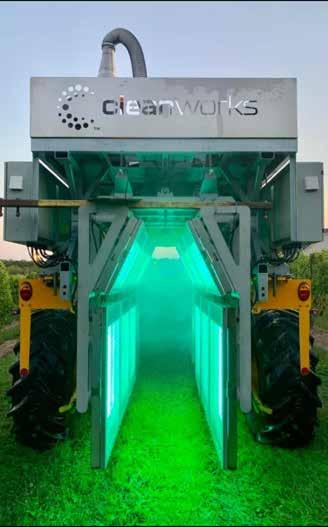
Cleanworks Corp. has had so much success with its patented process in sanitizing produce postharvest that its efficacy is now being tested in the fields, pre-harvest. Results are showing that it is very effective, even resulting in a reduction in the amount of fungicide needed.
Cleanworks Corp.’s patented process uses a specific mixture of hydrogen peroxide vapour mixed with ozone and UV light.
Celebrating Canadian Businesses: Cleanworks technology is making Canadian food safer
“It was developed for agriculture, and because it’s so powerful and so effective, it was moved into the healthcare field,” Moyer said.
In 2019, they were testing the process on norovirus and hepatitis with one of their units at Health Canada. When the pandemic hit the following year, “We were tasked by the Canadian government to see if our technology would work on COVID-19. It proved that it killed COVID-19 to a very high level. So, we were approved as a medical device in hospitals,” Moyer said. “It’s very powerful stuff. There are numerous pieces of our equipment in healthcare facilities and hospitals across Canada.”
The technology has received a lot of accolades, including winning Canada’s Food Waste Challenge for significantly reducing food waste through the technology and potentially greatly reducing the use of chemicals in the field; an award from the International Association of Food Protection for best new technology internationally for food safety; and the award for Ontario Centres of Excellence for New Technology.
“This technology certainly was born for a small reason, but it has done two things: it’s become the highest, most effective way to kill pathogens on food items; and it has leapfrogged Canada to probably the very top country in technology for making food safer,” Moyer said.
It’s being used in locations across the country, from Vancouver to the East Coast, as well as in Central America and the European Union.
Cleanworks Corp.’s patented process reduces pathogens – E coli, salmonella, listeria and such – 99 to 99.9 per cent, making food safer; it also drastically reduces mold and mildew, meaning it lasts longer, too.
“(In) the food industry, we want to have as many tools in our toolbox to make food as safe as possible,” Moyer said.
The units are engineered and manufactured in Canada.
“It’s certainly a Canadian-born technology that’s absolutely changing the face of food safety, not just here in Canada, but globally. We’re very proud of that. We’re super happy to have been able to take some Canadian ingenuity and spread it around the world.”
Cleanworks Corp.’s process has proven successful in the protein market, including being used on eggs, for the hatchery and the table.
By Diane Baltaz
The McLellan family of JaySar Farms and J & S Grains became a beloved highlight of the Brant County Federation of Agriculture (BCFA) 85th anniversary banquet in Burford on March 7.
That’s because the BCFA declared this tightknit, multi-generational family as the Brant Farm Award winners for 2026. During the banquet’s formal talks everyone from Ontario Federation of Agriculture president Drew Spoelstra to local politicians commended them.
Jay and Sara McLellan, their partner-son, Alex and family run JaySar Farms and J & S Grains, a 700 –acre operation on Salt Spring Road which grows corn, wheat, soybeans and hay, along with a dairy operation that was formed with Bill and Jean Emmott. They also provide custom work for neighbouring farms, which the BCFA said at the Burford fete assists in “fostering cooperation and mutual support within the local agricultural community.”
The BCFA chose the McLellans because “they embody the Brant Farm of the Year’s values of community, intergenerational, leadership, commitment and sustainable agricultural practices that keep farming and rural communities vibrant,” according to their press release.
Two past presidents, Mark Eddy and Colton Oughtred, narrated extensive curriculum vitae about the family’s accomplishments prior to presenting the award.
“The McLellans … represent the very best of agriculture in Brant County, excellence in farm management, strong family values, environmental stewardship and an extraordinary commitment to community service. JaySar Farms operate the dairy portion of the business while J & S Farms is responsible for the crop production, together forming an integrated and well-managed farming operation,” said Eddy.
The award recognized the McLellans’ lifelong community involvement. Jay served the Onondaga Fire Department for 35 years and is currently its chief. He is also a director with District 6 Grain Farmers of Ontario, a former BCFA director; past chair of the Brant Dairy Producers Committee and of the Brant Dairy Cooperative, including participation in related school education events. Thirty years ago, he created and still leads the wheat station for Grade 5 students at Bite of Brant. Sara is active with the Brantford Rotary Club; and along with Jay, hosted multiple community meetings on their farm, along with involvement in two township churches and 4-H.
Similarly, Alex joined the Onondaga Fire Department 10 years ago, is involved with the District 6 Grain Growers and the BCFA, as well as coaching a youth volleyball team along with his wife, Madison. He also assists at the Bite of Brant wheat station.
Oughtred summarized their community commitment by saying, “For decades the McLellan family has contributed far beyond their own farm gate. They are widely respected for their willingness to lead, mentor, educate, and support others - whether fellow farmers, youth, or community members. The McLellans are not
only a progressive farming operation but also a cornerstone of the Onondaga and Brant community.”
Jay outlined his farm history during his comprehensive, humour-filled speech during the award presentation. He told the sold-out crowd that he grew up on a 20-head dairy farm with 175 workable aces. The farm expanded in 1980 when his parents, Hugh and Verna, established a partnership with his brother Paul, who purchased a neighbouring farm, expanding the family operation to a 45-cow herd and 225 workable acres.
“There was no shortage of work so I continued working with them while I finished high school and college,” said Jay.
This young farmer married Sara in 1984, and moved into his grandmother’s farmhouse. He purchased his grandmother’s farm the following year, purchased quota for five cows and joined the family partnership, entitled Hugh McLellan and Sons. They expanded their workable acres by renting neighbours’ fields.
J & S Farms and JaySar Holsteins became established after Jay and Sara became involved with the Emmott family in 2000.
“In 2000, the Emmott family gave me the opportunity to start out on my own, setting up a joint venture and moving some quota to their operation. On May 1st 2000, we moved five cows from Paul’s barn to the Emmotts’.”
Because Holstein Canada required a prefix to register their herd, the McLellans modeled their choice after Hugh and Verna’s herd name: “My parents’ prefix was Huvern Holsteins, so it seemed fitting to make ours JaySar Holsteins.”
Since then, the McLellans increased their herd size and acreage.
“We got the opportunity to move into a modern robotic dairy barn thanks to the Emmotts. We expanded our workable acreage by straight
rent or share crop agreements. Through trial and error and by watching what our neighbours were doing, we have reduced our tillage practices and adapted cover crops into our rotation.”
Alex worked at home full-time in 2018 after studying at Ridgetown Agricultural College and Olds College, and working part time at another farm. He presently joined the partnership, and has two children whom Jay called “two, third-generation farmers, Annie and Huge.”
McLellan praised his other sons and daughters’ involvement with the farm, including their eldest son, Scott, whom he called “J&S Farms’ first employee” prior to his taking employment with a Stoney Creek company.
McLellan credited multiple Onondaga individuals for either assisting the family on the farm, or instructing them in sustainable cropping practices or on how to do more on-the-farm repairs.
“People have been asking me what makes your farm stand out to receive this award. I’ve been asking myself the same question. Then it came to me. I have surrounded myself and my family with greatness,” he concluded.
He advised the county’s younger farmers to make time to participate in the rural community:
“I’ve been on a fair number of committees over the years. I didn’t learn a lot at the meetings-- I slept through most of them. But it is amazing the wealth of knowledge you can get from people with just a couple of beers and start a group discussion. I brought home many ideas and turned some into reality on J&S Farms. I want to say to the younger farmers here get involved. I know you don’t have the time, but the things I learned and the people I’ve met and got to know I will cherish for the rest of my life.”
This is the second public recognition of Jay’s community commitment - in 2022 he received the Queen Elizabeth II Platinum Jubilee Award.
Alex McLellan and his mother, Sara listens to Jay as he thanks the BCFA for the 2026 Brant Farm award.
OFA asking municipalities to reconsider farm tax rates
By Tamara Botting
It’s been almost ten years since the last Municipal Property Assessment Corporation (MPAC) assessments were done.
“We’ve been in a bit of a holding pattern,” said Ben LeFort, senior policy analyst for the Ontario Federation of Agriculture (OFA). “We are waiting and watching what will happen there.”
Whenever the new assessments are done, it might help improve a longstanding issue that’s been impacting most agriculturally zoned properties across the province.
“On the flip side, it could get even worse,” LeFort said.
There are two main components that make up a property tax bill in Ontario: the MPAC assessment (which is supposed to be done every four years) and the tax rate, which is set by the municipality.
With agricultural properties, municipalities collect the full residential tax rate on the farm residence and the first acre of the property; after that, individual municipalities have the discretion to set the agricultural tax rate – which is applied to the remainder of the property – anywhere from 0 to 25 per cent of the residential tax rate.
“The municipality is going to collect what they need to collect. The main factor we’re concerned about is who are they collecting more from, and who are they collecting less from,” LeFort said.
The issue, according to the OFA, is that agricultural properties’ MPAC assessments jumped drastically – in some areas, over 60 per cent – while comparatively, other types of properties, like commercial and residential, only increased one or two per cent.
So, if a municipality opts to collect the full 25 per cent from the agricultural properties, chances are, they’ll be paying a greater share of taxes than other classes of properties, LeFort said.
“It’s become an arithmetic issue.”
So why are the assessments on agricultural properties so high?
It comes down to supply and demand.
The reality is, “We lose farmland every year,” LeFort said.
Many municipalities are seeing developers seeking to purchase agricultural properties and turn them into residential developments. Land suitable for agricultural purposes is limited to begin with, and once it’s developed, it’s gone –meaning that the farmland that’s left becomes even more in demand.
While MPAC’s assessments on agricultural properties’ values are based on farm-to-farmer sales, “The more the demand there is for farmland from any source, the higher the sale price will be,” LeFort said. “It’s impossible to strip that out of the equation.”
LeFort said that in the OFA’s opinion, this issue isn’t really something MPAC can address; “MPAC takes its orders from the province.”
And while some may want to point fingers at the Ontario government, the fact is, property assessments are going to vary across the province.
“What’s happening in Hamilton will be different than what’s happening in Huron County, etc.,” LeFort said.
Which means that ultimately, the individual municipalities’ ability to set the agricultural tax rate is “the only realistic tool at this point” to minimize the impact that high property value assessments can have on agricultural properties.
“Municipalities can adjust their farm tax ratio – they have the perfect tool to address this issue, if they choose to. This is now a municipal decision,” LeFort said.
While all of Ontario’s municipalities could address this issue, the fact is that most don’t, which is why the OFA is trying to get the messaging out that “municipalities where farm MPAC values have risen at a disproportionately higher pace than other property types should consider adjusting their farm tax ratio below 25 per cent,” LeFort said.
It’s important to note, though, that the OFA isn’t asking that municipalities not charge any taxes on agricultural properties.
“We accept and realize they are going up,” LeFort said. However, they’re asking munici-
Balancing residential versus farm tax rates is a challenge municipalities must grapple with. Farmers have seen the value of farms skyrocket and brought taxes up with it.
OFA asking municipalities to reconsider farm tax rates
palities to not put the brunt of that burden on a handful of farmers, and instead, apply a lower tax rate to slow the increase that agricultural properties are having to contend with.
LeFort acknowledges “It’s a difficult decision for all municipalities across the province.”
Because if a municipality decides to collect less tax dollars from farmers, they’re going to have to make up the difference elsewhere to cover their budgets.
“There is that reality of the trade off – a lowering of farm tax would mean more taxes on residential, industrial and commercial properties. It’s the co-ramification,” LeFort said, adding that in most cases, residential properties make up the bulk of a municipality’s tax base. However, he noted, when spread across multiple residential properties, the amount more that each household would pay would be much smaller than the steadily growing tax burden currently shouldered by a few agricultural properties.
Brant resident Larry Davis has been on the board of directors for the OFA for many years. A farmer himself, Davis lauds the work being done by the organization to try and address this taxation issue.
“In almost all municipalities in Ontario, where there is rural and urban, it will be disproportionate to the farmer,” he said.
Davis said it’s only right that farmland – besides the residence and first acre of property – is taxed at a much lower rate.
“Our properties generally don’t need sidewalks and streetlighting … and (our fields are) certainly not going to use a library,” he said.
He echoed the concerns about how the prevalent practice of developers seeking farmland is continuing to drive up prices, and consequently assessment values.
Developers will have more financial means to present a larger offer than most farmers would have, he said, adding that he doesn’t blame farmers who opt to sell to developers.
“Are you going to take the pot of gold, or are you going to work?”
Davis sees farmland being developed for housing as a losing situation all around.
Besides the taxation issue, it limits existing and future farmers’ abilities to expand their operations, Davis said.
“We desperately need houses. But we can’t continue to use farming soils,” he said.
Moreover, the practice drives up the cost of the new housing, Davis said.
“They’re going to put the price of the house that much higher, because they had to pay that much more for land.”
At the core, Davis sees a need for the general public and especially those in political office to be better aware of the vital role agriculture plays in the production of the four Fs: food, fuel, fibre, and flowers, which in turn drive a significant proportion of Ontario’s – and Canada’s – economy.
He noted that if you’re unaware, it’s easy to look at a field that’s ‘empty’ and think it’s just sitting there doing nothing.
“But just wait,” he said.
In the meantime, the OFA and the farmers it represents are also watching and waiting, to see what will come down the pike as far as new MPAC assessments are concerned.
As LeFort noted, “What the new assessment holds will determine whether this gets better or worse.”
MINDFUL OF MITES POWDERY MILDEW &
Magister, offering broad spectrum mite control, along with the advantage of control on Powdery Mildew.
Larry Davis.
Update on the 2025 Canadian potato variety trial presented at Canadian Potato Summit
By Tamara Botting
The Canadian potato variety trial is an essential cross-country information gathering and testing practice that has been shaping the nation’s potato industry for decades.
The influence the variety trials have on the nation’s agricultural industry can’t be understated when one considers the fact that potatoes are Canada’s largest vegetable crop. Furthermore, according to the Government of Canada website, in 2023, potatoes accounted for $1.96 billion in farm gate receipts.
Potatoes in Canada hosted its annual Canadian Potato Summit in January 2026. One of the sessions for that virtual event was the 2025 Canadian Potato Variety Trials: Industry Overview.
Jen McFarlane was the first presenter. She’s an integrated pest management (IPM) consultant for ES Cropconsult (an IPM company in British Columbia that does that province’s portion of the variety trials), and is the national coordinator for the variety trials.
McFarlane gave credit to all of those who contributed to the process, saying, “These field trials don’t take place without grower collaborators, seed producers, and everyone else who works hard in the field to make these trials happen.”
She also noted how expansive the trials are.
“These really do span the breadth of the country, from Vancouver on the west coast all the way to PEI on the east side. There’s a trial site in every province.”
This helps with the data collection, since each site has a unique climate and experiences different weather patterns. For instance, in 2025, Manitoba had some higher temperatures in May, and wildfires meant smoky conditions throughout the middle of the summer. While western Canada’s temperatures and rainfall were fairly average, New Brunswick and Prince Edward Island had drought conditions in the late summer; Quebec had high rain levels in July, but then it was very dry for the rest of the season.
The fields in the eastern trials are not irrigated, meaning that they were relying on rainfall.
While the conditions for the eastern side of Canada were hard for the growers to experience, McFarlane noted that there was a sliver lining in it for the variety trials, because it gave researchers “an opportunity to test drought tolerant varieties and see if there’s anything there that can be of use.”
She emphasized how much of a benefit it is to have trails in all of the provinces, because it allows for a broader data set; “2025 was a great year to compare these different conditions, because what we saw across the country was very varied.”
It wasn’t just the weather patterns that were diverse across the country, but also the varieties being grown.
Not only were up-and-coming varieties planted, but a short list of industry standards were also grown.
McFarlane said growing both types “really gave us an opportunity to provide a baseline to growers to compare from something like Yukon Gold with the newer varieties that are coming out, and I think that was helpful, so we will continue to do that.”
Also, not every variety will be grown at every site across the country. Some may grow as many as nine or ten varieties, while others may only grow one or two.
“We needed to have flexibility for the local market and industry for that area, so we’re not forcing someone to grow a potato that just isn’t relevant to them,” McFarlane said.
Throughout the trials, the parameters being measured include:
• Total yield – hundredweight (cwt) per acre
• Marketable yield
• Uniformity of shape and size
• Diseases observed
• Growth deformities observed
• Comments and other observations
McFarlane gave a quick rundown of some highlights of the varieties that were grown across Canada.
With red skinned potatoes, AG 1540 and Fenway both had great yields in BC, which made
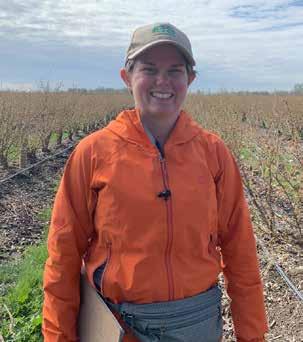
McFarlane is an integrated pest management (IPM) consultant for ES Cropconsult, an IPM company in British Columbia that does that province’s portion of the Canadian potato variety trials, and is the national coordinator for the variety trials.
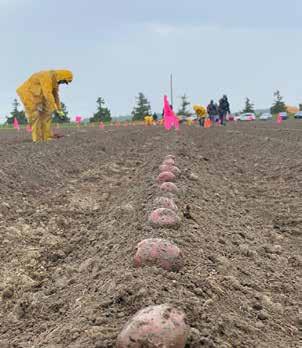
There’s a lot of planning and data recording that goes into the Canadian potato varieties trials each year. This is necessary, as this information is vital to track the performances of different varieties over multiple years, in different places and with varying weather, soil, etc.
Jen
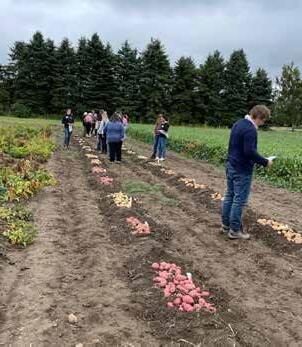
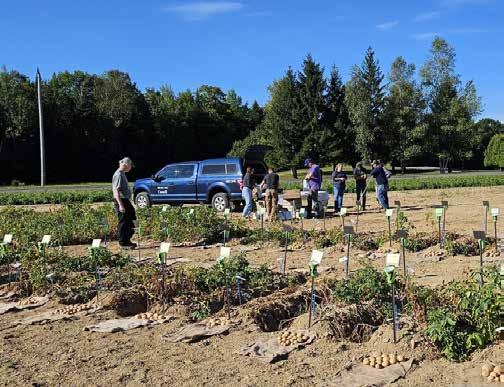
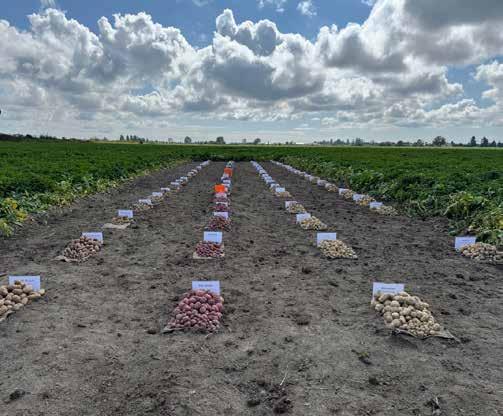
During the Canadian potato variety trials, field days – like this one in Ontario – are an opportunity for stakeholders to come out to the growing sites and see firsthand how the trials are being conducted, and how the different varieties are doing in real-world conditions.
Update on the 2025 Canadian potato variety trial presented at Canadian Potato Summit
sense, as the weather was so favourable. The Dark Red Norland variety was grown in seven different sites, so there was a lot of opportunity for comparison.
With yellow varieties, Yukon Gold, which is the industry standard, had a better yield in Manitoba, but was lower in Ontario and Quebec. Colomba also did well in Manitoba.
Constance had great yields in the western part of Canada, but there wasn’t as much of a basis for comparison, as it wasn’t grown in many sites; this was also true of Alegria.
Russet varieties were split into two categories, processing and fresh. Burbank had a lower yield in the eastern provinces due to the drought conditions; the other three varieties looked at were mostly grown in western Canada, which again, had good results because of favourable weather conditions.
It was a similar story with white varieties; Eva, Alliston and Audrey were limited as far as where they were grown, so the comparison data is lacking; Audrey did produce well in BC.
Kennebec had a poor yielding in Quebec, but did much better in BC, Alberta and Manitoba.
As far as chip varieties are concerned, two old favourites – Atlantic and Lamoka – both performed well; so too did SP327, which did especially well in BC and Alberta, and McFarlane described as “a promising new variety.”
She added, “Maybe this is something we’ll be seeing a little more of in the future.”
There were two other speakers during the webinar. Dr. Chandra Singh, from Lethbridge Polytechnic, spoke specifically about the field trials that took place in Alberta, while Samuel Gagnon with Progest spoke about the variety trials in Quebec.
While Ontario’s varieties trials results were not covered in the webinar, the March 2026 Canadian Agriscience Cluster for Horticulture 4 update report did have some details about some new promising potato varieties that were found through the province’s varieties trials.
(The report, which discusses testing results for a number of commodities, can be read here: bit.ly/4rr9ILr)
F180085-04 was described as “a standout early to mid chip line with high yield and gravity and low sugar levels at harvest.” Furthermore, the report noted, this variety “reduces the likelihood of processors rejecting a crop due to high sugar levels.”
Meanwhile, AG1540 proved to be “the highest-yielding late-maturing fresh market line in trials,” and “VF180073-13 is highly resilient, ranking as a top yielder in both the standard and heat-stress trials. This variety allows growers to better manage the risks associated with increasingly frequent summer heatwaves.”
Three varieties – VF19006-002, AG1601.05, and Kingsman – “were found to be the strongest dual-purpose varieties for boiling and baking in trials,” according to the report.
Testing is currently underway for the 20252026 long-term commercial storage trials, the results of which are expected to be released in December 2026.
The varieties trials are a lot of work – not only at each individual site, but also considering the coordination that has to happen across the nation.
Also, “It takes a long time to get a variety from the beginning stages all the way to being a commercial variety that can be grown,” McFarlane said, adding that the process is generally 15 years from start to finish.
However, she added, there’s a lot of value in the work being done.
“It keeps Canada at the forefront of producing new varieties,” she said. On top of that, it gives the growers the opportunity to see firsthand what grows well locally for them.
It was an extremely dry growing season in the Maritimes during the 2025 Canadian potato varieties trials. While this is never easy for farmers to contend with, it did give an opportunity to see which varieties are more drought tolerant.
Many of the potato varieties tested in British Columbia did very well in the trials, as the weather conditions were very favourable.
When doing the ‘right thing’ environmentally can also be good business
By Jeff Tribe
Building your own solar panel array may pencil out.
And it can be done.
But there may be that moment of doubt should you find yourself on a lift 30 or 40 feet in the air with a chainsaw in your hands, felling a potentially-problematic tree in bits and pieces.
The first thought hadn’t been creating a renewable energy source. Rather, an oldschool wood cook stove to help raise winter temperatures in our porous 100-year-old-plus farmhouse with the redundancy of an electricityfree heat and cooking source.
Stovepipe in particular being more expensive than I remembered, the quote came in at $11,000. Certainly fair, but more than hoped for, and in the ramblings of an overactive imagination, a number moving into the realm of alternatives.
Fascination with renewable energy began as a videographer during Erie Shores Wind Farm construction, brought down to earth and rooted in practicality courtesy of ‘Windchasers’ Craig and Connie Cook.
The couple are top-five percentile environmentalists whose own progression began with homemade windmills on their Cornell-area property, transitioning to consistent and comparatively maintenancefree solar power and onward to radicallysustainable living in a prototypical Canadian earthship they built themselves on their Clear Creek-area farm.
Beyond their impressive resume is generous willingness to support others along a path they pioneered. Their years of tangible proof of concept dovetailed nicely with an interview with Ontario Green Party leader Mike Schreiner, who spoke to sustainability initiatives that make economic sense.
The equation in my head began with a rough component/final hook-up costing of around $15,000, which by valuing my labour at zero dollars and leaving a 33 per cent contingency
for the inevitability of things costing more than you think, came in at $20,000.
Years ago, in order to incentivize renewable generation, one could sign a contract providing an attractive rate for power produced, an option my cousin inherited with the purchase of a farm property. In general terms, the contemporary net-metering model instead reads both production and consumption. Producers ‘bank’ excess power and make withdrawals as needed. My - again, admittedly roughcalculations included production expectations through conversion of my cousin’s comparablysized system’s performance, and by monitoring production from my daughter’s own off-the-grid solar array.
The numbers revealed theoretical potential to meet both our and our son’s households’
needs with additional capacity to power a heat pump in our residence. Even if those numbers pan out, we will have a connection fee. However, grid connectivity does provide value by acting as the battery and back-up generator equivalent required in an off-the-grid scenario. One might argue - and I did - the combination represented a better return on the projected $20,000 investment than our mutual funds or GICs were providing. Practically speaking, decent ROI and 20-year return through lowered expenses as we head into retirement. In addition, the concept offered a renewablypowered replacement for the original wood stove concept, both a back-up and alternative to the forced-air wood furnace that is our main heat source, less wood to cut for a guy who is not getting any younger, and a warmer and therefore happier wife.
There are major considerations before turning theory into reality.
First and foremost, solar panel arrays generate voltage and current with potentially dangerous or deadly implications. Adequate knowledge, expertise and safety procedures are absolute requirements, not options.
One must obtain a contract with Hydro 1, in general terms, through confirmation there is capacity in your area’s system and your own individual connection. There are two size options with application for a (maximum) 10-kilowatt system comparatively simple compared to larger arrays, which require significant additional criteria.
Any system must be code compliant, per inspection, appropriate oversight ensuring function and safety. In short, components, design, protection and warning signage must meet standards.
There is also a ton of work involved if one is looking to offset costs with sweat equity - an appropriate term given this summer’s elevated temperatures. And as with anything, it always takes longer than you think.
Ground was broken on a project reflecting
In the rough equivalent of an artist signing his work, Craig Cook is photographed alongside the solar panel array his experience and knowledge led to.
Craig’s expertise and my Scotch (frugal) heritage. Twenty-four 405-watt solar panels (9.720 kilowatts in total) are mounted on aluminium rails held up by a framework of pressure treated six-by-sixes, two-by-sixes and two-by-fours. They are south facing in an open pasture field, close to the house.
Craig’s lived experience indicates preference for ground over roof mounting, based on cost and access during construction, if any repairs are required, and for snow removal. Solar production is dependent on hours of daylight, most efficient on cold, sunny winter days but will generate on a cloudy or rainy day and even through a coating of ice. However, they won’t through a covering of snow and groundmounted panels are much easier and safer to clear than those on a roof.
There were concessions to expenditure: purchasing an on-sale cement mixer during six-by-six anchoring and renting a lift rather than trusting a large maple tree which had to be removed would fall in the ‘right’ direction instead of taking out our hydro wires as it crashed onto the house.
Being a farm boy did come in handy, familiarity around knocking wood together, 50 years on the back of a chainsaw helping ensure tree limbs twisted and fell as hoped, rather than onto the house or power lines. Experience with a post-hole digger came in handy through 30 six-by-six holes and another 21 fence posts anchoring one-bysix white oak planks sourced from an Amish sawmill. The hand-held option was chosen in part for precision, in part because the ground was too hard for my power-takeoff unit to penetrate. And finally, digging the 120-foot, two-foot-deep trenches burying the wires leading from the panel arrays to the house with a shovel, rather than renting one of those really cool little backhoes, a decision admittedly second-guessed on day two.
Has it all been worth it?
Will it indeed pencil out?
To be honest, I’ll know more in a year, more five years after that.
You can google the dickens out of a thing and run every calculation you want and the proof will still be in the pudding, or in this case, the hydro bill or hopefully, lack thereof. I do believe the principles are sound, there is potential for it to work out, at least partially.
‘Fun’ might be a strong word, reminiscences of flirting with ‘the big one’ while hand-splitting maple blocks or slopping concrete around six-by-sixes. But there is definitely a sense of satisfaction.
It’s a bucket list thing consistent with the belief those of us with access to the space and technology required, might understand that doing the ‘quote’ right thing environmentally can also be good business.
And it’s pretty cool when those two can meet.
An aerial shot of the Tribe family’s 9.720 kilowatt solar panel array.
Ontario Agri-Food Discovery Centre releases early concept drawings for future STEM-based learning centre
By Amanda Nelson
At the Ontario Agri-Food Discovery Centre’s 2026 annual general meeting March 26, board chair Steve Dolson introduced the team from Moriyama Teshima Architects, which developed concept designs for the future 10-acre site in Listowel.
The Ontario Agri-Food Discovery Centre aims to become a place for learning and play that showcases the innovation and importance of the agriculture and agri-food sector across Ontario, while highlighting what Huron and Perth counties have to offer.
Although still in the conceptual phase, the centre is already drawing attention and praise from local politicians, including Matthew Rae.
“This centre will showcase the strength of Ontario’s agri-food sector and the people behind it,” he said. “It’s an industry that drives our economy and puts food on our tables every day.”
The STEM-based centre is envisioned as a hub for science, education and community engagement, promoting curiosity and bridging the gap between consumers and agricultural practices. It will also highlight diverse career opportunities in the agri-food industry.
At the meeting, plans were discussed for an expanded facility, growing from 20,000 square feet to 34,000 square feet, with estimated costs increasing to $38 million.
The board secured $100,000 in grants from the Gay Lea Foundation and the Agricultural Adaptation Council, allowing the project to move forward with architectural proposals and the concept phase.
A total of 41 proposals were received before selecting Moriyama Teshima Architects. The overall project is expected to raise $40 million to $50 million, including $100,000 for concept design, $300,000 for planning and $150,000 for fundraising support.
The firm has worked on a number of civic and cultural institutions, including the Canadian War Museum, the Aga Khan Museum, the Discovery Centre and the Honey Bee Research Centre. They are currently leading new design work at Science North, as well as the Rouge National Urban Park Visitor, Learning and Community Centre.
Their approach to the project focuses on helping the public better understand Ontario agriculture and making food systems more visible.
“Food is everything. Food is national security.
strength and its community stability, and yet, for something so fundamental to our lives, much of this food system remains invisible to the public.”
He reiterated that the centre is about making the agri-food system visible to everyone, including those in urban centres, like Toronto.
“It’s a place for agriculture, technology, sustainability and education to come together — a place where Ontarians can better understand the land that sustains them, the systems that support it and the innovation shaping its future,” he said. “While the building is about agriculture, it’s also a civic institution about stewardship. It reflects resilience, and it’s about the future of food in Ontario.”
Olivia Keung, director of sustainability, said the concept will focus not only on the agri-food sector but also on sustainability and land use.
“Our projects focus on public engagement, learning and connections to the landscape,” she said. “We were inspired by the conversations during the tour and throughout the months we have been working together with the board, and we are deeply committed to sustainability and innovation.”
Keung said sustainability is a top priority for the concept.
“Architecture must embody environmental sustainability. That same belief — that buildings can actively demonstrate stewardship, innovation and responsibility to the land — is central to how we approach the Ontario AgriFood Discovery Centre,” she said.
The project began in 2020 with a feasibility study conducted for the Municipality of North Perth. A non-profit organization was formed in 2021, gained charitable status in 2022 and developed a strategic plan in 2023. In 2024, the Municipality of North Perth committed 10 acres of serviced land as the project expanded to a provincial scope.
The board plans to launch a capital campaign next year.
More information is available at oafdc.ca.
Pictured, from left, Ehsan Naimpour, Diarmuid Nash and Olivia Keung from Moriyama Teshima Architects and Steve Dolson, board chair announce new concept designs of the Ontario Agri-Food Discovery Centre at the 2026 AGM in March.
Another Ayr-area Jersey family receives Jersey Canada’s Honourary Life Member Award
By Diane Baltaz
An Ayr-area couple who established a new Jersey line 40 years ago joined Jersey Canada’s Honourary Life Member roster in March.
Brent and Betty Butcher of Brenbe Jerseys are one of two recipients of the 2026 Jersey Canada Honourary Life Member Award.
This award is a member-nominated recognition of a Jersey Canada member’s long-term leadership contribution to the Jersey breed.
States the Jersey Canada press release about the Butchers, “Brent and Betty represent three generations of dedication to the Jersey breed, building on the foundations of Bell City and Granclare (two historic herds in the Brant County region) to establish Brenbe Jerseys in Ayr in 1986. Brent’s passion for Jerseys began in childhood and continued as he helped Granclare achieve its Master Breeder Award in 1984 before developing Brenbe into a top-tier herd.”
The Jersey Canada press release states that Brenbe bred more than 70 cows that achieved the Excellent cows status, including multiple Supreme Excellents, All Canadian nominees and high scoring descendents of early purchases.
Brenbe’s success also includes numerous Silver and Gold Production Awards, Lifetime Production records, two Constructive Breeder Awards and a Jersey Canada Master Breeder title in 2017.
In addition to being active at the Paris Fair, Brent has led local fairs and supported 4-H, encouraging young exhibitors, often transporting some calves to local shows himself.
“Today, Brent and Betty’s three children continue the Brenbe legacy and passion for Jerseys with their own ventures. The couple remains actively involved where they can,” adds the Jersey Canada press release.
Brenbe Jerseys’ Facebook page describes their farm as a tie stall operation located on the Brant-Waterloo Road.
This is the second, consecutive year that an Ayr-area Jersey family earned Jersey Canada’s Honourary Life Member designation. In 2025, their neighbour, George Kyle of Ash Lawn Farms on Brant-Oxford Road received this honour.
Jersey Canada’s second 2026 Honourary Life Member recipients are Roger Ray and Diane Jarrell Ray of Hollylane Jerseys, Bellville.
Jersey Canada presented the awards to both couples at its annual general meeting in Ottawa in late March.
Brenbe Jersey’s farm on the Waterloo-Brant Townline Road.
Brenbe Farms also was rewarded with twin heifers this winter.
Diaries prove instrumental in providing an orderly succession for Scotland wholesale vegetable operation
By Diane Baltaz
After more than 40 years of growing vegetables and flowers, Bill Boot epitomized the successful farmer. In partnership with his wife of 37 years, Marianna, Bill developed a thriving wholesale vegetable operation with produce selling to multiple local markets and grocery chains across Ontario. The “Boots Blue Label” on their squash – their primary crop – became
Bill’s special pride.
His sons, Chris, Mike, and Jacob, now 30, 27 and 25 respectively, joined the operation after finishing school.
Bill’s farm-love began almost at birth, after his parents, John and Jacoba, bought a 24-acre parcel of land near Freelton in 1957, several years after emigrating from Holland. The family grew multiple vegetables for retail markets,
including pickling cucumbers, rhubarb, leeks, potatoes, cabbage, and asparagus. Keen on farming, Bill quit high school in order to work alongside of his father; he introduced squash, gourds, ornamental corn and squash and switched marketing to wholesale only.
Boots Farms relocated to a 160-acre former tobacco farm on the 13th concession near
You don’t have time to wait around for weeds to react. With Insight® Liquid SC, your pre-seed burndown happens fast, giving you a cleaner field and a head start on the season. Make this spring your fastest start yet with The Fastest Burndown, Insight Liquid SC!
Marianna Boot and her sons (left to right) Jake, Mike and Chris.
Bill Boot with his Boot Blue Label standing in his leeks.
Diaries prove instrumental in providing an orderly succession for Scotland wholesale vegetable operation
Scotland in 1990, gradually expanding the operation to 600 acres of owned and rented land. Boot obtained a booth at the Ontario Food Terminal (OFT), which became their primary sales venue.
But then Bill, 68, died unexpectedly a month after a routine surgery in December 2022.
It’s a loss that the close-knit family still feels. His untimely death just before the impending crop year jolted the family’s succession process: Boot’s core involvement in the farm needed to be replaced quickly.
Nevertheless, Boot’s entrenched passion for crops remained. According to the family, Boot’s legacy enabled them to quickly move into the 2023 planting, which usually begins in their greenhouses in February.
It starts with the family’s conversations — they frequently quote Boot’s maxims about why they practice various growing and marketing strategies.
Also, the family didn’t worry much about obtaining their 2023 crop supplies while they grieved.
“Bill already had everything ordered for the crop season,” said Marianna, who now oversees the entire operation. “He was a farmer all his life – things came naturally to him – he had everything organized.”
Immediate critical assistance came from their labour, notably the 30 Mexican workers who steadfastly worked under Boot for 15 to 20, and in one case, 25 years. Boots Farms’ operation is labour-intensive from seed to harvest: most plants are handled several times from seeding in approximately two acres of greenhouses, to transplanting and then hand harvesting each plant.
“They’re like family for us,” explained Marianna with emotion. “They were so instrumental for us after Bill’s death. They sent flowers to us from Mexico. They said that they’d make it (crop season) work. They came back. They know the work.”
The most instrumental windfall, according to all three sons, is the detailed farm diary that Bill kept. It is their primary reference book.
“Dad kept a daily journal of his farming activities -- right down to the amount and type of fertilizer he put in his tanks, about the greenhouse and weather conditions. It helped us to compare situations,” said Jacob.
“Bill was training them all the way. He was proud of the way his sons were stepping up as they matured,” said Marianna.
“But the journal is the key”, said Chris.
Each Boot performs specific responsibilities: Chris handles the office work, food safety and the majority of the tractor work; Marianna handles the procurement of local contract labour, which varies from 25 to 70 people annually, and bookkeeping; Jacob is the pesticide applicator and tackles greenhouse duties when Mike is at market.
Mike is the marketer, having begun this responsibility under Boot in 2018. Boot was then slowly retiring from the OFT work, hiring a salesperson to do some marketing, in order to focus on the farm. Marianna said that after Bill was off the scene and only attended the market when needed, some regulars at the terminal actually told her spouse that they “prefer dealing with Mike.”
Currently, 90 percent of their sales occur at
the Ontario Food Terminal, with Boots Farms’ own drivers and trucks delivering produce immediately after picking. Most of their buyers are what Marianna described as “small, familysized vendors”; although grocery chains, including Longo’s, Metro and Wal-Mart carry product, often sold the produce through thirdparty wholesalers.
Despite his pride in finding his blue Boots Squash label in area chain stores, Boot repeatedly stressed that their future depends upon smaller, independent retailers, who constitute the bulk of sales.
“Our dad used to say that our little customers are as big to us (as the chains) and so there’s so many of them we couldn’t do without them,” said Mike. “And the small Indies are there (at the OFT) every day.”
The family also custom grows plants for a few farmers.
Significantly, hot pepper production is increasing. “The hot pepper market is really taking off,” said Jake.
Boots Farms grows most of the crops that grew in Freelton. They form some of the greenhouses’ earliest February plantings, including leeks, marigolds, peppers, squash, basil, kale, cucumbers, some large-sized patio
and hanging flowers, and hot peppers.
Each seed tray holds approximately 300plus seeds, using soil from New Brunswick peat bogs.
The family does early greenhouse seeding and then transplants vegetables such as squash, rather than direct seeding them into the field. It gets product to market several weeks earlier.
“Bill wanted to be the first one on the market,” said Marianna.
Similarly, Boots Farms uses approximately five acres of “high tunnels” – portable greenhouselike structures which enables the family to roll the sides up and down according to weather conditions. They are mainly used for early peas, beans and peppers.
Drip line irrigation is used in accessible fields to conserve water during dry spells. Harvest crews handpick product for superior quality.
“Machine-picked beans may exhibit bruising on the following day,” said Chris.
Surplus produce goes to food banks in Brantford, Hamilton and a local church.
The Boot family continues to grow. Mike and his wife Shala, have Sawyer, now a toddler, while Jacob is married to Heather. There are also two recent grandchildren.
Meet our Agriculture Services Specialist
We know that farming is more than a business - it’s a way of life. We are committed to serving Canada’s farm communities by providing flexible financial solutions that let you get on with the business of farming. We’ll take the time necessary to understand your unique needs. Together we can meet today’s challenges and anticipate tomorrow’s opportunities.
Relationship Manager
Boots Farms’ Facebook states that Oscar, who manages the bean crops, has come annually from Mexico since 2009.
Phragmites is Canada’s most invasive plant
By Alice Guthrie Phragmites australis,
also known as the European Common Reed, are tall perennial grasses with fluffy flower heads – quite pretty to look at, but that is the only good thing we can say for them.
These are invasive plants that are establishing large stands in wetlands and beaches in Southwestern Ontario, and across eastern North America. Phragmites is an aggressive plant, spreading rapidly and releasing toxins at the root level which interfere with and compete with native plants, hindering growth and killing them. It prefers standing water, but has a long root system which allows it to survive in drier areas. It has been considered Canada’s worst invasive plant since 2005.
The plant has been in Ontario for decades. It is unknown how it was transported here from its original home in Eurasia.
Decreased biodiversity, increased fire risks from stands that contain a high percentage of dead stalks, issues with road safety due to blocked vision, and impacted recreational activities (swimming, boating, angling) are some of the detrimental effects these plants have.
The plants are huge,-growing fast to a height of up to five metres (15 feet) and forming dense stands – up to 200 stalks per square metre. Stems are tan or beige in colour; leaves are blue-green, seedheads are large and dense. It does not provide good habitat or food sources for wildlife.
It is easy to confuse these invasive phragmites with a closely related native species. The native version does not grow as tall and will co-exist with other native species. It does not form as dense a stand and is usually mixed with other plants. The colour is different – generally a reddish brown stalk with yellow-green leaves and a smaller seed head.
Invasive phragmites is restricted in Ontario, as the province attempts to prevent the further spread of the invader. Check more info and regulations on: www.ontario.ca/invasionON. It is illegal to buy, sell, trade or grow these plants.
Control of these plants is coordinated among several groups. One province wide initiative is:
“Green Shovels is a collaborative of like-minded conservation organizations, and a collection of projects designed to achieve job creation, economic recovery, and environmental progress while addressing invasive species issues,” the web site states.This coalition includes Ducks Unlimited Canada, Federation of Ontario Cottagers Associations, Invasive Species Centre, The Nature Conservancy of Canada, Ontario Federation of Anglers and Hunters, and the Ontario Invasive Plant Council.
Long Point has been a primary battleground against these invaders as they have been identified as a major threat to biodiversity in the area. A multi-partner alliance, including the Nature Conservancy of Canada (NCC), The Ministry of Natural Resources and Forestry (MNRF), and Environment and Climate Change Canada (ECCC) in partnership with the Long Point Phragmites Action Alliance (LPPAA), has worked since 2015 to address the impacts of
phragmites and protect the region’s important wetlands, considered globally significant. For more information check out this website: https://longpointphragmites.ca/phragmites/ The group’s success rate has been excellent, and most of the high density phragmite stands have been eliminated.
Another resource is The Invasive Phragmite Control Centre www.phragcontrol.com. Nicole Leversidge explained that methods of control include cutting to drown … if the water is deep enough, the plant can be cut and the root system drowned. Success depends on the depth (60-80 cm of water is needed) and on the clarity of the water - murky is best, as sunlight is less able to penetrate, and there is more sediment. There is also a herbicide that can be used in wet areas.
Long Point has been a primary battleground against these invaders as they have been identified as a major threat to biodiversity in the area.
On dry land, a terrestrial herbicide is sprayed on mature plants so the herbicide is carried to the roots with the goal to kill the root system … this gives 85-98 per cent mortality.
While in an area where phragmites grow, stay on trails and keep pets leashed. When leaving, remove mud, seeds or plant parts from clothing, vehicles (including bicycles or ATVs), pets, horses and mowers to avoid accidentally spreading it through its root fragments and seeds. Composting these plants at home is also discouraged, as both seeds and rhizomes can survive home composter temperatures. Report locations of phragmites to Invading Species Hotline at 1-800-5637711, or visit EDDMapS to report a sighting.
A final note: Burning phragmites is a bad idea - it burns fast and hot and large stands can ignite into large fires. People have lost houses from this idea.
Aylmer Burford Ingersoll
Close-up of a phragmite seed head.
Original Junior Farmers of Ontario “Centennial Project” continues into 2025 with additional Century Farm signage
By Diane Baltaz
What began as a Junior Farmers’ Association of Ontario (JFAO) project as a Canadian Centennial project in 1967 continues into the 21st century.
In 1967, the JFAO recognized interested families that had working farms for at least 100 consecutive years with a designated metal sign to post by their laneways. The metal signs featured a red barn under a multi-coloured abbreviation of Ontario along with 1967 inscribed on it. Because the “O” in Ontario was larger than the rest of the letters, the signs were sometimes nicknamed as “O-Century Farms.”
The Century Farm sign project remained popular long after 1967, and continued into the millennium. Constructed of aluminum, each sign measures16 by 19 inches (40.6 by 48.26 cm) and is identically printed on both sides, with the JFAO logo replacing the 1967 inscription. They are also available in French.
As Canada passed the 150-year mark in 2017, new century farms arose, in addition to farms that have remained in the same family for more than 150 years or event 200 to 250 years.
To celebrate these milestones, the Junior Farmers Association released
additional “ad-on signs” of 125, 150, 175, 200 and more recently, 225 years. These ad-on signs are erected underneath the original Century Farm sign.
The JFAO website states that these signs were custom designed by Junior Farmer member Becky Bouwmeester, with other members creatively writing the slogans. The add-on signs are offered in black and white, and are designed to hang under the Century Farm Sign.
In order to be designated as an Ontario Century Farm, owners must follow certain criteria. Direct descendents of the same family must have owned the farm for 100 consecutive years, and still be living on the farm and actively farming it.
The application to the JFAO head office in Guelph must be accompanied with copies of land registry records, or have their documentation verified by the JFAO Provincial Director for the area where the farm is located.
The current cost per sign is $100 plus shipping according to the JFAO website. Ad-on signs cost $50 plus shipping.
Contact information regarding the program is available online at www.jfao. on.ca/contactus
This century farm sign at the Rick and Joanne Boyce farm near Kelvin also has an add-on sign indicating 125 years. The Boyce family farmed the land since 1864.
Enjoying the fruits of their labour
Horticulture is agriculture at Creek View Acres Brant
The Creek View Acres orchard is home to apples, stone fruit, and raspberries, all planted by John and Christi, with the help of family and friends.
By Laura Richardson
It’s often said that farming is in the blood.
For Creek View Acres Brant owners, John Bisaillon and Christi Garneau, this seems to be the case.
Christi’s grandfather and great-grandfather were nurserymen and small fruit specialists on their Northumberland County farm, and John grew up growing sod on his grandparents’ Governors Road farm. For a time, they
pursued careers in contracting, but that call to farm is a strong one, and in the summer of 2020, they purchased land with the intention of returning it to agricultural production after a 50-year hiatus.
Today, their farm is their primary focus, having built the nursery and orchard. Undaunted by having less than 10 workable acres, the couple quickly set to work planting an orchard consisting of more than 25 apple
varieties, cherries, peaches, plums, nectarines and raspberries. Their nursery grew from seasonal herb and vegetable plants in the earlier years, to container growing cold-hardy perennials and shrubs, now emphasizing fruit trees and berry bushes and the most unique ornamental varieties.
For visitors to the farm who come to their open houses, garden tours, and family-
John enjoys working outdoors as a benefit of farming, and relishes deepening his knowledge about fruit tree care with each passing season.
Although Christi did not grow up farming herself, the farm is now her primary focus, having built the nursery and orchard business with the skills she gleaned working in public sector governance and with John’s contracting firm.
Enjoying the fruits of their labour
friendly events, the scene is picturesque with a 140-plus-year red barn overlooking the orchard on one side, and a managed forest situated along Fairchilds Creek on the other. Farm visitors often also frequent “The Nook”, their farm-based storefront, where folks can enjoy ciders, jams, and jellies produced from the fruit grown in the orchard, along with candles inspired by the farm’s fruits and flowers.
Christi jokingly admits that, “Even though we believe you can always find room for another plant, we know that’s always not the case for everyone and The Nook gives returning clients another way to support us and bring something home from the farm.”
During the colder months, the couple
researching the farm’s history, and feels that she is reconnecting with her rural ancestors. In enabling more and more people to plant their own fruit trees and shrubs, they are themselves planting ‘seeds’ of the love of horticulture all over Brant County.
At their very core, The Creek View Acres team wants their clients to be successful. They enjoy it when clients return to the farm to share their stories and pictures of their plants from the nursery growing strong in their own back (or front) yards.
Oversupply and trade issues drive down dry bean prices for Ontario growers
By Amanda Nelson
The 2026 Ontario Bean Growers annual general meeting was held in Stratford last month, where dry bean growers from across the region came together to discuss growing concerns around exports, particularly trade, transportation and domestic demand.
Alvin Klassen of Dry Bean World outlined current challenges as Canada continues to navigate overproduction of black beans and ongoing tariff changes that are limiting trade and creating uncertainty for growers.
“In the last five years, we’ve experienced several severe ups and downs in commercial markets related to supply and demand, with the influence of producer and dealer pricing,” said Klassen.
Despite steady global demand for dry beans, many growers are finding it harder to turn a profit.
Prices across North America have dropped sharply in recent years — in some cases by nearly half — while input costs such as fuel and fertilizer have remained high.
“Throughout North America,
we are now sitting where bean prices are half of what they were three years ago, and the cost of production hasn’t gone down at all,” said Klassen. “In fact, seed pricing hasn’t gone down, and it’s making it very difficult to sustain production.”
The issue, Klassen said, comes down to supply and demand. A strong harvest has left a surplus of beans in storage — known in the industry as “carryover” — giving buyers less incentive to pay higher prices.
At the same time, export challenges and limited processing options in Canada are making it harder for farmers to move their crops efficiently, adding further pressure to an already strained market.
Jeff English of Pulse Canada said the organization is working to increase domestic consumption through its “Love Canadian Beans” campaign, which aims to raise awareness that many beans sold in stores are grown in Canada and encourage more people to include them in their diets.
“It’s not about telling people how to eat, but showing them how beans can be incorporated into everyday foods we already know and love,” said English. “It’s about giving some familiarity to supporting what we see as a great, sustainably grown Canadian crop.”
English added that advancements in bean processing technology could also help grow the domestic market.
“Now that we have companies extracting proteins and starches from pulse crops, we should have an opportunity to put more protein into different foods — not necessarily calling them beans, but using them as a high-protein ingredient,” he said.
Bill Rosenberg, parliamentary assistant to the minister of agriculture, food and agribusiness, also addressed growers, highlighting the significant role Ontario’s bean producers play in the province’s agri-food sector.
“Our agri-food sector now generates around $52 billion in annual GDP,” he said. “This is why Ontario is known around the world for safe, nutritious and delicious food.
“Eighty to 90 per cent of the beans grown here in Ontario are exported around the world, and that is something to be proud of,” he added.
Overall, the message to growers was clear: while global demand is growing, the industry must navigate trade instability, supply chain risks and the need to build stronger domestic markets to remain competitive.
By Luke Edwards
After another tumultuous year in global geopolitics, leadership with the Grain Farmers of Ontario painted a picture of an industry still very much concerned about the near future, but one that has also experienced a few key wins in the past 12 months.
Farmers from Haldimand, Brant, Hamilton and Niagara gathered last month in Caledonia for the GFO District 6 annual meeting. Presentations from various officials in the morning took place before The Weather Network’s Mark Robinson delivered an afternoon address.
Perhaps unsurprisingly, Canada’s rocky relationship with its American neighbours to the south remained top of mind.
“Without a doubt, the most effect we’ve seen is Donald Trump returning to the White House,” said Jeff Harrison, of the GFO.
In response to the tariff threats, Harrison said GFO officials stepped up advocacy, working with government partners on this side of the border, while also reaching out to corresponding groups in the U.S.
“We have a great relationship with our partners to the south,” Harrison said, adding collaboration with American grain industry groups led to a forceful push against trade barriers.
Despite that, Harrison said grain farmers in the province continue to face challenges.
“The threats to our industry are real,” he said.
There were some wins to celebrate, he added. Last year’s announcement of an extra $100 million for the province’s Risk Management Plan is huge, Harrison said. The bump from $150 million to $250 million is being phased in.
“It can’t come quick enough,” Harrison said.
Other wins he highlighted included getting the federal carbon levy removed, as well as the planned increase to the capital gains tax.
Even the recent deal between Canada
were shared. Overall, local areas were relatively close to their respective averages for soybeans, winter wheat and corn, though Neufeld said for individual farmers it depended a lot on when they got the rain.
The western half of the province fared better than eastern Ontario, Neufeld added, with almost every producer in eastern Ontario being in a claim scenario.
Governance changes
Farmers learned of a few governance changes taking place with GFO.
The organization joined the Grain Growers
eastern Canada remains unique.
“We see it as an addition to, rather than a subtraction from, what we do,” he said.
The organization’s vice-president of strategic development, Paul Hoekstra, also outlined some changes stemming from a governance review for GFO. The main change will see a new way of distributing delegates, which should see a more spread out distribution.
And while it’s not directly impacting them, Hoekstra said they’re monitoring the situation at Agriculture and Agri-Food Canada, where officials announced 665 layoffs last month as
Jeff Harrison, chair of the Grain Farmers of Ontario, speaks at last month’s District 6 GFO meeting.
Spotted lanternfly ‘an imminent potential problem’ for Canadian growers
By Tamara Botting
Despite its name, the spotted lanternfly isn’t actually a fly. Moreover, while it may look like a moth, it doesn’t fall into that category, either. In truth, these insects are plant hoppers, more closely related to stink bugs or water bugs.
More important than being aware of the particulars of their moniker, though, is keep an eye out for them, and reporting it if you do spot one, because they are a federally regulated invasive species to Canada.
The good news so far is that “there actually are no established populations yet in Ontario, or anywhere else in the country,” said Emily Posteraro, Program Development Coordinator with the Invasive Species Centre.
However, there have been sightings (which is when someone has reported what they suspect to have been a spotted lanternfly specimen), and interceptions (where a specimen has been confirmed to be a spotted lanternfly).
This record is publicly available on the Canadian Food Inspection Agency (CFIA) website.
So far, there has been no known breeding activity of these bugs in the province, but the sightings and interceptions are concerning.
“We know there’s higher pressure coming from their spread in the United States,” said Posteraro, adding that the spotted lanternfly can be found in 18 different states now, including border states like Michigan and New York.
“With that, it just makes it more likely that they could come up this way,” Posteraro said. “We know that we have both suitable plant hosts and suitable climate for them, so there’s no reason that they wouldn’t be able to survive here as well as they’re doing in parts of the United States, where they’re well established by now.”
The spotted lanternfly is native to China, India and Vietnam. It was first detected in the US just over a decade ago. The species thrives in warm, humid climates.
While the adults and nymphs always die with the frost, the eggs are another matter.
Posteraro noted that Natural Resources Canada is doing research to determine what the hard limit is for the eggs of the spotted lantern fly to survive in the cold; so far, the research has shown that the eggs are still viable after a few days of -25 degrees C (-13 F).
“There definitely is a threshold for how far north they could survive,” Posteraro said. However, “our warming winters obviously don’t help maintain that threshold.”
So, what is the concern with the spotted lanternfly?
Broadly speaking, they are a plant stressor, both through their feeding activity and their excrement.
“More specifically – especially from an agriculture perspective – they do seem to inflict a lot of damage on grape vines in particular,” Posteraro said, which they also have a high preference for – though the spotted lanternfly is documented to feed on over 100 different host plants, including native hardwood trees in Ontario.
Unfortunately, another invasive species – the tree-of-heaven plant – is another viable food source for the spotted lanternfly, and since “it’s
all over the place … we know they could be supported by tree-of-heaven” if they were to become established in Ontario.
Posteraro noted that the spotted lanternfly will feed on fruit trees as well, though they don’t seem to inflict as much damage.
“They’ll feed and they’ll move on,” she said. When it comes to grape vines, though, there is a definite threat to the plant’s health, “and then obviously, the grape and wine industry that are dependent on them.”
Even if other types of plants and trees aren’t as susceptible to damage, “It might still pose a problem for the orchard in terms of people visit, they maybe don’t want to see bugs all over it.”
Another possible economic impact from the spotted lanternfly could come if it’s found on nursery stock and certain types of wood products.
Posteraro noted that even if the spotted lanternfly wasn’t doing a lot of damage to the trees or necessarily killing off the nursery plants, “they can’t have (the spotted lanternfly) in their product and then be moving it, because it’s a regulated species at the federal level, so that would impact their operations.”
As far as trying to combat the spread of the spotted lantern fly, the main tool right now are the monitoring protocols, which can be found on the CFIA website, as well as on the Government of Ontario website.
“We say, ‘If you spot it, snap it, catch it, and report it,’” Posteraro said, adding that her organization always reiterates CFIA’s messaging, because they’re the leading federal body that has jurisdiction over the spotted lanternfly.
Snapping a photo
of the suspected specimen helps create a record of it, but ideally CFIA wants the actual specimen, because that’s how their labs are able to confirm the species. The specimen doesn’t have to be alive to be tested; Posteraro also noted that there’s no risk to humans of bites or stings from a spotted lanternfly.
Once you’ve preserved the specimen, contact CFIA – either through the website or your local office – for instructions on how to submit it.
Anyone wanting to learn more about the spotted lanternfly can access resources through the Invasive Species Centre, including an online course that is offered free of charge, and that participants can take at their own pace.
As for when the spotted lanternfly might get established in Ontario, it’s a bit uncertain – though it does seem to be a bit more of a question of ‘when’ rather than ‘whether.’
“It could be next year. We were expecting it this year; we were expecting it the year before,” Posteraro said. “It’s an imminent potential problem right now.”
The spotted lanternfly has been designated as a federally regulated invasive species to Canada.
If you see a spotted lanternfly, you’re asked to take a photo, capture it, and submit the specimen to the Canadian Food Inspection Agency (CFIA).
Ontario soybean farmers face price pressure in changing global situation
By Amanda Nelson
Ontario soybean farmers are watching global trade negotiations closely as uncertainty around exports — particularly to China — adds to price pressure in a market already facing strong global crop supplies.
Brazil is expected to have a record soybean harvest in 2026, a development that analysts say will weigh on prices worldwide.
“There’s forecast to be record production in Brazil, and when there’s strong production, that has downward pressure on price,” said Brian Innes, executive director of Soy Canada. “That’s the first thing to watch for prices in 2026. The second is what happens globally with geopolitics and tariffs.”
Innes said changes in trade relations between major economies — especially the United States and China — can have a direct impact on the prices Canadian farmers receive.
“Due to the Trump administration, tariffs on soybeans have changed,” he said. “One thing to watch for 2026 is how the situation between the U.S. and China evolves, and how the situation between Canada and China evolves. That can have an impact on price if tariffs change.”
More than 70 per cent of Ontario’s soybean crop is exported, with prices shaped by global demand, particularly from China. While China historically sourced much of its soybeans from the United States, it is increasingly turning to Brazil due to generally lower prices.
Canadian soybeans shipped to China have the same three per cent tariff as most other countries in the world. The United States paid tariffs at a higher rate, but a deal was recently struck between the two countries on soybeans.
“From a farmer’s perspective, there’s been a lot of geopolitical uncertainty injected into the market,” Innes said.
On the positive, he said there was a strong export of Canadian soybeans from the 2025 crop to China. He said there is still strong import demand for soybeans for animal feed and human consumption, and that he expected this to continue.
Brazil and the United States are the world’s largest producers of soybeans. Prior to Trump striking a deal in December, the U.S. could not ship soybeans to China, which meant American beans were sent to other markets. These markets overlap with Canadian export markets.
“That made it difficult for us to compete in other markets, such as Indonesia,” he said.
Innes recently returned from the annual trip to China, Japan, and Taiwan. It was successful, and demand is strong, but large crops in Brazil and the U.S. will have an impact.
The Canadian and U.S. soybean markets are also closely linked through cross-border trade and processing, which could also impact prices for Canadian farmers.
“Products flow back and forth across the border,” said Innes. “For example, Ontario
soybeans are shipped to Michigan, processed into soybean meal, and then shipped back into Ontario. Soybean meal and soybean oil trade back and forth across the border, and that’s why prices are very linked.”
Soybeans are priced on global benchmarks — particularly U.S. futures markets — meaning Canadian prices move in step with broader world trends.
“The price that Ontario farmers see is based on what conditions Canada faces when exporting to the world, including China,” said Innes. “In the past, the difference between Michigan and Ontario was largely tied to exchange rates, but now, with global trade disruptions, Canada and the U.S. face different tariffs and different market conditions.”
Despite growing competition from lowercost producers, Innes said Ontario remains well positioned as a high-quality soybean supplier.
Ontario is a global leader in identitypreserved and food-grade soybeans, a niche market that allows farmers to compete on quality rather than volume alone.
“We’re living in a time of unprecedented global uncertainty, and if market conditions change for Canadian soybean exports, that will have an impact on price,” said Innes. “But Canadian soybeans have been flowing under strong export conditions for some time, and that has meant strong demand for Ontario soybeans.”
Horse Tales
BY LISA WRIGHT
Spring cleaning for your horse and paddock
By Lisa Wright
An ounce of prevention is definitely worth a lot when looking after your equines, particularly through spring:
The sun’s warmth is getting stronger and we have more hours of daylight, but a sure sign of spring is the blanket of hair around your horse or pony after a good currying! Spring cleaning doesn’t just mean the house; there are important things to do to keep you and your horse healthy and safe.
With spring comes mud or wet conditions and pastern dermatitis, commonly known as mud fever or scratches: painful scabs and cracks usually starting around the heels or back of the pastern, sometimes extending up almost to the knees and hocks. If left untreated the horse’s legs will swell and ooze often causing lameness and the condition can become chronic cellulitis.
An ounce of prevention can save weeks of treatment or lost spring riding time. First, avoid having your horse or pony continually standing in dirty bedding, mud or wet grass. Ideally, have a well-drained area for turn-out during wet weather or heavy dew. Dry lower legs as necessary with a towel and apply a barrier cream before there is any sign of infection. Hair stylists rely on the effectiveness of barrier creams to protect their hands against both a wet environment and chemicals. A few drops of vitamin E oil and tea tree oil added to thick, zinc oxide-based diaper rash cream is an effective home-remedy to prevent mud fever or ask for barrier cream at your local tack or farm supply store. Apply a thin coat to the skin around the pasterns and heels daily. Horses getting frequent baths can benefit from drying their legs immediately afterwards and
spraying on a 50:50 mix of baby oil and apple cider vinegar. Bell boots, particularly used in the spring to prevent horses pulling shoes, can rub the pastern allowing bacterial or fungal access through the skin. Inspect your horses’ legs daily, particularly white ones, for any redness; this takes less time than treating even a mild case of mud fever.
Dry winter air is hard on equipment. Spring is a good time to thoroughly inspect halters, leads, tack or harness. Go over every piece of equipment you use on your horse, paying particular attention to the stitching while looking for dry rot, broken or loose threads. A timely, inexpensive repair can prevent serious injury. Clean and condition leather items, watching for any signs of wear, thinning or cracking. Repair or replace those pieces.
Often forgotten is your horse’s bit. Check any areas that swivel, making sure the joints are still snug and there are no gaps that might pinch your horse’s mouth or lips. Non-metal bits such as plastic, nylon and rubber need to be checked for damage like burrs and rough spots from the horse chewing. Look at the bit on a flat surface – is it still square and balanced? I have seen bits become twisted due to metal fatigue or the horse catching the bit or bridle on something and pulling. Check the bit rings – are they still round (or their proper shape) and of even thickness? If not, drop the bit off at a metal recycler and replace it!
Spring is a good time to walk your horse’s pasture or paddock and fence line, even if you board your horse. Look for loose fence boards, slack or hanging wire, protruding screws or nails and note these for repair. Learn to identify common plants, shrubs and trees that are toxic to horses. Red maple, buttercup, burdock and nightshades
are among these, and common in Ontario. Remove them if found. Effective prevention is having clean hay constantly available! Horses usually choose good hay over unhealthy plant options as long as they always have access to hay. Clean up any garbage that may have blown into the pasture over the winter, particularly if the fence line is near a road. Plastic bags can blow a long way and while your horse refuses to eat those expensive treats you bought, it just might taste test a plastic or potato chip bag. If you’re lucky, you might find a horse shoe or two as well!
It’s time to book spring vaccinations and do a fecal test to determine whether your horse needs deworming and with which product. By only deworming when necessary and using the appropriate active ingredient, we delay resistance in parasites and prevent quickly recurring infestation. Rabies vaccines are mandatory in Ontario for horses in public places like boarding stables, conservation areas and showgrounds. While there are exceptions for horses kept on private property, accessible only by their caretakers, if your horse can come into contact with bats, raccoons, foxes, skunks or coyotes why take the risk? Prevention definitely beats losing your horse to an untreatable disease. Your veterinarian will suggest other vaccines based on your horse’s age, risk in your area, whether and where your horse is travelling, and the frequency they come into contact with new horses.
Most of all, spring is the time to enjoy your horse after the cold, snowy, short days of winter! Perhaps learn a new discipline or polish your skills by attending a clinic? We are fortunate to have English, western, driving, in-hand and liberty clinics or lessons all available nearby. If you can’t bring a horse, consider auditing or attend theory-based clinics such as equine bodywork, nutrition, first aid or conformation. Have you always wanted to go overnight camping with your horse? Several places offering this are within a few hours’ drive. Invite some friends and plan your trip!
Make sure you’re prepared by schooling at a local obstacle course, a great way to safely introduce your horse or pony to things they would commonly encounter on trails. Even young or very green horses on a lead or lunge line benefit from these outings. If you would like to compete with your equine partner, check out your local Saddle Clubs, discipline or breed Associations or Pony Club. Competitions always need volunteers; a great way to meet new people, observe what is expected before you attempt it, or encourage the next generation of equestrians. Recently while judging a show, my scribe was a former Olympian. Therapeutic riding and equine assisted learning programs also rely heavily on volunteers. Whether you’re highly experienced or just learned the difference between a halter and bridle, events need you!
Have fun, stay safe, thank your horse or pony for the privilege of their companionship.
Moose Lodge Farm to Table
BY LAURA RICHARDSON
By Laura Richardson
Soon, our gardens will be bursting with produce. Soon, it will be our own cucumbers and leaf lettuce in these recipes. Soon, leaves will bud on the trees and rows of green will defy gravity sprouting from fields. Until that time, we can begin to think of days with bright sunshine and green grass. Inspired by the colours of the sun and the grass, both of which we will see more of very soon, I have included here three tried and tested recipes enjoyed here at the Moose Lodge Farm.
The first is a sweet-savoury combo which features oranges. On a wonderful visit to see child sponsorship in action a few decades ago in Kenya, I was stunned to be served green oranges and learned that some oranges are actually green-skinned. That’s right; some oranges don’t come with orange on the outside naturally. In fact, the green pigment is due to chlorophyll which is therein to protect the fruit from sun exposure!
It is only because we North Americans associate green with fruit not being ripe that many of the ‘orange oranges’ we get today are treated with dyes, cold-shock treatments, or ethylene gas in order to make them have eye/ purchase appeal. Thankfully, we don’t often eat the rinds, and this recipe just calls for the vitamin rich insides!
The second recipe is a poppyseed salad dressing, which is far cheaper and healthier than the grocery store varieties. You can play with the flavours by using different oils and vinegars, but if you don’t mind the flavour of olive oil, the health benefits of this dressing does go through the roof.
Interestingly, poppy seeds are an underrated superfood, possessing qualities which are touted to help with heart health (good fats), bone health (they have high calcium), sleep help, anxiety reduction and even better digestion.
Elbows up was a huge push last year, and farmers did reap some rewards, but it has been
difficult to support local through a Canadian winter. Although we don’t currently grow a great deal of produce in Ontario during this season, year-round our dairy cows are producing Canadian milk and cheese products, and the third recipe is a good supporter of the important dairy industry.
Not only does buying Canadian dairy help our local farmers, but it is also healthier since a zero-tolerance policy for antibiotic residue in milk is strictly adhered to, and every tanker of milk is tested before being accepted in Canada. Know where your food comes from with this healthy “Super Easy Greek Dip”, great for parties or to pack in lunches!
Sunny-Side Breakfast Accompanyment
Four oranges, peeled, pith removed, sliced
1 T. olive oil (or less strong oil if you don’t like olive flavour)
1/8 t. Salt
1 T. honey
½ cup light cream cheese
4 slices quality, seedy toast
Pour 1 T. olive oil over orange slices and put in a 400 degree oven for 10 minutes. Toast bread slices and then spread cream cheese evenly over each slice. Put orange slices on top of the cream cheese and sprinkle with salt. Drizzle with honey and serve warm.
Beat The Winter Blues Poppyseed Dressing
8 T. vinegar
The other half of the onion, diced small
5 T. honey
3 T. poppy seeds
1 T. dijon mustard
¾ t. Salt
4 T. mayo
¾ cup olive oil (can substitute other)
This can all be mixed up in a Mason jar with a few good shakes, and stored easily that way too!
Super Easy Greek Dip
1 container of hummus
1 container of tzatziki sauce
½ cup green pepper, chopped (or hot pepper if you prefer)
½ cucumber, chopped
½ cup slices olives, chopped
1 cup of crumbled Canadian feta
Optional: green onions, diced small for garnish
Mix hummus and tzatziki and pour in a bowl. Layer the other ingredients. Serve with nachos or Triscuits or any cracker that can hold up to a big scoop of deliciousness!