Volume 3 | Issue 1
January 9, 2026
A NEW YEAR’S RESOLUTION FOR YOUR GRANGE by Philip J Vonada
National Grange Communications Director
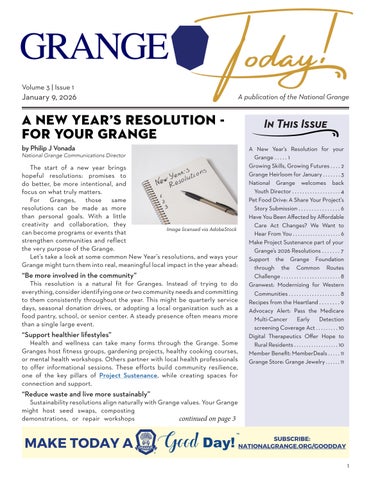
The start of a new year brings hopeful resolutions: promises to do better, be more intentional, and focus on what truly matters. For Granges, those same resolutions can be made as more than personal goals. With a little creativity and collaboration, they Image licensed via AdobeStock can become programs or events that strengthen communities and reflect the very purpose of the Grange. Let’s take a look at some common New Year’s resolutions, and ways your Grange might turn them into real, meaningful local impact in the year ahead:
“Be more involved in the community”
This resolution is a natural fit for Granges. Instead of trying to do everything, consider identifying one or two community needs and committing to them consistently throughout the year. This might be quarterly service days, seasonal donation drives, or adopting a local organization such as a food pantry, school, or senior center. A steady presence often means more than a single large event.
“Support healthier lifestyles”
Health and wellness can take many forms through the Grange. Some Granges host fitness groups, gardening projects, healthy cooking courses, or mental health workshops. Others partner with local health professionals to offer informational sessions. These efforts build community resilience, one of the key pillars of Project Sustenance, while creating spaces for connection and support.
A publication of the National Grange
In This Issue A New Year’s Resolution for your Grange . . . . . 1 Growing Skills, Growing Futures . . . . 2 Grange Heirloom for January . . . . . . . 3 National Grange welcomes back Youth Director . . . . . . . . . . . . . . . . . . . 4 Pet Food Drive: A Share Your Project’s Story Submission . . . . . . . . . . . . . . . . 6 Have You Been Affected by Affordable Care Act Changes? We Want to Hear From You . . . . . . . . . . . . . . . . . . . 6 Make Project Sustenance part of your Grange’s 2026 Resolutions . . . . . . . 7 Support the Grange Foundation through the Common Routes Challenge . . . . . . . . . . . . . . . . . . . . . . . 8 Granwest: Modernizing for Western Communities . . . . . . . . . . . . . . . . . . . . 8 Recipes from the Heartland . . . . . . . . 9 Advocacy Alert: Pass the Medicare Multi-Cancer Early Detection screening Coverage Act . . . . . . . . . 10 Digital Therapeutics Offer Hope to Rural Residents . . . . . . . . . . . . . . . . . . 10 Member Benefit: MemberDeals . . . . . 11 Grange Store: Grange Jewelry . . . . . . 11
“Reduce waste and live more sustainably”
Sustainability resolutions align naturally with Grange values. Your Grange might host seed swaps, composting demonstrations, or repair workshops continued on page 3
1
Growing Skills, Growing Futures Rural Life Initiative grants at work by Philip J Vonada
National Grange Communications Director
In the summer of 2025, two Granges were selected from across the nation to receive the National Grange’s largest Rural Life Initiative (RLI) grants—$5,000 awards supporting projects running from July 1 through December 31, 2025. Dry Creek Grange #646 in Washington and Little Lake Grange #670 in California took different approaches, but both demonstrated what’s possible when local leadership, community partnerships, and committed members come together around a shared vision for rural vitality.
From spring garden builds and summer tours to fall seed-saving events and winter wellness programming, the project emphasized practical, accessible skills. Participants learned how to grow food and herbs in small spaces, prepare frugal meals, make teas and remedies, and save seeds for future seasons. Twelve free public events were held during the grant period alone, all rooted in the idea that food security begins with shared knowledge. The project also responded directly to community need. When SNAP benefit cuts threatened local families, Little Lake Grange hosted a well-attended Food Security Town Hall that brought together county officials and food distribution agencies. That conversation sparked continued collaboration and future programming, reinforcing the Grange’s role as a trusted community leader.
Little Lake Grange: Cultivating Food Security and Wellness
Little Lake Grange’s Grange Garden Education Project transformed a patch of hard clay soil into a living classroom—one that reached hundreds of community members through free garden tours, hands-on classes, and seasonal workshops focused on herbs, food, and family wellness. Community members attend the fresh basil class, where they were able to use produce from the garden. Photo provided
What they learned: • Hands-on, sensory learning (touching, tasting, smelling plants) builds confidence quickly. • Gardening and wellness programming attracts families across generations. • Flexibility matters—being able to pivot programming in response to urgent community issues strengthened trust and relevance. Member engagement: Little Lake Grange recorded more than 700 volunteer service hours tied to the project, with members leading classes, maintaining the garden, creating The garden builders of Little Lake Grange get to work. continued on page 5 Photo provided educational materials,
2
www.nationalgrange.org
Grange Heirloom for January Use the Grange Heirloom Program to teach your members and the community about some of the key cornerstones of the Grange. Materials are available at http:// www.nationalgrange.org/heirloomprogram. You are welcome to choose any of the Grange Heirlooms at any time. We are currently in “Year D,” which runs through February 2026. The final year in the Heirloom Program cycle will begin in March. Use the hashtag #GrangeHeirloom when you share these important pieces of our work and history on social media.
Resolutions
continued from page 1
that encourage reuse instead of replacement. Community clean-up days or educational programs on reducing household waste can also reinforce the importance of self-sustainability while producing visible, positive change.
“Learn a new skill”
Skill-sharing is one of the most powerful and easily accessible tools Granges have. Our members possess a wealth of knowledge, from food preservation and woodworking to budgeting and emergency preparedness. Turning that expertise into workshops or demonstrations helps neighbors build confidence and practical skills while supporting Project Sustenance’s focus on self-sufficiency.
“Help address food insecurity”
Food security is at the heart of many Grange efforts and a cornerstone of Project Sustenance. Resolutions in this area might include expanding food drives to include fresh produce, creating or supporting community gardens, or partnering with local farms, farmers’ markets, and pantries. Some Granges organize regular free or low-cost meals or educational programs focused on cooking nutritious, affordable food.
“Be better prepared for emergencies.”
Preparedness is an increasingly important community need. A Grange resolution could involve hosting emergency readiness workshops, distributing preparedness kits, or working with local officials to share accurate information. These efforts strengthen both personal and community resilience and position the Grange as a trusted local resource.
“Be more engaged in civic life”
Civic participation is at the very core of Grange principles, rooted in education and respectful dialogue. This might include hosting nonpartisan community discussions, sharing voter education resources, or inviting local officials to speak about local issues and civic processes. By creating space for informed participation, Granges help strengthen local leadership and community resilience while continuing a tradition of grassroots engagement.
“Work better together”
Sometimes the most impactful resolution is internal. Improving communication, clarifying goals, or finding better ways to involve members in planning can strengthen a Grange’s ability to serve. Setting aside time at the beginning of the year to discuss priorities and capacity ensures that service projects are sustainable and shared, not shouldered by just a few. A New Year’s resolution doesn’t have to be ambitious to be meaningful. What matters is intention, consistency, and a focus on service. When Granges align everyday actions with community needs and with the shared vision of Project Sustenance, they continue a legacy that has endured for generations. As the year unfolds, remember: real impact isn’t measured by how much we promise, but by how faithfully we serve. One project, one partnership, and one act of care at a time, Granges continue to build stronger, more resilient communities. Here’s to a new year of purpose, action, and #GrangeStrong service.
www.nationalgrange.org
3
National Grange welcomes back Youth Director
by Philip J Vonada
National Grange Communications Director
Earlier this month, National Grange President Christine Hamp appointed Samantha Wilkins, a member of Alamo Grange #1446 in Texas, back to the role of National Grange Youth Director, where she previously served from 20222024. Wilkins steps back into the department which has been led by the Youth Advisory Team consisting of Jennie Gentry (NC), Jen and Ken Danko (PA), Samantha Hanson (IA), and Matt and Lynn Clark (NH) since 2024. A lifelong Granger, Wilkins brings deep experience and a strong commitment to youth leadership, advocacy, and service. She has served the Grange at every level— from local and state leadership in Texas to multiple national roles— most recently as National Junior Grange Director from 2016 to 2024. Wilkins also served on staff at the National Grange as Operations Coordinator from 2019 to 2022 and currently serves as Texas State Grange Secretary. “I am grateful and excited to return to this role,” Wilkins shared. “This position brings together my love for the Grange and my commitment to investing in the next generation. I look forward to building programs that help our youth grow as leaders and advocates for their communities.” In the coming year, Wilkins plans to focus on leadership development, strengthening youth advocacy voices, and expanding youth engagement through regional youth ambassadors. Her priorities center on helping young members understand their leadership styles, gain confidence in civic 4
engagement, and build meaningful connections across the organization. “Being part of their leadership journey, especially as they step into advocacy, service, and meaningful engagement, is incredibly energizing and rewarding,” said Wilkins. Wilkins believes that the Youth and Young Adult programs help strengthen the long-term sustainability of the Grange by intentionally devloping informed, confident leaders who feel connected, valued and prepared to serve. She hopes to continue investing in youth leaders of all backgrounds to build a pipeline of members who understand the Grange’s mission, are committed to its future, and are ready to step into leadership roles and invest back into the next generation of youth members. National Grange President Christine Hamp expressed her appreciation for the leadership that has shaped the youth program and her enthusiasm for Wilkins’ return. “I want to sincerely thank the members of the National Youth Advisory Team for their passion, dedication, and countless hours of service on behalf of Grange youth across the country over the past two years,” Hamp said. “I am delighted to welcome Samantha back into the role of National Grange Youth Director and look forward to the energy, vision, and leadership she brings as we continue investing in and building up the next generation of Grange leaders.” In the coming year, Wilkins plans to focus in three key areas: Helping youth identify their individual leadership styles and equipping them with opoprtunities to put skill into action; working with youth members to develop their legislative and advocacy voices; and building regional youth teams to help strengthen programming across the country. www.nationalgrange.org
A familiar face returns to the role: Samantha Wilkins of Texas has been reappointed as National Grange Youth Director. Photo by Lindsay Haggerty
For current youth and young adults, Wilkins has an important message to share: “Step forward even if you’re unsure. Leadership doesn’t require having all the answers; it begins with a willingness to learn, serve, and grow. Your voice, your ideas, and your passion matter, and the Grange is a place where you can discover your strengths, try new roles, and make a real difference alongside people who will support you. Say yes to the opportunity, trust the process, and know that the Grange is stronger when you are involved.” Wilkins can be reached by email at youth@nationalgrange.org.
RLI Grants and staffing events. Eight new members joined during the project period, many drawn in by shared interests in food, gardening, and wellness. How other Granges can replicate: • Start small with a demonstration garden or a few raised beds. • Pair garden tours with short “how-to” lessons. • Partner with local health, food, or cultural organizations to expand reach. • Use free, welcoming events as an entry point for deeper engagement.
Dry Creek Grange: Inspiring the Next Generation of Animal Care Professionals
Dry Creek Grange took a youthfocused approach, partnering with Clallam County 4-H to host a sixweek veterinary science program for students in grades 7–12. The program engaged 21 students interested in careers working with animals, including veterinary medicine and animal science. Through hands-on learning, guest speakers, and practical demonstrations, students explored animal health, care, and career pathways—many for the first time. The Grange hall became a place of discovery and possibility, reinforcing the relevance of the Grange to younger generations and their families.
continued from page 2 What they learned: • Youth programming works best when tied to clear career pathways. • Strong partnerships—in this case with 4-H—multiply impact and credibility. • Consistent, multi-week programming builds deeper relationships than one-off events. Member engagement: Dry Creek members stepped up as organizers, hosts, and mentors, ensuring the program ran smoothly week after week. Their involvement helped reintroduce the Grange as an active, youth-supporting presence in the community. How other Granges can replicate: • Look for existing youth organizations (4-H, FFA, school clubs) to partner with. • Choose a focused theme that reflects local interests or industries. • Commit to a series rather than a single event to build momentum and trust.
One Initiative, Many Pathways to Impact
While one project centered on gardens and wellness and the other on youth and animal science, both Dry Creek and Little Lake Granges exemplify the heart of the Rural Life Initiative: local solutions, locally led. Their projects strengthened food security, built community and personal
resilience, and encouraged selfsustainability—key pillars of Project Sustenance—while also energizing members and partners alike . Their successes show that there is no single “right” RLI project—only the right project for your community. Whether through growing food, teaching skills, or inspiring young people, these Granges proved that with vision, partnerships, and dedicated members, local ideas can create lasting rural impact. Granges interested in strengthening their capacity and preparing for future funding are encouraged to tune in to the Strategies to Strengthen Our Communities webinar series beginning on January 13, which will highlight practical tools, lessons learned, and real-world examples from successful projects.
Get RLI Ready Do you have an idea that might fit into the Rural Life Iniative mold? Here are some simple steps for success: m Start with a real community need What skills, services, or opportunities are missing locally? The strongest projects respond to what neighbors are already talking about. m Keep it accessible Free or low-cost events, clear messaging, and welcoming spaces lower barriers and invite new faces in. m Build partnerships early Work with schools, 4-H or FFA clubs, food banks, health organizations, libraries, or cultural groups to expand reach and share responsibility. m Track your story Document attendance, volunteer hours, partnerships, and lessons learned—these details strengthen reports and future applications. m Let members lead RLI projects succeed when members are empowered to share their skills, ideas, and time.
Students who participated in the veterinary course pose with presenters, including Ed Bauck, Clallam County Animal Control Deputy. Photo provided
www.nationalgrange.org
RLI opportunities are announced through National Grange newsletters, email, and social media — start planning now so your idea is ready when a new round launches.
5
Pet Food Drive
A “Share Your Project’s Story” submission by Bonnie Mitson & Randee Farmer
National Grange Community Service Co-Directors
Thank you to Ekonk Community Junior Grange #101 (CT) for submitting the electronic SHARE YOUR PROJECT'S STORY form located at https://www. nationalgrange.org/communityservice-programs/. Details of how the Grange accomplished their successful project are shared in this article. It is our hope that by sharing a project’s story, details might be helpful suggestions to other Granges on future projects. Thank you and great work, Ekonk Community Junior Grange! Project Name: Pet Food Drive Grange: Ekonk Community Junior Grange #101, Sterling, CT Approximate Hours Expended: 48 hours Junior Members: 10 (20 hours) Honorary Members: 8 (28 hours) Parents: numerous Store Employees: numerous Driven by their shared love of animals and a desire to give back, members of Ekonk Community Junior Grange came together to host a successful pet food drive benefiting local shelters. Several Grange families already dedicate their time year-round to animal welfare—volunteering at shelters and collecting bottle returns to support local causes—making this project a natural extension of their ongoing commitment. The effort was truly a team project. Junior members designed eye-catching posters, an honorary member created the event flyer, honorary members helped distribute materials throughout the community, and parents spread the word on social media to build momentum. The drive was held at a local animal supply store that has long supported the Grange’s annual service projects. Grange families staffed the event in two-hour shifts, welcoming donors and sharing the purpose behind the drive. By the end of the event,
Ekonk Community Junior Grange members and friends set up their pet food drive donation stand at a local animal supply store, raising $400 and a “generous supply” of pet food. Photo provided
the Junior Grange had collected a generous supply of pet food and raised $400, which was evenly divided between a local dog pound and a cat shelter. Through teamwork, creativity, and compassion, Ekonk Community Junior Grange turned their love for animals into meaningful community impact. Editor’s note: Do you like this kind of content? If so, be sure to check out Good Day! magazine which includes a “Share Your Project’s Story” in every issue. Please also submit your story online to the National Grange Community Service Team - the more stories that are submitted, the more frequently we can feature them. We know we can feature a story in EVERY issue of Grange Today!.
Have You Been Affected by Affordable Care Act Changes? We Want to Hear From You Across rural America, access to affordable, reliable of access to providers, or other challenges connected health care remains a critical issue for individuals, to ACA-related cuts, your story matters. Personal families, and communities. Recent changes and cuts perspectives are essential as the Grange continues its related to the Affordable Care Act (ACA), particularly advocacy work on behalf of rural Americans. the loss of enhanced premium tax benefits, have raised If you are interested in participating or would like new concerns—particularly for rural and small-town more information, please contact Legislative Director residents, farmers, and ranchers who already face Burton Eller. Your voice could help shape a larger limited options for care, coverage, and providers. The National Grange is seeking to better understand conversation—and future action—around health care how these changes are impacting real Grange members access and affordability in rural America. Your experience can help inform advocacy, education, and their families. If you or someone in your household has experienced higher costs, reduced coverage, loss and awareness. We encourage you to reach out. www.nationalgrange.org 6
Make Project Sustenance Part of your Grange’s 2026 Resolutions What is
Project Sustenance? Project Sustenance is the National Grange’s signature program, designed to align and elevate the community-based work Granges are already doing through three clearly defined pillars:
Food Security Food Security projects focus on improving access to affordable, nutritious food while strengthening local food systems. Granges may consider community gardens, seed libraries, food pantries, meal programs, or partnerships with local farmers, schools, and food banks. These efforts can address hunger, reduce food waste, and promote healthy eating, while reinforcing the vital role agriculture plays in every community. Food Security initiatives help ensure neighbors have reliable access to food today while building stronger, more resilient food networks for the future.
Community & Self-sustainability Personal Resilience Community & Personal Resilience projects help individuals and communities prepare for, respond to, and recover from challenges. This may include disaster preparedness efforts, mental health awareness, wellness programs, emergency supply drives, or activities that strengthen social connections and reduce isolation. These projects emphasize building strong relationships, local leadership, and support networks so communities are better equipped to adapt, respond, and care for one another during times of change or uncertainty.
Self-Sustainability projects build practical skills and longterm independence for individuals and communities. Granges might host workshops on gardening, food preservation, financial literacy, home efficiency, or skill-sharing across generations. Other ideas include tool libraries or repair events. By empowering people with knowledge and hands-on experience, these initiatives promote confidence, adaptability, and a culture of self-reliance that strengthens both individuals and the community as a whole.
Learn more and access ideas and resources at https://www.nationalgrange.org/projectsustenance www.nationalgrange.org
7
Support the Grange Foundation through the Common Routes Challenge Through April, the Grange Foundation is encouraging members and friends of the Grange to celebrate unity through movement by participating in the Common Routes: Choose Your Challenge event. This virtual -thon allows individuals to support the work of the Grange Foundation at the level and with the activity of their choice, from running a 10K to taking a few long Sunday drives. Pets and children can even take part! “The idea is simple - use your time on the move to reflect on the impact the Grange has had on your life or community and share that with others,” Grange Foundation Chairman John Benedik said. "You can choose how you want to participate, when you want to participate and in doing so, you’ll move the Grange Foundation forward into 2026 and beyond.” Adult and Junior racers will receive a cooling towel and sticker pack. If you sign up a child under 5, you will receive a special waterproof “Baby’s first 5k” sticker. You can even choose to have your pets get in on the fun by signing them up to take part in the pup strut - though it’s
open to any pet you’d like to participate. They will receive an event-branded pet bandana. Racers are encouraged to have friends register and enjoy being on the move together, but they may also want to secure sponsors. By encouraging people who do not wish to race to sponsor you, you’ll be helping the Foundation and entered into our contest for “biggest fundraisers.” Just tell your friends and family to click the donate button on the website, select their amount and choose “Other” and enter your name under the On Behalf Of option. To honor the idea that you can choose your challenge and move any way you’d like, we’ve also created a Sunday Driver
and passenger category. Sunday drivers will receive a keychain and sticker pack. Passengers will receive an event sticker pack. Finally, if you don’t want to race or drive but still wish to support the Grange Foundation and have your name added to the event supporters, you can register as a cheerleader. Registration is open through Grange Month (April)! When you register however, you will receive a digital bib so you can show your support and participation on social media platforms. Print the bib and hang it at your hall or office to encourage others to take part. Swag items will be sent by mail. “This is a great way to get a friend to support the Foundation and learn why the Grange is important to you while walking, running, biking, riding or doing any other type of movement that you choose,” Grange Foundation Associate Amanda Brozana said. "No matter what mode of movement you choose, we challenge you to share the value of Grange with others through this event." Register here: https://runsignup.com/ grangefoundation
Granwest: Modernizing for Western Communities Reliable coverage, lasting values. by Brian Allen
future growth—so we can respond faster, protect better,
VP, Chief Risk Officer - Granwest
For
more
than
130
years,
we’ve stood with farms and rural
and continue delivering dependable coverage when it matters most.
communities across the West. In
We are deeply grateful for the partnership and
2026, Grange Insurance Association
support of the Grange fraternal community over the
will adopt the Granwest name
years. As we move forward, we wish the Grange and
and transition to a modern corporate structure—steps
its members continued success and prosperity. Our
designed to keep us strong for generations ahead.
mission remains unchanged: protecting the people and
We’re evolving to stay competitive, invest in technology and resilience, and create flexibility for 8
small businesses that form the backbone of Western life. A new name; the same promise
www.nationalgrange.org
The America’s 250th Grange Workgroup is celebrating our country’s 250th Anniversary by “throwing back” to some classic recipes from Grange cookbooks. Do you have favorite recipes that evoke the American spirit which you would like to see published again? Send them to Lew Gaskill at olgaskill@comcast.net. Please include which Grange cookbook your recipes come from.
Whoopie Pies
Recipe courtesy of Deborah (Francher) Fasano Winchester Grange #74, Connecticut From the Celebrating 125 years 1888-2013 Cookbook
For cookies: 2 Cups Sugar 2 Cups Sour Milk (Buttermilk) 4 Tablespoons Cocoa
1 teaspoon Baking Powder 1 teaspoon Vanilla 1 Cup Shortening
3-3/4 Cups Flour 2 teaspoons Baking Soda 1/2 teaspoon salt
Did You Know? Whoopie pies originated in the northeastern U.S., with strong claims from Pennsylvania Dutch Country (Amish communities) and New England (Maine, Massachusetts), likely in the early 20th century, made from leftover cake batter and named for the joyful shouts of "Whoopie!" when found in lunch pails.
Cream shortening and sugar. Stir in sour milk. Sift flour, cocoa, baking powder, soda, and salt. Add to milk mixture. Stir in vanilla. Drop from teaspoon onto greased baking sheet. Bake 8 – 10 minutes at 350 degrees F. Cookies should be brown, but very soft and cake-like. Combine cornstarch and milk in saucepan. Cook to a
For filling: 3 Tablespoons cornstarch 1 Cup sugar 1/2 Cup butter
Wiener Schnitzel Did You Know? Schnitzel is a thin slice of meat, typically pounded thin, breaded, and pan-fried until crispy, originating from Austria and Germany, with the most famous version being Wiener Schnitzel (veal). While traditionally veal, it’s commonly made with pork, chicken, or turkey, and served with lemon, fries, or various sauces like mushroom (Jägerschnitzel) or creamy sauce (Rahmschnitzel).
paste, stirring constantly. Cool. Cream sugar, shortening,
1 Cup milk 1/2 Cup shortening 1 teaspoon vanilla
butter, and vanilla. Add cooled paste and beat at high speed until light and fluffy. Spread thickly between cookies. Recipe courtesy of Joan Campi Winchester Grange #74, Connecticut From the Celebrating 125 years 1888-2013 Cookbook
4-6 veal cutlets (or pork) – pounded very thin and dipped in flour Beat Smooth: 3 Tablespoons Parmesan cheese 1 egg beaten 1 teaspoon parsley Salt and pepper 1/4 teaspoon nutmeg 1/2 Cup milk
Dip floured cutlets in batter. Cook over low heat in fry pan in 4 Tablespoons butter until brown and tender. You may need more butter. Remove cutlets. Keep warm. Heat remaining butter until brown. Add lemon juice. Stir and pour over cutlets or use lemon butter.
www.nationalgrange.org
9
A18
Advocacy Alert: Pass the Medicare Multi-cancer Early Detection screening Coverage Act EZ
ADVERTISEMENT
RE
the washington post . wednesday, january 7 , 2026
ADVERTISEMENT
For several years, the National Grange has advocated for policies that strengthen rural health outcomes and ensure fair access to care. That work continues today with strong support for the Medicare MultiCancer Early Detection (MCED) Screening Coverage Act. The MCED Act would create a clear pathway for Medicare to cover multicancer early detection screening tests—a groundbreaking advancement in preventive healthcare. Currently, routine cancer screening exists for only five cancers, leaving most cancers without standard early detection options. MCED tests are designed to identify multiple cancers at earlier stages, often before symptoms appear. This sustained advocacy is now being recognized on a national level. The National Grange is included as a major healthcare advocate in advertising campaigns running in major Washington, D.C. newspapers, The New York Times, and The Wall Street Journal, urging Congress to act. But awareness alone won’t pass legislation.
Congress needs to hear directly from Grangers.
We urge all members to contact their U.S. Senators and Representatives and ask them to support and pass the MCED Act. Lawmakers listen when constituents speak—especially when messages come from trusted, community-based organizations like the Grange. A short call or email can make a difference. Identify yourself as a Grange member, explain why fair and competitive markets matter in your community, and ask for their support.
10
wp_PCF_WAPO (PRINT).indd 1
www.nationalgrange.org
12/30/25 4:42 PM
Digital Therapeutics Offer Hope to Rural Residents Courtesy of Family Features
While mental health challenges can affect virtually anyone living anywhere, there are certain populations that are at particular disadvantage for a variety of reasons. Rural areas in the United States have an estimated 17.58 million people in nonmetropolitan areas who experienced depression in 2024, according to microdata from the National Health Interview Survey, but these areas may not have enough support and treatment options. To learn more about rural residents’ experiences with mental health and awareness of additional or alternative treatments to traditional treatments that may be effective in rural areas, Rural Minds, the only national 501(c)(3) nonprofit focused on advocating for rural mental health, conducted a survey among rural Pennsylvania residents. Nearly 7 in 10 participants (69%) indicated in the past year they have either experienced symptoms of depression themselves or been concerned about someone close to them who is dealing with depression. “While there are many effective depression treatments in use by mental health professionals, common barriers to mental health treatment for residents of rural areas include the lack of confidentiality in small communities, fewer providers and greater distance to access mental health services,” said Jeff Winton, founder and chairman of Rural Minds. “In addition, many rural residents are either uninsured or underinsured.” The poll also showed 3 in 4 rural residents (76%) are aware of talk therapy as a depression treatment or intervention, and more than two-thirds (68%) are aware of pharmacological treatments. However, significantly less are aware of additional therapies. For example, only 17% indicated being aware of digital therapeutics and 11% reported awareness of eye movement desensitization and reprocessing. “Depression is a significant challenge for people living in rural areas,” said Robert E. Nelson, MD, co-owner of DGR Behavioral Health, LLC, and medical director at Caron Counseling Center. “In some parts of the country, mental
health services are nonexistent or very limited in rural communities. Additionally, the factors leading to depression can be different for those living outside urban and suburban communities.” In areas where access to traditional services is limited, other options may help fill the gaps for individuals experiencing depression. For example, nearly half of survey participants (47%) would be interested in a digital app for depression as part of their treatment plan. What are prescription digital therapeutics (PDTs)? Technology is changing the way patients receive treatment in many aspects of medicine. That is also true when it comes to mental health. PDTs are health softwares, delivered using a device such as a smartphone or computer, to treat or alleviate a condition, disorder, disease or injury. This type of treatment may need to be paired with traditional forms of treatment to help address a variety of conditions, including mental health conditions. Treatment delivered digitally can include brain-training exercises, cognitive behavioral therapy and behavioral reinforcement exercises. Some PDTs can also adapt based on usage. To be considered a true prescription digital therapeutic, the software must be authorized by the Food and Drug Administration (FDA), which gives users greater confidence in its usage and outcomes. Prescription digital therapeutics offer an additional or alternative treatment. In addition to the potential positive implications for improving access to mental health treatment options among rural residents, there are some other potential advantages to prescription digital therapeutics: • Less likely to cause side effects. Because there are no additional medications involved, this form of therapy doesn’t carry the same risk of medicine-related side effects or drug interactions with other medications that the user may be taking. • Studied for safety and effectiveness. In order to qualify for FDA authorization, they are studied in clinical trials to verify their safety and effectiveness. • Convenient. Since PDTs are provided via a personal device, such as a smartphone or tablet, the patient can access treatment when and where it’s most convenient. • Private. The nature of a PDT means it’s delivered remotely, and patients can pursue treatment within their own homes or other private locations without the need to make regular visits to a doctor’s office. Learn more about the mental health challenges facing Americans and find a prescription app at ruraldepressionoptions.com.
Photo courtesy of ShutterStock
www.nationalgrange.org
11
Grange Member Benefit: MemberDeals Discover incredible discounts with MemberDeals! Grange members can exclusive savings on everything from travel essentials — like car rentals and hotels — to unforgettable experiences, including theme parks, performances, and sporting events. Plus, find special seasonal discounts on computers, jewelry, phones, vision products, and so much more. Visit https://www.memberdeals.com/nationalgrange/?login=1 today to start saving. Savings include:
• •
12
Walt
Disney World & Disneyland Universal Orlando & Universal Studios Hollywood • Sea World • Six Flags • Busch Gardens
•
• LEGOLAND • Hersheypark • Sesame Place • Water Parks • Zoos & Aquariums • Hotels Shows, Sports, & Concerts
www.nationalgrange.org
• •
Movie tickets at AMC, Regal and more Rental Cars (Avis, Budget, Hertz, & others) • Shopping Deals • and much more!