Volume 3 | Issue 12
June 26, 2026

Volume 3 | Issue 12
June 26, 2026
by Hailey Lincoln Williamson National Grange Intern
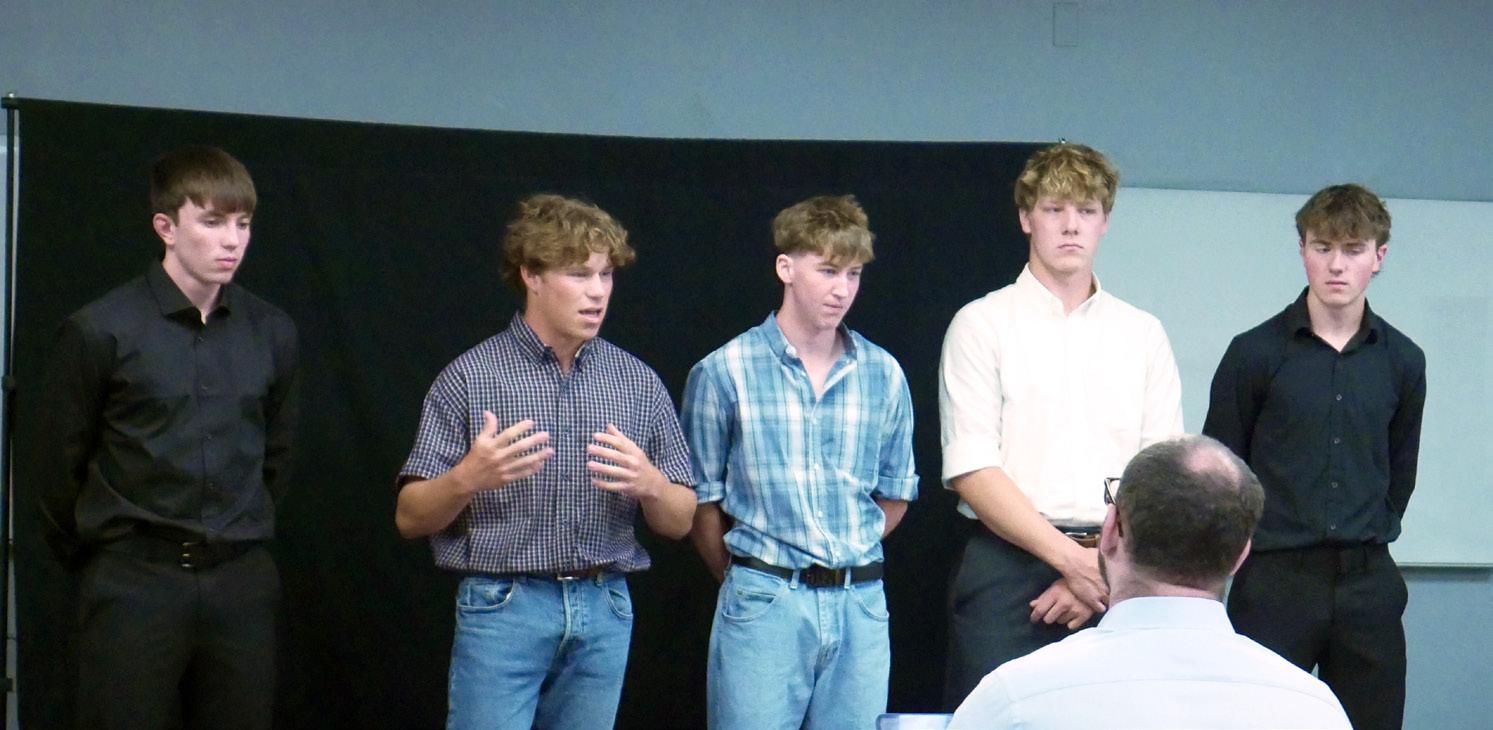
The halls of the University of Maryland were filled with energy, curiosity, and a passion for the past as students from across the country gathered for the National History Day competition on June 16.
Among the many impressive presentations was one delivered by five young gentlemen from Marshalltown High School in Iowa, whose project explored a chapter of American agricultural history that continues to influence the nation today: the Granger Laws.

The students captivated their audience with a thorough examination of the challenges farmers faced in the late nineteenth century. At a time when railroad companies held tremendous power over transportation, farmers often found themselves at the mercy of monopolistic shipping rates. Even after a successful harvest, many producers struggled to earn a profit because the cost of transporting their goods to market consumed much of their income.
continued on page 3

by Katie Girtler National Junior Grange Director junior@nationalgrange.org
As you all know, July marks our 250th anniversary of Independence, and July is also Junior Grange month!
For many of our youngest members, this is a time where we can celebrate their hard work and showcase their skills as budding leaders. If your Junior Grange has entered an Independence Day parade, volunteered with a veteran’s hall or home, or has done something special recently that celebrates our country, please send in photos and information to junior@nationalgrange.org - Grangers young and old want to see how you’re celebrating!
I want to challenge you and your Juniors as well in the coming month. Our National Junior Program Book holds many projects that can be used to celebrate this monumental occasion for our country, from easy to challenging projects. My challenge to you is to celebrate Junior Grange Month by creating a 250th commemorative sticker with drawing, coloring, or Canva designs and submitting your designs to the National Grange for the sticker contest.
Want to take it a step further? Encourage your Juniors to learn more about our nation’s most important documents with a fun craft of creating a feather quill and writing with it to copy words or sentences from the Constitution or the Declaration of Independence. A new Junior Passport on American Civics is being released this month as well, so I encourage you to take a gander at that. If you haven’t explored Passports with your Juniors yet, it is a fun way to gain knowledge and sticker badges about our amazing states, flag, civics, and other things. Passports are also a great tool for a meeting at any level –Junior, Community, Pomona, or State.
No matter how you’re celebrating your Junior Grangers this month, we want to know about it! If you’re wearing Red Shoes to a Grange Event, show us! Crafts, Camps, Junior-run events, or Junior-run service projects - we want to see it all!
I hope you have a wonderful and successful Junior Grange month, celebrating with lots of popsicles, outdoor adventures, water play and excitement!
Sticker Template Canva: https://grange.biz/JuniorStarSticker America250 Projects: https://www.nationalgrange.org/ junior-grange-projects/ (includes Historical craftsmanship project and commemorative star sticker.
Passports: https://www.nationalgrange.org/junior-passportprogram/
I encourage all Grangers to share this message with your Community Granges and with anyone working with Juniors or Junior-aged members. Remember, you don’t need to belong to a chartered Junior Grange to participate!


Recognizing the need for collective action, farmers organized through the Patrons of Husbandry, better known as the National Grange. The presenters skillfully explained how the Grange emerged as a powerful voice for rural America, advocating for farmers and helping inspire a series of state regulations that became known as the Granger Laws.
What made the project especially impressive was the students’ commitment to accuracy and thorough research. Prior to their state-level competition, the group reached out to National Grange staff to ask questions about the organization and its role today. Their efforts to fact-check information, better understand the modern Grange, and strengthen their bibliography demonstrated the level of scholarship and professionalism they brought to their work.
A highlight of the presentation was the group’s discussion of the legal battles that followed the passage of the Granger Laws. The students detailed how railroad companies challenged state-imposed rate regulations, arguing that government control of prices was unconstitutional. In the Iowa case they examined, however, farmers, state officials, and Grange supporters prevailed. The courts determined that
businesses serving a public interest could be subject to reasonable government regulation.
The presenters effectively connected this decision to broader legal and political developments occurring across the country. Similar court cases emerged as states grappled with how to balance private enterprise and public welfare. These disputes ultimately laid the groundwork for greater government oversight of commerce and helped shape legal principles that continue to influence American economic policy today.
Beyond their mastery of historical facts, the Iowa students demonstrated a remarkable ability to explain complex legal and economic concepts in a way that was both engaging and accessible.
They also highlighted the evolution of the Grange from a nineteenthcentury reform movement into a modern organization that continues to advocate for rural communities on issues such as health care, broadband access, agriculture, and community development.
National History Day is designed to encourage students to think critically about the past and its connection to the present. This group embodied that mission perfectly. Through careful research, confident delivery, and a
continued from page 1
clear passion for their topic, these young historians brought an important story of American agriculture, civic engagement, and democracy to life.
The National Grange applauds this outstanding group for their dedication, initiative, and commitment to sharing an important chapter of American agricultural history. Their willingness to engage directly with our organization during the research process reflected the care and professionalism they brought to their project. Through their thoughtful presentation, they not only highlighted the challenges farmers faced during this era but also demonstrated the lasting impact of the Grange’s advocacy on our nation’s legal and economic systems.
They represented our history with accuracy, enthusiasm, and integrity, telling the story of the Grange in a way that was engaging, meaningful, and relevant for a new generation. We are incredibly proud of the work they have done and grateful for their efforts to ensure that the legacy of the Grange and the voices of rural America continue to be remembered, studied, and understood.
The full presentation can be viewed at https://youtu.be/yjSu4K7IMOw
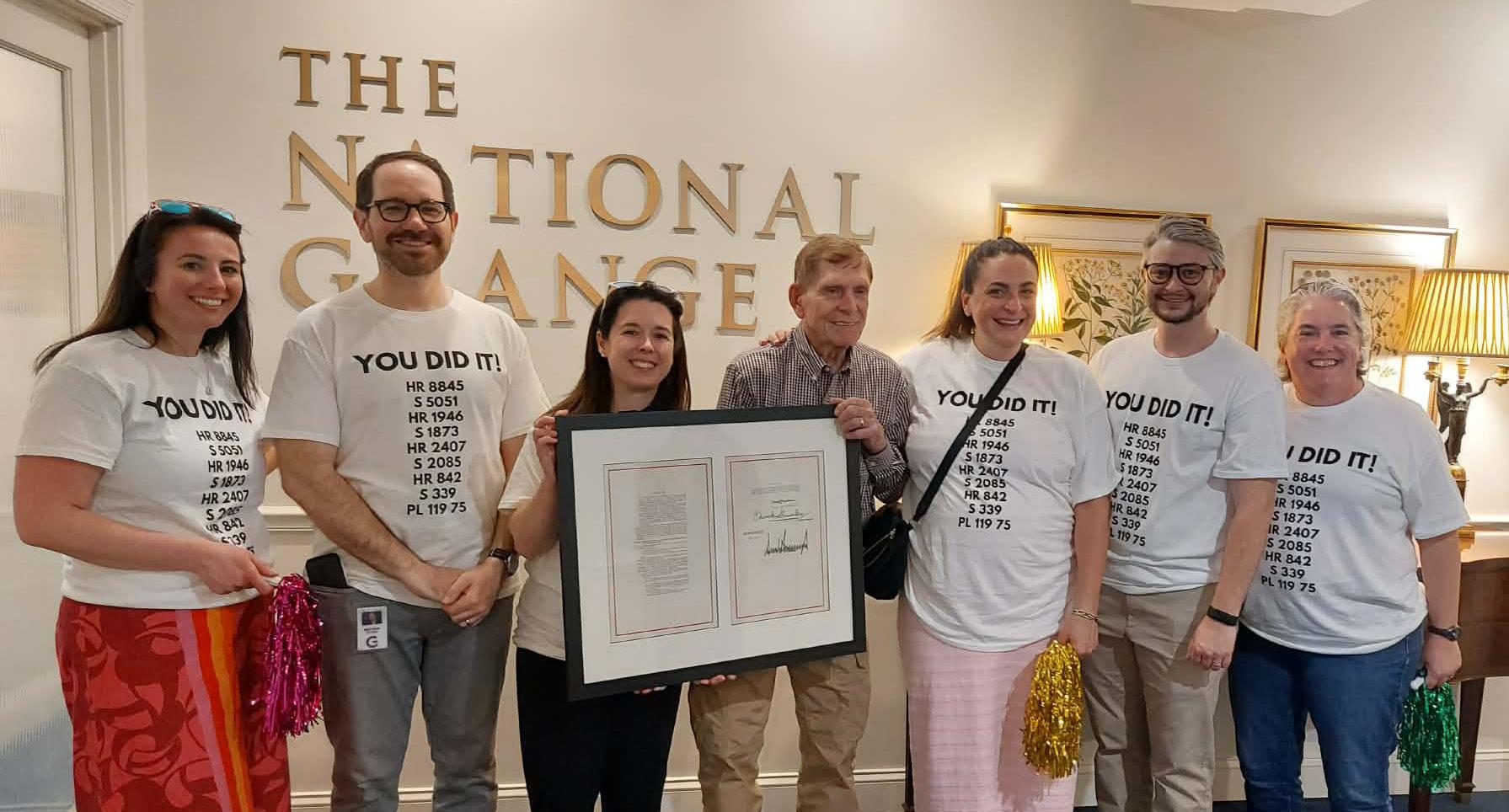
On June 9, a team from GRAIL Bio, including CEO Josh Ofman, stopped by the National Grange Headquarters to show their appreciation for the Grange helping to get the Nancy Gardner Sewell Medicare Multi-Cancer Early Detection Screening Coverage Act over the finish line. Pictured are members of the GRAIL staff presenting Burton Eller, National Grange Government Affairs Director, with a framed copy of the final law.
Photo by Stephanie Wilkins
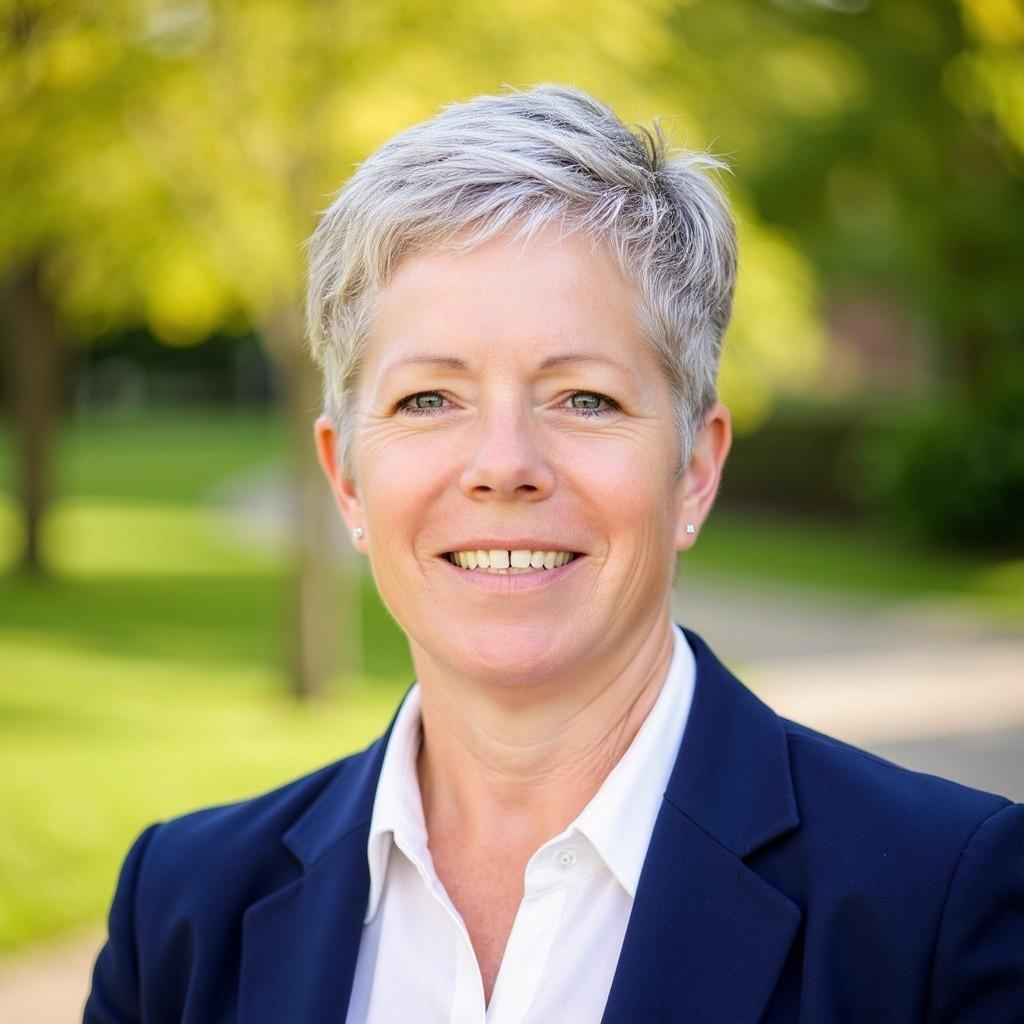
by Christine E. Hamp National Grange President
Breakthroughs in cancer detection are creating an opportunity we cannot afford to miss — the chance to find cancer earlier, treat it more effectively and save lives.
For rural America, that opportunity is even more significant.
We know the reality. Rural communities experience higher cancer incidence, later diagnoses and higher mortality rates than urban areas. Too often, cancer is not discovered until it has reached Stage 4, when treatment options are limited, more aggressive, and focused less on cure and more on managing the disease.
That reality comes with a cost that goes far beyond the diagnosis itself. It means long travel to distant treatment centers, extended time away from work, and an extraordinary burden placed on families and caregivers. For many rural patients, the challenge is not just fighting cancer but navigating the system required to treat it.
Early detection changes that. When cancer is found earlier, treatment is often less invasive, outcomes improve and patients have a far greater chance at survival. For rural families, it can also mean fewer disruptions to daily life, fewer miles traveled, and more time spent at home instead of in a hospital far away.
That is why emerging multi-cancer early detection tests are so important.
These tests are designed to detect
multiple cancers, often before symptoms appear, through something as simple as a blood draw. For cancers that have never had routine screening options, this represents a fundamental shift in how we approach detection. Instead of reacting to symptoms, we can identify the disease earlier, when intervention is most effective.
For rural communities, this is more than innovation. It is access.
MCED testing can be delivered in a primary care office, a community health center or even a mobile clinic — bringing early detection closer to where people live. That matters in communities where specialty care may be hours away and where delays in diagnosis can have lifealtering consequences.
This is why the National Grange has long supported the Nancy Gardner Sewell Medicare Multi-Cancer Early Detection Screening Coverage Act, now law.
By establishing a pathway for Medicare to cover Food and Drug Administrationapproved MCED tests, this legislation helps ensure that the benefits of early detection are not limited to those with the greatest access to care.
Passing the law is only the beginning. Now the focus must turn to implementation and ensuring that these tools are accessible, that providers are equipped to use them, and that rural patients can fully benefit from the progress being made. The science is advancing.
Policy must keep pace, and access must follow.
Recent clinical evidence reinforces what many in the medical community have hoped: these tests have the potential to significantly reduce late-stage diagnoses and expand the number of cancers that can be detected earlier. That is not just a medical advancement — it is a shift in outcomes.
For rural America, it could help close a gap that has widened for far too long.
Early detection cannot take away the difficulty of a cancer diagnosis, but it can change the path that follows. It can offer more options, more time and more hope — all of which matter.
As leaders, advocates, and members of rural communities, we know what is at stake. We also know what is possible when innovation, policy and access come together with purpose.
The path ahead gives us reason for optimism, but only if we ensure these advances reach every community.
Has your Grange (State, Pomona, Community, or Junior) participated in an advocacy project or event, connecting with local, state, or federal legislators about an issue?
We are looking to include “success stories” in a new project. If you’re willing to share your stories and photos, please send them to National Grange Intern Savannah Mangold at savannah.mangold@grange.org.

The National Grange Convention would not be possible without the incredible volunteers who step up to serve!
We are looking for enthusiastic volunteers to help make this year’s convention a welcoming, successful, and memorable experience for everyone attending. Whether you
can help greet guests, assist with events, support activities, or simply lend a helping hand where needed, your time and talents can make a huge difference.
Volunteering at Convention is a wonderful opportunity to:
• Meet Grangers from across the country
• Build connections and friendships
• Serve the organization we all care about
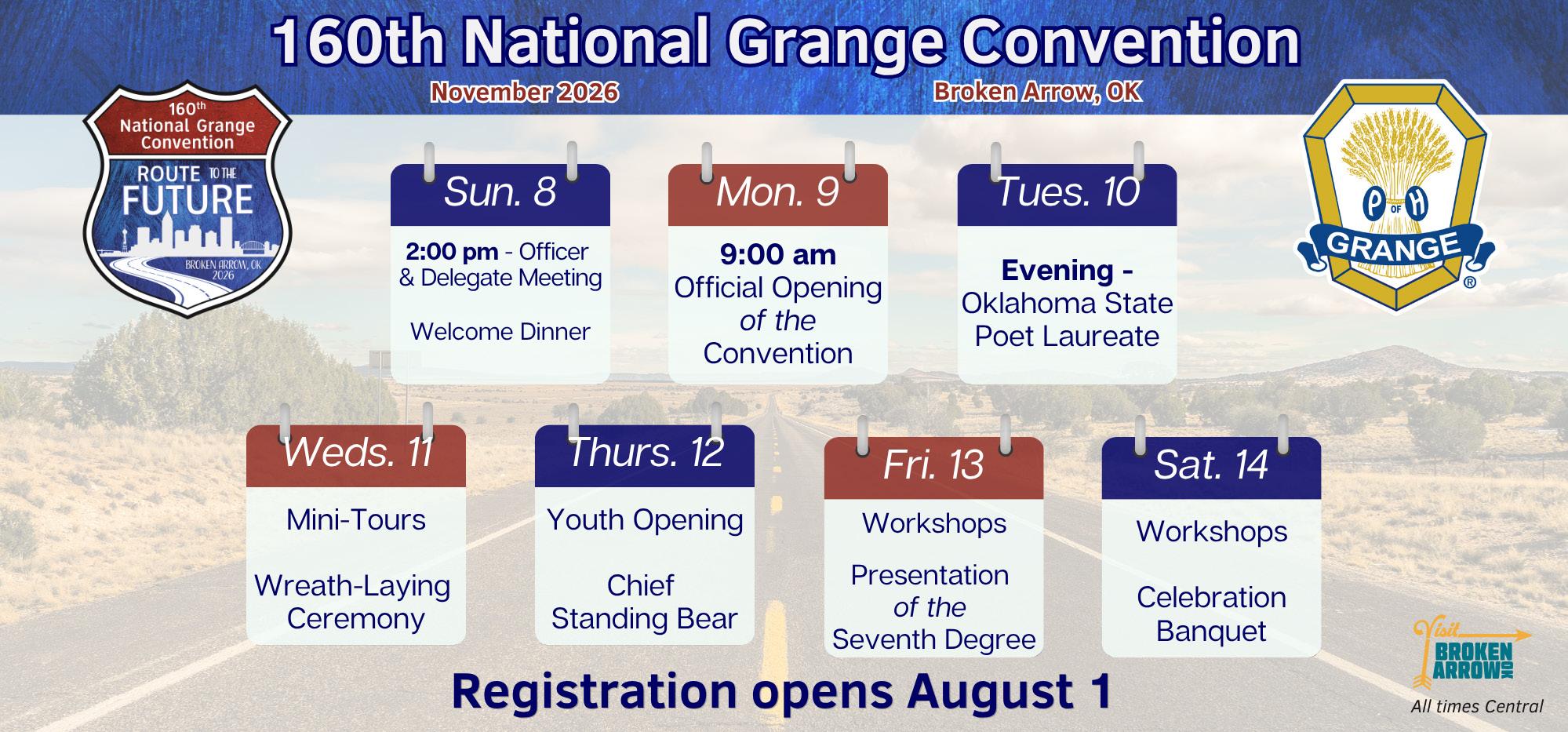
The National Grange invites all convention attendees to participate in a special Veterans Day Wreath-Laying Ceremony during this year's National Grange Convention in Broken Arrow, OK.
Veterans Day – November 11 7:30 a.m. (0730 hours) CST
Veterans Park, 1111 S. Main St, Broken Arrow, OK
This meaningful ceremony is open to everyone attending the convention, and we encourage all members and guests to join us as we honor the service and sacrifice of our nation's veterans.
We are seeking veterans representing all six branches of the
• Be part of something meaningful and memorable
No matter your experience level, there is a place for you to get involved! We encourage members of all ages to join us in helping make Convention a success.
If you are interested in volunteering, we would love to have you on the team! Please fill out this link to express your interest: https://grange.biz/160volunteers.
U.S. Armed Forces to assist with the wreath-laying ceremony. If you are a veteran and will be attending the convention, please contact Mark Gibbons at mark@retiresafe.org
When responding, please include:
• Your branch of service
• Your rank at the time of separation or retirement
One representative from each branch will be selected to participate in the ceremony.
This year's Veterans Day observance is proudly sponsored by Potomac Grange #1.
We look forward to honoring our veterans together in a spirit of gratitude and remembrance.

June 2026
Agriculture and Food
Senate farm bill draft unveiled
Senate Ag Committee Chairman John Boozman (R-AR) this week released the long-awaited farm bill 2.0 discussion draft for consideration by his fellow senators. The bill touts boosting support for a wide array of agriculture producers, enhancing transparency of fertilizer markets and foreign land ownership, modernizing USDA loan limits, strengthening healthcare access in rural areas, and expanding support for rural communities. What’s not included in the discussion draft are the most contentious issues that created divisions as the House crafted its farm bill 2.0 version. These include restoring sharp cuts to the SNAP feeding program, a pesticide exemption from state pesticide laws, year-round E15 ethanol approval, and a provision to nullify state animal welfare laws like California’s Prop 12. The House passed its version of farm bill 2.0 earlier this Spring. The Senate needs to pass its version of the farm bill 2.0 in order to complete the comprehensive farm bill process, which began with the One Big Beautiful Bill Act last year. The last comprehensive farm bill was enacted in 2018.
New World Screwworm is here now
For several months, we’ve followed the screwworm infestation migrate from Central America through Mexico and close in on the U.S.-Mexico border. We also knew it would happen sooner rather than later. The New World Screwworm (NWS) has now crossed the border into the United States, with several cases confirmed in Texas and New Mexico. Screwworm was previously eradicated from the U.S. in the 1960s. While NWS is a critical threat to the health of livestock, wildlife, and pets, it is important to clarify that screwworm is a parasite, not a disease, and it poses no food safety concerns for consumers. The risk lies in the screwworm larvae’s harmful impact on an animal’s welfare.
Screwworm is a fly
The NWS fly is about the size of a house fly. It has orange eyes, a metallic blue-green body, and three dark stripes along its back. It can travel on humans, vehicles, pets, livestock, and wildlife. The larvae feed on the living tissue of warm-blooded animals, entering through open wounds and burrowing into the flesh, causing severe wounds and animal suffering if not detected and treated quickly. The Food and Drug Administration has granted an Emergency Use Authorization for over-the-counter drugs to treat infestations in livestock and pets.
Now what?
America previously eradicated screwworm by developing sterile screwworm flies. Screwworm flies mate only once, so if the flies are infertile, no eggs are hatched and no larvae emerge. Even though the USDA began ratcheting up sterile fly production over the past year in anticipation of such an outbreak, supplies
of sterile flies are still limited. USDA is developing methods to maximize the production of sterile male flies and using modeling to deploy existing flies. Construction of expanded production facilities has been in the works for the past year, which should begin coming online within the next year.
The USDA has allotted $60 million in actions to better support small and very small meat and poultry processing facilities. These funds will go toward helping small plants improve customer service and responsiveness, make requirements easier to navigate, and reduce unnecessary regulatory burdens while still maintaining food safety. Increased support for small meat plants is a continuing priority for the National Grange.
Medical school curricula have been notoriously lacking in nutrition education for decades. Agriculture, food, and nutrition groups (including the National Grange) have been on a decades-long crusade to add nutrition courses to medical school requirements. Now, an additional group of 19 medical schools has agreed to require at least 40 hours of nutrition education or an equivalent, joining 54 others that have already made such commitments. The Departments of Health and Human Services and Education teamed up under the “Making America Healthy Again” banner to encourage this important change.
We’ve seen massive cuts to the federal Supplemental Nutrition Assistance Program (SNAP), which provides food assistance to low-income families. USDA said these cuts were necessary to weed out waste, fraud, and abuse, and for budgetary reasons. To stretch the remaining SNAP dollars, USDA initiated a pilot program in five states that barred SNAP recipients from using their SNAP benefits to buy soda, candy, and other non-essential, non-nutritious food items. Now, a federal judge has vacated those purchasing restrictions, ruling that USDA exceeded its legal authority and bypassed required public notice procedures. In response, Secretary of Agriculture Brooke Rollins said, “SNAP is for food—not sugar bombs fueling obesity, diabetes, and skyrocketing healthcare costs for low-income families.”
Agriculture labor bill introduced
U.S. House Agriculture Committee Chairman Glenn “GT” Thompson has introduced the Securing Agriculture’s Workforce Act. The legislation is based on a suite of bipartisan recommendations developed by the Agriculture Labor Working Group, comprised of seven Republicans and seven Democrats, in the last Congress. The working group hosted numerous roundtables with ag employers to
identify shortcomings in the H-2A program and to target potential solutions. Despite the H-2A’s tremendous cost and burdensome administration to the producer, guest worker numbers under H-2A have risen from 100,000 in 2013 to almost 400,000 in 2023. This is due to a lack of domestic workers willing to perform many of the necessary agricultural jobs. The original H-2A program was designed for large operations that need large numbers of workers. The National Grange is disappointed the legislation did not address ag worker reform to meet the needs of small and midsize operations that need a small number of workers. Grange had asked the Working Group and the Chairman to consider adopting the former Bracero guest-worker program, which was so successful for American agriculture from 1942 until 1964.
National Grange President featured in op-ed
National Grange President Christine Hamp authored an op-ed in Washington’s DC Journal about a promising new breakthrough tool for early cancer detection. The Multi-Cancer Early Detection screening test (MCED) diagnoses dozens of cancer types with a simple blood draw at a physician’s office, community health center, or mobile clinic before symptoms appear. This test is especially important for rural communities that experience higher cancer incidence, later diagnoses, and higher mortality rates than urban areas. This reality comes with a cost that goes far beyond the diagnosis itself. It means long travel to distant treatment centers, extended time away from work, and an extraordinary burden placed on families and caregivers. Medicare is authorized to cover MCED Congress approved, and the President signed into law, the Nancy Gardner Sewell Medicare Multi-Cancer Early Detection Screening Coverage Act, which authorizes Medicare to cover early detection screening tests. The Grange was recently thanked by GRAIL CEO Josh Ofman for its efforts in helping MCED become law, in a letter to Chris Hamp and Burton Eller. Grail also presented the Grange a framed and President-signed copy of the law, PL 119-75. (See page 3).
The National Grange joined Healthy Women and 19 patient groups to urge Congress to invest in technologies that could advance women’s health. To realize the full potential of genetically targeted technologies (GTTs), Congress must fund basic science discovery research and clinical testing, and pass legislation to promote continued investment in groundbreaking treatments for cardiovascular health, rare diseases, neurological conditions, and pediatric diseases.
In early June, Burton Eller, National Grange Government Affairs Director, was invited to testify before the Vaccines and Related Biological Products Advisory Committee of HHS. The committee is charged with making recommendations on the selection of the 2026-2027 COVID-19 vaccine formula. Eller critiqued the abysmal state of health care in rural America as background and spoke in support of continued broad access to the most effective COVID vaccines. He also urged the committee to recommend the updated version of the COVID vaccine be made available at the same time as this year’s flu vaccine so that rural residents can access both options with their trip to their provider or pharmacy.
The Build America 250 Act has cleared the House Transportation and Infrastructure Committee on a huge bipartisan vote of 66-2. The bill authorizes $50 billion over five years for the country’s ailing bridges. This represents the largest single investment ever in bridge repair and replacement. The Act also allows fees to be imposed on electric and plug-in hybrids to support the highway Trust Fund. Several amendments to the bill were accepted to limit train speeds when carrying certain chemicals, to require railroads to maintain real-time hazmat information, and to give states the option to allow six-axle vehicles to haul up to 91,000 pounds on federal interstates. The National Grange and the Ag Transportation Coalition are asking the House leadership to bring this legislation to a floor vote soon.
The good, the bad, and the necessity of data centers
Walk into almost any state capitol, county governance, or local zoning meeting these days, and you might see a data center project on the agenda. You’ll encounter a vocal set of concerns: Too much water. Too much power. Too few permanent jobs. Too little benefit for the local community. Big warehouse-type buildings are ruining the viewscape… From zoning battles in rural counties to rate design battles at state utility commissions, the future of AI is being shaped. But the urgent need for data centers is already here. It’s a necessity we’re already depending upon. The buildout of America’s AI infrastructure is not a matter of when but a matter of how. Grange members are encouraged to become involved in deciding how their communities best accommodate data centers. See the op-ed by National Grange intern Savannah Mangold on page 8.
From the Hill is written and compiled by Burton Eller, National Grange Government Affairs Director beller@nationalgrange.org
“Alone we can do so little; together we can do so much.”
- Helen Keller, American activist, author, and advocate
“Each of us must rededicate ourselves to serving the common good. We are a community. Our individual fates are linked; our futures intertwined; and if we act in that knowledge and in that spirit together, as the Bible says: ‘We can move mountains.’”
- Jimmy Carter, 39th United States President (1977-1981)
“Never doubt that a small group of thoughtful, committed citizens can change the world. Indeed, it’s the only thing that ever has.”
- Margaret Mead, American anthropologist and author
“What should young people do with their lives today? Many things, obviously. But the most daring thing is to create stable communities in which the terrible disease of loneliness can be cured.”
- Kurt Vonnegut, American author
A.I. companies are claiming that we need data centers to become better than our international competitors, but what does that really mean if we are hurting our own people to do so?
by Savannah Mangold National Grange Intern Public Writing and Rhetoric Major, Middle Tennessee State University
Artificial Intelligence, or A.I., has become one of the hottest topics of the last few years as its presence has become increasingly common in day-to-day life. A.I. exists in many forms: Some people use it as a tool for writing essays, others attempt to make movies with it, or some use it for coding. No matter how anyone feels about A.I., it has become a major tech tool for people and corporations alike. But just because it is seemingly everywhere, it does not mean that there aren’t issues and things that need to be addressed before it starts to impact rural America long term.
One of the biggest issues people have with A.I. has to do with their associated data centers. A data center holds all the physical computers and technology needed to run, essentially, the entire internet. All of the things we do online don’t just occur in a digital void, but actually require physical IT infrastructure to do all of the things we expect of the modern internet. These buildings house thousands of computers that make sure users can access things like the Cloud. Data centers are also the backbone of A.I. computing, so every time you interact with ChatGPT, your prompt or question gets run through a data center somewhere.
Data centers require a few important things to run: water, land, and energy. States with large swaths of land that can easily access the energy grid are the most appealing to A.I. companies, with some data centers covering multiple acres of land . These data centers are often massive square buildings with few to no windows. They are often multiple stories tall to make enough room for all of the computers inside. Southern states are great for data centers, which can be seen in their growing prevalence in states like Virginia and Tennessee. The first major A.I. data center in Tennessee was built in the Memphis area, affecting an already struggling community. Now companies and organizations are looking to expand to areas like McMinnville, Tennessee, Nashville, and increasingly throughout Appalachia and Appalachiaadjacent areas, with Virginia taking the lead with the
largest amount of A.I. data centers globally. Areas that are still recovering from the coal industry and its destruction are now facing a new group of people/companies looking to strip it of resources.
Data centers need a lot of water, mostly used to cool computers and prevent overheating. In a three-year span (2019-2022), data centers in Virginia went from using 1.13 billion gallons of water a year to 1.85 billion gallons For comparative measures, the U.S. usage of water in a year to cool data centers equals that of London in about a four-month span. But the people in London are using it to drink, cook, and everything else water is needed for, and not simply as a cooling system for people to use A.I. Companies are making some changes to water consumption, though, with some using gray water (Gray Water: “household wastewater (as from a sink or bath) that does not contain serious contaminants”), or finding other methods to cool that reduce reliance on clean, drinkable water. Clean water is, in fact, not an unlimited resource, so we have to protect what we do have and ensure it remains a human-first resource.
The area where people seem to really feel the presence of data centers is in electricity. Data centers raise energy costs for those in the surrounding area. States like Tennessee are adding policies that should help to curb the costs for everyday people, though. The Tennessee Valley Authority, the main provider of energy services in Tennessee, would require data centers to pay for the energy infrastructure that they require. Some centers, like the one in Memphis, use enough electricity to power 200,000-300,000 homes, so this kind of legislation is beyond necessary. Some people are actively facing electricity bills that are double the price of the year prior
continued on page 9
This summer and fall, the National Grange and the Alzheimer’s Association are partnering to raise awareness about Alzheimer’s Disease and Related Dementias at State Fair’s across the country. One in three older adults dies with Alzheimer’s or other dementia. The need for awareness, access to healthcare, and patient and caregiver support is great—but nowhere more so than in rural areas. Our organizations are working together to help meet those needs. For chapters interested in taking up this cause, the Alzheimer’s Association is providing outreach materials. These can be shared with you in a printable format, or brochures can be shipped to your chapter. It will take about three weeks to ship the materials. But the partnership doesn’t have to stop there. The Alzheimer’s Association has local chapters across the nation, providing services within each community. Find your chapter. And answers and resources are available anywhere in the country through the free 24/7 Helpline at 800-272-3900.
For more information about how Alzheimer’s and Dementia impact your state, visit the Alzheimer’s Disease Facts and Figures. To order materials for your state fair, contact Lorna Prophater at lprophator@alz.org or Letitia Thompson at lsthompson@alz.org.
Interested in the latest breakthroughs in Alzheimer’s and dementia science? Join virtually on July 16, at AAIC For All . AAIC For All is an opportunity for individuals who are not attending the Alzheimer’s Association International Conference® (AAIC®) to learn about the latest research on Alzheimer’s treatments, early detection, risk reduction and care.
Who: Community members
Where: Excel London, U.K., and online from anywhere When: July 16, 5-8 a.m. CT or on your own time* if attending virtually How: Click here to register for this no-cost event, or visit https://b-com.mci-group.com/CommunityPortal/ Registration/AAIC2026.aspx
and up to a 267% increase for wholesale electric costs in the past five years. In the end, civilians are the ones feeling this impact and paying the literal cost of data centers.
One of the biggest appeals of data centers is that they would create jobs in the area and increase tax revenue. Data centers would increase jobs for the building process, but would not do so by a large margin in the long term. Tax revenue could be incredibly beneficial for many communities, but it is important to compare that to the consequences that will come alongside it. With doubled energy costs and possible long-term consequences on the environment, there needs to be action alongside the big bucks.
continued from page 8
Some legislation has passed, at both a state and national level, which will help protect people from some of the impacts that data centers bring, but there is still a long way to go before there is a return on investment for surrounding communities. We will never be able to get rid of data centers, unless we want to get rid of the internet too, so this is something we have to work with. The consequences of these centers are already impacting rural communities, so it is up to us to be diligent and fight for the sanctity and safety of the people and land impacted by them.
by Bonnie Mitson National Grange Community Service Co-Director Bellgrove Grange #369, Idaho
How did you celebrate our country’s 250th year of freedom?
This year, Americans have a choice to stop and remember the heroes who gave us our great nation. It is a perfect time to teach the youth the history of our country’s founding. Don’t let this chance go by without sharing your pride in all our country has accomplished
My dad, who was born in 1910, told me that his life was filled with the wonders of what man could do because we lived in a country of freedom to create all the things we could think up. From reel to reels,
then radio broadcasts, to eight-track tapes, then TV, then color TV, to DVDs. Now, today, we all see each other in real time over Zoom meetings.
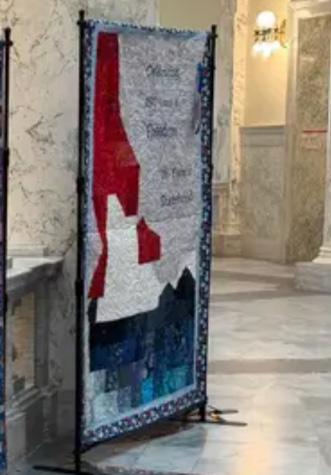
This year, I was invited to join other quilters in creating a quilt that would hang in the Idaho State Capitol Rotunda.
I chose a pattern by native born Idahoan Vanessa Cartwright of Quilty Ness called “One Gem of a Quilt,” an ode to Idaho. It is a silhouette outline of Idaho done in red, then whites, then blues.
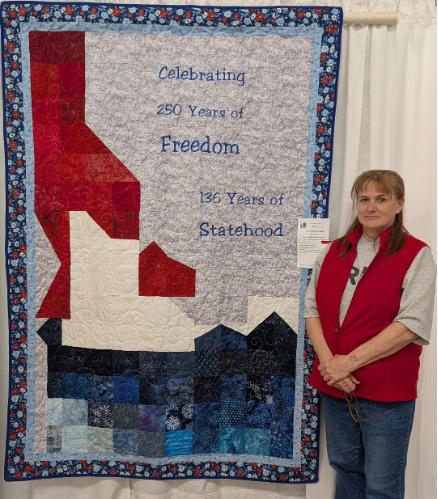
After the Capitol display, the quilt traveled 378 miles back to North Idaho to be displayed in the North Idaho Quilt Show, where it took 3rd place in the People’s Choice Award.
Keeping with the Grange Way of doing things, this quilt was a collaborative effort. I called my friends to collect the 5” squares of the fabrics needed, then recruited a friend to choose the color design, and yet another friend to fine-tune the paper piece points.
And within the week, the quilt top was ready for the embroidery, calling yet another friend (who had
an embroidery hoop bigger than I had) to save the day. The words were embroidered onto the quilt top, then off to the longarm and then to binding.
While I would love to take full credit for this quilt, it was a labor of love, community, and friendship. Thanks to Cherie, Joanne, Karen, Sharon, Cheryl, and Terri for the 756 miles they drove taking the Quilt back and forth. Thank you, friends, for “gettin’ her done!”


The America’s 250th Grange Workgroup is celebrating our country’s 250th Anniversary by “throwing back” to some classic recipes from Grange cookbooks. Do you have favorite recipes that evoke the American spirit which you would like to see published again? Send them to Lew Gaskill at olgaskill@comcast.net. Please include which Grange cookbook your recipes come from.
This week’s recipes are from Grange Favorites – New England Grange Building, West Springfield, Mass (2012)
16 large (not jumbo) raw shrimp: peeled, deveined, tails removed
8 slices turkey bacon
1/3 cup canned tomato sauce
3 Tablespoons ketchup
2 Tablespoons brown sugar
Splenda
1 Tablespoon cider vinegar
Preheat oven to 425º F. Cut bacon slices in half and set aside.
Mix together tomato sauce, ketchup, sugar, vinegar, and garlic powder.
Courtesy of Thelma L Northrup Cheshire Grange #23, CT
1/2 to 1 teaspoon garlic powder (depending on how garlicky you want them)
Lightly spray a baking pan with nonstick spray. Take one piece of bacon (half a slice) and coat it in sauce. Wrap the bacon around a piece of shrimp and place it seam-side down on the baking pan.
Repeat with the rest of the bacon and shrimp and then give them a quick mist with nonstick spray.
Place pan in oven and cook until shrimp is cooked through and bacon is crispy (about 10-15 minutes).
Makes 4 servings.
Note: if you are a Weight Watcher, each serving is 2 points
1 to 2 heads cabbage (1 large or 2 small)
1 small green pepper
1 small onion
1 medium to large carrot
1 cup light Miracle Whip
1/2 cup sugar
1/4 cup vinegar
1/4 cup vegetable oil
Courtesy of Carol Perry Slocum Grange #36, RI
In food processor, shred cabbage, green pepper, and onion. Place in large bowl. Mix Miracle Whip, vinegar, oil and sugar. Mix until smooth. Taste should be sweet with just a hint of the vinegar. Add to the cabbage and mix well. Let stand 1 hour to allow flavors to blend. You may need to add more of the dressing mix, depending on the amount of the cabbage mixture you have. You can also omit the sugar and make with sugar substitute. We use Sweet and Low.

Are you heading on a summer vacation? Grange members save up to 20% on best available rates at over 4,000 Comfort Inns, Comfort Suites, Quality, Sleep Inns, Clarion, MainStay Suites, EconoLodge, and Rodeway Inn and other Choice Hotels worldwide.
To receive your Choice Privileges membership and discounts, please visit choicehotels.com or call 1-800-258-2847 and provide the National Grange ID: 00211660.