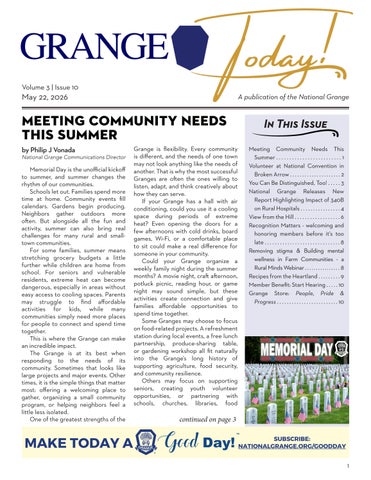

Meeting Community Needs This Summer
by Philip J Vonada National Grange Communications Director
Memorial Day is the unofficial kickoff to summer, and summer changes the rhythm of our communities.
Schools let out. Families spend more time at home. Community events fill calendars. Gardens begin producing. Neighbors gather outdoors more often. But alongside all the fun and activity, summer can also bring real challenges for many rural and smalltown communities.
For some families, summer means stretching grocery budgets a little further while children are home from school. For seniors and vulnerable residents, extreme heat can become dangerous, especially in areas without easy access to cooling spaces. Parents may struggle to find affordable activities for kids, while many communities simply need more places for people to connect and spend time together.
This is where the Grange can make an incredible impact.
The Grange is at its best when responding to the needs of its community. Sometimes that looks like large projects and major events. Other times, it is the simple things that matter most: offering a welcoming place to gather, organizing a small community program, or helping neighbors feel a little less isolated.
One of the greatest strengths of the
Grange is flexibility. Every community is different, and the needs of one town may not look anything like the needs of another. That is why the most successful Granges are often the ones willing to listen, adapt, and think creatively about how they can serve.
If your Grange has a hall with air conditioning, could you use it a cooling space during periods of extreme heat? Even opening the doors for a few afternoons with cold drinks, board games, Wi-Fi, or a comfortable place to sit could make a real difference for someone in your community.
Could your Grange organize a weekly family night during the summer months? A movie night, craft afternoon, potluck picnic, reading hour, or game night may sound simple, but these activities create connection and give families affordable opportunities to spend time together.
Some Granges may choose to focus on food-related projects. A refreshment station during local events, a free lunch partnership, produce-sharing table, or gardening workshop all fit naturally into the Grange’s long history of supporting agriculture, food security, and community resilience.
Others may focus on supporting seniors, creating youth volunteer opportunities, or partnering with schools, churches, libraries, food
continued on page


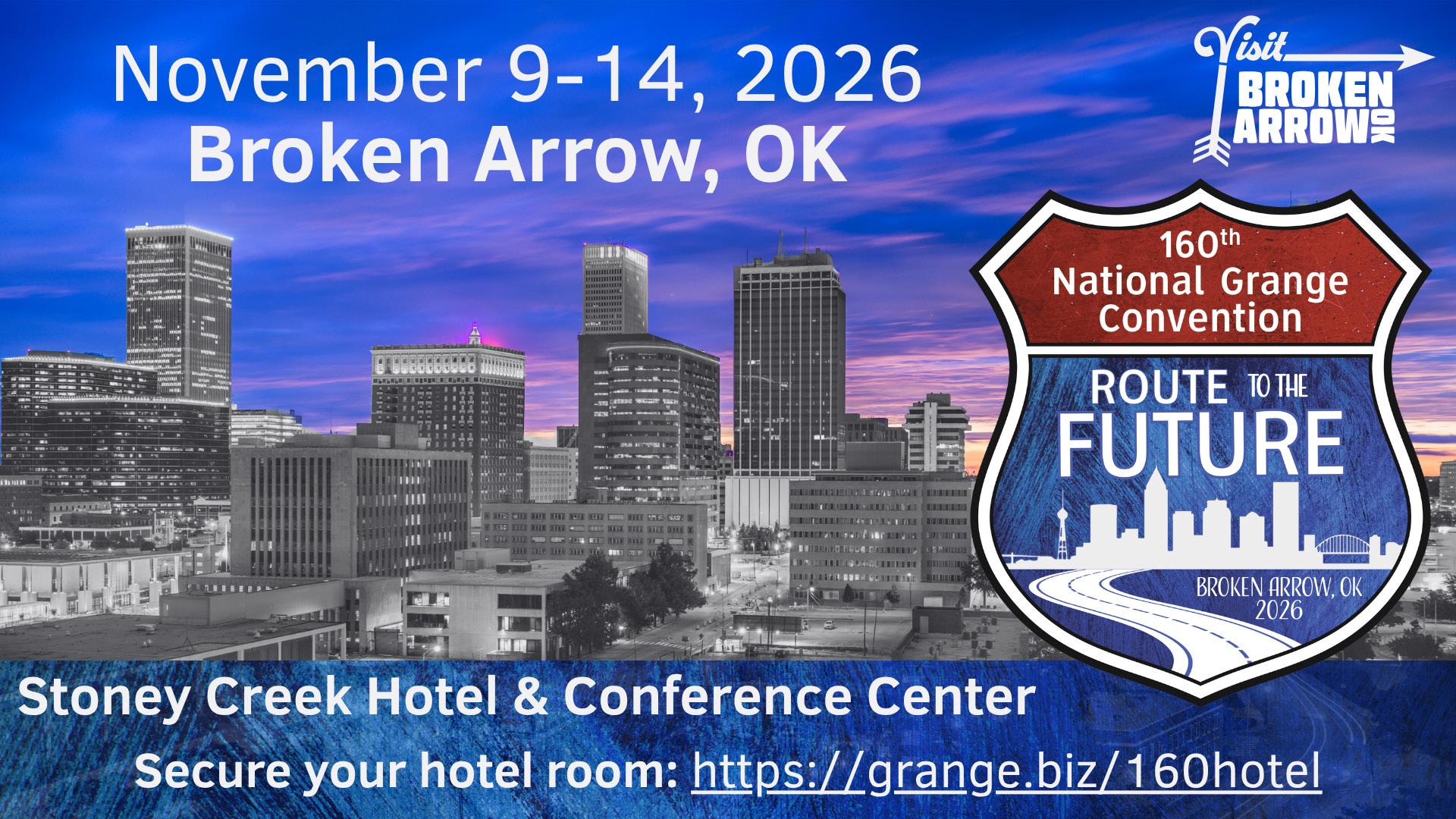
Volunteer at National Convention in Broken Arrow
by Samantha Wilkins Convention Management Team

The National Grange Convention would not be possible without the incredible volunteers who step up to serve!
We are looking for enthusiastic volunteers to help make this year’s convention a welcoming, successful, and memorable experience for everyone attending. Whether you can help greet guests, assist with events, support activities, or simply lend a helping hand
where needed, your time and talents can make a huge difference. Volunteering at Convention is a wonderful opportunity to:
• Meet Grangers from across the country
• Build connections and friendships
• Serve the organization we all care about
• Be part of something meaningful and memorable No matter your experience level, there is a place for you to get involved! We encourage members of all ages to join us in
helping make Convention a success.
If you are interested in volunteering, we would love to have you on the team! Please fill out this link to express your interest:
https://grange.biz/160volunteers.

You can be distinguished, too
With the end of the Grange year quickly approaching on June 30, now is the time for Granges to finish strong and wrap up projects, reports, and community activities - especially if you’re considering applying to be a Distinguished Grange. Whether your Grange has hosted community dinners, supported local schools, organized service projects, advocated for rural issues, or welcomed new members, every effort contributes to building a stronger Grange and stronger communities.
The Distinguished Grange program is about more than recognition. It highlights Granges that are active, forward-thinking, and engaged in meeting the needs of their communities. Even small projects can demonstrate meaningful impact and show how local Granges continue adapting to serve rural and smalltown America.
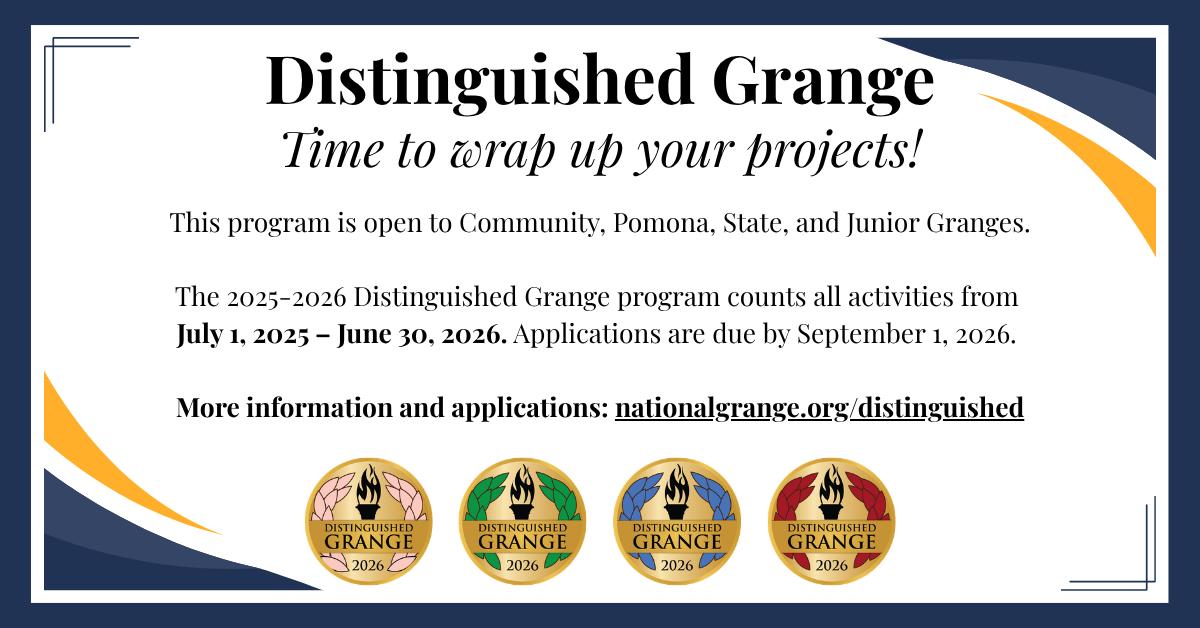
submissions. Photos, flyers, news reports, social media posts, and stories of community impact all help tell the story of your Grange’s work throughout the year.
If your Grange has never applied before, or if you are unsure whether your Grange qualifies, now is the perfect time to review the application requirements. You may discover that your Grange is already doing much of the work needed to become part of this elite group of Granges recognized nationwide. The application can also help identify areas where your Grange may want to grow and strengthen its programming in the future.
As the year comes to a close, Granges should also focus on gathering documentation and organizing records for
Summer IDeas
pantries, or Extension offices to fill gaps in community services.
The important thing is not how big or flashy the project is. The important thing is showing up.
People remember the organizations that are present in their communities. They remember the groups that respond when there is a need, offer help without being asked, and create spaces where neighbors feel welcomed and valued. Those moments build trust, relationships, and long-term community support for the Grange.
Summer is also a good reminder that the Grange cannot afford to stand still. Communities change, and the organizations that remain strong are the ones willing to evolve alongside them. Tradition is important, but tradition should inspire service, not limit it.
A Grange hall is more than a building.
Applications and submissions for the Distinguished Grange program are due by September 1. Granges are encouraged to begin preparing materials now rather than waiting until the last minute.
The work your Grange does matters. Every project, volunteer hour, and community partnership helps strengthen both your local community and the Grange as a whole.
Learn more and apply at nationalgrange.org/distinguished Questions can be directed to Program Administrator Connie Johnston at distinguishedgrange@grange.org
It can be a community gathering space, a resource center, a safe haven during emergencies, a place for learning, or simply a place where neighbors know they belong.
Leveraging partnerships between other community organizations can also help make a big impact. Consider reaching out to local health agencies to help provide for seniors; or the community pool to host a “free swim” night for families. Look in every corner of your community to see who might be able to step up and help.
This summer, instead of asking only, “What event should we hold?” maybe the better question is: “What does our community need from us right now?”
The answer could open the door to meaningful new ideas, stronger partnerships, and a deeper impact than you might expect.
continued from page 1
Simple Ways to Make an Impact this Summer
5 Open your hall to be a cooling center during extreme heat
5 Organize a summer snack program for elementary school students
5 Hold workshops on gardening and food preservation
5 Partner with a local library for a reading program or weekly story hour
5 Hold a weekly family nightgames, movies, crafts, etc.
5 Partner with senior agencies for wellness checks or other outreach
5 Create a community produce swap stand
National Grange Releases New Report
Highlighting
Impact of 340B on Rural Hospitals
Report reveals dramatic differences between rural and non-rural hospitals in patient populations, care delivery, and financial metrics
On Wednesday, the National Grange released a new report and analysis by Avalere Health examining the impact of the 340B Drug Pricing Program on rural hospitals, underscoring the program’s essential role in preserving access to care for millions of Americans in rural and small-town communities.
The report, The 340B Program Impact on Rural Hospitals, reveals stark disparities between rural and non-rural hospitals and raises concerns about policy and structural challenges that threaten the stability of rural healthcare systems.
“Rural hospitals are not just healthcare providers; they are critical lifelines for their communities,” said National Grange President Christine E. Hamp. “This report makes clear that rural providers are not the drivers of excess growth in the 340B program but depend on the 340B program to deliver care to some of our most vulnerable populations.”
According to the report, rural hospitals are falling behind in patient care due to a loss of critical funding. In general, rural hospitals serve older patients requiring more complex care, and who are more likely to require specialized and long-term care
services. The report also finds that despite representing 41% of 340B hospitals, rural facilities account for less than 3% of total Medicare 340B drug claims.
“When a program designed to be a financial lifeline for rural hospitals is instead dominated by non-rural systems, rural patients and communities are the ones who pay the price,” said Hamp. “We must ensure rural providers are protected, and that access to care is not further eroded.”
The National Grange is calling on policymakers to protect and strengthen the 340B program for rural providers while addressing structural issues that divert resources away from underserved communities. This includes protecting rural hospitals from unintended harm, preventing loopholes and policies that could accelerate rural hospital closures, and ensuring that rural communities continue to have access to critical specialty medical services.
The full report, made possible by a grant from Novartis, is available at: https://www.nationalgrange.org/340B-ruralimpact
The 340B Impact on Rural Hospitals and how
the National Grange is stepping up

When a rural hospital closes, a community does not simply lose a healthcare provider It loses jobs It loses economic stability It loses emergency capacity It loses a cornerstone institution that families depend upon, and too often, it loses hope That is why the National Grange is deeply concerned about threats to the integrity of the 340B Drug Pricing Program, particularly practices that divert resources away from the rural providers the program was designed to support. Nearly 200 rural hospitals have closed or discontinued inpatient services since 2010, leaving millions of Americans with diminished access to care.
What is 340B? What is 340B?
Created by Congress in 1992 under the Public Health Service Act, the 340B program requires drug manufacturers to provide significant discounts on outpatient medications to eligible safety-net providers, including rural hospitals and clinics
These providers can bill insurers at standard rates for those medications, using the savings generated to expand care for uninsured and underserved patients and to support critical community health services.


What’s the problem? What’s the problem? What’s the problem?
A recent Grange Avalere study found that some non-rural hospitals are taking advantage of the 340B program by gaining Rural Referral Center (RRC) status, even though RRCs were created to support hospitals serving rural patients.
This can divert resources away from true rural hospitals, increasing financial pressures and threatening their survival.
Greater transparency and accountability are needed to ensure 340B savings are used to support low-income and underinsured patients in rural communities.
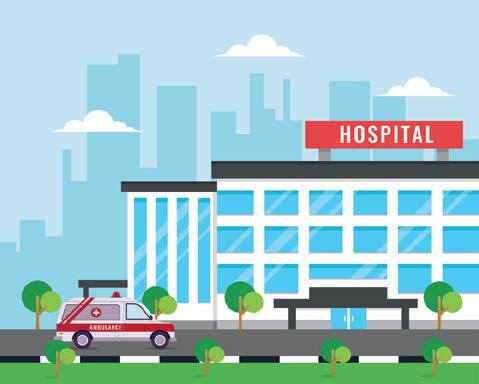

in
97% of 340B drug claims occur in urban hospitals

We want common sense We want common sense want common sense solutions that will... that will... that
Protect rural providers from unintended harm
Recognize the disproportionate financial vulnerability of rural providers.
Prevent policies that unintentionally accelerate rural hospital closures.
Ensure continued access to a full range of medicines, including specialty drugs, in rural communities
Reform 340B without weakening rural healthcare
Close loopholes that allow non-rural hospitals and Rural Referral Centers to take unfair advantage of programs intended for rural communities
The National Grange urges policymakers to make 340B reforms that ensure discounted drug savings while protecting program eligibility to true rural hospitals and rural demographics.

National Grange Policy Updates & Issue News
May 2026
Agriculture and Food
House passes farm bill
The House of Representatives passed H.R. 7567, the “mini” farm bill 2.0, by a bipartisan vote of 224-200. The legislation updates federal programs not dealt with in legislation passed into law last year. Congress had not completed a full, five-year farm bill since 2018. The bill’s E15 provision to allow year-round use of 15% corn-based ethanol blend was stripped from the bill because of opposition from small oil refiners. However, the E15 provision was then introduced as a stand-alone measure and passed the House several days later. A bipartisan amendment was adopted 280-142 to remove a provision that would have established federal supremacy of federal pesticide labeling laws over state and local regulations. An attempt to remove language that nullifies animal welfare laws like California’s Proposition 12 was unsuccessful. The National Grange joined over 400 farm, ranch, landowner, food, financial, conservation, and other groups in support of the bill’s final passage. Farm bill consideration now moves to the Senate.
Attorney General to probe beef processors
Acting U.S. Attorney General Todd Blanche has announced the Justice Department will investigate major beef processors for potential antitrust violations. Justice is reviewing over three million documents and interviewing hundreds of industry participants, including cattlemen, marketers, and processors. Four large companies (Cargill, JBS, Tyson Foods, and National Beef) handle 85% of all beef processing.
Planned USDA reorganization raises concerns about loss of talent
Reorganization at the United States Department of Agriculture (USDA) is proceeding as stakeholders express concern about its impact. Union representatives report that a vast majority of USDA employees say they will not move to proposed new locations across the country. USDA officials argue that reorganization will make the department more efficient and responsive to the needs of the people it serves, and that employees moving out of the National Capital Region will be able to find better housing outside of the D.C. area. The reorganization plan also proposes closing the Beltsville Agricultural Research Center in suburban Beltsville, Maryland, and relocating research programs to facilities across the country, better aligned with regional agricultural needs. This has raised concern among producers, scientists, lawmakers, and agricultural organizations, including the National Grange. Beltsville has long been considered the flagship of agricultural research in America. The House Appropriations Committee has included language in its FY27 funding bill that
gives clear direction to USDA to keep Beltsville and other existing Agricultural Research Service facilities operating unless otherwise approved by the Committees on Appropriations of both Houses of Congress.
Health Care
National Grange report pinpoints threat to rural hospitals
A new report released by the National Grange, The 340B Program Impact on Rural Hospitals, reveals stark disparities between rural and non-rural hospitals and raises concerns about policy and structural challenges that threaten the stability of rural health care systems. An analysis by Avalere Health examined the impact of the Medicare 340B Drug Pricing Program on rural hospitals and underscores the program’s essential role in preserving access to care for millions of Americans in rural and small-town communities. Under current Medicare rules, hospitals are classified as either geographically rural or urban. Congress passed the 340B provision in 1992 with the expectation that rural hospitals would receive special payment protection because they serve smaller, older, lower-income, uninsured, and underinsured populations, and because operating in rural areas is more expensive; these protections were to preserve access to care where market forces alone cannot. Regulatory changes and court decisions over time have created loopholes that allow some of the nation’s wealthiest, geographically urban hospitals to reclassify themselves as “administratively rural” and be designated as Rural Referral Centers. Under this scheme, annual spending on the 340B Program escalated from $6.6 billion in 2010 to $43.9 billion in 2021. This diversion of resources away from true rural hospitals increases financial pressures and threatens their survival. The National Grange is calling on policymakers to address structural issues and plug loopholes that divert resources away from underserved communities. “We must ensure rural providers are protected, and that access to care is not further eroded,” according to National Grange president Chris Hamp.
Don’t leave rural America behind in the fight against Alzheimer’s
National Grange president Christine Hamp’s opinion editorial was featured in the May 19 Washington Examiner. She noted that Alzheimer’s has touched every corner of rural America, and for far too long, these families have been left to face it with fewer resources, fewer specialists, and fewer options. Research is ongoing to evaluate whether blood tests can be used to detect Alzheimer’s in people before they show symptoms. These breakthroughs and others that are sure to follow could dramatically change the Alzheimer’s landscape in rural America.
Telecommunications
Vetting required for broadband deployment funding
A bipartisan bill, The Rural Broadband Protection Act, has been passed by Congress and signed into law by President Trump. It requires the Federal Communications Commission (FCC) to establish a vetting process for companies that submit applications under the Universal Fund’s high-cost program, which helps offset the cost of broadband buildouts in rural areas that telecom carriers otherwise have little market incentive to expand into. The FCC must document each applicant’s technical, financial, and operational capabilities, as well as their business plan and history of compliance with other broadband funding programs. Congress’ intent is to ensure taxpayer money is being used properly to fund rural broadband deployment in rural areas..
Trade
China talks yield ag sales
The meetings in Beijing recently between President Trump and China’s President Xi Jinping ended with some good news for farmers and ranchers. China will buy at least $17 billion in U.S. agricultural products each year for the next three years, and that’s on top of preexisting commitments on soybean purchases. In addition to those purchases, the administration secured commitments to revive poultry and beef exports. The deal also included China reinstating hundreds of U.S. beef export facility registrations and adding some new ones. A cornerstone of the latest U.S.-China negotiations is the establishment of two new mechanisms, the “Board of Trade” and the” Board of Investment”, to foster a government-to-government forum for officials to discuss trade and investment.
Transportation
House bill targets transportation infrastructure
A bipartisan bill draft just released by leadership of the House Transportation Committee would authorize $580 billion over five years to invest in roads, bridges, railroads, and other vital transit connectors. It specifically targets $50 billion of that amount for bridges, the largest ever bridge investment. The measure would codify exemptions for livestock haulers from electronic logging mandates and from federal hours of service requirements if within a 150-mile air radius of their destination. The bill would also create an online registration and renewal system that allows employees of farm-related industries to participate in the seasonal restricted commercial driver’s license program. The National Grange participated in the development of this legislative proposal.
Of Interest...
USDA accepting rural development grant applications
The USDA is making $27.7 million in grants available for business and community initiatives that promote economic growth and job creation. These are available through the Rural Business Development Grant Program at USDA. Business opportunity grants may be used for business support centers, technologybased economic development, leader and entrepreneur training, business plans, and more. Business enterprise grants may be used for training and technical assistance, project planning, market
research, buying or developing land, constructing or renovating buildings, buying equipment, and more. Local Grange chapters are encouraged to contact their state’s USDA Director of Rural Development for further information and guidance.
Perspectives
“It takes as much energy to wish as it does to plan.”Eleanor Roosevelt, First Lady of the United States (1933-1945), diplomat, and activist
“Plan your work for today and every day, then work your plan.”
- Margaret Thatcher, 50th Prime Minister of the United Kingdom (1979-1990)
“A goal without a plan is just a wish.”
- Antoine de Saint-Exupéry, French author, poet, and aviator
“Before anything else, preparation is the key to success.”
- Alexander Graham Bell, inventor, scientist, & engineer
“Always plan ahead. It wasn’t raining when Noah built the ark.”
- Richard Cushing, Archbishop of Boston (1944-1970)
“By failing to prepare, you are preparing to fail.”
- Benjamin Franklin, American dipolmat, statesman, philosopher, inventor, & writer
View From the Hill is written and compiled by Burton Eller National Grange Legislative Director beller@nationalgrange.org

Recognition Matters - welcoming and honoring members before it’s too late
One of the easiest ways to strengthen member engagement is also one of the simplest: recognize people for being part of your Grange.
Too often, we wait until a member reaches 25 years and receives their Silver Sheaf before we formally celebrate their involvement. While that milestone absolutely deserves recognition, why wait that long to thank someone for their commitment? The National Grange offers free downloadable membership certificates for 5, 10, 15, and 20 years of service, giving Granges an easy way to recognize members throughout their journey.
These certificates can be presented during a regular meeting, included in a special recognition night, or even mailed with a handwritten note. Small gestures like this remind members that their time and dedication matter. In a time when people have more competing demands than ever, feeling appreciated can make
a real difference.
The same goes for welcoming new members. The National Grange also provides downloadable new member certificates that can be printed at home. Presenting a certificate when someone joins may seem simple, but it helps reinforce that they are becoming part of something bigger — a nationwide organization with a long history of service, advocacy, and community involvement.
Recognition does not always have to be elaborate or expensive. Sometimes, a certificate, a handshake, and a sincere thank you are enough to help someone feel connected and valued. Don’t wait 25 years to celebrate your members. Let them know early and often that they are an important part of your Grange community.
Access and download these certificates from our website at https:// grange.biz/memberforms

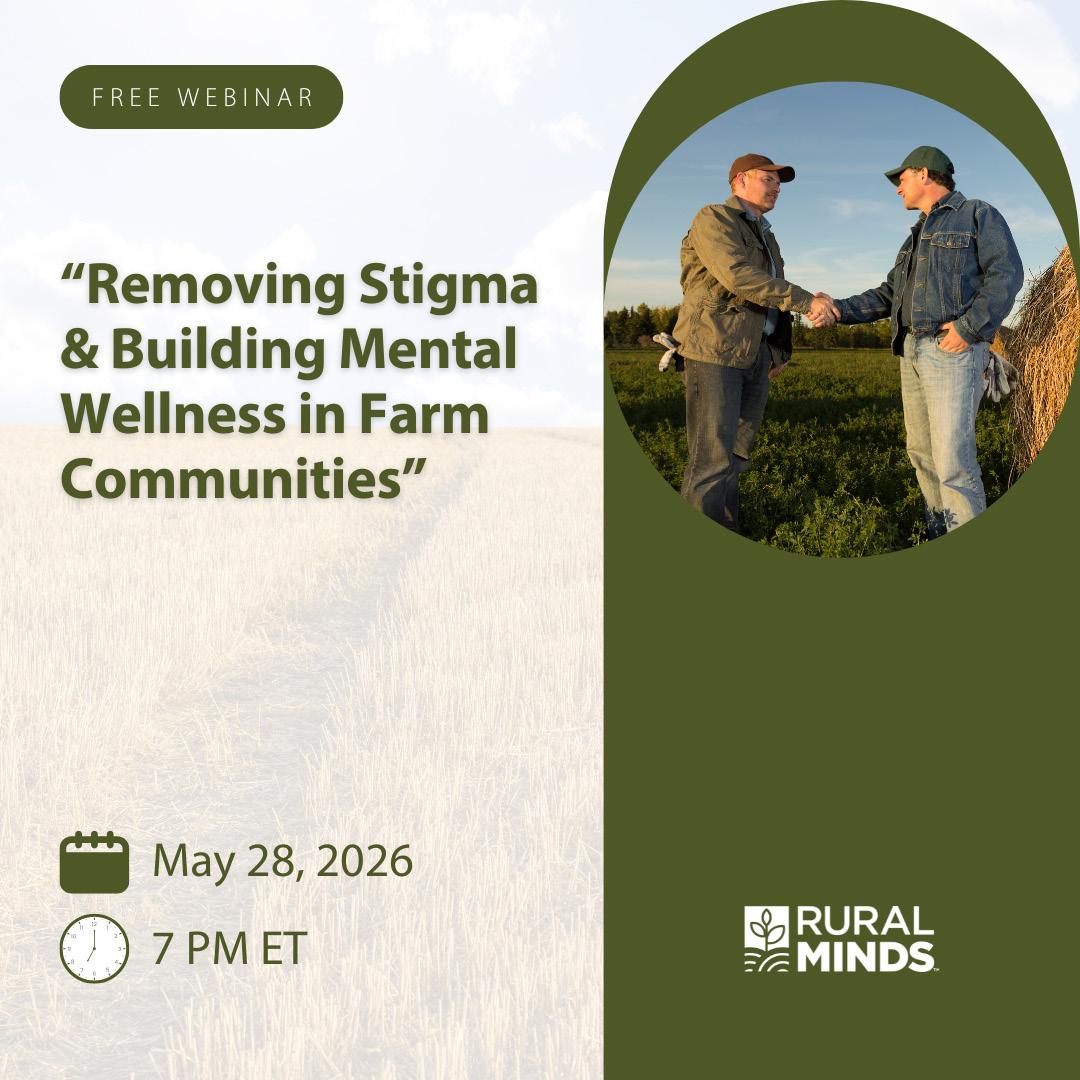
Removing stigma & Building mental wellness in Farm Communities - a Rural Minds Webinar
Join Rural Minds on May 28, 2026, at 7 PM ET / 4 PM PT, for the next Connections webinar: “Removing Stigma & Building Mental Wellness in Farm Communities.”
During this one-hour webinar, you’ll hear from two farmers who are helping to grow positive change in rural communities:
• Jolie Foreman – Missouri farmer and Executive Director of Shelby County Cares, working to reduce isolation and expand access to mental health support.
• Thomas Eisenbarth – Kansas farmer, rancher, educator, and founder of Grounded Ag, sharing a powerful perspective shaped by his own experiences in agriculture.
Together, they’ll share real stories and practical strategies to break stigma and support mental wellness in farm communities.
Learn more and register for free: tinyurl.com/45e9e33v

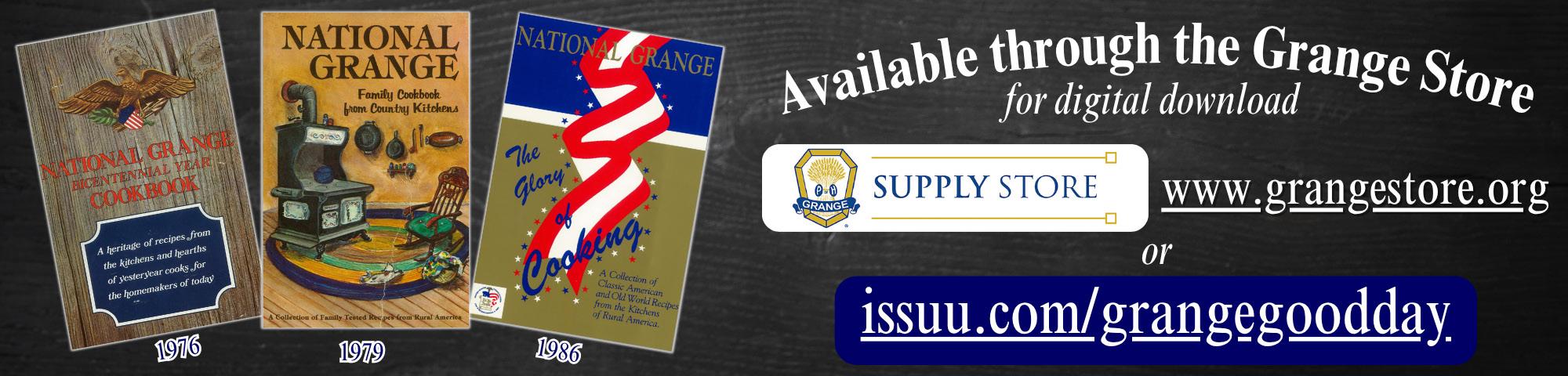
The America’s 250th Grange Workgroup is celebrating our country’s 250th Anniversary by “throwing back” to some classic recipes from Grange cookbooks. Do you have favorite recipes that evoke the American spirit which you would like to see published again? Send them to Lew Gaskill at olgaskill@comcast.net. Please include which Grange cookbook your recipes come from.

This week’s recipes are perfect for Memorial Day From the National Grange Bicentennial Year Cookbook
Delicious Chicken Casserole
1 cup cooked rice
2 cups diced cooked chicken, turkey or ham
1 cup cream of chicken soup
1 cup diced celery
3/4 cup mayonnaise
3 hard-cooked eggs, chopped
1 Tablespoon lemon juice
1 Tablespoon grated onion
1/2 teaspoon salt
1 cup buttered corn flakes
Courtesy of Mrs. Leon Wayand, Women’s Activity Chairman Louisville Grange #1310, Morris, NY
Combine all ingredients except corn flakes; place in 2-quart casserole. Sprinkle corn flakes over top.
Bake in preheated 350-degree oven for 1 hour or untilheated through. Serve immediately.
Red, White and Blue Salad
2 envelopes unflavored gelatin
1/3 cup sugar
Dash of salt
2 cups milk
1 1/4 cup cottage cheese
1 8-oz. can crushed unsweetened pineapple in juice
Courtesy of Mrs. Arthur Ebbert Biglerville Grange #2063 Biglerville, PA
1 cup sliced strawberries 1/2 cup blueberries cheese and pineapple.
Combine gelatin, sugar and salt in 1 1/2-quart saucepan; stir in 1/2 cup milk. Place over low heat, stirring constantly, until gelatin is dissolved. Add remaining 1 1/2 cups milk; stir in cottage cheese and pineapple.
Arrange several of the strawberries and blueberries in 6-cup star-shaped mold. Pour 1 cup of the gelatin mixture over top; chill until set. Arrange more of the strawberries and blueberries in a design against the side of the mold. Fold remaining strawberries and blueberries into gelatin mixture; turn into mold. Chill until firm.
Yield: 8-1 0 servings.
Grange Member Benefit: Start Hearing

Helping you find the best solution for your hearing needs and lifestyle – at the best value.
Grange Members and their families receive:
• Discounts up to 48% on today’s latest technology, including hearing aids and tinnitus options
• FREE annual hearing consultations
• Access to a nationwide network of 3,000+ hearing professionals
• Three-year supply of FREE batteries (40 cells per hearing aid purchased per year)
• One year of free office visits (limit of six)
• 60-day risk-free trial period
• FREE Deluxe Warranty Plan, including loss and damage
• Financing plans available (subject to credit approval)
With Start Hearing, their Hearing Care Advisors are with you each step of the way. To find out more and to schedule your hearing consultation, please call (833) 926-2824 or visit www.starthearing.com/partners/grange.