Good DAY!
™
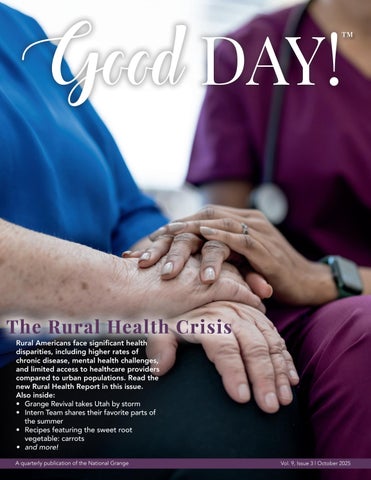
The Rural Health Crisis Rural Americans face significant health disparities, including higher rates of chronic disease, mental health challenges, and limited access to healthcare providers compared to urban populations. Read the new Rural Health Report in this issue. Also inside: • Grange Revival takes Utah by storm • Intern Team shares their favorite parts of the summer • Recipes featuring the sweet root vegetable: carrots • and more!
A quarterly publication of the National Grange
Vol. 9, Issue 3 l October 2025
Checking your
Subscription Don't miss a single issue!
1. Locate your Member ID
2. Visit nationalgrange.org/goodday 3. Fill in your information
4. Subscribe, renew or set up autorenewal
If you receive a new debit or credit card, or the expiration date has changed, please contact the office so we can update your autorenewal.
5. Need additional help?
™ MAGAZINE 2Email Stephanie (swilkins@nationalgrange.org) GOOD DAY! or Philip (pvonada@nationalgrange.org)! ®
www.nationalgrange.org
Good DAY!
N & V
GRANGE NEWS & VIEWS
5
F
GRANGE FOUNDATION
19
L
LEGISLATIVE
20
S RA
THE STATE OF RURAL AMERICA
23
I
IDEAS FOR GRANGE PROGRAMS & ACTION
28
M
69
MEMBERSHIP NEWS & RECOGNITION
On the cover:
The health disparities in rural America - from rates of disease and illness to hardships in accessing care - are highlighted in the new National Grange Rural Health Report. Photo via AdobeStock
J
Y H & L
F & R
L W
™
80
JUNIOR GRANGE & GRANGE YOUTH
HOBBIES & LIFESTYLE
87
FOOD & RECIPES
91 97
THE LAST WORD
P
PERSPECTIVES:
2025 Rural Health Report
33
Follow us on Social Media National Grange
@nationalgrange
@nationalgrange
National Grange
@nationalgrangeofficial @nationalgrangeyouth @national_junior_grange
@nationalgrange
Good Day! Magazine is a quarterly publication of the National Grange located at 1616 H St. NW, Suite 300, Washington, DC 20006 ISSN: 2688-6030. | All comments and questions can be directed to pvonada@nationalgrange.org. Reproduction or distribution of any part of this magazine is prohibited by anyone other than a Grange member or a chartered Grange without written permission from the National Grange Communications Department.
GOOD DAY!™ MAGAZINE ®
www.nationalgrange.org
3
WHAT’S THE GRANGE? The National Grange was founded as a fraternal organization for farm families in 1867 – opening its doors to men and women equally from the start. From rural free delivery of mail to the direct election of U.S. Senators by the people, Grange has influenced many aspects of American life and culture. Today, we continue to advocate for rural Americans and those interested in all areas of agriculture – including those who just like to eat – and our local Granges provide millions of dollars and hours of service to their neighbors annually. Each Grange operates as a grassroots unit, taking on projects most appropriate for their communities and advocating based on their members’ beliefs.
®
Learn more at www.nationalgrange.org.
OUR
John Benedik, NJ, Vice President jbenedik@grange.org Lynette Schaeffer, IL, Executive Committee Chair lschaeffer@grange.org Susan Noah, OR Executive Committee Member snoah@grange.org William “Buddy” Overstreet, TX, Executive Committee Member boverstreet@grange.org Joseph Stefenoni, CA Executive Committee Member jstefenoni@grange.org Tom Gwin, WA, Lecturer lecturer@nationalgrange.org
Christopher Johnston, MI, Steward
Christine E. Hamp, Publisher National Grange President President, Grange Foundation President, Grange Advocacy champ@nationalgrange.org Philip J. Vonada, Editor Communications Director pvonada@nationalgrange.org Stephanie Wilkins, Subscriptions Manager IT Director swilkins@nationalgrange.org
Amanda Leigh Brozana Membership & Leadership Development Director & Grange Foundation Associate abrozana@nationalgrange.org
Walter Hartley, RI, Assistant Steward
Loretta Washington Sales, Benefits, Programs & Membership Recognition Director lwashington@nationalgrange.org
Kathy Gibson, MA, Lady Assistant Steward Kay Hoffman Stiles, MD, Chaplain Joseph Goodrich, VT, Treasurer Debbie Campbell, PA, Secretary David Allen, NC, Gatekeeper Cindy Greer, CO, Ceres Barbara Foster, WV, Pomona
HEADQUARTERS PHONE (202) 628-3507 HEADQUARTERS ADDRESS: 1616 H ST NW SUITE 300 WASHINGTON, DC 20006
Additional Editing by: John Benedik, Lynette Schaeffer, Annie Johnson, Chloe Schmitz, & Lily Thomas and the 2024 class of Communication Fellows
Welina Shufeldt, OK, Flora
GOOD DAY!™ MAGAZINE
4 ®
Staff
Burton Eller, Advertising Partner Legislative Director Executive Director, Grange Advocacy beller@nationalgrange.org
Officers
Christine E. Hamp, WA, President champ@nationalgrange.org
OUR
www.nationalgrange.org
PRESIDENTIAL Perspective Christine E. Hamp
The Power of Being Present, Prepared, and Purposeful One of the Grange’s greatest strengths has always been its deep roots in the community. For nearly 160 years, Granges across the country have stood – sometimes quite literally – as pillars of support, service, and shared responsibility. In today’s world – where challenges shift quickly and needs arise overnight – our ability to be nimble, responsive, and deeply connected is more essential than ever. From natural disasters to divisive local debates, from economic hardships to public health emergencies, from families in crisis to moments of celebration and unity – our communities need organizations that can respond quickly, act meaningfully, and lead with clarity and compassion. The question we must ask ourselves is not whether the Grange can help – it’s whether we’re positioned to do so when the moment comes. We must not wait to be invited. We must already be in the room. That means staying informed and involved. It means showing up – at town council meetings, school board sessions, planning committees, and public forums. It means knowing our neighbors, keeping up with local news, and building and fostering relationships with the people and institutions that shape our communities. It means being the trusted ones others turn to – not just in emergencies, but in moments of possibility. We must be the ones who say, “Use our hall.” We must also be the ones who say, “We don’t have a hall, but we have people ready to help.” And above all, we must be the ones who ask, “What do you need – and how can we assist?” Whether your Grange meets in a hall, a library, a church basement, or around a kitchen table – you have everything you need to make a difference. In fact, Granges without a hall, untethered by property upkeep and overhead, may often be better equipped to move quickly, adapt on the fly, and build partnerships wherever the need arises. What matters most is not the building, it’s the presence. It’s the people. It’s the willingness to act. Flexibility is power, connection is influence, and purpose is the driver.
Project Sustenance helps give our flexibility direction. While our work may look different in each town, county, or state, Project Sustenance reminds us that being nimble isn’t just about speed – it’s about having a clear sense of what we’re moving toward. Its three pillars – food security, self-sustainability, and resilience – are guideposts to ensure our actions are rooted in real community needs.
Food Security
Organize the food drive. Fill the pantry shelves. Help the farmers’ market reach more families. The need is immediate, and we are capable.
Self-Sustainability
Teach life skills. Host a budgeting workshop. Offer a garden-to-table class or a basic repair tutorial. These simple acts can change lives and empower communities to stand strong on their own.
Resilience
Be the place where neighbors gather when the power goes out or tensions rise. Share resources on mental health. Connect seniors to care or children to services. Sometimes, just being present is the difference. These are not abstract ideas. They are actions we can take right now, rooted in our purpose and guided by our commitment to service. When we lean into these pillars, we don’t just support our communities – we help them thrive. I encourage each Grange – and each member – to ask: • Are we connected to the issues our neighbors are facing? • Are we present in conversations shaping our future? • Are we building relationships that position us as first responders – not just in emergencies, but in opportunities? • Are we visible, trusted, and engaged where it matters most? Being nimble doesn’t mean being unstructured or reactive. It means having the right mindset, the right relationships, and the right mission focus to meet the moment. Let’s recommit to being present, prepared, and purposeful. Because when the unexpected arrives – and it always will – it should be the Grange that’s already there: with sleeves rolled up, boots on the ground, and hearts and steady hands extended in service.
N GOOD DAY! MAGAZINE & V ™
www.nationalgrange.org
5
Grange Revival 2025: A Week of Community and Adventure in Torrey, Utah by Makayla Piers
National Grange Communication Fellow From July 2127, 2025, Grange members and friends from all over the country gathered in Torrey, Utah for the 2025 Grange Revival. RVs and tents quickly filled the park and every spot had a spectacular view of the gorgeous red rock cliffs. Everyone knew from the start that this week would be something special. The campground quickly became our little village. The setting made everything feel easy. Coffee in the morning, bright clear starry skies at night, and plenty of time in between to relax, laugh, and enjoy being together. What made it even better was the Grange spirit at play. Everyone
pitched in. Meals were served, tables were set, dishes were washed, and everyone shared the load without a second thought. That quiet teamwork Attendees at Grange Revival 4.0 - Torrey, Utah, gathered for this created an a t m o s p h e r e group photo in Capitol Reef National Park. Photo by Christopher Heath where the focus stayed on fun and fellowship. The spirit of generosity just about food. The watermelon showed up in countless ways carving contest was a perfect addition throughout the week. One of the and added extra fun. Some designs highlights was a pancake breakfast were artistic, others downright funny, hosted by the Giguere family, and every entry brought laughter, cheer, and plenty of photos. complete with FIVE POUNDS
of bacon that disappeared in record time. The Dutch oven dessert showcase was another favorite. Cobblers, cakes, and other creations baked slowly in cast iron filled the campground with sweet aromas, and once the lids were lifted, everyone was ready to sample the results. Another evening turned into a sweet memory as members tried their hands at making homemade ice cream, with plenty of laughs and taste tests along Linda Kesby (NY) just couldn’t wait to try the the way. And it wasn’t homemade ice cream! Photo by Chris Hamp
10
The Revival Planning Team poses at the giant frame. This team includes (clockwise from bottom left) Chris & Duane Hamp (WA), Jodi Ann & Jody Cameron (CT), Karie Blasingame (IL), Tony & Janet Fishovitz (PA), and Amanda Brozana (WA). Photo provided
N GOOD DAY! MAGAZINE & V ™
www.nationalgrange.org
Days were spent exploring the unique sites in Torrey. The hike to Hickman Bridge challenged everyone but the views made every step worth it. Capitol Reef’s petroglyphs told stories of the region’s earliest people, while its towering cliffs reminded us of just how small we are in such a grand landscape. Goblin Valley, with its strange rock formations, became a playground for photos and imagination. And then there were the simple pleasures, like biting into a mini pie at the historic Gifford House or learning about Fruita, the orchard-filled farming community that once thrived in the desert. One evening, everyone gathered in a rustic hall for live music from a traveling band with a mission. They play for free wherever they go, asking only for donations to local food banks. Grangers rose to the occasion, presenting boxes of food along with a $250 donation to support the band and the local community, along with a quilt (made by the 2023 Revival Quilt Shop Hop participants) that will be auctioned off for additional support. This cause aligned perfectly with the Grange’s commitment to food security through Project Sustenance. Once the band began to play, the hall quickly turned into a dance floor, with people of all ages joining in. Laughter and music filled the building and for a little while the revival became one big party. Later, campfires burned while stories were shared, s’mores roasted, and Uno “No Mercy” games played long into the night. As the week continued, it was time for the big announcement we had all been waiting for… the location
Tons of fun was had throughout the week of Revival, including at the watermelon carving contest. The carvings (right) were fun, unique, and a great addition of fun! Photos by Chris Hamp
for the next Grange Revival! Join us for Grange Revival 5.0 in Bryson City, North Carolina, at the Deep Creek Tube Center and Campground from July 19–24, 2027. The thought of adventuring into the rolling green of the Smoky Mountains stirred immediate excitement, and many began planning their next adventure before this one had even ended. As the week wrapped up, a group photo was taken, a simple but lasting reminder of the beautiful memories made in Utah. Goodbyes were hard, softened by the knowledge that these connections don’t end when the campers roll out. They continue across state lines, through visits, calls, and the simple fact that the Grange is a family wherever you go. Grange Revival 2025 was more than a trip. It was a reminder of why the movement matters. Service, fellowship, and the joy of working and laughing together. Utah gave us cliffs, canyons, and orchards, but the Grange gave it meaning. And now, the countdown to the Smoky Mountains begins! Learn more, see more photos, and access the registration information for 2027 at grangerevival.com.
N GOOD DAY! MAGAZINE & V ™
www.nationalgrange.org
11
An important feature of the National Grange’s signature initiative, Project Sustenance, is ideasharing and building a resource library that will help Granges easily adapt projects others have had with success to their communities. The program is gaining traction in Granges across the nation, and Granges have begun submitting their outreach, service and programs to be added to the Project Sustenance website.
PROJECT SUSTENANCE FEATURE
In each issue of Good Day!, we will highlight an activity, event or program submitted by Granges that meet one or more of the pillars – food security, selfsustainability, individual and community resilience – of Project Sustenance. Submit yours online at www.nationalgrange.org/projectsustenance.
Seeds, Garden, and a Shed by Claudine Mincks and Sara Wade Food Security, Self-Sustainability, Individual and Community Resilience
#670
As of the end of August, eight
Van Duzen River #517 (CA),
Granges across the country have
and VilleWorth #1300 (NC),
reported
or
have put forth the effort to
local
be innovative at educating
their
collaborative
independent
efforts
with
Mansford
#710 (WA), Merced Colony #527
(CA),
Taghhannuck
#100 (CT), Upton #125 (MA),
community partnerships in working
and
towards
growing
(CA),
providing
different
food
security,
resources to work towards
and
resilience
sustainability in growing their
in America’s hometowns as part
own food sources within their
of the National Grange’s Project
own communities.
self-sustainability,
Sustenance. Hightstown #96 (NJ), Little Lake
These
eight
Granges
had the following projects: little
free
seed
libraries,
Mansford Grange #710 (WA) offered seed packets to their neighbors and community. Photo provided
organizing plant give and
Members of Hightstown Grange (NJ) welcome their community to the Plant & Seed Swap. Photo provided
12
takes, hosting seed swaps, full
With summer winding down and
partnering gardens with elementary
fall harvests in full swing it is a perfect
schools, making seed kit gardens
time to highlight these Granges
together,
monthly
nationwide for their unique ideas on
gardening educational classes with
seeds, gardening, and community
hands on in the garden experience,
education in fun and engaging ways
and the ultimate in giving back to the
in the realm of growing one’s own
community by building a gardening
food source.
facilitating
shed from all recycled materials for
We applaud these Granges for
the unique purpose of sharing with
being reat examples in using Project
the community, seeds, plants, and
Sustenance to connect with their
gardening tools.
members and their communities.
N GOOD DAY! MAGAZINE & V ™
www.nationalgrange.org
Farm Camp: A Week of Fun and Learning A “Share Your Project’s Story” submission by Bonnie Mitson & Randee Farmer
National Grange Community Service Co-Directors Thank you to Poteet Grange #1576
(TX)
for
submitting
the
electronic SHARE YOUR PROJECT'S STORY form located at https://www.
nationalgrange.org/our-values/ community-service. Details of their Grange's Farm Camp: A Week of Fun and Learning are shared here. It is our hope that by sharing a project’s story, details might be helpful suggestions to other Granges on future projects. Thank you and great work, Poteet Grange! Project Name: Farm Camp: A Week of Fun and Learning Grange: Poteet Grange #1576, Poteet, Texas Approximate Hours Expended:
Members: 11 members (70 hours)
Non-Members: 7 FFA/4-H Members and 2 teachers (20 hours) Funds donated by members and Grange Fundraisers From June 2 to June 6, Poteet Grange was buzzing with excitement as they hosted their
Students participated in Sheep Day activities at the Poteet Grange Farm Camp. Photo provided Grange Family Craft Show. They learned to candle eggs and crafted their own egg replicas using foam and cotton balls. Tuesday brought a visit from two
Farm Camp, welcoming students from
2nd
to
8th
grade
adorable rabbits, thanks to FFA
across
member Brooklyn who showcased
Atascosa County, Texas. Dedicated
her Lionhead rabbit alongside a
volunteers from 4-H and FFA
Netherland Dwarf. The kids got
helped make this event a success,
creative with seed art, further
with special thanks to Miss Chelsea,
immersing themselves in the world
one of the Poteet FFA teachers, for
of animals. Our wonderful snack
her support!
team, including Anne, Danielle,
Each day of Farm Camp featured
Loramae,
a different animal theme, providing hands-on learning experiences for
treated
origins and growth of various fruits.
Monday kicked off with Poultry
Wednesday was Sheep Day,
Day, where the guests included a
and the highlight was a delightful
turkey, a chicken, and a duck. The
visit from a mother sheep and her
children learned about the unique
baby lamb. Students engaged in
characteristics of these birds and beautiful
Suzie,
the children were taught about the
the kids.
painted
and
everyone to tasty fruit kebabs while
discussions about shearing and
birdhouses,
wool processing, learned how to
which they could enter in the State
finger crochet, and participated
N GOOD DAY! MAGAZINE & V ™
www.nationalgrange.org
13
How Eating Together Benefits Your Family Courtesy of Family Features Sharing a meal offers far more than a full stomach; the benefits of eating together extend well beyond the dinner table. In the “2025 World Happiness Report,” evidence shows that sharing meals has a substantial impact on an individual’s wellbeing. Those who regularly eat with others report higher life satisfaction and display higher levels of social support, positive reciprocity and less loneliness. Learn more about how sharing a meal can improve your family’s overall well-being with these insights from the experts at the FMI Foundation and their “2025 Family Meals Barometer survey,” which delivers research, collaboration and education to address food safety, health and nutrition concerns.
Civil and Respectful Interactions In a world full of distractions, it may come as no surprise the “2025 Family Meals Barometer” survey found poor communication is a leading concern among parents, more worrisome than
Photo Courtesy of ShutterStock schoolwork or chores. More than two-thirds of respondents expressed a belief that civility in America is worse today compared to 10 years ago, but 74% said family meals are a great time to have and teach respectful interactions. Frequent family meals create a safe environment for families to discuss thornier societal issues.
Better Nutrition Numerous studies have shown families who eat more meals together have healthier eating habits and better diets in general. Family meals at home typically make it easier to fill plates with food from each food group. What’s more, parents who prepare wellbalanced meals and model healthy food choices allow children to mirror and adopt similar habits.
Improved Family Function In the “2025 Family Meals Barometer” survey, respondents cited having more time to spend together and family meals as the top two ways they feel more connected to family and loved ones. With busy school and extracurricular schedules, many families are hard-pressed to find quality time together without distractions. Gathering around the dinner table is an opportunity to connect with one another and talk about what’s happening at work, school and with friends.
Better Grades at School Numerous factors affect students’ academic performance, but eating together as a family helps reinforce many of the variables thought to influence student success. More nutritious meals play a role in stronger cognitive function. Multiple researchers found that children who are part of families that eat together regularly tend to have a stronger vocabulary and higher grades.
Improved Mental Health Another way family meals benefit students at school and beyond is stronger mental and emotional health. In several independent
28
I
GOOD DAY!™ MAGAZINE www.nationalgrange.org
studies, researchers found a positive correlation between family meals and self-esteem, psychosocial outcomes and other markers of mental health. Learn how gathering around the dinner table supports your family’s nutritional, social, mental and emotional health at fmi.org/ family-meals-movement.
Make Dinner Prep a Family Affair The benefits of eating together as a family don’t have to wait until everyone is at the table. During dinner prep, parents and
children have a chance to work elbow-to-elbow and talk about their days. When children participate in preparing healthy food, they may be more interested in eating it. As an added bonus, kids who take part in food preparation enjoy the benefits of building their own life skills. DIY dishes that put kids in charge of what goes on their plates can be a fun way to bring the family together and make meal prep easy. You can customize salad kits with a selection of protein options, create your own personal pizzas or serve a barstyle dinner such as nachos, baked potatoes or tacos that let each family member choose their own toppings.
Stop Medicaid Fraud Before it Starts by Dr. Mehmet Oz Administrator of the Centers for Medicare & Medicaid Services Courtesy of Family Features When I took on the role of leading Medicare, one of my primary goals was to crush the chronic fraud, waste, and abuse in the program. Ensuring that taxpayer dollars are used responsibly and that Medicare resources remain available for those who depend on them is a top priority. People with Medicare are at the very heart of this effort. Scammers are after your Medicare number to submit false claims for services that were never provided, or for services that are not needed. These fraudulent actions do more than just drain government funds. They can also compromise your personal medical records, potentially affecting the care you need. Medicare fraud costs American taxpayers billions of dollars every year. By staying vigilant and protecting your Medicare information, you can help stop fraud before it starts.
Together We can Crush Fraud
To protect yourself, follow these steps: 1. Guard Your Medicare card like you would a credit card or your social security number. 2. NEVER share your Medicare information with anyone who calls, texts, emails or shows up at your
3.
4.
5.
door uninvited. Scammers may pretend to be from Medicare or act like salespeople. Remember: Medicare will never contact you before you contact them. Be skeptical of “free” gifts, “free” medical services, discount packages or any offer – If it sounds too good to be true, it absolutely is! Check your Medicare claims statements to make sure that all services listed are the ones that you received. Also, check for fraud red flags like being billed twice for the same service. Report suspicious activity immediately by calling 1-800-MEDICARE.
Your health care decisions should always be made between you and your doctor, not a salesperson. Protecting your Medicare isn’t just about saving money, it’s also about safeguarding your health and the integrity of a system we all depend on. Stay vigilant, stay informed, and together we’ll stop these criminals in their tracks. With your help, we can crush Medicare fraud. To learn more, visit Medicare.gov/ fraud. To report potential fraud, call 1-800-MEDICARE (1-800-633-4227). Information
provided
by
the
U.S.
Department of Health & Human Services.
Be Aware of This Growing Scam
Fraudsters posing as salespeople are targeting older Americans, attempting to enroll them in hospice care without their knowledge or consent. They often go door to door, offering so-called “free” services like cooking, cleaning, medical equipment, or even protein shakes. This is all as a cover to get you to sign paperwork. Don’t do it.
I
GOOD DAY!™ MAGAZINE www.nationalgrange.org
Photo courtesy of ShutterStock
29
Staying Safe with Opioids at Home: The Role of Naloxone in the Care of Older Adults By Elana Kieffer, MBA Director of Strategic Alliances, Gerontological Society of America Many of us, especially as we age, are prescribed opioids for pain relief, due to health conditions or when recovering from surgery. While opioids used for pain relief as prescribed by a health care provider, especially taken short-term, are generally safe, there is always a risk of an overdose. It is important to note that not all opioids a person may have in their home were prescribed for them by a health care provider. If you or a loved one has opioids in the home, there are many ways to store opioids safely and steps to take if you think someone has had an overdose. Opioids are powerful and potentially addictive drugs that are sometimes needed for treating severe pain. When you or someone you live with or care for is interacting with opioids, you, family members, caregivers, friends, and other acquaintances must know about the adverse effects of these drugs and how to recognize and respond in cases of apparent overdoses. There are questions you should ask the prescribing provider when considering opioids for your treatment plan or for someone who you provide care for. There are also important questions to ask your pharmacist about methods for safely and securely storing and disposing of opioids. Physicians, dentists, and other health professionals grew accustomed over the years to prescribing opioids for a variety of relatively simple surgeries and minor conditions. Many of these situations are now recognized as responding well to nonopioid therapies such as over-the-counter analgesics. Ask your health care provider if nonprescription drugs or other non-opioid prescription medications could be strong enough to relieve pain when considering using opioids.
Questions to Ask Your Health Care Provider
• Do I really need opioids? • Would something with fewer side effects be enough to stop my pain? • Will you prescribe naloxone in addition to the opioid so that my insurance covers it? • What is the best way to dispose of leftover medication when I no longer need it? If you or someone you care for is prescribed an opioid medication, be sure to ask for and fill a prescription for naloxone. Naloxone (also commonly known as the brand name
30
I
Narcan) is a medication that can be used to restore breathing in people who have overdosed on opioids. You can also purchase naloxone without a prescription by paying for it out-of-pocket. People often do not take all the opioid medication they are given at the pharmacy, and these leftover medications lie forgotten in drawers and medication cabinets for long periods of time. Pets and children may discover and eat them. Teenagers or adults who are experimenting with drugs or addicted to opioids may find and take these drugs. You never know when naloxone may be needed. When opioids are present in the home, they must be stored properly—safely away from pets, children, and drug-seeking adolescents and adults. Recommended practices for the storage of opioids include the following: • Use a locked cabinet or a medication lock box or drawer. • Avoid storage in easily accessible areas such as bathrooms or kitchens. • Keep opioids and other medications in their original containers with information on proper use and side effects. • Keep track of the number of tablets or capsules remaining in the home. • Educate all family members and caregivers on the risks associated with opioid use. • Avoid storage in purses or bags to prevent theft or pilfering. • Keep medications in locked containers when traveling and maintain a list of all transported medications. Just as safe storage is important, opioids should be disposed of properly. The best way to dispose of opioids safely
GOOD DAY!™ MAGAZINE www.nationalgrange.org
is by taking them to a collection site registered by the U.S. Drug Enforcement Administration (DEA). You can find one close to you by going to https://www. deadiversion.usdoj.gov/drug_disposal/ drug-disposal.html and selecting “Search for Year Round Pharmaceutical Disposal Locations.” These drop-off locations are usually pharmacies or law enforcement agencies. Consumers can also ask pharmacists for pre-addressed envelopes to mail unneeded opioids back to the pharmacy. When those options are not available, the next best choice is making the drug products unpalatable or impossible to use before disposing of them in household trash. One method is mixing crushed-up drug products with coffee grounds, cat litter, or dirt. Another is to dissolve the products in water mixed with vinegar or dish soap and then soak up the solution using paper towels. High-risk products such as hydrocodone and fentanyl can be flushed down the toilet when other options are not feasible. Check the U.S. Food and Drug Administration (FDA) Remove the Risk medication flush list at https://www.fda.gov/drugs/disposalunused-medicines-what-you-shouldknow/drug-disposal-fdas-flush-listcertain-medicines to determine whether a product can be safely flushed.
Signs of Overdose and How to Help The most common side effects of opioids are sedation, constipation, euphoria, and mood changes. It is important to know how to recognize, prevent, and manage these side effects. If they do occur, you must monitor the person who is taking opioids and be prepared to take prompt action. Sleepiness and sedation are difficult to distinguish from opioid poisoning. As a family member or other caregiver, you can take the following actions to detect and manage sedation during opioid therapy: • Watch diligently for signs of
excessive sedation, such as difficulty waking the person, dizziness, or confusion. • Report to the person’s health care professionals all current medications, supplements, and nonprescription drugs as well as any recreational drug and alcohol use. • Ensure that the person follows the prescribed dosing instructions and does not take extra doses. • Encourage the person to avoid alcohol and other sedating drugs, including benzodiazepines such
I
GOOD DAY!™ MAGAZINE www.nationalgrange.org
as Valium and Xanax. All these factors make it important for you to be alert to adverse effects or opioid poisoning. People with past histories of substance abuse may be on treatments such as methadone or buprenorphine, and these can increase the risk of opioid poisoning. Safely using opioids requires attention to these instructions by everyone involved at all times: • Never take more opioids than prescribed without first consulting the health care provider or pharmacist.
31
• Keep a record of any changes in signs and symptoms or reactions to the opioids during treatment. • Ensure that you know the signs that indicate an emergency situation requiring immediate medical attention. As shown in the decision tree on page 30, signs of potential opioid overdoses include excessive sleepiness or trouble staying awake, walking, or talking. Other signs of an overdose are slow or shallow breathing, snoring or gurgling sounds, pale or cold skin, blue lips or fingernails, or constricted (small) pupils. If these signs are present, call the person’s name loudly, shake them, and rub your knuckles on their sternum (center chest) to try and wake them up. If the patient does not awaken, immediately administer naloxone. Lay the patient on their back and tilt their head up. Follow the instructions provided with the product you are using. For intranasal sprays, insert the nozzle into the nostril and press until the unit clicks to spray. For injectable naloxone, use the device as directed, injecting the medication into the outer thigh or upper arm (like an Epi-Pen). Naloxone quickly reverses an overdose by blocking the effects of opioids. It can restore normal breathing within 2 to 3 minutes in a person whose breath has slowed, or even stopped, as a result of opioid overdose. After the naloxone dose is given, place the person on their side with the top leg bent to prevent choking if they vomit. Call emergency medical services (911 in North America) immediately after administering the first dose of naloxone. Tell emergency services where you are and describe the patient’s condition. If you have experience monitoring someone’s vital signs, record their heart rate, breathing rate, and when possible, oxygenation and/or blood pressure. When help does arrive, give them the patient’s vital signs if you were able to take them. Stay with the person until help arrives. The effects of
32
I
naloxone only last for up to 90 minutes, and the opioid still in the patient’s system could again suppress breathing. Continue to observe the patient. If breathing is not restored after 3 minutes, give additional doses of naloxone every 2 to 3 minutes until help arrives. Emergency services can help you on the phone determine when you need to administer another dose. Opioids are powerful drugs that can control severe pain. However, overdoses still can occur even in those who have been using opioids for a while. The body’s responses to opioids can change, doses can be increased, or therapy may be switched to a different opioid. Family members and caregivers play an essential role in opioid safety. By knowing what signs and symptoms to watch for and what to do for opioid poisoning, you can protect the health and lives of your family and friends.
About the Gerontological Society of America: GSA is the oldest and largest interdisciplinary organization devoted to research, education, and practice in the field of aging. GSA’s principal mission — and that of our 6,000 members — is to promote the study of aging and disseminate information to scientists, decision makers, and the general public. Founded in 1945, GSA is the driving force behind advancing innovation in aging — both domestically and internationally. Our members come from more than 50 countries. The Vision of GSA is Meaningful Lives as we Age. Learn more at www.geron.org.
GOOD DAY!™ MAGAZINE www.nationalgrange.org
2025 Rural Health Report A special report of the National Grange
What is the Grange? OFFICIAL NAME: The National Grange of the Order of Patrons of Husbandry ESTABLISHED: 1867 HEADQUARTERS: 1616 H St. NW, Washington, DC MISSION: "Strengthening individuals, families and communities through service, education, nonpartisan grassroots advocacy and agricultural awareness.” MOTTO: "In essentials, unity; in non-essentials, liberty; in all things, charity. STRUCTURE: The National Grange is a grassroots organization with local chapters, also called Granges, in roughly 1,400 communities and rural areas across the United States. Each local Grange sets their agenda for service. education and outreach based on the needs of their community. MEMBERSHIP: 140,000 KEY PRIORITY ISSUES: Rural Broadband Expansion Farm Bill and legislation favorable for agricultural producers Quality Healthcare & 2 Education
What Is the Grange? The Grange, founded in 1867, is one of America’s oldest grassroots organizations. Built on values of education, advocacy, and community, it brings together people who care about rural life and want to make a difference. The Grange Is Grassroots Advocacy We give members a voice—from town halls to Capitol Hill. Whether it’s protecting farms or expanding rural broadband, Grangers help shape policy and stand up for rural communities. The Grange Is Community Service Grangers roll up their sleeves to support neighbors— organizing food drives, youth programs, and community events. We know our towns, and we work hard to make them better. The Grange Is a Family As a fraternal organization, the Grange offers more than membership—it builds lasting relationships. Through shared values and mutual support, members form strong bonds that strengthen both the organization and the communities we serve. Join Us Whether you're a farmer, a neighbor, or simply someone who cares about your community—there’s a place for you in the A Special Report Grange.ofCome be part of something meaningful. the National Grange
Table of Contents
including graphs, charts, and infographics
What is the Grange? . . . . . . . . . . . . . . . . . . . . . . . . . . . . 2
Setting the Stage . . . . . . . . . . . . . . . . . . . . . . . . . . . . . . 4 -
-
Age-adjusted death rates for the 10 leading causes of death, by urban-rural classification
-
Addressing Safety Beyond City Limits . . . . . . . . . . . . . 21 Million VMT in Traffic Crashes, by State, 2022 -
Rural EMS Divide
Cancer’s Unequal Burden on Rural America . . . . . . . . . . 7 -
ABCDE Rule: Moles vs. Melanoma
-
Age-adjusted death rates for heart disease, cancer, and chronic lower respiratory disease, by urban-rural classification: United States, 1999–2019
A Cardiovascular Crisis . . . . . . . . . . . . . . . . . . . . . . . . . . 11 How to Spot a Stroke
-
Heat Exhaustion vs Heat Stroke
-
Food Desert Map
Mobile Health Clinics Serve Rural America
Rural Access to Transportation . . . . . . . . . . . . . . . . . . . . 23
Disparities in Native and Tribal Nations . . . . . . . . . . . . 24 -
Native and Tribal Death Rates per 100,000
Left Behind: The Rural Disability Health Gap . . . . . . . . 25 Rural Walkability
Expanding Vaccine Access and Education . . . . . . . . . . 27 -
HPV Vaccination Coverage in Rural Areas is
The Rural Nursing Home Crisis: Declining Access to
Diabetes Mortality across Rurality, Time
Long-Term Care . . . . . . . . . . . . . . . . . . . . . . . . . . 28 -
Skilled Nursing Facilities - Dually Certified in Rural Areas
Prioritizing Women’s Health: Rural Realities . . . . . . . . 17 -
-
Consistently Lower
The Urban-Rural Diabetes Divide . . . . . . . . . . . . . . . . . 15 -
2013–2022
-
How to protect your skin from the Sun
-
Fatality Rates per 100 Million VMT in Traffic Crashes, by Rural/Urban Classification,
Rural Health Post-COVID . . . . . . . . . . . . . . . . . . . . . . . . 6
-
Ratio of Rural to Urban Fatality Rate per 100
Pregnancy-related deaths by urban-rural classifications
Invisible Struggles: Addressing Mental Health . . . . . . 18 -
Suicide rates across the United States
-
Suicide rates for persons above 10 years, by
The Grange’s Position . . . . . . . . . . . . . . . . . . . . . . . . . . 29
The Road Ahead . . . . . . . . . . . . . . . . . . . . . . . . . . . . . 30 10 Ways to Improve Rural Health . . . . . . . . . . . . . . . . . 31
How to Contact Your Legislator . . . . . . . . . . . . . . . . . . . 32 Sources . . . . . . . . . . . . . . . . . . . . . . . . . . . . . . . . . . . . . 33
urbanization -
Mental Health resources
editorial images in this publication are licensed through AdobeStock
The 2025 Rural Health Report is a publication of the National Grange located at 1616 H St. NW, Suite 300, Washington DC 20006.
Lily Thomas and Chloe Schmitz co-authored and curated this piece. with assistance from Legislative Director Burton Eller and Communications Director Philip J Vonada The Grange is a longstanding advocate for rural communities, championing policies, especially in healthcare, that address the unique needs of rural Americans. We promote civic engagement across all age groups and empower our members to lead in shaping policy. To learn more about the Grange or submit questions regarding this report, please visit https://www.nationalgrange.org/ or contact info@nationalgrange.org. Reproduction or distribution of any part of this publication is prohibited by anyone other than a Grange member or a chartered Grange without written permission from the National Grange Communications Department.
A Special Report of the National Grange
3
Setting the Stage The State of Health in Rural America
In recent years, rural communities have faced some of the most significant and damaging consequences Five years after the onset of the COVID-19 pandemic, for healthcare. Rural hospital closures have persistently both long-lasting and new challenges persist in the continued at an alarming rate, with hundreds more at risk U.S. healthcare system. However, few are as acutely today. Entire regions have been left without proximate access to care, forcing residents to drive hours to obtain experienced as those confronting rural America. Healthcare has been in the national spotlight for even basic services. Access to insurance has become decades; yet, debates over the Affordable Care Act, increasingly complex, and critical public programs that Medicaid expansions, supplemental nutrition programs, these communities rely on face ongoing threats. Jimmy Gentry, North Carolina and rural hospital funding have once State Grange President, recounted again taken center stage. While the In recent years, rural having to drive over 50 miles to the pandemic faded from our daily lives, communities have city to see a specialist, a journey in its wake, it left a trail of deepened faced some of the most infeasible for many rural Americans. disparities and reshaped lasting While many of these issues are not significant and damaging issues, especially in the small towns new, they are becoming more urgent. and communities that form the consequences for Lack of preventative care, heightened backbone of rural America. healthcare. exposure to environmental risks, Age-adjusted death rates for the 10 leading causes of death, by urban-rural classification (2019)
4
A Special Report of the National Grange
occupational hazards, increased cancer and chronic disease rates, deepening financial insecurity, and a plethora of other issues all contribute to the unremitting health crisis in rural America. As the future of healthcare continues to be debated, one thing remains clear: rural communities must not be excluded in the coming wave of reform and funding. They risk falling even further behind, perhaps irreversibly so.
erosion of the healthcare system in rural America has now been thrown into a full-blown emergency. The issues themselves are neither surprising nor new. For decades, rural hospitals have operated on a fine line and thin margins, struggling under inadequate funding, lack of
support, increasing competition from major systems, and rising demand.1 The pace of the closures is increasing at an alarming rate, with no sign of slowing down. Charlene Shupp Espenshade, a Grange member from Pennsylvania, recounts her father having to drive over an hour to find a doctor to do his CDL physical. As debates over some major funding and support systems continue, the question of how rural hospitals will function without additional funding is at the forefront of everyone’s minds. Some of the most crucial national programs supporting these hospitals now face growing political threats. The Affordable Care Act, which helped reduce the uninsured rate from 23.8% in 2010 to 12.6% in 2023,2 remains at the forefront of repeal and rollback efforts. These smaller rural hospitals already
Where Does It Start? The cracks within rural America’s healthcare system have widened in recent years. While some may view them as separate, most of these issues stem from a single foundational issue: the persistent lack of access. Following the COVID-19 pandemic, the collapse of rural health systems has become an increasingly visible and pressing crisis. Since 2005, over 180 rural hospitals have closed, with many more undergoing major conversions.1 As of today, over 700 rural hospitals are at risk of closing or are facing significant cuts.1 The slow
A Special Report of the National Grange
5
Rural Health Post-Covid Since COVID and 2020, 35 rural hospitals have closed.
23%
of rural hospitals are at risk of closure
PANDEMIC’S ZOOMTOWN EFFECT
Remote workers moving to rural areas during the pandemic drove up housing demand, causing home prices and rents to spike. Longtime residents are facing possibilities of being priced out of their own communities.
Small, rural hospitals faced major losses from privately insured patients during COVID. With less post-pandemic funding, many still struggle to recover. 6
A Special Report of the National Grange
operate at a significant disadvantage, often losing money on Medicaid and uninsured patients.2 Unlike larger hospitals, which can offset those losses with profits made from private insurance, rural hospitals are regularly underfunded and inadequately reimbursed by those same private plans.1 Some hospitals and medical centers remain standing only through state grants or local tax measures, which are not always guaranteed. Without meaningful intervention, the financial instability of rural hospitals may push even more communities to the edge of a healthcare void. At the same time, these same rural hospitals face a chronic shortage of qualified medical personnel.3 Several contributing factors are at play, including ruralurban pay disparities, fewer professional development opportunities, isolation, and resource strain.3 Despite the urgency of this problem, no long-term fix has been introduced. In rural communities, where there are higher rates of heart disease, diabetes, maternal and infant mortality,3 and many other chronic conditions, the effects are especially grave. Many residents go undiagnosed or untreated simply because there are no providers available or wait times for future appointments are unreasonably long.4 Without nearby hospitals or accessibility to specialized personnel, many rural Americans are left
with limited choices. In fact, rural areas across the country face dramatically lower access to primary care physicians. According to the USDA, these areas lag far behind urban areas in terms of the number of doctors per capita.5 The shortage of medical personnel, combined with limited access to hospitals, is resulting in significant delays in care. Specialists, such as OBoGYNs and other healthcare professionals, are often entirely unavailable within a reasonable driving distance, forcing patients to travel hours for basic care – adding even further costs to already expensive procedures – or to forgo it altogether.6 At its core, this is not just a crisis of infrastructure; it is a crisis of access. The inability to find care, whether due to closed hospitals, lack of providers, unaffordable insurance, or sheer distance, has become a defining feature of healthcare in rural America. The lack of access has shown its cascading effect, contributing to the increased dangers of chronic conditions, delaying early intervention, fueling preventable deaths, and deepening health disparities. The following report examines the wide-ranging consequences of this crisis, including worsening public health outcomes and gaps in care that inequitably burden rural communities. Unless addressed directly, these interconnected problems will only worsen.
Cancer’s Unequal Burden on Rural America Across rural America, where grasslands and fields can stretch for miles, a health crisis is unfolding. Cancer has become a disproportionately lethal threat in these communities, largely due to persistence and widening disparities in healthcare access. While cancer affects individuals across all demographics, rural residents are more likely to die from it, not because they are diagnosed more frequently, but because the systems meant to detect, treat, and support them is often fragmented and inaccessible. One of the most pressing issues in rural cancer care is the widespread shortage of healthcare infrastructure and medical professionals. Since
“If I was sick from chemo... help was 75 miles away... and you’re driving an hour and 20 minutes... just to get treatment.” - Kimberly Buchmeier, cancer survivor 2005, over 180 rural hospitals have closed, and an additional 700 are at risk of closure due to financial instability.6 For millions of rural Americans, the nearest hospital may be hours away. Access to oncologists, radiologists, and other specialists is even more limited, resulting in A Special Report of the National Grange
dangerous delays in screening, diagnosis, and treatment that can significantly lower survival rates. Kimberly Buchmeier, a lung cancer survivor from Auburn, Nebraska, described the toll vividly: “If I was sick from chemo… help was 75 miles away… and you’re driving an hour and 20 minutes… just to get treatment.”7
Access Barriers and Survival Disparities According to the CDC, cancer mortality rates are 8% higher in rural areas than in urban ones, even though rural areas have a 2% lower incidence rate of new cancer cases.6 This disparity highlights
7
through social media, disproportionately affects rural communities due to lower digital literacy and reduced access to legitimate medical perspectives from doctors.66 Addressing these issues requires outreach efforts and strong partnerships with local rural community groups to provide education. Expanding rural access to mobile vaccination clinics is also key. Improving vaccination education and rates is essential to protecting public health and preventing deadly outbreaks. Supporting mobile health clinics is key to
expanding vaccination to rural communities. Partnerships with community groups for increased vaccine education will provide the proper knowledge to rural communities who may be susceptible to disinformation on social media. Without these focused interventions, the disparities in vaccination coverage may continue to widen, which could pose long-term health threats. Access to nursing homes is a growing concern in
The Rural Nursing Home Crisis: Declining Access to Long-Term Care rural communities across the United States. As rural populations age, the demand for long-term care is increasing, but availability is rapidly declining. This gap is creating health and social challenges for rural elderly and their families. Between 2015 and 2022, over 550 nursing homes closed nationwide, with a disproportionate number of those being in rural areas.67 According to the National Rural Health Association, 70% of rural counties now lack access to long-term care facilities.68 In many rural states, nursing home closures have left entire counties without a single skilled nursing facility. Several factors contribute to this alarming trend. The financial crisis is a major problem. Rural nursing homes often heavily rely on Medicaid reimbursements, which typically do not cover all care costs. The Kaiser Family Foundation found Medicaid covers about 70% of nursing home residents nationwide but only pays 80% of the cost of care, making it difficult for rural facilities to remain open.
Bureau of Labor projects a need for over 1.2 million additional direct care workers by 2030, a shortage that will cripple rural facilities.70 The profound consequence of this crisis is affecting our rural elderly and their families. Individuals are being forced to relocate to urban nursing facilities, farther away from their families, leading to social isolation. Travel burdens are increasing on their relatives’ decreasing visits and their support systems. Efforts to address these issues require targeted investments and attention to rural facilities. Protecting our nation’s vulnerable population is essential.
69
Workforce shortages also play a critical role. Recruitment and retention are difficult for these rural facilities due to geographic isolation and lower pay. The United States
28
A Special Report of the National Grange
The Grange’s Position The National Grange has long acknowledged that access to quality health care is essential to the well-being and longevity of rural communities. Our commitment to rural health is grounded in our strong policy that supports both immediate improvements in care and infrastructure investments in the systems that sustain rural America. As these challenges continue to face our rural communities, it is critical to analyze how the Grange remains proactive in addressing these issues. First and foremost, the Grange supports maintaining federal block grants and matching funds for state-run community health clinics. These clinics are often the first and only point of access to healthcare for rural residents, who can often be hours from advanced care. By advocating for continued funding, the Grange recognizes the need to advance localized care in underserved areas. Incentivizing healthcare providers, especially medical residents, to practice in rural communities is another longstanding priority. The Grange policy explicitly calls for programs that encourage doctors, nurses, and other medical professionals to practice in areas where basic healthcare is not readily available. A federal program rolling out increased funding and stipends for these professionals would transform rural care. In addition, there is strong support for an education loan repayment program that helps alleviate student debt in exchange for service in
designated Health Professional Shortage Areas (HPSAs) and other underserved regions. The Grange has also taken a strong stance on the integration of telemedicine into rural health care. We support building the necessary infrastructure to expand telehealth services and advocate for the removal of regulatory barriers that hinder the widespread adoption of broadband. This policy position reflects the Grange’s understanding that technology can be a powerful tool in bridging the geographical care gap for isolated populations. Importantly, our organization continues to promote the preservation of home healthcare services. Opposing cuts to Medicare reimbursement rates and the imposition of new patient co-pays that would make care unaffordable for rural Americans who may be on a fixed income. Another important legislative measure is the CARE (Caregiver, Advise, Record, and Enable) Act, which helps family members to assist in delivering medical tasks at home, which is especially important in rural settings where professional support may be limited. We further support robust Medicare and Medicaid programs that treat rural and urban communities. Our policy calls for equal reimbursement rates for rural providers, streamlines the processing of claims, and expands coverage that includes hearing aids, dental and eye care, immunizations, and revolutionary technologies like continuous glucose monitors and early cancer detection testing (MCED).
A Special Report of the National Grange
Mental health is another area of Grange advocacy where we have been proactive. National policy encourages public awareness campaigns to reduce the stigma of mental illness in farming and rural communities. We support legislation that funds stress management training for federal agriculture employees and convenes rural mental health task forces. Additionally, the Grange actively partners with mental health organizations such as Rural Minds Inc. to expand education, outreach, and suicide prevention efforts. Grange advocacy also includes food security as a public health concern. Hunger and malnutrition have a direct impact on health. We support community-based hunger relief initiatives, such as the American Farm Bureau’s “Harvest for ALL” campaign, which engages farmers in donating food and time to local food banks. This aligns with our beliefs that rural America must not only produce food but also protect our vulnerable neighbors who may be facing food insecurity. Lastly, we recognize that none of this progress is possible without reliable infrastructure. The Grange supports full broadband
29
deployment to cover “the Last Mile,” areas of America not yet receiving this coverage. Recognizing that access to high-speed internet is essential for telehealth, education, and
emergency response. In conclusion, the Grange’s rural health initiatives are supported by our devoted Grange members from across America. Advocating for health care, mental health,
food security, and infrastructure, the Grange remains committed to ensuring that rural America will continue to have the resources and opportunities to thrive for generations.
The Road Ahead The state of rural health in America reflects a crisis that is both urgent and expansive. With the impending threat of the collapsing hospital infrastructure stems many issues. From rising rates of chronic conditions, increasing financial stress, mental health crisis, to hundreds of thousands at risk of losing health insurance, rural communities are facing a public health emergency. Forced to endure barriers like geographic isolation, underfunded services, workforce shortages, and limited access to nutritious food, all of which are contributing to the worsening conditions of health outcomes, higher mortality rates, and avoidable suffering. These challenges are not separate, but intersectional and compounding across issues like cancer care, maternal health, mental illness, addiction, and chronic disease management. The devastating consequences of delayed or unavailable treatment simply due to lack of access are compounded by policy failure and economic constraints that continue to increase the urban-rural divide. However, this intersectional crisis is not unbeatable. With services like telemedicine innovations, mobile clinics, community health workers, and targeted investment in policy offer a glimmer of hope. With organizations like
30
the Grange working to support policies that will provide rural hospitals with the resources they need, not only to survive but to flourish, increase broadband access, and fighting for crucial programs like Medicaid that provide rural Americans the opportunity to receive the care they need, the fight is just beginning. The resilience of rural communities has long been evident, and now the political will and sustained support of this community will match it. It will take a lot more than just one person; it will take a community. From voicing your opinions, your stories, expressing how much these programs are needed and just how crucial the ongoing support to sustain rural health is, you can make a difference. Identifying and calling your representative voicing what you care about or sending a personal letter providing a testimony on just how you are being effective by policies is just one way to join. Rural America cannot fall further behind. Equity in healthcare access must be a national priority, one that must be shown through tangible action. Only then will every American, regardless of where they live, has a fair shot at a healthy life.
A Special Report of the National Grange
10
WAYS TO IMPROVE RURAL HEALTH
Increased Rural Hospital Funding Provide Rural Residency Opportunities for Medical Students Mobile Clinc Access Increase Broadband Access for telehealth Early Cancer Detection Screenings
Promote Proper PPE Usage Combat Food Deserts Community Addiciton Services Access to Faster and Skilled EMS Mental Health Education and Advocacy
A Special Report of the National Grange
31
Reimagining medicine, together With approximately 35 research and development projects across solid tumors, hematology and radioligand therapy (RLT), Novartis is committed to using technology, leading science and patient-centered research to deliver pioneering cancer care for all those in need. Follow our journey at novartis.com
90
GRANGE ADVOCACY ADVERTORIAL
What’s Up, Doc?: Carrots! By Ann Olson Bercher President, Minnesota State Grange Certified Culinary Specialist Fall ends the growing season in Minnesota, and the last to be harvested in my garden are usually the root crops. Apparently, America’s favorite root vegetable may not be the potato, no matter how many French fries are consumed; instead, we prefer the humble carrot. According to several sources on the internet, each American will consume 10,866 carrots in a lifetime - I am guessing that each baby carrot counts as one whole carrot. That means California—the largest producer of carrots in the US, providing 94% of the crop—needs to keep up the good work! Carrots were domesticated over 5,000 years ago in the ancient empires, including modern-day Iran and Afghanistan. Upon their arrival in ancient Greece and Rome during medieval times, carrots were used for medicinal purposes. At that time, the color of carrots was not orange; instead, they could be black, white, red, or purple in color. The iconic orange color was created in the
Netherlands during the 17th century through selective breeding. This was done in tribute to the House of Orange, the royal family. Today, carrots are colorful jewels on any plate, whether they are roasted, stewed, or sautéed, whole or sliced, pickled or fresh. There are many ways to enjoy a great carrot! Many cuisines employ carrots in their recipes, from Asian to Middle Eastern, African to European. And, of course, American. Interestingly, while carrots are a fabulous source of fiber, betacarotene, and antioxidants, their nutrition is best released once it has been cooked. Why are carrots so tasty? They have the highest sugar content of any vegetable. (The second-highest source of sugar in a vegetable is beets, but that’s for another article.) So, are carrots still healthy? Yes! Carrots have a low glycemic index, usually lower than that of refined sugars found in many processed foods, and the fiber content of carrots slows down the absorption of sugars into the bloodstream.
There are some fun myths to share about carrots. Most popular is the one that led to the belief that eating carrots helps to improve night vision: During World War II, the British Royal Air Force (RAF) used a secret radar technology that helped them pinpoint the location of enemy bombers during the night. RAF pilot John “Cat’s Eyes” Cunnigham was the first pilot to shoot down an enemy aircraft using this new technology. He would go on to record 20 more victories, 19 of them occurring during the night. The
The British propaganda campaign about carrots being good for night vision even rolled into the “Dig On for Victory” campaign (the UK version of Victory Gardens). This propoganda poster by artist Peter Fraser prominently features carrots. Image in Public Domain Accessed via WikiMedia Commons
F GOOD DAY! MAGAZINE & R ™
www.nationalgrange.org
91
Ministry of Information developed a
your skin orange: This is actually true!
propaganda campaign and told the
A condition called “carotenemia” will
newspapers that Cunnigham and
give your skin a yellowish tint. This
pilots like him were so successful
is not too serious, as it is reversible
because they ate so many carrots.
if you quit eating so many carrots.
The
British
bought
into
the
However, too much carrot juice, like
campaign and began eating more
1 gallon a day, just might kill you with
carrots. The Food Ministry even took
a Vitamin A overdose.
it a step further and encouraged the
Lastly,
those
fabulous
baby
use of carrots as an alternative to
carrots that are so conveniently
fruit in cakes and tarts because of
bagged up and ready to eat are not
the natural sweetness of carrots. (see
naturally miniature: They are full-
above). Carrots were also stuck onto
grown carrots that are cut, peeled,
to grow carrots as part of the Dig on
Bugs Bunny is almost always portrayed with a carrot, like in this 1997 US Postal Service stamp - perpetuating the myth that rabbits love carrots. Image courtesy of the Smithsonian Institute
for Victory program. But the target of
your immune system.
the 1980s. He hated throwing out
sticks and given to children instead of lollypops. People were encouraged
and shaped into those perfect pieces due to the genius of a California farmer, Mike Yurosek, and his son in
this campaign was not the British, it
Rabbits eat a lot of carrots: A
so many carrots because they were
was directed toward the Germans to
favorite childhood cartoon character,
blemished or oddly shaped, so he
distract them from the evidence of
Bugs Bunny, is rarely seen without
started the process of cutting and
their fantastic radar technology.
a carrot in hand, er paw, while
peeling them to make them appear
delivering his famous, “What’s up,
perfect. This mechanized process
Doc?” mantra. It turns out that while
can be viewed on YouTube.
While carrots may not improve your night vision, they are good for eye health, your skin and boosting
rabbits may like carrots, one carrot
For more fun carrot trivia, facts,
for a rabbit is equivalent to a human
and recipes, I recommend that you
eating 20 carrots. The sugar content
visit the World Carrot Museum. This
in carrots is too much for a rabbit.
is a virtual museum that celebrates
Excessive carrot consumption upsets
all things carrot.
their digestive system and disrupts the bacteria levels in the gut. If you raise rabbits, offer carrots as an occasional treat.
carrotmuseum.co.uk/index.html. With all of this to ponder, the following are a few recipes that use
Eating too many carrots will turn
92
You can access it at https://www.
F GOOD DAY! MAGAZINE & R ™
www.nationalgrange.org
carrots in a number of different ways.
Moroccan Style
Carrot Dip
1 pound carrots, peeled and sliced thin 3 tablespoons water 1 ½ garlic cloves 1 teaspoon ginger, grated Pinch cayenne pepper 1 teaspoon ground cumin 1 teaspoon ground coriander 1 tablespoon red wine vinegar 2 ½ tablespoons olive oil Pinch of salt
Carrot
1. Place carrots and water in saucepan and bring to a boil. Lower heat and simmer gently 25-30 minutes shaking pan from time to time until carrots are soft. If any liquid remains, increase heat to boil off liquid, keep stirring so carrots do not scorch. 2. Transfer carrots to food processor bowl. 3. Add remaining ingredients to processor bowl and blend to form a smooth puree. 4. Check seasonings and add salt and cayenne as needed. 5. Chill well before serving.
Pancakes
makes 20
¾ cup milk 1 teaspoon vinegar ½ cup all-purpose flour ½ cup quick cooking oats 1 tablespoon sugar 1 teaspoon baking powder ½ teaspoon baking soda 1 teaspoon cinnamon
½ teaspoon ground cloves ½ teaspoon salt 2 cups finely diced carrots 1 teaspoon vanilla extract 2 tablespoons vegetable oil 1 egg
1. Combine milk and vinegar in a small bowl and set aside. 2. Place four oats, sugar, baking powder, baking soda, cinnamon, cloves, and salt in a food processor bowl and pulse for one minute. 3. Add milk/vinegar mixture, carrots, vanilla, vegetable oil, and egg to dry ingredients. Process until pureed. 4. Heat a lightly oiled skillet over medium-high heat. 5. Pour or scoop ¼ cup of batter onto skillet. 6. Brown on both sides.
F GOOD DAY! MAGAZINE & R ™
www.nationalgrange.org
93
In Essentials,
Unity In Non-Essentials, Liberty In All Things Charity - Grange Motto