Good DAY!
™
More than Food or Farming Agriculture shapes what we eat, wear, build, buy, and value. See how deeply connected we all are to agriculture and how the choices we make help shape its future. Also inside: • The 160th Annual Convention is coming soon • A new partnership with the NREA • Interns reflect on their summer • Cheesy Recipes • and more! A quarterly publication of the National Grange
Vol. 10, Issue 3 l October 2026
ADVERTISE WITH US Our quarterly publication welcomes advertisers. Up to a 20% discount may be offered to Grange members on their ad purchases. All rates shown are for pre-designed content submitted at least 2 weeks in advance of press date for an issue. You may request rates for ads to be designed by our staff.
GOOD DAY!™ 2026-2027 PRESS DATES Issue
Due Date
V10, I4 November 30 V11, I1 February 28, 2027
V11, I2 May 31, 2027
V11, I3 August 31, 2027
Hits Mailboxes January 2027 April 2027 July 2027
October 2027
Classified ads are also welcomed at $0.50 per word up to 25 words, $1 thereafter; $2.50 per website, email, or other link regardless of word count; $5 per photo (will appear no larger than 1.5”x1”). Special requests (bold design, font increase) available for extra charge. All copy should be submitted no later than 10 days prior to the due date. National Grange assumes no responsibility for that which is advertised in Good Day!™ and reserves the right to reject ads deemed offensive or irrelevant. Please contact Philip Vonada by email at pvonada@nationalgrange.org or by phone at (814) 404-7985 for details.
WRITE FOR US This is your chance! This is your magazine. Submissions may be made by any Grange member in good standing, especially including Junior and Youth members, and must be your own original work. For Juniors, you may get your parent, guardian or another mentor or adult’s assistance to write or draw the piece, but we expect all those who assist to adhere to high ethical standards and allow the Junior’s work to be reflected without influence by the adult/ older assistant. All work must be in good taste and appropriate for our audience. The National Grange reserves the right to reject any submissions.
Guidelines & The Fine Print Entries may include: photo essay (at least three photos that together tell a story with captions identifying the people in the photo if applicable and what is happening in the scene); short story (max. 1,500 words); poem; essay/article (maximum 1,500 words and must include at least two relevant photographs with captions); skit (no more than six speaking characters; should not take more than 10 minutes to perform and should not require an elaborate set); D-I-Y (do-it-yourself) project with supply list, step-by-step instructions and photos of each step; or open category (examples include but are not limited to a coloring book page related to Grange or agriculture; comic strip or box; recipes, etc.).
GOOD DAY!™ MAGAZINE
2 ®
www.nationalgrange.org
Each entry must be submitted digitally and include name, address, phone number, email (if applicable) and Grange details (name, number and state of Subordinate Grange and office held). Junior 1+ members can list the Subordinate or State Grange they are affiliated with. E-members can list National Grange E-member. Submission
is
acknowledgment
that
publication is authorized. In the case of Junior submissions, this is acknowledgment of right to publish by both Junior and their parent/ guardian. All submissions must be made via email to pvonada@nationalgrange.org.
Good DAY!
™
N & V
GRANGE NEWS & VIEWS
5
L
LEGISLATIVE AFFAIRS
19
S RA
THE STATE OF RURAL AMERICA
23
I
IDEAS FOR GRANGE PROGRAMS & ACTION
31
H W
HEALTH & WELLNESS
35
M
MEMBERSHIP NEWS & RECOGNITION
51
J
JUNIOR GRANGE & GRANGE YOUTH
62
H & L
HOBBIES & LIFESTYLE
69
F & R
FOOD & RECIPES
Y
L W
74 82
THE LAST WORD
On the cover:
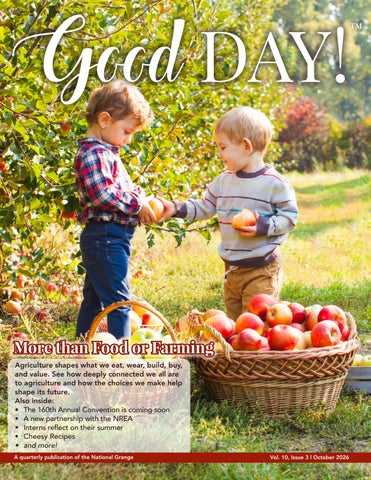
Two young boys trade apples in an orchard. As many Americans become further removed from the agriculture industry, how can we “connect” the average consumer to the farm again? Photo via AdobeStock
P
PERSPECTIVES:
What does it mean to be “Connected to Agriculture” today?
43
Follow us on Social Media National Grange
@nationalgrange
@nationalgrange
National Grange
@nationalgrangeofficial @nationalgrangeyouth @national_junior_grange
@nationalgrange
Good Day! Magazine is a quarterly publication of the National Grange located at 1616 H St. NW, Suite 300, Washington, DC 20006 ISSN: 2688-6030. | All comments and questions can be directed to pvonada@nationalgrange.org. Reproduction or distribution of any part of this magazine is prohibited by anyone other than a Grange member or a chartered Grange without written permission from the National Grange Communications Department.
GOOD DAY!™ MAGAZINE ®
www.nationalgrange.org
3
OUR
WHAT’S THE GRANGE? Founded in 1867, the National Grange began as a fraternal organization for farm families and was progressive from the start—welcoming men and women as equals. Over more than a century and a half, the Grange has helped shape American life, championing causes such as rural free mail delivery and the direct election of U.S. Senators, as well as broadband and rural healthcare. Today, the Grange continues to advocate for rural Americans and all who care about agriculture (including everyone who enjoys good food), while local Granges invest millions of dollars and countless volunteer hours back into their communities. Rooted in grassroots action, each Grange reflects the needs, values, and voices of its members and its community.
Christine E. Hamp, Publisher National Grange President President, Grange Foundation President, Grange Advocacy champ@nationalgrange.org Philip J. Vonada, Editor Communications Director pvonada@nationalgrange.org Stephanie Wilkins, Subscriptions Manager IT Director swilkins@nationalgrange.org Burton Eller, Advertising Partner Government Affairs Director Executive Director, Grange Advocacy beller@nationalgrange.org
®
Learn more at www.nationalgrange.org.
OUR
Officers
Christine E. Hamp, WA, President champ@nationalgrange.org John Benedik, NJ, Vice President jbenedik@grange.org
Susan Noah, OR, Executive Committee Chair snoah@grange.org Joseph Stefenoni, CA Executive Committee Member jstefenoni@grange.org William “Buddy” Overstreet, TX, Executive Committee Member boverstreet@grange.org Walter Hartley, RI, Executive Committee Member whartley@grange.org Dr. Richard Stonebraker, MD, Lecturer lecturer@nationalgrange.org
Staff
Amanda Leigh Brozana Membership & Leadership Development Director & Grange Foundation Associate abrozana@nationalgrange.org Loretta Washington Sales, Benefits, Programs & Membership Recognition Director lwashington@nationalgrange.org
Christopher Johnston, MI, Steward Doug Baldwin, IA, Assistant Steward
Randee Farmer & Bonnie Mitson McCann Community Service Directors communityservice@grange.org
Kathy Gibson, MA, Lady Assistant Steward
Katie Girtler Junior Grange Director junior@nationalgrange.org
Kay Hoffman Stiles, MD, Chaplain Joseph Goodrich, VT, Treasurer
Samantha Wilkins Youth & Young Adults Director youth@nationalgrange.org
Debbie Campbell, PA, Secretary David Allen, NC, Gatekeeper Cindy Greer, CO, Ceres Barbara Foster, WV, Pomona Welina Shufeldt, OK, Flora
HEADQUARTERS PHONE (202) 628-3507 HEADQUARTERS ADDRESS: 1616 H ST NW, SUITE 300 WASHINGTON, DC 20006 Additional Editing by John Benedik & Lynette Schaeffer
GOOD DAY!™ MAGAZINE
4 ®
www.nationalgrange.org
and the National Grange intern team
PRESIDENTIAL Perspective Christine E. Hamp
Ask ten people what it opportunity. It remains rooted in the soil, but today means to be “connected to its reach extends into nearly every corner of American agriculture,” and you’ll likely life. That is good news – not only for agriculture, but hear ten variations of the for the Grange. same answer we’ve heard for For nearly 160 years, the Grange has understood generations: owning a farm, something many organizations are only beginning raising livestock, planting to recognize: strong agriculture depends on strong crops, or working the land. communities. Our founders knew that farmers could Those answers are certainly true, but they are no not succeed without good roads, quality schools, longer the whole story. Agriculture today is both reliable transportation, access to markets, thriving timeless and transformational. local businesses, and neighbors willing to work The heart of agriculture has never changed. It together. They understood that rural prosperity is is still about feeding people, stewarding the land, never built by one industry alone. It is built by people caring for animals, and leaving something better who share a common purpose. That truth is even for the next generation. Those values have endured more relevant today. through every season, every economic cycle, every Today’s agricultural challenges are increasingly technological breakthrough, and every challenge our interconnected. Workforce shortages, supply rural communities have faced. chains, water, energy, broadband, healthcare, What has changed is how trade, education, artificial many different hands now intelligence, food security, and Being connected to make that work possible. environmental stewardship agriculture today doesn’t The person developing all shape agriculture’s future. require that your boots carry drought-resistant seed None exist in isolation, and fresh mud every evening. varieties is connected to neither should our solutions. agriculture. The truck driver For generations, the It requires understanding delivering grain across the Grange has been at its best that every meal begins country is connected to when it brings together with someone who chose to agriculture. The veterinarian people who might not serve something larger than caring for livestock. otherwise sit at the same themselves. The engineer designing table. precision equipment. The Farmers and ranchers teacher inspiring tomorrow’s alongside educators. Business agricultural leaders. The researcher developing owners alongside healthcare leaders. Young people new conservation practices. The small-town banker beside seasoned mentors. Rural voices working financing family operations. The broadband together instead of in separate silos – that is one of technician bringing connectivity to rural communities. our greatest strengths. The entrepreneur creating value-added products. Being connected to agriculture today doesn’t The volunteer serving meals at the county fair. Every require that your boots carry fresh mud every evening. one of them plays a role. It requires understanding that every meal begins with Agriculture has become one of the most someone who chose to serve something larger than interconnected endeavors in our nation – a network themselves. It requires recognizing that healthy farms of people, professions, innovation, technology, and and ranches and healthy rural communities rise, or
N GOOD DAY! MAGAZINE & V ™
www.nationalgrange.org
5
fall, together. It also requires us to think differently about the next generation. Many of tomorrow’s agricultural leaders may never operate a combine. They may write software that improves yields, develop new medical treatments for livestock, launch agribusiness startups, advocate for sound public policy, or discover technologies we cannot yet imagine. These future leaders are every bit as important to agriculture’s future as those working the fields today. If we fail to welcome these future leaders, we don’t just limit their opportunities – we limit agriculture itself. By welcoming them, we strengthen us all. This has always been the Grange way. As we look ahead, I believe our responsibility is not simply to preserve agriculture as we inherited it. Our responsibility is to help shape what agriculture becomes. That means honoring the traditions that built us while embracing the innovation that will sustain us. It means protecting our rural values while remaining
open to new ideas, new partnerships, and new generations of leaders. It means recognizing that agriculture’s story is still being written and that each of us has a role in writing the next chapter. Whether your connection to agriculture begins in a field, a classroom, a laboratory, a Main Street business, or around your family’s dinner table, you belong in this conversation. Agriculture has never been just an occupation. It is a calling to provide, to innovate, to serve, and to strengthen the nation that depends on it. Perhaps that is the Grange’s greatest contribution: connecting the people who grow our food with the people, professions, and communities that help make agriculture possible. For nearly 160 years, we have been more than an agricultural organization. We have been agriculture’s community. The future of agriculture will not be built by one profession. The future of agriculture will be built by people united for one purpose. That is how we honor our past. That is how we secure our future.
Save the Dates! Future National Grange Conventions
2027
November 8-13, 2027 Nugget Casino Resort Sparks, Nevada
2028
November 13-18, 2028 Kalahari Resort & Convention Center Round Rock, Texas
2029
November 12-17, 2029 Renaissance St. Louis Airport Hotel St. Louis, Missouri
2030
November 9-14, 2030 Harrah’s Cherokee Casino Resort Cherokee, North Carolina
161st
162nd
163rd
164th
Mark your calendars and make plans to join us!
6
N GOOD DAY! MAGAZINE & V ™
www.nationalgrange.org
From the desk of the PHILIP J. VONADA One of the first questions people ask when they find out I work for the National Grange is, “Did you grow up on a farm?” The answer is no. I wasn’t raised in a farm family, and my 4-H experience looked a little different than many people’s. While friends spent their summers raising dairy cows, goats, or rabbits, my projects centered around vegetable gardening, cooking, and wildlife (plus the fun ones - like ceramics, rocketry, and tie-dye). Looking back, though, I realize agriculture was woven into my childhood far more than I appreciated at the time. Growing up, my family kept three large vegetable gardens, and it wasn’t just for fun. Those gardens - as well as our apple and pear trees - helped feed our family of five, plus friends and family, through much of the year. Summer mornings, evenings, and weekends often meant picking peas, pulling carrots, weeding around the green beans, or gathering tomatoes that would soon be canned or frozen for the months ahead. My parents preserved just about everything we could. Those shelves of canned goods in the cellar and bags of frozen produce in the freezer weren’t just for show, they were our groceries. Other than “special” items or fresh produce in the winter, I don’t really remember buying many vegetables at the store until I was in my teens. Every fall brought another family tradition: butchering hogs with my mom’s extended family. It was simply part of life. We knew where our food came from because we had helped grow it, preserve it, and prepare it. At the time, I probably didn’t think much of it. It was just what our family did. Participating in Junior Grange alongside those experiences helped me learn that agriculture isn’t just about making a living. Agriculture, in any form, is about providing for families, caring for the land, and understanding the work that goes into even the simplest parts of our days. Today, I sometimes hear people say, “I’m not involved in agriculture.” Well, I don’t think that’s true. If you ate breakfast this morning, you’re connected to agriculture. If you’re wearing a cotton T-shirt, wool sweater, or leather belt, you’re connected to agriculture. Every meal, every loaf of bread, every glass of milk, every bouquet of flowers, and every wooden table in our
Editor
homes exists because someone worked the land. Agriculture isn’t something that only belongs to farmers - it belongs to everyone who likes to eat, drink, or just... exist. The challenge is that many of us have become disconnected from it. Food appears on grocery store shelves. Clothing shows up on our doorstep with the click of a button. It’s easy to forget the people, the weather, the equipment, the science, and the long days that made those things possible. I don’t think everyone has to become a farmer, but I do think we all have a responsibility to understand agriculture a little better than we do today. So what can you do? • Plant a small garden or participate in a community plot. • Visit a farmers market or buy into a CSA. • Take your family to a county fair, corn maze, hayride, or any of the many agritourism sites around the country. • Talk with someone whose livelihood depends on the weather forecast. • Advocate for environmental protection and conservation. • Ask questions. Stay curious. The Grange has always believed in bringing people together, and I think that mission is more important today than ever. We need more conversations between rural and urban communities, between producers and consumers, and between people whose lives may look very different but who depend on one another every single day. When I think back on my own childhood, I don’t remember feeling like I was “growing up in agriculture.” I just remember helping in the gardens, filling jars with vegetables or prepared foods that would end up on our dinner table months later, and lending a hand (usually as a go-fer) when it was time for the annual pig butchering. I realize those experiences taught me something much bigger than gardening or food preservation. They taught me that agriculture is the foundation of our daily lives. They also taught me that doing something together is important to help everyone learn and succeed. Whether your connection is through acres of fields or pastures, a backyard garden, or simply the food on your plate tonight, agriculture is part of your story, too.
N GOOD DAY! MAGAZINE & V ™
www.nationalgrange.org
7
Intern Team Brings Fresh Perspectives to DC The National Grange welcomed a talented team of summer interns in 2026, giving three young professionals the opportunity to gain hands-on experience while contributing to projects that will continue serving Grange members long after the summer ends. Hailey Lincoln Williamson, Savannah Mangold, and Holland Warren worked alongside National Grange staff on a variety of projects involving communications, public policy, research, and member resources. Throughout the summer, the interns had opportunities to learn more about the Grange, its grassroots structure, and the many ways the organization advocates for agriculture, rural communities, and the needs of its members. Hailey Lincoln Williamson joined the National Grange from SUNY Morrisville in her final year as an Agricultural Science and Agricultural Business dual major; Savannah Mangold is a senior Public Writing and Rhetoric major, minoring in Political Science Pre-Law, at Middle Tennessee State University; and Holland Warren is a junior at Florida State University, where she is pursuing a dual degree in Political Science and Environment and Society, with a minor in Spanish. Savannah and Holland both found their way to the National Grange through the Grange’s partnership with The Washington Center for Internships and Academic Seminars. Hear from all three:
Hailey Lincoln Williamson
I truly loved this internship. The highlight of my summer was attending meetings on Capitol Hill and following the progress of the Securing Agriculture Workforce Act (SAWA). Those experiences allowed me to build meaningful connections with House Agriculture Committee staffers while giving me valuable insight into
The National Grange’s 2026 Summer Intern Team. Left-Right: Savannah Mangold, National Grange President Christine Hamp, Holland Warren, and Hailey Lincoln Williamson. Photo provided
20
L
how our government and the legislative process truly function. I also really enjoyed collaborating on the advocacy guide. Working on this project taught our team the importance of recognizing and leaning into each person’s strengths. It showed me that when everyone contributes what they do best, we can accomplish far more than we could individually. Another incredible part of this internship was becoming involved in the Agriculture Intern Network. It was a great opportunity to connect with other young professionals, broaden my perspective on what life after graduation might look like, and build relationships that I know will be valuable as I begin my career in Washington, D.C. No two days looked the same, which made every week exciting. The flexibility, support, and open communication from the full-time Grange staff gave us the freedom to pursue projects we were passionate about while ensuring our work had a meaningful impact on both the organization and our own professional growth. I am incredibly grateful for this experience and everything it has taught me.
Savannah Mangold
This internship was a transformative experience for me. I spent my first long-term stint in a big city while working in an office setting for the first time. Luckily, I had the Grange team to help me adjust and bring my best foot forward. From the outset, the team had a lot of ideas, only some of which actually came to fruition. The advocacy guide was a behemoth of a project that faced a few ups-and-downs in the process of its creation, but I am incredibly happy with the end result. Throughout the two months, I had the chance to attend a couple of congressional hearings, meet with my representative’s staff, and attend a Make America Healthy Again (MAHA) influencer event. These were all great firsthand experiences that allowed me to really situate myself in the city and the culture. I learned a lot at these events that can only be gained by attending events in-person. I also worked on a new National Grange benefits brochure from the first week to the last. This was a good stretch of my skills to really make sure I prioritized what everyone had to say while also maintaining the general goal of the brochure. The bit of social media we did was interesting and I had a good time exploring DC in the process of content creation. I had some opportunities to talk with state and local Granges, as well as Junior Grange, which was a really great way to get to know what is going on outside of the beltway and keep myself grounded in what the work really
GOOD DAY!™ MAGAZINE www.nationalgrange.org
The Interns (also known as Team HSH) had the opportunity to host a Lunch & Learn with the DC Ag Intern Network, introducing a new generation of agricultural policy leaders to the work of the Grange. Photo provided
looks like and who it really affects. I had a w o n d e r f u l opportunity to network through the Ag Intern Network, and I appreciated the opportunity to be involved that way; I met some incredibly interesting people through the Lunch & Learns we attended over the
summer. Overall, this experience has been incredibly enjoyable and I was able to apply a lot of what I have learned in my degree towards the projects we have done and learned a lot of new things that I wouldn’t have had the opportunity to learn anywhere else, but in our nation’s capital.
Holland Warren
During my internship at the National Grange, I grew exponentially. Designing materials for the Guide to Grassroots Advocacy pushed my technical skills to a much higher standard than before. Curating social media content, op-eds, and a piece for Progressive Farmer all pushed me to further develop parts of myself I didn’t have full confidence in before. Before this internship, my leadership style was direct and aggressive. I usually preferred to be the loudest voice and the final authority in every room. Working with “Team HSH” completely changed my approach. I learned how to provide
Summer interns always enjoy visiting the monuments around DC. Savannah visited the FDR Memorial and grabbed this photo featuring a quote about her home state of Tennessee. Photo provided clear direction without steamrolling over other opinions. The Grange staff fostered a collaborative environment where failure was treated as a learning tool, and every team member felt supported through both high-stress deadlines and celebratory moments. I felt included from day one, whether we were participating in full staff meetings or joining informal team discussions. Building a professional network in Washington, D.C., was another major highlight. Through the Lunch & Learns and meetings arranged through National Grange Government Affairs Director Burton Eller’s network, I connected deeply with fellow agriculture and policy interns across the city. The Grange’s strong presence in D.C. provided a fantastic platform for these relationships to grow. Even small routines added to the experience. Thank you for all the Thursday farmers market cookies! What made this experience truly transformational was the rare balance of professional freedom and genuine community support. I leave the National Grange with stronger design capabilities, refined leadership habits, and a strong network in the agricultural sector. I am deeply grateful for the staff’s mentorship and trust throughout this term.
Part of the internship includes sitting in on hearings and other events on Capitol Hill. Hailey (at right) sat in on several House Ag Committee hearings to report back to National Grange leadership. Photo provided
L
Beyond the projects completed, the summer internship program provides an important opportunity to introduce emerging leaders to the work of a national organization while giving the National Grange the benefit of new ideas and perspectives. The 2026 intern team brought energy, curiosity, and enthusiasm to their work, and the National Grange is grateful for the contributions Hailey, Savannah, and Holland made throughout the summer, and we wish them continued success!
GOOD DAY!™ MAGAZINE www.nationalgrange.org
21
It Takes a Village... By Katie Girtler National Junior Grange Director Mom of 3 kids President of the Ono Grange #445
The title says it all. Most of us parents have heard the phrase, “it takes a village”; however, when it comes to the millennial generation, most of us have been left wondering where that village actually is. We strive to build lasting mom-friends, muddle through parenting advice from experts, and struggle to know if we are raising them up right. The generation ahead of us, who had a lesser village than their parents, but a village all the same, worry about stepping out of bounds with new-age parenting and therefore feel completely shut down if how a situation was handled is corrected. We must remember, though, that one thing is true for each generation: we all want to do just a little better than our parents did, pivoting what we know is just a form of learning, and we should never stop learning. This is a bold statement, but when paired with “we are doing the best we can with what we have/know,” it shifts the statement from being blame to one of learning. Something my mother taught me was: you make a mistake, and the first time it’s a lesson; the second time it is a mistake. Learn the lesson the first time, and you will stop making mistakes. As we all know, sometimes it takes a few mistakes to learn the lesson, but the point still holds true. Parenting is DIFFICULT - and that is why the village is necessary. Having another adult able to step in sometimes and say, “Hey, your attitude is not going to get you very far,” or “How is school going? Did you get an A on that math test you were worried about last week?” shows kids that it’s not only their parents looking out for them or interested in their lives but others as well… and therein lies the village. We cannot have our cake and eat it too, though. We either want a village or we don’t; we either want to help raise strong, respectful children… or we don’t. This is where strong communication and bonds flourish in the Grange. Parents need to be able to communicate
62
J
with their Grange members if they did not appreciate how things were handled for a particular instance, and Grange members need to be willing to receive the feedback, while the same is true vice versa My local Grange has become my village, but with grace and understanding. I am not talking about walking on eggshells when it comes to my children, but admitting when we are wrong, stepping up, and acknowledging that things were once done one way, have changed, and that some other lessons still ring true. No matter what, children need exposure to elders, and elders need exposure to children. Did you know that elders who spend time with children often live longer? Many of my Junior Grange programs are based on things my grandmother and grandfather taught me. Many of the Junior programs and activities that will be at this year’s National Convention grew out of what I learned from elders in my life. I have heard people say, “I have raised my kids; I do not need to raise other people’s children,” and that is not what I am asking. Junior Grange is one to two hours a month where Grange elders can make a lasting impact on the lives of children in their communities and teach life lessons they may not learn elsewhere. Parents, give your Grange Brothers and Sisters grace, though; be open about how you parent, how you talk to your kids, and be willing to take advice, even unsolicited. Take what you want and leave the rest. I know this article is asking a lot of all parties; parents and elders alike, but I have experienced all of this firsthand. I have talked myself through holding grace for myself as a parent and holding grace for the matrons within my Grange who are there to tell my kids to knock it off when I can’t be, or to listen to the excited story of my nine-year-old explaining her ambitions. I have listened to advice and complaints and discussed with my children the respect we show our hall. The Ono Grange is one of our homes, where our community family comes together to work to better ourselves, our community, and have a good time. The kids are all a part of that, so embrace youth and make space for Juniors. They may surprise you.
GOOD DAY!™ MAGAZINE www.nationalgrange.org
The United States #25
date I completed this passport on _______________________________________.
date approved my stamp on ______________________________.
GOOD DAY!™ MAGAZINE
www.nationalgrange.org
_________________________________________________________________________
_________________________________________________________________________
_________________________________________________________________________
_________________________________________________________________________
_________________________________________________________________________
_________________________________________________________________________
_________________________________________________________________________
_________________________________________________________________________
_________________________________________________________________________
_________________________________________________________________________
NOTES ON STEPS/STAMP WORK
Junior Leader Signature ____________________________________________
LEARNING OUTCOMES Upon completion, Junior Grangers will be able to: Point out where Oklahoma is on a map Identify a few facts about Oklahoma Use creativity to learn and engage with the topic Learn public speaking skills through presenting Learn leadership skills by leading an activity Conduct basic research skills and note taking skills as you gather information about this state.
LEARNING OBJECTIVES The purpose of this passport is to educate Junior Grangers about the State of Oklahoma and other facts about the state.
NECESSARY RESOURCES Internet access, poster board, markers, crayons or printer and printer paper
AUDIENCE Designed to be completed sequentially as Juniors grow, with culmination after Junior member has achieved at least a thirdgrade reading level and understands internet research. To earn the stamp, all steps must be completed but need not be done in order.
(or, if a 1+ Junior member, my mentor is a member of
state ___________________________________ Grange #___________ in ________)
DIFFICULTY LEVEL
state of _____________________________ Junior Grange #_________ in _______,
name of leader/mentor My Junior leader, __________________________________________________,
Oklahoma
STAMP CERTIFICATION
Name of Junior ___________________________________________________
J
63
Say Cheese!
By Ann Olson Bercher
President, Minnesota State Grange Certified Culinary Specialist I grew up in Iowa. And while I did not ever live on a farm, I was very much immersed in the dairy industry in Iowa. My grandfather had been a dairy herd manager during the 1920s and 30s, working at Maywood for Charlie Mayo, of the Mayo Brothers (i.e., the Mayo Clinic in Rochester, Minnesota) before he went to the University of Wyoming to manage their herd, then to a large farm in Mason City, Iowa. He then purchased his own operation, a dairy in Waukon, Iowa, and named it the Model Dairy. There, he distributed milk, cream, cottage cheese, and ice cream, which he and my father made. My father was the local milk man, delivering milk door to door in his glorious 1950s dairy truck. In 1957, my father moved our family to Cedar Falls, Iowa, where he worked for the Carnation Milk Company as a maintenance engineer until 1970. At that point, he purchased a Swiss Colony Cheese Franchise operation, which he and my mother operated for 15 years. They expanded their store operations to manage stores that they set up in Cedar Falls, Waterloo, Cedar Rapids, and Marshalltown. I worked at the Cedar Falls store when I was in high school, and then became the grateful recipient of the best care packages when I was away at college! I got all sorts of cheese, sausage, coffee, crackers, and Swiss chocolate almost every week! My roommate loved me! I look upon those “Cheese Years” as the best of my youth! I learned the mantra: “A meal without
74
cheese is like a kiss without a squeeze.” (Remember, I was in high school when my parents started the cheese business!) And I learned that there are so many kinds of cheese flavors based on milk, regions, microbes, and techniques. What is it about cheese that just makes everything better? Is it the gooey meltability that enhances our pizzas and hamburgers? Is it the creaminess that fortifies our pasta? Is it the tartness or sourness that glorifies bruschetta and cheeseboards? Is it the magic sauce that is in mac and cheese or cheesy potatoes? Is it the simple process that brings a smile when you split apart a mozzarella string cheese at lunch? Yes. Yes. All of that. Where did this magic element of gastric and oral delight come from? “Historically,” the origins of cheese occurred by a happy accident. Since humans are creative and inventive, they rationalized that while bladders and stomachs can hold liquid when inside a body, why can’t they do the same when outside of the body? So, around 5,000-8,000 years ago, some Middle Eastern nomad on a journey put milk inside of an animal stomach, tossed it inside a satchel on his camel, and proceeded to travel for miles and miles. Upon reaching his destination, he discovered that the milk in the stomach had coagulated, curds had separated from the liquid, soured a bit, and upon sampling, he decided that it was quite delicious. Or something like that. The beautiful ending to this story is that people
F GOOD DAY! MAGAZINE & R ™
www.nationalgrange.org
started doing this on purpose! These first cheeses probably resembled our modern-day feta. The magic ingredient that starts this whole process is rennet, which is found in the stomach of an animal. Over time, as the ingenuity of cheesemakers evolved, cheesemaking transformed into something more than a way to preserve milk for nourishment; it became a miraculous expression of terroir, animals, microbes, and time. Simply put, the reason we have hundreds of different styles, flavors, textures and aromas of cheese to sample is because the process of cheesemaking involves four main variables. When the variables change or combine in different ways, the results are algebraic and astounding! Lucky us! Those variables are milk, acid, microbes, and time. The basis of cheese is milk. Whether it is from a cow, a goat, a sheep, or any other animal that a human is able to extract milk from, that’s where this all starts. The milk is affected by the diet of the animal due to where the animal lives and what it eats. Variables in the milk include butterfat content, color and flavor. How the milk is handled can also make a difference. Is it raw, kept separate from other milk collections, or pasteurized?
To turn milk into cheese, an acid of some kind is usually introduced. This sours the milk, causing it to separate into curds and whey. Adding rennet (remember the animal stomach?) or other acid such as vinegar can accomplish this. Sometimes salt is part of this chemistry. Some cheeses are finished at this point, once the curds are separated from the whey. Think cheese curds, or mozzarella. Another option is using a starter bacterium that converts the milk sugars into lactic acid. Manipulation of these bacteria affects the finished product’s flavor and texture. Think of blue cheese or cheese with edible rinds. Other cheeses spend some time sitting around with their curds compressed. During aging, or ripening, cheese becomes a hospitable medium for growing a variety of microbes and enzymes. Cheese makers have worked hard for centuries to manipulate these variables to determine how long a cheese needs to age, or what microbes are needed for desired results. Another variable in contemporary cheeses is the addition of flavors to fresh and aged cheese such as herbs, spices, and wood smoke. You can find cheese with rinds of bark, black pepper, garlic and chives. Other cheeses have had other flavors incorporated into their mix before aging, such as wine or fruit. Cheese is portable, has a long shelf life when handled properly, has a high fat content, but it is also high in protein, calcium, and phosphorus. Cheese is more compact and has a longer shelf life than milk. Hard cheeses, such as Cheddar and Parmesan, last longer than soft
F GOOD DAY! MAGAZINE & R ™
www.nationalgrange.org
cheeses, such as Brie or goat’s milk cheese. If not consumed quickly enough, mold may appear on the surface of cheeses. For hard-surfaced cheeses, you can simply cut away the mold, and the remaining cheese is fine to eat. Here is my breakdown of eight groups of cheese, just to make choices easier. The distinctive veining and robust flavors of Blue cheese are the result of the introduction of mold like penicillin. Varieties include Roquefort, made from sheep’s milk with a rich and tangy flavor; Gorgonzola, an Italian blue that ranges from creamy and mild to tangy and sharp; and Stilton, an English cheese that is rich with deep, complex flavors. These cheeses are
75
best served at room temperature alone or paired with fruit or honey. They are fun to add to sauces, salads, and burgers. Hard cheeses such as cheddar, parmesan, gouda, and Gruyère are known for their robust flavors and firm textures, developed through an aging process that can last from months to years. This aging process concentrates the flavors, making hard cheeses a favorite among cheese enthusiasts. With a variety of types to choose from, hard cheeses can be used in numerous dishes or enjoyed on their own. Use them in sauces, in salads, on sandwiches or on a cheeseboard. Cheeses like mozzarella, provolone, and string cheese are called Pasta Filata (or “spun paste”) cheeses. These are heated and stretched so proteins align, delivering signature stretch and providing excellent browning for pizza and baked pasta dishes like lasagna. Semi-soft and semi-hard cheeses such as Havarti, Muenster, Fontina, young Gouda, and Monterey Jack slice cleanly and melt evenly, which makes them ideal for melting, slicing, and using in various recipes. Gouda can range from mild and creamy to sharp and nutty, depending on its age. Fontina, with its nutty and mild flavor profile, is another versatile option that works well in cooking and as a table cheese. Try them in grilled cheese sandwiches, burgers, or quiches. The world of fresh cheeses - that is, cottage cheese, ricotta, and cream cheese - is vast and varied, encompassing a range of textures and flavors suitable for both sweet and savory dishes. Fresh cheeses are characterized by their minimal processing and lack of aging, which preserves their delicate flavors and soft textures. Try using them in smoothies or as the basis for a veggie dip. Use them interchangeably in recipes. Soft-ripened cheeses such as Brie, Camembert, and triple creams delight the palate, offering creamy textures and bloomy rinds that elevate any cheese platter. These cheeses are characterized by their white or lightcolored rinds and soft, often spreadable, interiors. Brie is typically made from cow’s milk and has a mild, earthy flavor, while Camembert has a stronger, more pronounced taste. Triple-crème cheeses
76
are enriched with additional cream, resulting in an exceptionally rich and buttery texture. The rind on these cheeses comes from the white mold that grows on their surface and is crucial to developing their flavor. The rind is completely edible. Finally, Processed Cheese is made by heating and blending one or more cheeses with emulsifying agents into a smooth, homogeneous product, which is why it often has a more standardized texture and melt. Examples of these cheeses include American Cheese, Cheez Whiz, and Velveeta. Okay, there is a ninth group; this is the stinky cheese group where you will find Limburger and Stilton cheese. These cheeses are bathed in brine during their aging period. While their flavor profile is fairly mild, you need to get past the nasal acclimation in order to appreciate it. Some people enjoy the conflict. For a really slick and educational cheeseboard, try to include one of each type of cheese. (Think beer or wine flights.) I forgive you if you choose not to include any of the stinky cheeses. Those are for people with unique palettes. A cheeseboard is a great opportunity to try artisan cheeses with flavored rinds or incorporated ingredients such as wine or other flavors. Be sure to include some fresh fruit, a selection of crackers or baguettes, something salty like olives or nuts, and something sweet such as jam or fruit spread.
F GOOD DAY! MAGAZINE & R ™
www.nationalgrange.org
Deviled Eggs
Blue Cheese
12 eggs, hard-boiled and peeled 8 ounces low-fat cottage cheese 2.5 ounces blue cheese, crumbled 1 teaspoon ground black pepper 1/2 teaspoon Tajin (or paprika) 1 tablespoon buffalo sauce* 2 tablespoons turkey bacon, cooked, crumbled and chopped 2 tablespoons chives, minced
Buffalo Sauce
makes 24
1. Cut each egg in half, remove the yolks. 2. In a food processor combine egg yolks, cottage cheese, blue cheese and black pepper; purée until smooth. 3. Sprinkle egg whites with Tajin (or paprika) and, using a piping bag or scoop, fill each with 1 tablespoon of cheese mixture. 4. Drizzle each egg with buffalo sauce; top with bacon crumbles and chives.
½ cup cayenne pepper hot sauce, such as Frank’s Hot Sauce 4 tablespoons unsalted butter, melted 2 ½ tablespoons honey ½ teaspoon garlic powder ½ teaspoon Tajin (or paprika) Combine everything together and store leftovers in the refrigerator.
F GOOD DAY! MAGAZINE & R ™
www.nationalgrange.org
77
The Benefits The Benefits of of
NATIONAL GRANGE Membership Membership The National Grange equips members with the resources, connections, and support to build stronger Granges and stronger communities.
LEARN
GROW
Educational Resources
Volunteer & Leader Training
Webinars, online courses, publications, and tools to keep members informed and engaged.
SkillPreservation Programs
Celebrations of folk arts, handicrafts, and homemaking skills to preserve traditional knowledge.
Digital Resources
Templates, graphics, social media tools, and online training to help your Grange thrive.
Historical Preservation Management of historical documents that trace the Grange history and influence.
Programs that develop leadership and professional skills for all ages.
Membership Recognition Professionally created certificates, pins, and awards to celebrate member contributions & achievements.
Local Programming Support for programs that strengthen families, preserve traditions, and build community.
Partnerships Collaboration with partner organizations and initiatives that provide tools to strengthen our communities.
CONNECT
SUPPORT
ADVOCATE
SERVE
A Place to Belong
Unified Identity
Policy & Presence
Community Service
A cohesive brand voice uniting communities and Granges nationwide.
A full-time nonpartisan lobbyist in Washington, DC, representing Grange policy issues.
Resources and ideas to plan projects that make a difference where you live.
A nationwide family of members sharing talents, skills, and experiences.
National Convention An annual engagement opportunity for all members, which includes educational programs, business actions, and more!
Communication & Updates E-newsletters, social media, and Good Day! magazine keep members informed and engaged.
Grange Engage Online member platform that connects Grangers and provides a digital gathering space and archive for Granges.
Standardized Structure Standardized charters, by-laws, policies, and guidance to help Granges operate effectively.
Website Services Free websites and email addresses for Granges, plus a “Find a Grange” locator listing to help reach your community.
Trademark Protection Legal protection for the Grange name, brand, and reputation.
Rural Voice Ensuring the needs of all communities are heard and respected nationwide.
Issue Briefs & Alerts Timely updates explaining legislation and regulatory changes affecting Grange members & all of rural America.
Coalition Partnerships National relationships with organizations working together to advance rural priorities.
Learn more at www.nationalgrange.org
Project Sustenance Unified framework for community outreach used by Granges and Grange members nationwide.
Volunteer Recognition Resources and awards celebrating outstanding members and citizens.
Agricultural Literacy Programs and materials that promote agriculture and educate the next generation.